VOLUME XVII SLICE V Malta to Map, Walter (continued 10)
Reading edition
Vasari eulogizes Mantegna for his courteous, distinguished and praiseworthy deportment, although there are indications of his having been not a little litigious in disposition. With his fellow-pupils at Padua he had been affectionate; and for two of them, Dario da Trevigi and Marco Zoppo, he retained a steady friendship. That he had a high opinion of himself was natural, for no artist of his epoch could produce more manifest vouchers of marked and progressive attainment. He became very expensive in his habits, fell at times into difficulties, and had to urge his valid claims upon the marquis’s attention. After his return to Mantua from Rome his prosperity was at its height, until the death of his wife. He then formed some other connexion, and became at an advanced age the father of a natural son, Giovanni Andrea; and at the last, although he continued launching out into various expenses and schemes, he had serious tribulations, such as the banishment from Mantua of his son Francesco, who had incurred the marquis’s displeasure. Perhaps the aged master and connoisseur regarded as barely less trying the hard necessity of parting with a beloved antique bust of Faustina. Very soon after this transaction he died in Mantua, on the 13th of September 1506. In 1517 a handsome monument was set up to him by his sons in the church of S. Andrea, where he had painted the altar-piece of the mortuary chapel.
Mantegna was no less eminent as an engraver, though his history in that respect is somewhat obscure, partly because he never signed or dated any of his plates, unless in one single disputed instance, 1472. The account which has come down to us is that Mantegna began engraving in Rome, prompted by the engravings produced by Baccio Baldini of Florence after Sandro Botticelli; nor is there anything positive to invalidate this account, except the consideration that it would consign all the numerous and elaborate engravings made by Mantegna to the last sixteen or seventeen years of his life, which seems a scanty space for them, and besides the earlier engravings indicate an earlier period of his artistic style. It has been suggested that he began engraving while still in Padua, under the tuition of a distinguished goldsmith, Niccolò. He engraved about fifty plates, according to the usual reckoning; some thirty of them are mostly accounted indisputable—often large, full of figures, and highly studied. Some recent connoisseurs, however, ask us to restrict to seven the number of his genuine extant engravings—which appears unreasonable. Among the principal examples are “Roman Triumphs” (not the same compositions as the Hampton Court pictures), “A Bacchanal Festival,” “Hercules and Antaeus,” “Marine Gods,” “Judith with the Head of Holophernes,” the “Deposition from the Cross,” the “Entombment,” the “Resurrection,” the “Man of Sorrows,” the “Virgin in a Grotto.” Mantegna has sometimes been credited with the important invention of engraving with the burin on copper. This claim cannot be sustained on a comparison of dates, but at any rate he introduced the art into upper Italy. Several of his engravings are supposed to be executed on some metal less hard than copper. The technique of himself and his followers is characterized by the strongly marked forms of the design, and by the oblique formal hatchings of the shadows. The prints are frequently to be found in two states, or editions. In the first state the prints have been taken off with the roller, or even by hand-pressing, and they are weak in tint; in the second state the printing press has been used, and the ink is stronger.
The influence of Mantegna on the style and tendency of his age was very marked, and extended not only to his own flourishing Mantuan school, but over Italian art generally. His vigorous perspectives and trenchant foreshortenings pioneered the way to other artists: in solid antique taste, and the power of reviving the aspect of a remote age with some approach to system and consistency, he distanced all contemporary competition. He did not, however, leave behind him many scholars of superior faculty. His two legitimate sons were painters of only ordinary ability. His favourite pupil was known as Carlo del Mantegna; Caroto of Verona was another pupil, Bonsignori an imitator. Giovanni Bellini, in his earlier works, obviously followed the lead of his brother-in-law Andrea.
The works painted by Mantegna, apart from his frescoes, are not numerous; some thirty-five to forty are regarded as fully authenticated. We may name, besides those already specified—in the Naples Museum, “St Euphemia,” a fine early work; in Casa Melzi, Milan, the “Madonna and Child with Chanting Angels” (1461); in the Tribune of the Uffizi, Florence, three pictures remarkable for scrupulous finish; in the Berlin Museum, the “Dead Christ with two Angels”; in the Louvre, the two celebrated pictures of mythic allegory—“Parnassus” and “Minerva Triumphing over the Vices”; in the National Gallery, London, the “Agony in the Garden,” the “Virgin and Child Enthroned, with the Baptist and the Magdalen,” a late example; the monochrome of “Vestals,” brought from Hamilton Palace; the “Triumph of Scipio” (or Phrygian Mother of the Gods received by the Roman Commonwealth), a tempera in chiaroscuro, painted only a few months before the master’s death; in the Brera, Milan, the “Dead Christ, with the two Maries weeping,” a remarkable tour de force in the way of foreshortening, which, though it has a stunted appearance, is in correct technical perspective as seen from all points of view. With all its exceptional merit, this is an eminently ugly picture. It remained in Mantegna’s studio unsold at his death, and was disposed of to liquidate debts.
Not to speak of earlier periods, a great deal has been written concerning Mantegna of late years. See the works by Maud Crutwell (1901), Paul Kristeller (1901), H. Thode (1897), Paul Yriarte (1901), Julia Cartwright, Mantegna and Francia (1881).
(W. M. R.)
1 His fellow-workers were Bono of Ferrara, Ansuino of Forlì, and Niccolò Pizzolo, to whom considerable sections of the fresco-paintings are to be assigned. The acts of St James and St Christopher are the leading subjects of the series. St James Exorcizing may have been commenced by Pizzolo, and completed by Mantegna. The Calling of St James to the Apostleship appears to be Mantegna’s design, partially carried out by Pizzolo; the subjects of St James baptizing, his appearing before the judge, and going to execution, and most of the legend of St Christopher, are entirely by Mantegna.

MANTELL, GIDEON ALGERNON (1790-1852), English geologist and palaeontologist, was born in 1790 at Lewes, Sussex. Educated for the medical profession, he first practised in his native town, afterwards in 1835 in Brighton, and finally at Clapham, near London. He found time to prosecute researches on the palaeontology of the Secondary rocks, particularly in Sussex—a region which he made classical in the history of discovery. While he was still a country doctor at Lewes his eminence as a geological investigator was fully recognized on the publication of his work on The Fossils of the South Downs (1822). His most remarkable discoveries were made in the Wealden formations. He demonstrated the fresh-water origin of the strata, and from them he brought to light and described the remarkable Dinosaurian reptiles known as Iguanodon, Hylaeosaurus, Pelorosaurus and Regnosaurus. For these researches he was awarded the Wollaston medal by the Geological Society and a Royal medal by the Royal Society. He was elected F.R.S. in 1825. Among his other contributions to the literature of palaeontology was his description of the Triassic reptile Telerpelon elginense. Towards the end of his life Dr Mantell retired to London, where he died on the 10th of November 1852. His eldest son, Walter Baldock Durrant Mantell (1820-1895), settled in New Zealand, and there attained high public positions, eventually being secretary for Crown-lands. He obtained remains of the Notornis, a recently extinct bird, and also brought forward evidence to show that the moas were contemporaries of man.
In addition to the works above mentioned Dr Mantell was author of Illustrations of the Geology of Sussex (4to, 1827); Geology of the South-east of England (1833); The Wonders of Geology, 2 vols. (1838; ed. 7, 1857); Geological Excursions round the Isle of Wight, and along the Adjacent Coast of Dorsetshire (1847; ed. 3, 1854); Petrifactions and their Teachings (1851); The Medals of Creation (2 vols., 1854).
MANTES-SUR-SEINE, a town of northern France, capital of an arrondissement in the department of Seine-et-Oise on the left bank of the Seine, 34 m. W.N.W. of Paris by rail. Pop. (1906), 8113. The chief building in Mantes is the celebrated church of Notre-Dame which dates in the main from the end of the 12th century. A previous edifice was burnt down by William the Conqueror together with the rest of the town, at the capture of which he lost his life in 1087; he is said to have bequeathed a large sum for the rebuilding of the church. The plan, which bears a marked resemblance to that of Notre-Dame at Paris, includes a nave, aisles and choir, but no transepts. Three portals open into the church on the west, the two northernmost, which date from the 12th century, being decorated with fine carving; that to the south is of the 14th century and still more ornate. A fine rose-window and an open gallery, above which rise the summits of the western towers, occupy the upper part of the façade. In the interior, chapels dating from the 13th and 14th centuries are of interest. The tower of St Maclou (14th century), relic of an old church and the hôtel de ville (15th to 17th centuries), are among the older buildings of the town, and there is a fountain of the Renaissance period. Modern bridges and a medieval bridge unite Mantes with the opposite bank of the Seine on which the town of Limay is built. The town has a sub-prefecture and a tribunal of first instance. Mantes was occupied by the English from 1346 to 1364, and from 1416 to 1449.
MANTEUFFEL, EDWIN, Freiherr von (1809-1885), Prussian general field marshal, son of the president of the superior court of Magdeburg, was born at Dresden on the 24th of February 1809. He was brought up with his cousin, Otto von Manteuffel (1805-1882), the Prussian statesman, entered the guard cavalry at Berlin in 1827, and became an officer in 1828. After attending the War Academy for two years, and serving successively as aide-de-camp to General von Müffling and to Prince Albert of Prussia, he was promoted captain in 1843 and major in 1848, when he became aide-de-camp to Frederick William IV., whose confidence he had gained during the revolutionary movement in Berlin. Promoted lieutenant-colonel in 1852, and colonel to command the 5th Uhlans in 1853, he was sent on important diplomatic missions to Vienna and St Petersburg. In 1857 he became major-general and chief of the military cabinet. He gave hearty support to the prince regent’s plans for the reorganization of the army. In 1861 he was violently attacked in a pamphlet by Karl Twesten (1820-1870), a Liberal leader, whom he wounded in a duel. He served as lieutenant-general (to which rank he was promoted on the coronation of William I., Oct. 18, 1861) in the Danish war of 1864, and at its conclusion was appointed civil and military governor of Schleswig. In the Austrian War of 1866 he first occupied Holstein and afterwards commanded a division under Vogel von Falkenstein in the Hanoverian campaign, and succeeded him, in July, in command of the Army of the Main (see Seven Weeks’ War). His successful operations ended with the occupation of Würzburg, and he received the order pour le mérite. He was, however, on account of his monarchist political views and almost bigoted Roman Catholicism, regarded by the parliament as a reactionary, and, unlike the other army commanders, he was not granted a money reward for his services. He then went on a diplomatic mission to St Petersburg, where he was persona grata, and succeeded in gaining Russia’s assent to the new position in north Germany. On returning he was gazetted to the colonelcy of the 5th Dragoons. He was appointed to the command of the IX. (Schleswig-Holstein) army corps in 1866. But having formerly exercised both civil and military control in the Elbe duchies he was unwilling to be a purely military commander under one of his late civil subordinates, and retired from the army for a year. In 1868, however, he returned to active service. In the Franco-German War of 1870-71 he commanded the I. corps under Steinmetz, distinguishing himself in the battle of Colombey-Neuilly, and in the repulse of Bazaine at Noisseville (see Franco-German War; and Metz). He succeeded Steinmetz in October in the command of the I. army, won the battle of Amiens against General Farre, and occupied Rouen, but was less fortunate against Faidherbe at Pont Noyelles and Bapaume. In January 1871 he commanded the newly formed Army of the South, which he led, in spite of hard frost, through the Côte d’Or and over the plateau of Langres, cut off Bourbaki’s army of the east (80,000 men), and, after the action of Pontarlier, compelled it to cross the Swiss frontier, where it was disarmed. His immediate reward was the Grand Cross of the order of the Iron Cross, and at the conclusion of peace he received the Black Eagle. When the Southern Army was disbanded Manteuffel commanded first the II. army, and, from June 1871 until 1873, the army of occupation left in France, showing great tact in a difficult position. On leaving France at the close of the occupation, the emperor promoted Manteuffel to the rank of general field marshal and awarded him a large grant in money, and about the same time Alexander II. of Russia gave him the order of St Andrew. After this he was employed on several diplomatic missions, was for a time governor of Berlin, and in 1879, perhaps, as was commonly reported, because he was considered by Bismarck as a formidable rival, he was appointed governor-general of Alsace-Lorraine; and this office he exercised—more in the spirit, some said, of a Prussian than of a German official—until his death at Carlsbad, Bohemia, on the 17th of June 1885.
See lives by v. Collas (Berlin, 1874), and K. H. Keck (Bielefeld and Leipzig, 1890).
MANTINEIA, or Mantinea, an ancient city of Arcadia, Greece, situated in the long narrow plain running north and south, which is now called after the chief town Tripolitsa. Tegea was in the same valley, about 10 m. S. of Mantineia, and the two cities continually disputed the supremacy of the district. In every great war we find them ranged on opposite sides, except when superior force constrained both. The worship and mysteries of Cora at Mantineia were famous. The valley in which the city lies has no opening to the coast, and the water finds its way, often only with much care and artificial aid, through underground passages (katavothra) to the sea. It is bounded on the west by Mount Maenalus, on the east by Mount Artemision.
Mantineia is mentioned in the Homeric catalogue of ships, but in early Greek times existed only as a cluster of villages inhabited by a purely agricultural community. In the 6th century it was still insignificant as compared with the neighbouring city of Tegea, and submitted more readily to Spartan overlordship. The political history of Mantineia begins soon after the Persian wars, when its five constituent villages, at the suggestion of Argos, were merged into one city, whose military strength forthwith secured it a leading position in the Peloponnesus. Its policy was henceforth guided by three main considerations. Its democratic constitution, which seems to have been entirely congenial to the population of small freeholders, and its ambition to gain control over the Alpheus watershed and both the Arcadian high roads to the isthmus, frequently estranged Mantineia from Sparta and threw it into the arms of Argos. But the chronic frontier disputes with Tegea, which turned the two cities into bitter enemies, contributed most of all to determine their several policies. About 469 B.C. Mantineia alone of Arcadian townships refused to join the league of Tegea and Argos against Sparta. Though formally enrolled on the same side during the Peloponnesian War the two cities used the truce of 423 to wage a fierce but indecisive war with each other. In the time following the peace of Nicias the Mantineians, whose attempts at expansion beyond Mount Maenalus were being foiled by Sparta, formed a powerful alliance with Argos, Elis and Athens (420), which the Spartans, assisted by Tegea, broke up after a pitched battle in the city’s territory (418). In the subsequent years Mantineia still found opportunity to give the Athenians covert help, and during the Corinthian War (394-387) scarcely disguised its sympathy with the anti-Spartan league. In 385 the Spartans seized a pretext to besiege and dismantle Mantineia and to scatter its inhabitants among four villages. The city was reconstituted after the battle of Leuctra and under its statesman Lycomedes played a prominent part in organizing the Arcadian League (370). But the long-standing jealousy against Tegea, and a recent one against the new foundation of Megalopolis, created dissensions which resulted in Mantineia passing over to the Spartan side. In the following campaign of 362 Mantineia, after narrowly escaping capture by the Theban general Epaminondas, became the scene of a decisive conflict in which the latter achieved a notable victory but lost his own life. After the withdrawal of the Thebans from Arcadia Mantineia failed to recover its pre-eminence from Megalopolis, with which city it had frequent disputes. In contrast with the Macedonian sympathies of Megalopolis Mantineia joined the leagues against Antipater (322) and Antigonus Gonatas (266). A change of constitution, imposed perhaps by the Macedonians, was nullified (about 250) by a revolution through which democracy was restored. About 235 B.C. Mantineia entered the Achaean League, from which it had obtained protection against Spartan encroachments, but soon passed in turn to the Aetolians and to Cleomenes III. of Sparta. A renewed defection, inspired apparently by aversion to the aristocratic government of the Achaeans and jealousy of Megalopolis, was punished in 222 by a thorough devastation of the city, which was now reconstituted as a dependency of Argos and renamed Antigoneia in honour of the Achaeans’ ally Antigonus Doson. Mantineia regained its autonomous position in the Achaean League in 192, and its original name during a visit of the emperor Hadrian in A.D. 133. Under the later Roman Empire the city dwindled into a mere village, which since the 6th century bore the Slavonic name of Goritza. It finally became a prey to the malaria which arose when the plain fell out of cultivation, and under Turkish rule disappeared altogether.
(M. O. B. C.)
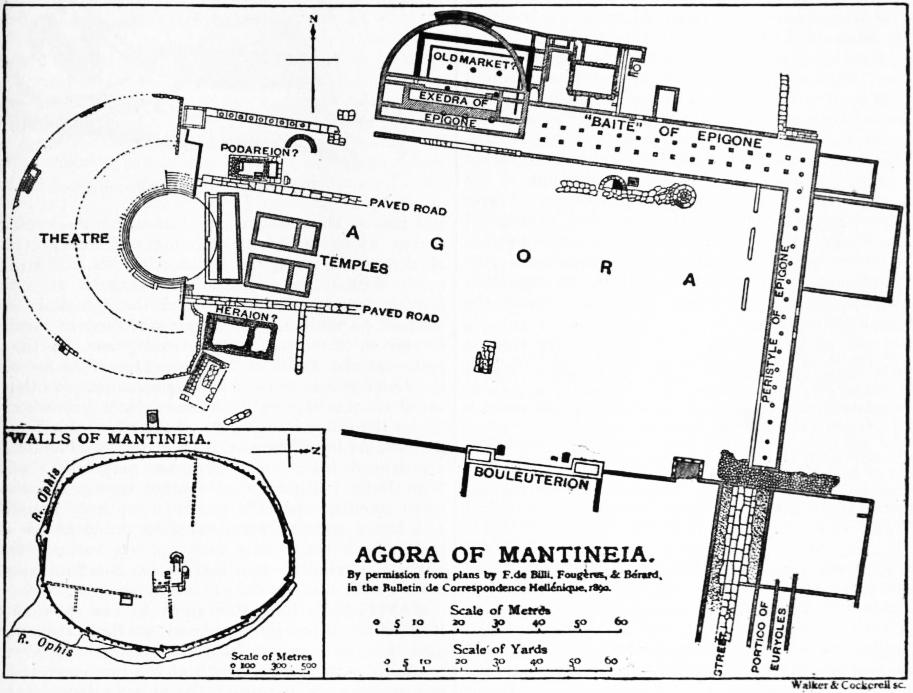
The site was excavated by M. Fougères, of the French School at Athens, in 1888. The plan of the agora and adjacent buildings has been recovered, and the walls have been completely investigated. The town was situated in an unusual position for a Greek city, on a flat marshy plain, and its walls form a regular ellipse about 2½ m. in circumference. When the town was first formed in 470 B.C. by the “synoecism” of the neighbouring villages, the river Ophis flowed through the midst of it, and the Spartan king Agesipolis dammed it up below the town and so flooded out the Mantineians and sapped their walls, which were of unbaked brick. Accordingly, when the city was rebuilt in 370 B.C., the river Ophis was divided into two branches, which between them encircled the walls; and the walls themselves were constructed to a height of about 3 to 6 feet of stone, the rest being of unbaked brick. These are the walls of which the remains are still extant. There are towers about every 80 ft.; and the gates are so arranged that the passage inwards usually runs from right to left, and so an attacking force would have to expose its right or shieldless side. Within the walls the most conspicuous landmark is the theatre, which, unlike the majority of Greek theatres, consists entirely of an artificial mound standing up from the level plain. Only about a quarter of its original height remains. Its scena is of rather irregular shape, and borders one of the narrow ends of the agora. Close to it are the foundations of several temples, one of them sacred to the hero Podaros. The agora is of unsymmetrical form; its sides are bordered by porticoes, interrupted by streets, like the primitive agora of Elis as described by Pausanias, and unlike the regular agoras of Ionic type. Most of these porticoes were of Roman period—the finest of them were erected, as we learn from inscriptions, by a lady named Epigone: one, which faced south, had a double colonnade, and was called the Βαίτη: close to it was a large exedra. The foundations of a square market-hall of earlier date were found beneath this. On the opposite side of the agora was an extensive Bouleuterion or senate-house. Traces remain of paved roads both within the agora and leading out of it; but the whole site is now a deserted and feverish swamp. The site is interesting for comparison with Megalopolis; the nature of its plan seems to imply that its main features must survive from the earlier “synoecism” a century before the time of Epaminondas.
See Strabo viii. 337; Pausanias viii. 8; Thucyd. iv. 134, v.; Xenophon, Hellenica, iv.-vii.; Diodorus xv. 85-87; Polybius ii. 57 sqq., vi. 43; D. Worenka, Mantineia (1905); B. V. Head, Historia numorum (Oxford, 1887), pp. 376-377; G. Fougères in Bulletin de correspondance hellénique (1890), id. Mantinée et l’Arcadie orientale (Paris, 1898). Consult also Tegea; Arcadia.
Five battles are recorded to have been fought near Mantineia; 418, 362 (see above), 295 (Demetrius Poliorcetes defeats Archidamus of Sparta), 242 (Aratus beats Agis of Sparta), 207 (Philopoemen beats Machanidas of Sparta). The battles of 362 and 207 are discussed at length by J. Kromayer, Antike Schtachtfelder in Griechenland (Berlin, 1903), 27-123, 281-314; Wiener Studien (1905), pp. 1-16.
(E. Gr.)
MANTIS, an insect belonging to the order Orthoptera. Probably no other insect has been the subject of so many and widespread legends and superstitions as the common “praying mantis,” Mantis religiosa, L. The ancient Greeks endowed it with supernatural powers (μάντις, a diviner); the Turks and Arabs hold that it prays constantly with its face turned towards Mecca; the Provençals call it Prega-Diou (Prie-Dieu); and numerous more or less similar names—preacher, saint, nun, mendicant, soothsayer, &c.—are widely diffused throughout southern Europe. In Nubia it is held in great esteem, and the Hottentots, if not indeed worshipping the local species (M. fausta), as one traveller has alleged, at least appear to regard its alighting upon any person both as a token of saintliness and an omen of good fortune.
Yet these are “not the saints but the tigers of the insect world.” The front pair of limbs are very peculiarly modified—the coxa being greatly elongated, while the strong third joint or femur bears on its curved underside a channel armed on each edge by strong movable spines. Into this groove the stout tibia is capable of closing like the blade of a pen-knife, its sharp, serrated edge being adapted to cut and hold. Thus armed, with head raised upon the much-elongated and semi-erect prothorax, and with the half-opened fore-limbs held outwards in the characteristic devotional attitude, it rests motionless upon the four posterior limbs waiting for prey, or occasionally stalks it with slow and silent movements, finally seizing it with its knife-blades and devouring it. Although apparently not daring to attack ants, these insects destroy great numbers of flies, grasshoppers and caterpillars, and the larger South-American species even attack small frogs, lizards and birds. They are very pugnacious, fencing with their sword-like limbs “like hussars with sabres,” the larger frequently devouring the smaller, and the females the males. The Chinese keep them in bamboo cages, and match them like fighting-cocks.
The common species fixes its somewhat nut-like egg capsules on the stems of plants in September. The young are hatched in early summer, and resemble the adults, but are without wings.
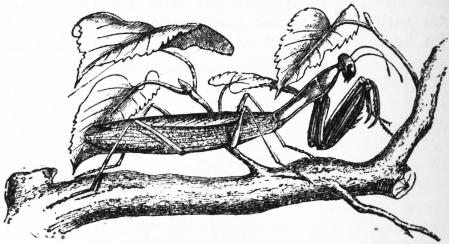
Praying Mantis (Mantis religiosa).
The green coloration and shape of the typical mantis are procryptic, serving to conceal the insect alike from its enemies and prey. The passage from leaf to flower simulation is but a step which, without interfering with the protective value of the coloration so far as insectivorous foes are concerned, carries with it the additional advantage of attracting flower-feeding insects within reach of the raptorial limbs. This method of allurement has been perfected in certain tropical species of Mantidae by the development on the prothorax and raptorial limbs of laminate expansions so coloured on the under side as to resemble papilionaceous or other blossoms, to which the likeness is enhanced by a gentle swaying kept up by the insect in imitation of the effect of a lightly blowing breeze. As instances of this may be cited Idalum diabolicum, an African insect, and Gongylus gongyloides, which comes from India. Examples of another species (Empusa eugena) when standing upon the ground deceptively imitate in shape and hue a greenish white anemone tinted at the edges with rose; and Bates records what appears to be a true case of aggressive mimicry practised by a Brazilian species which exactly resembles the white ants it preys upon.
MANTIS-FLY, the name given to neuropterous insects of the family Mantispidae, related to the ant-lions, lace-wing flies, &c., and named from their superficial resemblance to a Mantis owing to the length of the prothorax and the shape and prehensorial nature of the anterior legs. The larva, at first campodeiform, makes its way into the egg-case of a spider or the nest of a wasp to feed upon the eggs or young. Subsequently it changes into a fat grub with short legs. When full grown it spins a silken cocoon in which the transformation into the pupa is effected. The latter escapes from its double case before moulting into the mature insect.
MANTLE, a long flowing cloak without sleeves, worn by either sex. Particularly applied to the long robe worn over the armour by the men-at-arms of the middle ages, the name is still given to the robes of state of kings, peers, and the members of an order of knights. Thus the “electoral mantle” was a robe of office worn by the imperial electors, and the Teutonic knights were known as the orde alborum mantellorum from their white mantles. As an article of women’s dress a mantle now means a loose cloak or cape, of any length, and made of silk, velvet, or other rich material. The word is derived from the Latin mantellum or mantelum, a cloak, and is probably the same as, or another form of, mantelium or mantele, a table-napkin or table-cloth, from manus, hand, and tela, a cloth. A late Latin mantum, from which several Romance languages have taken words (cf. Ital. manto, and Fr. mante), must, as the New English Dictionary points out, be a “back-formation,” and this will explain the diminutive form of the Spanish mantilla. From the old French mantel came the English compounds “mantel-piece,” “mantel-shelf,” for the stone or wood beam which serves as a support for the structure above a fire-place, together with the whole framework, whether of wood, stone, &c., that acts as an ornament of the same (see Chimneypiece). The modern French form manteau is used in English chiefly as a dressmaker’s term for a woman’s mantle. “Mantua,” much used in the 18th century for a similar garment, is probably a corruption of manteau, due to silk or other materials coming from the Italian town of that name, and known by the trade name of “mantuas.” The Spanish mantilla is a covering for the head and shoulders of white or black lace or other material, the characteristic head-dress of women in southern and central Spain. It is occasionally seen in the other parts of Spain and Spanish countries, and also in Portugal.
“Mantle” is used in many transferred senses, all with the meaning of “covering,” as in zoology, for an enclosing sac or integument; thus it is applied to the “tunic” or layer of connective-tissue forming the body-wall of ascidians enclosing muscle-fibres, blood-sinuses and nerves (see Tunicata). The term is also used for a meshed cap of refractory oxides employed in systems of incandescent lighting (see Lighting). The verb is used for the creaming or frothing of liquids and of the suffusing of the skin with blood. In heraldry “mantling,” also known as “panache,” “lambrequin” or “contoise,” is an ornamental appendage to an escutcheon, of flowing drapery, forming a background (see Heraldry).
MANTON, THOMAS (1620-1677), English Nonconformist divine, was born at Laurence Lydiard, Somerset, in 1620, and was educated at Hart Hall, Oxford. Joseph Hall, bishop of Norwich, ordained him deacon: he never took priest’s orders, holding that “he was properly ordained to the ministerial office.” He was one of the clerks at the Westminster Assembly, one of Cromwell’s chaplains and a “trier,” and held livings at Stoke Newington (1645) and St Paul’s, Covent Garden (1656). He disapproved of the execution of Charles I. In 1658 he assisted Baxter to draw up the “Fundamentals of Religion.” He helped to restore Charles II. and became one of his chaplains, refusing the deanery of Rochester. In 1662 he lost his living under the Act of Uniformity and preached in his own rooms and in other parts of London. For this he was arrested in 1670.
His works are best known in the collected edition by J. C. Ryle (22 vols. 1870-1875).
MAN-TRAPS, mechanical devices for catching poachers and trespassers. They have taken many forms, the most usual being like a large rat-trap, the steel springs being armed with teeth which met in the victim’s leg. Since 1827 they have been illegal in England, except in houses between sunset and sunrise as a defence against burglars.
MANTUA (Ital. Mantova), a fortified city of Lombardy, Italy, the capital of the province of Mantua, the see of a bishop, and the centre of a military district, 25 m. S.S.W. of Verona and 100 m. E.S.E. of Milan by rail. Pop. (1906), 31,783. It is situated 88 ft. above the level of the Adriatic on an almost insular site in the midst of the swampy lagoons of the Mincio. As the belt of marshy ground along the south side can be laid under water at pleasure, the site of the city proper, exclusive of the considerable suburbs of Borgo di Fortezza to the north and Borgo di San Giorgio to the east, may still be said to consist, as it formerly did more distinctly, of two islands separated by a narrow channel and united by a number of bridges. On the west side lies Lago Superiore, on the east side Lago Inferiore—the boundary between the two being marked by the Argine del Mulino, a long mole stretching northward from the north-west angle of the city to the citadel.
On the highest ground in the city rises the cathedral, the interior of which was built after his death according to the plans of Giulio Romano; it has double aisles, a fine fretted ceiling, a dome-covered transept, a bad baroque façade, and a large unfinished Romanesque tower. Much more important architecturally is the church of St Andrea, built towards the close of the 15th century, after plans by Leon Battista Alberti, and consisting of a single, barrel-vaulted nave 350 ft. long by 62 ft. wide. It has a noble façade with a deeply recessed portico, and a brick campanile of 1414. The interior is decorated with 18th-century frescoes, to which period the dome also belongs. Mantegna is buried in one of the side chapels. S. Sebastiano is another work of Alberti’s. The old ducal palace—one of the largest buildings of its kind in Europe—was begun in 1302 for Guido Bonaccolsi, and probably completed in 1328 for Ludovico Gonzaga; but many of the accessory apartments are of much later date, and the internal decorations are for the most part the work of Giulio Romano and his pupils. There are also some fine rooms of the early 19th century. Close by are the Piazza dell’ Erbe and the Piazza Sordello, with Gothic palaces. The Castello di Corte here, the old castle of the Gonzagas (1395-1406), erected by Bartolino da Novara, the architect of the castle of Ferrara, now contains the archives, and has some fine frescoes by Mantegna with scenes from the life of Ludovico Gonzaga. Outside of the city, to the south of Porta Pusterla, stands the Palazzo del Te, Giulio’s architectural masterpiece, erected for Frederick Gonzaga in 1523-1535; of the numerous fresco-covered chambers which it contains, perhaps the most celebrated is the Sala dei Giganti, where, by a combination of mechanical with artistic devices, the rout of the Titans still contending with artillery of uptorn rocks against the pursuit and thunderbolts of Jove appears to rush downwards on the spectator. The architecture of Giulio’s own house in the town is also good.
Mantua has an academy of arts and sciences (Accademia Vergiliana), occupying a fine building erected by Piermarini, a public library founded in 1780 by Maria Theresa, a museum of antiquities dating from 1779, many of which have been brought from Sabbioneta, a small residence town of the Gonzagas in the late 16th century, a mineralogical museum, a good botanical garden, and an observatory. There are ironworks, tanneries, breweries, oil-mills and flour-mills in the town, which also has printing, furriery, doll-making and playing-card industries. As a fortress Mantua was long one of the most formidable in Europe, a force of thirty to forty thousand men finding accommodation within its walls; but it had two serious defects—the marshy climate told heavily on the health of the garrison, and effective sorties were almost impossible. It lies on the main line of railway between Verona and Modena; and is also connected by rail with Cremona and with Monselice, on the line from Padua to Bologna, and by steam tramway with Brescia and other places.
S. Maria delle Grazie, standing some 5 m. outside the town, was consecrated in 1399 as an act of thanksgiving for the cessation of the plague, and has a curious collection of ex voto pictures (wax figures), and also the tombs of the Gonzaga family.
Mantua had still a strong Etruscan element in its population during the Roman period. It became a Roman municipium, with the rest of Gallia Transpadana; but Martial calls it little Mantua, and had it not been for Virgil’s interest in his native place, and in the expulsion of a number of the Mantuans (and among them the poet himself) from their lands in favour of Octavian’s soldiers, we should probably have heard almost nothing of its existence. In 568 the Lombards found Mantua a walled town of some strength; recovered from their grasp in 590 by the exarch of Ravenna, it was again captured by Agilulf in 601. The 9th century was the period of episcopal supremacy, and in the 11th the city formed part of the vast possessions of Bonifacio, marquis of Canossa. From him it passed to Geoffrey, duke of Lorraine, and afterwards to the countess Matilda, whose support of the pope led to the conquest of Mantua by the emperor Henry IV. in 1090. Reduced to obedience by Matilda in 1113, the city obtained its liberty on her death, and instituted a communal government of its own, salva imperiali justitia. It afterwards joined the Lombard League; and the unsuccessful attack made by Frederick II. in 1236 brought it a confirmation of its privileges. But after a period of internal discord Ludovico Gonzaga attained to power (1328), and was recognized as imperial vicar (1329); and from that time till the death of Ferdinando Carbo in 1708 the Gonzagas were masters of Mantua (see Gonzaga). Under Gian Francesco II., the first marquis, Ludovico III., Gian Francesco III. (whose wife was Isabella d’Este), and Federico II., the first duke of Mantua, the city rose rapidly into importance as a seat of industry and culture. It was stormed and sacked by the Austrians in 1630, and never quite recovered. Claimed in 1708 as a fief of the empire by Joseph I., it was governed for the greater part of the century by the Austrians. In June 1796 it was besieged by Napoleon; but in spite of terrific bombardments it held out till February 1797. A three days’ bombardment in 1799 again placed Mantua in the hands of the Austrians; and, though restored to the French by the peace of Lunéville (1801), it became Austrian once more from 1814 till 1866. Between 1849 and 1859, when the whole of Lombardy except Mantua was, by the peace of Villafranca, ceded to Italy, the city was the scene of violent political persecution.
See Gaet. Susani, Nuovo prospetto delle pitture, &c., di Mantova (Mantua, 1830); Carlo d’Arco, Delle arti e degli artefici di Mantova (Mantua, 1857); and Storia di Mantova (Mantua, 1874).
MANU (Sanskrit, “man”), in Hindu mythology, the first man, ancestor of the world. In the Satapatha-Brahmana he is represented as a holy man, the chief figure in a flood-myth. Warned by a fish of the impending disaster he built a ship, and when the waters rose was dragged by the fish, which he harnessed to his craft, beyond the northern mountains. When the deluge ceased, a daughter was miraculously born to him and this pair became the ancestors of the human race. In the later scriptures the fish is declared an incarnation of Brahma. See Sanskrit Literature; Indian Law (Hindu).
MANUAL, i.e. belonging to the hand (Lat. manus), a word chiefly used to describe an occupation which employs the hands, as opposed to that which chiefly or entirely employs the mind. Particular uses of the word are: “sign-manual,” a signature or autograph, especially one affixed to a state document; “manual-exercise,” in military usage, drill in the handling of the rifle; “manual alphabet,” the formation of the letters of the alphabet by the fingers of one or both hands for communication with the deaf and dumb; and “manual acts,” the breaking of the bread, and the taking of the cup in the hands by the officiating priest in consecrating the elements during the celebration of the Eucharist. The use of the word for tools and implements to be used by the hand, as distinct from machinery, only survives in the “manual fire-engine.” From the late Latin use of manuale as a substantive, meaning “handbook,” comes the use of the word for a book treating a subject in a concise way, but more particularly of a book of offices, containing the forms to be used in the administration of the sacraments other than the Mass, but including communion out of the Mass, also the forms for churching, burials, &c. In the Roman Church such a book is usually called a rituale, “manual” being the name given to it in the English Church before the Reformation. The keyboard of an organ, as played by the hands, is called the “manual,” in distinction from the “pedal” keys played by the feet.
MANUCODE, from the French, an abbreviation of Manucodiata, and the Latinized form of the Malay Manukdewata, meaning, says Crawfurd (Malay and Engl. Dictionary, p. 97), the “bird of the gods,” and a name applied for more than two hundred years apparently to birds-of-paradise in general. In the original sense of its inventor, Montbeillard (Hist. nat. oiseaux, iii. 163), Manucode was restricted to the king bird-of-paradise and three allied species; but in English it has curiously been transferred1 to a small group of species whose relationship to the Paradiseidae has been frequently doubted, and must be considered uncertain. These manucodes have a glossy steel-blue plumage of much beauty, but are distinguished from other birds of similar coloration by the outer and middle toes being united for some distance, and by the extraordinary convolution of the trachea, in the males at least, with which is correlated the loud and clear voice of the birds. The convoluted portion of the trachea lies on the breast, between the skin and the muscles, much as is found in the females of the painted snipes (Rostratula), in the males of the curassows (Cracidae), and in a few other birds, but wholly unknown elsewhere among the Passeres. The manucodes are peculiar to the Papuan sub-region (including therein the peninsula of Cape York), and comprehend, according to R. B. Sharpe (Cat. B. Brit. Museum, iii. 164), two genera, for the first of which, distinguished by the elongated tufts on the head, he adopts R. P. Lesson’s name Phonygama, and for the second, having no tufts, but the feathers of the head crisped, that of Manucodia; and W. A. Forbes (Proc. Zool. Soc. 1882, p. 349) observed that the validity of the separation was confirmed by their tracheal formation. Of Phonygama Sharpe recognizes three species, P. keraudreni (the type) and P. jamesi, both from New Guinea, and P. gouldi, the Australian representative species; but the first two are considered by D. G. Elliot (Ibis. 1878, p. 56) and Count Salvadori (Ornitol. della Papuasia, ii. 510) to be inseparable. There is a greater unanimity in regard to the species of the so-called genus Manucodia proper, of which four are admitted—M. chalybeata or chalybea from north-western New Guinea, M. comriei from the south-eastern part of the same country, M. atra of wide distribution within the Papuan area, and M. jobiensis peculiar to the island which gives it a name. Little is known of the habits of these birds, except that they are, as already mentioned, remarkable for their vocal powers, which, in P. keraudreni, Lesson describes (Voy. de la Coquille, “Zoologie,” i. 638) as enabling them to pass through every note of the gamut.
(A. N.)
1 Manucodiata was used by M. J. Brisson (Ornithologie, ii. 130) as a generic term equivalent to the Linnaean Paradisea. In 1783 Boddaert, when assigning scientific names to the birds figured by Daubenton, called the subject of one of them (Pl. enlum. 634) Manucodia chalybea, the first word being apparently an accidental curtailment of the name of Brisson’s genus to which he referred it. Nevertheless some writers have taken it as evidence of an intention to found a new genus by that name, and hence the importation of Manucodia into scientific nomenclature, and the English form to correspond.
MANUEL I., COMNENUS (c. 1120-1180), Byzantine emperor (1143-1180), the fourth son of John II., was born about 1120. Having distinguished himself in his father’s Turkish war, he was nominated emperor in preference to his elder surviving brother. Endowed with a fine physique and great personal courage, he devoted himself whole-heartedly to a military career. He endeavoured to restore by force of arms the predominance of the Byzantine empire in the Mediterranean countries, and so was involved in conflict with his neighbours on all sides. In 1144 he brought back Raymond of Antioch to his allegiance, and in the following year drove the Turks out of Isauria. In 1147 he granted a passage through his dominions to two armies of crusaders under Conrad III. of Germany and Louis VII. of France; but the numerous outbreaks of overt or secret hostility between the Franks and the Greeks on their line of march, for which both sides were to blame, nearly precipitated a conflict between Manuel and his guests. In the same year the emperor made war upon Roger of Sicily, whose fleet captured Corfu and plundered the Greek towns, but in 1148 was defeated with the help of the Venetians. In 1149 Manuel recovered Corfu and prepared to take the offensive against the Normans. With an army mainly composed of mercenary Italians he invaded Sicily and Apulia, and although the progress of both these expeditions was arrested by defeats on land and sea, Manuel maintained a foothold in southern Italy, which was secured to him by a peace in 1155, and continued to interfere in Italian politics. In his endeavour to weaken the control of Venice over the trade of his empire he made treaties with Pisa and Genoa; to check the aspirations of Frederic I. of Germany he supported the free Italian cities with his gold and negotiated with pope Alexander III. In spite of his friendliness towards the Roman church Manuel was refused the title of “Augustus” by Alexander, and he nowhere succeeded in attaching the Italians permanently to his interests. None the less in a war with the Venetians (1172-74), he not only held his ground in Italy but drove his enemies out of the Aegean Sea. On his northern frontier Manuel reduced the rebellious Serbs to vassalage (1150-52) and made repeated attacks upon the Hungarians with a view to annexing their territory along the Save. In the wars of 1151-53 and 1163-68 he led his troops into Hungary but failed to maintain himself there; in 1168, however, a decisive victory near Semlin enabled him to conclude a peace by which Dalmatia and other frontier strips were ceded to him. In 1169 he sent a joint expedition with King Amalric of Jerusalem to Egypt, which retired after an ineffectual attempt to capture Damietta. In 1158-59 he fought with success against Raymond of Antioch and the Turks of Iconium, but in later wars against the latter he made no headway. In 1176 he was decisively beaten by them in the pass of Myriokephalon, where he allowed himself to be surprised in line of march. This disaster, though partly retrieved in the campaign of the following year, had a serious effect upon his vitality; henceforth he declined in health and in 1180 succumbed to a slow fever.
In spite of his military prowess Manuel achieved but in a slight degree his object of restoring the East Roman empire. His victories were counterbalanced by numerous defeats, sustained by his subordinates, and his lack of statesmanlike talent prevented his securing the loyalty of his subjects. The expense of keeping up his mercenary establishment and the sumptuous magnificence of his court put a severe strain upon the financial resources of the state. The subsequent rapid collapse of the Byzantine empire was largely due to his brilliant but unproductive reign. Manuel married, firstly, a sister-in-law of Conrad III. of Germany; and secondly, a daughter of Raymond of Antioch. His successor, Alexis II., was a son of the latter.
See John Cinnamus, History of John and Manuel (ed. 1836, Bonn); E. Gibbon, The Decline and Fall of the Roman Empire (ed. Bury, London, 1896), v. 229 sqq., vi. 214 sqq.; G. Finlay, History of Greece (ed. 1877, Oxford), iii. 143-197; H. v. Kap-Herr, Die abendländische Politik Kaiser Manuels (Strassburg, 1881).
(M. O. B. C.)
MANUEL II. PALAEOLOGUS (1350-1425), Byzantine emperor from 1391 to 1425, was born in 1350. At the time of his father’s death he was a hostage at the court of Bayezid at Brusa, but succeeded in making his escape; he was forthwith besieged in Constantinople by the sultan, whose victory over the Christians at Nicopolis, however (Sept. 28, 1396), did not secure for him the capital. Manuel subsequently set out in person to seek help from the West, and for this purpose visited Italy, France, Germany and England, but without material success; the victory of Timur in 1402, and the death of Bayezid in the following year were the first events to give him a genuine respite from Ottoman oppression. He stood on friendly terms with Mahommed I., but was again besieged in his capital by Murad II. in 1422. Shortly before his death he was forced to sign an agreement whereby the Byzantine empire undertook to pay tribute to the sultan.
Manuel was the author of numerous works of varied character—theological, rhetorical, poetical and letters. Most of these are printed in Migne, Patrologia graeca, clvi.; the letters have been edited by E. Legrand (1893). There is a special monograph, by B. de Xivrey (in Mémoires de l’Institut de France, xix. (1853), highly commended by C. Krumbacher, whose Geschichte der byzantinischen Litteratur (1897) should also be consulted.
MANUEL I. (d. 1263), emperor of Trebizond, surnamed the Great Captain (ὁ στρατηγικώτατος), was the second son of Alexius I., first emperor of Trebizond, and ruled from 1228 to 1263. He was unable to deliver his empire from vassalage, first to the Seljuks and afterwards to the Mongols. He vainly negotiated for a dynastic alliance with the Franks, by which he hoped to secure the help of Crusaders.
Manuel II., the descendant of Manuel I., reigned only a few months in 1332-1333. Manuel III. reigned from 1390 to 1417, but the only interest attaching to his name arises from his connexion with Timur, whose vassal he became without resistance.
See G. Finlay, History of Greece (ed. 1877, Oxford), iv. 338-340, 340-341, 386; Ph. Fallmerayer, Geschichte des Kaisertums Trapezunt (Munich, 1827), i. chs. 8, 14, ii. chs. 4, 5; T. E. Evangelides, Ἱστορία τῆς Τραπεζοῦντος (Odessa, 1898), 71-73, 87-88, 126-132.
MANUEL, EUGENE (1823-1901), French poet and man of letters, was born in Paris, the son of a Jewish doctor, on the 13th of July 1823. He was educated at the École Normale, and taught rhetoric for some years in provincial schools and then in Paris. In 1870 he entered the department of public instruction, and in 1878 became inspector-general. His works include: Pages intimes (1866), which received a prize from the Academy; Poèmes populaires (1874); Pendant la guerre (1871), patriotic poems, which were forbidden in Alsace-Lorraine by the German authorities; En voyage (1881), poems; La France (4 vols., 1854-1858); a school-book written in collaboration with his brother-in-law, Lévi Alavarès; Les Ouvriers (1870), a drama dealing with social questions, which was crowned by the Academy; L’Absent (1873), a comedy; Poésies du foyer et de l’école (1889), and editions of the works of J. B. Rousseau (1852) and André Chénier (1884). He died in Paris in 1901.
His Poésies complètes (2 vols., 1899) contained some fresh poems; to his Mélanges en prose (Paris, 1905) is prefixed an introductory note by A. Cahen.
MANUEL, JACQUES ANTOINE (1775-1827), French politician and orator, was born on the 10th of December 1775. When seventeen years old he entered the army, which he left in 1797 to become a lawyer. In 1814 he was chosen a member of the chamber of representatives, and in 1815 he urged the claim of Napoleon’s son to the French throne and protested against the restoration of the Bourbons. After this event be actively opposed the government, his eloquence making him the foremost orator among the members of the Left. In February 1823 his opposition to the proposed expedition into Spain to help Ferdinand VII. against his rebellious subjects produced a tumult in the Assembly. Manuel was expelled, but he refused to accept this sentence, and force was employed to remove him. He died on the 20th of August 1827.
MANUEL, LOUIS PIERRE (1751-1793), French writer and Revolutionist, was born at Montargis (Loiret). He entered the Congregation of the Christian Doctrine, and became tutor to the son of a Paris banker. In 1783 he published a pamphlet, called Essais historiques, critiques, littéraires, et philosophiques, for which he was imprisoned in the Bastille. He embraced the revolutionary ideas, and after the taking of the Bastille became a member of the provisional municipality of Paris. He was one of the leaders of the émeutes of the 20th of June and the 10th of August 1792, played an important part in the formation of the revolutionary commune which assured the success of the latter coup, and was made procureur of the commune. He was present at the September massacres and saved several prisoners, and on the 7th of September 1792 was elected one of the deputies from Paris to the convention, where he was one of the promoters of the proclamation of the republic. He suppressed the decoration of the Cross of St Louis, which he called a stain on a man’s coat, and demanded the sale of the palace of Versailles. His missions to the king, however, changed his sentiments; he became reconciled to Louis, courageously refused to vote for the death of the sovereign, and had to tender his resignation as deputy. He retired to Montargis, where he was arrested, and was guillotined in Paris on the 17th of November 1793. Besides the work cited above and his political pamphlets, he was the author of Coup d’œil philosophique sur le règne de St Louis (1786); L’Année française (1788); La Bastille dévoilée (1789); La Police de Paris dévoilée (1791); and Lettres sur la Révolution (1792). In 1792 he was prosecuted for publishing an edition of the Lettres de Mirabeau à Sophie, but was acquitted.
MANUEL DE MELLO, DOM FRANCISCO (? 1611-1666), Portuguese writer, a connexion on his father’s side of the royal house of Braganza, was a native of Lisbon. He studied the Humanities at the Jesuit College of S. Antão, where he showed a precocious talent, and tradition says that at the age of fourteen he composed a poem in ottava rima to celebrate the recovery of Bahia from the Dutch, while at seventeen he wrote a scientific work, Concordancias mathematicas. The death of his father, Dom Luiz de Mello, drove him early to soldiering, and having joined a contingent for the Flanders war, he found himself in the historic storm of January 1627, when the pick of the Portuguese fleet suffered shipwreck in the Bay of Biscay. He spent much of the next ten years of his life in military routine work in the Peninsula, varied by visits to the court of Madrid, where he contracted a friendship with the Spanish poet Quevedo and earned the favour of the powerful minister Olivares. In 1637 the latter despatched him in company with the conde de Linhares on a mission to pacify the revolted city of Evora, and on the same occasion the duke of Braganza, afterwards King John IV. (for whom he acted as confidential agent at Madrid), employed him to satisfy King Philip of his loyalty to the Spanish crown. In the following year he suffered a short imprisonment in Lisbon. In 1639 he was appointed colonel of one of the regiments raised for service in Flanders, and in June that year he took a leading part in defending Corunna against a French fleet commanded by the archbishop of Bordeaux, while in the following August he directed the embarcation of an expeditionary force of 10,000 men when Admiral Oquendo sailed with seventy ships to meet the French and Dutch. He came safely through the naval defeat in the channel suffered by the Spaniards at the hands of Van Tromp, and on the outbreak of the Catalonian rebellion became chief of the staff to the commander-in-chief of the royal forces, and was selected to write an account of the campaign, the Historia de la guerra de Cataluña, which became a Spanish classic. On the proclamation of Portuguese independence in 1640 he was imprisoned by order of Olivares, and when released hastened to offer his sword to John IV. He travelled to England, where he spent some time at the court of Charles I., and thence passing over to Holland assisted the Portuguese ambassador to equip a fleet in aid of Portugal, and himself brought it safely to Lisbon in October 1641. For the next three years he was employed in various important military commissions and further busied himself in defending by his pen the king’s title to his newly acquired throne. An intrigue with the beautiful countess of Villa Nova, and her husband’s jealousy, led to his arrest on the 19th of November 1644 on a false charge of assassination, and he lay in prison about nine years. Though his innocence was clear, the court of his Order, that of Christ, influenced by his enemies, deprived him of his commenda and sentenced him to perpetual banishment in India with a heavy money fine, and the king would not intervene to save him. Owing perhaps to the intercession of the queen regent of France and other powerful friends, his sentence was finally commuted into one of exile to Brazil. During his long imprisonment he finished and printed his history of the Catalonian War, and also wrote and published a volume of Spanish verses and some religious treatises, and composed in Portuguese a volume of homely philosophy, the Carta de Guia de Casados and a Memorial in his own defence to the king, which Herculano considered “perhaps the most eloquent piece of reasoning in the language.” During his exile in Brazil, whither he sailed on the 17th of April 1655, he lived at Bahia, where he wrote one of his Epanaphoras de varia historia and two parts of his masterpiece, the Apologos dialogaes. He returned home in 1659, and from then until 1663 we find him on and off in Lisbon, frequenting the celebrated Academia dos Generosos, of which he was five times elected president. In the last year he proceeded to Parma and Rome, by way of England, and France, and Alphonso VI. charged him to negotiate with the Curia about the provision of bishops for Portuguese sees and to report on suitable marriages for the king and his brother. During his stay in Rome he published his Obras morales, dedicated to Queen Catherine, wife of Charles II. of England, and his Cartas familiares. On his way back to Portugal he printed his Obras metricas at Lyons in May 1665, and he died in Lisbon the following year.
Manuel de Mello’s early Spanish verses are tainted with Gongorism, but his Portuguese sonnets and cartas on moral subjects are notable for their power, sincerity and perfection of form. He strove successfully to emancipate himself from foreign faults of style, and by virtue of his native genius, and his knowledge of the traditional poetry of the people, and the best Quinhentista models, he became Portugal’s leading lyric poet and prose writer of the 17th century. As with Camoens, imprisonments and exile contributed to make Manuel de Mello a great writer. His Letters, addressed to the leading nobles, ecclesiastics, diplomats and literati of the time, are written in a conversational style, lighted up by flashes of wit and enriched with apposite illustrations and quotations. His commerce with the best authors appears in the Hospital das lettras, a brilliant chapter of criticism forming part of the Apologos dialogaes. His comedy in redondilhas, the Auto do Fidalgo Aprendiz, is one of the last and quite the worthiest production of the school of Gil Vicente, and may be considered an anticipation of Molière’s Le Bourgeois gentilhomme.
There is no uniform edition of his works, but a list of them will be found in his Obras morales, and the various editions are set out in Innocencio da Silva’s Diccionario bibliographico portugues. See Dom Francisco Manuel de Mello, his Life and Writings, by Edgar Prestage (Manchester, 1905), “D. Francisco Manuel de Mello, documentos biographicos” and “D. Francisco Manuel de Mello, obras autographas e ineditas,” by the same writer, in the Archivo historico portuguez for 1909. Manuel de Mello’s prose style is considered at length by G. Cirot in Mariana historien (Bordeaux, 1905). pp. 378 seq.
(E. Pr.)
MANUL (Felis manul), a long-haired small wild cat from the deserts of Central Asia, ranging from Tibet to Siberia. The coat is long and soft, pale silvery grey or light buff in hue, marked with black on the chest and upper parts of the limbs, with transverse stripes on the loins and rings on the tail of the same hue. The Manul preys upon small mammals and birds. A separate generic name, Trichaelurus, has been proposed for this species by Dr K. Satunin.
MANURES and MANURING. The term “manure” originally meant that which was “worked by hand” (Fr. manœuvre), but gradually came to apply to any process by which the soil could be improved. Prominent among such processes was that of directly applying “manure” to the land, manure in this sense being what we now call “farmyard manure” or “dung,” the excreta of farm animals mixed with straw or other litter. Gradually, however, the use of the term spread to other materials, some of home origin, some imported, some manufactured by artificial processes, but all useful as a means of improving the fertility of the soil. Hence we have two main classes of manures: (a) what may be termed “natural manures,” and (b) “artificial manures.” Manures, again, may be divided according to the materials from which they are made—e.g. “bone manure,” “fish manure,” “wool manure,” &c.; or according to the constituents which they mainly supply—e.g. “phosphatic manures,” “potash manures,” “nitrogenous manures,” or there may be numerous combinations of these to form mixed or “compound” manures. Whatever it be, the word “manure” is now generally applied to anything which is used for fertilizing the soil. In America the term “fertilizers” is more generally adopted, and in Great Britain the introduction of the “Fertilizers and Feeding Stuffs Act” has effected a certain amount of change in the same direction. The modern tendency to turn attention less to the consideration of manurial applications given to land and more to the physical and mechanical changes introduced thereby in the soil itself, would seem to be carrying the word “manure” back more to its original meaning.
The subject of manures and their application involves a prior consideration of plant life and its requirements. The plant, growing in the soil, and surrounded by the atmosphere, derives from these two sources its nourishment and means of growth through the various stages of its development.
Chemical analysis has shown that plants are composed of water, organic or combustible matters, and inorganic or mineral matters. Water constitutes by far the greater part of a living plant; a grass crop will contain about 75% of water, a turnip crop 89 or 90%. The organic or combustible matters are those which are lost, along with the water, when the plant is burnt; the inorganic or mineral matters are those which are left behind as an “ash” after the burning. The combustible matter is composed of six elements: carbon, hydrogen, oxygen, nitrogen, sulphur and a little phosphorus. About one-half of the combustible matter of plants is carbon. Along with hydrogen and oxygen the carbon forms the cellulose, starch, sugar, &c., which plants contain, and with these same elements and sulphur the carbon forms the albuminoids of plants. The inorganic or mineral matters comprise a comparatively small part of the plant, but they contain, as essential constituents of plant life, the following elements: potassium, calcium, magnesium, iron, phosphorus and sulphur. In addition, other, but not essential, elements are found in the ash e.g. sodium, silicon and chlorine, together with small quantities of manganese and other rarer elements.
The above constituents that have been classed as “essential,” are necessary for the growth of the plant, and absence of any one will involve failure. This has been shown by growing plants in water dissolved in which are salts of the elements present in plants. By omitting in turn one or other of the elements aforesaid it is found that the plants will not grow after they have used up the materials contained in the seed itself. These elements are accordingly termed “essential,” and it therefore becomes necessary to inquire how they are to be supplied.
The atmosphere is the great storehouse of organic plant food. The leaves take up, through their stomata, the carbonic acid and other gases of the atmosphere. The carbonic acid, under the influence of light, is decomposed in the chlorophyll cells, oxygen is given off and carbon is assimilated, being subsequently built up into the various organic bodies forming the plant’s structure. It would seem, too, that plants can take up a small quantity of ammonia by their leaves, and also water to some extent, but the free or uncombined nitrogen of the air cannot be directly assimilated by the leaves of plants.
From the soil, on the other hand, the plant obtains, by means of its roots, its mineral requirements, also sulphur and phosphorus, and nearly all its nitrogen and water. Carbon, too, in the case of fungi, is obtained from the decayed vegetable matter in the soil. The roots are able not only to take up soluble salts that are presented to them, but they can attack and render soluble the solid constituents of the soil, thus transforming them into available plant food. In this way important substances, such as phosphoric acid and potash, are supplied to the plant, as also lime. Roots can further supply themselves with nitrogen in the form of nitrates, the ammonia and other nitrogenous bodies undergoing ready conversion into nitrates in the soil. These various mineral constituents, being now transferred to the plant, go to form new tissue, and ultimately seed, or else accumulate in the sap and are deposited on the older tissue.
Whether the nitrogen of the air can be utilized by plants or not has been long and strenuously discussed, Boussingault first, and then Lawes, Gilbert and Pugh, maintaining that there was no evidence of this utilization. But it was always recognized that certain plants, clover for example, enriched the land with nitrogen to an extent greater than could be accounted for by the mere supply to them of nitrates in the soil. Ultimately Hellriegel supplied the explanation by showing that, at all events, certain of the Leguminosae, by the medium of swellings or “nodules” on their roots, were able to fix the atmospheric nitrogen in the soil, and to convert it into nitrates for the use of the plant. This was found to be the result of the action of certain organisms within the nodules themselves, which in turn fed upon the carbohydrates of the plant and were thus living in a state of “symbiosis” with it. So far, however, this has not been shown to be the case with any other plants than the Leguminosae, and, though it is asserted by some that many other plants can take up the nitrogen of the air directly through their leaves, there is no clear evidence as yet of this.
We must now consider how the different requirements of the plant in regard to the elements necessary to maintain its life and to build up its structure affect the question of manuring.
Under conditions of natural growth and decay, when no crops are gathered in, or consumed on the land by live stock, the herbage, on dying down and decaying, returns to the atmosphere and the soil the elements taken from them during life; but, under cultivation, a succession of crops deprives the land of the constituents which are essential to healthy and luxuriant growth. Without an adequate return to the land of the matters removed in the produce, its fertility cannot be maintained for many years. In newly opened countries, where old forests have been cleared and the land brought under cultivation, the virgin soil often possesses at first a high degree of fertility, but gradually its productive power decreases from year to year. Where land is plentiful and easy to be obtained it is more convenient to clear fresh forest land than to improve more or less exhausted land by the application of manure, labour and skill. But in all densely peopled countries, and where the former mode of cultivation cannot be followed, it is necessary to resort to artificial means to restore the natural fertility of the land and to maintain and increase its productiveness. That continuous cropping without return of manure ends in deterioration of the soil is well seen in the case of the wheat-growing areas in America. Crops of wheat were taken one after another, the straw was burned and nothing was returned to the land; the produce began to fall off and the cultivators moved on to fresh lands, there to meet, in time, with the same experience; and now that the available land has been more or less intensely occupied, or that new land is too far removed for ready transport of the produce, it has been found necessary to introduce the system of manuring, and America now manufactures and uses for herself large quantities of artificial and other manures.
That the same exhaustion of soil would go on in Great Britain, if unchecked by manuring, is known to every practical farmer, and, if evidence were needed, it is supplied by the renowned Rothamsted experiments of Lawes and Gilbert, on a heavy land, and also by the more recent Woburn experiments of the Royal Agricultural Society of England, conducted on a light sandy soil. The following table will illustrate this point, and show also how under a system of manuring the fertility is maintained:—
Table 1.—Showing Exhaustion of Land by continuous Cropping without Manure, and the maintenance of fertility through manuring. (Rothamsted 50 years; Woburn 30 years.)
1. Rothamsted (heavy land).
Crop. Plot. Treatment Average yield of corn per acre.
8 years, 1844-1851. 10 years, 1852-1861. 10 years, 1862-1871. 10 years, 1872-1881. 10 years, 1882-1891. 10 years, 1892-1901. Average of 50 years, 1852-1901.
Bush. Bush. Bush. Bush. Bush. Bush. Bush.
Wheat 3 Unmanured continuously 17.2 15.9 14.5 10.4 12.6 12.3 43.1
2 Farm-yard manure yearly 28.0 34.2 37.5 28.7 38.2 39.2 35.6
Barley 7-2 Unmanured continuously — 22.4 17.5 13.7 12.7 10.0 15.3
1-0 Farm-yard manure yearly — 45.0 51.5 50.2 47.6 44.3 47.7
2. Woburn (light land).
Crop. Plot. Treatment. Average yield of corn per acre.
10 years, 1877-1886. 10 years, 1887-1896. 10 years, 1897-1906. Average of 30 years, 1877-1906.
Bush. Bush. Bush. Bush.
Wheat 7 Unmanured continuously 17.4 14.5 10.8 14.2
11b Farm-yard manure yearly 26.7 27.8 24.0 26.2
Barley 7 Unmanured continuously 23.0 18.1 13.3 18.1
11b Farm-yard manure yearly 40.0 39.9 36.6 38.8
Whereas on the heavier and richer land of Rothamsted the produce of unmanured wheat has fallen in 58 years from 17.2 bushels to 12.3 bushels, on the lighter and poorer soil of Woburn it has fallen in 30 years from 17.4 bushels to 10.8 bushels; barley has in 50 years at Rothamsted gone from 22.4 bushels to 10 bushels, whilst at Woburn (which is better suited for barley) it has fallen in 30 years from 23 bushels to 13.3 bushels. At both Rothamsted and Woburn the application of farm-yard manure has kept the produce of wheat and barley practically up to what it was at the beginning, or even increased it. Similar conclusions can be drawn from the use of artificial manures at each of the experimental stations named, exemplifying the fact that with suitable manuring crops of wheat or barley can be grown years after year without the land undergoing deterioration, whereas if left unmanured it gradually declines in fertility. Practical proof has further been given of this in the well-known “continuous corn-growing” system pursued, in his regular farming, by Mr John Prout of Sawbridgeworth, Herts, and subsequently by his son, Mr W. A. Prout, since the year 1862. By supplying, in the form of artificial manures, the necessary constituents for his crops, Mr Prout was enabled to grow year after year, with only an occasional interval for a clover crop and to allow of cleaning the land, excellent crops of wheat, barley and oats, and without, it may be added, the use of farm-yard manure at all.
In considering the economical use of manures on the land regard must be had to the following points: (1) the requirements of the crops intended to be cultivated; (2) the physical condition of the soil; (3) the chemical composition of the soil; and (4) the composition of the manure. Briefly stated, the guiding principle of manuring economically and profitably is to meet the requirements of the crops intended to be cultivated, by incorporating with the soil, in the most efficacious states of combination, the materials in which it is deficient, or which the various crops usually grown on the farm do not find in the land in a sufficiently available condition to ensure an abundant harvest. Soils vary greatly in composition, and hence it will be readily understood that in one locality or on one particular field a certain manure may be used with great benefit, while in another field the same manure has little or no effect upon the produce.
For plant life to thrive certain elements are necessary, viz. carbon, hydrogen, oxygen, nitrogen, sulphur, phosphorus, among the organic or combustible matters, and among the inorganic or mineral matters, potassium, calcium, magnesium, iron, phosphorus and sulphur. We must now examine the extent to which these necessary elements occur in either of the two great storehouses, the atmosphere and the soil, and how their removal in the form of crops may be made up for by the use of manures, so that the soil may be maintained in a state of fertility. Further, we must consider what functions these elements perform in regard to plant life, and, lastly, the forms in which they can best be applied for the use of crops.
Of carbon, hydrogen and oxygen there is no lack, the atmosphere providing carbonic acid in abundance, and rain giving the elements hydrogen and oxygen, so that these are supplied from natural sources. Iron, magnesium and sulphur also are seldom or never deficient in soils, and do not require to be supplemented by manuring. Accordingly, the elements for which there is the greatest demand by plants, and which the soil does not provide in sufficiency, are nitrogen, phosphorus, potassium, and, possibly, calcium. Manuring, apart from the physical and mechanical advantages which it confers upon soils, practically resolves itself, therefore, into the supply of nitrogen, phosphorus and potassium, and it is with the supply of these that we shall accordingly deal in particular.
1. Nitrogen.—Though we are still far from knowing what are the exact functions which nitrogen fulfils in plant life, there is no doubt as to the important part which it plays in the vegetable growth of the plant and in the formation of stem and leaf. Without a sufficiency of nitrogen the plant would be stunted in growth. Its growth, indeed, may be said to be measured by the supply of nitrogen, for while mineral constituents like phosphoric acid and potash are only taken up to the extent that the plant can use them i.e. according to its rate of growth, this actual growth itself would seem to be determined by the extent of the nitrogen supply. This it is which causes the ready response given to a crop by the application of some quickly-acting nitrogenous material like nitrate of soda, and which is marked by the dark-green colour produced and the pushing-on of the growth. Similarly, this use of nitrogen, by prolonging growth, defers maturity, while over-use of nitrogen tends to produce increase of leaf and lateness of ripening. Along with this growth of the vegetative portions, and seen, in the case of corn crops, mainly in the straw, there is a corresponding decrease, from the use of nitrogen in excess, in the quality of the grain. In corn a smaller grain and lesser weight per bushel are the result of over-nitrogen manuring. The composition of the grain is likewise affected, becoming more nitrogenous. With crops, however, where rapid green growth is required, nitrogen effects the purpose well, though here, too, over-manuring with nitrogen will tend to produce rankness and coarseness of growth. Experiments at Rothamsted and elsewhere, as well as everyday practice of the farm, bear testimony to the paramount importance of nitrogen-supply, and to the crops it is capable of raising. This applies not only to corn crops of all kinds, but to root crops, grass, potatoes, &c. Leguminous crops alone seem to have no need of it. In view of this practical experience, Liebig’s “mineral theory”—according to which he laid down that plants only needed to have mineral constituents, such as phosphoric acid, potash and lime, supplied to them—reads strangely nowadays. The use of mineral manures without nitrogen other than that already present in the soil or supplied in rain has been shown, alike at Rothamsted and Woburn, to produce crops of wheat and barley little better than those from unmanured land. The lack of nitrogen in ordinary cultivated soils is much more marked than is that of mineral constituents, and consequently even with the application of nitrogen alone (as by the use of nitrate of soda or sulphate of ammonia), good crops have been grown for a large number of years. This has been shown both at Rothamsted and at Woburn. On the other hand, experiments at these stations have demonstrated that better and more lasting results are obtained by the judicious use of nitrogenous materials in conjunction with phosphates and potash.
The form in which nitrogen is taken up by plants is mainly, if not wholly, that of nitrates, which are readily-soluble salts. Ammonia and other nitrogenous bodies undergo in the soil, through the agency of nitrifying organisms present in it (Bacterium nitrificans, &c.), rapid conversion into nitrates, and as such are easily assimilable by the plant. Similarly, they are the constituents which are most readily removed in drainage, and hence the adequate supply of nitrogen for the plant’s use is a constant problem in agriculture. Experiments on the rate of removal of nitrates from the soil by drainage showed that every inch of rain passing through the drains caused a loss of 2½ ℔ of nitrogen per acre (Voelcker and Frankland). At the same time, soils, as Way showed, have the power of absorbing, in different degrees, ammonia from its solution in water, and when salts of ammonia are passed through soils the ammonia alone is absorbed, the acids passing, generally in combination with lime, into the drainage.
Other experiments at Rothamsted on drainage showed that, though large quantities of ammonia salts were applied to the land, the drainage water contained merely traces of ammonia, but, on the other hand, nitrates in quantity, thus proving that it is as nitrates, and not as ammonia, that plants mainly, if not entirely, take up their nitrogenous food.
From these investigations it follows that much more nitrogen must be added to the land than would be needed to produce a given increase in the crop. Nitrogen, then, being so all-important, the question is, where is it to come from? We have seen that the leaves take up only minute quantities of ammonia, comparatively small amounts are supplied in the rain, dew, snow, &c.,1 and in the case of Leguminosae alone have we any evidence of plants being able to provide themselves with nitrogen from atmospheric sources. Some few organisms present in fertile soils, e.g. Azotobacter chroococcum, have also the power, under certain conditions, of fixing the free nitrogen of the atmosphere without the intervention of a “host,” but all these sources would be very inadequate to meet the demands of an intensive cultivation. An ordinary fertile arable soil will not show, on analysis, much more than .15% of nitrogen, and it is evident that the great source of supply of the needed nitrogen must be the direct manuring of the soil with materials containing nitrogen. These materials will be considered in detail later.
2. Phosphorus.—This is the most important mineral element which has to be supplied to the soil by the agency of manuring. It occurs in ordinary fertile soils to the extent of only about .15%, reckoned as phosphoric acid, and though its absence in sufficiency is not so marked or so soon shown under prolonged cultivation as is that of nitrogen, yet the fact that it is needed by all classes of crops, and that its application in manurial form is attended with great benefits, makes its supply one of great importance. From the time that Liebig, in 1840, suggested the treatment of bones with sulphuric acid in order to make them more readily available for the use of crops, and that the late Sir John Lawes (in 1843) began the dissolving of mineral phosphates for the purpose of manufacturing superphosphate, the “artificial manure” trade took its rise, and ever since then the whole globe has been exploited for the purpose of obtaining the raw phosphatic materials which form the base of the artificial manures of the past and of the present day. The functions which phosphoric acid fulfils in plant life would appear to be connected rather with the maturing of the plant than with the actual growth of the structure. Phosphates are found concentrated in those parts of the plant where cell growth and reproduction are most active. More especially is this the case with the seed in which phosphates are present in greatest quantity. While nitrogen delays maturity, phosphoric acid has just the opposite effect, and cereal crops not sufficiently supplied with it ripen much more tardily than do others. Moreover, the grain is formed more early when phosphatic manures have been given than when they are withheld. Phosphates increase the proportion of corn to straw, and, as regards the grain itself, they render it less nitrogenous, richer in phosphates, and altogether improve its quality.
While these are the principal functions of phosphates, they also exercise an influence on the young plant in its early stages. This is well seen in the almost universal practice of applying superphosphate to the young turnip or swede crop in order to push it beyond the attack of “fly.” Undoubtedly phosphates in readily available form stimulate the young seedling, enabling it to develop root growth, and, later on, causing the plant to “tiller out” well. Phosphoric acid occurs in the soil bound up with the oxides of iron and alumina, or, it may be, with lime, and the extent to which it may become useful to plants will depend largely upon the readiness with which it becomes available. For the purpose of ascertaining this different analytical methods have been suggested, the best known one being that of B. Dyer, in which a 1% solution of citric acid is used as a solvent. As a result of experimenting with Rothamsted soils of known capability it has been put forward that if a soil shows, by this treatment, less than .01% of phosphoric acid it is in need of phosphatic manuring.
Experiments carried on for many years at Rothamsted and Woburn have clearly established the beneficial effects of phosphatic manuring on corn crops, for though no material increase marks the application of mineral manures in the absence of nitrogen, yet the results when phosphates and nitrogen are used together are very much greater than when nitrogen alone has been applied; and this is true as regards not only the better ripening and quality of the grain, but also as regards the actual crop increase.
With root crops phosphates are almost indispensable; and, owing to the limited power which these crops have of utilizing the phosphoric acid in the soil, the supply of a readily available phosphatic manure like superphosphate is of the highest importance.
The assimilation of phosphoric acid goes on in a cereal crop after the time of flowering and to a later date than does that of nitrogen and potash, and it is ultimately stored in the seed. Soils possess a retentive power for phosphoric acid which enables the latter to be conserved and not removed to any extent by drainage. This function is exercised mainly by the presence of oxide of iron. Alumina acts in a similar way. In the case of soils that contain clay only traces of phosphoric acid are found in the drainage water.
3. Potassium.—The element third in importance, which requires to be supplied by manuring, is potassium, or, as it is generally expressed, potash. This in its functions resembles phosphoric acid somewhat, being concerned rather with the mature development of the plant than with its actual increase of growth. Like phosphoric acid, potash is found concentrated throughout the plant in the early stages of its growth, but, unlike it, is in the case of a cereal crop all taken up by the time of full bloom, whereas with phosphoric acid the assimilation continues later. Potash would appear to have an intimate connexion with the quality of crops, and to be favourable to the production of seed and fruit rather than to stem and leaf development. Certain crops, such as vegetables, fruit, hops, as well as root crops generally, make special demands upon potash supply, and, as checking the tendency to over-development of leaf, &c., induced by nitrogenous manures when used alone, potash has great practical importance. Potash appears to be bound up in a special way with the process of assimilation, for it has been clearly shown that whenever potash is deficient the formation of the carbohydrates, such as sugar, starch and cellulose, does not go on properly. Hellriegel and Wilfarth showed by experiment the dependence of starch formation on an adequate supply of potash. Cereal grains remained small and undeveloped when potash was withheld, because the formation of starch did not go on. The same effect has been strikingly shown in the Rothamsted experiments with mangels, a plot receiving potash salts as manure giving a crop of roots nearly 2½ times as heavy as that grown on a plot which has received no potash. In this case the increase is due almost entirely to the sugar and other carbohydrates elaborated in the leaves, and not to any increase of mineral constituents.
The effect of potash on maturity is somewhat uncertain, inasmuch as in the case of grain crops it would appear to delay maturity and to hasten it in that of root crops.
The influence of potash on particular crops is very marked. On clovers and other leguminous crops it is highly beneficial, while on grass land it is of particular importance as inducing the spread of clovers and other leguminous herbage. This is well seen in the Rothamsted grass experiments, where with a mineral manure containing potash one-half of the herbage is leguminous in nature, whereas the same manure without potash gives only 15% of leguminous plants. Similarly, where nitrogen is used by itself and no potash given there are no leguminous plants at all to be found. Potash occurs in an ordinary fertile soil to the extent of about .20%; a sandy soil will have less, a clay soil may have considerably more. Potash, however, is mostly bound up in the soil in the form of insoluble silicates, and these are often in a far from available form, but require cultivation, the use of lime and other means for getting them acted on by the air and moisture, and so liberating the potash. According to B. Dyer’s method of ascertaining the availability of potash in soils, the amount of potash soluble in a 1% citric acid solution should be about .005%, otherwise the addition of potash manures will be a requisite. In the case of soils containing much lime a larger quantity would, no doubt, be needed.
Potash, like phosphoric acid, is readily retained by soils, and so is not subject to any considerable losses by drainage. This retention is exercised by the ferric-oxide and alumina in soils, but still more so by the double silicates, and to some extent also by the humus of the soil. Potash will be liberated from its salts by the action of lime in the soil, the lime taking the place of the potash. Lime is, therefore, of much importance in setting free fresh stores of potash. Soda salts also, when in considerable excess, are able to liberate potash from its compounds, and to this is probably due, in many cases, the beneficial action attending the use of common salt.
4. Calcium.—Though calcium, or lime, is found in sufficiency in most cultivated soils, there are, nevertheless, soils in which lime is clearly deficient and where that deficiency has shown itself in practice. Moreover, so comparatively easy is the removal of lime from the soil by drainage, and so important is the part which lime plays in liberating potash from its compounds, and in helping to retain bases in the soil so that they are not lost in drainage, that the significance of lime cannot be ignored. Further, the availability of both potash and phosphoric acid in the soil has been found to be much increased by the presence of lime. Lime, as carbonate of calcium, is also necessary for the process of nitrification to go on in the soil. Some sandy soils, and even some clays, contain so little lime as to call for the direct supply of lime as an addition to the soil. When this is the case nothing can adequately take the place of lime, and in this sense lime may be called a “manure.” In the majority of cases, however, the practice of liming or chalking, which was a common one in former times, was resorted to mainly because of the ameliorating effects it produced on the land, both in a mechanical and in a physical direction. Thus, on clay soil it flocculates the particles, rendering the soil less tenacious of moisture, improving the drainage and making the soil warmer. Nor must the directly chemical results be overlooked, for in addition to those already mentioned, of liberating plant food (chiefly potash and phosphoric acid), retaining bases, and aiding nitrification, lime acts in a special way as regards the sourness or “acidity” which is sometimes produced in land when lime is deficient. In soils that are acid through the accumulation of humic acid nitrification does not go on, and bacterial life is repressed. The addition of lime has the effect of “sweetening” the land, and of restoring its bacterial activity. This acidity is also seen in the occurrence of the disease known as “finger and toe” in turnips, the fungus producing this being one that thrives in an acid soil. It is only found in soils poor in lime, and the only remedy for it is liming. The growth of weeds like spurry, marigold, sorrel, &c., is also a sign of land being wanting in lime. The most striking instance of this “soil acidity” is that afforded by the Woburn experiments, where, on a soil originally poor in lime, the soil has, through the continuous use of ammonia salts, been impoverished of its lime to such an extent that it has become quite sterile and is distinctly acid in character. The application of lime, however, to such a soil has had the effect of quite restoring its fertility.
The amount of lime which soils contain is a very variable one, chalk soils being very rich in lime, whereas sandy and peaty soils are generally very poor in it. If the amount of lime in a soil falls below 1% of carbonate of lime on the dried soil, the soil will sooner or later require liming.
5. Magnesium.—This is not known to be deficient in soils, although an essential element in them, and it is seldom directly applied as a manurial ingredient. Some natural potash salts, such as kainit, contain magnesia salts in considerable quantity; but their influence is not known to be of beneficial nature, though, like common salt, magnesia salts will, doubtless, render some of the potash in the soil available. At the same time magnesia salts are not without their influence on crops, and experiments have been undertaken at the Woburn experimental farm and elsewhere to determine the nature of this influence. Carbonate of magnesia has been tried in connexion with potato-growing, and, it is said, with good results.
6. Iron.—Iron is another essential ingredient of soil that is found in abundance and does not call for special application in manurial form. Iron is essential for the formation of chlorophyll in the leaves, and its presence is believed also to be beneficial for the development of colour in flowers, and for producing flavour in fruits and in vines especially. Ferrous sulphate has, partly with this view, and partly for its fungus-resisting properties, been suggested as a desirable constituent of manures. The function performed by ferric oxide in the soil of retaining phosphoric acid, potash and ammonia has been already alluded to.
7. Sulphur.—This, the last of the “essential” elements, is seldom specially employed in manurial form. There would appear to be no lack of it for the plant’s supply, and it is little required except for the building-up, with carbon, hydrogen, oxygen and nitrogen, of the albuminoids. There are few artificial manures which do not contain considerable amounts of sulphur, notably superphosphate. Sulphate of lime (gypsum) is sometimes applied to the land direct as a way of giving lime; this is employed in the case of clover and hops principally.
Having thus dealt with the essential ingredients which plants must have, and which may require to be supplied to them in the form of additional manures, we may briefly pass over the other constituents found in plants, which may, or may not, be given as manures.
8. Sodium.—This is a widely distributed element. The influence of common salt (chloride of sodium) in liberating, when used in large excess, potash from the silicates in which it is combined in the soil has been already referred to, and in this way common salt and also nitrate of soda (the two forms in which soda salts are used as manures) may have some benefit. The principal purpose for which common salt, however, is used, is that of retaining moisture in the land. It is specially useful in a dry season, or for succulent crops such as cabbage, kale, &c., or again for plants of maritime origin (such as mangels), which thrive near the sea shore.
9. Silicon.—All soils contain silica in abundance. Though silica forms so large a part of the ash of plants and is especially abundant in the straw of cereals, there is no evidence that it is required in plant life. Popularly, it is believed to “stiffen” the stems of cereals and grasses, but plants grown without it will do perfectly well. It would, however, appear that soluble silica does play some part in enabling phosphoric acid to be better assimilated by the plant. Silicates, however, have not justified their use as direct fertilizers.
10. Chlorine.—A certain amount of chlorine is brought down in the rain, and chlorides are also used in the form of common salt, with the effect, as aforesaid, of liberating potash from silicates, when given in excess, but there is no evidence as to any particular part which the chlorine itself plays.
11. Manganese, &c.—Manganese occurs in minute quantities in most plants, and it, along with lithium (found largely in the tobacco-plant), caesium, titanium, uranium and other rare elements, may be found in soils. Experiments at the Woburn pot-culture station and elsewhere, point to stimulating effects on vegetation produced by the action of minute doses of salts of these elements, but, so far, their use as manurial ingredients need not be considered in practice.
12. Humus.—Though not an element, or itself essential, this body, which may be described as decayed vegetable matter, is not without importance in plant life. Of it, farm-yard manure is to a large extent composed, and many “organic manures,” as they are termed, contain it in quantity. Dead leaves, decayed vegetation, the stubble of cereal crops and many waste materials add humus to the land, and this humus, by exposure to the air, is always undergoing further changes in the soil, opening it out, distributing carbonic acid through it, and supplying it, in its further decomposition, with nitrogen. The principal effects of humus on the soil are of a physical character, and it exercises particular benefit through its power of retaining moisture. Humus, however, has a distinct chemical action, in that it forms combinations with iron, calcium and ammonia. It thus becomes one of the principal sources of supply of the nitrogenous food of plants, and a soil rich in humus is one rich in nitrogen. The nitrogen in humus is not directly available as a food for plants, but many kinds of fungi and bacteria are capable of converting it into ammonia, from which, by the agency of nitrifying organisms, it is turned into nitrates and made available for the use of plants. Humus is able to retain phosphoric acid, potash, ammonia and other bases. So important were the functions of humus considered at one time that on this Thaer built his “humus theory,” which was, in effect, that, if humus was supplied to the soil, plants required nothing more. This was based, however, on the erroneous belief that the carbon, of which the bulk of the plant consists, was derived from the humus of the soil, and not, as we now know it to be, from the carbonic acid of the atmosphere. This theory was in turn replaced by the “mineral theory” of Liebig, and then both of them by the “nitrogen theory” of Lawes and Gilbert.