VOLUME XVII SLICE V Malta to Map, Walter (continued 8)
Reading edition

MANIPLE (Lat. manipulus, from manus, hand, and plere, to fill), a liturgical vestment of the Catholic Church, proper to all orders from the subdeacon upwards. It is a narrow strip of material, silk or half-silk, about a yard long, worn on the left fore-arm in such a way that the ends hang down to an equal length on either side. In order to secure it, it is sometimes tied on with strings attached underneath, sometimes provided with a hole in the lining through which the arm is passed. It is ornamented with three crosses, one in the centre and one at each end, that in the centre being obligatory, and is often elaborately embroidered. It is the special ensign of the office of subdeacon, and at the ordination is placed on the arm of the new subdeacon by the bishop with the words: “Take the maniple, the symbol of the fruit of good works.”1 It is strictly a “mass vestment,” being worn, with certain exceptions (e.g. by a subdeacon singing the Gospel at the service of blessing the palms), only at Mass, by the celebrant and the ministers assisting.
The most common name for the maniple up to the beginning of the 11th century in the Latin Church was mappula (dim. of mappa, cloth), the Roman name for the vestment until the time of Innocent III. The designation manipulus did not come into general use until the 15th century. Father Braun (Liturg. Gewandung, p. 517) gives other early medieval names: sudanum, fano, mantile, all of them meaning “cloth” or “handkerchief.” He traces the vestment ultimately to a white linen cloth of ceremony (pallium linostinum) worn in the 4th century by the Roman clergy over the left arm, and peculiar at that time to them. Its ultimate origin is obscure, but is probably traceable to some ceremonial handkerchiefs commonly carried by Roman dignitaries, e.g. those with which the magistrates were wont to signal the opening of the games of the circus. As late as the 9th century, indeed, the maniple was still a handkerchief, held folded in the left hand. By what process it became changed into a narrow strip is not known; the earliest extant specimen of the band-like maniple is that found in the grave of St Cuthbert (9th century); by the 11th century (except in the case of subdeacons, whose maniples would seem to have continued for a while to be cloths in practical use) the maniple had universally assumed its present general form and purely ceremonial character.
The maniple was originally carried in the left hand. In pictures of the 9th, 10th and 11th centuries it is represented as either so carried or as hung over the left fore-arm. By the 12th century the rule according to which it is worn over the left arm had been universally accepted. According to present usage the maniple is put on by priests after the alb and girdle; by deacons and subdeacons after the dalmatic or tunicle; by bishops at the altar after the Confiteor, except at masses for the dead, when it is assumed before the stole.2
In the East the maniple in its Western form is known only to the Armenians, where it is peculiar to subdeacons. This vestment is not derived from the Roman rite, but is properly a stole, which the subdeacons used to carry in the left hand. It is now laid over the subdeacon’s left arm at ordination. The true equivalent of the maniple (in the Greek and Armenian rites only) is not, as has been assumed, the epimanikion, a sort of loose, embroidered cuff (see Vestments), but the epigonation. This is a square of silk, stiffened with cardboard, surrounded by an embroidered border, and usually decorated in the middle with a cross or a sword (the “sword of the Spirit,” which it is supposed to symbolize); sometimes, however, the space within the border is embroidered with pictures. It is worn only by bishops and the higher clergy, and derives its name from the fact that it hangs down over the knee (γόνυ). It is worn on the right side, under the phelonion, but when the sakkos is worn instead of the phelonion, by metropolitans, &c., it is attached to this. The epigonation, like the maniple, was originally a cloth held in the hand; a fact sufficiently proved by the ancient name ἐγχείριον (χείρ, hand), which it retained until the 12th century. For convenience’ sake this cloth came to be suspended from the girdle on the right side, and is thus represented in the earliest extant paintings (see Braun, p. 552). The name epigonation, which appears in the latter half of the 12th century, probably marks the date of the complete conventionalizing of the original cloth into the present stiff embroidered square; but the earliest representations of the vestment in its actual form date from the 14th century, e.g. the mosaic of St Athanasius in the chapel of St Zeno in St Mark’s at Venice.
See J. Braun, S. J., Die liturgische Gewandung (Freiburg im Breisgau, 1907), pp. 515-561. and the bibliography to Vestments.
1 According to Father Braun this custom cannot be traced earlier than the 9th century. It forms no essential part of the ordination ceremony (Liturg. Gewandung, p. 548).
2 For the evolution of these rules see Braun, op. cit. pp. 546 seq.
MANIPUR, a native state on the north-east frontier of India, in political subordination to the lieutenant-governor of Eastern Bengal and Assam. Area, 8456 sq. m. Pop. (1901), 284,465. It is bounded on the N. by the Naga country and the hills overlooking the Assam valley, on the W. by Cachar district, on the E. by Upper Burma, and on the S. by the Lushai hills. The state consists of a wide valley, estimated at about 650 sq. m., and a large surrounding tract of mountainous country. The hill ranges generally run north and south, with occasional connecting spurs and ridges of lower elevation between. Their greatest altitude is in the north, where they reach to upwards of 8000 ft. above sea-level. The principal geographical feature in the valley is the Logtak lake, an irregular sheet of water of considerable size, but said to be yearly growing smaller. The valley is watered by numerous rivers, the Barak being the most important. The hills are densely clothed with tree jungle and large forest timber. Some silk is produced and there are a few primitive manufacturing industries, e.g. of pottery. Rice and forest produce, however, are the principal exports. The road from Manipur to the Assam-Bengal railway at Dimapur is the principal trade route.
The kingdom of Manipur, or, as the Burmans call it, Kasse or Kathe, first emerges from obscurity as a neighbour and ally of the Shan kingdom of Pong, which had its capital at Mogaung. The valley appears to have been originally occupied by several tribes which came from different directions. Although their general facial characteristics are Mongolian, there is a great diversity of feature among the Manipuris, some of them showing a regularity approaching the Aryan type. In the valley the people are chiefly Hindus, that religion being of recent introduction. Their own name for themselves is Meithei, and their language is a branch of the Kuki-Chin family, spoken by 273,000 persons in all India in 1901. One of their peculiarities is the high position enjoyed by women, who conduct most of the trade of the valley. They have a caste system of their own, different from that of India, and chiefly founded on the system of lallup, or forced labour, which has been abolished by the British. Every male between the ages of seventeen and sixty was formerly obliged to place his services at the disposal of the state for a certain number of days each year, and to different classes of the people different employments were assigned. About four hundred Mahommedan families, descendants of settlers from Bengal, reside to the east of the capital. The aboriginal hill-men belong to one of the two great divisions of Nagas and Kukis, and are subdivided into innumerable clans and sections with slight differences in language, customs or dress. The state is noted for the excellence of its breed of ponies. The English game of polo was introduced from Manipur, where it forms a great national pastime.
The first relations of the British with Manipur date from 1762, when the raja solicited British aid to repel a Burmese invasion, and a treaty was entered into. The force was recalled, and little communication between the two countries took place until 1824, on the outbreak of the first Burmese War. British assistance was again invoked by the raja, and the Burmese were finally expelled from both the Assam and the Manipur valleys. Disputed successions have always been a cause of trouble. The raja, Chandra Kirtti Singh, died in 1886, and was succeeded by his eldest son, Sur Chandra Singh, who appointed his next brother, Kula Chandra Dhuya Singh, jubraj, or heir-apparent. In 1890 another brother, the senapati, or commander-in-chief, Tikendrajit Singh, dethroned the raja, and installed the jubraj as regent, the ex-raja retiring to Calcutta. In March 1891 the chief commissioner of Assam (Quinton) marched to Manipur with 400 Gurkhas, in order to settle the question of succession. His purpose was to recognize the new ruler, but to remove the senapati. After some futile negotiations, Quinton sent an ultimatum, requiring the surrender of the senapati, by the hands of the political resident, F. Grimwood, but no result followed. An attempt was then made to arrest the senapati, but after some sharp fighting, in which Lieut. Brackenbury was killed, he escaped; and the Manipuris then attacked the British residency with an overwhelming force. Quinton was compelled to ask for a parley, and he, Colonel Skene, Grimwood, Cossins and Lieut. Simpson, unarmed, went to the fort to negotiate. They were all there treacherously murdered, and when the news arrived the Gurkhas retreated to Cachar, Mrs Grimwood and the wounded being with them. This led to a military expedition, which did not encounter much resistance. The various columns, converging on Manipur, found it deserted; and the regent, senapati, and others were captured during May. After a formal trial the senapati and one of the generals of the rebellion were hanged and the regent was transported to the Andaman Islands. But it was decided to preserve the existence of the state, and a child of the ruling family, named Chura Chand, of the age of five, was nominated raja. He was sent to be educated in the Mayo College at Ajmere, and he afterwards served for two years in the imperial cadet corps. Meanwhile the administration was conducted under British supervision. The opportunity was seized for abolishing slavery and unpaid forced labour, a land revenue of Rs. 2 per acre being substituted in the valley and a house-tax in the hills. The boundaries of the state were demarcated, disarmament was carried out, and the construction of roads was pushed forward. In 1901 Manipur was visited by Lord Curzon, on his way from Cachar to Burma. In May 1907 the government of the state was handed over to Chura Chand, who was to be assisted by a council of six Manipuris, with a member of the Indian civil service as vice-president. At the same time it was announced that the government of India would support the raja with all its powers and suppress summarily all attempts to displace him. The revenue is £26,000. The capital is Imphal, which is really an overgrown village; pop. (1901), 67,093.
See Mrs Ethel St Clair Grimwood, My Three Years in Manipur (1891); Manipur State Gazetteer (Calcutta, 1905); T. C. Hodson, The Meitheis (1908).
MANISA (anc. Magnesia ad Sipylum), the chief town of the Saru-khan sanjak of the Aidin (Smyrna) vilayet of Asia Minor, situated in the valley of the Gediz Chai (Hermus), at the foot of Mt Sipylus, and connected by railway with Smyrna and Afium Kara-Hissar. Pop. about 35,000, half being Mussulman. Manisa is an important commercial centre, and contains interesting buildings dating from the times of the Seljuk and early Osmanli sultans, including mosques built by Murad II. and III. and a Mevlevi Tekke second only to that at Konia. It is the seat of a flourishing American mission. In 1204 Manisa was occupied by John Ducas, who when he became emperor made it the Byzantine seat of government. In 1305, after the inhabitants had massacred the Catalan garrison, Roger de Flor besieged it unsuccessfully. In 1313 the town was taken by Saru Khan and became the capital of the Turcoman emirate of that name. In 1398 it submitted to the Osmanli sultan Bayezid I., and in 1402 was made a treasure city by Timur. In 1419 it was the scene of the insurrection of the liberal reformer, Bedr ed-Din, which was crushed by Prince Murad, whose residence in the town as Murad II., after twice abdicating the throne, is one of the most romantic stories in Turkish history. In the 17th century Manisa became the residence of the greatest of the Dere Bey families, Kara Osman Oglu, Turcoman by origin, and possibly connected with the former emirs of Sarukhan, which seems to have risen to power by farming the taxes of a province which princes of the house of Othman had often governed and regarded with especial affection. The liva of Sarukhan was one of the twenty-two in the Ottoman Empire leased on a life tenure up to the time of Mahmud II. In the 18th century the family of Kara Osman Oglu (or Karasman) ruled de facto all west central Anatolia, one member being lord of Bergama and another of Aidin, while the head of the house held Manisa with all the Hermus valley and had greater power in Smyrna than the representative of the capitan pasha in whose province that city nominally lay. Outside their own fiefs the family had so much property that it was commonly said they could sleep in a house of their own at any stage from Smyrna to Baghdad. The last of its great beys was Haji Hussein Zadē, who was frequently called in to Smyrna on the petition of his friends, the European merchants, to assure tranquillity in the troublous times consequent on Napoleon’s invasion of Egypt, and the British and Russian attacks on the Porte early in the 19th century. He always acquitted himself well, but having refused to bring his contingent to the grand vizier when on the march to Egypt in 1798, and awakened the jealousy of the capitan pasha, he was in continual danger. Exiled in 1812, he was subsequently restored to Manisa, and died there in 1821. His son succeeded after sanguinary tumults; but Mahmud II., who had long marked the family for destruction, was so hostile towards it, after he had got rid of the janissaries, that it had lost all but the shadow of power by 1830. Descendants survived in Manisa who retained a special right of granting title-deeds within the district, independent of the local administration.
(D. G. H.)
MANISTEE, a city and the county-seat of Manistee county, Michigan, U.S.A., on the Manistee river (which here broadens into a small lake) near its entrance into Lake Michigan, about 114 m. W.N.W. of Grand Rapids. Pop. (1890), 12,812; (1900), 14,260 (4966 foreign-born); (1904, state census), 12,708; (1910), 12,381. It is served by the Père Marquette, the Manistee & Grand Rapids, the Manistee & North-Eastern, and the Manistee & Luther railways, and by steamboat lines to Chicago, Milwaukee and other lake ports. The channel between Lake Manistee and Lake Michigan has been considerably improved since 1867 by the Federal government. There is a United States life-saving station at the harbour entrance. The city has a county normal school, a school for the deaf and dumb, a domestic science and manual training school, a business college, and a Carnegie library. Manistee is a summer resort, with good trout streams and well-known brine-baths. One mile from the city limits, on Lake Michigan, is Orchard Beach, a bathing resort, connected with the city by electric railway; and about 9 m. north of Manistee is Portage Lake (about 2 m. long and 1 m. wide), a fishing resort and harbour of refuge (with a good channel from Lake Michigan), connected with the city by steamboat and railway. Manistee has large lumber interests, is the centre of an extensive fruit-growing region, and has various manufactures, including lumber and salt.1 The total value of the factory product in 1904 was $3,256,601. The municipality owns and operates its waterworks. Manistee (the name being taken from a former Ottawa Indian village, probably on Little Traverse Bay, Mich.) was settled about 1849, and was chartered as a city in 1869, the charter of that year being revised in 1890.
1 There is a very large salt block at Eastlake, 1 m. east of Manistee, and Filer City, a few miles south-east, is another source of supply.
MANITOBA, a lake of Manitoba province, Canada, situated between 50° 11′ and 51° 48′ N. and 97° 56′ and 99° 35′ W. It has an area of 1711 sq. m., a length of shore line of 535 m., and is at an altitude of 810 ft. above the sea. It has a total length of 119 m., a maximum width of 29 m., discharge of 14,833 cub. ft. per second, and has an average depth of 12 ft. Its shores are low, and for the most part swampy. The Waterhen river, which carries the discharge of Lake Winnipegosis, is the only considerable stream entering the lake. It is drained by the Little Saskatchewan river into Lake Winnipeg. It was discovered by De la Verendrye in 1739.
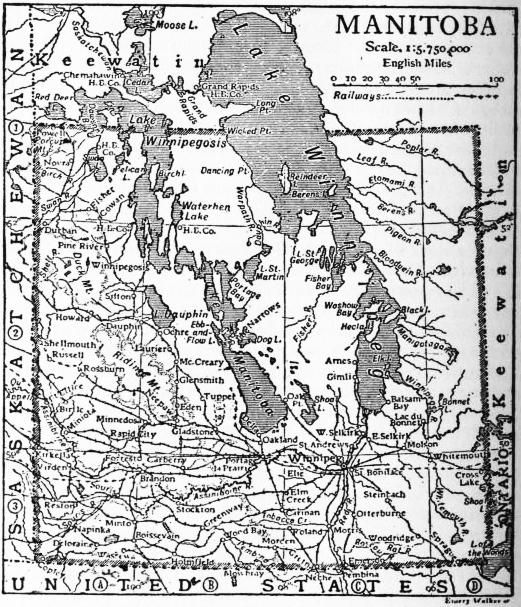
MANITOBA, one of the western provinces of the Dominion of Canada, situated midway between the Atlantic and the Pacific coasts of the Dominion, about 1090 m. due west of Quebec. It is bounded S. by the parallel 49° N., which divides it from the United States; W. by 101° 20′ W.; N. by 52° 50′ N.; and E. by the western boundary of Ontario. Manitoba formerly belonged to the Hudson’s Bay Company, and after the transfer of its territory to Canada was admitted in 1870 as the fifth province of the Dominion. At that time the infant province had an area of 13,500 sq. m., and some 12,000 people, chiefly Indian half-breeds. In 1881 the limits were increased as above, and the province now contains upwards of 73,956 sq. m., extending 264 m. from north to south and upwards of 300 from east to west. The old district of Assiniboia, the result of the efforts in colonization by the earl of Selkirk in 1811 and succeeding years, was the nucleus of the province.
The name Manitoba sprang from the union of two Indian words, Manito (the Great Spirit), and Waba (the “narrows” of the lake, which may readily be seen on the map). This well-known strait was a sacred place to the Crees and Saulteaux, who, impressed by the weird sound made by the wind as it rushed through the narrows, as simple children of the prairies called them Manito-Waba, or the “Great Spirit’s narrows.” The name, arising from this unusual sound, has been by metonymy translated into “God’s Voice.” The word was afterwards contracted into its present form. As there is no accent in Indian words, the natural pronunciation of this name would be Mān-ī-tō-bā. On this account, the custom of both the French and English people of the country was for years before and for several years after 1870 to pronounce it Mān-ĭ-tŏ-bā, and even in some cases to spell it “Manitobah.” After the formation of the province and the familiar use of the provincial name in the Dominion parliament, where it has occupied much attention for a generation, the pronunciation has changed, so that the province is universally known from ocean to ocean as Mān-ĭ-tō-bă.
Physical Features.—The drainage of Manitoba is entirely north-eastward to Hudson Bay. The three lakes—whose greatest lengths are 260,122 and 119 m. respectively—are Winnipeg, Winnipegosis and Manitoba. They are all of irregular shape, but average respectively 30, 18 and 10 m. in width. They are fresh, shallow and tideless. Winnipegosis and Manitoba at high water, in spring-time, discharge their overflow through small streams into Winnipeg. The chief rivers emptying into Lake Winnipeg are the Winnipeg, the Red and the Saskatchewan. The Assiniboine river enters the Red river 45 m. from Lake Winnipeg, and at the confluence of the rivers (“The Forks”) is situated the city of Winnipeg. The Winnipeg, which flows from the territory lying south-east of Lake Winnipeg, is a noble river some 200 m. long, which after leaving Lake of the Woods dashes with its clear water over many cascades, and traverses very beautiful scenery. At its falls from Lake of the Woods is one of the greatest and most easily utilized water-powers in the world, and from falls lower down the river electric power for the city of Winnipeg is obtained. The Red river is at intervals subject to freshets. In a century’s experience of the Selkirk colonists there have been four “floods.” The highest level of the site of the city of Winnipeg is said to have been under 5 ft. of water for several weeks in May and June in 1826, and 2½ ft. in 1852, not covered in 1861; only the lowest levels were under water in 1882. The extent of overflow has thus on each occasion been less. The loose soil on the banks of the river is every year carried away in great masses, and the channel has so widened as to render the recurrence of an overflow unlikely. The Saskatchewan, though not in the province, empties into Lake Winnipeg less than half a degree from the northern boundary. It is a mighty river, rising in the Rocky Mountains, and crossing eighteen degrees of longitude. Near its mouth are the Grand Rapids. Above these steamers ply to Fort Edmonton, a point upwards of 800 m. north-west of the city of Winnipeg. Steamers run from Grand Rapids, through Lake Winnipeg, up Red river to the city of Winnipeg, important locks having been constructed on the river at St Andrews.
The surface of Manitoba is somewhat level and monotonous. It is chiefly a prairie region, with treeless plains of from 5 to 40 m. extent, covered in summer with an exuberant vegetable growth, which dies every year. The river banks, however, are fringed with trees, and in the more undulating lands the timber belts vary from a few hundreds of yards to 5 or 10 m. in width, forming at times forests of no inconsiderable size. The chief trees of the country are the aspen (Populus tremuloides), the ash-leaved maple (Negundo aceroides), oak (Quercus alba), elm (Ulmus Americana), and many varieties of willow. The strawberry, raspberry, currant, plum, cherry and grape are indigenous.
Climate.—The climate of Manitoba, being that of a region of wide extent and of similar conditions, is not subject to frequent variations. Winter, with cold but clear and bracing weather, usually sets in about the middle of November, and ends with March. In April and May the rivers have opened, the snow has disappeared, and the opportunity has been afforded the farmer of sowing his grain. June is often wet, but most favourable for the springing crops; July and August are warm, but, excepting two or three days at a time, not uncomfortably so; while the autumn weeks of late August and September are very pleasant. Harvest generally extends from the middle of August to near the end of September. The chief crops of the farmer are wheat (which from its flinty hardness and full kernel is the specialty of the Canadian north-west), oats, barley and pease. Hay is made of the native prairie grasses, which grow luxuriantly. From the richness and mellowness of the soil potatoes and all taproots reach a great size. Heavy dews in summer give the needed moisture after the rains of June have ceased. The traveller and farmer are at times annoyed by the mosquito.
Area and Population.—The area is 73,956 sq. m., of which 64,066 are land and 9890 water. Pop. (1871), 18,995; (1881), 62,260; (1891), 152,506; (1901), 254,947 (138,332 males, 116,615 females); (1906), 365,688 (205,183 males and 160,505 females). The principal cities and towns are: Winnipeg (90,153), Brandon (10,408), Portage la Prairie (5106), St Boniface (5119), West Selkirk (2701), and Morden (1437). In 1901, 49,102 families inhabited 48,415 houses, and the proportion of the urban population to the rural was 27.5 to 72.5. Classified according to place of birth, the principal nationalities were as follows in 1901: Canada, 180,853; England, 20,392; Scotland, 8099; Ireland, 4537; other British possessions, 490; Germany, 2291; Iceland, 5403; Austria, 11,570; Russia and Poland, 8854; Scandinavia, 1772; United States, 6922; other countries, 4028. In 1901 the Indians numbered 5827; half-breeds, 10,372. Of the Indian half-breeds, one half are of English-speaking parentage, and chiefly of Orkney origin; the remainder are known as Metis or Bois-brûlés, and are descended from French-Canadian voyageurs. In 1875 a number of Russian Mennonites (descendants of the Anabaptists of the Reformation) came to the country. They originally emigrated from Germany to the plains of southern Russia, but came over to Manitoba to escape the conscription. They number upwards of 15,000. About 4000 French Canadians, who had emigrated from Quebec to the United States, have also made the province their home, as well as Icelanders now numbering 20,000. During the decade ending 1907 large reserves were settled with Ruthenians often known as Galicians, Poles and other peoples from central and northern Europe. Some 30,000 of these are found in the province. The remainder of the population is chiefly made up of English-speaking people from the other provinces of the Dominion, from the United States, from England and Scotland and the north of Ireland.
Religion.—Classified according to religion, the various denominations were, in 1901, as follows: Presbyterians, 65,310; Episcopalians, 44,874; Methodists, 49,909; Roman Catholics, 35,622; Baptists, 9098; Lutherans, 16,473; Mennonites, 15,222; Greek Catholics, 7898; other denominations, 9903; not specified, 638.
Government.—The province is under a lieutenant-governor, appointed for a term of five years, with an executive council of six members, responsible to the local legislature, which consists of forty-two members. It has four members in the Canadian Senate and ten in the House of Commons.
Education.—The dual system of education, established in 1871, was abolished in 1890, and the administrative machinery consolidated under a minister of the Crown and an advisory board. This act was amended in 1897 to meet the wishes of the Roman Catholic minority, but separate schools were not re-established; nor was the council divided into denominational committees. There are collegiate institutes for more advanced education at Winnipeg, Brandon and Portage la Prairie, with a total of 1094 pupils enrolled. There is also a normal school at Winnipeg for the training of teachers. Higher education is represented by the provincial university, which teaches science and mathematics, holds examinations, distributes scholarships, and grants degrees in all subjects. It has affiliated to it colleges of the Roman Catholic, Episcopalian, Presbyterian and Methodist denominations, with medical and pharmaceutical colleges. The arts colleges of the churches carry on the several courses required by the university, and send their students to the examinations of the university. A well-equipped agricultural college near Winnipeg is provided for sons and daughters of farmers.
Agriculture is the prevailing industry of Manitoba. Dairy-farming is rapidly increasing in importance, and creameries for the manufacture of butter and cheese are established in almost all parts of the province. Large numbers of horses, cattle, swine and poultry are reared. The growth of cereals is the largest department of agriculture followed.
The following statistics are interesting:—
1883. 1890. 1894. 1901.
Bushels. Bushels. Bushels. Bushels.
Wheat 5,686,355 14,665,769 17,172,883 50,502,085
Oats 9,478,965 9,513,443 11,907,854 27,796,588
Barley 1,898,430 2,069,415 2,981,716 6,536,155
Flax No statistics collected 366,000 266,420
Rye ” ” 59,924 62,261
Peas ” ” 18,434 16,349
Potatoes ” ” 2,035,336 4,797,433
Other roots ” ” 1,841,942 2,925,362
The enormous development of the wheat-growing industry is shown by these and the following statistics:—
Wheat inspected in Winnipeg.
1902 51,833,000 bushels
1903 40,396,650 ”
1904 39,784,900 ”
1905 55,849,840 ”
1906 66,636,390 ”
These figures do not include the wheat ground into flour and sent by way of British Columbia to Asia and Australia, nor the wheat retained by the farmers for seed. The Dominion government maintains an experimental farm of 670 acres at Brandon. The fisheries are all fresh-water, principally white-fish, pickerel and pike. Large quantities of fresh fish caught in lakes Winnipeg and Manitoba are exported to all parts of the United States.
Communications.—The region of the Red River and Assiniboine valleys was opened up by the fur traders, who came by the waterways from Lake Superior, and afterwards by the water communication with Hudson Bay. While these early traders used the canoe and the York boat,1 yet the steamboat played an important part in the early history of the region from 1868 till 1885, when access from the United States was gained by steamers down the Red River. The completion of the St Andrew’s Rapids canal on Red River, and the Grand Rapids canal on the Saskatchewan river will again give an impetus to inland navigation on the tributaries of Lake Winnipeg. Lake Manitoba also affords opportunity for inland shipping.
The broad expanse of prairie-land in the western provinces of Canada is well suited for the cheap and expeditious building of railways. The first connexion with the United States was by two railways coming down the Red River valley. But the desire for Canadian unity led the Dominion to assist a transcontinental line connecting Manitoba with eastern Canada. The building of the Canadian Pacific railway through almost continuous rocks for 800 miles was one of the greatest engineering feats of modern times. Immediately on the formation of the Canadian Pacific railway company branch lines were begun at Winnipeg and there are eight radial lines running from this centre to all parts of the country. Winnipeg is thus connected with Montreal on the east, and Vancouver on the west, and is the central point of the Canadian Pacific system, having railway yards and equipment equalled by few places in America. In opposition to the Canadian Pacific railway a southern line was built from Winnipeg to the American boundary. This fell into the hands of the Northern Pacific railway, but was purchased by the promoters of the Canadian Northern railway. This railway has six radiating lines leaving the city of Winnipeg, and its main line connects Port Arthur on Lake Superior with Edmonton in the west. The Canadian Northern railway has a remarkable network of railways connecting Winnipeg with every corner of Manitoba. The Great Northern railway has also three branch lines in Manitoba and one of these has Winnipeg as its terminus. The grand Trunk Pacific railway, the great transcontinental line promoted by the Laurier government, passes through Manitoba north of the Canadian Pacific, coming from the east deflects southward to pass through Winnipeg, and then strikes northward in a direct line of easy gradients to find its way through the Rocky Mountains to its terminus of Prince Rupert on the north coast of British Columbia.
History.—The first white settlement in Manitoba was made by Pierre Gaultier de Varennes, Sieur de la Verendrye (d. 1749), who, gradually pushing westward from Lake Superior, reached Lake Winnipeg in 1733, and in the following year built a fort not far from the present Fort Alexander. In October 1738 he built another at Fort Rouge, at the junction of the Red and Assiniboine rivers, where is now the city of Winnipeg. After the British conquest of 1763 the west became the scene of a rapidly increasing fur trade, and for many years there was keen rivalry between the Hudson’s Bay Company, with its headquarters in England, and the North-West Company of Montreal. French and Scottish farmers and fur-traders gradually settled along the Red River, and by their frequent marriages with the Indians produced a race of metis or half-breeds. From 1811 to 1818 Lord Selkirk’s attempted colonization greatly increased the population; from the time of his failure till 1869 the settlers lived quietly under the mild rule of the Hudson’s Bay Company. In that year the newly formed Dominion of Canada bought from the company its territorial and political rights. A too hasty occupation by Canadian officials and settlers led to the rebellion of the Metis under Louis Riel, a native leader. The rebellion was quieted and Sir Garnet Wolseley (now Lord Wolseley) was sent from Canada by the lake route, with several regiments of troops—regulars and volunteers. The Manitoba Act constituting the province was passed by the Canadian parliament in 1870. (See Red River Settlement; and Riel, Louis.)
The admixture of races and religions, and its position as the key to the great West, have ever since made Manitoba the storm centre of Canadian politics. In the charter granted by the Canadian parliament to the Canadian Pacific railway a clause giving it for twenty years control over the railway construction of the province led to a fierce agitation, till the clause was repealed in 1888. Till 1884 an equally fierce agitation was carried on against Ontario with regard to the eastern boundary of Manitoba. (See Ontario.) In both these disputes the provincial leader was the Hon. John Norquay, in whose veins ran a large admixture of Indian blood. In 1890 changes in the school system unfavourable to the Roman Catholic Church led to a constitutional struggle, to which was due the defeat of the Federal ministry in 1896. Since 1896 its rapid material progress has produced numerous economic problems and disputes, many of which are still unsolved.
(G. Br.; W. L. G.)
1 A round-bottomed, strongly built boat, 30 to 36 ft. long, propelled by 8 men. It was devised by the Hudson’s Bay Company for carrying freight, as a substitute for the less serviceable canoe, and was named after their York factory, the centre to which the traders brought down the furs for shipment to England and from which they took back merchandise and supplies to the interior of Rupert’s Land.
MANITOU or Manito (Algonquian Indian, “mystery,” “supernatural”), among certain American Indian tribes, a spirit or genius of good or evil. The manitou is almost always an animal, each individual having one assigned him, generally by dream-inspiration, at the greatest religious act of his life—his first fast. This animal then becomes his fetish; its skin is carried as a charm, and representations of it are tattooed and painted on the body or engraved on the weapons.
MANITOWOC (Indian, “Spirit-land”), a city and the county-seat of Manitowoc county, Wisconsin, on the W. shore of Lake Michigan, 75 m. N. of Milwaukee. Pop. (1890), 7710; (1900), 11,786, of whom 2998 were foreign-born; (1910 census), 13,027. It is served by the Chicago & North-Western, and the Wisconsin Central railways; by ferry across the lake to Frankfort, Mich., and Ludington, Mich.; by the Ann Arbor and the Père Marquette railways; and by the Goodrich line of lake steamers. The city is finely situated on high ground above the lake at the mouth of the Manitowoc river. At Manitowoc are the county insane asylum and a Polish orphan asylum. The city has a training school for county teachers, a business college, two hospitals and a Carnegie library. There are ship-yards for the construction of both steel and wooden vessels, and several grain elevators. The value of the factory products increased from $1,935,442 in 1900 to $4,427,816 in 1905, or 128.8 per cent.—a greater increase than that of any other city in the state during this period. There is a good harbour, and the city has a considerable lake commerce in grain, flour, and dairy products. Jacques Vieau established here a post for the North-west Company of fur traders in 1795. The first permanent settlement was made about 1836, and Manitowoc was chartered as a city in 1870. In Manitowoc county, 18 m. south-west of the city of Manitowoc, is St Nazianz, an unorganized village near which in 1854 a colony or community of German Roman Catholics was established under the leadership of Father Ambrose Oswald, the primary object being to enable poor people by combination and co-operation to supply themselves with the comforts of life at minimum expense and have as much time as possible left for religious thought and worship. The title of the colony’s land was vested in Father Oswald after the panic of 1857 until his death in 1874, when he devised the lands to “the colony founded by me.” The colony had no legal existence at the time, but was then incorporated as the “Roman Catholic Religious Society of St Nazianz,” and as such sued successfully for the bequest. Financially the colony was successful, but as there were some desertions and no new recruits after Father Oswald’s death, there were few members by 1909. There are no longer any traces of communism, and the colony’s property is actually held by an organization of the local Roman Catholic church.
MANIZALES, a city of Colombia and capital of the department of Cáldas (up to 1905 the northern part of Antioquia), 75 m. S. of Medellin, on the old trade route across the Cordillera between Honda, on the Magdalena, and the Cauca Valley. Pop. (1906, estimate), 20,000. The city is situated on a plateau of the western slope of the Cordillera, 6988 ft. above the sea. It is surrounded by rich mineral and agricultural districts.
MANKATO, a city and the county-seat of Blue Earth county, Minnesota, U.S.A., at the southern bend of the Minnesota river, where it is joined by the Blue Earth about 86 m. S.W. of Minneapolis. Pop. (1890), 8838; (1900), 10,599, of whom 2578 were foreign-born; (1910 census), 10,365. Mankato is served by the Chicago, St. Paul, Minneapolis & Omaha, the Chicago & North-Western (both “North-Western Lines”), the Chicago, Milwaukee & St Paul, and the Chicago Great-Western railways. The city has two fine parks, a Carnegie library, a Federal building, the Immanuel and St Joseph hospitals, two commercial colleges, and a state normal school (1868). The numerous lakes in the neighbourhood, particularly Lake Madison and Lake Washington, are widely known as summer resorts. Four miles west of the city is Minneopa state park (area, 60 acres), in which are Minneopa Falls (60 ft.) and a fine gorge; the park was established by the state in 1905-1906. Mankato has an extensive trade in dairy and agricultural products (especially grain), stone (a pinkish buff limestone is quarried in the vicinity), and forest products. The value of its factory products increased from $1,887,315 in 1900 to $3,422,117 in 1905, or 81.3%.
Mankato was settled about 1853, and was first chartered as a city in 1868. On or near the site of the city stood a village of the Mankato (“blue earth”) band of the Mdewakanton Sioux, who derived their name from one of their chiefs, “Old Mankato.” In this region occurred the Sioux uprising of 1862, and from this point operations were carried on which eventually resulted in the subjugation of the Indians and the hanging, at Mankato, in December 1862, of 38 leaders of the revolt. In the uprising the Mankato band was led by another chief named Mankato, who took part in the attack on Ft Ridgeley, Minn., in August, in the engagement on the 3rd of September at Birch Coolie, Minn., and in that on the 23rd of September at Wood Lake, where he was killed.
MANLEY, MARY DE LA RIVIERE (c. 1663-1724), English writer, daughter of Sir Roger Manley, governor of the Channel Islands, was born on the 7th of April 1663 in Jersey. She wrote her own biography under the title of The Adventures of Rivella, or the History of the Author of the Atalantis by “Sir Charles Lovemore” (1714). According to her own account she was left an orphan at the age of sixteen, and beguiled into a mock marriage with a kinsman who deserted her basely three years afterwards. She was patronized for a short time by the duchess of Cleveland, and wrote an unsuccessful comedy, The Lost Lover (1696); in freedom of speech she equalled the most licentious writers of comedy in that generation. Her tragedy, The Royal Mischief (1696) was more successful. From 1696 Mrs Manley was a favourite member of witty and fashionable society. In 1705 appeared The Secret History of Queen Zarah and the Zarazians, a satire on Sarah, duchess of Marlborough, in the guise of romance. This was probably by Mrs Manley, who, four years later, achieved her principal triumph as a writer by her Secret Memoirs ... of Several Persons of Quality (1709), a scandalous chronicle “from the New Atalantis, an island in the Mediterranean.” She was arrested in the autumn of 1709 as the author of a libellous publication, but was discharged by the court of queen’s bench on the 13th of February 1710. Mrs Manley sought in this scandalous narrative to expose the private vices of the ministers whom Swift, Bolingbroke and Harley combined to drive from office. During the keen political campaign in 1711 she wrote several pamphlets, and many numbers of the Examiner, criticizing persons and policy with equal vivacity. Later were published her tragedy Lucius (1717); The Power of Love, in Seven Novels (1720), and A Stage Coach Journey to Exeter (1725).
MANLIUS, the name of a Roman gens, chiefly patrician, but containing plebeian families also.
1. Marcus Manlius Capitolinus, a patrician, consul 392 B.C. According to tradition, when in 390 B.C. the besieging Gauls were attempting to scale the Capitol, he was roused by the cackling of the sacred geese, rushed to the spot and threw down the foremost assailants (Livy v. 47; Plutarch, Camillus, 27). Several years after, seeing a centurion led to prison for debt, he freed him with his own money, and even sold his estate to relieve other poor debtors, while he accused the senate of embezzling public money. He was charged with aspiring to kingly power, and condemned by the comitia, but not until the assembly had adjourned to a place without the walls, where they could no longer see the Capitol which he had saved. His house on the Capitol (the origin of his surname) was razed, and the Manlii resolved that henceforth no patrician Manlius should bear the name of Marcus. According to Mommsen, the story of the saving of the Capitol was a later invention to explain his surname, and his attempt to relieve the debtors a fiction of the times of Cinna.
Livy vi. 14-20; Plutarch, Camillus, 36; Cicero, De domo, 38.
2. Titus Manlius Imperiosus Torquatus, twice dictator (353, 349 B.C.) and three times consul (347, 344, 340). When his father, L. Manlius Imperiosus (dictator 363), was brought to trial by the tribune M. Pomponius for abusing his office of dictator, he forced Pomponius to drop the accusation by threatening his life (Livy vii. 3-5). In 360, during a war with the Gauls, he slew one of the enemy, a man of gigantic stature, in single combat, and took from him a torques (neck-ornament), whence his surname. When the Latins demanded an equal share in the government of the confederacy, Manlius vowed to kill with his own hand the first Latin he saw in the senate-house. The Latins and Campanians revolted, and Manlius, consul for the third time, marched into Campania and gained two great victories, near Vesuvius, where P. Decius Mus (q.v.), his colleague, “devoted” himself in order to gain the day, and at Trifanum. In this campaign Manlius executed his own son, who had killed an enemy in single combat, and thus disobeyed the express command of the consuls.
Livy vii. 4, 10, 27, viii. 3; Cicero, De off. iii. 31.
3. Titus Manlius Torquatus, consul 235 B.C. and 224, censor 231, dictator 208. In his first consulship he subjugated Sardinia, recently acquired from the Carthaginians, when the temple of Janus was shut for the second time in Roman history (Livy i. 19). In 216 he opposed the ransoming of the Romans taken prisoners at Cannae; and in 215 he was sent to Sardinia and defeated a Carthaginian attempt to regain possession of the island.
Livy xxiii. 34; Polybius ii. 31.
4. Gnaeus Manlius Vulso, praetor 195, consul 189. He was sent to Asia to conclude peace with Antiochus III., king of Syria. He marched into Pamphylia, defeated the Celts of Galatia on Mt Olympus and drove them back across the Halys. In the winter, assisted by ten delegates sent from Rome, he settled the terms of peace with Antiochus, and in 187 received the honour of a triumph.
Polybius xxii. 16-25; Livy xxxviii. 12-28, 37-50; xxxix. 6.
MANN, HORACE (1796-1859), American educationist, was born in Franklin, Massachusetts, on the 4th of May 1796. His childhood and youth were passed in poverty, and his health was early impaired by hard manual labour. His only means for gratifying his eager desire for books was the small library founded in his native town by Benjamin Franklin and consisting principally of histories and treatises on theology. At the age of twenty he was fitted, in six months, for college, and in 1819, graduated with highest honours, from the Brown University at Providence, Rhode Island, having devoted himself so unremittingly to his studies as to weaken further his naturally feeble constitution. He then studied law for a short time at Wrentham, Massachusetts; was tutor in Latin and Greek (1820-1822) and librarian (1821-1823) at Brown University; studied during 1821-1823 in the famous law school conducted by Judge James Gould at Litchfield, Connecticut; and in 1823 was admitted to the Norfolk (Mass.) bar. For fourteen years, first at Dedham, Massachusetts, and after 1833 at Boston, he devoted himself, with great success, to his profession. Meanwhile he served, with conspicuous ability, in the Massachusetts House of Representatives from 1827 to 1833 and in the Massachusetts Senate from 1833 to 1837, for the last two years as president. It was not until he became secretary (1837) of the newly created board of education of Massachusetts, that he began the work which was soon to place him in the foremost rank of American educationists. He held this position till 1848, and worked with a remarkable intensity—holding teachers’ conventions, delivering numerous lectures and addresses, carrying on an extensive correspondence, introducing numerous reforms, planning and inaugurating the Massachusetts normal school system, founding and editing The Common School Journal (1838), and preparing a series of Annual Reports, which had a wide circulation and are still considered as being “among the best expositions, if, indeed, they are not the very best ones, of the practical benefits of a common school education both to the individual and to the state” (Hinsdale). The practical result of his work was the virtual revolutionizing of the common school system of Massachusetts, and indirectly of the common school systems of other states. In carrying out his work he met with bitter opposition, being attacked particularly by certain school-masters of Boston who strongly disapproved of his pedagogical theories and innovations, and by various religious sectaries, who contended against the exclusion of all sectarian instruction from the schools. He answered these attacks in kind, sometimes perhaps with unnecessary vehemence and rancour, but he never faltered in his work, and, an optimist by nature, a disciple of his friend George Combe (q.v.), and a believer in the indefinite improvability of mankind, he was sustained throughout by his conviction that nothing could so much benefit the race, morally, intellectually and materially, as education. Resigning the secretaryship in 1848, he was elected to the national House of Representatives, as an anti-slavery Whig to succeed John Quincy Adams, and was re-elected in 1849, and, as an independent candidate, in 1850, serving until March 1853. In 1852 he was the candidate of the Free-soilers for the governorship of Massachusetts, but was defeated. In Congress he was one of the ablest opponents of slavery, contending particularly against the Compromise Measures of 1850, but he was never technically an Abolitionist and he disapproved of the Radicalism of Garrison and his followers. From 1853 until his death, on the second of August 1859, he was president of the newly established Antioch College at Yellow Springs, Ohio, where he taught political economy, intellectual and moral philosophy, and natural theology. The college received insufficient financial support and suffered from the attacks of religious sectaries—he himself was charged with insincerity because, previously a Unitarian, he joined the Christian Connexion, by which the college was founded—but he earned the love of his students, and by his many addresses exerted a beneficial influence upon education in the Middle West.
A collected edition of Mann’s writings, together with a memoir (1 vol.) by his second wife, Mary Peabody Mann, a sister of Miss E. P. Peabody, was published (in 5 vols. at Boston in 1867-1891) as the Life and Works of Horace Mann. Of subsequent biographies the best is probably Burke A. Hinsdale’s Horace Mann and the Common School Revival in the United Stales (New York, 1898), in “The Great Educators” series. Among other biographies O. H. Lang’s Horace Mann, his Life and Work (New York, 1893), Albert E. Winship’s Horace Mann, the Educator (Boston, 1896), and George A. Hubbell’s Life of Horace Mann, Educator, Patriot and Reformer (Philadelphia, 1910), may be mentioned. In vol. I. of the Report for 1895-1896 of the United States commissioner of education there is a detailed “Bibliography of Horace Mann,” containing more than 700 titles.
MANNA, a concrete saccharine exudation obtained by making incisions on the trunk of the flowering or manna ash tree, Fraxinus Ornus. The manna ash is a small tree found in Italy, and extending to Switzerland, South Tirol, Hungary, Greece, Turkey and Asia Minor. It also grows in the islands of Sicily, Corsica and Sardinia. It blossoms early in summer, producing numerous clusters of whitish flowers. At the present day the manna of commerce is collected exclusively in Sicily from cultivated trees, chiefly in the districts around Capaci, Carini, Cinisi and Favarota, small towns 20 to 25 m. W. of Palermo, and in the townships of Geraci, Castelbuono, and other places in the district of Cefalù, 50 to 70 m. E. of Palermo. In the frassinetti or plantations the trees are placed about 7 ft. apart, and after they are eight years old, and the trunk at least 3 in. in diameter, the collection of manna is begun. This operation is performed in July or August during the dry weather, by making transverse incisions 1½ to 2 in. long, and about 1 in. apart, through the bark, one cut being made each day, the first at the bottom of the tree, another directly above the first, and so on. In succeeding years the process is repeated on the untouched sides of the trunk, until the tree has been cut all round and exhausted. It is then cut down, and a young plant arising from the same root takes its place. The finest or flaky manna appears to have been allowed to harden on the stem. A very superior kind, obtained by allowing the juice to encrust pieces of wood or straws inserted in the cuts, is called manna a cannolo. The fragments adhering to the stem, after the finest flakes have been removed are scraped off, and form the small or Tolfa manna of commerce. That which flows from the lower incisions is often collected on tiles or on a concave piece of the prickly pear (Opunlia), but is less crystalline and more glutinous, and is less esteemed.
Manna of good quality dissolves at ordinary temperatures in about 6 parts of water, forming a clear liquid. Its chief constituent is mannite or manna sugar, a hexatomic alcohol, C6H8(OH)6, which likewise occurs, in much smaller quantity, in certain species of the brown seaweed, Fucus, and in plants of several widely separated natural orders. Mannite is obtained by extracting manna with alcohol and crystallizing the solution. The best manna contains 70 to 80%. It crystallizes in shining rhombic prisms from its aqueous solution and as delicate needles from alcohol. Manna possesses mildly laxative properties, and on account of its sweet taste is employed as a mild aperient for children. It is less used in England now than formerly, but is still largely consumed in South America. In Italy mannite is prepared for sale in the shape of small cones resembling loaf sugar in shape, and is frequently prescribed in medicine instead of manna.
The manna of the present day appears to have been unknown before the 15th century, although a mountain in Sicily with the Arabic name Gibelman, i.e. “manna mountain,” appears to point to its collection there during the period that the island was held by the Saracens, 827-1070. In the 16th century it was collected in Calabria, and until recently was produced in the Tuscan Maremma, but none is now brought into commerce from Italy, although the name of Tolfa, a town near Civita Vecchia, is still applied to an inferior variety of the drug.
Various other kinds of manna are known, but none of these has been found to contain mannite. Alhagi manna (Persian and Arabic tar-angubīn, also known as terendschabin) is the produce of Alhagi maurorum, a small, spiny, leguminous plant, growing in Arabia, Asia Minor, Persia, Afghanistan, Baluchistan and northern India. This manna occurs in the form of small, roundish, hard, dry tears, varying from the size of a mustard seed to that of a coriander, of a light-brown colour, sweet taste, and senna-like odour. The spines and pods of the plant are often mixed with it. It is collected near Kandahar and Herat, and imported into India from Cabul and Kandahar. Tamarisk manna (Persian gaz-angubīn, tamarisk honey) exudes in June and July from the slender branches of Tamarix gallica, var. mannifera, in the form of honey-like drops, which, in the cold temperature of the early morning, are found in the solid state. This secretion is caused by the puncture of an insect, Coccus manniparus. In the valleys of the peninsula of Sinai, especially in the Wādy el-Sheikh, this manna (Arabic man) is collected by the Arabs and sold to the monks of St Catherine, who supply it to the pilgrims visiting the convent. It is found also in Persia and the Punjab, but does not appear to be collected in any quantity. This kind of manna seems to be alluded to by Herodotus (vii. 31). Under the same name of gaz-angubīn there are sold commonly in the Persian bazaars round cakes, of which a chief ingredient is a manna obtained to the south-west of Ispahan, in the month of August, by shaking the branches or scraping the stems of Astragalus florulentus and A. adscendens.1 Shir Khist, a manna known to writers on materia medica in the 16th century, is imported into India from Afghanistan and Turkestan to a limited extent; it is the produce of Cotoneaster nummularia (Rosaceae), and to a less extent of Atraphaxis spinosa (Polygonaceae); it is brought chiefly from Herat.
Oak manna or Gueze-elefi, according to Haussknecht, is collected from the twigs of Quercus Vallonia and Q. persica, on which it is produced by the puncture of an insect during the month of August. This manna occurs in the state of agglutinated tears, and forms an object of some industry among the wandering tribes of Kurdistan. It is collected before sunrise, by shaking the grains of manna on to linen cloths spread out beneath the trees, or by dipping the small branches in hot water and evaporating the solution thus obtained. A substance collected by the inhabitants of Laristan from Pyrus glabra strongly resembles oak manna in appearance.
Australian or Eucalyptus manna is found on the leaves of Eucalyptus viminalis, E. Gunnii, var. rubida, E. pulverulenta, &c. The Lerp manna of Australia is of animal origin.
Briançon manna is met with on the leaves of the common Larch (q.v.), and bide-khecht on those of the willow, Salix fragilis; and a kind of manna was at one time obtained from the cedar.
The manna of the Biblical narrative, notwithstanding the miraculous circumstances which distinguish it from anything now known, answers in its description very closely to the tamarisk manna.
See Bentley and Trimen, Medicinal Plants (1880); Watt, Dictionary of Economic Products of India, under “Manna” (1891). For analyses see A. Ebert, Abst. J.C.S., 1909, 96, p. 176.
1 See Bombay Lit. Tr., vol. i. art. 16, for details as to the gazangubīn. A common Persian sweetmeat consists of wheat-flour kneaded with manna into a thick paste.
MANNERS, CHARLES (1857- ), English musician, whose real name was Southcote Mansergh, was born in London, son of Colonel Mansergh, an Irishman. He had a fine bass voice, and was educated for the musical profession in Dublin and at the Royal Academy of Music in London. He began singing in opera in 1881, and in 1882 had great success as the sentry in Iolanthe at the Savoy, following this with numerous engagements in opera both in England and America. He married the singer Fanny Moody, already a leading soprano on the operatic stage, in 1890; and in 1897 they formed the Moody-Manners opera company, which had a great success in the provinces and undertook seasons in London in 1902. Manners and his wife were assisted by some other excellent artists, and their enterprise had considerable influence on contemporary English music.
MANNERS-SUTTON, CHARLES (1755-1828), archbishop of Canterbury, was educated at Charterhouse and Cambridge. In 1785 he was appointed to the family living at Averham-with-Kelham, in Nottinghamshire, and in 1791 became dean of Peterborough. He was consecrated bishop of Norwich in 1792, and two years later received the appointment of dean of Windsor in commendam. In 1805 he was chosen to succeed Archbishop Moore in the see of Canterbury. During his primacy the old archiepiscopal palace at Croydon was sold and the country palace of Addington bought with the proceeds. He presided over the first meeting which issued in the foundation of the National Society, and subsequently lent the scheme his strong support. He also exerted himself to promote the establishment of the Indian episcopate. His only published works are two sermons, one preached before the Lords (London, 1794), the other before the Society for the Propagation of the Gospel (London, 1797). His brother, Thomas Manners-Sutton, 1st Baron Manners (1756-1842), was lord chancellor of Ireland. For his son Charles see Canterbury, 1st Viscount.
MANNHEIM, a town of Germany, in the grand-duchy of Baden, lying on the right bank of the Rhine, at its confluence with the Neckar, 39 m. by rail N. of Karlsruhe, 10 m. W. of Heidelberg and 55 m. S. of Frankfort-on-Main. Pop. (1900), 141,131; (1905), 162,607 (of whom about 70,000 are Roman Catholics and 6000 Jews). It is perhaps the most regularly built town in Germany, consisting of twelve parallel streets intersected at right angles by others, which cut it up into 136 square sections of equal size. These blocks are distinguished, after the American fashion, by letters and numerals. Except on the south side all the streets debouch on the promenade, which forms a circle round the town on the site of the old ramparts. Outside this ring are the suburbs Schwetzinger-Vorstadt to the south and Neckar-Vorstadt to the north, others being Lindenhof, Mühlau, Neckarau and Käferthal. Mannheim is connected by a handsome bridge with Ludwigshafen, a rapidly growing commercial and manufacturing town on the left bank of the Rhine, in Bavarian territory. The Neckar is spanned by two bridges.
Nearly the whole of the south-west side of the town is occupied by the palace (1720-1759), formerly the residence of the elector palatine of the Rhine. It is one of the largest buildings of the kind in Germany, covering an area of 15 acres, and having a frontage of about 600 yards. It has 1500 windows. The left wing was totally destroyed by the bombardment of 1795, but has since been restored. The palace contains a picture gallery and collections of natural history and antiquities, and in front of it are two monumental fountains and a monument to the emperor William I. The large and beautiful gardens at the back form the public park of the town. Among the other prominent buildings arc the theatre, the arsenal, the synagogue, the “Kaufhaus,” the town-hall (Rathaus, 1771) and the observatory. A newer building is the fine municipal Festhalle with magnificent rooms. The only noteworthy churches are the Jesuit church (1737-1760), the interior of which is lavishly decorated with marble and painting; the Koncordienkirche and the Schlosskirche. In front of the theatre are statues of Schiller, August Wilhelm Iffland the actor, and Wolfgang Heribert von Dalberg (1750-1806), intendant of the theatre in the time of Schiller. Mannheim is the chief commercial town on the upper Rhine, and yields in importance to Cologne alone among the lower Rhenish towns. It stands at the head of the effective navigation on the Rhine, and is not only the largest port on the upper course of that stream, but is the principal emporium for south Germany for such commodities as cereals, coal, petroleum, timber, sugar and tobacco, with a large trade in hops, wine and other south German produce. Owing to the rapid increase in the traffic, a new harbour at the mouth of the Neckar was opened in 1898. The industries are equal in importance to the transit trade, and embrace metal-working, iron-founding and machine building, the manufacture of electric plant, celluloid, automobiles, furniture, cables and chemicals, sugar refining, cigar and tobacco making, and brewing.
Mannheim is the seat of the central board for the navigation of the Rhine, of a high court of justice, and of the grand ducal commissioner for north Baden.
History.—The name of Mannheim was connected with its present site in the 8th century, when a small village belonging to the abbey of Lorsch lay in the marshy district between the Neckar and the Rhine. To the south of this village, on the Rhine, was the castle of Eicholzheim, which acquired some celebrity as the place of confinement assigned to Pope John XXIII. by the council of Constance. The history of modern Mannheim begins, however, with the opening of the 17th century, when the elector palatine Frederick IV. founded a town here, which was peopled chiefly with Protestant refugees from Holland. The strongly fortified castle which he erected at the same time had the unfortunate result of making the infant town an object of contention in the Thirty Years’ War, during which it was five times taken and retaken. In 1688 Mannheim, which had in the meantime recovered from its former disasters, was captured by the French, and in 1689 it was burned down. Ten years later it was rebuilt on an extended scale, and provided with fortifications by the elector John William. For its subsequent importance it was indebted to the elector Charles Philip, who, owing to ecclesiastical disputes, transferred his residence from Heidelberg to Mannheim in 1720. It remained the capital of the Palatinate for nearly sixty years, being especially flourishing under the elector Charles Theodore. In 1794 Mannheim fell into the hands of the French, and in the following year it was retaken by the Austrians after a severe bombardment, which left scarcely a single building uninjured. In 1803 it was assigned to the grand duke of Baden, who caused the fortifications to be razed. Towards the end of the 18th century Mannheim attained great celebrity in the literary world as the place where Schiller’s early plays were performed for the first time. It was at Mannheim that Kotzebue was assassinated in 1819. During the revolution in Baden in 1849 the town was for a time in the hands of the insurgents, and was afterwards occupied by the Prussians.
See Feder, Geschichte der Stadt Mannheim (1875-1877, 2 vols., new ed. 1903); Pichler, Chronik des Hof- und National Theaters in Mannheim (Mannheim, 1879); Landgraf, Mannheim und Ludwigshafen (Zürich, 1890); Die wirtschaftliche Bedeutung Mannheims, published by the Mannheim Chamber of Commerce (Mannheim, 1905); the Forschungen zur Geschichte Mannheims und der Pfalz, published by the Mannheimer Altertumsverein (Leipzig, 1898); and the annual Chronik der Hauptstadt Mannheim (1901 seq.).
MANNING, HENRY EDWARD (1808-1892), English Roman Catholic cardinal, was born at Totteridge, Hertfordshire, on the 15th of July 1808,1 being the third and youngest son of William Manning, a West India merchant, who was a director of the Bank of England and governor, 1812-1813, and who sat in Parliament for some thirty years, representing in the Tory interest Plympton Earle, Lymington, Evesham, and Penryn consecutively. His mother, Mary, daughter of Henry Leroy Hunter, of Beech Hill, Reading, was of a family said to be of French extraction. Manning’s boyhood was mainly spent at Coombe Bank, Sundridge, Kent, where he had for companions Charles and Christopher Wordsworth, afterwards bishops of St Andrews and of Lincoln. He was educated at Harrow, 1822-1827, Dr G. Butler being then the head master, but obtained no distinction beyond being in the cricket eleven in 1825. He matriculated at Balliol College, Oxford, in 1827, and soon made his mark as a debater at the Union, where Gladstone succeeded him as president in 1830. At this date he was ambitious of a political career, but his father had sustained severe losses in business, and in these circumstances Manning, having graduated with first-class honours in 1830, obtained the year following, through Viscount Goderich, a post as supernumerary clerk in the colonial office. This, however, he resigned in 1832, his thoughts having been turned towards a clerical career under Evangelical influences, which affected him deeply throughout life. Returning to Oxford, he was elected a fellow of Merton College, and was ordained; and in 1833 he was presented to the rectory of Lavington-with-Graffham in Sussex by Mrs Sargent, whose granddaughter Caroline he married on the 7th of November 1833, the ceremony being performed by the bride’s brother-in-law, Samuel Wilberforce, afterwards bishop of Oxford and of Winchester. Manning’s married life was of brief duration. His young and beautiful wife was of a consumptive family, and died childless (July 24, 1837). The lasting sadness that thus early overshadowed him tended to facilitate his acceptance of the austere teaching of the Oxford Tracts; and though he was never an acknowledged disciple of Newman, it was due to the latter’s influence that from this date his theology assumed an increasingly High Church character, and his printed sermon on the “Rule of Faith” was taken as a public profession of his alliance with the Tractarians. In 1838 he took a leading part in the Church education movement, by which diocesan boards were established throughout the country; and he wrote an open letter to his bishop in criticism of the recent appointment of the ecclesiastical commission. In December of that year he paid his first visit to Rome, and called on Dr Wiseman in company with W. E. Gladstone. In January 1841 Shuttleworth, bishop of Chichester, appointed him archdeacon, whereupon he began a personal visitation of each parish within his district, completing the task in 1843. In 1842 he published a treatise on The Unity of the Church, and his reputation as an eloquent and earnest preacher being by this time considerable, he was in the same year appointed select preacher by his university, thus being called upon to fill from time to time the pulpit which Newman, as vicar of St Mary’s, was just ceasing to occupy. Four volumes of his sermons appeared between the years 1842 and 1850, and these had reached the 7th, 4th, 3rd and 2nd editions respectively in 1850, but were not afterwards reprinted. In 1844 his portrait was painted by Richmond, and the same year he published a volume of university sermons, in which, however, was not included the one on the Gunpowder Plot. This sermon had much annoyed Newman and his more advanced disciples, but it was a proof that at that date Manning was loyal to the Church of England as Protestant. Newman’s secession in 1845 placed Manning in a position of greater responsibility, as one of the High Church leaders, along with Pusey and Keble and Marriott; but it was with Gladstone and James Hope (afterwards Hope-Scott) that he was at this time most closely associated. In the spring of 1847 he was seriously ill, and that autumn and the following winter he spent abroad, chiefly in Rome, where he saw Newman “wearing the Oratorian habit and dead to the world.” He had public and private audiences with the pope on the 9th of April and the 11th of May 1848, but recorded next to nothing in his diary concerning them, though numerous other entries show an eager interest in everything connected with the Roman Church, and private papers also indicate that he recognized at this time grave defects in the Church of England and a mysterious attractiveness in Roman Catholicism, going so far as to question whether he might not one day be a Roman Catholic himself. Returning to England, he protested, but with moderation, against the appointment of Hampden as bishop of Hereford, and continued to take an active part in the religious education controversy. Through the influence of Samuel Wilberforce, he was offered the post of sub-almoner to Queen Victoria, always recognized as a stepping-stone to the episcopal bench, and his refusal of it was honourably consonant with all else in his career as an Anglican dignitary, in which he united pastoral diligence with an asceticism that was then quite exceptional. In 1850 the decision of the privy council, that the bishop of Exeter was bound to institute the Rev. G. C. Gorham to the benefice of Brampford Speke in spite of the latter’s acknowledged disbelief in the doctrine of baptismal regeneration, brought to a crisis the position within the Church of England of those who believed in that Church as a legitimate part of the infallible Ecclesia docens. Manning made it clear that he regarded the matter as vital, though he did not act on this conviction until no hope remained of the decision being set aside or practically annulled by joint action of the bishops. In July he addressed to his bishop an open letter on “The Appellate Jurisdiction of the Crown in Matters Spiritual,” and he also took part in a meeting in London which protested against the decision. In the autumn of this year (1850) was the great popular outcry against the “Papal aggression” (see Wiseman), and Manning, feeling himself unable to take part in this protest, resigned, early in December his benefice and his archdeaconry; and writing to Hope-Scott, who a little later became a Roman Catholic with him, stated his conviction that the alternative was “either Rome or licence of thought and will.” He was received into the Roman Catholic Church by Father Brownbill, S.J., at the church in Farm Street, on Passion Sunday, the 6th of April 1851. On the following Sunday he was confirmed and received to communion by Cardinal Wiseman, who also, within ten weeks of his reception, ordained him priest. Manning thereupon proceeded to Rome to pursue his theological studies, residing at the college known as the “Academy for Noble Ecclesiastics,” and attending lectures by Perrone and Passaglia among others. The pope frequently received him in private audience, and in 1854 conferred on him the degree of D.D. During his visits to England he was at the disposal of Cardinal Wiseman, who through him, at the time of the Crimean War, was enabled to obtain from the government the concession that for the future Roman Catholic army chaplains should not be regarded as part of the staff of the Protestant chaplain-general. In 1857 the pope, proprio motu, appointed him provost (or head of the chapter) of Westminster, and the same year he took up his residence in Bayswater as superior of a community known as the “Oblates of St Charles,” an association of secular priests on the same lines as the institute of the Oratory, but with this difference, that they are by their constitution at the beck and call of the bishop in whose diocese they live. The community was thus of the greatest service to Cardinal Wiseman, whose right-hand man Manning thenceforward became. During the eight years of his life at Bayswater he was most active in all the duties of the priesthood, preaching, hearing confessions, and receiving converts; and he was notably zealous to promote in England all that was specially Roman and papal, thus giving offence to old-fashioned Catholics, both clerical and lay, many of whom were largely influenced by Gallican ideas, and had with difficulty accepted the restoration of the hierarchy in 1850. In 1860 he delivered a course of lectures on the pope’s temporal power, at that date seriously threatened, and shortly afterwards he was appointed a papal domestic prelate, thus becoming a “Monsignor,” to be addressed as “Right Reverend.” He was now generally recognized as the able and effective leader of the Ultramontane party among English Roman Catholics, acting always, however, in subordination to Cardinal Wiseman; and on the latter’s death (Feb. 15, 1865) it was felt that, if Manning should succeed to the vacant archbishopric, the triumph of Ultramontanism would be secured. Such a consummation not being desired by the Westminster chapter, they submitted to the pope three names, and Manning’s was not one of them. Great efforts were made to secure the succession for the titular archbishop Errington, who at one time had been Wiseman’s coadjutor with that right reserved to him, but who had been ousted from that position by the pope acting under Manning’s influence. In such circumstances Pius IX. could hardly do otherwise than ignore Errington’s nomination, as he also ignored the nomination of Clifford, bishop of Clifton, and of Grant, bishop of Southwark; and, by what he humorously described as “the Lord’s own coup d’état,” he appointed Manning to the archiepiscopal see. Consecrated at the pro-cathedral at Moorfields (since destroyed) by Dr Ullathorne, bishop of Birmingham (June 8, 1865), and enthroned there (Nov. 6), after receiving the pallium in Rome, Manning began his work as archbishop by devoting himself especially to the religious education of the poor and to the establishment of Catholic industrial and reformatory schools. He steadily opposed whatever might encourage the admission of Catholics to the national universities, and so put his foot down on Newman’s project to open a branch house of the Oratory at Oxford with himself as superior. He made an unsuccessful and costly effort to establish a Catholic university at Kensington, and he also made provision for a diocesan seminary of strictly ecclesiastical type. Jealous of the exclusive claims of the Roman Church, he procured a further condemnation at Rome of the “Association for the Promotion of the Unity of Christendom,” which advocated prayers for the accomplishment of a kind of federal union between the Roman, Greek and Anglican Churches, and in a pastoral letter he insisted on the heretical assumption implied in such an undertaking. He also worked for the due recognition of the dignity of the secular or pastoral clergy, whose position seemed to be threatened by the growing ascendancy of the regulars, and especially of the Jesuits, whom, as a practically distinct organization within the Church, he steadily opposed. In addition to his diocesan synods, he presided in 1873 over the fourth provincial synod of Westminster, which legislated on “acatholic” universities, church music, mixed marriages, and the order of a priest’s household, having previously taken part, as theologian, in the provincial synods of 1853 and 1859, with a hand in the preparation of their decrees. But it was chiefly through his strenuous advocacy of the policy of defining papal infallibility at the Vatican council (1869-1870) that Manning’s name obtained world-wide renown. In this he was instant in season and out of season. He brought to Rome a petition in its favour from his chapter at Westminster, and during the progress of the council he laboured incessantly to overcome the opposition of the “inopportunists.” And he never ceased to regard it as one of the chief privileges of his life that he had been able to take an active part in securing the definition, and in having heard with his own ears that doctrine proclaimed as a part of divine revelation. In 1875 he published a reply to Gladstone’s attack on the Vatican decrees; and on the 15th of March in that year he was created cardinal, with the title of SS. Andrew and Gregory on the Coelian. He was present at the death of Pius IX. (Feb. 7, 1878); and in the subsequent conclave, while some Italian cardinals were prepared to vote for his election to fill the vacant chair, he himself supported Cardinal Pecci, afterwards known as Leo XIII. With him, however, Manning found less sympathy than with his predecessor, though Manning’s advocacy of the claims of labour attracted Leo’s attention, and influenced the encyclical which he issued on the subject. After the Vatican council, and more especially after the death of Pius IX., Manning devoted his attention mainly to social questions, and with these his name was popularly associated during the last fifteen years of his life. From 1872 onwards he was a strict teetotaller, not touching alcohol even as a medicine, and there was some murmuring among his clergy that his teaching on this subject verged on heresy. But his example and his zeal profoundly influenced for good the Irish poor forming the majority of his flock; and the “League of the Cross” which he founded, and which held annual demonstrations at the Crystal Palace, numbered nearly 30,000 members in London alone in 1874. He sat on two royal commissions, the one on the housing of the working classes (1884), and the other on primary education (1886); and in each case the report showed evident marks of his influence, which his fellow-commissioners recognized as that of a wise and competent social reformer. In the cause of labour he was active for many years, and in 1872 he set an example to the clergy of all the churches by taking a prominent part in a meeting held in Exeter Hall on behalf of the newly established Agricultural Labourers’ Union, Joseph Arch and Charles Bradlaugh being among those who sat with him on the platform. In later years his strenuous advocacy of the claims of the working classes, and his declaration that “every man has a right to work or to bread” led to his being denounced as a Socialist. That he was such he denied more than once (Lemire, Le Cardinal Manning et son action sociale, Paris, 1893, p. 210), nor was he ever a Socialist in principle; but he favoured some of the methods of Socialism, because they alone seemed to him practically to meet the case of that pressing poverty which appealed to his heart. He took a leading part in the settlement of the dockers’ strike in the autumn of 1889, and his patient and effectual action on this and on similar occasions secured for him the esteem and affection of great numbers of working men, so that his death on the 14th of January 1892, and his funeral a week later, were the occasion for a remarkable demonstration of popular veneration. The Roman Catholic Cathedral at Westminster is his joint memorial with his predecessor, Cardinal Wiseman.
Whatever may have been the value of Manning’s services to the Roman Catholic Church in England in bringing it, as he did, up to a high level of what in earlier years was commonly denounced as Ultramontanism, it is certain that by his social action, as well as by the earnestness and holiness of his life, he greatly advanced, in the minds of his countrymen generally, their estimate of the character and value of Catholicism. Pre-eminently he was a devout ecclesiastic, a “great priest”; and his sermons, both Anglican and Catholic, are marked by fervour and dignity, by a conviction of his own authoritative mission as preacher, and by an eloquent insistence on considerations such as warm the heart and bend the will rather than on such as force the intellect to assent. But many of his instincts were those of a statesman, a diplomatist, a man of the world, even of a business man; and herein lay, at least in part, the secret of his influence and success. Intellectually he did not stand in the front rank. He was neither a philosopher nor a literary genius. Among his many publications, written, it is only fair to admit, amidst the urgent pressure of practical work, there is barely a page or even a sentence that bears the stamp of immortality. But within a somewhat narrower field he worked with patience, industry, and self-denying zeal; his ambition, which seemed to many personal, was rather the outcome of his devotion to the cause of the Church; and in the later years of his life especially he showed that he loved righteousness and hated iniquity, and that he realized as clearly as any one that the service of God was incomplete without the service of man.
The publication in 1896 of Manning’s Life, by Purcell, was the occasion for some controversy on the ethics of biography. Edward Purcell was an obscure Catholic journalist, to whom Manning, late in life, had entrusted, rather by way of charitable bequest, his private diaries and other confidential papers. It thus came to pass that in Purcell’s voluminous biography much that was obviously never intended for the public eye was, perhaps inadvertently, printed, together with a good deal of ungenerous comment. The facts disclosed which mainly attracted attention were: (1) that Manning, while yet formally an Anglican, and while publicly and privately dissuading others from joining the Roman Catholic Church, was yet within a little convinced that it was his own duty and destiny to take that step himself; (2) that he was continually intriguing at the back-stairs of the Vatican for the furtherance of his own views as to what was desirable in matters ecclesiastical; (3) that his relations with Newman were very unfriendly; and (4) that, while for the most part he exhibited towards his own clergy a frigid and masterful demeanour, he held privately very cordial relations with men of diverse religions or of no theological beliefs at all. And certainly Manning does betray in these autobiographical fragments an unheroic sensitiveness to the verdict of posterity on his career. But independent critics (among whom may specially be named François de Pressensé) held that Manning came well through the ordeal, and that Purcell’s Life had great value as an unintentionally frank revelation of character.
(A. W. Hu.)
1 Purcell’s assertion that the year of his birth was 1807 rests on no trustworthy evidence.
MANNY, SIR WALTER DE MANNY, Baron de (d. 1372), soldier of fortune and founder of the Charterhouse, younger son of Jean de Mauny, known as Le Borgne de Mauny, by his wife Jeanne de Jenlain, was a native of Hainaut, from whose counts he claimed descent. Manny—the name is thus spelt by most English writers—was a patron and friend of Froissart, in whose chronicles his exploits have a conspicuous and probably an exaggerated place. He appears to have first come to England as an esquire of Queen Philippa in 1327, and he took a distinguished part in the Scottish wars of Edward III. In 1337 he was placed in command of an English fleet, and in the following year accompanied Edward to the continent, where in the campaigns of the next few years he proved himself one of the boldest and ablest of the English king’s military commanders. He was summoned to parliament as a baron by writ from the 12th of November 1347 to the 8th of January 1371. In 1359 he was made a knight of the Garter; and at various times he received extensive grants of land both in England and in France. He was frequently employed by King Edward in the conduct of diplomatic negotiations as well as in military commands. He was one of those charged with the safe custody of the French king John when a prisoner at Calais in 1360; in 1369 he was second in command under John of Gaunt in his invasion of France.
But Manny is chiefly remembered for his share in the foundation of the Charterhouse in London. In 1349 he bought some acres of land near Smithfield, which were consecrated as a burying-place where large numbers of the victims of the Black Death were interred; and here he built a chapel, from which the place obtained the name of “Newchurchhaw.” The chapel and ground were bought from Manny by the bishop of London, Michael de Northburgh, who died in 1361 and by his will bequeathed a large sum of money to found there a Carthusian convent. It is not clear whether this direction was ever carried out; for in 1371 Manny obtained letters patent from King Edward III. permitting him to found, apparently on the same site, a Carthusian monastery called “La Salutation Mère Dieu,” where the monks were to pray for the soul of Northburgh as well as for the soul of Manny himself. The bishop’s bequest may have contributed to the building and endowment of the house; or possibly, as seems to be implied by a bull granted by Urban VI. in 1378, there were originally two kindred establishments owing their foundation to Northburgh and Manny respectively. At all events Manny, who died early in 1372, left instructions that he was to be buried in the church of the Carthusian monastery founded by himself. About 1335 he married Margaret, daughter and heiress of Thomas Plantagenet, earl of Norfolk, son of King Edward I., whose first husband had been John, Lord Segrave. This lady, who outlived Manny by many years, was countess of Norfolk in her own right, and she was created duchess of Norfolk in 1397. Manny left no surviving son. His daughter Anne, Baroness de Manny in her own right, married John Hastings, 2nd earl of Pembroke; and on the death of her only son unmarried in 1389, the barony of Manny became extinct.
See Œuvres de Froissart, I. Chroniques, edited by Baron Kervyn de Lettenhove (Brussels, 1867-1877), and the Globe edition of Froissart’s Chronicles (Eng. trans., London, 1895); G. F. Beltz, Memorials of the Most Noble Order of the Garter (London, 1841); Chronicon Angliae 1323-1388, edited by E. Maunde Thompson (Rolls series 64, London, 1874); Philip Bearcroft, An Historical Account of Thomas Sutton and of his Foundation in Charterhouse (London, 1737).
MANNYNG, ROBERT (Robert of Brunne) (c. 1264-1340?), English poet, was a native of Brunne, now Bourne, in Lincolnshire. About 6 m. from Bourne was the Gilbertine monastery of Sempringham, founded by Sir Gilbert de Sempringham in 1139. The foundation provided for seven to thirteen canons, with a number of lay brothers and a community of nuns. No books were allowed to the lay brothers and nothing could be written in the monastery without the prior’s consent. Mannyng entered this house in 1288, when, according to the rules, he must have been at least 24 years of age, if, as is supposed, he was a lay brother. He says he was at Cambridge with Robert de Bruce and his two brothers, Thomas and Alexander, but this does not necessarily imply that he was a fellow-student. There was a Gilbertine monastery at Cambridge, and Mannyng may have been there on business connected with his order. When he wrote Handlyng Synne he had been (11. 63-76) fifteen years in the priory, beginning to write in “englysch rime in 1303.” Thirty-five years later he began his Story of Inglande, and had removed (11. 139, &c.) to the monastery of Sixille (now Sixhills), near Market Rasen, in north Lincolnshire.
Handlyng Synne, a poem of nearly 13,000 lines, is a free translation, with many additions and amplifications, from William of Waddington’s Manuel des Pechiez. It is a series of metrical homilies on the Ten Commandments, the Seven Deadly Sins and the Seven Sacraments, illustrated by a number of amusing stories from various sources. The Cursor Mundi had turned religious history into something not very different from a romance of chivalry, and in the stories of Handlyng Synne the influence of the fabliaux is not far to seek. Mannyng wrote in the English tongue not for learned but for “lewd” men, “that talys and ryme wyl blethly here,” to occupy the leisure hours during which they might otherwise fall into “vylanye, dedly synne or other folye.” Each of his twenty-four topics has its complement of stories. He tells of the English observance of Saturday afternoon as holy to the Virgin, and has much to say of popular amusements, which become sins when they keep people away from church. Tournaments in particular are fertile occasions of all the deadly sins; and mystery plays, except those of the birth and resurrection of Christ performed in the churches, also lead men into transgression. He inveighs against the oppression of the poor by the rich, reproves those who, weary of matins or mass, spend their time in church “jangling,” telling tales, and wondering where they will get the best ale, and revives the legend of the dancers at the church door during mass who were cursed by the priest and went on dancing for a twelvemonth without cessation. He loved music himself, and justified this profane pleasure by the example of Bishop Grosseteste, who lodged his harper in the chamber next his own; but he holds up as a warning to gleemen the fate of the minstrel who sang loud while the bishop said grace, and was miserably killed by a falling stone in consequence. The old monk’s keen observation makes the book a far more valuable contribution to history than his professed chronicle. It is a storehouse of quaint stories and out-of-the-way information on manners and customs.
His chronicle, The Story of Inglande, was also written for the solace and amusement of the unlearned when they sit together in fellowship (11. 6-10). The earlier half is written in octosyllabic verse, and begins with the story of the Deluge. The genealogy of Locrine, king of Britain, is traced back to Noah, through Aeneas, and the chronicler relates the incidents of the Trojan war as told by Dares the Phrygian. From this point he follows closely the Brut of Wace. He loved stories for their own sake, and found fault with Wace for questioning the miraculous elements in the legend of Arthur. In the second half of his chronicle, which is less simple in style, he translates from the French of Pierre de Langtoft. He writes in rhyming alexandrines, and in the latter part of the work uses middle rhymes. Mannyng’s Chronicle marks a change in national sentiment. Though he regards the Norman domination as a “bondage,” he is loud in his praises of Edward I., “Edward of Inglond.”
The linguistic importance of Mannyng’s work is very great. He used very few of those Teutonic words which, though still in use, were eventually to drop out of the language, and he introduced a great number of French words destined to be permanently adopted in English. Moreover, he employed comparatively few obsolete inflexions, and his work no doubt furthered the adoption of the Midland dialect as the acknowledged literary instrument. T. L. Kington-Oliphant (Old and Middle English, 1878) regards his work as the definite starting point of the New English which with slight changes was to form the language of the Book of Common Prayer.
A third work, usually ascribed to Mannyng, chiefly on the ground of its existing side by side with the Handlyng Synne in the Harleian and Bodleian MSS., is the Medytacyuns of the Soper of oure lorde Jhesu, And also of hys passyun And eke of the peynes of hys swete modyr, Mayden marye, a free translation of St Bonaventura’s De coena et passione Domini....
Robert of Brunne’s Chronicle exists in two MSS.: Petyt MS. 511, written in the Northern dialect, in the Inner Temple library; and Lambeth MS. 131 in a Midland dialect. The first part was edited The Story of England ... (1887) for the Rolls Series, with an introductory essay by F. J. Furnivall; the second part was published by Thomas Hearne as Peter Langtoft’s Chronicle ... (1725). Peter Langtoft’s French version was edited by Thomas Wright for the “Rolls Series” in 1866. Of Handlyng Synne there are complete MSS. in the Bodleian library (MS. 415) and in the British Museum (Harleian MS. 1701), and a fragment in the library of Dulwich College (MS. 24). It was edited, with Waddington’s text in parallel columns, by F. J. Furnivall for the Roxburghe Club (1862), and for the Early English Text Society (1901-1903). The Meditacyun was edited from the Bodleian and Harleian MSS. by J. Meadow Cooper for the same society (1875). See also Gerhard Hellmers, Ueber die Sprache Robert Mannyngs of Brunne und über die Autorschaft der ihm zugeschriebenen Meditations ... (Göttingen, 1885), which contains an analysis of the dialectic peculiarities of Mannyng’s work; O. Boerner, “Die Sprache Robert Mannyngs” ... in Studien zur engl. Philologie (vol. xii., Halle, 1904) and Oskar Preussner, Robert Mannyng of Brunne’s Übersetzung von Pierre de Langtofts Chronicle (Breslau, 1891). All accounts of his life are based on his own work. For the Sempringham priory see Dugdale, Monasticon vi. 947 seq., and Miss Rose Graham’s S. Gilbert of Sempringham and the Gilbertines (1901).
MANŒUVRES, MILITARY. Manœuvres may be defined as the higher training for war of troops of all arms in large bodies, and have been carried out in most countries ever since the first formation of standing armies. In England no manœuvres or camps of exercise appear to have been held till the beginning of the 19th century, when Sir John Moore trained the famous Light Brigade at Shorncliffe camp. In France, however, under Louis XIV., large camps of instruction were frequently held, the earliest recorded being that of 18,000 troops at Compiègne in 1666; and these were continued at intervals under his successor. At these French camps much time was devoted to ceremonial, and the manœuvres performed were of an elementary description. Still their effect upon the training of the army for war was far-reaching, and bore fruit in the numerous wars in the first half of the 18th century. Moreover, experiments were made with proposed tactical systems and technical improvements, as in the case of the contest between l’ordre mince and l’ordre profonde (see Infantry) between 1785 and 1790. Other countries followed suit, but it was reserved for Frederick the Great to inaugurate a system of real manœuvres and to develop on the training-ground the system of tactics which bore such good fruit in his various campaigns. The numbers of troops assembled were large; for example, at Spandau in 1753, when 36,000 men carried out manœuvres for twelve days. The king laid the greatest stress on these exercises, and took immense pains to turn to account the experience gained in his campaigns. Great secrecy was observed, and before the Seven Years’ War no stranger was allowed to be present. The result of all this careful training was shown in the Seven Years’ War, and after it the Prussian manœuvres gained a reputation which they have maintained to this day. But with the passing away of the great king they became more and more pedantic, and the fatal results were shown in 1806. After the Napoleonic wars yearly manœuvres became the custom in every large Continental army. Great Britain alone thought she could dispense with them, perhaps because of the constant practical training her troops and officers received in the various Indian and colonial wars; and it was not till 1853 that, by the advice of the Prince Consort, a body of troops were gathered together for a camp of exercise on Chobham Common, and that eventually a standing camp of exercise was evolved out of the temporary camp formed during the Crimean War at Aldershot.