VOLUME XVII SLICE V Malta to Map, Walter (continued 3)
Reading edition
As regards aquatic mammals, the greater number of the Cetacea, or whales and dolphins, have, as might be expected, a very wide distribution in the ocean. A few, on the other hand, have a very restricted range, the Greenland right whale (Balaena mysticetus) being, for instance, limited to the zone of the northern circumpolar ice, while no corresponding species occurs in the southern hemisphere. In this case, not only temperature, but also the peculiar mode of feeding, may be the cause. The narwhal and the beluga have a very similar distribution, though the latter occasionally ranges farther south. The bottle-noses (Hyperöodon) are restricted to the North Atlantic, never entering, so far as known, the tropical seas. Other species are exclusively tropical or austral in their range. The pigmy whale (Neobalaena marginata), for instance, has only been met with in the seas round Australia, New Zealand and South America, while a beaked whale (Berardius arnouxi) appears to be confined to the New Zealand seas.
The Cetacea, however, are by no means limited to the ocean, or even to salt water, some entering large rivers for considerable distances, and others being exclusively fluviatile. The susu (Platanista) is, for instance, extensively distributed throughout nearly the whole of the river systems of the Ganges, Brahmaputra and Indus, ascending as high as there is water enough to swim in, but apparently never passing out to sea. The individuals inhabiting the Indus and the Ganges must therefore have been for long ages isolated without developing any distinctive anatomical characters, those by which P. indi was separated from P. gangetica having been shown to be of no constant value. Orcella fluminalis, again, appears to be limited to the Irrawaddy; and at least two distinct species of dolphin, belonging to different genera, are found in the Amazon. It is remarkable that none of the great lakes or inland seas of the world is inhabited by cetaceans.
The great difference in the manner of life of the sea-cows, or Sirenia, as compared with that of the Cetacea, causes a corresponding difference in their geographical distribution. Slow in their movements, and feeding on vegetable substances, they are confined to the neighbourhood of rivers, estuaries or coasts, although there is a possibility of accidental transport by currents across considerable distances. Of the three genera existing within historic times, one (Manatus) is exclusively confined to the shores of the tropical Atlantic and the rivers entering into it, individuals scarcely specifically distinguishable being found both on the American and the African. The dugong (Halicore) is distributed in different colonies, at present isolated, throughout the Indian Ocean from Arabia to North Australia; while the Rhytina or northern sea-cow was, for some time before its extinction, limited to a single island in the extreme north of the Pacific Ocean.
The seals (Pinnipedia) although capable of traversing long reaches of ocean, are less truly aquatic than the last two groups, always resorting to the land or to ice-floes for breeding. The geographical range of each species is generally more or less restricted, usually according to climate, as they are mostly inhabitants either of the Arctic or Antarctic seas and adjacent temperate regions, few being found within the tropics. For this reason the northern and the southern species are for the most part quite distinct. In fact, the only known exception is the case of a colony of elephant-seals (Macrorhinus leoninus), whose general range is in the southern hemisphere, inhabiting the coast of California. In this case a different specific name has been given to the northern form, but the characters by which it is distinguished are of little importance, and probably, except for the abnormal geographical distribution, would never have been discovered. The most remarkable circumstance connected with the distribution of seals is the presence of members of the order in the three isolated great lakes or inland seas of Central Asia—the Caspian, Aral and Baikal—which, notwithstanding their long isolation, have varied but slightly from species now inhabiting the Polar Ocean.
Authorities.—The above article is partly based on that of Sir W. H. Flower in the 9th edition of this work. The literature connected with mammals is so extensive that all that can be attempted here is to refer the reader to a few textbooks, with the aid of which, combined with that of the annual volumes of the Zoological Record, he may obtain such information on the subject as he may require: F. E. Beddard, “Mammals,” The Cambridge Natural History, vol. x. (1902); W. H. Flower and R. Lydekker, The Study of Mammals (London, 1891); Max Weber, Die Säugethiere (Jena, 1904); W. T. Blanford, The Fauna of British India—Mammalia (1888-1891); D. G. Elliot, Synopsis of the Mammals of North America (Chicago, 1901) and The Mammals of Middle America and the West Indies (Chicago, 1904); W. L. Sclater, The Fauna of South Africa—Mammals (Cape Town, 1901-1902); W. K. Parker, Mammalian Descent (London, 1885); E. Trouessart, Catalogus mammalium, tam viventium quam fossilium (Paris, 1898-1899); and supplement, 1904-1905; T. S. Palmer, Index generum mammalium (Washington, 1904); W. L. and P. L. Sclater, The Geography of Mammals (London, 1899); R. Lydekker, A Geographical History of Mammals (Cambridge, 1896).
(W. H. F.; R. L.)

MAMMARY GLAND (Lat. mamma), or female breast, the organ by means of which the young are suckled, and the possession of which, in some region of the trunk, entitles the animal bearing it to a place in the order of Mammalia.
Anatomy.—In the human female the gland extends vertically from the second to the sixth rib, and transversely from the edge of the sternum to the mid axillary line; it is embedded in the fat superficial to the pectoralis major muscle, and a process which extends toward the arm-pit is sometimes called the axillary tail. A little below the centre of the glandular swelling is the nipple, surrounding which is a pigmented circular patch called the areola; this is studded with slight nodules, which are the openings of areolar glands secreting an oily fluid to protect the skin during suckling. During the second or third month of pregnancy the areola becomes more or less deeply pigmented, but this to a large extent passes off after lactation ceases. In structure the gland consists of some fifteen to twenty lobules, each of which has a lactiferous duct opening at the summit of the nipple, and branching in the substance of the gland to form secondary lobules, the walls of which are lined by cubical epithelium in which the milk is secreted. These secondary lobules project into the surrounding fat, so that it is difficult to dissect out the gland cleanly. Before opening at the nipple each lactiferous duct has a fusiform dilatation called the ampulla.
After the child-bearing period of life the breasts atrophy and tend to become pendulous, while in some African races they are pendulous throughout life. Variations in the mammary glands are common; often the left breast is larger than the right, and in those rare cases in which one breast is suppressed it is usually the right, though suppression of the breast does not necessarily include absence of the nipple.
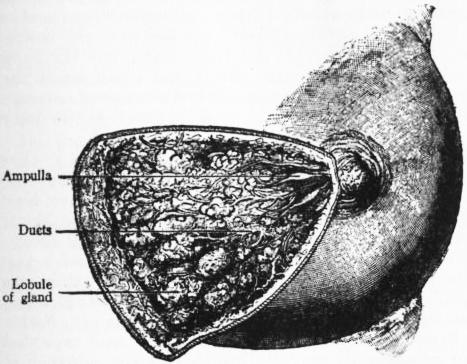
(From A. F. Dixon, Cunningham’s Text Book of Anatomy.)
Fig. 1.—Dissection of the Mammary Gland.
Supernumerary nipples and glands are not uncommon, and, when they occur, are usually situated in the mammary line which extends from the anterior axillary fold to the spine of the pubis; hence, when an extra nipple appears above the normal one, it is external to it, but, when below, it is nearer the middle line. The condition of extra breasts is known as polymasty, that of extra nipples as polythely, and it is interesting to notice that the latter is commoner in males than in females. O. Ammon (quoted by Wiedersheim) records the case of a German soldier who had four nipples on each side. These nipples in the human subject are seldom found below the costal margin. In normal males the breast structure is present, but rudimentary, though it is not very rare to find instances of boys about puberty in whom a small amount of milk is secreted, and one case at least is recorded of a man who suckled a child. A functional condition of the mammary glands in men is known as gynaekomasty. (For further details see The Structure of Man, by R. Wiedersheim, translated by H. and M. Bernard, and edited by G. B. Howes, London, 1895.)
Embryology.—There is every probability that the mammary glands are modified and hypertrophied sebaceous glands, and transitional stages are seen in the areolar glands, which sometimes secrete milk. At an early stage of foetal life a raised patch of ectoderm is seen, which later on becomes a saucer-like depression; from the bottom of this fifteen or twenty solid processes of cells, each presumably representing a sebaceous gland, grow into the mesoderm which forms the connective-tissue stroma of the mamma. Later on these processes branch. The last stage is that the centre of the mammary pit or saucer-like depression once more grows up to form the nipple, and at birth the processes become tubular, thus forming lactiferous ducts. The glands grow little until the age of puberty, but their full development is not reached until the birth of the first child.
Comparative Anatomy.—In the lower Mammals the mammary line, already mentioned, appears in the embryo as a ridge, and in those which have many young at a birth patches of this develop in the thoracic and abdominal regions to form the mammae, while the intervening parts of the ridge disappear. The number of mammae is not constant in animals of the same species; as an instance of this it will be found that in the dog the number of nipples varies from seven to ten, though animals with many nipples are more liable to variation than those with few. When only a few young are produced at a time the mammae are few, and it seems to depend on the convenience of suckling in which part of the mammary line the glands are developed. In the pouched Mammals (Monotremes and Marsupials) inguinal mammae are found, and so they are in most Ungulates as well as in the Cetacea. In the elephants, Sirenia, Chiroptera and most of the Primates, on the other hand, they are confined to the pectoral region, and this is also the case in some Rodents, e.g. the jumping hare (Pedetes caffer). In the monotremes the mammary pit remains throughout life, and the milk is conducted along the hairs to the young, but in other Mammals nipples are formed in one of two ways. One is that already described in Man, which is common to the Marsupials and Primates, while in the other the margin or vallum of the mammary pit grows up, and so forms a nipple with a very deep pit, into the bottom of which the lactiferous ducts open. The latter is regarded as the primary arrangement. In the monotremes the mammae are looked upon, not as modified sebaceous glands, as in other Mammals, but as altered sweat glands. It is further of interest to notice that in these primitive Mammals the glands are equally developed in both sexes, and it is thought that among the bats the male often assists in suckling the young (see G. Dobson, Brit. Museum Cat. of the Chiroptera, London, 1878). These facts, together with the occasional occurrence of gynaekomasty in man, make it probable that the ancestral Mammal was an animal in which both sexes helped in the process of lactation.
For further details and literature up to 1906 see Comparative Anatomy of Vertebrates, by R. Wiedersheim, adapted by W. N. Parker (1907), and Bronn’s Classen und Ordnungen des Thierreichs.
(F. G. P.)
Diseases of the Mammary Gland.—Inflammation of the breast (mastitis) is apt to occur in a woman who is suckling, and is due to the presence of septic micro-organisms, which, as a rule, have found their way into the milk-ducts, the lymphatics or the veins, through a crack, or other wound, in a nipple which has been made sore by the infant’s vigorous attempts to obtain food. Especially is this septic inflammation apt to occur if the nipple is depressed, or so badly formed that the infant has difficulty in feeding from it. The inflamed breast is enlarged, tender and painful, and the skin over it is hot, and perhaps too reddened. The woman feels ill and feverish, and she may shiver, or have a definite rigor—which suggests that the inflammation is running on to the formation of an abscess. The abscess may be superficial to, or beneath, the breast, but it is usually within the breast itself. The infant should at once be weaned, the milk-tension being relieved by the breast-pump. Fomentations should be applied under waterproof jaconette, and the breast should be evenly supported by a bandage or by the corsets. Belladonna and glycerine should be smeared over the breast, with the view of checking the secretion of milk, as well as of easing pain. But before this is done six or eight leeches may be applied. On the first indication that matter is collecting, an incision should be made, for if the matter is allowed to remain locked up in the breast tissue the abscess will rapidly increase in size, and the whole of the breast may become infected and destroyed. Supposing that, in making the incision, no pus is discovered, the relief to the vascular tension thus afforded will be nevertheless highly beneficial. The operation had better be done under a general anaesthetic, so that the surgeon can introduce a probe, or his finger, into the wound, breaking down the partitions which are likely to exist between separate abscesses, and thus enable them to be drained through the one opening. As the discharge begins to cease, the tenderness subsides, and gentle massage, or firm strapping of the breast, will prove useful. The general treatment will consist in the administration of an aperient, and, the tongue being clean, in prescribing such drugs as quinine, strychnia and iron. The diet should be liberal, but not carried to such excess that the power of digestion and absorption is overtaxed. During the early acute stage of the disease small doses of morphia may be necessary. When the tongue has cleaned, a little wine may be given with advantage.
Chronic Eczema around the nipple of a woman late in life, with, perhaps, localized ulceration, is known as Paget’s Disease. The importance of it is that cancerous infiltration is apt to pass from it along the milk-ducts and to involve the breast in malignant disease. Hence, when eczema about the nipple refuses to clear up under the influence of soothing treatment, it is well to insist on the removal of the entire breast. Sometimes this eczema is malignant from the beginning, being associated with the active prolifization of the epithelial cells of the milk-ducts, and with their escape into the surrounding tissues. The nipple is retracted in most of these cases, which, however, are not often met with.
Chronic Mastitis is of frequent occurrence in women who are past middle age. The part of the breast involved is enlarged, hard, and more or less tender and painful. It is sometimes impossible clinically to distinguish this disease from cancer. True, the tumour is not so definite or so hard as a cancer, nor is it attached to the skin, nor to the muscles of the chest wall, and if there are any glands secondarily enlarged in the arm-pit they are not so hard as they may be in cancer. But all these are questions of degree. It is, of course, highly inadvisable to leave it to time to clear up the diagnosis, for a chronic mastitis, innocent at first, may eventually become cancerous. If in any case the difficulty of distinguishing a chronic mastitis from a malignant tumour of the breast is insuperable, the safest course is to remove the breast and have it examined by the microscope. The suggestion, sometimes made, as to the preliminary removal of a small piece of the tumour for examination is not to be recommended.
A simple glandular tumour, fibro-adenoma, is apt to be found in the breasts of youngish women, who may possibly give an account of some blow or other injury; there may, however, be no history of injury. The tumour is smooth, rounded or oval, and lies loose in the midst of the breast; as a rule it is not tender. It is not associated with enlarged glands in the arm-pit. The tumour had best be removed, though there is no urgency about the operation, as the growth is absolutely innocent. There is, however, no telling as to what course an innocent tumour of the breast may take as middle age comes on.
Cysts of the Breast.—A galactocele is a tumour due to the locking up of milk in a greatly dilated duct. Other forms of cystic disease may be due to serous or hydatid fluid, or to thin pus, being surrounded by fibrous walls. Such cysts are best treated by free incision, and by passing a gauze dressing into their depths. If the tissue is occupied by many cysts, the whole breast had better be removed.
Cancer of the Breast may be met with in men as well as in women; in men, however, it is very rare. It is commonest in women between the ages of forty and fifty. It is sometimes met with in women of twenty; and the younger the individual the more malignant is the disease. Married life seems to have no effect as regards the incidence of the disease, but it often happens that a breast which gave trouble during the period of suckling becomes later the subject of cancer; in other cases there is a clear history of the attack having followed an injury. It is, thus, as if inflammatory changes in the breast were the direct cause of a later cancerous invasion. Though it is impossible to affirm that heredity has a great influence in the incidence of cancer, it is, nevertheless, remarkable that the members of certain families are unusually prone to the disease.
The chief feature of a cancerous tumour of the breast is its great hardness. The technical name for the growth is scirrhus (Gr. σκίρος, or σκίρρος, any hard coat or covering, stucco), from its stony hardness. The tumour consists of a dense framework of fibrous tissue, with groups of cancer-cells in the spaces. The malignancy of the disease depends upon the cells, not upon the fibrous tissue. In young subjects the cells predominate, but in old ones the contraction of the fibrous tissue throughout the breast compresses and destroys the cells, and this sometimes to such an extent that there is at last nothing left at the site but contracted fibrous tissue, all trace of malignancy having disappeared. This variety of the disease is found in old people, and is called atrophic cancer.
The cells of a cancerous breast are apt to be carried by the lymphatics to the lymphatic glands in the arm-pit, and by the bloodstream to the spinal column and to other parts of the skeleton, and sometimes to the liver, which thus becomes large and hard, or to the other breast.
As the fibrous tissue around the tumour becomes invaded by the new growth it undergoes contraction (much as a string becomes shorter when it is wetted), and as this shortening of the fibrous bands increases the nipple may be retracted, and the breast may be closely bound down to the chest-wall; and, further, the skin overlying the tumour may be drawn in towards the tumour so as to form a conspicuous dimple. Later, the nutrition of this patch of skin may be so interfered with that it mortifies or breaks down, and thus a cancerous ulcer is produced. This ulcer slowly spreads, and its floor is covered with a discharge in which septic micro-organisms undergo cultivation; in this way the ulcer becomes highly offensive. By the use of antiseptic lotions and a frequent change of dressings, however, all unpleasant smell can be checked or prevented. As the ulcer extends it is apt to implicate large blood-vessels, so that serious, and sometimes alarming, haemorrhages take place. And if the breast had previously been in pain, the bleeding is likely to give great relief. But repeated haemorrhages bring on increasing exhaustion, and thus materially hasten the end.
There is at present only one trustworthy treatment for cancer, and that is its free removal by operation. The entire breast and the nipple must be sacrificed. At the present day the operation itself is not a “dreadful” one. To be successful it must be very thorough, and it must be done early. The patient, being under an anaesthetic, feels nothing, and the subsequent dressings of the wound are attended with scarcely any pain. There need be but a couple of days of confinement to bed, and when the wound has soundly healed the patient may be encouraged to use her arm. Should there be recurrence of cancerous nodules in or about the wound, their removal should be promptly and widely effected. The writer has records of one case in which between the first operation and the last report there was a space of over twenty-nine years, and another of fifteen years. Each of these patients had one extensive operation, and four or five smaller operations for dealing with recurrences. Each of them, however, might be considered unlikely subjects for further return.
For a superficial cancer the X-rays may be of service, but many applications of the rays are likely to be needed, and the case may possibly refuse to yield to their influence, and, after loss of valuable time, the disease may have eventually to be removed by the knife. The great advantage which the treatment by the knife offers over every other method is that the growth can be cleanly, efficiently and promptly removed, and, with it, all the affected lymph-spaces, and the lymphatic glands which are secondarily implicated.
As regards the value of radium in the treatment of cancer of the breast, the high expectations which were somewhat widely associated with this newly-found element early in 1909 must be said to have been unjustified by any precise results. Injections of radium salts have been made into the substance of a cancer, and tubes of aluminium containing the salt have been introduced into the growth, but no deep cancer has thereby been cured. Radium has also been exposed again and again on the surface of the affected breast, but similarly with no great result. Unfortunately, whilst one is experimenting in the treatment of an operable cancer, the epithelial cells of the growth may be making their way towards distant parts, where no rays or emanations could possibly reach them. Whatever may be the future of radium as a therapeutic agent in the treatment of cancer of the breast, it is certain that, on the facts as known at the beginning of 1910, the only safe course is to remove the breast by direct operation, together with the associated lymph-spaces and lymphatic glands. And if this is done promptly and thoroughly cancer of the breast will come more and more into the class of curable diseases.
(E. O.*)
MAMMEE APPLE, South American or St Domingo Apricot, the fruit of Mammea americana (natural order Clusiaceae), a large tree with opposite leathery gland-dotted leaves, white, sweet-scented, short-stalked, solitary or clustered axillary flowers and yellow fruit 3 to 6 in. in diameter. The bitter rind encloses a sweet aromatic flesh, which is eaten raw or steeped in wine or with sugar, and is also used for preserves. There are one to four large rough seeds, which are bitter and resinous, and used as anthelmintics. An aromatic liqueur distilled from the flowers is known as eau de créole in the West Indies, and the acrid resinous gum is used to destroy the chigoes which attack the naked feet of the negroes. The wood is durable and well adapted for building purposes; it is beautifully grained and used for fancy work.
MAMMON, a word of Aramaic origin meaning “riches.” The etymology is doubtful; connexions with a word meaning “entrusted,” or with the Hebrew matmon, treasure, have been suggested. “Mammon,” Gr. μαμωνᾶς (see Professor Eb. Nestle in Ency. Bib. s.v.), occurs in the Sermon on the Mount (Matt. vi. 24) and the parable of the Unjust Steward (Luke xvi. 9-13). The Authorized Version keeps the Syriac word. Wycliffe uses “richessis.” The New English Dictionary quotes Piers Plowman as containing the earliest personification of the name. Nicholaus de Lyra (commenting on the passage in Luke) says that Mammon est nomen daemonis. There is no trace, however, of any Syriac god of such a name, and the common identification of the name with a god of covetousness or avarice is chiefly due to Milton (Paradise Lost, i. 678).
MAMMOTH (O. Russ. mammot, mod. mamant; the Tatar word mama, earth, from which it is supposed to be derived, is not known to exist), a name given to an extinct elephant, Elephas primigenius of Blumenbach. Probably no extinct animal has left such abundant evidence of its former existence; immense numbers of bones, teeth, and more or less entire carcases, or “mummies,” as they may be called, having been discovered, with the flesh, skin and hair in situ, in the frozen soil of the tundra of northern Siberia.
The general characteristics of the order Proboscidea, to which the mammoth belongs, are given under that heading. The mammoth pertains to the most highly specialized section of the group of elephants, which also contains the modern Asiatic species. Of the whole group it is in many respects, as in the size and form of the tusks and the characters of the molar teeth, the farthest removed from the mastodon type, while its nearest surviving relative, the Asiatic elephant (E. maximus), has retained the slightly more generalized characters of the mammoth’s contemporaries of more southern climes, E. columbi of America and E. armeniacus of the Old World. The tusks, or upper incisor teeth, which were probably smaller in the female, in the adult males attained the length of from 9 to 10 ft. measured along the outer curve. Upon leaving the head they were directed at first downwards, and outwards, then upwards and finally inwards at the tips, and generally with a tendency to a spiral form not seen in other elephants.
It is chiefly by the characters of the molar teeth that the various extinct modifications of the elephant type are distinguished. Those of the mammoth (fig. 2) differ from the corresponding organs of allied species in great breadth of the crown as compared with the length, the narrowness and crowding or close approximation of the ridges, the thinness of the enamel, and its straightness, parallelism and absence of “crimping,” as seen on the worn surface or in a horizontal section of the tooth. The molars, as in other elephants, are six in number on each side above and below, succeeding each other from before backwards. Of these Dr Falconer gave the prevailing “ridge-formula” (or number of complete ridges in each tooth) as 4, 8, 12, 12, 16, 24, as in E. maximus. Dr Leith-Adams, working from more abundant materials, has shown that the number of ridges of each tooth, especially those at the posterior end of the series, is subject to individual variation, ranging in each tooth of the series within the following limits: 3 to 4, 6 to 9, 9 to 12, 9 to 15, 14 to 16, 18 to 27—excluding the small plates, called “talons,” at each end. Besides these variations in the number of ridges or plates of which each tooth is composed, the thickness of the enamel varies so much as to have given rise to a distinction between a “thick-plated” and a “thin-plated” variety—the latter being most prevalent among specimens from the Arctic regions. From the specimens with thick enamel plates the transition to the other species mentioned above, including E. maximus, is almost imperceptible.
The bones of the skeleton generally more resemble those of the Indian elephant than of any other species, but the skull differs in the narrower summit, narrower temporal fossae, and more prolonged incisive sheaths, supporting the roots of the enormous tusks. Among the external characters by which the mammoth was distinguished from either of the existing species of elephant was the dense clothing, not only of long, coarse outer hair, but also of close under woolly hair of a reddish-brown colour, evidently in adaptation to the cold climate it inhabited. This character is represented in rude but graphic drawings of prehistoric age found in caverns in the south of France. It should be added that young Asiatic elephants often show considerable traces of the woolly coat of the mammoth. The average height does not appear to have exceeded that of either of the existing species of elephant.
The geographical range of the mammoth was very extensive. There is scarcely a county in England in which its remains have not been found in alluvial gravel or in caverns, and numbers of its teeth are dredged in the North Sea. In Scotland and Ireland its remains are less abundant, and in Scandinavia and Finland they appear to be unknown; but they have been found in vast numbers at various localities throughout the greater part of central Europe (as far south as Santander and Rome), northern Asia, and the northern part of the American continent.
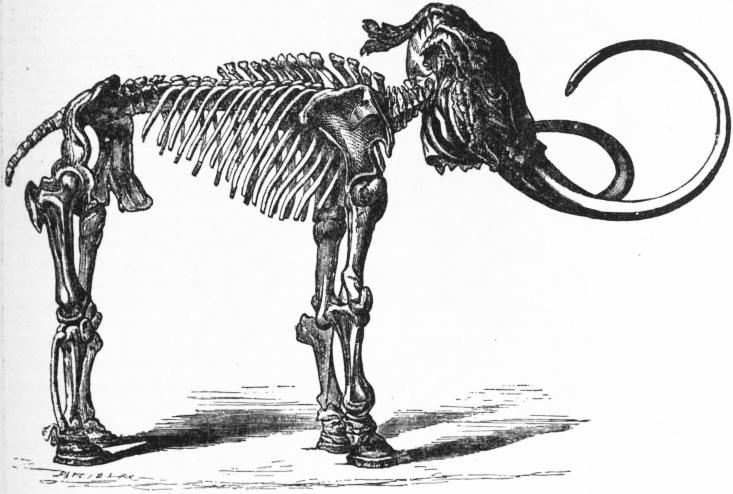
(From Tilesius.)
Fig. 1.—Skeleton of Mammoth (Elephas primigenius), with portions of the skin.
The mammoth belongs to the post-Tertiary or Pleistocene epoch and was contemporaneous with man. There is evidence to show that it existed in Britain before, during and after the glacial period. It is in northern Siberia that its remains have been found in the greatest abundance and in exceptional preservation. For a long period there has been from that region an export of mammoth-ivory, fit for commercial purposes, to China and to Europe. In the middle of the 10th century trade was carried on at Khiva in fossil ivory. Middendorff estimated the number of tusks which have yearly come into the market during the last two centuries at at least a hundred pairs, but Nordenskiöld considers this estimate too low. Tusks are found along the whole shore-line between the mouth of the Obi and Bering Strait, and the farther north the more numerous they become, the islands of New Siberia being one of the favourite collecting localities. The remains are found not only round the mouths of the great rivers, but embedded in the frozen soil in such circumstances as to indicate that the animals lived not far from the localities in which they are found; and they are exposed either by the melting of the ice in warm summers or the washing away of the sea-cliffs or river-banks. In this way the bodies of more or less nearly perfect animals, often standing in the erect position, with the soft parts and hairy covering entire, have been brought to light.
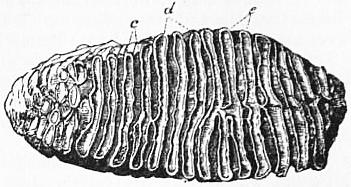
(From Owen.)
Fig. 2.—Grinding surface of Upper Molar Tooth of the Mammoth (Elephas primigenius). c, cement; d, dentine; e, enamel.
For geographical distribution and anatomical characters see Falconer’s Paleontological Memoirs, vol. ii (1868); B. Dawkins, “Elephas Primigenius, its Range in Space and Time,” Quart. Journ. Geol. Soc., xxxv. 138 (1879); and A. Leith Adams, “Monograph of British Fossil Elephants,” part ii., Palaeontographical Society (1879).
(W. H. F.; R. L.*)
MAMMOTH CAVE, a cave in Edmondson county, Kentucky, U.S.A., 37° 14′ N. lat. and 86° 12′ W. long., by rail 85 m. S.S.W. of Louisville. Steamboats run from the mouth of the Green river, near Evansville, Indiana, to the Mammoth Cave landing. The cave is usually said to have been discovered, in 1809, by a hunter named Hutchins; but the county records, as early as 1797, fixed its entrance as the landmark for a piece of real estate. Its mouth is in a forest ravine, 194 ft. above Green river and 600 ft. above the sea. This aperture is not the original mouth, the latter being a chasm a quarter of a mile north of it, and leading into what is known as Dixon’s cave. The two portions are not now connected, though persons in one can make themselves heard by those in the other.
The cavernous limestone of Kentucky covers an area of 8000 sq. m., is massive and homogeneous, and belongs to the Subcarboniferous period. It shows few traces of dynamic disturbance, but has been carved, mainly by erosion since the Miocene epoch, into many caverns, of which the Mammoth Cave is the largest.
The natural arch that admits one to Mammoth Cave has a span of 70 ft., and from a ledge above it a cascade leaps 59 ft. to the rocks below, where it disappears. A flight of stone steps leads the way down to a narrow passage, through which the air rushes with violence, outward in summer and inward in winter. The temperature of the cave is uniformly 54° F. throughout the year, and the atmosphere is both chemically and optically of singular purity. While the lower levels are moist from the large pools and rivers that have secret connexion with Green river, the upper galleries are extremely dry. These conditions led at one time to the erection of thirteen cottages at a point about 1 m. underground, for the use of invalids, especially consumptives. The experiment failed, and only two cottages now remain as curiosities.
The Main Cave, from 40 to 300 ft. wide and from 35 to 125 ft. high, has several vast rooms, e.g. the Rotunda, where are the ruins of the old saltpetre works; the Star Chamber, where the protrusion of white crystals through a coating of the black oxide of manganese creates an optical illusion of great beauty; the Chief City, where an area of 2 acres is covered by a vault 125 ft. high, and the floor is strewn with rocky fragments, among which are found numerous half-burnt torches made of canes, and other signs of prehistoric occupancy. Two skeletons were exhumed near the Rotunda; but few other bones of any description have been found. The so-called Mammoth Cave “mummies” (i.e. bodies kept by being inhumed in nitrous earth), with accompanying utensils, ornaments, braided sandals and other relics, were found in Short and Salt Caves near by, and removed to Mammoth Cave for exhibition. The Main Cave, which abruptly ends 4 m. from the entrance, is joined by winding passages, with spacious galleries on different levels; and, although the diameter of the area of the whole cavern is less than 10 m., the combined length of all accessible avenues is supposed to be about 150 m.
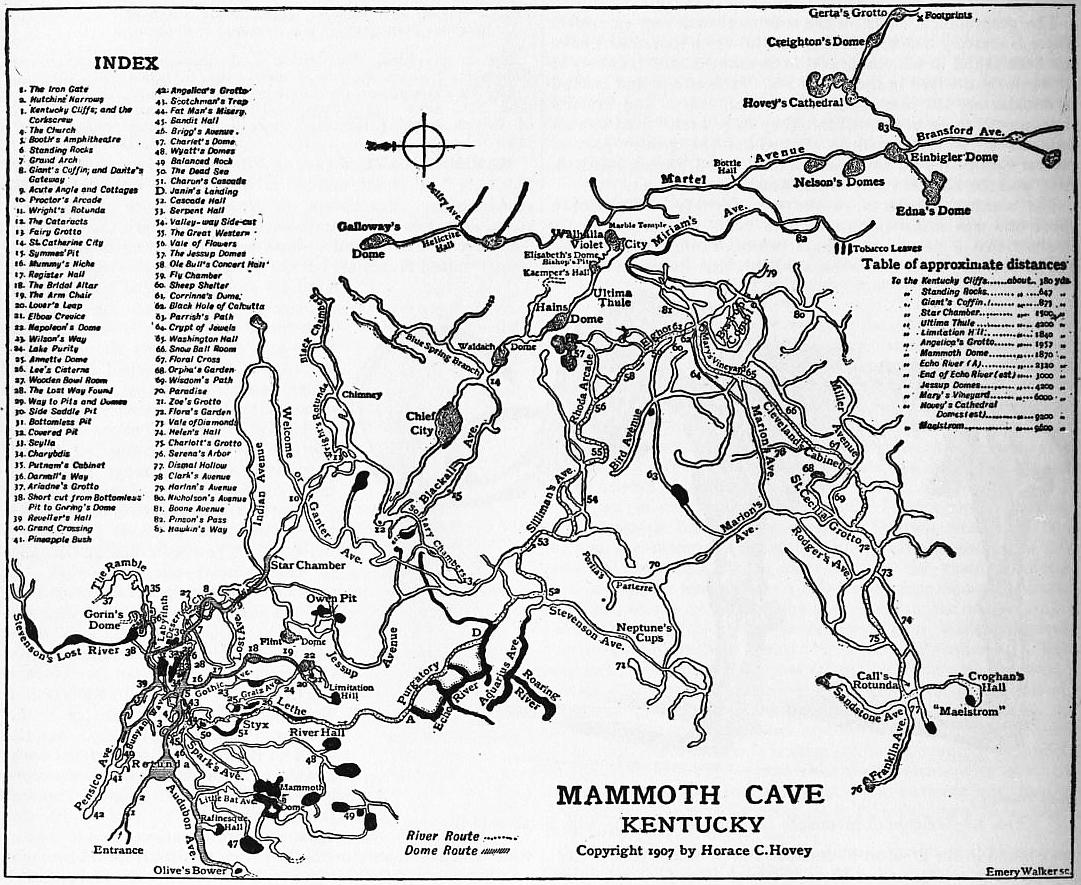
The chief points of interest are arranged along two lines of exploration, besides which there are certain side excursions. The “short route” requires about four hours, and the “long route” nine. Audubon’s Avenue, the one nearest the entrance, is occupied in winter by myriads of bats, that hang from the walls in clusters like swarms of bees. The Gothic Avenue contains numerous large stalactites and stalagmites, and an interesting place called the Chapel, and ends in a double dome and cascade. Among the most surprising features of cave scenery are the vertical shafts that pierce through all levels, from the uppermost galleries, or even from the sink-holes, down to the lowest floor. These are styled pits or domes, according to the position occupied by the observer. A crevice behind a block of stone, 40 ft. long by 20 ft. wide, called the Giant’s Coffin, admits the explorer to a place where six pits, varying in depth from 65 ft. to 200 ft., exist in an area of 600 yds. This includes Gorin’s Dome, which is viewed from a point midway in its side, and also from its top, and was formerly regarded as the finest room in the cavern. Others admire more the Mammoth Dome, at the termination of Spark’s Avenue, where a cataract falls from a height of 150 ft. amid walls wonderfully draped with stalactitic tapestry. The Egyptian Temple, which is a continuation of the Mammoth Dome, contains six massive columns, two of them quite perfect and 80 ft. high and 25 ft. in diameter. The combined length of these contiguous chambers is 400 ft. By a crevice above they are connected with an arm of Audubon’s Avenue. Lucy’s Dome, one of the group of Jessup Domes, is supposed to be the loftiest of all these vertical shafts. A pit called the “Maelstrom,” in Croghan’s Hall, is the spot most remote from the mouth of the cave. There are some fine stalactites near this pit, and others in the Fairy Grotto and in Pensico Avenue; but, considering the magnitude of Mammoth Cave, its poverty of stalactitic ornamentation is remarkable. The wealth of crystals is, however, surprising, and these are of endless variety and fantastic beauty.
Cleveland’s Cabinet and Marion’s Avenue, each a mile long, are adorned by myriads of gypsum rosettes and curiously twisted crystals, called “oulopholites.” These cave flowers are unfolded by pressure, as if a sheaf were forced through a tight binding, or the crystal fibres curl outward from the centre of the group. Thus spotless arches of 50 ft. span are embellished by floral clusters and garlands, hiding nearly every foot of the grey limestone. The botryoidal formations hanging by thousands in Mary’s Vineyard resemble mimic clusters of grapes, as the oulopholites resemble roses. Again, there are chambers with drifts of snowy crystals of the sulphate of magnesia, the ceilings so thickly covered with their efflorescence that a loud concussion will cause them to fall like flakes of snow.
Many small rooms and tortuous paths, where nothing of special interest can be found, are avoided as much as possible on the regular routes; but certain disagreeable experiences are inevitable. There is peril also in the vicinity of the deep pits. The one known as the Bottomless Pit was for many years a barrier to all further exploration, but it is now crossed by a wooden bridge. Long before the shaft had been cut as deep as now the water flowed away by a channel gradually contracting to a serpentine way, so extremely narrow as to be called the Fat Man’s Misery. The walls, only 18 in. apart, change direction eight times in 105 yds., while the distance from the sandy path to the ledge overhead is but 5 ft. The rocky sides are finely marked with waves and ripples, as if running water had suddenly been petrified. This winding way conducts one to River Hall, beyond which lie the crystalline gardens that have been described. It used to be said that, if this narrow passage were blocked up, escape would be impossible; but an intricate web of fissures, called the Corkscrew, has been discovered, by means of which a good climber, ascending only a few hundred feet, lands 1000 yds. from the mouth of the cave, and cuts off one or two miles.
The waters, entering through numerous domes and pits, and falling, during the rainy season, in cascades of great volume, are finally collected in River Hall, where they form several extensive lakes, or rivers, whose connexion with Green River is known to be in deep springs appearing under arches on its margin. Whenever there is a freshet in Green River the streams in the cave are joined in a continuous body of water, the rise sometimes being 60 ft. above the low-water mark. The subsidence within is less rapid than the rise; and the streams are impassable for about seven months in each year. They are navigable from May to October, and furnish interesting features of cave scenery. The first approach is called the Dead Sea, embraced by cliffs 60 ft. high and 100 ft. long, above which a path has been made, whence a stairway leads down to the banks of the river Styx, a body of water 40 ft. long, crossed by a natural bridge. Lake Lethe comes next—a broad basin enclosed by walls 90 ft. high, below which a narrow path leads to a pontoon at the neck of the lake. A beach of the finest yellow sand extends for 500 yds. to Echo River, the largest of all being from 20 to 200 ft. wide, 10 to 40 ft. deep and about three-quarters of a mile long. It is crossed by boats. The arched passage-way is very symmetrical, varying in height from 19 to 35 ft., and famous for its musical reverberations—not a distinct echo, but an harmonious prolongation of sound for from 10 to 30 seconds after the original tone is produced. The long vault has a certain keynote of its own, which, when firmly struck, excites harmonics, including tones of incredible depth and sweetness.
There are several other streams here besides those in River Hall. On one of them F. J. Stevenson of London is said to have floated for seven hours without finding its end. A glance at the accompanying map will show that there is a labyrinth of avenues and chasms seldom visited and never fully explored. New discoveries are frequently made. An exploring party in 1904 found a curious complex of upper and lower galleries accessible from the most eastern portion of the cave; beyond which another party, in 1905, discovered several large domes previously unknown. H. C. Hovey, in 1907, was led by expert guides into still wilder recesses, where a series of five domes were found, that opened into each other by tall gateways; each dome being 60 ft. in diameter and 175 ft. high. This magnificent group has since been named “Hovey’s Cathedral Domes.” No instrumental survey of the Mammoth Cave has ever been allowed by the management. The best map possible is therefore only the result of estimates and partial measurements. The depths of the most noted pits have easily been ascertained by line and plummet and the height of several large domes has been found by the use of small balloons. While making a survey exclusively for the cave-owners in 1908, Max Kaemper of Berlin, Germany, forced an opening from the main cave into a remarkable region to which the general name of “Violet City” was given, in honour of Mrs Violet Blair Janin, who owned a third of the Mammoth Cave estate. Special features are Kaemper Hall, Blair Castle, the Marble Temple and Walhalla. There are eleven enormous pits, many large fine stalactites and stalagmites and surprisingly beautiful mural decorations. Dr Hovey made and published (1909) a new handbook embodying all known discoveries of importance, with four sketch-maps of the routes of usual exhibition.
The fauna of Mammoth Cave has been classified by F. W. Putnam, A. S. Packard and E. D. Cope, who have catalogued twenty-eight species truly subterraneous, besides those that may be regarded as stragglers from the surface. They are distributed thus: Vertebrata, 8 species; Insecta, 17; Arachnida, 12; Myriapoda, 2; Crustacea, 5; Vermes, 3; Mollusca, 1. Ehrenberg adds a list of 8 Polygastric Infusoria, 1 fossil infusorian, 5 Phytolitharia and several microscopic fungi. A bed of Agaricus was found by the writer near the river Styx; and upon this hint an attempt has been made to propagate edible fungi in this locality. All the known forms of plant-life are either fungi or allied to them, and many are only microscopic. The most interesting inhabitants of Mammoth Cave are the blind, wingless grasshoppers, with extremely long antennae; blind, colourless crayfish (Cambarus pellucidus, Telk.); and the blind fish, Amblyopsis spelaeus, colourless and viviparous, from 1 in. to 6 in. long. The Cambarus and Amblyopsis have wide distribution, being found in many other caves, and also in deep wells, in Kentucky and Indiana. Fish not blind are occasionally caught, which are apparently identical with species existing in streams outside. The true subterranean fauna may be regarded as chiefly of Pleistocene origin; yet certain forms are possibly remnants of Tertiary life.
Bibliography.—Plan and Description of the Great and Wonderful Cave in Kentucky, by Dr Nahum Ward (1816); Notes on the Mammoth Cave, with a Map, by Edmund F. Lee, C. E. (1835); Rambles in the Mammoth Cave in 1844, by Alexander Bullitt, with map by Stephen Bishop; guide-books by Wright (1858), Binkerd (1869), Forwood (1875), Proctor (1878), Hovey (1882), &c., and Hovey and Call (1897); Hovey’s Celebrated American Caverns (1882, &c.); and The Mammoth Cave and its Inhabitants, by Packard and F. W. Putnam (1879).
(H. C. H.)
MAMORÉ, a large river of Bolivia which unites with the Beni in 10° 20′ S. to form the Madeira, one of the largest tributaries of the Amazon. It rises on the northern slope of the Sierra de Cochabamba east of the city of Cochabamba, and is known as the Chimoré down to its junction with the Chapare, or Chapari. Its larger tributaries are the Chapare, Sécure, Apere and Yacuma from the west, and the Ichila, Guapay or Grande, Ivari and Guaporé from the east. Taking into account its length only, the Guapay should be considered the upper part of the Mamoré; but it is shallow and obstructed, and carries a much smaller volume of water. The Guaporé, or Itenez, also rivals the Mamoré in length and volume, having its source in the Serra dos Parecis, Matto Grosso, Brazil, a few miles from streams flowing northward to the Tapajos and Amazon, and southward to the Paraguay and Paraná. The Mamoré is interrupted by rapids a few miles above its junction with the Beni, but a railway 180 m. long has been undertaken from below the rapids of the Madeira. Above the rapids the river is navigable to Chimoré, at the foot of the sierra, and most of its tributaries are navigable for long distances. Franz Keller (in The Amazon and Madeira Rivers; New York, 1874) gives the outflow of the Mamoré at mean water level, and not including the Guaporé, as 2530 cub. in. per second, and the area of its drainage basin, also not including the Guaporé, as 9382 sq. m.
See Edward D. Mathews, Up the Amazon and Madeira Rivers (London, 1879).
MAMUN (c. 786-833), originally Abdallah, surnamed Al-Ma’mūn (“in whom men trust”), the seventh of the Abbasid caliphs of Bagdad, was born about A.D. 786, and was the second son of Harun al-Rashīd. By Harun’s will he was successor-designate to his brother Amin, during whose reign he was to be governor of the eastern part of the empire. On Harun’s death (809) Amin succeeded and Mamun acquiesced. Irritated, however, by the treatment he received from Amin, and supported by a portion of the army, Mamun speedily rebelled. A five years’ struggle between the two brothers ended in the death of Amin and the proclamation of Mamun as caliph at Bagdad (Sept. 813). Various factions and revolts, which disturbed the first years of his reign, were readily quelled by his prudent and energetic measures. But a much more serious rebellion, stirred up by his countenancing the heretical sect of Ali and adopting their colours, soon after threatened his throne. His crown was actually on the head of his uncle Ibrahim b. Mahdi (surnamed Mobarek) for a short time (Barbier de Meynard, in Journal Asiatique, March-April 1869). This inaugurated a period of tranquillity, which Mamun employed in fostering literature and science. He had already, while governor of Khorasan, founded a college there, and attracted to it the most eminent men of the day, and Bagdad became the seat of academical instruction. At his own expense he caused to be translated into Arabic many valuable books from the Greek, Persian, Chaldean and Coptic languages; and he was himself an ardent student of mathematics and astronomy. The first Arabic translation of Euclid was dedicated to him in 813. Mamun founded observatories at Bagdad and Kassiun (near Damascus), and succeeded in determining the inclination of the ecliptic. He also caused a degree of the meridian to be measured on the plain of Shinar; and he constructed astronomical tables, which are said to be wonderfully accurate.
In 827 he was converted to the heterodox faith of the Mo’tazilites, who asserted the free-will of man and denied the eternity of the Koran. The later years (829-830) of his reign were distracted by hostilities with the Greek emperor Theophilus, while a series of revolts in different parts of the Arabian empire betokened the decline of the military glory of the caliphs. Spain and part of Africa had already asserted their independence, and Egypt and Syria were now inclined to follow. In 833, after quelling Egypt, at least nominally, Mamun marched into Cilicia to prosecute the war with the Greeks, but died near Tarsus, leaving his crown to a younger brother, Motasim. The death of Mamun ended an important epoch in the history of science and letters and the period of Arabian prosperity which his father’s reign had begun.
See further under Caliphate, sect. C., §§ 5, 6, 7.
MAMUND, a Pathan tribe and valley on the Peshawar border of the North-West Frontier Province of India. The Mamunds live partly in Bajour and partly in Afghan territory, due north of the Mohmands, a much larger tribe, with whom they must not be confounded. They are one of the clans of the Tarkanis (q.v.), and number 6000 fighting men; they gave much trouble during the Chitral Campaign in 1895, and again during the Mohmand Expedition in 1897 they inflicted severe losses upon General Jeffrey’s brigade. (See Mohmand.)
MAN, the word common to Teutonic languages for a single person of the human race, of either sex, the Lat. homo, and Gr. ἄνθρωπος; also for the human race collectively, and for a full-grown adult male human being. Teutonic languages, other than English, have usually adopted a derivative in the first sense, e.g. German Mensch. Philologists are not in agreement as to whether the Sanskrit manu is the direct source, or whether both are to be traced to a common root. Doubt also is thrown on the theory that the word is to be referred to the Indo-Germanic root, men, meaning “to think,” seen in “mind,” man being essentially the thinking or intelligent animal. (See Anthropology.)
MAN, ISLE OF (anc. Mona), a dominion of the crown of England, in the Irish Sea. (For map, see England, section I.) It is about 33 m. long by about 12 broad in the broadest part. Its general form resembles that of an heraldic lozenge, though its outline is very irregular, being indented with numerous bays and narrow creeks. Its chief physical characteristic is the close juxtaposition of mountain, glen and sea, which has produced a variety and beauty of scenery unsurpassed in any area of equal size elsewhere.
The greater part of its surface is hilly. The hills, which reach their culminating point in Snaefell (2034 ft.), have a definite tendency to trend in the direction of the longer axis, but throw out many radiating spurs, which frequently extend to the coast-line. They are, for the most part, smooth and rounded in outline, the rocks being such as do not favour the formation of crags, though, owing to the rapidity of their descent, streams have frequently rent steep-walled craggy gulleys in their sides. The strength of the prevalent westerly winds has caused them to be treeless, except in some of the lower slopes, but they are clad with verdure to their summits. Rising almost directly from the sea, they appear higher than they really are, and therefore present a much more imposing appearance than many hills of greater altitude. On the south-west, where they descend precipitously into the sea, they unite with the cliffs to the north and south of them to produce the most striking part of the coast scenery for which the isle is remarkable. But, indeed, the whole coast from Peel round by the Calf, past Castletown and Douglas to Maughold Head, near Ramsey, is distinguished by rugged grandeur. From Ramsey round by the Point of Ayre to within a few miles of Peel extend low sandy cliffs, bordered by flat sandy shores, which surround the northern plain. This plain is relieved only by a low range of hills, the highest of which attains an elevation of 270 ft. The drainage of the island radiates from the neighbourhood of Snaefell, from which mountain and its spurs streams have on all sides found their way to the sea. The most important of these are the Sulby, falling into the sea at Ramsey; the Awin-glass (bright river) and the Awin-dhoo (dark river), which unite their waters near Douglas; the Neb, at the mouth of which Peel is situated; and the Awin-argid (silver river, now called the Silverburn), which joins the sea at Castletown. There are no lakes. The narrow, winding glens thus formed, which are studded with clumps of fir, sycamore and mountain ash, interspersed with patches of gorse, heather and fern, afford a striking and beautiful contrast to the bare mountain tops. Traces of an older system of drainage than that which now exists are noticeable in many places, the most remarkable being the central depression between Douglas and Peel. The chief bays are, on the east coast, Ramsey, with an excellent anchorage, Laxey, Douglas, Derbyhaven, Castletown and Port St Mary; and, on the west coast, Port Erin and Peel.
Geology.—The predominant feature in the stratigraphy of the Isle of Man is, in the words of G. W. Lamplough,1 “the central ridge of slate and greywacke, which seems to have constituted an insulated tract at as early a date as the beginning of the Carboniferous period. This prototype of the present island appears afterwards to have been enfolded and obliterated by the sediments of later times; but with the progress of denudation the old ridge has once more emerged from beneath this mantle.” This mass of ancient rocks, the Manx Slate Series, has been divided locally into the Barrule slates, the Agneesh and other grit beds; and the Lonan and Niarbyl Flags. The whole series strikes N.E.-S.W., while structurally the strata form part of a synclinorium, the higher beds being on the N.W. and S.E. sides of the islands, the lower beds in the interior; although the subordinate dips appear to indicate an anticlinal structure. These rocks have been greatly crumpled; and in places, notably in Sully Glen, thrusting has developed a well-marked crush-breccia. So much has this folding and compression toughened the soft argillaceous rocks that the Barrule Slate, for example, is almost everywhere found occupying the highest points while the hard but more joined grits and flags occupy the lower ground on the mountain flanks. The Manx Series is penetrated and altered by large masses of granite at Dhoon, Foxdale and one or two other spots; and dykes, more or less directly associated with these masses, are numerous. No satisfactory fossils have yet been obtained from these rocks, but they are regarded, provisionally, as of Upper Cambrian age. Carboniferous rocks, including a basal conglomerate, white limestone with abundant fossils, and the black “Posidonomya Beds” (some of which are polished as a black marble) occur about Castletown, Poolvash Bay and Langness; and the basement beds appear again on the west coast at Peel. The cliffs and foreshore at Scarlet Point exhibit contemporaneous Carboniferous tuffs, agglomerates and basalts, as well as later dolerite dykes, in a most striking manner. Here too may be seen some curious effects of thrusting in the limestones. At the northern end of the island the Manx Slates end abruptly in an ancient sea-cliff which crosses between Ramsey and Ballaugh. The low-lying country beyond is formed of a thick mass of glacial sands, gravels and boulder clay. In the Bride Hills are to be seen glacial mounds rising 150 ft. above the level of the plain. The depressions known as the Curragh, now drained but still peaty in places, probably represent the sites of late glacial lakes. Glacial deposits are found also in all parts of the island. Beneath the thick drift of the plain, Carboniferous, Permian and Trassic rocks have been proved to lie at some depth below the present sea-level. On the coast near the Point of Ayr is a raised beach. Silver-bearing lead ore, zinc and copper are the principal minerals found in the Isle of Man; the most important mining centres being at Foxdale and Laxey.
Climate.—The island is liable to heavy gales from the south-west. Of this the trend of the branches of the trees to the north-east is a striking testimony. But it is equally subject to the influence of the warm drift from the Atlantic, so that its winters are mild, and, influenced by the less changeable temperature of the sea, its summers cool. The mean annual temperature is 49°.0 F., the temperature of the coldest month (January) being 41°.5, and the warmest (August) 58°.5, giving an extreme annual range of temperature of 17°.1 only, while the average temperature in spring is 46°.0, in summer 57°.2, in autumn 50°.9 and in winter 42°.0. Further evidence of the mildness of the climate is afforded by the fact that fuchsias, hydrangeas, myrtles and escallonias grow luxuriantly in the open air. Its rainfall, placed as it is between mountain districts in England, Ireland, Scotland and Wales, is naturally rather wet than dry. Statistics, however, reveal remarkable divergencies in the amounts of rain in the different parts of the island, varying from 61 in. at Snaefell to 25 in. at the Calf of Man. In the more populous districts it varies from 46 in. at Ramsey, and 45 in. at Douglas, to 38 in. at Peel and 34 in. at Castletown. Of sunshine the Isle of Man has a larger share than any portion of the United Kingdom except the south and south-east coasts and the Channel Islands. Briefly, then, the climate of the island may be pronounced to be equable and sunny, and, though humid, decidedly invigorating; its rainfall, though it varies greatly, is excessive in the populous districts; and its winds are strong and frequent, and usually mild and damp.
Fauna.—Like Ireland, the Isle of Man is exempt from snakes and toads, a circumstance traditionally attributed to the agency of St Patrick, the patron saint of both islands. Frogs, however, have been introduced from Ireland, and both the sand lizard and the common lizard are found. Badgers, moles, squirrels and voles are absent and foxes are extinct. Fossil bones of the Irish elk are frequently found, and a complete skeleton of this animal is to be seen at Castle Rushen. The red deer, which is referred to in the ancient laws and pictured on the runic crosses, became extinct by the beginning of the 18th century. Hares are less plentiful than formerly, and rabbits are not very numerous. Snipe are fairly common, and there are a few partridges and grouse. The latter, which had become extinct, were reintroduced in 1880. Woodcock, wild geese, wild ducks, plover, widgeon, teal, heron, bittern, kingfishers and the Manx shearwater (Puffinus anglorum) visit the island, but do not breed there. The puffin (Fratercula artica) is still numerous on the Calf islet in the summer time. The peregrine falcon, which breeds on the rocky coast, and the chough have become very scarce. The legal protection of sea-birds (local act of 1867) has led to an enormous increase in the number of gulls. A variety of the domestic cat, remarkable for the absence or stunted condition of the tail, is peculiar to the island.
Flora.—Like the fauna, the flora is chiefly remarkable for its meagreness. It contains at most 450 species as compared with 690 in Jersey. Alpine forms are absent. But what it lacks in variety it makes up in beauty and quantity. For the profusion of the gorse-bloom and the abundance of spring flowers, especially of primroses, and of ferns, the Isle of Man is probably unrivalled.
People.—The Manx people of the present day are mainly of Scandio-Celtic origin, with some slight traces of earlier races. They have large and broad heads, usually broader than those of their brother Celts (Goidels) in Ireland and Scotland, with very broad, but not specially prominent cheek-bones. Their faces are usually either scutiform, like those of the Northmen, or oval, which is the usual Celtic type, and their noses are almost always of good length, and straighter than is general among Celtic races. Light eyes and fair complexion, with rather dark hair, are the more usual combinations. They are usually rather tall and heavily built, their average height (males) being 5 ft. 7½ in., and average weight (naked) 155 ℔. The tendency of the population to increase is balanced by emigration. It reached its maximum in 1891. Since then it has slightly declined. A noticeable feature is its greater proportionate growth in the towns, especially in Douglas, than in the country. The country population reached its maximum in 1851. Since then it has been shrinking rapidly, especially in the northern district.
Sheadings, Parishes and Towns. 1726. 1821. 1871. 1901.
Rushen. Malew (P.) 890 2,649 2,466 2,113
Castletown (T.) 785 2,036 2,318 1,963
Arbory (P.) 661 1,455 1,350 802
Rushen (P.) 813 2,568 3,665 3,277
Middle. Santon (P.) 376 800 628 468
Braddan (P.) 780 1,754 2,215 2,177
Douglas (T.) 810 6,054 13,846 19,149
Onchan (P.) 370 1,457 1,620 3,942
Glenfalca. Marown (P.) 499 1,201 1,121 973
German (P.) 510 1,849 1,762 1,230
Peel (T.) 475 1,909 3,496 3,306
Patrick (P.) 745 2,031 2,888 1,925
Garff. Lonan (P.) 547 1,846 3,741 2,513
Maughold (P.) 529 1,514 1,433 887
Ramsey (T.) 460 1,523 3,861 4,672
Ayre. Lezayre (P.) 1,309 2,209 1,620 1,389
Bride (P.) 612 1,001 880 539
Andreas (P.) 967 2,229 1,757 1,144
Michael. Jurby (P.) 483 1,108 788 504
Ballaugh (P.) 806 1,467 1,077 712
Michael (P.) 643 1,427 1,231 928
Total 14,070 40,087 53,763 54,613
Chief Political Divisions and Towns.—The island is divided into six sheadings (so named from the Scandinavian skeða-Þing, or ship-district), called Glenfaba, Middle, Rushen, Garff, Ayre and Michael, each of which has its officer, the coroner, whose functions are similar to those of a sheriff; and there are seventeen parishes. For the towns see Castletown, Douglas, Peel and Ramsey. The principal villages are Ballasalla, Ballaugh, Foxdale, Laxey, Michael, Onchan, Port Erin and Port St Mary.
Communications.—There is communication by steamer with Liverpool, Glasgow, Greenock, Belfast, Silloth, Whitehaven, Belfast and Dublin throughout the year and, during the summer season, there are also steamers plying to Androssan, Heysham, Fleetwood and Blackpool. A daily mail was established in 1879. The internal communications are excellent. The roads are under the management of a board appointed by the Tynwald Court, a surveyor-general, and parochial surveyors. They are maintained by a system of licences on public-houses, carriages, carts and dogs, and a rate on real property. There are railways between Douglas, Ramsey, Peel, Castletown, Port Erin and Port St Mary, the line between Douglas and Ramsey being via St John’s and Michael. Electric tramways run from Douglas to Ramsey via Laxey, from Douglas to Port Soderick, and from Laxey to the summit of Snaefell.
Industries. (a) Agriculture.—The position of the Manx farmers, though they generally pay higher rents than their compeers in those countries do, is, except in the remote parts of the island, more favourable than that of the English or Scottish farmers. The best land is in the north and south. The farms are principally held on lease and small holdings have almost entirely disappeared. The cultivated area is about 93,000 acres, or 65% of the whole. The commons and uncultivated lands on the mountains are also utilized for pasturage. Oats occupy about three-fourths of the area under corn crops, barley about one-sixth. The amount of wheat and other corn crops is very trifling. Neither Manx wheat nor barley is as good on an average as English; but oats is, on the whole, fully equal to what is grown on the mainland. Turnips, which are an excellent crop, are largely exported, and the dry and sandy soil of the north of the island is very favourable for the growth of potatoes. The white and red clover and the common grasses grow luxuriantly, and the pasturage is, generally speaking, good. Some of the low-lying land, especially in the north, is much in need of systematic drainage. The livestock, largely in consequence of the premiums given by the insular government and the local agricultural society to bulls, heavy and light stallions and cart mares, now approximates very closely in quality to the stock in the north of England. Dairying, owing to the large number of summer visitors, is the most profitable department of agricultural industry. Apples, pears and wall fruit do not succeed very well, but the soil is favourable for the cultivation of strawberries, raspberries, gooseberries, currants and vegetables. Both agricultural and market-garden produce are quite insufficient to supply the demand in the summer.
(b) Fishing.—The important place which the fishing industry anciently held in the social organization of the Isle of Man is quaintly reflected in the wording of the oath formerly taken by the deemsters, who promised to execute the laws between the sovereign and his subjects, and “betwixt party and party, as indifferently as the herring backbone doth lie in the midst of the fish.” The statutes and records abound in evidence of the great extent to which both the people and their rulers were dependent on the produce of the sea. The most numerous fish are herrings, cod, mackerel, ling, haddock, plaice, sole, fluke, turbot and brett. The industry is, however, in a decaying condition, especially the herring fishery, which, for reasons which have not been satisfactorily ascertained, fails periodically. The amount of fish caught, except herrings, is not sufficient to supply the local demand in the summer, though some of the fish named are exported during the rest of the year. About 250 vessels, aggregating 4260 tons, with crews numbering 4250, are employed in this industry. A fish hatchery has been established at Port Erin by the insular government.
(c) Mining.—There is no doubt that, in proportion to its area, the metalliferous wealth of the Isle of Man has been very considerable. Two of its mines, Laxey and Foxdale, have stood for a long series of years in the first rank in the British Islands for productiveness of zinc and silver lead respectively. These metals have constituted its principal riches, but copper pyrites and hematite iron have also been raised in marketable quantities, while only very small amounts of the ores of nickel and antimony have been found. The mines are rented from the Crown as lord of the manor. The value of the ore produced is about £40,000 annually. Other economic products are clay, granite, limestone, sandstone, slate (of an inferior quality) and salt, which has been discovered near the Point of Ayre.
(d) Textiles, &c.—Since labour has become scarcer and dearer textile industries have been declining, being unable to compete with larger and more completely organized manufactories elsewhere. The principal manufactured articles are woollen cloths and blankets, hemp ropes and cotton, and herring nets. A few fishing vessels are built, and brewing is a prosperous industry. But, apart from agriculture, the most important industry (for so it may be called) is that of the provision for summer visitors, nearly half a million of whom come to the island annually.
Commerce.—The chief exports are lead, zinc, turnips, ropes, cotton nets and salt. The imports consist chiefly of timber, provisions, livestock, poultry, flour, fruit, vegetables and eggs. In 1906 the tonnage of vessels (other than fishing or wind-bound vessels) cleared for traffic was 720,790. The number of vessels (other than fishing vessels) registered as belonging to the island in 1906 was 79.
Government.—The government of the island is vested in a lieutenant-governor, appointed by the Crown; in a Council, which is the upper branch of the legislature; in the House of Keys, which is the lower branch; and in the Tynwald Court. The Council and Keys sit separately as legislative bodies, but they sit in the Tynwald Court as distinct bodies with co-ordinate powers to transact executive business and to sign Bills. The Tynwald Court controls the surplus revenue, after the payment of the cost of government and of a fixed contribution of £10,000 to the imperial exchequer, subject to the supervision of the Treasury and the veto of the lieutenant-governor, and it appoints boards to manage the harbours, highways, education, local government, and lunatic and poor asylums. The Imperial government, after intimating its intention to Tynwald, fixes the rates of the customs duties, but Tynwald can by resolution “impose, abolish or vary” the customs duties subject to the approval of parliament or the Treasury, such change to take effect immediately and to continue for six months, and, if parliament be then sitting, to the end of the session, provided that the same be not in the meantime annulled by the passing of an act of parliament, or a Treasury minute. The approval of the sovereign of the United Kingdom in Council is essential to every legislative enactment. Acts of the imperial parliament do not affect the island except it be specially named in them. The lieutenant-governor, who is the representative of the sovereign, presides in the Council, in the Tynwald Court, in the High Court of Justice (Staff of Government division) and in the Court of General Gaol Delivery. He is the supreme executive authority, and he shares the control of the legislative and administrative functions, including the management of the revenue and the control of its surplus, with the Tynwald Court; he has also the power of veto as regards the disposal of surplus revenue and the nature of proposed harbour works, and his signature is necessary to the validity of all acts. It has been the practice for him to act as chancellor of the exchequer and to initiate all questions concerning the raising or expenditure of public funds. The Council consists of the lieutenant-governor, the lord-bishop of the diocese, the clerk of the rolls, the two deemsters, the attorney-general, the archdeacon (all of whom are appointed by the Crown) and the vicar-general, who is appointed by the bishop. No act of the governor and Council is valid unless it is the act of the governor and at least two members of the Council. The House of Keys (for origin of the name see Key) is one of the most ancient legislative assemblies in the world. It consists of twenty-four members, elected by male and female owners or occupiers of property. Each of the six sheadings elects three members; the towns of Castletown, Peel and Ramsey one each, and Douglas five. There is no property qualification required of the members, and the house sits for five years unless previously dissolved by the lieutenant-governor.
Law.—The High Court of Justice, of which the lieutenant-governor is president, contains three divisions: viz. the Chancery Division, in which the clerk of the rolls sits as judge, the Common Law Division, of which the deemsters are the judges, the Staff of Government Division, in which the governor and three judges sit together. The jurisdiction of the Chancery and Common Law Division is in the main similar to that of the corresponding divisions in the English Courts. The Staff of Government exercises appellate jurisdiction, similar to that of the Appeal Courts in England. The Common Law Courts for the southern division of the island are held at Douglas and Castletown alternately and those for the northern division at Ramsey, once in three months. Actions in these courts are heard by a deemster and a special or common jury. The Chancery Court sits once a fortnight at Douglas. The deemsters also have summary jurisdiction in matters of debt, actions for liquidated damages under £50, suits for possession of real or personal property, petitions for probate, &c. These courts, called Deemsters’ Courts, are held weekly, alternately at Douglas and Castletown, by the deemster for the southern division of the island, and at Ramsey and Peel by the deemster for the northern division. Criminal cases are heard by the magistrates or a high-bailiff and are (with the exception of minor cases which may be dealt with summarily) sent on by them for trial by a deemster and a jury of six, who hear the evidence and determine whether there is sufficient ground for sending the case for trial before the Court of General Gaol Delivery, thus discharging the functions of the Grand Jury in England. The Court of General Gaol Delivery is the Supreme Criminal Court and is presided over by the lieutenant-governor, who is assisted by the clerk of the rolls and the two deemsters. The high-bailiffs hold weekly courts in the four towns for the recovery of debts under forty shillings and for the trial of cases usually brought before a stipendiary magistrate in England. The magistrates (J.P.’s) also hold regular courts in the towns for the trial of breaches of the peace and minor offences. There is a coroner in each of the six sheadings. These officers are appointed annually by the lieutenant-governor and perform duties similar to those of a sheriff’s officer in England. Inquests of death are held by a high-bailiff and jury. The Manx Bar is distinct from that of England. Its members, called “Advocates,” combine the functions of barrister and solicitor. The laws relating to real property still retain much of their ancient peculiarity, but other branches of law have of late years by various acts of Tynwald been made practically identical with English law.
As regards real property the general tenure is a customary freehold devolving from each possessor to his next heir-at-law. The descent of land follows the same rules as the descent of the crown of England. The right of primogeniture extends to females in default of males in the direct line. The interest of a widow or widower, being the first wife or husband of a person deceased, is a life estate in one-half of the lands which have descended hereditarily, and is forfeited by a second marriage; a second husband or second wife is only entitled to a life interest in one-fourth, if there be issue of the first marriage. Of the land purchased by the husband the wife surviving him is entitled to a life interest in one moiety. By a statute of the year 1777 proprietors of land are empowered to grant leases for any term not exceeding twenty-one years in possession without the consent of the wife.
Church.—It is not known by whom Christianity was introduced into Man, but from the large proportion of names of Irish ecclesiastics surviving in the appellations of the old Manx keeills, or cells, which are of similar type to the Irish oratories of the 6th and 7th centuries, and in the dedications of the parish churches, which are usually on ancient sites, it may be reasonably conjectured that Manxmen were, for the most part, Christianized by Irish missionaries. During the incursions of the pagan Vikings Christianity was almost certainly extirpated and it was probably not reintroduced before the beginning of the 11th century. The two most important events in the history of the medieval Manx Church were the formation of the diocese of Sodor (q.v.) and the foundation of the abbey of Rushen, a branch of the Cistercian abbey of Furness, in 1134. This latter event was important because the Cistercians were exempted from all episcopal visitation and control, by charter granted by the pope, and were, therefore, only subject to his rule and that of the abbots of their own order. From this time till the Reformation we find that there was an almost continuous struggle between the laity and the spiritual barons and monks, who had obtained great power and much property in the island. In 1458 the diocese was placed under York. The dissolution of the religious houses in Man was not brought about by the English Act of 1539, which did not apply to the island, but by the arbitrary action of Henry VIII. From such evidence as is available it would seem that the Reformation was a very slow process. When Isaac Barrow (uncle of his well-known namesake) became bishop in 1663 the condition of the Church was deplorable, but under him and his able and saintly successors, Thomas Wilson (1698-1755) and Mark Hildesley (1755-1773). it attained to a very much higher level than the English Church during the same period. After Hildesley’s time it was again neglected, and successful missions by John Wesley and others resulted in the establishment and rapid increase of Nonconformity. It was not till the second decade of the 19th century that the condition of the Church began to improve again, and this improvement has steadily continued. In 1878 a Sodor and Man theological school was established for the training of candidates for holy orders. This school has been affiliated to Durham University. In 1880 four rural deaneries were established, and commissioners were constituted as trustees of endowments for Church purposes. In 1895 a cathedral chapter, with four canons, was constituted under the name of the “Dean and Chapter of Man,” the bishop being the dean of the cathedral church. A Church Sustentation Fund was established by Bishop Straton in 1894, with a view to supplementing the incomes of the clergy, which had been greatly reduced on account of the low price of corn. There have been several acts giving Nonconformists equal rights with Churchmen. Among these are the Burials Acts of 1881 and 1895, which permit burials to take place in churchyards without the rites of the Church of England, and allow any burial service, provided it be Christian, in mortuary chapels. At the present day Nonconformists, chiefly Wesleyan Methodists, probably outnumber Churchmen, and there is a small number of Roman Catholics and Presbyterians. The bishop, who has a seat, but not a vote, in the House of Lords, is assisted by an archdeacon, a vicar-general, a registrar and a sumner-general. The jurisdiction of the only remaining ecclesiastical court, which is presided over by the vicar-general, as representing the bishop, is mainly in connexion with affiliation questions, the swearing-in of churchwardens and the granting of faculties. The power of the Manx Convocation to make canons, though not exercised since 1704, has never been abrogated, and so far affords a token that the Manx Church is a separate national Church governed by its own laws, which, however, must be approved by the insular Legislature.
Education.—It was not till 1872, when the insular Legislature passed the Public Elementary Education Act, that the Manx State undertook any direct responsibility for education. This act differed from the English Act of 1870 in three important particulars: (1) it at once constituted every town and parish a school district under a school board; (2) the attendance of children was made compulsory; and (3) every elementary school, those in connexion with the Church of Rome excepted, was obliged to provide for non-sectarian instruction in religious subjects, and for the reading of the Bible accompanied by suitable explanation. Since the date of this act education has made extraordinary strides. It became free in 1892, and a higher-grade school was established in Douglas in 1894. The public elementary schools, which are nearly all managed by School Boards, are subject to the control of a local “Council of Education” appointed by the Tynwald Court; but, as the Manx Act of 1872 requires that, in order to obtain a government grant, the schools shall fulfil the conditions contained in the minutes of the education department at Whitehall, they are examined by English inspectors and compelled to attain the same standard of efficiency as the English and Welsh schools. In 1907 an act establishing a system of secondary education was passed by the Legislature. The total number of public elementary schools in 1906 was 47, 42 being board and 5 denominational. Besides King William’s College, opened in 1833, which provided a similar education to that obtainable at the English public schools, there are grammar schools in Douglas, Ramsey and Castletown.
The Manx language (see Celt: Language) still lingers, the census of 1901 showing that there were about 4400 people who understood something of it. There is now no one who does not speak English.
Economics.—Municipal government was established in 1860, and in 1876 vaccination was made compulsory, as also was the registration of births, marriages and deaths in 1878. It was not till 1884 that the sanitation of the towns was seriously taken in hand; but ten years more elapsed before the sanitary condition of the island was dealt with by the passing of an act which constituted parish and village districts, with commissioners elected by the people, who had, in conjunction with a board elected by the Tynwald Court and an inspector appointed by it, to attend to all questions relating to sanitation and infectious diseases. As a result of these measures the death-rate has been greatly reduced. In 1888 a permissive poor law was established; it has been adopted by all the towns except Peel and by seven of the seventeen country parishes. Before this date the poor had been dependent on voluntary relief, which broke down owing to the growth of a temporarily employed class occupied in administering to the wants of the summer visitors. The total number of persons in receipt of poor relief averages about 920, and that of lunatics about 212. The average number of births during the five years 1902-1906 was 21.6, of marriages 6.1, and of deaths 17.6 per thousand. The rateable annual value of the parishes, towns and villages is about £400,000. The revenue for the year ending the 31st of March 1907 was £86,365, and the expenditure £75,728. The largest revenue raised was £91,193 in 1901, and the debt reached its maximum amount, £219,531, in 1894.
History.—The history of the Isle of Man falls naturally into three periods. In the first of these the island was inhabited by a Celtic people. The next is marked by the Viking invasions and the establishment of Scandinavian rule. The third period is that of the English dominion. The secular history of the Isle of Man during the Celtic period is an absolute blank, there being no trustworthy record of any event whatever before the incursions of the Northmen, since the exploits attributed to Baetan MacCairill, king of Ulster, at the end of the 6th century, which were formally supposed to have been performed in the Isle of Man, really occurred in the country between the Firths of Clyde and Forth. And it is clear that, even if the supposed conquest of the Menavian islands—Man and Anglesey—by Edwin of Northumbria, in 616, did take place, it could not have led to any permanent results; for, when the English were driven from the coasts of Cumberland and Lancashire soon afterwards, they could not well have retained their hold on the island to the west of these coasts. It is, however, possible that in 684, when Ecfrid laid Ireland waste from Dublin to Drogheda, he temporarily occupied Man. During the period of Scandinavian domination there are two main epochs—one before the conquest of Man by Godred Crovan in 1079, and the other after it. The earlier epoch is characterized by warfare and unsettled rule, the later is comparatively peaceful. Between about A.D. 800 and 815 the Vikings came to Man chiefly for plunder; between about 850 and 990, when they settled in it, the island fell under the rule of the Scandinavian kings of Dublin; and between 990 and 1079, it was subject to the powerful earls of Orkney. The conqueror Godred Crovan was evidently a remarkable man, though little information about him is attainable. According to the Chronicon Manniae he “subdued Dublin, and a great part of Leinster, and held the Scots in such subjection that no one who built a vessel dared to insert more than three bolts.” The memory of such a ruler would be likely to survive in tradition, and it seems probable therefore that he is the person commemorated in Manx legend under the name of King Gorse or Orry. The islands which were under his rule were called the Suðr-eyjar (Sudreys or the south isles), in contradistinction to the norðr-eyjar, or the north isles, i.e. the Orkneys and Shetlands, and they consisted of the Hebrides, and of all the smaller western islands of Scotland, with Man. At a later date his successors took the title of Rex Manniae el Insularum. Olaf, Godred’s son, was a powerful monarch, who, according to the Chronicle, maintained “such close alliance with the kings of Ireland and Scotland that no one ventured to disturb the Isles during his time” (1113-1152). His son, Godred, who for a short period ruled over Dublin also, as a result of a quarrel with Somerled, the ruler of Argyll, in 1156, lost the smaller islands off the coast of Argyll. An independent sovereignty was thus interposed between the two divisions of his kingdom. Early in the 13th century, when Reginald of Man did homage to King John, we hear for the first time of English intervention in the affairs of Man. But it was into the hands of Scotland that the islands were ultimately to fall. During the whole of the Scandinavian period the isles were nominally under the suzerainty of the kings of Norway, but they only occasionally asserted it with any vigour. The first to do so was Harold Haarfager about 885, then came Magnus Barfod about 1100, both of whom conquered the isles. From the middle of the 12th century till 1217 the suzerainty, owing to the fact that Norway was a prey to civil dissensions, had been of a very shadowy character. But after that date it became a reality and Norway consequently came into collision with the growing power of Scotland. Finally, in 1261, Alexander III. of Scotland sent envoys to Norway to negotiate for the cession of the isles, but their efforts led to no result. He therefore initiated hostilities which terminated in the complete defeat of the Norwegian fleet at Largs in 1263. Magnus, king of Man and the Isles, who had fought on the Norwegian side, was compelled to surrender all the islands over which he had ruled, except Man, for which he did homage. Two years later Magnus died and in 1266 the king of Norway, in consideration of the sum of 4000 marks, ceded the islands, including Man, to Scotland. But Scotland’s rule over Man was not firmly established till 1275, when the Manx were defeated in a decisive battle at Ronaldsway, near Castletown. In 1290 we find Edward I. of England in possession of Man, and it remained in English hands till 1313, when it was taken by Robert Bruce after besieging Castle Rushen for five weeks. Then, till 1346, when the battle of Neville’s Cross decided the long struggle between England and Scotland in England’s favour, there followed a confused period when Man was sometimes under English and sometimes under Scottish rule. About 1333 it had been granted by King Edward III. to William de Montacute, 1st earl of Salisbury, as his absolute possession, without reserving any service to be rendered to him. In 1392 his son sold the island “with the crowne” to Sir William Le Scroope. In 1399 Henry IV. caused Le Scroope, who had taken Richard’s side, to be beheaded. The island then came into the possession of the crown and was granted to Henry de Percy, earl of Northumberland, but, he having been attainted, Henry IV., in 1406, made a grant of it, with the patronage of the bishopric, to Sir John Stanley, his heirs and assigns, on the service of rendering two falcons on paying homage and two falcons to all future kings of England on their coronation.
With the accession of the Stanleys to the throne there begins a better epoch in Manx history. Though the island’s new rulers rarely visited its shores, they placed it under responsible governors, who, in the main, seem to have treated it with justice. Of the thirteen members of the family who ruled in Man, the second Sir John Stanley (1414-1432), James, the 7th earl (1627-1651), and the 10th earl of the same name (1702-1736) had the most important influence on it. The first curbed the power of the spiritual barons, introduced trial by jury, instead of trial by battle, and ordered the laws to be written. The second, known as the Great Stanley, and his wife, Charlotte de la Tremoille (or Tremouille), are probably the most striking figures in Manx history. In 1643 Charles I. ordered him to go to Man, where the people, who were no doubt influenced by what was taking place in England, threatened to revolt. But his arrival, with English soldiers, soon put a stop to anything of this kind. He conciliated the people by his affability, brought in Englishmen to teach various handicrafts and tried to help the farmers by improving the breed of Manx horses, and, at the same time, he restricted the exactions of the Church. But the Manx people never had less liberty than under his rule. They were heavily taxed; troops were quartered upon them; and they also had the more lasting grievance of being compelled to accept leases for three lives instead of holding their land by the “straw” tenure which they considered to be equivalent to a customary inheritance. Six months after the death of the king Stanley received a summons from General Ireton to surrender the island, which he haughtily declined. In August 1651 he went to England with some of his troops, among whom were 300 Manxmen, to join King Charles II., and he and they shared in the decisive defeat of the Royalists at Worcester. He was captured and confined in Chester Castle, and, after being tried by court martial, was executed at Wigan. Soon after his death the Manx Militia, under the command of William Christian, rose against the Countess and captured all the insular forts except Rushen and Peel. They were then joined by a parliamentary force under Colonel Duckenfield, to whom the Countess surrendered after a brief resistance. Fairfax had been appointed “Lord of Man and the Isles” in September, so that Man continued under a monarchical government and remained in the same relation to England as before. The restoration of Stanley government in 1660 therefore caused as little friction and alteration as its temporary cessation had. One of the first acts of the new lord, Charles (the 8th earl), was to order Christian to be tried. He was found guilty and executed. Of the other persons implicated in the rebellion only three were excepted from the general amnesty. But by order in Council they were pardoned, and the judges responsible for the sentence on Christian were punished. His next act was to dispute the permanency of the tenants’ holdings, which they had not at first regarded as being affected by the acceptance of leases, a proceeding which led to an almost open rebellion against his authority and to the neglect of agriculture. In lieu of it the people devoted themselves to the fisheries and to contraband trade. The agrarian question was not settled till 1704, when James, Charles’s brother and successor, largely through the influence of Bishop Wilson, entered into a compact with his tenants, which was embodied in an act, called the “Act of Settlement.” Their compact secured the tenants in the possession of their estates in perpetuity on condition of a fixed rent, and a small fine on succession or alienation. From the great importance of this act to the Manx people it has been called their Magna Carta. As time went on, and the value of the estates increased, the rent payable to the lord became so small in proportion as to be almost nominal. James died in 1736 and the sovereignty of the isle passed to James Murray, 2nd duke of Atholl. In 1764 he was succeeded by his only surviving child Charlotte, Baroness Strange, and her husband, John Murray, who, in right of his wife, became Lord of Man. About 1720 the contraband trade greatly increased. In 1726 it was, for a time, somewhat checked by the interposition of parliament, but during the last ten years of the Atholl régime (1756-1765) it assumed such proportions that, in the interests of the imperial revenue, it became necessary to suppress it. With a view to so doing an Act of Parliament, called the “Revesting Act,” was passed in 1765, under which the sovereign rights of the Atholls and the customs revenues of the island were purchased for the sum of £70,000, and an annuity of £2000 was granted to the duke and duchess. The Atholls still retained their manorial rights, the patronage of the See, and certain other perquisites, which were finally purchased for the excessive sum of £417,144 in 1828. Up to the time of the Revestment the Tynwald Court passed laws concerning the government of the island in all respects and had control over its finances, subject to the approval of the lord. After the Revestment, or rather after the passage of the “Mischief Act” in the same year, Imperial Parliament legislated with respect to customs, harbours and merchant shipping, and, in measures of a general character, it occasionally inserted clauses by which penalties in contravention of the acts of which they formed part might be enforced in the island. It also assumed the control of the insular customs duties. Such were the changes which, rather than the transference of the sovereignty from the lord to the king of Great Britain and Ireland, modified the Constitution of the Isle of Man. Its ancient laws and tenures were not interfered with, but in many ways the Revestment adversely affected it. The hereditary lords were far from being model rulers, but most of them had taken some personal share in its government, and had interested themselves in the well-being of its inhabitants. But now the whole direction of its affairs was handed over to officials, who regarded the island as a pestilent nest of smugglers, from which it was their duty to extract as much revenue as possible. Some alleviation of this state of things was experienced between 1793 and 1826 when the 4th duke of Atholl was appointed governor, since, though he quarrelled with the Keys and was unduly solicitous for his pecuniary interests, he did occasionally exert himself to promote the welfare of the island. After his departure the English officials resumed their sway. But they were more considerate than before. Moreover, since smuggling, which had only been checked, not suppressed, by the Revesting Act, had by that time almost disappeared, and the Manx revenue was producing a large and increasing surplus, the Isle of Man came to be regarded more favourably, and, thanks to this fact and to the representations of the Manx people to English ministers in 1837, 1844 and 1853, it obtained a somewhat less stringent customs tariff and an occasional dole towards erecting its much neglected public works. Since 1866, when the Isle of Man obtained a measure of at least nominal “Home Rule,” the Manx people have made remarkable progress, and at the present day form a prosperous community.
Monuments.—The prehistoric monuments in Man are numerous. There are earth entrenchments, seemingly of the earliest period; fragments of stone circles and alignments; burial cairns with stone cists of several successive periods; urn mounds and crannoges or lake dwellings. The monuments belonging to the historic period begin with the round tower on Peel islet, the humble Celtic keeills and the sculptured crosses in which the island is especially rich. Of these crosses about one-fourth have inscriptions in the old Norse language. The origin and history of the early buildings remaining on the island are obscure. The castles of Rushen and Peel are the only important buildings of a military character which survive, but the remains of ecclesiastical buildings are numerous and interesting, though, with the exception of St German’s Cathedral on Peel islet, now in ruins, they are only small and simple structures.