VOLUME XVII SLICE V Malta to Map, Walter (continued 5)
Reading edition
In determining the plan of the canal the main point which arose was whether it should be made with locks or whether it should be on the sea-level throughout, and therefore tidal. The advantage of a still waterway in navigating large steamers, and the facilities afforded by one constant water-level for works on the banks and the quick discharge of goods at the terminal docks at Manchester, secured the adoption of the plans for a canal with locks as designed by Sir E. Leader Williams. The fresh-water portion of the canal extended between Manchester and Runcorn, while from the latter place to Garston it was proposed to improve the upper Mersey estuary by constructing training walls and dredging to form a deep central channel. Parliamentary powers to construct the canal were sought in the session of 1883, when the bill passed the committee of the House of Commons but was rejected by the committee of the House of Lords. Brought forward again the next year, it was passed by the Lords but thrown out by the Commons. The opposition from Liverpool and the railway companies was very strong; to meet to some extent that of the former, a continuation of the canal was proposed from Runcorn to Eastham along the Cheshire side of the Mersey, instead of a trained channel in the estuary, and in this form the bill was again introduced in the session of 1885, and, notwithstanding strong opposition, was passed by both houses of parliament. The cost of this contest to promoters and opponents exceeded £400,000, the various committees on the bill having sat over 175 days. Owing to difficulties in raising the capital the works were not begun until November 1887.
The total length of the canal is 35½ m. and it may be regarded as divided into three sections. From Eastham to Runcorn it is near or through the Mersey estuary for 12¾ m., and thence to Latchford near Warrington, 8¼ m., it is inland; both these sections have the same water-level, which is raised by high tides. At Latchford the locks stop tidal action, and the canal is fed by the waters of the rivers Mersey and Irwell from that point to Manchester, 14½ m. from Latchford. The canal begins on the Cheshire side of the Mersey at Eastham, about 6 m. above Liverpool. The entrance is well sheltered and adjoins a good low-water channel communicating with the Sloyne deep at Liverpool. Three entrance locks have been provided close to and parallel with each other, their length and width being 600 by 80, 350 by 50, and 150 by 30 ft. These locks maintain the water-level in the canal nearly to mean high-water level (14 ft. 2 in. above the Liverpool datum); when the tide rises above that height the lock gates are opened and the tide flows up to Latchford, giving on high spring tides an additional depth of water of about 7 ft. On the ebb tide this water is returned to the Mersey through large sluices at Randles Creek and at the junction of the river Weaver with the canal, the level of the canal thus being reduced to its normal height. The canal throughout to Manchester has a minimum depth of 28 ft.; the depth originally was 26 ft., but the lock sills were placed 2 ft. lower to allow of the channel being dredged to 28 ft. when necessary. The minimum width at bottom is 120 ft., allowing large vessels to pass each other at any point on the canal; this width is considerably increased at the locks and other parts. The slopes are generally about 1½ to 1, but are flatter through some portions; in rock-cutting the sides are nearly vertical. From Eastham to Runcorn the canal is alternately inland and on the foreshore of the estuary, on which embankments were constructed to act as dams and keep out the tide during the excavation of the canal, and afterwards to maintain the water-level at low water in the estuary; both sides are faced with heavy coursed stone. The material for the embankments was principally clay excavated from the cuttings. In some places, where the foundation was of a porous nature, sheeting piles of timber had to be used. At Ellesmere Port, where the embankment is 6200 ft. long on sand, 13,000 whole timber sheeting piles 35 ft. long were driven, to secure the base of the embankment on each side; water jets under pressure through 1½ in. wrought-iron pipes were used at the foot of each pile to assist the sinking, which was found most difficult by ordinary means. At the river Weaver ten Stoney roller sluices are built, each 30 ft. span, with heavy stone and concrete piers and foundations; at Runcorn, where the river Mersey is narrow, a concrete sea-wall 4300 ft. long was substituted for the embankment. At various points under the canal cast-iron siphon pipes were laid to carry off any land drainage which was at a lower level than the canal; the largest of these siphons were constructed to allow the tidal and fresh water of the river Gowy to pass under the canal at Stanlow Point, between Eastham and Ellesmere Port. Two 12-ft. siphons are there placed close together, built of cast-iron segments; they are each 400 ft. long, and were laid on concrete 4 ft. below the bottom of the canal. From Runcorn to Latchford the canal is nearly straight, the depth of cutting varying from 35 to 70 ft., partly in rock, but generally in alluvial deposit. The whole length of the canal passes through the New Red Sandstone formation, with its overlying beds of gravel, clay, sand and silt, which gave much trouble during the progress of the work; retaining walls of stone and brickwork had to be built in these places to maintain the sides of the canal from slips and injury from the wash of steamers.
The canal from Latchford to Manchester is in heavy cutting through the valleys of the rivers Mersey and Irwell. As these rivers are circuitous in course, only very small portions could be utilized in forming the canal; a line as nearly straight as possible was therefore adopted, and involved many crossings of the river channels. During the whole progress of the work these had to be kept open for the discharge of floods and land water, and in some places temporary cuts of considerable length had to be made for the same object. In November 1890 and December 1891 high winter floods covered the whole of the river valleys, filling many miles of the unfinished canal and causing great damage to the slopes. Altogether 23 m. of canal had to be pumped out to enable the work to be completed. After the cuttings between the river channels were finished, the end dams were removed, and the rivers Irwell and Mersey were turned into the new channel now forming the upper portion of the ship canal. The total rise to the level of the docks at Manchester from the ordinary level of the water in the tidal portion of the canal below Latchford locks is 60 ft. 6 in.; this is obtained by an average rise of about 15 ft. at each of the sets of locks at Latchford, Irlam (7½ m. nearer Manchester), Barton (2 m. farther) and Mode Wheel (3½ m. above Barton locks at the entrance to the Manchester docks). For the greater part of this last length the canal is widened at bottom from 120 ft., its normal width, to 170 ft., to enable vessels to lie at timber and other wharves without interfering with the passage of large vessels to or from the docks. The locks are in duplicate, one being 600 ft. long by 65 ft. wide, the other 350 ft. long by 45 ft. wide, with Stoney’s sluices adjacent. They are filled or emptied in five minutes by large culverts on each side with side openings into the lock. Concrete with facings of blue Staffordshire brick is largely used, and the copings, sills, hollow quoins and fender courses are of Cornish granite. The lock gates are constructed of greenheart timber. The sluices near the locks take the place of the weirs used in the old Mersey and Irwell navigation; they are 30 ft. span each, four being generally used at each set of locks. In ordinary seasons any water not used for lockage purposes passes over the tops of the sluices, which are kept closed; in flood times the sluices are raised to a height which will pass off floods with a comparatively small rise in the canal. There are eight hydraulic installations on the canal, each having duplicate steam-engines and boilers; the mains exceed 7 m. in length, the pressure being 700 ℔ to the inch. They work the cranes, lifts and capstans at the docks, lock gates and culvert sluices, coal tips, swing bridges and aqueduct.
At Barton, near Manchester, the Bridgewater canal crosses the river Irwell on the first navigable aqueduct constructed in England. It was the work of James Brindley, and since it was built at only sufficient height to allow of barges passing under it, means had to be found to allow of this important canal being maintained, and yet to permit steamers to use the ship canal below it. Brindley’s canal is on one level throughout its whole length, and as its water supply is only sufficient for the flight of locks by which it descends at Runcorn to the Mersey, locks down to the ship canal would have involved the waste of a lock of water on each side and caused serious delay to the traffic. Sir E. Leader Williams surmounted the difficulty by means of a swing aqueduct for the Bridgewater canal, which when closed enables the traffic to pass as before, while it is opened to allow of ships crossing it on the lower level of the ship canal. The water in the swing portions of the aqueduct when opened is retained by closing gates at each end, similar gates being shut at the same time across the fixed portion of the aqueduct. The swing portion is a large steel trough carried by side girders, 234 ft. long and 33 ft. high in the centre, tapering 4 ft. to the ends; the waterway is 19 ft. wide and 6 ft. deep. The whole works on a central pier with similar arrangements to the largest swing bridges on the canal; it has two spans over the ship canal of 90 ft. each. It is somewhat singular that the first fixed canal aqueduct in England should, after the lapse of 136 years, be replaced by the first swing aqueduct ever constructed. The swing aqueduct is moved by hydraulic power, and has never given any trouble in working, even in times of severe frost. The weight of the movable portion, including the water, is 1600 tons.
The manner of dealing with the five lines of railways that were cut through by the canal was one of importance, both in the interests of the travelling public and the trade on the canal; they are all lines with a heavy traffic, including the main line of the London & North Western railway near Warrington, with its important route to Scotland. Swing bridges, although in use on some lines to cross navigations, are dangerous and inconvenient, and high-level deviation lines were adopted for each railway crossing the canal. No such alteration of a railway had been previously sanctioned by parliament, and it was only the importance of a ship canal to Manchester that secured the requisite powers against the strong opposition of the railway companies. Embankments were made close to and parallel with the old lines, beginning about a mile and a quarter from the canal on each side, the canal itself being crossed by viaducts which give a clear headway of 75 ft. at ordinary water-level. Vessels with high masts trading on the canal are provided with telescopic or sliding top-masts. The gradients on the railways rising up to the viaducts are 1 in 135. The span of the viaducts is so arranged as to maintain the full width of the canal for navigation; and as the railways generally cross the canal on the skew, this necessitated girders in some cases of 300 ft. span. There are nine main roads requiring swing bridges across the canal; all below Barton have a span giving a clear waterway of 120 ft. The width of these bridges varies with the importance of the roads from 20 to 36 ft., and they are constructed of steel, their weight ranging from 500 to 1000 tons each. They work on a live ring of conical cast-iron rollers and are moved by hydraulic power supplied by steam, gas or oil engines. The Trafford Road bridge at the docks at Manchester is the heaviest swing bridge on the canal; being of extra width, it weighs 1800 tons.
The canal being virtually one long dock, wharves at various points have been erected to enable chemical or manufacturing works to be carried on, widenings being provided where necessary. At Ellesmere Port coal tips and sheds have been erected, and the canal is in direct communication with the docks there as well as at Weston Point and Runcorn, where a large trade is carried on with the Staffordshire Potteries and the Cheshire salt districts. At Partington branches from the railways connect the canal with the Yorkshire and Lancashire coal-fields, and the canal is widened out 65 ft. on each side for six hydraulic coal tips. At Mode Wheel there are extensive abattoirs and lairages, erected by the Manchester Corporation; also large petroleum oil tanks, graving dock and pontoons, cold-air meat stores and other accommodation for traffic. At Manchester the area of the docks is 104 acres, with 152 acres of quay space, having over 5 m. of frontage to the docks, which are provided with a number of three-storey transit sheds, thirteen seven-storey and seven four-storey warehouses, and a large grain silo. The London & North Western and Lancashire & Yorkshire railway companies and the Cheshire Lines Committee have made branch lines to the docks, the railways and sidings at which are over 30 miles in length. Much traffic is also carted, or dealt with by inland canals in direct communication with the docks. The substitution of a wide and deep canal, nearly straight, for comparatively shallow and narrow winding rivers, and the use of large sluices in place of fixed weirs to carry off the river water, have been of great advantage to the district in greatly reducing the height of floods.
The total amount of excavation in the canal, docks and subsidiary work amounted to over 54 million cub. yds., nearly one-fourth of which was sandstone rock; the excavated material was used in forming the railway deviation embankments, filling up the old beds of the rivers and raising low lands near the canal. As many men were employed on the works as could be obtained, but the number never exceeded 17,000, and the greater part of the excavation was done by about eighty steam navvies and land dredgers. For the conveyance of excavation and materials, 228 miles of temporary railway lines were laid, and 173 locomotives, 6300 wagons and trucks, and 316 fixed and portable steam-engines and cranes were employed, the total cost of the plant being nearly £1,000,000. The expenditure on the works, including plant and equipment, to the 1st of January 1900, was £10,327,666. The purchase of the Mersey and Irwell and Bridgewater navigations (£1,786,651), land and compensation (£1,223,809), interest on capital during constructions (£1,170,733), and parliamentary, superintendence and general expenses brought up the total amount to £15,248,437.
The traffic on the canal gradually increased from 925,659 tons in 1894 to 2,778,108 tons in 1899 and 5,210,759 tons in 1907. After its opening considerable reductions were made in the railway rates of carriage and the charges at the Liverpool docks in order to meet the lower cost of conveyance by shipping passing up it. The result has been of great advantage to the trade of Lancashire and the surrounding districts, and the saving in the cost of carriage, estimated at £700,000 a year, assists manufacturers to meet the competition of their foreign opponents who have the advantage of low rates of carriage on the improved waterways of America, Germany, France and Belgium. Before the construction of the canal, large manufacturers had left Manchester to establish their works at ports like Glasgow, where they could save the cost of inland carriage. Since its opening, new industries have been started at Manchester and along its banks, warehouses and mills that were formerly empty are now occupied, while nearly 10,000 new houses have been built for the accommodation of the workpeople required to meet the enlarged trade of the city.
For further details see Sir Bosdin Leech, History of the Manchester Ship Canal (Manchester, 1907).
(E. L. W.)

MANCHURIA, the name by which the territory in the east of Asia occupied by the Manchus is known in Europe. By the Chinese it is called the country of the Manchus, an epithet meaning “pure,” chosen by the founder of the dynasty which now rules over Manchuria and China as an appropriate designation for his family. Manchuria lies in a north-westerly and south-easterly direction between 39° and 53° N. and between 116° and 134° E., and is wedged in between China and Mongolia on the west and north-west, and Korea and the Russian territory on the Amur on the east and north. More definitely, it is bounded N. by the Amur, E. by the Usuri, S. by the Gulf of Liao-tung, the Yellow Sea and Korea, and W. by Chih-li and Mongolia. The territory thus defined is about 800 m. in length and 500 m. in width, and contains about 390,000 sq. m. It is divided into three provinces, viz. Hei-lung-kiang or Northern Manchuria, Kirin or Central Manchuria, and Shēng-king or Southern Manchuria. Physically the country is divided into two regions, the one a series of mountain ranges occupying the northern and eastern portions of the kingdom, and the other a plain which stretches southwards from Mukden, the capital, to the Gulf of Liao-tung.
A system of parallel ranges of mountains, culminating in the Chinese Ch’ang pai Shan, “the long white mountains,” on the Korean frontier, runs in a north-easterly direction from the shores of the Gulf of Liao-tung. In its course through Eastern Manchuria it forms the watershed of the Sungari, Usuri and other rivers, and in the south that of the Ya-lu and many smaller streams. It also forms the eastern boundary of the great plain of Liao-tung. The mountains of this system reach their greatest height on the south-east of Kirin, where their snow-capped peaks rise to the elevation of 8000 ft. The scenery among them is justly celebrated, more especially in the neighbourhood of Haich‘ēng, Siu-yen and the Korean Gate.
The three principal rivers of Manchuria are the Sungari, Mutan-kiang and Usuri already mentioned. Of these the Sungari, which is the largest, rises on the northern slopes of the Ch’ang pai Shan range, and runs in a north-westerly direction to its junction with the Nonni, from which point it turns north-east until it empties itself into the Amur. It is navigable by native junks above Kirin, which city may also be reached by steamer. In its long course it varies greatly both in depth and width, in some parts being only a few feet deep and spreading out to a width of more than a mile, while in other and mountainous portions of its course its channel is narrowed to 300 or 400 ft., and its depth is increased in inverse ratio. The Usuri rises in about 44° N. and 131° E., and after running a north-easterly course for nearly 500 m. it also joins the Amur. The Mutan-kiang takes its rise, like the Sungari, on the northern slopes of the Ch’ang pai Shan range, and not far from the sources of that river. It takes a north-easterly course as far as the city of Ninguta, at which point it turns northward, and so continues until it joins the Sungari at San-sing. It is navigable by junks between that city and Ninguta, though the torrents in its course make the voyage backwards and forwards one of considerable difficulty. Next in importance to these rivers are the Liao and Ya-lu, the former of which rises in Mongolia, and after running in an easterly direction for about 400 m. enters Manchuria in about 43° N., and turning southward empties itself into the Gulf of Liao-tung. The Ya-lu rises in Korea, and is the frontier river of that country.
Provinces and Towns.—Mukden, or as it is called by the Chinese Shēng-king, the capital city of Manchuria, is situated in the province of Shēng-king, occupies a fine position on the river Hun-ho, an affluent of the Liao, and is a city of considerable pretensions. Liao-yang, which was once the capital of the country, is also in the province of Shēng-king. The other cities in the province are Kin-chow-fu on the west of the Gulf of Liao-tung; Kin-chow, on the western extremity of the Liao-tung peninsula; Kai-ping, on the north-western shore of the same peninsula; Hai-chēng, on the road from Niu-chwang to Mukden; Ki-yuen, a populous and prosperous city in the north of the province; and Sing-king, east of Mukden, the original seat of the founders of the present dynasty. The most important commercial place, however, is the treaty port of Niu-chwang, at the head of the Gulf of Liao-tung. According to the custom-house returns the value of the foreign imports and exports in the year 1880 was £691,954 and £1,117,790 respectively, besides a large native trade carried on in junks. In 1904 the value of foreign imports had risen to £2,757,962, but the exports amounted to £1,742,859 only, the comparatively low figure being accounted for by the Russo-Japanese war.
The province of Kirin, or Central Manchuria, is bounded on the N. and N.W. by the Sungari, on the S. by Shēng-king and Korea, on the W. by Mongolia, and on the E. by the Usuri and the maritime Russian province. It contains an area of about 90,000 sq. m., and is entirely mountainous with the exception of a stretch of plain country in its north-western corner. This plain produces large quantities of indigo and opium, and is physically remarkable for the number of isolated conical hills which dot its surface. These sometimes occur in a direct line at intervals of 15 or 20 m., and elsewhere are scattered about “like dish-covers on a table.” Kirin, the capital of the province, occupies a magnificent position, being surrounded on the north, west and south by a semicircular range of mountains with the broad stream of the Sungari flowing across the front. The local trade is considerable. A-She-ho, on the Ashe, with a population of 60,000; Petuna (Chinese, Sing-chung), on the Sungari, population 30,000; San-sing, near the junction of the Sungari and Mutan-kiang; La-lin, 120 m. to the north of Kirin, population 20,000; Harbin or Kharbin and Ninguta are the other principal cities in the province.
Hei-lung-kiang, or Northern Manchuria, which contains about 195,000 sq. m., is bounded on the N. and N.E. by the Amur, on the S. by the Sungari, and on the W. by the Nonni and Mongolia. It is traversed by the Great and Lesser Khingan mountains and their offshoots. This province is thinly populated, and is cultivated only along the lines of its rivers. The only towns of any importance are Tsitsihar and Mergen, both situated on the Nonni and Khailar in the west.
Climate, Flora, Fauna.—The climate over the greater part of the country varies between extremes of heat and cold, the thermometer ranging between 90° F. in the summer and 10° below zero in the winter. As in the north of China, the rivers are frozen up during the four winter months. After a short spring the heat of summer succeeds, which in its turn is followed by an autumn of six weeks’ duration. The great plain in Shēng-king is in many parts swampy, and in the neighbourhood of the sea, where the soil emits a saline exudation such as is also common in the north of China, it is perfectly sterile. In other parts fine crops of millet and various kinds of grain are grown, and on it trees flourish abundantly. The trees and plants are much the same as those common in England, and severe as the weather is in winter the less elevated mountains are covered to their summits with trees. The wild animals also are those known in Europe, with the addition of tigers and panthers. Bears, wild boars, hares, wolves, foxes and wild cats are very common, and in the north sables are found in great numbers. One of the most noticeable of the birds is the Mongolian lark (Melanocorypha mongolica), which is found in a wild state both in Manchuria and in the desert of Mongolia. This bird is exported in large numbers to northern China, where it is much prized on account of its extraordinary power of imitation. The Manchurian crane is common, as also are eagles, cuckoos, laughing doves, &c. Insects abound, owing to the swampy nature of much of the country. The rivers are well stocked with fish, especially with salmon, which forms a common article of food. In such immense shoals do these fish appear in some of the smaller streams that numbers are squeezed out on to the banks and there perish.
Products and Industries.—In minerals Manchuria is very rich: coal, gold, iron (as well as magnetic iron ore), and precious stones are found in large quantities. Gold mines are worked at several places in the northern part of Manchuria, of which the principal are on the Muho river, an affluent of the Amur, and near the Russian frontier. Mines are also worked at Kwanyin-shan, opposite the Russian frontier town of Radevska, and at Chia-pi-kou, on an affluent of the upper Sungari. Indigo and opium are the most lucrative crops. The indigo plant is grown in large quantities in the plain country to the north of Mukden, and is transported thence to the coast in carts, each of which carries rather more than a ton weight of the dye. The poppy is cultivated wherever it will grow, the crop being far more profitable than that of any other product. Cotton, tobacco, pulse, millet, wheat and barley are also grown.
Population.—The population is estimated as follows for each of the three divisions:—
Province of Shēng-king (Fēng T’ien) 4,000,000
Province of Kirin 6,500,000
Province of Hei-lung-kiang 2,000,000
————
Total 12,500,000
Communications.—Four principal highways traverse Manchuria. The first runs from Peking to Kirin via Mukden, where it sends off a branch to Korea. At Kirin it bifurcates, one branch going to San-sing, the extreme north-eastern town of the province of Kirin, and the other to Possiet Bay on the coast via Ninguta. The second road runs from the treaty port of Niu-chwang through Mukden to Petuna in the north-western corner of the Kirin province, and thence to Tsitsihar, Mergen and the Amur. The third also starts from Niu-chwang, and strikes southward to Kin-chow at the extremity of the Liao-tung peninsula. The fourth connects Niu-chwang with the Gate of Korea.
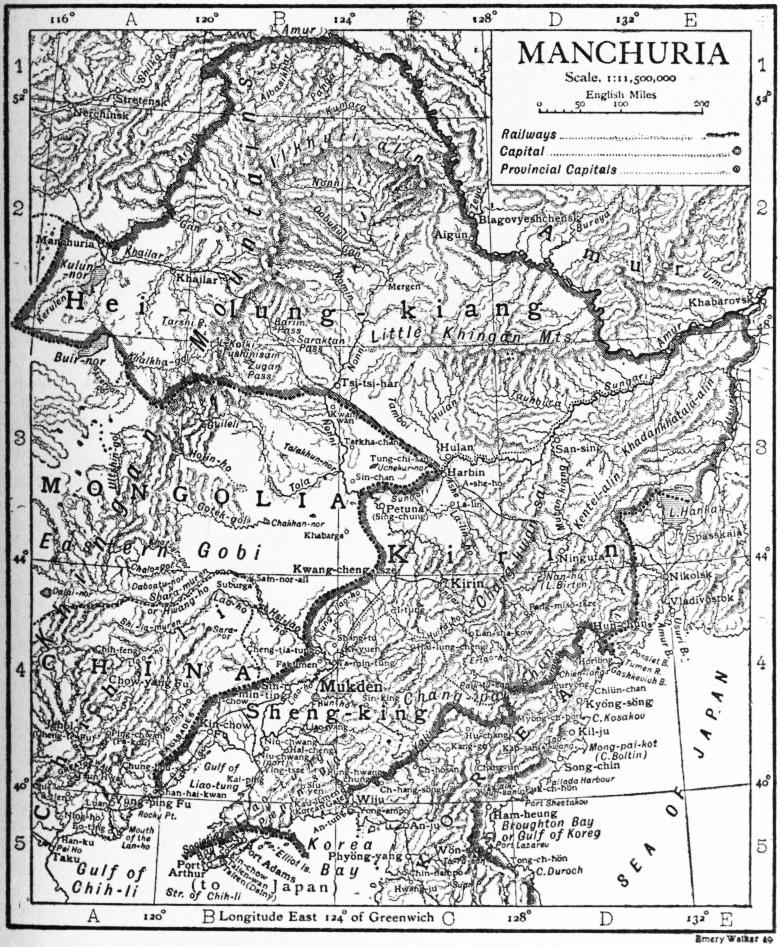
The original Manchurian railway was constructed under an agreement made in 1896 between the Chinese government and the Russo-Chinese bank, an institution founded in 1895 to develop Russian interests in the East. The Chinese Eastern Manchurian Railways. Railway Company was formed by the bank under this agreement, to construct and work the line, and surveys were made in 1897, the town of Harbin being founded as headquarters for the work. The line, which affords through communication from Europe by way of the Trans-Siberian system, enters Manchuria near a station of that name in the north-west corner of the country, passes Khailar, and runs south-east, near Tsitsihar, to Harbin. Thence the main line continues in the same general direction to the eastern frontier of Manchuria, and so to Vladivostok. In 1898 Russia obtained a lease of the Liao-tung peninsula, and a clause of this contract empowered her to connect Port Arthur and Dalny (now Tairen) with the main Manchurian railway by a branch southward from Harbin. In spite of interruption caused by the Boxer outbreak, through communication was established in 1901. Under the Russo-Japanese treaty of August 1905, after the war, supplemented by a convention between Japan and China concluded in December of the same year, Japan took over the line from Port Arthur as far as Kwang-chēng-tsze, now known as the Southern Manchurian railway (508 m.). Branches were promoted (a) from Mukden to Antung on the Ya-lu, to connect with the Korean system, and (b) from Kwang-chēng-tsze to Kirin. The rest of the original Manchurian system (1088 miles) remains under Russian control. In the south-west of Manchuria a line of the imperial railways of Northern China gives connexion from Peking, and Branches at Kou-pang-tsze to Sin-min-ting and to Niu-chwang, and the link between Sin-min-ting and Mukden is also under Chinese control. The lines now under Russian control were laid down, and remain, on the 5 ft. gauge which is the Russian standard; but after the Russian control of the southern lines was lost the gauge was altered from that standard.
History.—Manchu, as has been said, is not the name of the country but of the people who inhabit it. The name was adopted by a ruler who rose to power in the beginning of the 13th century. Before that time the Manchus were more or less a shifting population, and, being broken up into a number of tribes, they went mainly under the distinctive name of those clans which exercised lordship over them. Thus under the Cbow dynasty (1122-225 B.C.) they were known as Sewshin, and at subsequent periods as Yih-low, Wuh-keih, Moh-hoh, Pohai, Nüchih and according to the Chinese historians also as Khitan. Throughout their history they appear as a rude people, the tribute they brought to the Chinese court consisting of stone arrow-heads, hawks, gold, and latterly ginseng. Assuming that, as the Chinese say, the Khitans were Manchus, the first appearance of the Manchus, as a people, in China dates from the beginning of the 10th century, when the Khitans, having first conquered the kingdom of Pohai, crossed the frontier into China and established the Liao or Iron dynasty in the northern portion of the empire. These invaders were in their turn overthrown two centuries later by another invasion from Manchuria. These new conquerors were Nüchihs, and therefore direct ancestors of the Manchus. On assuming the imperial yellow in China their chief adopted the title of Kin or “Golden” for his dynasty. “Iron” (Liao), he said, “rusts, but gold always keeps its purity and colour, therefore my dynasty shall be called Kin.” In a little more than a century, however, the Kins were driven out of China by the Mongols under Jenghiz Khan. But before the close of their rule a miraculous event occurred on the Chang-pai-Shan mountains which is popularly believed to have laid the seeds of the greatness of the present rulers of the empire. Three heaven-born maidens, so runs the legend, were bathing one day in a lake under the Chang-pai-Shan mountains when a passing magpie dropped a ripe red fruit into the lap of one of them. The maiden ate the fruit, and in due course a child was born to her, whom she named Aisin Gioro, or the Golden. When quite a lad Aisin Gioro was elected chief over three contending clans, and established his capital at Otoli near the Chang-pai-Shan mountains. His reign, however, was brief, for his subjects rose and murdered him, with all his sons except the youngest, Fancha, who, like the infant Haitu in Mongolian history, was miraculously saved. Nothing is recorded of the facts of Aisin Gioro’s reign except that he named the people over whom he reigned Manchu, or “Pure.” His descendants, through the rescued Fancha, fell into complete obscurity until about the middle of the 16th century, when one of them, Nurhachu by name, a chieftain of a small tribe, rose to power. Nurhachu played with skill and daring the rôle which had been played by Jenghiz Khan more than three centuries before in Mongolia. With even greater success than his Mongolian counterpart, Nurhachu drew tribe after tribe under his sway, and after numerous wars with Korea and Mongolia he established his rule over the whole of Manchuria. Being thus the sovereign of an empire, he, again like Jenghiz Khan, adopted for himself the title of Ying-ming, “Brave and Illustrious,” and took for his reign the title of T’ien-ming. Thirteen years later, in 1617, after numerous border fights with the Chinese, Nurhachu drew up a list of “seven hates,” or indictments, against his southern neighbours, and, not getting the satisfaction he demanded, declared war against them. The progress of this war, the peace hastily patched up, the equally hasty alliance and its consequences, being matters of Chinese history, are treated in the article China.
Manchuria was claimed by Russia as her particular sphere of interest towards the close of the 19th century, and in the course of the disturbances of 1900 Russian troops occupied various parts of the country. Eventually a Manchurian convention was arranged between China and Russia, by which Russia was to evacuate the province; but no actual ratification of this convention was made by Russia. The Anglo-German agreement of October 1900, to which Japan also became a party, and by which it was agreed to “maintain undiminished the territorial condition of the Chinese empire,” was considered by Great Britain and Japan not to exclude Manchuria; but Germany, on the other hand, declared that Manchuria was of no interest to her. The Anglo-Japanese treaty of 1902, however, was ostensibly directed towards the preservation of Manchuria in Chinese hands. British capital has been invested in the extension of the Chinese Northern railway to Niu-chwang, and the fact was officially recognized by an agreement between Great Britain and Russia in 1899. One result of the Russo-Japanese War was the evacuation of Manchuria by the Russians, which, after the conclusion of peace in 1905, was handed over by Japan to China.
See H. E. M. James, The Long White Mountain (London, 1888); D. Christie, Ten Years in Manchuria (Paisley, 1895); F. E. Younghusband, The Heart of a Continent: a Narrative of Travels in Manchuria (London, 1896); P. H. Kent, Railway Enterprise in China (London, 1907).
(R. K. D.)
MANCINI, PASQUALE STANISLAO (1817-1888), Italian jurist and statesman, was born at Castel Baronia, in the province of Avellino, on the 17th of March 1817. At Naples, where he studied law and displayed great literary activity, he rapidly acquired a prominent position, and in 1848 was instrumental in persuading Ferdinand II. to participate in the war against Austria. Twice he declined the offer of a portfolio in the Neapolitan cabinet, and upon the triumph of the reactionary party undertook the defence of the Liberal political prisoners. Threatened with imprisonment in his turn, he fled to Piedmont, where he obtained a university professorship and became preceptor of the crown prince Humbert. In 1860 he prepared the legislative unification of Italy, opposed the idea of an alliance between Piedmont and Naples, and, after the fall of the Bourbons, was sent to Naples as administrator of justice, in which capacity he suppressed the religious orders, revoked the Concordat, proclaimed the right of the state to Church property, and unified civil and commercial jurisprudence. In 1862 he became minister of public instruction in the Rattazzi cabinet, and induced the Chamber to abolish capital punishment. Thereafter, for fourteen years, he devoted himself chiefly to questions of international law and arbitration, but in 1876, upon the advent of the Left to power, became minister of justice in the Depretis cabinet. His Liberalism found expression in the extension of press freedom, the repeal of imprisonment for debt, and the abolition of ecclesiastical tithes. During the Conclave of 1878 he succeeded, by negotiations with Cardinal Pecci (afterwards Leo XIII.), in inducing the Sacred College to remain in Rome, and, after the election of the new pope, arranged for his temporary absence from the Vatican for the purpose of settling private business. Resigning office in March 1878, he resumed the practice of law, and secured the annulment of Garibaldi’s marriage. The fall of Cairoli led to Mancini’s appointment (1881) to the ministry of foreign affairs in the Depretis administration. The growing desire in Italy for alliance with Austria and Germany did not at first secure his approval; nevertheless he accompanied King Humbert to Vienna and conducted the negotiations which led to the informal acceptance of the Triple Alliance. His desire to retain French confidence was the chief motive of his refusal in July 1882 to share in the British expedition to Egypt, but, finding his efforts fruitless when the existence of the Triple Alliance came to be known, he veered to the English interest and obtained assent in London to the Italian expedition to Massawa. An indiscreet announcement of the limitations of the Triple Alliance contributed to his fall in June 1885, when he was succeeded by Count di Robilant. He died in Rome on the 26th of December 1888.
MANCIPLE, the official title of the caterer at a college, an inn of court, or other institution. Sometimes also the chief cook. The medieval Latin manceps, formed from mancipium, acquisition by purchase (see Roman Law), meant a purchaser of stores, and mancipium became used of his office. It is from the latter word that the O. Fr. manciple is taken.
MANCUNIUM, the name often (though perhaps incorrectly) given as the Romano-British name of Manchester. Here, close to the Medlock, in the district still called Castlefield near Knott Mill, stood in Roman days a fort garrisoned by a cohort of Roman auxiliary soldiers. The site is now obscured by houses, railways and the Rochdale canal, but vestiges of Roman ramparts can still be seen, and other remains were found in 1907 and previous years. Traces of Romano-British inhabitation have been noted elsewhere in Manchester, especially near the cathedral. But there was no town here; we can trace nothing more than a fort guarding the roads running north through Lancashire and east into Yorkshire, and the dwellings of women-folk and traders which would naturally spring up outside such a fort. The ancient name is unknown. Our Roman authorities give both Mancunium and Mamucium, but it is not clear that either form is correct.
See W. T. Watkin’s Roman Lancashire; C. Roeder’s Roman Manchester, and the account edited by F. Bruton of the excavations in 1907.
(F. J. H.)
MANDAEANS, also known as Sabians, Nasoraeans, or St John’s Christians,1 an Oriental sect of great antiquity, interesting to the theologian as almost the only surviving example of a religion compounded of Christian, heathen and Jewish elements on a type which is essentially that of ancient Gnosticism.
The Mandaeans are found in the marshy lands of South Babylonia (al-baṭāiḥ), particularly in the neighbourhood of Basra (or Bussorah), and in Khūzistān (Disful, Shuster).2 They speak the languages of the localities in which they are settled (Arabic or Persian), but the language of their sacred books is an Aramaic dialect, which has its closest affinities with that of the Babylonian Talmud, written in a peculiar character suggestive of the old Palmyrene.3 The existence of the Mandaeans has been known since the middle of the 17th century, when the first Christian missionaries, Ignatius a Jesu4 and Angelus a Sancto, began to labour among them at Basra; further information was gathered at a somewhat later date by Pietro della Valle5 and Jean de Thévenot6 (1633-1667), and in the following century by Engelbrecht Kaempfer (1651-1716), Jean Chardin (1643-1713) and Carsten Niebuhr. In recent times they have been visited by A. H. Petermann7 and Albrecht Socin, and Siouffi8 published in 1880 a full and accurate account of their manners and customs, taken from the lips of a converted Mandaean. For our knowledge of their doctrinal system, however, we still depend chiefly upon the sacred books already mentioned, consisting of fragments of very various antiquity derived from an older literature.9 Of these the largest and most important is the Sidrā rabbā (“Great Book”), known also as Ginzā (“Treasure”), consisting of two unequal parts, of which the larger is called yamīnā (to the right hand) and the smaller s’mala (to the left hand), because of the manner in which they are bound together. The former is intended for the living; the latter consists chiefly of prayers to be read at the burial of priests. As regards doctrine, the work is exhaustive; but it is diffuse, obscure, and occasionally self-contradictory, as might be expected in a work which consists of a number of unconnected paragraphs of various authorship and date. The last section of the “right-hand” part (the “Book of Kings”) is one of the older portions, and from its allusion to “the Persian and Arabian kings” may be dated somewhere between A.D. 700 and 900. Many of the doctrinal portions may in substance well be still older, and date from the time of the Sassanids. None of the MSS., however, is older than the 16th century.10
The following sketch represents, as far as can be gathered from these heterogeneous sources, the principal features of the Mandaean system. The ground and origin of all things is Pīrā, or more correctly Pērā rabbā (“the great abyss,” or from פער, “to split,” cf. the Gnostic βυθός, or more probably cf. Heb. perī, “the great fruit”), associated with whom, and forming a triad with him, are the primal aeons Ayar zīvā rabbā, “the great shining aether,” and Mānā rabbā d’eḳārā, “the great spirit of glory,” usually called simply Mānā rabbā. The last-named, the most prominent of the three, is the king of light properly so called, from whom the development of all things begins. From him emanates Yarděnā rabbā, “the great Jordan,” which, as the higher-world soul, permeates the whole aether, the domain of Ayar. Alongside of Mānā rabbā frequent mention is made of D’mūthā, his “image,” as a female power; the name “image of the father” arises out of the same conception as that which gives rise to the name of ἔννοια among the Greek Gnostics. Mānā rabbā called into being the highest of the aeons properly so called, Hayyē Kadmāyē, “Primal Life,” and then withdrew into deepest secrecy, visible indeed to the highest but not to the lowest aeons (cf. Σοφία and Προπάτωρ), yet manifesting himself also to the souls of the more pious of the Mandaeans after their separation from the body. Primal Life, who is properly speaking the Mandaean god, has the same predicates as the primal spirit, and every prayer, as well as every section of the sacred books, begins by invoking him.11 The extremely fantastic delineation of the world of light by which Hayyē Kadmāyē is surrounded (see for example the beginning of Sidrā rabbā) corresponds very closely with the Manichaean description of the abode of the “king of the paradise of light.” The king of light “sits in the far north in might and glory.” The Primal Light unfolds himself by five great branches, viz. “the highest purest light, the gentle wind, the harmony of sounds, the voice of all the aeons, and the beauty of their forms,” all these being treated as abstractions and personified. Out of the further development and combination of these primary manifestations arise numerous aeons (‘Uthrē, “splendours,” from עתר, “is rich”), of which the number is often stated to be three hundred and sixty. They are divided into a number of classes (kings, hypostases, forms, &c.); the proper names by which they are invoked are many, and for the most part obscure, borrowed doubtless, to some extent, from the Parsee angelology. From the First Life proceeds as a principal emanation the “Second Life,” Hayyē Tinyānē, generally called Yōshamīn. This last name is evidently meant to be Hebrew, “Yahweh of the heavens,” the God of the Jews being of a secondary rank in the usual Gnostic style. The next emanation after Yōshamīn is “the messenger of life” (Mandā d’hayyē, literally γνῶσις τῆς ζωῆς), the most important figure in the entire system, the mediator and redeemer, the λόγος and the Christ of the Mandaeans, from whom, as already stated, they take their name. He belongs to the heathen Gnosis, and is in his essence the same as the Babylonian Marduk. Yōshamīn desired to raise himself above the Primal Light, but failed in the attempt, and was punished by removal out of the pure aetherial world into that of inferior light. Mandā, on the other hand, continues with the First Life and Mānā rabbā, and is called his “beloved son,” the “first born,” “high priest” and “word of life.” The “Life” calls into existence in the visible world a series of three great Helpers, Hibil, Shithil and Anōsh (late Judaeo-Babylonian transformations of the well-known names of the book of Genesis), the guardians of souls. The last son of the Second Life is Hayyē t’līthayē, the “Third Life,” usually called father of the Uthrē (Abā d‘ ‘Uthrē, Abāthūr). His usual epithet is “the Ancient” (‘Aṭīqā), and he is also called “the deeply hidden and guarded.” He stands on the borderland between the here and the hereafter, like the mysterious πρεσβύτης τρίτος or senex tertius of Mani, whose becoming visible will betoken the end of the world. Abāthūr sits on the farthest verge of the world of light that lies towards the lower regions, and weighs in his balance the deeds of the departed spirits who ascend to him. Beneath him was originally nothing but a huge void with muddy black water at the bottom, in which his image was reflected, becoming ultimately solidified into P’tāhīl, his son, who now partakes of the nature of matter. The demiurge of the Mandaeans, and corresponding to the Ialdabaoth of the Ophites, he at the instance of his father frames the earth and men—according to some passages in conjunction with the seven bad planetary spirits. He created Adam and Eve, but was unable to make them stand upright, whereupon Hibil, Shithil and Anōsh were sent by the First Life to infuse into their forms spirit from Mānā rabbā himself. Hibil, at the instance of the supreme God, also taught men about the world of light and the aeons, and especially gave them to know that not P’tāhīl but another was their creator and supreme God, who as “the great king of light, without number, without limit,” stands far above him. At the same time he enjoined the pair to marry and people the world. P’tāhīl had now lost his power over men, and was driven by his father out of the world of light into a place beneath it, whence he shall at the day of judgment be raised, and after receiving baptism be made king of the ‘Uthrē with divine honours.
The underworld is made up of four vestibules and three hells properly so called. The vestibules have each two rulers, Zartay and Zartanay, Hag and Mag, Gaf and Gafan, Anatan and Kin. In the highest hell rules alone the grisly king Sh’dūm, “the warrior”; in the storey immediately beneath is Giv, “the great”; and in the lowest is Krūn or Karkūm, the oldest and most powerful of all, commonly called “the great mountain of flesh” (Tūrā rabbā d’besrā), but also “the first-born of darkness.” In the vestibules dirty water is still to be met with, but the hells are full of scorching consuming fire, except Krūn’s domain, where is nought but dust, ashes and vacancy. Into these regions descended Hibil the brilliant, in the power of Mānā rabbā, just as in the Manichaean mythology the “primal man,” armed with the elements of the king of light, descends to a contest with the primal devil. Hibil lingers, gradually unfolding his power, in each of the vestibules, and finally passing from hell to hell reaches Karkūm. Hibil allows himself to be half swallowed by the monster, but is unhurt, and compels his antagonist to recognize the superiority of Mānā rabbā, the God of light, and to divulge his profoundest secret, the hidden name of darkness. Armed with this he returns through the successive hells, compelling the disclosure of every secret, depriving the rulers of their power, and barring the doors of the several regions. From the fourth vestibule he brought the female devil Rūhā, daughter of Kin, and set her over the whole four. This Rūhā, the mother of falsehood and lies, of poisoning and fornication is an anti-Christian parody of the Rūhā d’Qudshā (Holy Spirit) of the Syriac Church. She is the mother of Ur, the personified fire of hell, who in anger and pride made a violent onset on the world of light (compare the similar occurrence in the Manichaean mythology), but was mastered by Hibil and thrown in chains down to the “black water,” and imprisoned within seven iron and seven golden walls. By Ur, Rūhā, while P’tāhīl was engaged in his work of creation, became mother of three sets of seven, twelve and five sons respectively; all were translated by P’tāhīl to the heavenly firmament (like the Archons of Mani), the first group forming the planets and the next the signs of the zodiac, while the third is as yet undetermined. Of the names of the planets Estera (Ishtar Venus, also called Rūhā d’Qudshā, “holy spirit”), Enba (Nebo, Mercury), Sīn (moon), Kēwān (Saturn), Bīl (Jupiter), and Nirīg (Nirgal, Mars) reveal their Babylonian origin; Il or Il Il, the sun, is also known as Ḳādūsh and Adūnay (the Adonai of the Old Testament); as lord of the planetary spirits his place is in the midst of them; they are the source of all temptation and evil amongst men. The houses of the planets, as well as the earth and a second world immediately to the north of it, rest upon anvils laid by Hibil on the belly of Ur.
In the Mandaean representation the sky is an ocean of water, pure and clear, but of more than adamantine solidity, upon which the stars and planets sail. Its transparency allows us to see even to the pole star, who is the central sun around whom all the heavenly bodies move. Wearing a jewelled crown, he stands before Abāthūr’s door at the gate of the world of light; the Mandaeans accordingly invariably pray with their faces turned northward. The earth is conceived of as a round disk, slightly sloping towards the south, surrounded on three sides by the sea, but on the north by a high mountain of turquoises; behind this is the abode of the blest, a sort of inferior paradise, inhabited by the Egyptians who were saved from drowning with Pharaoh in the Red Sea, and whom the Mandaeans look upon as their ancestors, Pharaoh himself having been their first high priest and king. The total duration of the earth they fix at four hundred and eighty thousand years, divided into seven epochs, in each of which one of the planets rules. The Sidrā Rabbā knows of three total destructions of the human race by fire and water, pestilence and sword, a single pair alone surviving in each case. In the Mandaean view the Old Testament saints are false prophets; such as Abraham, who arose six thousand years after Nū(Noah) during the reign of the sun, Mīshā (Moses), in whose time the true religion was professed by the Egyptians, and Shlīmūn (Solomon) bar Davith, the lord of the demons. Another false prophet and magician was Yishu M’shīhā, who was in fact a manifestation of the planet Mercury. Forty-two years before his day, under King Pontius Pilate, there had appeared the true prophet Yahyā or John son of Zechariah, an incarnation of Hibil, of whose birth and childhood fantastic stories are told. Yahyā by a mistake gave baptism to the false Messiah, who had feigned humility; on the completion of his mission, after undergoing a seeming execution, he returned clothed with light into the kingdom of light. As a contemporary of Yahyā and the false Messiah Hibil’s younger brother Anōsh ‘Uthrā came down from heaven, caused himself to be baptized by Yahyā, wrought miracles of healing and of raising the dead, and brought about the crucifixion of the false Messiah. He preached the true religion, destroyed Jerusalem (“Urashlam,” i.e. “the devil finished it”), which had been built by Adūnay, dispersed over the world the Jews who had put Yahyā to death, and previous to his return into the worlds of light sent forth three hundred and sixty prophets for the diffusion of the true religion. All this speaks of intense hatred alike of Jews and Christians; the fasts, celibacy and monastic and anchoret life of the latter are peculiarly objectionable to the Mandaeans. Two hundred and forty years after the appearing of the false Messiah there came to the world sixty thousand saints out of Pharaoh’s world to take the place of the Mandaeans, who had been completely extirpated; their high priest had his residence in Damascus. The last false prophet was M’hammad or Ahmat bar Bisbat (Mahomet), but Anōsh, who remained close beside him and his immediate successors, prevented hostilities against the true believers, who claim to have had in Babylonia, under the Abbasids, four hundred places of worship. Subsequent persecutions compelled their withdrawal to ‘Ammāra in the neighbourhood of Wāsit, and ultimately to Khūzistān. At the end of the world the devil Ur will swallow up the earth and the other intermediate higher worlds, and thereupon will burst and fall into the abyss of darkness where, along with all the worlds and powers of darkness, he will ultimately cease to be, so that thenceforward the universe will consist of but one everlasting world of light.
The chief depositaries of these Mandaean mysteries are the priests, who enjoy a high degree of power and social regard. The priesthood has three grades: (1) the Sh’kandā or deacon is generally chosen from episcopal or priestly families, and must be without bodily blemish. The candidate for orders must be at least nineteen years old and have undergone twelve years’ preparation; he is then qualified to assist the priesthood in the ceremonies of religion. (2) The Tarmīdā (i.e. “Talmīdā,” “initiated”) or priest is ordained by a bishop and two priests or by four priests after a long and extremely painful period of preparation. (3) The Ganzivrā (“treasurer”) or bishop, the highest dignitary, is chosen from the whole body of the Tarmīdās after a variety of tests, and possesses unlimited authority over the clergy. A supreme priestly rank, that of Rīsh ‘ammā, or “head of the people,” is recognized, but only in theory; since the time of Pharaoh this sovereign pontificate has only once been filled. Women are admitted to priestly offices as well as men. The priestly dress, which is all white, consists of drawers, an upper garment, and a girdle with the so-called tāgā (“crown”); in all ceremonies the celebrants must be barefoot. By far the most frequent and important of the religious ceremonies is that of baptism (maṣbūthā), which is called for in a great variety of cases, not only for children but for adults, where consecration or purification is required, as for example on all Sundays and feast days, after contact with a dead body, after return from abroad, after neglect of any formality on the part of a priest in the discharge of his functions. In all these cases baptism is performed by total immersion in running water, but during the five days’ baptismal festival the rite is observed wholesale by mere sprinkling of large masses of the faithful at once. The Mandaeans observe also with the elements of bread (pehtā) and wine (mambūhā, lit. “fountain”) a sort of eucharist, which has a special sanctifying efficacy, and is usually dispensed at festivals, but only to baptized persons of good repute who have never willingly denied the Mandaean faith. In receiving it the communicant must not touch the host with his finger; otherwise it loses its virtue. The hosts are made by the priests from unleavened fine flour. The Mandaean places of worship, being designed only for the priests and their assistants (the worshippers remaining in the forecourt), are excessively small, and very simply furnished; two windows, a door that opens towards the south so that those who enter have their faces turned towards the pole star, a few boards in the corner, and a gabled roof complete the whole structure; there is neither altar nor decoration of any kind. The neighbourhood of running water (for baptisms) is essential. At the consecration of a church the sacrifice of a dove (the bird of Ishtar) has place among the ceremonies. Besides Sundays there are six great feasts: (1) that of the New Year (Naurūz rabbā), on the first day of the first month of winter; (2) Dehwā h’ nīnā, the anniversary of the happy return of Hibil Zīvā from the kingdom of darkness into that of light, lasting five days, beginning with the 18th of the first month of spring; (3) the Marwānā, in commemoration of the drowned Egyptians, on the first day of the second month of spring; (4) the great five days’ baptismal festival (pantshā), the chief feast, kept on the five intercalary days at the end of the second month of summer—during its continuance every Mandaean, male and female, must dress in white and bathe thrice daily; (5) Dehwā d’daimānā, in honour of one of the three hundred and sixty ‘Uthras, on the first day of the second month of autumn; (6) Kanshe Zahlā, the preparation feast, held on the last day of the year. There are also fast days called m’battal (Arab.), on which it is forbidden to kill any living thing or eat flesh. These, however, are really “rest-days,” as fasting is forbidden in Mandaeism. The year is solar, and has twelve months of thirty days each, with five intercalary days between the eighth and the ninth month. Of the seven days of the week, next to Sunday (habshaba) Thursday has a special sacredness as the day of Hibil Zīvā. As regards secular occupation, the present Mandaeans are goldsmiths, ironworkers, and house and ship carpenters. The Sidrā Rabbā lays great stress upon the duty of procreation, and marriage is a duty. In the 17th century, according to the old travellers, they numbered about 20,000 families, but at the present day they hardly number more than 1200 souls. In external appearance the Mandaean is distinguished from the Moslem only by a brown coat and a parti-coloured headcloth with a cord twisted round it. They have some peculiar deathbed rites: a deacon with some attendants waits upon the dying, and as death approaches administers a bath first of warm and afterwards of cold water; a holy dress, consisting of seven pieces (rastā), is then put on; the feet are directed towards the north and the head turned to the south, so that the body faces the pole star. After the burial a funeral feast is held in the house of mourning.
The Mandaeans are strictly reticent about their theological dogmas in the presence of strangers; and the knowledge they actually possess of these is extremely small. The foundation of the system is obviously to be sought in Gnosticism, and more particularly in the older type of that doctrine (known from the serpent symbol as Ophite or Naassene) which obtained in Mesopotamia and Further Asia generally. But it is equally plain that the Ophite nucleus has from time to time received very numerous and often curiously perverted accretions from Babylonian Judaism, Oriental Christianity and Parsism, exhibiting a striking example of religious syncretism. In the Gnostic basis itself it is not difficult to recognize the general features of the religion of ancient Babylonia, and thus we are brought nearer a solution of the problem as to the origin of Gnosticism in general. It is certain that Babylonia, the seat of the present Mandaeans, must be regarded also as the cradle in which their system was reared; it is impossible to think of them as coming from Palestine, or to attribute to their doctrines a Jewish or Christian origin. They do not spring historically from the disciples of John the Baptist (Acts xviii. 25; xix. 3 seq.; Recog. Clem. i. 54); the tradition in which he and the Jordan figure so largely is not original, and is therefore worthless; at the same time it is true that their baptismal praxis and its interpretation place them in the same religious group with the Hemerobaptists of Eusebius (H. E. iv. 22) and Epiphanius (Haer., xvii.), or with the sect of disciples of John who remained apart from Christianity. Their reverence for John is of a piece with their whole syncretizing attitude towards the New Testament. Indeed, as has been seen, they appropriate the entire personale of the Bible from Adam, Seth, Abel, Enos and Pharaoh to Jesus and John, a phenomenon which bears witness to the close relations of the Mandaean doctrine both with Judaism and Christianity—not the less close because they were relations of hostility. The history of religion presents other examples of the degradation of holy to demonic figures on occasion of religious schism. The use of the word “Jordan,” even in the plural, for “sacred water,” is precisely similar to that by the Naassenes described in the Philosophumena (v. 7); there ὁ μέγας Ἰορδάνης denotes the spiritualizing sanctifying fluid which pervades the world of light. The notions of the Egyptians and the Red Sea, according to the same work (v. 16), are used by the Peratae much as by the Mandaeans. And the position assigned by the Sethians (Σηθιανοί) to Seth is precisely similar to that given by the Mandaeans to Abel. Both alike are merely old Babylonian divinities in a new Biblical garb. The genesis of Mandaeism and the older gnosis from the old and elaborate Babylonio-Chaldaean religion is clearly seen also in the fact that the names of the old pantheon (as for example those of the planetary divinities) are retained, but their holders degraded to the position of demons—a conclusion confirmed by the fact that the Mandaeans, like the allied Ophites, Peratae and Manichaeans, certainly have their original seat in Mesopotamia and Babylonia. It seems clear that the trinity of Anu, Bel, and Ea in the old Babylonian religion has its counterpart in the Mandaean Pīrā, Ayar, and Mānā rabbā. The D’mūthā of Mānā is the Damkina, the wife of Ea, mentioned by Damascius as Δαύκη, wife of Ἁός. Mandā d’hayyē and his image Hibil Zīvā with his incarnations clearly correspond to the old Babylonian Marduk, Merodach, the “first-born” son of Ea, with his incarnations, the chief divinity of the city of Babylon, the mediator and redeemer in the old religion. Hibil’s contest with darkness has its prototype in Marduk’s battle with chaos, the dragon Tiamat, which (another striking parallel) partially swallows Marduk, just as is related of Hibil and the Manichaean primal man. Other features are borrowed by the Mandaean mythology under this head from the well-known epos of Istar’s descensus ad inferos. The sanctity with which water is invested by the Mandaeans is to be explained by the fact that Ea has his seat “in the depths of the world sea.”
Cf. K. Kessler’s article, “Mandäer,” in Herzog-Hauck’s Realencyklopädie, and the same author’s paper, “Ueber Gnosis u. altbabylonische Religion,” in the Abhandh. d. fūnften internationalen Orientalisten-congresses zu Berlin (Berlin, 1882); also W. Brandt’s Mandäische Religion (Leipzig, 1889), and M. N. Siouffi’s Études sur la religion des Soubbas (Paris, 1880).
(K. K.; G. W. T.)
1 The first of these names (not Mendaeans or Mandaites) is that given by themselves, and means γνωστικοί, followers of Gnosis (מאנדאייא, from מאנדא, Hebr. מדע). The Gnosis of which they profess themselves adherents is a personification, the æon and mediator “knowledge of life” (see below). The title Nasoraeans (Nāṣōrāyē), according to Petermann, they give only to those among themselves who are most distinguished for knowledge and character. Like the Arabic Naṣāra, it is originally identical with the name of the half heathen half Jewish-Christian Ναζωραῖοι, and indicates an early connexion with that sect. The inappropriate designation of St John’s Christians arises from the early and imperfect acquaintance of Christian missionaries, who had regard merely to the reverence in which the name of the Baptist is held among them, and their frequent baptisms. In their dealings with members of other communions the designation they take is Sabians, in Arabic Ṣābi’ūna, from צבא = צבע, to baptize, thus claiming the toleration extended by the Koran (Sur, 5,.73; 22, 17; 2, 59) to those of that name.
2 In 1882 they were said to have shrunk to 200 families, and to be seeking a new settlement on the Tigris, to escape the persecutions to which they are exposed.
3 See T. Nöldeke’s admirable Mandäische Grammatik (Halle, 1875).
4 Narratio originis, rituum, et errorum Christianorum S. Joannis (Rome, 1652).
5 Reisebeschreibung, part iv. (Geneva, 1674).
6 Voyage au Levant (Paris, 1664).
7 Reisen im Orient, ii. 447 seq.
8 M. M. Siouffi, Études sur la religion ... des Soubbas (Paris, 1880).
9 Mandaean MSS. occur in the British Museum, the Bodleian Library, the Bibliothèque Nationale of France, and also in Rome, Weimar and Berlin. A number of Mandaean inscriptions relating to popular beliefs and superstitions have been published by H. Pognon, Inscriptions mandaites (2 vols., Paris, 1898-1899), also by M. Lidzbarski in his Ephemeris (Giessen, 1900 seq.).
10 The first printed edition and translation of the Sidra rabba, by Matth. Norberg (Codex Nazaraeus, liber Adami appellatus, 3 vols., Copenhagen, 1815-1816, followed by a lexicon in 1816, and an onomasticon in 1817), is so defective as to be quite useless; even the name Book of Adam is unknown to the Mandaeans. Petermann’s Thesaurus s. Liber magnus, vulgo “Liber Adami” appellatus, opus Mandaeorum summi panderis (2 vols., Berlin and Leipzig, 1867), is an excellent metallographic reproduction of the Paris MS. A German translation of about a quarter of this work has been published in W. Brandt’s Mandäische Schriften, with notes (Göttingen, 1893). A critical edition still remains a desideratum. Next in importance to the Sidrā rābbā is the Sidrā d’Yahyā, or “Book of John,” otherwise known as the D’rāschē d’Malkē, “Discourses of the Kings,” which has not as yet been printed as a whole, although portions nave been published by Lorsbach and Tychsen (see Museum f. bibl. u. orient. Lit. (1807), and Stäudlin’s Beitr. z. Phil. u. Gesch. d. Relig. u. Sittenlehre 1796 seq.). The Kolāstā (Ar. Khulāṣa, “Quintessence”), or according to its fuller title ’Enyānē uderāshē d’maṣbūthā umasseḳthā (“Songs and Discourses of Baptism and the Ascent,” viz. of the soul after death), has been admirably lithographed by Euting (Stuttgart, 1867). It is also known as Sidrā d’neshmātha, “Book of Souls,” and besides hymns and doctrinal discourses contains prayers to be offered by the priests at sacrifice and at meals, as well as other liturgical matter. The Mandaean marriage service occurs both in Paris and in Oxford as an independent MS. The Dīwān, hitherto unpublished, contains the ritual for atonement. The Asfar malwāshē, or “Book of the Zodiac,” is astrological. Of smaller pieces many are magical and used as amulets.
11 The use of the word “life” in a personal sense is usual in Gnosticism; compare the Ζωὴ of Valentin and el-ḥayāt el-muallama, “the dark life,” of Mani in the Fihirst.
MANDALAY, formerly the capital of independent Burma, now the headquarters of the Mandalay division and district, as well as the chief town in Upper Burma, stands on the left bank of the Irrawaddy, in 21° 59′ N. and 96° 8′ E. Its height above mean sea-level is 315 ft. Mandalay was built in 1856-1857 by King Mindōn. It is now divided into the municipal area and the cantonment. The town covers an area of 6 m. from north to south and 3 from east to west, and has well-metalled roads lined with avenues of trees and regularly lighted and watered. The cantonment consists of the area inside the old city walls, and is now called Fort Dufferin. In the centre stands the palace, a group of wooden buildings, many of them highly carved and gilt, resting on a brick platform 900 ft. by 500 ft., and 6 ft. high. The greater part of it is now utilized for military and other offices. The garrison consists of a brigade belonging to the Burma command of the Indian army. There are many fine pagodas and monastic buildings in the town. The population in 1901 was 183,816, showing a decrease of 3% in the decade. The population is very mixed. Besides Burmese there are Zerbadis (the offspring of a Mahommedan with a Burman wife), Mahommedans, Hindus, Jews, Chinese, Shans and Manipuris (called Kathe), Kachins and Palaungs. Trains run from Mandalay to Rangoon, Myit-kyina, and up the Mandalay-Kunlong railway. The steamers of the Irrawaddy Flotilla Company also ply in all directions. There are twenty bazaars, the chief of which, the Zegyo, was burnt in 1897, and again in 1906, but rebuilt.
The Mandalay District has an area of 2117 sq. m. and a population (1901) of 366,507, giving a density of 177 inhabitants to the square mile. About 600 sq. m. along the Irrawaddy river are flat land, nearly all cultivated. In the north and east there are some 1500 sq. m. of high hills and table-lands, forming geographically a portion of the Shan table-land. Here the fall to the plains averages 3000 to 4000 ft. in a distance of 10 m. This part of the district is well wooded and watered. The Maymyo subdivision has very fine plateaus of 3000 to 3600 ft. in height. The highest peaks are between 4000 and 5000 ft. above sea-level. The Irrawaddy, the Myit-ngè and the Madaya are the chief rivers. The last two come from the Shan States, and are navigable for between 20 and 30 m. There are many canals, most of which have fallen greatly into disrepair, and the Aungbinle, Nanda and Shwepyi lakes also supply water for cultivation. A systematic irrigation scheme has been undertaken by the government. The Sagyin hills near Madaya are noted for their alabaster; rubies are also found in small quantities. There are 335 sq. m. of forest reserves in the district, but there is little teak. The climate is dry and healthy. During May and June and till August strong winds prevail. The thermometer rises to about 107° in the shade in the hot weather, and the minimum in the month of December is about 55°. The rainfall is light, the average being under 30 in.
The Division includes the districts of Mandalay, Bhamo, Myit-kyina, Katha and Ruby Mines, with a total area of 29,373 sq. m., and a population (1901) of 777,338, giving an average density of 30 inhabitants to the square mile.
(J. G. Sc.)
MANDAMUS, WRIT OF, in English law, a high prerogative writ issuing from the High Court of Justice (named from the first word in the Latin form of the writ) containing a command in the name of the king, directed to inferior courts, corporations, or individuals, ordering them to do a specific act within the duty of their office, or which they are bound by statute to do, and performance whereof the applicant for the writ has a specific legal right to enforce. Direct orders from the sovereign to subjects commanding the performance of particular acts were common in early times, and to this class of orders mandamus originally belonged. It became customary for the court of king’s bench, in cases where a legal duty was established but no sufficient means existed for enforcing it, to order performance by this writ. Under the Judicature Acts and the Crown Office Rules, 1906 (r. 49), the powers of the court of king’s bench as to the grant of the prerogative writ of mandamus are exercisable only in the king’s bench division of the High Court.
The writ though of right is not of course: i.e. the applicant cannot have it merely for the asking, but must satisfy the High Court that circumstances exist calling for its issue. The procedure regulating the grant and enforcement of the writ is determined by the Crown Office Rules, 1906 (rr. 49-68, 125).
Mandamus has always been regarded as an exceptional remedy to supplement the deficiencies of the common law, or defects of justice. Where another legal or equitable remedy exists, equally appropriate, convenient, speedy, beneficial and effectual, the writ will as a rule be refused. It is occasionally granted even when a remedy by indictment is available: but is not issued unless the existence of the duty and refusal to perform it are clearly established, nor where performance in fact has become impossible. The writ is used to compel inferior courts to hear and determine according to law cases within their jurisdiction, e.g. where a county court or justices in petty or quarter sessions refuse to assume a jurisdiction which they possess to deal with a matter brought before them. It has in recent years been employed to compel municipal bodies to discharge their duties as to providing proper sewerage for their districts and to compel anti-vaccinationist guardians of the poor to appoint officers for the execution of the Vaccination Acts; and it is also employed to compel the promoters of railway and similar undertakings to discharge duties imposed upon them towards the public by their special acts, e.g. with reference to highways, &c., affected by their railways or other undertakings. The courts do not prescribe the specific manner in which the duty is to be discharged, but do not stay their hands until substantial compliance is established.
Besides the prerogative common-law writ there are a number of orders, made by the High Court under statutory authority, and described as or as being in the nature of mandamus, e.g. mandamus to proceed to the election of a corporate officer of a municipal corporation (Municipal Corporations Act 1882, s. 225); orders in the nature of mandamus to justices to hear and determine a matter within their jurisdiction, or to state and sign a case under the enactments relating to special cases.
At common law mandamus lies only for the performance of acts of a public or official character. The enforcement of merely private obligations, such as those arising from contracts, is not within its scope. By s. 68 of the Common Law Procedure Act 1854, the plaintiff in any action other than replevin and ejectment was empowered to claim a writ of mandamus to compel the defendant to fulfil any duty in the fulfilment of which the plaintiff was personally interested. By s. 25 (8) of the Judicature Act 1873 a mandamus may be granted by an interlocutory order of the High Court in all cases in which it shall appear to the court just or convenient that such an order should be made. This enactment does not deal with the prerogative mandamus but empowers the king’s bench and the chancery divisions to grant an interlocutory mandamus in any pending cause or matter by an order other than the final judgment and even by an order made after the judgment. S. 68 of the act of 1854 has been repealed and replaced by Order LIII. of the Rules of the Supreme Court. The remedy thus created is an attempt to engraft upon the old common law remedy by damages a right in the nature of specific performance of the duty in question. It is not limited to cases in which the prerogative writ would be granted; but mandamus is not granted when the result desired can be obtained by some remedy equally convenient, beneficial and effective, or a particular and different remedy is provided by statute. An action for mandamus does not lie against judicial officers such as justices. The mandamus issued in the action is no longer a writ of mandamus, but a judgment or order having effect equivalent to the writ formerly used.
Mandatory Injunction.—The High Court has a jurisdiction derived from the court of chancery to grant injunctions at the suit of the attorney-general or of private persons. Ordinarily these injunctions are in the form of prohibition or restraint and not of command. But occasionally mandatory injunctions are granted in the form of a direct command by the court.
Specific Performance.—The jurisdiction of the High Court, derived from the court of chancery, to decree specific performance of contracts has some resemblance to mandamus in the domains of public or quasi-public law.
Ireland.—The law of Ireland as to mandamus is derived from that of England, and differs therefrom only in minor details.
British Possessions.—In a British possession the power to issue the prerogative writ is usually vested in the Supreme Court by its charter or by local legislation.
United States.—The writ has passed into the law of the United States. “There is in the federal judiciary an employment of the writ substantially as the old prerogative writ in the king’s bench practice, also as a mode of exercising appellate jurisdiction, also as a proceeding ancillary to a judgment previously rendered, in exercise of original jurisdiction, as when a circuit court having rendered a judgment against a county issues a mandamus requiring its officers to levy a tax to provide for the payment of the judgment.” And in the various states mandamus is used under varying regulations, mandate being in some cases substituted as the name of the proceeding.
MANDAN, a tribe of North American Indians of Siouan stock. When first met they were living on the Missouri at the mouth of the Heart river. At the beginning of the 19th century they were driven up the Missouri by the Sioux. In 1845 they joined the Gros Ventres and later the Arikaras, and settled in their present position at Fort Berthold reservation, North Dakota. The Mandans have always been agricultural; they are noted for their ceremonies, and from the tattooing on face and breast were described in the sign language as “the tattooed people.”
MANDARIN, the common name for all public officials in China, the Chinese name for whom is kwan or kwūn. The word comes through the Portuguese from Malay mantri, a counsellor or minister of state. The ultimate origin of this word is the Sanskrit root man-, meaning to “think,” seen in “man,” “mind,” &c. The term “mandarin” is not, in its western usage, applied indiscriminately to all civil and military officials, but only to those who are entitled to wear a “button,” which is a spherical knob, about an inch in diameter, affixed to the top of the official cap or hat. These officials, civil and military alike, are divided into nine grades or classes, each grade being distinguished by a button of a particular colour. The grade to which an official belongs is not necessarily related to the office he holds. The button which distinguishes the first grade is a transparent red stone; the second grade, a red coral button; the third, a sapphire; the fourth, a blue opaque stone; the fifth, a crystal button; the sixth, an opaque white shell button; the seventh, a plain gold button; the eighth, a worked gold button; and the ninth, a worked silver button. The mandarins also wear certain insignia embroidered on their official robes, and have girdle clasps of different material. The first grade have, for civilians an embroidered Manchurian crane on the breast and back, for the military an embroidered unicorn with a girdle clasp of jade set in rubies. The second grade, for civilians an embroidered golden pheasant, for the military a lion with a girdle clasp of gold set in rubies. The third grade, for civilians a peacock, for the military a leopard with a clasp of worked gold. The fourth grade, for civilians a wild goose, for the military a tiger, and a clasp of worked gold with a silver button. The fifth grade, for civilians a silver pheasant, for the military a bear and a clasp of plain gold with a silver button. The sixth grade, for civilians an egret, for the military a tiger-cat with a mother-of-pearl clasp. The seventh grade, for civilians a mandarin duck, for the military a mottled bear with a silver clasp. The eighth grade, for civilians a quail, for the military a seal with a clear horn clasp. The ninth grade, for civilians a long-tailed jay, for the military a rhinoceros with a buffalo-horn clasp.
The “mandarin language” is the Chinese, which is spoken in official and legal circles; it is also spoken over a considerable portion of the country, particularly the northern and central parts, though not perhaps with the same purity. Mandarin duck (anas galericulata) and Mandarin orange (citrus nobilis) possibly derive their names, by analogy, from the sense of superiority implied in the title “mandarin.”
See Society in China, by Sir R. K. Douglas; L’Empire du milieu, by E. and O. Reclus.
MANDASOR, or Mandsaur, a town of Central India, in the native state of Gwalior, on the Rajputana railway, 31 m. S. of Neemuch. Pop. (1901), 20,936. It gave its name to the treaty with Holkar, which concluded the Mahratta-Pindari War in 1818. It is a centre of the Malwa opium trade.
Mandasor and its neighbourhood are full of archaeological interest. An inscription discovered near the town indicated the erection of a temple of the sun in 437, and at Sondani are two great monolith pillars recording a victory of Yasodharma, king of Malwa, in 528. The fort dates from the 14th and 15th centuries. Hindu and Jain remains are numerous, though the town is now entirely Mahommedan.
MANDATE (Mandatum), a contract in Roman law constituted by one person (the mandatarius) promising to do something gratuitously at the request of another (the mandator), who undertakes to indemnify him against loss. The jurist distinguished the different cases of mandatum according as the object of the contract was the benefit of the mandator or a third person singly, or the mandator and a third person, the mandator and the mandatarius, or the mandatarius and a third person together. When the benefit was that of the mandatarius alone, the obligations of the contract were held not to arise, although the form of the contract might exist, the commission being held to be merely advice tendered to the mandatarius, and acted on by him at his own risk. Mandatum was classified as one of the contracts established by consent of the parties alone; but, as there was really no obligation of any kind until the mandatarius had acted on the mandate, it has with more propriety been referred to the contracts created by the supply of some fact (re). The obligations of the mandatarius under the contract were, briefly, to do what he had promised according to his instructions, observing ordinary diligence in taking care of any property entrusted to him, and handing over to his principal the results of his action, including the right to sue in his name. On the other hand, the principal was bound to recoup him his expenses and indemnify him against loss through obligations he might have incurred.
The essentials and the terminology of the contract are preserved in most modern systems of law. But in English law mandate, under that name, can hardly be said to exist as a separate form of contract. To some extent the law of mandatum corresponds partly to the law of principal and agent, partly to that of principal and surety. “Mandate” is retained to signify the contract more generally known as gratuitous bailment. It is restricted to personal property, and it implies the delivery of something to the bailee, both of which conditions are unknown in the mandatum of the civil law (see Bailment).
MANDAUE, a town of the province of Cebú, island of Cebú, Philippine Islands, on the E. coast and E. coast road, about 4 m. N.E. of the town of Cebú, the capital. Pop. (1903), 11,078; in the same year the town of Consolación (pop. 5511) was merged with Mandaue. Its climate is very hot, but healthy. The principal industries are the raising of Indian corn and sugar-cane and the manufacture of salt from sea-water. Cebú-Visayan is the language.
MANDELIC ACID (Phenylglycollic Acid), C8H8O3 or C6H5·CH(OH)·COOH, an isomer of the cresotinic and the oxymethylbenzoic acids. Since the molecule contains an asymmetric carbon atom, the acid exists in three forms, one being an inactive “racemic” mixture, and the other two being optically active forms. The inactive variety is known as paramandelic acid. It may be prepared by the action of hydrochloric acid on the addition compound of benzaldehyde and hydrocyanic acid:—
C6H5CHO + HCN + HCl + 2H2O = C6H5·CHOH·COOH + NH4Cl,
(F. L. Winckler, Ann., 1836, 18, 310), by boiling phenylchlor-acetic acid with alkalis (A. Spiegel, Ber., 1881, 14, 239), by heating benzoylformaldehyde with alkalis (H. v. Pechmann, Ber., 1887, 20, 2905), and by the action of dilute alkalies on ω-dibromacetophenone (C. Engler, Ber., 1887, 20, 2202):—
C6H5COCHBr2 + 3KHO = 2KBr + H2O + C6H5·CHOH·CO2K.
It crystallizes from water in large rhombic crystals, which melt at 118° C. Oxidizing agents convert it into benzaldehyde. When heated with hydriodic acid and phosphorus it forms phenylacetic acid; whilst concentrated hydrobromic acid and hydrochloric acid at moderate temperatures convert it into phenylbrom- and phenylchlor-acetic acids. The inactive mixture may be resolved into its active components by fractional crystallization of the cinchonine salt, when the salt of the dextro modification separates first; or the ammonium salt may be fermented by Penicillium glaucum, when the laevo form is destroyed and the dextro form remains untouched; on the other hand, Saccharomyces ellipsoïdeus destroys the dextro form, but does not touch the laevo form. A mixture of the two forms in equivalent quantities produces the inactive variety, which is also obtained when either form is heated for some hours to 160° C.
MANDER, CAREL VAN (1548-1606), Dutch painter, poet and biographer, was born of a noble family at Meulebeke. He studied under Lucas de Heere at Ghent, and in 1568-1569 under Pieter Vlerick at Kortryck. The next five years he devoted to the writing of religious plays for which he also painted the scenery. Then followed three years in Rome (1574-1577), where he is said to have been the first to discover the catacombs. On his return journey he passed through Vienna, where, together with the sculptor Hans Mont, he made the triumphal arch for the entry of the emperor Rudolph. After many vicissitudes caused by war, loss of fortune and plague, he settled at Haarlem where, in conjunction with Goltzius and Cornelisz, he founded a successful academy of painting. His fame is, however, principally based upon a voluminous biographical work on the paintings of various epochs—a book that has become for the northern countries what Vasari’s Lives of the Painters became for Italy. It was completed in 1603 and published in 1604, in which year Van Mander removed to Amsterdam, where he died in 1606.
MANDEVILLE, BERNARD DE (1670-1733), English philosopher and satirist, was born at Dordrecht, where his father practised as a physician. On leaving the Erasmus school at Rotterdam he gave proof of his ability by an Oratio scholastica de medicina (1685), and at Leiden University in 1689 he maintained a thesis De brutorum operationibus, in which he advocated the Cartesian theory of automatism among animals. In 1691 he took his medical degree, pronouncing an “inaugural disputation,” De chylosi vitiata. Afterwards he came to England “to learn the language,” and succeeded so remarkably that many refused to believe he was a foreigner. As a physician he seems to have done little, and lived poorly on a pension given him by some Dutch merchants and money which he earned from distillers for advocating the use of spirits. His conversational abilities won him the friendship of Lord Macclesfield (chief justice 1710-1718) who introduced him to Addison, described by Mandeville as “a parson in a tye-wig.” He died in January (19th or 21st) 1733/4 at Hackney.
The work by which he is known is the Fable of the Bees, published first in 1705 under the title of The Grumbling Hive, or Knaves Turn’d Honest (two hundred doggerel couplets). In 1714 it was republished anonymously with Remarks and An Enquiry into the Origin of Moral Virtue. In 1723 a later edition appeared, including An Essay on Charity and Charity Schools, and A Search into the Nature of Society. The book was primarily written as a political satire on the state of England in 1705, when the Tories were accusing Marlborough and the ministry of advocating the French War for personal reasons. The edition of 1723 was presented as a nuisance by the Grand Jury of Middlesex, was denounced in the London Journal by “Theophilus Philo-Britannus,” and attacked by many writers, notably by Archibald Campbell (1691-1756) in his Aretelogia (published as his own by Alexander Innes in 1728; afterwards by Campbell, under his own name, in 1733, as Enquiry into the Original of Moral Virtue). The Fable was reprinted in 1729, a ninth edition appeared in 1755, and it has often been reprinted in more recent times. Berkeley attacked it in the second dialogue of the Alciphron (1732) and John Brown criticized him in his Essay upon Shaftesbury’s Characteristics (1751).
Mandeville’s philosophy gave great offence at the time, and has always been stigmatized as false, cynical and degrading. His main thesis is that the actions of men cannot be divided into lower and higher. The higher life of man is merely a fiction introduced by philosophers and rulers to simplify government and the relations of society. In fact, virtue (which he defined as “every performance by which man, contrary to the impulse of nature, should endeavour the benefit of others, or the conquest of his own passions, out of a rational ambition of being good”) is actually detrimental to the state in its commercial and intellectual progress, for it is the vices (i.e. the self-regarding actions of men) which alone, by means of inventions and the circulation of capital in connexion with luxurious living, stimulate society into action and progress. In the Fable he shows a society possessed of all the virtues “blest with content and honesty,” falling into apathy and utterly paralyzed. The absence of self-love (cf. Hobbes) is the death of progress. The so-called higher virtues are mere hypocrisy, and arise from the selfish desire to be superior to the brutes. “The moral virtues are the political offspring which flattery begot upon pride.” Similarly he arrives at the great paradox that “private vices are public benefits.” But his best work and that in which he approximates most nearly to modern views is his account of the origin of society. His a priori theories should be compared with Maine’s historical inquiries (Ancient Law, c. V.). He endeavours to show that all social laws are the crystallized results of selfish aggrandizement and protective alliances among the weak. Denying any form of moral sense or conscience, he regards all the social virtues as evolved from the instinct for self-preservation, the give-and-take arrangements between the partners in a defensive and offensive alliance, and the feelings of pride and vanity artificially fed by politicians, as an antidote to dissension and chaos. Mandeville’s ironical paradoxes are interesting mainly as a criticism of the “amiable” idealism of Shaftesbury, and in comparison with the serious egoistic systems of Hobbes and Helvetius. It is mere prejudice to deny that Mandeville had considerable philosophic insight; at the same time he was mainly negative or critical, and, as he himself said, he was writing for “the entertainment of people of knowledge and education.” He may be said to have cleared the ground for the coming utilitarianism.
Works.—Typhon: a Burlesque Poem (1704); Aesop Dress’d, or a Collection of Fables writ in Familiar Verse (1704); The Planter’s Charity (1704); The Virgin Unmasked (1709, 1724, 1731, 1742), a work in which the coarser side of his nature is prominent; Treatise of the Hypochondriack and Hysterick Passions (1711, 1715, 1730) admired by Johnson (Mandeville here protests against merely speculative therapeutics, and advances fanciful theories of his own about animal spirits in connexion with “stomachic ferment”: he shows a knowledge of Locke’s methods, and an admiration for Sydenham); Free Thoughts on Religion (1720); A Conference about Whoring (1725); An Enquiry into the Causes of the Frequent Executions at Tyburn (1725); The Origin of Honour and the Usefulness of Christianity in War (1732). Other works attributed, wrongly, to him are A Modest Defence of Public Stews (1724); The World Unmasked (1736) and Zoologia medicinalis hibernica (1744).
See Hill’s Boswell, iii. 291-293; L. Stephen’s English Thought in the Eighteenth Century, A. Bain’s Moral Science (593-598); Windelband’s History of Ethics (Eng. trans. Tufts); J. M. Robertson, Pioneer Humanists (1907); P. Sakmann, Bernard de Mandeville und die Bienenfabel-Controverse (Freiburg i/Br., 1897), and compare articles Ethics, Shaftesbury, Hobbes.
(J. M. M.)
MANDEVILLE, GEOFFREY DE (d. 1144), earl of Essex, succeeded his father, William, as constable of the Tower of London in or shortly before 1130. Though a great Essex landowner, he played no conspicuous part in history till 1140, when Stephen created him earl of Essex in reward for his services against the empress Matilda. After the defeat and capture of Stephen at Lincoln (1141) the earl deserted to Matilda, but before the end of the year, learning that Stephen’s release was imminent, returned to his original allegiance. In 1142 he was again intriguing with the empress; but before he could openly join her cause he was detected and deprived of his castles by the king. In 1143-1144 Geoffrey maintained himself as a rebel and a bandit in the fen-country, using the Isle of Ely and Ramsey Abbey as his headquarters. He was besieged by Stephen in the fens, and met his death in September 1144 in consequence of a wound received in a skirmish. His career is interesting for two reasons. The charters which he extorted from Stephen and Matilda illustrate the peculiar form taken by the ambitions of English feudatories. The most important concessions are grants of offices and jurisdictions which had the effect of making Mandeville a viceroy with full powers in Essex, Middlesex and London, and Hertfordshire. His career as an outlaw exemplifies the worst excesses of the anarchy which prevailed in some parts of England during the civil wars of 1140-1147, and it is probable that the deeds of Mandeville inspired the rhetorical description, in the Peterborough Chronicle of this period, when “men said openly that Christ and his saints were asleep.”
See J. H. Round, Geoffrey de Mandeville, a Study of the Anarchy (London, 1892).
(H. W. C. D.)
MANDEVILLE, JEHAN DE (“Sir John Mandeville”), the name claimed by the compiler of a singular book of travels, written in French, and published between 1357 and 1371. By aid of translations into many other languages it acquired extraordinary popularity, while a few interpolated words in a particular edition of an English version gained for Mandeville in modern times the spurious credit of being “the father of English prose.”
In his preface the compiler calls himself a knight, and states that he was born and bred in England, of the town of St Albans; had crossed the sea on Michaelmas Day 1322; had travelled by way of Turkey (Asia Minor), Armenia the little (Cilicia) and the great, Tartary, Persia, Syria, Arabia, Egypt upper and lower, Libya, great part of Ethiopia, Chaldaea, Amazonia, India the less, the greater and the middle, and many countries about India; had often been to Jerusalem, and had written in Romance as more generally understood than Latin. In the body of the work we hear that he had been at Paris and Constantinople; had served the sultan of Egypt a long time in his wars against the Bedawin, had been vainly offered by him a princely marriage and a great estate on condition of renouncing Christianity, and had left Egypt under sultan Melech Madabron, i.e. Muzaffar or Mudhaffar1 (who reigned in 1346-1347); had been at Mount Sinai, and had visited the Holy Land with letters under the great seal of the sultan, which gave him extraordinary facilities; had been in Russia, Livonia, Cracow, Lithuania, “en roialme daresten” (? de Daresten or Silistria), and many other parts near Tartary, but not in Tartary itself; had drunk of the well of youth at Polombe (Quilon on the Malabar coast), and still seemed to feel the better; had taken astronomical observations on the way to Lamory (Sumatra), as well as in Brabant, Germany, Bohemia and still farther north; had been at an isle called Pathen in the Indian Ocean; had been at Cansay (Hangchow-fu) in China, and had served the emperor of China fifteen months against the king of Manzi; had been among rocks of adamant in the Indian Ocean; had been through a haunted valley, which he places near “Milstorak” (i.e. Malasgird in Armenia); had been driven home against his will in 1357 by arthritic gout; and had written his book as a consolation for his “wretched rest.” The paragraph which states that he had had his book confirmed at Rome by the pope is an interpolation of the English version.