VOLUME XVII SLICE V Malta to Map, Walter (continued 6)
Reading edition
Part at least of the personal history of Mandeville is mere invention. Nor is any contemporary corroboration of the existence of such a Jehan de Mandeville known. Some French MSS., not contemporary, give a Latin letter of presentation from him to Edward III., but so vague that it might have been penned by any writer on any subject. It is in fact beyond reasonable doubt that the travels were in large part compiled by a Liége physician, known as Johains à le Barbe or Jehan à la Barbe, otherwise Jehan de Bourgogne.
The evidence of this is in a modernized extract quoted by the Liége herald, Louis Abry2 (1643-1720), from the lost fourth book of the Myreur des Hystors of Johans des Preis, styled d’Oultremouse. In this “Jean de Bourgogne, dit à la Barbe,” is said to have revealed himself on his deathbed to d’Oultremouse, whom he made his executor, and to have described himself in his will as “messire Jean de Mandeville, chevalier, comte de Montfort en Angleterre et seigneur de l’isle de Campdi et du château Pérouse.” It is added that, having had the misfortune to kill an unnamed count in his own country, he engaged himself to travel through the three parts of the world, arrived at Liége in 1343, was a great naturalist, profound philosopher and astrologer, and had a remarkable knowledge of physic. And the identification is confirmed by the fact that in the now destroyed church of the Guillelmins was a tombstone of Mandeville, with a Latin inscription stating that he was otherwise named “ad Barbam,” was a professor of medicine, and died at Liége on the 17th of November 1372: this inscription is quoted as far back as 1462.
Even before his death the Liége physician seems to have confessed to a share in the composition of the work. In the common Latin abridged version of it, at the end of c. vii., the author says that when stopping in the sultan’s court at Cairo he met a venerable and expert physician of “our” parts, that they rarely came into conversation because their duties were of a different kind, but that long afterwards at Liége he composed this treatise at the exhortation and with the help (hortatu et adiutorio) of the same venerable man, as he will narrate at the end of it. And in the last chapter he says that in 1355, in returning home, he came to Liége, and being laid up with old age and arthritic gout in the street called Bassesauenyr, i.e. Basse Savenir, consulted the physicians. That one came in who was more venerable than the others by reason of his age and white hairs, was evidently expert in his art, and was commonly called Magister Iohannes ad Barbam. That a chance remark of the latter caused the renewal of their old Cairo acquaintance, and that Ad Barbam, after showing his medical skill on Mandeville, urgently begged him to write his travels; “and so at length, by his advice and help, monitu et adiutorio, was composed this treatise, of which I had certainly proposed to write nothing until at least I had reached my own parts in England.” He goes on to speak of himself as being now lodged in Liége, “which is only two days distant from the sea of England”; and it is stated in the colophon (and in the MSS.) that the book was first published in French by Mandeville, its author, in 1355, at Liége, and soon after in the same city translated into “the said” Latin form. Moreover, a MS. of the French text extant at Liége about 18603 contained a similar statement, and added that the author lodged at a hostel called “al hoste Henkin Levo”: this MS. gave the physician’s name as “Johains de Bourgogne dit ale barbe,” which doubtless conveys its local form.
There is no contemporary English mention of any English knight named Jehan de Mandeville, nor are the arms said to have been on the Liége tomb like any known Mandeville arms. But Dr G. F. Warner has ingeniously suggested that de Bourgogne may be a certain Johan de Bourgoyne, who was pardoned by parliament on the 20th of August 1321 for having taken part in the attack on the Despensers, but whose pardon was revoked in May 1322, the year in which “Mandeville” professes to have left England. And it should now be added that among the persons similarly pardoned on the recommendation of the same nobleman was a Johan Mangevilayn, whose name appears closely related to that of “de Mandeville”4—which is merely a later form of “de Magneville.”
Mangeuilain occurs in Yorkshire as early as 16 Hen. I. (Pipe Roll Soc., xv. 40), but is very rare, and (failing evidence of any place named Mangeville) seems to be merely a variant spelling of Magnevillain. The meaning may be simply “of Magneville,” de Magneville; but the family of a 14th century bishop of Nevers were called both “Mandevilain” and “de Mandevilain”—where Mandevilain seems a derivative place-name, meaning the Magneville or Mandeville district. In any case it is clear that the name “de Mandeville” might be suggested to de Bourgogne by that of his fellow-culprit Mangevilayn, and it is even possible that the two fled to England together, were in Egypt together, met again at Liége, and shared in the compilation of the Travels.
Whether after the appearance of the Travels either de Bourgogne or “Mangevilayn” visited England is very doubtful. St Albans Abbey had a sapphire ring, and Canterbury a crystal orb, said to have been given by Mandeville; but these might have been sent from Liége, and it will appear later that the Liége physician possessed and wrote about precious stones. St Albans also had a legend that a ruined marble tomb of Mandeville (represented cross-legged and in armour, with sword and shield) once stood in the abbey; this may be true of “Mangevilayn” or it may be a mere myth.
It is a little curious that the name preceding Mangevilayn in the list of persons pardoned is “Johan le Barber.” Did this suggest to de Bourgogne the alias “à le Barbe,” or was that only a Liége nickname? Note also that the arms on Mandeville’s tomb were borne by the Tyrrells of Hertfordshire (the county in which St Albans lies); for of course the crescent on the lion’s breast is only the “difference” indicating a second son.
Leaving this question, there remains the equally complex one whether the book contains any facts and knowledge acquired by actual travels and residence in the East. Possibly it may, but only as a small portion of the section which treats of the Holy Land and the ways of getting thither, of Egypt, and in general of the Levant. The prologue, indeed, points almost exclusively to the Holy Land as the subject of the work. The mention of more distant regions comes in only towards the end of this prologue, and (in a manner) as an afterthought.
By far the greater part of these more distant travels, extending in fact from Trebizond to Hormuz, India, the Malay Archipelago, and China, and back again to western Asia, has been appropriated from the narrative of Friar Odoric (written in 1330). These passages, as served up by Mandeville, are almost always, indeed, swollen with interpolated particulars, usually of an extravagant kind, whilst in no few cases the writer has failed to understand the passages which he adopts from Odoric and professes to give as his own experiences. Thus (p. 209),5 where Odoric has given a most curious and veracious account of the Chinese custom of employing tame cormorants to catch fish, the cormorants are converted by Mandeville into “little beasts called loyres (layre, B), which are taught to go into the water” (the word loyre being apparently used here for “otter,” lutra, for which the Provençal is luria or loiria).
At a very early date the coincidence of Mandeville’s stories with those of Odoric was recognized, insomuch that a MS. of Odoric which is or was in the chapter library at Mainz begins with the words: Incipit Itinerarius fidelis fratris Odorici socii Militis Mendavil per Indian; licet hic [read ille] prius el alter posterius peregrinationem suam descripsit. At a later day Sir T. Herbert calls Odoric “travelling companion of our Sir John”; and Purchas, with most perverse injustice, whilst calling Mandeville, next to Polo, “if next ... the greatest Asian traveller that ever the world had,” insinuates that Odoric’s story was stolen from Mandeville’s. Mandeville himself is crafty enough, at least in one passage, to anticipate criticism by suggesting the probability of his having travelled with Odoric (see p. 282 and below).
Much, again, of Mandeville’s matter, particularly in Asiatic geography and history, is taken bodily from the Historiae Orientis of Hetoum, an Armenian of princely family, who became a monk of the Praemonstrant order, and in 1307 dictated this work on the East, in the French tongue at Poitiers, out of his own extraordinary acquaintance with Asia and its history in his own time.
It is curious that no passage in Mandeville can be plausibly traced to Marco Polo, with one exception. This is (p. 163) where he states that at Hormuz the people during the great heat lie in water—a circumstance mentioned by Polo, though not by Odoric. We should suppose it most likely that this fact had been interpolated in the copy of Odoric used by Mandeville, for if he had borrowed it direct from Polo he would have borrowed more.
A good deal about the manners and customs of the Tatars is demonstrably derived from the famous work of the Franciscan Ioannes de Plano Carpini, who went as the pope’s ambassador to the Tatars in 1245-1247; but Dr Warner considers that the immediate source for Mandeville was the Speculum historiale of Vincent de Beauvais. Though the passages in question are all to be found in Plano Carpini more or less exactly, the expression is condensed and the order changed. For examples compare Mandeville, p. 250, on the tasks done by Tatar women, with Plano Carpini, p. 643;6 Mandeville, p. 250, on Tatar habits of eating, with Plano Carpini, pp. 639-640; Mandeville, p. 231, on the titles borne on the seals of the Great Khan, with Plano Carpini, p. 715, &c.
The account of Prester John is taken from the famous Epistle of that imaginary potentate, which was so widely diffused in the 13th century, and created that renown which made it incumbent on every traveller in Asia to find some new tale to tell of him. Many fabulous stories, again, of monsters, such as cyclopes, sciapodes, hippopodes, monoscelides, anthropophagi, and men whose heads did grow beneath their shoulders, of the phoenix and the weeping crocodile, such as Pliny has collected, are introduced here and there, derived no doubt from him, Solinus, the bestiaries, or the Speculum naturale of Vincent de Beauvais. And interspersed, especially in the chapters about the Levant, are the stories and legends that were retailed to every pilgrim, such as the legend of Seth and the grains of paradise from which grew the wood of the cross, that of the shooting of old Cain by Lamech, that of the castle of the sparrow-hawk (which appears in the tale of Melusina), those of the origin of the balsam plants at Maṭarīya, of the dragon of Cos, of the river Sabbation, &c.
Even in that part of the book which might be supposed to represent some genuine experience there are the plainest traces that another work has been made use of, more or less—we might almost say as a framework to fill up. This is the itinerary of the German knight Wilhelm von Boldensele, written in 1336 at the desire of Cardinal Talleyrand de Perigord.7 A cursory comparison of this with Mandeville leaves no doubt that the latter has followed its thread, though digressing on every side, and too often eliminating the singular good sense of the German traveller. We may indicate as examples Boldensele’s account of Cyprus (Mandeville, p. 28 and p. 10), of Tyre and the coast of Palestine (Mandeville, 29, 30, 33, 34), of the journey from Gaza to Egypt (34), passages about Babylon of Egypt (40), about Mecca (42), the general account of Egypt (45), the pyramids (52), some of the wonders of Cairo, such as the slave-market, the chicken-hatching stoves, and the apples of paradise, i.e. plantains (49), the Red Sea (57), the convent on Sinai (58, 60), the account of the church of the Holy Sepulchre (74-76), &c. There is, indeed, only a small residuum of the book to which genuine character, as containing the experiences of the author, can possibly be attributed. Yet, as has been intimated, the borrowed stories are frequently claimed as such experiences. In addition to those already mentioned, he alleges that he had witnessed the curious exhibition of the garden of transmigrated souls (described by Odoric) at Cansay, i.e. Hangchow-fu (211). He and his fellows with their valets had remained fifteen months in service with the emperor of Cathay in his wars against the king of Manzi—Manzi, or Southern China, having ceased to be a separate kingdom some seventy years before the time referred to. But the most notable of these false statements occurs in his adoption from Odoric of the story of the Valley Perilous (282). This is, in its original form, apparently founded on real experiences of Odoric viewed through a haze of excitement and superstition. Mandeville, whilst swelling the wonders of the tale with a variety of extravagant touches, appears to safeguard himself from the reader’s possible discovery that it was stolen by the interpolation: “And some of our fellows accorded to enter, and some not. So there were with us two worthy men, Friars Minor, that were of Lombardy, who said that if any man would enter they would go in with us. And when they had said so, upon the gracious trust of God and of them, we caused mass to be sung, and made every man to be shriven and houselled; and then we entered, fourteen persons; but at our going out we were but nine,” &c.
In referring to this passage it is only fair to recognize that the description (though the suggestion of the greatest part exists in Odoric) displays a good deal of imaginative power; and there is much in the account of Christian’s passage through the Valley of the Shadow of Death, in Bunyan’s famous allegory, which indicates a possibility that John Bunyan may have read and remembered this episode either in Mandeville or in Hakluyt’s Odoric.
Nor does it follow that the whole work is borrowed or fictitious. Even the great Moorish traveller Ibn Batuta, accurate and veracious in the main, seems—in one part at least of his narrative—to invent experiences; and in such works as those of Jan van Hees and Arnold von Harff we have examples of pilgrims to the Holy Land whose narratives begin apparently in sober truth, and gradually pass into flourishes of fiction and extravagance. So in Mandeville also we find particulars not yet traced to other writers, and which may therefore be provisionally assigned either to the writer’s own experience or to knowledge acquired by colloquial intercourse in the East.
It is difficult to decide on the character of his statements as to recent Egyptian history. In his account of that country (pp. 37, 38) though the series of the Comanian (i.e. of the Bahri Mameluke) sultans is borrowed from Hetoum down to the accession of Melechnasser, i.e. Malik al-Nāṣir (Nāṣir ud-din Mahommed), who came first to the throne in 1293, Mandeville appears to speak from his own knowledge when he adds that this “Melechnasser reigned long and governed wisely.” In fact, though twice displaced in the early part of his life, Malik Nāṣir reigned till 1341, a duration unparalleled in Mahommedan Egypt, whilst we are told that during the last thirty years of his reign Egypt rose to a high pitch of wealth and prosperity. Mandeville, however, then goes on to say that his eldest son, Melechemader, was chosen to succeed; but this prince was caused privily to be slain by his brother, who took the kingdom under the name of Melechmadabron. “And he was Soldan when I departed from those countries.” Now Malik Nāṣir Mahommed was followed in succession by no less than eight of his sons in thirteen years, the first three of whom reigned in aggregate only a few months. The names mentioned by Mandeville appear to represent those of the fourth and sixth of the eight, viz. Ṣaliḥ ‘Imād ud-din Ismā’īl, and Moẓaffar (Saif ud-din Ḥajjī); and these the statements of Mandeville do not fit.
On several occasions Arabic words are given, but are not always recognizable, owing perhaps to the carelessness of copyists in such matters. Thus, we find (p. 50) the names (not satisfactorily identified) of the wood, fruit and sap of the balsam plant; (p. 99) of bitumen, “alkatran” (al-Kāṭrān); (p. 168) of the three different kinds of pepper (long pepper, black pepper and white pepper) as sorbotin, fulful and bano or bauo (fulful is the common Arabic word for pepper; the others have not been satisfactorily explained). But these, and the particulars of his narrative for which no literary sources have yet been found, are too few to constitute a proof of personal experience.
Mandeville, again, in some passages shows a correct idea of the form of the earth, and of position in latitude ascertained by observation of the pole star; he knows that there are antipodes, and that if ships were sent on voyages of discovery they might sail round the world. And he tells a curious story, which he had heard in his youth, how a worthy man did travel ever eastward until he came to his own country again (p. 183). But he repeatedly asserts the old belief that Jerusalem was in the centre of the world (79, 183), and maintains in proof of this that at the equinox a spear planted erect in Jerusalem casts no shadow at noon, which, if true, would equally consist with the sphericity of the earth, provided that the city were on the equator.
The sources of the book, which include various authors besides those whom we have specified, have been laboriously investigated by Dr Albert Bovenschen8 and Dr G. F. Warner,9 and to them the reader must be referred for more detailed information on the subject.
The oldest known MS. of the original—once Barrois’s, afterwards the earl of Ashburnham’s, now Nouv. Acq. Franç. 4515 in the Bibliothèque Nationale, Paris—is dated 1371, but is nevertheless very inaccurate in proper names. An early printed Latin translation made from the French has been already quoted, but four others, unprinted, have been discovered by Dr J. Vogels.10 They exist in eight MSS., of which seven are in Great Britain, while the eighth was copied by a monk of Abingdon; probably, therefore, all these unprinted translations were executed in this country. From one of them, according to Dr Vogels,11 an English version was made which has never been printed and is now extant only in free abbreviations, contained in two 15th century MSS. in the Bodleian Library, Oxford—MS. e Museo 116, and MS. Rawlinson D. 99: the former, which is the better, is in Midland dialect, and may possibly have belonged to the Augustinian priory of St Osyth in Essex, while the latter is in Southern dialect.
The first English translation direct from the French was made (at least as early as the beginning of the 15th century) from a MS. of which many pages were lost.12 Writing of the name Califfes (Khalif), the author says (Roxburghe Club ed., p. 18) that it is tant a dire come roi(s). Il y soleit auoir v. soudans—“as much as to say king. There used to be 5 sultans.” In the defective French MS. a page ended with Il y so; then came a gap, and the next page went on with part of the description of Mount Sinai, Et est celle vallee mult froide (ibid. p. 32). Consequently the corresponding English version has “That ys to say amonge hem Roys Ils and this vale ys ful colde”! All English printed texts before 1725, and Ashton’s 1887 edition, follow these defective copies, and in only two known MSS. has the lacuna been detected and filled up.
One of them is the British Museum MS. Egerton 1982 (Northern dialect, about 1410-1420?), in which, according to Dr Vogels, the corresponding portion has been borrowed from that English version which had already been made from the Latin. The other is in the British Museum MS. Cotton Titus C. xvi. (Midland dialect, about 1410-1420?), representing a text completed, and revised throughout, from the French, though not by a competent hand. The Egerton text, edited by Dr G. F. Warner, has been printed by the Roxburghe Club, while the Cotton text, first printed in 1725 and 1727, is in modern reprints the current English version.
That none of the forms of the English version can be from the same hand which wrote the original is made patent by their glaring errors of translation, but the Cotton text asserts in the preface that it was made by Mandeville himself, and this assertion was till lately taken on trust by almost all modern historians of English literature. The words of the original “je eusse cest livret mis en latin ... mais ... je l’ay mis en rōmant” were mistranslated as if “je eusse” meant “I had” instead of “I should have,” and then (whether of fraudulent intent or by the error of a copyist thinking to supply an accidental omission) the words were added “and translated it agen out of Frensche into Englyssche.” Mātzner (Altenglische Sprachproben, I., ii., 154-155) seems to have been the first to show that the current English text cannot possibly have been made by Mandeville himself. Of the original French there is no satisfactory edition, but Dr Vogels has undertaken a critical text, and Dr Warner has added to his Egerton English text the French of a British Museum MS. with variants from three others.
It remains to mention certain other works bearing the name of Mandeville or de Bourgogne.
MS. Add. C. 280 in the Bodleian appends to the “Travels” a short French life of St Alban of Germany, the author of which calls himself Johan Mandivill[e], knight, formerly of the town of St Alban, and says he writes to correct an impression prevalent among his countrymen that there was no other saint of the name: this life is followed by part of a French herbal.
To Mandeville (by whom de Bourgogne is clearly meant) d’Oultremouse13 ascribes a Latin “lappidaire selon l’oppinion des Indois,” from which he quotes twelve passages, stating that the author (whom he calls knight, lord of Montfort, of Castelperouse, and of the isle of Campdi) had been “baillez en Alexandrie” seven years, and had been presented by a Saracen friend with some fine jewels which had passed into d’Oultremouse’s own possession: of this Lapidaire, a French version, which seems to have been completed after 1479, has been several times printed.14 A MS. of Mandeville’s travels offered for sale in 186215 is said to have been divided into five books: (1) the travels, (2) de là forme de la terre et comment et par quelle manière elle fut faite, (3) de la forme del ciel, (4) des herbes selon les yndois et les philosophes par de là, and (5) ly lapidaire—while the cataloguer supposed Mandeville to have been the author of a concluding piece entitled La Venianche de nostre Signeur Ihesu-Crist fayte par Vespasian fil del empereur de Romme et comment Iozeph daramathye fu deliures de la prizon. From the treatise on herbs a passage is quoted asserting it to have been composed in 1357 in honour of the author’s natural lord, Edward, king of England. This date is corroborated by the title of king of Scotland given to Edward, who had received from Baliol the surrender of the crown and kingly dignity on the 20th of January 1356, but on the 3rd of October 1357 released King David and made peace with Scotland: unfortunately we are not told whether the treatise contains the author’s name, and, if so, what name. Tanner (Bibliotheca) alleges that Mandeville wrote several books on medicine, and among the Ashmolean MSS. in the Bodleian are a medical receipt by John de Magna Villa (No. 1479), an alchemical receipt by him (No. 1407), and another alchemical receipt by Johannes de Villa Magna (No. 1441).
Finally, de Bourgogne wrote under his own name a treatise on the plague,16 extant in Latin, French and English texts, and in Latin and English abridgments. Herein he describes himself as Johannes de Burgundia, otherwise called cum Barba, citizen of Liége and professor of the art of medicine; says that he had practised forty years and had been in Liége in the plague of 1365; and adds that he had previously written a treatise on the cause of the plague, according to the indications of astrology (beginning Deus deorum), and another on distinguishing pestilential diseases (beginning Cum nimium propter instans tempus epidimiale). “Burgundia” is sometimes corrupted into “Burdegalia,” and in English translations of the abridgment almost always appears as “Burdews” (Bordeaux) or the like. MS. Rawlinson D. 251 (15th century) in the Bodleian also contains a large number of English medical receipts, headed “Practica phisicalia Magistri Johannis de Burgundia.”
See further Dr G. F. Warner’s article in the Dictionary of National Biography for a comprehensive account, and for bibliographical references; Ulysse Chevalier’s Répertoire des sources historiques du moyen age for references generally; and the Zeitschr. f. celt. Philologie II., i. 126, for an edition and translation, by Dr Whitley Stokes, of Fingin O’Mahony’s Irish version of the Travels.
(E. W. B. N.; H. Y.)
1 The on in Madabron apparently represents the Arabic nunation, though its use in such a case is very odd.
2 Quoted again from him by the contemporary Liége herald, Lefort, and from Lefort in 1866 by Dr S. Bormans. Dr J. Vogels communicated it in 1884 to Mr E. W. B. Nicholson, who wrote on it in the Academy of April 12, 1884.
3 See Dr G. F. Warner’s edition (Roxburghe Club), p. 38. In the Bull. de l’Institut archéologique Liégeois, iv. (1860), p. 171, M. Ferd. Henaux quotes the passage from “MSS. de la Bibliothèque publique de Liége, à l’Université, no. 360, fol. 118,” but the MS. is not in the 1875 printed catalogue of the University Library, which has no Old French MS. of Mandeville at present. It was probably lent out and not returned.
4 The de Mandevilles, earls of Essex, were originally styled de Magneville, and Leland, in his Comm. de Script. Britt. (CDV), calls our Mandeville himself “Joannes Magnovillanus, alias Mandeville.”
5 Page indications like this refer to passages in the 1866 reissue of Halliwell’s edition, as being probably the most ready of access. But all these passages have also been verified as substantially occurring in Barrois’s French MS. Nouv. Acq. Franç. 4515 in the Bibliothèque Nationale, Paris, mentioned below (of A.D. 1371), cited B, and in that numbered xxxix. of the Grenville collection (British Museum), which dates probably from the early part of the 15th century, cited G.
6 Viz. in D’Avezac’s ed. in tom. iv. of Rec. de voyages et de mémoires pub. by the Soc. de Géog., 1839.
7 It is found in the Thesaurus of Canisius (1604), v. pt. ii. p. 95, and in the ed. of the same by Basnage (1725), iv. 337.
8 Die Quellen für die Reisebeschreibung des Johann von Mandeville, Inaugural-Dissertation ... Leipzig (Berlin, 1888). This was revised and enlarged as “Untersuchungen über Johann von Mandeville und die Quellen seiner Reisebeschreibung,” in the Zeitschrift der Gesellschaft für Erdkunde zu Berlin, Bd. 23, Heft 3 u. 4 (No. 135, 136).
9 In his edition (Roxburghe Club).
10 Die ungedruckten lateinischen Versionen Mandeville’s (Crefeld, 1886).
11 Handschriftliche Untersuchungen über die englische Version Mandeville’s (Crefeld, 1891), p. 46.
12 Dr Vogels controverts these positions, arguing that the first English version from the French was the complete Cotton text, and that the defective English copies were made from a defective English MS. His supposed evidences of the priority of the Cotton text equally consist with its being a later revision, and for Roys Ils in the defective English MSS. he has only offered a laboured and improbable explanation.
13 Stanislas Bormans, Introduction to d’Oultremouse’s Chronicle, pp. lxxxix., xc.; see also Warner’s edition of the Travels, p. xxxv. The ascription is on ff. 5 and 6 of Le Tresorier de philosophie naturele des pierres precieuses, an unprinted work by d’Oultremouse in MS. Fonds français 12326 of the Bibliothèque Nationale, Paris. The passage about Alexandria is on f. 81.
14 See L. Pannier, Les Lapidaires français, pp. 189-204: not knowing d’Oultremouse’s evidence, he has discredited the attribution to Mandeville and doubted the existence of a Latin original.
15 Description ... d’une collection ... d’anciens manuscrits ... réunis par les soins de M. J. Techener, pt. i. (Paris, 1862), p. 159 (referred to by Pannier, pp. 193-194).
16 Respecting this, see David Murray, The Black Book of Paisley, &c. (1885), and John de Burdeus, &c. (1891).

MANDHATA, a village with temples in India, in Nimar district of the Central Provinces, on the south bank of the Narbada. Pop. (1901), 832. It is a famous place of Hindu pilgrimage, as containing one of the twelve great lingas of Siva; and as late as the beginning of the 19th century it was the scene of the self-immolation of devotees who threw themselves from the cliffs into the river.
MANDI, a native state of India, within the Punjab. It ranks as the most important of the hill states to which British influence extended in 1846 after the first Sikh War. The territory lies among the lower ranges of the Himalaya, between Kangra and Kulu. The country is mountainous, being intersected by two great parallel ranges, reaching to an average height of 5000 to 7000 ft. above sea-level. The valleys between the hill ranges are fertile, and produce all the ordinary grains, besides more valuable crops of rice, maize, sugar-cane, poppy and tobacco. Iron is found in places, and also gold in small quantities. Area, 1200 sq. m.; pop. (1901), 174,045; estimated revenue, £28,000; tribute, £6666. The chief, whose title is raja, is a Rajput of old family. Considerable sums have been expended on roads and bridges. An important product of the state is salt, which is mined in two places.
The town of Mandi is on the Beas, which is here a mountain torrent, crossed by a fine iron bridge; 2991 ft. above sea-level; 88 m. from Simla. Pop. (1901), 8144. It was founded in 1527, and contains a palace of the 17th century and other buildings of interest. It is a mart for transfrontier trade with Tibet and Yarkand.
See Mandi State Gazetteer (Lahore, 1908).
MANDINGO, the name currently given to a very important division of negro peoples in West Africa. It is seemingly a corruption of a term applied to an important section of this group, the Mande-nka or Mande-nga. The present writer has usually heard this word pronounced by the Mandingo themselves “Mandiña,” or even “Madiña.” It seems to be derived from the racial name Mande, coupled with the suffix nka or nke, meaning “people,” the people of Mande. Then again this word Mande seems to take the varying forms of Male, Meli, Mane, Madi, and, according to such authorities as Binger, Delafosse and Desplagnes, it is connected with a word Mali, which means “hippopotamus” or else “manati”—probably the latter. According to Desplagnes, the word is further divisible into ma, which would have meant “fish,” and nde, a syllable to which he ascribes the meaning of “father.” In no Mandingo dialect known to the present writer (or in any other known African language) does the vocable ma apply to “fish,” and in only one very doubtful far eastern Mandingo dialect is the root nde or any other similar sound applied to “father.” This etymology must be abandoned, probably in favour of Mani, Mali, Madi, Mande, meaning “hippopotamus,” and in some cases the other big water mammal, the manati.1
The West African tribes speaking Mandingo languages vary very much in outward appearance. Some of them may be West African negroes of the forest type with little or no intermixture with the Caucasian; others, such as the typical Mandingos or the Susus, obviously contain a non-negro element in their physique. This last type resembles very strongly the Swahilis of the Zanzibar littoral or other crosses between the Arab and the negro; and though nearly always black-skinned, often has a well-shaped nose and a fairly full beard. The tribes dwelling in the West African forest, but speaking languages of Mandingo type, do not perhaps exhibit the very prognathous, short-limbed, “ugly” development of West African negro, but are of rather a refined type, and some of them are lighter in skin colour than the more Arab-looking Mandingos of the north. But in these forest Mandingos the beard is scanty. Occasionally the Mandingo physical type appears in eastern Liberia and on the Ivory Coast amongst people speaking Kru languages. In other cases it is associated with the Senufo speech-family.
Delafosse divides the Mandingo group linguistically into three main sections: (1) the Mande-tamu, (2) the Mande-fu, and (3) the Mande-tã, according as they use for the numeral 10 the root tamu, tã or fu. Of the first group are the important tribes of the Soni-nké (called Sarakulle by the Fula, and Sarakolé by the French); the Swaninki people of Azer, and the oases of Tishitt, Wadan and Walata in the south-west Sahara; and the Bozo, who are the fishermen along the banks of the Upper Niger and the Bani from Jenné to Timbuktu. The Soni-nké are also known as Marka, and they include (according to Binger) the Samogho and even the Kurtei along the banks of the Niger east of Timbuktu as far as Say.
The group of Mande-tã would include the Bamana (incorrectly called Bambara) of the upper Senegal and of Segu on the Upper Niger, the Toronke, the Mandenga, the Numu of the district west of the Black Volta, the Vai of south-western Liberia, and the Dyula or Gyula of the region at the back of the Ivory Coast.
The group of the Mande-fu includes a great many different languages and dialects, chiefly in the forest region of Sierra Leone and Liberia, and also the dialects of the celebrated Susu or Soso tribe, and the Mandingo tribes of Futa Jallon, of the Grand Scarcies River and of the interior of the Ivory Coast, and of the regions between the eastern affluents of the Upper Niger and the Black Volta. To this group Delafosse joins the Boko dialect spoken by people dwelling to the west of the Lower Niger at Bussa—between Bussa and Borgu. If this hypothesis be correct it gives a curious eastern extension to the range of the Mandingo family at the present day; or it may be a vestige left by the Mandingo invasion which, according to legend, came in prehistoric times from the Hausa countries across the Niger to Senegambia. It is remarkable that this Boko dialect as recorded by the missionary Koelle most resembles certain dialects in central Liberia and in the Ivory Coast hinterland.
The Mandingos, coming from the East and riding on horses (according to tradition), seem to have invaded western Nigeria about A.D. 1000 (if not earlier), and to have gradually displaced and absorbed the Songhai or Fula (in other words, Negroid, “White”) rulers of the countries in the basin of the Upper Niger or along its navigable course as far as the Bussa Rapids and the forest region. On the ruins of these Songhai, Berber, or Fula kingdoms rose the empire of Mali (Melle). Considerable sections of the Mandingo invaders had adopted Mahommedanism, and extended a great Mahommedan empire of western Nigeria far northwards into the Sahara Desert. In the 16th century the Songhai regained supreme power. See infra, § The Melle Empire.
Although the Mandingos, and especially the Susu section, may have come as conquerors, they devoted themselves through the succeeding centuries more and more to commerce. They became to the extreme west of Africa what the Hausa are in the west-central regions. Some of the Mandingo invasions, especially in the forest region, left little more than the imposition of their language; but where there was any element of Caucasian blood (for the original Mandingo invaders were evidently dashed with the Caucasian by intermingling with some of the negroid races of north-central Africa), they imposed a degree of civilization which excluded cannibalism (still rampant in much of the forest region of West Africa), introduced working in leather and in metals, and was everywhere signalized by a passionate love of music, a characteristic of all true Mandingo tribes at the present day. It is noteworthy that many of the instruments affected by the Mandingos are found again in the more civilized regions of Bantu Africa, as well as in the central Sudan. Many of these types of musical instruments can also be traced originally to ancient Egypt. The Mandingos also seem to have brought with them in their westward march the Egyptian type of ox, with the long, erect horns. It would almost seem as if this breed had been preceded by the zebu or humped ox; though these two types are evidently of common origin so far as derivation from one wild species is concerned. The Mandingos maintain the system of totems or clans, and each section or tribe identifies itself with a symbol, which is usually an animal or a plant. The Mandenga are supposed to have either the manati or the hippopotamus as tanna. (Binger states that the manati was the totem of the Mande group, to which perhaps belonged originally the Susu and the Dyula.) The Bamana are the people of the crocodile; the Samanke are the people of the elephant; the Samokho of the snake. Other totems or symbols of special families or castes are the dog, the calabash or gourd, the lion, the green monkey, the leopard, the monitor lizard, a certain spice called bandugu, certain rats, the python, the puff-adder, &c.
Authorities.—The bibliography dealing with the Mandingo peoples is very extensive, but only the following works need be cited: Captain L. G. Binger, Du Niger au Golfe de Guinée, &c. (1892); Maurice Delafosse, Vocabulaires comparatifs de plus de 60 langues et dialectes parlés à la Côte d’Ivoire, &c. (1904); Lieut. Desplagnes, Le Plateau central nigérien (1907); Lady Lugard, A Tropical Dependency (1905); Sir Harry Johnston, Liberia (1906). Most of these works contain extensive bibliographies.
(H. H. J.)
The Melle Empire.—The tradition which ascribes the arrival of the Mandingo in the western Sudan to the 10th or 11th century is referred to in the previous section. It is not known by whom the Melle (Mali) state was founded. Neither is there certainty as to the site of the capital, also called Melle. Idrisi in the 12th century describes the Wangara (a Hausa name for the Mandingo) as a powerful people, and El Bakri writes in similar terms. But the first king whose name is preserved was Baramindana, believed to have reigned from 1213 to 1235. His territory lay south of that of Jenné, partly within the bend of the Niger and partly west of that river. The people were already Moslem, and the capital was a rendezvous for merchants from all parts of the western Sudan and the Barbary States. Mari Jatah (or Diara), Baramindana’s successor, about the middle of the 13th century conquered the Susu, then masters of Ghanata (Ghana). Early in the 14th century Mansa, i.e. Sultan, Kunkur Musa, extended the empire, known as the Mellistine, to its greatest limits, making himself master of Timbuktu, Gao and all the Songhoi dominions. His authority extended northward over the Sahara to the Tuat oases. Mansa Suleiman was on the throne when in 1352-1353 Melle was visited by Ibn Batuta. By this monarch the empire was divided into three great provinces, ruled by viceroys. For a century afterwards Melle appears to have been the dominant Sudan state west of the Lower Niger, but it had to meet the hostility of the growing power of the pagan Mossi, of the Tuareg in the north and of the Songhoi, who under Sunni Ali (c. 1325) had already regained a measure of independence. Cadamosto nevertheless describes Melle in 1454 as being still the most powerful of the negro-land kingdoms and the most important for its traffic in gold and slaves. The Songhoi sovereign Askia is said to have completed the conquest of Melle at the beginning of the 16th century. It nevertheless retained some sort of national existence—though with the advent of the Moors in the Niger countries (end of the 16th century) native civilization suffered a blow from which it never recovered. Civil war is said to have finally wrought the ruin of Melle about the middle of the 17th century.2 The Portuguese, from their first appearance on the Senegal and Gambia, entered into friendly relations with the rulers of Melle. Barros relates (Da Asia, Decade I.) that John II. of Portugal sent embassies to the court of Melle by way of the Gambia (end of the 15th century). At that time the authority of Melle was said to extend westward to the coast. The king, pressed by the Mossi, the Songhoi and the Fula, solicited the help of his “friends and allies” the Portuguese—with what result does not appear; but in 1534 Barros himself despatched an ambassador to the king of Melle concerning the trade of the Gambia. By way of that river the Portuguese themselves penetrated as far as Bambuk, a country conquered by the Mandingo in the 12th century. By Barros the name of the Melle ruler is given as Mandi Mansa, which may be the native form for “Sultan of the Mandi” (Mandingo).
See further Timbuktu and the authorities there cited; cf. also L. Marc, Le Pays Mossi (Paris, 1909). Lists of Mandingo sovereigns are given in Stokvis, Manuel d’histoire, vol. i. (Leiden, 1888).
(F. R. C.)
1 Indeed it is possible that the European name for this Sirenian—manati—derived from the West Indies, is the corruption of a West African word manti, applied very naturally to the animal by the West African slaves, who at once recognized it as similar to the creature found on the West African coast in their own rivers, and also on the Upper Niger.
2 On the ruins of the old Melle dominions arose five smaller kingdoms, representing different sections of the Mandingo peoples.
MANDLA, a town and district of British India, in the Jubbulpore division of the Central Provinces. The town is on the river Nerbudda, 1787 ft. above the sea. It has a manufacture of bell-metal vessels. Pop. (1901), 5054. The district of Mandla, among the Satpura hills, has an area of 5054 sq. m. It consists of a wild highland region, broken up by the valleys of numerous rivers and streams. The Nerbudda flows through the centre of the district, receiving several tributaries which take their rise in the Maikal hills, a range densely clothed with sāl forest, and forming part of the great watershed between eastern and western India. The loftiest mountain is Chauradadar, about 3400 ft. high. Tigers abound, and the proportion of deaths caused by wild animals is greater than in any other district of the Central Provinces. The magnificent sāl forests which formerly clothed the highlands have suffered greatly from the nomadic system of cultivation practised by the hill tribes, who burned the wood and sowed their crops in the ashes; but measures have been taken to prevent further damage. The population in 1901 was 318,400, showing a decrease of 6.5% in the decade, due to famine. The aboriginal or hill tribes are more numerous in Mandla than in any other district of the Central Provinces, particularly the Gonds. The principal crops are rice, wheat, other food grains, pulse and oilseeds. There is a little manufacture of country cloth. A branch of the Bengal-Nagpur railway touches the south-western border of the district. Mandla suffered most severely from the famine of 1896-1897, partly owing to its inaccessibility, and partly from the shy habits of the aboriginal tribes. The registered death-rate in 1907 was as high as 96 per thousand.
MANDOLINE (Fr. mandoline; Ger. Mandoline; It. mandolina), the treble member of the lute family, and therefore a stringed instrument of great antiquity. The mandoline is classified amongst the stringed instruments having a vaulted back, which is more accentuated than even that of the lute. The mandoline is strung with steel and brass wire strings. There are two varieties of mandolines, both Italian: (1) the Neapolitan, 2 ft. long, which is the best known, and has four courses of pairs of unisons tuned like the violin in fifths; (2) the Milanese, which is slightly larger and has five or six courses of pairs of unisons. The neck is covered by a finger-board, on which are distributed the twelve or more frets which form nuts at the correct points under the strings on which the fingers must press to obtain the chromatic semitones of the scale. The strings are twanged by means of a plectrum or pick, held between the thumb and first finger of the right hand. In order to strike a string the pick is given a gliding motion over the string combined with a down or an up movement, respectively indicated by signs over the notes. In order to sustain notes on the mandoline the effect known as tremolo is employed; it is produced by means of a double movement of the pick up and down over a pair of strings.
The mandoline is a derivative of the mandola or mandore, which was smaller than the lute but larger than either of the mandolines described above. It had from four to eight courses of strings, the chanterelle or melody string being single and the others in pairs of unisons. The mandore is mentioned in Robert de Calenson (12th cent.), and elsewhere; it may be identified with the pandura.
The Neapolitan mandoline was scored for by Mozart as an accompaniment to the celebrated serenade in Don Juan. Beethoven wrote for it a Sonatina per il mandolino, dedicated to his friend Krumpholz. Grétry and Paisiello also introduced it into their operas as an accompaniment to serenades.
The earliest method for the mandoline was published by Fouchette in Paris in 1770. The earliest mention of the instrument in England, in 1707, is quoted in Ashton’s Social Life in the Reign of Queen Anne: “Signior Conti will play ... on the mandoline, an instrument not known yet.”
(K. S.)
MANDRAKE (Mandragora officinarum), a plant of the potato family, order Solanaceae, a native of the Mediterranean region. It has a short stem bearing a tuft of ovate leaves, with a thick fleshy and often forked root. The flowers are solitary, with a purple bell-shaped corolla; the fruit is a fleshy orange-coloured berry. The mandrake has been long known for its poisonous properties and supposed virtues. It acts as an emetic, purgative and narcotic, and was much esteemed in old times; but, except in Africa and the East, where it is used as a narcotic and anti-spasmodic, it has fallen into well-earned disrepute. In ancient times, according to Isidorus and Serapion, it was used as a narcotic to diminish sensibility under surgical operations, and the same use is mentioned by Kazwīnī, i. 297, s.v. “Luffāḥ” Shakespeare more than once alludes to this plant, as in Antony and Cleopatra: “Give me to drink mandragora.” The notion that the plant shrieked when touched is alluded to in Romeo and Juliet: “And shrieks like mandrakes torn out of the earth, that living mortals, hearing them, run mad.” The mandrake, often growing like the lower limbs of a man, was supposed to have other virtues, and was much used for love philtres, while the fruit was supposed, and in the East is still supposed, to facilitate pregnancy (Aug., C. Faust. xxii. 56; cf. Gen. xxx. 14, where the Hebrew דדראמ is undoubtedly the mandrake). Like the mallow, the mandrake was potent in all kinds of enchantment (see Maimonides in Chwolson, Ssabier, ii. 459). Dioscorides identifies it with the κιρκαία, the root named after the enchantress Circe. To it appears to apply the fable of the magical herb Baaras, which cured demoniacs, and was procured at great risk or by the death of a dog employed to drag it up, in Josephus (B. J. vii. 6, § 3). The German name of the plant (Alraune; O. H. G. Alrûna) indicates the prophetic power supposed to be in little images (homunculi, Goldmännchen, Galgenmännchen) made of this root which were cherished as oracles. The possession of such roots was thought to ensure prosperity. (See Du Cange, s.vv. “Mandragora” and Littré.)
Gerard in 1597 (Herball, p. 280) described male and female mandrakes, and Dioscorides also recognizes two such plants corresponding to the spring and autumn species (M. vernalis and M. officinarum respectively), differing in the colour of the foliage and shape of fruit.
MANDRILL (a name formed by the prefix “man” to the word “drill,” which was used in ancient literature to denote an ape, and is probably of West African origin), the common title of the most hideous and most brilliantly coloured of all the African monkeys collectively denominated baboons and constituting the genus Papio. Together with the drill (q.v.), the mandrill, Papio maimon, constitutes the subgenus Maimon, which is exclusively West African in distribution, and characterized, among other peculiarities, by the extreme shortness of the tail, and the great development of the longitudinal bony swellings, covered during life with naked skin, on the sides of the muzzle. As a whole, the mandrill is characterized by heaviness of body, stoutness and strength of limb, and exceeding shortness of tail, which is a mere stump, not 2 in. long, and usually carried erect. It is, moreover, remarkable for the prominence of its brow-ridges, beneath which the small and closely approximated eyes are deeply sunk; the immense size of the canine teeth; and more especially for the extraordinarily vivid colouring of some parts of the skin. The body generally is covered with soft hair—light olive-brown above and silvery grey beneath—and the chin is furnished underneath with a small pointed yellow beard. The hair of the forehead and temples is directed upwards so as to meet in a point on the crown, which gives the head a triangular appearance. The ears are naked, and bluish black. The hands and feet are naked, and black. A large space around the greatly developed callosities on the buttocks, as well as the upper part of the insides of the thighs, is naked and of a crimson colour, shading off on the sides to lilac or blue, which, depending upon injection of the superficial blood-vessels, varies in intensity according to the condition of the animal—increasing under excitement, fading during sickness, and disappearing after death. It is, however, in the face that the most remarkable disposition of vivid hues occurs, more resembling those of a brilliantly coloured flower than what might be expected in a mammal. The cheek-prominences are of an intense blue, the effect of which is heightened by deeply sunk longitudinal furrows of a darker tint, while the central line and termination of the nose are bright scarlet. It is only to fully adult males that this description applies. The female is of much smaller size, and more slender; and, though the general tone of the hairy parts of the body is the same, the prominences, furrows, and colouring of the face are much less marked. The young males have black faces.
Old males are remarkable for the ferocity of their disposition, as well as for other disagreeable qualities; but when young they can easily be tamed. Like baboons, mandrills appear to be indiscriminate eaters, feeding on fruit, roots, reptiles, insects, scorpions, &c., and inhabit open rocky ground rather than forests. Not much is known of the mandrill’s habits in the wild state, nor of the exact limits of its geographical distribution; the specimens brought to Europe coming from the west coast of tropical Africa, from Guinea to the Gaboon. (See also Primates.)
(W. H. F.; R. L.*)
MANDU, or Mandogarh, a ruined city in the Dhar state of Central India, the ancient capital of the Mahommedan kingdom of Malwa. The city is situated at an elevation of 2079 ft. and extends for 8 m. along the crest of the Vindhyan mountains. It reached its greatest splendour in the 15th century under Hoshang Shah (1405-1434). The circuit of the battlemented wall is nearly 23 m., enclosing a large number of palaces, mosques and other buildings. The oldest mosque dates from 1405; the finest is the Jama Masjid or great mosque, a notable example of Pathan architecture, founded by Hoshang Shah. The marble-domed tomb of this ruler is also magnificent.
For a description and history of Mandu, see Sir James Campbell’s Gazetteer of Bombay, vol. i. part ii. (1896), and Journal of the Bombay Asiatic Society (vol. xxi.).
MANDURIA, a city of Apulia, Italy, in the province of Lecce, from which it is 27 m. W. by road (22 m. E. of Taranto), 270 ft. above sea-level, and 8 m. N. of the coast. Pop. (1901), 12,199 (town); 13,190 (commune). It is close to the site of the ancient Manduria, considerable remains of the defences of which can still be seen; they consisted of a double line of wall built of rectangular blocks of stone, without mortar, and with a broad ditch in front. Some tombs with gold ornaments were found in 1886 (L. Viola in Notizie degli Scavi, 1886, 100). It was an important stronghold of the Messapii against Tarentum, and Archidamus III., king of Sparta, fell beneath its walls in 338 B.C., while leading the army of the latter (Plut., Agis, 3, calls the place Mandonion: see s.v. Archidamus). It revolted to Hannibal, but was stormed by the Romans in 209 B.C. Pliny mentions a spring here which never changed its level, and may still be seen. The town was destroyed by the Saracens in the 10th century; the inhabitants settled themselves on the site of the present town, at first called Casalnuovo, which resumed the old name in 1700.
(T. As.)
MANDVI, a seaport of India, in the native state of Cutch, within the Gujarat province of Bombay, 36 m. from Bhuj, and 182 m. by sea from Karachi. Pop. (1901), 24,683. It is a weekly port of call for steamers of the British India line, vessels of 70 tons cannot come nearer than 500 yards. The pilots and sailors of Mandvi have a high reputation.
MANES, in Roman mythology, the disembodied and immortal spirits of the dead. The word is an old adjective—manis, manus, meaning “good,” the opposite of which is immanis; hence the Manes, clearly a euphemistic term, are the “good people.” They were looked upon as gods; hence the dedication, of great antiquity and frequent occurrence, Divis or Dis Manibus in sepulchral inscriptions, used even in Christian times. When a body was consumed on the funeral pyre, relations and friends invoked the deceased as a divinity, and the law of the Twelve Tables prescribed that the rights of the divine Manes should be respected, and that each man should regard the dead members of his family as gods. Their home was in the bowels of the earth, from which they only emerged at certain times. It was an old Italian custom—especially at the foundation of cities—to dig a pit in the form of an inverted sky (hence called mundus), the lower part of which was supposed to be sacred to the gods of the underworld, including the Manes. Such a pit existed on the Palatine at Rome. It was covered by a stone called lapis manalis, representing the entrance to the lower world, which was removed three times in the year (Aug. 24, Oct. 5, Nov. 8). The Manes were then believed to issue forth, and these days were regarded as religiosi—that is, all important business in public and private life was suspended. Offerings were made to propitiate the dead: libations of water, wine, warm milk, honey, oil, and the blood of sacrificial victims—black sheep, pigs and oxen (suovetaurilia)—was poured upon the graves; ointment and incense were offered, lamps were lighted, and the grave was adorned with garlands of flowers, especially roses and violets. Beans, eggs, lentils, salt, bread and wine, placed on the grave, formed the chief part of a meal partaken of by the mourners. There was also a public state festival in honour of the dead, called Parentalia, held from the 13th to the 21st of February, the last month of the old Roman year, the last day of the festival being called Feralia. During its continuance all the temples were shut, marriages were forbidden, and the magistrates had to appear without the insignia of their office.
There was considerable analogy between the Manes and the received idea of “souls”—and there was a corresponding idea that they could be conjured up and appear as ghosts. They were also supposed to have the power of sending dreams. It is to be noticed that, unlike the Lares, the Manes are never spoken of singly.
For authorities, see Lares and Penates.
MANET, ÉDOUARD (1832-1883), French painter, regarded as the most important master of Impressionism (q.v.), was born in Paris on the 23rd of January 1832. After spending some time under the tuition of the Abbé Poiloup, he entered the Collège Rollin, where his passion for drawing led him to neglect all his other lessons. His studies finished in 1848, he was placed on board the ship Guadeloupe, voyaging to Rio de Janeiro. On his return he first studied in Couture’s studio (1851), where his independence often infuriated his master. For six years he was an intermittent visitor to the studio, constantly taking leave to travel, and going first to Cassel, Dresden, Vienna and Munich, and afterwards to Florence, Rome and Venice, where he made some stay. Some important drawings date from this period, and one picture, “A Nymph Surprised.” Then, after imitating Couture, more or less, in “The Absinthe-drinker” (1866), and Courbet in “The Old Musician,” he devoted himself almost exclusively to the study of the Spanish masters in the Louvre. A group was already gathering round him—Whistler, Legros, and Fantin-Latour haunted his studio in the Rue Guyot. His “Spaniard playing the Guitar,” in the Salon of 1861, excited much animadversion. Delacroix alone defended Manet, but, this notwithstanding, his “Fifer of the Guard” and “Breakfast on the Grass” were refused by the jury. Then the “Exhibition of the Rejected” was opened, and round Manet a group was formed, including Bracquemond, Legros, Jongkind, Whistler, Harpignies and Fantin-Latour, the writers Zola, Duranty and Duret, and Astruc the sculptor. In 1863, when an amateur, M. Martinet, lent an exhibition-room to Manet, the painter exhibited fourteen pictures; and then, in 1864, contributed again to the Salon “The Angels at the Tomb” and “A Bullfight.” Of this picture he afterwards kept nothing but the toreador in the foreground, and it is now known as “The Dead Man.” In 1865 he sent to the Salon “Christ reviled by the Soldiers” and the famous “Olympia,” which was hailed with mockery and laughter. It represents a nude woman reclining on a couch, behind which is seen the head of a negress who carries a bunch of flowers. A black cat at her feet emphasizes the whiteness of the sheet on which the woman lies. This work (now in the Louvre) was presented to the Luxembourg by a subscription started by Claude Monet (1890). It was hung in 1897 among the Caillebotte collection, which included the “Balcony,” and a study of a female head called “Angelina.” This production, of a highly independent individuality, secured Manet’s exclusion from the Salon of 1866, so that he determined to exhibit his pictures in a place apart during the Great Exhibition of 1867. In a large gallery in the Avenue de l’Alma, half of which was occupied by Courbet, he hung no fewer than fifty paintings. Only one important picture was absent, “The Execution of the Emperor Maximilian”; its exhibition was prohibited by the authorities. From that time, in spite of the fierce hostility of some adversaries, Manet’s energy and that of his supporters began to gain the day. His “Young Girl” (Salon of 1868) was justly appreciated, as well as the portrait of Lola; but the “Balcony” and the “Breakfast” (1869) were as severely handled as the “Olympia” had been. In 1870 he exhibited “The Music Lesson” and a portrait of Mlle E. Gonzales. Not long before the Franco-Prussian War, Manet, finding himself in the country with a friend, for the first time discovered the true value of open air to the effects of painting in his picture “The Garden,” which gave rise to the “open air” or plein air school. After fighting as a gunner, he returned to his family in the Pyrenees, where he painted “The Battle of the Kearsarge and the Alabama.” His “Bon Bock” (1873) created a furore. But in 1875, as in 1869, there was a fresh outburst of abuse, this time of the “Railroad,” “Polichinelle,” and “Argenteuil,” and the jury excluded the artist, who for the second time arranged an exhibition in his studio. In 1877 his “Hamlet” was admitted to the Salon, but “Nana” was rejected. The following works were exhibited at the Salon of 1881: “In the Conservatory,” “In a Boat,” and the portraits of Rochefort and Proust; and the Cross of the Legion of Honour was conferred on the painter on the 31st of December in that year. Manet died in Paris on the 20th of April 1883. He left, besides his pictures, a number of pastels and engravings. He illustrated Les Chats by Champfleury, and Edgar Allan Poe’s The Raven.
See Zola, Manet (Paris, 1867); E. Bazire, Manet (Paris, 1884); G. Geffroy, La Vie artistique (1893).
(H. Fr.)
MANETENERIS, a tribe of South American Indians of the upper Purus river, and between it and the Jurua, north-western Brazil. They manufacture cotton cloth, and have iron axes and fish hooks. The men wear long ponchos, the women sacks open at the bottom. The Maneteneris are essentially a waterside people. Their cedarwood canoes are very long and beautifully made.
MANETHO (Μανέθων in an inscription of Carthage; Μανεθὼς in a papyrus), Egyptian priest and annalist, was a native of Sebennytus in the Delta. The name which he bears has a good Egyptian appearance, and has been found on a contemporary papyrus probably referring to the man himself. The evidence of Plutarch and other indications connect him with the reigns of Ptolemy I. and II. His most important work was an Egyptian history in Greek, for which he translated the native records. It is now only known by some fragments of narrative in Josephus’s treatise Against Apion, and by tables of dynasties and kings with lengths of reigns, divided into three books, in the works of Christian chronographers. The earliest and best of the latter is Julius Africanus, besides whom Eusebius and some falsifying apologists offer the same materials; the chief text is that preserved in the Chronographia of Georgius Syncellus. It is difficult to judge the value of the original from these extracts: it is clear from the different versions of the lists that they have been corrupted. Manetho’s work was probably based on native lists like that of the Turin Papyrus of Kings: even his division into dynasties may have been derived from such. The fragments of narrative give a very confused idea of Egyptian history in the time of the Hyksos and the XVIIIth Dynasty. The royal lists, too, are crowded with errors of detail, both in the names and order of the kings, and in the lengths attributed to the reigns. The brief notes attached to some of the names may be derived from Manetho’s narrative, but they are chiefly references to kings mentioned by Herodotus or to marvels that were supposed to have occurred: they certainly possess little historical value. A puzzling annotation to the name of Bocchoris, “in whose time a lamb spake 990 years,” has been well explained by Krall’s reading of a demotic story written in the twenty-third year of Augustus. According to this a lamb prophesied that after Bocchoris’s reign Egypt should be in the hands of the oppressor 900 years; in Africanus’s day it was necessary to lengthen the period in order to keep up the spirits of the patriots after the stated term had expired. This is evidently not from the pure text of Manetho. Notwithstanding all their defects, the fragments of Manetho have provided the accepted scheme of Egyptian dynasties and have been of great service to scholars ever since the first months of Champollion’s decipherment.
See C. Müller, Fragmenta historicorum graecorum, ii. 511-616; A. Wiedemann, Aegyptische Geschichte (Gotha, 1884), pp. 121 et sqq.; J. Krall in Festgaben für Büdinger (Innsbruck, 1898); Grenfell and Hunt, El Hibeh Papyri, i. 223; also the section on chronology in Egypt, and generally books on Egyptian history and chronology.
(F. Ll. G.)
MANFRED (c. 1232-1266), king of Sicily, was a natural son of the emperor Frederick II. by Bianca Lancia, or Lanzia, who is reported on somewhat slender evidence to have been married to the emperor just before his death. Frederick himself appears to have regarded Manfred as legitimate, and by his will named him as prince of Tarentum and appointed him as the representative in Italy of his half-brother, the German king, Conrad IV. Although only about eighteen years of age Manfred acted loyally and with vigour in the execution of his trust, and when Conrad appeared in southern Italy in 1252 his authority was quickly and generally acknowledged. When in May 1254 the German king died, Manfred, after refusing to surrender Sicily to Pope Innocent IV., accepted the regency on behalf of Conradin, the infant son of Conrad. But the strength of the papal party in the Sicilian kingdom rendered the position of the regent so precarious that he decided to open negotiations with Innocent. By a treaty made in September 1254, Apulia passed under the authority of the pope, who was personally conducted by Manfred into his new possession. But Manfred’s suspicions being aroused by the demeanour of the papal retinue, he fled to the Saracens at Lucera. Aided by Saracen allies, he defeated the papal troops at Foggia on the 2nd of December 1254, and soon established his authority over Sicily and the Sicilian possessions on the mainland.
Taking advantage in 1258 of a rumour that Conradin was dead, Manfred was crowned king of Sicily at Palermo on the 10th of August in that year. The falsehood of this report was soon manifest; but the new king, supported by the popular voice, declined to abdicate, and pointed out to Conradin’s envoys the necessity for a strong native ruler. But the pope, to whom the Saracen alliance was a serious offence, declared Manfred’s coronation void and pronounced sentence of excommunication. Undeterred by this sentence Manfred sought to obtain power in central and northern Italy, and in conjunction with the Ghibellines his forces defeated the Guelphs at Monte Aperto on the 4th of September 1260. He was then recognized as protector of Tuscany by the citizens of Florence, who did homage to his representative, and he was chosen senator of the Romans by a faction in the city. Terrified by these proceedings, Pope Urban IV. implored aid from France, and persuaded Charles count of Anjou, a brother of King Louis IX., to accept the investiture of the kingdom of Sicily at his hands. Hearing of the approach of Charles, Manfred issued a manifesto to the Romans, in which he not only defended his rule over Italy but even claimed the imperial crown. The rival armies met near Benevento on the 26th of February 1266, where, although the Germans fought with undaunted courage, the cowardice of the Italians quickly brought destruction on Manfred’s army. The king himself, refusing to fly, rushed into the midst of his enemies and was killed. Over his body, which was buried on the battlefield, a huge heap of stones was placed, but afterwards with the consent of the pope the remains were unearthed, cast out of the papal territory, and interred on the banks of the Liris. Manfred was twice married. His first wife was Beatrice, daughter of Amadeus IV. count of Savoy, by whom he had a daughter, Constance, who became the wife of Peter III. king of Aragon; and his second wife, who died in prison in 1271, was Helena, daughter of Michael II. despot of Epirus. Contemporaries praise the noble and magnanimous character of Manfred, who was renowned for his physical beauty and intellectual attainments.
Manfred forms the subject of dramas by E. B. S. Raupach, O. Marbach and F. W. Roggee. Three letters written by Manfred are published by J. B. Carusius in Bibliotheca historica regni Siciliae (Palermo, 1732). See Cesare, Storia di Manfredi (Naples, 1837); Münch, König Manfred (Stuttgart, 1840); Riccio, Alcuni studii storici intorno a Manfredi e Conradino (Naples, 1850); F. W. Schirrmacher, Die letzten Hohenstaufen (Göttingen, 1871); Capesso, Historia diplomatica regni Siciliae (Naples, 1874); A. Karst, Geschichte Manfreds vom Tode Friedrichs II. bis zu seiner Krönung (Berlin, 1897); and K. Hampe, Urban IV. und Manfred (Heidelberg, 1905).
MANFREDONIA, a town and archiepiscopal see (with Viesti) of Apulia, Italy, in the province of Foggia, from which it is 22½ m. N.E. by rail, situated on the coast, facing E., 13 ft. above sea-level, to the south of Monte Gargano, and giving its name to the gulf to the east of it. Pop. (1901), 11,549. It was founded by Manfred in 1263, and destroyed by the Turks in 1620; but the medieval castle of the Angevins and parts of the town walls are well preserved. In the church of S. Domenico, the chapel of the Maddalena contains old paintings of the 14th century. Two miles to the south-west is the fine cathedral of S. Maria Maggiore di Siponto, built in 1117 in the Romanesque style, with a dome and crypt. S. Leonardo, nearer Foggia, belonging to the Teutonic order, is of the same date. This marks the site of the ancient Sipontum, the harbour of Arpi, which became a Roman colony in 194 B.C., and was not deserted in favour of Manfredonia until the 13th century, having become unhealthy owing to the stagnation of the water in the lagoons.
See A. Beltramelli, Il Gargano (Bergamo, 1907).
(T. As.)
MANGABEY, a name (probably of French origin) applied to the West African monkeys of the genus Cercocebus, the more typical representatives of which are characterized by their bare, flesh-coloured upper eye-lids, and the uniformly coloured hairs of the fur. (See Primates.)
MANGALIA, a town in the department of Constantza Rumania, situated on the Black Sea, and at the mouth of a small stream, the Mangalia, 10 m. N. of the Bulgarian frontier. Pop. (1900), 1459. The inhabitants, among whom are many Turks and Bulgarians, are mostly fisherfolk. Mangalia is to be identified with the Thracian Kallatis or Acervetis, a colony of Miletus which continued to be a flourishing place to the close of the Roman period. In the 14th century it had 30,000 inhabitants, and a large trade with Genoa.
MANGALORE, a seaport of British India, administrative headquarters of the South Kanara district of Madras, and terminus of the west coast line of the Madras railway. Pop. (1901), 44,108. The harbour is formed by the backwater of two small rivers. Vessels ride in 24 to 30 ft. of water, and load from and unload into lighters. The chief exports are coffee, coco-nut products, timber, rice and spices. Mangalore clears and exports all the coffee of Coorg, and trades directly with Arabia and the Persian Gulf. There is a small shipbuilding industry. The town has a large Roman Catholic population, with a European bishop, several churches, a convent and a college. It is the headquarters of the Basel Lutheran mission, which possesses one of the most active printing presses in southern India, and has also successfully introduced the industries of weaving and the manufacture of tiles. Two colleges (Government and St Aloysius) are situated here. Mangalore was gallantly defended by Colonel John Campbell of the 42nd regiment from May 6, 1783, to January 30, 1784, with a garrison of 1850 men, of whom 412 were English, against Tippoo Sultan’s whole army.
MANGAN, JAMES CLARENCE (1803-1849), Irish poet, was born in Dublin on the 1st of May 1803. His baptismal name was James, the “Clarence” being his own addition. His father, a grocer, who boasted of the terror with which he inspired his children, had ruined himself by imprudent speculation and extravagant hospitality. The burden of supporting the family fell on James, who entered a scrivener’s office, at the age of fifteen, and drudged as a copying clerk for ten years. He was employed for some time in the library of Trinity College, and in 1833 he found a place in the Irish Ordnance Survey. He suffered a disappointment in love, and continued ill health drove him to the use of opium. He was habitually the victim of hallucinations which at times threatened his reason. For Charles Maturin, the eccentric author of Melmoth, he cherished a deep admiration, the results of which are evident in his prose stories. He belonged to the Comet Club, a group of youthful enthusiasts who carried on war in their paper, the Comet, against the levying of tithes on behalf of the Protestant clergy. Contributions to the Dublin Penny Journal followed; and to the Dublin University Magazine he sent translations from the German poets. The mystical tendency of German poetry had a special appeal for him. He chose poems that were attuned to his own melancholy temperament, and did much that was excellent in this field. He also wrote versions of old Irish poems, though his knowledge of the language, at any rate at the beginning of his career, was but slight. Some of his best-known Irish poems, however, O’Hussey’s Ode to the Maguire, for instance, follow the originals very closely. Besides these were “translations” from Arabic, Turkish and Persian. How much of these languages he knew is uncertain, but he had read widely in Oriental subjects, and some of the poems are exquisite though the original authors whom he cites are frequently mythical. He took a mischievous pleasure in mystifying his readers, and in practising extraordinary metres. For the Nation he wrote from the beginning (1842) of its career, and much of his best work appeared in it. He afterwards contributed to the United Irishman. On the 20th of June 1849 he died at Meath Hospital, Dublin, of cholera. It was alleged at the time that starvation was the real cause. This statement was untrue, but there is no doubt that his wretched poverty made him ill able to withstand disease.
Mangan holds a high place among Irish poets, but his fame was deferred by the inequality and mass of his work, much of which lay buried in inaccessible newspaper files under his many pseudonyms, “Vacuus,” “Terrae Filius,” “Clarence,” &c. Of his genius, morbid though it sometimes is, as in his tragic autobiographical ballad of The Nameless One, there can be no question. He expressed with rare sincerity the tragedy of Irish hopes and aspirations, and he furnished abundant proof of his versatility in his excellent nonsense verses, which are in strange contrast with the general trend of his work.
An autobiography which appeared in the Irish Monthly (1882) does not reproduce the real facts of his career with any fidelity. For some time after his death there was no adequate edition of his works, but German Anthology (1845), and The Poets and Poetry of Munster (1849) had appeared during his lifetime. In 1850 Hercules Ellis included thirty of his ballads in his Romances and Ballads of Ireland. Other selections appeared subsequently, notably one (1897), by Miss L. I. Guiney. The Poems of James Clarence Mangan (1903), and the Prose Writings (1904), were both edited by D. J. O’Donoghue, who wrote in 1897 a complete account of the Life and Writings of the poet.
MANGANESE [symbol Mn; atomic weight, 54.93 (O = 16)], a metallic chemical element. Its dioxide (pyrolusite) has been known from very early times, and was at first mistaken for a magnetic oxide of iron. In 1740 J. H. Pott showed that it did not contain iron and that it yielded a definite series of salts, whilst in 1774 C. Scheele proved that it was the oxide of a distinctive metal. Manganese is found widely distributed in nature, being generally found to a greater or less extent associated with the carbonates and silicates of iron, calcium and magnesium, and also as the minerals braunite, hausmannite, psilomelane, manganite, manganese spar and hauerite. It has also been recognized in the atmosphere of the sun (A. Cornu, Comptes rendus, 1878, 86, pp. 315, 530), in sea water, and in many mineral waters.
The metal was isolated by J. G. Gahn in 1774, and in 1807 J. F. John (Gehlen’s Jour. chem. phys., 1807, 3, p. 452) obtained an impure metal by reducing the carbonate at a high temperature with charcoal, mixed with a small quantity of oil. R. Bunsen prepared the metal by electrolysing manganese chloride in a porous cell surrounded by a carbon crucible containing hydrochloric acid. Various reduction methods have been employed for the isolation of the metal. C. Brunner (Pogg. Ann., 1857, 101, p. 264) reduced the fluoride by metallic sodium, and E. Glatzel (Ber., 1889, 22, p. 2857) the chloride by magnesium, H. Moissan (Ann. Chim. Phys., 1896 (7) 9, p. 286) reduced the oxide with carbon in the electric furnace; and H. Goldschmidt has prepared the metal from the oxide by means of his “thermite” process (see Chromium). W. H. Green and W. H. Wahl [German patent 70773 (1893)] prepare a 97% manganese from pyrolusite by heating it with 30% sulphuric acid, the product being then converted into manganous oxide by heating in a current of reducing gas at a dull red heat, cooled in a reducing atmosphere, and finally reduced by heating with granulated aluminium in a magnesia crucible with lime and fluorspar as a flux. A purer metal is obtained by reducing manganese amalgam by hydrogen (O. Prelinger, Monats., 1894, 14, p. 353).
Prelinger’s manganese has a specific gravity of 7.42, and the variety obtained by distilling pure manganese amalgam in vacuo is pyrophoric (A. Guntz, Bull. Soc. [3], 7, 275), and burns when heated in a current of sulphur dioxide. The pure metal readily evolves hydrogen when acted upon by sulphuric and hydrochloric acids, and is readily attacked by dilute nitric acid. It precipitates many metals from solutions of their salts. It is employed commercially in the manufacture of special steels. (See Iron and Steel.)
Compounds
Manganese forms several oxides, the most important of which are manganous oxide, MnO, trimanganese tetroxide, Mn3O4, manganese sesquioxide, Mn2O3, manganese dioxide, MnO2, manganese trioxide, MnO3, and manganese heptoxide, Mn3O7.
Manganous oxide, MnO, is obtained by heating a mixture of anhydrous manganese chloride and sodium carbonate with a small quantity of ammonium chloride (J. v. Liebig and F. Wöhler, Pogg. Ann., 1830, 21, p. 584); or by reducing the higher oxides with hydrogen or carbon monoxide. It is a dark coloured powder of specific gravity 5.09. Manganous hydroxide, Mn(OH)2, is obtained as a white precipitate on adding a solution of a caustic alkali to a manganous salt. For the preparation of the crystalline variety identical with the mineral pyrochroite (see A. de Schulten, Comptes rendus, 1887, 105, p. 1265). It rapidly oxidizes on exposure to air and turns brown, going ultimately to the sesquioxide. Trimanganese tetroxide, Mn3O4, is produced more or less pure when the other oxides are heated. It may be obtained crystalline by heating manganese sulphate and potassium sulphate to a bright red heat (H. Debray, Comptes rendus, 1861, 52, p. 985). It is a reddish-brown powder, which when heated with hydrochloric acid yields chlorine. Manganese sesquioxide, Mn2O3, found native as the mineral braunite, may be obtained by igniting the other oxides in a mixture of nitrogen and oxygen, containing not more than 26% of the latter gas (W. Dittmar, Jour. Chem. Soc., 1864, 17, p. 294). The hydrated form, found native as the mineral manganite, is produced by the spontaneous oxidation of manganous hydroxide. In the hydrated condition it is a dark brown powder which readily loses water at above 100° C., it dissolves in hot nitric acid, giving manganous nitrate and manganese dioxide: 2MnO(OH) + 2HNO3 = Mn(NO3)2 + MnO2 + 2H2O. Manganese dioxide, or pyrolusite (q.v.), MnO2, the most important oxide, may be prepared by heating crystallized manganous nitrate until red fumes are given off, decanting the clear liquid, and heating to 150° to 160° C. for 40 to 60 hours (A. Gorgen, Bull. Soc., 1890 [3], 4, p. 16), or by heating manganese carbonate to 260° C. in the presence of air and washing the residue with very dilute cold hydrochloric acid. It is a hard black solid which readily loses oxygen when strongly heated, leaving a residue of Mn3O4. When heated with concentrated hydrochloric acid it yields chlorine, and with concentrated sulphuric acid it yields oxygen. It is reduced to the monoxide when heated in a current of hydrogen. It is a strong oxidizing agent. It dissolves in cold concentrated hydrochloric acid, forming a dark brown solution which probably contains manganic chloride (see R. J. Meyer, Zeit. anorg. Chem., 1899, 22, p. 169; G. Neumann, Monats., 1894, 15, p. 489). It is almost impossible to prepare a pure hydrated manganese dioxide owing to the readiness with which it loses oxygen, leaving residues of the type xMnO·yMnO2. Such mixtures are obtained by the action of alkaline hypochlorites on manganous salts, or by suspending manganous carbonate in water and passing chlorine through the mixture. The solid matter is filtered off, washed with water, and warmed with 10% nitric acid (A. Gorgen). It is a dark brown powder, which reddens litmus. Manganese dioxide combines with other basic oxides to form manganites, and on this property is based the Weldon process for the recovery of manganese from the waste liquors of the chlorine stills (see Chlorine). The manganites are amorphous brown solids, insoluble in water, and decomposed by hydrochloric acid with the evolution of chlorine. Manganese trioxide, MnO3, is obtained in small quantity as an unstable deliquescent red solid by dropping a solution of potassium permanganate in sulphuric acid on to dry sodium carbonate (B. Franke, Jour. prak. Chem., 1887 [2], 36, p. 31). Above 50° C. it decomposes into the dioxide and oxygen. It dissolves in water forming manganic acid, H2MnO4. Manganese heptoxide, Mn2O7, prepared by adding pure potassium permanganate to well cooled, concentrated sulphuric acid, when the oxide separates as a dark oil (H. Aschoff, Pogg. Ann., 1860, 111, p. 217), is very unstable, continually giving off oxygen. It decomposes violently on heating, and explodes in contact with hydrogen, sulphur, phosphorus, &c. It dissolves in water to form a deep red solution which contains permanganic acid, HMnO4. This acid is also formed by decomposing barium or lead permanganate with dilute sulphuric acid. It is only known in aqueous solution. This solution is of a deep violet-red colour, and is somewhat fluorescent; it decomposes on exposure to light, or when heated. It is a monobasic acid, and a very powerful oxidizing agent (M. M. P. Muir, Jour. Chem. Soc., 1907, 91, p. 1485).
Manganous Salts.—The anhydrous chloride, MnCl2, is obtained as a rose-red crystalline solid by passing hydrochloric acid gas over manganese carbonate, first in the cold and afterwards at a moderate red heat. The hydrated chloride, MnCl2·4H2O, is obtained in rose-red crystals by dissolving the metal or its carbonate in aqueous hydrochloric acid and concentrating the solution. It may be obtained in at least two different forms, one isomorphous with NaCl·2H2O, by concentrating the solution between 15° C. and 20°C.; the other, isomorphous with FeCl2·4H2O, by slow evaporation of the mother liquors from the former. It forms double salts with the chlorides of the alkali metals. The bromide MnBr2·4H2O, iodide, MnI2, and fluoride, MnF2, are known.
Manganous Sulphate, MnSO4, is prepared by strongly heating a paste of pyrolusite and concentrated sulphuric acid until acid fumes cease to be evolved. The ferric and aluminium sulphates present are thus converted into insoluble basic salts, and the residue yields manganous sulphate when extracted with water. The salt crystallizes with varying quantities of water, according to the temperature at which crystallization is effected: between −4° C. and +6° C. with 7H2O, between 15° C. and 20° C. with 5H2O, and between 25° C. and 31° C. with 4H2O. It crystallizes in large pink crystals, the colour of which is probably due to the presence of a small quantity of manganic sulphate or of a cobalt sulphate. It combines with the sulphates of the alkali metals to form double salts.
Manganous Nitrate, Mn(NO3)2·6H2O, obtained by dissolving the carbonate in nitric acid and concentrating the solution, crystallizes from nitric acid solutions in long colourless needles, which melt at 25.8° C. and boil at 129.5° C. with some decomposition.
Manganous Carbonate, MnCO3, found native as manganese spar, may be prepared as an amorphous powder by heating manganese chloride with sodium carbonate in a sealed tube to 150° C., or in the hydrated form as a white flocculent precipitate by adding sodium carbonate to a manganous salt. In the moist condition it rapidly turns brown on exposure to air.
Manganous Sulphide, MnS, found native as manganese glance, may be obtained by heating the monoxide or carbonate in a porcelain tube in a current of carbon bisulphide vapour. R. Schneider (Pogg. Ann., 1874, 151, 449) obtained a crystalline variety by melting sulphur with anhydrous manganous sulphate and dry potassium carbonate, extracting the residue and drying it in a current of hydrogen. Four sulphides are known; the red and green are anhydrous, a grey variety contains much water, whilst the pink is a mixture of the grey and red (J. C. Olsen and W. S. Rapalje, Jour. Amer. Chem. Soc., 1904, 26, p. 1615). Ammonium sulphide alone gives incomplete precipitation of the sulphide. In the presence of ammonium salts the precipitate is dirty white in colour, whilst in the presence of free ammonia it is a buff colour. This form of the sulphide is readily oxidized when exposed in the moist condition, and is easily decomposed by dilute mineral acids.
Manganese Disulphide, MnS2, found native as hauerite, is formed as a red coloured powder by heating manganous sulphate with potassium polysulphide in a sealed tube at 160°-170° C. (H. v. Senarmont, Jour. prak. Chem., 1850, 51, p. 385).
Manganic Salts.—The sulphate, Mn2(SO4)3, is prepared by gradually heating at 138° C. a mixture of concentrated sulphuric and manganese dioxide until the whole becomes of a dark green colour. The excess of acid is removed by spreading the mass on a porous plate, the residue stirred for some hours with nitric acid, again spread on a porous plate, and finally dried quickly at about 130° C. It is a dark green deliquescent powder which decomposes on heating or on exposure to moist air. It is readily decomposed by dilute acids. With potassium sulphate in the presence of sulphuric acid it forms potassium manganese alum, K2SO4·Mn2(SO4)2·24H2O. A. Piccini (Zeit. anorg. Chem. 1898, 17, p. 355) has also obtained a manganese caesium alum. Manganic Fluoride, MnF3, a solid obtained by the action of fluorine on manganous chloride, is decomposed by heat into manganous fluoride and fluorine. By suspending the dioxide in carbon tetrachloride and passing in hydrochloric acid gas, W. B. Holmes (Abst. J.C.S., 1907, ii., p. 873) obtained a black trichloride and a reddish-brown tetrachloride.
Manganese Carbide, Mn3C, is prepared by heating manganous oxide with sugar charcoal in an electric furnace, or by fusing manganese chloride and calcium carbide. Water decomposes it, giving methane and hydrogen (H. Moissan); Mn3C + 6H2O = 3Mn(OH)2 + CH4 + H2.
Manganates.—These salts are derived from manganic acid H2MnO4. Those of the alkali metals are prepared by fusing manganese dioxide with sodium or potassium hydroxide in the presence of air or of some oxidizing agent (nitre, potassium chlorate, &c.); MnO2 + 2KHO + O = K2MnO4 + H2O. In the absence of air the reaction proceeds slightly differently, some manganese sesquioxide being formed; 3MnO2 + 2KHO = K2MnO4 + Mn2O3 + H2O. The fused mass has a dark olive-green colour, and dissolves in a small quantity of cold water to a green solution, which is, however, only stable in the presence of an excess of alkali. The green solution is readily converted into a pink one of permanganate by a large dilution with water, or by passing carbon dioxide through it: 3K2MnO4 + 2CO2 = 2K2CO3 + 2KMnO4 + MnO2.
Permanganates are the salts of permanganic acid, HMnO4. The potassium salt, KMnO4, may be prepared by passing chlorine or carbon dioxide through an aqueous solution of potassium manganate, or by the electrolytic oxidation of the manganate at the anode [German patent 101710 (1898)]. It crystallizes in dark purple-red prisms, isomorphous with potassium perchlorate. It acts as a powerful oxidizing agent, both in acid and alkaline solution; in the first case two molecules yield five atoms of available oxygen and in the second, three atoms:
2KMnO4 + 3H2SO4 = K2SO4 + 2MnSO4 + 3H2O + 5O;
2KMnO4 + 3H2O = 2MnO2·H2O + 2KHO + 3O.
It completely decomposes hydrogen peroxide in sulphuric acid solution—
2KMnO4 + 5H2O2 + 3H2SO4 = K2SO4 + 2MnSO4 + 8H2O + 5O2.
It decomposes when heated to
200°-240° C. : 2KMnO4 = K2MnO4 + MnO2 + O2;
and when warmed with hydrochloric acid it yields chlorine:
2KMnO4 + 16HCl = 2KCl + 2MnCl2 + 8H2O + 5Cl2.
Sodium Permanganate, NaMnO4.3H2O (?), may be prepared in a similar manner, or by precipitating the silver salt with sodium chloride. It crystallizes with great difficulty. A solution of the crude salt is used as a disinfectant under the name of “Condy’s fluid.”
Ammonium Permanganate, NH4·MnO4, explodes violently on rubbing, and its aqueous solution decomposes on boiling (W. Muthmann, Ber., 1893, 26, p. 1018); NH4·MnO4 = MnO2 + N2 + 2H2O.
Barium Permanganate, BaMn2O3, crystallizes in almost black needles, and is formed by passing carbon dioxide through water containing suspended barium manganate.
Detection.—Manganese salts can be detected by the amethyst colour they impart to a borax-bead when heated in the Bunsen flame, and by the green mass formed when they are fused with a mixture of sodium carbonate and potassium nitrate. Manganese may be estimated quantitatively by precipitation as carbonate, this salt being then converted into the oxide, Mn3O4 by ignition; or by precipitation as hydrated dioxide by means of ammonia and bromine water, followed by ignition to Mn3O4. The valuation of pyrolusite is generally carried out by means of a distillation with hydrochloric acid, the liberated chlorine passing through a solution of potassium iodide, and the amount of iodine liberated being ascertained by means of a standard solution of sodium thiosulphate.
The atomic weight of manganese has been frequently determined. J. Berzelius, by analysis of the chloride, obtained the value 54.86; K. v. Hauer (Sitzb. Akad. Wien., 1857, 25, p. 132), by conversion of the sulphate into sulphide, obtained the value 54.78; J. Dewar and A. Scott (Chem. News, 1883, 47, p. 98), by analysis of silver permanganate, obtained the value 55.038; J. M. Weeren (Stahl. u. Eisen, 1893, 13, p. 559), by conversion of manganous oxide into the sulphate obtained the value 54.883, and of the sulphate into sulphide the value 54.876 (H = 1), and finally G. P. Baxter and Hines (Jour. Amer. Chem. Soc., 1906, 28, p. 1360), by analyses of the chloride and bromide, obtained 54.96 (O = 16).
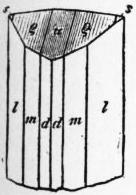
MANGANITE, a mineral consisting of hydrated manganese sesquioxide, Mn2O3·H2O, crystallizing in the orthorhombic system and isomorphous with diaspore and göthite. Crystals are prismatic and deeply striated parallel to their length; they are often grouped together in bundles. The colour is dark steel-grey to iron-black, and the lustre brilliant and submetallic: the streak is dark reddish-brown. The hardness is 4, and the specific gravity 4.3. There is a perfect cleavage parallel to the brachypinacoid, and less perfect cleavage parallel to the prism faces m. Twinned crystals are not infrequent. The mineral contains 89.7% of manganese sesquioxide; it dissolves in hydrochloric acid with evolution of chlorine. The best crystallized specimens are those from Ilfeld in the Harz, where the mineral occurs with calcite and barytes in veins traversing porphyry. Crystals have also been found at Ilmenau in Thuringia, Neukirch near Schlettstadt in Alsace (“newkirkite”), Granam near Towie in Aberdeenshire, Upton Pyne near Exeter and Negaunee in Michigan. As an ore of manganese it is much less abundant than pyrolusite or psilomelane. The name manganite was given by W. Haidinger in 1827: French authors adopt F. S. Beudant’s name “acerdèse,” (Gr. ἀκερδής, unprofitable) because the mineral is of little value for bleaching purposes as compared with pyrolusite.
(L. J. S.)
MANGBETTU (Monbuttu), a negroid people of Central Africa living to the south of the Niam-Niam in the Welle district of Belgian Congo. They number about a million. Their country is a table-land at an altitude of 2500 to 2800 ft. Despite its abundant animal life, luxuriant vegetation and rich crops of plantain and oil-palm, the Mangbettu have been some of the most inveterate cannibals in Africa; but since the Congo State established posts in the country (c. 1895) considerable efforts have been made to stamp out cannibalism. Physically the Mangbettu differ greatly from their negro neighbours. They are not so black and their faces are less negroid, many having quite aquiline noses. The beard, too, is fuller than in most negroes. They appear to have imposed their language and customs on the surrounding tribes, the Mundu, Abisanga, &c. Once a considerable power, they have practically disappeared as far as the original stock is concerned; their language and culture, however, remain, maintained by their subjects, with whom they have to a large extent intermixed. The men wear bark cloth, the art of weaving being unknown, the women a simple loin cloth, often not that. Both sexes paint the body in elaborate designs. As potters, sculptors, boatbuilders and masons the Mangbettu have had few rivals in Africa. Their huts, with pointed roofs, were not only larger and better built, but were cleaner than those of their neighbours, and some of their more important buildings were of great size and exhibited some skill in architecture.
See G. A. Schweinfurth, Heart of Africa (1874); W. Junker, Travels in Africa (1890); G. Casati, Ten Years in Equatoria (1891).
MANGEL-WURZEL, or field-beet, a variety of the common beet, known botanically as Beta vulgaris, var. macrorhiza. The name is German and means literally “root of scarcity.” R. C. A. Prior (Popular Names of British Plants) says it was originally mangold, a word of doubtful meaning. The so-called root consists of the much thickened primary root together with the “hypocotyl,” i.e. the original stem between the root and the seed-leaves. A transverse section of the root shows a similar structure to the beet, namely a series of concentric rings of firmer “woody” tissue alternating with rings of soft thin-walled parenchymatous “bast-tissue” which often has a crimson or yellowish tint. The root is a store of carbohydrate food-stuff in the form of sugar, which is formed in the first year of growth when the stem remains short and bears a rosette of large leaves. If the plant be allowed to remain in the ground till the following year strong leafy angular aerial stems are developed, 3 ft. or more in height, which branch and bear the inflorescences. The flowers are arranged in dense sessile clusters subtended by a small bract, and resemble those of the true beet. The so-called seeds are clusters of spurious fruits. After fertilization the fleshy receptacle and the base of the perianth of each flower enlarge and the flowers in a cluster become united; the fleshy parts with the ovaries, each of which contains one seed, become hard and woody. Hence several seeds are present in one “seed” of commerce, which necessitates the careful thinning of a young crop, as several seedlings may spring from one “seed.”