VOLUME XVI SLICE IV Lefebvre, Tanneguy to Letronne, Jean Antoine
Reading edition
Articles in This Slice
LEFEBVRE, TANNEGUY LENS (town of France)
LEFEBVRE-DESNOËTTES, CHARLES LENS (in optics)
LE FÈVRE, JEAN LENT
LEG LENTHALL, WILLIAM
LEGACY LENTIL
LE GALLIENNE, RICHARD LENTULUS
LEGARÉ, HUGH SWINTON LENZ, JAKOB MICHAEL REINHOLD
LEGAS LEO (popes)
LEGATE, BARTHOLOMEW LEO (emperors of the East)
LEGATE LEO (disciple of St Francis)
LEGATION LEO, HEINRICH
LEGEND LEO, JOHANNES
LEGENDRE, ADRIEN MARIE LEO, LEONARDO
LEGENDRE, LOUIS LEO (sign of the zodiac)
LEGERDEMAIN LEOBEN
LEGGE, HENRY LEOBSCHÜTZ
LEGGE, JAMES LEOCHARES
LEGHORN LEOFRIC
LEGION LEOMINSTER (Herefordshire, England)
LEGITIM LEOMINSTER (Massachusetts, U.S.A.)
LEGITIMACY, and LEGITIMATION LEÓN, LUIS PONCE DE
LEGITIMISTS LEON, MOSES DE
LEGNAGO (town of Venetia) LEON OF MODENA
LEGNANO (town of Lombardy) LEÓN (Mexico)
LEGOUVÉ, GABRIEL JEAN BAPTISTE ERNEST WILFRID LEON (Nicaragua)
LEGROS, ALPHONSE LEON (Spanish province)
LEGUMINOSAE LEON (Spanish city)
LÈGYA LEONARDO DA VINCI
LEH LEONARDO OF PISA
LEHMANN, JOHANN GOTTLOB LEONCAVALLO, RUGGIERO
LEHMANN, PETER MARTIN ORLA LEONIDAS
LEHNIN LEONTIASIS OSSEA
LEHRS, KARL LEONTINI
LEIBNITZ, GOTTFRIED WILHELM LEONTIUS
LEICESTER, EARLS OF LEOPARD
LEICESTER, ROBERT DUDLEY LEOPARDI, GIACOMO
LEICESTER, ROBERT SIDNEY LEOPARDO, ALESSANDRO
LEICESTER, THOMAS WILLIAM COKE LEOPOLD
LEICESTER LEOPOLD I. (Roman emperor)
LEICESTERSHIRE LEOPOLD II. (Roman emperor)
LEIDEN LEOPOLD I. (king of the Belgians)
LEIDY, JOSEPH LEOPOLD II. (king of the Belgians)
LEIF ERICSSON LEOPOLD II. (of Habsburg-Lorraine)
LEIGH, EDWARD LEOPOLD II. (lake)
LEIGH LEOTYCHIDES
LEIGHTON, FREDERICK LEIGHTON LEOVIGILD
LEIGHTON, ROBERT LEPANTO, BATTLE OF
LEIGHTON BUZZARD LE PAUTRE, JEAN
LEININGEN LEPCHA
LEINSTER LE PELETIER, DE SAINT-FARGEAU, LOUIS MICHE
LEIPZIG LEPIDOLITE
LEIRIA LEPIDOPTERA
LEISLER, JACOB LEPIDUS
LEISNIG LE PLAY, PIERRE GUILLAUME FRÉDÉRIC
LEITH LEPROSY
LEITMERITZ LEPSIUS, KARL RICHARD
LEITNER, GOTTLIEB WILHELM LEPTINES
LEITRIM LEPTIS
LEIXÕES LE PUY
LEJEUNE, LOUIS FRANÇOIS LERDO DE TEJADA, SEBASTIAN
LEKAIN LERICI
LELAND, CHARLES GODFREY LÉRIDA (province of Spain)
LELAND, JOHN (English antiquary) LÉRIDA (city of Spain)
LELAND, JOHN (English divine) LERMA, FRANCISCO DE SANDOVAL Y ROJAS
LELAND STANFORD JR. UNIVERSITY LERMONTOV, MIKHAIL YUREVICH
LELEGES LEROUX, PIERRE
LELEWEL, JOACHIM LEROY-BEAULIEU, HENRI JEAN BAPTISTE ANATOLE
LELONG, JACQUES LEROY-BEAULIEU, PIERRE PAUL
LELY, SIR PETER LERWICK
LE MAÇON, ROBERT LE SAGE, ALAIN RENÉ
LE MAIRE DE BELGES, JEAN LES ANDELYS
LEMAÎTRE, FRANÇOIS ÉLIE JULES LES BAUX
LE MANS LESBONAX
LE MARCHANT, JOHN GASPARD LESBOS
LEMBERG LESCHES
LEMERCIER, LOUIS JEAN NÉPOMUCÉNE LESCURE, LOUIS MARIE JOSEPH
LEMERY, NICOLAS LESDIGUIÈRES, FRANÇOIS DE BONNE
LEMERY LESGHIANS
LEMGO LESINA
LEMIERRE, ANTOINE MARIN LESION
LEMIRE, JULES AUGUSTE LESKOVATS
LEMMING LESLEY, JOHN
LEMNISCATE LESLEY, J. PETER
LEMNOS LESLIE, CHARLES
LEMOINNE, JOHN ÉMILE LESLIE, CHARLES ROBERT
LEMON, MARK LESLIE, FRED
LEMON LESLIE, SIR JOHN
LEMONNIER, ANTOINE LOUIS CAMILLE LESLIE, THOMAS EDWARD CLIFFE
LEMONNIER, PIERRE CHARLES LESLIE (Scotland)
LEMOYNE, JEAN BAPTISTE LESPINASSE, JEANNE JULIE ÉLÉONORE DE
LEMPRIÈRE, JOHN LES SABLES D’OLONNE
LEMUR LES SAINTES-MARIES
LENA LESSE
LE NAIN LESSEPS, FERDINAND DE
LENAU, NIKOLAUS LESSING, GOTTHOLD EPHRAIM
LENBACH, FRANZ VON LESSON
LENCLOS, NINON DE LESTE
LENFANT, JACQUES L’ESTRANGE, SIR ROGER
LENKORAN LESUEUR, DANIEL
LENNEP, JACOB VAN LE SUEUR, EUSTACHE
LENNEP LESUEUR, JEAN FRANÇOIS
LENNOX LE TELLIER, MICHEL
LENNOX, CHARLOTTE LETHAL
LENNOX, MARGARET LETHARGY
LENO, DAN LETHE
LENORMANT, FRANÇOIS LE TRÉPORT
LENOX LETRONNE, JEAN ANTOINE

LEFEBVRE, TANNEGUY (Tanaquillus Faber) (1615-1672), French classical scholar, was born at Caen. After completing his studies in Paris, he was appointed by Cardinal Richelieu inspector of the printing-press at the Louvre. After Richelieu’s death he left Paris, joined the Reformed Church, and in 1651 obtained a professorship at the academy of Saumur, which he filled with great success for nearly twenty years. His increasing ill-health and a certain moral laxity (as shown in his judgment on Sappho) led to a quarrel with the consistory, as a result of which he resigned his professorship. Several universities were eager to obtain his services, and he had accepted a post offered him by the elector palatine at Heidelberg, when he died suddenly on the 12th of September, 1672. One of his children was the famous Madame Dacier. Lefebvre, who was by no means a typical student in dress or manners, was a highly cultivated man and a thorough classical scholar. He brought out editions of various Greek and Latin authors—Longinus, Anacreon and Sappho, Virgil, Horace, Lucretius and many others. His most important original works are: Les Vies des poètes Grecs (1665); Méthode pour commencer les humanités Grecques et Latines (2nd ed., 1731), of which several English adaptations have appeared; Epistolae Criticae (1659).
In addition to the Mémoires pour ... la vie de Tanneguy Lefebvre, by F. Graverol (1686), see the article in the Nouvelle biographie générale, based partly on the MS. registers of the Saumur Académie.
LEFEBVRE-DESNOËTTES, CHARLES, Comte (1773-1822), French cavalry general, joined the army in 1792 and served with the armies of the North, of the Sambre-and-Meuse and Rhine-and-Moselle in the various campaigns of the Revolution. Six years later he had become captain and aide-de-camp to General Bonaparte. At Marengo he won further promotion, and at Austerlitz became colonel, serving also in the Prussian campaigns of 1806-1807. In 1808 he was made general of brigade and created a count of the Empire. Sent with the army into Spain, he conducted the first and unsuccessful siege of Saragossa. The battlefield of Tudela showed his talents to better advantage, but towards the end of 1808 he was taken prisoner in the action of Benavente by the British cavalry under Paget (later Lord Uxbridge, and subsequently Marquis of Anglesey). For over two years he remained a prisoner in England, living on parole at Cheltenham. In 1811 he escaped, and in the invasion of Russia in 1812 was again at the head of his cavalry. In 1813 and 1814 his men distinguished themselves in most of the great battles, especially La Rothière and Montmirail. He joined Napoleon in the Hundred Days and was wounded at Waterloo. For his part in these events he was condemned to death, but he escaped to the United States, and spent the next few years farming in Louisiana. His frequent appeals to Louis XVIII. eventually obtained his permission to return, but the “Albion,” the vessel on which he was returning to France, went down off the coast of Ireland with all on board on the 22nd of May 1822.
LE FÈVRE, JEAN (c. 1395-1468), Burgundian chronicler and seigneur of Saint Remy, is also known as Toison d’or from his long connexion with the order of the Golden Fleece. Of noble birth, he adopted the profession of arms and with other Burgundians fought in the English ranks at Agincourt. In 1430, on the foundation of the order of the Golden Fleece by Philip III. the Good, duke of Burgundy, Le Fèvre was appointed its king of arms and he soon became a very influential person at the Burgundian court. He frequently assisted Philip in conducting negotiations with foreign powers, and he was an arbiter in tournaments and on all questions of chivalry, where his wide knowledge of heraldry was highly useful. He died at Bruges on the 16th of June 1468.
Le Fèvre wrote a Chronique, or Histoire de Charles VI., roy de France. The greater part of this chronicle is merely a copy of the work of Enguerrand de Monstrelet, but Le Fèvre is an original authority for the years between 1428 and 1436 and makes some valuable additions to our knowledge, especially about the chivalry of the Burgundian court. He is more concise than Monstrelet, but is equally partial to the dukes of Burgundy. The Chronique has been edited by F. Morand for the Société de l’histoire de France (Paris, 1876). Le Fèvre is usually regarded as the author of the Livre des faites de Jacques de Lalaing.
LEG (a word of Scandinavian origin, from the Old Norwegian leggr, cf. Swed. lägg, Dan. laég; the O. Eng. word was sceanca, shank), the general name for those limbs in animals which support and move the body, and in man for the lower limbs of the body (see Anatomy, Superficial and Artistic; Skeleton, Appendicular; Muscular System). The word is in common use for many objects which resemble the leg in shape or function. As a slang term, “leg,” a shortened form of “blackleg,” has been in use since the end of the 18th century for a swindler, especially in connexion with racing or gambling. The term “blackleg” is now also applied by trade-unionists to a workman who, during a strike or lockout, continues working or is brought to take the place of the withdrawn workers.
LEGACY (Lat. legatum), in English law, some particular thing or things given or left by a testator in his will, to be paid or performed by his executor or administrator. The word is primarily applicable to gifts of personalty or gifts charged upon real estate; but if there is nothing else to which it can refer it may refer to realty; the proper word, however, for gifts of realty is devise.
Legacies may be either specific, general or demonstrative. A specific legacy is “something which a testator, identifying it by a sufficient description and manifesting an intention that it should be enjoyed in the state and condition indicated by that description, separates in favour of a particular legatee from the general mass of his personal estate,” e.g. a gift of “my portrait by X,” naming the artist. A general legacy is a gift not so distinguished from the general mass of the personal estate, e.g. a gift of £100 or of a gold ring. A demonstrative legacy partakes of the nature of both the preceding kinds of legacies, e.g. a gift of £100 payable out of a named fund is a specific legacy so far as the fund named is available to pay the legacy; after the fund is exhausted the balance of the legacy is a general legacy and recourse must be had to the general estate to satisfy such balance. Sometimes a testator bequeaths two or more legacies to the same person; in such a case it is a question whether the later legacies are in substitution for, or in addition to, the earlier ones. In the latter case they are known as cumulative. In each case the intention of the testator is the rule of construction; this can often be gathered from the terms of the will or codicil, but in the absence of such evidence the following rules are followed by the courts. Where the same specific thing is bequeathed twice to the same legatee or where two legacies of equal amount are bequeathed by the same instrument the second bequest is mere repetition; but where legacies of equal amounts are bequeathed by different instruments or of unequal amounts by the same instruments they are considered to be cumulative.
If the estate of the testator is insufficient to satisfy all the legacies these must abate, i.e. be reduced rateably; as to this it should be noticed that specific and demonstrative legacies have a prior claim to be paid in full out of the specific fund before general legacies, and that general legacies abate rateably inter se in the absence of any provision to the contrary by the testator. Specific legacies are liable to ademption where the specific thing perishes or ceases to belong to the testator, e.g. in the instance given above if the testator sells the portrait the legatee will get nothing by virtue of the legacy. As a general rule, legacies given to persons who predecease the testator do not take effect; they are said to lapse. This is so even if the gift be to A and his executors, administrators and assigns, but this is not so if the testator has shown a contrary intention, thus, a gift to A or his personal representative will be effective even though A predecease the testator; further, by the Wills Act 1837, devises of estates tail and gifts to a child or other issue of the testator will not lapse if any issue of the legatee survive the testator. Lapsed legacies fall into and form part of the residuary estate. In the absence of any indication to the contrary a legacy becomes due on the day of the death of the testator, though for the convenience of the executor it is not payable till a year after that date; this delay does not prevent the legacy vesting on the testator’s death. It frequently happens, however, that a legacy is given payable at a future date; in such a case, if the legatee dies after the testator but prior to the date when the legacy is payable it is necessary to discover whether the legacy was vested or contingent, as in the former case it becomes payable to the legatee’s representative; in the latter, it lapses. In this, as in other cases, the test is the intention of the testator as expressed in the will; generally it may be said that a gift “payable” or “to be paid” at a certain fixed time confers a vested interest on the legatee, while a gift to A “at” a fixed time, e.g. twenty-one years of age, only confers on A an interest contingent on his attaining the age of twenty-one.
Legacy Duty is a duty charged by the state upon personal property devolving upon the legatees or next of kin of a dead person, either by virtue of his will or upon his intestacy. The duty was first imposed in England in 1780, but the principal act dealing with the subject is the Legacy Duty Act 1796. The principal points as to the duty are these. The duty is charged on personalty only. It is payable only where the person on whose death the property passes was domiciled in the United Kingdom. The rate of duty varies from 1 to 10% according to the relationship between the testator and legatee. As between husband and wife no duty is payable. The duty is payable by the executors and deducted from the legacy unless the testator directs otherwise. Special provisions as to valuation are in force where the gift is of an annuity or is settled on various persons in succession, or the legacy is given in joint tenancy and other cases. In some cases the duty is payable by instalments which carry interest at 3%. In various cases legacies are exempt from duty—the more important are gifts to a member of the royal family, specific legacies under £20 (pecuniary legacies under £20 pay duty), legacies of books, prints, &c., given to a body corporate for preservation, not for sale, and legacies given out of an estate the principal value of which is less than £100. Further, by the Finance Act 1894, payment of the estate duty thereby created absorbs the 1% duty paid by lineal ancestors or descendants of the deceased1 and the duty on a settled legacy, and, lastly, in the event of estate duty being paid on an estate the total value of which is under £1000, no legacy duty is payable. The legacy duty payable in Ireland is now for all practical purposes assimilated to that in Great Britain. The principal statute in that country is an act of 1814.
1 The Finance Bill 1909-1910 re-imposed this duty, and extended it to husbands and wives as well as descendants and ancestors.
LE GALLIENNE, RICHARD (1866- ), English poet and critic, was born in Liverpool on the 20th of January 1866. He started life in a business office in Liverpool, but abandoned this to turn author. My Lady’s Sonnets appeared at Liverpool in 1887, and in 1889 he became for a short time literary secretary to Wilson Barrett. In the same year he published Volumes in Folio, The Book Bills of Narcissus and George Meredith: some Characteristics (new ed., 1900). He joined the staff of the Star in 1891, and wrote for various papers over the signature of “Logroller.” English Poems (1892), R. L. Stevenson and other Poems (1895), a paraphrase (1897) of the Rubáiyát of Omar Khayyám, and Odes from the Divan of Hafiz (1903), contained some light, graceful verse, but he is best known by the fantastic prose essays and sketches of Prose Fancies (2 series, 1894-1896), Sleeping Beauty and other Prose Fancies (1900), The Religion of a Literary Man (1893), The Quest of the Golden Girl (1897), The Life Romantic (1901), &c. His first wife, Mildred Lee, died in 1894, and in 1897 he married Julie Norregard, subsequently taking up his residence in the United States. In 1906 he translated, from the Danish, Peter Nansen’s Love’s Trilogy.
LEGARÉ, HUGH SWINTON (1797-1843), American lawyer and statesman, was born in Charleston, South Carolina, on the 2nd of January 1797, of Huguenot and Scotch stock. Partly on account of his inability to share in the amusements of his fellows by reason of a deformity due to vaccine poisoning before he was five (the poison permanently arresting the growth and development of his legs), he was an eager student, and in 1814 he graduated at the College of South Carolina with the highest rank in his class and with a reputation throughout the state for scholarship and eloquence. He studied law for three years in South Carolina, and then spent two years abroad, studying French and Italian in Paris and jurisprudence at Edinburgh. In 1820-1822 and in 1824-1830 he was a member of the South Carolina legislature. In 1827, with Stephen Elliott (1771-1830), the naturalist, he founded the Southern Review, of which he was the sole editor after Elliott’s death until 1834, when it was discontinued, and to which he contributed articles on law, travel, and modern and classical literature. In 1830-1832 he was attorney-general of South Carolina, and, although a State’s Rights man, he strongly opposed nullification. During his term of office he appeared in a case before the United States Supreme Court, where his knowledge of civil law so strongly impressed Edward Livingston, the secretary of state, who was himself an admirer of Roman Law, that he urged Legaré to devote himself to the study of this subject with the hope that he might influence American law toward the spirit and philosophy and even the forms and processes of Roman jurisprudence. Through Livingston, Legaré was appointed American chargé d’affaires at Brussels, where from 1833 to 1836 he perfected himself in civil law and in the German commentaries on civil law. In 1837-1839, as a Union Democrat, he was a member of the national House of Representatives, and there ably opposed Van Buren’s financial policy in spite of the enthusiasm in South Carolina for the sub-treasury project. He supported Harrison in the presidential campaign of 1840, and when the cabinet was reconstructed by Tyler in 1841, Legaré was appointed attorney-general of the United States. On the 9th of May 1843 he was appointed secretary of state ad interim, after the resignation of Daniel Webster. On the 20th of June 1843 he died suddenly at Boston. His great work, the forcing into common law of the principles of civil law, was unaccomplished; but Story says “he seemed about to accomplish [it]; for his arguments before the Supreme Court were crowded with the principles of the Roman Law, wrought into the texture of the Common Law with great success.” As attorney-general he argued the famous cases, the United States v. Miranda, Wood v. the United States, and Jewell v. Jewell.
See The Writings of Hugh Swinton Legaré (2 vols., Charleston, S.C., 1846), edited by his sister, Mrs Mary Bullen, who contributed a biographical sketch; and two articles by B. J. Ramage in The Sewanee Review, vol. x. (New York, 1902).
LEGAS, one of the Shangalla group of tribes, regarded as among the purest types of the Galla race. They occupy the upper Yabus valley, S.W. Abyssinia, near the Sudan frontier. The Legas are physically distinct from the Negro Shangalla. They are of very light complexion, tall and thin, with narrow hollow-cheeked faces, small heads and high foreheads. The chiefs’ families are of more mixed blood, with perceptible Negro strain. The Legas are estimated to number upwards of a hundred thousand, of whom some 20,000 are warriors. They are, however, a peaceful race, kind to their women and slaves, and energetic agriculturists. Formerly independent, they came about 1900 under the sway of Abyssinia. The Legas are pagans, but Mahommedanism has gained many converts among them.
LEGATE, BARTHOLOMEW (c. 1575-1612), English fanatic, was born in Essex and became a dealer in cloth. About the beginning of the 17th century he became a preacher among a sect called the “Seekers,” and appears to have held unorthodox opinions about the divinity of Jesus Christ. Together with his brother Thomas he was put in prison for heresy in 1611. Thomas died in Newgate gaol, London, but Bartholomew’s imprisonment was not a rigorous one. James I. argued with him, and on several occasions he was brought before the Consistory Court of London, but without any definite result. Eventually, after having threatened to bring an action for wrongful imprisonment, Legate was tried before a full Consistory Court in February 1612, was found guilty of heresy, and was delivered to the secular authorities for punishment. Refusing to retract his opinions he was burned to death at Smithfield on the 18th of March 1612. Legate was the last person burned in London for his religious opinions, and Edward Wightman, who was burned at Lichfield in April 1612, was the last to suffer in this way in England.
See T. Fuller, Church History of Britain (1655); and S. R. Gardiner, History of England, vol. ii. (London, 1904).
LEGATE (Lat. legatus, past part. of legare, to send as deputy), a title now generally confined to the highest class of diplomatic representatives of the pope, though still occasionally used, in its original Latin sense, of any ambassador or diplomatic agent. According to the Nova Compilatio Decretalium of Gregory IX., under the title “De officio legati” the canon law recognizes two sorts of legate, the legatus natus and the legatus datus or missus. The legatus datus (missus) may be either (1) delegatus, or (2) nuncius apostolicus, or (3) legatus a latere (lateralis, collateralis). The rights of the legatus natus, which included concurrent jurisdiction with that of all the bishops within his province, have been much curtailed since the 16th century; they were altogether suspended in presence of the higher claims of a legatus a latere, and the title is now almost quite honorary. It was attached to the see of Canterbury till the Reformation and it still attaches to the sees of Seville, Toledo, Aries, Reims, Lyons, Gran, Prague, Gnesen-Posen, Cologne, Salzburg, among others. The commission of the legatus delegatus (generally a member of the local clergy) is of a limited nature, and relates only to some definite piece of work. The nuncius apostolicus (who has the privilege of red apparel, a white horse and golden spurs) possesses ordinary jurisdiction within the province to which he has been sent, but his powers otherwise are restricted by the terms of his mandate. The legatus a latere (almost invariably a cardinal, though the power can be conferred on other prelates) is in the fullest sense the plenipotentiary representative of the pope, and possesses the high prerogative implied in the words of Gregory VII., “nostra vice quae corrigenda sunt corrigat, quae statuend constituat.” He has the power of suspending all the bishops in his province, and no judicial cases are reserved from his judgment. Without special mandate, however, he cannot depose bishops or unite or separate bishoprics. At present legati a latere are not sent by the holy see, but diplomatic relations, where they exist, are maintained by means of nuncios, internuncios and other agents.
The history of the office of papal legate is closely involved with that of the papacy itself. If it were proved that papal legates exercised the prerogatives of the primacy in the early councils, it would be one of the strongest points for the Roman Catholic view of the papal history. Thus it is claimed that Hosius of Cordova presided over the council of Nicaea (325) in the name of the pope. But the claim rests on slender evidence, since the first source in which Hosius is referred to as representative of the pope is Gelasius of Cyzicus in the Propontis, who wrote toward the end of the 5th century. It is even open to dispute whether Hosius was president at Nicaea, and though he certainly presided over the council of Sardica in 343, it was probably as representative of the emperors Constans and Constantius, who had summoned the council. Pope Julius I. was represented at Sardica by two presbyters. Yet the fifth canon, which provides for appeal by a bishop to Rome, sanctions the use of embassies a latere. If the appellant wishes the pope to send priests from his own household, the pope shall be free to do so, and to furnish them with full authority from himself (“ut de latere suo presbyteros mittat ... habentes ejus auctoritatem a quo destinati sunt”). The decrees of Sardica, an obscure council, were later confused with those of Nicaea and thus gained weight. In the synod of Ephesus in 431, Pope Celestine I. instructed his representatives to conduct themselves not as disputants but as judges, and Cyril of Alexandria presided not only in his own name but in that of the pope (and of the bishop of Jerusalem). Instances of delegation of the papal authority in various degrees become numerous in the 5th century, especially during the pontificate of Leo I. Thus Leo writes in 444 (Ep. 6) to Anastasius of Thessalonica, appointing him his vicar for the province of Illyria; the same arrangement, he informs us, had been made by Pope Siricius in favour of Anysius, the predecessor of Anastasius. Similar vicarial or legatine powers had been conferred in 418 by Zosimus upon Patroclus, bishop of Arles. In 449 Leo was represented at the “Robber Synod,” from which his legates hardly escaped with life; at Chalcedon, in 451, they were treated with singular honour, though the imperial commissioners presided. Again, in 453 the same pope writes to the empress Pulcheria, naming Julianus of Cos as his representative in the defence of the interests of orthodoxy and ecclesiastical discipline at Constantinople (Ep. 112); the instructions to Julianus are given in Ep. 113 (“hanc specialem curam vice mea functus assumas”). The designation of Anastasius as vicar apostolic over Illyria may be said to mark the beginning of the custom of conferring, ex officio, the title of legatus upon the holders of important sees, who ultimately came to be known as legati nati, with the rank of primate; the appointment of Julianus at Constantinople gradually developed into the long permanent office of apocrisiarius or responsalis. Another sort of delegation is exemplified in Leo’s letter to the African bishops (Ep. 12), in which he sends Potentius, with instructions to inquire in his name, and to report (“vicem curae nostrae fratri et consacerdoti nostro Potentio delegantes qui de episcopis, quorum culpabilis ferebatur electio, quid veritas haberet inquireret, nobisque omnia fideliter indicaret”). Passing on to the time of Gregory the Great, we find him sending two representatives to Gaul in 599, to suppress simony, and one to Spain in 603. Augustine of Canterbury is sometimes spoken of as legate, but it does not appear that in his case this title was used in any strictly technical sense, although the archbishop of Canterbury afterwards attained the permanent dignity of a legatus natus. Boniface, the apostle of Germany, was in like manner constituted, according to Hincmar (Ep. 30), a legate of the apostolic see by Popes Gregory II. and Gregory III. According to Hefele (Conc. iv. 239), Rodoald of Porto and Zecharias of Anagni, who were sent by Pope Nicolas to Constantinople in 860, were the first actually called legati a latere. The policy of Gregory VII. naturally led to a great development of the legatine as distinguished from the ordinary episcopal function. From the creation of the medieval papal monarchy until the close of the middle ages, the papal legate played a most important rôle in national as well as church history. The further definition of his powers proceeded throughout the 12th and 13th centuries. From the 16th century legates a latere give way almost entirely to nuncios (q.v.).
See P. Hinschius, Kirchenrecht, i. 498 ff.; G. Phillips, Kirchenrecht, vol. vi. 680 ff.
LEGATION (Lat. legatio, a sending or mission), a diplomatic mission of the second rank. The term is also applied to the building in which the minister resides and to the area round it covered by his diplomatic immunities. See Diplomacy.
LEGEND (through the French from the med. Lat. legenda, things to be read, from legere, to read), in its primary meaning the history or life-story of a saint, and so applied to portions of Scripture and selections from the lives of the saints as read at divine service. The statute of 3 and 4 Edward VI. dealing with the abolition of certain books and images (1549), cap. 10, sect. 1, says that “all bookes ... called processionalles, manuelles, legends ... shall be ... abolished.” The “Golden Legend,” or Aurea Legenda, was the name given to a book containing lives of the saints and descriptions of festivals, written by Jacobus de Voragine, archbishop of Genoa, in the 13th century. From the original application of the word to stories of the saints containing wonders and miracles, the word came to be applied to a story handed down without any foundation in history, but popularly believed to be true. “Legend” is also used of a writing, inscription, or motto on coins or medals, and in connexion with coats of arms, shields, monuments, &c.
LEGENDRE, ADRIEN MARIE (1752-1833), French mathematician, was born at Paris (or, according to some accounts, at Toulouse) in 1752. He was brought up at Paris, where he completed his studies at the Collège Mazarin. His first published writings consist of articles forming part of the Traité de mécanique (1774) of the Abbé Marie, who was his professor; Legendre’s name, however, is not mentioned. Soon afterwards he was appointed professor of mathematics in the École Militaire at Paris, and he was afterwards professor in the École Normale. In 1782 he received the prize from the Berlin Academy for his “Dissertation sur la question de balistique,” a memoir relating to the paths of projectiles in resisting media. He also, about this time, wrote his “Recherches sur la figure des planètes,” published in the Mémoires of the French Academy, of which he was elected a member in succession to J. le Rond d’Alembert in 1783. He was also appointed a commissioner for connecting geodetically Paris and Greenwich, his colleagues being P. F. A. Méchain and C. F. Cassini de Thury; General William Roy conducted the operations on behalf of England. The French observations were published in 1792 (Exposé des opérations faites en France in 1787 pour la jonction des observatoires de Paris et de Greenwich). During the Revolution, he was one of the three members of the council established to introduce the decimal system, and he was also a member of the commission appointed to determine the length of the metre, for which purpose the calculations, &c., connected with the arc of the meridian from Barcelona to Dunkirk were revised. He was also associated with G. C. F. M. Prony (1755-1839) in the formation of the great French tables of logarithms of numbers, sines, and tangents, and natural sines, called the Tables du Cadastre, in which the quadrant was divided centesimally; these tables have never been published (see Logarithms). He was examiner in the École Polytechnique, but held few important state offices. He died at Paris on the 10th of January 1833, and the discourse at his grave was pronounced by S. D. Poisson. The last of the three supplements to his Traité des fonctions elliptiques was published in 1832, and Poisson in his funeral oration remarked: “M. Legendre a eu cela de commun avec la plupart des géomètres qui l’ont précédé, que ses travaux n’ont fini qu’avec sa vie. Le dernier volume de nos mémoires renferme encore un mémoire de lui, sur une question difficile de la théorie des nombres; et peu de temps avant la maladie qui l’a conduit au tombeau, il se procura les observations les plus récentes des comètes à courtes périodes, dont il allait se servir pour appliquer et perfectionner ses méthodes.”
It will be convenient, in giving an account of his writings, to consider them under the different subjects which are especially associated with his name.
Elliptic Functions.—This is the subject with which Legendre’s name will always be most closely connected, and his researches upon it extend over a period of more than forty years. His first published writings upon the subject consist of two papers in the Mémoires de l’Académie Française for 1786 upon elliptic arcs. In 1792 he presented to the Academy a memoir on elliptic transcendents. The contents of these memoirs are included in the first volume of his Exercices de calcul intégral (1811). The third volume (1816) contains the very elaborate and now well-known tables of the elliptic integrals which were calculated by Legendre himself, with an account of the mode of their construction. In 1827 appeared the Traité des fonctions elliptiques (2 vols., the first dated 1825, the second 1826), a great part of the first volume agrees very closely with the contents of the Exercices; the tables, &c., are given in the second volume. Three supplements, relating to the researches of N. H. Abel and C. G. J. Jacobi, were published in 1828-1832, and form a third volume. Legendre had pursued the subject which would now be called elliptic integrals alone from 1786 to 1827, the results of his labours having been almost entirely neglected by his contemporaries, but his work had scarcely appeared in 1827 when the discoveries which were independently made by the two young and as yet unknown mathematicians Abel and Jacobi placed the subject on a new basis, and revolutionized it completely. The readiness with which Legendre, who was then seventy-six years of age, welcomed these important researches, that quite overshadowed his own, and included them in successive supplements to his work, does the highest honour to him (see Function).
Eulerian Integrals and Integral Calculus.—The Exercices de calcul intégral consist of three volumes, a great portion of the first and the whole of the third being devoted to elliptic functions. The remainder of the first volume relates to the Eulerian integrals and to quadratures. The second volume (1817) relates to the Eulerian integrals, and to various integrals and series, developments, mechanical problems, &c., connected with the integral calculus; this volume contains also a numerical table of the values of the gamma function. The latter portion of the second volume of the Traité des fonctions elliptiques (1826) is also devoted to the Eulerian integrals, the table being reproduced. Legendre’s researches connected with the “gamma function” are of importance, and are well known; the subject was also treated by K. F. Gauss in his memoir Disquisitiones generales circa series infinitas (1816), but in a very different manner. The results given in the second volume of the Exercices are of too miscellaneous a character to admit of being briefly described. In 1788 Legendre published a memoir on double integrals, and in 1809 one on definite integrals.
Theory of Numbers.—Legendre’s Théorie des nombres and Gauss’s Disquisitiones arithmeticae (1801) are still standard works upon this subject. The first edition of the former appeared in 1798 under the title Essai sur la théorie des nombres; there was a second edition in 1808; a first supplement was published in 1816, and a second in 1825. The third edition, under the title Théorie des nombres, appeared in 1830 in two volumes. The fourth edition appeared in 1900. To Legendre is due the theorem known as the law of quadratic reciprocity, the most important general result in the science of numbers which has been discovered since the time of P. de Fermat, and which was called by Gauss the “gem of arithmetic.” It was first given by Legendre in the Mémoires of the Academy for 1785, but the demonstration that accompanied it was incomplete. The symbol (a/p) which is known as Legendre’s symbol, and denotes the positive or negative unit which is the remainder when a1/2p(−1) is divided by a prime number p, does not appear in this memoir, but was first used in the Essai sur la théorie des nombres. Legendre’s formula x: (log x−1.08366) for the approximate number of forms inferior to a given number x was first given by him also in this work (2nd ed., p. 394) (see Number).
Attractions of Ellipsoids.—Legendre was the author of four important memoirs on this subject. In the first of these, entitled “Recherches sur l’attraction des sphéroides homogènes,” published in the Mémoires of the Academy for 1785, but communicated to it at an earlier period, Legendre introduces the celebrated expressions which, though frequently called Laplace’s coefficients, are more correctly named after Legendre. The definition of the coefficients is that if (1 − 2h cos φ + h2)−1/2 be expanded in ascending powers of h, and if the general term be denoted by Pnhn, then Pn is of the Legendrian coefficient of the nth order. In this memoir also the function which is now called the potential was, at the suggestion of Laplace, first introduced. Legendre shows that Maclaurin’s theorem with respect to confocal ellipsoids is true for any position of the external point when the ellipsoids are solids of revolution. Of this memoir Isaac Todhunter writes: “We may affirm that no single memoir in the history of our subject can rival this in interest and importance. During forty years the resources of analysis, even in the hands of d’Alembert, Lagrange and Laplace, had not carried the theory of the attraction of ellipsoids beyond the point which the geometry of Maclaurin had reached. The introduction of the coefficients now called Laplace’s, and their application, commence a new era in mathematical physics.” Legendre’s second memoir was communicated to the Académie in 1784, and relates to the conditions of equilibrium of a mass of rotating fluid in the form of a figure of revolution which does not deviate much from a sphere. The third memoir relates to Laplace’s theorem respecting confocal ellipsoids. Of the fourth memoir Todhunter writes: “It occupies an important position in the history of our subject. The most striking addition which is here made to previous researches consists in the treatment of a planet supposed entirely fluid; the general equation for the form of a stratum is given for the first time and discussed. For the first time we have a correct and convenient expression for Laplace’s nth coefficient.” (See Todhunter’s History of the Mathematical Theories of Attraction and the Figure of the Earth (1873), the twentieth, twenty-second, twenty-fourth, and twenty-fifth chapters of which contain a full and complete account of Legendre’s four memoirs. See also Spherical Harmonics.)
Geodesy.—Besides the work upon the geodetical operations connecting Paris and Greenwich, of which Legendre was one of the authors, he published in the Mémoires de l’Académie for 1787 two papers on trigonometrical operations depending upon the figure of the earth, containing many theorems relating to this subject. The best known of these, which is called Legendre’s theorem, is usually given in treatises on spherical trigonometry; by means of it a small spherical triangle may be treated as a plane triangle, certain corrections being applied to the angles. Legendre was also the author of a memoir upon triangles drawn upon a spheroid. Legendre’s theorem is a fundamental one in geodesy, and his contributions to the subject are of the greatest importance.
Method of Least Squares.—In 1806 appeared Legendre’s Nouvelles Méthodes pour la détermination des orbites des comètes, which is memorable as containing the first published suggestion of the method of least squares (see Probability). In the preface Legendre remarks: “La méthode qui me paroît la plus simple et la plus générale consiste à rendre minimum la somme des quarrés des erreurs, ... et que j’appelle méthode des moindres quarrés”; and in an appendix in which the application of the method is explained his words are: “De tous les principes qu’on peut proposer pour cet objet, je pense qu’il n’en est pas de plus général, de plus exact, ni d’une application plus facile que celui dont nous avons fait usage dans les recherches précédentes, et qui consiste à rendre minimum la somme des quarrés des erreurs.” The method was proposed by Legendre only as a convenient process for treating observations, without reference to the theory of probability. It had, however, been applied by Gauss as early as 1795, and the method was fully explained, and the law of facility for the first time given by him in 1809. Laplace also justified the method by means of the principles of the theory of probability; and this led Legendre to republish the part of his Nouvelles Méthodes which related to it in the Mémoires de l’Académie for 1810. Thus, although the method of least squares was first formally proposed by Legendre, the theory and algorithm and mathematical foundation of the process are due to Gauss and Laplace. Legendre published two supplements to his Nouvelles Méthodes in 1806 and 1820.
The Elements of Geometry.—Legendre’s name is most widely known on account of his Eléments de géométrie, the most successful of the numerous attempts that have been made to supersede Euclid as a text-book on geometry. It first appeared in 1794, and went through very many editions, and has been translated into almost all languages. An English translation, by Sir David Brewster, from the eleventh French edition, was published in 1823, and is well known in England. The earlier editions did not contain the trigonometry. In one of the notes Legendre gives a proof of the irrationality of π. This had been first proved by J. H. Lambert in the Berlin Memoirs for 1768. Legendre’s proof is similar in principle to Lambert’s, but much simpler. On account of the objections urged against the treatment of parallels in this work, Legendre was induced to publish in 1803 his Nouvelle Théorie des parallèles. His Géométrie gave rise in England also to a lengthened discussion on the difficult question of the treatment of the theory of parallels.
It will thus be seen that Legendre’s works have placed him in the very foremost rank in the widely distinct subjects of elliptic functions, theory of numbers, attractions, and geodesy, and have given him a conspicuous position in connexion with the integral calculus and other branches of mathematics. He published a memoir on the integration of partial differential equations and a few others which have not been noticed above, but they relate to subjects with which his name is not especially associated. A good account of the principal works of Legendre is given in the Bibliothèque universelle de Genève for 1833, pp. 45-82.
See Élie de Beaumont, “Memoir de Legendre,” translated by C. A. Alexander, Smithsonian Report (1874).
(J. W. L. G.)
LEGENDRE, LOUIS (1752-1797), French revolutionist, was born at Versailles on the 22nd of May 1752. When the Revolution broke out, he kept a butcher’s shop in Paris, in the rue des Boucheries St Germain. He was an ardent supporter of the ideas of the Revolution, a member of the Jacobin Club, and one of the founders of the club of the Cordeliers. In spite of the incorrectness of his diction, he was gifted with a genuine eloquence, and well knew how to carry the populace with him. He was a prominent actor in the taking of the Bastille (14th of July 1789), in the massacre of the Champ de Mars (July 1791), and in the attack on the Tuileries (10th of August 1792). Deputy from Paris to the Convention, he voted for the death of Louis XVI., and was sent on mission to Lyons (27th of February 1793) before the revolt of that town, and was on mission from August to October 1793 in Seine-Inférieure. He was a member of the Comité de Sûreté Générale, and contributed to the downfall of the Girondists. When Danton was arrested, Legendre at first defended him, but was soon cowed and withdrew his defence. After the fall of Robespierre, Legendre took part in the reactionary movement, undertook the closing of the Jacobin Club, was elected president of the Convention, and helped to bring about the impeachment of J. B. Carrier, the perpetrator of the noyades of Nantes. He was subsequently elected a member of the Council of Ancients, and died on the 13th of December 1797.
See F. A. Aulard, Les Orateurs de la Législative et de la Convention (2nd ed., Paris, 1906, 2 vols.); “Correspondance de Legendre” in the Révolution française (vol. xl., 1901).
LEGERDEMAIN (Fr. léger-de-main, i.e. light or sleight of hand), the name given specifically to that form of conjuring in which the performer relies on dexterity of manipulation rather than on mechanical apparatus. See Conjuring.
LEGGE, afterwards Bilson-Legge, HENRY (1708-1764), English statesman, fourth son of William Legge, 1st earl of Dartmouth (1672-1750), was born on the 29th of May 1708. Educated at Christ Church, Oxford, he became private secretary to Sir Robert Walpole, and in 1739 was appointed secretary of Ireland by the lord-lieutenant, the 3rd duke of Devonshire; being chosen member of parliament for the borough of East Looe in 1740, and for Orford, Suffolk, at the general election in the succeeding year. Legge only shared temporarily in the downfall of Walpole, and became in quick succession surveyor-general of woods and forests, a lord of the admiralty, and a lord of the treasury. In 1748 he was sent as envoy extraordinary to Frederick the Great, and although his conduct in Berlin was sharply censured by George II., he became treasurer of the navy soon after his return to England. In April 1754 he joined the ministry of the duke of Newcastle as chancellor of the exchequer, the king consenting to this appointment although refusing to hold any intercourse with the minister; but Legge shared the elder Pitt’s dislike of the policy of paying subsidies to the landgrave of Hesse, and was dismissed from office in November 1755. Twelve months later he returned to his post at the exchequer in the administration of Pitt and the 4th duke of Devonshire, retaining office until April 1757 when he shared both the dismissal and the ensuing popularity of Pitt. When in conjunction with the duke of Newcastle Pitt returned to power in the following July, Legge became chancellor of the exchequer for the third time. He imposed new taxes upon houses and windows, and he appears to have lost to some extent the friendship of Pitt, while the king refused to make him a peer. In 1759 he obtained the sinecure position of surveyor of the petty customs and subsidies in the port of London, and having in consequence to resign his seat in parliament he was chosen one of the members for Hampshire, a proceeding which greatly incensed the earl of Bute, who desired this seat for one of his friends. Having thus incurred Bute’s displeasure Legge was again dismissed from the exchequer in March 1761, but he continued to take part in parliamentary debates until his death at Tunbridge Wells on the 23rd of August 1764. Legge appears to have been a capable financier, but the position of chancellor of the exchequer was not at that time a cabinet office. He took the additional name of Bilson on succeeding to the estates of a relative, Thomas Bettersworth Bilson, in 1754. Pitt called Legge, “the child, and deservedly the favourite child, of the Whigs.” Horace Walpole said he was “of a creeping, underhand nature, and aspired to the lion’s place by the manœuvre of the mole,” but afterwards he spoke in high terms of his talents. Legge married Mary, daughter and heiress of Edward, 4th and last Baron Stawel (d. 1755). This lady, who in 1760 was created Baroness Stawel of Somerton, bore him an only child, Henry Stawel Bilson-Legge (1757-1820), who became Baron Stawel on his mother’s death in 1780. When Stawel died without sons his title became extinct. His only daughter, Mary (d. 1864), married John Dutton, 2nd Baron Sherborne.
See John Butier, bishop of Hereford, Some Account of the Character of the late Rt. Hon. H. Bilson-Legge (1765); Horace Walpole, Memoirs of the Reign of George II. (London, 1847); and Memoirs of the Reign of George III., edited by G. F. R. Barker (London, 1894); W. E. H. Lecky, History of England, vol. ii. (London, 1892); and the memoirs and collections of correspondence of the time.
LEGGE, JAMES (1815-1897), British Chinese scholar, was born at Huntly, Aberdeenshire, in 1815, and educated at King’s College, Aberdeen. After studying at the Highbury Theological College, London, he went in 1839 as a missionary to the Chinese, but, as China was not yet open to Europeans, he remained at Malacca three years, in charge of the Anglo-Chinese College there. The College was subsequently moved to Hong-Kong, where Legge lived for thirty years. Impressed with the necessity of missionaries being able to comprehend the ideas and culture of the Chinese, he began in 1841 a translation in many volumes of the Chinese classics, a monumental task admirably executed and completed a few years before his death. In 1870 he was made an LL.D. of Aberdeen and in 1884 of Edinburgh University. In 1875 several gentlemen connected with the China trade suggested to the university of Oxford a Chair of Chinese Language and Literature to be occupied by Dr Legge. The university responded liberally, Corpus Christi College contributed the emoluments of a fellowship, and the chair was constituted in 1876. In addition to his other work Legge wrote The Life and Teaching of Confucius (1867); The Life and Teaching of Mencius (1875); The Religions of China (1880); and other books on Chinese literature and religion. He died at Oxford on the 29th of November 1897.
LEGHORN (Ital. Livorno, Fr. Livourne), a city of Tuscany, Italy, chief town of the province of the same name, which consists of the commune of Leghorn and the islands of Elba and Gorgona. The town is the seat of a bishopric and of a large naval academy—the only one in Italy—and the third largest commercial port in the kingdom, situated on the west coast, 12 m. S.W. of Pisa by rail, 10 ft. above sea-level. Pop. (1901) 78,308 (town), 96,528 (commune). It is built along the seashore upon a healthy and fertile tract of land, which forms, as it were, an oasis in a zone of Maremma. Behind is a range of hills, the most conspicuous of which, the Monte Nero, is crowned by a frequented pilgrimage church and also by villas and hotels, to which a funicular railway runs. The town itself is almost entirely modern. The 16th-century Fortezza Vecchia, guarding the harbour, is picturesque, and there is a good bronze statue of the grand duke Ferdinand I. by Pietro Tacca (1577-1640), a pupil of Giovanni da Bologna. The lofty Torre del Marzocco, erected in 1423 by the Florentines, is fine. The façade of the cathedral was designed by Inigo Jones. The old Protestant cemetery contains the tombs of Tobias Smollett (d. 1771) and Francis Horner (d. 1817). There is also a large synagogue founded in 1581. The exchange, the chamber of commerce and the clearing-house (one of the oldest in the world, dating from 1764) are united under one roof in the Palazzo del Commercio, opened in 1907. Several improvements have been carried out in the city and port, and the place is developing rapidly as an industrial centre. The naval academy, formerly established partly at Naples and partly at Genoa, has been transferred to Leghorn. Some of the navigable canals which connected the harbour with the interior of the city have been either modified or filled up. Several streets have been widened, and a road along the shore has been transformed into a fine and shady promenade. Leghorn is the principal sea-bathing resort in this part of Italy, the season lasting from the end of June to the end of August. A spa for the use of the Acque della Salute has been constructed. Leghorn is on the main line from Pisa to Rome; another line runs to Colle Salvetti. A considerable number of important steamship lines call here. The new rectilinear mole, sanctioned in 1881, has been built out into the sea for a distance of 600 yds. from the old Vegliaia lighthouse, and the docking basin has been lengthened to 490 ft. Inside the breakwater the depth varies from 10 to 26 ft. The total trade of the port increased from £3,853,593 in 1897 to £5,675,285 in 1905 and £7,009,758 in 1906 (the large increase being mainly due to a rise of over £1,000,000 in imports—mainly of coal, building materials and machinery), the average ratio of imports to exports being as three to two. The imports consist principally of machinery, coal, grain, dried fish, tobacco and hides, and the exports of hemp, hides, olive oil, soap, coral, candied fruit, wine, straw hats, boracic acid, mercury, and marble and alabaster. In 1885 the total number of vessels that entered the port was 4281 of 1,434,000 tons; of these, 1251 of 750,000 tons were foreign; 688,000 tons of merchandise were loaded and unloaded. In 1906, after considerable fluctuations during the interval, the total number that entered was 4623 vessels of 2,372,551 tons; of these, 935 of 1,002,119 tons were foreign; British ships representing about half this tonnage. In 1906 the total imports and exports amounted to 1,470,000 tons including coasting trade. A great obstacle to the development of the port is the absence of modern mechanical appliances for loading and unloading vessels, and of quay space and dock accommodation. The older shipyards have been considerably extended, and shipbuilding is actively carried on, especially by the Orlando yard which builds large ships for the Italian navy, while new industries—namely, glass-making and copper and brass-founding, electric power works, a cement factory, porcelain factories, flour-mills, oil-mills, a cotton yarn spinning factory, electric plant works, a ship-breaking yard, a motor-boat yard, &c.—have been established. Other important firms, Tuscan wine-growers, oil-growers, timber traders, colour manufacturers, &c., have their head offices and stores at Leghorn, with a view to export. The former British “factory” here was of great importance for the trade with the Levant, but was closed in 1825. The two villages of Ardenza and Antignano, which form part of the commune, have acquired considerable importance, the former in part for sea-bathing.
The earliest mention of Leghorn occurs in a document of 891, relating to the first church here; in 1017 it is called a castle. In the 13th century the Pisans tried to attract a population to the spot, but it was not till the 14th that Leghorn became a rival of Porto Pisano at the mouth of the Arno, which it was destined ultimately to supplant. It was at Leghorn that Urban V. and Gregory XI. landed on their return from Avignon. When in 1405 the king of France sold Pisa to the Florentines he kept possession of Leghorn; but he afterwards (1407) sold it for 26,000 ducats to the Genoese, and from the Genoese the Florentines purchased it in 1421. In 1496 the city showed its devotion to its new masters by a successful defence against Maximilian and his allies, but it was still a small place; in 1551 there were only 749 inhabitants. With the rise of the Medici came a rapid increase of prosperity; Cosmo, Francis and Ferdinand erected fortifications and harbour works, warehouses and churches, with equal liberality, and the last especially gave a stimulus to trade by inviting “men of the East and the West, Spanish and Portuguese, Greeks, Germans, Italians, Hebrews, Turks, Moors, Armenians, Persians and others,” to settle and traffic in the city, as it became in 1606. Declared free and neutral in 1691, Leghorn was permanently invested with these privileges by the Quadruple Alliance in 1718; but in 1796 Napoleon seized all the hostile vessels in its port. It ceased to be a free city by the law of 1867.
(T. As.)
LEGION (Lat. legio), in early Rome, the levy of citizens marching out en masse to war, like the citizen-army of any other primitive state. As Rome came to need more than one army at once and warfare grew more complex, legio came to denote a unit of 4000-6000 heavy infantry (including, however, at first some light infantry and at various times a handful of cavalry) who were by political status Roman citizens and were distinct from the “allies,” auxilia, and other troops of the second class. The legionaries were regarded as the best and most characteristic Roman soldiers, the most trustworthy and truly Roman; they enjoyed better pay and conditions of service than the “auxiliaries.” In A.D. 14 (death of Augustus) there were 25 such legions: later, the number was slightly increased; finally about A.D. 290 Diocletian reduced the size and greatly increased the number of the legions. Throughout, the dominant features of the legions were heavy infantry and Roman citizenship. They lost their importance when the Barbarian invasions altered the character of ancient warfare and made cavalry a more important arm than infantry, in the late 3rd and 4th centuries A.D. In the middle ages the word “legion” seems not to have been used as a technical term. In modern times it has been employed for organizations of an unusual or exceptional character, such as a corps of foreign volunteers or mercenaries. See further Roman Army.
(F. J. H.)
The term legion has been used to designate regiments or corps of all arms in modern times, perhaps the earliest example of this being the Provincial Legions formed in France by Francis I. (see Infantry). Napoleon, in accordance with this precedent, employed the word to designate the second-line formations which he maintained in France and which supplied the Grande Armée with drafts. The term “Foreign Legion” is often used for irregular volunteer corps of foreign sympathizers raised by states at war, often by smaller states fighting for independence. Unlike most foreign legions the “British Legion” which, raised in Great Britain and commanded by Sir de Lacy Evans (q.v.), fought in the Carlist wars, was a regularly enlisted and paid force. The term “foreign legion” is colloquially but incorrectly applied to-day to the Régiments étrangers in the French service, which are composed of adventurous spirits of all nationalities and have been employed in many arduous colonial campaigns.
The most famous of the corps that have borne the name of legion in modern times was the King’s German Legion (see Beamish’s history of the corps). The electorate of Hanover being in 1805 threatened by the French, and no effective resistance being considered possible, the British government wished to take the greater part of the Hanoverian army into its service. But the acceptance by the Hanoverian government of this offer was delayed until too late, and it was only after the French had entered the country and the army as a unit had been disbanded that the formation of the “King’s German Regiment,” as it was at first called, was begun in England. This enlisted not only ex-Hanoverian soldiers, but other Germans as well, as individuals. Lieut.-Colonel von der Decken and Major Colin Halkett were the officers entrusted with the formation of the new corps, which in January 1805 had become a corps of all arms with the title of King’s German Legion. It then consisted of a dragoon and a hussar regiment, five batteries, two light and four line battalions and an engineer section, all these being afterwards increased. Its services included the abortive German expedition of November 1805, the expedition to Copenhagen in 1807, the minor sieges and combats in Sicily 1808-14, the Walcheren expedition of 1809, the expedition to Sweden under Sir John Moore in 1808, and the campaign of 1813 in north Germany. But its title to fame is its part in the Peninsular War, in which from first to last it was an acknowledged corps d’élite—its cavalry especially, whose services both on reconnaissance and in battle were of the highest value. The exploit of the two dragoon regiments of the Legion at Garcia Hernandez after the battle of Salamanca, where they charged and broke up two French infantry squares and captured some 1400 prisoners, is one of the most notable incidents in the history of the cavalry arm (see Sir E. Wood’s Achievements of Cavalry). A general officer of the Legion, Charles Alten (q.v.), commanded the British Light Division in the latter part of the war. It should be said that the Legion was rarely engaged as a unit. It was considered rather as a small army of the British type, most of which served abroad by regiments and battalions while a small portion and depot units were at home, the total numbers under arms being about 25,000. In 1815 the period of service of the corps had almost expired when Napoleon returned from Elba, but its members voluntarily offered to prolong their service. It lost heavily at Waterloo, in which Baring’s battalion of the light infantry distinguished itself by its gallant defence of La Haye Sainte. The strength of the Legion at the time of its disbandment was 1100 officers and 23,500 men. A short-lived “King’s German Legion” was raised by the British government for service in the Crimean War. Certain Hanoverian regiments of the German army to-day represent the units of the Legion and carry Peninsular battle-honours on their standards and colours.
LEGITIM, or Bairn’s Part, in Scots law, the legal share of the movable property of a father due on his death to his children. If a father dies leaving a widow and children, the movable property is divided into three equal parts; one-third part is divided equally among all the children who survive, although they may be of different marriages (the issue of predeceased children do not share); another third goes to the widow as her jus relictae, and the remaining third, called “dead’s part,” may be disposed of by the father by will as he pleases. If the father die intestate the dead’s part goes to the children as next of kin. Should the father leave no widow, one-half of the movable estate is legitim and one-half dead’s part. In claiming legitim, however, credit must be given for any advance made by the father out of his movable estate during his lifetime.
LEGITIMACY, and LEGITIMATION, the status derived by individuals in consequence of being born in legal wedlock, and the means by which the same status is given to persons not so born. Under the Roman or civil law a child born before the marriage of the parents was made legitimate by their subsequent marriage. This method of legitimation was accepted by the canon law, by the legal systems of the continent of Europe, of Scotland and of some of the states of the United States. The early Germanic codes, however, did not recognize such legitimation, nor among the Anglo-Saxons had the natural-born child any rights of inheritance, or possibly any right other than that of protection, even when acknowledged by its father. The principle of the civil and canon law was at one time advocated by the clergy of England, but was summarily rejected by the barons at the parliament of Merton in 1236, when they replied Nolumus leges Angliae mutare.
English law takes account solely of the fact that marriage precedes the birth of the child; at whatever period the birth happens after the marriage, the offspring is prima facie legitimate. The presumption of law is always in favour of the legitimacy of the child of a married woman, and at one time it was so strong that Sir Edward Coke held that “if the husband be within the four seas, i.e. within the jurisdiction of the king of England, and the wife hath issue, no proof shall be admitted to prove the child a bastard unless the husband hath an apparent impossibility of procreation.” It is now settled, however, that the presumption of legitimacy may be rebutted by evidence showing non-access on the part of the husband, or any other circumstance showing that the husband could not in the course of nature have been the father of his wife’s child. If the husband had access, or the access be not clearly negatived, even though others at the same time were carrying on an illicit intercourse with the wife, a child born under such circumstances is legitimate. If the husband had access intercourse must be presumed, unless there is irresistible evidence to the contrary. Neither husband or wife will be permitted to prove the non-access directly or indirectly. Children born after a divorce a mensa et thoro will, however, be presumed to be bastards unless access be proved. A child born so long after the death of a husband that he could not in the ordinary course of nature have been the father is illegitimate. The period of gestation is presumed to be about nine calendar months; and if there were any circumstances from which an unusually long or short period of gestation could be inferred, special medical testimony would be required.
A marriage between persons within the prohibited degrees of affinity was before 1835 not void, but only voidable, and the ecclesiastical courts were restrained from bastardizing the issue after the death of either of the parents. Lord Lyndhurst’s act (1835) declared all such existing marriages valid, but all subsequent marriages between persons within the prohibited degrees of consanguinity or affinity were made null and void and the issue illegitimate (see Marriage). By the Legitimacy Declaration Act 1858, application may be made to the Probate, Divorce and Admiralty Court (in Scotland, to the Court of Session by action of declarator) for a declaration of legitimacy and of the validity of a marriage. The status of legitimacy in any country depending upon the fact of the child having been born in wedlock, it may be concluded that any question as to the legitimacy of a child turns either on the validity of the marriage or on whether the child has been born in wedlock.
Legitimation effected by the subsequent marriage of the parents of the illegitimate child is technically known as legitimation per subsequens matrimonium. This adoption of the Roman law principle is followed by most of the states of the continent of Europe (with distinctions, of course, as to certain illegitimate children, or as to the forms of acknowledgment by the parent or parents), in the Isle of Man, Guernsey, Jersey, Lower Canada, St Lucia, Trinidad, Demerara, Berbice, Cape Colony, Ceylon, Mauritius; it has been adopted in New Zealand (Legitimation Act 1894), South Australia (Legitimation Act 1898, amended 1902), Queensland (Legitimation Act 1899), New South Wales (Legitimation Act 1902), and Victoria (Registration of Births, Deaths and Marriages Act 1903). It is to be noted, however, that in these states the mere fact of the parents marrying does not legitimate the child; indeed, the parents may marry, yet the child remain illegitimate. In order to legitimate the child it is necessary for the father to make application for its registration; in South Australia, the application must be made by both parents; so also in Victoria, if the mother is living, if not, application by the father will suffice. In New Zealand, Queensland and New South Wales, registration may be made at any time after the marriage; in Victoria, within six months from the date of the marriage; in South Australia, by the act of 1898, registration was permissible only within thirty days before or after the marriage, but by the amending act of 1902 it is allowed at any time more than thirty days after the marriage, provided the applicants prove before a magistrate that they are the parents of the child. In all cases the legitimation is retrospective, taking effect from the birth of the child. Legitimation by subsequent marriage exists also in the following states of the American Union: Maine, Pennsylvania, Illinois, Michigan, Iowa, Minnesota, California, Oregon, Nevada, Washington, N. and S. Dakota, Idaho, Montana and New Mexico. In Massachusetts, Vermont, Illinois, Indiana, Wisconsin, Nebraska, Maryland, Virginia, West Virginia, Kentucky, Missouri, Arkansas, Texas, Colorado, Idaho, Wyoming, Georgia, Alabama, Mississippi and Arizona, in addition to the marriage the father must recognize or acknowledge the illegitimate child as his. In New Hampshire, Connecticut and Louisiana both parents must acknowledge the child, either by an authentic act before marriage or by the contract of marriage. In some states (California, Nevada, N. and S. Dakota and Idaho) if the father of an illegitimate child receives it into his house (with the consent of his wife, if married), and treats it as if it were legitimate, it becomes legitimate for all purposes. In other states (N. Carolina, Tennessee, Georgia and New Mexico) the putative father can legitimize the child by process in court. Those states of the United States which have not been mentioned follow the English common law, which also prevails in Ireland, some of the West Indies and part of Canada. In Scotland, on the other hand, the principle of the civil law is followed. In Scotland, bastards could be legitimized in two ways: either by the subsequent intermarriage of the mother of the child with the father, or by letters of legitimation from the sovereign. With respect to the last, however, it is to be observed that letters of legitimation, be their clauses ever so strong, could not enable the bastard to succeed to his natural father; for the sovereign could not, by any prerogative, cut off the private right of third parties. But by a special clause in the letters of legitimation, the sovereign could renounce his right to the bastard’s succession, failing legitimate descendants, in favour of him who would have been the bastard’s heir had he been born in lawful wedlock, such renunciation encroaching upon no right competent to any third person.
The question remains, how far, if at all, English law recognizes the legitimacy of a person born out of wedlock. Strictly speaking, English law does not recognize any such person as legitimate (though the supreme power of an act of parliament can, of course, confer the rights of legitimacy), but under certain circumstances it will recognize, for purposes of succession to property, a legitimated person as legitimate. The general maxim of law is that the status of legitimacy must be tried by the law of the country where it originates, and where the law of the father’s domicile at the time of the child’s birth, and of the father’s domicile at the time of the subsequent marriage, taken together, legitimize the child, English law will recognize the legitimacy. For purposes of succession to real property, however, legitimacy must be determined by the lex loci rei sitae; so that, for example, a legitimized Scotsman would be recognized as legitimate in England, but not legitimate so far as to take lands as heir (Birtwhistle v. Vardill, 1840). The conflict of laws on the subject yields some curious results. Thus, a domiciled Scotsman had a son born in Scotland and then married the mother in Scotland. The son died possessed of land in England, and it was held that the father could not inherit from the son. On the other hand, where an unmarried woman, domiciled in England died intestate there, it was held that her brother’s daughter, born before marriage, but whilst the father was domiciled in Holland, and legitimized by the parents’ marriage while they were still domiciled in Holland, was entitled to succeed to the personal property of her aunt (In re Goodman’s Trusts, 1880). In re Grey’s Trusts (1892) decided that, where real estate was bequeathed to the children of a person domiciled in a foreign country and these children were legitimized by the subsequent marriage in that country of their father with their mother, that they were entitled to share as legitimate children in a devise of English realty. It is to be noted that this decision does not clash with that of Birtwhistle v. Vardill.
See J. A. Foote, Private International Law; A. V. Dicey, Conflict of Laws; L. von Bar, Private International Law; Story, Conflict of Laws; J. Westlake, International Law.
LEGITIMISTS (Fr. légitimistes, from légitime, lawful, legitimate), the name of the party in France which after the revolution of 1830 continued to support the claims of the elder line of the house of Bourbon as the legitimate sovereigns “by divine right.” The death of the comte de Chambord in 1883 dissolved the parti légitimiste, only an insignificant remnant, known as the Blancs d’Espagne, repudiating the act of renunciation of Philip V. of Spain and upholding the rights of the Bourbons of the line of Anjou. The word légitimiste was not admitted by the French Academy until 1878; but meanwhile it had spread beyond France, and the English word legitimist is now applied to any supporter of monarchy by hereditary right as against a parliamentary or other title.
LEGNAGO, a fortified town of Venetia, Italy, in the province of Verona, on the Adige, 29 m. by rail E. of Mantua, 52 ft. above sea-level. Pop. (1906) 2731 (town), 17,000 (commune). Legnago is one of the famous Quadrilateral fortresses. The present fortifications were planned and made in 1815, the older defences having been destroyed by Napoleon I. in 1801. The situation is low and unhealthy, but the territory is fertile, rice, cereals and sugar being grown. Legnago is the birthplace of G. B. Cavalcaselle, the art historian (1827-1897). A branch line runs hence to Rovigo.
LEGNANO, a town of Lombardy, Italy, in the province of Milan, 17 m. N.W. of that city by rail, 682 ft. above sea-level. Pop. (1881) 7153, (1901) 18,285. The church of S. Magno, built in the style of Bramante by G. Lampugnano (1504-1529), contains an altar-piece considered one of Luini’s best works. There are also remains of a castle of the Visconti. Legnano is the seat of important cotton and silk industries, with machine-shops, boiler-works, and dyeing and printing of woven goods, and thread. Close by, the Lombard League defeated Frederick Barbarossa in 1176; a monument in commemoration of the battle was erected on the field in 1876, while there is another by Butti erected in 1900 in the Piazza Federico Barbarossa.
LEGOUVÉ, GABRIEL JEAN BAPTISTE ERNEST WILFRID (1807-1903), French dramatist, son of the poet Gabriel Legouvé (1764-1812), who wrote a pastoral La Mort d’Abel (1793) and a tragedy of Epicharis et Néron, was born in Paris on the 5th of February 1807. His mother died in 1810, and almost immediately afterwards his father was removed to a lunatic asylum. The child, however, inherited a considerable fortune, and was carefully educated. Jean Nicolas Bouilly (1763-1842) was his tutor, and early instilled into the young Legouvé a passion for literature, to which the example of his father and of his grandfather, J. B. Legouvé (1729-1783), predisposed him. As early as 1829 he carried away a prize of the French Academy for a poem on the discovery of printing; and in 1832 he published a curious little volume of verses, entitled Les Morts Bizarres. In those early days Legouvé brought out a succession of novels, of which Edith de Falsen enjoyed a considerable success. In 1847 he began the work by which he is best remembered, his contributions to the development and education of the female mind, by lecturing at the College of France on the moral history of women: these discourses were collected into a volume in 1848, and enjoyed a great success. Legouvé wrote considerably for the stage, and in 1849 he collaborated with A. E. Scribe in Adrienne Lecouvreur. In 1855 he brought out his tragedy of Médée, the success of which had much to do with his election to the French Academy. He succeeded to the fauteuil of J. A. Ancelot, and was received by Flourens, who dwelt on the plays of Legouvé as his principal claim to consideration. As time passed on, however, he became less prominent as a playwright, and more so as a lecturer and propagandist on woman’s rights and the advanced education of children, in both of which directions he was a pioneer in French society. His La Femme en France au XIX^me siècle (1864), reissued, much enlarged, in 1878; his Messieurs les enfants (1868), his Conférences Parisiennes (1872), his Nos filles et nos fils (1877), and his Une Éducation de jeune fille (1884) were works of wide-reaching influence in the moral order. In 1886-1887 he published, in two volumes, his Soixante ans de souvenirs, an excellent specimen of autobiography. He was raised in 1887 to the highest grade of the Legion of Honour, and held for many years the post of inspector-general of female education in the national schools. Legouvé was always an advocate of physical training. He was long accounted one of the best shots in France, and although, from a conscientious objection, he never fought a duel, he made the art of fencing his life-long hobby. After the death of Désiré Nisard in 1888, Legouvé became the “father” of the French Academy. He died on the 14th of March 1903.
LEGROS, ALPHONSE (1837- ), painter and etcher, was born at Dijon on the 8th of May 1837. His father was an accountant, and came from the neighbouring village of Veronnes. Young Legros frequently visited the farms of his relatives, and the peasants and landscapes of that part of France are the subjects of many of his pictures and etchings. He was sent to the art school at Dijon with a view to qualifying for a trade, and was apprenticed to Maître Nicolardo, house decorator and painter of images. In 1851 Legros left for Paris to take another situation; but passing through Lyons he worked for six months as journeyman wall-painter under the decorator Beuchot, who was painting the chapel of Cardinal Bonald in the cathedral. In Paris he studied with Cambon, scene-painter and decorator of theatres, an experience which developed a breadth of touch such as Stanfield and Cox picked up in similar circumstances. At this time he attended the drawing-school of Lecoq de Boisbaudran. In 1855 Legros attended the evening classes of the École des Beaux Arts, and perhaps gained there his love of drawing from the antique, some of the results of which may be seen in the Print Room of the British Museum. He sent two portraits to the Salon of 1857: one was rejected, and formed part of the exhibition of protest organized by Bonvin in his studio; the other, which was accepted, was a profile portrait of his father. This work was presented to the museum at Tours by the artist when his friend Cazin was curator. Champfleury saw the work in the Salon, and sought out the artist to enlist him in the small army of so-called “Realists,” comprising (round the noisy glory of Courbet) all those who raised protest against the academical trifles of the degenerate Romantics. In 1859 Legros’s “Angelus” was exhibited, the first of those quiet church interiors, with kneeling figures of patient women, by which he is best known as a painter. “Ex Voto,” a work of great power and insight, painted in 1861, now in the museum at Dijon, was received by his friends with enthusiasm, but it only obtained a mention at the Salon. Legros came to England in 1863, and in 1864 married Miss Frances Rosetta Hodgson. At first he lived by his etching and teaching. He then became teacher of etching at the South Kensington School of Art, and in 1876 Slade Professor at University College, London. He was naturalized as an Englishman in 1881, and remained at University College seventeen years. His influence there was exerted to encourage a certain distinction, severity and truth of character in the work of his pupils, with a simple technique and a respect for the traditions of the old masters, until then somewhat foreign to English art. He would draw or paint a torso or a head before the students in an hour or even less, so that the attention of the pupils might not be dulled. As students had been known to take weeks and even months over a single drawing, Legros ordered the positions of the casts in the Antique School to be changed once every week. In the painting school he insisted upon a good outline, preserved by a thin rub in of umber, and then the work was to be finished in a single painting, “premier coup.” Experiments in all varieties of art work were practised; whenever the professor saw a fine example in the museum, or when a process interested him in a workshop, he never rested until he had mastered the technique and his students were trying their ’prentice hands at it. As he had casually picked up the art of etching by watching a comrade in Paris working at a commercial engraving, so he began the making of medals after a walk in the British Museum, studying the masterpieces of Pisanello, and a visit to the Cabinet des Médailles in Paris. Legros considered the traditional journey to Italy a very important part of artistic training, and in order that his students should have the benefit of such study he devoted a part of his salary to augment the income available for a travelling studentship. His later works, after he resigned his professorship in 1892, were more in the free and ardent manner of his early days—imaginative landscapes, castles in Spain, and farms in Burgundy, etchings like the series of “The Triumph of Death,” and the sculptured fountains for the gardens of the duke of Portland at Welbeck.
Pictures and drawings by Legros, besides those already mentioned, may be seen in the following galleries and museums: “Amende Honorable,” “Dead Christ,” bronzes, medals and twenty-two drawings, in the Luxembourg, Paris; “Landscape,” “Study of a Head,” and portraits of Browning, Burne-Jones, Cassel, Huxley and Marshall, at the Victoria and Albert Museum, Kensington; “Femmes en prière,” National Gallery of British Art; “The Tinker,” and six other works from the Ionides Collection, bequeathed to South Kensington; “Christening,” “Barricade,” “The Poor at Meat,” two portraits and several drawings and etchings, collection of Lord Carlisle; “Two Priests at the Organ,” “Landscape” and etchings, collection of Rev. Stopford Brooke; “Head of a Priest,” collection of Mr Vereker Hamilton; “The Weed-burner,” some sculpture and a large collection of etchings and drawings, Mr Guy Knowles; “Psyche,” collection of Mr L. W. Hodson; “Snow Scene,” collection of Mr G. F. Watts, R.A.; thirty-five drawings and etchings, the Print Room, British Museum; “Jacob’s Dream” and twelve drawings of the antique, Cambridge; “Saint Jerome,” two studies of heads and some drawings, Manchester; “The Pilgrimage” and “Study made before the Class,” Liverpool Walker Art Gallery; “Study of Heads,” Peel Park Museum, Salford.
See Dr Hans W. Singer, “Alphonse Legros,” Die graphischen Künste (1898); Léonce Bénédite, “Alphonse Legros,” Revue de l’art (Paris, 1900); Cosmo Monkhouse, “Professor Legros,” Magazine of Art (1882).
(C. H.*)
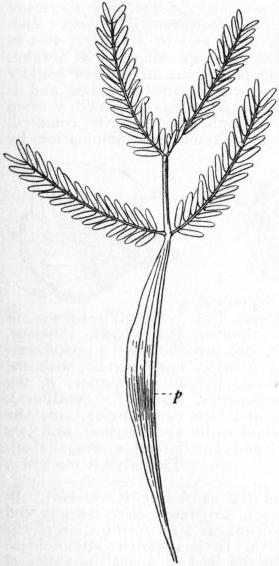
Fig. 1.—Leaf of an Acacia (A. heterophylla) showing flattened leaf-like petiole (phyllode), p, and bipinnate blade.
LEGUMINOSAE, the second largest family of seed-plants, containing about 430 genera with 7000 species. It belongs to the series Rosales of the Dicotyledons, and contains three well-marked suborders, Papilionatae, Mimosoideae and Caesalpinioideae. The plants are trees, shrubs or herbs of very various habit. The British representatives, all of which belong to the suborder Papilionatae, include a few shrubs, such as Ulex (gorse, furze), Cytisus (broom) and Genista, but the majority, and this applies to the suborder as a whole, are herbs, such as the clovers, Medicago, Melilotus, &c., sometimes climbing by aid of tendrils which are modified leaf-structures, as in Lathyrus and the vetches (Vicia). Scarlet runner (Phaseolus multiflorus) has a herbaceous twining stem. Woody climbers (lianes) are represented by species of Bauhinia (Caesalpinioideae), which with their curiously flattened twisted stems are characteristic features of tropical forests, and Entada scandens (Mimosoideae) also common in the tropics; these two suborders, which are confined to the warmer parts of the earth, consist chiefly of trees and shrubs such as Acacia and Mimosa belonging to the Mimosoideae, and the Judas tree of southern Europe (Cercis) and tamarind belonging to the Caesalpinioideae. The so-called acacia of European gardens (Robinia Pseudacacia) and laburnum are examples of the tree habit in the Papilionatae. Water plants are rare, but are represented by Aeschynomene and Neptunia, tropical genera. The roots of many species bear nodular swellings (tubercles), the cells of which contain bacterium-like bodies which have the power of fixing the nitrogen of the atmosphere in such a form as to make it available for plant food. Hence the value of these plants as a crop on poor soil or as a member of a series of rotation of crops, since they enrich the soil by the nitrogen liberated by the decay of their roots or of the whole plant if ploughed in as green manure.
The leaves are alternate in arrangement and generally compound and stipulate. A common form is illustrated by the trefoil or clovers, which have three leaflets springing from a common point (digitately trifoliate); pinnate leaves are also frequent as in laburnum and Robinia. In Mimosoideae the leaves are generally bipinnate (figs. 1, 2, 3). Rarely are the leaves simple as in Bauhinia. Various departures from the usual leaf-type occur in association with adaptations to different functions or environments. In leaf-climbers, such as pea or vetch, the end of the rachis and one or more pairs of leaflets are changed into tendrils. In gorse the leaf is reduced to a slender spine-like structure, though the leaves of the seedling have one to three leaflets. In many Australian acacias the leaf surface in the adult plant is much reduced, the petiole being at the same time flattened and enlarged (fig. 1), frequently the leaf is reduced to a petiole flattened in the vertical plane; by this means a minimum surface is exposed to the intense sunlight. In the garden pea the stipules are large and foliaceous, replacing the leaflets, which are tendrils; in Robinia the stipules are spiny and persist after leaf-fall. In some acacias (q.v.) the thorns are hollow, and inhabited by ants as in A. sphaerocephala, a central American plant (fig. 2) and others. In some species of Astragalus, Onobrychis and others, the leaf-stalk persists after the fall of the leaf and becomes hard and spiny.
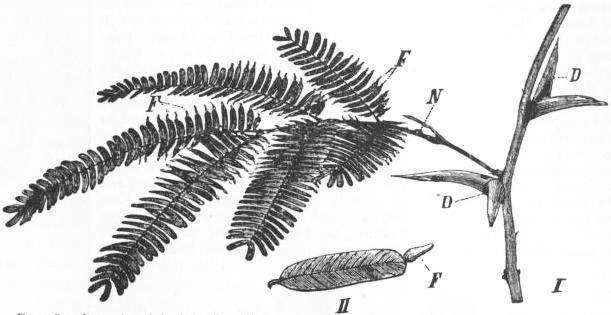
From Strasburger’s Lehrbuch der Botanik, by permission of Gustav Fischer.
Fig. 2.—Acacia sphaerocephala.
I, Leaf and part of stem; D, hollow thorns in which the ants live; F, food bodies at the apices of the lower pinnules; N, nectary on the petiole. (Reduced.) II, Single pinnule with food-body, F. (Somewhat enlarged.)
Leaf-movements occur in many of the genera. Such are the sleep-movement in the clovers, runner bean (Phaseolus), Robinia and acacia, where the leaflets assume a vertical position at nightfall. Spontaneous movements are exemplified in the telegraph-plant (Desmodium gyrans), native of tropical Asia, where the small lateral leaflets move up and down every few minutes. The sensitive plant (Mimosa pudica) is an example of movement in response to contact, the leaves assuming a sleep-position if touched. The seat of the movement is the swollen base of the leaf-stalk, the so-called pulvinus (fig. 3).
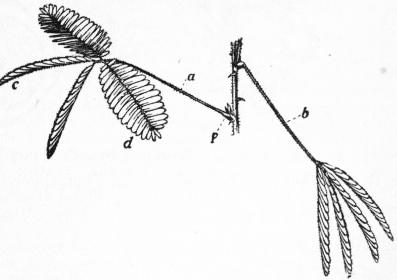
Fig. 3.—Branch with two leaves of the Sensitive Plant (Mimosa pudica), showing the petiole in its erect state, a, and in its depressed state, b; also the leaflets closed, c, and the leaflets expanded, d; p, pulvinus, the seat of the movement of the petiole.
The stem of the lianes shows some remarkable deviations from the normal in form and structure. In Papilionatae anomalous secondary thickening arises from the production of new cambium zones outside the original ring (Mucuna, Wistaria) forming concentric rings or transverse or broader strands; where, as in Rhyncosia the successive cambiums are active only at two opposite points, a flat ribbon-like stem is produced. The climbing Bauhinias (Caesalpinioideae) have a flattened stem with basin-like undulations; in some growth in thickness is normal, in others new cambium-zones are found concentrically, while in others new and distinct growth-centres, each with its cambium-zone, arise outside the primary zone. The climbing Mimosoideae show no anomalous growth in thickness, but in some cases the stem becomes strongly winged. Gum passages in the pith and medullary rays occur, especially in species of acacia and Astragalus; gum-arabic is an exudation from the branches of Acacia Senegal, gum-tragacanth from Astragalus gummifer and other species. Logwood is the coloured heartwood of Haematoxylon campechianum; red sandalwood of Pterocarpus santalinus.
The flowers are arranged in racemose inflorescences, such as the simple raceme (Laburnum, Robinia), which is condensed to a head in Trifolium; in Acacia and Mimosa the flowers are densely crowded (fig. 4). The flower is characterized by a hypogynous or slightly perigynous arrangement of parts, the anterior position of the odd sepal, the free petals, and the single median carpel with a terminal style, simple stigma and two alternating rows of ovules on the ventral suture of the ovary which faces the back of the flower.
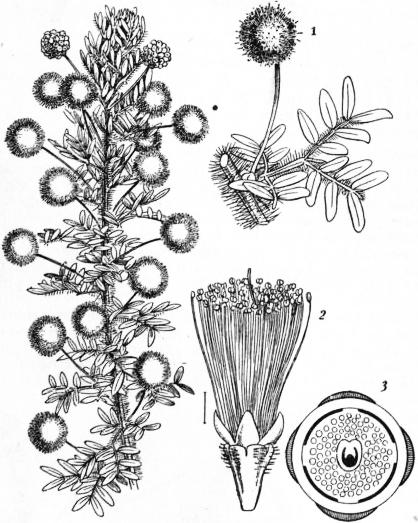
Fig. 4.—Acacia obscura, flowering branch about 1⁄3 natural size.
1, Part of stem with leaf and its subtended inflorescence, about natural size. 2, Flower, much enlarged. 3, Floral diagram of Acacia latifolia. (After Eichler.)
The arrangement of the petals and the number and cohesion of the stamens vary in the three suborders. In Mimosoideae, the smallest of the three, the flower is regular (fig. 4 [3]), and the sepals and petals have a valvate aestivation, and are generally pentamerous, but 3-6-merous flowers also occur. The sepals are more or less united into a cup (fig. 4 [2]), and the petals sometimes cohere at the base. The stamens vary widely in number and cohesion; in Acacia (fig. 4) they are indefinite and free, in the tribe Ingeae, indefinite and monadelphous, in other tribes as many or twice as many as the petals. Frequently, as in Mimosa, the long yellow stamens are the most conspicuous feature of the flower. In Caesalpinioideae (fig. 5) the flowers are zygomorphic in a median plane and generally pentamerous. The sepals are free, or the two upper ones united as in tamarind, and imbricate in aestivation, rarely as in the Judas-tree (fig. 5 [2]), valvate. The corolla shows great variety in form; it is imbricate in aestivation, the posterior petal being innermost. In Cercis (fig. 5) it clearly resembles the papilionaceous type; the odd petal stands erect, the median pair are reflexed and wing-like, and the lower pair enclose the essential organs. In Cassia all five petals are subequal and spreading; in Amherstia the anterior pair are small or absent while the three upper ones are large; in Krameria, the anterior pair are represented by glandular scales, and in Tamarindus are suppressed. Apetalous flowers occur in Copaifera and Ceratonia. The stamens, generally ten in number, are free, as in Cercis (fig. 5) or more or less united as in Amherstia, where the posterior one is free and the rest are united. In tamarind only three stamens are fertile. The largest suborder, Papilionatae, has a flower zygomorphic in the median plane (figs. 6, 7). The five sepals are generally united (figs. 7, 9), and have an ascending imbricate arrangement (fig. 6); the calyx is often two-lipped (fig. 9 [1]). The corolla has five unequal petals with a descending imbricate arrangement; the upper and largest, the standard (vexillum), stands erect, the lateral pair, the wings or alae, are long-clawed, while the anterior pair cohere to form the keel or carina, in which are enclosed the stamens and pistil. The ten stamens are monadelphous as in gorse or broom (fig. 9), or diadelphous as in sweet pea (fig. 8) (the posterior one being free), or almost or quite free; these differences are associated with differences in the methods of pollination. The ten stamens here, as in the last suborder, though arranged in a single whorl, arise in two series, the five opposite the sepals arising first.
The carpel is sometimes stalked and often surrounded at the base by a honey-secreting disk; the style is terminal and in the zygomorphic flowers is often curved and somewhat flattened with a definite back and front. Sometimes as in species of Trifolium and Medicago the ovules are reduced to one. The pod or legume splits along both sutures (fig. 10) into a pair of membranous, leathery or sometimes fleshy valves, bearing the seeds on the ventral suture. Dehiscence is often explosive, the valves separating elastically and twisting spirally, thus shooting out the seeds, as in gorse, broom and others. In Desmodium, Entada and others the pod is constricted between each seed, and breaks up into indehiscent one-seeded parts; it is then called a lomentum (fig. 11); in Astragalus it is divided by a longitudinal septum.
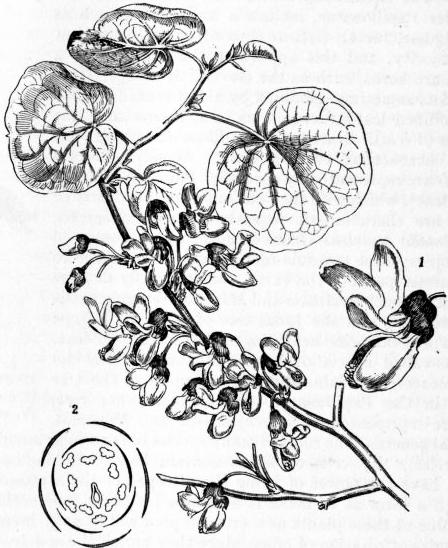
Fig. 5.—Flowering branch of Judas-tree (Cercis siliquastrum) reduced. 1, Flower, natural size. 2, Floral diagram.
Fig. 6.—Diagram of Flower of Sweet Pea (Lathyrus), showing five sepals, s, two are superior, one inferior, and two lateral; five petals, p, one superior, two inferior, and two lateral; ten stamens in two rows, a, and one carpel, c. Fig. 7.—Flower of Pea (Pisum sativum), showing a papilionaceous corolla, with one petal superior, st, the standard (vexillum), two inferior, car, the keel (carina), and two lateral, a, wings (alae). The calyx is marked c.
The pods show a very great variety in form and size. Thus in the clovers they are a small fraction of an inch, while in the common tropical climber Entada scandens they are woody structures more than a yard long and several inches wide. They are generally more or less flattened, but sometimes round and rod-like, as in species of Cassia, or are spirally coiled as in Medicago. Indehiscent one-seeded pods occur in species of clover and in Medicago, also in Dalbergia and allied genera, where they are winged. In Colutea, the bladder-senna of gardens, the pod forms an inflated bladder which bursts under pressure; it often becomes detached and is blown some distance before bursting. An arillar outgrowth is often developed on the funicle, and is sometimes brightly coloured, rendering the seed conspicuous and favouring dissemination by birds; in such cases the seed-coat is hard. In other cases the hard seed-coat itself is bright-coloured as in the scarlet seeds of Abrus precatorius, the so-called weather-plant. Animals also act as the agents of distribution in the case of fleshy edible pods containing seeds with a hard smooth testa, which will pass uninjured through the body, as in tamarind and the fruit of the carob-tree (Ceratonia). In the ground-nut (Arachis hypogaea), Trifolium subterraneum and others, the flower-stalks grow downwards after fertilization of the ovules and bury the fruit in the earth. In the suborders Mimosoideae and Papilionatae the embryo fills the seed or a small quantity of endosperm occurs, chiefly round the radicle. In Caesalpinioideae endosperm is absent, or present forming a thin layer round the embryo as in the tribe Bauhinieae, or copious and cartilaginous as in the Cassieae. The embryo has generally flat leaf-like or fleshy cotyledons with a short radicle.
Fig. 8.—Stamens and Pistil of Sweet Pea (Lathyrus). The stamens are diadelphous, nine of them being united by their filaments f, while the uppermost one (e) is free; st, stigma, c, calyx.
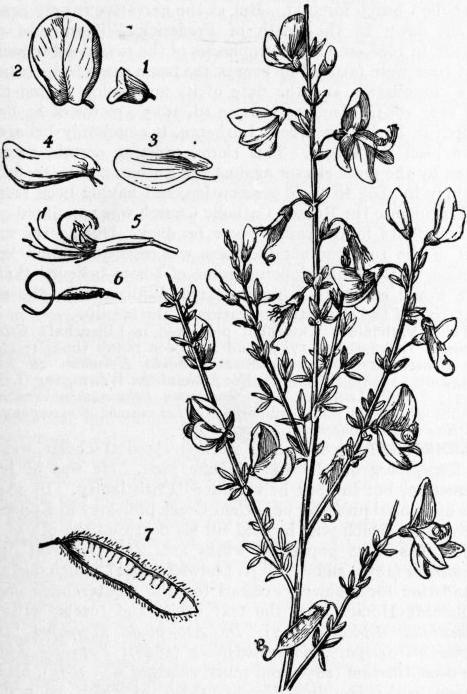
Fig. 9.—Broom (Cytisus scoparius). (2-7 slightly reduced.)
1, Calyx. 2, Standard. 3, Wing. 4, Keel. 5, Monadelphous stamens and style. 6, Pistil. 7, Pod.
Insects play an important part in the pollination of the flowers. In the two smaller suborders the stamens and stigma are freely exposed and the conspicuous coloured stamens serve as well as the petals to attract insects; in Mimosa and Acacia the flowers are crowded in conspicuous heads or spikes. The relation of insects to the flower has been carefully studied in the Papilionatae, chiefly in European species. Where honey is present it is secreted on the inside of the base of the stamens and accumulated in the base of the tube formed by the united filaments round the ovary. It is accessible only to insects with long probosces, such as bees. In these cases the posterior stamen is free, allowing access to the honey. The flowers stand more or less horizontally; the large erect white or coloured standard renders them conspicuous, the wings form a platform on which the insect rests and the keel encloses the stamens and pistil, protecting them from rain and the attacks of unbidden pollen-eating insects. In his book on the fertilization of flowers, Hermann Müller distinguishes four types of papilionaceous flowers according to the way in which the pollen is applied to the bee: