VOLUME XVI SLICE IV Lefebvre, Tanneguy to Letronne, Jean Antoine (continued 10)
Reading edition
Distribution and Migration.—The range of the Lepidoptera is practically world-wide; they are absent from the most remote and inhospitable of the arctic and antarctic lands, but even Kerguelen possesses a few small indigenous moths. Many of the large and dominant families have a range wide as that of the order, and certain species that have attached themselves to man—like the meal moths and the clothes moths—have become almost cosmopolitan. Interesting and suggestive restrictions of range can, however, be often traced. Although butterflies have been found in 82° N. latitude in Greenland, they are unknown in Iceland, and only a few species of the group reach New Zealand. Three large sections—the Ithomiinae, Heliconiinae and Brassolinae—of the great butterfly family Nymphalidae are peculiar to the Neotropical region, while the Morphinae, a characteristically South American group, have a few Oriental genera in India and Indo-Malaya. The Acraeinae, another section of the same family, have the vast majority of their species in Ethiopian Africa, but are represented eastwards in the Oriental and Australian regions and westwards in South America. A comparison of the lepidopterous faunas of Ireland, Great Britain and the European continent is very instructive, and suggests strongly that, despite their power of flight the Lepidoptera are mostly dependent on land-connexions for the extension of their range. For example, Ireland has only forty of the seventy species of British butterflies. The range of many Lepidoptera is of course determined by the distribution of the plants on which their larvae feed.
Nevertheless certain species of powerful flight, and some that might be thought feeble on the wing, often cross sea-channels and establish or reinforce distant colonies. Caterpillars of the great death’s head moth (Acherontia atropos) are found every summer feeding in British and Irish potato fields, but it is doubtful if any of the pupae resulting from them survive the winter in our climate. It is believed by Tutt that the species is only maintained by a fresh immigration of moths from the South each summer. Hosts of white butterflies (Pieris) have been frequently observed crossing the English Channel from France to Kent. Migrating swarms of Lepidoptera have often been met by sailors in mid-ocean; thus, Tutt records the presence around a sailing ship in the Atlantic of such a swarm of the rather feeble moth Deiopeia pulchella, nearly 1000 m. from its nearest known habitat. This migratory instinct is connected with the gregarious habits of many Lepidoptera. For example, H. W. Bates states that at one place in South America he noticed eighty different species flying about in enormous numbers in the sunshine, and these, with few exceptions, were males, the females remaining within the forest shades. Darwin describes a “butterfly shower,” which he observed 10 m. off the South American coast, extending as far as the eye could reach; “even by the aid of the telescope,” he adds, “it was not possible to see a space free from butterflies.” Sir J. Emerson Tennent, witnessed in Ceylon a mighty host of butterflies of white or pale yellow hue, “apparently miles in breadth and of such prodigious extension as to occupy hours and even days uninterruptedly in their passage.” Observations at Heligoland by H. Gätke have shown that migrating moths “travel under the same conditions as migrating birds, and for the most part in their company, in an east to west direction; they fly in swarms, the numbers of which defy all attempts at computation and can only be expressed by millions.” The painted lady butterfly (Pyrameis cardui) comes in repeated swarms from the Mediterranean region into northern and western Europe, while in North America companies of the monarch (Anosia archippus) invade Canada every summer from the United States, and are believed to return southwards in autumn. This latter species has, during the last half-century, extended its range south-westwards across the Pacific and reached the Austro-Malayan islands, while several specimens have occurred in southern and western England, though it has not established itself on this side of the Atlantic. It is noteworthy that the introduction of its food-plant—Asclepias—into the Sandwich Islands in 1850 apparently enabled it to spread across the Pacific.
Fossil History.—Our knowledge of the geological history of the Lepidoptera is but scanty. Certain Oolitic fossil insects from the lithographic stone of Solenhofen, Bavaria, have been described as moths, but it is only in Tertiary deposits that undoubted Lepidoptera occur, and these, all referable to existing families, are very scarce. Most of them come from the Oligocene beds of Florissant, Colorado, and have been described by S. H. Scudder. The paucity of Lepidoptera among the fossils is not surprising when we consider the delicacy of their structure, and though their past history cannot be traced back beyond early Cainozoic times, we can have little doubt from the geographical distribution of some of the families that the order originated with the other higher Endopterygota in the Mesozoic epoch.
Classification.—The order Lepidoptera contains more than fifty families, the discussion of whose mutual relationships has given rise to much difference of opinion. The generally received distinction is between butterflies or Rhopalocera (Lepidoptera with clubbed feelers, whose habit is to fly by day) and moths or Heterocera (Lepidoptera with variously shaped feelers, mostly crepuscular or nocturnal in habit). This distinction is quite untenable as a zoological conception, for the relationship of butterflies to some moths is closer than that of many families of Heterocera to each other. Still more objectionable is the division of the order into Macrolepidoptera (including the butterflies and large moths) and the Microlepidoptera (comprising the smaller moths). Most of the recent suggestions for the division of the Lepidoptera into sub-orders depend upon some single character. Thus J. H. Comstock has proposed to separate the three lowest families, which have—like caddis-flies (Trichoptera)—a jugum on each forewing, as a suborder Jugatae, distinct from all the rest of the Lepidoptera—the Frenatae, mostly possessing a frenulum on the hindwing. A. S. Packard places one family (Micropterygidae) with functional mandibles and a lacinia in the first maxilla alone in a suborder Laciniata, all the rest of the order forming the suborder Haustellata. T. A. Chapman divides the families with free or incompletely obtect and mobile pupae (Incompletae) from those with obtect pupae which never leave the cocoon (Obtectae), and this is probably the most natural primary division of the Lepidoptera that has as yet been suggested. Dyar puts forward a classification founded entirely on the structure of the larva, while Tutt divides the Lepidoptera into three great stirps characterized by the shape of the chorion of the egg. The primitive form of the egg is oval, globular, or flattened with the micropyle at one end; from this has apparently been derived the upright form of egg with the micropyle on top which characterizes the butterflies and the higher moths. These schemes, though helpful in pointing out important differences, are unnatural in that they lay stress on single, often adaptive, characters to the exclusion of others equally important. Although it is perhaps best to establish no division among the Lepidoptera between the order and the family, an attempt has been made in the classification adopted in this article to group the families into tribes or super-families which may indicate their probable affinities. The systematic work of G. F. Hampson, A. R. Grote and E. Meyrick has done much to place the classification of the Lepidoptera on a sound basis, so far as the characters of the imago are concerned, but attention must also be paid to the preparatory stages if a truly natural system is to be reached.
Jugatae.
Three families are included in this group having in common certain primitive characters of the wings and neuration (see fig. 6), as well as of the larva and pupa. There is a membranous lobe or jugum near the base of the wing, and the neuration of the hindwing is closely like that of the forewing, the radial nervure being five-branched in both. The pupa has four or five movable segments, and the larval prolegs have complete circles of hooklets.
The three families of the Jugatae are not very closely related to each other. The Micropterygidae (often known as Eriocephalidae), comprising a few small moths with metallic wings, are the most primitive of all Lepidoptera. They are provided with functional mandibles, while the maxillae have distinct laciniae, well-developed palps and galeae not modified for suction (see fig. 3). The larva is remarkable on account of its long feelers, the presence of pairs of jointed prolegs on the first eight abdominal segments, an anal sucker beneath the last segment and bladder-like outgrowths on the cuticle. These curious larvae feed on wet moss. The family has only a few genera scattered widely over the earth’s surface (Europe, America, Australia, New Zealand).
The Eriocraniidae resemble the Micropterygidae in appearance, but the imago has no mandibles, and the maxillae, though short and provided with conspicuous palps, have no laciniae and form a proboscis as in Lepidoptera generally. The abdomen of the female carries a serrate piercing process, and the eggs are laid in the leaves of deciduous trees, the white larvae, with aborted legs, mining in the leaf tissue. The fully-fed larva winters in an underground cocoon and then changes into the most remarkable of all known lepidopterous pupae, with relatively enormous toothed mandibles which bite a way out of the cocoon in preparation for the final change. These pupal mandibles of the Eriocraniidae, together with the nature of the imaginal maxillae in the Micropterygidae (Eriocephalidae) and the wing-neuration in both families, point strongly to a relationship between the Lepidoptera and the Trichoptera.
The Hepialidae or swift moths—the third family of the Jugatae—are in some respects specialized. The moths are of large or moderate size with the maxillae in a vestigial condition, no food being taken after the attainment of the perfect state. The larvae (fig. 12) feed either on roots or in the wood of trees and shrubs, not attaining their growth in less than a year and some large exotic species living for two or three. The family is world-wide in range, and Australia possesses some almost gigantic and strangely coloured genera.
Tineides.
A large assemblage of moths, mostly of small size, are included in this group. The wings have no jugum, but there is a frenulum on the hindwing, which has, as in all the groups above the Jugatae, only a single radial nervure. Three anal nervures are present in the hindwing in those families whose wings are well developed, but in several families of small moths the wings of both pairs are very narrow and pointed, and the neuration is consequently reduced. The sub-costal nervure of the hindwing is usually present and distinct from the radial nervure. The egg is flat except in the Cossidae and Castniidae in which it is upright. The larval prolegs, with few exceptions, have a complete circle of hooklets, and the larvae usually feed in some concealed situation. The pupa is incompletely obtect, with three (in some females only two) to five free abdominal segments, and emerges partly from the cocoon before the moth appears. The cremaster serves to anchor the pupa to its cocoon at the correct degree of emergence, and thus facilitates the eclosion of the imago.
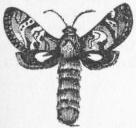
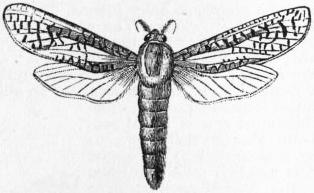
Fig. 18.—Stygia australis. S. Europe. Fig. 19.—Zeuzera scalaris. India.
The Cossidae are a small family of large moths (figs. 8, 18, 19) belonging to this section, characterized by their heads with erect rough scales or hairs, the pectinate feelers of the males, their reduced maxillae so that no food is taken in the perfect state, and their wings with the fifth radial nervure arising from the third, and the main median nervure forking in the discoidal areolet. The larvae feed in plant stems, often in the wood of trees, forming tunnels and galleries, and usually taking a year or more to reach maturity. The pupa which has three or four free segments in the male and four or five in the female, rests in a cocoon within the food plant, often strengthened by chips of wood, or in a subterranean cocoon. The family is fairly well represented in the tropics; the British fauna possesses only three species, of which the “goat” (Cossus cossus) and the “leopard” (Zeuzera pyrina) are well known, the caterpillars of both being often injurious to timber and fruit trees.
The Tortricidae are a large family of small moths (see fig. 1), nearly allied to the Cossidae. The fifth radial nervure does not arise from the third, the maxillae are well developed, but their palps are obsolete; the head is densely clothed with erect scales; the terminal segment of the labial palp is short and obtuse. The female pupa has three, the male four, free segments. All the larvae of these moths have some method of concealing themselves while feeding. A frequent plan is to roll up a leaf of the food-plant, fastening the twisted portion with silken threads so as to make a tubular retreat; this is the habit of the caterpillar of the green bell moth (Tortrix viridana) which often ravages the foliage of oak plantations. The larvae of the pine-shoot moths (Retinia) shelter in solidified resinous exudations from their coniferous food-plants, while the codlin-moth caterpillar (Carpocapsa pomonella) feeds in apples and pears, growing with the growth of the fruit which affords them both provender and home. The antics of “jumping-beans” are due to the movements of tortricid caterpillars within the substance of the seed.
The Psychidae are a small but widely-distributed family of moths whose males have the head, densely clothed with rough hairs, bearing complex, bipectinated feelers, but with the maxillae reduced and useless. The larvae live in portable cases made of grass, pieces of leaf or stick, with a silken lining, and these cases serve as cocoons for the pupae which agree in structure with those of the Tortricidae. But the most remarkable feature of the family is the extreme degradation of the female, which, wingless, legless and without jaws or feelers, never emerges from the cocoon.
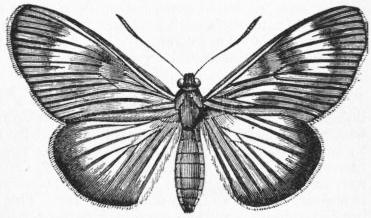
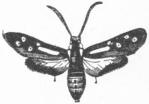
Fig. 20.—Castnia acraeoides. Brazil. Fig. 21.—Neurosymploca concinna. S. Africa.
The Castniidae are a small family of large, conspicuous, day-flying exotic moths (fig. 20) whose clubbed feelers and bright colours give them a resemblance to butterflies, although their wing-neuration is of the primitive tineoid type; the smooth larvae feed on the stems or roots of plants and the pupal structure agrees with that of the Tortricidae and Psychidae. The distribution of the family is confined to Tropical America and the Indo-Malayan and Australian regions.
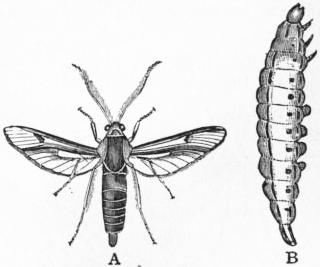
Fig. 22.—A, Sesia asiliformis (Gad-fly Hawk Moth). Europe. B, Larva.
The Zygaenidae (burnet moths) are a large family of day-flying moths (fig. 21) adorned with brilliant metallic colours. The feelers are long, stout in the middle and tapering, bearing numerous long or short pectinations. The well-developed maxillae have vestigial palps. The larvae—often very conspicuously coloured—are remarkable among the Tineides in having incomplete circles of hooks on the prolegs, and they feed exposed on the leaves of various plants. The pupa, enclosed in a silken cocoon, has four or five free segments. The Limacodidae are a small family of brownish nocturnal moths, allied to the Zygaenidae and agreeing with them in the structure of the pupa. The larva in this family also is an exposed feeder, but it is remarkable in form, being flattened and slug-like, without prolegs and adorned with curious spinous processes.
The Sesiidae are a large family of small, narrow-winged moths, the sub-costal nervure of the hindwing being absent and the wings being for the most part destitute of scales (fig. 22). The maxillae are developed but their palps are vestigial, while the terminal segment of the labial palp is short and pointed. Many of these insects have their bodies banded with black and yellow; this in conjunction with the transparent wings makes some of them like wasps or hornets in appearance. The larvae feed in the woody stems of various plants. The pupa, with three or four free abdominal segments, remains within its cocoon, formed with chips of wood, until the time for its final change draws near; then it works itself partly out of the tree by means of the spines on its abdominal segments.
The Nepticulidae are the smallest of all the Lepidoptera, measuring only 3-8 mm. across the outspread wings, which are all lanceolate and pointed at the tip. The sucking portions of the maxillae are vestigial, but the palps are long and jointed. The larvae, without thoracic limbs or prolegs, but sometimes with paired rudimentary processes on some of the segments, mine in the leaves of plants. The pupa, with four free abdominal segments in the female and five in the male, rests in a cocoon usually outside the mine.
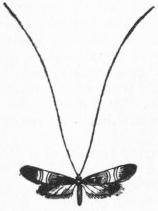
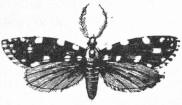
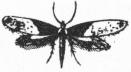
Fig. 23.—Adela degeerella. Europe. Fig. 24.—Euplocampus anthracinus. Europe. Fig. 25.—Tinea tapetzella (Clothes Moth). Europe.
The Adelidae are a family of delicate, but larger, moths with very long feelers (fig. 23) especially in the males. The larvae feed, when young, in flowers; later, protected by a flat case, they devour leaves; the pupa resembles that of the Nepticulidae in structure. The female has an ovipositor adapted for piercing plant tissues.
The Tineidae are a large and important family of small moths (figs. 14, 24, 25) with rough-haired heads, and with the maxillae and their palps usually well developed. Many of the genera have narrow pointed wings with degraded neuration. The larvae differ in their habits, some—Gracilaria for example—mine in leaves, while others, like the well-known caterpillars of the clothes moth (Tinea) surround themselves with portable cases (fig. 14) formed by spinning together their own excrement. The female pupa has three, the male four free abdominal segments.
Plutellides.
This group includes a few large families of small moths that are linked by their imaginal and larval structure to the Tineidae (in which they have often been included) and by their pupal structure to the higher groups that have yet to be considered. The moths have labial palps with slender pointed terminal segments, and narrow pointed wings, but the neuration (except in the Elachistidae) is less degenerate than in most Tineidae. The hairy covering of the head is smooth, and the maxillary palps are usually vestigial. The egg is flat, and the larval prolegs have complete circles of hooklets. The pupa is obtect with only two free abdominal segments (fifth and sixth) in both sexes and does not move out of the cocoon.
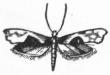
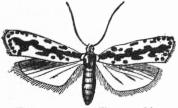
Fig. 26.—Cerostoma asperella. Europe. Fig. 27.—Psecadia pusiella.
Four families are included in this group. The Plutellidae (fig. 26) have the maxillary palps developed, in some genera, as slender threadlike appendages directed straight forward. The larvae do not usually mine in leaves, but feed openly, keeping to the underside for protection (Plutella), or spinning by their united labour a mass of web over the food-plant (Hyponomeuta). In the other three families the maxillary palps are vestigial or obsolete. The Elachistidae have remarkably narrow, pointed wings and their larvae mine in leaves or form portable cases and feed among seeds. In the Oecophoridae (fig. 27) the sub-costal nervure of the hindwing is free and distinct throughout its length, and the larvae usually feed among spun leaves or seeds, or in decayed wood. The Gelechiidae are a large family with similar larval habits; the moths are distinguished by the sinuate termen of the hindwing and the connexion of its sub-costal nervure with the discoidal areolet.
Pyralides.
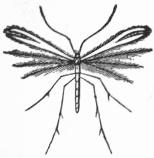
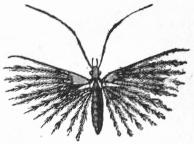
Fig. 28.—Pterophorus spilodactylus. Europe. Fig. 29.—Orneodes hexadactylus (24-plumed Moth). Europe.
This group includes a number of moths of delicate build with elongate legs, the maxillae and their palps being usually well developed. The forewings have two anal nervures, the hindwings three (fig. 30, h, i); in the hindwing the sub-costal nervure bends towards and often connects with the radial, and the frenulum is usually present. The egg is flat. The larva has complete circles of hooklets on its five pairs of prolegs, and the pupa (usually completely obtect) does not move at all from its cocoon. This group includes the only Lepidoptera that have aquatic larvae.
Of the families comprised in this division three deserve special mention. The Pterophoridae (plume moths, fig. 28) usually have the wings deeply cleft—a single cleft in the forewing and two in the hindwing. The hairy larvae feed openly on leaves, while the soft and hairy pupa remains attached to its cocoon by the cremaster, although it is incompletely obtect and has three or four free abdominal segments. The Orneodidae (multiplume moths) have all the wings six-cleft. Our British species, Orneodes hexadactyla (fig. 29), is an exquisite little insect, whose larva feeds on the blossoms of honeysuckle. The pupa is completely obtect, with only two free abdominal segments. The Pyralidae (figs. 13, 30), a large family with numerous divisions, have entire wings, and their pupae are obtect. The caterpillars feed in some kind of shelter, some spinning a loose case among the leaves of their food-plant, others burrowing into dry vegetable substances or eating the waxen cells of bees. Several species of this group, such as the Mediterranean flour moth, Ephestia kühniella (fig. 30), become serious pests in storehouses and granaries, their larvae devouring flour and similar food-stuffs.
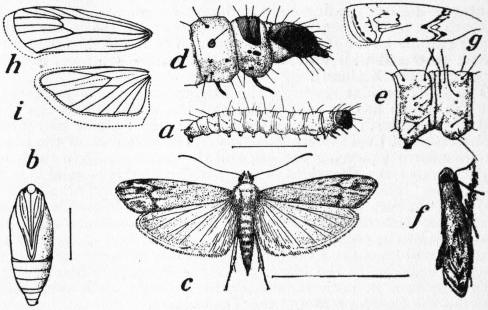
After Riley and Howard, Insect Life, vol. 2 (U.S. Dept. Agr.).
Fig. 30.—Flour Moth (Ephestia kühniella).
c, With wings spread. f, At rest. g, h, i, Marking and neuration of wings. a, Larva. b, Pupa. d, Head and front body-segments of larva. e, 2nd and 3rd abdominal segments.
Noctuides.
In this group may be included a number of families of moths with the second median nervure of the forewing arising close to the third. This feature of neuration characterizes also the Jugatae (see fig. 6), Tineides, Plutellides and Pyralides. But the Noctuides differ from these groups in having only two anal nervures in the hindwing. The maxillary palps are absent or vestigial, and a frenulum is usually present on the hindwing. The larva has usually ten prolegs, whose hooklets are arranged only along the inner edge, while the immobile pupa is always obtect with only two free abdominal segments (the fifth and sixth). The Lasiocampidae and their allies have flat eggs, but in the Noctuidae, Arctiidae and their allies the egg is upright.
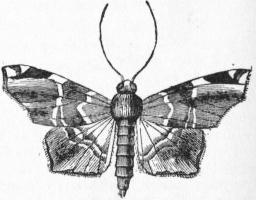
Fig. 31.—Claterna cydonia. India.
The Lasiocampidae, together with a few small families, differ from the majority of this group in wanting a frenulum. The maxillae of the Lasiocampidae are so reduced that no food is taken in the imaginal state, and in correlation with this condition the feelers of the male are strongly (those of the female more feebly) bipectinated. The moths are stout, hairy insects, usually brown or yellow in the pattern of their wings. The caterpillars are densely hairy and many species hibernate in the larval stage. The pupa is enclosed in a hard, dense cocoon, whence the name “eggars” is often applied to the family, which has a wide distribution, but is absent from New Zealand. The Drepanulidae are an allied family, in which the frenulum is usually present, while the hindmost pair of larval prolegs are absent, their segment being prolonged into a pointed process which is raised up when the caterpillar is at rest. The hook-tip moths represent this family in the British fauna.
The Lymantriidae resemble the Lasiocampidae in their hairy bodies ana vestigial maxillae, but the frenulum is usually present on the hindwing and the feelers are bipectinate only in the males. Some females of this family—the vapourer moths (Orgyia and allies, fig. 17), for example—are degenerate creatures with vestigial wings. The larvae (fig. 15) are very hairy, and often carry dense tufts on some of their segments; hence the name of “tussocks” frequently applied to them. The pupae are also often hairy (fig. 16)—an exceptional condition—and are protected by a cocoon of silk mixed with some of the larval hairs, while the female sheds some hairs from her own abdomen to cover the eggs. The family is widely distributed, its headquarters being the eastern tropics. To that part of the world is restricted the allied family of the Hypsidae, distinguished from the “tussocks” by the slender upturned terminal segment of the labial palps and by the development of the maxillae.
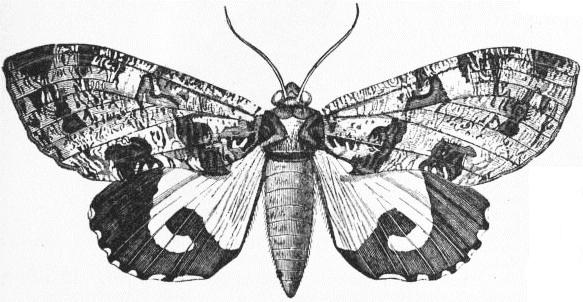
Fig. 32.—Ophideres imperator. Madagascar.
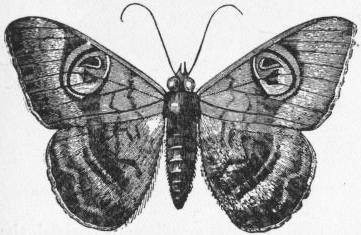
Fig. 33.—Cyligramma fluctuosa. W. Africa.
From Mally, Bull. 24, Div. Ent. U.S. Dept. Agr.
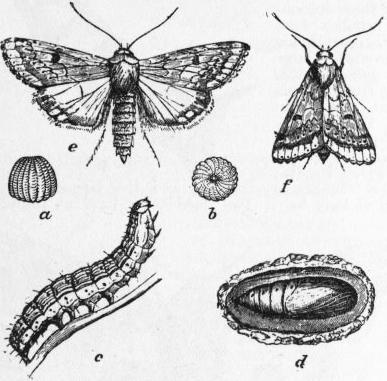
Fig. 34.—e, f, Heliothis armigera. Europe, c, Larva; d, pupa in cell. Natural size. a, b, Egg, highly magnified.
The Noctuidae are the largest and most dominant family of the Lepidoptera, comprising some 10,000 known species. They are mostly moths of dull coloration, flying at dusk or by night. The maxillae are well developed, the hindwing has a frenulum, and its sub-costal nervure touches the radial near the base. The larvae of the Noctuidae (fig. 34, c) are rarely hairy and the pupa (fig. 34, d) usually rests in an earthen cell, being often the wintering stage for the species; sometimes the pupa is enclosed in a loose cocoon of silk and leaves. In some Noctuidae (fig. 32) the hindwings are brightly coloured, but these are concealed beneath the dull, inconspicuous forewings when the insect rests (fig. 34, f). Nearly allied to the Noctuidae, but very different in appearance, are the gaily-coloured Agaristidae, a family of day-flying moths (figs. 35, 36), confined to the warmer regions of the globe and distinguished by their thickened feelers, those of the Noctuids being thread-like or slightly pectinate.
The Arctiidae (tiger moths, footmen, &c.) are allied to the Noctuidae, but their wing-neuration is more specialized, the sub-costal nervure of the hindwing being confluent with the radial for the basal part of its course. These moths (fig. 37) have gaily coloured wings, and the caterpillars are often densely covered with long smooth hairs. The pupae are enclosed in silken cocoons (fig. 38). The highest specialization of structure in this group of the Lepidoptera is reached by the Syntomidae, a family nearly allied to the Arctiidae, but with the sub-costal nervure in the hindwing absent. The Syntomidae have elongate narrow forewings and short hindwings, usually dark in colour with clear spots and dashes destitute of scales (fig. 40). The body, on the other hand, is often brilliantly adorned. The family, abundant in the tropics of the Old World, has only two European species.
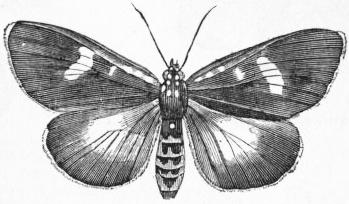
Fig. 35.—Rothia pales. Madagascar.
Sphingides.
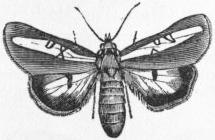
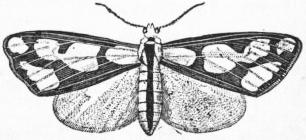
Fig. 36.—Aegocera rectilinea. Tropical Africa. Fig. 37.—Haploa Lecontei. N. America.
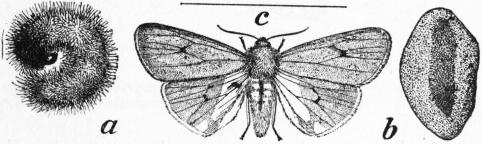
After Lugger, Riley and Howard, Insect Life, vol. 2 (U.S. Dept. Agr.).
Fig. 38.—c, Tiger Moth (Phragmatobia fuliginosa, Linn.). Europe. a, Caterpillar; b, cocoon with pupa. Slightly enlarged.
This group includes a series of families which agree with the Noctuides in most points, but are distinguished by the origin of the second median nervure of the forewing close to the first, or from the discocellular nervure midway between the first and third medians (see fig. 5). These neurational characters may appear somewhat insignificant, but such slight though constant distinctions in structures of no adaptational value may be safely regarded as truly significant of relationship. Several of the families in this group have lost the frenulum. In larval and pupal characters the Sphingides generally resemble the Noctuides, but in some families there is a reduction in the number of the larval prolegs. The egg is spherical or flat, upright only in the Notodontidae.
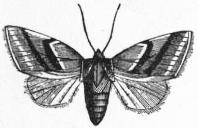
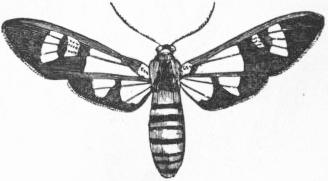
Fig. 39.—Halias prasinana. Europe. Fig. 40.—Euchromia formosa. S. Africa.
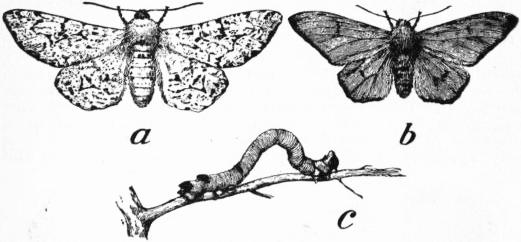
The Notodontidae are stout, hairy moths (figs. 5, 41, 42 a) with maxillae and frenulum developed. In the larva the prolegs on the hindmost segment are sometimes modified into pointed outgrowths which are carried erect when the caterpillar moves about. From these structures whip-like, coloured processes are protruded by the caterpillar (fig. 42 b) of the puss moth (Cerura) when alarmed; these processes are believed to help in “terrifying” the caterpillar’s enemies. Allied to the Notodontidae are the Cymatophoridae—a family of moths agreeing with the Noctuidae in appearance and habits—and the large and important family of the Geometridae. The moths (fig. 43) of this family are distinguished from the Notodontidae by their delicate build and elongate feet, the caterpillars (fig. 43, c) by the absence or vestigial condition of the three anterior pairs of prolegs. The two hinder pairs of prolegs are therefore alone functional and the larva progresses by “looping,” i.e. bending the body so as to bring these prolegs close up to the thoracic legs, and then, taking a fresh grip on the twig whereon it walks, stretching the body straight out again. Many of these larvae have a striking resemblance both in form and colour to the twigs of their food-plant. In some of the species the female has the wings reduced to useless vestiges. The family is world-wide in its range. The tropical Uraniidae are large handsome moths (figs. 44, 45), often with exquisite wing-patterns, allied to the Geometridae, but distinguished by the absence of a frenulum in the moth and the presence of the normal ten prolegs in the larva.
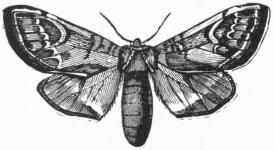
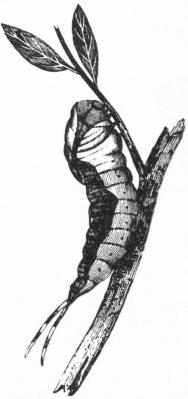
Fig. 41.—Notodonta ziczac (Pebble Prominent Moth). Europe.
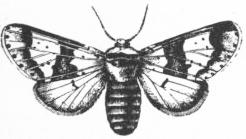
Fig. 42a.—Cerura borealis. N. America. Fig. 42b.—Larva of Cerura (Puss Moth).
After Grote, Natural Science (J. M. Dent & Co.).
Fig. 43.—Geometrid Moth (Amphidasys betularia, Linn.). Europe. a, Large grey type; b, dark variety; c, caterpillar in looping attitude.
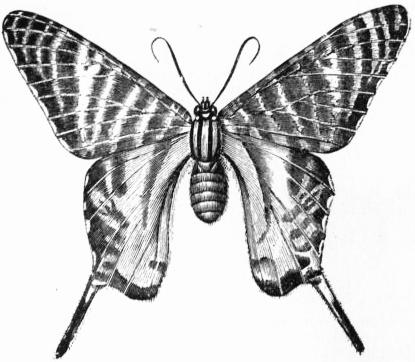
Fig. 44.—Urania boisduvalii. Cuba.
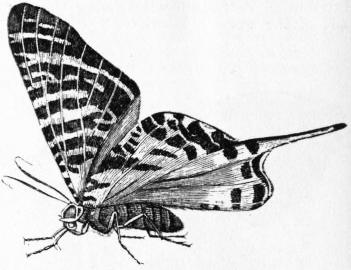
Fig. 45.—Urania boisduvalii at rest, showing under surface of wings.
The Sphingidae (hawk moths) are insects often of large size (figs. 46a, 47), with spindle-shaped feelers, elongate and powerful forewings and the maxillae very well developed. The hindwing carries a frenulum and has its sub-costal nervure connected with the radial by a short bar. The caterpillars have the full number of prolegs, and, in many genera, carry a prominent dorsal horn on the eighth abdominal segment (fig. 46b). The pupa lies in an earthen cell. On account of their powerful flight the moths of this family have a wide range; certain species—like Acherontia atropos and Protoparce convolvuli—migrate into the British Islands in numbers almost every summer.
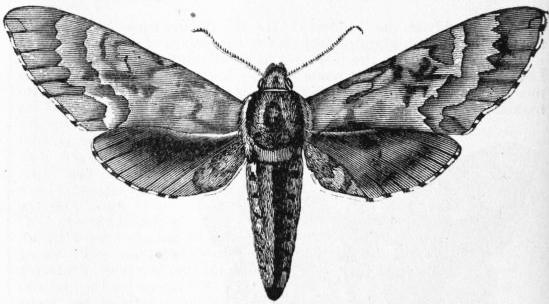
Fig. 46a.—Chlaenogramma jasminearum (Jessamine Sphinx). N. America.
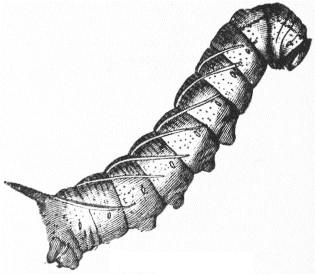
Fig. 46b.—Larva.
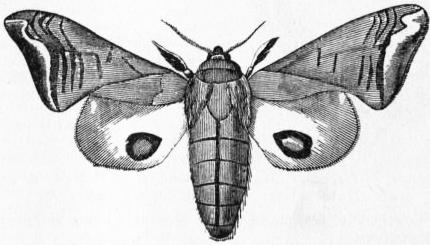
Fig. 47.—Smerinthus ocellatus (Eyed Hawk moth). Europe.
A group of families in which the first maxillae are vestigial, the feelers bipectinate and the pupa enclosed in a dense silken cocoon, have been regarded as the most highly specialized of all the moths, though according to other views the whole series of the Lepidoptera culminates in the Syntomidae. Of these cocoon-spinning families may be specially mentioned the Eupterotidae, large brown or yellow moths inhabiting tropical Asia and Africa, and represented in Europe only by the “processionary moth” (Cnethocampa processionea). In this family the frenulum is present, and the larvae are protected with tufts of long hair. The Bombycidae have no frenulum, and the larvae are smooth, with some of the segments humped and the eighth abdominal often carrying a dorsal spine. The family is tropical in its distribution, but the common silkworm (Bombyx mori, fig. 48) has become acclimatized in southern Europe and is the source of most of the silk used in manufacture and art. Of commercial value also is the silk spun by the great moths of the family Saturniidae, well represented in warm countries and contributing a single species (Saturnia pavonia-minor) to the British fauna. These moths (fig. 49) have but a single anal nervure in the hindwing and only three radial nervures in the forewing. The wing-patterns are handsome and striking; usually an unsealed “eyespot” is conspicuous at the end of each discoidal areolet. The caterpillars are protected by remarkable spine-bearing tubercles (fig. 10, B).
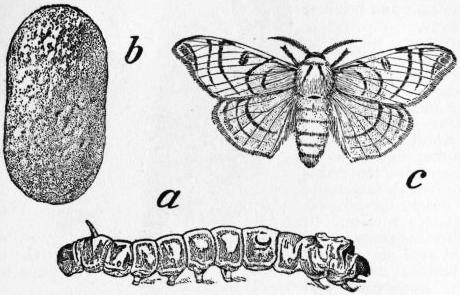
After C.V. Riley, Bull. 14, Div. Ent. U.S. Dept. Agr.
Fig. 48.—Bombyx mori. China. a, Caterpillar (the common silkworm); b, cocoon; c, male moth.
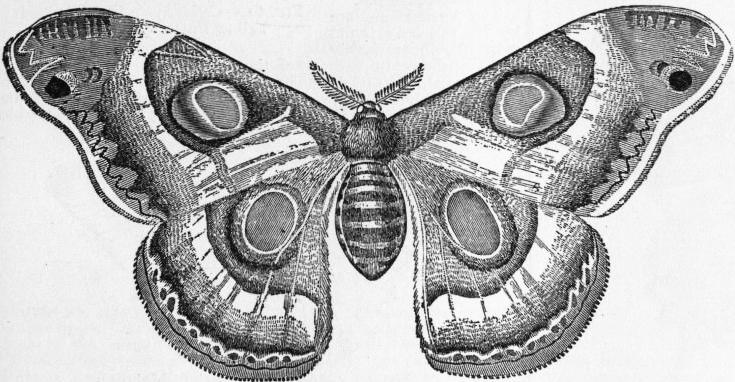
Fig. 49.—Epiphora bouhiniae. W. Africa.
Grypocera.
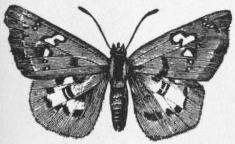
Fig. 50.—Tagiades sabadius. S. Africa.
This group stands at the base of the series of families that are usually distinguished as “butterflies.” The feelers are recurved at the tip, and thickened just before the extremity. The forewing has the full number of radial nervures, distinct and evenly spaced, and two anal nervures; the frenulum is usually absent. The larvae (fig. 51) have prolegs with complete circles of hooklets, and often feed in concealed situations, while the pupa is protected by a light cocoon. The affinities of this group are clearly not with the higher groups of moths just described, but with some of the lower families. According to Meyrick they are most closely related to the Pyralidae, but Hampson and most other students would derive them (through the Castniidae) from a primitive Tineoid stock allied to the Cossidae and Zygaenidae.
Three families are included in the section. The North American Megathymidae and the Australian Euschemonidae have a frenulum and are usually reckoned among the “moths.” The Hesperiidae in which the frenulum is wanting form the large family of the skipper butterflies, represented in our own fauna by several species. They are insects with broad head—the feelers being widely separated—usually brown or grey wings (fig. 50) and a peculiar jerky flight. The family has an extensive range but is unknown in Greenland, New Zealand, and in many oceanic islands.
Rhopalocera.
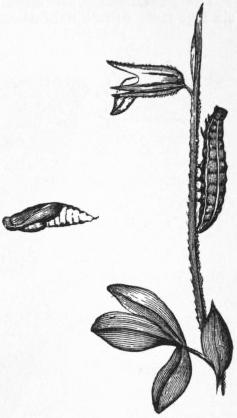
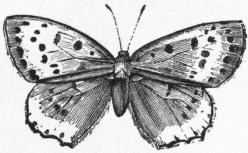
Fig. 51.—Chrysalis and Larva of Nisoniadestages (dingy skipper). Europe. Fig. 52.—Chrysophanus thoe. N. America.
This group comprises the typical butterflies which are much more highly specialized than the Grypocera, and may be readily distinguished by the knobbed or clubbed feelers and by the absence of a frenulum. Two or more of the radial nervures in the forewing arise from a common stalk or are suppressed. The egg is “upright.” The larvae have hooklets only on the inner edges of the prolegs. The pupa is very highly modified, only two free abdominal segments are ever recognizable, and in some genera even these have become consolidated. The cocoon is reduced to a pad of silk, to which the pupa is attached, suspended by the cremastral hooks; in some families there is also a silken girdle around the waist-region. In correlation with the exposed condition of the pupa, we find the presence of a specially developed “head-piece” or “nose-horn” to protect the head-region of the contained imago. Their bright colours and conspicuous flight in the sunshine has made the Rhopalocera the most admired of all insects by the casual observer.
A modification that has taken place in several families of butterflies is the reduction of the first pair of legs. H. W. Bates arranged the families in a series depending on this character, but neurational and pupal features must be taken into account as well, and the sequence followed here is modified from that proposed by A. R. Grote and J. W. Tutt.
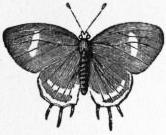
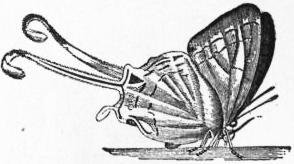
Fig. 53.—Rathinda amor. India. Fig. 54.—Cheritra freja. India.
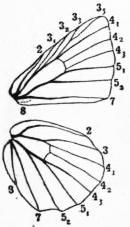
The Lycaenidae are a large family including the small butterflies (figs. 52, 53, 54) popularly known as blues, coppers and hairstreaks. The forelegs in the female are normal, but in the male the tarsal segments are shortened and the claws sometimes are absent. The forewing has only three or four radial nervures (fig. 55), the last two of which arise from a common stalk; the feelers are inserted close together on the head. The larva is short and hairy, somewhat like a woodlouse in shape, the broad sides concealing the legs and prolegs, while the pupa, which is also hairy or bristly, is attached by the cremaster to a silken pad and cinctured with a silken thread. The upper surfaces of the wings of these insects are usually of a bright metallic hue—blue or coppery—while beneath there are often numerous dark centred “eye-spots.” The family is widely distributed. Nearly related are the Lemoniidae, a family abundantly represented in the Neotropical Region, but scarce in the Old World and having only a single European species (Nemeobius lucinia) which occurs also in England. In the Lemoniidae (figs. 56, 57) the forelegs of the male are reduced and useless for walking. The Libytheidae may be recognized by the elongate snout-like palps, the five-branched radial nervure of the forewing, the cylindrical hairy larva, and the pupa attached only by the cremaster.
After Grote, Natural Science, vol. 12 (J. M. Dent & Co.).
Fig. 55.—Neuration of Wings in Lycaena.
2, Sub-costal. 3, Radial. 4, Median. 5, Cubital. 7, 8, Anal nervures.
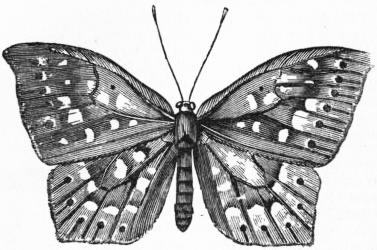
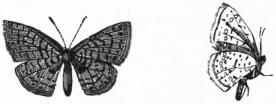
Fig. 56.—Eurybia carolina. Brazil. Fig. 57.—Calephelis caenius. N. America.
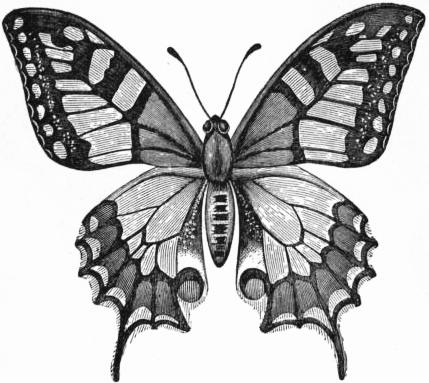
Fig. 58.—Papilio machaon (Swallow-tail.). Europe.
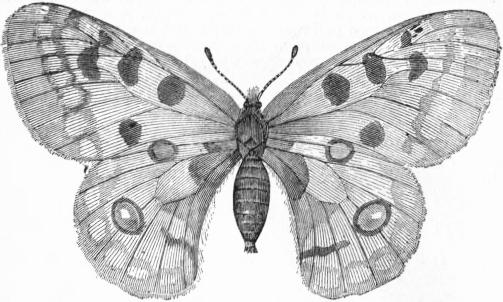
Fig. 59.—Parnassius apollo (Apollo). European Alps.
The Papilionidae are large butterflies with ample wings, and all six legs fully developed in both sexes. The forewing has five radial and two anal nervures, the second of the latter being free from the first and running to the dorsum of the wing, while the hindwing has but a single anal, and is frequently prolonged into a “tail” at the third median nervure (fig. 58). The larva is cylindrical, never hairy but often tuberculate and provided with a dorsal retractile tentacle (osmaterium) on the prothorax. The pupa, which has a double “nose-horn,” is attached by the cremaster and a waist-girdle to the food-plant in the Papilioninae (fig. 58), but lies in a web on the ground among the Parnasiinae (figs. 59, 60). The latter sub-family includes the well-known Apollo butterflies of the Alps. The former is represented in the British fauna by the East Anglian swallow-tail (Papilio machaon), and is very abundant in the warmer regions of the world, including some of the most magnificent and brilliant of insects.
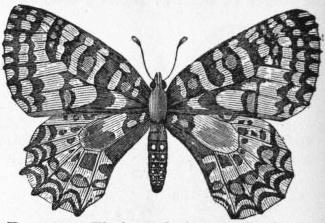
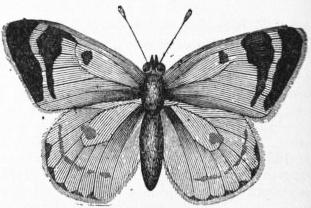
Fig. 60.—Thais medesicaste. S. France. Fig. 61.—Colias hyale (Pale clouded Yellow Butterfly). Europe.
Agreeing with the Papilionidae in the six perfect legs of both sexes and the cincture-support of the pupa we find the Pieridae—the family of the white and yellow butterflies (figs. 61, 62)—represented by ten species in the British fauna and very widely spread over the earth’s surface. In the Pieridae there are two anal nervures in the hindwing, while the second anal nervure in the forewing runs into the first; the larva is cylindrical and hairy without an osmaterium. The pupa has a single “nose-horn,” and in the more highly organized genera there is no mobility whatever between its abdominal segments. The wintering pupae of the common cabbage butterflies (Pieris brassicae and P. rapae) are common objects attached to walls and fences and their colour harmonizes, to a great extent, with that of their surroundings.
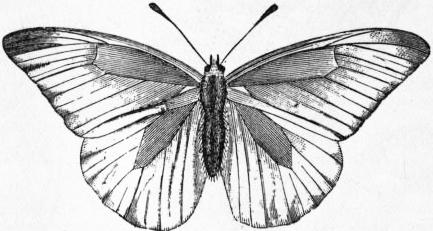
Fig. 62.—Appias nero (male). Malaya.
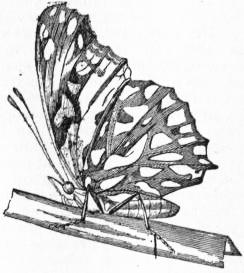
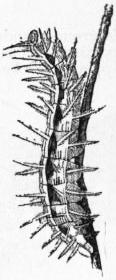
Fig. 63.—Dione moneta. Brazil. Fig. 64.—Larva of Argynnis paphia (Silver-washed Fritillary). Europe.
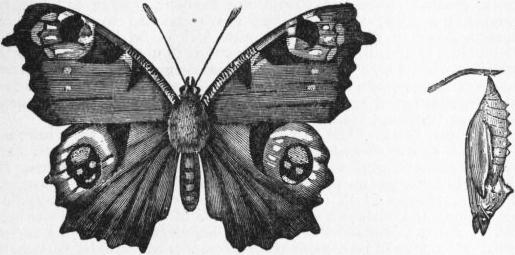
Fig. 65.—Vanessa io (Peacock) and its pupa.
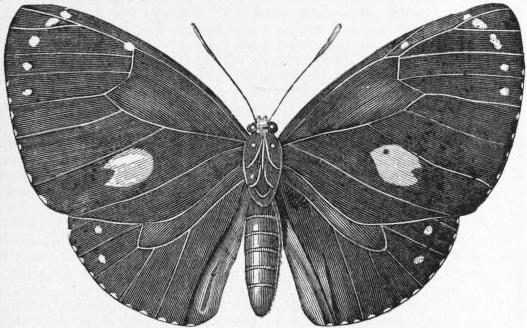
Fig. 66.—Euploea leucostictos (male). Malaya.
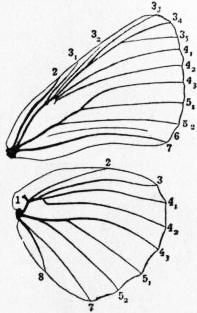
After A. R. Grote, Natural Science, vol. 12 (J. M. Dent & Co.).
Fig. 67.—Neuration of Wings in a Nymphaline Butterfly.
2, Sub-costal. 3, Radial. 4, Median. 5, Cubital. 6, 7, 8, Anal nervures.
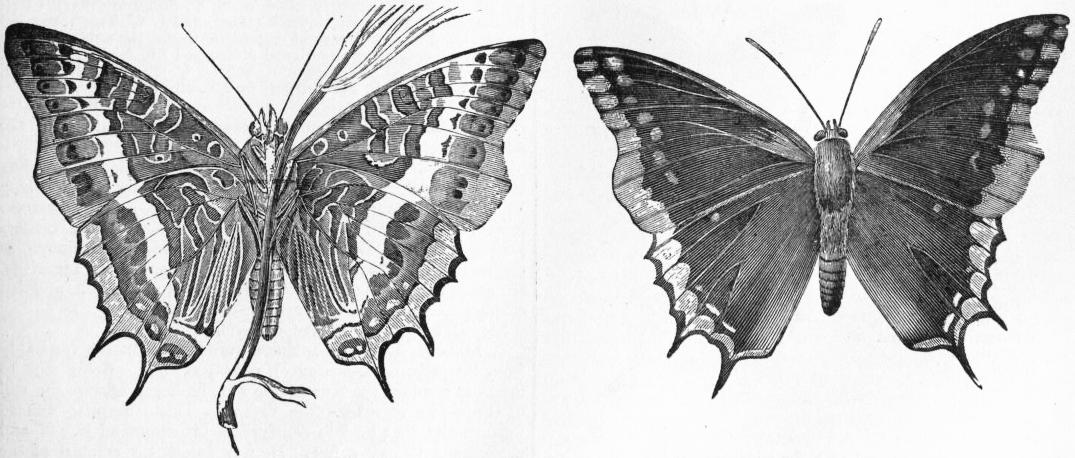
Fig. 68.—Nymphalis jason. W. Africa. Upper and under surface.
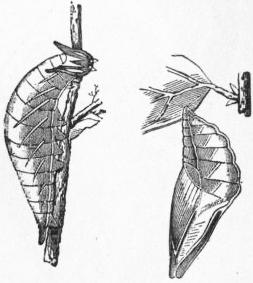
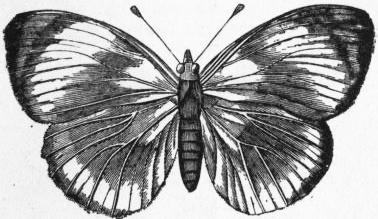
Fig. 69.—Larva and Pupa of Apatura ilia. Fig. 70.—Callithea sapphira. Brazil.
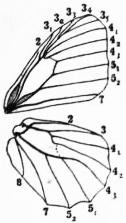
The Nymphalidae are by far the largest and most dominant family of butterflies. In both sexes the forelegs are useless for walking (fig. 63), the tarsal segments being absent and the short shins clothed with long hairs, whence the name of brush-footed butterflies is often applied to the family. The neuration of the wings resembles that found among the Pieridae, but in the Nymphalidae the pupa, which has a double nose-horn (fig. 65)—as in Papilio—is suspended from the cremaster only, no girdling thread being present, or it lies simply on the ground. The egg is elongate and sub-conical in form and ornamented with numerous ribs, while the larva is usually protected by numerous spines (fig. 64) arising from the segmental tubercles. To this family belong our common gaily-coloured butterflies—the tortoiseshells, peacock (fig. 65), admirals, fritillaries and emperors. In most cases the bright colouring is confined to the upper surface of the wings, the under-side being mottled and often inconspicuous. Most members of the group Vanessidi—the peacock and tortoiseshells (Vanessa) and the red admiral (Pyrameis) for example—hibernate in the imaginal state. This large family is divided into several sub-families whose characters may be briefly given, as they are considered to be distinct families by many entomologists. The Danainae (or Euploeinae, fig. 66) have the anal nervures of the forewing arising from a common stalk, the discoidal areolets in both wings closed, and the front feet of the female thickened; their larvae are smooth with fleshy processes. The danaine butterflies range over all the warmer parts of the world, becoming most numerous in the eastern tropics, where flourish the handsome purple Euploeae whose males often have “brands” on the wings; these insects are conspicuously marked and are believed to be distasteful to birds and lizards. So are the South American Ithomiinae, distinguished from the Danainae by the slender feet of the females; the narrow winged, tawny Acraeinae, with simple anal nervures, thick hairy palps and spiny larvae; and the Heliconiinae whose palps are compressed, scaly at the sides and hairy in front. This last named sub-family is confined to the Neotropical Region, while the Acraeinae are most numerous in the Ethiopian. The Nymphalinae include the British vanessids (fig. 65), and a vast assemblage of exotic genera (figs. 68, 70), characterized by the “open” discoidal areolets (fig. 67) owing to the absence of the transverse “disco-cellular” nervules. In the Morphinae—including some magnificent South American insects with deep or azure blue wings, and a few rather dull-coloured Oriental genera—the areolets are closed in the forewings and often in the hindwings. The larvae of the Morphinae (fig. 71) are smooth or hairy with a curiously forked tail-segment. A similar larva characterizes the South American Brassolinae or owl-butterflies—robust insects (figs. 72, 73) with the areolets closed in both wings, which are adorned with large “eye-spots” beneath. The Satyrinae, including our native browns and the Alpine Erebiae, resemble the foregoing group in many respects of structure, but the sub-costal nervure is greatly thickened at the base (fig. 74). This sub-family is world-wide in its distribution. One genus (Oeneis, fig. 75) is found in high northern latitudes, but reappears in South America. The dark, spotted species of Erebia are familiar insects to travellers among the Alps; yet butterflies nearly related to these Alpine insects occur in Patagonia, in South Africa and in New Zealand. Such facts of distribution clearly show that though the Nymphalidae have attained a high degree of specialization among the Lepidoptera, some of their genera have a history which goes back to a time when the distribution of land and water on the earth’s surface must have been very different from what it is to-day.
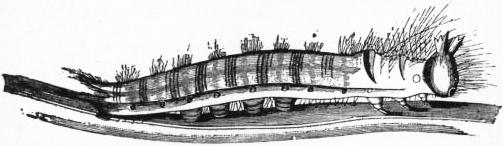
Fig. 71.—Larva of Amathusia phidippus.
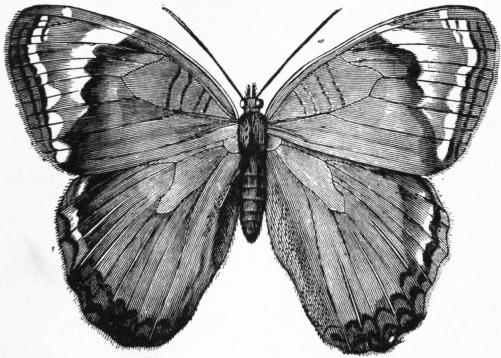
Fig. 72.—Opsiphanes syme. Brazil.
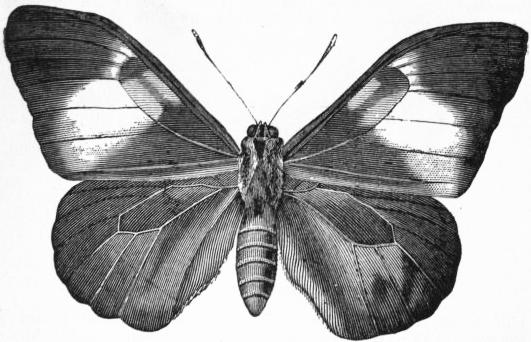
Fig. 73.—Brassolis astyra. Brazil.
After A. R. Grote, Natural Science, vol. 12 (J. M. Dent & Co.).
Fig. 74.—Neuration of wings in Pararge, a satyrid butterfly.
2, Sub-costal. 3, Radial. 4, Median. 5, Cubital. 7, 8, Anal nervures.
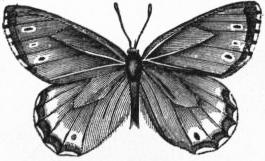
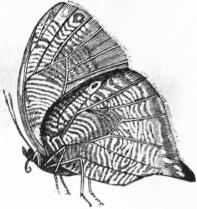
Fig. 75.—Oeneis jutta. Arctic Regions. Fig. 76.—Bia actorion. Brazil.
Bibliography.—The handsome Lepidoptera, with their interesting and easily observed life-histories, have naturally attracted many students, and the literature of the order is enormous. M. Malpighi’s treatise on the anatomy of the silkworm (De Bombycibus, London, 1669) and P. Lyonnet’s memoir on the Goat-caterpillar, are among the earliest and most famous of entomological writings. W. F. Kirby’s Handbook to the Order Lepidoptera (5 vols., London, 1894-1897) should be consulted for references to the older systematic writers such as Linnaeus, J. C. Fabricius, J. Hübner, P. Cramer, E. Doubleday and W. C. Hewitson. Kirby’s Catalogues are also invaluable for the systematist. For the jaws of the Lepidoptera see F. Darwin, Quart. Journ. Mic. Sci. xv. (1875); E. Burgess, Amer. Nat. xiv. (1880); A. Walter, Jen. Zeits. f. Naturw. xviii. (1885); W. Breitenbach, Ib. xv. (1882); V. L. Kellogg, Amer. Nat. xxix. (1895). The last-named deals also with wing structure, which is further described by A. Spuler, Zeits. wiss. Zool. liii. (1892) and Zool. Jahrb. Anat. viii. (1895); A. R. Grote, Mitt. aus dem Roemer-Museum (Hildesheim, 1896-1897); G. Enderlein, Zool. Jahrb. Anat. xvi. (1903), and many others. For scales see A. G. Mayer, Bull. Mus. Comp. Zool. Harvard, xxix. (1896). For internal anatomy W. H. Jackson, Trans. Linn. Soc. Zool. (2) v. (1891), and W. Petersen, Mem. Acad. Imp. Sci. St Petersburg (8) ix. (1900). The early stages and transformations of Lepidoptera are described by J. Gonin, Bull. Soc. Vaud. Sci. Nat. xxx. (1894); E. B. Poulton, Trans. Linn. Soc. Zool. (2) v. (1891); H. G. Dyar, Ann. New York Acad. Sci. viii. (1894); T. A. Chapman, Trans. Entom. Soc. Lond. (1893), &c. For habits and life-relations see A. Seitz, Zool. Jahrb. Syst. v., vii. (1890, 1894); A. Weismann, Studies in the Theory of Descent (London, 1882) and Entomologist, xxix. (1896); F. Merrifield, Trans. Entom. Soc. Lond. (1890, 1893, 1905); M. Standfuss, Handbuch der paläarktischen Gross-schmetterlinge (Jena, 1896); R. Trimen, Proc. Ent. Soc. Lond. (1898); E. B. Poulton, Colours of Animals (London, 1890); Trans. Entom. Soc. (1892 and 1903), and Journ. Linn. Soc. Zool. xxvi. (1898); F. E. Beddard, Animal Coloration (London, 1892). For distribution see H. J. Elwes, Proc. Entom. Soc. Lond. (1894); J. W. Tutt, Migration and Dispersal of Insects (London, 1902); Fossil Lepidoptera, S. H. Scudder, 8th Rep. U.S. Geol. Survey (1889). Among recent general works on the Lepidoptera, most of which contain numerous references to the older literature, may be mentioned A. S. Packard’s unfinished work on the Bombycine Moths of N. America, Mem. Nat. Acad. Sci. Philadelphia, vii. (1895), and Mem. Acad. Sci. Washington, lx. (1905); D. Sharp’s chapter in Cambridge Nat. Hist. vi. (London, 1898); G. F. Hampson, Moths of India (4 vols., London, 1892-1896), and Catalogue of the Lepidoptera Phalaenae (1895) and onwards; S. H. Scudder, Butterflies of New England (3 vols., Cambridge, Mass., 1888-1889); W. J. Holland, Butterfly Book (New York, 1899). Works on the British Lepidoptera are numerous, for example, those of H. T. Stainton (1851), C. G. Barrett (1893-1907), E. Meyrick (1895), and J. W. Tutt (1899 and onwards). For recent general systematic works, the student should consult the catalogues mentioned above and the Zoological Record. The writings of O. Staudinger, E. Schatz, C. Oberthür, K. Jordan, C. Aurivillius and P. Mabille may be specially mentioned.
(G. H. C.)

LEPIDUS, the name of a Roman patrician family in the Aemilian gens.
1. Marcus Aemilius Lepidus, one of the three ambassadors sent to Egypt in 201 B.C. as guardians of the infant king Ptolemy V. He was consul in 187 and 175, censor 179, pontifex maximus from 180 onwards, and was six times chosen by the censors princeps senatus. He died in 152. He distinguished himself in the war with Antiochus III. of Syria, and against the Ligurians. He made the Via Aemilia from Ariminum to Placentia, and led colonies to Mutina and Parma.
Livy xl. 42-46, epit. 48; Polybius xvi. 34.
2. Marcus Aemilius Lepidus, surnamed Porcina (probably from his personal appearance), consul 137 B.C. Being sent to Spain to conduct the Numantine war, he began against the will of the senate to attack the Vaccaei. This enterprise was so unsuccessful that he was deprived of his command in 136 and condemned to pay a fine. He was among the greatest of the earlier Roman orators, and Cicero praises him for having introduced the well-constructed sentence and even flow of language from Greek into Roman oratory.
Cicero, Brutus, 25, 27, 86, 97; Vell. Pat. ii. 10; Appian, Hisp. 80-83; Livy, epit. 56.
3. Marcus Aemilius Lepidus, father of the triumvir. In 81 B.C. he was praetor of Sicily, where he made himself detested by oppression and extortion. In the civil wars he sided with Sulla and bought much of the confiscated property of the Marian partisans. Afterwards he became leader of the popular party, and with the help of Pompey was elected consul for 78, in spite of the opposition of Sulla. When the dictator died, Lepidus tried in vain to prevent the burial of his body in the Campus Martius, and to alter the constitution established by him. His colleague Lutatius Catulus found a tribune to place his veto on Lepidus’s proposals; and the quarrel between the two parties in the state became so acute that the senate made the consuls swear not to take up arms. Lepidus was then ordered by the senate to go to his province, Transalpine Gaul; but he stopped in Etruria on his way from the city and began to levy an army. He was declared a public enemy early in 77, and forthwith marched against Rome. A battle took place in the Campus Martius, Pompey and Catulus commanding the senatorial army, and Lepidus was defeated. He sailed to Sardinia, in order to put himself into connexion with Sertorius in Spain, but here also suffered a repulse, and died shortly afterwards.
Plutarch, Sulla, 34, 38, Pompey, 15; Appian, B.C. i. 105, 107; Livy, epit. 90; Florus iii. 23; Cicero, Balbus, 15.
4. Marcus Aemilius Lepidus, the triumvir. He joined the party of Julius Caesar in the civil wars, and was by the dictator thrice nominated magister equitum and raised to the consulship in 46 B.C. He was a man of great wealth and influence, and it was probably more on this ground than on account of his ability that Caesar raised him to such honours. In the beginning of 44 B.C. he was sent to Gallia Narbonensis, but before he had left the city with his army Caesar was murdered. Lepidus, as commander of the only army near Rome, became a man of great importance in the troubles which followed. Taking part with Marcus Antonius (Mark Antony), he joined in the reconciliation which the latter effected with the senatorial party, and afterwards sided with him when open war broke out. Antony, after his defeat at Mutina, joined Lepidus in Gaul, and in August 43 Octavian (afterwards the emperor Augustus), who had forced the senate to make him consul, effected an arrangement with Antony and Lepidus, and their triumvirate was organized at Bononia. Antony and Octavian soon reduced Lepidus to an inferior position. His province of Gaul and Spain was taken from him; and, though he was included in the triumvirate when it was renewed in 37, his power was only nominal. He made an effort in the following year to regain some reality of power, conquered part of Sicily, and claimed the whole island as his province, but Octavian found means to sap the fidelity of his soldiers, and he was obliged to supplicate for his life. He was allowed to retain his fortune and the office of pontifex maximus to which he had been appointed in 44, but had to retire into private life. According to Suetonius (Augustus, 16) he died at Circeii in the year 13.
See Rome: History ii., “The Republic,” Period C, ad fin.; Appian, Bell. Civ. ii.-v.; Dio Cassius xli.-xlix.; Vell. Pat. ii. 64, 80; Orelli’s Onomasticon to Cicero.
LE PLAY, PIERRE GUILLAUME FRÉDÉRIC (1806-1882), French engineer and economist, was born at La Rivière-Saint-Sauveur (Calvados) on the 11th of April 1806, the son of a custom-house official. He was educated at the École Polytechnique, and from there passed into the State Department of Mines. In 1834 he was appointed head of the permanent committee of mining statistics, and in 1840 engineer-in-chief and professor of metallurgy at the school of mines, where he became inspector in 1848. For nearly a quarter of a century Le Play spent his vacations travelling in the various countries of Europe, and collected a vast quantity of material bearing upon the social condition of the working classes. In 1855 he published Les Ouvriers européens, which comprised a series of thirty-six monographs on the budgets of typical families selected from the most diverse industries. The Académie des Sciences conferred on him the Montyon prize. Napoleon III., who held him in high esteem, entrusted him with the organization of the Exhibition of 1855, and appointed him counsellor of state, commissioner general of the Exhibition of 1867, senator of the empire and grand officer of the Legion of Honour. He died in Paris on the 5th of April 1882.
In 1856 Le Play founded the Société internationale des études pratiques d’Économie sociale, which has devoted its energies principally to forwarding social studies on the lines laid down by its founder. The journal of the society, La Réforme sociale, founded in 1881, is published fortnightly. Other works of Le Play are La Réforme sociale (2 vols., 1864; 7th ed., 3 vols., 1887); L’Organisation de la famille (1871); La Constitution de l’Angleterre (in collaboration with M. Delaire, 1875). See article in Harvard Quarterly Journal of Economics (June 1890), by H. Higgs.
LEPROSY (Lepra Arabum, Elephantiasis Graecorum, Aussatz, Spedalskhed), the greatest disease of medieval Christendom, identified, on the one hand, with a disease endemic from the earliest historical times (1500 B.C.) in the delta and valley of the Nile, and, on the other hand, with a disease now common in Asia, Africa, South America, the West Indies, and certain isolated localities of Europe. An authentic representation of the leprosy of the middle ages exists in a picture at Munich by Holbein, painted at Augsburg in 1516; St Elizabeth gives bread and wine to a prostrate group of lepers, including a bearded man whose face is covered with large round reddish knobs, an old woman whose arm is covered with brown blotches, the leg swathed in bandages through which matter oozes, the bare knee also marked with discoloured spots, and on the head a white rag or plaster, and, thirdly, a young man whose neck and face (especially round the somewhat hairless eyebrows) are spotted with brown patches of various size. It is conjectured by Virchow that the painter had made studies of lepers from the leper-houses then existing at Augsburg. These external characters of medieval leprosy agree with the descriptions of it by the ancients, and with the pictures of modern leprosy given by Danielssen and Boeck for Norway, by various authors for sporadic European cases, by Anderson for Malacca, by Carter for India, by Wolff for Madeira and by Hillis for British Guiana. There has been some confusion in the technical naming of the disease; it is called Elephantiasis (Leontiasis, Satyriasis) by the Greek writers, and Lepra by the Arabians.
Leprosy is now included among the parasitic diseases (see Parasitic Diseases). The cause is believed to be infection by the bacillus leprae, a specific microbe discovered by Armauer Hansen in 1871. It is worthy of note that tuberculosis is very common among lepers, and especially attacks the serous membranes. The essential character of leprosy is a great multiplication of cells, resembling the “granulation cells” of lupus and syphilis, in the tissues affected, which become infiltrated and thickened, with degeneration and destruction of their normal elements. The new cells vary in size from ordinary leucocytes to giant cells three or four times larger. The bacilli are found in these cells, sometimes in small numbers, sometimes in masses. The structures most affected are the skin, nerves, mucous membranes and lymphatic glands.
The symptoms arise from the anatomical changes indicated, and they vary according to the parts attacked. Three types of disease are usually described—(1) nodular, (2) smooth or anaesthetic, (3) mixed. In the first the skin is chiefly affected, in the second the nerves; the third combines the features of both. It should be understood that this classification is purely a matter of convenience, and is based on the relative prominence of symptoms, which may be combined in all degrees. The incubation period of leprosy—assuming it to be due to infection—is unknown, but cases are on record which can only be explained on the hypothesis that it may be many years. The invasion is usually slow and intermittent. There are occasional feverish attacks, with the usual constitutional disturbance and other slight premonitory signs, such as changes in the colour of the skin and in its sensibility. Sometimes, but rarely, the onset is acute and the characteristic symptoms develop rapidly. These begin with an eruption which differs markedly according to the type of disease. In the nodular form dark red or coppery patches appear on the face, backs of the hands, and feet or on the body; they are generally symmetrical, and vary from the size of a shilling upwards. They come with one of the feverish attacks and fade away when it has gone, but only to return. After a time infiltration and thickening of the skin become noticeable, and the nodules appear. They are lumpy excrescences, at first pink but changing to brown. Thickening of the skin of the face produces a highly characteristic appearance, recalling the aspect of a lion. The tissues of the eye undergo degenerative changes; the mucous membrane of the nose and throat is thickened, impairing the breathing and the voice; the eyebrows fall off; the ears and nose become thickened and enlarged. As the disease progresses the nodules tend to break down and ulcerate, leaving open sores. The patient, whose condition is extremely wretched, gradually becomes weaker, and eventually succumbs to exhaustion or is carried off by some intercurrent disease, usually inflammation of the kidneys or tuberculosis. A severe case may end fatally in two years, but, as a rule, when patients are well cared for the illness lasts several years. There is often temporary improvement, but complete recovery from this form of leprosy rarely or never occurs. The smooth type is less severe and more chronic. The eruption consists of patches of dry, slightly discoloured skin, not elevated above the surface. These patches are the result of morbid changes affecting the cutaneous nerves, and are accompanied by diminished sensibility over the areas of skin affected. At the same time certain nerve trunks in the arm and leg, and particularly the ulnar nerve, are found to be thickened. In the further stages the symptoms are those of increasing degeneration of the nerves. Bullae form on the skin, and the discoloured patches become enlarged; sensation is lost, muscular power diminished, with wasting, contraction of tendons, and all the signs of impaired nutrition. The nails become hard and clawed; perforating ulcers of the feet are common; portions of the extremities, including whole fingers and toes, die and drop off. Later, paralysis becomes more marked, affecting the muscles of the face and limbs. The disease runs a very chronic course, and may last twenty or thirty years. Recovery occasionally occurs. In the mixed form, which is probably the most common, the symptoms described are combined in varying degrees. Leprosy may be mistaken for syphilis, tuberculosis, ainhum (an obscure disease affecting negroes, in which the little toe drops off), and several affections of the skin. Diagnosis is established by the presence of the bacillus leprae in the nodules or bullae, and by the signs of nerve degeneration exhibited in the anaesthetic patches of skin and the thickened nerve trunks.
In former times leprosy was often confounded with other skin diseases, especially psoriasis and leucoderma; the white leprosy of the Old Testament was probably a form of the latter. But there is no doubt that true leprosy has existed from time immemorial. Prescriptions for treating it have been found in Egypt, to which a date of about 4600 B.C. is assigned. The disease is described by Aristotle and by later Greek writers, but not by Hippocrates, though leprosy derives its name from his “lepra” or “scaly” disease, which was no doubt psoriasis. In ancient times it was widely prevalent throughout Asia as well as in Egypt, and among the Greeks and Romans. In the middle ages it became extensively diffused in Europe, and in some countries—France, England, Germany and Spain—every considerable town had its leper-house, in which the patients were segregated. The total number of such houses has been reckoned at 19,000. The earliest one in England was established at Canterbury in 1096, and the latest at Highgate in 1472. At one time there were at least 95 religious hospitals for lepers in Great Britain and 14 in Ireland (Sir James Simpson). During the 15th century the disease underwent a remarkable diminution. It practically disappeared in the civilized parts of Europe, and the leper-houses were given up. It is a singular fact that this diminution was coincident with the great extension of syphilis (see Prostitution). The general disappearance of leprosy at this time is the more unintelligible because it did not take effect everywhere. In Scotland the disease lingered until the 19th century, and in some other parts it has never died out at all. At the present time it still exists in Norway, Iceland, along the shores of the Baltic, in South Russia, Greece, Turkey, several Mediterranean islands, the Riviera, Spain and Portugal. Isolated cases occasionally occur elsewhere, but they are usually imported. The Teutonic races seem to be especially free from the taint. Leper asylums are maintained in Norway and at two or three places in the Baltic, San Remo, Cyprus, Constantinople, Alicante and Lisbon. Except in Spain, where some increase has taken place, the disease is dying out. The number of lepers in Norway was 3000 in 1856, but has now dwindled to a few hundreds. They are no longer numerous in any part of Europe. On the other hand, leprosy prevails extensively throughout Asia, from the Mediterranean to Japan, and from Arabia to Siberia. It is also found in nearly all parts of Africa, particularly on the east and west coasts near the equator. In South Africa it has greatly increased, and attacks the Dutch as well as natives. Leper asylums have been established at Robben Island near Cape Town, and in Tembuland. In Australia, where it was introduced by Chinese, it has also spread to Europeans. In New Zealand the Maoris are affected; but the amount of leprosy is not large in either country. A much more remarkable case is that of the Hawaiian Islands, where the disease is believed to have been imported by Chinese. It was unknown before 1848, but in 1866 the number of lepers had risen to 230 and in 1882 to 4000 (Liveing). All attempts to stop it by segregating lepers in the settlement of Molokai appear to have been fruitless. In the West Indies and on the American continent, again, leprosy has a wide distribution. It is found in nearly all parts of South and Central America, and in certain parts of North America—namely, Louisiana, California (among Chinese), Minnesota, Wisconsin and North and South Dakota (Norwegians), New Brunswick (French Canadians).
It is difficult to find any explanation of the geographical distribution and behaviour of leprosy. It seems to affect islands and the sea-coast more than the interior, and to some extent this gives colour to the old belief that it is caused or fostered by a fish diet, which has been revived by Mr Jonathan Hutchinson, but is not generally accepted. Leprosy is found in interiors where fish is not an article of diet. Climate, again, has obviously little, if any, influence. The theory of heredity is equally at fault, whether it be applied to account for the spread of the disease by transmission or for its disappearance by the elimination of susceptible persons. The latter is the manner in which heredity might be expected to act, if at all, for lepers are remarkably sterile. But we see the disease persisting among the Eastern races, who have been continuously exposed to its selective influence from the earliest times, while it has disappeared among the Europeans, who were affected very much later. The opposite theory of hereditary transmission from parents to offspring is also at variance with many observed facts. Leprosy is very rarely congenital, and no cases have occurred among the descendants to the third generation of 160 Norwegian lepers settled in the United States. Again, if hereditary transmission were an effective influence, the disease could hardly have died down so rapidly as it did in Europe in the 15th century. Then we have the theory of contagion. There is no doubt that human beings are inoculable with leprosy, and that the disease may be communicated by close contact. Cases have been recorded which prove it conclusively; for instance, that of a man who had never been out of the British islands, but developed leprosy after sharing for a time the bed and clothes of his brother, who had contracted the disease in the West Indies. Some of the facts noted, such as the extensive dissemination of the disease in Europe during the middle ages, and its subsequent rapid decline, suggest the existence of some unknown epidemic factor. Poverty and insanitation are said to go with the prevalence of leprosy, but they go with every malady, and there is nothing to show that they have any special influence. Vaccination has been blamed for spreading it, and a few cases of communication by arm-to-arm inoculation are recorded. The influence of this factor, however, can only be trifling. Vaccination is a new thing, leprosy a very old one; where there is most vaccination there is no leprosy, and where there is most leprosy there is little or no vaccination. In India 78% of the lepers are unvaccinated, and in Canton since vaccination was introduced leprosy has declined (Cantlie). On the whole we must conclude that there is still much to be learnt about the conditions which govern the prevalence of leprosy.
With regard to prevention, the isolation of patients is obviously desirable, especially in the later stages, when open sores may disseminate the bacilli; but complete segregation, which has been urged, is regarded as impracticable by those who have had most experience in leprous districts. Scrupulous cleanliness should be exercised by persons attending on lepers or brought into close contact with them. In treatment the most essential thing is general care of the health, with good food and clothing. The tendency of modern therapeutics to attach increasing importance to nutrition in various morbid states, and notably in diseases of degeneration, such as tuberculosis and affections of the nervous system, is borne out by experience in leprosy, which has affinities to both; and this suggests the application to it of modern methods for improving local as well as general nutrition by physical means. A large number of internal remedies have been tried with varying results; those most recommended are chaulmoogra oil, arsenic, salicylate of soda, salol and chlorate of potash. Vergueira uses Collargol intravenously and subcutaneously, and states that in all the cases treated there was marked improvement, and hair that had been lost grew again. Calmette’s Anterenene injected subcutaneously has been followed by good results. Deycke together with R. Bey isolated from a non-ulcerated leprous nodule a streptothrix which they call S. leproides. Its relation to the bacillus is uncertain. They found that injections of this organism had marked curative effects, due to a neutral fat which they named “Nastin.” Injections of Nastin together with Benzoyl Chloride directly act on the lepra bacilli. Some cases were unaffected by this treatment, but with others the effect was marvellous. Dr W. A. Pusey of Chicago uses applications of carbon dioxide snow with good effect. In the later stages of the disease there is a wide field for surgery, which is able to give much relief to sufferers.
Literature.—For history and geographical distribution, see Hirsch, Handbuch der historisch-geographischen Pathologie (1st ed., Erlangen, 1860, with exhaustive literature). For pathology, Virchow, Die krankhaften Geschwülste (Berlin, 1863-1867), vol. ii. For clinical histories, R. Liveing, Elephantiasis Graecorum or True Leprosy (London, 1873), ch. iv. For medieval leprosy—in Germany, Virchow, in Virchow’s Archiv, five articles, vols. xviii.-xx. (1860-1861); in the Netherlands, Israëls, in Nederl. Tijdschr. voor Geneeskunde, vol. i. (1857); in Britain, J. Y. Simpson, Edin. Med. and Surg. Journ., three articles, vols. lxvi. and lxvii. (1846-1847). Treatises on modern leprosy in particular localities: Danielssen and Boeck (Norway), Traité de la Spédalskhed, with atlas of twenty-four coloured plates (Paris, 1848); A. F. Anderson, Leprosy as met with in the Straits Settlements, coloured photographs with explanatory notes (London, 1872); H. Vandyke Carter (Bombay), On Leprosy and Elephantiasis, with coloured plates (London, 1874); Hillis, Leprosy in British Guiana, an account of West Indian leprosy, with twenty-two coloured plates (London, 1882). See also the dermatological works of Hebra, Erasmus Wilson, Bazin and Jonathan Hutchinson (also the latter’s letters to The Times of the 11th of April and the 25th of May 1903); British Medical Journal (April 1, 1908); American Journal of Dermatology (Dec. 1907); The Practitioner (February 1910). An important early work is that of P. G. Hensler, Vom abendländischen Aussatze im Mittelalter (Hamburg, 1790).
LEPSIUS, KARL RICHARD (1810-1884), German Egyptologist, was born at Naumburg-am-Saale on the 23rd of December 1810, and in 1823 was sent to the “Schulpforta” school near Naumburg, where he came under the influence of Professor Lange. In 1829 he entered the university of Leipzig, and one year later that of Göttingen, where, under the influence of Otfried Müller, he finally decided to devote himself to the archaeological side of philology. From Göttingen he proceeded to Berlin, where he graduated in 1833 as doctor with the thesis De tabulis Eugubinis. In the same year he proceeded to study in Paris, and was commissioned by the duc de Luynes to collect material from the Greek and Latin writers for his work on the weapons of the ancients. In 1834 he took the Volney prize with his Paläographie als Mittel der Sprachforschung. Befriended by Bunsen and Humboldt, Lepsius threw himself with great ardour into Egyptological studies, which, since the death of Champollion in 1832, had attracted no scholar of eminence and weight. Here Lepsius found an ample field for his powers. After four years spent in visiting the Egyptian collections of Italy, Holland and England, he returned to Germany, where Humboldt and Bunsen united their influence to make his projected visit to Egypt a scientific expedition with royal support. For three years Lepsius and his party explored the whole of the region in which monuments of ancient Egyptian and Ethiopian occupation are found, from the Sudan above Khartum to the Syrian coast. At the end of 1845 they returned home, and the results of the expedition, consisting of casts, drawings and squeezes of inscriptions and scenes, maps and plans collected with the utmost thoroughness, as well as antiquities and papyri, far surpassed expectations. In 1846 he married Elisabeth Klein, and his appointment to a professorship in Berlin University in the following August afforded him the leisure necessary for the completion of his work. In 1859 the twelve volumes of his vast Denkmäler aus Ägypten und Äthiopien were finished, supplemented later by a text prepared from the note-books of the expedition; they comprise its entire archaeological, palaeographical and historical results. In 1866 Lepsius again went to Egypt, and discovered the famous Decree of Tanis or Table of Canopus, an inscription of the same character as the Rosetta Stone, in hieroglyphic, demotic and Greek. In 1873 he was appointed keeper of the Royal Library, Berlin, which, like the Berlin Museum, owes much to his care. About ten years later he was appointed Geheimer Oberregierungsrath. He died at Berlin on the 10th of July 1884. Besides the colossal Denkmäler and other publications of texts such as the Todtenbuch der Ägypter (Book of the Dead, 1842) his other works, amongst which may be specially named his Königsbuch der Ägypter (1858) and Chronologie der Ägypter (1849), are characterized by a quality of permanence that is very remarkable in a subject of such rapid development as Egyptology. In spite of his scientific training in philology Lepsius left behind few translations of inscriptions or discussions of the meanings of words: by preference he attacked historical and archaeological problems connected with the ancient texts, the alphabet, the metrology, the names of metals and minerals, the chronology, the royal names. On the other hand one of his latest works, the Nubische Grammatik (1880), is an elaborate grammar of the then little-known Nubian language, preceded by a linguistic sketch of the African continent. Throughout his life he profited by the gift of attaching to himself the right men, whether as patrons or, like Weidenbach and Stern, as assistants. Lepsius was a fine specimen of the best type of German scholar.
See Richard Lepsius, by Georg Ebers (New York, 1887), and art. Egypt, section Exploration and Research.
LEPTINES, an Athenian orator, known as the proposer of a law that no Athenian, whether citizen or resident alien (with the sole exception of the descendants of Harmodius and Aristogeiton), should be exempt from the public charges (λειτουργίαι) for the state festivals. The object was to provide funds for the festivals and public spectacles at a time when both the treasury and the citizens generally were short of money. It was further asserted that many of the recipients of immunity were really unworthy of it. Against this law Demosthenes delivered (354 B.C.) his well-known speech Against Leptines in support of the proposal of Ctesippus that all the cases of immunity should be carefully investigated. Great stress is laid on the reputation for ingratitude and breach of faith which the abolition of immunities would bring upon the state. Besides, the law itself had been passed unconstitutionally, for an existing law confirmed these privileges, and by the constitution of Solon no law could be enacted until any existing law which it contravened had been repealed. The law was probably condemned. Nothing further is known of Leptines.
See the edition of the speech by J. E. Sandys (1890).
LEPTIS, the name of two towns in ancient Africa. The first, Leptis Magna (Λεπτίμαγνα), the modern Lebda, was in Tripolitana between Tripolis and Mesrata at the mouth of the Cinyps; the second, Leptis Parva (Λέπτις ἡ μικρά), known also as Leptiminus or Leptis minor, the modern Lamta, was a small harbour of Byzacena between Ruspina (Monastir) and Thapsus (Dimas).
1. Leptis Magna was one of the oldest and most flourishing of the Phoenician emporia established on the coasts of the greater Syrtis, the chief commercial entrepot for the interior of the African continent. It was founded by the Sidonians (Sallust, Jug. 78) who were joined later by people of Tyre (Pliny, Hist. Nat. v. 17). Herodotus enlarges on the fertility of its territory (iv. 175, v. 42). It was tributary to Carthage to which it paid a contribution of a talent a day (Livy xxxiv. 62). After the Second Punic War Massinissa made himself master of it (Sallust, Jug. 78; Livy xxxiv. 62; Appian viii. 106). During the Jugurthine War it appealed for protection to Rome (Sallust, Jug. 78). Though captured and plundered by Juba, it maintained its allegiance to Rome, supported the senatorial cause, received Cato the younger with the remains of the Pompeian forces after Pharsalus 48 B.C. After his victory Julius Caesar imposed upon it an annual contribution of 300,000 measures of oil. Nevertheless, it preserved its position as a free city governed by its own magistrates (C.I.L. viii. 7). It received the title of municipium (C.I.L. viii. 8), and was subsequently made a colonia by Trajan (C.I.L. viii. 10). Septimius Severus, who was born there, beautified the place and conferred upon it the Ius Italicum. Leptis Magna was the limit of the Roman state, the last station of the limes Tripolitanus; hence, especially during the last centuries of the Empire, it suffered much from the Nomads of the desert, the Garamantes, the Austuriani and the Levathae (Ammian. Marc. xxviii. 6; Procop. De Aedif. vi. 4). Its commerce declined and its harbour silted up. Justinian made a vain attempt to rebuild it (Procop. ibid.; Ch. Diehl, L’Afrique byzantine, p. 388). It was the seat of a bishopric, but no mention is made of its bishops after 462.
Leptis Magna had a citadel which protected the commercial city which was generally called Neapolis, the situation of which may be compared with that of Carthage at the foot of Byrsa. Its ruins are still imposing; remains of ramparts and docks, a theatre, a circus and various buildings of the Roman period still exist. Inscriptions show that the current pronunciation of the name was Lepcis, Lepcitana, instead of Leptis, Leptitana (Tissot, Géogr. comp. de la prov. d’Afrique, ii. 219; Clermont-Ganneau, Recueil d’archéologie orientale, vi. 41; Comptes rendus de l’Acad. des Inscr. et B.-Lettres, 1903, p. 333; Cagnat, C.R. Acad., 1905, p. 531). The coins of Leptis Magna, like the majority of the emporia in the neighbourhood, present a series from the Punic period. They are of bronze with the legend לפקי (Lepqi). They have on one side the head of Bacchus, Hercules or Cybele, and on the other various emblems of these deities. From the Roman period we have also coins bearing the heads of Augustus, Livia and Tiberius, which still have the name of the town in Neo-Punic script (Lud. Müller, Numism. de l’anc. Afrique, ii. 3).
The ruins of Leptis Magna have been visited by numerous travellers since the time of Frederick William and Henry William Beechey (Travels, pp. 51 and 74) and Heinrich Barth (Wanderungen, pp. 306, 360); they are described by Ch. Tissot (Géogr. comp. ii. 219 et seq.); Cl. Perroud, De Syrticis emporiis, p. 33 (Paris, 1881, in 8°); see also a description in the New York journal, The Nation (1877), vol. xxvii. No. 683. M. Méhier de Mathuisieulx explored the site afresh in 1901; his account is inserted in the Nouvelles Archives des missions, x. 245-277; cf. vol. xii. See also J. Toutain, “Le Limes Tripolitanus en Tripolitaine,” in the Bulletin archéologique áu comité des travaux historiques (1905).
2. Leptis Parva (Lamta), 7½ m. from Monastir, which is often confused by modern writers with Leptis Magna in their interpretations of ancient texts (Tissot, Géogr. comp. ii. 169), was, according to the Tabula Peutingeriana, 18 m. south of Hadrumetum. Evidently Phoenician in origin like Leptis Magna, it was in the Punic period of comparatively slight importance. Nevertheless, it had fortifications, and the French engineer, A. Daux, has discovered a probable line of ramparts. Like its neighbour Hadrumetum, Leptis Parva declared for Rome after the last Punic War. Also after the fall of Carthage in 146 it preserved its autonomy and was declared a civitas libera et immunis (Appian, Punica, 94; C.I.L. i. 200; De bell. Afric. c. xii.). Julius Caesar made it the base of his operations before the battle of Thapsus in 46 (Ch. Tissot, Géogr. comp. ii. 728). Under the Empire Leptis Parva became extremely prosperous; its bishops appeared in the African councils from 258 onwards. In Justinian’s reorganization of Africa we find that Leptis Parva was with Capsa one of the two residences of the Dux Byzacenae (Tissot, op. cit. p. 171). The town had coins under Augustus and Tiberius. On the obverse is the imperial effigy with a Latin legend, and on the reverse the Greek legend ΛΕΠΤΙC with the bust of Mercury (Lud. Müller, Numism. de l’anc. Afrique, ii. 49). The ruins extend along the sea-coast to the north-west of Lemta; the remains of docks, the amphitheatre and the acropolis can be distinguished; a Christian cemetery has furnished tombs adorned with curious mosaics.
See Comptes rendus de l’Acad. des Inscrip. et B.-Lettres (1883), p. 189; Cagnat and Saladin, “Notes d’archéol. tunisiennes,” in the Bulletin monumental of 1884; Archives des missions, xii. 111; Cagnat, Explorations archéol. en Tunisie, 3me fasc. pp. 9-16, and Tour du monde (1881), i. 292; Saladin, Rapport sur une mission en Tunisie (1886), pp. 9-20; Bulletin archéol. du comité de travaux historiques (1895), pp. 69-71 (inscriptions of Lamta); Bulletin de la Soc. archéol. de Sousse (1905; plan of the ruins of Lamta).
(E. B.*)
LE PUY, or Le Puy en Velay, a town of south-eastern France, capital of the department of Haute-Loire, 90 m. S.W. of Lyons on the Paris-Lyon railway. Pop. (1906) town, 17,291; commune, 21,420. Le Puy rises in the form of an amphitheatre from a height of 2050 ft. above sea-level upon Mont Anis, a hill that divides the left bank of the Dolézon from the right bank of the Borne (a rapid stream joining the Loire 3 m. below). From the new town, which lies east and west in the valley of the Dolézon, the traveller ascends the old feudal and ecclesiastical town through narrow steep streets, paved with pebbles of lava, to the cathedral commanded by the fantastic pinnacle of Mont Corneille. Mont Corneille, which is 433 ft. above the Place de Breuil (in the lower town), is a steep rock of volcanic breccia, surmounted by an iron statue of the Virgin (53 ft. high) cast, after a model by Bonassieux, out of guns taken at Sebastopol. Another statue, that of Msgr de Morlhon, bishop of Le Puy, also sculptured by Bonassieux, faces that of the Virgin. From the platform of Mont Corneille a magnificent panoramic view is obtained of the town and of the volcanic mountains, which make this region one of the most interesting parts of France.
The Romanesque cathedral (Notre-Dame), dating chiefly from the first half of the 12th century, has a particoloured façade of white sandstone and black volcanic breccia, which is reached by a flight of sixty steps, and consists of three tiers, the lowest composed of three high arcades opening into the porch, which extends beneath the first bays of the nave; above are three windows lighting the nave; and these in turn are surmounted by three gables, two of which, those to the right and the left, are of open work. The staircase continues within the porch, where it divides, leading on the left to the cloister, on the right into the church. The doorway of the south transept is sheltered by a fine Romanesque porch. The isolated bell-tower (184 ft.), which rises behind the choir in seven storeys, is one of the most beautiful examples of the Romanesque transition period. The bays of the nave are covered in by octagonal cupolas, the central cupola forming a lantern. The choir and transepts are barrel-vaulted. Much veneration is paid to a small image of the Virgin on the high altar, a modern copy of the medieval image destroyed at the Revolution. The cloister, to the north of the choir, is striking, owing to its variously-coloured materials and elegant shafts. Viollet-le-Duc considered one of its galleries to belong to the oldest known type of cathedral cloister (8th or 9th century). Connected with the cloister are remains of fortifications of the 13th century, by which it was separated from the rest of the city. Near the cathedral the baptistery of St John (11th century), built on the foundations of a Roman building, is surrounded by walls and numerous remains of the period, partly uncovered by excavations. The church of St Lawrence (14th century) contains the tomb and statue of Bertrand du Guesclin, whose ashes were afterwards carried to St Denis.
Le Puy possesses fragmentary remains of its old line of fortifications, among them a machicolated tower, which has been restored, and a few curious old houses dating from the 12th to the 17th century. In front of the hospital there is a fine medieval porch under which a street passes. Of the modern monuments the statue of Marie Joseph Paul, marquis of La Fayette, and a fountain in the Place de Breuil, executed in marble, bronze and syenite, may be specially mentioned. The museum, named after Charles Crozatier, a native sculptor and metal-worker to whose munificence it principally owes its existence, contains antiquities, engravings, a collection of lace, and ethnographical and natural history collections. Among the curiosities of Le Puy should be noted the church of St Michel d’Aiguilhe, beside the gate of the town, perched on an isolated rock like Mont Corneille, the top of which is reached by a staircase of 271 steps. The church dates from the end of the 10th century and its chancel is still older. The steeple is of the same type as that of the cathedral. Three miles from Le Puy are the ruins of the Château de Polignac, one of the most important feudal strongholds of France.
Le Puy is the seat of a bishopric, a prefect and a court of assizes, and has tribunals of first instance and of commerce, a board of trade arbitration, a chamber of commerce, and a branch of the Bank of France. Its educational institutions include ecclesiastical seminaries, lycées and training colleges for both sexes and municipal industrial schools of drawing, architecture and mathematics applied to arts and industries. The principal manufacture is that of lace and guipure (in woollen, linen, cotton, silk and gold and silver threads), and distilling, leather-dressing, malting and the manufacture of chocolate and cloth are carried on. Cattle, woollens, grain and vegetables are the chief articles of trade.
It is not known whether Le Puy existed previously to the Roman invasion. Towards the end of the 4th or beginning of the 5th century it became the capital of the country of the Vellavi, at which period the bishopric, originally at Revession, now St Paulien, was transferred hither. Gregory of Tours speaks of it by the name of Anicium, because a chapel “ad Deum” had been built on the mountain, whence the name of Mont Adidon or Anis, which it still retains. In the 10th century it was called Podium Sanctae Mariae, whence Le Puy. In the middle ages there was a double enclosure, one for the cloister, the other for the town. The sanctuary of Nôtre Dame was much frequented by pilgrims, and the city grew famous and populous. Rivalries between the bishops who held directly of the see of Rome and had the right of coining money, and the lords of Polignac, revolts of the town against the royal authority, and the encroachments of the feudal superiors on municipal prerogatives often disturbed the quiet of the town. The Saracens in the 8th century, the Routiers in the 12th, the English in the 14th, the Burgundians in the 15th, successively ravaged the neighbourhood. Le Puy sent the flower of its chivalry to the Crusades in 1096, and Raymond d’Aiguille, called d’Agiles, one of its sons, was their historian. Many councils and various assemblies of the states of Languedoc met within its walls; popes and sovereigns, among the latter Charlemagne and Francis I., visited its sanctuary. Pestilence and the religious wars put an end to its prosperity. Long occupied by the Leaguers, it did not submit to Henry IV. until many years after his accession.
LERDO DE TEJADA, SEBASTIAN (1825-1889), president of Mexico, was born at Jalapa on the 25th of April 1825. He was educated as a lawyer and became a member of the supreme court. He became known as a liberal leader and a supporter of President Juarez. He was minister of foreign affairs for three months in 1857, and became president of the Chamber of Deputies in 1861. During the French intervention and the reign of the emperor Maximilian he continued loyal to the patriotic party, and had an active share in conducting the national resistance. He was minister of foreign affairs to President Juarez, and he showed an implacable resolution in carrying out the execution of Maximilian at Querétaro. When Juarez died in 1872 Lerdo succeeded him in office in the midst of a confused civil war. He achieved some success in pacifying the country and began the construction of railways. He was re-elected on the 24th of July 1876, but was expelled in January of the following year by Porfirio Diaz. He had made himself unpopular by the means he took to secure his re-election and by his disposition to limit state rights in favour of a strongly centralized government. He fled to the United States and died in obscurity at New York in 1889.
See H. H. Bancroft, Pacific States, vol. 9 (San Francisco, 1882-1890).
LERICI, a village of Liguria, Italy, situated on the N.E. side of the Gulf of Spezia, about 12 m. E.S.E. of Spezia, and 4 m. W.S.W. of Sarzana by road, 17 ft. above sea-level. Pop. (1901) 9326. Its small harbour is guarded by an old castle, said to have been built by Tancred; in the middle ages it was the chief place on the gulf. S. Terenzo, a hamlet belonging to Lerici, was the residence of Shelley during his last days. Farther north-west is the Bay of Pertusola, with its large lead-smelting works.
LÉRIDA, a province of northern Spain, formed in 1833 of districts previously included in the ancient province of Catalonia, and bounded on the N. by France and Andorra, E. by Gerona and Barcelona, S. by Tarragona and W. by Saragossa and Huesca. Pop. (1900) 274,590; area 4690 sq. m. The northern half of Lérida belongs entirely to the Mediterranean or eastern section of the Pyrenees, and comprises some of the finest scenery in the whole chain, including the valleys of Aran and La Cerdaña, and large tracts of forest. It is watered by many rivers, the largest of which is the Segre, a left-hand tributary of the Ebro. South of the point at which the Segre is joined on the right by the Noguera Pallaresa, the character of the country completely alters. The Llaños de Urgel, which comprise the greater part of southern Lérida, are extensive plains forming part of the Ebro valley, but redeemed by an elaborate system of canals from the sterility which characterizes so much of that region in Aragon. Lérida is traversed by the main railway from Barcelona to Saragossa, and by a line from Tarragona to the city of Lérida. In 1904 the Spanish government agreed with France to carry another line to the mouth of an international tunnel through the Pyrenees. Industries are in a more backward condition than in any other province of Catalonia, despite the abundance of water-power. There are, however, many saw-mills, flour-mills, and distilleries of alcohol and liqueurs, besides a smaller number of cotton and linen factories, paper-mills, soap-works, and oil and leather factories. Zinc, lignite and common salt are mined, but the output is small and of slight value. There is a thriving trade in wine, oil, wool, timber, cattle, mules, horses and sheep, but agriculture is far less prosperous than in the maritime provinces of Catalonia. Lérida (q.v.) is the capital (pop. 21,432), and the only town with more than 5000 inhabitants. Séo de Urgel, near the headwaters of the Segre, is a fortified city which has been an episcopal see since 840, and has had a close historical connexion with Andorra (q.v.). Solsona, on a small tributary of the Cardoner, which flows through Barcelona to the Mediterranean, is the Setelix of the Romans, and contains in its parish church an image of the Virgin said to possess miraculous powers, and visited every year by many hundreds of pilgrims. Cervera, on a small river of the same name, contains the buildings of a university which Philip V. established here in 1717. This university had originally been founded at Barcelona in the 15th century, and was reopened there in 1842. In character, and especially in their industry, intelligence and keen local patriotism, the inhabitants of Lérida are typical Catalans. (See Catalonia.)
LÉRIDA, the capital of the Spanish province of Lérida, on the river Segre and the Barcelona-Saragossa and Lérida-Tarragona railways. Pop. (1900) 21,432. The older parts of the city, on the right bank of the river, are a maze of narrow and crooked streets, surrounded by ruined walls and a moat, and commanded by the ancient citadel, which stands on a height overlooking the plains of Noguera on the north and of Urgel on the south. On the left bank, connected with the older quarters by a fine stone bridge and an iron railway bridge, are the suburbs, laid out after 1880 in broad and regular avenues of modern houses. The old cathedral, last used for public worship in 1707, is a very interesting late Romanesque building, with Gothic and Mauresque additions; but the interior was much defaced by its conversion into barracks after 1717. It was founded in 1203 by Pedro II. of Aragon, and consecrated in 1278. The fine octagonal belfry was built early in the 15th century. A second cathedral, with a Corinthian façade, was completed in 1781. The church of San Lorenzo (1270-1300) is noteworthy for the beautiful tracery of its Gothic windows; its nave is said to have been a Roman temple, converted by the Moors into a mosque and by Ramon Berenguer IV., last count of Barcelona, into a church. Other interesting buildings are the Romanesque town hall, founded in the 13th century but several times restored, the bishop’s palace and the military hospital, formerly a convent. The museum contains a good collection of Roman and Romanesque antiquities; and there are a school for teachers, a theological seminary and academies of literature and science. Leather, paper, glass, silk, linen and cloth are manufactured in the city, which has also some trade in agricultural produce.
Lérida is the Ilerda of the Romans, and was the capital of the people whom they called Ilerdenses (Pliny) or Ilergetes (Ptolemy). By situation the key of Catalonia and Aragon, it was from a very early period an important military station. In the Punic wars it sided with the Carthaginians and suffered much from the Roman arms. In its immediate neighbourhood Hanno was defeated by Scipio in 216 B.C., and it afterwards became famous as the scene of Caesar’s arduous struggle with Pompey’s generals Afranius and Petreius in the first year of the civil war (49 B.C.). It was already a municipium in the time of Augustus, and enjoyed great prosperity under later emperors. Under the Visigoths it became an episcopal see, and at least one ecclesiastical council is recorded to have met here (in 546). Under the Moors Lareda became one of the principal cities of the province of Saragossa; it became tributary to the Franks in 793, but was reconquered in 797. In 1149 it fell into the hands of Ramon Berenguer IV. In modern times it has come through numerous sieges, having been taken by the French in November 1707 during the War of Succession, and again in 1810. In 1300 James II. of Aragon founded a university at Lérida, which achieved some repute in its day, but was suppressed in 1717, when the university of Cervera was founded.
LERMA, FRANCISCO DE SANDOVAL Y ROJAS, Duke of (1552-1625), Spanish minister, was born in 1552. At the age of thirteen he entered the royal palace as a page. The family of Sandoval was ancient and powerful, but under Philip II. (1556-1598) the nobles, with the exception of a few who held viceroyalties or commanded armies abroad, had little share in the government. The future duke of Lerma, who was by descent marquis of Denia, passed his life as a courtier, and possessed no political power till the accession of Philip III. in 1598. He had already made himself a favourite with the prince, and was in fact one of the incapable men who, as the dying king Philip II. foresaw, were likely to mislead the new sovereign. The old king’s fears were fully justified. No sooner was Philip III. king than he entrusted all authority to his favourite, whom he created duke of Lerma in 1599 and on whom he lavished an immense list of offices and grants. The favour of Lerma lasted for twenty years, till it was destroyed by a palace intrigue carried out by his own son. Philip III. not only entrusted the entire direction of his government to Lerma, but authorized him to affix the royal signature to documents, and to take whatever presents were made to him. No royal favourite was ever more amply trusted, or made a worse use of power. At a time when the state was practically bankrupt, he encouraged the king in extravagance, and accumulated for himself a fortune estimated by contemporaries at forty-four millions of ducats. Lerma was pious withal, spending largely on religious houses, and he carried out the ruinous measures for the expulsion of the Moriscoes in 1610—a policy which secured him the admiration of the clergy and was popular with the mass of the nation. He persisted in costly and useless hostilities with England till, in 1604, Spain was forced by exhaustion to make peace, and he used all his influence against a recognition of the independence of the Low Countries. The fleet was neglected, the army reduced to a remnant, and the finances ruined beyond recovery. His only resources as a finance minister were the debasing of the coinage, and foolish edicts against luxury and the making of silver plate. Yet it is probable that he would never have lost the confidence of Philip III., who divided his life between festivals and prayers, but for the domestic treachery of his son, the duke of Uceda, who combined with the king’s confessor, Aliaga, whom Lerma had introduced to the place, to turn him out. After a long intrigue in which the king was all but entirely dumb and passive, Lerma was at last compelled to leave the court, on the 4th of October 1618. As a protection, and as a means of retaining some measure of power in case he fell from favour, he had persuaded Pope Paul V. to create him cardinal, in the year of his fall. He retired to the town of Lerma in Old Castile, where he had built himself a splendid palace, and then to Valladolid. Under the reign of Philip IV., which began in 1621 he was despoiled of part of his wealth, and he died in 1625.