VOLUME XVI SLICE IV Lefebvre, Tanneguy to Letronne, Jean Antoine (continued 5)
Reading edition
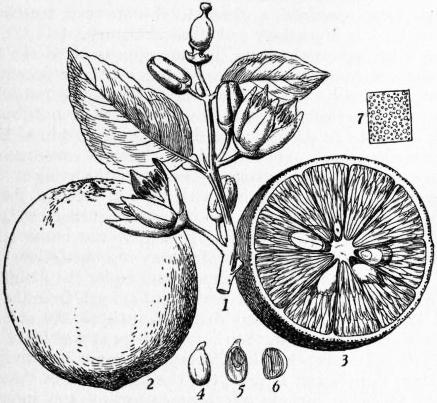
Fig. 2.—Lime—Citrus medica, var. acida.
1, Flowering shoot. 2, Fruit. 3, Same cut transversely. 4, Seed. 5, Seed cut lengthwise. 6, Seed cut transversely. 7, Superficial view of portion of rind showing oil glands.
The sour lime is Citrus acida, generally regarded as a var. (acida) of C. medica. It is a native of India, ascending to about 4000 ft. in the mountains, and occurring as a small, much-branched thorny bush. The small flowers are white or tinged with pink on the outside; the fruit is small and generally round, with a thin, light green or lemon-yellow bitter rind, and a very sour, somewhat bitter juicy pulp. It is extensively cultivated throughout the West Indies, especially in Dominica, Montserrat and Jamaica, the approximate annual value of the exports from these islands being respectively £45,000, £6000 and £6000. The plants are grown from seed in nurseries and planted out about 200 to the acre. They begin to bear from about the third year, but full crops are not produced until the trees are six or seven years old. The ripe yellow fruit is gathered as it falls. The fruit is bruised by hand in a funnel-shaped vessel known as an écuelle, with a hollow stem; by rolling the fruit on a number of points on the side of the funnel the oil cells in the rind are broken and the oil collects in the hollow stem—this is the essential oil or essence of limes. The fruits are then taken to the mill, sorted, washed and passed through rollers and exposed to two squeezings. Two-thirds of the juice is expressed by the first squeezing, is strained at once, done up in puncheons and exported as raw juice. The product of the second squeezing, together with the juice extracted by a subsequent squeezing in a press, is strained and evaporated down to make concentrated juice; ten gallons of the raw juice yield one gallon of the concentrated juice. The raw juice is used for preparations of lime juice cordial, the concentrated for manufactures of citric acid.
On some estates citrate of lime is now manufactured in place of concentrated acid. Distilled oil of limes is prepared by distilling the juice, but its value is low in comparison with the expressed oil obtained by hand as described above. Green limes and pickled limes preserved in brine are largely exported to the United States, and more recently green limes have been exported to the United Kingdom. Limalade or preserved limes is an excellent substitute for marmalade. A spineless form of the lime appeared as a sport in Dominica in 1892, and is now grown there and elsewhere on a commercial scale. A form with seedless fruits has also recently been obtained in Dominica and Trinidad independently. The young leaves of the lime are used for perfuming the water in finger-glasses, a few being placed in the water and bruised before use.

LEMONNIER, ANTOINE LOUIS CAMILLE (1844- ), Belgian poet, was born at Ixelles, Brussels, on the 24th of March 1844. He studied law, and then took a clerkship in a government office, which he resigned after three years. Lemonnier inherited Flemish blood from both parents, and with it the animal force and pictorial energy of the Flemish temperament. He published a Salon de Bruxelles in 1863, and again in 1866. His early friendships were chiefly with artists; and he wrote art criticisms with recognized discernment. Taking a house in the hills near Namur, he devoted himself to sport, and developed the intimate sympathy with nature which informs his best work. Nos Flamands (1869) and Croquis d’automne (1870) date from this time. Paris-Berlin (1870), a pamphlet pleading the cause of France, and full of the author’s horror of war, had a great success. His capacity as a novelist, in the fresh, humorous description of peasant life, was revealed in Un Coin de village (1879). In Un Mâle (1881) he achieved a different kind of success. It deals with the amours of a poacher and a farmer’s daughter, with the forest as a background. Cachaprès, the poacher, seems the very embodiment of the wild life around him. The rejection of Un Mâle by the judges for the quinquennial prize of literature in 1883 made Lemonnier the centre of a school, inaugurated at a banquet given in his honour on the 27th of May 1883. Le Mort (1882), which describes the remorse of two peasants for a murder they have committed, is a masterpiece in its vivid representation of terror. It was remodelled as a tragedy in five acts (Paris, 1899) by its author. Ceux de la glèbe (1889), dedicated to the “children of the soil,” was written in 1885. He turned aside from local subjects for some time to produce a series of psychological novels, books of art criticism, &c., of considerable value, but assimilating more closely to French contemporary literature. The most striking of his later novels are: L’Hystérique (1885); Happe-chair (1886), often compared with Zola’s Germinal; Le Possédé (1890); La Fin des bourgeois (1892); L’Arche, journal d’une maman (1894), a quiet book, quite different from his usual work; La Faute de Mme Charvet (1895); L’Homme en amour (1897); and, with a return to Flemish subjects, Le Vent dans les moulins (1901); Petit Homme de Dieu (1902), and Comme va le ruisseau (1903). In 1888 Lemonnier was prosecuted in Paris for offending against public morals by a story in Gil Blas, and was condemned to a fine. In a later prosecution at Brussels he was defended by Edmond Picard, and acquitted; and he was arraigned for a third time, at Bruges, for his Homme en amour, but again acquitted. He represents his own case in Les Deux consciences (1902), L’Île vierge (1897) was the first of a trilogy to be called La Légende de la vie, which was to trace, under the fortunes of the hero, the pilgrimage of man through sorrow and sacrifice to the conception of the divinity within him. In Adam et Ève (1899), and Au Cœur frais de la forêt (1900), he preached the return to nature as the salvation not only of the individual but of the community. Among his other more important works are G. Courbet, et ses œuvres (1878); L’Histoire des Beaux-Arts en Belgique 1830-1887 (1887); En Allemagne (1888), dealing especially with the Pinakothek at Munich; La Belgique (1888), an elaborate descriptive work with many illustrations; La Vie belge (1905); and Alfred Stevens et son œuvre (1906).
Lemonnier spent much time in Paris, and was one of the early contributors to the Mercure de France. He began to write at a time when Belgian letters lacked style; and with much toil, and some initial extravagances, he created a medium for the expression of his ideas. He explained something of the process in a preface contributed to Gustave Abel’s Labeur de la prose (1902). His prose is magnificent and sonorous, but abounds in neologisms and strange metaphors.
See the Revue de Belgique (15th February 1903), which contains the syllabus of a series of lectures on Lemonnier by Edmond Picard, a bibliography of his works, and appreciations by various writers.
LEMONNIER, PIERRE CHARLES (1715-1799), French astronomer, was born on the 23rd of November 1715 in Paris, where his father was professor of philosophy at the collège d’Harcourt. His first recorded observation was made before he was sixteen, and the presentation of an elaborate lunar map procured for him admission to the Academy, on the 21st of April 1736, at the early age of twenty. He was chosen in the same year to accompany P. L. Maupertuis and Alexis Clairault on their geodetical expedition to Lapland. In 1738, shortly after his return, he explained, in a memoir read before the Academy, the advantages of J. Flamsteed’s mode of determining right ascensions. His persistent recommendation, in fact, of English methods and instruments contributed effectively to the reform of French practical astronomy, and constituted the most eminent of his services to science. He corresponded with J. Bradley, was the first to represent the effects of nutation in the solar tables, and introduced, in 1741, the use of the transit-instrument at the Paris observatory. He visited England in 1748, and, in company with the earl of Morton and James Short the optician, continued his journey to Scotland, where he observed the annular eclipse of July 25. The liberality of Louis XV., in whose favour he stood high, furnished him with the means of procuring the best instruments, many of them by English makers. Amongst the fruits of his industry may be mentioned a laborious investigation of the disturbances of Jupiter by Saturn, the results of which were employed and confirmed by L. Euler in his prize essay of 1748; a series of lunar observations extending over fifty years; some interesting researches in terrestrial magnetism and atmospheric electricity, in the latter of which he detected a regular diurnal period; and the determination of the places of a great number of stars, including twelve separate observations of Uranus, between 1765 and its discovery as a planet. In his lectures at the collège de France he first publicly expounded the analytical theory of gravitation, and his timely patronage secured the services of J. J. Lalande for astronomy. His temper was irritable, and his hasty utterances exposed him to retorts which he did not readily forgive. Against Lalande, owing to some trifling pique, he closed his doors “during an entire revolution of the moon’s nodes.” His career was arrested by paralysis late in 1791, and a repetition of the stroke terminated his life. He died at Héril near Bayeux on the 31st of May 1799. By his marriage with Mademoiselle de Cussy he left three daughters, one of whom became the wife of J. L. Lagrange. He was admitted in 1739 to the Royal Society, and was one of the one hundred and forty-four original members of the Institute.
He wrote Histoire céleste (1741); Théorie des comètes (1743), a translation, with additions of Hailey’s Synopsis; Institutions astronomiques (1746), an improved translation of J. Keill’s text-book; Nouveau zodiaque (1755); Observations de la lune, du soleil, et des étoiles fixes (1751-1775); Lois du magnétisme (1776-1778), &c.
See J. J. Lalande, Bibl. astr., p. 819 (also in the Journal des savants for 1801); F. X. von Zach, Allgemeine geog. Ephemeriden iii. 625; J. S. Bailly, Hist. de l’astr. moderne, iii.; J. B. J. Delambre. Hist. de l’astr. au XVIIIe siècle, p. 179; J. Mädler, Geschichte der Himmelskunde, ii. 6; R. Wolf, Geschichte der Astronomie, p. 480.
LEMOYNE, JEAN BAPTISTE (1704-1778), French sculptor, was the pupil of his father, Jean Louis Lemoyne, and of Robert le Lorrain. He was a great figure in his day, around whose modest and kindly personality there waged opposing storms of denunciation and applause. Although his disregard of the classic tradition and of the essentials of dignified sculpture, as well as his lack of firmness and of intellectual grasp of the larger principles of his art, lay him open to stringent criticism, de Clarac’s charge that he had delivered a mortal blow at sculpture is altogether exaggerated. Lemoyne’s more important works have for the most part been destroyed or have disappeared. The equestrian statue of “Louis XV.” for the military school, and the composition of “Mignard’s daughter, Mme Feuquières, kneeling before her father’s bust” (which bust was from the hand of Coysevox) were subjected to the violence by which Bouchardon’s equestrian monument of Louis XIV. (q.v.) was destroyed. The panels only have been preserved. In his busts evidence of his riotous and florid imagination to a great extent disappears, and we have a remarkable series of important portraits, of which those of women are perhaps the best. Among Lemoyne’s leading achievements in this class are “Fontenelle” (at Versailles), “Voltaire,” “Latour” (all of 1748), “Duc de la Valière” (Versailles), “Comte de St Florentin,” and “Crébillon” (Dijon Museum); “Mlle Chiron” and “Mlle Dangeville,” both produced in 1761 and both at the Théâtre Français in Paris, and “Mme de Pompadour,” the work of the same year. Of the Pompadour he also executed a statue in the costume of a nymph, very delicate and playful in its air of grace. Lemoyne was perhaps most successful in his training of pupils, one of the leaders of whom was Falconnet.
LEMPRIÈRE, JOHN (c. 1765-1824), English classical scholar, was born in Jersey, and educated at Winchester and Pembroke College, Oxford. He is chiefly known for his Bibliotheca Classica or Classical Dictionary (1788), which, edited by various later scholars, long remained a readable if not very trustworthy reference book in mythology and classical history. In 1792, after holding other scholastic posts, he was appointed to the head-mastership of Abingdon grammar school, and later became the vicar of that parish. While occupying this living, he published a Universal Biography of Eminent Persons in all Ages and Countries (1808). In 1809 he succeeded to the head-mastership of Exeter free grammar school. On retiring from this, in consequence of a disagreement with the trustees, he was given the living of Meeth in Devonshire, which, together with that of Newton Petrock, he held till his death in London on the 1st of February 1824.
LEMUR (from Lat. lemures, “ghosts”), the name applied by Linnaeus to certain peculiar Malagasy representatives of the order Primates (q.v.) which do not come under the designation of either monkeys or apes, and, with allied animals from the same island and tropical Asia and Africa, constitute the suborder Prosimiae, or Lemuroidea, the characteristics of which are given in the article just mentioned. The typical lemurs include species like Lemur mongoz and L. catta, but the English name “lemur” is often taken to include all the members of the suborder, although the aberrant forms are often conveniently termed “lemuroids.” All the Malagasy lemurs, which agree in the structure of the internal ear, are now included in the family Lemuridae, confined to Madagascar and the Comoro Islands, which comprises the great majority of the group. The other families are the Nycticebidae, common to tropical Asia and Africa, and the Tarsiidae, restricted to the Malay countries. In the more typical Lemuridae there are two pairs of upper incisor teeth, separated by a gap in the middle line; the premolars may be either two or three, but the molars, as in the lower jaw, are always three on each side. In the lower jaw the incisors and canines are directed straight forwards, and are of small size and nearly similar form; the function of the canine being discharged by the first premolar, which is larger than the other teeth of the same series. With the exception of the second toe of the hind-foot, the digits have well-formed, flattened nails as in the majority of monkeys. In the members of the typical genus Lemur, as well as in the allied Hapalemur and Lepidolemur, none of the toes or fingers are connected by webs, and all have the hind-limbs of moderate length, and the tail long. The maximum number of teeth is 36, there being typically two pairs of incisors and three of premolars in each jaw. In habits some of the species are nocturnal and others diurnal; but all subsist on a mixed diet, which includes birds, reptiles, eggs, insects and fruits. Most are arboreal, but the ring-tailed lemur (L. catta) often dwells among rocks. The species of the genus Lemur are diurnal, and may be recognized by the length of the muzzle, and the large tufted ears. In some cases, as in the black lemur (L. macaco) the two sexes are differently coloured; but in others, especially the ruffed lemur (L. varius), there is much individual variation in this respect, scarcely any two being alike. The gentle lemurs (Hapalemur) have a rounder head, with smaller ears and a shorter muzzle, and also a bare patch covered with spines on the fore-arm. The sportive lemurs (Lepidolemur) are smaller than the typical species of Lemur, and the adults generally lose their upper incisors. The head is short and conical, the ears large, round and mostly bare, and the tail shorter than the body. Like the gentle lemurs they are nocturnal. (See Avahi, Aye-Aye, Galago, Indri, Loris, Potto, Sifaka and Tarsier.)
(R. L.*)
LENA, a river of Siberia, rising in the Baikal Mountains, on the W. side of Lake Baikal, in 54° 10′ N. and 107° 55′ E. Wheeling round by the S., it describes a semicircle, then flows N.N.E. and N.E., being joined by the Kirenga and the Vitim, both from the right; from 113° E. it flows E.N.E as far as Yakutsk (62° N., 127° 40′ E.), where it enters the lowlands, after being joined by the Olekma, also from the right. From Yakutsk it goes N. until joined by its right-hand affluent the Aldan, which deflects it to the north-west; then, after receiving its most important left-hand tributary, the Vilyui, it makes its way nearly due N. to the Nordenskjöld Sea, a division of the Arctic, disemboguing S.W. of the New Siberian Islands by a delta 10,800 sq. m. in area, and traversed by seven principal branches, the most important being Bylov, farthest east. The total length of the river is estimated at 2860 m. The delta arms sometimes remain blocked with ice the whole year round. At Yakutsk navigation is generally practicable from the middle of May to the end of October, and at Kirensk, at the confluence of the Lena and the Kirenga, from the beginning of May to about the same time. Between these two towns there is during the season regular steamboat communication. The area of the river basin is calculated at 895,500 sq. m. Gold is washed out of the sands of the Vitim and the Olekma, and tusks of the mammoth are dug out of the delta.
See G. W. Melville, In the Lena Delta (1885).
LE NAIN, the name of three brothers, Louis, Antoine and Mathieu, who occupy a peculiar position in the history of French art. Although they figure amongst the original members of the French Academy, their works show no trace of the influences which prevailed when that body was founded. Their sober execution and choice of colour recall characteristics of the Spanish school, and when the world of Paris was busy with mythological allegories, and the “heroic deeds” of the king, the three Le Nain devoted themselves chiefly to subjects of humble life such as “Boys Playing Cards,” “The Forge,” or “The Peasants’ Meal.” These three paintings are now in the Louvre; various others may be found in local collections, and some fine drawings may be seen in the British Museum; but the Le Nain signature is rare, and is never accompanied by initials which might enable us to distinguish the work of the brothers. Their lives are lost in obscurity; all that can be affirmed is that they were born at Laon in Picardy towards the close of the 16th century. About 1629 they went to Paris; in 1648 the three brothers were received into the Academy, and in the same year both Antoine and Louis died. Mathieu lived on till August 1677; he bore the title of chevalier, and painted many portraits. Mary of Medici and Mazarin were amongst his sitters, but these works seem to have disappeared.
See Champfleury, Essai sur la vie et l’œuvre des Le Nain (1850), and Catalogue des tableaux des Le Nain (1861).
LENAU, NIKOLAUS, the pseudonym of Nikolaus Franz Niembsch von Strehlenau (1802-1850), Austrian poet, who was born at Csatád near Temesvar in Hungary, on the 15th of August 1802. His father, a government official, died at Budapest in 1807, leaving his children to the care of an affectionate, but jealous and somewhat hysterical, mother, who in 1811 married again. In 1819 the boy went to the university of Vienna; he subsequently studied Hungarian law at Pressburg and then spent the best part of four years in qualifying himself in medicine. But he was unable to settle down to any profession. He had early begun to write verses; and the disposition to sentimental melancholy acquired from his mother, stimulated by love disappointments and by the prevailing fashion of the romantic school of poetry, settled into gloom after his mother’s death in 1829. Soon afterwards a legacy from his grandmother enabled him to devote himself wholly to poetry. His first published poems appeared in 1827, in J. G. Seidl’s Aurora. In 1831 he went to Stuttgart, where he published a volume of Gedichte (1832) dedicated to the Swabian poet Gustav Schwab. Here he also made the acquaintance of Uhland, Justinus Kerner, Karl Mayer1 and others; but his restless spirit longed for change, and he determined to seek for peace and freedom in America. In October 1832 he landed at Baltimore and settled on a homestead in Ohio. But the reality of life in “the primeval forest” fell lamentably short of the ideal he had pictured; he disliked the Americans with their eternal “English lisping of dollars” (englisches Talergelispel); and in 1833 he returned to Germany, where the appreciation of his first volume of poems revived his spirits. From now on he lived partly in Stuttgart and partly in Vienna. In 1836 appeared his Faust, in which he laid bare his own soul to the world; in 1837, Savonarola, an epic in which freedom from political and intellectual tyranny is insisted upon as essential to Christianity. In 1838 appeared his Neuere Gedichte, which prove that Savonarola had been but the result of a passing exaltation. Of these new poems, some of the finest were inspired by his hopeless passion for Sophie von Löwenthal, the wife of a friend, whose acquaintance he had made in 1833 and who “understood him as no other.” In 1842 appeared Die Albigenser, and in 1844 he began writing his Don Juan, a fragment of which was published after his death. Soon afterwards his never well-balanced mind began to show signs of aberration, and in October 1844 he was placed under restraint. He died in the asylum at Oberdöbling near Vienna on the 22nd of August 1850. Lenau’s fame rests mainly upon his shorter poems; even his epics are essentially lyric in quality. He is the greatest modern lyric poet of Austria, and the typical representative in German literature of that pessimistic Weltschmerz which, beginning with Byron, reached its culmination in the poetry of Leopardi.
Lenau’s Sämtliche Werke were published in 4 vols. by A. Grün (1855); but there are several more modern editions, as those by M. Koch in Kürschner’s Deutsche Nationalliteratur, vols. 154-155 (1888), and by E. Castle (2 vols., 1900). See A. Schurz, Lenaus Leben, grösstenteils aus des Dichters eigenen Briefen (1855); L. A. Frankl, Zu Lenaus Biographie (1854, 2nd ed., 1885); A. Marchand, Les Poètes lyriques de l’Autriche (1881); L. A. Frankl, Lenaus Tagebuch und Briefe an Sophie Löwenthal (1891); A. Schlossar, Lenaus Briefe an die Familie Reinbeck (1896); L. Roustan, Lenau et son temps (1898); E. Castle, Lenau und die Familie Löwenthal (1906).
1 Karl Friedrich Hartmann Mayer (1786-1870), poet, and biographer of Uhland, was by profession a lawyer and government official in Württemberg.
LENBACH, FRANZ VON (1836-1904), German painter, was born at Schrobenhausen, in Bavaria, on the 13th of December 1836. His father was a mason, and the boy was intended to follow his father’s trade or be a builder. With this view he was sent to school at Landsberg, and then to the polytechnic at Augsburg. But after seeing Hofner, the animal painter, executing some studies, he made various attempts at painting, which his father’s orders interrupted. However, when he had seen the galleries of Augsburg and Munich, he finally obtained his father’s permission to become an artist, and worked for a short time in the studio of Gräfle, the painter; after this he devoted much time to copying. Thus he was already accomplished in technique when he became the pupil of Piloty, with whom he set out for Italy in 1858. A few interesting works remain as the outcome of this first journey—“A Peasant seeking Shelter from Bad Weather” (1855), “The Goatherd” (1860, in the Schack Gallery, Munich), and “The Arch of Titus” (in the Palfy collection, Budapest). On returning to Munich, he was at once called to Weimar to take the appointment of professor at the Academy. But he did not hold it long, having made the acquaintance of Count Schack, who commissioned a great number of copies for his collection. Lenbach returned to Italy the same year, and there copied many famous pictures. He set out in 1867 for Spain, where he copied not only the famous pictures by Velasquez in the Prado, but also some landscapes in the museums of Granada and the Alhambra (1868). In the previous year he had exhibited at the great exhibition at Paris several portraits, one of which took a third-class medal. Thereafter he exhibited frequently both at Munich and at Vienna, and in 1900 at the Paris exhibition was awarded a Grand Prix for painting. Lenbach, who died in 1904, painted many of the most remarkable personages of his time.
See Berlepsch, “Lenbach,” Velhagen und Klasings Monatshefte (1891); Bégouen, Les Portraits de Lenbach à l’exposition de Munich (1899); K. Knackfuss, Lenbach, and Franz von Lenbach Bildnisse (1900).
LENCLOS, NINON DE (1615-1705), the daughter of a gentleman of good position in Touraine, was born in Paris in November 1615. Her long and eventful life divides into two periods, during the former of which she was the typical Frenchwoman of the gayest and most licentious society of the 17th century, during the latter the recognized leader of the fashion in Paris, and the friend of wits and poets. All that can be pleaded in defence of her earlier life is that she had been educated by her father in epicurean and sensual beliefs, and that she retained throughout the frank demeanour, and disregard of money, which won from Saint Évremond the remark that she was an honnête homme. She had a succession of distinguished lovers, among them being Gaspard de Coligny, the marquis d’Éstrées, La Rochefoucauld, Condé and Saint Évremond. Queen Christina of Sweden visited her, and Anne of Austria was powerless against her. After she had continued her career for a preposterous length of time, she settled down to the social leadership of Paris. Among her friends she counted Mme de la Sablière, Mme de la Fayette and Mme de Maintenon. It became the fashion for young men as well as old to throng round her, and the best of all introductions for a young man who wished to make a figure in society was an introduction to Mlle de Lenclos. Her long friendship with Saint Évremond must be briefly noticed. They were of the same age, and had been lovers in their youth, and throughout his long exile the wit seems to have kept a kind remembrance of her. The few really authentic letters of Ninon are those addressed to her old friend, and the letters of both in the last few years of their equally long lives are exceptionally touching, and unique in the polite compliments with which they try to keep off old age. If Ninon owes part of her posthumous fame to Saint Évremond, she owes at least as much to Voltaire, who was presented to her as a promising boy poet by the abbé de Chateauneuf. To him she left 2000 francs to buy books, and his letter on her was the chief authority of many subsequent biographers. Her personal appearance is, according to Sainte-Beuve, best described in Clélie, a novel by Mlle de Scudéry, in which she figures as Clarisse. Her distinguishing characteristic was neither beauty nor wit, but high spirits and perfect evenness of temperament.
The letters of Ninon published after her death were, according to Voltaire, all spurious, and the only authentic ones are those to Saint Évremond, which can be best studied in Dauxmesnil’s edition of Saint Évremond, and his notice on her. Sainte-Beuve has an interesting notice of these letters in the Causeries du Lundi, vol. iv. The Correspondance authentique was edited by E. Colombey in 1886. See also Helen K. Hayes, The Real Ninon de l’Enclos (1908); and Mary C. Rowsell, Ninon de l’Enclos and her century (1910).
LENFANT, JACQUES (1661-1728), French Protestant divine, was born at Bazoche in La Beauce on the 13th of April 1661, son of Paul Lenfant, Protestant pastor at Bazoche and afterwards at Châtillon-sur-Loing until the revocation of the edict of Nantes, when he removed to Cassel. After studying at Saumur and Geneva, Lenfant completed his theological course at Heidelberg, where in 1684 he was ordained minister of the French Protestant church, and appointed chaplain to the dowager electress palatine. When the French invaded the Palatinate in 1688 Lenfant withdrew to Berlin, as in a recent book he had vigorously attacked the Jesuits. Here in 1689 he was again appointed one of the ministers of the French Protestant church; this office he continued to hold until his death, ultimately adding to it that of chaplain to the king, with the dignity of Consistorialrath. He visited Holland and England in 1707, preached before Queen Anne, and, it is said, was invited to become one of her chaplains. He was the author of many works, chiefly on church history. In search of materials he visited Helmstädt in 1712, and Leipzig in 1715 and 1725. He died at Berlin on the 7th of August 1728.
An exhaustive catalogue of his publications, thirty-two in all, will be found in J. G. de Chauffepié’s Dictionnaire. See also E. and S. Haag’s France Protestante. He is now best known by his Histoire du concile de Constance (Amsterdam, 1714; 2nd ed., 1728; English trans., 1730). It is of course largely dependent upon the laborious work of Hermann von der Hardt (1660-1746), but has literary merits peculiar to itself, and has been praised on all sides for its fairness. It was followed by Histoire du concile de Pise (1724), and (posthumously) by Histoire de la guerre des Hussites et du concile de Basle (Amsterdam, 1731; German translation, Vienna, 1783-1784). Lenfant was one of the chief promoters of the Bibliothèque Germanique, begun in 1720; and he was associated with Isaac Beausobre (1659-1738) in the preparation of the new French translation of the New Testament with original notes, published at Amsterdam in 1718.
LENKORAN, a town in Russian Transcaucasia, in the government of Baku, stands on the Caspian Sea, at the mouth of a small stream of its own name, and close to a large lagoon. The lighthouse stands in 38° 45′ 38″ N. and 48° 50′ 18″ E. Taken by storm on New Year’s day 1813 by the Russians, Lenkoran was in the same year formally surrendered by Persia to Russia by the treaty of Gulistan, along with the khanate of Talysh, of which it was the capital. Pop. (1867) 15,933, (1897) 8768. The fort has been dismantled; and in trade the town is outstripped by Astara, the customs station on the Persian frontier.
The District of Lenkoran (2117 sq. m.) is a thickly wooded mountainous region, shut off from the Persian plateau by the Talysh range (7000-8000 ft. high), and with a narrow marshy strip along the coast. The climate is exceptionally moist and warm (annual rainfall 52.79 in; mean temperature in summer 75° F., in winter 40°), and fosters the growth of even Indian species of vegetation. The iron tree (Parrotia persica), the silk acacia, Carpinus betulus, Quercus iberica, the box tree and the walnut flourish freely, as well as the sumach, the pomegranate, and the Gleditschia caspica. The Bengal tiger is not unfrequently met with, and wild boars are abundant. Of the 131,361 inhabitants in 1897 the Talyshes (35,000) form the aboriginal element, belonging to the Iranian family, and speaking an independently developed language closely related to Persian. They are of middle height and dark complexion, with generally straight nose, small round skull, small sharp chin and large full eyes, which are expressive, however, rather of cunning than intelligence. They live exclusively on rice. In the northern half of the district the Tatar element predominates (40,000) and there are a number of villages occupied by Russian Raskolniks (Nonconformists). Agriculture, bee-keeping, silkworm-rearing and fishing are the principal occupations.
LENNEP, JACOB VAN (1802-1868), Dutch poet and novelist, was born on the 24th of March 1802 at Amsterdam, where his father, David Jacob van Lennep (1774-1853), a scholar and poet, was professor of eloquence and the classical languages in the Athenaeum. Lennep took the degree of doctor of laws at Leiden, and then settled as an advocate in Amsterdam. His first poetical efforts had been translations from Byron, of whom he was an ardent admirer, and in 1826 he published a collection of original Academische Idyllen, which had some success. He first attained genuine popularity by the Nederlandsche Legenden (2 vols., 1828) which reproduced, after the manner of Sir Walter Scott, some of the more stirring incidents in the early history of his fatherland. His fame was further raised by his patriotic songs at the time of the Belgian revolt, and by his comedies Het Dorp aan de Grenzen (1830) and Het Dorp over de Grenzen (1831), which also had reference to the political events of 1830. In 1833 he broke new ground with the publication of De Pleegzoon (The Adopted Son), the first of a series of historical romances in prose, which have acquired for him in Holland a position somewhat analogous to that of Sir Walter Scott in Great Britain. The series included De Roos van Dekama (2 vols., 1836), Onze Voorouders (5 vols., 1838), De Lotgevallen van Ferdinand Huyck (2 vols., 1840), Elizabeth Musch (3 vols., 1850), and De Lotgevallen van Klaasje Zevenster (5 vols., 1865), several of which have been translated into German and French, and two—The Rose of Dekama (1847) and The Adopted Son (New York, 1847)—into English. His Dutch history for young people (Voornaamste Geschiedenissen van Noord-Nederland aan mijne Kindern verhaald, 4 vols., 1845) is attractively written. Apart from the two comedies already mentioned, Lennep was an indefatigable journalist and literary critic, the author of numerous dramatic pieces, and of an excellent edition of Vondel’s works. For some years Lennep held a judicial appointment, and from 1853 to 1856 he was a member of the second chamber, in which he voted with the conservative party. He died at Oosterbeek near Arnheim on the 25th of August 1868.
There is a collective edition of his Poetische Werken (13 vols., 1859-1872), and also of his Romantische Werken (23 vols., 1855-1872). See also a bibliography by P. Knoll (1869); and Jan ten Brink, Geschiedenis der Noord-Nederlandsche Letteren in de XIXe Eeuw (No. iii.).
LENNEP, a town of Germany, in the Prussian Rhine province, 18 m. E. of Düsseldorf, and 9 m. S. of Barmen by rail, at a height of 1000 ft. above the level of the sea. Pop. (1905) 10,323. It lies in the heart of one of the busiest industrial districts in Germany, and carries on important manufactures of the finer kinds of cloth, wool, yarn and felt, and also of iron and steel goods. It has an Evangelical and a Protestant church, a modern school and a well-equipped hospital. Lennep, which was the residence of the counts of Berg from 1226 to 1300, owes the foundation of its prosperity to an influx of Cologne weavers during the 14th century.
LENNOX, a name given to a large district in Dumbartonshire and Stirlingshire, which was erected into an earldom in the latter half of the 12th century. It embraced the ancient sheriffdom of Dumbarton and nineteen parishes with the whole of the lands round Loch Lomond, formerly Loch Leven, and the river of that name which glides into the estuary of the Clyde at the ancient castle of Dumbarton.
On this river Leven, at Balloch, was the seat of Alwin, first earl of Lennox. It is probable that he was of Celtic descent, but the records are silent as to his part in history; that he was earl at all is only proved from the charters of his son, another Alwin, and he died some time before 1217. The second Alwin was father of ten sons, one of whom founded the clan Macfarlane, famous in the annals of the district, while another was ancestor of Walter of Farlane, who married the heiress of the 6th earl of Lennox. Maldouen, the 3rd earl, eldest of the sons of Alwin the younger, is an historical personage; he was a witness to the treaty between Alexander II., king of Scotland, and his brother-in-law the English king Henry III., at Newcastle in 1237, concerning the much disputed northern counties of England. His grandson, Malcolm, successor to the title, swore fealty to Edward I. in 1296; it was apparently his son, another Malcolm, the 5th earl, who was summoned by Edward to parliament and entrusted with the important post of guarding the fords of the river Forth. But the 5th earl soon after gave his services to the party of Bruce, the cause of that family having been embraced by his father as early as 1292. As a result the English king bestowed the earldom on Sir John Menteith, who was holding it in 1307 while the real earl was with King Robert Bruce in his wanderings in the Lennox country. For his services he was rewarded with a renewal of the earldom and the keeping of Dumbarton Castle; he fell fighting for his country at Halidon Hill in 1333. His son Donald, the 6th earl, an adherent of King David II., left a daughter, Margaret, countess of Lennox, who was married to her kinsman the above-mentioned Walter of Farlane, nearest heir male of the Lennox family.
In 1392, on the marriage of their grand-daughter Isabella, eldest daughter of Duncan, 8th earl, with Sir Murdoch Stewart, afterwards duke of Albany, the earldom was resigned into the hands of the king, who re-granted it to Earl Duncan, with remainder to the heirs male of his body, with remainder to Murdoch and Isabella and the heirs of their bodies begotten between them, with eventual remainder to Earl Duncan’s nearest and lawful heirs. In 1424, when Murdoch, then duke of Albany, succeeded in ransoming the poet king James I. from his long English captivity, the aged Earl Duncan went with the Scottish party to Durham. The next year, however, he suffered the fate of Albany, being executed perhaps for no other reason than that he was his father-in-law. The earldom was not forfeited, and the widowed duchess of Albany, now also countess of Lennox, lived secure in her island castle of Inchmurrin on Loch Lomond until her death. Of her four sons, none of whom left legitimate issue, the eldest died in 1421, the two next suffered their father’s fate at Stirling, while the youngest had to flee for his life to Ireland. Her daughter Isobel appears to have been the wife of Sir Walter Buchanan of that ilk.
It was from Elizabeth, sister of the countess, that the next holders of the title descended. She was married to Sir John Stewart of Darnley (distinguished in the military history of France as seigneur d’Aubigny), whose immediate ancestor was brother of James, 5th high steward of Scotland. Their grandson, another Sir John Stewart, created a lord of parliament as Lord Darnley, was served heir to his great-grandfather Duncan, earl of Lennox, in 1473, and was designated as earl of Lennox in a charter under the great seal in the same year. Thereafter followed disputes with John of Haldane, whose wife’s great-grandmother had been another of the three daughters of Duncan, 8th earl of Lennox, and in her right he contested the succession. Lord Darnley, however, appears to have silenced all opposition and for the last seven years of his life maintained his right to the earldom undisputed. Three of his younger sons were greatly distinguished in the French service, one being captain of Scotsmen-at-arms, another premier homme d’armes, and a third maréchal de France. Their elder brother Matthew, 2nd earl of this line, fell on Flodden Field, leaving by his wife Elizabeth, daughter of James, earl of Arran, and niece of James III., a son and successor John, who became one of the guardians of James V. and was murdered in 1526. His son Matthew, the 4th earl, played a great part in the intrigues of his time, and by his marriage with Margaret Douglas allied himself to the royal house of England as well as strengthening the ties which bound his family to that of Scotland; because Margaret was the daughter and heir of the 6th earl of Angus by his wife, Margaret Tudor, sister of King Henry VIII. and widow of King James IV. Though his estates were forfeited in 1545, Earl Matthew in 1564 not only had them restored but had the satisfaction of getting his eldest son Henry married to Mary, queen of Scots. The murder of Lord Darnley, now created earl of Rosse, lord of Ardmanoch and duke of Albany, took place in February 1567, and in July his only son James, by Mary’s abdication, became king of Scotland. The old earl of Lennox, now grandfather of his sovereign, obtained the regency in 1570, but in the next year was killed in the attack made on the parliament at Stirling, being the third earl in succession to meet with a violent death.
The title was now merged in the crown in the person of James VI. the next heir, but was soon after granted to the king’s uncle Charles, who died in 1576, leaving an only child, the unfortunate Lady Arabella Stewart.
Two years later the title was granted to Robert Stewart, the king’s grand-uncle, second son of John, the 3rd earl, but he in 1580 exchanged it for that of earl of March. On the same day the earldom of Lennox was given to Esme Stewart, first cousin of the king and grandson of the 3rd earl, he being son of John Stewart (adopted heir of the maréchal d’Aubigny) and his French wife, Anne de la Queulle. In the following year Esme was created duke of Lennox, earl of Darnley, Lord Aubigny, Tarboulton and Dalkeith, and other favours were heaped upon him, but the earl of Ruthven sent him back to France where he died soon after. His elder son, Ludovic, was thereupon summoned to Scotland by James, who invested him with all his father’s honours and estates, and after his accession to the English throne created him Lord Settrington and earl of Richmond (1613), and earl of Newcastle-upon-Tyne and duke of Richmond (1623), all these titles being in the peerage of England. After holding many appointments the 2nd duke died without issue in 1624, being succeeded in his Scottish titles by his brother Esme, who had already been created earl of March and Lord Clifton of Leighton Bromswold in the peerage of England (1619) and was seigneur d’Aubigny in France. Of his sons, Henry succeeded to Aubigny and died young at Venice; Ludovic, seigneur d’Aubigny, entered the Roman Catholic Church and received a cardinal’s hat just before his death; while the three other younger sons, George, seigneur d’Aubigny, John and Bernard, were all distinguished as royalists in the Civil war. Each met a soldier’s death, George at Edgehill, John at Alresford and Bernard at Rowton Heath. James, the eldest son and 4th duke of Lennox, was created duke of Richmond in 1641, being like his brother a devoted adherent of Charles I.
With the death of his little son Esme, the 5th duke, in 1660, the titles, including that of Richmond, passed to his first cousin Charles, who had already been created Lord Stuart of Newbury and earl of Lichfield, being likewise now seigneur d’Aubigny. Disliked by Charles II., principally because of his marriage with “la belle Stuart”—“the noblest romance and example of a brave lady that ever I read in my life,” writes Pepys—he was sent into exile as ambassador to Denmark, where he was drowned in 1672. His wife had had the Lennox estates granted to her for life, but his only sister Katharine, wife of Henry O’Brien, heir apparent of the 7th earl of Thomond, was served heir to him. Her only daughter, the countess of Clarendon, was mother of Theodosia Hyde, ancestress of the present earls of Darnley.
The Lennox dukedom, being to heirs male, now devolved upon Charles II., who bestowed it with the titles of earl of Darnley and Lord Tarbolton upon one of his bastards, Charles Lennox, son of the celebrated duchess of Portsmouth, he having previously been created duke of Richmond, earl of March and Lord Settrington in the peerage of England. The ancient lands of the Lennox title were also granted to him, but these he sold to the duke of Montrose.
His son Charles, who inherited his grandmother’s French dukedom of Aubigny, was a soldier of distinction, as were the 3rd and 4th dukes. The wife of the last, Lady Charlotte Gordon, as heir of her brother brought the ancient estates of her family to the Lennoxes; the additional name of Gordon being taken by the 5th duke of Richmond and of Lennox on the death of his uncle, the 5th duke of Gordon. In the next generation further honours were granted to the family in the person of the 6th duke, who was rewarded for his great public services with the titles of duke of Gordon and earl of Kinrara in the peerage of the United Kingdom (1876).
See Scots Peerage, vol. v., for excellent accounts of these peerages by the Rev. John Anderson, curator Historical Dept. H.M. Register House; A. Francis Steuart and Francis J. Grant, Rothesay Herald. See also The Lennox by William Fraser.
LENNOX, CHARLOTTE (1720-1804), British writer, daughter of Colonel James Ramsay, lieutenant-governor of New York, was born in 1720. She went to London in 1735, and, being left unprovided for at her father’s death, she began to earn her living by writing. She made some unsuccessful appearances on the stage and married in 1748. Samuel Johnson had an exaggerated admiration for her. “Three such women,” he said, speaking of Elizabeth Carter, Hannah More and Fanny Burney, “are not to be found; I know not where to find a fourth, except Mrs Lennox, who is superior to them all.” Her chief works are: The Female Quixote; or the Adventures of Arabella (1752), a novel; Shakespear illustrated; or the novels and histories on which the plays ... are founded (1753-1754), in which she argued that Shakespeare had spoiled the stories he borrowed for his plots by interpolating unnecessary intrigues and incidents; The Life of Harriot Stuart (1751), a novel; and The Sister, a comedy produced at Covent Garden (18th February 1769). This last was withdrawn after the first night, after a stormy reception, due, said Goldsmith, to the fact that its author had abused Shakespeare.
LENNOX, MARGARET, Countess of (1515-1578), daughter of Archibald Douglas, 6th earl of Angus, and Margaret Tudor, daughter of Henry VII. of England and widow of James IV. of Scotland, was born at Harbottle Castle, Northumberland, on the 8th of October 1515. On account of her nearness to the English crown, Lady Margaret Douglas was brought up chiefly at the English court in close association with the Princess Mary, who remained her fast friend throughout life. She was high in Henry VIII.’s favour, but was twice disgraced; first for an attachment to Lord Thomas Howard, who died in the Tower in 1537, and again in 1541 for a similar affair with Sir Charles Howard, brother of Queen Catherine Howard. In 1544 she married a Scottish exile, Matthew Stewart, 4th earl of Lennox (1516-1571), who was regent of Scotland in 1570-1571. During Mary’s reign the countess of Lennox had rooms in Westminster Palace; but on Elizabeth’s accession she removed to Yorkshire, where her home at Temple Newsam became a centre for Catholic intrigue. By a series of successful manœuvres she married her son Henry Stewart, Lord Darnley, to Mary, queen of Scots. In 1566 she was sent to the Tower, but after the murder of Darnley in 1567 she was released. She was at first loud in her denunciations of Mary, but was eventually reconciled with her daughter-in-law. In 1574 she again aroused Elizabeth’s anger by the marriage of her son Charles, earl of Lennox, with Elizabeth Cavendish, daughter of the earl of Shrewsbury. She was sent to the Tower with Lady Shrewsbury, and was only pardoned after her son’s death in 1577. Her diplomacy largely contributed to the future succession of her grandson James to the English throne. She died on the 7th of March 1578.
The famous Lennox jewel, made for Lady Lennox as a memento of her husband, was bought by Queen Victoria in 1842.
LENO, DAN, the stage-name of George Galvin (1861-1904), English comedian, who was born at Somers Town, London, in February 1861. His parents were actors, known as Mr and Mrs Johnny Wilde. Dan Leno was trained to be an acrobat, but soon became a dancer, travelling with his brother as “the brothers Leno,” and winning the world’s championship in clog-dancing at Leeds in 1880. Shortly afterwards he appeared in London at the Oxford, and in 1886-1887 at the Surrey Theatre. In 1888-1889 he was engaged by Sir Augustus Harris to play the Baroness in the Babes in the Wood, and from that time he was a principal figure in the Drury Lane pantomimes. He was the wittiest and most popular comedian of his day, and delighted London music-hall audiences by his shop-walker, stores-proprietor, waiter, doctor, beef-eater, bathing attendant, “Mrs Kelly,” and other impersonations. In 1900 he engaged to give his entire services to the Pavilion Music Hall, where he received £100 per week. In November 1901 he was summoned to Sandringham to do a “turn” before the king, and was proud from that time to call himself the “king’s jester.” Dan Leno’s generosity endeared him to his profession, and he was the object of much sympathy during the brain failure which recurred during the last eighteen months of his life. He died on the 31st of October 1904.
LENORMANT, FRANÇOIS (1837-1883), French Assyriologist and archaeologist, was born in Paris on the 17th of January 1837. His father, Charles Lenormant, distinguished as an archaeologist, numismatist and Egyptologist, was anxious that his son should follow in his steps. He made him begin Greek at the age of six, and the child responded so well to this precocious scheme of instruction, that when he was only fourteen an essay of his, on the Greek tablets found at Memphis, appeared in the Revue archéologique. In 1856 he won the numismatic prize of the Académie des Inscriptions with an essay entitled Classification des monnaies des Lagides. In 1862 he became sub-librarian of the Institute. In 1859 he accompanied his father on a journey of exploration to Greece, during which Charles Lenormant succumbed to fever at Athens (24th November). Lenormant returned to Greece three times during the next six years, and gave up all the time he could spare from his official work to archaeological research. These peaceful labours were rudely interrupted by the war of 1870, when Lenormant served with the army and was wounded in the siege of Paris. In 1874 he was appointed professor of archaeology at the National Library, and in the following year he collaborated with Baron de Witte in founding the Gazette archéologique. As early as 1867 he had turned his attention to Assyrian studies; he was among the first to recognize in the cuneiform inscriptions the existence of a non-Semitic language, now known as Accadian. Lenormant’s knowledge was of encyclopaedic extent, ranging over an immense number of subjects, and at the same time thorough, though somewhat lacking perhaps in the strict accuracy of the modern school. Most of his varied studies were directed towards tracing the origins of the two great civilizations of the ancient world, which were to be sought in Mesopotamia and on the shores of the Mediterranean. He had a perfect passion for exploration. Besides his early expeditions to Greece, he visited the south of Italy three times with this object, and it was while exploring in Calabria that he met with an accident which ended fatally in Paris on the 9th of December 1883, after a long illness. The amount and variety of Lenormant’s work is truly amazing when it is remembered that he died at the early age of forty-six. Probably the best known of his books are Les Origines de l’histoire d’après la Bible, and his ancient history of the East and account of Chaldean magic. For breadth of view, combined with extraordinary subtlety of intuition, he was probably unrivalled.
LENOX, a township of Berkshire county, Massachusetts, U.S.A. Pop. (1900) 2942, (1905) 3058; (1910) 3060. Area, 19.2 sq. m. The principal village, also named Lenox (or Lenox-on-the-Heights), lies about 2 m. W. of the Housatonic river, at an altitude of about 1000 ft., and about it are high hills—Yokun Seat (2080 ft.), South Mountain (1200 ft.), Bald Head (1583 ft.), and Rattlesnake Hill (1540 ft.). New Lenox and Lenoxdale are other villages in the township. Lenox is a fashionable summer and autumn resort, much frequented by wealthy people from Washington, Newport and New York. There are innumerable lovely walks and drives in the surrounding region, which contains some of the most beautiful country of the Berkshires—hills, lakes, charming intervales and woods. As early as 1835 Lenox began to attract summer residents. In the next decade began the creation of large estates, although the great holdings of the present day, and the villas scattered over the hills, are comparatively recent features. The height of the season is in the autumn, when there are horse-shows, golf, tennis, hunts and other outdoor amusements. The Lenox library (1855) contained about 20,000 volumes in 1908. Lenox was settled about 1750, was included in Richmond township in 1765, and became an independent township in 1767. The names were those of Sir Charles Lennox, third duke of Richmond and of Lennox (1735-1806), one of the staunch friends of the American colonies during the War of Independence. Lenox was the county-seat from 1787 to 1868. It has literary associations with Catherine M. Sedgwick (1789-1867), who passed here the second half of her life; with Nathaniel Hawthorne, whose brief residence here (1850-1851) was marked by the production of the House of the Seven Gables and the Wonder Book; with Fanny Kemble, a summer resident from 1836-1853; and with Henry Ward Beecher (see his Star Papers). Elizabeth (Mrs Charles) Sedgwick, the sister-in-law of Catherine Sedgwick, maintained here from 1828 to 1864 a school for girls, in which Harriet Hosmer, the sculptor, and Maria S. Cummins (1827-1866), the novelist, were educated; and in Lenox academy (1803), a famous classical school (now a public high school) were educated W. L. Yancey, A. H. Stephens, Mark Hopkins and David Davis (1815-1886), a circuit judge of Illinois from 1848 to 1862, a justice (1862-1877) of the United States Supreme Court, a Republican member of the United States Senate from Illinois in 1877-1883, and president of the Senate from the 31st of October 1881, when he succeeded Chester A. Arthur, until the 3rd of March 1883. There is a statue commemorating General John Paterson (1744-1808) a soldier from Lenox in the War of Independence.
See R. de W. Mallary, Lenox and the Berkshire Highlands (1902); J. C. Adams, Nature Studies in Berkshire; C. F. Warner, Picturesque Berkshire (1890); and Katherine M. Abbott, Old Paths and Legends of the New England Border (1907).
LENS, a town of Northern France, in the department of Pas-de-Calais, 13 m. N.N.E. of Arras by rail on the Déûle and on the Lens canal. Pop. (1906) 27,692. Lens has important iron and steel foundries, and engineering works and manufactories of steel cables, and occupies a central position in the coalfields of the department. Two and a half miles W.S.W. lies Liévin (pop. 22,070), likewise a centre of the coalfield. In 1648 the neighbourhood of Lens was the scene of a celebrated victory gained by Louis II. of Bourbon, prince of Condé, over the Spaniards.
LENS (from Lat. lens, lentil, on account of the similarity of the form of a lens to that of a lentil seed), in optics, an instrument which refracts the luminous rays proceeding from an object in such a manner as to produce an image of the object. It may be regarded as having four principal functions: (1) to produce an image larger than the object, as in the magnifying glass, microscope, &c.; (2) to produce an image smaller than the object, as in the ordinary photographic camera; (3) to convert rays proceeding from a point or other luminous source into a definite pencil, as in lighthouse lenses, the engraver’s globe, &c.; (4) to collect luminous and heating rays into a smaller area, as in the burning glass. A lens made up of two or more lenses cemented together or very close to each other is termed “composite” or “compound”; several lenses arranged in succession at a distance from each other form a “system of lenses,” and if the axes be collinear a “centred system.” This article is concerned with the general theory of lenses, and more particularly with spherical lenses. For a special part of the theory of lenses see Aberration; the instruments in which the lenses occur are treated under their own headings.
The most important type of lens is the spherical lens, which is a piece of transparent material bounded by two spherical surfaces, the boundary at the edge being usually cylindrical or conical. The line joining the centres, C1, C2 (fig. 1), of the bounding surfaces is termed the axis; the points S1, S2, at which the axis intersects the surfaces, are termed the “vertices” of the lens; and the distance between the vertices is termed the “thickness.” If the edge be everywhere equidistant from the vertex, the lens is “centred.”
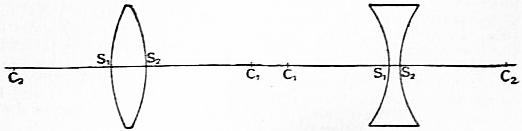
Fig. 1.
Although light is really a wave motion in the aether, it is only necessary, in the investigation of the optical properties of systems of lenses, to trace the rectilinear path of the waves, i.e. the direction of the normal to the wave front, and this can be done by purely geometrical methods. It will be assumed that light, so long as it traverses the same medium, always travels in a straight line; and in following out the geometrical theory it will always be assumed that the light travels from left to right; accordingly all distances measured in this direction are positive, while those measured in the opposite direction are negative.
Theory of Optical Representation.—If a pencil of rays, i.e. the totality of the rays proceeding from a luminous point, falls on a lens or lens system, a section of the pencil, determined by the dimensions of the system, will be transmitted. The emergent rays will have directions differing from those of the incident rays, the alteration, however, being such that the transmitted rays are convergent in the “image-point,” just as the incident rays diverge from the “object-point.” With each incident ray is associated an emergent ray; such pairs are termed “conjugate ray pairs.” Similarly we define an object-point and its image-point as “conjugate points”; all object-points lie in the “object-space,” and all image-points lie in the “image-space.”
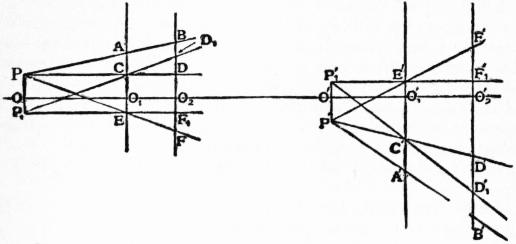
Fig. 2.
The laws of optical representations were first deduced in their most general form by E. Abbe, who assumed (1) that an optical representation always exists, and (2) that to every point in the object-space there corresponds a point in the image-space, these points being mutually convertible by straight rays; in other words, with each object-point is associated one, and only one, image-point, and if the object-point be placed at the image-point, the conjugate point is the original object-point. Such a transformation is termed a “collineation,” since it transforms points into points and straight lines into straight lines. Prior to Abbe, however, James Clerk Maxwell published, in 1856, a geometrical theory of optical representation, but his methods were unknown to Abbe and to his pupils until O. Eppenstein drew attention to them. Although Maxwell’s theory is not so general as Abbe’s, it is used here since its methods permit a simple and convenient deduction of the laws.
Maxwell assumed that two object-planes perpendicular to the axis are represented sharply and similarly in two image-planes also perpendicular to the axis (by “sharply” is meant that the assumed ideal instrument unites all the rays proceeding from an object-point in one of the two planes in its image-point, the rays being generally transmitted by the system). The symmetry of the axis being premised, it is sufficient to deduce laws for a plane containing the axis. In fig. 2 let O1, O2 be the two points in which the perpendicular object-planes meet the axis; and since the axis corresponds to itself, the two conjugate points O′1, O′2, are at the intersections of the two image-planes with the axis. We denote the four planes by the letters O1, O2, and O′1, O′2. If two points A, C be taken in the plane O1, their images are A′, C′ in the plane O′1, and since the planes are represented similarly, we have O′1A′:O1A = O′1C′1:O1C = β1 (say), in which β1 is easily seen to be the linear magnification of the plane-pair O1, O′1. Similarly, if two points B, D be taken in the plane O2 and their images B′, D′ in the plane O′2, we have O′2B′:O2B = O′2D′:O2D = β2 (say), β2 being the linear magnification of the plane-pair O2, O′2. The joins of A and B and of C and D intersect in a point P, and the joins of the conjugate points similarly determine the point P′.
If P′ is the only possible image-point of the object-point P, then the conjugate of every ray passing through P must pass through P′. To prove this, take a third line through P intersecting the planes O1, O2 in the points E, F, and by means of the magnifications β1, β2 determine the conjugate points E′, F′ in the planes O′1, O′2. Since the planes O1, O2 are parallel, then AC/AE = BD/BF; and since these planes are represented similarly in O′1, O′2, then A′C′/A′E′ = B′D′/B′F′. This proportion is only possible when the straight line E′F′ contains the point P′. Since P was any point whatever, it follows that every point of the object-space is represented in one and only one point in the image-space.
Take a second object-point P1, vertically under P and defined by the two rays CD1, and EF1, the conjugate point P′1 will be determined by the intersection of the conjugate rays C′D′1 and E′F′1, the points D′1, F′1, being readily found from the magnifications β1, β2. Since PP1 is parallel to CE and also to DF, then DF = D1F1. Since the plane O2 is similarly represented in O′2, D′F′ = D′1F′1; this is impossible unless P′P′1 be parallel to C′E′. Therefore every perpendicular object-plane is represented by a perpendicular image-plane.
Let O be the intersection of the line PP1 with the axis, and let O′ be its conjugate; then it may be shown that a fixed magnification β3 exists for the planes O and O′. For PP1/FF1 = OO1/O1O2, P′P′1/F′F′1 = O′O′/O′1O′2, and F′F′1 = β2FF1. Eliminating FF1 and F′F′1 between these ratios, we have P′P′1/PP1β2 = O′O′1·O1O2/OO1. O′1O′2, or β3 = β2·O′O′1·O1O2/OO1·O′1O′2, i.e. β3 = β2 × a product of the axial distances.
The determination of the image-point of a given object-point is facilitated by means of the so-called “cardinal points” of the optical system. To determine the image-point O′1 (fig. 3) corresponding to the object-point O1, we begin by choosing from the ray pencil proceeding from O1, the ray parallel with the axis, i.e. intersecting the axis at infinity. Since the axis is its own conjugate, the parallel ray through O1 must intersect the axis after refraction (say at F′). Then F′ is the image-point of an object-point situated at infinity on the axis, and is termed the “second principal focus” (German der bildseitige Brennpunkt, the image-side focus). Similarly if O′4 be on the parallel through O1 but in the image-space, then the conjugate ray must intersect the axis at a point (say F), which is conjugate with the point at infinity on the axis in the image-space. This point is termed the “first principal focus” (German der objektseitige Brennpunkt, the object-side focus).
Let H1, H′1 be the intersections of the focal rays through F and F′ with the line O1O′4. These two points are in the position of object and image, since they are each determined by two pairs of conjugate rays (O1H1 being conjugate with H′1F′, and O′4H′1 with H1F). It has already been shown that object-planes perpendicular to the axis are represented by image-planes also perpendicular to the axis. Two vertical planes through H1 and H′1, are related as object- and image-planes; and if these planes intersect the axis in two points H and H′, these points are named the “principal,” or “Gauss points” of the system, H being the “object-side” and H′ the “image-side principal point.” The vertical planes containing H and H′ are the “principal planes.” It is obvious that conjugate points in these planes are equidistant from the axis; in other words, the magnification β of the pair of planes is unity. An additional characteristic of the principal planes is that the object and image are direct and not inverted. The distances between F and H, and between F′ and H′ are termed the focal lengths; the former may be called the “object-side focal length” and the latter the “image-side focal length.” The two focal points and the two principal points constitute the so-called four cardinal points of the system, and with their aid the image of any object can be readily determined.
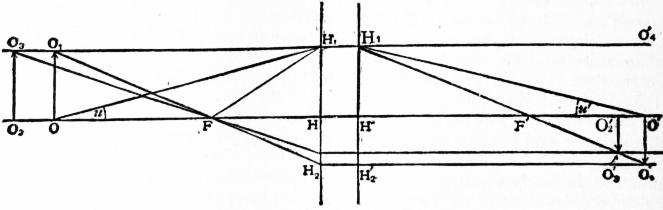
Fig. 3.
Equations relating to the Focal Points.—We know that the ray proceeding from the object point O1, parallel to the axis and intersecting the principal plane H in H1, passes through H′1 and F′. Choose from the pencil a second ray which contains F and intersects the principal plane H in H2; then the conjugate ray must contain points corresponding to F and H2. The conjugate of F is the point at infinity on the axis, i.e. on the ray parallel to the axis. The image of H2 must be in the plane H′ at the same distance from, and on the same side of, the axis, as in H′2. The straight line passing through H′2 parallel to the axis intersects the ray H′1F′ in the point O′1, which must be the image of O1. If O be the foot of the perpendicular from O1 to the axis, then OO1 is represented by the line O′O′1 also perpendicular to the axis.
This construction is not applicable if the object or image be infinitely distant. For example, if the object OO1 be at infinity (O being assumed to be on the axis for the sake of simplicity), so that the object appears under a constant angle w, we know that the second principal focus is conjugate with the infinitely distant axis-point. If the object is at infinity in a plane perpendicular to the axis, the image must be in the perpendicular plane through the focal point F′ (fig. 4).
The size y′ of the image is readily deduced. Of the parallel rays from the object subtending the angle w, there is one which passes through the first principal focus F, and intersects the principal plane H in H1. Its conjugate ray passes through H′ parallel to, and at the same distance from the axis, and intersects the image-side focal plane in O′1; this point is the image of O1, and y′ is its magnitude. From the figure we have tan w = HH1/FH = y′/f, or f = y′/tan w; this equation was used by Gauss to define the focal length.
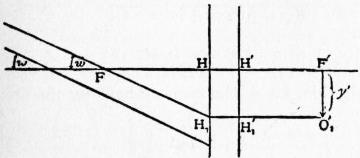
Fig. 4.
Referring to fig. 3, we have from the similarity of the triangles OO1F and HH2F, HH2/OO1 = FH/FO, or O′O′1/OO1 = FH/FO. Let y be the magnitude of the object OO1, y′ that of the image O′O′1, x the focal distance FO of the object, and f the object-side focal distance FH; then the above equation may be written y′/y = f/x. From the similar triangles H′1H′F′ and O′1O′F′, we obtain O′O′1/OO1 = F′O′/F′H′. Let x′ be the focal distance of the image F′O′, and f′ the image-side focal length F′H′; then y′/y = x′/f′. The ratio of the size of the image to the size of the object is termed the lateral magnification. Denoting this by β, we have
β = y′/y = f/x = x′/f′,
(1)
and also
xx′ = ff′.
(2)
By differentiating equation (2) we obtain
dx′= −(ff′/x2) dx or dx′/dx = −ff′/x2.
(3)
The ratio of the displacement of the image dx′ to the displacement of the object dx is the axial magnification, and is denoted by α. Equation (3) gives important information on the displacement of the image when the object is moved. Since f and f′ always have contrary signs (as is proved below), the product −ff′ is invariably positive, and since x2 is positive for all values of x, it follows that dx and dx′ have the same sign, i.e. the object and image always move in the same direction, either both in the direction of the light, or both in the opposite direction. This is shown in fig. 3 by the object O3O2 and the image O′3O′2.
If two conjugate rays be drawn from two conjugate points on the axis, making angles u and u′ with the axis, as for example the rays OH1, O′H′1, in fig. 3, u is termed the “angular aperture for the object,” and u′ the “angular aperture for the image.” The ratio of the tangents of these angles is termed the “convergence” and is denoted by γ, thus γ = tan u′/tan u. Now tan u′= H′H′1/O′H′ = H′H′1/(O′F′ + F′H′) = H′H′1/(F′H′ − F′O′). Also tan u = HH1/OH = HH1/(OF + FH) = HH1/(FH − FO). Consequently γ = (FH − FO)/(F′H′ − F′O′), or, in our previous notation, γ = (f − x)/(f′ − x′).
From equation (1) f/x = x′/f′, we obtain by subtracting unity from both sides (f − x)/x = (x′ − f′)/f′, and consequently
f − x = − x = − f = γ.
f′ − x′ f′ x′
(4)
From equations (1), (3) and (4), it is seen that a simple relation exists between the lateral magnification, the axial magnification and the convergence, viz. αγ = β.
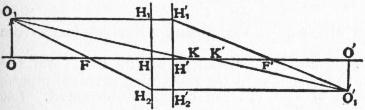
Fig. 5.
In addition to the four cardinal points F, H, F′, H′, J. B. Listing, “Beiträge aus physiologischen Optik,” Göttinger Studien (1845) introduced the so-called “nodal points” (Knotenpunkte) of the system, which are the two conjugate points from which the object and image appear under the same angle. In fig. 5 let K be the nodal point from which the object y appears under the same angle as the image y′ from the other nodal point K′. Then OO1/KO = O′O′1/K′O′, or OO1/(KF + FO) = O′O′1/(K′F′+ F′O′), or OO1/(FO − FK) = O′O′1/(F′O′− F′K′). Calling the focal distances FK and F′K′, X and X′, we have y/(x − X) = y′/(x′− X′), and since y′/y = β, it follows that 1/(x − X) = β/(x′− X′). Replace x′ and X′ by the values given in equation (2), and we obtain
1 = β / ( ff′ − ff′ ) or 1 = −β xX .
x − X x X ff′
Since β = f/x = x′/f′, we have f′ = −X, f = −X′.
These equations show that to determine the nodal points, it is only necessary to measure the focal distance of the second principal focus from the first principal focus, and vice versa. In the special case when the initial and final medium is the same, as for example, a lens in air, we have f = −f′, and the nodal points coincide with the principal points of the system; we then speak of the “nodal point property of the principal points,” meaning that the object and corresponding image subtend the same angle at the principal points.
Equations Relating to the Principal Points.—It is sometimes desirable to determine the distances of an object and its image, not from the focal points, but from the principal points. Let A (see fig. 3) be the principal point distance of the object and A′ that of the image, we then have
A = HO = HF + FO = FO − FH = x − f, A′ = H′O′ = H′F′ + F′O′ = F′O′ − F′H′ = x′ − f′,
whence
x = A + f and x′ = A′ + f′.
Using xx′ = ff′, we have (A + f)(A′ + f′) = ff′, which leads to AA′ + Af′ + A′f = O, or
1 + f′ + f = O;
A′ A
this becomes in the special case when f = -f′,
1 − 1 = 1 .
A′ A f
To express the linear magnification in terms of the principal point distances, we start with equation (4) (f − x)/(f′ − x′) = −x/f′. From this we obtain A/A′ = -x/f′, or x = −f′A/A′; and by using equation (1) we have β = −fA′/f′A.
In the special case of f = −f′, this becomes β = A′/A = y′/y, from which it follows that the ratio of the dimensions of the object and image is equal to the ratio of the distances of the object and image from the principal points.
The convergence can be determined in terms of A and A′ by substituting x = −f′A/A′ in equation (4), when we obtain γ = A/A′.
Compound Systems.—In discussing the laws relating to compound systems, we assume that the cardinal points of the component systems are known, and also that the combinations are centred, i.e. that the axes of the component lenses coincide. If some object be represented by two systems arranged one behind the other, we can regard the systems as co-operating in the formation of the final image.
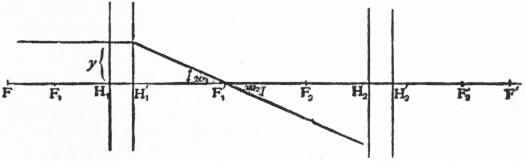
Fig. 6.
Let such a system be represented in fig. 6. The two single systems are denoted by the suffixes 1 and 2; for example, F1 is the first principal focus of the first, and F′2 the second principal focus of the second system. A ray parallel to the axis at a distance y passes through the second principal focus F′1 of the first system, intersecting the axis at an angle w′1. The point F′1 will be represented in the second system by the point F′, which is therefore conjugate to the point at infinity for the entire system, i.e. it is the second principal focus of the compound system. The representation of F′1 in F′ by the second system leads to the relations F2F′1 = x2, and F′2F′ = x′2, whence x2x′2 = f2f′2. Denoting the distance between the adjacent focal planes F′1, F2 by Δ, we have Δ = F′1F2 = −F2F′1, so that x′2 = -f2f′2/Δ. A similar ray parallel to the axis at a distance y proceeding from the image-side will intersect the axis at the focal point F2; and by finding the image of this point in the first system, we determine the first principal focus of the compound system. Equation (2) gives x1x′1 = f1f′1, and since x′1 = F′1F2 = Δ, we have x1 = f1f′1/Δ as the distance of the first principal focus F of the compound system from the first principal focus F1 of the first system.
To determine the focal lengths f and f′ of the compound system and the principal points H and H′, we employ the equations defining the focal lengths, viz. f = y′/tan w, and f′ = y/tan w′. From the construction (fig. 6) tan w′1 = y/f′1. The variation of the angle w′1 by the second system is deduced from the equation to the convergence, viz. γ = tan w′2/tan w2 = −x2/f′2 = Δ/f′2, and since w2 = w′1, we have tan w′2 = (Δ/f′2) tan w′1. Since w′ = w′2 in our system of notation, we have
f′ = y = yf′2 = f′1·f′2 .
tan w′ Δ tan w′1 Δ
By taking a ray proceeding from the image-side we obtain for the first principal focal distance of the combination
f = −f1f2/Δ.
In the particular case in which Δ = 0, the two focal planes F′1, F2 coincide, and the focal lengths f, f′ are infinite. Such a system is called a telescopic system, and this condition is realized in a telescope focused for a normal eye.
So far we have assumed that all the rays proceeding from an object-point are exactly united in an image-point after transmission through the ideal system. The question now arises as to how far this assumption is justified for spherical lenses. To investigate this it is simplest to trace the path of a ray through one spherical refracting surface. Let such a surface divide media of refractive indices n and n′, the former being to the left. The point where the axis intersects the surface is the vertex S (fig. 7). Denote the distance of the axial object-point O from S by s; the distance from O to the point of incidence P by p; the radius of the spherical surface by r; and the distance OC by c, C being the centre of the sphere. Let u be the angle made by the ray with the axis, and i the angle of incidence, i.e. the angle between the ray and the normal to the sphere at the point of incidence. The corresponding quantities in the image-space are denoted by the same letters with a dash. From the triangle O′PC we have sin u = (r/c) sin i, and from the triangle O′PC we have sin u′ = (r/c′) sin i′. By Snell’s law we have n′/n = sin i/sin i′, and also φ = u′ + i′. Consequently c′ and the position of the image may be found.
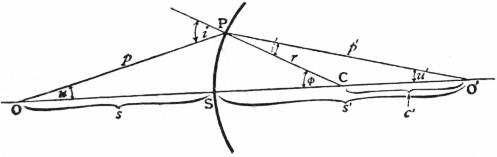
Fig. 7.
To determine whether all the rays proceeding from O are refracted through O′, we investigate the triangle OPO′. We have p/p′ = sin u′/sin u. Substituting for sin u and sin u′ the values found above, we obtain p′/p = c′ sin i/c sin i′ = n′c′/nc. Also c = OC = CS + SO = −SC + SO = s − r, and similarly c′ = s′ − r. Substituting these values we obtain
p′ = n′(s′ − r) , or n(s − r) = n′(s′ − r) .
p n(s − r) p p′
(6)
To obtain p and p′ we use the triangles OPC and O′PC; we have p2 = (s − r)2 + r2 + 2r(s − r) cos φ, p′2 = (s′ − r)2 + r2 + 2r(s′ − r) cos φ. Hence if s, r, n and n′ be constant, s′ must vary as φ varies. The refracted rays therefore do not reunite in a point, and the deflection is termed the spherical aberration (see Aberration).
Developing cos φ in powers of φ, we obtain
p2 = (s − r)2 + r2 + 2r(s − r) { 1 − φ2 + φ4 − φ6 + ... },
2! 4! 6!
and therefore for such values of φ for which the second and higher powers may be neglected, we have p2 = (s − r)2 + r2 + 2r(s − r), i.e. p = s, and similarly p′ = s′. Equation (6) then becomes n(s − r)/s = n′(s′ − r)/s′ or
n′ = n + n′ − n .
s′ s r
(7)
This relation shows that in a very small central aperture in which the equation p = s holds, all rays proceeding from an object-point are exactly united in an image-point, and therefore the equations previously deduced are valid for this aperture. K. F. Gauss derived the equations for thin pencils in his Dioptrische Untersuchungen (1840) by very elegant methods. More recently the laws relating to systems with finite aperture have been approximately realized, as for example, in well-corrected photographic objectives.
Position of the Cardinal Points of a Lens.—Taking the case of a single spherical refracting surface, and limiting ourselves to the small central aperture, it is seen that the second principal focus F′ is obtained when s is infinitely great. Consequently s′ = -f′; the difference of sign is obvious, since s′ is measured from S, while f′ is measured from F′. The focal lengths are directly deducible from equation (7):—
f′ = −n′r / (n′ − n)
(8)
f = nr / (n′ − n).
(9)
By joining this simple refracting system with a similar one, so that the second spherical surface limits the medium of refractive index n′, we derive the spherical lens. Generally the two spherical surfaces enclose a glass lens, and are bounded on the outside by air of refractive index 1.
The deduction of the cardinal points of a spherical glass lens in air from the relations already proved is readily effected if we regard the lens as a combination of two systems each having one refracting surface, the light passing in the first system from air to glass, and in the second from glass to air. If we know the refractive index of the glass n, the radii r1, r2 of the spherical surfaces, and the distances of the two lens-vertices (or the thickness of the lens d) we can determine all the properties of the lens. A biconvex lens is shown in fig. 8. Let F1 be the first principal focus of the first system of radius r1, and F1′ the second principal focus; and let S1 be its vertex. Denote the distance F1 S1 (the first principal focal length) by f1, and the corresponding distance F′1 S1 by f′1. Let the corresponding quantities in the second system be denoted by the same letters with the suffix 2.
By equations (8) and (9) we have
f1 = r1 , f′1 = − nr1 , f2 = − nr2 , f′2 = r2 ,
n − 1 n − 1 n − 1 n − 1
f2 having the opposite sign to f1. Denoting the distance F′1F2 by Δ, we have Δ = F′1F2 = F′1S1 + S1S2 + S2F2 = F′1S1 + S1S2 − F2S2 = f′1 + d − f2. Substituting for f′1 and f2 we obtain
Δ = − nr1 + d + nr2 .
n − 1 n − 1
Writing R = Δ(n − 1), this relation becomes
R = n(r2 − r1) + d(n − 1).
We have already shown that f (the first principal focal length of a compound system) = −f1f2/Δ. Substituting for f1, f2 and Δ the values found above, we obtain
f = r1r2n = r1r2n ,
(n − 1)R (n − 1) {n (r2 − r1) + d(n − 1)}
(10)
which is equivalent to
1 = (n − 1) { 1 − 1 } + (n − 1)2 d .
f r1 r2 r1r2n
If the lens be infinitely thin, i.e. if d be zero, we have for the first principal focal length.
1 = (n − 1) { 1 − 1 }.
f r1 r2
By the same method we obtain for the second principal focal length
f′ = f′1f′2 = − nr1r2 = −f.
Δ (n − 1)R
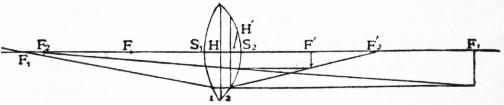
Fig. 8.
The reciprocal of the focal length is termed the power of the lens and is denoted by φ. In formulae involving φ it is customary to denote the reciprocal of the radii by the symbol ρ; we thus have φ = 1/f, ρ = 1/r. Equation (10) thus becomes
φ = (n − 1) (ρ1 − ρ2) + (n − 1)2 dρ1ρ2 .
n
The unit of power employed by spectacle-makers is termed the diopter or dioptric (see Spectacles).
We proceed to determine the distances of the focal points from the vertices of the lens, i.e. the distances FS1 and F′S2. Since F is represented by the first system in F2, we have by equation (2)
x1 = f1f′1 = f1f′1 = − nr12 ,
x′1 Δ (n − 1)R
where x1 = F1F, and x′1 = F′1F2 = Δ. The distance of the first principal focus from the vertex S, i.e. S1F, which we denote by sF is given by sF = S1F = S1F1 + F1F = −F1S1 + F1F. Now F1S1 is the distance from the vertex of the first principal focus of the first system, i.e. f1 and F1F = x1. Substituting these values, we obtain
sF = − r1 − nr12 = − r1 (nr1 + R) .
n − 1 (n − 1)R (n − 1)R
The distance F′2F′ or x′2 is similarly determined by considering F′1 to be represented by the second system in F′.
We have
x′2 = f2f′2 = − f2f′2 = nr22 ,
x2 Δ (n − 1)R
so that
sF′ = x′2 − f′2 = r2 (nr2 − R) ,
(n − 1)R
where sF′ denotes the distance of the second principal focus from the vertex S2.
The two focal lengths and the distances of the foci from the vertices being known, the positions of the remaining cardinal points, i.e. the principal points H and H′, are readily determined. Let sH = S1H, i.e. the distance of the object-side principal point from the vertex of the first surface, and sH′ = S2H′, i.e. the distance of the image-side principal point from the vertex of the second surface, then f = FH = FS1 + S1H = −S1F + S1H = −sF + sH; hence sH = sF + f = −dr1/R. Similarly sH′ = sF′ + f′ = −dr2/R. It is readily seen that the distances sH and sH′ are in the ratio of the radii r1 and r2.
The distance between the two principal planes (the interstitium) is deduced very simply. We have S1S2 = S1H + HH′ + H′S2, or HH′ = S1S2 − S1H + S2H′. Substituting, we have
HH′ = d − sH + sH′ = d(n − 1) (r2 − r1 + d)/R.
The interstitium becomes zero, or the two principal planes coincide, if d = r1 − r2.
We have now derived all the properties of the lens in terms of its elements, viz. the refractive index, the radii of the surfaces, and the thickness.
Forms of Lenses.—By varying the signs and relative magnitude of the radii, lenses may be divided into two groups according to their action, and into four groups according to their form.
According to their action, lenses are either collecting, convergent and condensing, or divergent and dispersing; the term positive is sometimes applied to the former, and the term negative to the latter. Convergent lenses transform a parallel pencil into a converging one, and increase the convergence, and diminish the divergence of any pencil. Divergent lenses, on the other hand, transform a parallel pencil into a diverging one, and diminish the convergence, and increase the divergence of any pencil. In convergent lenses the first principal focal distance is positive and the second principal focal distance negative; in divergent lenses the converse holds.
The four forms of lenses are interpretable by means of equation (10).
f = r1r2n .
(n − 1) { n (r2 − r1) + d(n − 1)}
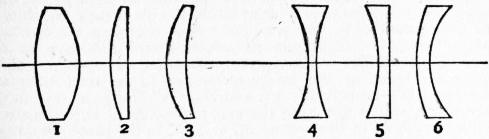
Fig. 9.
(1) If r1 be positive and r2 negative. This type is called biconvex (fig. 9, 1). The first principal focus is in front of the lens, and the second principal focus behind the lens, and the two principal points are inside the lens. The order of the cardinal points is therefore FS1HH′S2F′. The lens is convergent so long as the thickness is less than n(r1 − r2)/(n − 1). The special case when one of the radii is infinite, in other words, when one of the bounding surfaces is plane is shown in fig. 9, 2. Such a collective lens is termed plano-convex. As d increases, F and H move to the right and F′ and H′ to the left. If d = n(r1 − r2)/(n − 1), the focal length is infinite, i.e. the lens is telescopic. If the thickness be greater than n(r1 − r2)/(n − 1), the lens is dispersive, and the order of the cardinal points is HFS1S2F′H′.
(2) If r1 is negative and r2 positive. This type is called biconcave (fig. 9, 4). Such lenses are dispersive for all thicknesses. If d increases, the radii remaining constant, the focal lengths diminish. It is seen from the equations giving the distances of the cardinal points from the vertices that the first principal focus F is always behind S1, and the second principal focus F′ always in front of S2, and that the principal points are within the lens, H′ always following H. If one of the radii becomes infinite, the lens is plano-concave (fig. 9, 5).
(3) If the radii are both positive. These lenses are called convexo-concave. Two cases occur according as r2 > r1, or < r1. (a) If r2 > r1, we obtain the mensicus (fig. 9, 3). Such lenses are always collective; and the order of the cardinal points is FHH′F′. Since sF and sH are always negative, the object-side cardinal points are always in front of the lens. H′ can take up different positions. Since sH′ = −dr2/R = −dr2/{n (r2 − r1) + d(n − 1)}, sH′ is greater or less than d, i.e. H′ is either in front of or inside the lens, according as d < or > {r2 − n(r2 − r1)}/(n − 1). (b) If r2 < r1 the lens is dispersive so long as d < n(r1 − r2)/(n − 1). H is always behind S1 and H′ behind S2, since sH and sH′ are always positive. The focus F is always behind S1 and F′ in front of S2. If the thickness be small, the order of the cardinal points is F′HH′F; a dispersive lens of this type is shown in fig. 9, 6. As the thickness increases, H, H′ and F move to the right, F more rapidly than H, and H more rapidly than H′; F′, on the other hand, moves to the left. As with biconvex lenses, a telescopic lens, having all the cardinal points at infinity, results when d = n(r1 − r2)/(n − 1). If d > n(r1 − r2)/(n − 1), f is positive and the lens is collective. The cardinal points are in the same order as in the mensicus, viz. FHH′F′; and the relation of the principal points to the vertices is also the same as in the mensicus.
(4) If r1 and r2 are both negative. This case is reduced to (3) above, by assuming a change in the direction of the light, or, in other words, by interchanging the object- and image-spaces.
The six forms shown in fig. 9 are all used in optical constructions. It may be stated fairly generally that lenses which are thicker at the middle are collective, while those which are thinnest at the middle are dispersive.
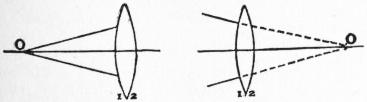
Fig. 10.
Different Positions of Object and Image.—The principal points are always near the surfaces limiting the lens, and consequently the lens divides the direct pencil containing the axis into two parts. The object can be either in front of or behind the lens as in fig. 10. If the object point be in front of the lens, and if it be realized by rays passing from it, it is called real. If, on the other hand, the object be behind the lens, it is called virtual; it does not actually exist, and can only be realized as an image.
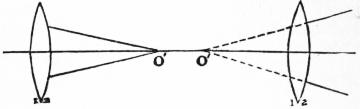
Fig. 11.
When we speak of “object-points,” it is always understood that the rays from the object traverse the first surface of the lens before meeting the second. In the same way, images may be either real or virtual. If the image be behind the second surface, it is real, and can be intercepted on a screen. If, however, it be in front of the lens, it is visible to an eye placed behind the lens, although the rays do not actually intersect, but only appear to do so, but the image cannot be intercepted on a screen behind the lens. Such an image is said to be virtual. These relations are shown in fig. 11.
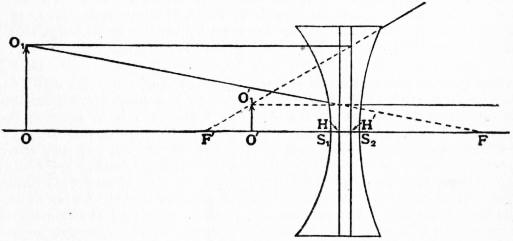
Fig. 12.
By referring to the equations given above, it is seen that a thin convergent lens produces both real and virtual images of real objects, but only a real image of a virtual object, whilst a divergent lens produces a virtual image of a real object and both real and virtual images of a virtual object. The construction of a real image of a real object by a convergent lens is shown in fig. 3; and that of a virtual image of a real object by a divergent lens in fig. 12.
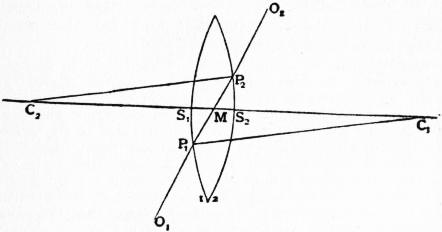
Fig. 13.
The optical centre of a lens is a point such that, for any ray which passes through it, the incident and emergent rays are parallel. The idea of the optical centre was originally due to J. Harris (Treatise on Optics, 1775); it is not properly a cardinal point, although it has several interesting properties. In fig. 13, let C1P1 and C2P2 be two parallel radii of a biconvex lens. Join P1P2 and let O1P1 and O2P2 be incident and emergent rays which have P1P2 for the path through the lens. Then if M be the intersection of P1P2 with the axis, we have angle C1P1M = angle C2P2M; these two angles are—for a ray travelling in the direction O1P1P2O2—the angles of emergence and of incidence respectively. From the similar triangles C2P2M and C1P1M we have
C1M : C2M = C1P1 : C2P2 = r1 : r2.
(11)
Such rays as P1P2 therefore divide the distance C1C2 in the ratio of the radii, i.e. at the fixed point M, the optical centre. Calling S1M = s1, S2M = s2, then C1S1 = C1M + MS1 = C1M − S1M, i.e. since C1S1 = r1, C1M = r1 + s1, and similarly C2M = r2 + s2. Also S1S2 = S1M + MS2 = S1M − S2M, i.e. d = s1 − s2. Then by using equation (11) we have s1 = r1d/(r − r2) and s2 = r2d/(r1 − r2), and hence s1/s2 = r1/r2. The vertex distances of the optical centre are therefore in the ratio of the radii.
The values of s1 and s2 show that the optical centre of a biconvex or biconcave lens is in the interior of the lens, that in a plano-convex or plano-concave lens it is at the vertex of the curved surface, and in a concavo-convex lens outside the lens.
The Wave-theory Derivation of the Focal Length.—The formulae above have been derived by means of geometrical rays. We here give an account of Lord Rayleigh’s wave-theory derivation of the focal length of a convex lens in terms of the aperture, thickness and refractive index (Phil. Mag. 1879 (5) 8, p. 480; 1885, 20, p. 354); the argument is based on the principle that the optical distance from object to image is constant.
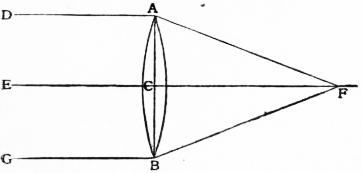
Fig. 14.
“Taking the case of a convex lens of glass, let us suppose that parallel rays DA, EC, GB (fig. 14) fall upon the lens ACB, and are collected by it to a focus at F. The points D, E, G, equally distant from ACB, lie upon a front of the wave before it impinges upon the lens. The focus is a point at which the different parts of the wave arrive at the same time, and that such a point can exist depends upon the fact that the propagation is slower in glass than in air. The ray ECF is retarded from having to pass through the thickness (d) of glass by the amount (n − 1)d. The ray DAF, which traverses only the extreme edge of the lens, is retarded merely on account of the crookedness of its path, and the amount of the retardation is measured by AF − CF. If F is a focus these retardations must be equal, or AF − CF = (n − 1)d. Now if y be the semi-aperture AC of the lens, and f be the focal length CF, AF − CF = √(f2 + y2) − f = ½y2/f approximately, whence