VOLUME XVI SLICE IV Lefebvre, Tanneguy to Letronne, Jean Antoine (continued 6)
Reading edition
f = ½y2 / (n − 1)d.
(12)
In the case of plate-glass (n − 1) = ½ (nearly), and then the rule (12) may be thus stated: the semi-aperture is a mean proportional between the focal length and the thickness. The form (12) is in general the more significant, as well as the more practically useful, but we may, of course, express the thickness in terms of the curvatures and semi-aperture by means of d = ½y2 (r1−1 − r2−1). In the preceding statement it has been supposed for simplicity that the lens comes to a sharp edge. If this be not the case we must take as the thickness of the lens the difference of the thicknesses at the centre and at the circumference. In this form the statement is applicable to concave lenses, and we see that the focal length is positive when the lens is thickest at the centre, but negative when the lens is thickest at the edge.”
Regulation of the Rays.
The geometrical theory of optical instruments can be conveniently divided into four parts: (1) The relations of the positions and sizes of objects and their images (see above); (2) the different aberrations from an ideal image (see Aberration); (3) the intensity of radiation in the object- and image-spaces, in other words, the alteration of brightness caused by physical or geometrical influences; and (4) the regulation of the rays (Strahlenbegrenzung).
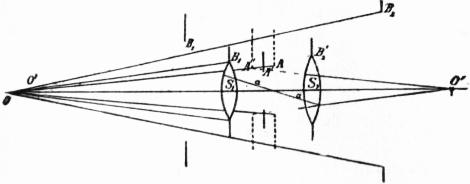
Fig. 15.
The regulation of rays will here be treated only in systems free from aberration. E. Abbe first gave a connected theory; and M. von Rohr has done a great deal towards the elaboration. The Gauss cardinal points make it simple to construct the image of a given object. No account is taken of the size of the system, or whether the rays used for the construction really assist in the reproduction of the image or not. The diverging cones of rays coming from the object-points can only take a certain small part in the production of the image in consequence of the apertures of the lenses, or of diaphragms. It often happens that the rays used for the construction of the image do not pass through the system; the image being formed by quite different rays. If we take a luminous point of the object lying on the axis of the system then an eye introduced at the image-point sees in the instrument several concentric rings, which are either the fittings of the lenses or their images, or the real diaphragms or their images. The innermost and smallest ring is completely lighted, and forms the origin of the cone of rays entering the image-space. Abbe called it the exit pupil. Similarly there is a corresponding smallest ring in the object-space which limits the entering cone of rays. This is called the entrance pupil. The real diaphragm acting as a limit at any part of the system is called the aperture-diaphragm. These diaphragms remain for all practical purposes the same for all points lying on the axis. It sometimes happens that one and the same diaphragm fulfils the functions of the entrance pupil and the aperture-diaphragm or the exit pupil and the aperture-diaphragm.
Fig. 15 shows the general but simplified case of the different diaphragms which are of importance for the regulation of the rays. S1, S2 are two centred systems. A′ is a real diaphragm lying between them. B1 and B′2 are the fittings of the systems. Then S1 produces the virtual image A of the diaphragm A′ and the image B2 of the fitting B′2, whilst the system S2 makes the virtual image A″ of the diaphragm A′ and the virtual image B′1 of the fitting B1. The object-point O is reproduced really through the whole system in the point O′. From the object-point O three diaphragms can be seen in the object-space, viz. the fitting B1, the image of the fitting B2 and the image A of the diaphragm A′ formed by the system S1. The cone of rays nearest to B2 is not received to its total extent by the fitting B1, and the cone which has entered through B1 is again diminished in its further course, when passing through the diaphragm A′, so that the cone of rays really used for producing the image is limited by A, the diaphragm which seen from O appears to be the smallest. A is therefore the entrance pupil. The real diaphragm A′ which limits the rays in the centre of the system is the aperture diaphragm. Similarly three diaphragms lying in the image-space are to be seen from the image-point O′—namely B′, A″, and B′2. A″ limits the rays in the image-space, and is therefore the exit pupil. As A is conjugate to the diaphragm A′ in the system S1, and A″ to the same diaphragm A′ in the system S2, the entrance pupil A is conjugate to the exit pupil A″ throughout the instrument. This relation between entrance and exit pupils is general.
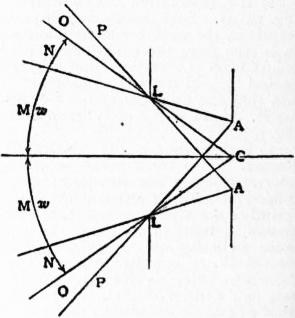
Fig. 16.
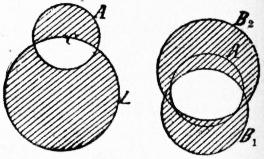
Fig. 17a. Fig. 17b.
The apices of the cones of rays producing the image of points near the axis thus lie in the object-points, and their common base is the entrance pupil. The axis of such a cone, which connects the object point with the centre of the entrance pupil, is called the principal ray. Similarly, the principal rays in the image-space join the centre of the exit pupil with the image-points. The centres of the entrance and exit pupils are thus the intersections of the principal rays.
For points lying farther from the axis, the entrance pupil no longer alone limits the rays, the other diaphragms taking part. In fig. 16 only one diaphragm L is present besides the entrance pupil A, and the object-space is divided to a certain extent into four parts. The section M contains all points rendered by a system with a complete aperture; N contains all points rendered by a system with a gradually diminishing aperture; but this diminution does not attain the principal ray passing through the centre C. In the section O are those points rendered by a system with an aperture which gradually decreases to zero. No rays pass from the points of the section P through the system and no image can arise from them. The second diaphragm L therefore limits the three-dimensional object-space containing the points which can be rendered by the optical system. From C through this diaphragm L this three-dimensional object-space can be seen as through a window. L is called by M von Rohr the entrance luke. If several diaphragms can be seen from C, then the entrance luke is the diaphragm which seen from C appears the smallest. In the sections N and O the entrance luke also takes part in limiting the cones of rays. This restriction is known as the “vignetting” action of the entrance luke. The base of the cone of rays for the points of this section of the object-space is no longer a circle but a two-cornered curve which arises from the object-point by the projection of the entrance luke on the entrance pupil. Fig. 17a shows the base of such a cone of rays. It often happens that besides the entrance luke, another diaphragm acts in a vignetting manner, then the operating aperture of the cone of rays is a curve made up of circular arcs formed out of the entrance pupil and the two projections of the two acting diaphragms (fig. 17b).
If the entrance pupil is narrow, then the section NO, in which the vignetting is increasing, is diminished, and there is really only one division of the section M which can be reproduced, and of the section P which cannot be reproduced. The angle w + w = 2w, comprising the section which can be reproduced, is called the angle of the field of view on the object-side. The field of view 2w retains its importance if the entrance pupil is increased. It then comprises all points reached by principal rays. The same relations apply to the image-space, in which there is an exit luke, which, seen from the middle of the exit pupil, appears under the smallest angle. It is the image of the entrance luke produced by the whole system. The image-side field of view 2w′ is the angle comprised by the principal rays reaching the edge of the exit luke.
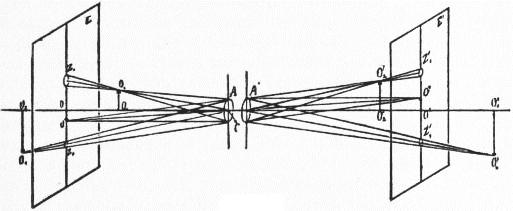
Fig. 18.
Most optical instruments are used to observe object-reliefs (three-dimensional objects), and generally an image-relief (a three-dimensional image) is conjugate to this object-relief. It is sometimes required, however, to represent by means of an optical instrument the object-relief on a plane or on a ground-glass as in the photographic camera. For simplicity we shall assume the intercepting plane as perpendicular to the axis and shall call it, after von Rohr, the “ground glass plane.” All points of the image not lying in this plane produce circular spots (corresponding to the form of the pupils) on it, which are called “circles of confusion.” The ground-glass plane (fig. 18) is conjugate to the object-plane E in the object-space, perpendicular to the axis, and called the “plane focused for.” All points lying in this plane are reproduced exactly on the ground-glass plane as the points OO. The circle of confusion Z on the plane focused for corresponds to the circle of confusion Z′ on the ground-glass plane. The figure formed on the plane focused for by the cones of rays from all of the object-points of the total object-space directed to the entrance pupil, was called “object-side representation” (imago) by M von Rohr. This representation is a central projection. If, for instance, the entrance pupil is imagined so small that only the principal rays pass through, then they project directly, and the intersections of the principal rays represent the projections of the points of the object lying off the plane focused for. The centre of the projection or the perspective centre is the middle point of the entrance pupil C. If the entrance pupil is opened, in place of points, circles of confusion appear, whose size depends upon the size of the entrance pupil and the position of the object-points and the plane focused for. The intersection of the principal ray is the centre of the circle of confusion. The clearness of the representation on the plane focused for is of course diminished by the circles of confusion. This central projection does not at all depend upon the instrument, but is entirely geometrical, arising when the position and the size of the entrance pupil, and the position of the plane focused for have been fixed. The instrument then produces an image on the ground-glass plane of this perspective representation on the plane focused for, and on account of the exact likeness which this image has to the object-side representation it is called the “representation copy.” By moving it round an angle of 180°, this representation can be brought into a perspective position to the objects, so that all rays coming from the middle of the entrance pupil and aiming at the object-points, would always meet the corresponding image-points. This representation is accessible to the observer in different ways in different instruments. If the observer desires a perfectly correct perspective impression of the object-relief the distance of the pivot of the eye from the representation copy must be equal to the nth part of the distance of the plane focused for from the entrance pupil, if the instrument has produced a nth diminution of the object-side representation. The pivot of the eye must coincide with the centre of the perspective, because all images are observed in direct vision. It is known that the pivot of the eye is the point of intersection of all the directions in which one can look. Thus all these points represented by circles of confusion which are less than the angular sharpness of vision appear clear to the eye; the space containing all these object-points, which appear clear to the eye, is called the depth. The depth of definition, therefore, is not a special property of the instrument, but depends on the size of the entrance pupil, the position of the plane focused for and on the conditions under which the representation can be observed.
If the distance of the representation from the pivot of the eye be altered from the correct distance already mentioned, the angles of vision under which various objects appear are changed; perspective errors arise, causing an incorrect idea to be given of the depth. A simple case is shown in fig. 19. A cube is the object, and if it is observed as in fig. 19a with the representation copy at the correct distance, a correct idea of a cube will be obtained. If, as in figs. 19b and 19c, the distance is too great, there can be two results. If it is known that the farthest section is just as high as the nearer one then the cube appears exceptionally deepened, like a long parallelepipedon. But if it is known to be as deep as it is high then the eye will see it low at the back and high at the front. The reverse occurs when the distance of observation is too short, the body then appears either too flat, or the nearer sections seem too low in relation to those farther off. These perspective errors can be seen in any telescope. In the telescope ocular the representation copy has to be observed under too large an angle or at too short a distance: all objects therefore appear flattened, or the more distant objects appear too large in comparison with those nearer at hand.

After von Rohr.
Fig. 19.
After von Rohr. After von Rohr.
Fig. 20. Fig. 21.
After von Rohr.
Fig. 22.
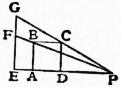
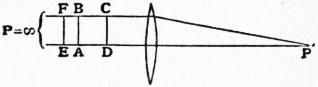
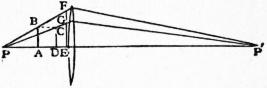
From the above the importance of experience will be inferred. But it is not only necessary that the objects themselves be known to the observer but also that they are presented to his eye in the customary manner. This depends upon the way in which the principal rays pass through the system—in other words, upon the special kind of “transmission” of the principal rays. In ordinary vision the pivot of the eye is the centre of the perspective representation which arises on the very distant plane standing perpendicular to the mean direction of sight. In this kind of central projection all objects lying in front of the plane focused for are diminished when projected on this plane, and those lying behind it are magnified. (The distances are always given in the direction of light.) Thus the objects near to the eye appear large and those farther from it appear small. This perspective has been called by M von Rohr1 “entocentric transmission” (fig. 20). If the entrance pupil of the instrument lies at infinity, then all the principal rays are parallel and the projections of all objects on the plane focused for are exactly as large as the objects themselves. After E. Abbe, this course of rays is called “telecentric transmission” (fig. 21). The exit pupil then lies in the image-side focus of the system. If the perspective centre lies in front of the plane focused for, then the objects lying in front of this plane are magnified and those behind it are diminished. This is just the reverse of perspective representation in ordinary sight, so that the relations of size and the arrangements for space must be quite incorrectly indicated (fig. 22); this representation is called by M von Rohr a “hypercentric transmission.”
(O. Hr.)
1 M von Rohr, Zeitschr. für Sinnesphysiologie (1907), xli. 408-429.

LENT (O. Eng. lencten, “spring,” M. Eng. lenten, lente, lent; cf. Dut. lente, Ger. Lenz, “spring,” O. H. Ger. lenzin, lengizin, lenzo, probably from the same root as “long” and referring to “the lengthening days”), in the Christian Church, the period of fasting preparatory to the festival of Easter. As this fast falls in the early part of the year, it became confused with the season, and gradually the word Lent, which originally meant spring, was confined to this use. The Latin name for the fast, Quadragesima (whence Ital. quaresima, Span. cuaresma and Fr. carême), and its Gr. equivalent τεσσαρακοστή (now superseded by the term ἡ νηστεία “the fast”), are derived from the Sunday which was the fortieth day before Easter, as Quinquagesima and Sexagesima are the fiftieth and sixtieth, Quadragesima being until the 7th century the caput jejunii or first day of the fast.
The length of this fast and the rigour with which it has been observed have varied greatly at different times and in different countries (see Fasting). In the time of Irenaeus the fast before Easter was very short, but very severe; thus some ate nothing for forty hours between the afternoon of Good Friday and the morning of Easter. This was the only authoritatively prescribed fast known to Tertullian (De jejunio, 2, 13, 14; De oratione, 18). In Alexandria about the middle of the 3rd century it was already customary to fast during Holy Week; and earlier still the Montanists boasted that they observed a two weeks’ fast instead of one. Of the Lenten fast or Quadragesima, the first mention is in the fifth canon of the council of Nicaea (325), and from this time it is frequently referred to, but chiefly as a season of preparation for baptism, of absolution of penitents or of retreat and recollection. In this season fasting played a part, but it was not universally nor rigorously enforced. At Rome, for instance, the whole period of fasting was but three weeks, according to the historian Socrates (Hist. eccl. v. 22), these three weeks, in Mgr. Duchesne’s opinion, being not continuous but, following the primitive Roman custom, broken by intervals. Gradually, however, the fast as observed in East and West became more rigorously defined. In the East, where after the example of the Church of Antioch the Quadragesima fast had been kept distinct from that of Holy Week, the whole fast came to last for seven weeks, both Saturdays and Sundays (except Holy Saturday) being, however, excluded. In Rome and Alexandria, and even in Jerusalem, Holy Week was included in Lent and the whole fast lasted but six weeks, Saturdays, however, not being exempt. Both at Rome and Constantinople, therefore, the actual fast was but thirty-six days. Some Churches still continued the three weeks’ fast, but by the middle of the 5th century most of these divergences had ceased and the usages of Antioch-Constantinople and Rome-Alexandria had become stereotyped in their respective spheres of influence.
The thirty-six days, as forming a tenth part of the year and therefore a perfect number, at first found a wide acceptance (so Cassianus, Coll. xxi. 30); but the inconsistency of this period with the name Quadragesima, and with the forty days’ fast of Christ, came to be noted, and early in the 7th century four days were added, by what pope is unknown, Lent in the West beginning henceforth on Ash Wednesday (q.v.). About the same time the cycle of paschal solemnities was extended to the ninth week before Easter by the institution of stational masses for Septuagesima, Sexagesima and Quinquagesima Sundays. At Constantinople, too, three Sundays were added and associated with the Easter festival in the same way as the Sundays in Lent proper. These three Sundays were added in the Greek Church also, and the present custom of keeping an eight weeks’ fast (i.e. exactly 8×5 days), now universal in the Eastern Church, originated in the 7th century. The Greek Lent begins on the Monday of Sexagesima, with a week of preparatory fasting, known as τυροφάγια, or the “butter-week”; the actual fast, however, starts on the Monday of Quinquagesima (Estomihi), this week being known as “the first week of the fast” (ἑβδομὰς τῶν νηστειῶν). The period of Lent is still described as “the six weeks of the fast” (ἓξ ἑβδομάδες τῶν νηστειῶν), Holy Week (ἡ ἁγία καὶ μεγάλη ἑβδομάς) not being reckoned in. The Lenten fast was retained at the Reformation in some of the reformed Churches, and is still observed in the Anglican and Lutheran communions. In England a Lenten fast was first ordered to be observed by Earconberht, king of Kent (640-664). In the middle ages, meat, eggs and milk were forbidden in Lent not only by ecclesiastical but by statute law; and this rule was enforced until the reign of william III. The chief Lenten food from the earliest days was fish, and entries in the royal household accounts of Edward III. show the amount of fish supplied to the king. Herring-pies were a great delicacy. Charters granted to seaports often stipulated that the town should send so many herrings or other fish to the king annually during Lent. How severely strict medieval abstinence was may be gauged from the fact that armies and garrisons were sometimes, in default of dispensations, as in the case of the siege of Orleans in 1429, reduced to starvation for want of Lenten food, though in full possession of meat and other supplies. The battle of the Herrings (February 1429) was fought in order to cover the march of a convoy of Lenten food to the English army besieging Orleans. Dispensations from fasting were, however, given in case of illness.
During the religious confusion of the Reformation, the practice of fasting was generally relaxed and it was found necessary to reassert the obligation of keeping Lent and the other periods and days of abstinence by a series of proclamations and statutes. In these, however, the religious was avowedly subordinate to a political motive, viz. to prevent the ruin of the fisheries, which were the great nursery of English seamen. Thus the statute of 2 and 3 Edward VI., cap. 9 (1549), while inculcating that “due and godly abstinence from flesh is a means to virtue,” adds that “by the eating of fish much flesh is saved to the country,” and that thereby, too, the fishing trade is encouraged. The statute, however, would not seem to have had much effect; for in spite of a proclamation of Queen Elizabeth in 1560 imposing a fine of £20 for each offence on butchers slaughtering animals during Lent, in 1563 Sir William Cecil, in Notes upon an Act for the Increase of the Navy, says that “in old times no flesh at all was eaten on fish days; even the king himself could not have license; which was occasion of eating so much fish as now is eaten in flesh upon fish days.” The revolt against fish had ruined the fisheries and driven the fishermen to turn pirates, to the great scandal and detriment of the realm. Accordingly, in the session of 1562-1563, Cecil forced upon an unwilling parliament “a politic ordinance on fish eating,” by which the eating of flesh on fast days was made punishable by a fine of three pounds or three months’ imprisonment, one meat dish being allowed on Wednesdays on condition that three fish dishes were present on the table. The kind of argument by which Cecil overcame the Protestant temper of the parliament is illustrated by a clause which he had meditated adding to the statute, a draft of which in his own handwriting is preserved: “Because no person should misjudge the intent of the statute,” it runs, “which is politicly meant only for the increase of fishermen and mariners, and not for any superstition for choice of meats; whoever shall preach or teach that eating of fish or forbearing of flesh is for the saving of the soul of man, or for the service of God, shall be punished as the spreader of false news” (Dom. MSS., Elizabeth, vol. xxvii.). But in spite of statutes and proclamations, of occasional severities and of the patriotic example of Queen Elizabeth, the practice of fasting fell more and more into disuse. Ostentatious avoidance of a fish-diet became, indeed, one of the outward symbols of militant Protestantism among the Puritans. “I have often noted,” writes John Taylor, the water-poet, in his Jack a Lent (1620), “that if any superfluous feasting or gormandizing, paunch-cramming assembly do meet, it is so ordered that it must be either in Lent, upon a Friday, or a fasting: for the meat does not relish well except it be sauced with disobedience and comtempt of authority.” The government continued to struggle against this spirit of defiance; proclamations of James I. in 1619 and 1625, and of Charles I. in 1627 and 1631, again commanded abstinence from all flesh during Lent, and the High Church movement of the 17th century lent a fresh religious sanction to the official attitude. So late as 1687, James II. issued a proclamation ordering abstention from meat; but, after the Revolution, the Lenten laws fell obsolete, though they remained on the statute-book till repealed by the Statute Law Revision Act 1863. But during the 18th century, though the strict observance of the Lenten fast was generally abandoned, it was still observed and inculcated by the more earnest of the clergy, such as William Law and John Wesley; and the custom of women wearing mourning in Lent, which had been followed by Queen Elizabeth and her court, survived until well into the 19th century. With the growth of the Oxford Movement in the English Church, the practice of observing Lent was revived; and, though no rules for fasting are authoritatively laid down, the duty of abstinence is now very generally inculcated by bishops and clergy, either as a discipline or as an exercise in self-denial. For the more “advanced” Churches, Lenten practice tends to conform to that of the pre-Reformation Church.
Mid-Lent, or the fourth Sunday in Lent, was long known as Mothering Sunday, in allusion to the custom for girls in service to be allowed a holiday on that day to visit their parents. They usually took as a present for their mother a small cake known as a simnel. In shape it resembled a pork-pie but in materials it was a rich plum-pudding. The word is derived through M. Lat. simenellus, simella, from Lat. simila, wheat flour. In Gloucestershire simnel cakes are still common; and at Usk, Monmouth, the custom of mothering is still scrupulously observed.
LENTHALL, WILLIAM (1591-1662), English parliamentarian, speaker of the House of Commons, second son of William Lenthall, of Lachford, Oxfordshire, a descendent of an old Herefordshire family, was born at Henley-on-Thames in June 1591. He left Oxford without taking a degree in 1609, and was called to the bar at Lincoln’s Inn in 1616, becoming a bencher in 1633. He represented Woodstock in the Short Parliament (April 1640), and was chosen by King Charles I. to be speaker of the Long Parliament, which met on the 3rd of November 1640. According to Clarendon, a worse choice could not have been made, for Lenthall was of a “very timorous nature.” He was treated with scanty respect in the chair, and seems to have had little control over the proceedings. On the 4th of January 1642, however, when the king entered the House of Commons to seize the five members, Lenthall behaved with great prudence and dignity. Having taken the speaker’s chair and looked round in vain to discover the offending members, Charles turned to Lenthall standing below, and demanded of him “whether any of those persons were in the House, whether he saw any of them and where they were.” Lenthall fell on his knees and replied: “May it please your Majesty, I have neither eyes to see nor tongue to speak in this place but as the House is pleased to direct me, whose servant I am here.” On the outbreak of the great rebellion, Lenthall threw in his lot with the parliament. He had already called attention to the inadequacy of his salary and been granted a sum of £6000 (9th of April 1642); and he was now appointed master of the rolls (22nd of November 1643), and one of the commissioners of the great seal (Oct. 1646-March 1648).
He carried on his duties as speaker without interruption till 1647, when the power of the parliament had been transferred to the army. On the 26th of July a mob invaded the House of Commons and obliged it to rescind the ordinance re-establishing the old parliamentary committee of militia; Lenthall was held in the chair by main force and compelled to put to the vote a resolution inviting the king to London. Threats of worse things came subsequently to Lenthall’s ears, and, taking the mace with him, he left London on the 29th to join the army and Fairfax. Lenthall and Manchester, the speaker of the Lords, headed the fugitive members at the review on Hounslow Heath on the 3rd of August, being received by the soldiers “as so many angels sent from heaven for their good.” Returning to London with the army, he was installed again by Fairfax in the chair (6th August), and all votes passed during his absence were annulled. He adhered henceforth to the army party, but with a constant bias in favour of the king.
At the Restoration he claimed to have sent money to the king at Oxford, to have provided the queen with comforts and necessaries and to have taken care of the royal children. But he put the question for the king’s trial from the chair, and continued to act as speaker after the king’s execution. He still continued to use his influence in favour of the royalists, whenever this was possible without imperilling his own interests, and he saved the lives of both the earl of Norwich (8th March 1649) and Sir W. D’Avenant (3rd July 1650) by his casting vote. The removal of the king had left the parliament supreme; and Lenthall as its representative, though holding little real power, was the first man in the state.
His speakership continued till the 20th of April 1653, when the Long Parliament was summarily expelled. Cromwell directed Colonel Harrison, on the refusal of Lenthall to quit the chair, to pull him out—and Lenthall submitted to the show of force. He took no part in politics till the assembling of the first protectorate parliament, on the 3rd of September 1654, in which he sat as member for Oxfordshire. He was again chosen speaker, his former experience and his pliability of character being his chief recommendations. In the second protectorate parliament, summoned by Cromwell on the 17th of September 1656, Lenthall was again chosen member for Oxfordshire, but had some difficulty in obtaining admission, and was not re-elected speaker. He supported Cromwell’s administration, and was active in urging the protector to take the title of king. In spite of his services, Lenthall was not included by Cromwell in his new House of Lords, and was much disappointed and crestfallen at his omission. The protector, hearing of his “grievous complaint,” sent him a writ, and Lenthall was elated at believing he had secured a peerage. After Cromwell’s death, the officers, having determined to recall the “Rump” Parliament, assembled at Lenthall’s house at the Rolls (6th May 1659), to desire him to send out the writs. Lenthall, however, had no wish to resume his duties as speaker, preferring the House of Lords, and made various excuses for not complying. Nevertheless, upon the officers threatening to summon the parliament without his aid, and hearing the next morning that several members had assembled, he led the procession to the parliament house. Lenthall was now restored to the position of dignity which he had filled before. He was temporarily made keeper of the new great seal (14th of May). On the 6th of June it was voted that all commissions should be signed by Lenthall and not by the commander-in-chief. His exalted position, however, was not left long unassailed. On the 13th of October Lambert placed soldiers round the House and prevented the members from assembling. Lenthall’s coach was stopped as he was entering Palace Yard, the mace was seized and he was obliged to return. The army, however, soon returned to their allegiance to the parliament. On the 24th of December they marched to Lenthall’s house, and expressed their sorrow. On the 29th the speaker received the thanks of the reassembled parliament.
Lenthall now turned his attention to bring about the Restoration. He “very violently” opposed the oath abjuring the house of Stuart, now sought to be imposed by the republican faction on the parliament, and absented himself from the House for ten days, to avoid, it was said, any responsibility for the bill. He had been in communication with Monk for some time, and on Monk entering London with his army (3rd February 1660) Lenthall met him in front of Somerset House. On the 6th of February Monk visited the House of Commons, when Lenthall pronounced a speech of thanks. On the 28th of March Lenthall forwarded to the king a paper containing “Heads of Advice.” According to Monk, he “was very active for the restoring of His Majesty and performed many services ... which could not have been soe well effected without his helpe.” Lenthall notwithstanding found himself in disgrace at the Restoration. In spite of Monk’s recommendation, he was not elected by Oxford University for the Convention Parliament, nor was he allowed by the king, though he had sent him a present of £3000, to remain master of the rolls. On the 11th of June he was included by the House of Commons, in spite of a recommendatory letter from Monk, among the twenty persons excepted from the act of indemnity and subject to penalties not extending to life. In the House of Lords, however, Monk’s testimony and intercession were effectual, and Lenthall was only declared incapable of holding for the future any public office. His last public act was a disgraceful one. Unmindful now of the privileges of parliament, he consented to appear as a witness against the regicide Thomas Scot, for words spoken in the House of Commons while Lenthall was in the chair. It was probably after this that he was allowed to present himself at court, and his contemporaries took a malicious glee in telling how “when, with some difficulty, he obtained leave to kiss the king’s hand he, out of guilt, fell backward, as he was kneeling.”
Lenthall died on the 3rd of September 1662. In his will he desired to be buried without any state and without a monument, “but at the utmost a plain stone with this superscription only, Vermis sum, acknowledging myself to be unworthy of the least outward regard in this world and unworthy of any remembrance that hath been so great a sinner.” He was held in little honour by his contemporaries, and was universally regarded as a time-server. He was, however, a man of good intentions, strong family affections and considerable ability. Unfortunately he was called by the irony of fate to fill a great office, in which governed constantly by fears for his person and estate, he was seduced into a series of unworthy actions. He left one son, Sir John Lenthall, who had descendants. His brother, Sir John Lenthall, who, it was said, had too much influence with him, was notorious for his extortions as keeper of the King’s Bench prison.
See C. H. Firth in the Dict. Nat. Biog.; Wood (ed. Bliss), Ath. Oxon. iii. 603, who gives a list of his printed speeches and letters; Foss, Lives of the Judges, vi. 447; and J. A. Manning, Lives of the Speakers of the House of Commons. There are numerous references to Lenthall in his official capacity, and letters written by and to him, in the Calendar of State Papers, Domestic Series, and in various MSS. calendared in the Hist. MSS. Commission Series. See also D’Ewes’s Diary, in the Harleian Collection, British Museum, some extracts from which have been given by J. Forster, Case of the Five Members, 233 sq.; and Notes and Queries, ser. iii., vii. 45 (“Lenthall’s Lamentation”), viii., i. 165, 338, 2, ix., xi. 57.
LENTIL, the seed of Lens esculenta (also known as Ervum Lens), a small annual of the vetch tribe. The plant varies from 6 to 18 in. in height, and has many long ascending branches. The leaves are alternate, with six pairs of oblong-linear, obtuse, mucronate leaflets. The flowers, two to four in number, are of a pale blue colour, and are borne in the axils of the leaves, on a slender footstalk nearly equalling the leaves in length; they are produced in June or early in July. The pods are about ½ in. long, broadly oblong, slightly inflated, and contain two seeds, which are of the shape of a doubly convex lens, and about 1⁄6 in. in diameter. There are several cultivated varieties of the plant, differing in size, hairiness and colour of the leaves, flowers and seeds. The last may be more or less compressed in shape, and in colour may vary from yellow or grey to dark brown; they are also sometimes mottled or speckled. In English commerce two kinds of lentils are principally met with, French and Egyptian. The former are usually sold entire, and are of an ash-grey colour externally and of a yellow tint within; the latter are usually sold like split peas, without the seed coat, and consist of the reddish-yellow cotyledons, which are smaller and rounder than those of the French lentil; the seed coat when present is of a dark brown colour. Considerable quantities of lentils are also imported into the United States.
The native country of the lentil is not known. It was probably one of the first plants brought under cultivation by mankind; lentils have been found in the lake dwellings of St Peter’s Island, Lake of Bienne, which are of the Bronze age. The name ‘adas (Heb. עדש) appears to be an original Semitic word, and the red pottage of lentils for which Esau sold his birthright (Gen. xxv. 34) was apparently made from the red Egyptian lentil. This lentil is cultivated in one or other variety in India, Persia, Syria, Egypt, Nubia and North Africa, and in Europe, along the coast of the Mediterranean, and as far north as Germany, Holland and France. In Egypt, Syria and other Eastern countries the parched seeds are exposed for sale in shops, and esteemed the best food to carry on long journeys. Lentils form a chief ingredient in the Spanish puchero, and are used in a similar way in France and other countries. For this purpose they are usually sold in the shelled state.
The reddish variety of the lentil (lentillon d’hiver) is the kind most esteemed in Paris on account of the superior flavour of its smaller seeds. It is sown in autumn either with a cereal crop or alone, and is cultivated chiefly in the north and east of France. The large or common variety, lentille large blonde, cultivated in Lorraine and at Gallardon (Eure-et-Loir), and largely in Germany, is the most productive, but is less esteemed. This kind has very small whitish flowers, two or rarely three on a footstalk, and the pods are generally one-seeded, the seeds being of a whitish or cream colour, about 3⁄8 of an inch broad and 1⁄8 in. thick. A single plant produces from 100 to 150 pods, which are flattened, about ¾ in. long and ½ in. broad. Another variety, with seeds similar in form and colour to the last, but of much smaller size, is known as the lentillon de Mars. It is sown in spring. This variety and the lentille large are both sometimes called the lentille à la reine. A small variety, lentille verte du Puy, cultivated chiefly in the departments of Haute Loire and Cantal, is also grown as a vegetable and for forage. The Egyptian lentil was introduced into Britain in 1820. It has blue flowers. Another species of lentil, Ervum monanthos, is grown in France about Orleans and elsewhere under the name of jarosse and jarande. It is, according to Vilmorin, one of the best kinds of green food to grow on a poor dry sandy soil; on calcareous soil it does not succeed so well. It is usually sown in autumn with a little rye or winter oats, at the rate of a hectolitre to a hectare.
The lentil prefers a light warm sandy soil; on rich land it runs to leaf and produces but few pods. The seeds are sown in March or April or early in May, according to the climate of the country, as they cannot endure night frosts. If for fodder they are sown broadcast, but in drills if the ripe seeds are required. The pods are gathered in August or September, as soon as they begin to turn brown—the plants being pulled up like flax while the foliage is still green, and on a dry day lest the pods split in drying and loss of seed takes place. Lentils keep best in the husk so far as flavour is concerned, and will keep good in this way for two years either for sowing or for food. An acre of ground yields on an average about 11 cwt. of seed and 30 cwt. of straw. The amount and character of the mineral matter requisite in the soil may be judged from the analysis of the ash, which in the seeds has as its chief ingredients—potash 34.6%, soda 9.5, lime 6.3, phosphoric acid 36.2, chloride of sodium 7.6, while in the straw the percentages are—potash 10.8, lime 52.3, silica 17.6, phosphoric acid 12.3, chloride of sodium 2.1.
Lentils have attracted considerable notice among vegetarians as a food material, especially for soup. A Hindu proverb says, “Rice is good, but lentils are my life.” The husk of the seed is indigestible, and to cook lentils properly requires at least two and a half hours, but they are richer in nutritious matter than almost any other kind of pulse, containing, according to Payen’s analysis, 25.2% of nitrogenous matter (legumin), 56% of starch and 2.6% of fatty matter. Fresenius’s analysis differs in giving only 35% of starch; Einhoff gives 32.81 of starch and 37.82% of nitrogenous matter. Lentils are more properly the food of the poor in all countries where they are grown, and have often been spurned when better food could be obtained, hence the proverb Dives factus jam desiit gaudere lente. The seeds are said to be good for pigeons, or mixed in a ground state with potatoes or barley for fattening pigs. The herbage is highly esteemed as green food for suckling ewes and all kinds of cattle (being said to increase the yield of milk), also for calves and lambs. Haller says that lentils are so flatulent as to kill horses. They were also believed to be the cause of severe scrofulous disorders common in Egypt. This bad reputation may possibly be due to the substitution of the seeds of the bitter vetch or tare lentil, Ervum Ervilia, a plant which closely resembles the true lentil in height, habit, flower and pod, but whose seeds are without doubt possessed of deleterious properties—producing weakness or even paralysis of the extremities in horses which have partaken of them. The poisonous principle seems to reside chiefly in the bitter seed coat, and can apparently be removed by steeping in water, since Gerard, speaking of the “bitter vetch” (E. Ervilia), says “kine in Asia and in most other countries do eat thereof, being made sweet by steeping in water.” The seed of E. Ervilia is about the same size and almost exactly of the same reddish-brown colour as that of the Egyptian lentil, and when the seed coat is removed they are both of the same orange red hue, but the former is not so bright as the latter. The shape is the best means of distinguishing the two seeds, that of E. Ervilia being obtusely triangular.
Sea-lentil is a name sometimes applied to the gulfweed Sargassum vulgare.
LENTULUS, the name of a Roman patrician family of the Cornelian gens, derived from lentes (“lentils”), which its oldest members were fond of cultivating (according to Pliny, Nat. Hist. xviii. 3, 10). The word Lentulitas (“Lentulism”; cf. Appietas) is coined by Cicero (Ad Fam. iii. 7, 5) to express the attributes of a pronounced aristocrat. The three first of the name were L. Cornelius Lentulus (consul 327 B.C.), Servius Cornelius Lentulus (consul 303) and L. Cornelius Lentulus Caudinus (consul 275). Their connexion with the later Lentuli (especially those of the Ciceronian period) is very obscure and difficult to establish. The following members of the family deserve mention.
Publius Cornelius Lentulus, nicknamed Sura, one of the chief figures in the Catilinarian conspiracy. When accused by Sulla (to whom he had been quaestor in 81 B.C.) of having squandered the public money, he refused to render any account, but insolently held out the calf of his leg (sura), on which part of the person boys were punished when they made mistakes in playing ball. He was praetor in 75, governor of Sicily 74, consul 71. In 70, being expelled from the senate with a number of others for immorality, he joined Catiline. Relying upon a Sibylline oracle that three Cornelii should be rulers of Rome, Lentulus regarded himself as the destined successor of Cornelius Sulla and Cornelius Cinna. When Catiline left Rome after Cicero’s first speech In Catilinam, Lentulus took his place as chief of the conspirators in the city. In conjunction with C. Cornelius Cethegus, he undertook to murder Cicero and set fire to Rome, but the plot failed owing to his timidity and indiscretion. Ambassadors from the Allobroges being at the time in Rome, the bearers of a complaint against the oppressions of provincial governors, Lentulus made overtures to them, with the object of obtaining armed assistance. Pretending to fall in with his views, the ambassadors obtained a written agreement signed by the chief conspirators, and informed Q. Fabius Sanga, their “patron” in Rome, who in his turn acquainted Cicero. The conspirators were arrested and forced to admit their guilt. Lentulus was compelled to abdicate his praetorship, and, as it was feared that there might be an attempt to rescue him, he was put to death in the Tullianum on the 5th of December 63.
See Dio Cassius xxxvii. 30, xlvi. 20; Plutarch, Cicero, 17; Sallust, Catilina; Cicero, In Catilinam, iii., iv.; Pro Sulla, 25; also Catiline.
Publius Cornelius Lentulus, called Spinther from his likeness to an actor of that name, one of the chief adherents of the Pompeian party. In 63 B.C. he was curule aedile, assisted Cicero in the suppression of the Catilinarian conspiracy, and distinguished himself by the splendour of the games he provided. Praetor in 60, he obtained the governorship of Hispania Citerior (59) through the support of Caesar, to whom he was also indebted for his election to the consulship (57). Lentulus played a prominent part in the recall of Cicero from exile, and although a temporary coolness seems to have arisen between them, Cicero speaks of him in most grateful terms. From 56-53 Lentulus was governor of the province of Cilicia (with Cyprus) and during that time was commissioned by the senate to restore Ptolemy XI. Auletes to his kingdom (see Ptolemies). The Sibylline books, however, declared that the king must not be restored by force of arms, at the risk of peril to Rome. As a provincial governor, Lentulus appears to have looked after the interests of his subjects, and did not enrich himself at their expense. In spite of his indebtedness to Caesar, Lentulus joined the Pompeians on the outbreak of civil war (49). The generosity with which he was treated by Caesar after the capitulation of Corfinium made him hesitate, but he finally decided in favour of Pompey. After the battle of Pharsalus, Lentulus escaped to Rhodes, where he was at first refused admission, although he subsequently found an asylum there (Cicero, Ad Att. xi. 13. 1). According to Aurelius Victor (De vir. ill. lxxviii., 9, if the reading be correct), he subsequently fell into Caesar’s hands and was put to death.
See Caesar, Bell. Civ. i. 15-23, iii. 102; Plutarch, Pomp. 49; Valerius Maximus ix. 14, 4; many letters of Cicero, especially Ad Fam. i. 1-9.
Lucius Cornelius Lentulus, surnamed Crus or Cruscello (for what reason is unknown), member of the anti-Caesarian party. In 61 B.C. he was the chief accuser of P. Clodius (q.v.) in the affair of the festival of Bona Dea. When consul (49) he advised the rejection of all peace terms offered by Caesar, and declared that, if the senate did not at once decide upon opposing him by force of arms, he would act upon his own responsibility. There seems no reason to doubt that Lentulus was mainly inspired by selfish motives, and hoped to find in civil war an opportunity for his own aggrandizement. But in spite of his brave words he fled in haste from Rome as soon as he heard of Caesar’s advance, and crossed over to Greece. After Pharsalus, he made his way to Rhodes (but was refused admission), thence, by way of Cyprus, to Egypt. He landed at Pelusium the day after the murder of Pompey, was immediately seized by Ptolemy, imprisoned, and put to death.
See Caesar, Bell. Civ. i. 4, iii. 104; Plutarch, Pompey, 80.
A full account of the different Cornelii Lentuli, with genealogical table, will be found in Pauly-Wissowa’s Realencyclopädie, iv. pt. 1, p. 1355 (1900) (s.v. “Cornelius”); see also V. de Vit, Onomasticon, ii. 433.
LENZ, JAKOB MICHAEL REINHOLD (1751-1792), German poet, was born at Sesswegen in Livonia, the son of the village pastor, on the 12th of January 1751. He removed with his parents to Dorpat in 1759, and soon began to compose sacred odes, in the manner of Klopstock. In 1768 he entered the university of Königsberg as a student of theology, and in 1771 accompanied, as tutor, two young German nobles, named von Kleist, to Strassburg, where they were to enter the French army. In Strassburg Lenz was received into the literary circle that gathered round Friedrich Rudolf Salzmann (1749-1821) and became acquainted with Goethe, at that time a student at the university. In order to be close to his young pupils, Lenz had to remove to Fort Louis in the neighbourhood, and while here became deeply enamoured of Goethe’s friend, Friederike Elisabeth Brion (1752-1813), daughter of the pastor of Sesenheim. Lenz endeavoured, after Goethe’s departure from Strassburg, to replace the great poet in her affections, and to her he poured out songs and poems (Die Liebe auf dem Lande) which were long attributed to Goethe himself, as was also Lenz’s first drama, the comedy, Der Hofmeister, oder Vorteile der Privaterziehung (1774). In 1776 he visited Weimar and was most kindly received by the duke; but his rude, overbearing manner and vicious habits led to his expulsion. In 1777 he became insane, and in 1779 was removed from Emmendingen, where J. G. Schlosser (1739-1799), Goethe’s brother-in-law, had given him a home, to his native village. Here he lived in great poverty for several years, and then was given, more out of charity than on account of his merits, the appointment of tutor in a pension school near Moscow, where he died on the 24th of May 1792. Lenz, though one of the most talented poets of the Sturm und Drang period, presented a strange medley of genius and childishness. His great, though neglected and distorted, abilities found vent in ill-conceived imitations of Shakespeare. His comedies, Der Hofmeister; Der neue Menoza (1774); Die Soldaten (1776); Die Freunde machen den Philosophen (1776), though accounted the best of his works, are characterized by unnatural situations and an incongruous mixture of tragedy and comedy.
Lenz’s Gesammelte Schriften were published by L. Tieck in three volumes (1828); supplementary to these volumes are E. Dorer-Egloff, J. M. R. Lenz und seine Schriften (1857) and K. Weinhold, Dramatischer Nachlass von J. M. R. Lenz (1884); a selection of Lenz’s writings will be found in A. Sauer, Stürmer und Dränger, ii.; Kürschner’s Deutsche Nationalliteratur, vol. lxxx., (1883). See further E. Schmidt, Lenz und Klinger (1878); J. Froitzheim, Lenz und Goethe (1891); H. Rauch, Lenz und Shakespeare (1892); F. Waldmann, Lenz in Briefen (1894).
LEO, the name of thirteen popes.
Leo I., who alone of Roman pontiffs shares with Gregory I. the surname of the Great, pope from 440 to 461, was a native of Rome, or, according to a less probable account, of Volterra in Tuscany. Of his family or early life nothing is known; that he was highly cultivated according to the standards of his time is obvious, but it does not appear that he could write Greek, or even that he understood that language. In one of the letters (Ep. 104) of Augustine, an acolyte named Leo is mentioned as having been in 418 the bearer of a communication from Sixtus of Rome (afterwards pope) to Aurelius of Carthage against the Pelagians. In 429, when the first unmistakable reference to Pope Leo occurs, he was still only a deacon, but already a man of commanding influence; it was at his suggestion that the De incarnatione of the aged Cassianus, having reference to the Nestorian heresy, was composed in that year, and about 431 we find Cyril of Alexandria writing to him that he might prevent the Roman Church from lending its support in any way to the ambitious schemes of Juvenal of Jerusalem. In 440, while Leo was in Gaul, whither he had been sent to compose some differences between Aetius and another general named Albinus, Pope Sixtus III. died. The absent deacon, or rather archdeacon, was unanimously chosen to succeed him, and received consecration on his return six weeks afterwards (September 29). In 443 he began to take measures against the Manichaeans (who since the capture of Carthage by Genseric in 439 had become very numerous at Rome), and in the following year he was able to report to the Italian bishops that some of the heretics had returned to Catholicism, while a large number had been sentenced to perpetual banishment “in accordance with the constitutions of the Christian emperors,” and others had fled; in seeking these out the help of the provincial clergy was sought. It was during the earlier years of Leo’s pontificate that the events in Gaul occurred which resulted in this triumph over Hilarius of Arles, signalized by the edict of Valentinian III. (445), denouncing the contumacy of the Gallic bishop, and enacting “that nothing should be done in Gaul, contrary to ancient usage, without the authority of the bishop of Rome, and that the decree of the apostolic see should henceforth be law.” In 447 Leo held the correspondence with Turribus of Astorga which led to the condemnation of the Priscillianists by the Spanish national church. In 448 he received with commendation a letter from Eutyches, the Constantinopolitan monk, complaining of the revival of the Nestorian heresy there; and in the following year Eutyches wrote his circular, appealing against the sentence which at the instance of Eusebius of Dorylaeum had been passed against him at a synod held in Constantinople under the presidency of the patriarch Flavian, and asking papal support at the oecumenical council at that time under summons to meet at Ephesus. The result of a correspondence was that Leo by his legates sent to Flavian that famous epistle in which he sets forth with great fulness of detail the doctrine ever since recognized as orthodox regarding the union of the two natures in the one person of Jesus Christ. The events at the “robber” synod at Ephesus belong to general church history rather than to the biography of Leo; his letter, though submitted, was not read by the assembled fathers, and the papal legates had some difficulty in escaping with their lives from the violence of the theologians who, not content with deposing Flavian and Eusebius, shouted for the dividing of those who divided Christ. When the news of the result of this oecumenical council (oecumenical in every circumstance except that it was not presided over by the pope) reached Rome, Leo wrote to Theodosius “with groanings and tears,” requesting the emperor to sanction another council, to be held this time, however, in Italy. In this petition he was supported by Valentinian III., by the empress-mother Galla Placidia and by the empress Eudoxia, but the appeal was made in vain. A change, however, was brought about by the accession in the following year of Marcian, who three days after coming to the throne published an edict bringing within the scope of the penal laws against heretics the supporters of the dogmas of Apollinaris and Eutyches. To convoke a synod in which greater orthodoxy might reasonably be expected was in these circumstances no longer difficult, but all Leo’s efforts to secure that the meeting should take place on Italian soil were unavailing. When the synod of Chalcedon assembled in 451, the papal legates were treated with great respect, and Leo’s former letter to Flavian was adopted by acclamation as formulating the creed of the universal church on the subject of the person of Christ. Among the reasons urged by Leo for holding this council in Italy had been the threatening attitude of the Huns; the dreaded irruption took place in the following year (452). After Aquileia had succumbed to Attila’s long siege, the conqueror set out for Rome. Near the confluence of the Mincio and the Po he was met by Leo, whose eloquence persuaded him to turn back. Legend has sought to enhance the impressiveness of the occurrence by an unnecessarily imagined miracle. The pope was less successful with Genseric when the Vandal chief arrived under the walls of Rome in 455, but he secured a promise that there should be no incendiarism or murder, and that three of the oldest basilicas should be exempt from plunder—a promise which seems to have been faithfully observed. Leo died on the 10th of November 461, the liturgical anniversary being the 11th of April. His successor was Hilarius or Hilarus, who had been one of the papal legates at the “robber” synod in 449.
The title of doctor ecclesiae was given to Leo by Benedict XIV. As bishop of the diocese of Rome, Leo distinguished himself above all his predecessors by his preaching, to which he devoted himself with great zeal and success. From his short and pithy Sermones many of the lessons now to be found in the Roman breviary have been taken. Viewed in conjunction with his voluminous correspondence, the sermons sufficiently explain the secret of his greatness, which chiefly lay in the extraordinary strength and purity of his convictions as to the primacy of the successors of St Peter at a time when the civil and ecclesiastical troubles of the civilized world made men willing enough to submit themselves to any authority whatsoever that could establish its right to exist by courage, honesty and knowledge of affairs.
The works of Leo I. were first collectively edited by Quesnel (Lyons, 1700), and again, on the basis of this, in what is now the standard edition by Ballerini (Venice, 1753-1756). Ninety-three Sermones and one hundred and seventy-three Epistolae occupy the first volume; the second contains the Liber Sacramentorum, usually attributed to Leo, and the De Vocatione Omnium Gentium, also ascribed, by Quesnel and others, to him, but more probably the production of a certain Prosper, of whom nothing further is known. The works of Hilary of Arles are appended.
Leo II., pope from August 682 to July 683, was a Sicilian by birth, and succeeded Agatho I. Agatho had been represented at the sixth oecumenical council (that of Constantinople in 681), where Pope Honorius I. was anathematized for his views in the Monothelite controversy as a favourer of heresy, and the only fact of permanent historical interest with regard to Leo is that he wrote once and again in approbation of the decision of the council and in condemnation of Honorius, whom he regarded as one who profana proditione immaculatam fidem subvertere conatus est. In their bearing upon the question of papal infallibility these words have excited considerable attention and controversy, and prominence is given to the circumstance that in the Greek text of the letter to the emperor in which the phrase occurs the milder expression παρεχώρησεν (subverti permisit) is used for subvertere conatus est. This Hefele in his Conciliengeschichte (iii. 294) regards as alone expressing the true meaning of Leo. It was during Leo’s pontificate that the dependence of the see of Ravenna upon that of Rome was finally settled by imperial edict. Benedict II. succeeded him.
Leo III., whose pontificate (795-816) covered the last eighteen years of the reign of Charlemagne, was a native of Rome, and having been chosen successor of Adrian I. on the 26th of December 795, was consecrated to the office on the following day. His first act was to send to Charles as patrician the standard of Rome along with the keys of the sepulchre of St Peter and of the city; a gracious and condescending letter in reply made it still more clear where all real power at that moment lay. For more than three years his term of office was uneventful; but at the end of that period the feelings of disappointment which had secretly been rankling in the breasts of Paschalis and Campulus, nephews of Adrian I., who had received from him the offices of primicerius and sacellarius respectively, suddenly manifested themselves in an organized attack upon Leo as he was riding in procession through the city on the day of the Greater Litany (25th April 799); the object of his assailants was, by depriving him of his eyes and tongue, to disqualify him for the papal office, and, although they were unsuccessful in this attempt, he found it necessary to accept the protection of Winegis, the Frankish duke of Spoleto, who came to the rescue. Having vainly requested the presence of Charles in Rome, Leo went beyond the Alps to meet the king at Paderborn; he was received with much ceremony and respect, but his enemies having sent in serious written charges, of which the character is not now known, Charles decided to appoint both the pope and his accusers to appear as parties before him when he should have arrived in Rome. Leo returned in great state to his diocese, and was received with honour; Charles, who did not arrive until November in the following year, lost no time in assuming the office of a judge, and the result of his investigation was the acquittal of the pope, who at the same time, however, was permitted or rather required to clear himself by the oath of compurgation. The coronation of the emperor followed two days afterwards; its effect was to bring out with increased clearness the personally subordinate position of Leo. The decision of the emperor, however, secured for Leo’s pontificate an external peace which was only broken after the accession of Louis the Pious. His enemies began to renew their attacks; the violent repression of a conspiracy led to an open rebellion at Rome; serious charges were once more brought against him, when he was overtaken by death in 816. It was under this pontificate that Felix of Urgel, the adoptianist, was anathematized (798) by a Roman synod. Leo at another synod held in Rome in 810 admitted the dogmatic correctness of the filioque, but deprecated its introduction into the creed. On this point, however, the Frankish Church persevered in the course it had already initiated. Leo’s successor was Stephen IV.
Leo IV., pope from 847 to 855, was a Roman by birth, and succeeded Sergius II. His pontificate was chiefly distinguished by his efforts to repair the damage done by the Saracens during the reign of his predecessor to various churches of the city, especially those of St Peter and St Paul. It was he who built and fortified the suburb on the right bank of the Tiber still known as the Civitas Leonina. A frightful conflagration, which he is said to have extinguished by his prayers, is the subject of Raphael’s great work in the Sala dell’ Incendio of the Vatican. He held three synods, one of them (in 850) distinguished by the presence of Louis II., who was crowned emperor on the occasion, but none of them otherwise of importance. The history of the papal struggle with Hincmar of Reims, which began during Leo’s pontificate, belongs rather to that of Nicholas I. Benedict III. was Leo’s immediate successor.
Leo V., a native of Ardea, was pope for two months in 903 after the death of Benedict IV. He was overthrown and cast into prison by the priest Christopher, who installed himself in his place.
Leo VI. succeeded John X. in 928, and reigned seven months and a few days. He was succeeded by Stephen VIII.
Leo VII., pope from 936 to 939, was preceded by John XI., and followed by Stephen IX.
Leo VIII., pope from 963 to 965, a Roman by birth, held the lay office of protoscrinius when he was elected to the papal chair at the instance of Otto the Great by the Roman synod which deposed John XII. in December 963. Having been hurried with unseemly haste through all the intermediate orders, he received consecration two days after his election, which was unacceptable to the people. In February 964, the emperor having withdrawn from the city, Leo found it necessary to seek safety in flight, whereupon he was deposed by a synod held under the presidency of John XII. On the sudden death of the latter, the populace chose Benedict V. as his successor; but Otto, returning and laying siege to the city, compelled their acceptance of Leo. It is usually said that, at the synod which deposed Benedict, Leo conceded to the emperor and his successors as sovereign of Italy full rights of investiture, but the genuineness of the document on which this allegation rests is more than doubtful. Leo VIII. was succeeded by John XIII.
Leo IX., pope from 1049 to 1054, was a native of Upper Alsace, where he was born on the 21st of June 1002. His proper name was Bruno; the family to which he belonged was of noble rank, and through his father he was related to the emperor Conrad II. He was educated at Toul, where he successively became canon and (1026) bishop; in the latter capacity he rendered important political services to his relative Conrad II., and afterwards to Henry III., and at the same time he became widely known as an earnest and reforming ecclesiastic by the zeal he showed in spreading the rule of the order of Cluny. On the death of Damasus II., Bruno was in December 1048, with the concurrence both of the emperor and of the Roman delegates, selected his successor by an assembly at Worms; he stipulated, however, as a condition of his acceptance that he should first proceed to Rome and be canonically elected by the voice of clergy and people. Setting out shortly after Christmas, he had a meeting with abbot Hugo of Cluny at Besançon, where he was joined by the young monk Hildebrand, who afterwards became Pope Gregory VII.; arriving in pilgrim garb at Rome in the following February, he was received with much cordiality, and at his consecration assumed the name of Leo IX. One of his first public acts was to hold the well-known Easter synod of 1049, at which celibacy of the clergy (down to the rank of subdeacon) was anew enjoined, and where he at least succeeded in making clear his own convictions against every kind of simony. The greater part of the year that followed was occupied in one of those progresses through Italy, Germany and France which form a marked feature in Leo’s pontificate. After presiding over a synod at Pavia, he joined the emperor Henry III. in Saxony, and accompanied him to Cologne and Aix-la-Chapelle; to Reims he also summoned a meeting of the higher clergy, by which several important reforming decrees were passed. At Mainz also he held a council, at which the Italian and French as well as the German clergy were represented, and ambassadors of the Greek emperor were present; here too simony and the marriage of the clergy were the principal matters dealt with. After his return to Rome he held (29th April 1050) another Easter synod, which was occupied largely with the controversy about the teachings of Berengarius of Tours; in the same year he presided over provincial synods at Salerno, Siponto and Vercelli, and in September revisited Germany, returning to Rome in time for a third Easter synod, at which the question of the reordination of those who had been ordained by simonists was considered. In 1052 he joined the emperor at Pressburg, and vainly sought to secure the submission of the Hungarians; and at Regensburg, Bamberg and Worms the papal presence was marked by various ecclesiastical solemnities. After a fourth Easter synod in 1053 Leo set out against the Normans in the south with an army of Italians and German volunteers, but his forces sustained a total defeat at Astagnum near Civitella (18th June 1053); on going out, however, from the city to meet the enemy he was received with every token of submission, relief from the pressure of his ban was implored and fidelity and homage were sworn. From June 1053 to March 1054 he was nevertheless detained at Benevento in honourable captivity; he did not long survive his return to Rome, where he died on the 19th of April 1054. He was succeeded by Victor II.
Leo X. [Giovanni de’ Medici] (1475-1521), pope from the 11th of March 1513 to the 1st of December 1521, was the second son of Lorenzo de’ Medici, called the Magnificent, and was born at Florence on the 11th of December 1475. Destined from his birth for the church, he received the tonsure at the age of seven and was soon loaded with rich benefices and preferments. His father prevailed on Innocent VIII. to name him cardinal-deacon of Sta Maria in Dominica in March 1489, although he was not allowed to wear the insignia or share in the deliberations of the college until three years later. Meanwhile he received a careful education at Lorenzo’s brilliant humanistic court under such men as Angelo Poliziano, the classical scholar, Pico della Mirandola, the philosopher and theologian, the pious Marsilio Ficino who endeavoured to unite the Platonic cult with Christianity and the poet Bernardo Dovizio Bibbiena. From 1489 to 1491 he studied theology and canon law at Pisa under Filippo Decio and Bartolomeo Sozzini. On the 23rd of March 1492 he was formally admitted into the sacred college and took up his residence at Rome, receiving a letter of advice from his father which ranks among the wisest of its kind. The death of Lorenzo on the 8th of April, however, called the seventeen-year-old cardinal to Florence. He participated in the conclave which followed the death of Innocent VIII. in July 1492 and opposed the election of Cardinal Borgia. He made his home with his elder brother Piero at Florence throughout the agitation of Savonarola and the invasion of Charles VIII. of France, until the uprising of the Florentines and the expulsion of the Medici in November 1494. While Piero found refuge at Venice and Urbino, Cardinal Giovanni travelled in Germany, in the Netherlands and in France. In May 1500 he returned to Rome, where he was received with outward cordiality by Alexander VI., and where he lived for several years immersed in art and literature. In 1503 he welcomed the accession of Julius II. to the pontificate; the death of Piero de’ Medici in the same year made Giovanni head of his family. On the 1st of October 1511 he was appointed papal legate of Bologna and the Romagna, and when the Florentine republic declared in favour of the schismatic Pisans Julius II. sent him against his native city at the head of the papal army. This and other attempts to regain political control of Florence were frustrated, until a bloodless revolution permitted the return of the Medici on the 14th of September 1512. Giovanni’s younger brother Giuliano was placed at the head of the republic, but the cardinal actually managed the government. Julius II. died in February 1513, and the conclave, after a stormy seven day’s session, united on Cardinal de’ Medici as the candidate of the younger cardinals. He was ordained to the priesthood on the 15th of March, consecrated bishop on the 17th, and enthroned with the name of Leo X. on the 19th. There is no evidence of simony in the conclave, and Leo’s election was hailed with delight by the Romans on account of his reputation for liberality, kindliness and love of peace. Following the example of many of his predecessors, he promptly repudiated his election “capitulation” as an infringement on the divinely bestowed prerogatives of the Holy See.
Many problems confronted Leo X. on his accession. He must preserve the papal conquests which he had inherited from Alexander VI. and Julius II. He must minimize foreign influence, whether French, Spanish or German, in Italy. He must put an end to the Pisan schism and settle the other troubles incident to the French invasion. He must restore the French Church to Catholic unity, abolish the pragmatic sanction of Bourges, and bring to a successful close the Lateran council convoked by his predecessor. He must stay the victorious advance of the Turks. He must quiet the disagreeable wranglings of the German humanists. Other problems connected with his family interests served to complicate the situation and eventually to prevent the successful consummation of many of his plans. At the very time of Leo’s accession Louis XII. of France, in alliance with Venice, was making a determined effort to regain the duchy of Milan, and the pope, after fruitless endeavours to maintain peace, joined the league of Mechlin on the 5th of April 1513 with the emperor Maximilian I., Ferdinand I. of Spain and Henry VIII. of England. The French and Venetians were at first successful, but on the 6th of June met overwhelming defeat at Novara. The Venetians continued the struggle until October. On the 19th of December the fifth Lateran council, which had been reopened by Leo in April, ratified the peace with Louis XII. and registered the conclusion of the Pisan schism. While the council was engaged in planning a crusade and in considering the reform of the clergy, a new crisis occurred between the pope and the king of France. Francis I., who succeeded Louis XII. on the 1st of January 1515, was an enthusiastic young prince, dominated by the ambition of recovering Milan and Naples. Leo at once formed a new league with the emperor and the king of Spain, and to ensure English support made Wolsey a cardinal. Francis entered Italy in August and on the 14th of September won the battle of Marignano. The pope in October signed an agreement binding him to withdraw his troops from Parma and Piacenza, which had been previously gained at the expense of the duchy of Milan, on condition of French protection at Rome and Florence. The king of Spain wrote to his ambassador at Rome “that His Holiness had hitherto played a double game and that all his zeal to drive the French from Italy had been only a mask”; this reproach seemed to receive some confirmation when Leo X. held a secret conference with Francis at Bologna in December 1515. The ostensible subjects under consideration were the establishment of peace between France, Venice and the Empire, with a view to an expedition against the Turks, and the ecclesiastical affairs of France. Precisely what was arranged is unknown. During these two or three years of incessant political intrigue and warfare it was not to be expected that the Lateran council should accomplish much. Its three main objects, the peace of Christendom, the crusade and the reform of the church, could be secured only by general agreement among the powers, and Leo or the council failed to secure such agreement. Its most important achievements were the registration at its eleventh sitting (19th December 1516) of the abolition of the pragmatic sanction, which the popes since Pius II. had unanimously condemned, and the confirmation of the concordat between Leo X. and Francis I., which was destined to regulate the relations between the French Church and the Holy See until the Revolution. Leo closed the council on the 16th of March 1517. It had ended the schism, ratified the censorship of books introduced by Alexander VI. and imposed tithes for a war against the Turks. It raised no voice against the primacy of the pope.
The year which marked the close of the Lateran council was also signalized by Leo’s unholy war against the duke of Urbino. The pope was naturally proud of his family and had practised nepotism from the outset. His cousin Giulio, who subsequently became Clement VII., he had made the most influential man in the curia, naming him archbishop of Florence, cardinal and vice-chancellor of the Holy See. Leo had intended his younger brother Giuliano and his nephew Lorenzo for brilliant secular careers. He had named them Roman patricians; the latter he had placed in charge of Florence; the former, for whom he planned to carve out a kingdom in central Italy of Parma, Piacenza, Ferrara and Urbino, he had taken with himself to Rome and married to Filiberta of Savoy. The death of Giuliano in March 1516, however, caused the pope to transfer his ambitions to Lorenzo. At the very time (December 1516) that peace between France, Spain, Venice and the Empire seemed to give some promise of a Christendom united against the Turk, Leo was preparing an enterprise as unscrupulous as any of the similar exploits of Cesare Borgia. He obtained 150,000 ducats towards the expenses of the expedition from Henry VIII. of England, in return for which he entered the imperial league of Spain and England against France. The war lasted from February to September 1517 and ended with the expulsion of the duke and the triumph of Lorenzo; but it revived the nefarious policy of Alexander VI., increased brigandage and anarchy in the States of the Church, hindered the preparations for a crusade and wrecked the papal finances. Guicciardini reckoned the cost of the war to Leo at the prodigious sum of 800,000 ducats. The new duke of Urbino was the Lorenzo de’ Medici to whom Machiavelli addressed The Prince. His marriage in March 1518 was arranged by the pope with Madeleine la Tour d’Auvergne, a royal princess of France, whose daughter was the Catherine de’ Medici celebrated in French history. The war of Urbino was further marked by a crisis in the relations between pope and cardinals. The sacred college had grown especially worldly and troublesome since the time of Sixtus IV., and Leo took advantage of a plot of several of its members to poison him, not only to inflict exemplary punishments by executing one and imprisoning several others, but also to make a radical change in the college. On the 3rd of July 1517 he published the names of thirty-one new cardinals, a number almost unprecedented in the history of the papacy. Some of the nominations were excellent, such as Lorenzo Campeggio, Giambattista Pallavicini, Adrian of Utrecht, Cajetan, Cristoforo Numai and Egidio Canisio. The naming of seven members of prominent Roman families, however, reversed the wise policy of his predecessor which had kept the dangerous factions of the city out of the curia. Other promotions were for political or family considerations or to secure money for the war against Urbino. The pope was accused of having exaggerated the conspiracy of the cardinals for purposes of financial gain, but most of such accusations appear to be unsubstantiated.
Leo, meanwhile, felt the need of staying the advance of the warlike sultan, Selim I., who was threatening western Europe, and made elaborate plans for a crusade. A truce was to be proclaimed throughout Christendom; the pope was to be the arbiter of disputes; the emperor and the king of France were to lead the army; England, Spain and Portugal were to furnish the fleet; and the combined forces were to be directed against Constantinople. Papal diplomacy in the interests of peace failed, however; Cardinal Wolsey made England, not the pope, the arbiter between France and the Empire; and much of the money collected for the crusade from tithes and indulgences was spent in other ways. In 1519 Hungary concluded a three years’ truce with Selim I., but the succeeding sultan, Suliman the Magnificent, renewed the war in June 1521 and on the 28th of August captured the citadel of Belgrade. The pope was greatly alarmed, and although he was then involved in war with France he sent about 30,000 ducats to the Hungarians. Leo treated the Uniate Greeks with great loyalty, and by bull of the 18th of May 1521 forbade Latin clergy to celebrate mass in Greek churches and Latin bishops to ordain Greek clergy. These provisions were later strengthened by Clement VII. and Paul III. and went far to settle the chronic disputes between the Latins and Uniate Greeks.
Leo was disturbed throughout his pontificate by heresy and schism. The dispute between Reuchlin and Pfefferkorn relative to the Talmud and other Jewish books was referred to the pope in September 1513. He in turn referred it to the bishops of Spires and Worms, who gave decision in March 1514 in favour of Reuchlin. After the appeal of the inquisitor-general, Hochstraten, and the appearance of the Epistolae obscurorum virorum, however, Leo annulled the decision (June 1520) and imposed silence on Reuchlin. The pope had already authorized the extensive grant of indulgences in order to secure funds for the crusade and more particularly for the rebuilding of St Peter’s at Rome. Against the attendant abuses the Augustinian monk Martin Luther (q.v.) posted (31st October 1517) on the church door at Wittenberg his famous ninety-five theses, which were the signal for widespread revolt against the church. Although Leo did not fully comprehend the import of the movement, he directed (3rd February 1518) the vicar-general of the Augustinians to impose silence on the monks. On the 30th of May Luther sent an explanation of his theses to the pope; on the 7th of August he was cited to appear at Rome. An arrangement was effected, however, whereby that citation was cancelled, and Luther betook himself in October 1518 to Augsburg to meet the papal legate, Cardinal Cajetan, who was attending the imperial diet convened by the emperor Maximilian to impose the tithes for the Turkish war and to elect a king of the Romans; but neither the arguments of the learned cardinal, nor the dogmatic papal bull of the 9th of November to the effect that all Christians must believe in the pope’s power to grant indulgences, moved Luther to retract. A year of fruitless negotiation followed, during which the pamphlets of the reformer set all Germany on fire. A papal bull of the 15th of June 1520, which condemned forty-one propositions extracted from Luther’s teachings, was taken to Germany by Eck in his capacity of apostolic nuncio, published by him and the legates Alexander and Caracciola, and burned by Luther on the 10th of December at Wittenberg. Leo then formally excommunicated Luther by bull of the 3rd of January 1521; and in a brief directed the emperor to take energetic measures against heresy. On the 26th of May 1521 the emperor signed the edict of the diet of Worms, which placed Luther under the ban of the Empire; on the 21st of the same month Henry VIII. of England sent to Leo his book against Luther on the seven sacraments. The pope, after careful consideration, conferred on the king of England the title “Defender of the Faith” by bull of the 11th of October 1521. Neither the imperial edict nor the work of Henry VIII. stayed the Lutheran movement, and Luther himself, safe in the solitude of the Wartburg, survived Leo X. It was under Leo X. also that the Protestant movement had its beginning in Scandinavia. The pope had repeatedly used the rich northern benefices to reward members of the Roman curia, and towards the close of the year 1516 he sent the grasping and impolitic Arcimboldi as papal nuncio to Denmark to collect money for St Peter’s. King Christian II. took advantage of the growing dissatisfaction on the part of the native clergy toward the papal government, and of Arcimboldi’s interference in the Swedish revolt, in order to expel the nuncio and summon (1520) Lutheran theologians to Copenhagen. Christian approved a plan by which a formal state church should be established in Denmark, all appeals to Rome should be abolished, and the king and diet should have final jurisdiction in ecclesiastical causes. Leo sent a new nuncio to Copenhagen (1521) in the person of the Minorite Francesco de Potentia, who readily absolved the king and received the rich bishopric of Skara. The pope or his legate, however, took no steps to remove abuses or otherwise reform the Scandinavian churches.
That Leo did not do more to check the tendency toward heresy and schism in Germany and Scandinavia is to be partially explained by the political complications of the time, and by his own preoccupation with schemes of papal and Medicean aggrandizement in Italy. The death of the emperor Maximilian on the 12th of January 1519 had seriously affected the situation. Leo vacillated between the powerful candidates for the succession, allowing it to appear at first that he favoured Francis I. while really working for the election of some minor German prince. He finally accepted Charles I. of Spain as inevitable, and the election of Charles (28th of June 1519) revealed Leo’s desertion of his French alliance, a step facilitated by the death at about the same time of Lorenzo de’ Medici and his French wife. Leo was now anxious to unite Ferrara, Parma and Piacenza to the States of the Church. An attempt late in 1519 to seize Ferrara failed, and the pope recognized the need of foreign aid. In May 1521 a treaty of alliance was signed at Rome between him and the emperor. Milan and Genoa were to be taken from France and restored to the Empire, and Parma and Piacenza were to be given to the Church on the expulsion of the French. The expense of enlisting 10,000 Swiss was to be borne equally by pope and emperor. Charles took Florence and the Medici family under his protection and promised to punish all enemies of the Catholic faith. Leo agreed to invest Charles with Naples, to crown him emperor, and to aid in a war against Venice. It was provided that England and the Swiss might join the league. Henry VIII. announced his adherence in August. Francis I. had already begun war with Charles in Navarre, and in Italy, too, the French made the first hostile movement (23rd June 1521). Leo at once announced that he would excommunicate the king of France and release his subjects from their allegiance unless Francis laid down his arms and surrendered Parma and Piacenza. The pope lived to hear the joyful news of the capture of Milan from the French and of the occupation by papal troops of the long-coveted provinces (November 1521). Leo X. died on the 1st of December 1521, so suddenly that the last sacraments could not be administered; but the contemporary suspicions of poison were unfounded. His successor was Adrian VI.
Several minor events of Leo’s pontificate are worthy of mention. He was particularly friendly with King Emmanuel of Portugal on account of the latter’s missionary enterprises in Asia and Africa. His concordat with Florence (1516) guaranteed the free election of the clergy in that city. His constitution of the 1st of March 1519 condemned the king of Spain’s claim to refuse the publication of papal bulls. He maintained close relations with Poland because of the Turkish advance and the Polish contest with the Teutonic Knights. His bull of the 1st of July 1519, which regulated the discipline of the Polish Church, was later transformed into a concordat by Clement VII. Leo showed special favours to the Jews and permitted them to erect a Hebrew printing-press at Rome. He approved the formation of the Oratory of Divine Love, a group of pious men at Rome which later became the Theatine Order, and he canonized Francesco di Paola.
As patron of learning Leo X. deserves a prominent place among the popes. He raised the church to a high rank as the friend of whatever seemed to extend knowledge or to refine and embellish life. He made the capital of Christendom the centre of culture. Every Italian artist and man of letters in an age of singular intellectual brilliancy tasted or hoped to taste of his bounty, while yet a cardinal, he had restored the church of Sta Maria in Domnica after Raphael’s designs; and as pope he built S. Giovanni on the Via Giulia after designs by Jacopo Sansovino and pressed forward the work on St Peter’s and the Vatican under Raphael and Chigi. His constitution of the 5th of November 1513 reformed the Roman university, which had been neglected by Julius II. He restored all its faculties, gave larger salaries to the professors, and summoned distinguished teachers from afar; and, although it never attained to the importance of Padua or Bologna, it nevertheless possessed in 1514 an excellent faculty of eighty-eight professors. Leo called Theodore Lascaris to Rome to give instruction in Greek, and established a Greek printing-press from which the first Greek book printed at Rome appeared in 1515. He made Raphael custodian of the classical antiquities of Rome and the vicinity. The distinguished Latinists Pietro Bembo (1470-1547) and Jacopo Sadoleto (1477-1547) were papal secretaries, as well as the famous poet Bernardo Accolti (d. 1534). Writers of poetry like Vida (1490-1566), Trissino (1478-1550), and Bibbiena (1470-1520), writers of novelle like Bandello, and a hundred other literati of the time were bishops, or papal scriptors or abbreviators, or in other papal employ. Leo’s lively interest in art and literature, to say nothing of his natural liberality, his nepotism, his political ambitions and necessities, and his immoderate personal luxury, exhausted within two years the hard savings of Julius II., and precipitated a financial crisis from which he never emerged and which was a direct cause of most of the calamities of his pontificate. He created many new offices and shamelessly sold them. He sold cardinals’ hats. He sold membership in the “Knights of Peter.” He borrowed large sums from bankers, curials, princes and Jews. The Venetian ambassador Gradenigo estimated the paying number of offices on Leo’s death at 2150, with a capital value of nearly 3,000,000 ducats and a yearly income of 328,000 ducats. Marino Giorgi reckoned the ordinary income of the pope for the year 1517 at about 580,000 ducats, of which 420,000 came from the States of the Church, 100,000 from annates, and 60,000 from the composition tax instituted by Sixtus IV. These sums, together with the considerable amounts accruing from indulgences, jubilees, and special fees, vanished as quickly as they were received. Then the pope resorted to pawning palace furniture, table plate, jewels, even statues of the apostles. Several banking firms and many individual creditors were ruined by the death of the pope.
In the past many conflicting estimates were made of the character and achievements of the pope during whose pontificate Protestantism first took form. More recent studies have served to produce a fairer and more honest opinion of Leo X. A report of the Venetian ambassador Marino Giorgi bearing date of March 1517 indicates some of his predominant characteristics:—“The pope is a good-natured and extremely free-hearted man, who avoids every difficult situation and above all wants peace; he would not undertake a war himself unless his own personal interests were involved; he loves learning; of canon law and literature he possesses remarkable knowledge; he is, moreover, a very excellent musician.” Leo was dignified in appearance and elegant in speech, manners and writing. He enjoyed music and the theatre, art and poetry, the masterpieces of the ancients and the wonderful creations of his contemporaries, the spiritual and the witty—life in every form. It is by no means certain that he made the remark often attributed to him, “Let us enjoy the papacy since God has given it to us,” but there is little doubt that he was by nature devoid of moral earnestness or deep religious feeling. On the other hand, in spite of his worldliness, Leo was not an unbeliever; he prayed, fasted, and participated in the services of the church with conscientiousness. To the virtues of liberality, charity and clemency he added the Machiavellian qualities of falsehood and shrewdness, so highly esteemed by the princes of his time. Leo was deemed fortunate by his contemporaries, but an incurable malady, wars, enemies, a conspiracy of cardinals, and the loss of all his nearest relations darkened his days; and he failed entirely in his general policy of expelling foreigners from Italy, of restoring peace throughout Europe, and of prosecuting war against the Turks. He failed to recognize the pressing need of reform within the church and the tremendous dangers which threatened the papal monarchy; and he unpardonably neglected the spiritual needs of the time. He was, however, zealous in firmly establishing the political power of the Holy See; he made it unquestionably supreme in Italy; he successfully restored the papal power in France; and he secured a prominent place in the history of culture.
Authorities.—The life of Leo X. was written shortly after his death by Paolo Giovio, bishop of Nocera, who had known him intimately. Other important contemporary sources are the Italian History of the Florentine writer Guicciardini, covering the period 1492-1530 (4 vols., Milan, 1884); the reports of the Venetian ambassadors, Marino Giorgi (1517), Marco Minio (1520) and Luigi Gradenigo (1523), in vol. iii. of the 2nd series of Le Relazioni degli ambasciatori Veneti, edited by Alberi (Florence, 1846); and the Diarii of the Venetian Marino Sanuto (58 vols., 1879-1903). Other materials for the biography are to be found in the incomplete Regesta edited by Joseph Cardinal Hergenröther (Freiburg-i-B., 1884 ff.); in the Turin collection of papal bulls (1859, &c.); in Il Diario di Leone X. dai volumi manoscritti degli archivi Vaticani della S. Sede connote di M. Armellini (Rome, 1884); and in “Documenti risguardanti Giovanni de’ Medici e il pontifice Leone X.,” appendix to vol. 1 of the Archivio storico Italiano (Florence, 1842).
See L. Pastor, Geschichte der Päpste im Zeitalter der Renaissance u. der Glaubensspaltung von der Wahl Leos X. bis zum Tode Klemens VII. part 1 (Freiburg-i.-B., 1906); M. Creighton, History of the Papacy, vol. 6 (1901); F. Gregorovius, Rome in the Middle Ages, trans. by Mrs G. W. Hamilton, vol. viii., part 1 (1902); L. von Ranke, History of the Popes, vol. i., trans. by E. Foster in the Bohn Library; Histoire de France, ed. by E. Lavisse, vol. 5, part 1 (1903); Walter Friedensburg, “Ein rotulus familiae Papst Leos X.,” in Quellen u. Forschungen aus italienischen Archiven u. Bibliotheken, vol. vi. (1904); W. Roscoe, Life and Pontificate of Leo X. (6th ed., 2 vols., 1853), a celebrated biography but considerably out of date in spite of the valuable notes of the German and Italian translators, Henke and Bossi; F. S. Nitti, Leone X. e la sua politica secondo documenti e carteggi inediti (Florence, 1892); A. Schulte, Die Fugger in Rom 1495-1523 (2 vols., Leipzig, 1906); and H. M. Vaughan, The Medici Popes (1908).