VOLUME XVI SLICE IV Lefebvre, Tanneguy to Letronne, Jean Antoine (continued 8)
Reading edition
Leonardo’s “Last Supper,” for all its injuries, became from the first, and has ever since remained, for all Christendom the typical representation of the scene. Goethe in his famous criticism has said all that needs to be said of it. The painter has departed from precedent in grouping the disciples, with their Master in the midst, along the far side and the two ends of a long, narrow table, and in leaving the near or service side of the table towards the spectator free. The chamber is seen in a perfectly symmetrical perspective, its rear wall pierced by three plain openings which admit the sense of quiet distance and mystery from the open landscape beyond; by the central of these openings, which is the widest of the three, the head and shoulders of the Saviour are framed in. On His right and left are ranged the disciples in equal numbers. The furniture and accessories of the chamber, very simply conceived, have been rendered with scrupulous exactness and distinctness; yet they leave to the human and dramatic elements the absolute mastery of the scene. The serenity of the holy company has within a moment been broken by the words of their Master, “One of you shall betray Me.” In the agitation of their consciences and affections, the disciples have started into groups or clusters along the table, some standing, some still remaining seated. There are four of these groups, of three disciples each, and each group is harmoniously interlinked by some natural connecting action with the next. Leonardo, though no special student of the Greeks, has perfectly carried out the Greek principle of expressive variety in particulars subordinated to general symmetry. He has used all his acquired science of linear and aerial perspective to create an almost complete illusion to the eye, but an illusion that has in it nothing trivial, and in heightening our sense of the material reality of the scene only heightens its profound spiritual impressiveness and gravity. The results of his intensest meditations on the psychology and the human and divine significance of the event (on which he has left some pregnant hints in written words of his own) are perfectly fused with those of his subtlest technical calculations on the rhythmical balancing of groups and arrangement of figures in space.
Of authentic preparatory studies for this work there remain but few. There is a sheet at the Louvre of much earlier date than the first idea or commission for this particular picture, containing some nude sketches for the arrangement of the subject; another later and farther advanced, but still probably anterior to the practical commission, at Venice, and a MS. sheet of great interest at the Victoria and Albert Museum, on which the painter has noted in writing the dramatic motives appropriate to the several disciples. At Windsor and Milan are a few finished studies in red chalk for the heads. A highly-reputed series of life-sized chalk drawings of the same heads, of which the greater portion is at Weimar, consists of early copies, and is interesting though having no just claim to originality. Scarcely less doubtful is the celebrated unfinished and injured study of the head of Christ at the Brera, Milan.
Leonardo’s triumph with his “Last Supper” encouraged him in the hope of proceeding now to the casting of the Sforza monument or “Great Horse,” the model of which had stood for the last three years the admiration of all beholders, in the Corte Vecchio of the Castello. He had formed a new and close friendship with Luca Pacioli of Borgo San Sepolcro, the great mathematician, whose Summa de aritmetica, geometrica, &c., he had eagerly bought at Pavia on its first appearance, and who arrived at the Court of Milan about the moment of the completion of the “Cenacolo.” Pacioli was equally amazed and delighted at Leonardo’s two great achievements in sculpture and painting, and still more at the genius for mathematical, physical and anatomical research shown in the collections of MS. notes which the master laid before him. The two began working together on the materials for Pacioli’s next book, De divina proportione. Leonardo obtained Pacioli’s help in calculations and measurements for the great task of casting the bronze horse and man. But he was soon called away by Ludovico to a different undertaking, the completion of the interior decorations, already begun by another hand and interrupted, of certain chambers of the Castello called the Saletta Negra and the Sala Grande dell’ Asse, or Sala della Torre. When, in the last decade of the 19th century, works of thorough architectural investigation and repair were undertaken in that building under the superintendence of Professor Luca Beltrami, a devoted foreign student, Dr Paul Müller-Walde, obtained leave to scrape for traces of Leonardo’s handiwork beneath the replastered and white-washed walls and ceilings of chambers that might be identified with these. In one small chamber there was cleared a frieze of cupids intermingled with foliage; but in this, after the first moments of illusion, it was only possible to acknowledge the hand of some unknown late and lax decorator of the school, influenced as much by Raphael as by Leonardo. In another room (Sala del Tesoro) was recovered a gigantic headless figure, in all probability of Mercury, also wrongly claimed at first for Leonardo, and afterwards, to all appearance rightly, for Bramante. But in the great Sala dell’ Asse (or della Torre) abundant traces of Leonardo’s own hand were found, in the shape of a decoration of intricate geometrical knot or plait work combined with natural leafage; the abstract puzzle-pattern, of a kind in which Leonardo took peculiar pleasure, intermingling in cunning play and contrast with a pattern of living boughs and leaves exquisitely drawn in free and vital growth. Sufficient portions of this design were found in good preservation to enable the whole to be accurately restored—a process as legitimate in such a case as censurable in the case of a figure-painting. For these and other artistic labours Leonardo was rewarded in 1498 (ready money being with difficulty forthcoming and his salary being long in arrears) by the gift of a suburban garden outside the Porta Vercelli.
But again he could not get leave to complete the task in hand. He was called away on duty as chief military engineer (ingegnere camerale) with the special charge of inspecting and maintaining all the canals and waterways of the duchy. Dangers were accumulating upon Ludovico and the state of Milan. France had become Ludovico’s enemy; and Louis XII., the pope and Venice had formed a league to divide his principality among them. He counted on baffling them by forming a counter league of the principalities of northern Italy, and by raising the Turks against Venice, and the Germans and Swiss against France. Germans and Swiss, however, inopportunely fell to war against each other. Ludovico travelled to Innsbruck, the better to push his interests (September 1499). In his absence Louis XII. invaded the Milanese, and the officers left in charge of the city surrendered it without striking a blow. The invading sovereign, going to Sta Maria delle Grazie with his retinue to admire the renowned painting of the “Last Supper,” asked if it could not be detached from the wall and transported to France. The French lieutenant in Milan, Gian Giacomo Trivulzio, the embittered enemy of Ludovico, began exercising a vindictive tyranny over the city which had so long accepted the sway of the usurper. Great artists were usually exempt from the consequences of political revolutions, and Trivulzio, now or later, commissioned Leonardo to design an equestrian monument to himself. Leonardo, having remained unmolested at Milan for two months under the new régime, but knowing that Ludovico was preparing a great stroke for the re-establishment of his power, and that fresh convulsions must ensue, thought it best to provide for his own security. In December he left Milan with his friend Luca Pacioli, having first sent some of his modest savings to Florence for investment. His intention was to watch events. They took a turn which made him a stranger to Milan for the next seven years. Ludovico, at the head of an army of Swiss mercenaries, returned victoriously in February 1500, and was welcomed by a population disgusted with the oppression of the invaders. But in April he was once more overthrown by the French in a battle fought at Novara, his Swiss clamouring at the last moment for their overdue pay, and treacherously refusing to fight against a force of their own countrymen led by La Trémouille. Ludovico was taken prisoner and carried to France; the city, which had been strictly spared on the first entry of Louis XII., was entered and sacked; and the model of Leonardo’s great statue made a butt (as eye witnesses tell) for Gascon archers. Two years later we find the duke Ercole of Ferrara begging the French king’s lieutenant in Milan to let him have the model, injured as it was, for the adornment of his own city; but nothing came of the petition, and within a short time it seems to have been totally broken up.
Thus, of Leonardo’s sixteen years’ work at Milan (1483-1499) the results actually remaining are as follows: The Louvre “Virgin of the Rocks” possibly, i.e. as to its execution; the conception and style are essentially Florentine, carried out by Leonardo to a point of intense and almost glittering finish, of quintessential, almost overstrained, refinement in design and expression, and invested with a new element of romance by the landscape in which the scene is set—a strange watered country of basaltic caves and arches, with the lights and shadows striking sharply and yet mysteriously among rocks, some upright, some jutting, some pendent, all tufted here and there with exquisite growths of shrub and flower. The National Gallery “Virgin of the Rocks” certainly, with help from Ambrogio de Predis; in this the Florentine character of the original is modified by an admixture of Milanese elements, the tendency to harshness and over-elaboration of detail softened, the strained action of the angel’s pointing hand altogether dropped, while in many places pupils’ work seems recognizable beside that of the master. The “Last Supper” of Sta Maria delle Grazie, his masterpiece; as to its history and present condition enough has been said. The decorations of the ceiling of the Sala della Torre in the Castello. Other paintings done by him at Milan are mentioned, and attempts have been made to identify them with works still existing. He is known to have painted portraits of two of the king’s mistresses, Cecilia Gallerani and Lucrezia Crivelli. Cecilia Gallerani used to be identified as a lady with ringlets and a lute, depicted in a portrait at Milan, now rightly assigned to Bartolommeo Veneto. More lately she has by some been conjecturally recognized in a doubtful, though Leonardesque, portrait of a lady with a weasel in the Czartoryski collection at Prague. Lucrezia Crivelli has, with no better reason, been identified with the famous “Belle Ferronnière” (a mere misnomer, caught from the true name of another portrait which used to hang near it) at the Louvre; this last is either a genuine Milanese portrait by Leonardo himself or an extraordinarily fine work of his pupil Boltraffio. Strong claims have also been made on behalf of a fine profile portrait resembling Beatrice d’Este in the Ambrosiana; but this the best judges are agreed in regarding as a work, done in a lucky hour, of Ambrogio de Predis. A portrait of a musician in the same gallery is in like manner contested between the master and the pupil. Mention is made of a “Nativity” painted for and sent to the emperor Maximilian, and also apparently of some picture painted for Matthias Corvinus, king of Hungary; both are lost or at least unidentified. The painters especially recorded as Leonardo’s immediate pupils during this part of his life at Milan are the two before mentioned, Giovanni Antonio Boltraffio and Ambrogio Preda or de Predis, with Marco d’Oggionno and Andrea Salai, the last apparently less a fully-trained painter than a studio assistant and personal attendant, devotedly attached and faithful in both capacities. Leonardo’s own native Florentine manner had at first been not a little modified by that of the Milanese school as he found it represented in the works of such men as Bramantino, Borgognone and Zenale; but his genius had in its turn reacted far more strongly upon the younger members of the school, and exercised, now or later, a transforming and dominating influence not only upon his immediate pupils, but upon men like Luini, Giampetrino, Bazzi, Cesare da Sesto and indeed the whole Lombard school in the early 15th century. Of sculpture done by him during this period we have no remains, only the tragically tantalizing history of the Sforza monument. Of drawings there are very many, including few only for the “Last Supper,” many for the Sforza monument, as well as the multitude of sketches, scientific and other, which we find intermingled among the vast body of his miscellaneous MSS., notes and records. In mechanical, scientific and theoretical studies of all kinds it was a period, as these MSS. attest, of extraordinary activity and self-development. At Pavia in 1494 we find him taking up literary and grammatical studies, both in Latin and the vernacular; the former, no doubt, in order the more easily to read those among the ancients who had laboured in the fields that were his own, as Euclid, Galen, Celsus, Ptolemy, Pliny, Vitruvius and, above all, Archimedes; the latter with a growing hope of some day getting into proper form and order the mass of materials he was daily accumulating for treatises on all his manifold subjects of enquiry. He had been much helped by his opportunities of intercourse with the great architects, engineers and mathematicians who frequented the court of Milan—Bramante, Alberghetti, Andrea di Ferrara, Pietro Monti, Fazio Cardano and, above all, Luca Pacioli. The knowledge of Leonardo’s position among and familiarity with such men early helped to spread the idea that he had been at the head of a regularly constituted academy of arts and sciences at Milan. The occurrence of the words “Achademia Leonardi Vinci” on certain engravings, done after his drawings, of geometric “knots” or puzzle-patterns (things for which we have already learned his partiality), helped to give currency to this impression not only in Italy but in the North, where the same engravings were copied by Albrecht Dürer. The whole notion has been proved mistaken. There existed no such academy at Milan, with Leonardo as president. The academies of the day represented the prevailing intellectual tendency of Renaissance humanism, namely, an absorbing enthusiasm for classic letters and for the transcendental speculations of Platonic and neo-Platonic mysticism, not unmixed with the traditions and practice of medieval alchemy, astrology and necromantics. For these last pursuits Leonardo had nothing but contempt. His many-sided and far-reaching studies in experimental science were mainly his own, conceived and carried out long in advance of his time, and in communion with only such more or less isolated spirits as were advancing along one or another of the same paths of knowledge. He learnt indeed on these lines eagerly wherever he could, and in learning imparted knowledge to others. But he had no school in any proper sense except his studio, and his only scholars were those who painted there. Of these one or two, as we have evidence, tried their hands at engraving; among their engravings were these “knots,” which, being things of use for decorative craftsmen to copy, were inscribed for identification, and perhaps for protection, as coming from the Achademia Leonardi Vinci; a trifling matter altogether, and quite unfit to sustain the elaborate structure of conjecture which has been built on it.
To return to the master: when he and Luca Pacioli left Milan in December 1499, their destination was Venice. They made a brief stay at Mantua, where Leonardo was graciously received by the duchess Isabella Gonzaga, the most cultured of the many cultured great ladies of her time, whose portrait he promised to paint on a future day; meantime he made the fine chalk drawing of her now at the Louvre. Arrived at Venice, he seems to have occupied himself chiefly with studies in mathematics and cosmography. In April the friends heard of the second and final overthrow of Ludovico il Moro, and at that news, giving up all idea of a return to Milan, moved on to Florence, which they found depressed both by internal troubles and by the protraction of the indecisive and inglorious war with Pisa. Here Leonardo undertook to paint an altar-piece for the Church of the Annunziata, Filippino Lippi, who had already received the commission, courteously retiring from it in his favour. A year passed by, and no progress had been made with the painting. Questions of physical geography and engineering engrossed him as much as ever. He writes to correspondents making enquiries about the tides in the Euxine and Caspian Seas. He reports for the information of the Arte de’ Mercanti on the precautions to be taken against a threatening landslip on the hill of S. Salvatore dell’ Osservanza. He submits drawings and models for the canalization and control of the waters of the Arno, and propounds, with compulsive eloquence and conviction, a scheme for transporting the Baptistery of St John, the “bel San Giovanni” of Dante, to another part of the city, and elevating it on a stately basement of marble. Meantime the Servite brothers of the Annunziata were growing impatient for the completion of their altar-piece. In April 1501 Leonardo had only finished the cartoon, and this all Florence flocked to see and admire. Isabella Gonzaga, who cherished the hope that he might be induced permanently to attach himself to the court of Mantua, wrote about this time to ask news of him, and to beg for a painting from him for her study, already adorned with masterpieces by the first hands of Italy, or at least for a “small Madonna, devout and sweet as is natural to him.” In reply her correspondent says that the master is wholly taken up with geometry and very impatient of the brush, but at the same time tells her all about his just completed cartoon for the Annunziata. The subject was the Virgin seated in the lap of St Anne, bending forward to hold her child who had half escaped from her embrace to play with a lamb upon the ground. The description answers exactly to the composition of the celebrated picture of the Virgin and St Anne at the Louvre. A cartoon of this composition in the Esterhazy collection at Vienna is held to be only a copy, and the original cartoon must be regarded as lost. But another of kindred though not identical motive has come down to us and is preserved in the Diploma Gallery at the Royal Academy. In this incomparable work St Anne, pointing upward with her left hand, smiles with an intense look of wondering, questioning, inward sweetness into the face of the Virgin, who in her turn smiles down upon her child as He leans from her lap to give the blessing to the little St John standing beside her. Evidently two different though nearly related designs had been maturing in Leonardo’s mind. A rough first sketch for the motive of the Academy cartoon is in the British Museum; one for the motive of the lost cartoon and of the Louvre picture is at Venice. No painting by Leonardo from the Academy cartoon exists, but in the Ambrosiana at Milan there is one by Luini, with the figure of St Joseph added. It remains a matter of debate whether the Academy cartoon or that shown by Leonardo at the Annunziata in 1501 was the earlier. The probabilities seem in favour of the Academy cartoon. This, whether done at Milan or at Florence, is in any case a typically perfect and harmonious example of the master’s Milanese manner; while in the other composition with the lamb the action and attitude of the Virgin are somewhat strained, and the original relation between her head and her mother’s, lovely both in design and expression, is lost.
In spite of the universal praise of his cartoon, Leonardo did not persevere with the picture, and the monks of the Annunziata had to give back the commission to Filippino Lippi, at whose death the task was completed by Perugino. It remains uncertain whether a small Madonna with distaff and spindle, which the correspondent of Isabella Gonzaga reports Leonardo as having begun for one Robertet, a favourite of the king of France, was ever finished. He painted one portrait, it is said, at this time, that of Ginevra Benci, a kinswoman, perhaps sister, of a youth Giovanni di Amerigo Benci, who shared his passion for cosmographical studies; and probably began another, the famous “La Gioconda,” which was only finished four years afterwards. The gonfalionere Soderini offered him in vain, to do with it what he would, the huge half-spoiled block of marble out of which Michelangelo three years later wrought his “David.” Isabella Gonzaga again begged, in an autograph letter, that she might have a painting by his hand, but her request was put off; he did her, however, one small service by examining and reporting on some jewelled vases, formerly the property of Lorenzo de’ Medici, which had been offered her. The importunate expectations of a masterpiece or masterpieces in painting or sculpture, which beset him on all hands in Florence, inclined him to take service again with some princely patron, if possible of a genius commensurate with his own, who would give him scope to carry out engineering schemes on a vast scale. Accordingly he suddenly took service, in the spring of 1502, with Cesare Borgia, duke of Valentinois, then almost within sight of the realization of his huge ambitions, and meanwhile occupied in consolidating his recent conquests in the Romagna. Between May 1502 and March 1503 Leonardo travelled as chief engineer to Duke Caesar over a great part of central Italy. Starting with a visit to Piombino, on the coast opposite Elba, he went by way of Siena to Urbino, where he made drawings and began works; was thence hastily summoned by way of Pesaro and Rimini to Cesena; spent two months between there and Cesenatico, projecting and directing canal and harbour works, and planning the restoration of the palace of Frederic II.; thence hurriedly joined his master, momentarily besieged by enemies at Imola; followed him probably to Sinigaglia and Perugia, through the whirl of storms and surprises, vengeances and treasons, which marked his course that winter, and finally, by way of Chiusi and Acquapendente, as far as Orvieto and probably to Rome, where Caesar arrived on the 14th of February 1503. The pope’s death and Caesar’s own downfall were not destined to be long delayed. But Leonardo apparently had already had enough of that service, and was back at Florence in March. He has left dated notes and drawings made at most of the stations we have named, besides a set of six large-scale maps drawn minutely with his own hand, and including nearly the whole territory of the Maremma, Tuscany and Umbria between the Apennines and the Tyrrhene Sea.
At Florence he was at last persuaded, on the initiative of Piero Soderini, to undertake for his native city a work of painting as great as that with which he had adorned Milan. This was a battle-piece to decorate one of the walls of the new council-hall in the palace of the signory. He chose an episode in the victory won by the generals of the republic in 1440 over Niccolo Piccinino near a bridge at Anghiari, in the upper valley of the Tiber. To the young Michelangelo was presently entrusted a rival battle-piece to be painted on another wall of the same apartment; he chose, as is well known, a surprise of the Florentine forces in the act of bathing near Pisa. About the same time Leonardo took part in the debate on the proper site for Michelangelo’s newly finished colossal “David,” and voted in favour of the Loggia dei Lanzi, against a majority which included Michelangelo himself. Neither Leonardo’s genius nor his noble manners could soften the rude and taunting temper of the younger man, whose style as an artist, nevertheless, in subjects both of tenderness and terror, underwent at this time a profound modification from Leonardo’s example.
In one of the sections of his projected Treatise on Painting, Leonardo has detailed at length, and obviously from his own observation, the pictorial aspects of a battle. His choice of subject in this instance was certainly not made from any love of warfare or indifference to its horrors. In his MSS. there occur almost as many trenchant sayings on life and human affairs as on art and natural law; and of war he has disposed in two words as a “bestial frenzy” (pazzia bestialissima). In his design for the Hall of Council he set himself to depict this frenzy at its fiercest. He chose the moment of a terrific struggle for the colours between the opposing sides; hence the work became commonly known as the “Battle of the Standard.” Judging by the accounts of those who saw it, and the fragmentary evidences which remain, the tumultuous medley of men and horses, and the expressions of martial fury and despair, must have been conceived and rendered with a mastery not less commanding than had been the looks and gestures of bodeful sorrow and soul’s perplexity among the quiet company on the convent wall at Milan. The place assigned to Leonardo for the preparation of his cartoon was the Sala del Papa at Santa Maria Novella. He for once worked steadily and unremittingly at his task. His accounts with the signory enable us to follow its progress step by step. He had finished the cartoon in less than two years (1504-1505), and when it was exhibited along with that of Michelangelo, the two rival works seemed to all men a new revelation of the powers of art, and served as a model and example of the students of that generation, as the frescoes of Masaccio in the Carmine had served to those of two generations earlier. The young Raphael, whose incomparable instinct for rhythmical design had been trained hitherto on subjects of holy quietude and rapt contemplation according to the traditions of Umbrian art, learnt from Leonardo’s example to apply the same instinct to themes of violent action and strife. From the same example Fra Bartolommeo and a crowd of other Florentine painters of the rising or risen generation took in like manner a new impulse. The master lost no time in proceeding to the execution of his design upon the mural surface; this time he had devised a technical method of which, after a preliminary trial in the Sala del Papa, he regarded the success as certain; the colours, whether tempera or other remains in doubt, were to be laid on a specially prepared ground, and then both colours and ground made secure upon the wall by the application of heat. When the central group was done the heat was applied, but it was found to take effect unequally; the colours in the upper part ran or scaled from the wall, and the result was a failure more or less complete. The unfinished and decayed painting remained for some fifty years on the wall, but after 1560 was covered over with new frescoes by Vasari. The cartoon did not last so long. After doing its work as the most inspiring of all examples for students it seems to have been cut up. When Leonardo left Italy for good in 1516 he is recorded to have left “the greater part of it” in deposit at the hospital of S. Maria Nuova, where he was accustomed also to deposit his moneys, and whence it seems before long to have disappeared. Our only existing memorials of the great work are a number of small pen-studies of fighting men and horses, three splendid studies in red chalk at Budapest for heads in the principal group, one head at Oxford copied by a contemporary of the size of the original cartoon (above life); a tiny sketch, also at Oxford, by Raphael after the principal group; an engraving done by Zacchia of Lucca in 1558 not after the original but after a copy; a 16th-century Flemish drawing of the principal group, and another, splendidly spirited, by Rubens, both copies of copies; with Edelinck’s fine engraving after the Rubens drawing.
During these years, 1503-1506, Leonardo also resumed (if it is true that he had already begun it before his travels with Cesare Borgia) the portrait of Madonna Lisa, the Neapolitan wife of Zanobi del Giocondo, and finished it to the last pitch of his powers. In this lady he had found a sitter whose face and smile possessed in a singular degree the haunting, enigmatic charm in which he delighted. He worked, it is said, at her portrait during some portion of four successive years, causing music to be played during the sittings that the rapt expression might not fade from off her countenance. The picture was bought afterwards by Francis I. for four thousand gold florins, and is now one of the glories of the Louvre. The richness of colouring on which Vasari expatiates has indeed flown, partly from injury, partly because in striving for effects of light and shade the painter was accustomed to model his figures on a dark ground, and in this as in his other oil-pictures the ground has to a large extent come through. Nevertheless, in its dimmed and blackened state, the portrait casts an irresistible spell alike by subtlety of expression, by refinement and precision of drawing, and by the romantic invention of its background. It has been the theme of endless critical rhapsodies, among which that of Pater is perhaps the most imaginative as it is the best known.
In the spring of 1506 Leonardo, moved perhaps by chagrin at the failure of his work in the Hall of Council, accepted a pressing invitation to Milan, from Charles d’Amboise, Maréchal de Chaumont, the lieutenant of the French king in Lombardy. The leave of absence granted to him by the signory on the request of the French viceroy was for three months only. The period was several times extended, at first grudgingly, Soderini complaining that Leonardo had treated the republic ill in the matter of the battle picture; whereupon the painter honourably offered to refund the money paid, an offer which the signory as honourably refused. Louis XII. sent messages urgently desiring that Leonardo should await his own arrival in Milan, having seen a small Madonna by him in France (probably that painted for Robertet) and hoping to obtain from him works of the same class and perhaps a portrait. The king arrived in May 1507, and soon afterwards Leonardo’s services were formally and amicably transferred from the signory of Florence to Louis, who gave him the title of painter and engineer in ordinary. In September of the same year troublesome private affairs called him to Florence. His father had died in 1504, apparently intestate. After his death Leonardo experienced unkindness from his seven half-brothers, Ser Piero’s legitimate sons. They were all much younger than himself. One of them, who followed his father’s profession, made himself the champion of the others in disputing Leonardo’s claim to his share, first in the paternal inheritance, and then in that which had been left to be divided between the brothers and sisters by an uncle. The litigation that ensued dragged on for several years, and forced upon Leonardo frequent visits to Florence and interruptions of his work at Milan, in spite of pressing letters to the authorities of the republic from Charles d’Amboise, from the French king himself, and from others of his powerful friends and patrons, begging that the proceedings might be accelerated. There are traces of work done during these intervals of compulsory residence at Florence. A sheet of sketches drawn there in 1508 shows the beginning of a Madonna now lost except in the form of copies, one of which (known as the “Madonna Litta”) is at St Petersburg, another in the Poldi-Pezzoli Museum at Milan. A letter from Leonardo to Charles d’Amboise in 1511, announcing the end of his law troubles, speaks of two Madonnas of different sizes that he means to bring with him to Milan. One was no doubt that just mentioned; can the other have been the Louvre “Virgin with St Anne and St John,” now at last completed from the cartoon exhibited in 1501? Meantime the master’s main home and business were at Milan. Few works of painting and none of sculpture (unless the unfulfilled commission for the Trivulzio monument belongs to this time) are recorded as occupying him during the seven years of his second residence in that city (1506-1513). He had attached to himself a new and devoted young friend and pupil of noble birth, Francesco Melzi. At the villa of the Melzi family at Vaprio, where Leonardo was a frequent visitor, a colossal Madonna on one of the walls is traditionally ascribed to him, but is rather the work of Sodoma or of Melzi himself working under the master’s eye. Another painter in the service of the French king, Jehan Perréal or Jehan de Paris, visited Milan, and consultations on technical points were held between him and Leonardo. But Leonardo’s chief practical employments were evidently on the continuation of his great hydraulic and irrigation works in Lombardy. His old trivial office of pageant-master and inventor of scientific toys was revived on the occasion of Louis XII.’s triumphal entry after the victory of Agnadello in 1509, and gave intense delight to the French retinue of the king. He was consulted on the construction of new choir-stalls for the cathedral. He laboured in the natural sciences as ardently as ever, especially at anatomy in company with the famous professor of Pavia, Marcantonio della Torre. To about this time, when he was approaching his sixtieth year, may belong the noble portrait-drawing of himself in red chalk at Turin. He looks too old for his years, but quite unbroken; the character of a veteran sage has fully imprinted itself on his countenance; the features are grand, clear and deeply lined, the mouth firmly set and almost stern, the eyes strong and intent beneath their bushy eyebrows, the hair flows untrimmed over his shoulders and commingles with a majestic beard.
Returning to Milan with his law-suits ended in 1511, Leonardo might have looked forward to an old age of contented labour, the chief task of which, had he had his will, would undoubtedly have been to put in order the vast mass of observations and speculations accumulated in his note-books, and to prepare some of them for publication. But as his star seemed rising that of his royal protector declined. The hold of the French on Lombardy was rudely shaken by hostile political powers, then confirmed again for a while by the victories of Gaston de Foix, and finally destroyed by the battle in which that hero fell under the walls of Ravenna. In June 1512 a coalition between Spain, Venice and the pope re-established the Sforza dynasty in power at Milan in the person of Ludovico’s son Massimiliano. This prince must have been familiar with Leonardo as a child, but perhaps resented the ready transfer of his allegiance to the French, and at any rate gave him no employment. Within a few months the ageing master uprooted himself from Milan, and moved with his chattels and retinue of pupils to Rome, into the service of the house that first befriended him, the Medici. The vast enterprises of Pope Julius II. had already made Rome the chief seat and centre of Italian art. The accession of Giulio de’ Medici in 1513 under the title of Leo X. raised on all hands hopes of still ampler and more sympathetic patronage. Leonardo’s special friend at the papal court was the pope’s youngest brother, Giuliano de’ Medici, a youth who combined dissipated habits with thoughtful culture and a genuine interest in arts and sciences. By his influence Leonardo and his train were accommodated with apartments in the Belvedere of the Vatican. But the conditions of the time and place proved adverse. The young generation held the field. Michelangelo and Raphael, who had both, as we have seen, risen to greatness partly on Leonardo’s shoulders, were fresh from the glory of their great achievements in the Sistine Chapel and the Stanze. Their rival factions hated each other, but both, especially the faction of Michelangelo, turned bitterly against the veteran newcomer. The pope, indeed, is said to have been delighted with Leonardo’s minor experiments and ingenuities in science, and especially by a kind of zoological toys which he had invented by way of pastime, as well as mechanical tricks played upon living animals. But for the master’s graver researches and projects he cared little, and was far more interested in the dreams of astrologers and alchemists. When Leonardo, having received a commission for a picture, was found distilling for himself a new medium of oils and herbs before he had begun the design, the pope was convinced, not quite unreasonably, that nothing serious would come of it. The only paintings positively recorded as done by him at Rome are two small panels for an official of the papal court, one of a child, the other of a Madonna, both now lost or unrecognized. To this time may also belong a lost Leda, standing upright with the god in swan’s guise at her side and the four children near their feet. This picture was at Fontainebleau in the 16th century and is known from several copies, the finest of them at the Borghese gallery, as well as from one or two preliminary sketches by the master himself and a small sketch copy by Raphael. A portrait of a Florentine lady, said to have been painted for Giuliano de’ Medici and seen afterwards in France, may also have been done at Rome; or may what we learn of this be only a confused account of the Monna Lisa? Tradition ascribes to Leonardo an attractive fresco of a Madonna with a donor in the convent of St Onofrio, but this seems to be clearly the work of Boltraffio. The only engineering works we hear of at this time are some on the harbour and defences of Cività Vecchia. On the whole the master in these Roman days found himself slighted for the first and only time in his life. He was, moreover, plagued by insubordination and malignity on the part of two German assistant craftsmen lodged in his apartments. Charges of impiety and body-snatching laid by these men in connexion with his anatomical studies caused the favour of the pope to be for a time withdrawn. After a stay of less than two years, Leonardo left Rome under the following circumstances. Louis XII. of France had died in the last days of 1514. His young and brilliant successor, Francis I., surprised Europe by making a sudden dash at the head of an army across the Alps to vindicate his rights in Italy. After much hesitation Leo X. in the summer of 1515 ordered Giuliano de’ Medici, as gonfalonier of the Church, to lead a papal force into the Emilia and watch the movements of the invader. Leonardo accompanied his protector on the march, and remained with the headquarters of the papal army at Piacenza when Giuliano fell ill and retired to Florence. After the battle of Marignano it was arranged that Francis and the pope should meet in December at Bologna. The pope, travelling by way of Florence and discussing there the great new scheme of the Laurentian library, entertained the idea of giving the commission to Leonardo; but Michelangelo came in hot haste from Rome and succeeded in securing it for himself. As the time for the meeting of the potentates at Bologna drew near, Leonardo proceeded thither from Piacenza, and in due course was presented to the king. Between the brilliant young sovereign and the grand old sage an immediate and strong sympathy sprang up; Leonardo accompanied Francis on his homeward march as far as Milan, and there determined to accept the royal invitation to France, where a new home was offered him with every assurance of honour and regard.
The remaining two and a half years of Leonardo’s life were spent at the Castle of Cloux near Amboise, which was assigned, with a handsome pension, to his use. The court came often to Amboise, and the king delighted in his company, declaring his knowledge both of the fine arts and of philosophy to be beyond those of all mortal men. In the spring of 1518 Leonardo had occasion to exercise his old talents as a festival-master when the dauphin was christened and a Medici-Bourbon marriage celebrated. He drew the designs for a new palace at Amboise, and was much engaged with the project of a great canal to connect the Loire and Saône. An ingenious attempt has been made to prove, in the absence of records, that the famous spiral staircase at Blois was also of his designing.
Among his visitors was a fellow-countryman, Cardinal Louis of Aragon, whose secretary has left an account of the day. Leonardo, it seems, was suffering from some form of slight paralysis which impaired his power of hand. But he showed the cardinal three pictures, the portrait of a Florentine lady done for Giuliano de’ Medici (the Gioconda?), the Virgin in the lap of St Anne (the Louvre picture; finished at Florence or Milan 1507-1513?), and a youthful John the Baptist. The last, which may have been done since he settled in France, is the darkened and partly repainted, but still powerful and haunting half-length figure in the Louvre, with the smile of inward ravishment and the prophetic finger beckoning skyward like that of St Anne in the Academy cartoon. Of the “Pomona” mentioned by Lomazzo as a work of the Amboise time his visitor says nothing, nor yet of the Louvre “Bacchus,” which tradition ascribes to Leonardo but which is clearly pupil’s work. Besides pictures, the master seems also to have shown and explained to his visitors some of his vast store of notes and observations on anatomy and physics. He kept hoping to get some order among his papers, the accumulation of more than forty years, and perhaps to give the world some portion of the studies they contained. But his strength was nearly exhausted. On Easter Eve 1519, feeling that the end was near, he made his will. It made provision, as became a great servant of the most Christian king, for masses to be said and candles to be offered in three different churches of Amboise, first among them that of St Florentin, where he desired to be buried, as well as for sixty poor men to serve as torch-bearers at his funeral. Vasari babbles of a death-bed conversion and repentance. But Leonardo had never been either a friend or an enemy of the Church. Sometimes, indeed, he denounces fiercely enough the arts and pretensions of priests; but no one has embodied with such profound spiritual insight some of the most vital moments of the Christian story. His insatiable researches into natural fact brought upon him among the vulgar some suspicion of practising those magic arts which of all things he scouted and despised. The bent of his mind was all towards the teachings of experience and against those of authority, and laws of nature certainly occupied far more of his thoughts than dogmas of religion; but when he mentions these it is with respect as throwing light on the truth of things from a side which was not his own. His conformity at the end had in it nothing contradictory of his past. He received the sacraments of the Church and died on the 2nd of May 1519. King Francis, then at his court of St Germain-en-Laye, is said to have wept for the loss of such a servant; that he was present beside the death-bed and held the dying painter in his arms is a familiar but an untrue tale. After a temporary sepulture elsewhere his remains were transported on the 12th of August to the cloister of St Florentin according to his wish. He left all his MSS. and apparently all the contents of his studio, with other gifts, to the devoted Melzi, whom he named executor; to Salai and to his servant Battista Villanis a half each of his vineyard outside Milan; gifts of money and clothes to his maid Maturina; one of money to the poor of the hospital in Amboise; and to his unbrotherly half-brothers a sum of four hundred ducats lying to his credit at Florence.
History tells of no man gifted in the same degree as Leonardo was at once for art and science. In art he was an inheritor and perfecter, born in a day of great and many-sided endeavours on which he put the crown, surpassing both predecessors and contemporaries. In science, on the other hand, he was a pioneer, working wholly for the future, and in great part alone. That the two stupendous gifts should in some degree neutralize each other was inevitable. No imaginable strength of any single man would have sufficed to carry out a hundredth part of what Leonardo essayed. The mere attempt to conquer the kingdom of light and shade for the art of painting was destined to tax the skill of generations, and is perhaps not wholly and finally accomplished yet. Leonardo sought to achieve that conquest and at the same time to carry the old Florentine excellences of linear drawing and psychological expression to a perfection of which other men had not dreamed. The result, though marvellous in quality, is in quantity lamentably meagre. Knowing and doing allured him equally, and in art, which consists in doing, his efforts were often paralysed by his strained desire to know. The thirst for knowledge had first been aroused in him by the desire of perfecting the images of beauty and power which it was his business to create.
Thence there grew upon him the passion of knowledge for its own sake. In the splendid balance of his nature the Virgilian longing, rerum cognoscere causas, could never indeed wholly silence the call to exercise his active powers. But the powers he cared most to exercise ceased by degree to be those of imaginative creation, and came to be those of turning to practical human use the mastery which his studies had taught him over the forces of nature. In science he was the first among modern men to set himself most of those problems which unnumbered searchers of later generations have laboured severally or in concert to solve. Florence had had other sons of comprehensive genius, artistic and mechanical, Leon Battista Alberti perhaps the chief. But the more the range and character of Leonardo’s studies becomes ascertained the more his greatness dwarfs them all. A hundred years before Bacon, say those who can judge best, he showed a firmer grasp of the principles of experimental science than Bacon showed, fortified by a far wider range of actual experiment and observation. Not in his actual conclusions, though many of these point with surprising accuracy in the direction of truths established by later generations, but in the soundness, the wisdom, the tenacity of his methods lies his great title to glory. Had the Catholic reaction not fatally discouraged the pursuit of the natural sciences in Italy, had Leonardo even left behind him any one with zeal and knowledge enough to extract from the mass of his MSS. some portion of his labours in those sciences and give them to the world, an incalculable impulse would have been given to all those enquiries by which mankind has since been striving to understand the laws of its being and control the conditions of its environment,—to mathematics and astronomy, to mechanics, hydraulics, and physics generally, to geology, geography, and cosmology, to anatomy and the sciences of life. As it was, these studies of Leonardo—“studies intense of strong and stern delight”—seemed to his trivial followers and biographers merely his whims and fancies, ghiribizzi, things to be spoken of slightingly and with apology. The MSS., with the single exception of some of those relating to painting, lay unheeded and undivulged until the present generation; and it is only now that the true range of Leonardo’s powers is beginning to be fully discerned.
So much for the intellectual side of Leonardo’s character and career. As a moral being we are less able to discern what he was like. The man who carried in his brain so many images of subtle beauty, as well as so much of the hidden science of the future, must have lived spiritually, in the main, alone. Of things communicable he was at the same time, as we have said, communicative—a genial companion, a generous and loyal friend, ready and eloquent of discourse, impressing all with whom he was brought in contact by the power and the charm of genius, and inspiring fervent devotion and attachment in friends and pupils. We see him living on terms of constant affection with his father, and in disputes with his brothers not the aggressor but the sufferer from aggression. We see him full of tenderness to animals, a virtue not common in Italy in spite of the example of St Francis; open-handed in giving, not eager in getting—“poor,” he says, “is the man of many wants”; not prone to resentment—“the best shield against injustice is to double the cloak of long-suffering”; zealous in labour above all men—“as a day well spent gives joyful sleep, so does a life well spent give joyful death.” With these instincts and maxims, and with his strength, granting it almost more than human, spent ever tunnelling in abstruse mines of knowledge, his moral experience is not likely to have been deeply troubled. In religion, he regarded the faith of his age and country at least with imaginative sympathy and intellectual acquiescence, if no more. On the political storms which shook his country and drove him from one employment to another, he seems to have looked not with the passionate participation of a Dante or a Michelangelo but rather with the serene detachment of a Goethe. In matters of the heart, if any consoling or any disturbing passion played a great part in his life, we do not know it; we know only (apart from a few passing shadows cast by calumny and envy) of affectionate and dignified relations with friends, patrons and pupils, of public and private regard mixed in the days of his youth with dazzled admiration, and in those of his age with something of reverential awe.
The Drawings of Leonardo.—These are among the greatest treasures ever given to the world by the human spirit expressing itself in pen and pencil. Apart from the many hundreds of illustrative pen-sketches scattered through his autobiographic and scientific MSS., the principal collection is at Windsor Castle (partly derived from the Arundel collection); others of importance are in the British Museum; at Christ Church, Oxford; in the Louvre, at Chantilly, in the Uffizi, the Venice Academy, the Royal Library at Turin, the Museum of Budapest, and in the collections of M. Bonnat, Mrs Mond, and Captain Holford. Leonardo’s chief implements were pen, silver-point, and red and black chalk (red chalk especially). In silver-point there are many beautiful drawings of his earlier time, and some of his later; but of the charming heads of women and young men in this material attributed to him in various collections, comparatively few are his own work, the majority being drawings in his spirit by his pupils Ambrogio Preda or Boltraffio. Leonardo appears to have been left-handed. There is some doubt on the point; but a contemporary and intimate friend, Luca Pacioli, speaks of his “ineffable left hand”; all the best of his drawings are shaded downward from left to right, which would be the readiest way for a left-handed man; and his habitual eccentric practice of writing from right to left is much more likely to have been due to natural left-handedness than to any desire of mystery or concealment. A full critical discussion and catalogue of the extant drawings of Leonardo are to be found in Berenson’s Drawings of the Florentine Painters.
The Writings of Leonardo.—The only printed book bearing Leonardo’s name until the recent issues of transcripts from his MSS. was the celebrated Treatise on Painting (Trattato della pittura, Traité de la peinture). This consists of brief didactic chapters, or more properly paragraphs, of practical direction or critical remark on all the branches and conditions of a painter’s practice. The original MS. draft of Leonardo has been lost, though a great number of notes for it are scattered through the various extant volumes of his MSS. The work has been printed in two different forms; one of these is an abridged version consisting of 365 sections; the first edition of it was published in Paris in 1551, by Raphael Dufresne, from a MS. which he found in the Barberini library; the last, translated into English by J. F. Rigaud, in London, 1877. The other is a more extended version, in 912 sections, divided into eight books; this was printed in 1817 by Guglielmo Manzi at Rome, from two MSS. which he had discovered in the Vatican library; a German translation from the same MS. has been edited by G. H. Ludwig in Eitelberger’s series of Quellenschriften für Kunstgeschichte (Vienna, 1882; Stuttgart, 1885). On the history of the book in general see Max Jordan, Das Malerbuch des Leonardo da Vinci (Leipzig, 1873). The unknown compilers of the Vatican MSS. must have had before them much more of Leonardo’s original text than is now extant. Only about a quarter of the total number of paragraphs are identical with passages to be found in the master’s existing autograph note-books. It is indeed doubtful whether Leonardo himself ever completed the MS. treatise (or treatises) on painting and kindred subjects mentioned by Fra Luca Pacioli and by Vasari, and probable that the form and order, and perhaps some of the substance, of the Trattato as we have it was due to compilers and not to the master himself.
In recent years a whole body of scholars and editors have been engaged in giving to the world the texts of Leonardo’s existing MSS. The history of these is too complicated to be told here in any detail. Francesco Melzi (d. 1570) kept the greater part of his master’s bequest together as a sacred trust as long as he lived, though even in his time some MSS. on the art of painting seem to have passed into other hands. But his descendants suffered the treasure to be recklessly dispersed. The chief agents in their dispersal were the Doctor Orazio Melzi who possessed them in the last quarter of the 16th century; the members of a Milanese family called Mazzenta, into whose hands they passed in Orazio Melzi’s lifetime; and the sculptor Pompeo Leoni, who at one time entertained the design of procuring their presentation to Philip II. of Spain, and who cut up a number of the note-books to form the great miscellaneous single volume called the Codice Atlantico, now at Milan. This volume, with a large proportion of the total number of other Leonardo MSS. then existing, passed into the hands of a Count Arconati, who presented them to the Ambrosian library at Milan in 1636. In the meantime the earl of Arundel had made a vain attempt to purchase one of these volumes (the Codice Atlantico?) at a great price for the king of England. Some stray parts of the collection, including the MSS. now at Windsor, did evidently come into Lord Arundel’s possession, and the history of some other parts can be followed; while much, it is evident, was lost for good. In 1796 Napoleon swept away to Paris, along with the other art treasures of Italy, the whole of the Leonardo MSS. at the Ambrosiana: only the Codice Atlantico was afterwards restored, the other volumes remaining the property of the Institut de France. These also have had their adventures, two of them having been stolen by Count Libri and passed temporarily into the collection of Lord Ashburnham, whence they were in recent years made over again to the Institute. The first important step towards a better knowledge of the MSS. was made by the beginning, in 1880, of the great series of publications from the MSS. of the Institut de France undertaken by C. Ravaisson-Mollien; the next by the publication in 1883 of Dr J. P. Richter’s Literary Works of Leonardo da Vinci (see Bibliography): this work included, besides a history and analytical index of the MSS., facsimiles of a number of selected pages containing matter of autobiographical, artistic, or literary interest, with transcripts and translations of their MS. contexts. Since then much progress has been made in the publication of the complete MSS., scientific and other, whether with adequate critical apparatus or in the form of mere facsimile without transliteration or comment.
A brief statement follows of the present distribution of the several MSS. and of the form in which they are severally published:—
England.—Windsor: Nine MSS., chiefly on anatomy, published entire in simple facsimile by Rouveyre (Paris, 1901); partially, with transliterations and introduction by Piumati and Sabachnikoff (Paris, 1898, foll.); British Museum: one MS., miscellaneous, unpublished; Victoria and Albert Museum: ten note-books bound in 3 vols.; facsimile by Rouveyre, Holkham (collection of Lord Leicester), 1 vol., on hydraulics and the action of water; published in facsimile with transliteration and notes by Gerolamo Calvi. France.—Institut de France: seventeen MSS., all published with transliteration and notes by C. Ravaisson-Mollien (6 vols., Paris, 1880-1891). Italy.—Milan, Ambrosiana: the Codice Atlantico, the huge miscellany, of vital importance for the study of the master, put together by Pompeo Leoni; published in facsimile, with transliteration, by the Accademia dei Lincei (1894, foll.); Milan: collection of Count Trivulzio; 1 vol., miscellaneous; published and edited by L. Beltrami (1892); Rome: collection of Count Marszolini; Treatise on the Flight of Birds, published and edited by Piumati and Sabachnikoff (Paris, 1492).
Bibliography.—The principal authorities are:—“Il libro di Antonio Billi,” edited from MS. by G. de Fabriazy in Archivio Storico Ital. ser. v. vol. 7; “Breve vita di Leonardo da Vinci, scritto da un adnonimo del 1500” (known as the Anonimo Gaddiano), printed by G. Milanesi in Archivio Storico Ital. t. xvi. (1872), translated with notes by H. P. Horne in series published by the Unicorn Library (1903); Paolo Giovio, “Leonardi Vincii vita,” in his Elogia, printed in Tiraboschi, Storia della Lett. Ital. t. vii. pt. 4, and in Classici Italiani, vol. 314; Vasari, in his celebrated Lives of the Painters (1st ed., Florence, 1550; 2nd ed. ibid. 1568; ed. Milanesi, with notes and supplements, 1878-1885); Sabba da Castiglione, Ricordi (Venice, 1565); G. P. Lomazzo, Trattato dell’ arte della pittura, &c. (Milan, 1584-1585); Id., Idea del tempio della pittura (Milan, 1591); Le Père Dan, Le Trésor ... de Fontainebleau (1642); J. B. Venturi, Essai sur les ouvrages physico-mathématiques de L. da V. (Paris, 1797); C. Amoretti, Memorie storiche sulla vita, &c. di L. da V. (Milan, 1804), a work which laid the foundation of all future researches; Giuseppe Bossi, Del Cenacolo di L. da V. (Milan, 1810); C. Fumagalli, Scuola di Leonardo da Vinci (1811); Gaye, Carteggia d’artisti (1839-1841); G. Uzielli, Ricerche intorno a L. da V., series 1, 2 (Florence, 1872; Rome, 1884; series 1 revised, Turin, 1896), documentary researches of the first importance for the study; C. L. Calvi, Notizie dei principali professori di belle arti (Milan, 1869); Arsène Houssaye, Histoire de L. de V. (Paris, 1869 and 1876, an agreeable literary biography of the pre-critical kind); Mrs Heaton, Life of L. da V. (London, 1872), a work also made obsolete by recent research; Hermann Grothe, L. da V. als Ingenieur und Philosoph (Berlin, 1874); A. Marks, the S. Anne of L. da V. (London, 1882); J. P. Richter, The Literary Works of L. da V. (2 vols., London, 1883), this is the very important and valuable history of and selection from the texts mentioned above under MSS.; Ch. Ravaisson-Mollien, Les Écrits de L. da V. (Paris, 1881); Paul Müller Walde, L. da V., Lebensskizze und Forschungen (Munich, 1889-1890); Id., “Beiträge zur Kenntniss des L. da V.,” in Jahrbuch der k. Preussischen Kunstsammlungen (1897-1899), the first immature and incomplete, the second of high value: the whole life of this writer has been devoted to the study of L. da V., but it is uncertain whether the vast mass of material collected by him will ever take shape or see the light; G. Gronau, L. da V. (London, 1902); Bernhard Berenson, The Drawings of the Florentine Painters (London, 1903); Edmondo Solmi, Studi sulla filosofia naturale di L. da V. (Modena, 1898); Id., Leonardo (Florence, 1st ed. 1900, 2nd ed. 1907; this last edition of Solmi’s work is by far the most complete and satisfactory critical biography of the master which yet exists); A. Rosenberg, L. da V., in Knackfuss’s series of art biographies (Leipzig, 1898); Gabriel Séailles, L. da V. l’artiste et le savant (1st ed. 1892, 2nd ed. 1906), a lucid and careful general estimate of great value, especially in reference to Leonardo’s relations to modern science; Edward McCurdy, L. da V., in Bell’s “Great Masters” series (1904 and 1907), a very sound and trustworthy summary of the master’s career as an artist; Id., L. da V.’s Note-Books (1908), a selection from the passages of chief general interest in the master’s MSS., very well chosen, arranged, and translated, with a useful history of the MSS. prefixed, Le Vicende del Cenacolo di L. da V. nel secolo XIX. (Milan, 1906), an official account of the later history and vicissitudes of the “Last Supper” previous to its final repair; Luca Beltrami, Il Castello di Milano (1894); Id., L. da V. et la Sala dell’ Asse (1902); Id., “Il Cenacolo di Leonardo,” in Raccolta Vinciana (Milan, 1908), the official account of the successful work of repair carried out by Signor Cavenaghi in the preceding years; Woldemar von Seidlitz, Leonardo da Vinci, der Wendepunkt der Renaissance (2 vols., 1909), a comprehensive and careful work by an accomplished and veteran critic, inclined to give perhaps an excessive share in the reputed works of Leonardo to a single pupil, Ambrogio Preda. It seems needless to give references to the voluminous discussion in newspapers and periodicals concerning the authenticity of a wax bust of Flora acquired in 1909 for the Berlin Museum and unfortunately ascribed to Leonardo da Vinci, its real author having been proved by external and internal evidence to be the Englishman Richard Cockle Lucas, and its date 1846.
(S. C.)

LEONARDO OF PISA (Leonardus Pisanus or Fibonacci), Italian mathematician of the 13th century. Of his personal history few particulars are known. His father was called Bonaccio, most probably a nickname with the ironical meaning of “a good, stupid fellow,” while to Leonardo himself another nickname, Bigollone (dunce, blockhead), seems to have been given. The father was secretary in one of the numerous factories erected on the southern and eastern coasts of the Mediterranean by the warlike and enterprising merchants of Pisa. Leonardo was educated at Bugia, and afterwards toured the Mediterranean. In 1202 he was again in Italy and published his great work, Liber abaci, which probably procured him access to the learned and refined court of the emperor Frederick II. Leonardo certainly was in relation with some persons belonging to that circle when he published in 1220 another more extensive work, De practica geometriae, which he dedicated to the imperial astronomer Dominicus Hispanus. Some years afterwards (perhaps in 1228) Leonardo dedicated to the well-known astrologer Michael Scott the second edition of his Liber abaci, which was printed with Leonardo’s other works by Prince Bald. Boncompagni (Rome, 1857-1862, 2 vols.). The other works consist of the Practica geometriae and some most striking papers of the greatest scientific importance, amongst which the Liber quadratorum may be specially signalized. It bears the notice that the author wrote it in 1225, and in the introduction Leonardo tells us the occasion of its being written. Dominicus had presented Leonardo to Frederick II. The presentation was accompanied by a kind of mathematical performance, in which Leonardo solved several hard problems proposed to him by John of Palermo, an imperial notary, whose name is met with in several documents dated between 1221 and 1240. The methods which Leonardo made use of in solving those problems fill the Liber quadratorum, the Flos, and a Letter to Magister Theodore. All these treatises seem to have been written nearly at the same period, and certainly before the publication of the second edition of the Liber abaci, in which the Liber quadratorum is expressly mentioned. We know nothing of Leonardo’s fate after he issued that second edition.
Leonardo’s works are mainly developments of the results obtained by his predecessors; the influences of Greek, Arabian, and Indian mathematicians may be clearly discerned in his methods. In his Practica geometriae plain traces of the use of the Roman agrimensores are met with; in his Liber abaci old Egyptian problems reveal their origin by the reappearance of the very numbers in which the problem is given, though one cannot guess through what channel they came to Leonardo’s knowledge. Leonardo cannot be regarded as the inventor of that very great variety of truths for which he mentions no earlier source.
The Liber abaci, which fills 459 printed pages, contains the most perfect methods of calculating with whole numbers and with fractions, practice, extraction of the square and cube roots, proportion, chain rule, finding of proportional parts, averages, progressions, even compound interest, just as in the completest mercantile arithmetics of our days. They teach further the solution of problems leading to equations of the first and second degree, to determinate and indeterminate equations, not by single and double position only, but by real algebra, proved by means of geometric constructions, and including the use of letters as symbols for known numbers, the unknown quantity being called res and its square census.
The second work of Leonardo, his Practica geometriae (1220) requires readers already acquainted with Euclid’s planimetry, who are able to follow rigorous demonstrations and feel the necessity for them. Among the contents of this book we simply mention a trigonometrical chapter, in which the words sinus versus arcus occur, the approximate extraction of cube roots shown more at large than in the Liber abaci, and a very curious problem, which nobody would search for in a geometrical work, viz.—To find a square number remaining so after the addition of 5. This problem evidently suggested the first question, viz.—To find a square number which remains a square after the addition and subtraction of 5, put to our mathematician in presence of the emperor by John of Palermo, who, perhaps, was quite enough Leonardo’s friend to set him such problems only as he had himself asked for. Leonardo gave as solution the numbers 1197⁄144, 1697⁄144, and 697⁄144,—the squares of 35⁄12, 41⁄12 and 27⁄12; and the method of finding them is given in the Liber quadratorum. We observe, however, that this kind of problem was not new. Arabian authors already had found three square numbers of equal difference, but the difference itself had not been assigned in proposing the question. Leonardo’s method, therefore, when the difference was a fixed condition of the problem, was necessarily very different from the Arabian, and, in all probability, was his own discovery. The Flos of Leonardo turns on the second question set by John of Palermo, which required the solution of the cubic equation x3 + 2x2 + 10x = 20. Leonardo, making use of fractions of the sexagesimal scale, gives x = 10 22i 7ii 42iii 33iv 4v 40vi, after having demonstrated, by a discussion founded on the 10th book of Euclid, that a solution by square roots is impossible. It is much to be deplored that Leonardo does not give the least intimation how he found his approximative value, outrunning by this result more than three centuries. Genocchi believes Leonardo to have been in possession of a certain method called regula aurea by H. Cardan in the 16th century, but this is a mere hypothesis without solid foundation. In the Flos equations with negative values of the unknown quantity are also to be met with, and Leonardo perfectly understands the meaning of these negative solutions. In the Letter to Magister Theodore indeterminate problems are chiefly worked, and Leonardo hints at his being able to solve by a general method any problem of this kind not exceeding the first degree.
As for the influence he exercised on posterity, it is enough to say that Luca Pacioli, about 1500, in his celebrated Summa, leans so exclusively to Leonardo’s works (at that time known in manuscript only) that he frankly acknowledges his dependence on them, and states that wherever no other author is quoted all belongs to Leonardus Pisanus.
Fibonacci’s series is a sequence of numbers such that any term is the sum of the two preceding terms; also known as Lamé’s series.
(M. Ca.)
LEONCAVALLO, RUGGIERO (1858- ), Italian operatic composer, was born at Naples and educated for music at the conservatoire. After some years spent in teaching and in ineffectual attempts to obtain the production of more than one opera, his Pagliacci was performed at Milan in 1892 with immediate success; and next year his Medici was also produced there. But neither the latter nor Chatterton (1896)—both early works—obtained any favour; and it was not till La Bohème was performed in 1897 at Venice that his talent obtained public confirmation. Subsequent operas by Leoncavallo were Zaza (1900), and Der Roland (1904). In all these operas he was his own librettist.
LEONIDAS, king of Sparta, the seventeenth of the Agiad line. He succeeded, probably in 489 or 488 B.C., his half-brother Cleomenes, whose daughter Gorgo he married. In 480 he was sent with about 7000 men to hold the pass of Thermopylae against the army of Xerxes. The smallness of the force was, according to a current story, due to the fact that he was deliberately going to his doom, an oracle having foretold that Sparta could be saved only by the death of one of its kings: in reality it seems rather that the ephors supported the scheme half-heartedly, their policy being to concentrate the Greek forces at the Isthmus. Leonidas repulsed the frontal attacks of the Persians, but when the Malian Ephialtes led the Persian general Hydarnes by a mountain track to the rear of the Greeks he divided his army, himself remaining in the pass with 300 Spartiates, 700 Thespians and 400 Thebans. Perhaps he hoped to surround Hydarnes’ force: if so, the movement failed, and the little Greek army, attacked from both sides, was cut down to a man save the Thebans, who are said to have surrendered. Leonidas fell in the thickest of the fight; his head was afterwards cut off by Xerxes’ order and his body crucified. Our knowledge of the circumstances is too slight to enable us to judge of Leonidas’s strategy, but his heroism and devotion secured him an almost unique place in the imagination not only of his own but also of succeeding times.
See Herodotus v. 39-41, vii. 202-225, 238, ix. 10; Diodorus xi. 4-11; Plutarch, Apophthegm. Lacon.; de malignitate Herodoti, 28-33; Pausanias i. 13, iii. 3, 4; Isocrates, Paneg. 92; Lycurgus, c. Leocr. 110, 111; Strabo i. 10, ix. 429; Aelian, Var. hist. iii. 25; Cicero, Tusc. disput. i. 42, 49; de Finibus, ii. 30; Cornelius Nepos, Themistocles, 3; Valerius Maximus iii. 2; Justin ii. 11. For modern criticism on the battle of Thermopylae see G. B. Grundy, The Great Persian War (1901); G. Grote, History of Greece, part ii., c. 40; E. Meyer, Geschichte des Altertums, iii., §§ 219, 220; G. Busolt, Griechische Geschichte, 2nd ed., ii. 666-688; J. B. Bury, “The Campaign of Artemisium and Thermopylae,” in British School Annual, ii. 83 seq.; J. A. R. Munro, “Some Observations on the Persian Wars, II.,” in Journal of Hellenic Studies, xxii. 294-332.
(M. N. T.)
LEONTIASIS OSSEA, a rare disease characterized by an overgrowth of the facial and cranial bones. The common form is that in which one or other maxilla is affected, its size progressively increasing both regularly and irregularly, and thus encroaching on the cavities of the orbit, the mouth, the nose and its accessory sinuses. Exophthalmos gradually develops, going on later to a complete loss of sight due to compression of the optic nerve by the overgrowth of bone. There may also be interference with the nasal respiration and with the taking of food. In the somewhat less common form of this rare disease the overgrowth of bone affects all the cranial bones as well as those of the face, the senses being lost one by one and death finally resulting from cerebral pressure. There is no treatment other than exposing the overgrown bone, and chipping away pieces, or excising entirely where possible.
LEONTINI (mod. Lentini), an ancient town in the south-east of Sicily, 22 m. N.N.W. of Syracuse direct, founded by Chalcidians from Naxos in 729 B.C. It is almost the only Greek settlement not on the coast, from which it is 6 m. distant. The site, originally held by the Sicels, was seized by the Greeks owing to its command of the fertile plain on the north. It was reduced to subjection in 498 B.C. by Hippocrates of Gela, and in 476 Hieron of Syracuse established here the inhabitants of Catana and Naxos. Later on Leontini regained its independence, but in its efforts to retain it, the intervention of Athens was more than once invoked. It was mainly the eloquence of Gorgias (q.v.) of Leontini which led to the abortive Athenian expedition of 427. In 422 Syracuse supported the oligarchs against the people and received them as citizens, Leontini itself being forsaken. This led to renewed Athenian intervention, at first mainly diplomatic; but the exiles of Leontini joined the envoys of Segesta in persuading Athens to undertake the great expedition of 415. After its failure, Leontini became subject to Syracuse once more (see Strabo vi. 272). Its independence was guaranteed by the treaty of 405 between Dionysius and the Carthaginians, but it very soon lost it again. It was finally stormed by M. Claudius Marcellus in 214 B.C. In Roman times it seems to have been of small importance. It was destroyed by the Saracens A.D. 848, and almost totally ruined by the earthquake of 1698. The ancient city is described by Polybius (vii. 6) as lying in a bottom between two hills, and facing north. On the western side of this bottom ran a river with a row of houses on its western bank under the hill. At each end was a gate, the northern leading to the plain, the southern, at the upper end, to Syracuse. There was an acropolis on each side of the valley, which lies between precipitous hills with flat tops, over which buildings had extended. The eastern hill1 still has considerable remains of a strongly fortified medieval castle, in which some writers are inclined (though wrongly) to recognize portions of Greek masonry. See G. M. Columba, in Archeologia di Leontinoi (Palermo, 1891), reprinted from Archivio Storico Siciliano, xi.; P. Orsi in Römische Mitteilungen (1900), 61 seq. Excavations were made in 1899 in one of the ravines in a Sicel necropolis of the third period; explorations in the various Greek cemeteries resulted in the discovery of some fine bronzes, notably a fine bronze lebes, now in the Berlin museum.
(T. As.)
1 As a fact there are two flat valleys, up both of which the modern Lentini extends; and hence there is difficulty in fitting Polybius’s account to the site.
LEONTIUS, theological writer, born at Byzantium, flourished during the 6th century. He is variously styled Byzantinus, Hierosolymitanus (as an inmate of the monastery of St Saba near Jerusalem) and Scholasticus (the first “schoolman,” as the introducer of the Aristotelian definitions into theology; according to others, he had been an advocate, a special meaning of the word scholasticus). He himself states that in his early years he belonged to a Nestorian community. Nothing else is known of his life; he is frequently confused with others of the same name, and it is uncertain which of the works bearing the name Leontius are really by him. Most scholars regard as genuine the polemical treatises Contra Nestorianos et Eutychianos, Contra Nestorianos, Contra Monophysitas, Contra Severum (patriarch of Antioch); and the Σχόλια, generally called De Sectis. An essay Adversus fraudes Apollinaristarum and two homilies are referred to other hands, the homilies to a Leontius, presbyter of Constantinople.
Collected works in J. P. Migne, Patrologia Graeca, lxxxvi.; for the various questions connected with Leontius see F. Loops, Das Leben und die polemischen Werke des Leontios von Byzanz (Leipzig, 1887); W. Rügamer, Leontius von Byzanz (1894); V. Ermoni, De Leontio Byzantino (Paris, 1895); C. Krumbacher, Geschichte der byzantinischen Litteratur (1897); J. P. Junglas, Leontius von Byzanz (1908). For other persons of the name see Fabricius, Bibliotheca Graeca (ed. Harles), viii. 323.
LEOPARD,1 Pard or Panther (Felis pardus), the largest spotted true cat of the Old World, with the exception of the snow-leopard, which is, however, inferior in point of size to the largest leopard. (See Carnivora and Snow-Leopard.) Leopards, known in India as cheeta (chita), are characterized by the rosette-like form of the black spots on the greater part of the body, and the absence of a central spot from each rosette. Towards the head and on the limbs the spots tend to become solid, but there is great local variation in regard to their form and arrangement. In the Indian leopard, the true Felis pardus, the spots are large and rosette-like, and the same is the case with the long-haired Persian leopard (F. pardus tulliana). On the other hand the heavily built and thick-haired Manchurian F. p. villosa has more consolidated spots. African leopards, again, to one of which the name F. p. leopardus is applicable, show a decided tendency to a breaking-up of the spots; West African animals being much darker-coloured than those from the east side of the continent.
Both as regards structure and habits, the leopard may be reckoned as one of the more typical representatives of the genus Felis, belonging to that section in which the hyoid bone is loosely connected with the skull, owing to imperfect ossification of its anterior arch, and the pupil of the eye when contracted under the influence of light is circular, not linear as in the smaller cats.
The size of leopards varies greatly, the head and body usually measuring from 3½ to 4½ ft. in length, and the tail from 2½ to 3 ft., but some specimens exceed these limits, while the Somali leopard (F. p. nanopardus) falls considerably short of them. The ground-colour of the fur varies from a pale fawn to a rufous buff, graduating in the Indian race into pure white on the under-parts and inside of the limbs. Generally speaking, the spots on the under parts and limbs are simple and blacker than those on the other parts of the body. The bases of the ears behind are black, the tips buff. The upper side of the tail is buff, spotted with broken rings like the back, its under surface white with simple spots. The hair of the cubs is longer than that of the adults, its ground-colour less bright, and its spots less distinct. Perfectly black leopards, which in certain lights show the characteristic markings on the fur, are not uncommon, and are examples of melanism, occurring as individual variations, sometimes in one cub out of a litter of which the rest are normally coloured, and therefore not indicating a distinct race, much less a species. These are met with chiefly in southern Asia; melanism among African leopards taking the form of an excessive breaking-up of the spots, which finally show a tendency to coalesce.
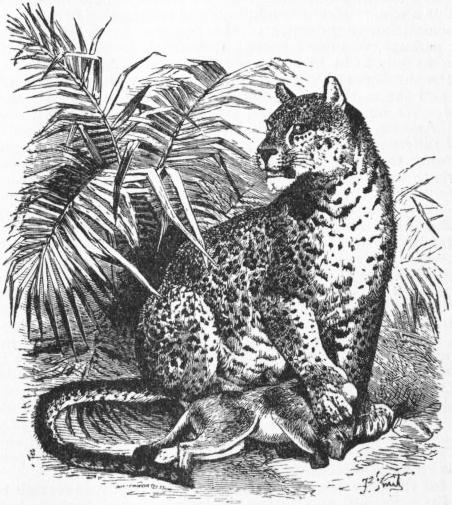
The Leopard (Felis pardus).
In habits the leopard resembles the other large cat-like animals, yielding to none in the ferocity of its disposition. It is exceedingly quick in its movements, but seizes its prey by waiting in ambush or stealthily approaching to within springing distance, when it suddenly rushes upon it and tears it to ground with its powerful claws and teeth. It preys upon almost any animal it can overcome, such as antelopes, deer, sheep, goats, monkeys, peafowl, and has a special liking for dogs. It not unfrequently attacks human beings in India, chiefly children and old women, but instances have been known of a leopard becoming a regular “man-eater.” When favourable opportunities occur, it often kills many more victims than it can devour at once, either to gratify its propensity for killing or for the sake of their fresh blood. It generally inhabits woody districts, and can climb trees with facility when hunted, but usually lives on or near the ground, among rocks, bushes and roots and low branches of large trees.
The geographical range of the leopard embraces practically all Africa, and Asia from Palestine to China and Manchuria, inclusive of Ceylon and the great Malay Islands as far as Java. Fossil bones and teeth, indistinguishable from those of existing leopards, have been found in cave-deposits of Pleistocene age in Spain, France, Germany and England.
(R. L.*; W. H. F.)
1 The name (Late Lat. leopardus, Late Gr. λεόπαρδος) was given by the ancients to an animal supposed to have been a cross between a lion (Lat. leo, Gr. λὲων) and a pard (Gr. πάρδος, Pers. pars) or panther. Medieval heralds made no distinction in shape between a lion and a leopard, but marked the difference by drawing the leopard showing the full face (see Heraldry: § Beasts and Birds).
LEOPARDI, GIACOMO, Count (1798-1837), Italian poet, was born at Recanati in the March of Ancona, on the 29th of June 1798. All the circumstances of his parentage and education conspired to foster his precocious and sensitive genius at the expense of his physical and mental health. His family was ancient and patrician, but so deeply embarrassed as to be only rescued from ruin by the energy of his mother, who had taken the control of business matters entirely into her own hands, and whose engrossing devotion to her undertaking seems to have almost dried up the springs of maternal tenderness. Count Monaldo Leopardi, the father, a mere nullity in his own household, secluded himself in his extensive library, to which his nervous, sickly and deformed son had free access, and which absorbed him exclusively in the absence of any intelligent sympathy from his parents, any companionship except that of his brothers and sister, or any recreation in the dullest of Italian towns. The lad spent his days over grammars and dictionaries, learning Latin with little assistance, and Greek and the principal modern languages with none at all. Any ordinarily clever boy would have emerged from this discipline a mere pedant and bookworm. Leopardi came forth a Hellene, not merely a consummate Greek scholar, but penetrated with the classical conception of life, and a master of antique form and style. At sixteen he composed a Latin treatise on the Roman rhetoricians of the 2nd century, a commentary on Porphyry’s life of Plotinus and a history of astronomy; at seventeen he wrote on the popular errors of the ancients, citing more than four hundred authors. A little later he imposed upon the first scholars of Italy by two odes in the manner of Anacreon. At eighteen he produced a poem of considerable length, the Appressamento alla Morte, which, after being lost for many years, was discovered and published by Zanino Volta. It is a vision of the omnipotence of death, modelled upon Petrarch, but more truly inspired by Dante, and in its conception, machinery and general tone offering a remarkable resemblance to Shelley’s Triumph of Life (1822), of which Leopardi probably never heard. This juvenile work was succeeded (1819) by two lyrical compositions which at once placed the author upon the height which he maintained ever afterwards. The ode to Italy, and that on the monument to Dante erected at Florence, gave voice to the dismay and affliction with which Italy, aroused by the French Revolution from the torpor of the 17th and 18th centuries, contemplated her forlorn and degraded condition, her political impotence, her degeneracy in arts and arms and the frivolity or stagnation of her intellectual life. They were the outcry of a student who had found an ideal of national existence in his books, and to whose disappointment everything in his own circumstances lent additional poignancy. But there is nothing unmanly or morbid in the expression of these sentiments, and the odes are surprisingly exempt from the failings characteristic of young poets. They are remarkably chaste in diction, close and nervous in style, sparing in fancy and almost destitute of simile and metaphor, antique in spirit, yet pervaded by modern ideas, combining Landor’s dignity with a considerable infusion of the passion of Byron. These qualities continued to characterize Leopardi’s poetical writings throughout his life. A third ode, on Cardinal Mai’s discoveries of ancient MSS., lamented in the same spirit of indignant sorrow the decadence of Italian literature. The publication of these pieces widened the breach between Leopardi and his father, a well-meaning but apparently dull and apathetic man, who had lived into the 19th century without imbibing any of its spirit, and who provoked his son’s contempt by a superstition unpardonable in a scholar of real learning. Very probably from a mistaken idea of duty to his son, very probably, too, from his own entire dependence in pecuniary matters upon his wife, he for a long time obstinately refused Leopardi funds, recreation, change of scene, everything that could have contributed to combat the growing pessimism which eventually became nothing less than monomaniacal. The affection of his brothers and sister afforded him some consolation, and he found intellectual sympathy in the eminent scholar and patriot Pietro Giordani, with whom he assiduously corresponded at this period, partly on the ways and means of escaping from “this hermitage, or rather seraglio, where the delights of civil society and the advantages of solitary life are alike wanting.” This forms the keynote of numerous letters of complaint and lamentation, as touching but as effeminate in their pathos as those of the banished Ovid. It must be remembered in fairness that the weakness of Leopardi’s eyesight frequently deprived him for months together of the resource of study. At length (1822) his father allowed him to repair to Rome, where, though cheered by the encouragement of C. C. J. Bunsen and Niebuhr, he found little satisfaction in the trifling pedantry that passed for philology and archaeology, while his sceptical opinions prevented his taking orders, the indispensable condition of public employment in the Papal States. Dispirited and with exhausted means, he returned to Recanati, where he spent three miserable years, brightened only by the production of several lyrical masterpieces, which appeared in 1824. The most remarkable is perhaps the Bruto Minore, the condensation of his philosophy of despair. In 1825 he accepted an engagement to edit Cicero and Petrarch for the publisher Stella at Milan, and took up his residence at Bologna, where his life was for a time made almost cheerful by the friendship of the countess Malvezzi. In 1827 appeared the Operette Morali, consisting principally of dialogues and his imaginary biography of Filippo Ottonieri, which have given Leopardi a fame as a prose writer hardly inferior to his celebrity as a poet. Modern literature has few productions so eminently classical in form and spirit, so symmetrical in construction and faultless in style. Lucian is evidently the model; but the wit and irony which were playthings to Lucian are terribly earnest with Leopardi. Leopardi’s invention is equal to Lucian’s and his only drawback in comparison with his exemplar is that, while the latter’s campaign against pretence and imposture commands hearty sympathy, Leopardi’s philosophical creed is a repulsive hedonism in the disguise of austere stoicism. The chief interlocutors in his dialogues all profess the same unmitigated pessimism, claim emancipation from every illusion that renders life tolerable to the vulgar, and assert or imply a vast moral and intellectual superiority over unenlightened mankind. When, however, we come to inquire what renders them miserable, we find it is nothing but the privation of pleasurable sensation, fame, fortune or some other external thing which a lofty code of ethics would deny to be either indefeasibly due to man or essential to his felicity. A page of Sartor Resartus scatters Leopardi’s sophistry to the winds, and leaves nothing of his dialogues but the consummate literary skill that would render the least fragment precious. As works of art they are a possession for ever, as contributions to moral philosophy they are worthless, and apart from their literary qualities can only escape condemnation if regarded as lyrical expressions of emotion, the wail extorted from a diseased mind by a diseased body. Filippo Ottonieri is a portrait of an imaginary philosopher, imitated from the biography of a real sage in Lucian’s Demonax. Lucian has shown us the philosopher he wished to copy, Leopardi has truly depicted the philosopher he was. Nothing can be more striking or more tragical than the picture of the man superior to his fellows in every quality of head and heart, and yet condemned to sterility and impotence because he has, as he imagines, gone a step too far on the road to truth, and illusions exist for him no more. The little tract is full of remarks on life and character of surprising depth and justice, manifesting what powers of observation as well as reflection were possessed by the sickly youth who had seen so little of the world.
Want of means soon drove Leopardi back to Recanati, where, deaf, half-blind, sleepless, tortured by incessant pain, at war with himself and every one around him except his sister, he spent the two most unhappy years of his unhappy life. In May 1831 he escaped to Florence, where he formed the acquaintance of a young Swiss philologist, M. de Sinner. To him he confided his unpublished philological writings, with a view to their appearance in Germany. A selection appeared under the title Excerpta ex schedis criticis J. Leopardi (Bonn, 1834). The remaining MSS. were purchased after Sinner’s death by the Italian government, and, together with Leopardi’s correspondence with the Swiss philologist, were partially edited by Aulard. In 1831 appeared a new edition of Leopardi’s poems, comprising several new pieces of the highest merit. These are in general less austerely classical than his earlier compositions, and evince a greater tendency to description, and a keener interest in the works and ways of ordinary mankind. The Resurrection, composed on occasion of his unexpected recovery, is a model of concentrated energy of diction, and The Song of the Wandering Shepherd in Asia is one of the highest flights of modern lyric poetry. The range of the author’s ideas is still restricted, but his style and melody are unsurpassable. Shortly after the publication of these pieces (October 1831) Leopardi was driven from Florence to Rome by an unhappy attachment. His feelings are powerfully expressed in two poems, To Himself and Aspasia, which seem to breathe wounded pride at least as much as wounded love. In 1832 Leopardi returned to Florence, and there formed acquaintance with a young Neapolitan, Antonio Ranieri, himself an author of merit, and destined to enact towards him the part performed by Severn towards Keats, an enviable title to renown if Ranieri had not in his old age tarnished it by assuming the relation of Trelawny to the dead Byron. Leopardi accompanied Ranieri and his sister to Naples, and under their care enjoyed four years of comparative tranquillity. He made the acquaintance of the German poet Platen, his sole modern rival in the classical perfection of form, and composed La Ginestra, the most consummate of all his lyrical masterpieces, strongly resembling Shelley’s Mont Blanc, but more perfect in expression. He also wrote at Naples The Sequel to the Battle of the Frogs and Mice, a satire in ottava rima on the abortive Neapolitan revolution of 1820, clever and humorous, but obscure from the local character of the allusions. The more painful details of his Neapolitan residence may be found by those who care to seek for them in the deplorable publication of Ranieri’s peevish old age (Sette anni di sodalizio). The decay of Leopardi’s constitution continued; he became dropsical; and a sudden crisis of his malady, unanticipated by himself alone, put an end to his life-long sufferings on the 15th of June 1837.
The poems which constitute Leopardi’s principal title to immortality are only forty-one in number, and some of these are merely fragmentary. They may for the most part be described as odes, meditative soliloquies, or impassioned addresses, generally couched in a lyrical form, although a few are in magnificent blank verse. Some idea of the style and spirit of the former might be obtained by imagining the thoughts of the last book of Spenser’s Faerie Queene in the metre of his Epithalamium. They were first edited complete by Ranieri at Florence in 1845, forming, along with the Operette Morali, the first volume of an edition of Leopardi’s works, which does not, however, include The Sequel to the Battle of the Frogs and Mice, first printed at Paris in 1842, nor the afterwards discovered writings. Vols. ii.-iv. contain the philological essays and translations, with some letters, and vols. v. and vi. the remainder of the correspondence. Later editions are those of G. Chiarini and G. Mestica. The juvenile essays preserved in his father’s library at Recanati were edited by Cugnoni (Opere inedite) in 1879, with the consent of the family. See Cappelleti, Bibliografia Leopardiana (Parma, 1882). Leopardi’s biography is mainly in his letters (Epistolario, 1st ed., 1849, 5th ed., 1892), to which his later biographers (Brandes, Bouché-Leclercq, Rosa) have merely added criticisms, excellent in their way, more particularly Brandes’s, but generally over-rating Leopardi’s significance in the history of human thought. W. E. Gladstone’s essay (Quart. Rev., 1850), reprinted in vol. ii. of the author’s Gleanings, is too much pervaded by the theological spirit, but is in the main a pattern of generous and discriminating eulogy. There are excellent German translations of the poems by Heyse and Brandes. An English translation of the essays and dialogues by C. Edwards appeared in 1882, and most of the dialogues were translated with extraordinary felicity by James Thomson, author of The City of Dreadful Night, and originally published in the National Reformer.
(R. G.)
LEOPARDO, ALESSANDRO (d. c. 1512), Italian sculptor, was born and died at Venice. His first known work is the imposing mausoleum of the doge Andrea Vendramini, now in the church of San Giovanni e Paolo; in this he had the co-operation of Tullio Lombardo, but the finest parts are Leopardo’s. Some of the figures have been taken away, and two in the Berlin museum are considered to be certainly his work. He was exiled on a charge of fraud in 1487, and recalled in 1490 by the senate to finish Verrocchio’s colossal statue of Bartolommeo Colleoni. He worked between 1503 and 1505 on the tomb of Cardinal Zeno at St Mark’s, which was finished in 1515 by Pietro Lombardo; and in 1505 he designed and cast the bronze sockets for the three flagstaffs in the square of St Mark’s, the antique character of the decorations suggesting some Greek model. (See Venice.)