VOLUME XVI SLICE IV Lefebvre, Tanneguy to Letronne, Jean Antoine (continued 9)
Reading edition

LEOPOLD (M.H. Ger. Liupolt, O.H. Ger. Liupald, from liut, Mod. Ger. Leute, “people,” and pald, “bold,” i.e. “bold for the people”), the name which has been that of several European sovereigns.
LEOPOLD I. (1640-1705), Roman emperor, the second son of the emperor Ferdinand III. and his first wife Maria Anna, daughter of Philip III. of Spain, was born on the 9th of June 1640. Intended for the Church, he received a good education, but his prospects were changed by the death of his elder brother, the German king Ferdinand IV., in July 1654, when he became his father’s heir. In 1655 he was chosen king of Hungary and in 1656 king of Bohemia, and in July 1658, more than a year after his father’s death, he was elected emperor at Frankfort, in spite of the intrigues of Cardinal Mazarin, who wished to place on the imperial throne Ferdinand, elector of Bavaria, or some other prince whose elevation would break the Habsburg succession. Mazarin, however, obtained a promise from the new emperor that he would not send assistance to Spain, then at war with France, and, by joining a confederation of German princes, called the league of the Rhine, France secured a certain influence in the internal affairs of Germany. Leopold’s long reign covers one of the most important periods of European history; for nearly the whole of its forty-seven years he was pitted against Louis XIV. of France, whose dominant personality completely overshadowed Leopold. The emperor was a man of peace and never led his troops in person; yet the greater part of his public life was spent in arranging and directing wars. The first was with Sweden, whose king Charles X. found a useful ally in the prince of Transylvania, George II. Rakocky, a rebellious vassal of the Hungarian crown. This war, a legacy of the last reign, was waged by Leopold as the ally of Poland until peace was made at Oliva in 1660. A more dangerous foe next entered the lists. The Turks interfered in the affairs of Transylvania, always an unruly district, and this interference brought on a war with the Empire, which after some desultory operations really began in 1663. By a personal appeal to the diet at Regensburg Leopold induced the princes to send assistance for the campaign; troops were also sent by France, and in August 1664 the great imperialist general, Montecucculi, gained a notable victory at St Gotthard. By the peace of Vasvar the emperor made a twenty years’ truce with the sultan, granting more generous terms than his recent victory seemed to render necessary.
After a few years of peace began the first of three wars between France and the Empire. The aggressive policy pursued by Louis XIV. towards Holland had aroused the serious attention of Europe, and steps had been taken to check it. Although the French king had sought the alliance of several German princes and encouraged the Turks in their attacks on Austria the emperor at first took no part in this movement. He was on friendly terms with Louis, to whom he was closely related and with whom he had already discussed the partition of the lands of the Spanish monarchy; moreover, in 1671 he arranged with him a treaty of neutrality. In 1672, however, he was forced to take action. He entered into an alliance for the defence of Holland and war broke out; then, after this league had collapsed owing to the defection of the elector of Brandenburg, another and more durable alliance was formed for the same purpose, including, besides the emperor, the king of Spain and several German princes, and the war was renewed. At this time, twenty-five years after the peace of Westphalia, the Empire was virtually a confederation of independent princes, and it was very difficult for its head to conduct any war with vigour and success, some of its members being in alliance with the enemy and others being only lukewarm in their support of the imperial interests. Thus this struggle, which lasted until the end of 1678, was on the whole unfavourable to Germany, and the advantages of the treaty of Nijmwegen (February 1679) were with France.
Almost immediately after the conclusion of peace Louis renewed his aggressions on the German frontier. Engaged in a serious struggle with Turkey, the emperor was again slow to move, and although he joined a league against France in 1682 he was glad to make a truce at Regensburg two years later. In 1686 the league of Augsburg was formed by the emperor and the imperial princes, to preserve the terms of the treaties of Westphalia and of Nijmwegen. The whole European position was now bound up with events in England, and the tension lasted until 1688, when William of Orange won the English crown and Louis invaded Germany. In May 1689 the grand alliance was formed, including the emperor, the kings of England, Spain and Denmark, the elector of Brandenburg and others, and a fierce struggle against France was waged throughout almost the whole of western Europe. In general the several campaigns were favourable to the allies, and in September 1697 England and Holland made peace with Louis at Ryswick. To this treaty Leopold refused to assent, as he considered that his allies had somewhat neglected his interests, but in the following month he came to terms and a number of places were transferred from France to Germany. The peace with France lasted for about four years and then Europe was involved in the War of the Spanish Succession. The king of Spain, Charles II., was a Habsburg by descent and was related by marriage to the Austrian branch, while a similar tie bound him to the royal house of France. He was feeble and childless, and attempts had been made by the European powers to arrange for a peaceable division of his extensive kingdom. Leopold refused to consent to any partition, and when in November 1700 Charles died, leaving his crown to Philip, duke of Anjou, a grandson of Louis XIV., all hopes of a peaceable settlement vanished. Under the guidance of William III. a powerful league, the grand alliance, was formed against France; of this the emperor was a prominent member, and in 1703 he transferred his claim on the Spanish monarchy to his second son, the archduke Charles. The early course of the war was not favourable to the imperialists, but the tide of defeat had been rolled back by the great victory of Blenheim before Leopold died on the 5th of May 1705.
In governing his own lands Leopold found his chief difficulties in Hungary, where unrest was caused partly by his desire to crush Protestantism. A rising was suppressed in 1671 and for some years Hungary was treated with great severity. In 1681, after another rising, some grievances were removed and a less repressive policy was adopted, but this did not deter the Hungarians from revolting again. Espousing the cause of the rebels the sultan sent an enormous army into Austria early in 1683; this advanced almost unchecked to Vienna, which was besieged from July to September, while Leopold took refuge at Passau. Realizing the gravity of the situation somewhat tardily, some of the German princes, among them the electors of Saxony and Bavaria, led their contingents to the imperial army which was commanded by the emperor’s brother-in-law, Charles, duke of Lorraine, but the most redoubtable of Leopold’s allies was the king of Poland, John Sobieski, who was already dreaded by the Turks. On the 12th of September 1683 the allied army fell upon the enemy, who was completely routed, and Vienna was saved. The imperialists, among whom Prince Eugene of Savoy was rapidly becoming prominent, followed up the victory with others, notably one near Mohacz in 1687 and another at Zenta in 1697, and in January 1699 the sultan signed the treaty of Karlowitz by which he admitted the sovereign rights of the house of Habsburg over nearly the whole of Hungary. Before the conclusion of the war, however, Leopold had taken measures to strengthen his hold upon this country. In 1687 at the diet of Pressburg the constitution was changed, the right of the Habsburgs to succeed to the throne without election was admitted and the emperor’s elder son Joseph was crowned hereditary king of Hungary.
During this reign some important changes were made in the constitution of the Empire. In 1663 the imperial diet entered upon the last stage of its existence, and became a body permanently in session at Regensburg; in 1692 the duke of Hanover was raised to the rank of an elector, becoming the ninth member of the electoral college; and in 1700 Leopold, greatly in need of help for the impending war with France, granted the title of king of Prussia to the elector of Brandenburg. The net result of these and similar changes was to weaken the authority of the emperor over the members of the Empire, and to compel him to rely more and more upon his position as ruler of the Austrian archduchies and of Hungary and Bohemia, and Leopold was the first who really appears to have realized this altered state of affairs and to have acted in accordance therewith.
The emperor was married three times. His first wife was Margaret Theresa (d. 1673), daughter of Philip IV. of Spain; his second Claudia Felicitas (d. 1676), the heiress of Tirol; and his third Eleanora, a princess of the Palatinate. By his first two wives he had no sons, but his third wife bore him two, Joseph and Charles, both of whom became emperors. He had also four daughters.
Leopold was a man of industry and education, and during his later years he showed some political ability. Extremely tenacious of his rights, and regarding himself as an absolute sovereign, he was also very intolerant and was greatly influenced by the Jesuits. In person he was short, but strong and healthy. Although he had no inclination for a military life he loved exercises in the open air, such as hunting and riding; he had also a taste for music.
Leopold’s letters to Marco d’Aviano from 1680 to 1699 were edited by O. Klopp and published at Graz in 1888. Other letters are found in the Fontes rerum Austriacarum, Bände 56 and 57 (Vienna, 1903-1904). See also F. Krones, Handbuch der Geschichte Österreichs (Berlin, 1876-1879); R. Baumstark, Kaiser Leopold I. (1873); and A. F. Pribram, Zur Wahl Leopolds I. (Vienna, 1888).
(A. W. H.*)
LEOPOLD II. (1747-1792), Roman emperor, and grand-duke of Tuscany, son of the empress Maria Theresa and her husband, Francis I., was born in Vienna on the 5th of May 1747. He was a third son, and was at first educated for the priesthood, but the theological studies to which he was forced to apply himself are believed to have influenced his mind in a way unfavourable to the Church. On the death of his elder brother Charles in 1761 it was decided that he should succeed to his father’s grand duchy of Tuscany, which was erected into a “secundogeniture” or apanage for a second son. This settlement was the condition of his marriage on the 5th of August 1764 with Maria Louisa, daughter of Charles III. of Spain, and on the death of his father Francis I. (13th August 1765) he succeeded to the grand duchy. For five years he exercised little more than nominal authority under the supervision of counsellors appointed by his mother. In 1770 he made a journey to Vienna to secure the removal of this vexatious guardianship, and returned to Florence with a free hand. During the twenty years which elapsed between his return to Florence and the death of his eldest brother Joseph II. in 1790 he was employed in reforming the administration of his small state. The reformation was carried out by the removal of the ruinous restrictions on industry and personal freedom imposed by his predecessors of the house of Medici, and left untouched during his father’s life; by the introduction of a rational system of taxation; and by the execution of profitable public works, such as the drainage of the Val di Chiana. As he had no army to maintain, and as he suppressed the small naval force kept up by the Medici, the whole of his revenue was left free for the improvement of his state. Leopold was never popular with his Italian subjects. His disposition was cold and retiring. His habits were simple to the verge of sordidness, though he could display splendour on occasion, and he could not help offending those of his subjects who had profited by the abuses of the Medicean régime. But his steady, consistent and intelligent administration, which advanced step by step, making the second only when the first had been justified by results, brought the grand duchy to a high level of material prosperity. His ecclesiastical policy, which disturbed the deeply rooted convictions of his people, and brought him into collision with the pope, was not successful. He was unable to secularize the property of the religious houses, or to put the clergy entirely under the control of the lay power.
During the last few years of his rule in Tuscany Leopold had begun to be frightened by the increasing disorders in the German and Hungarian dominions of his family, which were the direct result of his brother’s headlong methods. He and Joseph II. were tenderly attached to one another, and met frequently both before and after the death of their mother, while the portrait by Pompeo Baltoni in which they appear together shows that they bore a strong personal resemblance to one another. But it may be said of Leopold, as of Fontenelle, that his heart was made of brains. He knew that he must succeed his childless eldest brother in Austria, and he was unwilling to inherit his unpopularity. When, therefore, in 1789 Joseph, who knew himself to be dying, asked him to come to Vienna, and become co-regent, Leopold coldly evaded the request. He was still in Florence when Joseph II. died at Vienna on the 20th of February 1790, and he did not leave his Italian capital till the 3rd of March. Leopold, during his government in Tuscany, had shown a speculative tendency to grant his subjects a constitution. When he succeeded to the Austrian lands he began by making large concessions to the interests offended by his brother’s innovations. He recognized the Estates of his different dominions as “the pillars of the monarchy,” pacified the Hungarians and divided the Belgian insurgents by concessions. When these failed to restore order, he marched troops into the country, and re-established at the same time his own authority, and the historic franchises of the Flemings. Yet he did not surrender any part that could be retained of what Maria Theresa and Joseph had done to strengthen the hands of the state. He continued, for instance, to insist that no papal bull could be published in his dominions without his consent (placetum regium).
If Leopold’s reign as emperor, and king of Hungary and Bohemia, had been prolonged during years of peace, it is probable that he would have repeated his successes as a reforming ruler in Tuscany on a far larger scale. But he lived for barely two years, and during that period he was hard pressed by peril from west and east alike. The growing revolutionary disorders in France endangered the life of his sister Marie Antoinette, the queen of Louis XVI., and also threatened his own dominions with the spread of a subversive agitation. His sister sent him passionate appeals for help, and he was pestered by the royalist emigrants, who were intriguing both to bring about an armed intervention in France, and against Louis XVI. From the east he was threatened by the aggressive ambition of Catherine II. of Russia, and by the unscrupulous policy of Prussia. Catherine would have been delighted to see Austria and Prussia embark on a crusade in the cause of kings against the Revolution. While they were busy beyond the Rhine, she would have annexed what remained of Poland, and would have made conquests in Turkey. Leopold II. had no difficulty in seeing through the rather transparent cunning of the Russian empress, and he refused to be misled. To his sister he gave good advice and promises of help if she and her husband could escape from Paris. The emigrants who followed him pertinaciously were refused audience, or when they forced themselves on him were peremptorily denied all help. Leopold was too purely a politician not to be secretly pleased at the destruction of the power of France and of her influence in Europe by her internal disorders. Within six weeks of his accession he displayed his contempt for her weakness by practically tearing up the treaty of alliance made by Maria Theresa in 1756 and opening negotiations with England to impose a check on Russia and Prussia. He was able to put pressure on England by threatening to cede his part of the Low Countries to France, and then, when secure of English support, he was in a position to baffle the intrigues of Prussia. A personal appeal to Frederick William II. led to a conference between them at Reichenbach in July 1790, and to an arrangement which was in fact a defeat for Prussia. Leopold’s coronation as king of Hungary on the 15th of November 1790, was preceded by a settlement with the diet in which he recognized the dominant position of the Magyars. He had already made an eight months’ truce with the Turks in September, which prepared the way for the termination of the war begun by Joseph II., the peace of Sistova being signed in August 1791. The pacification of his eastern dominions left Leopold free to re-establish order in Belgium and to confirm friendly relations with England and Holland.
During 1791 the emperor continued to be increasingly preoccupied with the affairs of France. In January he had to dismiss the count of Artois, afterwards Charles X., king of France, in a very peremptory way. His good sense was revolted by the folly of the French emigrants, and he did his utmost to avoid being entangled in the affairs of that country. The insults inflicted on Louis XVI. and Marie Antoinette, however, at the time of their attempted flight to Varennes in June, stirred his indignation, and he made a general appeal to the sovereigns of Europe to take common measures in view of events which “immediately compromised the honour of all sovereigns, and the security of all governments.” Yet he was most directly interested in the conference at Sistova, which in June led to a final peace with Turkey. On the 25th of August he met the king of Prussia at Pillnitz, near Dresden, and they drew up a declaration of their readiness to intervene in France if and when their assistance was called for by the other powers. The declaration was a mere formality, for, as Leopold knew, neither Russia nor England was prepared to act, and he endeavoured to guard against the use which he foresaw the emigrants would endeavour to make of it. In face of the agitation caused by the Pillnitz declaration in France, the intrigues of the emigrants, and the attacks made by the French revolutionists on the rights of the German princes in Alsace, Leopold continued to hope that intervention might not be required. When Louis XVI. swore to observe the constitution of September 1791, the emperor professed to think that a settlement had been reached in France. The attacks on the rights of the German princes on the left bank of the Rhine, and the increasing violence of the parties in Paris which were agitating to bring about war, soon showed, however, that this hope was vain. Leopold met the threatening language of the revolutionists with dignity and temper. His sudden death on the 1st of March 1792 was an irreparable loss to Austria.
Leopold had sixteen children, the eldest of his eight sons being his successor, the emperor Francis II. Some of his other sons were prominent personages in their day. Among them were: Ferdinand III., grand duke of Tuscany; the archduke Charles, a celebrated soldier; the archduke John, also a soldier; the archduke Joseph, palatine of Hungary; and the archduke Rainer, viceroy of Lombardy-Venetia.
Several volumes containing the emperor’s correspondence have been published. Among these are: Joseph II. und Leopold von Toskana. Ihr Briefwechsel 1781-1790 (Vienna, 1872), and Marie Antoinette, Joseph II. und Leopold II. Ihr Briefwechsel (Vienna, 1866), both edited by A. Ritter von Arneth; Joseph II., Leopold II. und Kaunitz. Ihr Briefwechsel (Vienna, 1873); and Leopold II., Franz II. und Catharina. Ihre Correspondenz nebst einer Einleitung: Zur Geschichte der Politik Leopolds II. (Leipzig, 1874), both edited by A. Beer; and Leopold II. und Marie Christine. Ihrand Briefwechsel 1781-1792, edited by A. Wolf (Vienna, 1867). See also H. von Sybel, Über die Regierung Kaiser Leopolds II. (Munich, 1860); A. Schultze, Kaiser Leopold II. und die französische Revolution (Leipzig, 1899); and A. Wolf and H. von Zwiedeneck-Südenhorst, Österreich unter Maria Theresa, Joseph II. und Leopold II. (Berlin, 1882-1884).
LEOPOLD I. (1790-1865), king of the Belgians, fourth son of Francis, duke of Saxe-Coburg-Saalfeld, and uncle of Queen Victoria of England, was born at Coburg on the 18th of December 1790. At the age of eighteen he entered the military service of Russia, and accompanied the emperor Alexander to Erfurt as a member of his staff. He was required by Napoleon to quit the Russian army, and spent some years in travelling. In 1813 he accepted from the emperor Alexander the post of a cavalry general in the army of invasion, and he took part in the whole of the campaign of that and the following year, distinguishing himself in the battles of Leipzig, Lützen and Bautzen. He entered Paris with the allied sovereigns, and accompanied them to England. He married in May 1816 Charlotte, only child of George, prince regent, afterwards George IV., heiress-presumptive to the British throne, and was created duke of Kendal in the British peerage and given an annuity of £50,000. The death of the princess in the following year was a heavy blow to his hopes, but he continued to reside in England. In 1830 he declined the offer of the crown of Greece, owing to the refusal of the powers to grant conditions which he considered essential to the welfare of the new kingdom, but was in the following year elected king of the Belgians (4th June 1831). After some hesitation he accepted the crown, having previously ascertained that he would have the support of the great powers on entering upon his difficult task, and on the 12th of July he made his entry into Brussels and took the oath to observe the constitution. During the first eight years of his reign he was confronted with the resolute hostility of King William I. of Holland, and it was not until 1839 that the differences between the two states, which until 1830 had formed the kingdom of the Netherlands, were finally settled at the conference of London by the treaty of the 24 Articles (see Belgium). From this date until his death, King Leopold spent all his energies in the wise administration of the affairs of the newly formed kingdom, which may be said to owe in a large measure its first consolidation and constant prosperity to the care and skill of his discreet and fatherly government. In 1848 the throne of Belgium stood unshaken amidst the revolutions which marked that year in almost every European country. On the 8th of August 1832 Leopold married, as his second wife, Louise of Orleans, daughter of Louis Philippe, king of the French. Queen Louise endeared herself to the Belgian people, and her death in 1850 was felt as a national loss. This union produced two sons and one daughter—(1) Leopold, afterwards king of the Belgians; (2) Philip, count of Flanders; (3) Marie Charlotte, who married Maximilian of Austria, the unfortunate emperor of Mexico. Leopold I. died at Laeken on the 10th of December 1865. He was a most cultured man and a great reader, and did his utmost during his reign to encourage art, science and education. His judgment was universally respected by contemporary sovereigns and statesmen, and he was frequently spoken of as “the Nestor of Europe” (see also Victoria, Queen).
See Th. Juste, Léopold Ier, roi des Belges d’après des doc. inéd. 1793-1865 (2 vols., Brussels, 1868), and Les Fondateurs de la monarchie Belge (22 vols., Brussels, 1878-1880); J. J. Thonissen, La Belgique sous le règne de Léopold Ier (Louvain, 1862).
LEOPOLD II. [Leopold Louis Philippe Marie Victor] (1835-1909), king of the Belgians, son of the preceding, was born at Brussels on the 9th of April 1835. In 1846 he was created duke of Brabant and appointed a sub-lieutenant in the army, in which he served until his accession, by which time he had reached the rank of lieutenant-general. On attaining his majority he was made a member of the senate, in whose proceedings he took a lively interest, especially in matters concerning the development of Belgium and its trade. On the 22nd of August 1853 Leopold married Marie Henriette (1836-1902), daughter of the archduke Joseph of Austria, palatine of Hungary, by his wife Marie Dorothea, duchess of Württemberg. This princess, who was a great-granddaughter of the empress Maria Theresa, and a great-niece of Marie Antoinette, endeared herself to the people by her elevated character and indefatigable benevolence, while her beauty gained for her the sobriquet of “The Rose of Brabant”; she was also an accomplished artist and musician, and a fine horsewoman. Between the years 1854 and 1865 Leopold travelled much abroad, visiting India and China as well as Egypt and the countries on the Mediterranean coast of Africa. On the 10th of December 1865 he succeeded his father. On the 28th of January 1869 he lost his only son, Leopold (b. 1859), duke of Hainaut. The king’s brother Philip, count of Flanders (1837-1905), then became heir to the throne; and on his death his son Albert (b. 1875) became heir-presumptive. During the Franco-Prussian War (1870-1871) the king of the Belgians preserved neutrality in a period of unusual difficulty and danger. But the most notable event in Leopold’s career was the foundation of the Congo Free State (q.v.). While still duke of Brabant he had been the first to call the attention of the Belgians to the need of enlarging their horizon beyond sea, and after his accession to the throne he gave the first impulse towards the development of this idea by founding in 1876 the Association Internationale Africaine. He enlisted the services of H. M. Stanley, who visited Brussels in 1878 after exploring the Congo river, and returned in 1879 to the Congo as agent of the Comité d’Études du Haut Congo, soon afterwards reorganized as the “International Association of the Congo.” This association was, in 1884-1885, recognized by the powers as a sovereign state under the name of the État Indépendant du Congo. Leopold’s exploitation of this vast territory, which he administered autocratically, and in which he associated himself personally with various financial schemes, was understood to bring him an enormous fortune; it was the subject of acutely hostile criticism, to a large extent substantiated by the report of a commission of inquiry instituted by the king himself in 1904, and followed in 1908 by the annexation of the state to Belgium (see Congo Free State: History). In 1880 Leopold sought an interview with General C. G. Gordon and obtained his promise, subject to the approval of the British government, to enter the Belgian service on the Congo. Three years later Leopold claimed fulfilment of the promise, and Gordon was about to proceed to the Congo when the British government required his services for the Sudan. On the 15th of November 1902 King Leopold’s life was attempted in Brussels by an Italian anarchist named Rubino. Queen Marie Henriette died at Spa on the 19th of September of the same year. Besides the son already mentioned she had borne to Leopold three daughters—Louise Marie Amélie (b. 1858), who in 1875 married Philip of Saxe-Coburg and Gotha, and was divorced in 1906; Stéphanie (b. 1864), who married Rudolph, crown prince of Austria, in 1881, and after his death in 1889 married, against her father’s wishes, Elemer, Count Lonyay, in 1900; and Clémentine (b. 1872). At the time of the queen’s death an unseemly incident was occasioned by Leopold’s refusal to see his daughter Stéphanie, who in consequence was not present at her mother’s funeral. The disagreeable impression on the public mind thus created was deepened by an unfortunate litigation, lasting for two years (1904-1906), over the deceased queen’s will, in which the creditors of the princess Louise, together with princess Stéphanie (Countess Lonyay), claimed that under the Belgian law the queen’s estate was entitled to half of her husband’s property. This claim was disallowed by the Belgian courts. The king died at Laeken, near Brussels, on the 17th of December 1909. On the 23rd of that month his nephew took the oath to observe the constitution, assuming the title of Albert I. King Leopold was personally a man of considerable attainments and much strength of character, but he was a notoriously dissolute monarch, who even to the last offended decent opinion by his indulgences at Paris and on the Riviera. The wealth he amassed from the Congo he spent, no doubt, royally not only in this way but also on public improvements in Belgium; but he had a hard heart towards the natives of his distant possession.
LEOPOLD II. (1797-1870), of Habsburg-Lorraine, grand-duke of Tuscany, was born on the 3rd of October 1797, the son of the grand-duke Ferdinand III., whom he succeeded in 1824. During the first twenty years of his reign he devoted himself to the internal development of the state. His was the mildest and least reactionary of all the Italian despotisms of the day, and although always subject to Austrian influence he refused to adopt the Austrian methods of government, allowed a fair measure of liberty to the press, and permitted many political exiles from other states to dwell in Tuscany undisturbed. But when in the early ’forties a feeling of unrest spread throughout Italy, even in Tuscany demands for a constitution and other political reforms were advanced; in 1845-1846 riots broke out in various parts of the country, and Leopold granted a number of administrative reforms. But Austrian influence prevented him from going further, even had he wished to do so. The election of Pope Pius IX. gave fresh impulse to the Liberal movement, and on the 4th of September 1847 Leopold instituted the National Guard—a first step towards the constitution; shortly after the marchese Cosimo Ridolfi was appointed prime minister. The granting of the Neapolitan and Piedmontese constitutions was followed (17th February 1848) by that of Tuscany, drawn up by Gino Capponi. The revolution in Milan and Vienna aroused a fever of patriotic enthusiasm in Tuscany, where war against Austria was demanded; Leopold, giving way to popular pressure, sent a force of regulars and volunteers to co-operate with Piedmont in the Lombard campaign. His speech on their departure was uncompromisingly Italian and Liberal. “Soldiers,” he said, “the holy cause of Italian freedom is being decided to-day on the fields of Lombardy. Already the citizens of Milan have purchased their liberty with their blood and with a heroism of which history offers few examples.... Honour to the arms of Italy! Long live Italian independence!” The Tuscan contingent fought bravely, if unsuccessfully, at Curtatone and Montanara. On the 26th of June the first Tuscan parliament assembled, but the disturbances consequent on the failure of the campaign in Lombardy led to the resignation of the Ridolfi ministry, which was succeeded by that of Gino Capponi. The riots continued, especially at Leghorn, which was a prey to actual civil war, and the democratic party of which F. D. Guerrazzi and G. Montanelli were leading lights became every day more influential. Capponi resigned, and Leopold reluctantly agreed to a Montanelli-Guerrazzi ministry, which in its turn had to fight against the extreme republican party. New elections in the autumn of 1848 returned a constitutional majority, but it ended by voting in favour of a constituent assembly. There was talk of instituting a central Italian kingdom with Leopold as king, to form part of a larger Italian federation, but in the meanwhile the grand-duke, alarmed at the revolutionary and republican agitations in Tuscany and encouraged by the success of the Austrian arms, was, according to Montanelli, negotiating with Field-Marshal Radetzky and with Pius IX., who had now abandoned his Liberal tendencies, and fled to Gaeta. Leopold had left Florence for Siena, and eventually for Porto S. Stefano, leaving a letter to Guerrazzi in which, on account of a protest from the pope, he declared that he could not agree to the proposed constituent assembly. The utmost confusion prevailed in Florence and other parts of Tuscany. On the 9th of February 1849 the republic was proclaimed, largely as a result of Mazzini’s exhortations, and on the 18th Leopold sailed for Gaeta. A third parliament was elected and Guerrazzi appointed dictator. But there was great discontent, and the defeat of Charles Albert at Novara caused consternation among the Liberals. The majority, while fearing an Austrian invasion, desired the return of the grand-duke who had never been unpopular, and in April 1849 the municipal council usurped the powers of the assembly and invited him to return, “to save us by means of the restoration of the constitutional monarchy surrounded by popular institutions, from the shame and ruin of a foreign invasion.” Leopold accepted, although he said nothing about the foreign invasion, and on the 1st of May sent Count Luigi Serristori to Tuscany with full powers. But at the same time the Austrians occupied Lucca and Leghorn, and although Leopold simulated surprise at their action it has since been proved, as the Austrian general d’Aspre declared at the time, that Austrian intervention was due to the request of the grand-duke. On the 24th of May the latter appointed G. Baldasseroni prime minister, on the 25th the Austrians entered Florence and on the 28th of July Leopold himself returned. In April 1850 he concluded a treaty with Austria sanctioning the continuation for an indefinite period of the Austrian occupation with 10,000 men; in September he dismissed parliament, and the following year established a concordat with the Church of a very clerical character. He feebly asked Austria if he might maintain the constitution, and the Austrian premier, Prince Schwarzenberg, advised him to consult the pope, the king of Naples and the dukes of Parma and Modena. On their advice he formally revoked the constitution (1852). Political trials were held, Guerrazzi and many others being condemned to long terms of imprisonment, and although in 1855 the Austrian troops left Tuscany, Leopold’s popularity was gone. A part of the Liberals, however, still believed in the possibility of a constitutional grand-duke who could be induced for a second time to join Piedmont in a war against Austria, whereas the popular party headed by F. Bartolommei and G. Dolfi realized that only by the expulsion of Leopold could the national aspirations be realized. When in 1859 France and Piedmont made war on Austria, Leopold’s government failed to prevent numbers of young Tuscan volunteers from joining the Franco-Piedmontese forces. Finally an agreement was arrived at between the aristocratic constitutionalists and the popular party, as a result of which the grand-duke’s participation in the war was formally demanded. Leopold at first gave way, and entrusted Don Neri Corsini with the formation of a ministry. The popular demands presented by Corsini were for the abdication of Leopold in favour of his son, an alliance with Piedmont and the reorganization of Tuscany in accordance with the eventual and definite reorganization of Italy. Leopold hesitated and finally rejected the proposals as derogatory to his dignity. On the 27th of April there was great excitement in Florence, Italian colours appeared everywhere, but order was maintained, and the grand-duke and his family departed for Bologna undisturbed. Thus the revolution was accomplished without a drop of blood being shed, and after a period of provisional government Tuscany was incorporated in the kingdom of Italy. On the 21st of July Leopold abdicated in favour of his son Ferdinand IV., who never reigned, but issued a protest from Dresden (26th March 1860). He spent his last years in Austria, and died in Rome on the 29th of January 1870.
Leopold of Tuscany was a well-meaning, not unkindly man, and fonder of his subjects than were the other Italian despots, but he was weak, and too closely bound by family ties and Habsburg traditions ever to become a real Liberal. Had he not joined the conclave of autocrats at Gaeta, and, above all, had he not summoned Austrian assistance while denying that he had done so, in 1849, he might yet have preserved his throne, and even changed the whole course of Italian history. At the same time his rule, if not harsh, was enervating and demoralizing.
See G. Baldasseroni, Leopoldo II. (Florence, 1871), useful but reactionary in tendency, the author having been Leopold’s minister, G. Montanelli, Memorie sull’ Italia (Turin, 1853); F. D. Guerrazzi, Memorie (Leghorn, 1848); Zobi, Storia civile della Toscana, vols. iv.-v. (Florence, 1850-1852); A. von Reumont, Geschichte Toscanas (2 vols., Gotha, 1876-1877); M. Bartolommei-Gioli, Il Rivolgimento Toscano e L’azione popolare (Florence, 1905); C. Tivaroni, L’ Italia durante il dominio Austriaco, vol. i. (Turin, 1892), and L’ Italia degli Italiani, vol. i. (Turin, 1895). See also Ricasoli; Bartolommei; Capponi, Gino; &c.
(L. V.*)
LEOPOLD II., a lake of Central Africa in the basin of the Kasai affluent of the Congo, cut by 2° S. and 18° 10′ E. It has a length N. to S. of about 75 m., is 30 m. across at its northern end, tapering towards its southern end. Numerous bays and gulfs render its outline highly irregular. Its shores are flat and marshy, the lake being (in all probability) simply the lowest part of a vast lake which existed here before the Kasai system breached the barrier—at Kwa mouth—separating it from the Congo. The lake is fed by the Lokoro (about 300 m. long) and smaller streams from the east. Its northern and western affluents are comparatively unimportant. It discharges its waters (at its southern end) into the Mfini, which is in reality the lower course of the Lukenye. The lake is gradually diminishing in area; in the rainy season it overflows its banks. The surrounding country is very flat and densely wooded.
See Kasai; and articles and maps in Le Mouvement géog., specially vol. xiv., No. 29 (1897) and vol. xxiv., No. 38 (1907).
LEOTYCHIDES, Spartan king, of the Eurypontid family, was descended from Theopompus through his younger son Anaxandridas (Herod. viii. 131), and in 491 B.C. succeeded Demaratus (q.v.), whose title to the throne he had with Cleomenes’ aid successfully challenged. He took part in Cleomenes’ second expedition to Aegina, on which ten hostages were seized and handed over to the Athenians for safe custody: for this he narrowly escaped being surrendered to the Aeginetans after Cleomenes’ death. In the spring of 479 we find him in command of the Greek fleet of 110 ships, first at Aegina and afterwards at Delos. In August he attacked the Persian position at Mycale on the coast of Asia Minor opposite Samos, inflicted a crushing defeat on the land-army, and annihilated the fleet which was drawn up on the shore. Soon afterwards he sailed home with the Peloponnesians, leaving the Athenians to prosecute the siege of Sestos. In 476 he led an army to Thessaly to punish the Aleuadae of Larisa for the aid they had rendered to the Persians and to strengthen Spartan influence in northern Greece. After a series of successful engagements he accepted a bribe from the enemy to withdraw. For this he was brought to trial at Sparta, and to save his life fled to the temple of Athena Alea at Tegea. Sentence of exile was passed, his house was razed and his grandson Archidamus II. ascended the throne (Herod. vi. 65-87, ix. 90-114; Thucydides i. 89; Pausanias iii. 4. 3. 7. 9-10; Plutarch, De malignitate Herodoti, 21, p. 859 D; Diodorus xi. 34-37).
According to Diodorus (xi. 48) Leotychides reigned twenty-two, his successor Archidamus forty-two years. The total duration of the two reigns, sixty-four years, we know to be correct, for Leotychides came to the throne in 491 and Archidamus (q.v.) died in 427. On this basis, then, Leotychides’s exile would fall in 469 and the Thessalian expedition in that or the preceding year (so E. Meyer, Geschichte des Altertums, iii. § 287). But Diodorus is not consistent with himself; he attributes (xi. 48) Leotychides’s death to the year 476-475 and he records (xii. 35) Archidamus’s death in 434-433, though he introduces him in the following years at the head of the Peloponnesian army (xii. 42, 47, 52). Further, he says expressly that Leotychides ἐτελεύτησεν ἄρξας ἔτη εἴκοσι καὶ δύο, i.e. he lived twenty-two years after his accession. The twenty-two years, then, may include the time which elapsed between his exile and his death. In that case Leotychides died in 469, and 476-475 may be the year in which his reign, though not his life, ended. This date seems, from what we know of the political situation in general, to be more probable than the later one for the Thessalian campaign.
G. Busolt, Griech. Geschichte, iii. 83, note; J. B. Bury, History of Greece, p. 326; G. Grote, History of Greece, new edition 1888, iv. 349, note; also abridged edition 1907, p. 273, note 3. Beloch’s view (Griech. Geschichte, i. 455, note 2) that the expedition took place in 476, the trial and flight in 469, is not generally accepted.
(M. N. T.)
LEOVIGILD, or Löwenheld (d. 586), king of the Visigoths, became king in 568 after the short period of anarchy which followed the death of King Athanagild, whose widow, Goisvintha, he married. At first he ruled that part of the Visigothic kingdom which lay to the south of the Pyrenees, his brother Liuva or Leova governing the small part to the north of these mountains; but in 572 Liuva died and Leovigild became sole king. At this time the Visigoths who settled in Spain early in the 5th century were menaced by two powerful enemies, the Suevi who had a small kingdom in the north-west of the peninsula, and the Byzantines who had answered Athanagild’s appeal for help by taking possession of a stretch of country in the south-east. Their kingdom, too, was divided and weakened by the fierce hostility between the orthodox Christians and those who professed Arianism. Internal and external dangers alike, however, failed to daunt Leovigild, who may fairly be called the restorer of the Visigothic kingdom. He turned first against the Byzantines, who were defeated several times; he took Cordova and chastised the Suevi; and then by stern measures he destroyed the power of those unruly and rebellious chieftains who had reduced former kings to the position of ciphers. The chronicler tells how, having given peace to his people, he, first of the Visigothic sovereigns, assumed the attire of a king and made Toledo his capital. He strengthened the position of his family and provided for the security of his kingdom by associating his two sons, Recared and Hermenegild, with himself in the kingly office and placing parts of the land under their rule. Leovigild himself was an Arian, being the last of the Visigothic kings to hold that creed; but he was not a bitter foe of the orthodox Christians, although he was obliged to punish them when they conspired against him with his external enemies. His son Hermenegild, however, was converted to the orthodox faith through the influence of his Frankish wife, Ingundis, daughter of King Sigebert I., and of Leander, metropolitan of Seville. Allying himself with the Byzantines and other enemies of the Visigoths, and supported by most of the orthodox Christians he headed a formidable insurrection. The struggle was fierce; but at length, employing persuasion as well as force, the old king triumphed. Hermenegild was captured; he refused to give up his faith and in March or April 585 he was executed. He was canonized at the request of Philip II., king of Spain, by Pope Sixtus V. About this time Leovigild put an end to the kingdom of the Suevi. During his last years he was engaged in a war with the Franks. He died at Toledo on the 21st of April 586 and was succeeded by his son Recared.
LEPANTO,1 BATTLE OF, fought on the 7th of October 1571. The conquest of Cyprus by the Turks, and their aggressions on the Christian powers, frightened the states of the Mediterranean into forming a holy league for their common defence. The main promoter of the league was Pope Pius V., but the bulk of the forces was supplied by the republic of Venice and Philip II. of Spain, who was peculiarly interested in checking the Turks both because of the Moorish element in the population of Spain, and because he was also sovereign of Naples and Sicily. In compliment to King Philip, the general command of the league’s fleet was given to his natural brother, Don John of Austria. It included, however, only twenty-four Spanish ships. The great majority of the two hundred galleys and eight galeasses, of which the fleet was composed, came from Venice, under the command of the proveditore Barbarigo; from Genoa, which was in close alliance with Spain, under Gianandrea Doria; and from the Pope whose squadron was commanded by Marc Antonio Colonna. The Sicilian and Neapolitan contingents were commanded by the marquess of Santa Cruz, and Cardona, Spanish officers. Eight thousand Spanish soldiers were embarked. The allied fleet was collected slowly at Messina, from whence it advanced by the passage between Ithaca and Cephalonia to Cape Marathia near Dragonera. The Turkish fleet which had come up from Cyprus and Crete anchored in the Gulf of Patras. It consisted in all of 273 galleys which were of lighter build than the Christians’, and less well supplied with cannon or small arms. The Turks still relied mainly on the bow and arrow. Ali, the capitan pasha, was commander-in-chief, and he had with him Chulouk Bey of Alexandria, commonly called Scirocco, and Uluch Ali, dey of Algiers. On the 7th of October the Christian fleet advanced to the neighbourhood of Cape Scropha. It was formed in the traditional order of the galleys—a long line abreast, subdivided into the centre or “battle” commanded by Don John in person, the left wing under the proveditore Barbarigo, and the right under Gianandrea Doria. But a reserve squadron was placed behind the centre under the marquess of Santa Cruz, and the eight lumbering galeasses were stationed at intervals in front of the line to break the formation of the Turks. The capitan pasha left his anchorage in the Gulf of Patras with his fleet in a single line, without reserve or advance-guard. He was himself in the centre, with Scirocco on his right and Uluch Ali on his left. The two fleets met south of Cape Scropha, both drawn up from north to south, the land being close to the left flank of the Christians, and the right of the Turks. To the left of the Turks and the right of the Christians, there was open sea. Ali Pasha’s greater numbers enabled him to outflank his enemy. The Turks charged through the intervals between the galeasses, which proved to be of no value. On their right Scirocco outflanked the Venetians of Barbarigo, but the better build of the galleys of Saint Mark and the admirable discipline of their crews gave them the victory. The Turks were almost all sunk or driven on shore. Scirocco and Barbarigo both lost their lives. On the centre Don John and the capitan pasha met prow to prow—the Christians reserving the fire of their bow guns (called di cursia) till the moment of impact, and then boarding. Ali Pasha was slain and his galley taken. Everywhere on the centre the Christians gained the upper hand, but their victory was almost turned into a defeat by the mistaken manœuvres of Doria. In fear lest he should be outflanked by Uluch Ali, he stood out to sea, leaving a gap between himself and the centre. The dey of Algiers, who saw the opening, reversed the order of his squadron, and fell on the right of the centre. The galleys of the Order of Malta, which were stationed at this point, suffered severely, and their flagship was taken with great slaughter. A disaster was averted by the marquess of Santa Cruz, who brought up the reserve. Uluch Ali then retreated with sail and oar, bringing most of his division off in good order.
The loss of life in the battle was enormous, being put at 20,000 for the Turks and 8000 for the Christians. The battle of Lepanto was of immense political importance. It gave the naval power of the Turks a blow from which it never recovered, and put a stop to their aggression in the Eastern Mediterranean. Historically the battle is interesting because it was the last example of an encounter on a great scale between fleets of galleys and also because it was the last crusade. The Christian powers of the Mediterranean did really combine to avert the ruin of Christendom. Hardly a noble house of Spain or Italy was not represented in the fleet, and the princes headed the boarders. Volunteers came from all parts of Europe, and it is said that among them was Sir Richard Grenville, afterwards famous for his fight in the “Revenge” off Flores in the Azores. Cervantes was undoubtedly present, and had his left hand shattered by a Turkish bullet.
For full accounts of the battle, with copious references to authorities and to ancient controversies, mostly arising out of the conduct of Doria, see Sir W. Stirling Maxwell, Don John of Austria (1883); and Jurien de la Gravière, La Guerre de Chypre et la bataille de Lepanto (1888).
(D. H.)
1 For Lepanto see Naupactus.
LE PAUTRE, JEAN (1618-1682), French designer and engraver. He was apprenticed to a carpenter and builder and in addition to learning mechanical and constructive work developed considerable facility with the pencil. His designs, which were innumerable in quantity and exuberant in fancy, consisted mainly of ceilings, friezes, chimney-pieces, doorways and mural decorations; he also devised fire-dogs, sideboards, cabinets, console tables, mirrors and other pieces of furniture; he was long employed at the Gobelins. His work is often excessively flamboyant and over-elaborate; he revelled in amorini and swags, arabesques and cartouches. His chimney-pieces, however, were frequently simple and elegant. His engraved plates, almost entirely original, are something like 1500 in number and include a portrait of himself. He became a member of the academy of Paris in 1677.
LEPCHA, the name of the aboriginal inhabitants of Sikkim (q.v.). A peace-loving people, the Lepchas have been repeatedly conquered by surrounding hill-tribes, and their ancient patriarchal customs are dying out. The total number of speakers of Lepcha, or Rong, in all India in 1901, was only 19,291. Their rich and beautiful language has been preserved from extinction by the efforts of General Mainwaring and others; but their literature was almost entirely destroyed by the Tibetans, and their traditions are being rapidly forgotten. Once free and independent, they are now the poorest people in Sikkim, and it is from them that the coolie class is drawn. They are above all things woodmen, knowing the ways of beasts and birds, and possessing an extensive zoological and botanical nomenclature of their own.
See Florence Donaldson, Lepcha Land (1900).
LE PELETIER (or Lepelletier), DE SAINT-FARGEAU, LOUIS MICHEL (1760-1793), French politician, was born on the 29th of May 1760 at Paris. He belonged to a well-known family, his great-grandfather, Michel Robert Le Peletier des Forts, count of Saint-Fargeau, having been controller-general of finance. He inherited a great fortune, and soon became president of the parlement of Paris and in 1789 he was a deputy of the noblesse to the States-General. At this time he shared the conservative views of the majority of his class; but by slow degrees his ideas changed and became very advanced. On the 13th of July 1789 he demanded the recall of Necker, whose dismissal by the king had aroused great excitement in Paris; and in the Constituent Assembly he had moved the abolition of the penalty of death, of the galleys and of branding, and the substitution of beheading for hanging. This attitude won him great popularity, and on the 21st of June 1790 he was made president of the Constituent Assembly. During the existence of the Legislative Assembly, he was president of the general council for the department of the Yonne, and was afterwards elected by this department as a deputy to the Convention. Here he was in favour of the trial of Louis XVI. by the assembly and voted for the death of the king. This vote, together with his ideas in general, won him the hatred of the royalists, and on the 20th of January 1793, the eve of the execution of the king, he was assassinated in the Palais Royal at Paris by a member of the king’s body-guard. The Convention honoured Le Peletier by a magnificent funeral, and the painter J. L. David represented his death in a famous picture, which was later destroyed by his daughter. Towards the end of his life, Le Peletier had interested himself in the question of public education; he left fragments of a plan, the ideas contained in which were borrowed in later schemes. His assassin fled to Normandy, where, on the point of being discovered, he blew out his brains. Le Peletier had a brother, Félix (1769-1837), well known for his advanced ideas. His daughter, Suzanne Louise, was “adopted” by the French nation.
See Œuvres de M. le Peletier de Saint-Fargeau (Brussels, 1826) with a life by his brother Félix; E. Le Blant, “Le Peletier de St-Fargeau, et son meurtrier,” in the Correspondant review (1874); F. Clerembray, Épisodes de la Révolution (Rouen, 1891); Brette, “La Réforme de la législation universelle, et le plan de Lepelletier Saint-Fargeau,” in La Révolution française, xlii. (1902); and M. Tourneux, Bibliog. de l’hist. de Paris ... (vol. i., 1890, Nos. 3896-3910, and vol. iv., 1906, s.v. Lepeletier).
LEPIDOLITE, or Lithia-Mica, a mineral of the mica group (see Mica). It is a basic aluminium, potassium and lithium fluo-silicate, with the approximate formula KLi [Al(OH, F)2] Al(SiO3)3. Lithia and fluorine are each present to the extent of about 5%; rubidium and caesium are sometimes present in small amounts. Distinctly developed monoclinic crystals or cleavage sheets of large size are of rare occurrence, the mineral being usually found as scaly aggregates, and on this account was named lepidolite (from Gr. λεπίς, scale) by M. H. Klaproth in 1792. It is usually of a lilac or peach-blossom colour, but is sometimes greyish-white, and has a pearly lustre on the cleavage surfaces. The hardness is 2½-4 and the sp. gr. 2.8-2.9, the optic axial angle measures 50°-70°. It is found in pegmatite-veins, often in association with pink tourmaline (rubellite) and sometimes intergrown in parallel position with muscovite. Scaly masses of considerable extent are found at Rozena near Bystrzitz in Moravia and at Pala in San Diego county, California. The material from Rozena has been known since 1791, and has sometimes been cut and polished for ornamental purposes: it has a pretty colour and spangled appearance and takes a good polish, but is rather soft. At Pala it has been extensively mined for the preparation of lithium and rubidium salts. Other localities for the mineral are the island of Utö in Sweden, and Auburn and Paris in Maine, U.S.A.; at Alabashka near Mursinka in the Urals large isolated crystals have been found, and from Central Australia transparent cleavage sheets of a fine lilac colour are known.
The lithium-iron mica zinnwaldite or lithionite is closely allied to lepidolite, differing from it in containing some ferrous iron in addition to the constituents mentioned above. It occurs as greyish silvery scales with hexagonal outlines in the tin-bearing granites of Zinnwald in the Erzgebirge, Bohemia and of Cornwall.
(L. J. S.)
LEPIDOPTERA (Gr. λεπίς, a scale or husk, and πτερόν, a wing), a term used in zoological classification for one of the largest and best-known orders of the class Hexapoda (q.v.), in order that comprises the insects popularly called butterflies and moths. The term was first used by Linnaeus (1735) in the sense still accepted by modern zoologists, and there are few groups of animals as to whose limits and distinguishing characters less controversy has arisen.
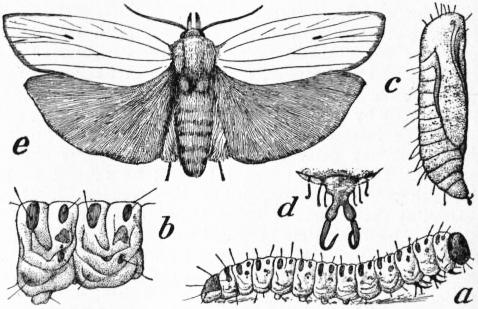
After Edwards, Riley and Howard’s Insect Life, vol. 3 (U.S. Dept. Agr.).
Fig. 1.—e, Crytophasa unipuctata, Donov., Australia. a, Larva; c, pupa, natural size; b, 2nd and 3rd abdominal segments of larva; d, cremaster of pupa, magnified.
Characters.—The name of the order indicates the fact that the wings (and other parts of the body) are clothed with flattened cuticular structures—the scales (fig. 7)—that may be regarded as modified arthropodan “hairs.” Such scales are not peculiar to the Lepidoptera—they are found also on many of the Aptera, on the Psocidae, a family of Corrodentia, on some Coleoptera (beetles) and on the gnats (Culicidae), a family of Diptera. The most distinctive structural features of the Lepidoptera are to be found in the jaws. The mandibles are mere vestiges or entirely absent; the second maxillae are usually reduced to a narrow transverse mentum which bears the scale-covered labial palps, between which project the elongate first maxillae, grooved on their inner faces, so as to form when apposed a tubular proboscis adapted for sucking liquid food.
All Lepidoptera are hatched as the eruciform soft-bodied type of larva (fig. 1, a) known as the caterpillar, with biting mandibles, three pairs of thoracic legs and with a variable number (usually five pairs) of abdominal prolegs, which carry complete or incomplete circles of hooklets. The pupa in a single family only is free (i.e. with the appendages free from the body), and mandibulate. In the vast majority of the order it is more or less obtect (i.e. with the appendages fixed to the cuticle of the body) and without mandibles (fig. 1, c).
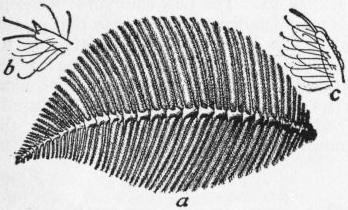
From Riley and Howard, Insect Life, vol. 7 (U.S. Dept. Agr.).
Fig. 2.—a, Feeler of Saturniid Moth (Telea polyphemus). b, c, Tips of branches, highly magnified.
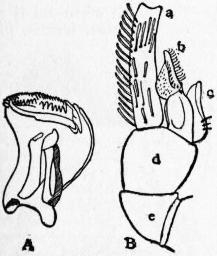
After A. Walter (Jen. Zeits. f. Naturw. vol. 18).
Fig. 3.—A, Mandible, and B, 1st maxilla of Micropteryx (Eriocephala). Magnified.
a, Palp. b, Galea. c, Lacinia. d, Stipes. e, Cardo of maxilla.
Structure.—The head in the Lepidoptera is sub-globular in shape with the compound eyes exceedingly well developed, and with a pair of ocelli or “simple eyes” often present on the vertex. It is connected to the thorax by a relatively broad and membranous “neck.” The feelers are many-jointed, often they are complex, the segments bearing processes arranged in a comb-like manner and furnished with numerous sensory hairs (fig. 2). The complexity of the feelers is carried to its highest development in certain male moths that have a wonderful power of discovering their females by smell or some analogous sense. Often the feelers are excessively complex in male moths whose maxillae are so reduced that they take no food in the imaginal state. The nature of the jaws has already been briefly described. Functional mandibles of peculiar form (fig. 3, A) are present in the remarkable small moths of the genus Micropteryx (or Eriocephala), and there are vestiges of these jaws in other moths of low type, but the minute structures in the higher Lepidoptera that were formerly described as mandibles are now believed to belong to the labrum, the true mandibles being perhaps represented by rounded prominences, not articulated with the head-capsule. Throughout the order, as a whole, the jaws are adapted for sucking liquid food, and the suctorial proboscis (often erroneously called a “tongue”) is formed as was shown by J. C. Savigny in 1816 by two elongated and flexible outgrowths of the first maxillae, usually regarded as representing the outer lobes or galeae (fig. 4, A, B, g). These structures are grooved along their inner faces and by means of a series of interlocking hair-like bristles can be joined together so as to form a tubular sucker (fig. 4, C). At their extremities they are beset with club-like sense-organs, whose apparent function is that of taste. The proboscis when in use is stretched out in front of the head and inserted into the corolla of a flower or elsewhere, for the absorption of liquid nourishment. When at rest, the proboscis is rolled up into a close spiral beneath the head and between the labial palps (fig. 4, A, p). Only in the genus Micropteryx mentioned above is the lacinia of the maxilla (as A. Walter has shown) developed (fig. 3, B, c). The maxillary palp is usually a mere vestige (fig. 4, B, p) though it is conspicuous in a few families of small moths. A considerable number of Lepidoptera take no food in the imaginal state; in these the maxillae are reduced or altogether atrophied. The second maxillae are intimately fused together to form the labium, which consists only of a reduced mentum, bearing sometimes vestigial lobes and always a pair of palps. These have two or three segments and are clothed with scales. The form and direction of the terminal segment of the labial palp afford valuable characters in classification.
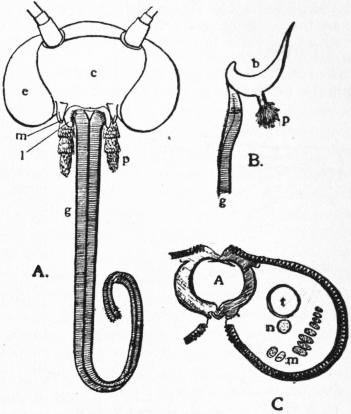
Fig. 4.—Arrangement of the jaws in a typical Moth. Somewhat diagrammatic and in part after E. Burgess and V. L. Kellogg (Amer. Nat. xiv. xxix.).
A, Front view of head. c, Clypeus. e, Compound eye. m, Vestigial mandible. l, Labrum. g, Galeae of 1st maxillae. p, Labial palp. Magnified, B. b, Base of first maxilla dissected out of the head. p, Vestigial palp. g, Galea. Further magnified. C, Part transverse section showing how the channel (A) of the proboscis is formed by the interlocking of the grooved inner faces of the flexible maxillae. t, Air-tube. n, Nerve. m, Muscle-fibres. Highly magnified.
In the thorax of the Lepidoptera the foremost segment or prothorax is very small, and not movable on the mesothorax. In many families it carries a pair of small erectile plates—the patagia—which have been regarded as serially homologous with the wings. The mesothorax is extensive; its scutum forming most of the dorsal thoracic area and small plates—tegulae—are often present at the base of the forewings, as in Hymenoptera. The tegulae which are beset with long hair-like scales are often conspicuous. The metathorax is smaller than the mesothorax. The legs are of the typical hexapodan form with five-segmented feet; the shins often bear terminal and median spurs articulated at their bases and the entire limbs are clothed with scales.
After A. S. Packard, Mem. Nat. Acad. Sci. vol. vii.
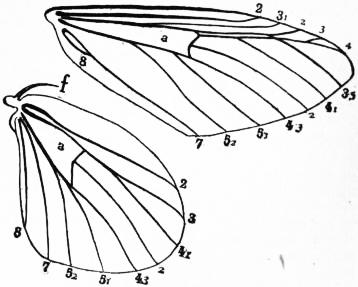
Fig. 5.—Wing-neuration of a Notodont Moth. 2, Sub-costal; 3, radial; 4, median; 5, cubital; 7, 8, anal nervures. a, Discoidal areolet or “cell”; f, frenulum. Note that the forewing has five branches (1-5) of the radial nervure, the hindwing one only. The first anal nervure (No. 6) is absent.
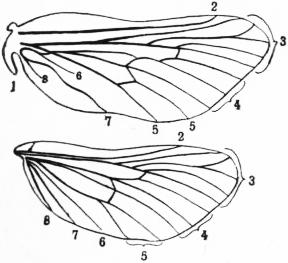
The wings of the Lepidoptera may be said to dominate the structure of the insect; only exceptionally, in certain female moths, are they vestigial or absent (fig. 17). The forewing, with its prominent apex, is longer than the hindwing, and the neuration in both (see figs. 5 and 6) is for the most part longitudinal, only a few transverse nervures, which are, in fact, branches of the median trunk, marking off a discoidal areolet or “cell” (fig. 5, a). The five branches of the radial nervure (figs. 5, 6, 3) (see Hexapoda) are usually present in the forewing, but the hindwing, in most families, has only a single radial nervure; its anal area is, however, often more strongly developed than that of the forewing. The two wings of a side are usually kept together during flight by a few stout bristles—the frenulum—(fig. 5, f) projecting from the base of the costa of the hindwing and fitting beneath a membranous fold or a few thickened scales—the retinaculum—on the under surface of the forewing. In butterflies there is no frenulum, but a costal outgrowth of the hindwing subserves the same function. In the most primitive moths a small lobate outgrowth—the jugum (fig. 6, j.)—from the dorsum of the forewing is present, but it can be of little service in keeping the two wings together. A jugum may be also present on the hindwing. The legs, which are generally used for clinging rather than for walking, have five-segmented feet and are covered with scales. In some families the front pair are reduced and without tarsal segments.
After Packard, Mem. Nat. Acad. Sci. vol. vii.
Fig. 6.—Wing neuration of a Swift Moth (Hepialid). j, Jugum. Nervures numbered as in fig. 5. Note that there are five branches to the radial nervure (No. 3) in both fore- and hindwing, and that the median trunk nervures (No. 4) traverse the discoidal areolet.
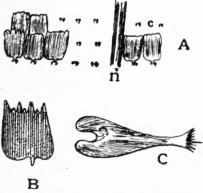
Fig. 7.—A, Arrangement of scales in rows on wing of Butterfly. n, Nervure; c, collar-like outgrowths of cuticle. Magnified. B, single scale, and C, an androconium more highly magnified.
Ten abdominal segments are recognizable in many Lepidoptera, but the terminal segments are reduced or modified to form external organs of reproduction. In the male, according to the interpretation of C. Peytoureau, the lateral plates belonging to the ninth segment form paired claspers beset with harpes, or series of ridges or teeth, while the tergum of the tenth segment forms a dorsal hook—the uncus—and its sternum a ventral process or scaphium. In the female the terminal segments form, in some cases, a protrusible ovipositor, but the typical hexapodan ovipositor with its three pairs of processes is undeveloped in the Lepidoptera.
As already mentioned, the characteristic scales on the wings, legs and body of the Lepidoptera are cuticular structures. A complete series of transitional forms can be traced between the most elaborate flattened scales (fig. 7, B) with numerous longitudinal striae and a simple arthropod “hair.” Either a “hair” or a scale owes its origin to a special cell of the ectoderm (hypodermis), a process from which grows through the general cuticle and forms around itself the substance of the cuticular appendage. The scales on the wings are arranged in regular rows (fig. 7, A), and the general cuticle is drawn out into a narrow neck or collar around the base of each scale. The scales can be easily rubbed from the surface of the wing, and the series of collars in which the scales rest are then evident (fig. 7, A, c) on the wing-membrane. On the wings of many male butterflies there are specially modified scales—the androconia (fig. 7, C)—which are formed by glandular cells and diffuse a scented secretion. In some cases, the androconia are mixed among the ordinary scales; in others they are associated into conspicuous “brands” (see fig. 66). The admirable colours of the wings of the Lepidoptera are due partly to pigment in the scales—as in the case of yellows, browns, reds and blacks—partly to “interference” effects from the fine striae on the scales—as with the blues, purples and greens.
A few points of interest in the internal structure of the Lepidoptera deserve mention. The mouth opens into a sub-globular, muscular pharynx which is believed to suck the liquid food through the proboscis, and force it along the slender gullet into a crop-like enlargement or diverticulum of the fore-gut known as a “food-reservoir” or “sucking-stomach.” The true stomach is tubular, and beyond it lies the intestine into which open the three pairs of excretory (Malpighian) tubes. The terminal part of the intestine is of wide diameter, and in some cases gives off a short caecum. The brain and the sub-oesophageal ganglia are closely approximated; there are two or three thoracic and four (rarely five) abdominal ganglia. In the female each ovary has four ovarian tubes, in which the large egg-cells are enclosed in follicles and associated with nutritive cells. There is a special bursa which in the Hepialidae opens with the vagina on the eighth abdominal sternum. In the Micropterygidae, Enocraniidae and the lower Tineides, the duct of the bursa leads into the vagina, which still opens on the eighth sternum. But in most Lepidoptera, the bursa opens by a vestibule on the eighth sternum, distinct from the vagina, whose opening shifts back to the ninth, the duct of the bursa being connected with the vagina by a canal which opens opposite to the spermatheca. In the male, the two testes are usually fused into a single mass, and a pair of tubular accessory glands open into the vasa deferentia or into the ejaculatory duct. In a few families—the Hepialidae and Saturniidae for example—the testes retain the primitive paired arrangement. These details have been worked out by various students, among whom W. H. Jackson and W. Petersen deserve special mention. Summing up the developmental history of the genital ducts, Jackson remarks that there is “an Ephemeridal stage, which ends towards the close of larval life, an Orthopteran stage, indicated during the quiescent period preceding pupation, and a Lepidopteran stage which begins with the commencement of pupal life.”
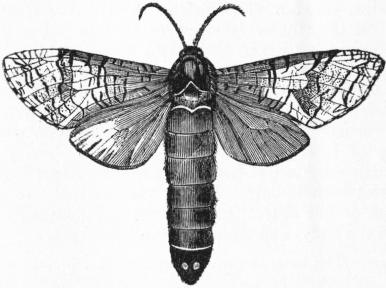
Fig. 8 a.—Cossus macmurtrei. (MacMurtrie’s Goat Moth.) N. America.
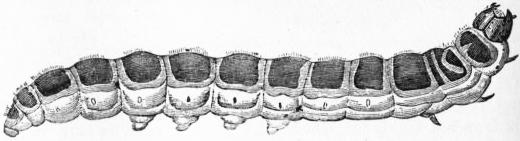
Fig. 8 b.—Larva of Cossus cossus. (Goat Moth.) Europe.
Development.—Many observations have been made on the embryology of the Lepidoptera; for some of the more important results of these see Hexapoda. The post-embryonic development of Lepidoptera is more familiar, perhaps, than that of any other group of animals. The egg shows great variation in its outward form, the outer envelope or chorion being in some families globular, in others flattened, in others again erect and sub-conical or cylindrical; while its surface often exhibits a beautifully regular series of ribs and furrows. Throughout the order the larva is of the form known as the caterpillar (fig. 1, a, b, fig. 8 B) characterized by the presence of three pairs of jointed and clawed legs on the thorax and a variable number of pairs of abdominal “prolegs”—sub-cylindrical outgrowths of the abdominal segments, provided with a complete or incomplete circle of hooklets at the extremity.
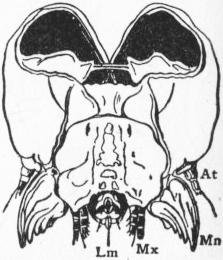
Fig. 9.—Head of Goat Moth Caterpillar (Cossus) from behind. Magnified. (From Miall and Denny after Lyonnet.)
At, Feeler. Mn, Mandible. Mx, First maxilla. Lm, Second maxillae (Labium) with spinneret.
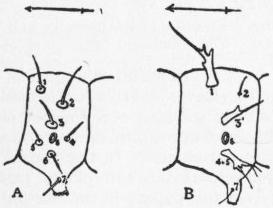
There are ten abdominal segments—the ninth often small and concealed; prolegs are usually present on the third, fourth, fifth, sixth and tenth of these segments. The head of the caterpillar (fig. 9) is large with firmly chitinized cuticle; it carries usually twelve simple eyes or ocelli, a pair of short feelers (fig. 9 At) and a pair of strong mandibles (fig. 9, Mn), for the caterpillar feeds by biting leaves or other plant-tissues. The first maxillae, so highly developed in the imago, are in the larva small and inconspicuous appendages, each bearing two short jointed processes,—the galea and the palp (fig. 9, Mx). The second maxillae form a plate-like labium on whose surface projects the spinneret which is usually regarded as a modified hypopharynx (fig. 9, Lm). The silk-glands whose ducts open on this spinneret are paired convoluted tubes lying alongside the elongate cylindrical stomach. In the common “silkworm” these glands are five times as long as the body of the caterpillar. They are regarded as modified salivary glands, though the correspondence has been doubted by some students. The body of the caterpillar is usually cylindrical and wormlike, with the segmentation well marked and the cuticle feebly chitinized and flexible. Firm chitinous plates are, however, not seldom present on the prothorax and on the hindmost abdominal segment. The segments are mostly provided with bristle or spine-bearing tubercles, whose arrangement has lately been shown by H. G. Dyar to give partially trustworthy indications of relationship. On either side of the median line we find two dorsal or trapezoidal tubercles (Nos. 1 and 2), while around the spiracle are grouped (Nos. 3, 4 and 5) supra-, post-, and pre-spiracular tubercles; below are the sub-spiraculars, of which there may be two (Nos. 6, 7). The last-named is situated on the base of the abdominal proleg, and yet another tubercle (No. 8) may be present on the inner aspect of the proleg. The spiracles are very conspicuous on the body of a caterpillar, occurring on the prothorax and on the first eight abdominal segments. Various tubercles may become coalesced or aborted (fig. 10, B); often, in conjunction with the spines that they bear, the tubercles serve as a valuable protective armature for the caterpillar. Much discussion has taken place as to whether the abdominal prolegs are or are not developed directly from the embryonic abdominal appendages. In the more lowly families of Lepidoptera, these organs are provided at the extremity with a complete circle of hooklets, but in the more highly organized families, only the inner half of this circle is retained.
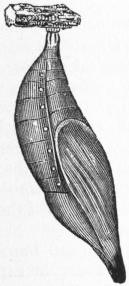
B, after Grote, Mitt. aus dem Roemer Museum, No. 6. Fig. 11.—Pupa of a Butterfly (Amathusia phidippus).
Fig. 10.—Abdominal segments of Caterpillars, to show arrangement of tubercles; the arrows point anteriorly. A, Generalized condition; B, specialized condition in the Saturniidae. s, Spiracle; the numbering of the tubercles is explained in the text. Note that in B No. 2 is much reduced and disappears after the first moult. 4 and 5 are coalesced, and 6 is absent.
The typical Lepidopteran pupa, or “chrysalis,” as shown in the higher families, is an obtect pupa (fig. 11) with no trace of mandibles, the appendages being glued to the body by an exudation, and motion being possible only at three of the abdominal intersegmental regions, the fifth and sixth abdominal segments at most being “free.” A flattened or pointed process—the cremaster—often prominent at the tail-end, may carry one or several hooks (fig. 1, d) which serve to anchor the pupa to its cocoon or to suspend butterfly-pupae from their pad of silk (fig. 11). In the lower families the pupa (fig. 1, c) is only incompletely obtect, and a greater number of abdominal segments can move on one another. The seventh abdominal segment is, in all female lepidopterous pupae, fused with those behind it; in the male “incomplete” pupa this becomes “free” and so may the segments anterior to it, in both sexes, forward to and including the third. The presence of circles of spines on the abdominal segments enables the “incomplete” pupa as a whole to work its way partly out of the cocoon when the time for the emergence of the imago draws near. In the family of the Eriocraniidae (often called the Micropterygidae) the pupa resembles that of a caddis-fly (Trichopteron) being active before the emergence of the imago and provided with strong mandibles by means of which it bites its way out of the cocoon. The importance of the pupa in the phylogeny and classification of the Lepidoptera has lately been demonstrated by T. A. Chapman in a valuable series of papers. Sometimes organs are present in the pupa which are undeveloped in the imago, such as the maxillary palps of the Sesiidae (clearwing moths) and the pectination on the feelers of female Saturniids. E. B. Poulton has drawn attention to the ancestral value of such characters.
Habits and Life-Relations.—The attractiveness of the Lepidoptera and the conspicuous appearance of many of them have led to numerous observations on their habits. The method of feeding of the imago by the suction of liquids has already been mentioned in connexion with the structure of the maxillae and the food-canal. Nectar from flowers is the usual food of moths and butterflies, most of which alight on a blossom before thrusting the proboscis into the corolla of the flower, while others—the hawk moths (Sphingidae) for example—remain poised in the air in front of the flower by means of excessively rapid vibration of the wings, and quickly unrolling the proboscis sip the nectar. Certain flowers with remarkably long tubular corollas seem to be specially adapted for the visits of hawk moths. Some Lepidoptera have other sources of food-supply. The juices of fruit are often sought for, and certain moths can pierce the envelope of a succulent fruit with the rough cuticular outgrowths at the tips of the maxillae, so as to reach the soft tissue within. Animal juices attract other Lepidoptera, which have been observed to suck blood from a wounded mammal; while putrid meat is a familiar “lure” for the gorgeous “purple emperor” butterfly (Apatura iris). The water of streams or the dew on leaves may be frequently sought by Lepidoptera desirous of quenching their thirst, possibly with fatal results, the insects being sometimes drowned in rivers in large numbers. Members of several families of the Lepidoptera—the Hepialidae, Lasiocampidae and Saturniidae, for example—have the maxillae vestigial or aborted, and take no food at all after attaining the winged condition. In such insects there is a complete “division of labour” between the larval and the imaginal instars, the former being entirely devoted to nutritive, the latter to reproductive functions.
Of much interest is the variety displayed among the Lepidoptera in the season and the duration of the various instars. The brightly coloured vanessid butterflies, for example, emerge from the pupa in the late summer and live through the winter in sheltered situations, reappearing to lay their eggs in the succeeding spring. Many species, such as the vapourer moths (Orgyia), lay eggs in the autumn, which remain unhatched through the winter. The eggs of the well-known magpie moths (Abraxas) hatch in autumn and the caterpillar hibernates while still quite small, awaiting for its growth the abundant food-supply to be afforded by the next year’s foliage. The codlin moths (Carpocapsa) pass the winter as resting full-grown larvae, which seek shelter and spin cocoons in autumn, but do not pupate until the succeeding spring. Lastly, many of the Lepidoptera hibernate in the pupal stage; the death’s head moth (Acherontia) and the cabbage-white butterflies (Pieris) are familiar examples of such. The last-named insects afford instances of the “double-brooded” condition, two complete life-cycles being passed through in the year. The flour moth (Ephestia kühniella) is said to have five successive generations in a twelvemonth. On the other hand, certain species whose larvae feed in wood or on roots take two or three years to reach the adult stage.
The rate of growth of the larva depends to a great extent on the nature of its food, and the feeding-habits of caterpillars afford much of interest and variety to the student. The contrast among the Lepidoptera between the suctorial mouth of the imago and the biting jaws of the caterpillar is very striking (cf. figs. 4 and 9), and the profound transformation in structure which takes place is necessarily accompanied by the change from solid to liquid food. The first meal of a young caterpillar is well known to be often its empty egg-shell; from this it turns to feed upon the leaves whereon its provident parent has laid her eggs. But in a few cases hatching takes place in winter or early spring, and the young larvae have then to find a temporary food until their own special plant is available. For example, the caterpillars of some species of Xanthia and other noctuid moths feed at first upon willow-catkins. On the other hand, the caterpillars of the pith moth (Blastodacna) hatched at midsummer, feed on leaves when young, and burrow into woody shoots in autumn. All who have tried to rear caterpillars know that, while those of some species will feed only on one particular species of plant, others will eat several species of the same genus or family, while others again are still less particular, some being able to feed on almost any green herb. It is curious to note how certain species change their food in different localities, a caterpillar confined to one plant in some localities being less particular elsewhere. Individual aberrations in food are of special interest in suggesting the starting-point for a change in the race. When we consider the vast numbers of the Lepidoptera and the structural modifications which they have undergone, their generally faithful adherence to a vegetable diet is remarkable. The vast majority of caterpillars eat leaves, usually devouring them openly, and, if of large size, quickly reducing the amount of foliage on the plant. But many small caterpillars keep, apparently for the sake of concealment, to the under surface of the leaf, while others burrow into the green tissue, forming a characteristic sinuous “mine” between the two leaf-skins. In several families we find the habit of burrowing in woody stems,—the “goat” (Cossus, fig. 8) and the clearwings (Sesiidae), for example, while others, like the larvae of the swift moths (Hepialidae) live underground devouring roots (fig. 12). The richer nutrition in the green food is usually shown by the quicker growth of the numerous caterpillars that feed on it, as compared with the slower development of the wood and root-feeding species. Aquatic larvae are very rare among the Lepidoptera. The caterpillars of the pyralid “china-mark” moths (Hydrocampa, fig. 13), however, live under water, feeding on duckweed (Lemna) and breathing atmospheric air, a film of which is enclosed in a spun-up shelter beneath the leaves, while the larvae of Paraponyx, which feed on Stratiotes, have closed spiracles and breathe dissolved air by means of branchial filaments along the sides of the body.
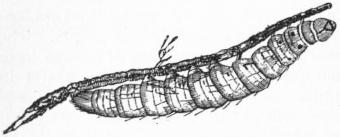
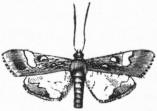
Fig. 12.—Larva of Hepialus humuli (ghost moth). Fig. 13.—Hydrocampa aquatilis (water moth).
We may now turn to instances of more anomalous modes of feeding. The clothes moths (Tineids) have invaded our dwellings and found a congenial food-stuff for their larvae in our garments. A few small species of the same group are reared in meal and other human food-stores; so are the caterpillars of some pyralid moths (Ephestia), while others (Asopia, Aglossa) feed upon kitchen refuse. Two species of crambid moths (Aphomia sociella and Galleria melonella) find a home in bee-hives, where their caterpillars feed upon the wax, while the waxy secretion from the body of the great American lantern-fly (Fulgora candelaria) serves both as shelter and food for the caterpillar of the moth Epipyrops anomala. Very few caterpillars have developed a thoroughly carnivorous habit. That of Cosmia trapezina feeds on oak and other leaves, but devours smaller caterpillars which happen to get in its way, and if shaken from the tree, eats other larvae while climbing the trunk. Xylina ornithopus and a few other species are said to be always carnivorous when opportunity offers; the small looping caterpillar of a “pug” moth (Eupithecia coronata) has been observed to eat a larva three times as big as itself. The caterpillars of Orthosia pistacina live together in peace while their food is moist, but devour each other when it dries up; this is true cannibalism—a term which should not be applied to the habit of preying on another species. A few carnivorous caterpillars do not attack other caterpillars, but prey upon insects of another order; among these Fenescia tarquinius, which eats aphides, and Erastria scitula, which feeds upon scale insects, must be reckoned as benefactors to mankind. The life-history of the latter moth has been worked out by H. Rouzaud. It inhabits the shores of the Mediterranean, and its caterpillar devours the coccids upon various fruit-trees, especially the black-scale (Lecanium oleae) of the olive. The moth, which is a small noctuid, the white markings on whose wings give it the appearance of a bird-dropping when at rest in the daytime, appears in May, and lays her eggs, singly and far apart, upon the trees infested by the coccids. when hatched, the young caterpillar selects a large female coccid, eats its way through the scale, and devours the insect beneath; having done this it makes its way to a fresh victim. As it increases in size it forms a case for itself made of the scales of its victims, excrement, &c., bound together by silk which it spins, and, protected by this covering, which closely resembles the smut-covered bark of the tree, it roams about during its later stages, devouring several coccids every day. So nutritious is the food, that four or five successive broods follow each other through the summer.
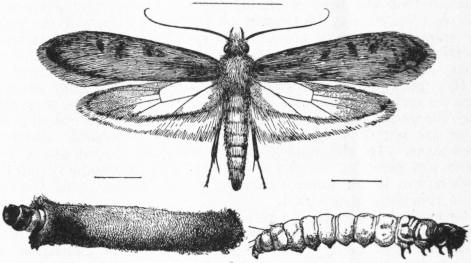
After Marlatt (after Riley), Bull. 4, Div. Ent. U.S. Dept. Agr.
Fig. 14.—Clothes Moth (Tinea pellionella), with larva in and out of its case. Magnified.
The habit just mentioned of forming some kind of protective covering out of foreign substances spun together by silk is practised by caterpillars of different families. The clothes moth larvae (Tinea, fig. 14), for example, make a tubular dwelling out of the pellets of wool passed from their own intestines, while the allied Tortricid caterpillars roll up leaves and spin for themselves cylindrical shelters. The habit of spinning over the food plant a protective mass of web, whereon the caterpillars of a family can live together socially is not uncommon. In the case of the small ermine moths (Hyponomeuta) the caterpillars remain associated throughout their lives and pupate in cocoons on the mass of web produced by their common labour. But the larger, spiny caterpillars of the vanessid butterflies usually scatter away from the nest of their infancy when they have attained a certain size.
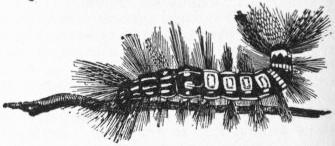
Fig. 15.—Larva of Orgyia gonostigma. Europe.
Spines and hairs seem to be often effective protections for caterpillars; the experiments of E. B. Poulton and others tend to show that hairy caterpillars (fig. 15) are distasteful to birds. Many caterpillars are protected by the harmony of their general green coloration with their surroundings. When the insect attains a large size—as in the case of the hawk moth (Sphingid) caterpillars—the extensive green surface becomes broken up by diagonal dark markings (fig. 46b), thus simulating the effect of light and shade among the foliage. A remarkable result of Poulton’s experiments has been the establishment of a reflex effect through the skin on the colour of a caterpillar. Some species of “loopers” (Geometridae, fig. 43) for example, if placed when young among surroundings of a certain colour, become closely assimilated thereto—dark brown among dark twigs, green among green leaves. These colour-reflexes in conjunction with the elongate twig-like shape of the caterpillars and their habit of stretching themselves straight out from a branch, afford some of the best and most familiar examples of “protective resemblance.” The “terrifying attitude” of caterpillars, and the supposed resemblance borne by some of them to serpents and other formidable vertebrates or arthropods, are discussed in the article Mimicry.
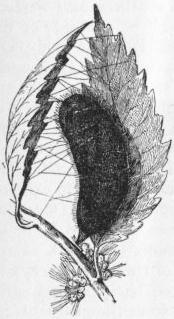
After Ratzeburg, Insect Life, vol. 2 (U.S. Dept. Agr.).
Fig. 16.—Pupa of Gypsy Moth (Porthetria dispar) sheltered in leaves joined by silken threads. Below is the cast larval cuticle.
The silk produced by a caterpillar is, as we have seen, often advantageous in its own life-relations, but its great use is in connexion with the pupal stage. In the life-history of many Lepidoptera, the last act of the caterpillar is to spin a cocoon which may afford protection to the pupa. In some cases this is formed entirely of the silk produced by the spinning-glands, and may vary from the loose meshwork that clothes the pupa of the diamond-back moth (Plutella cruciferarum) to the densely woven cocoon of the silkworms (Bombycidae and Saturniidae) or the hard shell-like covering of the eggars (Lasiocampidae). Frequently foreign substances are worked up with the silk and serve to strengthen the cocoon, such as hairs from the body of the caterpillar itself, as among the “tigers” (Arctiidae) or chips of wood, as with the timber-burrowing larva of the “goat” (Cossus). In many families of Lepidoptera we can trace a degeneration of the cocoon. Thus, the pupae of most owl moths (Noctuidae) and hawk moths (Sphingidae) lie buried in an earthen cell. Among the butterflies we find that the cocoon is reduced to a pad of silk which gives attachment to the cremaster; in the Pieridae there is in addition a girdle of silk around the waist-region of the pupa, but the pupae of the Nymphalidae (figs. 11, 65) simply hang from the supporting pad by the tail-end. Poulton has shown that the colours of some exposed pupae vary with the nature of the surroundings of the larva during the final stage.
When the pupal stage is complete the insect has to make its way out of the cocoon. In the lower families of moths it is the pupa which comes out at least partially, working itself onwards by the spines on its abdominal segments; the pupa of the primitive Micropteryx has functional mandibles with which it bites through the cocoon. In the higher Lepidoptera the pupa is immovable, and the imago, after the ecdysis of the pupal cuticle, must emerge. This emergence is in some cases facilitated by the secretion of an acid or alkaline solvent discharged from the mouth or from the hind-gut, which weakens the cocoon—so that the delicate moth can break through without injury.
As might be expected, the conditions to which larva and pupa are subjected have often a marked influence on the nature of the imago. An indifferent food-supply for the larva leads to a dwarfing of the moth or butterfly. Many converging lines of experiment and observation tend to show that cool conditions during the pupal stage frequently induce darkening of pigment in the imago, while a warm temperature brightens the colours of the perfect insect. For example, in many species of butterfly that are double-brooded, the spring brood emerging from the wintering pupae are more darkly coloured than the summer brood, but if the pupae producing the latter be subjected artificially to cold conditions, the winter form of imago results. It is usually impossible, however, to produce the summer form of the species from wintering pupae by artificial heat. From this A. Weismann argued that the more stable winter form must be regarded as representing the ancestral race of the species. Further examples of this “seasonal dimorphism” are afforded by many tropical butterflies which possess a darker “wet-season” and a brighter “dry-season” generation. So different in appearance are often these two seasonal forms that before their true relationship was worked out they had been naturally regarded as independent species. The darkening of wing-patterns in many species of Lepidoptera has been carefully studied in our own British fauna. Melanic or melanochroic varieties are specially characteristic of western and hilly regions, and some remarkable dark races (fig. 43) of certain geometrid moths have arisen and become perpetuated in the manufacturing districts of the north of England. The production of these melanic forms is explained by J. W. Tutt and others as largely due to the action of natural selection, the damp and sooty conditions of the districts where they occur rendering unusually dark the surfaces—such as rocks, tree-trunks and palings—on which moths habitually rest and so favouring the survival of dark, and the elimination of pale varieties, as the latter would be conspicuous to their enemies. Breeding experiments have shown that these melanic races are sometimes “dominant” to their parent-stock. An evidently adaptive connexion can be frequently traced between the resting situation and attitude of the insect and the colour and pattern of its wings. Moths that rest with the hindwings concealed beneath the forewings (fig. 34, f) often have the latter dull and mottled, while the former are sometimes highly coloured. Butterflies whose normal resting attitude is with the wings closed vertically over the back (fig. 63) so that the under surface is exposed to view, often have this under surface mottled and inconspicuous although the upper surface may be bright with flashing colours. Various degrees of such “protective resemblance” can be traced, culminating in the wonderful “imitation” of its surroundings shown by the tropical “leaf-butterflies” (Kallima), the under surfaces of whose wings, though varying greatly, yet form in every case a perfect representation of a leaf in some stage or other of decay, the butterfly at the same time disposing of the rest of its body so as to bear out the deception. How this is effected is best told by A. R. Wallace, who was the first to observe it, in his work The Malay Archipelago:—
“The habit of the species is always to rest on a twig and among dead or dried leaves, and in this position, with the wings closely pressed together, their outline is exactly that of a moderately sized leaf slightly curved or shrivelled. The tail of the hindwings forms a perfect stalk and touches the stick, while the insect is supported by the middle pair of legs, which are not noticed among the twigs and fibres that surround it. The head and antennae are drawn back between the wings so as to be quite concealed, and there is a little notch hollowed out at the very base of the wings, which allows the head to be retracted sufficiently.”
But the British Vanessids often rest on a bare patch of ground with the brightly coloured upper surface of their wings fully exposed to view, and even make themselves still more conspicuous by fanning their wings up and down. Some genera and families of Lepidoptera, believed to secrete noxious juices that render them distasteful, are adorned with the staring contrasts of colour usually regarded as “warning,” while other genera, belonging to harmless families sought for as food by birds and lizards, are believed to obtain complete or partial immunity by their likeness to the conspicuous noxious groups. (See Mimicry.)
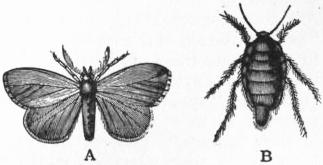
Fig. 17.—Vapourer Moth (Ocneria detrita). S. Europe. A, Male; B, Female.
Sexual dimorphism is frequent among the Lepidoptera. In many families this takes the form of more elaborate feelers in the male than in the female moth. Such complex feelers (fig. 2) bear numerous sensory (olfactory) nerve-endings and give to the males that possess them a wonderful power of discovering their mates. A single captive female of the Endromidae or Lasiocampidae often causes hundreds of males of her species to “assemble” around her prison, and this character is made use of by collectors who want to secure specimens. In many butterflies—notably the “blues” (Lycaenidae)—the male is brilliant while the female is dull, and in other groups (the Danainae for example) he is provided with scent-producing glands believed to be “alluring” in function. The apparent evidence given by the sexual differences among the Lepidoptera in favour of C. Darwin’s theory of sexual selection finds no support from a study of their habits. The male indeed usually seeks the female, but she appears to exercise no choice in pairing. In some cases the female is attracted by the male, and here a modified form of sexual selection appears to be operative. The ghost swift moth (Hepialus humuli) affords a curious and interesting example of this condition, the female showing the usual brown and buff coloration of her genus, while the wings of the male are pure white, rendering him conspicuous in the dusky evening when pairing takes place. But in the northernmost haunts of the species, where there is no midsummer night, the male closely resembles the female in wing patterns, the development of the conspicuous white being needless. A very interesting sexual dimorphism is seen in the wingless condition of several female moths—the winter moths (Hybernia and Cheimatobia) among the Geometridae and the vapourers (Orgyia and Ocneria) among the Lymantriidae for example (fig. 17). It might be thought that the loss of power of flight by the female would seriously restrict the range of the species. In such insects, however, the caterpillars are often active and travel far.