VOLUME XVI SLICE IV Lefebvre, Tanneguy to Letronne, Jean Antoine (continued 4)
Reading edition
See J. H. Stocqueler, Life and Labours of Dr Leitner (1875).

LEITRIM, a county of Ireland in the province of Connaught, bounded N.W. by Donegal Bay, N.E. by Fermanagh, E. by Cavan, S.E. by Longford, S.W. by Roscommon and W. by Sligo. The area is 392,381 acres, or about 613 sq. m. The northern portion of the county consists of an elevated tableland, of which the highest summits belong to the Truskmore Hills, reaching 1712 ft.; with Benbo, 1365 ft. and Lackagh, 1446 ft. In the southern part the country is comparatively level, and is generally richly wooded. The county touches the south coast of Donegal Bay, but the coast-line is only about 3 m. The principal river is the Shannon, which, issuing from Lough Allen, forms the south-western boundary of the county with Roscommon. The Bonnet rises in the north-west and flows to Lough Gill, and the streams of Drones and Duff separate Leitrim from Donegal and Sligo. Besides Lough Allen, which has an area of 8900 acres, the other principal lakes in the county are Lough Macnean, Lough Scur, Lough Garadice and Lough Melvin. The scenery of the north is wild and attractive, while in the neighbourhood of the Shannon it is of great beauty. Lough Melvin and the coast rivers afford rod fishing, the lough being noted for its gillaroo trout.
This varied county has in general a floor of Carboniferous Limestone, which forms finely scarped hills as it reaches the sea in Donegal Bay. The underlying sandstone appears at Lough Melvin, and again on the margin of a Silurian area in the extreme south. The Upper Carboniferous series, dipping gently southward, form mountainous country round Lough Allen, where the name of Slieve Anierin records the abundance of clay-ironstone beneath the coal seams. The sandstones and shales of this series scarp boldly towards the valley of the Bonnet, across which rises, in picturesque contrast, the heather-clad ridge of ancient gneiss which forms, in Benbo, the north-east end of the Ox Mountains. The ironstone was smelted in the upland at Creevelea down to 1859, and the coal is worked in a few thin seams.
The climate is moist and unsuitable for grain crops. On the higher districts the soil is stiff and cold, and, though abounding in stones, retentive of moisture, but in the valleys there are some fertile districts. Lime, marl and similar manures are abundant, and on the coast seaweed is plentiful. The proportion of tillage to pasture is roughly as 1 to 3. Potatoes are grown, but oats, the principal grain crop, are scanty. The live stock consists chiefly of cattle, pigs and poultry. Coarse linens for domestic purposes are manufactured and coarse pottery is also made. The Sligo, Leitrim and Northern Counties railway, connecting Sligo with Enniskillen, crosses the northern part of the county, by way of Manor Hamilton; the Mullingar and Sligo line of the Midland Great Western touches the south-western boundary of the county, with a station at Carrick-on-Shannon; while connecting with this line at Dromod is the Cavan and Leitrim railway to Ballinamore and Arigna, and to Belturbet in county Cavan.
The population (78,618 in 1891; 69,343 in 1901) decreases owing to emigration, the decrease being one of the most serious shown by any Irish county. It includes nearly 90% of Roman Catholics. The only towns are Carrick-on-Shannon (pop. 1118) and Manor Hamilton (993). The county is divided into five baronies. It is within the Connaught circuit, and assizes are held at Carrick-on-Shannon, and quarter sessions at Ballinamore, Carrick-on-Shannon and Manor Hamilton. It is in the Protestant diocese of Kilmore, and the Roman Catholic dioceses of Ardagh and Kilmore. In the Irish House of Commons two members were returned for the county and two for the boroughs of Carrick-on-Shannon and Jamestown, but at the Union the boroughs were disfranchised. The county divisions are termed the North and South, each returning one member.
With the territory which afterwards became the county Cavan, Leitrim formed part of Brenny or Breffny, which was divided into two principalities, of which Leitrim, under the name of Hy Bruin-Brenny, formed the western. Being for a long time in the possession of the O’Rourkes, descendants of Roderick, king of Ireland, it was also called Brenny O’Rourke. This family long maintained its independence; even in 1579, when the other existing counties of Connaught were created, the creation of Leitrim was deferred, and did not take place until 1583. Large confiscations were made in the reigns of Elizabeth and James I., in the Cromwellian period, and after the Revolution of 1688.
There are “druidical” remains near Fenagh and at Letterfyan, and important monastic ruins at Creevelea near the Bonnet, with several antique monuments, and in the parish of Fenagh. There was a flourishing Franciscan friary at Jamestown. The abbeys of Mohill, Annaduff and Drumlease are converted into parish churches. Among the more notable old castles are Manor Hamilton Castle, originally very extensive, but now in ruins, and Castle John on an island in Lough Scur. There is a small village named Leitrim about 4 m. N. of Carrick-on-Shannon, which was once of enough importance to give its name to a barony and to the county, and is said to have been the seat of an early bishopric.
LEIXÕES, a seaport and harbour of refuge of northern Portugal; in 41° 9′ 10″ N., 8° 40′ 35″ W., 3 m. N. of the mouth of the Douro. Leixões is included in the parish of Matozinhos (pop. 1900, 7690) and constitutes the main port of the city of Oporto (q.v.), with which it is connected by an electric tramway. The harbour, of artificial construction, has an area of over 220 acres, and admits vessels of any size, the depth at the entrance being nearly 50 ft. The transference of cargo to and from ships lying in the Leixões basin is effected entirely by means of lighters from Oporto. In addition to wine, &c., from Oporto, large numbers of emigrants to South America are taken on board here. The trade of the port is mainly in British hands, and large numbers of British ships call at Leixões on the voyage between Lisbon and Liverpool, London or Southampton.
LEJEUNE, LOUIS FRANÇOIS, Baron (1776-1848), French general, painter, and lithographer, was born at Versailles. As aide-de-camp to General Berthier he took an active part in many of the Napoleonic campaigns, which he made the subjects of an important series of battle-pictures. The vogue he enjoyed is due to the truth and vigour of his work, which was generally executed from sketches and studies made on the battlefield. When his battle-pictures were shown at the Egyptian Hall in London, a rail had to be put up to protect them from the eager crowds of sightseers. Among his chief works are “The Entry of Charles X. into Paris, 6 June 1825” at Versailles; “Episode of the Prussian War, October 1807” at Douai Museum; “Marengo” (1801); “Lodi,” “Thabor,” “Aboukir” (1804); “The Pyramids” (1806); “Passage of the Rhine in 1795” (1824), and “Moskawa” (1812). The German campaign of 1806 brought him to Munich, where he visited the workshop of Senefelder, the inventor of lithography. Lejeune was so fascinated by the possibilities of the new method that he then and there made the drawing on stone of his famous “Cossack” (printed by C. and T. Senefelder, 1806). Whilst he was taking his dinner, and with his horses harnessed and waiting to take him back to Paris, one hundred proofs were printed, one of which he subsequently submitted to Napoleon. The introduction of lithography into France was greatly due to the efforts of Lejeune. Many of his battle-pictures were engraved by Coiny and Bovinet.
See Fournier-Sarlovèze, Le Général Lejeune (Paris, Libraire de l’art).
LEKAIN, the stage name of Henri Louis Cain (1728-1778), French actor, who was born in Paris on the 14th of April 1728, the son of a silversmith. He was educated at the Collège Mazarin, and joined an amateur company of players against which the Comédie Française obtained an injunction. Voltaire supported him for a time and enabled him to act in his private theatre and also before the duchess of Maine. Owing to the hostility of the actors it was only after a struggle of seventeen months that, by the command of Louis XV., he was received at the Comédie Française. His success was immediate. Among his best parts were Herod in Mariamne, Nero in Britannicus and similar tragic rôles, in spite of the fact that he was short and stout, with irregular and rather common features. His name is connected with a number of important scenic reforms. It was he who had the benches removed on which privileged spectators formerly sat encumbering the stage, Count Lauragais paying for him an excessive indemnity demanded. Lekain also protested against the method of sing-song declamation prevalent, and endeavoured to correct the costuming of the plays, although unable to obtain the historic accuracy at which Talma aimed. He died in Paris on the 8th of February 1778.
His eldest son published his Mémoires (1801) with his correspondence with Voltaire, Garrick and others. They were reprinted with a preface by Talma in Mémoires sur l’art dramatique (1825).
LELAND, CHARLES GODFREY (1824-1903), American author, son of a merchant, was born at Philadelphia on the 15th of August 1824, and graduated at Princeton in 1845. He afterwards studied at Heidelberg, Munich and Paris. He was in Paris during the revolution of 1848, and took an active part in it. He then returned to Philadelphia, and after being admitted to the bar in 1851, devoted himself to contributing to periodicals, editing various magazines and writing books. At the opening of the Civil War he started at Boston the Continental Magazine, which advocated emancipation. In 1868 he became known as the humorous author of Hans Breitmann’s Party and Ballads, which was followed by other volumes of the same kind, collected in 1871 with the title of Hans Breitmann’s Ballads. These dialect poems, burlesquing the German American, at once became popular. In 1869 he went to Europe, and till 1880 was occupied, chiefly in London, with literary work; after returning to Philadelphia for six years, he again made his home in Europe, generally at Florence, where he died on the 20th of March 1903. Though his humorous verses were most attractive to the public, Leland was a serious student of folk-lore, particularly of the gipsies, his writings on the latter (The English Gypsies and their Language, 1872; The Gypsies, 1882; Gypsy Sorcery and Fortune-telling ..., 1891, &c.) being recognized as valuable contributions to the literature of the subject. He was president of the first European folk-lore congress, held in Paris in 1889.
His other publications include Poetry and Mystery of Dreams (1855), Meister Karl’s Sketch-book (1855), Pictures of Travel (1856), Sunshine in Thought (1862), Heine’s Book of Songs (1862), The Music Lesson of Confucius (1870), Egyptian Sketch-book (1873), Abraham Lincoln (1879), The Minor Arts (1880), Algonquin Legends of New England (1884), Songs of the Sea and Lays of the Land (1895), Hans Breitmann in Tyrol (1895), One Hundred Profitable Acts (1897), Unpublished Legends of Vergil (1899), Kuloskap the Master, and other Algonquin Poems (1903, with J. Dyneley Prince).
See his Memoirs (2 vols., 1893), and E. R. Pennell, C. G. Leland (1906).
LELAND (Leyland or Laylonde), JOHN (c. 1506-1552), English antiquary, was born in London on the 13th of September, probably in 1506. He owed his education at St Paul’s school under William Lilly, and at Christ’s College, Cambridge, to the kindness of a patron, Thomas Myles. He graduated at Cambridge in 1521, and subsequently studied at All Souls College, Oxford, and in Paris under François Dubois (Sylvius). On his return to England he took holy orders. He had been tutor to Lord Thomas Howard, son of the 3rd duke of Norfolk, and to Francis Hastings, afterwards earl of Huntingdon. Meanwhile his learning had recommended him to Henry VIII., who presented him to the rectory of Peuplingues in the marches of Calais in 1530. He was already librarian and chaplain to the king, and in 1533 he received a novel commission under the great seal as king’s antiquary, with power to search for records, manuscripts and relics of antiquity in all the cathedrals, colleges and religious houses of England. Probably from 1534, and definitely from 1536 onwards to 1542, he was engaged on an antiquarian tour through England and Wales. He sought to preserve the MSS. scattered at the dissolution of the monasteries, but his powers did not extend to the actual collection of MSS. Some valuable additions, however, he did procure for the king’s library, chiefly from the abbey of St Augustine at Canterbury. He had received a special dispensation permitting him to absent himself from his rectory of Peuplingues in 1536, and on his return from his itinerary he received the rectory of Haseley in Oxfordshire; his support of the church policy of Henry and Cranmer being further rewarded by a canonry and prebend of King’s College (now Christ Church), Oxford, and a prebend of Salisbury. In a Strena Henrico1 (pr. 1546), addressed to Henry VIII. in 1545, he proposed to execute from the materials which he had collected in his journeys a topography of England, an account of the adjacent islands, an account of the British nobility, and a great history of the antiquities of the British Isles. He toiled over his papers at his house in the parish of St Michael le Querne, Cheapside, London, but he was not destined to complete these great undertakings, for he was certified insane in March 1550, and died on the 18th of April 1552.
Leland was an exact observer, and a diligent student of local chronicles. The bulk of his work remained in MS. at the time of his death, and various copies were made, one by John Stowe in 1576. After passing through various hands the greater part of Leland’s MSS. were deposited by William Burton, the historian of Leicestershire, in the Bodleian at Oxford. They had in the meantime been freely used by other antiquaries, notably by John Bale, William Camden and Sir William Dugdale. The account of his journey in England and Wales in eight MS. quarto volumes received its name The Itinerary of John Leland from Thomas Burton and was edited by Thomas Hearne (9 vols., Oxford, 1710-1712; other editions in 1745 and 1770). The scattered portions dealing with Wales were re-edited by Miss L. Toulmin Smith in 1907. His other most important work, the Collectanea, in four folio MS. volumes, was also published by Hearne (6 vols., Oxford, 1715). His Commentarii de scriptoribus Britannicis, which had been used and distorted by his friend John Bale, was edited by Anthony Hall (2 vols., Oxford, 1709). Some of Leland’s MSS., which formerly belonged to Sir Robert Cotton, passed into the possession of the British Museum. He was a Latin poet of some merit, his most famous piece being the Cygneo Cantio (1545) in honour of Henry VIII. Many of his minor works are included in Hearne’s editions of the Itinerary and the Collectanea.
For accounts of Leland see John Bale, Catalogus (1557); Anthony à Wood, Athenae Oxonienses; W. Huddesford, Lives of those eminent Antiquaries John Leland, Thomas Hearne and Anthony à Wood (Oxford, 1772). A life of Leland, attributed to Edward Burton (c. 1750), from the library of Sir Thomas Phillipps, printed in 1896 contains a bibliography. See also the biography by Sidney Lee, in the Dict. Nat. Biog.
1 Re-edited in 1549 by John Bale as The laboryeuse Journey and Serche of J. Leylande for Englandes Antiquitees geven of him for a Neu Yeares Gifte, &c., modern edition by W. A. Copinger (Manchester, 1895).
LELAND, JOHN (1691-1766), English Nonconformist divine, was born at Wigan, Lancashire, and educated in Dublin, where he made such progress that in 1716, without having attended any college or hall, he was appointed first assistant and afterwards sole pastor of a congregation of Presbyterians in New Row. This office he continued to fill until his death on the 16th of January 1766. He received the degree of D.D. from Aberdeen in 1739. His first publication was A Defence of Christianity (1733), in reply to Matthew Tindal’s Christianity as old as the Creation; it was succeeded by his Divine Authority of the Old and New Testaments asserted (1738), in answer to The Moral Philosopher of Thomas Morgan; in 1741 he published two volumes, in the form of two letters, being Remarks on [H. Dodwell’s] Christianity not founded on Argument; and in 1753 Reflexions on the late Lord Bolingbroke’s Letters on the Study and Use of History. His View of the Principal Deistical Writers that have appeared in England was published in 1754-1756. This is the chief work of Leland—“most worthy, painstaking and commonplace of divines,” as Sir Leslie Stephen called him—and in spite of many defects and inconsistencies is indispensable to every student of the deistic movement of the 18th century.
His Discourses on various Subjects, with a Life prefixed, was published posthumously (4 vols., 1768-1789).
LELAND STANFORD JR. UNIVERSITY, near Palo Alto, California, U.S.A., in the beautiful Santa Clara valley, was founded in 1885 by Leland Stanford1 (1824-1893), and by his wife Jane Lathrop Stanford (1825-1905), as a memorial to their only child, Leland Stanford, Jr., who died in 1884 in his seventeenth year. The doors were opened in 1891 to 559 students. The university campus consists of Stanford’s former Palo Alto farm, which comprises about 9000 acres. From the campus there are charming views of San Francisco Bay, of the Coast Range, particularly of Mount Hamilton some 30 m. E. with the Lick Observatory on its summit, of mountain foothills, and of the magnificent redwood forests toward Santa Cruz.
The buildings, designed originally by H. H. Richardson and completed by his successors, Shepley, Rutan and Coolidge, are of soft buff sandstone in a style adapted from the old California mission (Moorish-Romanesque) architecture, being long and low with wide colonnades, open arches and red tiled roofs. An outer surrounds an inner quadrangle of buildings. The inner quadrangle, about a court which is 586 by 246 ft. and is faced by a continuous open arcade and adorned with large circular beds of tropical plants and flowers, consists of twelve one-storey buildings and a beautiful memorial church. Of the fourteen buildings of the outer quadrangle some are two storeys high. A magnificent memorial arch (100 ft. high), adorned with a frieze designed by John Evans, representing the “Progress of Civilization in America,” and forming the main gateway, was destroyed by the earthquake of 1906. Outside the quadrangles are other buildings—a museum of art and archaeology, based on collections made by Leland Stanford, Jr., chemical laboratories, engineering work-shops, dormitories, a mausoleum of the founders, &c. There is a fine arboretum (300 acres) and a cactus garden. The charming views, the grace and harmonious colours of the buildings, and the tropic vegetation make a campus of wonderful beauty. The students in 1907-1908 numbered 1738, of whom 126 were graduates, 99 special students, and 500 women.2 The university library (with the library of the law department) contained in 1908 about 107,000 volumes. A marine biological laboratory, founded by Timothy Hopkins, is maintained at Pacific Grove on the Bay of Monterey. The university has an endowment from its founders estimated at $30,000,000, including three great estates with 85,000 acres of farm and vineyard lands, and several smaller tracts; but the endowment was very largely in interest-bearing securities, income from which was temporarily cut off in the early years of the university’s life by litigation. The founders wished the university “to qualify students for personal success and direct usefulness in life; to promote the public welfare by exercising an influence in behalf of humanity and civilization, teaching the blessings of liberty regulated by law, and inculcating love and reverence for the great principles of government as derived from the inalienable rights of man to life, liberty and the pursuit of happiness.” There are no inflexible entrance requirements as to particular studies except English composition to ensure a degree of mental maturity, the minimum amount of preparation is fixed as that which should be given by four years in a secondary school, leaving to the applicants a wide choice of subjects (35 in 1906) ranging from ancient history to woodworking and machine shop. In the curriculum, liberty perhaps even greater than at Harvard is allowed as to “electives.” Work on some one major subject occupies about one-third of the undergraduate course; the remaining two-thirds (or more) is purely elective. The influence of sectarianism and politics is barred from the university by its charter, and by its private origin and private support. At the same time in its policy it is practically a state university of the most liberal type. Instruction is entirely free. The president of the university has the initiative in all appointments and in all matters of general policy. Within the university faculty power lies in an academic council, and, more particularly, in an advisory board of nine professors, elected by the academic council, to which all propositions of the president are submitted. The growth of the university has been steady, and its conduct careful. David Starr Jordan3 was its first president.
See O. H. Elliot and O. V. Eaton, Stanford University and thereabouts (San Francisco, 1896), and the official publications of the university.
1 Stanford was born in Watervliet, New York; studied law in Albany; removed to California in 1852 and went into business at Michigan Bluff, Placer county, whence he removed to Sacramento in 1856; was made president in 1861 of the Central Pacific railroad company, which built the first trans-continental railway line over the Sierra Nevada; was governor of California in 1862-1863, and United States senator in 1885-1893; and was owner of the great Vina farm (55,000 acres) in Tehama county, containing the largest vineyard in the world (13,400 acres), the Gridley tract (22,000 acres) in Butte county, and the Palo Alto breeding farm, which was the home of his famous thoroughbred racers, Electioneer, Arion, Sunol, Palo Alto and Advertiser.
2 The number of women attending the university as students in any semester is limited by the founding grant to 500.
3 President Jordan was born in 1851 at Gainesville, New York; was educated at Cornell, where he taught botany for a time; became an assistant to the United States fish commission in 1872; in 1885-1891 was president of the university of Indiana, where from 1879 he had been professor of zoology; and in 1891 was elected president of Leland Stanford Jr. University. An eminent ichthyologist, he wrote, with Barton Warren Evermann (b. 1853), of the United States Bureau of Fisheries, Fishes of North and Middle America (4 vols., 1896-1900), and Food and Game Fishes of North America (1902); and prepared A Guide to the Study of Fishes (1905).
LELEGES, the name applied by Greek writers to an early people or peoples of which traces were believed to remain in Greek lands.
1. In Asia Minor.—In Homer the Leleges are allies of the Trojans, but they do not occur in the formal catalogue in Iliad, bk. ii., and their habitat is not specified. They are distinguished from the Carians, with whom some later writers confused them; they have a king Altes, and a town Pedasus which was sacked by Achilles. The name Pedasus occurs (i.) near Cyzicus, (ii.) in the Troad on the Satnioeis river, (iii.) in Caria, as well as (iv.) in Messenia. Alcaeus (7th-6th centuries B.C.) calls Antandrus in the Troad Lelegian, but Herodotus (5th century) substitutes Pelasgian (q.v.). Gargara in the Troad also counted as Lelegian. Pherecydes (5th century) attributed to Leleges the coast land of Caria from Ephesus to Phocaea, with the islands of Samos and Chios, placing the “true Carians” farther south from Ephesus to Miletus. If this statement be from Pherecydes of Leros (c. 480) it has great weight. In the 4th century, however, Philippus of Theangela in south Caria describes Leleges still surviving as serfs of the true Carians, and Strabo, in the 1st century B.C., attributes to the Leleges a well-marked group of deserted forts, tombs and dwellings which ranged (and can still be traced) from the neighbourhood of Theangela and Halicarnassus as far north as Miletus, the southern limit of the “true Carians” of Pherecydes. Plutarch also implies the historic existence of Lelegian serfs at Tralles in the interior.
2. In Greece and the Aegean.—A single passage in the Hesiodic catalogue (fr. 136 Kinkel) places Leleges “in Deucalion’s time,” i.e. as a primitive people, in Locris in central Greece. Not until the 4th century B.C. does any other writer place them anywhere west of the Aegean. But the confusion of the Leleges with the Carians (immigrant conquerors akin to Lydians and Mysians, and probably to Phrygians) which first appears in a Cretan legend (quoted by Herodotus, but repudiated, as he says, by the Carians themselves) and is repeated by Callisthenes, Apollodorus and other later writers, led easily to the suggestion of Callisthenes, that Leleges joined the Carians in their (half legendary) raids on the coasts of Greece. Meanwhile other writers from the 4th century onwards claimed to discover them in Boeotia, west Acarnania (Leucas), and later again in Thessaly, Euboea, Megara, Lacedaemon and Messenia. In Messenia they were reputed immigrant founders of Pylos, and were connected with the seafaring Taphians and Teleboans of Homer, and distinguished from the Pelasgians; in Lacedaemon and in Leucas they were believed to be aboriginal. These European Leleges must be interpreted in connexion with the recurrence of place names like Pedasus, Physcus, Larymna and Abae, (a) in Caria, and (b) in the “Lelegian” parts of Greece; perhaps this is the result of some early migration; perhaps it is also the cause of these Lelegian theories.
Modern speculations (mainly corollaries of Indo-Germanic theory) add little of value to the Greek accounts quoted above. H. Kiepert (“Über den Volksstamm der Leleges,” in Monatsber. Berl. Akad., 1861, p. 114) makes the Leleges an aboriginal people akin to Albanians and Illyrians; K. W. Deimling, Die Leleger (Leipzig, 1862), starts them in south-west Asia Minor, and brings them thence to Greece (practically the Greek view); G. F. Unger, “Hellas in Thessalien,” in Philologus, Suppl. ii. (1863), makes them Phoenician, and derives their name from λαλάζειν (cf. the names βάρβαρος, Wälsche). E. Curtius (History of Greece, i.) distinguished a “Lelegian” phase of nascent Aegean culture. Most later writers follow Deimling. For Strabo’s “Lelegian” monuments, cf. Paton and Myres, Journal of Hellenic Studies, xvi. 188-270.
(J. L. M.)
LELEWEL, JOACHIM (1786-1861), Polish historian, geographer and numismatist, was born at Warsaw on the 22nd of March 1786. His family came from Prussia in the early part of the 18th century; his grandfather was appointed physician to the reigning king of Poland, and his father caused himself to be naturalized as a Polish citizen. The original form of the name appears to have been Lölhöffel. Joachim was educated at the university of Vilna, and became in 1807 a teacher in a school at Krzemieniec in Volhynia, in 1814 teacher of history at Vilna, and in 1818 professor and librarian at the university of Warsaw. He returned to Vilna in 1821. His lectures enjoyed great popularity, and enthusiasm felt for him by the students is shown in the beautiful lines addressed to him by Mickiewicz. But this very circumstance made him obnoxious to the Russian government, and at Vilna Novosiltsev was then all-powerful. Lelewel was removed from his professorship in 1824, and returned to Warsaw, where he was elected a deputy to the diet in 1829. He joined the revolutionary movement with more enthusiasm than energy, and though the emperor Nicholas I. distinguished him as one of the most dangerous rebels, did not appear to advantage as a man of action. On the suppression of the rebellion he made his way in disguise to Germany, and subsequently reached Paris in 1831. The government of Louis Philippe ordered him to quit French territory in 1833 at the request of the Russian ambassador. The cause of this expulsion is said to have been his activity in writing revolutionary proclamations. He went to Brussels, where for nearly thirty years he earned a scanty livelihood by his writings. He died on the 29th of May 1861 in Paris, whither he had removed a few days previously.
Lelewel, a man of austere character, simple tastes and the loftiest conception of honour, was a lover of learning for its own sake. His literary activity was enormous, extending from his Edda Skandinawska (1807) to his Géographie des Arabes (2 vols., Paris, 1851). One of his most important publications was La Géographie du moyen âge (5 vols., Brussels, 1852-1857), with an atlas (1849) of plates entirely engraved by himself, for he rightly attached such importance to the accuracy of his maps that he would not allow them to be executed by any one else. His works on Polish history are based on minute and critical study of the documents; they were collected under the title Polska, dzieje i rzeczy jej rozpatrzywane (Poland, her History and Affairs surveyed), in 20 vols. (Posen, 1853-1876). He intended to write a complete history of Poland on an extensive scale, but never accomplished the task. His method is shown in the little history of Poland, first published at Warsaw in Polish in 1823, under the title Dzieje Polski, and afterwards almost rewritten in the Histoire de Pologne (2 vols., Paris, 1844). Other works on Polish history which may be especially mentioned are La Pologne au moyen âge (3 vols., Posen, 1846-1851), an edition of the Chronicle of Matthew Cholewa1 (1811) and Ancient Memorials of Polish Legislation (Ksiegi ustaw polskich i mazowieckich). He also wrote on the trade of Carthage, on Pytheas of Marseilles, the geographer, and two important works on numismatics (La Numismatique du moyen âge, Paris, 2 vols., 1835; Études numismatiques, Brussels, 1840). While employed in the university library of Warsaw he studied bibliography, and the fruits of his labours may be seen in his Bibliograficznych Ksiag dwoje (A Couple of Books on Bibliography) (2 vols., Vilna, 1823-1826). The characteristics of Lelewel as an historian are great research and power to draw inferences from his facts; his style is too often careless, and his narrative is not picturesque, but his expressions are frequently terse and incisive.
He left valuable materials for a just comprehension of his career in the autobiography (Adventures while Prosecuting Researches and Inquiries on Polish Matters) printed in his Polska.
1 I.e. the three first books of the Historia Polonica of Vincentius (Kadlbek), bishop of Cracow (d. 1223), wrongly ascribed by Lelewel to Matthaeus Cholewa, bishop of Cracow. See Potthast, Bibliotheca hist, med. aev., s.v. “Vincentius.”
LELONG, JACQUES (1665-1721), French bibliographer, was born at Paris on the 19th of April 1665. He was a priest of the Oratory, and was librarian to the establishment of the Order in Paris, where he spent his life in seclusion. He died at Paris on the 13th of August 1721. He first published a Bibliotheca sacra (1709), an index of all the editions of the Bible, then a Bibliothèque historique de la France (1719), a volume of considerable size, containing 17,487 items to which Lelong sometimes appends useful notes. His work is far from complete. He vainly hoped that his friend and successor Father Desmolets, would continue it; but it was resumed by Charles-Marie Fevret de Fontette, a councillor of the parlement of Dijon, who spent fifteen years of his life and a great deal of money in rewriting the Bibliothèque historique. The first two volumes (1768 and 1769) contained as many as 29,143 items. Fevret de Fontette died on the 16th of February 1772, leaving the third volume almost finished. It appeared in 1772, thanks to Barbaud de La Bruyère, who later brought out the 4th and 5th volumes (1775 and 1778). In this new edition the Bibliothèque historique is a work of reference of the highest order; it is still of great value.
LELY, SIR PETER (1617-1680) English painter, was born at Soest, Westphalia, in 1617. His father, a military captain and a native of Holland, was originally called van der Vaes; the nickname of Le Lys or Lely, by which he was generally known, was adopted by his son as a surname. After studying for two years under Peter de Grebber, an artist of some note at Haarlem, Lely, induced by the patronage of Charles I. for the fine arts, removed to England in 1641. There he at first painted historical subjects and landscape; he soon became so eminent in his profession as to be employed by Charles to paint his portrait shortly after the death of Vandyck. He afterwards portrayed Cromwell. At the Restoration his genius and agreeable manners won the favour of Charles II., who made him his state-painter, and afterwards knighted him. He formed a famous collection, the best of his time, containing drawings, prints and paintings by the best masters; it sold by auction for no less than £26,000. His great example, however, was Vandyck, whom, in some of his most successful pieces, he almost rivals. Lely’s paintings are carefully finished, warm and clear in colouring, and animated in design. The graceful posture of the heads, the delicate rounding of the hands, and the broad folds of the draperies are admired in many of his portraits. The eyes of the ladies are drowsy with languid sentiment, and allegory of a commonplace sort is too freely introduced. His most famous work is a collection of portraits of the ladies of the court of Charles II., known as “the Beauties,” formerly at Windsor Castle, and now preserved at Hampton Court Palace. Of his few historical pictures, the best is “Susannah and the Elders,” at Burleigh House. His “Jupiter and Europa,” in the duke of Devonshire’s collection, is also worthy of note. Lely was nearly as famous for crayon work as for oil-painting. Towards the close of his life he often retired to an estate which he had bought at Kew. He died of apoplexy in the Piazza, Covent Garden, London, and was buried in Covent Garden church, where a monument was afterwards erected to his memory. Pepys characterized Lely as “a mighty proud man and full of state.” The painter married an English lady of family, and left a son and daughter, who died young. His only disciples were J. Greenhill and J. Buckshorn; he did not, however, allow them to obtain an insight into his special modes of work.
(W. M. R.)
LE MAÇON (or Le Masson), ROBERT (c. 1365-1443), chancellor of France, was born at Château du Loir, Sarthe. He was ennobled in March 1401, and became six years later a councillor of Louis II., duke of Anjou and king of Sicily. A partisan of the house of Orleans, he was appointed chancellor to Isabella of Bavaria on the 29th of January 1414, on the 20th of July commissary of the mint, and in June 1416 chancellor to the count of Ponthieu, afterwards Charles VII. On the 16th of August he bought the barony of Trèves in Anjou, and henceforward bore the title of seigneur of Trèves. When Paris was surprised by the Burgundians on the night of the 29th of May 1418 he assisted Tanguy Duchâtel in saving the dauphin. His devotion to the cause of the latter having brought down on him the wrath of John the Fearless, duke of Burgundy, he was excluded from the political amnesty known as the peace of Saint Maur des Fossés, though he retained his seat on the king’s council. He was by the dauphin’s side when John the Fearless was murdered at the bridge of Montereau on the 10th of September 1419. He resigned the seals at the beginning of 1422; but he continued to exercise great influence, and in 1426 he effected a reconciliation between the king and the duke of Brittany. Having been captured by Jean de Langeac, seneschal of Auvergne, in August of the same year, he was shut up for three months in the château of Usson. When set at liberty he returned to court, where he staunchly supported Joan of Arc against all the cabals that menaced her. It was he who signed the patent of nobility for the Arc family in December 1429. In 1430 he was once more entrusted with an embassy to Brittany. Having retired from political life in 1436, he died on the 28th of January 1443, and was interred at Trèves, where his epitaph may still be seen.
See C. Bourcier, “Robert le Masson,” in the Revue historique de l’Anjou (1873); and the Nouvelle biographie générale, vol. xxx.
(J. V.*)
LE MAIRE DE BELGES, JEAN (1473-c. 1525), French poet and historiographer, was born at Bavai in Hainault. He was a nephew of Jean Molinet, and spent some time with him at Valenciennes, where the elder writer held a kind of academy of poetry. Le Maire in his first poems calls himself a disciple of Molinet. In certain aspects he does belong to the school of the grands rhétoriqueurs, but his great merit as a poet is that he emancipated himself from the affectations and puerilities of his masters. This independence of the Flemish school he owed in part perhaps to his studies at the university of Paris and to the study of the Italian poets at Lyons, a centre of the French renascence. In 1503 he was attached to the court of Margaret of Austria, duchess of Savoy, afterwards regent of the Netherlands. For this princess he undertook more than one mission to Rome; he became her librarian and a canon of Valenciennes. To her were addressed his most original poems, Epistres de l’amand verd, the amant vert being a green parrot belonging to his patroness. Le Maire gradually became more French in his sympathies, eventually entering the service of Anne of Brittany. His prose Illustrations des Gaules et singularitez de Troye (1510-1512), largely adapted from Benoît de Sainte More, connects the Burgundian royal house with Hector. Le Maire probably died before 1525. Étienne Pasquier, Ronsard and Du Bellay all acknowledged their indebtedness to him. In his love for antiquity, his sense of rhythm, and even the peculiarities of his vocabulary he anticipated the Pléiade.
His works were edited in 1882-1885 by J. Stecher, who wrote the article on him in the Biographie nationale de Belgique.
LEMAÎTRE, FRANÇOIS ÉLIE JULES (1853- ), French critic and dramatist, was born at Vennecy (Loiret) on the 27th of April 1853. He became a professor at the university of Grenoble, but he had already become known by his literary criticisms, and in 1884 he resigned his position to devote himself entirely to literature. He succeeded J. J. Weiss as dramatic critic of the Journal des Débats, and subsequently filled the same office on the Revue des Deux Mondes. His literary studies were collected under the title of Les Contemporains (7 series, 1886-1899), and his dramatic feuilletons as Impressions de théâtre (10 series, 1888-1898). His sketches of modern authors are interesting for the insight displayed in them, the unexpectedness of the judgments and the gaiety and originality of their expression. He published two volumes of poetry: Les Médaillons (1880) and Petites orientales (1883); also some volumes of contes, among them En marge des vieux livres (1905). His plays are: Révoltée (1889), Le député Leveau, and Le Mariage blanc (1891), Les Rois (1893), Le Pardon and L’Age difficile (1895), La Massière (1905) and Bertrade (1906). He was admitted to the French Academy on the 16th of January 1896. His political views were defined in La Campagne nationaliste (1902), lectures delivered in the provinces by him and by G. Cavaignac. He conducted a nationalist campaign in the Écho de Paris, and was for some time president of the Ligue de la Patrie Française, but resigned in 1904, and again devoted himself to literature.
LE MANS, a town of north-western France, capital of the department of Sarthe, 77 m. S.W. of Chartres on the railway from Paris to Brest. Pop. (1906) town, 54,907, commune, 65,467. It is situated just above the confluence of the Sarthe and the Huisne, on an elevation rising from the left bank of the Sarthe. Several bridges connect the old town and the new quarters which have sprung up round it with the more extensive quarter of Pré on the right bank. Modern thoroughfares are gradually superseding the winding and narrow streets of old houses; a tunnel connects the Place des Jacobins with the river side. The cathedral, built in the highest part of the town, was originally founded by St Julian, to whom it is dedicated. The nave dates from the 11th and 12th centuries. In the 13th century the choir was enlarged in the grandest and boldest style of that period. The transepts, which are higher than the nave, were rebuilt in the 15th century, and the bell-tower of the south transept, the lower part of which is Romanesque, was rebuilt in the 15th and 16th centuries. Some of the stained glass in the nave, dating from the first half of the 12th century, is the oldest in France; the west window, representing the legend of St Julian, is especially interesting. The south lateral portal (12th century) is richly decorated, and its statuettes exhibit many costumes of the period. The austere simplicity of the older part of the building is in striking contrast with the lavish richness of the ornamentation in the choir, where the stained glass is especially fine. The rose-window (15th century) of the north transept, representing the Last Judgment, contains many historical figures. The cathedral also has curious tapestries and some remarkable tombs, including that of Berengaria, queen of Richard Cœur de Lion. Close to the western wall is a megalithic monument nearly 15 ft. in height. The church of La Couture, which belonged to an old abbey founded in the 7th century by St Bertrand, has a porch of the 13th century with fine statuary; the rest of the building is older. The church of Notre-Dame du Pré, on the right bank of the Sarthe, is Romanesque in style. The hôtel de ville was built in 1756 on the site of the former castle of the counts of Maine; the prefecture (1760) occupies the site of the monastery of La Couture, and contains the library, the communal archives, and natural history and art collections; there is also an archaeological museum. Among the old houses may be mentioned the Hôtel du Grabatoire of the Renaissance, once a hospital for the canons and the so-called house of Queen Berengaria (16th century), meeting place of the historical and archaeological society of Maine. A monument to General Chanzy commemorates the battle of Le Mans (1871). Le Mans is the seat of a bishopric dating from the 3rd century, of a prefect, and of a court of assizes, and headquarters of the IV. army corps. It has also tribunals of first instance and of commerce, a council of trade-arbitrators, a chamber of commerce, a branch of the Bank of France, an exchange, a lycée for boys, training colleges, a higher ecclesiastical seminary and a school of music. The town has a great variety of industries, carried on chiefly in the southern suburb of Pontlieue. The more important are the state manufacture of tobacco, the preparation of preserved vegetables, fish, &c., tanning, hemp-spinning, bell-founding, flour-milling, the founding of copper and other metals, and the manufacture of railway wagons, machinery and engineering material, agricultural implements, rope, cloth and stained glass. The fattening of poultry is an important local industry, and there is trade in cattle, wine, cloth, farm-produce, &c. The town is an important railway centre.
As the capital of the Aulerci Cenomanni, Le Mans was called Suindinum or Vindinum. The Romans built walls round it in the 3rd century, and traces of them are still to be seen close to the left bank of the river near the cathedral. In the same century the town was evangelized by St Julian, who became its first bishop. Ruled at first by his successors—notably St Aldric—Le Mans passed in the middle ages to the counts of Maine (q.v.), whose capital and residence it became. About the middle of the 11th century the citizens secured a communal charter, but in 1063 the town was seized by William the Conqueror, who deprived them of their liberties, which were recovered when the countship of Maine had passed to the Plantagenet kings of England. Le Mans was taken by Philip Augustus in 1189, recaptured by John, subsequently confiscated and later ceded to Queen Berengaria, who did much for its prosperity. It was several times besieged in the 15th and 16th centuries. In 1793 it was seized by the Vendeans, who were expelled by the Republican generals Marceau and Westermann after a stubborn battle in the streets. In 1799 it was again occupied by the Chouans.
The battle of Le Mans (10th-12th January 1871) was the culminating point of General Chanzy’s fighting retreat into western France after the winter campaign in Beauce and Perche (see Franco-German War). The numerous, but ill-trained and ill-equipped, levies of the French were followed up by Prince Frederick Charles with the German II. Army, now very much weakened but consisting of soldiers who had in six months’ active warfare acquired the self-confidence of veterans. The Germans advanced with three army corps in first line and one in reserve. On the 9th of January the centre corps (III.) drove an advanced division of the French from Ardenay (13 m. E. of Le Mans). On the 10th of January Chanzy’s main defensive position was approached. Its right wing was east of the Sarthe and 3-5 m. from Le Mans, its centre on the heights of Anvours with the river Huisne behind it, and its left scattered along the western bank of the same river as far as Montfort (12 m. E.N.E. of Le Mans) and thence northward for some miles. On the 10th there was a severe struggle for the villages along the front of the French centre. On the 11th Chanzy attempted a counter-offensive from many points, but owing to the misbehaviour of certain of his rawest levies, the Germans were able to drive him back, and as their cavalry now began to appear beyond his extreme left flank, he retreated in the night of the 11th on Laval, the Germans occupying Le Mans after a brief rearguard fight on the 12th.
LE MARCHANT, JOHN GASPARD (1766-1812), English major-general, was the son of an officer of dragoons, John Le Marchant, a member of an old Guernsey family. After a somewhat wild youth, Le Marchant, who entered the army in 1781, attained the rank of lieutenant-colonel in 1797. Two years before this he had designed a new cavalry sword; and in 1801 his scheme for establishing at High Wycombe and Great Marlow schools for the military instruction of officers was sanctioned by Parliament, and a grant of £30,000 was voted for the “royal military college,” the two original departments being afterwards combined and removed to Sandhurst. Le Marchant was the first lieutenant-governor, and during the nine years that he held this appointment he trained many officers who served with distinction under Wellington in the Peninsula. Le Marchant himself was given the command of a cavalry brigade in 1810, and greatly distinguished himself in several actions, being killed at the battle of Salamanca on the 22nd of July 1812, after the charge of his brigade had had an important share in the English victory. He wrote several treatises on cavalry tactics and other military subjects, but few of them were published. By his wife, Mary, daughter of John Carey of Guernsey, Le Marchant had four sons and six daughters.
His second son, Sir Denis le Marchant, Bart. (1795-1874), was educated at Eton and Trinity College, Cambridge, and was called to the bar in 1823. In 1830 he became secretary to Lord Chancellor Brougham, and in the Reform Bill debates made himself exceedingly useful to the ministers. Having been secretary to the board of trade from 1836 to 1841, he was created a baronet in 1841. He entered the House of Commons in 1846, and was under secretary for the home department in the government of Lord John Russell. He was chief clerk of the House of Commons from 1850 to 1871. He published a Life of his father in 1841, and began a Life of Lord Althorpe which was completed after his death by his son; he also edited Horace Walpole’s Memoirs of the Reign of George III. (1845). Sir Denis Le Marchant died in London on the 30th of October 1874.
The third son of General Le Marchant, Sir John Gaspard Le Marchant (1803-1874), entered the English army, and saw service in Spain in the Carlist War of 1835-37. He was afterwards lieutenant-governor of Newfoundland (1847-1852) and of Nova Scotia (1852-1857); governor of Malta (1859-1864); commander-in-chief at Madras (1865-1868). He was made K.C.B. in 1865, and died on the 6th of February 1874.
See Sir Denis Le Marchant, Memoirs of General Le Marchant (1841); Sir William Napier, History of the War in the Peninsula (6 vols., 1828-1840).
LEMBERG (Pol. Lwów, Lat. Leopolis), the capital of the crownland of Galicia, Austria, 468 m. N.W. of Vienna by rail. Pop. (1900) 159,618, of whom over 80% were Poles, 10% Germans, and 8% Ruthenians; nearly 30% of the population were Jews. According to population Lemberg is the fourth city in the Austrian empire, coming after Vienna, Prague and Trieste. Lemberg is situated on the small river Peltew, an affluent of the Bug, in a valley in the Sarmatian plateau, and is surrounded by hills. It is composed of the inner town and of four suburbs. The inner town was formerly fortified, but the fortifications were transformed into pleasure grounds in 1811. Lemberg is the residence of Roman Catholic, Greek Catholic and Armenian archbishops, and contains three cathedrals. The Roman Catholic cathedral was finished by Casimir IV. in 1480 in Gothic style; near it is a chapel (1609) remarkable for its architecture and sculpture. The Greek cathedral, built in 1740-1779 in the Basilica style, is situated on a height which dominates the town. The Armenian cathedral was built in 1437 in the Armenian-Byzantine style. The Dominican church, built in 1749 after the model of St Peter’s at Rome, contains a monument by Thorvaldsen to the Countess Dunin-Borkowska; the Greek St Nicholas church was built in 1292; and the Roman Catholic St Mary church was built in 1363 by the first German settlers. The town hall (1828-1837) with a tower 250 ft. high is situated in the middle of a square. Also notable are the hall of the estates (1877-1881), the industrial museum, the theatre, the palace of the Roman Catholic archbishop and several educational establishments. There are many beautiful private buildings, broad and well-paved streets, numerous squares and public gardens. At the head of the educational institutions stands the university, founded in 1784 by Joseph II., transformed into a lycée in 1803, and restored and reorganized in 1817. Since 1871 the language of instruction has been Polish, and in 1901 the university had 110 lecturers, and was attended by 2060 students. There are also a polytechnic, gymnasia—for Poles, Ruthenians and Germans respectively—seminaries for priests, training colleges for teachers, and other special and technical schools. In Lemberg is the National Institute founded by Count Ossolinski, which contains a library of books and manuscripts relating chiefly to the history and literature of Poland, valuable antiquarian and scientific collections, and a printing establishment; also the Dzieduszycki museum with collections of natural history and ethnography relating chiefly to Galicia. Industrially and commercially Lemberg is the most important city in Galicia, its industries including the manufacture of machinery and iron wares, matches, stearin candles and naphtha, arrack and liqueurs, chocolate, chicory, leather and plaster of Paris, as well as brewing, corn-milling and brick and tile making. It has important commerce in linen, flax, hemp, wool and seeds, and a considerable transit trade. Of the well-wooded hills which surround Lemberg, the most important is the Franz-Josef-Berg to the N.E., with an altitude of 1310 ft. Several beautiful parks have been laid out on this hill.
Leopolis was founded about 1259 by the Ruthenian prince Leo Danilowicz, who moved here his residence from Halicz in 1270. From Casimir the Great, who captured it in 1340, it received the Magdeburg rights, and for almost two hundred years the public records were kept in German. In 1412 it became the see of a Roman Catholic archbishopric, and from 1432 until 1772 it was the capital of the Polish province of Reussen (Terra Russia). During the whole period of Polish supremacy it was a most important city, and after the fall of Constantinople it greatly developed its trade with the East. In 1648 and 1655 it was besieged by the Cossacks, and in 1672 by the Turks. Charles XII. of Sweden captured it in 1704. In 1848 it was bombarded.
LEMERCIER, LOUIS JEAN NÉPOMUCÉNE (1771-1840), French poet and dramatist, was born in Paris on the 21st of April 1771. His father had been intendant successively to the duc de Penthièvre, the comte de Toulouse and the unfortunate princesse de Lamballe, who was the boy’s godmother. Lemercier showed great precocity; before he was sixteen his tragedy of Méléagre was produced at the Théâtre Français. Clarissa Harlowe (1792) provoked the criticism that the author was not assez roué pour peindre les roueries. Le Tartufe révolutionnaire, a parody full of the most audacious political allusions, was suppressed after the fifth representation. In 1795 appeared Lemercier’s masterpiece Agamemnon, called by Charles Labitte the last great antique tragedy in French literature. It was a great success, but was violently attacked later by Geoffroy, who stigmatized it as a bad caricature of Crébillon. Quatre métamorphoses (1799) was written to prove that the most indecent subjects might be treated without offence. The Pinto (1800) was the result of a wager that no further dramatic innovations were possible after the comedies of Beaumarchais. It is a historical comedy on the subject of the Portuguese revolution of 1640. This play was construed as casting reflections on the first consul, who had hitherto been a firm friend of Lemercier. His extreme freedom of speech finally offended Napoleon, and the quarrel proved disastrous to Lemercier’s fortune for the time. None of his subsequent work fulfilled the expectations raised by Agamemnon, with the exception perhaps of Frédégonde et Brunéhaut (1821). In 1810 he was elected to the Academy, where he consistently opposed the romanticists, refusing to give his vote to Victor Hugo. In spite of this, he has some pretensions to be considered the earliest of the romantic school. His Christophe Colomb (1809), advertised on the playbill as a comédie shakespirienne (sic), represented the interior of a ship, and showed no respect for the unities. Its numerous innovations provoked such violent disturbances in the audience that one person was killed and future representations had to be guarded by the police. Lemercier wrote four long and ambitious epic poems: Homère, Alexandre (1801), L’Atlantiade, ou la théogonie newtonienne (1812) and Moïse (1823), as well as an extraordinary Panhypocrisiade (1819-1832), a distinctly romantic production in twenty cantos, which has the sub-title Spectacle infernal du XVIe siècle. In it 16th-century history, with Charles V. and Francis I. as principal personages, is played out on an imaginary stage by demons in the intervals of their sufferings. Lemercier died on the 7th of June 1840 in Paris.
LEMERY, NICOLAS (1645-1715), French chemist, was born at Rouen on the 17th of November 1645. After learning pharmacy in his native town he became a pupil of C. Glaser’s in Paris, and then went to Montpellier, where he began to lecture on chemistry. He next established a pharmacy in Paris, still continuing his lectures, but in 1683, being a Calvinist, he was obliged to retire to England. In the following year he returned to France, and turning Catholic in 1686 was able to reopen his shop and resume his lectures. He died in Paris on the 19th of June 1715. Lemery did not concern himself much with theoretical speculations, but holding chemistry to be a demonstrative science, confined himself to the straightforward exposition of facts and experiments. In consequence, his lecture-room was thronged with people of all sorts, anxious to hear a man who shunned the barren obscurities of the alchemists, and did not regard the quest of the philosopher’s stone and the elixir of life as the sole end of his science. Of his Cours de chymie (1675) he lived to see 13 editions, and for a century it maintained its reputation as a standard work. His other publications included Pharmacopée universelle (1697), Traité universel des drogues simples (1698), Traité de l’antimoine (1707), together with a number of papers contributed to the French Academy, one of which offered a chemical and physical explanation of underground fires, earthquakes, lightning and thunder. He discovered that heat is evolved when iron filings and sulphur are rubbed together to a paste with water, and the artificial volcan de Lemery was produced by burying underground a considerable quantity of this mixture, which he regarded as a potent agent in the causation of volcanic action.
His son Louis (1677-1743) was appointed physician at the Hôtel Dieu in 1710, and became demonstrator of chemistry at the Jardin du Roi in 1731. He was the author of a Traité des aliments (1702), and of a Dissertation sur la nature des os (1704), as well as of a number of papers on chemical topics.
LEMERY, a town of the province of Batangas, Luzon, Philippine Islands, on the Gulf of Balayan and the Pansipit river, opposite Taal (with which it is connected by a bridge), and about 50 m. S. of Manila. Pop. of the municipality (1903) 11,150. It has a fine church and convent. Lemery is situated on a plain in a rich agricultural district, which produces rice, Indian corn, sugar and cotton, and in which horses and cattle are bred. It is also a port for coasting vessels, and has an important trade with various parts of the archipelago. The language is Tagalog.
LEMGO, a town of Germany, in the principality of Lippe, in a broad and fertile plain, 9 m. N. from Detmold and on the railway Hameln-Lage. Pop. (1900) 8840. Its somewhat gloomy aspect, enhanced by the tortuous narrow lanes flanked by gabled houses of the 15th century, has gained for it among countryfolk the sobriquet of the “Witches’ nest” (Hexen-Nest). It is replete with interest for the antiquarian. It has four Evangelical churches, two with curiously leaning, lead-covered spires; an old town-hall; a gymnasium; and several philanthropic and religious institutions. Among the latter is the Jungfrauenstift, of which a princess of the reigning house of Lippe-Detmold has always been lady superior since 1306. The chief industry of Lemgo is the manufacture of meerschaum pipes, which has attained here a high pitch of excellence; other industries are weaving, brewing and the manufacture of leather and cigars. The town was a member of the Hanseatic league.
LEMIERRE, ANTOINE MARIN (1733-1793), French dramatist and poet, was born in Paris on the 12th of January 1733. His parents were poor, but Lemierre found a patron in the collector-general of taxes, Dupin, whose secretary he became. Lemierre gained his first success on the stage with Hypermnestre (1758); Térée (1761) and Idoménée (1764) failed on account of the subjects. Artaxerce, modelled on Metastasio, and Guillaume Tell were produced in 1766; other successful tragedies were La Veuve de Malabar (1770) and Barnavelt (1784). Lemierre revived Guillaume Tell in 1786 with enormous success. After the Revolution he professed great remorse for the production of a play inculcating revolutionary principles, and there is no doubt that the horror of the excesses he witnessed hastened his death, which took place on the 4th of July 1793. He had been admitted to the Academy in 1781. Lemierre published La Peinture (1769), based on a Latin poem by the abbé de Marsy, and a poem in six cantos, Les Fastes, ou les usages de l’année (1779), an unsatisfactory imitation of Ovid’s Fasti.
His Œuvres (1810) contain a notice of Lemierre by R. Perrin and his Œuvres choisies (1811) one by F. Fayolle.
LEMIRE, JULES AUGUSTE (1853- ), French priest and social reformer, was born at Vieux-Berquin (Nord) on the 23rd of April 1853. He was educated at the college of St Francis of Assisi, Hazebrouck, where he subsequently taught philosophy and rhetoric. In 1897 he was elected deputy for Hazebrouck and was returned unopposed at the elections of 1898, 1902 and 1906. He organized a society called La Ligue du coin de terre et du foyer, the object of which was to secure, at the expense of the state, a piece of land for every French family desirous of possessing one. The abbé Lemire sat in the chamber of deputies as a conservative republican and Christian Socialist. He protested in 1893 against the action of the Dupuy cabinet in closing the Bourse du Travail, characterizing it as the expression of “a policy of disdain of the workers.” In December 1893 he was seriously injured by the bomb thrown by the anarchist Vaillant from the gallery of the chamber.
LEMMING, the native name of a small Scandinavian rodent mammal Lemmus norvegicus (or L. lemmus), belonging to the mouse tribe, or Muridae, and nearly related, especially in the structure of its cheek-teeth, to the voles. Specimens vary considerably in size and colour, but the usual length is about 5 in., and the soft fur yellowish-brown, marked with spots of dark brown and black. It has a short, rounded head, obtuse muzzle, small bead-like eyes, and short rounded ears, nearly concealed by the fur. The tail is very short. The feet are small, each with five claws, those of the fore feet strongest, and fitted for scratching and digging. The usual habitat of lemmings is the high lands or fells of the great central mountain chain of Norway and Sweden, from the southern branches of the Langfjeldene in Christiansand stift to the North Cape and the Varangerfjord. South of the Arctic circle they are, under ordinary circumstances, confined to the plateaus covered with dwarf birch and juniper above the conifer-region, though in Tromsö amt and in Finmarken they occur in all suitable localities down to the level of the sea. The nest, under a tussock of grass or a stone, is constructed of short dry straws, and usually lined with hair. The number of young in each nest is generally five, sometimes only three occasionally seven or eight, and at least two broods are produced annually. Their food is entirely vegetable, especially grass roots and stalks, shoots of dwarf birch, reindeer lichens and mosses, in search of which they form, in winter, long galleries through the turf or under the snow. They are restless, courageous and pugnacious little animals. When suddenly disturbed, instead of trying to escape they sit upright, with their back against a stone, hissing and showing fight in a determined manner.
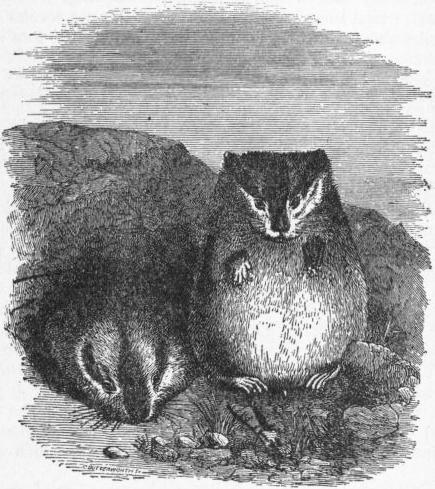
The Norwegian Lemming (Lemmus Norvegicus).
The circumstance which has given popular interest to the lemming is that certain districts of the cultivated lands of Norway and Sweden, where in ordinary circumstances they are unknown, are, at uncertain intervals varying from five to twenty or more years, overrun by an army of these little creatures, which steadily and slowly advance, always in the same direction, and regardless of all obstacles, swimming streams and even lakes of several miles in breadth, and committing considerable devastation on their line of march by the quantity of food they consume. In their turn they are pursued and harassed by crowds of beasts and birds of prey, as bears, wolves, foxes, dogs, wild cats, stoats, weasels, eagles, hawks and owls, and never spared by man; even domestic animals, as cattle, goats and reindeer, join in the destruction, stamping them to the ground with their feet, and even eating their bodies. Numbers also die from diseases produced apparently from overcrowding. None returns, and the onward march of the survivors never ceases until they reach the sea, into which they plunge, and swimming onwards in the same direction perish in the waves. These sudden appearances of vast bodies of lemmings, and their singular habit of persistently pursuing the same onward course of migration, have given rise to various speculations, from the ancient belief of the Norwegian peasants, shared by Olaus Magnus, that they fall down from the clouds, to the hypothesis that they are acting in obedience to an instinct inherited from ancient times, and still seeking the congenial home in the submerged Atlantis, to which their ancestors of the Miocene period were wont to resort when driven from their ordinary dwelling-places by crowding or scarcity of food. The principal facts regarding these migrations seem to be as follows. When any combination of circumstances has occasioned an increase of the numbers of the lemmings in their ordinary dwelling-places, impelled by the restless or migratory instinct possessed in a less developed degree by so many of their congeners, a movement takes place at the edge of the elevated plateau, and a migration towards the lower-lying land begins. The whole body moves forward slowly, always advancing in the same general direction in which they originally started, but following more or less the course of the great valleys. They only travel by night; and, staying in congenial places for considerable periods, with unaccustomed abundance of provender, notwithstanding the destructive influences to which they are exposed, they multiply excessively during their journey, having families more numerous and frequent than in their usual homes. The progress may last from one to three years, according to the route taken, and the distance to be traversed until the sea-coast is reached, which in a country so surrounded by water as the Scandinavian peninsula must be the ultimate goal of such a journey. This may be either the Atlantic or the Gulf of Bothnia, according as the migration has commenced from the west or the east side of the central elevated plateau. Those that finally perish in the sea, committing what appears to be a voluntary suicide, are only acting under the same blind impulse which has led them previously to cross shallower pieces of water with safety. In Eastern Europe, Northern Asia and North America the group is represented by the allied L. obensis, and in Alaska, by L. nigripes; while the circumpolar banded lemming, Dicrostonyx torquatus, which turns white in winter, represents a second genus taking its name from the double claws on one of the toes of the forefeet.
For habits of lemmings, see R. Collett, Myodes lemmus, its habits and migrations in Norway (Christiania Videnskabs-Selskabs Forhandlinger, 1895).
(W. H. F.; R. L.*)
LEMNISCATE (from Gr. λημνίσκος, ribbon), a quartic curve invented by Jacques Bernoulli (Acta Eruditorum, 1694) and afterwards investigated by Giulio Carlo Fagnano, who gave its principal properties and applied it to effect the division of a quadrant into 2.2m, 3.2m and 5.2m equal parts. Following Archimedes, Fagnano desired the curve to be engraved on his tombstone. The complete analytical treatment was first given by Leonhard Euler. The lemniscate of Bernoulli may be defined as the locus of a point which moves so that the product of its distances from two fixed points is constant and is equal to the square of half the distance between these points. It is therefore a particular form of Cassini’s oval (see Oval). Its cartesian equation, when the line joining the two fixed points is the axis of x and the middle point of this line is the origin, is (x2 + y2)2 = 2a2(x2 − y2) and the polar equation is r2 = 2a2 cos 2θ. The curve (fig. 1) consists of two loops symmetrically placed about the coordinate axes. The pedal equation is r3 = a2p, which shows that it is the first positive pedal of a rectangular hyperbola with regard to the centre. It is also the inverse of the same curve for the same point. It is the envelope of circles described on the central radii of an ellipse as diameters. The area of the complete curve is 2a2, and the length of any arc may be expressed in the form ∫ (1 − x4)−1/2dx, an elliptic integral sometimes termed the lemniscatic integral.

Fig. 1. Fig. 2. Fig. 3.
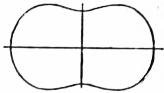
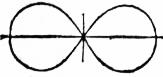
Fig. 4. Fig. 5.
The name lemniscate is sometimes given to any crunodal quartic curve having only one real finite branch which is symmetric about the axis. Such curves are given by the equation x2 − y2 = ax4 + bx2y2 + cy4. If a be greater than b the curve resembles fig. 2 and is sometimes termed the fishtail-lemniscate; if a be less than b, the curve resembles fig. 3. The same name is also given to the first positive pedal of any central conic. When the conic is a rectangular hyperbola, the curve is the lemniscate of Bernoulli previously described. The elliptic lemniscate has for its equation (x2 + y2)2 = a2x2 + b2y2 or r2 = a2 cos2θ + b2 sin2θ (a > b). The centre is a conjugate point (or acnode) and the curve resembles fig. 4. The hyperbolic lemniscate has for its equation (x2 + y2)2 = a2x2 − b2y2 or r2 = a2 cos2θ − b2 sin2θ. In this case the centre is a crunode and the curve resembles fig. 5. These curves are instances of unicursal bicircular quartics.
LEMNOS (mod. Limnos), an island in the northern part of the Aegean Sea. The Italian form of the name, Stalimene, i.e. ἐς τὴν Λῆμνον, is not used in the island itself, but is commonly employed in geographical works. The island, which belongs to Turkey, is of considerable size: Pliny says that the coast-line measured 112½ Roman miles, and the area has been estimated at 150 sq. m. Great part is mountainous, but some very fertile valleys exist, to cultivate which 2000 yoke of oxen are employed. The hill-sides afford pasture for 20,000 sheep. No forests exist on the island; all wood is brought from the coast of Rumelia or from Thasos. A few mulberry and fruit trees grow, but no olives. The population is estimated by some as high as 27,000, of whom 2000 are Turks and the rest Greeks, but other authorities doubt whether it reaches more than half this number. The chief towns are Kastro on the western coast, with a population of 4000 Greeks and 800 Turks, and Mudros on the southern coast. Kastro possesses an excellent harbour, and is the seat of all the trade carried on with the island. Greek, English and Dutch consuls or consular agents were formerly stationed there; but the whole trade is now in Greek hands. The archbishops of Lemnos and Ai Strati, a small neighbouring island with 2000 inhabitants, resides in Kastro. In ancient times the island was sacred to Hephaestus, who as the legend tells fell on Lemnos when his father Zeus hurled him headlong out of Olympus. This tale, as well as the name Aethaleia, sometimes applied to it, points to its volcanic character. It is said that fire occasionally blazed forth from Mosychlos, one of its mountains; and Pausanias (viii. 33) relates that a small island called Chryse, off the Lemnian coast, was swallowed up by the sea. All volcanic action is now extinct.
The most famous product of Lemnos is the medicinal earth, which is still used by the natives. At one time it was popular over western Europe under the name terra sigillata. This name, like the Gr. Λημνία σφραγίς, is derived from the stamp impressed on each piece of the earth; in ancient times the stamp was the head of Artemis. The Turks now believe that a vase of this earth destroys the effect of any poison drunk from it—a belief which the ancients attached rather to the earth from Cape Kolias in Attica. Galen went to see the digging up of this earth (see Kuhn, Medic. Gr. Opera, xii. 172 sq.); on one day in each year a priestess performed the due ceremonies, and a waggon-load of earth was dug out. At the present time the day selected is the 6th of August, the feast of Christ the Saviour. Both the Turkish hodja and the Greek priest are present to perform the necessary ceremonies; the whole process takes place before daybreak. The earth is sold by apothecaries in stamped cubical blocks. The hill from which the earth is dug is a dry mound, void of vegetation, beside the village of Kotschinos, and about two hours from the site of Hephaestia. The earth was considered in ancient times a cure for old festering wounds, and for the bite of poisonous snakes.
The name Lemnos is said by Hecataeus (ap. Steph. Byz.) to have been a title of Cybele among the Thracians, and the earliest inhabitants are said to have been a Thracian tribe, called by the Greeks Sinties, i.e. “the robbers.” According to a famous legend the women were all deserted by their husbands, and in revenge murdered every man on the island. From this barbarous act, the expression Lemnian deeds, Λήμνια ἔργα, became proverbial. The Argonauts landing soon after found only women in the island, ruled over by Hypsipyle, daughter of the old king Thoas. From the Argonauts and the Lemnian women were descended the race called Minyae, whose king Euneus, son of Jason and Hypsipyle, sent wine and provisions to the Greeks at Troy. The Minyae were expelled by a Pelasgian tribe who came from Attica. The historical element underlying these traditions is probably that the original Thracian people were gradually brought into communication with the Greeks as navigation began to unite the scattered islands of the Aegean (see Jason); the Thracian inhabitants were barbarians in comparison with the Greek mariners. The worship of Cybele was characteristic of Thrace, whither it spread from Asia Minor at a very early period, and it deserves notice that Hypsipyle and Myrina (the name of one of the chief towns) are Amazon names, which are always connected with Asiatic Cybele-worship. Coming down to a better authenticated period, we find that Lemnos was conquered by Otanes, one of the generals of Darius Hystaspis; but was soon reconquered by Miltiades, the tyrant of the Thracian Chersonese. Miltiades afterwards returned to Athens, and Lemnos continued an Athenian possession till the Macedonian empire absorbed it. On the vicissitudes of its history in the 3rd century B.C. see Köhler in Mittheil. Inst. Athen. i. 261. The Romans declared it free in 197 B.C., but gave it over in 166 to Athens, which retained nominal possession of it till the whole of Greece was made a Roman province. A colony of Attic cleruchs was established by Pericles, and many inscriptions on the island relate to Athenians. After the division of the empire, Lemnos passed under the Byzantine emperors; it shared in the vicissitudes of the eastern provinces, being alternately in the power of Greeks, Italians and Turks, till finally the Turkish sultans became supreme in the Aegean. In 1476 the Venetians successfully defended Kotschinos against a Turkish siege; but in 1657 Kastro was captured by the Turks from the Venetians after a siege of sixty-three days. Kastro was again besieged by the Russians in 1770.
Homer speaks as if there were one town in the island called Lemnos, but in historical times there was no such place. There were two towns, Myrina, now Kastro, and Hephaestia. The latter was the chief town; its coins are found in considerable number, the types being sometimes the Athenian goddess and her owl, sometimes native religious symbols, the caps of the Dioscuri, Apollo, &c. Few coins of Myrina are known. They belong to the period of Attic occupation, and bear Athenian types. A few coins are also known which bear the name, not of either city, but of the whole island. Conze was the first to discover the site of Hephaestia, at a deserted place named Palaeokastro on the east coast. It had once a splendid harbour, which is now filled up. Its situation on the east explains why Miltiades attacked it first when he came from the Chersonese. It surrendered at once, whereas Myrina, with its very strong citadel built on a perpendicular rock, sustained a siege. It is said that the shadow of Mount Athos fell at sunset on a bronze cow in the agora of Myrina. Pliny says that Athos was 87 m. to the north-west; but the real distance is about 40 English miles. One legend localized in Lemnos still requires notice. Philoctetes was left there by the Greeks on their way to Troy; and there he suffered ten years’ agony from his wounded foot, until Ulysses and Neoptolemus induced him to accompany them to Troy. He is said by Sophocles to have lived beside Mount Hermaeus, which Aeschylus (Agam. 262) makes one of the beacon points to flash the news of Troy’s downfall home to Argos.
See Rhode, Res Lemnicae; Conze, Reise auf den Inseln des Thrakischen Meeres (from which the above-mentioned facts about the present state of the island are taken); also Hunt in Walpole’s Travels; Belon du Mans, Observations de plusieurs singularitez, &c.; Finlay, Greece under the Romans; von Hammer, Gesch. des Osman. Reiches; Gött. Gel. Anz. (1837). The chief references in ancicnt writers are Iliad i. 593, v. 138, xiv. 229, &c.; Herod. iv. 145; Str. pp. 124, 330; Plin. iv. 23, xxxvi. 13.
LEMOINNE, JOHN ÉMILE (1815-1892), French journalist, was born of French parents, in London, on the 17th of October 1815. He was educated first at an English school and then in France. In 1840 he began writing for the Journal des débats, on English and other foreign questions, and under the empire he held up to admiration the free institutions of England by contrast with imperial methods. After 1871 he supported Thiers, but his sympathies rather tended towards a liberalized monarchy, until the comte de Chambord’s policy made such a development an impossibility, and he then ranged himself with the moderate Republicans. In 1875 Lemoinne was elected to the French Academy, and in 1880 he was nominated a life senator. Distinguished though he was for a real knowledge of England among the French journalists who wrote on foreign affairs, his tone towards English policy greatly changed in later days, and though he never shared the extreme French bitterness against England as regards Egypt, he maintained a critical attitude which served to stimulate French Anglophobia. He was a frequent contributor to the Revue des deux mondes, and published several books, the best known of which is his Études critiques et biographiques (1862). He died in Paris on the 14th of December 1892.
LEMON, MARK (1809-1870), editor of Punch, was born in London on the 30th of November 1809. He had a natural talent for journalism and the stage, and, at twenty-six, retired from less congenial business to devote himself to the writing of plays. More than sixty of his melodramas, operettas and comedies were produced in London. At the same time he contributed to a variety of magazines and newspapers, and founded and edited the Field. In 1841 Lemon and Henry Mayhew conceived the idea of a humorous weekly paper to be called Punch, and when the first number was issued, in July 1841, were joint-editors and, with the printer and engraver, equal owners. The paper was for some time unsuccessful, Lemon keeping it alive out of the profits of his plays. On the sale of Punch Lemon became sole editor for the new proprietors, and it remained under his control until his death, achieving remarkable popularity and influence. Lemon was an actor of ability, a pleasing lecturer and a successful impersonator of Shakespearian characters. He also wrote a host of novelettes and lyrics, over a hundred songs, a few three-volume novels, several Christmas fairy tales and a volume of jests. He died at Crawley, Sussex, on the 23rd of May 1870.
LEMON, the fruit of Citrus Limonum, which is regarded by some botanists as a variety of Citrus medica. The wild stock of the lemon tree is said to be a native of the valleys of Kumaon and Sikkim in the North-West provinces of India, ascending to a height of 4000 ft., and occurring under several forms. Sir George Watt (Dictionary of Economic Products of India, ii. 352) regards the wild plants as wild forms of the lime or citron and considers it highly probable that the wild form of the lemon has not yet been discovered.
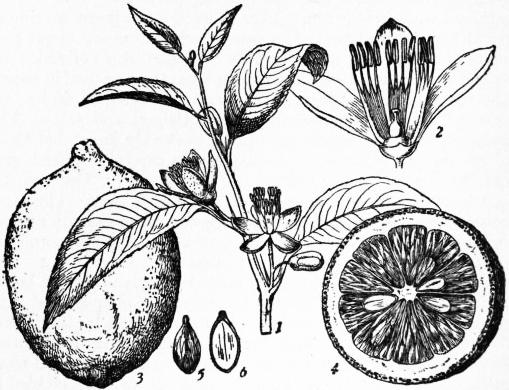
Fig. 1.—Lemon—Citrus Limonum.
1, Flowering shoot. 2, Flower with two petals and two bundles of stamens removed; slightly enlarged. 3, Fruit. 4, Same cut across. 5, Seed. 6, Same cut lengthwise.
The lemon seems to have been unknown to the ancient Greeks and Romans, and to have been introduced by the Arabs into Spain between the 12th and 13th centuries. In 1494 the fruit was cultivated in the Azores, and largely shipped to England, but since 1838 the exportation has ceased. As a cultivated plant the lemon is now met with throughout the Mediterranean region, in Spain and Portugal, in California and Florida, and in almost all tropical and subtropical countries. Like the apple and pear, it varies exceedingly under cultivation. Risso and Poiteau enumerate forty-seven varieties of this fruit, although they maintain as distinct the sweet lime, C. Limetta, with eight varieties, and the sweet lemon, C. Lumia, with twelve varieties, which differ only in the fruit possessing an insipid instead of an acid juice.
The lemon is more delicate than the orange, although, according to Humboldt, both require an annual mean temperature of 62° Fahr. Unlike the orange, which presents a fine close head of deep green foliage, it forms a straggling bush, or small tree, 10 to 12 ft. high, with paler, more scattered leaves, and short angular branches with sharp spines in the axils. The flowers, which possess a sweet odour quite distinct from that of the orange, are in part hermaphrodite and in part unisexual, the outside of the corolla having a purplish hue. The fruit, which is usually crowned with a nipple, consists of an outer rind or peel, the surface of which is more or less rough from the convex oil receptacles imbedded in it, and of a white inner rind, which is spongy and nearly tasteless, the whole of the interior of the fruit being filled with soft parenchymatous tissue, divided into about ten to twelve compartments, each generally containing two or three seeds. The white inner rind varies much in thickness in different kinds, but is never so thick as in the citron. As lemons are much more profitable to grow than oranges, on account of their keeping properties, and from their being less liable to injury during voyages, the cultivation of the lemon is preferred in Italy wherever it will succeed. In damp valleys it is liable like the orange (q.v.) to be attacked by a fungus sooty mould, the stem, leaves, and fruit becoming covered with a blackish dust. This is coincident with or subsequent to the attacks of a small oval brown insect, Chermes hesperidum. Trees not properly exposed to sunlight and air suffer most severely from these pests. Syringing with resin-wash or milk of lime when the young insects are hatched, and before they have fixed themselves to the plant, is a preventive. Since 1875 this fungoid disease has made great ravages in Sicily among the lemon and citron trees, especially around Catania and Messina. Heritte attributes the prevalence of the disease to the fact that the growers have induced an unnatural degree of fertility in the trees, permitting them to bear enormous crops year after year. This loss of vitality is in some measure met by grafting healthy scions of the lemon on the bitter orange, but trees so grafted do not bear fruit until they are eight or ten years old.
The lemon tree is exceedingly fruitful, a large one in Spain or Sicily ripening as many as three thousand fruits in favourable seasons. In the south of Europe lemons are collected more or less during every month of the year, but in Sicily the chief harvest takes place from the end of October to the end of December, those gathered during the last two months of the year being considered the best for keeping purposes. The fruit is gathered while still green. After collection the finest specimens are picked out and packed in cases, each containing about four hundred and twenty fruits, and also in boxes, three of which are equal to two cases, each lemon being separately packed in paper. The remainder, consisting of ill-shaped or unsound fruits, are reserved for the manufacture of essential oil and juice. The whole of the sound lemons are usually packed in boxes, but those which are not exported immediately are carefully picked over and the unsound ones removed before shipment. The exportation is continued as required until April and May. The large lemons with a rougher rind, which appear in the London market in July and August, are grown at Sorrento near Naples, and are allowed to remain on the trees until ripe.
Candied lemon peel is usually made in England from a larger variety of the lemon cultivated in Sicily on higher ground than the common kind, from which it is distinguished by its thicker rind and larger size. This kind, known as the Spadaforese lemon, is also allowed to remain on the trees until ripe, and when gathered the fruit is cut in half longitudinally and pickled in brine, before being exported in casks. Before candying the lemons are soaked in fresh water to remove the salt. Citrons are also exported from Sicily in the same way, but these are about six times as expensive as lemons, and a comparatively small quantity is shipped. Besides those exported from Messina and Palermo, lemons are also imported into England to a less extent from the Riviera of Genoa, and from Malaga in Spain, the latter being the most esteemed. Of the numerous varieties the wax lemon, the imperial lemon and the Gaeta lemon are considered to be the best. Lemons are also extensively grown in California and Florida.
Lemons of ordinary size contain about 2 oz. of juice, of specific gravity 1.039-1.046, yielding on an average 32.5 to 42.53 grains of citric acid per oz. The amount of this acid, according to Stoddart, varies in different seasons, decreasing in lemons kept from February to July, at first slowly and afterwards rapidly, until at the end of that period it is all split up into glucose and carbonic acid—the specific gravity of the juice being in February 1.046, in May 1.041 and in July 1.027, while the fruit is hardly altered in appearance. It has been stated that lemons may be kept for some months with scarcely perceptible deterioration by varnishing them with an alcoholic solution of shellac—the coating thus formed being easily removed when the fruit is required for household use by gently kneading it in the hands. Besides citric acid, lemon juice contains 3 to 4% of gum and sugar, albuminoid matters, malic acid and 2.28% of inorganic salts. Cossa has determined that the ash of dried lemon juice contains 54% of potash, besides 15% of phosphoric acid. In the white portion of the peel (in common with other fruits of the genus) a bitter principle called hesperidin has been found. It is very slightly soluble in boiling water, but is soluble in dilute alcohol and in alkaline solutions, which it soon turns of a yellow or reddish colour. It is also darkened by tincture of perchloride of iron. Another substance named lemonin, crystallizing in lustrous plates, was discovered in 1879 by Palerno and Aglialoro in the seeds, in which it is present in very small quantity, 15,000 grains of seed yielding only 80 grains of it. It differs from hesperidin in dissolving in potash without alteration. It melts at 275° F.
The simplest method of preserving lemon juice in small quantities for medicinal or domestic use is to keep it covered with a layer of olive or almond oil in a closed vessel furnished with a glass tap, by which the clear liquid may be drawn off as required. Lemon juice is largely used on shipboard as a preventive of scurvy. By the Merchant Shipping Act 1867 every British ship going to other countries where lemon or lime juice cannot be obtained was required to take sufficient to give 1 oz. to every member of the crew daily. Of this juice it requires about 13,000 lemons to yield l pipe (108 gallons). Sicilian juice in November yields about 9 oz. of crude citric acid per gallon, but only 6 oz. if the fruit is collected in April. The crude juice was formerly exported to England, and was often adulterated with sea-water, but is now almost entirely replaced by lime juice. A concentrated lemon juice for the manufacture of citric acid is prepared in considerable quantities, chiefly at Messina and Palermo, by boiling down the crude juice in copper vessels over an open fire until its specific gravity is about 1.239, seven to ten pipes of raw making only one of concentrated lemon juice. “Lemon juice” for use on shipboard is prepared also from the fruits of limes and Bergamot oranges. It is said to be sometimes adulterated with sulphuric acid on arrival in England.
The lemon used in medicine is described in the British pharmacopoeia as being the fruit of Citrus medica, var. Limonum. The preparations of lemon peel are of small importance. From the fresh peel is obtained the oleum limonis (dose ½-3 minims), which has the characters of its class. It contains a terpene known as citrene or limonene, which also occurs in orange peel: and citral, the aldehyde of geraniol, which is the chief constituent of oil of roses. Of much importance is the succus limonis or lemon juice, 1 oz. of which contains about 40 grains of free citric acid, besides the citrate of potassium (.25%) and malic acid, free and combined. Ten per cent. of alcohol must be added to lemon juice if it is to be kept. From it are prepared the syrupus limonis (dose ½-2 drachms), which consists of sugar, lemon juice and an alcoholic extract of lemon peel, and also citric acid itself. Lemon juice is practically impure citric acid (q.v.).
Essence or Essential Oil of Lemon.—The essential oil contained in the rind of the lemon occurs in commerce as a distinct article. It is manufactured chiefly in Sicily, at Reggio in Calabria, and at Mentone and Nice in France. The small and irregularly shaped fruits are employed while still green, in which state the yield of oil is greater than when they are quite ripe. In Sicily and Calabria the oil is extracted in November and December as follows. A workman cuts three longitudinal slices off each lemon, leaving a three-cornered central core having a small portion of rind at the apex and base. These pieces are then divided transversely and cast on one side, and the strips of peel are thrown in another place. Next day the pieces of peel are deprived of their oil by pressing four or five times successively the outer surface of the peel (zest or flavedo) bent into a convex shape, against a flat sponge held in the palm of the left hand and wrapped round the forefinger. The oil vesicles in the rind, which are ruptured more easily in the fresh fruit than in the state in which lemons are imported, yield up their oil to the sponge, which when saturated is squeezed into an earthen vessel furnished with a spout and capable of holding about three pints. After a time the oil separates from the watery liquid which accompanies it, and is then decanted. By this process four hundred fruits yield 9 to 14 oz. of essence. The prisms of pulp are afterwards expressed to obtain lemon juice, and then distilled to obtain the small quantity of volatile oil they contain. At Mentone and Nice a different process is adopted. The lemons are placed in an écuelle à piquer, a shallow basin of pewter about 8½ in. in diameter, having i a lip for pouring on one side and a closed tube at the bottom about 5 in. long and 1 in. in diameter. A number of stout brass pins stand up about half an inch from the bottom of the vessel. The workman rubs a lemon over these pins, which rupture the oil vesicles, and the oil collects in the tube, which when it becomes full is emptied into another vessel that it may separate from the aqueous liquid mixed with it. When filtered it is known as Essence de citron au zeste, or, in the English market, as perfumers’ essence of lemon, inferior qualities being distinguished as druggists’ essence of lemon. An additional product is obtained by immersing the scarified lemons in warm water and separating the oil which floats off. Essence de citron distillée is obtained by rubbing the surface of fresh lemons (or of those which have been submitted to the action of the écuelle à piquer) on a coarse grater of tinned iron, and distilling the grated peel. The oil so obtained is colourless, and of inferior fragrance, and is sold at a lower price, while that obtained by the cold processes has a yellow colour and powerful odour.
Essence of lemon is chiefly brought from Messina and Palermo packed in copper bottles holding 25 to 50 kilogrammes or more, and sometimes in tinned bottles of smaller size. It is said to be rarely found in a state of purity in commerce, almost all that comes into the market being diluted with the cheaper distilled oil. This fact may be considered as proved by the price at which the essence of lemon is sold in England, this being less than it costs the manufacturer to make it. When long kept the essence deposits a white greasy stearoptene, apparently identical with the bergaptene obtained from the essential oil of the Bergamot orange. The chief constituent of oil of lemon is the terpene, C10H16, boiling at 348°.8 Fahr., which, like oil of turpentine, readily yields crystals of terpin, C10H163OH2, but differs in yielding the crystalline compound, C10H16 + 2Cl, oil of turpentine forming one having the formula C10H16 + HCl. Oil of lemons also contains, according to Tilden, another hydrocarbon, C10H16, boiling at 3.20° Fahr., a small amount of cymene, and a compound acetic ether, C2H3O·C10H17O. The natural essence of lemon not being wholly soluble in rectified spirit of wine, an essence for culinary purposes is sometimes prepared by digesting 6 oz of lemon peel in one pint of pure alcohol of 95%, and, when the rind has become brittle, which takes place in about two and a half hours, powdering it and percolating the alcohol through it. This article is known as “lemon flavour.”
The name lemon is also applied to some other fruits. The Java lemon is the fruit of Citrus javanica, the pear lemon of a variety of C. Limetta, and the pearl lemon of C. margarita. The fruit of a passion-flower, Passiflora laurifolia, is sometimes known as the water-lemon, and that of a Berberidaceous plant, Podophyllum peltatum, as the wild lemon. In France and Germany the lemon is known as the citron, and hence much confusion arises concerning the fruits referred to in different works. The essential oil known as oil of cedrat is usually a factitious article instead of being prepared, as its name implies, from the citron (Fr. cédratier). An essential oil is also prepared from C. Lumia, at Squillace in Calabria, and has an odour like that of Bergamot but less powerful.