VOLUME XIV SLICE II Hydromechanics to Ichnography (continued 6)
Reading edition
To become a polyp, the actinula (fig. 3, A) becomes attached to some firm object by the pole farthest from the mouth, and its growth preponderates in the direction of the principal axis, that is to say, the axis passing through the mouth (fig. 3, a-b). As a result the body becomes columnar in form (fig. 3, B), and without further change passes into the characteristic polyp-form (see Polyp).
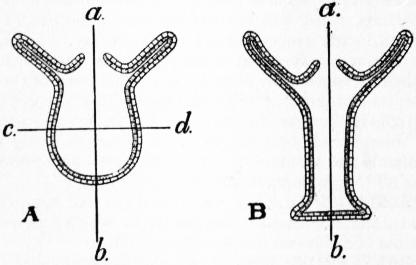
Fig. 3.—Diagram showing the change of the Actinula (A) into a Polyp (B); a-b, principal (vertical) axis; c-d, horizontal axis. The endoderm is shaded, the ectoderm is left clear.
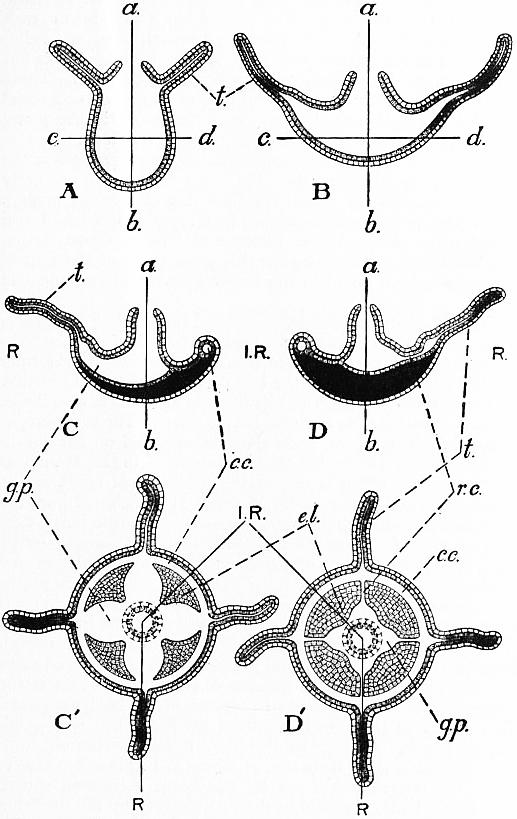
Fig. 4.—Diagram showing the change of the Actinula into a Medusa. A, Vertical section of the actinula; a-b and c-d as in fig. 3, B, transitional stage, showing preponderating growth in the horizontal plane. C, C′, D, D′, two types of medusa organization; C and D are composite sections, showing a radius (R) on one side, an interradius (IR) on the other; C’ and D’ are plans; the mouth and manubrium are indicated at the centre, leading into the gastral cavity subdivided by the four areas of concrescence in each interradius (IR). t, tentacle; g.p, gastric pouch; r.c, radial canal not present in C and C′; c.c, circular or ring-canal; e.l, endoderm-lamella formed by concrescence. For a more detailed diagram of medusa-structure see article Medusa.
It is convenient to distinguish two types of polyp by the names hydro polyp and anthopolyp, characteristic of the Hydrozoa and Anthozoa respectively. In the hydropolyp the body is typically elongated, the height of the column being far greater than the diameter. The peristome is relatively small and the mouth is generally raised on a projecting spout or hypostome. The ectoderm loses entirely the ciliation which it had in the planula and actinula stages and commonly secretes on its external surface a protective or supporting investment, the perisarc. Contrasting with this, the anthopolyp is generally of squat form, the diameter often exceeding the height; the peristome is wide, a hypostome is lacking, and the ectoderm, or so much of it as is exposed, i.e. not covered by secretion of skeletal or other investment, retains its ciliation throughout life. The internal structural differences are even more characteristic. In the hydropolyp the blastopore of the embryo forms the adult mouth situated at the extremity of the hypostome, and the ectoderm and endoderm meet at this point. In the anthopolyp the blastopore is carried inwards by an in-pushing of the body-wall of the region of the peristome, so that the adult mouth is an opening leading into a short ectodermal oesophagus or stomodaeum, at the bottom of which is the blastopore. Further, in the hydropolyp the digestive cavity either remains simple and undivided and circular in transverse section, or may show ridges projecting internally, which in this case are formed of endoderm alone, without any participation of the mesogloea. In the anthopolyp, on the other hand, the digestive cavity is always subdivided by so-called mesenteries, in-growths of the endoderm containing vertical lamellae of mesogloea (see Anthozoa). In short, the hydropolyp is characterized by a more simple type of organization than the anthopolyp, and is in most respects less modified from the actinula type of structure.
Returning now to the actinula, this form may, as already stated, develop into a medusa, a type of individual found only in the Hydrozoa, as here understood. To become a medusa, the actinula grows scarcely at all in the direction of the principal axis, but greatly along a plane at right angles to it. Thus the body becomes umbrella-shaped, the concave side representing the peristome, and the convex side the column, of the polyp. Hence the tentacles are found at the edge of the umbrella, and the hypostome forms usually a projecting tube, with the mouth at the extremity, forming the manubrium or handle of the umbrella. The medusa has a pronounced radial symmetry, and the positions of the primary tentacles, usually four in number, mark out the so-called radii, alternating with which are four interradii. The ectoderm retains its ciliation only in the sensory organs. The mesogloea becomes enormously increased in quantity (hence the popular name “jelly-fish”), and in correlation with this the endoderm-layer lining the coelenteron becomes pressed together in the interradial areas and undergoes concrescence, forming a more or less complicated gastrovascular system (see Medusa). It is sufficient to state here that the medusa is usually a free-swimming animal, floating mouth downwards on the open seas, but in some cases it may be attached by its aboral pole, like a polyp, to some firm basis, either temporarily or permanently.
Thus the development of the two types of individual seen in the Hydrozoa may be summarized as follows:—
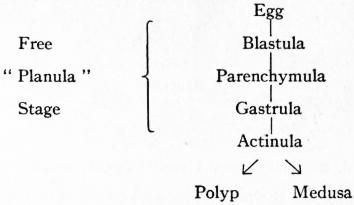
This development, though probably representing the primitive sequence of events, is never actually found in its full extent, but is always abbreviated by omission or elimination of one or more of the stages. We have already seen that the parenchymula stage is passed over when the gastrulation is of the invaginate type. On the other hand, the parenchymula may develop directly into the actinula or even into the polyp, with suppression of the intervening steps. Great apparent differences may also be brought about by variations in the period at which the embryo is set free as a larva, and since two free-swimming stages, planula and actinula, are unnecessary, one or other of them is always suppressed. A good example of this is seen in two common genera of British hydroids, Cordylophora and Tabularia. In Cordylophora the embryo is set free at the parenchymula stage as a planula which fixes itself and develops into a polyp, both gastrula and actinula stages being suppressed. In Tubularia, on the other hand, the parenchymula develops into an actinula within the maternal tissues, and is then set free, creeps about for a time, and after fixing itself, changes into a polyp; hence in this case the planula-stage, as a free larva, is entirely suppressed.
The Hydrozoa may be defined, therefore, as Cnidaria in which two types of individual, the polyp and the medusa, may be present, each type developed along divergent lines from the primitive actinula form. The polyp (hydropolyp) is of simple structure and never has an ectodernal oesophagus or mesenteries.1 The general ectoderm loses its cilia, which persist only in the sensory cells, and it frequently secretes external protective or supporting structures. An internal mesogloeal skeleton is not found.
The class is divisible into two main divisions or sub-classes, Hydromedusae and Scyphomedusae, of which definitions and detailed systematic accounts will be found under these headings.
General Works on Hydrozoa.—C. Chun, “Coelenterata (Hohlthiere),” Bronn’s Klassen und Ordnungen des Thier-Reichs ii. 2 (1889 et seq.); Y. Delage, and E. Hérouard, Traité de zoologie concrète, ii. part 2, Les Coelentérés (1901); G. H. Fowler, “The Hydromedusae and Scyphomedusae” in E. R. Lankester’s Treatise on Zoology, ii. chapters iv. and v. (1900); S. J. Hickson, “Coelenterata and Ctenophora,” Cambridge Natural History, i. chapters x.-xv. (1906).
(E. A. M.)
1 See further under Scyphomedusae.
HYENA, a name applicable to all the representatives of the mammalian family Hyaenidae, a group of Carnivora (q.v.) allied to the civets. From all other large Carnivora except the African hunting-dog, hyenas are distinguished by having only four toes on each foot, and are further characterized by the length of the fore-legs as compared with the hind pair, the non-retractile claws, and the enormous strength of the jaws and teeth, which enables them to break the hardest bones and to retain what they have seized with unrelaxing grip.
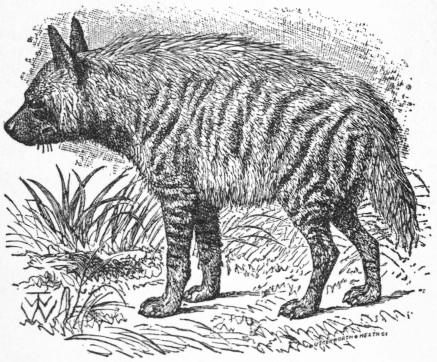
Fig. 1.—The Striped Hyena (Hyaena striata).
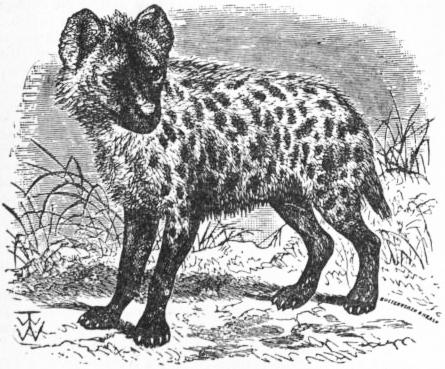
Fig. 2.—The Spotted Hyena (Hyaena crocuta).
The striped hyena (Hyaena striata) is the most widely distributed species, being found throughout India, Persia, Asia Minor, and North and East Africa, the East African form constituting a distinct race, H. striata schillingsi; while there are also several distinct Asiatic races. The species resembles a wolf in size, and is greyish-brown In colour, marked with indistinct longitudinal stripes of a darker hue, while the legs are transversely striped. The hairs on the body are long, especially on the ridge of the neck and back, where they form a distinct mane, which is continued along the tail. Nocturnal in habits, it prefers by day the gloom of caves and ruins, or of the burrows which it occasionally forms, and issues forth at sunset, when it commences its unearthly howling. When the animal is excited, the howl changes into what has been compared to demoniac laughter, whence the name of “laughing-hyena.” These creatures feed chiefly on carrion, and thus perform useful service by devouring remains which might otherwise pollute the air. Even human dead are not safe from their attacks, their powerful claws enabling them to gain access to newly interred bodies in cemeteries. Occasionally (writes Dr W. T. Blanford) sheep or goats, and more often dogs, are carried off, and the latter, at all events, are often taken alive to the animal’s den. This species appears to be solitary in habits, and it is rare to meet with more than two together. The cowardice of this hyena is proverbial; despite its powerful teeth, it rarely attempts to defend itself. A very different animal is the spotted hyena, Hyaena (Crocuta) crocuta, which has the sectorial teeth of a more cat-like type, and is marked by dark-brown spots on a yellowish ground, while the mane is much less distinct. At the Cape it was formerly common, and occasionally committed great havoc among the cattle, while it did not hesitate to enter the Kaffir dwellings at night and carry off children sleeping by their mothers. By persistent trapping and shooting, its numbers have now been considerably reduced, with the result, however, of making it exceedingly wary, so that it is not readily caught in any trap with which it has had an opportunity of becoming acquainted. Its range extends from Abyssinia to the Cape. The Abyssinian form has been regarded as a distinct species, under the name of H. liontiewi, but this, like various more southern forms, is but regarded as a local race. The brown hyena (H. brunnea) is South African, ranging to Angola on the west and Kilimanjaro on the east. In size it resembles the striped hyena, but differs in appearance, owing to the fringe of long hair covering the neck and fore part of the back. The general hue is ashy-brown, with the hair lighter on the neck (forming a collar), chest and belly; while the legs are banded with dark brown. This species is not often seen, as it remains concealed during the day. Those frequenting the coast feed on dead fish, crabs and an occasional stranded whale, though they are also a danger to the sheep and cattle kraal. Strand-wolf is the local name at the Cape.
Although hyenas are now confined to the warmer regions of the Old World, fossil remains show that they had a more northerly range during Tertiary times; the European cave-hyena being a form of the spotted species, known as H. crocuta spelaea. Fossil hyenas occur in the Lower Pliocene of Greece, China, India, &c.; while remains indistinguishable from those of the striped species have been found in the Upper Pliocene of England and Italy.
HYÈRES, a town in the department of the Var in S.E. France, 11 m. by rail E. of Toulon. In 1906 the population of the commune was 17,790, of the town 10,464; the population of the former was more than doubled in the last decade of the 19th century. Hyères is celebrated (as is also its fashionable suburb, Costebelle, nearer the seashore) as a winter health resort. The town proper is situated about 2½ m. from the seashore, and on the south-western slope of a steep hill (669 ft., belonging to the Maurettes chain, 961 ft.), which is one of the westernmost spurs of the thickly wooded Montagnes des Maures. It is sheltered from the north-east and east winds, but is exposed to the cold north-west wind or mistral. Towards the south and south-east a fertile plain, once famous for its orange groves, but now mainly covered by vineyards and farms, stretches to the sea, while to the south-west, across a narrow valley, rises a cluster of low hills, on which is the suburb of Costebelle. The older portion of the town is still surrounded, on the north and east, by its ancient, though dilapidated medieval walls, and is a labyrinth of steep and dirty streets. The more modern quarter which has grown up at the southern foot of the hill has handsome broad boulevards and villas, many of them with beautiful gardens, filled with semi-tropical plants. Among the objects of interest in the old town are: the house (Rue Rabaton, 7) where J. B. Massillon (1663-1742), the famous pulpit orator, was born; the parish church of St Louis, built originally in the 13th century by the Cordelier or Franciscan friars, but completely restored in the earlier part of the 19th century; and the site of the old château, on the summit of the hill, now occupied by a villa. The plain between the new town and the sea is occupied by large nurseries, an excellent jardin d’acclimatation, and many market gardens, which supply Paris and London with early fruits and vegetables, especially artichokes, as well as with roses in winter. There are extensive salt beds (salines) both on the peninsula of Giens, S. of the town, and also E. of the town. To the east of the Giens peninsula is the fine natural harbour of Hyères, as well as three thinly populated islands (the Stoechades of the ancients), Porquerolles, Port Cros and Le Levant, which are grouped together under the common name of Îles d’Hyères.
The town of Hyères seems to have been founded in the 10th century, as a place of defence against pirates, and takes its name from the aires (hierbo in the Provençal dialect), or threshing-floors for corn, which then occupied its site. It passed from the possession of the viscounts of Marseilles to Charles of Anjou, count of Provence, and brother of St Louis (the latter landed here in 1254, on his return from Egypt). The château was dismantled by Henri IV., but thanks to its walls, the town resisted in 1707 an attack made by the duke of Savoy.
See Ch. Lenthéric, La Provence Maritime ancienne et moderne (chap. 5) (Paris, 1880).
(W. A. B. C.)
HYGIEIA, in Greek mythology, the goddess of health. It seems probable that she was originally an abstraction, subsequently personified, rather than an independent divinity of very ancient date. The question of the original home of her worship has been much discussed. The oldest traces of it, so far as is known at present, are to be found at Titane in the territory of Sicyon, where she was worshipped together with Asclepius, to whom she appears completely assimilated, not an independent personality. Her cult was not introduced at Epidaurus till a late date, and therefore, when in 420 B.C. the worship of Asclepius was introduced at Athens coupled with that of Hygieia, it is not to be inferred that she accompanied him from Epidaurus, or that she is a Peloponnesian importation at all. It is most probable that she was invented at the time of the introduction of Asclepius, after the sufferings caused by the plague had directed special attention to sanitary matters. The already existing worship of Athena Hygieia had nothing to do with Hygieia the goddess of health, but merely denoted the recognition of the power of healing as one of the attributes of Athena, which gradually became crystallized into a concrete personality. At first no special relationship existed between Asclepius and Hygieia, but gradually she came to be regarded as his daughter, the place of his wife being already secured by Epione. Later Orphic hymns, however, and Herodas iv. 1-9, make her the wife of Asclepius. The cult of Hygieia then spread concurrently with that of Asclepius, and was introduced at Rome from Epidaurus in 293, by which time she may have been admitted (which was not the case before) into the Epidaurian family of the god. Her proper name as a Romanized Greek importation was Valetudo, but she was gradually identified with Salus, an older genuine Italian divinity, to whom a temple had already been erected in 302. While in classical times Asclepius and Hygieia are simply the god and goddess of health, in the declining years of paganism they are protecting divinities generally, who preserve mankind not only from sickness but from all dangers on land and sea. In works of art Hygieia is represented, together with Asclepius, as a maiden of benevolent appearance, wearing the chiton and giving food or drink to a serpent out of a dish.
See the article by H. Lechat in Daremberg and Saglio’s Dictionnaire des antiquités, with full references to authorities; and E. Thrämer in Roscher’s Lexikon der Mythologie, with a special section on the modern theories of Hygieia.
HYGIENE (Fr. hygiène, from Gr. ὑγιαίνειν, to be healthy), the science of preserving health, its practical aim being to render “growth more perfect, decay less rapid, life more vigorous, death more remote.” The subject is thus a very wide one, embracing all the agencies which affect the physical and mental well-being of man, and it requires acquaintance with such diverse sciences as physics, chemistry, geology, engineering, architecture, meteorology, epidemiology, bacteriology and statistics. On the personal or individual side it involves consideration of the character and quality of food and of water and other beverages; of clothing; of work, exercise and sleep; of personal cleanliness, of special habits, such as the use of tobacco, narcotics, &c.; and of control of sexual and other passions. In its more general and public aspects it must take cognizance of meteorological conditions, roughly included under the term climate; of the site or soil on which dwellings are placed; of the character, materials and arrangement of dwellings, whether regarded individually or in relation to other houses among which they stand; of their heating and ventilation; of the removal of excreta and other effete matters; of medical knowledge relating to the incidence and prevention of disease; and of the disposal of the dead.
These topics will be found treated in such articles as Dietetics, Food, Food-Preservation, Adulteration, Water, Heating, Ventilation, Sewerage, Bacteriology, Housing, Cremation, &c. For legal enactments which concern the sanitary well-being of the community, see Public Health.
HYGINUS, eighth pope. It was during his pontificate (c. 137-140) that the gnostic heresies began to manifest themselves at Rome.
HYGINUS (surnamed Gromaticus, from gruma, a surveyor’s measuring-rod), Latin writer on land-surveying, flourished in the reign of Trajan (A.D. 98-117). Fragments of a work on legal boundaries attributed to him will be found in C. F. Lachmann, Gromatici Veteres, i. (1848).
A treatise on Castrametation (De Munitionibus Castrorum), also attributed to him, is probably of later date, about the 3rd century A.D. (ed. W. Gemoll, 1879; A. von Domaszewski, 1887).
HYGINUS, GAIUS JULIUS, Latin author, a native of Spain (or Alexandria), was a pupil of the famous Cornelius Alexander Polyhistor and a freedman of Augustus, by whom he was made superintendent of the Palatine library (Suetonius, De Grammaticis, 20). He is said to have fallen into great poverty in his old age, and to have been supported by the historian Clodius Licinus. He was a voluminous author, and his works included topographical and biographical treatises, commentaries on Helvius Cinna and the poems of Virgil, and disquisitions on agriculture and bee-keeping. All these are lost.
Under the name of Hyginus two school treatises on mythology are extant: (1) Fabularum Liber, some 300 mythological legends and celestial genealogies, valuable for the use made by the author of the works of Greek tragedians now lost; (2) De Astronomia, usually called Poetica Astronomica, containing an elementary treatise on astronomy and the myths connected with the stars, chiefly based on the Καταστερισμοί of Eratosthenes. Both are abridgments and both are by the same hand; but the style and Latinity and the elementary mistakes (especially in the rendering of the Greek originals) are held to prove that they cannot have been the work of so distinguished a scholar as C. Julius Hyginus. It is suggested that these treatises are an abridgment (made in the latter half of the 2nd century) of the Genealogiae of Hyginus by an unknown grammarian, who added a complete treatise on mythology.
Editions.—Fabulae, by M. Schmidt (1872); De Astronomia, by B. Bunte (1875); see also Bunte, De C. Julii Hygini, Augusti Liberti, Vita et Scriptis (1846).
HYGROMETER (Gr. ὁγρός, moist, μέτρον, a measure), an instrument for measuring the absolute or relative amount of moisture in the atmosphere; an instrument which only qualitatively determines changes in the humidity is termed a “hygroscope.” The earlier instruments generally depended for their action on the contraction or extension of substances when exposed to varying degrees of moisture; catgut, hair, twisted cords and wooden laths, all of which contract with an increase in the humidity and vice versa, being the most favoured materials. The familiar “weather house” exemplifies this property. This toy consists of a house provided with two doors, through which either a man or woman appears according as the weather is about to be wet or fine. This action is effected by fixing a catgut thread to the base on which the figures are mounted, in such a manner that contraction of the thread rotates the figures so that the man appears and extension so that the woman appears.
Many of the early forms are described in C. Hutton, Math. and Phil. Dictionary (1815). The modern instruments, which utilize other principles, are described in Meteorology: II. Methods and Apparatus.
HYKSOS, or “Shepherd Kings,” the name of the earliest invaders of Egypt of whom we have definite evidence in tradition. Josephus (c. Apion. i. 14), who identifies the Hyksos with the Israelites, preserves a passage from the second book of Manetho giving an account of them. (It may be that Josephus had it, not direct from Manetho’s writings, but through the garbled version of some Alexandrine compiler.) In outline it is as follows. In the days of a king of Egypt named Timaeus the land was suddenly invaded from the east by men of ignoble race, who conquered it without a struggle, destroyed cities and temples, and slew or enslaved the inhabitants. At length they elected a king named Salatis, who, residing at Memphis, made all Egypt tributary, and established garrisons in different parts, especially eastwards, fearing the Assyrians. He built also a great fortress at Avaris, in the Sethroite nome, east of the Bubastite branch of the Nile. Salatis was followed in succession by Beon, Apachnas, Apophis, Jannas and Asses. These six kings reigned 198 years and 10 months, and all aimed at extirpating the Egyptians. Their whole race was named Hyksos, i.e. “shepherd kings,” and some say they were Arabs (another explanation found by Josephus is “captive shepherds”). When they and their successors had held Egypt for 511 years, the kings of the Thebais and other parts of Egypt rebelled, and a long and mighty war began. Misphragmuthosis worsted the “Shepherds” and shut them up in Avaris; and his son Thutmosis, failing to capture the stronghold, allowed them to depart; whereupon they went forth, 240,000 in number, established themselves in Judea and built Jerusalem.
In Manetho’s list of kings, the six above named (with many variations in detail) form the XVth dynasty, and are called “six foreign Phoenician kings.” The XVIth dynasty is of thirty-two “Hellenic (sic?) shepherd kings,” the seventeenth is of “shepherds and Theban kings” (reigning simultaneously). The lists vary greatly in different versions, but the above seems the most reasonable selection of readings to be made. For “Hellenic” see below. The supposed connexion with the Israelites has made the problem of the Hyksos attractive, but light is coming upon it very slowly. In 1847 E. de Rougé proved from a fragment of a story in the papyri of the British Museum, that Apopi was one of the latest of the Hyksos kings, corresponding to Aphobis; he was king of the “pest” and suppressed the worship of the Egyptian gods, and endeavoured to make the Egyptians worship his god Setekh or Seti; at the same time an Egyptian named Seqenenrē reigned in Thebes, more or less subject to Aphobis. The city of Hawari (Avaris) was also mentioned in the fragment.
In 1850 a record of the capture of this city from the Hyksos by Ahmosi, the founder of the eighteenth dynasty, was discovered by the same scholar. A large class of monuments was afterwards attributed to the Hyksos, probably in error. Some statues and sphinxes, found in 1861 by Mariette at Tanis (in the north-east of the Delta), which had been usurped by later kings, had peculiar “un-Egyptian” features. One of these bore the name of Apopi engraved lightly on the shoulder; this was evidently a usurper’s mark, but from the whole circumstances it was concluded that these, and others of the same type of features found elsewhere, must have belonged to the Hyksos. This view held the field until 1893, when Golénischeff produced an inferior example bearing its original name, which showed that in this case it represented Amenemhe III. In consequence it is now generally believed that they all belong to the twelfth dynasty. Meanwhile a headless statue of a king named Khyan, found at Bubastis, was attributed on various grounds to the Hyksos, the soundest arguments being his foreign name and the boastful un-Egyptian epithet “beloved of his ka,” where “beloved of Ptah” or some other god was to be expected. His name was immediately afterwards recognized on a lion found as far away from Egypt as Bagdad. Flinders Petrie then pointed out a group of kings named on scarabs of peculiar type, which, including Khyan, he attributed to the period between the Old Kingdom and the New, while others were in favour of assigning them all to the Hyksos, whose appellation seemed to be recognizable in the title Hek-khos, “ruler of the barbarians,” borne by Khyan. The extraordinary importance of Khyan was further shown by the discovery of his name on a jar-lid at Cnossus in Crete. Semitic features were pointed out in the supposed Hyksos names, and Petrie was convinced of their date by his excavations of 1905-1906 in the eastern Delta. Avaris is generally assigned to the region towards Pelusium on the strength of its being located in the Sethroite nome by Josephus, but Petrie thinks it was at Tell el-Yahudiyeh (Yehudia), where Hyksos scarabs are common. From the remains of fortifications there he argues that the Hyksos were uncivilized desert people, skilled in the use of the bow, and must thus have destroyed by their archery the Egyptian armies trained to fight hand-to-hand; further, that their hordes were centered in Syria, but were driven thence by a superior force in the East to take refuge in the islands and became a sea-power—whence the strange description “Hellenic” in Manetho, which most editors have corrected to ἀλλοί, “others.” Besides the statue of Khyan, blocks of granite with the name of Apopi have been found in Upper Egypt at Gebelen and in Lower Egypt at Bubastis. The celebrated Rhind mathematical papyrus was copied in the reign of an Apopi from an original of the time of Amenemhe III. Large numbers of Hyksos scarabs are found in Upper and Lower Egypt, and they are not unknown in Palestine. Khyan’s monuments, inconspicuous as they are, actually extend over a wider area—from Bagdad to Cnossus—than those of any other Egyptian king.
It is certain that this mysterious people were Asiatic, for they are called so by the Egyptians. Though Seth was an Egyptian god, as god of the Hyksos he represents some Asiatic deity. The possibility of a connexion between the Hyksos and the Israelites is still admitted in some quarters. Hatred of these impious foreigners, of which there is some trace in more than one text, aroused amongst the Egyptians (as nothing ever did before or since) that martial spirit which carried the armies of Tethmosis to the Euphrates.
Besides the histories of Egypt, see J. H. Breasted, Ancient Records of Egypt; Historical Documents ii. 4, 125; G. Maspero, Contes populaires, 3me éd. p. 236; W. M. F. Petrie, Hyksos and Israelite Cities, p. 67; Golénischeff in Recueil de travaux, xv. p. 131.
(F. Ll. G.)
HYLAS, In Greek legend, son of Theiodamas, king of the Dryopians in Thessaly, the favourite of Heracles and his companion on the Argonautic expedition. Having gone ashore at Kios in Mysia to fetch water, he was carried off by the nymphs of the spring in which he dipped his pitcher. Heracles sought him in vain, and the answer of Hylas to his thrice-repeated cry was lost in the depths of the water. Ever afterwards, in memory of the threat of Heracles to ravage the land if Hylas were not found, the inhabitants of Kios every year on a stated day roamed the mountains, shouting aloud for Hylas (Apollonius Rhodius i. 1207; Theocritus xiii.; Strabo xii. 564; Propertius i. 20; Virgil, Ecl. vi. 43). But, although the legend is first told in Alexandrian times, the “cry of Hylas” occurs long before as the “Mysian cry” in Aeschylus (Persae, 1054), and in Aristophanes (Plutus, 1127) “to cry Hylas” is used proverbially of seeking something in vain. Hylas, like Adonis and Hyacinthus, represents the fresh vegetation of spring, or the water of a fountain, which dries up under the heat of summer. It is suggested that Hylas was a harvest deity and that the ceremony gone through by the Kians was a harvest festival, at which the figure of a boy was thrown into the water, signifying the dying vegetation-spirit of the year.
See G. Türk in Breslauer Philologische Abhandlungen, vii. (1895); W. Mannhardt, Mythologische Forschungen (1884).
HYLOZOISM (Gr. ὕλη, matter, ζωή, life), in philosophy, a term applied to any system which explains all life, whether physical or mental, as ultimately derived from matter (“cosmic matter,” Weldstoff). Such a view of existence has been common throughout the history of thought, and especially among physical scientists. Thus the Ionian school of philosophy, which began with Thales, sought for the beginning of all things in various material substances, water, air, fire (see Ionian School). These substances were regarded as being in some sense alive, and taking some active part in the development of being. This primitive hylozoism reappeared in modified forms in medieval and Renaissance thought, and in modern times the doctrine of materialistic monism is its representative. Between modern materialism and hylozoism proper there is, however, the distinction that the ancients, however vaguely, conceived the elemental matter as being in some sense animate if not actually conscious and conative.
HYMEN, or Hymenaeus, originally the name of the song sung at marriages among the Greeks. As usual the name gradually produced the idea of an actual person whose adventures gave rise to the custom of this song. He occurs often in association with Linus and Ialemus, who represent similar personifications, and is generally called a son of Apollo and a Muse. As the son of Dionysus and Aphrodite, he was regarded as a god of fruitfulness. In Attic legend he was a beautiful youth who, being in love with a girl, followed her in a procession to Eleusis disguised as a woman, and saved the whole band from pirates. As reward he obtained the girl in marriage, and his happy married life caused him ever afterwards to be invoked in marriage songs (Servius on Virgil, Aen. i. 651). According to another story, he was a youth who was killed by the fall of his house on his wedding day; hence he was invoked, to propitiate him and avert a similar fate from others (Servius, loc. cit.). He is represented in works of art as an effeminate-looking, winged youth, carrying a bridal torch and wearing a nuptial veil. The marriage song was sung, with musical accompaniment, during the procession of the bride from her parents’ house to that of the bridegroom, Hymenaeus being invoked at the end of each portion.
See R. Schmidt, De Hymenaeo el Talasio (1886), and J. A. Hild in Daremberg and Saglis’s Dictionnaire des antiquités.
HYMENOPTERA (Gr. ὑμήν, a membrane, and πτερόν, a wing), a term used in zoological classification for one of the most important orders of the class Hexapoda (q.v.). The order was founded by Linnaeus (Systema Naturae, 1735), and is still recognized by all naturalists in the sense proposed by him, to include the saw-flies, gall-flies, ichneumon-flies and their allies, ants, wasps and bees. The relationship of the Hymenoptera to other orders of insects is discussed in the article Hexapoda, but it may be mentioned here that in structure the highest members of the order are remarkably specialized, and that in the perfection of their instincts they stand at the head of all insects and indeed of all invertebrate animals. About 30,000 species of Hymenoptera are now known.
After C. L. Marlatt, Bur. Ent. Bull. 3, N.S., U.S. Dept. Agric.
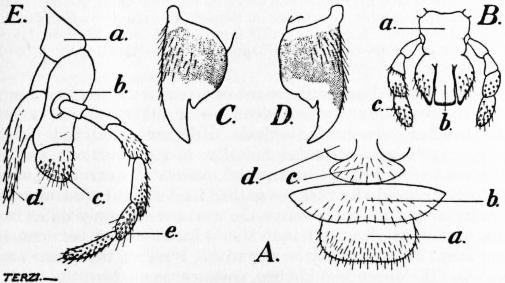
Fig. 1.—A, Front of head of Saw-fly (Pachynematus); a, labrum; b, clypeus; c, vertex; d, d, antennal cavities. C and D, Mandibles. E, First maxilla; a, cardo; b, stipes; c, galea; d, lacinia; e, palp. B, Second maxillae (Labium); a, mentum; b, ligula (between the two galeae); c, c, palps. Magnified.
After C. Janet, Mem. Soc. Zool. France (1898).
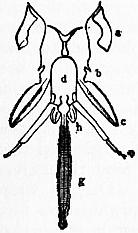
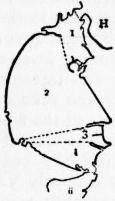
Fig. 2.—Jaws of Hive-bee (Apis mellifica). Magnified about 6½ times. a, mandible; b, c, palp and lacinia of first maxilla; d, e, g, h, mentum, palp, fused laciniae (ligula or “tongue”) and galea of 2nd maxillae. Fig. 3.—Median section through mid-body of female Red Ant (Myrmica rubra). H, Head; 1, 2, 3, the thoracic segments; i., ii., the first and second abdominal segments; i., being the propodeum.
Characters.—In all Hymenoptera the mandibles (fig. 1, C, D) are well developed, being adapted, as in the more lowly winged insects, such as the Orthoptera, for biting. The more generalized Hymenoptera have the second maxillae but slightly modified, their inner lobes being fused to form a ligula (fig. 1, B, b). In the higher families this structure becomes elongated (fig. 2, g) so as to form an elaborate sucking-organ or “tongue.” These insects are able, therefore, to bite as well as to suck, whereas most insects which have acquired the power of suction have lost that of biting. Both fore- and hind-wings are usually present, both pairs being membranous, the hind-wings small and not folded when at rest, each provided along the costa with a row of curved hooks which catch on to a fold along the dorsum of the adjacent fore-wing during flight. A large number of Hymenoptera are, however, entirely wingless—at least as regards one sex or form of the species. One of the most remarkable features is the close union of the foremost abdominal segment (fig. 3, i.) with the metathorax, of which it often seems to form a part, the apparent first abdominal segment being, in such case, really the second (fig. 3, ii.). The true first segment, which undergoes a more or less complete fusion with the thorax is known as the “median segment” or propodeum. In female Hymenoptera the typical insectan ovipositor with its three pairs of processes is well developed, and in the higher families this organ becomes functional as a sting (fig. 5),—used for offence and defence. As regards their life history, all Hymenoptera undergo a “complete” metamorphosis. The larva is soft-skinned (eruciform), being either a caterpillar (fig. 6, b) or a legless grub (fig. 7, a), and the pupa is free (fig. 7, c), i.e. with the appendages not fixed to the body, as is the case in the pupa of most moths.
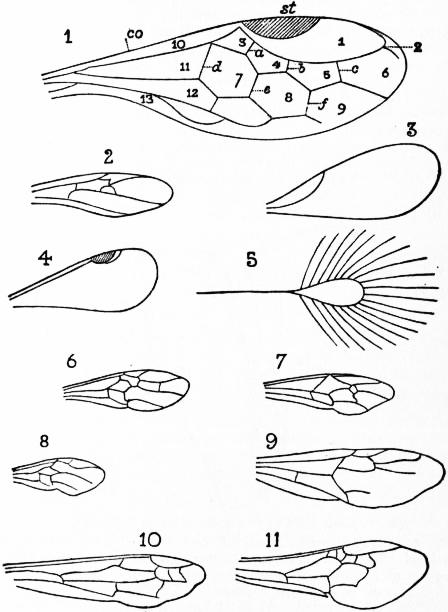
Fig. 4.—Fore-Wings of Hymenoptera.
1. Tenthredinidae (Hylotoma)— 1, marginal; 2, appendicular; 3, 4, 5, 6, radial or submarginal; 7, 8, 9, median or discoidal; 10, sub-costal; 11, 12, cubital or branchial; and 13, anal or lanceolate cellules; a, b, c, submarginal nervures; d, basal nervures; e, f, recurrent nervures; st, stigma; co, costa. 2. Cynipidae (Cynips). 3. Chalcididae (Perilampus). 4. Proctotrypidae (Codrus). 5. Mymaridae (Mymar). 6. Braconidae (Bracon). 7. Ichneumonidae (Trogus). 8. Chrysididae (Cleptes). 9. Formicidae (Formica). 10. Vespidae (Vespa). 11. Apidae (Apathus).
Structure.—The head of a hymenopterous insect bears three simple eyes (ocelli) on the front and vertex in addition to the large compound eyes. The feelers are generally simple in type, rarely showing serrations or prominent appendages; but one or two basal segments are frequently differentiated to form an elongate “scape,” the remaining segments—carried at an elbowed angle to the scape—making up the “flagellum”; the segments of the flagellum often bear complex sensory organs. The general characters of the jaws have been mentioned above, and in detail there is great variation in these organs among the different families. The sucking tongue of the Hymenoptera has often been compared with the hypopharynx of other insects. According to D. Sharp, however, the hypopharynx is present in all Hymenoptera as a distinct structure at the base of the “tongue,” which must be regarded as representing the fused laciniae of the second maxillae. In the thorax the pronotum and prosternum are closely associated with the mesothorax, but the pleura of the prothorax are usually shifted far forwards, so that the fore-legs are inserted just behind the head. A pair of small plates—the tegulae—are very generally present at the bases of the fore-wings. The union of the first abdominal segment with the metathorax has been already mentioned. The second (so-called “first”) abdominal segment is often very constricted, forming the “waist” so characteristic of wasps and ants for example. The constriction of this segment and its very perfect articulation with the propodeum give great mobility to the abdomen, so that the ovipositor or sting can be used with the greatest possible accuracy and effect.
Mention has already been made of the series of curved hooks along the costa of the hind-wing; by means of this arrangement the two wings of a side are firmly joined together during flight, which thus becomes particularly accurate. The wings in the Hymenoptera show a marked reduction in the number of nervures as compared with more primitive insects. The main median nervure, and usually also the sub-costal become united with the radial, while the branches of radial, median and cubital nervures pursuing a transverse or recurrent course across the wing, divide its area into a number of areolets or “cells,” that are of importance in classification. Among many of the smaller Hymenoptera we find that the wings are almost destitute of nervures. In the hind-wings—on account of their reduced size—the nervures are even more reduced than in the fore-wings.
The legs of Hymenoptera are of the typical insectan form, and the foot is usually composed of five segments. In many families the trochanter appears to be represented by two small segments, there being thus an extra joint in the leg. It is almost certain that the distal of these two segments really belongs to the thigh, but the ordinary nomenclature will be used in the present article, as this character is of great importance in discriminating families, and the two segments in question are referred to the trochanter by most systematic writers.
After C. Janet, Aiguillon de la Myrmica rubra (Paris, 1898).
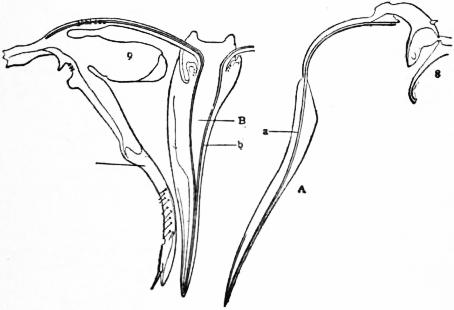
Fig. 5.—Ovipositor or Sting of Red Ant (Myrmica rubra) Queen. Magnified. The right sheath C (outer process of the ninth abdominal segment—9) is shown in connexion with the guide B formed by the inner processes of the 9th segment. The stylet A (process of the 8th abdominal segment—8) is turned over to show its groove a, which works along the tongue or rail b.
The typical insectan ovipositor, so well developed among the Hymenoptera, consists of three pairs of processes (gonapophyses) two of which belong to the ninth abdominal segment and one to the eighth. The latter are the cutting or piercing stylets (fig. 5, A) of the ovipositor, while the two outer processes of the ninth segment are modified into sheaths or feelers (fig. 5, C) and the two inner processes form a guide (fig. 5, B) on which the stylets work, tongues or rails on the “guide” fitting accurately into longitudinal grooves on the stylet. In the different families of the Hymenoptera, there are various modifications of the ovipositor, in accord with the habits of the insects and the purposes to which the organ is put. The sting of wasps, ants and bees is a modified ovipositor and is used for egg-laying by the fertile females, as well as for defence. Most male Hymenoptera have processes which form claspers or genital armature. These processes are not altogether homologous with those of the ovipositor, being formed by inner and outer lobes of a pair of structures on the ninth abdominal segment.
Many points of interest are to be noted in the internal structure of the Hymenoptera. The gullet leads into a moderate-sized crop, and several pairs of salivary glands open into the mouth. The crop is followed by a proventriculus which, in the higher Hymenoptera, forms the so-called “honey stomach,” by the contraction of whose wails the solid and liquid food can be separated, passed on into the digestive stomach, or held in the crop ready for regurgitation into the mouth. Behind the digestive stomach are situated, as usual, intestine and rectum, and the number of kidney (Malpighian) tubes varies from only six to over a hundred, being usually great.
In the female, each ovary consists of a large number of ovarian tubes, in which swollen chambers containing the egg-cells alternate with smaller chambers enclosing nutrient material. In connexion with the ovipositor are two poison-glands, one acid and the other alkaline in its secretion. The acid gland consists of one, two or more tubes, with a cellular coat of several layers, opening into a reservoir whence the duct leads to the exterior. The alkaline gland is an irregular tube with a single cellular layer, its duct opening alongside that of the acid reservoir. These glands are most strongly developed when the ovipositor is modified into a sting.
Development.—Parthenogenesis is of normal occurrence in the life-cycle of many Hymenoptera. There are species of gall-fly in which males are unknown, the unfertilized eggs always developing into females. On the other hand, in certain saw-flies and among the higher families, the unfertilized eggs, capable of development, usually give rise to male insects (see Bee). The larvae of most saw-flies feeding on the leaves of plants are caterpillars (fig. 6, b) with numerous abdominal pro-legs, but in most families of Hymenoptera the egg is laid in such a situation that an abundant food-supply is assured without exertion on the part of the larva, which is consequently a legless grub, usually white in colour, and with soft flexible cuticle (fig. 7, a). The organs and instincts for egg-laying and food-providing are perhaps the most remarkable features in the economy of the Hymenoptera. Gall-fly grubs are provided with vegetable food through the eggs being laid by the mother insect within plant tissues. The ichneumon pierces the body of a caterpillar and lays her eggs where the grubs will find abundant animal food. A digging-wasp hunts for insect prey and buries it with the egg, while a true wasp feeds her brood with captured insects, as a bird her fledglings. Bees store honey and pollen to serve as food for their young. Thus we find throughout the order a degree of care for offspring unreached by other insects, and this family-life has, in the best known of the Hymenoptera—ants, wasps and bees—developed into an elaborate social organization.
Social Life.—The development of a true insect society among the Hymenoptera is dependent on a differentiation among the females between individuals with well-developed ovaries (“queens”) whose special function is reproduction; and individuals with reduced or aborted ovaries (“workers”) whose duty is to build the nest, to gather food and to tend and feed the larvae. Among the wasps the workers may only differ from the queens in size, and individuals intermediate between the two forms of female may be met with. Further, the queen wasp, and also the queen humble-bee, commences unaided the work of building and founding a new nest, being afterwards helped by her daughters (the workers) when these have been developed. In the hive-bee and among ants, on the other hand, there are constant structural distinctions between queen and worker, and the function of the queen bee in a hive is confined to egg-laying, the labour of the community being entirely done by the workers. Many ants possess several different forms of worker, adapted for special duties. Details of this fascinating subject are given in the special articles Ant, Bee and Wasp (q.v.).
Habits and Distribution.—Reference has been already made to the various methods of feeding practised by Hymenoptera in the larval stage, and the care taken of or for the young throughout the order leads in many cases to the gathering of such food by the mother or nurse. Thus, wasps catch flies; worker ants make raids and carry off weak insects of many kinds; bees gather nectar from flowers and transform it into honey within their stomachs—largely for the sake of feeding the larvae in the nest. The feeding habits of the adult may agree with that of the larva, or differ, as in the ease of wasps which feed their grubs on flies, but eat principally vegetable food themselves. The nest-building habit is similarly variable. Digging wasps make simple holes in the ground; many burrowing bees form branching tunnels; other bees excavate timber or make their brood-chambers in hollow plant-stems; wasps work up with their saliva vegetable fibres bitten off tree-bark to make paper; social bees produce from glands in their own bodies the wax whence their nest-chambers are built. The inquiline habit (“cuckoo-parasitism”), when one species makes use of the labour of another by invading the nest and laying her eggs there, is of frequent occurrence among Hymenoptera; and in some cases the larva of the intruder is not content with taking the store of food provided, but attacks and devours the larva of the host.
Most Hymenoptera are of moderate or small size, the giants of the order—certain saw-flies and tropical digging-wasps—never reach the bulk attained by the largest beetles, while the wing-spread is narrow compared with that of many dragon-flies and moths. On the other hand, there are thousands of very small species, and the tiny “fairy-flies” (Mymaridae), whose larvae live as parasites in the eggs of various insects, are excessively minute for creatures of such complex organization. Hymenoptera are probably less widely distributed than Aptera, Coleoptera or Diptera, but they are to be found in all except the most inhospitable regions of the globe. The order is, with few exceptions, terrestrial or aerial in habit. Comparatively only a few species are, for part of their lives, denizens of fresh water; these, as larvae, are parasitic on the eggs or larvae of other aquatic insects, the little hymenopteron, Polynema natans, one of the “fairy-flies”—swims through the water by strokes of her delicate wings in search of a dragon-fly’s egg in which to lay her own egg, while the rare Agriotypus dives after the case of a caddis-worm. It is of interest that the waters have been invaded by the parasitic group of the Hymenoptera, since in number of species this is by far the largest of the order. No group of terrestrial insects escapes their attacks—even larvae boring in wood are detected by ichneumon flies with excessively long ovipositors. Not a few cases are known in which a parasitic larva is itself pierced by the ovipositor of a “hyperparasite,” and even the offspring of the latter may itself fall a victim to the attack of a “tertiary parasite.”
Fossil History.—Very little is known of the history of the Hymenoptera previous to the Tertiary epoch, early in which, as we know from the evidence of many Oligocene and Miocene fossils, all the more important families had been differentiated. Fragments of wings from the Lias and Oolitic beds have been referred to ants and bees, but the true nature of these remains is doubtful.
Classification.—Linnaeus divided the Hymenoptera into two sections—the Terebrantia, whose females possess a cutting or piercing ovipositor, and the Aculeata, in which the female organ is modified into a sting. This nomenclature was adopted by P. A. Latreille and has been in general use until the present day. A closely similar division of the order results from T. Hartig’s character drawn from the trochanter—whether of two segments or undivided—the groups being termed respectively Ditrocha and Monotrocha. But the most natural division is obtained by the separation of the saw-flies as a primitive sub-order, characterized by the imperfect union of the first abdominal segment with the thorax, and by the broad base of the abdomen, so that there is no median constriction or “waist,” and by the presence of thoracic legs—usually also of abdominal pro-legs—in the larva. All the other families of Hymenoptera, including the gall-flies, ichneumons and aculeates, have the first abdominal segment closely united with the thorax, the second abdominal segment constricted so as to form a narrow stalk or “waist,” and legless larvae without a hinder outlet to the food-canal. These two sub-orders are usually known as the Sessiliventra and Petioliventra respectively, but the names Symphyta and Apocrita proposed in 1867 by C. Gerstaecker have priority, and should not be replaced.
Symphyta.
This sub-order, characterized by the “sessile,” broad-based abdomen, whose first segment is imperfectly united with the thorax, and by the usually caterpillar-like larvae with legs, includes the various groups of saw-flies. Three leading families may be mentioned. The Cephidae, or stem saw-flies, have an elongate pronotum, a compressed abdomen, and a single spine on the shin of the fore-leg. The soft, white larvae have the thoracic legs very small and feed in the stems of various plants. Cephus pygmaeus is a well-known enemy of corn crops. The Siricidae (“wood-wasps”) are large elongate insects also with one spine on each fore-shin, but with the pronotum closely joined to the mesothorax. The ovipositor is long and prominent, enabling the female insect to lay her eggs in the wood of trees, where the white larvae, whose legs are excessively short, tunnel and feed. These insects are adorned with bands of black and yellow, or with bright metallic colours, and on account of their large size and formidable ovipositors they often cause needless alarm to persons unfamiliar with their habits. The Tenthredinidae, or true saw-flies, are distinguished by two spines on each fore-shin, while the larvae are usually caterpillars, with three pairs of thoracic legs, and from six to eight pairs of abdominal pro-legs the latter not possessing the hooks found on the pro-legs of lepidopterous caterpillars. Most saw-fly larvae devour leaves, and the beautifully serrate processes of the ovipositor are well adapted for egg-laying in plant tissues. Some saw-fly larvae are protected by a slimy secretion (fig. 6, c) and a few live concealed in galls. In the form of the feelers, the wing-neuration and minor structural details there is much diversity among the saw-flies. They have been usually regarded as a single family, but W. H. Ashmead has lately differentiated eleven families of them.
Apocrita.
This sub-order includes the vast majority of the Hymenoptera, characterized by the narrowly constricted waist in the adult and by the legless condition of the larva. The trochanter is simple in some genera and divided in others. With regard to the minor divisions of this group, great difference of opinion has prevailed among students. In his recent classification Ashmead (1901) recognizes seventy-nine families arranged under eight “super-families.” The number of species included in this division is enormous, and the multiplication of families is, to some extent, a natural result of increasingly close study. But the distinctions between many of these rest on comparatively slight characters, and it is likely that the future discovery of new genera may abolish many among such distinctions as may now be drawn. It seems advisable, therefore, in the present article to retain the wider conception of the family that has hitherto contented most writers on the Hymenoptera. Ashmead’s “super-families” have, however, been adopted as—founded on definite structural characters—they probably indicate relationship more nearly than the older divisions founded mostly on habit. The Cynipoidea include the gall-flies and their parasitic relations. In the Chalcidoidea, Ichneumonoidea and Proctotrypoidea will be found nearly all the “parasitic Hymenoptera” of older classifications. The Formicoidea are the ants. The group of Fossores, or “digging-wasps,” is divided by Ashmead, one section forming the Sphecoidea, while the other, together with the Chrysidae and the true wasps, make up the Vespoidea. The Apoidea consists of the bees only.
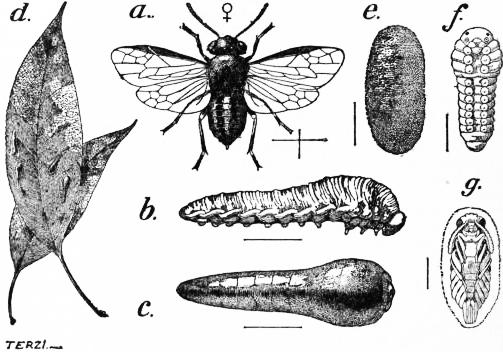
After Marlatt, Ent. Circ. 26, U.S. Dept. Agric.
Fig. 6.—a, Pear Saw-fly (Eriocampoides limacina); b, larva without, and c, with its slimy protective coat; e, cocoon; f, larva before pupation; g, pupa, magnified; d, leaves with larvae.
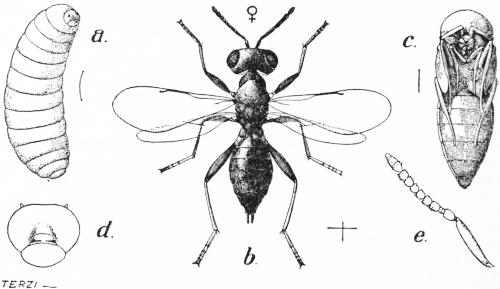
After Howard, Ent. Tech. Bull. 5 U.S. Dept. Agric.
Fig. 7.—Chalcid (Dibrachys boucheanus), a hyper-parasite.
a, Larva. d, Its head more highly magnified. b, Female fly. c, Pupa of male. e, Feeler.
Cynipoidea.—In this division the ovipositor issues from the ventral surface of the abdomen; the pronotum reaches back to the tegulae; the trochanter has two segments; the fore-wing (fig. 4, 2) has no stigma, but one or two areolets. The feelers with twelve to fifteen segments are thread-like and straight. All the insects included in this group are small and form two families—the Cynipidae and the Figitidae. They are the “gall-flies,” many of the species laying eggs in various plant-tissues where the presence of the larva causes the formation of a pathological growth or gall, always of a definite form and characteristic of the species; the “oak-apple” and the bedeguar of the rose are familiar examples. Other flies of this group have the inquiline habit, laying their eggs in the galls of other species, while others again pierce the cuticle of maggots or aphids, in whose bodies their larvae live as parasites.
Chalcidoidea.—This division resembles the Cynipoidea in the position of the ovipositor, and in the two segmented trochanters. The fore-wing also has no stigma, and the whole wing is almost destitute of nervures and areolets, while the pronotum does not reach back to the tegulae, and the feelers are elbowed (fig. 7). The vast majority of this group, including nearly 5000 known species, are usually reckoned as a single family, the Chalcididae, comprising small insects, often of bright metallic colours, whose larvae are parasitic in insects of various orders. The “fig-insects,” whose presence in ripening figs is believed essential to the proper development of the fruit, belong to Blastophaga and other genera of this family. They are remarkable in having wingless males and winged females. The “polyembryonic” development of an Encyrtus, as studied by P. Marchal, is highly remarkable. The female lays her egg in the egg of a small ermine moth (Hyponomeuta) and the egg gives rise not to a single embryo but to a hundred, which develop as the host-caterpillar develops, being found at a later stage within the latter enveloped in a flexible tube.
The Mymaridae or “fairy-flies” are distinguished from the Chalcididae by their narrow fringed wings (figs. 4, 5) and by the situation of the ovipositor just in front of the tip of the abdomen. They are among the most minute of all insects and their larvae are probably all parasitic in insects’ eggs.
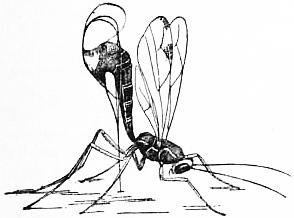
After Riley and Howard, Insect Life, vol. i.
Fig. 8.—Ichneumon Fly (Rhyssa per-suasoria) ovipositing.
Ichneumonoidea.—The ten thousand known species included in this group agree with the Cynipoidea and Chalcidoidea in the position of the ovipositor and in the jointed trochanters, but are distinguished by the fore-wing possessing a distinct stigma and usually a typical series of nervures and areolets (figs. 4, 8). Many of the species are of fair size. They lay their eggs (fig. 8) in the bodies of insects and their larvae belonging to various orders. A few small families such as the Evaniidae and the Stephanidae are included here, but the vast majority of the group fall into two large families, the Ichneumonidae and the Braconidae, the former distinguished by the presence of two median (or discoidal) cells in the fore-wing (figs. 4, 7), while the latter has only one (figs. 4, 6). Not a few of these insects, however, are entirely wingless. On account of their work in destroying plant-eating insects, the ichneumon-flies are of great economic importance.
Proctotrypoidea.—This group may be distinguished from the preceding by the position of the ovipositor at the extreme apex of the abdomen, and from the groups that follow (with very few exceptions) by the jointed trochanters of the legs. The pronotum reaches back to the tegulae. The Pelecinidae—included here by Ashmead—are large insects with remarkably elongate abdomens and undivided trochanters. All the other members of the group may be regarded as forming a single family—the Proctotrypidae, including an immense number of small parasitic Hymenoptera, not a few of which are wingless. Of special interest are the transformations of Platygaster, belonging to this family, discovered by M. Ganin, and familiarized to English readers through the writings of Sir J. Lubbock (Lord Avebury). The first larva is broad in front and tapers behind to a “tail” provided with two divergent processes, so that it resembles a small crustacean. It lives in the grub of a gall-midge and it ultimately becomes changed into the usual white and fleshy hymenopterous larva. The four succeeding sections, in which the ovipositor is modified into a sting (always exserted from the tip of the abdomen) and the trochanters are with few exceptions simple, form the Aculeata of Linnaeus.
Formicoidea.—The ants which form this group are readily distinguished by the differentiation of the females into winged “queens” and wingless “workers.” The pronotum extends back to the wing-bases, and the “waist” is greatly constricted and marked by one or two “nodes.” The differentiation of the females leads to a complex social life, the nesting habits of ants and the various industries that they pursue being of surpassing interest (see Ant).
Vespoidea.—This section includes a number of families characterized by the backward extension of the prothorax to the tegulae and distinguished from the ants by the absence of “nodes” at the base of the abdomen. The true wasps have the fore-wings folded lengthwise when at rest and the fore-legs of normal build—not specialized for digging. The Vespidae or social wasps have “queens” and “workers” like the ants, but both these forms of female are winged; the claws on their fret are simple. In the Eumenidae or solitary wasps the female sex is undifferentiated, and the foot claws are toothed. (For the habits of these insects see Wasp.) The Chrysididae or ruby wasps are small insects with a very hard cuticle exhibiting brilliant metallic colours—blue, green and crimson. Only three or four abdominal segments are visible, the hinder segments being slender and retracted to form a telescope-like tube in which the ovipositor lies. When the ovipositor is brought into use this tube is thrust out. The eggs are laid in the nests of various bees and wasps, the chrysid larva living as a “cuckoo” parasite. The Trigonalidae, a small family whose larvae are parasitic in wasps’ nests, also probably belong here.
The other families of the Vespoidea belong to the series of “Fossores” or digging-wasps. In two of the families—the Mutillidae and Thynnidae—the females are wingless and the larvae live as parasites in the larvae of other insects; the female Mutilla enters bumble-bees’ nests and lays her eggs in the bee-grubs. In the other families both sexes are winged, and the instinct and industry of the females are among the most wonderful in the Hymenoptera. They make burrows wherein they place insects or spiders which they have caught and stung, laying their eggs beside the victim so that the young larvae find themselves in presence of an abundant and appropriate food-supply. Valuable observations on the habits of these insects are due to J. H. Fabre and G. W. and E. Peckham. The prey is sometimes stung in the neighbourhood of the nerve ganglia, so that it is paralysed but not killed, the grub of the fossorial wasp devouring its victim alive; but this instinct varies in perfection, and in many cases the larva flourishes equally whether its prey be killed or not. The females have a wonderful power of finding their burrows on returning from their hunting expeditions. Among the Vespoid families of fossorial wasps, the Pompilidae are the most important. They are recognizable by their slender and elongate hind-legs; many of them provision their burrows with spiders. The Sapygidae are parasitic on bees, while the Scoliidae are large, robust and hairy insects, many of which prey upon the grubs of chafers.
Sphecoidea.—In this division are included the rest of the “digging-wasps,” distinguished from the Vespoidea by the short pronotum not reaching backward to the tegulae. They have usually been reckoned as forming a single, very large family—the Sphegidae—but ten or twelve subdivisions of the group are regarded as distinct families by Ashmead and others. Great diversity is shown in the details of structure, habits and nature of the prey. Species of Sphex, studied by Fabre, provisioned their brood-chambers with crickets. Pelopoeus hunts spiders, while Ammophila catches caterpillars for the benefit of her young. Fabre states that the last-named insect uses a stone for the temporary closing of her burrow, and the Peckhams have seen a female Ammophila take a stone between her mandibles and use it as a hammer for pounding down the earth over her finished nest. The habits of Bembex are of especial interest. The female, instead of provisioning her burrow with a supply of food that will suffice the larva for its whole life, brings fresh flies with which she regularly feeds her young. In this instinct we have a correspondence with the habits of social wasps and bees. Yet it may be thought that the usual instinct of the “digging-wasps” to capture and store up food in an underground burrow for the benefit of offspring which they will never see is even more surprising. The habit of some genera is to catch the prey before making their tunnel, but more frequently the insect digs her nest, and then hunts for prey to put into it.
Apoidea.—The bees which make up this group agree with the Sphecoidea in the short pronotum, but may be distinguished from all other Hymenoptera by the widened first tarsal segment and the plumose hairs on head and body. They are usually regarded as forming a single family—the Apidae—but there is very great diversity in structural details, and Ashmead divides them into fourteen families. The “tongue,” for example, is short and obtuse or emarginate in Colletes and Prosopis, while in all other bees it is pointed at the tip. But in Andrena and its allies it is comparatively short, while in the higher genera, such as Apis and Bombus, it is elongate and flexible, forming a most elaborate and perfect organ for taking liquid food. Bees feed on honey and pollen. Most of the genera are “solitary” in habit, the female sex being undifferentiated; but among the humble-bees and hive-bees we find, as in social wasps and ants, the occurrence of workers, and the consequent elaboration of a wonderful insect-society. (See Bee.)
Bibliography.—The literature of several special families of the Hymenoptera will be found under the articles Ant, Bee, Ichneumon-Fly, Wasp, &c., referred to above. Among earlier students on structure may be mentioned P. A. Latreille, Familles naturelles du règne animal (Paris, 1825), who recognized the nature of the “median segment.” C. Gerstaecker (Arch. f. Naturg. xx., 1867) and F. Brauer (Sitzb. K. Akad. Wiss. Wien. lxxxv., 1883) should also be consulted on this subject. For internal anatomy, specially the digestive organs, see L. Dufour, Mém. savants étrangers, vii. (1841), and Ann. Sci. Nat. Zool. (4), i. 1854. For nervous system H. Viallanes, Ann. Sci. Nat. Zool. (7), ii. iv. 1886-1887, and F. C. Kenyon, Journ. Comp. Neurol. vi., 1896. For poison and other glands, see L. Bordas, Ann. Sci. Nat. Zool. (7) xix., 1895. For the sting and ovipositor H. Dewitz, Zeits. wiss. Zool. xxv., 1874, xxviii., 1877, and F. Zander, ib. lxvi., 1899. For male genital armature S. A. Peytoureau, Morphologie de l’armure génitale des insectes (Bordeaux, 1895), and E. Zander, Zeits. wiss. Zool. lxvii., 1900. The systematic student of Hymenoptera is greatly helped by C. G. de Dalla Torre’s Catalogus Hymenopterorum (10 vols., Leipzig, 1893-1902). For general classifications see F. W. Konow, Entom. Nachtr. (1897), and W. H. Ashmead, Proc. U.S. Nat. Mus. xxiii., 1901; the latter paper deals also especially with the Ichneumonoidea of the globe. For habits and life histories of Hymenoptera see J. Lubbock (Lord Avebury), Ants, Bees and Wasps (9th ed., London, 1889); C. Janet, Études sur les fourmis, les guêpes et les abeilles (Paris, &c., 1893 and onwards); and G. W. and E. G. Peckham, Instincts and Habits of Solitary Wasps (Madison, Wis. U.S.A., 1898). Monographs of most of the families of British Hymenoptera have now been published. For saw-flies and gall-flies, see P. Cameron’s British Phytophagous Hymenoptera (4 vols., London, Roy. Soc., 1882-1893). For Ichneumonoidea, C. Morley’s Ichneumons of Great Britain (Plymouth, 1903, &c.), and T. A. Marshall’s “British Braconidae,” Trans. Entom. Soc., 1885-1899. The smaller parasitic Hymenoptera have been neglected in this country since A. H. Haliday’s classical papers Entom. Mag. i.-v., (1833-1838) but Ashmead’s “North American Proctotrypidae” (Bull. U.S. Nat. Mus. xlv., 1893) is valuable for the European student. For the Fossores, wasps, ants and bees see E. Saunders, Hymenoptera Aculeata of the British Islands (London, 1896). Exhaustive references to general systematic works will be found in de Dalla Torre’s Catalogue mentioned above. Of special value to English students are C. T. Bingham’s Fauna of British India, “Hymenoptera” (London, 1897 and onwards), and P. Cameron’s volumes on Hymenoptera in the Biologia Centrali-Americana. F. Smith’s Catalogues of Hymenoptera in the British Museum (London, 1853-1859) are well worthy of study.
(G. H. C.)
HYMETTUS (Ital. Monte Matto, hence the modern name Trello Vouni), a mountain in Attica, bounding the Athenian plain on the S.E. Height, 3370 ft. It was famous in ancient times for its bees, which gathered honey of peculiar flavour from its aromatic herbs; their fame still persists. The spring mentioned by Ovid (Ars Amat. iii. 687) is probably to be recognized near the monastery of Syriani or Kaesariani on the western slope. This may be identical with that known as Κύλλον Πήρα, said to be a remedy for barrenness in women. The marble of Hymettus, which often has a bluish tinge, was used extensively for building in ancient Athens, and also, in early times, for sculpture; but the white marble of Pentelicus was preferred for both purposes.
See E. Dodwell, Classical and Topographical Tour (1819), i. 483.
HYMNS.—1. Classical Hymnody.—The word “hymn” (ὕμνος) was employed by the ancient Greeks1 to signify a song or poem composed in honour of gods, heroes or famous men, or to be recited on some joyful, mournful or solemn occasion. Polymnia was the name of their lyric muse. Homer makes Alcinous entertain Odysseus with a “hymn” of the minstrel Demodocus, on the capture of Troy by the wooden horse. The Works and Days of Hesiod begins with an invocation to the Muses to address hymns to Zeus, and in his Theogonia he speaks of them as singing or inspiring “hymns” to all the divinities, and of the bard as “their servant, hymning the glories of men of old, and of the gods of Olympus.” Pindar calls by this name odes, like his own, in praise of conquerors at the public games of Greece. The Athenian dramatists (Euripides most frequently) use the word and its cognate verbs in a similar manner; they also describe by them metrical oracles and apophthegms, martial, festal and hymeneal songs, dirges and lamentations or incantations of woe.
Hellenic hymns, according to this conception of them, have come down to us, some from a very early and others from a late period of Greek classical literature. Those which passed by the name of Homer2 were already old in the time of Thucydides. They are mythological poems (several of them long), in hexameter verse—some very interesting. That to Apollo contains a traditionary history of the origin and progress of the Delphic worship; those on Hermes and on Dionysus are marked by much liveliness and poetical fancy. Hymns of a like general character, but of less interest (though these also embody some fine poetical traditions of the Greek mythology, such as the story of Teiresias, and that of the wanderings of Leto), were written in the 3rd century before Christ, by Callimachus of Cyrene. Cleanthes, the successor of Zeno, composed (also in hexameters) an “excellent and devout hymn” (as it is justly called by Cudworth, in his Intellectual System) to Zeus, which is preserved in the Eclogae of Stobaeus, and from which Aratus borrowed the words, “For we are also His offspring,” quoted by St Paul at Athens. The so-called Orphic hymns, in hexameter verse, styled τελεταί, or hymns of initiation into the “mysteries” of the Hellenic religion, are productions of the Alexandrian school,—as to which learned men are not agreed whether they are earlier or later than the Christian era.
The Romans did not adopt the word “hymn”; nor have we many Latin poems of the classical age to which it can properly be applied. There are, however, a few—such as the simple and graceful “Dianae sumus in fide” (“Dian’s votaries are we”) of Catullus, and “Dianam tenerae dicite virgines” (“Sing to Dian, gentle maidens”) of Horace—which approach much more nearly than anything Hellenic to the form and character of modern hymnody.
2. Hebrew Hymnody.—For the origin and idea of Christian hymnody we must look, not to Gentile, but to Hebrew sources. St Augustine’s definition of a hymn, generally accepted by Christian antiquity, may be summed up in the words, “praise to God with song” (“cum cantico”); Bede understood the “canticum” as properly requiring metre; though he thought that what in its original language was a true hymn might retain that character in an unmetrical translation. Modern use has enlarged the definition; Roman Catholic writers extend it to the praises of saints; and the word now comprehends rhythmical prose as well as verse, and prayer and spiritual meditation as well as praise.
The modern distinction between psalms and hymns is arbitrary (see Psalms). The former word was used by the LXX. as a generic designation, probably because it implied an accompaniment by the psaltery (said by Eusebius to have been of very ancient use in the East) or other instruments. The cognate verb “psallere” has been constantly applied to hymns, both in the Eastern and in the Western Church; and the same compositions which they described generically as “psalms” were also called by the LXX. “odes” (i.e. songs) and “hymns.” The latter word occurs, e.g. in Ps. lxxii. 20 (“the hymns of David the son of Jesse”), in Ps. lxv. 1, and also in the Greek titles of the 6th, 54th, 55th, 67th and 76th (this numbering of the psalms being that of the English version, not of the LXX.). The 44th chapter of Ecclesiasticus, “Let us now praise famous men,” &c., is entitled in the Greek πατέρων ὕμνος, “The Fathers’ Hymn.” Bede speaks of the whole book of Psalms as called “liber hymnorum,” by the universal consent of Hebrews, Greeks and Latins.
In the New Testament we find our Lord and His apostles singing a hymn (ὑμνήσαντες ἐξῆλθον), after the institution of the Lord’s Supper; St Paul and Silas doing the same (ὕμνουν τὸν θεόν) in their prison at Philippi; St James recommending psalm-singing (ψαλλέτω), and St Paul “psalms and hymns and spiritual songs” (ψαλμοῖς καὶ ὕμνοις καὶ ῲδαῖς πνευματικαῖς) St Paul also, in the 14th chapter of the first epistle to the Corinthians, speaks of singing (ψαλῶ) and of every man’s psalm (ἕκαστος ὑμῶν ψαλμὸν ἕχει). In a context which plainly has reference to the assemblies of the Corinthian Christians for common worship. All the words thus used were applied by the LXX. to the Davidical psalms; it is therefore possible that these only may be intended, in the different places to which we have referred. But there are in St Paul’s epistles several passages (Eph. v. 14; 1 Tim. iii. 16; 1 Tim. vi. 15, 16; 2 Tim. ii. 11, 12) which have so much of the form and character of later Oriental hymnody as to have been supposed by Michaelis and others to be extracts from original hymns of the Apostolic age. Two of them are apparently introduced as quotations, though not found elsewhere in the Scriptures. A third has not only rhythm, but rhyme. The thanksgiving prayer of the assembled disciples, recorded in Acts iv., is both in substance and in manner poetical; and in the canticles, “Magnificat,” “Benedictus,” &c., which manifestly followed the form and style of Hebrew poetry, hymns or songs, proper for liturgical use, have always been recognized by the church.
3. Eastern Church Hymnody.—The hymn of our Lord, the precepts of the apostles, the angelic song at the nativity, and “Benedicite omnia opera” are referred to in a curious metrical prologue to the hymnary of the Mozarabic Breviary as precedents for the practice of the Western Church. In this respect, however, the Western Church followed the Eastern, in which hymnody prevailed from the earliest times.
Philo describes the Theraputae (q.v.) of the neighbourhood of Alexandria as composers of original hymns, which (as well as old) were sung at their great religious festivals—the people listening in silence till they came to the closing Therapeutae. strains, or refrains, at the end of a hymn or stanza (the “acroteleutia” and “ephymnia”), in which all, women as well as men, heartily joined. These songs, he says, were in various metres (for which he uses a number of technical terms); some were choral, some not; and they were divided into variously constructed strophes or stanzas. Eusebius, who thought that the Theraputae were communities of Christians, says that the Christian practice of his own day was in exact accordance with this description.
The practice, not only of singing hymns, but of singing them antiphonally, appears, from the well-known letter of Pliny to Trajan, to have been established in the Bithynian churches at the beginning of the 2nd century. They Antiphonal singing. were accustomed “stato die ante lucem convenire, carmenque Christo, quasi Deo, dicere secum invicem.” This agrees well, in point of time, with the tradition recorded by the historian Socrates, that Ignatius (who suffered martyrdom about A.D. 107) was led by a vision or dream of angels singing hymns in that manner to the Holy Trinity to introduce antiphonal singing into the church of Antioch, from which it quickly spread to other churches. There seems to be an allusion to choral singing in the epistle of Ignatius himself to the Romans, where he exhorts them, “χορὸς γελῳδίαν” (“having formed themselves into a choir”), to “sing praise to the Father in Christ Jesus.” A statement of Theodoret has sometimes been supposed to refer the origin of antiphonal singing to a much later date; but this seems to relate only to the singing of Old Testament Psalms (τὴν Δαυιδικὴν μελῳδίαν), the alternate chanting of which, by a choir divided into two parts, was (according to that statement) first introduced into the church of Antioch by two monks famous in the history of their time, Flavianus and Diodorus, under the emperor Constantius II.
Other evidence of the use of hymns in the 2nd century is contained in a fragment of Caius, preserved by Eusebius, which refers to “all the psalms and odes written by faithful brethren from the beginning,” as “hymning Christ, the 2nd century. Word of God, as God.” Tertullian also, in his description of the “Agapae,” or love-feasts, of his day, says that, after washing hands and bringing in lights, each man was invited to come forward and sing to God’s praise something either taken from the Scriptures or of his own composition (“ut quisque de Sacris Scripturis vel proprio ingenio potest”). George Bull, bishop of St David’s, believed one of those primitive compositions to be the hymn appended by Clement of Alexandria to his Paedagogus; and Archbishop Ussher considered the ancient morning and evening hymns, of which the use was enjoined by the Apostolical Constitutions, and which are also mentioned in the “Tract on Virginity” printed with the works of St Athanasius, and in St Basil’s treatise upon the Holy Spirit, to belong to the same family. Clement’s hymn, in a short anapaestic metre, beginning στόμιον πώλων ἀδαῶν (or, according to some editions, βασιλεῦ ἁγίων, λόγε πανδαμάτωρ—translated by the Rev. A. Chatfield, “O Thou, the King of Saints, all-conquering Word”), is rapid, spirited and well-adapted for singing. The Greek “Morning Hymn” (which, as divided into verses by Archbishop Ussher in his treatise De Symbolis, has a majestic rhythm, resembling a choric or dithyrambic strophe) is the original form of “Gloria in Excelsis,” still said or sung, with some variations, in all branches of the church which have not relinquished the use of liturgies. The Latin form of this hymn (of which that in the English communion office is an exact translation) is said, by Bede and other ancient writers, to have been brought into use at Rome by Pope Telesphorus, as early as the time of the emperor Hadrian. A third, the Vesper or “Lamp-lighting” hymn (“φῶς ἱλαρὸν ἁγίας δόξης”—translated by Canon Bright “Light of Gladness, Beam Divine”), holds its 3rd century. place to this day in the services of the Greek rite. In the 3rd century Origen seems to have had in his mind the words of some other hymns or hymn of like character, when he says (in his treatise Against Celsus): “We glorify in hymns God and His only begotten Son; as do also the Sun, the Moon, the Stars and all the host of heaven. All these, in one Divine chorus, with the just among men, glorify in hymns God who is over all, and His only begotten Son.” So highly were these compositions esteemed in the Syrian churches that the council which deposed Paul of Samosata from the see of Antioch in the time of Aurelian justified that act, in its synodical letter to the bishops of Rome and Alexandria, on this ground (among others) that he had prohibited the use of hymns of that kind, by uninspired writers, addressed to Christ.
After the conversion of Constantine, the progress of hymnody became closely connected with church controversies. There had been in Edessa, at the end of the 2nd or early in the 3rd century, a Gnostic writer of conspicuous ability, named Bardesanes, who was succeeded, as the head of his sect or school, by his son Harmonius. Both father and son wrote hymns, and set them to agreeable melodies, which acquired, and in the 4th century still retained, much local popularity. Ephraem Syrus, the first voluminous hymn-writer whose works remain to us, thinking that the same melodies might be made useful to the faith, if adapted to more orthodox words, composed to them a large number of hymns in the Syriac language, principally in tetrasyllabic, pentasyllable and heptasyllabic metres, divided into strophes of from 4 to 12, 16 and even 20 lines each. When a strophe contained five lines, the fifth was generally an “ephymnium,” detached in sense, and consisting of a prayer, invocation, doxology or the like, to be sung antiphonally, either in full chorus or by a separate part of the choir. The Syriac Chrestomathy of August Hahn (Leipzig, 1825), and the third volume of H. A. Daniel’s Thesaurus Hymnologicus (Leipzig, 1841-1856), contain specimens of these hymns. Some of them have been translated into (unmetrical) English by the Rev. Henry Burgess (Select Metrical Hymns of Ephrem Syrus, &c., 1853). A considerable number of those so translated are on subjects connected with death, resurrection, judgment, &c., and display not only Christian faith and hope, but much simplicity and tenderness of natural feeling. Theodoret speaks of the spiritual songs of Ephraem as very sweet and profitable, and as adding much, in his (Theodoret’s) time, to the brightness of the commemorations of martyrs in the Syrian Church.
The Greek hymnody contemporary with Ephraem followed, with some licence, classical models. One of its favourite metres was the Anacreontic; but it also made use of the short anapaestic, Ionic, iambic and other lyrical measures, as well as the hexameter and pentameter. Its principal authors were Methodius, bishop of Olympus, who died about A.D. 311, Synesius, who became bishop of Ptolemais in Cyrenaica in 410, and Gregory Nazianzen, for a short time (380-381) patriarch of Constantinople. The merits of these writers have been perhaps too much depreciated by the admirers of the later Greek “Melodists.” They have found an able English translator in the Rev. Allen Chatfield (Songs and Hymns of Earliest Greek Christian Poets, London, 1876). Among the most striking of their works are μνώεο Χριστέ (“Lord Jesus, think of me”), by Synesius; σὲ τὸν ἄφθιτον μονάρχην (“O Thou, the One Supreme”) and τί σοι θέλεις γενέσθαι (“O soul of mine, repining”), by Gregory; also ἄνωθεν παρθένοι (“The Bridegroom cometh”), by Methodius. There continued to be Greek metrical hymn-writers, in a similar style, till a much later date. Sophronius, patriarch of Jerusalem in the 7th century, wrote seven Anacreontic hymns; and St John Damascene, one of the most copious of the second school of “Melodists,” was also the author of some long compositions in trimeter iambics.
An important development of hymnody at Constantinople arose out of the Arian controversy. Early in the 4th century Athanasius had rebuked, not only the doctrine of Arius, but the light character of certain hymns by which he Period of Arian controversy. endeavoured to make that doctrine popular. When, towards the close of that century (398), St John Chrysostom was raised to the metropolitan see, the Arians, who were still numerous at Constantinople, had no places of worship within the walls; but they were in the habit of coming into the city at sunset on Saturdays, Sundays and the greater festivals, and congregating in the porticoes and other places of public resort, where they sung, all night through, antiphonal songs, with “acroteleutia” (closing strains, or refrains), expressive of Arian doctrine, often accompanied by taunts and insults to the orthodox. Chrysostom was apprehensive that this music might draw some of the simpler church people to the Arian side; he therefore organized, in opposition to it, under the patronage and at the cost of Eudoxia, the empress of Arcadius (then his friend), a system of nightly processional hymn-singing, with silver crosses, wax-lights and other circumstances of ceremonial pomp. Riots followed, with bloodshed on both sides, and with some personal injury to the empress’s chief eunuch, who seems to have officiated as conductor or director of the church musicians. This led to the suppression, by an imperial edict, of all public Arian singing; while in the church the practice of nocturnal hymn-singing on certain solemn occasions, thus first introduced, remained an established institution.
It is not improbable that some rudiments of the peculiar system of hymnody which now prevails throughout the Greek communion, and whose affinities are rather to the Hebrew and Syriac than to the classical forms, may Greek system of hymnody. have existed in the church of Constantinople, even at that time. Anatolius, patriarch of Constantinople in the middle of the 5th century, was the precursor of that system; but the reputation of being its proper founder belongs to Romanos, of whom little more is known than that he wrote hymns still extant, and lived towards the end of that century. The importance of that system in the services of the Greek church may be understood from the fact that Dr J. M. Neale computed four-fifths of the whole space (about 5000 pages) contained in the different service-books of that church to be occupied by hymnody, all in a language or dialect which has ceased to be anywhere spoken.
The system has a peculiar technical terminology, in which the words “troparion,” “ode,” “canon” and “hirmus” (εἶρμος) chiefly require explanation.
The troparion is the unit of the system, being a strophe or stanza, seen, when analysed, to be divisible into verses or clauses, with regulated caesuras, but printed in the books as a single prose sentence, without marking any divisions. The following (turned into English, from a “canon” by John Mauropus) may be taken as an example: “The never-sleeping Guardian, | the patron of my soul, | the guide of my life, | allotted me by God, | I hymn thee, Divine Angel | of Almighty God.” Dr Neale and most other writers regard all these “troparia” as rhythmical or modulated prose. Cardinal J. B. Pitra, on the other hand, who in 1867 and 1876 published two learned works on this subject, maintains that they are really metrical, and governed by definite rules of prosody, of which he lays down sixteen. According to him, each “troparion” contains from three to thirty-three verses; each verse varies from two to thirteen syllables, often in a continuous series, uniform, alternate or reciprocal, the metre being always syllabic, and depending, not on the quantity of vowels or the position of consonants, but on an harmonic series of accents.
In various parts of the services solitary troparia are sung, under various names, “contacion,” “oecos,” “cathisma,” &c., which mark distinctions either in their character or in their use.
An ode is a song or hymn compounded of several similar “troparia,”—usually three, four or five. To these is always prefixed a typical or standard “troparion,” called the hirmus, by which the syllabic measure, the periodic series of accents, and in fact the whole structure and rhythm of the stanzas which follow it are regulated. Each succeeding “troparion” in the same “ode” contains the same number of verses, and of syllables in each verse, and similar accents on the same or equivalent syllables. The “hirmus” may either form the first stanza of the “ode” itself, or (as is more frequently the case) may be taken from some other piece; and, when so taken, it is often indicated by initial words only, without being printed at length. It is generally printed within commas, after the proper rubric of the “ode.” A hymn in irregular “stichera” or stanzas, without a “hirmus,” is called “idiomelon.” A system of three or four odes is “triodion” or “tetraodion.”
A canon is a system of eight (theoretically nine) connected odes, the second being always suppressed. Various pauses, relieved by the interposition of other short chants or readings, occur during the singing of a whole “canon.” The final “troparion” in each ode of the series is not unfrequently detached in sense (like the “ephymnia” of Ephraem Syrus), particularly when it is in the (very common) form of a “theotokion,” or ascription of praise to the mother of our Lord, and when it is a recurring refrain or burden.
There were two principal periods of Greek hymnography constructed on these principles—the first that of Romanos and his followers, extending over the 6th and 7th centuries, the second that of the schools which arose during the Iconoclastic controversy in the 8th century, and which continued for some centuries afterwards, until the art itself died out.
The works of the writers of the former period were collected in Tropologia, or church hymn-books, which were held in high esteem till the 10th century, when they ceased to be regarded as church-books, and so fell into neglect. School of Romanos. They are now preserved only in a very small number of manuscripts. From three of these, belonging to public libraries at Moscow, Turin and Rome, Cardinal Pitra has printed, in his Analecta, a number of interesting examples, the existence of which appears to have been unknown to Dr Neale, and which, in the cardinal’s estimation, are in many respects superior to the “canons,” &c., of the modern Greek service-books, from which all Neale’s translations (except some from Anatolius) are taken. Cardinal Pitra’s selections include twenty-nine works by Romanos, and some by Sergius, and nine other known, as well as some unknown, authors. He describes them as having generally a more dramatic character than the “melodies” of the later period, and a much more animated style; and he supposes that they may have been originally sung with dramatic accompaniments, by way of substitution for the theatrical performances of Pagan times. As an instance of their peculiar character, he mentions a Christmas or Epiphany hymn by Romanos, in twenty-five long strophes, in which there is, first, an account of the Nativity and its accompanying wonders, and then a dialogue between the wise men, the Virgin mother and Joseph. The magi arrive, are admitted, describe the moral and religious condition of Persia and the East, and the cause and adventures of their journey, and then offer their gifts. The Virgin intercedes for them with her Son, instructs them in some parts of Jewish history, and ends with a prayer for the salvation of the world.
The controversies and persecutions of the 8th and succeeding centuries turned the thoughts of the “melodists” of the great monasteries of the Studium at Constantinople and St Saba in Palestine and their followers, and those of Melodists. the adherents of the Greek rite in Sicily and South Italy (who suffered much from the Saracens and the Normans), into a less picturesque but more strictly theological course; and the influence of those controversies, in which the final success of the cause of “Icons” was largely due to the hymns, as well as to the courage and sufferings, of these confessors, was probably the cause of their supplanting, as they did, the works of the older school. Cardinal Pitra gives them the praise of having discovered a graver and more solemn style of chant, and of having done much to fix the dogmatic theology of their church upon its present lines of near approach to the Roman.
Among the “melodists” of this latter Greek school there were many saints of the Greek church, several patriarchs and two emperors—Leo the Philosopher, and Constantine Porphyrogenitus, his son. Their greatest poets were Theodore and Joseph of the Studium, and Cosmas and John (called Damascene) of St Saba. Neale translated into English verse several selected portions, or centoes, from the works of these and others, together with four selections from earlier works by Anatolius. Some of his translations—particularly “The day is past and over,” from Anatolius, and “Christian, dost thou see them,” from Andrew of Crete—have been adopted into hymn-books used in many English churches; and the hymn “Art thou weary,” which is rather founded upon than translated from one by Stephen the Sabaite, has obtained still more general popularity.
4. Western Church Hymnody.—It was not till the 4th century that Greek hymnody was imitated in the West, where its introduction was due to two great lights of the Latin Church—St Hilary of Poitiers and St Ambrose of Milan.
Hilary was banished from his see of Poitiers in 356, and was absent from it for about four years, which he spent in Asia Minor, taking part during that time in one of the councils of the Eastern Church. He thus had full opportunity of becoming acquainted with the Greek church music of that day; and he wrote (as St Jerome, who was thirty years old when Hilary died, and who was well acquainted with his acts and writings, and spent some time in or near his diocese, informs us) a “book of hymns,” to one of which Jerome particularly refers, in the preface to the second book of his own commentary on the epistle to the Galatians. Isidore, archbishop of Seville, who presided over the fourth council of Toledo, in his book on the offices of the church, speaks of Hilary as the first Latin hymn-writer; that council itself, in its 13th canon, and the prologue to the Mozarabic hymnary (which is little more than a versification of the canon), associate his name, in this respect, with that of Ambrose. A tradition, ancient and widely spread, ascribed to him the authorship of the remarkable “Hymnum dicat turba fratrum, hymnum cantus personet” (“Band of brethren, raise the hymn, let your song the hymn resound”), which is a succinct narrative, in hymnal form, of the whole gospel history; and is perhaps the earliest example of a strictly didactic hymn. Both Bede and Hincmar much admired this composition, though the former does not mention, in connexion with it, the name of Hilary. The private use of hymns of such a character by Christians in the West may probably have preceded their ecclesiastical use; for Jerome says that in his day those who went into the fields might hear “the ploughman at his hallelujahs, the mower at his hymns, and the vine-dresser singing David’s psalms.” Besides this, seven shorter metrical hymns attributed to Hilary are still extant.
Of the part taken by Ambrose, not long after Hilary’s death, in bringing the use of hymns into the church of Milan, we have a contemporary account from his convert, St Augustine. Justina, mother of the emperor Valentinian, favoured Ambrose. the Arians, and desired to remove Ambrose from his see. The “devout people,” of whom Augustine’s mother, Monica, was one, combined to protect him, and kept guard in the church. “Then,” says Augustine, “it was first appointed that, after the manner of the Eastern churches, hymns and psalms should be sung, lest the people should grow weary and faint through sorrow; which custom has ever since been retained, and has been followed by almost all congregations in other parts of the world.” He describes himself as moved to tears by the sweetness of these “hymns and canticles”:—“The voices flowed into my ears; the truth distilled into my heart; I overflowed with devout affections, and was happy.” To this time, according to an uncertain but not improbable tradition which ascribed the composition of the “Te Deum” to Ambrose, and connected it with the conversion of Augustine, is to be referred the commencement of the use in the church of that sublime unmetrical hymn.
It is not, however, to be assumed that the hymnody thus introduced by Ambrose was from the first used according to the precise order and method of the later Western ritual. To bring it into (substantially) that order and method appears to have been the work of St Benedict. Walafrid Strabo, the earliest ecclesiastical writer on this subject (who lived at the beginning of the 9th century), says that Benedict, on the constitution of the religious order known by his name (about 530), appointed the Ambrosian hymns to be regularly sung in his offices for the canonical hours. Hence probably originated the practice of the Italian churches, and of others which followed their example, to sing certain hymns (Ambrosian, or by the early successors of the Ambrosian school) daily throughout the week, at “Vespers,” “Lauds” and “Nocturns,” and on some days at “Compline” also—varying them with the different ecclesiastical seasons and festivals, commemorations of saints and martyrs and other special offices. Different dioceses and religious houses had their own peculiarities of ritual, including such hymns as were approved by their several bishops or ecclesiastical superiors, varying in detail, but all following the same general method. The national rituals, which were first reduced into a form substantially like that which has since prevailed, were probably those of Lombardy and of Spain, now known as the “Ambrosian” and the “Mozarabic.” The age and origin of the Spanish ritual are uncertain, but it is mentioned in the 7th century by Isidore, bishop of Seville. It contained a copious hymnary, the original form of which may be regarded as canonically approved by the fourth council of Toledo (633). By the 13th canon of that council, an opinion (which even then found advocates) against the use in churches of any hymns not taken from the Scriptures—apparently the same opinion which had been held by Paul of Samosata—was censured; and it was ordered that such hymns should be used in the Spanish as well as in the Gallican churches, the penalty of excommunication being denounced against all who might presume to reject them.