VOLUME XIV SLICE II Hydromechanics to Ichnography (continued 5)
Reading edition
The above example illustrates how Nicholson’s or Fahrenheit’s hydrometer may be employed as a weighing machine for small weights.
In all hydrometers in which a part only of the instrument is immersed, there is a liability to error in consequence of the surface tension, or capillary action, as it is frequently called, along the line of contact of the instrument and the surface of the liquid (see Capillary Action). This error diminishes as the diameter of the stem is reduced, but is sensible in the case of the thinnest stem which can be employed, and is the chief source of error in the employment of Nicholson’s hydrometer, which otherwise would be an instrument of extreme delicacy and precision. The following is Nicholson’s statement on this point:—
“One of the greatest difficulties which attends hydrostatical experiments arises from the attraction or repulsion that obtains at the surface of the water. After trying many experiments to obviate the irregularities arising from this cause, I find reason to prefer the simple one of carefully wiping the whole instrument, and especially the stem, with a clean cloth. The weights in the dish must not be esteemed accurate while there is either a cumulus or a cavity in the water round the stem.”
It is possible by applying a little oil to the upper part of the bulb of a common or of a Sikes’s hydrometer, and carefully placing it in pure water, to cause it to float with the upper part of the bulb and the whole of the stem emerging as indicated in fig. 4, when it ought properly to sink almost to the top of the stem, the surface tension of the water around the circumference of the circle of contact, AA′, providing the additional support required.
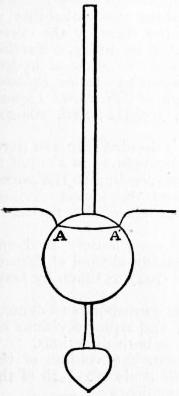
Fig. 4.
The universal hydrometer of G. Atkins, described in the Phil. Mag. for 1808, xxxi. 254, is merely Nicholson’s hydrometer with the screw at C projecting through the collar into which it is screwed, and terminating in a sharp point above the cup G. To this point soft bodies lighter than water (which would float if placed in the cup) could be attached, and thus completely immersed. Atkins’s instrument was constructed so as to weigh 700 grains, and when immersed to the mark on the stem in distilled water at 60° F. it carried 300 grains in the upper dish. The hydrometer therefore displaced 1000 grains of distilled water at 60° F. and hence the specific gravity of any other liquid was at once indicated by adding 700 to the number of grains in the pan required to make the instrument sink to the mark on the stem. The small divisions on the scale corresponded to differences of 1⁄10th of a grain in the weight of the instrument.
The “Gravimeter,” constructed by Citizen Guyton and described in Nicholson’s Journal, 4to, i. 110, differs from Nicholson’s instrument in being constructed of glass, and having a cylindrical bulb about 21 centimetres in length and 22 millimetres in diameter. Its weight is so adjusted that an additional weight of 5 grammes must be placed in the upper pan to cause the instrument to sink to the mark on the stem in distilled water at the standard temperature. The instrument is provided with an additional piece, or “plongeur,” the weight of which exceeds 5 grammes by the weight of water which it displaces; that is to say, it is so constructed as to weigh 5 grammes in water, and consists of a glass envelope filled with mercury. It is clear that the effect of this “plongeur,” when placed in the lower pan, is exactly the same as that of the 5 gramme weight in the upper pan. Without the extra 5 grammes the instrument weighs about 20 grammes, and therefore floats in a liquid of specific gravity .8. Thus deprived of its additional weight it may be used for spirits. To use the instrument for liquids of much greater density than water additional weights must be placed in the upper pan, and the “plongeur” is then placed in the lower pan for the purpose of giving to the instrument the requisite stability.
Charles’s balance areometer is similar to Nicholson’s hydrometer, except that the lower basin admits of inversion, thus enabling the instrument to be employed for solids lighter than water, the inverted basin serving the same purpose as the pointed screw in Atkins’s modification of the instrument.
Adie’s sliding hydrometer is of the ordinary form, but can be adjusted for liquids of widely differing specific gravities by drawing out a sliding tube, thus changing the volume of the hydrometer while its weight remains constant.
The hydrometer of A. Baumé, which has been extensively used in France, consists of a common hydrometer graduated in the following manner. Certain fixed points were first determined upon the stem of the instrument. The first of these was found by immersing the hydrometer in pure water, and marking the stem at the level of the surface. This formed the zero of the scale. Fifteen standard solutions of pure common salt in water were then prepared, containing respectively 1, 2, 3, ... 15% (by weight) of dry salt. The hydrometer was plunged in these solutions in order, and the stem having been marked at the several surfaces, the degrees so obtained were numbered 1, 2, 3, ... 15. These degrees were, when necessary, repeated along the stem by the employment of a pair of compasses till 80 degrees were marked off. The instrument thus adapted to the determination of densities exceeding that of water was called the hydrometer for salts.
The hydrometer intended for densities less than that of water, or the hydrometer for spirits, is constructed on a similar principle. The instrument is so arranged that it floats in pure water with most of the stem above the surface. A solution containing 10% of pure salt is used to indicate the zero of the scale, and the point at which the instrument floats when immersed in distilled water at 10° R. (54½° F.) is numbered 10. Equal divisions are then marked off upwards along the stem as far as the 50th degree.
The densities corresponding to the several degrees of Baumé’s hydrometer are given by Nicholson (Journal of Philosophy, i. 89) as follows:—
Baumé’s Hydrometer for Spirits. Temperature 10° R.
Degrees. Density. Degrees. Density. Degrees. Density.
10 1.000 21 .922 31 .861
11 .990 22 .915 32 .856
12 .985 23 .909 33 .852
13 .977 24 .903 34 .847
14 .970 25 .897 35 .842
15 .963 26 .892 36 .837
16 .955 27 .886 37 .832
17 .949 28 .880 38 .827
18 .943 29 .874 39 .822
19 .935 30 .867 40 .817
20 .928
Baume’s Hydrometer for Salts.
Degrees. Density. Degrees. Density. Degrees. Density.
0 1.000 27 1.230 51 1.547
3 1.020 30 1.261 54 1.594
6 1.040 33 1.295 57 1.659
9 1.064 36 1.333 60 1.717
12 1.089 39 1.373 63 1.779
15 1.114 42 1.414 66 1.848
18 1.140 45 1.455 69 1.920
21 1.170 48 1.500 72 2.000
24 1.200

Fig. 5.—Jones’s Hydrometer.
Carrier’s hydrometer was very similar to that of Baumé, Cartier having been employed by the latter to construct his instruments for the French revenue. The point at which the instrument floated in distilled water was marked 10° by Cartier, and 30° on Carrier’s scale corresponded to 32° on Baumé’s.
Perhaps the main object for which hydrometers have been constructed is the determination of the value of spirituous liquors, chiefly for revenue purposes. To this end an immense variety of hydrometers have been devised, differing mainly in the character of their scales.
In Speer’s hydrometer the stem has the form of an octagonal prism, and upon each of the eight faces a scale is engraved, indicating the percentage strength of the spirit corresponding to the several divisions of the scale, the eight scales being adapted respectively to the temperature 35°, 40°, 45°, 50°, 55°, 60°, 65° and 70° F. Four small pins, which can be inserted into the counterpoise of the instrument, serve to adapt the instrument to the temperatures intermediate between those for which the scales are constructed. William Speer was supervisor and chief assayer of spirits in the port of Dublin. For a more complete account of this instrument see Tilloch’s Phil. Mag., xiv. 151.
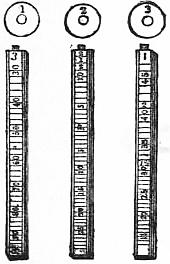
Fig. 6.
The hydrometer constructed by Jones, of Holborn, consists of a spheroidal bulb with a rectangular stem (fig. 5). Between the bulb and counterpoise is placed a thermometer, which serves to indicate the temperature of the liquid, and the instrument is provided with three weights which can be attached to the top of the stem. On the four sides of the stem AD are engraved four scales corresponding respectively to the unloaded instrument, and to the instrument loaded with the respective weights. The instrument when unloaded serves for the range from 74 to 47 over proof; when loaded with the first weight it indicates from 46 to 13 over proof, with the second weight from 13 over proof to 29 under proof, and with the third from 29 under proof to pure water, the graduation corresponding to which is marked W at the bottom of the fourth scale. One side of the stem AD is shown in fig. 5, the other three in fig. 6. The thermometer is also provided with four scales corresponding to the scales above mentioned. Each scale has its zero in the middle corresponding to 60° F. If the mercury in the thermometer stand above this zero the spirit must be reckoned weaker than the hydrometer indicates by the number on the thermometer scale level with the top of the mercury, while if the thermometer indicate a temperature lower than the zero of the scale (60° F.) the spirit must be reckoned stronger by the scale reading. At the side of each of the four scales on the stem of the hydrometer is engraved a set of small numbers indicating the contraction in volume which would be experienced if the requisite amount of water (or spirit) were added to bring the sample tested to the proof strength.
The hydrometer constructed by Dicas of Liverpool is provided with a sliding scale which can be adjusted for different temperatures, and which also indicates the contraction in volume incident on bringing the spirit to proof strength. It is provided with thirty-six different weights which, with the ten divisions on the stem, form a scale from 0 to 370. The employment of so many weights renders the instrument ill-adapted for practical work where speed is an object.
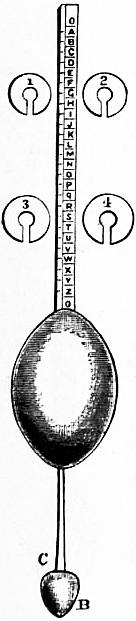
Fig. 7.—Atkins’s Hydrometer.
This instrument was adopted by the United States in 1790, but was subsequently discarded by the Internal Revenue Service for another type. In this latter form the observations have to be made at the standard temperature of 60° F., at which the graduation 100 corresponds to proof spirit and 200 to absolute alcohol. The need of adjustable weights is avoided by employing a set of five instruments, graduated respectively 0°-100°, 80°-120°, 100°-140°, 130°-170°, 160°-200°. The reading gives the volume of proof spirit equivalent to the volume of liquor; thus the readings 80° and 120° mean that 100 volumes of the test liquors contain the same amount of absolute alcohol as 80 and 120 volumes of proof spirit respectively. Proof spirit is defined in the United States as a mixture of alcohol and water which contains equal volumes of alcohol and water at 60° F., the alcohol having a specific gravity of 0.7939 at 60° as compared with water at its maximum density. The specific gravity of proof spirit is 0.93353 at 60°; and 100 volumes of the mixture is made from 50 volumes of absolute alcohol and 53.71 volumes of water.
Quin’s universal hydrometer is described in the Transactions of the Society of Arts, viii. 98. It is provided with a sliding rule to adapt it to different temperatures, and has four scales, one of which is graduated for spirits and the other three serve to show the strengths of worts. The peculiarity of the instrument consists in the pyramidal form given to the stem, which renders the scale-divisions more nearly equal in length than they would be on a prismatic stem.
Atkins’s hydrometer, as originally constructed, is described in Nicholson’s Journal, 8vo, ii. 276. It is made of brass, and is provided with a spheroidal bulb the axis of which is 2 in. in length, the conjugate diameter being 1½ in. The whole length of the instrument is 8 in., the stem square of about 1⁄8-in. side, and the weight about 400 grains. It is provided with four weights, marked 1, 2, 3, 4, and weighing respectively 20, 40, 61 and 84 grains, which can be attached to the shank of the instrument at C (fig. 7) and retained there by the fixed weight B. The scale engraved upon one face of the stem contains fifty-five divisions, the top and bottom being marked 0 or zero and the alternate intermediate divisions (of which there are twenty-six) being marked with the letters of the alphabet in order. The four weights are so adjusted that, if the instrument floats with the stem emerging as far as the lower division 0 with one of the weights attached, then replacing the weight by the next heavier causes the instrument to sink through the whole length of the scale to the upper division 0, and the first weight produces the same effect when applied to the naked instrument. The stem is thus virtually extended to five times its length, and the number of divisions increased practically to 272. When no weight is attached the instrument indicates densities from .806 to .843; with No. 1 it registers from .843 to .880, with No. 2 from .880 to .918, with No. 3 from .918 to .958, and with No. 4 from .958 to 1.000, the temperature being 55° F. It will thus be seen that the whole length of the stem corresponds to a difference of density of about .04, and one division to about .00074, indicating a difference of little more than 1⁄3% in the strength of any sample of spirits.
The instrument is provided with a sliding rule, with scales corresponding to the several weights, which indicate the specific gravity corresponding to the several divisions of the hydrometer scale compared with water at 55° F. The slider upon the rule serves to adjust the scale for different temperatures, and then indicates the strength of the spirit in percentages over or under proof. The slider is also provided with scales, marked respectively Dicas and Clarke, which serve to show the readings which would have been obtained had the instruments of those makers been employed. The line on the scale marked “concentration” indicates the diminution in volume consequent upon reducing the sample to proof strength (if it is over proof, O.P.) or upon reducing proof spirit to the strength of the sample (if it is under proof, U.P.). By applying the several weights in succession in addition to No. 4 the instrument can be employed for liquids heavier than water; and graduations on the other three sides of the stem, together with an additional slide rule, adapt the instrument for the determination of the strength of worts.
Atkins subsequently modified the instrument (Nicholson’s Journal, 8vo, iii. 50) by constructing the different weights of different shapes, viz. circular, square, triangular and pentagonal, instead of numbering them 1, 2, 3 and 4 respectively, a figure of the weight being stamped on the sliding rule opposite to every letter in the series to which it belongs, thus diminishing the probability of mistakes. He also replaced the letters on the stem by the corresponding specific gravities referred to water as unity. Further information concerning these instruments and the state of hydrometry in 1803 will be found in Atkins’s pamphlet On the Relation between the Specific Gravities and the Strength of Spirituous Liquors (1803); or Phil. Mag. xvi. 26-33, 205-212, 305-312; xvii. 204-210 and 329-341.
In Gay-Lussac’s alcoholometer the scale is divided into 100 parts corresponding to the presence of 1, 2, ... % by volume of alcohol at 15° C., the highest division of the scale corresponding to the purest alcohol he could obtain (density .7947) and the lowest division corresponding to pure water. A table provides the necessary corrections for other temperatures.
Tralles’s hydrometer differs from Gay-Lussac’s only in being graduated at 4° C. instead of 15° C., and taking alcohol of density .7939 at 15.5° C. for pure alcohol instead of .7947 as taken by Gay-Lussac (Keene’s Handbook of Hydrometry).
In Beck’s hydrometer the zero of the scale corresponds to density 1.000 and the division 30 to density .850, and equal divisions on the scale are continued as far as is required in both directions.
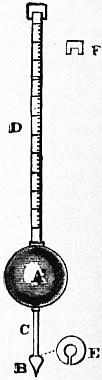
Fig. 8.—Sike’s Hydrometer.
In the centesimal hydrometer of Francœur the volume of the stem between successive divisions of the scale is always 1⁄100th of the whole volume immersed when the instrument floats in water at 4° C. In order to graduate the stem the instrument is first weighed, then immersed in distilled water at 4° C., and the line of flotation marked zero. The first degree is then found by placing on the top of the stem a weight equal to 1⁄100th of the weight of the instrument, which increases the volume immersed by 1⁄100th of the original volume. The addition to the top of the stem of successive weights, each 1⁄100th of the weight of the instrument itself, serves to determine the successive degrees. The length of 100 divisions of the scale, or the length of the uniform stem the volume of which would be equal to that of the hydrometer up to the zero graduation, Francœur called the “modulus” of the hydrometer. He constructed his instruments of glass, using different instruments for different portions of the scale (Francœur, Traité d’aréométrie, Paris, 1842).
Dr Boriés of Montpellier constructed a hydrometer which was based upon the results of his experiments on mixtures of alcohol and water. The interval between the points corresponding to pure alcohol and to pure water Boriés divided into 100 equal parts, though the stem was prolonged so as to contain only 10 of these divisions, the other 90 being provided for by the addition of 9 weights to the bottom of the instrument as in Clarke’s hydrometer.
The instrument which has now been exclusively used for revenue purposes for nearly a century is that associated with the name of Bartholomew Sikes, who was correspondent to the Board of Excise from 1774 to 1783, and for some time collector of excise for Hertfordshire.
Sikes’s hydrometer, on account of its similarity to that of Boriés, appears to have been borrowed from that instrument. It is made of gilded brass or silver, and consists of a spherical ball A (fig. 8), 1.5 in. in diameter, below which is a weight B connected with the ball by a short conical stem C. The stem D is rectangular in section and about 3½ in. in length. This is divided into ten equal parts, each of which is subdivided into five. As in Boriés’s instrument, a series of 9 weights, each of the form shown at E, serves to extend the scale to 100 principal divisions. In the centre of each weight is a hole capable of admitting the lowest and thickest end of the conical stem C, and a slot is cut into it just wide enough to allow the upper part of the cone to pass. Each weight can thus be dropped on to the lower stem so as to rest on the counterpoise B. The weights are marked 10, 20, ... 90; and in using the instrument that weight must be selected which will allow it to float in the liquid with a portion only of the stem submerged. Then the reading of the scale at the line of flotation, added to the number on the weight, gives the reading required. A small supernumerary weight F is added, which can be placed upon the top of the stem. F is so adjusted that when the 60 weight is placed on the lower stem the instrument sinks to the same point in distilled water when F is attached as in proof spirit when F is removed. The best instruments are now constructed for revenue purposes of silver, heavily gilded, because it was found that saccharic acid contained in some spirits attacked brass behind the gilding.
The following table gives the specific gravities corresponding to the principal graduations on Sikes’s hydrometer at 60° F. and 62° F., together with the corresponding strengths of spirits. The latter are based upon the tables of Charles Gilpin, clerk to the Royal Society, for which the reader is referred to the Phil. Trans. for 1794. Gilpin’s work is a model for its accuracy and thoroughness of detail, and his results have scarcely been improved upon by more recent workers. The merit of Sikes’s system lies not so much in the hydrometer as in the complete system of tables by which the readings of the instrument are at once converted into percentage of proof-spirit.
Table showing the Densities corresponding to the Indications of Sike’s Hydrometer.
Sike’s Indications. 60° F. 62° F.
Density. Proof Spirit per cent. Density. Proof Spirit per cent.
0 .815297 167.0 .815400 166.5
1 .816956 166.1 .817059 165.6
2 .818621 165.3 .818725 164.8
3 .820294 164.5 .820397 163.9
4 .821973 163.6 .822077 163.1
5 .823659 162.7 .823763 162.3
6 .825352 161.8 .825457 161.4
7 .827052 160.9 .827157 160.5
8 .828759 160.0 .828864 159.6
9 .830473 159.1 .830578 158.7
10 .832195 158.2 .832300 157.8
11 .833888 157.3 .833993 156.8
12 .835587 156.4 .835692 155.9
13 .837294 155.5 .837400 155.0
14 .839008 154.6 .839114 154.0
15 .840729 153.7 .840835 153.1
16 .842458 152.7 .842564 152.1
17 .844193 151.7 .844299 151.1
18 .845936 150.7 .846042 150.1
19 .847685 149.7 .847792 149.1
20 .849442 148.7 .849549 148.1
20B .849393 148.7 .849500 148.1
21 .851122 147.6 .851229 147.1
22 .852857 146.6 .852964 146.1
23 .854599 145.6 .854707 145.1
24 .856348 144.6 .856456 144.0
25 .858105 143.5 .858213 142.9
26 .859869 142.4 .859978 141.8
27 .861640 141.3 .861749 140.8
28 .863419 140.2 .863528 139.7
29 .865204 139.1 .865313 138.5
30 .866998 138.0 .867107 137.4
30B .866991 138.0 .867100 137.4
31 .868755 136.9 .868865 136.2
32 .870526 135.7 .870636 135.1
33 .872305 134.5 .872415 133.9
34 .874090 133.4 .874200 132.8
35 .875883 132.2 .873994 131.6
36 .877684 131.0 .877995 130.4
37 .879492 129.8 .879603 129.1
38 .881307 128.5 .881419 127.9
39 .883129 127.3 .883241 126.7
40 .884960 126.0 .885072 125.4
40B .884888 126.0 .885000 125.4
41 .886689 124.8 .886801 124.2
42 .888497 123.5 .888609 122.9
43 .890312 122.2 .890425 121.6
44 .892135 120.9 .892248 120.3
45 .893965 119.6 .894078 119.0
46 .895803 118.3 .895916 117.6
47 .897647 116.9 .897761 116.3
48 .899509 115.6 .899614 114.9
49 .901360 114.2 .901417 113.5
50 .903229 112.8 .903343 112.1
50B .903186 112.8 .903300 112.1
51 .905024 111.4 .905138 110.7
52 .906869 110.0 .906983 109.3
53 .908722 108.6 .908837 107.9
54 .910582 107.1 .910697 106.5
55 .912450 105.6 .912565 105.0
56 .914326 104.2 .914441 103.5
57 .916209 102.7 .916323 102.0
58 .918100 101.3 .918216 100.5
59 .919999 99.7 .820115 98.9
60 .921906 98.1 .922022 97.4
60B .921884 98.1 .922000 97.4
61 .923760 96.6 .923877 95.9
62 .925643 95.0 .925760 94.2
63 .927534 93.3 .927652 92.6
64 .929433 91.7 .929550 90.9
65 .931339 90.0 .931457 89.2
66 .933254 88.3 .933372 87.5
67 .935176 86.5 .935294 85.8
68 .937107 84.7 .937225 84.0
69 .939045 82.9 .939163 82.2
70 .940991 81.1 .941110 80.3
70B .940981 81.1 .941100 80.3
71 .942897 79.2 .943016 78.4
72 .944819 77.3 .944938 76.5
73 .946749 75.3 .946869 74.5
74 .948687 73.3 .948807 72.5
75 .950634 71.2 .950753 70.4
76 .952588 69.0 .952708 68.2
77 .954550 66.8 .954670 66.0
78 .956520 64.4 .956641 63.5
79 .958498 61.9 .958619 61.1
80 .960485 59.4 .960606 58.5
80B .960479 59.4 .960600 58.5
81 .962433 56.7 .962555 55.8
82 .964395 53.9 .964517 53.0
83 .966366 50.9 .966488 50.0
84 .968344 47.8 .968466 47.0
85 .970331 44.5 .970453 43.8
86 .972325 41.0 .972448 40.4
87 .974328 37.5 .974451 36.9
88 .976340 34.0 .976463 33.5
89 .978359 30.6 .978482 30.1
90 .980386 27.2 .980510 26.7
90B .980376 27.2 .980500 26.7
91 .982371 23.9 .982496 23.6
92 .984374 20.8 .984498 20.5
93 .986385 17.7 .986510 17.4
94 .988404 14.8 .988529 14.5
95 .990431 12.0 .990557 11.7
96 .992468 9.3 .992593 9.0
97 .994512 6.7 .994637 6.5
98 .996565 4.1 .996691 4.0
99 .998626 1.8 .998752 1.6
100 1.000696 0.0 1.000822 0.0
In the above table for Sikes’s hydrometer two densities are given corresponding to each of the degrees 20, 30, 40, 50, 60, 70, 80 and 90, indicating that the successive weights belonging to the particular instrument for which the table has been calculated do not quite agree. The discrepancy, however, does not produce any sensible error in the strength of the corresponding spirit.
A table which indicates the weight per gallon of spirituous liquors for every degree of Sikes’s hydrometer is printed in 23 and 24 Vict. c. 114, schedule B. This table differs slightly from that given above, which has been abridged from the table given in Keene’s Handbook of Hydrometry, apparently on account of the equal divisions on Sikes’s scale having been taken as corresponding to equal increments of density.
Sikes’s hydrometer was established for the purpose of collecting the revenue of the United Kingdom by Act of Parliament, 56 Geo. III. c. 140, by which it was enacted that “all spirits shall be deemed and taken to be of the degree of strength which the said hydrometers called Sikes’s hydrometers shall, upon trial by any officer or officers of the customs or excise, denote such spirits to be.” This act came into force on January 5, 1817, and was to have remained in force until August 1, 1818, but was repealed by 58 Geo. III. c. 28, which established Sikes’s hydrometer on a permanent footing. By 3 and 4 Will. IV. c. 52, § 123, it was further enacted that the same instruments and methods should be employed in determining the duty upon imported spirits as should in virtue of any Act of Parliament be employed in the determination of the duty upon spirits distilled at home. It is the practice of the officers of the inland revenue to adjust Sikes’s hydrometer at 62° F., that being the temperature at which the imperial gallon is defined as containing 10 ℔ avoirdupois of distilled water. The specific gravity of any sample of spirits thus determined, when multiplied by ten, gives the weight in pounds per imperial gallon, and the weight of any bulk of spirits divided by this number gives its volume at once in imperial gallons.
Mr (afterwards Colonel) J. B. Keene, of the Hydrometer Office, London, has constructed an instrument after the model of Sikes’s, but provided with twelve weights of different masses but equal volumes, and the instrument is never used without having one of these attached. When loaded with either of the lightest two weights the instrument is specifically lighter than Sikes’s hydrometer when unloaded, and it may thus be used for specific gravities as low as that of absolute alcohol. The volume of each weight being the same, the whole volume immersed is always the same when it floats at the same mark whatever weight may be attached.
Besides the above, many hydrometers have been employed for special purposes. Twaddell’s hydrometer is adapted for densities greater than that of water. The scale is so arranged that the reading multiplied by 5 and added to 1000 gives the specific gravity with reference to water as 1000. To avoid an inconveniently long stem, different instruments are employed for different parts of the scale as mentioned above.
The lactometer constructed by Dicas of Liverpool is adapted for the determination of the quality of milk. It resembles Sikes’s hydrometer in other respects, but is provided with eight weights. It is also provided with a thermometer and slide rule, to reduce the readings to the standard temperature of 55° F. Any determination of density can be taken only as affording prima facie evidence of the quality of milk, as the removal of cream and the addition of water are operations which tend to compensate each other in their influence on the density of the liquid, so that the lactometer cannot be regarded as a reliable instrument.
The marine hydrometers, as supplied by the British government to the royal navy and the merchant marine, are glass instruments with slender stems, and generally serve to indicate specific gravities from 1.000 to 1.040. Before being issued they are compared with a standard instrument, and their errors determined. They are employed for taking observations of the density of sea-water.
The salinometer is a hydrometer originally intended to indicate the strength of the brine in marine boilers in which sea-water is employed. Saunders’s salinometer consists of a hydrometer which floats in a chamber through which the water from the boiler is allowed to flow in a gentle stream, at a temperature of 200° F. The peculiarity of the instrument consists in the stream of water, as it enters the hydrometer chamber, being made to impinge against a disk of metal, by which it is broken into drops, thus liberating the steam, which would otherwise disturb the instrument.
The use of Sikes’s hydrometer necessitates the employment of a considerable quantity of spirit. For the testing of spirits in bulk no more convenient instrument has been devised, but where very small quantities are available more suitable laboratory methods must be adopted.
In England, the Finance Act 1907 (7 Ed. VII. c. 13), section 4, provides as follows: (1) The Commissioners of Customs and the Commissioners of Inland Revenue may jointly make regulations authorizing the use of any means described in the regulations for ascertaining for any purpose the strength or weight of spirits. (2) Where under any enactment Sykes’s (sic) Hydrometer is directed to be used or may be used for the purpose of ascertaining the strength or weight of spirits, any means so authorized by regulations may be used instead of Sykes’s Hydrometer and references to Sykes’s Hydrometer in any enactment shall be construed accordingly. (3) Any regulations made under this section shall be published in the London, Edinburgh and Dublin Gazette, and shall take effect from the date of publication, or such later date as may be mentioned in the regulations for the purpose. (4) The expression “spirits” in this section has the same meaning as in the Spirits Act 1880.
(W. G.)
1 In Nicholson’s Journal, iii. 89, Citizen Eusebe Salverte calls attention to the poem “De Ponderibus et Mensuris” generally ascribed to Rhemnius Fannius Palaemon, and consequently 300 years older than Hypatia, in which the hydrometer is described and attributed to Archimedes.
2 Nicholson’s Journal, vol. i. p. 111, footnote.
HYDROPATHY, the name given, from the Greek, to the “water-cure,” or the treatment of disease by water, used outwardly and inwardly. Like many descriptive names, the word “hydropathy” is defective and even misleading, the active agents in the treatment being heat and cold, of which water is little more than the vehicle, and not the only one. Thermotherapeutics (or thermotherapy) is a term less open to objection.
Hydropathy, as a formal system, dates from about 1829, when Vincenz Priessnitz (1801-1851), a farmer of Gräfenberg in Silesia, Austria, began his public career in the paternal homestead, extended so as to accommodate the increasing numbers attracted by the fame of his cures. Two English works, however, on the medical uses of water had been translated into German in the century preceding the rise of the movement under Priessnitz. One of these was by Sir John Floyer (1649-1734), a physician of Lichfield, who, struck by the remedial use of certain springs by the neighbouring peasantry, investigated the history of cold bathing, and published in 1702 his Ψυχρολουσία, or the History of Cold Bathing, both Ancient and Modern.” The book ran through six editions within a few years, and the translation was largely drawn upon by Dr J. S. Hahn of Silesia, in a work published in 1738, On the Healing Virtues of Cold Water, Inwardly and Outwardly applied, as proved by Experience. The other work was that of Dr James Currie (1756-1805) of Liverpool, entitled Medical Reports on the Effects of Water, Cold and Warm, as a remedy in Fevers and other Diseases, published in 1797, and soon after translated into German by Michaelis (1801) and Hegewisch (1807). It was highly popular, and first placed the subject on a scientific basis. Hahn’s writings had meanwhile created much enthusiasm among his countrymen, societies having been everywhere formed to promote the medicinal and dietetic use of water; and in 1804 Professor Örtel of Ansbach republished them and quickened the popular movement by unqualified commendation of water drinking as a remedy for all diseases. In him the rising Priessnitz found a zealous advocate, and doubtless an instructor also.
At Gräfenberg, to which the fame of Priessnitz drew people of every rank and many countries, medical men were conspicuous by their numbers, some being attracted by curiosity, others by the desire of knowledge, but the majority by the hope of cure for ailments which had as yet proved incurable. Many records of experiences at Gräfenberg were published, all more or less favourable to the claims of Priessnitz, and some enthusiastic in their estimate of his genius and penetration; Captain Claridge introduced hydropathy into England in 1840, his writings and lectures, and later those of Sir W. Erasmus Wilson (1809-1884), James Manby Gully (1808-1883) and Edward Johnson, making numerous converts, and filling the establishments opened soon after at Malvern and elsewhere. In Germany, France and America hydropathic establishments multiplied with great rapidity. Antagonism ran high between the old practice and the new. Unsparing condemnation was heaped by each on the other; and a legal prosecution, leading to a royal commission of inquiry, served but to make Priessnitz and his system stand higher in public estimation.
Increasing popularity diminished before long that timidity which had in great measure prevented trial of the new method from being made on the weaker and more serious class of cases, and had caused hydropathists to occupy themselves mainly with a sturdy order of chronic invalids well able to bear a rigorous regimen and the severities of unrestricted crisis. The need of a radical adaptation to the former class was first adequately recognized by John Smedley, a manufacturer of Derbyshire, who, impressed in his own person with the severities as well as the benefits of “the cold water cure,” practised among his workpeople a milder form of hydropathy, and began about 1852 a new era in its history, founding at Matlock a counterpart of the establishment at Gräfenberg.
Ernst Brand (1826-1897) of Berlin, Räljen and Theodor von Jürgensen of Kiel, and Karl Liebermeister (1833-1901) of Basel, between 1860 and 1870, employed the cooling bath in abdominal typhus with striking results, and led to its introduction to England by Dr Wilson Fox. In the Franco-German war the cooling bath was largely employed, in conjunction frequently with quinine; and it now holds a recognized position in the treatment of hyperpyrexia. The wet sheet pack has become part of medical practice; the Turkish bath, introduced by David Urquhart (1805-1877) into England on his return from the East, and ardently adopted by Dr Richard Barter (1802-1870) of Cork, has become a public institution, and, with the “morning tub” and the general practice of water drinking, is the most noteworthy of the many contributions by hydropathy to public health (see Baths, ad fin.).
The appliances and arrangements by means of which heat and cold are brought to bear on the economy are—(a) Packings, hot and cold, general and local, sweating and cooling; (b) hot air and steam baths; (c) general baths, of hot water and cold; (d) sitz, spinal, head and foot baths; (e) bandages (or compresses), wet and dry; also (f) fomentations and poultices, hot and cold, sinapisms, stupes, rubbings and water potations, hot and cold.
(a) Packings.—The full pack consists of a wet sheet enveloping the body, with a number of dry blankets packed tightly over it, including a macintosh covering or not. In an hour or less these are removed and a general bath administered. The pack is a derivative, sedative, sudorific and stimulator of cutaneous excretion. There are numerous modifications of it, notably the cooling pack, where the wrappings are loose and scanty, permitting evaporation, and the application of indefinite duration, the sheet being rewetted as it dries; this is of great value in protracted febrile conditions. There are also local packs, to trunk, limbs or head separately, which are derivative, soothing or stimulating, according to circumstance and detail.
(b) Hot air baths, the chief of which is the Turkish (properly, the Roman) bath, consisting of two or more chambers ranging in temperature from 120° to 212° or higher, but mainly used at 150° for curative purposes. Exposure is from twenty minutes up to two hours according to the effect sought, and is followed by a general bath, and occasionally by soaping and shampooing. It is stimulating, derivative, depurative, sudorific and alterative, powerfully promoting tissue change by increase of the natural waste and repair. It determines the blood to the surface, reducing internal congestions, is a potent diaphoretic, and, through the extremes of heat and cold, is an effective nervous and vascular stimulant and tonic. Morbid growths and secretions, as also the uraemic, gouty and rheumatic diathesis, are beneficially influenced by it. The full pack and Turkish bath have between them usurped the place and bettered the function of the once familiar hot bath. The Russian or steam bath and the lamp bath are primitive and inferior varieties of the modern Turkish bath, the atmosphere of which cannot be too dry and pure.
(c) General baths comprise the rain (or needle), spray (or rose), shower, shallow, plunge, douche, wave and common morning sponge baths, with the dripping sheet, and hot and cold spongings, and are combinations, as a rule, of hot and cold water. They are stimulating, tonic, derivative and detergent.
(d) Local baths comprise the sitz (or sitting), douche (or spouting), spinal, foot and head baths, of hot or cold water, singly or in combination, successive or alternate. The sitz, head and foot baths are used “flowing” on occasion. The application of cold by “Leiter’s tubes” is effective for reducing inflammation (e.g. in meningitis and in sunstroke); in these a network of metal or indiarubber tubing is fitted to the part affected, and cold water kept continuously flowing through them. Rapid alternations of hot and cold water have a powerful effect in vascular stasis and lethargy of the nervous system and absorbents, yielding valuable results in local congestions and chronic inflammations.
(e) Bandages (or compresses) are of two kinds,—cooling, of wet material left exposed for evaporation, used in local inflammations and fevers; and heating, of the same, covered with waterproof material, used in congestion, external or internal, for short or long periods. Poultices, warm, of bread, linseed, bran, &c., changed but twice in twenty-four hours, are identical in action with the heating bandage, and superior only in the greater warmth and consequent vital activity their closer application to the skin ensures.
(f) Fomentations and poultices, hot or cold, sinapisms, stupes, rubefacients, irritants, frictions, kneadings, calisthenics, gymnastics, electricity, &c., are adjuncts largely employed.
Bibliography.—Among the numerous earlier works on hydropathy, the following are worth mention: Balbirnie, Water Cure in Consumption (1847), Hydropathic Aphorisms (1856) and A Plea for the Turkish Bath (1862); Beni-Barde, Traité d’hydrothérapie (1874); Claridge, Cold Water Cure, or Hydropathy (1841), Facts and Evidence in Support of Hydropathy (1843) and Cold Water, Tepid Water and Friction Cure (1849); Dunlop, Philosophy of the Bath (1873); Floyer, Psychrolousia, or the History of Cold-Bathing, &c. (1702); J. S. Hahn (Schweidnitz), Observations on the Healing Virtues of Cold Water (1738); Hunter, Hydropathy for Home Use (1879); E. W. Lane, Hydropathy, or the Natural System of Medical Treatment (1857); R. J. Lane, Life at the Water Cure (1851); Shew, Hydropathic Family Physician (1857); Smedley, Practical Hydropathy (1879); Smethurst, Hydrotherapia, or the Water Cure (1843); Wainwright, Inquiry into the Nature and Use of Baths (1737); Weiss, Handbook of Hydropathy (1844); Wilson Principles and Practice of the Cold Water Cure (1854) and The Water Cure (1859). A useful recent work dealing comprehensively with the subject is Richard Metcalfe’s Rise and Progress of Hydropathy (1906).
HYDROPHOBIA (Gr. ὕδωρ, water, and ϕόβος, fear; so called from the symptom of dread of water), or Rabies (Lat. for “madness”), an acute disease, occurring chiefly in certain of the lower animals, particularly the canine species, and liable to be communicated by them to other animals and to man.
In Dogs, &c.—The occurrence of rabies in the fox, wolf, hyaena, jackal, raccoon, badger and skunk has been asserted; but there is every probability that it is originally a disease of the dog. It is communicated by inoculation to nearly all, if not all, warm-blooded creatures. The transmission from one animal to another only certainly takes place through inoculation with viruliferous matters. The malady is generally characterized at a certain stage by an irrepressible desire in the animal to act offensively with its natural weapons—dogs and other carnivora attacking with their teeth, herbivora with their hoofs or horns, and birds with their beaks, when excited ever so slightly. In the absence of excitement the malady may run its course without any fit of fury or madness.
Symptoms.—The disease has been divided into three stages or periods, and has also been described as appearing in at least two forms, according to the peculiarities of the symptoms. But, as a rule, one period of the disease does not pass suddenly into another, the transition being almost imperceptible; and the forms do not differ essentially from each other, but appear merely to constitute varieties of the same disease, due to the natural disposition of the animal, or other modifying circumstances. These forms have been designated true or furious rabies (Fr. rage vrai; Ger. rasende Wuth) and dumb rabies (Fr. rage mue; Ger. stille Wuth).
The malady does not commence with fury and madness, but in a strange and anomalous change in the habits of the dog: it becomes dull, gloomy, and taciturn, and seeks to isolate itself in out-of-the-way places, retiring beneath chairs and to odd corners. But in its retirement it cannot rest: it is uneasy and fidgety, and no sooner has it lain down than suddenly it jumps up in an agitated manner, walks backwards and forwards several times, again lies down and assumes a sleeping attitude, but has only maintained it for a few minutes when it is once more moving about. Again it retires to its corner, to the farthest recess it can find, and huddles itself up into a heap, with its head concealed beneath its chest and fore-paws. This state of continual agitation and inquietude is in striking contrast with its ordinary habits, and should therefore receive attention. Not unfrequently there are a few moments when the creature appears more lively than usual, and displays an extraordinary amount of affection. Sometimes there is a disposition to gather up straw, thread, bits of wood, &c., which are industriously carried away; a tendency to lick anything cold, as iron, stones, &c., is also observed in many instances; and there is also a desire evinced to lick other animals. Sexual excitement is also frequently an early symptom. At this period no disposition to bite is observed; the animal is docile with its master and obeys his voice, though not so readily as before, nor with the same pleased countenance. There is something strange in the expression of its face, and the voice of its owner is scarcely able to make it change from a sudden gloominess to its usual animated aspect. These symptoms gradually become more marked; the restlessness and agitation increase. If on straw the dog scatters and pulls it about with its paws, and if in a room it scratches and tumbles the cushions or rugs on which it usually lies. It is incessantly on the move, rambling about, scratching the ground, sniffing in corners and at the doors, as if on the scent or seeking for something. It indulges in strange movements, as if affected by some mental influences or a prey to hallucinations. When not excited by any external influence it will remain for a brief period perfectly still and attentive, as if watching something, or following the movements of some creature on the wall; then it will suddenly dart forward and snap at the vacant air, as if pursuing an annoying object, or endeavouring to seize a fly. At another time it throws itself, yelling and furious, against the wall, as if it heard threatening voices on the other side, or was bent on attacking an enemy. Nevertheless, the animal is still docile and submissive, for its master’s voice will bring it out of its frenzy. But the saliva is already virulent, and the excessive affection which it evinces at intervals, by licking the hands or face of those it loves, renders the danger very great should there be a wound or abrasion. Until a late period in the disease the master’s voice has a powerful influence over the animal. When it has escaped from all control and wanders erratically abroad, ferocious and restless, and haunted by horrid phantoms, the familiar voice yet exerts its influence, and it is rare indeed that it attacks its master.
There is no dread of water in the rabid dog; the animal is generally thirsty, and if water be offered will lap it with avidity, and swallow it at the commencement of the disease. And when, at a later period, the constriction about the throat—symptomatic of the disease—renders swallowing difficult, the dog will none the less endeavour to drink, and the lappings are as frequent and prolonged when deglutition becomes impossible. So little dread has the rabid dog of water that it will ford streams and swim rivers; and when in the ferocious stage it will even do this in order to attack other creatures on the opposite side.
At the commencement of the disease the dog does not usually refuse to eat, and some animals are voracious to an unusual degree. But in a short time it becomes fastidious, only eating what it usually has a special predilection for. Soon, however, this gives place to a most characteristic symptom—either the taste becomes extremely depraved or the dog has a fatal and imperious desire to bite and ingest everything. The litter of its kennel, wool from cushions, carpets, stockings, slippers, wood, grass, earth, stones, glass, horse-dung, even its own faeces and urine, or whatever else may come in its way, are devoured. On examination of the body of a dog which has died of rabies it is so common to find in the stomach a quantity of dissimilar and strange matters on which the teeth have been exercised that, if there was nothing known of the animal’s history, there would be strong evidence of its having been affected with the disease. When a dog, then, is observed to gnaw and eat suchlike matters, though it exhibits no tendency to bite, it should be suspected.
The mad dog does not usually foam at the mouth to any great extent at first. The mucus of the mouth is not much increased in quantity, but it soon becomes thicker, viscid, and glutinous, and adheres to the angles of the mouth, fauces and teeth. It is at this period that the thirst is most ardent, and the dog sometimes furiously attempts to detach the saliva with its paws; and if after a while it loses its balance in these attempts and tumbles over, there can no longer be any doubt as to the nature of the malady. There is another symptom connected with the mouth in that form of the disease named “dumb madness” which has frequently proved deceptive. The lower jaw drops in consequence of paralysis of its muscles, and the mouth remains open. The interior is dry from the air passing continually over it, and assumes a deep red tint, somewhat masked by patches of dust or earth, which more especially adhere to the upper surface of the tongue and to the lips. The strange alteration produced in the dog’s physiognomy by its constantly open mouth and the dark colour of the interior is rendered still more characteristic by the dull, sad, or dead expression of the animal’s eyes. In this condition the creature is not very dangerous, because generally it could not bite if it tried—indeed there does not appear to be much desire to bite in dumb madness; but the saliva is none the less virulent, and accidental inoculations with it, through imprudent handling, will prove as fatal as in the furious form. The mouth should not be touched,—numerous deaths having occurred through people thinking the dog had some foreign substance lodged in its throat, and thrusting their fingers down to remove it. The sensation of tightness which seems to exist at the throat causes the dog to act as if a bone were fixed between its teeth or towards the back of its mouth, and to employ its fore-paws as if to dislodge it. This is a very deceptive symptom, and may prove equally dangerous if caution be not observed. Vomiting of blood or a chocolate-coloured fluid is witnessed in some cases, and has been supposed to be due to the foreign substances in the stomach, which abrade the lining membrane; this, however, is not correct, as it has been observed in man.
The voice of the rabid dog is very peculiar, and so characteristic that to those acquainted with it nothing more is needed to prove the presence of the disease. Those who have heard it once or twice never forget its signification. Owing to the alterations taking place in the larynx the voice becomes hoarse, cracked and stridulous, like that of a child affected with croup—the “voix du coq,” as the French have it. A preliminary bark is made in a somewhat elevated tone and with open mouth; this is immediately succeeded by five, six or eight decreasing howls, emitted when the animal is sitting or standing, and always with the nose elevated, which seem to come from the depths of the throat, the jaws not coming together and closing the mouth during such emission, as in the healthy bark. This alteration in the voice is frequently the first observable indication of the malady, and should at once attract attention. In dumb madness the voice is frequently lost from the very commencement—hence the designation.
The sensibility of the mad dog appears to be considerably diminished, and the animal appears to have lost the faculty of expressing the sensations it experiences: it is mute under the infliction of pain, though there can be no doubt that it still has peripheral sensation to some extent. Burning, beating and wounding produce much less effect than in health, and the animal will even mutilate itself with its teeth. Suspicion, therefore, should always strongly attach to a dog which does not manifest a certain susceptibility to painful impressions and receives punishment without any cry or complaint. There is also reason for apprehension when a dog bites itself persistently in any part of its body. A rabid dog is usually stirred to fury at the sight of one of its own species; this test has been resorted to by Henrie Marie Bouley (1814-1885) to dissipate doubts as to the existence of the disease when the diagnosis is otherwise uncertain. As soon as the suspected animal, if it is really rabid, finds itself in the presence of another of its species it at once assumes the aggressive, and, if allowed, will bite furiously. All rabid animals indeed become excited, exasperated, and furious at the sight of a dog, and attack it with their natural weapons, even the timid sheep when rabid butts furiously at the enemy before which in health it would have fled in terror. This inversion of sentiment is sometimes valuable in diagnosing the malady; it is so common that it may be said to be present in every case of rabies. When, therefore, a dog, contrary to its habits and natural inclination, becomes suddenly aggressive to other dogs, it is time to take precautions.
In the large majority of instances the dog is inoffensive in the early period of the disease to those to whom it is familiar. It then flies from its home and either dies, is killed as “mad,” or returns in a miserable plight, and in an advanced stage of the malady, when the desire to bite is irresistible. It is in the early stage that sequestration and suppressive measures are most valuable. The dogs which propagate the disease are usually those that have escaped from their owners. After two or three days, frequently in about twelve hours, more serious and alarming symptoms appear, ferocious instincts are developed, and the desire to do injury is irrepressible. The animal has an indefinable expression of sombre melancholy and cruelty. The eyes have their pupils dilated, and emit flashes of light when they are not dull and heavy; they always appear so fierce as to produce terror in the beholder; they are red, and their sensibility to light is increased; and wrinkles, which sometimes appear on the forehead, add to the repulsive aspect of the animal. If caged it flies at the spectator, emitting its characteristic howl or bark, and seizing the iron bars with its teeth, and if a stick be thrust before it this is grasped and gnawed. This fury is soon succeeded by lassitude, when the animal remains insensible to every excitement. Then all at once it rouses up again, and another paroxysm of fury commences. The first paroxysm is usually the most intense, and the fits vary in duration from some hours to a day, and even longer; they are ordinarily briefer in trained and pet dogs than in those which are less domesticated, but in all the remission is so complete after the first paroxysm that the animals appear to be almost well, if not in perfect health. During the paroxysms respiration is hurried and laboured, but tranquil during the remissions. There is an increase of temperature, and the pulse is quick and hard. When the animal is kept in a dark place and not excited, the fits of fury are not observed. Sometimes it is agitated and restless in the manner already described. It never becomes really furious or aggressive unless excited by external objects—the most potent of these, as has been said, being another dog, which, however, if it be admitted to its cage, it may not at once attack. The attacked animal rarely retaliates, but usually responds to the bites by acute yells, which contrast strangely with the silent anger of the aggressor, and tries to hide its head with its paws or beneath the straw. These repeated paroxysms hurry the course of the disease. The secretion and flowing of a large quantity of saliva from the mouth are usually only witnessed in cases in which swallowing has become impossible, the mouth being generally dry. At times the tongue, nose and whole head appear swollen. Other dogs frequently shun one which is rabid, as if aware of their danger.
The rabid dog, if lodged in a room or kept in a house, is continually endeavouring to escape; and when it makes its escape it goes freely forward, as if impelled by some irresistible force. It travels considerable distances in a short time, perhaps attacking every living creature it meets—preferring dogs, however, to other animals, and these to mankind; cats, sheep, cattle and horses are particularly liable to be injured. It attacks in silence, and never utters a snarl or a cry of anger; should it chance to be hurt in return it emits no cry or howl of pain. The degree of ferocity appears to be related to natural disposition and training. Some dogs, for instance, will only snap or give a slight bite in passing, while others will bite furiously, tearing the objects presented to them, or which they meet in their way, and sometimes with such violence as to injure their mouth and break their teeth, or even their jaws. If chained, they will in some cases gnaw the chain until their teeth are worn away and the bones laid bare. The rabid dog does not continue its progress very long. Exhausted by fatigue and the paroxysms of madness excited in it by the objects it meets, as well as by hunger, thirst, and also, no doubt, by the malady, its limbs soon become feeble; the rate of travelling is lessened and the walk is unsteady, while its drooping tall, head inclined towards the ground, open mouth, and protruded tongue (of a leaden colour or covered with dust) give the distressed creature a very striking and characteristic physiognomy. In this condition, however, it is much less to be dreaded than in its early fits of fury, since it is no longer capable or desirous of altering its course or going out of its way to attack an animal or a man not immediately in the path. It is very probable that its fast-failing vision, deadened scent, and generally diminished perception prevent its being so readily impressed or excited by surrounding objects as it previously was. To each paroxysm, which is always of short duration, there succeeds a degree of exhaustion as great as the fits have been violent and oft repeated. This compels the animal to stop; then it shelters itself in obscure places—frequently in ditches by the roadside—and lies there in a somnolescent state for perhaps hours. There is great danger, nevertheless, in disturbing the dog at this period; for when roused from its torpor it has sometimes sufficient strength to inflict a bite. This period, which may be termed the second stage, is as variable in its duration as the first, but it rarely exceeds three or four days. The above-described phenomena gradually merge into those of the third or last period, when symptoms of paralysis appear, which are speedily followed by death. During the remission in the paroxysms these paralytic symptoms are more particularly manifested in the hind limbs, which appear as if unable to support the animal’s weight, and cause it to stagger about; or the lower jaw becomes more or less drooping, leaving the parched mouth partially open. Emaciation rapidly sets in, and the paroxysms diminish in intensity, while the remissions become less marked. The physiognomy assumes a still more sinister and repulsive aspect; the hair is dull and erect; the flanks are retracted; the eyes lose their lustre and are buried in the orbits, the pupil being dilated, and the cornea dull and semi-opaque; very often, even at an early period, the eyes squint, and this adds still more to the terrifying appearance of the poor dog. The voice, if at all heard, is husky, the breathing laborious, and the pulse hurried and irregular. Gradually the paralysis increases, and the posterior extremities are dragged as if the animal’s back were broken, until at length it becomes general; it is then the prelude to death. Or the dog remains lying in a state of stupor, and can only raise itself with difficulty on the fore-limbs when greatly excited. In this condition it may yet endeavour to bite at objects within its reach. At times convulsions of a tetanic character appear in certain muscles; at other times these are general. A comatose condition ensues, and the rabid dog, if permitted to die naturally, perishes, in the great majority of cases, from paralysis and asphyxia.
In dumb madness there is paralysis of the lower jaw, which imparts a curious and very characteristic physiognomy to the dog; the voice is also lost, and the animal can neither eat nor drink. In this condition the creature remains with its jaw pendent and the mouth consequently wide open, showing the flaccid or swollen tongue covered with brownish matter, and a stringy gelatinous-looking saliva lying between it and the lower lip and coating the fauces, which sometimes appear to be inflamed. Though the animal is unable to swallow fluids, the desire to drink is nevertheless intense; for the creature will thrust its face into the vessel of water in futile attempts to obtain relief, even until the approach of death. Water may be poured down its throat without inducing a paroxysm. The general physiognomy and demeanour of the poor creature inspire the beholder with pity rather than fear. The symptoms due to cerebral excitement are less marked than in the furious form of the disease; the agitation is not so considerable, and the restlessness, tendency to run away, and desire to bite are nearly absent; generally the animal is quite passive. Not unfrequently one or both eyes squint, and it is only when very much excited that the dog may contrive to close its mouth. Sometimes there is swelling about the pharynx and the neck; when the tongue shares in this complication it hangs out of the mouth. In certain cases there is a catarrhal condition of the membrane lining the nasal cavities, larynx, and bronchi; sometimes the animal testifies to the existence of abdominal pain, and the faeces are then soft or fluid. The other symptoms—such as the rapid exhaustion and emaciation, paralysis of the posterior limbs towards the termination of the disease, as well as the rapidity with which it runs its course—are the same as in the furious form.
The simultaneous occurrence of furious and dumb madness has frequently been observed in packs of fox-hounds. Dumb madness differs, then, from the furious type in the paralysis of the lower jaw, which hinders the dog from biting, save in very exceptional circumstances; the ferocious instincts are also in abeyance; and there is no tendency to aggression. It has been calculated that from 15 to 20% of rabid dogs have this particular form of the disease. Puppies and young dogs chiefly have furious rabies.
These are the symptoms of rabies in the dog; but it is not likely, nor is it necessary, that they will all be present in every case. In other species the symptoms differ more or less from those manifested by the dog, but they are generally marked by a change in the manner and habits of the creatures affected, with strong indications of nervous disturbance, in the majority of species amounting to ferociousness and a desire to injure, timid creatures becoming bold and aggressive.
In Human Beings.—The disease of hydrophobia has been known from early times, and is alluded to in the works of Aristotle, Xenophon, Plutarch, Virgil, Horace, Ovid and many others, as well as in those of the early writers on medicine. Celsus gives detailed instructions respecting the treatment of men who have been bitten by rabid dogs, and dwells on the dangers attending such wounds. After recommending suction of the bitten part by means of a dry cupping glass, and thereafter the application of the actual cautery or of strong caustics, and the employment of baths and various internal remedies, he says: “Idque cum ita per triduum factum est, tutus esse homo a periculo videtur. Solet autem ex eo vulnere, ubi parum occursum est, aquae timor nasci, ὑδροφοβίαν Graeci appellant. Miserrimum genus morbi; in quo simul aeger et siti et aquae metu cruciatur; quo oppressis in angusto spes est.” Subsequently Galen described minutely the phenomena of hydrophobia, and recommended the excision of the wounded part as a protection against the disease. Throughout many succeeding centuries little or nothing was added to the facts which the early physicians had made known upon the subject. The malady was regarded with universal horror and dread, and the unfortunate sufferers were generally abandoned by all around them and left to their terrible fate. In later times the investigations of Boerhaave, Gerard van Swieten (1700-1772), John Hunter, François Magendie (1783-1855), Gilbert Breschet (1784-1845), Virchow, Albert Reder, as also of William Youatt (1776-1847), George Fleming, Meynell, Karl Hertwig (1798-1881), and others, have furnished important information; but all these were put into the shade by the researches of Pasteur.
The disease is communicated by the secretions of the mouth of the affected animal entering a wound or abrasion of the human skin or mucous membrane. In the great majority of cases (90%) this is due to the bite of a rabid dog, but bites of rabid cats, wolves, foxes, jackals, &c. are occasionally the means of conveying the disease. Numerous popular fallacies still prevail on the subject of hydrophobia. Thus it is supposed that the bite of an angry dog may produce the disease, and all the more if the animal should subsequently develop symptoms of rabies. The ground for this erroneous notion is the fact, which is unquestionable, that animals in whom rabies is in the stage of incubation, during which there are few if any symptoms, may by their bites convey the disease, though fortunately during this early stage they are little disposed to bite. The bite of a non-rabid animal, however enraged, cannot give rise to hydrophobia.
The period of incubation of the disease, or that time which elapses between the introduction of the virus and the development of the symptoms, appears to vary in a remarkable degree, being in some cases as short as a fortnight, and in others as long as several months or even years. On an average it seems to be from about six weeks to three months, but it mainly depends on the part bitten; bites on the head are the most dangerous. The incubation period is also said to be shorter in children. The rare instances of the appearance of hydrophobia many years after the introduction of the poison are always more or less open to question as to subsequent inoculation.
When the disease is about to declare itself it not unfrequently happens that the wound, which had quickly and entirely healed after the bite, begins to exhibit evidence of irritation or inflammatory action, or at least to be the seat of morbid sensations such as numbness, tingling or itching. The symptoms characterizing the premonitory stage are great mental depression and disquietude, together with restlessness and a kind of indefinite fear. There is an unusual tendency to talk, and the articulation is abrupt and rapid. Although in some instances the patients will not acknowledge that they have been previously bitten, and deny it with great obstinacy, yet generally they are well aware of the nature of their malady, and speak despairingly of its consequences. There is in this early stage a certain amount of constitutional disturbance showing itself by feverishness, loss of appetite, sleeplessness, headache, great nervous excitability, respiration of a peculiar sighing or sobbing character, and even occasionally a noticeable aversion to liquids. These symptoms—constituting what is termed the melancholic stage—continue in general for one or two days, when they are succeeded by the stage of excitement in which all the characteristic phenomena of the malady are fully developed. Sometimes the disease first shows itself in this stage, without antecedent symptoms.
The agitation of the sufferer now becomes greatly increased, and the countenance exhibits anxiety and terror. There is noticed a marked embarrassment of the breathing, but the most striking and terrible features of this stage are the effects produced by attempts to swallow fluids. The patient suffers from thirst and desires eagerly to drink, but on making the effort is seized with a most violent suffocative paroxysm produced by spasm of the muscles of swallowing and breathing, which continues for several seconds, and is succeeded by a feeling of intense alarm and distress. With great caution and determination the attempt is renewed, but only to be followed with a repetition of the seizure, until the unhappy sufferer ceases from sheer dread to try to quench the thirst which torments him. Indeed the very thought of doing so suffices to bring on a choking paroxysm, as does also the sound of the running of water. The patient is extremely sensitive to any kind of external impression; a bright light, a loud noise, a breath of cool air, contact with any one, are all apt to bring on one of these seizures. But besides these suffocative attacks there also occur general convulsions affecting the whole muscular system of the body, and occasionally a condition of tetanic spasm. These various paroxysms increase in frequency and severity with the advance of the disease, but alternate with intervals of comparative quiet, in which, however, there is intense anxiety and more or less constant difficulty of breathing, accompanied with a peculiar sonorous expiration, which has suggested the notion that the patient barks like a dog. In many instances there is great mental disturbance, with fits of maniacal excitement, in which he strikes at every one about him, and accuses them of being the cause of his sufferings—these attacks being succeeded by calm intervals in which he expresses great regret for his violent behaviour. During all this stage of the disease the patient is tormented with a viscid secretion accumulating in his mouth, which from dread of swallowing he is constantly spitting about him. There may also be noticed snapping movements of the jaws as if he were attempting to bite, but these are in reality a manifestation of the spasmodic action which affects the muscles generally. There is no great amount of fever, but there is constipation, diminished flow of urine, and often sexual excitement.
After two or three days of suffering of the most terrible description the patient succumbs, death taking place either in a paroxysm of choking, or on the other hand in a tranquil manner from exhaustion, all the symptoms having abated, and the power of swallowing returned before the end. The duration of the disease from the first declaration of the symptoms is generally from three to five days.
Apart from the inoculation method (see below), the treatment of most avail is that which is directed towards preventing the absorption of the poison into the system. This may be accomplished by excision of the part involved in the bite of the rabid animal, or, where this from its locality is impracticable, in the application to the wound of some chemical agent which will destroy the activity of the virus, such as potassa fusa, lunar caustic (nitrate of silver), or the actual cautery in the form of a red-hot wire. The part should be thoroughly acted on by these agents, no matter what amount of temporary suffering this may occasion. Such applications should be resorted to immediately after the bite has been inflicted, or as soon thereafter as possible. Further, even though many hours or days should elapse, these local remedies should still be applied; for if, as appears probable, some at least of the virus remains for long at the injured part, the removal or effectual destruction of this may prevent the dread consequences of its absorption. Every effort should be made to tranquillize and reassure the patient.
Two special points of interest have arisen in recent years in connexion with this disease. One is the Pasteur treatment by inoculation with rabic virus (see also Parasitic Diseases), and the other was the attempt of the government to exterminate rabies in the British Isles by muzzling dogs.
The Pasteur treatment was first applied to human beings in 1885 after prolonged investigation and experimental trial on animals. It is based on the fact that a virus, capable of giving rabies by inoculation, can be extracted Pasteur treatment. from the tissues of a rabid animal and then intensified or attenuated at pleasure. It appears that the strength of the rabic virus, as determined by inoculation, is constant in the same species of animal, but is modified by passing through another species. For instance, the natural virus of dogs is always of the same strength, but when inoculated into monkeys it becomes weakened, and the process of attenuation can be carried on by passing the virus through a succession of monkeys, until it loses the power of causing death. If this weakened virus is then passed back through guinea-pigs, dogs or rabbits, it regains its former strength. Again, if it be passed through a succession of dogs it becomes intensified up to a maximum of strength which is called the virus fixe. Pasteur further discovered that the strength can be modified by temperature and by keeping the dried tissues of a rabid animal containing the virus. Thus, if the spinal cord of a rabid dog be preserved in a dry state, the virus loses strength day by day. The system of treatment consists in making an emulsion of the cord and graduating the strength of the dose by using a succession of cords, which have been kept for a progressively diminishing length of time. Those which have been kept for fourteen days are used as a starting-point, yielding virus of a minimum strength. They are followed by preparations of diminishing age and increasing strength, day by day, up to the maximum, which is three days old. These are successively injected into the circulatory system. The principle is the artificial acquisition by the patient of resistance to the rabic virus, which is presumed to be already in the system but has not yet become active, by accustoming him gradually to its toxic effect, beginning with a weak form and progressively increasing the dose. It is not exactly treatment of the disease, because it is useless or nearly so when the disease has commenced, nor is it exactly preventive, for the patient has already been bitten. It must be regarded as a kind of anticipatory cure. The cords are cut into sections and preserved dry in sterilized flasks plugged with cotton-wool. Another method of preparing the inoculatory virus, which has been devised by Guido Tizzoni and Eugenio Centanni, consists in subjecting the virus fixe to peptic digestion by diluted gastric juice for varying periods of time.
The first patient was treated by Pasteur’s system in July 1885. He was successively inoculated with emulsions made from cords that had been kept fourteen and ten days, then eleven and eight days, then eight, seven, six days, and so on. Two forms of treatment are now used—(1) the “simple,” in which the course from weak to strong virus is extended over nine days; (2) the “intensive,” in which the maximum is reached in seven days. The latter is used in cases of very bad bites and those of some standing, in which it is desirable to lose no time. Two days are compressed into one at the commencement by making injections morning and evening instead of once a day, so that the fifth-day cord is reached in four days instead of six, as in the “simple” treatment. When the maximum—the third-day cord—is reached the injections are continued with fifth-, fourth-, and third-day cords. The whole course is fifteen days in the simple treatment and twenty-one in the intensive. The doses injected range from 1 to 3 cubic centimetres. Injections are made alternately into the right and left flanks. The following table shows the number treated from 1886 to 1905, with the mortality.
Year. Patients Treated. Deaths. Mortality per cent.
1886 2671 25 .94
1887 1770 14 .79
1888 1622 9 .55
1889 1830 7 .38
1890 1540 5 .32
1891 1559 4 .25
1892 1790 4 .22
1893 1648 6 .36
1894 1387 7 .50
1895 1520 5 .33
1896 1308 4 .30
1897 1521 6 .39
1898 1465 3 .20
1899 1614 4 .25
1900 1419 10 .70
1901 1318 5 .37
1902 1105 2 .18
1903 630 4 .65
1904 757 5 .66
1905 727 4 .54
These figures do not include cases which develop hydrophobia during treatment or within fifteen days after treatment is completed, for it is held that persons who die within that period have their nervous centres invaded by virus before the cure has time to act. The true mortality should therefore be considerably higher. For instance, in 1898 three deaths came within this category, which just doubles the mortality; and in 1899 the additional deaths were six, bringing the mortality up to two-and-a-half times that indicated in the table. When, however, the additional deaths are included the results remain sufficiently striking, if two assumptions are granted—(1) that all the persons treated have been bitten by rabid animals; (2) that a large proportion of persons so bitten usually have hydrophobia. Unfortunately, both these assumptions lack proof, and therefore the evidence of the efficacy of the treatment cannot be said to satisfy a strictly scientific standard. With regard to the first point, the patients are divided into three categories—(1) those bitten by an animal the rabidity of which is proved by the development of rabies in other animals bitten by it or inoculated from its spinal cord; (2) those bitten by an animal pronounced rabid on a veterinary examination; (3) those bitten by an animal suspected of being rabid. The number of patients in each category in 1898 was (1) 141, (2) 855, (3) 469; and in 1899 it was (1) 152, (2) 1099, (3) 363. As might be expected, the vast majority came under the second and third heads, in which the evidence of rabidity is doubtful or altogether lacking. With regard to the second point, the proportion of persons bitten by rabid animals who ordinarily develop hydrophobia has only been “estimated” from very inadequate data. Otto Bollinger from a series of collected statistics states that before the introduction of the Pasteur treatment, of patients bitten by dogs undoubtedly rabid 47% died, the rate being 33% in those whose wounds had been cauterized and 83% when there had been no local treatment. If the number of rabid dogs be compared with the deaths from hydrophobia in any year or series of years, it can hardly be very high. For instance, in 1895, 668 dogs, besides other animals, were killed and certified to be rabid in England, and the deaths from hydrophobia were twenty. Of course this proves nothing, as the number of persons bitten is not known, but the difference between the amount of rabies and of hydrophobia is suggestively great in view of the marked propensity of rabid dogs to bite, nor is it accounted for by the fact that some of the persons bitten were treated at the Institut Pasteur. A comparison of the annual mortality from hydrophobia in France before and after the introduction of the treatment would afford decisive evidence as to its efficacy; but unfortunately no such comparison can be made for lack of vital statistics in that country. The experience of the Paris hospitals, however, points to a decided diminution of mortality. On the whole it must be said, in the absence of further data, that the Pasteur treatment certainly diminishes the danger of hydrophobia from the bites of rabid animals.
More recently treatment with an anti-rabic serum has been suggested (see Parasitic Diseases). Victor Babes and Lepp and later Guido Tizzoni and Eugenio Centanni have worked out a method of serum treatment curative and protective. In this method not the rabic poison itself, as in the Pasteur treatment, but the protective substance formed is injected into the tissues. The serum of a vaccinated animal is capable of neutralizing the power of the virus of rabies not only when mixed with the virus before injection but even when injected simultaneously or within twenty-four hours after the introduction of the virus. These authors showed that the serum of a rabbit protects a rabbit better than does the serum of a dog, and vice versa. At the end of twenty days’ injections they found they could obtain such a large quantity of anti-rabic substance in the serum of an animal, that even 1 part of serum to 25,000 of the body weight would protect an animal. This process differs from that of Pasteur in so far as that in place of promoting the formation of the antidote within the body of the patient, by a process of vaccination with progressively stronger and stronger virus, this part of the process is carried on in an animal, Babes using the dog and Centanni the sheep, the blood serum of which is injected. This method of vaccination is useful as a protective to those in charge of kennels.
The attempt to stamp out rabies in Great Britain was an experiment undertaken by the government in the public interest. The principal means adopted were the muzzling of dogs in infected areas, and prolonged quarantine for Muzzling order in England. imported animals. The efficacy of dog-muzzling in checking the spread of rabies and diminishing its prevalence has been repeatedly proved in various countries. Liable as other animals may be to the disease, in England at least the dog is pre-eminently the vehicle of contagion and the great source of danger to human beings. There is a difference of opinion on the way in which muzzling acts, though there can be none as to the effect it produces in reducing rabies. Probably it acts rather by securing the destruction of ownerless and stray—which generally includes rabid—dogs than by preventing biting; for though it may prevent snapping, even the wire-cage muzzle does not prevent furious dogs from biting, and it is healthy, not rabid, dogs that wear the muzzle. It has therefore been suggested that a collar would have the same effect, if all collarless dogs were seized; but the evidence goes to show that it has not, perhaps because rabid dogs are more likely to stray from home with their collars, which are constantly worn, than with muzzles which are not, and so escape seizure. Moreover, it is much easier for the police to see whether a dog is wearing a muzzle or not than it is to make sure about the collar. However this may be, the muzzle has proved more efficacious, but it was not applied systematically in England until a late date. Sometimes the regulations were in the hands of the government, and sometimes they were left to local authorities; in either case they were allowed to lapse as soon as rabies had died down. In April 1897 the Board of Agriculture entered on a systematic attempt to exterminate rabies by the means indicated. The plan was to enforce muzzling over large areas in which the disease existed, and to maintain it for six months after the occurrence of the last case. In spite of much opposition and criticism, this was resolutely carried out under Mr Walter Long, the responsible minister, and met with great success. By the spring of 1899—that is, in two years—the disease had disappeared in Great Britain, except for one area in Wales; and, with this exception, muzzling was everywhere relaxed in October 1899. It was taken off in Wales also in the following May, no case having occurred since November 1899. Rabies was then pronounced extinct. During the summer of 1900, however, it reappeared in Wales, and several counties were again placed under the order. The year 1901 was the third in succession in which no death from hydrophobia was registered in the United Kingdom. In the ten years preceding 1899, 104 deaths were registered, the death-rate reaching 30 in 1889 and averaging 29 annually. In 1902 two deaths from hydrophobia were registered. From that date to June 1909 (the latest available for the purpose of this article) no death from hydrophobia was notified in the United Kingdom.
See Annales de l’Institut Pasteur, from 1886; Journal of the Board of Agriculture, 1899; Makins, “Hydrophobia,” in Treves’s System of Surgery; Woodhead, “Rabies,” in Allbutt’s System of Medicine.
HYDROSPHERE (Gr. ὕδωρ, water, and σφαῖρα, sphere), in physical geography, a name given to the whole mass of the water of the oceans, which fills the depressions in the earth’s crust, and covers nearly three-quarters of its surface. The name is used in distinction from the atmosphere, the earth’s envelope of air, the lithosphere (Gr. λίθος, rock) or solid crust of the earth, and the centrosphere or interior mass within the crust. To these “spheres” some writers add, by figurative usage, the terms “biosphere,” or life-sphere, to cover all living things, both animals and plants, and “psychosphere,” or mind-sphere, covering all the products of human intelligence.
HYDROSTATICS (Gr. ὕδωρ, water, and the root στα-, to cause to stand), the branch of hydromechanics which discusses the equilibrium of fluids (see Hydromechanics).
HYDROXYLAMINE, NH2OH, or hydroxy-ammonia, a compound prepared in 1865 by W. C. Lossen by the reduction of ethyl nitrate with tin and hydrochloric acid. In 1870 E. Ludwig and T. H. Hein (Chem. Centralblatt, 1870, 1, p. 340) obtained it by passing nitric oxide through a series of bottles containing tin and hydrochloric acid, to which a small quantity of platinum tetrachloride has been added; the acid liquid is poured off when the operation is completed, and sulphuretted hydrogen is passed in; the tin sulphide is filtered off and the filtrate evaporated. The residue is extracted by absolute alcohol, which dissolves the hydroxylamine hydrochloride and a little ammonium chloride; this last substance is removed as ammonium platino-chloride, and the residual hydroxylamine hydrochloride is recrystallized. E. Divers obtains it by mixing cold saturated solutions containing one molecular proportion of sodium nitrate, and two molecular proportions of acid sodium sulphite, and then adding a saturated solution of potassium chloride to the mixture. After standing for twenty-four hours, hydroxylamine potassium disulphonate crystallizes out. This is boiled for some hours with water and the solution cooled, when potassium sulphate separates first, and then hydroxylamine sulphate. E. Tafel (Zeit. anorg. Chem., 1902, 31, p. 289) patented an electrolytic process, wherein 50% sulphuric acid is treated in a divided cell provided with a cathode of amalgamated lead, 50% nitric acid being gradually run into the cathode compartment. Pure anhydrous hydroxylamine has been obtained by C. A. Lobry de Bruyn from the hydrochloride, by dissolving it in absolute methyl alcohol and then adding sodium methylate. The precipitated sodium chloride is filtered, and the solution of hydroxylamine distilled in order to remove methyl alcohol, and finally fractionated under reduced pressure. The free base is a colourless, odourless, crystalline solid, melting at about 30° C., and boiling at 58° C. (under a pressure of 22 mm.). It deliquesces and oxidizes on exposure, inflames in dry chlorine and is reduced to ammonia by zinc dust. Its aqueous solution is strongly alkaline, and with acids it forms well-defined stable salts. E. Ebler and E. Schott (J. pr. Chem., 1908, 78, p. 289) regard it as acting with the formula NH2·OH towards bases, and as NH3:O towards acids, the salts in the latter case being of the oxonium type. It is a strong reducing agent, giving a precipitate of cuprous oxide from alkaline copper solutions at ordinary temperature, converting mercuric chloride to mercurous chloride, and precipitating metallic silver from solutions of silver salts. With aldehydes and ketones it forms oximes (q.v.). W. R. Dunstan (Jour. Chem. Soc., 1899, 75, p. 792) found that the addition of methyl iodide to a methyl alcohol solution of hydroxylamine resulted in the formation of trimethyloxamine, N(CH3)3O.
Many substituted hydroxylamines are known, substitution taking place either in the α or β position . β-phenylhydroxyl-amine, C6H5NH·OH·, is obtained in the reduction of nitrobenzene in neutral solution (e.g. by the action of the aluminium-mercury couple and water), but better, according to C. Goldschmidt (Ber., 1896, 29, p. 2307) by dissolving nitrobenzene in ten times its weight of ether containing a few cubic centimetres of water, and heating with excess of zinc dust and anhydrous calcium chloride for three hours on a water bath. It also appears as an intermediate product in the electrolytic reduction of nitrobenzene in sulphuric acid solution. By gentle oxidation it yields nitrosobenzene. Derivatives of the type R2N·OH result in the action of the Grignard reagent on amyl nitrite. Dihydroxy-ammonia or nitroxyl, NH(OH)2, a very unstable and highly reactive substance, has been especially studied by A. Angeli (see A. W. Stewart, Recent Advances in Physical and Inorganic Chemistry, 1909).

HYDROZOA, one of the most widely spread and prolific groups of aquatic animals. They are for the most part marine in habitat, but a familiar fresh-water form is the common Hydra of ponds and ditches, which gives origin to the name of the class. The Hydrozoa comprise the hydroids, so abundant on all shores, most of which resemble vegetable organisms to the unassisted eye; the hydrocorallines, which, as their name implies, have a massive stony skeleton and resemble corals; the jelly-fishes so called; and the Siphonophora, of which the species best known by repute is the so-called “Portuguese man-of-war” (Physalia), dreaded by sailors on account of its terrible stinging powers.
In external form and appearance the Hydrozoa exhibit such striking differences that there would seem at first sight to be little in common between the more divergent members of the group. Nevertheless there is no other class in the animal kingdom with better marked characteristics, or with more uniform morphological peculiarities underlying the utmost diversity of superficial characters.
All Hydrozoa, in the first place, exhibit the three structural features distinctive of the Coelentera (q.v.). (1) The body is built up of two layers only, an external protective and sensory layer, the ectoderm, and an internal digestive layer, the endoderm. (2) The body contains but a single internal cavity, the coelenteron or gastrovascular space, which may be greatly ramified, but is not shut off into cavities distinct from the central digestive space. (3) The generative cells are produced in either the ectoderm or endoderm, and not in a third layer arising in the embryo, distinct from the two primary layers; in other words, there is no mesoderm or coelom.
To these three characters the Hydrozoa add a fourth which is distinctive of the subdivision of the Coelenterata termed the Cnidaria; that is to say, they always possess peculiar stinging organs known as nettle-cells, or nematocysts (Cnidae), each produced in a cell forming an integral part of the animal’s tissues. The Hydrozoa are thus shown to belong to the group of Coelenterata Cnidaria, and it remains to consider more fully their distinctive features, and in particular those which mark them off from the other main division of the Cnidaria, the Anthozoa (q.v.), comprising the corals and sea-anemones.
The great diversity, to which reference has already been made, in the form and structure of the Hydrozoa is due to two principal causes. In the first place, we find in this group two distinct types of person or individual, the polyp and the medusa (qq.v.), each capable of a wide range of variations; and when both polyp and medusa occur in the life-cycle of the same species, as is frequently the case, the result is an alternation of generations of a type peculiarly characteristic of the class. In the second place, the power of non-sexual reproduction by budding is practically of universal occurrence among the Hydrozoa, and by the buds failing to separate from the parent stock, colonies are produced, more or less complicated in structure and often of great size. We find that polyps may either bud other polyps or may produce medusae, and that medusae may bud medusae, though never, apparently, polyps. Hence we have a primary subdivision of the colonies of Hydrozoa into those produced by budding of polyps and those produced by budding of medusae. The former may contain polyp-persons and medusa-persons, either one kind alone or both kinds combined; the latter will contain only medusa-persons variously modified.
The morphology of the Hydrozoa reduces itself, therefore, to a consideration of the morphology of the polyp, of the medusa and of the colony. Putting aside the last-named, for a detailed account of which see Hydromedusae, we can best deal with the peculiarities of the polyp and medusa from a developmental point of view.
In the development of the Hydrozoa, and indeed of the Cnidaria generally, the egg usually gives rise to an oval larva which swims about by means of a coating of cilia on the surface of the body. This very characteristic larva is termed a planula, but though very uniform externally, the planulae of different species, or of the same species at different periods, do not always represent the same stage of embryonic development internally. On examining more minutely the course of the development, it is found that the ovum goes through the usual process of cleavage, always total and regular in this group, and so gives rise to a hollow sphere or ovoid with the wall composed of a single layer of cells, and containing a spacious cavity, the blastocoele or segmentation-cavity. This is the blastula stage occurring universally in all Metazoa, probably representing an ancestral Protozoan colony in phylogeny. Next the blastula gives rise to an internal mass of cells (fig. 1, hy) which come from the wall either by immigration (fig. 1, A) or by splitting off (delamination). The formation of an inner cell-mass converts the single-layered blastula (monoblastula) into a double-layered embryo (diblastula) which may be termed a parenchymula, since at first the inner cell-mass forms an irregular parenchyma which may entirely fill up and obliterate the segmentation cavity (fig. 1, B). At a later stage, however, the cells of the inner mass arrange themselves in a definite layer surrounding an internal cavity (fig. 1, C, al), which soon acquires an opening to the exterior at one pole, and so forms the characteristic embryonic stage of all Enterozoa known as the gastrula (fig. 2). In this stage the body is composed of two layers, ectoderm (d) externally, and endoderm (c) internally, surrounding a central cavity, the archenteron (b), which communicates with the exterior by a pore (a), the blastopore.
From Balfour, after Kowalewsky.
Fig. 1.—Formation of the Diblastula of Eucope (one of the Calyptoblastic Hydromedusae) by immigration. A, B, C, three successive stages. ep, Ectoderm; hy, endoderm; al, enteric cavity.
From Gegenbaur’s Elements of Comparative Anatomy.
Fig. 2.—Diagram of a Diblastula.
a, Blastopore. b, Archenteric cavity. c, Endoderm. d, Ectoderm.
Thus a planula larva may be a blastula, or but slightly advanced beyond this stage, or it may be (and most usually is) a parenchymula; or in some cases (Scyphomedusae) it may be a gastrula. It should be added that the process of development, the gastrulation as it is termed, may be shortened by the immigration of cells taking place at one pole only, and in a connected layer with orderly arrangement, so that the gastrula stage is reached at once from the blastula without any intervening parenchymula stage. This is a process of gastrulation by invagination which is found in all animals above the Coelenterata, but which is very rare in the Cnidaria, and is known only in the Scyphomedusae amongst the Hydrozoa.
After the gastrula stage, which is found as a developmental stage in all Enterozoa, the embryo of the Hydrozoa proceeds to develop characters which are peculiar to the Coelenterata only. Round the blastopore hollow outgrowths, variable in number, arise by the evagination of the entire body-wall, both ectoderm and endoderm. Each outgrowth contains a prolongation of the archenteric cavity (compare figs. 2 and 3, A). In this way is formed a ring of tentacles, the most characteristic organs of the Cnidaria. They surround a region which is termed the peristome, and which contains in the centre the blastopore, which becomes the adult mouth. The archenteron becomes the gastrovascular system or coelenteron. Between the ectoderm and endoderm a gelatinous supporting layer, termed the mesogloea, makes its appearance. The gastrula has now become an actinula, which may be termed the distinctive larva of the Cnidaria, and doubtless represents in a transitory manner the common ancestor of the group. In no case known, however, does the actinula become the adult, sexually mature individual, but always undergoes further modifications, whereby it develops into either a polyp or a medusa.