VOLUME XIV SLICE II Hydromechanics to Ichnography (continued 10)
Reading edition
Authorities.—K. W. von Humboldt, “Über die cantabrische oder baskische Sprache” in Adelung, Mithridates iv. (1817), and Prüfung d. Untersuchungen ü. die Urbewohner Hispaniens vermittelst der waskischen Sprache (Berlin, 1821); L. F. Graslin, De l’Ibérie (Paris, 1838); T. B. G. M. Bory de St Vincent, Essai géologique sur le genre humain (1838); G. Lagneau, “Sur l’ethnologie des peuples ibériens,” in Bull. soc. anthrop. (1867), pp. 146-161; J. F. Bladé, Études sur l’origine des Basques (Paris, 1869), Défense des études, &c. (Paris, 1870); Phillips, Die Einwanderung der Iberer in die pyren. Halbinsel (Vienna, 1870), Über das iberische Alphabet (Vienna, 1870); W. Boyd Dawkins, “The Northern Range of the Basques,” in Fortnightly Rev. N.S. xvi. 323-337 (1874); W. T. van Eys, “La Langue ibérienne et la langue basque,” in Revue de linguistique, pp. 3-15 (1874); W. Webster, “The Basque and the Kelt,” in Journ. Anthrop. Inst. v. 5-29 (1875); F. M. Tubino, Los Aborigines ibericos o los Berberos en la peninsula (Madrid, 1876); A. Luchaire, Les Origines linguistiques de l’Aquitaine (Paris, 1877); W. Boyd Dawkins, Early Man in Britain (London, 1880); A. Castaing, “Les Origines des Aquitains,” Mém. Soc. Eth. N.S. 1, pp. 183-328 (1884); G. C. C. Gerland, “Die Basken und die Iberer” in Gröber, Grundriss d. roman. Philologie, 1, pp. 313-334 (1888); M. H. d’Arbois de Jubainville, Les Premiers habitants de l’Europe (1889-1894); J. F. Bladé, Les Vascons avant leur établissement en Novempopulanie, Agen. (1891); W. Webster, “The Celt-iberians,” Academy xl. 268-269 (and consequent correspondence) (1891); J. Rhys, “The Inscriptions and Language of the Northern Picts,” Proc. Soc. Ant. Scot. xxvi. 263-351 (1892); F. Fita, “El Vascuence en las inscripciones ógmicas,” Bol. Real. Acad. Hist. Madrid (June 1893), xxii. 579-587; G. v. d. Gabelentz, “Baskisch u. Berberisch,” Sitz. k. preuss. Akad. Wiss. 593-613 (Berlin, 1893), Die Verwandtschaft der Baskischen mit der Berber-Sprache Nordafrikas nachgewiesen (Braunschweig, 1894); M. H. d’Arbois de Jubainville, “Les Celtes en Espagne,” Rev. celtique, xiv. 357-395 (1894); G. Buschan, “Über die iberische Rasse,” Ausland, lxvi. 342-344 (1894); F. Olóriz y Aguilera, Distribucion geografica del indice cefalico en España (Madrid, 1894), “La Talla humana en España” in Discursos R. Acad. Medicina xxxvi. 389 (Madrid, 1896); R. Collignon, “La Race basque,” L’Anthropologie, v. 276-287 (1894); T. de Aranzadi, “Le Peuple basque, résumé” Bull. soc. d’anth. 510-520 (1894), “Consideraciones acerca de la raza basca” Euskel-Erria xxxv. 33, 65, 97, 129 (1896); H. Schuchhardt, Baskische Studien, i. “Über die Entstehung der Bezugsformen des baskischen Zeitworts”; Denkschriften der K. Akad. der Wiss., Phil.-Hist., Classe, Bd. 42, Abh. 3. (Wien, 1893); Ph. Salmon, Rev. mens. Éc. d’anthr. v. 155-181, 214-220 (1895); R. Collignon, “Anthr. du S.-O. de la France,” Mém. Soc. Anthr. § 3. 1. 4. p. 1-129 (1895), Ann. de géogr. v. 156-166 (1896), and with J. Deniker, “Les Maures de Sénégal,” L’Anthr. vii. 57-69 (1897); G. Hervé, Rev. mens. Éc. d’anthr. vi. 97-109 (1896); G. Sergi, Africa: Anthropologia della stirpe Camitica (Turin, 1897), Arii ed Italici (1898); L. de Hoyos Sainz, “L’Anthropologie et la préhistorique en Espagne et en Portugal en 1897,” L’Anthropologie, ix. 37-51 (1898); J. Deniker (see Collignon) “Les Races de l’Europe,” L’Anthropologie, ix. 113-133 (1898); M. Gèze, “De quelques rapports entre les langues berbère et basque,” Mém. soc. arch. du Midi de la France, xiii. See also the works quoted in the footnotes; and the bibliography under Basques.
(J. L. M.)
1 For the prehistoric civilization of the peninsula as a whole see Spain.
2 P. A. Boudard’s Études sur l’alphabet ibérien (Paris, 1852). and Numismatique ibérienne (Béziers, 1859); Aloiss Heiss, Notes sur les monnaies celtibériennes (Paris, 1865), and Description générale des monnaies antiques de l’Espagne (Paris, 1870); Phillips, Über das iberische Alphabet (Vienna, 1870), Die Einwanderung der Iberer in die pyren. Halbinsel (Vienna, 1870); W. M. Flinders Petrie, Journ. Anthr. Inst. xxix. (1899) 204, and above all E. Hübner, Monumenta linguae Ibericae.
3 W. van Eys, for example, “La Langue ibérienne et la langue basque,” in Revue de linguistique, goes against Humboldt; but Prince Napoleon and to a considerable extent A. Luchaire maintain the justice of his method and the value of many of his results. See Luchaire, Les Origines linguistiques de l’Aquitaine (Paris, 1877).
4 Compare the interesting résumé of the whole question in Boyd Dawkins’s Early Man in Britain (London, 1880).
IBEX, one of the names of the Alpine wild goat, otherwise known as the steinbok and bouquetin, and scientifically as Capra ibex. Formerly the ibex was common on the mountain-ranges of Germany, Switzerland and Tirol, but is now confined to the Alps which separate Valais from Piedmont, and to the lofty peaks of Savoy, where its existence is mainly due to game-laws. The ibex is a handsome animal, measuring about 4½ ft. in length and standing about 40 in. at the shoulder. The skin is covered in summer with a short fur of an ashy-grey colour, and in winter with much longer yellowish-brown hair concealing a dense fur beneath. The horns of the male rise from the crest of the skull, and after bending gradually backwards terminate in smooth tips; the front surface of the remainder carrying bold transverse ridges or knots. About 1 yd. is the maximum recorded length of ibex-horns. The fact that the fore-legs are somewhat shorter than those behind enables the ibex to ascend mountain slopes with more facility than it can descend, while its hoofs are as hard as steel, rough underneath and when walking over a flat surface capable of being spread out. These, together with its powerful sinews, enable it to take prodigious leaps, to balance itself on the smallest foothold and to scale almost perpendicular rocks. Ibex live habitually at a greater height than chamois or any other Alpine mammals, their vertical limit being the line of perpetual snow. There they rest in sunny nooks during the day, descending at night to the highest woods to graze. Ibex are gregarious, feeding in herds of ten to fifteen individuals; but the old males generally live apart from, and usually at greater elevations than, the females and young. They utter a sharp whistling sound not unlike that of the chamois, but when greatly irritated or frightened make a peculiar snorting noise. The period of gestation in the female is ninety days, after which she produces—usually at the end of June—a single young one which is able at once to follow its mother. Kids when caught young and fed on goat’s milk can be readily tamed; and in the 16th century young tamed ibex were frequently driven to the mountains along with the goats, in whose company they would afterwards return. Even wild ibex have been known to stray among the herds of goats, although they shun the society of chamois. Its flesh is said to resemble mutton, but has a flavour of game.
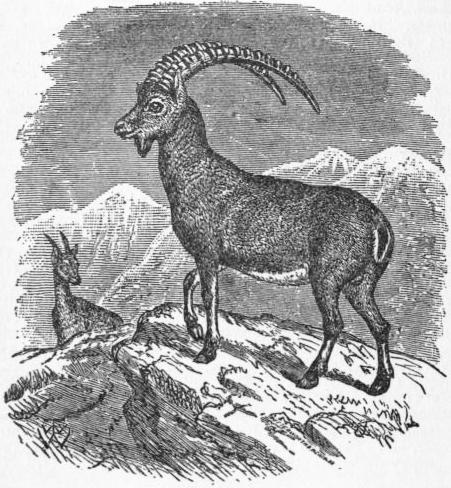
The Ibex (Capra ibex).
By naturalists the name “ibex” has been extended to embrace all the kindred species of wild goats, while by sportsmen it is used in a still more elastic sense, to include not only the true wild goat (known in India as the Sind ibex) but even the short-horned Hemitragus hylocrius of the Nilgiris. Dealing only with species zoologically known as ibex, the one nearest akin to the European kind is the Asiatic or Siberian ibex (Capra sibirica), which, with several local phases, extends from the northern side of Kashmir over an enormous area in Central Asia. These ibex, especially the race from the Thian Shan, are incomparably finer than the European species, their bold knotted horns sometimes attaining a length of close on 60 in. The Arabian, or Nubian, ibex (C. nubiana) is characterized by the more slender type of horn, in which the front edge is much narrower; while the Simien ibex (C. vali) of Central Abyssinia is a very large and dark-coloured animal, with the horns black instead of brownish, and bearing only slightly marked front ridges. The Caucasian ibex (C. caucasica), or tur, is a wholly fox-coloured animal, in which the horns are still flatter in front, and thus depart yet further from the ibex type. In the Spanish ibex (C. pyrenaica) the horns are flattened, with ill-defined knobs, and a spiral twist. (See Goat.)
(W. H. F.; R. L.*)
IBIS, one of the sacred birds of the ancient Egyptians. James Bruce identified this bird with the Abu-Hannes or “Father John” of the Abyssinians, and in 1790 it received from Latham (Index ornithologicus, p. 706) the name of Tantalus aethiopicus. This determination was placed beyond question by Cuvier (Ann. du Muséum, iv. 116-135) and Savigny (Hist. nat. et mythol. de l’ibis) in 1805. They, however, removed it from the Linnaean genus Tantalus and, Lacépède having some years before founded a genus Ibis, it was transferred thither, and is now generally known as I. aethiopica, though some speak of it as I. religiosa. No attempt can here be made to treat the ibis from a mythological or antiquarian point of view. Savigny’s memoir contains a great deal of matter on the subject. Wilkinson (Ancient Egyptians, ser. 2, vol. ii. pp. 217-224) added some of the results of later research, and Renouf in his Hibbert Lectures explains the origin of the myth.
The ibis is chiefly an inhabitant of the Nile basin from Dongola southward, as well as of Kordofan and Sennar; whence about midsummer it moves northwards to Egypt.1 In Lower Egypt it bears the name of Abu-mengel, or “father of the sickle,” from the form of its bill, but it does not stay long in that country, disappearing when the Nile has subsided. Hence most travellers have failed to meet with it there2 (since their acquaintance with the birds of Egypt is limited to those which frequent the country in winter), and writers have denied generally to this species a place in its modern fauna (cf. Shelley, Birds of Egypt, p. 261). However, in 1864, von Heuglin (Journ. für Ornithologie, 1865, p. 100) saw a young bird which had been shot in the Delta, and E. C. Taylor (Ibis, 1878, p. 372) saw an adult which had been killed near Lake Menzal in 1877. The story told to Herodotus of its destroying snakes is, according to Savigny, devoid of truth, but Cuvier states that he discovered partly digested remains of a snake in the stomach of a mummied ibis.
The ibis is somewhat larger than a curlew, Numenius arquata, which bird it resembles, with a much stouter bill and stouter legs. The head and greater part of the neck are bare and black. The plumage is white, except the primaries, which are black, and a black plume, formed by the secondaries, tertials and lower scapulars, and richly glossed with bronze, blue and green, which curves gracefully over the hind-quarters. The bill and feet are also black. The young lack the ornamental plume, and in them the head and neck are clothed with short black feathers, while the bill is yellow. The nest is placed in bushes or high trees, the bird generally building in companies, and in the middle of August von Heuglin (Orn. Nord-Ost-Afrikas, p. 1138) found that it had from two to four young or much incubated eggs.3 These are of a dingy white, splashed, spotted and speckled with reddish-brown.
Congeneric with the typical ibis are two or three other species, the I. melanocephala of India, the I. molucca or I. strictipennis, of Australia, and the I. bernieri of Madagascar, all of which closely resemble I. aethiopica; while many other forms not very far removed from it, though placed by authors in distinct genera,4 are known. Among these are several beautiful species such as the Japanese Geronticus nippon, the Lophotibis cristata of Madagascar, and the scarlet ibis,5 Eudocimus ruber, of America. The glossy ibis, Plegadis falcinellus, found throughout the West Indies, Central and the south-eastern part of North America, as well as in many parts of Europe (whence it not unfrequently strays to the British Islands), Africa, Asia and Australia. This bird, believed to be the second kind of ibis spoken of by Herodotus, is rather smaller than the sacred ibis, and mostly of a dark chestnut colour with brilliant green and purple reflections on the upper parts, exhibiting, however, when young none of the rufous hue. This species lays eggs of a deep sea-green colour, having wholly the character of heron’s eggs, and it often breeds in company with herons, while the eggs of all other ibises whose eggs are known resemble those of the sacred ibis. Though ibises resemble the curlews externally, there is no affinity between them. The Ibididae are more nearly related to the storks, Ciconiidae, and still more to the spoonbills, Plataleidae, with which latter many systematists consider them to form one group, the Hemiglottides of Nitzsch. Together these groups form the sub-order Ciconiae of the order Ciconiiformes. The true ibises are also to be clearly separated from the wood-ibises, Tantalidae, of which there are four or five species, by several not unimportant structural characters. Fossil remains of a true ibis, I. pagana, have been found in considerable numbers in the middle Tertiary beds of France.6
(A. N.)
1 It has been said to occur occasionally in Europe (Greece and southern Russia).
2 E. C. Taylor remarked (Ibis, 1859, p. 51), that the buff-backed heron, Ardea bubulcus, was made by the tourists’ dragomans to do duty for the “sacred ibis,” and this seems to be no novel practice, since by it, or something like it, Hasselqvist was misled, and through him Linnaeus.
3 The ibis has more than once nested in the gardens of the Zoological Society in London, and even reared its young there.
4 For some account of these may be consulted Dr Reichenow’s paper in Journ. für Ornithologie (1877), pp. 143-156; Elliot’s in Proc. Zool. Society (1877), pp. 477-510; and that of Oustalet in Nouv. Arch. du Muséum, ser. 2, vols. i. pp. 167-184.
5 It is a popular error—especially among painters—that this bird was the sacred ibis of the Egyptians.
6 The name “Ibis” was selected as the title of an ornithological magazine, frequently referred to in this and other articles, which made its first appearance in 1859.
IBLIS, or Eblis, in Moslem mythology the counterpart of the Christian and Jewish devil. He figures oftener in the Koran under the name Shaitan, Iblis being mentioned 11 times, whereas Shaitan appears in 87 passages. He is chief of the spirits of evil, and his personality is adapted to that of his Jewish prototype. Iblis rebelled against Allah and was expelled from Paradise. The Koranic legend is that his fall was a punishment for his refusal to worship Adam. Condemned to death he was afterwards respited till the judgment day (Koran vii. 13).
See Gustav Weil, The Bible, the Koran and the Talmud (London, 1846).
IBN ‘ABD RABBIHI [Abū ‘Umar Aḥmad ibn Maḥommed ibn ‘Abd Rabbihi] (860-940), Arabian poet, was born in Cordova and descended from a freed slave of Hishām, the second Spanish Omayyad caliph. He enjoyed a great reputation for learning and eloquence. No diwan of his is extant, but many selections from his poems are given in the Yatīmat ud-Dahr, i. 412-436 (Damascus, 1887). More widely known than his poetry is his great anthology, the ‘Iqd ul-Farīd (“The Precious Necklace”), a work divided into twenty-five sections, the thirteenth being named the middle jewel of the necklace, the chapters on either side of this being named after other jewels. It is an adab book (see Arabia: Literature, section “Belles Lettres”) resembling Ibn Qutaiba’s ‘Uyūn ul-Akhbār, from which it borrows largely. It has been printed, several times in Cairo (1876, 1886, &c.).
(G. W. T.)
IBN ‘ARABĪ [Muḥyiuddīn Abū ‘Abdallāh ibn ul-’Arabī] (1165-1240), Moslem theologian and mystic, was born in Murcia and educated in Seville. When thirty-eight he travelled in Egypt, Arabia, Bagdad, Mosul and Asia Minor, after which he lived in Damascus for the rest of his life. In law he was a Zahirite, in theology a mystic of the extreme order, though professing orthodox Ash’arite theology and combating in many points the Indo-Persian mysticism (pantheism). He claims to have had conversations with all the prophets past and future, and reports conversations with God himself. Of his numerous works about 150 still exist. The most extensive is the twelve-volume Futūḥāt ul-Makkīyāt (“Meccan Revelations”), a general encyclopaedia of Sufic beliefs and doctrines. Numerous extracts from this work are contained in Sha‘rānī’s (d. 1565) manual of Sufic dogma (Yawāqīt) published several times in Cairo. A short account of these works is given in A. von Kremer’s Geschichte der herrschenden Ideen des Islams, pp. 102-109 (Leipzig, 1868). Another characteristic and more accessible work of Ibn ‘Arabi is the Fuṣūṣ ul-Ḥikam, on the nature and importance of the twenty-seven chief prophets, written in 1230 (ed. Bulāq, 1837) and with the Commentary (Cairo, 1891) of Qāshāni (d. 1350); cf. analysis by M. Schreiner in Journal of German Oriental Society, lii. 516-525.
Of some 289 works said to have been written by Ibn ‘Arabī 150 are mentioned in C. Brockelmann’s Gesch. der arabischen Litteratur, vol. i. (Weimar, 1898), pp. 441-448. See also R. A. Nicholson, A Literary History of the Arabs, pp. 399-404 (London, 1907).
(G. W. T.)
IBN ATHĪR, the family name of three brothers, all famous in Arabian literature, born at Jazīrat ibn ‘Umar in Kurdistan. The eldest brother, known as Majd ud-Dīn (1149-1210), was long in the service of the amir of Mosul, and was an earnest student of tradition and language. His dictionary of traditions (Kitāb un-Nihāya) was published at Cairo (1893), and his dictionary of family names (Kitāb ul-Murassa’) has been edited by Seybold (Weimar, 1896). The youngest brother, known as Diyā ud-Dīn (1163-1239), served Saladin from 1191 on, then his son, al-Malik ul-Afdal, and was afterwards in Egypt, Samosata, Aleppo, Mosul and Bagdad. He was one of the most famous aesthetic and stylistic critics in Arabian literature. His Kitāb ul-Mathal, published in Bulāq in 1865 (cf. Journal of the German Oriental Society, xxxv. 148, and Goldziher’s Abhandlungen, i. 161 sqq.), contains some very independent criticism of ancient and modern Arabic verse. Some of his letters have been published by D. S. Margoliouth “On the Royal Correspondence of Diya ed-Din el-Jazari” in the Actes du dixième congrès international des orientalistes, sect. 3, pp. 7-21.
The brother best known by the simple name of Ibn Athīr was Abu-l-Ḥasan ‘Izzuddīn Mahommed Ibn ul-Athīr (1160-1234), who devoted himself to the study of history and tradition. At the age of twenty-one he settled with his father in Mosul and continued his studies there. In the service of the amir for many years, he visited Bagdad and Jerusalem and later Aleppo and Damascus. He died in Mosul. His great history, the Kāmil, extends to the year 1231; it has been edited by C. J. Tornberg, Ibn al-Athiri Chronicon quod perfectissimum inscribitur (14 vols., Leiden, 1851-1876), and has been published in 12 vols. in Cairo (1873 and 1886). The first part of this work up to A.H. 310 (A.D. 923) is an abbreviation of the work of Tabarī (q.v.) with additions. Ibn Athīr also wrote a history of the Atabegs of Mosul, published in the Recueil des historiens des croisades (vol. ii., Paris); a work (Usd ul-Ghāba), giving an account of 7500 companions of Mahomet (5 vols., Cairo, 1863), and a compendium (the Lubāb) of Sam‘āni’s Kitāb ul-Anṣāb (cf. F. Wüstenfeld’s Specimen el-Lobabi, Göttingen, 1835).
(G. W. T.)
IBN BATUTA, i.e. Abu Abdullah Mahommed, surnamed Ibn Batuta (1304-1378), the greatest of Moslem travellers, was born at Tangier in 1304. He entered on his travels at twenty-one (1325) and closed them in 1355. He began by traversing the coast of the Mediterranean from Tangier to Alexandria, finding time to marry two wives on the road. After some stay at Cairo, then probably the greatest city in the world (excluding China), and an unsuccessful attempt to reach Mecca from Aidhab on the west coast of the Red Sea, he visited Palestine, Aleppo and Damascus. He then made the pilgrimage to Mecca and Medina, and visited the shrine of Ali at Mashhad-Ali, travelling thence to Basra, and across the mountains of Khuzistan to Isfahan, thence to Shiraz and back to Kufa and Bagdad. After an excursion to Mosul and Diarbekr, he made the haj a second time, staying at Mecca three years. He next sailed down the Red Sea to Aden (then a place of great trade), the singular position of which he describes, noticing its dependence for water-supply upon the great cisterns restored in modern times. He continued his voyage down the African coast, visiting, among other places, Mombasa and Quiloa (Kilwa). Returning north he passed by the chief cities of Oman to New Ormuz (Hurmuz), which had about 15 years before, c. 1315, been transferred to its famous island-site from the mainland (Old Ormuz). After visiting other parts of the gulf he crossed the breadth of Arabia to Mecca, making the haj for the third time. Crossing the Red Sea, he made a journey of great hardship to Syene, and thence along the Nile to Cairo. After this, travelling through Syria, he made a circuit among the petty Turkish states into which Asia Minor was divided after the fall of the kingdom of Rum (Iconium). He now crossed the Black Sea to Kaffa, then mainly occupied by the Genoese, and apparently the first Christian city he had seen, for he was much perturbed by the bell-ringing. He next travelled into Kipchak (the Mongol khanate of Russia), and joined the camp of the reigning khan Mahommed Uzbeg, from whom the great and heterogeneous Uzbeg race is perhaps named. Among other places in this empire he travelled to Bolghar (54° 54′ N.) in order to witness the shortness of the summer night, and desired to continue his travels north into the “Land of Darkness” (in the extreme north of Russia), of which wonderful things were told, but was obliged to forego this. Returning to the khan’s camp he joined the cortège of one of the Khatuns, who was a Greek princess by birth (probably illegitimate) and in her train travelled to Constantinople, where he had an interview with the emperor Andronikos III. the Younger (1328-1341). He tells how, as he passed the city gates, he heard the guards muttering Sarakinu. Returning to the court of Uzbeg, at Sarai on the Volga, he crossed the steppes to Khwarizm and Bokhara; thence through Khorasan and Kabul, and over the Hindu Kush (to which he gives that name, its first occurrence). He reached the Indus, on his own statement, in September, 1333. This closes the first part of his narrative.
From Sind, which he traversed to the sea and back again, he proceeded to Multan, and eventually, on the invitation of Mahommed Tughlak, the reigning sovereign, to Delhi. Mahommed was a singular character, full of pretence at least to many accomplishments and virtues, the founder of public charities, and a profuse patron of scholars, but a parricide, a fratricide, and as madly capricious, bloodthirsty and unjust as Caligula. “No day did his palace gate fail to witness the elevation of some abject to affluence and the torture and murder of some living soul.” He appointed the traveller to be kazi of Delhi, with a present of 12,000 silver dinars (rupees), and an annual salary of the same amount, besides an assignment of village lands. In the sultan’s service Ibn Batuta remained eight years; but his good fortune stimulated his natural extravagance, and his debts soon amounted to four or five times his salary. At last he fell into disfavour and retired from court, only to be summoned again on a congenial duty. The emperor of China, last of the Mongol dynasty, had sent a mission to Delhi, and the Moor was to accompany the return embassy (1342). The party travelled through central India to Cambay and thence sailed to Calicut, classed by the traveller with the neighbouring Kaulam (Quilon), Alexandria, Sudak in the Crimea, and Zayton (Amoy harbour) in China, as one of the greatest trading havens in the world—an interesting enumeration from one who had seen them all. The mission party was to embark in Chinese junks (the word used) and smaller vessels, but that carrying the other envoys and the presents, which started before Ibn Batuta was ready, was wrecked totally; the vessel that he had engaged went off with his property, and he was left on the beach of Calicut. Not daring to return to Delhi, he remained about Honore and other cities of the western coast, taking part in various adventures, among others the capture of Sindabur (Goa), and visiting the Maldive Islands, where he became kazi, and married four wives, and of which he has left the best medieval account, hardly surpassed by any modern. In August 1344 he left the Maldives for Ceylon; here he made the pilgrimage to the “Footmark of our Father Adam.” Thence he betook himself to Maabar (the Coromandel coast), where he joined a Mussulman adventurer, residing at Madura, who had made himself master of much of that region. After once more visiting Malabar, Canara and the Maldives, he departed for Bengal, a voyage of forty-three days, landing at Sadkawan (Chittagong). In Bengal he visited the famous Moslem saint Shaykh Jalaluddin, whose shrine (Shah Jalal at Silhet) is still maintained. Returning to the delta, he took ship at Sunarganw (near Dacca) on a junk bound for Java (i.e. Java Minor of Marco Polo, or Sumatra). Touching the coast of Arakan or Burma, he reached Sumatra in forty days, and was provided with a junk for China by Malik al Dhahir, a zealous disciple of Islam, which had recently spread among the states on the northern coast of that island. Calling (apparently) at Cambodia on his way, Ibn Batuta reached China at Zayton (Amoy harbour), famous from Marco Polo; he also visited Sin Kalan or Canton, and professes to have been in Khansa (Kinsay of Marco Polo, i.e. Hangchau), and Khanbalik (Cambaluc or Peking). The truth of his visit to these two cities, and especially to the last, has been questioned. The traveller’s history, not least in China, singularly illustrates the free masonry of Islam, and its power of carrying a Moslem doctor over the known world of Asia and Africa. On his way home he saw the great bird Rukh (evidently, from his description, an island lifted by refraction); revisited Sumatra, Malabar, Oman, Persia, Bagdad, and crossed the great desert to Palmyra and Damascus, where he got his first news of home, and heard of his father’s death fifteen years before. Diverging to Hamath and Aleppo, on his return to Damascus, he found the Black Death raging, so that two thousand four hundred died in one day. Revisiting Jerusalem and Cairo he made the haj a fourth time, and finally reappeared at Fez (visiting Sardinia en route) on the 8th of November 1349, after twenty-four years’ absence. Morocco, he felt, was, after all, the best of countries. “The dirhems of the West are but little; but then you get more for them.” After going home to Tangier, Ibn Batuta crossed into Spain and made the round of Andalusia, including Gibraltar, which had just then stood a siege from the “Roman tyrant Adfunus” (Alphonso XI. of Castile, 1312-1350). In 1352 the restless man started for Central Africa, passing by the oases of the Sahara (where the houses were built of rock-salt, as Herodotus tells, and roofed with camel skins) to Timbuktu and Gogo on the Niger, a river which he calls the Nile, believing it to flow down into Egypt, an opinion maintained by some up to the date of Lander’s discovery. Being then recalled by his own king, he returned to Fez (early in 1354) via Takadda, Haggar and Tuat. Thus ended his twenty-eight years’ wanderings which in their main lines alone exceeded 75,000 m. By royal order he dictated his narrative to Mahommed Ibn Juzai, who concludes the work, 13th of December 1355 (A.D.) with the declaration: “This Shaykh is the traveller of our age; and he who should call him the traveller of the whole body of Islam would not exceed the truth.” Ibn Batuta died in 1378, aged seventy-three.
Ibn Batuta’s travels have only been known in Europe during the 19th century; at first merely by Arabic abridgments in the Gotha and Cambridge libraries. Notices or extracts had been published by Seetzen (c. 1808), Kosegarten (1818), Apetz (1819), and Burckhardt (1819), when in 1829 Dr S. Lee published for the Oriental Translation Fund a version from the abridged MSS. at Cambridge, which attracted much interest. The French capture of Constantina afforded MSS. of the complete work, one of them the autograph of Ibn Juzai. And from these, after versions of fragments by various French scholars, was derived at last (1858-1859) the standard edition and translation of the whole by M. Défrémery and Dr Sanguinetti, in 4 vols. See also Sir Henry Yule, Cathay, ii. 397-526; C. Raymond Beazley, Dawn of Modern Geography, iii. 535-538. Though there are some singular chronological difficulties in the narrative, and a good many cursory inaccuracies and exaggerations, there is no part of it except, perhaps, certain portions of the journeys in north China, which is open to doubt. The accounts of the Maldive Islands, and of the Negro countries on the Niger, are replete with interesting and accurate particulars. The former agrees surprisingly with that given by the only other foreign resident we know of, Pyrard de la Val, two hundred and fifty years later. Ibn Batuta’s statements and anecdotes regarding the showy virtues and solid vices of Sultan Muhammad Tughlak are in entire agreement with Indian historians, and add many fresh details.
(H. Y.; C. R. B.)
IBN DURAID [Abū Bakr Mahommed ibn ul-Ḥasan ibn Duraid ul-Azdī] (837-934), Arabian poet and philologist, was born at Baṣra of south Arabian stock. At his native place he was trained under various teachers, but fled in 871 to Oman at the time Baṣra was attacked by the negroes, known as the Zanj, under Muhallabī. After living twelve years in Oman he went to Persia, and, under the protection of the governor, ‘Abdallāh ibn Mahommed ibn Mīkāl, and his son, Isma’īl, wrote his chief works. In 920 he went to Bagdad, where he received a pension from the caliph Moqtadir.
The Maqsūra, a poem in praise of Ibn Mīkāl and his son, has been edited by A. Haitsma (1773) E. Scheidius (1786) and N. Boyesen (1828). Various commentaries on the poem exist in MS. (cf. C. Brockelmann, Gesch. der ar. Lit., i. 211 ff., Weimar, 1898), The Jamhara fi-l-Lugha is a large dictionary written in Persian but not printed. Another work is the Kitāb ul-Ishtiqāq (“Book of Etymology”), edited by F. Wüstenfeld (Göttingen, 1854); it was written in opposition to the anti-Arabian party to show the etymological connexion of the Arabian tribal names.
(G. W. T.)
IBN FARADĪ [Abū-l-Walīd ‘Abdallāh ibn ul-Faradi] (962-1012), Arabian historian, was born at Cordova and studied law and tradition. In 992 he made the pilgrimage and proceeded to Egypt and Kairawān, studying in these places. After his return in 1009 he became cadi in Valencia, and was killed at Cordova when the Berbers took the city.
His chief work is the History of the Learned Men of Andalusia, edited by F. Codera (Madrid, 1891-1892). He wrote also a history of the poets of Andalusia.
(G. W. T.)
IBN FĀRID [Abū-l-Qāsim ‘Umar ibn ul-Fāriḍ] (1181-1235), Arabian poet, was born in Cairo, lived for some time in Mecca and died in Cairo. His poetry is entirely Sufic, and he was esteemed the greatest mystic poet of the Arabs. Some of his poems are said to have been written in ecstasies. His diwan has been published with commentary at Beirūt, 1887, &c.; with the commentaries of Burīnī (d. 1615) and ‘Abdul-Ghānī (d. 1730) at Marseilles, 1853, and at Cairo; and with the commentary of Rushayyid Ghālib (19th century) at Cairo, 1893. One of the separate poems was edited by J. von Hammer Purgstall as Das arabische hohe Lied der Liebe (Vienna, 1854).
See R. A. Nicholson, A Literary History of the Arabs (London, 1907), pp. 394-398.
(G. W. T.)
IBN GABIROL [Solomon ben Judah], Jewish poet and philosopher, was born at Malaga, probably about 1021. The early part of his troublous life was spent at Saragossa, but few personal details of it are recorded. His parents died while he was a child and he was under the protection first of a certain Jekuthiel, who died in 1039, and afterwards of Samuel ha-Nagid, the well-known patron of learning. His passionate disposition, however, embittered no doubt by his misfortunes, involved him in frequent difficulties and led to his quarrelling with Samuel. It is generally agreed that he died young, although the date is uncertain. Al Harizi1 says at the age of twenty-nine, and Moses b. Ezra2 about thirty, but Abraham Zaccuto3 states that he died (at Valencia) in 1070. M. Steinschneider4 accepts the date 1058.
His literary activity began early. He is said to have composed poems at the age of sixteen, and elegies by him are extant on Hai Gaon (died in 1038) and Jekuthiel (died in 1039), each of which was written probably soon after the death of the person commemorated. About the same time he also wrote his ‘Anaq, a poem on grammar, of which only 97 lines out of 400 are preserved. Moses ben Ezra says of him that he imitated Moslem models, and was the first to open to Jewish poets the door of versification,5 meaning that he first popularized the use of Arabic metres in Hebrew. It is as a poet that he has been known to the Jews to the present day, and admired for the youthful freshness and beauty of his work, in which he may be compared to the romantic school in France and England in the early 19th century. Besides his lyrical and satirical poems, he contributed many of the finest compositions to the liturgy (some of them with the acrostic “Shelomoh ha-qaṭō”), which are widely different from the artificial manner of the earlier payyeṭanim. The best known of his longer liturgical compositions are the philosophical Kether Malkūth (for the Day of Atonement) and the Azharōth, on the 613 precepts (for Shebhu‘ōth). Owing to his pure biblical style he had an abiding influence on subsequent liturgical writers.
Outside the Jewish community he was known as the philosopher Avicebron (Avencebrol, Avicebrol, &c.) The credit of identifying this name as a medieval corruption of Ibn Gabirol is due to S. Munk, who showed that selections made by Shem Tōbh Palqera (or Falqera) from the Meqōr Ḥayyīm (the Hebrew translation of an Arabic original) by Ibn Gabirol, corresponded to the Latin Fons Vitae of Avicebron. The Latin version, made by Johannes Hispalensis and Gundisalvi about one hundred years after the author’s death, had at once become known among the Schoolmen of the 12th century and exerted a powerful influence upon them, although so little was known of the author that it was doubted whether he was a Christian or a Moslem. The teaching of the Fons Vitae was entirely new to the country of its origin, and being drawn largely from Neoplatonic sources could not be expected to find favour with Jewish thinkers. Its distinctive doctrines are: (1) that all created beings, spiritual or corporeal, are composed of matter and form, the various species of matter being but varieties of the universal matter, and similarly all forms being contained in one universal form; (2) that between the primal One and the intellect (the νοῦς of Plotinus) there is interposed the divine Will, which is itself divine and above the distinction of form and matter, but is the cause of their union in the being next to itself, the intellect, in which Avicebron holds that the distinction does exist. The doctrine that there is a material, as well as a formal, element in all created beings was explicitly adopted from Avicebron by Duns Scotus (as against the view of Albertus Magnus and Thomas Aquinas), and perhaps his exaltation of the will above the intellect is due to the same influence. Avicebron develops his philosophical system throughout quite independently of his religious views—a practice wholly foreign to Jewish teachers, and one which could not be acceptable to them. Indeed, this charge is expressly brought against him by Abraham ben David of Toledo (died in 1180). It is doubtless this non-religious attitude which accounts for the small attention paid to the Fons Vitae by the Jews, as compared with the wide influence of the philosophy of Maimonides.
The other important work of Ibn Gabirol is Iṣlāḥ al-akhlāq (the improvement of character), a popular work in Arabic, translated into Hebrew (Tiqqūn middōth ha-nephesh) by Judah ibn Tibbon. It is widely different in treatment from the Fons, being intended as a practical not a speculative work.
The collection of moral maxims, compiled in Arabic but best known (in the Hebrew translation of Judah ibn Tibbon) as Mibḥar ha-penīnīm, is generally ascribed to Ibn Gabirol, though on less certain grounds.
Bibliography.—Texts of the liturgical poems are to be found in the prayer-books: others in Dukes and Edelmann, Treasures of Oxford (Oxford, 1850); Dukes, Shīrē Shelomoh (Hanover, 1858); S. Sachs, Shīr ha-shīrīm asher li-Shelomoh (Paris, 1868, incomplete); Brody, Die weltlichen Gedichte des ... Gabirol (Berlin, 1897, &c.).
“Avencebrolis Fons Vitae” (Latin text) in Clemens Bäumker’s Beiträge zur Gesch. d. Philosophie, Bd. i. Hefte 2-4 (Münster, 1892); The Improvement of the Moral Qualities [Arabic and English] ed. by S. S. Wise (New York, 1901); A Choice of Pearls [Hebrew and English] ed. by Ascher (London, 1859).
On the philosophy in general: S. Munk, Mélanges (quoted above); Guttmann, Die Philosophie des Sal.-ibn Gabirol (Göttingen, 1889); D. Kaufmann, Studien über Sal.-ibn Gabirol (Budapest, 1899); S. Horovitz, “Die Psychologie Ibn Gabirols,” in the Jahresbericht des jüd. theol. Seminars Fränckel’scher Stiftung (Breslau, 1900); Wittmann, “Zur Stellung Avencebrols ...” (in Bäumker’s Beiträge, Bd. v. Heft 1, Münster, 1905).
(A. Cy.)
1 Jud. Har. Macamæ, ed. Lagarde (Göttingen, 1883), p. 89, l. 61.
2 See the passage quoted by Munk, Mélanges de philosophie arabe et juive (Paris, 1859), pp. 264 and 517.
3 Liber Juchassin, ed. Filipowski (London, 1857), p. 217.
4 Hebr. Übersetzungen (Berlin, 1893), § 219, note 70; cf. Kaufmann, Studien über Sal.-ibn Gabirol (Budapest, 1899), p. 79, note 2.
5 See Munk, op. cit. pp. 515-516, transl. on pp. 263-264. Metre had been already used by Dunash.
IBN HAUKAL, strictly Ibn Hauqal, a 10th century Arabian geographer. Nothing is known of his life. His work on geography, written in 977, is only a revision and extension of the Masālik ul-Mamālik of al-Iṣṭakhrī, who wrote in 951. This itself was a revised edition of the Kitāb ul-Ashkāl or Ṣuwar ul-Aqālim of Abū Zaid ul-Balkhī, who wrote about 921. Ibn Hauḳal’s work was published by M. J. de Goeje (Leiden, 1873). An anonymous epitome of the book was written in 1233.
See M. J. de Goeje, “Die Iṣṭahrī-Balhī Frage,” in the Zeitschrift der deutschen Morgenländischen Gesellschaft, xxv. 42 sqq.
IBN ḤAZM [Abū Maḥommed ‘Alī ibn Aḥmad ibn Ḥazm] (994-1064), Moslem theologian, was born in a suburb of Cordova. He studied history, law and theology, and became a vizier as his father had been before him, but was deposed for heresy, and spent the rest of his life quietly in the country. In legal matters he belonged first to the Shāfi’ite school, but came to adopt the views of the Zāhirites, who admitted only the external sense of the Koran and tradition, disallowing the use of analogy (Qiyās) and Taqlīd (appeal to the authority of an imām), and objecting altogether to the use of individual opinion (Ra‘y). Every sentence of the Koran was to be interpreted in a general and universal sense; the special application to the circumstances of the time it was written was denied. Every word of the Koran was to be taken in a literal sense, but that sense was to be learned from other uses in the Koran itself, not from the meaning in other literature of the time. The special feature of Ibn Ḥazm’s teaching was that he extended the application of these principles from the study of law to that of dogmatic theology. He thus found himself in opposition at one time to the Mo‘tazilites, at another to the Ash‘arites. He did not, however, succeed in forming a school. His chief work is the Kitāb ul-Milal wan-Niḥal, or “Book of Sects” (published in Cairo, 1899).
For his teaching cf. I. Goldziher, Die Zahiriten, pp. 116-172 (Leipzig, (1884), and M. Schreiner in the Journal of the German Oriental Society, lii. 464-486. For a list of his other works see C. Brockelmann’s Geschichte der arabischen Literatur, vol. i. (Weimar, 1898), p. 400.
(G. W. T.)
IBN HISHĀM [Abū Maḥommed ‘Abdulmalik ibn Hishām ibn Ayyūb ul-Himyarī] (d. 834), Arabian biographer, studied in Kufa but lived afterwards in Fostāt (old Cairo), where he gained a name as a grammarian and student of language and history. His chief work is his edition of Ibn Isḥāq’s (q.v.) Life of the Apostle of God, which has been edited by F. Wüstenfeld (Göttingen, 1858-1860). An abridged German translation has been made by G. Weil (Stuttgart, 1864; cf. P. Brönnle, Die Commentatoren des Ibn Isḥaq und ihre Scholien, Halle, 1895). Ibn Hishām is said to have written a work explaining the difficult words which occur in poems on the life of the Apostle, and another on the genealogies of the Himyarites and their princes.
(G. W. T.)
IBN ISHĀQ [Mahommed ibn Isḥāq Abū ‘Abdallāh] (d. 768), Arabic historian, lived in Medina, where he interested himself to such an extent in the details of the Prophet’s life that he was attacked by those to whom his work seemed to have a rationalistic tendency. He consequently left Medina in 733, and went to Alexandria, then to Kufa and Hira, and finally to Bagdad, where the caliph Manṣūr provided him with the means of writing his great work. This was the Life of the Apostle of God, which is now lost and is known to us only in the recension of Ibn Hishām (q.v.). The work has been attacked by Arabian writers (as in the Fihrist) as untrustworthy, and it seems clear that he introduced forged verses (cf. Journal of the German Oriental Society, xiv. 288 sqq.). It remains, however, one of the most important works of the age.
(G. W. T.)
IBN JUBAIR [Abū-l Ḥusain Maḥommed ibn Aḥmad ibn Jubair] (1145-1217), Arabian geographer, was born in Valencia. At Granada he studied the Koran, tradition, law and literature, and later became secretary to the Mohad governor of that city. During this time he composed many poems. In 1183 he left the court and travelled to Alexandria, Jerusalem, Medina, Mecca, Damascus, Mosul and Bagdad, returning in 1185 by way of Sicily.
The Travels of Ibn Jubair were edited by W. Wright (Leiden, 1852); and a new edition of this text, revised by M. J. de Goeje, was published by the Gibb Trustees (London, 1907). The part relating to Sicily was published, with French translation and notes, by M. Amari in the Journal asiatique (1845-1846) and a French translation alone of the same part by G. Crolla in Museon, vi. 123-132.
(G. W. T.)
IBN KHALDŪN [Abū Zaid ibn Maḥommed ibn Maḥommed ibn Khaldūn] (1332-1406), Arabic historian, was born at Tunis. He studied the various branches of Arabic learning with great success. In 1352 he obtained employment under the Marīnid sultan Abū Inān (Faris I.) at Fez. In the beginning of 1356, his integrity having been suspected, he was thrown into prison until the death of Abū Inān in 1358, when the vizier al-Hasan ibn Omar set him at liberty and reinstated him in his rank and offices. He here continued to render great service to Abu Salem (Ibrahim III.), Abū Inān’s successor, but, having offended the prime minister, he obtained permission to emigrate to Spain, where, at Granada, he was received with great cordiality by Ibn al Ahmar, who had been greatly indebted to his good offices when an exile at the court of Abu Salem. The favours he received from the sovereign excited the jealousy of the vizier, and he was driven back to Africa (1364), where he was received with great cordiality by the sultan of Bougie, Abu Abdallah, who had been formerly his companion in prison. On the fall of Abu Abdallah Ibn Khaldūn raised a large force amongst the desert Arabs, and entered the service of the sultan of Tlemçen. A few years later he was taken prisoner by Abdalaziz (‘Abd ul ‘Azīz), who had defeated the sultan of Tlemçen and seized the throne. He then entered a monastic establishment, and occupied himself with scholastic duties, until in 1370 he was sent for to Tlemçen by the new sultan. After the death of ‘Abd ul ‘Azīz he resided at Fez, enjoying the patronage and confidence of the regent. After some further vicissitudes in 1378 he entered the service of the sultan of his native town of Tunis, where he devoted himself almost exclusively to his studies and wrote his history of the Berbers. Having received permission to make the pilgrimage to Mecca, he reached Cairo, where he was presented to the sultan, al-Malik udh-Dhahir Barkuk, who insisted on his remaining there, and in the year 1384 made him grand cadi of the Malikite rite for Cairo. This office he filled with great prudence and probity, removing many abuses in the administration of justice in Egypt. At this time the ship in which his wife and family, with all his property, were coming to join him, was wrecked, and every one on board lost. He endeavoured to find consolation in the completion of his history of the Arabs of Spain. At the same time he was removed from his office of cadi, which gave him more leisure for his work. Three years later he made the pilgrimage to Mecca, and on his return lived in retirement in the Fayum until 1399, when he was again called upon to resume his functions as cadi. He was removed and reinstated in the office no fewer than five times.
In 1400 he was sent to Damascus, in connexion with the expedition intended to oppose Timur or Tamerlane. When Timur had become master of the situation, Ibn Khaldūn let himself down from the walls of the city by a rope, and presented himself before the conqueror, who permitted him to return to Egypt. Ibn Khaldūn died on the 16th of March 1406, at the age of sixty-four.
The great work by which he is known is a “Universal History,” but it deals more particularly with the history of the Arabs of Spain and Africa. Its Arabic title is Kitāb ul‘Ibar, wa dīwān el Mubtada wa’l Khabar, fī ayyām ul ‘Arab wa’l’Ajām wa’l Berber; that is, “The Book of Examples and the Collection of Origins and Information respecting the History of the Arabs, Foreigners and Berbers.” It consists of three books, an introduction and an autobiography. Book i. treats of the influence of civilization upon man; book ii. of the history of the Arabs and other peoples from the remotest antiquity until the author’s own times; book iii. of the history of the Berber tribes and of the kingdoms founded by that race in North Africa. The introduction is an elaborate treatise on the science of history and the development of society, and the autobiography contains the history, not only of the author himself, but of his family and of the dynasties which ruled in Fez, Tunis and Tlemçen during his lifetime. An edition of the Arabic text has been printed at Būlāq, (7 vols., 1867) and a part of the work has been translated by the late Baron McG. de Slane under the title of Histoire des Berbères (Algiers, 1852-1856); it contains an admirable account of the author and analysis of his work. Vol. i., the Muqaddama (preface), was published by M. Quatremère (3 vols., Paris, 1858), often republished in the East, and a French translation was made by McG. de Slane (3 vols., Paris, 1862-1868). The parts of the history referring to the expeditions of the Franks into Moslem lands were edited by C. J. Tornberg (Upsala, 1840), and the parts treating of the Banu-l Aḥmar kings of Granada were translated into French by M. Gaudefroy-Demombynes in the Journal asiatique, ser. 9, vol. xiii. The Autobiography of Ibn Khaldūn was translated into French by de Slane in the Journal asiatique, ser. 4, vol. iii. For an English appreciation of the philosophical spirit of Ibn Khaldūn see R. Flint’s History of the Philosophy of History (Edinburgh, 1893), pp. 157-170.
(E. H. P.; G. W. T.)
IBN KHALLIKĀN [Abū-l ‘Abbās Aḥmad ibn Khallikān] (1211-1282), Arabian biographer, was born at Arbela, the son of a professor reputed to be ascended from the Barmecides of the court of Harun al-Rashid. When eighteen he went to Aleppo, where he studied for six years, then to Damascus, and in 1238 to Alexandria and Cairo. In 1252 he married and became chief cadi of Syria in Damascus in 1261. Having held this office for ten years, he was professor in Cairo until 1278, when he again took office in Damascus for three years. In 1281 he accepted a professorship in the same city, but died in the following year.
His great work is the Kitab Wafayāt ul-A‘yān, “The Obituaries of Eminent Men.” It contains in alphabetical order the lives of the most celebrated persons of Moslem history and literature, except those of Mahomet, the four caliphs and the companions of Mahomet and their followers (the Tābiūn). The work is anecdotal and contains many brief extracts from the poetry of the writers. It was published by F. Wüstenfeld (Göttingen, 1835-1843), in part by McG. de Slane (Paris, 1838-1842), and also in Cairo (1859 and 1882). An English translation by McG. de Slane was published for the Oriental Translation Fund in 4 vols. (London, 1842-1871). Thirteen extra biographies from a manuscript in Amsterdam were published by Pijnappel (Amsterdam, 1845). A Persian translation exists in manuscript, and various extracts from the work are known. Several supplements to the book have been written, the best known being that of Maḥommed ibn Shākir (d. 1362), published at Cairo 1882. A collection of poems by Ibn Khallikān is also extant.
(G. W. T.)
IBN QUTAIBA, or Kotaiba [Abū Maḥommed ibn Muslim ibn Qutaiba] (828-889), Arabian writer, was born at Bagdad or Kufa, and was of Iranian descent, his father belonging to Merv. Having studied tradition and philology he became cadi in Dinawār and afterwards teacher in Bagdad, where he died. He was the first representative of the eclectic school of Bagdad philologists that succeeded the schools of Kufa and Baṣra (see Arabia: Literature, section “Grammar”). Although engaged also in theological polemic (cf. I. Goldziher, Muhammedanische Studien, ii. 136, Halle, 1890), his chief works were directed to the training of the ideal secretary. Of these five may be said to form a series. The Adab ul-Kātib (“Training of the Secretary”) contains instruction in writing and is a compendium of Arabic style. It has been edited by Max Grünert (Leiden, 1900). The Kitāb ush-Sharāb is still in manuscript. The Kitāb ul-Ma’ārif has been edited by F. Wüstenfeld as the Handbuch der Geschichte1 (Göttingen, 1850); the Kitāb ush-Shi’r wash-Shu’arāi (“Book of Poetry and Poets”) edited by M. J. de Goeje (Leiden, 1904).2 The fifth and most important is the ’Uyūn ul-Akhbār, which deals in ten books with lordship, war, nobility, character, science and eloquence, asceticism, friendship, requests, foods and women, with many illustrations from history, poetry and proverb (ed. C. Brockelmann, Leiden, 1900 sqq.).
For other works (which were much quoted by later Arabian writers) see C. Brockelmann, Gesch. der arabischen Literatur, vol. i. (Weimar, 1898), pp. 120-122.
(G. W. T.)
1 Summary in E. G. Browne, A Literary History of Persia (London, 1902), pp. 387 f.
2 The preface was translated into German by Theodor Nöldeke in his Beiträge (Hanover, 1864), pp. 1-51.
IBN ṢA’D [Abū ‘Abdallāh Maḥommed ibn Ṣa’d ibn Mani’ uz-Zuhrī], often called Kātib ul-Waqidī (“secretary of Waqidī”) of Baṣra] (d. 845), Arabian biographer, received his training in tradition from Waqidī and other celebrated teachers. He lived for the most part in Bagdad, and had the reputation of being both trustworthy and accurate in his writings, which, in consequence, were much used by later writers. His work, the Kitāb ul-Ṭabaqāt ul-Kabīr (15 vols.) contains the lives of Mahomet, his Companions and Helpers (including those who fought at Badr as a special class) and of the following generation (the Followers) who received their traditions from the personal friends of the Prophet.
This work has been edited under the superintendence of E. Sachau (Leiden, 1904 sqq.); cf. O. Loth, Das Classenbuch des Ibn Sa‘d (Leipzig, 1869).
(G. W. T.)
IBN TIBBON, a family of Jewish translators, who flourished in Provence in the 12th and 13th centuries. They all made original contributions to philosophical and scientific literature, but their permanent fame is based on their translations. Between them they rendered into Hebrew all the chief Jewish writings of the middle ages. These Hebrew translations were, in their turn, rendered into Latin (by Buxtorf and others) and in this form the works of Jewish authors found their way into the learned circles of Europe. The chief members of the Ibn Tibbon family were (1) Judah Ben Saul (1120-1190), who was born in Spain but settled in Lunel. He translated the works of Baḥya, Halevi, Saadiah and the grammatical treatises of Janaḥ. (2) His son, Samuel (1150-1230), translated the Guide of the Perplexed by Maimonides. He justly termed his father “the father of the Translators,” but Samuel’s own method surpassed his father’s in lucidity and fidelity to the original. (3) Son of Samuel, Moses (died 1283). He translated into Hebrew a large number of Arabic books (including the Arabic form of Euclid). The Ibn Tibbon family thus rendered conspicuous services to European culture, and did much to further among Jews who did not understand Arabic the study of science and philosophy.
(I. A.)
IBN ṬUFAIL, or Ṭofail [Abū Bakr Maḥommed ibn ‘Abd-ul-Malik ibn Ṭufail ul-Qaisī] (d. 1185), Moslem philosopher, was born at Guadix near Granada. There he received a good training in philosophy and medicine, and is said to have been a pupil of Avempace (q.v.). He became secretary to the governor of Granada, and later physician and vizier to the Mohad caliph, Abu Ya‘qūb Yūsuf. He died at Morocco.
His chief work is a philosophical romance, in which he describes the awakening and growth of intellect in a child removed from the influences of ordinary life. Its Arabic title is Risālat Hayy ibn Yaqzān; it was edited by E. Pococke as Philosophus autodidactus (Oxford, 1671; 2nd ed., 1700), and with a French translation by L. Gauthier (Algiers, 1900). An English translation by S. Ockley was published in 1708 and has been reprinted since. A Spanish translation by F. Pons Boigues was published at Saragossa (1900). Another work of Ibn Ṭufail, the Kitāb Asrār ul-Hikma ul-mashraqīyya (“Secrets of Eastern Science”), was published at Bulāq (1882); cf. S. Munk, Mélanges (1859), pp. 410 sqq., and T. J. de Boer, Geschichte der Philosophie im Islam (Stuttgart, 1901), pp. 160 sqq. (also an English translation).
(G. W. T.)
IBN USAIBI‘A [Muwaffaquddīn Abū-l-’Abbās Aḥmad ibn ul-Qāsim ibn Abī Usaibi’a] (1203-1270), Arabian physician, was born at Damascus, the son of an oculist, and studied medicine at Damascus and Cairo. In 1236 he was appointed by Saladin physician to a new hospital in Cairo, but surrendered the appointment the following year to take up a post given him by the amir of Damascus in Salkhad near that city. There he lived and died. He wrote ‘Uyūn ul-Anba‘fī Ṭabaqāt ul-Aṭibba‘ or “Lives of the Physicians,” which in its first edition (1245-1246) was dedicated to the vizier of Damascus. This he enlarged, though it is uncertain whether the new edition was made public in the lifetime of the author.
Edition by A. Müller (Königsberg, 1884).
(G. W. T.)
IBO, a district of British West Africa, on the lower Niger immediately above the delta, and mainly on the eastern bank of the river. The chief town, frequently called by the same name (more correctly Abo or Áboh), lies on a creek which falls into the main stream about 150 m. from its mouth and contains from 6000 to 8000 inhabitants. The Ibo are a strong well-built Negro race. Their women are distinguished by their embonpoint. The language of the Ibo is one of the most widely spoken on the lower Niger. The Rev. J. F. Schön began its reduction in 1841, and in 1861 he published a grammar (Oku Ibo Grammatical Elements, London, Church Miss. Soc.). (See Nigeria.)
IBRAHĪM AL-MAUṢILĪ (742-804), Arabian singer, was born of Persian parents settled in Kufa. In his early years his parents died and he was trained by an uncle. Singing, not study, attracted him, and at the age of twenty-three he fled to Mosul, where he joined a band of wild youths. After a year he went to Rai (Rei, Rhagae), where he met an ambassador of the caliph Manṣūr, who enabled him to come to Baṣra and take singing lessons. His fame as a singer spread, and the caliph Mahdī brought him to the court. There he remained a favourite under Hādī, while Harūn al-Rashīd kept him always with him until his death, when he ordered his son (Ma’mūn) to say the prayer over his corpse. Ibrahīm, as might be expected, was no strict Moslem. Two or three times he was knouted and imprisoned for excess in wine-drinking, but was always taken into favour again. His powers of song were far beyond anything else known at the time. Two of his pupils, his son Isḥāq and Muḥāriq, attained celebrity after him.
See the Preface to W. Ahlwardt’s Abu Nowas (Greifswald, 1861), pp. 13-18, and the many stories of his life in the Kitāb ul-Aghāni, v. 2-49.
(G. W. T.)
IBRAHIM PASHA (1789-1848), Egyptian general, is sometimes spoken of as the adopted son of Mehemet Ali, pasha of Egypt. He is also and more commonly called his son. He was born in his father’s native town, Kavala in Thrace. During his father’s struggle to establish himself in Egypt, Ibrahim, then sixteen years of age, was sent as a hostage to the Ottoman capitan pasha (admiral), but when Mehemet Ali was recognized as pasha, and had defeated the English expedition under General A. M. Fraser, he was allowed to return to Egypt. When Mehemet Ali went to Arabia to prosecute the war against the Wahhabis in 1813, Ibrahim was left in command in Upper Egypt. He continued the war with the broken power of the Mamelukes, whom he suppressed. In 1816 he succeeded his brother Tusun in command of the Egyptian forces in Arabia. Mehemet Ali had already begun to introduce European discipline into his army, and Ibrahim had probably received some training, but his first campaign was conducted more in the old Asiatic style than his later operations. The campaign lasted two years, and terminated in the destruction of the Wahhabis as a political power. Ibrahim landed at Yembo, the port of Medina, on the 30th of September 1816. The holy cities had been recovered from the Wahhabis, and Ibrahim’s task was to follow them into the desert of Nejd and destroy their fortresses. Such training as the Egyptian troops had received, and their artillery, gave them a marked superiority in the open field. But the difficulty of crossing the desert to the Wahhabi stronghold of Deraiya, some 400 m. east of Medina, and the courage of their opponents, made the conquest a very arduous one. Ibrahim displayed great energy and tenacity, sharing all the hardships of his army, and never allowing himself to be discouraged by failure. By the end of September 1818 he had forced the Wahhabi leader to surrender, and had taken Deraiya, which he ruined. On the 11th of December 1819 he made a triumphal entry into Cairo. After his return he gave effective support to the Frenchman, Colonel Sève (Suleiman Pasha), who was employed to drill the army on the European model. Ibrahim set an example by submitting to be drilled as a recruit. When in 1824 Mehemet Ali was appointed governor of the Morea by the sultan, who desired his help against the insurgent Greeks, he sent Ibrahim with a squadron and an army of 17,000 men. The expedition sailed on the 10th of July 1824, but was for some months unable to do more than come and go between Rhodes and Crete. The fear of the Greek fire ships stopped his way to the Morea. When the Greek sailors mutinied from want of pay, he was able to land at Modon on the 26th of February 1825. He remained in the Morea till the capitulation of the 1st of October 1828 was forced on him by the intervention of the Western powers. Ibrahim’s operations in the Morea were energetic and ferocious. He easily defeated the Greeks in the open field, and though the siege of Missolonghi proved costly to his own troops and to the Turks who operated with him, he brought it to a successful termination on the 24th of April 1826. The Greek guerrilla bands harassed his army, and in revenge he desolated the country and sent thousands of the inhabitants into slavery in Egypt. These measures of repression aroused great indignation in Europe, and led first to the intervention of the English, French and Russian squadrons (see Navarino, Battle of), and then to the landing of a French expeditionary force. By the terms of the capitulation of the 1st of October 1828, Ibrahim evacuated the country. It is fairly certain that the Turkish government, jealous of his power, had laid a plot to prevent him and his troops from returning to Egypt. English officers who saw him at Navarino describe him as short, grossly fat and deeply marked with smallpox. His obesity did not cause any abatement of activity when next he took the field. In 1831, his father’s quarrel with the Porte having become flagrant, Ibrahim was sent to conquer Syria. He carried out his task with truly remarkable energy. He took Acre after a severe siege on the 27th of May 1832, occupied Damascus, defeated a Turkish army at Homs on the 8th of July, defeated another Turkish army at Beilan on the 29th of July, invaded Asia Minor, and finally routed the grand vizier at Konia on the 21st of December. The convention of Kutaiah on the 6th of May left Syria for a time in the hands of Mehemet Ali. Ibrahim was undoubtedly helped by Colonel Sève and the European officers in his army, but his intelligent docility to their advice, as well as his personal hardihood and energy, compare most favourably with the sloth, ignorance and arrogant conceit of the Turkish generals opposed to him. He is entitled to full credit for the diplomatic judgment and tact he showed in securing the support of the inhabitants, whom he protected and whose rivalries he utilized. After the campaign of 1832 and 1833 Ibrahim remained as governor in Syria. He might perhaps have administered successfully, but the exactions he was compelled to enforce by his father soon ruined the popularity of his government and provoked revolts. In 1838 the Porte felt strong enough to renew the struggle, and war broke out once more. Ibrahim won his last victory for his father at Nezib on the 24th of June 1839. But Great Britain and Austria intervened to preserve the integrity of Turkey. Their squadrons cut his communications by sea with Egypt, a general revolt isolated him in Syria, and he was finally compelled to evacuate the country in February 1841. Ibrahim spent the rest of his life in peace, but his health was ruined. In 1846 he paid a visit to western Europe, where he was received with some respect and a great deal of curiosity. When his father became imbecile in 1848 he held the regency till his own death on the 10th of November 1848.
See Edouard Gouin, L’Égypte au XIXe siècle (Paris, 1847); Aimé Vingtrinier, Soliman-Pasha (Colonel Sève) (Paris, 1886). A great deal of unpublished material of the highest interest with regard to Ibrahim’s personality and his system in Syria is preserved in the British Foreign Office archives; for references to these see Cambridge Mod. Hist. x. 852, bibliography to chap. xvii.
IBSEN, HENRIK (1828-1906), Norwegian dramatic and lyric poet, eldest son of Knud Henriksen Ibsen, a merchant, and of his wife Marichen Cornelia Altenburg, was born at Skien on the 20th of March 1828. For five generations the family had consisted on the father’s side of a blending of the Danish, German and Scottish races, with no intermixture of pure Norwegian. In 1836 Knud Ibsen became insolvent, and the family withdrew, in great poverty, to a cottage in the outskirts of the town. After brief schooling at Skien, Ibsen was, towards the close of 1843, apprenticed to an apothecary in Grimstad; here he remained through seven dreary years of drudgery, which set their mark upon his spirit. In 1847, in his nineteenth year, he began to write poetry. He made a gloomy and almost sinister impression upon persons who met him at this time, and one of his associates of those days has recorded that Ibsen “walked about Grimstad like a mystery sealed with seven seals.” He had continued, by assiduous reading, his self-education, and in 1850 he contrived to come up as a student to Christiania. In the same year he published his first work, the blank-verse tragedy of Catilina, under the pseudonym Brynjolf Bjarme. A second drama, The Viking’s Barrow, was acted (but not printed) a few months later; Ibsen was at this time entirely under the influence of the Danish poet Oehlenschläger. During the next year or two he made a very precarious livelihood in Christiania as a journalist, but in November 1851 he had the good fortune to be appointed “stage-poet” at the little theatre of Bergen, with a small but regular salary. He was practically manager at this house, and he also received a travelling stipend. In 1852, therefore, he went for five months to study the stage, to Copenhagen and to Dresden. Among many dramatic experiments which Ibsen made in Bergen, the most considerable and most satisfactory is the saga-drama of Mistress Inger at Östraat, which was produced in 1855; and printed at Christiania in 1857; here are already perceptible some qualities of his mature character. Much less significant, although at the time more successful, is The Feast at Solhaug, a tragedy produced in Bergen in 1856; here for a moment Ibsen abandoned his own nascent manner for an imitation of the popular romantic dramatist of Denmark, Henrik Hertz. It is noticeable that Ibsen, by far the most original of modern writers for the stage, was remarkably slow in discovering the true bent of his genius. His next dramatic work was the romantic tragedy of Olaf Liljekrans, performed in 1857, but unprinted until 1898. This was the last play Ibsen wrote in Bergen. In the summer of the former year his five years’ appointment came to an end, and he returned to Christiania. Almost immediately he began the composition of a work which showed an extraordinary advance on all that he had written before, the beautiful saga-drama of The Warriors in Helgeland, in which he threw off completely the influence of the Danish romantic tragedians, and took his material directly from the ancient Icelandic sources. This play marks an epoch in the development of Norwegian literature. It was received by the managers, both in Christiania and Copenhagen, with contemptuous disapproval, and in the autumn of 1857 Ibsen could not contrive to produce it even at the new theatre of which he was now the manager. The Warriors was printed at Christiania in 1858, but was not acted anywhere until 1861. During these years Ibsen suffered many reverses and humiliations, but he persisted in his own line in art. Some of his finest short poems, among others the admirable seafaring romance, Terje Vigen, belong to the year 1860. The annoyances which Ibsen suffered, and the retrograde and ignorant conditions which he felt around him in Norway, developed the ironic qualities in his genius, and he became an acid satirist. The brilliant rhymed drama, Love’s Comedy, a masterpiece of lyric wit and incisive vivacity, was published in 1862. This was a protest against the conventionality which deadens the beauty of all the formal relations between men and women, and against the pettiness, the publicity, and the prosiness of betrothed and married life among the middle classes in Norway; it showed how society murders the poetry of love. For some time past Ibsen had been meditating another saga-drama in prose, and in 1864 this appeared, Kongsemnerne (The Pretenders). These works, however, now so universally admired, contained an element of strangeness which was not welcome when they were new. Ibsen’s position in Christiania grew more and more disagreeable, and he had positive misfortunes which added to his embarrassment. In 1862 his theatre became bankrupt, and he was glad to accept the poorly-paid post of “aesthetic adviser” at the other house. An attempt to obtain a poet’s pension (digtergage) was unsuccessful; the Storthing, which had just voted one to Björnson, refused to do the same for Ibsen. His cup was full of disillusion and bitterness, and in April 1864 he started, by Berlin and Trieste, ultimately to settle in Rome. His anger and scorn gave point to the satirical arrows which he shot back to his thankless fatherland from Italy in the splendid poem of Brand, published in Copenhagen in 1866, a fierce attack on the Laodicean state of religious and moral sentiment in the Norway of that day; the central figure, the stern priest Brand, who attempts to live like Christ and is snubbed and hounded away by his latitudinarian companions, is one of the finest conceptions of a modern poet. Ibsen had scarcely closed Brand before he started a third lyrico-dramatic satire. Peer Gynt (1867), which remains, in a technical sense, the most highly finished of all his metrical works. In Brand the hero had denounced certain weaknesses which Ibsen saw in the Norwegian character, but these and other faults are personified in the hero of Peer Gynt; or rather, in this figure the poet pictured, in a type, the Norwegian nation in all the egotism, vacillation, and lukewarmness which he believed to be characteristic of it. Ibsen, however, acted better than he preached, and he soon forgot his abstraction in the portrait of Peer Gynt as a human individual. In this magnificent work modern Norwegian literature first rises to a level with the finest European poetry of the century. In 1869 Ibsen wrote the earliest of his prose dramas, the political comedy, The Young Men’s League, in which for the first time he exercised his extraordinary gift for perfectly natural and yet pregnant dialogue. Ibsen was in Egypt, in October 1869, when his comedy was put on the stage in Christiania, amid violent expressions of hostility; on hearing the news, he wrote his brilliant little poem of defiance, called At Port Saïd. By this time, however, he had become a successful author; Brand sold largely, and has continued to be the most popular of Ibsen’s writings. In 1866, moreover, the Storthing had been persuaded to vote him a “poet’s pension,” and there was now an end of Ibsen’s long struggle with poverty. In 1868 he left Rome, and settled in Dresden until 1874, when he returned to Norway. But after a short visit he went back to Germany, and lived first at Dresden, afterwards at Munich, and did not finally settle in Christiania until 1891. His shorter lyrical poems were collected in 1871, and in that year his name and certain of his writings were for the first time mentioned to the English public. At this time he was revising his old works, which were out of print, and which he would not resign again to the reading world until he had subjected them to what in some instances (for example, Mistress Inger at Östraat) amounted to practical recomposition. In 1873 he published a double drama, each part of which was of unusual bulk, the whole forming the tragedy of Emperor and Galilean; this, Ibsen’s latest historical play, has for subject the unsuccessful struggle of Julian the Apostate to hold the world against the rising tide of Christianity. The work is of an experimental kind, and takes its place between the early poetry and the later prose of the author. Compared with the series of plays which Ibsen had already inaugurated with The Young Men’s League, Emperor and Galilean preserves a colour of idealism and even of mysticism which was for many years to be absent from Ibsen’s writings, but to reappear in his old age with The Master-builder. There is some foundation for the charge that Ibsen has made his romantic Greek emperor needlessly squalid, and that he has robbed him, at last, too roughly of all that made him a sympathetic exponent of Hellenism. Ibsen was now greatly occupied by the political spectacle of Germany at war first in Denmark, then in France, and he believed that all things were conspiring to start a new epoch of individualism. He was therefore deeply disgusted by the Paris commune, and disappointed by the conservative reaction which succeeded it. This disillusion in political matters had a very direct influence upon Ibsen’s literary work. It persuaded him that nothing could be expected in the way of reform from democracies, from large blind masses of men moved capriciously in any direction, but that the sole hope for the future must lie in the study of personality, in the development of individual character. He set himself to diagnose the conditions of society, which he had convinced himself lay sick unto death. Hitherto Ibsen had usually employed rhymed verse for his dramatic compositions, or, in the case of his saga-plays, a studied and artificial prose. Now, in spite of the surprising achievements of his poetry, he determined to abandon versification, and to write only in the language of everyday conversation. In the first drama of this his new period, The Pillars of Society (1877), he dealt with the problem of hypocrisy in a small commercial centre of industry, and he drew in the Bernick family a marvellous picture of social egotism in a prosperous seaport town. There was a certain similarity between this piece and A Doll’s House (1879), although the latter was much the more successful in awakening curiosity. Indeed, no production of Ibsen’s has been so widely discussed as this, which is nevertheless not the most coherently conceived of his plays. Here also, social hypocrisy, was the object of the playwright’s satire, but this time mainly in relation to marriage. In A Doll’s House Ibsen first developed his views with regard to the individualism of woman. In his previous writings he had depicted woman as a devoted and willing sacrifice to man; here he begins to explain that she has no less a duty to herself, and must keep alive her own conception of honour and of responsibility. The conclusion of A Doll’s House was violently and continuously discussed through the length and breadth of Europe, and to the situation of Nora Helmer is probably due more than to anything else the long tradition that Ibsen is “immoral.” He braved convention still more audaciously in Ghosts (1881), perhaps the most powerful of the series of plays in which Ibsen diagnoses the diseases of modern society. It was received in Norway with a tumult of ill-will, and the author was attacked no less venomously than he had been twenty years before. Ibsen was astonished and indignant at the reception given to Ghosts, and at the insolent indifferentism of the majority to all ideas of social reform. He wrote, more as a pamphlet than as a play, what is yet one of the most effective of his comedies, An Enemy of the People (1882). Dr Stockmann, the hero of that piece, discovers that the drainage system of the bathing-station on which the little town depends is faulty, and the water impure and dangerous. He supposes that the corporation will be grateful to have these deficiencies pointed out; on the contrary, they hound him out of their midst as an “enemy of the people.” In this play occurs Ibsen’s famous and typical saying, “a minority may be right—a majority is always wrong.” This polemical comedy seemed at first to be somewhat weakened by the personal indignation which runs through it, but it has held the stage. Ibsen’s next drama, The Wild Duck (1884), was written in singular contrast with the zest and fire which had inspired An Enemy of the People. Here he is squalid and pessimistic to a degree elsewhere unparalleled in his writings; it is not quite certain that he is not here guilty of a touch of parody of himself. The main figure of the play is an unhealthy, unlucky enthusiast, who goes about making hopeless mischief by exposing weak places in the sordid subterfuges of others. This drama contains a figure, Hjálmar Ekdal, who claims the bad pre-eminence of being the meanest scoundrel in all drama. The Wild Duck is the darkest, the least relieved, of Ibsen’s studies of social life, and his object in composing it is not obvious. With Rosmersholm (1886) he rose to the height of his genius again; this is a mournful, but neither a pessimistic nor a cynical play. The fates which hang round the contrasted lives of Rosmer and Rebecca, the weak-willed scrupulous man and the strong-willed unshrinking woman, the old culture and the new, the sickly conscience and the robust one, create a splendid dramatic antithesis. Ibsen then began to compose a series of dramas, of a more and more symbolical and poetic character; the earliest of these was the mystical The Lady from the Sea (1888). At Christmas 1890 he brought out Hedda Gabler; two years later The Master-builder (Bygmester Solnaes), in which many critics see the highest attainment of his genius; at the close of 1894 Little Eyolf; in 1896 John Gabriel Borkman; and in 1900 When We Dead Awaken. On the occasion of his seventieth birthday (1898) Ibsen was the recipient of the highest honours from his own country and of congratulations and gifts from all parts of the world. A colossal bronze statue of him was erected outside the new National Theatre, Christiania, in September 1899. In 1901 his health began to decline, and he was ordered by the physician to abandon every species of mental effort. The evil advanced, and he became unconscious of the passage of events. After lingering in this sad condition he died, without suffering, on the 23rd of May 1906, and was accorded a public funeral, with the highest national honours.
No recent writer belonging to the smaller countries of Europe has had so widely spread a fame as that of Ibsen, and although the value of his dramatic work is still contested, it has received the compliment of vivacious discussion in every part of the world. There would, perhaps, have been less violence in this discussion if it had been perceived that the author does not pose as a moral teacher, but as an imaginative investigator. He often and with much heat insisted that he was not called upon as a poet to suggest a remedy for the diseases of society, but to diagnose them. In this he was diametrically opposed to Tolstoi, who admitted that he wrote his books for the healing of the nations. If the subjects which Ibsen treats, or some of them, are open to controversy, we are at least on firm ground in doing homage to the splendour of his art as a playwright. He reintroduced into modern dramatic literature something of the velocity and inevitability of Greek tragic intrigue. It is very rarely that any technical fault can be found with the architecture of his plots, and his dialogue is the most lifelike that the modern stage has seen. His long apprenticeship to the theatre was of immense service to him in this respect. In every country, though least perhaps in England, the influence of Ibsen has been marked in the theatrical productions of the younger school. Even in England, on the rare occasions when his dramas are acted, they awaken great interest among intelligent playgoers.
The editions of Ibsen’s works are numerous, but the final text is included in the Samlede Vaerker, with a bibliography by J. B. Halvorsen, published in Copenhagen, in 10 vols. (1898-1902). They have been translated into the principal European languages, and into Japanese. The study of Ibsen in English was begun by Mr Gosse in 1872, and continued by Mr William Archer, whose version of Ibsen’s prose dramas appeared in 5 vols. (1890, 1891; new and revised edition, 1906). Other translators have been Mr C. Herford, Mr R. A. Streatfield, Miss Frances Lord and Mr Adie. His Correspondence was edited, in 2 vols., under the supervision of his son, Sigurd Ibsen, in 1904 (Eng. trans., 1905). Critical studies on the writings and position of Ibsen are innumerable, and only those which were influential in guiding opinion, during the early part of his career, in the various countries, can be mentioned here: Georg Brandes Ästhetiske Studier (Copenhagen, 1868); Les Quesnel, Poésie scandinave (Paris 1874); Valfrid Valsenius, Henrik Ibsen (Helsingfors, 1879); Edmund Gosse, Studies in Northern Literature (London, 1879); L. Passarge, Henrik Ibsen (Leipzig, 1883); G. Brandes, Björnson och Ibsen (Stockholm, 1882); Henrik Jaeger, Henrik Ibsen 1828-1888 (Copenhagen, 1888; Eng. trans., 1890); T. Terwey, Henrik Ibsen (Amsterdam, 1882); G. Bernard Shaw, The Quintessence of Ibsen (London, 1892). In France Count Moritz Prozor carried on an ardent propaganda in favour of Ibsen from 1885, and Jules Lemaître’s articles in his Les Contemporains and Impressions de théâtre did much to encourage discussion. W. Archer forwarded the cause in England from 1878 onwards. In Germany Ibsen began to be known in 1866, when John Grieg, P. F. Siebold and Adolf Strodtmann successively drew attention to his early dramas; but his real popularity among the Germans dates from 1880.
(E. G.)
IBYCUS, of Rhegium in Italy, Greek lyric poet, contemporary of Anacreon, flourished in the 6th century B.C. Notwithstanding his good position at home, he lived a wandering life, and spent a considerable time at the court of Polycrates, tyrant of Samos. The story of his death is thus related: While in the neighbourhood of Corinth, the poet was mortally wounded by robbers. As he lay dying he saw a flock of cranes flying overhead, and called upon them to avenge his death. The murderers betook themselves to Corinth, and soon after, while sitting in the theatre, saw the cranes hovering above. One of them, either in alarm or jest, ejaculated, “Behold the avengers of Ibycus,” and thus gave the clue to the detection of the crime (Plutarch, De Garrulitate, xiv.). The phrase, “the cranes of Ibycus,” passed into a proverb among the Greeks for the discovery of crime through divine intervention. According to Suidas, Ibycus wrote seven books of lyrics, to some extent mythical and heroic, but mainly erotic (Cicero, Tusc. Disp. iv. 33), celebrating the charms of beautiful youths and girls. F. G. Welcker suggests that they were sung by choruses of boys at the “beauty competitions” held at Lesbos. Although the metre and dialect are Dorian, the poems breathe the spirit of Aeolian melic poetry.
The best editions of the fragments are by F. W. Schneidewin (1833) and Bergk, Poëtae lyrici Graeci.
ICA (Yca, or Ecca), a city of southern Peru and the capital of a department of the same name, 170 m. S.S.E. of Lima, and 46 m. by rail S.E. of Pisco; its port on the Pacific coast. Pop. (1906, official estimate) 6000. It lies in a valley of the foothills of the Cordillera Occidental, which is watered by the Rio de Ica, is made highly fertile by irrigation, and is filled with vineyards and cotton fields; between this valley and the coast is a desert. The original town was founded in 1563, 4 m. E. of its present site, but it was destroyed by the earthquake of 1571, and again by that of 1664, after which the present town was laid out near the ruins. In 1882 a Chilean marauding expedition inflicted great damage to private property in the town and vicinity. These repeated disasters give the place a partially ruined appearance, but it has considerable commercial and industrial prosperity. It has a large cotton factory and there are some smaller industries. Wine-making is one of the principal industries of the valley, and much brandy, called pisco, is exported from Pisco. A new industry is that of drying the fruits for which this region is celebrated. Ica is the seat of a national college.
The department of Ica lies between the Western Cordillera and the Pacific coast, and extends from the department of Lima S.E. to that of Arequipa. Pop. (1906, official estimate) 68,220; area 8721 sq. m. Ica is in the rainless region of Peru, and the greater part of its surface is barren. It is crossed by the rivers Pisco, Ica and Grande, whose tributaries drain the western slope of the Cordillera, and whose valleys are fertile and highly cultivated. The valley of the Nasca, a tributary of the Grande, is celebrated for an extensive irrigating system constructed by the natives before the discovery of America. The principal products of the department are cotton, grapes, wine, spirits, sugar and fruit. These are two good ports on the northern coast, Tambo de Mora and Pisco, the latter being connected with the capital by a railway across the desert, 46 m. long.
ICE (a word common to Teutonic languages; cf. Ger. Eis), the solid crystalline form which water assumes when exposed to a sufficiently low temperature. It is a colourless crystalline substance, assuming forms belonging to the hexagonal system, and distinguished by a well-marked habit of twinning, which occasions the beautiful “ice flowers” displayed by hoar-frost. It is frequently precipitated as hoar-frost, snow or hail; and in the glaciers and snows of lofty mountain systems or of regions of high latitude it exists on a gigantic scale, being especially characteristic of the seas and lands around the poles. In various regions, especially in France and Italy, great quantities of ice form in caves, which, in virtue of their depth below the earth’s surface, their height above the sea-level, or their exposure to suitable winds, or to two or more of these conditions in combination, are unaffected by ordinary climatic changes, so that the mean annual temperature is sufficiently low to ensure the permanency of the ice. The temperature at which water freezes, and also at which ice melts, is so readily determined that it is employed as one of the standard temperatures in the graduation of ordinary thermometer scales, this temperature being the zero of the Centigrade and Réaumur scales, and 32° of the Fahrenheit (see Thermometry). In the act of freezing, water, though its temperature remains unchanged, undergoes a remarkable expansion so that ice at 0° C. is less dense than water—a fact demonstrated by its power of floating. The sub-aqueous retention of “ground-ice” or “anchor-ice,” which forms in certain circumstances at the bottom of streams or pools in which there are many eddies, is due to the cohesion between it and the stones or rocks which compose the bed of the streams or pools. As water expands on freezing, so conversely ice contracts on melting; and the ice-cold water thus formed continues to contract when heated until it has reached its point of maximum density, the temperature at which this occurs being about 39° Fahr, or 4° C. Above this point water continuously expands, and at no temperature is it less dense than ice as is shown by the following table:—
Density of ice at 0°C. = .9175
” water at 0°C. = .99988
” ” 4°C. = 1.00000
” ” 10°C. = .99976
” ” 100°C. = .95866
Under the influence of heat, ice itself behaves as most solids do, contracting when cooled, expanding when heated. According to Plücker, the coefficient of cubical dilatation at moderately low temperatures is 0.0001585. From a series of elaborate experiments, Person deduced 0.505 as the specific heat of ice, or about half that of water.
Though no rise of temperature accompanies the melting of ice, there is yet a definite quantity of heat absorbed, namely, about 80 calories per gram; this is called the latent heat of fusion of water (see Fusion). The same amount of heat is evolved when water becomes ice. That ice can be melted by increase of pressure was first pointed out by James Thomson in 1849. He showed that, since water expands on freezing, the laws of thermodynamics require that its freezing-point must be lowered by increase of pressure; and he calculated that for every additional atmosphere of pressure the freezing-point of water was lowered by 0.0075°. This result was verified by his brother, Sir William Thomson (Lord Kelvin), in 1850. The Thomsons and H. L. F. Helmholtz successfully applied this behaviour of ice under pressure to the explanation of many properties of the substance. When two blocks of ice at 0° C. are pressed together or even simply laid in contact, they gradually unite along their touching surfaces till they form one block. This “regelation” is due to the increased pressure at the various points of contact causing the ice there to melt and cool. The water so formed tends to escape, thus relieving the pressure for an instant, refreezing and returning to the original temperature. This succession of melting and freezing, with their accompanying thermal effects, goes on until the two blocks are cemented into one.
Ice forms over fresh water if the temperature of the air has been for a sufficient time at or below the freezing-point; but not until the whole mass of water has been cooled down to its point of maximum density, so that the subsequent cooling of the surface can give rise to no convection currents, is freezing possible. Sea-water, in the most favourable circumstances, does not freeze till its temperature is reduced to about −2° C.; and the ice, when formed, is found to have rejected four-fifths of the salt which was originally present. In the upper provinces of India water is made to freeze during cold clear nights by leaving it overnight in porous vessels, or in bottles which are enwrapped in moistened cloth. The water then freezes in virtue of the cold produced by its own evaporation or by the drying of the moistened wrapper. In Bengal the natives resort to a still more elaborate forcing of the conditions. Pits are dug about 2 ft. deep and filled three-quarters full with dry straw, on which are set flat porous pans containing the water to be frozen. Exposed overnight to a cool dry gentle wind from the north-west, the water evaporates at the expense of its own heat, and the consequent cooling takes place with sufficient rapidity to overbalance the slow influx of heat from above through the cooled dense air or from below through the badly conducting straw.
See Water, and for the manufacture of ice see Refrigerating.
ICEBERG (from ice and Berg, Ger. for hill, mountain), a floating mass of ice broken from the end of a glacier or from an ice-sheet. The word is sometimes, but rarely, applied to the arch of an Arctic glacier viewed from the sea. It is more commonly used to describe huge floating masses of ice that drift from polar regions into navigable waters. They are occasionally encountered far beyond the polar regions, rising into beautiful forms with breakers roaring into their caves and streams of water pouring from their pinnacles in the warmer air. When, however, they rest in comparatively warm water, melting takes place most rapidly at the base and they frequently overturn. Only one-ninth of the mass of ice is seen above water. When a glacier descends to the sea, as in Alaska, and “advances into water, the depth of which approaches its thickness, the ends are broken off and the detached masses float away as icebergs. Many of the bergs are overturned, or at least tilted, as they set sail. If this does not happen at once it is likely to occur later as the result of the wave-cutting and melting which disturb their equilibrium” (T. C. Chamberlin and R. D. Salisbury, Geology: Processes and their Results, 1905). These bergs carry a load of débris from the glacier and gradually strew their load upon the sea floor. They do not travel far before losing all stony and earthy débris, but glacial material found in dredgings shows that icebergs occasionally carry their load far from land. The structure of the iceberg varies with its origin and is always that of the glacier or ice-sheet from which it was broken. The breaking off of the ice-sheet from a Greenland glacier is called locally the “calving” of the glacier. The constantly renewed material from which the icebergs are formed is brought down by the motion of the glacier. The ice-sheet cracks at the end, and masses break off, owing to the upward pressure of the water upon the lighter ice which is pushed into it. This is accomplished with considerable violence. The disintegration of an Arctic ice-sheet is a simpler matter, as the ice is already floating.
ICELAND (Dan. Island), an island in the North Atlantic Ocean, belonging to Denmark. Its extreme northerly point is touched by the Arctic Circle; it lies between 13° 22′ and 24° 35′ W., and between 63° 12′ and 66° 33′ N., and has an area of 40,437 sq. m. Its length is 298 m. and its breadth 194 m., the shape being a rough oval, broken at the north-west, where a peninsula, diversified by a great number of fjords, projects from the main portion of the island. The total length of the coast-line is about 3730 m., of which approximately one-third belongs to the north-western peninsula. Iceland is a plateau or tableland, built up of volcanic rocks of older and younger formation, and pierced on all sides by fjords and valleys. Compared with the tableland, the lowlands have a relatively small area, namely, one-fourteenth of the whole; but these lowlands are almost the only parts of the island which are inhabited. In consequence of the rigour of its climate, the central tableland is absolutely uninhabitable. At the outside, not more than one-fourth of the area of Iceland is inhabited; the rest consists of elevated deserts, lava streams and glaciers. The north-west peninsula is separated from the main mass of the island by the bays Hunaflói and Breiðifjörðr, so that there are really two tablelands, a larger and a smaller. The isthmus which connects the two is only 4¼ m. across, but has an altitude of 748 ft. The mean elevation of the north-west peninsula is 2000 ft. The fjords and glens which cut into it are shut in by precipitous walls of basalt, which plainly shows that they have been formed by erosion through the mass of the plateau. The surface of this tableland is also bare and desolate, being covered with gravel and fragments of rock. Here and there are large straggling snowfields, the largest being Glámu and Drangajökull,1 on the culminating points of the plateau. The only inhabited districts are the shores of the fjords, where grass grows capable of supporting sheep; but a large proportion of the population gain their livelihood by fishing. The other and larger tableland, which constitutes the substantial part of Iceland, reaches its culminating point in the south-east, in the gigantic snowfield of Vatnajökull, which covers 3300 sq. m. The axis of highest elevation of Iceland stretches from north-west to south-east, from the head of Hvammsfjörðr to Hornafjörðr, and from this water-parting the rivers descend on both sides. The crest of the water-parting is crowned by a chain of snow-capped mountains, separated by broad patches of lower ground. They are really a chain of minor plateaus which rise 4500 to 6250 ft. above sea-level and 2000 to 3000 ft. above the tableland itself. In the extreme east is Vatnajökull, which is separated from Tungnafellsjökull by Vonarskard (3300 ft.). Between Tungnafellsjökull and Hofsjökull lies the broad depression of Sprengisandr (2130 ft.). Continuing north-west, between Hofsjökull and the next snow-capped mountain, Langjökull, lies Kjölur (2000 ft.); and between Langjökull and Eiriksjökull, Flosaskard (2630 ft.). To the north of the jöklar last mentioned there are a number of lakes, all well stocked with fish. Numerous valleys or glens penetrate into the tableland, especially on the north and east, and between them long mountain spurs, sections of the tableland which have resisted the action of erosion, thrust themselves towards the sea. Of these the most considerable is the mass crowned by Mýrdalsjökull, which stretches towards the south. The interior of the tableland consists for the most part of barren, grassless deserts, the surface being covered by gravel, loose fragments of rock, lava, driftsand, volcanic ashes and glacial detritus.