VOLUME XIV SLICE I Husband to Hydrolysis (continued 4)
Reading edition
“At one time it appeared to me probable,” he wrote (Origin of Species, 6th ed. p. 247), “as it has to others, that the sterility of first crosses and of hybrids might have been slowly acquired through the natural selection of slightly lessened degrees of fertility, which, like any other variation, spontaneously appeared in certain individuals of one variety when crossed with those of another variety. For it would clearly be advantageous to two varieties or incipient species if they could be kept from blending, on the same principle that, when man is selecting at the same time two varieties, it is necessary that he should keep them separate. In the first place, it may be remarked that species inhabiting distinct regions are often sterile when crossed; now it could clearly have been of no advantage to such separated species to have been rendered mutually sterile and, consequently, this could not have been effected through natural selection; but it may perhaps be argued that, if a species were rendered sterile with some one compatriot, sterility with other species would follow as a necessary contingency. In the second place, it is almost as much opposed to the theory of natural selection as to that of special creation, that in reciprocal crosses the male element of one form should have been rendered utterly impotent on a second form, whilst at the same time the male element of this second form is enabled freely to fertilize the first form; for this peculiar state of the reproductive system could hardly have been advantageous to either species.”
Darwin came to the conclusion that the sterility of crossed species must be due to some principle quite independent of natural selection. In his search for such a principle he brought together much evidence as to the instability of the reproductive system, pointing out in particular how frequently wild animals in captivity fail to breed, whereas some domesticated races have been so modified by confinement as to be fertile together although they are descended from species probably mutually infertile. He was disposed to regard the phenomena of differential sterility as, so to speak, by-products of the process of evolution. G. J. Romanes afterwards developed his theory of physiological selection, in which he supposed that the appearance of differential fertility within a species was the starting-point of new species; certain individuals by becoming fertile only inter se proceeded along lines of modification diverging from the lines followed by other members of the species. Physiological selection in fact would operate in the same fashion as geographical isolation; if a portion of a species separated on an island tends to become a new species, so also a portion separated by infertility with the others would tend to form a new species. According to Romanes, therefore, mutual infertility was the starting-point, not the result, of specific modification. Romanes, however, did not associate his interesting theory with a sufficient number of facts, and it has left little mark on the history of the subject. A. R. Wallace, on the other hand, has argued that sterility between incipient species may have been increased by natural selection in the same fashion as other favourable variations are supposed to have been accumulated. He thought that “some slight degree of infertility was a not infrequent accompaniment of the external differences which always arise in a state of nature between varieties and incipient species.”
Weismann concluded, from an examination of a series of plant hybrids, that from the same cross hybrids of different character may be obtained, but that the characters are determined at the moment of fertilization; for he found that all the flowers on the same hybrid plant resembled one another in the minutest details of colour and pattern. Darwin already had pointed to the act of fertilization as the determining point, and it is in this direction that the theory of hybridism has made the greatest advance.
The starting-point of the modern views comes from the experiments and conclusions on plant hybrids made by Gregor Mendel and published in 1865. It is uncertain if Darwin had paid attention to this work; Romanes, writing in the 9th edition of this Encyclopaedia, cited it without comment. First H. de Vries, then W. Bateson and a series of observers returned to the work of Mendel (see Mendelism), and made it the foundation of much experimental work and still more theory. It is still too soon to decide if the confident predictions of the Mendelians are justified, but it seems clear that a combination of Mendel’s numerical results with Weismann’s (see Heredity) conception of the particulate character of the germ-plasm, or hereditary material, is at the root of the phenomena of hybridism, and that Darwin was justified in supposing it to lie outside the sphere of natural selection and to be a fundamental fact of living matter.
Authorities.—Apellö, “Über einige Resultate der Kreuzbefruchtung bei Knochenfischen,” Bergens mus. aarbog (1894); Bateson, “Hybridization and Cross-breeding,” Journal of the Royal Horticultural Society (1900); J. L. Bonhote, “Hybrid Ducks,” Proc. Zool. Soc. of London (1905), p. 147; Boveri, article “Befruchtung,” in Ergebnisse der Anatomie und Entwickelungsgeschichte von Merkel und Bonnet, i. 385-485; Cornevin et Lesbre, “Étude sur un hybride issu d’une mule féconde et d’un cheval,” Rev. Sci. li. 144; Charles Darwin, Origin of Species (1859), The Effects of Cross and Self-Fertilization in the Vegetable Kingdom (1878); Delage, La Structure du protoplasma et les théories sur l’hérédité (1895, with a literature); de Vries, “The Law of Disjunction of Hybrids,” Comptes rendus (1900), p. 845; Elliot, Hybridism; Escherick, “Die biologische Bedeutung der Genitalabhänge der Insecten,” Verh. z. B. Wien, xlii. 225; Ewart, The Penycuik Experiments (1899); Focke, Die Pflanzen-Mischlinge (1881); Foster-Melliar, The Book of the Rose (1894); C. F. Gaertner, various papers in Flora, 1828, 1831, 1832, 1833, 1836, 1847, on “Bastard-Pflanzen”; Gebhardt, “Über die Bastardirung von Rana esculenta mit R. arvalis,” Inaug. Dissert. (Breslau, 1894); G. Mendel, “Versuche über Pflanzen-Hybriden,” Verh. Natur. Vereins in Brünn (1865), pp. 1-52; Morgan, “Experimental Studies,” Anat. Anz. (1893), p. 141; id. p. 803; G. J. Romanes, “Physiological Selection,” Jour. Linn. Soc. xix. 337; H. Scherren, “Notes on Hybrid Bears,” Proc. Zool. Soc. of London (1907), p. 431; Saunders, Proc. Roy. Soc. (1897), lxii. 11; Standfuss, “Études de zoologie expérimentale,” Arch. Sci. Nat. vi. 495; Suchetet, “Les Oiseaux hybrides rencontrés à l’état sauvage,” Mém. Soc. Zool. v. 253-525, and vi. 26-45; Vernon, “The Relation between the Hybrid and Parent Forms of Echinoid Larvae,” Proc. Roy. Soc. lxv. 350; Wallace, Darwinism (1889); Weismann, The Germ-Plasm (1893).
(P. C. M)
HYDANTOIN (glycolyl urea), C3H4N2O2 or the ureïde of glycollic acid, may be obtained by heating allantoin or alloxan with hydriodic acid, or by heating bromacetyl urea with alcoholic ammonia. It crystallizes in needles, melting at 216° C.
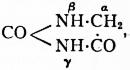
When hydrolysed with baryta water yields hydantoic (glycoluric)acid, H2N·CO·NH·CH2·CO2H, which is readily soluble in hot water, and on heating with hydriodic acid decomposes into ammonia, carbon dioxide and glycocoll, CH2·NH2·CO2·H. Many substituted hydantoins are known; the α-alkyl hydantoins are formed on fusion of aldehyde- or ketone-cyanhydrins with urea, the β-alkyl hydantoins from the fusion of mono-alkyl glycocolls with urea, and the γ-alkyl hydantoins from the action of alkalis and alkyl iodides on the α-compounds. γ-Methyl hydantoin has been obtained as a splitting product of caffeine (E. Fischer, Ann., 1882, 215, p. 253).
HYDE, the name of an English family distinguished in the 17th century. Robert Hyde of Norbury, Cheshire, had several sons, of whom the third was Lawrence Hyde of Gussage St Michael, Dorsetshire. Lawrence’s son Henry was father of Edward Hyde, earl of Clarendon (q.v.), whose second son by his second wife was Lawrence, earl of Rochester (q.v.); another son was Sir Lawrence Hyde, attorney-general to Anne of Denmark, James I.’s consort; and a third son was Sir Nicholas Hyde (d. 1631), chief-justice of England. Sir Nicholas entered parliament in 1601 and soon became prominent as an opponent of the court, though he does not appear to have distinguished himself in the law. Before long, however, he deserted the popular party, and in 1626 he was employed by the duke of Buckingham in his defence to impeachment by the Commons; and in the following year he was appointed chief-justice of the king’s bench, in which office it fell to him to give judgment in the celebrated case of Sir Thomas Darnell and others who had been committed to prison on warrants signed by members of the privy council, which contained no statement of the nature of the charge against the prisoners. In answer to the writ of habeas corpus the attorney-general relied on the prerogative of the crown, supported by a precedent of Queen Elizabeth’s reign. Hyde, three other judges concurring, decided in favour of the crown, but without going so far as to declare the right of the crown to refuse indefinitely to show cause against the discharge of the prisoners. In 1629 Hyde was one of the judges who condemned Eliot, Holles and Valentine for conspiracy in parliament to resist the king’s orders; refusing to admit their plea that they could not be called upon to answer out of parliament for acts done in parliament. Sir Nicholas Hyde died in August 1631.
Sir Lawrence Hyde, attorney-general to Anne of Denmark, had eleven sons, four of whom were men of some mark. Henry was an ardent royalist who accompanied Charles II. to the continent, and returning to England was beheaded in 1650; Alexander (1598-1667) became bishop of Salisbury in 1665; Edward (1607-1659) was a royalist divine who was nominated dean of Windsor in 1658, but died before taking up the appointment, and who was the author of many controversial works in Anglican theology; and Robert (1595-1665) became recorder of Salisbury and represented that borough in the Long Parliament, in which he professed royalist principles, voting against the attainder of Strafford. Having been imprisoned and deprived of his recordership by the parliament in 1645/6, Robert Hyde gave refuge to Charles II. on his flight from Worcester in 1651, and on the Restoration he was knighted and made a judge of the common pleas. He died in 1665. Henry Hyde (1672-1753), only son of Lawrence, earl of Rochester, became 4th earl of Clarendon and 2nd earl of Rochester, both of which titles became extinct at his death. He was in no way distinguished, but his wife Jane Hyde, countess of Clarendon and Rochester (d. 1725), was a famous beauty celebrated by the homage of Swift, Prior and Pope, and by the groundless scandal of Lady Mary Wortley Montagu. Two of her daughters, Jane, countess of Essex, and Catherine, duchess of Queensberry, were also famous beauties of the reign of Queen Anne. Her son, Henry Hyde (1710-1753), known as Viscount Cornbury, was a Tory and Jacobite member of parliament, and an intimate friend of Bolingbroke, who addressed to him his Letters on the Study and Use of History, and On the Spirit of Patriotism. In 1750 Lord Cornbury was created Baron Hyde of Hindon, but, as he predeceased his father, this title reverted to the latter and became extinct at his death. Lord Cornbury was celebrated as a wit and a conversationalist. By his will he bequeathed the papers of his great-grandfather, Lord Clarendon, the historian, to the Bodleian Library at Oxford.
See Lord Clarendon, The Life of Edward, Earl of Clarendon (3 vols., Oxford, 1827); Edward Foss, The Judges of England (London, 1848-1864); Anthony à Wood, Athenae oxonienses (London, 1813-1820); Samuel Pepys, Diary and Correspondence, edited by Lord Braybrooke (4 vols., London, 1854).
HYDE, THOMAS (1636-1703), English Orientalist, was born at Billingsley, near Bridgnorth, in Shropshire, on the 29th of June 1636. He inherited his taste for linguistic studies, and received his first lessons in some of the Eastern tongues, from his father, who was rector of the parish. In his sixteenth year Hyde entered King’s College, Cambridge, where, under Wheelock, professor of Arabic, he made rapid progress in Oriental languages, so that, after only one year of residence, he was invited to London to assist Brian Walton in his edition of the Polyglott Bible. Besides correcting the Arabic, Persic and Syriac texts for that work, Hyde transcribed into Persic characters the Persian translation of the Pentateuch, which had been printed in Hebrew letters at Constantinople in 1546. To this work, which Archbishop Ussher had thought well-nigh impossible even for a native of Persia, Hyde appended the Latin version which accompanies it in the Polyglott. In 1658 he was chosen Hebrew reader at Queen’s College, Oxford, and in 1659, in consideration of his erudition in Oriental tongues, he was admitted to the degree of M.A. In the same year he was appointed under-keeper of the Bodleian Library, and in 1665 librarian-in-chief. Next year he was collated to a prebend at Salisbury, and in 1673 to the archdeaconry of Gloucester, receiving the degree of D.D. shortly afterwards. In 1691 the death of Edward Pococke opened up to Hyde the Laudian professorship of Arabic; and in 1697, on the deprivation of Roger Altham, he succeeded to the regius chair of Hebrew and a canonry of Christ Church. Under Charles II., James II. and William III. Hyde discharged the duties of Eastern interpreter to the court. Worn out by his unremitting labours, he resigned his librarianship in 1701, and died at Oxford on the 18th of February 1703. Hyde, who was one of the first to direct attention to the vast treasures of Oriental antiquity, was an excellent classical scholar, and there was hardly an Eastern tongue accessible to foreigners with which he was not familiar. He had even acquired Chinese, while his writings are the best testimony to his mastery of Turkish, Arabic, Syriac, Persian, Hebrew and Malay.
In his chief work, Historia religionis veterum Persarum (1700), he made the first attempt to correct from Oriental sources the errors of the Greek and Roman historians who had described the religion of the ancient Persians. His other writings and translations comprise Tabulae longitudinum et latitudinum stellarum fixarum ex observatione principis Ulugh Beighi (1665), to which his notes have given additional value; Quatuor evangelia et acta apostolorum lingua Malaica, caracteribus Europaeis (1677); Epistola de mensuris et ponderibus serum sive sinensium (1688), appended to Bernard’s De mensuris et ponderibus antiquis; Abraham Peritsol itinera mundi (1691); and De ludis orientalibus libri II. (1694).
With the exception of the Historia religionis, which was republished by Hunt and Costard in 1760, the writings of Hyde, including some unpublished MSS., were collected and printed by Dr Gregory Sharpe in 1767 under the title Syntagma dissertationum quas olim ... Thomas Hyde separatim edidit. There is a life of the author prefixed. Hyde also published a catalogue of the Bodleian Library in 1674.
HYDE, a market town and municipal borough in the Hyde parliamentary division of Cheshire, England, 71⁄2 m. E. of Manchester, by the Great Central railway. Pop. (1901) 32,766. It lies in the densely populated district in the north-east of the county, on the river Tame, which here forms the boundary of Cheshire with Lancashire. To the east the outlying hills of the Peak district of Derbyshire rise abruptly. The town has cotton weaving factories, spinning mills, print-works, iron foundries and machine works; also manufactures of hats and margarine. There are extensive coal mines in the vicinity. Hyde is wholly of modern growth, though it contains a few ancient houses, such as Newton Hall, in the part of the town so called. The old family of Hyde held possession of the manor as early as the reign of John. The borough, incorporated in 1881, is under a mayor, 6 aldermen and 18 councillors. Area, 3081 acres.
HYDE DE NEUVILLE, JEAN GUILLAUME, Baron (1776-1857), French politician, was born at La Charité-sur-Loire (Nièvre) on the 24th of January 1776, the son of Guillaume Hyde, who belonged to an English family which had emigrated with the Stuarts after the rebellion of 1745. He was only seventeen when he successfully defended a man denounced by Fouché before the revolutionary tribunal of Nevers. From 1793 onwards he was an active agent of the exiled princes; he took part in the Royalist rising in Berry in 1796, and after the coup d’état of the 18th Brumaire (November 9, 1799) tried to persuade Bonaparte to recall the Bourbons. An accusation of complicity in the infernal machine conspiracy of 1800-1801 was speedily retracted, but Hyde de Neuville retired to the United States, only to return after the Restoration. He was sent by Louis XVIII. to London to endeavour to persuade the British government to transfer Napoleon to a remoter and safer place of exile than the isle of Elba, but the negotiations were cut short by the emperor’s return to France in March 1815. In January 1816 de Neuville became French ambassador at Washington, where he negotiated a commercial treaty. On his return in 1821 he declined the Constantinople embassy, and in November 1822 was elected deputy for Cosne. Shortly afterwards he was appointed French ambassador at Lisbon, where his efforts to oust British influence culminated, in connexion with the coup d’état of Dom Miguel (April 30, 1824), in his suggestion to the Portuguese minister to invite the armed intervention of Great Britain. It was assumed that this would be refused, in view of the loudly proclaimed British principle of non-intervention, and that France would then be in a position to undertake a duty that Great Britain had declined. The scheme broke down, however, owing to the attitude of the reactionary party in the government of Paris, which disapproved of the Portuguese constitution. This destroyed his influence at Lisbon, and he returned to Paris to take his seat in the Chamber of Deputies. In spite of his pronounced Royalism, he now showed Liberal tendencies, opposed the policy of Villèle’s cabinet, and in 1828 became a member of the moderate administration of Martignac as minister of marine. In this capacity he showed active sympathy with the cause of Greek independence. During the Polignac ministry (1829-1830) he was again in opposition, being a firm upholder of the charter; but after the revolution of July 1830 he entered an all but solitary protest against the exclusion of the legitimate line of the Bourbons from the throne, and resigned his seat. He died in Paris on the 28th of May 1857.
His Mémoires et souvenirs (3 vols., 1888), compiled from his notes by his nieces, the vicomtesse de Bardonnet and the baronne Laurenceau, are of great interest for the Revolution and the Restoration.
HYDE PARK, a small township of Norfolk county, Massachusetts, U.S.A., about 8 m. S.W. of the business centre of Boston. Pop. (1890) 10,193; (1900) 13,244, of whom 3805 were foreign-born; (1910 census) 15,507. Its area is about 41⁄2 sq. m. It is traversed by the New York, New Haven & Hartford railway, which has large repair shops here, and by the Neponset river and smaller streams. The township contains the villages of Hyde Park, Readville (in which there is the famous “Weil” trotting-track), Fairmount, Hazelwood and Clarendon Hills. Until about 1856 Hyde Park was a farmstead. The value of the total factory product increased from $4,383,959 in 1900 to $6,739,307 in 1905, or 53.7%. In 1868 Hyde Park was incorporated as a township, being formed of territory taken from Dorchester, Dedham and Milton.
HYDERABAD, or Haidarabad, a city and district of British India, in the Sind province of Bombay. The city stands on a hill about 3 m. from the left bank of the Indus, and had a population in 1901 of 69,378. Upon the site of the present fort is supposed to have stood the ancient town of Nerankot, which in the 8th century submitted to Mahommed bin Kasim. In 1768 the present city was founded by Ghulam Shah Kalhora; and it remained the capital of Sind until 1843, when, after the battle of Meeanee, it was surrendered to the British, and the capital transferred to Karachi. The city is built on the most northerly hills of the Ganga range, a site of great natural strength. In the fort, which covers an area of 36 acres, is the arsenal of the province, transferred thither from Karachi in 1861, and the palaces of the ex-mirs of Sind. An excellent water supply is derived from the Indus. In addition to manufactures of silk, gold and silver embroidery, lacquered ware and pottery, there are three factories for ginning cotton. There are three high schools, training colleges for masters and mistresses, a medical school, an agricultural school for village officials, and a technical school. The city suffered from plague in 1896-1897.
The District of Hyderabad has an area of 8291 sq. m., with a population in 1901 of 989,030, showing an increase of 15% in the decade. It consists of a vast alluvial plain, on the left bank of the Indus, 216 m. long and 48 broad. Fertile along the course of the river, it degenerates towards the east into sandy wastes, sparsely populated, and defying cultivation. The monotony is relieved by the fringe of forest which marks the course of the river, and by the avenues of trees that line the irrigation channels branching eastward from this stream. The south of the district has a special feature in its large natural water-courses (called dhoras) and basin-like shallows (chhaus), which retain the rains for a long time. A limestone range called the Ganga and the pleasant frequency of garden lands break the monotonous landscape. The principal crops are millets, rice, oil-seeds, cotton and wheat, which are dependent on irrigation, mostly from government canals. There is a special manufacture at Hala of glazed pottery and striped cotton cloth. Three railways traverse the district: (1) one of the main lines of the North-Western system, following the Indus valley and crossing the river near Hyderabad; (2) a broad-gauge branch running south to Badin, which will ultimately be extended to Bombay; and (3) a metre-gauge line from Hyderabad city into Rajputana.
HYDERABAD, Haidarabad, also known as the Nizam’s Dominions, the principal native state of India in extent, population and political importance; area, 82,698 sq. m.; pop. (1901) 11,141,142, showing a decrease of 3.4% in the decade; estimated revenue 41⁄2 crores of Hyderabad rupees (£2,500,000). The state occupies a large portion of the eastern plateau of the Deccan. It is bounded on the north and north-east by Berar, on the south and south-east by Madras, and on the west by Bombay. The country presents much variety of surface and feature; but it may be broadly divided into two tracts, distinguished from one another geologically and ethnically, which are locally known from the languages spoken as Telingana and Marathwara. In some parts it is mountainous, wooded and picturesque, in others flat and undulating. The open country includes lands of all descriptions, including many rich and fertile plains, much good land not yet brought under cultivation, and numerous tracts too sterile ever to be cultivated. In the north-west the geological formations are volcanic, consisting principally of trap, but in some parts of basalt; in the middle, southern and south-western parts the country is overlaid with gneissic formations. The territory is well watered, rivers being numerous, and tanks or artificial pieces of water abundant, especially in Telingana. The principal rivers are the Godavari, with its tributaries the Dudna, Manjira and Pranhita; the Wardha, with its tributary the Penganga; and the Kistna, with its tributary the Tungabhadra. The climate may be considered in general good; and as there are no arid bare deserts, hot winds are little felt.
More than half the revenue of the state is derived from the land, and the development of the country by irrigation and railways has caused considerable expansion in this revenue, though the rate of increase in the decade 1891-1901 was retarded by a succession of unfavourable seasons. The soil is generally fertile, though in some parts it consists of chilka, a red and gritty mould little fitted for purposes of agriculture. The principal crops are millets of various kinds, rice, wheat, oil-seeds, cotton, tobacco, sugar-cane, and fruits and garden produce in great variety. Silk, known as tussur, the produce of a wild species of worm, is utilized on a large scale. Lac, suitable for use as a resin or dye, gums and oils are found in great quantities. Hides, raw and tanned, are articles of some importance in commerce. The principal exports are cotton, oil-seeds, country-clothes and hides; the imports are salt, grain, timber, European piece-goods and hardware. The mineral wealth of the state consists of coal, copper, iron, diamonds and gold; but the development of these resources has not hitherto been very successful. The only coal mine now worked is the large one at Singareni, with an annual out-turn of nearly half a million tons. This coal has enabled the nizam’s guaranteed state railway to be worked so cheaply that it now returns a handsome profit to the state. It also gives encouragement to much-needed schemes of railway extension, and to the erection of cotton presses and of spinning and weaving mills. The Hyderabad-Godavari railway (opened in 1901) traverses a rich cotton country, and cotton presses have been erected along the line. The currency of the state is based on the hali sikka, which contains approximately the same weight of silver as the British rupee, but its exchange value fell heavily after 1893, when free coinage ceased in the mint. In 1904, however, a new coin (the Mahbubia rupee) was minted; the supply was regulated, and the rate of exchange became about 115 = 100 British rupees. The state suffered from famine during 1900, the total number of persons in receipt of relief rising to nearly 500,000 in June of that year. The nizam met the demands for relief with great liberality.
The nizam of Hyderabad is the principal Mahommedan ruler in India. The family was founded by Asaf Jah, a distinguished Turkoman soldier of the emperor Aurangzeb, who in 1713 was appointed subahdar of the Deccan, with the title of nizam-ul-mulk (regulator of the state), but eventually threw off the control of the Delhi court. Azaf Jah’s death in 1748 was followed by an internecine struggle for the throne among his descendants, in which the British and the French took part. At one time the French nominee, Salabat Jang, established himself with the help of Bussy. But finally, in 1761, when the British had secured their predominance throughout southern India, Nizam Ali took his place and ruled till 1803. It was he who confirmed the grant of the Northern Circars in 1766, and joined in the two wars against Tippoo Sultan in 1792 and 1799. The additions of territory which he acquired by these wars was afterwards (1800) ceded to the British, as payment for the subsidiary force which he had undertaken to maintain. By a later treaty in 1853, the districts known as Berar were “assigned” to defray the cost of the Hyderabad contingent. In 1857 when the Mutiny broke out, the attitude of Hyderabad as the premier native state and the cynosure of the Mahommedans in India became a matter of extreme importance; but Afzul-ud-Dowla, the father of the present ruler, and his famous minister, Sir Salar Jang, remained loyal to the British. An attack on the residency was repulsed, and the Hyderabad contingent displayed their loyalty in the field against the rebels. In 1902 by a treaty made by Lord Curzon, Berar was leased in perpetuity to the British government, and the Hyderabad contingent was merged in the Indian army. The nizam Mir Mahbub Ali Khan Bahadur, Asaf Jah, a direct descendant of the famous nizam-ul-mulk, was born on the 18th of August 1866. On the death of his father in 1869 he succeeded to the throne as a minor, and was invested with full powers in 1884. He is notable as the originator of the Imperial Service Troops, which now form the contribution of the native chiefs to the defence of India. On the occasion of the Panjdeh incident in 1885 he made an offer of money and men, and subsequently on the occasion of Queen Victoria’s Jubilee in 1887 he offered 20 lakhs (£130,000) annually for three years for the purpose of frontier defence. It was finally decided that the native chiefs should maintain small but well-equipped bodies of infantry and cavalry for imperial defence. For many years past the Hyderabad finances were in a very unhealthy condition, the expenditure consistently outran the revenue, and the nobles, who held their tenure under an obsolete feudal system, vied with each other in ostentatious extravagance. But in 1902, on the revision of the Berar agreement, the nizam received 25 lakhs (£167,000) a year for the rent of Berar, thus substituting a fixed for a fluctuating source of income, and a British financial adviser was appointed for the purpose of reorganizing the resources of the state.
See S. H. Bilgrami and C. Willmott, Historical and Descriptive Sketch of the Nizam’s Dominions (Bombay, 1883-1884).
HYDERABAD or Haidarabad, capital of the above state, is situated on the right bank of the river Musi, a tributary of the Kistna, with Golconda to the west, and the residency and its bazaars and the British cantonment of Secunderabad to the north-east. It is the fourth largest city in India; pop. (1901) 448,466, including suburbs and cantonment. The city itself is in shape a parallelogram, with an area of more than 2 sq. m. It was founded in 1589 by Mahommed Kuli, fifth of the Kutb Shahi kings, of whose period several important buildings remain as monuments. The principal of these is the Char Minar or Four Minarets (1591). The minarets rise from arches facing the cardinal points, and stand in the centre of the city, with four roads radiating from their base. The Ashur Khana (1594), a ceremonial building, the hospital, the Gosha Mahal palace and the Mecca mosque, a sombre building designed after a mosque at Mecca, surrounding a paved quadrangle 360 ft. square, were the other principal buildings of the Kutb Shahi period, though the mosque was only completed in the time of Aurangzeb. The city proper is surrounded by a stone wall with thirteen gates, completed in the time of the first nizam, who made Hyderabad his capital. The suburbs, of which the most important is Chadarghat, extend over an additional area of 9 sq. m. There are several fine palaces built by various nizams, and the British residency is an imposing building in a large park on the left bank of the Musi, N.E. of the city. The bazaars surrounding it, and under its jurisdiction, are extremely picturesque and are thronged with natives from all parts of India. Four bridges crossed the Musi, the most notable of which was the Purana Pul, of 23 arches, built in 1593. On the 27th and 28th of September 1908, however, the Musi, swollen by torrential rainfall (during which 15 in. fell in 36 hours), rose in flood to a height of 12 ft. above the bridges and swept them away. The damage done was widespread; several important buildings were involved, including the palace of Salar Jang and the Victoria zenana hospital, while the beautiful grounds of the residency were destroyed. A large and densely populated part of the city was wrecked, and thousands of lives were lost. The principal educational establishments are the Nizam college (first grade), engineering, law, medical, normal, industrial and Sanskrit schools, and a number of schools for Europeans and Eurasians. Hyderabad is an important centre of general trade, and there is a cotton mill in its vicinity. The city is supplied with water from two notable works, the Husain Sagar and the Mir Alam, both large lakes retained by great dams. Secunderabad, the British military cantonment, is situated 51⁄2 m. N. of the residency; it includes Bolaram, the former headquarters of the Hyderabad contingent.
HYDER ALI, or Haidar ’Ali (c. 1722-1782), Indian ruler and commander. This Mahommedan soldier-adventurer, who, followed by his son Tippoo, became the most formidable Asiatic rival the British ever encountered in India, was the great-grandson of a fakir or wandering ascetic of Islam, who had found his way from the Punjab to Gulburga in the Deccan, and the second son of a naik or chief constable at Budikota, near Kolar in Mysore. He was born in 1722, or according to other authorities 1717. An elder brother, who like himself was early turned out into the world to seek his own fortune, rose to command a brigade in the Mysore army, while Hyder, who never learned to read or write, passed the first years of his life aimlessly in sport and sensuality, sometimes, however, acting as the agent of his brother, and meanwhile acquiring a useful familiarity with the tactics of the French when at the height of their reputation under Dupleix. He is said to have induced his brother to employ a Parsee to purchase artillery and small arms from the Bombay government, and to enrol some thirty sailors of different European nations as gunners, and is thus credited with having been “the first Indian who formed a corps of sepoys armed with firelocks and bayonets, and who had a train of artillery served by Europeans.” At the siege of Devanhalli (1749) Hyder’s services attracted the attention of Nanjiraj, the minister of the raja of Mysore, and he at once received an independent command; within the next twelve years his energy and ability had made him completely master of minister and raja alike, and in everything but in name he was ruler of the kingdom. In 1763 the conquest of Kanara gave him possession of the treasures of Bednor, which he resolved to make the most splendid capital in India, under his own name, thenceforth changed from Hyder Naik into Hyder Ali Khan Bahadur; and in 1765 he retrieved previous defeat at the hands of the Mahrattas by the destruction of the Nairs or military caste of the Malabar coast, and the conquest of Calicut. Hyder Ali now began to occupy the serious attention of the Madras government, which in 1766 entered into an agreement with the nizam to furnish him with troops to be used against the common foe. But hardly had this alliance been formed when a secret arrangement was come to between the two Indian powers, the result of which was that Colonel Smith’s small force was met with a united army of 80,000 men and 100 guns. British dash and sepoy fidelity, however, prevailed, first in the battle of Chengam (September 3rd, 1767), and again still more remarkably in that of Tiruvannamalai (Trinomalai). On the loss of his recently made fleet and forts on the western coast, Hyder Ali now offered overtures for peace; on the rejection of these, bringing all his resources and strategy into play, he forced Colonel Smith to raise the siege of Bangalore, and brought his army within 5 m. of Madras. The result was the treaty of April 1769, providing for the mutual restitution of all conquests, and for mutual aid and alliance in defensive war; it was followed by a commercial treaty in 1770 with the authorities of Bombay. Under these arrangements Hyder Ali, when defeated by the Mahrattas in 1772, claimed British assistance, but in vain; this breach of faith stung him to fury, and thenceforward he and his son did not cease to thirst for vengeance. His time came when in 1778 the British, on the declaration of war with France, resolved to drive the French out of India. The capture of Mahé on the coast of Malabar in 1779, followed by the annexation of lands belonging to a dependent of his own, gave him the needed pretext. Again master of all that the Mahrattas had taken from him, and with empire extended to the Kistna, he descended through the passes of the Ghats amid burning villages, reaching Conjeeveram, only 45 m. from Madras, unopposed. Not till the smoke was seen from St Thomas’s Mount, where Sir Hector Munro commanded some 5200 troops, was any movement made; then, however, the British general sought to effect a junction with a smaller body under Colonel Baillie recalled from Guntur. The incapacity of these officers, notwithstanding the splendid courage of their men, resulted in the total destruction of Baillie’s force of 2800 (September the 10th, 1780). Warren Hastings sent from Bengal Sir Eyre Coote, who, though repulsed at Chidambaram, defeated Hyder thrice successively in the battles of Porto Novo, Pollilur and Sholingarh, while Tippoo was forced to raise the siege of Wandiwash, and Vellore was provisioned. On the arrival of Lord Macartney as governor of Madras, the British fleet captured Negapatam, and forced Hyder Ali to confess that he could never ruin a power which had command of the sea. He had sent his son Tippoo to the west coast, to seek the assistance of the French fleet, when his death took place suddenly at Chittur in December 1782.
See L. B. Bowring, Haidar Ali and Tipu Sultan, “Rulers of India” series (1893). For the personal character and administration of Hyder Ali see the History of Hyder Naik, written by Mir Hussein Ali Khan Kirmani (translated from the Persian by Colonel Miles, and published by the Oriental Translation Fund), and the curious work written by M. Le Maître de La Tour, commandant of his artillery (Histoire d’Hayder-Ali Khan, Paris, 1783). For the whole life and times see Wilks, Historical Sketches of the South of India (1810-1817); Aitchison’s Treaties, vol. v. (2nd ed., 1876); and Pearson, Memoirs of Schwartz (1834).
HYDRA (or Sidra, Nidra, Idero, &c.; anc. Hydrea), an island of Greece, lying about 4 m. off the S.E. coast of Argolis in the Peloponnesus, and forming along with the neighbouring island of Dokos (Dhoko) the Bay of Hydra. Pop. about 6200. The greatest length from south-west to north-east is about 11 m., and the area is about 21 sq. mi.; but it is little better than a rocky and treeless ridge with hardly a patch or two of arable soil. Hence the epigram of Antonios Kriezes to the queen of Greece: “The island produces prickly pears in abundance, splendid sea captains and excellent prime ministers.” The highest point, Mount Ere, so called (according to Miaoules) from the Albanian word for wind, is 1958 ft. high. The next in importance is known as the Prophet Elias, from the large convent of that name on its summit. It was there that the patriot Theodorus Kolokotrones was imprisoned, and a large pine tree is still called after him. The fact that in former times the island was richly clad with woods is indicated by the name still employed by the Turks, Tchamliza, the place of pines; but it is only in some favoured spots that a few trees are now to be found. Tradition also has it that it was once a well-watered island (hence the designation Hydrea), but the inhabitants are now wholly dependent on the rain supply, and they have sometimes had to bring water from the mainland. This lack of fountains is probably to be ascribed in part to the effect of earthquakes, which are not infrequent; that of 1769 continued for six whole days. Hydra, the chief town, is built near the middle of the northern coast, on a very irregular site, consisting of three hills and the intervening ravines. From the sea its white and handsome houses present a picturesque appearance, and its streets though narrow are clean and attractive. Besides the principal harbour, round which the town is built, there are three other ports on the north coast—Mandraki, Molo, Panagia, but none of them is sufficiently sheltered. Almost all the population of the island is collected in the chief town, which is the seat of a bishop, and has a local court, numerous churches and a high school. Cotton and silk weaving, tanning and shipbuilding are carried on, and there is a fairly active trade.
Hydra was of no importance in ancient times. The only fact in its history is that the people of Hermione (a city on the neighbouring mainland now known by the common name of Kastri) surrendered it to Samian refugees, and that from these the people of Troezen received it in trust. It appears to be completely ignored by the Byzantine chroniclers. In 1580 it was chosen as a refuge by a body of Albanians from Kokkinyas in Troezenia; and other emigrants followed in 1590, 1628, 1635, 1640, &c. At the close of the 17th century the Hydriotes took part in the reviving commerce of the Peloponnesus; and in course of time they extended their range. About 1716 they began to build sakturia (of from 10 to 15 tons burden), and to visit the islands of the Aegean; not long after they introduced the latinadika (40-50 tons), and sailed as far as Alexandria, Constantinople, Trieste and Venice; and by and by they ventured to France and even America. From the grain trade of south Russia more especially they derived great wealth. In 1813 there were about 22,000 people in the island, and of these 10,000 were seafarers. At the time of the outbreak of the war of Greek independence the total population was 28,190, of whom 16,460 were natives and the rest foreigners. One of their chief families, the Konduriotti, was worth £2,000,000. Into the struggle the Hydriotes flung themselves with rare enthusiasm and devotion, and the final deliverance of Greece was mainly due to the service rendered by their fleets.
See Pouqueville, Voy. de la Grèce, vol. vi.; Antonios Miaoules, Ὑπόμνημα περὶ τῆς νήσου Ὕδρας (Munich, 1834); Id. Συνοπτικὴ ἱστορία τῶν ναυμαχιῶν διὰ τῶν πλοίων τῶν τρίων νήσων, Ὕδρας, Πέτσων καὶ Ψαρῶν (Nauplia, 1833); Id. Ἱστορία τῆς νήσου Ὕδρας (Athens, 1874); G. D. Kriezes, Ἱστρία τῆς νήσου Ὕδρας (Patras, 1860).
HYDRA (watersnake), in Greek legend, the offspring of Typhon and Echidna, a gigantic monster with nine heads (the number is variously given), the centre one being immortal. Its haunt was a hill beneath a plane tree near the river Amymone, in the marshes of Lerna by Argos. The destruction of this Lernaean hydra was one of the twelve “labours” of Heracles, which he accomplished with the assistance of Iolaus. Finding that as soon as one head was cut off two grew up in its place, they burnt out the roots with firebrands, and at last severed the immortal head from the body, and buried it under a mighty block of rock. The arrows dipped by Heracles in the poisonous blood or gall of the monster ever afterwards inflicted fatal wounds. The generally accepted interpretation of the legend is that “the hydra denotes the damp, swampy ground of Lerna with its numerous springs (κεφαλαί, heads); its poison the miasmic vapours rising from the stagnant water; its death at the hands of Heracles the introduction of the culture and consequent purification of the soil” (Preller). A euhemeristic explanation is given by Palaephatus (39). An ancient king named Lernus occupied a small citadel named Hydra, which was defended by 50 bowmen. Heracles besieged the citadel and hurled firebrands at the garrison. As often as one of the defenders fell, two others at once stepped into his place. The citadel was finally taken with the assistance of the army of Iolaus and the garrison slain.
See Hesiod, Theog., 313; Euripides, Hercules furens, 419; Pausanias ii. 37; Apollodorus ii. 5, 2; Diod. Sic. iv. 11; Roscher’s Lexikon der Mythologie. In the article Greek Art, fig. 20 represents the slaying of the Lernaean hydra by Heracles.
HYDRA, in astronomy, a constellation of the southern hemisphere, mentioned by Eudoxus (4th century B.C.) and Aratus (3rd century B.C.), and catalogued by Ptolemy (27 stars), Tycho Brahe (19) and Hevelius (31). Interesting objects are: the nebula H. IV. 27 Hydrae, a planetary nebula, gaseous and whose light is about equal to an 8th magnitude star; ε Hydrae, a beautiful triple star, composed of two yellow stars of the 4th and 6th magnitudes, and a blue star of the 7th magnitude; R. Hydrae, a long period (425 days) variable, the range in magnitude being from 4 to 9.7; and U. Hydrae, an irregularly variable, the range in magnitude being 4.5 to 6.
HYDRACRYLIC ACID (ethylene lactic acid), CH2OH·CH2·CO2H. an organic oxyacid prepared by acting with silver oxide and water on β-iodopropionic acid, or from ethylene by the addition of hypochlorous acid, the addition product being then treated with potassium cyanide and hydrolysed by an acid. It may also be prepared by oxidizing the trimethylene glycol obtained by the action of hydrobromic acid on allylbromide. It is a syrupy liquid, which on distillation is resolved into water and the unsaturated acrylic acid, CH2:CH·CO2H. Chromic and nitric acids oxidize it to oxalic acid and carbon dioxide. Hydracrylic aldehyde, CH2OH·CH2·CHO, was obtained in 1904 by J. U. Nef (Ann. 335, p. 219) as a colourless oil by heating acrolein with water. Dilute alkalis convert it into crotonaldehyde, CH3·CH:CH·CHO.
HYDRANGEA, a popular flower, the plant to which the name is most commonly applied being Hydrangea Hortensia, a low deciduous shrub, producing rather large oval strongly-veined leaves in opposite pairs along the stem. It is terminated by a massive globular corymbose head of flowers, which remain a long period in an ornamental condition. The normal colour of the flowers, the majority of which have neither stamens nor pistil, is pink; but by the influence of sundry agents in the soil, such as alum or iron, they become changed to blue. There are numerous varieties, one of the most noteworthy being “Thomas Hogg” with pure white flowers. The part of the inflorescence which appears to be the flower is an exaggerated expansion of the sepals, the other parts being generally abortive. The perfect flowers are small, rarely produced in the species above referred to, but well illustrated by others, in which they occupy the inner parts of the corymb, the larger showy neuter flowers being produced at the circumference.
There are upwards of thirty species, found chiefly in Japan, in the mountains of India, and in North America, and many of them are familiar in gardens. H. Hortensia (a species long known in cultivation In China and Japan) is the most useful for decoration, as the head of flowers lasts long in a fresh state, and by the aid of forcing can be had for a considerable period for the ornamentation of the greenhouse and conservatory. Their natural flowering season is towards the end of the summer, but they may be had earlier by means of forcing. H. japonica is another fine conservatory plant, with foliage and habit much resembling the last named, but this has flat corymbs of flowers, the central ones small and perfect, and the outer ones only enlarged and neuter. This also produces pink or blue flowers under the influence of different soils.
The Japanese species of hydrangea are sufficiently hardy to grow in any tolerably favourable situation, but except in the most sheltered localities they seldom blossom to any degree of perfection in the open air, the head of blossom depending on the uninjured development of a well-ripened terminal bud, and this growth being frequently affected by late spring frosts. They are much more useful for pot-culture indoors, and should be reared from cuttings of shoots having the terminal bud plump and prominent, put in during summer, these developing a single head of flowers the succeeding summer. Somewhat larger plants may be had by nipping out the terminal bud and inducing three or four shoots to start in its place, and these, being steadily developed and well ripened, should each yield its inflorescence in the following summer, that is, when two years old. Large plants grown in tubs and vases are fine subjects for large conservatories, and useful for decorating terrace walks and similar places during summer, being housed in winter, and started under glass in spring.
Hydrangea paniculata var. grandiflora is a very handsome plant; the branched inflorescence under favourable circumstances is a yard or more in length, and consists of large spreading masses of crowded white neuter flowers which completely conceal the few inconspicuous fertile ones. The plant attains a height of 8 to 10 ft. and when in flower late in summer and in autumn is a very attractive object in the shrubbery.
The Indian and American species, especially the latter, are quite hardy, and some of them are extremely effective.
HYDRASTINE, C21H21NO6, an alkaloid found with berberine in the root of golden seal, Hydrastis canadensis, a plant indigenous to North America. It was discovered by Durand in 1851, and its chemistry formed the subject of numerous communications by E. Schmidt and M. Freund (see Ann., 1892, 271, p. 311) who, aided by P. Fritsch (Ann., 1895, 286, p. 1), established its constitution. It is related to narcotine, which is methoxy hydrastine. The root of golden seal is used in medicine under the name hydrastis rhizome, as a stomachic and nervine stimulant.
HYDRATE, in chemistry, a compound containing the elements of water in combination; more specifically, a compound containing the monovalent hydroxyl or OH group. The first and more general definition includes substances containing water of crystallization; such salts are said to be hydrated, and when deprived of their water to be dehydrated or anhydrous. Compounds embraced by the second definition are more usually termed hydroxides, since at one time they were regarded as combinations of an oxide with water, for example, calcium oxide or lime when slaked with water yielded calcium hydroxide, written formerly as CaO·H20. The general formulae of hydroxides are: MiOH, Mii(OH)2, Miii(OH)3, Miv(OH)4, &c., corresponding to the oxides M2iO, MiiO, M2iiiO3, MivO2, &c., the Roman index denoting the valency of the element. There is an important difference between non-metallic and metallic hydroxides; the former are invariably acids (oxyacids), the latter are more usually basic, although acidic metallic oxides yield acidic hydroxides. Elements exhibiting strong basigenic or oxygenic characters yield the most, stable hydroxides; in other words, stable hydroxides are associated with elements belonging to the extreme groups of the periodic system, and unstable hydroxides with the central members. The most stable basic hydroxides are those of the alkali metals, viz. lithium, sodium, potassium, rubidium and caesium, and of the alkaline earth metals, viz. calcium, barium and strontium; the most stable acidic hydroxides are those of the elements placed in groups VB, VIB and VIIB of the periodic table.
HYDRAULICS (Gr. ὕδωρ, water, and αὐλός, a pipe), the branch of engineering science which deals with the practical applications of the laws of hydromechanics.
I. THE DATA OF HYDRAULICS1
§ 1. Properties of Fluids.—The fluids to which the laws of practical hydraulics relate are substances the parts of which possess very great mobility, or which offer a very small resistance to distortion independently of inertia. Under the general heading Hydromechanics a fluid is defined to be a substance which yields continually to the slightest tangential stress, and hence in a fluid at rest there can be no tangential stress. But, further, in fluids such as water, air, steam, &c., to which the present division of the article relates, the tangential stresses that are called into action between contiguous portions during distortion or change of figure are always small compared with the weight, inertia, pressure, &c., which produce the visible motions it is the object of hydraulics to estimate. On the other hand, while a fluid passes easily from one form to another, it opposes considerable resistance to change of volume.
It is easily deduced from the absence or smallness of the tangential stress that contiguous portions of fluid act on each other with a pressure which is exactly or very nearly normal to the interface which separates them. The stress must be a pressure, not a tension, or the parts would separate. Further, at any point in a fluid the pressure in all directions must be the same; or, in other words, the pressure on any small element of surface is independent of the orientation of the surface.
§ 2. Fluids are divided into liquids, or incompressible fluids, and gases, or compressible fluids. Very great changes of pressure change the volume of liquids only by a small amount, and if the pressure on them is reduced to zero they do not sensibly dilate. In gases or compressible fluids the volume alters sensibly for small changes of pressure, and if the pressure is indefinitely diminished they dilate without limit.
In ordinary hydraulics, liquids are treated as absolutely incompressible. In dealing with gases the changes of volume which accompany changes of pressure must be taken into account.
§ 3. Viscous fluids are those in which change of form under a continued stress proceeds gradually and increases indefinitely. A very viscous fluid opposes great resistance to change of form in a short time, and yet may be deformed considerably by a small stress acting for a long period. A block of pitch is more easily splintered than indented by a hammer, but under the action of the mere weight of its parts acting for a long enough time it flattens out and flows like a liquid.
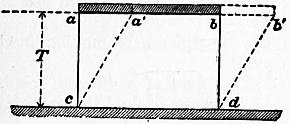
Fig. 1.
All actual fluids are viscous. They oppose a resistance to the relative motion of their parts. This resistance diminishes with the velocity of the relative motion, and becomes zero in a fluid the parts of which are relatively at rest. When the relative motion of different parts of a fluid is small, the viscosity may be neglected without introducing important errors. On the other hand, where there is considerable relative motion, the viscosity may be expected to have an influence too great to be neglected.
Measurement of Viscosity. Coefficient of Viscosity.—Suppose the plane ab, fig. 1 of area ω, to move with the velocity V relatively to the surface cd and parallel to it. Let the space between be filled with liquid. The layers of liquid in contact with ab and cd adhere to them. The intermediate layers all offering an equal resistance to shearing or distortion, the rectangle of fluid abcd will take the form of the parallelogram a′b′cd. Further, the resistance to the motion of ab may be expressed in the form
R = κωV,
(1)
where κ is a coefficient the nature of which remains to be determined.
If we suppose the liquid between ab and cd divided into layers as shown in fig. 2, it will be clear that the stress R acts, at each dividing face, forwards in the direction of motion if we consider the upper layer, backwards if we consider the lower layer. Now suppose the original thickness of the layer T increased to nT; if the bounding plane in its new position has the velocity nV, the shearing at each dividing face will be exactly the same as before, and the resistance must therefore be the same. Hence,
R = κ′ω (nV).
(2)
But equations (1) and (2) may both be expressed in one equation if κ and κ′ are replaced by a constant varying inversely as the thickness of the layer. Putting κ = μ/T, κ′ = μ/nT,
R = μωV/T;
or, for an indefinitely thin layer,
R = μωdV/dt,
(3)
an expression first proposed by L. M. H. Navier. The coefficient μ is termed the coefficient of viscosity.
According to J. Clerk Maxwell, the value of μ for air at θ° Fahr. in pounds, when the velocities are expressed in feet per second, is
μ = 0.000 000 025 6 (461° + θ);
that is, the coefficient of viscosity is proportional to the absolute temperature and independent of the pressure.
The value of μ for water at 77° Fahr. is, according to H. von Helmholtz and G. Piotrowski,
μ = 0.000 018 8,
the units being the same as before. For water μ decreases rapidly with increase of temperature.
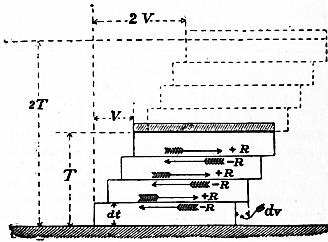
Fig. 2.
§ 4. When a fluid flows in a very regular manner, as for instance when It flows in a capillary tube, the velocities vary gradually at any moment from one point of the fluid to a neighbouring point. The layer adjacent to the sides of the tube adheres to it and is at rest. The layers more interior than this slide on each other. But the resistance developed by these regular movements is very small. If in large pipes and open channels there were a similar regularity of movement, the neighbouring filaments would acquire, especially near the sides, very great relative velocities. V. J. Boussinesq has shown that the central filament in a semicircular canal of 1 metre radius, and inclined at a slope of only 0.0001, would have a velocity of 187 metres per second,2 the layer next the boundary remaining at rest. But before such a difference of velocity can arise, the motion of the fluid becomes much more complicated. Volumes of fluid are detached continually from the boundaries, and, revolving, form eddies traversing the fluid in all directions, and sliding with finite relative velocities against those surrounding them. These slidings develop resistances incomparably greater than the viscous resistance due to movements varying continuously from point to point. The movements which produce the phenomena commonly ascribed to fluid friction must be regarded as rapidly or even suddenly varying from one point to another. The internal resistances to the motion of the fluid do not depend merely on the general velocities of translation at different points of the fluid (or what Boussinesq terms the mean local velocities), but rather on the intensity at each point of the eddying agitation. The problems of hydraulics are therefore much more complicated than problems in which a regular motion of the fluid is assumed, hindered by the viscosity of the fluid.
Relation of Pressure, Density, and Temperature of Liquids
§ 5. Units of Volume.—In practical calculations the cubic foot and gallon are largely used, and in metric countries the litre and cubic metre (= 1000 litres). The imperial gallon is now exclusively used in England, but the United States have retained the old English wine gallon.
1 cub. ft. = 6.236 imp. gallons = 7.481 U.S. gallons.
1 imp. gallon = 0.1605 cub. ft. = 1.200 U.S. gallons.
1 U.S. gallon = 0.1337 cub. ft. = 0.8333 imp. gallon.
1 litre = 0.2201 imp. gallon = 0.2641 U.S. gallon.
Density of Water.—Water at 53° F. and ordinary pressure contains 62.4 ℔ per cub. ft., or 10 ℔ per imperial gallon at 62° F. The litre contains one kilogram of water at 4° C. or 1000 kilograms per cubic metre. River and spring water is not sensibly denser than pure water. But average sea water weighs 64 ℔ per cub. ft. at 53° F. The weight of water per cubic unit will be denoted by G. Ice free from air weighs 57.28 ℔ per cub. ft. (Leduc).
§ 6. Compressibility of Liquids.—The most accurate experiments show that liquids are sensibly compressed by very great pressures, and that up to a pressure of 65 atmospheres, or about 1000 ℔ per sq. in., the compression is proportional to the pressure. The chief results of experiment are given in the following table. Let V1 be the volume of a liquid in cubic feet under a pressure p1 ℔ per sq. ft., and V2 its volume under a pressure p2. Then the cubical compression is (V2 − V1)/V1, and the ratio of the increase of pressure p2 − p1 to the cubical compression is sensibly constant. That is, k = (p2 − p1)V1/(V2 − V1) is constant. This constant is termed the elasticity of volume. With the notation of the differential calculus,
k = dp / ( − dV ) = − V dp .
V dV
Elasticity of Volume of Liquids.
Canton. Oersted. Colladon and Sturm. Regnault.
Water 45,990,000 45,900,000 42,660,000 44,000,000
Sea water 52,900,000 ·· ·· ··
Mercury 705,300,000 ·· 626,100,000 604,500,000
Oil 44,090,000 ·· ·· ··
Alcohol 32,060,000 ·· 23,100,000 ··
According to the experiments of Grassi, the compressibility of water diminishes as the temperature increases, while that of ether, alcohol and chloroform is increased.
§ 7. Change of Volume and Density of Water with Change of Temperature.—Although the change of volume of water with change of temperature is so small that it may generally be neglected in ordinary hydraulic calculations, yet it should be noted that there is a change of volume which should be allowed for in very exact calculations. The values of ρ in the following short table, which gives data enough for hydraulic purposes, are taken from Professor Everett’s System of Units.
Density of Water at Different Temperatures.
Temperature. ρ Density of Water. G Weight of 1 cub. ft. in ℔.
Cent. Fahr.
0 32.0 .999884 62.417
1 33.8 .999941 62.420
2 35.6 .999982 62.423
3 37.4 1.000004 62.424
4 39.2 1.000013 62.425
5 41.0 1.000003 62.424
6 42.8 .999983 62.423
7 44.6 .999946 62.421
8 46.4 .999899 62.418
9 48.2 .999837 62.414
10 50.0 .999760 62.409
11 51.8 .999668 62.403
12 53.6 .999562 62.397
13 55.4 .999443 62.389
14 57.2 .999312 62.381
15 59.0 .999173 62.373
16 60.8 .999015 62.363
17 62.6 .998854 62.353
18 64.4 .998667 62.341
19 66.2 .998473 62.329
20 68.0 .998272 62.316
22 71.6 .997839 62.289
24 75.2 .997380 62.261
26 78.8 .996879 62.229
28 82.4 .996344 62.196
30 86 .995778 62.161
35 95 .99469 62.093
40 104 .99236 61.947
45 113 .99038 61.823
50 122 .98821 61.688
55 131 .98583 61.540
60 140 .98339 61.387
65 149 .98075 61.222
70 158 .97795 61.048
75 167 .97499 60.863
80 176 .97195 60.674
85 185 .96880 60.477
90 194 .96557 60.275
100 212 .95866 59.844
The weight per cubic foot has been calculated from the values of ρ, on the assumption that 1 cub. ft. of water at 39.2° Fahr. is 62.425 ℔. For ordinary calculations in hydraulics, the density of water (which will in future be designated by the symbol G) will be taken at 62.4 ℔ per cub. ft., which is its density at 53° Fahr. It may be noted also that ice at 32° Fahr. contains 57.3 ℔ per cub. ft. The values of ρ are the densities in grammes per cubic centimetre.
§ 8. Pressure Column. Free Surface Level.—Suppose a small vertical pipe introduced into a liquid at any point P (fig. 3). Then the liquid will rise in the pipe to a level OO, such that the pressure due to the column in the pipe exactly balances the pressure on its mouth. If the fluid is in motion the mouth of the pipe must be supposed accurately parallel to the direction of motion, or the impact of the liquid at the mouth of the pipe will have an influence on the height of the column. If this condition is complied with, the height h of the column is a measure of the pressure at the point P. Let ω be the area of section of the pipe, h the height of the pressure column, p the intensity of pressure at P; then
pω = Ghω ℔,
p/G = h;
that is, h is the height due to the pressure at p. The level OO will be termed the free surface level corresponding to the pressure at P.
Relation of Pressure, Temperature, and Density of Gases
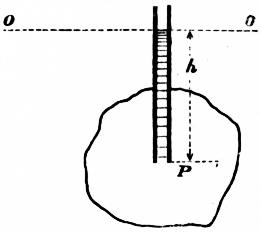
Fig. 3.
§ 9. Relation of Pressure, Volume, Temperature and Density in Compressible Fluids.—Certain problems on the flow of air and steam are so similar to those relating to the flow of water that they are conveniently treated together. It is necessary, therefore, to state as briefly as possible the properties of compressible fluids so far as knowledge of them is requisite in the solution of these problems. Air may be taken as a type of these fluids, and the numerical data here given will relate to air.
Relation of Pressure and Volume at Constant Temperature.—At constant temperature the product of the pressure p and volume V of a given quantity of air is a constant (Boyle’s law).
Let p0 be mean atmospheric pressure (2116.8 ℔ per sq. ft.), V0 the volume of 1 ℔ of air at 32° Fahr. under the pressure p0. Then
p0V0 = 26214.
(1)
If G0 is the weight per cubic foot of air in the same conditions,
G0 = 1/V0 = 2116.8/26214 = .08075.
(2)
For any other pressure p, at which the volume of 1 ℔ is V and the weight per cubic foot is G, the temperature being 32° Fahr.,
pV = p/G = 26214; or G = p/26214.
(3)
Change of Pressure or Volume by Change of Temperature.—Let p0, V0, G0, as before be the pressure, the volume of a pound in cubic feet, and the weight of a cubic foot in pounds, at 32° Fahr. Let p, V, G be the same quantities at a temperature t (measured strictly by the air thermometer, the degrees of which differ a little from those of a mercurial thermometer). Then, by experiment,
pV = p0V0 (460.6 + t) / (460.6 + 32) = p0V0τ/τ0,
(4)
where τ, τ0 are the temperatures t and 32° reckoned from the absolute zero, which is −460.6° Fahr.;
p/G = p0τ/G0τ0;
(4a)
G = pτ0G0/p0τ.
(5)
If p0 = 2116.8, G0 = .08075, τ0 = 460.6 + 32 = 492.6, then
p/G = 53.2τ.
(5a)
Or quite generally p/G = Rτ for all gases, if R is a constant varying inversely as the density of the gas at 32° F. For steam R = 85.5.
II. KINEMATICS OF FLUIDS
§ 10. Moving fluids as commonly observed are conveniently classified thus:
(1) Streams are moving masses of indefinite length, completely or incompletely bounded laterally by solid boundaries. When the solid boundaries are complete, the flow is said to take place in a pipe. When the solid boundary is incomplete and leaves the upper surface of the fluid free, it is termed a stream bed or channel or canal.
(2) A stream bounded laterally by differently moving fluid of the same kind is termed a current.
(3) A jet is a stream bounded by fluid of a different kind.
(4) An eddy, vortex or whirlpool is a mass of fluid the particles of which are moving circularly or spirally.
(5) In a stream we may often regard the particles as flowing along definite paths in space. A chain of particles following each other along such a constant path may be termed a fluid filament or elementary stream.
§ 11. Steady and Unsteady, Uniform and Varying, Motion.—There are two quite distinct ways of treating hydrodynamical questions. We may either fix attention on a given mass of fluid and consider its changes of position and energy under the action of the stresses to which it is subjected, or we may have regard to a given fixed portion of space, and consider the volume and energy of the fluid entering and leaving that space.
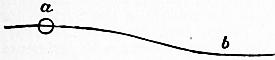
Fig. 4.
If, in following a given path ab (fig. 4), a mass of water a has a constant velocity, the motion is said to be uniform. The kinetic energy of the mass a remains unchanged. If the velocity varies from point to point of the path, the motion is called varying motion. If at a given point a in space, the particles of water always arrive with the same velocity and in the same direction, during any given time, then the motion is termed steady motion. On the contrary, if at the point a the velocity or direction varies from moment to moment the motion is termed unsteady. A river which excavates its own bed is in unsteady motion so long as the slope and form of the bed is changing. It, however, tends always towards a condition in which the bed ceases to change, and it is then said to have reached a condition of permanent regime. No river probably is in absolutely permanent regime, except perhaps in rocky channels. In other cases the bed is scoured more or less during the rise of a flood, and silted again during the subsidence of the flood. But while many streams of a torrential character change the condition of their bed often and to a large extent, in others the changes are comparatively small and not easily observed.
As a stream approaches a condition of steady motion, its regime becomes permanent. Hence steady motion and permanent regime are sometimes used as meaning the same thing. The one, however, is a definite term applicable to the motion of the water, the other a less definite term applicable in strictness only to the condition of the stream bed.
§ 12. Theoretical Notions on the Motion of Water.—The actual motion of the particles of water is in most cases very complex. To simplify hydrodynamic problems, simpler modes of motion are assumed, and the results of theory so obtained are compared experimentally with the actual motions.
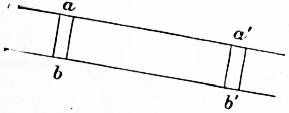
Fig. 5.
Motion in Plane Layers.—The simplest kind of motion in a stream is one in which the particles initially situated in any plane cross section of the stream continue to be found in plane cross sections during the subsequent motion. Thus, if the particles in a thin plane layer ab (fig. 5) are found again in a thin plane layer a′b′ after any interval of time, the motion is said to be motion in plane layers. In such motion the internal work in deforming the layer may usually be disregarded, and the resistance to the motion is confined to the circumference.
Laminar Motion.—In the case of streams having solid boundaries, it is observed that the central parts move faster than the lateral parts. To take account of these differences of velocity, the stream may be conceived to be divided into thin laminae, having cross sections somewhat similar to the solid boundary of the stream, and sliding on each other. The different laminae can then be treated as having differing velocities according to any law either observed or deduced from their mutual friction. A much closer approximation to the real motion of ordinary streams is thus obtained.
Stream Line Motion.—In the preceding hypothesis, all the particles in each lamina have the same velocity at any given cross section of the stream. If this assumption is abandoned, the cross section of the stream must be supposed divided into indefinitely small areas, each representing the section of a fluid filament. Then these filaments may have any law of variation of velocity assigned to them. If the motion is steady motion these fluid filaments (or as they are then termed stream lines) will have fixed positions in space.
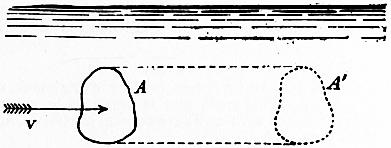
Fig. 6.
Periodic Unsteady Motion.—In ordinary streams with rough boundaries, it is observed that at any given point the velocity varies from moment to moment in magnitude and direction, but that the average velocity for a sensible period (say for 5 or 10 minutes) varies very little either in magnitude or velocity. It has hence been conceived that the variations of direction and magnitude of the velocity are periodic, and that, if for each point of the stream the mean velocity and direction of motion were substituted for the actual more or less varying motions, the motion of the stream might be treated as steady stream line or steady laminar motion.
§ 13. Volume of Flow.—Let A (fig. 6) be any ideal plane surface, of area ω, in a stream, normal to the direction of motion, and let V be the velocity of the fluid. Then the volume flowing through the surface A in unit time is
Q = ωV.
(1)
Thus, if the motion is rectilinear, all the particles at any instant in the surface A will be found after one second in a similar surface A′, at a distance V, and as each particle is followed by a continuous thread of other particles, the volume of flow is the right prism AA′ having a base ω and length V.
If the direction of motion makes an angle θ with the normal to the surface, the volume of flow is represented by an oblique prism AA′ (fig. 7), and in that case
Q = ωV cos θ.
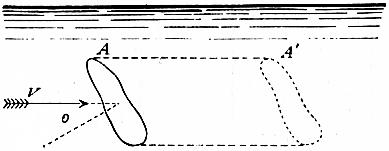
Fig. 7.
If the velocity varies at different points of the surface, let the surface be divided into very small portions, for each of which the velocity may be regarded as constant. If dω is the area and v, or v cos θ, the normal velocity for this element of the surface, the volume of flow is
Q = ∫ v dω, or ∫ v cos θ dω,
as the case may be.
§ 14. Principle of Continuity.—If we consider any completely bounded fixed space in a moving liquid initially and finally filled continuously with liquid, the inflow must be equal to the outflow. Expressing the inflow with a positive and the outflow with a negative sign, and estimating the volume of flow Q for all the boundaries,
ΣQ = 0.
In general the space will remain filled with fluid if the pressure at every point remains positive. There will be a break of continuity, if at any point the pressure becomes negative, indicating that the stress at that point is tensile. In the case of ordinary water this statement requires modification. Water contains a variable amount of air in solution, often about one-twentieth of its volume. This air is disengaged and breaks the continuity of the liquid, if the pressure falls below a point corresponding to its tension. It is for this reason that pumps will not draw water to the full height due to atmospheric pressure.
Application of the Principle of Continuity to the case of a Stream.—If A1, A2 are the areas of two normal cross sections of a stream, and V1, V2 are the velocities of the stream at those sections, then from the principle of continuity,
V1A1 = V2A2;
V1/V2 = A2/A1
(2)
that is, the normal velocities are inversely as the areas of the cross sections. This is true of the mean velocities, if at each section the velocity of the stream varies. In a river of varying slope the velocity varies with the slope. It is easy therefore to see that in parts of large cross section the slope is smaller than in parts of small cross section.
If we conceive a space in a liquid bounded by normal sections at A1, A2 and between A1, A2 by stream lines (fig. 8), then, as there is no flow across the stream lines,
V1/V2 = A2/A1,
as in a stream with rigid boundaries.
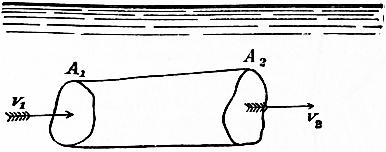
Fig. 8.
In the case of compressible fluids the variation of volume due to the difference of pressure at the two sections must be taken into account. If the motion is steady the weight of fluid between two cross sections of a stream must remain constant. Hence the weight flowing in must be the same as the weight flowing out. Let p1, p2 be the pressures, v1, v2 the velocities, G1, G2 the weight per cubic foot of fluid, at cross sections of a stream of areas A1, A2. The volumes of inflow and outflow are
A1v1 and A2v2,
and, if the weights of these are the same,
G1A1v1 = G2A2v2;
and hence, from (5a) § 9, if the temperature is constant,
p1A1v1 = p2A2v2.
(3)
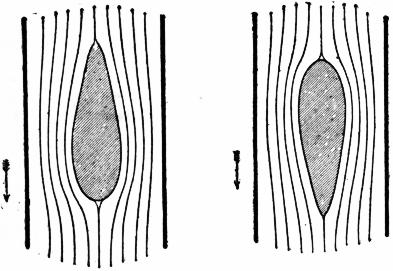
Fig. 9.
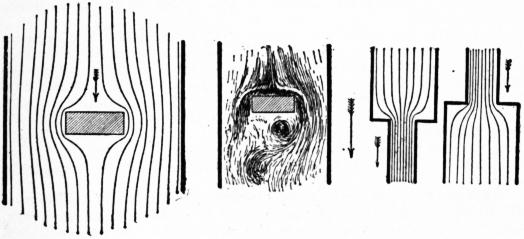
Fig. 10. Fig. 11. Fig. 12.
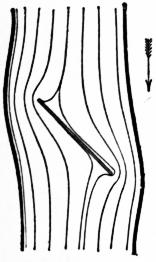
Fig. 13.
§ 15. Stream Lines.—The characteristic of a perfect fluid, that is, a fluid free from viscosity, is that the pressure between any two parts into which it is divided by a plane must be normal to the plane. One consequence of this is that the particles can have no rotation impressed upon them, and the motion of such a fluid is irrotational. A stream line is the line, straight or curved, traced by a particle in a current of fluid in irrotational movement. In a steady current each stream line preserves its figure and position unchanged, and marks the track of a stream of particles forming a fluid filament or elementary stream. A current in steady irrotational movement may be conceived to be divided by insensibly thin partitions following the course of the stream lines into a number of elementary streams. If the positions of these partitions are so adjusted that the volumes of flow in all the elementary streams are equal, they represent to the mind the velocity as well as the direction of motion of the particles in different parts of the current, for the velocities are inversely proportional to the cross sections of the elementary streams. No actual fluid is devoid of viscosity, and the effect of viscosity is to render the motion of a fluid sinuous, or rotational or eddying under most ordinary conditions. At very low velocities in a tube of moderate size the motion of water may be nearly pure stream line motion. But at some velocity, smaller as the diameter of the tube is greater, the motion suddenly becomes tumultuous. The laws of simple stream line motion have hitherto been investigated theoretically, and from mathematical difficulties have only been determined for certain simple cases. Professor H. S. Hele Shaw has found means of exhibiting stream line motion in a number of very interesting cases experimentally. Generally in these experiments a thin sheet of fluid is caused to flow between two parallel plates of glass. In the earlier experiments streams of very small air bubbles introduced into the water current rendered visible the motions of the water. By the use of a lantern the image of a portion of the current can be shown on a screen or photographed. In later experiments streams of coloured liquid at regular distances were introduced into the sheet and these much more clearly marked out the forms of the stream lines. With a fluid sheet 0.02 in. thick, the stream lines were found to be stable at almost any required velocity. For certain simple cases Professor Hele Shaw has shown that the experimental stream lines of a viscous fluid are so far as can be measured identical with the calculated stream lines of a perfect fluid. Sir G. G. Stokes pointed out that in this case, either from the thinness of the stream between its glass walls, or the slowness of the motion, or the high viscosity of the liquid, or from a combination of all these, the flow is regular, and the effects of inertia disappear, the viscosity dominating everything. Glycerine gives the stream lines very satisfactorily.
Fig. 9 shows the stream lines of a sheet of fluid passing a fairly shipshape body such as a screwshaft strut. The arrow shows the direction of motion of the fluid. Fig. 10 shows the stream lines for a very thin glycerine sheet passing a non-shipshape body, the stream lines being practically perfect. Fig. 11 shows one of the earlier air-bubble experiments with a thicker sheet of water. In this case the stream lines break up behind the obstruction, forming an eddying wake. Fig. 12 shows the stream lines of a fluid passing a sudden contraction or sudden enlargement of a pipe. Lastly, fig. 13 shows the stream lines of a current passing an oblique plane. H. S. Hele Shaw, “Experiments on the Nature of the Surface Resistance in Pipes and on Ships,” Trans. Inst. Naval Arch. (1897). “Investigation of Stream Line Motion under certain Experimental Conditions,” Trans. Inst. Naval Arch. (1898); “Stream Line Motion of a Viscous Fluid,” Report of British Association (1898).
III. PHENOMENA OF THE DISCHARGE OF LIQUIDS FROM ORIFICES AS ASCERTAINABLE BY EXPERIMENTS
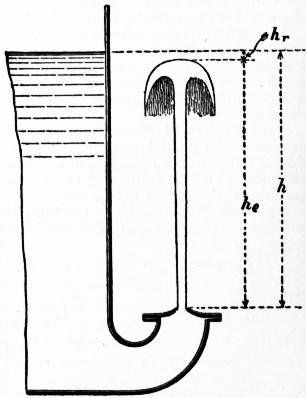
Fig. 14.
§ 16. When a liquid issues vertically from a small orifice, it forms a jet which rises nearly to the level of the free surface of the liquid in the vessel from which it flows. The difference of level hr (fig. 14) is so small that it may be at once suspected to be due either to air resistance on the surface of the jet or to the viscosity of the liquid or to friction against the sides of the orifice. Neglecting for the moment this small quantity, we may infer, from the elevation of the jet, that each molecule on leaving the orifice possessed the velocity required to lift it against gravity to the height h. From ordinary dynamics, the relation between the velocity and height of projection is given by the equation
v = √2gh.
(1)
As this velocity is nearly reached in the flow from well-formed orifices, it is sometimes called the theoretical velocity of discharge. This relation was first obtained by Torricelli.
If the orifice is of a suitable conoidal form, the water issues in filaments normal to the plane of the orifice. Let ω be the area of the orifice, then the discharge per second must be, from eq. (1),
Q = ωv = ω√2gh nearly.
(2)
This is sometimes quite improperly called the theoretical discharge for any kind of orifice. Except for a well-formed conoidal orifice the result is not approximate even, so that if it is supposed to be based on a theory the theory is a false one.
Use of the term Head in Hydraulics.—The term head is an old millwright’s term, and meant primarily the height through which a mass of water descended in actuating a hydraulic machine. Since the water in fig. 14 descends through a height h to the orifice, we may say there are h ft. of head above the orifice. Still more generally any mass of liquid h ft. above a horizontal plane may be said to have h ft. of elevation head relatively to that datum plane. Further, since the pressure p at the orifice which produces outflow is connected with h by the relation p/G = h, the quantity p/G may be termed the pressure head at the orifice. Lastly, the velocity v is connected with h by the relation v2/2g = h, so that v2/2g may be termed the head due to the velocity v.
§ 17. Coefficients of Velocity and Resistance.—As the actual velocity of discharge differs from √2gh by a small quantity, let the actual velocity
= va = cv √2gh,
(3)
where cv is a coefficient to be determined by experiment, called the coefficient of velocity. This coefficient is found to be tolerably constant for different heads with well-formed simple orifices, and it very often has the value 0.97.
The difference between the velocity of discharge and the velocity due to the head may be reckoned in another way. The total height h causing outflow consists of two parts—one part he expended effectively in producing the velocity of outflow, another hr in overcoming the resistances due to viscosity and friction. Let
hr = crhe,
where cr is a coefficient determined by experiment, and called the coefficient of resistance of the orifice. It is tolerably constant for different heads with well-formed orifices. Then
va = √2ghe = √ { 2gh / (1 + cr) }.
(4)
The relation between cv and cr for any orifice is easily found:—
va = cv√2gh = √ { 2gh / (1 + cr) }
cv = √ { 1 / (1 + cr) }
(5)
cr = 1 / cv2 − 1.
(5a)
Thus if cv = 0.97, then cr = 0.0628. That is, for such an orifice about 61⁄4% of the head is expended in overcoming frictional resistances to flow.
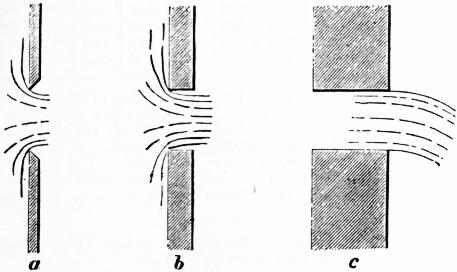
Fig. 15.
Coefficient of Contraction—Sharp-edged Orifices in Plane Surfaces.—When a jet issues from an aperture in a vessel, it may either spring clear from the inner edge of the orifice as at a or b (fig. 15), or it may adhere to the sides of the orifice as at c. The former condition will be found if the orifice is bevelled outwards as at a, so as to be sharp edged, and it will also occur generally for a prismatic aperture like b, provided the thickness of the plate in which the aperture is formed is less than the diameter of the jet. But if the thickness is greater the condition shown at c will occur.
When the discharge occurs as at a or b, the filaments converging towards the orifice continue to converge beyond it, so that the section of the jet where the filaments have become parallel is smaller than the section of the orifice. The inertia of the filaments opposes sudden change of direction of motion at the edge of the orifice, and the convergence continues for a distance of about half the diameter of the orifice beyond it. Let ω be the area of the orifice, and ccω the area of the jet at the point where convergence ceases; then cc is a coefficient to be determined experimentally for each kind of orifice, called the coefficient of contraction. When the orifice is a sharp-edged orifice in a plane surface, the value of cc is on the average 0.64, or the section of the jet is very nearly five-eighths of the area of the orifice.
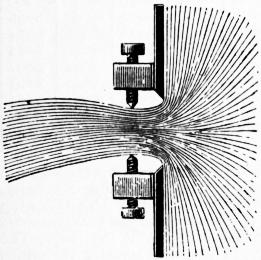
Fig. 16.
Coefficient of Discharge.—In applying the general formula Q = ωv to a stream, it is assumed that the filaments have a common velocity v normal to the section ω. But if the jet contracts, it is at the contracted section of the jet that the direction of motion is normal to a transverse section of the jet. Hence the actual discharge when contraction occurs is
Qa = cvv × ccω = cccvω √(2gh),
or simply, if c = cvcc,
Qa = cω √(2gh),
where c is called the coefficient of discharge. Thus for a sharp-edged plane orifice c = 0.97 × 0.64 = 0.62.
§ 18. Experimental Determination of cv, cc, and c.—The coefficient of contraction cc is directly determined by measuring the dimensions of the jet. For this purpose fixed screws of fine pitch (fig. 16) are convenient. These are set to touch the jet, and then the distance between them can be measured at leisure.
The coefficient of velocity is determined directly by measuring the parabolic path of a horizontal jet.
Let OX, OY (fig. 17) be horizontal and vertical axes, the origin being at the orifice. Let h be the head, and x, y the coordinates of a point A on the parabolic path of the jet. If va is the velocity at the orifice, and t the time in which a particle moves from O to A, then
x = vat; y = 1⁄2 gt2.
Eliminating t,
va = √ (gx2/2y).
Then
cv = va √ (2gh) = √ (x2/4yh).
In the case of large orifices such as weirs, the velocity can be directly determined by using a Pitot tube (§ 144).
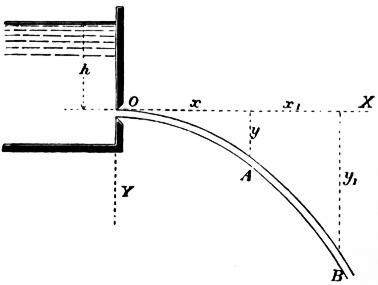
Fig. 17.
The coefficient of discharge, which for practical purposes is the most important of the three coefficients, is best determined by tank measurement of the flow from the given orifice in a suitable time. If Q is the discharge measured in the tank per second, then
c = Q/ω √ (2gh).
Measurements of this kind though simple in principle are not free from some practical difficulties, and require much care. In fig. 18 is shown an arrangement of measuring tank. The orifice is fixed in the wall of the cistern A and discharges either into the waste channel BB, or into the measuring tank. There is a short trough on rollers C which when run under the jet directs the discharge into the tank, and when run back again allows the discharge to drop into the waste channel. D is a stilling screen to prevent agitation of the surface at the measuring point, E, and F is a discharge valve for emptying the measuring tank. The rise of level in the tank, the time of the flow and the head over the orifice at that time must be exactly observed.
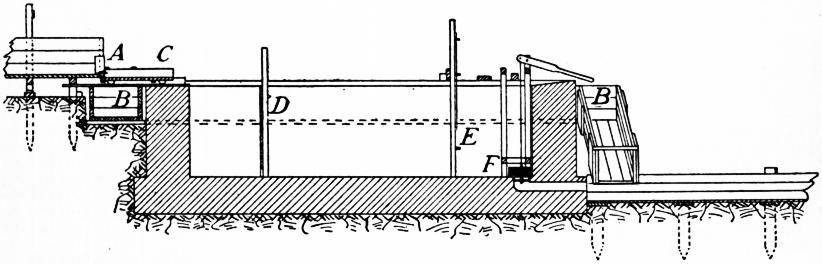
Fig. 18.
For well made sharp-edged orifices, small relatively to the water surface in the supply reservoir, the coefficients under different conditions of head are pretty exactly known. Suppose the same quantity of water is made to flow in succession through such an orifice and through another orifice of which the coefficient is required, and when the rate of flow is constant the heads over each orifice are noted. Let h1, h2 be the heads, ω1, ω2 the areas of the orifices, c1, c2 the coefficients. Then since the flow through each orifice is the same
Q = c1ω1 √ (2gh1) = c2ω2 √ (2gh2).
c2 = c1 (ω1/ω2) √ (h1/h2).
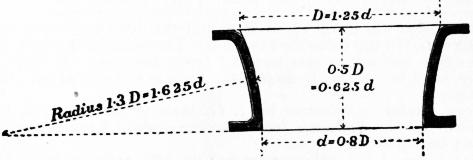
Fig. 19.
§ 19. Coefficients for Bellmouths and Bellmouthed Orifices.—If an orifice is furnished with a mouthpiece exactly of the form of the contracted vein, then the whole of the contraction occurs within the mouthpiece, and if the area of the orifice is measured at the smaller end, cc must be put = 1. It is often desirable to bellmouth the ends of pipes, to avoid the loss of head which occurs if this is not done; and such a bellmouth may also have the form of the contracted jet. Fig. 19 shows the proportions of such a bellmouth or bell-mouthed orifice, which approximates to the form of the contracted jet sufficiently for any practical purpose.
For such an orifice L. J. Weisbach found the following values of the coefficients with different heads.
Head over orifice, in ft. = h .66 1.64 11.48 55.77 337.93
Coefficient of velocity = cv .959 .967 .975 .994 .994
Coefficient of resistance = cr .087 .069 .052 .012 .012
As there is no contraction after the jet issues from the orifice, cc = 1, c = cv; and therefore
Q = cvω √ (2gh) = ω √ { 2gh / (1 + cr }.
§ 20. Coefficients for Sharp-edged or virtually Sharp-edged Orifices.—There are a very large number of measurements of discharge from sharp-edged orifices under different conditions of head. An account of these and a very careful tabulation of the average values of the coefficients will be found in the Hydraulics of the late Hamilton Smith (Wiley & Sons, New York, 1886). The following short table abstracted from a larger one will give a fair notion of how the coefficient varies according to the most trustworthy of the experiments.
Coefficient of Discharge for Vertical Circular Orifices, Sharp-edged, with free Discharge into the Air. Q = cω √ (2gh).
Head measured to Centre of Orifice. Diameters of Orifice.
.02 .04 .10 .20 .40 .60 1.0
Values of C.
0.3 .. .. .621 .. .. .. ..
0.4 .. .637 .618 .. .. .. ..
0.6 .655 .630 .613 .601 .596 .588 ..
0.8 .648 .626 .610 .601 .597 .594 .583
1.0 .644 .623 .608 .600 .598 .595 .591
2.0 .632 .614 .604 .599 .599 .597 .595
4.0 .623 .609 .602 .599 .598 .597 .596
8.0 .614 .605 .600 .598 .597 .596 .596
20.0 .601 .599 .596 .596 .596 .596 .594
At the same time it must be observed that differences of sharpness in the edge of the orifice and some other circumstances affect the results, so that the values found by different careful experimenters are not a little discrepant. When exact measurement of flow has to be made by a sharp-edged orifice it is desirable that the coefficient for the particular orifice should be directly determined.
The following results were obtained by Dr H. T. Bovey in the laboratory of McGill University.
Coefficient of Discharge for Sharp-edged Orifices.
Head in ft. Form of Orifice.
Circular. Square. Rectangular Ratio of Sides 4:1 Rectangular Ratio of Sides 16:1 Tri- angular.
Sides Vertical. Diagonal Vertical. Long Sides Vertical. Long Sides hori- zontal. Long Sides Vertical. Long Sides Hori- zontal.
1 .620 .627 .628 .642 .643 .663 .664 .636
2 .613 .620 .628 .634 .636 .650 .651 .628
4 .608 .616 .618 .628 .629 .641 .642 .623
6 .607 .614 .616 .626 .627 .637 .637 .620
8 .606 .613 .614 .623 .625 .634 .635 .619
10 .605 .612 .613 .622 .624 .632 .633 .618
12 .604 .611 .612 .622 .623 .631 .631 .618
14 .604 .610 .612 .621 .622 .630 .630 .618
16 .603 .610 .611 .620 .622 .630 .630 .617
18 .603 .610 .611 .620 .621 .630 .629 .616
20 .603 .609 .611 .620 .621 .629 .628 .616
The orifice was 0.196 sq. in. area and the reductions were made with g = 32.176 the value for Montreal. The value of the coefficient appears to increase as (perimeter) / (area) increases. It decreases as the head increases. It decreases a little as the size of the orifice is greater.
Very careful experiments by J. G. Mair (Proc. Inst. Civ. Eng. lxxxiv.) on the discharge from circular orifices gave the results shown on top of next column.
The edges of the orifices were got up with scrapers to a sharp square edge. The coefficients generally fall as the head increases and as the diameter increases. Professor W. C. Unwin found that the results agree with the formula
c = 0.6075 + 0.0098 / √ h − 0.0037d,
where h is in feet and d in inches.
Coefficients of Discharge from Circular Orifices. Temperature 51° to 55°.
Head in feet h. Diameters of Orifices in Inches (d).
1 11⁄4 11⁄2 13⁄4 2 21⁄4 21⁄2 23⁄4 3
Coefficients (c).
.75 .616 .614 .616 .610 .616 .612 .607 .607 .609
1.0 .613 .612 .612 .611 .612 .611 .604 .608 .609
1.25 .613 .614 .610 .608 .612 .608 .605 .605 .606
1.50 .610 .612 .611 .606 .610 .607 .603 .607 .605
1.75 .612 .611 .611 .605 .611 .605 .604 .607 .605
2.00 .609 .613 .609 .606 .609 .606 .604 .604 .605
The following table, compiled by J. T. Fanning (Treatise on Water Supply Engineering), gives values for rectangular orifices in vertical plane surfaces, the head being measured, not immediately over the orifice, where the surface is depressed, but to the still-water surface at some distance from the orifice. The values were obtained by graphic interpolation, all the most reliable experiments being plotted and curves drawn so as to average the discrepancies.
Coefficients of Discharge for Rectangular Orifices, Sharp-edged, in Vertical Plane Surfaces.
Head to Centre of Orifice. Ratio of Height to Width.
4 2 11⁄2 1 3⁄4 1⁄2 1⁄4 1⁄8
Feet. 4 ft. high. 1 ft. wide. 2 ft. high. 1 ft. wide. 11⁄2 ft. high. 1 ft. wide. 1 ft. high. 1 ft. wide. 0.75 ft. high. 1 ft. wide. 0.50 ft. high. 1 ft. wide. 0.25 ft. high. 1 ft. wide. 0.125 ft. high. 1 ft. wide.
0.2 .. .. .. .. .. .. .. .6333
.3 .. .. .. .. .. .. .6293 .6334
.4 .. .. .. .. .. .6140 .6306 .6334
.5 .. .. .. .. .6050 .6150 .6313 .6333
.6 .. .. .. .5984 .6063 .6156 .6317 .6332
.7 .. .. .. .5994 .6074 .6162 .6319 .6328
.8 .. .. .6130 .6000 .6082 .6165 .6322 .6326
.9 .. .. .6134 .6006 .6086 .6168 .6323 .6324
1.0 .. .. .6135 .6010 .6090 .6172 .6320 .6320
1.25 .. .6188 .6140 .6018 .6095 .6173 .6317 .6312
1.50 .. .6187 .6144 .6026 .6100 .6172 .6313 .6303
1.75 .. .6186 .6145 .6033 .6103 .6168 .6307 .6296
2 .. .6183 .6144 .6036 .6104 .6166 .6302 .6291
2.25 .. .6180 .6143 .6029 .6103 .6163 .6293 .6286
2.50 .6290 .6176 .6139 .6043 .6102 .6157 .6282 .6278
2.75 .6280 .6173 .6136 .6046 .6101 .6155 .6274 .6273
3 .6273 .6170 .6132 .6048 .6100 .6153 .6267 .6267
3.5 .6250 .6160 .6123 .6050 .6094 .6146 .6254 .6254
4 .6245 .6150 .6110 .6047 .6085 .6136 .6236 .6236
4.5 .6226 .6138 .6100 .6044 .6074 .6125 .6222 .6222
5 .6208 .6124 .6088 .6038 .6063 .6114 .6202 .6202
6 .6158 .6094 .6063 .6020 .6044 .6087 .6154 .6154
7 .6124 .6064 .6038 .6011 .6032 .6058 .6110 .6114
8 .6090 .6036 .6022 .6010 .6022 .6033 .6073 .6087
9 .6060 .6020 .6014 .6010 .6015 .6020 .6045 .6070
10 .6035 .6015 .6010 .6010 .6010 .6010 .6030 .6060
15 .6040 .6018 .6010 .6011 .6012 .6013 .6033 .6066
20 .6045 .6024 .6012 .6012 .6014 .6018 .6036 .6074
25 .6048 .6028 .6014 .6012 .6016 .6022 .6040 .6083
30 .6054 .6034 .6017 .6013 .6018 .6027 .6044 .6092
35 .6060 .6039 .6021 .6014 .6022 .6032 .6049 .6103