VOLUME XII SLICE VII Gyantse to Hallel
Reading edition
Articles in This Slice
GYANTSE HAHNEMANN, SAMUEL CHRISTIAN FRIEDRICH
GYGES HAHN-HAHN, IDA
GYLIPPUS HAI
GYLLEMBOURG-EHRENSVÄRD, THOMASINE CHRISTINE HAIBAK
GYLLENSTJERNA, JOHAN HAIDA
GYMKHANA HAIDINGER, WILHELM KARL
GYMNASTICS AND GYMNASIUM HAIDUK
GYMNOSOPHISTS HAIFA
GYMNOSPERMS HAIK
GYMNOSTOMACEAE HAIL
GYMPIE HAILES, DAVID DALRYMPLE
GYNAECEUM HAILSHAM
GYNAECOLOGY HAINAN
GYÖNGYÖSI, ISTVÁN HAINAU
GYÖR HAINAUT
GYP HAINBURG
GYPSUM HAINICHEN
GYROSCOPE AND GYROSTAT HAI-PHONG
GYTHIUM HAIR
GYULA-FEHÉRVÁR HAIR-TAIL
H HAITI
HAAG, CARL HAJIPUR
HAAKON HAJJ
HAARLEM HĀJJĪ KHALĪFA
HAARLEM LAKE HAKE, EDWARD
HAASE, FRIEDRICH HAKE, THOMAS GORDON
HAASE, FRIEDRICH GOTTLOB HAKE
HAAST, SIR JOHANN FRANZ JULIUS VON HAKKAS
HABABS HAKLUYT, RICHARD
HABAKKUK HAKODATE
HABDALA HAL
HABEAS CORPUS HALA
HABERDASHER HALAESA
HABINGTON, WILLIAM HALAKHA
HABIT HALBERSTADT
HABITAT HALBERT
HABSBURG HALDANE, JAMES ALEXANDER
HACHETTE, JEAN NICOLAS PIERRE HALDANE, RICHARD BURDON
HACHETTE, JEANNE HALDANE, ROBERT
HACHETTE, LOUIS CHRISTOPHE FRANÇOIS HALDEMAN, SAMUEL STEHMAN
HACHURE HALDIMAND, SIR FREDERICK
HACIENDA HALE, EDWARD EVERETT
HACKBERRY HALE, HORATIO
HACKENSACK HALE, JOHN PARKER
HACKET, JOHN HALE, SIR MATTHEW
HACKETT, HORATIO BALCH HALE, NATHAN
HACKETT, JAMES HENRY HALE, WILLIAM GARDNER
HACKLÄNDER, FRIEDRICH WILHELM VON HALEBID
HACKNEY (borough of London) HALES, JOHN (d. 1571)
HACKNEY (riding-horse) HALES, JOHN (1584-1656)
HADAD HALES, STEPHEN
HADDINGTON, EARL OF HALESOWEN
HADDINGTON HALEVI, JUDAH BEN SAMUEL
HADDINGTONSHIRE HALÉVY, JACQUES FRANÇOIS FROMENTAL ÉLIE
HADDOCK HALÉVY, LUDOVIC
HADDON HALL HALFPENNY, WILLIAM
HADEN, SIR FRANCIS SEYMOUR HALF-TIMBER WORK
HADENDOA HALFWAY COVENANT
HADERSLEBEN HALHED, NATHANIEL BRASSEY
HADING, JANE HALIBURTON, THOMAS CHANDLER
HADLEIGH HALIBUT
HADLEY, ARTHUR TWINING HALICARNASSUS
HADLEY, JAMES HALICZ
HADLEY HALIFAX, CHARLES MONTAGUE
HADRAMUT HALIFAX, GEORGE MONTAGU DUNK
HADRIA HALIFAX, GEORGE SAVILE
HADRIAN HALIFAX (Canada)
HADRIAN'S WALL HALIFAX (Yorkshire, England)
HADRUMETUM ḤALIṢAH
HAECKEL, ERNST HEINRICH HALKETT, HUGH
HAEMATITE HALL, BASIL
HAEMATOCELE HALL, CARL CHRISTIAN
HAEMOPHILIA HALL, CHARLES FRANCIS
HAEMORRHAGE HALL, CHRISTOPHER NEWMAN
HAEMORRHOIDS HALL, EDWARD
HAEMOSPORIDIA HALL, FITZEDWARD
HAETZER, LUDWIG HALL, ISAAC HOLLISTER
HĀFIZ HALL, SIR JAMES
HAG HALL, JAMES (American judge)
HAGEDORN, FRIEDRICH VON HALL, JAMES (American geologist)
HAGEN, FRIEDRICH HEINRICH VON DER HALL, JOSEPH
HAGEN HALL, MARSHALL
HAGENAU HALL, ROBERT
HAGENBACH, KARL RUDOLF HALL, SAMUEL CARTER
HAGENBECK, CARL HALL, WILLIAM EDWARD
HAGERSTOWN HALL (spa of Austria)
HAG-FISH HALL (town of Germany)
HAGGADA HALL (of a mansion)
HAGGAI HALLAM, HENRY
HAGGARD, HENRY RIDER HALLAM, ROBERT
HAGGIS HALLÉ, SIR CHARLES
HAGIOLOGY HALLE
HAGIOSCOPE HALLECK, FITZ-GREENE
HAGONOY HALLECK, HENRY WAGER
HAGUE, THE HÄLLEFLINTA
HAHN, AUGUST HALLEL
GYANTSE, one of the large towns of Tibet. It lies S.E. of Shigatse, 130 m. from the Indian frontier and 145 m. from Lhasa. Its central position at the junction of the roads from India and Bhutan with those from Ladakh and Central Asia leading to Lhasa makes it a considerable distributing trade centre. Its market is the third largest in Tibet, coming after Lhasa and Shigatse, and is especially celebrated for its woollen cloth and carpet manufactures. Here caravans come from Ladakh, Nepal and upper Tibet, bringing gold, borax, salt, wool, musk and furs, to exchange for tea, tobacco, sugar, cotton goods, broadcloth and hardware. The town is compactly built of stone houses, with wooden balconies facing the main street, whence narrow lanes strike off into uninviting slums, and contains a fort and monastery. In the British expedition of 1904 Gyantse formed the first objective of the advance, and the force was besieged here in the mission post of Changlo for some time. The Tibetans made a night attack on the post, and were beaten off with some difficulty, but subsequently the British attacked and stormed the fort or jong. Under the treaty of 1904 a British trade agent is stationed at Gyantse.
GYGES, founder of the third or Mermnad dynasty of Lydian kings, he reigned 687-652 B.C. according to H. Geizer, 690-657 B.C. according to H. Winckler. The chronology of the Lydian kings given by Herodotus has been shown by the Assyrian inscriptions to be about twenty years in excess. Gyges was the son of Dascylus, who, when recalled from banishment in Cappadocia by the Lydian king Sadyattes—called Candaules “the Dog-strangler” (a title of the Lydian Hermes) by the Greeks—sent his son back to Lydia instead of himself. Gyges soon became a favourite of Sadyattes and was despatched by him to fetch Tudo, the daughter of Arnossus of Mysia, whom the Lydian king wished to make his queen. On the way Gyges fell in love with Tudo, who complained to Sadyattes of his conduct. Forewarned that the king intended to punish him with death, Gyges assassinated Sadyattes in the night and seized the throne with the help of Arselis of Mylasa, the captain of the Carian bodyguard, whom he had won over to his cause. Civil war ensued, which was finally ended by an appeal to the oracle of Delphi and the confirmation of the right of Gyges to the crown by the Delphian god. Further to secure his title he married Tudo. Many legends were told among the Greeks about his rise to power. That found in Herodotus, which may be traced to the poet Archilochus of Paros, described how “Candaules” insisted upon showing Gyges his wife when unrobed, which so enraged her that she gave Gyges the choice of murdering her husband and making himself king, or of being put to death himself. Plato made Gyges a shepherd, who discovered a magic ring by means of which he murdered his master and won the affection of his wife (Hdt. i. 8-14; Plato, Rep. 359; Justin i. 7; Cicero, De off. iii. 9). Once established on the throne Gyges devoted himself to consolidating his kingdom and making it a military power. The Troad was conquered, Colophon captured from the Greeks, Smyrna besieged and alliances entered into with Ephesus and Miletus. The Cimmerii, who had ravaged Asia Minor, were beaten back, and an embassy was sent to Assur-bani-pal at Nineveh (about 650 B.C.) in the hope of obtaining his help against the barbarians. The Assyrians, however, were otherwise engaged, and Gyges turned to Egypt, sending his faithful Carian troops along with Ionian mercenaries to assist Psammetichus in shaking off the Assyrian yoke (660 B.C.). A few years later he fell in battle against the Cimmerii under Dugdammē (called Lygdamis by Strabo i. 3. 21), who took the lower town of Sardis. Gyges was succeeded by his son Ardys.
See Nicolaus Damascenus, quoting from the Lydian historian Xanthus, in C. Müller, Fragmenta historicorum Graecorum, iii.; R. Schubert, Geschichte der Könige von Lydien (1884); M. G. Radet, La Lydie et le monde grec au temps de Mermnades (1892-1893): H. Gelzer, “Das Zeitalter des Gyges” (Rhein. Mus., 1875); H. Winckler, Altorientalische Forschungen, i. (1893); Macan’s edition of Herodotus.
(A. H. S.)
GYLIPPUS, a Spartan general of the 5th century B.C.; he was the son of Cleandridas, who had been expelled from Sparta for accepting Athenian bribes (446 B.C.) and had settled at Thurii. His mother was probably a helot, for Gylippus is said to have been, like Lysander and Callicratidas, a mothax (see Helot). When Alcibiades urged the Spartans to send a general to lead the Syracusan resistance against the Athenian expedition, Gylippus was appointed, and his arrival was undoubtedly the turning point of the struggle (414-413). Though at first his long hair, his threadbare cloak and his staff furnished the subject of many a jest, and his harsh and overbearing manner caused grave discontent, yet the rapidity and decisiveness of his movements, won the sympathy and respect of the Syracusans. Diodorus (xiii. 28-32), probably following Timaeus, represents him as inducing the Syracusans to pass sentence of death on the captive Athenian generals, but we need have no hesitation in accepting the statement of Philistus (Plutarch, Nicias, 28), a Syracusan who himself took part in the defence, and Thucydides (vii. 86), that he tried, though without success, to save their lives, wishing to take them to Sparta as a signal proof of his success. Gylippus fell, as his father had done, through avarice; entrusted by Lysander with an immense sum which he was to deliver to the ephors at Sparta, he could not resist the temptation to enrich himself and, on the discovery of his guilt, went into exile.
Thucydides vi. 93. 104, vii.; Plutarch, Nicias, 19, 21, 27, 28, Lysander, 16, 17; Diodorus xiii. 7, 8, 28-32; Polyaenus i. 39. 42. See Syracuse (for the siege operations), commentaries on Thucydides and the Greek histories.
GYLLEMBOURG-EHRENSVÄRD, THOMASINE CHRISTINE, Baroness (1773-1856), Danish author, was born on the 9th of November 1773, at Copenhagen. Her maiden name was Buntzen. Her great beauty early attracted notice, and before she was seventeen she married the famous writer Peter Andreas Heiberg. To him she bore in the following year a son, afterwards illustrious as the poet and critic Johan Ludvig Heiberg. In 1800 her husband was exiled, and she obtained a divorce, marrying in December 1801 the Swedish Baron K. F. Ehrensvärd, himself a political fugitive. Her second husband, who presently adopted the name of Gyllembourg, died in 1815. In 1822 she followed her son to Kiel, where he was appointed professor, and in 1825 she returned with him to Copenhagen. In 1827 she first appeared as an author by publishing her romance of The Polonius Family in her son’s newspaper Flyvende Post. In 1828 the same journal contained The Magic Ring, which was immediately followed by En Hverdags historie (An Everyday Story). The success of this anonymous work was so great that the author adopted until the end of her career the name of “The Author of An Everyday Story.” In 1833-1834 she published three volumes of Old and New Novels. New Stories followed in 1835 and 1836. In 1839 appeared two novels, Montanus the Younger and Ricida; in 1840, One in All; in 1841, Near and Far; in 1843, A Correspondence; in 1844, The Cross Ways; in 1845, Two Generations. From 1849 to 1851 the Baroness Ehrensvärd-Gyllembourg was engaged in bringing out a library edition of her collected works in twelve volumes. On the 2nd of July 1856 she died in her son’s house at Copenhagen. Not until then did the secret of her authorship transpire; for throughout her life she had preserved the closest reticence on the subject even with her nearest friends. The style of Madame Ehrensvärd-Gyllembourg is clear and sparkling; for English readers no closer analogy can be found than between her and Mrs Gaskell, and Cranford might well have been written by the witty Danish authoress.
See J. L. Heiberg, Peter Andreas Heiberg og Thomasine Gyllembourg (Copenhagen, 1882), and L. Kornelius-Hybel, Nogle Bemaerkninger om P. A. Heiberg og Fru Gyllembourg (Copenhagen, 1883).
GYLLENSTJERNA, JOHAN, Count (1635-1680), Swedish statesman, completed his studies at Upsala and then visited most of the European states and laid the foundations of that deep insight into international politics which afterwards distinguished him. On his return home he met King Charles X. in the Danish islands and was in close attendance upon him till the monarch’s death in 1660. He began his political career at the diet which assembled in the autumn of the same year. An aristocrat by birth and inclination, he was nevertheless a true patriot and demanded the greatest sacrifices from his own order in the national interests. He was therefore one of those who laboured most zealously for the recovery of the crown lands. In the Upper House he was the spokesman of the gentry against the magnates, whose inordinate privileges he would have curtailed or abolished. His adversaries vainly endeavoured to gain him by favour, for as court-marshal and senator he was still more hostile to the dominant patricians who followed the adventurous policy of Magnus de la Gardie. Thus he opposed the French alliance which de la Gardie carried through in 1672, and consistently advocated economy in domestic and neutrality in foreign affairs. On the outbreak of the war in 1675 he was the most loyal and energetic supporter of the young Charles XI., and finally his indispensable counsellor. Indeed, it may be said, that the political principles which he instilled into the youthful monarch were faithfully followed by Charles during the whole of his reign. In 1679 Gyllenstjerna was appointed the Swedish plenipotentiary at the peace congress of Lund. The alliance which he then concluded with Denmark bound the two northern realms together in a common foreign policy, and he sought besides to facilitate their harmonious co-operation by every means in his power. In 1680, after bringing home Charles XI.’s Danish bride from Copenhagen, he was appointed governor-general of Scania (Skåne), but expired a few weeks later.
See M. Höjer, Öfversigt af Sveriges yttre politik under åren 1676-1680 (Upsala, 1875).
(R. N. B.)
GYMKHANA, a display of miscellaneous sports, originally at the military stations of India. The word would seem to be a colloquial remodelling of the Hindustani gend-khana, ball-house or racquet-court, by substituting for gend the first syllable of the English word “gymnastics.” The definition given in Yule’s Glossary is as follows: “A place of public resort at a station, where the needful facilities for athletics and games ... are provided.” The name of the place was afterwards applied to the games themselves, and the word is now used almost exclusively in this sense. According to Yule the first use of it that can be traced was, on the authority of Major John Trotter, at Rurki in the year 1861, when a gymkhana was instituted there. Gymkhana sports were invented to relieve the monotony of Indian station life, and both officers and men from the ranks took part in them. The first meetings consisted of promiscuous horse and pony races at catch weights. To these were soon added a second variety, originally called the pāgŏl (funny races), the one generally known outside India, which consisted of miscellaneous races and competitions of all kinds, some serious and some amusing, on horseback, on foot and on bicycles. Among these may be mentioned the usual military sports; such as tent-pegging, lemon-cutting and obstacle racing; rickshaw racing; tilting at the ring sack, pillion, hurdle, egg-and-spoon, blindfold, threading-the-needle and many other kinds of races depending upon the inventive powers of the committees in charge.
GYMNASTICS AND GYMNASIUM, terms signifying respectively a system of physical exercises practised either for recreation or for the purpose of promoting the health and development of the body, and the building where such exercises are carried on. The gymnasium of the Greeks was originally the school where competitors in the public games received their training, and was so named from the circumstance that these competitors exercised naked (γυμνός). The gymnasium was a public institution as distinguished from the palaestra, which was a private school where boys were trained in physical exercises, though the term palaestra is also often used for the part of a gymnasium specially devoted to wrestling and boxing. The athletic contests for which the gymnasium supplied the means of training and practice formed part of the social life of the Greeks from the earliest times. They were held in honour of heroes and gods; sometimes forming part of a periodic festival, sometimes of the funeral rites of a deceased chief. In course of time the Greeks grew more attached to such sports; their free active life, spent to a great extent in the open air, fostered the liking almost into a passion. The victor in any athletic contest, though he gained no money prize, was rewarded with the honour and respect of his fellow citizens; and a victory in the great religious festivals was counted an honour for the whole state. In these circumstances the training of competitors for the greater contests became a matter of public concern; and accordingly special buildings were provided by the state, and their management entrusted to public officials. The regulation of the gymnasium at Athens is attributed by Pausanias (i. 39. 3) to Theseus. Solon made several laws on the subject; but according to Galen it was reduced to a system in the time of Cleisthenes. Ten gymnasiarchs, one from each tribe, were appointed annually. These performed in rotation the duties of their office, which were to maintain and pay the persons who were training for public contests, to conduct the games at the great Athenian festivals, to exercise general supervision over the morals of the youths, and to adorn and keep up the gymnasium. This office was one of the ordinary λειτουργίαι (public services), and great expense was entailed on the holders. Under them were ten sophronistae, whose duty was to watch the conduct of the youths at all times, and especially to be present at all their games. The practical teaching and selecting of the suitable exercises for each youth were in the hands of the paedotribae and gymnastae, the latter of whom also superintended the effect on the constitution of the pupils, and prescribed for them when they were unwell. The aleiptae oiled and rubbed dust on the bodies of the youths, acted as surgeons, and administered the drugs prescribed. According to Galen there was also a teacher of the various games of ball. The gymnasia built to suit these various purposes were large buildings, which contained not merely places for each kind of exercise, but also a stadium, baths, covered porticos for practice in bad weather, and outer porticos where the philosophers and men of letters read public lectures and held disputations.
The gymnasium of the Greeks did not long remain an institution exclusively devoted to athletic exercises. It soon began to be applied to other uses even more important. The development arose naturally through the recognition by the Greeks of the important place in education occupied by physical culture, and of the relation between exercise and health. The gymnasium accordingly became connected with education on the one hand and with medicine on the other. Due training of the body and maintenance of the health and strength of children were the chief part of earlier Greek education. Except the time devoted to letters and music, the education of boys was conducted in the gymnasia, where provision was made, as already mentioned, for their moral as well as their physical training. As they grew older, conversation and social intercourse took the place of the more systematic discipline. Philosophers and sophists assembled to talk and to lecture in the gymnasia, which thus became places of general resort for the purpose of all less systematic intellectual pursuits, as well as for physical exercises. In Athens there were three great public gymnasia—Academy, Lyceum and Cynosarges—each of which was consecrated to a special deity with whose statue it was adorned; and each was rendered famous by association with a celebrated school of philosophy. Plato’s teaching in the Academy has given immortality to that gymnasium; Aristotle conferred lustre on the Lyceum; and the Cynosarges was the resort of the Cynics. Plato when treating of education devotes much consideration to gymnastics (see especially Rep. iii. and various parts of Laws); and according to Plato it was the sophist Prodicus who first pointed out the connexion between gymnastics and health. Having found such exercises beneficial to his own weak health, he formulated a method which was adopted generally, and which was improved by Hippocrates. Galen lays the greatest stress on the proper use of gymnastics, and throughout ancient medical writers we find that special exercises are prescribed as the cure for special diseases.
The Greek institution of the gymnasium never became popular with the Romans, who regarded the training of boys in gymnastics with contempt as conducive to idleness and immorality, and of little use from a military point of view; though at Sparta gymnastic training had been chiefly valued as encouraging warlike tastes and promoting the bodily strength needed for the use of weapons and the endurance of hardship. Among the Romans of the republic, the games in the Campus Martius, the duties of camp life, and the enforced marches and other hardships of actual warfare, served to take the place of the gymnastic exercises required by the Greeks. The first public gymnasium at Rome was built by Nero and another by Commodus. In the middle ages, though jousts and feats of horsemanship and field sports of various kinds were popular, the more systematic training of the body which the Greeks had associated with the gymnasium fell into neglect; while the therapeutic value of special exercises as understood by Hippocrates and Galen appears to have been lost sight of. Rousseau, in his Émile, was the first in modern times to call attention to the injurious consequences of such indifference, and he insisted on the importance of physical culture as an essential part of education. It was probably due in some measure to his influence that F. L. Jahn and his followers in Germany, encouraged by the Prussian minister Stein, established the Turnplätze, or gymnastic schools, which played an important part during the War of Liberation, and in the political agitations which followed the establishment of the German confederation by the Congress of Vienna. The educational reformers Pestalozzi and Froebel emphasized the need for systematic physical training in any complete scheme of education.
The later development of the classical gymnasium (when it had become the school of Intellectual culture rather than of exclusively physical exercise), and not the original idea, has been perpetuated in the modern use of the word in Germany, where the name “gymnasium” is given to the highest grade of secondary school, and the association of the word with athleticism has been entirely abandoned. On the other hand, in England, France and elsewhere in Europe, as well as in America, the history of the word has been precisely the reverse; the connexion of the gymnasium with philosophy and mental culture has been dropped, and it indicates a building exclusively intended for the practice of physical exercises. But whereas the Greeks received training in the gymnasium for contests which are now designated as athletic sports (q.v.), gymnastics in the modern sense is a term restricted to such exercises as are usually practised indoors, with or without the aid of mechanical appliances, as distinguished from sports or games practised in the open air.
It was not until near the end of the 19th century that gymnastics were recognized in England as anything more than a recreation; their value as a specifically therapeutic agent, or as an article in the curriculum of elementary schools, was not realized. More recently, however, educationists have urged with increasing insistence the need for systematic physical training, and their views received greater attention when evidence of deterioration in the physique of the people began to accumulate. During the first decade of the 20th century more than one commission reported to parliament in England in favour of more systematic and general physical training being encouraged or even made compulsory by public authority. Voluntary associations were formed for encouraging such training and providing facilities for it. Gymnastics had already for several years been an essential part of the training of army recruits with exceedingly beneficial results, and gymnasia had been established at Aldershot and other military centres. Physical exercises, although not compulsory, obtained a permanent place in the code for elementary schools in Great Britain; and much care has been taken to provide a syllabus of exercises adapted for the improvement of the physique of the children. These exercises are partly gymnastic and partly of the nature of drill; they do not in most cases require the use of appliances, and are on that account known as “free movements,” which numbers of children go through together, accompanied whenever possible by music. On the other hand at the larger public schools and universities there are elaborate gymnasia equipped with a great variety of apparatus, the skilful use of which demands assiduous practice; and this is encouraged by annual contests between teams of gymnasts representing rival institutions.
The appliances vary to some extent in different gymnasia, some of the more complicated requiring a greater amount of space and involving a larger cost than is often practicable. But where these considerations are negligible, substantial uniformity is to be found in the equipment Gymnastic apparatus. of gymnasia not designed for specifically medical purposes. The simplest, and in many respects the most generally useful, of all gymnastic apparatus is the dumb-bell. It was in use in England as early as the time of Elizabeth, and it has the advantage that it admits of being exactly proportioned to the individual strength of each learner, and can be adjusted in weight as his strength increases. The exercises that may be performed with the dumb-bell, combined with a few simple drill-like movements, give employment to all parts of the body and to both sides equally. Dumb-bell exercises, therefore, when arranged judiciously and with knowledge, are admirably suited for developing the physique, and are extensively employed in schools both for boys and girls. The bar-bell is merely a two-handed dumb-bell, and its use is similar in principle. The Indian club is also in use in most gymnasia; but the risk of overstraining the body by its unskilful handling makes it less generally popular than the dumb-bell. All these appliances may be, and often are, used either in ordinary schoolrooms or elsewhere outside the gymnasium. The usual fixed sorts of apparatus, the presence of which (or of some of them) in a building may be said to constitute it a gymnasium, are the following: a leaping-rope; a leaping-pole; a vaulting-horse; a horizontal bar, so mounted between two upright posts that its height from the ground may be adjusted as desired; parallel bars, used for exercises to develop the muscles of the trunk and arms; the trapeze consisting of a horizontal bar suspended by ropes at a height of 4 to 5 ft. from the ground; the bridge ladder; the plank; the inclined plane; the mast; swinging rings; the prepared wall; the horizontal beam.
Before the end of the 19th century the therapeutic value of gymnastics was fully realized by the medical profession; and a number of medical or surgical gymnasia came into existence, provided with specially devised apparatus for the treatment of different physical defects or weaknesses. The exercises practised in them are arranged upon scientific principles based on anatomical and physiological knowledge; and these principles have spread thence to influence largely the practice of gymnastics in schools and in the army. A French medical writer enumerates seven distinct groups of maladies, each including a number of different complaints, for which gymnastic exercises are a recognized form of treatment; and there are many malformations of the human body, formerly believed to be incurable, which are capable of being greatly remedied if not entirely corrected by regular gymnastic exercises practised under medical direction.
The value of gymnastics both for curing defects, and still more for promoting health and the development of normal physique, is recognized even more clearly on the continent of Europe than in Great Britain. In Germany the government not only controls the practice of gymnastics but makes it compulsory for every child and adult to undergo a prescribed amount of such physical training. In France also, physical training by gymnastics is under state control; in Sweden, Denmark, Switzerland, Italy, Russia, systems more or less distinct enjoy a wide popularity; and in Finland gymnastics are practised on lines that exhibit national peculiarities. The Finns introduce an exceptional degree of variety into their exercises as well as into the appliances devised to assist them; women are scarcely less expert than men in the performance of them; and the enthusiasm with which the system is supported produces the most beneficial results in the physique of the people. International gymnastic contests have become a feature of the revived Olympic Games (see Athletic Sports), and in those held at Athens in 1906 a team of Danish ladies took part in the competition and proved by their skilful performance that gymnastics may be practised with as much success by women as by men.
The chief work on the ancient gymnastics is Krause, Gymnastik und Agonistik der Hellenen (1841); of more recent works mention may be made of Jäger, Gymnastik der Hellenen (1881); L. Grasberger, Erziehung und Unterricht im klassischen Altertum (1881); J. P. Mahaffy, Old Greek Education (1883); A. S. Wilkins, National Education in Greece (1873); E. Paz, Histoire de la gymnastique (1886); Wickenhagen, Antike und moderne Gymnastik (1891); Becker-Göll, Charicles ii.; Brugsma, Gymnasiorum apud Graecos descriptio (1855); Petersen, Das Gymnasium der Griechen (1858). See also N. Laisné, Gymnastique pratique (Paris, 1879); Collineau, La Gymnastique (Paris, 1884); L’Hygiène à l’école (Paris, 1889); P. de Coubertin, La Gymnastique utilitaire (Paris, 1905); H. Nissen, Rational Home Gymnastics (Boston, 1903).
(R. J. M.)
GYMNOSOPHISTS (Lat. gymnosophistae, from Gr. γυμνός, σοφιστής, “naked philosophers”), the name given by the Greeks to certain ancient Hindu philosophers who pursued asceticism to the point of regarding food and clothing as detrimental to purity of thought. From the fact that they often lived as hermits in forests, the Greeks also called them Hylobioi (cf. the Vāna-prasthās in Sanskrit writings). Diogenes Laërtius (ix. 61 and 63) refers to them, and asserts that Pyrrho of Elis, the founder of pure scepticism, came under their influence, and on his return to Elis imitated their habits of life, to what extent does not appear. Strabo (xv. 711, 714) divides them into Brahmans and Sarmans (or Shamans). See Jains.
GYMNOSPERMS, in Botany. The Gymnosperms, with the Angiosperms, constitute the existing groups of seed-bearing plants or Phanerogams: the importance of the seed as a distinguishing feature in the plant kingdom may be emphasized by the use of the designation Spermophyta for these two groups, in contrast to the Pteridophyta and Bryophyta in which true seeds are unknown. Recent discoveries have, however, established the fact that there existed in the Palaeozoic era fern-like plants which produced true seeds of a highly specialized type; this group, for which Oliver and Scott proposed the term Pteridospermae in 1904, must also be included in the Spermophyta. Another instance of the production of seeds in an extinct plant which further reduces the importance of this character as a distinguishing feature is afforded by the Palaeozoic genus Lepidocarpon described by Scott in 1901; this lycopodiaceous type possessed an integumented megaspore, to which the designation seed may be legitimately applied (see Palaeobotany: Palaeozoic).
As the name Gymnosperm (Gr. γυμνός, naked, σπέρμα, seed) implies, one characteristic of this group is the absence of an ovary or closed chamber containing the ovules. It was the English botanist Robert Brown who first recognized this important distinguishing feature in conifers and cycads in 1825; he established the gymnospermy of these seed-bearing classes as distinct from the angiospermy of the monocotyledons and dicotyledons. As Sachs says in his history of botany, “no more important discovery was ever made in the domain of comparative morphology and systematic botany.” As Coulter and Chamberlain express it, “the habitats of the Gymnosperms to-day indicate that they either are not at home in the more genial conditions affected by Angiosperms, or have not been able to maintain themselves in competition with this group of plants.”
These naked-seeded plants are of special interest on account of their great antiquity, which far exceeds that of the Angiosperms, and as comprising different types which carry us back to the Palaeozoic era and to the forests of the coal period. The best known and by far the largest division of the Gymnosperms is that of the cone-bearing trees (pines, firs, cedars, larches, &c.), which play a prominent part in the vegetation of the present day, especially in the higher latitudes of the northern hemisphere; certain members of this class are of considerable antiquity, but the conifers as a whole are still vigorous and show but little sign of decadence. The division known as the Cycadophyta is represented by a few living genera of limited geographical range and by a large number of extinct types which in the Mesozoic era (see Palaeobotany: Mesozoic) played a conspicuous part in the vegetation of the world. Among existing Cycadophyta we find surviving types which, in their present isolation, their close resemblance to fossil forms, and in certain morphological features, constitute links with the past that not only connect the present with former periods in the earth’s history, but serve as sign-posts pointing the way back along one of the many lines which evolution has followed.
It is needless to discuss at length the origin of the Gymnosperms. The two views which find most favour in regard to the Coniferales and Cycadophyta are: (1) that both have been derived from remote filicinean ancestors; (2) that the cycads are the descendants of a fern-like stock, while conifers have been evolved from lycopodiaceous ancestors. The line of descent of recent cycads is comparatively clear in so far as they have undoubted affinity with Palaeozoic plants which combined cycadean and filicinean features; but opinion is much more divided as to the nature of the phylum from which the conifers are derived. The Cordaitales (see Palaeobotany: Palaeozoic) are represented by extinct forms only, which occupied a prominent position in the Palaeozoic period; these plants exhibit certain features in common with the living Araucarias, and others which invite a comparison with the maidenhair tree (Ginkgo biloba), the solitary survivor of another class of Gymnosperms, the Ginkgoales (see Palaeobotany: Mesozoic). The Gnetales are a class apart, including three living genera, of which we know next to nothing as regards their past history or line of descent. Although there are several morphological features in the three genera of Gnetales which might seem to bring them into line with the Angiosperms, it is usual to regard these resemblances as parallel developments along distinct lines rather than to interpret them as evidence of direct relationship.
Gymnospermae.—Trees or shrubs; leaves vary considerably in size and form. Flowers unisexual, except in a few cases (Gnetales) without a perianth. Monoecious or dioecious. Ovules naked, rarely without carpellary leaves, usually borne on carpophylls, which assume various forms. The single megaspore enclosed in the nucellus is filled with tissue (prothallus) before fertilization, and contains two or more archegonia, consisting usually of a large egg-cell and a small neck, rarely of an egg-cell only and no neck (Gnetum and Welwitschia). Microspore spherical or oval, with or without a bladder-like extension of the exine, containing a prothallus of two or more cells, one of which produces two non-motile or motile male cells. Cotyledons two or several. Secondary xylem and phloem produced by a single cambium, or by successive cambial zones; no true vessels (except in the Gnetales) in the wood, and no companion-cells in the phloem.
I. Pteridospermae (see Palaeobotany, Palaeozoic).
II. Cycadophyta.
A. Cycadales (recent and extinct).
B. Bennettitales (see Palaeobotany: Mesozoic).
III. Cordaitales (see Palaeobotany: Palaeozoic).
IV. Ginkgoales (recent and extinct).
V. Coniferales.
A. Taxaceae.
B. Pinaceae.
There is no doubt that the result of recent research and of work now in progress will be to modify considerably the grouping of the conifers. The family Araucarieae, represented by Araucaria and Agathis, should perhaps be separated as a special class and a rearrangement of other genera more in accord with a natural system of classification will soon be possible; but for the present its twofold subdivision may be retained.
VI. Gnetales.
A. Ephedroideae.
B. Gnetoideae.
C. Welwitschioideae (Tumboideae).
Cycadophyta.—A. Cycadales.—Stems tuberous or columnar, not infrequently branched, rarely epiphytic (Peruvian species of Zamia); fronds pinnate, bi-pinnate in the Australian genus Bowenia. Dioecious; flowers in the form of cones, except the female flowers of Cycas, which consist of a rosette of leaf-like carpels at the apex of the stem. Seeds albuminous, with one integument; the single embryo, usually bearing two partially fused cotyledons, is attached to a long tangled suspensor. Stems and roots increase in diameter by secondary thickening, the secondary wood being produced by one cambium or developed from successive cambium-rings.
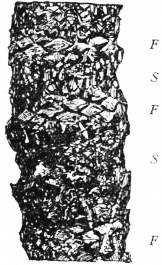
Fig. 1.—Stem of Cycas. F, foliage-leaf bases; S, scale-leaf bases.
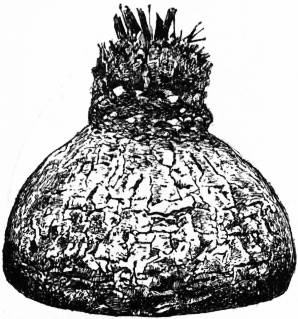
Fig. 2.—Cycas siamensis.
The cycads constitute a homogeneous group of a few living members confined to tropical and sub-tropical regions. As a fairly typical and well-known example of the Cycadaceae, a species of the genus Cycas (e.g. C. circinalis, C. revoluta, &c.) is briefly described. The stout columnar stem may reach a height of 20 metres, and a diameter of half a metre; it remains either unbranched or divides near the summit into several short and thick branches, each branch terminating in a crown of long pinnate leaves. The surface of the stem is covered with rhomboidal areas, which represent the persistent bases of foliage- and scale-leaves. In some species of Cycas there is a well-defined alternation of transverse zones on the stem, consisting of larger areas representing foliage-leaf bases, and similar but smaller areas formed by the bases of scale-leaves (F and S, fig. 1). The scale-leaves clothing the terminal bud are linear-lanceolate in form, and of a brown or yellow colour; they are pushed aside as the stem-axis elongates and becomes shrivelled, finally falling off, leaving projecting bases which are eventually cut off at a still lower level. Similarly, the dead fronds fall off, leaving a ragged petiole, which is afterwards separated from the stem by an absciss-layer a short distance above the base. In some species of Cycas the leaf-bases do not persist as a permanent covering to the stem, but the surface is covered with a wrinkled bark, as in Cycas siamensis, which has a stem of unusual form (fig. 2). Small tuberous shoots, comparable on a large scale with the bulbils of Lycopodium Selago, are occasionally produced in the axils of some of the persistent leaf-bases; these are characteristic of sickly plants, and serve as a means of vegetative reproduction. In the genus Cycas the female flower is peculiar among cycads in consisting of a terminal crown of separate leaf-like carpels several inches in length; the apical portion of each carpellary leaf may be broadly triangular in form, and deeply dissected on the margins into narrow woolly appendages like rudimentary pinnae. From the lower part of a carpel are produced several laterally placed ovules, which become bright red or orange on ripening; the bright fleshy seeds, which in some species are as large as a goose’s egg, and the tawny spreading carpels produce a pleasing combination of colour in the midst of the long dark-green fronds, which curve gracefully upwards and outwards from the summit of the columnar stem. In Cycas the stem apex, after producing a cluster of carpellary leaves, continues to elongate and produces more bud-scales, which are afterwards pushed aside as a fresh crown of fronds is developed. The young leaves of Cycas consist of a straight rachis bearing numerous linear pinnae, traversed by a single midrib; the pinnae are circinately coiled like the leaf of a fern (fig. 3). The male flower of Cycas conforms to the type of structure characteristic of the cycads, and consists of a long cone of numerous sporophylls bearing many oval pollen-sacs on their lower faces. The type described serves as a convenient representative of its class. There are eight other living genera, which may be classified as follows:—

Fig. 3.—Cycas. Young Frond.
Classification.—A. Cycadeae.—Characterized by (a) the alternation of scale- and foliage-leaves (fig. 1) on the branched or unbranched stem; (b) the growth of the main stem through the female flower; (c) the presence of a prominent single vein in the linear pinnae; (d) the structure of the female flower, which is peculiar in not having the form of a cone, but consists of numerous independent carpels, each of which bears two or more lateral ovules. Represented by a single genus, Cycas. (Tropical Asia, Australia, &c.).
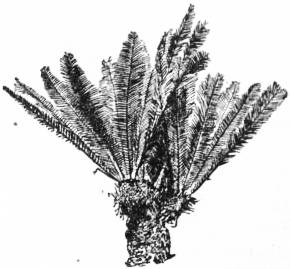
B. Zamieae.—The stem does not grow through the female flower; both male and female flowers are in the form of cones. (a) Stangerieae.—Characterized by the fern-like venation of the pinnae, which have a prominent midrib, giving off at a wide angle simple or forked and occasionally anastomosing lateral veins. A single genus, Stangeria, confined to South Africa, (b) Euzamieae.—The pinnae are traversed by several parallel veins. Bowenia, an Australian cycad, is peculiar in having bi-pinnate fronds (fig. 5). The various genera are distinguished from one another by the shape and manner of attachment of the pinnae, the form of the carpellary scales, and to some extent by anatomical characters. Encephalartos (South and Tropical Africa).—Large cones; the carpellary scales terminate in a peltate distal expansion. Macrozamia (Australia).—Similar to Encephalartos except in the presence of a spinous projection from the swollen distal end of the carpels. Zamia (South America, Florida, &c.).—Stem short and often divided into several columnar branches. Each carpel terminates in a peltate head. Ceratozamia (Mexico).—Similar in habit to Macrozamia, but distinguished by the presence of two horn-like spinous processes on the apex of the carpels. Microcycas (Cuba).—Like Zamia, except that the ends of the stamens are flat, while the apices of the carpels are peltate. Dioon (Mexico) (fig. 4).—Characterized by the woolly scale-leaves and carpels; the latter terminate in a thick laminar expansion of triangular form, bearing two placental cushions, on which the ovules are situated. Bowenia (Australia).—Bi-pinnate fronds; stem short and tuberous (fig. 5).
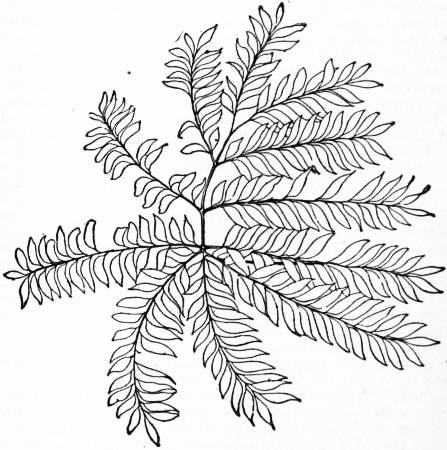
From a photograph of a plant in Peradeniya Gardens, Ceylon, by Professor R. H. Yapp. Fig. 5.—Bowenia spectabilis: frond.
Fig. 4.—Dioon edule.
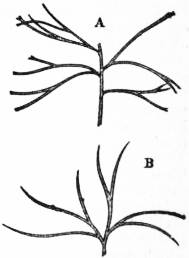
Fig. 6.—Macrozamia heteromera. A, part of frond; B, single pinna.
The stems of cycads are often described as unbranched; it is true that in comparison with conifers, in which the numerous branches, springing from the main stem, give a characteristic form to the tree, the tuberous or columnar stem of the Cycadaceae Stem and leaf. constitutes a striking distinguishing feature. Branching, however, occurs not infrequently: in Cycas the tall stem often produces several candelabra-like arms; in Zamia the main axis may break up near the base into several cylindrical branches; in species of Dioon (fig. 4) lateral branches are occasionally produced. The South African Encephalartos frequently produces several branches. Probably the oldest example of this genus in cultivation is in the Botanic Garden of Amsterdam, its age is considered by Professor de Vries to be about two thousand years: although an accurate determination of age is impossible, there is no doubt that many cycads grow very slowly and are remarkable for longevity. The thick armour of petiole-bases enveloping the stem is a characteristic Cycadean feature; in Cycas the alternation of scale-leaves and fronds is more clearly shown than in other cycads; in Encephalartos, Dioon, &c., the persistent scale-leaf bases are almost equal in size to those of the foliage-leaves, and there is no regular alternation of zones such as characterizes some species of Cycas. Another type of stem is illustrated by Stangeria and Zamia, also by a few forms of Cycas (fig. 2), in which the fronds fall off completely, leaving a comparatively smooth stem. The Cyas type of frond, except as regards the presence of a midrib in each pinna, characterizes the cycads generally, except Bowenia and Stangeria. In the monotypic genus Bowenia the large fronds, borne singly on the short and thick stem, are bi-pinnate (fig. 5); the segments, which are broadly ovate or rhomboidal, have several forked spreading veins, and resemble the large pinnules of some species of Adiantum. In Stangeria, also a genus represented by one species (S. paradoxa of South Africa), the long and comparatively broad pinnae, with an entire or irregularly incised margin, are very fern-like, a circumstance which led Kunze to describe the plant in 1835 as a species of the fern Lomaria. In rare cases the pinnae of cycads are lobed or branched: in Dioon spinulosum (Central America) the margin of the segments bears numerous spinous processes; in some species of Encephalartos, e.g. E. horridus, the lamina is deeply lobed; and in a species of the Australian genus Macrozamia, M. heteromera, the narrow pinnae are dichotomously branched almost to the base (fig. 6), and resemble the frond of some species of the fern Schizaea, or the fossil genus Baiera (Ginkgoales). An interesting species of Cycas, C. Micholitzii, has recently been described by Sir William Thiselton-Dyer from Annam, where it was collected by one of Messrs Sanders & Son’s collectors, in which the pinnae instead of being of the usual simple type are dichotomously branched as in Macrozamia heteromera. In Ceratozamia the broad petiole-base is characterized by the presence of two lateral spinous processes, suggesting stipular appendages, comparable, on a reduced scale, with the large stipules of the Marattiaceae among Ferns. The vernation varies in different genera; in Cycas the rachis is straight and the pinnae circinately coiled (fig. 3); in Encephalartos, Dioon, &c., both rachis and segments are straight; in Zamia the rachis is bent or slightly coiled, bearing straight pinnae. The young leaves arise on the stem-apex as conical protuberances with winged borders on which the pinnae appear as rounded humps, usually in basipetal order; the scale-leaves in their young condition resemble fronds, but the lamina remains undeveloped. A feature of interest in connexion with the phylogeny of cycads is the presence of long hairs clothing the scale-leaves, and forming a cap on the summit of the stem-apex or attached to the bases of petioles; on some fossil cycadean plants these outgrowths have the form of scales, and are identical in structure with the ramenta (paleae) of the majority of ferns.
The male flowers of cycads are constructed on a uniform plan, and in all cases consist of an axis bearing crowded, spirally disposed sporophylls. These are often wedge-shaped and angular; in some cases they consist of a short, thick Flower. stalk, terminating in a peltate expansion, or prolonged upwards in the form of a triangular lamina. The sporangia (pollen-sacs), which occur on the under-side of the stamens, are often arranged in more or less definite groups or sori, interspersed with hairs (paraphyses); dehiscence takes place along a line marked out by the occurrence of smaller and thinner-walled cells bounded by larger and thicker-walled elements, which form a fairly prominent cap-like “annulus” near the apex of the sporangium, not unlike the annulus characteristic of the Schizaeaceae among ferns. The sporangial wall, consisting of several layers of cells, encloses a cavity containing numerous oval spores (pollen-grains). In structure a cycadean sporangium recalls those of certain ferns (Marattiaceae, Osmundaceae and Schizaeaceae), but in the development of the spores there are certain peculiarities not met with among the Vascular Cryptogams. With the exception of Cycas, the female flowers are also in the form of cones, bearing numerous carpellary scales. In Cycas revoluta and C. circinalis each leaf-like carpel may produce several laterally attached ovules, but in C. Normanbyana the carpel is shorter and the ovules are reduced to two; this latter type brings us nearer to the carpels of Dioon, in which the flower has the form of a cone, and the distal end of the carpels is longer and more leaf-like than in the other genera of the Zamieae, which are characterized by shorter carpels with thick peltate heads bearing two ovules on the morphologically lower surface. The cones of cycads attain in some cases (e.g. Encephalartos) a considerable size, reaching a length of more than a foot. Cases have been recorded (by Thiselton-Dyer in Encephalartos and by Wieland in Zamia) in which the short carpellary cone-scales exhibit a foliaceous form. It is interesting that no monstrous cycadean cone has been described in which ovuliferous and staminate appendages are borne on the same axis: in the Bennettitales (see Palaeobotany: Mesozoic) flowers were produced bearing on the same axis both androecium and gynoecium.
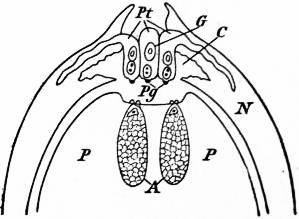
Fig. 7.—Zamia. Part of Ovule in longitudinal section. (After Webber.)
P, Prothallus. A, Archegonia. N, Nucellus. C, Pollen-chamber. Pt, Pollen-tube. Pg, Pollen-grain. G, Generative cell (second cell of pollen-tube).
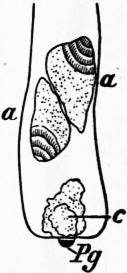
Fig. 8.—Zamia. Proximal end of Pollen-tube, a, a, Spermatozoids from G of fig. 7; Pg, pollen-grain; c, proximal cell (first cell). (After Webber.)
The pollen-grains when mature consist of three cells, two small and one large cell; the latter grows into the pollen-tube, as in the Coniferales, and from one of the small cells two large ciliated spermatozoids are eventually produced. A Microspores and megaspores. remarkable exception to this rule has recently been recorded by Caldwell, who found that in Microcycas Calocoma the body-cells may be eight or even ten in number and the sperm-cells twice as numerous. One of the most important discoveries made during the latter part of the 19th century was that by Ikeno, a Japanese botanist, who first demonstrated the existence of motile male cells in the genus Cycas. Similar spermatozoids were observed in some species of Zamia by H. J. Webber, and more recent work enables us to assume that all cycads produce ciliated male gametes. Before following the growth of the pollen-grain after pollination, we will briefly describe the structure of a cycadean ovule. An ovule consists of a conical nucellus surrounded by a single integument. At an early stage of development a large cell makes its appearance in the central region of the nucellus; this increases in size and eventually forms three cells; the lowest of these grows vigorously and constitutes the megaspore (embryo-sac), which ultimately absorbs the greater part of the nucellus. The megaspore-nucleus divides repeatedly, and cells are produced from the peripheral region inwards, which eventually fill the spore-cavity with a homogeneous tissue (prothallus); some of the superficial cells at the micropylar end of the megaspore increase in size and divide by a tangential wall into two, an upper cell which gives rise to the short two-celled neck of the archegonium, and a lower cell which develops into a large egg-cell. Each megaspore may contain 2 to 6 archegonia. During the growth of the ovum nourishment is supplied from the contents of the cells immediately surrounding the egg-cell, as in the development of the ovum of Pinus and other conifers. Meanwhile the tissue in the apical region of the nucellus has been undergoing disorganization, which results in the formation of a pollen-chamber (fig. 7, C) immediately above the megaspore. Pollination in cycads has always been described as anemophilous, but according to recent observations by Pearson on South African species it seems probable that, at least in some cases, the pollen is conveyed to the ovules by animal agency. The pollen-grains find their way between the carpophylls, which at the time of pollination are slightly apart owing to the elongation of the internodes of the flower-axis, and pass into the pollen-chamber; the large cell of the pollen-grain grows out into a tube (Pt), which penetrates the nucellar tissue and often branches repeatedly; the pollen-grain itself, with the prothallus-cells, projects freely into the pollen-chamber (fig. 7). The nucleus of the outermost (second) small cell (fig. 7, G) divides, and one of the daughter-nuclei passes out of the cell, and may enter the lowest (first) small cell. The outermost cell, by the division of the remaining nucleus, produces two large spermatozoids (fig. 8, a, a). In Microcycas 16 sperm-cells are produced. In the course of division two bodies appear in the cytoplasm, and behave as centrosomes during the karyokinesis; they gradually become threadlike and coil round each daughter nucleus. This thread gives rise to a spiral ciliated band lying in a depression on the body of each spermatozoid; the large spermatozoids eventually escape from the pollen-tube, and are able to perform ciliary movements in the watery liquid which occurs between the thin papery remnant of nucellar tissue and the archegonial necks. Before fertilization a neck-canal cell is formed by the division of the ovum-nucleus. After the body of a spermatozoid has coalesced with the egg-nucleus the latter divides repeatedly and forms a mass of tissue which grows more vigorously in the lower part of the fertilized ovum, and extends upwards towards the apex of the ovum as a peripheral layer of parenchyma surrounding a central space. By further growth this tissue gives rise to a proembryo, which consists, at the micropylar end, of a sac; the tissue at the chalazal end grows into a long and tangled suspensor, terminating in a mass of cells, which is eventually differentiated into a radicle, plumule and two cotyledons. In the ripe seed the integument assumes the form of a fleshy envelope, succeeded internally by a hard woody shell, internal to which is a thin papery membrane—the apical portion of the nucellus—which is easily dissected out as a conical cap covering the apex of the endosperm. A thorough examination of cycadean seeds has recently been made by Miss Stopes, more particularly with a view to a comparison of their vascular supply with that in Palaeozoic gymnospermous seeds (Flora, 1904). The first leaves borne on the seedling axis are often scale-like, and these are followed by two or more larger laminae, which foreshadow the pinnae of the adult frond.
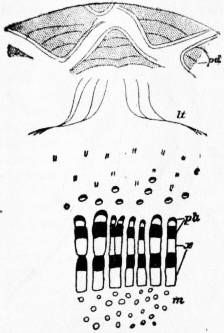
Fig. 9.—Macrozamia. Diagrammatic transverse section of part of Stem. (After Worsdell.)
pd, Periderm in leaf-bases. lt, Leaf-traces in cortex. ph, Phloem. x, Xylem. m, Medullary bundles. c, Cortical bundles.
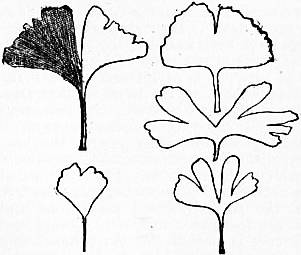
Fig. 10.—Ginkgo biloba. Leaves.
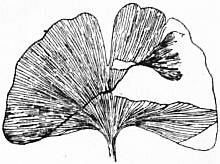
Fig. 11.—Ginkgo adiantoides. Fossil (Eocene) leaf from the Island of Mull.
The anatomical structure of the vegetative organs of recent cycads is of special interest as affording important evidence of relationship with extinct types, and with other groups of recent plants. Brongniart, who Anatomy. was the first to investigate in detail the anatomy of a cycadean stem, recognized an agreement, as regards the secondary wood, with Dicotyledons and Gymnosperms, rather than with Monocotyledons. He drew attention also to certain structural similarities between Cycas and Ginkgo. The main anatomical features of a cycad stem may be summarized as follows: the centre is occupied by a large parenchymatous pith traversed by numerous secretory canals, and in some genera by cauline vascular bundles (e.g. Encephalartos and Macrozamia). In addition to these cauline strands (confined to the stem and not connected with the leaves), collateral bundles are often met with in the pith, which form the vascular supply of terminal flowers borne at intervals on the apex of the stem. These latter bundles may be seen in sections of old stems to pursue a more or less horizontal course, passing outwards through the main woody cylinder. This lateral course is due to the more vigorous growth of the axillary branch formed near the base of each flower, which is a terminal structure, and, except in the female flower of Cycas, puts a limit to the apical growth of the stem. The vigorous lateral branch therefore continues the line of the main axis. The pith is encircled by a cylinder of secondary wood, consisting of single or multiple radial rows of tracheids separated by broad medullary rays composed of large parenchymatous cells; the tracheids bear numerous bordered pits on the radial walls. The large medullary rays give to the wood a characteristic parenchymatous or lax appearance, which is in marked contrast to the more compact wood of a conifer. The protoxylem-elements are situated at the extreme inner edge of the secondary wood, and may occur as small groups of narrow, spirally-pitted elements scattered among the parenchyma which abuts on the main mass of wood. Short and reticulately-pitted tracheal cells, similar to tracheids, often occur in the circummedullary region of cycadean stems. In an old stem of Cycas, Encephalartos or Macrozamia the secondary wood consists of several rather unevenly concentric zones, while in some other genera it forms a continuous mass as in conifers and normal dicotyledons. These concentric rings of secondary xylem and phloem (fig. 9) afford a characteristic cycadean feature. After the cambium has been active for some time producing secondary xylem and phloem, the latter consisting of sieve-tubes, phloem-parenchyma and frequently thick-walled fibres, a second cambium is developed in the pericycle; this produces a second vascular zone, which is in turn followed by a third cambium, and so on, until several hollow cylinders are developed. It has been recently shown that several cambium-zones may remain in a state of activity, so that the formation of a new cambium does not necessarily mark a cessation of growth in the more internal meristematic rings. It occasionally happens that groups of xylem and phloem are developed internally to some of the vascular rings; these are characterized by an inverse orientation of the tissues, the xylem being centrifugal and the phloem centripetal in its development. The broad cortical region, which contains many secretory canals, is traversed by numerous vascular bundles (fig. 9, c) some of which pursue a more or less vertical course, and by frequent anastomoses with one another form a loose reticulum of vascular strands; others are leaf-traces on their way from the stele of the stem to the leaves. Most of these cortical bundles are collateral in structure, but in some the xylem and phloem are concentrically arranged; the secondary origin of these bundles from procambium-strands was described by Mettenius in his classical paper of 1860. During the increase in thickness of a cycadean stem successive layers of cork-tissue are formed by phellogens in the persistent bases of leaves (fig. 9, pd), which increase in size to adapt themselves to the growth of the vascular zones. The leaf-traces of cycads are remarkable both on account of their course and their anatomy. In a transverse section of a stem (fig. 9) one sees some vascular bundles following a horizontal or slightly oblique course in the cortex, stretching for a longer or shorter distance in a direction concentric with the woody cylinder. From each leaf-base two main bundles spread right and left through the cortex of the stem (fig. 9, lt), and as they curve gradually towards the vascular ring they present the appearance of two rather flat ogee curves, usually spoken of as the leaf-trace girdles (fig. 9, lt). The distal ends of these girdles give off several branches, which traverse the petiole and rachis as numerous collateral bundles. The complicated girdle-like course is characteristic of the leaf-traces of most recent cycads, but in some cases, e.g. in Zamia floridana, the traces are described by Wieland in his recent monograph on American fossil cycads (Carnegie Institution Publications, 1906) as possessing a more direct course similar to that in Mesozoic genera. A leaf-trace, as it passes through the cortex, has a collateral structure, the protoxylem being situated at the inner edge of the xylem; when it reaches the leaf-base the position of the spiral tracheids is gradually altered, and the endarch arrangement (protoxylem internal) gives place to a mesarch structure (protoxylem more or less central and not on the edge of the xylem strand). In a bundle examined in the basal portion of a leaf the bulk of the xylem is found to be centrifugal in position, but internally to the protoxylem there is a group of centripetal tracheids; higher up in the petiole the xylem is mainly centripetal, the centrifugal wood being represented by a small arc of tracheids external to the protoxylem and separated from it by a few parenchymatous elements. Finally, in the pinnae of the frond the centrifugal xylem may disappear, the protoxylem being now exarch in position and abutting on the phloem. Similarly in the sporophylls of some cycads the bundles are endarch near the base and mesarch near the distal end of the stamen or carpel. The vascular system of cycadean seedlings presents some features worthy of note; centripetal xylem occurs in the cotyledonary bundles associated with transfusion-tracheids. The bundles from the cotyledons pursue a direct course to the stele of the main axis, and do not assume the girdle-form characteristic of the adult plant. This is of interest from the point of view of the comparison of recent cycads with extinct species (Bennettites), in which the leaf-traces follow a much more direct course than in modern cycads. The mesarch structure of the leaf-bundles is met with in a less pronounced form in the flower peduncles of some cycads. This fact is of importance as showing that the type of vascular structure, which characterized the stems of many Palaeozoic genera, has not entirely disappeared from the stems of modern cycads; but the mesarch bundle is now confined to the leaves and peduncles. The roots of some cycads Roots. resemble the stems in producing several cambium-rings; they possess 2 to 8 protoxylem-groups, and are characterized by a broad pericyclic zone. A common phenomenon in cycads is the production of roots which grow upwards (apogeotropic), and appear as coralline branched structures above the level of the ground; some of the cortical cells of these roots are hypertrophied, and contain numerous filaments of blue-green Algae (Nostocaceae), which live as endoparasites in the cell-cavities.
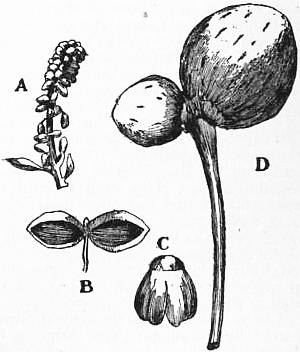
Fig. 12.—Ginkgo biloba. A, Male flower; B, C, single stamens; D, female flower.
Ginkgoales.—This class-designation has been recently proposed to give emphasis to the isolated position of the genus Ginkgo (Salisburia) among the Gymnosperms. Ginkgo biloba, the maidenhair tree, has usually been placed by botanists in the Taxeae in the neighbourhood of the yew (Taxus), but the proposal by Eichler in 1852 to institute a special family, the Salisburieae, indicated a recognition of the existence of special characteristics which distinguish the genus from other members of the Coniferae. The discovery by the Japanese botanist Hirase of the development of ciliated spermatozoids in the pollen-tube of Ginkgo, in place of the non-motile male cells of typical conifers, served as a cogent argument in favour of separating the genus from the Coniferales and placing it in a class of its own. In 1712 Kaempfer published a drawing of a Japanese tree, which he described under the name Ginkgo; this term was adopted in 1771 by Linnaeus, who spoke of Kaempfer’s plant as Ginkgo biloba. In 1797 Smith proposed to use the name Salisburia adiantifolia in preference to the “uncouth” genus Ginkgo and “incorrect” specific term biloba. Both names are still in common use. On account of the resemblance of the leaves to those of some species of Adiantum, the appellation maidenhair tree has long been given to Ginkgo biloba. Ginkgo is of special interest on account of its isolated position among existing plants, its restricted geographical distribution, and its great antiquity (see Palaeobotany: Mesozoic). This solitary survivor of an ancient stock is almost extinct, but a few old and presumably wild trees are recorded by travellers in parts of China. Ginkgo is common as a sacred tree in the gardens of temples in the Far East, and often cultivated in North America and Europe. Ginkgo biloba, which may reach a height of over 30 metres, forms a tree of pyramidal shape with a smooth grey bark. The leaves (figs. 10 and 11) have a long, slender petiole terminating in a fan-shaped lamina, which may be entire, divided by a median incision into two wedge-shaped lobes, or subdivided into several narrow segments. The venation is like that of many ferns, e.g. Adiantum; the lowest vein in each half of the lamina follows a course parallel to the edge, and gives off numerous branches, which fork repeatedly as they spread in a palmate manner towards the leaf margin. The foliage-leaves occur either scattered on long shoots of unlimited growth, or at the apex of short shoots (spurs), which may eventually elongate into long shoots.
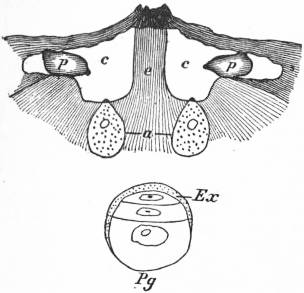
Fig. 13.—Ginkgo. Apex of Ovule, and Pollen-grain. (After Hirase.)
p, Pollen-tube (proximal end). c, Pollen-chamber. e, Upward prolongation of megaspore. a, Archegonia. Pg, Pollen-grain. Ex, Exine.
The flowers are dioecious. The male flowers (fig. 12), borne in the axil of scale-leaves, consist of a stalked central axis bearing loosely disposed stamens; each stamen consists of a slender filament terminating in a small apical scale, which bears Flowers. usually two, but not infrequently three or four pollen-sacs (fig. 12, C). The axis of the flower is a shoot bearing leaves in the form of stamens. A mature pollen-grain contains a prothallus of 3 to 5 cells (Fig. 13, Pg); the exine extends over two-thirds of the circumference, leaving a thin portion of the wall, which on collapsing produces a longitudinal groove similar to the median depression on the pollen-grain of a cycad. The ordinary type of female flower has the form of a long, naked peduncle bearing a single ovule on either side of the apex (fig. 12), the base of each being enclosed by a small, collar-like rim, the nature of which has been variously interpreted. A young ovule consists of a conical nucellus surrounded by a single integument terminating as a two-lipped micropyle. A large pollen-chamber occupies the apex of the nucellus; immediately below this, two or more archegonia (fig. 13, a) are developed in the upper region of the megaspore, each consisting of a large egg-cell surmounted by two neck-cells and a canal-cell which is cut off shortly before fertilization. After the entrance of the pollen-grain the pollen-chamber becomes roofed over by a blunt protuberance of nucellar tissue. The megaspore (embryo-sac) continues to grow after pollination until the greater part of the nucellus is gradually destroyed; it also gives rise to a vertical outgrowth, which projects from the apex of the megaspore as a short, thick column (fig. 13, e) supporting the remains of the nucellar tissue which forms the roof of the pollen-chamber (fig. 13, c). Surrounding the pitted wall of the ovum there is a definite layer of large cells, no doubt representing a tapetum, which, as in cycads and conifers, plays an important part in nourishing the growing egg-cell. The endosperm detached from a large Ginkgo ovule after fertilization bears a close resemblance to that of a cycad; the apex is occupied by a depression, on the floor of which two small holes mark the position of the archegonia, and the outgrowth from the megaspore apex projects from the centre as a short peg. After pollination the pollen-tube grows into the nucellar tissue, as in cycads, and the pollen-grain itself (fig. 13, Pg) hangs down into the pollen-chamber; two large spirally ciliated spermatozoids are produced, their manner of development agreeing very closely with that of the corresponding cells in Cycas and Zamia. After fertilization the ovum-nucleus divides and cell-formation proceeds rapidly, especially in the lower part of the ovum, in which the cotyledon and axis of the embryo are differentiated; the long, tangled suspensor of the cycadean embryo is not found in Ginkgo. It is often stated that fertilization occurs after the ovules have fallen, but it has been demonstrated by Hirase that this occurs while the ovules are still attached to the tree. The ripe seed, which grows as large as a rather small plum, is enclosed by a thick, fleshy envelope covering a hard woody shell with two or rarely three longitudinal keels. A papery remnant of nucellus lines the inner face of the woody shell, and, as in cycadean seeds, the apical portion is readily separated as a cap covering the summit of the endosperm.
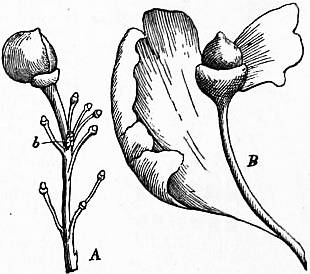
Fig. 14.—Ginkgo. Abnormal female Flowers. A, Peduncle; b, scaly bud; B, leaf bearing marginal ovule. (After Fujii.)
The morphology of the female flowers has been variously interpreted by botanists; the peduncle bearing the ovules has been described as homologous with the petiole of a foliage-leaf and as a shoot-structure, the collar-like envelope at the base of the ovules being referred to as a second integument or arillus, or as the representative of a carpel. The evidence afforded by normal and abnormal flowers appears to be in favour of the following interpretation: The peduncle is a shoot bearing two or more carpels. Each ovule is enclosed at the base by an envelope or collar homologous with the lamina of a leaf; the fleshy and hard coats of the nucellus constitute a single integument. The stalk of an ovule, considerably reduced in normal flowers and much larger in some abnormal flowers, is homologous with a leaf-stalk, with which it agrees in the structure and number of vascular bundles. The facts on which this description is based are derived partly from anatomical evidence, and in part from an account given by a Japanese botanist, Fujii, of several abnormal female flowers; in some cases the collar at the base of an ovule, often described as an arillus, is found to pass gradually into the lamina of a leaf bearing marginal ovules (fig. 14, B). The occurrence of more than two ovules on one peduncle is by no means rare; a particularly striking example is described by Fujii, in which an unusually thick peduncle bearing several stalked ovules terminates in a scaly bud (fig. 14, A, b). The frequent occurrence of more than two pollen-sacs and the equally common occurrence of additional ovules have been regarded by some authors as evidence in favour of the view that ancestral types normally possessed a greater number of these organs than are usually found in the recent species. This Anatomy. view receives support from fossil evidence. Close to the apex of a shoot the vascular bundles of a leaf make their appearance as double strands, and the leaf-traces in the upper part of a shoot have the form of distinct bundles, which in the older part of the shoot form a continuous ring. Each double leaf-trace passes through four internodes before becoming a part of the stele; the double nature of the trace is a characteristic feature. Secretory sacs occur abundantly in the leaf-lamina, where they appear as short lines between the veins; they are abundant also in the cortex and pith of the shoot, in the fleshy integument of the ovule, and elsewhere. The secondary wood of the shoot and root conforms in the main to the coniferous type; in the short shoots the greater breadth of the medullary rays in the more internal part of the xylem recalls the cycadean type. The secondary phloem contains numerous thick-walled fibres, parenchymatous cells, and large sieve-tubes with plates on the radial walls; swollen parenchymatous cells containing crystals are commonly met with in the cortex, pith and medullary-ray tissues. The wood consists of tracheids, with circular bordered pits on their radial walls, and in the late summer wood pits are unusually abundant on the tangential walls. A point of anatomical interest is the occurrence in the vascular bundles of the cotyledons, scale-leaves, and elsewhere of a few centripetally developed tracheids, which give to the xylem-strands a mesarch structure such as characterizes the foliar bundles of cycads. The root is diarch in structure, but additional protoxylem-strands may be present at the base of the main root; the pericycle consists of several layers of cells.
This is not the place to discuss in detail the past history of Ginkgo (see Palaeobotany: Mesozoic). Among Palaeozoic genera there are some which bear a close resemblance to the recent type in the form of the leaves; and petrified Palaeozoic seeds, Geological history. almost identical with those of the maidenhair tree, have been described from French and English localities. During the Triassic and Jurassic periods the genus Baiera—no doubt a representative of the Ginkgoales—was widely spread throughout Europe and in other regions; Ginkgo itself occurs abundantly in Mesozoic and Tertiary rocks, and was a common plant in the Arctic regions as elsewhere during the Jurassic and Lower Cretaceous periods. Some unusually perfect Ginkgo leaves have been found in the Eocene leaf-beds between the lava-flows exposed in the cliffs of Mull (fig. 11). From an evolutionary point of view, it is of interest to note the occurrence of filicinean and cycadean characters in the maidenhair tree. The leaves at once invite a comparison with ferns; the numerous long hairs which form a delicate woolly covering on young leaves recall the hairs of certain ferns, but agree more closely with the long filamentous hairs of recent cycads. The spermatozoids constitute the most striking link with both cycads and ferns. The structure of the seed, the presence of two neck-cells in the archegonia, the late development of the embryo, the partially-fused cotyledons and certain anatomical characters, are features common to Ginkgo and the cycads. The maidenhair tree is one of the most interesting survivals from the past; it represents a type which, in the Palaeozoic era, may have been merged into the extinct class Cordaitales. Through the succeeding ages the Ginkgoales were represented by numerous forms, which gradually became more restricted in their distribution and fewer in number during the Cretaceous and Tertiary periods, terminating at the present day in one solitary survivor.
Coniferales.—Trees and shrubs characterized by a copious branching of the stem and frequently by a regular pyramidal form. Leaves simple, small, linear or short and scale-like, usually persisting for more than one year. Flowers monoecious or dioecious, unisexual, without a perianth, often in the form of cones, but never terminal on the main stem.
The plants usually included in the Coniferae constitute a less homogeneous class than the Cycadaceae. Some authors use the term Coniferae in a restricted sense as including those genera which have the female flowers in the form of cones, External features. the other genera, characterized by flowers of a different type, being placed in the Taxaceae, and often spoken of as Taxads. In order to avoid confusion in the use of the term Coniferae, we may adopt as a class-designation the name Coniferales, including both the Coniferae—using the term in a restricted sense—and the Taxaceae. The most striking characteristic of the majority of the Coniferales is the regular manner of the monopodial branching and the pyramidal shape. Araucaria imbricata, the Monkey-puzzle tree, A. excelsa, the Norfolk Island pine, many pines and firs, cedars and other genera illustrate the pyramidal form. The mammoth redwood tree of California, Sequoia (Wellingtonia) gigantea, which represents the tallest Gymnosperm, is a good example of the regular tapering main stem and narrow pyramidal form. The cypresses afford instances of tall and narrow trees similar in habit to Lombardy poplars. The common cypress (Cupressus sempervirens), as found wild in the mountains of Crete and Cyprus, is characterized by long and spreading branches, which give it a cedar-like habit. A pendulous or weeping habit is assumed by some conifers, e.g. Picea excelsa var. virgata represents a form in which the main branches attain a considerable horizontal extension, and trail themselves like snakes along the ground. Certain species of Pinus, the yews (Taxus) and some other genera grow as bushes, which in place of a main mast-like stem possess several repeatedly-branched leading shoots. The unfavourable conditions in Arctic regions have produced a dwarf form, in which the main shoots grow close to the ground. Artificially induced dwarfed plants of Pinus, Cupressus, Sciadopitys (umbrella pine) and other genera are commonly cultivated by the Japanese. The dying off of older branches and the vigorous growth of shoots nearer the apex of the stem produce a form of tree illustrated by the stone pine of the Mediterranean region (Pinus Pinea), which Turner has rendered familiar in his “Childe Harold’s Pilgrimage” and other pictures of Italian scenery. Conifers are not infrequently seen in which a lateral branch has bent sharply upwards to take the place of the injured main trunk. An upward tendency of all the main lateral branches, known as fastigiation, is common in some species, producing well-marked varieties, e.g. Cephalotaxus pedunculata var. fastigiata; this fastigiate habit may arise as a sport on a tree with spreading branches. Another departure from the normal is that in which the juvenile or seedling form of shoot persists in the adult tree; the numerous coniferous plants known as species of Retinospora are examples of this. The name Retinospora, therefore, does not stand for a true genus, but denotes persistent young forms of Juniperus, Thuja, Cupressus, &c., in which the small scaly leaves of ordinary species are replaced by the slender, needle-like leaves, which stand out more or less at right angles from the branches. The flat branchlets of Cupressus, Thuja (arbor vitae), Thujopsis dolabrata (Japanese arbor vitae) are characteristic of certain types of conifers; in some cases the horizontal extension of the branches induces a dorsiventral structure. A characteristic feature of the genus Agathis (Dammara) the Kauri pine of New Zealand, is the deciduous habit of the branches; these become detached from the main trunk leaving a well-defined absciss-surface, which appears as a depressed circular scar on the stem. A new genus of conifers, Taiwania, has recently been described from the island of Formosa; it is said to agree in habit with the Japanese Cryptomeria, but the cones appear to have a structure which distinguishes them from those of any other genus.
With a few exceptions conifers are evergreen, and retain the leaves for several years (10 years in Araucaria imbricata, 8 to 10 in Picea excelsa, 5 in Taxus baccata; in Pinus the needles usually fall in October of their third year). The larch (Larix) Leaves. sheds its leaves in the autumn, in the Chinese larch (Pseudolarix Kaempferi) the leaves turn a bright yellow colour before falling. In the swamp cypress (Taxodium distichum) the tree assumes a rich brown colour in the autumn, and sheds its leaves together with the branchlets which bear them; deciduous branches occur also in some other species, e.g. Sequoia sempervirens (redwood), Thuja occidentalis, &c. The leaves of conifers are characterized by their small size, e.g. the needle-form represented by Pinus, Cedrus, Larix, &c., the linear flat or angular leaves, appressed to the branches, of Thuja, Cupressus, Libocedrus, &c. The flat and comparatively broad leaves of Araucaria imbricata, A. Bidwillii, and some species of the southern genus Podocarpus are traversed by several parallel veins, as are also the still larger leaves of Agathis, which may reach a length of several inches. In addition to the foliage-leaves several genera also possess scale-leaves of various kinds, represented by bud-scales in Pinus, Picea, &c., which frequently persist for a time at the base of a young shoot which has pushed its way through the yielding cap of protecting scales, while in some conifers the bud-scales adhere together, and after being torn near the base are carried up by the growing axis as a thin brown cap. The cypresses, araucarias and some other genera have no true bud-scales; in some species, e.g. Araucaria Bidwillii, the occurrence of small foliage-leaves, which have functioned as bud-scales, at intervals on the shoots affords a measure of seasonal growth. The occurrence of long and short shoots is a characteristic feature of many conifers. In Pinus the needles occur in pairs, or in clusters of 3 or 5 at the apex of a small and inconspicuous short shoot of limited growth (spur), which is enclosed at its base by a few scale-leaves, and borne on a branch of unlimited growth in the axil of a scale-leaf. In the Californian Pinus monophylla each spur bears usually one needle, but two are not uncommon; it would seem that rudiments of two needles are always produced, but, as a rule, only one develops into a needle. In Sciadopitys similar spurs occur, each bearing a single needle, which in its grooved surface and in the possession of a double vascular bundle bears traces of an origin from two needle-leaves. A peculiarity of these leaves is the inverse orientation of the vascular tissue; each of the two veins has its phloem next the upper and the xylem towards the lower surface of the leaf; this unusual position of the xylem and phloem may be explained by regarding the needle of Sciadopitys as being composed of a pair of leaves borne on a short axillary shoot and fused by their margins (fig. 15, A). Long and short shoots occur also in Cedrus and Larix, but in these genera the spurs are longer and stouter, and are not shed with the leaves; this kind of short shoot, by accelerated apical growth, often passes into the condition of a long shoot on which the leaves are scattered and separated by comparatively long internodes, instead of being crowded into tufts such as are borne on the ends of the spurs. In the genus Phyllocladus (New Zealand, &c.) there are no green foliage-leaves, but in their place flattened branches (phylloclades) borne in the axils of small scale-leaves. The cotyledons are often two in number, but sometimes (e.g. Pinus) as many as fifteen; these leaves are usually succeeded by foliage-leaves in the form of delicate spreading needles, and these primordial leaves are followed, sooner or later, by the adult type of leaf, except in Retinosporas, which retain the juvenile foliage. In addition to the first foliage-leaves and the adult type of leaf, there are often produced leaves which are intermediate both in shape and structure between the seedling and adult foliage. Dimorphism or heterophylly is fairly common. One of the best known examples is the Chinese juniper (Juniperus chinensis), in which branches with spinous leaves, longer and more spreading than the ordinary adult leaf, are often found associated with the normal type of branch. In some cases, e.g. Sequoia sempervirens, the fertile branches bear leaves which are less spreading than those on the vegetative shoots. Certain species of the southern hemisphere genus Dacrydium afford particularly striking instances of heterophylly, e.g. D. Kirkii of New Zealand, in which some branches bear small and appressed leaves, while in others the leaves are much longer and more spreading. A well-known fossil conifer from Triassic strata—Voltzia heterophylla—also illustrates a marked dissimilarity in the leaves of the same shoot. The variation in leaf-form and the tendency of leaves to arrange themselves in various ways on different branches of the same plant are features which it is important to bear in mind in the identification of fossil conifers. In this connexion we may note the striking resemblance between some of the New Zealand Alpine Veronicas, e.g. Veronica Hectori, V. cupressoides, &c. (also Polycladus cupressinus, a Composite), and some of the cypresses and other conifers with small appressed leaves. The long linear leaves of some species of Podocarpus, in which the lamina is traversed by a single vein, recall the pinnae of Cycas; the branches of some Dacrydiums and other forms closely resemble those of lycopods; these superficial resemblances, both between different genera of conifers and between conifers and other plants, coupled with the usual occurrence of fossil coniferous twigs without cones attached to them, render the determination of extinct types a very unsatisfactory and frequently an impossible task.
A typical male flower consists of a central axis bearing numerous spirally-arranged sporophylls (stamens), each of which consists of a slender stalk (filament) terminating distally in a more or less prominent knob or triangular scale, and bearing Flowers. two or more pollen-sacs (microsporangia) on its lower surface. The pollen-grains of some genera (e.g. Pinus) are furnished with bladder-like extensions of the outer wall, which serve as aids to wind-dispersal. The stamens of Araucaria and Agathis are peculiar in bearing several long, and narrow free pollen-sacs; these may be compared with the sporangiophores of the horsetails (Equisetum); in Taxus (yew) the filament is attached to the centre of a large circular distal expansion, which bears several pollen-sacs on its under surface. In the conifers proper the female reproductive organs have the form of cones, which may be styled flowers or inflorescences according to different interpretations of their morphology. In the Taxaceae the flowers have a simpler structure. The female flowers of the Abietineae may be taken as representing a common type. A pine cone reaches maturity in two years; a single year suffices for the full development in Larix and several other genera. The axis of the cone bears numerous spirally disposed flat scales (cone-scales), each of which, if examined in a young cone, is found to be double, and to consist of a lower and an upper portion. The latter is a thin flat scale bearing a median ridge or keel (e.g. Abies), on each side of which is situated an inverted ovule, consisting of a nucellus surrounded by a single integument. As the cone grows in size and becomes woody the lower half of the cone-scale, which we may call the carpellary scale, may remain small, and is so far outgrown by the upper half (seminiferous scale) that it is hardly recognizable in the mature cone. In many species of Abies (e.g. Abies pectinata, &c.) the ripe cone differs from those of Pinus, Picea and Cedrus in the large size of the carpellary scales, which project as conspicuous thin appendages beyond the distal margins of the broader and more woody seminiferous scales; the long carpellary scale is a prominent feature also in the cone of the Douglas pine (Pseudotsuga Douglasii). The female flowers (cones) vary considerably in size; the largest are the more or less spherical cones of Araucaria—a single cone of A. imbricata may produce as many as 300 seeds, one seed to each fertile cone-scale—and the long pendent cones, 1 to 2 ft. in length, of the sugar pine of California (Pinus Lambertiana) and other species. Smaller cones, less than an inch long, occur in the larch, Athrotaxis (Tasmania), Fitzroya (Patagonia and Tasmania), &c. In the Taxodieae and Araucarieae the cones are similar in appearance to those of the Abietineae, but they differ in the fact that the scales appear to be single, even in the young condition; each cone-scale in a genus of the Taxodiinae (Sequoia, &c.) bears several seeds, while in the Araucariinae (Araucaria and Agathis) each scale has one seed. The Cupressineae have cones composed of a few scales arranged in alternate whorls; each scale bears two or more seeds, and shows no external sign of being composed of two distinct portions. In the junipers the scales become fleshy as the seeds ripen, and the individual scales fuse together in the form of a berry. The female flowers of the Taxaceae assume another form; in Microcachrys (Tasmania) the reproductive structures are spirally disposed, and form small globular cones made up of red fleshy scales, to each of which is attached a single ovule enclosed by an integument and partially invested by an arillus; in Dacrydium the carpellary leaves are very similar to the foliage leaves—each bears one ovule with two integuments, the outer of which constitutes an arillus. Finally in the yew, as a type of the family Taxeae, the ovules occur singly at the apex of a lateral branch, enclosed when ripe by a conspicuous red or yellow fleshy arillus, which serves as an attraction to animals, and thus aids in the dispersal of the seeds.
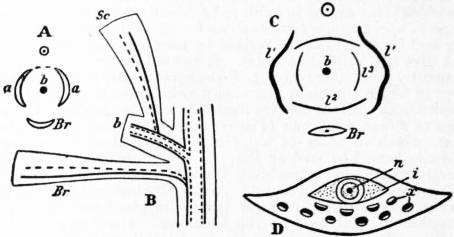
(C and D after Worsdell.)
Fig. 15.—Diagrammatic treatment of: A, Double needle of Sciadopitys (a, a, leaves; b, shoot; Br, bract). B, seminiferous scale as leaf of axillary shoot (b, shoot; Sc, seminiferous scale; Br, bract). C, seminiferous scale as fused pair of leaves (l1, l2, l3, first, second and third leaves; b, shoot; Br, bract). D, cone-scale of Araucaria (n, nucellus; i, integument; x, xylem).
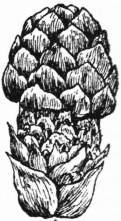
Fig. 16.—Abnormal Cone of Pinus rigida. (After Masters.)
It is important to draw attention to some structural features exhibited by certain cone-scales, in which there is no external sign indicative of the presence of a carpellary and a seminiferous scale. In Araucaria Cookii and some allied species each Morphology of female flower. scale has a small pointed projection from its upper face near the distal end; the scales of Cunninghamia (China) are characterized by a somewhat ragged membranous projection extending across the upper face between the seeds and the distal end of the scale; in the scales of Athrotaxis (Tasmania) a prominent rounded ridge occupies a corresponding position. These projections and ridges may be homologous with the seminiferous scale of the pines, firs, cedars, &c. The simplest interpretation of the cone of the Abietineae is that which regards it as a flower consisting of an axis bearing several open carpels, which in the adult cone may be large and prominent or very small, the scale bearing the ovules being regarded as a placental outgrowth from the flat and open carpel. In Araucaria the cone-scale is regarded as consisting of a flat carpel, of which the placenta has not grown out into the scale-like structure. The seminiferous scale of Pinus, &c., is also spoken of sometimes as a ligular outgrowth from the carpellary leaf. Robert Brown was the first to give a clear description of the morphology of the Abietineous cone in which carpels bear naked ovules; he recognized gymnospermy as an important distinguishing feature in conifers as well as in cycads. Another view is to regard the cone as an inflorescence, each carpellary scale being a bract bearing in its axil a shoot the axis of which has not been developed; the seminiferous scale is believed to represent either a single leaf or a fused pair of leaves belonging to the partially suppressed axillary shoot. In 1869 van Tieghem laid stress on anatomical evidence as a key to the morphology of the cone-scales; he drew attention to the fact that the collateral vascular bundles of the seminiferous scale are inversely orientated as compared with those of the carpellary scale; in the latter the xylem of each bundle is next the upper surface, while in the seminiferous scale the phloem occupies that position. The conclusion drawn from this was that the seminiferous scale (fig. 15, B, Sc) is the first and only leaf of an axillary shoot (b) borne on that side of the shoot, the axis of which is suppressed, opposite the subtending bract (fig. 15, A, B, C, Br). Another view is to apply to the seminiferous scale an explanation similar to that suggested by von Mohl in the case of the double needle of Sciadopitys, and to consider the seed-bearing scale as being made up of a pair of leaves (fig. 15, A, a, a) of an axillary shoot (b) fused into one by their posterior margins (fig. 15, A). The latter view receives support from abnormal cones in which carpellary scales subtend axillary shoots, of which the first two leaves (fig. 15, C, l1, l1) are often harder and browner than the others; forms have been described transitional between axillary shoots, in which the leaves are separate, and others in which two of the leaves are more or less completely fused. In a young cone the seminiferous scale appears as a hump of tissue at the base or in the axil of the carpellary scale, but Celakovský, a strong supporter of the axillary-bud theory, attaches little or no importance to this kind of evidence, regarding the present manner of development as being merely an example of a short cut adopted in the course of evolution, and replacing the original production of a branch in the axil of each carpellary scale. Eichler, one of the chief supporters of the simpler view, does not recognize in the inverse orientation of the vascular bundles an argument in support of the axillary-bud theory, but points out that the seminiferous scale, being an outgrowth from the surface of the carpellary scale, would, like outgrowths from an ordinary leaf, naturally have its bundles inversely orientated. In such cone-scales as show little or no external indication of being double in origin, e.g. Araucaria (fig. 15, D) Sequoia, &c., there are always two sets of bundles; the upper set, having the phloem uppermost, as in the seminiferous scale of Abies or Pinus, are regarded as belonging to the outgrowth from the carpellary scale and specially developed to supply the ovules. Monstrous cones are fairly common; these in some instances lend support to the axillary-bud theory, and it has been said that this theory owes its existence to evidence furnished by abnormal cones. It is difficult to estimate the value of abnormalities as evidence bearing on morphological interpretation; the chief danger lies perhaps in attaching undue weight to them, but there is also a risk of minimizing their importance. Monstrosities at least demonstrate possible lines of development, but when the abnormal forms of growth in various directions are fairly evenly balanced, trustworthy deductions become difficult. The occurrence of buds in the axils of carpellary scales may, however, simply mean that buds, which are usually undeveloped in the axils of sporophylls, occasionally afford evidence of their existence. Some monstrous cones lend no support to the axillary-bud theory. In Larix the axis of the cone often continues its growth; similarly in Cephalotaxus the cones are often proliferous. (In rare cases the proliferated portion produces male flowers in the leaf-axils.) In Larix the carpellary scale may become leafy, and the seminiferous scale may disappear. Androgynous cones may be produced, as in the cone of Pinus rigida (fig. 16), in which the lower part bears stamens and the upper portion carpellary and seminiferous scales. An interesting case has been figured by Masters, in which scales of a cone of Cupressus Lawsoniana bear ovules on the upper surface and stamens on the lower face. One argument that has been adduced in support of the axillary bud theory is derived from the Palaeozoic type Cordaites, in which each ovule occurs on an axis borne in the axil of a bract. The whole question is still unsolved, and perhaps insoluble. It may be that the interpretation of the female cone of the Abietineae as an inflorescence, which finds favour with many botanists, cannot be applied to the cones of Agathis and Araucaria. Without expressing any decided opinion as to the morphology of the double cone-scale of the Abietineae, preference may be felt in favour of regarding the cone-scale of the Araucarieae as a simple carpellary leaf bearing a single ovule. A discussion of this question may be found in a paper on the Araucarieae by Seward and Ford, published in the Transactions of the Royal Society of London (1906). Cordaites is an extinct type which in certain respects resembles Ginkgo, cycads and the Araucarieae, but its agreement with true conifers is probably too remote to justify our attributing much weight to the bearing of the morphology of its female flowers on the interpretation of that of the Coniferae. The greater simplicity of the Eichler theory may prejudice us in its favour; but, on the other hand, the arguments advanced in favour of the axillary-bud theories are perhaps not sufficiently cogent to lead us to accept an explanation based chiefly on the uncertain evidence of monstrosities.
A pollen-grain when first formed from its mother-cell consists of a single cell; in this condition it may be carried to the nucellus of the ovule (e.g. Taxus, Cupressus, &c.), or more usually (Pinus, Larix, &c.) it reaches maturity before the dehiscence Micro-spores and megaspores. of the microsporangium. The nucleus of the microspore divides and gives rise to a small cell within the large cell, a second small cell is then produced; this is the structure of the ripe pollen-grain in some conifers (Taxus, &c.). The large cell grows out as a pollen-tube; the second of the two small cells (body-cell) wanders into the tube, followed by the nucleus of the first small cell (stalk-cell). In Taxus the body-cell eventually divides into two, in which the products of division are of unequal size, the larger constituting the male generative cell, which fuses with the nucleus of the egg-cell. In Juniperus the products of division of the body-cell are equal, and both function as male generative cells. In the Abietineae cell-formation in the pollen-grain is carried farther. Three small cells occur inside the cavity of the microspore; two of them collapse and the third divides into two, forming a stalk-cell and a larger body-cell. The latter ultimately divides in the apex of the pollen-tube into two non-motile generative cells. Evidence has lately been adduced of the existence of numerous nuclei in the pollen-tubes of the Araucarieae, and it seems probable that in this as in several other respects this family is distinguished from other members of the Coniferales. The precise method of fertilization in the Scots Pine was followed by V. H. Blackman, who also succeeded in showing that the nuclei of the sporophyte generation contain twice as many chromosomes as the nuclei of the gametophyte. Other observers have in recent years demonstrated a similar relation in other genera between the number of chromosomes in the nuclei of the two generations. The ovule is usually surrounded by one integument, which projects beyond the tip of the nucellus as a wide-open lobed funnel, which at the time of pollination folds inwards, and so assists in bringing the pollen-grains on to the nucellus. In some conifers (e.g. Taxus, Cephalotaxus, Dacrydium, &c.) the ordinary integument is partially enclosed by an arillus or second integument. It is held by some botanists (Celakovský) that the seminiferous scale of the Abietineae is homologous with the arillus or second integument of the Taxaceae, but this view is too strained to gain general acceptance. In Araucaria and Saxegothaea the nucellus itself projects beyond the open micropyle and receives the pollen-grains direct. During the growth of the cell which forms the megaspore the greater part of the nucellus is absorbed, except the apical portion, which persists as a cone above the megaspore; the partial disorganization of some of the cells in the centre of the nucellar cone forms an irregular cavity, which may be compared with the larger pollen-chamber of Ginkgo and the cycads. In each ovule one megaspore comes to maturity, but, exceptionally, two may be present (e.g. Pinus sylvestris). It has been shown by Lawson that in Sequoia sempervirens (Annals of Botany, 1904) and by other workers in the genera that several megaspores may attain a fairly large size in one prothallus. The megaspore becomes filled with tissue (prothallus), and from some of the superficial cells archegonia are produced, usually three to five in number, but in rare cases ten to twenty or even sixty may be present. In the genus Sequoia there may be as many as sixty archegonia (Arnoldi and Lawson) in one megaspore; these occur either separately or in some parts of the prothallus they may form groups as in the Cupressineae; they are scattered through the prothallus instead of being confined to the apical region as in the majority of conifers. Similarly in the Araucarieae and in Widdringtonia the archegonia are numerous and scattered and often sunk in the prothallus tissue. In Libocedrus decurrens (Cupressineae) Lawson describes the archegonia as varying in number from 6 to 24 (Annals of Botany xxi., 1907). An archegonium consists of a large oval egg-cell surmounted by a short neck composed of one or more tiers of cells, six to eight cells in each tier. Before fertilization the nucleus of the egg-cell divides and cuts off a ventral canal-cell; this cell may represent a second egg-cell. The egg-cells of the archegonia may be in lateral contact (e.g. Cupressineae) or separated from one another by a few cells of the prothallus, each ovum being immediately surrounded by a layer of cells distinguished by their granular contents and large nuclei. During the development of the egg-cell, food material is transferred from these cells through the pitted wall of the ovum. The tissue at the apex of the megaspore grows slightly above the level of the archegonia, so that the latter come to lie in a shallow depression. In the process of fertilization the two male generative nuclei, accompanied by the pollen-tube nucleus and that of the stalk-cell, pass through an open pit at the apex of the pollen-tube into the protoplasm of the ovum. After fertilization the nucleus of the egg divides, the first stages of karyokinesis being apparent even before complete fusion of the male and female nuclei has occurred. The result of this is the production of four nuclei, which eventually take up a position at the bottom of the ovum and become separated from one another by vertical cell-walls; these nuclei divide again, and finally three tiers of cells are produced, four in each tier. In the Abietineae the cells of the middle tier elongate and push the lowest tier deeper into the endosperm; the cells of the bottom tier may remain in lateral contact and produce together one embryo, or they may separate (Pinus, Juniperus, &c.) and form four potential embryos. The ripe albuminous seed contains a single embryo with two or more cotyledons. The seeds of many conifers are provided with large thin wings, consisting in some genera (e.g. Pinus) of the upper cell-layers of the seminiferous scale, which have become detached and, in some cases, adhere loosely to the seed as a thin membrane; the loose attachment may be of use to the seeds when they are blown against the branches of trees, in enabling them to fall away from the wing and drop to the ground. The seeds of some genera depend on animals for dispersal, the carpellary scale (Microcachrys) or the outer integument being brightly coloured and attractive. In some Abietineae (e.g. Pinus and Picea)—in which the cone-scales persist for some time after the seeds are ripe—the cones hang down and so facilitate the fall of the seeds; in Cedrus, Araucaria and Abies the scales become detached and fall with the seeds, leaving the bare vertical axis of the cone on the tree. In all cases, except some species of Araucaria (sect. Colymbea) the germination is epigean. The seedling plants of some Conifers (e.g. Araucaria imbricata) are characterized by a carrot-shaped hypocotyl, which doubtless serves as a food-reservoir.