VOLUME XII SLICE VII Gyantse to Hallel (continued 4)
Reading edition
HAASE, FRIEDRICH (1827- ), German actor, was born on the 1st of November 1827, in Berlin, the son of a valet to King Frederick William IV., who became his godfather. He was educated for the stage under Ludwig Tieck and made his first appearance in 1846 in Weimar, afterwards acting at Prague (1849-1851) and Karlsruhe (1852-1855). From 1860 to 1866 he played in St Petersburg, then was manager of the court theatre in Coburg, and in 1869 (and again in 1882-1883) visited the United States. He was manager of the Stadt Theater in Leipzig from 1870 to 1876, when he removed to Berlin, where he devoted his energies to the foundation and management of the Deutsches Theater. He finally retired from the stage in 1898. Haase’s aristocratic appearance and elegant manner fitted him specially to play high comedy parts. His chief rôles were those of Rocheferrier in the Partie Piquet; Richelieu; Savigny in Der feiner Diplomat, and der Fürst in Der geheime Agent. He is the author of Ungeschminkte Briefe and Was ich erlebte 1846-1898 (Berlin, 1898).
See Simon, Friedrich Haase (Berlin, 1898).
HAASE, FRIEDRICH GOTTLOB (1808-1867), German classical scholar, was born at Magdeburg on the 4th of January 1808. Having studied at Halle, Greifswald and Berlin, he obtained in 1834 an appointment at Schulpforta, from which he was suspended and sentenced to six years’ imprisonment for identifying himself with the Burschenschaften (students’ associations). Having been released after serving one year of his sentence, he visited Paris, and on his return in 1840 he was appointed professor at Breslau, where he remained till his death on the 16th of August 1867. He was undoubtedly one of the most successful teachers of his day in Germany, and exercised great influence upon all his pupils.
He edited several classic authors: Xenophon (Λακεδαιμονίων πολιτεία, 1833); Thucydides (1840); Velleius Paterculus (1858); Seneca the philosopher (2nd ed., 1872, not yet superseded); and Tacitus (1855), the introduction to which is a masterpiece of Latinity. His Vorlesungen über lateinische Sprachwissenschaft was published after his death by F. A. Eckstein and H. Peter (1874-1880). See C Bursian, Geschichte der klassischen Philologie in Deutschland (1883); G. Fickert, Friderici Haasii memoria (1868), with a list of works; T. Oelsner in Rübezahl (Schlesische Provinzialblätter), vii. Heft 3 (Breslau, 1868).
HAAST, SIR JOHANN FRANZ JULIUS VON (1824-1887), German and British geologist, was born at Bonn on the 1st of May 1824. He received his early education partly in that town and partly in Cologne, and then entered the university at Bonn, where he made a special study of geology and mineralogy. In 1858 he started for New Zealand to report on the suitability of the colony for German emigrants. He then became acquainted with Dr von Hochstetter, and rendered assistance to him in the preliminary geological survey which von Hochstetter had undertaken. Afterwards Dr Haast accepted offers from the governments of Nelson and Canterbury to investigate the geology of those districts, and the results of his detailed labours greatly enriched our knowledge with regard to the rocky structure, the glacial phenomena and the economic products. He discovered gold and coal in Nelson, and he carried on important researches with reference to the occurrence of Dinornis and other extinct wingless birds (Moas). His Geology of the Provinces of Canterbury and Westland, N.Z., was published in 1879. He was the founder of the Canterbury museum at Christchurch, of which he became director, and which he endeavoured to render the finest collection in the southern hemisphere. He was surveyor-general of Canterbury from 1861 to 1871, and professor of geology at Canterbury College. He was elected F.R.S. in 1867; and he was knighted for his services at the time of the colonial exhibition in London in 1887. He died at Wellington, N.Z., on the 15th of August 1887.
HABABS (Az-Hibbehs), a nomadic pastoral people of Hamitic stock, living in the coast region north-west of Massawa. Physically they are Beja, by language and traditions Abyssinians. They were Christians until the 19th century, but are now Mahommedans. Their sole wealth consists in cattle.
HABAKKUK, the name borne by the eighth book of the Old Testament “Minor Prophets.” It occurs twice in the book itself (i. 1, iii. 1) in titles, but nowhere else in the Old Testament. The meaning of the name is uncertain. If Hebrew, it might be derived from the root חבק (to embrace) as an intensive term of affection. It has also been connected more plausibly with an Assyrian plant name, ḫambaḱūḱu (Delitzsch, Assyrisches Handwörterbuch, p. 281). The Septuagint has Ἀμβακούμ. Of the person designated, no more is known than may be inferred from the writing which bears his name. Various legends are connected with him, of which the best known is given in the Apocryphal story of “Bel and the Dragon” (v. 33-39); but none of these has any historic value.1
The book itself falls into three obvious parts, viz. (1) a dialogue between the prophet and God (i. 2-ii. 4); (2) a series of five woes pronounced on wickedness (ii. 5-ii. 20); (3) a poem describing the triumphant manifestation of God (iii.). There is considerable difficulty in regard to the interpretation of (1), on which that of (2) will turn; while (3) forms an independent section, to be considered separately.
In the dialogue, the prophet cries to God against continued violence and injustice, though it is not clear whether this is done within or to Israel (i. 2-4). The divine answer declares that God raises up the Chaldaeans, whose formidable resources are invincible (i. 5-11). The prophet thereupon calls God’s attention to the tyranny which He apparently allows to triumph, and declares his purpose to wait till an answer is given to his complaint (i. 12-ii. 2). God answers by demanding patience, and by declaring that the righteous shall live by his faithfulness (ii. 3-4).
The interpretation of this dialogue which first suggests itself is that the prophet is referring to wickedness within the nation, which is to be punished by the Chaldaeans as a divine instrument; in the process, the tyranny of the instrument itself calls for punishment, which the prophet is bidden to await in patient fidelity. On this view of the dialogue, the subsequent woes will be pronounced against the Chaldaeans, and the date assigned to the prophecy will be about 600 B.C., i.e. soon after the battle of Carchemish (605 B.C.), when the Chaldaean victory over Egypt inaugurated a period of Chaldaean supremacy which lasted till the Chaldaeans themselves were overthrown by Cyrus in 538 B.C. Grave objections, however, confront this interpretation, as is admitted even by such recent defenders of it as Davidson and Driver. Is it likely that a prophet would begin a complaint against Chaldaean tyranny (admittedly central in the prophecy) by complaining of that wickedness of his fellow-countrymen which seems partly to justify it? Are not the terms of reference in i. 2 f. and 1. 12 f. too similar for the supposition that two distinct, even contradictory, complaints are being made (cf. “wicked” and “righteous” in i. 4 and i. 13, interchanged in regard to Israel, on above theory)? And if i. 5-11 is a genuine prophecy of the raising up of the Chaldaeans, whence comes that long experience of their rule required to explain the detailed denunciation of their tyranny? To meet the last objection, Davidson supposes i. 5-11 to be really a reference to the past, prophetic in form only, and brings down the whole section to a later period of Chaldaean rule, “hardly, one would think, before the deportation of the people under Jehoiachin in 597” (p. 49). Driver prefers to bisect the dialogue by supposing i. 2-11 to be written at an earlier period than i. 12 f. (p. 57). The other objections, however, remain, and have provoked a variety of theories from Old Testament scholars, of which three call for special notice. (1) The first of these, represented by Giesebrecht,2 Nowack and Wellhausen, refers i. 2-4 to Chaldaean oppression of Israel, the same subject being continued in i. 12 f. Obviously, the reference to the Chaldaeans as a divine instrument could not then stand in its present place, and it is accordingly regarded as a misplaced earlier prophecy. This is the minimum of critical procedure required to do justice to the facts. (2) Budde, followed by Cornill, also regards i. 2-4 as referring to the oppression of Israel by a foreign tyrant, whom, however, he holds to be Assyria. He also removes i. 5-11 from its present place, but makes it part of the divine answer, following ii. 4. On this view, the Chaldaeans are the divine instrument for punishing the tyranny of the Assyrians, to whom the following woes will therefore refer. The date would fall between Josiah’s reformation (621) and his death (609). This is a plausible and even attractive theory; its weakness seems to lie in the absence of any positive evidence in the prophecy itself, as is illustrated by the fact that even G. A. Smith, who follows it, suggests “Egypt from 608-605” as an alternative to Assyria (p. 124). (3) Marti (1904) abandons the attempt to explain the prophecy as a unity, and analyses it into three elements, viz. (a) The original prophecy by Habakkuk, consisting of i. 5-10, 14 f., belonging to the year 605, and representing the emergent power of the Chaldaeans as a divine scourge of the faithless people; (b) Woes against the Chaldaeans, presupposing not only tyrannous rule over many peoples, but the beginning of their decline and fall, and therefore of date about 540 B.C. (ii. 5-19); (c) A psalm of post-exilic origin, whose fragments, i. 2-4, 12 a, 13, ii. 1-4, have been incorporated into the present text from the margins on which they were written, its subject being the suffering of the righteous. Each of these three theories3 encounters difficulties of detail; none can be said to have secured a dominant position. The great variety of views amongst competent critics is significant of the difficulty of the problem, which can hardly be regarded as yet solved; this divergence of opinion perhaps points to the impossibility of maintaining the unity of chs. i. and ii., and throws the balance of probability towards some such analysis as that of Marti, which is therefore accepted in the present article.
In regard to the poem which forms the third and closing chapter of the present book of Habakkuk, there is much more general agreement. Its most striking characteristic lies in the superscription (“A prayer of Habakkuk the prophet, set to Shigionoth”), the subscription (“For the chief musician, on my stringed instruments”), and the insertion of the musical term “Selah” in three places (v. 3, 9, 13). These liturgical notes make extremely probable the supposition that the poem has been taken from some collection like that of our present book of Psalms, probably on the ground of the authorship asserted by the superscription there attached to it. It cannot, however, be said that the poem itself supports this assertion, which carries no more intrinsic weight than the Davidic titles of the Psalms. The poem begins with a prayer that God will renew the historic manifestation of the exodus, which inaugurated the national history and faith; a thunderstorm moving up from the south is then described, in which God is revealed (3-7); it is asked whether this manifestation, whose course is further described, is against nature only (8-11); the answer is given that it is for the salvation of Israel against its wicked foes (12-15); the poet describes the effect in terror upon himself (16) and declares his confidence in God, even in utter agricultural adversity (17-19). As Wellhausen says (p. 171): “The poet appears to believe that in the very act of describing enthusiastically the ancient deed of deliverance, he brings home to us the new; we are left sometimes in doubt whether he speaks of the past to suggest the new by analogy, or whether he is concerned directly with the future, and simply paints it with the colours of the past.” In any case, there is nothing in this fine poem to connect it with the conception of the Chaldaeans as a divine instrument. It is the nation that speaks through the poet (cf. v. 14), but at what period of its post-exilic history we have no means of inferring.
Our estimate of the theological teaching of this book will naturally be influenced by the particular critical theory which is adopted. The reduction of the book to four originally independent sections requires that the point of each be stated separately. When this is done, it will, however, be found that there is a broad unity of subject, and of natural development in its treatment, such as to some extent justifies the instinct or the judgment of those who were instrumental in effecting the combination of the separate parts. (1) The poem (iii.), though possibly latest in date,4 claims first consideration, because it avowedly moves in the circle of primitive ideas, and supplicates a divine intervention, a direct and immediate manifestation of the transcendent God. He is conceived as controlling or overcoming the forces of nature; and though an earlier mythology has supplied some of the ideas, yet, as with the opening chapters of Genesis, they are transfigured by the moral purpose which animates them, the purpose to subdue all things that could frustrate the destiny of God’s anointed (v. 13). The closing verses strike that deep note of absolute dependence on God, which is the glory of the religion of the Old Testament and its chief contribution to the spirit of the Gospels. (2) The prophecy of the Chaldaeans as the instruments of the divine purpose involves a different, yet related, conception of the divine providence. The philosophy of history, by which Hebrew prophets could read a deep moral significance into national disaster and turn the flank of resistless attack, became one of the most important elements in the nation’s faith. If the world-powers were hard as flint in their dealings with Israel, the people of God were steeled to such moral endurance that each clash of their successive onsets kindled some new flame of devotion. Through the Chaldaeans God worked a work which required centuries of life and literature to disclose its fulness (i. 5). (3) When we turn from this view of the Chaldaeans to the denunciation of their tyranny in “taunt songs” (ii. 5-20), we have simply a practical application of the doctrine of divine government. God being what He is, at once moral and all-powerful, the immoral life is doomed to overthrow, whether the immorality consist in grasping rapacity, proud self-aggrandizement, cruel exaction, exulting triumph or senseless idolatry. (4) Yet, because the doom so often tarries, there arises the problem of the suffering of the innocent and the upright. How can God look down with tolerance that seems favour on so much that conflicts with His declared will and character? This is the great problem of Israel, finding its supreme expression for all time in the book of Job (q.v.). In that book the solution of the problem of innocent suffering lies hidden from the sufferer, even to the end, for he is not admitted with the reader to the secret of the prologue; it is the practical solution of faithfulness resting on faith which is offered to us. So here, with the principle of ii. 4, “the righteous shall live by his faithfulness.” The different application of these words in the New Testament to “faith” is well known (Rom. i. 17; Gal. iii. 11; Heb. x. 38) though the difference is apt to be exaggerated by those who forget how much of the element of אמונה: lies in Paul’s conception of πίστις. In G. A. Smith’s words, “as Paul’s adaptation, ‘the just shall live by faith,’ has become the motto of evangelical Christianity, so we may say that Habakkuk’s original of it has been the motto and the fame of Judaism: ‘the righteous shall live by his faithfulness.’”
The Hebrew text of this impressive and varied book is unfortunately corrupt in many places; even so cautious a critic as Driver accepts or favourably notices eighteen textual emendations in the three chapters, and suspects the text in at least seven other cases. For the interpretation of the book in detail, the English reader will find Driver’s commentary (1906) the most useful.
References to earlier literature will be found in the following noteworthy studies of recent date: Davidson, “Nahum, Habakkuk and Zephaniah,” in Cambridge Bible (1896); Nowack, Die kleinen Propheten (Hdkr.) (1897); Wellhausen, Die kleinen Propheten3 (1898); G. A. Smith, “The Book of the Twelve Prophets,” in The Expositor’s Bible, vol. ii. (1898); Driver, article “Habakkuk” in Hastings’ Dictionary of the Bible, vol. ii. pp. 269-272 (1900); Budde, article “Habakkuk” in Ency. Biblica, vol. ii., c. 1921-1928 (1901); Stevenson, “The Interpretation of Habakkuk,” in The Expositor (1902), pp. 388-401; Peake, The Problem of Suffering in the Old Testament (1904), pp. 4-11 and app. A, “Recent Criticism of Habakkuk”; Marti, Dodekapropheton (K. H. C.) (1904); Driver, “Minor Prophets,” vol. ii., in Century Bible (1906); Duhm, Das Buch Habakkuk (Text, Übersetzung und Efklärung), 1906 (regards the book as a unity belonging to the time of Alexander the Great). Max L. Margolis discusses the anonymous Greek version of Habakkuk iii. in a volume of Old Test. and Semitic Studies: in Memory of William Rainey Harper (Chicago, 1908).
(H. W. R.*)
1 These legends are collected in Hastings, D. B. vol. ii. p. 272. He is the watchman of Is. xxi. 6 (cf. Hab. ii. 1); the son of the Shunammite (2 Kings iv. 16); and is miraculously lifted by his hair to carry his own dinner to Daniel in the lions’ den (supra).
2 Followed by Peake in The Problem of Suffering, pp. 4 f., 151 f., to whose appendix (A) reference may be made for further details of recent criticism.
3 For the less probable theories of Rothstein, Lauterburg, Happel and Peiser (amongst others), cf. Marti’s Commentary, pp. 328 f. and 332. Stevenson (The Expositor, 1902) states clearly the difficulties for those who regard ch. i. as a unity. He sees two independent sections, 2-4 + 12-13, and 5-11 + 14-17.
4 Earlier, however, than Ps. lxxvii. 17-20, which is drawn from it.
HABDALA (lit. “separation”), a Hebrew term chiefly appropriated to ceremonies at the conclusion of Sabbath and festivals, marking the separation between times sacred and secular. On the Saturday night the ceremony consists of three items: (a) benediction over a cup of wine (common to many other Jewish functions); (b) benediction over a lighted taper, of which possibly the origin is utilitarian, as no light might be kindled on the Sabbath day, but the rite may be symbolical; and (c) benediction over a box of sweet-smelling spices. The origin of the latter has been traced to the bowl of burning spice which in Talmudic times was introduced after each meal. But here too symbolic ideas must be taken into account. Both the light and the spices would readily fit into the conception of the Sabbath “Over-soul” of the mystics.
(I. A.)
HABEAS CORPUS, in English law, a writ issued out of the High Court of Justice commanding the person to whom it is directed to bring the body of a person in his custody before that or some other court for a specified purpose.
There are various forms of the writ, of which the most famous is that known as habeas corpus ad subjiciendum, the well-established remedy for violation of personal liberty. From the earliest records of the English law no free man could be detained in custody except on a criminal charge or conviction or for a civil debt. That right is expressed in the Great Charter in the words: “Nullus liber homo capiatur vel imprisonetur aut dissaisietur aut utlagetur, aut exuletur aut aliquo modo destruatur nec super eum ibimus nec super eum mittemus, nisi per legale judicium parium suorum, vel per legem terrae.”1 The writ is a remedial mandatory writ of right existing by the common law, i.e. it is one of the extraordinary remedies—such as mandamus, certiorari and prohibitions, which the superior courts may grant. While “of right,” it is not “of course,” and is granted only on application to the High Court or a judge thereof, supported by a sworn statement of facts setting up at least a probable case of illegal confinement. It is addressed to the person in whose custody another is detained, and commands him to bring his prisoner before the court immediately after the receipt of the writ, together with the day and cause of his being taken and detained, to undergo and receive (ad subjiciendum et recipiendum) whatsoever the court awarding the writ “may consider of concerning him in that behalf.”
It is often stated that the writ is founded on the article of the Great Charter already quoted; but there are extant instances of the issue of writs of habeas corpus before the charter. Other writs having somewhat similar effect were in use at an early date, e.g. the writ de odio et atiâ, used as early as the 12th century to prevent imprisonment on vexatious appeals of felony, and the writ of mainprise (de manucaptione), long obsolete if not abolished in England but which it was attempted to use in India so late as 1870. In the ease of imprisonment on accusation of crime the writ issued from the court of king’s bench (or from the chancery), and on its return the court judged of the legality of the imprisonment, and discharged the prisoner or admitted him to bail or remanded him to his former custody according to the result of the examination.
By the time of Charles I. the writ was fully established as the appropriate process for checking illegal imprisonment by inferior courts or by public officials. But it acquired its full and present constitutional importance by legislation.
In Darnel’s case (1627) the judges held that the command of the king was a sufficient answer to a writ of habeas corpus. The House of Commons thereupon passed resolutions to the contrary, and after a conference with the House of Lords the measure known as the Petition of Right was passed (1627, 3 Car. I. c. i.) which, inter alia, recited (s. 5) that, contrary to the Great Charter and the good laws and statutes of the realm, divers of the king’s subjects had of late been imprisoned without any cause shown, and when they were brought up on habeas corpus ad subjiciendum, and no cause was shown other than the special command of the king signified by the privy council, were nevertheless remanded to prison, and enacted “that no freeman in any such manner as is before mentioned be imprisoned or detained.” The Petition of Right was disregarded in Selden’s case (1629), when it was successfully returned to a habeas corpus that Selden and others were committed by the king’s special command “for notable contempts against the king and his government and for stirring up sedition against him.”2 This led to legislation in 1640 by which, after abolishing the Star Chamber, the right to a habeas corpus was given to test the legality of commitments by command or warrant of the king or the privy council.3
The reign of Charles II. was marked by further progress towards securing the freedom of the subject from wrongful imprisonment. Lord Clarendon was impeached, inter alia, for causing many persons to be imprisoned against law and to be conveyed in custody to places outside England. In 1668 a writ of habeas corpus was issued to test the legality of an imprisonment in Jersey. Though the authority of the courts had been strengthened by the Petition of Right and the act of 1640, it was still rendered insufficient by reason of the insecurity of judicial tenure, the fact that only the chancellor (a political as well as a legal officer) and the court of king’s bench had undoubted right to issue the writ, and the inability or hesitation of the competent judges to issue the writ except during the legal term, which did not cover more than half the year. A series of bills was passed through the Commons between 1668 and 1675, only to be rejected by the other House. In Jenkes’s case (1676) Lord Chancellor Nottingham refused to issue the writ in vacation in a case in which a man had been committed by the king in council for a speech at Guildhall, and could get neither bail nor trial. In 1679, but rather in consequence of Lord Clarendon’s arbitrary proceedings4 than of Jenkes’s case, a fresh bill was introduced which passed both Houses (it is said the upper House by the counting of one stout peer as ten) and became the famous Habeas Corpus Act of 1679 (31 Car. II. c. 2). The passing of the act was largely due to the experience and energy of Lord Shaftesbury, after whom it was for some time called. The act, while a most important landmark in the constitutional history of England, in no sense creates any right to personal freedom, but is essentially a procedure act for improving the legal mechanism by means of which that acknowledged right may be enforced.5 It declares no principles and defines no rights, but is for practical purposes worth a hundred articles guaranteeing constitutional liberty.6
In the manner characteristic of English legislation the act is limited to the particular grievances immediately in view and is limited to imprisonment for criminal or supposed criminal matters, leaving untouched imprisonment on civil process or by private persons. It recites that great delays have been used by sheriffs and gaolers in making returns of writs of habeas corpus directed to them; and for the prevention thereof, and the more speedy relief of all persons imprisoned for criminal or supposed criminal matters, it enacts in substance as follows: (1) When a writ of habeas corpus is directed to a sheriff or other person in charge of a prisoner, he must within 3, 10 or 20 days, according to the distance of the place of commitment, bring the body of his prisoner to the court, with the true cause of his detainer or imprisonment—unless the commitment was for treason or felony plainly expressed in the warrant of commitment. (2) If any person be committed for any crime—unless for treason or felony plainly expressed in the warrant—it shall be lawful for such person or persons (other than persons convicted or in execution by legal process) in time of vacation, to appeal to the lord chancellor as a judge, who shall issue a habeas corpus returnable immediately, and on the return thereof shall discharge the prisoner on giving security for his appearance before the proper court—unless the party so committed is detained upon a legal process or under a justice’s warrant for a non-bailable offence. Persons neglecting for two terms to pray for a habeas corpus shall have none in vacation. (3) Persons set at large on habeas corpus shall not be recommitted for the same offence unless by the legal order and process of the court having cognizance of the case. (4) A person committed to prison for treason or felony shall, if he requires it, in the first week of the next term or the first day of the next session of oyer and terminer, be indicted in that term or session or else admitted to bail, unless it appears on affidavit that the witnesses for the crown are not ready; and if he is not indicted and tried in the second term or session after commitment, or if after trial he is acquitted, he shall be discharged from imprisonment. (5) No inhabitant of England (except persons contracting, or, after conviction for felony, electing to be transported) shall be sent prisoner to Scotland, Ireland, Jersey, &c., or any place beyond the seas. Stringent penalties are provided for offences against the act. A judge delaying habeas corpus forfeits £500 to the party aggrieved. Illegal imprisonment beyond seas renders the offender liable in an action by the injured party to treble costs and damages to the extent of not less than £500, besides subjecting him to the penalties of praemunire and to other disabilities. “The great rank of those who were likely to offend against this part of the statute was,” says Hallam, “the cause of this unusual severity.” Indeed as early as 1591 the judges had complained of the difficulty of enforcing the writ in the case of imprisonment at the instance of magnates of the realm. The effect of the act was to impose upon the judges under severe sanction the duty of protecting personal liberty in the case of criminal charges and of securing speedy trial upon such charges when legally framed; and the improvement of their tenure of office at the revolution, coupled with the veto put by the Bill of Rights on excessive bail, gave the judicature the independence and authority necessary to enable them to keep the executive within the law and to restrain administrative development of the scope or penalties of the criminal law; and this power of the judiciary to control the executive, coupled with the limitations on the right to set up “act of state” as an excuse for infringing individual liberty is the special characteristic of English constitutional law.
It is to be observed that neither at common law nor under the act of 1679 was the writ the appropriate remedy in the case of a person convicted either on indictment or summarily. It properly applied to persons detained before or without trial or sentence; and for convicted persons the proper remedy was by writs of error or certiorari to which a writ of habeas corpus might be used as ancillary.
As regards persons imprisoned for debt or on civil process the writ was available at common law to test the legality of the detention: but the practice in these cases is unaffected by the act of 1679, and is of no present interest, since imprisonment on civil process is almost abolished. As regards persons in private custody, e.g. persons not sui juris detained by those not entitled to their guardianship or lunatics, or persons kidnapped, habeas corpus ad subjiciendum seems not to have been the ordinary common law remedy. The appropriate writ for such cases was that known as de homine replegiando. The use of this writ in most if not all criminal cases was forbidden in 1553; but it was used in the 17th century in a case of kidnapping (Designy’s case, 1682), and against Lord Grey for abducting his wife’s sister (1682), and in the earl of Banbury’s case to recover his wife (1704). The latest recorded instance of its use is Trebilcock’s case (1736), in which a ward sought to free himself from the custody of his guardian.
Since that date the habeas corpus ad subjiciendum has been used in cases of illegal detention in private custody. In 1758 questions arose as to its application to persons in naval or military custody, including pressed men, which led to the introduction of a bill in parliament and to the consultation by the House of Lords of the judges (see Wilmot’s Opinions, p. 77). In the same year the writ was used to release the wife of Earl Ferrers from his custody and maltreatment, and was unsuccessfully applied for by John Wilkes to get back his wife, who was separated from him by mutual agreement. But perhaps the most interesting instances of that period are the case of the negro Somerset (1771), who was released from a claim to hold him as a slave in England: and that of the Hottentot Venus (1810), where an alien woman on exhibition in England was brought before the court by Zachary Macaulay in order to ascertain whether she was detained against her will.
The experience of the 18th century disclosed defects in the procedure for obtaining liberty in cases not covered by the act of 1679. But it was not till 1816 that further legislation was passed for more effectually securing the liberty of the subject. The act of 1816 (56 Geo. III. c. 100), does not touch cases covered by the act of 1679. It enacts (1) that a writ of habeas corpus shall be issued in vacation time in favour of a person restrained of his liberty otherwise than for some criminal or supposed criminal matter (except persons imprisoned for debt or by civil process); (2) that though the return to the writ be good and sufficient in law, the judge shall examine into the truth of the facts set forth in such return, and if they appear doubtful the prisoner shall be bailed; (3) that the writ shall run to any port, harbour, road, creek or bay on the coast of England, although not within the body of any county. The last clause was intended to meet doubts on the applicability of habeas corpus in cases of illegal detention on board ship, which had been raised owing to a case of detention on a foreign ship in an English port.
It will appear from the foregoing statement that the issue and enforcement of the writ rests on the common law as strengthened by the acts of 1627, 1640, 1679 and 1816, and subject also to the regulations as to procedure contained in the Crown Office Rules, 1906. The effect of the statutes is to keep the courts always open for the issue of the writ. It is available to put an end to all forms of illegal detention in public or private custody. In the case of the Canadian prisoners (1839) it was used to obtain the release of persons sentenced in Canada for participating in the rebellion of 1837, who were being conveyed throughout England in custody on their way to imprisonment in another part of the empire, and it is matter of frequent experience for the courts to review the legality of commitments under the Extradition Acts and the Fugitive Offenders Act 1881, of fugitives from the justice of a foreign state or parts of the king’s dominions outside the British Islands.
In times of public danger it has occasionally been thought necessary to “suspend” the Habeas Corpus Act 1679 by special and temporary legislation. This was done in 1794 (by an act annually renewed until 1801) and again in 1817, as to persons arrested and detained by his majesty for conspiring against his person and government. The same course was adopted in Ireland in 1866 during a Fenian rising. It has been the practice to make such acts annual and to follow their expiration by an act of indemnity. In cases where martial law exists the use of the writ is ex hypothesi suspended during conditions amounting to a state of war within the realm or the British possession affected (e.g. the Cape Colony and Natal during the South African War), and it would seem that the acts of courts martial during the period are not the subject of review by the ordinary courts. The so-called “suspension of the Habeas Corpus Act” bears a certain similarity to what is called in Europe “suspending the constitutional guarantees” or “proclaiming a state of siege,” but “is not in reality more than suspension of one particular remedy for the protection of personal freedom.”
There are various other forms of the writ according to the purpose for which it is granted. Thus habeas corpus ad respondendum is used to bring up a prisoner confined by the process of an inferior court in order to charge him in another proceeding (civil or criminal) in the superior court or some other court. As regards civil proceedings, this form of the writ is now rarely used, owing to the abolition of arrest on mesne process and the restriction of imprisonment for debt, or in execution of a civil judgment. The right to issue the writ depends on the common law, supplemented by an act of 1802. It is occasionally used for the purpose of bringing a person in custody for debt or on a criminal charge before a criminal court to be charged in respect of a criminal proceeding: but the same result may be obtained by means of an order of a secretary of state, made under s. 11 of the Prison Act 1898, or by the written order of a court of criminal jurisdiction before which he is required to take his trial on indictment (Criminal Law Amendment Act 30 & 31 Vict. c. 35, s. 10.)
Other forms are ad satisfaciendum; ad faciendum et recipiendum, to remove into a superior court proceedings under which the defendant is in custody: ad testificandum, where a prisoner is required as a witness, issued under an act of 1804 (s. 11), which is in practice replaced by orders under s. 11 of the Prison Act 1898 (supra) or the order of a judge under s. 9 of the Criminal Procedure Act 1853: and ad deliberandum et recipias, to authorize the transfer from one custody to another for purposes of trial, which is in practice superseded by the provisions of the Prison Acts 1865, 1871 and 1898, and the Criminal Law Amendment Act 1867 (supra).
The above forms are now of little or no importance; but the procedure for obtaining them and the forms of writ are included in the Crown Office Rules 1906.
Ireland.—The common law of Ireland as to the writs of habeas corpus is the same as that in England. The writ has in past times been issued from the English court of king’s bench into Ireland; but does not now so issue. The acts of 1803 and 1816 already mentioned apply to Ireland. The Petition of Right is not in terms applicable to Ireland. The Habeas Corpus Act 1679 does not apply to Ireland; but its equivalent is supplied by an act of 1781-1782 of the Irish parliament (21 & 22 Geo. III. c. 11). Sec. 16 contains a provision empowering the chief governor and privy council of Ireland by a proclamation under the great seal of Ireland to suspend the act during such time only as there shall be an actual invasion or rebellion in Ireland; and it is enacted that during the currency of the proclamation no judge or justices shall bail or try any person charged with being concerned in the rebellion or invasion without an order from the lord lieutenant or lord deputy and senior of the privy council. In Ireland by an act of 1881 the Irish executive was given an absolute power of arbitrary and preventive arrest on suspicion of treason or of an act tending to interfere with the maintenance of law and order: but the warrant of arrest was made conclusive. This act continued by annual renewals until 1906, when it expired.
Scotland.—The writ of habeas corpus is unknown to Scots law, nor will it issue from English courts into Scotland. Under a Scots act of 1701 (c. 6) provision is made for preventing wrongous imprisonment and against undue delay in trials. It was applied to treason felony in 1848. The right to speedy trial is now regulated by s. 43 of the Criminal Procedure Scotland Act 1887. These enactments are as to Scotland equivalent to the English Act of 1679. Under the Court of Exchequer Scotland Act 1856 (19 & 20 V. c. 56) provision is made for bringing before the court of session persons and proceedings before inferior courts and public officers—which is analogous to the powers to issue habeas corpus in such cases out of the English court of exchequer (now the revenue side of the king’s bench division).
British Possessions.—The act of 1679 expressly applies to Wales, Berwick-on-Tweed, Jersey and Guernsey, and the act of 1816 also extends to the Isle of Man. The court of king’s bench has also issued the writ to the king’s foreign dominions beyond seas, e.g. to St Helena, and so late as 1861 to Canada (Anderson’s case 1861, 30 L.J.Q.B. 129). In consequence of the last decision it was provided by the Habeas Corpus Act 1862 that no writ of habeas corpus should issue out of England by authority of any court or judge “into any colony or foreign dominion of the crown where the crown has a lawfully established court of justice having authority to grant or issue the writ and to ensure its due execution in the ‘colony’ or dominion” (25 & 26 V. c. 20). The expression “foreign dominion” is meant to apply to places outside the British Islands, and does not include the Isle of Man or the Channel Islands (see re Brown [1864], 33 L.J.Q.B. 193).
In Australasia and Canada and in most if not all the British possessions whose law is based on the common law, the power to issue and enforce the writ is possessed and is freely exercised by colonial courts, under the charters or statutes creating and regulating the courts. The writ is freely resorted to in Canada, and in 1905, 1906, two appeals came to the privy council from the dominion, one with reference to an extradition case, the other with respect to the right to expel aliens.
Under the Roman-Dutch law as applied in British Guiana the writ was unknown and no similar process existed (2nd report of West Indian law commissioners). But by the Supreme Court Ordinance of 1893 that court possesses (inter alia) all the authorities, powers and functions belonging to or incident to a superior court of record in England, which appears to include the power to issue the writ of habeas corpus. Under the Roman-Dutch law as applied to South Africa free persons appear to have a right to release under a writ de libero homine exhibendo, which closely resembles the writ of habeas corpus, and the procedure described as “manifestation” used in the kingdom of Aragon (Hallam, Middle Ages, vol. ii., c. iv.). The writ of habeas corpus has not been formally adopted or the Habeas Corpus Acts formally extended to South Africa; but in the Cape Colony, under the charter of justice and colonial legislation, the supreme court on petition grants a remedy equivalent to that obtained in England by writ of habeas corpus; and the remedy is sometimes so described (Koke v. Balie, 1879, 9 Buchanan, 45, 64, arising out of a rising in Griqualand). During and after the South African War of 1899-1902 many attempts were made by this procedure to challenge or review the sentences of courts martial; see re Fourie (1900). 18 Cape Rep. 8.
The laws of Ceylon being derived from the Roman-Dutch law, the writ of habeas corpus is not indigenous: but, under s. 49 of the Supreme Court Ordinance 1889, the court or a judge has power to grant and issue “mandates in the nature of writs of habeas corpus.” The chartered high courts in India have power to issue and enforce the writ of habeas corpus. The earliest record of its use was in 1775, when it was directed to Warren Hastings. It has been used to test the question whether Roman Catholic religious orders could enter India, and in 1870 an attempt was made thereby to challenge the validity of a warrant in the nature of a lettre de cachet issued by the viceroy (Ind. L. Rep. 6 Bengal, 392, 456, 498), and it has also been applied to settle controversies between Hindus and missionaries as to the custody of a young convert (R. v. Vaughan, 1870, 5 Bengal, 418), and between a Mahommedan husband and his mother-in-law as to the custody of a girl-wife (Khatija Bibi, 1870, 5 Bengal, 557).
United States.—Before the Declaration of Independence some of the North American colonies had adopted the act of 1679; and the federal and the other state legislatures of the United States have founded their procedure on that act. The common law as to the writ of habeas corpus has been inherited from England, and has been generally made to apply to commitments and detentions of all kinds. Difficult questions, unknown to English law, have arisen from the peculiar features of the American state-system. Thus the constitution provides that “the privilege of the writ of habeas corpus shall not be suspended unless when, in cases of rebellion or invasion, the public safety may require it”; and it has been the subject of much dispute whether the power of suspension under this provision is vested in the president or the congress. The weight of opinion seems to lean to the latter alternative. Again, conflicts have arisen between the courts of individual states and the courts of the union. It seems that a state court has no right to issue a habeas corpus for the discharge of a person held under the authority of the federal government. On the other hand, the courts of the union issue the writ only in those cases in which the power is expressly conferred on them by the constitution.
Authorities.—Paterson, Liberty of the Subject (1877); Short and Mellor, Crown Practice (1890); American: Church on Habeas Corpus (2nd ed. 1893).
(W. F. C.)
1 See Hallam, Const. Hist. vol. i., c. vii. (12th ed.) p. 384.
2 Hallam, Const. Hist. vol. ii., c. viii. (12th ed.) p. 2.
3 Ibid. c. ix. (12th ed.) p. 98.
4 Ibid. vol. iii., c. xiii. (12th ed.) p. 12.
5 Dicey, Law of the Constitution (6th ed.), p. 217.
6 Dicey, Law of the Constitution (6th ed.), p. 195.
HABERDASHER, a name for a tradesman who sells by retail small articles used in the making or wearing of dress, such as sewing cottons or silks, tapes, buttons, pins and needles and the like. The sale of such articles is not generally carried on alone, and a “haberdashery counter” usually forms a department of drapers’ shops. The word, found in Chaucer, and even earlier (1311), is of obscure origin; the suggestion that it is connected with an Icelandic haprtask, “haversack,” is, according to the New English Dictionary, impossible. Haperlas occurs in an early Anglo-French customs list, which includes articles such as were sold by haberdashers, but this word may itself have been a misspelling of “haberdash.” The obscurity of origin has left room for many conjectures such as that of Minsheu that “haberdasher” was perhaps merely a corruption of the German Habt ihr das? “Have you that?” or Habe das, Herr, “Have that, sir,” used descriptively for a general dealer in miscellaneous wares. The Haberdashers’ Company is one of the greater Livery Companies of the City of London. Originally a branch of the mercers, the fraternity took over the selling of “small wares,” which included not only articles similar to those sold as “haberdashery” now, but such things as gloves, daggers, glass, pens, lanterns, mousetraps and the like. They were thus on this side connected with the Milliners. On the other hand there was early a fusion with the old gild of the “Hurers,” or cap makers, and the hatters, and by the reign of Henry VII. the amalgamation was complete. There were long recognized two branches of the haberdashers, the haberdashers of “small wares,” and the haberdashers of hats (see further Livery Companies). The haberdashers are named, side by side with the capellarii, in the White Book (Liber Albus) of the city of London (see Munimenta Gildhallae Londiniensis, ed. H. T. Riley, Rolls Series, 12, 1859-1862), and a haberdasher forms one of the company of pilgrims in the Canterbury Tales (Prologue, 361).
HABINGTON, WILLIAM (1605-1654), English poet, was born at Hendlip Hall, Worcestershire, on the 4th of November 1605. He belonged to a well-known Catholic family. His father, Thomas Habington (1560-1647), an antiquary and historical scholar, had been implicated in the plots on behalf of Mary queen of Scots; his uncle, Edward Habington, was hanged in 1586 on the charge of conspiring against Elizabeth in connexion with Anthony Babington; while to his mother, Mary Habington, was attributed the revelation of the Gunpowder Plot. The poet was sent to the college at St Omer, but, pressure being brought to bear on him to induce him to become a Jesuit, he removed to Paris. He married about 1632 Lucy, second daughter of Sir William Herbert, first Baron Powys. This lady he had addressed in the volume of lyrical poems arranged in two parts and entitled Castara, published anonymously in 1634. In 1635 appeared a second edition enlarged by three prose characters, fourteen new lyrics and eight touching elegies on his friend and kinsman, George Talbot. The third edition (1640) contains a third part consisting of a prose character of “A Holy Man” and twenty-two devotional poems. Habington’s lyrics are full of the far-fetched “conceits” which were fashionable at court, but his verse is quite free from the prevailing looseness of morals. Indeed his reiterated praises of Castara’s virtue grow wearisome. He is at his best in his reflective poems on the uncertainty of human life and kindred topics. He also wrote a Historie of Edward the Fourth (1640), based on notes provided by his father; a tragi-comedy, The Queene of Arragon (1640), published without his consent by his kinsman, the earl of Pembroke, and revived at the Restoration; and six essays on events in modern history, Observations upon History (1641). Anthony à Wood insinuated that during the Commonwealth the poet “did run with the times, and was not unknown to Oliver the usurper.” He died on the 30th of November 1654.
The works of Habington have not been collected. The Queene of Arragon was reprinted in Dodsley’s “Old Plays,” vol. ix. (1825); Castara was edited by Charles Elton (1812), and by E. Arber with a compact and comprehensive introduction (1870) for his “English Reprints.”
HABIT (through the French from Lat. habitus, from habere, to have, hold, or, in a reflective sense, to be in a certain condition; in many of the English senses the French use habitude, not habit), condition of body or mind, especially one that has become permanent or settled by custom or persistent repetition, hence custom, usage. In botany and zoology the term is used both in the above sense of instinctive action of animals and tendencies of plants, and also of the manner of growth or external appearance of a plant or animal. From the use of the word for external appearances comes its use for fashion in dress, and hence as a term for a lady’s riding dress and for the particular form of garment adopted by the members of a religious order, like “cowl” applied as the mark of a monk or nun.
HABITAT (a French word derived from habiter, Lat. habitare, to dwell), in botany and zoology, the term for the locality in which a particular species of plants or animals thrives.
HABSBURG, or Hapsburg, the name of the famous family from which have sprung the dukes and archdukes of Austria from 1282, kings of Hungary and Bohemia from 1526, and emperors of Austria from 1804. They were also Roman emperors and German kings from 1438 to 1806, and kings of Spain from 1516 to 1700, while the minor dignities held by them at different times are too numerous to mention.
The name Habsburg, a variant of an older form, Habichtsburg (hawk’s castle), was taken from the castle of Habsburg, which was situated on the river Aar not far from its junction with the Rhine. The castle was built about 1020 by Werner, bishop of Strassburg, and his brother, Radbot, the founder of the abbey of Muri. These men were grandsons of a certain Guntram, who, according to some authorities, is identical with a Count Guntram who flourished during the reign of the emperor Otto the Great, and whose ancestry can be traced back to the time of the Merovingian kings. This conjecture, however, is extremely problematical. Among Radbot’s sons was one Werner, and Werner and his son Otto were called counts of Habsburg, Otto being probably made landgrave of upper Alsace late in the 11th or early in the 12th century. At all events Otto’s son Werner (d. 1167), and the latter’s son Albert (d. 1199), held this dignity, and both landgraves increased the area of the Habsburg lands. Albert became count of Zürich and protector of the monastery of Säckingen, and obtained lands in the cantons of Unterwalden and Lucerne; his son Rudolph, having assisted Frederick of Hohenstaufen, afterwards the emperor Frederick II., against the emperor Otto IV., received the county of Aargau. Both counts largely increased their possessions in the districts now known as Switzerland and Alsace, and Rudolph held an influential place among the Swabian nobility. After his death in 1232 his two sons, Albert and Rudolph, divided his lands and founded the lines of Habsburg-Habsburg and Habsburg-Laufenburg. Rudolph’s descendants, counts of Habsburg-Laufenburg, were soon divided into two branches, one of which became extinct in 1408 and the other seven years later. Before this date, however, Laufenburg and some other districts had been sold to the senior branch of the family, who thus managed to retain the greater part of the Habsburg lands.
Rudolph’s brother Albert (d. 1239), landgrave of Alsace, married Hedwig of Kyburg (d. 1260), and from this union there was born in 1218 Rudolph, the founder of the greatness of the house of Habsburg, and the first of the family to ascend the German throne. Through his mother he inherited a large part of the lands of the extinct family of Zähringen; he added in other ways to his possessions, and was chosen German king in September 1273. Acting vigorously in his new office, he defeated and killed his most formidable adversary, Ottakar II., king of Bohemia, in 1278, and in December 1282 he invested his sons, Albert and Rudolph, with the duchies of Austria and Styria, which with other lands had been taken from Ottakar. This was an event of supreme moment in the history of the Habsburgs, and was the first and most important stage in the process of transferring the centre of their authority from western to eastern Europe, from the Rhine to the Danube. On Rudolph’s death in July 1291 the German crown passed for a time away from the Habsburgs, but in July 1298 it was secured by his son, Albert, whose reign, however, was short and uneventful. But before 1308, the year of Albert’s death, the long and troubled connexion of the Habsburgs with Bohemia had already begun. In 1306 Wenceslas III., the last Bohemian king of the Přmyslide dynasty, was murdered. Seizing the opportunity and declaring that the vacant kingdom was an imperial fief, King Albert bestowed it upon his eldest son, Rudolph, and married this prince to Elizabeth, widow of Wenceslas II. and stepmother of Wenceslas III. But Rudolph died in 1307, and his father’s attempt to keep the country in his own hands was ended by his murder in 1308.
Albert’s successor as German king was Henry of Luxemburg (the emperor Henry VII.), and this election may be said to initiate the long rivalry between the houses of Habsburg and Luxemburg. But the immediate enemy of the Habsburgs was not a Luxemburg but a Wittelsbach. Without making any definite partition, Albert’s five remaining sons spent their time in governing their lands until 1314, when one of them, Frederick called the Fair, forsook this comparatively uneventful occupation and was chosen by a minority of the electors German king in succession to Henry VII. At the same time the Wittelsbach duke of Bavaria, Louis, known to history as the emperor Louis the Bavarian, was also chosen. War was inevitable, and the battle of Mühldorf, fought in September 1322, sealed the fate of Frederick. Louis was victorious: his rival went into an honourable captivity, and the rising Habsburg sun underwent a temporary eclipse.
For more than a century after Frederick’s death in 1330 the Habsburgs were exiles from the German throne. But they were not inactive. In 1335 his two surviving brothers, Albert and Otto, inherited Carinthia and part of Carniola by right of their mother, Elizabeth; in 1363 Albert’s son Rudolph received Tirol; and during the same century part of Istria, Trieste and other districts were acquired. All King Albert’s six sons had died without leaving male issue save Otto, whose family became extinct in 1344, and Albert, the ancestor of all the later Habsburgs. Of Albert’s four sons two also left no male heirs, but the remaining two, Albert III. and Leopold III., were responsible for a division of the family which is of some importance. By virtue of a partition made upon their brother Rudolph’s death in 1365 Albert and his descendants ruled over Austria, while Leopold and his sons took Styria, Carinthia and Tirol, Alsace remaining undivided as heretofore.
Towards the middle of the 15th century the German throne had been occupied for nearly a hundred years by members of the Luxemburg family. The reigning emperor Sigismund, who was also king of Hungary and Bohemia, was without sons, and his daughter Elizabeth was the wife of Albert of Habsburg, the grandson and heir of Duke Albert III., who had died in 1395. Sigismund died in December 1437, leaving his two kingdoms to his son-in-law, who was crowned king of Hungary in January 1438 and king of Bohemia in the following June. Albert was also chosen and crowned German king in succession to Sigismund, thus beginning the long and uninterrupted connexion of his family with the imperial throne, a connexion which lasted until the dissolution of the Holy Roman Empire in 1806. He did not, however, enjoy his new dignities for long, as he died in October 1439 while engaged in a struggle with the Turks. Albert left no sons, but soon after his death one was born to him, called Ladislaus, who became duke of Austria and king of Hungary and Bohemia. Under the guardianship of his kinsman, the emperor Frederick III., the young prince’s reign was a troubled one, and when he died unmarried in 1457 his branch of the family became extinct, and Hungary and Bohemia passed away from the Habsburgs, who managed, however, to retain Austria.
Leopold III., duke of Carinthia and Styria, who was killed in 1386 at the battle of Sempach, had four sons, of whom two only, Frederick and Ernest, left male issue. Frederick and his only son, Sigismund, confined their attention mainly to Tirol and Alsace, leaving the larger destinies of the family in the hands of Ernest of Carinthia and Styria (d. 1424) and his sons, Frederick and Albert and after the death of King Ladislaus in 1457 these two princes and their cousin Sigismund were the only representatives of the Habsburgs. In February 1440 Frederick of Styria was chosen German king in succession to his kinsman Albert. He was a weak and incompetent ruler, but a stronger and abler man might have shrunk from the task of administering his heterogeneous and unruly realm. Although very important in the history of the house of Habsburg, Frederick’s long reign was a period of misfortune, and the motto which he assumed, A.E.I.O.U. (Austriae est imperare orbi universo), seemed at the time a particularly foolish boast. He acted as guardian both to Ladislaus of Hungary, Bohemia and Austria, and to Sigismund of Tirol, and in all these countries his difficulties were increased by the hostility of his brother Albert. Having disgusted the Tirolese he gave up the guardianship of their prince in 1446, while in Hungary and Bohemia he did absolutely nothing to establish the authority of his ward; in 1452 the Austrians besieged him in Vienna Neustadt and compelled him to surrender the person of Ladislaus, thus ending even his nominal authority. When the young king died in 1457 the Habsburgs lost Hungary and Bohemia, but they retained Austria, which, after some disputing, Frederick and Albert divided between themselves, the former taking lower and the latter upper Austria. This arrangement was of short duration. In 1461 Albert made war upon his brother and forced him to resign lower Austria, which, however, he recovered after Albert’s death in December 1463. Still more unfortunate was the German king in Switzerland. For many years the Swiss had chafed under the rule of the Habsburgs; during the reign of Rudolph I. they had shown signs of resentment as the kingly power increased; and the struggle which had been carried on for nearly two centuries had been almost uniformly in their favour. It was marked by the victory of Morgarten over Duke Leopold I. in 1315, and by that of Sempach over Leopold III. in 1386, by the conquest of Aargau at the instigation of the emperor Sigismund early in the 15th century, and by the final struggle for freedom against Frederick III. and Sigismund of Tirol. Taking advantage of some dissensions among the Swiss, the king saw an opportunity to recover his lost lands, and in 1443 war broke out. But his allies, the men of Zürich, were defeated, and when in August 1444 some French mercenaries, who had advanced to his aid, suffered the same fate at St Jakob, he was compelled to give up the struggle. A few years later Sigismund became involved in a war with the same formidable foemen; he too was worsted, and the “Perpetual Peace” of 1474 ended the rule of the Habsburgs in Switzerland. This humiliation was the second great step in the process of removing the Habsburgs from western to eastern Europe. In 1453, just after his coronation as emperor at Rome, Frederick legalized the use of the title archduke, which had been claimed spasmodically by the Habsburgs since 1361. This title is now peculiar to the house of Habsburg.
The reverses suffered by the Habsburgs during the reign of Frederick III. were many and serious, but an improvement was at hand. The emperor died in August 1493, and was followed on the imperial throne by his son Maximilian I., perhaps the most versatile and interesting member of the family. Before his father’s death Maximilian had been chosen German king, or king of the Romans, and had begun to repair the fortunes of his house. He had married Mary, daughter and heiress of Charles the Bold, duke of Burgundy; he had driven the Hungarians from Vienna and the Austrian archduchies, which Frederick had, perforce, allowed them to occupy; and he had received Tirol on the abdication of Sigismund in 1490. True it is that upon Mary’s death in 1482 part of her inheritance, the rich and prosperous Netherlands, held that her husband’s authority was at an end, while another part, the two Burgundies and Artois, had been seized by the king of France; nevertheless, after a protracted struggle the German king secured almost the whole of Charles the Bold’s lands for his son, the archduke Philip, the duchy of Burgundy alone remaining in the power of France after the conclusion of the peace of Senlis in 1493. Maximilian completed his work by adding a piece of Bavaria, Görz and then Gradiska to the Habsburg lands.
After Sigismund’s death in 1496 Maximilian and Philip were the only living male members of the family. Philip married Joanna, daughter of Ferdinand and Isabella of Spain, and died in 1506 leaving two sons, Charles and Ferdinand. Charles succeeded his father in the Netherlands; he followed one grandfather, Ferdinand, as king of Spain in 1516, and when the other, Maximilian, died in 1519 he became the emperor Charles V., and succeeded to all the hereditary lands of the Habsburgs. But provision had to be made for Ferdinand, and in 1521 this prince was given the Austrian archduchies, Austria, Styria, Carinthia and Carniola; in the same year he married Anne, daughter of Wladislaus, king of Hungary and Bohemia, and when his childless brother-in-law, King Louis, was killed at the battle of Mohacs in August 1526 he claimed the two kingdoms, both by right of his wife and by treaty. After a little trouble Bohemia passed under his rule, but Hungary was more recalcitrant. A long war took place between Ferdinand and John Zapolya, who was also crowned king of Hungary, but in 1538 a treaty was made and the country was divided, the Habsburg prince receiving the western and smaller portion. However, he was soon confronted with a more formidable foe, and he spent a large part of his subsequent life in defending his lands from the attacks of the Turks.
The Habsburgs had now reached the summit of their power. The prestige which belonged to Charles as head of the Holy Roman Empire was backed by the wealth and commerce of the Netherlands and of Spain, and by the riches of the Spanish colonies in America. In Italy he ruled over Sardinia, Naples and Sicily, which had passed to him with Spain, and the duchy of Milan, which he had annexed in 1535; to the Netherlands he had added Friesland, the bishopric of Utrecht, Gröningen and Gelderland, and he still possessed Franche-Comté and the fragments of the Habsburg lands in Alsace and the neighbourhood. Add to this Ferdinand’s inheritance, the Austrian archduchies and Tirol, Bohemia with her dependent provinces, and a strip of Hungary, and the two brothers had under their sway a part of Europe the extent of which was great, but the wealth and importance of which were immeasurably greater. Able to scorn the rivalry of the other princely houses of Germany, the Habsburgs saw in the kings of the house of Valois the only foemen worthy of their regard.
When Charles V. abdicated he was succeeded as emperor, not by his son Philip, but by his brother Ferdinand. Philip became king of Spain, ruling also the Netherlands, Franche-Comté, Naples, Sicily, Milan and Sardinia, and the family was definitely divided into the Spanish and Austrian branches. For Spain and the Spanish Habsburgs the 17th century was a period of loss and decay, the seeds of which were sown during the reign of Philip II. The northern provinces of the Netherlands were lost practically in 1609 and definitely by the treaty of Westphalia in 1648; Roussillon and Artois were annexed to France by the treaty of the Pyrenees in 1659, while Franche-Comté and a number of towns in the Spanish Netherlands suffered a similar fate by the treaty of Nijmwegen in 1678. Finally Charles II., the last Habsburg king of Spain, died childless in November 1700, and his lands were the prize of the War of the Spanish Succession. The Austrian Habsburgs fought long and valiantly for the kingdom of their kinsman, but Louis XIV. was too strong for them, and by the peace of Rastatt Spain passed from the Habsburgs to the Bourbons. However, the Austrian branch of the family received in 1714 the Italian possessions of Charles II., except Sicily, which was given to the duke of Savoy, and also the southern Netherlands, which are thus often referred to as the Austrian Netherlands; and retained the duchy of Mantua, which it had seized in 1708.
Ferdinand I., the founder of the line of the Austrian Habsburgs, arranged a division of his lands among his three sons before his death in 1564. The eldest, Maximilian II., received Austria, Bohemia and Hungary, and succeeded his father as emperor; he married Maria, a daughter of Charles V., and though he had a large family his male line became extinct in 1619. The younger sons were Ferdinand, ruler of Tirol, and Charles, archduke of Styria. The emperor Maximilian II. left five sons, two of whom, Rudolph and Matthias, succeeded in turn to the imperial throne, but, as all the brothers were without male issue, the family was early in the 17th century threatened with a serious crisis. Rudolph died in 1612, the reigning emperor Matthias was old and ill, and the question of the succession to the Empire, to the kingdoms of Hungary and Bohemia, and to the hereditary lands of the Habsburgs became acute. Turning to the collateral branches of the family, the sons of the archduke Ferdinand were debarred from the succession owing to their father’s morganatic marriage with Philippine Welser, and the only hope of the house was in the sons of Charles of Styria. To prevent the Habsburg monarchy from falling to pieces the emperor’s two surviving brothers renounced their rights, and it was decided that Ferdinand, a son of Charles of Styria, should succeed his cousin Matthias. The difficulties which impeded the completion of this scheme were gradually overcome, and the result was that when Matthias died in 1619 the whole of the lands of the Austrian Habsburgs was united under the rule of the emperor Ferdinand II. Tirol, indeed, a few years later was separated from the rest of the monarchy and given to the emperor’s brother, the archduke Leopold, but this separation was ended when Leopold’s son died in 1665.
The arbitrary measures which followed Ferdinand’s acquisition of the Bohemian crown contributed to the outbreak of the Thirty Years’ War, but in a short time the Bohemians were subdued, and in 1627, following a precedent set in 1547, the emperor declared the throne hereditary in the house of Habsburg. The treaty of Westphalia which ended this war took comparatively little from the Habsburgs, though they ceded Alsace to France; but the Empire was greatly weakened, and its ruler was more than ever compelled to make his hereditary lands in the east of Europe the base of his authority, finding that he derived more strength from his position as archduke of Austria than from that of emperor. Ferdinand III. succeeded his father Ferdinand II., and during the long reign of the former’s son, Leopold I., the Austrian, like the Spanish, Habsburgs were on the defensive against the aggressive policy of Louis XIV., and in addition they had to withstand the assaults of the Turks. In two ways they sought to strengthen their position. The unity of the Austrian lands was strictly maintained, and several marriages kept up a close and friendly connexion with Spain. A series of victories over the sultan during the later part of the 17th century rolled back the tide of the Turkish advance, and the peace of Karlowitz made in 1699 gave nearly the whole of Hungary to the Habsburgs. Against France Austria was less successful, and a number of humiliations culminated in 1714 in the failure to secure Spain, to which reference has already been made.
The hostility of Austria and France, or rather of Habsburg and Bourbon, outlived the War of the Spanish Succession. In 1717 Spain conquered Sardinia, which was soon exchanged by Austria for Sicily; other struggles and other groupings of the European powers followed, and in 1735, by the treaty of Vienna, Austria gave up Naples and Sicily and received the duchies of Parma and Piacenza. These surrenders were doubtless inevitable, but they shook the position of the house of Habsburg in Italy. However, a domestic crisis was approaching which threw Italian affairs into the shade. Charles VI., who had succeeded his brother, Joseph I., as emperor in 1711, was without sons, and his prime object in life was to secure the succession of his elder daughter, Maria Theresa, to the whole of his lands and dignities. But in 1713, four years before the birth of Maria Theresa, he had first issued the famous Pragmatic Sanction, which declared that the Habsburg monarchy was indivisible and that in default of male heirs a female could succeed to it. Then after the death of his only son and the birth of Maria Theresa the emperor bent all his energies to securing the acceptance of the Pragmatic Sanction. Promulgated anew in 1724, it was formally accepted by the estates of the different Habsburg lands; in 1731 it was guaranteed by the imperial diet. By subordinating every other interest to this, Charles at length procured the assent of the various powers of Europe to the proposed arrangement; he married the young princess to Francis Stephen, duke of Lorraine, afterwards grand-duke of Tuscany, and when he died on the 20th of October 1740 he appeared to have realized his great ambition. With the emperor’s death the house of Habsburg, strictly speaking, became extinct, its place being taken by the house of Habsburg-Lorraine, which sprang from the union of Maria Theresa and Francis Stephen; and it is interesting to note that the present Habsburgs are only descended in the female line from Rudolph I. and Maximilian I.
GENEALOGICAL TABLE OF THE HOUSE OF HABSBURG-LORRAINE.
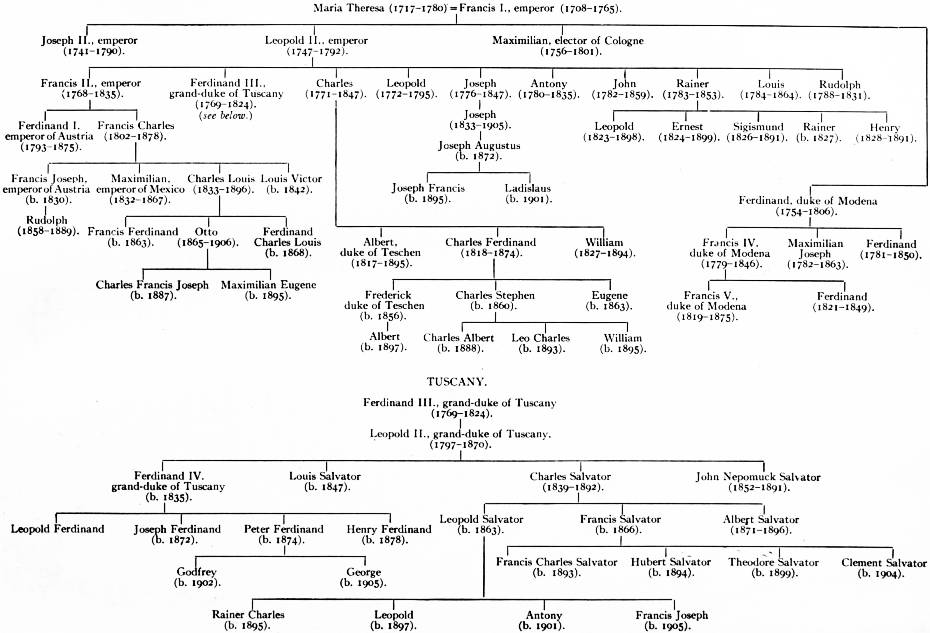
Immediately after the death of Charles the Pragmatic Sanction was forgotten. A crowd of claimants called for various parts of the Habsburg lands; Frederick the Great, talking less but acting more, invaded and conquered Silesia, and it seemed likely that the dissolution of the Habsburg monarchy would at no long interval follow the extinction of the Habsburg race. A Wittelsbach prince, Charles Albert, elector of Bavaria, the emperor Charles VII., and not Francis Stephen, was chosen emperor in January 1742, and by the treaty of Breslau, made later in the same year, nearly all Silesia was formally surrendered to Prussia. But the worst was now over, and when in 1748 the peace of Aix-la-Chapelle, which practically confirmed the treaty of Breslau, had cleared away the dust of war, Maria Theresa and her consort were found to occupy a strong position in Europe. In the first place, in September 1745, Francis had been chosen emperor; then the imperial pair ruled Hungary and Bohemia, although the latter kingdom was shorn of Silesia; in spite of French conquests the Austrian Netherlands remained in their hands; and in Italy Francis had added Tuscany to his wife’s heritage, although Parma and Piacenza had been surrendered to Spain and part of Milan to the king of Sardinia. The diplomatic volte-face and the futile attempts of Maria Theresa to recover Silesia which followed this treaty belong to the general history of Europe.
The emperor Francis I. died in 1765 and was succeeded by his son Joseph II., an ambitious and able prince, whose aim was to restore the Habsburgs and the Empire to their former great positions in Europe, and whose pride did not prevent him from learning from Frederick the Great, the despoiler of his house. His projects, however, including one of uniting Bavaria with Austria, which was especially cherished, failed completely, and when he died in February 1790 he left his lands in a state of turbulence which reflected the general condition of Europe. The Netherlands had risen against the Austrians, and in January 1790 had declared themselves independent; Hungary, angered by Joseph’s despotic measures, was in revolt, and the other parts of the monarchy were hardly more contented. But the 18th century saw a few successes for the Habsburgs. In 1718 a successful war with Turkey was ended by the peace of Passarowitz, which advanced the Austrian boundary very considerably to the east, and although by the treaty of Belgrade, signed twenty-one years later, a large part of this territory was surrendered, yet a residuum, the banate of Temesvar, was permanently incorporated with Hungary. The struggle over the succession to Bavaria, which was concluded in 1779 by the treaty of Teschen, was responsible for adding Innviertel, or the quarter of the Inn, to Austria; the first partition of Poland brought eastern Galicia and Lodomeria, and in 1777 the sultan ceded Bukovina. Joseph II. was followed by his brother, Leopold II., who restored the Austrian authority in the Netherlands, and the latter by his son Francis II., who resigned the crown of the Holy Roman Empire in August 1806, having two years before taken the title of emperor of Austria as Francis I.
Before the abdication of the emperor Francis in 1806 Austria had met and suffered from the fury of revolutionary France, but the cessions of territory made by her at the treaties of Campo Formio (1797), of Lunéville (1801) and of Pressburg (1805) were of no enduring importance. This, however, cannot be said for the treaties of Paris and of Vienna, which in 1814 and 1815 arranged the map of Europe upon the conclusion of the Napoleonic wars. These were highly favourable to the Habsburgs. In eastern and central Europe Austria regained her former position, the lands ceded to Bavaria and also eastern Galicia, which had been in the hands of Russia since 1809, being restored; she gave up the Austrian Netherlands, soon to be known as Belgium, to the new kingdom of the Netherlands, and acquiesced in the arrangement which had taken from her the Breisgau and the remnant of the Habsburg lands upon the Rhine. In return for these losses Austria became the dominant power In Italy. A mass of northern Italy, including her former possessions in Milan and the neighbourhood, and also the lands recently forming the republic of Venice, was made into the kingdom of Lombardy-Venetia, and this owned the emperor of Austria as king. Across the Adriatic Dalmatia was added to the Habsburg monarchy, the population of which, it has been estimated, was increased at this time by over four millions.
The illiberal and oppressive character of the Austrian rule in Italy made it very unpopular; it was hardly less so in Hungary and Bohemia, and the advent of the year 1848 found the subject kingdoms eager to throw off the Habsburg yoke. The whole monarchy was quickly in a state of revolution, in the midst of which the emperor Ferdinand, who had succeeded his father Francis in 1835, abdicated, and his place was taken by his young nephew Francis Joseph. The position of the Habsburg monarchy now seemed desperate. But it was strong in its immemorial tradition, which was enough to make the efforts of the Frankfort parliament to establish German unity under Prussian hegemony abortive; it was strong also in the general loyalty to the throne of the imperial army; and its counsels were directed by statesmen who knew well how to exploit in the interests of the central power the national rivalries within the monarchy. With the crushing of the Hungarian revolt by the emperor Nicholas I. of Russia in 1849 the monarchy was freed from the most formidable of its internal troubles; in 1850 the convention of Olmütz restored its influence in Germany.
Though the status quo was thus outwardly re-established, the revolutions of 1848 had really unchained forces which made its maintenance impossible. In Germany Prussia was steadily preparing for the inevitable struggle with Austria for the mastery; in France Napoleon III. was preparing to pose as the champion of the oppressed nationalities which had once more settled down sullenly under the Habsburg yoke. The alliance of the French emperor and the king of Sardinia, and the Italian war of 1859 ended in the loss of Lombardy to the Habsburgs. Seven years later the crushing defeat of Königgrätz not only ended their long rule in Italy, based on the tradition of the medieval empire, by leading to the cession of Venetia to the new Italian kingdom, but led to their final exclusion from the German confederation, soon to become, under the headship of Prussia, the German empire.
By the loss of the predominance in Germany conceded to it by the treaties of Vienna, and by the shifting of its “centre of gravity” eastward, the Habsburg monarchy, however, perhaps gained more than it lost. One necessary result, indeed, was the composition (Ausgleich) with Hungary in 1867, by which the latter became an independent state (Francis Joseph being crowned king at Pest in June 1867) bound to the rest of the monarchy only by the machinery necessary for the carrying out of a common policy in matters of common interest. This at least restored the loyalty of the Hungarians to the Habsburg dynasty; it is too soon yet to say that it secured permanently the essential unity of the Habsburg monarchy. By the system of the Dual Monarchy the rest of the Austrian emperor’s dominions (Cis-Leithan) were consolidated under a single central government, the history of which has been mainly that of the rival races within the empire struggling for political predominance. Since the development of the constitution has been consistently in a democratic direction and the Slavs are in a great majority, the tendency has been for the German element—strong in its social status and tradition of predominance—to be swamped by what it regards as an inferior race; and a considerable number of Austrian “Germans” have learned to look not to their Habsburg rulers, but to the power of the German empire for political salvation. The tendency eastwards of the monarchy was increased when in 1878 the congress of Berlin placed Bosnia and Herzegovina under Austrian rule. Old ambitions were now revived at the expense of the Ottoman empire, the goal of which was the port of Salonica; and not the least menacing aspect of the question of the near East has been that the rivalry of Italy and the Habsburg monarchy has been transferred to the Balkan peninsula. Yet, in spite of internal dissensions arising out of questions fundamentally insoluble, and in spite of the constant threat of external complications that may lead to war, the Habsburg monarchy as the result of the changes in the 19th and 20th centuries is seemingly stronger than ever. The shadow of universal claims to empire and sonorous but empty titles have vanished, but so have the manifold rivalries and entanglements which accompanied the Habsburg rule in Italy and the Netherlands and Habsburg preponderance in Germany. The monarchy is stronger because its sphere is more defined; because as preserving the pax Romana among the jostling races of eastern Europe, it is more than ever recognized as an essential element in the maintenance of European peace, and is recognized as necessary and beneficial even by the ambitious and restless nationalities that chafe under its rule.
A few words must be said about the cadet branches of the Habsburg family. When, in 1765, Francis I. died and Joseph II. became emperor, the grand-duchy of Tuscany passed by special arrangement not to Joseph, but to his younger brother Leopold. Then in 1791, after Leopold had succeeded Joseph as emperor, he handed over the grand-duchy to his second son, Ferdinand (1769-1824). In 1801 this prince was deposed by Napoleon and Tuscany was seized by France. Restored to the Habsburgs in the person of Ferdinand in 1814, it remained under his rule, and then under that of his son Leopold (1797-1870), until the rising of 1859, when the Austrians were driven out and the grand-duchy was added to the kingdom of Sardinia. A similar fate attended the duchy of Modena, which had passed to the Habsburgs through the marriage of its heiress Mary Beatrice of Este (d. 1829) with the archduke Ferdinand (1754-1806), brother of the emperor Leopold II. From 1814 to 1846 this duchy was governed by Ferdinand’s son, Duke Francis IV., and from 1846 to 1859 by his grandson, Francis V. This family became extinct on the death of Francis V. in 1875.
In addition to his successor Francis II., and to Ferdinand, grand-duke of Tuscany, the emperor Leopold II. had eight sons, five of whom, including the archduke John (1782-1859), who saw a good deal of service during the Napoleonic Wars and was chosen regent (Reichsverweser) of Germany in 1848, have now no living male descendants. Thus the existing branches of the family are descended from Leopold’s five other sons. The descendants of Leopold, the dispossessed grand-duke of Tuscany, were in 1909 represented by his son, Ferdinand (b. 1835), who still claimed the title of grand-duke of Tuscany, and his son and grandsons; by the numerous descendants of the archduke Charles Salvator (1830-1892); and by the archduke Louis Salvator (b. 1847), a great traveller and a voluminous writer. The grand-duke’s fourth son was the archduke John Nepomuck Salvator, who, after serving in the Austrian army, resigned all his rights and titles and under the name of Johann Orth took command of a sailing vessel. He is supposed to have been drowned off the coast of South America in 1891, but reports of his continued existence were circulated from time to time after that date. Of the emperor Leopold’s other sons the archduke Charles, perhaps the most distinguished soldier of the family, left four sons, including Albert, duke of Teschen (1817-1895), who inherited some of his father’s military ability. Charles’s family was in 1909 represented by his grandsons, the sons of the archduke Charles Ferdinand (1818-1874). The archduke Joseph (1776-1847), palatine of Hungary, was represented by a grandson, Joseph Augustus (b. 1872), and the archduke Rainer (1783-1853), viceroy of Lombardy-Venetia, by a son Rainer (b. 1827), and by several grandsons.
The eldest and reigning branch of the family was in 1909 represented by the emperor Francis Joseph, whose father was the archduke Francis Charles (1802-1878), and whose grandfather was the emperor Francis II. Francis Joseph’s only son Rudolph died in 1889; consequently the heir to the Habsburg monarchy was the emperor’s nephew Francis Ferdinand (b. 1863), the eldest of the three sons of his brother Charles Louis (1833-1896). In 1875 Francis Ferdinand inherited the wealth of the Este family and took the title of archduke of Austria-Este; in 1900 he contracted a morganatic marriage with Sophia, countess of Chotek, renouncing for his sons the succession to the monarchy. Thus after Francis Ferdinand this would pass to the sons of his brother, the archduke Otto (1865-1906). One of the emperor’s three brothers was Maximilian, emperor of Mexico from 1863 to 1867.
With the exception of Charles V. the Habsburgs have produced no statesmen of great ability, while several members of the family have displayed marked traces of insanity. Nevertheless they secured, and for over 350 years they kept, the first place among the potentates of Europe; a dignity in origin and theory elective becoming in practice hereditary in their house. This position they owe to some extent to the tenacity with which they have clung to the various lands and dignities which have passed into their possession, but they owe it much more to a series of fortunate marriages and opportune deaths. The union of Maximilian and Mary of Burgundy, of Philip the Handsome and Joanna of Spain, of Ferdinand and Anna of Hungary and Bohemia; the death of Ottakar of Bohemia, of John, the only son of Ferdinand and Isabella of Spain, of Louis of Hungary and Bohemia—these are the corner-stones upon which the Habsburg monarchy has been built.
For the origin and early history of the Habsburgs see G. de Roo, Annales rerum ab Austriacis Habsburgicae gentis principibus a Rudolpho I. usque ad Carolum V. gestarum (Innsbruck, 1592, fol.); M. Herrgott, Genealogia diplomatica augustae gentis Habsburgicae (Vienna, 1737-1738); E. M. Fürst von Lichnowsky, Geschichte des Hauses Habsburg (Vienna, 1836-1844); A. Schulte, Geschichte der Habsburger in den ersten drei Jahrhunderten (Innsbruck, 1887); T. von Liebenau, Die Anfänge des Hauses Habsburg (Vienna, 1883); W. Merz, Die Habsburg (Aarau, 1896); W. Gisi, Der Ursprung der Häuser Zähringen und Habsburg (1888); and F. Weihrich, Stammtafel zur Geschichte des Hauses Habsburg (Vienna, 1893). For the history of the Habsburg monarchy see Langl, Die Habsburg und die denkwürdigen Stätten ihrer Umgebung (Vienna, 1895); and E. A. Freeman, Historical Geography of Europe (1881). Two English books on the subject are J. Gilbart-Smith, The Cradle of the Hapsburgs (1907); and A. R. and E. Colquhoun, The Whirlpool of Europe, Austria-Hungary and the Hapsburgs (1906).
(A. W. H.*)
HACHETTE, JEAN NICOLAS PIERRE (1769-1834), French mathematician, was born at Mézières, where his father was a bookseller, on the 6th of May 1769. For his early education he proceeded first to the college of Charleville, and afterwards to that of Reims. In 1788 he returned to Mézières, where he was attached to the school of engineering as draughtsman to the professors of physics and chemistry. In 1793 he became professor of hydrography at Collioure and Port-Vendre. While there he sent several papers, in which some questions of navigation were treated geometrically, to Gaspard Monge, at that time minister of marine, through whose influence he obtained an appointment in Paris. Towards the close of 1794, when the École Polytechnique was established, he was appointed along with Monge over the department of descriptive geometry. There he instructed some of the ablest Frenchmen of the day, among them S. D. Poisson, F. Arago and A. Fresnel. Accompanying Guyton de Morveau in his expedition, earlier in the year, he was present at the battle of Fleurus, and entered Brussels with the French army. In 1816, on the accession of Louis XVIII., he was expelled from his chair by government. He retained, however, till his death the office of professor in the faculty of sciences in the École Normale, to which he had been appointed in 1810. The necessary royal assent was in 1823 refused to the election of Hachette to the Académie des Sciences, and it was not till 1831, after the Revolution, that he obtained that honour. He died at Paris on the 16th of January 1834. Hachette was held in high esteem for his private worth, as well as for his scientific attainments and great public services. His labours were chiefly in the field of descriptive geometry, with its application to the arts and mechanical engineering. It was left to him to develop the geometry of Monge, and to him also is due in great measure the rapid advancement which France made soon after the establishment of the École Polytechnique in the construction of machinery.
Hachette’s principal works are his Deux Supplements à la Géométrie descriptive de Monge (1811 and 1818); Éléments de géométrie à trois dimensions (1817); Collection des épures de géométrie, &c. (1795 and 1817); Applications de géométrie descriptive (1817); Traité de géométrie descriptive, &c. (1822); Traité élémentaire des machines (1811); Correspondance sur l’École Polytechnique (1804-1815). He also contributed many valuable papers to the leading scientific journals of his time.
For a list of Hachette’s writings see the Catalogue of Scientific Papers of the Royal Society of London; also F. Arago, Œuvres (1855); and Silvestre, Notice sur J. N. P. Hachette (Bruxelles, 1836).
HACHETTE, JEANNE, French heroine. Jeanne Lainé, or Fourquet, called Jeanne Hachette, was born about 1454. We have no precise information about her family or origin. She is known solely for her act of heroism which on the 27th of June 1472 saved Beauvais when it was on the point of being taken by the troops of Charles the Bold, duke of Burgundy. The town was defended by only 300 men-at-arms, commanded by Louis de Balagny. The Burgundians were making an assault, and one of their number had actually planted a flag upon the battlements, when Jeanne, axe in hand, flung herself upon him, hurled him into the moat, tore down the flag, and revived the drooping courage of the garrison. In gratitude for this heroic deed, Louis XI. instituted a procession in Beauvais called the Procession of the Assault, and married Jeanne to her chosen lover Colin Pilon, loading them with favours.
See Georges Vallat, Jeanne Hachette (Abbeville, 1898).
HACHETTE, LOUIS CHRISTOPHE FRANÇOIS (1800-1864), French publisher, was born at Rethel in the Ardennes on the 5th of May 1800. After studying three years at a normal school with the view of becoming a teacher, he was in 1822 on political grounds expelled from the seminary. He then studied law, but in 1826 he established in Paris a publishing business for the issue of works adapted to improve the system of school instruction, or to promote the general culture of the community. He published manuals in various departments of knowledge, dictionaries of modern and ancient languages, educational journals, and French, Latin and Greek classics annotated with great care by the most eminent authorities. Subsequently to 1850 he, in conjunction with other partners, published a cheap railway library, scientific and miscellaneous libraries, an illustrated library for the young, libraries of ancient literature, of modern foreign literature, and of modern foreign romance, a series of guide-books and a series of dictionaries of universal reference. In 1855 he also founded Le Journal pour tous, a publication with a circulation of 150,000 weekly. Hachette also manifested great interest in the formation of mutual friendly societies among the working classes, in the establishment of benevolent institutions, and in other questions relating to the amelioration of the poor, on which subjects he wrote various pamphlets; and he lent the weight of his influence towards a just settlement of the question of international literary copyright. He died on the 31st of July 1864.
HACHURE (French for “hatching”), the term for the conventional lines used in hill or mountain shading upon a map (q.v.) to indicate the slope of the surface, the depth of shading being greatest where the slope is steepest. The method is less accurate than that of contour lines, but gives an indication of the trend and extent of a range or mountain system, especially upon small-scale maps.
HACIENDA (O. Span, facienda, from the Latin, meaning “things to be done”), a Spanish term for a landed estate. It is commonly applied in Spanish America to a country estate, on which stock-raising, manufacturing or mining may be carried on, usually with a dwelling-house for the owner’s residence upon it. It is thus used loosely for a country house.
HACKBERRY, a name given to the fruit of Celtis occidentalis, belonging to the natural botanical order Ulmaceae, to which also belongs the elm (Ulmus). It is also known under the name of “sugar-berry,” “beaver-wood” and “nettle-tree.” The hackberry tree is of middle size, attaining from 60 to 80 ft. in height (though sometimes reaching 130 ft.), and with the aspect of an elm. The leaves are ovate in shape, with a very long taper point, rounded and usually very oblique at the base, usually glabrous above and soft-pubescent beneath. The soft filmy flowers appear early in the spring before the expansion of the leaves. The fruit is oblong, about half to three-quarters of an inch long, of a reddish or yellowish colour when young, turning to a dark purple in autumn. This tree is distributed through the deep shady forests bordering river banks from Canada (where it is very rare) to the southern states. The fruit has a sweetish and slightly astringent taste, and is largely eaten in the United States. The seeds contain an oil like that of almonds. The bark is tough and fibrous like hemp, and the wood is heavy, soft, fragile and coarse-grained, and is used for making fences and furniture. The root has been used as a dye for linens.
HACKENSACK, a town and the county-seat of Bergen county, New Jersey, U.S.A., on the Hackensack river, 13 m. N. of Jersey City. Pop. (1890), 6004; (1900), 9443, of whom 2009 were foreign-born and 515 were negroes; (1905) 11,098; (1910) 14,050. It is served by the New York, Susquehanna & Western, and the New Jersey & New York railways, both being controlled by the Erie Company; and indirectly by the West Shore (at Bogota, ½ m. S.E.). Electric lines connect Hackensack with Newark, Passaic and Paterson, and with New York ferries. The town extends from the low bank of the river W. to the top of a ridge, about 40 ft. higher up, from which there are good views to the S. and E. Hackensack is principally a residential town, though there are a number of manufacturing establishments in and near it. Silk and silk goods and wall-paper are the principal manufactures. In 1905 the value of the town’s factory product was $1,488,358, an increase of 90.3% since 1900. There are an historic mansion-house and an interesting old Dutch church, both erected during the 18th century; and a monument marks the grave of General Enoch Poor (1736-1780), an officer in the War of Independence, who was born at Andover, Mass., entered the Continental Army from New Hampshire, and took part in the campaign against Burgoyne, in the battle of Monmouth and in General Sullivan’s expedition against the Iroquois. Hackensack was settled by the Dutch about 1640, and was named after the Hackensack Indians, a division of the Unami Delawares, who lived in the valleys of the Hackensack and Passaic rivers, and whose best-known chief was Oritany, a friend of the whites. Hackensack is coextensive with the township of New Barbadoes, first incorporated with considerably larger territory in 1693.