VOLUME XII SLICE VII Gyantse to Hallel (continued 8)
Reading edition
HAJIPUR, a town of British India, in the Muzaffarpur district of Bengal, on the Gandak, just above its confluence with the Ganges opposite Patna. Pop. (1901), 21,398. Hajipur figures conspicuously in the history of the struggles between Akbar and his rebellious Afghan governors of Bengal, being twice besieged and captured by the imperial troops, in 1572 and 1574. Within the limits of the old fort is a small stone mosque, very plain, but of peculiar architecture, and attributed to Hājī Ilyās, its traditional founder (c. 1350). Its command of water traffic in three directions makes the town a place of considerable commercial importance. Hajipur has a station on the main line of the Bengal and North-western railway.
HAJJ or Hadj, the Arabic word, meaning literally a “setting out,” for the greater pilgrimage of Mahommedans to Mecca, which takes place from the 8th to the 10th of the twelfth month of the Mahommedan year; the lesser pilgrimage, called umrah or omra, may be made to the mosque at Mecca at any time other than that of the hajj proper, and is also a meritorious act. The term hajji or hadji is given to those who have performed the greater pilgrimage. The word hajj is sometimes loosely used of any Mahommedan pilgrimage to a sacred place or shrine, and is also applied to the pilgrimages of Christians of the East to the Holy Sepulchre at Jerusalem (see Mecca; Mahommedan Religion).
HĀJJĪ KHALĪFA [in full Muṣṭafā ibn ‘Abdallāh Kātib Chelebī Hājjī Khalīfa] (ca. 1599-1658), Arabic and Turkish author, was born at Constantinople. He became secretary to the commissariat department of the Turkish army in Anatolia, was with the army in Bagdad in 1625, was present at the siege of Erzerum, and returned to Constantinople in 1628. In the following year he was again in Bagdad and Hamadān, and in 1633 at Aleppo, whence he made the pilgrimage to Mecca (hence his title Hājjī). The following year he was in Erivān and then returned to Constantinople. Here he obtained a post in the head office of the commissariat department, which afforded him time for study. He seems to have attended the lectures of great teachers up to the time of his death, and made a practice of visiting bookshops and noting the titles and contents of all books he found there. His largest work is the Bibliographical Encyclopaedia written in Arabic. In this work, after five chapters dealing with the sciences generally, the titles of Arabian, Persian and Turkish books written up to his own time are arranged in alphabetical order. With the titles are given, where possible, short notes on the author, his date, and sometimes the introductory words of his work. It was edited by G. Flügel with Latin translation and a useful appendix (7 vols. Leipzig, 1835-1858). The text alone of this edition has been reproduced at Constantinople (1893).
Hājjī Khalīfa also wrote in Turkish: a chronological conspectus of general history (translated into Italian by G. R. Carli, Venice, 1697); a history of the Turkish empire from 1594 to 1655 (Constantinople, 1870); a history of the naval wars of the Turks (Constantinople, 1729; chapters 1-4 translated by J. Mitchell, London, 1831); a general geography published at Constantinople, 1732 (Latin trans. by M. Norberg, London and Gotha, 1818; German trans. of part by J. von Hammer, Vienna, 1812; French trans. of part by V. de St Martin in his Geography of Asia Minor, vol. I).
For his life see the preface to Flügel’s edition; list of his works in C. Brockelmann’s Gesch. d. arabischen Literatur (Berlin, 1902), vol. ii., pp. 428-429.
(G. W. T.)
HAKE, EDWARD (fl. 1579), English satirist, was educated under John Hopkins, the part-author of the metrical version of the Psalms. He resided in Gray’s Inn and Barnard’s Inn, London. In the address “To the Gentle Reader” prefixed to his Newes out of Powles Churchyard ... Otherwise entitled Syr Nummus (2nd ed., 1579) he mentions the “first three yeeres which I spent in the Innes of Channcery, being now about a dosen of yeeres passed.” In 1585 and 1586 he was mayor of New Windsor, and in 1588 he represented the borough in parliament. His last work was published in 1604. He was protected by the earl of Leicester, whose policy it was to support the Puritan party, and who no doubt found a valuable ally in so vigorous a satirist of error in clerical places as was Hake. Newes out of Paules Churchyarde, A Trappe for Syr Monye, first appeared in 1567, but no copy of this impression is known, and it was re-issued in 1579 with the title quoted above. The book takes the form of a dialogue between Bertulph and Paul, who meet in the aisles of the cathedral, and is divided into eight “satyrs,” dealing with the corruption of the higher clergy and of judges, the greed of attorneys, the tricks of physicians and apothecaries, the sumptuary laws, extravagant living, Sunday sports, the abuse of St Paul’s cathedral as a meeting-place for business and conversation, usury, &c. It is written in rhymed fourteen-syllable metre, which is often more comic than the author intended. It contains, amid much prefatory matter, a note to the “carping and scornefull Sicophant,” in which he attacks his enemies with small courtesy and much alliteration. One is described as a “carping careless cankerd churle.”
He also wrote a translation from Thomas à Kempis, The Imitation, or Following of Christ (1567, 1568); A Touchstone for this Time Present (1574), a scurrilous attack on the Roman Catholic Church, followed by a treatise on education; A Commemoration of the ... Raigne of ... Elizabeth (1575), enlarged in 1578 to A Joyfull Continuance of the Commemoration, &c.; and of Gold’s Kingdom, and this Unhelping Age (1604), a collection of pieces in prose and verse, in which the author inveighs against the power of gold. A bibliography of these and of Hake’s other works was compiled by Mr Charles Edmonds for his edition in 1872 of the Newes (Isham Reprints, No. 2, 1872).
HAKE, THOMAS GORDON (1800-1895), English poet, was born at Leeds, of an old Devonshire family, on the 10th of March 1809. His mother was a Gordon of the Huntly branch. He studied medicine at St George’s hospital and at Edinburgh and Glasgow, but had given up practice for many years before his death, and had devoted himself to a literary life. In 1839 he published a prose epic Vates, republished in Ainsworth’s magazine as Valdarno, which attracted the attention of D. G. Rossetti. In after years he became an intimate member of the circle of friends and followers gathered round Rossetti, who so far departed from his usual custom as to review Hake’s poems in the Academy and in the Fortnightly Review. In 1871 he published Madeline; 1872, Parables and Tales; 1883, The Serpent Play; 1890, New Day Sonnets; and in 1892 his Memoirs of Eighty Years. Dr Hake’s works had much subtlety and felicity of expression, and were warmly appreciated in a somewhat restricted literary circle. In his last published verse, the sonnets, he shows an advance in facility on the occasional harshness of his earlier work. He was given a Civil List literary pension in 1893, and died on the 11th of January 1895.
HAKE (Merluccius vulgaris), a fish which differs from the cod in having only two dorsal fins, and one anal. It is very common on the coasts of Europe and eastern North America, but its flesh is much less esteemed than that of the true Gadi. Specimens 4 ft. in length are not scarce. There are local variations in the use of “hake” as a name; in America the “silver hake” (Merluccius bilinearis), sometimes called “whiting,” and “Pacific hake” (Merluccius productus) are also food-fishes of inferior quality.
HAKKAS (“Guests,” or “Strangers”), a people of S.W. China, chiefly found in Kwang-Tung, Fu-Kien and Formosa. Their origin is doubtful, but there is some ground for believing that they may be a cross between the aboriginal Mongolic element of northern China and the Chinese proper. According to their tradition, they were in Shantung and northern China as early as the 3rd century B.C. In disposition, appearance and customs they differ from the true Chinese. They speak a distinct dialect. Their women, who are prettier than the pure Chinese, do not compress their feet, and move freely about in public. The Hakkas are a most industrious people and furnish at Canton nearly all the coolie labour employed by Europeans. Their intelligence is great, and many noted scholars have been of Hakka birth. Hung Sin-tsuan, the leader in the Taiping rebellion, was a Hakka. In Formosa they serve as intermediaries between the Chinese and European traders and the natives. From time immemorial they seem to have been persecuted by the Chinese, whom they regard as “foreigners,” and with whom their means of communication is usually “pidgin English.” The earliest persecution occurred under the “first universal emperor” of China, Shi-Hwang-ti (246-210 B.C.). From this time the Hakkas appear to have become wanderers. Sometimes for generations they were permitted to live unmolested, as under the Han dynasty, when some of them held high official posts. During the Tang dynasty (7th, 8th, and 9th centuries) they settled in the mountains of Fu-kien and on the frontiers of Kwang-Tung. On the invasion of Kublai Khan, the Hakkas distinguished themselves by their bravery on the Chinese side. In the 14th century further persecutions drove them into Kwang-Tung.
See “An Outline History of the Hakkas,” China Review (London, 1873-1874), vol. ii.; Pitou, “On the Origin and History of the Hakkas,” ib.; Dyer Ball, Easy Lessons in the Hakka Dialect (1884), Things Chinese (London, 1893); Schaub, “Proverbs in Daily Use among the Hakkas,” in China Review (London, 1894-1895), vol. xxi.; Rev. J. Edkins, China’s Place in Philology; Girard de Rialle, Rev. d. anthrop. (Jan. and April, 1885); G. Taylor, “The Aborigines of Formosa,” China Review, xiv. p. 198 seq., also xvi. No. 3, “A Ramble through Southern Formosa.”
HAKLUYT, RICHARD (c. 1553-1616), British geographer, was born of good family in or near London about 1553. The Hakluyts were of Welsh extraction, not Dutch as has been supposed. They appear to have settled in Herefordshire as early as the 13th century. The family seat was Eaton, 2 m. S.E. of Leominster. Hugo Hakelute was returned M.P. for that borough in 1304/5. Richard went to school at Westminster, where he was a queen’s scholar; while there his future bent was determined by a visit to his cousin and namesake, Richard Hakluyt of the Middle Temple. His cousin ’s discourse, illustrated by “certain bookes of cosmographie, an universall mappe, and the Bible,” made young Hakluyt resolve to “prosecute that knowledge and kind of literature.” Entering Christ Church, Oxford, in 1570, “his exercises of duty first performed,” he fell to his intended course of reading, and by degrees perused all the printed or written voyages and discoveries that he could find. He took his B.A. In 1573/4. It is probable that, shortly after taking his M.A. (1577), he began at Oxford the first public lectures in geography that “shewed both the old imperfectly composed and the new lately reformed mappes, globes, spheares, and other instruments of this art.” That this was not in London is certain, as we know that the first lecture of the kind was delivered in the metropolis on the 4th of November 1588 by Thomas Hood.
Hakluyt’s first published work was his Divers Voyages touching the Discoverie of America (London, 1582, 4to.). This brought him to the notice of Lord Howard of Effingham, and so to that of Sir Edward Stafford, Lord Howard’s brother-in-law; accordingly at the age of thirty, being acquainted with “the chiefest captaines at sea, the greatest merchants, and the best mariners of our nation,” he was selected as chaplain to accompany Stafford, now English ambassador at the French court, to Paris (1583). In accordance with the instructions of Secretary Walsingham, he occupied himself chiefly in collecting information of the Spanish and French movements, and “making diligent inquirie of such things as might yield any light unto our westerne discoverie in America.” The first fruits of Hakluyt’s labours in Paris are embodied in his important work entitled A particuler discourse concerning Westerne discoveries written in the yere 1584, by Richarde Hackluyt of Oxforde, at the requeste and direction of the righte worshipfull Mr Walter Raghly before the comynge home of his twoo barkes. This long-lost MS. was at last printed in 1877. Its object was to recommend the enterprise of planting the English race in the unsettled parts of North America. Hakluyt’s other works consist mainly of translations and compilations, relieved by his dedications and prefaces, which last, with a few letters, are the only material we possess out of which a biography of him can be framed. Hakluyt revisited England in 1584, laid before Queen Elizabeth a copy of the Discourse “along with one in Latin upon Aristotle’s Politicks,” and obtained, two days before his return to Paris, the grant of the next vacant prebend at Bristol, to which he was admitted in 1586 and held with his other preferments till his death.
While in Paris Hakluyt interested himself in the publication of the MS. journal of Laudonnière, the Histoire notable de la Florida, edited by Bassanier (Paris, 1586, 8vo.). This was translated by Hakluyt and published in London under the title of A notable historie containing foure voyages made by certayne French captaynes into Florida (London, 1587, 4to.). The same year De orbe novo Petri Martyris Anglerii decades octo illustratae labore et industria Richardi Hackluyti saw the light at Paris. This work contains the exceedingly rare copperplate map dedicated to Hakluyt and signed F. G. (supposed to be Francis Gualle); it is the first on which the name of “Virginia” appears.
In 1588 Hakluyt finally returned to England with Lady Stafford, after a residence in France of nearly five years. In 1589 he published the first edition of his chief work, The Principall Navigations, Voiages and Discoveries of the English Nation (fol., London, 1 vol.). In the preface to this we have the announcement of the intended publication of the first terrestrial globe made in England by Molyneux. In 1598-1600 appeared the final, reconstructed and greatly enlarged edition of The Principal Navigations, Voyages, Traffiques and Discoveries of the English Nation (fol., 3 vols.). Some few copies contain an exceedingly rare map, the first on the Mercator projection made in England according to the true principles laid down by Edward Wright. Hakluyt’s great collection, though but little read, has been truly called the “prose epic of the modern English nation.” It is an invaluable treasure of material for the history of geographical discovery and colonization, which has secured for its editor a lasting reputation. In 1601 Hakluyt edited a translation from the Portuguese of Antonio Galvano, The Discoveries of the World (4to., London). In the same year his name occurs as an adviser to the East India Company, supplying them with maps, and informing them as to markets. Meantime in 1590 (April 20th) he had been instituted to the rectory of Withering-sett-cum-Brockford, Suffolk. In 1602, on the 4th of May, he was installed prebendary of Westminster, and in the following year he was elected archdeacon of Westminster. In the licence of his second marriage (30th of March 1604) he is also described as one of the chaplains of the Savoy, and his will contains a reference to chambers occupied by him there up to the time of his death; in another official document he is styled D.D. In 1605 he secured the prospective living of James Town, the intended capital of the intended colony of Virginia. This benefice he supplied, when the colony was at last established in 1607, by a curate, one Robert Hunt. In 1606 he appears as one of the chief promoters of the petition to the king for patents to colonize Virginia. He was also a leading adventurer in the London or South Virginia Company. His last publication was a translation of Fernando de Soto’s discoveries in Florida, entitled Virginia richly valued by the description of Florida her next neighbour (London, 1609, 4to). This work was intended to encourage the young colony of Virginia; to Hakluyt, it has been said, “England is more indebted for its American possession than to any man of that age.” We may notice that it was at Hakluyt’s suggestion that Robert Parke translated Mendoza’s History of China (London, 1588-1589) and John Pory made his version of Leo Africanus (A Geographical History of Africa, London, 1600). Hakluyt died in 1616 (November 23rd) and was buried in Westminster Abbey (November 26th); by an error in the abbey register his burial is recorded under the year 1626. Out of his various emoluments and preferments (of which the last was Gedney rectory, Lincolnshire, in 1612) he amassed a small fortune, which was squandered by a son. A number of his MSS., sufficient to form a fourth volume of his collections of 1598-1600, fell into the hands of Samuel Purchas, who inserted them in an abridged form in his Pilgrimes (1625-1626, fol.). Others are preserved at Oxford (Bib. Bod. MS. Seld. B. 8). which consist chiefly of notes gathered from contemporary authors.
Besides the MSS. or editions noticed in the text (Divers Voyages (1582); Particuler Discourse (1584); Laudonnière’s Florida (1587); Peter Martyr, Decades (1587); Principal Navigations (1589 and 1598-1600); Galvano’s Discoveries (1601); De Soto’s Florida record, the Virginia richly valued (1609, &c.), we may notice the Hakluyt Society’s London edition of the Divers Voyages in 1850, the edition of the Particuler Discourse, by Charles Deane in the Collections of the Maine Historical Society (Cambridge, Mass., 1870, with an introduction by Leonard Woods); also, among modern issues of the Principal Navigations, those of 1809 (5 vols., with much additional matter), and of 1903-1905 (Glasgow, 12 vols.). The new title-page issued for the first volume of the final edition of the Principal Navigations, in 1599, merely cancelled the former 1598 title with its reference to the Cadiz expedition of 1596; but from this has arisen the mistaken supposition that a new edition was then (1599) published. Hakluyt’s Galvano was edited for the Hakluyt Society by Admiral C. R. D. Bethune in 1862. This Society, which was founded in 1846 for printing rare and unpublished voyages and travels, includes the Glasgow edition of the Principal Navigations in its extra series, as well as C. R. Beazley’s edition of Carpini, Rubruquis, and other medieval texts from Hakluyt (Cambridge, 1903, 1 vol.). Reckoning in these and an issue of Purchas’s Pilgrimes by the Glasgow publisher of the Hakluyt of 1903-1905, the society has now published or “fathered” 150 vols. See also Voyages of the Elizabethan Seamen to America, being Select Narratives from the Principal Navigations, by E. J. Payne (Oxford, 1880; 1893; new edition by C. R. Beazley, 1907).
For Hakluyt’s life the dedications of the 1589 and 1598 editions of the Principal Navigations should be especially consulted; also Winter Jones’s introduction to the Kakluyt Society edition of the Divers Voyages; Fuller’s Worthies of England, “Herefordshire”; Oxford Univ. Reg. (Oxford Hist. Soc), ii., iii. 39; Historical MSS. Commission, 4th report, appendix, p. 614, the last giving us the Towneley MSS. referring to payments (prizes?) awarded to Hakluyt when at Oxford, May 12th and June 4th, 1575.
(C. H. C; C. R. B.)
HAKODATE, a town on the south of the island of Yezo, Japan, for many years regarded as the capital of the island until Sapporo was officially raised to that rank. Pop. (1903) 84,746. Its position, as has been frequently remarked, is not unlike that of Gibraltar, as the town is built along the north-western base of a rocky promontory (1157 ft. in height) which forms the eastern boundary of a spacious bay, and is united to the mainland by a narrow sandy isthmus. The summit of the rock, called the Peak, is crowned by a fort. Hakodate is one of the ports originally opened to foreign trade. The Bay of Hakodate, an inlet of Tsugaru Strait, is completely land-locked, easy of access and spacious, with deep water almost up to the shore, and good holding-ground. The Russians formerly used Hakodate as a winter port. The staple exports are beans, pulse and peas, marine products, sulphur, furs and timber; the staple imports, comestibles (especially salted fish), kerosene and oil-cake. The town is not situated so as to profit largely by the development of the resources of Yezo, and as a port of foreign trade its outlook is indifferent. Frequent steamers connect Hakodate and Yokohama and other ports, and there is daily communication with Aomori, 56 m. distant, whence there is rail-connexion with Tokyo. Hakodate was opened to American commerce in 1854. In the civil war of 1868 the town was taken by the rebel fleet, but it was recovered by the mikado in 1869.
HAL, a town of Brabant, Belgium, about 9 m. S.W. of Brussels, situated on the river Senne and the Charleroi canal. Pop. (1904) 13,541. The place is interesting chiefly on account of its fine church of Notre Dame, formerly dedicated to St Martin. This church, a good example of pure Gothic, was begun in 1341 and finished in 1409. Its principal ornament is the alabaster altar, by J. Mone, completed in 1533. The bronze font dates from 1446. Among the monuments is one in black marble to the dauphin Joachim, son of Louis XI., who died in 1460. In the treasury of the church are many costly objects presented by illustrious personages, among others by the emperor Charles V., King Henry VIII. of England, Charles the Bold of Burgundy, and several popes. The church is chiefly celebrated, however, for its miraculous image of the Virgin. Legend says that during a siege the bullets fired into the town were caught by her in the folds of her dress. Some of these are still shown in a chest that stands in a side chapel. In consequence of this belief a great pilgrimage, attended by many thousands from all parts of Belgium, is paid annually to this church. The hôtel de ville dates from 1616 and has been restored with more than ordinary good taste.
HALA, or Halla (formerly known as Murtazabad), a town of British India in Hyderabad district, Sind. Pop. (1901) 4985. It has long been famous for its glazed pottery and tiles, made from a fine clay obtained from the Indus, mixed with powdered flints. The town has also a manufacture of susis or striped trouser-cloths.
HALAESA, an ancient town on the north coast of Sicily, about 14 m. E. of Cephaloedium [Cefalu], to the east of the modern Castel di Tusa, founded in 403 B.C. by Archonides, tyrant of Herbita, whose name it sometimes bore: we find, e.g. Halaisa Archonida on a coin of the time of Augustus (Corp. inscrip. Lat. x., Berlin, 1883, p. 768). It was the first town to surrender to the Romans in the First Punic War, and was granted freedom and immunity from tithe. It became a place of some importance in Roman days, especially as a port, and entirely outstripped its mother city. Halaesa is the only place in Sicily where an inscription dedicated to a Roman governor of the republican period (perhaps in 93 B.C.) has come to light.
(T. As.)
HALAKHA, or Halacha (literally “rule of conduct”), the rabbinical development of the Mosaic law; with the haggada it makes up the Talmud and Midrash (q.v.). As the haggada is the poetic, so the halakha is the legal element of the Talmud (q.v.), and arose out of the faction between the Sadducees, who disputed the traditions, and the Pharisees, who strove to prove their derivation from scripture. Among the chief attempts to codify the halakha were the Great Rules (Halakhoth Gedoloth) of Simon Kayyara (9th century), based on the letters written by the Gaonim, the heads of the Babylonian schools, to Jewish inquirers in many lands, the work of Jacob Alfassi (1013-1103), the Strong Hand of Maimonides (1180), and the Table Prepared (Shulḥan Aruch) of Joseph Qaro (1565), which from its practical scope and its clarity as a work of general reference became the universal handbook of Jewish life in many of its phases.
(I. A.)
HALBERSTADT, a town of Germany, in the Prussian province of Saxony, 56 m. by rail N.W. of Halle, and 29 S.W. of Magdeburg. It lies in a fertile country to the north of the Harz Mountains, on the Holzemme, at the junction of railways to Halle, Goslar and Thale. Pop. (1905) 45,534. The town has a medieval appearance, many old houses decorated with beautiful wood-carving still surviving. The Gothic cathedral (now Protestant), dating from the 13th and 14th centuries, is remarkable for the majestic impression made by the great height of the interior, with its slender columns and lofty, narrow aisles. The treasure, preserved in the former chapter-house, is rich in reliquaries, vestments and other objects of medieval church art. The beautiful spires, which had become unsafe, were rebuilt in 1890-1895. Among the other churches the only one of special interest is the Liebfrauenkirche (Church of Our Lady), a basilica, with four towers, in the later Romanesque style, dating from the 12th and 13th centuries and restored in 1848, containing old mural frescoes and carved figures. Remarkable among the other old buildings are the town-hall, of the 14th century and restored in the 17th century, with a crypt, and the Petershof, formerly the episcopal palace, but now utilized as law courts and a prison. The principal educational establishment is the gymnasium, with a library of 40,000 volumes. Close to the cathedral lies the house of the poet Gleim (q.v.), since 1899 the property of the municipality and converted into a museum. It contains a collection of the portraits of the friends of the poet-scholar and some valuable manuscripts. The principal manufactures of the town are sugar, cigars, paper, gloves, chemical products, beer and machinery. About a mile and a half distant are the Spiegelsberge, from which a fine view of the surrounding country is obtained, and the Klusberge, with prehistoric cave-dwellings cut out in the sandstone rocks.
The history of Halberstadt begins with the transfer to it, by Bishop Hildegrim I., in 820 of the see founded by Charlemagne at Seligenstadt. At the end of the 10th century the bishops were granted by the emperors the right to exercise temporal jurisdiction over their see, which became one of the most considerable of the ecclesiastical principalities of the Empire. As such it survived the introduction of the Reformation in 1542; but in 1566, on the death of Sigismund of Brandenburg (also archbishop of Madgeburg from 1552 to 1566), the last Catholic bishop, the chapter from motives of economy elected the infant Henry Julius of Brunswick-Lüneburg. In 1589 he became duke of Brunswick, and two years later he abolished the Catholic rites in Halberstadt. The see was governed by lay bishops until 1648, when it was formally converted by the treaty of Westphalia into a secular principality for the elector of Brandenburg. By the treaty of Tilsit in 1807 it was annexed to the kingdom of Westphalia, but came again to Prussia on the downfall of Napoleon.
The town received a charter from Bishop Arnulf in 998. In 1113 it was burnt by the emperor Henry V., and in 1179 by Henry the Lion. During the Thirty Years’ War it was occupied alternately by the Imperialists and the Swedes, the latter of whom handed it over to Brandenburg.
See Lucanus, Der Dom zu Halberstadt (1837), Wegweiser durch Halberstadt (2nd ed., 1866) and Die Liebfrauenkirche zu Halberstadt (1872); Scheffer, Inschriften und Legenden halberstädtischer Bauten (1864); Schmidt, Urkundenbuch der Stadt Halberstadt (Halle, 1878); and Zschiesche, Halberstadt, sonst und jetzi (1882).
HALBERT, Halberd or Halbard, a weapon consisting of an axe-blade balanced by a pick and having an elongated pike-head at the end of the staff, which was usually about 5 or 6 ft. in length. The utility of such a weapon in the wars of the later middle ages lay in this, that it gave the foot soldier the means of dealing with an armoured man on horseback. The pike could do no more than keep the horseman at a distance. This ensured security for the foot soldier but did not enable him to strike a mortal blow, for which firstly a long-handled and secondly a powerful weapon, capable of striking a heavy cleaving blow, was required. Several different forms of weapon responding to these requirements are described and illustrated below; it will be noticed that the thrusting pike is almost always combined with the cutting-bill hook or axe-head, so that the individual billman or halberdier should not be at a disadvantage if caught alone by a mounted opponent, or if his first descending blow missed its object. It will be noticed further that, concurrently with the disuse of complete armour and the development of firearms, the pike or thrusting element gradually displaces the axe or cleaving element in these weapons, till at last we arrive at the court halberts and partizans of the late 16th and early 17th centuries and the so-called “halbert” of the infantry officer and sergeant in the 18th, which can scarcely be classed even as partizans.
Figs. 1-6 represent types of these long cutting, cut and thrust weapons of the middle ages, details being omitted for the sake of clearness. The most primitive is the voulge (fig. 1), which is simply a heavy cleaver on a pole, with a point added. The next form, the gisarme or guisarme (fig. 2), appears in infinite variety but is always distinguished from voulges, &c. by the hook, which was used to pull down mounted men, and generally resembles the agricultural bill-hook of to-day. The glaive (fig. 3 is late German) is a broad, heavy, slightly curved sword-blade on a stave; it is often combined with the hooked gisarme as a glaive-gisarme (fig. 4, Burgundian, about 1480). A gisarme-voulge is shown in fig. 5 (Swiss, 14th century).
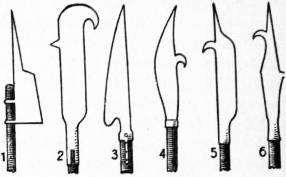
Figs. 1-6.
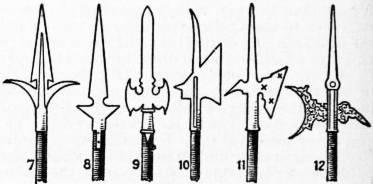
Figs. 7-12.
The weapon best known to Englishmen is the bill, which was originally a sort of scythe-blade, sharp on the concave side (whereas the glaive has the cutting edge on the convex side), but in its best-known form it should be called a bill-gisarme (fig. 6). The partizans, ranseurs and halberts proper developed naturally from the earlier types. The feature common to all, as has been said, is the combination of spear and axe. In the halberts the axe predominates, as the examples (fig. 10, Swiss, early 15th century; fig. 11, Swiss, middle 16th century; and fig. 12, German court halbert of the same period as fig. 11) show. In the partizan the pike is the more important, the axe-heads being reduced to little more than an ornamental feature. A south German specimen (fig. 9, 1615) shows how this was compensated by the broadening of the spear-head, the edges of which in such weapons were sharpened. Fig. 8, a service weapon of simple form, merely has projections on either side, and from this developed the ranseur (fig. 7), a partizan with a very long and narrow point, like the blade of a rapier, and with fork-like projections intended to act as “sword-breakers,” instead of the atrophied axe-heads of the partizan proper.
The halbert played almost as conspicuous a part in the military history of Middle Europe during the 15th and early 16th centuries as the pike. But, even in a form distinguishable from the voulge and the glaive, it dates from the early part of the 13th century, and for many generations thereafter it was the special weapon of the Swiss. Fauchet, in his Origines des dignitez, printed in 1600, states that Louis XI. of France ordered certain new weapons of war called hallebardes to be made at Angers and other places in 1475. The Swiss had a mixed armament of pikes and halberts at the battle of Morat in 1476. In the 15th and 16th centuries the halberts became larger, and the blades were formed in many varieties of shape, often engraved, inlaid, or pierced in open work, and exquisitely finished as works of art. This weapon was in use in England from the reign of Henry VII. to the reign of George III., when it was still carried (though in shape it had certainly lost its original characteristics, and had become half partizan and half pike) by sergeants in the guards and other infantry regiments. It is still retained as the symbol of authority borne before the magistrates on public occasions in some of the burghs of Scotland. The Lochaber axe may be called a species of halbert furnished with a hook on the end of the staff at the back of the blade. The godendag (Fr. godendart) is the Flemish name of the halbert in its original form.
The derivation of the word is as follows. The O. Fr. hallebarde, of which the English “halberd,” “halbert,” is an adaptation, was itself adapted from the M.H.G. helmbarde, mod. Hellebarde; the second part is the O.H.G. barta or parta, broad-axe, probably the same word as Bart, beard, and so called from its shape; the first part is either helm, handle, cf. “helm,” tiller of a ship, the word meaning “hafted axe,” or else helm, helmet, an axe for smiting the helmet. A common derivation was to take the word as representing a Ger. halb-barde, half-axe; the early German form shows this to be an erroneous guess.
HALDANE, JAMES ALEXANDER (1768-1851), Scottish divine, the younger son of Captain James Haldane of Airthrey House, Stirlingshire, was born at Dundee on the 14th of July 1768. Educated first at Dundee and afterwards at the high school and university of Edinburgh, at the age of seventeen he joined the “Duke of Montrose” East Indiaman as a midshipman. After four voyages to India he was nominated to the command of the “Melville Castle” in the summer of 1793; but having during a long and unexpected detention of his ship begun a careful study of the Bible, and also come under the evangelical influence of David Bogue of Gosport, one of the founders of the London Missionary Society, he abruptly resolved to quit the naval profession for a religious life, and returned to Scotland before his ship had sailed. About the year 1796 he became acquainted with the celebrated evangelical divine, Charles Simeon of Cambridge, in whose society he made several tours through Scotland, endeavouring by tract-distribution and other means to awaken others to some of that interest in religious subjects which he himself so strongly felt. In May 1797 he preached his first sermon, at Gilmerton near Edinburgh, with encouraging success. In the same year he established a non-sectarian organization for tract distribution and lay preaching called the “Society for the Propagation of the Gospel at Home.” During the next few years he made repeated missionary journeys, preaching wherever he could obtain hearers, and generally in the open air. Not originally disloyal to the Church of Scotland, he was gradually driven by the hostility of the Assembly and the exigencies of his position into separation. In 1799 he was ordained as pastor of a large Independent congregation in Edinburgh. This was the first congregational church known by that name in Scotland. In 1801 a permanent building replaced the circus in which the congregation had at first met. To this church he continued to minister gratuitously for more than fifty years. In 1808 he made public avowal of his conversion to Baptist views. As advancing years compelled him to withdraw from the more exhausting labours of itineracy and open-air preaching, he sought more and more to influence the discussion of current religious and theological questions by means of the press. He died on the 8th of February 1851.
His son, Daniel Rutherford Haldane (1824-1887), by his second wife, a daughter of Professor Daniel Rutherford, was a prominent Scottish physician, who became president of the Edinburgh College of Physicians.
Among J. A. Haldane’s numerous contributions to current theological discussions were: The Duty of Christian Forbearance in Regard to Points of Church Order (1811); Strictures on a Publication upon Primitive Christianity by Mr John Walker (1819); Refutation of Edward Irving’s Heretical Doctrines respecting the Person and Atonement of Jesus Christ. His Observations on Universal Pardon, &c., was a contribution to the controversy regarding the views of Thomas Erskine of Linlathen and Campbell of Row; Man’s Responsibility (1842) is a reply to Howard Hinton on the nature and extent of the Atonement. He also published: Journal of a Tour in the North; Early Instruction Commended (1801); Views of the Social Worship of the First Churches (1805); The Doctrine and Duty of Self-Examination (1806); The Doctrine of the Atonement (1845); Exposition of the Epistle to the Galatians (1848).
HALDANE, RICHARD BURDON (1856- ), British statesman and philosopher, was the third son of Robert Haldane of Cloanden, Perthshire, a writer to the signet, and nephew of J. S. Burdon-Sanderson. He was a grand-nephew of the Scottish divines J. A. and Robert Haldane. He was educated at Edinburgh Academy and the universities of Edinburgh and Göttingen, where he studied philosophy under Lotze. He took first-class honours in philosophy at Edinburgh, and was Gray scholar and Ferguson scholar in philosophy of the four Scottish Universities (1876). He was called to the bar in 1879, and so early as 1890 became a queen’s counsel. In 1885 he entered parliament as liberal member for Haddingtonshire, for which he was re-elected continuously up to and including 1910. He was included in 1905 in Sir H. Campbell-Bannerman’s cabinet as secretary for war, and was the author of the important scheme for the reorganization of the British army, by which the militia and the volunteer forces were replaced by a single territorial force. Though always known as one of the ablest men of the Liberal party and conspicuous during the Boer War of 1899-1902 as a Liberal Imperialist, the choice of Mr Haldane for the task of thinking out a new army organization on business lines had struck many people as curious. Besides being a chancery lawyer, he was more particularly a philosopher, conspicuous for his knowledge of Hegelian metaphysics. But with German philosophy he had also the German sense of thoroughness and system, and his scheme, while it was much criticized, was recognized as the best that could be done with a voluntary army. Mr Haldane’s chief literary publications were: Life of Adam Smith (1887); Education and Empire (1902); The Pathway to Reality (1903). He also translated, jointly with J. Kemp, Schopenhauer’s Die Welt als Wille und Vorstellung (The World as Will and Idea, 3 vols., 1883-1886).
HALDANE, ROBERT (1764-1842), Scottish divine, elder brother of J. A. Haldane (q.v.), was born in London on the 28th of February 1764. After attending classes in the Dundee grammar school and in the high school and university of Edinburgh in 1780, he joined H.M.S. “Monarch,” of which his uncle Lord Duncan was at that time in command, and in the following year was transferred to the “Foudroyant,” on board of which, during the night engagement with the “Pegase,” he greatly distinguished himself. Haldane was afterwards present at the relief of Gibraltar, but at the peace of 1783 he finally left the navy, and soon afterwards settled on his estate of Airthrey, near Stirling. He put himself under the tuition of David Bogue of Gosport and carried away deep impressions from his academy. The earlier phases of the French Revolution excited his deepest sympathy, a sympathy which induced him to avow his strong disapproval of the war with France. As his over-sanguine visions of a new order of things to be ushered in by political change disappeared, he began to direct his thoughts to religious subjects. Resolving to devote himself and his means wholly to the advancement of Christianity, his first proposal for that end, made in 1796, was to organize a vast mission to Bengal, of which he was to provide the entire expense; with this view the greater part of his estate was sold, but the East India Company refused to sanction the scheme, which therefore had to be abandoned. In December 1797 he joined his brother and some others in the formation of the “Society for the Propagation of the Gospel at Home,” in building chapels or “tabernacles” for congregations, in supporting missionaries, and in maintaining institutions for the education of young men to carry on the work of evangelization. He is said to have spent more than £70,000 in the course of the following twelve years (1798-1810). He also initiated a plan for evangelizing Africa by bringing over native children to be trained as Christian teachers to their own countrymen. In 1816 he visited the continent, and first at Geneva and afterwards in Montauban (1817) he lectured and interviewed large numbers of theological students with remarkable effect; among them were Malan, Monod and Merle d’Aubigné. Returning to Scotland in 1819, he lived partly on his estate of Auchengray and partly in Edinburgh, and like his brother took an active part, chiefly through the press, in many of the religious controversies of the time. He died on the 12th of December 1842.
In 1816 he published a work on the Evidences and Authority of Divine Revelation, and in 1819 the substance of his theological prelections in a Commentaire sur l’Épître aux Romains. Among his later writings, besides numerous pamphlets on what was known as “the Apocrypha controversy,” are a treatise On the Inspiration of Scripture (1828), which has passed through many editions, and a later Exposition of the Epistle to the Romans (1835), which has been frequently reprinted, and has been translated into French and German.
See Memoirs of R. and J. A. Haldane, by Alexander Haldane (1852).
HALDEMAN, SAMUEL STEHMAN (1812-1880), American naturalist and philologist, was born on the 12th of August 1812 at Locust Grove, Pa. He was educated at Dickinson College, and in 1851 was appointed professor of the natural sciences in the university of Pennsylvania. In 1855 he went to Delaware College, where he filled the same position, but in 1869 he returned to the university of Pennsylvania as professor of comparative philology and remained there till his death, which occurred at Chickies, Pa., on the 10th of September 1880. His writings include Freshwater Univalve Mollusca of the United States (1840); Zoological Contributions (1842-1843); Analytic Orthography (1860); Tours of a Chess Knight (1864); Pennsylvania Dutch, a Dialect of South German with an Infusion of English (1872); Outlines of Etymology (1877); and Word-Building (1881).
HALDIMAND, SIR FREDERICK (1718-1791), British general and administrator, was born at Yverdun, Neuchâtel, Switzerland, on the 11th of August 1718, of Huguenot descent. After serving in the armies of Sardinia, Russia and Holland, he entered British service in 1754, and subsequently naturalized as an English citizen. During the Seven Years’ War he served in America, was wounded at Ticonderoga (1758) and was present at the taking of Montreal (1760). After filling with credit several administrative positions in Canada, Florida and New York, in 1778 he succeeded Sir Guy Carleton (afterwards Lord Dorchester) as governor-general of Canada. His measures against French sympathizers with the Americans have incurred extravagant strictures from French-Canadian historians, but he really showed moderation as well as energy. In 1785 he returned to London. He died at his birthplace on the 5th of June 1791.
His life has been well written by Jean McIlwraith in the “Makers of Canada” series (Toronto, 1904). His Correspondence and Diary fill 262 volumes in the Canadian Archives, and are catalogued in the Annual Reports (1884-1889).
HALE, EDWARD EVERETT (1822-1909), American author, was born in Boston on the 3rd of April 1822, son of Nathan Hale (1784-1863), proprietor and editor of the Boston Daily Advertiser, nephew of Edward Everett, the orator and statesman, and grand-nephew of Nathan Hale, the martyr spy. He graduated from Harvard in 1839; was pastor of the church of the Unity, Worcester, Massachusetts, in 1846-1856, and of the South Congregational (Unitarian) church, Boston, in 1856-1899; and in 1903 became chaplain of the United States Senate. He died at Roxbury (Boston), Massachusetts, on the 10th of June 1909. His forceful personality, organizing genius, and liberal practical theology, together with his deep interest in the anti-slavery movement (especially in Kansas), popular education (especially Chautauqua work), and the working-man’s home, were active in raising the tone of American life for half a century. He was a constant and voluminous contributor to the newspapers and magazines. He was an assistant editor of the Boston Daily Advertiser, and edited the Christian Examiner, Old and New (which he assisted in founding in 1869; in 1875 it was merged in Scribner’s Magazine), Lend a Hand (founded by him in 1886 and merged in the Charities Review in 1897), and the Lend a Hand Record; and he was the author or editor of more than sixty books—fiction, travel, sermons, biography and history.
He first came into notice as a writer in 1859, when he contributed the short story “My Double and How He Undid Me” to the Atlantic Monthly. He soon published in the same periodical other stories, the best known of which was “The Man Without a Country” (1863), which did much to strengthen the Union cause in the North, and in which, as in some of his other non-romantic tales, he employed a minute realism which has led his readers to suppose the narrative a record of fact. The two stories mentioned, and such others as “The Rag-Man and the Rag-Woman” and “The Skeleton in the Closet,” gave him a prominent position among the short-story writers of America. The story Ten Times One is Ten (1870), with its hero Harry Wadsworth, and its motto, first enunciated in 1869 in his Lowell Institute lectures, “Look up and not down, look forward and not back, look out and not in, and lend a hand,” led to the formation among young people of “Lend-a-Hand Clubs,” “Look-up Legions” and “Harry Wadsworth Clubs.” Out of the romantic Waldensian story In His Name (1873) there similarly grew several other organizations for religious work, such as “King’s Daughters,” and “King’s Sons.”
Among his other books are Kansas and Nebraska (1854); The Ingham Papers (1869); His Level Best, and Other Stories (1870); Sybaris and Other Homes (1871); Philip Nolan’s Friends (1876), his best-known novel, and a sequel to The Man Without a Country; The Kingdom of God (1880); Christmas at Narragansett (1885); East and West, a novel (1892); For Fifty Years (poems, 1893); Ralph Waldo Emerson (1899); We, the People (1903); Prayers Offered in the Senate of the United States (1904), and Tarry-at-Home Travels (1906). He edited Lingard’s History of England (1853), and contributed to Winsor’s Memorial History of Boston (1880-1881), and to his Narrative and Critical History of America (1886-1889). With his son, Edward Everett Hale, Jr., he published Franklin in France (2 vols., 1887-1888), based largely on original research. The most charming books of his later years were A New England Boyhood (1893), James Russell Lowell and His Friends (1899), and Memories of a Hundred Years (1902).
A uniform and revised edition of his principal writings, in ten volumes, appeared in 1899-1901.
HALE, HORATIO (1817-1896), American ethnologist, was born in Newport, New Hampshire, on the 3rd of May 1817. He was the son of David Hale, a lawyer, and of Sarah Josepha Hale (1790-1879), a popular poet, who, besides editing Godey’s Lady’s Magazine for many years and publishing some ephemeral books, is supposed to have written the verses “Mary had a little lamb,” and to have been the first to suggest the national observance of Thanksgiving Day. The son graduated in 1837 at Harvard, and during 1838-1842 was philologist to the United States Exploring Expedition, which under Captain Charles Wilkes sailed around the world. Of the reports of that expedition Hale prepared the sixth volume, Ethnography and Philology (1846), which is said to have “laid the foundations of the ethnography of Polynesia.” He was admitted to the Chicago bar in 1855, and in the following year removed to Clinton, Ontario, Canada, where he practised his profession, and where on the 28th of December 1896 he died. He made many valuable contributions to the science of ethnology, attracting attention particularly by his theory of the origin of the diversities of human languages and dialects—a theory suggested by his study of “child-languages,” or the languages invented by little children. He also emphasized the importance of languages as tests of mental capacity and as “criteria for the classification of human groups.” He was, moreover, the first to discover that the Tutelos of Virginia belonged to the Siouan family, and to identify the Cherokee as a member of the Iroquoian family of speech. Besides writing numerous magazine articles, he read a number of valuable papers before learned societies. These include: Indian Migrations as Evidenced by Language (1882); The Origin of Languages and the Antiquity of Speaking Man (1886); The Development of Language (1888); and Language as a Test of Mental Capacity: Being an Attempt to Demonstrate the True Basis of Anthropology (1891). He also edited for Brinton’s “Library of Aboriginal Literature,” the Iroquois Book of Rites (1883).
HALE, JOHN PARKER (1806-1873), American statesman, was born at Rochester, New Hampshire, on the 31st of March 1806. He graduated at Bowdoin College in 1827, was admitted to the New Hampshire bar in 1830, was a member of the state House of Representatives in 1832, and from 1834 to 1841 was United States district attorney for New Hampshire. In 1843-1845 he was a Democratic member of the national House of Representatives, and, though his earnest co-operation with John Quincy Adams in securing the repeal of the “gag rule” directed against the presentation to Congress of anti-slavery petitions estranged him from the leaders of his party, he was renominated without opposition. In January 1845, however, he refused in a public statement to obey a resolution (28th of December 1844) of the state legislature directing him and his New Hampshire associates in Congress to support the cause of the annexation of Texas, a Democratic measure which Hale regarded as being distinctively in the interest of slavery. The Democratic State convention was at once reassembled, Hale was denounced, and his nomination withdrawn. In the election which followed Hale ran independently, and, although the Democratic candidates were elected in the other three congressional districts of the state, his vote was large enough to prevent any choice (for which a majority was necessary) in his own. Hale then set out in the face of apparently hopeless odds to win over his state to the anti-slavery cause. The remarkable canvass which he conducted is known in the history of New Hampshire as the “Hale Storm of 1845.” The election resulted in the choice of a legislature controlled by the Whigs and the independent Democrats, he himself being chosen as a member of the state House of Representatives, of which in 1846 he was speaker. He is remembered, however, chiefly for his long service in the United States Senate, of which he was a member from 1847 to 1853 and again from 1855 to 1865. At first he was the only out-and-out anti-slavery senator,—he alone prevented the vote of thanks to General Taylor and General Scott for their Mexican war victories from being made unanimous in the Senate (February 1848)—but in 1849 Salmon P. Chase and William H. Seward, and in 1851 Charles Sumner joined him, and the anti-slavery cause became for the first time a force to be reckoned with in that body. In October 1847 he had been nominated for president by the Liberty party, but he withdrew in favour of Martin Van Buren, the Free Soil candidate, in 1848. In 1851 he was senior counsel for the rescuers of the slave Shadrach in Boston. In 1852 he was the Free Soil candidate for the presidency, but received only 156,149 votes. In 1850 he secured the abolition of flogging in the U.S. navy, and through his efforts in 1862 the spirit ration in the navy was abolished. He was one of the organizers of the Republican party, and during the Civil War was an eloquent supporter of the Union and chairman of the Senate naval committee. From 1865 to 1869 he was United States minister to Spain. He died at Dover, New Hampshire, on the 19th of December 1873. A statue of Hale, presented by his son-in-law William Eaton Chandler (b. 1835), U.S. senator from New Hampshire in 1887-1901, was erected in front of the Capitol in Concord, New Hampshire, in 1892.
HALE, SIR MATTHEW (1609-1676), lord chief justice of England, was born on the 1st of November 1609 at Alderley in Gloucestershire, where his father, a retired barrister, had a small estate. His paternal grandfather was a rich clothier of Wotton-under-Edge; on his mother’s side he was connected with the noble family of the Poyntzes of Acton. Left an orphan when five years old, he was placed by his guardian under the care of the Puritan vicar of Wotton-under-Edge, with whom he remained till he attained his sixteenth year, when he entered Magdalen Hall, Oxford. At Oxford, Hale studied for several terms with a view to holy orders, but suddenly there came a change. The diligent student, at first attracted by a company of strolling players, threw aside his studies, and plunged carelessly into gay society. He soon decided to change his profession; and resolved to trail a pike as a soldier under the prince of Orange in the Low Countries. Before going abroad, however, Hale found himself obliged to proceed to London in order to give instructions for his defence in a legal action which threatened to deprive him of his patrimony. His leading counsel was the celebrated Serjeant Glanville (1586-1661), who, perceiving in the acuteness and sagacity of his youthful client a peculiar fitness for the legal profession, succeeded, with much difficulty, in inducing him to renounce his military for a legal career, and on the 8th of November 1629 Hale became a member of the honourable society of Lincoln’s Inn.
He immediately resumed his habits of intense application. The rules which he laid down for himself, and which are still extant in his handwriting, prescribe sixteen hours a day of close application, and prove, not only the great mental power, but also the extraordinary physical strength he must have possessed, and for which indeed, during his residence at the university, he had been remarkable. During the period allotted to his preliminary studies, he read over and over again all the yearbooks, reports, and law treatises in print, and at the Tower of London and other antiquarian repositories examined and carefully studied the records from the foundation of the English monarchy down to his own time. But Hale did not confine himself to law. He dedicated no small portion of his time to the study of pure mathematics, to investigations in physics and chemistry, and even to anatomy and architecture; and there can be no doubt that this varied learning enhanced considerably the value of many of his judicial decisions.
Hale was called to the bar in 1637, and almost at once found himself in full practice. Though neither a fluent speaker nor bold pleader, in a very few years he was at the head of his profession. He entered public life at perhaps the most critical period of English history. Two parties were contending in the state, and their obstinacy could not fail to produce a most direful collision. But amidst the confusion Hale steered a middle course, rising in reputation, and an object of solicitation from both parties. Taking Pomponius Atticus as his political model, he was persuaded that a man, a lawyer and a judge could best serve his country and benefit his countrymen by holding aloof from partisanship and its violent prejudices, which are so apt to distort and confuse the judgment. But he is best vindicated from the charges of selfishness and cowardice by the thoughts and meditations contained in his private diaries and papers, where the purity and honour of his motives are clearly seen. It has been said, but without certainty, that Hale was engaged as counsel for the earl of Strafford; he certainly acted for Archbishop Laud, Lord Maguire, Christopher Love, the duke of Hamilton and others. It is also said that he was ready to plead on the side of Charles I. had that monarch submitted to the court. The parliament having gained the ascendancy, Hale signed the Solemn League and Covenant, and was a member of the famous assembly of divines at Westminster in 1644; but although he would undoubtedly have preferred a Presbyterian form of church government, he had no serious objection to the system of modified Episcopacy, proposed by Usher. Consistently with his desire to remain neutral, Hale took the engagement to the Commonwealth as he had done to the king, and in 1653, already serjeant, he became a judge in the court of common pleas. Two years afterwards he sat in Cromwell’s parliament as one of the members for Gloucestershire. After the death of the protector, however, he declined to act as a judge under Richard Cromwell, although he represented Oxford in Richard’s parliament. At the Restoration in 1660 Hale was very graciously received by Charles II., and in the same year was appointed chief baron of the exchequer, and accepted, with extreme reluctance, the honour of knighthood. After holding the office of chief baron for eleven years he was raised to the higher dignity of lord chief justice, which he held till February 1676, when his failing health compelled him to resign. He retired to his native Alderley, where he died on the 25th of December of the same year. He was twice married and survived all his ten children save two.
As a judge Sir Matthew Hale discharged his duties with resolute independence and careful diligence. His sincere piety made him the intimate friend of Isaac Barrow, Archbishop Tillotson, Bishop Wilkins and Bishop Stillingfleet, as well as of the Nonconformist leader, Richard Baxter. He is chargeable, however, with the condemnation and execution of two poor women tried before him for witchcraft in 1664, a kind of judicial murder then falling under disuse. He is also reproached with having hastened the execution of a soldier for whom he had reason to believe a pardon was preparing.
Of Hale’s legal works the only two of importance are his Historia placitorum coronae, or History of the Pleas of the Crown (1736); and the History of the Common Law of England, with an Analysis of the Law, &c. (1713). Among his numerous religious writings the Contemplations, Moral and Divine, occupy the first place. Others are The Primitive Origination of Man (1677); Of the Nature of True Religion, &c. (1684); A Brief Abstract of the Christian Religion (1688). One of his most popular works is the collection of Letters of Advice to his Children and Grandchildren. He also wrote an Essay touching the Gravitation or Nongravitation of Fluid Bodies (1673); Difficiles Nugae, or Observations touching the Torricellian Experiment, &c. (1675); and a translation of the Life of Pomponius Atticus, by Cornelius Nepos (1677). His efforts in poetry were inauspicious. He left his valuable collection of MSS. and records to the library of Lincoln’s Inn. His life has been written by G. Burnet (1682); by J. B. Williams (1835); by H. Roscoe, in his Lives of Eminent Lawyers, in 1838; by Lord Campbell, in his Lives of the Chief Justices, in 1849; and by E. Foss in his Lives of the Judges (1848-1870).
HALE, NATHAN (1756-1776). American hero of the War of Independence, was born at Coventry, Conn., and educated at Yale, then becoming a school teacher. He joined a Connecticut regiment after the breaking out of the war, and served in the siege of Boston, being commissioned a captain at the opening of 1776. When Heath’s brigade departed for New York he went with them, and the tradition is that he was one of a small and daring band who captured an English provision sloop from under the very guns of a man-of-war. But on the 21st of September, having volunteered to enter the British lines to obtain information concerning the enemy, he was captured in his disguise of a Dutch school-teacher and on the 22nd was hanged. The penalty was in accordance with military law, but young Hale’s act was a brave one, and he has always been glorified as a martyr. Tradition attributes to him the saying that he only regretted that he had but one life to lose for his country; and it is said that his request for a Bible and the services of a minister was refused by his captors. There is a fine statue of Hale by Macmonnies in New York.
See H. P. Johnston, Nathan Hale (1901).
HALE, WILLIAM GARDNER (1849- ), American classical scholar, was born on the 9th of February 1849 in Savannah, Georgia. He graduated at Harvard University in 1870, and took a post-graduate course in philosophy there in 1874-1876; studied classical philology at Leipzig and Göttingen in 1876-1877; was tutor in Latin at Harvard from 1877 to 1880, and professor of Latin in Cornell University from 1880 to 1892, when he became professor of Latin and head of the Latin department of the University of Chicago. From 1894 to 1899 he was chairman and in 1895-1896 first director of the American School of Classical Studies at Rome. He is best known as an original teacher on questions of syntax. In The Cum-Constructions: Their History and Functions, which appeared in Cornell University Studies in Classical Philology (1888-1889; and in German version by Neizert in 1891), he attacked Hoffmann’s distinction between absolute and relative temporal clauses as published in Lateinische Zeitpartikeln (1874); Hoffmann replied in 1891, and the best summary of the controversy is in Wetzel’s Der Streit zwischen Hoffmann und Hale (1892). Hale wrote also The Sequence of Tenses in Latin (1887-1888), The Anticipatory Subjunctive in Greek and Latin (1894), and a Latin Grammar (1903), to which the parts on sounds, inflection and word-formation were contributed by Carl Darling Buck.
HALEBID, a village in Mysore state, southern India; pop. (1901), 1524. The name means “old capital,” being the site of Dorasamudra, the capital of the Hoysala dynasty founded early in the 11th century. In 1310 and again in 1326 it was taken and plundered by the first Mahommedan invader of southern India. Two temples, still standing, though never completed and greatly ruined, are regarded as the finest examples of the elaborately carved Chalukyan style of architecture.
HALES, or Hayles, JOHN (d. 1571), English writer and politician, was a son of Thomas Hales of Hales Place, Halden, Kent. He wrote his Highway to Nobility about 1543, and was the founder of a free school at Coventry for which he wrote Introductiones ad grammaticam. In political life Hales, who was member of parliament for Preston, was specially concerned with opposing the enclosure of land, being the most active of the commissioners appointed in 1548 to redress this evil; but he failed to carry several remedial measures through parliament. When the protector, the duke of Somerset, was deprived of his authority in 1550, Hales left England and lived for some time at Strassburg and Frankfort, returning to his own country on the accession of Elizabeth. However he soon lost the royal favour by writing a pamphlet, A Declaration of the Succession of the Crowne Imperiall of Inglande, which declared that the recent marriage between Lady Catherine Grey and Edward Seymour, earl of Hertford, was legitimate, and asserted that, failing direct heirs to Elizabeth, the English crown should come to Lady Catherine as the descendant of Mary, daughter of Henry VII. The author was imprisoned, but was quickly released, and died on the 28th of December 1571. The Discourse of the Common Weal, described as “one of the most informing documents of the age,” and written about 1549, has been attributed to Hales. This has been edited by E. Lamond (Cambridge, 1893).
Hales is often confused with another John Hales, who was clerk of the hanaper under Henry VIII. and his three immediate successors.
HALES, JOHN (1584-1656), English scholar, frequently referred to as “the ever memorable,” was born at Bath on the 19th of April 1584, and was educated at Corpus Christi College, Oxford. He was elected a fellow of Merton in 1605, and in 1612 he was appointed public lecturer on Greek. In 1613 he was made a fellow of Eton. Five years later he went to Holland, as chaplain to the English ambassador, Sir Dudley Carleton, who despatched him to Dort to report upon the proceedings of the synod then sitting. In 1619 he returned to Eton and spent his time among his books and in the company of literary men, among whom he was highly reputed for his common sense, his erudition and his genial charity. Andrew Marvell called him “one of the clearest heads and best-prepared breasts in Christendom.” His eirenical tract entitled Schism and Schismaticks (1636) fell into the hands of Archbishop Laud, and Hales, hearing that he had disapproved of it, is said to have written to the prelate a vindication of his position. This led to a meeting, and in 1639 Hales was made one of Laud’s chaplains and also a canon of Windsor. In 1642 he was deprived of his canonry by the parliamentary committee, and two years later was obliged to hide in Eton with the college documents and keys. In 1649 he refused to take the “Engagement” and was ejected from his fellowship. He then retired to Buckinghamshire, where he found a home with Mrs Salter, the sister of the bishop of Salisbury (Brian Duppa), and acted as tutor to her son. The issue of the order against harbouring malignants led him to return to Eton. Here, having sold his valuable library at great sacrifice, he lived in poverty until his death on the 19th of May 1656.
His collected works (3 vols.) were edited by Lord Hailes, and published in 1765.
HALES, STEPHEN (1677-1761), English physiologist, chemist and inventor, was born at Bekesbourne in Kent on the 7th or 17th of September 1677, the fifth (or sixth) son of Thomas Hales, whose father, Sir Robert Hales, was created a baronet by Charles II. in 1670. In June 1696 he was entered as a pensioner of Benet (now Corpus Christi) College, Cambridge, with the view of taking holy orders, and in February 1703 was admitted to a fellowship. He received the degree of master of arts in 1703 and of bachelor of divinity in 1711. One of his most intimate friends was William Stukeley (1687-1765) with whom he studied anatomy, chemistry, &c. In 1708-1709 Hales was presented to the perpetual curacy of Teddington in Middlesex, where he remained all his life, notwithstanding that he was subsequently appointed rector of Porlock in Somerset, and later of Faringdon in Hampshire. In 1717 he was elected fellow of the Royal Society, which awarded him the Copley medal in 1739. In 1732 he was named one of a committee for establishing a colony in Georgia, and the next year he received the degree of doctor of divinity from Oxford. He was appointed almoner to the princess-dowager of Wales in 1750. On the death of Sir Hans Sloane in 1753, Hales was chosen foreign associate of the French Academy of Sciences. He died at Teddington on the 4th of January 1761.
Hales is best known for his Statical Essays. The first volume, Vegetable Staticks (1727), contains an account of numerous experiments in plant-physiology—the loss of water in plants by evaporation, the rate of growth of shoots and leaves, variations in root-force at different times of the day, &c. Considering it very probable that plants draw “through their leaves some part of their nourishment from the air,” he undertook experiments to show in “how great a proportion air is wrought into the composition of animal, vegetable and mineral substances”; though this “analysis of the air” did not lead him to any very clear ideas about the composition of the atmosphere, in the course of his inquiries he collected gases over water in vessels separate from those in which they were generated, and thus used what was to all intents and purposes a “pneumatic trough.” The second volume (1733) on Haemostaticks, containing experiments on the “force of the blood” in various animals, its rate of flow, the capacity of the different vessels, &c., entitles him to be regarded as one of the originators of experimental physiology. But he did not confine his attention to abstract inquiries. The quest of a solvent for calculus in the bladder and kidneys was pursued by him as by others at the period, and he devised a form of forceps which, on the testimony of John Ranby (1703-1773), sergeant-surgeon to George II., extracted stones with “great ease and readiness.” His observations of the evil effect of vitiated air caused him to devise a “ventilator” (a modified organ-bellows) by which fresh air could be conveyed into gaols, hospitals, ships’-holds, &c.; this apparatus was successful in reducing the mortality in the Savoy prison, and it was introduced into France by the aid of H. L. Duhamel du Monceau. Among other things Hales invented a “sea-gauge” for sounding, and processes for distilling fresh from sea water, for preserving corn from weevils by fumigation with brimstone, and for salting animals whole by passing brine into their arteries. His Admonition to the Drinkers of Gin, Brandy, &c., published anonymously in 1734, has been several times reprinted.
HALESOWEN, a market town in the Oldbury parliamentary division of Worcestershire, England, on a branch line of the Great Western and Midland railways, 6½ m. W.S.W. of Birmingham. Pop. (1901), 4057. It lies in a pleasant country among the eastern foothills of the Lickey Hills. There are extensive iron and steel manufactures. The church of SS Mary and John the Baptist has rude Norman portions; and the poet William Shenstone, buried in 1763 in the churchyard, has a memorial in the church. His delight in landscape gardening is exemplified in the neighbouring estate of the Leasowes, which was his property. There is a grammar school founded in 1652, and in the neighbourhood is the Methodist foundation of Bourne College (1883). Close to the town, on the river Stour, which rises in the vicinity, are slight ruins of a Premonstratensian abbey of Early English date. Within the parish and 2 m. N.W. of Halesowen is Cradley, with iron and steel works, fire-clay works and a large nail and chain industry.
HALEVI, JUDAH BEN SAMUEL (c. 1085-c. 1140), the greatest Hebrew poet of the middle ages, was born in Toledo c. 1085, and died in Palestine after 1140. In his youth he wrote Hebrew love poems of exquisite fancy, and several of his Wedding Odes are included in the liturgy of the Synagogue. The mystical connexion between marital affection and the love of God had, in the view of older exegesis, already expressed itself in the scriptural Song of Songs and Judah Halevi used this book as his model. In this aspect of his work he found inspiration also in Arabic predecessors. The second period of his literary career was devoted to more serious pursuits. He wrote a philosophical dialogue in five books, called the Cuzari, which has been translated into English by Hirschfeld. This book bases itself on the historical fact that the Crimean Kingdom of the Khazars adopted Judaism, and the Hebrew poet-philosopher describes what he conceives to be the steps by which the Khazar king satisfied himself as to the claims of Judaism. Like many other medieval Jewish authors, Judah Halevi was a physician. His real fame depends on his liturgical hymns, which are the finest written in Hebrew since the Psalter, and are extensively used in the Septardic rite. A striking feature of his thought was his devotion to Jerusalem. To the love of the Holy City he devoted his noblest genius, and he wrote some memorable Odes to Zion, which have been commemorated by Heine, and doubly appreciated recently under the impulse of Zionism (q.v.). He started for Jerusalem, was in Damascus in 1140, and soon afterwards died. Legend has it that he was slain by an Arab horseman just as he arrived within sight of what Heine called his “Woebegone poor darling, Desolation’s very image,—Jerusalem.”
Excellent English renderings of some of Judah Halevi’s poems may be read in Mrs H. Lucas’s The Jewish Year, and Mrs R. N. Solomon’s Songs of Exile.
(I. A.)
HALÉVY, JACQUES FRANÇOIS FROMENTAL ÉLIE (1799-1862), French composer, was born on the 27th of May 1799, at Paris, of a Jewish family. He studied at the Paris Conservatoire under Berton and Cherubini, and in 1819 gained the grand prix de Rome with his cantata Herminie. In accordance with the conditions of his scholarship he started for Rome, where he devoted himself to the study of Italian music, and wrote an opera and various minor works. In 1827 his opera L’Artisan was performed at the Théâtre Feydeau in Paris, apparently without much success. Other works of minor importance, and now forgotten, followed, amongst which Manon Lescaut, a ballet, produced in 1830, deserves mention. In 1834 the Opéra-Comique produced Ludovic, the score of which had been begun by Hérold and had been completed by Halévy. In 1835 Halévy composed the tragic opera La Juive and the comic opera L’Éclair, and on these works his fame is mainly founded. The famous air of Eléazar and the anathema of the cardinal in La Juive soon became popular all over France. L’Éclair is a curiosity of musical literature. It is written for two tenors and two soprani, without a chorus, and displays the composer’s mastery over the most refined effects of instrumentation and vocalization in a favourable light. After these two works he wrote numerous operas of various genres, amongst which only La Reine de Chypre, a spectacular piece analyzed by Wagner in one of his Paris letters (1841), and La Tempesta, in three acts, written for Her Majesty’s theatre, London (1850), need be mentioned. In addition to his productive work Halévy also rendered valuable services as a teacher. He was professor at the Conservatoire from 1827 till his death—some of the most successful amongst the younger composers in France, such as Gounod, Victor Massé and Georges Bizet, the author of Carmen, being amongst his pupils. He was maestro al cembalo at the Théâtre Italien from 1827 to 1829; then director of singing at the Opera House in Paris until 1845, and in 1836 he succeeded Reicha at the Institut de France. Halévy also tried his hand at literature. In 1857 he became permanent secretary to the Académie des Beaux Arts, and there exists an agreeable volume of Souvenirs et portraits from his pen. He died at Nice, on the 17th of March 1862.
HALÉVY, LUDOVIC (1834-1908), French author, was born in Paris on the 1st of January 1834. His father, Léon Halévy (1802-1883), was a clever and versatile writer, who tried almost every branch of literature—prose and verse, vaudeville, drama, history—without, however, achieving decisive success in any. His uncle, J. F. Fromental E. Halévy (q.v.), was for many years associated with the opéra; hence the double and early connexion of Ludovic Halévy with the Parisian stage. At the age of six he might have been seen playing in that Foyer de la danse with which he was to make his readers so familiar, and, when a boy of twelve, he would often, of a Sunday night, on his way back to the College Louis le Grand, look in at the Odéon, where he had free admittance, and see the first act of the new play. At eighteen he joined the ranks of the French administration and occupied various posts, the last being that of secrétaire-rédacteur to the Corps Législatif. In that capacity he enjoyed the special favour and friendship of the famous duke of Morny, then president of that assembly. In 1865 Ludovic Halévy’s increasing popularity as an author enabled him to retire from the public service. Ten years earlier he had become acquainted with the musician Offenbach, who was about to start a small theatre of his own in the Champs Élysées, and he wrote a sort of prologue, Entrez, messieurs, mesdames, for the opening night. Other little productions followed, Ba-ta-clan being the most noticeable among them. They were produced under the pseudonym of Jules Servières. The name of Ludovic Halévy appeared for the first time on the bills on the 1st of January 1856. Soon afterwards the unprecedented run of Orphée aux enfers, a musical parody, written in collaboration with Hector Crémieux, made his name famous. In the spring of 1860 he was commissioned to write a play for the manager of the Variétés in conjunction with another vaudevillist, Lambert Thiboust. The latter having abruptly retired from the collaboration, Halévy was at a loss how to carry out the contract, when on the steps of the theatre he met Henri Meilhac (1831-1897), then comparatively a stranger to him. He proposed to Meilhac the task rejected by Lambert Thiboust, and the proposal was immediately accepted. Thus began a connexion which was to last over twenty years, and which proved most fruitful both for the reputation of the two authors and the prosperity of the minor Paris theatres. Their joint works may be divided into three classes: the opérettes, the farces, the comedies. The opérettes afforded excellent opportunities to a gifted musician for the display of his peculiar humour. They were broad and lively libels against the society of the time, but savoured strongly of the vices and follies they were supposed to satirize. Amongst the most celebrated works of the joint authors were La Belle Hélène (1864), Barbe Bleue (1866), La Grande Duchesse de Gerolstein (1867), and La Périchole (1868). After 1870 the vogue of Parody rapidly declined. The decadence became still more apparent when Offenbach was no longer at hand to assist the two authors with his quaint musical irony, and when they had to deal with interpreters almost destitute of singing powers. They wrote farces of the old type, consisting of complicated intrigues, with which they cleverly interwove the representation of contemporary whims and social oddities. They generally failed when they attempted comedies of a more serious character and tried to introduce a higher sort of emotion. A solitary exception must be made in the case of Frou-frou (1869), which, owing perhaps to the admirable talent of Aimée Desclée, remains their unique succès de larmes.
Meilhac and Halévy will be found at their best in light sketches of Parisian life, Les Sonnettes, Le Roi Candaule, Madame attend Monsieur, Toto chez Tata. In that intimate association between the two men who had met so opportunely on the perron des variétés, it was often asked who was the leading partner. The question was not answered until the connexion was finally severed and they stood before the public, each to answer for his own work. It was then apparent that they had many gifts in common. Both had wit, humour, observation of character. Meilhac had a ready imagination, a rich and whimsical fancy; Halévy had taste, refinement and pathos of a certain kind. Not less clever than his brilliant comrade, he was more human. Of this he gave evidence in two delightful books, Monsieur et Madame Cardinal (1873) and Les Petites Cardinal, in which the lowest orders of the Parisian middle class are faithfully described. The pompous, pedantic, venomous Monsieur Cardinal will long survive as the true image of sententious and self-glorifying immorality. M. Halévy’s peculiar qualities are even more visible in the simple and striking scenes of the Invasion, published soon after the conclusion of the Franco-German War, in Criquette (1883) and L’Abbé Constantin (1882), two novels, the latter of which went through innumerable editions. Zola had presented to the public an almost exclusive combination of bad men and women; in L’Abbé Constantin all are kind and good, and the change was eagerly welcomed by the public. Some enthusiasts still maintain that the Abbé will rank permanently in literature by the side of the equally chimerical Vicar of Wakefield. At any rate, it opened for M. Ludovic Halévy the doors of the French Academy, to which he was elected in 1884.
Halévy remained an assiduous frequenter of the Academy, the Conservatoire, the Comédie Française, and the Society of Dramatic Authors, but, when he died in Paris on the 8th of May 1908, he had produced practically nothing new for many years. His last romance, Kari Kari, appeared in 1892.
The Théâtre of MM. Meilhac and Halévy was published in 8 vols. (1900-1902).
HALFPENNY, WILLIAM, English 18th-century architectural designer—he described himself as “architect and carpenter.” He was also known as Michael Hoare; but whether his real name was William Halfpenny or Michael Hoare is uncertain. His books, of which he published a score, deal almost entirely with domestic architecture, and especially with country houses in those Gothic and Chinese fashions which were so greatly in vogue in the middle of the 18th century. His most important publications, from the point of view of their effect upon taste, were New Designs for Chinese Temples, in four parts (1750-1752); Rural Architecture in the Gothic Taste (1752); Chinese and Gothic Architecture Properly Ornamented (1752); and Rural Architecture in the Chinese Taste (1750-1752). These four books were produced in collaboration with John Halfpenny, who is said to have been his son. New Designs for Chinese Temples is a volume of some significance in the history of furniture, since, having been published some years before the books of Thomas Chippendale and Sir Thomas Chambers, it disproves the statement so often made that those designers introduced the Chinese taste into this country. Halfpenny states distinctly that “the Chinese manner” had been “already introduced here with success.” The work of the Halfpennys was by no means all contemptible. It is sometimes distinctly graceful, but is marked by little originality.
HALF-TIMBER WORK, an architectural term given to those buildings in which the framework is of timber with vertical studs and cross pieces filled in between with brickwork, rubble masonry or plaster work on oak laths; in the first two, brick nogging or nogging are the terms occasionally employed (see Carpentry). Sometimes the timber structure is raised on a stone or brick foundation, as at Ledbury town hall in Herefordshire, where the lower storey is open on all sides; but more often it is raised on a ground storey, either in brick or stone, and in order to give additional size to the upper rooms projects forward, being carried on the floor joists. Sometimes the masonry or brickwork rises through two or three storeys and the half-brick work is confined to the gables. There seems to be some difference of opinion as to whether the term applies to the mixture of solid walling with the timber structure or to the alternation of wood posts and the filling in, but the latter definition is that which is generally understood. The half-timber throughout England is of the most picturesque description, and the earliest examples date from towards the close of the 15th century. In the earliest example, Newgate House, York (c. 1450), the timber framing is raised over the ground floor. The finest specimen is perhaps that of Moreton Old Hall, Cheshire (1570), where there is only a stone foundation about 12 in. high, and the same applies to Bramall Hall, near Manchester, portions of which are very early. Among other examples are Speke Hall, Lancashire; Park Hall, Shropshire (1553-1558); Hall i’ th’ Wood, Lancashire (1591); St Peter’s Hospital, Bristol (1607); the Ludlow Feather’s Inn (1610); many of the streets at Chester and Shrewsbury; the Sparrowe’s Home, Ipswich; and Staple Inn, Holborn, from which in recent years the plaster coat which was put on many years ago has been removed, displaying the ancient woodwork. A similar fate has overtaken a very large number of half-timber buildings to keep out the driving winds; thus in Lewes nearly all the half-timbered houses have had slates hung on the timbers, others tiles, the greater number having been covered with plaster or stucco. Although there are probably many more half-timber houses in England than on the continent of Europe, in the north of France and in Germany are examples in many of the principal towns, and in some cases in better preservation than in England. They are also enriched with carving of a purer and better type, especially in France; thus at Chartres, Angers, Rouen, Caen, Lisieux, Bayeux, St Lô and Beauvais, are many extremely fine examples of late Flamboyant and early Transitional examples. Again on the borders of the Rhine in all the small towns most of the houses are in half-timber work, the best examples being at Bacharach, Rhense and Boppart. Far more elaborate examples, however, are found in the vicinity of the Harz Mountains; the supply of timber from the forests there being very abundant; thus at Goslar, Wernigerode and Quedlingburg there is an endless variety, as also farther on at Gelnhausen and Hameln, the finest series of all being at Hildesheim. In Bavaria at Nuremberg, Rothenburg and Dinkelsbühl, half-timber houses dating from the 16th century are still well preserved; and throughout Switzerland the houses constructed in timber and plaster are the most characteristic features of the country.
HALFWAY COVENANT, an expedient adopted in the Congregational churches of New England between 1657 and 1662. Under its terms baptized persons of moral life and orthodox belief might receive the privilege of baptism for their children and other church benefits, without the full enrolment in membership which admitted them to the communion of the Lord’s Supper.
See Congregationalism: American.
HALHED, NATHANIEL BRASSEY (1751-1830), English Orientalist and philologist, was born at Westminster on the 25th of May 1751. He was educated at Harrow, where he began his intimacy with Richard Brinsley Sheridan (see Sheridan Family) continued after he entered Christ Church, Oxford, where, also, he made the acquaintance of Sir William Jones, the famous Orientalist, who induced him to study Arabic. Accepting a writership in the service of the East India Company, Halhed went out to India, and here, at the suggestion of Warren Hastings, by whose orders it had been compiled, translated the Gentoo code from a Persian version of the original Sanskrit. This translation was published in 1776 under the title A Code of Gentoo Laws. In 1778 he published a Bengali grammar, to print which he set up, at Hugli, the first press in India. It is claimed for him that he was the first writer to call attention to the philological connexion of Sanskrit with Persian, Arabic, Greek and Latin. In 1785 he returned to England, and from 1790-1795 was M.P. for Lymington, Hants. For some time he was a disciple of Richard Brothers (q.v.), and his unwise speech in parliament in defence of Brothers made it impossible for him to remain in the House, from which he resigned in 1795. He subsequently obtained a home appointment under the East India Company. He died in London on the 18th of February 1830.
His collection of Oriental manuscripts was purchased by the British Museum, and there is an unfinished translation by him of the Mahābhārata in the library of the Asiatic Society of Bengal.
HALIBURTON, THOMAS CHANDLER (1796-1865), British writer, long a judge of Nova Scotia, was born at Windsor, Nova Scotia, in 1796, and received his education there, at King’s College. He was called to the bar in 1820, and became a member of the House of Assembly. He distinguished himself as a barrister, and in 1828 was promoted to the bench as a chief-justice of the common pleas. In 1829 he published An Historical and Statistical Account of Nova Scotia. But it is as a brilliant humourist and satirist that he is remembered, in connexion with his fictitious character “Sam Slick.” In 1835 he contributed anonymously to a local paper a series of letters professedly depicting the peculiarities of the genuine Yankee. These sketches, which abounded in clever picturings of national and individual character, drawn with great satirical humour, were collected in 1837, and published under the title of The Clockmaker, or Sayings and Doings of Samuel Slick of Slickville. A second series followed in 1838, and a third in 1840. The Attaché, or Sam Slick in England (1843-1844), was the result of a visit there in 1841. His other works include: The Old Judge, or Life in a Colony (1843); The Letter Bag of the Great Western (1839); Rule and Misrule of the English in America (1851); Traits of American Humour (1852); and Nature and Human Nature (1855).
Meanwhile he continued to secure popular esteem in his judicial capacity. In 1840 he was promoted to be a judge of the supreme court; but within two years he resigned his seat on the bench, removed to England, and in 1859 entered parliament as the representative of Launceston, in the Conservative interest. But the tenure of his seat for Launceston was brought to an end by the dissolution of the parliament in 1865, and he did not again offer himself to the constituency. He died on the 27th of August of the same year, at Gordon House, Isleworth, Middlesex.
A memoir of Haliburton, by F. Blake Crofton, appeared in 1889.
HALIBUT, or Holibut (Hippoglossus vulgaris), the largest of all flat-fishes, growing to a length of 10 ft. or more, specimens of 5 ft. in length and of 100 ℔ in weight being frequently exposed for sale in the markets. Indeed, specimens under 2 ft. in length are very rarely caught, and singularly enough, no instance is known of a very young specimen having been obtained. Small ones are commonly called “chicken halibut.” The halibut is much more frequent in the higher latitudes of the temperate zone than in its southern portion; it is a circumpolar species, being found on the northern coasts of America, Europe and Asia, extending in the Pacific southwards to California. On the British coasts it keeps at some distance from the shore, and is generally caught in from 50 to 150 fathoms. Its flesh is generally considered coarse, but it is white and firm, and when properly served is excellent for the table. The name is derived from “holy” (M.E. haly), and recalls its use for food on holy days.
HALICARNASSUS (mod. Budrum), an ancient Greek city on the S.W. coast of Caria, Asia Minor, on a picturesque and advantageous site on the Ceramic Gulf or Gulf of Cos. It originally occupied only the small island of Zephyria close to the shore, now occupied by the great castle of St Peter, built by the Knights of Rhodes in 1404; but in course of time this island was united to the mainland and the city extended so as to incorporate Salmacis, an older town of the Leleges and Carians.
About the foundation of Halicarnassus various traditions were current; but they agree in the main point as to its being a Dorian colony, and the figures on its coins, such as the head of Medusa, Athena and Poseidon, or the trident, support the statement that the mother cities were Troezen and Argos. The inhabitants appear to have accepted as their legendary founder Anthes, mentioned by Strabo, and were proud of the title of Antheadae. At an early period Halicarnassus was a member of the Doric Hexapolis, which included Cos, Cnidus, Lindus, Camirus and Ialysus; but one of the citizens, Agasicles, having taken home the prize tripod which he had won in the Triopian games instead of dedicating it according to custom to the Triopian Apollo, the city was cut off from the league. In the early 5th century Halicarnassus was under the sway of Artemisia, who made herself famous at the battle of Salamis. Of Pisindalis, her son and successor, little is known; but Lygdamis, who next attained to power, is notorious for having put to death the poet Panyasis and caused Herodotus, the greatest of Halicarnassians, to leave his native city (c. 457 B.C.). In the 5th century B.C. Halicarnassus and other Dorian cities of Asia were to some extent absorbed by the Delian League, but the peace of Antalcidas in 387 made them subservient to Persia; and it was under Mausolus, a Persian satrap who assumed independent authority, that Halicarnassus attained its highest prosperity. Struck by the natural strength and beauty of its position, Mausolus removed to Halicarnassus from Mylasa, increasing the population of the city by the inhabitants of six towns of the Leleges. He was succeeded by Artemisia, whose military ability was shown in the stratagem by which she captured the Rhodian vessels attacking her city, and whose magnificence and taste have been perpetuated by the “Mausoleum,” the monument she erected to her husband’s memory (see Mausolus). One of her successors, Pixodarus, tried to ally himself with the rising power of Macedon, and is said to have gained the momentary consent of the young Alexander to wed his daughter. The marriage, however, was forbidden by Philip. Alexander, as soon as he had reduced Ionia, summoned Halicarnassus, where Memnon, the paramount satrap of Asia Minor, had taken refuge with the Persian fleet, to surrender; and on its refusal took the city after hard fighting and devastated it, but not being able to reduce the citadel, was forced to leave it blockaded. He handed the government of the city back to the family of Mausolus, as represented by Ada, sister of the latter. Not long afterwards we find the citizens receiving the present of a gymnasium from Ptolemy, and building in his honour a stoa or portico; but the city never recovered altogether from the disasters of the siege, and Cicero describes it as almost deserted. The site is now occupied in part by the town of Budrum; but the ancient walls can still be traced round nearly all their circuit, and the position of several of the temples, the theatre, and other public buildings can be fixed with certainty.
From the ruins of the Mausoleum sufficient has been recovered by the excavations carried out in 1857 by C. T. Newton to enable a fairly complete restoration of its design to be made. The building consisted of five parts—a basement or podium, a pteron or enclosure of columns, a pyramid, a pedestal and a chariot group. The basement, covering an area of 114 ft. by 92, was built of blocks of greenstone and cased with marble. Round the base of it were probably disposed groups of statuary. The pteron consisted (according to Pliny) of thirty-six columns of the Ionic order, enclosing a square cella. Between the columns probably stood single statues. From the portions that have been recovered, it appears that the principal frieze of the pteron represented combats of Greeks and Amazons. In addition to these, there are also many life-size fragments of animals, horsemen, &c., belonging probably to pedimental sculptures, but formerly supposed to be parts of minor friezes. Above the pteron rose the pyramid, mounting by 24 steps to an apex or pedestal. On this apex stood the chariot with the figure of Mausolus himself and an attendant. The height of the statue of Mausolus in the British Museum is 9 ft. 9½ in. without the plinth. The hair rising from the forehead falls in thick waves on each side of the face and descends nearly to the shoulder; the beard is short and close, the face square and massive, the eyes deep set under overhanging brows, the mouth well formed with settled calm about the lips. The drapery is grandly composed. All sorts of restorations of this famous monument have been proposed. The original one, made by Newton and Pullan, is obviously in error in many respects; and that of Oldfield, though to be preferred for its lightness (the Mausoleum was said anciently to be “suspended in mid-air”), does not satisfy the conditions postulated by the remains. The best on the whole is that of the veteran German architect, F. Adler, published in 1900; but fresh studies have since been made (see below).