VOLUME XII SLICE VII Gyantse to Hallel (continued 7)
Reading edition
His other books include Maiwa’s Revenge (1888), Mr Meeson’s Will (1888), Colonel Quaritch, V.C. (1888), Cleopatra (1889), Eric Brighteyes (1891), The World’s Desire (1890), a romance of Helen of Troy, written with Mr Andrew Lang; Nada the Lily (1892), Montezuma’s Daughter (1894), The People of the Mist (1894), Joan Haste (1895), Heart of the World (1896), Dr Therne (1898), A Farmer’s Year (1899), The New South Africa (1900), Lysbeth, A Tale of the Dutch (1901). Stella Fregelius (1903), A Gardener’s Year (1905), A Farmer’s Year (1899, revised ed., 1906), The Way of the Spirit (1906).
HAGGIS, a dish consisting of a calf’s, sheep’s or other animal’s heart, liver and lungs, and also sometimes of the smaller intestines, boiled in the stomach of the animal with seasoning of pepper, salt, onions, &c., chopped fine with suet and oatmeal. It is considered peculiarly a Scottish dish, but was common in England till the 18th century. The derivation of the word is obscure. The Fr. hachis, English “hash,” is of later appearance than “haggis.” It may be connected with a verb “to hag,” meaning to cut in small pieces, and would then be cognate ultimately with “hash.”
HAGIOLOGY (from Gr. ἅγιος, saint, λόγος, discourse), that branch of the historical sciences which is concerned with the lives of the saints. If hagiology be considered merely in the sense in which the term has come to be understood in the later stages of its development, i.e. the critical study of hagiographic remains, there would be no such science before the 17th century. But the bases of hagiology may fairly be said to have been laid at the time when hagiographic documents, hitherto dispersed, were first brought together into collections. The oldest collection of this kind, the συναγωγὴ τῶν ἀρχαίων μαρτυρίων of Eusebius, to which the author refers in several passages in his writings (Hist. Eccl., v. proem 2; v. 20, 5), and which has left more than one trace in Christian literature, is unfortunately lost in its entirety. The Martyrs of Palestine, as also the writings of Theodoret, Palladius and others, on the origins of the monastic life, and, similarly, the Dialogues of St Gregory (Pope Gregory I.), belong to the category of sources rather than to that of hagiologic collections. The In gloria martyrum and In gloria confessorum of Gregory of Tours are valuable for the sources used in their compilation. The most important collections are those which comprise the Acts of the Martyrs and the lives of saints, arranged in the order of the calendar. In the Greek Church these are called menologies (from Gr. μήν, month, λόγος, discourse), and their existence can be traced back with certainty to the 9th century (Theodore of Studium, Epist. i. 2). One of them, the menology of Metaphrastes, compiled in the second half of the 10th century, enjoyed a universal vogue (see Symeon Metaphrastes). The corresponding works in the Western Church are the passionaries or legendaries, varieties of which are dispersed in libraries and have not been studied collectively. They generally draw from a common source, the Roman legendary, and the lives of the local saints, i.e. those specially honoured in a church, a province or a country. One of the best known is the Austrian legendary (De magno legendario Austriaco in the Analecta Bollandiana, xvii. 24-264). From the menologies and legendaries various compilations were made: in the Greek Church, the Synaxaria (see Synaxarium); in the Western Church, abridgments and extracts such as the Speculum hisloriale of Vincent de Beauvais; the Legenda aurea of Jacobus de Voragine; the Sanctorale of Bernard Guy [d. 1331] (see L. Delisle, Notice sur les manuscrits de Bernard Guy, Paris, 1879); the Sanctilogium of John of Tynemouth (c. 1366), utilized by John Capgrave, and published in 1516 under the name of Nova legenda Angliae (new edition by C. Horstman, Oxford, 1901); and the Catalogus sanctorum of Petrus de Natalibus (c. 1375), published at Vicenza in 1493, and many times reprinted. The Sanctuarium of B. Mombritius, published at Milan about 1480, is particularly valuable because it gives a faithful reproduction of the ancient texts according to the manuscripts. One of the most zealous collectors of lives of saints was John Gielemans of Brabant (d. 1487), whose work is of great value (Bollandists, De codicibus hagiographicis Iohannis Gielemans, Brussels, 1895), and with him must be associated Anton Geens, or Gentius, of Groenendael, who died in 1543 (Analecta Bollandiana, vi. 31-34).
Hagiology entered on a new development with the publication of the Sanctorum priscorum patrum vitae (Venice and Rome, 1551-1560) of Aloysius Lipomanus (Lippomano), bishop of Verona. As a result of the co-operation of humanist scholars a great number of Greek hagiographic texts became for the first time accessible to the West in a Latin translation. The Carthusian, Laurentius Surius, carried on the work of Lippomano, completed it, and arranged the materials strictly in the order of the calendar (De probatis sanctorum historiis, Cologne, 1570-1575). What prevents the work of Surius from being regarded as an improvement upon Lippomano’s is that Surius thought it necessary to retouch the style of those documents which appeared to him badly written, without troubling himself about the consequent loss of their documentary value.
The actual founder of hagiologic criticism was the Flemish Jesuit, Heribert Rosweyde (d. 1629), who, besides his important works on the martyrologies (see Martyrology), published the celebrated collection of the Vitae patrum (Antwerp, 1615), a veritable masterpiece for the time at which it appeared. It was he, too, who conceived the plan of a great collection of lives of saints, compiled from the manuscripts and augmented with notes, from which resulted the collection of the Acta sanctorum (see Bollandists). This last enterprise gave rise to others of a similar character but less extensive in scope.
Dom T. Ruinart collected the best Acta of the martyrs in his Acta martyrum sincera (Paris, 1689). The various religious orders collected the Acta of their saints, often increasing the lists beyond measure. The best publication of this kind, the Acta sanctorum ordinis S. Benedicti (Paris, 1668-1701) of d’Achery and Mabillon, does not entirely escape this reproach. Countries, provinces and dioceses also had their special hagiographic collections, conceived according to various plans and executed with more or less historical sense. Of these, the most important collections are those of O. Caietanus, Vitae sanctorum Siculorum (Palermo, 1657); G. A. Lobineau, Vie des saints de Bretagne (Rennes, 1725); and J. H. Ghesquière, Acta sanctorum Belgii (Brussels and Tongerloo, 1783-1794). The principal lives of the German saints are published in the Monumenta Germaniae, and a special section of the Scriptores rerum Merovingicarum is devoted to the lives of the saints. For Scotland and Ireland mention must be made of T. Messingham’s Florilegium insulae sanctorum (Paris, 1624); I. Colgan’s Acta sanctorum veteris et maioris Scotiae seu Hiberniae (Louvain, 1645-1647); John Pinkerton’s Vitae antiquae sanctorum ... (London, 1789, of which a revised and enlarged edition was published by W. M. Metcalfe at Paisley in 1889, under the title of Lives of the Scottish Saints); W. J. Rees’s Lives of the Cambro-British Saints (Llandovery, 1853); Acta sanctorum Hiberniae (Edinburgh, 1888); Whitley Stokes’s Lives of Saints from the Book of Lismore (Oxford, 1890); and J. O’Hanlon’s Lives of the Irish Saints (Dublin, 1875-1904). Towards the 13th century vernacular collections of lives of saints began to increase. This literature is more interesting from the linguistic than from the hagiologic point of view, and comes rather within the domain of the philologist.
The hagiography of the Eastern and the Greek church also has been the subject of important publications. The Greek texts are very much scattered. Of them, however, may be mentioned J. B. Malou’s “Symeonis Metaphrastae opera omnia” (Patrologia Graeca, 114, 115, 116) and Theophilos Ioannu, Μνημεῖα ἁγιολογικά (Venice, 1884). For Syriac, there are S. E. Assemani’s Acta sanctorum martyrum orientalium (Rome, 1748) and P. Bedjan’s Acta martyrum et sanctorum (Paris, 1890-1897); for Armenian, the acts of martyrs and lives of saints, published in two volumes by the Mechitharist community of Venice in 1874; for Coptic, Hyvernat’s Les Actes des martyrs de l’Égypte (Paris, 1886); for Ethiopian, K. Conti Rossini’s Scriptores Aethiopici, vitae sanctorum (Paris, 1904 seq.); and for Georgian, Sabinin’s Paradise of the Georgian Church (St Petersburg, 1882).
In addition to the principal collections must be mentioned the innumerable works in which the hagiographic texts have been subjected to detailed critical study.
To realize the present state of hagiology, the Bibliotheca hagiographica, both Latin and Greek, published by the Bollandists, and the Bulletin hagiographique, which appears in each number of the Analecta Bollandiana (see Bollandists), must be consulted. Thanks to the combined efforts of a great number of scholars, the classification of the hagiographic texts has in recent years made notable progress. The criticism of the sources, the study of literary styles, and the knowledge of local history now render it easier to discriminate in this literature between what is really historical and what is merely the invention of the genius of the people or of the imagination of pious writers (see H. Delehaye, Les Légendes hagiographiques, 2nd ed., pp. 121-141, Brussels, 1906). “Though the lives of saints,” says a recent historian, “are filled with miracles and incredible stories, they form a rich mine of information concerning the life and customs of the people. Some of them are ‘memorials of the best men of the time written by the best scholars of the time,’” (C. Gross, The Sources and Literature of English History, p. 34, London, 1900).
(H. De.)
HAGIOSCOPE (from Gr. ἅγιος, holy, and σκοπεῖν, to see), in architecture, an opening through the wall of a church in an oblique direction, to enable the worshippers in the transepts or other parts of the church, from which the altar was not visible, to see the elevation of the Host. As a rule these hagioscopes, or “squints” as they are sometimes called, are found on one or both sides of the chancel arch. In some cases a series of openings has been cut in the walls in an oblique line to enable a person standing in the porch (as in Bridgewater church, Somerset) to see the altar; in this case and in other instances such openings were sometimes provided for an attendant, who had to ring the Sanctus bell when the Host was elevated. Though rarely met with on the continent of Europe, there are occasions where they are found, so as to enable a monk in one of the vestries to follow the service and communicate with the bell-ringers.
HAGONOY, a town of the province of Bulacan, Luzon, Philippine Islands, on Manila Bay and on the W. branch and the delta of the Pampanga Grande river, about 25 m. N.W. of Manila. Pop. (1903), 21,304. Hagonoy is situated in a rich agricultural region, producing rice, Indian corn, sugar and a little coffee. Alcohol is made in considerable quantities from the fermented juice of the nipa palm, which grows in the neighbouring swamps, and from the leaves of which the nipa thatch is manufactured. There is good fishing. The women of the town are very skilful in weaving the native fabrics. The language is Tagalog. Hagonoy was founded in 1581.
HAGUE, THE (in Dutch, ’s Gravenhage, or, abbreviated, den Haag; in Fr. La Haye; and in Late Lat. Haga Comitis), the chief town of the province of South Holland, about 2½ m. from the sea, with a junction station 9½ m. by rail S.W. by S. of Leiden. Steam tramways connect it with the seaside villages of Scheveningen, Kykduin and ’s Gravenzande, as well as with Delft, Wassenaar and Leiden, and it is situated on a branch of the main canal from Rotterdam to Amsterdam. Pop. (1900), 212,211. The Hague is the chief town of the province, the usual residence of the court and diplomatic bodies, and the seat of the government, the states-general, the high council of the Netherlands, the council of state, the chamber of accounts and various other administrative bodies. The characteristics of the town are quite in keeping with its political position; it is as handsome as it is fashionable, and was rightly described by de Amicis in his Olanda as half Dutch, half French. The Hague has grown very largely in modern times, especially on its western side, which is situated on the higher and more sandy soil, the south-eastern half of the town comprising the poorer and the business quarters. The main features in a plan of the town are its fine streets and houses and extensive avenues and well-planted squares; while, as a city, the neighbourhood of an attractive seaside resort, combined with the advantages and importance of a large town, and the possession of beautiful and wooded surroundings, give it a distinction all its own.
The medieval-looking group of government buildings situated in the Binnenhof (or “inner court”), their backs reflected in the pretty sheet of water called the Vyver, represent both historically and topographically the centre of the Hague. On the opposite side of the Vyver lies the parallelogram formed by the fine houses and magnificent avenue of trees of the Lange Voorhout, the Kneuterdyk and the Vyverburg, representing the fashionable kernel of the city. Close by lies the entrance to the Haagsche Bosch, or the wood, on one side of which is situated the deer-park, and a little beyond on the other the zoological gardens (1862). Away from the Lange Voorhout the fine Park Straat stretches to the “1813 Plein” or square, in the centre of which rises the large monument (1869) by Jaquet commemorating the jubilee of the restoration of Dutch independence in 1813. Beyond this is the Alexander Veld, used as a military drill ground, and close by is the entrance to the beautiful road called the Scheveningensche Weg, which leads through the “little woods” to Scheveningen. Parallel to the Park Straat is the busy Noordeinde, in which is situated the royal palace. The palace was purchased by the States in 1595, rebuilt by the stadtholder William III., and extended by King William I. in the beginning of the 19th century. In front of the building is an equestrian statue of William I. of Orange by Count Nieuerkerke (1845), and behind are the gardens and extensive stables. The Binnenhof, which has been already mentioned, was once surrounded by a moat, and is still entered through ancient gateways. The oldest portion was founded in 1249 by William II., count of Holland, whose son, Florens V., enlarged it and made it his residence. Several centuries later the stadtholders also lived here. The fine old hall of the knights, built by Florens, and now containing the archives of the home office, is the historic chamber in which the states of the Netherlands abjured their allegiance to Philip II. of Spain, and in front of which the grey-headed statesman Johan van Oldenbarneveldt was executed in 1619. Close by on the one side are the courts of justice, and on the other the first and second chambers of the states-general, containing some richly painted ceilings and the portraits of various stadtholders. Government offices occupy the remainder of the buildings, and in the middle of the court is a fountain surmounted by a statuette of William II., count of Holland (1227-1256). In the adjoining Buitenhof, or “outer court,” is a statue of King William II. (d. 1849), and the old Gevangen Poort, or prison gate (restored 1875), consisting of a tower and gateway. It was here that the brothers Cornelis and Jan de Witt were killed by the mob in 1672. On the opposite side of the Binnenhof is the busy square called the Plein, where all the tram-lines meet. Round about it are the buildings of the ministry of justice and other government buildings, including one to contain the state archives, the large club-house of the Witte Societeit, and the Mauritshuis. The Mauritshuis was built in 1633-1644 by Count John Maurice of Nassau, governor of Brazil, and contains the famous picture gallery of the Hague. The nucleus of this collection was formed by the princes of Orange, notably by the stadtholder William V. (1748-1806). King William I. did much to restore the losses caused by the removal of many of the pictures during the French occupation. Other artistic collections in the Hague are the municipal museum (Gernsente Museum), containing paintings by both ancient and modern Dutch artists, and some antiquities; the fine collection of pictures in the Steengracht gallery, belonging to Jonkheer Steengracht; the museum Meermanno-Westreenianum, named after Count Meermann and Baron Westreenen (d. 1850), containing some interesting MSS. and specimens of early typography and other curiosities; and the Mesdag Museum, containing the collection of the painter H. W. Mesdag (b. 1831) presented by him to the state. The royal library (1798) contains upwards of 500,000 volumes, including some early illuminated MSS., a valuable collection of coins and medals and some fine antique gems. In addition to the royal palace already mentioned, there are the palaces of the queen-dowager, of the prince of Orange (founded about 1720 by Count Unico of Wassenaar Twiekels) and of the prince von Wied, dating from 1825, and containing some good early Dutch and Flemish masters. There are numerous churches of various denominations in the Hague as well as an English church, a Russian chapel and two synagogues, one of which is Portuguese. The Groote Kerk of St James (15th and 16th centuries) has a fine vaulted interior, and contains some old stained glass, a carved wooden pulpit (1550), a large organ and interesting sepulchral monuments, and some escutcheons of the knights of the Golden Fleece, placed here after the chapter of 1456. The Nieuwe Kerk, or new church (first half 17th century), contains the tombs of the brothers De Witt and of the philosopher Spinoza. Spinoza is further commemorated by a monument in front of the house in which he died in 1677. The picturesque town hall (built in 1565 and restored and enlarged in 1882) contains a historical picture gallery. The principal other buildings are the provincial government offices, the royal school of music, the college of art, the large building (1874) of the society for arts and sciences, the ethnographical institute of the Netherlands Indies with fine library, the theatres, civil and military hospitals, orphanage, lunatic asylum and other charitable institutions; the fine modern railway station (1892), the cavalry and artillery and the infantry barracks, and the cannon foundry. The chief industries of the town are iron casting, copper and lead smelting, cannon founding, the manufacture of furniture and carriages, liqueur distilling, lithographing and printing.
The Hague wood has been described as the city’s finest ornament. It is composed chiefly of oaks and alders and magnificent avenues of gigantic beech-trees. Together with the Haarlem wood it is thought to be a remnant of the immense forest which once extended along the coast. At the end of one of the avenues which penetrates into it from the town is the large summer club-house of the Witte Societeit, under whose auspices concerts are given here in summer. Farther into the wood are some pretty little lakes, and the famous royal villa called the Huis ten Bosch, or “house in the wood.” This villa was built by Pieter Post for the Princess Amelia of Solms, in memory of her husband the stadtholder, Frederick Henry of Orange (d. 1647), and wings were added to it by Prince William IV. in 1748. The chief room is the Orange Saloon, an octagonal hall 50 ft. high, covered with paintings by Dutch and Flemish artists, chiefly of incidents in the life of Prince Frederick. In this room the International Peace Conference had its sittings in the summer of 1899. The collections in the Chinese and Japanese rooms, and the grisailles in the dining-room painted by Jacobus de Wit (1695-1754), are also noteworthy.
The history of the Hague is in some respects singular. In the 13th century it was no more than a hunting-lodge of the counts of Holland, and though Count Floris V. (b. 1254-1296) made it his residence and it thus became the seat of the supreme court of justice of Holland and the centre of the administration, and from the time of William of Orange onward the meeting-place of the states-general, it only received the status of a town, from King Louis Bonaparte, early in the 19th century.
In the latter part of the 17th and the first half of the 18th century the Hague was the centre of European diplomacy. Among the many treaties and conventions signed here may be mentioned the treaty of the Triple Alliance (January 23, 1688) between England, Sweden and the Netherlands; the concert of the Hague (March 31, 1710) between the Emperor, England and Holland, for the maintenance of the neutrality of the Swedish provinces in Germany during the war of the northern powers against Sweden; the Triple Alliance (January 4, 1717) between France, England and Holland for the guarantee of the treaty of Utrecht; the treaty of peace (Feb. 17, 1717) between Spain, Savoy and Austria, by which the first-named acceded to the principles of the Triple Alliance; the treaty of peace between Holland and France (May 16, 1795); the first “Hague Convention,” the outcome of the “peace conference” assembled on the initiative of the emperor Nicholas II. of Russia (July 27, 1899), and the series of conventions, the results of the second peace conference (June 15-October 18, 1907). The International court of arbitration or Hague Tribunal was established in 1899 (see Europe: History; Arbitration, International). The Palace of Peace designed to be completed in 1913 as the seat of the tribunal, on the Scheveningen avenue, is by a French architect, L. M. Cordonnier, and A. Carnegie contributed £300,000 towards its cost.
HAHN, AUGUST (1792-1863), German Protestant theologian, was born on the 27th of March 1792 at Grossosterhausen near Eisleben, and studied theology at the university of Leipzig. In 1819 he was nominated professor extraordinarius of theology and pastor of Altstadt in Königsberg, and in 1820 received a superintendency in that city. In 1822 he became professor ordinarius. In 1826 he removed as professor of theology to Leipzig, where, hitherto distinguished only as editor of Bardesanes, Marcion (Marcion’s Evangelium in seiner ursprünglichen Gestalt, 1823), and Ephraem Syrus, and the joint editor of a Syrische Chrestomathie (1824), he came into great prominence as the author of a treatise, De rationalismi qui dicitur vera indole et qua cum naturalismo contineatur ratione (1827), and also of an Offene Erklärung an die Evangelische Kirche zunächst in Sachsen u. Preussen (1827), in which, as a member of the school of E. W. Hengstenberg, he endeavoured to convince the rationalists that it was their duty voluntarily and at once to withdraw from the national church. In 1833 Hahn’s pamphlet against K. G. Bretschneider (Über die Lage des Christenthums in unserer Zeit, 1832) having attracted the notice of Friedrich Wilhelm III., he was called to Breslau as theological professor and consistorial councillor, and in 1843 became “general superintendent” of the province of Silesia. He died at Breslau on the 13th of May 1863. Though uncompromising in his “supra-naturalism,” he did not altogether satisfy the men of his own school by his own doctrinal system. The first edition of his Lehrbuch des christlichen Glaubens (1828) was freely characterized as lacking in consistency and as detracting from the strength of the old positions in many important points. Many of these defects, however, he is considered to have remedied in his second edition (1857). Among his other works are his edition of the Hebrew Bible (1833), his Bibliothek der Symbole und Glaubensregeln der apostolisch-katholischen Kirche (1842; 2nd ed. 1877) and Predigten (1852).
His eldest son, Heinrich August Hahn (1821-1861), after studying theology at Breslau and Berlin, became successively Privatdozent at Breslau (1845), professor ad interim (1846) at Königsberg on the death of Heinrich Hävernick, professor extraordinarius (1851) and professor ordinarius (1860) at Greifswald. Amongst his published works were a commentary on the Book of Job (1850), a translation of the Song of Songs (1852), an exposition of Isaiah xl.-lxvi. (1857) and a commentary on the Book of Ecclesiastes (1860).
See the articles in Herzog-Hauck, Realencyklopädie, and the Allgemeine deutsche Biographie.
HAHNEMANN, SAMUEL CHRISTIAN FRIEDRICH (1755-1843), German physician and founder of “homoeopathy,” was born at Meissen in Saxony on the 10th of April 1755. He was educated at the “elector’s school” of Meissen, and studied medicine at Leipzig and Vienna, taking the degree of M.D. at Erlangen in 1779. After practising in various places, he settled in Dresden in 1784, and thence removed to Leipzig in 1789. In the following year, while translating W. Cullen’s Materia medica into German, he was struck by the fact that the symptoms produced by quinine on the healthy body were similar to those of the disordered states it was used to cure. He had previously felt dissatisfied with the state of the science of medicine, and this observation led him to assert the truth of the “law of similars,” similia similibus curantur or curentur—i.e. diseases are cured (or should be treated) by those drugs which produce symptoms similar to them in the healthy. He promulgated his new principle in a paper published in 1796 in C. W. Hufeland’s Journal, and four years later, convinced that drugs in much smaller doses than were generally employed effectually exerted their curative powers, he advanced his doctrine of their potentization or dynamization. In 1810 he published his chief work, Organon der rationellen Heilkunde, containing an exposition of his system, which he called homoeopathy (q.v.), and in the following years appeared the six volumes of his Reine Arzneimittellehre, which detailed the symptoms produced by “proving” a large number of drugs, i.e. by systematically administering them to healthy subjects. In 1821 the hostility of established interests, and especially of the apothecaries, whose services were not required under his system, forced him to leave Leipzig, and at the invitation of the grand-duke of Anhalt-Cöthen he went to live at Cöthen. Fourteen years later he removed to Paris, where he practised with great success until his death on the 2nd of July 1843. Statues were erected to his memory at Leipzig in 1851 and at Cöthen in 1855. He also wrote, in addition to the works already mentioned, Fragmenta de viribus medicamentorum positivis (1805) and Die chronischen Krankheiten (1828-1830).
See the article Homoeopathy; also Albrecht, Hahnemann’s Leben und Werken (Leipzig, 1875); Bradford, Hahnemann’s Life and Letters (Philadelphia, 1895).
HAHN-HAHN, IDA, Countess Von (1805-1880), German author, was born at Tressow, in Mecklenburg-Schwerin, on the 22nd of June 1805, daughter of Graf (Count) Karl Friedrich von Hahn (1782-1857), well known for his enthusiasm for the stage, upon which he squandered a large portion of his fortune. She married in 1826 her wealthy cousin Count Adolf von Hahn-Hahn. With him she had an extremely unhappy life, and in 1829 her husband’s irregularities led to a divorce. The countess travelled, produced some volumes of poetry indicating true lyrical feeling, and in 1838 appeared as a novelist with Aus der Gesellschaft, a title which, proving equally applicable to her subsequent novels, was retained as that of a series, the book originally so entitled being renamed Ida Schönholm. For several years the countess continued to produce novels bearing a certain subjective resemblance to those of George Sand, but less hostile to social institutions, and dealing almost exclusively with aristocratic society. The author’s patrician affectations at length drew upon her the merciless ridicule of Fanny Lewald in a parody of her style entitled Diogena (1847), and this and the revolution of 1848 together seem to have co-operated in inducing her to embrace the Roman Catholic religion in 1850. She justified her step in a polemical work entitled Von Babylon nach Jerusalem (1851), which elicited a vigorous reply from H. Abeken. In 1852 she retired into a convent at Angers, which she, however, soon left, taking up her residence at Mainz where she founded a nunnery, in which she lived without joining the order, and continued her literary labours. For many years her novels were the most popular works of fiction in aristocratic circles; many of her later publications, however, passed unnoticed as mere party manifestoes. Her earlier works do not deserve the neglect into which they have fallen. If their sentimentalism is sometimes wearisome, it is grounded on genuine feeling and expressed with passionate eloquence. Ulrich and Gräfin Faustine, both published in 1841, mark the culmination of her power; but Sigismund Forster (1843), Cecil (1844), Sibylle (1846) and Maria Regina (1860) also obtained considerable popularity. She died at Mainz on the 12th of January 1880.
Her collected works, Gesammelte Werke, with an introduction by O. von Schaching, were published in two series, 45 volumes in all (Regensburg, 1903-1904). See H. Keiter, Gräfin Hahn-Hahn (Würzburg, undated); P. Haffner, Gräfin Ida Hahn-Hahn, eine psychologische Studie (Frankfort, 1880); A. Jacoby, Ida Gräfin Hahn-Hahn (Mainz, 1894).
HAI (939-1038), Jewish Talmudical scholar, was born in 939. He was educated by his father Sherira, gaon of Pombeditha (Pumbedita), whom he afterwards assisted in his work. They were cast into prison for a short time by the caliph Qadir, and subsequently on Sherira’s death Hai was appointed gaon in his place (998). This office he held till his death on the 28th of March 1038. He is famous chiefly for his answers to problems of ritual and civil law. He composed important treatises on Talmudic law and the Mishnah; many poems are also attributed to him on doubtful authority. In his responsa he laid stress on custom and tradition provided no infringement of the law were involved, and was essentially conservative in theology. He had considerable knowledge not only of religious movements within the Jewish body, but also of Mahommedan theology and controversial method, and frequently consulted theologians of other beliefs.
See Steinschneider, Hebr. Übersetz. p. 910, and article in Jewish Encyclopedia, vi. 153.
HAIBAK, a town and khanate of Afghan Turkestan. The valley of Haibak, which is 3100 ft. above sea level, is fertile and richly cultivated. The town, which is famed in Persian legend, consists now of only a couple of streets, containing many Hindu shops and a small garrison. The inhabitants call themselves Jagatais, a Turki race, though now generally mixed with Tajiks and speaking Persian. In the neighbourhood of Haibak are some very typical Buddhist ruins. Haibak derives its importance from its position on the main line of communication between Kabul and Afghan Turkestan.
HAIDA, a tribe of North American Indians of Skittagetan stock. They still occupy their original home, the Queen Charlotte islands, British Columbia. They are skilful seamen, making long fishing expeditions in cedarwood canoes. They are noted for their carving and basket-work. They formerly made raids on the coast tribes. Slavery was hereditary, the slaves being prisoners of war. The population, some 7000 in the middle of the 19th century, is now reduced to a few hundreds.
See Handbook of American Indians (Washington, 1907). For “Haida Texts and Myths,” see Bull. 29 Smithsonian Institution Bureau Amer. Ethnol. (1905).
HAIDINGER, WILHELM KARL, Ritter von (1795-1871), Austrian mineralogist, geologist and physicist, was born at Vienna on the 5th of February 1795. His father, Karl Haidinger, contributed largely to the development of mineralogical science in the latter half of the 18th century. Having studied at the normal school of St Anne, and attended classes at the university, Wilhelm, at the age of seventeen, joined Professor F. Mohs at Gratz, and five years later accompanied the professor to Freiberg on the transfer of his labours to the mining academy of that town.
In 1822 Haidinger visited France and England with Count Breunner, and, journeying northward, took up his abode in Edinburgh. He translated into English, with additions of his own, Mohs’s Grundriss der Mineralogie, published at Edinburgh in three volumes under the title Treatise on Mineralogy (1825). After a tour in northern Europe, including the Scandinavian mining districts, he undertook the scientific direction of the porcelain works at Elbogen, belonging to his brothers. In 1840 he was appointed counsellor of mines (Bergrat) at Vienna in the place of Professor Mohs, a post which included the charge of the imperial cabinet of minerals. He devoted himself to the rearrangement and enrichment of the collections, and the museum became the first in Europe. Shortly after (1843) Haidinger commenced a series of lectures on mineralogy, which was given to the world under the title Handbuch der bestimmenden Mineralogie (Vienna, 1845; tables, 1846). On the establishment of the imperial geological institute, he was chosen director (1849); and this important position he occupied for seventeen years. He was elected a member of the imperial board of agriculture and mines, and a member of the imperial academy of sciences of Vienna. He organized the society of the Freunde der Naturwissenschaften. As a physicist Haidinger ranked high, and he was one of the most active promoters of scientific progress in Austria. He was the discoverer of the interesting optical appearances which have been called after him “Haidinger’s brushes.” Knighted in 1865, the following year he retired to his estate at Dornbach near Vienna, where he died on the 19th of March 1871.
In addition to the works already named, Haidinger published Anfangsgründe der Mineralogie (Leipzig, 1829); Geognostische Übersichtskarte der österreich. Monarchie (Vienna, 1847); Bemerkungen über die Anordnung der kleinsten Theilchen in Christallen (Vienna, 1853); Interferenzlinien am Glimmer (Vienna, 1855); Vergleichungen von Augit und Amphibol (Vienna, 1855). He also edited the Naturwissenschaftliche Abhandlungen (Vienna, 1847); the Berichte über die Mittheilungen von Freunden der Naturwissenschaften in Wien (Vienna, 1847-1851); and the Jahrbuch of the Vienna K. K. Geologische Reichsanstalt (1850), &c. Some of his papers will be found in the Transactions of the Royal Society of Edinburgh (vol. x.) and of the Wernerian Society (1822-1823), Edinburgh Phil. Journal, Brewster’s Journal of Science, and Poggendorff’s Annalen.
(H. B. Wo.)
HAIDUK (also written Hayduk, Heiduc, Heyduke and Heyduque), a term which appears originally to have meant “robber” or “brigand,” a sense it retains in Servia and some other parts of the Balkan Peninsula. It is probably derived from the Turkish haidūd, “marauder,” but its origin is not absolutely certain. Most of the European races with which the Turks came into close contact during the 15th and 16th centuries seem to have adopted it as a loan-word, and it appears in Magyar as hajdú (plural hajduk), in Serbo-Croatian, Rumanian, Polish and Čech as hajduk, in Bulgarian as hajdutin and in Greek as χαιντούτης. By the beginning of the 17th century its use had spread north and west as far as Sweden and Great Britain. In Hungary it was applied to a class of mercenary foot-soldiers of Magyar stock. In 1605 these haiduks were rewarded for their fidelity to the Protestant party (see Hungary: History) with titles of nobility and territorial rights over a district situated on the left bank of the river Theiss, known thenceforward as the Haiduk region. This was enlarged in 1876 and converted into the county of Hajdú (Ger. Hajduken). Hajdú is also a common prefix in Hungarian place-names, e.g. Hajdú-Szoboszló, Hajdú-Námás. In Austria-Hungary, Germany, Poland, Sweden and some other countries, haiduk came to mean an attendant in a court of law, or a male servant, dressed in Hungarian semi-military costume. It is also occasionally used as a synonym for “footman” or “lackey.”
HAIFA, a town of Palestine at the foot of Mt. Carmel, on the south of the Bay of Acre. It represents the classical Sycaminum, but the present town is entirely modern. It has developed since about 1890 into an important port, and is connected by railway with Damascus. The population is estimated at 12,000 (Moslems 6000, Christians 4000, Jews 1500, Germans 500; the last belong for the greater part to the Unitarian sect of the “Templars,” who have colonies also at Jaffa and Jerusalem). The exports (grain and oil) were valued at £178,738 in 1900. Much of the trade that formerly went to Acre has been attracted to Haifa. This port is the best natural harbour on the Palestine coast.
HAIK (an Arabic word, from hak, to weave), a piece of cloth, usually of coarse hand-woven wool, worn by Arabs, Moors and other Mahommedan peoples. It is generally 6 to 6½ yds. long, and about 2 broad. It is either striped or plain, and is worn equally by both sexes, usually as an outer covering; but it is often the only garment of the poorer classes. By women the “haik” is arranged to cover the head and, in the presence of men, is held so as to conceal the face. A thin “haik” of silk, like a veil, is used by brides at their marriage.
HAIL (O. Eng. hægl and hagol,1 cf. the cognate Teutonic hagel, as in German, Dutch, Swedish, &c.; the Gr. κάχληξ, pebble, is probably allied), the name for rounded masses or single pellets of ice falling from the clouds in a shower. True hail has a concentric structure caused by the frozen particles of moisture first descending into a warm cloud, whence they are carried upwards on an ascending current of heated air into a cold stratum where the fresh coating of water vapour deposited in the cloud is frozen. The hailstone descends again, receives a fresh coating, is carried up once more, refrozen, and again descends. Thus the hailstone grows until the current is no longer strong enough to support it when it falls to the ground. At times masses of hail are frozen together, and a very sudden cooling will sometimes result in the formation of ragged masses of ice that fall with disastrous results. Hail must be distinguished from the frozen snow, “soft-hail” or “graupel,” that often falls at the rear of a spring cyclone, since true hail is almost entirely a summer phenomenon, and falls most frequently in thunderstorms which are produced under the conditions that are favourable to the formation of hail, i.e. great heat, a still atmosphere, the production of strong local convection currents in consequence, and the passage of a cold upper drift.
1 “Hail,” a call of greeting or salutation, a shout to attract attention, must, of course, be distinguished. This word represents the Old Norwegian heill, prosperity, cognate with O. Eng. hāl, whence “hale,” “whole,” and hæl, whence “health,” “heal.”
HAILES, DAVID DALRYMPLE, Lord (1726-1792), Scottish lawyer and historian, was born at Edinburgh on the 28th of October 1726. His father, Sir James Dalrymple, Bart., of Hailes, in the county of Haddington, auditor-general of the exchequer of Scotland, was a grandson of James, first Viscount Stair; and his mother, Lady Christian Hamilton, was a daughter of Thomas, 6th earl of Haddington. David was the eldest of sixteen children. He was educated at Eton, and studied law at Utrecht, being intended for the Scottish bar, to which he was admitted shortly after his return to Scotland in 1748. As a pleader he attained neither high distinction nor very extensive practice, but he rapidly established a well-deserved reputation for sound knowledge, unwearied application and strict probity; and in 1766 he was elevated to the bench, when he assumed the title of Lord Hailes. Ten years later he was appointed a lord of justiciary. He died on the 29th of November 1792. He was twice married, and had a daughter by each wife. The baronetcy to which he had succeeded passed to the son of his brother John, provost of Edinburgh. Another brother was Alexander Dalrymple (1737-1808), the first admiralty hydrographer, who distinguished himself in the East India Company’s service and as a geographer. Lord Hailes’s younger daughter married Sir James Fergusson; and their grandson, Sir Charles Dalrymple, 1st Bart. (cr. 1887), M.P. for Bute from 1868 to 1885, afterwards came into Lord Hailes’s estate and took his family name.
Lord Hailes’s most important contribution to literature was the Annals of Scotland, of which the first volume, “From the accession of Malcolm III., surnamed Canmore, to the accession of Robert I.,” appeared in 1776, and the second, “From the accession of Robert I., surnamed Bruce, to the accession of the house of Stewart,” in 1779. It is, as Dr Johnson justly described this work at the time of its appearance, a “Dictionary” of carefully sifted facts, which tells all that is wanted and all that is known, but without any laboured splendour of language or affected subtlety of conjecture. The other works of Lord Hailes include Historical Memoirs concerning the Provincial Councils of the Scottish Clergy (1769); An Examination of some of the Arguments for the High Antiquity of Regiam Majestatem (1769); three volumes entitled Remains of Christian Antiquity (“Account of the Martyrs of Smyrna and Lyons in the Second Century,” 1776; “The Trials of Justin Martyr, Cyprian, &c.,” 1778; “The History of the Martyrs of Palestine, translated from Eusebius,” 1780); Disquisitions concerning the Antiquities of the Christian Church (1783); and editions or translations of portions of Lactantius, Tertullian and Minucius Felix. In 1786 he published An Inquiry into the Secondary Causes which Mr Gibbon has assigned for the Rapid Growth of Christianity (Dutch translation, Utrecht, 1793), one of the most respectable of the very many replies which were made to the famous 15th and 16th chapters of the Decline and Fall of the Roman Empire.
A “Memoir” of Lord Hailes is prefixed to the 1808 reprint of his Inquiry into the Secondary Causes.
HAILSHAM, a market-town in the Eastbourne parliamentary division of Sussex, England, 54 m. S.S.E. from London by the London, Brighton & South Coast railway. Pop. (1901), 4197. The church of St Mary is Perpendicular. The picturesque Augustinian priory of Michelham lies 2 m. W. by the Cuckmere river; it is altered into a dwelling house, but retains a gate-house, crypt and other portions of Early English date. There was also a Premonstratensian house at Otham, 3 m. S., but the remains are scanty. Hailsham has a considerable agricultural trade, and manufactures of rope and matting are carried on.
HAINAN, or, as it is usually called in Chinese, K’iung-chow-fu, a large island belonging to the Chinese province of Kwang-tung, and situated between the Chinese Sea and the Gulf of Tong-king from 20° 8′ to 17° 52′ N., and from 108° 32′ to 111° 15′ E. It measures 160 m. from N.E. to S.W., and the average breadth is about 90 m. The area is estimated at from 1200 to 1400 sq. m., or two-thirds the size of Sicily. From the peninsula of Lei-chow on the north it is separated by the straits of Hainan, which have a breadth of 15 or 20 m.
With the exception of a considerable area in the north, and broad tracts on the north-east and north-west sides, the whole island is occupied by jungle-covered mountains, with rich valleys between. The central range bears the name of Li-mou shan or Wu-tchi shan (the Five-Finger Mountain), and attains a height of 6000 or 7000 ft. Its praises are celebrated in a glowing ode by Ch‘iu, a native poet. The island appears to be well watered, and some of its rivers are not without importance as possible highways of commerce; but the details of its hydrography are very partially ascertained. A navigable channel extends in an irregular curve from the bay of Hoi-how (Hai-K‘ow) in the north to Tan-chow on the west coast. Being exposed to the winter monsoon, the northern parts of the island enjoy much the same sort of temperate climate as the neighbouring provinces of the mainland, but in the southern parts, protected from the monsoon by the mountain ranges, the climate is almost or entirely tropical. Snow falls so rarely that its appearance in 1684 is reported in the native chronicles as a remarkable event. Earthquakes are a much more familiar phenomenon, having occurred, according to the same authority, in 1523, 1526, 1605, 1652, 1677, 1681, 1684, 1702, 1704, 1725, 1742, 1816, 1817 and 1822. Excellent timber of various kinds—eagle-wood, rose-wood, liquidambar, &c.—is one of the principal products of the island, and has even been specially transported to Peking for imperial purposes. The coco palm flourishes freely even in the north, and is to be found growing in clumps with the Pinus sinensis. Rice, cotton, sugar, indigo, cinnamon, betel-nuts, sweet potatoes, ground-nuts and tobacco are all cultivated in varying quantities. The aboriginal inhabitants collect a kind of tea called t’ien ch’a, or celestial tea, which looks like the leaves of a wild camellia, and has an earthy taste when infused. Lead, silver, copper and iron occur in the Shi-lu shan or “stone-green-hill”; the silver at least was worked till 1850. Gold and lapis lazuli are found in other parts of the island.
The ordinary cattle of Hainan are apparently a cross between the little yellow cow of south China and the zebu of India. Buffaloes are common, and in the neighbourhood of Nanlu at least they are frequently albinos. Horses are numerous but small. Hogs and deer are both common wild animals, and of the latter there are three species, Cervus Eldi, Cervus hippelaphus and Cervus vaginalis. Among the birds, of which 172 species are described by Mr Swinhoe in his paper in The Ibis (1870), there are eagles, notably a new species Spilornis Rutherfordi, buzzards, harriers, kites, owls, goatsuckers and woodpeckers. The Upupa ceylonensis is familiar to the natives as the “bird of the Li matrons,” and the Palaeornis javanica as the “sugar-cane bird.”
Hainan forms a fu or department of the province of Kwang-tung, though strictly it is only a portion of the island that is under Chinese administration, the remainder being still occupied by unsubjugated aborigines. The department contains three chow and ten hien districts. K‘iung-chow-hien, in which the capital is situated; Ting-an-hien, the only inland district; Wen-ch‘ang-hien, in the north-east of the island; Hui-t‘ung-hien, Lo-hui-hien, Ling-shu-hien, Wan-chow, Yai-chow (the southmost of all), Kan-ēn-hien, Ch’ang-hwa-hien, Tan-chow, Lin-kao-hien and Ch‘ēng-mai-hien. The capital K’iung-chow-fu is situated in the north about 10 li (or 3 m.) from the coast on the river. It is a well-built compact city, and its temples and examination halls are in good preservation. Carved articles in coco-nuts and scented woods are its principal industrial product. In 1630 it was made the seat of a Roman Catholic mission by Benoit de Mathos, a Portuguese Jesuit, and the old cemetery still contains about 113 Christian graves. The port of K‘iung-chow-fu at the mouth of the river, which is nearly dry at low water, is called simply Hoi-how, or in the court dialect Hai-K‘ow, i.e. seaport. The two towns are united by a good road, along which a large traffic is maintained partly by coolie porters but more frequently by means of wheel-barrows, which serve the purpose of cabs and carts. The value of the trade of the port has risen from £670,600 in 1899 to £719,333 in 1904. In the same year 424 vessels, representing a tonnage of 312,554, visited the port. This trade is almost entirely with the British colony of Hong-Kong, with which the port is connected by small coasting steamers, but since 1893 it has had regular steamboat communication with Haiphong in Tongking. The population of K‘iung-chow, including its shipping port of Hoi-how, is estimated at 52,000. The number of foreign residents in 1900 was about 30, most of them officials or missionaries.
The inhabitants of Hainan may be divided into three classes, the Chinese immigrants, the civilized aborigines or Shu-li and the wild aborigines or Sheng-li. The Chinese were for the most part originally from Kwang-si and the neighbouring provinces, and they speak a peculiar dialect, of which a detailed account by Mr Swinhoe was given in The Phoenix, a Monthly Magazine for China, &c. (1870). The Shu-li as described by Mr Taintor are almost of the same stature as the Chinese, but have a more decided copper colour, higher cheek-bones and more angular features, while their eyes are not oblique. Their hair is long, straight and black, and their beards, if they have any, are very scanty. They till the soil and bring rice, fuel, timber, grass-cloth, &c., to the Chinese markets. The Sheng-li or Li proper, called also La, Le or Lauy, are probably connected with the Laos of Siam and the Lolos of China. Though not gratuitously aggressive, they are highly intractable, and have given great trouble to the Chinese authorities. Among themselves they carry on deadly feuds, and revenge is a duty and an inheritance. Though they are mainly dependent on the chase for food, their weapons are still the spear and the bow, the latter being made of wood and strung with bamboo. In marriage no avoidance of similarity of name is required. The bride’s face is tattooed according to a pattern furnished by the bridegroom. Their funeral mourning consists of abstaining from drink and eating raw beef, and they use a wooden log for a coffin. When sick they sacrifice oxen. In the spring-time there is a festival in which the men and women from neighbouring settlements move about in gay clothing hand in hand and singing songs. The whole population of the island is estimated at about 2½ millions. At its first conquest 23,000 families were introduced from the mainland. In 1300 the Chinese authorities assign 166,257 inhabitants; in 1370, 291,000; in 1617, 250,524; and in 1835, 1,350,000.
It was in 111 B.C. that Lu-Po-Teh, general of the emperor Wu-ti, first made the island of Hainan subject to the Chinese, who divided it into the two prefectures, Tan-urh or Drooping Ear in the south, so-called from the long ears of the native “king,” and Chu-yai or Pearl Shore in the north. During the decadence of the elder branch of the Han dynasty the Chinese supremacy was weakened, but in A.D. 43 the natives were led by the success of Ma-yuan in Tong-king to make a new tender of their allegiance. About this time the whole island took the name of Chu-yai. In A.D. 627 the name of K‘iung-chow came into use. On its conquest by the generals of Kublai Khan in 1278 the island was incorporated with the western part of the province of Kwang-tung in a new satrapy, Hai-peh Hai-nan Tao, i.e. the circuit north of the sea and south of the sea. It was thus that Hai-nan-Tao, or district south of the sea or strait, came into use as the name of the island, which, however, has borne the official title of K‘iung-chow-fu, probably derived from the Kiung shan or Jade Mountains, ever since 1370, the date of its erection into a department of Kwang-tung. For a long time Hainan was the refuge of the turbulent classes of China and the place of deportation for delinquent officials. It was there, for example, that Su-She or Su-Tung-po was banished in 1097. From the 15th to the 19th century pirates made the intercourse with the mainland dangerous, and in the 17th they were considered so formidable that merchants were allowed to convey their goods only across the narrow Hainan Strait. Since 1863 the presence of English men-of-war has put an end to this evil. According to the treaty of Tientsin, the capital K’iung-chow and the harbour Hoi-how (Hai-Kow) were opened to European commerce; but it was not till 1876 that advantage was taken of the permission.
HAINAU (officially Haynau), a town of Germany, in the Prussian province of Silesia, on the Schnelle Deichsa and the railway from Breslau to Dresden, 12 m. N.W. of Liegnitz. Pop. 10,500. It has an Evangelical and a Roman Catholic church, manufactories of gloves, patent leather, paper, metal ware and artificial manures, and a considerable trade in cereals. Near Hainau the Prussian cavalry under Blücher inflicted a defeat on the French rearguard on the 26th of May 1813.
HAINAUT (Flem. Henegouwen, Ger. Hennegau), a province of Belgium formed out of the ancient county of Hainaut. Modern Hainaut is famous as containing the chief coal and iron mines of Belgium. There are about 150,000 men and women employed in the mines, and about as many more in the iron and steel works of the province. About 1880 these numbers were not more than half their present totals. The principal towns of Hainaut are Mons, the capital, Charleroi, Tournai, Jumet and La Louvière. The province is watered by both the Scheldt and the Sambre, and is connected with Flanders by the Charleroi-Ghent canal. The area of the province is computed at 930,405 acres or 1453 sq. m. In 1904 the population was 1,192,967, showing an average of 821 per square mile.
Under the successors of Clovis Hainaut formed part, first of the kingdom of Metz, and then of that of Lotharingia. It afterwards became part of the duchy of Lorraine. The first to bear the title of count of Hainaut was Reginar “Long-Neck” (c. 875), who, later on, made himself master of the duchy of Lorraine and died in 916. His eldest son inherited Lower Lorraine, the younger, Reginar II., the countship of Hainaut, which remained in the male line of his descendants, all named Reginar, until the death of Reginar V. in 1036. His heiress, Richildis, married en secondes noces Baldwin VI. of Flanders, and, by him, became the ancestress of the Baldwin (VI. of Hainaut) who in 1204 was raised by the Crusaders to the empire of Constantinople. The emperor Baldwin’s elder daughter Jeanne brought the countship of Hainaut to her husbands Ferdinand of Portugal (d. 1233) and Thomas of Savoy (d. 1259). On her death in 1244, however, it passed to her sister Margaret, on whose death in 1279 it was inherited by her grandson, John of Avesnes, count of Holland (d. 1304). The countship of Hainaut remained united with that of Holland during the 14th and 15th centuries. It was under the counts William I. “the Good” (1304-1337), whose daughter Philippa married Edward III. of England, and William II. (1337-1345) that the communes of Hainaut attained great political importance. Margaret, who succeeded her brother William II. in 1345, by her marriage with the emperor Louis IV. brought Hainaut with the rest of her dominions to the house of Wittelsbach. Finally, early in the 15th century, the countess Jacqueline was dispossessed by Philip the Good of Burgundy, and Hainaut henceforward shared the fate of the rest of the Netherlands.
Authorities.—The Chronicon Hanoniense or Chronica Honnoniae of Giselbert of Mons (d. 1223-1225), chancellor of Count Baldwin V., covering the period between 1040 and 1195, is published in Pertz, Monum. Germ. (Hanover, 1840, &c.). The Chronicon Hanoniense, ascribed to Baldwin, count of Avesnes (d. 1289), and written between 1278 and 1281, was published under the title Hist. genealogica comitum Hannoniae, &c., at Antwerp (1691 and 1693) and Brussels (1722). The Annals of Jacques de Guise (b. 1334; d. 1399) were published by de Fortia d’Urban under the title, Histoire de Hainault par Jacques de Guyse, in 19 vols. (Paris, 1826-1838); C. Delacourt, “Bibliographie de l’hist. du Hainaut,” in the Annales du cercle archéologique de Mons, vol. v. (Mons, 1864); T. Bernier, Dict. géograph. historique, &c., de Hainault (Mons, 1891). See also Ulysse Chevalier, Répertoire des sources s.v.
HAINBURG, or Haimburg, a town of Austria, in Lower Austria, 38 m. E.S.E of Vienna by rail. Pop. (1900), 5134. It is situated on the Danube, only 2½ m. from the Hungarian frontier, and since the fire of 1827 Hainburg has been much improved, being now a handsomely built town. It has one of the largest tobacco manufactories in Austria, employing about 2000 hands, and a large needle factory. It occupies part of the site of the old Celtic town Carnuntum (q.v.). It is still surrounded by ancient walls, and has a gate guarded by two old towers. There are numerous Roman remains, among which may be mentioned the altar and tower at the town-house, on the latter of which is a statue, said to be of Attila. A Roman aqueduct is still used to bring water to the town. On the neighbouring Hainberg is an old castle, built of Roman remains, which appears in German tradition under the name of Heimburc; it was wrested from the Hungarians in 1042 by the emperor Henry III. At the foot of the same hill is a castle of the 12th century, where Ottakar of Bohemia was married to Margaret of Austria in 1252; earlier it was the residence of the dukes of Babenberg. Outside the town, on an island in the Danube, is the ruined castle of Röthelstein or Rothenstein, held by the Knights Templars. Hainburg was besieged by the Hungarians in 1477, was captured by Matthias Corvinus in 1482, and was sacked and its inhabitants massacred by the Turks in 1683.
HAINICHEN, a town of Germany, in the kingdom of Saxony, on the Kleine Striegis, 15 m. N.E. of Chemnitz, on the railway to Rosswein. Pop. (1905), 7752. It has two Evangelical churches, a park, and commercial and technical schools. Hainichen is a place of considerable industry. Its chief manufacture is that of flannels, baize, and similar fabrics; indeed it may be called the centre of this industry in Germany. The special whiteness and excellence of the flannel made in Hainichen are due to the peculiar nature of the water used in the manufacture. There are also large dye-works and bleaching establishments. Hainichen is the birthplace of Gellert, to whose memory a bronze statue was erected in the market-place in 1865. The Gellert institution for the poor was erected in 1815.
HAI-PHONG, a seaport of Tongking, French Indo-China, on the Cua-Cam, a branch of the Song-koi (Red river) delta. The population numbers between 21,000 and 22,000, of whom 12,500 are Annamese, 7500 Chinese (attracted by the rice trade of the port) and 1200 Europeans. It is situated about 20 m. from the Gulf of Tongking and 58 m. E. by S. of Hanoi, with which it communicates by river and canal and by railway. It is the second commercial port of French Indo-China, is a naval station, and has government and private ship-building yards. The harbour is accessible at all times to vessels drawing 19 to 20 ft., but is obstructed by a bar. Hai-phong is the seat of a resident who performs the functions of mayor, and the residency is the chief building of the town. A civil tribunal, a tribunal of commerce and a branch of the Bank of Indo-China are also among its institutions. It is the headquarters of the river steamboat service (Messageries fluviales) of Tongking, which plies as far as Lao-kay on the Song-koi, to the other chief towns of Tongking and northern Annam, and also to Hong-kong. Cotton-spinning and the manufacture of cement are carried on.
HAIR (a word common to Teutonic languages), the general term for the characteristic outgrowth of the epidermis forming the coat of mammals. The word is also applied by analogy to the filamentous outgrowths from the body of insects, &c., plants, and metaphorically to anything of like appearance.
For anatomy, &c. of animal hair see Skin and Exoskeleton; Fibres and allied articles; Fur, and Leather.
Anthropology.—The human hair has an important place among the physical criteria of race. While its general structure and quantity vary comparatively little, its length in individuals and relatively in the two sexes, its form, its colour, its general consistency and the appearance under the microscope of its transverse section show persistent differences in the various races. It is the persistence of these differences and specially in regard to its colour and texture, which has given to hair its ethnological importance. So obvious a racial differentiation had naturally long ago attracted the attention of anthropologists. But it was not until the 19th century that microscopic examination showed the profound difference in structure between the hair characteristic of the great divisions of mankind. It was in 1863 that Dr Pruner-Bey read a paper before the Paris Anthropological Society entitled “On the Human Hair as a Race Character, examined by aid of the Microscope.” This address established the importance of hair as a racial criterion. He demonstrated that the structure of the hair is threefold:—
(1) Short and crisp, generally termed “woolly,” elliptical or kidney-shaped in section, with no distinguishable medulla or pith. Its colour is almost always jet black, and it is characteristic of all the black races except the Australians and aborigines of India. This type of hair has two varieties. When the hairs are relatively long and the spiral of the curls large, the head has the appearance of being completely covered, as with some of the Melanesian races and most of the negroes. Haeckel has called this “eriocomous” or “woolly” proper. In some negroid peoples, however, such as the Hottentots and Bushmen, the hair grows in very short curls with narrow spirals and forms little tufts separated by spaces which appear bare. The head looks as if it were dotted over with pepper-seed, and thus this hair has gained the name of “peppercorn-growth.” Haeckel has called it “lophocomous” or “crested.” Most negroes have this type of hair in childhood and, even when fully grown, signs of it around the temples. The space between each tuft is not bald, as was at one time generally assumed. The hair grows uniformly over the head, as in all races.
2. Straight, lank, long and coarse, round or nearly so in section, with the medulla or pith easily distinguishable, and almost without exception black. This is the hair of the yellow races, the Chinese, Mongols and Indians of the Americas.
3. Wavy and curly, or smooth and silky, oval in section, with medullary tube but no pith. This is the hair of Europeans, and is mainly fair, though black, brown, red or towy varieties are found.
There is a fourth type of hair describable as “frizzy.” It is easily distinguishable from the Asiatic and European types, but not from the negroid wool. It is always thick and black, and is characteristic of the Australians, Nubians, and certain of the Mulattos. Generally hair curls in proportion to its flatness. The rounder it is the stiffer and lanker. These extremes are respectively represented by the Papuans and the Japanese. Of all hair the woolly type is found to be the most persistent, as in the case of the Brazilian Cafusos, negro and native hybrids. Quatrefages quotes the case of a triple hybrid, “half negro, quarter Cherokee, quarter English,” who had short crisp furry-looking hair.
Wavy types of hair vary most in colour: almost the deepest hue of black being found side by side with the most flaxen and towy. Colour varies less in the lank type, and scarcely at all in the woolly. The only important exception to the uniform blackness of the negroid wool is to be found among the Wochuas, a tribe of African pigmies whose hair is described by Wilhelm Junker (Travels in Africa, iii. p. 82) as “of a dark, rusty brown hue.” Fair hair in all its shades is frequent among the populations of northern Europe, but much rarer in the south. According to Dr John Beddoe there are sixteen blonds out of every hundred Scotch, thirteen out of every hundred English, and two only out of a hundred Italians. The percentage of brown hair is 75% among Spaniards, 39 among French and 16 only in Scandinavia. Among the straight-haired races fair hair is far rarer; it is, however, found among the western Finns. Among those races with frizzy hair, red is almost as common as among those with wavy hair. Red hair, however, is an individual anomaly associated ordinarily with freckles. There are no red-haired races.
A certain correlation appears to exist between the nature of hair and its absolute or relative length in the two sexes. Thus straight hair is the longest (Chinese, Red Indians), while woolly is shortest. Wavy hair holds an intermediate position. In the two extremes the difference of length in man and woman is scarcely noticeable. In some lank-haired races, men’s tresses are as long as women’s, e.g. the Chinese pigtail, and the hair of Redskins which grows to the length sometimes of upwards of 9 ft. In the frizzy-haired peoples, men and women have equally short growths. Bushwomen, the female Hottentot and negresses have hair no longer than men’s. It is only in the wavy, and now and again in the frizzy types, that the difference in the sexes is marked. Among European men the length rarely exceeds 12 to 16 in., while with women the mean length is between 25 and 30 in. and in some cases has been known to reach 6 ft. or more.
The growth of hair on the body corresponds in general with that on the head. The hairiest races are the Australians and Tasmanians, whose heads are veritable mops in the thickness and unkempt luxuriance of the locks. Next to them are the Todas, and other hill-tribesmen of India, and the Hairy Ainu of Japan. Traces, too, of the markedly hairy race, now extinct, supposed to be the ancestor of Toda and Ainu alike, are to be found here and there in Europe, especially among the Russian peasantry. The least hairy peoples are the yellow races, the men often scarcely having rudimentary beards, e.g. Indians of America and the Mongols. Negroid peoples may be said to be intermediate, but usually incline to hairlessness. The wavy-haired populations hold also an intermediate position, but somewhat incline to hairiness. Among negroes especially no rule can be formulated. Bare types such as the Bushmen and western negroes are found contiguous to hairy types such as the inhabitants of Ashantee. Neither is there any rule as to baldness. From statistics taken in America it would seem that it is ten times less frequent among negroes than among whites between the ages of thirty-three and forty-five years, and thirty times less between twenty-one and thirty-two years. Among Mulattos it is more frequent than among negroes but less than among whites. It is rarer among Redskins than among negroes. The lanugo or downy hairs, with which the human foetus is covered for some time before birth and which is mostly shed in the womb, and the minute hairs which cover nearly every part of the adult human body, may be regarded as rudimentary remains of a complete hairy covering in the ancestors of mankind. The Pliocene, or at all events Miocene precursor of man, was a furred creature. The discovery of Egyptian mummies six thousand years old or more has proved that this physical criterion remains unchanged, and that it is to-day what it was so many scores of centuries back. Perhaps, then, the primary divisions of mankind were distinguished by hair the same in texture and colour as that which characterizes to-day the great ethnical groups. The wavy type bridges the gulf between the lank and woolly types, all in turn derived from a common hair-covered being. In this connexion it is worth mention, as pointed out by P. Topinard, that though the regions occupied by the negroid races are the habitat of the anthropoid apes, the hair of the latter is real hair, not wool. Further in the eastern section of the dark domain, while the Papuan is still black and dolichocephalic, his presumed progenitor, the orang-utan, is brachycephalic with decidedly red hair. Thus the white races are seen to come nearest the higher apes in this respect, yellow next, and black farthest removed.
No test has proved, on repeated examination, to be a safer one of racial purity than the quality of hair, and Pruner-Bey goes so far as to suggest that “a single hair presenting the average form characteristic of the race might serve to define it.” At any rate a hair of an individual bears the stamp of his origin.
See Dr Pruner-Bey in Mémoires de la société d’anthropologie, ii. P. A. Brown, Classification of Mankind by the Hair; P. Topinard, L’Homme dans la nature (1891), chap. vi.
Commerce.—Hair enters into a considerable variety of manufactures. Bristles are the stout elastic hairs obtained from the backs of certain breeds of pigs. The finest qualities, and the greatest quantities as well, are obtained from Russia, where a variety of pig is reared principally on account of its bristles. The best and most costly bristles are used by shoemakers, secondary qualities being employed for toilet and clothes-brushes, while inferior qualities are worked up into the commoner kinds of brushes used by painters and for many mechanical purposes. For artists’ use and for decorative painting, brushes or pencils of hair from the sable, camel, badger, polecat, &c., are prepared. The hair of various animals which is too short for spinning into yarn is utilized for the manufacture of felt. For this use the hair of rabbits, hares, beavers and of several other rodents is largely employed, especially in France, in making the finer qualities of felt hats. Cow hair, obtained from tanneries, is used in the preparation of roofing felts, and felt for covering boilers or steam-pipes, and for other similar purposes. It is also largely used by plasterers for binding the mortar of the walls and roofs of houses; and it is to some extent being woven up into coarse friezes, horse-cloths, railway rugs and inferior blankets. The tail hair of oxen is also of value for stuffing cushions and other upholstery work, for which purpose, as well as for making the official wigs of law officers, barristers, &c., the tail and body hair of the yak or Tibet ox is also sometimes imported into Europe. The tail and mane hair of horses is in great demand for various purposes. The long tail hair is especially valuable for weaving into hair-cloth, mane hair and the short tail hair being, on the other hand, principally prepared and curled for stuffing the chairs, sofas and couches which are covered with the cloth manufactured from the long hair. The horse hair used in Great Britain is principally obtained from South America, Germany and Russia, and its sorting, cleaning and working up into the various manufactures dependent on the material are industries of some importance. In addition to the purposes already alluded to, horse hair is woven into crinoline for ladies’ bonnets, plaited into fishing lines, woven into bags for oil and cider pressers, and into straining cloths for brewers, &c., and for numerous other minor uses. The manufactures which arise in connexion with human hair are more peculiar than important, although occasionally fashions arise which cause a large demand for human hair. The fluctuations of such fashions determine the value of hair; but at all times long tresses are of considerable value. Grey, light, pale and auburn hair are distinguished as extra colours, and command much higher prices than the common shades. The light-coloured hair is chiefly obtained in Germany and Austria, and the south of France is the principal source of the darker shades. In the south of France the cultivation and sale of heads of hair by peasant girls is a common practice; and hawkers attend fairs for the special purpose of engaging in this traffic. Hair 5 and even 6 ft. long is sometimes obtained. Scarcely any of the “raw material” is obtained in the United Kingdom except in the form of ladies’ “combings.” Bleaching of hair by means of peroxide of hydrogen is extensively practised, with the view of obtaining a supply of golden locks, or of preparing white hair for mixing to match grey shades; but in neither case is the result very successful. Human hair is worked up into a great variety of wigs, scalps, artificial fronts, frizzets and curls, all for supplementing the scanty or failing resources of nature. The plaiting of human hair into articles of jewellery, watch-guards, &c., forms a distinct branch of trade.
HAIR-TAIL (Trichiurus), a marine fish belonging to the Acanthopterygii scombriformes, with a long band-like body terminating in a thread-like tail, and with strong prominent teeth in both jaws. Several species are known, of which one, common in the tropical Atlantic, not rarely reaches the British Islands.
HAITI [Haïti, Hayti, San Domingo, or Hispaniola], an island in the West Indies. It lies almost in the centre of the chain and, with the exception of Cuba, is the largest of the group. Its greatest length between Cape Engano on the east and Cape des Irois on the west is 407 m., and its greatest breadth between Cape Beata on the south and Cape Isabella on the north 160 m. The area is 28,000 sq. m., being rather less than that of Ireland. From Cuba, 70 m. W.N.W., and from Jamaica, 130 m. W.S.W., it is separated by the Windward Passage; and from Porto Rico, 60 m. E., by the Mona Passage. It lies between 17° 37′ and 20° 0′ N. and 68° 20′ and 74° 28′ W. From the west coast project two peninsulas. The south-western, of which Cape Tiburon forms the extremity, is the larger. It is 150 m. long and its width varies from 20 to 40 m. Columbus landed at Mole St Nicholas at the point of the north-western peninsula, which is 50 m. long, with an average breadth of 40 m. Between these lies the Gulf of Gonaïve, a triangular bay, at the apex of which stands the city of Port-au-Prince. The island of Gonaïve, opposite the city at a distance of 27 m., divides the entrance to Port-au-Prince into two fine channels, and forms an excellent harbour, 200 sq. m. In extent, the coral reefs along the coast being its only defect. On the north-east coast is the magnificent Bay of Samana, formed by the peninsula of that name, a mountain range projecting into the sea; its mouth is protected by a coral reef stretching 8½m. from the south coast. There is however, a good passage for ships, and within lies a safe and beautiful expanse of water 300 sq. m. in extent. Beyond Samana, with the exception of the poor harbour of Santo Domingo, there are no inlets on the east and south coasts until the Bays of Ocoa and Neyba are reached. The south coast of the Tiburon peninsula has good harbours at Jacmel, Bainet, Aquin and Les Cayes or Aux Cayes. The only inlets of any importance between Aux Cayes and Port-au-Prince are Jeremie and the Bay of Baraderes. The coast line is estimated at 1250 m.
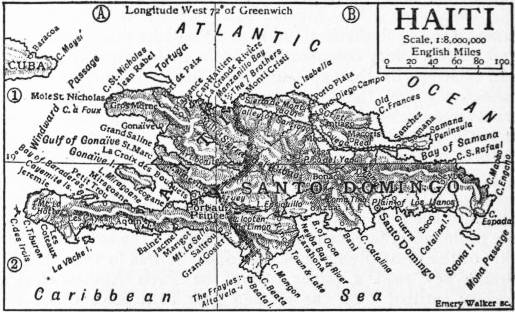
Haiti is essentially a mountainous island. Steep escarpments, leading to the rugged uplands of the interior, reach almost everywhere down to the shores, leaving only here and there a few strips of beach. There are three fairly distinct mountain ranges, the northern, central and southern, with parallel axes from E. to W.; while extensive and fertile plains lie between them. The northern range usually called the Sierra de Monti Cristi, extends from Cape Samana on the east to Cape Fragata on the west. It has a mean elevation of 3000 ft., culminating in the Loma Diego Campo (3855 ft.), near the centre of the range. The central range runs from Cape Engano to Cape St Nicholas, some 400 m. in an oblique direction from E. to W. Towards the centre of the island it broadens and forms two distinct chains; the northern, the Sierra del Cibao, constituting the backbone of Haiti; the southern curving first S.W., then N.W., and reaching the sea near St Marc. In addition to these there are a number of secondary crests, difficult to trace to the backbone of the system, since the loftiest peaks are usually on some lateral ridge. Such for instance is Loma Tina (10,300 ft.) the highest elevation on the island, which rises as a spur N.W. of the city of Santo Domingo. In the Sierra del Cibao, the highest summit is the Pico del Yaqui (9700 ft.). The southern range runs from the Bay of Neyba due W. to Cape Tiburon. Its highest points are La Selle (8900 ft.) and La Hotte (7400 ft.). The plain of Seybo or Los Llanos is the largest of the Haitian plains. It stretches eastwards from the river Ozama for 95 m. and has an average width of 16 m. It is perfectly level, abundantly watered, and admirably adapted for the rearing of cattle. But perhaps the grandest is the Vega Real, or Royal Plain, as it was called by Columbus, which lies between the Cibao and Monti Cristi ranges. It stretches from Samana Bay to Manzanillo Bay, a distance of 140 m., but is interrupted in the centre by a range of hills in which rise the rivers which drain it. The northern part of this plain, however, is usually known as the Valley of Santiago. Most of the large valleys are in a state of nature, in part savanna, in part wooded, and all very fertile.
There are four large rivers. The Yaqui, rising in the Pico del Yaqui, falls, after a tortuous north-westerly course through the valley of Santiago, into Manzanillo Bay; its mouth is obstructed by shallows, and it is navigable only for canoes. The Neyba, or South Yaqui, also rises in the Pico del Yaqui and flows S. into the Bay of Neyba. In the mountains within a few miles from the sources of these rivers, rise the Yuna and the Artibonite. The Yuna drains the Vega Real, flows into Samana Bay, and is navigable by light-draught vessels for some distance from its mouth. The Artibonite flows through the valley of its name into the Gulf of Gonaïve. Of the smaller rivers the Ozama, on which the city of Santo Domingo stands, is the most important. The greatest lake is that of Enriquillo or Xaragua, at a height of 300 ft. above sea-level. It is 27 m. long by 8 m. broad and very deep. Though 25 m. from the sea its waters are salt, and the Haitian negroes call it Etang Salé. After heavy rains it occasionally forms a continuous sheet of water with another lake called Azuey, or Etang Saumatre, which is 16 m. long by 4 m. broad; on these occasions the united lake has a total length of 60 m. and is larger than the Lake of Geneva. Farther S. is the Icoten de Limon, 5 m. long by 2 m. broad, a fresh-water lake with no visible outlet. Smaller lakes are Rincon and Miragoane. There are no active volcanoes, but earthquakes are not infrequent.
Geology.—The geology of Haiti is still very imperfectly known, and large tracts of the island have never been examined by a geologist. It is possible that the schists that have been observed in some parts of the island may be of Pre-cretaceous age, but the oldest rocks in which fossils have yet been found belong to the Cretaceous System, and the geological sequence is very similar to that of Jamaica. Excluding the schists of doubtful age, the series begins with sandstones and conglomerates, containing pebbles of syenite, granite, diorite, &c.; and these are overlaid by marls, clays and limestones containing Hippurites. Then follows a series of sandstones, clays and limestones with occasional seams of lignite, evidently of shallow-water origin. These are referred by R. T. Hill to the Eocene, and they are succeeded by chalky beds which were laid down in a deeper sea and which probably correspond with the Montpelier beds of Jamaica (Oligocene). Finally, there are limestones and marls composed largely of corals and molluscs, which are probably of very late Tertiary or Post-tertiary age. Until, however, the island has been more thoroughly examined, the correlation of the various Tertiary and Post-tertiary deposits must remain doubtful. Some of the beds which Hill has placed in the Eocene have been referred by earlier writers to the Miocene. Tippenhauer describes extensive eruptions of basalt of Post-pliocene age.
Fauna and Flora.—The fauna is not extensive. The agouti is the largest wild mammal. Birds are few, excepting water-fowl and pigeons. Snakes abound, though few are venomous. Lizards are numerous, and insects swarm in the low parts, with tarantulas, scorpions and centipedes. Caymans are found in the lakes and rivers, and the waters teem with fish and other sea food. Wild cattle, hogs and dogs, descendants of those brought from Europe, roam at large on the plains and in the forests. The wild hogs furnish much sport to the natives, who hunt them with dogs trained for the purpose.
In richness and variety of vegetable products Haiti is not excelled by any other country in the world. All tropical plants and trees grow in perfection, and nearly all the vegetables and fruits of temperate climates may be successfully cultivated in the highlands. Among indigenous products are cotton, rice, maize, tobacco, cocoa, ginger, native indigo (indigo marron or sauvage), arrowroot, manioc or cassava, pimento, banana, plantain, pine-apple, artichoke, yam and sweet potato. Among the important plants and fruits are sugarcane, coffee, indigo (called indigo franc, to distinguish it from the native), melons, cabbage, lucerne, guinea grass and the bread-fruit, mango, caimite, orange, almond, apple, grape, mulberry and fig. Most of the imported fruits have degenerated from want of care, but the mango, now spread over nearly the whole island, has become almost a necessary article of food; the bread-fruit has likewise become common, but is not so much esteemed. Haiti is also rich in woods, especially in cabinet and dye woods; among the former are mahogany, manchineel, satinwood, rosewood, cinnamon wood (Canella alba), yellow acoma (Sideroxylon mastichodendron) and gri-gri; and among the latter are Brazil wood, logwood, fustic and sassafras. On the mountains are extensive forests of pine and a species of oak; and in various parts occur the locust, ironwood, cypress or Bermuda cedar, palmetto and many kinds of palms.
Climate.—Owing to the great diversity of its relief Haiti presents a wider range of climate than any other part of the Antilles. The yearly rainfall is abundant, averaging about 120 in., but the wet and dry seasons are clearly divided. At Port-au-Prince the rainy season lasts from April to October, but varies in other parts of the island, so that there is never a season when rain is general. The mountain districts are constantly bathed in dense mists and heavy dews, while other districts are almost rainless. Owing to its sheltered position the heat at Port-au-Prince is greater than elsewhere. In summer the temperature there ranges between 80° and 95° F. and in winter between 70° and 80° F. Even in the highlands the mercury never falls below 45° F. Hurricanes are not so frequent as in the Windward Isles, but violent gales often occur. The prevailing winds are from the east.
The Republic of Haiti.—Haiti is divided into two parts, the negro republic of Haiti owning the western third of the island, while the remainder belongs to Santo Domingo (q.v.) or the Dominican Republic. Between these two governments there exists the strongest political antipathy.
Although but a small state, with an area of only 10,204 sq. m., the republic of Haiti is, in many respects, one of the most interesting communities in the world, as it is the earliest and most successful example of a state peopled, and governed on a constitutional model, by negroes. At its head is a president assisted by two chambers, the members of which are elected and hold office under a constitution of 1889. This constitution, thoroughly republican in form, is French in origin, as are also the laws, language, traditions and customs of Haiti. In practice, however, the government resolves itself into a military despotism, the power being concentrated in the hands of the president. The Haitians seem to possess everything that a progressive and civilized nation can desire, but corruption is spread through every portion and branch of the government. Justice is venal, and the police are brutal and inefficient. Since 1869 the Roman Catholic has been the state religion, but all classes of society seem to be permeated with a thinly disguised adherence to the horrid rites of Voodoo (q.v.), although this has been strenuously denied. The country is divided into 5 départements, 23 arrondissements and 67 communes. Each département and arrondissement is governed by a general in the army. The army numbers about 7000 men, and the navy consists of a few small vessels. Elementary education is free, and there are some 400 primary schools; secondary education is mainly in the hands of the church. The Sisters of Charity and the Christian Brothers have schools at Port-au-Prince, where there is also a lyceum, a medical and a law school. The children of the wealthier classes are usually sent to France for their education. The unit of money is the gourde, the nominal value of which is the same as the American dollar, but it is subject to great fluctuations. The revenue is almost entirely derived from customs, paid both on imports and exports. There being a lack of capital and enterprise, the excessive customs dues produce a very depressed condition of trade. Imports are consequently confined to bare necessaries, the cheapest sorts of dry and fancy goods, matches, flour, salt beef and pork, codfish, lard, butter and similar provisions. The exports are coffee, cocoa, logwood, cotton, gum, honey, tobacco and sugar. The island is one of the most fertile in the world, and if it had an enlightened and stable government, an energetic people, and a little capital, its agricultural possibilities would seem to be endless. Communications are bad; the roads constructed during the French occupation have degenerated into mere bridle tracks. There is a coast service of steamers, maintained since 1863, and 26 ports are regularly visited every ten days. Foreign communication is excellent, more foreign steamships visiting this island than any other in the West Indies. A railway from Port-au-Prince runs through the Plain of Cul de Sac for 28 m. to Manneville on the Etang Saumatre, another runs from Cap Haitien to La Grande Rivière, 15 m. distant.
The people are almost entirely pure-blooded negroes, the mulattoes, who form about 10% of the population, being a rapidly diminishing and much-hated class. The negroes are a kindly, hospitable people, but ignorant and lazy. They have a passion for dancing weird African dances to the accompaniment of the tom-tom. Marriage is neither frequent nor legally prescribed, since children of looser unions are regarded by the state as legitimate. In the interior polygamy is frequent. The people generally speak a curious but not unattractive patois of French origin, known as Creole. French is the official language, and by a few of the educated natives it is written and spoken in its purity. On the whole it must be owned that, after a century of independence and self-government, the Haitian people have made no progress, if they have not actually shown signs of retrogression. The chief towns ate Port-au-Prince (pop. 75,000), Cap Haitien (29,000), Les Cayes (25,000), Gonaïve (18,000), and Port de Paix (10,000). Jeremie was the birthplace of the elder Dumas. The ruins of the wonderful palace of Sans-Souci and of the fortress of La Ferrière, built by King Henri Christophe (1807-1825), can be seen near Millot, a town 9 m. inland from Cap Haitien. Plaisance (25,000), Gros Morne (22,000) and La Croix des Bouquets (20,000) are the largest towns in the interior. The entire population of the republic is about 1,500,000.
History.—The history of Haiti begins with its discovery by Columbus, who landed from Cuba at Mole St Nicholas on the 6th of December 1492. The natives called the country Haiti (mountainous country), and Quisquica (vast country). Columbus named it Espagnola (Little Spain), which was latinized into Hispaniola. At the time of its discovery, the island was inhabited by about 2,000,000 Indians, who are described by the Spaniards as feeble in intellect and physically defective. They were, however, soon exterminated, and their place was supplied (as early as 1512) by slaves imported from Africa, the descendants of whom now possess the land. Six years after its discovery Columbus had explored the interior of the island, founded the present capital, and had established flourishing settlements at Isabella, Santiago, La Vega, Porto Plata and Bonao. Mines had been opened up, and advances made in agriculture. Sugar was introduced in 1506, and in a few years became the staple product. About 1630, a mixed company of French and English, driven by the Spaniards from St Kitts, settled on the island of Tortuga, where they became formidable under the name of Buccaneers. They soon obtained a footing on the mainland of Haiti, and by the treaty of Ryswick, 1697, the part they occupied was ceded to France. This new colony, named Saint Dominique, subsequently attained a high degree of prosperity, and was in a flourishing state when the French Revolution broke out in 1789. The population was then composed of whites, free coloured people (mostly mulattoes) and negro slaves. The mulattoes demanded civil rights, up to that time enjoyed only by the whites; and in 1791 the National Convention conferred on them all the privileges of French citizens. The whites at once adopted the most violent measures, and petitioned the home government to reverse the decree, which was accordingly revoked. In August 1791, the plantation slaves broke out into insurrection, and the mulattoes threw in their lot with them. A period of turmoil followed, lasting for several years, during which both parties were responsible for acts of the most revolting cruelty. Commissioners were sent out from France with full powers to settle the dispute, but although in 1793 they proclaimed the abolition of slavery, they could effect nothing. To add further to the troubles of the colony, it was invaded by a British force, which, in spite of the climate and the opposition of the colonists, succeeded in maintaining itself until driven out in 1798 by Toussaint l’Ouverture. By treaty with Spain, in 1795, France had acquired the title to the entire island.
By 1801, Toussaint l’Ouverture, an accomplished negro of remarkable military genius, had succeeded in restoring order. He then published, subject to the approval of France, a form of constitutional government, under which he was to be governor for life. This step, however, roused the suspicions of Bonaparte, then first consul, who determined to reduce the colony and restore slavery. He sent out his brother-in-law, General Leclerc, with 25,000 troops; but the colonists offered a determined, and often ferocious, resistance. At length, wearied of the struggle, Leclerc proposed terms, and Toussaint, induced by the most solemn guarantees on the part of the French, laid down his arms. He was seized and sent to France, where he died in prison in 1803. The blacks, infuriated by this act of treachery, renewed the struggle, under Jean Jacques Dessalines (1758-1806), with a barbarity unequalled in previous contests. The French, further embarrassed by the appearance of a British fleet, were only too glad to evacuate the island in November 1803.
The opening of the following year saw the declaration of independence, and the restoration of the aboriginal name of Haiti. Dessalines, made governor for life, inaugurated his rule with a bloodthirsty massacre of all the whites. In October 1804, he proclaimed himself emperor and was crowned with great pomp; but in 1806 his subjects, growing tired of his tyranny, assassinated him. His position was now contended for by several chiefs, one of whom, Henri Christophe (1767-1820), established himself in the north, while Alexandre Sabes Pétion (1770-1818) took possession of the southern part. The Spaniards re-established themselves in the eastern part of the island, retaining the French name, modified to Santo Domingo. Civil war now raged between the adherents of Christophe and Pétion, but in 1810 hostilities were suspended. Christophe declared himself king of Haiti under the title of Henry I.; but his cruelty caused an insurrection, and in 1820 he committed suicide. Pétion was succeeded in 1818 by General Jean Pierre Boyer (1776-1850), who, after Christophe’s death, made himself master of all the French part of the island. In 1821 the eastern end of the island proclaimed its independence of Spain, and Boyer, taking advantage of dissensions there, invaded it, and in 1822 the dominion of the whole island fell into his hands. Boyer held the presidency of the new government, which was called the republic of Haiti, until 1843, when he was driven from the island by a revolution. In 1844 the people at the eastern end of the island again asserted their independence. The republic of Santo Domingo was established, and from that time the two political divisions have been maintained. Meanwhile in Haiti revolution followed revolution, and president succeeded president, in rapid succession. Order, however, was established in 1849, when Soulouque, who had previously obtained the presidency, proclaimed himself emperor, under the title of Faustin I. After a reign of nine years he was deposed and exiled, the republic being restored under the mulatto president Fabre Geffrard. His firm and enlightened rule rendered him so unpopular that in 1867 he was forced to flee to Jamaica. He was succeeded by Sylvestre Salnave, who, after a presidency of two years, was shot. Nissage-Saget (1870), Dominique (1874), and Boisrond-Canal (1876) followed, each to be driven into exile by revolution. The next president, Salomon, maintained himself in office for ten years, but he too was driven from the country and died in exile. Civil war raged in 1888-1889 between Generals Légitime and Hippolyte, and the latter succeeded in obtaining the vacant presidency. He ruled with the most absolute authority till his death in 1896. General Tiresias Simon Sam followed and ruled till his flight to Paris in 1902. The usual civil war ensued, and after nine months of turmoil, order was restored by the election of Nord Alexis in December 1902.
Alexis’ administration was unsuccessful, and was marked by many disturbances, culminating in his expulsion. In 1904 there was an attack by native soldiery on the French and German representatives, and punishment was exacted by these powers. In December 1904 ex-president Sam, his wife and members of his ministry were sentenced to long terms of imprisonment for fraudulently issuing bonds. In December 1907 a conspiracy against the government was reported and the ringleaders were sentenced to death. But in January 1908 the revolution spread, and Gonaïve and St Marc and other places were reported to be in the hands of the insurgents. Prompt measures were taken, the rising was checked, and Alexis announced the pardon of the revolutionaries. In March, however, this pacific policy was reversed by a new ministry; some suspects were summarily executed, and the attitude of the government was only modified when the powers sent war-ships to Port-au-Prince. In September the criminal court at the capital sentenced to death, by default, a large number of persons implicated in the risings earlier in the year, and in November revolution broke out again. General Antoine Simon raised his standard at Aux Cayes. Disaffection was rife among the government troops, who deserted to him in great numbers. On the 2nd of December Port-au-Prince was occupied without bloodshed by the revolutionaries, and Alexis took to flight, escaping violence with some difficulty, and finding refuge on a French ship. General Simon then assumed the presidency. At the end of April 1910 Alexis died in Jamaica, in circumstances of some obscurity; it had just been discovered that a plot was on foot to depose Simon, and further trouble was threatened.
Authorities.—B. Edwards, Hist. Survey of the Island of S. Domingo (London, 1801); Jordan, Geschichte der Insel Haiti (Leipzig, 1846); Linstant Pradin, Recueil général des lois et actes du gouvernement d’Haiti (Paris, 1851-1865); Monte y Tejada, Historia de Santo Domingo (Havana, 1853); Saint Amand, Hist. des révolutions d’Haiti (Paris, 1859); Sam. Hazard, Santo Domingo, Past and Present (London, 1873), with bibliography; Sir Spencer St John, Haiti, or the Black Republic (London, 1889); L. Gentil Tippenhauer, Die Insel Haiti (Leipzig, 1893); Marcelin, Haiti, études économiques, sociales, et politiques; and Haiti, ses guerres civiles, leurs causes (Paris, 1893); Hesketh Pritchard, Where Black Rules White (London, 1900). For geology, see W. M. Gabb, “On the Topography and Geology of Santo Domingo,” Trans. Amer. Phil. Soc., Philadelphia, new series, vol. xv. (1881). pp. 49-259, with map; L. G. Tippenhauer, Die Insel Haiti (Leipzig, 1893); see also several articles by L. G. Tippenhauer in Peterm. Mitt. 1899 and 1901. A comparison with the Jamaican succession will be found in R. T. Hill, “The Geology and Physical Geography of Jamaica,” Bull. Mus. Comp. Zool., Harvard, vol. xxxiv. (1899).