VOLUME XII SLICE VII Gyantse to Hallel (continued 6)
Reading edition
Specular haematite forms a constituent of certain schistose rocks, such as the Brazilian itabirite. In the Marquette district of Michigan (Lake Superior) schistose specular ore occurs in important deposits, associated with a jasper rock, in which the ore alternates with bands of red quartzite. Micaceous iron ore consists of delicate steel-grey scales of specular haematite, unctuous to the touch, used as a lubricant and also as a pigment. It is worked in Devonshire under the name of shining ore. Very thin laminae of haematite, blood-red by transmitted light, occur as microscopic enclosures in certain minerals, such as carnallite and sun-stone, to which they impart colour and lustre.
Much haematite occurs in a compact or massive form, often mammillary, and presenting on fracture a fibrous structure. The reniform masses are known as kidney ore. Such red ore is generally neither so dense nor so hard as the crystals. It often passes into an earthy form, termed soft red ore, and when mixed with more or less clay constitutes red ochre, ruddle or reddle (Ger. Rötel).
The hard haematite is occasionally cut and polished as an ornamental stone, and certain kinds have been made into beads simulating black pearls. It was worked by the Assyrians for their engraved cylinder-seals, and was used by the gnostics for amulets. Some of the native tribes in the Congo basin employ it as a material for axes. The hard fibrous ore of Cumberland is known as pencil ore, and is employed for the burnishers used by bookbinders and others. Santiago de Compostela in Spain furnishes a considerable supply of haematite burnishers.
Haematite is an important ore of iron (q.v.), and is extensively worked in Elba, Spain (Bilbao), Scandinavia, the Lake Superior region and elsewhere. In England valuable deposits occur in the Carboniferous Limestone of west Cumberland (Whitehaven district) and north Lancashire (Ulverston district). The hard ore is siliceous, and fine crystallized specimens occur in association with smoky quartz. The ore is remarkably free from phosphorus, and is consequently valued for the production of pig-iron to be converted into Bessemer steel.
(F. W. R.*)
HAEMATOCELE (Gr. αἷμα, blood, and κήλη, tumour), the medical term for a localized collection of blood in the tunica vaginalis or cord. It is usually the result of a sudden blow or severe strain, but may arise from disease. At first it forms a smooth, fluctuating, opaque swelling, but later becomes hard and firm. In chronic cases the walls of the tunica vaginalis undergo changes. The treatment of a case seen soon after the injury is directed towards keeping the patient at rest, elevating the parts, and applying an evaporating lotion or ice-bag. In chronic cases it may be necessary to lay open the cavity and remove the coagulum.
HAEMOPHILIA, the medical term for a condition of the vascular system, often running in families, the members of which are known as “bleeders,” characterized by a disposition towards bleeding, whether with or without the provocation of an injury to the tissue. When this bleeding is spontaneous it comes from the mucous membranes, especially from the nose, but also from the mouth, bowel and bronchial tubes. Slight bruises are apt to be followed by extravasations of blood into the tissues; the swollen joints (knee especially) of a bleeder are probably due, in the first instance, to the escape of blood into the joint cavity or synovial membrane. It is always from the smallest vessels that the blood escapes, and may do so in such quantities as to cause death in a few hours.
HAEMORRHAGE (Gr. αἷμα, blood, and ῥηγνύναι, to burst), a general term for any escape of blood from a blood-vessel (see Blood). It commonly results from injury, as the tearing or cutting of a blood-vessel, but certain forms result from disease, as in scurvy and purpura. The chief varieties of haemorrhage are arterial, venous and capillary. Bleeding from an artery is of a bright red colour, and escapes from the end of the vessel nearest the heart in jets synchronous with the heart’s beat. Bleeding from a vein is of a darker colour; the flow is steady, and the bleeding is from the distal end of the vessel. Capillary bleeding is a general oozing from a raw surface. By extravasation of blood is meant the pouring out of blood into the areolar tissues, which become boggy. This is termed a bruise or ecchymosis. Epistaxis is a term given to bleeding from the nose. Haematemesis is vomiting of blood, the colour of which may be altered by digestion, as is also the case in melaena, or passage of blood with the faeces, in which the blood becomes dark and tarry-looking from the action of the intestinal fluids. Haemoptysis denotes an escape of blood from the air-passages, which is usually bright red and frothy from admixture with air. Haematuria means passage of blood with the urine.
Cessation of bleeding may take place from natural or from artificial means. Natural arrest of haemorrhage arises from (1) the coagulation of the blood itself, (2) the diminution of the heart’s action as in fainting, (3) changes taking place in the cut vessel causing its retraction and contraction. In the surgical treatment of haemorrhage minor means of arresting bleeding are: cold, which is most valuable in general oozing and local extravasations; very hot water, 130° to 160° F., a powerful haemostatic; position, such as elevation of the limb, valuable in bleeding from the extremities; styptics or astringents, applied locally, as perchloride of iron, tannic acid and others, the most valuable being suprarenal extract. In arresting haemorrhage temporarily the chief thing is to press directly on the bleeding part. The pressure to be effectual need not be severe, but must be accurately applied. If the bleeding point cannot be reached, the pressure should be applied to the main artery between the bleeding point and the heart. In small blood-vessels pressure will be sufficient to arrest haemorrhage permanently. In large vessels it is usual to pass a ligature round the vessel and tie it with a reef-knot. Apply the ligature, if possible, at the bleeding point, tying both ends of the cut vessel. If this cannot be done, the main artery of the limb must be exposed by dissection at the most accessible point between the wound and the heart, and there ligatured.
Haemorrhage has been classified as—(1) primary, occurring at the time of the injury; (2) reactionary, or within twenty-four hours of the accident, during the stage of reaction; (3) secondary, occurring at a later period and caused by faulty application of a ligature or septic condition of the wound. In severe haemorrhage, as from the division of a large artery, the patient may collapse and death ensue from syncope. In this case stimulants and strychnine may be given, but they should be avoided until it is certain the bleeding has been properly controlled, as they tend to increase it. Transfusion of blood directly from the vein of a healthy person to the blood-vessels of the patient, and infusion of saline solution into a vein, may be practised (see Shock). In a congenital condition known as haemophylia (q.v.) it is difficult to stop the flow of blood.
The surgical procedure for the treatment of an open wound is—(1) arrest of haemorrhage; (2) cleansing of the wound and removal of any foreign bodies; (3) careful apposition of its edges and surfaces—the edges being best brought in contact by sutures of aseptic silk or catgut, the surfaces by carefully applied pressure; (4) free drainage, if necessary, to prevent accumulation either of blood or serous effusion; (5) avoidance of sepsis; (6) perfect rest of the part. These methods of treatment require to be modified for wounds in special situations and for those in which there is much contusion and laceration. When a special poison has entered the wound at the time of its infliction or at some subsequent date, it is necessary to provide against septic conditions of the wound itself and blood-poisoning of the general circulation.
HAEMORRHOIDS, or Hemorrhoids (from Gr. αἷμα, blood, and ῥεῖν, to flow), commonly called piles, swellings formed by the dilatation of veins of the lowest part of the bowel, or of those just outside the margin of its aperture. The former, internal piles, are covered by mucous membrane; the latter, external piles, are just beneath the skin. As the veins of the lining of the bowel become dilated they form definite bulgings within the bowel, and, at last increasing in size, escape through the anus when a motion is being passed. Growing still larger, they may come down spontaneously when the individual is standing or walking, and they are apt to be a grave source of pain or annoyance. Eventually they may remain constantly protruded—nevertheless, they are still internal piles because they arise from the interior of the bowel. Though a pile is sometimes solitary, there are usually several of them. They are apt to become inflamed, and the inflammation is associated with heat, pain, discharge and general uneasiness; ulceration and bleeding are also common symptoms, hence the term “bleeding piles.” The external pile is covered by the thin dark-coloured skin of the anal margin. Severe pressure upon the large abdominal veins may retard the upward flow of blood to the heart and so give rise to piles; this is apt to happen in the case of disease of the liver, malignant and other tumours, and pregnancy. General weakness of the constitution or of the blood-vessels and habitual constipation may be predisposing causes of piles. The exciting cause may be vigorous straining at stool or exposure to damp, as from sitting on the wet ground. Piles are often only a symptom, and in their treatment this fact should be kept in view; if the cause is removed the piles may disappear. But in some cases it may be impossible to remove the cause, as when a widely-spreading cancerous growth of the rectum, or of the interior of the pelvis or abdomen, is blocking the upward flow of blood in the veins. Sometimes when a pile has been protruded, as during defaecation, it is tightly grasped by spasmodic contraction of the circular muscular fibres which guard the outlet of the bowel, and it then becomes swollen, engorged and extremely painful; the strangulation may be so severe that the blood in the vessels coagulates and the pile mortifies. This, indeed, is nature’s attempt at curing a pile, but it is distressing, and, as a rule, it is not entirely successful.
The palliative treatment of piles consists in obtaining a daily and easy action of the bowels, in rest, cold bathing, astringent injections, lotions and ointments. The radical treatment consists in their removal by operation, but this should not be contemplated until palliative treatment has failed. The operation consists in drawing the pile well down, and strangling the vessels entering and leaving its base, either by a strong ligature tightly applied, by crushing, or by cautery. Before dealing with the pile the anus is vigorously dilated in order that the pile may be dealt with with greater precision, and also that the temporary paralysis of the sphincter muscle, which follows the stretching, may prevent the occurrence of painful and spasmodic contractions subsequently. The ligatures by which the base of the piles are strangulated slough off with the pile in about ten days, and in about ten days more the individual is, as a rule, well enough to return to his work. If, for one reason or another, no operation is to be undertaken, and the piles are troublesome, relief may be afforded by warm sponging and by sitz-baths, the pile being gently dried afterwards by a piece of soft linen, smeared with vaseline, and carefully returned into the bowel. Under surgical advice, cocaine or morphia may be brought in contact with the tender parts, either in the form of lotion, suppository or ointment. In operating upon internal piles it is undesirable to remove all the external piles around the anus, lest the contraction of the circumferential scar should cause permanent narrowing of the orifice. If, as often happens, blood clots in the vein of an external pile, the small, hard, tender swelling may be treated with anodyne fomentations, or it may be rendered insensitive by the ether spray and opened by a small incision, the clot being turned out.
(E. O.*)
HAEMOSPORIDIA, in zoology, an order of Ectospora, which although comparatively few in number and very inconspicuous in size and appearance, have of late years probably attracted greater attention and been more generally studied than any other Sporozoa; the reason being that they include the organisms well known as malarial parasites. In spite, however, of much and careful recent research—to a certain extent, rather, as a result of it—it remains the case that the Haemosporidia are, in some respects, the group of the Ectospora about which our knowledge is, for the time being, in the most unsatisfactory condition. Such important questions, indeed, as the scope and boundaries of the group, its exact origin and affinities, the rank and interclassification of the forms admittedly included in it, are answered quite differently by different workers. For example, one well-known Sporozoan authority (M. Lühe) has recently united the two groups, Haemosporidia and Haemoflagellates, bodily into one, while others (e.g. Novy and McNeal) deny that there is any connexion whatever between “Cytozoa” and Trypanosomes. Again, the inclusion or exclusion of forms like Piroplasma and Halteridium is also the subject of much discussion. The present writer accepts here the view that the Haemosporidia are derived from Haemoflagellates which have developed a gregariniform (Sporozoan) phase at the expense, largely or entirely, of the flagelliform one. The not inconsiderable differences met with among different types are capable of explanation on the ground that certain forms have advanced farther than others along this particular line of evolution. In other words, it is most probable that the Haemosporidia are to be regarded as comprising various parasites which represent different stages intermediate between, on the one side, a Flagellate, and on the other, a typical chlamydospore-forming Ectosporan parasite. While, however, it is easy enough sharply to separate off all Haemosporidia from other Ectospora, it is a very difficult matter to define their limits on the former side. Two principal criteria which a doubtful haemal parasite might very well be required to satisfy in order to be considered as a Haemosporidian rather than a Haemoflagellate are (a) the occurrence of schizogony during the “corpuscular” phase in the Vertebrate host, and (b) the formation of many germs (“sporozoites”) from the zygote; so long as these conditions were complied with, the present writer, at all events, would not feel he was countenancing any protozoological heresy in allowing for the possibility of a Flagellate (perhaps trypaniform) phase or features being present at some period or other in the life-cycle.1 To render this article complete, however, one or two well-known parasites, hitherto referred to this order, must also be mentioned, which, judged by the above (arbitrary) standard, are, it may be, on the Haemoflagellate side of the dividing line (e.g. Halteridium, according to Schaudinn).
The chief characters which distinguish the Haemosporidia from other Ectospora are the following. They are invariably blood parasites, and for part or all of the trophic period come into intimate relation with the cellular elements in the blood. There is always an alternation of hosts and of generations, an Invertebrate being the definitive host, in which sexual conjugation is undergone and which is to be regarded as the primary one, a Vertebrate being the intermediate or secondary one. The zygote or sporont is at first capable of movement and known as an ookinete. No resistant spores (chlamydospores) are formed, the ultimate germs or sporozoites always being free in the oocyst and not enclosed by sporocysts.
To Sir E. Ray Lankester is due the honour of discovering the first Haemosporidian, a discovery which did not take place until after most of the other kinds of Sporozoa were known. In 1871 this author described the parasite of the frog, which he later termed Drepanidium ranarum. The next discovery was the great and far-reaching one of Laveran, who in 1883 described all the characteristic phases of the malarial parasite which are met with in human blood. While regarding the organism as the cause of the disease, Laveran did not at once recognize its animal and Sporozoan nature, but considered it rather as a vegetable, and termed it Oscillaria malariae. As in the case of the Trypanosomes, we owe to Danilewsky (1885-1889) the first serious attempts to study the comparative anatomy and life-history of these parasites, from a zoological point of view. Danilewsky first named them Haemosporidia, and distinguished between Haemocytozoa and Leucocytozoa. To the brilliant researches of R. Ross and Grassi in the closing years of the 19th century is due the realization of the essential part played by the gnat or mosquito in the life-cycle and transmission of the parasites; and to MacCallum belongs the credit of first observing the true sexual conjugation, in the case of a Halteridium. Since then, thanks to the labours of Argutinsky and Schaudinn, our knowledge of the malarial parasites has steadily increased. Until quite recently, however, very little was known about the Haemosporidia of cold-blooded Vertebrates; but in 1903 Siegel and Schaudinn demonstrated that the same rôle is performed in their case by a leech or a tick, and since then many new forms have been described.
The Haemosporidia are widely distributed and of very general occurrence among the chief classes of Vertebrates. Among Invertebrates they are apparently limited to bloodsucking insects, ticks and leeches.2 As already stated, Occurrence: habitat; effects on host. the universal habitat of the parasites in the Vertebrate is the blood; as a result, of course, they are to be met with in the capillaries of practically all the important organs of the body; and it is to be noted that while certain phases (e.g. growing trophozoites, mature gametocytes) are found in the peripheral circulation, others (e.g. schizogonous “rosettes,” young gametocytes) occur in the internal organs, liver, kidneys, &c., where the circulation is sluggish. The relation of the parasites to the blood-cells varies greatly. Most attack, probably exclusively, the red blood corpuscles (haematids); a few, however, select the leucocytes, and are therefore known as Leucocytozoa. In the case of Mammalian and Avian forms (malarial parasites) Schaudinn and Argutinsky have shown that the trophic and schizogonic phases are not really endoglobular but closely attached to the corpuscle, hollowing out a depression or space into which they nestle; the gametocytes, on the other hand, are actually intercellular. Forms parasitic in cold-blooded Vertebrates, on the contrary, are always, so far as is known, endoglobular when in relation with the corpuscles; and the same is apparently the case with the Mammalian parasite, Piroplasma. Although in no instance so far described is the parasite actually intranuclear (as certain Coccidia are), in one or two cases (e.g. Karyolysus of lizards and certain species of Haemogregarina) it reacts markedly upon the nucleus and soon causes its disintegration. While many Haemosporidia (e.g. malarial parasites, with the exception of Halteridium) remain in connexion with the same corpuscle throughout the whole period of growth and schizogony, the new generation of merozoites first being set free from the broken-down cell, others (the Haemogregarines, broadly speaking, and also Halteridium) leave one corpuscle after a short time, wander about free in the plasma, and then seek out another; and this may be repeated until the parasite is ready for schizogony, which generally occurs in the corpuscle.
As in the case of Trypanosomes (q.v.), normally—that is to say, when in an accustomed, tolerant host, and under natural conditions—Haemosporidia are non-pathogenic and do not give rise to any ill-effects in the animals harbouring them. When, however, the parasites gain an entry into the blood of man or other unadapted animals,3 they produce, as is well known, harmful and often very serious effects. There are three recognized types of malarial fever, each caused by a distinct form and characterized by the mode of manifestation. Two, the so-called benign fevers, are intermittent; namely, tertian and quartan fever, in which the fever recurs every second and third day respectively. This is due to the fact that schizogony takes different lengths of time in the two cases, 48 hours in the one, 72 in the other; the height of the fever-period coincides with the break-down of the corpuscle at the completion of the process, and the liberation of great numbers of merozoites in the blood. The third type is the dangerous aestivo-autumnal or pernicious malaria, in which the fever is irregular or continuous during long periods.
A very general symptom is anaemia, which is sometimes present to a marked extent, when it may lead to a fatal termination. This is the result of the very considerable destruction of the blood-corpuscles which takes place, the haemoglobin of which is absorbed by the parasites as nutriment. A universal feature connected with this mode of nutrition is the production, in the cytoplasm of the parasite, of a brown pigment, termed melanin; this does not represent reserve material, but is an excreted by-product derived from the haemoglobin. These pigment-grains are at length liberated into the blood-stream and become deposited in the various organs, spleen, liver, kidneys, brain, causing pronounced pigmentation.
Another type of fever, more acute and more generally fatal, is that produced by forms belonging to the genus Piroplasma, in cattle, dogs, horses and other domestic animals in different regions of the globe; and recently Wilson and Chowning have stated that the “spotted fever of the Rockies” is a human piroplasmosis caused by P. hominis. The disease of cattle is known variously as Texas-fever, Tristeza, Red-water, Southern cattle-fever, &c. In this type of illness the endogenous multiplication of the parasites is very great and rapid, and brings about an enormous diminution in the number of healthy red blood corpuscles. Their sudden destruction results in the liberation of large quantities of haemoglobin in the plasma, which turns deep-red in colour; and hence haemoglobinuria, which occurs only rarely in malaria, is a constant symptom in piroplasmosis.
The parasite of pernicious malaria, here termed Laverania malariae, will serve very well as a type of the general life-cycle (fig. 1). Slight differences shown by the other malarial parasites (Plasmodium) will be mentioned in passing, but the Example of the life-history. main divergences which other Haemosporidian types exhibit are best considered separately. With the bite of an infected mosquito, the minute sickle-like sporozoites are injected into the blood. They rapidly penetrate into the blood corpuscles, in which they appear as small irregular, more or less amoeboid trophozoites. A vacuole next arises in the cytoplasm, which increases greatly in size, and gives rise to the well-known, much discussed ring-form of the parasite, in which it resembles a signet-ring, the nucleus forming a little thickening to one side. Some authorities (e.g. Argutinsky) have regarded this structure as being really a greatly distended vesicular nucleus, and, to a large extent, indeed, an artifact, resulting from imperfect fixation; but Schaudinn considers it is a true vacuole, and explains it on the ground of the rapid nutrition and growth. Later on this vacuole disappears, and the grains of pigment make their appearance. The trophozoite is now large and full-grown, and has become rounded and ready for schizogony. The nucleus of the schizont divides several times (more or less directly, by simple or multiple fission) to form a number of daughter-nuclei, which take up a regular position near the periphery. Around these the cytoplasm becomes segmented, giving rise to the well-known corps en rosace. Eventually the merozoites, in the form of little round uninuclear bodies, are liberated from the now broken-down corpuscle, leaving behind a certain amount of residual cytoplasm containing the pigment grains. Besides the difference in the time taken by the complete process of schizogony in the various species (see above), there are distinctions in the composition of the rosettes. Thus, in Laverania, the number of merozoites formed is very variable; in Plasmodium vivax (the tertian parasite) there are only few (9 to 12) merozoites, but in P. malariae (the quartan form) they are more numerous, from 12 to 24. The liberated merozoites proceed to infect fresh blood corpuscles and a new endogenous cycle is started.
After asexual multiplication has gone on for some time, sexual forms become developed. According to Schaudinn, the stimulus which determines the production of gametocytes instead of schizonts is the reaction of the host (at the height of a fever period) upon the parasites. A young trophozoite which is becoming a gametocyte is distinguished from one which gives rise to a schizont by its much slower rate of growth, and the absence of any vacuoles in its cytoplasm. The gametocytes themselves are characterized by their peculiar shape, like that of a sausage, whence they are very generally known as “crescents.” Male and female gametocytes are distinguished (roughly) by the arrangement of the pigment-grains; in the former, they are fairly evenly scattered throughout the cytoplasm, but in the megagametocytes the pigment tends to be aggregated centrally, around the nucleus. As they become full-grown and mature, however, the gametocytes lose their crescentic form and assume that of an oval, and finally of a sphere. At the same time, they are set free from the remains of the blood corpuscle. The spherical stage is practically the limit of development in the Vertebrate host, although, sometimes, the nucleus of the microgametocyte may proceed to division. The “crescents” of the pernicious parasite afford a very important diagnostic difference from the gametocytes of both species of Plasmodium, which have the ordinary, rounded shape of the schizonts. In the case of the latter, points such as their slower growth, their less amoeboid character, and their size furnish the means of distinction.
When a gnat or mosquito sucks blood, all phases of the parasite in the peripheral circulation at that point may succeed in passing into the insect. If this occurs all trophic and schizogonic phases are forthwith digested, and the survival of the sexual phases depends entirely upon whether the insect is a gnat or mosquito. Only in the latter case can further development of the gametocytes go on; in other words, only the genus Anopheles, and not the genus Culex, furnishes specific hosts for the malarial parasites. This is a biological fact of considerable importance in connexion with the prophylactic measures against malaria. In the stomach of an Anopheles, the gametocytes quickly proceed to gamete-formation. The nucleus of the microgametocyte divides up, and the daughter-nuclei pass to the periphery. The surface of the body grows out into long, whip-like processes, of which there are usually 6 to 8 (probably the typical number is 8); each is very motile, in this respect strongly resembling a flagellum. This phase may also develop in drawn blood, which has, of course, become suddenly cooled by the exposure; and it seems evident that it is the change in temperature, from the warm to the cold-blooded host, which brings about the development of the actual sexual elements. Earlier observers regarded the phase just described as representing another parasite altogether, of a Flagellate nature—whence the well-known term, Polymitus-form; and even more recent workers, such as Labbé who connected it with the malarial parasite, failed to appreciate its true significance, and considered it rather as a degeneration-appearance. The micro-gametes soon liberate themselves from the residual cytoplasm of the parent and swim away in search of a megagamete; each is a very slender, wavy filament, composed largely of chromatic substance. The finer details of structure of the microgamete of a malarial parasite cannot be said, however, to be thoroughly known, and it is by no means impossible that its structure is really trypaniform, as, according to Schaudinn’s great work, is the case with the merozoites and sporozoites.
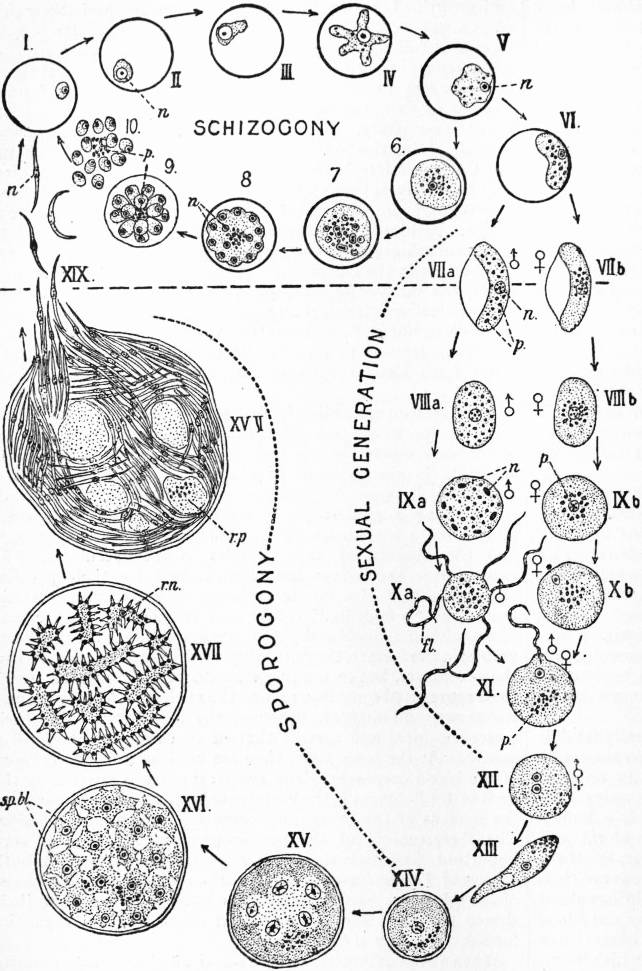
From Lankester’s Treatise on Zoology.
Fig. 1.—Diagram of the complete life-cycle of the parasite of pernicious malaria, Laverania malariae, Gr. et Fel. The stages on the upper side of the dotted line are those found in human blood; below the dotted line are seen the phases through which the parasite passes in the intermediate host, the mosquito. Plan and arrangement chiefly after Neveu-Lemaire; details of the figures founded on those of Grassi, Schaudinn (Leuckart’s Zoologische Wandtafeln), Ross and others.
I.-V. and 6-10 show the schizogony. VI.-XII., The sexual generation. XIII., The motile zygote. XIV.-XIX., Sporogony. I.-III., Young amoebulae in blood-corpuscles. IV., Older, actively amoeboid trophozoite. V., Still older, less amoeboid trophozoite. 6, Mature schizont. 7, Schizont, with nucleus dividing up. 8, Young rosette stage. 9, Fully formed rosette stage. 10, Merozoites free in the blood by breaking down of the corpuscle. VI., Young indifferent gametocyte. VII., a, Male crescent. VII., b, Female crescent. VIII., a and b, The gametocytes becoming oval. IX., a and b, Spherical gametocytes; in the male (IX. a) the nucleus has divided up. X., a and b, Formation of gametes; in the male (X. a) the so-called flagella or male gametes (fl) are thrown out, one of them is seen detached; in the female (X. b) a portion of the nucleus has been expelled. XI., A male gamete penetrating a female gamete at a cone of reception formed near the nucleus. XII., Zygote with two pronuclei in proximity. XIII., Zygote in the motile stage (vermicule or oökinete). XIV., Encysted zygote (oöcyst). XV., Commencing multiplication of the nuclei in the oöcyst. XVI., Oöcyst with numerous sporoblasts. XVII., Commencing formation of sporozoites. XVIII., Full-grown oocyst crammed with ripe sporozoites; on one side the cyst has burst and the sporozoites are escaping. XIX., Free sporozoites, showing their changes of form. n, Nucleus of the parasite. p, Melanin pigment. fl, “Flagella.” sp. bl., Sporoblasts. r. n., Residual nuclei. r. p., Residual protoplasm.
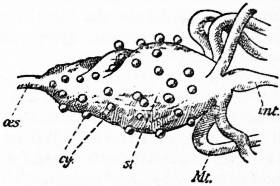
From Lankester’s Treatise on Zoology.
Fig. 2.—Stomach of a mosquito, with cysts of Haemosporidia. (After Ross.)
oes, Oesophagus. st, Stomach. cy, Cysts. Mt, Malpighian tubules. int, Intestine.
The megagametocyte becomes a megagamete directly after a process of maturation, which consists in the expulsion of a certain amount of nuclear substance. The actual conjugation is quite similar to the process in Coccidia, and the resulting zygote perfectly homologous. In the present case, however, the zygote does not at once secrete an oöcyst, with a thick resistant wall; on the contrary, it changes its shape, and becomes markedly gregariniform and active, and is known for this reason as an ookinete. The ookinete passes through the epithelial layer of the stomach, the thinner and more pointed end leading the way, and comes to rest in the connective tissue forming the outer layer of the stomach-wall (fig. 2). Here it becomes rounded and cyst-like, and grows considerably; for only a thin, delicate cyst-membrane is secreted, which does not impede the absorption of nutriment. Meanwhile, the nucleus has divided into several, around each of which the cytoplasm becomes segmented. Each of these segments (“blastophores,” “zoidophores”) is entirely comparable to a sporoblast in the Coccidian oocyst, the chief difference being that it never forms a spore; moreover the segments or sporoblasts in the oocyst of a malarial parasite are irregular in shape and do not become completely separated from one another, but remain connected by thin cytoplasmic strands. Repeated multiplication of the sporoblast-nuclei next takes place, with the result that a great number of little nuclei are found all round the periphery. A corresponding number of fine cytoplasmic processes grow out from the surface, each carrying a nucleus with it, and in this manner a huge number of slender, slightly sickle-shaped germs or sporozoites (“blasts,” “zoids,” &c.) are formed. Each oocyst may contain from hundreds to thousands of sporozoites.
When the sporogony (which lasts about 10 days) is completed, the oocyst ruptures and the sporozoites are set free into the body-cavity, leaving behind a large quantity of residual cytoplasm, including pigment grains, &c. The sporozoites are carried about by the blood-stream; ultimately, however, apparently by virtue of some chemotactic attraction, they practically all collect in the salivary glands, filling the secretory cells and also invading the ducts. When the mosquito next bites a man, numbers of them are injected, together with the minute drop of saliva, into his blood, where they begin a fresh endogenous cycle.
There is only one other point with regard to the life-history that need be mentioned. With the lapse of time all trophic and schizogonic (asexual) phases of the parasite in the blood die off. But it has long been known that malarial patients, apparently quite cured, may suddenly exhibit all the symptoms again, without having incurred a fresh infection. Schaudinn has investigated the cause of this recurrence, and finds that it is due to the power of the megagametocytes, which are very resistant and long-lived, to undergo a kind of parthenogenesis under favourable conditions and give rise to the ordinary asexual schizonts, which in turn can repopulate the host with all the other phases. Microgametocytes, on the other hand, die off in time if they cannot pass into a mosquito.
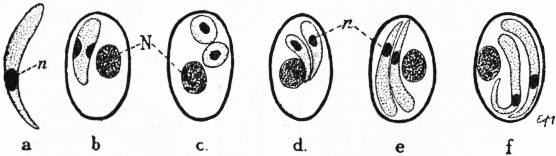
From Lankester’s Treatise on Zoology.
Fig. 3.—Haemogregarina bigemina, Laveran, from the blood of blennies. (After Laveran, magnified about 1800 diameters.)
a, The form of the parasite found free in the blood-plasma. b, Parasite within a blood-corpuscle, preparing for division; the nucleus has already divided. c, The parasite has divided into two rounded corpuscles, which assume the form of the free parasite, as seen in d, e and f. N, Nucleus of the blood-corpuscle. n, Nucleus of the parasite. The outline of the blood-corpuscle is indicated by a thick black line.
Various types of form are to be met with among the Haemosporidia. In one, characteristic of most (though not of absolutely all) parasites of warm-blooded Vertebrates, the trophozoites are of irregular amoeboid shape; hence this section Comparative Morphology; variations in the life-cycle where known. is generally known as the Haemamoebidae. In another type, characteristic of the parasites of cold-blooded Vertebrates, the body possesses a definite, vermiform, i.e. gregariniform shape, which is retained during the intracorpuscular as well as during the free condition; this section comprises the Haemogregarinidae. Allied to this latter type of form are the trophozoites of Piroplasma, which are normally pear-shaped; they differ, however, in being very minute, and, moreover, exhibit considerable polymorphism, rod-like (so-called bacillary) and ring-forms being of common occurrence. It is important to note that in a certain species of Haemogregarina (fig. 3) the young trophozoites markedly resemble Piroplasma in their pyriform appearance; and a further point of agreement between the two forms is mentioned below. Lastly there is the Avian genus Halteridium, the trophozoites of which are characteristically bean-shaped or reniform. True Haemogregarines also differ in other slight points from “Haemamoebae.” Thus the young endoglobular trophozoite does not exhibit a ring (vacuolar) phase; and the cytoplasm never contains, at any period, the characteristic melanin pigment above noted. In some species of Haemogregarina the parasite, while intracorpuscular, becomes surrounded by a delicate membrane, the cytocyst; on entering upon an active, “free” period, the cytocyst is ruptured and left behind with the remains of the corpuscle. A very interesting cytological feature is the occurrence, in one or two Haemosporidia, of nuclear dimorphism, i.e. of a larger and smaller chromatic body, probably comparable to the trophic and kinetic nuclei of a Trypanosome, or of the “Leishman-Donovan” bodies. Schaudinn was the first to notice this character, in Piroplasma canis, and his observation has since been confirmed by Lühe.4 Moreover, Brumpt has also noticed nuclear dimorphism in the ookinete of a species of Haemogregarina in a leech (as the Invertebrate host)—a highly important observation.
As regards the life-history, the endogenous (schizogonous) cycle is known in many cases. Sometimes schizogony takes the primitive form of simple binary (probably) longitudinal fission; this is the case in Piroplasma (fig. 4) and also in Haemogregarina bigemina just referred to. From this result the pairs of individuals (“twins”) so often found in the corpuscles. In addition, however, at any rate in Piroplasma, it is probable that multiple division (more allied to ordinary schizogony) also takes place; such is the case, according to Laveran, in P. equi, and the occurrence at times of four parasites in a corpuscle, arranged in a cruciform manner, is most likely to be thus explained. Labbé has described schizogony in Halteridium danilewskyi as taking place in a rather peculiar manner; the parasite becomes much drawn-out and halter-like, and the actual division is restricted to its two ends, two clumps of merozoites being formed, at first connected by a narrow strand of unused cytoplasm, which subsequently disappears. Some doubt, however, attaches to this account, as no one else appears to have seen the process. For the rest, schizogony takes place more or less in the customary way, allowing for variations in the mode of arrangement of the merozoites. It remains to be noted that in Karyolysus lacertarum, according to Labbé, two kinds of schizont are developed, which give rise, respectively, to micromerozoites and megamerozoites, in either case enclosed in a delicate cytocyst. This probably corresponds to an early sexual differentiation (such as is found among certain Coccidia (q.v.), the micromerozoites producing eventually micro-gametocytes, the others megagametocytes.
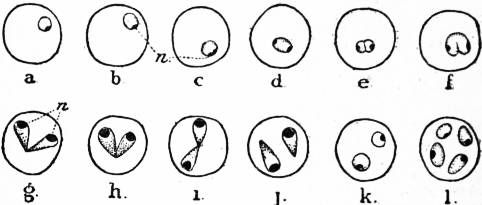
From Lankester’s Treatise on Zoology.
Fig. 4.—Development and schizogony of Piroplasma bigeminum in the blood-corpuscles of the ox. (After Laveran and Nicolle.)
a, Youngest form. b, Slightly older. c and d. Division of the nucleus. e and f, Division of the body of the parasite. g, h, i, j, Various forms of the twin parasite. k and l, Doubly infected corpuscles.
It has now been recognized for some time that the sexual (exogenous) part of the life-cycle of all the Haemamoebidae takes place in an Invertebrate (Insectan) host, and is fundamentally similar to that above described in those cases where it has been followed. In contradistinction to the malarial parasites, this host, in the Avian forms (Haemoproteus and Halteridium)5 is a species of Culex and not of Anopheles; in other words, gamete-formation, conjugation and subsequent sporozoite-formation in these cases will only go on in the former. On the other hand, in the case of the Haemogregarines, it was thought until quite lately that the entire life-history, including conjugation and sporogony, went on in the Vertebrate host; and only in 1902 Hintze described what purported to be the complete life-history of Lankesterella (Drepanidium) ranarum undergone in the frog. This view was rendered obsolete by the work of Siegel and Schaudinn, who demonstrated the occurrence of an alternation of hosts and of generations in the case of Haemogregarina stepanovi, parasitic in a tortoise, and in Karyolysus lacertarum; the Invertebrate hosts, in which, in both cases, the sexual process is undergone, being respectively a leech (Placobdella) and a tick (Ixodes). With this discovery the main distinction (as supposed) between the Haemosporidia of warm and of cold-blooded Vertebrates vanished. It was further acknowledged by Schaudinn (under whom Hintze had worked) that the latter had been misled by Coccidian cysts and spores, which he took for those of Lankesterella. The gametogony and sporogony of Haemogregarina stepanovi in the leech agree in essential particulars with the process above described. The microgametes are extremely minute, and the sporozoites, which are developed in the salivary glands, where the motile ookinetes finally come to rest, are extremely “spirochaetiform”—the full significance of this latter fact being, perhaps, not appreciated.
Christophers recently described some remarkable phases which he regarded as belonging to the cycle of Haemogregarina gerbilli (one of the few Mammalian Haemogregarines known) in a louse (Haematopinus). In a private communication, however, the author states that he has probably mistaken phases in the development of an ordinary gregarine parasite in the louse for part of the life-cycle of this Haemogregarine.
The Mammalian parasite Piroplasma is the one about whose life-history our knowledge is most vague. Besides the typical and generally occurring forms, others have also been observed in the blood, but it is doubtful how far these are to be looked upon as normal; for instance, Bowhill and Le Doux have described, in various species, a phase in which a long, slender pseudopodial-like outgrowth is present, with a swelling at the distal end. It is, moreover, quite uncertain which are the sexual forms, comparable to gametocytes. Doflein regards large pear-shaped forms as such (megagametocytes?), which become spherical when maturing; and Nocard and Motas have figured amoeboid, irregular forms, with the nucleus fragmented and possessing flagella-like processes (possibly microgametes?). The Invertebrate host is well known to be, in the case of all species, a tick; thus bovine piroplasmosis (P. bigeminum) in America is conveyed by Rhipicephalus annulatus (Boophilus bovis), canine piroplasmosis (P. canis) in South Africa by Haemaphysalis leachi (and perhaps Dermacentor reticulatus), and so on. The manner in which the infection is transmitted by the tick varies greatly. In some cases (e.g. P. bigeminum and P. canis) only the generation subsequent to that which receives the infection (by feeding on an infected ox) can transmit it back again to another ox; in other words, true hereditary infection of the ova in the mother-tick is found to occur. The actual period in the life of the daughter-tick at which it can convey the infection apparently varies. On the other hand, in the case of East African coast-fever, Theiler found that hereditary infection does not occur, the same generation transmitting the parasite (P. parvum) at different periods of life. Little is certainly known regarding the phases of the parasite which are passed through in the tick. Lignières has observed a kind of multiple fission in the stomach, several very minute bodies, consisting mostly of chromatin, being formed, which may serve for endogenous reproduction. Koch has published an account of certain curious forms of P. bigeminum, in which the body is produced into many stiff, ray-like processes, giving the appearance of a star; according to him fusion of such forms takes place, and the resulting zygote becomes rounded, perhaps transitional to the pear-shaped forms.
The classification and nomenclature of the Haemosporidia are in a very unsettled condition. For an account of the various systems and modifications hitherto adopted, the article of Minchin (see under Sporozoa: Bibliography) should be consulted. Classification. With the realization that the life-history in the case of the “Haemamoebae” and the Haemogregarines is fundamentally similar in type, the chief reason for grouping them as distinct suborders has disappeared. It is most convenient to regard them as separate, but closely allied families, the Plasmodidae (“Haemamoebidae”) and the Haemogregarinidae. The Piroplasmata, on the other hand, constitute another family, which is better placed in a distinct section or sub-order. In addition there are, as already noted, two or three genera whose systematic position must be considered as quite uncertain. One is the well-known Halteridium of Labbé, parasitic in various birds; the type-species is H. danilewskyi (Gt. and Fel.). Another is the much-debated parasite of white blood-corpuscles (leucocytes), originally described in birds by Danilewsky under the name of Leucocytozoon, a form of which has been recently observed in Mammals.
In conclusion, the chief members of the above-mentioned families may be enumerated.
Fam. Plasmodidae (“Haemamoebidae”).
Genus Laverania, Gr. and Fel. (syn. Haemamoenas, Ross), for L. malariae, Gr. and Fel. (synn. L. s. Plasmodium, s. “Haemamoeba,” &c., praecox s. immaculatum, &c.), the parasite of pernicious malaria. Genus Plasmodium, March. and Celli (syn. “Haemamoeba”) for P. vivax and P. malariae, the tertian and quartan parasite, respectively. There is also a form known in apes, P. kochi. Genus Haemoproteus, Kruse (syn. Proteosoma), for H. danilewskyi (syn. Proteosoma grassi, Plasmodium praecox, &c.), parasitic in numerous birds. Recently, another form has been described, from reptiles, which Castellani and Willey have termed Haemocystidium simondi.
Remarks.—The distinguishing characters of the malarial parasites have been mentioned above. Some authorities would include Laverania in the genus Plasmodium, as differing only specifically from the other two forms. It has, moreover, been suggested by Sergent that all three are merely different phases of the same parasite, predominating at different seasons; this idea cannot be regarded, however, as in any way proved so far. From what is known of the morphology and mode of manifestation of these forms, the differences between Laverania and the two species of Plasmodium are considerably more pronounced than those between P. vivax and P. malariae; if the latter are to be considered as distinct species, the first-named is probably generically distinct. Lühe, it may be noted, in his recent comprehensive account of the Haematozoa, also takes this view. Lastly, whatever be the correct solution of the above problem, there is certainly not sufficient justification for including the Avian genus Haemoproteus, as also only a species of Plasmodium, which is done by some. Its different Vertebrate habitat, and also the fact that its Insectan definitive host is Culex and not Anopheles, differentiate it sharply from Laverania and Plasmodium.
From Lankester’s Treatise on Zoology.
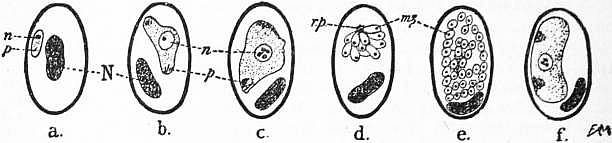
Fig. 5.—Haemoproteus danilewskyi, Kruse (parasite of various birds). × about 1200. a, b, c and d from the chaffinch; d and e from the lark. (After Labbé.)
a, Young trophozoite in a blood-corpuscle, b and c, Older trophozoite. d and e, Sporulation. d, Precocious sporulation with few merozoites. e, Sporulation of a full-grown schizont, with numerous merozoites. f, Gametocyte. N, Nucleus of blood-corpuscle. n, Nucleus of parasite. p, Pigment. mz, Merozoites. r.p, Residual protoplasm.
From Lankester’s Treatise on Zoology.
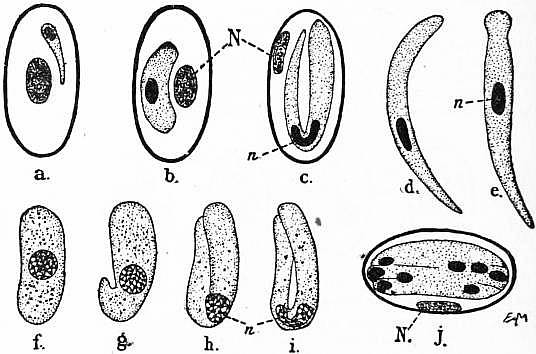
Fig. 6.—Haemogregarina stepanovi, Danilewsky (par. Emys and Cistudo), phases of the schizogony. (a-e and j after Laveran; f-i after Börner.) × 1000 to 1200 diameters.
a, Blood-corpuscle with young trophozoite. b, Older trophozoite. c, Full-grown trophozoite, ready to leave the corpuscle. d and e, Trophozoites free in the blood-plasma, showing changes of form. f-i, Trophozoites, still within the blood-corpuscle (not drawn), showing the structure of the nucleus, the coarse chromatoid granules in the protoplasm and the manner in which the parasite grows into the U-shaped Haemogregarine without increase of body-mass. j, Commencement of sporulation; the nucleus has divided into eight nuclei, and the body of the parasite is beginning to divide up into as many merozoites within a blood-corpuscle. N, Nucleus of the blood-corpuscle. n, Nucleus of the parasite.
Fam. Haemogregarinidae.—The different genera are characterized chiefly by their size relative to the blood-corpuscles, and their disposition in the latter. Here, again, it has been suggested to unite the various types all in one genus, Haemogregarina, but this seems at least premature when it is remembered how little is known in most cases of the life-cycle, which may prove to exhibit important divergences.
Genus Haemogregarina, Danilewsky (syn. Danilewskya, Labbé). The body of the parasite exceeds the blood-corpuscle in length, when adult, and is bent upon itself, like a U. A very great number of species are known, mostly from reptiles and fishes; among them may be mentioned H. stepanovi (fig. 6), from Emys and Cistudo, whose sexual-cycle in a leech has been worked out by Siegel (see above), H. delagei, from Raja, H. bigemina, from blennies, and H. simondi, from soles. Recently one or two Mammalian forms have been observed, H. gerbilli, from an Indian rat (Gerbillus), and H. jaculi, from the jerboa.
Genus Lankesterella, Labbé (syn. Drepanidium, Lankester). The parasite is not more than three-quarters the length of the corpuscle. L. ranarum from Rana is the type-species; another, recently described by Fantham, is L. tritonis, from the newt.
From Lankester’s Treatise on Zoology.
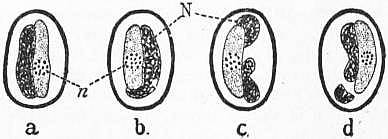
Fig. 7.—Karyolysus lacertarum (Danil.), in the blood-corpuscles of Lacerta muralis, showing the effects of the parasite upon the nucleus of the corpuscle. In c and d the nucleus is broken up. N, Nucleus of the corpuscle; n, nucleus of the parasite, seen as a number of masses of chromatin, not enclosed by a distinct membrane. (After Marceau.)
Genus Karyolysus, Labbé. The parasite does not exceed the corpuscle in length; the forms included in this genus, moreover, although not actually intranuclear, have a marked karyolytic and disintegrating action upon the nucleus of the corpuscle. The type-species is the well-known K. lacertarum, of lizards; another is K. (Haemogregarina) viperini, from Tropidonotus.
In the section of the Piroplasmata there is only the genus Piroplasma, Patton (synn. Babesia, Starcovici, Pyrosoma, Smith and Kilborne), the principal species of which are as follows: P. bigeminum, the cause of Texas cattle-fever, tick-fever (Rinder-malaria) of South Africa, and P. bovis, causing haemoglobinuria of cattle in Southern Europe; there is some uncertainty as to whether these two are really distinct; P. canis, P. ovis and P. equi associated, respectively, with those animals. Lately, a very small form, P. parvum, has been described by Theiler in Rhodesia, which causes East-African coast-fever; and another, P. muris, has been observed in white rats by Fantham.
Bibliography.—(The older literature is enumerated in most treatises on Sporozoa—see bibliography under Sporozoa). P. Argutinsky, “Malariastudien,” Arch. mikr. Anat. 59, p. 315, pls. 18-21 (1901), and op. cit. 61, p. 331, pl. 18 (1902); A. Balfour, “Haemogregarine of Mammals,” J. Trop. Med. 8, p. 241, 8 figs. (1905); C. A. Bentley, “Leucocytozoan of the Dog,” B.M.J. (1905), 1, pp. 988 and 1078; N. Berestneff, “Über einen neuen Blutparasiten der indischen Frösche,” Arch. Protistenk. 2, p. 343, pl. 8 (1903); “Über das ’Leucocytozoan’ danilewskyi,” op. cit. 3, p. 376, pl. 15 (1904); A. Billet, “Contribution à l’étude du paludisme et de son hématozoaire en Algérie,” Ann. Inst. Pasteur, 16, p. 186 (1902); (Notes on various Haemogregarines). C. R. Soc. Biol. 56, pp. 482, 484, 607 and 741 (1904); C. Börner, “Untersuchungen über Hämosporidien,” Zeitschr. wiss. Zool. 69, p. 398, 1 pl. (1901); T. Bowhill, “Equine piroplasmosis,” &c., J. Hyg. 5, p. 7, pls. 1-3 (1905); Bowhill and C. le Doux, “Contribution to the Study of ’Piroplasmosis canis,’” op. cit. 4, p. 217, pl. 11 (1904); E. Brumpt and C. Lebailly, “Description de quelques nouvelles espèces de trypanosomes et d’hémogrégarines,” &c., C. R. Ac. Sci. 139, p. 613 (1904); A. Castellani and A. Willey, “Observations on the Haematozoa of Vertebrates in Ceylon,” Spolia Zeylan. 2, p. 78, 1 pl. (1904), and Q. J. Micr. Sci. 49, p. 383, pl. 24 (1905); S. R. Christophers, “Haemogregarina gerbilli,” Sci. Mem. India, 18, 15 pp., 1 pl. (1905); H. B. Fantham, “Lankesterella tritonis, n. sp.,” &c., Zool. Anz. 29, p. 257, 17 figs. (1905); “Piroplasma muris,” &c., Q. J. Micr. Sci. 50, p. 493, pl. 28 (1906); C. Graham-Smith, “A new Form of Parasite found in the Red Blood-Corpuscles of Moles,” J. Hyg. 5, p. 453, pls. 13 and 14 (1905); R. Hintze, “Lebensweise und Entwickelung von Lankesterella minima,” Zool. Jahrb. Anat. 15, p. 693, pl. 36 (1902); S. James, “On a Parasite found in the White Blood-Corpuscles of Dogs,” Sci. Mem. India, 14, 12 pp. 1 pl. (1905); R. Koch, “Vorläufige Mitteilungen über die Ergebnisse einer Forschungsreise nach Ostafrika,” Deutsch. med. Wochenschr., 1905, p. 1865, 24 figs.; A. Labbé, “Recherches sur les parasites endoglobulaires du sang des vertébrés,” Arch. zool. exp. (3) ii. p. 55, 10 pls. (1894); A. Laveran, “Sur quelques hémogrégarines des ophidiens,” C. R. Ac. Sci. 135, p. 1036, 13 figs. (1902); “Sur une Haemamoeba d’une mésange (Parus major),” C. R. Soc. Biol. 54, p. 1121, 10 figs. (1902); “Sur la piroplasmose bovine bacilliforme,” C. R. Ac. Sci. 138, p. 648, 18 figs. (1903); “Contribution à l’étude de Haemamoeba ziemanni,” C. R. Soc. Biol. 55, p. 620, 7 figs. (1903); “Sur une hémogrégarine des gerboises,” C. R. Ac. Sci. 141, p. 295, 9 figs. (1905); (On different Haemogregarines) C. R. Soc. Biol. 59, pp. 175, 176, with figs. (1905); “Haemocytozoa. Essai de classification,” Bull. Inst. Pasteur, 3, p. 809 (1905); Laveran and F. Mesnil, “Sur les hématozoaires des poissons marins,” C. R. Ac. Sci. 135, p. 567 (1902); “Sur quelques protozoaires parasites d’une tortue d’Asie,” t.c. p. 609, 14 figs. (1902); Laveran and Nègre, “Sur un protozoaire parasite de Hyalomma aegyptium,” C. R. Soc. Biol. 58, p. 964, 6 figs. (1905); (for various earlier papers by these authors, reference should be made to the C. R. Ac. Sci. and C R. Soc. Biol. for previous years); C. Lebailly (On Piscine Haemogregarines) C. R. Ac. Sci. 139, p. 576 (1904), and C. R. Soc. Biol. 59, p. 304 (1905); J. Lignières, “Sur la ‘Tristeza,’” Ann. Inst. Pasteur, 15, p. 121, pl. 6 (1901); “La Piroplasmose bovine; nouvelles recherches,” &c., Arch. parasit. 7, p. 398, pl. 4 (1903); M. Lühe, “Die im Blute schmarotzenden Protozoen,” in Mense’s Handbuch der Tropenkrankheiten (Leipzig, 1906), 3, 1; F. Marceau, “Note sur le Karyolysus lacertarum,” Arch. parasitol. 4, p. 135, 46 figs. (1901); W. MacCallum, “On the Haematozoan Infection of Birds,” J. Exp. Med. 3, p. 117, pl. 12 (1898); G. Mauser, “Die Malaria perniciosa,” Centrbl. Bakter. (1) 32, Orig. p. 695, 3 pls. (1902); C. Nicolle (On various Reptilian Haemogregarines), C. R. Soc. Biol. 56, pp. 330, 608 and 912, with figs. (1904); Nicolle and C. Comte, “Sur le rôle ... de Hyalomma ... dans l’infection hémogrégarinienne,” op. cit. 58, p. 1045 (1905); Norcard and Motas, “Contribution à l’étude de la piroplasmose canine,” Ann. Inst. Pasteur, 16, p. 256, pls. 5 and 6 (1902); G. Nuttall and G. Graham-Smith, “Canine piroplasmosis,” J. Hygiene, p. 237, pl. 9 (1905); F. Schaudinn, “Der Generationswechsel der Coccidien und Hämosporidien,” Zool. Centrbl. 6, p. 675 (1899); “Studien über krankheitserregende Protozoen—II. Plasmodium vivax,” Arb. Kais. Gesundheitsamte, 19, p. 169, pls. 4-6 (1902); E. and E. Sergent (On different Haemogregarines), C. R. Soc. Biol. 56, pp. 130, 132 (1904), op. cit. 58, pp. 56, 57, 670 (1905); J. Siegel, “Die geschlechtliche Entwickelung von Haemogregarina,” &c., Arch. Protistenk. 2, p. 339, 7 figs. (1903); P. L. Simond, “Contribution à l’étude des hématozoaires endoglobulaires des reptiles,” Ann. Inst. Pasteur, 15, p. 319, 1 pl. (1901); T. Smith and F. Kilborne, “Investigations into the Nature, Causation and Prevention of Texas Cattle Fever,” Rep. Bureau Animal Industry, U.S.A., 9 and 10, p. 177, pls. (1893); A. Theiler, “The Piroplasma bigeminum of the Immune Ox,” J. Army Med. Corps, 3, pp. 469, 599, 1 pl. (1904); J. Vassal, “Sur une hématozoaire endoglobulaire nouveau d’un mammifère,” Ann. Inst. Pasteur, 19, p. 224, pl. 10 (1905); L. B. Wilson and W. Chowning, “Studies in Piroplasmosis hominis,” J. Infect. Diseases, 1, p. 31, 2 pls. (1904).
(H. M. Wo.)
1 Compare, for example, the flagellated granules of certain Coccidia, which point unmistakably to a Flagellate ancestry.
2 A possible exception is a doubtful species of Haemogregarina, which has been described from the walls of the blood-vessels of an Annelid.
3 For an interesting account of the biological relations between parasites and their hosts, and the penalty Man pays for his roving propensities, the reader should see Lankester’s article in the Quarterly Review, July 1904.
4 This does away with one of the principal reasons on account of which some authorities consider Piroplasma (Leishmania) donovani as quite distinct from other Piroplasmata (see Trypanosomes).
5 It must not be forgotten that one species of Halteridium (H. [Trypanomorpha] noctuae) is said to have well-marked trypaniform phases in its life-cycle; these are preferably considered under Trypanosomes (q.v.), and therefore, to avoid repetition, are only thus alluded to here. Whether H. danilewskyi also becomes trypaniform in certain phases, and how far it really agrees with the criteria of a Haemosporidian above postulated, are matters which are not yet definitely known.
HAETZER, or Hetzer, LUDWIG (d. 1529), Swiss divine, was born in Switzerland, at Bischofszell, in Thurgau. He studied at Freiburg-im-Breisgau, and began his career in a chaplaincy at Wadenswil, on the Lake of Zürich. At this time his attachment to the old faith was tempered by a mystical turn, and by a devotion to the prophetical writings of the Old Testament, which he studied in the original. By 1523 we find him in Zürich, where he published, at first anonymously and in Latin (Judicium Dei), later with his name and in German (Sept. 24, 1523), a small tract against the religious use of images, and bearing the motto attached to all his subsequent works, “O Got erlösz die (or dein) Gefangnen” (“O God, set the prisoners free”). An attempt to give effect to the teaching of this (frequently reprinted) tract was followed by a public religious disputation, of which Haetzer drew up the official account. In 1524 he brought out a tract on the conversion of the Jews, and published a German version of Johann Bugenhagen’s brief exposition of the epistles of St Paul (Ephesians to Hebrews); in the dedication (dated Zürich, June 29, 1524) he undertakes to translate Bugenhagen’s comment on the Psalter. He then went to Augsburg, bearing Zwingli’s introduction to Johann Frosch. Here he came for a time under the influence of Urbanus Regius, and was for a short time the guest of Georg Regel. Returning to Zürich, he was in intercourse with leading Anabaptists (though his own position was simply the disuse of infant baptism) till their expulsion in January 1525. Again resorting to Augsburg, and resuming work as corrector of the press for his printer Silvan Ottmar, he pushed his views to the extreme of rejecting all sacraments, reaching something like the mystical standpoint of the early Quakers. He was expelled from Augsburg in the autumn of 1525, and made his way through Constance to Basel, where Oecolampadius received him kindly. He translated into German the first treatise of Oecolampadius on the Lord’s Supper (in which the words of institution are taken figuratively), and proceeding to Zürich in November, published his version there in February 1526, with a preface disclaiming connexion with the Anabaptists. His relations with Zwingli were difficult; returning to Basel he published (July 18, 1526) his translation of Malachi, with Oecolampadius’s exposition, and with a preface reflecting on Zwingli. This he followed by a version of Isaiah xxxvi.-xxxvii. He next went to Strassburg, and was received by Wolfgang Capito. At Strassburg in the late autumn of 1526 he fell in with Hans Dengk or Denck, who collaborated with him in the production of his opus magnum, the translation of the Hebrew Prophets, Alle Propheten nach hebraischer Sprach vertuetscht. The preface is dated Worms, 3 April 1527; and there are editions, Worms, 13 April 1527, folio; Augsburg, 22 June 1527, folio; Worms, 7 Sept. 1527, 16º; and Augsburg, 1528, folio. It was the first Protestant version of the prophets in German, preceding Luther’s by five years, and highly spoken of by him. Haetzer and Denck now entered on a propagandist mission from place to place, with some success, but of short duration. Denck died at Basel in November 1527. Haetzer was arrested at Constance in the summer of 1528. After long imprisonment and many examinations he was condemned on the 3rd of February 1529 to die by the sword, and the sentence was executed on the following day. His demeanour on the scaffold impressed impartial witnesses, Hans Zwick and Thomas Blaurer, who speak warmly of his fervour and courage. The Dutch Baptist Martyrology describes him as “a servant of Jesus Christ.” The Moravian Chronicle says “he was condemned for the sake of divine truth.” His papers included an unpublished treatise against the essential deity of Christ, which was suppressed by Zwingli; the only extant evidence of his anti-trinitarian views being contained in eight quaint lines of German verse preserved in Sebastian Frank’s Chronica. The discovery of his heterodox Christology (which has led modern Unitarians to regard him as their proto-martyr) was followed by charges of loose living, never heard of in his lifetime, and destitute of evidence or probability.
See Breitinger, “Anecdota quaedam de L. H.” in Museum Helveticum (1746), parts 21 and 23; Wallace, Antitrinitarian Biography (1850); Dutch Martyrology (Hanserd Knollys Society) (1856); Th. Keim, in Hauck’s Realencyklopädie (1899).
(A. Go.*)
HĀFIZ. Shams-ud-din Mahommed, better known by his takhallus or nom de plume of Hāfiz, was one of the most celebrated writers of Persian lyrical poetry. He was born at Shiraz, the capital of Fars, in the early part of the 8th century of the Mahommedan era, that is to say, in the 14th of our own. The exact date of his birth is uncertain, but he attained a ripe old age and died in 791 A.H. (A.D. 1388). This is the date given in the chronogram which is engraved on his tomb, although several Persian biographers give a different year. Very little is actually known about his life, which appears to have been passed in retirement in Shiraz, of which he always speaks in terms of affectionate admiration. He was a subject of the Muzaffar princes, who ruled in Shiraz, Yazd, Kirman and Ispahan, until the dynasty was overthrown by Timur (Tamerlane). Of these princes his especial patrons were Shah Shujā’ and Shah Mansūr. He early devoted himself to the study of poetry and theology, and also became learned in mystic philosophy, which he studied under Shaik Mahmūd ‘Aṭṭār, chief of an order of dervishes. Hāfiz afterwards enrolled himself in the same order and became a professor of Koranic exegesis in a college which his friend and patron Haji Kiwam-ud-din, the vizier, specially founded for him. This was probably the reason of his adopting the sobriquet of Hāfiz (“one who remembers”), which is technically applied to any person who has learned the Koran by heart. The restraints of an ascetic life seem to have been very little to Hāfiz’s taste, and his loose conduct and wine-bibbing propensities drew upon him the severe censure of his monastic colleagues. In revenge he satirizes them unmercifully in his verses, and seldom loses an opportunity of alluding to their hypocrisy. Hāfiz’s fame as a poet was soon rapidly spread throughout the Mahommedan world, and several powerful monarchs sent him presents and pressing invitations to visit them. Amongst others he was invited by Mahmūd Shah Bahmani, who reigned in the south of India. After crossing the Indus and passing through Lahore he reached Hurmuz, and embarked on board a vessel sent for him by the Indian prince. He seems, however, to have been a bad sailor, and, having invented an excuse for being put ashore, made the best of his way back to Shiraz. Some biographies narrate a story of an interview between Hāfiz and the invader Timur. The latter sent for him and asked angrily, “Art thou he who was so bold as to offer my two great cities Samarkand and Bokhara for the black mole on thy mistress’s cheek?” alluding to a well-known verse in one of his odes. “Yes, sire,” replied Hāfiz, “and it is by such acts of generosity that I have brought myself to such a state of destitution that I have now to solicit your bounty.” Timur was so pleased at his ready wit that he dismissed the poet with a handsome present. Unfortunately for the truth of this story Timur did not capture Shiraz till A.D. 1393, while the latest date that can be assigned to Hāfiz’s death is 1391. Of his private life little or nothing is known. One of his poems is said to record the death of his wife, another that of a favourite unmarried son, and several others speak of his love for a girl called Shākh i Nabat, “Sugar-cane branch,” and this is almost all of his personal history that can be gathered from his writings. He was, like most Persians, a Shi‘ite by religion, believing in the transmission of the office of Imām (head of the Moslem Church) in the family of Ali, cousin of the prophet, and rejecting the Hadith (traditional sayings) of Mahomet, which form the Sunna or supplementary code of Mahommedan ceremonial law. One of his odes which contains a verse in praise of Ali is engraved on the poet’s tomb, but is omitted by Sudi, the Turkish editor and commentator, who was himself a rigid Sunnite. Hāfiz’s heretical opinions and dissipated life caused difficulties to be raised by the ecclesiastical authorities on his death as to his interment in consecrated ground. The question was at length settled by Hāfiz’s own works, which had then already begun to be used, as they are now throughout the East, for the purposes of divination, in the same manner as Virgil was employed in the middle ages for the divination called Sortes Virgilianae. Opening the book at random after pronouncing the customary formula asking for inspiration, the objectors hit upon the following verse—“Turn not away thy foot from the bier of Hāfiz, for though immersed in sin, he will be admitted into Paradise.” He was accordingly buried in the centre of a small cemetery at Shiraz, now included in an enclosure called the Hāfiziyeh.
His principal work is the Dīwān, that is, a collection of short odes or sonnets called ghazals, and consisting of from five to sixteen baits or couplets each, all the couplets in each ode having the same rhyme in the last hemistich, and the last couplet always introducing the poet’s own nom de plume. The whole of these are arranged in alphabetical order, an arrangement which certainly facilitates reference but makes it absolutely impossible to ascertain their chronological order, and therefore detracts from their value as a means of throwing light upon the growth and development of his genius or the incidents of his career. They are often held together by a very slender thread of continuous thought, and few editions agree exactly in the order of the couplets. Still, a careful study of them, especially from the point of view indicated by the Sufiistic system of philosophy, will always show that a single idea does run throughout the whole. The nature of these poems has been the subject of much discussion in the West, some scholars seeing in their anacreontic utterances nothing but sensuality and materialism, while others, following the Oriental school, maintain that they are wholly and entirely mystic and philosophic. Something between the two would probably be nearer the truth. It must be remembered that Hāfiz was a professed dervish and Sūfi, and that his ghazals were in all probability published from a takia, and arranged with at least a view to Sufiistic interpretation. At the same time it is ridiculous to suppose that the glowing imagery, the gorgeous and often tender descriptions of natural beauties, the fervent love passages, and the roystering drinking songs were composed in cool blood or with deliberate ascetic purpose. The beauty of Hāfiz’s poetry is that it is natural. It is the outcome of a fervent soul and a lofty genius delighting in nature and enjoying life; and it is the poet’s misfortune that he lived in an age and amongst a people where rigid conventionality demanded that his free and spontaneous thoughts should be recast in an artificial mould.
Besides the Dīwān, Hāfiz wrote a number of other poems; the Leipzig edition of his works contains 573 ghazals (forming the Dīwān), 42 kit‘as or fragments, 69 ruba‘iyāt or tetrastics, 6 masnaviyāt or poems in rhyming couplets, 2 kasāïd, idylls or panegyrics, and 1 mukhammes or poem in five-line strophes. Other editions contain several tarji‘-band or poems with a refrain. The whole Dīwān was translated into English prose by H. Wilberforce Clarke in 1891, with introduction and exhaustive commentary and bibliography; a few rhyming versions of single poems by Sir William Jones, J. Nott, J. Hindley, Falconer, &c., are to be found scattered through the pages of the Oriental Miscellany and other periodicals, and a fine edition containing a verse rendering of the principal poems by H. Bicknell appeared in 1875. Other selections by S. Robinson (1875), A. Rogers (1889), J. H. M‘Carthy (1893), and Gertrude L. Bell (1897). The principal German versions are by von Hammer Purgstall (1812), which gave the first impulse to Goethe’s Westöstlicher Diwan; a rhyming and rhythmical translation of a large portion of Hāfiz’s works by Vincenz von Rosenzweig of Vienna (Vienna, 1858), which contains also the Persian text and notes; Der Diwan des Schemseddīn Muhammed Hāfis, by G. H. F. Nesselmann (Berlin, 1865), in which the rhyming system of the original is imitated. Besides these, the reader may consult d’Herbelot, Bibliothèque orientale, article “Hafiz”; Sir William Ouseley’s Oriental Collections (1797-1798); A Specimen of Persian Poetry, or Odes of Hafiz, by John Richardson (London, 1802); Biographical Notices of Persian Poets, by Sir Gore Ouseley (Oriental Translation Fund, 1846); and an excellent article by Professor E. B. Cowell in Macmillan’s Magazine (No. 177, July 1874); J. A. Vullers, Vitae poëtarum Persicorum (1839, translated from Daulatshah); S. Robinson, Persian Poetry for English Readers (1883). The best edition of the text is perhaps that edited by Hermann Brockhaus of Leipzig (1854-1856). which is based on the recension of the Turkish editor Sudi, and contains his commentary in Turkish on the first eighty ghazals. See also H. Ethé in Grundriss der iranischen Philologie, ii. (Strassburg, 1896); P. Horn, Geschichte der persischen Literatur (Leipzig, 1901).
(E. H. P.)
HAG. (1) (Probably a shortened form of the O. Eng. hægtesse, hegtes, cognate with Ger. Hexe, witch, Dutch hecse), a word common during the 16th and 17th centuries for a female demon or evil spirit, and so particularly applied to such supernatural beings as the harpies and fairies of classical mythology, and also to witches. In modern usage the word is generally used of a hideous old woman whose repulsive exterior is accompanied by malice or wickedness. The name is also used of an eel-like parasitic fish, Myxine glutinosa, allied to the lamprey.
(2) A word common in Scottish and northern English dialects for an enclosed piece of wood, a copse. This is the same word as “hedge” (see Hedges) and “haw.” “Hag” also means “to cut,” and is used in Scotland of an extent of woodland marked out for felling, and of a quantity of felled wood. This word is also used of a cutting in the peat of a “moss” or “bog,” and hence applied to the small plots of firm ground or heather in a bog; it is common in the form “moss-hags.”
HAGEDORN, FRIEDRICH VON (1708-1754), German poet, was born on the 23rd of April 1708 at Hamburg, where his father, a man of scientific and literary taste, was Danish minister. He was educated at the gymnasium of Hamburg, and later (1726) became a student of law at Jena. Returning to Hamburg in 1729, he obtained the appointment of unpaid private secretary to the Danish ambassador in London, where he lived till 1731. Hagedorn’s return to Hamburg was followed by a period of great poverty and hardship, but in 1733 he was appointed secretary to the so-called “English Court” (Englischer Hof) in Hamburg, a trading company founded in the 13th century. He shortly afterwards married, and from this time had sufficient leisure to pursue his literary occupations till his death on the 28th of October 1754. Hagedorn is the first German poet who bears unmistakable testimony to the nation’s recovery from the devastation wrought by the Thirty Years’ War. He is eminently a social poet. His light and graceful love-songs and anacreontics, with their undisguised joie de vivre, introduced a new note into the German lyric; his fables and tales in verse are hardly inferior in form and in delicate persiflage to those of his master La Fontaine, and his moralizing poetry re-echoes the philosophy of Horace. He exerted a dominant influence on the German lyric until late in the 18th century.
The first collection of Hagedorn’s poems was published at Hamburg shortly after his return from Jena in 1729, under the title Versuch einiger Gedichte (reprinted by A. Sauer, Heilbronn, 1883). In 1738 appeared Versuch in poetischen Fabeln und Erzählungen; in 1742 a collection of his lyric poems, under the title Sammlung neuer Oden und Lieder; and his Moralische Gedichte in 1750. A collection of his entire works was published at Hamburg after his death in 1757. The best is J. J. Eschenburg’s edition (5 vols., Hamburg, 1800). Selections of his poetry with an excellent introduction in F. Muncker’s Anakreontiker und preussisch-patriotische Lyriker (Stuttgart, 1894). See also H. Schuster, F. von Hagedorn und seine Bedeutung für die deutsche Literatur (Leipzig, 1882); W. Eigenbrodt, Hagedorn und die Erzählung in Reimversen (Berlin, 1884).
HAGEN, FRIEDRICH HEINRICH VON DER (1780-1856), German philologist, chiefly distinguished for his researches in Old German literature, was born at Schmiedeberg In Brandenburg on the 19th of February 1780. After studying law at the university of Halle, he obtained a legal appointment in the state service at Berlin, but in 1806 resigned this office in order to devote himself exclusively to letters. In 1810 he was appointed professor extraordinarius of German literature in the university of Berlin; in the following year he was transferred in a similar capacity to Breslau, and in 1821 returned to Berlin as professor ordinarius. He died at Berlin on the 11th of June 1856. Although von der Hagen’s critical work is now entirely out of date, the chief merit of awakening an interest in old German poetry belongs to him.
His principal publications are the Nibelungenlied, of which he issued four editions, the first in 1810 and the last in 1842; the Minnesinger (Leipzig, 1838-1856, 4 vols, in 5 parts); Lieder der ältern Edda (Berlin, 1812); Gottfried von Strassburg (Berlin, 1823); a collection of Old German tales under the title Gesamtabenteuer (Stuttgart, 1850, 3 vols.) and Das Heldenbuch (Leipzig, 1855). He also published Über die ältesten Darstellungen der Faustsage (Berlin, 1844); and from 1835 he edited Das neue Jahrbuch der Berlinischen Gesellschaft für deutsche Sprache und Altertumskunde. His correspondence with C. G. Heyne and G. F. Benecke was published by K. Dziatzko (Leipzig, 1893).
HAGEN, a town of Germany, In the Prussian province of Westphalia. Pop. (1905), 77,498. It lies amid well-wooded hills at the confluence of the Ennepe with the Volme, 15 m. N.E. of Elberfeld, on the main line to Brunswick and Berlin, and at the junction of important lines of railway, connecting it with the principal towns of the Westphalian iron district. It has five Evangelical churches, a Roman Catholic church, an Old Catholic church, a synagogue, a gymnasium, realgyrnnasium, and a technical school with special classes for machine-building. There are also a museum, a theatre, and a prettily arranged municipal park. Hagen is one of the most flourishing commercial towns in Westphalia, and possesses extensive iron and steel works, large cotton print works, woollen and cotton factories, manufactures of leather, paper, tobacco, and iron and steel wares, breweries and distilleries. There are large limestone quarries in the vicinity and also an alabaster quarry.
HAGENAU, a town of Germany, in the imperial province of Alsace-Lorraine, situated in the middle of the Hagenau Forest, on the Moder, and on the railway from Strassburg to Weissenburg, 10 m. N.N.E. of the former city. Pop. (1905), 18,500. It has two Evangelical and two ancient Catholic churches (one dating from the 12th, the other from the 13th century), a gymnasium, a public library, a hospital, and a theatre. The principal industries are wool and cotton spinning, and the manufacture of porcelain, earthenware, boots, soap, oil, sparkling wines and beer. There is also considerable trade in hops and vegetables. Hagenau is an important military centre and has a large garrison, including three artillery battalions.
Hagenau dates from the beginning of the 12th century, and owes its origin to the erection of a hunting lodge by the dukes of Swabia. The emperor Frederick I. surrounded it with walls and gave it town rights in 1154. On the site of the hunting lodge he founded an imperial palace, in which were preserved the jewelled imperial crown, sceptre, imperial globe, and sword of Charlemagne. Subsequently it became the seat of the Landvogt of Hagenau, the imperial advocatus in Lower Alsace. Richard of Cornwall, king of the Romans, made it an imperial city in 1257. In 1648 it came into the possession of France, and in 1673 Louis XIV. caused the fortifications to be razed. In 1675 it was captured by imperial troops, but in 1677 it was retaken by the French and nearly all destroyed by fire. In 1871 it fell, with the rest of Alsace-Lorraine, into the possession of Germany.
HAGENBACH, KARL RUDOLF (1801-1874). German church historian, was born on the 4th of March 1801 at Basel, where his father was a practising physician. His preliminary education was received at a Pestalozzian school, and afterwards at the gymnasium, whence in due course he passed to the newly reorganized local university. He early devoted himself to theological studies and the service of the church, while at the same time cherishing and developing broad “humanistic” tendencies which found expression in many ways and especially in an enthusiastic admiration for the writings of Herder. The years 1820-1823 were spent first at Bonn, where G. C. F. Lücke (1791-1855) exerted a powerful influence on his thought, and afterwards at Berlin, where Schleiermacher and Neander became his masters. Returning in 1823 to Basel, where W. M. L. de Wette had recently been appointed to a theological chair, he distinguished himself greatly by his trial-dissertation, Observationes historico-hermeneuticae circa Origenis methodum interpretendae sacrae Scripturae; in 1824 he became professor extraordinarius, and in 1829 professor ordinarius of theology. Apart from his academic labours in connexion with the history of dogma and of the church, he lived a life of great and varied usefulness as a theologian, a preacher and a citizen; and at his “jubilee” in 1873, not only the university and town of Basel but also the various churches of Switzerland united to do him honour. He died at Basel on the 7th of June 1874.
Hagenbach was a voluminous author in many departments, but he is specially distinguished as a writer on church history. Though neither so learned and condensed as the contributions of Gieseler, nor so original and profound as those of Neander, his lectures are clear, attractive and free from narrow sectarian prejudice. In dogmatics, while avowedly a champion of the “mediation theology” (Vermittelungstheologie), based upon the fundamental conceptions of Herder and Schleiermacher, he was much less revolutionary than were many others of his school. He sought to maintain the old confessional documents, and to make the objective prevail over the purely subjective manner of viewing theological questions. But he himself was aware that in the endeavour to do so he was not always successful, and that his delineations of Christian dogma often betrayed a vacillating and uncertain hand.
His works include Tabellarische Übersicht der Dogmengeschichte (1828); Encyclopädie u. Methodologie der theol. Wissenschaften (1833); Vorlesungen über Wesen u. Geschichte der Reformation u. des Protestantismus (1834-1843); Lehrbuch der Dogmengeschichte (1840-1841, 5th ed., 1867; English transl., 1850); Vorlesungen über die Geschichte der alien Kirche (1853-1855); Vorlesungen über die Kirchengeschichte des Mittelalters (1860-1861); Grundlinien der Homiletik u. Liturgik (1863); biographies of Johannes Oecolampadius (1482-1564) and Oswald Myconius (1488-1552) and a Geschichte der theol. Schule Basels (1860); his Predigten (1858-1875), two volumes of poems entitled Luther u. seine Zeit (1838), and Gedichte (1846). The lectures on church history under the general title Vorlesungen über die Kirchengeschichte von der ältesten Zeit bis zum 19ten Jahrhundert were reissued in seven volumes (1868-1872).
See especially the article in Herzog-Hauck, Realencyklopädie.
HAGENBECK, CARL (1844- ), wild-animal collector and dealer, was born at Hamburg in 1844. In 1848 his father purchased some seals and a Polar bear brought to Hamburg by a whaler, and subsequently acquired many other wild animals. At the age of twenty-one Carl Hagenbeck was given the whole collection, and before long had greatly extended the business, so that in 1873 he had to erect large buildings in Hamburg to house his animals. In 1875 he began to exhibit a collection of the representative animals of many countries, accompanied by troupes of the natives of the respective countries, throughout all the large cities of Europe. The educational value of these exhibitions was officially recognized by the French government, which in 1891 awarded Hagenbeck the diploma of the Academy. Most of the wild animals exhibited in music-halls and other popular places of entertainment throughout the world have come from Hagenbeck’s collection at Stellingen, near Hamburg.
HAGERSTOWN, a city and the county-seat of Washington county, Maryland, U.S.A., near Antietam Creek, about 86 m. by rail W.N.W. from Baltimore. Pop. (1890), 10,118; (1900), 13,591, of whom 1277 were negroes; (1910, census), 16,507. Hagerstown is served by the Baltimore & Ohio, the Western Maryland, the Norfolk & Western, and the Cumberland Valley railways, and by an interurban electric line. It lies in a fertile valley overlooked by South Mountain to the E. and North Mountain, more distant, to the W. The city is the seat of Kee Mar College (1852; non-sectarian) for women. Hagerstown is a business centre for the surrounding agricultural district, has good water power, and as a manufacturing centre ranked third in the state in 1905, its factory products being valued in that year at $3,026,901, an increase of 66.3% over their value in 1900. Among the manufactures are flour, shirts, hosiery, gloves, bicycles, automobiles, agricultural implements, print paper, fertilizers, sash, doors and blinds, furniture, carriages, spokes and wheels. The municipality owns and operates its electric lighting plant. Hagerstown was laid out as a town in 1762 by Captain Jonathan Hager (who had received a patent to 200 acres here from Lord Baltimore in 1739), and was incorporated in 1791. It was an important station on the old National (or Cumberland) Road. General R. E. Lee concentrated his forces at Hagerstown before the battle of Gettysburg.
HAG-FISH, Glutinous Hag, Or Borer (Myxine), a marine fish which forms with the lampreys one of the lowest orders of vertebrates (Cyclostomata). Similar in form to a lamprey, it is usually found within the body of dead cod or haddock, on the flesh of which it feeds after having buried itself in the abdomen. When caught, it secretes a thick glutinous slime in such quantity that it is commonly believed to have the power of converting water into glue. It is found in the North Atlantic and other temperate seas of the globe, being taken in some localities in large numbers, e.g. off the east coast of Scotland and the west coast of California (see Cyclostomata).
HAGGADA, or ’Agada (literally “narrative”), includes the more homiletic elements of rabbinic teaching. It is not logically distinguishable from the halakha (q.v.), for the latter or forensic element makes up with the haggada the Midrash (q.v.), but, being more popular than the halakha, is often itself styled the Midrash. It may be described as the poetical and ethical element as contrasted with the legal element in the Talmud (q.v.), but the two elements are always closely connected. From one point of view the haggada, amplifying and developing the contents of Hebrew scripture in response to a popular religious need, may be termed a rabbinical commentary on the Old Testament, containing traditional stories and legends, sometimes amusing, sometimes trivial, and often beautiful. The haggada abounds in parables. The haggadic passages of the Talmud were collected in the Eye of Jacob, a very popular compilation completed by Jakob ibn Habib in the 16th century.
HAGGAI, in the Bible, the tenth in order of the “minor prophets,” whose writings are preserved in the Old Testament. The name Haggai (חגי, Gr. Ἀγγαῖος, whence Aggeus in the English version of the Apocrypha) perhaps means “born on the feast day,” “festive.” But Wellhausen1 is probably right in taking the word as a contraction for Hagariah (“Yahweh hath girded”), just as Zaccai (Zacchaeus) is known to be a contraction of Zechariah.
The book of Haggai contains four short prophecies delivered between the first day of the sixth month and the twenty-fourth day of the ninth month—that is, between September and December—of the second year of Darius the king. The king in question must be Darius Hystaspis (521-485 B.C.). The language of the prophet in ii. 3 suggests the probability that he was himself one of those whose memories reached across the seventy years of the captivity, and that his prophetic work began in extreme old age. This supposition agrees well with the shortness of the period covered by his book, and with the fact that Zechariah, who began to prophesy in the same autumn and was associated with Haggai’s labours (Ezra v. 1), afterwards appears as the leading prophet in Jerusalem (Zech. vii. 1-4). We know nothing further of the personal history of Haggai from the Bible. Later traditions may be read in Carpzov’s Introductio, pars 3, cap. xvi. Epiphanius (Vitae prophetarum) says that he came up from Babylon while still young, prophesied the return, witnessed the building of the temple and received an honoured burial near the priests. Haggai’s name is mentioned in the titles of several psalms in the Septuagint (Psalms cxxxvii., cxlv.-cxlviii.) and other versions, but these titles are without value, and moreover vary in MSS. Eusebius did not find them in the Hexaplar Septuagint.2
In his first prophecy (i. 1-11) Haggai addresses Zerubbabel and Joshua, rebuking the people for leaving the temple unbuilt while they are busy in providing panelled houses for themselves. The prevalent famine and distress are due to Yahweh’s indignation at such remissness. Let them build the house, and Yahweh will take pleasure in it and acknowledge the honour paid to Him. The rebuke took effect, and the people began to work at the temple, strengthened by the prophet’s assurance that the Lord was with them (i. 12-15). In a second prophecy (ii. 1-9) delivered in the following month, Haggai forbids the people to be disheartened by the apparent meanness of the new temple. The silver and gold are the Lord’s. He will soon shake all nations and their choicest gifts will be brought to adorn His house. Its glory shall be greater than that of the former temple, and in this place He will give peace. A third prophecy (ii. 10-19) contains a promise, enforced by a figure drawn from the priestly ritual, that God will remove famine and bless the land from the day of the foundation of the temple onwards. Finally, in ii. 20-23, Zerubbabel is assured of God’s special love and protection in the impending catastrophe of kingdoms and nations to which the prophet had formerly pointed as preceding the glorification of God’s house on Zion. In thus looking forward to a shaking of all nations Haggai agrees with earlier prophecies, especially Isa. xxiv.-xxvii., while his picture of the glory and peace of the new Zion and its temple is drawn from the great anonymous prophet who penned Isa. lx and lxvi. The characteristic features of the book are the importance assigned to the personality of Zerubbabel, who, though a living contemporary, is marked out as the Messiah; and the almost sacramental significance attached to the temple. The hopes fixed on Zerubbabel, the chosen of the Lord, dear to Him as His signet ring (cf. Jer. xxii. 24), are a last echo in Old Testament prophecy of the theocratic importance of the house of David. In the book of Zechariah Zerubbabel has already fallen into the background and the high priest is the leading figure of the Judean community.3 The stem of David is superseded by the house of Zadok, the kingship has yielded to the priesthood, and the extinction of national hopes gives new importance to that strict organization of the hierarchy for which Ezekiel had prepared the way by his sentence of disfranchisement against the non-Zadokite priests.
The indifference of the Jews to the desolate conditions of their sanctuary opens up a problem of some difficulty. It is strange that neither Haggai nor his contemporary Zechariah mentions or implies any return of exiles from Babylon, and the suggestion has accordingly been made that the return under Cyrus described in Ezra i.-iv. is unhistorical, and that the community addressed by Haggai consisted of the remnant that had been left in Jerusalem and its neighbourhood after the majority had gone into exile or fled to Egypt (Jer. xliii.). Such a remnant, amongst whom might be members of the priestly and royal families, would gather strength and boldness as the troubles of Babylon increased and her vigilance was relaxed, and might receive from Babylon and other lands both refugees and some account at least of the writings of Ezekiel and the Second Isaiah. Stimulated by such causes and obtaining formal permission from the Persian government, they would arise as a new Israel and enter on a new phase of national life and divine revelation.
In spite, however, of the plausibility of this theory, it seems preferable to adhere to the story of Ezra i.-iv. Apart from the weighty objections that the Edomites would have frustrated such a recrudescence of the remnant Jews as has been described, it must be remembered that the main stream of Jewish life and thought had been diverted to Babylon. Thence, when the opportunity came under Cyrus, some 50,000 Jews, the spiritual heirs of the best elements of the old Israel, returned to found the new community. With them were all the resources, and the only people they found at Jerusalem were hostile gentiles and Samaritans. Full of enthusiasm, they set about rebuilding the temple and realizing the glowing promises about the prosperity and dominance of Zion that had fallen from the lips of the Second Isaiah (xlix. 14-26, xlv. 14). Bitter disappointment, however, soon overcame them, the Samaritans were strong enough to thwart and hinder their temple-building, and it seemed as though the divine favour was withdrawn. Apathy took the place of enthusiasm, and sordid worries succeeded to high hopes. “The like collapse has often been experienced in history when bands of religious men, going forth, as they thought, to freedom and the immediate erection of a holy commonwealth, have found their unity wrecked and their enthusiasm dissipated by a few inclement seasons on a barren and hostile shore.”4
From this torpor they were roused by tidings which might well be interpreted as the restoration of divine favour. Away in the East Cyrus had been succeeded in 529 B.C. by Cambyses, who had annexed Egypt and on whose death in 522 a Magian impostor, Gaumata, had seized the throne. The fraud was short-lived, and Darius I. became king and the founder of a new dynasty. These events shook the whole Persian empire; Babylon and other subject states rose in revolt, and to the Jews it seemed that Persia was tottering and that the Messianic era was nigh. It was therefore natural that Haggai and Zechariah should urge the speedy building of the temple, in order that the great king might be fittingly received.
It is sometimes levied as a reproach against Haggai that he makes no direct reference to moral duties. But it is hardly fair to contrast his practical counsel with the more ethical and spiritual teaching of the earlier Hebrew prophets. One thing was needful—the temple. “Without a sanctuary Yahweh would have seemed a foreigner to Israel. The Jews would have thought that He had returned to Sinai, the holy mountain; and that they were deprived of the temporal blessings which were the gifts of a God who literally dwelt in the midst of his people.” Haggai argued that material prosperity was conditioned by zeal in worship; the prevailing distress was an indication of divine anger due to the people’s religious apathy. Haggai’s reproofs touched the conscience of the Jews, and the book of Zechariah enables us in some measure to follow the course of a religious revival which, starting with the restoration of the temple, did not confine itself to matters of ceremony and ritual worship. On the other hand, Haggai’s treatment of his theme, practical and effective as it was for the purpose in hand, moves on a far lower level than the aspirations of the prophet who wrote the closing chapters of Isaiah. To the latter the material temple is no more than a detail in the picture of a work of restoration eminently ideal and spiritual, and he expressly warns his hearers against attaching intrinsic importance to it (Isa. lxvi. 1). To Haggai the temple appears so essential that he teaches that while it lay waste, the people and all their works and offerings were unclean (Hag. ii. 14). In this he betrays his affinity with Ezekiel, who taught that it is by the possession of the sanctuary that Israel is sanctified (Ezek. xxxvii. 28). In truth the new movement of religious thought and feeling which started from the fall of the Hebrew state took two distinct lines, of which Ezekiel and the anonymous authors of Isa. xl.-lxvi. are the respective representatives. While the latter developed their great picture of Israel the mediatorial nation, the systematic and priestly mind of Ezekiel had shaped a more material conception of the religious vocation of Israel in that picture of the new theocracy where the temple and its ritual occupy the largest place, with a sanctity which is set in express contrast to the older conception of the holiness of the city of Jerusalem (cf. Ezek. xliii. 7 seq. with Jer. xxxi. 40, Isa. iv. 5), and with a supreme significance for the religious life of the people which is expressed in the figure of the living waters issuing from under the threshold of the house (Ezek. xlvii.). It was the conception of Ezekiel which permanently influenced the citizens of the new Jerusalem, and took final shape in the institutions of Ezra. To this consummation, with its necessary accompaniment in the extinction of prophecy, the book of Haggai already points.
Authorities.—The elaborate and valuable German commentary of A. Köhler (Erlangen, 1860) forms the first part of his work on the Nachexilische Propheten. Reinke’s Commentary (Münster, 1868) is the work of a scholarly Roman Catholic. Haggai has generally been treated in works on all the prophets, as by Ewald (2nd ed., 1868; Eng. trans., vol. iii., 1878); or along with the other minor prophets, as by Hitzig (3rd ed., by H. Steiner, Leipzig, 1881), Keil (1866, 3rd ed., 1888, Eng. trans., Edinburgh, 1868), and Pusey (1875), S. R. Driver (1906), W. Nowack (2nd ed., 1905), K. Marti (1904), J. Wellhausen (3rd ed., 1898); or with the other post-exile prophets, as by Köhler, Pressel (Gotha, 1870), Dods (1879) and others. The older literature will be found in books of introduction or in Rosenmüller’s Scholia. The learned commentary of Marckius may be specially mentioned. On the place of Haggai in the history of Old Testament prophecy, see Duhm, Theologie der Propheten (Bonn, 1875); A. B. Davidson, The Theology of the Old Testament (1904); A. F. Kirkpatrick, The Doctrine of the Prophets; G. A. Smith, The Book of the Twelve Prophets, vol. 2 (1903); Tony Andrée, Le Prophète Aggée; Ed. Meyer, Entstehung des Judentums (1896).
(W. R. S.; A. J. G.)
1 In Bleek’s Einleitung, 4th ed., p. 434.
2 See the note on Ps. cxlv. 1 in Field’s Hexapla; Köhler, Weissagungen Haggai’s, 32; Wright, Zechariah and his Prophecies, xix.
3 After the foundation of the temple Zerubbabel disappears from history and lives only in legend, which continued to busy itself with his story, as we see from the apocryphal book of Esdras (cf. Derenbourg, Hist. de la Palestine, chap. i).
4 G. A. Smith, Minor Prophets, ii. 235.
HAGGARD, HENRY RIDER (1856- ), English novelist, was born at Bradenham Hall, Norfolk, on the 22nd of June 1856. When he was nineteen he went to South Africa as secretary to Sir Henry Bulwer, governor of Natal. At the time of the first annexation of the Transvaal (1877), he was on the staff of the special commissioner, Sir Theophilus Shepstone; and he subsequently became a master of the high court of the Transvaal. He married in 1879 a Norfolk heiress, Miss Margitson, but returned to the Transvaal in time to witness its surrender to the Boers and the overthrow of the policy of his former chief. He returned to England and read for the bar, but soon took to literary work; he published Cetywayo and his White Neighbours (1882), written in defence of Sir T. Shepstone’s policy. This was followed by the novels Dawn (1884), The Witch’s Head (1885), which contains an account of the British defeat at Isandhlwana; and in 1886 King Solomon’s Mines, suggested by the Zimbabwe ruins, which first made him popular. She (1887), another fantastic African story, was also very successful, a sequel, Ayesha, or the Return of She, being published in 1905. The scene of Jess (1887) and of Allan Quatermain (1888) was also laid in Africa. In 1895 he unsuccessfully contested the East Norfolk parliamentary division in the Unionist interest; he showed great interest in rural and agricultural questions, being a practical gardener and farmer on his estate in Norfolk. In his Rural England (2 vols., 1902) he exposed the evils of depopulation in country districts. In 1905 he was commissioned by the colonial office to inquire into the Salvation Army settlements at Fort Romie, S. California, and Fort Amity, Colorado, with a view to the establishment of similar colonies in South Africa. His report on the subject was first published as a blue book, and afterwards, in an enlarged form, as The Poor and the Land (1905), with suggestions for a scheme of national land settlement in Great Britain itself.