VOLUME XII SLICE I Gichtel, Johann to Glory (continued 6)
Reading edition
In the midst of these multifarious labours Giry found time for extensive archaeological researches, and made a special study of the medieval treatises dealing with the technical processes employed in the arts and industries. He prepared a new edition of the monk Theophilus’s celebrated treatise, Diversarum artium schedula, and for several years devoted his Saturday mornings to laboratory research with the chemist Aimé Girard at the Conservatoire des Arts et Métiers, the results of which were utilized by Marcellin Berthelot in the first volume (1894) of his Chimie au moyen âge. Giry took an energetic part in the Collection de textes relatifs à l’histoire du moyen âge, which was due in great measure to his initiative. He was appointed director of the section of French history in La Grande Encyclopédie, and contributed more than a hundred articles, many of which, e.g. “Archives” and “Diplomatique,” were original works. In collaboration with his pupil André Réville, he wrote the chapters on “L’Émancipation des villes, les communes et les bourgeoisies” and “Le Commerce et l’industrie au moyen âge” for the Histoire générale of Lavisse and Rambaud. Giry took a keen interest in politics, joining the republican party and writing numerous articles in the republican newspapers, mainly on historical subjects. He was intensely interested in the Dreyfus case, but his robust constitution was undermined by the anxieties and disappointments occasioned by the Zola trial and the Rennes court-martial, and he died in Paris on the 13th of November 1899.
For details of Giry’s life and works see the funeral orations published in the Bibliothèque de l’École des Chartes, and afterwards in a pamphlet (1899). See also the biography by Ferdinand Lot in the Annuaire de l’École des Hautes Études for 1901; and the bibliography of his works by Henry Maistre in the Correspondance historique et archéologique (1899 and 1900).
GISBORNE, a seaport of New Zealand, in Cook county, provincial district of Auckland, on Poverty Bay of the east coast of North Island. Pop. (1901) 2733; (1906) 5664. Wool, frozen mutton and agricultural produce are exported from the rich district surrounding. Petroleum has been discovered in the neighbourhood, and about 40 m. from the town there are warm medicinal springs. Near the site of Gisborne Captain Cook landed in 1769, and gave Poverty Bay its name from his inability to obtain supplies owing to the hostility of the natives. Young Nick’s Head, the southern horn of the bay, was named from Nicholas Young, his ship’s boy, who first observed it.
GISLEBERT (or Gilbert) OF MONS (c. 1150-1225), Flemish chronicler, became a clerk, and obtained the positions of provost of the churches of St Germanus at Mons and St Alban at Namur, in addition to several other ecclesiastical appointments. In official documents he is described as chaplain, chancellor or notary, of Baldwin V., count of Hainaut (d. 1195), who employed him on important business. After 1200 Gislebert wrote the Chronicon Hanoniense, a history of Hainaut and the neighbouring lands from about 1050 to 1195, which is specially valuable for the latter part of the 12th century, and for the life and times of Baldwin V.
The chronicle is published in Band xxi. of the Monumenta Germaniae historica (Hanover, 1826 fol.); and separately with introduction by W. Arndt (Hanover, 1869). Another edition has been published by L. Vanderkindere in the Recueil de textes pour servir à l’étude de l’histoire de Belgique (Brussels, 1904); and there is a French translation by G. Menilglaise (Tournai, 1874).
See W. Meyer, Das Werk des Kanzlers Gislebert von Mons als verfassungsgeschichtliche Quelle (Königsberg, 1888); K. Huygens, Sur la valeur historique de la chronique Gislebert de Mons (Ghent, 1889); and W. Wattenbach, Deutschlands Geschichtsquellen, Band ii. (Berlin, 1894).
GISORS, a town of France, in the department of Eure, situated in the pleasant valley of the Epte, 44. m. N.W. of Paris on the railway to Dieppe. Pop. (1906) 4345. Gisors is dominated by a feudal stronghold built chiefly by the kings of England in the 11th and 12th centuries. The outer enceinte, to which is attached a cylindrical donjon erected by Philip Augustus, king of France, embraces an area of over 7 acres. On a mound in the centre of this space rises an older donjon, octagonal in shape, protected by another enceinte. The outer ramparts and the ground they enclose have been converted into promenades. The church of St Gervais dates in its oldest parts—the central tower, the choir and parts of the aisles—from the middle of the 13th century, when it was founded by Blanche of Castile. The rest of the church belongs to the Renaissance period. The Gothic and Renaissance styles mingle in the west façade, which, like the interior of the building, is adorned with a profusion of sculptures; the fine carving on the wooden doors of the north and west portals is particularly noticeable. The less interesting buildings of the town include a wooden house of the Renaissance era, an old convent now used as an hôtel de ville, and a handsome modern hospital. There is a statue of General de Blanmont, born at Gisors in 1770. Among the industries of Gisors are felt manufacture, bleaching, dyeing and leather-dressing.
In the middle ages Gisors was capital of the Vexin. Its position on the frontier of Normandy caused its possession to be hotly contested by the kings of England and France during the 12th century, at the end of which it and the dependent fortresses of Neaufles and Dangu were ceded by Richard Cœur de Lion to Philip Augustus. During the wars of religion of the 16th century it was occupied by the duke of Mayenne on behalf of the League, and in the 17th century, during the Fronde, by the duke of Longueville. Gisors was given to Charles Auguste Fouquet in 1718 in exchange for Belle-Ile-en-Mer and made a duchy in 1742. It afterwards came into the possession of the count of Eu and the duke of Penthièvre.
GISSING, GEORGE ROBERT (1857-1903), English novelist, was born at Wakefield on the 22nd of November 1857. He was educated at the Quaker boarding-school of Alderley Edge and at Owens College, Manchester. His life, especially its earlier period, was spent in great poverty, mainly in London, though he was for a time also in the United States, supporting himself chiefly by private teaching. He published his first novel, Workers in the Dawn, in 1880. The Unclassed (1884) and Isabel Clarendon (1886) followed. Demos (1886), a novel dealing with socialistic ideas, was, however, the first to attract attention. It was followed by a series of novels remarkable for their pictures of lower middle class life. Gissing’s own experiences had preoccupied him with poverty and its brutalizing effects on character. He made no attempt at popular writing, and for a long time the sincerity of his work was appreciated only by a limited public. Among his more characteristic novels were: Thyrza (1887), A Life’s Morning (1888), The Nether World (1889), New Grub Street (1891), Born in Exile (1892), The Odd Women (1893), In the Year of Jubilee (1894), The Whirlpool (1897). Others, e.g. The Town Traveller (1901), indicate a humorous faculty, but the prevailing note of his novels is that of the struggling life of the shabby-genteel and lower classes and the conflict between education and circumstances. The quasi-autobiographical Private Papers of Henry Ryecroft (1903) reflects throughout Gissing’s studious and retiring tastes. He was a good classical scholar and had a minute acquaintance with the late Latin historians, and with Italian antiquities; and his posthumous Veranilda (1904), a historical romance of Italy in the time of Theodoric the Goth, was the outcome of his favourite studies. Gissing’s powers as a literary critic are shown in his admirable study on Charles Dickens (1898). A book of travel, By the Ionian Sea, appeared in 1901. He died at St Jean de Luz in the Pyrenees on the 28th of December 1903.
See also the introductory essay by T. Seccombe to The House of Cobwebs (1906), a posthumous volume of Gissing’s short stories.
GITSCHIN (Czech Jičin), a town of Bohemia, Austria, 65 m. N.E. of Prague by rail. Pop. (1900) 9790, mostly Czech. The parish church was begun by Wallenstein after the model of the pilgrims’ church of Santiago de Compostela in Spain, but not completed till 1655. The castle, which stands next to the church, was built by Wallenstein and finished in 1630. It was here that the emperor Francis I. of Austria signed the treaty of 1813 by which he threw in his lot with the Allies against Napoleon. Wallenstein was interred at the neighbouring Carthusian monastery, but in 1639 the head and right hand were taken by General Banér to Sweden, and in 1702 the other remains were removed by Count Vincent of Waldstein to his hereditary burying ground at Münchengrätz. Gitschin was originally the village of Zidinĕves and received its present name when it was raised to the dignity of a town by Wenceslaus II. in 1302. The place belonged to various noble Bohemian families, and in the 17th century came into the hands of Wallenstein, who made it the capital of the duchy of Friedland and did much to improve and extend it. His murder, and the miseries of the Thirty Years’ War, brought it very low; and it passed through several hands before it was bought by Prince Trauttmannsdorf, to whose family it still belongs. On the 29th of June 1866 the Prussians gained here a great victory over the Austrians. This victory made possible the junction of the first and second Prussian army corps, and had as an ultimate result the Austrian defeat at Königgrätz.
GIUDICI, PAOLO EMILIANO (1812-1872), Italian writer, was born in Sicily. His History of Italian Literature (1844) brought him to the front, and in 1848 he became professor of Italian literature at Pisa, but after a few months was deprived of the chair on account of his liberal views in politics. On the re-establishment of the Italian kingdom he became professor of aesthetics (resigning 1862) and secretary of the Academy of Fine Arts at Florence, and in 1867 was elected to the chamber of deputies. He held a prominent place as an historian, his works including a Storia del teatro (1860), and Storia dei comuni italiani (1861), besides a translation of Macaulay’s History of England (1856). He died at Tonbridge in England, on the 8th of September 1872.
A Life appeared at Florence in 1874.
GIULIO ROMANO, or Giulio Pippi (c. 1492-1546), the head of the Roman school of painting in succession to Raphael. This prolific painter, modeller, architect and engineer receives his common appellation from the place of his birth—Rome, in the Macello de’ Corbi. His name in full was Giulio di Pietro de Filippo de’ Giannuzzi—Giannuzzi being the true family name, and Pippi (which has practically superseded Giannuzzi) being an abbreviation from the name of his grandfather Filippo. The date of Giulio’s birth is a little uncertain. Vasari (who knew him personally) speaks of him as fifty-four years old at the date of his death, 1st November 1546; thus he would have been born in 1492. Other accounts assign 1498 as the date of birth. This would make Giulio young indeed in the early and in such case most precocious stages of his artistic career, and would show him as dying, after an infinity of hard work, at the comparatively early age of forty-eight.
Giulio must at all events have been quite youthful when he first became the pupil of Raphael, and at Raphael’s death in 1520 he was at the utmost twenty-eight years of age. Raphael had loved him as a son, and had employed him in some leading works, especially in the Loggie of the Vatican; the series there popularly termed “Raphael’s Bible” is done in large measure by Giulio,—as for instance the subjects of the “Creation of Adam and Eve,” “Noah’s Ark,” and “Moses in the Bulrushes.” In the saloon of the “Incendio del Borgo,” also, the figures of “Benefactors of the Church” (Charlemagne, &c.) are Giulio’s handiwork. It would appear that in subjects of this kind Raphael simply furnished the design, and committed the execution of it to some assistant, such as Giulio,—taking heed, however, to bring it up, by final retouching, to his own standard of style and type. Giulio at a later date followed out exactly the same plan; so that in both instances inferiorities of method, in the general blocking-out and even in the details of the work, are not to be precisely charged upon the caposcuola. Amid the multitude of Raphael’s pupils, Giulio was eminent in pursuing his style, and showed universal aptitude; he did, among other things, a large amount of architectural planning for his chief. Raphael bequeathed to Giulio, and to his fellow-pupil Gianfrancesco Penni (“Il Fattore”), his implements and works of art; and upon them it devolved to bring to completion the vast fresco-work of the “Hall of Constantine” in the Vatican—consisting, along with much minor matter, of the four large subjects, the “Battle of Constantine,” the “Apparition of the Cross,” the “Baptism of Constantine” and the “Donation of Rome to the Pope.” The two former compositions were executed by Pippi, the two latter by Penni. The whole of this onerous undertaking was completed within a period of only three years,—which is the more remarkable as, during some part of the interval since Raphael’s decease, the Fleming, Adrian VI., had been pope, and his anti-aesthetic pontificate had left art and artists almost in a state of inanition. Clement VII. had now, however, succeeded to the popedom. By this time Giulio was regarded as the first painter in Rome; but his Roman career was fated to have no further sequel.
Towards the end of 1524 his friend the celebrated writer Baldassar Castiglione seconded with success the urgent request of the duke of Mantua, Federigo Gonzaga, that Giulio should migrate to that city, and enter the duke’s service for the purpose of carrying out his projects in architecture and pictorial decoration. These projects were already considerable, and under Giulio’s management they became far more extensive still. The duke treated his painter munificently as to house, table, horses and whatever was in request; and soon a very cordial attachment sprang up between them. In Pippi’s multifarious work in Mantua three principal undertakings should be noted. (1) In the Castello he painted the “History of Troy,” along with other subjects. (2) In the suburban ducal residence named the Palazzo del Te (this designation being apparently derived from the form of the roads which led towards the edifice) he rapidly carried out a rebuilding on a vastly enlarged scale,—the materials being brick and terra-cotta, as there is no local stone,—and decorated the rooms with his most celebrated works in oil and fresco painting—the story of Psyche, Icarus, the fall of the Titans, and the portraits of the ducal horses and hounds. The foreground figures of Titans are from 12 to 14 ft. high; the room, even in its structural details, is made to subserve the general artistic purpose, and many of its architectural features are distorted accordingly. Greatly admired though these pre-eminent works have always been, and at most times even more than can now be fully ratified, they have suffered severely at the hands of restorers, and modern eyes see them only through a dull and deadening fog of renovation. The whole of the work on the Palazzo del Te, which is of the Doric order of architecture, occupied about five years. (3) Pippi recast and almost rebuilt the cathedral of Mantua; erected his own mansion, replete with numerous antiques and other articles of vertu; reconstructed the street architecture to a very large extent, and made the city, sapped as it is by the shallows of the Mincio, comparatively healthy; and at Marmiruolo, some 5 m. distant from Mantua, he worked out other important buildings and paintings. He was in fact, for nearly a quarter of a century, a sort of Demiurgus of the arts of design in the Mantuan territory.
Giulio’s activity was interrupted but not terminated by the death of Duke Federigo. The duke’s brother, a cardinal who became regent, retained him in full employment. For a while he went to Bologna, and constructed the façade of the church of S. Petronio in that city. He was afterwards invited to succeed Antonio Sangallo as architect of St Peter’s in Rome,—a splendid appointment, which, notwithstanding the strenuous opposition of his wife and of the cardinal regent, he had almost resolved to accept, when a fever overtook him, and, acting upon a constitution somewhat enfeebled by worry and labour, caused his death on the 1st of November 1546. He was buried in the church of S. Barnaba in Mantua. At the time of his death Giulio enjoyed an annual income of more than 1000 ducats, accruing from the liberalities of his patrons. He left a widow, and a son and daughter. The son, named Raffaello, studied painting, but died before he could produce any work of importance; the daughter, Virginia, married Ercole Malatesta.
Wide and solid knowledge of design, combined with a promptitude of composition that was never at fault, formed the chief motive power and merit of Giulio Romano’s art. Whatever was wanted, he produced it at once, throwing off, as Vasari says, a large design in an hour; and he may in that sense, though not equally so when an imaginative or ideal test is applied, be called a great inventor. It would be difficult to name any other artist who, working as an architect, and as the plastic and pictorial embellisher of his architecture, produced a total of work so fully and homogeneously his own; hence he has been named “the prince of decorators.” He had great knowledge of the human frame, and represented it with force and truth, though sometimes with an excess of movement; he was also learned in other matters, especially in medals, and in the plans of ancient buildings. In design he was more strong and emphatic than graceful, and worked a great deal from his accumulated stores of knowledge, without consulting nature direct. As a general rule, his designs are finer and freer than his paintings, whether in fresco or in oil—his easel pictures being comparatively few, and some of them the reverse of decent; his colouring is marked by an excess of blackish and heavy tints.
Giulio Romano introduced the style of Raphael into Mantua, and established there a considerable school of art, which surpassed in development that of his predecessor Mantegna, and almost rivalled that of Rome. Very many engravings—more than three hundred are mentioned—were made contemporaneously from his works; and this not only in Italy, but in France and Flanders as well. His plan of entrusting principally to assistants the pictorial execution of his cartoons has already been referred to; Primaticcio was one of the leading coadjutors. Rinaldo Mantovano, a man of great ability who died young, was the chief executant of the “Fall of the Giants”; he also co-operated with Benedetto Pagni da Pescia in painting the remarkable series of horses and hounds, and the story of Psyche. Another pupil was Fermo Guisoni, who remained settled in Mantua. The oil pictures of Giulio Romano are not generally of high importance; two leading ones are the “Martyrdom of Stephen,” in the church of that saint in Genoa, and a “Holy Family” in the Dresden Gallery. Among his architectural works not already mentioned is the Villa Madama in Rome, with a fresco of Polyphemus, and boys and satyrs; the Ionic façade of this building may have been sketched out by Raphael.
Vasari gives a pleasing impression of the character of Giulio. He was very loving to his friends, genial, affable, well-bred, temperate in the pleasures of the table, but liking fine apparel and a handsome scale of living. He was good-looking, of middle height, with black curly hair and dark eyes, and an ample beard; his portrait, painted by himself, is in the Louvre.
Besides Vasari, Lanzi and other historians of art, the following works may be mentioned: C. D. Arco, Vita di G. Pippi (1828); G. C. von Murr, Notice sur les estampes gravées après dessins de Jules Romain (1865); R. Sanzio, two works on Etchings and Paintings (1800, 1836).
(W. M. R.)
GIUNTA PISANO, the earliest Italian painter whose name is found inscribed on an extant work. He is said to have exercised his art from 1202 to 1236. He may perhaps have been born towards 1180 in Pisa, and died in or soon after 1236; but other accounts give 1202 as the date of his birth, and 1258 or thereabouts for his death. There is some ground for thinking that his family name was Capiteno. The inscribed work above referred to, one of his earliest, is a “Crucifix,” long in the kitchen of the convent of St Anne in Pisa. Other Pisan works of like date are very barbarous, and some of them may be also from the hand of Giunta. It is said that he painted in the upper church of Assisi,—in especial a “Crucifixion” dated 1236, with a figure of Father Elias, the general of the Franciscans, embracing the foot of the cross. In the sacristy is a portrait of St Francis, also ascribed to Giunta; but it more probably belongs to the close of the 13th century. He was in the practice of painting upon cloth stretched on wood, and prepared with plaster.
GIURGEVO (Giurgiu), the capital of the department of Vlashca, Rumania; situated amid mud-flats and marshes on the left bank of the Danube. Pop. (1900) 13,977. Three small islands face the town, and a larger one shelters its port, Smarda, 2½ m. E. The rich corn-lands on the north are traversed by a railway to Bucharest, the first line opened in Rumania, which was built in 1869 and afterwards extended to Smarda. Steamers ply to Rustchuk, 2½ m. S.W. on the Bulgarian shore, linking the Rumanian railway system to the chief Bulgarian line north of the Balkans (Rustchuk-Varna). Thus Giurgevo, besides having a considerable trade with the home ports lower down the Danube, is the headquarters of commerce between Bulgaria and Rumania. It exports timber, grain, salt and petroleum; importing coal, iron and textiles. There are also large saw-mills.
Giurgevo occupies the site of Theodorapolis, a city built by the Roman emperor Justinian (A.D. 483-565). It was founded in the 14th century by Genoese merchant adventurers, who established a bank, and a trade in silks and velvets. They called the town, after the patron saint of Genoa, San Giorgio (St George); and hence comes its present name. As a fortified town, Giurgevo figured often in the wars for the conquest of the lower Danube; especially in the struggle of Michael the Brave (1593-1601) against the Turks, and in the later Russo-Turkish Wars. It was burned in 1659. In 1829, its fortifications were finally razed, the only defence left being a castle on the island of Slobosia, united to the shore by a bridge.
GIUSTI, GIUSEPPE (1809-1850), Tuscan satirical poet, was born at Monsummano, a small village of the Valdinievole, on the 12th of May 1809. His father, a cultivated and rich man, accustomed his son from childhood to study, and himself taught him, among other subjects, the first rudiments of music. Afterwards, in order to curb his too vivacious disposition, he placed the boy under the charge of a priest near the village, whose severity did perhaps more evil than good. At twelve Giusti was sent to school at Florence, and afterwards to Pistoia and to Lucca; and during those years he wrote his first verses. In 1826 he went to study law at Pisa; but, disliking the study, he spent eight years in the course, instead of the customary four. He lived gaily, however, though his father kept him short of money, and learned to know the world, seeing the vices of society, and the folly of certain laws and customs from which his country was suffering. The experience thus gained he turned to good account in the use he made of it in his satire.
His father had in the meantime changed his place of abode to Pescia; but Giuseppe did worse there, and in November 1832, his father having paid his debts, he returned to study at Pisa, seriously enamoured of a woman whom he could not marry, but now commencing to write in real earnest in behalf of his country. With the poem called La Ghigliottina (the guillotine), Giusti began to strike out a path for himself, and thus revealed his great genius. From this time he showed himself the Italian Béranger, and even surpassed the Frenchman in richness of language, refinement of humour and depth of satirical conception. In Béranger there is more feeling for what is needed for popular poetry. His poetry is less studied, its vivacity perhaps more boisterous, more spontaneous; but Giusti, in both manner and conception, is perhaps more elegant, more refined, more penetrating. In 1834 Giusti, having at last entered the legal profession, left Pisa to go to Florence, nominally to practise with the advocate Capoquadri, but really to enjoy life in the capital of Tuscany. He fell seriously in love a second time, and as before was abandoned by his love. It was then he wrote his finest verses, by means of which, although his poetry was not yet collected in a volume, but for some years passed from hand to hand, his name gradually became famous. The greater part of his poems were published clandestinely at Lugano, at no little risk, as the work was destined to undermine the Austrian rule in Italy. After the publication of a volume of verses at Bastia, Giusti thoroughly established his fame by his Gingillino, the best in moral tone as well as the most vigorous and effective of his poems. The poet sets himself to represent the vileness of the treasury officials, and the base means they used to conceal the necessities of the state. The Gingillino has all the character of a classic satire. When first issued in Tuscany, it struck all as too impassioned and personal. Giusti entered heart and soul into the political movements of 1847 and 1848, served in the national guard, sat in the parliament for Tuscany; but finding that there was more talk than action, that to the tyranny of princes had succeeded the tyranny of demagogues, he began to fear, and to express the fear, that for Italy evil rather than good had resulted. He fell, in consequence, from the high position he had held in public estimation, and in 1848 was regarded as a reactionary. His friendship for the marquis Gino Capponi, who had taken him into his house during the last years of his life, and who published after Giusti’s death a volume of illustrated proverbs, was enough to compromise him in the eyes of such men as Guerrazzi, Montanelli and Niccolini. On the 31st of May 1850 he died at Florence in the palace of his friend.
The poetry of Giusti, under a light trivial aspect, has a lofty civilizing significance. The type of his satire is entirely original, and it had also the great merit of appearing at the right moment, of wounding judiciously, of sustaining the part of the comedy that “castigat ridendo mores.” Hence his verse, apparently jovial, was received by the scholars and politicians of Italy in all seriousness. Alexander Manzoni in some of his letters showed a hearty admiration of the genius of Giusti; and the weak Austrian and Bourbon governments regarded them as of the gravest importance.
His poems have often been reprinted, the best editions being those of Le Monnier, Carducci (1859; 3rd ed., 1879), Fioretti (1876) and Bragi (1890). Besides the poems and the proverbs already mentioned, we have a volume of select letters, full of vigour and written in the best Tuscan language, and a fine critical discourse on Giuseppe Parini, the satirical poet. In some of his compositions the elegiac rather than the satirical poet is seen. Many of his verses have been excellently translated into German by Paul Heyse. Good English translations were published in the Athenaeum by Mrs T. A. Trollope, and some by W. D. Howells are in his Modern Italian Poets (1887).
GIUSTINIANI, the name of a prominent Italian family which originally belonged to Venice, but established itself subsequently in Genoa also, and at various times had representatives in Naples, Corsica and several of the islands of the Archipelago.
In the Venetian line the following are most worthy of mention:—
1. Lorenzo (1380-1465), the Laurentius Justinianus of the Roman calendar, at an early age entered the congregation of the canons of St George in Alga, and in 1433 became general of that order. About the same time he was made by Eugenius IV. bishop of Venice; and his episcopate was marked by considerable activity in church extension and reform. On the removal of the patriarchate from Grado to Venice by Nicholas V. in 1451, Giustiniani was promoted to that dignity, which he held for fourteen years. He died on January 8, 1465, was canonized by Pope Alexander VIII., his festival (semi-duplex) being fixed by Innocent XII. for September 5th, the anniversary of his elevation to the bishopric. His works, consisting of sermons, letters and ascetic treatises, have been frequently reprinted,—the best edition being that of the Benedictine P. N. A. Giustiniani, published at Venice in 2 vols. folio, 1751. They are wholly devoid of literary merit. His life has been written by Bernard Giustiniani, by Maffei and also by the Bollandists.
2. Leonardo (1388-1446), brother of the preceding, was for some years a senator of Venice, and in 1443 was chosen procurator of St Mark. He translated into Italian Plutarch’s Lives of Cinna and Lucullus, and was the author of some poetical pieces, amatory and religious—strambotti and canzonetti—as well as of rhetorical prose compositions. Some of the popular songs set to music by him became known as Giustiniani.
3. Bernardo (1408-1489), son of Leonardo, was a pupil of Guarino and of George of Trebizond, and entered the Venetian senate at an early age. He served on several important diplomatic missions both to France and Rome, and about 1485 became one of the council of ten. His orations and letters were published in 1492; but his title to any measure of fame he possesses rests upon his history of Venice, De origine urbis Venetiarum rebusque ab ipsa gestis historia (1492), which was translated into Italian by Domenichi in 1545, and which at the time of its appearance was undoubtedly the best work upon the subject of which it treated. It is to be found in vol. i. of the Thesaurus of Graevius.
4. Pietro, also a senator, lived in the 16th century, and wrote on Historia rerum Venetarum in continuation of that of Bernardo. He was also the author of chronicles De gestis Petri Mocenigi and De bello Venetorum cum Carolo VIII. The latter has been reprinted in the Script. rer. Ital. vol. xxi.
Of the Genoese branch of the family the most prominent members were the following:—
5. Paolo, di Moniglia (1444-1502), a member of the order of Dominicans, was, from a comparatively early age, prior of their convent at Genoa. As a preacher he was very successful, and his talents were fully recognized by successive popes, by whom he was made master of the sacred palace, inquisitor-general for all the Genoese dominions, and ultimately bishop of Scio and Hungarian legate. He was the author of a number of Biblical commentaries (no longer extant), which are said to have been characterized by great erudition.
6. Agostino (1470-1536) was born at Genoa, and spent some wild years in Valencia, Spain. Having in 1487 joined the Dominican order, he gave himself with great energy to the study of Greek, Hebrew, Chaldee and Arabic, and in 1514 began the preparation of a polyglot edition of the Bible. As bishop of Nebbio in Corsica, he took part in some of the earlier sittings of the Lateran council (1516-1517), but, in consequence of party complications, withdrew to his diocese, and ultimately to France, where he became a pensioner of Francis I., and was the first to occupy a chair of Hebrew and Arabic in the university of Paris. After an absence from Corsica for a period of five years, during which he visited England and the Low Countries, and became acquainted with Erasmus and More, he returned to Nebbio, about 1522, and there remained, with comparatively little intermission, till in 1536, when, while returning from a visit to Genoa, he perished in a storm at sea. He was the possessor of a very fine library, which he bequeathed to the republic of Genoa. Of his projected polyglot only the Psalter was published (Psalterium Hebraeum, Graecum, Arabicum, et Chaldaicum, Genoa, 1616). Besides the Hebrew text, the LXX. translation, the Chaldee paraphrase, and an Arabic version, it contains the Vulgate translation, a new Latin translation by the editor, a Latin translation of the Chaldee, and a collection of scholia. Giustiniani printed 2000 copies at his own expense, including fifty in vellum for presentation to the sovereigns of Europe and Asia; but the sale of the work did not encourage him to proceed with the New Testament, which he had also prepared for the press. Besides an edition of the book of Job, containing the original text, the Vulgate, and a new translation, he published a Latin version of the Moreh Nevochim of Maimonides (Director dubitantium aut perplexorum, 1520), and also edited in Latin the Aureus libellus of Aeneas Platonicus, and the Timaeus of Chalcidius. His annals of Genoa (Castigatissimi annali di Genova) were published posthumously in 1537.
The following are also noteworthy:—
7. Pompeio (1569-1616), a native of Corsica, who served under Alessandro Farnese and the marquis of Spinola in the Low Countries, where he lost an arm, and, from the artificial substitute which he wore, came to be known by the sobriquet Bras de Fer. He also defended Crete against the Turks; and subsequently was killed in a reconnaissance at Friuli. He left in Italian a personal narrative of the war in Flanders, which has been repeatedly published in a Latin translation (Bellum Belgicum, Antwerp, 1609).
8. Giovanni (1513-1556), born in Candia, translator of Terence’s Andria and Eunuchus, of Cicero’s In Verrem, and of Virgil’s Aeneid, viii.
9. Orsatto (1538-1603), Venetian senator, translator of the Oedipus Tyrannus of Sophocles and author of a collection of Rime, in imitation of Petrarch. He is regarded as one of the latest representatives of the classic Italian school.
10. Geronimo, a Genoese, flourished during the latter half of the 16th century. He translated the Alcestis of Euripides and three of the plays of Sophocles; and wrote two original tragedies, Jephte and Christo in Passione.
11. Vincenzo, who in the beginning of the 17th century built the Roman palace and made the art collection which are still associated with his name (see Galleria Giustiniana, Rome, 1631). The collection was removed in 1807 to Paris, where it was to some extent broken up. In 1815 all that remained of it, about 170 pictures, was purchased by the king of Prussia and removed to Berlin, where it forms a portion of the royal museum.
GIUSTO DA GUANTO [Jodocus, or Justus, of Ghent] (fl. 1465-1475), Flemish painter. The public records of the city of Ghent have been diligently searched, but in vain, for a clue to the history of Justus or Jodocus, whom Vasari and Guicciardini called Giusto da Guanto. Flemish annalists of the 16th century have enlarged upon the scanty statements of Vasari, and described Jodocus as a pupil of Hubert Van Eyck. But there is no source to which this fable can be traced. The registers of St Luke’s gild at Ghent comprise six masters of the name of Joos or Jodocus who practised at Ghent in the 15th century. But none of the works of these masters has been preserved, and it is impossible to compare their style with that of Giusto. It was between 1465 and 1474 that this artist executed the “Communion of the Apostles” which Vasari has described, and modern critics now see to the best advantage in the museum of Urbino. It was painted for the brotherhood of Corpus Christi at the bidding of Frederick of Montefeltro, who was introduced into the picture as the companion of Caterino Zeno, a Persian envoy at that time on a mission to the court of Urbino. From this curious production it may be seen that Giusto, far from being a pupil of Hubert Van Eyck, was merely a disciple of a later and less gifted master, who took to Italy some of the peculiarities of his native schools, and forthwith commingled them with those of his adopted country. As a composer and draughtsman Giusto compares unfavourably with the better-known painters of Flanders; though his portraits are good, his ideal figures are not remarkable for elevation of type or for subtlety of character and expression. His work is technically on a level with that of Gerard of St John, whose pictures are preserved in the Belvedere at Vienna. Vespasian, a Florentine bookseller who contributed much to form the antiquarian taste of Frederick of Montefeltro, states that this duke sent to the Netherlands for a capable artist to paint a series of “ancient worthies” for a library recently erected in the palace of Urbino. It has been conjectured that the author of these “worthies,” which are still in existence at the Louvre and in the Barberini palace at Rome, was Giusto. Yet there are notable divergences between these pictures and the “Communion of the Apostles.” Still, it is not beyond the range of probability that Giusto should have been able, after a certain time, to temper his Flemish style by studying the masterpieces of Santi and Melozzo, and so to acquire the mixed manner of the Flemings and Italians which these portraits of worthies display. Such an assimilation, if it really took place, might justify the Flemings in the indulgence of a certain pride, considering that Raphael not only admired these worthies, but copied them in the sketch-book which is now the ornament of the Venetian Academy. There is no ground for presuming that Giusto ad Guanto is identical with Justus d’Allamagna who painted the “Annunciation” (1451) in the cloisters of Santa Maria di Castello at Genoa. The drawing and colouring of this wall painting shows that Justus d’Allamagna was as surely a native of south Germany as his homonym at Urbino was a born Netherlander.
GIVET, a town of northern France, in the department of Ardennes, 40 m. N. by E. of Mézières on the Eastern railway between the town and Namur. Pop. (1906) town, 5110; commune, 7468. Givet lies on the Meuse about 1 m. from the Belgian frontier, and was formerly a fortress of considerable importance. It is divided into three portions—the citadel called Charlemont and Grand Givet on the left bank of the river, and on the opposite bank Petit Givet, connected with Grand Givet by a stone bridge of five arches. The fortress of Charlemont, situated at the top of a precipitous rock 705 ft. high, was founded by the emperor Charles V. in the 16th century, and further fortified by Vauban at the end of the 17th century; it is the only survival of the fortifications of the town, the rest of which were destroyed in 1892. In Grand Givet there are a church and a town-hall built by Vauban, and a statue of the composer Étienne Méhul stands in the fine square named after him. Petit Givet, the industrial quarter, is traversed by a small tributary of the Meuse, the Houille, which is bordered by tanneries and glue factories. Pencils and tobacco-pipes are also manufactured. The town has considerable river traffic, consisting chiefly of coal, copper and stone. There is a chamber of arts and manufactures.
GIVORS, a manufacturing town of south-eastern France, in the department of Rhône, on the railway between Lyons and St Étienne, 14 m. S. of Lyon. Pop. (1906) 11,444. It is situated on the right bank of the Rhone, here crossed by a suspension bridge, at its confluence with the Gier and the canal of Givors, which starts at Grand Croix on the Gier, some 13 m. distant. The chief industries are metal-working, engineering-construction and glass-working. There are coal mines in the vicinity. On the hill overlooking the town are the ruins of the château of St Gerald and of the convent of St Ferréol, remains of the old town destroyed in 1594.
GJALLAR, in Scandinavian mythology, the horn of Heimdall, the guardian of the rainbow bridge by which the gods pass and repass between earth and heaven. This horn had to be blown whenever a stranger approached the bridge.
GLABRIO. 1. Manius Acilius Glabrio, Roman statesman and general, member of a plebeian family. When consul in 191 B.C. he defeated Antiochus the Great of Syria at Thermopylae, and compelled him to leave Greece. He then turned his attention to the Aetolians, who had persuaded Antiochus to declare war against Rome, and was only prevented from crushing them by the intercession of T. Quinctius Flamininus. In 189 Glabrio was a candidate for the censorship, but was bitterly opposed by the nobles. He was accused by the tribunes of having concealed a portion of the Syrian spoils in his own house; his legate gave evidence against him, and he withdrew his candidature. It is probable that he was the author of the law which left it to the discretion of the pontiffs to insert or omit the intercalary month of the year.
Censorinus, De die natali, xx.; Macrobius, Saturnalia, i. 13; index to Livy; Appian, Syr. 17-21.
2. Manius Acilius Glabrio, Roman statesman and general, grandson of the famous jurist P. Mucius Scaevola. When praetor urbanus (70 B.C.) he presided at the trial of Verres. According to Dio Cassius (xxxvi. 38), in conjunction with L. Calpurnius Piso, his colleague in the consulship (67), he brought forward a severe law (Lex Acilia Calpurnia) against illegal canvassing at elections. In the same year he was appointed to supersede L. Lucullus in the government of Cilicia and the command of the war against Mithradates, but as he did absolutely nothing and was unable to control the soldiery, he was in turn superseded by Pompey according to the provisions of the Manilian law. Little else is known of him except that he declared in favour of the death punishment for the Catilinarian conspirators.
Dio Cassius xxxvi. 14, 16. 24; Cicero, Pro lege Manilia, 2. 9; Appian, Mithrid. 90.
GLACE BAY, a city and port of entry of Cape Breton county, Nova Scotia, Canada, on the Atlantic Ocean, 14 m. E. of Sydney, with which it is connected both by steam and electric railway. It is the centre of the properties of the Dominion Coal Company (founded 1893), which produce most of the coal of Nova Scotia. Though it has a fair harbour, most of the shipping is done from Sydney in summer and from Louisburg in winter. Pop. (1892) 2000; (1901) 6945; (1906) 13,000.
GLACIAL PERIOD, in geology, the name usually given, by English and American writers, to that comparatively recent time when all parts of the world suffered a marked lowering of temperature, accompanied in northern Europe and North America by glacial conditions, not unlike those which now characterize the Polar regions. This period, which is also known as the “Great Ice Age” (German Die Eiszeit), is synchronous with the Pleistocene period, the earlier of the Post-Tertiary or Quaternary divisions of geological time. Although “Glacial period” and “Pleistocene” (q.v.) are often used synonymously it is convenient to consider them separately, inasmuch as not a few Pleistocene formations have no causal relationship with conditions of glaciation. Not until the beginning of the 19th century did the deposits now generally recognized as the result of ice action receive serious attention; the tendency was to regard such superficial and irregular material as mere rubbish. Early ideas upon the subject usually assigned floods as the formative agency, and this view is still not without its supporters (see Sir H. H. Howorth, The Glacial Nightmare and the Flood). Doubtless this attitude was in part due to the comparative rarity of glaciers and ice-fields where the work of ice could be directly observed. It was natural therefore that the first scientific references to glacial action should have been stimulated by the Alpine regions of Switzerland, which called forth the writings of J. J. Scheuchzer, B. F. Kuhn, H. B. de Saussure, F. G. Hugi, and particularly those of J. Venetz, J. G. von Charpentier and L. Aggasiz. Canon Rendu, J. Forbes and others had studied the cause of motion of glaciers, while keen observers, notably Sir James Hall, A. Brongniart and J. Playfair, had noted the occurrence of travelled and scratched stones.
The result of these efforts was the conception of great ice-sheets flowing over the land, grinding the rock surfaces and transporting rock débris in the manner to be observed in the existing glaciers. However, before this view had become established Sir C. Lyell evolved the “drift theory” to explain the widely spread phenomenon of transported blocks, boulder clay and the allied deposits; in this he was supported by Sir H. de la Beche, Charles Darwin, Sir R. I. Murchison and many others. According to the drift theory, the transport and distribution of “erratic blocks,” &c., had been effected by floating icebergs; this view naturally involved a considerable and widespread submergence of the land, an assumption which appeared to receive support from the occasional presence of marine shells at high levels in the “drift” deposits. So great was the influence of those who favoured the drift theory that even to-day it cannot be said to have lost complete hold; we still speak of “drift” deposits in England and America, and the belief in one or more great submergences during the Glacial period is still held more firmly by certain geologists than the evidence would seem to warrant. The case against the drift theory was most clearly expressed by Sir A. C. Ramsay for England and Scotland, and by the Swedish scientist Otto Torell. Since then the labours of Professor James Geikie, Sir Archibald Geikie, Professor P. Kendall and others in England; von Verendt, H. Credner, de Geer, E. Geinitz, A. Helland, Jentzsch, K. Keilhack, A. Penck, H. Schröder, F. Wahnschaffe in Scandinavia and Germany; T. C. Chamberlin, W. Upham, G. F. Wright in North America, have all tended to confirm the view that it is to the movement of glaciers and ice-sheets that we must look as the predominant agent of transport and abrasion in this period. The three stages through which our knowledge of glacial work has advanced may thus be summarized: (1) the diluvial hypothesis, deposits formed by floods; (2) the drift hypothesis, deposits formed mainly by icebergs and floating ice; (3) the ice-sheet hypothesis, deposits formed directly or indirectly through the agency of flowing ice.
Evidences.—The evidence relied upon by geologists for the former existence of the great ice-sheets which traversed the northern regions of Europe and America is mainly of two kinds: (1) the peculiar erosion of the older rocks by ice and ice-borne stones, and (2) the nature and disposition of ice-borne rock débris. After having established the criteria by which the work of moving ice is to be recognized in regions of active glaciation, the task of identifying the results of earlier glaciation elsewhere has been carried on with unabated energy.
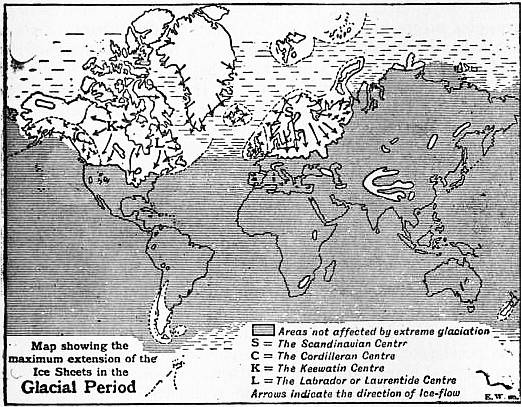
1. Ice Erosion.—Although there are certain points of difference between the work of glaciers and broad ice-sheets, the former being more or less restricted laterally by the valleys in which they flow, the general results of their passage over the rocky floor are essentially similar. Smooth rounded outlines are imparted to the rocks, markedly contrasting with the pinnacled and irregular surfaces produced by ordinary weathering; where these rounded surfaces have been formed on a minor scale the well-known features of roches moutonnées (German Rundhöcker) are created; on a larger scale we have the erosion-form known as “crag and tail,” when the ice-sheet has overridden ground with more pronounced contours, the side of the hill facing the advancing ice being rounded and gently curved (German Stossseite), and the opposite side (Leeseite) steep, abrupt and much less smooth. Such features are never associated with the erosion of water. The rounding of rock surfaces is regularly accompanied by grooving and striation (German Schrammen, Schliffe) caused by the grinding action of stones and boulders embedded in the moving ice. These “glacial striae” are of great value in determining the latest path of the vanished ice-sheets (see map). Several other erosion-features are generally associated with ice action; such are the circular-headed valleys, “cirques” or “corries” (German Zirkus) of mountain districts; the pot-holes, giants’ kettles (Strudellöcher, Riesentöpfe), familiarly exemplified in the Gletschergarten near Lucerne; the “rock-basins” (Felsseebecken) of mountainous regions are also believed to be assignable to this cause on account of their frequent association with other glacial phenomena, but it is more than probable that the action of running water (waterfalls, &c.)—influenced no doubt by the disposition of the ice—has had much to do with these forms of erosion. As regards rock-basins, geologists are still divided in opinion: Sir A. C. Ramsay, J. Geikie, Tyndall, Helland, H. Hess, A. Penck, and others have expressed themselves in favour of a glacial origin; while A. Heim, F. Stapff, T. Kjerulf, L. Rütimeyer and many others have strongly opposed this view.
2. Glacial deposits may be roughly classified in two groups: those that have been formed directly by the action of the ice, and those formed through the agency of water flowing under, upon, and from the ice-sheets, or in streams and lakes modified by the presence of the ice. To differentiate in practice between the results of these two agencies is a matter of some difficulty in the case of unstratified deposits; but the boulder clay may be taken as the typical formation of the glacier or ice-sheet, whether it has been left as a terminal moraine at the limit of glaciation or as a ground moraine beneath the ice. A stratified form of boulder clay, which not infrequently rests upon, and is therefore younger than, the more typical variety, is usually regarded as a deposit formed by water from the material (englacial, innenmorän) held in suspension within the ice, and set free during the process of melting. Besides the innumerable boulders, large and small, embedded in the boulder clay, isolated masses of rock, often of enormous size, have been borne by ice-sheets far from their original home and stranded when the ice melted. These “erratic blocks,” “perched blocks” (German Findlinge) are familiar objects in the Alpine glacier districts, where they have frequently received individual names, but they are just as easily recognized in regions from which the glaciers that brought them there have long since been banished. Not only did the ice transport blocks of hard rock, granite and the like, but huge masses of stratified rock were torn from their bed by the same agency; the masses of chalk in the cliffs near Cromer are well known; near Berlin, at Firkenwald, there is a transported mass of chalk estimated to be at least 2,000,000 cubic metres in bulk, which has travelled probably 15 kilometres from its original site; a block of Lincolnshire oolite is recorded by C. Fox-Strangways near Melton in Leicestershire, which is 300 yds. long and 100 yds. broad if no more; and instances of a similar kind might be multiplied.
When we turn to the “fluvio-glacial” deposits we find a bewildering variety of stratified and partially bedded deposits of gravel, sand and clay, occurring separately or in every conceivable condition of association. Some of these deposits have received distinctive names; such are the “Kames” of Scotland, which are represented in Ireland by “Eskers,” and in Scandinavia by “Åsar.” Another type of hillocky deposit is exemplified by the “drums” or “drumlins.” Everywhere beyond the margin of the advancing or retreating ice-sheets these deposits were being formed; streams bore away coarse and fine materials and spread them out upon alluvial plains or upon the floors of innumerable lakes, many of which were directly caused by the damming of the ordinary water-courses by the ice. As the level of such lakes was changed new beach-lines were produced, such as are still evident in the great lake region of North America, in the parallel roads of Glen Roy, and the “Strandlinien” of many parts of northern Europe.
Viewed in relation to man’s position on the earth, no geological changes have had a more profound importance than those of the Glacial period. The whole of the glaciated region bears evidence of remarkable modification of topographic features; in parts of Scotland or Norway or Canada the old rocks are bared of soil, rounded and smoothed as far as the eye can see. The old soil and subsoil, the product of ages of ordinary weathering, were removed from vast areas to be deposited and concentrated in others. Old valleys were filled—often to a great depth, 300-400 ft.; rivers were diverted from their old courses, never to return; lakes of vast size were caused by the damming of old outlets (Lake Lahontan, Lake Agassiz, &c., in North America), while an infinite number of shifting lakelets—with their deposits—played an important part along the ice-front at all stages of its career. The influence of this period upon the present distribution of plant and animal life in northern latitudes can hardly be overestimated.
Much stress has been laid upon supposed great changes in the level of the land in northern regions during the Glacial period. The occurrence of marine shells at an elevation of 1350 ft. at Moel Tryfaen in north Wales, and at 1200 ft. near Macclesfield in Cheshire, has been cited as evidence of profound submergence by some geologists, though others see in these and similar occurrences only the transporting action of ice-sheets that have traversed the floor of the adjoining seas. Marine shells in stratified materials have been found on the coast of Scotland at 100 ft. and over, in S. Scandinavia at 600 to 800 ft., and in the “Champlain” deposits of North America at various heights. The dead shells of the “Yoldia clay” cover wide areas at the bottom of the North Atlantic at depths from 500 to 1300 fathoms, though the same mollusc is now found living in Arctic seas at the depth of 5 to 15 fathoms. This has been looked upon as a proof that in the N.W. European region the lithosphere stood about 2600 ft. higher than it does now (Brögger, Nansen, &c.), and it has been suggested that a union of the mainland of Europe with that of North America—forming a northern continental mass, “Prosarctis”—may have been achieved by way of Iceland, Jan Mayen Land and Greenland. The pre-glacial valleys and fjords of Norway and Scotland, with their deeply submerged seaward ends, are regarded as proofs of former elevation. The great depth of alluvium in some places (236 metres at Bremen) points in the same direction. Evidences of changes of level occur in early, middle and late Pleistocene formations, and the nature of the evidence is such that it is on the whole safer to assume the existence only of the more moderate degree of change.
The Cause of the Glacial Period.—Many attempts have been made to formulate a satisfactory hypothesis that shall conform with the known facts and explain the great change in climatic conditions which set in towards the close of the Tertiary era, and culminated during the Glacial period. Some of the more prominent hypotheses may be mentioned, but space will not permit of a detailed analysis of theories, most of which rest upon somewhat unsubstantial ground. The principal facts to be taken into consideration are (1) the great lowering of temperature over the whole earth; (2) the localization of extreme glaciation in north-west Europe and north-east America; and (3) the local retrogression of the ice-sheets, once or more times repeated.
Some have suggested the simple solution of a change in the earth’s axis, and have indicated that the pole may have travelled through some 15° to 20° of latitude; thus, the polar glaciation, as it now exists, might have been in this way transferred to include north-west Europe and North America; but modern views on the rigidity of the earth’s body, together with the lack of any evidence of the correlative movement of climatic zones in other parts of the world, render this hypothesis quite untenable. On similar grounds a change in the earth’s centre of gravity is unthinkable. Theories based upon the variations in the obliquity of the ecliptic or eccentricity of the earth’s orbit, or on the passage of the solar system through cold regions of space, or upon the known variations in the heat emitted by the sun, are all insecure and unsatisfactory. The hypothesis elaborated by James Croll (Phil. Mag., 1864, 28, p. 121; Climate and Time, 1875; and Discussion on Climate and Cosmology, 1889) was founded upon the assumption that with the earth’s eccentricity at its maximum and winter in the north at aphelion, there would be a tendency in northern latitudes for the accumulation of snow and ice, which would be accentuated indirectly by the formation of fogs and a modification of the trade winds. The shifting of the thermal equator, and with it the direction of the trade winds, would divert some of the warm ocean currents from the cold regions, and this effect was greatly enhanced, he considered, by the configuration of the Atlantic Ocean. Croll’s hypothesis was supported by Sir R. Ball (The Cause of the Great Ice Age, 1893), and it met with very general acceptance; but it has been destructively criticized by Professor S. Newcomb (Phil. Mag., 1876, 1883, 1884) and by E. P. Culverwell (Phil. Mag., 1894, p. 541, and Geol. Mag., 1895, pp. 3 and 55). The difficulties in the way of Croll’s theory are: (1) the fundamental assumption, that midwinter and midsummer temperatures are directly proportional to the sun’s heat at those periods, is not in accordance with observed facts; (2) the glacial periods would be limited in duration to an appropriate fraction of the precessional period (21,000 years), which appears to be too short a time for the work that was actually done by ice agency; and (3) Croll’s glacial periods would alternate between the northern and southern hemispheres, affecting first one then the other. Sir C. Lyell and others have advocated the view that great elevation of the land in polar regions would be conducive to glacial conditions; this is doubtless true, but the evidence that the Glacial period was primarily due to this cause is not well established. Other writers have endeavoured to support the elevation theory by combining with it various astronomical and meteorological agencies. More recently several hypotheses have been advanced to explain the glacial period as the result of changes in the atmosphere; F. W. Harmer (“The Influence of Winds upon the Climate during the Pleistocene Epoch,” Q.J.G.S., 1901, 57, p. 405) has shown the importance of the influence of winds in certain circumstances; Marsden Manson (“The Evolution of Climate,” American Geologist, 1899, 24, p. 93) has laid stress upon the influence of clouds; but neither of these theories grapples successfully with the fundamental difficulties. Others again have requisitioned the variability in the amount of the carbon dioxide in the atmosphere—hypotheses which depend upon the efficiency of this gas as a thermal absorbent. The supply of carbon dioxide may be increased from time to time, as by the emanations from volcanoes (S. Arrhenius and A. G. Hogböm), or it may be decreased by absorption into sea-water, and by the carbonation of rocks. Professor T. C. Chamberlin based a theory of glaciation on the depletion of the carbon dioxide of the air (“An Attempt to frame a Working Hypothesis of the cause of Glacial Periods on an Atmospheric Basis,” Jl. Geol., 1899, vii. 752-771; see also Chamberlin and Salisbury, Geology, 1906, ii. 674 and iii. 432). The outline of this hypothesis is as follows: The general conditions for glaciation were (1) that the oceanic circulation was interrupted by the existence of land; (2) that vertical circulation of the atmosphere was accelerated by continental and other influences; (3) that the thermal blanketing of the earth was reduced by a depletion of the moisture and carbon dioxide in the atmosphere, and that hence the average temperature of the surface of the earth and of the body of the ocean was reduced, and diversity in the distribution of heat and moisture introduced. The localization of glaciation is assignable to the two great areas of permanent atmospheric depression that have their present centres near Greenland and the Aleutian Islands respectively. The periodicity of glacial advances and retreats, demanded by those who believe in the validity of so-called “interglacial” epochs, is explained by a series of complicated processes involving the alternate depletion and completion of the normal charge of carbon dioxide in the air.
Whatever may be the ultimate verdict upon this difficult subject, it is tolerably clear that no simple cause of glacial conditions is likely to be discovered, but rather it will appear that these conditions resulted from the interaction of a complicated series of factors; and further, until a greater degree of unanimity can be approached in the interpretation of observed facts, particularly as regards the substantiality of interglacial epochs, the very foundations of a sound working hypothesis are wanting.
Classification of Glacial Deposits—Interglacial Epochs.—Had the deposits of glaciated regions consisted solely of boulder clay little difficulty might have been experienced in dealing with their classification. But there are intercalated in the boulder clays those irregular stratified and partially stratified masses of sand, gravel and loam, frequently containing marine or freshwater shells and layers of peat with plant remains, which have given rise to the conception of “interglacial epochs”—pauses in the rigorous conditions of glaciation, when the ice-sheets dwindled almost entirely away, while plants and animals re-established themselves on the newly exposed soil. Glacialists may be ranged in two schools: those who believe that one or more phases of milder climatic conditions broke up the whole Glacial period into alternating epochs of glaciation and “deglaciation”; and those who believe that the intercalated deposits represent rather the localized recessional movements of the ice-sheets within one single period of glaciation. In addition to the stratified deposits and their contents, important evidence in favour of interglacial epochs occurs in the presence of weathered surfaces on the top of older boulder clays, which are themselves covered by younger glacial deposits.
The cause of the interglacial hypothesis has been most ardently championed in England by Professor James Geikie; who has endeavoured to show that there were in Europe six distinct glacial epochs within the Glacial period, separated by five epochs of more moderate temperature. These are enumerated below:
6th Glacial epoch, Upper Turbarian, indicated by the deposits of peat which underlie the lower raised beaches.
5th Interglacial epoch, Upper Forestian.
5th Glacial epoch, Lower Turbarian, indicated by peat deposits overlying the lower forest-bed, by the raised beaches and carse-clays of Scotland, and in part by the Littorina-clays of Scandinavia.
4th Interglacial epoch, Lower Forestian, the lower forests under peat beds, the Ancylus-beds of the great freshwater Baltic lake and the Littorina-clays of Scandinavia.
4th Glacial epoch, Mecklenburgian, represented by the moraines of the last great Baltic glacier, which reach their southern limit in Mecklenburg; the 100-ft. terrace of Scotland and the Yoldia-beds of Scandinavia.
3rd Interglacial epoch, Neudeckian, intercalations of marine and freshwater deposits in the boulder clays of the southern Baltic coasts.
3rd Glacial epoch, Polandian, glacial and fluvio-glacial formations of the minor Scandinavian ice-sheet; and the “upper boulder clay” of northern and western Europe.
2nd Interglacial epoch, Helvetian, interglacial beds of Britain and lignites of Switzerland.
2nd Glacial epoch, Saxonian, deposits of the period of maximum glaciation when the northern ice-sheet reached the low ground of Saxony, and the Alpine glaciers formed the outermost moraines.
1st Interglacial epoch, Norfolkian, the forest-bed series of Norfolk.
1st Glacial epoch, Scanian, represented only in the south of Sweden, which was overridden by a large Baltic glacier. The Chillesford clay and Weybourne crag of Norfolk and the oldest moraines and fluvio-glacial gravels of the Arctic lands may belong to this epoch.
In a similar manner Professor Chamberlin and other American geologists have recognized the following stages in the glaciation of North America:
The Champlain, marine substage. The Glacio-lacustrine substage. The later Wisconsin (6th glacial). The fifth interglacial. The earlier Wisconsin (5th glacial). The Peorian (4th interglacial). The Iowan (4th glacial). The Sangamon (3rd interglacial). The Illinoian (3rd glacial). The Yarmouth or Buchanan (2nd interglacial). The Kansan (2nd glacial). The Aftonian (1st interglacial). The sub-Aftonian or Jerseyan (1st glacial).
Although it is admitted that no strict correlation of the European and North American stages is possible, it has been suggested that the Aftonian may be the equivalent of the Helvetian; the Kansan may represent the Saxonian; the Iowan, the Polandian; the Jerseyan, the Scanian; the early Wisconsin, the Mecklenburgian. But considering how fragmentary is much of the evidence in favour of these stages both in Europe and America, the value of such attempts at correlation must be infinitesimal. This is the more evident when it is observed that there are other geologists of equal eminence who are unable to accept so large a number of epochs after a close study of the local circumstances; thus, in the subjoined scheme for north Germany, after H. W. Munthe, there are three glacial and two interglacial epochs.
Post-Glacial epoch The Mya time = beech-time. The Littorina time = oak-time. The Ancylus time = pine- and birch-time.
3rd Glacial epoch Including the upper boulder clay, “younger Baltic moraine” with the Yoldia or Dryas phase in the retrogressive stage.
2nd Interglacial epoch including the Cyprina-clay.
2nd Glacial epoch, the maximum glaciation.
1st Interglacial epoch.
1st Glacial epoch, “older boulder clay.”
Again, in the Alps four interglacial epochs have been recognized; while in England there are many who are willing to concede one such epoch, though even for this the evidence is not enough to satisfy all glacialists (G. W. Lamplugh, Address, Section C, Brit. Assoc., York, 1906).
This great diversity of opinion is eloquent of the difficulties of the subject; it is impossible not to see that the discovery of interglacial epochs bears a close relationship to the origin of certain hypotheses of the cause of glaciation; while it is significant that those who have had to do the actual mapping of glacial deposits have usually greater difficulty in finding good evidence of such definite ameliorations of climate, than those who have founded their views upon the examination of numerous but isolated areas.
Extent of Glacial Deposits.—From evidence of the kind cited above, it appears that during the glacial period a series of great ice-sheets covered enormous areas in North America and north-west Europe. The area covered during the maximum extension of the ice has been reckoned at 20 million square kilometres (nearly 8 million sq. m.) in North America and 6½ million square kilometres (about 2½ million sq. m.) in Europe.
In Europe three great centres existed from which the ice-streams radiated; foremost in importance was the region of Fennoscandia (the name for Scandinavia with Finland as a single geological region); from this centre the ice spread out far into Germany and Russia and westward, across the North Sea, to the shores of Britain. The southern boundary of the ice extended from the estuary of the Rhine in an irregular series of lobes along the Schiefergebirge, Harz, Thüringerwald, Erzgebirge and Riesengebirge, and the northern flanks of the Carpathians towards Cracow. Down the valley of the Dnieper a lobe of the ice-sheet projected as far as 40° 50′ N.; another lobe extended down the Don valley as far as 48° N.; thence the boundary runs north-easterly towards the Urals and the Kara Sea. The British Islands constituted the centre second in importance; Scotland, Ireland and all but the southern part of England were covered by a moving ice-cap. On the west the ice-sheets reached out to sea; on the east they were conterminous with those from Scandinavia. The third European centre was the Alpine region; it is abundantly clear from the masses of morainic detritus and perched blocks that here, in the time of maximum glaciation, the ice-covered area was enormously in excess of the shrivelled remnants, which still remain in the existing glaciers. All the valleys were filled with moving ice; thus the Rhone glacier at its maximum filled Lake Geneva and the plain between the Bernese Oberland and the Jura; it even overrode the latter and advanced towards Besançon. Extensive glaciation was not limited to the aforesaid regions, for all the areas of high ground had their independent glaciers strongly developed; the Pyrenees, the central highlands of France, the Vosges, Black Forest, Apennines and Caucasus were centres of minor but still important glaciation.
The greatest expansion of ice-sheets was located on the North American continent; here, too, there were three principal centres of outflow: the “Cordilleran” ice-sheet in the N.W., the “Keewatin” sheet, radiating from the central Canadian plains, and the eastern “Labrador” or “Laurentide” sheet. From each of these centres the ice poured outwards in every direction, but the principal flow in each case was towards the south-west. The southern boundary of the glaciated area runs as an irregular line along the 49° parallel in the western part of the continent, thence it follows the Mississippi valley down to its junction with the Ohio (southern limit 37° 30′ N.), eastward it follows the direction of that river and turns north-eastward in the direction of New Jersey. As in Europe, the mountainous regions of North America produced their own local glaciers; in the Rockies, the Olympics and Sierras, the Bighorn Mountains of Wyoming, the Uinta Mountains of Utah, &c. Although it was in the northern hemisphere that the most extensive glaciation took place, the effects of a general lowering of temperature seem to have been felt in the mountainous regions of all parts; thus in South America, New Zealand, Australia and Tasmania glaciers reached down the valleys far below the existing limits, and even where none are now to be found. In Asia the evidences of a former extension of glaciation are traceable in the Himalayas, and northward in the high ranges of China and Eastern Siberia. The same is true of parts of Turkestan and Lebanon. In Africa also, in British East Africa moraines are discovered 5400 ft. below their modern limit. In Iceland and Greenland, and even in the Antarctic, there appears to be evidence of a former greater extension of the ice. It is of interest to note that Alaska seems to be free from excessive glaciation, and that a remarkable “driftless” area lies in Wisconsin. The maximum glaciation of the Glacial period was clearly centred around the North Atlantic.
Glacial Epochs in the Older Geological Periods.—Since Ramsay drew attention to the subject in 1855 (“On the occurrence of angular, subangular, polished and striated fragments and boulders in the Permian Breccia of Shropshire, Worcestershire, &c., and on the probable existence of glaciers and icebergs in the Permian epoch,” Q.J.G.S., 1855, pp. 185-205), a good deal of attention has been paid to such formations. It is now generally acknowledged that the Permo-carboniferous conglomerates with striated boulders and polished rock surfaces, such as are found in the Karoo formation of South Africa, the Talkir conglomerate of the Salt Range in India, and the corresponding formations in Australia, represent undeniable glacial conditions at that period on the great Indo-Australian continent. A glacial origin has been suggested for numerous other conglomeratic formations, such as the Pre-Cambrian Torridonian of Scotland, and “Geisaschichten” of Norway; the basal Carboniferous conglomerate of parts of England; the Permian breccias of England and parts of Europe; the Trias of Devonshire; the coarse conglomerates in the Tertiary Flysch in central Europe; and the Miocene conglomerates of the Ligurian Apennines. In regard to the glacial nature of all these formations there is, however, great divergence of opinion (see A. Heim, “Zur Frage der exotischen Blöcke in Flysch,” Eclogae geologicae Helvetiae, vol. ix. No. 3, 1907, pp. 413-424).
Authorities.—The literature dealing directly with the Glacial period has reached enormous dimensions; in addition to the works already mentioned the following may be taken as a guide to the general outline of the subject: J. Geikie, The Great Ice Age (3rd ed., London, 1904), also Earth Sculpture (1898); G. F. Wright, The Ice Age in North America (4th ed., New York, 1905) and Man and the Glacial Period (1892); F. E. Geinitz, Die Eiszeit (Braunschweig, 1906); A. Penck and E. Brückner, Die Alpen im Eiszeitalter (Leipzig, 1901-1906, uncompleted). Many references to the literature will be found in Sir A. Geikie’s Textbook of Geology, vol. ii. (4th ed., 1903); Chamberlin and Salisbury, Geology, vol. iii. (1906). As an example of glacial theories carried beyond the usual limits, see M. Gugenhan, Die Ergletscherung der Erde von Pol zu Pol (Berlin, 1906). See also Zeitschrift für Gletscherkunde (Berlin, 1906 and onwards quarterly); Sir H. H. Howorth (opposing accepted glacial theories), The Glacial Nightmare and the Flood, i., ii. (London, 1893), Ice and Water, i., ii. (London, 1905), The Mammoth and the Flood (London, 1887).
(J. A. H.)
GLACIER (adopted from the French; from glace, ice, Lat. glacies), a mass of compacted ice originating in a snow-field. Glaciers are formed on any portion of the earth’s surface that is permanently above the snow-line. This line varies locally in the same latitudes, being in some places higher than in others, but in the main it may be described as an elliptical shell surrounding the earth with its longest diameter in the tropics and its shortest in the polar regions, where it touches sea-level. From the extreme regions of the Arctic and Antarctic circles this cold shell swells upwards into a broad dome, from 15,000 to 18,000 ft. high over the tropics, truncating, as it rises, a number of peaks and mountain ranges whose upper portions like all regions above this thermal shell receive all their moisture in the form of snow. Since the temperature above the snow-line is below freezing point evaporation is very slight, and as the snow is solid it tends to accumulate in snow-fields, where the snow of one year is covered by that of the next, and these are wrapped over many deeper layers that have fallen in previous years. If these piles of snow were rigid and immovable they would increase in height until the whole field rose above the zone of ordinary atmospheric precipitation, and the polar ice-caps would add a load to these regions that would produce far-reaching results. The mountain regions also would rise some miles in height, and all their features would be buried in domes of snow some miles in thickness. When, however, there is sufficient weight the mass yields to pressure and flows outwards and downwards. Thus a balance of weight and height is established, and the ice-field is disintegrated principally at the edges, the surplus in polar regions being carried off in the form of icebergs, and in mountain regions by streams that flow from the melting ends of the glaciers.
Formation.—The formation of glaciers is in all cases due to similar causes, namely, to periodical and intermittent falls of snow. After a snow-fall there is a period of rest during which the snow becomes compacted by pressure and assumes the well-known granular character seen in banks and patches of ordinary snow that lie longest upon the ground when the snow is melting. This is the firn or névé. The next fall of snow covers and conceals the névé, but the light fresh crystals of this new snow in turn become compacted to the coarsely crystalline granular form of the underlying layer and become névé in turn. The process goes on continually; the lower layers become subject to greater and greater pressure, and in consequence become gradually compacted into dense clear ice, which, however, retains its granular crystalline texture throughout. The upper layers of névé are usually stratified, owing to some individual peculiarity in the fall, or to the accumulation of dust or débris upon the surface before it is covered by fresh snow. This stratification is often visible on the emerging glacier, though it is to be distinguished from the foliation planes caused by shearing movement in the body of the glacier ice.
Types.—The snow-field upon which a glacier depends is always formed when snow-fall is greater than snow-waste. This occurs under varying conditions with a differently resulting type of glacier. There are limited fields of snow in many mountain regions giving rise to long tongues of ice moving slowly down the valleys and therefore called “valley glaciers.” The greater part of Greenland is covered by an ice-cap extending over nearly 400,000 sq. m., forming a kind of enormous continuous glacier on its lower slopes. The Antarctic ice region is believed to extend over more than 3,000,000 sq. m. Each of these continental fields, besides producing block as distinguished from tongue glaciers, sends into the sea a great number of icebergs during the summer season. These ice-caps covering great regions are by far the most important types. Between these “polar” or “continental glaciers” and the “alpine” type there are many grades. Smaller detached ice-caps may rest upon high plateaus as in Iceland, or several tongues of ice coming down neighbouring valleys may splay out into convergent lobes on lower ground and form a “piedmont glacier” such as the Malaspina Glacier in Alaska. When the snow-field lies in a small depression the glacier may remain suspended in the hollow and advance no farther than the edge of the snow-field. This is called a “cliff-glacier,” and is not uncommon in mountain regions. The end of a larger glacier, or the edge of an ice-sheet, may reach a precipitous cliff, where the ice will break from the edge of the advancing mass and fall in blocks to the lower ground, where a “reconstructed glacier” will be formed from the fragments and advance farther down the slope.
When a glacier originates upon a dome-shaped or a level surface the ice will deploy radially in all directions. When a snow-field is formed above steep valleys separated by high ridges the ice will flow downwards in long streams. If the valleys under the snow-fields are wide and shallow the resultant glaciers will broaden out and partially fill them, and in all cases, since the conditions of glacier formation are similar, the resultant form and the direction of motion will depend upon the amount of ice and the form of the surface over which the glacier flows. A glacier flowing down a narrow gorge to an open valley, or on to a plain, will spread at its foot into a fan-shaped lobe as the ice spreads outwards while moving downwards. An ice-cap is in the main thickest at the centre, and thins out at the edges. A valley glacier is thickest at some point between its source and its end, but nearer to its source than to its termination, but its thickness at various portions will depend upon the contour of the valley floor over which the glacier rides, and may reach many hundreds of feet. At its centre the Greenland ice-cap is estimated to be over 5000 ft. thick. In all cases the glacier ends where the waste of ice is greater than the supply, and since the relationship varies in different years, or cycles of years, the end of a glacier may advance or retreat in harmony with greater or less snow-fall or with cooler or hotter summers. There seems to be a cycle of inclusive contraction and expansion of from 35 to 40 or 50 years. At present the ends of the Swiss glaciers are cradled in a mass of moraine-stuff due to former extension of the glaciers, and investigations in India show that in some parts of the Himalayas the glaciers are retreating as they are in North America and even in the southern hemisphere (Nature, January 2, 1908, p. 201).
Movement.—The fact that a glacier moves is easily demonstrated; the cause of the movement is pressure upon a yielding mass; the nature of the movement is still under discussion. Rows of stakes or stones placed in line across a glacier are found to change their position with respect to objects on the bank and also with regard to each other. The posts in the centre of the ice-stream gradually move away from those at the side, proving that the centre moves faster than the sides. It has also been proved that the surface portions move more rapidly than the deeper layers and that the motion is slowest at the sides and bottom where friction is greatest.
The rate of motion past the same spot is not uniform. Heat accelerates it, cold arrests it, and the pressure of a large amount of water stimulates the flow. The rate of flow under the same conditions varies at different parts of the glacier directly as the thickness of ice, the steepness of slope and the smoothness of rocky floor. Generally speaking, the rate of motion depends upon the amount of ice that forms the “head” pressure, the slope of the under surface and of the upper surface, the nature of the floor, the temperature and the amount of water present in the ice. The ordinary rate of motion is very slow. In Switzerland it is from 1 or 2 in. to 4 ft. per day, in Alaska 7 ft., in Greenland 50 to 60 ft., and occasionally 100 ft. per day in the height of summer under exceptional conditions of quantity of ice and of water and slope. Measurements of Swiss glaciers show that near the ice foot where wastage is great there is very little movement, and observations upon the inland border of Greenland ice show that it is almost stationary over long distances. In many aspects the motion of a body of ice resembles that of a body of water, and an alpine glacier is often called an ice-river, since like a river it moves faster in the centre than at the sides and at the top faster than at the bottom. A glacier follows a curve in the same way as a river, and there appear to be ice swirls and eddies as well as an upward creep on shelving curves recalling many features of stream action. The rate of motion of both ice-stream and river is accelerated by quantity and steepness of slope and retarded by roughness of bed, but here the comparison ends, for temperature does not affect the rate of water motion, nor will a liquid crack into crevasses as a glacier does, or move upwards over an adverse slope as a glacier always does when there is sufficient “head” of ice above it. So that although in many respects ice behaves as a viscous fluid the comparison with such a fluid is not perfect. The cause of glacier motion must be based upon some more or less complex considerations. The flakes of snow are gradually transformed into granules because the points and angles of the original flakes melt and evaporate more readily than the more solid central portions, which become aggregated round some master flake that continues to grow in the névé at the expense of its smaller neighbours, and increases in size until finally the glacier ice is composed of a mass of interlocked crystalline granules, some as large as a walnut, closely compacted under pressure with the principal crystalline axes in various directions. In the upper portions of the glacier movement due to pressure probably takes place by the gliding of one granule over another. In this connexion it must be noted that pressure lowers the melting point of ice while tension raises it, and at all points of pressure there is therefore a tendency to momentary melting, and also to some evaporation due to the heat caused by pressure, and at the intermediate tension spaces between the points of pressure this resultant liquid and vapour will be at once re-frozen and become solid. The granular movement is thus greatly facilitated, while the body of ice remains in a crystalline solid condition. In this connexion it is well to remember that the pressure of the glacier upon its floor will have the same result, but the effect here is a mass-effect and facilitates the gliding of the ice over obstacles, since the friction produces heat and the pressure lowers the melting point, so that the two causes tend to liquefy the portion where pressure is greatest and so to “lubricate” the prominences and enable the glacier to slide more easily over them, while the liquid thus produced is re-frozen when the pressure is removed.
In polar regions of very low temperature a very considerable amount of pressure must be necessary before the ice granules yield to momentary liquefaction at the points of pressure, and this probably accounts for the extreme thickness of the Arctic and Antarctic ice-caps where the slopes are moderate, for although equally low temperatures are found in high Alpine snow-fields the slopes there are exceedingly steep and motion is therefore more easily produced.
Observations made upon the Greenland glaciers indicate a considerable amount of “shearing” movement in the lower portions of a glacier. Where obstacles in the bed of the glacier arrest the movement of the ice immediately above it, or where the lower portion of the glacier is choked by débris, the upper ice glides over the lower in shearing planes that are sometimes strongly marked by débris caught and pushed forwards along these planes of foliation. It must be remembered that there is a solid push from behind upon the lower portion of a glacier, quite different from the pressure of a body of water upon any point, for the pressure of a fluid is equal in all directions, and also that this push will tend to set the crystalline granules in positions in which their crystalline axes are parallel along the gliding planes. The production of gliding planes is in some cases facilitated by the descent into the glacier of water melted during summer, where it expands in freezing and pushes the adjacent ice away from it, forming a surface along which movement is readily established.
If under all circumstances the glacier melted under pressure at the bottom, glacial abrasion would be nearly impossible, since every small stone and fragment of rock would rotate in a liquid shell as the ice moved forward, but since the pressure is not always sufficient to produce melting, the glacier sometimes remains dry at its base; rock fragments are held firmly; and a dry glacier may thus become a graving tool of enormous power. Whatever views may be adopted as to the causes of glacier motion, the peculiar character of glacier ice as distinct from homogeneous river or pond ice must be kept in view, as well as the characteristic tendency of water to expand in freezing, the lowering of the melting point of ice under pressure, the raising of the melting point under tension, the production of gliding or shearing planes under pressure from above, the presence in summer of a considerable quantity of water in the lower portions of the glacier which are thus loosened, the cracking of ice (as into crevasses), under sudden strain, and the regelation of ice in contact. A result of this last process is that fissures are not permanent, but having been produced by the passage of ice over an obstruction, they subsequently become healed when the ice proceeds over a flatter bed. Finally it must be remembered that although glacier ice behaves in some sense like a viscous fluid its condition is totally different, since “a glacier is a crystalline rock of the purest and simplest type, and it never has other than the crystalline state.”
Characteristics.—The general appearance of a glacier varies according to its environment of position and temperature. The upper portion is hidden by névé and often by freshly fallen snow, and is smooth and unbroken. During the summer, when little snow falls, the body of the glacier moves away from the snow-field and a gaping crevasse of great depth is usually established called the bergschrund, which is sometimes taken as the upper limit of the glacier. The glacier as it moves down the valley may become “loaded” in various ways. Rock-falls send periodical showers of stones upon it from the heights, and these are spread out into long lines at the glacier sides as the ice moves downwards carrying the rock fragments with it. These are the “lateral moraines.” When two or more glaciers descending adjacent valleys converge into one glacier one or more sides of the higher valleys disappear, and the ice that was contained in several valleys is now carried by one. In the simplest case where two valleys converge into one the two inner lateral moraines meet and continue to stream down the larger valley as one “median moraine.” Where several valleys meet there are several such parallel median moraines, and so long as the ice remains unbroken these will be carried upon the surface of the glacier and finally tipped over the end. There is, however, differential heating of rock and ice, and if the stones carried are thin they tend to sink into the ice because they absorb heat readily and melt the ice under them. Dust has the same effect and produces “dust wells” that honeycomb the upper surface of the ice with holes into which the dust sinks. If the moraine rocks are thick they prevent the ice under them from melting in sunlight, and isolated blocks often remain supported upon ice-pillars in the form of ice tables, which finally collapse, so that such rocks may be scattered out of the line of the moraine. As the glacier descends into the lower valleys it is more strongly heated, and surface streams are established in consequence that flow into channels caused by unequal melting of the ice and finally plunge into crevasses. These crevasses are formed by strains established as the central parts drag away from the sides of the glacier and the upper surface from the lower, and more markedly by the tension due to a sudden bend in the glacier caused by an inequality in its bed which must be over-ridden. These crevasses are developed at right angles to the strain and often produce intersecting fissures in several directions. The morainic material is gradually dispersed by the inequalities produced, and is further distributed by the action of superficial streams until the whole surface is strewn with stones and débris, and presents, as in the lower portions of the Mer de Glace, an exceedingly dirty appearance. Many blocks of stone fall into the gaping crevasses and much loose rock is carried down as “englacial material” in the body of the glacier. Some of it reaches the bottom and becomes part of the “ground moraine” which underlies the glacier, at least from the bergschrund to the “snout,” where much of it is carried away by the issuing stream and spread finally on to the plains below. It appears that a very considerable amount of degradation is caused under the bergschrund by the mass of ice “plucking” and dragging great blocks of rock from the side of the mountain valley where the great head of ice rests in winter and whence it begins to move in summer. These blocks and many smaller fragments are carried downwards wedged in the ice and cause powerful abrasion upon the rocky floor, rasping and scoring the channel, producing conspicuous striae, polishing and rounding the rock surfaces, and grinding the contained fragments as well as the surface over which it passes into small fragments and fine powder, from which “boulder clay” or “till” is finally produced. Emerging, then, from the snow-field as pure granular ice the glacier gradually becomes strewn and filled with foreign material, not only from above but also, as is very evident in some Greenland glaciers, occasionally from below by masses of fragments that move upwards along gliding planes, or are forced upwards by slow swirls in the ice itself.
As a glacier is a very brittle body any abrupt change in gradient will produce a number of crevasses, and these, together with those produced by dragging strains, will frequently wedge the glacier into a mass of pinnacles or séracs that may be partially healed but are usually evident when the melting end of the glacier emerges suddenly from a steep valley. Here the streams widen the weaker portions and the moraine rocks fall from the end to produce the “terminal” moraine, which usually lies in a crescentic heap encircling the glacier snout, whence it can only be moved by a further advance of the glacier or by the ordinary slow process of atmospheric denudation.
In cases where no rock falls upon the surface there is a considerable amount of englacial material due to upturning either over accumulated ground débris or over structural inequalities in the rock floor. This is well seen at the steep sides and ends of Greenland glaciers, where material frequently comes to the surface of the melting ice and produces median and lateral moraines, besides appearing in enormous “eyes” surrounded in the glacial body by contorted and foliated ice and sometimes producing heaps and embankments as it is pushed out at the end of the melting ice.
The environment of temperature requires consideration. At the upper or dorsal portion of the glacier there is a zone of variable (winter and summer) temperature, beneath which, if the ice is thick enough, there is a zone of constant temperature which will be about the mean annual temperature of the region of the snow-field. Underlying this there is a more or less constant ventral or ground temperature, depending mainly upon the internal heat of the earth, which is conducted to the under surface of the glacier where it slowly melts the ice, the more readily because the pressure lowers the melting point considerably, so that streams of water run constantly from beneath many glaciers, adding their volume to the springs which issue from the rock. The middle zone of constant temperature is wedge-shaped in “alpine” glaciers, the apex pointing downwards to the zone of waste. The upper zone of variable temperature is thinnest in the snow-field where the mean temperature is lowest, and entirely dominant in the snout end of the glacier where the zone of constant temperature disappears. Two temperature wedges are thus superposed base to point, the one being thickest where the other is thinnest, and both these lie upon the basal film of temperature where the escaping earth-heat is strengthened by that due to friction and pressure. The cold wave of winter may pass right through a thin glacier, or the constant temperature may be too low to permit of the ice melting at the base, in which cases the glacier is “dry” and has great eroding power. But in the lower warmer portions water running through crevasses will raise the temperature, and increase the strength of the downward heat wave, while the mean annual temperature being there higher, the combined result will be that the glacier will gradually become “wet” at the base and have little eroding power, and it will become more and more wet as it moves down the lower valley zone of ice-waste, until at last the balance is reached between waste and supply and the glacier finally disappears.