VOLUME XII SLICE I Gichtel, Johann to Glory (continued 10)
Reading edition
When the surface of the glass has been ground down to a plane, the surface itself is still “grey,” i.e. deeply pitted with the marks of the abrasive used in grinding it down; these marks are removed by the process of smoothing, in which the surface is successively ground with abrasives of gradually increasing fineness, leaving ultimately a very smooth and very minutely pitted “grey” surface. This smooth surface is then brilliantly polished by the aid of friction with a rubbing tool covered with a soft substance like leather or felt and fed with a polishing material, such as rouge. A few strokes of such a rubber are sufficient to produce a decidedly “polished” appearance, but prolonged rubbing under considerable pressure and the use of a polishing paste of a proper consistency are required in order to remove the last trace of pitting from the surface. This entire process must, obviously, be applied in turn to each of the two surfaces of the slab of glass. Plate-glass is manufactured in this manner in thicknesses varying from 3⁄16 in. to 1 in. or even more, while single sheets are produced measuring more than 27 ft. by 13 ft.
”Rolled Plate” and figured “Rolled Plate.”—Glass for this purpose, with perhaps the exception of the best white and tinted varieties, is now universally produced in tank-furnaces, similar in a general way to those used for sheet-glass, except that the furnaces used for “rolled plate” glass of the roughest kinds do not need such minutely careful attention and do not work at so high a temperature. The composition of these glasses is very similar to that of sheet-glass, but for the ordinary kinds of rolled plate much less scrupulous selection need be made in the choice of raw materials, especially of the sand.
The glass is taken from the furnace in large iron ladles, which are carried upon slings running on overhead rails; from the ladle the glass is thrown upon the cast-iron bed of a rolling-table, and is rolled into sheet by an iron roller, the process being similar to that employed in making plate-glass, but on a smaller scale. The sheet thus rolled is roughly trimmed while hot and soft, so as to remove those portions of glass which have been spoilt by immediate contact with the ladle, and the sheet, still soft, is pushed into the open mouth of an annealing tunnel or “lear,” down which it is carried by a system of moving grids.
The surface of the glass produced in this way may be modified by altering the surface of the rolling-table; if the table has a smooth surface, the glass will also be more or less smooth, but much dented and buckled on the surface and far from having the smooth face of blown sheet. If the table has a pattern engraved upon it the glass will show the same pattern in relief, the most frequent pattern of the kind being either small parallel ridges or larger ribs crossing to form a lozenge pattern.
The more elaborate patterns found on what is known as “figure rolled plate” are produced in a somewhat different manner; the glass used for this purpose is considerably whiter in colour and much softer than ordinary rolled plate, and instead of being rolled out on a table it is produced by rolling between two moving rollers from which the sheet issues. The pattern is impressed upon the soft sheet by a printing roller which is brought down upon the glass as it leaves the main rolls. This glass shows a pattern in high relief and gives a very brilliant effect.
The various varieties of rolled plate-glass are now produced for some purposes with a reinforcement of wire netting which is embedded in the mass of the glass. The wire gives the glass great advantages in the event of fracture from a blow or from fire, but owing to the difference in thermal expansion between wire and glass, there is a strong tendency for such “wired glass” to crack spontaneously.
Patent Plate-glass.—This term is applied to blown sheet-glass, whose surface has been rendered plane and brilliant by a process of grinding and polishing. The name “patent plate” arose from the fact that certain patented devices originated by James Chance of Birmingham first made it possible to polish comparatively thin glass in this way.
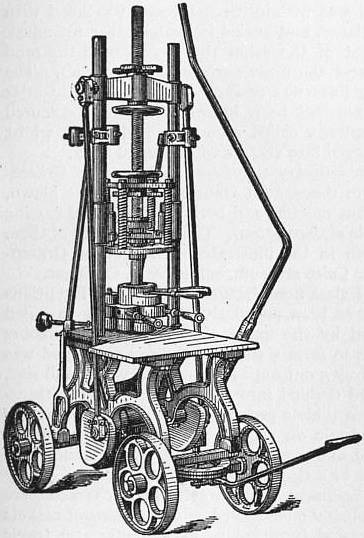
Fig. 20.—Modern American Glass-Press.
(B) Pressed Glass.—The technical difference between pressed and moulded glass is that moulded glass-ware has taken its form from a mould under the pressure of a workman’s breath, or of compressed air, whereas pressed glass-ware has taken its form from a mould under the pressure of a plunger. Moulded glass receives the form of the mould on its interior as well as on its exterior surface. In pressed glass the exterior surface is modelled by the mould, whilst the interior surface is modelled by the plunger (fig. 20).
The process of pressing glass was introduced to meet the demand for cheap table-ware. Pressed glass, which is necessarily thick and serviceable, has well met this legitimate demand, but it also caters for the less legitimate taste for cheap imitations of hand-cut glass. An American writer has expressed his satisfaction that the day-labourer can now have on his table at a nominal price glass dishes of elaborate design, which only an expert can distinguish from hand-cut crystal. The deceptive effect is in some cases heightened by cutting over and polishing by hand the pressed surface.
The glass for pressed ware must be colourless, and, when molten, must be sufficiently fluid to adapt itself readily to the intricacies of the moulds, which are often exceedingly complex. The materials employed are sand, sulphate of soda, nitrate of soda, calcspar and in some works carbonate of barium. The following is an analysis of a specimen of English pressed glass; SiO2, 70.68%; Na2O, 18.38%; CaO, 5.45%; BaO, 4.17%; Al2O3, 0.33%; and Fe2O3, 0.20%. Tanks and pots are both used for melting the glass. The moulds are made of cast iron. They are usually in two main pieces, a base and an upper part or collar of hinged sections. The plunger is generally worked by a hand lever. The operator knows by touch when the plunger has pressed the glass far enough to exactly fill the mould. Although the moulds are heated, the surface of the glass is always slightly ruffled by contact with the mould. For this reason every piece of pressed glass-ware, as soon as it is liberated from the mould, is exposed to a sharp heat in a small subsidiary furnace in order that the ruffled surface may be removed by melting. These small furnaces are usually heated by an oil spray under the pressure of steam or compressed air.
See Antonio Neri, Ars vitraria, cum Merritti observationibus (Amsterdam, 1668) (Neri’s work was translated into English by C. Merritt in 1662, and the translation, The Art of making Glass, was privately reprinted by Sir T. Phillipps, Bart., in 1826); Johann Kunkel, Vollständige Glasmacher-Kunst (Nuremberg, 1785); Apsley Pellatt, Curiosities of Glass-making (London, 1849); A. Sauzay, Marvels of Glass-making (from the French) (London, 1869); G. Bontemps, Guide du verrier (Paris, 1868); E. Peligot, Le Verre, son histoire, sa fabrication (Paris, 1878); W. Stein, “Die Glasfabrikation,” in Bolley’s Technologie, vol. iii. (Brunswick, 1862); H. E. Benrath, Die Glasfabrikation (Brunswick, 1875); J. Falck and L. Lobmeyr, Die Glasindustrie (Vienna, 1875); D. H. Hovestadt, Jenaer Glas (Jena, 1900; Eng. trans. by J. D. and A. Everett, Macmillan, 1907); J. Henrivaux, Le Verre et le cristal (Paris, 1887), and La Verrerie au XXe siècle (1903); Chance, Harris and Powell, Principles of Glass-making (London, 1883); Moritz V. Rohr, Theorie und Geschichte der photographischen Objektive (Berlin, 1899); C. E. Guillaume, Traité pratique de la thermométrie de précision (Paris, 1889); Louis Coffignal, Verres et émaux (Paris, 1900); R. Gerner, Die Glasfabrikation (Vienna, 1897); C. Wetzel, Herstellung grosser Glaskörper (Vienna, 1900); C. Wetzel, Bearbeitung von Glaskörpern (Vienna, 1901); E. Tscheuschner, Handbuch der Glasfabrikation (Weimar, 1885); R. Dralle, Anlage und Betrieb der Glasfabriken (Leipzig, 1886); G. Tammann, Kristallisieren und Schmelzen (Leipzig, 1903); W. Rosenhain, “Some Properties of Glass,” Trans. Optical Society (London, 1903), “Possible Directions of Progress in Optical Glass,” Proc. Optical Convention (London, 1905) and Glass Manufacture (London, 1908); Introduction to section 1, Catalogue of the Optical Convention (London, 1905).
(H. J. P.; W. Rn.)
History of Glass Manufacture.
The great similarity in form, technique and decoration of the earliest known specimens of glass-ware suggests that the craft of glass-making originated from a single centre. It has been generally assumed that Egypt was the birthplace of the glass industry. It is true that many conditions existed in Egypt favourable to the development of the craft. The Nile supplied a waterway for the conveyance of fuel and for the distribution of the finished wares. Materials were available providing the essential ingredients of glass. The Egyptian potteries afforded experience in dealing with vitreous glazes and vitreous colours, and from Egyptian alabaster-quarries veined vessels were wrought, which may well have suggested the decorative arrangement of zigzag lines (see Plate I. figs, 1, 2, 4 d) so frequently found on early specimens of glass-ware. In Egypt, however, no traces have at present been found of the industry in a rudimentary condition, and the vases which have been classified as “primitive” bear witness to an elaboration of technique far in advance of the experimental period. The earliest specimens of glass-ware which can be definitely claimed as Egyptian productions, and the glass manufactory discovered by Dr Flinders Petrie at Tell el Amarna, belong to the period of the XVIIIth dynasty. The comparative lateness of this period makes it difficult to account for the wall painting at Beni Hasan, which accurately represents the process of glass-blowing, and which is attributed to the period of the XIth dynasty. Dr Petrie surmounts the difficulty by saying that the process depicted is not glass-blowing, but some metallurgical process in which reeds were used tipped with lumps of clay. It is possible that the picture does not represent Egyptian glass-blowers, but is a traveller’s record of the process of glass-blowing seen in some foreign or subject country. The scarcity of specimens of early glass-ware actually found in Egypt, and the advanced technique of those which have been found, lead to the supposition that glass-making was exotic and not a native industry. The tradition, recorded by Pliny (Nat. Hist. xxxvi. 65), assigns the discovery of glass to Syria, and the geographical position of that country, its forests as a source of fuel, and its deposits of sand add probability to the tradition. The story that Phoenician merchants found a glass-like substance under their cooking pots, which had been supported on blocks of natron, need not be discarded as pure fiction. The fire may well have caused the natron, an impure form of carbonate of soda, to combine with the surrounding sand to form silicate of soda, which, although not a permanent glass, is sufficiently glass-like to suggest the possibility of creating a permanent transparent material. Moreover, Pliny (xxxvi. 66) actually records the discovery which effected the conversion of deliquescent silicate of soda into permanent glass. The words are “Coeptus addi magnes lapis.” There have been many conjectures as to the meaning of the words “magnes lapis.” The material has been considered by some to be magnetic iron ore and by others oxide of manganese. Oxides of iron and manganese can only be used in glass manufacture in comparatively small quantities for the purpose of colouring or neutralizing colour in glass, and their introduction would not be a matter of sufficient importance to be specially recorded. In chapter 25 of the same book Pliny describes five varieties of “magnes lapis.” One of these he says is found in magnesia, is white in colour, does not attract iron and is like pumice stone. This variety must certainly be magnesian limestone. Magnesian limestone mixed and fused with sand and an alkaline carbonate produces a permanent glass. The scene of the discovery of glass is placed by Pliny on the banks of the little river Belus, under the heights of Mount Carmel, where sand suitable for glass-making exists and wood for fuel is abundant. In this neighbourhood fragments and lumps of glass are still constantly being dug up, and analysis proves that the glass contains a considerable proportion of magnesia. The district was a glass-making centre in Roman times, and it is probable that the Romans inherited and perfected an indigenous industry of remote antiquity. Pliny has so accurately recorded the stages by which a permanent glass was developed that it may be assumed that he had good reason for claiming for Syria the discovery of glass. Between Egypt and Syria there was frequent intercourse both of conquest and commerce. It was customary for the victor after a successful raid to carry off skilled artisans as captives. It is recorded that Tahutmes III. sent Syrian artisans to Egypt. Glass-blowers may have been amongst their captive craftsmen, and may have started the industry in Egypt. The claims of Syria and Egypt are at the present time so equally balanced that it is advisable to regard the question of the birthplace of the glass industry as one that has still to be settled.
The “primitive” vessels which have been found in Egypt are small in size and consist of columnar stibium jars, flattened bottles and amphorae, all decorated with zigzag lines, tiny wide-mouthed vases on feet and minute jugs. The vessels of later date which have been found in considerable quantities, principally in the coast towns and islands of the Mediterranean, are amphorae and alabastra, also decorated with zigzag lines. The amphorae (Plate I. figs. 1 and 2) terminate with a point, or with an unfinished extension from the terminal point, or with a knob. The alabastra have short necks, are slightly wider at the base than at the shoulder and have rounded bases. Dr Petrie has called attention to two technical peculiarities to be found in almost every specimen of early glass-ware. The inner surface is roughened (Plate I. fig. 4 c), and has particles of sand adhering to it, as if the vessel had been filled with sand and subjected to heat, and the inside of the neck has the impression of a metal rod (Plate I. fig. 4 a), which appears to have been extracted from the neck with difficulty. From this evidence Dr Petrie has assumed that the vessels were not blown, but formed upon a core of sandy paste, modelled upon a copper rod, the rod being the core of the neck (see Egypt: Art and Archaeology). The evidence, however, hardly warrants the abandonment of the simple process of blowing in favour of a process which is so difficult that it may almost be said to be impossible, and of which there is no record or tradition except in connexion with the manufacture of small beads. The technical difficulties to which Dr Petrie has called attention seem to admit of a somewhat less heroic explanation. A modern glass-blower, when making an amphora-shaped vase, finishes the base first, fixes an iron rod to the finished base with a seal of glass, severs the vase from the blowing iron, and finishes the mouth, whilst he holds the vase by the iron attached to its base. The “primitive” glass-worker reversed this process. Having blown the body of the vase, he finished the mouth and neck part, and fixed a small, probably hollow, copper rod inside the finished neck by pressing the neck upon the rod (Plate I. fig. 4 b). Having severed the body of the vase from the blowing iron, he heated and closed the fractured base, whilst holding the vase by means of the rod fixed in the neck. Nearly every specimen shows traces of the pressure of a tool on the outside of the neck, as well as signs of the base having been closed by melting. Occasionally a knob or excrescence, formed by the residue of the glass beyond the point at which the base has been pinched together, remains as a silent witness of the process.
If glass-blowing had been a perfectly new invention of Graeco-Egyptian or Roman times, some specimens illustrating the transition from core-moulding to blowing must have been discovered. The absence of traces of the transition strengthens the supposition that the revolution in technique merely consisted in the discovery that it was more convenient to finish the base of a vessel before its mouth, and such a revolution would leave no trace behind. The roughened inner surface and the adhering particles of sand may also be accounted for. The vessels, especially those in which many differently coloured glasses were incorporated, required prolonged annealing. It is probable that when the metal rod was withdrawn the vessel was filled with sand, to prevent collapse, and buried in heated ashes to anneal. The greater the heat of the ashes the more would the sand adhere to and impress the inner surface of the vessels. The decoration of zigzag lines was probably applied directly after the body of the vase had been blown. Threads of coloured molten glass were spirally coiled round the body, and, whilst still viscid, were dragged into zigzags with a metal hook.
Egypt.—The glass industry flourished in Egypt in Graeco-Egyptian and Roman times. All kinds of vessels were blown, both with and without moulds, and both moulding and cutting were used as methods of decoration. The great variety of these vessels is well shown in the illustrated catalogue of Graeco-Egyptian glass in the Cairo museum, edited by C. C. Edgar.
Another species of glass manufacture in which the Egyptians would appear to have been peculiarly skilled is the so-called mosaic glass, formed by the union of rods of various colours in such a manner as to form a pattern; the rod so formed was then reheated and drawn out until reduced to a very small size, 1 sq. in. or less, and divided into tablets by being cut transversely, each of these tablets presenting the pattern traversing its substance and visible on each face. This process was no doubt first practised in Egypt, and is never seen in such perfection as in objects of a decidedly Egyptian character. Very beautiful pieces of ornament of an architectural character are met with, which probably once served as decorations of caskets or other small pieces of furniture or of trinkets; also tragic masks, human faces and birds. Some of the last-named are represented with such truth of colouring and delicacy of detail that even the separate feathers of the wings and tail are well distinguished, although, as in an example in the British Museum, a human-headed hawk, the piece which contains the figure may not exceed ¾ in. in its largest dimension. Works of this description probably belong to the period when Egypt passed under Roman domination, as similar objects, though of inferior delicacy, appear to have been made in Rome.
Assyria.—Early Assyrian glass is represented in the British Museum by a vase of transparent greenish glass found in the north-west palace of Nineveh. On one side of this a lion is engraved, and also a line of cuneiform characters, in which is the name of Sargon, king of Assyria, 722 B.C. Fragments of coloured glasses were also found there, but our materials are too scanty to enable us to form any decided opinion as to the degree of perfection to which the art was carried in Assyria. Many of the specimens discovered by Layard at Nineveh have all the appearance of being Roman, and were no doubt derived from the Roman colony, Niniva Claudiopolis, which occupied the same site.
Plate I.
Fig. 1. Fig. 2. Fig. 3. Fig. 4. Fig. 5. Fig. 7. Fig. 6. Fig. 8. Fig. 10. Fig. 9.
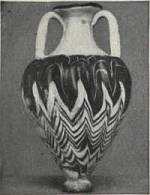
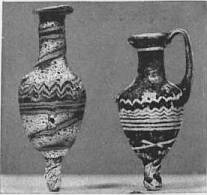
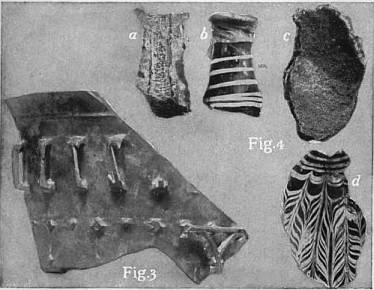
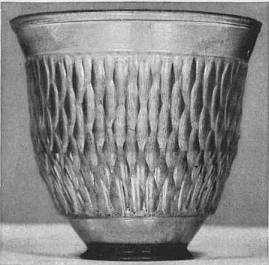
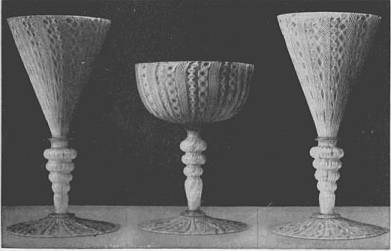
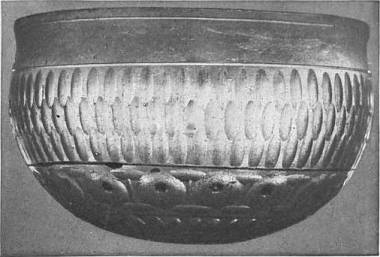
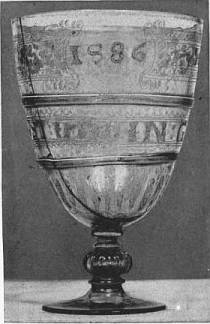
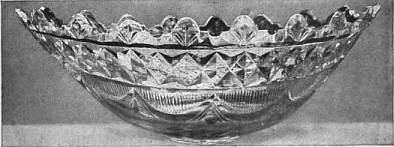
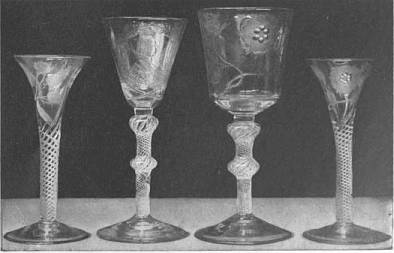
Plate II.
Fig. 11. Fig. 12.
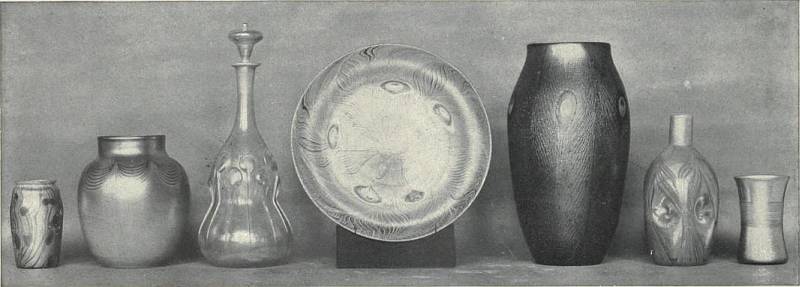
Fig. 13.
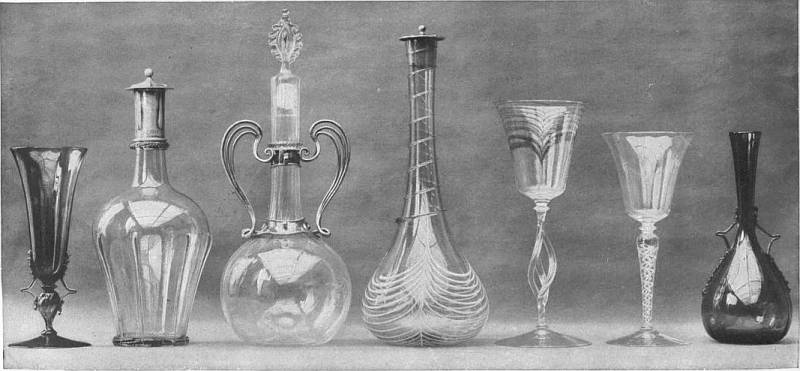
Fig. 14.
Roman Glass.—In the first centuries of our era the art of glass-making was developed at Rome and other cities under Roman rule in a most remarkable manner, and it reached a point of excellence which in some respects has never been excelled or even perhaps equalled. It may appear a somewhat exaggerated assertion that glass was used for more purposes, and in one sense more extensively, by the Romans of the imperial period than by ourselves in the present day; but it is one which can be borne out by evidence. It is true that the use of glass for windows was only gradually extending itself at the time when Roman civilization sank under the torrent of German and Hunnish barbarism, and that its employment for optical instruments was only known in a rudimentary stage; but for domestic purposes, for architectural decoration and for personal ornaments glass was unquestionably much more used than at the present day. It must be remembered that the Romans possessed no fine porcelain decorated with lively colours and a beautiful glaze; Samian ware was the most decorative kind of pottery which was then made. Coloured and ornamental glass held among them much the same place for table services, vessels for toilet use and the like, as that held among us by porcelain. Pliny (Nat. Hist. xxxvi. 26, 67) tells us that for drinking vessels it was even preferred to gold and silver.
Glass was largely used in pavements, and in thin plates as a coating for walls. It was used in windows, though by no means exclusively, mica, alabaster and shells having been also employed. Glass, in flat pieces, such as might be employed for windows, has been found in the ruins of Roman houses, both in England and in Italy, and in the house of the faun at Pompeii a small pane in a bronze frame remains. Most of the pieces have evidently been made by casting, but the discovery of fragments of sheet-glass at Silchester proves that the process of making sheet-glass was known to the Romans. When the window openings were large, as was the case in basilicas and other public buildings, and even in houses, the pieces of glass were, doubtless, fixed in pierced slabs of marble or in frames of wood or bronze. The Roman glass-blowers were masters of all the ordinary methods of manipulation and decoration. Their craftsmanship is proved by the large cinerary urns, by the jugs with wide, deeply ribbed, scientifically fixed handles, and by vessels and vases as elegant in form and light in weight as any that have been since produced at Murano. Their moulds, both for blowing hollow vessels and for pressing ornaments, were as perfect for the purposes for which they were intended as those of the present time. Their decorative cutting (Plate I. figs. 5 and 6), which took the form of simple, incised lines, or bands of shallow oval or hexagonal hollows, was more suited to the material than the deep prismatic cutting of comparatively recent times.
The Romans had at their command, of transparent colours, blue, green, purple or amethystine, amber, brown and rose; of opaque colours, white, black, red, blue, yellow, green and orange. There are many shades of transparent blue and of opaque blue, yellow and green. In any large collection of fragments it would be easy to find eight or ten varieties of opaque blue, ranging from lapis lazuli to turquoise or to lavender and six or seven of opaque green. Of red the varieties are fewer; the finest is a crimson red of very beautiful tint, and there are various gradations from this to a dull brick red. One variety forms the ground of a very good imitation of porphyry; and there is a dull semi-transparent red which, when light is passed through it, appears to be of a dull green hue. With these colours the Roman vitrarius worked, either using them singly or blending them in almost every conceivable combination, sometimes, it must be owned, with a rather gaudy and inharmonious effect.
The glasses to which the Venetians gave the name “mille fiori” were formed by arranging side by side sections of glass cane, the canes themselves being built up of differently coloured rods of glass, and binding them together by heat. A vast quantity of small cups and paterae were made by this means in patterns which bear considerable resemblance to the surfaces of madrepores. In these every colour and every shade of colour seem to have been tried in great variety of combination with effects more or less pleasing, but transparent violet or purple appears to have been the most common ground colour. Although most of the vessels of this mille fiori glass were small, some were made as large as 20 in. in diameter. Imitations of natural stones were made by stirring together in a crucible glasses of different colours, or by incorporating fragments of differently coloured glasses into a mass of molten glass by rolling. One variety is that in which transparent brown glass is so mixed with opaque white and blue as to resemble onyx. This was sometimes done with great success, and very perfect imitations of the natural stone were produced. Sometimes purple glass is used in place of brown, probably with the design of imitating the precious murrhine. Imitations of porphyry, of serpentine, and of granite are also met with, but these were used chiefly in pavements, and for the decoration of walls, for which purposes the onyx-glass was likewise employed.
The famous cameo glass was formed by covering a mass of molten glass with one or more coatings of a differently coloured glass. The usual process was to gather, first, a small quantity of opaque white glass; to coat this with a thick layer of translucent blue glass; and, finally, to cover the blue glass with a coating of the white glass. The outer coat was then removed from that portion which was to constitute the ground, leaving the white for the figures, foliage or other ornamentation; these were then sculptured by means of the gem-engraver’s tools. Pliny no doubt means to refer to this when he says (Nat. Hist. xxxvi. 26. 66), “aliud argenti modo caelatur,” contrasting it with the process of cutting glass by the help of a wheel, to which he refers in the words immediately preceding, “aliud torno teritur.”
The Portland or Barberini vase in the British Museum is the finest example of this kind of work which has come down to us, and was entire until it was broken into some hundred pieces by a madman. The pieces, however, were joined together by Mr Doubleday with extraordinary skill, and the beauty of design and execution may still be appreciated. The two other most remarkable examples of this cameo glass are an amphora at Naples and the Auldjo vase. The amphora measures 1 ft. 5⁄8 in. in height, 1 ft. 7½ in. in circumference; it is shaped like the earthern amphoras with a foot far too small to support it, and must no doubt have had a stand, probably of gold; the greater part is covered with a most exquisite design of garlands and vines, and two groups of boys gathering and treading grapes and playing on various instruments of music; below these is a line of sheep and goats in varied attitudes. The ground is blue and the figures white. It was found in a house in the Street of Tombs at Pompeii in the year 1839, and is now in the Royal Museum at Naples. It is well engraved in Richardson’s Studies of Ornamental Design. The Auldjo vase, in the British Museum, is an oenochoe about 9 in. high; the ornament consists mainly of a most beautiful band of foliage, chiefly of the vine, with bunches of grapes; the ground is blue and the ornaments white; it was found at Pompeii in the house of the faun. It also has been engraved by Richardson. The same process was used in producing large tablets, employed, no doubt, for various decorative purposes. In the South Kensington Museum is a fragment of such a tablet or slab; the figure, a portion of which remains, could not have been less than about 14 in. high. The ground of these cameo glasses is most commonly transparent blue, but sometimes opaque blue, purple or dark brown. The superimposed layer, which is sculptured, is generally opaque white. A very few specimens have been met with in which several colours are employed.
At a long interval after these beautiful objects come those vessels which were ornamented either by means of coarse threads trailed over their surfaces and forming rude patterns, or by coloured enamels merely placed on them in lumps; and these, doubtless, were cheap and common wares. But a modification of the first-named process was in use in the 4th and succeeding centuries, showing great ingenuity and manual dexterity,—that, namely, in which the added portions of glass are united to the body of the cup, not throughout, but only at points, and then shaped either by the wheel or by the hand (Plate I. fig. 3). The attached portions form in some instances inscriptions, as on a cup found at Strassburg, which bears the name of the emperor Maximian (A.D. 286-310), on another in the Vereinigte Sammlungen at Munich, and on a third in the Trivulzi collection at Milan, where the cup is white, the inscription green and the network blue. Probably, however, the finest example is a situla, 10½ in. high by 8 in. wide at the top and 4 in. at the bottom, preserved in the treasury of St Mark at Venice. This is of glass of a greenish hue; on the upper part is represented, in relief, the chase of a lion by two men on horseback accompanied by dogs; the costume appears to be Byzantine rather than Roman, and the style is very bad. The figures are very much undercut. The lower part has four rows of circles united to the vessel at those points alone where the circles touch each other. All the other examples have the lower portion covered in like manner by a network of circles standing nearly a quarter of an inch from the body of the cup. An example connected with the specimens just described is the cup belonging to Baron Lionel de Rothschild; though externally of an opaque greenish colour, it is by transmitted light of a deep red. On the outside, in very high relief, are figures of Bacchus with vines and panthers, some portions being hollow from within, others fixed on the exterior. The changeability of colour may remind us of the “calices versicolores” which Hadrian sent to Servianus.
So few examples of glass vessels of this period which have been painted in enamel have come down to us that it has been questioned whether that art was then practised; but several specimens have been described which can leave no doubt on the point; decisive examples are afforded by two cups found at Vaspelev, in Denmark, engravings of which are published in the Annaler for Nordisk Oldkyndeghed for 1861, p. 305. These are small cups, 3 in. and 2½ in. high, 3¾ in. and 3 in. wide, with feet and straight sides; on the larger are a lion and a bull, on the smaller two birds with grapes, and on each some smaller ornaments. On the latter are the letters DVB. R. The colours are vitrified and slightly in relief; green, blue and brown may be distinguished. They are found with Roman bronze vessels and other articles.
The art of glass-making no doubt, like all other art, deteriorated during the decline of the Roman empire, but it is probable that it continued to be practised, though with constantly decreasing skill, not only in Rome but in the provinces. Roman technique was to be found in Byzantium and Alexandria, in Syria, in Spain, in Germany, France and Britain.
Early Christian and Byzantine Glass.—The process of embedding gold and silver leaf between two layers of glass originated as early as the 1st century, probably in Alexandria. The process consisted in spreading the leaf on a thin film of blown glass and pressing molten glass on to the leaf so that the molten glass cohered with the film of glass through the pores of the metallic leaf. If before this application of the molten glass the metallic leaf, whilst resting on the thin film of blown glass, was etched with a sharp point, patterns, emblems, inscriptions and pictures could be embedded and rendered permanent by the double coating of glass. The plaques thus formed could be reheated and fashioned into the bases of bowls and drinking vessels. In this way the so-called “fondi d’oro” of the catacombs in Rome were made. They are the broken bases of drinking vessels containing inscriptions, emblems, domestic scenes and portraits etched in gold leaf. Very few have any reference to Christianity, but they served as indestructible marks for indicating the position of interments in the catacombs. The fondi d’oro suggested the manufacture of plaques of gold which could be broken up into tesserae for use in mosaics.
Some of the Roman artificers in glass no doubt migrated to Constantinople, and it is certain that the art was practised there to a very great extent during the middle ages. One of the gates near the port took its name from the adjacent glass houses. St Sofia when erected by Justinian had vaults covered with mosaics and immense windows filled with plates of glass fitted into pierced marble frames; some of the plates, 7 to 8 in. wide and 9 to 10 in. high, not blown but cast, which are in the windows may possibly date from the building of the church. It is also recorded that pierced silver disks were suspended by chains and supported glass lamps “wrought by fire.” Glass for mosaics was also largely made and exported. In the 8th century, when peace was made between the caliph Walid and the emperor Justinian II., the former stipulated for a quantity of mosaic for the decoration of the new mosque at Damascus, and in the 10th century the materials for the decoration of the niche of the kibla at Cordova were furnished by Romanus II. In the 11th century Desiderius, abbot of Monte Casino, sent to Constantinople for workers in mosaic.
We have in the work of the monk Theophilus, Diversarum artium schedula, and in the probably earlier work of Eraclius, about the 11th century, instructions as to the art of glass-making in general, and also as to the production of coloured and enamelled vessels, which these writers speak of as being practised by the Greeks. The only entire enamelled vessel which we can confidently attribute to Byzantine art is a small vase preserved in the treasury of St Mark’s at Venice. This is decorated with circles of rosettes of blue, green and red enamel, each surrounded by lines of gold; within the circles are little figures evidently suggested by antique originals, and precisely like similar figures found on carved ivory boxes of Byzantine origin dating from the 11th or 12th century. Two inscriptions in Cufic characters surround the vase, but they, it would seem, are merely ornamental and destitute of meaning. The presence of these inscriptions may perhaps lead to the inference that the vase was made in Sicily, but by Byzantine workmen. The double-handled blue-glass vase in the British Museum, dating from the 5th century, is probably a chalice, as it closely resembles the chalices represented on early Christian monuments.
Of uncoloured glass brought from Constantinople several examples exist in the treasury of St Mark’s at Venice, part of the plunder of the imperial city when taken by the crusaders in 1204. The glass in all is greenish, very thick, with many bubbles, and has been cut with the wheel; in some instances circles and cones, and in one the outlines of the figure of a leopard, have been left standing up, the rest of the surface having been laboriously cut away. The intention would seem to have been to imitate vessels of rock crystal. The so-called “Hedwig” glasses may also have originated in Constantinople. These are small cups deeply and rudely cut with conventional representations of eagles, lions and griffins. Only nine specimens are known. The specimen in the Rijks Museum at Amsterdam has an eagle and two lions. The specimen in the Germanic Museum at Nuremberg has two lions and a griffin.
Saracenic Glass.—The Saracenic invasion of Syria and Egypt did not destroy the industry of glass-making. The craft survived and flourished under the Saracenic régime in Alexandria, Cairo, Tripoli, Tyre, Aleppo and Damascus. In inventories of the 14th century both in England and in France mention may frequently be found of glass vessels of the manufacture of Damascus. A writer in the early part of the 15th century states that “glass-making is an important industry at Haleb (Aleppo).” Edward Dillon (Glass, 1902) has very properly laid stress on the importance of the enamelled Saracenic glass of the 13th, 14th and 15th centuries, pointing out that, whereas the Romans and Byzantine Greeks made some crude and ineffectual experiments in enamelling, it was under Saracenic influence that the processes of enamelling and gilding on glass vessels were perfected. An analysis of the glass of a Cairene mosque lamp shows that it is a soda-lime glass and contains as much as 4% of magnesia. This large proportion of magnesia undoubtedly supplied the stability required to withstand the process of enamelling. The enamelled Saracenic glasses take the form of flasks, vases, goblets, beakers and mosque lamps. The enamelled decoration on the lamps is restricted to lettering, scrolls and conventional foliage; on other objects figure-subjects of all descriptions are freely used. C. H. Read has pointed out a curious feature in the construction of the enamelled beakers. The base is double but the inner lining has an opening in the centre. Dillon has suggested that this central recess may have served to support a wick. It is possible however, that it served no useful purpose, but that the construction is a survival from the manufacture of vessels with fondi d’oro. The bases containing the embedded gold leaf must have been welded to the vessels to which they belonged, in the same way as the bases are welded to the Saracenic beakers. The enamelling process was probably introduced in the early part of the 13th century; most of the enamelled mosque lamps belong to the 14th century.
Venetian Glass.—Whether refugees from Padua, Aquileia or other Italian cities carried the art to the lagoons of Venice in the 5th century, or whether it was learnt from the Greeks of Constantinople at a much later date, has been a disputed question. It would appear not improbable that the former was the case, for it must be remembered that articles formed of glass were in the later days of Roman civilization in constant daily use, and that the making of glass was carried on, not as now in large establishments, but by artisans working on a small scale. It seems certain that some knowledge of the art was preserved in France, in Germany and in Spain, and it seems improbable that it should have been lost in that archipelago, where the traditions of ancient civilization must have been better preserved than in almost any other place. In 523 Cassiodorus writes of the “innumerosa navigia” belonging to Venice, and where trade is active there is always a probability that manufactures will flourish. However this may be, the earliest positive evidence of the existence at Venice of a worker in glass would seem to be the mention of Petrus Flavianus, phiolarius, in the ducale of Vitale Falier in the year 1090. In 1224 twenty-nine persons are mentioned as friolari (i.e. phiolari), and in the same century “mariegole,” or codes of trade regulations, were drawn up (Monografia della vetraria Veneziana e Muranese, p. 219). The manufacture had then no doubt attained considerable proportions: in 1268 the glass-workers became an incorporated body; in their processions they exhibited decanters, scent-bottles and the like; in 1279 they made, among other things, weights and measures. In the latter part of this century the glass-houses were almost entirely transferred to Murano. Thenceforward the manufacture continued to grow in importance; glass vessels were made in large quantities, as well as glass for windows. The earliest example which has as yet been described—a cup of blue glass, enamelled and gilt—is, however, not earlier than about 1440. A good many other examples have been preserved which may be assigned to the same century: the earlier of these bear a resemblance in form to the vessels of silver made in the west of Europe; in the later an imitation of classical forms becomes apparent. Enamel and gilding were freely used, in imitation no doubt of the much-admired vessels brought from Damascus. Dillon has pointed out that the process of enamelling had probably been derived from Syria, with which country Venice had considerable commercial intercourse. Many of the ornamental processes which we admire in Venetian glass were already in use in this century, as that of mille fiori, and the beautiful kind of glass known as “vitro di trina” or lace glass. An elaborate account of the processes of making the vitro di trina and the vasi a reticelli (Plate I., fig. 7) is given in Bontemps’s Guide du verrier, pp. 602-612. Many of the examples of these processes exhibit surprising skill and taste, and are among the most beautiful objects produced at the Venetian furnaces. That peculiar kind of glass usually called schmelz, an imperfect imitation of calcedony, was also made at Venice in the 15th century. Avanturine glass, that in which numerous small particles of copper are diffused through a transparent yellowish or brownish mass, was not invented until about 1600.
The peculiar merits of the Venetian manufacture are the elegance of form and the surprising lightness and thinness of the substance of the vessels produced. The highest perfection with regard both to form and decoration was reached in the 16th century; subsequently the Venetian workmen somewhat abused their skill by giving extravagant forms to vessels, making drinking glasses in the forms of ships, lions, birds, whales and the like.
Besides the making of vessels of all kinds the factories of Murano had for a long period almost an entire monopoly of two other branches of the art—the making of mirrors and of beads. Attempts to make mirrors of glass were made as early as A.D. 1317, but even in the 16th century mirrors of steel were still in use. To make a really good mirror of glass two things are required—a plate free from bubbles and striae, and a method of applying a film of metal with a uniform bright surface free from defects. The principle of applying metallic films to glass seems to have been known to the Romans and even to the Egyptians, and is mentioned by Alexander Neckam in the 12th century, but it would appear that it was not until the 16th century that the process of “silvering” mirrors by the use of an amalgam of tin and mercury had been perfected. During the 16th and 17th centuries Venice exported a prodigious quantity of mirrors, but France and England gradually acquired knowledge and skill in the art, and in 1772 only one glass-house at Murano continued to make mirrors.
The making of beads was probably practised at Venice from a very early period, but the earliest documentary evidence bearing on the subject does not appear to be of earlier date than the 14th century, when prohibitions were directed against those who made of glass such objects as were usually made of crystal or other hard stones. In the 16th century it had become a trade of great importance, and about 1764 twenty-two furnaces were employed in the production of beads. Towards the end of the same century from 600 to 1000 workmen were, it is stated, employed on one branch of the art, that of ornamenting beads by the help of the blow-pipe. A very great variety of patterns was produced; a tariff of the year 1800 contains an enumeration of 562 species and a vast number of sub-species.
The efforts made in France, Germany and England, in the 17th and 18th centuries, to improve the manufacture of glass in those countries had a very injurious effect on the industry of Murano. The invention of colourless Bohemian glass brought in its train the practice of cutting glass, a method of ornamentation for which Venetian glass, from its thinness, was ill adapted. One remarkable man, Giuseppe Briati, exerted himself, with much success, both in working in the old Venetian method and also in imitating the new fashions invented in Bohemia. He was especially successful in making vases and circular dishes of vitro di trina; one of the latter in the Correr collection at Venice, believed to have been made in his glass-house, measures 55 centimetres (nearly 23 in.) in diameter. The vases made by him are as elegant in form as the best of the Cinquecento period, but may perhaps be distinguished by the superior purity and brilliancy of the glass. He also made with great taste and skill large lustres and mirrors with frames of glass ornamented either in intaglio or with foliage of various colours. He obtained a knowledge of the methods of working practised in Bohemia by disguising himself as a porter, and thus worked for three years in a Bohemian glass-house. In 1736 he obtained a patent at Venice to manufacture glass in the Bohemian manner. He died in 1772.
The fall of the republic was accompanied by interruption of trade and decay of manufacture, and in the last years of the 18th and beginning of the 19th century the glass-making of Murano was at a very low ebb. In the year 1838 Signor Bussolin revived several of the ancient processes of glass-working, and this revival was carried on by C. Pietro Biguglia in 1845, and by others, and later by Salviati, to whose successful efforts the modern renaissance of Venetian art glass is principally due.
The fame of Venice in glass-making so completely eclipsed that of other Italian cities that it is difficult to learn much respecting their progress in the art. Hartshorne and Dillon have drawn attention to the important part played by the little Ligurian town, Altare, as a centre from which glass-workers migrated to all parts of Europe. It is said that the glass industry was established at Altare, in the 11th century, by French craftsmen. In the 14th century Muranese glass-workers settled there and developed the industry. It appears that as early as 1295 furnaces had been established at Treviso, Vicenza, Padua, Mantua, Ferrara, Ravenna and Bologna. In 1634 there were two glass-houses in Rome and one in Florence; but whether any of these produced ornamented vessels, or only articles of common use and window glass, would not appear to have as yet been ascertained.
Germany—Glass-making in Germany during the Roman period seems to have been carried on extensively in the neighbourhood of Cologne. The Cologne museum contains many specimens of Roman glass, some of which are remarkable for their cut decoration. The craft survived the downfall of the Roman power, and a native industry was developed. This industry must have won some reputation, for in 758 the abbot of Jarrow appealed to the bishop of Mainz to send him a worker in glass. There are few records of glass manufacture in Germany before the beginning of the 16th century. The positions of the factories were determined by the supply of wood for fuel, and subsequently, when the craft of glass-cutting was introduced, by the accessibility of water-power. The vessels produced by the 16th-century glass-workers in Germany, Holland and the Low Countries are closely allied in form and decoration. The glass is coloured (generally green) and the decoration consists of glass threads and glass studs, or prunts (“Nuppen”). The use of threads and prunts is illustrated by the development of the “Roemer,” so popular as a drinking-glass, and as a feature in Dutch studies of still life. The “Igel,” a squat tumbler covered with prunts, gave rise to the “Krautstrunk,” which is like the “Igel,” but longer and narrow-waisted. The “Roemer” itself consists of a cup, a short waist studded with prunts and a foot. The foot at first was formed by coiling a thread of glass round the base of the waist; but, subsequently, an open glass cone was joined to the base of the waist, and a glass thread was coiled upon the surface of the cone. The “Passglas,” another popular drinking-glass, is cylindrical in form and marked with horizontal rings of glass, placed at regular intervals, to indicate the quantity of liquor to be taken at a draught.
In the edition of 1581 of the De re metallica by Georg Agricola, there is a woodcut showing the interior of a German glass factory, and glass vessels both finished and unfinished.
In 1428 a Muranese glass-worker set up a furnace in Vienna, and another furnace was built in the same town by an Italian in 1486. In 1531 the town council of Nuremberg granted a subsidy to attract teachers of Venetian technique. Many specimens exist of German winged and enamelled glasses of Venetian character. The Venetian influence, however, was indirect rather than direct. The native glass-workers adopted the process of enamelling, but applied it to a form of decoration characteristically German. On tall, roomy, cylindrical glasses they painted portraits of the emperor and electors of Germany, or the imperial eagle bearing on its wings the arms of the states composing the empire. The earliest-known example of these enamelled glasses bears the date 1553. They were immensely popular and the fashion for them lasted into the 18th century. Some of the later specimens have views of cities, battle scenes and processions painted in grisaille.
A more important outcome, however, of Italian influence was the production, in emulation of Venetian glass, of a glass made of refined potash, lime and sand, which was more colourless than the material it was intended to imitate. This colourless potash-lime glass has always been known as Bohemian glass. It was well adapted for receiving cut and engraved decoration, and in these processes the German craftsmen proved themselves to be exceptionally skilful. At the end of the 16th century Rudolph II. brought Italian rock-crystal cutters from Milan to take control of the crystal and glass-cutting works he had established at Prague. It was at Prague that Caspar Lehmann and Zachary Belzer learnt the craft of cutting glass. George Schwanhart, a pupil of Caspar Lehmann, started glass-cutting at Ratisbon, and about 1690 Stephen Schmidt and Hermann Schwinger introduced the crafts of cutting and engraving glass in Nuremberg. To the Germans must be credited the discovery, or development, of colourless potash-lime glass, the reintroduction of the crafts of cutting and engraving on glass, the invention by H. Schwanhart of the process of etching on glass by means of hydrofluoric acid, and the rediscovery by J. Kunkel, who was director of the glass-houses at Potsdam in 1679, of the method of making copper-ruby glass.
Low Countries and the United Provinces.—The glass industry of the Low Countries was chiefly influenced by Italy and Spain, whereas German influence and technique predominated in the United Provinces. The history of glass-making in the provinces is almost identical with that of Germany. In the 17th and 18th centuries the processes of scratching, engraving and etching were brought to great perfection.
The earliest record of glass-making in the Low Countries consists in an account of payments made in 1453-1454 on behalf of Philip the Good of Burgundy to “Gossiun de Vieuglise, Maître Vorrier de Lille” for a glass fountain and four glass plateaus. Schuermans has traced Italian glass-workers to Antwerp, Liége, Brussels and Namur. Antwerp appears to have been the headquarters of the Muranese, and Liége the headquarters of the Altarists. Guicciardini in his description of the Netherlands, in 1563, mentions glass as among the chief articles of export to England.
In 1599 the privilege of making “Voires de cristal à la faschon Venise,” was granted to Philippe de Gridolphi of Antwerp. In 1623 Anthony Miotti, a Muranese, addressed a petition to Philip IV. of Spain for permission to make glasses, vases and cups of fine crystal, equal to those of Venice, but to be sold at one-third less than Venetian glasses. In 1642 Jean Savonetti “gentilhomme Verrier de Murano” obtained a patent for making glass in Brussels. The Low Country glasses are closely copied from Venetian models, but generally are heavier and less elegant. Owing to the fashion of Dutch and Flemish painters introducing glass vases and drinking-glasses into their paintings of still life, interiors and scenes of conviviality, Holland and Belgium at the present day possess more accurate records of the products of their ancient glass factories than any other countries.
Spain.—During the Roman occupation Pliny states that glass was made “per Hispanias” (Nat. Hist. xxxvi. 26. 66). Traces of Roman glass manufactories have been found in Valencia and Murcia, in the valleys which run down to the coast of Catalonia, and near the mouth of the Ebro. Little is known about the condition of glass-making in Spain between the Roman period and the 13th century. In the 13th century the craft of glass-making was practised by the Moors in Almeria, and was probably a survival from Roman times. The system of decorating vases and vessels by means of strands of glass trailed upon the surface in knots, zigzags and trellis work, was adopted by the Moors and is characteristic of Roman craftsmanship. Glass-making was continued at Pinar de la Vidriera and at Al Castril de la Pena into the 17th century. The objects produced show no sign of Venetian influence, but are distinctly Oriental in form. Many of the vessels have four or as many as eight handles, and are decorated with serrated ornamentation, and with the trailed strands of glass already referred to. The glass is generally of a dark-green colour.
Barcelona has a long record as a centre of the glass industry. In 1324 a municipal edict was issued forbidding the erection of glass-furnaces within the city. In 1455 the glass-makers of Barcelona were permitted to form a gild. Jeronimo Paulo, writing in 1491, says that glass vessels of various sorts were sent thence to many places, and even to Rome. Marineus Siculus, writing early in the 16th century, says that the best glass was made at Barcelona; and Gaspar Baneiros, in his Chronographia, published in 1562, states that the glass made at Barcelona was almost equal to that of Venice and that large quantities were exported.
The author of the Atlante español, writing at the end of the 18th century, says that excellent glass was still made at Barcelona on Venetian models. The Italian influence was strongly felt in Spain, but Spanish writers have given no precise information as to when it was introduced or whence it came. Schuermans has, however, discovered the names of more than twenty Italians who found their way into Spain, in some cases by way of Flanders, either from Altare or from Venice. The Spanish glass-makers were very successful in imitating the Venetian style, and many specimens supposed to have originated from Murano are really Spanish. In addition to the works at Barcelona, the works which chiefly affected Venetian methods were those of Cadalso in the province of Toledo, founded in the 16th century, and the works established in 1680 at San Martin de Valdeiglesias in Avila. There were also works at Valdemaqueda and at Villafranca. In 1680 the works in Barcelona, Valdemaqueda and Villafranca are named in a royal schedule giving the prices at which glass was to be sold in Madrid. In 1772 important glass works were established at Recuenco in the province of Cuenca, mainly to supply Madrid. The royal glass manufactory of La Granja de San Ildefonso was founded about 1725; in the first instance for the manufacture of mirror plates, but subsequently for the production of vases and table-ware in the French style. The objects produced are mostly of white clear glass, cut, engraved and gilded. Engraved flowers, views and devices are often combined with decorative cutting. Don Sigismundo Brun is credited with the invention of permanent gilding fixed by heat. Spanish glass is well represented in the Victoria and Albert Museum.
France.—Pliny states that glass was made in Gaul, and there is reason to believe that it was made in many parts of the country and on a considerable scale. There were glass-making districts both in Normandy and in Poitou.
Little information can be gathered concerning the glass industry between the Roman period and the 14th century. It is recorded that in the 7th century the abbot of Wearmouth in England obtained artificers in glass from France; and there is a tradition that in the 11th century glass-workers migrated from Normandy and Brittany and set up works at Altare near Genoa.
In 1302 window glass, probably crown-glass, was made at Beza le Forêt in the department of the Eure. In 1416 these works were in the hands of Robin and Leban Guichard, but passed subsequently to the Le Vaillants.
In 1338 Humbert, the dauphin, granted a part of the forest of Chamborant to a glass-worker named Guionet on the condition that Guionet should supply him with vessels of glass.
In 1466 the abbess of St Croix of Poitiers received a gross of glasses from the glass-works of La Ferrière, for the privilege of gathering fern for the manufacture of potash.
In France, as in other countries, efforts were made to introduce Italian methods of glass-working. Schuermans in his researches discovered that during the 15th and 16th centuries many glass-workers left Altare and settled in France,—the Saroldi migrated to Poitou, the Ferri to Provence, the Massari to Lorraine and the Bormioli to Normandy. In 1551 Henry II. of France established at St Germain en Laye an Italian named Mutio; he was a native of Bologna, but of Altare origin. In 1598 Henry IV. permitted two “gentil hommes verriers” from Mantua to settle at Rouen in order to make “verres de cristal, verres dorée emaul et autres ouvrages qui se font en Venise.”
France assimilated the craft of glass-making, and her craftsmen acquired a wide reputation. Lorraine and Normandy appear to have been the most important centres. To Lorraine belong the well-known names Hennezel, de Thietry, du Thisac, de Houx; and to Normandy the names de Bongar, de Cacqueray le Vaillant and de Brossard.
In the 17th century the manufacture of mirror glass became an important branch of the industry. In 1665 a manufactory was established in the Faubourg St Antoine in Paris, and another at Tour-la-Ville near Cherbourg.
Louis Lucas de Nehou, who succeeded de Cacqueray at the works at Tour-la-Ville, moved in 1675 to the works in Paris. Here, in 1688, in conjunction with A. Thevart, he succeeded in perfecting the process of casting plate-glass. Mirror plates previous to the invention had been made from blown “sheet” glass, and were consequently very limited in size. De Nehou’s process of rolling molten glass poured on an iron table rendered the manufacture of very large plates possible.
The Manufactoire Royale des Glaces was removed in 1693 to the Château de St Gobain.
In the 18th century the manufacture of vases de verre had become so neglected that the Academy of Sciences in 1759 offered a prize for an essay on the means by which the industry might be revived (Labarte, Histoire des arts industriels).
The famous Baccarat works, for making crystal glass, were founded in 1818 by d’Artigues.
English Glass.—The records of glass-making in England are exceedingly meagre. There is reason to believe that during the Roman occupation the craft was carried on in several parts of the country. Remains of a Roman glass manufactory of considerable extent were discovered near the Manchester Ship Canal at Warrington. Wherever the Romans settled glass vessels and fragments of glass have been found. There is no evidence to prove that the industry survived the withdrawal of the Roman garrison.
It is probable that the glass drinking-vessels, which have been found in pre-Christian Anglo-Saxon tombs, were introduced from Germany. Some are elaborate in design and bear witness to advanced technique of Roman character. In 675 Benedict Biscop, abbot of Wearmouth, was obliged to obtain glass-workers from France, and in 758 Cuthbert, abbot of Jarrow, appealed to the bishop of Mainz to send him artisans to manufacture “windows and vessels of glass, because the English were ignorant and helpless.” Except for the statement in Bede that the French artisans, sent by Benedict Biscop, taught their craft to the English, there is at present no evidence of glass having been made in England between the Roman period and the 13th century. In some deeds relating to the parish of Chiddingfold, in Surrey, of a date not later than 1230, a grant is recorded of twenty acres of land to Lawrence “vitrearius,” and in another deed, of about 1280, the “ovenhusveld” is mentioned as a boundary. This field has been identified, and pieces of crucible and fragments of glass have been dug up. There is another deed, dated 1300, which mentions one William “le verir” of Chiddingfold.
About 1350 considerable quantities of colourless flat glass were supplied by John Alemayn of Chiddingfold for glazing the windows in St George’s chapel, Windsor, and in the chapel of St Stephen, Westminster. The name Alemayn (Aleman) suggests a foreign origin. In 1380 John Glasewryth, a Staffordshire glass-worker, came to work at Shuerewode, Kirdford, and there made brode-glas and vessels for Joan, widow of John Shertere.
There were two kinds of flat glass, known respectively as “brode-glas” and “Normandy” glass. The former was made, as described by Theophilus, from cylinders, which were split, reheated and flattened into square sheets. It was known as Lorraine glass, and subsequently as “German sheet” or sheet-glass. Normandy glass was made from glass circles or disks. When, in after years, the process was perfected, the glass was known as “crown” glass. In 1447 English flat glass is mentioned in the contract for the windows of the Beauchamp chapel at Warwick, but disparagingly, as the contractor binds himself not to use it. In 1486, however, it is referred to in such a way as to suggest that it was superior to “Dutch, Venice or Normandy glass.” The industry does not seem to have prospered, for when in 1567 an inquiry was made as to its condition, it was ascertained that only small rough goods were being made.
In the 16th century the fashion for using glass vessels of ornamental character spread from Italy into France and England. Henry VIII. had a large collection of glass drinking-vessels chiefly of Venetian manufacture. The increasing demand for Venetian drinking-glasses suggested the possibility of making similar glass in England, and various attempts were made to introduce Venetian workmen and Venetian methods of manufacture. In 1550 eight Muranese glass-blowers were working in or near the Tower of London. They had left Murano owing to slackness of trade, but had been recalled, and appealed to the Council of Ten in Venice to be allowed to complete their contract in London. Seven of these glass-workers left London in the following year, but one, Josepho Casselari, remained and joined Thomas Cavato, a Dutchman. In 1574 Jacob Verzellini, a fugitive Venetian, residing in Antwerp, obtained a patent for making drinking-glasses in London “such as are made in Murano.” He established works in Crutched Friars, and to him is probably due the introduction of the use of soda-ash, made from seaweed and seaside plants, in place of the crude potash made from fern and wood ashes. His manufactory was burnt down in 1575, but was rebuilt. He afterwards moved his works to Winchester House, Broad Street. There is a small goblet (Pl. I., fig. 8) in the British Museum which is attributed to Verzellini. It is Venetian in character, of a brownish tint, with two white enamel rings round the body. It is decorated with diamond or steel-point etching, and bears on one side the date 1586, and on the opposite side the words “In God is al mi trust.” Verzellini died in 1606 and was buried at Down in Kent. In 1592 the Broad Street works had been taken over by Jerome Bowes. They afterwards passed into the hands of Sir R. Mansel, and in 1618 James Howell, author of Epistolae Ho-elianae, was acting as steward. The works continued in operation until 1641. During excavations in Broad Street in 1874 many fragments of glass were found; amongst them were part of a wine-glass, a square scent-bottle and a wine-glass stem containing a spiral thread of white enamel.
A greater and more lasting influence on English glass-making came from France and the Low Countries. In 1567 James Carré of Antwerp stated that he had erected two glass-houses at “Fernefol” (Fernfold Wood in Sussex) for Normandy and Lorraine glass for windows, and had brought over workmen. From this period began the records in England of the great glass-making families of Hennezel, de Thietry, du Thisac and du Houx from Lorraine, and of de Bongar and de Cacqueray from Normandy. About this time glass-works were established at Ewhurst and Alford in Surrey, Loxwood, Kirdford, Wisborough and Petworth in Sussex, and Sevenoaks and Penshurst in Kent. Beginning in Sussex, Surrey and Kent, where wood for fuel was plentiful, the foreign glass-workers and their descendants migrated from place to place, always driven by the fuel-hunger of their furnaces. They gradually made their way into Hampshire, Wiltshire, Gloucestershire, Staffordshire, Northumberland, Scotland and Ireland. They can be traced by cullet heaps and broken-down furnaces, and by their names, often mutilated, recorded in parish registers.
In 1610 a patent was granted to Sir W. Slingsby for burning coal in furnaces, and coal appears to have been used in the Broad Street works. In 1615 all patents for glass-making were revoked and a new patent issued for making glass with coal as fuel, in the names of Mansel, Zouch, Thelwall, Kellaway and Percival. To the last is credited the first introduction of covered crucibles to protect the molten glass from the products of burning coal.
Simultaneously with the issue of this patent the use of wood for melting glass was prohibited, and it was made illegal to import glass from abroad. About 1617 Sir R. Mansel, vice-admiral and treasurer of the navy, acquired the sole rights of making glass in England. These rights he retained for over thirty years.
During the protectorate all patent rights virtually lapsed, and mirrors and drinking-glasses were once more imported from Venice. In 1663 the duke of Buckingham, although unable to obtain a renewal of the monopoly of glass-making, secured the prohibition of the importation of glass for mirrors, coach plates, spectacles, tubes and lenses, and contributed to the revival of the glass industry in all its branches. Evelyn notes in his Diary a visit in 1673 to the Italian glass-house at Greenwich, “where glass was blown of finer metal than that of Murano,” and a visit in 1677 to the duke of Buckingham’s glass-works, where they made huge “vases of mettal as cleare, ponderous and thick as chrystal; also looking-glasses far larger and better than any that came from Venice.”
Some light is thrown on the condition of the industry at the end of the 17th century by the Houghton letters on the improvement of trade and commerce, which appeared in 1696. A few of these letters deal with the glass trade, and in one a list is given of the glass-works then in operation. There were 88 glass factories in England which are thus classified:
Bottles 39
Looking-glass plates 2
Crown and plate-glass 5
Window glass 15
Flint and ordinary glass 27
—
88
It is probable that the flint-glass of that date was very different from the flint-glass of to-day. The term flint-glass is now understood to mean a glass composed of the silicates of potash and lead. It is the most brilliant and the most colourless of all glasses, and was undoubtedly first perfected in England. Hartshorne has attributed its discovery to a London merchant named Tilson, who in 1663 obtained a patent for making “crystal glass.” E. W. Hulme, however, who has carefully investigated the subject, is of opinion that flint-glass in its present form was introduced about 1730. The use of oxide of lead in glass-making was no new thing; it had been used, mainly as a flux, both by Romans and Venetians. The invention, if it may be regarded as one, consisted in eliminating lime from the glass mixture, substituting refined potash for soda, and using a very large proportion of lead oxide. It is probable that flint-glass was not invented, but gradually evolved, that potash-lead glasses were in use during the latter part of the 17th century, but that the mixture was not perfected until the middle of the following century.
The 18th century saw a great development in all branches of glass-making. Collectors of glass are chiefly concerned with the drinking-glasses which were produced in great profusion and adapted for every description of beverage. The most noted are the glasses with stout cylindrical legs (Plate I. fig. 9), containing spiral threads of air, or of white or coloured enamel. To this type of glass belong many of the Jacobite glasses which commemorate the old or the young Pretender.
In 1746 the industry was in a sufficiently prosperous condition to tempt the government to impose an excise duty. The report of the commission of excise, dealing with glass, published in 1835 is curious and interesting reading. So burdensome was the duty and so vexatious were the restrictions that it is a matter for wonder that the industry survived. In this respect England was more fortunate than Ireland. Before 1825, when the excise duty was introduced into Ireland, there were flourishing glass-works in Belfast, Cork, Dublin and Waterford. By 1850 the Irish glass industry had been practically destroyed. Injurious as the excise duty undoubtedly was to the glass trade generally, and especially to the flint-glass industry, it is possible that it may have helped to develop the art of decorative glass-cutting. The duty on flint-glass was imposed on the molten glass in the crucibles and on the unfinished goods. The manufacturer had, therefore, a strong inducement to enhance by every means in his power the selling value of his glass after it had escaped the exciseman’s clutches. He therefore employed the best available art and skill in improving the craft of glass-cutting. It is the development of this craft in connexion with the perfecting of flint-glass that makes the 18th century the most important period in the history of English glass-making. Glass-cutting was a craft imported from Germany, but the English material so greatly surpassed Bohemian glass in brilliance that the Bohemian cut-glass was eclipsed. Glass-cutting was carried on at works in Birmingham, Bristol, Belfast, Cork, Dublin, Glasgow, London, Newcastle, Stourbridge, Whittington and Waterford. The most important centres of the craft were London, Bristol, Birmingham and Waterford (see Plate I., fig. 10, for oval cut-glass Waterford bowl). The finest specimens of cut-glass belong to the period between 1780 and 1810. Owing to the sacrifice of form to prismatic brilliance, cut-glass gradually lost its artistic value. Towards the middle of the 19th century it became the fashion to regard all cut-glass as barbarous, and services of even the best period were neglected and dispersed. At the present time scarcely anything is known about the origin of the few specimens of 18th-century English cut-glass which have been preserved in public collections. It is strange that so little interest has been taken in a craft in which for some thirty years England surpassed all competitors, creating a wave of fashion which influenced the glass industry throughout the whole of Europe.
In the report of the Excise Commission a list is given of the glass manufactories which paid the excise duty in 1833. There were 105 factories in England, 10 in Scotland and 10 in Ireland. In England the chief centres of the industry were Bristol, Birmingham, London, Manchester, Newcastle, Stourbridge and York. Plate-glass was made by Messrs Cookson of Newcastle, and by the British Plate Glass Company of Ravenhead. Crown and German sheet-glass were made by Messrs Chance & Hartley of Birmingham. The London glass-works were those of Apsley Pellatt of Blackfriars, Christie of Stangate, and William Holmes of Whitefriars. In Scotland there were works in Glasgow, Leith and Portobello. In Ireland there were works in Belfast, Cork, Dublin and Waterford. The famous Waterford works were in the hands of Gatchell & Co.
India.—Pliny states (Nat. Hist. xxxvi. 26, 66) that no glass was to be compared to the Indian, and gives as a reason that it was made from broken crystal; and in another passage (xii. 19, 42) he says that the Troglodytes brought to Ocelis (Ghella near Bab-el-Mandeb) objects of glass. We have, however, very little knowledge of Indian glass of any considerable antiquity. A few small vessels have been found in the “topes,” as in that at Manikiala in the Punjab, which probably dates from about the Christian era; but they exhibit no remarkable character, and fragments found at Brahmanabad are hardly distinguishable from Roman glass of the imperial period. The chronicle of the Sinhalese kings, the Mahavamsa, however, asserts that mirrors of glittering glass were carried in procession in 306 B.C., and beads like gems, and windows with ornaments like jewels, are also mentioned at about the same date. If there really was an important manufacture of glass in Ceylon at this early time, that island perhaps furnished the Indian glass of Pliny. In the later part of the 17th century some glass decorated with enamel was made at Delhi. A specimen is in the Indian section of the South Kensington Museum. Glass is made in several parts of India—as Patna and Mysore—by very simple and primitive methods, and the results are correspondingly defective. Black, green, red, blue and yellow glasses are made, which contain a large proportion of alkali and are readily fusible. The greater part is worked into bangles, but some small bottles are blown (Buchanan, Journey through Mysore, i. 147, iii. 369).
Persia.—No very remarkable specimens of Persian glass are known in Europe, with the exception of some vessels of blue glass richly decorated with gold. These probably date from the 17th century, for Chardin tells us that the windows of the tomb of Shah Abbas II. (ob. 1666), at Kum, were “de cristal peint d’or et d’azur.” At the present day bottles and drinking-vessels are made in Persia which in texture and quality differ little from ordinary Venetian glass of the 16th or 17th centuries, while in form they exactly resemble those which may be seen in the engravings in Chardin’s Travels.
China.—The history of the manufacture of glass in China is obscure, but the common opinion that it was learnt from the Europeans in the 17th century seems to be erroneous. A writer in the Mémoires concernant les Chinois (ii. 46) states on the authority of the annals of the Han dynasty that the emperor Wu-ti (140 B.C.) had a manufactory of the kind of glass called “lieou-li” (probably a form of opaque glass), that in the beginning of the 3rd century of our era the emperor Tsaou-tsaou received from the West a considerable present of glasses of all colours, and that soon after a glass-maker came into the country who taught the art to the natives.
The Wei dynasty, to which Tsaou-tsaou belonged, reigned in northern China, and at this day a considerable manufacture of glass is carried on at Po-shan-hien in Shantung, which it would seem has existed for a long period. The Rev. A. Williamson (Journeys in North China, i. 131) says that the glass is extremely pure, and is made from the rocks in the neighbourhood. The rocks are probably of quartz, i.e. rock crystal, a correspondence with Pliny’s statement respecting Indian glass which seems deserving of attention.
Whether the making of glass in China was an original discovery of that ingenious people, or was derived via Ceylon from Egypt, cannot perhaps be now ascertained; the manufacture has, however, never greatly extended itself in China. The case has been the converse of that of the Romans; the latter had no fine pottery, and therefore employed glass as the material for vessels of an ornamental kind, for table services and the like. The Chinese, on the contrary, having from an early period had excellent porcelain, have been careless about the manufacture of glass. A Chinese writer, however, mentions the manufacture of a huge vase in A.D. 627, and in 1154 Edrisi (first climate, tenth section) mentions Chinese glass. A glass vase about a foot high is preserved at Nara in Japan, and is alleged to have been placed there in the 8th century. It seems probable that this is of Chinese manufacture. A writer in the Mémoires concernant les Chinois (ii. 463 and 477), writing about 1770, says that there was then a glass-house at Peking, where every year a good number of vases were made, some requiring great labour because nothing was blown (rien n’est soufflé), meaning no doubt that the ornamentation was produced not by blowing and moulding, but by cutting. This factory was, however, merely an appendage to the imperial magnificence. The earliest articles of Chinese glass the date of which has been ascertained, which have been noticed, are some bearing the name of the emperor Kienlung (1735-1795), one of which is in the Victoria and Albert Museum.
In the manufacture of ornamental glass the leading idea in China seems to be the imitation of natural stones. The coloured glass is usually not of one bright colour throughout, but semi-transparent and marbled; the colours in many instances are singularly fine and harmonious. As in 1770, carving or cutting is the chief method by which ornament is produced, the vessels being blown very solid.
Bibliography.—Georg Agricola, De re metallica (Basel, 1556); Percy Bate, English Table Glass (n.d.); G. Bontemps, Guide du verrier (Paris, 1868); Edward Dillon, Glass (London, 1907); C. C. Edgar, “Graeco-Egyptian Glass,” Catalogue du Musée du Caire (1905); Sir A. W. Franks, Guide to Glass Room in British Museum (1888); Rev. A. Hallen, “Glass-making in Sussex,” Scottish Antiquary, No. 28 (1893); Albert Hartshorne, Old English Glasses (London); E. W. Hulme, “English Glass-making in XVI. and XVII. Centuries,” The Antiquary, Nos. 59, 60, 63, 64, 65; Alexander Nesbitt, “Glass,” Art Handbook, Victoria and Albert Museum; E. Peligot, Le Verre, son histoire, sa fabrication (Paris, 1878); Apsley Pellatt, Curiosities of Glass-making (London, 1849); F. Petrie, Tell-el-Amarna, Egypt Exploration Fund (1894); “Egypt,” sect. Art; H. J. Powell, “Cut Glass,” Journal Society of Arts, No. 2795; C. H. Read, “Saracenic Glass,” Archaeologia, vol. 58, part 1.; Juan F. Riano, “Spanish Arts,” Art Handbook, Victoria and Albert Museum; H. Schuermans, “Muranese and Altarist Glass Workers,” eleven letters: Bulletins des commissions royales (Brussels, 1883, 1891). For the United States, see vol. x. of Reports of the 12th Census, pp. 949-1000, and Special Report of Census of Manufactures (1905), Part III., pp. 837-935.
(A. Ne.; H. J. P.)
GLASS, STAINED. All coloured glass is, strictly speaking, “stained” by some metallic oxide added to it in the process of manufacture. But the term “stained glass” is popularly, as well as technically, used in a more limited sense, and is understood to refer to stained glass windows. Still the words “stained glass” do not fully describe what is meant; for the glass in coloured windows is for the most part not only stained but painted. Such painting was, however, until comparatively modern times, used only to give details of drawing and to define form. The colour in a stained glass window was not painted on the glass but incorporated in it, mixed with it in the making—whence the term “pot-metal” by which self-coloured glass is known, i.e. glass coloured in the melting pot.
A medieval window was consequently a patchwork of variously coloured pieces. And the earlier its date the more surely was it a mosaic, not in the form of tesserae, but in the manner known as “opus sectile.” Shaped pieces of coloured glass were, that is to say, put together like the parts of a puzzle. The nearest approach to an exception to this rule is a fragment at the Victoria and Albert Museum, in which actual tesserae are fused together into a solid slab of many-coloured glass, in effect a window panel, through which the light shines with all the brilliancy of an Early Gothic window. But apart from the fact that the design proves in this case to be even more effective with the light upon it, the use of gold leaf in the tesserae confirms the presumption that this work, which (supposing it to be genuine) would be Byzantine, centuries earlier than any coloured windows that we know of, and entirely different from them in technique, is rather a specimen of fused mosaic that happens to be translucent than part of a window designedly executed in tesserae.
The Eastern (and possibly the earlier) practice was to set chips of coloured glass in a heavy fretwork of stone or to imbed them in plaster. In a medieval window they were held together by strips of lead, in section something like the letter H, the upright strokes of which represent the “tapes” extending on either side well over the edges of the glass, and the crossbar the connecting “core” between them. The leading was soldered together at the points of junction, cement or putty was rubbed into the crevices between glass and lead, and the window was attached (by means of copper wires soldered on to the leads) to iron saddle-bars let into the masonry.
Stained glass was primarily the art of the glazier; but the painter, called in to help, asserted himself more and more, and eventually took it almost entirely into his own hands. Between the period when it was glazier’s work eked out by painting and when it was painter’s work with the aid of the glazier lies the entire development of stained and painted window-making. With the eventual endeavour of the glass painter to do without the glazier, and to get the colour by painting in translucent enamel upon colourless glass, we have the beginning of a form of art no longer monumental and comparatively trivial.
This evolution of the painted window from a patchwork of little pieces of coloured glass explains itself when it is remembered that coloured glass was originally not made in the big sheets produced nowadays, but at first in jewels to look as much as possible like rubies, sapphires, emeralds and other precious stones, and afterwards in rounds and sheets of small dimensions. Though some of the earliest windows were in the form of pure glazing (“leaded-lights”), the addition of painting seems to have been customary from the very first. It was a means of rendering detail not to be got in lead. Glazing affords by itself scope for beautiful pattern work; but the old glaziers never carried their art as far as they might have done in the direction of ornament; their aim was always in the direction of picture; the idea was to make windows serve the purpose of coloured story books. That was beyond the art of the glazier. It was easy enough to represent the drapery of a saint by red glass, the ground on which he stood by green, the sky above by blue, his crown by yellow, the scroll in his hand by white, and his flesh by brownish pink; but when it came to showing the folds of red drapery, blades of green grass, details of goldsmith’s work, lettering on the scroll, the features of the face—the only possible way of doing it was by painting. The use of paint was confined at first to an opaque brown, used, not as colour, but only as a means of stopping out light, and in that way defining comparatively delicate details within the lead lines. These themselves outlined and defined the main forms of the design. The pigment used by the glass painter was of course vitreous: it consisted of powdered glass and sundry metallic oxides (copper, iron, manganese, &c.), so that, when the pieces of painted glass were made red hot in the kiln, the powdered glass became fused to the surface, and with it the dense colouring matter also. When the pieces of painted glass were afterwards glazed together and seen against the light, the design appeared in the brilliant colour of the glass, its forms drawn in the uniform black into which, at a little distance, leadwork and painting lines became merged.
It needed solid painting to stop out the light entirely: thin paint only obscured it. And, even in early glass, thin paint was used, whether to subdue crude colour or to indicate what little shading a 13th-century draughtsman might desire. In the present state of old glass, the surface often quite disintegrated, it is difficult to determine to what extent thin paint was used for either purpose. There must always have been the temptation to make tint do instead of solid lines; but the more workmanlike practice, and the usual one, was to get difference of tint, as a pen-draughtsman does, by lines of solid opaque colour. In comparatively colourless glass (grisaille) the pattern was often made to stand out by cross-hatching the background; and another common practice was to coat the glass with paint all over, and scrape the design out of it. The effect of either proceeding was to lower the tone of the glass without dirtying the colour, as a smear of thin paint would do.
Towards the 14th century, when Gothic design took a more naturalistic direction, the desire to get something like modelling made it necessary to carry painting farther, and they got rid to some extent of the ill effect of shading-colour smeared on the glass by stippling it. This not only softened the tint and allowed of gradation according to the amount of stippling, but let some light through, where the bristles of the stippling-tool took up the pigment. Shading of this kind enforced by touches of strong brushwork, cross-hatching and some scratching out of high lights was the method of glass painting adopted in the 14th century.
Glass was never at the best a pleasant surface to paint on; and glass painting, following the line of least resistance, developed in the later Gothic and early Renaissance periods into something unlike any other form of painting. The outlines continued to be traced upon the glass and fixed in the fire; but, after that, the process of painting consisted mainly in the removal of paint. The entire surface of the glass was coated with an even “matt” of pale brown; this was allowed to dry; and then the high lights were rubbed off, and the modelling was got by scrubbing away the paint with a dry hog-hair brush, more or less, according to the gradations required. Perfect modelling was got by repeating the operation—how often depended upon the dexterity of the painter. A painter’s method is partly the outcome of his individuality. One man would float on his colour and manipulate it to some extent in the moist state; another would work entirely upon the dry matt. Great use was made of the pointed stick with which sharp lines of light were easily scraped out; and in the 16th century Swiss glass painters, working upon a relatively small scale, got their modelling entirely with a needle-point, scraping away the paint just as an etcher scratches away the varnish from his etching plate. The practice of the two craftsmen is, indeed, identical, though the one scratches out what are to be black lines and the other lines of light. In the end, then, though a painter would always use touches of the brush to get crisp lines of dark, the manipulation of glass painting consisted more in erasing lights than in painting shadows, more in rubbing out or scraping off paint than in putting it on in brush strokes.
So far there was no thought of getting colour by means of paint. The colour was in the glass itself, permeating the mass (“pot-metal”). There was only one exception to this—ruby glass, the colour of which was so dense that red glass thick enough for its purpose would have been practically obscure; and so they made a colourless pot-metal coated on one side only with red glass. This led to a practice which forms an exception to the rule that in “pot-metal” glass every change of colour, or from colour to white, is got by the use of a separate piece of glass. It was possible in the ease of this “flashed” ruby to grind away portions of the surface and thus obtain white on red or red on white. Eventually they made coated glass of blue and other colours, with a view to producing similar effects by abrasion. (The same result is arrived at nowadays by means of etching. The skin of coloured glass, in old days laboriously ground or cut away, is now easily eaten off by fluoric acid.) One other exceptional expedient in colouring had very considerable effect upon the development of glass design from about the beginning of the 14th century. The discovery that a solution of silver applied to glass would under the action of the fire stain it yellow enabled the glass painter to get yellow upon colourless glass, green upon grey-blue, and (by staining only the abraded portions) yellow upon blue or ruby. This yellow was neither enamel nor pot-metal colour, but stain—the only staining actually done by the glass painter as distinct from the glass maker. It varied in colour from pale lemon to deep orange, and was singularly pure in quality. As what is called “white” glass became purer and was employed in greater quantities it was lavishly used; so much so that a brilliant effect of silvery white and golden yellow is characteristic of later Gothic windows.
The last stage of glass painting was the employment of enamel not for stopping out light but to get colour. It began to be used in the early part of the 16th century—at first only in the form of a flesh tint; but it was not long before other colours were introduced. This use of colour no longer in the glass but upon it marks quite a new departure in technique. Enamel colour was finely powdered coloured glass mixed with gum or some such substance into a pigment which could be applied with a brush. When the glass painted with it was brought to a red heat in the oven, the powdered glass melted and was fused to it, just like the opaque brown employed from the very beginning of glass-painting.
This process of enamelling was hardly called for in the interests of art. Even the red flesh-colour (borrowed from the Limoges enamellers upon copper) did not in the least give the quality of flesh, though it enabled the painter to suggest by contrast the whiteness of a man’s beard. As for the brighter enamel colours, they had nothing like the depth or richness of “stained” glass. What enamel really did was to make easy much that had been impossible in mosaic, as, for example, to represent upon the very smallest shield of arms any number of “charges” all in the correct tinctures. It encouraged the minute workmanship characteristic of Swiss glass painting; and, though this was not altogether inappropriate to domestic window panes, the painter was tempted by it to depart from the simplicity and breadth of design inseparable from the earlier mosaic practice. In the end he introduced coloured glass only where he could hardly help it, and glazed the great part of his window in rectangular panes of clear glass, upon which he preferred to paint his picture in opaque brown and translucent enamel colours.
Enamel upon glass has not stood the test of time. Its presence is usually to be detected in old windows by specks of light shining through the colour. This is where the enamel has crumbled off. There is a very good reason for that. Enamel must melt at a temperature at which the glass it is painted on keeps its shape. The lower the melting point of the powdered glass the more easily it is fused. The painter is consequently inclined to use enamel of which the contraction and expansion is much greater than that of his glass—with the result that, under the action of the weather, the colour is apt to work itself free and expose the bare white glass beneath. The only enamel which has held its own is that of the Swiss glass-painters of the 16th and 17th centuries. The domestic window panes they painted may not in all cases have been tried by the sudden changes of atmosphere to which church windows are subject; but credit must be given them for exceptionally skilful and conscientious workmanship.
The story of stained glass is bound up with the history of architecture, to which it was subsidiary, and of the church, which was its patron. Its only possible course of development was in the wake of church building. From its very inception it was Gothic and ecclesiastical. And, though it survived the upheaval of the Renaissance and was turned to civil and domestic use, it is to church windows that we must go to see what stained glass really was—or is; for time has been kind to it. The charm of medieval glass lies to a great extent in the material, and especially in the inequality of it. Chemically impure and mechanically imperfect, it was rarely crude in tint or even in texture. It shaded off from light to dark according to its thickness; it was speckled with air bubbles; it was streaked and clouded; and all these imperfections of manufacture went to perfection of colour. And age has improved it: the want of homogeneousness in the material has led to the disintegration of its surface; soft particles in it have been dissolved away by the action of the weather, and the surface, pitted like an oyster-shell, refracts the light in a way which adds greatly to the effect; at the same time there is roothold for the lichen which (like the curtains of black cobwebs) veils and gives mystery to the colour. An appreciable part of the beauty of old glass is the result of age and accident. In that respect no new glass can compare with it. There is, however, no such thing as “the lost secret” of glass-making. It is no secret that age mellows.
Stained and painted glass is commonly apportioned to its “period,” Gothic or Renaissance, and further to the particular phase of the style to which it belongs. C. Winston, who was the first to inquire thoroughly into English glass, adopting T. Rickman’s classification, divided Gothic windows into Early English (to c. 1280), Decorated (to c. 1380) and Perpendicular (to c. 1530). These dates will do. But the transition from one phase of design to another is never so sudden, nor so easily defined, as any table of dates would lead us to suppose. The old style lingered in one district long after the new fashion was flourishing in another. Besides, the English periods do not quite coincide with those of other countries. France, Germany and the Low Countries count for much in the history of stained glass; and in no two places was the pace of progress quite the same. There was, for example, scarcely any 13th-century Gothic in Germany, where the “geometric” style, equivalent to our Decorated, was preceded by the Romanesque period; in France the Flamboyant took the place of our Perpendicular; and in Italy Gothic never properly took root at all. All these considered, a rather rough and ready division presents the least difficulty to the student of old glass; and it will be found convenient to think of Gothic glass as (1) Early, (2) Middle and (3) Late, and of the subsequent windows as (1) Renaissance and (2) Late Renaissance. The three periods of Gothic correspond approximately to the 13th, 14th and 15th centuries. The limits of the two periods of the Renaissance are not so easily defined. In the first part of the 16th century (in Italy long before that) the Renaissance and Gothic periods overlapped; in the latter part of it, glass painting was already on the decline; and in the 17th and 18th centuries it sank to deeper depths of degradation.