VOLUME XII SLICE I Gichtel, Johann to Glory (continued 11)
Reading edition
The likeness of early windows to translucent enamel (which is also glass) is obvious. The lines of lead glazing correspond absolutely to the “cloisons” of Byzantine goldsmith’s work. Moreover, the extreme minuteness of the leading (not always either mechanically necessary or architecturally desirable) suggests that the starting point of all this gorgeous illumination was the idea of reproducing on a grandiose scale the jewelled effect produced in small by cloisonné enamellers. In other respects the earliest glass shows the influence of Byzantine tradition. It is mainly according to the more or less Byzantine character of its design and draughtsmanship that archaeologists ascribe certain remains of old glass to the 12th or the 11th century. Apart from documentary or direct historic evidence, it is not possible to determine the precise date of any particular fragment. In the “restored” windows at St Denis there are remnants of glass belonging to the year 1108. Elsewhere in France (Reims, Anger, Le Mans, Chartres, &c.) there is to be found very early glass, some of it probably not much later than the end of the 10th century, which is the date confidently ascribed to certain windows at St Remi (Reims) and at Tegernsee. The rarer the specimen the greater may be its technical and antiquarian interest. But, even if we could be quite sure of its date, there is not enough of this very early work, and it does not sufficiently distinguish itself from what followed, to count artistically for much. The glory of early glass belongs to the 13th century.
The design of windows was influenced, of course, by the conditions of the workshop, by the nature of glass, the difficulty of shaping it, the way it could be painted, and the necessity of lead glazing. The place of glass in the scheme of church decoration led to a certain severity in the treatment of it. The growing desire to get more and more light into the churches, and the consequent manufacture of purer and more transparent glass, affected the glazier’s colour scheme. For all that, the fashion of a window was, mutatis mutandis, that of the painting, carving, embroidery, goldsmith’s work, enamel and other craftsmanship of the period. The design of an ivory triptych is very much that of a three-light window. There is a little enamelled shrine of German workmanship in the Victoria and Albert Museum which might almost have been designed for glass; and the famous painted ceiling at Hildesheim is planned precisely on the lines of a medallion window of the 13th century. By that time glass had fallen into ways of its own, and there were already various types of design which we now recognize as characteristic of the first great period, in some respects the greatest of all.
Pre-eminently typical of the first period is the “medallion window.” Glaziers began by naïvely accepting the iron bars across the light as the basis of their composition, and planned a window as a series of panels, one above the other, between the horizontal crossbars and the upright lines of the border round it. The next step was to mitigate the extreme severity of this composition by the introduction of a circular or other medallion within the square boundary lines. Eventually these were abandoned altogether, the iron bars were shaped according to the pattern, and there was evolved the “medallion window,” in which the main divisions of the design are emphasized by the strong bands of iron round them. Medallions were invariably devoted to picturing scenes from Bible history or from the lives of the saints, set forth in the simplest and most straightforward manner, the figures all on one plane, and as far as possible clear-cut against a sapphire-blue or ruby-red ground. Scenery was not so much depicted as suggested. An arch or two did duty for architecture, any scrap of foliated ornament for landscape. Simplicity of silhouette was absolutely essential to the readableness of pictures on the small scale allowed by the medallion. As it is, they are so difficult to decipher, so confused and broken in effect, as to give rise (the radiating shape of “rose windows” aiding) to the misconception that the design of early glass is kaleidoscopic—which it is not. The intervals between subject medallions were filled in England (Canterbury) with scrollwork, in France (Chartres) more often with geometric diaper, in which last sometimes the red and blue merge into an unpleasant purple. Design on this small scale was obviously unsuited to distant windows. Clerestory lights were occupied by figures, sometimes on a gigantic scale, entirely occupying the window, except for the border and perhaps the slightest pretence of a niche. This arrangement lent itself to broad effects of colour. The drawing may be rude; at times the figures are grotesque; but the general impression is one of mysterious grandeur and solemnity.
The depth and intensity of colour in the windows so far described comes chiefly from the quality of the glass, but partly also from the fact that very little white or pale-coloured glass was used. It was not the custom at this period to dilute the colour of a rich window with white. If light was wanted they worked in white, enlivened, it might be, by colour. Strictly speaking, 13th-century glass was never colourless, but of a greenish tint, due to impurities in the sand, potash or other ingredients; it was of a horny consistency, too; but it is convenient to speak of all would-be-clear glass as “white.” The greyish windows in which it prevails are technically described as “in grisaille.” There are examples (Salisbury, Châlons, Bonlieu, Angers) of “plain glazing” in grisaille, in which the lead lines make very ingenious and beautiful pattern. In the more usual case of painted grisaille the lead lines still formed the groundwork of the design, though supplemented by foliated or other detail, boldly outlined in strong brown and emphasized by a background of cross-hatching. French grisaille was frequently all in white (Reims, St Jean-aux-Bois, Sens), English work was usually enlivened by bands and bosses of colour (Salisbury); but the general effect of the window was still grey and silvery, even though there might be distributed about it (the “five sisters,” York minster) a fair amount of coloured glass. The use of grisaille is sufficiently accounted for by considerations of economy and the desire to get light; but it was also in some sort a protest (witness the Cistercian interdict of 1134) against undue indulgence in the luxury of colour. At this stage of its development it was confined strictly to patternwork; figure subjects were always in colour. For all that, some of the most restful and entirely satisfying work of the 13th century was in grisaille (Salisbury, Chartres, Reims, &c.).
The second or Middle period of Gothic glass marks a stage between the work of the Early Gothic artist who thought out his design as glazing, and that of the later draughtsman who conceived it as something to be painted. It represents to many the period of greatest interest—probably because of its departure from the severity of Early work. It was the period of more naturalistic design; and a touch of nature is more easily appreciated than architectural fitness. Middle Gothic glass, halting as it does between the relatively rude mosaic of early times and the painter-like accomplishment of fully-developed glass painting, has not the salient merits of either. In the matter of tone also it is intermediate between the deep, rich, sober harmonies of Early windows and the lighter, brighter, gayer colouring of later glass. Now for the first time grisaille ornament and coloured figurework were introduced into the same window. And this was done in a very judicious way, in alternate bands of white and deep rich colour, binding together the long lights into which windows were by this time divided (chapter-house, York minster). A similar horizontal tendency of design is noticeable in windows in which the figures are enshrined under canopies, henceforth a feature in glass design. The pinnaclework falls into pronounced bands of brassy yellow between the tiers of figures (nave, York minster) and serves to correct the vertical lines of the masonry. Canopywork grew sometimes to such dimensions as quite to overpower the figure it was supposed to frame; but, then, the sense of scale was never a directing factor in Decorated design. A more interesting form of ornament is to be found in Germany, where it was a pleasing custom (Regensburg) to fill windows with conventional foliage without figurework. There is abundance of Middle Gothic glass in England (York, Wells, Ely, Oxford), but the best of it, such as the great East window at Gloucester cathedral, has features more characteristic of the 15th than of the 14th century.
The keynote of Late Gothic glass is brilliancy. It had a silvery quality. The 15th century was the period of white glass, which approached at last to colourlessness, and was employed in great profusion. Canopywork, more universal than ever, was represented almost entirely in white touched with yellow stain, but not in sufficient quantities to impair its silveriness. Whatever the banality of the idea of imitation stonework in glass, the effect of thus framing coloured pictures in delicate white is admirable: at last we have white and colour in perfect combination. Fifteenth-century figurework contains usually a large proportion of white glass; flesh tint is represented by white; there is white in the drapery; in short, there is always white enough in the figures to connect them with the canopywork and make the whole effect one. The preponderance of white will be better appreciated when it is stated that very often not a fifth or sixth part of the glass is coloured. It is no uncommon thing to find figures draped entirely in white with only a little colour in the background; and figurework all in grisaille upon a ground of white latticework is quite characteristic of Perpendicular glass.
One of the most typical forms of Late English Gothic canopy is where (York minster) its slender pinnacles fill the upper part of the window, and its solid base frames a picture in small of some episode in the history of the personage depicted as large as life above. A much less satisfactory continental practice was to enrich only the lower half of the window with stained glass and to make shift above (Munich) with “roundels” of plain white glass, the German equivalent for diamond latticework.
Plate I.
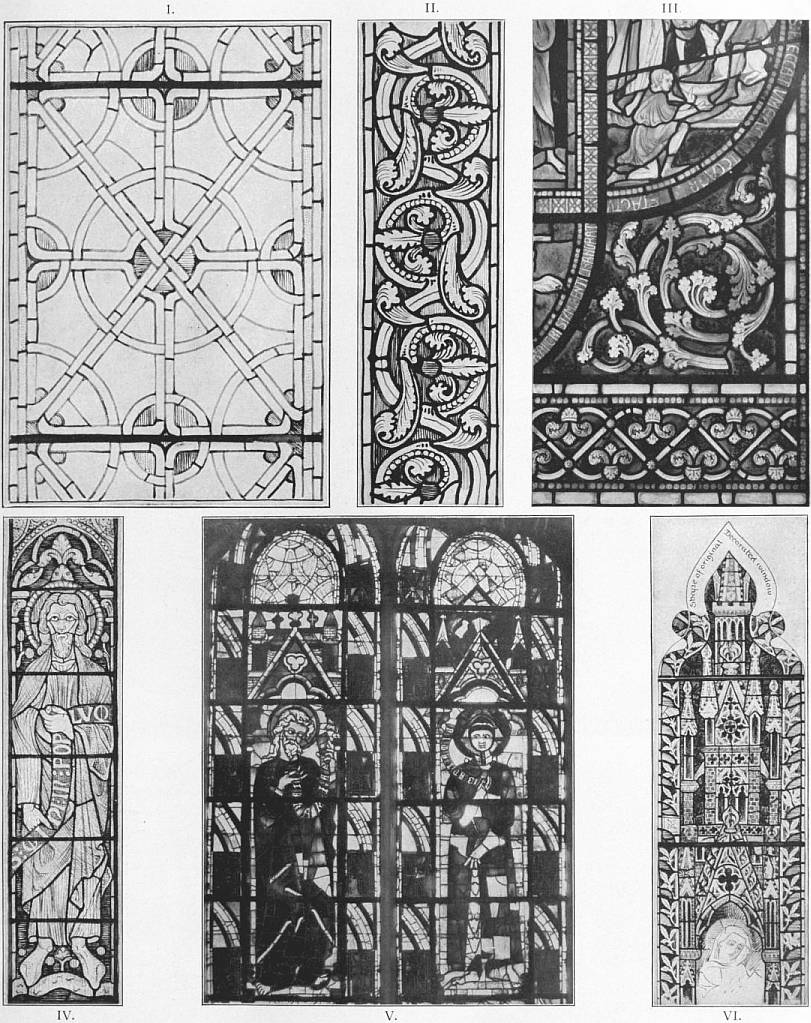
I. EARLY GLAZING. From S. Serge, Angers, Grisaille, with colour introduced in the small circles. II. AN EARLY BORDER. From S. Kunibert, Cologne. III. PORTION OF AN EARLY MEDALLION WINDOW. From Canterbury, showing the plan of the design and the ornamental details. IV. AN EARLY FIGUREJFROM LYONS. Showing the leading of the eyes, hair, nimbus, and drapery. V. DECORATED LIGHTS. From S. Urbain, Troyes, showing both the influence of the early period in the figures, and the beginning of the architectural canopy. VI. TYPICAL DECORATED CANOPY. From Exeter.
Nos. I., II., III., IV., VI. are taken from illustrations in Lewis F. Day, Windows, by permission of B. T. Batsford.
Plate II.
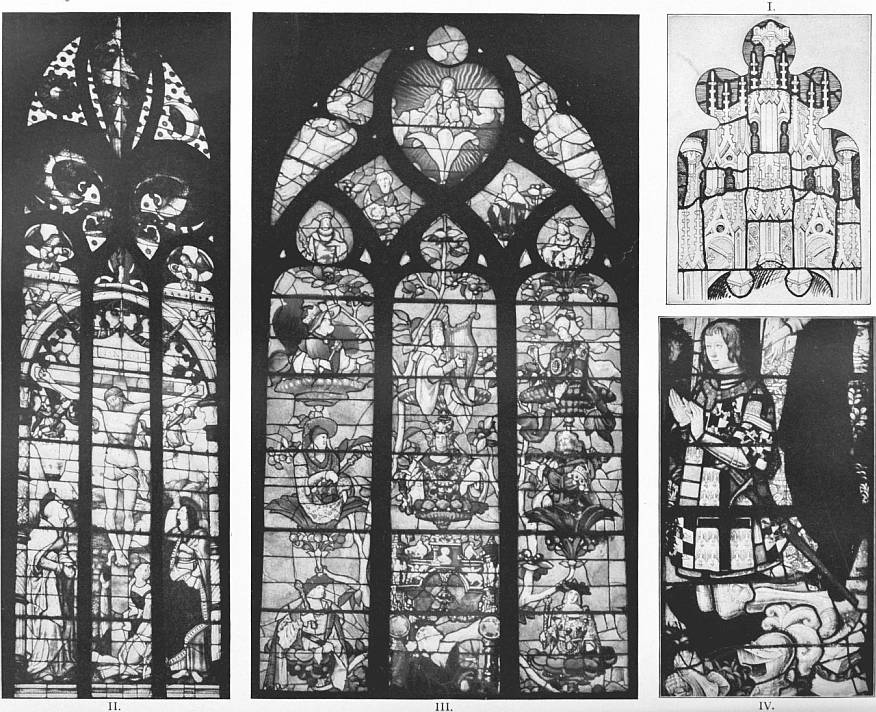
I. A TYPICAL PERPENDICULAR CANOPY (from Lewis F. Day, Windows, by permission of B. T. Batsford). II. A WINDOW FROM AUCH. Illustrating the transition from Perpendicular to Renaissance. III. A SIXTEENTH-CENTURY JESSE WINDOW. From Beauvais (source as in Fig. I.). IV. PORTION OF A RENAISSANCE WINDOW. From Montmorency, showing the perfection of glass painting.
From Lutien Magne, Oeuvre des Peintres Verriers Français, by permission of Firmin-Didot et Cie.
A sign of later times is the way pictures spread beyond the confines of a single light. This happened by degrees. At first the connexion between the figures in separate window openings was only in idea, as when a central figure of the crucified Christ was flanked by the Virgin and St John in the side lights. Then the arms of the cross would be carried through, or as it were behind, the mullions. The expansion to a picture right across the window was only a question of time. Not that the artist ventured as yet to disregard the architectural setting of his picture—that happened later on—but that he often composed it with such cunning reference to intervening stonework that it did not interfere with it. It has been argued that each separate light of a window ought to be complete in itself. On the other hand it has proved possible to make due acknowledgment of architectural conditions without cramping design in that way. There can be no doubt as to the variety and breadth of treatment gained by accepting the whole window as field for a design. And, when a number of lights go to make a window, it is the window, and no separate part of it, which is the main consideration.
By the end of the Gothic period, glass painters proceeded on an entirely different method from that of the 13th century. The designer of early days began with glazing: he thought in mosaic and leadwork; the lines he first drew were the lines of glazing; painting was only a supplementary process, enabling him to get what lead lines would not give. The Late Gothic draughtsman began with the idea of painting; glazing was to him of secondary importance; he reached a stage (Creation window, Great Malvern) where it is clear that he first sketched out his design, and then bethought him how to glaze it in such wise that the leadwork (which once boldly outlined everything) should not interfere with the picture. The artful way in which he would introduce little bits of colour into a window almost entirely white, makes it certain that he had always at the back of his mind the consideration of the glazing to come. So long as he thought of that, and did not resent it, all was fairly well with glass painting, but there came a point where he found it difficult, if not impossible, to reconcile the extreme delicacy of his painting upon white glass with the comparatively brutal strength of his lead lines. It is here that the conditions of painting and glazing clash at last.
It must not be supposed that Late Gothic windows were never by any chance rich in colour. Local conservatism and personal predilection prevented anything like monotonous progress in a single direction. There is (St Sebald, Nuremberg) Middle Gothic glass as dense in colour as any 13th-century work, and Late Gothic (Troyes cathedral) which, from its colour, one might take at first to be a century earlier than it is. In Italy (Florence) and to some extent in Spain (Seville) it was the custom to make canopywork so rich in colour that it was more like part of the picture than a frame to it. But that was by exception. The tendency was towards lighter windows. Glass itself was less deeply stained when painters depended more upon their power of deepening it by paint. It was the seeking after delicate effects of painting, quite as much as the desire to let light into the church, which determined the tone of later windows. The clearer the glass the more scope it gave for painting.
It is convenient to draw a line between Gothic art and Renaissance. Nothing is easier than to say that windows in which crocketed canopywork occurs are Gothic, and that those with arabesque are Renaissance. But that is an arbitrary distinction, which does not really distinguish. Some of the most beautiful work in glass, such for example as that at Auch, is so plainly intermediate between two styles that it is impossible to describe it as anything but “transitional.” And, apart from particular instances, we have only to look at the best Late Gothic work to see that it is informed by the new spirit, and at fine Renaissance glass to observe how it conforms to Gothic traditions of workmanship. The new idea gave a spurt to Gothic art; and it was Gothic impetus which carried Renaissance glass painting to the summit of accomplishment reached in the first half of the 16th century. When that subsided, and the pictorial spirit of the age at last prevailed, the bright days of glass were at an end. If we have to refer to the early Renaissance as the culminating period of glass painting, it is because the technique of an earlier period found in it freer and fuller expression. With the Renaissance, design broke free from the restraints of tradition.
An interesting development of Renaissance design was the framing of pictures in golden-yellow arabesque ornament, scarcely architectural enough to be called canopywork, and reminiscent rather of beaten goldsmith’s work than of stone carving. This did for the glass picture what a gilt frame does for a painting in oil. Very often framework of any kind was dispensed with. The primitive idea of accepting bars and mullions as boundaries of design, and filling the compartments formed by them with a medley of little subjects, lingered on. The result was delightfully broken colour, but inevitable confusion; for iron and masonry do not effectively separate glass pictures. There was no longer in late glass any pretence of preserving the plane of the window. It was commonly designed to suggest that one saw out of it. Throughout the period of the Renaissance, architectural and landscape backgrounds play an important part in design. An extremely beautiful feature in early 16th-century French glass pictures (Rouen, &c.) is the little peep of distant country delicately painted upon the pale-blue glass which represents the sky. In larger work landscape and architecture were commonly painted upon white (King’s College, Cambridge). The landscape effect was always happiest when one or other of these conventions was adopted. Canopywork never went quite out of fashion. For a long while the plan was still to frame coloured pictures in white. Theoretically this is no less effectually to be done by Italian than by Gothic shrinework. Practically the architectural setting assumed in the 16th century more and more the aspect of background to the figures, and, in order that it should take its place in the picture, they painted it so heavily that it no longer told as white. Already in van Orley’s magnificent transept windows at St Gudule, Brussels, the great triumphal arch behind the kneeling donors and their patron saints (in late glass donors take more and more the place of holy personages) tells dark against the clear ground. There came a time, towards the end of the century, when, as in the wonderful windows at Gouda, the very quality of white glass is lost in heavily painted shadow.
The pictorial ambition of the glass painter, active from the first, was kept for centuries within the bounds of decoration. Medallion subjects were framed in ornament, standing figures in canopywork, and pictures were conceived with regard to the window and its place in architecture. Severity of treatment in design may have been due more to the limitations of technique than to restraint on the part of the painter. The point is that it led to unsurpassed results. It was by absolute reliance upon the depth and brilliancy of self-coloured glass that all the beautiful effects of early glass were obtained. We need not compare early mosaic with later painted glass; each was in its way admirable; but the early manner is the more peculiar to glass, if not the more proper to it. The ruder and more archaic design gives in fullest measure the glory of glass—for the loss of which no quality of painting ever got in glass quite makes amends. The pictorial effects compatible with glass design are those which go with pure, brilliant and translucent colour. The ideal of a “primitive” Italian painter was more or less to be realized in glass: that of a Dutch realist was not. It is astonishing what glass painters did in the way of light and shade. But the fact remains that heavy painting obscured the glass, that shadows rendered in opaque surface-colour lacked translucency, and that in seeking before all things the effects of shadow and relief, glass painters of the 17th century fell short of the qualities on the one hand of glass and on the other of painting.
The course of glass painting was not so even as this general survey of its progress might seem to imply. It was quickened here, impeded there, by historic events. The art made a splendid start in France; but its development was stayed by the disasters of war, just when in England it was thriving under the Plantagenets. It revived again under Francis I. In Germany it was with the prosperity of the free cities of the Empire that glass painting prospered. In the Netherlands it blossomed out under the favour of Charles V. In the Swiss Confederacy its direction was determined by civil and domestic instead of church patronage. In most countries there were in different districts local schools of glass painting, each with some character of its own. To what extent design was affected by national temperament it is not easy to say. The marked divergence of the Flemish from the French treatment of glass in the 16th century is not entirely due to a preference on the one part for colour and on the other for light and shade, but is partly owing to the circumstance that, whilst in France design remained in the hands of craftsmen, whose trade was glass painting, in the Netherlands it was entrusted by the emperor to his court painter, who concerned himself as little as possible with a technique of which he knew nothing. If in France we come also upon the names of well-known artists, they seem, like Jean Cousin, to have been closely connected with glass painting: they designed so like glass painters that they might have begun their artistic career in the workshop.
The attribution of fine windows to famous artists should not be too readily accepted; for, though it is a foible of modern times to father whatever is noteworthy upon some great name, the masterpieces of medieval art are due to unknown craftsmen. In Italy, where glass painting was not much practised, and it seems to have been the custom either to import glass painters as they were wanted or to get work done abroad, it may well be that designs were supplied by artists more or less distinguished. Ghiberti and Donatello may have had a hand in the cartoons for the windows of the Duomo at Florence; but it is not to any sculptor that we can give the entire credit of design so absolutely in the spirit of colour decoration. The employment of artists not connected with glass design would go far to explain the great difference of Italian glass from that of other countries. The 14th-century work at Assisi is more correctly described as “Trecento” than as Gothic, and the “Quattrocento” windows at Florence are as different as could be from Perpendicular work. One compares them instinctively with Italian paintings, not with glass elsewhere. And so with the 15th-century Italian glass. The superb 16th-century windows of William of Marseilles at Arezzo, in which painting is carried to the furthest point possible short of sacrificing the pure quality of glass, are more according to contemporary French technique. Both French and Italian influence may be traced in Spanish glass (Avila, Barcelona, Burgos, Granada, Leon, Seville, Toledo). Some of it is said to have been executed in France. If so it must have been done to Spanish order. The coarse effectiveness of the design, the strength of the colour, the general robustness of the art, are characteristically Spanish; and nowhere this side of the Pyrenees do we find detail on a scale so enormous.
We have passed by, in following the progressive course of craftsmanship, some forms of design, peculiar to no one period but very characteristic of glass. The “quarry window,” barely referred to, its diamond-shaped or oblong panes painted, richly bordered, relieved by bosses of coloured ornament often heraldic, is of constant occurrence. Entire windows, too, were from first to last given up to heraldry. The “Jesse window” occurs in every style. According to the fashion of the time the “Stem of Jesse” burst out into conventional foliage, vine branches or arbitrary scrollwork. It appealed to the designer by the scope it gave for freedom of design. He found vent, again, for fantastic imagination in the representation of the “Last Judgment,” to which the west window was commonly devoted. And there are other schemes in which he delighted; but this is not the place to dwell upon them.
The glass of the 17th century does not count for much. Some of the best in England is the work of the Dutch van Linge family (Wadham and Balliol Colleges, Oxford). What glass painting came to in the 18th century is nowhere better to be seen than in the great west window of the ante-chapel at New College, Oxford. That is all Sir Joshua Reynolds and the best china painter of his day could do between them. The very idea of employing a china painter shows how entirely the art of the glass painter had died out.
It re-awoke in England with the Gothic revival of the 19th century; and the Gothic revival determined the direction modern glass should take. Early Victorian doings are interesting only as marking the steps of recovery (cf. the work of T. Willement in the choir of the Temple church; of Ward and Nixon, lately removed from the south transept of Westminster Abbey; of Wailes). Better things begin with the windows at Westminster inspired by A. C. Pugin, who exercised considerable influence over his contemporaries. John Powell (Hardman & Co.) was an able artist content to walk, even after that master’s death, reverently in his footsteps. Charles Winston, whose Hints on Glass Painting was the first real contribution towards the understanding of Gothic glass, and who, by the aid of the Powells (of Whitefriars) succeeded in getting something very like the texture and colour of old glass, was more learned in ancient ways of workmanship than appreciative of the art resulting from them. (He is responsible for the Munich glass in Glasgow cathedral.) So it was that, except for here and there a window entrusted by exception to W. Dyce, E. Poynter, D. G. Rossetti, Ford Madox Brown or E. Burne-Jones, glass, from the beginning of its recovery, fell into the hands of men with a strong bias towards archaeology. The architects foremost in the Gothic revival (W. Butterfield, Sir G. Scott, G. E. Street, &c.) were all inclined that way; and, as they had the placing of commissions for windows, they controlled the policy of glass painters. Designers were constrained to work in the pedantically archaeological manner prescribed by architectural fashion. Unwillingly as it may have been, they made mock-medieval windows, the interest in which died with the popular illusion about a Gothic revival. But they knew their trade; and when an artist like John Clayton (master of a whole school of later glass painters) took a window in hand (St Augustine’s, Kilburn; Truro cathedral; King’s College Chapel, Cambridge) the result was a work of art from which, tradework as it may in a sense be, we may gather what such men might have done had they been left free to follow their own artistic impulse. It is necessary to refer to this because it is generally supposed that whatever is best in recent glass is due to the romantic movement. The charms of Burne-Jones’s design and of William Morris’s colour, place the windows done by them among the triumphs of modern decorative art; but Morris was neither foremost in the reaction, nor quite such a master of the material he was working in as he showed himself in less exacting crafts. Other artists to be mentioned in connexion with glass design are: Clement Heaton, Bayne, N. H. J. Westlake and Henry Holiday, not to speak of a younger generation of able men.
Foreign work shows, as compared with English, a less just appreciation of glass, though the foremost draughtsmen of their day were enlisted for its design. In Germany, King Louis of Bavaria employed P. von Cornelius and W. von Kaulbach (Aix-la-Chapelle, Cologne, Glasgow); in France the Bourbons employed J. A. D. Ingres, F. V. E. Delacroix, Vernet and J. H. Flandrin (Dreux); and the execution of their designs was entrusted to the most expert painters to be procured at Munich and Sèvres; but all to little effect. They either used pot-metal glass of poor quality, or relied upon enamel—with the result that their colour lacks the qualities of glass. Where it is not heavy with paint it is thin and crude. In Belgium happier results were obtained. In the chapel of the Holy Sacrament at Brussels there is one window by J. B. Capronnier not unworthy of the fine series by B. van Orley which it supplements. At the best, however, foreign artists failed to appreciate the quality of glass; they put better draughtsmanship into their windows than English designers of the mid-Victorian era, and painted them better; but they missed the glory of translucent colour.
Modern facilities of manufacture make possible many things which were hitherto out of the question. Enamel colours are richer; their range is extended; and it may be possible, with the improved kilns and greater chemical knowledge we possess, to make them hold permanently fast. It was years ago demonstrated at Sèvres how a picture may be painted in colours upon a sheet of plate-glass measuring 4 ft. by 2½ ft. We are now no doubt in a position to produce windows painted on much larger sheets. But the results achieved, technically wonderful as they are, hardly warrant the waste of time and labour upon work so costly, so fragile, so lacking in the qualities of a picture on the one hand and of glass on the other.
In America, John la Farge, finding European material not dense enough, produced pot-metal more heavily charged with colour. This was wilfully streaked, mottled and quasi-accidentally varied; some of it was opalescent; much of it was more like agate or onyx than jewels. Other forms of American enterprise were: the making of glass in lumps, to be chipped into flakes; the ruckling it; the shaping it in a molten state, or the pulling it out of shape. It takes an artist of some reserve to make judicious use of glass like this. La Farge and L. C. Tiffany have turned it to beautiful account; but even they have put it to purposes more pictorial than it can properly fulfil. The design it calls for is a severely abstract form of ornament verging upon the barbaric.
Examples of Important Historical Stained Glass.
There are remains of the earliest known glass: in France—at Le Mans, Chartres, Châlons-sur-Marne, Angers and Poitiers cathedrals, the abbey church of St Denis and at St Remi, Reims: in England—at York minster (fragments): in Germany—at Augsburg and Strassburg cathedrals: in Austria—in the cloisters of Heiligen Kreuz.
The following is a classified list of some of the most characteristic and important windows, omitting for the most part isolated examples, and giving by preference the names of churches where there is a fair amount of glass remaining; the country in which at each period the art throve best is put first.
Early Gothic
France. England. Germany.
Chartres Le Mans Bourges Reims Auxerre cathedrals. Canterbury Salisbury Lincoln cathedrals. Church of St Kunibert, Cologne (Romanesque). Cologne cathedral.
York minster.
Ste Chapelle, Paris. Church of St Jean-aux-Bois.
Middle Gothic
England. Germany. France.
York minster. Ely cathedral. Wells cathedral. Tewkesbury abbey. Church of St Sebald, Nuremberg. Évreux cathedral. Church of St Pierre, Chartres. Cathedral and church of St Urbain, Troyes. Church of Ste Radegonde, Poitiers. Cathedral and church of St Ouen, Rouen.
Strassburg Regensburg Augsburg Erfurt Freiburg cathedrals.
Church of Nieder Haslach.
Italy. Spain.
Church of St Francis, Assisi. Church of Or San Michele, Florence. Church of S. Petronio, Bologna. Toledo cathedral.
Late Gothic
England. France. Germany.
New College, Oxford. Gloucester cathedral. York, minster and other churches. Great Malvern abbey. Church of St Mary, Shrewsbury. Fairford church. Bourges Troyes cathedrals. Cologne Ulm Munich cathedrals
Church of Notre Dame, Alençon. Church of St Lorenz, Nuremberg.
Italy. Spain.
The Duomo, Florence. Toledo cathedral.
Transition Period The choir of the cathedral at Auch.
Renaissance
France. Netherlands. Switzerland.
St Vincent St Patrice St Godard Rouen. Church of St Jacques Church of St Martin Cathedral Liége. Lucerne and most of the other principal museums.
Church of St Foy, Conches. Church of St Gervais, Paris. Church of St Étienne-du-Mont, Paris. Church of St Martin, Montmorency. Church of Écouen. Church of St Étienne, Beauvais. Church of St Nizier, Troyes. Church of Brou, Bourg-en-Bresse. The Château de Chantilly. Brussels cathedral.
England. Italy. Spain.
King’s College chapel, Cambridge. Lichfield cathedral. St George’s church, Hanover Square, London. St Margaret’s church, Westminster. Arezzo Milan cathedrals. Granada Seville cathedrals.
Certosa di Pavia. Church of S. Petronio, Bologna. Church of Sta Maria Novella, Florence.
Germany.
Freiburg cathedral.
Late Renaissance
Netherlands. France. England.
Groote Kirk, Gouda. Choir of Brussels cathedral. Antwerp cathedral. Church of St Martin-ès-Vignes, Troyes. Nave and transepts of Auch cathedral. Wadham Balliol New colleges, Oxford.
Switzerland.
Most museums.
Of late years each country has been learning so much from the others that the newest effort is very much in one direction. It seems to be agreed that the art of the window-maker begins with glazing, that the all-needful thing is beautiful glass, that painting may be reduced to a minimum, and on occasion (thanks to new developments in the making of glass) dispensed with altogether. A tendency has developed itself in the direction not merely of mosaic, but of carrying the glazier’s art farther than has been done before and rendering landscapes and even figure subjects in unpainted glass. When, however, it comes to the representation of the human face, the limitations of simple lead-glazing are at once apparent. A possible way out of the difficulty was shown at the Paris Exhibition of 1900 by M. Tournel, who, by fusing together coloured tesserae on to larger pieces of colourless glass, anticipated the discovery of the already mentioned fragment of Byzantine mosaic now in the Victoria and Albert Museum. He may have seen or heard Of something of the sort. There would be no advantage in building up whole windows in this way; but for the rendering of the flesh and sundry minute details in a window for the most part heavily leaded, this fusing together of tesserae, and even of little pieces of glass cut carefully to shape, seems to supply the want of something more in keeping with severe mosaic glazing than painted flesh proves to be.
Glass painters are allowed to-day a freer hand than formerly. They are no longer exclusively engaged upon ecclesiastical work; domestic glass is an important industry; and a workman once comparatively exempt from pedantic control is not so easily restrained from self-expression. Moreover, the recognition of the artistic position of craftsmen in general makes it possible for a man to devote himself to glass without sinking to the rank of a mechanic; and artists begin to realize the scope glass offers them. What they lack as yet is experience in their craft, and perhaps due workmanlike respect for traditional ways of workmanship. When the old methods come to be superseded it will be only by new ones evolved out of them. At present the conditions of glass painting remain very much what they were. The supreme beauty of glass is still in the purity, the brilliancy, the translucency of its colour. To make the most of this the designer must be master of his trade. The test of window design is, now as ever, that it should have nothing to lose and everything to gain by execution in stained glass.
Bibliography.—Theophilus, Arts of the Middle Ages (London, 1847); Charles Winston, An Inquiry into the Difference of Style observable in Ancient Glass Painting, especially in England (Oxford, 1847), and Memoirs illustrative of the Art of Glass Painting (London, 1865); N. H. J. Westlake, A History of Design in Painted Glass (4 vols., London, 1881-1894); L. F. Day, Windows, A Book about Stained and Painted Glass (London, 1909), and Stained Glass (London, 1903); A. W. Franks, A Book of Ornamental Glazing Quarries (London, 1849); A Booke of Sundry Draughtes, principaly serving for Glasiers (London, 1615, reproduced 1900); F. G. Joyce, The Fairford Windows (coloured plates) (London, 1870); Divers Works of Early Masters in Ecclesiastical Decoration, edited by John Weale (2 vols., London, 1846); Ferdinand de Lasteyrie, Histoire de la peinture sur verre d’après ses monuments en France (2 vols., Paris, 1852), and Quelques mots sur la théorie de la peinture sur verre (Paris, 1853); L. Magne, Œuvre des peintres verriers français (2 vols., Paris, 1885); Viollet le Duc, “Vitrail,” vol. ix. of the Dictionnaire raisonné de l’architecture (Paris, 1868); O. Merson, “Les Vitraux,” Bibliothèque de l’enseignement des beaux-arts (Paris, 1895); E. Levy and J. B. Capronnier, Histoire de la peinture sur verre (coloured plates) (Brussels, 1860); Ottin, Le Vitrail, son histoire à travers les âges (Paris); Pierre le Vieil, L’Art de la peinture sur verre et de la vitrerie (Paris, 1774); C. Cahier and A. Martin, Vitraux peints de Bourges du XIIIe siècle (2 vols., Paris, 1841-1844); S. Clement and A. Guitard, Vitraux du XIIIe siècle de la cathédrale de Bourges (Bourges, 1900): M. A. Gessert, Geschichte der Glasmalerei in Deutschland und den Niederlanden, Frankreich, England, &c., von ihrem Ursprung bis auf die neueste Zeit (Tübingen and Stuttgart, 1839; also an English translation, London, 1851); F. Geiges, Der alte Fensterschmuck des Freiburger Münsters, 5 parts (Freiburg im Breisgau, 1902, &c.); A. Hafner, Chefs-d’œuvre de la peinture suisse sur verre (Berlin).
(L. F. D.)
GLASSBRENNER, ADOLF (1810-1876), German humorist and satirist, was born at Berlin on the 27th of March 1810. After being for a short time in a merchant’s office, he took to journalism, and in 1831 edited Don Quixote, a periodical which was suppressed in 1833 owing to its revolutionary tendencies. He next, under the pseudonym Adolf Brennglas, published a series of pictures of Berlin life, under the titles Berlin wie es ist und—trinkt (30 parts, with illustrations, 1833-1849), and Buntes Berlin (14 parts, with illustrations, Berlin, 1837-1858), and thus became the founder of a popular satirical literature associated with modern Berlin. In 1840 he married the actress Adele Peroni (1813-1895), and removed in the following year to Neustrelitz, where his wife had obtained an engagement at the Grand ducal theatre. In 1848 Glassbrenner entered the political arena and became the leader of the democratic party in Mecklenburg-Strelitz. Expelled from that country in 1850, he settled in Hamburg, where he remained until 1858; and then he became editor of the Montagszeitung in Berlin, where he died on the 25th of September 1876.
Among Glassbrenner’s other humorous and satirical writings may be mentioned: Leben und Treiben der feinen Welt (1834); Bilder und Träume aus Wien (2 vols., 1836); Gedichte (1851, 5th ed. 1870); the comic epics, Neuer Reineke Fuchs (1846, 4th ed. 1870) and Die verkehrte Welt (1857, 6th ed. 1873); also Berliner Volksleben (3 vols., illustrated; Leipzig, 1847-1851). Glassbrenner has published some charming books for children, notably Lachende Kinder (14th ed., 1884), and Sprechende Tiere (20th ed., Hamburg, 1899).
See R. Schmidt-Cabanis, “Adolf Glassbrenner,” in Unsere Zeit (1881).
GLASS CLOTH, a textile material, the name of which indicates the use for which it was originally intended. The cloths are in general woven with the plain weave, and the fabric may be all white, striped or cheeked with red, blue or other coloured threads; the checked cloths are the most common. The real article should be all linen, but a large quantity is made with cotton warp and tow weft, and in some cases they are composed entirely of cotton. The short fibres of the cheaper kind are easily detached from the cloth, and hence they are not so satisfactory for the purpose for which they are intended.
GLASSIUS, SALOMO (1593-1656), theologian and biblical critic, was born at Sondershausen, in the principality of Schwarzburg-Sondershausen, on the 20th of May 1593. In 1612 he entered the university of Jena. In 1615, with the idea of studying law, he moved to Wittenberg. In consequence of an illness, however, he returned to Jena after a year. Here, as a student of theology under Johann Gerhard, he directed his attention especially to Hebrew and the cognate dialects; in 1619 he was made an “adjunctus” of the philosophical faculty, and some time afterwards he received an appointment to the chair of Hebrew. From 1625 to 1638 he was superintendent in Sondershausen; but shortly after the death of Gerhard (1637) he was, in accordance with Gerhard’s last wish, appointed to succeed him at Jena. In 1640, however, at the earnest invitation of Duke Ernest the Pious, he removed to Gotha as court preacher and general superintendent in the execution of important reforms which had been initiated in the ecclesiastical and educational establishments of the duchy. The delicate duties attached to this office he discharged with tact and energy; and in the “syncretistic” controversy, by which Protestant Germany was so long vexed, he showed an unusual combination of firmness with liberality, of loyalty to the past with a just regard to the demands of the present and the future. He died on the 27th of July 1656.
His principal work, Philologia sacra (1623), marks the transition from the earlier views on questions of biblical criticism to those of the school of Spener. It was more than once reprinted during his lifetime, and appeared in a new and revised form, edited by J. A. Dathe (1731-1791) and G. L. Bauer at Leipzig. Glassius succeeded Gerhard as editor of the Weimar Bibelwerk, and wrote the commentary on the poetical books of the Old Testament for that publication. A volume of his Opuscula was printed at Leiden in 1700.
See the article in Herzog-Hauck, Realencyklopädie.
GLASSWORT, a name given to Salicornia herbacea (also known as marsh samphire), a salt-marsh herb with succulent, jointed, leafless stems, in reference to its former use in glass-making, when it was burnt for barilla. Salsola Kali, an allied plant with rigid, fleshy, spinous-pointed leaves, which was used for the same purpose, was known as prickly glasswort. Both plants are members of the natural order Chenopodiaceae.
GLASTONBURY, a market town and municipal borough in the Eastern parliamentary division of Somersetshire, England, on the main road from London to Exeter, 37 m. S.W. of Bath by the Somerset & Dorset railway. Pop. (1901) 4016. The town lies in the midst of orchards and water-meadows, reclaimed from the fens which encircled Glastonbury Tor, a conical height once an island, but now, with the surrounding flats, a peninsula washed on three sides by the river Brue.
The town is famous for its abbey, the ruins of which are fragmentary, and as the work of destruction has in many places descended to the very foundations it is impossible to make out the details of the plan. Of the vast range of buildings for the accommodation of the monks hardly any part remains except the abbot’s kitchen, noteworthy for its octagonal interior (the exterior plan being square, with the four corners filled in with fireplaces and chimneys), the porter’s lodge and the abbey barn. Considerable portions are standing of the so-called chapel of St Joseph at the west end, which has been identified with the Lady chapel, occupying the site of the earliest church. This chapel, which is the finest part of the ruins, is Transitional work of the 12th century. It measures about 66 ft. from east to west and about 36 from north to south. Below the chapel is a crypt of the 15th century inserted beneath a building which had no previous crypt. Between the chapel and the great church is an Early English building which appears to have served as a Galilee porch. The church itself was a cruciform structure with a choir, nave and transepts, and a tower surmounting the centre of intersection. From east to west the length was 410 ft. and the breadth of the nave was about 80 ft. The nave had ten bays and the choir six. Of the nave three bays of the south side are still standing, and the windows have pointed arches externally and semicircular arches internally. Two of the tower piers and a part of one arch give some indication of the grandeur of the building. The foundations of the Edgar chapel, discovered in 1908, make the whole church the longest of cathedral or monastic churches in the country. The old clock, presented to the abbey by Adam de Sodbury (1322-1335), and noteworthy as an early example of a clock striking the hours automatically with a count-wheel, was once in Wells cathedral, but is now preserved in the Victoria and Albert Museum.
The Glastonbury thorn, planted, according to the legend, by Joseph of Arimathea, has been the object of considerable comment. It is said to be a distinct variety, flowering twice a year. The actual thorn visited by the pilgrims was destroyed about the Reformation time, but specimens of the same variety are still extant in various parts of the country.
The chief buildings, apart from the abbey, are the church of St John Baptist, Perpendicular in style, with a fine tower and some 15th-century monuments; St Benedict’s, dating from 1493-1524; St John’s hospital, founded 1246; and the George Inn, built in the time of Henry VII. or VIII. The present stone cross replaced a far finer one of great age, which had fallen into decay. The Antiquarian Museum contains an excellent collection, including remains from a prehistoric village of the marshes, discovered in 1892, and consisting of sixty mounds within a space of five acres. There is a Roman Catholic missionaries’ college. In the 16th century the woollen industry was introduced by the duke of Somerset; and silk manufacture was carried on in the 18th century. Tanning and tile-making, and the manufacture of boots and sheep-skin rugs are practised. The town is governed by a mayor, 4 aldermen and 12 councillors. Area, 5000 acres.
The lake-village discovered in 1892 proves that there was a Celtic settlement about 300-200 B.C. on an island in the midst of swamps, and therefore easily defensible. British earthworks and Roman roads and relics prove later occupation. The name of Glastonbury, however, is of much later origin, being a corruption of the Saxon Glæstyngabyrig. By the Britons the spot seems to have been called Ynys yr Afalon (latinized as Avallonia) or Ynysvitrin (see Avalon), and it became the local habitation of various fragments of Celtic romance. According to the legends which grew up under the care of the monks, the first church of Glastonbury was a little wattled building erected by Joseph of Arimathea as the leader of the twelve apostles sent over to Britain from Gaul by St Philip. About a hundred years later, according to the same authorities, the two missionaries, Phaganus and Deruvianus, who came to king Lucius from Pope Eleutherius, established a fraternity of anchorites on the spot, and after three hundred years more St Patrick introduced among them a regular monastic life. The British monastery founded about 601 was succeeded by a Saxon abbey built by Ine in 708. From the decadent state into which Glastonbury was brought by the Danish invasions it was recovered by Dunstan, who had been educated within its walls and was appointed its abbot about 946. The church and other buildings of his erection remained till the installation, in 1082, of the first Norman abbot, who inaugurated the new epoch by commencing a new church. His successor Herlewin (1101-1120), however, pulled it down to make way for a finer structure. Henry of Blois (1126-1172) added greatly to the extent of the monastery. In 1184 (on 25th May) the whole of the buildings were laid in ruins by fire; but Henry II. of England, in whose hands the monastery then was, entrusted his chamberlain Rudolphus with the work of restoration, and caused it to be carried out with much magnificence. The great church of which the ruins still remain was then erected. In the end of the 12th century, and on into the following, Glastonbury was distracted by a strange dispute, caused by the attempt of Savaric, the ambitious bishop of Bath, to make himself master of the abbey. The conflict was closed by the decision of Innocent III., that the abbacy should be merged in the new see of Bath and Glastonbury, and that Savaric should have a fourth of the property. On Savaric’s death his successor gave up the joint bishopric and allowed the monks to elect their own abbot. From this date to the Reformation the monastery, one of the chief Benedictine abbeys in England, continued to flourish, the chief events in its history being connected with the maintenance of its claims to the possession of the bodies or tombs of King Arthur and St Dunstan. From early times through the middle ages it was a place of pilgrimage. As early at least as the beginning of the 11th century the tradition that Arthur was buried at Glastonbury appears to have taken shape; and in the reign of Henry II., according to Giraldus Cambrensis and others, the abbot Henry de Blois, causing search to be made, discovered at the depth of 16 ft. a massive oak trunk with an inscription “Hic jacet sepultus inclitus rex Arthurus in insula Avalonia.” After the fire of 1184 the monks asserted that they were in possession of the remains of St Dunstan, which had been abstracted from Canterbury after the Danish sack of 1011 and kept in concealment ever since. The Canterbury monks naturally denied the assertion, and the contest continued for centuries. In 1508 Warham and Goldston having examined the Canterbury shrine reported that it contained all the principal bones of the saint, but the abbot of Glastonbury in reply as stoutly maintained that this was impossible. The day of such disputes was, however, drawing to a close. In 1539 the last and 60th abbot of Glastonbury, Robert Whyting, was lodged in the Tower on account of “divers and sundry treasons.” “The ‘account’ or ‘book’ of his treasons ... seems to be lost, and the nature of the charges ... can only be a matter of speculation” (Gairdner, Cal. Pap. on Hen. VIII., xiv. ii. pref. xxxii). He was removed to Wells, where he was “arraigned and next day put to execution for robbing of Glastonbury church.” The execution took place on Glastonbury Tor. His body was quartered and his head fixed on the abbey gate. A darker passage does not occur in the annals of the English Reformation than this murder of an able and high-spirited man, whose worst offence was that he defended as best he could from the hand of the spoiler the property in his charge.
In 1907, the site of the abbey with the remains of the buildings, which had been in private hands since the granting of the estate to Sir Peter Carew by Elizabeth in 1559, was bought by Mr Ernest Jardine for the purpose of transferring it to the Church of England. Bishop Kennion of Bath and Wells entered into an agreement to raise a sum of £31,000, the cost of the purchase; this was completed, and the site and buildings were formally transferred at a dedicatory service in 1909 to the Diocesan Trustees of Bath and Wells, who are to hold and manage the property according to a deed of trust. This deed provided for the appointment of an advisory council, consisting of the archbishop of Canterbury, the bishop of Bath and Wells and four other bishops, each with power to nominate one clerical and one lay member. The council has the duty of deciding the purpose for which the property is to be used “in connexion with and for the benefit of the Church of England.” To give time for further collection of funds and deliberation, the property was re-let for five years to the original purchaser.
In the 8th century Glastonbury was already a borough owned by the abbey, which continued to be overlord till the Dissolution. The abbey obtained charters in the 7th century, but the town received its first charter from Henry II., who exempted the men of Glastonbury from the jurisdiction of royal officials and freed them from certain tolls. This was confirmed by Henry III. in 1227, by Edward I. in 1278, by Edward II. in 1313 and by Henry VI. in 1447. The borough was incorporated by Anne in 1706, and the corporation was reformed by the act of 1835. In 1319 Glastonbury received a writ of summons to parliament, but made no return, and has not since been represented. A fair on the 8th of September was granted in 1127; another on the 29th of May was held under a charter of 1282. Fairs known as Torr fair and Michaelmas fair are now held on the second Mondays in September and October and are chiefly important for the sale of horses and cattle. The market day every other Monday is noted for the sale of cheese. Glastonbury owed its medieval importance to its connexion with the abbey. At the Dissolution the introduction of woollen manufacture checked the decay of the town. The cloth trade flourished for a century and was replaced by silk-weaving, stocking-knitting and glove-making, all of which have died out.
See Abbot Gasquet. Henry VIII. and the English Monasteries (1906), and The Last Abbot of Glastonbury (1895 and 1908); William of Malmesbury, “De antiq. Glastoniensis ecclesiae,” in Rerum Anglicarum script. vet. tom. i. (1684) (also printed by Hearne and Migne); John of Glastonbury, Chronica sive de hist. de rebus Glast., ed. by Hearne (2 vols., Oxford, 1726); Adam of Domerham, De rebus gestis Glast., ed. by Hearne (2 vols., Oxford, 1727); Hist. and Antiq. of Glast. (London, 1807); Avalonian Guide to the Town of Glastonbury (8th ed., 1839); Warner, Hist. of the Abbey and Town (Bath, 1826); Rev. F. Warre, “Glastonbury Abbey,” in Proc. of Somersetshire Archaeol. and Nat. Hist. Soc., 1849; Rev. F. Warre, “Notice of Ruins of Glastonbury Abbey,” ib. 1859; Rev. W. A. Jones, “On the Reputed Discovery of King Arthur’s Remains at Glastonbury,” ib. 1859; Rev. J. R. Green, “Dunstan at Glastonbury” and “Giso and Savaric,” ib. 1863; Rev. Canon Jackson, “Savaric, Bishop of Bath and Glastonbury,” ib. 1862, 1863; E. A. Freeman, “King Ine,” ib. 1872 and 1874; Dr W. Beattie, in Journ. of Brit. Archaeol. Ass. vol. xii., 1856; Rev. R. Willis, Architectural History of Glastonbury Abbey (1866); W. H. P. Greswell, Chapters on the Early History of Glastonbury Abbey (1909); Views and plans of the abbey building will be found in Dugdale’s Monasticon (1655); Stevens’s Monasticon (1720); Stukeley, Itinerarium curiosum (1724); Grose, Antiquities (1754); Carter, Ancient Architecture (1800); Storer, Antiq. and Topogr. Cabinet, ii., iv., v. (1807), &c.; Britton’s Architectural Antiquities, iv. (1813); Vetusta monumenta, iv. (1815); and New Monasticon, i. (1817).
GLATIGNY, JOSEPH ALBERT ALEXANDRE (1830-1873), French poet, was born at Lillebonne (Seine Inférieure) on the 21st of May 1839. His father, who was a carpenter and afterwards a gendarme, removed in 1844 to Bernay, where Albert received an elementary education. Soon after leaving school he was apprenticed to a printer at Pont Audemer, where he produced a three-act play at the local theatre. He then joined a travelling company of actors to whom he acted as prompter. Inspired primarily by the study of Théodore de Banville, he published his Vignes folles in 1857; his best collection of lyrics, Les Flèches d’or, appeared in 1864; and a third volume, Gilles et pasquins, in 1872. After Glatigny settled in Paris he improvised at café concerts and wrote several one-act plays. On an expedition to Corsica with a travelling company he was on one occasion arrested and put in irons for a week through being mistaken by the police for a notorious criminal. His marriage with Emma Dennie brought him great happiness, but the hardships of his life weakened his health and he died at Sèvres on the 16th of April 1873.
See Catulle Mendès, Légende du Parnasse contemporain (1884), and Glatigny, drame funambulesque (1906).
GLATZ (Slav. Kladsko), a fortified town of Germany, in the Prussian province of Silesia, in a narrow valley on the left bank of the Neisse, not far from the Austrian frontier, 58 m. S.W. from Breslau by rail. Pop. (1905) 16,051. The town with its narrow streets winds up the fortified hill which is crowned by the old citadel. Across the river, on the Schäferberg, lies a more modern fortress built by the Prussians about 1750. Before the town on both banks of the river there is a fortified camp by which bombardment from the neighbouring heights can be hindered and which affords accommodation for 10,000 men. The inner ceinture of walls was razed in 1891 and their site is now occupied by new streets. There are a Lutheran and two Roman Catholic churches, one of which, the parish church, contains the monuments of seven Silesian dukes. Among the other buildings the principal are the Royal Catholic gymnasium and the military hospital. The industries include machine shops, breweries, and the manufacture of spirits, linen, damask, cloth, hosiery, beads and leather.
Glatz existed as early as the 10th century, and received German settlers about 1250. It was besieged several times during the Thirty Years’ War and during the Seven Years’ War and came into the possession of Prussia in 1742. In 1821 and 1883 great devastation was caused here by floods. The county of Glatz was long contended for by the kingdoms of Poland and of Bohemia. Eventually it became part of the latter country, and in 1534 was sold to the house of Habsburg, from whom it was taken by Frederick the Great during his attack on Silesia.
See Ludwig, Die Grafschaft Glatz in Wort und Bild (Breslau, 1897); Kutzen, Die Grafschaft Glatz (Glogau, 1873); and Geschichtsquellen der Grafschaft Glatz, edited by F. Volkmer and Hohaus (1883-1891).
GLAUBER, JOHANN RUDOLF (1604-1668), German chemist, was born at Karlstadt, Bavaria, in 1604 and died at Amsterdam in 1668. Little more is known of his life than that he resided successively in Vienna, Salzburg, Frankfurt and Cologne before settling in Holland, where he made his living chiefly by the sale of secret chemical and medicinal preparations. Though his writings abound in universal solvents and other devices of the alchemists, he made some real contributions to chemical knowledge. Thus he clearly described the preparation of hydrochloric acid by the action of oil of vitriol on common salt, the manifold virtues of sodium sulphate—sal mirabile, Glauber’s salt—formed in the process being one of the chief themes of his Miraculum mundi; and he noticed that nitric acid was formed when nitre was substituted for the common salt. Further he prepared a large number of substances, including the chlorides and other salts of lead, tin, iron, zinc, copper, antimony and arsenic, and he even noted some of the phenomena of double decomposition. He was always anxious to turn his knowledge to practical account, whether in preparing medicines, or in furthering industrial arts such as dyeing, or in increasing the fertility of the soil by artificial manures. One of his most notable works was his Teutschlands Wohlfarth in which he urged that the natural resources of Germany should be developed for the profit of the country and gave various instances of how this might be done.
His treatises, about 30 in number, were collected and published at Frankfort in 1658-1659, at Amsterdam in 1661, and, in an English translation by Packe, at London in 1689.
GLAUBER’S SALT, decahydrated sodium sulphate, Na2SO4, 10H2O. It is said by J. Kunkel to have been known as an arcanum or secret medicine to the electoral house of Saxony in the middle of the 16th century, but it was first described by J. R. Glauber (De natura salium, 1658), who prepared it by the action of oil of vitriol or sulphuric acid on common salt, and, ascribing to it many medicinal virtues, termed it sal mirabile Glauberi. As the mineral thenardite or mirabilite, which crystallizes in the rhombic system, it occurs in many parts of the world, as in Spain, the western states of North America and the Russian Caucasus; in the last-named region, about 25 m. E. of Tiflis, there is a thick bed of the pure salt about 5 ft. below the surface, and at Balalpashinsk there are lakes or ponds the waters of which are an almost pure solution. The substance is the active principle of many mineral waters, e.g. Frederickshall; it occurs in sea-water and it is a constant constituent of the blood. In combination with calcium sulphate, it constitutes the mineral glauberite or brongniartite, Na2SO4·CaSO4, which assumes forms belonging to the monoclinic system and occurs in Spain and Austria. It has a bitter, saline, but not acrid taste. At ordinary temperatures it crystallizes from aqueous solutions in large colourless monoclinic prisms, which effloresce in dry air, and at 35°C. melt in their water of crystallization. At 100° they lose all their water, and on further heating fuse at 843°. Its maximum solubility in water is at 34°; above that temperature it ceases to exist in the solution as a decahydrate, but changes to the anhydrous salt, the solubility of which decreases with rise of temperature. Glauber’s salt readily forms supersaturated solutions, in which crystallization takes place suddenly when a crystal of the salt is thrown in; the same effect is obtained by exposure to the air or by touching the solution with a glass rod. In medicine it is employed as an aperient, and is one of the safest and most innocuous known. For children it may be mixed with common salt and the two be used with the food without the child being conscious of any difference. Its simulation of the taste of common salt also renders it suitable for administration to insane patients and others who refuse to take any drug. If, however, its presence is recognized sodium phosphate may be substituted.
GLAUCHAU, a town of Germany, in the kingdom of Saxony, on the right bank of the Mulde, 7 m. N. of Zwickau and 17 W. of Chemnitz by rail. Pop. (1875) 21,743; (1905) 24,556. It has important manufactures of woollen and half-woollen goods, in regard to which it occupies a high position in Germany. There are also dye-works, print-works, and manufactories of paper, linen, thread and machinery. Glauchau possesses a high grade school, elementary schools, a weaving school, an orphanage and an infirmary. Some portions of the extensive old castle date from the 12th century, and the Gottesacker church contains interesting antiquarian relics. Glauchau was founded by a colony of Sorbs and Wends, and belonged to the lords of Schönburg as early as the 12th century.
See R. Hofmann, Rückblick über die Geschichte der Stadt Glauchau (1897).
GLAUCONITE, a mineral, green in colour, and chemically a hydrous silicate of iron and potassium. It especially occurs in the green sands and muds which are gathering at the present time on the sea bottom at many different places. The wide extension of these sands and muds was first made known by the naturalists of the “Challenger,” and it is now found that they occur in the Mediterranean as well as in the open ocean, but they have not been found in the Black Sea or in any fresh-water lakes. These deposits are not in a true sense abyssal, but are of terrigenous origin, the mud and sand being derived from the wear of the continents, transported by marine currents. The greater part of the mass consists in all cases of minerals such as quartz, felspar (often labradorite), mica, chlorite, with more or less calcite which is probably always derived from shells or other organic sources. Many accessory minerals such as tourmaline and zircon have been identified also, while augite, hornblende and other volcanic minerals occur in varying proportion as in all the sediments of the open sea. The depth in which they accumulate varies a good deal, viz. from 200 up to 2000 fathoms, but as a rule is less than 1000 fathoms, and it is believed that the most common situations are where the continental shores slope rather steeply into moderate depths of water. Many of the blue muds, which owe their colour to fine particles of sulphide of iron, contain also a small quantity of glauconite; in Globigerina oozes this substance has also been found, and in fact there exists every gradation between the glauconitic deposits and the other types of sands and muds which are found at similar depths.
The colouring matter is believed in every case to be glauconite. Other ingredients, such as lime, alumina and magnesia are usually shown to be present by the analyses, but may perhaps be regarded as non-essential: it is impossible to isolate this substance in a pure state as it occurs only in fine aggregates, mixed with other minerals. The glauconite, though crystalline, never occurs well crystallized but only as dense clusters of very minute particles which react feebly on polarized light. They have one well-marked characteristic inasmuch as they often form rounded lumps. In many cases it is certain that these are casts, which fill up the interior of empty shells of Foraminifera. They may be seen occupying these shells, and when the shell is dissolved away perfect casts of glauconite are set free. Apparently in some manner not understood, the decaying organic matter in the shell of the dead organism initiated or favoured the chemical reactions by which the glauconite was formed. That the mineral originated on the sea bottom among the sand and mud is quite certainly established by these facts; moreover, since it is so soft and friable that it is easily powdered up by pressure with the fingers, it cannot have been transported from any great distance by currents. Small rounded glauconite lumps, which are common on the sands but show no trace of having filled the chambers of Foraminifera, may have arisen by a re-deposit of broken-down casts such as have been described; probably slight movement of the deposits, occasioned by currents, may have broken up the glauconite casts and scattered the soft material through the water. Films or stains of glauconite on shells, sand grains and phosphate nodules are explained by a similar deposit of fragmental glauconite.
In a small number of Tertiary and older rocks glauconite occurs as an essential component. It is found in the Pliocene sands of Holland, the Eocene sands of Paris and the “Molasse” of Switzerland, but is much more abundant in the Lower Cretaceous rocks of N. Europe, especially in the subdivision known as the Greensand. Rounded lumps and casts like those of the green sands of the present day are plentiful in these rocks, and it is obvious that the mode of formation was in all respects the same. The green sand when weathered is brown or rusty coloured, the glauconite being oxidized to limonite. Calcareous sands or impure limestones with glauconite are also by no means rare, an example being the well-known Kentish Rag. In the Chalk-rock and Chalk-marl of some parts of England glauconite is rather frequent, and glauconitic chalk is known also in the north of France. Among the oldest rocks which contain this mineral are the Lower Silurian of the St Petersburg district, but it is very rare in the Palaeozoic formations, possibly because it undergoes crystalline change and is also liable to be oxidized and converted into other ferruginous minerals. It has been suggested that certain deposits of iron ores may owe their origin to deposits of glauconite, as for example those of the Mesabi range, Minnesota, U.S.A.
(J. S. F.)
GLAUCOUS (Gr. γλαυκός, bright, gleaming), a word meaning of a sea-green colour, in botany covered with bloom, like a plum or a cabbage-leaf.
GLAUCUS (“bright”), the name of several figures in Greek mythology, the most important of which are the following:
1. Glaucus, surnamed Pontius, a sea divinity. Originally a fisherman and diver of Anthedon in Boeotia, having eaten of a certain magical herb sown by Cronus, he leapt into the sea, where he was changed into a god, and endowed with the gift of unerring prophecy. According to others he sprang into the sea for love of the sea-god Melicertes, with whom he was often identified (Athenaeus vii. 296). He was worshipped not only at Anthedon, but on the coasts of Greece, Sicily and Spain, where fishermen and sailors at certain seasons watched for his arrival during the night in order to consult him (Pausanias ix. 22). In art he is depicted as a vigorous old man with long hair and beard, his body terminating in a scaly tail, his breast covered with shells and seaweed. He was said to have been the builder and pilot of the Argo, and to have been changed into a god after the fight between the Argonauts and Tyrrhenians. He assisted the expedition in various ways (Athenaeus, loc. cit.; see also Ovid, Metam. xiii. 904). Glaucus was the subject of a satyric drama by Aeschylus. He was famous for his amours, especially those with Scylla and Circe.
See the exhaustive monograph by R. Gaedechens, Glaukos der Meergott (1860), and article by the same in Roscher’s Lexikon der Mythologie; and for Glaucus and Scylla, E. Vinet in Annali dell’ Instituto di Correspondenza archeologica, xv. (1843).
2. Glaucus, usually surnamed Potnieus, from Potniae near Thebes, son of Sisyphus by Merope and father of Bellerophon. According to the legend he was torn to pieces by his own mares (Virgil, Georgics, iii. 267; Hyginus, Fab. 250, 273). On the isthmus of Corinth, and also at Olympia and Nemea, he was worshipped as Taraxippus (“terrifier of horses”), his ghost being said to appear and frighten the horses at the games (Pausanias vi. 20). He is closely akin to Glaucus Pontius, the frantic horses of the one probably representing the stormy waves, the other the sea in its calmer mood. He also was the subject of a lost drama of Aeschylus.
3. Glaucus, the son of Minos and Pasiphaë. When a child, while playing at ball or pursuing a mouse, he fell into a jar of honey and was smothered. His father, after a vain search for him, consulted the oracle, and was referred to the person who should suggest the aptest comparison for one of the cows of Minos which had the power of assuming three different colours. Polyidus of Argos, who had likened it to a mulberry (or bramble), which changes from white to red and then to black, soon afterwards discovered the child; but on his confessing his inability to restore him to life, he was shut up in a vault with the corpse. Here he killed a serpent which was revived by a companion, which laid a certain herb upon it. With the same herb Polyidus brought the dead Glaucus back to life. According to others, he owed his recovery to Aesculapius. The story was the subject of plays by the three great Greek tragedians, and was often represented in mimic dances.
See Hyginus, Fab. 136; Apollodorus iii. 3. 10; C. Höck, Kreta, iii. 1829; C. Eckermann, Melampus, 1840.
4. Glaucus, son of Hippolochus, and grandson of Bellerophon, mythical progenitor of the kings of Ionia. He was a Lycian prince who, along with his cousin Sarpedon, assisted Priam in the Trojan War. When he found himself opposed to Diomedes, with whom he was connected by ties of hospitality, they ceased fighting and exchanged armour. Since the equipment of Glaucus was golden and that of Diomedes brazen, the expression “golden for brazen” (Iliad, vi. 236) came to be used proverbially for a bad exchange. Glaucus was afterwards slain by Ajax.
All the above are exhaustively treated by R. Gaedechens in Ersch and Gruber’s Allgemeine Encyclopädie.
GLAZING.—The business of the glazier may be confined to the mere fitting and setting of glass (q.v.), even the cutting up of the plates into squares being generally an independent art, requiring a degree of tact and judgment not necessarily possessed by the building artificer. The tools generally used by the glazier are the diamond for cutting, laths or straight edges, tee square, measuring rule, glazing knife, hacking knife and hammer, duster, sash tool, two-foot rule and a glazier’s cradle for carrying the glass. Glaziers’ materials are glass, putty, priming or paint, springs, wash-leather or india-rubber for door panels, size, black. The glass is supplied by the manufacturer and cut to the sizes required for the particular work to be executed. Putty is made of whiting and linseed oil, and is generally bought in iron kegs of ½ or 1 cwt.; the putty should always be kept covered over, and when found to be getting hard in the keg a little oil should be put on it to keep it moist. Priming is a thin coat of paint with a small amount of red lead in it. In the majority of cases after the sashes for the windows are fitted they are sent to the glazier’s and primed and glazed, and then returned to the job and hung in their proper positions. When priming sashes it is important that the rebates be thoroughly primed, else the putty will not adhere. All wood that is to be painted requires before being primed to have the knots coated with knotting. When the priming is dry, the glass is cut and fitted into its place; each pane should fit easily with about 1⁄16th in. play all round. The glazier runs the putty round the rebates with his hands, and then beds the glass in it, pushing it down tight, and then further secures it by knocking in small nails, called glaziers’ sprigs, on the rebate side. He then trims up the edges of the protruding putty and bevels off the putty on the rebate or outside of the sash with a putty knife. The sash is then ready for painting. Large squares and plate glass are usually inserted when the sashes are hung to avoid risks of breakage. For inside work the panes of glass are generally secured with beads (not with putty), and in the best work these beads are fixed with brass screws and caps to allow of easy removal without breaking the beads and damaging the paint, &c. In the case of glass in door panels where there is much vibration and slamming, the glass is bedded in wash-leather or india-rubber and secured with beads as before mentioned.
The most common glass and that generally used is clear sheet in varying thicknesses, ranging in weight from 15 to 30 oz. per sq. ft. This can be had in several qualities of English Varieties of glass. or foreign manufacture. But there are many other varieties—obscured, fluted, enamelled, coloured and ornamental, rolled and rough plate, British polished plate, patent plate, fluted rolled, quarry rolled, chequered rough, and a variety of figured rolled, and stained glass, and crown-glass with bulls’-eyes in the centre.
Lead light glazing is the glazing of frames with small squares of glass, which are held together by reticulations of lead; these are secured by means of copper wire to iron saddle bars, which are let into mortices in the wood frames or stone jambs. This is formed with strips of lead, soldered at the angles; the glass is placed between the strips and the lead flattened over the edges of glass to secure it. This is much used in public buildings and private residences. In Weldon’s method the saddle bars are bedded in the centre of the strips of lead, thus strengthening the frame of lead strips and giving a better appearance.
Wired rolled plate or wired cast plate, usually ¼ in. thick, has wire netting embedded in it to prevent the glass from falling in the case of fire; its use is obligatory in London for all lantern and skylights, screens and doors on the staircases of public and warehouse buildings, in accordance with the London Building Act. It is also used for the decks of ships and for port and cabin lights, as it is much stronger than plain glass, and if fractured is held together by the wire.
Patent prismatic rolled glass, or “refrax” (fig. 1), consists of an effectual application of the well-known properties of the prism; it absorbs all the light that strikes the window opening, and diffuses it in the most efficient manner possible in the darkest portions of the apartment. It can be fixed in the ordinary way or placed over the existing glass.
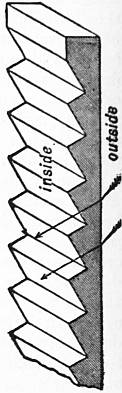
Fig. 1.—Prism Window Glass.
Pavement lights (fig. 2) and stallboard lights are constructed with iron frames in small squares and glazed with thick prismatic glass, and are used to light basements. They are placed on the pavement and under shop fronts in the portion called the stallboard, and are also inserted in iron coal plates.
Great skill has of late years been displayed in the ornamentation of glass such as is seen in public saloons, restaurants, &c., as, for instance, in bevelling the edges, silvering, brilliant cutting, embossing, bending, cutting shelving to fancy shapes and polishing, and in glass ventilators.
There are several patent methods of roof glazing, such as are applied to railway stations, studios and printing and other factories requiring light. Some of the first patents of this kind were erected with wood glazing Roof glazing. bars; these were unsightly, since they required to be of large sectional area when spanning a distance of 7 or 8 ft., and also required to be constantly painted. This was a source of trouble; the roof was constantly leaking and, moreover, it was not fire-resisting.
Of subsequent patents one includes the use of steel T-bars, in which the glass is bedded and covered with a capping of copper or zinc secured with bolts and nuts. Another employs steel bars covered with lead; and this is a very good method, as the bars are of small section, require no painting, and are also fire-resisting. There is one reason for preferring wood to steel, namely, that wood does not expand and contract like steel does. After the sun has been on steel bars, especially those in long lengths, they tend to buckle and then when cold contract, thus getting out of shape; there is also the possibility that when expanding they may break the glass. This is more noticeable in the case of iron ventilating frames in this glazing, which after having weathered for a year or two will begin to get out of shape and so give trouble in opening and closing.
Care should be taken not to fit the glass in iron bars tightly, but a good 1⁄8th in. play all round should be allowed. A few of the systems of patent roof glazing will be described in the following pages, together with illustrations.
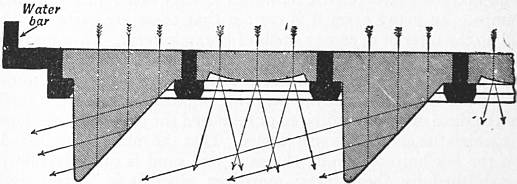
Fig. 2.—Section through Prism Pavement Light, the direction of light rays being indicated by arrows.
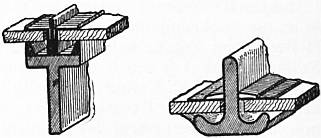
Fig. 3.—“British Challenge” Glazing. Fig. 4.—Mellowes’ Glazing.
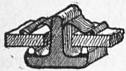
Fig. 5.—Heywood’s Glazing.
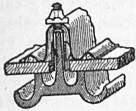
Fig. 6.—Helliwell’s “Perfection” Glazing.
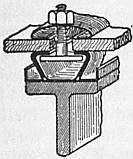
Fig. 7.—Rendle’s “Invincible” Glazing.
The system of glazing known as the “British Challenge” (fig. 3), with steel bars encased with a sheeting of 4-℔ lead, is very simple and durable, needs no painting, and can be fixed at as much as 8 ft. clear bearings, with the bars spaced 2 ft. apart. The ends of the bars rest on the wood or steel purlins or plates, and are either notched and screwed down, or simply fitted with a bracket which is screwed. The bar is of T section with condensation grooves, and the lead wings on top are turned down on to the glass after fitting. This lead-covered steel bar is a great improvement on the plain steel bar as it is entirely unaffected by smoke, acids or exhaust fumes from steam engines; this is important in the case of a railway station, where the fumes would otherwise eat the steel away and so weaken the bars that in time they would snap. Another somewhat similar system is known as “Mellowes’ Eclipse Roof Glazing” (fig. 4). It consists of steel T-bars having lead wings on top to turn on to the glass in a similar manner to the last, the top wings being double and the underside of the bar having an additional wing to catch the condensation. The Heywood combination system (fig. 5) is composed of galvanized steel T-bars, sometimes encased in lead and sometimes partly encased. It has a capping and condensation gutters of lead, and the glass is bedded on asbestos packing to get a better bearing edge, so as to be held more securely. Hope’s glazing is very similar, but the bars are either T or cross according to the span. The “Perfection” glazing used by Messrs Helliwell & Co. (fig. 6) is composed of steel shaped T bars with copper capping, secured with bolts and nuts and having asbestos packing on top of the glass under the edges of the capping. Pennycook’s glazing is composed of steel shaped T bars encased with lead and lead wings. Rendle’s “Invincible” glazing (fig. 7) is composed of steel T bars with specially shaped copper water and condensation channels, all formed in the one piece and resting on top of the T steel; the glass rests on the zinc channel, and a copper capping is fixed over the edges of the glass and secured with bolts and nuts. Deard’s glazing is very similar, and is composed of T steel encased with lead; it claims to save all drilling for fixing to iron roofs. There are also other systems composed of wood bars with condensation gutter and capping of copper secured with bolts and nuts, and asbestos packing with slight differences in some minor matters, but these systems are but little used.
Cloisonné glass is a patent ornamental glass formed by placing two pieces flat against each other enclosing a species of glass mosaic. Designs are worked and shaped in gilt wire and placed on one sheet of glass; the space between the wire is then filled in with coloured beads, and another sheet of glass is placed on top of it to keep them in position, and the edges of the glass are bound with linen, &c., to keep them firmly together.
Glass is now used for decorative purposes, such as wall tiling and ceilings; it is coloured and decorated in almost any shade and presents a very effective appearance. An invention Use in building. has been patented for building houses entirely of glass; the walls are constructed of blocks or bricks of opaque glass, the several walls being varied in thickness according to the constructional requirements.
It is certainly true that daylight has much to do with the sanitary condition of all buildings, and this being so the proper distribution of daylight to a building is of the greatest possible importance, and must be effected by an ample provision of windows judiciously arranged. The heads of all windows should be kept as near the ceiling as possible, as well to obtain easy ventilation as to ensure good lighting. As far as is practicable a building should be planned so that each room receives the sun’s rays for some part of the day. This is rarely an easy matter, especially in towns where the aspect of the building is out of the architect’s hands. The best sites for light are found in streets running north and south and east and west, and lighting areas or courts in buildings should always if possible be arranged on these lines. The task of adequately lighting lofty city buildings has been greatly minimized by the introduction of many forms of reflecting and intensifying contrivances, which are used to deflect light into those apartments into which daylight does not directly penetrate, and which would otherwise require the use of artificial light to render them of any use; the most useful of these inventions are the various forms of prism glass already referred to and illustrated in this article.
See L. F. Day, Stained and Painted Class; and W. Eckstein, Interior Lighting.
(J. Bt.)
GLAZUNOV, ALEXANDER CONSTANTINOVICH (1865- ), Russian musical composer, was born in St Petersburg on the 10th of August 1865, his father being a publisher and bookseller. He showed an early talent for music, and studied for a year or so with Rimsky-Korsakov. At the age of sixteen he composed a symphony (afterwards elaborated and published as op. 5), but his opus 1 was a quartet in D, followed by a pianoforte suite on S-a-c-h-a, the diminutive of his name Alexander. In 1884 he was taken up by Liszt, and soon became known as a composer. His first symphony was played that year at Weimar, and he appeared as a conductor at the Paris exhibition in 1889. In 1897 his fourth and fifth symphonies were performed in London under his own conducting. In 1900 he became professor at the St Petersburg conservatoire. His separate works, including orchestral symphonies, dance music and songs, make a long list. Glazunov is a leading representative of the modern Russian school, and a master of orchestration; his tendency as compared with contemporary Russian composers is towards classical form, and he was much influenced by Brahms, though in “programme music” he is represented by such works as his symphonic poems The Forest, Stenka Razin, The Kremlin and his suite Aus dem Mittelalter. His ballet music, as in Raymonda, achieved much popularity.
GLEBE (Lat. glaeba, gleba, clod or lump of earth, hence soil, land), in ecclesiastical law the land devoted to the maintenance of the incumbent of a church. Burn (Ecclesiastical Law, s.v. “Glebe Lands”) says: “Every church of common right is entitled to house and glebe, and the assigning of them at the first was of such absolute necessity that without them no church could be regularly consecrated. The house and glebe are both comprehended under the word manse, of which the rule of the canon law is, sancitum est ut unicuique ecclesiae unus mansus integer absque ullo servitio tribuatur.” In the technical language of English law the fee-simple of the glebe is said to be in abeyance, that is, it exists “only in the remembrance, expectation and intendment of the law.” But the freehold is in the parson, although at common law he could alienate the same only with proper consent,—that is, in his case, with the consent of the bishop. The disabling statutes of Elizabeth (Alienation by Bishops, 1559, and Dilapidations, &c., 1571) made void all alienations by ecclesiastical persons, except leases for the term of twenty-one years or three lives. By an act of 1842 (5 & 6 Vict. c. 27, Ecclesiastical Leases) glebe land and buildings may be let on lease for farming purposes for fourteen years or on an improving lease for twenty years. But the parsonage house and ten acres of glebe situate most conveniently for occupation must not be leased. By the Ecclesiastical Leasing Acts of 1842 (5 & 6 Vict. c. 108) and 1858 glebe lands may be let on building leases for not more than ninety-nine years and on mining leases for not more than sixty years. The Tithe Act 1842, the Glebe Lands Act 1888 and various other acts make provision for the sale, purchase, exchange and gift of glebe lands. In Scots ecclesiastical law, the manse now signifies the minister’s dwelling-house, the glebe being the land to which he is entitled in addition to his stipend. All parish ministers appear to be entitled to a glebe, except the ministers in royal burghs proper, who cannot claim a glebe unless there be a landowner’s district annexed; and even in that case, when there are two ministers, it is only the first who has a claim.
See Phillimore, Ecclesiastical Law (2nd ed.); Cripps, Law of Church and Clergy; Leach, Tithe Acts (6th ed.); Dart, Vendors and Purchasers (7th ed.).
GLEE, a musical term for a part-song of a particular kind. The word, as well as the thing, is essentially confined to England. The technical meaning has been explained in different ways; but there is little doubt of its derivation through the ordinary sense of the word (i.e. merriment, entertainment) from the A.S. gleov, gleo, corresponding to Lat. gaudium, delectamentum, hence ludus musicus; on the other hand, a musical “glee” is by no means necessarily a merry composition. Gleeman (A.S. “gleo-man”) is translated simply as “musicus” or “cantor,” to which the less distinguished titles of “mimus, jocista, scurra,” are frequently added in old dictionaries. The accomplishments and social position of the gleeman seem to have been as varied as those of the Provençal “joglar.” There are early examples of the word “glee” being used as synonymous with harmony or concerted music. The former explanation, for instance, is given in the Promptorium parvulorum, a work of the 15th century. Glee in its present meaning signifies, broadly speaking, a piece of concerted vocal music, generally unaccompanied, and for male voices, though exceptions are found to the last two restrictions. The number of voices ought not to be less than three. As regards musical form, the glee is little distinguished from the catch,—the two terms being often used indiscriminately for the same song; but there is a distinct difference between it and the madrigal—one of the earliest forms of concerted music known in England. While the madrigal does not show a distinction of contrasted movements, this feature is absolutely necessary in the glee. In the madrigal the movement of the voices is strictly contrapuntal, while the more modern form allows of freer treatment and more compact harmonies. Differences of tonality are fully explained by the development of the art, for while the madrigal reached its acme in Queen Elizabeth’s time, the glee proper was little known before the Commonwealth; and its most famous representatives belong to the 18th century and the first quarter of the 19th. Among the numerous collections of the innumerable pieces of this kind, only one of the earliest and most famous may be mentioned, Catch that Catch can, a Choice Collection of Catches, Rounds and Canons, for three and four voices, published by John Hilton in 1652. The name “glee,” however, appears for the first time in John Playford’s Musical Companion, published twenty-one years afterwards, and reprinted again and again, with additions by later composers—Henry Purcell, William Croft and John Blow among the number. The originator of the glee in its modern form was Dr Arne, born in 1710. Among later English musicians famous for their glees, catches and part-songs, the following may be mentioned:—Attwood, Boyce, Bishop, Crotch, Callcott, Shield, Stevens, Horsley, Webb and Knyvett. The convivial character of the glee led, in the 18th century, to the formation of various societies, which offered prizes and medals for the best compositions of the kind and assembled for social and artistic purposes. The most famous amongst these—The Glee Club—was founded in 1787, and at first used to meet at the house of Mr Robert Smith, in St Paul’s churchyard. This club was dissolved in 1857. A similar society—The Catch Club—was formed in 1761 and is still in existence.
GLEICHEN, two groups of castles in Germany, thus named from their resemblance to each other (Ger. gleich = like, or resembling). The first is a group of three, each situated on a hill in Thuringia between Gotha and Erfurt. One of these called Gleichen, the Wanderslebener Gleiche (1221 ft. above the sea), was besieged unsuccessfully by the emperor Henry IV. in 1088. It was the seat of a line of counts, one of whom, Ernest III., a crusader, is the subject of a romantic legend. Having been captured, he was released from his imprisonment by a Turkish woman, who returned with him to Germany and became his wife, a papal dispensation allowing him to live with two wives at the same time (see Reineck, Die Sage von der Doppelehe eines Grafen von Gleichen, 1891). After belonging to the elector of Mainz the castle became the property of Prussia in 1803. The second castle is called Mühlburg (1309 ft. above the sea). This existed as early as 704 and was besieged by Henry IV. in 1087. It came into the hands of Prussia in 1803. The third castle, Wachsenburg (1358 ft.), is still inhabited and contains a collection of weapons and pictures belonging to its owner, the duke of Saxe-Coburg-Gotha, whose family obtained possession of it in 1368. It was built about 935 (see Beyer, Die drei Gleichen, Erfurt, 1898). The other group consists of two castles, Neuen-Gleichen and Alten-Gleichen. Both are in ruins and crown two hills about 2 m. S.E. from Göttingen.
The name of Gleichen is taken by the family descended from Prince Victor of Hohenlohe-Langenburg through his marriage with Miss Laura Seymour, daughter of Admiral Sir George Francis Seymour, a branch of the Hohenlohe family having at one time owned part of the county of Gleichen.
GLEIG, GEORGE (1753-1840), Scottish divine, was born at Boghall, Kincardineshire, on the 12th of May 1753, the son of a farmer. At the age of thirteen he entered King’s College, Aberdeen, where the first prize in mathematics and physical and moral sciences fell to him. In his twenty-first year he took orders in the Scottish Episcopal Church, and was ordained to the pastoral charge of a congregation at Pittenweem, Fife, whence he removed in 1790 to Stirling. He became a frequent contributor to the Monthly Review, the Gentleman’s Magazine, the Anti-Jacobin Review and the British Critic. He also wrote several articles for the third edition of the Encyclopaedia Britannica, and on the death of the editor, Colin Macfarquhar, in 1793, was engaged to edit the remaining volumes. Among his principal contributions to this work were articles on “Instinct,” “Theology” and “Metaphysics.” The two supplementary volumes were mainly his own work. He was twice chosen bishop of Dunkeld, but the opposition of Bishop Skinner, afterwards primus, rendered the election on both occasions ineffectual. In 1808 he was consecrated assistant and successor to the bishop of Brechin, in 1810 was preferred to the sole charge, and in 1816 was elected primus of the Episcopal Church of Scotland, in which capacity he greatly aided in the introduction of many useful reforms, in fostering a more catholic and tolerant spirit, and in cementing a firm alliance with the sister church of England. He died at Stirling on the 9th of March 1840.
Besides various sermons, Gleig was the author of Directions for the Study of Theology, in a series of letters from a bishop to his son on his admission to holy orders (1827); an edition of Stackhouse’s History of the Bible (1817); and a life of Robertson the historian, prefixed to an edition of his works. See Life of Bishop Gleig, by the Rev. W. Walker (1879). Letters to Henderson of Edinburgh and John Douglas, bishop of Salisbury, are in the British Museum.
His third and only surviving son, George Robert Gleig (1796-1888), was educated at Glasgow University, whence he passed with a Snell exhibition to Balliol College, Oxford. He abandoned his scholastic studies to enter the army, and served with distinction in the Peninsular War (1813-14), and in the American War, in which he was thrice wounded. Resuming his work at Oxford, he proceeded B.A. in 1818, M.A. in 1821, and, having been ordained in 1820, held successively curacies at Westwell in Kent and Ash (to the latter the rectory of Ivy Church was added in 1822). He was subsequently appointed chaplain of Chelsea hospital (1824), chaplain-general of the forces (1844-1875) and inspector-general of military schools (1846-1857). From 1848 till his death on the 9th of July 1888 he was prebend of Willesden in St Paul’s cathedral. During the last sixty years of his life he was a prolific, if not very scientific, writer; he wrote for Blackwood’s Magazine and Fraser’s Magazine, and produced a large number of historical works.