VOLUME XII SLICE I Gichtel, Johann to Glory (continued 3)
Reading edition
In the 1st tablet, after a general survey of the adventures of Gilgamesh, his rule at Erech is described, where he enlists the services of all the young able-bodied men in the building of the great wall of the city. The people sigh under the burden imposed, and call upon the goddess Aruru to create a being who might act as a rival to Gilgamesh, curb his strength, and dispute his tyrannous control. The goddess consents, and creates Eabani, who is described as a wild man, living with the gazelles and the beasts of the field. Eabani, whose name, signifying “Ea creates,” points to the tradition which made Ea (q.v.) the creator of humanity, symbolizes primeval man. Through a hunter, Eabani and Gilgamesh are brought together, but instead of becoming rivals, they are joined in friendship. Eabani is induced by the snares of a maiden to abandon his life with the animals and to proceed to Erech, where Gilgamesh, who has been told in several dreams of the coming of Eabani, awaits him. Together they proceed upon several adventures, which are related in the following four tablets. At first, indeed, Eabani curses the fate which led him away from his former life, and Gilgamesh is represented as bewailing Eabani’s dissatisfaction. The sun-god Shamash calls upon Eabani to remain with Gilgamesh, who pays him all honours in his palace at Erech. With the decision of the two friends to proceed to the forest of cedars in which the goddess Irnina—a form of Ishtar—dwells, and which is guarded by Khumbaba, the 2nd tablet ends. In the 3rd tablet, very imperfectly preserved, Gilgamesh appeals through a Shamash priestess Rimat-Belit to the sun-god Shamash for his aid in the proposed undertaking. The 4th tablet contains a description of the formidable Khumbaba, the guardian of the cedar forest. In the 5th tablet Gilgamesh and Eabani reach the forest. Encouraged by dreams, they proceed against Khumbaba, and despatch him near a specially high cedar over which he held guard. This adventure against Khumbaba belongs to the Eabani stratum of the epic, into which Gilgamesh is artificially introduced. The basis of the 6th tablet is the familiar nature-myth of the change of seasons, in which Gilgamesh plays the part of the youthful solar god of the springtime, who is wooed by the goddess of fertility, Ishtar. Gilgamesh, recalling to the goddess the sad fate of those who fall a victim to her charms, rejects the offer. In the course of his recital snatches of other myths are referred to, including he famous Tammuz-Adonis tale, in which Tammuz, the youthful bridegroom, is slain by his consort Ishtar. The goddess, enraged at the insult, asks her father Anu to avenge her. A divine bull is sent to wage a contest against Gilgamesh, who is assisted by his friend Eabani. This scene of the fight with the bull is often depicted on seal cylinders. The two friends by their united force succeed in killing the bull, and then after performing certain votive and purification rites return to Erech, where they are hailed with joy. In this adventure it is clearly Eabani who is artificially introduced in order to maintain the association with Gilgamesh. The 7th tablet continues the Eabani stratum. The hero is smitten with sore disease, but the fragmentary condition of this and the succeeding tablet is such as to envelop in doubt the accompanying circumstances, including the cause and nature of his disease. The 8th tablet records the death of Eabani. The 9th and 10th tablets, exclusively devoted to Gilgamesh, describe his wanderings in quest of Ut-Napishtim, from whom he hopes to learn how he may escape the fate that has overtaken his friend Eabani. He goes through mountain passes and encounters lions. At the entrance to the mountain Mashu, scorpion-men stand guard, from one of whom he receives advice as to how to pass through the Mashu district. He succeeds in doing so, and finds himself in a wonderful park, which lies along the sea coast. In the 10th tablet the goddess Sabitu, who, as guardian of the sea, first bolts her gate against Gilgamesh, after learning of his quest, helps him to pass in a ship across the sea to the “waters of death.” The ferry-man of Ut-Napishtim brings him safely through these waters, despite the difficulties and dangers of the voyage, and at last the hero finds himself face to face with Ut-Napishtim. In the 11th tablet, Ut-Napishtim tells the famous story of the Babylonian flood, which is so patently attached to Gilgamesh in a most artificial manner. Ut-Napishtim and his wife are anxious to help Gilgamesh to new life. He is sent to a place where he washes himself clean from impurity. He is told of a weed which restores youth to the one grown old. Scarcely has he obtained the weed when it is snatched away from him, and the tablet closes somewhat obscurely with the prediction of the destruction of Erech. In the 12th tablet Gilgamesh succeeds in obtaining a view of Eabani’s shade, and learns through him of the sad fate endured by the dead. With this description, in which care of the dead is inculcated as the only means of making their existence in Aralu, where the dead are gathered, bearable, the epic, so far as we have it, closes.
The reason why the flood episode and the interview with the dead Eabani are introduced is quite clear. Both are intended as illustrations of doctrines taught in the schools of Babylonia; the former to explain that only the favourites of the gods can hope under exceptional circumstances to enjoy life everlasting; the latter to emphasize the impossibility for ordinary mortals to escape from the inactive shadowy existence led by the dead, and to inculcate the duty of proper care for the dead. That the astro-theological system is also introduced into the epic is clear from the division into twelve tablets, which correspond to the yearly course of the sun, while throughout there are indications that all the adventures of Gilgamesh and Eabani, including those which have an historical background, have been submitted to the influence of this system and projected on to the heavens. This interpretation of the popular tales, according to which the career of the hero can be followed in its entirety and in detail in the movements in the heavens, in time, with the growing predominance of the astral-mythological system, overshadowed the other factors involved, and it is in this form, as an astral myth, that it passes through the ancient world and leaves its traces in the folk-tales and myths of Hebrews, Phoenicians, Syrians, Greeks and Romans throughout Asia Minor and even in India.
Bibliography.—The complete edition of the Gilgamesh Epic by Paul Haupt under the title Das babylonische Nimrodepos (Leipzig, 1884-1891), with the 12th tablet in the Beiträge zur Assyriologie, i. 48-79; German translation by Peter Jensen in vol. vi. of Schrader’s Keilinschriftliche Bibliothek (Berlin, 1900), pp. 116-273. See also the same author’s comprehensive work, Das Gilgamesch-Epos in der Weltliteratur (vol. i. 1906, vol. ii. to follow). An English translation of the chief portions in Jastrow, Religion of Babylonia and Assyria (Boston, 1898), ch. xxiii.
(M. Ja.)
1 The name of the hero, written always ideographically, was for a long time provisionally read Izdubar; but a tablet discovered by T. G. Pinches gave the equivalent Gilgamesh (see Jastrow, Religion of Babylonia and Assyria, p. 468).
GILGIT, an outlying province in the extreme north-west of India, over which Kashmir has reasserted her sovereignty. Only a part of the basin of the river Gilgit is included within its political boundaries. There is an intervening width of mountainous country, represented chiefly by glaciers and ice-fields, and intersected by narrow sterile valleys, measuring some 100 to 150 m. in width, to the north and north-east, which separates the province of Gilgit from the Chinese frontier beyond the Muztagh and Karakoram. This part of the Kashmir borderland includes Kanjut (or Hunza) and Ladakh. To the north-west, beyond the sources of the Yasin and Ghazar in the Shandur range (the two most westerly tributaries of the Gilgit river) is the deep valley of the Yarkhun or Chitral. Since the formation of the North-West Frontier Province in 1901, the political charge of Chitral, Dir and Swat, which was formerly included within the Gilgit agency, has been transferred to the chief commissioner of the new province, with his capital at Peshawar. Gilgit proper now forms a wazarat of the Kashmir state, administered by a wazir. Gilgit is also the headquarters of a British political agent, who exercises some supervision over the wazir, and is directly responsible to the government of India for the administration of the outlying districts or petty states of Hunza, Nagar, Ashkuman, Yasin and Ghizar, the little republic of Chilas, &c. These states acknowledge the suzerainty of Kashmir, paying an annual tribute in gold or grain, but they form no part of its territory.
Within the wider limits of the former Gilgit agency are many mixed races, speaking different languages, which have all been usually classed together under the name Dard. The Dard, however, is unknown beyond the limits of the Kohistan district of the Indus valley to the south of the Hindu Koh, the rest of the inhabitants of the Indus valley belonging to Shin republics, or Chilas. The great mass of the Chitral population are Kho (speaking Khowar), and they may be accepted as representing the aboriginal population of the Chitral valley. (See Hindu Kush.) Between Chitral and the Indus the “Dards” of Dardistan are chiefly Yeshkuns and Shins, and it would appear from the proportions in which these people occupy the country that they must have primarily moved up from the valley of the Indus in successive waves of conquest, first the Yeshkuns, and then the Shins. No one can put a date to these invasions, but Biddulph is inclined to class the Yeshkuns with the Yuechi who conquered the Bactrian kingdom about 120 B.C. The Shins are obviously a Hindu race (as is testified by their veneration for the cow), who spread themselves northwards and eastwards as far as Baltistan, where they collided with the aboriginal Tatar of the Asiatic highlands. But the ethnography of “Dardistan,” or the Gilgit agency (for the two are, roughly speaking, synonymous), requires further investigation, and it would be premature to attempt to frame anything like an ethnographical history of these regions until the neighbouring provinces of Tangir and Darel have been more fully examined. The wazarat of Gilgit contains a population (1901) of 60,885, all Mahommedans, mostly of the Shiah sect, but not fanatical. The dominant race is that of the Shins, whose language is universally spoken. This is one of the so-called Pisacha languages, an archaic Aryan group intermediate between the Iranian and the Sanskritic.
In general appearance and dress all the mountain-bred peoples extending through these northern districts are very similar. Thick felt coats reaching below the knee, loose “pyjamas” with cloth “putties” and boots (often of English make) are almost universal, the distinguishing feature in their costume being the felt cap worn close to the head and rolled up round the edges. They are on the whole a light-hearted, cheerful race of people, but it has been observed that their temperament varies much with their habitat—those who live on the shadowed sides of mountains being distinctly more morose and more serious in disposition than the dwellers in valleys which catch the winter sunlight. They are, at the same time, bloodthirsty and treacherous to a degree which would appear incredible to a casual observer of their happy and genial manners, exhibiting a strange combination (as has been observed by a careful student of their ways) of “the monkey and the tiger.” Addicted to sport of every kind, they pursue no manufacturing industries whatsoever, but they are excellent agriculturists, and show great ingenuity in their local irrigation works and in their efforts to bring every available acre of cultivable soil within the irrigated area. Gold washing is more or less carried on in most of the valleys north of the river Gilgit, and gold dust (contained in small packets formed with the petals of a cup-shaped flower) is an invariable item in their official presents and offerings. Gold dust still constitutes part of the annual tribute which, strangely enough, is paid by Hunza to China, as well as to Kashmir.
Routes in the Gilgit Agency.—One of the oldest recorded routes through this country is that which connects Mastuj in the Chitral valley with Gilgit, passing across the Shandur range (12,250). It now forms the high-road between Gilgit and Chitral, and has been engineered into a passable route. From the north three great glacier-bred affluents make their way to the river of Gilgit, joining it at almost equal intervals, and each of them affords opportunity for a rough passage northwards. (1) The Yasin river, which follows a fairly straight course from north to south for about 40 m. from the foot of the Darkôt pass across the Shandur range (15,000) to its junction with the river Gilgit, close to the little fort of Gupis, on the Gilgit-Mastuj road. Much of this valley is cultivated and extremely picturesque. At the head of it is a grand group of glaciers, one of which leads up to the well-known pass of Darkôt. (2) 25 m. (by map measurement) below Gupis the Gilgit receives the Ashkuman affluent from the north. The little Lake of Karumbar is held to be its source, as it lies at the head of the river. The same lake is sometimes called the source of the river Yarkhun or Chitral; and it seems possible that a part of its waters may be deflected in each direction. The Karumbar, or Ashkuman, is nearly twice the length of the Yasin, and the upper half of the valley is encompassed by glaciers, rendering the route along it uncertain and difficult. (3) 40 m. or so below the Ashkuman junction, and nearly opposite the little station of Gilgit, the river receives certain further contributions from the north which are collected in the Hunza and Nagar basins. These basins include a system of glaciers of such gigantic proportions that they are probably unrivalled in any part of the world. The glacial head of the Hunza is not far from that of the Karumbar, and, like the Karumbar, the river commences with a wide sweep eastwards, following a course roughly parallel to the crest of the Hindu Kush (under whose southern slopes it lies close) for about 40 m. Then striking south for another 40 m., it twists amidst the barren feet of gigantic rock-bound spurs which reach upwards to the Muztagh peaks on the east and to a mass of glaciers and snow-fields on the west, hidden amidst the upper folds of mountains towering to an average of 25,000 ft. The next great bend is again to the west for 30 m., before a final change of direction to the south at the historical position of Chalt and a comparatively straight run of 25 m. to a junction with the Gilgit. The valley of Hunza lies some 10 m. from the point of this westerly bend, and 20 (as the crow flies) from Chalt. Much has been written of the magnificence of Hunza valley scenery, surrounded as it is by a stupendous ring of snow-capped peaks and brightened with all the radiant beauty that cultivation adds to these mountain valleys; but such scenery must be regarded as exceptional in these northern regions.
Glaciers and Mountains.—Conway and Godwin Austen have described the glaciers of Nagar which, enclosed between the Muztagh spurs on the north-east and the frontier peaks of Kashmir (terminating with Rakapushi) on the south-west, and massing themselves in an almost uninterrupted series from the Hunza valley to the base of those gigantic peaks which stand about Mount Godwin Austen, seem to be set like an ice-sea to define the farthest bounds of the Himalaya. From its uttermost head to the foot of the Hispar, overhanging the valley above Nagar, the length of the glacial ice-bed known under the name of Biafo is said to measure about 90 m. Throughout the mountain region of Kanjut (or Hunza) and Nagar the valleys are deeply sunk between mountain ranges, which are nowhere less than 15,000 ft. in altitude, and which must average above 20,000 ft. As a rule, these valleys are bare of vegetation. Where the summits of the loftier ranges are not buried beneath snow and ice they are bare, bleak and splintered, and the nakedness of the rock scenery extends down their rugged spurs to the very base of them. On the lower slopes of tumbled débris the sun in summer beats with an intensity which is unmitigated by the cloud drifts which form in the moister atmosphere of the monsoon-swept summits of the Himalaya. Sun-baked in summer and frost-riven in winter, the mountain sides are but immense ramps of loose rock débris, only awaiting the yearly melting of the upper snow-fields, or the advent of a casual rainstorm, to be swept downwards in an avalanche of mud and stones into the gorges below. Here it becomes piled and massed together, till the pressure of accumulation forces it out into the main valleys, where it spreads in alluvial fans and silts up the plains. This formation is especially marked throughout the high level valleys of the Gilgit basin.
Passes.—Each of these northern affluents of the main stream is headed by a pass, or a group of passes, leading either to the Pamir region direct, or into the upper Yarkhun valley from which a Pamir route diverges. The Yasin valley is headed by the Darkôt pass (15,000 ft.), which drops into the Yarkhun not far from the foot of the Baroghil group over the main Hindu Kush watershed. The Ashkuman is headed by the Gazar and Kora Bohrt passes, leading to the valley of the Ab-i-Punja; and the Hunza by the Kilik and Mintaka, the connecting links between the Taghdumbash Pamir and the Gilgit basin. They are all about the same height—15,000 ft. All are passable at certain times of the year to small parties, and all are uncertain. In no case do they present insuperable difficulties in themselves, glaciers and snow-fields and mountain staircases being common to all; but the gorges and precipices which distinguish the approaches to them from the south, the slippery sides of shelving spurs whose feet are washed by raging torrents, the perpetual weary monotony of ascent and descent over successive ridges multiplying the gradient indefinitely—these form the real obstacles blocking the way to these northern passes.
Gilgit Station.—The pretty little station of Gilgit (4890 ft. above sea) spreads itself in terraces above the right bank of the river nearly opposite the opening leading to Hunza, almost nestling under the cliffs of the Hindu Koh, which separates it on the south from the savage mountain wilderness of Darel and Kohistan. It includes a residency for the British political officer, with about half a dozen homes for the accommodation of officials, barracks suitable for a battalion of Kashmir troops, and a hospital. Evidences of Buddhist occupation are not wanting in Gilgit, though they are few and unimportant. Such as they are, they appear to prove that Gilgit was once a Buddhist centre, and that the old Buddhist route between Gilgit and the Peshawar plain passed through the gorges and clefts of the unexplored Darel valley to Thakot under the northern spurs of the Black Mountain.
Connexion with India.—The Gilgit river joins the Indus a few miles above the little post of Bunji, where an excellent suspension bridge spans the river. The valley is low and hot, and the scenery between Gilgit and Bunji is monotonous; but the road is now maintained in excellent condition. A little below Bunji the Astor river joins the Indus from the south-east, and this deep pine-clad valley indicates the continuation of the highroad from Gilgit to Kashmir via the Tragbal and Burzil passes. Another well-known route connecting Gilgit with the Abbottabad frontier of the Punjab lies across the Babusar pass (13,000 ft.), linking the lovely Hazara valley of Kaghan to Chilas; Chilas (4150 ft.) being on the Indus, some 50 m. below Bunji. This is a more direct connexion between Gilgit and the plains of the Punjab than that afforded by the Kashmir route via Gurais and Astor, which latter route involves two considerable passes—the Tragbal (11,400) and the Burzil (13,500); but the intervening strip of absolutely independent territory (independent alike of Kashmir and the Punjab), which includes the hills bordering the road from the Babusar pass to Chilas, renders it a risky route for travellers unprotected by a military escort. Like the Kashmir route, it is now defined by a good military road.
History.—The Dards are located by Ptolemy with surprising accuracy (Daradae) on the west of the Upper Indus, beyond the head-waters of the Swat river (Soastus), and north of the Gandarae, i.e. the Gandharis, who occupied Peshawar and the country north of it. The Dardas and Chinas also appear in many of the old Pauranic lists of peoples, the latter probably representing the Shin branch of the Dards. This region was traversed by two of the Chinese pilgrims of the early centuries of our era, who have left records of their journeys, viz. Fahien, coming from the north, c. 400, and Hsüan Tsang, ascending from Swat, c. 631. The latter says: “Perilous were the roads, and dark the gorges. Sometimes the pilgrim had to pass by loose cords, sometimes by light stretched iron chains. Here there were ledges hanging in mid-air; there flying bridges across abysses; elsewhere paths cut with the chisel, or footings to climb by.” Yet even in these inaccessible regions were found great convents, and miraculous images of Buddha. How old the name of Gilgit is we do not know, but it occurs in the writings of the great Mahommedan savant al-Biruni, in his notices of Indian geography. Speaking of Kashmir, he says: “Leaving the ravine by which you enter Kashmir and entering the plateau, then you have for a march of two more days on your left the mountains of Bolor and Shamilan, Turkish tribes who are called Bhattavaryan. Their king has the title Bhatta-Shah. Their towns are Gilgit, Aswira and Shiltash, and their language is the Turkish. Kashmir suffers much from their inroads” (Trs. Sachau, i. 207). There are difficult matters for discussion here. It is impossible to say what ground the writer had for calling the people Turks. But it is curious that the Shins say they are all of the same race as the Moguls of India, whatever they may mean by that. Gilgit, as far back as tradition goes, was ruled by rajas of a family called Trakane. When this family became extinct the valley was desolated by successive invasions of neighbouring rajas, and in the 20 or 30 years ending with 1842 there had been five dynastic revolutions. The most prominent character in the history was a certain Gaur Rahman or Gauhar Aman, chief of Yasin, a cruel savage and man-seller, of whom many evil deeds are told. Being remonstrated with for selling a mullah, he said, “Why not? The Koran, the word of God, is sold; why not sell the expounder thereof?” The Sikhs entered Gilgit about 1842, and kept a garrison there. When Kashmir was made over to Maharaja Gulab Singh of Jammu in 1846, by Lord Hardinge, the Gilgit claims were transferred with it. And when a commission was sent to lay down boundaries of the tracts made over, Mr Vans Agnew (afterwards murdered at Multan) and Lieut. Ralph Young of the Engineers visited Gilgit, the first Englishmen who did so. The Dogras (Gulab Singh’s race) had much ado to hold their ground, and in 1852 a catastrophe occurred, parallel on a smaller scale to that of the English troops at Kabul. Nearly 2000 men of theirs were exterminated by Gaur Rahman and a combination of the Dards; only one person, a soldier’s wife, escaped, and the Dogras were driven away for eight years. Gulab Singh would not again cross the Indus, but after his death (in 1857) Maharaja Ranbir Singh longed to recover lost prestige. In 1860 he sent a force into Gilgit. Gaur Rahman just then died, and there was little resistance. The Dogras after that took Yasin twice, but did not hold it. They also, in 1866, invaded Darel, one of the most secluded Dard states, to the south of the Gilgit basin, but withdrew again. In 1889, in order to guard against the advance of Russia, the British government, acting as the suzerain power of Kashmir, established the Gilgit agency; in 1901, on the formation of the North-West Frontier province, the rearrangement was made as stated above.
Authorities.—Biddulph, The Tribes of the Hindu Kush (Calcutta, 1880); W. Lawrence, The Kashmir Valley (London, 1895); Tanner, “Our Present Knowledge of the Himalaya,” Proc. R.G.S. vol. xiii., 1891; Durand, Making a Frontier (London, 1899); Report of Lockhart’s Mission (Calcutta, 1886); E. F. Knight, Where Three Empires Meet (London, 1892); F. Younghusband, “Journeys in the Pamirs and Adjacent Countries,” Proc. R.G.S. vol. xiv., 1892; Curzon, “Pamirs,” Jour. R.G.S. vol. viii., 1896; Leitnér, Dardistan (1877).
(T. H. H.*)
GILL, JOHN (1697-1771), English Nonconformist divine, was born at Kettering, Northamptonshire. His parents were poor and he owed his education chiefly to his own perseverance. In November 1716 he was baptized and began to preach at Higham Ferrers and Kettering, until the beginning of 1719, when he became pastor of the Baptist congregation at Horsleydown in Southwark. There he continued till 1757, when he removed to a chapel near London Bridge. From 1729 to 1756 he was Wednesday evening lecturer in Great Eastcheap. In 1748 he received the degree of D.D. from the university of Aberdeen. He died at Camberwell on the 14th of October 1771. Gill was a great Hebrew scholar, and in his theology a sturdy Calvinist.
His principal works are Exposition of the Song of Solomon (1728); The Prophecies of the Old Testament respecting the Messiah (1728); The Doctrine of the Trinity (1731); The Cause of God and Truth (4 vols., 1731); Exposition of the Bible, in 10 vols. (1746-1766), in preparing which he formed a large collection of Hebrew and Rabbinical books and MSS.; The Antiquity of the Hebrew Language—Letters, Vowel Points, and Accents (1767); A Body of Doctrinal Divinity (1767); A Body of Practical Divinity (1770); and Sermons and Tracts, with a memoir of his life (1773). An edition of his Exposition of the Bible appeared in 1816 with a memoir by John Rippon, which has also appeared separately.
GILL. (1) One of the branchiae which form the breathing apparatus of fishes and other animals that live in the water. The word is also applied to the branchiae of some kinds of worm and arachnids, and by transference to objects resembling the branchiae of fishes, such as the wattles of a fowl, or the radiating films on the under side of fungi. The word is of obscure origin. Danish has giaelle, and Swedish gäl with the same meaning. The root which appears in “yawn,” “chasm,” has been suggested. If this be correct, the word will be in origin the same as “gill,” often spelled “ghyll,” meaning a glen or ravine, common in northern English dialects and also in Kent and Surrey. The g in both these words is hard. (2) A liquid measure usually holding one-fourth of a pint. The word comes through the O. Fr. gelle, from Low Lat. gello or gillo, a measure for wine. It is thus connected with “gallon.” The g is soft. (3) An abbreviation of the feminine name Gillian, also often spelled Jill, as it is pronounced. Like Jack for a boy, with which it is often coupled, as in the nursery rhyme, it is used as a homely generic name for a girl.
GILLES DE ROYE, or Egidius de Roya (d. 1478), Flemish chronicler, was born probably at Montdidier, and became a Cistercian monk. He was afterwards professor of theology in Paris and abbot of the monastery of Royaumont at Asnières-sur-Oise, retiring about 1458 to the convent of Notre Dame des Dunes, near Furnes, and devoting his time to study. Gilles wrote the Chronicon Dunense or Annales Belgici, a résumé and continuation of the work of another monk, Jean Brandon (d. 1428), which deals with the history of Flanders, and also with events in Germany, Italy and England from 792 to 1478.
The Chronicle was published by F. R. Sweert in the Rerum Belgicarum annales (Frankfort, 1620); and the earlier part of it by C. B. Kervyn de Lettenhove in the Chroniques relatives à l’histoire de la Belgique (Brussels, 1870).
GILLES LI MUISIS, or Le Muiset (c. 1272-1352), French chronicler, was born probably at Tournai, and in 1289 entered the Benedictine abbey of St Martin in his native city, becoming prior of this house in 1327, and abbot four years later. He only secured the latter position after a contest with a competitor, but he appears to have been a wise ruler of the abbey. Gilles wrote two Latin chronicles, Chronicon majus and Chronicon minus, dealing with the history of the world from the creation until 1349. This work, which was continued by another writer to 1352, is valuable for the history of northern France, and Flanders during the first half of the 14th century. It is published by J. J. de Senet in the Corpus chronicorum Flandriae, tome ii. (Brussels, 1841); Gilles also wrote some French poems, and these Poésies de Gilles li Muisis have been published by Baron Kervyn de Lettenhove (Louvain, 1882).
See A. Molinier, Les Sources de l’histoire de France, tome iii. (Paris, 1903).
GILLESPIE, GEORGE (1613-1648), Scottish divine, was born at Kirkcaldy, where his father, John Gillespie, was parish minister, on the 21st of January 1613, and entered the university of St Andrews as a “presbytery bursar” in 1629. On the completion of a brilliant student career, he became domestic chaplain to John Gordon, 1st Viscount Kenmure (d. 1634), and afterwards to John Kennedy, earl of Cassillis, his conscience not permitting him to accept the episcopal ordination which was at that time in Scotland an indispensable condition of induction to a parish. While with the earl of Cassillis he wrote his first work, A Dispute against the English Popish Ceremonies obtruded upon the Church of Scotland, which, opportunely published shortly after the “Jenny Geddes” incident (but without the author’s name) in the summer of 1637, attracted considerable attention, and within a few months had been found by the privy council to be so damaging that by their orders all available copies were called in and burnt. In April 1638, soon after the authority of the bishops had been set aside by the nation, Gillespie was ordained minister of Wemyss (Fife) by the presbytery of Kirkcaldy, and in the same year was a member of the famous Glasgow Assembly, before which he preached (November 21st) a sermon against royal interference in matters ecclesiastical so pronounced, as to call for some remonstrance on the part of Argyll, the lord high commissioner. In 1642 Gillespie was translated to Edinburgh; but the brief remainder of his life was chiefly spent in the conduct of public business in London. Already, in 1640, he had accompanied the commissioners of the peace to England as one of their chaplains; and in 1643 he was appointed by the Scottish Church one of the four commissioners to the Westminster Assembly. Here, though the youngest member of the Assembly, he took a prominent part in almost all the protracted discussions on church government, discipline and worship, supporting Presbyterianism by numerous controversial writings, as well as by an unusual fluency and readiness in debate. Tradition long preserved and probably enhanced the record of his victories in debate, and especially of his encounter, with John Selden on Matt. xviii. 15-17. In 1645 he returned to Scotland, and is said to have drawn the act of assembly sanctioning the directory of public worship. On his return to London he had a hand in drafting the Westminster confession of faith, especially chap. i. Gillespie was elected moderator of the Assembly in 1648, but the laborious duties of that office (the court continued to sit from the 12th of July to the 12th of August) told fatally on an overtaxed constitution; he fell into consumption, and, after many weeks of great weakness, he died at Kirkcaldy on the 17th of December 1648. In acknowledgment of his great public services, a sum of £1000 Scots was voted, though destined never to be paid, to his widow and children by the committee of estates. A simple tombstone, which had been erected to his memory in Kirkcaldy parish church, was in 1661 publicly broken at the cross by the hand of the common hangman, but was restored in 1746.
His principal publications were controversial and chiefly against Erastianism: Three sermons against Thomas Coleman; A Sermon before the House of Lords (August 27th), on Matt. iii. 2, Nihil Respondem and Male Audis; Aaron’s Rod Blossoming, or the Divine Ordinance of Church-government vindicated (1646), which is deservedly regarded as a really able statement of the case for an exclusive spiritual jurisdiction in the church; One Hundred and Eleven Propositions concerning the Ministry and Government of the Church (Edinburgh, 1647). The following were posthumously published by his brother: A Treatise of Miscellany Questions (1649); The Ark of the New Testament (2 vols., 1661-1667); Notes of Debates and Proceedings of the Assembly of Divines at Westminster, from February 1644 to January 1645. See Works, with memoir, published by Hetherington (Edinburgh, 1843-1846).
GILLESPIE, THOMAS (1708-1774), Scottish divine, was born at Clearburn, in the parish of Duddingston, Midlothian, in 1708. He was educated at the university of Edinburgh, and studied divinity first at a small theological seminary at Perth, and afterwards for a brief period under Philip Doddridge at Northampton, where he received ordination in January 1741. In September of the same year he was admitted minister of the parish of Carnock, Fife, the presbytery of Dunfermline agreeing not only to sustain as valid the ordination he had received in England, but also to allow a qualification of his subscription to the church’s doctrinal symbol, so far as it had reference to the sphere of the civil magistrate in matters of religion. Having on conscientious grounds persistently absented himself from the meetings of presbytery held for the purpose of ordaining one Andrew Richardson, an unacceptable presentee, as minister of Inverkeithing, he was, after an unobtrusive but useful ministry of ten years, deposed by the Assembly of 1752 for maintaining that the refusal of the local presbytery to act in this case was justified. He continued, however, to preach, first at Carnock, and afterwards in Dunfermline, where a large congregation gathered round him. His conduct under the sentence of deposition produced a reaction in his favour, and an effort was made to have him reinstated; this he declined unless the policy of the church were reversed. In 1761, in conjunction with Thomas Boston of Jedburgh and Collier of Colinsburgh, he formed a distinct communion under the name of “The Presbytery of Relief,”—relief, that is to say, “from the yoke of patronage and the tyranny of the church courts.” The Relief Church eventually became one of the communions combining to form the United Presbyterian Church. He died on the 19th of January 1774. His only literary efforts were an Essay on the Continuation of Immediate Revelations in the Church, and a Practical Treatise on Temptation. Both works appeared posthumously (1774). In the former he argues that immediate revelations are no longer vouchsafed to the church, in the latter he traces temptation to the work of a personal devil.
See Lindsay’s Life and Times of the Rev. Thomas Gillespie; Smithers’s History of the Relief Church; for the Relief Church see United Presbyterian Church.
GILLIE (from the Gael. gille, Irish gille or giolla, a servant or boy), an attendant on a Gaelic chieftain; in this sense its use, save historically, is rare. The name is now applied in the Highlands of Scotland to the man-servant who attends a sportsman in shooting or fishing. A gillie-wetfoot, a term now obsolete (a translation of gillie-casfliuch, from the Gaelic cas, foot, and fliuch, wet), was the gillie whose duty it was to carry his master over streams. It became a term of contempt among the Lowlanders for the “tail” (as his attendants were called) of a Highland chief.
GILLIES, JOHN (1747-1836), Scottish historian and classical scholar, was born at Brechin, in Forfarshire, on the 18th of January 1747. He was educated at Glasgow University, where, at the age of twenty, he acted for a short time as substitute for the professor of Greek. In 1784 he completed his History of Ancient Greece, its Colonies and Conquests (published 1786). This work, valuable at a time when the study of Greek history was in its infancy, and translated into French and German, was written from a strong Whig bias, and is now entirely superseded (see Greece: Ancient History, “Authorities”). On the death of William Robertson (1721-1793), Gillies was appointed historiographer-royal for Scotland. In his old age he retired to Clapham, where he died on the 15th of February 1836.
Of his other works, none of which are much read, the principal are: View of the Reign of Frederic II. of Prussia, with a Parallel between that Prince and Philip II. of Macedon (1789), rather a panegyric than a critical history; translations of Aristotle’s Rhetoric (1823) and Ethics and Politics (1786-1797); of the Orations of Lysias and Isocrates (1778); and History of the World from Alexander to Augustus (1807), which, although deficient in style, was commended for its learning and research.
GILLINGHAM, a market town in the northern parliamentary division of Dorsetshire, England, 105 m. W.S.W. from London by the London & South-Western railway. Pop. (1901) 3380. The church of St Mary the Virgin has a Decorated chancel. There is a large agricultural trade, and manufactures of bricks and tiles, cord, sacking and silk, brewing and bacon-curing are carried on. The rich undulating district in which Gillingham is situated was a forest preserved by King John and his successors, and the site of their lodge is traceable near the town.
GILLINGHAM, a municipal borough of Kent, England, in the parliamentary borough of Chatham and the mid-division of the county, on the Medway immediately east of Chatham, on the South-Eastern & Chatham railway. Pop. (1891) 27,809; (1901) 42,530. Its population is largely industrial, employed in the Chatham dockyards, and in cement and brick works in the neighbourhood. The church of St Mary Magdalene ranges in date from Early English to Perpendicular, retaining also traces of Norman work and some early brasses. A great battle between Edmund Ironside and Canute, c. 1016, is placed here; and there was formerly a palace of the archbishops of Canterbury. Gillingham was incorporated in 1903, and is governed by a mayor, 6 aldermen and 18 councillors. The borough includes the populous districts of Brompton and New Brompton. Area, 4355 acres.
GILLOT, CLAUDE (1673-1722), French painter, best known as the master of Watteau and Lancret, was born at Langres. His sportive mythological landscape pieces, with such titles as “Feast of Pan” and “Feast of Bacchus,” opened the Academy of Painting at Paris to him in 1715; and he then adapted his art to the fashionable tastes of the day, and introduced the decorative fêtes champêtres, in which he was afterwards surpassed by his pupils. He was also closely connected with the opera and theatre as a designer of scenery and costumes.
GILLOTT, JOSEPH (1799-1873); English pen-maker, was born at Sheffield on the 11th of October 1799. For some time he was a working cutler there, but in 1821 removed to Birmingham, where he found employment in the “steel toy” trade, the technical name for the manufacture of steel buckles, chains and light ornamental steel-work generally. About 1830 he turned his attention to the manufacture of steel pens by machinery, and in 1831 patented a process for placing elongated points on the nibs of pens. Subsequently he invented other improvements, getting rid of the hardness and lack of flexibility, which had been a serious defect in nibs, by cutting, in addition to the centre slit, side slits, and cross grinding the points. By 1859 he had built up a very large business. Gillott was a liberal art-patron, and one of the first to recognize the merits of J. M. W. Turner. He died at Birmingham on the 5th of January 1873. His collection of pictures, sold after his death, realized £170,000.
GILLOW, ROBERT (d. 1773), the founder at Lancaster of a distinguished firm of English cabinet-makers and furniture designers whose books begin in 1731. He was succeeded by his eldest son Richard (1734-1811), who after being educated at the Roman Catholic seminary at Douai was taken into partnership about 1757, when the firm became Gillow & Barton, and his younger sons Robert and Thomas, and the business was continued by his grandson Richard (1778-1866). In its early days the firm of Gillow were architects as well as cabinet-makers, and the first Richard Gillow designed the classical Custom House at Lancaster. In the middle of the 18th century the business was extended to London, and about 1761 premises were opened in Oxford Street on a site which was continuously occupied until 1906. For a long period the Gillows were the best-known makers of English furniture—Sheraton and Heppelwhite both designed for them, and replicas are still made of pieces from the drawings of Robert Adam. Between 1760 and 1770 they invented the original form of the billiard-table; they were the patentees (about 1800) of the telescopic dining-table which has long been universal in English houses; for a Captain Davenport they made, if they did not invent, the first writing-table of that name. Their vogue is indicated by references to them in the works of Jane Austen, Thackeray and the first Lord Lytton, and more recently in one of Gilbert and Sullivan’s comic operas.
GILLRAY, JAMES (1757-1815), English caricaturist, was born at Chelsea in 1757. His father, a native of Lanark, had served as a soldier, losing an arm at Fontenoy, and was admitted first as an inmate, and afterwards as an outdoor pensioner, at Chelsea hospital. Gillray commenced life by learning letter-engraving, in which he soon became an adept. This employment, however, proving irksome, he wandered about for a time with a company of strolling players. After a very checkered experience he returned to London, and was admitted a student in the Royal Academy, supporting himself by engraving, and probably issuing a considerable number of caricatures under fictitious names. Hogarth’s works were the delight and study of his early years. “Paddy on Horseback,” which appeared in 1779, is the first caricature which is certainly his. Two caricatures on Rodney’s naval victory, issued in 1782, were among the first of the memorable series of his political sketches. The name of Gillray’s publisher and printseller, Miss Humphrey—whose shop was first at 227 Strand, then in New Bond Street, then in Old Bond Street, and finally in St James’s Street—is inextricably associated with that of the caricaturist. Gillray lived with Miss (often called Mrs) Humphrey during all the period of his fame. It is believed that he several times thought of marrying her, and that on one occasion the pair were on their way to the church, when Gillray said: “This is a foolish affair, methinks, Miss Humphrey. We live very comfortably together; we had better let well alone.” There is no evidence, however, to support the stories which scandalmongers invented about their relations. Gillray’s plates were exposed in Humphrey’s shop window, where eager crowds examined them. A number of his most trenchant satires are directed against George III., who, after examining some of Gillray’s sketches, said, with characteristic ignorance and blindness to merit, “I don’t understand these caricatures.” Gillray revenged himself for this utterance by his splendid caricature entitled, “A Connoisseur Examining a Cooper,” which he is doing by means of a candle on a “save-all”; so that the sketch satirizes at once the king’s pretensions to knowledge of art and his miserly habits.
The excesses of the French Revolution made Gillray conservative; and he issued caricature after caricature, ridiculing the French and Napoleon, and glorifying John Bull. He is not, however, to be thought of as a keen political adherent of either the Whig or the Tory party; he dealt his blows pretty freely all round. His last work, from a design by Bunbury, is entitled “Interior of a Barber’s Shop in Assize Time,” and is dated 1811. While he was engaged on it he became mad, although he had occasional intervals of sanity, which he employed on his last work. The approach of madness must have been hastened by his intemperate habits. Gillray died on the 1st of June 1815, and was buried in St James’s churchyard, Piccadilly.
The times in which Gillray lived were peculiarly favourable to the growth of a great school of caricature. Party warfare was carried on with great vigour and not a little bitterness; and personalities were freely indulged in on both sides. Gillray’s incomparable wit and humour, knowledge of life, fertility of resource, keen sense of the ludicrous, and beauty of execution, at once gave him the first place among caricaturists. He is honourably distinguished in the history of caricature by the fact that his sketches are real works of art. The ideas embodied in some of them are sublime and poetically magnificent in their intensity of meaning; while the coarseness by which others are disfigured is to be explained by the general freedom of treatment common in all intellectual departments in the 18th century. The historical value of Gillray’s work has been recognized by accurate students of history. As has been well remarked: “Lord Stanhope has turned Gillray to account as a veracious reporter of speeches, as well as a suggestive illustrator of events.” His contemporary political influence is borne witness to in a letter from Lord Bateman, dated November 3, 1798. “The Opposition,” he writes to Gillray, “are as low as we can wish them. You have been of infinite service in lowering them, and making them ridiculous.” Gillray’s extraordinary industry may be inferred from the fact that nearly 1000 caricatures have been attributed to him; while some consider him the author of 1600 or 1700. He is invaluable to the student of English manners as well as to the political student. He attacks the social follies of the time with scathing satire; and nothing escapes his notice, not even a trifling change of fashion in dress. The great tact Gillray displays in hitting on the ludicrous side of any subject is only equalled by the exquisite finish of his sketches—the finest of which reach an epic grandeur and Miltonic sublimity of conception.
Gillray’s caricatures are divided into two classes, the political series and the social. The political caricatures form really the best history extant of the latter part of the reign of George III. They were circulated not only over Britain but throughout Europe, and exerted a powerful influence. In this series, George III., the queen, the prince of Wales, Fox, Pitt, Burke and Napoleon are the most prominent figures. In 1788 appeared two fine caricatures by Gillray. “Blood on Thunder fording the Red Sea” represents Lord Thurlow carrying Warren Hastings through a sea of gore: Hastings looks very comfortable, and is carrying two large bags of money. “Market-Day” pictures the ministerialists of the time as horned cattle for sale. Among Gillray’s best satires on the king are: “Farmer George and his Wife,” two companion plates, in one of which the king is toasting muffins for breakfast, and in the other the queen is frying sprats; “The Anti-Saccharites,” where the royal pair propose to dispense with sugar, to the great horror of the family; “A Connoisseur Examining a Cooper”; “Temperance enjoying a Frugal Meal”; “Royal Affability”; “A Lesson in Apple Dumplings”; and “The Pigs Possessed.” Among his other political caricatures may be mentioned: “Britannia between Scylla and Charybdis,” a picture in which Pitt, so often Gillray’s butt, figures in a favourable light; “The Bridal Night”; “The Apotheosis of Hoche,” which concentrates the excesses of the French Revolution in one view; “The Nursery with Britannia reposing in Peace”; “The First Kiss these Ten Years” (1803), another satire on the peace, which is said to have greatly amused Napoleon; “The Handwriting upon the Wall”; “The Confederated Coalition,” a fling at the coalition which superseded the Addington ministry; “Uncorking Old Sherry”; “The Plum-Pudding in Danger”; “Making Decent,” i.e. “Broad-bottomites getting into the Grand Costume”; “Comforts of a Bed of Roses”; “View of the Hustings in Covent Garden”; “Phaëthon Alarmed”; and “Pandora opening her Box.” The miscellaneous series of caricatures, although they have scarcely the historical importance of the political series, are more readily intelligible, and are even more amusing. Among the finest are: “Shakespeare Sacrificed”; “Flemish Characters” (two plates); “Twopenny Whist”; “Oh! that this too solid flesh would melt”; “Sandwich Carrots”; “The Gout”; “Comfort to the Corns”; “Begone Dull Care”; “The Cow-Pock,” which gives humorous expression to the popular dread of vaccination; “Dilletanti Theatricals”; and “Harmony before Matrimony” and “Matrimonial Harmonics”—two exceedingly good sketches in violent contrast to each other.
A selection of Gillray’s works appeared in parts in 1818; but the first good edition was Thomas M‘Lean’s, which was published, with a key, in 1830. A somewhat bitter attack, not only on Gillray’s character, but even on his genius, appeared in the Athenaeum for October 1, 1831, which was successfully refuted by J. Landseer in the Athenaeum a fortnight later. In 1851 Henry G. Bohn put out an edition, from the original plates, in a handsome folio, the coarser sketches being published in a separate volume. For this edition Thomas Wright and R. H. Evans wrote a valuable commentary, which is a good history of the times embraced by the caricatures. The next edition, entitled The Works of James Gillray, the Caricaturist: with the Story of his Life and Times (Chatto & Windus, 1874), was the work of Thomas Wright, and, by its popular exposition and narrative, introduced Gillray to a very large circle formerly ignorant of him. This edition, which is complete in one volume, contains two portraits of Gillray, and upwards of 400 illustrations. Mr J. J. Cartwright, in a letter to the Academy (Feb. 28, 1874), drew attention to the existence of a MS. volume, in the British Museum, containing letters to and from Gillray, and other illustrative documents. The extracts he gave were used in a valuable article in the Quarterly Review for April 1874. See also the Academy for Feb. 21 and May 16, 1874.
There is a good account of Gillray in Wright’s History of Caricature and Grotesque in Literature and Art (1865); See also the article Caricature.
GILLYFLOWER, a popular name applied to various flowers, but principally to the clove, Dianthus Caryophyllus, of which the carnation is a cultivated variety, and to the stock, Matthiola incana, a well-known garden favourite. The word is sometimes written gilliflower or gilloflower, and is reputedly a corruption of July-flower, “so called from the month they blow in.” Henry Phillips (1775-1838); in his Flora historica, remarks that Turner (1568) “calls it gelouer, to which he adds the word stock, as we would say gelouers that grow on a stem or stock, to distinguish them from the clove-gelouers and the wall-gelouers. Gerard, who succeeded Turner, and after him Parkinson, calls it gilloflower, and thus it travelled from its original orthography until it was called July-flower by those who knew not whence it was derived.” Dr Prior, in his useful volume on the Popular Names of British Plants, very distinctly shows the origin of the name. He remarks that it was “formerly spelt gyllofer and gilofre with the o long, from the French giroflée, Italian garofalo (M. Lat. gariofilum), corrupted from the Latin Caryophyllum, and referring to the spicy odour of the flower, which seems to have been used in flavouring wine and other liquors to replace the more costly clove of India. The name was originally given in Italy to plants of the pink tribe, especially the carnation, but has in England been transferred of late years to several cruciferous plants.” The gillyflower of Chaucer and Spenser and Shakespeare was, as in Italy, Dianthus Caryophyllus; that of later writers and of gardeners, Matthiola. Much of the confusion in the names of plants has doubtless arisen from the vague use of the French terms giroflée, œillet and violette, which were all applied to flowers of the pink tribe, but in England were subsequently extended and finally restricted to very different plants. The use made of the flowers to impart a spicy flavour to ale and wine is alluded to by Chaucer, who writes:
“And many a clove gilofre To put in ale”;
also by Spenser, who refers to them by the name of sops in wine, which was applied in consequence of their being steeped in the liquor. In both these cases, however, it is the clove-gillyflower which is intended, as it is also in the passage from Gerard, in which he states that the conserve made of the flowers with sugar “is exceeding cordiall, and wonderfully above measure doth comfort the heart, being eaten now and then.” The principal other plants which bear the name are the wallflower, Cheiranthus Cheiri, called wall-gillyflower in old books; the dame’s violet, Hesperis matronalis, called variously the queen’s, the rogue’s and the winter gillyflower; the ragged-robin, Lychnis Flos-cuculi, called marsh-gillyflower and cuckoo-gillyflower; the water-violet, Hottonia palustris, called water-gillyflower; and the thrift, Armeria vulgaris, called sea-gillyflower. As a separate designation it is nowadays usually applied to the wallflower.
GILMAN, DANIEL COIT (1831-1908), American educationist, was born in Norwich, Connecticut, on the 6th of July 1831. He graduated at Yale in 1852, studied in Berlin, was assistant librarian of Yale in 1856-1858 and librarian in 1858-1865, and was professor of physical and political geography in the Sheffield Scientific School of Yale University and a member of the Governing Board of this School in 1863-1872. From 1856 to 1860 he was a member of the school board of New Haven, and from August 1865 to January 1867 secretary of the Connecticut Board of Education. In 1872 he became president of the University of California at Berkeley. On the 30th of December 1874 he was elected first president of Johns Hopkins University (q.v.) at Baltimore. He entered upon his duties on the 1st of May 1875, and was formally inaugurated on the 22nd of February 1876. This post he filled until 1901. From 1901 to 1904 he was the first president of the Carnegie Institution at Washington, D.C. He died at Norwich, Conn., on the 13th of October 1908. He received the honorary degree of LL.D. from Harvard, St John’s, Columbia, Yale, North Carolina, Princeton, Toronto, Wisconsin and Clark Universities, and William and Mary College. His influence upon higher education in America was great, especially at Johns Hopkins, where many wise details of administration, the plan of bringing to the university as lecturers for a part of the year scholars from other colleges, the choice of a singularly brilliant and able faculty, and the marked willingness to recognize workers in new branches of science were all largely due to him. To the organization of the Johns Hopkins hospital, of which he was made director in 1889, he contributed greatly. He was a singularly good judge of men and an able administrator, and under him Johns Hopkins had an immense influence, especially in the promotion of original and productive research. He was always deeply interested in the researches of the professors at Johns Hopkins, and it has been said of him that his attention as president was turned inside and not outside the university. He was instrumental in determining the policy of the Sheffield Scientific School of Yale University while he was a member of its governing board; on the 28th of October 1897 he delivered at New Haven a semi-centennial discourse on the school, which appears in his University Problems. He was a prominent member of the American Archaeological Society and of the American Oriental Society; was one of the original trustees of the John F. Slater Fund (for a time he was secretary, and from 1893 until his death was president of the board); from 1891 until his death was a trustee of the Peabody Educational Fund (being the vice-president of the board); and was an original member of the General Education Board (1902) and a trustee of the Russell Sage Foundation for Social Betterment (1907). In 1896-1897 he served on the Venezuela Boundary Commission appointed by President Cleveland. In 1901 he succeeded Carl Schurz as president of the National Civil Service Reform League and served until 1907. Some of his papers and addresses are collected in a volume entitled University Problems in the United States (1888). He wrote, besides, James Monroe (1883), in the American Statesmen Series; a Life of James D. Dana, the geologist (1899); Science and Letters at Yale (1901), and The Launching of a University (1906), an account of the early years of Johns Hopkins.
GILMORE, PATRICK SARSFIELD (1829-1892), American bandmaster, was born in Ireland, and settled in America about 1850. He had been in the band of an Irish regiment, and he had great success as leader of a military band at Salem, Massachusetts, and subsequently (1859) in Boston. He increased his reputation during the Civil War, particularly by organizing a monster orchestra of massed bands for a festival at New Orleans in 1864; and at Boston in 1869 and 1872 he gave similar performances. He was enormously popular as a bandmaster, and composed or arranged a large variety of pieces for orchestra. He died at St Louis on the 24th of September 1892.
GILPIN, BERNARD (1517-1583), the “Apostle of the North,” was descended from a Westmorland family, and was born at Kentmere in 1517. He was educated at Queen’s College, Oxford, graduating B.A. in 1540, M.A. in 1542 and B.D. in 1549. He was elected fellow of Queen’s and ordained in 1542; subsequently he was elected student of Christ Church. At Oxford he first adhered to the conservative side, and defended the doctrines of the church against Hooper; but his confidence was somewhat shaken by another public disputation which he had with Peter Martyr. In 1552 he preached before King Edward VI. a sermon on sacrilege, which was duly published, and displays the high ideal which even then he had formed of the clerical office; and about the same time he was presented to the vicarage of Norton, in the diocese of Durham, and obtained a licence, through William Cecil, as a general preacher throughout the kingdom as long as the king lived. On Mary’s accession he went abroad to pursue his theological investigations at Louvain, Antwerp and Paris; and from a letter of his own, dated Louvain, 1554, we get a glimpse of the quiet student rejoicing in an “excellent library belonging to a monastery of Minorites.” Returning to England towards the close of Queen Mary’s reign, he was invested by his mother’s uncle, Tunstall, bishop of Durham, with the archdeaconry of Durham, to which the rectory of Easington was annexed. The freedom of his attacks on the vices, and especially the clerical vices, of his times excited hostility against him, and he was formally brought before the bishop on a charge consisting of thirteen articles. Tunstall, however, not only dismissed the case, but presented the offender with the rich living of Houghton-le-Spring; and when the accusation was again brought forward, he again protected him. Enraged at this defeat, Gilpin’s enemies laid their complaint before Bonner, bishop of London, who secured a royal warrant for his apprehension. Upon this Gilpin prepared for martyrdom; and, having ordered his house-steward to provide him with a long garment, that he might “goe the more comely to the stake,” he set out for London. Fortunately, however, for him, he broke his leg on the journey, and his arrival was thus delayed till the news of Queen Mary’s death freed him from further danger. He at once returned to Houghton, and there he continued to labour till his death on the 4th of March 1583. When the Roman Catholic bishops were deprived he was offered the see of Carlisle; but he declined this honour and also the provostship of Queen’s, which was offered him in 1560. At Houghton his course of life was a ceaseless round of benevolent activity. In June 1560 he entertained Cecil and Dr Nicholas Wotton on their way to Edinburgh. His hospitable manner of living was the admiration of all. His living was a comparatively rich one, his house was better than many bishops’ palaces, and his position was that of a clerical magnate. In his household he spent “every fortnight 40 bushels of corn, 20 bushels of malt and an ox, besides a proportional quantity of other kinds of provisions.” Strangers and travellers found a ready reception; and even their horses were treated with so much care that it was humorously said that, if one were turned loose in any part of the country, it would immediately make its way to the rector of Houghton. Every Sunday from Michaelmas till Easter was a public day with Gilpin. For the reception of his parishioners he had three tables well covered—one for gentlemen, the second for husbandmen, the third for day-labourers; and this piece of hospitality he never omitted, even when losses or scarcity made its continuance difficult. He built and endowed a grammar-school at a cost of upwards of £500, educated and maintained a large number of poor children at his own charge, and provided the more promising pupils with means of studying at the universities. So many young people, indeed, flocked to his school that there was not accommodation for them in Houghton, and he had to fit up part of his house as a boarding establishment. Grieved at the ignorance and superstition which the remissness of the clergy permitted to flourish in the neighbouring parishes, he used every year to visit the most neglected parts of Northumberland, Yorkshire, Cheshire, Westmorland and Cumberland; and that his own flock might not suffer, he was at the expense of a constant assistant. Among his parishioners he was looked up to as a judge, and did great service in preventing law-suits amongst them. If an industrious man suffered a loss, he delighted to make it good; if the harvest was bad, he was liberal in the remission of tithes. The boldness which he could display at need is well illustrated by his action in regard to duelling. Finding one day a challenge-glove stuck up on the door of a church where he was to preach, he took it down with his own hand, and proceeded to the pulpit to inveigh against the unchristian custom. His theological position was not in accord with any of the religious parties of his age, and Gladstone thought that the catholicity of the Anglican Church was better exemplified in his career than in those of more prominent ecclesiastics (pref. to A. W. Hutton’s edition of S. R. Maitland’s Essays on the Reformation). He was not satisfied with the Elizabethan settlement, had great respect for the Fathers, and was with difficulty induced to subscribe. Archbishop Sandys’ views on the Eucharist horrified him; but on the other hand he maintained friendly relations with Bishop Pilkington and Thomas Lever, and the Puritans had some hope of his support.
A life of Bernard Gilpin, written by George Carleton, bishop of Chichester, who had been a pupil of Gilpin’s at Houghton, will be found in Bates’s Vitae selectorum aliquot virorum, &c. (London, 1681). A translation of this sketch by William Freake, minister, was published at London, 1629; and in 1852 it was reprinted in Glasgow, with an introductory essay by Edward Irving. It forms one of the lives in Christopher Wordsworth’s Ecclesiastical Biography (vol. iii., 4th ed.), having been compared with Carleton’s Latin text. Another biography of Gilpin, which, however, adds little to Bishop Carleton’s, was written by William Gilpin, M.A., prebendary of Ailsbury (London, 1753 and 1854). See also Dict. Nat. Biog.
GILSONITE (so named after S. H. Gilson of Salt Lake City), or Uintahite, or Uintaite, a description of asphalt occurring in masses several inches in diameter in the Uinta (or Uintah) valley, near Fort Duchesne, Utah. It is of black colour; its fracture is conchoidal, and it has a lustrous surface. When warmed it becomes plastic, and on further beating fuses perfectly. It has a specific gravity of 1.065 to 1.070. It dissolves freely in hot oil of turpentine. The output amounted to 10,916 short tons for the year 1905, and the value was $4.51 per ton.
GILYAKS, a hybrid people, originally widespread throughout the Lower Amur district, but now confined to the Amur delta and the north of Sakhalin. They have been affiliated by some authorities to the Ainu of Sakhalin and Yezo; but they are more probably a mongrel people, and Dr A. Anuchin states that there are two types, a Mongoloid with sparse beard, high cheek-bones and flat face, and a Caucasic with bushy beard and more regular features. The Chinese call them Yupitatse, “Fish-skin-clad people,” from their wearing a peculiar dress made from salmon skin.
See E. G. Ravenstein, The Russians on the Amur (1861); Dr A. Anuchin, Mem. Imp. Soc. Nat. Sc. xx., Supplement (Moscow, 1877); H. von Siebold, Über die Aino (Berlin, 1881); J. Deniker in Revue d’ethnographie (Paris, 1884); L. Schrenck, Die Völker des Amurlandes (St Petersburg, 1891).
GIMBAL, a mechanical device for hanging some object so that it should keep a horizontal and constant position, while the body from which it is suspended is in free motion, so that the motion of the supporting body is not communicated to it. It is thus used particularly for the suspension of compasses or chronometers and lamps at sea, and usually consists of a ring freely moving on an axis, within which the object swings on an axis at right angles to the ring.
The word is derived from the O. Fr. gemel, from Lat. gemellus, diminutive of geminus, a twin, and appears also in gimmel or jimbel and as gemel, especially as a term for a ring formed of two hoops linked together and capable of separation, used in the 16th and 17th centuries as betrothal and keepsake rings. They sometimes were made of three or more hoops linked together.
GIMLET (from the O. Fr. guimbelet, probably a diminutive of the O.E. wimble, and the Scandinavian wammle, to bore or twist; the modern French is gibelet), a tool used for boring small holes. It is made of steel, with a shaft having a hollow side, and a screw at the end for boring the wood; the handle of wood is fixed transversely to the shaft. A gimlet is always a small tool. A similar tool of large size is called an “auger” (see Tool).
GIMLI, in Scandinavian mythology, the great hall of heaven whither the righteous will go to spend eternity.
GIMP, or Gymp. (1) (Of somewhat doubtful origin, but probably a nasal form of the Fr. guipure, from guiper, to cover or “whip” a cord over with silk), a stiff trimming made of silk or cotton woven around a firm cord, often further ornamented by a metal cord running through it. It is also sometimes covered with bugles, beads or other glistening ornaments. The trimming employed by upholsterers to edge curtains, draperies, the seats of chairs, &c., is also called gimp; and in lace work it is the firmer or coarser thread which outlines the pattern and strengthens the material. (2) A shortened form of gimple (the O. E. wimple), the kerchief worn by a nun around her throat, sometimes also applied to a nun’s stomacher.
GIN, an aromatized or compounded potable spirit, the characteristic flavour of which is derived from the juniper berry. The word “gin” is an abbreviation of Geneva, both being primarily derived from the Fr. genièvre (juniper). The use of the juniper for flavouring alcoholic beverages may be traced to the invention, or perfecting, by Count de Morret, son of Henry IV. of France, of juniper wine. It was the custom in the early days of the spirit industry, in distilling spirit from fermented liquors, to add in the working some aromatic ingredients, such as ginger, grains of paradise, &c., to take off the nauseous flavour of the crude spirits then made. The invention of juniper wine, no doubt, led some one to try the juniper berry for this purpose, and as this flavouring agent was found not only to yield an agreeable beverage, but also to impart a valuable medicinal quality to the spirit, it was generally made use of by makers of aromatized spirits thereafter. It is probable that the use of grains of paradise, pepper and so on, in the early days of spirit manufacture, for the object mentioned above, indirectly gave rise to the statements which are still found in current text-books and works of reference as to the use of Cayenne pepper, cocculus indicus, sulphuric acid and so on, for the purpose of adulterating spirits. It is quite certain that such materials are not used nowadays, and it would indeed, in view of modern conditions of manufacture and of public taste, be hard to find a reason for their use. The same applies to the suggestions that such substances as acetate of lead, alum or sulphate of zinc are employed for the fining of gin.
There are two distinct types of gin, namely, the Dutch geneva or hollands and the British gin. Each of these types exists in the shape of numerous sub-varieties. Broadly speaking, British gin is prepared with a highly rectified spirit, whereas in the manufacture of Dutch gin a preliminary rectification is not an integral part of the process. The old-fashioned Hollands is prepared much after the following fashion. A mash consisting of about one-third of malted barley or bere and two-thirds rye-meal is prepared, and infused at a somewhat high temperature. After cooling, the whole is set to ferment with a small quantity of yeast. After two to three days the attenuation is complete, and the wash so obtained is distilled, and the resulting distillate (the low wines) is redistilled, with the addition of the flavouring matter (juniper berries, &c.) and a little salt. Originally the juniper berries were ground with the malt, but this practice no longer obtains, but some distillers, it is believed, still mix the juniper berries with the wort and subject the whole to fermentation. When the redistillation over juniper is repeated, the product is termed double (geneva, &c.). There are numerous variations in the process described, wheat being frequently employed in lieu of rye. In the manufacture of British gin,1 a highly rectified spirit (see Spirits) is redistilled in the presence of the flavouring matter (principally juniper and coriander), and frequently this operation is repeated several times. The product so obtained constitutes the “dry” gin of commerce. Sweetened or cordialized gin is obtained by adding sugar and flavouring matter (juniper, coriander, angelica, &c.) to the dry variety. Inferior qualities of gin are made by simply adding essential oils to plain spirit, the distillation process being omitted. The essential oil of juniper is a powerful diuretic, and gin is frequently prescribed in affections of the urinary organs.
1 The precise origin of the term “Old Tom,” as applied to unsweetened gin, appears to be somewhat obscure. In the English case of Boord & Son v. Huddart (1903), in which the plaintiffs established their right to the “Cat Brand” trade-mark, it was proved before Mr Justice Swinfen Eady that this firm had first adopted about 1849 the punning association of the picture of a Tom cat on a barrel with the name of “Old Tom”; and it was at one time supposed that this was due to a tradition that a cat had fallen into one of the vats, the gin from which was highly esteemed. But the term “Old Tom” had been known before that, and Messrs Boord & Son inform us that previously “Old Tom” had been a man, namely “old Thomas Chamberlain of Hodge’s distillery”; an old label book in their possession (1909) shows a label and bill-head with a picture of “Old Tom” the man on it, and another label shows a picture of a sailor lad on shipboard described as “Young Tom.”
GINDELY, ANTON (1829-1892), German historian, was the son of a German father and a Slavonic mother, and was born at Prague on the 3rd of September 1829. He studied at Prague and at Olmütz, and, after travelling extensively in search of historical material, became professor of history at the university of Prague and archivist for Bohemia in 1862. He died at Prague on the 24th of October 1892. Gindely’s chief work is his Geschichte des dreissigjährigen Krieges (Prague, 1869-1880), which has been translated into English (New York, 1884); and his historical work is mainly concerned with the period of the Thirty Years’ War. Perhaps the most important of his numerous other works are: Geschichte der böhmischen Brüder (Prague, 1857-1858); Rudolf II. und seine Zeit (1862-1868), and a criticism of Wallenstein, Waldstein während seines ersten Generalats (1886). He wrote a history of Bethlen Gabor in Hungarian, and edited the Monumenta historiae Bohemica. Gindely’s posthumous work, Geschichte der Gegenreformation in Böhmen, was edited by T. Tupetz (1894).
See the Allgemeine deutsche Biographie, Band 49 (Leipzig, 1904).
GINGALL, or Jingal (Hindostani janjal), a gun used by the natives throughout the East, usually a light piece mounted on a swivel; it sometimes takes the form of a heavy musket fired from a rest.
GINGER (Fr. gingembre, Ger. Ingwer), the rhizome or underground stem of Zingiber officinale (nat. ord. Zingiberaceae), a perennial reed-like plant growing from 3 to 4 ft. high. The flowers and leaves are borne on separate stems, those of the former being shorter than those of the latter, and averaging from 6 to 12 in. The flowers themselves are borne at the apex of the stems in dense ovate-oblong cone-like spikes from 2 to 3 in. long, composed of obtuse strongly-imbricated bracts with membranous margins, each bract enclosing a single small sessile flower. The leaves are alternate and arranged in two rows, bright green, smooth, tapering at both ends, with very short stalks and long sheaths which stand away from the stem and end in two small rounded auricles. The plant rarely flowers and the fruit is unknown. Though not found in a wild state, it is considered with very good reason to be a native of the warmer parts of Asia, over which it has been cultivated from an early period and the rhizome imported into England. From Asia the plant has spread into the West Indies, South America, western tropical Africa, and Australia. It is commonly grown in botanic gardens in Britain.
The use of ginger as a spice has been known from very early times; it was supposed by the Greeks and Romans to be a product of southern Arabia, and was received by them by way of the Red Sea; in India it has also been known from a very remote period, the Greek and Latin names being derived from the Sanskrit. Flückiger and Hanbury, in their Pharmacographia, give the following notes on the history of ginger. On the authority of Vincent’s Commerce and Navigation of the Ancients, it is stated that in the list of imports from the Red Sea into Alexandria, which in the second century of our era were there liable to the Roman fiscal duty, ginger occurs among other Indian spices. So frequent is the mention of ginger in similar lists during the middle ages, that it evidently constituted an important item in the commerce between Europe and the East. It thus appears in the tariff of duties levied at Acre in Palestine about 1173, in that of Barcelona in 1221, Marseilles in 1228 and Paris in 1296. Ginger seems to have been well known in England even before the Norman Conquest, being often referred to in the Anglo-Saxon leech-books of the 11th century. It was very common in the 13th and 14th centuries, ranking next in value to pepper, which was then the commonest of all spices, and costing on an average about 1s. 7d. per ℔. Three kinds of ginger were known among the merchants of Italy about the middle of the 14th century: (1) Belledi or Baladi, an Arabic name, which, as applied to ginger, would signify country or wild, and denotes common ginger; (2) Colombino, which refers to Columbum, Kolam or Quilon, a port in Travancore, frequently mentioned in the middle ages; and (3) Micchino, a name which denoted that the spice had been brought from or by way of Mecca. Marco Polo seems to have seen the ginger plant both in India and China between 1280 and 1290. John of Montecorvino, a missionary friar who visited India about 1292, gives a description of the plant, and refers to the fact of the root being dug up and transported. Nicolo di Conto, a Venetian merchant in the early part of the 15th century, also describes the plant and the collection of the root, as seen by him in India. Though the Venetians received ginger by way of Egypt, some of the superior kinds were taken from India overland by the Black Sea. The spice is said to have been introduced into America by Francisco de Mendoça, who took it from the East Indies to New Spain. It seems to have been shipped for commercial purposes from San Domingo as early as 1585, and from Barbados in 1654; so early as 1547 considerable quantities were sent from the West Indies to Spain.
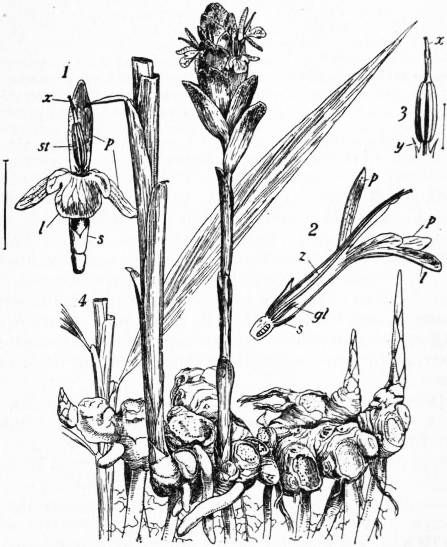
From Bentley & Trimen’s Medicinal Plants, by permission of J. & A. Churchill.
Ginger (Zingiber officinale), about ½ nat. size, with leafy and flowering stem; the former cut off short.
1. Flower. 2. Flower in vertical section. 3. Fertile stamen, enveloping the style which projects above it. 4. Piece of leafy stem. 1-3 enlarged. s, Sepals. p, Petals. l, Labellum, representing two barren stamens. st, Fertile stamen. y, Staminode. x, Tip of style bearing the stigma. z, Style. gl, Honey-secreting glands.
Ginger is known in commerce in two distinct forms, termed respectively coated and uncoated ginger, as having or wanting the epidermis. For the first, the pieces, which are called “races” or “hands,” from their irregular palmate form, are washed and simply dried in the sun. In this form ginger presents a brown, more or less irregularly wrinkled or striated surface, and when broken shows a dark brownish fracture, hard, and sometimes horny and resinous. To produce uncoated ginger the rhizomes are washed, scraped and sun-dried, and are often subjected to a system of bleaching, either from the fumes of burning sulphur or by immersion for a short time in a solution of chlorinated lime. The whitewashed appearance that much of the ginger has, as seen in the shops, is due to the fact of its being washed in whiting and water, or even coated with sulphate of lime. This artificial coating is supposed by some to give the ginger a better appearance; it often, however, covers an inferior quality, and can readily be detected by the ease with which it rubs off, or by its leaving a white powdery substance at the bottom of the jar in which it is contained. Uncoated ginger, as seen in trade, varies from single joints an inch or less in length to flattish irregularly branched pieces of several joints, the “races” or “hands,” and from 3 to 4 in. long; each branch has a depression at its summit showing the former attachment of a leafy stem. The colour, when not whitewashed, is a pale buff; it is somewhat rough or fibrous, breaking with a short mealy fracture, and presenting on the surfaces of the broken parts numerous short bristly fibres.
The principal constituents of ginger are starch, volatile oil (to which the characteristic odour of the spice is due) and resin (to which is attributed its pungency). Its chief use is as a condiment or spice, but as an aromatic and stomachic medicine it is also used internally. “The stimulant, aromatic and carminative properties render it of much value in atonic dyspepsia, especially if accompanied with much flatulence, and as an adjunct to purgative medicines to correct griping.” Externally applied as a rubefacient, it has been found to relieve headache and toothache. The rhizomes, collected in a young green state, washed, scraped and preserved in syrup, form a delicious preserve, which is largely exported both from the West Indies and from China. Cut up into pieces like lozenges and preserved in sugar, ginger also forms a very agreeable sweetmeat.
GINGHAM, a cotton or linen cloth, for the name of which several origins are suggested. It is said to have been made at Guingamp, a town in Brittany; the New English Dictionary derives the word from Malay ging-gang, meaning “striped.” The cloth is now of a light or medium weight, and woven of dyed or white yarns either in a single colour or different colours, and in stripes, checks or plaids. It is made in Lancashire and in Glasgow, and also to a large extent in the United States. Imitations of it are obtained by calico-printing. It is used for dresses, &c.
GINGI, or Gingee, a rock fortress of southern India, in the South Arcot district of Madras. It consists of three hills, connected by walls enclosing an area of 7 sq. m., and practically impregnable to assault. The origin of the fortress is shrouded in legend. When occupied by the Mahrattas at the end of the 17th century, it withstood a siege of eight years against the armies of Aurangzeb. In 1750 it was captured by the French, who held it with a strong force for eleven years. It surrendered to the English in 1761, in the words of Orme, “terminated the long hostilities between the two rival European powers in Coromandel, and left not a single ensign of the French nation avowed by the authority of its government in any part of India.”
GINGUENÉ, PIERRE LOUIS (1748-1815), French author, was born on the 27th of April 1748 at Rennes, in Brittany. He was educated at a Jesuit college in his native town, and came to Paris in 1772. He wrote criticisms for the Mercure de France, and composed a comic opera, Pomponin (1777). The Satire des satires (1778) and the Confession de Zulmé (1779) followed. The Confession was claimed by six or seven different authors, and though the value of the piece is not very great, it obtained great success. His defence of Piccini against the partisans of Gluck made him still more widely known. He hailed the first symptoms of the Revolution, joined Giuseppe Cerutti, the author of the Mémoire pour le peuple français (1788), and others in producing the Feuille villageoise, a weekly paper addressed to the villages of France. He also celebrated in an indifferent ode the opening of the states-general. In his Lettres sur les confessions de J.-J. Rousseau (1791) he defended the life and principles of his author. He was imprisoned during the Terror, and only escaped with life by the downfall of Robespierre. Some time after his release he assisted, as director-general of the “commission exécutive de l’instruction publique,” in reorganizing the system of public instruction, and he was an original member of the Institute of France. In 1797 the directory appointed him minister plenipotentiary to the king of Sardinia. After fulfilling his duties for seven months, very little to the satisfaction of his employers, Ginguené retired for a time to his country house of St Prix, in the valley of Montmorency. He was appointed a member of the tribunate, but Napoleon, finding that he was not sufficiently tractable, had him expelled at the first “purge,” and Ginguené returned to his literary pursuits. He was one of the commission charged to continue the Histoire littéraire de la France, and he contributed to the volumes of this series which appeared in 1814, 1817 and 1820. Ginguené’s most important work is the Histoire littéraire d’Italie (14 vols., 1811-1835). He was putting the finishing touches to the eighth and ninth volumes when he died on the 11th of November 1815. The last five volumes were written by Francesco Salfi and revised by Pierre Daunou.
In the composition of his history of Italian literature he was guided for the most part by the great work of Girolamo Tiraboschi, but he avoids the prejudices and party views of his model.
Ginguené edited the Décade philosophique, politique et littéraire till it was suppressed by Napoleon in 1807. He contributed largely to the Biographie universelle, the Mercure de France and the Encyclopédie méthodique; and he edited the works of Chamfort and of Lebrun. Among his minor productions are an opera, Pomponin ou le tuteur mystifié (1777); La Satire des satires (1778); De l’autorité de Rabelais dans la révolution présente (1791); De M. Neckar (1795); Fables nouvelles (1810); Fables inédites (1814). See “Éloge de Ginguené” by Dacier, in the Mémoires de l’institut, tom. vii.; “Discours” by M. Daunou, prefixed to the 2nd ed. of the Hist. litt. d’Italie; D. J. Garat, Notice sur la vie et les ouvrages de P. L. Ginguené, prefixed to a catalogue of his library (Paris, 1817).
GINKEL, GODART VAN (1630-1703); 1st earl of Athlone, Dutch general in the service of England, was born at Utrecht in 1630. He came of a noble family, and bore the title of Baron van Reede, being the eldest son of Godart Adrian van Reede, Baron Ginkel. In his youth he entered the Dutch army, and in 1688 he followed William, prince of Orange, in his expedition to England. In the following year he distinguished himself by a memorable exploit—the pursuit, defeat and capture of a Scottish regiment which had mutinied at Ipswich, and was marching northward across the fens. It was the alarm excited by this mutiny that facilitated the passing of the first Mutiny Act. In 1690 Ginkel accompanied William III. to Ireland, and commanded a body of Dutch cavalry at the battle of the Boyne. On the king’s return to England General Ginkel was entrusted with the conduct of the war. He took the field in the spring of 1691, and established his headquarters at Mullingar. Among those who held a command under him was the marquis of Ruvigny, the recognized chief of the Huguenot refugees. Early in June Ginkel took the fortress of Ballymore, capturing the whole garrison of 1000 men. The English lost only 8 men. After reconstructing the fortifications of Ballymore the army marched to Athlone, then one of the most important of the fortified towns of Ireland. The Irish defenders of the place were commanded by a distinguished French general, Saint-Ruth. The firing began on June 19th, and on the 30th the town was stormed, the Irish army retreating towards Galway, and taking up their position at Aughrim. Having strengthened the fortifications of Athlone and left a garrison there, Ginkel led the English, on July 12th, to Aughrim. An immediate attack was resolved on, and, after a severe and at one time doubtful contest, the crisis was precipitated by the fall of Saint-Ruth, and the disorganized Irish were defeated and fled. A horrible slaughter of the Irish followed the struggle, and 4000 corpses were left unburied on the field, besides a multitude of others that lay along the line of the retreat. Galway next capitulated, its garrison being permitted to retire to Limerick. There the viceroy Tyrconnel was in command of a large force, but his sudden death early in August left the command in the hands of General Sarsfield and the Frenchman D’Usson. The English came in sight of the town on the day of Tyrconnel’s death, and the bombardment was immediately begun. Ginkel, by a bold device, crossed the Shannon and captured the camp of the Irish cavalry. A few days later he stormed the fort on Thomond Bridge, and after difficult negotiations a capitulation was signed, the terms of which were divided into a civil and a military treaty. Thus was completed the conquest or pacification of Ireland, and the services of the Dutch general were amply recognized and rewarded. He received the formal thanks of the House of Commons, and was created by the king 1st earl of Athlone and baron of Aughrim. The immense forfeited estates of the earl of Limerick were given to him, but the grant was a few years later revoked by the English parliament. The earl continued to serve in the English army, and accompanied the king to the continent in 1693. He fought at the sieges of Namur and the battle of Neerwinden, and assisted in destroying the French magazine at Givet. In 1702, waiving his own claims to the position of commander-in-chief, he commanded the Dutch serving under the duke of Marlborough. He died at Utrecht on the 11th of February 1703, and was succeeded by his son the 2nd earl (1668-1719), a distinguished soldier in the reigns of William III. and Anne. On the death of the 9th earl without issue in 1844, the title became extinct.
GINSBURG, CHRISTIAN DAVID (1831- ), Hebrew scholar, was born at Warsaw on the 25th of December 1831. Coming to England shortly after the completion of his education in the Rabbinic College at Warsaw, Dr Ginsburg continued his study of the Hebrew Scriptures, with special attention to the Megilloth. The first result of these studies was a translation of the Song of Songs, with a commentary historical and critical, published in 1857. A similar translation of Ecclesiastes, followed by treatises on the Karaites, on the Essenes and on the Kabbala, kept the author prominently before biblical students while he was preparing the first sections of his magnum opus, the critical study of the Massorah. Beginning in 1867 with the publication of Jacob ben Chajim’s Introduction to the Rabbinic Bible, Hebrew and English, with notices, and the Massoreth Ha-Massoreth of Elias Levita, in Hebrew, with translation and commentary, Dr Ginsburg took rank as an eminent Hebrew scholar. In 1870 he was appointed one of the first members of the committee for the revision of the English version of the Old Testament. His life-work culminated in the publication of the Massorah, in three volumes folio (1880-1886), followed by the Masoretico-critical edition of the Hebrew Bible (1894), and the elaborate introduction to it (1897). Dr Ginsburg had one predecessor in the field, the learned Jacob ben Chajim, who in 1524-1525 published the second Rabbinic Bible, containing what has ever since been known as the Massorah; but neither were the materials available nor was criticism sufficiently advanced for a complete edition. Dr Ginsburg took up the subject almost where it was left by those early pioneers, and collected portions of the Massorah from the countless MSS. scattered throughout Europe and the East. More recently Dr Ginsburg has published Facsimiles of Manuscripts of the Hebrew Bible (1897 and 1898), and The Text of the Hebrew Bible in Abbreviations (1903), in addition to a critical treatise “on the relationship of the so-called Codex Babylonicus of A.D. 916 to the Eastern Recension of the Hebrew Text” (1899, for private circulation). In the last-mentioned work he seeks to prove that the St Petersburg Codex, for so many years accepted as the genuine text of the Babylonian school, is in reality a Palestinian text carefully altered so as to render it conformable to the Babylonian recension. He subsequently undertook the preparation of a new edition of the Hebrew Bible for the British and Foreign Bible Society. He also contributed many articles to J. Kitto’s Encyclopaedia, W. Smith’s Dictionary of Christian Biography and the Encyclopaedia Britannica.
GINSENG, the root of a species of Panax (P. Ginseng), native of Manchuria and Korea, belonging to the natural order Araliaceae, used in China as a medicine. Other roots are substituted for it, notably that of Panax quinquefolium, distinguished as American ginseng, and imported from the United States. At one time the ginseng obtained from Manchuria was considered to be the finest quality, and in consequence became so scarce that an imperial edict was issued prohibiting its collection. That prepared in Korea is now the most esteemed variety. The root of the wild plant is preferred to that of cultivated ginseng, and the older the plant the better is the quality of the root considered to be. Great care is taken in the preparation of the drug. The account given by Kaempfer of the preparation of nindsin, the root of Sium ninsi, in Korea, will give a good idea of the preparation of ginseng, ninsi being a similar drug of supposed weaker virtue, obtained from a different plant, and often confounded with ginseng. “In the beginning of winter nearly all the population of Sjansai turn out to collect the root, and make preparations for sleeping in the fields. The root, when collected, is macerated for three days in fresh water, or water in which rice has been boiled twice; it is then suspended in a closed vessel over the fire, and afterwards dried, until from the base to the middle it assumes a hard, resinous and translucent appearance, which is considered a proof of its good quality.”
Ginseng of good quality generally occurs in hard, rather brittle, translucent pieces, about the size of the little finger, and varying in length from 2 to 4 in. The taste is mucilaginous, sweetish and slightly bitter and aromatic. The root is frequently forked, and it is probably owing to this circumstance that medicinal properties were in the first place attributed to it, its resemblance to the body of a man being supposed to indicate that it could restore virile power to the aged and impotent. In price it varies from 6 or 12 dollars to the enormous sum of 300 or 400 dollars an ounce.
Lockhart gives a graphic description of a visit to a ginseng merchant. Opening the outer box, the merchant removed several paper parcels which appeared to fill the box, but under them was a second box, or perhaps two small boxes, which, when taken out, showed the bottom of the large box and all the intervening space filled with more paper parcels. These parcels, he said, “contained quicklime, for the purpose of absorbing any moisture and keeping the boxes quite dry, the lime being packed in paper for the sake of cleanliness. The smaller box, which held the ginseng, was lined with sheet-lead; the ginseng further enclosed in silk wrappers was kept in little silken-covered boxes. Taking up a piece, he would request his visitor not to breathe upon it, nor handle it; he would dilate upon the many merits of the drug and the cures it had effected. The cover of the root, according to its quality, was silk, either embroidered or plain, cotton cloth or paper.” In China the ginseng is often sent to friends as a valuable present; in such cases, “accompanying the medicine is usually given a small, beautifully-finished double kettle, in which the ginseng is prepared as follows. The inner kettle is made of silver, and between this and the outside vessel, which is a copper jacket, is a small space for holding water. The silver kettle, which fits on a ring near the top of the outer covering, has a cup-like cover in which rice is placed with a little water; the ginseng is put in the inner vessel with water, a cover is placed over the whole, and the apparatus is put on the fire. When the rice in the cover is sufficiently cooked, the medicine is ready, and is then eaten by the patient, who drinks the ginseng tea at the same time.” The dose of the root is from 60 to 90 grains. During the use of the drug tea-drinking is forbidden for at least a month, but no other change is made in the diet. It is taken in the morning before breakfast, from three to eight days together, and sometimes it is taken in the evening before going to bed.