VOLUME XII SLICE I Gichtel, Johann to Glory (continued 12)
Reading edition
Among the latter were (besides histories of the campaigns in which he served), Life of Sir Thomas Munro (3 vols., 1830); History of India (4 vols., 1830-1835); The Leipsic Campaign and Lives of Military Commanders (1831); Story of the Battle of Waterloo (1847); Sketch of the Military History of Great Britain (1845); Sale’s Brigade in Afghanistan (1847); biographies of Lord Clive (1848), the duke of Wellington (1862), and Warren Hastings (1848; the subject of Macaulay’s essay, in which it is described as “three big bad volumes full of undigested correspondence and undiscerning panegyric”).
GLEIM, JOHANN WILHELM LUDWIG (1719-1803), German poet, was born on the 2nd of April 1719 at Ermsleben, near Halberstadt. Having studied law at the university of Halle he became secretary to Prince William of Brandenburg-Schwedt at Berlin, where he made the acquaintance of Ewald von Kleist, whose devoted friend he became. When the prince fell at the battle of Prague, Gleim became secretary to Prince Leopold of Dessau; but he soon gave up his position, not being able to bear the roughness of the “Old Dessauer.” After residing a few years in Berlin he was appointed, in 1747, secretary of the cathedral chapter at Halberstadt. “Father Gleim” was the title accorded to him throughout all literary Germany on account of his kind-hearted though inconsiderate and undiscriminating patronage alike of the poets and poetasters of the period. He wrote a large number of feeble imitations of Anacreon, Horace and the minnesingers, a dull didactic poem entitled Halladat oder das rote Buch (1774), and collections of fables and romances. Of higher merit are his Preussische Kriegslieder von einem Grenadier (1758). These, which were inspired by the campaigns of Frederick II., are often distinguished by genuine feeling and vigorous force of expression. They are also noteworthy as being the first of that long series of noble political songs in which later German literature is so rich. With this exception, Gleim’s writings are for the most part tamely commonplace in thought and expression. He died at Halberstadt on the 18th of February 1803.
Gleim’s Sämtliche Werke appeared in 7 vols. in the years 1811-1813; a reprint of the Lieder eines Grenadiers was published by A. Sauer in 1882. A good selection of Gleim’s poetry will be found in F. Muncker, Anakreontiker und preussisch-patriotische Lyriker (1894). See W. Körte, Gleims Leben aus seinen Briefen und Schriften (1811). His correspondence with Heinse was published in 2 vols. (1894-1896); with Uz (1889), in both cases edited by C. Schüddekopf.
GLEIWITZ, a town of Germany, in the Prussian province of Silesia, on the Klodnitz, and the railway between Oppeln and Cracow, 40 m. S.E. of the former town. Pop. (1875) 14,156; (1905) 61,324. It possesses two Protestant and four Roman Catholic churches, a synagogue, a mining school, a convent, a hospital, two orphanages, and barracks. Gleiwitz is the centre of the mining industry of Upper Silesia. Besides the royal foundry, with which are connected machine manufactories and boiler-works, there are other foundries, meal mills and manufactories of wire, gas pipes, cement and paper.
See B. Nietsche, Geschichte der Stadt Gleiwitz (1886); and Seidel, Die königliche Eisengiesserei zu Gleiwitz (Berlin, 1896).
GLENALMOND, a glen of Perthshire, Scotland, situated to the S.E. of Loch Tay. It comprises the upper two-thirds of the course of the Almond, or a distance of 20 m. For the greater part it follows a direction east by south, but at Newton Bridge it inclines sharply to the south-east for 3 m., and narrows to such a degree that this portion is known as the Small (or Sma’) Glen. At the end of this pass the glen expands and runs eastwards as far as the well-known public school of Trinity College, where it may be considered to terminate. The most interesting spot in the glen is that traditionally known as the grave of Ossian. The district east of Buchanty, near which are the remains of a Roman camp, is said to be the Drumtochty of Ian Maclaren’s stories. The mountainous region at the head of the glen is dominated by Ben y Hone or Ben Chonzie (3048 ft. high).
GLENCAIRN, EARLS OF. The 1st earl of Glencairn in the Scottish peerage was Alexander Cunningham (d. 1488), a son of Sir Robert Cunningham of Kilmaurs in Ayrshire. Made a lord of the Scottish parliament as Lord Kilmaurs not later than 1469, Cunningham was created earl of Glencairn in 1488; and a few weeks later he was killed at the battle of Sauchieburn whilst fighting for King James III. against his rebellious son, afterwards James IV. His son and successor, Robert (d. c. 1490), was deprived of his earldom by James IV., but before 1505 this had been revived in favour of Robert’s son, Cuthbert (d. c. 1540), who became 3rd earl of Glencairn, and whose son William (c. 1490-1547) was the 4th earl. This noble, an early adherent of the Reformation, was during his public life frequently in the pay and service of England, although he fought on the Scottish side at the battle of Solway Moss (1542), where he was taken prisoner. Upon his release early in 1543 he promised to adhere to Henry VIII., who was anxious to bring Scotland under his rule, and in 1544 he entered into other engagements with Henry, undertaking inter alia to deliver Mary queen of Scots to the English king. However, he was defeated by James Hamilton, earl of Arran, and the project failed; Glencairn then deserted his fellow-conspirator, Matthew Stewart, earl of Lennox, and came to terms with the queen-mother, Mary of Guise, and her party.
William’s son, Alexander, the 5th earl (d. 1574), was a more pronounced reformer than his father, whose English sympathies he shared, and was among the intimate friends of John Knox. In March 1557 he signed the letter asking Knox to return to Scotland; in the following December he subscribed the first “band” of the Scottish reformers; and he anticipated Lord James Stewart, afterwards the regent Murray, in taking up arms against the regent, Mary of Guise, in 1558. Then, joined by Stewart and the lords of the congregation, he fought, against the regent, and took part in the attendant negotiations with Elizabeth of England, whom he visited in London in December 1560. When in August 1561 Mary queen of Scots returned to Scotland, Glencairn was made a member of her council; he remained loyal to her after she had been deserted by Murray, but in a few weeks rejoined Murray and the other Protestant lords, returning to Mary’s side in 1566. After the queen had married the earl of Bothwell she was again forsaken by Glencairn, who fought against her at Carberry Hill and at Langside. The earl, who was always to the fore in destroying churches, abbeys and other “monuments of idolatry,” died on the 23rd of November 1574. His short satirical poem against the Grey Friars is printed by Knox in his History of the Reformation.
James, the 7th earl (d. c. 1622), took part in the seizure of James VI., called the raid of Ruthven in 1582. William, the 9th earl (c. 1610-1664), a somewhat lukewarm Royalist during the Civil War, was a party to the “engagement” between the king and the Scots in 1647; for this proceeding the Scottish parliament deprived him of his office as lord justice-general, and nominally of his earldom. In March 1653 Charles II. commissioned the earl to command the Royalist forces in Scotland, pending the arrival of General John Middleton, and the insurrection of this year is generally known as Glencairn’s rising. After its failure he was betrayed and imprisoned, but although excepted from pardon he was not executed; and when Charles II. was restored he became lord chancellor of Scotland. After a dispute with his former friend, James Sharp, archbishop of St Andrews, he died at Belton in Haddingtonshire on the 30th of May 1664. This earl’s son John (d. 1703), who followed his brother Alexander as 11th earl in 1670, was a supporter of the Revolution of 1688. His descendant, James, the 14th earl (1749-1791), is known as the friend and patron of Robert Burns. He performed several useful services for the poet; and when he died on the 30th of January 1791 Burns wrote a Lament beginning, “The wind blew hollow frae the hills,” and ending with the lines, “But I’ll remember thee, Glencairn, and a’ that thou hast done for me.” The 14th earl was never married, and when his brother and successor, John, died childless in September 1796 the earldom became extinct, although it was claimed by Sir Adam Fergusson, Bart., a descendant of the 10th earl.
GLENCOE, a glen in Scotland, situated in the north of Argyllshire. Beginning at the north-eastern base of Buchaille Etive, it takes a gentle north-westerly trend for 10 m. to its mouth on Loch Leven, a salt-water arm of Loch Linnhe. On both sides it is shut in by wild and precipitous mountains and its bed is swept by the Coe—Ossian’s “dark Cona,”—which rises in the hills at its eastern end. About half-way down the glen the stream forms the tiny Loch Triochatan. Towards Invercoe the landscape acquires a softer beauty. Here Lord Strathcona, who, in 1894, purchased the heritage of the Macdonalds of Glencoe, built his stately mansion of Mount Royal. The principal mountains on the south side are the various peaks of Buachaille Etive, Stob Dearg (3345 ft.), Bidean nam Bian (3756 ft.) and Meall Mor (2215 ft.), and on the northern side the Pap of Glencoe (2430 ft.), Sgor nam Fiannaidh (3168 ft.) and Meall Dearg (3118 ft.). Points of interest are the Devil’s Staircase, a steep, boulder-strewn “cut” (1754 ft. high) across the hills to Fort William; the Study; the cave of Ossian, where tradition says that he was born, and the Iona cross erected in 1883 by a Macdonald in memory of his clansmen who perished in the massacre of 1692. About 1 m. beyond the head of the glen is Kingshouse, a relic of the old coaching days, when it was customary for tourists to drive from Ballachulish via Tyndrum to Loch Lomond. Now the Glencoe excursion is usually made from Oban—by rail to Achnacloich, steamer up Loch Etive, coach up Glen Etive and down Glencoe and steamer at Ballachulish to Oban. One mile to the west of the Glen lies the village of Ballachulish (pop. 1143). It is celebrated for its slate quarries, which have been worked since 1760. The industry provides employment for 600 men and the annual output averages 30,000 tons. The slate is of excellent quality and is used throughout the United Kingdom. Ballachulish is a station on the Callander and Oban extension line to Fort William (Caledonian railway). The pier and ferry are some 2 m. W. of the village.
GLENCORSE, JOHN INGLIS, Lord (1810-1891), Scottish judge, son of a minister, was born at Edinburgh on the 21st of August 1810. From Glasgow University he went to Balliol College, Oxford. He was admitted a member of the Faculty of Advocates, and soon became known as an eloquent and successful pleader. In 1852 he was made solicitor-general for Scotland in Lord Derby’s first ministry, three months later becoming Lord Advocate. In 1858 he resumed this office in Lord Derby’s second administration, being returned to the House of Commons as member for Stamford. He was responsible for the Universities of Scotland Act of 1858, and in the same year he was elevated to the bench as lord justice clerk. In 1867 he was made lord justice general of Scotland and lord president of the court of session, taking the title of Lord Glencorse. Outside his judicial duties he was responsible for much useful public work, particularly in the department of higher education. In 1869 he was elected chancellor of Edinburgh University, having already been rector of the university of Glasgow. He died on the 20th August 1891.
GLENDALOUGH, VALE OF, a mountain glen of Co. Wicklow, Ireland, celebrated and frequently visited both on account of its scenic beauty and, more especially, because of the collection of ecclesiastical remains situated in it. Fortunately for its appearance, it is not approached by any railway, but services of cars are maintained to several points, of which Rathdrum, 8½ m. S.E., is the nearest railway station, on the Dublin & South-Eastern. The glen is traversed by the stream of Glenealo, a tributary of the Avonmore, expanding into small loughs, the Upper and the Lower. The former of these is walled by the abrupt heights of Camaderry (2296 ft.) and Lugduff (2176 ft.), and here the extreme narrowness of the valley adds to its grandeur; while lower down, where it widens, the romantic character of the scenery is enhanced by the scattered ruins of the former monastic settlement. These ruins have the collective name of the “Seven Churches.” The settlement owed its foundation to the hermit St Kevin, who is reputed to have died on the 3rd of June 618; and it rapidly became a seat of learning of wide fame, but suffered much at the hands of the Danes and the Anglo-Normans. In close proximity to an hotel, and to one another, in an enclosure, are a round tower, one of the finest in Ireland, 110 ft. high and 52 in circumference; St Kevin’s kitchen or church (closely resembling the house of St Columba at Kells), which measures 25 ft. by 15, with a high-pitched roof and round belfry—supposed to be the earliest example of its type; and the cathedral, about 73 ft. in total length by 51 in width. This possesses a good square-headed doorway, and an east window of ornate character (the chancel being of later date than the nave), and there are also some early tombs, but the whole is in a decayed condition. In the enclosure are also a Lady chapel, chiefly remarkable for its doorway of wrought granite, in a style of architecture resembling Greek; a priest’s house (restored), and slight remains of St Chiaran’s church. Here is also St Kevin’s cross, a granite monolith never completed; and the enclosure is entered by a fine though dilapidated gateway. Other neighbouring remains are Trinity or the Ivy Church, towards Laragh, with beautiful detailed work; St Saviour’s monastery, carefully restored under the direction of the Board of Works, with a chancel arch of three orders (re-erected); while on the shores of the upper lough are Reefert Church, the burial-place of the O’Toole family, and Teampull-na-skellig, the church of the rock. St Kevin’s bed is a cave approachable with difficulty, above the lough, probably a natural cavity artificially enlarged, to which attaches the legend of St Kevin’s hermitage. Along the valley there are a number of monuments and stone crosses of various sizes and styles. The whole collection forms, with the possible exception of Clonmacnoise in King’s county, the most striking monument of monasticism in Ireland.
GLENDOWER, OWEN (c. 1359-1415), the last to claim the title of an independent prince of Wales, more correctly described as Owain ab Gruffydd, lord of Glyndyvrdwy in Merioneth, was a man of good family, with two great houses, Sycharth and Glyndyvrdwy in the north, besides smaller estates in south Wales. His father was called Gruffydd Vychan, and his mother Helen; on both sides he had pretensions to be descended from the old Welsh princes. Owen was probably born about 1359, studied law at Westminster, was squire to the earl of Arundel, and a witness for Grosvenor in the famous Scrope and Grosvenor lawsuit in 1386. Afterwards he was in the service of Henry of Bolingbroke, the future king, though by an error it has been commonly stated that he was squire to Richard II. Welsh sympathies were, however, on Richard’s side, and combined with a personal quarrel to make Owen the leader of a national revolt.
The lords of Glyndyvrdwy had an ancient feud with their English neighbours, the Greys of Ruthin. Reginald Grey neglected to summon Owen, as was his duty, for the Scottish expedition of 1400, and then charged him with treason for failing to appear. Owen thereupon took up arms, and when Henry IV. returned from Scotland in September he found north Wales ablaze. A hurried campaign under the king’s personal command was ineffectual. Owen’s estates were declared forfeit and vigorous measures threatened by the English government. Still the revolt gathered strength. In the spring of 1401 Owen was raiding in south Wales, and credited with the intention of invading England. A second campaign by the king in the autumn was defeated, like that of the previous year, through bad weather and the Fabian tactics of the Welsh. Owen had already been intriguing with Henry Percy (Hotspur), who during 1401 held command in north Wales, and with Percy’s brother-in-law, Sir Edmund Mortimer. During the winter of 1401-1402 his plans were further extended to negotiations with the rebel Irish, the Scots and the French. In the spring he had grown so strong that he attacked Ruthin, and took Grey prisoner. In the summer he defeated the men of Hereford under Edmund Mortimer at Pilleth, near Brynglas, in Radnorshire. Mortimer was taken prisoner and treated with such friendliness as to make the English doubt his loyalty; within a few months he married Owen’s daughter. In the autumn the English king was for the third time driven “bootless home and weather-beaten back.” The few English strongholds left in Wales were now hard pressed, and Owen boasted that he would meet his enemy in the field. Nevertheless, in May 1403 Henry of Monmouth was allowed to sack Sycharth and Glyndyvrdwy unopposed. Owen had a greater plot in hand. The Percies were to rise in arms, and meeting Owen at Shrewsbury, overwhelm the prince before help could arrive. But Owen’s share in the undertaking miscarried through his own defeat near Carmarthen on the 12th of July, and Percy was crushed at Shrewsbury ten days later. Still the Welsh revolt was never so formidable. Owen styled himself openly prince of Wales, established a regular government, and called a parliament at Machynlleth. As a result of a formal alliance the French sent troops to his aid, and in the course of 1404 the great castles of Harlech and Aberystwith fell into his hands.
In the spring of 1405 Owen was at the height of his power; but the tide turned suddenly. Prince Henry defeated the Welsh at Grosmont in March, and twice again in May, when Owen’s son Griffith and his chancellor were made prisoners. Scrope’s rebellion in the North prevented the English from following up their success. The earl of Northumberland took refuge in Wales, and the tripartite alliance of Owen with Percy and Mortimer (transferred by Shakespeare to an earlier occasion) threatened a renewal of danger. But Northumberland’s plots and the active help of the French proved ineffective. The English under Prince Henry gained ground steadily, and the recovery of Aberystwith, after a long siege, in the autumn of 1408 marked the end of serious warfare. In February 1409 Harlech was also recaptured, and Owen’s wife, daughter and grandchildren were taken prisoners. Owen himself still held out and even continued to intrigue with the French. In July 1415 Gilbert Talbot had power to treat with Owen and his supporters and admit them to pardon. Owen’s name does not occur in the document renewing Talbot’s powers in February 1416; according to Adam of Usk he died in 1415. Later English writers allege that he died of starvation in the mountains; but Welsh legend represents him as spending a peaceful old age with his sons-in-law at Ewyas and Monington in Herefordshire, till his death and burial at the latter place. The dream of an independent and united Wales was never nearer realization than under Owen’s leadership. The disturbed state of England helped him, but he was indeed a remarkable personality, and has not undeservedly become a national hero. Sentiment and tradition have magnified his achievements, and confused his career with tales of portents and magical powers. Owen left many bastard children; his legitimate representative in 1433 was his daughter Alice, wife of Sir John Scudamore of Ewyas.
The facts of Owen’s life must be pieced together from scattered references in contemporary chronicles and documents; perhaps the most important are Adam of Usk’s Chronicle and Ellis’s Original Letters. On the Welsh side something is given by the bards Iolo Goch and Lewis Glyn Cothi. For modern accounts consult J. H. Wylie’s History of England under Henry IV. (4 vols., 1884-1898); A. C. Bradley’s popular biography; and Professor Tout’s article in the Dictionary of National Biography.
(C. L. K.)
GLENELG, CHARLES GRANT, Baron (1778-1866), eldest son of Charles Grant (q.v.), chairman of the directors of the East India Company, was born in India on the 26th of October 1778, and was educated at Magdalene College, Cambridge, of which he became a fellow in 1802. Called to the bar in 1807, he was elected member of parliament for the Inverness burghs in 1807, and having gained some reputation as a speaker in the House of Commons, he was made a lord of the treasury in December 1813, an office which he held until August 1819, when he became secretary to the lord-lieutenant of Ireland and a privy councillor. In 1823 he was appointed vice-president of the board of trade; from September 1827 to June 1828 he was president of the board and treasurer of the navy; then joining the Whigs, he was president of the board of control under Earl Grey and Lord Melbourne from November 1830 to November 1834. At the board of control Grant was primarily responsible for the act of 1833, which altered the constitution of the government of India. In April 1835 he became secretary for war and the colonies, and was created Baron Glenelg. His term of office was a stormy one. His differences with Sir Benjamin d’Urban (q.v.), governor of Cape Colony, were serious; but more so were those with King William IV. and others over the administration of Canada. He was still secretary when the Canadian rebellion broke out in 1837; his wavering and feeble policy was fiercely attacked in parliament; he became involved in disputes with the earl of Durham, and the movement for his supercession found supporters even among his colleagues in the cabinet. In February 1839 he resigned, receiving consolation in the shape of a pension of £2000 a year. From 1818 until he was made a peer Grant represented the county of Inverness in parliament, and he has been called “the last of the Canningites.” Living mainly abroad during the concluding years of his life, he died unmarried at Cannes on the 23rd of April 1866 when his title became extinct.
Glenelg’s brother, Sir Robert Grant (1779-1838), who was third wrangler in 1801, was, like his brother, a fellow of Magdalene College, Cambridge, and a barrister. From 1818 to 1834 he represented various constituencies in parliament, where he was chiefly prominent for his persistent efforts to relieve the disabilities of the Jews.1 In June 1834 he was appointed governor of Bombay, and he died in India on the 9th of July 1838. Grant wrote a Sketch of the History of the East India Co. (1813), and is also known as a writer of hymns.
1 Sir S. Walpole (History of England, vol. v.) is wrong in stating that Charles Grant introduced bills to remove Jewish disabilities in 1833 and 1834. They were introduced by his brother Robert.
GLENELG, a municipal town and watering place of Adelaide county, South Australia, on Holdfast Bay, 6½ m. by rail S.S.W. of the city of Adelaide. Pop. (1901) 3949. It is a popular summer resort, connected with Adelaide by two lines of railway. In the vicinity is the “Old Gum Tree” under which South Australia was proclaimed British territory by Governor Hindmarsh in 1836.
GLENGARRIFF, or Glengariff (“Rough Glen”), a celebrated resort of tourists in summer and invalids in winter, in the west riding of county Cork, Ireland, on Glengarriff Harbour, an inlet on the northern side of Bantry Bay, 11 m. by coach road from Bantry on the Cork, Bandon & South Coast railway. Beyond its hotels, Glengarriff is only a small village, but the island-studded harbour, the narrow glen at its head and the surrounding of mountains, afford most attractive views, and its situation on the “Prince-of Wales’” route travelled by King Edward VII. in 1848, and on a fine mountain coach road from Macroom, brings it into the knowledge of many travellers to Killarney. Thackeray wrote enthusiastically of the harbour. The glaciated rocks of the glen are clothed with vegetation of peculiar luxuriance, flourishing in the mild climate which has given Glengarriff its high reputation as a health resort for those suffering from pulmonary complaints.
GLEN GREY, a division of the Cape province south of the Stormberg, adjoining on the east the Transkeian Territories. Pop. (1904) 55,107. Chief town Lady Frere, 32 m. N.E. of Queenstown. The district is well watered and fertile, and large quantities of cereals are grown. Over 96% of the inhabitants are of the Zulu-Xosa (Kaffir) race, and a considerable part of the district was settled during the Kaffir wars of Cape Colony by Tembu (Tambookies) who were granted a location by the colonial government in recognition of their loyalty to the British. Act No. 25 of 1894 of the Cape parliament, passed at the instance of Cecil Rhodes, which laid down the basis upon which is effected the change of land tenure by natives from communal to individual holdings, and also dealt with native local self-government and the labour question, applied in the first instance to this division, and is known as the Glen Grey Act (see Cape Colony: History). The provisions of the act respecting individual land tenure and local self-government were in 1898 applied, with certain modifications, to the Transkeian Territories. The division is named after Sir George Grey, governor of Cape Colony 1854-1861.
GLENS FALLS, a village of Warren county, New York, U.S.A., 55 m. N. of Troy, on the Hudson river. Pop. (1890) 9509; (1900) 12,613, of whom 1762 were foreign-born; (1910 census) 15,243. Glens Falls is served by the Delaware & Hudson and the Hudson Valley (electric) railways. The village contains a state armoury, the Crandall free public library, a Y.M.C.A. building, the Park hospital, an old ladies’ home, and St Mary’s (Roman Catholic) and Glens Falls (non-sectarian) academies. There are two private parks, open to the public, and a waterworks system is maintained by the village. An iron bridge crosses the river just below the falls, connecting Glens Falls and South Glens Falls (pop. in 1910, 2247). The falls of the Hudson here furnish a fine water-power, which is utilized, in connexion with steam and electricity, in the manufacture of lumber, paper and wood pulp, women’s clothing, shirts, collars and cuffs, &c. In 1905 the village’s factory products were valued at $4,780,331. About 12 m. above Glens Falls, on the Hudson, a massive stone dam has been erected; here electric power, distributed to a large area, is generated. In the neighbourhood of Glens Falls are valuable quarries of black marble and limestone, and lime, plaster and Portland cement works. Glens Falls was settled about the close of the French and Indian War (1763), and was incorporated as a village in 1839.
GLENTILT, a glen in the extreme north of Perthshire, Scotland. Beginning at the confines of Aberdeenshire, it follows a north-westerly direction excepting for the last 4 m., when it runs due S. to Blair Atholl. It is watered throughout by the Tilt, which enters the Garry after a course of 14 m., and receives on its right the Tarff, which forms some beautiful falls just above the confluence, and on the left the Fender, which has some fine falls also. The attempt of the 6th duke of Atholl (1814-1864) to close the glen to the public was successfully contested by the Scottish Rights of Way Society. The group of mountains—Carn nan Gabhar (3505 ft.), Ben y Gloe (3671) and Carn Liath (3193)—on its left side dominate the lower half of the glen. Marble of good quality is occasionally quarried in the glen, and the rock formation has attracted the attention of geologists from the time of James Hutton.
GLEYRE, MARC CHARLES GABRIEL (1806-1874), French painter, of Swiss origin, was born at Chevilly in the canton of Vaud on the 2nd of May 1806. His father and mother died while he was yet a boy of some eight or nine years of age; and he was brought up by an uncle at Lyons, who sent him to the industrial school of that city. Going up to Paris a lad of seventeen or nineteen, he spent four years in close artistic study—in Hersent’s studio, in Suisse’s academy, in the galleries of the Louvre. To this period of laborious application succeeded four years of meditative inactivity in Italy, where he became acquainted with Horace Vernet and Léopold Robert; and six years more were consumed in adventurous wanderings in Greece, Egypt, Nubia and Syria. At Cairo he was attacked with ophthalmia, and in the Lebanon he was struck down by fever; and he returned to Lyons in shattered health. On his recovery he proceeded to Paris, and, fixing his modest studio in the rue de Université, began carefully to work out the conceptions which had been slowly shaping themselves in his mind. Mention is made of two decorative panels—“Diana leaving the Bath,” and a “Young Nubian”—as almost the first fruits of his genius; but these did not attract public attention till long after, and the painting by which he practically opened his artistic career was the “Apocalyptic Vision of St John,” sent to the Salon of 1840. This was followed in 1843 by “Evening,” which at the time received a medal of the second class, and afterwards became widely popular under the title of the Lost Illusions. It represents a poet seated on the bank of a river, with drooping head and wearied frame, letting his lyre slip from a careless hand, and gazing sadly at a bright company of maidens whose song is slowly dying from his ear as their boat is borne slowly from his sight.
In spite of the success which attended these first ventures, Gleyre retired from public competition, and spent the rest of his life in quiet devotion to his own artistic ideals, neither seeking the easy applause of the crowd, nor turning his art into a means of aggrandizement and wealth. After 1845, when he exhibited the “Separation of the Apostles,” he contributed nothing to the Salon except the “Dance of the Bacchantes” in 1849. Yet he laboured steadily and was abundantly productive. He had an “infinite capacity of taking pains,” and when asked by what method he attained to such marvellous perfection of workmanship, he would reply, “En y pensant toujours.” A long series of years often intervened between the first conception of a piece and its embodiment, and years not unfrequently between the first and the final stage of the embodiment itself. A landscape was apparently finished; even his fellow artists would consider it done; Gleyre alone was conscious that he had not “found his sky.” Happily for French art this high-toned laboriousness became influential on a large number of Gleyre’s younger contemporaries; for when Delaroche gave up his studio of instruction he recommended his pupils to apply to Gleyre, who at once agreed to give them lessons twice a week, and characteristically refused to take any fee or reward. By instinct and principle he was a confirmed celibate: “Fortune, talent, health,—he had everything; but he was married,” was his lamentation over a friend. Though he lived in almost complete retirement from public life, he took a keen interest in politics, and was a voracious reader of political journals. For a time, indeed, under Louis Philippe, his studio had been the rendezvous of a sort of liberal club. To the last—amid all the disasters that befell his country—he was hopeful of the future, “la raison finira bien par avoir raison.” It was while on a visit to the Retrospective Exhibition, opened on behalf of the exiles from Alsace and Lorraine, that he died suddenly on the 5th of May 1874. He left unfinished the “Earthly Paradise,” a noble picture, which Taine has described as “a dream of innocence, of happiness and of beauty—Adam and Eve standing in the sublime and joyous landscape of a paradise enclosed in mountains,”—a worthy counterpart to the “Evening.” Among the other productions of his genius are the “Deluge,” which represents two angels speeding above the desolate earth, from which the destroying waters have just begun to retire, leaving visible behind them the ruin they have wrought; the “Battle of the Lemanus,” a piece of elaborate design, crowded but not cumbered with figures, and giving fine expression to the movements of the various bands of combatants and fugitives; the “Prodigal Son,” in which the artist has ventured to add to the parable the new element of mother’s love, greeting the repentant youth with a welcome that shows that the mother’s heart thinks less of the repentance than of the return; “Ruth and Boaz”; “Ulysses and Nausicaa”; “Hercules at the feet of Omphale”; the “Young Athenian,” or, as it is popularly called, “Sappho”; “Minerva and the Nymphs”; “Venus πάνδημος”; “Daphnis and Chloë”; and “Love and the Parcae.” Nor must it be omitted that he left a considerable number of drawings and water-colours, and that we are indebted to him for a number of portraits, among which is the sad face of Heine, engraved in the Revue des deux mondes for April 1852. In Clément’s catalogue of his works there are 683 entries, including sketches and studies.
See Fritz Berthoud in Bibliothèque universelle de Genève (1874); Albert de Montet, Dict. biographique des Genevois et des Vaudois (1877); and Vie de Charles Gleyre (1877), written by his friend, Charles Clément, and illustrated by 30 plates from his works.
GLIDDON, GEORGE ROBINS (1809-1857), British Egyptologist, was born in Devonshire in 1809. His father, a merchant, was United States consul at Alexandria, and there Gliddon was taken at an early age. He became United States vice-consul, and took a great interest in Egyptian antiquities. Subsequently he lectured in the United States and succeeded in rousing considerable attention to the subject of Egyptology generally. He died at Panama in 1857. His chief work was Ancient Egypt (1850, ed. 1853). He wrote also Memoir on the Cotton of Egypt (1841); Appeal to the Antiquaries of Europe on the Destruction of the Monuments of Egypt (1841); Discourses on Egyptian Archaeology (1841); Types of Mankind (1854), in conjunction with J. C. Nott and others; Indigenous Races of the Earth (1857), also in conjunction with Nott and others.
GLINKA, FEDOR NIKOLAEVICH (1788-1849); Russian poet and author, was born at Smolensk in 1788, and was specially educated for the army. In 1803 he obtained a commission as an officer, and two years later took part in the Austrian campaign. His tastes for literary pursuits, however, soon induced him to leave the service, whereupon he withdrew to his estates in the government of Smolensk, and subsequently devoted most of his time to study or travelling about Russia. Upon the invasion of the French in 1812, he re-entered the Russian army, and remained in active service until the end of the campaign in 1814. Upon the elevation of Count Milarodovich to the military governorship of St Petersburg, Glinka was appointed colonel under his command. On account of his suspected revolutionary tendencies he was, in 1826, banished to Petrozavodsk, but he nevertheless retained his honorary post of president of the Society of the Friends of Russian Literature, and was after a time allowed to return to St Petersburg. Soon afterwards he retired completely from public life, and died on his estates in 1849.
Glinka’s martial songs have special reference to the Russian military campaigns of his time. He is known also as the author of the descriptive poem Kareliya, &c. (Carelia, or the Captivity of Martha Joanovna) (1830), and of a metrical paraphrase of the book of Job. His fame as a military author is chiefly due to his Pisma Russkago Ofitsera (Letters of a Russian Officer) (8 vols., 1815-1816).
GLINKA, MICHAEL IVANOVICH (1803-1857), Russian musical composer, was born at Novospassky, a village in the Smolensk government, on the 2nd of June 1803. His early life he spent at home, but at the age of thirteen we find him at the Blagorodrey Pension, St Petersburg, where he studied music under Carl Maier and John Field, the Irish composer and pianist, who had settled in Russia. We are told that in his seventeenth year he had already begun to compose romances and other minor vocal pieces; but of these nothing now is known. His thorough musical training did not begin till the year 1830, when he went abroad and stayed for three years in Italy, to study the works of old and modern Italian masters. His thorough knowledge of the requirements of the voice may be connected with this course of study. His training as a composer was finished under the contrapuntist Dehn, with whom Glinka stayed for several months at Berlin. In 1833 he returned to Russia, and devoted himself to operatic composition. On the 27th of September (9th of October) 1836, took place the first representation of his opera Life for the Tsar (the libretto by Baron de Rosen). This was the turning-point in Glinka’s life,—for the work was not only a great success, but in a manner became the origin and basis of a Russian school of national music. The story is taken from the invasion of Russia by the Poles early in the 17th century, and the hero is a peasant who sacrifices his life for the tsar. Glinka has wedded this patriotic theme to inspiring music. His melodies, moreover, show distinct affinity to the popular songs of the Russians, so that the term “national” may justly be applied to them. His appointment as imperial chapelmaster and conductor of the opera of St Petersburg was the reward of his dramatic successes. His second opera Russlan and Lyudmila, founded on Pushkin’s poem, did not appear till 1842; it was an advance upon Life for the Tsar in its musical aspect, but made no impression upon the public. In the meantime Glinka wrote an overture and four entre-actes to Kukolnik’s drama Prince Kholmsky. In 1844 he went to Paris, and his Jota Arragonesa (1847), and the symphonic work on Spanish themes, Une Nuit à Madrid, reflect the musical results of two years’ sojourn in Spain. On his return to St Petersburg he wrote and arranged several pieces for the orchestra, amongst which the so-called Kamarinskaya achieved popularity beyond the limits of Russia. He also composed numerous songs and romances. In 1857 he went abroad for the third time; he now wrote his autobiography, orchestrated Weber’s Invitation à la valse, and began to consider a plan for a musical version of Gogol’s Tarass-Boulba. Abandoning the idea and becoming absorbed in a passion for ecclesiastical music he went to Berlin to study the ancient church modes. Here he died suddenly on the 2nd of February 1857.
GLINKA, SERGY NIKOLAEVICH (1774-1847), Russian author, the elder brother of Fedor N. Glinka, was born at Smolensk in 1774. In 1796 he entered the Russian army, but after three years’ service retired with the rank of major. He afterwards employed himself in the education of youth and in literary pursuits, first in the Ukraine, and subsequently at Moscow, where he died in 1847. His poems are spirited and patriotic; he wrote also several dramatic pieces, and translated Young’s Night Thoughts.
Among his numerous prose works the most important from an historical point of view are: Russkoe Chtenie (Russian Reading: Historical Memorials of Russia in the 18th and 19th Centuries) (2 vols., 1845); Istoriya Rossii, &c. (History of Russia for the use of Youth) (10 vols., 1817-1819, 2nd ed. 1822, 3rd ed. 1824); Istoriya Armyan, &c. (History of the Migration of the Armenians of Azerbijan from Turkey to Russia) (1831); and his contributions to the Russky Vyestnik (Russian Messenger), a monthly periodical, edited by him from 1808 to 1820.
GLOBE-FISH, or Sea-Hedgehog, the names by which some sea-fishes are known, which have the remarkable faculty of inflating their stomachs with air. They belong to the families Diodontidae and Tetrodontidae. Their jaws resemble the sharp beak of a parrot, the bones and teeth being coalesced into one mass with a sharp edge. In the Diodonts there is no mesial division of the jaws, whilst in the Tetrodonts such a division exists, so that they appear to have two teeth above and two below. By means of these jaws they are able to break off branches of corals, and to masticate other hard substances on which they feed. Usually they are of a short, thick, cylindrical shape, with powerful fins (fig. 1). Their body is covered with thick skin, without scales, but provided with variously formed spines, the size and extent of which vary in the different species. When they inflate their capacious stomachs with air, they assume a globular form, and the spines protrude, forming a more or less formidable defensive armour (fig. 2). A fish thus blown out turns over and floats belly upwards, driving before the wind and waves. Many of these fishes are highly poisonous when eaten, and fatal accidents have occurred from this cause. It appears that they acquire poisonous qualities from their food, which frequently consists of decomposing or poisonous animal matter, such as would impart, and often does impart, similar deleterious qualities to other fish. They are most numerous between the tropics and in the seas contiguous to them, but a few species live in large rivers, as, for instance, the Tetrodon fahaka, a fish well known to all travellers on the Nile. Nearly 100 different species are known.
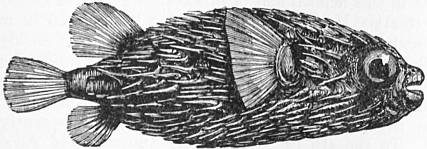
Fig. 1.—Diodon maculatus.
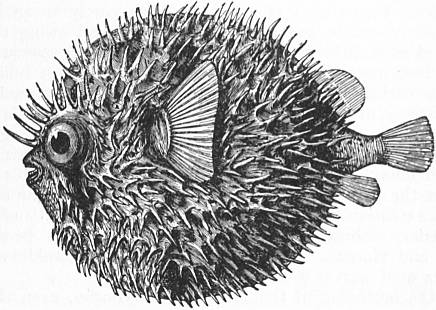
Fig. 2.—Diodon maculatus (inflated).
GLOBIGERINA, A. d’Orbigny, a genus of Perforate Foraminifera (q.v.) of pelagic habit, and formed of a conical spiral aggregate of spheroidal chambers with a crescentic mouth. The shells accumulate at the bottom of moderately deep seas to form “Globigerina ooze” and are preserved thus in the chalk. Hastigerina only differs in the “flat” or nautiloid spiral.
GLOCKENSPIEL, or Orchestral Bells (Fr. carillon; Ger. Glockenspiel, Stahlharmonika; Ital. campanelli; Med. Lat. tintinnabulum, cymbalum, bombulum), an instrument of percussion of definite musical pitch, used in the orchestra, and made in two or three different styles. The oldest form of glockenspiel, seen in illuminated MSS. of the middle ages, consists of a set of bells mounted on a frame and played by one performer by means of steel hammers. The name “bell” is now generally a misnomer, other forms of metal or wood having been found more convenient. The pyramid-shaped glockenspiel, formerly used in the orchestra for simple rhythmical effects, consists of an octave of semitone, hemispherical bells, placed one above the other and fastened to an iron rod which passes through the centre of each, the bells being of graduated sizes and diminishing in diameter as the pitch rises. The lyre-shaped glockenspiel, or steel harmonica (Stahlharmonika), is a newer model, which has instead of bells twelve or more bars of steel, graduating in size according to their pitch. These bars are fastened horizontally across two bars of steel set perpendicularly in a steel frame in the shape of a lyre. The bars are struck by little steel hammers attached to whalebone sticks.
Wagner has used the glockenspiel with exquisite judgment in the fire scene of the last act of Die Walküre and in the peasants’ waltz in the last scene of Die Meistersinger. When chords are written for the glockenspiel, as in Mozart’s Magic Flute, the keyed harmonica1 is used. It consists of a keyboard having a little hammer attached to each key, which strikes a bar of glass or steel when the key is depressed. The performer, being able to use both hands, can play a melody with full harmonies, scale and arpeggio passages in single and double notes. A peal of hemispherical bells was specially constructed for Sir Arthur Sullivan’s Golden Legend. It consists of four bells constructed of bell-metal about 1 in. thick, the largest measuring 27 in. in diameter, the smallest 23. They are fixed on a stand one above the other, with a clearance of about ¾ in. between them; the rim of the lowest and largest bell is 15 in. from the foot of the stand. The bells are struck by mallets, which are of two kinds—a pair of hard wood for forte passages, and a pair covered with wash-leather for piano effects. The peal was unique at the time it was made for the Golden Legend, but a smaller bell of the same shape, ¼ in. thick, with a diameter measuring about 16 in., specially made for the performance of Liszt’s St Elizabeth, when conducted by the composer in London, evidently suggested the idea for the peal.
(K. S.)
1 See “The Keyed Harmonica improved by H. Klein of Pressburg,” article in the Allg. musik. Ztg., Bd. i. pp. 675-699 (Leipzig, 1798); also Becker, p. 254, Bartel.
GLOGAU, a fortified town of Germany, in the Prussian province of Silesia, 59 m. N.W. from Breslau, on the railway to Frankfort-on-Oder. Pop. (1905) 23,461. It is built partly on an island and partly on the left bank of the Oder; and owing to the fortified enceinte having been pushed farther afield, new quarters have been opened up. Among its most important buildings are the cathedral, in the Gothic, and a castle (now used as a courthouse), in the Renaissance style, two other Roman Catholic and three Protestant churches, a new town-hall, a synagogue, a military hospital, two classical schools (Gymnasien) and several libraries. Owing to its situation on a navigable river and at the junction of several lines of railway, Glogau carries on an extensive trade, which is fostered by a variety of local industries, embracing machinery-building, tobacco, beer, oil, sugar and vinegar. It has also extensive lithographic works, and its wool market is celebrated.
In the beginning of the 11th century Glogau, even then a populous and fortified town, was able to withstand a regular siege by the emperor Henry V.; but in 1157 the duke of Silesia, finding he could not hold out against Frederick Barbarossa, set it on fire. In 1252 the town, which had been raised from its ashes by Henry I., the Bearded, became the capital of a principality of Glogau, and in 1482 town and district were united to the Bohemian crown. In the course of the Thirty Years’ War Glogau suffered greatly. The inhabitants, who had become Protestants soon after the Reformation, were dragooned into conformity by Wallenstein’s soldiery; and the Jesuits received permission to build themselves a church and a college. Captured by the Protestants in 1632, and recovered by the Imperialists in 1633, the town was again captured by the Swedes in 1642, and continued in Protestant hands till the peace of Westphalia in 1648, when the emperor recovered it. In 1741 the Prussians took the place by storm, and during the Seven Years’ War it formed an important centre of operations for the Prussian forces. After the battle of Jena (1806) it fell into the hands of the French; and was gallantly held by Laplane, against the Russian and Prussian besiegers, after the battle of Katzbach in August 1813 until the 17th of the following April.
See Minsberg, Geschichte der Stadt und Festung Glogau’s (2 vols., Glogau, 1853); and H. von Below, Zur Geschichte des Jahres 1806. Glogau’s Belagerung und Verteidigung (Berlin, 1893).
GLORIOSA, in botany, a small genus of plants belonging to the natural order Liliaceae, native of tropical Asia and Africa. They are bulbous plants, the slender stems of which support themselves by tendril-like prolongations of the tips of some of the narrow generally lanceolate leaves. The flowers, which are borne in the leaf-axils at the ends of the stem, are very handsome, the six, generally narrow, petals are bent back and stand erect, and are a rich orange yellow or red in colour; the six stamens project more or less horizontally from the place of insertion of the petals. They are generally grown in cultivation as stove-plants.
GLORY (through the O. Fr. glorie, modern gloire, from Lat. gloria, cognate with Gr. κλεός, κλύειν), a synonym for fame, renown, honour, and thus used of anything which reflects honour and renown on its possessor. In the phrase “glory of God” the word implies both the honour due to the Creator, and His majesty and effulgence. In liturgies of the Christian Church are the Gloria Patri, the doxology beginning “Glory be to the Father,” the response Gloria tibi, Domine, “Glory be to Thee, O Lord,” sung or said after the giving out of the Gospel for the day, and the Gloria in excelsis, “Glory be to God on high,” sung during the Mass and Communion service. A “glory” is the term often used as synonymous with halo, nimbus or aureola (q.v.) for the ring of light encircling the head or figure in a pictorial or other representation of sacred persons.