VOLUME XII SLICE I Gichtel, Johann to Glory (continued 5)
Reading edition
Origin and Language of the Gipsies.—The real key to their origin is, however, the Gipsy language. The scientific study of that language began in the middle of the 19th century with the work of Pott, and was brought to a high state of perfection by Miklosich. From that time on monographs have multiplied and minute researches have been carried on in many parts of the world, all tending to elucidate the true origin of the Gipsy language. It must remain for the time being an open question whether the Gipsies were originally a pure race. Many a strange element has contributed to swell their ranks and to introduce discordant elements into their vocabulary. Ruediger (1782), Grellmann (1783) and Marsden (1783) almost simultaneously and independently of one another came to the same conclusion, that the language of the Gipsies, until then considered a thieves’ jargon, was in reality a language closely allied with some Indian speech. Since then the two principal problems to be solved have been, firstly, to which of the languages of India the original Gipsy speech was most closely allied, and secondly, by which route the people speaking that language had reached Europe and then spread westwards. Despite the rapid increase in our knowledge of Indian languages, no solution has yet been found to the first problem, nor is it likely to be found. For the language of the Gipsies, as shown now by recent studies of the Armenian Gipsies, has undergone such a profound change and involves so many difficulties, that it is impossible to compare the modern Gipsy with any modern Indian dialect owing to the inner developments which the Gipsy language has undergone in the course of centuries. All that is known, moreover, of the Gipsy language, and all that rests on reliable texts, is quite modern, scarcely earlier than the middle of the 19th century. Followed up in the various dialects into which that language has split, it shows such a thorough change from dialect to dialect, that except as regards general outlines and principles of inflexion, nothing would be more misleading than to draw conclusions from apparent similarities between Gipsy, or any Gipsy dialect, and any Indian language; especially as the Gipsies must have been separated from the Indian races for a much longer period than has elapsed since their arrival in Europe and since the formation of their European dialects. It must also be borne in mind that the Indian languages have also undergone profound changes of their own, under influences totally different from those to which the Gipsy language has been subjected. The problem would stand differently if by any chance an ancient vocabulary were discovered representing the oldest form of the common stock from which the European dialects have sprung; for there can be no doubt of the unity of the language of the European Gipsies. The question whether Gipsy stands close to Sanskrit or Prakrit, or shows forms more akin to Hindi dialects, specially those of the North-West frontier, or Dardestan and Kafiristan, to which may be added now the dialects of the Pisāca language (Grierson, 1906), is affected by the fact established by Fink that the dialect of the Armenian Gipsies shows much closer resemblance to Prakrit than the language of the European Gipsies, and that the dialects of Gipsy spoken throughout Syria and Asia Minor differ profoundly in every respect from the European Gipsy, taken as a whole spoken. The only explanation possible is that the European Gipsy represents the first wave of the Westward movement of an Indian tribe or caste which, dislocated at a certain period by political disturbances, had travelled through Persia, making a very short stay there, thence to Armenia staying there a little longer, and then possibly to the Byzantine Empire at an indefinite period between 1100 and 1200; and that another clan had followed in their wake, passing through Persia, settling in Armenia and then going farther down to Syria, Egypt and North Africa. These two tribes though of a common remote Indian origin must, however, be kept strictly apart from one another in our investigation, for they stand to each other in the same relation as they stand to the various dialects in India. The linguistic proof of origin can therefore now not go further than to establish the fact that the Gipsy language is in its very essence an originally Indian dialect, enriched in its vocabulary from the languages of the peoples among whom the Gipsies had sojourned, whilst in its grammatical inflection it has slowly been modified, to such an extent that in some cases, like the English or the Servian, barely a skeleton has remained.
Notwithstanding the statements to the contrary, a Gipsy from Greece or Rumania could no longer understand a Gipsy of England or Germany, so profound is the difference. But the words which have entered into the Gipsy language, borrowed as they were from the Greeks, Hungarians, Rumanians, &c., are not only an indication of the route taken—and this is the only use that has hitherto been made of the vocabulary—but they are of the highest importance for fixing the time when the Gipsies had come in contact with these languages. The absence of Arabic is a positive proof that not only did the Gipsies not come via Arabia (as maintained by De Goeje) before they reached Europe, but that they could not even have been living for any length of time in Persia after the Mahommedan conquest, or at any rate that they could not have come in contact with such elements of the population as had already adopted Arabic in addition to Persian. But the form of the Persian words found among European Gipsies, and similarly the form of the Armenian words found in that language, are a clear indication that the Gipsies could not have come in contact with these languages before Persian had assumed its modern form and before Armenian had been changed from the old to the modern form of language. Still more strong and clear is the evidence in the case of the Greek and Rumanian words. If the Gipsies had lived in Greece, as some contend, from very ancient times, some at least of the old Greek words would be found in their language, and similarly the Slavonic words would be of an archaic character, whilst on the contrary we find medieval Byzantine forms, nay, modern Greek forms, among the Gipsy vocabulary collected from Gipsies in Germany or Italy, England or France; a proof positive that they could not have been in Europe much earlier than the approximate date given above of the 11th or 12th century. We then find from a grammatical point of view the same deterioration, say among the English or Spanish Gipsies, as has been noticed in the Gipsy dialect of Armenia. It is no longer Gipsy, but a corrupt English or Spanish adapted to some remnants of Gipsy inflections. The purest form has been preserved among the Greek Gipsies and to a certain extent among the Rumanian. Notably through Miklosich’s researches and comparative studies, it is possible to follow the slow change step by step and to prove, at any rate, that, as far as Europe is concerned, the language of these Gipsies was one and the same, and that it was slowly split up into a number of dialects (13 Miklosich, 14 Colocci) which shade off into one another, and which by their transitional forms mark the way in which the Gipsies have travelled, as also proved by historical evidence. The Welsh dialect, known by few, has retained, through its isolation, some of the ancient forms.
Religion, Habits and Customs.—Those who have lived among the Gipsies will readily testify that their religious views are a strange medley of the local faith, which they everywhere embrace, and some old-world superstitions which they have in common with many nations. Among the Greeks they belong to the Greek Church, among the Mahommedans they are Mahommedans, in Rumania they belong to the National Church. In Hungary they are mostly Catholics, according to the faith of the inhabitants of that country. They have no ethical principles and they do not recognize the obligations of the Ten Commandments. There is extreme moral laxity in the relation of the two sexes, and on the whole they take life easily, and are complete fatalists. At the same time they are great cowards, and they play the rôle of the fool or the jester in the popular anecdotes of eastern Europe. There the poltroon is always a Gipsy, but he is good-humoured and not so malicious as those Gipsies who had endured the hardships of outlawry in the west of Europe.
There is nothing specifically of an Oriental origin in their religious vocabulary, and the words Devla (God), Bang (devil) or Trushul (Cross), in spite of some remote similarity, must be taken as later adaptations, and not as remnants of an old Sky-worship or Serpent-worship. In general their beliefs, customs, tales, &c. belong to the common stock of general folklore, and many of their symbolical expressions find their exact counterpart in Rumanian and modern Greek, and often read as if they were direct translations from these languages. Although they love their children, it sometimes happens that a Gipsy mother will hold her child by the legs and beat the father with it. In Rumania and Turkey among the settled Gipsies a good number are carriers and bricklayers; and the women take their full share in every kind of work, no matter how hard it may be. The nomadic Gipsies carry on the ancient craft of coppersmiths, or workers in metal; they also make sieves and traps, but in the East they are seldom farriers or horse-dealers. They are far-famed for their music, in which art they are unsurpassed. The Gipsy musicians belong mostly to the class who originally were serfs. They were retained at the courts of the boyars for their special talent in reciting old ballads and love songs and their deftness in playing, notably the guitar and the fiddle. The former was used as an accompaniment to the singing of either love ditties and popular songs or more especially in recital or heroic ballads and epic songs; the latter for dances and other amusements. They were the troubadours and minstrels of eastern Europe; the largest collection of Rumanian popular ballads and songs was gathered by G. Dem. Teodorescu from a Gipsy minstrel, Petre Sholkan; and not a few of the songs of the guslars among the Servians and other Slavonic nations in the Balkans come also from the Gipsies. They have also retained the ancient tunes and airs, from the dreamy “doina” of the Rumanian to the fiery “czardas” of the Hungarian or the stately “hora” of the Bulgarian. Liszt went so far as to ascribe to the Gipsies the origin of the Hungarian national music. This is an exaggeration, as seen by the comparison of the Gipsy music in other parts of south-east Europe; but they undoubtedly have given the most faithful expression to the national temperament. Equally famous is the Gipsy woman for her knowledge of occult practices. She is the real witch; she knows charms to injure the enemy or to help a friend. She can break the charm if made by others. But neither in the one case nor in the other, and in fact as little as in their songs, do they use the Gipsy language. It is either the local language of the natives as in the case of charms, or a slightly Romanized form of Greek, Rumanian or Slavonic. The old Gipsy woman is also known for her skill in palmistry and fortune-telling by means of a special set of cards, the well-known Tarok of the Gipsies. They have also a large stock of fairy tales resembling in each country the local fairy tales, in Greece agreeing with the Greek, and in Rumania with the Rumanian fairy tales. It is doubtful, however, whether they have contributed to the dissemination of these tales throughout Europe, for a large number of Gipsy tales can be shown to have been known in Europe long before the appearance of the Gipsies, and others are so much like those of other nations that the borrowing may be by the Gipsy from the Greek, Slav or Rumanian. It is, however, possible that playing-cards might have been introduced to Europe through the Gipsies. The oldest reference to cards is found in the Chronicle of Nicolaus of Cavellazzo, who says that the cards were first brought into Viterbo in 1379 from the land of the Saracens, probably from Asia Minor or the Balkans. They spread very quickly, but no one has been able as yet to trace definitely the source whence they were first brought. Without entering here into the history of the playing-cards and of the different forms of the faces and of the symbolical meaning of the different designs, one may assume safely that the cards, before they were used for mere pastime or for gambling, may originally have had a mystical meaning and been used as sortes in various combinations. To this very day the oldest form is known by the hitherto unexplained name of Tarock, played in Bologna at the beginning of the 15th century and retained by the French under the form Tarot, connected direct with the Gipsies, “Le Tarot des Bohémiens.” It was noted above that the oldest chronicler (Presbyter) who describes the appearance of the Gipsies in 1416 in Germany knows them by their Italian name “Cianos,” so evidently he must have known of their existence in Italy previous to any date recorded hitherto anywhere, and it is therefore not impossible that coming from Italy they brought with them also their book of divination.
Physical Characteristics.—As a race they are of small stature varying in colour from the dark tan of the Arab to the whitish hue of the Servian and the Pole. In fact there are some white-coloured Gipsies, especially in Servia and Dalmatia, and these are often not easily distinguishable from the native peoples, except that they are more lithe and sinewy, better proportioned and more agile in their movements than the thick-set Slavs and the mixed race of the Rumanians. By one feature, however, they are easily distinguishable and recognize one another, viz. by the lustre of their eyes and the whiteness of their teeth. Some are well built; others have the features of a mongrel race, due no doubt to intermarriage with outcasts of other races. The women age very quickly and the mortality among the Gipsies is great, especially among children; among adults it is chiefly due to pulmonary diseases. They love display and Oriental showiness, bright-coloured dresses, ornaments, bangles, &c.; red and green are the colours mostly favoured by the Gipsies in the East. Along with a showy handkerchief or some shining gold coins round their necks, they will wear torn petticoats and no covering on their feet. And even after they have been assimilated and have forgotten their own language they still retain some of the prominent features of their character, such as the love of inordinate display and gorgeous dress; and their moral defects not only remain for a long time as glaring as among those who live the life of vagrants, but even become more pronounced. The Gipsy of to-day is no longer what his forefathers have been. The assimilation with the nations in the near East and the steps taken for the suppression of vagrancy in the West, combine to denationalize the Gipsy and to make “Români Chib” a thing of the past.
Bibliography.—The scientific study of the Gipsy language and its origin, as well as the critical history of the Gipsy race, dates (with the notable exception of Grellmann) almost entirely from Pott’s researches in 1844.
I. Collections of Documents, &c.—Lists of older publications appeared in the books of Pott, Miklosich and the archduke Joseph; Pott adds a critical appreciation of the scientific value of the books enumerated. See also Verzeichnis von Werken und Aufsätzen ... über die Geschichte und Sprache der Zigeuner, &c., 248 entries (Leipzig, 1886); J. Tipray, “Adalékok a czigányokról szóló írodalomhoz,” in Magyar Könyvszemle (Budapest, 1877); Ch. G. Leland, A Collection of Cuttings ... relating to Gypsies (1874-1891), bequeathed by him to the British Museum. See also the Orientalischer Jahresbericht, ed. Müller (Berlin, 1887 ff.).
II. History.—(a) The first appearance of the Gipsies in Europe. Sources: A. F. Oefelius, Rerum Boicarum scriptores, &c. (Augsburg, 1763); M. Freher, Andreae Presbyteri ... chronicon de ducibus Bavariae ... (1602); S. Munster, Cosmographia ... &c. (Basel, 1545); J. Thurmaier, Annalium Boiorum libri septem, ed. T. Zieglerus (Ingolstad, 1554); M. Crusius, Annales Suevici, &c. (Frankfurt, 1595-1596), Schwäbische Chronik ... (Frankfurt, 1733); A. Krantz, Saxonia (Cologne, 1520); Simon Simeon, Itineraria, &c., ed. J. Nasmith (Cambridge, 1778). (b) Origin and spread of the Gipsies: H. M. G. Grellmann, Die Zigeuner, &c. (1st ed., Dessau and Leipzig, 1783; 2nd ed., Göttingen, 1787); English by M. Roper (London, 1787; 2nd ed., London, 1807), entitled Dissertation on the Gipsies, &c.; Carl von Heister, Ethnographische ... Notizen über die Zigeuner (Königsberg, 1842), a third and greatly improved edition of Grellmann and the best book of its kind up to that date; A. F. Pott, Die Zigeuner in Europa und Asien (2 vols., Halle, 1844-1845), the first scholarly work with complete and critical bibliography, detailed grammar, etymological dictionary and important texts; C. Hopf, Die Einwanderung der Zigeuner in Europa (Gotha, 1870); F. von Miklosich, “Beiträge zur Kenntnis der Zigeuner-Mundarten,” i.-iv., in Sitzungsber. d. Wiener Akad. d. Wissenschaften (Vienna, 1874-1878), “Über die Mundarten und die Wanderungen der Zigeuner Europas,” i.-xii., in Denkschriften d. Wiener Akad. d. Wissenschaften (1872-1880); M. J. de Goeje, Bijdrage tot de geschiedenis der Zigeuners (Amsterdam, 1875), English translation by MacRitchie, Account of the Gipsies of India (London, 1886); Zedler, Universal-Lexicon, vol. lxii., s.v. “Zigeuner,” pp. 520-544 containing a rich bibliography; many publications of P. Bataillard from 1844 to 1885; A. Colocci, Storia d’ un popolo errante, with illustrations, map and Gipsy-Ital. and Ital.-Gipsy glossaries (Turin, 1889); F. H. Groome, “The Gypsies,” in E. Magnusson, National Life and Thought (1891), and art. “Gipsies” in Encyclopaedia Britannica (9th ed., 1879); C. Améro, Bohémiens, Tsiganes et Gypsies (Paris, 1895); M. Kogalnitschan, Esquisse sur l’histoire, les mœurs et la langue des Cigains (Berlin, 1837; German trans., Stuttgart, 1840)—valuable more for the historical part than for the linguistic; J. Czacki, Dziela, vol. iii. (1844-1845)—for historic data about Gipsies in Poland; I. Kopernicki and J. Moyer, Charakterystyka fizyczna ludrości galicyjskiéj (1876)—for the history and customs of Galician gipsies; Ungarische statistische Mitteilungen, vol. ix. (Budapest, 1895), containing the best statistical information on the Gipsies; V. Dittrich, A nagy-idai czigányok (Budapest, 1898); T. H. Schwicker, “Die Zigeuner in Ungarn u. Siebenbürgen,” in vol. xii. of Die Völker Österreich-Ungarns (Vienna, 1883), and in Mitteilungen d. K. K. geographischen Gesellschaft (Vienna, 1896); Dr J. Polek, Die Zigeuner in der Bukowina (Czernowitz, 1908); Ficker, “Die Zigeuner der Bukowina,” in Statist. Monatschrift, v. 6, Hundert Jahre 1775-1875: Zigeuner in d. Bukowina (Vienna, 1875), Die Völkerstämme der österr.-ungar. Monarchie, &c. (Vienna, 1869); V. S. Morwood, Our Gipsies (London, 1885); D. MacRitchie, Scottish Gypsies under the Stewarts (Edinburgh, 1894); F. A. Coelho, “Os Ciganos de Portugal,” in Bol. Soc. Geog. (Lisbon, 1892); A. Dumbarton, Gypsy Life in the Mysore Jungle (London, 1902).
III. Linguistic.—[Armenia], F. N. Finck, “Die Sprache der armenischen Zigeuner,” in Mémoires de l’Acad. Imp. des Sciences, viii. (St Petersburg, 1907). [Austria-Hungary], R. von Sowa, Die Mundart der slovakischen Zigeuner (Göttingen, 1887), and Die mährische Mundart der Romsprache (Vienna, 1893); A. J. Puchmayer, Români Čib (Prague, 1821); P. Josef Ješina, Romáňi Čib (in Czech, 1880; in German, 1886); G. Ihnatko, Czigány nyelvtan (Losoncon, 1877); A. Kalina, La Langue des Tsiganes slovaques (Posen, 1882); the archduke Joseph, Czigány nyelvtan (Budapest, 1888); H. von Wlislocki, Die Sprache der transsilvanischen Zigeuner (Leipzig, 1884). [Brazil], A. T. de Mello Moraes, Os ciganos no Brazil (Rio de Janeiro, 1886). [France, the Basques], A. Baudrimont, Vocabulaire de la langue des Bohémiens habitant les pays basques-français (Bordeaux, 1862). [Germany], R. Pischel, Beiträge zur Kenntnis der deutschen Zigeuner (Halle, 1894); R. von Sowa, “Wörterbuch des Dialekts der deutschen Zigeuner,” in Abhandlungen f. d. Kunde d. Morgenlandes, xi. 1, very valuable (Leipzig, 1898); F. N. Finck, Lehrbuch des Dialekts der deutschen Zigeuner—very valuable (Marburg, 1903). [Great Britain, &c.], Ch. G. Leland, The English Gipsies and their Language (London and New York, 1873; 2nd ed., 1874), The Gipsies of Russia, Austria, England, America, &c. (London, 1882)—the validity of Leland’s conclusions is often doubtful; B. C. Smart and H. J. Crofton, The Dialect of the English Gypsies (2nd ed., London, 1875); G. Borrow, Romano lavo-lil (London, 1874, 1905), Lavengro, ed. F. H. Groome (London, 1899). [Rumania], B. Constantinescu, Probe de Limba şi literatura Ţiganilor din România (Bucharest, 1878). [Russia, Bessarabia], O. Boethlingk, Über die Sprache der Zigeuner in Russland (St Petersburg, 1852; supplement, 1854). [Russia, Caucasus], K. Badganian, Cygany. Nêskolĭko slovŭ o narêčijahŭ zakavkazskihŭ cyganŭ (St Petersburg, 1887); Istomin, Ciganskij Jazykŭ (1900). [Spain], G. H. Borrow, The Zincali, or an Account of the Gipsies of Spain (London, 1841, and numerous later editions); R. Campuzano, Origen ... de los Gitanos, y diccionario de su dialecto (2nd ed., Madrid, 1857); A. de C., Diccionario del dialecto gitano, &c. (Barcelona, 1851); M. de Sales y Guindale, Historia, costumbres y dialecto de los Gitanos (Madrid, 1870); M. de Sales, El Gitanismo (Madrid, 1870); J. Tineo Rebolledo, ”A Chipicalli” la lengua gitana: diccionario gitano-español (Granada, 1900). [Turkey], A. G. Paspati, Études sur les Tchinghianés, ou Bohémiens de l’empire ottoman (Constantinople, 1870), with grammar, vocabulary, tales and French glossary; very important. [General], John Sampson, “Gypsy Language and Origin,” in Journ. Gypsy Lore Soc. vol. i. (2nd ser., Liverpool, 1907); J. A. Decourdemanche, Grammaire du Tchingané, &c. (Paris, 1908)—fantastic in some of its philology; F. Kluge, Rotwelsche Quellen (Strassburg, 1901); L. Günther, Das Rotwelsch des deutschen Gauners (Leipzig, 1905), for the influence of Gipsy on argot; L. Besses, Diccionario de argot español (Barcelona); G. A. Grierson, The Pi’sāca Languages of North-Western India (London, 1906), for parallels in Indian dialects; G. Borrow, Criscote e majaró Lucas ... El evangelio segun S. Lucas ... (London, 1837; 2nd ed., 1872)—this is the only complete translation of any one of the gospels into Gipsy. For older fragments of such translations, see Pott ii. 464-521.
IV. Folklore, Tales, Songs, &c.—Many songs and tales are found in the books enumerated above, where they are mostly accompanied by literal translations. See also Ch. G. Leland, E. H. Palmer and T. Tuckey, English Gipsy Songs in Romany, with Metrical English Translation (London, 1875); G. Smith, Gipsy Life, &c. (London, 1880); M. Rosenfeld, Lieder der Zigeuner (1882); Ch. G. Leland, The Gypsies (Boston, Mass., 1882), Gypsy Sorcery and Fortune-Telling (London, 1891); H. von Wlislocki, Märchen und Sagen der transsilvanischen Zigeuner (Berlin, 1886)—containing 63 tales, very freely translated; Volksdichtungen der siebenbürgischen und südungarischen Zigeuner (Vienna, 1890)—songs, ballads, charms, proverbs and 100 tales; Vom wandernden Zigeunervolke (Hamburg, 1890); Wesen und Wirkungskreis der Zauberfrauen bei den siebenbürgischen Zigeuner (1891); “Aus dem inneren Leben der Zigeuner,” in Ethnologische Mitteilungen (Berlin, 1892); R. Pischel, Bericht über Wlislocki vom wandernden Zigeunervolke (Göttingen, 1890)—a strong criticism of Wlislocki’s method, &c.; F. H. Groome, Gypsy Folk-Tales (London, 1899), with historical introduction and a complete and trustworthy collection of 76 gipsy tales from many countries; Katadá, Contes gitanos (Logroño, 1907); M. Gaster, Zigeunermärchen aus Rumänien (1881); “Ţiganii, &c.,” in Revista pentru Istorie, &c., i. p. 469 ff. (Bucharest, 1883); “Gypsy Fairy-Tales” in Folklore. The Journal of the Gipsy-Lore Society (Edinburgh, 1888-1892) was revived in Liverpool in 1907.
V. Legal Status.—A few of the books in which the legal status of the Gipsies (either alone or in conjunction with “vagrants”) is treated from a juridical point of view are here mentioned, also the history of the trial in 1726. J. B. Weissenbruch, Ausführliche Relation von der famosen Zigeuner-Diebes-Mord und Räuber (Frankfurt and Leipzig, 1727); A. Ch. Thomasius, Tractatio juridica de vagabundo, &c. (Leipzig, 1731); F. Ch. B. Avé-Lallemant, Das deutsche Gaunertum, &c. (Leipzig, 1858-1862); V. de Rochas, Les Parias de France et d’Espagne (Paris, 1876); P. Chuchul, Zum Kampfe gegen Landstreicher und Bettler (Kassel, 1881); R. Breithaupt, Die Zigeuner und der deutsche Staat (Würzburg, 1907); G. Steinhausen, Geschichte der deutschen Kultur (Leipzig and Vienna, 1904).
(M. G.)
GIRAFFE, a corruption of Zarāfah, the Arabic name for the tallest of all mammals, and the typical representative of the family Giraffidae, the distinctive characters of which are given in the article Pecora, where the systematic position of the group is indicated. The classic term “camelopard,” probably introduced when these animals were brought from North Africa to the Roman amphitheatre, has fallen into complete disuse.
In common with the okapi, giraffes have skin-covered horns on the head, but in these animals, which form the genus Giraffa, these appendages are present in both sexes; and there is often an unpaired one in advance of the pair on the forehead. Among other characteristics of these animals may be noticed the great length of the neck and limbs, the complete absence of lateral toes and the long and tufted tail. The tongue is remarkable for its great length, measuring about 17 in. in the dead animal, and for its great elasticity and power of muscular contraction while living. It is covered with numerous large papillae, and forms, like the trunk of the elephant, an admirable organ for the examination and prehension of food. Giraffes are inhabitants of open country, and owing to their length of neck and long flexible tongues are enabled to browse on tall trees, mimosas being favourites. To drink or graze they are obliged to straddle the fore-legs apart; but they seldom feed on grass and are capable of going long without water. When standing among mimosas they so harmonize with their surroundings that they are difficult of detection. Formerly giraffes were found in large herds, but persecution has reduced their number and led to their extermination from many districts. Although in late Tertiary times widely spread over southern Europe and India, giraffes are now confined to Africa south of the Sahara.
Apart from the distinct Somali giraffe (Giraffa reticulata), characterized by its deep liver-red colour marked with a very coarse network of fine white lines, there are numerous local forms of the ordinary giraffe (Giraffa camelopardalis). The northern races, such as the Nubian G. c. typica and the Kordofan G. c. antiquorum, are characterized by the large frontal horn of the bulls, the white legs, the network type of coloration and the pale tint. The latter feature is specially developed in the Nigerian G. c. peralta, which is likewise of the northern type. The Baringo G. c. rothschildi also has a large frontal horn and white legs, but the spots in the bulls are very dark and those of the females jagged. In the Kilimanjaro G. c. tippelskirchi the frontal horn is often developed in the bulls, but the legs are frequently spotted to the fetlocks. Farther south the frontal horn tends to disappear more or less completely, as in the Angola G. c. angolensis, the Transvaal G. c. wardi and the Cape G. c. capensis, while the legs are fully spotted and the colour-pattern on the body (especially in the last-named) is more of a blotched type, that is to say, consists of dark blotches on a fawn ground, instead of a network of light lines on a dark ground.
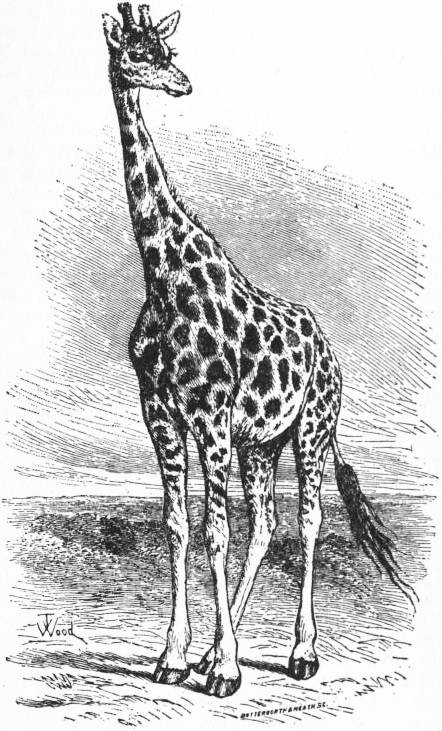
The North African or Nubian Giraffe (Giraffa camelopardalis).
For details, see a paper on the subspecies of Giraffa camelopardalis, by R. Lydekker in the Proceedings of the Zoological Society of London for 1904.
(R. L.*)
GIRALDI, GIGLIO GREGORIO [Lilius Gregorius Gyraldus] (1479-1552), Italian scholar and poet, was born on the 14th of June 1479, at Ferrara, where he early distinguished himself by his talents and acquirements. On the completion of his literary course he removed to Naples, where he lived on familiar terms with Jovianus Pontanus and Sannazaro; and subsequently to Lombardy, where he enjoyed the favour of the Mirandola family. At Milan in 1507 he studied Greek under Chalcondylas; and shortly afterwards, at Modena, he became tutor to Ercole (afterwards Cardinal) Rangone. About the year 1514 he removed to Rome, where, under Clement VII., he held the office of apostolic protonotary; but having in the sack of that city (1527), which almost coincided with the death of his patron Cardinal Rangone, lost all his property, he returned in poverty once more to Mirandola, whence again he was driven by the troubles consequent on the assassination of the reigning prince in 1533. The rest of his life was one long struggle with ill-health, poverty and neglect; and he is alluded to with sorrowful regret by Montaigne in one of his Essais (i. 34), as having, like Sebastian Castalio, ended his days in utter destitution. He died at Ferrara in February 1552; and his epitaph makes touching and graceful allusion to the sadness of his end. Giraldi was a man of very extensive erudition; and numerous testimonies to his profundity and accuracy have been given both by contemporary and by later scholars. His Historia de diis gentium marked a distinctly forward step in the systematic study of classical mythology; and by his treatises De annis et mensibus, and on the Calendarium Romanum et Graecum, he contributed to bring about the reform of the calendar, which was ultimately effected by Pope Gregory XIII. His Progymnasma adversus literas et literatos deserves mention at least among the curiosities of literature; and among his other works to which reference is still occasionally made are Historiae poëtarum Graecorum ac Latinorum; De poëtis suorum temporum; and De sepultura ac vario sepeliendi ritu. Giraldi was also an elegant Latin poet.
His Opera omnia were published at Leiden in 1696.
GIRALDI, GIOVANNI BATTISTA (1504-1573), surnamed Cynthius, Cinthio or Cintio, Italian novelist and poet, born at Ferrara in November 1504, was educated at the university of his native town, where in 1525 he became professor of natural philosophy, and, twelve years afterwards, succeeded Celio Calcagnini in the chair of belles-lettres. Between 1542 and 1560 he acted as private secretary, first to Ercole II. and afterwards to Alphonso II. of Este; but having, in connexion with a literary quarrel in which he had got involved, lost the favour of his patron in the latter year, he removed to Mondovi, where he remained as a teacher of literature till 1568. Subsequently, on the invitation of the senate of Milan, he occupied the chair of rhetoric at Pavia till 1573, when, in search of health, he returned to his native town, where on the 30th of December he died. Besides an epic entitled Ercole (1557), in twenty-six cantos, Giraldi wrote nine tragedies, the best known of which, Orbecche, was produced in 1541. The sanguinary and disgusting character of the plot of this play, and the general poverty of its style, are, in the opinion of many of its critics, almost fully redeemed by occasional bursts of genuine and impassioned poetry; of one scene in the third act in particular it has even been affirmed that, if it alone were sufficient to decide the question, the Orbecche would be the finest play in the world. Of the prose works of Giraldi the most important is the Hecatommithi or Ecatomiti, a collection of tales told somewhat after the manner of Boccaccio, but still more closely resembling the novels of Giraldi’s contemporary Bandello, only much inferior in workmanship to the productions of either author in vigour, liveliness and local colour. Something, but not much, however, may be said in favour of their professed claim to represent a higher standard of morality. Originally published at Monteregale, Sicily, in 1565, they were frequently reprinted in Italy, while a French translation by Chappuys appeared in 1583 and one in Spanish in 1590. They have a peculiar interest to students of English literature, as having furnished, whether directly or indirectly, the plots of Measure for Measure and Othello. That of the latter, which is to be found in the Hecatommithi (iii. 7), is conjectured to have reached Shakespeare through the French translation; while that of the former (Hecat. viii. 5) is probably to be traced to Whetstone’s Promos and Cassandra (1578), an adaptation of Cinthio’s story, and to his Heptamerone (1582), which contains a direct English translation. To Giraldi also must be attributed the plot of Beaumont and Fletcher’s Custom of the Country.
GIRALDUS CAMBRENSIS (1146?-1220), medieval historian, also called Gerald de Barri, was born in Pembrokeshire. He was the son of William de Barri and Augharat, a daughter of Gerald, the ancestors of the Fitzgeralds and the Welsh princess, Nesta, formerly mistress of King Henry I. Falling under the influence of his uncle, David Fitzgerald, bishop of St David’s, he determined to enter the church. He studied at Paris, and his works show that he had applied himself closely to the study of the Latin poets. In 1172 he was appointed to collect tithe in Wales, and showed such vigour that he was made archdeacon. In 1176 an attempt was made to elect him bishop of St David’s, but Henry II. was unwilling to see any one with powerful native connexions a bishop in Wales. In 1180, after another visit to Paris, he was appointed commissiary to the bishop of St David’s, who had ceased to reside. But Giraldus threw up his post, indignant at the indifference of the bishop to the welfare of his see. In 1184 he was made one of the king’s chaplains, and was elected to accompany Prince John on his voyage to Ireland. While there he wrote a Topographia Hibernica, which is full of information, and a strongly prejudiced history of the conquest, the Expugnatio Hibernica. In 1186 he read his work with great applause before the masters and scholars of Oxford. In 1188 he was sent into Wales with the primate Baldwin to preach the Third Crusade. Giraldus declares that the mission was highly successful; in any case it gave him the material for his Itinerarium Cambrense, which is, after the Expugnatio, his best known work. He accompanied the archbishop, who intended him to be the historian of the Crusade, to the continent, with the intention of going to the Holy Land. But in 1189 he was sent back to Wales by the king, who knew his influence was great, to keep order among his countrymen. Soon after he was absolved from his crusading vow. According to his own statements, which often tend to exaggeration, he was offered both the sees of Bangor and Llandaff, but refused them. From 1192 to 1198 he lived in retirement at Lincoln and devoted himself to literature. It is probably during this period that he wrote the Gemma ecclesiastica (discussing disputed points of doctrine, ritual, &c.) and the Vita S. Remigii. In 1198 he was elected bishop of St David’s. But Hubert Walter, the archbishop of Canterbury, was determined to have in that position no Welshman who would dispute the metropolitan pretensions of the English primates. The king, for political reasons, supported Hubert Walter. For four years Giraldus exerted himself to get his election confirmed, and to vindicate the independence of St David’s from Canterbury. He went three times to Rome. He wrote the De jure Meneviensis ecclesiae in support of the claims of his diocese. He made alliances with the princes of North and South Wales. He called a general synod of his diocese. He was accused of stirring up rebellion among the Welsh, and the justiciar proceeded against him. At length in 1202 the pope annulled all previous elections, and ordered a new one. The prior of Llanthony was finally elected. Gerald was immediately reconciled to the king and archbishop; the utmost favour was shown to him; even the expenses of his unsuccessful election were paid. He spent the rest of his life in retirement, though there was some talk of his being made a cardinal. He certainly survived John.
The works of Giraldus are partly polemical and partly historical. His value as a historian is marred by his violent party spirit; some of his historical tracts, such as the Liber de instructione principum and the Vita Galfridi Archiepiscopi Eborecensis, seem to have been designed as political pamphlets. Henry II., Hubert Walter and William Longchamp, the chancellor of Richard I., are the objects of his worst invectives. His own pretensions to the see of St David are the motive of many of his misrepresentations. But he is one of the most vivid and witty of our medieval historians.
See the Rolls edition of his works, ed. J. S. Brewer, J. F. Dimock and G. F. Warner in 8 vols. (London, 1861-1891), some of which have valuable introductions.
GIRANDOLE (from the Ital. girandola), an ornamental branched candlestick of several lights. It came into use about the second half of the 17th century, and was commonly made and used in pairs. It has always been, comparatively speaking, a luxurious appliance for lighting, and in the great 18th-century period of French house decoration the famous ciseleurs designed some exceedingly beautiful examples. A great variety of metals has been used for the purpose—sometimes, as in the case of the candlestick, girandoles have been made in hard woods. Gilded bronze has been a very frequent medium, but for table purposes silver is still the favourite material.
GIRARD, JEAN BAPTISTE [known as “Le Père Girard” or “Le Père Gregoire”] (1765-1850), French-Swiss educationalist, was born at Fribourg and educated for the priesthood at Lucerne. He was the fifth child in a family of fourteen, and his gift for teaching was early shown at home in helping his mother with the younger children; and after passing through his noviciate he spent some time as an instructor in convents, notably at Würzburg (1785-1788). Then for ten years he was busy with religious duty. In 1798, full of Kantian ideas, he published an essay outlining a scheme of national Swiss education; and in 1804 he began his career as a public teacher, first in the elementary school at Fribourg (1805-1823), then (being driven away by Jesuit hostility) in the gymnasium at Lucerne till 1834, when he retired to Fribourg and devoted himself with the production of his books on education, De l’enseignement régulier de la langue maternelle (1834, 9th ed. 1894; Eng. trans. by Lord Ebrington, The Mother Tongue, 1847), and Cours éducatif (1844-1846). Father Girard’s reputation and influence as an enthusiast in the cause of education became potent not only in Switzerland, where he was hailed as a second Pestalozzi, but in other countries. He had a genius for teaching, his method of stimulating the intelligence of the children at Fribourg and interesting them actively in learning, and not merely cramming them with rules and facts, being warmly praised by the Swiss educationalist François Naville (1784-1846) in his treatise on public education (1832). His undogmatic method and his Liberal Christianity brought him into conflict with the Jesuits, but his aim was, in all his teaching, to introduce the moral idea into the minds of his pupils by familiarizing them with the right or wrong working of the facts he brought to their attention, and thus to elevate character all through the educational curriculum.
GIRARD, PHILIPPE HENRI DE (1775-1845), French mechanician, was born at Lourmarin, Vaucluse, on the 1st of February 1775. He is chiefly known in connexion with flax-spinning machinery. Napoleon having in 1810 decreed a reward of one million francs to the inventor of the best machine for spinning flax, Girard succeeded in producing what was required. But he never received the promised reward, although in 1853, after his death, a comparatively small pension was voted to his heirs, and having relied on the money to pay the expenses of his invention he got into serious financial difficulties. He was obliged, in 1815, to abandon the flax mills he had established in France, and at the invitation of the emperor of Austria founded a flax mill and a factory for his machines at Hirtenberg. In 1825, at the invitation of the emperor Alexander I. of Russia, he went to Poland, and erected near Warsaw a flax manufactory, round which grew up a village which received the name of Girardow. In 1818 he built a steamer to run on the Danube. He did not return to Paris till 1844, where he still found some of his old creditors ready to press their claims, and he died in that city on the 26th of August 1845. He was also the author of numerous minor inventions.
GIRARD, STEPHEN (1750-1831), American financier and philanthropist, founder of Girard College in Philadelphia, was born in a suburb of Bordeaux, France, on the 20th of May 1750. He lost the sight of his right eye at the age of eight and had little education. His father was a sea captain, and the son cruised to the West Indies and back during 1764-1773, was licensed captain in 1773, visited New York in 1774, and thence with the assistance of a New York merchant began to trade to and from New Orleans and Port au Prince. In May 1776 he was driven into the port of Philadelphia by a British fleet and settled there as a merchant; in June of the next year he married Mary (Polly) Lum, daughter of a shipbuilder, who, two years later, after Girard’s becoming a citizen of Pennsylvania (1778), built for him the “Water Witch,” the first of a fleet trading with New Orleans and the West Indies—most of Girard’s ships being named after his favourite French authors, such as “Rousseau,” “Voltaire,” “Helvétius” and “Montesquieu.” His beautiful young wife became insane and spent the years from 1790 to her death in 1815 in the Pennsylvania Hospital. In 1810 Girard used about a million dollars deposited by him with the Barings of London for the purchase of shares of the much depreciated stock of the Bank of the United States—a purchase of great assistance to the United States government in bolstering European confidence in its securities. When the Bank was not rechartered the building and the cashier’s house in Philadelphia were purchased at a third of the original cost by Girard, who in May 1812 established the Bank of Stephen Girard. He subscribed in 1814 for about 95% of the government’s war loan of $5,000,000, of which only $20,000 besides had been taken, and he generously offered at par shares which upon his purchase had gone to a premium. He pursued his business vigorously in person until the 12th of February 1830, when he was injured in the street by a truck; he died on the 26th of December 1831. His public spirit had been shown during his life not only financially but personally; in 1793, during the plague of yellow fever in Philadelphia, he volunteered to act as manager of the wretched hospital at Bush Hill, and with the assistance of Peter Helm had the hospital cleansed and its work systematized; again during the yellow fever epidemic of 1797-1798 he took the lead in relieving the poor and caring for the sick. Even more was his philanthropy shown in his disposition by will of his estate, which was valued at about $7,500,000, and doubtless the greatest fortune accumulated by any individual in America up to that time. Of his fortune he bequeathed $116,000 to various Philadelphia charities, $500,000 to the same city for the improvement of the Delaware water front, $300,000 to Pennsylvania for internal improvements, and the bulk of his estate to Philadelphia, to be used in founding a school or college, in providing a better police system, and in making municipal improvements and lessening taxation. Most of his bequest to the city was to be used for building and maintaining a school “to provide for such a number of poor male white orphan children ... a better education as well as a more comfortable maintenance than they usually receive from the application of the public funds.” His will planned most minutely for the erection of this school, giving details as to the windows, doors, walls, &c.; and it contained the following phrase: “I enjoin and require that no ecclesiastic, missionary or minister of any sect whatsoever, shall ever hold or exercise any duty whatsoever in the said college; nor shall any such person ever be admitted for any purpose, or as a visitor, within the premises appropriated to the purposes of the said college.... I desire to keep the tender minds of orphans ... free from the excitements which clashing doctrines and sectarian controversy are so apt to produce.” Girard’s heirs-at-law contested the will in 1836, and they were greatly helped by a public prejudice aroused by the clause cited; in the Supreme Court of the United States in 1844 Daniel Webster, appearing for the heirs, made a famous plea for the Christian religion, but Justice Joseph Story handed down an opinion adverse to the heirs (Vidals v. Girard’s Executors). Webster was opposed in this suit by John Sergeant and Horace Binney. Girard specified that those admitted to the college must be white male orphans, of legitimate birth and good character, between the ages of six and ten; that no boy was to be permitted to stay after his eighteenth year; and that as regards admissions preference was to be shown, first to orphans born in Philadelphia, second to orphans born in any other part of Pennsylvania, third to orphans born in New York City, and fourth to orphans born in New Orleans. Work upon the buildings was begun in 1833, and the college was opened on the 1st of January 1848, a technical point of law making instruction conditioned upon the completion of the five buildings, of which the principal one, planned by Thomas Ustick Walter (1804-1887), has been called “the most perfect Greek temple in existence.” To a sarcophagus in this main building the remains of Stephen Girard were removed in 1851. In the 40 acres of the college grounds there were in 1909 18 buildings (valued at $3,350,000), 1513 pupils, and a total “population,” including students, teachers and all employes, of 1907. The value of the Girard estate in the year 1907 was $35,000,000, of which $550,000 was devoted to other charities than Girard College. The control of the college was under a board chosen by the city councils until 1869, when by act of the legislature it was transferred to trustees appointed by the Common Pleas judges of the city of Philadelphia. The course of training is partly industrial—for a long time graduates were indentured till they came of age—but it is also preparatory to college entrance.
See H. A. Ingram, The Life and Character of Stephen Girard (Philadelphia, 1884), and George P. Rupp, “Stephen Girard—Merchant and Mariner,” in 1848-1898: Semi-Centennial of Girard College (Philadelphia, 1898).
GIRARDIN, DELPHINE DE (1804-1855), French author, was born at Aix-la-Chapelle on the 26th of January 1804. Her mother, the well-known Madame Sophie Gay, brought her up in the midst of a brilliant literary society. She published two volumes of miscellaneous pieces, Essais poétiques (1824) and Nouveaux Essais poétiques (1825). A visit to Italy in 1827, during which she was enthusiastically welcomed by the literati of Rome and even crowned in the capitol, was productive of various poems, of which the most ambitious was Napoline (1833). Her marriage in 1831 to Émile de Girardin (see below) opened up a new literary career. The contemporary sketches which she contributed from 1836 to 1839 to the feuilleton of La Presse, under the nom de plume of Charles de Launay, were collected under the title of Lettres parisiennes (1843), and obtained a brilliant success. Contes d’une vieille fille à ses neveux (1832), La Canne de Monsieur de Balzac (1836) and Il ne faut pas jouer avec la douleur (1853) are among the best-known of her romances; and her dramatic pieces in prose and verse include L’École des journalistes (1840), Judith (1843), Cléopâtre (1847), Lady Tartufe (1853), and the one-act comedies, C’est la faute du mari (1851), La Joie fait peur (1854), Le Chapeau d’un horloger (1854) and Une Femme qui déteste son mari, which did not appear till after the author’s death. In the literary society of her time Madame Girardin exercised no small personal influence, and among the frequenters of her drawing-room were Théophile Gautier and Balzac, Alfred de Musset and Victor Hugo. She died on the 29th of June 1855. Her collected works were published in six volumes (1860-1861).
See Sainte-Beuve, Causeries du lundi, t. iii.; G. de Molènes, “Les Femmes poètes,” in Revue des deux mondes (July 1842); Taxile Delord, Les Matinées littéraires (1860); L’Esprit de Madame Girardin, avec une préface par M. Lamartine (1862); G. d’Heilly, Madame de Girardin, sa vie et ses œuvres (1868); Imbert de Saint Amand, Mme de Girardin (1875).
GIRARDIN, ÉMILE DE (1802-1881), French publicist, was born, not in Switzerland in 1806 of unknown parents, but (as was recognized in 1837) in Paris in 1802, the son of General Alexandre de Girardin and of Madame Dupuy, wife of a Parisian advocate. His first publication was a novel, Émile, dealing with his birth and early life, and appeared under the name of Girardin in 1827. He became inspector of fine arts under the Martignac ministry just before the revolution of 1830, and was an energetic and passionate journalist. Besides his work on the daily press he issued miscellaneous publications which attained an enormous circulation. His Journal des connaissances utiles had 120,000 subscribers, and the initial edition of his Almanach de France (1834) ran to a million copies. In 1836 he inaugurated cheap journalism in a popular Conservative organ, La Presse, the subscription to which was only forty francs a year. This undertaking involved him in a duel with Armand Carrel, the fatal result of which made him refuse satisfaction to later opponents. In 1839 he was excluded from the Chamber of Deputies, to which he had been four times elected, on the plea of his foreign birth, but was admitted in 1842. He resigned early in February 1847, and on the 24th of February 1848 sent a note to Louis Philippe demanding his resignation and the regency of the duchess of Orleans. In the Legislative Assembly he voted with the Mountain. He pressed eagerly in his paper for the election of Prince Louis Napoleon, of whom he afterwards became one of the most violent opponents. In 1856 he sold La Presse, only to resume it in 1862, but its vogue was over, and Girardin started a new journal, La Liberté, the sale of which was forbidden in the public streets. He supported Émile Ollivier and the Liberal Empire, but plunged into vehement journalism again to advocate war against Prussia. Of his many subsequent enterprises the most successful was the purchase of Le Petit Journal, which served to advocate the policy of Thiers, though he himself did not contribute. The crisis of the 16th of May 1877, when Jules Simon fell from power, made him resume his pen to attack MacMahon and the party of reaction in La France and in Le Petit Journal. Émile de Girardin married in 1831 Delphine Gay (see above), and after her death in 1855 Guillemette Joséphine Brunold, countess von Tieffenbach, widow of Prince Frederick of Nassau. He was divorced from his second wife in 1872.
The long list of his social and political writings includes: De la presse périodique au XIXe, siècle (1837); De l’instruction publique (1838); Études politiques (1838); De la liberté de la presse et du journalisme (1842); Le Droit au travail au Luxembourg et à l’Assemblée Nationale (2 vols., 1848); Les Cinquante-deux (1849, &c.), a series of articles on current parliamentary questions; La Politique universelle, décrets de l’avenir (Brussels, 1852); Le Condamné du 6 mars (1867), an account of his own differences with the government in 1867 when he was fined 5000 fr. for an article in La Liberté; Le Dossier de la guerre (1877), a collection of official documents; Questions de mon temps, 1836 à 1856, articles extracted from the daily and weekly press (12 vols., 1858).
GIRARDON, FRANÇOIS (1628-1715), French sculptor, was born at Troyes on the 17th of March 1628. As a boy he had for master a joiner and wood-carver of his native town, named Baudesson, under whom he is said to have worked at the château of Liébault, where he attracted the notice of Chancellor Séguier. By the chancellor’s influence Girardon was first removed to Paris and placed in the studio of François Anguier, and afterwards sent to Rome. In 1652 he was back in France, and seems at once to have addressed himself with something like ignoble subserviency to the task of conciliating the court painter Charles Le Brun. Girardon is reported to have declared himself incapable of composing a group, whether with truth or from motives of policy it is impossible to say. This much is certain, that a very large proportion of his work was carried out from designs by Le Brun, and shows the merits and defects of Le Brun’s manner—a great command of ceremonial pomp in presenting his subject, coupled with a large treatment of forms which if it were more expressive might be imposing. The court which Girardon paid to the “premier peintre du roi” was rewarded. An immense quantity of work at Versailles was entrusted to him, and in recognition of the successful execution of four figures for the Bains d’Apollon, Le Brun induced the king to present his protégé personally with a purse of 300 louis, as a distinguishing mark of royal favour. In 1650 Girardon was made member of the Academy, in 1659 professor, in 1674 “adjoint au recteur,” and finally in 1695 chancellor. Five years before (1690), on the death of Le Brun, he had also been appointed “inspecteur général des ouvrages de sculpture”—a place of power and profit. In 1699 he completed the bronze equestrian statue of Louis XIV., erected by the town of Paris on the Place Louis le Grand. This statue was melted down during the Revolution, and is known to us only by a small bronze model (Louvre) finished by Girardon himself. His Tomb of Richelieu (church of the Sorbonne) was saved from destruction by Alexandre Lenoir, who received a bayonet thrust in protecting the head of the cardinal from mutilation. It is a capital example of Girardon’s work, and the theatrical pomp of its style is typical of the funeral sculpture of the reigns of Louis XIV. and Louis XV.; but amongst other important specimens yet remaining may also be cited the Tomb of Louvois (St Eustache), that of Bignon, the king’s librarian, executed in 1656 (St Nicolas du Chardonneret), and decorative sculptures in the Galerie d’Apollon and Chambre du roi in the Louvre. Mention should not be omitted of the group, signed and dated 1699, “The Rape of Proserpine” at Versailles, which also contains the “Bull of Apollo.” Although chiefly occupied at Paris Girardon never forgot his native Troyes, the museum of which town contains some of his best works, including the marble busts of Louis XIV. and Maria Theresa. In the hôtel de ville is still shown a medallion of Louis XIV., and in the church of St Rémy a bronze crucifix of some importance—both works by his hand. He died in Paris in 1715.
See Corrard de Breban, Notice sur la vie et les œuvres de Girardon (1850).
GIRART DE ROUSSILLON, an epic figure of the Carolingian cycle of romance. In the genealogy of romance he is a son of Doon de Mayence, and he appears in different and irreconcilable circumstances in many of the chansons de geste. The legend of Girart de Roussillon is contained in a Vita Girardi de Roussillon (ed. P. Meyer, in Romania, 1878), dating from the beginning of the 12th century and written probably by a monk of the abbey of Pothières or of Vezelai, both of which were founded in 860 by Girart; in Girart de Roussillon, a chanson de geste written early in the 12th century in a dialect midway between French and Provençal, and apparently based on an earlier Burgundian poem; in a 14th century romance in alexandrines (ed. T. J. A. P. Mignard, Paris and Dijon, 1878); and in a prose romance by Jehan Wauquelin in 1447 (ed. L. de Montille, Paris, 1880). The historical Girard, son of Leuthard and Grimildis, was a Burgundian chief who was count of Paris in 837, and embraced the cause of Lothair against Charles the Bald. He fought at Fontenay in 841, and doubtless followed Lothair to Aix. In 855 he became governor of Provence for Lothair’s son Charles, king of Provence (d. 863). His wife Bertha defended Vienne unsuccessfully against Charles the Bald in 870, and Girard, who had perhaps aspired to be the titular ruler of the northern part of Provence, which he had continued to administer under Lothair II. until that prince’s death in 869, retired with his wife to Avignon, where he died probably in 877, certainly before 879. The tradition of his piety, of the heroism of his wife Bertha, and of his wars with Charles passed into romance; but the historical facts are so distorted that in Girart de Roussillon the trouvère makes him the opponent of Charles Martel, to whom he stands in the relation of brother-in-law. He is nowhere described in authentic historic sources as of Roussillon. The title is derived from his castle built on Mount Lassois, near Châtillon-sur-Seine. Southern traditions concerning Count Girart, in which he is made the son of Garin de Monglane, are embodied in Girart de Viane (13th century) by Bertrand de Bar-sur-l’Aube, and in the Aspramonte of Andrea da Barberino, based on the French chanson of Aspremont, where he figures as Girart de Frete or de Fratte.1 Girart de Viane is the recital of a siege of Vienne by Charlemagne, and in Aspramonte Girart de Fratte leads an army of infidels against Charlemagne. Girart de Roussillon was long held to be of Provençal origin, and to be a proof of the existence of an independent Provençal epic, but its Burgundian origin may be taken as proved.
See F. Michel, Gerard de Rossillon ... publié en français et en provençal d’après les MSS. de Paris et de Londres (Paris, 1856); P. Meyer, Girart de Roussillon (1884), a translation in modern French with a comprehensive introduction. For Girart de Viane (ed. P. Tarbé, Reims, 1850) see L. Gautier, Épopées françaises, vol. iv.; F. A. Wulff, Notice sur les sagas de Magus et de Geirard (Lund, 1874).
1 It is of interest to note that Freta was the old name for the town of Saint Remy, and that it is close to the site of the ancient town of Glanum, the name of which is possibly preserved in Garin de Monglane, the ancestor of the heroes of the cycle of Guillaume d’Orange.
GIRAUD, GIOVANNI, Count (1776-1834), Italian dramatist, of French origin, was born at Rome, and showed a precocious passion for the theatre. His first play, L’Onestà non si vince, was successfully produced in 1798. He took part in politics as an active supporter of Pius VI., but was mainly occupied with the production of his plays, and in 1809 became director-general of the Italian theatres. He died at Naples in 1834. Count Giraud’s comedies, the best of which are Gelosie per equivoco (1807) and L’Ajonell’ imbarazzo (1824), were bright and amusing on the stage, but of no particular literary quality.
His collected comedies were published in 1823 and his Teatro domestico in 1825.
GIRDLE (O. Eng. gyrdel, from gyrdan, to gird; cf. Ger. Gürtel, Dutch gordel, from gürten and gorden; “gird” and its doublet “girth” together with the other Teutonic cognates have been referred by some to the root ghar—to seize, enclose, seen in Gr. χείρ, hand, Lat. hortus, garden, and also English yard, garden, garth, &c.), a band of leather or other material worn round the waist, either to confine the loose and flowing outer robes so as to allow freedom of movement, or to fasten and support the garments of the wearer. Among the Romans it was used to confine the tunica, and it formed part of the dress of the soldier; when a man quitted military service he was said, cingulum deponere, to lay aside the girdle. Money being carried in the girdle, zonam perdere signified to lose one’s purse, and, among the Greeks, to cut the girdle was to rob a man of his money.
Girdles and girdle-buckles are not often found in Gallo-Roman graves, but in the graves of Franks and Burgundians they are constantly present, often ornamented with bosses of silver or bronze, chased or inlaid. Sidonius Apollinaris speaks of the Franks as belted round the waist, and Gregory of Tours in the 6th century says that a dagger was carried in the Frankish girdle.
In the Anglo-Saxon dress the girdle makes an unimportant figure, and the Norman knights, as a rule, wore their belts under their hauberks. After the Conquest, however, the artificers gave more attention to a piece whose buckle and tongue invited the work of the goldsmith. Girdles of varying richness are seen on most of the western medieval effigies. That of Queen Berengaria lets the long pendant hang below the knee, following a fashion which frequently reappears.
In the latter part of the 13th century the knight’s surcoat is girdled with a narrow cord at the waist, while the great belt, which had become the pride of the well-equipped cavalier, loops across the hips carrying the heavy sword aslant over the thighs or somewhat to the left of the wearer.
But it is in the second half of the following century that the knightly belt takes its most splendid form. Under the year 1356 the continuator of the chronicle of Nangis notes that the increase of jewelled belts had mightily enhanced the price of pearls. The belt is then worn, as a rule, girdling the hips at some distance below the waist, being probably supported by hooks as is the belt of a modern infantry soldier. The end of the belt, after being drawn through the buckle, is knotted or caught up after the fashion of the tang of the Garter. The waist girdle either disappears from sight or as a narrow and ornamented strap is worn diagonally to help in the support of the belt. A mass of beautiful ornament covers the whole belt, commonly seen as an unbroken line of bosses enriched with curiously worked roundels or lozenges which, when the loose strap-end is abandoned, meet in a splendid morse or clasp on which the enameller and jeweller had wrought their best. About 1420 this fashion tends to disappear, the loose tabards worn over armour in the jousting-yard hindering its display. The belt never regains its importance as an ornament, and, at the beginning of the 16th century, sword and dagger are sometimes seen hanging at the knight’s sides without visible support.
In civil dress the magnificent belt of the 14th century is worn by men of rank over the hips of the tight short-skirted coat, and in that century and in the 15th and 16th there are sumptuary laws to cheek the extravagance of rich girdles worn by men and women whose humble station made them unseemly. Even priests must be rebuked for their silver girdles with baselards hanging from them. Purses, daggers, keys, penners and inkhorns, beads and even books, dangled from girdles in the 15th and early 16th centuries. Afterwards the girdle goes on as a mere strap for holding up the clothing or as a sword-belt. At the Restoration men contrasted the fashion of the court, a light rapier hung from a broad shoulder-belt, with the fashion of the countryside, where a heavy weapon was supported by a narrow waistbelt. Soon afterwards both fashions disappeared. Sword-hangers were concealed by the skirt, and the belt, save in certain military and sporting costumes, has no more been in sight in England. Even as a support for breeches or trousers, the use of braces has gradually supplanted the girdle during the past century.
In most of those parts of the Continent—Brittany, for example—where the peasantry maintains old fashions in clothing, the belt or girdle is still an important part of the clothing. Italian non-commissioned officers find that the Sicilian recruit’s main objection to the first bath of his life-time lies in the fact that he must lay down the cherished belt which carries his few valuables. With the Circassian the belt still buckles on an arsenal of pistols and knives.
Folklore and ancient custom are much concerned with the girdle. Bankrupts at one time put it off in open court; French law refused courtesans the right to wear it; Saint Guthlac casts out devils by buckling his girdle round a possessed man; an earl is “a belted earl” since the days when the putting on of a girdle was part of the ceremony of his creation; and fairy tales of half the nations deal with girdles which give invisibility to the wearer.
(O. Ba.)
GIRGA, or Girgeh, a town of Upper Egypt on the W. bank of the Nile, 313 m. S.S.E. of Cairo by rail and about 10 m. N.N.E. of the ruins of Abydos. Pop. (1907) 19,893, of whom about one-third are Copts. The town presents a picturesque appearance from the Nile, which at this point makes a sharp bend. A ruined mosque with a tall minaret stands by the river-brink. Many of the houses are of brick decorated with glazed tiles. The town is noted for the excellence of its pottery. Girga is the seat of a Coptic bishop. It also possesses a Roman Catholic monastery, considered the most ancient in the country. As lately as the middle of the 18th century the town stood a quarter of a mile from the river, but is now on the bank, the intervening space having been washed away, together with a large part of the town, by the stream continually encroaching on its left bank.
GIRGENTI (anc. Agrigentum, q.v.), a town of Sicily, capital of the province which bears its name, and an episcopal see, on the south coast, 58 m. S. by E. of Palermo direct and 84½ m. by rail. Population (1901) 25,024. The town is built on the western summit of the ridge which formed the northern portion of the ancient site; the main street runs from E. to W. on the level, but the side streets are steep and narrow. The cathedral occupies the highest point in the town; it was not founded till the 13th century, taking the place of the so-called temple of Concord. The campanile still preserves portions of its original architecture, but the interior has been modernized. In the chapter-house a famous sarcophagus, with scenes illustrating the myth of Hippolytus, is preserved. There are other scattered remains of 13th-century architecture in the town, while, in the centre of the ancient city, close to the so-called oratory of Phalaris, is the Norman church of S. Nicolo. A small museum in the town contains vases, terra-cottas, a few sculptures, &c. The port of Girgenti, 5½ m. S.W. by rail, now known as Porto Empedocle (population in 1901, 11,529), as the principal place of shipment for sulphur, the mining district beginning immediately north of Girgenti.
(T. As.)
GIRISHK, a village and fort of Afghanistan. It stands on the right bank of the Helmund 78 m. W. of Kandahar on the road to Herat; 3641 ft. above the sea. The fort, which is garrisoned from Kandahar and is the residence of the governor of the district (Pusht-i-Rud), has little military value. It commands the fords of the Helmund and the road to Seistan, from which it is about 190 m. distant; and it is the centre of a rich agricultural district. Girishk was occupied by the British during the first Afghan War; and a small garrison of sepoys, under a native officer, successfully withstood a siege of nine months by an overwhelming Afghan force. The Dasht-i-Bakwa stretches beyond Girishk towards Farah, a level plain of considerable width, which tradition assigns as the field of the final contest for supremacy between Russia and England.
GIRNAR, a sacred hill in Western India, in the peninsula of Kathiawar, 10 m. E. of Junagarh town. It consists of five peaks, rising about 3500 ft. above the sea, on which are numerous old Jain temples, much frequented by pilgrims. At the foot of the hill is a rock, with an inscription of Asoka (2nd century B.C.), and also two other inscriptions (dated 150 and 455 A.D.) of great historical importance.
GIRODET DE ROUSSY, ANNE LOUIS (1767-1824), French painter, better known as Girodet-Trioson, was born at Montargis on the 5th of January 1767. He lost his parents in early youth, and the care of his fortune and education fell to the lot of his guardian, M. Trioson, “médecin de mesdames,” by whom he was in later life adopted. After some preliminary studies under a painter named Luquin, Girodet entered the school of David, and at the age of twenty-two he successfully competed for the Prix de Rome. At Rome he executed his “Hippocrate refusant les présents d’Artaxerxès” and “Endymion dormant” (Louvre), a work which was hailed with acclamation at the Salon of 1792. The peculiarities which mark Girodet’s position as the herald of the romantic movement are already evident in his “Endymion.” The firm-set forms, the grey cold colour, the hardness of the execution are proper to one trained in the school of David, but these characteristics harmonize ill with the literary, sentimental and picturesque suggestions which the painter has sought to render. The same incongruity marks Girodet’s “Danaë” and his “Quatre Saisons,” executed for the king of Spain (repeated for Compiègne), and shows itself to a ludicrous extent in his “Fingal” (St Petersburg, Leuchtenberg collection), executed for Napoleon I. in 1802. This work unites the defects of the classic and romantic schools, for Girodet’s imagination ardently and exclusively pursued the ideas excited by varied reading both of classic and of modern literature, and the impressions which he received from the external world afforded him little stimulus or check; he consequently retained the mannerisms of his master’s practice whilst rejecting all restraint on choice of subject. The credit lost by “Fingal” Girodet regained in 1806, when he exhibited “Scène de Déluge” (Louvre), to which (in competition with the “Sabines” of David) was awarded the decennial prize. This success was followed up in 1808 by the production of the “Reddition de Vienne” and “Atala au Tombeau”—a work which went far to deserve its immense popularity, by a happy choice of subject, and remarkable freedom from the theatricality of Girodet’s usual manner, which, however, soon came to the front again in his “Révolte de Caire” (1810). His powers now began to fail, and his habit of working at night and other excesses told upon his constitution; in the Salon of 1812 he exhibited only a “Tête de Vierge”; in 1819 “Pygmalion et Galatée” showed a still further decline of strength; and in 1824—the year in which he produced his portraits of Cathelineau and Bonchamps—Girodet died on the 9th of December.
He executed a vast quantity of illustrations, amongst which may be cited those to the Didot Virgil (1798) and to the Louvre Racine (1801-1805). Fifty-four of his designs for Anacreon were engraved by M. Chatillon. Girodet wasted much time on literary composition, his poem Le Peintre (a string of commonplaces), together with poor imitations of classical poets, and essays on Le Génie and La Grâce, were published after his death (1829), with a biographical notice by his friend M. Coupin de la Couperie; and M. Delécluze, in his Louis David et son temps, has also a brief life of Girodet.
GIRONDE, a maritime department of south-western France, formed from four divisions of the old province of Guyenne, viz. Bordelais, Bazadais, and parts of Périgord and Agenais. Area, 4140 sq. m. Pop. (1906) 823,925. It is bounded N. by the department of Charente-Inférieure, E. by those of Dordogne and Lot-et-Garonne, S. by that of Landes, and W. by the Bay of Biscay. It takes its name from the river or estuary of the Gironde formed by the union of the Garonne and Dordogne. The department divides itself naturally into a western and an eastern portion. The former, which is termed the Landes (q.v.), occupies more than a third of the department, and consists chiefly of morass or sandy plain, thickly planted with pines and divided from the sea by a long line of dunes. These dunes are planted with pines, which, by binding the sand together with their roots, prevent it from drifting inland and afford a barrier against the sea. On the east the dunes are fringed for some distance by two extensive lakes, Carcans and Lacanau, communicating with each other and with the Bay of Arcachon, near the southern extremity of the department. The Bay of Arcachon contains numerous islands, and on the land side forms a vast shallow lagoon, a considerable portion of which, however, has been drained and converted into arable land. The eastern portion of the department consists chiefly of a succession of hill and dale, and, especially in the valley of the Gironde, is very fertile. The estuary of the Gironde is about 45 m. in length, and varies in breadth from 2 to 6 m. It presents a succession of islands and mud banks which divide it into two channels and render navigation somewhat difficult. It is, however, well buoyed and lighted, and has a mean depth of 21 ft. There are extensive marshes on the right bank to the north of Blaye, and the shores on the left are characterized, especially towards the mouth, by low-lying polders protected by dikes and composed of fertile salt marshes. At the mouth of the Gironde stands the famous tower of Cordouan, one of the finest lighthouses of the French coast. It was built between the years 1585 and 1611 by the architect and engineer Louis de Foix, and added to towards the end of the 18th century. The principal affluent of the Dordogne in this department is the Isle. The feeders of the Garonne are, with the exception of the Dropt, all small. West of the Garonne the only river of importance is the Leyre, which flows into the Bay of Arcachon. The climate is humid and mild and very hot in summer. Wheat, rye, maize, oats and tobacco are grown to a considerable extent. The corn produced, however, does not meet the wants of the inhabitants. The culture of the vine is by far the most important branch of industry carried on (see Wine), the vineyards occupying about one-seventh of the surface of the department. The wine-growing districts are the Médoc, Graves, Côtes, Palus, Entre-deux-Mers and Sauternes. The Médoc is a region of 50 m. in length by about 6 m. in breadth, bordering the left banks of the Garonne and the Gironde between Bordeaux and the sea. The Graves country forms a zone 30 m. in extent, stretching along the left bank of the Garonne from the neighbourhood of Bordeaux to Barsac. The Sauternes country lies to the S.E. of the Graves. The Côtes lie on the right bank of the Dordogne and Gironde, between it and the Garonne, and on the left bank of the Garonne. The produce of the Palus, the alluvial land of the valleys, and of the Entre-deux-Mers, situated on the left bank of the Dordogne, is inferior. Fruits and vegetables are extensively cultivated, the peaches and pears being especially fine. Cattle are extensively raised, the Bazadais breed of oxen and the Bordelais breed of milch-cows being well known. Oyster-breeding is carried on on a large scale in the Bay of Arcachon. Large supplies of resin, pitch and turpentine are obtained from the pine woods, which also supply vine-props, and there are well-known quarries of limestone. The manufactures are various, and, with the general trade, are chiefly carried on at Bordeaux (q.v.), the chief town and third port in France. Pauillac, Blaye, Libourne and Arcachon are minor ports. Gironde is divided into the arrondissements of Bordeaux, Blaye, Lesparre, Libourne, Bazas and La Réole, with 49 cantons and 554 communes. The department is served by five railways, the chief of which are those of the Orleans and Southern companies. It forms part of the circumscription of the archbishopric, the appeal-court and the académie (educational division) of Bordeaux, and of the region of the XVIII. army corps, the headquarters of which are at that city. Besides Bordeaux, Libourne, La Réole, Bazas, Blaye, Arcachon, St Emilion and St Macaire are the most noteworthy towns and receive separate treatment. Among the other places of interest the chief are Cadillac, on the right bank of the Garonne, where there is a castle of the 16th century, surrounded by fortifications of the 14th century; Labrède, with a feudal château in which Montesquieu was born and lived; Villandraut, where there is a ruined castle of the 13th century; Uzeste, which has a church begun in 1310 by Pope Clement V.; Mazères with an imposing castle of the 14th century; La Sauve, which has a church (11th and 12th centuries) and other remains of a Benedictine abbey; and Ste Foy-la-Grande, a bastide created in 1255 and afterwards a centre of Protestantism, which is still strong there. La Teste (pop. in 1906, 5699) was the capital in the middle ages of the famous lords of Buch.
GIRONDISTS (Fr. Girondins), the name given to a political party in the Legislative Assembly and National Convention during the French Revolution (1791-1793). The Girondists were, indeed, rather a group of individuals holding certain opinions and principles in common than an organized political party, and the name was at first somewhat loosely applied to them owing to the fact that the most brilliant exponents of their point of view were deputies from the Gironde. These deputies were twelve in number, six of whom—the lawyers Vergniaud, Guadet, Gensonné, Grangeneuve and Jay, and the tradesman Jean François Ducos—sat both in the Legislative Assembly and the National Convention. In the Legislative Assembly these represented a compact body of opinion which, though not as yet definitely republican, was considerably more advanced than the moderate royalism of the majority of the Parisian deputies. Associated with these views was a group of deputies from other parts of France, of whom the most notable were Condorcet, Fauchet, Lasource, Isnard, Kersaint, Henri Larivière, and, above all, Jacques Pierre Brissot, Roland and Pétion, elected mayor of Paris in succession to Bailly on the 16th of November 1791. On the spirit and policy of the Girondists Madame Roland, whose salon became their gathering-place, exercised a powerful influence (see Roland); but such party cohesion as they possessed they owed to the energy of Brissot (q.v.), who came to be regarded as their mouthpiece in the Assembly and the Jacobin Club. Hence the name Brissotins, coined by Camille Desmoulins, which was sometimes substituted for that of Girondins, sometimes closely coupled with it. As strictly party designations these first came into use after the assembling of the National Convention (September 20th, 1792), to which a large proportion of the deputies from the Gironde who had sat in the Legislative Assembly were returned. Both were used as terms of opprobrium by the orators of the Jacobin Club, who freely denounced “the Royalists, the Federalists, the Brissotins, the Girondins and all the enemies of the democracy” (F. Aulard, Soc. des Jacobins, vi. 531).
In the Legislative Assembly the Girondists represented the principle of democratic revolution within and of patriotic defiance to the European powers without. They were all-powerful in the Jacobin Club (see Jacobins), where Brissot’s influence had not yet been ousted by Robespierre, and they did not hesitate to use this advantage to stir up popular passion and intimidate those who sought to stay the progress of the Revolution. They compelled the king in 1792 to choose a ministry composed of their partisans—among them Roland, Dumouriez, Clavière and Servan; and it was they who forced the declaration of war against Austria. In all this there was no apparent line of cleavage between “La Gironde” and the Mountain. Montagnards and Girondists alike were fundamentally opposed to the monarchy; both were democrats as well as republicans; both were prepared to appeal to force in order to realize their ideals; in spite of the accusation of “federalism” freely brought against them, the Girondists desired as little as the Montagnards to break up the unity of France. Yet from the first the leaders of the two parties stood in avowed opposition, in the Jacobin Club as in the Assembly. It was largely a question of temperament. The Girondists were idealists, doctrinaires and theorists rather than men of action; they encouraged, it is true, the “armed petitions” which resulted, to their dismay, in the émeute of the 20th of June; but Roland, turning the ministry of the interior into a publishing office for tracts on the civic virtues, while in the provinces riotous mobs were burning the châteaux unchecked, is more typical of their spirit. With the ferocious fanaticism or the ruthless opportunism of the future organizers of the Terror they had nothing in common. As the Revolution developed they trembled at the anarchic forces they had helped to unchain, and tried in vain to curb them. The overthrow of the monarchy on the 10th of August and the massacres of September were not their work, though they claimed credit for the results achieved.
The crisis of their fate was not slow in coming. It was they who proposed the suspension of the king and the summoning of the National Convention; but they had only consented to overthrow the kingship when they found that Louis XVI. was impervious to their counsels, and, the republic once established, they were anxious to arrest the revolutionary movement which they had helped to set in motion. As Daunou shrewdly observes in his Mémoires, they were too cultivated and too polished to retain their popularity long in times of disturbance, and were therefore the more inclined to work for the establishment of order, which would mean the guarantee of their own power.1 Thus the Girondists, who had been the Radicals of the Legislative Assembly, became the Conservatives of the Convention. But they were soon to have practical experience of the fate that overtakes those who attempt to arrest in mid-career a revolution they themselves have set in motion. The ignorant populace, for whom the promised social millennium had by no means dawned, saw in an attitude seemingly so inconsistent obvious proof of corrupt motives, and there were plenty of prophets of misrule to encourage the delusion—orators of the clubs and the street corners, for whom the restoration of order would have meant well-deserved obscurity. Moreover, the Septembriseurs—Robespierre, Danton, Marat and their lesser satellites—realized that not only their influence but their safety depended on keeping the Revolution alive. Robespierre, who hated the Girondists, whose lustre had so long obscured his own, had proposed to include them in the proscription lists of September; the Mountain to a man desired their overthrow.
The crisis came in March 1793. The Girondists, who had a majority in the Convention, controlled the executive council and filled the ministry, believed themselves invincible. Their orators had no serious rivals in the hostile camp; their system was established in the purest reason. But the Montagnards made up by their fanatical, or desperate, energy and boldness for what they lacked in talent or in numbers. They had behind them the revolutionary Commune, the Sections and the National Guard of Paris, and they had gained control of the Jacobin club, where Brissot, absorbed in departmental work, had been superseded by Robespierre. And as the motive power of this formidable mechanism of force they could rely on the native suspiciousness of the Parisian populace, exaggerated now into madness by famine and the menace of foreign invasion. The Girondists played into their hands. At the trial of Louis XVI. the bulk of them had voted for the “appeal to the people,” and so laid themselves open to the charge of “royalism”; they denounced the domination of Paris and summoned provincial levies to their aid, and so fell under suspicion of “federalism,” though they rejected Buzot’s proposal to transfer the Convention to Versailles. They strengthened the revolutionary Commune by decreeing its abolition, and then withdrawing the decree at the first sign of popular opposition; they increased the prestige of Marat by prosecuting him before the Revolutionary Tribunal, where his acquittal was a foregone conclusion. In the suspicious temper of the times this vacillating policy was doubly fatal. Marat never ceased his denunciations of the “faction des hommes d’État,” by which France was being betrayed to her ruin, and his parrot cry of “Nous sommes trahis!” was re-echoed from group to group in the streets of Paris. The Girondists, for all their fine phrases, were sold to the enemy, as Lafayette, Dumouriez and a hundred others—once popular favourites—had been sold.
The hostility of Paris to the Girondists received a fateful advertisement by the election, on the 15th of February 1793, of the ex-Girondist Jean Nicolas Pache (1746-1823) to the mayoralty. Pache had twice been minister of war in the Girondist government; but his incompetence had laid him open to strong criticism, and on the 4th of February he had been superseded by a vote of the Convention. This was enough to secure him the suffrages of the Paris electors ten days later, and the Mountain was strengthened by the accession of an ally whose one idea was to use his new power to revenge himself on his former colleagues. Pache, with Chaumette, procureur of the Commune, and Hébert, deputy procureur, controlled the armed organization of the Paris Sections, and prepared to turn this against the Convention. The abortive émeute of the 10th of March warned the Girondists of their danger, but the Commission of Twelve appointed on the 18th of May, the arrest of Marat and Hébert, and other precautionary measures, were defeated by the popular risings of the 27th and 31st of May, and, finally, on the 2nd of June, Hanriot with the National Guards purged the Convention of the Girondists. Isnard’s threat, uttered on the 25th of May, to march France upon Paris had been met by Paris marching upon the Convention.
The list drawn up by Hanriot, and endorsed by a decree of the intimidated Convention, included twenty-two Girondist deputies and ten members of the Commission of Twelve, who were ordered to be detained at their lodgings “under the safeguard of the people.” Some submitted, among them Gensonné, Guadet, Vergniaud, Pétion, Birotteau and Boyer-Fonfrède. Others, including Brissot, Louvet, Buzot, Lasource, Grangeneuve, Larivière and Bergoing, escaped from Paris and, joined later by Guadet, Pétion and Birotteau, set to work to organize a movement of the provinces against the capital. This attempt to stir up civil war determined the wavering and frightened Convention. On the 13th of June it voted that the city of Paris had deserved well of the country, and ordered the imprisonment of the detained deputies, the filling up of their places in the Assembly by their suppléants, and the initiation of vigorous measures against the movement in the provinces. The excuse for the Terror that followed was the imminent peril of France, menaced on the east by the advance of the armies of the Coalition, on the west by the Royalist insurrection of La Vendée, and the need for preventing at all costs the outbreak of another civil war. The assassination of Marat by Charlotte Corday (q.v.) only served to increase the unpopularity of the Girondists and to seal their fate. On the 28th of July a decree of the Convention proscribed, as traitors and enemies of their country, twenty-one deputies, the final list of those sent for trial comprising the names of Antiboul, Boilleau the younger, Boyer-Fonfrède, Brissot, Carra, Duchastel, the younger Ducos, Dufriche de Valazé, Duprat, Fauchet, Gardien, Gensonné, Lacaze, Lasource, Lauze-Deperret, Lehardi, Lesterpt-Beauvais, the elder Minvielle, Sillery, Vergniaud and Viger, of whom five were deputies from the Gironde. The names of thirty-nine others were included in the final acte d’accusation, accepted by the Convention on the 24th of October, which stated the crimes for which they were to be tried as their perfidious ambition, their hatred of Paris, their “federalism” and, above all, their responsibility for the attempt of their escaped colleagues to provoke civil war.
The trial of the twenty-one, which began before the Revolutionary Tribunal on the 24th of October, was a mere farce, the verdict a foregone conclusion. On the 31st they were borne to the guillotine in five tumbrils, the corpse of Dufriche de Valazé—who had killed himself—being carried with them. They met death with great courage, singing the refrain “Plutôt la mort que l’esclavage!” Of those who escaped to the provinces the greater number, after wandering about singly or in groups, were either captured and executed or committed suicide, among them Barbaroux, Buzot, Condorcet, Grangeneuve, Guadet, Kersaint, Pétion, Rabaut de Saint-Étienne and Rebecqui. Roland had killed himself at Rouen on the 15th of November, a week after the execution of his wife. Among the very few who finally escaped was Jean Baptiste Louvet, whose Mémoires give a thrilling picture of the sufferings of the fugitives. Incidentally they prove, too, that the sentiment of France was for the time against the Girondists, who were proscribed even in their chief centre, the city of Bordeaux. The survivors of the party made an effort to re-enter the Convention after the fall of Robespierre, but it was not until the 5th of March 1795 that they were formally reinstated. On the 3rd of October of the same year (11 Vendémiaire, year III.) a solemn fête in honour of the Girondist “martyrs of liberty” was celebrated in the Convention. See also the article French Revolution and separate biographies.
Of the special works on the Girondists Lamartine’s Histoire des Girondins (2 vols., Paris, 1847, new ed. 1902, in 6 vols.) is rhetoric rather than history and is untrustworthy; the Histoire des Girondins, by A. Gramier de Cassagnac (Paris, 1860) led to the publication of a Protestation by J. Guadet, a nephew of the Girondist orator, which was followed by his Les Girondins, leur vie privée, leur vie publique, leur proscription et leur mort (2 vols., Paris, 1861, new ed. 1890); with which cf. Alary, Les Girondins par Guadet (Bordeaux, 1863); also Charles Vatel, Charlotte de Corday et les Girondins: pièces classées et annotées (3 vols., Paris, 1864-1872); Recherches historiques sur les Girondins (2 vols., ib. 1873); Ducos, Les Trois Girondines (Madame Roland, Charlotte Corday, Madame Bouquey) et les Girondins (ib. 1896); Edmond Biré, La Légende des Girondins (Paris, 1881, new ed. 1896); also Helen Maria Williams, State of Manners and Opinions in the French Republic towards the close of the 18th Century (2 vols., London, 1801). Memoirs or fragments of memoirs also exist by particular Girondists, e.g. Barbaroux, Pétion, Louvet, Madame Roland. See, further, the bibliography to the article French Revolution.
(W. A. P.)
1 Daunou, “Mémoires pour servir à l’hist. de la Convention Nationale,” p. 409, vol. xii. of M. Fr. Barrière, Bibl. des mém. rel à l’hist. de la France, &c. (Paris, 1863).
GIRTIN, THOMAS (1775-1802), English painter and etcher, was the son of a well-to-do cordage maker in Southwark, London. His father died while Thomas was a child, and his widow married Mr Vaughan, a pattern-draughtsman. Girtin learnt drawing as a boy, and was apprenticed to Edward Doyes (1763-1804), the mezzotint engraver, and he soon made J. M. W. Turner’s acquaintance. His architectural and topographical sketches and drawings soon established his reputation, his use of water-colour for landscapes being such as to give him the credit of having created modern water-colour painting, as opposed to mere “tinting.” His etchings also were characteristic of his artistic genius. His early death from consumption (9th of November 1802) led indeed to Turner saying that “had Tom Girtin lived I should have starved.” From 1794 to his death he was an exhibitor at the Royal Academy; and some fine examples of his work have been bequeathed by private owners to the British Museum and the Victoria and Albert Museum.
GIRVAN, a police burgh, market and fishing town of Ayrshire, Scotland, at the mouth of the Girvan, 21 m. S.W. of Ayr, and 63 m. S.W. of Glasgow by the Glasgow & South-Western railway. Pop. (1901) 4024. The principal industry was weaving, but the substitution of the power-loom for the hand-loom nearly put an end to it. The herring fishery has developed to considerable proportions, the harbour having been enlarged and protected by piers and a breakwater. Moreover, the town has grown in repute as a health and holiday resort, its situation being one of the finest in the west of Scotland. There is excellent sea-bathing, and a good golf-course. The vale of Girvan, one of the most fertile tracts in the shire, is made so by the Water of Girvan, which rises in the loch of Girvan Eye, pursues a very tortuous course of 36 m. and empties into the sea. Girvan is the point of communication with Ailsa Craig. About 13 m. S.W. at the mouth of the Stinchar is the fishing village of Ballantrae (pop. 511).
GIRY (Jean Marie Joseph), ARTHUR (1848-1899), French historian, was born at Trévoux (Ain) on the 29th of February 1848. After rapidly completing his classical studies at the lycée at Chartres, he spent some time in the administrative service and in journalism. He then entered the École des Chartes, where, under the influence of J. Quicherat, he developed a strong inclination to the study of the middle ages. The lectures at the École des Hautes Études, which he attended from its foundation in 1868, revealed his true bent; and henceforth he devoted himself almost entirely to scholarship. He began modestly by the study of the municipal charters of St Omer. Having been appointed assistant lecturer and afterwards full lecturer at the École des Hautes Études, it was to the town of St Omer that he devoted his first lectures and his first important work, Histoire de la ville de Saint-Omer et de ses institutions jusqu’au XIVe siècle (1877). He, however, soon realized that the charters of one town can only be understood by comparing them with those of other towns, and he was gradually led to continue the work which Augustin Thierry had broadly outlined in his studies on the Tiers État. A minute knowledge of printed books and a methodical examination of departmental and communal archives furnished him with material for a long course of successful lectures, which gave rise to some important works on municipal history and led to a great revival of interest in the origins and significance of the urban communities in France. Giry himself published Les Établissements de Rouen (1883-1885), a study, based on very minute researches, of the charter granted to the capital of Normandy by Henry II., king of England, and of the diffusion of similar charters throughout the French dominions of the Plantagenets; a collection of Documents sur les relations de la royauté avec les villes de France de 1180 à 1314 (1885); and Étude sur les origines de la commune de Saint-Quentin (1887).
About this time personal considerations induced Giry to devote the greater part of his activity to the study of diplomatic, which had been much neglected at the École des Chartes, but had made great strides in Germany. As assistant (1883) and successor (1885) to Louis de Mas Latrie, Giry restored the study of diplomatic, which had been founded in France by Dom Jean Mabillon, to its legitimate importance. In 1894 he published his Manuel de diplomatique, a monument of lucid and well-arranged erudition, which contained the fruits of his long experience of archives, original documents and textual criticism; and his pupils, especially those at the École des Hautes Études, soon caught his enthusiasm. With their collaboration he undertook the preparation of an inventory and, subsequently, of a critical edition of the Carolingian diplomas. By arrangement with E. Mühlbacher and the editors of the Monumenta Germaniae historica, this part of the joint work was reserved for Giry. Simultaneously with this work he carried on the publication of the annals of the Carolingian epoch on the model of the German Jahrbücher, reserving for himself the reign of Charles the Bald. Of this series his pupils produced in his lifetime Les Derniers Carolingiens (by F. Lot, 1891), Eudes, comte de Paris et roi de France (by E. Favre, 1893), and Charles le Simple (by Eckel, 1899). The biographies of Louis IV. and Hugh Capet and the history of the kingdom of Provence were not published until after his death, and his own unfinished history of Charles the Bald was left to be completed by his pupils. The preliminary work on the Carolingian diplomas involved such lengthy and costly researches that the Académie des Inscriptions et Belles-Lettres took over the expenses after Giry’s death.