VOLUME XI SLICE VI Geodesy to Geometry (continued 14)
Reading edition
The second controversy is that between the view that the axioms applicable to space are known only from experience, and the view that in some sense these axioms are given a priori. Both these views, thus broadly stated, Axioms. are capable of various subtle modifications, and a discussion of them would merge into a general treatise on epistemology. The cruder forms of the a priori view have been made quite untenable by the modern mathematical discoveries. Geometers now profess ignorance in many respects of the exact axioms which apply to existent space, and it seems unlikely that a profound study of the question should thus obliterate a priori intuitions.
Another question irrelevant to this article, but with some relevance to the above controversy, is that of the derivation of our perception of existent space from our various types of sensation. This is a question for psychology.22
Definition of Abstract Geometry.—Existent space is the subject matter of only one of the applications of the modern science of abstract geometry, viewed as a branch of pure mathematics. Geometry has been defined23 as “the study of series of two or more dimensions.” It has also been defined24 as “the science of cross classification.” These definitions are founded upon the actual practice of mathematicians in respect to their use of the term “Geometry.” Either of them brings out the fact that geometry is not a science with a determinate subject matter. It is concerned with any subject matter to which the formal axioms may apply. Geometry is not peculiar in this respect. All branches of pure mathematics deal merely with types of relations. Thus the fundamental ideas of geometry (e.g. those of points and of straight lines) are not ideas of determinate entities, but of any entities for which the axioms are true. And a set of formal geometrical axioms cannot in themselves be true or false, since they are not determinate propositions, in that they do not refer to a determinate subject matter. The axioms are propositional functions.25 When a set of axioms is given, we can ask (1) whether they are consistent, (2) whether their “existence theorem” is proved, (3) whether they are independent. Axioms are consistent when the contradictory of any axiom cannot be deduced from the remaining axioms. Their existence theorem is the proof that they are true when the fundamental ideas are considered as denoting some determinate subject matter, so that the axioms are developed into determinate propositions. It follows from the logical law of contradiction that the proof of the existence theorem proves also the consistency of the axioms. This is the only method of proof of consistency. The axioms of a set are independent of each other when no axiom can be deduced from the remaining axioms of the set. The independence of a given axiom is proved by establishing the consistency of the remaining axioms of the set, together with the contradictory of the given axiom. The enumeration of the axioms is simply the enumeration of the hypotheses26 (with respect to the undetermined subject matter) of which some at least occur in each of the subsequent propositions.
Any science is called a “geometry” if it investigates the theory of the classification of a set of entities (the points) into classes (the straight lines), such that (1) there is one and only one class which contains any given pair of the entities, and (2) every such class contains more than two members. In the two geometries, important from their relevance to existent space, axioms which secure an order of the points on any line also occur. These geometries will be called “Projective Geometry” and “Descriptive Geometry.” In projective geometry any two straight lines in a plane intersect, and the straight lines are closed series which return into themselves, like the circumference of a circle. In descriptive geometry two straight lines in a plane do not necessarily intersect, and a straight line is an open series without beginning or end. Ordinary Euclidean geometry is a descriptive geometry; it becomes a projective geometry when the so-called “points at infinity” are added.
Projective Geometry.
Projective geometry may be developed from two undefined fundamental ideas, namely, that of a “point” and that of a “straight line.” These undetermined ideas take different specific meanings for the various specific subject matters to which projective geometry can be applied. The number of the axioms is always to some extent arbitrary, being dependent upon the verbal forms of statement which are adopted. They will be presented27 here as twelve in number, eight being “axioms of classification,” and four being “axioms of order.”
Axioms of Classification.—The eight axioms of classification are as follows:
1. Points form a class of entities with at least two members.
2. Any straight line is a class of points containing at least three members.
3. Any two distinct points lie in one and only one straight line.
4. There is at least one straight line which does not contain all the points.
5. If A, B, C are non-collinear points, and A′ is on the straight line BC, and B′ is on the straight line CA, then the straight lines AA′ and BB′ possess a point in common.
Definition.—If A, B, C are any three non-collinear points, the plane ABC is the class of points lying on the straight lines joining A with the various points on the straight line BC.
6. There is at least one plane which does not contain all the points.
7. There exists a plane α, and a point A not incident in α, such that any point lies in some straight line which contains both A and a point in α.
Definition.—Harm. (ABCD) symbolizes the following conjoint statements: (1) that the points A, B, C, D are collinear, and (2) that a quadrilateral can be found with one pair of opposite sides intersecting at A, with the other pair intersecting at C, and with its diagonals passing through B and D respectively. Then B and D are said to be “harmonic conjugates” with respect to A and C.
8. Harm. (ABCD) implies that B and D are distinct points.
In the above axioms 4 secures at least two dimensions, axiom 5 is the fundamental axiom of the plane, axiom 6 secures at least three dimensions, and axiom 7 secures at most three dimensions. From axioms 1-5 it can be proved that any two distinct points in a straight line determine that line, that any three non-collinear points in a plane determine that plane, that the straight line containing any two points in a plane lies wholly in that plane, and that any two straight lines in a plane intersect. From axioms 1-6 Desargue’s well-known theorem on triangles in perspective can be proved.
The enunciation of this theorem is as follows: If ABC and A′B′C′ are two coplanar triangles such that the lines AA′, BB′, CC′ are concurrent, then the three points of intersection of BC and B′C′ of CA and C′A′, and of AB and A′B′ are collinear; and conversely if the three points of intersection are collinear, the three lines are concurrent. The proof which can be applied is the usual projective proof by which a third triangle A″B″C″ is constructed not coplanar with the other two, but in perspective with each of them.
It has been proved28 that Desargues’s theorem cannot be deduced from axioms 1-5, that is, if the geometry be confined to two dimensions. All the proofs proceed by the method of producing a specification of “points” and “straight lines” which satisfies axioms 1-5, and such that Desargues’s theorem does not hold.
It follows from axioms 1-5 that Harm. (ABCD) implies Harm. (ADCB) and Harm. (CBAD), and that, if A, B, C be any three distinct collinear points, there exists at least one point D such that Harm. (ABCD). But it requires Desargues’s theorem, and hence axiom 6, to prove that Harm. (ABCD) and Harm. (ABCD′) imply the identity of D and D′.
The necessity for axiom 8 has been proved by G. Fano,29 who has produced a three dimensional geometry of fifteen points, i.e. a method of cross classification of fifteen entities, in which each straight line contains three points, and each plane contains seven straight lines. In this geometry axiom 8 does not hold. Also from axioms 1-6 and 8 it follows that Harm. (ABCD) implies Harm. (BCDA).
Definitions.—When two plane figures can be derived from one another by a single projection, they are said to be in perspective. When two plane figures can be derived one from the other by a finite series of perspective relations between intermediate figures, they are said to be projectively related. Any property of a plane figure which necessarily also belongs to any projectively related figure, is called a projective property.
The following theorem, known from its importance as “the fundamental theorem of projective geometry,” cannot be proved30 from axioms 1-8. The enunciation is: “A projective correspondence between the points on two straight lines is completely determined when the correspondents of three distinct points on one line are determined on the other.” This theorem is equivalent31 (assuming axioms 1-8) to another theorem, known as Pappus’s Theorem, namely: “If l and l′ are two distinct coplanar lines, and A, B, C are three distinct points on l, and A′, B′, C′ are three distinct points on l′, then the three points of intersection of AA′ and B′C, of A′B and CC′, of BB′ and C′A, are collinear.” This theorem is obviously Pascal’s well-known theorem respecting a hexagon inscribed in a conic, for the special case when the conic has degenerated into the two lines l and l′. Another theorem also equivalent (assuming axioms 1-8) to the fundamental theorem is the following:32 If the three collinear pairs of points, A and A′, B and B′, C and C′, are such that the three pairs of opposite sides of a complete quadrangle pass respectively through them, i.e. one pair through A and A′ respectively, and so on, and if also the three sides of the quadrangle which pass through A, B, and C, are concurrent in one of the corners of the quadrangle, then another quadrangle can be found with the same relation to the three pairs of points, except that its three sides which pass through A, B, and C, are not concurrent.
Thus, if we choose to take any one of these three theorems as an axiom, all the theorems of projective geometry which do not require ordinal or metrical ideas for their enunciation can be proved. Also a conic can be defined as the locus of the points found by the usual construction, based upon Pascal’s theorem, for points on the conic through five given points. But it is unnecessary to assume here any one of the suggested axioms; for the fundamental theorem can be deduced from the axioms of order together with axioms 1-8.
Axioms of Order.—It is possible to define (cf. Pieri, loc. cit.) the property upon which the order of points on a straight line depends. But to secure that this property does in fact range the points in a serial order, some axioms are required. A straight line is to be a closed series; thus, when the points are in order, it requires two points on the line to divide it into two distinct complementary segments, which do not overlap, and together form the whole line. Accordingly the problem of the definition of order reduces itself to the definition of these two segments formed by any two points on the line; and the axioms are stated relatively to these segments.
Definition.—If A, B, C are three collinear points, the points on the segment ABC are defined to be those points such as X, for which there exist two points Y and Y′ with the property that Harm. (AYCY′) and Harm. (BYXY′) both hold. The supplementary segment ABC is defined to be the rest of the points on the line. This definition is elucidated by noticing that with our ordinary geometrical ideas, if B and X are any two points between A and C, then the two pairs of points, A and C, B and X, define an involution with real double points, namely, the Y and Y′ of the above definition. The property of belonging to a segment ABC is projective, since the harmonic relation is projective.
The first three axioms of order (cf. Pieri, loc. cit.) are:
9. If A, B, C are three distinct collinear points, the supplementary segment ABC is contained within the segment BCA.
10. If A, B, C are three distinct collinear points, the common part of the segments BCA and CAB is contained in the supplementary segment ABC.
11. If A, B, C are three distinct collinear points, and D lies In the segment ABC, then the segment ADC is contained within the segment ABC.
From these axioms all the usual properties of a closed order follow. It will be noticed that, if A, B, C are any three collinear points, C is necessarily traversed in passing from A to B by one route along the line, and is not traversed in passing from A to B along the other route. Thus there is no meaning, as referred to closed straight lines, in the simple statement that C lies between A and B. But there may be a relation of separation between two pairs of collinear points, such as A and C, and B and D. The couple B and D is said to separate A and C, if the four points are collinear and D lies in the segment complementary to the segment ABC. The property of the separation of pairs of points by pairs of points is projective. Also it can be proved that Harm. (ABCD) implies that B and D separate A and C.
Definitions.—A series of entities arranged in a serial order, open or closed, is said to be compact, if the series contains no immediately consecutive entities, so that in traversing the series from any one entity to any other entity it is necessary to pass through entities distinct from either. It was the merit of R. Dedekind and of G. Cantor explicitly to formulate another fundamental property of series. The Dedekind property33 as applied to an open series can be defined thus: An open series possesses the Dedekind property, if, however, it be divided into two mutually exclusive classes u and v, which (1) contain between them the whole series, and (2) are such that every member of u precedes in the serial order every member of v, there is always a member of the series, belonging to one of the two, u or v, which precedes every member of v (other than itself if it belong to v), and also succeeds every member of u (other than itself if it belong to u). Accordingly in an open series with the Dedekind property there is always a member of the series marking the junction of two classes such as u and v. An open series is continuous if it is compact and possesses the Dedekind property. A closed series can always be transformed into an open series by taking any arbitrary member as the first term and by taking one of the two ways round as the ascending order of the series. Thus the definitions of compactness and of the Dedekind property can be at once transferred to a closed series.
12. The last axiom of order is that there exists at least one straight line for which the point order possesses the Dedekind property.
It follows from axioms 1-12 by projection that the Dedekind property is true for all lines. Again the harmonic system ABC, where A, B, C are collinear points, is defined34 thus: take the harmonic conjugates A′, B′, C′ of each point with respect to the other two, again take the harmonic conjugates of each of the six points A, B, C, A′, B′, C′ with respect to each pair of the remaining five, and proceed in this way by an unending series of steps. The set of points thus obtained is called the harmonic system ABC. It can be proved that a harmonic system is compact, and that every segment of the line containing it possesses members of it. Furthermore, it is easy to prove that the fundamental theorem holds for harmonic systems, in the sense that, if A, B, C are three points on a line l, and A′, B′, C′ are three points on a line l′, and if by any two distinct series of projections A, B, C are projected into A′, B′, C′, then any point of the harmonic system ABC corresponds to the same point of the harmonic system A′B′C′ according to both the projective relations which are thus established between l and l′. It now follows immediately that the fundamental theorem must hold for all the points on the lines l and l′, since (as has been pointed out) harmonic systems are “everywhere dense” on their containing lines. Thus the fundamental theorem follows from the axioms of order.
A system of numerical coordinates can now be introduced, possessing the property that linear equations represent planes and straight lines. The outline of the argument by which this remarkable problem (in that “distance” is as yet undefined) is solved, will now be given. It is first proved that the points on any line can in a certain way be definitely associated with all the positive and negative real numbers, so as to form with them a one-one correspondence. The arbitrary elements in the establishment of this relation are the points on the line associated with 0, 1 and ∞.
This association35 is most easily effected by considering a class of projective relations of the line with itself, called by F. Schur (loc. cit.) prospectivities.
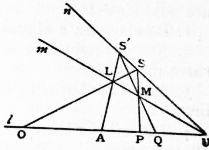
Fig. 69.
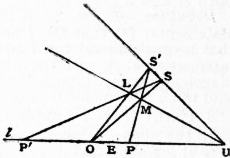
Fig. 70.
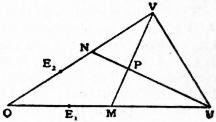
Fig. 71.
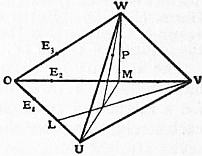
Fig. 72.
Let l (fig. 69) be the given line, m and n any two lines intersecting at U on l, S and S′ two points on n. Then a projective relation between l and itself is formed by projecting l from S on to m, and then by projecting m from S′ back on to l. All such projective relations, however m, n, S and S′ be varied, are called “prospectivities,” and U is the double point of the prospectivity. If a point O on l is related to A by a prospectivity, then all prospectivities, which (1) have the same double point U, and (2) relate O to A, give the same correspondent (Q, in figure) to any point P on the line l; in fact they are all the same prospectivity, however m, n, S, and S′ may have been varied subject to these conditions. Such a prospectivity will be denoted by (OAU²).
The sum of two prospectivities, written (OAU²) + (OBU²), is defined to be that transformation of the line l into itself which is obtained by first applying the prospectivity (OAU²) and then applying the prospectivity (OBU²). Such a transformation, when the two summands have the same double point, is itself a prospectivity with that double point.
With this definition of addition it can be proved that prospectivities with the same double point satisfy all the axioms of magnitude. Accordingly they can be associated in a one-one correspondence with the positive and negative real numbers. Let E (fig. 70) be any point on l, distinct from O and U. Then the prospectivity (OEU²) is associated with unity, the prospectivity (OOU²) is associated with zero, and (OUU²) with ∞. The prospectivities of the type (OPU²), where P is any point on the segment OEU, correspond to the positive numbers; also if P′ is the harmonic conjugate of P with respect to O and U, the prospectivity (OP′U²) is associated with the corresponding negative number. (The subjoined figure explains this relation of the positive and negative prospectivities.) Then any point P on l is associated with the same number as is the prospectivity (OPU²).
It can be proved that the order of the numbers in algebraic order of magnitude agrees with the order on the line of the associated points. Let the numbers, assigned according to the preceding specification, be said to be associated with the points according to the “numeration-system (OEU).” The introduction of a coordinate system for a plane is now managed as follows: Take any triangle OUV in the plane, and on the lines OU and OV establish the numeration systems (OE1U) and (OE2V), where E1 and E2 are arbitrarily chosen. Then (cf. fig. 71) if M and N are associated with the numbers x and y according to these systems, the coordinates of P are x and y. It then follows that the equation of a straight line is of the form ax + by + c = 0. Both coordinates of any point on the line UV are infinite. This can be avoided by introducing homogeneous coordinates X, Y, Z, where x = X/Z, and y = Y/Z, and Z = 0 is the equation of UV.
The procedure for three dimensions is similar. Let OUVW (fig. 72) be any tetrahedron, and associate points on OU, OV, OW with numbers according to the numeration systems (OE1U), (OE2V), and (OE3W). Let the planes VWP, WUP, UVP cut OU, OV, OW in L, M, N respectively; and let x, y, z be the numbers associated with L, M, N respectively. Then P is the point (x, y, z). Also homogeneous coordinates can be introduced as before, thus avoiding the infinities on the plane UVW.
The cross ratio of a range of four collinear points can now be defined as a number characteristic of that range. Let the coordinates of any point Pr of the range P1 P2 P3 P4 be
λra + μr + a′ , λrb + μrb′ , λrc + μrc′ , (r = 1, 2, 3, 4)
λr + μr λr + μr λr + μr
and let (λrμs) be written for λrμs -λsμr. Then the cross ratio {P1 P2 P3 P4} is defined to be the number (λ1μ2)(λ3μ4) / (λ1μ4)(λ3μ2). The equality of the cross ratios of the ranges (P1 P2 P3 P4) and (Q1 Q2 Q3 Q4) is proved to be the necessary and sufficient condition for their mutual projectivity. The cross ratios of all harmonic ranges are then easily seen to be all equal to -1, by comparing with the range (OE1UE′1) on the axis of x.
Thus all the ordinary propositions of geometry in which distance and angular measure do not enter otherwise than in cross ratios can now be enunciated and proved. Accordingly the greater part of the analytical theory of conics and quadrics belongs to geometry at this stage The theory of distance will be considered after the principles of descriptive geometry have been developed.
Descriptive Geometry.
Descriptive geometry is essentially the science of multiple order for open series. The first satisfactory system of axioms was given by M. Pasch.36 An improved version is due to G. Peano.37 Both these authors treat the idea of the class of points constituting the segment lying between two points as an undefined fundamental idea. Thus in fact there are in this system two fundamental ideas, namely, of points and of segments. It is then easy enough to define the prolongations of the segments, so as to form the complete straight lines. D. Hilbert’s38 formulation of the axioms is in this respect practically based on the same fundamental ideas. His work is justly famous for some of the mathematical investigations contained in it, but his exposition of the axioms is distinctly inferior to that of Peano. Descriptive geometry can also be considered39 as the science of a class of relations, each relation being a two-termed serial relation, as considered in the logic of relations, ranging the points between which it holds into a linear open order. Thus the relations are the straight lines, and the terms between which they hold are the points. But a combination of these two points of view yields40 the simplest statement of all. Descriptive geometry is then conceived as the investigation of an undefined fundamental relation between three terms (points); and when the relation holds between three points A, B, C, the points are said to be “in the [linear] order ABC.”
O. Veblen’s axioms and definitions, slightly modified, are as follows:—
1. If the points A, B, C are in the order ABC, they are in the order CBA.
2. If the points A, B, C are in the order ABC, they are not in the order BCA.
3. If the points A, B, C are in the order ABC, A is distinct from C.
4. If A and B are any two distinct points, there exists a point C such that A, B, C are in the order ABC.
Definition.—The line AB (A ≠ B) consists of A and B, and of all points X in one of the possible orders, ABX, AXB, XAB. The points X in the order AXB constitute the segment AB.
5. If points C and D (C ≠ D) lie on the line AB, then A lies on the line CD.
6. There exist three distinct points A, B, C not in any of the orders ABC, BCA, CAB.
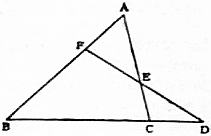
Fig. 73.
7. If three distinct points A, B, C (fig. 73) do not lie on the same line, and D and E are two distinct points in the orders BCD and CEA, then a point F exists in the order AFB, and such that D, E, F are collinear.
Definition.—If A, B, C are three non-collinear points, the plane ABC is the class of points which lie on any one of the lines joining any two of the points belonging to the boundary of the triangle ABC, the boundary being formed by the segments BC, CA and AB. The interior of the triangle ABC is formed by the points in segments such as PQ, where P and Q are points respectively on two of the segments BC, CA, AB.
8. There exists a plane ABC, which does not contain all the points.
Definition.—If A, B, C, D are four non-coplanar points, the space ABCD is the class of points which lie on any of the lines containing two points on the surface of the tetrahedron ABCD, the surface being formed by the interiors of the triangles ABC, BCD, DCA, DAB.
9. There exists a space ABCD which contains all the points.
10. The Dedekind property holds for the order of the points on any straight line.
It follows from axioms 1-9 that the points on any straight line are arranged in an open serial order. Also all the ordinary theorems respecting a point dividing a straight line into two parts, a straight line dividing a plane into two parts, and a plane dividing space into two parts, follow.
Again, in any plane α consider a line l and a point A (fig. 74).
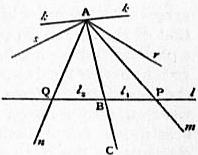
Fig. 74.
Let any point B divide l into two half-lines l1 and l2. Then it can be proved that the set of half-lines, emanating from A and intersecting l1 (such as m), are bounded by two half-lines, of which ABC is one. Let r be the other. Then it can be proved that r does not intersect l1. Similarly for the half-line, such as n, intersecting l2. Let s be its bounding half-line. Then two cases are possible. (1) The half-lines r and s are collinear, and together form one complete line. In this case, there is one and only one line (viz. r + s) through A and lying in α which does not intersect l. This is the Euclidean case, and the assumption that this case holds is the Euclidean parallel axiom. But (2) the half-lines r and s may not be collinear. In this case there will be an infinite number of lines, such as k for instance, containing A and lying in α, which do not intersect l. Then the lines through A in α are divided into two classes by reference to l, namely, the secant lines which intersect l, and the non-secant lines which do not intersect l. The two boundary non-secant lines, of which r and s are respectively halves, may be called the two parallels to l through A.
The perception of the possibility of case 2 constituted the starting-point from which Lobatchewsky constructed the first explicit coherent theory of non-Euclidean geometry, and thus created a revolution in the philosophy of the subject. For many centuries the speculations of mathematicians on the foundations of geometry were almost confined to hopeless attempts to prove the “parallel axiom” without the introduction of some equivalent axiom.41
Associated Projective and Descriptive Spaces.—A region of a projective space, such that one, and only one, of the two supplementary segments between any pair of points within it lies entirely within it, satisfies the above axioms (1-10) of descriptive geometry, where the points of the region are the descriptive points, and the portions of straight lines within the region are the descriptive lines. If the excluded part of the original projective space is a single plane, the Euclidean parallel axiom also holds, otherwise it does not hold for the descriptive space of the limited region. Again, conversely, starting from an original descriptive space an associated projective space can be constructed by means of the concept of ideal points.42 These are also called projective points, where it is understood that the simple points are the points of the original descriptive space. An ideal point is the class of straight lines which is composed of two coplanar lines a and b, together with the lines of intersection of all pairs of intersecting planes which respectively contain a and b, together with the lines of intersection with the plane ab of all planes containing any one of the lines (other than a or b) already specified as belonging to the ideal point. It is evident that, if the two original lines a and b intersect, the corresponding ideal point is nothing else than the whole class of lines which are concurrent at the point ab. But the essence of the definition is that an ideal point has an existence when the lines a and b do not intersect, so long as they are coplanar. An ideal point is termed proper, if the lines composing it intersect; otherwise it is improper.
A theorem essential to the whole theory is the following: if any two of the three lines a, b, c are coplanar, but the three lines are not all coplanar, and similarly for the lines a, b, d, then c and d are coplanar. It follows that any two lines belonging to an ideal point can be used as the pair of guiding lines in the definition. An ideal point is said to be coherent with a plane, if any of the lines composing it lie in the plane. An ideal line is the class of ideal points each of which is coherent with two given planes. If the planes intersect, the ideal line is termed proper, otherwise it is improper. It can be proved that any two planes, with which any two of the ideal points are both coherent, will serve as the guiding planes used in the definition. The ideal planes are defined as in projective geometry, and all the other definitions (for segments, order, &c.) of projective geometry are applied to the ideal elements. If an ideal plane contains some proper ideal points, it is called proper, otherwise it is improper. Every ideal plane contains some improper ideal points.
It can now be proved that all the axioms of projective geometry hold of the ideal elements as thus obtained; and also that the order of the ideal points as obtained by the projective method agrees with the order of the proper ideal points as obtained from that of the associated points of the descriptive geometry. Thus a projective space has been constructed out of the ideal elements, and the proper ideal elements correspond element by element with the associated descriptive elements. Thus the proper ideal elements form a region in the projective space within which the descriptive axioms hold. Accordingly, by substituting ideal elements, a descriptive space can always be considered as a region within a projective space. This is the justification for the ordinary use of the “points at infinity” in the ordinary Euclidean geometry; the reasoning has been transferred from the original descriptive space to the associated projective space of ideal elements; and with the Euclidean parallel axiom the improper ideal elements reduce to the ideal points on a single improper ideal plane, namely, the plane at infinity.43
Congruence and Measurement.—The property of physical space which is expressed by the term “measurability” has now to be considered. This property has often been considered as essential to the very idea of space. For example, Kant writes,44 “Space is represented as an infinite given quantity.” This quantitative aspect of space arises from the measurability of distances, of angles, of surfaces and of volumes. These four types of quantity depend upon the two first among them as fundamental. The measurability of space is essentially connected with the idea of congruence, of which the simplest examples are to be found in the proofs of equality by the method of superposition, as used in elementary plane geometry. The mere concepts of “part” and of “whole” must of necessity be inadequate as the foundation of measurement, since we require the comparison as to quantity of regions of space which have no portions in common. The idea of congruence, as exemplified by the method of superposition in geometrical reasoning, appears to be founded upon that of the “rigid body,” which moves from one position to another with its internal spatial relations unchanged. But unless there is a previous concept of the metrical relations between the parts of the body, there can be no basis from which to deduce that they are unchanged.
It would therefore appear as if the idea of the congruence, or metrical equality, of two portions of space (as empirically suggested by the motion of rigid bodies) must be considered as a fundamental idea incapable of definition in terms of those geometrical concepts which have already been enumerated. This was in effect the point of view of Pasch.45 It has, however, been proved by Sophus Lie46 that congruence is capable of definition without recourse to a new fundamental idea. This he does by means of his theory of finite continuous groups (see Groups, Theory of), of which the definition is possible in terms of our established geometrical ideas, remembering that coordinates have already been introduced. The displacement of a rigid body is simply a mode of defining to the senses a one-one transformation of all space into itself. For at any point of space a particle may be conceived to be placed, and to be rigidly connected with the rigid body; and thus there is a definite correspondence of any point of space with the new point occupied by the associated particle after displacement. Again two successive displacements of a rigid body from position A to position B, and from position B to position C, are the same in effect as one displacement from A to C. But this is the characteristic “group” property. Thus the transformations of space into itself defined by displacements of rigid bodies form a group.
Call this group of transformations a congruence-group. Now according to Lie a congruence-group is defined by the following characteristics:—
1. A congruence-group is a finite continuous group of one-one transformations, containing the identical transformation.
2. It is a sub-group of the general projective group, i.e. of the group of which any transformation converts planes into planes, and straight lines into straight lines.
3. An infinitesimal transformation can always be found satisfying the condition that, at least throughout a certain enclosed region, any definite line and any definite point on the line are latent, i.e. correspond to themselves.
4. No infinitesimal transformation of the group exists, such that, at least in the region for which (3) holds, a straight line, a point on it, and a plane through it, shall all be latent.
The property enunciated by conditions (3) and (4), taken together, is named by Lie “Free mobility in the infinitesimal.” Lie proves the following theorems for a projective space:—
1. If the above four conditions are only satisfied by a group throughout part of projective space, this part either (α) must be the region enclosed by a real closed quadric, or (β) must be the whole of the projective space with the exception of a single plane. In case (α) the corresponding congruence group is the continuous group for which the enclosing quadric is latent; and in case (β) an imaginary conic (with a real equation) lying in the latent plane is also latent, and the congruence group is the continuous group for which the plane and conic are latent.
2. If the above four conditions are satisfied by a group throughout the whole of projective space, the congruence group is the continuous group for which some imaginary quadric (with a real equation) is latent.
By a proper choice of non-homogeneous co-ordinates the equation of any quadrics of the types considered, either in theorem 1 (α), or in theorem 2, can be written in the form 1 + c(x² + y² + z²) = 0, where c is negative for a real closed quadric, and positive for an imaginary quadric. Then the general infinitesimal transformation is defined by the three equations:
dx/dt = u − ω3y + ω2z + cx (ux + vy + wz), (A)
dy/dt = v − ω1z + ω3x + cy (ux + vy + wz),
dz/dt = w − ω2x + ω1y + cz (ux + vy + wz).
In the ease considered in theorem 1 (β), with the proper choice of co-ordinates the three equations defining the general infinitesimal transformation are:
dx/dt = u − ω3y + ω2z, (B)
dy/dt = v − ω1z + ω3x,
dz/dt = w − ω2x + ω1y.
In this case the latent plane is the plane for which at least one of x, y, z are infinite, that is, the plane 0.x + 0.y + 0.z + a = 0; and the latent conic is the conic in which the cone x² + y² + z² = 0 intersects the latent plane.
It follows from theorems 1 and 2 that there is not one unique congruence-group, but an indefinite number of them. There is one congruence-group corresponding to each closed real quadric, one to each imaginary quadric with a real equation, and one to each imaginary conic in a real plane and with a real equation. The quadric thus associated with each congruence-group is called the absolute for that group, and in the degenerate case of 1 (β) the absolute is the latent plane together with the latent imaginary conic. If the absolute is real, the congruence-group is hyperbolic; if imaginary, it is elliptic; if the absolute is a plane and imaginary conic, the group is parabolic. Metrical geometry is simply the theory of the properties of some particular congruence-group selected for study.
The definition of distance is connected with the corresponding congruence-group by two considerations in respect to a range of five points (A1, A2, P1, P2, P3), of which A1 and A2 are on the absolute.
Let {A1P1A2P2} stand for the cross ratio (as defined above) of the range (A1P1A2P2), with a similar notation for the other ranges. Then
(1)
log {A1P1A2P2} + log {A1P2A2P3} = log {A1P1A2P3},
and
(2), if the points A1, A2, P1, P2 are transformed into A′1, A′2, P′1, P′2 by any transformation of the congruence-group, (α) {A1P1A2P2 = {A′1P′1A′2P′2}, since the transformation is projective, and (β) A′1, A′2 are on the absolute since A1 and A2 are on it. Thus if we define the distance P1P2 to be ½k log {A1P1A2P2}, where A1 and A2 are the points in which the line P1P2 cuts the absolute, and k is some constant, the two characteristic properties of distance, namely, (1) the addition of consecutive lengths on a straight line, and (2) the invariability of distances during a transformation of the congruence-group, are satisfied. This is the well-known Cayley-Klein projective definition47 of distance, which was elaborated in view of the addition property alone, previously to Lie’s discovery of the theory of congruence-groups. For a hyperbolic group when P1 and P2 are in the region enclosed by the absolute, log {A1P1A2P2} is real, and therefore k must be real. For an elliptic group A1 and A2 are conjugate imaginaries, and log {A1P1A2P2} is a pure imaginary, and k is chosen to be κ/ι, where κ is real and ι = √ −.
Similarly the angle between two planes, p1 and p2, is defined to be (1/2ι) log (t1p1t2p2), where t1 and t2 are tangent planes to the absolute through the line p1p2. The planes t1 and t2 are imaginary for an elliptic group, and also for an hyperbolic group when the planes p1 and p2 intersect at points within the region enclosed by the absolute. The development of the consequences of these metrical definitions is the subject of non-Euclidean geometry.
The definitions for the parabolic case can be arrived at as limits of those obtained in either of the other two cases by making k ultimately to vanish. It is also obvious that, if P1 and P2 be the points (x1, y1, z1) and (x2, y2, z2), it follows from equations (B) above that {(x1 − x2)² + (y1 − y2)² + (z1 − z2)²}1/2 is unaltered by a congruence transformation and also satisfies the addition property for collinear distances. Also the previous definition of an angle can be adapted to this case, by making t1 and t2 to be the tangent planes through the line p1p2 to the imaginary conic. Similarly if p1 and p2 are intersecting lines, the same definition of an angle holds, where t1 and t2 are now the lines from the point p1p2 to the two points where the plane p1p2 cuts the imaginary conic. These points are in fact the “circular points at infinity” on the plane. The development of the consequences of these definitions for the parabolic case gives the ordinary Euclidean metrical geometry.
Thus the only metrical geometry for the whole of projective space is of the elliptic type. But the actual measure-relations (though not their general properties) differ according to the elliptic congruence-group selected for study. In a descriptive space a congruence-group should possess the four characteristics of such a group throughout the whole of the space. Then form the associated ideal projective space. The associated congruence-group for this ideal space must satisfy the four conditions throughout the region of the proper ideal points. Thus the boundary of this region is the absolute. Accordingly there can be no metrical geometry for the whole of a descriptive space unless its boundary (in the associated ideal space) is a closed quadric or a plane. If the boundary is a closed quadric, there is one possible congruence-group of the hyperbolic type. If the boundary is a plane (the plane at infinity), the possible congruence-groups are parabolic; and there is a congruence-group corresponding to each imaginary conic in this plane, together with a Euclidean metrical geometry corresponding to each such group. Owing to these alternative possibilities, it would appear to be more accurate to say that systems of quantities can be found in a space, rather than that space is a quantity.
Lie has also deduced48 the same results with respect to congruence-groups from another set of defining properties, which explicitly assume the existence of a quantitative relation (the distance) between any two points, which is invariant for any transformation of the congruence-group.49
The above results, in respect to congruence and metrical geometry, considered in relation to existent space, have led to the doctrine50 that it is intrinsically unmeaning to ask which system of metrical geometry is true of the physical world. Any one of these systems can be applied, and in an indefinite number of ways. The only question before us is one of convenience in respect to simplicity of statement of the physical laws. This point of view seems to neglect the consideration that science is to be relevant to the definite perceiving minds of men; and that (neglecting the ambiguity introduced by the invariable slight inexactness of observation which is not relevant to this special doctrine) we have, in fact, presented to our senses a definite set of transformations forming a congruence-group, resulting in a set of measure relations which are in no respect arbitrary. Accordingly our scientific laws are to be stated relevantly to that particular congruence-group. Thus the investigation of the type (elliptic, hyperbolic or parabolic) of this special congruence-group is a perfectly definite problem, to be decided by experiment. The consideration of experiments adapted to this object requires some development of non-Euclidean geometry (see section VI., Non-Euclidean Geometry). But if the doctrine means that, assuming some sort of objective reality for the material universe, beings can be imagined, to whom either all congruence-groups are equally important, or some other congruence-group is specially important, the doctrine appears to be an immediate deduction from the mathematical facts. Assuming a definite congruence-group, the investigation of surfaces (or three-dimensional loci in space of four dimensions) with geodesic geometries of the form of metrical geometries of other types of congruence-groups forms an important chapter of non-Euclidean geometry. Arising from this investigation there is a widely-spread fallacy, which has found its way into many philosophic writings, namely, that the possibility of the geometry of existent three-dimensional space being other than Euclidean depends on the physical existence of Euclidean space of four or more dimensions. The foregoing exposition shows the baselessness of this idea.
Bibliography.—For an account of the investigations on the axioms of geometry during the Greek period, see M. Cantor, Vorlesungen über die Geschichte der Mathematik, Bd. i. and iii.; T.L. Heath, The Thirteen Books of Euclid’s Elements, a New Translation from the Greek, with Introductory Essays and Commentary, Historical, Critical, and Explanatory (Cambridge, 1908)—this work is the standard source of information; W.B. Frankland, Euclid, Book I., with a Commentary (Cambridge, 1905)—the commentary contains copious extracts from the ancient commentators. The next period of really substantive importance is that of the 18th century. The leading authors are: G. Saccheri, S.J., Euclides ab omni naevo vindicatus (Milan, 1733). Saccheri was an Italian Jesuit who unconsciously discovered non-Euclidean geometry in the course of his efforts to prove its impossibility. J.H. Lambert, Theorie der Parallellinien (1766); A.M. Legendre, Éléments de géométrie (1794). An adequate account of the above authors is given by P. Stäckel and F. Engel, Die Theorie der Parallellinien von Euklid bis auf Gauss (Leipzig, 1895). The next period of time (roughly from 1800 to 1870) contains two streams of thought, both of which are essential to the modern analysis of the subject. The first stream is that which produced the discovery and investigation of non-Euclidean geometries, the second stream is that which has produced the geometry of position, comprising both projective and descriptive geometry not very accurately discriminated. The leading authors on non-Euclidean geometry are K.F. Gauss, in private letters to Schumacher, cf. Stäckel and Engel, loc. cit.; N. Lobatchewsky, rector of the university of Kazan, to whom the honour of the effective discovery of non-Euclidean geometry must be assigned. His first publication was at Kazan in 1826. His various memoirs have been re-edited by Engel; cf. Urkunden zur Geschichte der nichteuklidischen Geometrie by Stäckel and Engel, vol. i. “Lobatchewsky.” J. Bolyai discovered non-Euclidean geometry apparently in independence of Lobatchewsky. His memoir was published in 1831 as an appendix to a work by his father W. Bolyai, Tentamen juventutem.... This memoir has been separately edited by J. Frischauf, Absolute Geometrie nach J. Bolyai (Leipzig, 1872); B. Riemann, Über die Hypothesen, welche der Geometrie zu Grunde liegen (1854); cf. Gesamte Werke, a translation in The Collected Papers of W.K. Clifford. This is a fundamental memoir on the subject and must rank with the work of Lobatchewsky. Riemann discovered elliptic metrical geometry, and Lobatchewsky hyperbolic geometry. A full account of Riemann’s ideas, with the subsequent developments due to Clifford, F. Klein and W. Killing, will be found in The Boston Colloquium for 1903 (New York, 1905), article “Forms of Non-Euclidean Space,” by F.S. Woods. A. Cayley, loc. cit. (1859), and F. Klein, “Über die sogenannte nichteuklidische Geometrie,” Math. Annal. vols. iv. and vi. (1871 and 1872), between them elaborated the projective theory of distance; H. Helmholtz, “Über die thatsächlichen Grundlagen der Geometrie” (1866), and “Über die Thatsachen, die der Geometrie zu Grunde liegen” (1868), both in his Wissenschaftliche Abhandlungen, vol. ii., and S. Lie, loc. cit. (1890 and 1893), between them elaborated the group theory of congruence.
The numberless works which have been written to suggest equivalent alternatives to Euclid’s parallel axioms may be neglected as being of trivial importance, though many of them are marvels of geometric ingenuity.
The second stream of thought confined itself within the circle of ideas of Euclidean geometry. Its origin was mainly due to a succession of great French mathematicians, for example, G. Monge, Géométrie descriptive (1800); J.V. Poncelet, Traité des proprietés projectives des figures (1822); M. Chasles, Aperçu historique sur l’origine et le développement des méthodes en géométrie (Bruxelles, 1837), and Traité de géométrie supérieure (Paris, 1852); and many others. But the works which have been, and are still, of decisive influence on thought as a store-house of ideas relevant to the foundations of geometry are K.G.C. von Staudt’s two works, Geometrie der Lage (Nürnberg, 1847); and Beiträge zur Geometrie der Lage (Nürnberg, 1856, 3rd ed. 1860).
The final period is characterized by the successful production of exact systems of axioms, and by the final solution of problems which have occupied mathematicians for two thousand years. The successful analysis of the ideas involved in serial continuity is due to R. Dedekind, Stetigkeit und irrationale Zahlen (1872), and to G. Cantor, Grundlagen einer allgemeinen Mannigfaltigkeitslehre (Leipzig, 1883), and Acta math. vol. 2.
Complete systems of axioms have been stated by M. Pasch, loc. cit.; G. Peano, loc. cit.; M. Pieri, loc. cit.; B. Russell, Principles of Mathematics; O. Veblen, loc. cit.; and by G. Veronese in his treatise, Fondamenti di geometria (Padua, 1891; German transl. by A. Schepp, Grundzüge der Geometrie, Leipzig, 1894). Most of the leading memoirs on special questions involved have been cited in the text; in addition there may be mentioned M. Pieri, “Nuovi principii di geometria projettiva complessa,” Trans. Accad. R. d. Sci. (Turin, 1905); E.H. Moore, “On the Projective Axioms of Geometry,” Trans. Amer. Math. Soc., 1902; O. Veblen and W.H. Bussey, “Finite Projective Geometries,” Trans. Amer. Math. Soc., 1905; A.B. Kempe, “On the Relation between the Logical Theory of Classes and the Geometrical Theory of Points,” Proc. Lond. Math. Soc., 1890; J. Royce, “The Relation of the Principles of Logic to the Foundations of Geometry,” Trans. of Amer. Math. Soc., 1905; A. Schoenflies, “Über die Möglichkeit einer projectiven Geometrie bei transfiniter (nichtarchimedischer) Massbestimmung,” Deutsch. M.-V. Jahresb., 1906.
For general expositions of the bearings of the above investigations, cf. Hon. Bertrand Russell, loc. cit.; L. Couturat, Les Principes des mathématiques (Paris, 1905); H. Poincaré, loc. cit.; Russell and Whitehead, Principia mathematica (Cambridge, Univ. Press). The philosophers whose views on space and geometric truth deserve especial study are Descartes, Leibnitz, Hume, Kant and J.S. Mill.
(A. N. W.)
1 For Egyptian geometry see Egypt, § Science and Mathematics.
2 Cf. A.N. Whitehead, Universal Algebra, Bk. vi. (Cambridge, 1898).
3 Cf. A.N. Whitehead, loc. cit.
4 Cf. A.N. Whitehead, “The Geodesic Geometry of Surfaces in non-Euclidean Space,” Proc. Lond. Math. Soc. vol. xxix.
5 Cf. Klein, “Zur nicht-Euklidischen Geometrie,” Math. Annal. vol. xxxvii.
6 On the theory of parallels before Lobatchewsky, see Stäckel und Engel, Theorie der Parallellinien von Euklid bis auf Gauss (Leipzig, 1895). The foregoing remarks are based upon the materials collected in this work.
7 See Stäckel und Engel, op. cit., and “Gauss, die beiden Bolyai, und die nicht-Euklidische Geometrie,” Math. Annalen, Bd. xlix.; also Engel’s translation of Lobatchewsky (Leipzig, 1898), pp. 378 ff.
8 Lobatchewsky’s works on the subject are the following:—“On the Foundations of Geometry,” Kazañ Messenger, 1829-1830; “New Foundations of Geometry, with a complete Theory of Parallels,” Proceedings of the University of Kazañ, 1835 (both in Russian, but translated into German by Engel, Leipzig, 1898); “Géométrie imaginaire,” Crelle’s Journal, 1837; Theorie der Parallellinien (Berlin, 1840; 2nd ed., 1887; translated by Halsted, Austin, Texas, 1891). His results appear to have been set forth in a paper (now lost) which he read at Kazañ in 1826.
9 Translated by Halsted (Austin, Texas, 4th ed., 1896.)
10 Abhandlungen d. Königl. Ges. d. Wiss. zu Göttingen, Bd. xiii.; Ges. math. Werke, pp. 254-269; translated by Clifford, Collected Mathematical Papers.
11 Cf. Gesamm. math. und phys. Werke, vol. i. (Leipzig, 1894).
12 Wiss. Abh. vol. ii. pp. 610, 618 (1866, 1868).
13 Mind, O.S., vols. i. and iii.; Vorträge und Reden, vol. ii. pp. 1, 256.
14 His papers are “Saggio di interpretazione della geometria non-Euclidea,” Giornale di matematiche, vol. vi. (1868); “Teoria fondamentale degli spazii di curvatura costante,” Annali di matematica, vol. ii. (1868-1869). Both were translated into French by J. Hoüel, Annales scientifiques de l’École Normale supérieure, vol. vi. (1869).
15 Beltrami shows also that this definition agrees with that of Gauss.
16 “Sur la théorie des foyers,” Nouv. Ann. vol. xii.
17 Math. Annalen, iv. vi., 1871-1872.
18 For an investigation of these and similar properties, see Whitehead, Universal Algebra (Cambridge, 1898), bk. vi. ch. ii. The polar form was independently discovered by Simon Newcomb in 1877.
19 For an analysis of Leibnitz’s ideas on space, cf. B. Russell, The Philosophy of Leibnitz, chs. viii.-x.
20 Cf. Hon. Bertrand Russell, “Is Position in Time and Space Absolute or Relative?” Mind, n.s. vol. 10 (1901), and A.N. Whitehead, “Mathematical Concepts of the Material World,” Phil. Trans. (1906), p. 205.
21 Cf. Critique of Pure Reason, 1st section: “Of Space,” conclusion A, Max Müller’s translation.
22 Cf. Ernst Mach, Erkenntniss und Irrtum (Leipzig); the relevant chapters are translated by T.J. McCormack, Space and Geometry (London, 1906); also A. Meinong, Über die Stellung der Gegenstandstheorie im System der Wissenschaften (Leipzig, 1907).
23 Cf. Russell, Principles of Mathematics, § 352 (Cambridge, 1903).
24 Cf. A.N. Whitehead, The Axioms of Projective Geometry, § 3 (Cambridge, 1906).
25 Cf. Russell, Princ. of Math., ch. i.
26 Cf. Russell, loc. cit., and G. Frege, “Über die Grundlagen der Géométrie,” Jahresber. der Deutsch. Math. Ver. (1906).
27 This formulation—though not in respect to number—is in all essentials that of M. Pieri, cf. “I principii della Geometria di Posizione,” Accad. R. di Torino (1898); also cf. Whitehead, loc. cit.
28 Cf. G. Peano, “Sui fondamenti della Geometria,” p. 73, Rivista di matematica, vol. iv. (1894), and D. Hilbert, Grundlagen der Geometrie (Leipzig, 1899); and R.F. Moulton, “A Simple non-Desarguesian Plane Geometry,” Trans. Amer. Math. Soc., vol. iii. (1902).
29 Cf. “Sui postulati fondamentali della geometria projettiva,” Giorn. di matematica, vol. xxx. (1891); also of Pieri, loc. cit., and Whitehead, loc. cit.
30 Cf. Hilbert, loc. cit.; for a fuller exposition of Hilbert’s proof cf. K.T. Vahlen, Abstrakte Geometrie (Leipzig, 1905), also Whitehead, loc. cit.
31 Cf. H. Wiener, Jahresber. der Deutsch. Math. Ver. vol. i. (1890); and F. Schur, “Über den Fundamentalsatz der projectiven Geometrie,” Math. Ann. vol. li. (1899).
32 Cf. Hilbert, loc. cit., and Whitehead, loc. cit.
33 Cf. Dedekind, Stetigkeit und irrationale Zahlen (1872).
34 Cf. v. Staudt, Geometrie der Lage (1847).
35 Cf. Pasch, Vorlesungen über neuere Geometrie (Leipzig, 1882), a classic work; also Fiedler, Die darstellende Geometrie (1st ed., 1871, 3rd ed., 1888); Clebsch, Vorlesungen über Geometrie, vol. iii.; Hilbert, loc. cit.; F. Schur, Math. Ann. Bd. lv. (1902); Vahlen, loc. cit.; Whitehead, loc. cit.
36 Cf. loc. cit.
37 Cf. I Principii di geometria (Turin, 1889) and “Sui fondamenti della geometria,” Rivista di mat. vol. iv. (1894).
38 Cf. loc. cit.
39 Cf. Vailati, Rivista di mat. vol. iv. and Russell, loc. cit. § 376.
40 Cf. O. Veblen, “On the Projective Axioms of Geometry,” Trans. Amer. Math. Soc. vol. iii. (1902).
41 Cf. P. Stäckel and F. Engel, Die Theorie der Parallellinien von Euklid bis auf Gauss (Leipzig, 1895).
42 Cf. Pasch, loc. cit., and R. Bonola, “Sulla introduzione degli enti improprii in geometria projettive,” Giorn. di mat. vol. xxxviii. (1900); and Whitehead, Axioms of Descriptive Geometry (Cambridge, 1907).
43 The original idea (confined to this particular case) of ideal points is due to von Staudt (loc. cit.).
44 Cf. Critique, “Trans. Aesth.” Sect. I.
45 Cf. loc. cit.
46 Cf. Über die Grundlagen der Geometrie (Leipzig, Ber., 1890); and Theorie der Transformationsgruppen (Leipzig, 1893), vol. iii.
47 Cf. A. Cayley, “A Sixth Memoir on Quantics,” Trans. Roy. Soc., 1859, and Coll. Papers, vol. ii.; and F. Klein, Math. Ann. vol. iv., 1871.
48 Cf. loc. cit.
49 For similar deductions from a third set of axioms, suggested in essence by Peano, Riv. mat. vol. iv. loc. cit. cf. Whitehead, Desc. Geom. loc. cit.
50 Cf. H. Poincaré, La Science et l’hypothèse, ch. iii.