VOLUME XI SLICE VI Geodesy to Geometry (continued 10)
Reading edition
The harmonic property of the complete quadrilateral is: Any diagonal or harmonic line is harmonically divided by the other two; and of a complete quadrangle: The angle at any harmonic point is divided harmonically by the joins to the other harmonic points. To prove the first theorem, we have to prove (AA′, βγ), (BB′, γα), (CC′, βα) are harmonic. Consider the cross-ratio (CC′, αβ). Then projecting from A on BB′ we have A(CC′, αβ) = A(B′B, αγ). Projecting from A′ on BB′, A′(CC′, αβ) = A′(BB′, αγ). Hence (B′B, αγ) = (BB′, αγ), i.e. the cross-ratio (BB′, αγ) equals that of its reciprocal; hence the range is harmonic.
The second theorem states that the pencils L(BA, NM), M(B′A, LN), N(BA, LM) are harmonic. Deferring the subject of harmonic pencils to the next section, it will suffice to state here that any transversal intersects an harmonic pencil in an harmonic range. Consider the pencil L(BA, NM), then it is sufficient to prove (BA′, NM′) is harmonic. This follows from the previous theorem by considering A′B as a diagonal of the quadrilateral ALB′M.]
This property of the complete quadrilateral allows the solution of the problem:
To construct the harmonic conjugate D to a point C with regard to two given points A and B.
Through A draw any two lines, and through C one cutting the former two in G and H. Join these points to B, cutting the former two lines in E and F. The point D where EF cuts AB will be the harmonic conjugate required.
This remarkable construction requires nothing but the drawing of lines, and is therefore independent of measurement. In a similar manner the harmonic conjugate of the line VA for two lines VC, VD is constructed with the aid of the property of the complete quadrangle.
§ 22. Harmonic Pencils.—The theory of cross-ratios may be extended from points in a row to lines in a flat pencil and to planes in an axial pencil. We have seen (§ 13) that if the lines which join four points A, B, C, D to any point S be cut by any other line in A′, B′, C′, D′, then (AB, CD) = (A′B′, C′D′). In other words, four lines in a flat pencil are cut by every other line in four points whose cross-ratio is constant.
Definition.—By the cross-ratio of four rays in a flat pencil is meant the cross-ratio of the four points in which the rays are cut by any line. If a, b, c, d be the lines, then this cross-ratio is denoted by (ab, cd).
Definition.—By the cross-ratio of four planes in an axial pencil is understood the cross-ratio of the four points in which any line cuts the planes, or, what is the same thing, the cross-ratio of the four rays in which any plane cuts the four planes.
In order that this definition may have a meaning, it has to be proved that all lines cut the pencil in points which have the same cross-ratio. This is seen at once for two intersecting lines, as their plane cuts the axial pencil in a flat pencil, which is itself cut by the two lines. The cross-ratio of the four points on one line is therefore equal to that on the other, and equal to that of the four rays in the flat pencil.
If two non-intersecting lines p and q cut the four planes in A, B, C, D and A′, B′, C′, D′, draw a line r to meet both p and q, and let this line cut the planes in A″, B″, C″, D″. Then (AB, CD) = (A′B′, C′D′), for each is equal to (A″B″, C″D″).
§ 23. We may now also extend the notion of harmonic elements, viz.
Definition.—Four rays in a flat pencil and four planes in an axial pencil are said to be harmonic if their cross-ratio equals -1, that is, if they are cut by a line in four harmonic points.
If we understand by a “median line” of a triangle a line which joins a vertex to the middle point of the opposite side, and by a “median line” of a parallelogram a line joining middle points of opposite sides, we get as special cases of the last theorem:
The diagonals and median lines of a parallelogram form an harmonic pencil; and
At a vertex of any triangle, the two sides, the median line, and the line parallel to the base form an harmonic pencil.
Taking the parallelogram a rectangle, or the triangle isosceles, we get:
Any two lines and the bisections of their angles form an harmonic pencil. Or:
In an harmonic pencil, if two conjugate rays are perpendicular, then the other two are equally inclined to them; and, conversely, if one ray bisects the angle between conjugate rays, it is perpendicular to its conjugate.
This connects perpendicularity and bisection of angles with projective properties.
§ 24. We add a few theorems and problems which are easily proved or solved by aid of harmonics.
An harmonic pencil is cut by a line parallel to one of its rays in three equidistant points.
Through a given point to draw a line such that the segment determined on it by a given angle is bisected at that point.
Having given two parallel lines, to bisect on either any given segment without using a pair of compasses.
Having given in a line a segment and its middle point, to draw through any given point in the plane a line parallel to the given line.
To draw a line which joins a given point to the intersection of two given lines which meet off the drawing paper (by aid of § 21).
Correspondence. Homographic and Perspective Ranges
§ 25. Two rows, p and p′, which are one the projection of the other (as in fig. 5), stand in a definite relation to each other, characterized by the following properties.
1. To each point in either corresponds one point in the other; that is, those points are said to correspond which are projections of one another.
2. The cross-ratio of any four points in one equals that of the corresponding points in the other.
3. The lines joining corresponding points all pass through the same point.
If we suppose corresponding points marked, and the rows brought into any other position, then the lines joining corresponding points will no longer meet in a common point, and hence the third of the above properties will not hold any longer; but we have still a correspondence between the points in the two rows possessing the first two properties. Such a correspondence has been called a one-one correspondence, whilst the two rows between which such correspondence has been established are said to be projective or homographic. Two rows which are each the projection of the other are therefore projective. We shall presently see, also, that any two projective rows may always be placed in such a position that one appears as the projection of the other. If they are in such a position the rows are said to be in perspective position, or simply to be in perspective.
§ 26. The notion of a one-one correspondence between rows may be extended to flat and axial pencils, viz. a flat pencil will be said to be projective to a flat pencil if to each ray in the first corresponds one ray in the second, and if the cross-ratio of four rays in one equals that of the corresponding rays in the second.
Similarly an axial pencil may be projective to an axial pencil. But a flat pencil may also be projective to an axial pencil, or either pencil may be projective to a row. The definition is the same in each case: there is a one-one correspondence between the elements, and four elements have the same cross-ratio as the corresponding ones.
§ 27. There is also in each case a special position which is called perspective, viz.
1. Two projective rows are perspective if they lie in the same plane, and if the one row is a projection of the other.
2. Two projective flat pencils are perspective—(1) if they lie in the same plane, and have a row as a common section; (2) if they lie in the same pencil (in space), and are both sections of the same axial pencil; (3) if they are in space and have a row as common section, or are both sections of the same axial pencil, one of the conditions involving the other.
3. Two projective axial pencils, if their axes meet, and if they have a flat pencil as a common section.
4. A row and a projective flat pencil, if the row is a section of the pencil, each point lying in its corresponding line.
5. A row and a projective axial pencil, if the row is a section of the pencil, each point lying in its corresponding line.
6. A flat and a projective axial pencil, if the former is a section of the other, each ray lying in its corresponding plane.
That in each case the correspondence established by the position indicated is such as has been called projective follows at once from the definition. It is not so evident that the perspective position may always be obtained. We shall show in § 30 this for the first three cases. First, however, we shall give a few theorems which relate to the general correspondence, not to the perspective position.
§ 28. Two rows or pencils, flat or axial, which are projective to a third are projective to each other; this follows at once from the definitions.
§ 29. If two rows, or two pencils, either flat or axial, or a row and a pencil, be projective, we may assume to any three elements in the one the three corresponding elements in the other, and then the correspondence is uniquely determined.
For if in two projective rows we assume that the points A, B, C in the first correspond to the given points A′, B′, C′ in the second, then to any fourth point D in the first will correspond a point D′ in the second, so that
(AB, CD) = (A′B′, C′D′).
But there is only one point, D′, which makes the cross-ratio (A′B′, C′D′) equal to the given number (AB, CD).
The same reasoning holds in the other cases.
§ 30. If two rows are perspective, then the lines joining corresponding points all meet in a point, the centre of projection; and the point in which the two bases of the rows intersect as a point in the first row coincides with its corresponding point in the second.
This follows from the definition. The converse also holds, viz.
If two projective rows have such a position that one point in the one coincides with its corresponding point in the other, then they are perspective, that is, the lines joining corresponding points all pass through a common point, and form a flat pencil.
For let A, B, C, D ... be points in the one, and A′, B′, C′, D′ ... the corresponding points in the other row, and let A be made to coincide with its corresponding point A′. Let S be the point where the lines BB′ and CC′ meet, and let us join S to the point D in the first row. This line will cut the second row in a point D″, so that A, B, C, D are projected from S into the points A, B′, C′, D″. The cross-ratio (AB, CD) is therefore equal to (AB′, C′D″), and by hypothesis it is equal to (A′B′, C′D′). Hence (A′B′, C′D″) = (A′B′, C′D′), that is, D″ is the same point as D′.
§ 31. If two projected flat pencils in the same plane are in perspective, then the intersections of corresponding lines form a row, and the line joining the two centres as a line in the first pencil corresponds to the same line as a line in the second. And conversely,
If two projective pencils in the same plane, but with different centres, have one line in the one coincident with its corresponding line in the other, then the two pencils are perspective, that is, the intersection of corresponding lines lie in a line.
The proof is the same as in § 30.
§ 32. If two projective flat pencils in the same point (pencil in space), but not in the same plane, are perspective, then the planes joining corresponding rays all pass through a line (they form an axial pencil), and the line common to the two pencils (in which their planes intersect) corresponds to itself. And conversely:—
If two flat pencils which have a common centre, but do not lie in a common plane, are placed so that one ray in the one coincides with its corresponding ray in the other, then they are perspective, that is, the planes joining corresponding lines all pass through a line.
§ 33. If two projective axial pencils are perspective, then the intersection of corresponding planes lie in a plane, and the plane common to the two pencils (in which the two axes lie) corresponds to itself. And conversely:—
If two projective axial pencils are placed in such a position that a plane in the one coincides with its corresponding plane, then the two pencils are perspective, that is, corresponding planes meet in lines which lie in a plane.
The proof again is the same as in § 30.
§ 34. These theorems relating to perspective position become illusory if the projective rows of pencils have a common base. We then have:—
In two projective rows on the same line—and also in two projective and concentric flat pencils in the same plane, or in two projective axial pencils with a common axis—every element in the one coincides with its corresponding element in the other as soon as three elements in the one coincide with their corresponding elements in the other.
Proof (in case of two rows).—Between four elements A, B, C, D and their corresponding elements A′, B′, C′, D′ exists the relation (ABCD) = (A′B′C′D′). If now A′, B′, C′ coincide respectively with A, B, C, we get (AB, CD) = (AB, CD′), hence D and D′ coincide.
The last theorem may also be stated thus:—
In two projective rows or pencils, which have a common base but are not identical, not more than two elements in the one can coincide with their corresponding elements in the other.
Thus two projective rows on the same line cannot have more than two pairs of coincident points unless every point coincides with its corresponding point.
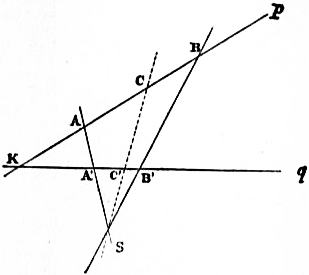
Fig. 9.
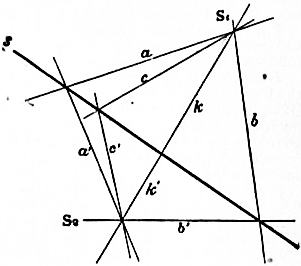
Fig. 10.
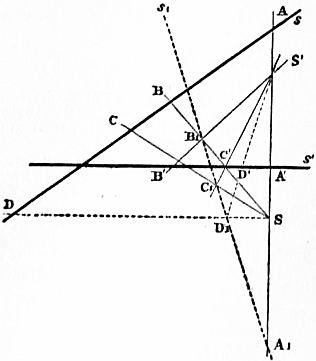
Fig. 11.
It is easy to construct two projective rows on the same line, which have two pairs of corresponding points coincident. Let the points A, B, C as points belonging to the one row correspond to A, B, and C′ as points in the second. Then A and B coincide with their corresponding points, but C does not. It is, however, not necessary that two such rows have twice a point coincident with its corresponding point; it is possible that this happens only once or not at all. Of this we shall see examples later.
§ 35. If two projective rows or pencils are in perspective position, we know at once which element in one corresponds to any given element in the other. If p and q (fig. 9) are two projective rows, so that K corresponds to itself, and if we know that to A and B in p correspond A′ and B′ in q, then the point S, where AA′ meets BB′, is the centre of projection, and hence, in order to find the point C′ corresponding to C, we have only to join C to S; the point C′, where this line cuts q, is the point required.
If two flat pencils, S1 and S2, in a plane are perspective (fig. 10), we need only to know two pairs, a, a′ and b, b′, of corresponding rays in order to find the axis s of projection. This being known, a ray c′ in S2, corresponding to a given ray c in S1, is found by joining S2 to the point where c cuts the axis s.
A similar construction holds in the other cases of perspective figures.
On this depends the solution of the following general problem.
§ 36. Three pairs of corresponding elements in two projective rows or pencils being given, to determine for any element in one the corresponding element in the other.
We solve this in the two cases of two projective rows and of two projective flat pencils in a plane.
Problem I.—Let A, B, C be three points in a row s, A′, B′, C′ the corresponding points in a projective row s′, both being in a plane; it is required to find for any point D in s the corresponding point D′ in s′.
Problem II.—Let a, b, c be three rays in a pencil S, a′, b′, c′ the corresponding rays in a projective pencil S′, both being in the same plane; it is required to find for any ray d in S the corresponding ray d′ in S′.
The solution is made to depend on the construction of an auxiliary row or pencil which is perspective to both the given ones. This is found as follows:—
Solution of Problem I.—On the line joining two corresponding points, say AA′ (fig. 11), take any two points, S and S′, as centres of auxiliary pencils. Join the intersection B1 of SB and S′B′ to the intersection C1 of SC and S′C′ by the line s1. Then a row on s1 will be perspective to s with S as centre of projection, and to s′ with S′ as centre. To find now the point D′ on s′ corresponding to a point D on s we have only to determine the point D1, where the line SD cuts s1, and to draw S′D1; the point where this line cuts s′ will be the required point D′.
Proof.—The rows s and s′ are both perspective to the row s1, hence they are projective to one another. To A, B, C, D on s correspond A1, B1, C1, D1 on s1, and to these correspond A′, B′, C′, D′ on s′; so that D and D′ are corresponding points as required.
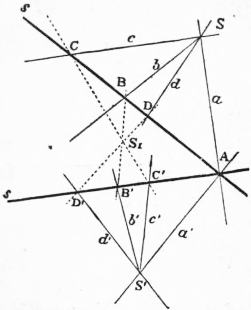
Fig. 12.
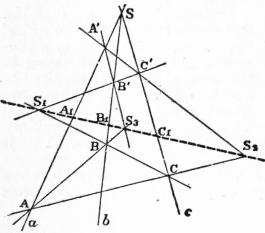
Fig. 13.
Solution of Problem II.—Through the intersection A of two corresponding rays a and a′ (fig. 12), take two lines, s and s′, as bases of auxiliary rows. Let S1 be the point where the line b1, which joins B and B′, cuts the line c1, which joins C and C′. Then a pencil S1 will be perspective to S with s as axis of projection. To find the ray d′ in S′ corresponding to a given ray d in S, cut d by s at D; project this point from S1 to D′ on s′ and join D′ to S′. This will be the required ray.
Proof.—That the pencil S1 is perspective to S and also to S′ follows from construction. To the lines a1, b1, c1, d1 in S1 correspond the lines a, b, c, d in S and the lines a′, b′, c′, d′ in S′, so that d and d′ are corresponding rays.
In the first solution the two centres, S, S′, are any two points on a line joining any two corresponding points, so that the solution of the problem allows of a great many different constructions. But whatever construction be used, the point D′, corresponding to D, must be always the same, according to the theorem in § 29. This gives rise to a number of theorems, into which, however, we shall not enter. The same remarks hold for the second problem.
§ 37. Homological Triangles.—As a further application of the theorems about perspective rows and pencils we shall prove the following important theorem.
Theorem.—If ABC and A′B′C′ (fig. 13) be two triangles, such that the lines AA′, BB′, CC′ meet in a point S, then the intersections of BC and B′C′, of CA and C′A′, and of AB and A′B′ will lie in a line. Such triangles are said to be homological, or in perspective. The triangles are “co-axial” in virtue of the property that the meets of corresponding sides are collinear and copolar, since the lines joining corresponding vertices are concurrent.
Proof.—Let a, b, c denote the lines AA′, BB′, CC′, which meet at S. Then these may be taken as bases of projective rows, so that A, A′, S on a correspond to B, B′, S on b, and to C, C′, S on c. As the point S is common to all, any two of these rows will be perspective.
If S1 be the centre of projection of rows b and c,
S2 ” ” ” c and a,
S3 ” ” ” a and b,
and if the line S1S2 cuts a in A1, and b in B1, and c in C1, then A1, B1 will be corresponding points in a and b, both corresponding to C1 in c. But a and b are perspective, therefore the line A1B1, that is S1S2, joining corresponding points must pass through the centre of projection S3 of a and b. In other words, S1, S2, S3 lie in a line. This is Desargues’ celebrated theorem if we state it thus:—
Theorem of Desargues.—If each of two triangles has one vertex on each of three concurrent lines, then the intersections of corresponding sides lie in a line, those sides being called corresponding which are opposite to vertices on the same line.
The converse theorem holds also, viz.
Theorem.—If the sides of one triangle meet those of another in three points which lie in a line, then the vertices lie on three lines which meet in a point.
The proof is almost the same as before.
§ 38. Metrical Relations between Projective Rows.—Every row contains one point which is distinguished from all others, viz. the point at infinity. In two projective rows, to the point I at infinity in one corresponds a point I′ in the other, and to the point J′ at infinity in the second corresponds a point J in the first. The points I′ and J are in general finite. If now A and B are any two points in the one, A′, B′ the corresponding points in the other row, then
(AB, JI) = (A′B′, J′I′),
or
AJ/JB : AI/IB = A′J′/J′B′ : A′I′/I′B′.
But, by § 17,
AI/IB = A′J′/J′B′ = −1;
therefore the last equation changes into
AJ · A′I′ = BJ · B′I′,
that is to say—
Theorem.—The product of the distances of any two corresponding points in two projective rows from the points which correspond to the points at infinity in the other is constant, viz. AJ · A′I′ = k. Steiner has called this number k the Power of the correspondence.
[The relation AJ · A′I′ = k shows that if J, I′ be given then the point A′ corresponding to a specified point A is readily found; hence A, A′ generate homographic ranges of which I and J′ correspond to the points at infinity on the ranges. If we take any two origins O, O′, on the ranges and reduce the expression AJ · A′I′ = k to its algebraic equivalent, we derive an equation of the form αxx′ + βx + γx′ + δ = 0. Conversely, if a relation of this nature holds, then points corresponding to solutions in x, x′ form homographic ranges.]
§ 39. Similar Rows.—If the points at infinity in two projective rows correspond so that I′ and J are at infinity, this result loses its meaning. But if A, B, C be any three points in one, A′, B′, C′ the corresponding ones on the other row, we have
(AB, CI) = (A′B′, C′I′),
which reduces to
AC/CB = A′C′/C′B′ or AC/A′C′ = BC/B′C′,
that is, corresponding segments are proportional. Conversely, if corresponding segments are proportional, then to the point at infinity in one corresponds the point at infinity in the other. If we call such rows similar, we may state the result thus—
Theorem.—Two projective rows are similar if to the point at infinity in one corresponds the point at infinity in the other, and conversely, if two rows are similar then they are projective, and the points at infinity are corresponding points.
From this the well-known propositions follow:—
Two lines are cut proportionally (in similar rows) by a series of parallels. The rows are perspective, with centre of projection at infinity.
If two similar rows are placed parallel, then the lines joining homologous points pass through a common point.
§ 40. If two flat pencils be projective, then there exists in either, one single pair of lines at right angles to one another, such that the corresponding lines in the other pencil are again at right angles.
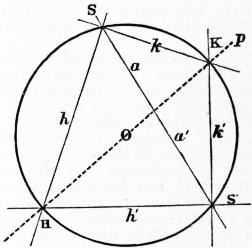
Fig. 14.
To prove this, we place the pencils in perspective position (fig. 14) by making one ray coincident with its corresponding ray. Corresponding rays meet then on a line p. And now we draw the circle which has its centre O on p, and which passes through the centres S and S′ of the two pencils. This circle cuts p in two points H and K. The two pairs of rays, h, k, and h′, k′, joining these points to S and S′ will be pairs of corresponding rays at right angles. The construction gives in general but one circle, but if the line p is the perpendicular bisector of SS′, there exists an infinite number, and to every right angle in the one pencil corresponds a right angle in the other.
Principle of Duality
§ 41. It has been stated in § 1 that not only points, but also planes and lines, are taken as elements out of which figures are built up. We shall now see that the construction of one figure which possesses certain properties gives rise in many cases to the construction of another figure, by replacing, according to definite rules, elements of one kind by those of another. The new figure thus obtained will then possess properties which may be stated as soon as those of the original figure are known.
We obtain thus a principle, known as the principle of duality or of reciprocity, which enables us to construct to any figure not containing any measurement in its construction a reciprocal figure, as it is called, and to deduce from any theorem a reciprocal theorem, for which no further proof is needed.
It is convenient to print reciprocal propositions on opposite sides of a page broken into two columns, and this plan will occasionally be adopted.
We begin by repeating in this form a few of our former statements:—
Two points determine a line. Two planes determine a line.
Three points which are not in a line determine a plane. Three planes which do not pass through a line determine a point.
A line and a point without it determine a plane. A line and a plane not through it determine a point.
Two lines in a plane determine a point. Two lines through a point determine a plane.
These propositions show that it will be possible, when any figure is given, to construct a second figure by taking planes instead of points, and points instead of planes, but lines where we had lines.
For instance, if in the first figure we take a plane and three points in it, we have to take in the second figure a point and three planes through it. The three points in the first, together with the three lines joining them two and two, form a triangle; the three planes in the second and their three lines of intersection form a trihedral angle. A triangle and a trihedral angle are therefore reciprocal figures.
Similarly, to any figure in a plane consisting of points and lines will correspond a figure consisting of planes and lines passing through a point S, and hence belonging to the pencil which has S as centre.
The figure reciprocal to four points in space which do not lie in a plane will consist of four planes which do not meet in a point. In this case each figure forms a tetrahedron.
§ 42. As other examples we have the following:—
To a row is reciprocal an axial pencil,
to a flat pencil ” a flat pencil,
to a field of points and lines ” a pencil of planes and lines,
to the space of points ” the space of planes.
For the row consists of a line and all the points in it, reciprocal to it therefore will be a line with all planes through it, that is, an axial pencil; and so for the other cases.
This correspondence of reciprocity breaks down, however, if we take figures which contain measurement in their construction. For instance, there is no figure reciprocal to two planes at right angles, because there is no segment in a row which has a magnitude as definite as a right angle.
We add a few examples of reciprocal propositions which are easily proved.
Theorem.—If A, B, C, D are any four points in space, and if the lines AB and CD meet, then all four points lie in a plane, hence also AC and BD, as well as AD and BC, meet. Theorem.—If α, β, γ, δ are four planes in space, and if the lines αβ and γδ meet, then all four planes lie in a point (pencil), hence also αγ and βδ, as well as αδ and βγ, meet.
Theorem.—If of any number of lines every one meets every other, whilst all do not
lie in a point, then all lie in a plane. lie in a plane, then all lie in a point (pencil).
§ 43. Reciprocal figures as explained lie both in space of three dimensions. If the one is confined to a plane (is formed of elements which lie in a plane), then the reciprocal figure is confined to a pencil (is formed of elements which pass through a point).
But there is also a more special principle of duality, according to which figures are reciprocal which lie both in a plane or both in a pencil. In the plane we take points and lines as reciprocal elements, for they have this fundamental property in common, that two elements of one kind determine one of the other. In the pencil, on the other hand, lines and planes have to be taken as reciprocal, and here it holds again that two lines or planes determine one plane or line.
Thus, to one plane figure we can construct one reciprocal figure in the plane, and to each one reciprocal figure in a pencil. We mention a few of these. At first we explain a few names:—
A figure consisting of n points in a plane will be called an n-point. A figure consisting of n lines in a plane will be called an n-side.
A figure consisting of n planes in a pencil will be called an n-flat. A figure consisting of n lines in a pencil will be called an n-edge.
It will be understood that an n-side is different from a polygon of n sides. The latter has sides of finite length and n vertices, the former has sides all of infinite extension, and every point where two of the sides meet will be a vertex. A similar difference exists between a solid angle and an n-edge or an n-flat. We notice particularly—
A four-point has six sides, of which two and two are opposite, and three diagonal points, which are intersections of opposite sides. A four-side has six vertices, of which two and two are opposite, and three diagonals, which join opposite vertices.
A four-flat has six edges, of which two and two are opposite, and three diagonal planes, which pass through opposite edges. A four-edge has six faces, of which two and two are opposite, and three diagonal edges, which are intersections of opposite faces.
A four-side is usually called a complete quadrilateral, and a four-point a complete quadrangle. The above notation, however, seems better adapted for the statement of reciprocal propositions.
§ 44.
If a point moves in a plane it describes a plane curve. If a line moves in a plane it envelopes a plane curve (fig. 15).
If a plane moves in a pencil it envelopes a cone. If a line moves in a pencil it describes a cone.
A curve thus appears as generated either by points, and then we call it a “locus,” or by lines, and then we call it an “envelope.” In the same manner a cone, which means here a surface, appears either as the locus of lines passing through a fixed point, the “vertex” of the cone, or as the envelope of planes passing through the same point.
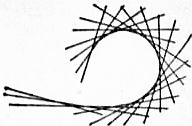
Fig. 15.
To a surface as locus of points corresponds, in the same manner, a surface as envelope of planes; and to a curve in space as locus of points corresponds a developable surface as envelope of planes.
It will be seen from the above that we may, by aid of the principle of duality, construct for every figure a reciprocal figure, and that to any property of the one a reciprocal property of the other will exist, as long as we consider only properties which depend upon nothing but the positions and intersections of the different elements and not upon measurement.
For such propositions it will therefore be unnecessary to prove more than one of two reciprocal theorems.
Generation of Curves and Cones of Second Order or Second Class
§ 45. Conics.—If we have two projective pencils in a plane, corresponding rays will meet, and their point of intersection will constitute some locus which we have to investigate. Reciprocally, if two projective rows in a plane are given, then the lines which join corresponding points will envelope some curve. We prove first:—
Theorem.—If two projective flat pencils lie in a plane, but are neither in perspective nor concentric, then the locus of intersections of corresponding rays is a curve of the second order, that is, no line contains more than two points of the locus. Theorem.—If two projective rows lie in a plane, but are neither in perspective nor on a common base, then the envelope of lines joining corresponding points is a curve of the second class, that is, through no point pass more than two of the enveloping lines.
Proof.—We draw any line t. This cuts each of the pencils in a row, so that we have on t two rows, and these are projective because the pencils are projective. If corresponding rays of the two pencils meet on the line t, their intersection will be a point in the one row which coincides with its corresponding point in the other. But two projective rows on the same base cannot have more than two points of one coincident with their corresponding points in the other (§ 34). Proof.—We take any point T and join it to all points in each row. This gives two concentric pencils, which are projective because the rows are projective. If a line joining corresponding points in the two rows passes through T, it will be a line in the one pencil which coincides with its corresponding line in the other. But two projective concentric flat pencils in the same plane cannot have more than two lines of one coincident with their corresponding line in the other (§ 34).
It will be seen that the proofs are reciprocal, so that the one may be copied from the other by simply interchanging the words point and line, locus and envelope, row and pencil, and so on. We shall therefore in future prove seldom more than one of two reciprocal theorems, and often state one theorem only, the reader being recommended to go through the reciprocal proof by himself, and to supply the reciprocal theorems when not given.
§ 46. We state the theorems in the pencil reciprocal to the last, without proving them:—
Theorem.—If two projective flat pencils are concentric, but are neither perspective nor coplanar, then the envelope of the planes joining corresponding rays is a cone of the second class; that is, no line through the common centre contains more than two of the enveloping planes. Theorem.—If two projective axial pencils lie in the same pencil (their axes meet in a point), but are neither perspective nor co-axial, then the locus of lines joining corresponding planes is a cone of the second order; that is, no plane in the pencil contains more than two of these lines.
§ 47. Of theorems about cones of second order and cones of second class we shall state only very few. We point out, however, the following connexion between the curves and cones under consideration:
The lines which join any point in space to the points on a curve of the second order form a cone of the second order. Every plane section of a cone of the second order is a curve of the second order.
The planes which join any point in space to the lines enveloping a curve of the second class envelope themselves a cone of the second class. Every plane section of a cone of the second class is a curve of the second class.
By its aid, or by the principle of duality, it will be easy to obtain theorems about them from the theorems about the curves.
We prove the first. A curve of the second order is generated by two projective pencils. These pencils, when joined to the point in space, give rise to two projective axial pencils, which generate the cone in question as the locus of the lines where corresponding planes meet.
§48.
Theorem.—The curve of second order which is generated by two projective flat pencils passes through the centres of the two pencils. Theorem.—The envelope of second class which is generated by two projective rows contains the bases of these rows as enveloping lines or tangents.
Proof.—If S and S′ are the two pencils, then to the ray SS′ or p′ in the pencil S′ corresponds in the pencil S a ray p, which is different from p′, for the pencils are not perspective. But p and p′ meet at S, so that S is a point on the curve, and similarly S′. Proof.—If s and s′ are the two rows, then to the point ss′ or P′ as a point in s′ corresponds in s a point P, which is not coincident with P′, for the rows are not perspective. But P and P′ are joined by s, so that s is one of the enveloping lines, and similarly s′.
It follows that every line in one of the two pencils cuts the curve in two points, viz. once at the centre S of the pencil, and once where it cuts its corresponding ray in the other pencil. These two points, however, coincide, if the line is cut by its corresponding line at S itself. The line p in S, which corresponds to the line SS′ in S′, is therefore the only line through S which has but one point in common with the curve, or which cuts the curve in two coincident points. Such a line is called a tangent to the curve, touching the latter at the point S, which is called the “point of contact.”
In the same manner we get in the reciprocal investigation the result that through every point in one of the rows, say in s, two tangents may be drawn to the curve, the one being s, the other the line joining the point to its corresponding point in s′. There is, however, one point P in s for which these two lines coincide. Such a point in one of the tangents is called the “point of contact” of the tangent. We thus get—
Theorem.—To the line joining the centres of the projective pencils as a line in one pencil corresponds in the other the tangent at its centre. Theorem.—To the point of intersection of the bases of two projective rows as a point in one row corresponds in the other the point of contact of its base.
§ 49. Two projective pencils are determined if three pairs of corresponding lines are given. Hence if a1, b1, c1 are three lines in a pencil S1, and a2, b2, c2 the corresponding lines in a projective pencil S2, the correspondence and therefore the curve of the second order generated by the points of intersection of corresponding rays is determined. Of this curve we know the two centres S1 and S2, and the three points a1a2, b1b2, c1c2, hence five points in all. This and the reciprocal considerations enable us to solve the following two problems:
Problem.—To construct a curve of the second order, of which five points S1, S2, A, B, C are given. Problem.—To construct a curve of the second class, of which five tangents u1, u2, a, b, c are given.
In order to solve the left-hand problem, we take two of the given points, say S1 and S2, as centres of pencils. These we make projective by taking the rays a1, b1, c1, which join S1 to A, B, C respectively, as corresponding to the rays a2, b2, c2, which join S2 to A, B, C respectively, so that three rays meet their corresponding rays at the given points A, B, C. This determines the correspondence of the pencils which will generate a curve of the second order passing through A, B, C and through the centres S1 and S2, hence through the five given points. To find more points on the curve we have to construct for any ray in S1 the corresponding ray in S2. This has been done in § 36. But we repeat the construction in order to deduce further properties from it. We also solve the right-hand problem. Here we select two, viz. u1, u2 of the five given lines, u1, u2, a, b, c, as bases of two rows, and the points A1, B1, C1 where a, b, c cut u1 as corresponding to the points A2, B2, C2 where a, b, c cut u2.
We get then the following solutions of the two problems:
Solution.—Through the point A draw any two lines, u1 and u2 (fig. 16), the first u1 to cut the pencil S1 in a row AB1C1, the other u2 to cut the pencil S2 in a row AB2C2. These two rows will be perspective, as the point A corresponds to itself, and the centre of projection will be the point S, where the lines B1B2 and C1C2 meet. To find now for any ray d1 in S1 its corresponding ray d2 in S2, we determine the point D1 where d1 cuts u1, project this point from S to D2 on u2 and join S2 to D2. This will be the required ray d2 which cuts d1 at some point D on the curve. Solution.—In the line a take any two points S1 and S2 as centres of pencils (fig. 17), the first S1 (A1B1C1) to project the row u1, the other S2 (A2B2C2) to project the row u2. These two pencils will be perspective, the line S1A1 being the same as the corresponding line S2A2, and the axis of projection will be the line u, which joins the intersection B of S1B1 and S2B2 to the intersection C of S1C1 and S2C2. To find now for any point D1 in u1 the corresponding point D2 in u2, we draw S1D1 and project the point D where this line cuts u from S2 to u2. This will give the required point D2, and the line d joining D1 to D2 will be a new tangent to the curve.
§ 50. These constructions prove, when rightly interpreted, very important properties of the curves in question.
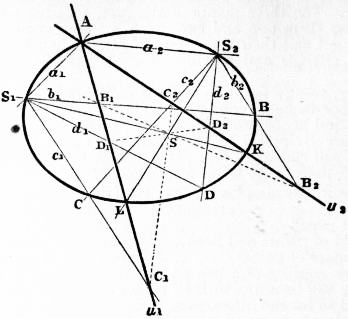
Fig. 16.
If in fig. 16 we draw in the pencil S1 the ray k1 which passes through the auxiliary centre S, it will be found that the corresponding ray k2 cuts it on u2. Hence—
Theorem.—In the above construction the bases of the auxiliary rows u1 and u2 cut the curve where they cut the rays S2S and S1S respectively. Theorem.—In the above construction (fig. 17) the tangents to the curve from the centres of the auxiliary pencils S1 and S2 are the lines which pass through u2u and u1u respectively.
As A is any given point on the curve, and u1 any line through it, we have solved the problems:
Problem.—To find the second point in which any line through a known point on the curve cuts the curve. Problem.—To find the second tangent which can be drawn from any point in a given tangent to the curve.
If we determine in S1 (fig. 16) the ray corresponding to the ray S2S1 in S2, we get the tangent at S1. Similarly, we can determine the point of contact of the tangents u1 or u2 in fig. 17.
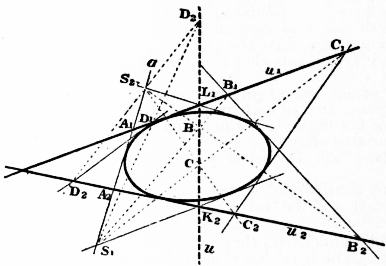
Fig. 17.
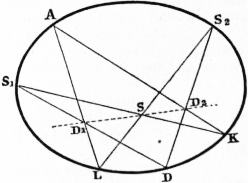
Fig. 18.
§ 51. If five points are given, of which not three are in a line, then we can, as has just been shown, always draw a curve of the second order through them; we select two of the points as centres of projective pencils, and then one such curve is determined. It will be presently shown that we get always the same curve if two other points are taken as centres of pencils, that therefore five points determine one curve of the second order, and reciprocally, that five tangents determine one curve of the second class. Six points taken at random will therefore not lie on a curve of the second order. In order that this may be the case a certain condition has to be satisfied, and this condition is easily obtained from the construction in § 49, fig. 16. If we consider the conic determined by the five points A, S1, S2, K, L, then the point D will be on the curve if, and only if, the points on D1, S, D2 be in a line.
This may be stated differently if we take AKS1DS2L (figs. 16 and 18) as a hexagon inscribed in the conic, then AK and DS2 will be opposite sides, so will be KS1 and S2L, as well as S1D and LA. The first two meet in D2, the others in S and D1 respectively. We may therefore state the required condition, together with the reciprocal one, as follows:—
Pascal’s Theorem.—If a hexagon be inscribed in a curve of the second order, then the intersections of opposite sides are three points in a line. Brianchon’s Theorem.—If a hexagon be circumscribed about a curve of the second class, then the lines joining opposite vertices are three lines meeting in a point.
These celebrated theorems, which are known by the names of their discoverers, are perhaps the most fruitful in the whole theory of conics. Before we go over to their applications we have to show that we obtain the same curve if we take, instead of S1, S2, any two other points on the curve as centres of projective pencils.
§ 52. We know that the curve depends only upon the correspondence between the pencils S1 and S2, and not upon the special construction used for finding new points on the curve. The point A (fig. 16 or 18), through which the two auxiliary rows u1, u2 were drawn, may therefore be changed to any other point on the curve. Let us now suppose the curve drawn, and keep the points S1, S2, K, L and D, and hence also the point S fixed, whilst we move A along the curve. Then the line AL will describe a pencil about L as centre, and the point D1 a row on S1D perspective to the pencil L. At the same time AK describes a pencil about K and D2 a row perspective to it on S2D. But by Pascal’s theorem D1 and D2 will always lie in a line with S, so that the rows described by D1 and D2 are perspective. It follows that the pencils K and L will themselves be projective, corresponding rays meeting on the curve. This proves that we get the same curve whatever pair of the five given points we take as centres of projective pencils. Hence—
Only one curve of the second order can be drawn which passes through five given points. Only one curve of the second class can be drawn which touches five given lines.
We have seen that if on a curve of the second order two points coincide at A, the line joining them becomes the tangent at A. If, therefore, a point on the curve and its tangent are given, this will be equivalent to having given two points on the curve. Similarly, if on the curve of second class a tangent and its point of contact are given, this will be equivalent to two given tangents.
We may therefore extend the last theorem:
Only one curve of the second order can be drawn, of which four points and the tangent at one of them, or three points and the tangents at two of them, are given. Only one curve of the second class can be drawn, of which four tangents and the point of contact at one of them, or three tangents and the points of contact at two of them, are given.
§ 53. At the same time it has been proved:
If all points on a curve of the second order be joined to any two of them, then the two pencils thus formed are projective, those rays being corresponding which meet on the curve. Hence— All tangents to a curve of second class are cut by any two of them in projective rows, those being corresponding points which lie on the same tangent. Hence—
The cross-ratio of four rays joining a point S on a curve of second order to four fixed points A, B, C, D in the curve is independent of the position of S, and is called the cross-ratio of the four points A, B, C, D. The cross-ratio of the four points in which any tangent u is cut by four fixed tangents a, b, c, d is independent of the position of u, and is called the cross-ratio of the four tangents a, b, c, d.
If this cross-ratio equals −1 the four points are said to be four harmonic points. If this cross-ratio equals −1 the four tangents are said to be four harmonic tangents.
We have seen that a curve of second order, as generated by projective pencils, has at the centre of each pencil one tangent; and further, that any point on the curve may be taken as centre of such pencil. Hence—
A curve of second order has at every point one tangent. A curve of second class has on every tangent a point of contact.
§ 54. We return to Pascal’s and Brianchon’s theorems and their applications, and shall, as before, state the results both for curves of the second order and curves of the second class, but prove them only for the former.
Pascal’s theorem may be used when five points are given to find more points on the curve, viz. it enables us to find the point where any line through one of the given points cuts the curve again. It is convenient, in making use of Pascal’s theorem, to number the points, to indicate the order in which they are to be taken in forming a hexagon, which, by the way, may be done in 60 different ways. It will be seen that 1 2 (leaving out 3) 4 5 are opposite sides, so are 2 3 and (leaving out 4) 5 6, and also 3 4 and (leaving out 5) 6 1.
If the points 1 2 3 4 5 are given, and we want a 6th point on a line drawn through 1, we know all the sides of the hexagon with the exception of 5 6, and this is found by Pascal’s theorem.
If this line should happen to pass through 1, then 6 and 1 coincide, or the line 6 1 is the tangent at 1. And always if two consecutive vertices of the hexagon approach nearer and nearer, then the side joining them will ultimately become a tangent.
We may therefore consider a pentagon inscribed in a curve of second order and the tangent at one of its vertices as a hexagon, and thus get the theorem:
Every pentagon inscribed in a curve of second order has the property that the intersections of two pairs of non-consecutive sides lie in a line with the point where the fifth side cuts the tangent at the opposite vertex. Every pentagon circumscribed about a curve of the second class has the property that the lines which join two pairs of non-consecutive vertices meet on that line which joins the fifth vertex to the point of contact of the opposite side.
This enables us also to solve the following problems.
Given five points on a curve of second order to construct the tangent at any one of them. Given five tangents to a curve of second class to construct the point of contact of any one of them.
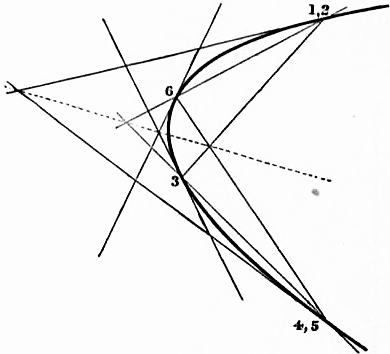
Fig. 19.
If two pairs of adjacent vertices coincide, the hexagon becomes a quadrilateral, with tangents at two vertices. These we take to be opposite, and get the following theorems:
If a quadrilateral be inscribed in a curve of second order, the intersections of opposite sides, and also the intersections of the tangents at opposite vertices, lie in a line (fig. 19). If a quadrilateral be circumscribed about a curve of second class, the lines joining opposite vertices, and also the lines joining points of contact of opposite sides, meet in a point.
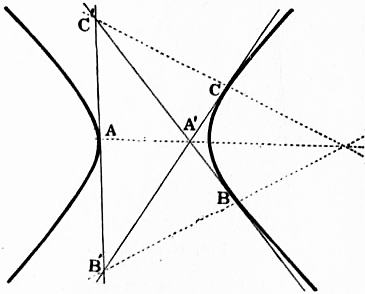
Fig. 20.
If we consider the hexagon made up of a triangle and the tangents at its vertices, we get—
If a triangle is inscribed in a curve of the second order, the points in which the sides are cut by the tangents at the opposite vertices meet in a point. If a triangle be circumscribed about a curve of second class, the lines which join the vertices to the points of contact of the opposite sides meet in a point (fig. 20).
§ 55. Of these theorems, those about the quadrilateral give rise to a number of others. Four points A, B, C, D may in three different ways be formed into a quadrilateral, for we may take them in the order ABCD, or ACBD, or ACDB, so that either of the points B, C, D may be taken as the vertex opposite to A. Accordingly we may apply the theorem in three different ways.
Let A, B, C, D be four points on a curve of second order (fig. 21), and let us take them as forming a quadrilateral by taking the points in the order ABCD, so that A, C and also B, D are pairs of opposite vertices. Then P, Q will be the points where opposite sides meet, and E, F the intersections of tangents at opposite vertices. The four points P, Q, E, F lie therefore in a line. The quadrilateral ACBD gives us in the same way the four points Q, R, G, H in a line, and the quadrilateral ABDC a line containing the four points R, P, I, K. These three lines form a triangle PQR.
The relation between the points and lines in this figure may be expressed more clearly if we consider ABCD as a four-point inscribed in a conic, and the tangents at these points as a four-side circumscribed about it,—viz. it will be seen that P, Q, R are the diagonal points of the four-point ABCD, whilst the sides of the triangle PQR are the diagonals of the circumscribing four-side. Hence the theorem—
Any four-point on a curve of the second order and the four-side formed by the tangents at these points stand in this relation that the diagonal points of the four-point lie in the diagonals of the four-side. And conversely,
If a four-point and a circumscribed four-side stand in the above relation, then a curve of the second order may be described which passes through the four points and touches there the four sides of these figures.
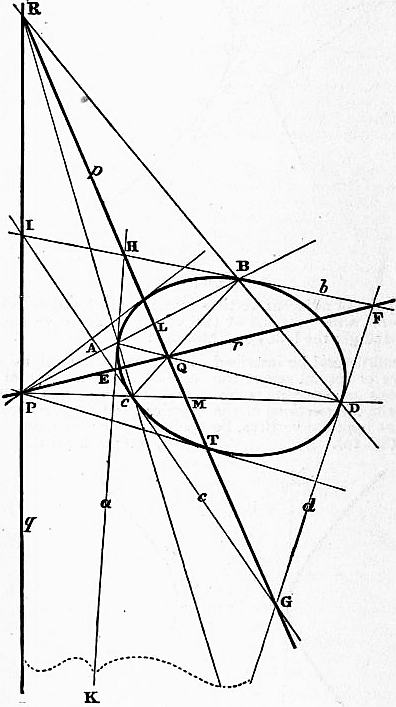
Fig. 21.
That the last part of the theorem is true follows from the fact that the four points A, B, C, D and the line a, as tangent at A, determine a curve of the second order, and the tangents to this curve at the other points B, C, D are given by the construction which leads to fig. 21.
The theorem reciprocal to the last is—
Any four-side circumscribed about a curve of second class and the four-point formed by the points of contact stand in this relation that the diagonals of the four-side pass through the diagonal points of the four-point. And conversely,
If a four-side and an inscribed four-point stand in the above relation, then a curve of the second class may be described which touches the sides of the four-side at the points of the four-point.
§ 56. The four-point and the four-side in the two reciprocal theorems are alike. Hence if we have a four-point ABCD and a four-side abcd related in the manner described, then not only may a curve of the second order be drawn, but also a curve of the second class, which both touch the lines a, b, c, d at the points A, B, C, D.
The curve of second order is already more than determined by the points A, B, C and the tangents a, b, c at A, B and C. The point D may therefore be any point on this curve, and d any tangent to the curve. On the other hand the curve of the second class is more than determined by the three tangents a, b, c and their points of contact A, B, C, so that d is any tangent to this curve. It follows that every tangent to the curve of second order is a tangent of a curve of the second class having the same point of contact. In other words, the curve of second order is a curve of second class, and vice versa. Hence the important theorems—
Every curve of second order is a curve of second class. Every curve of second class is a curve of second order.
The curves of second order and of second class, having thus been proved to be identical, shall henceforth be called by the common name of Conics.
For these curves hold, therefore, all properties which have been proved for curves of second order or of second class. We may therefore now state Pascal’s and Brianchon’s theorem thus—
Pascal’s Theorem.—If a hexagon be inscribed in a conic, then the intersections of opposite sides lie in a line.
Brianchon’s Theorem.—If a hexagon be circumscribed about a conic, then the diagonals forming opposite centres meet in a point.
§ 57. If we suppose in fig. 21 that the point D together with the tangent d moves along the curve, whilst A, B, C and their tangents a, b, c remain fixed, then the ray DA will describe a pencil about A, the point Q a projective row on the fixed line BC, the point F the row b, and the ray EF a pencil about E. But EF passes always through Q. Hence the pencil described by AD is projective to the pencil described by EF, and therefore to the row described by F on b. At the same time the line BD describes a pencil about B projective to that described by AD (§ 53). Therefore the pencil BD and the row F on b are projective. Hence—
If on a conic a point A be taken and the tangent a at this point, then the cross-ratio of the four rays which join A to any four points on the curve is equal to the cross-ratio of the points in which the tangents at these points cut the tangent at A.
§ 58. There are theorems about cones of second order and second class in a pencil which are reciprocal to the above, according to § 43. We mention only a few of the more important ones.
The locus of intersections of corresponding planes in two projective axial pencils whose axes meet is a cone of the second order.
The envelope of planes which join corresponding lines in two projective flat pencils, not in the same plane, is a cone of the second class.
Cones of second order and cones of second class are identical.
Every plane cuts a cone of the second order in a conic.
A cone of second order is uniquely determined by five of its edges or by five of its tangent planes, or by four edges and the tangent plane at one of them, &c. &c.
Pascal’s Theorem.—If a solid angle of six faces be inscribed in a cone of the second order, then the intersections of opposite faces are three lines in a plane.
Brianchon’s Theorem.—If a solid angle of six edges be circumscribed about a cone of the second order, then the planes through opposite edges meet in a line.
Each of the other theorems about conics may be stated for cones of the second order.
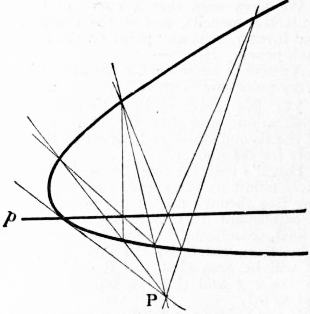
Fig. 22.
§ 59. Projective Definitions of the Conics.—We now consider the shape of the conics. We know that any line in the plane of the conic, and hence that the line at infinity, either has no point in common with the curve, or one (counting for two coincident points) or two distinct points. If the line at infinity has no point on the curve the latter is altogether finite, and is called an Ellipse (fig. 21). If the line at infinity has only one point in common with the conic, the latter extends to infinity, and has the line at infinity a tangent. It is called a Parabola (fig. 22). If, lastly, the line at infinity cuts the curve in two points, it consists of two separate parts which each extend in two branches to the points at infinity where they meet. The curve is in this case called an Hyperbola (see fig. 20). The tangents at the two points at infinity are finite because the line at infinity is not a tangent. They are called Asymptotes. The branches of the hyperbola approach these lines indefinitely as a point on the curves moves to infinity.
§ 60. That the circle belongs to the curves of the second order is seen at once if we state in a slightly different form the theorem that in a circle all angles at the circumference standing upon the same arc are equal. If two points S1, S2 on a circle be joined to any other two points A and B on the circle, then the angle included by the rays S1A and S1B is equal to that between the rays S2A and S2B, so that as A moves along the circumference the rays S1A and S2A describe equal and therefore projective pencils. The circle can thus be generated by two projective pencils, and is a curve of the second order.
If we join a point in space to all points on a circle, we get a (circular) cone of the second order (§ 43). Every plane section of this cone is a conic. This conic will be an ellipse, a parabola, or an hyperbola, according as the line at infinity in the plane has no, one or two points in common with the conic in which the plane at infinity cuts the cone. It follows that our curves of second order may be obtained as sections of a circular cone, and that they are identical with the “Conic Sections” of the Greek mathematicians.
§ 61. Any two tangents to a parabola are cut by all others in projective rows; but the line at infinity being one of the tangents, the points at infinity on the rows are corresponding points, and the rows therefore similar. Hence the theorem—
The tangents to a parabola cut each other proportionally.
Pole and Polar
§ 62. We return once again to fig. 21, which we obtained in § 55.
If a four-side be circumscribed about and a four-point inscribed in a conic, so that the vertices of the second are the points of contact of the sides of the first, then the triangle formed by the diagonals of the first is the same as that formed by the diagonal points of the other.
Such a triangle will be called a polar-triangle of the conic, so that PQR in fig. 21 is a polar-triangle. It has the property that on the side p opposite P meet the tangents at A and B, and also those at C and D. From the harmonic properties of four-points and four-sides it follows further that the points L, M, where it cuts the lines AB and CD, are harmonic conjugates with regard to AB and CD respectively.
If the point P is given, and we draw a line through it, cutting the conic in A and B, then the point Q harmonic conjugate to P with regard to AB, and the point H where the tangents at A and B meet, are determined. But they lie both on p, and therefore this line is determined. If we now draw a second line through P, cutting the conic in C and D, then the point M harmonic conjugate to P with regard to CD, and the point G where the tangents at C and D meet, must also lie on p. As the first line through P already determines p, the second may be any line through P. Now every two lines through P determine a four-point ABCD on the conic, and therefore a polar-triangle which has one vertex at P and its opposite side at p. This result, together with its reciprocal, gives the theorems—
All polar-triangles which have one vertex in common have also the opposite side in common.
All polar-triangles which have one side in common have also the opposite vertex in common.
§ 63. To any point P in the plane of, but not on, a conic corresponds thus one line p as the side opposite to P in all polar-triangles which have one vertex at P, and reciprocally to every line p corresponds one point P as the vertex opposite to p in all triangles which have p as one side.
We call the line p the polar of P, and the point P the pole of the line p with regard to the conic.
If a point lies on the conic, we call the tangent at that point its polar; and reciprocally we call the point of contact the pole of tangent.
§ 64. From these definitions and former results follow—
The polar of any point P not on the conic is a line p, which has the following properties:— The pole of any line p not a tangent to the conic is a point P, which has the following properties:—
1. On every line through P which cuts the conic, the polar of P contains the harmonic conjugate of P with regard to those points on the conic. 1. Of all lines through a point on p from which two tangents may be drawn to the conic, the pole P contains the line which is harmonic conjugate to p, with regard to the two tangents.
2. If tangents can be drawn from P, their points of contact lie on p. 2. If p cuts the conic, the tangents at the intersections meet at P.
3. Tangents drawn at the points where any line through P cuts the conic meet on p; and conversely, 3. The point of contact of tangents drawn from any point on p to the conic lie in a line with P; and conversely,
4. If from any point on p, tangents be drawn, their points of contact will lie in a line with P. 4. Tangents drawn at points where any line through P cuts the conic meet on p.
5. Any four-point on the conic which has one diagonal point at P has the other two lying on p. 5. Any four-side circumscribed about a conic which has one diagonal on p has the other two meeting at P.
The truth of 2 follows from 1. If T be a point where p cuts the conic, then one of the points where PT cuts the conic, and which are harmonic conjugates with regard to PT, coincides with T; hence the other does—that is, PT touches the curve at T.
That 4 is true follows thus: If we draw from a point H on the polar one tangent a to the conic, join its point of contact A to the pole P, determine the second point of intersection B of this line with the conic, and draw the tangent at B, it will pass through H, and will therefore be the second tangent which may be drawn from H to the curve.
§ 65. The second property of the polar or pole gives rise to the theorem—
From a point in the plane of a conic, two, one or no tangents may be drawn to the conic, as its polar has two, one, or no points in common with the curve. A line in the plane of a conic has two, one or no points in common with the conic, according as two, one or no tangents can be drawn from its pole to the conic.
Of any point in the plane of a conic we say that it was without, on or within the curve according as two, one or no tangents to the curve pass through it. The points on the conic separate those within the conic from those without. That this is true for a circle is known from elementary geometry. That it also holds for other conics follows from the fact that every conic may be considered as the projection of a circle, which will be proved later on.
The fifth property of pole and polar stated in § 64 shows how to find the polar of any point and the pole of any line by aid of the straight-edge only. Practically it is often convenient to draw three secants through the pole, and to determine only one of the diagonal points for two of the four-points formed by pairs of these lines and the conic (fig. 22).
These constructions also solve the problem—
From a point without a conic, to draw the two tangents to the conic by aid of the straight-edge only.
For we need only draw the polar of the point in order to find the points of contact.
§ 66. The property of a polar-triangle may now be stated thus—
In a polar-triangle each side is the polar of the opposite vertex, and each vertex is the pole of the opposite side.
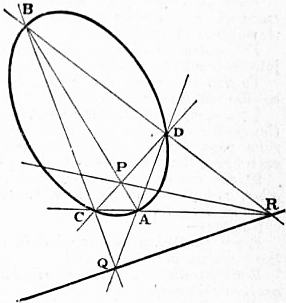
Fig. 23.
If P is one vertex of a polar-triangle, then the other vertices, Q and R, lie on the polar p of P. One of these vertices we may choose arbitrarily. For if from any point Q on the polar a secant be drawn cutting the conic in A and D (fig. 23), and if the lines joining these points to P cut the conic again at B and C, then the line BC will pass through Q. Hence P and Q are two of the vertices on the polar-triangle which is determined by the four-point ABCD. The third vertex R lies also on the line p. It follows, therefore, also—
If Q is a point on the polar of P, then P is a point on the polar of Q; and reciprocally,
If q is a line through the pole of p, then p is a line through the pole of q.
This is a very important theorem. It may also be stated thus—
If a point moves along a line describing a row, its polar turns about the pole of the line describing a pencil.
This pencil is projective to the row, so that the cross-ratio of four poles in a row equals the cross-ratio of its four polars, which pass through the pole of the row.
To prove the last part, let us suppose that P, A and B in fig. 23 remain fixed, whilst Q moves along the polar p of P. This will make CD turn about P and move R along p, whilst QD and RD describe projective pencils about A and B. Hence Q and R describe projective rows, and hence PR, which is the polar of Q, describes a pencil projective to either.
§ 67. Two points, of which one, and therefore each, lies on the polar of the other, are said to be conjugate with regard to the conic; and two lines, of which one, and therefore each, passes through the pole of the other, are said to be conjugate with regard to the conic. Hence all points conjugate to a point P lie on the polar of P; all lines conjugate to a line p pass through the pole of p.
If the line joining two conjugate poles cuts the conic, then the poles are harmonic conjugates with regard to the points of intersection; hence one lies within the other without the conic, and all points conjugate to a point within a conic lie without it.
Of a polar-triangle any two vertices are conjugate poles, any two sides conjugate lines. If, therefore, one side cuts a conic, then one of the two vertices which lie on this side is within and the other without the conic. The vertex opposite this side lies also without, for it is the pole of a line which cuts the curve. In this case therefore one vertex lies within, the other two without. If, on the other hand, we begin with a side which does not cut the conic, then its pole lies within and the other vertices without. Hence—
Every polar-triangle has one and only one vertex within the conic.
We add, without a proof, the theorem—
The four points in which a conic is cut by two conjugate polars are four harmonic points in the conic.
§ 68. If two conics intersect in four points (they cannot have more points in common, § 52), there exists one and only one four-point which is inscribed in both, and therefore one polar-triangle common to both.
Theorem.—Two conics which intersect in four points have always one and only one common polar-triangle; and reciprocally,
Two conics which have four common tangents have always one and only one common polar-triangle.
Diameters and Axes of Conics
§ 69. Diameters.—The theorems about the harmonic properties of poles and polars contain, as special cases, a number of important metrical properties of conics. These are obtained if either the pole or the polar is moved to infinity,—it being remembered that the harmonic conjugate to a point at infinity, with regard to two points A, B, is the middle point of the segment AB. The most important properties are stated in the following theorems:—
The middle points of parallel chords of a conic lie in a line—viz. on the polar to the point at infinity on the parallel chords.
This line is called a diameter.
The polar of every point at infinity is a diameter.
The tangents at the end points of a diameter are parallel, and are parallel to the chords bisected by the diameter.
All diameters pass through a common point, the pole of the line at infinity.
All diameters of a parabola are parallel, the pole to the line at infinity being the point where the curve touches the line at infinity.
In case of the ellipse and hyperbola, the pole to the line at infinity is a finite point called the centre of the curve.
A centre of a conic bisects every chord through it.
The centre of an ellipse is within the curve, for the line at infinity does not cut the ellipse.
The centre of an hyperbola is without the curve, because the line at infinity cuts the curve. Hence also—
From the centre of an hyperbola two tangents can be drawn to the curve which have their point of contact at infinity. These are called Asymptotes (§ 59).
To construct a diameter of a conic, draw two parallel chords and join their middle points.
To find the centre of a conic, draw two diameters; their intersection will be the centre.
§ 70. Conjugate Diameters.—A polar-triangle with one vertex at the centre will have the opposite side at infinity. The other two sides pass through the centre, and are called conjugate diameters, each being the polar of the point at infinity on the other.
Of two conjugate diameters each bisects the chords parallel to the other, and if one cuts the curve, the tangents at its ends are parallel to the other diameter.
Further—
Every parallelogram inscribed in a conic has its sides parallel to two conjugate diameters; and
Every parallelogram circumscribed about a conic has as diagonals two conjugate diameters.
This will be seen by considering the parallelogram in the first case as an inscribed four-point, in the other as a circumscribed four-side, and determining in each case the corresponding polar-triangle. The first may also be enunciated thus—
The lines which join any point on an ellipse or an hyperbola to the ends of a diameter are parallel to two conjugate diameters.
§ 71. If every diameter is perpendicular to its conjugate the conic is a circle.
For the lines which join the ends of a diameter to any point on the curve include a right angle.
A conic which has more than one pair of conjugate diameters at right angles to each other is a circle.
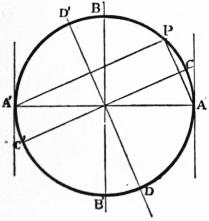
Fig. 24.
Let AA′ and BB′ (fig. 24) be one pair of conjugate diameters at right angles to each other, CC and DD′ a second pair. If we draw through the end point A of one diameter a chord AP parallel to DD′, and join P to A′, then PA and PA′ are, according to § 70, parallel to two conjugate diameters. But PA is parallel to DD′, hence PA′ is parallel to CC, and therefore PA and PA′ are perpendicular. If we further draw the tangents to the conic at A and A′, these will be perpendicular to AA′, they being parallel to the conjugate diameter BB′. We know thus five points on the conic, viz. the points A and A′ with their tangents, and the point P. Through these a circle may be drawn having AA′ as diameter; and as through five points one conic only can be drawn, this circle must coincide with the given conic.
§ 72. Axes.—Conjugate diameters perpendicular to each other are called axes, and the points where they cut the curve vertices of the conic.
In a circle every diameter is an axis, every point on it is a vertex; and any two lines at right angles to each other may be taken as a pair of axes of any circle which has its centre at their intersection.
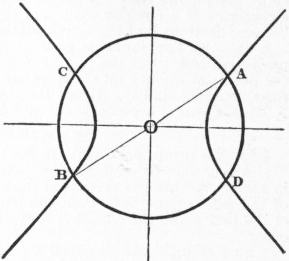
Fig. 25.
If we describe on a diameter AB of an ellipse or hyperbola a circle concentric to the conic, it will cut the latter in A and B (fig. 25). Each of the semicircles in which it is divided by AB will be partly within, partly without the curve, and must cut the latter therefore again in a point. The circle and the conic have thus four points A, B, C, D, and therefore one polar-triangle, in common (§ 68). Of this the centre is one vertex, for the line at infinity is the polar to this point, both with regard to the circle and the other conic. The other two sides are conjugate diameters of both, hence perpendicular to each other. This gives—
An ellipse as well as an hyperbola has one pair of axes.
This reasoning shows at the same time how to construct the axis of an ellipse or of an hyperbola.
A parabola has one axis, if we define an axis as a diameter perpendicular to the chords which it bisects. It is easily constructed. The line which bisects any two parallel chords is a diameter. Chords perpendicular to it will be bisected by a parallel diameter, and this is the axis.
§ 73. The first part of the right-hand theorem in § 64 may be stated thus: any two conjugate lines through a point P without a conic are harmonic conjugates with regard to the two tangents that may be drawn from P to the conic.
If we take instead of P the centre C of an hyperbola, then the conjugate lines become conjugate diameters, and the tangents asymptotes. Hence—
Any two conjugate diameters of an hyperbola are harmonic conjugates with regard to the asymptotes.
As the axes are conjugate diameters at right angles to one another, it follows (§ 23)—
The axes of an hyperbola bisect the angles between the asymptotes.
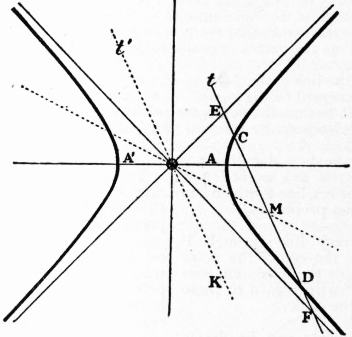
Fig. 26.
Let O be the centre of the hyperbola (fig. 26), t any secant which cuts the hyperbola in C, D and the asymptotes in E, F, then the line OM which bisects the chord CD is a diameter conjugate to the diameter OK which is parallel to the secant t, so that OK and OM are harmonic with regard to the asymptotes. The point M therefore bisects EF. But by construction M bisects CD. It follows that DF = EC, and ED = CF; or
On any secant of an hyperbola the segments between the curve and the asymptotes are equal.
If the chord is changed into a tangent, this gives—
The segment between the asymptotes on any tangent to an hyperbola is bisected by the point of contact.
The first part allows a simple solution of the problem to find any number of points on an hyperbola, of which the asymptotes and one point are given. This is equivalent to three points and the tangents at two of them. This construction requires measurement.
§ 74. For the parabola, too, follow some metrical properties. A diameter PM (fig. 27) bisects every chord conjugate to it, and the pole P of such a chord BC lies on the diameter. But a diameter cuts the parabola once at infinity. Hence—
The segment PM which joins the middle point M of a chord of a parabola to the pole P of the chord is bisected by the parabola at A.
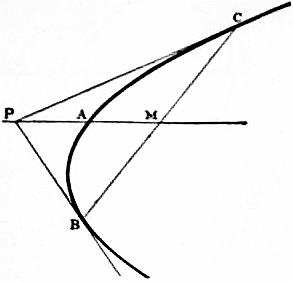
Fig. 27.
§ 75. Two asymptotes and any two tangents to an hyperbola may be considered as a quadrilateral circumscribed about the hyperbola. But in such a quadrilateral the intersections of the diagonals and the points of contact of opposite sides lie in a line (§ 54). If therefore DEFG (fig. 28) is such a quadrilateral, then the diagonals DF and GE will meet on the line which joins the points of contact of the asymptotes, that is, on the line at infinity; hence they are parallel. From this the following theorem is a simple deduction:
All triangles formed by a tangent and the asymptotes of an hyperbola are equal in area.
If we draw at a point P (fig. 28) on an hyperbola a tangent, the part HK between the asymptotes is bisected at P. The parallelogram PQOQ′ formed by the asymptotes and lines parallel to them through P will be half the triangle OHK, and will therefore be constant. If we now take the asymptotes OX and OY as oblique axes of co-ordinates, the lines OQ and QP will be the co-ordinates of P, and will satisfy the equation xy = const. = a².
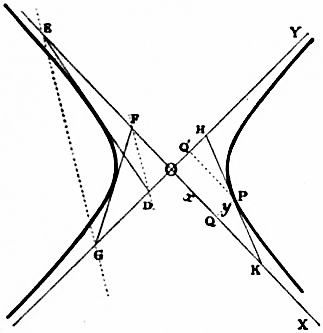
Fig. 28.
For the asymptotes as axes of co-ordinates the equation of the hyperbola is xy = const.
Involution
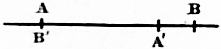
Fig. 29.
§ 76. If we have two projective rows, ABC on u and A′B′C′ on u′, and place their bases on the same line, then each point in this line counts twice, once as a point in the row u and once as a point in the row u′. In fig. 29 we denote the points as points in the one row by letters above the line A, B, C ..., and as points in the second row by A′, B′, C′ ... below the line. Let now A and B′ be the same point, then to A will correspond a point A′ in the second, and to B′ a point B in the first row. In general these points A′ and B will be different. It may, however, happen that they coincide. Then the correspondence is a peculiar one, as the following theorem shows:
If two projective rows lie on the same base, and if it happens that to one point in the base the same point corresponds, whether we consider the point as belonging to the first or to the second row, then the same will happen for every point in the base—that is to say, to every point in the line corresponds the same point in the first as in the second row.

Fig. 30.
In order to determine the correspondence, we may assume three pairs of corresponding points in two projective rows. Let then A′, B′, C′, in fig. 30, correspond to A, B, C, so that A and B′, and also B and A′, denote the same point. Let us further denote the point C′ when considered as a point in the first row by D; then it is to be proved that the point D′, which corresponds to D, is the same point as C. We know that the cross-ratio of four points is equal to that of the corresponding row. Hence
(AB, CD) = (A′B′, C′D′)
but replacing the dashed letters by those undashed ones which denote the same points, the second cross-ratio equals (BA, DD′), which, according to § 15, equals (AB, D′D); so that the equation becomes
(AB, CD) = (AB, D′D).
This requires that C and D′ coincide.
§ 77. Two projective rows on the same base, which have the above property, that to every point, whether it be considered as a point in the one or in the other row, corresponds the same point, are said to be in involution, or to form an involution of points on the line.
We mention, but without proving it, that any two projective rows may be placed so as to form an involution.
An involution may be said to consist of a row of pairs of points, to every point A corresponding a point A′, and to A′ again the point A. These points are said to be conjugate, or, better, one point is termed the “mate” of the other.
From the definition, according to which an involution may be considered as made up of two projective rows, follow at once the following important properties:
1. The cross-ratio of four points equals that of the four conjugate points.
2. If we call a point which coincides with its mate a “focus” or “double point” of the involution, we may say: An involution has either two foci, or one, or none, and is called respectively a hyperbolic, parabolic or elliptic involution (§ 34).
3. In an hyperbolic involution any two conjugate points are harmonic conjugates with regard to the two foci.
For if A, A′ be two conjugate points, F1, F2 the two foci, then to the points F1, F2, A, A′ in the one row correspond the points F1, F2, A′, A in the other, each focus corresponding to itself. Hence (F1F2, AA′) = (F1F2, A′A)—that is, we may interchange the two points AA′ without altering the value of the cross-ratio, which is the characteristic property of harmonic conjugates (§ 18).
4. The point conjugate to the point at infinity is called the “centre” of the involution. Every involution has a centre, unless the point at infinity be a focus, in which case we may say that the centre is at infinity.
In an hyperbolic involution the centre is the middle point between the foci.
5. The product of the distances of two conjugate points A, A′ from the centre O is constant: OA · OA′ = c.
For let A, A′ and B, B′ be two pairs of conjugate points, the centre, I the point at infinity, then
(AB, OI) = (A′B′, IO),
or
OA · OA′ = OB · OB′.
In order to determine the distances of the foci from the centre, we write F for A and A′ and get
OF² = c; OF = ±√c.
Hence if c is positive OF is real, and has two values, equal and opposite. The involution is hyperbolic.
If c = 0, OF = 0, and the two foci both coincide with the centre. If c is negative, √c becomes imaginary, and there are no foci. Hence we may write—
In an hyperbolic involution, OA · OA′ = k²,
In a parabolic involution, OA · OA′ = 0,
In an elliptic involution, OA · OA′ = −k².
From these expressions it follows that conjugate points A, A′ in an hyperbolic involution lie on the same side of the centre, and in an elliptic involution on opposite sides of the centre, and that in a parabolic involution one coincides with the centre.
In the first case, for instance, OA · OA′ is positive; hence OA and OA′ have the same sign.
It also follows that two segments, AA′ and BB′, between pairs of conjugate points have the following positions: in an hyperbolic involution they lie either one altogether within or altogether without each other; in a parabolic involution they have one point in common; and in an elliptic involution they overlap, each being partly within and partly without the other.
Proof.—We have OA . OA′ = OB · OB′ = k² in case of an hyperbolic involution. Let A and B be the points in each pair which are nearer to the centre O. If now A, A′ and B, B′ lie on the same side of O, and if B is nearer to O than A, so that OB < OA, then OB′ > OA′; hence B′ lies farther away from O than A′, or the segment AA′ lies within BB′. And so on for the other cases.
6. An involution is determined—
(α) By two pairs of conjugate points. Hence also (β) By one pair of conjugate points and the centre; (γ) By the two foci; (δ) By one focus and one pair of conjugate points; (ε) By one focus and the centre.
7. The condition that A, B, C and A′, B′, C′ may form an involution may be written in one of the forms—
(AB, CC′) = (A′B′, C′C),
or
(AB, CA′) = (A′B′, C′A),
or
(AB, C′A′) = (A′B′, CA),
for each expresses that in the two projective rows in which A, B, C and A′, B′, C′ are conjugate points two conjugate elements may be interchanged.
8. Any three pairs. A, A′, B, B′, C, C′, of conjugate points are connected by the relations:
AB′ · BC′ · CA′ = AB′ · BC · C′A′ = AB · B′C′ · CA′ = AB · B′C · C′A′ = −1.
A′B · B′C · C′A A′B · B′C′ · CA A′B′ · BC · C′A A′B′ · BC′ · CA
These relations readily follow by working out the relations in (7) (above).
§ 78. Involution of a quadrangle.—The sides of any four-point are cut by any line in six points in involution, opposite sides being cut in conjugate points.
Let A1B1C1D1 (fig. 31) be the four-point. If its sides be cut by the line p in the points A, A′, B, B′, C, C′, if further, C1D1 cuts the line A1B1 in C2, and if we project the row A1B1C2C to p once from D1 and once from C1, we get (A′B′, C′C) = (BA, C′C).
Interchanging in the last cross-ratio the letters in each pair we get (A′B′, C′C) = (AB, CC′). Hence by § 77 (7) the points are in involution.
The theorem may also be stated thus:
The three points in which any line cuts the sides of a triangle and the projections, from any point in the plane, of the vertices of the triangle on to the same line are six points in involution.
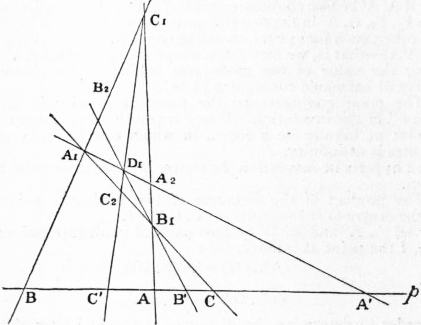
Fig. 31.
Or again—
The projections from any point on to any line of the six vertices of a four-side are six points in involution, the projections of opposite vertices being conjugate points.
This property gives a simple means to construct, by aid of the straight edge only, in an involution of which two pairs of conjugate points are given, to any point its conjugate.
§ 79. Pencils in Involution.—The theory of involution may at once be extended from the row to the flat and the axial pencil—viz. we say that there is an involution in a flat or in an axial pencil if any line cuts the pencil in an involution of points. An involution in a pencil consists of pairs of conjugate rays or planes; it has two, one or no focal rays (double lines) or planes, but nothing corresponding to a centre.
An involution in a flat pencil contains always one, and in general only one, pair of conjugate rays which are perpendicular to one another. For in two projective flat pencils exist always two corresponding right angles (§ 40).
Each involution in an axial pencil contains in the same manner one pair of conjugate planes at right angles to one another.
As a rule, there exists but one pair of conjugate lines or planes at right angles to each other. But it is possible that there are more, and then there is an infinite number of such pairs. An involution in a flat pencil, in which every ray is perpendicular to its conjugate ray, is said to be circular. That such involution is possible is easily seen thus: if in two concentric flat pencils each ray on one is made to correspond to that ray on the other which is perpendicular to it, then the two pencils are projective, for if we turn the one pencil through a right angle each ray in one coincides with its corresponding ray in the other. But these two projective pencils are in involution.
A circular involution has no focal rays, because no ray in a pencil coincides with the ray perpendicular to it.
§ 80. Every elliptical involution in a row may be considered as a section of a circular involution.
In an elliptical involution any two segments AA′ and BB′ lie partly within and partly without each other (fig. 32). Hence two circles described on AA′ and BB′ as diameters will intersect in two points E and E′. The line EE′ cuts the base of the involution at a point O, which has the property that OA . OA′ = OB · OB′, for each is equal to OE . OE′. The point O is therefore the centre of the involution. If we wish to construct to any point C the conjugate point C′, we may draw the circle through CEE′. This will cut the base in the required point C′ for OC · OC′ = OA · OA′. But EC and EC′ are at right angles. Hence the involution which is obtained by joining E or E′ to the points in the given involution is circular. This may also be expressed thus: