VOLUME IX SLICE II Ehud to Electroscope (continued 5)
Reading edition
(E. Br.)
1 This is the view of the Sachsenspiegel, and also of Albert of Stade (quoted in Schröder, p. 476, n. 27): “Palatinus eligit, quia dapifer est; dux Saxoniae, quia marescalcus,” &c. Schröder points out (p. 479, n. 45) that “participation in the coronation feast is an express recognition of the king”; and those who are to discharge their office in the one must have had a prominent voice in the other.
2 See Schröder’s Lehrbuch der deutschen Rechtsgeschichte, p. 820.
ELECTRA (Ἠλέκτρα), “the bright one,” in Greek mythology. (1) One of the seven Pleiades, daughter of Atlas and Pleïone. She is closely connected with the old constellation worship and the religion of Samothrace, the chief seat of the Cabeiri (q.v.), where she was generally supposed to dwell. By Zeus she was the mother of Dardanus, Iasion (or Eëtion), and Harmonia; but in the Italian tradition, which represented Italy as the original home of the Trojans, Dardanus was her son by a king of Italy named Corythus. After her amour with Zeus, Electra fled to the Palladium as a suppliant, but Athena, enraged that it had been touched by one who was no longer a maiden, flung Electra and the image from heaven to earth, where it was found by Ilus, and taken by him to Ilium; according to another tradition, Electra herself took it to Ilium, and gave it to her son Dardanus (Schol. Eurip. Phoen. 1136). In her grief at the destruction of the city she plucked out her hair and was changed into a comet; in another version Electra and her six sisters had been placed among the stars as the Pleiades, and the star which she represented lost its brilliancy after the fall of Troy. Electra’s connexion with Samothrace (where she was also called Electryone and Strategis) is shown by the localization of the carrying off of her reputed daughter Harmonia by Cadmus, and by the fact that, according to Athenicon (the author of a work on Samothrace quoted by the scholiast on Apollonius Rhodius i. 917), the Cabeiri were Dardanus and Iasion. The gate Electra at Thebes and the fabulous island Electris were said to have been called after her (Apollodorus iii. 10. 12; Servius on Aen. iii. 167, vii. 207, x. 272, Georg. i. 138).
(2) Daughter of Agamemnon and Clytaemnestra, sister of Orestes and Iphigeneia. She does not appear in Homer, although according to Xanthus (regarded by some as a fictitious personage), to whom Stesichorus was indebted for much in his Oresteia, she was identical with the Homeric Laodice, and was called Electra because she remained so long unmarried (Ἀ-λέκτρα). She was said to have played an important part in the poem of Stesichorus, and subsequently became a favourite figure in tragedy. After the murder of her father on his return from Troy by her mother and Aegisthus, she saved the life of her brother Orestes by sending him out of the country to Strophius, king of Phanote in Phocis, who had him brought up with his own son Pylades. Electra, cruelly ill-treated by Clytaemnestra and her paramour, never loses hope that her brother will return to avenge his father. When grown up, Orestes, in response to frequent messages from his sister, secretly repairs with Pylades to Argos, where he pretends to be a messenger from Strophius bringing the news of the death of Orestes. Being admitted to the palace, he slays both Aegisthus and Clytaemnestra. According to another story (Hyginus, Fab. 122), Electra, having received a false report that Orestes and Pylades had been sacrificed to Artemis in Tauris, went to consult the oracle at Delphi. In the meantime Aletes, the son of Aegisthus, seized the throne of Mycenae. Her arrival at Delphi coincided with that of Orestes and Iphigeneia. The same messenger, who had already communicated the false report of the death of Orestes, informed her that he had been slain by Iphigeneia. Electra in her rage seized a burning brand from the altar, intending to blind her sister; but at the critical moment Orestes appeared, recognition took place, and the brother and sister returned to Mycenae. Aletes was slain by Orestes, and Electra became the wife of Pylades. The story of Electra is the subject of the Choëphori of Aeschylus, the Electra of Sophocles and the Electra of Euripides. It is in the Sophoclean play that Electra is most prominent.
There are many variations in the treatment of the legend, for which, as also for a discussion of the modern plays on the subject by Voltaire and Alfieri, see Jebb’s Introduction to his edition of the Electra of Sophocles.
ELECTRICAL (or Electrostatic) MACHINE, a machine operating by manual or other power for transforming mechanical work into electric energy in the form of electrostatic charges of opposite sign delivered to separate conductors. Electrostatic machines are of two kinds: (1) Frictional, and (2) Influence machines.
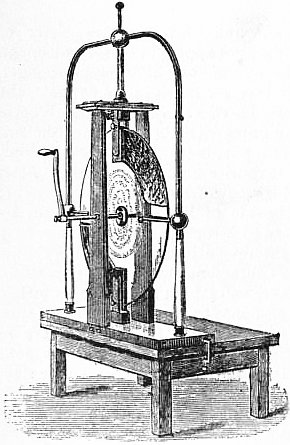
Fig. 1.—Ramsden’s electrical machine.
Frictional Machines.—A primitive form of frictional electrical machine was constructed about 1663 by Otto von Guericke (1602-1686). It consisted of a globe of sulphur fixed on an axis and rotated by a winch, and it was electrically excited by the friction of warm hands held against it. Sir Isaac Newton appears to have been the first to use a glass globe instead of sulphur (Optics, 8th Query). F. Hawksbee in 1709 also used a revolving glass globe. A metal chain resting on the globe served to collect the charge. Later G.M. Bose (1710-1761), of Wittenberg, added the prime conductor, an insulated tube or cylinder supported on silk strings, and J.H. Winkler (1703-1770), professor of physics at Leipzig, substituted a leather cushion for the hand. Andreas Gordon (1712-1751) of Erfurt, a Scotch Benedictine monk, first used a glass cylinder in place of a sphere. Jesse Ramsden (1735-1800) in 1768 constructed his well-known form of plate electrical machine (fig. 1). A glass plate fixed to a wooden or metal shaft is rotated by a winch. It passes between two rubbers made of leather, and is partly covered with two silk aprons which extend over quadrants of its surface. Just below the places where the aprons terminate, the glass is embraced by two insulated metal forks having the sharp points projecting towards the glass, but not quite touching it. The glass is excited positively by friction with the rubbers, and the charge is drawn off by the action of the points which, when acted upon inductively, discharge negative electricity against it. The insulated conductor to which the points are connected therefore becomes positively electrified. The cushions must be connected to earth to remove the negative electricity which accumulates on them. It was found that the machine acted better if the rubbers were covered with bisulphide of tin or with F. von Kienmayer’s amalgam, consisting of one part of zinc, one of tin and two of mercury. The cushions were greased and the amalgam in a state of powder spread over them. Edward Nairne’s electrical machine (1787) consisted of a glass cylinder with two insulated conductors, called prime conductors, on glass legs placed near it. One of these carried the leather exacting cushions and the other the collecting metal points, a silk apron extending over the cylinder from the cushion almost to the points. The rubber was smeared with amalgam. The function of the apron is to prevent the escape of electrification from the glass during its passage from the rubber to the collecting points. Nairne’s machine could give either positive or negative electricity, the first named being collected from the prime conductor carrying the collecting points and the second from the prime conductor carrying the cushion.
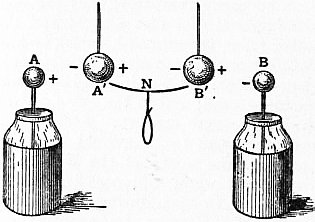
Fig. 2.
Influence Machines.—Frictional machines are, however, now quite superseded by the second class of instrument mentioned above, namely, influence machines. These operate by electrostatic induction and convert mechanical work into electrostatic energy by the aid of a small initial charge which is continually being replenished or reinforced. The general principle of all the machines described below will be best understood by considering a simple ideal case. Imagine two Leyden jars with large brass knobs, A and B, to stand on the ground (fig. 2). Let one jar be initially charged with positive electricity on its inner coating and the other with negative, and let both have their outsides connected to earth. Imagine two insulated balls A′ and B′ so held that A′ is near A and B′ is near B. Then the positive charge on A induces two charges on A′, viz.: a negative on the side nearest and a positive on the side most removed. Likewise the negative charge on B induces a positive charge on the side of B′ nearest to it and repels negative electricity to the far side. Next let the balls A′ and B′ be connected together for a moment by a wire N called a neutralizing conductor which is subsequently removed. Then A′ will be left negatively electrified and B′ will be left positively electrified. Suppose that A′ and B′ are then made to change places. To do this we shall have to exert energy to remove A′ against the attraction of A and B′ against the attraction of B. Finally let A′ be brought in contact with B and B′ with A. The ball A′ will give up its charge of negative electricity to the Leyden jar B, and the ball B′ will give up its positive charge to the Leyden jar A. This transfer will take place because the inner coatings of the Leyden jars have greater capacity with respect to the earth than the balls. Hence the charges of the jars will be increased. The balls A′ and B′ are then practically discharged, and the above cycle of operations may be repeated. Hence, however small may be the initial charges of the Leyden jars, by a principle of accumulation resembling that of compound interest, they can be increased as above shown to any degree. If this series of operations be made to depend upon the continuous rotation of a winch or handle, the arrangement constitutes an electrostatic influence machine. The principle therefore somewhat resembles that of the self-exciting dynamo.
The first suggestion for a machine of the above kind seems to have grown out of the invention of Volta’s electrophorus. Bennet’s Doubler. Abraham Bennet, the inventor of the gold leaf electroscope, described a doubler or machine for multiplying electric charges (Phil. Trans., 1787).
The principle of this apparatus may be explained thus. Let A and C be two fixed disks, and B a disk which can be brought at will within a very short distance of either A or C. Let us suppose all the plates to be equal, and let the capacities of A and C in presence of B be each equal to p, and the coefficient of induction between A and B, or C and B, be q. Let us also suppose that the plates A and C are so distant from each other that there is no mutual influence, and that p’ is the capacity of one of the disks when it stands alone. A small charge Q is communicated to A, and A is insulated, and B, uninsulated, is brought up to it; the charge on B will be—(q/p)Q. B is now uninsulated and brought to face C, which is uninsulated; the charge on C will be (q/p)²Q. C is now insulated and connected with A, which is always insulated. B is then brought to face A and uninsulated, so that the charge on A becomes rQ, where
r = p ( 1 + q² ).
p + p′ p²
A is now disconnected from C, and here the first operation ends. It is obvious that at the end of n such operations the charge on A will be rnQ, so that the charge goes on increasing in geometrical progression. If the distance between the disks could be made infinitely small each time, then the multiplier r would be 2, and the charge would be doubled each time. Hence the name of the apparatus.
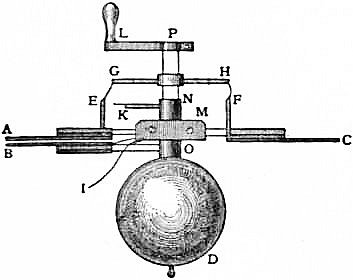
Fig. 3.—Nicholson’s Revolving Doubler.
Erasmus Darwin, B. Wilson, G.C. Bohnenberger and J.C.E. Peclet devised various modifications of Bennet’s instrument (see S.P. Thompson, “The Influence Machine from 1788 to 1888,” Journ. Soc. Tel. Eng., 1888, 17, p. 569). Nicholson’s doubler. Bennet’s doubler appears to have given a suggestion to William Nicholson (Phil. Trans., 1788, p. 403) of “an instrument which by turning a winch produced the two states of electricity without friction or communication with the earth.” This “revolving doubler,” according to the description of Professor S.P. Thompson (loc. cit.), consists of two fixed plates of brass A and C (fig. 3), each two inches in diameter and separately supported on insulating arms in the same plane, so that a third revolving plate B may pass very near them without touching. A brass ball D two inches in diameter is fixed on the end of the axis that carries the plate B, and is loaded within at one side, so as to act as a counterpoise to the revolving plate B. The axis P N is made of varnished glass, and so are the axes that join the three plates with the brass axis N O. The axis N O passes through the brass piece M, which stands on an insulating pillar of glass, and supports the plates A and C. At one extremity of this axis is the ball D, and the other is connected with a rod of glass, N P, upon which is fixed the handle L, and also the piece G H, which is separately insulated. The pins E, F rise out of the back of the fixed plates A and C, at unequal distances from the axis. The piece K is parallel to G H, and both of them are furnished at their ends with small pieces of flexible wire that they may touch the pins E, F in certain points of their revolution. From the brass piece M there stands out a pin I, to touch against a small flexible wire or spring which projects sideways from the rotating plate B when it comes opposite A. The wires are so adjusted by bending that B, at the moment when it is opposite A, communicates with the ball D, and A communicates with C through GH; and half a revolution later C, when B comes opposite to it, communicates with the ball D through the contact of K with F. In all other positions A, B, C and D are completely disconnected from each other. Nicholson thus described the operation of his machine:—
“When the plates A and B are opposite each other, the two fixed plates A and C may be considered as one mass, and the revolving plate B, together with the ball D, will constitute another mass. All the experiments yet made concur to prove that these two masses will not possess the same electric state.... The redundant electricities in the masses under consideration will be unequally distributed; the plate A will have about ninety-nine parts, and the plate C one; and, for the same reason, the revolving plate B will have ninety-nine parts of the opposite electricity, and the ball D one. The rotation, by destroying the contacts, preserves this unequal distribution, and carries B from A to C at the same time that the tail K connects the ball with the plate C. In this situation, the electricity in B acts upon that in C, and produces the contrary state, by virtue of the communication between C and the ball; which last must therefore acquire an electricity of the same kind with that of the revolving plate. But the rotation again destroys the contact and restores B to its first situation opposite A. Here, if we attend to the effect of the whole revolution, we shall find that the electric states of the respective masses have been greatly increased; for the ninety-nine parts in A and B remain, and the one part of electricity in C has been increased so as nearly to compensate ninety-nine parts of the opposite electricity in the revolving plate B, while the communication produced an opposite mutation in the electricity of the ball. A second rotation will, of course, produce a proportional augmentation of these increased quantities; and a continuance of turning will soon bring the intensities to their maximum, which is limited by an explosion between the plates” (Phil. Trans., 1788, p. 405).
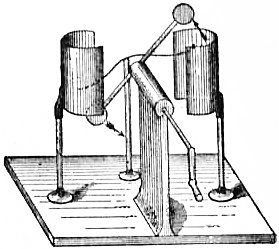
Fig. 4.—Belli’s Doubler.
Nicholson described also another apparatus, the “spinning condenser,” which worked on the same principle. Bennet and Nicholson were followed by T. Cavallo, John Read, Bohnenberger, C.B. Désormes and J.N.P. Hachette Belli’s doubler. and others in the invention of various forms of rotating doubler. A simple and typical form of doubler, devised in 1831 by G. Belli (fig. 4), consisted of two curved metal plates between which revolved a pair of balls carried on an insulating stem. Following the nomenclature usual in connexion with dynamos we may speak of the conductors which carry the initial charges as the field plates, and of the moving conductors on which are induced the charges which are subsequently added to those on the field plates, as the carriers. The wire which connects two armature plates for a moment is the neutralizing conductor. The two curved metal plates constitute the field plates and must have original charges imparted to them of opposite sign. The rotating balls are the carriers, and are connected together for a moment by a wire when in a position to be acted upon inductively by the field plates, thus acquiring charges of opposite sign. The moment after they are separated again. The rotation continuing the ball thus negatively charged is made to give up this charge to that negatively electrified field plate, and the ball positively charged its charge to the positively electrified field plate, by touching little contact springs. In this manner the field plates accumulate charges of opposite sign.
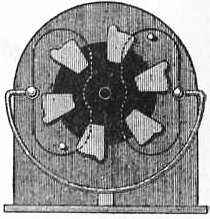
Fig. 5.—Varley’s Machine.
Modern types of influence machine may be said to date from 1860 when C.F. Varley patented a type of influence machine which has been the parent of numerous subsequent forms (Brit. Pat. Spec. No. 206 of 1860). In it the Varley’s machine. field plates were sheets of tin-foil attached to a glass plate (fig. 5). In front of them a disk of ebonite or glass, having carriers of metal fixed to its edge, was rotated by a winch. In the course of their rotation two diametrically opposite carriers touched against the ends of a neutralizing conductor so as to form for a moment one conductor, and the moment afterwards these two carriers were insulated, one carrying away a positive charge and the other a negative. Continuing their rotation, the positively charged carrier gave up its positive charge by touching a little knob attached to the positive field plate, and similarly for the negative charge carrier. In this way the charges on the field plates were continually replenished and reinforced. Varley also constructed a multiple form of influence machine having six rotating disks, each having a number of carriers and rotating between field plates. With this apparatus he obtained sparks 6 in. long, the initial source of electrification being a single Daniell cell.
Varley was followed by A.J.I. Toepler, who in 1865 constructed an influence machine consisting of two disks fixed on the same shaft and rotating in the same direction. Each disk carried two strips of tin-foil extending Toepler machine. nearly over a semi-circle, and there were two field plates, one behind each disk; one of the plates was positively and the other negatively electrified. The carriers which were touched under the influence of the positive field plate passed on and gave up a portion of their negative charge to increase that of the negative field plate; in the same way the carriers which were touched under the influence of the negative field plate sent a part of their charge to augment that of the positive field plate. In this apparatus one of the charging rods communicated with one of the field plates, but the other with the neutralizing brush opposite to the other field plate. Hence one of the field plates would always remain charged when a spark was taken at the transmitting terminals.
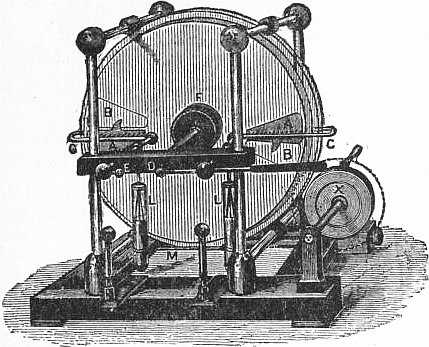
Fig. 6.—Holtz’s Machine.
Between 1864 and 1880, W.T.B. Holtz constructed and described a large number of influence machines which were for a long time considered the most advanced development of this type of electrostatic machine. In one form the Holtz machine. Holtz machine consisted of a glass disk mounted on a horizontal axis F (fig. 6) which could be made to rotate at a considerable speed by a multiplying gear, part of which is seen at X. Close behind this disk was fixed another vertical disk of glass in which were cut two windows B, B. On the side of the fixed disk next the rotating disk were pasted two sectors of paper A, A, with short blunt points attached to them which projected out into the windows on the side away from the rotating disk. On the other side of the rotating disk were placed two metal combs C, C, which consisted of sharp points set in metal rods and were each connected to one of a pair of discharge balls E, D, the distance between which could be varied. To start the machine the balls were brought in contact, one of the paper armatures electrified, say, with positive electricity, and the disk set in motion. Thereupon very shortly a hissing sound was heard and the machine became harder to turn as if the disk were moving through a resisting medium. After that the discharge balls might be separated a little and a continuous series of sparks or brush discharges would take place between them. If two Leyden jars L, L were hung upon the conductors which supported the combs, with their outer coatings put in connexion with one another by M, a series of strong spark discharges passed between the discharge balls. The action of the machine is as follows: Suppose one paper armature to be charged positively, it acts by induction on the right hand comb, causing negative electricity to issue from the comb points upon the glass revolving disk; at the same time the positive electricity passes through the closed discharge circuit to the left comb and issues from its teeth upon the part of the glass disk at the opposite end of the diameter. This positive electricity electrifies the left paper armature by induction, positive electricity issuing from the blunt point upon the side farthest from the rotating disk. The charges thus deposited on the glass disk are carried round so that the upper half is electrified negatively on both sides and the lower half positively on both sides, the sign of the electrification being reversed as the disk passes between the combs and the armature by discharges issuing from them respectively. If it were not for leakage in various ways, the electrification would go on everywhere increasing, but in practice a stationary state is soon attained. Holtz’s machine is very uncertain in its action in a moist climate, and has generally to be enclosed in a chamber in which the air is kept artificially dry.
Robert Voss, a Berlin instrument maker, in 1880 devised a form of machine in which he claimed that the principles of Toepler and Holtz were combined. On a rotating glass or ebonite disk were placed carriers of tin-foil or metal buttons Voss’s machine. against which neutralizing brushes touched. This armature plate revolved in front of a field plate carrying two pieces of tin-foil backed up by larger pieces of varnished paper. The studs on the armature plate were charged inductively by being connected for a moment by a neutralizing wire as they passed in front of the field plates, and then gave up their charges partly to renew the field charges and partly to collecting combs connected to discharge balls. In general design and construction, the manner of moving the rotating plate and in the use of the two Leyden jars in connexion with the discharge balls, Voss borrowed his ideas from Holtz.
All the above described machines, however, have been thrown into the shade by the invention of a greatly improved type of influence machine first constructed by James Wimshurst about 1878. Two glass disks are mounted on two shafts Wimshurst machine. in such a manner that, by means of two belts and pulleys worked from a winch shaft, the disks can be rotated rapidly in opposite directions close to each other (fig. 7). These glass disks carry on them a certain number (not less than 16 or 20) tin-foil carriers which may or may not have brass buttons upon them. The glass plates are well varnished, and the carriers are placed on the outer sides of the two glass plates. As therefore the disks revolve, these carriers travel in opposite directions, coming at intervals in opposition to each other. Each upright bearing carrying the shafts of the revolving disks also carries a neutralizing conductor or wire ending in a little brush of gilt thread. The neutralizing conductors for each disk are placed at right angles to each other. In addition there are collecting combs which occupy an intermediate position and have sharp points projecting inwards, and coming near to but not touching the carriers. These combs on opposite sides are connected respectively to the inner coatings of two Leyden jars whose outer coatings are in connexion with one another.
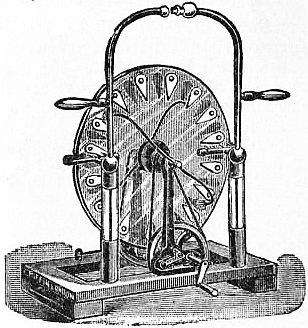
Fig. 7.—Wimshurst’s Machine.
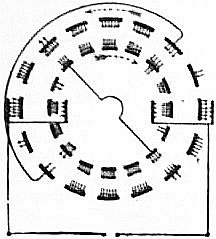
Fig. 8.—Action of the Wimshurst Machine.
The operation of the machine is as follows: Let us suppose that one of the studs on the back plate is positively electrified and one at the opposite end of a diameter is negatively electrified, and that at that moment two corresponding studs on the front plate passing opposite to these back studs are momentarily connected together by the neutralizing wire belonging to the front plate. The positive stud on the back plate will act inductively on the front stud and charge it negatively, and similarly for the other stud, and as the rotation continues these charged studs will pass round and give up most of their charge through the combs to the Leyden jars. The moment, however, a pair of studs on the front plate are charged, they act as field plates to studs on the back plate which are passing at the moment, provided these last are connected by the back neutralizing wire. After a few revolutions of the disks half the studs on the front plate at any moment are charged negatively and half positively and the same on the back plate, the neutralizing wires forming the boundary between the positively and negatively charged studs. The diagram in fig. 8, taken by permission from S.P. Thompson’s paper (loc. cit.), represents a view of the distribution of these charges on the front and back plates respectively. It will be seen that each stud is in turn both a field plate and a carrier having a charge induced on it, and then passing on in turn induces further charges on other studs. Wimshurst constructed numerous very powerful machines of this type, some of them with multiple plates, which operate in almost any climate, and rarely fail to charge themselves and deliver a torrent of sparks between the discharge balls whenever the winch is turned. He also devised an alternating current electrical machine in which the discharge balls were alternately positive and negative. Large Wimshurst multiple plate influence machines are often used instead of induction coils for exciting Röntgen ray tubes in medical work. They give very steady illumination on fluorescent screens.
In 1900 it was found by F. Tudsbury that if an influence machine is enclosed in a metallic chamber containing compressed air, or better, carbon dioxide, the insulating properties of compressed gases enable a greatly improved effect to be obtained owing to the diminution of the leakage across the plates and from the supports. Hence sparks can be obtained of more than double the length at ordinary atmospheric pressure. In one case a machine with plates 8 in. in diameter which could give sparks 2.5 in. at ordinary pressure gave sparks of 5, 7, and 8 in. as the pressure was raised to 15, 30 and 45 ℔ above the normal atmosphere.
The action of Lord Kelvin’s replenisher (fig. 9) used by him in connexion with his electrometers for maintaining their charge, closely resembles that of Belli’s doubler and will be understood from fig. 9. Lord Kelvin also devised an influence machine, commonly called a “mouse mill,” for electrifying the ink in connexion with his siphon recorder. It was an electrostatic and electromagnetic machine combined, driven by an electric current and producing in turn electrostatic charges of electricity. In connexion with this subject mention must also be made of the water dropping influence machine of the same inventor.1
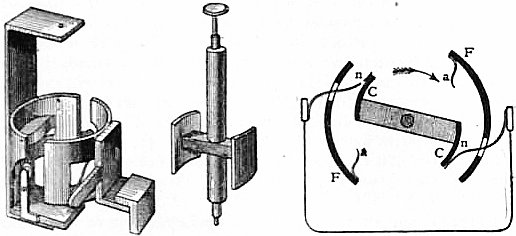
Fig. 9.—Lord Kelvin’s Replenisher.
C, C, Metal carriers fixed to ebonite cross-arm. F, F, Brass field-plates or conductors. a, a, Receiving springs. n, n, Connecting springs or neutralizing brushes.
The action and efficiency of influence machines have been investigated by F. Rossetti, A. Righi and F.W.G. Kohlrausch. The electromotive force is practically constant no matter what the velocity of the disks, but according to some observers the internal resistance decreases as the velocity increases. Kohlrausch, using a Holtz machine with a plate 16 in. in diameter, found that the current given by it could only electrolyse acidulated water in 40 hours sufficient to liberate one cubic centimetre of mixed gases. E.E.N. Mascart, A. Roiti, and E. Bouchotte have also examined the efficiency and current producing power of influence machines.
Bibliography.—In addition to S.P. Thompson’s valuable paper on influence machines (to which this article is much indebted) and other references given, see J. Clerk Maxwell, Treatise on Electricity and Magnetism (2nd ed., Oxford, 1881), vol. i. p. 294; J.D. Everett, Electricity (expansion of part iii. of Deschanel’s Natural Philosophy) (London, 1901), ch. iv. p. 20; A. Winkelmann, Handbuch der Physik (Breslau, 1905), vol. iv. pp. 50-58 (contains a large number of references to original papers); J. Gray, Electrical Influence Machines, their Development and Modern Forms (London, 1903).
(J. A. F.)
1 See Lord Kelvin, Reprint of Papers on Electrostatics and Magnetism (1872); “Electrophoric Apparatus and Illustrations of Voltaic Theory,” p. 319; “On Electric Machines Founded on Induction and Convection,” p. 330; “The Reciprocal Electrophorus,” p. 337.
ELECTRIC EEL (Gymnotus electricus), a member of the family of fishes known as Gymnotidae. In spite of their external similarity the Gymnotidae have nothing to do with the eels (Anguilla). They resemble the latter in the elongation of the body, the large number of vertebrae (240 in Gymnotus), and the absence of pelvic fins; but they differ in all the more important characters of internal structure. They are in fact allied to the carps or Cyprinidae and the cat-fishes or Siluridae. In common with these two families and the Characinidae of Africa and South America, the Gymnotidae possess the peculiar structures called ossicula auditus or Weberian ossicles. These are a chain of small bones belonging to the first four vertebrae, which are much modified, and connecting the air-bladder with the auditory organs. Such an agreement in the structure of so complicated and specialized an apparatus can only be the result of a community of descent of the families possessing it. Accordingly these families are now placed together in a distinct sub-order, the Ostariophysi. The Gymnotidae are strongly modified and degraded Characinidae. In them the dorsal and caudal fins are very rudimentary or absent, and the anal is very long, extending from the anus, which is under the head or throat, to the end of the body.
Gymnotus is the only genus of the family which possesses electric organs. These extend the whole length of the tail, which is four-fifths of the body. They are modifications of the lateral muscles and are supplied with numerous branches of the spinal nerves. They consist of longitudinal columns, each composed of an immense number of “electric plates.” The posterior end of the organ is positive, the anterior negative, and the current passes from the tail to the head. The maximum shock is given when the head and tail of the Gymnotus are in contact with different points in the surface of some other animal. Gymnotus electricus attains a length of 3 ft. and the thickness of a man’s thigh, and frequents the marshes of Brazil and the Guianas, where it is regarded with terror, owing to the formidable electrical apparatus with which it is provided. When this natural battery is discharged in a favourable position, it is sufficiently powerful to stun the largest animal; and according to A. von Humboldt, it has been found necessary to change the line of certain roads passing through the pools frequented by the electric eels. These fish are eaten by the Indians, who, before attempting to capture them, seek to exhaust their electrical power by driving horses into the ponds. By repeated discharges upon these they gradually expend this marvellous force; after which, being defenceless, they become timid, and approach the edge for shelter, when they fall an easy prey to the harpoon. It is only after long rest and abundance of food that the fish is able to resume the use of its subtle weapon. Humboldt’s description of this method of capturing the fish has not, however, been verified by recent travellers.
ELECTRICITY. This article is devoted to a general sketch of the history of the development of electrical knowledge on both the theoretical and the practical sides. The two great branches of electrical theory which concern the phenomena of electricity at rest, or “frictional” or “static” electricity, and of electricity in motion, or electric currents, are treated in two separate articles, Electrostatics and Electrokinetics. The phenomena attendant on the passage of electricity through solids, through liquids and through gases, are described in the article Conduction, Electric, and also Electrolysis, and the propagation of electrical vibrations in Electric Waves. The interconnexion of magnetism (which has an article to itself) and electricity is discussed in Electromagnetism, and these manifestations in nature in Atmospheric Electricity; Aurora Polaris and Magnetism, Terrestrial. The general principles of electrical engineering will be found in Electricity Supply, and further details respecting the generation and use of electrical power are given in such articles as Dynamo; Motors, Electric; Transformers; Accumulator; Power Transmission: Electric; Traction; Lighting: Electric; Electrochemistry and Electrometallurgy. The principles of telegraphy (land, submarine and wireless) and of telephony are discussed in the articles Telegraph and Telephone, and various electrical instruments are treated in separate articles such as Amperemeter; Electrometer; Galvanometer; Voltmeter; Wheatstone’s Bridge; Potentiometer; Meter, Electric; Electrophorus; Leyden Jar; &c.
The term “electricity” is applied to denote the physical agency which exhibits itself by effects of attraction and repulsion when particular substances are rubbed or heated, also in certain chemical and physiological actions and in connexion with moving magnets and metallic circuits. The name is derived from the word electrica, first used by William Gilbert (1544-1603) in his epoch-making treatise De magnete, magneticisque corporibus, et de magno magnete tellure, published in 1600,1 to denote substances which possess a similar property to amber (= electrum, from ἤλεκτρον) of attracting light objects when rubbed. Hence the phenomena came to be collectively called electrical, a term first used by William Barlowe, archdeacon of Salisbury, in 1618, and the study of them, electrical science.
Historical Sketch.
Gilbert was the first to conduct systematic scientific experiments on electrical phenomena. Prior to his date the scanty knowledge possessed by the ancients and enjoyed in the middle ages began and ended with facts said to have been familiar to Thales of Miletus (600 B.C.) and mentioned by Theophrastus (321 B.C.) and Pliny (A.D. 70), namely, that amber, jet and one or two other substances possessed the power, when rubbed, of attracting fragments of straw, leaves or feathers. Starting with careful and accurate observations on facts concerning the mysterious properties of amber and the lodestone, Gilbert laid the foundations of modern electric and magnetic science on the true experimental and inductive basis. The subsequent history of electricity may be divided into four well-marked periods. The first extends from the date of publication of Gilbert’s great treatise in 1600 to the invention by Volta of the voltaic pile and the first production of the electric current in 1799. The second dates from Volta’s discovery to the discovery by Faraday in 1831 of the induction of electric currents and the creation of currents by the motion of conductors in magnetic fields, which initiated the era of modern electrotechnics. The third covers the period between 1831 and Clerk Maxwell’s enunciation of the electromagnetic theory of light in 1865 and the invention of the self-exciting dynamo, which marks another great epoch in the development of the subject; and the fourth comprises the modern development of electric theory and of absolute quantitative measurements, and above all, of the applications of this knowledge in electrical engineering. We shall sketch briefly the historical progress during these various stages, and also the growth of electrical theories of electricity during that time.
First Period.—Gilbert was probably led to study the phenomena of the attraction of iron by the lodestone in consequence of his conversion to the Copernican theory of the earth’s motion, and thence proceeded to study the attractions produced by amber. An account of his electrical discoveries is given in the De magnete, lib. ii. cap. 2.2 He invented the versorium or electrical needle and proved that innumerable bodies he called electrica, when rubbed, can attract the needle of the versorium (see Electroscope). Robert Boyle added many new facts and gave an account of them in his book, The Origin of Electricity. He showed that the attraction between the rubbed body and the test object is mutual. Otto von Guericke (1602-1686) constructed the first electrical machine with a revolving ball of sulphur (see Electrical Machine), and noticed that light objects were repelled after being attracted by excited electrics. Sir Isaac Newton substituted a ball of glass for sulphur in the electrical machine and made other not unimportant additions to electrical knowledge. Francis Hawksbee (d. 1713) published in his book Physico-Mechanical Experiments (1709), and in several Memoirs in the Phil. Trans. about 1707, the results of his electrical inquiries. He showed that light was produced when mercury was shaken up in a glass tube exhausted of its air. Dr Wall observed the spark and crackling sound when warm amber was rubbed, and compared them with thunder and lightning (Phil. Trans., 1708, 26, p. 69). Stephen Gray (1696-1736) noticed in 1720 that electricity could be excited by the friction of hair, silk, wool, paper and other bodies. In 1729 Gray made the important discovery that some bodies were conductors and others non-conductors of electricity. In conjunction with his friend Granville Wheeler (d. 1770), he conveyed the electricity from rubbed glass, a distance of 886 ft., along a string supported on silk threads (Phil. Trans., 1735-1736, 39, pp. 16, 166 and 400). Jean Théophile Desaguliers (1683-1744) announced soon after that electrics were non-conductors, and conductors were non-electrics. C.F. de C. du Fay (1699-1739) made the great discovery that electricity is of two kinds, vitreous and resinous (Phil. Trans., 1733, 38, p. 263), the first being produced when glass, crystal, &c. are rubbed with silk, and the second when resin, amber, silk or paper, &c. are excited by friction with flannel. He also discovered that a body charged with positive or negative electricity repels a body free to move when the latter is charged with electricity of like sign, but attracts it if it is charged with electricity of opposite sign, i.e. positive repels positive and negative repels negative, but positive attracts negative. It is to du Fay also that we owe the abolition of the distinction between electrics and non-electrics. He showed that all substances could be electrified by friction, but that to electrify conductors they must be insulated or supported on non-conductors. Various improvements were made in the electrical machine, and thereby experimentalists were provided with the means of generating strong electrification; C.F. Ludolff (1707-1763) of Berlin in 1744 succeeded in igniting ether with the electric spark (Phil. Trans., 1744, 43, p. 167).
For a very full list of the papers and works of these early electrical philosophers, the reader is referred to the bibliography on Electricity in Dr Thomas Young’s Natural Philosophy, vol. ii. p. 415.
In 1745 the important invention of the Leyden jar or condenser was made by E.G. von Kleist of Kammin, and almost simultaneously by Cunaeus and Pieter van Musschenbroek (1692-1761) of Leiden (see Leyden Jar). Sir William Watson (1715-1787) in England first observed the flash of light when a Leyden jar is discharged, and he and Dr John Bevis (1695-1771) suggested coating the jar inside and outside with tinfoil. Watson carried out elaborate experiments to discover how far the electric discharge of the jar could be conveyed along metallic wires and was able to accomplish it for a distance of 2 m., making the important observation that the electricity appeared to be transmitted instantaneously.
Franklin’s Researches.—Benjamin Franklin (1706-1790) was one of the great pioneers of electrical science, and made the ever-memorable experimental identification of lightning and electric spark. He argued that electricity is not created by friction, but merely collected from its state of diffusion through other matter by which it is attracted. He asserted that the glass globe, when rubbed, attracted the electrical fire, and took it from the rubber, the same globe being disposed, when the friction ceases, to give out its electricity to any body which has less. In the case of the charged Leyden jar, he asserted that the inner coating of tinfoil had received more than its ordinary quantity of electricity, and was therefore electrified positively, or plus, while the outer coating of tinfoil having had its ordinary quantity of electricity diminished, was electrified negatively, or minus. Hence the cause of the shock and spark when the jar is discharged, or when the superabundant or plus electricity of the inside is transferred by a conducting body to the defective or minus electricity of the outside. This theory of the Leyden phial Franklin supported very ingeniously by showing that the outside and the inside coating possessed electricities of opposite sign, and that, in charging it, exactly as much electricity is added on one side as is subtracted from the other. The abundant discharge of electricity by points was observed by Franklin is his earliest experiments, and also the power of points to conduct it copiously from an electrified body. Hence he was furnished with a simple method of collecting electricity from other bodies, and he was enabled to perform those remarkable experiments which are chiefly connected with his name. Hawksbee, Wall and J.A. Nollet (1700-1770) had successively suggested the identity of lightning and the electric spark, and of thunder and the snap of the spark. Previously to the year 1750, Franklin drew up a statement, in which he showed that all the general phenomena and effects which were produced by electricity had their counterparts in lightning. After waiting some time for the erection of a spire at Philadelphia, by means of which he hoped to bring down the electricity of a thunderstorm, he conceived the idea of sending up a kite among thunder-clouds. With this view he made a small cross of two small light strips of cedar, the arms being sufficiently long to reach to the four corners of a large thin silk handkerchief when extended. The corners of the handkerchief were tied to the extremities of the cross, and when the body of the kite was thus formed, a tail, loop and string were added to it. The body was made of silk to enable it to bear the violence and wet of a thunderstorm. A very sharp pointed wire was fixed at the top of the upright stick of the cross, so as to rise a foot or more above the wood. A silk ribbon was tied to the end of the twine next the hand, and a key suspended at the junction of the twine and silk. In company with his son, Franklin raised the kite like a common one, in the first thunderstorm, which happened in the month of June 1752. To keep the silk ribbon dry, he stood within a door, taking care that the twine did not touch the frame of the door; and when the thunder-clouds came over the kite he watched the state of the string. A cloud passed without any electrical indications, and he began to despair of success. At last, however, he saw the loose filaments of the twine standing out every way, and he found them to be attracted by the approach of his finger. The suspended key gave a spark on the application of his knuckle, and when the string had become wet with the rain the electricity became abundant. A Leyden jar was charged at the key, and by the electric fire thus obtained spirits were inflamed, and many other experiments performed which had been formerly made by excited electrics. In subsequent trials with another apparatus, he found that the clouds were sometimes positively and sometimes negatively electrified, and so demonstrated the perfect identity of lightning and electricity. Having thus succeeded in drawing the electric fire from the clouds, Franklin conceived the idea of protecting buildings from lightning by erecting on their highest parts pointed iron wires or conductors communicating with the ground. The electricity of a hovering or a passing cloud would thus be carried off slowly and silently; and if the cloud was highly charged, the lightning would strike in preference the elevated conductors.3 The most important of Franklin’s electrical writings are his Experiments and Observations on Electricity made at Philadelphia, 1751-1754; his Letters on Electricity; and various memoirs and letters in the Phil. Trans. from 1756 to 1760.
About the same time that Franklin was making his kite experiment in America, T.F. Dalibard (1703-1779) and others in France had erected a long iron rod at Marli, and obtained results agreeing with those of Franklin. Similar investigations were pursued by many others, among whom Father G.B. Beccaria (1716-1781) deserves especial mention. John Canton (1718-1772) made the important contribution to knowledge that electricity of either sign could be produced on nearly any body by friction with appropriate substances, and that a rod of glass roughened on one half was excited negatively in the rough part and positively in the smooth part by friction with the same rubber. Canton first suggested the use of an amalgam of mercury and tin for use with glass cylinder electrical machines to improve their action. His most important discovery, however, was that of electrostatic induction, the fact that one electrified body can produce charges of electricity upon another insulated body, and that when this last is touched it is left electrified with a charge of opposite sign to that of the inducing charge (Phil. Trans., 1753-1754). We shall make mention lower down of Canton’s contributions to electrical theory. Robert Symmer (d. 1763) showed that quite small differences determined the sign of the electrification that was generated by the friction of two bodies one against the other. Thus wearing a black and a white silk stocking one over the other, he found they were electrified oppositely when rubbed and drawn off, and that such a rubbed silk stocking when deposited in a Leyden jar gave up its electrification to the jar (Phil. Trans., 1759). Ebenezer Kinnersley (1711-1778) of Philadelphia made useful observations on the elongation and fusion of iron wires by electrical discharges (Phil. Trans., 1763). A contemporary of Canton and co-discoverer with him of the facts of electrostatic induction was the Swede, Johann Karl Wilcke (1732-1796), then resident in Germany, who in 1762 published an account of experiments in which a metal plate held above the upper surface of a glass table was subjected to the action of a charge on an electrified metal plate held below the glass (Kon. Schwedische Akad. Abhandl., 1762, 24, p. 213).
Pyro-electricity.—The subject of pyro-electricity, or the power possessed by some minerals of becoming electrified when merely heated, and of exhibiting positive and negative electricity, now began to attract notice. It is possible that the lyncurium of the ancients, which according to Theophrastus attracted light bodies, was tourmaline, a mineral found in Ceylon, which had been christened by the Dutch with the name of aschentrikker, or the attractor of ashes. In 1717 Louis Lémery exhibited to the Paris Academy of Sciences a stone from Ceylon which attracted light bodies; and Linnaeus in mentioning his experiments gives the stone the name of lapis electricus. Giovanni Caraffa, duca di Noja (1715-1768), was led in 1758 to purchase some of the stones called tourmaline in Holland, and, assisted by L.J.M. Daubenton and Michel Adanson, he made a series of experiments with them, a description of which he gave in a letter to G.L.L. Buffon in 1759. The subject, however, had already engaged the attention of the German philosopher, F.U.T. Aepinus, who published an account of them in 1756. Hitherto nothing had been said respecting the necessity of heat to excite the tourmaline; but it was shown by Aepinus that a temperature between 99½° and 212° Fahr. was requisite for the development of its attractive powers. Benjamin Wilson (Phil. Trans., 1763, &c.), J. Priestley, and Canton continued the investigation, but it was reserved for the Abbé Haüy to throw a clear light on this curious branch of the science (Traité de minéralogie, 1801). He found that the electricity of the tourmaline decreased rapidly from the summits or poles towards the middle of the crystal, where it was imperceptible; and he discovered that if a tourmaline is broken into any number of fragments, each fragment, when excited, has two opposite poles. Haüy discovered the same property in the Siberian and Brazilian topaz, borate of magnesia, mesotype, prehnite, sphene and calamine. He also found that the polarity which minerals receive from heat has a relation to the secondary forms of their crystals—the tourmaline, for example, having its resinous pole at the summit of the crystal which has three faces. In the other pyro-electric crystals above mentioned, Haüy detected the same deviation from the rules of symmetry in their secondary crystals which occurs in tourmaline. C.P. Brard (1788-1838) discovered that pyro-electricity was a property of axinite; and it was afterwards detected in other minerals. In repeating and extending the experiments of Haüy much later, Sir David Brewster discovered that various artificial salts were pyro-electric, and he mentions the tartrates of potash and soda and tartaric acid as exhibiting this property in a very strong degree. He also made many experiments with the tourmaline when cut into thin slices, and reduced to the finest powder, in which state each particle preserved its pyro-electricity; and he showed that scolezite and mesolite, even when deprived of their water of crystallization and reduced to powder, retain their property of becoming electrical by heat. When this white powder is heated and stirred about by any substance whatever, it collects in masses like new-fallen snow, and adheres to the body with which it is stirred.
For Sir David Brewster’s work on pyro-electricity, see Trans. Roy. Soc. Edin., 1845, also Phil. Mag., Dec. 1847. The reader will also find a full discussion on the subject in the Treatise on Electricity, by A. de la Rive, translated by C.V. Walker (London, 1856), vol. ii. part v. ch. i.
Animal electricity.—The observation that certain animals could give shocks resembling the shock of a Leyden jar induced a closer examination of these powers. The ancients were acquainted with the benumbing power of the torpedo-fish, but it was not till 1676 that modern naturalists had their attention again drawn to the fact. E. Bancroft was the first person who distinctly suspected that the effects of the torpedo were electrical. In 1773 John Walsh (d. 1795) and Jan Ingenhousz (1730-1799) proved by many curious experiments that the shock of the torpedo was an electrical one (Phil. Trans., 1773-1775); and John Hunter (id. 1773, 1775) examined and described the anatomical structure of its electrical organs. A. von Humboldt and Gay-Lussac (Ann. Chim., 1805), and Etienne Geoffroy Saint-Hilaire (Gilb. Ann., 1803) pursued the subject with success; and Henry Cavendish (Phil. Trans., 1776) constructed an artificial torpedo, by which he imitated the actions of the living animal. The subject was also investigated (Phil. Trans., 1812, 1817) by Dr T.J. Todd (1789-1840), Sir Humphry Davy (id. 1829), John Davy (id. 1832, 1834, 1841) and Faraday (Exp. Res., vol. ii.). The power of giving electric shocks has been discovered also in the Gymnotus electricus (electric eel), the Malapterurus electricus, the Trichiurus electricus, and the Tetraodon electricus. The most interesting and the best known of these singular fishes is the Gymnotus or Surinam eel. Humboldt gives a very graphic account of the combats which are carried on in South America between the gymnoti and the wild horses in the vicinity of Calabozo.
Cavendish’s Researches.—The work of Henry Cavendish (1731-1810) entitles him to a high place in the list of electrical investigators. A considerable part of Cavendish’s work was rescued from oblivion in 1879 and placed in an easily accessible form by Professor Clerk Maxwell, who edited the original manuscripts in the possession of the duke of Devonshire.4 Amongst Cavendish’s important contributions were his exact measurements of electrical capacity. The leading idea which distinguishes his work from that of his predecessors was his use of the phrase “degree of electrification” with a clear scientific definition which shows it to be equivalent in meaning to the modern term “electric potential.” Cavendish compared the capacity of different bodies with those of conducting spheres of known diameter and states these capacities in “globular inches,” a globular inch being the capacity of a sphere 1 in. in diameter. Hence his measurements are all directly comparable with modern electrostatic measurements in which the unit of capacity is that of a sphere 1 centimetre in radius. Cavendish measured the capacity of disks and condensers of various forms, and proved that the capacity of a Leyden pane is proportional to the surface of the tinfoil and inversely as the thickness of the glass. In connexion with this subject he anticipated one of Faraday’s greatest discoveries, namely, the effect of the dielectric or insulator upon the capacity of a condenser formed with it, in other words, made the discovery of specific inductive capacity (see Electrical Researches, p. 183). He made many measurements of the electric conductivity of different solids and liquids, by comparing the intensity of the electric shock taken through his body and various conductors. He seems in this way to have educated in himself a very precise “electrical sense,” making use of his own nervous system as a kind of physiological galvanometer. One of the most important investigations he made in this way was to find out, as he expressed it, “what power of the velocity the resistance is proportional to.” Cavendish meant by the term “velocity” what we now call the current, and by “resistance” the electromotive force which maintains the current. By various experiments with liquids in tubes he found this power was nearly unity. This result thus obtained by Cavendish in January 1781, that the current varies in direct proportion to the electromotive force, was really an anticipation of the fundamental law of electric flow, discovered independently by G.S. Ohm in 1827, and since known as Ohm’s Law. Cavendish also enunciated in 1776 all the laws of division of electric current between circuits in parallel, although they are generally supposed to have been first given by Sir C. Wheatstone. Another of his great investigations was the determination of the law according to which electric force varies with the distance. Starting from the fact that if an electrified globe, placed within two hemispheres which fit over it without touching, is brought in contact with these hemispheres, it gives up the whole of its charge to them—in other words, that the charge on an electrified body is wholly on the surface—he was able to deduce by most ingenious reasoning the law that electric force varies inversely as the square of the distance. The accuracy of his measurement, by which he established within 2% the above law, was only limited by the sensibility, or rather insensibility, of the pith ball electrometer, which was his only means of detecting the electric charge.5 In the accuracy of his quantitative measurements and the range of his researches and his combination of mathematical and physical knowledge, Cavendish may not inaptly be described as the Kelvin of the 18th century. Nothing but his curious indifference to the publication of his work prevented him from securing earlier recognition for it.
Coulomb’s Work.—Contemporary with Cavendish was C.A. Coulomb (1736-1806), who in France addressed himself to the same kind of exact quantitative work as Cavendish in England. Coulomb has made his name for ever famous by his invention and application of his torsion balance to the experimental verification of the fundamental law of electric attraction, in which, however, he was anticipated by Cavendish, namely, that the force of attraction between two small electrified spherical bodies varies as the product of their charges and inversely as the square of the distance of their centres. Coulomb’s work received better publication than Cavendish’s at the time of its accomplishment, and provided a basis on which mathematicians could operate. Accordingly the close of the 18th century drew into the arena of electrical investigation on its mathematical side P.S. Laplace, J.B. Biot, and above all, S.D. Poisson. Adopting the hypothesis of two fluids, Coulomb investigated experimentally and theoretically the distribution of electricity on the surface of bodies by means of his proof plane. He determined the law of distribution between two conducting bodies in contact; and measured with his proof plane the density of the electricity at different points of two spheres in contact, and enunciated an important law. He ascertained the distribution of electricity among several spheres (whether equal or unequal) placed in contact in a straight line; and he measured the distribution of electricity on the surface of a cylinder, and its distribution between a sphere and cylinder of different lengths but of the same diameter. His experiments on the dissipation of electricity possess also a high value. He found that the momentary dissipation was proportional to the degree of electrification at the time, and that, when the charge was moderate, its dissipation was not altered in bodies of different kinds or shapes. The temperature and pressure of the atmosphere did not produce any sensible change; but he concluded that the dissipation was nearly proportional to the cube of the quantity of moisture in the air.6 In examining the dissipation which takes place along imperfectly insulating substances, he found that a thread of gum-lac was the most perfect of all insulators; that it insulated ten times as well as a dry silk thread; and that a silk thread covered with fine sealing-wax insulated as powerfully as gum-lac when it had four times its length. He found also that the dissipation of electricity along insulators was chiefly owing to adhering moisture, but in some measure also to a slight conducting power. For his memoirs see Mém. de math. et phys. de l’acad. de sc., 1785, &c.
Second Period.—We now enter upon the second period of electrical research inaugurated by the epoch-making discovery of Alessandro Volta (1745-1827). L. Galvani had made in 1790 his historic observations on the muscular contraction produced in the bodies of recently killed frogs when an electrical machine was being worked in the same room, and described them in 1791 (De viribus electricitatis in motu musculari commentarius, Bologna, 1791). Volta followed up these observations with rare philosophic insight and experimental skill. He showed that all conductors liquid and solid might be divided into two classes which he called respectively conductors of the first and of the second class, the first embracing metals and carbon in its conducting form, and the second class, water, aqueous solutions of various kinds, and generally those now called electrolytes. In the case of conductors of the first class he proved by the use of the condensing electroscope, aided probably by some form of multiplier or doubler, that a difference of potential (see Electrostatics) was created by the mere contact of two such conductors, one of them being positively electrified and the other negatively. Volta showed, however, that if a series of bodies of the first class, such as disks of various metals, are placed in contact, the potential difference between the first and the last is just the same as if they are immediately in contact. There is no accumulation of potential. If, however, pairs of metallic disks, made, say, of zinc and copper, are alternated with disks of cloth wetted with a conductor of the second class, such, for instance, as dilute acid or any electrolyte, then the effect of the feeble potential difference between one pair of copper and zinc disks is added to that of the potential difference between the next pair, and thus by a sufficiently long series of pairs any required difference of potential can be accumulated.
The Voltaic Pile.—This led him about 1799 to devise his famous voltaic pile consisting of disks of copper and zinc or other metals with wet cloth placed between the pairs. Numerous examples of Volta’s original piles at one time existed in Italy, and were collected together for an exhibition held at Como in 1899, but were unfortunately destroyed by a disastrous fire on the 8th of July 1899. Volta’s description of his pile was communicated in a letter to Sir Joseph Banks, president of the Royal Society of London, on the 20th of March 1800, and was printed in the Phil. Trans., vol. 90, pt. 1, p. 405. It was then found that when the end plates of Volta’s pile were connected to an electroscope the leaves diverged either with positive or negative electricity. Volta also gave his pile another form, the couronne des tasses (crown of cups), in which connected strips of copper and zinc were used to bridge between cups of water or dilute acid. Volta then proved that all metals could be arranged in an electromotive series such that each became positive when placed in contact with the one next below it in the series. The origin of the electromotive force in the pile has been much discussed, and Volta’s discoveries gave rise to one of the historic controversies of science. Volta maintained that the mere contact of metals was sufficient to produce the electrical difference of the end plates of the pile. The discovery that chemical action was involved in the process led to the advancement of the chemical theory of the pile and this was strengthened by the growing insight into the principle of the conservation of energy. In 1851 Lord Kelvin (Sir W. Thomson), by the use of his then newly-invented electrometer, was able to confirm Volta’s observations on contact electricity by irrefutable evidence, but the contact theory of the voltaic pile was then placed on a basis consistent with the principle of the conservation of energy. A.A. de la Rive and Faraday were ardent supporters of the chemical theory of the pile, and even at the present time opinions of physicists can hardly be said to be in entire accordance as to the source of the electromotive force in a voltaic couple or pile.7
Improvements in the form of the voltaic pile were almost immediately made by W. Cruickshank (1745-1800), Dr W.H. Wollaston and Sir H. Davy, and these, together with other eminent continental chemists, such as A.F. de Fourcroy, L.J. Thénard and J.W. Ritter (1776-1810), ardently prosecuted research with the new instrument. One of the first discoveries made with it was its power to electrolyse or chemically decompose certain solutions. William Nicholson (1753-1815) and Sir Anthony Carlisle (1768-1840) in 1800 constructed a pile of silver and zinc plates, and placing the terminal wires in water noticed the evolution from these wires of bubbles of gas, which they proved to be oxygen and hydrogen. These two gases, as Cavendish and James Watt had shown in 1784, were actually the constituents of water. From that date it was clearly recognized that a fresh implement of great power had been given to the chemist. Large voltaic piles were then constructed by Andrew Crosse (1784-1855) and Sir H. Davy, and improvements initiated by Wollaston and Robert Hare (1781-1858) of Philadelphia. In 1806 Davy communicated to the Royal Society of London a celebrated paper on some “Chemical Agencies of Electricity,” and after providing himself at the Royal Institution of London with a battery of several hundred cells, he announced in 1807 his great discovery of the electrolytic decomposition of the alkalis, potash and soda, obtaining therefrom the metals potassium and sodium. In July 1808 Davy laid a request before the managers of the Royal Institution that they would set on foot a subscription for the purchase of a specially large voltaic battery; as a result he was provided with one of 2000 pairs of plates, and the first experiment performed with it was the production of the electric arc light between carbon poles. Davy followed up his initial work with a long and brilliant series of electrochemical investigations described for the most part in the Phil. Trans. of the Royal Society.
Magnetic Action of Electric Current.—Noticing an analogy between the polarity of the voltaic pile and that of the magnet, philosophers had long been anxious to discover a relation between the two, but twenty years elapsed after the invention of the pile before Hans Christian Oersted (1777-1851), professor of natural philosophy in the university of Copenhagen, made in 1819 the discovery which has immortalized his name. In the Annals of Philosophy (1820, 16, p. 273) is to be found an English translation of Oersted’s original Latin essay (entitled “Experiments on the Effect of a Current of Electricity on the Magnetic Needle”), dated the 21st of July 1820, describing his discovery. In it Oersted describes the action he considers is taking place around the conductor joining the extremities of the pile; he speaks of it as the electric conflict, and says: “It is sufficiently evident that the electric conflict is not confined to the conductor, but is dispersed pretty widely in the circumjacent space. We may likewise conclude that this conflict performs circles round the wire, for without this condition it seems impossible that one part of the wire when placed below the magnetic needle should drive its pole to the east, and when placed above it, to the west.” Oersted’s important discovery was the fact that when a wire joining the end plates of a voltaic pile is held near a pivoted magnet or compass needle, the latter is deflected and places itself more or less transversely to the wire, the direction depending upon whether the wire is above or below the needle, and on the manner in which the copper or zinc ends of the pile are connected to it. It is clear, moreover, that Oersted clearly recognized the existence of what is now called the magnetic field round the conductor. This discovery of Oersted, like that of Volta, stimulated philosophical investigation in a high degree.
Electrodynamics.—On the 2nd of October 1820, A.M. Ampère presented to the French Academy of Sciences an important memoir,8 in which he summed up the results of his own and D.F.J. Arago’s previous investigations in the new science of electromagnetism, and crowned that labour by the announcement of his great discovery of the dynamical action between conductors conveying the electric currents. Ampère in this paper gave an account of his discovery that conductors conveying electric currents exercise a mutual attraction or repulsion on one another, currents flowing in the same direction in parallel conductors attracting, and those in opposite directions repelling. Respecting this achievement when developed in its experimental and mathematical completeness, Clerk Maxwell says that it was “perfect in form and unassailable in accuracy.” By a series of well-chosen experiments Ampère established the laws of this mutual action, and not only explained observed facts by a brilliant train of mathematical analysis, but predicted others subsequently experimentally realized. These investigations led him to the announcement of the fundamental law of action between elements of current, or currents in infinitely short lengths of linear conductors, upon one another at a distance; summed up in compact expression this law states that the action is proportional to the product of the current strengths of the two elements, and the lengths of the two elements, and inversely proportional to the square of the distance between the two elements, and also directly proportional to a function of the angles which the line joining the elements makes with the directions of the two elements respectively. Nothing is more remarkable in the history of discovery than the manner in which Ampère seized upon the right clue which enabled him to disentangle the complicated phenomena of electrodynamics and to deduce them all as a consequence of one simple fundamental law, which occupies in electrodynamics the position of the Newtonian law of gravitation in physical astronomy.
In 1821 Michael Faraday (1791-1867), who was destined later on to do so much for the science of electricity, discovered electromagnetic rotation, having succeeded in causing a wire conveying a voltaic current to rotate continuously round the pole of a permanent magnet.9 This experiment was repeated in a variety of forms by A.A. De la Rive, Peter Barlow (1776-1862), William Ritchie (1790-1837), William Sturgeon (1783-1850), and others; and Davy (Phil. Trans., 1823) showed that when two wires connected with the pole of a battery were dipped into a cup of mercury placed on the pole of a powerful magnet, the fluid rotated in opposite directions about the two electrodes.
Electromagnetism.—In 1820 Arago (Ann. Chim. Phys., 1820, 15, p. 94) and Davy (Annals of Philosophy, 1821) discovered independently the power of the electric current to magnetize iron and steel. Félix Savary (1797-1841) made some very curious observations in 1827 on the magnetization of steel needles placed at different distances from a wire conveying the discharge of a Leyden jar (Ann. Chim. Phys., 1827, 34). W. Sturgeon in 1824 wound a copper wire round a bar of iron bent in the shape of a horseshoe, and passing a voltaic current through the wire showed that the iron became powerfully magnetized as long as the connexion with the pile was maintained (Trans. Soc. Arts, 1825). These researches gave us the electromagnet, almost as potent an instrument of research and invention as the pile itself (see Electromagnetism).
Ampère had already previously shown that a spiral conductor or solenoid when traversed by an electric current possesses magnetic polarity, and that two such solenoids act upon one another when traversed by electric currents as if they were magnets. Joseph Henry, in the United States, first suggested the construction of what were then called intensity electromagnets, by winding upon a horseshoe-shaped piece of soft iron many superimposed windings of copper wire, insulated by covering it with silk or cotton, and then sending through the coils the current from a voltaic battery. The dependence of the intensity of magnetization on the strength of the current was subsequently investigated (Pogg. Ann. Phys., 1839, 47) by H.F.E. Lenz (1804-1865) and M.H. von Jacobi (1801-1874). J.P. Joule found that magnetization did not increase proportionately with the current, but reached a maximum (Sturgeon’s Annals of Electricity, 1839, 4). Further investigations on this subject were carried on subsequently by W.E. Weber (1804-1891), J.H.J. Müller (1809-1875), C.J. Dub (1817-1873), G.H. Wiedemann (1826-1899), and others, and in modern times by H.A. Rowland (1848-1901), Shelford Bidwell (b. 1848), John Hopkinson (1849-1898), J.A. Ewing (b. 1855) and many others. Electric magnets of great power were soon constructed in this manner by Sturgeon, Joule, Henry, Faraday and Brewster. Oersted’s discovery in 1819 was indeed epoch-making in the degree to which it stimulated other research. It led at once to the construction of the galvanometer as a means of detecting and measuring the electric current in a conductor. In 1820 J.S.C. Schweigger (1779-1857) with his “multiplier” made an advance upon Oersted’s discovery, by winding the wire conveying the electric current many times round the pivoted magnetic needle and thus increasing the deflection; and L. Nobili (1784-1835) in 1825 conceived the ingenious idea of neutralizing the directive effect of the earth’s magnetism by employing a pair of magnetized steel needles fixed to one axis, but with their magnetic poles pointing in opposite directions. Hence followed the astatic multiplying galvanometer.
Electrodynamic Rotation.—The study of the relation between the magnet and the circuit conveying an electric current then led Arago to the discovery of the “magnetism of rotation.” He found that a vibrating magnetic compass needle came to rest sooner when placed over a plate of copper than otherwise, and also that a plate of copper rotating under a suspended magnet tended to drag the magnet in the same direction. The matter was investigated by Charles Babbage, Sir J.F.W. Herschel, Peter Barlow and others, but did not receive a final explanation until after the discovery of electromagnetic induction by Faraday in 1831. Ampère’s investigations had led electricians to see that the force acting upon a magnetic pole due to a current in a neighbouring conductor was such as to tend to cause the pole to travel round the conductor. Much ingenuity had, however, to be expended before a method was found of exhibiting such a rotation. Faraday first succeeded by the simple but ingenious device of using a light magnetic needle tethered flexibly to the bottom of a cup containing mercury so that one pole of the magnet was just above the surface of the mercury. On bringing down on to the mercury surface a wire conveying an electric current, and allowing the current to pass through the mercury and out at the bottom, the magnetic pole at once began to rotate round the wire (Exper. Res., 1822, 2, p. 148). Faraday and others then discovered, as already mentioned, means to make the conductor conveying the current rotate round a magnetic pole, and Ampère showed that a magnet could be made to rotate on its own axis when a current was passed through it. The difficulty in this case consisted in discovering means by which the current could be passed through one half of the magnet without passing it through the other half. This, however, was overcome by sending the current out at the centre of the magnet by means of a short length of wire dipping into an annular groove containing mercury. Barlow, Sturgeon and others then showed that a copper disk could be made to rotate between the poles of a horseshoe magnet when a current was passed through the disk from the centre to the circumference, the disk being rendered at the same time freely movable by making a contact with the circumference by means of a mercury trough. These experiments furnished the first elementary forms of electric motor, since it was then seen that rotatory motion could be produced in masses of metal by the mutual action of conductors conveying electric current and magnetic fields. By his discovery of thermo-electricity in 1822 (Pogg. Ann. Phys., 6), T.J. Seebeck (1770-1831) opened up a new region of research (see Thermo-electricity). James Cumming (1777-1861) in 1823 (Annals of Philosophy, 1823) found that the thermo-electric series varied with the temperature, and J.C.A. Peltier (1785-1845) in 1834 discovered that a current passed across the junction of two metals either generated or absorbed heat.
Ohm’s Law.—In 1827 Dr G.S. Ohm (1787-1854) rendered a great service to electrical science by his mathematical investigation of the voltaic circuit, and publication of his paper, Die galvanische Kette mathematisch bearbeitet. Before his time, ideas on the measurable quantities with which we are concerned in an electric circuit were extremely vague. Ohm introduced the clear idea of current strength as an effect produced by electromotive force acting as a cause in a circuit having resistance as its quality, and showed that the current was directly proportional to the electromotive force and inversely as the resistance. Ohm’s law, as it is called, was based upon an analogy with the flow of heat in a circuit, discussed by Fourier. Ohm introduced the definite conception of the distribution along the circuit of “electroscopic force” or tension (Spannung), corresponding to the modern term potential. Ohm verified his law by the aid of thermo-electric piles as sources of electromotive force, and Davy, C.S.M. Pouillet (1791-1868), A.C. Becquerel (1788-1878), G.T. Fechner (1801-1887), R.H.A. Kohlrausch (1809-1858) and others laboured at its confirmation. In more recent times, 1876, it was rigorously tested by G. Chrystal (b. 1851) at Clerk Maxwell’s instigation (see Brit. Assoc. Report, 1876, p. 36), and although at its original enunciation its meaning was not at first fully apprehended, it soon took its place as the expression of the fundamental law of electrokinetics.
Induction of Electric Currents.—In 1831 Faraday began the investigations on electromagnetic induction which proved more fertile in far-reaching practical consequences than any of those which even his genius gave to the world. These advances all centre round his supreme discovery of the induction of electric currents. Fully familiar with the fact that an electric charge upon one conductor could produce a charge of opposite sign upon a neighbouring conductor, Faraday asked himself whether an electric current passing through a conductor could not in any like manner induce an electric current in some neighbouring conductor. His first experiments on this subject were made in the month of November 1825, but it was not until the 29th of August 1831 that he attained success. On that date he had provided himself with an iron ring, over which he had wound two coils of insulated copper wire. One of these coils was connected with the voltaic battery and the other with the galvanometer. He found that at the moment the current in the battery circuit was started or stopped, transitory currents appeared in the galvanometer circuit in opposite directions. In ten days of brilliant investigation, guided by clear insight from the very first into the meaning of the phenomena concerned, he established experimentally the fact that a current may be induced in a conducting circuit simply by the variation in a magnetic field, the lines of force of which are linked with that circuit. The whole of Faraday’s investigations on this subject can be summed up in the single statement that if a conducting circuit is placed in a magnetic field, and if either by variation of the field or by movement or variation of the form of the circuit the total magnetic flux linked with the circuit is varied, an electromotive force is set up in that circuit which at any instant is measured by the rate at which the total flux linked with the circuit is changing.
Amongst the memorable achievements of the ten days which Faraday devoted to this investigation was the discovery that a current could be induced in a conducting wire simply by moving it in the neighbourhood of a magnet. One form which this experiment took was that of rotating a copper disk between the poles of a powerful electric magnet. He then found that a conductor, the ends of which were connected respectively with the centre and edge of the disk, was traversed by an electric current. This important fact laid the foundation for all subsequent inventions which finally led to the production of electromagnetic or dynamo-electric machines.
Third Period.—With this supremely important discovery of Faraday’s we enter upon the third period of electrical research, in which that philosopher himself was the leading figure. He not only collected the facts concerning electromagnetic induction so industriously that nothing of importance remained for future discovery, and embraced them all in one law of exquisite simplicity, but he introduced his famous conception of lines of force which changed entirely the mode of regarding electrical phenomena. The French mathematicians, Coulomb, Biot, Poisson and Ampère, had been content to accept the fact that electric charges or currents in conductors could exert forces on other charges or conductors at a distance without inquiring into the means by which this action at a distance was produced. Faraday’s mind, however, revolted against this notion; he felt intuitively that these distance actions must be the result of unseen operations in the interposed medium. Accordingly when he sprinkled iron filings on a card held over a magnet and revealed the curvilinear system of lines of force (see Magnetism), he regarded these fragments of iron as simple indicators of a physical state in the space already in existence round the magnet. To him a magnet was not simply a bar of steel; it was the core and origin of a system of lines of magnetic force attached to it and moving with it. Similarly he came to see an electrified body as a centre of a system of lines of electrostatic force. All the space round magnets, currents and electric charges was therefore to Faraday the seat of corresponding lines of magnetic or electric force. He proved by systematic experiments that the electromotive forces set up in conductors by their motions in magnetic fields or by the induction of other currents in the field were due to the secondary conductor cutting lines of magnetic force. He invented the term “electrotonic state” to signify the total magnetic flux due to a conductor conveying a current, which was linked with any secondary circuit in the field or even with itself.
Faraday’s Researches.—Space compels us to limit our account of the scientific work done by Faraday in the succeeding twenty years, in elucidating electrical phenomena and adding to the knowledge thereon, to the very briefest mention. We must refer the reader for further information to his monumental work entitled Experimental Researches on Electricity, in three volumes, reprinted from the Phil. Trans. between 1831 and 1851. Faraday divided these researches into various series. The 1st and 2nd concern the discovery of magneto-electric induction already mentioned. The 3rd series (1833) he devoted to discussion of the identity of electricity derived from various sources, frictional, voltaic, animal and thermal, and he proved by rigorous experiments the identity and similarity in properties of the electricity generated by these various methods. The 5th series (1833) is occupied with his electrochemical researches. In the 7th series (1834) he defines a number of new terms, such as electrolyte, electrolysis, anode and cathode, &c., in connexion with electrolytic phenomena, which were immediately adopted into the vocabulary of science. His most important contribution at this date was the invention of the voltameter and his enunciation of the laws of electrolysis. The voltameter provided a means of measuring quantity of electricity, and in the hands of Faraday and his successors became an appliance of fundamental importance. The 8th series is occupied with a discussion of the theory of the voltaic pile, in which Faraday accumulates evidence to prove that the source of the energy of the pile must be chemical. He returns also to this subject in the 16th series. In the 9th series (1834) he announced the discovery of the important property of electric conductors, since called their self-induction or inductance, a discovery in which, however, he was anticipated by Joseph Henry in the United States. The 11th series (1837) deals with electrostatic induction and the statement of the important fact of the specific inductive capacity of insulators or dielectrics. This discovery was made in November 1837 when Faraday had no knowledge of Cavendish’s previous researches into this matter. The 19th series (1845) contains an account of his brilliant discovery of the rotation of the plane of polarized light by transparent dielectrics placed in a magnetic field, a relation which established for the first time a practical connexion between the phenomena of electricity and light. The 20th series (1845) contains an account of his researches on the universal action of magnetism and diamagnetic bodies. The 22nd series (1848) is occupied with the discussion of magneto-crystallic force and the abnormal behaviour of various crystals in a magnetic field. In the 25th series (1850) he made known his discovery of the magnetic character of oxygen gas, and the important principle that the terms paramagnetic and diamagnetic are relative. In the 26th series (1850) he returned to a discussion of magnetic lines of force, and illuminated the whole subject of the magnetic circuit by his transcendent insight into the intricate phenomena concerned. In 1855 he brought these researches to a conclusion by a general article on magnetic philosophy, having placed the whole subject of magnetism and electromagnetism on an entirely novel and solid basis. In addition to this he provided the means for studying the phenomena not only qualitatively, but also quantitatively, by the profoundly ingenious instruments he invented for that purpose.
Electrical Measurement.—Faraday’s ideas thus pressed upon electricians the necessity for the quantitative measurement of electrical phenomena.10 It has been already mentioned that Schweigger invented in 1820 the “multiplier,” and Nobili in 1825 the astatic galvanometer. C.S.M. Pouillet in 1837 contributed the sine and tangent compass, and W.E. Weber effected great improvements in them and in the construction and use of galvanometers. In 1849 H. von Helmholtz devised a tangent galvanometer with two coils. The measurement of electric resistance then engaged the attention of electricians. By his Memoirs in the Phil. Trans. in 1843, Sir Charles Wheatstone gave a great impulse to this study. He invented the rheostat and improved the resistance balance, invented by S.H. Christie (1784-1865) in 1833, and subsequently called the Wheatstone Bridge. (See his Scientific Papers, published by the Physical Society of London, p. 129.) Weber about this date invented the electrodynamometer, and applied the mirror and scale method of reading deflections, and in co-operation with C.F. Gauss introduced a system of absolute measurement of electric and magnetic phenomena. In 1846 Weber proceeded with improved apparatus to test Ampère’s laws of electrodynamics. In 1845 H.G. Grassmann (1809-1877) published (Pogg. Ann. vol. 64) his “Neue Theorie der Electrodynamik,” in which he gave an elementary law differing from that of Ampère but leading to the same results for closed circuits. In the same year F.E. Neumann published another law. In 1846 Weber announced his famous hypothesis concerning the connexion of electrostatic and electrodynamic phenomena. The work of Neumann and Weber had been stimulated by that of H.F.E. Lenz (1804-1865), whose researches (Pogg. Ann., 1834, 31; 1835, 34) among other results led him to the statement of the law by means of which the direction of the induced current can be predicted from the theory of Ampère, the rule being that the direction of the induced current is always such that its electrodynamic action tends to oppose the motion which produces it.
Neumann in 1845 did for electromagnetic induction what Ampère did for electrodynamics, basing his researches upon the experimental laws of Lenz. He discovered a function, which has been called the potential of one circuit on another, from which he deduced a theory of induction completely in accordance with experiment. Weber at the same time deduced the mathematical laws of induction from his elementary law of electrical action, and with his improved instruments arrived at accurate verifications of the law of induction, which by this time had been developed mathematically by Neumann and himself. In 1849 G.R. Kirchhoff determined experimentally in a certain case the absolute value of the current induced by one circuit in another, and in the same year Erik Edland (1819-1888) made a series of careful experiments on the induction of electric currents which further established received theories. These labours laid the foundation on which was subsequently erected a complete system for the absolute measurement of electric and magnetic quantities, referring them all to the fundamental units of mass, length and time. Helmholtz gave at the same time a mathematical theory of induced currents and a valuable series of experiments in support of them (Pogg. Ann., 1851). This great investigator and luminous expositor just before that time had published his celebrated essay, Die Erhaltung der Kraft (“The Conservation of Energy”), which brought to a focus ideas which had been accumulating in consequence of the work of J.P. Joule, J.R. von Mayer and others, on the transformation of various forms of physical energy, and in particular the mechanical equivalent of heat. Helmholtz brought to bear upon the subject not only the most profound mathematical attainments, but immense experimental skill, and his work in connexion with this subject is classical.
Lord Kelvin’s Work.—About 1842 Lord Kelvin (then William Thomson) began that long career of theoretical and practical discovery and invention in electrical science which revolutionized every department of pure and applied electricity. His early contributions to electrostatics and electrometry are to be found described in his Reprint of Papers on Electrostatics and Magnetism (1872), and his later work in his collected Mathematical and Physical Papers. By his studies in electrostatics, his elegant method of electrical images, his development of the theory of potential and application of the principle of conservation of energy, as well as by his inventions in connexion with electrometry, he laid the foundations of our modern knowledge of electrostatics. His work on the electrodynamic qualities of metals, thermo-electricity, and his contributions to galvanometry, were not less massive and profound. From 1842 onwards to the end of the 19th century, he was one of the great master workers in the field of electrical discovery and research.11 In 1853 he published a paper “On Transient Electric Currents” (Phil. Mag., 1853 [4], 5, p. 393), in which he applied the principle of the conservation of energy to the discharge of a Leyden jar. He added definiteness to the idea of the self-induction or inductance of an electric circuit, and gave a mathematical expression for the current flowing out of a Leyden jar during its discharge. He confirmed an opinion already previously expressed by Helmholtz and by Henry, that in some circumstances this discharge is oscillatory in nature, consisting of an alternating electric current of high frequency. These theoretical predictions were confirmed and others, subsequently, by the work of B.W. Feddersen (b. 1832), C.A. Paalzow (b. 1823), and it was then seen that the familiar phenomena of the discharge of a Leyden jar provided the means of generating electric oscillations of very high frequency.
Telegraphy.—Turning to practical applications of electricity, we may note that electric telegraphy took its rise in 1820, beginning with a suggestion of Ampère immediately after Oersted’s discovery. It was established by the work of Weber and Gauss at Göttingen in 1836, and that of C.A. Steinheil (1801-1870) of Munich, Sir W.F. Cooke (1806-1879) and Sir C. Wheatstone in England, Joseph Henry and S.F.B. Morse (1791-1872) in the United States in 1837. In 1845 submarine telegraphy was inaugurated by the laying of an insulated conductor across the English Channel by the brothers Brett, and their temporary success was followed by the laying in 1851 of a permanent Dover-Calais cable by T.R. Crampton. In 1856 the project for an Atlantic submarine cable took shape and the Atlantic Telegraph Company was formed with a capital of £350,000, with Sir Charles Bright as engineer-in-chief and E.O.W. Whitehouse as electrician. The phenomena connected with the propagation of electric signals by underground insulated wires had already engaged the attention of Faraday in 1854, who pointed out the Leyden-jar-like action of an insulated subterranean wire. Scientific and practical questions connected with the possibility of laying an Atlantic submarine cable then began to be discussed, and Lord Kelvin was foremost in developing true scientific knowledge on this subject, and in the invention of appliances for utilizing it. One of his earliest and most useful contributions (in 1858) was the invention of the mirror galvanometer. Abandoning the long and somewhat heavy magnetic needles that had been used up to that date in galvanometers, he attached to the back of a very small mirror made of microscopic glass a fragment of magnetized watch-spring, and suspended the mirror and needle by means of a cocoon fibre in the centre of a coil of insulated wire. By this simple device he provided a means of measuring small electric currents far in advance of anything yet accomplished, and this instrument proved not only most useful in pure scientific researches, but at the same time was of the utmost value in connexion with submarine telegraphy. The history of the initial failures and final success in laying the Atlantic cable has been well told by Mr. Charles Bright (see The Story of the Atlantic Cable, London, 1903).12 The first cable laid in 1857 broke on the 11th of August during laying. The second attempt in 1858 was successful, but the cable completed on the 5th of August 1858 broke down on the 20th of October 1858, after 732 messages had passed through it. The third cable laid in 1865 was lost on the 2nd of August 1865, but in 1866 a final success was attained and the 1865 cable also recovered and completed. Lord Kelvin’s mirror galvanometer was first used in receiving signals through the short-lived 1858 cable. In 1867 he invented his beautiful siphon-recorder for receiving and recording the signals through long cables. Later, in conjunction with Prof. Fleeming Jenkin, he devised his automatic curb sender, an appliance for sending signals by means of punched telegraphic paper tape. Lord Kelvin’s contributions to the science of exact electric measurement13 were enormous. His ampere-balances, voltmeters and electrometers, and double bridge, are elsewhere described in detail (see Amperemeter; Electrometer, and Wheatstone’s Bridge).
Dynamo.—The work of Faraday from 1831 to 1851 stimulated and originated an immense mass of scientific research, but at the same time practical inventors had not been slow to perceive that it was capable of purely technical application. Faraday’s copper disk rotated between the poles of a magnet, and producing thereby an electric current, became the parent of innumerable machines in which mechanical energy was directly converted into the energy of electric currents. Of these machines, originally called magneto-electric machines, one of the first was devised in 1832 by H. Pixii. It consisted of a fixed horseshoe armature wound over with insulated copper wire in front of which revolved about a vertical axis a horseshoe magnet. Pixii, who invented the split tube commutator for converting the alternating current so produced into a continuous current in the external circuit, was followed by J. Saxton, E.M. Clarke, and many others in the development of the above-described magneto-electric machine. In 1857 E.W. Siemens effected a great improvement by inventing a shuttle armature and improving the shape of the field magnet. Subsequently similar machines with electromagnets were introduced by Henry Wilde (b. 1833), Siemens, Wheatstone, W. Ladd and others, and the principle of self-excitation was suggested by Wilde, C.F. Varley (1828-1883), Siemens and Wheatstone (see Dynamo). These machines about 1866 and 1867 began to be constructed on a commercial scale and were employed in the production of the electric light. The discovery of electric-current induction also led to the production of the induction coil (q.v.), improved and brought to its present perfection by W. Sturgeon, E.R. Ritchie, N.J. Callan, H.D. Rühmkorff (1803-1877), A.H.L. Fizeau, and more recently by A. Apps and modern inventors. About the same time Fizeau and J.B.L. Foucault devoted attention to the invention of automatic apparatus for the production of Davy’s electric arc (see Lighting: Electric), and these appliances in conjunction with magneto-electric machines were soon employed in lighthouse work. With the advent of large magneto-electric machines the era of electrotechnics was fairly entered, and this period, which may be said to terminate about 1867 to 1869, was consummated by the theoretical work of Clerk Maxwell.