VOLUME IX SLICE II Ehud to Electroscope (continued 3)
Reading edition
R = A sin α cos³ α − cos α ,
r² r
K = A cos³ α + Cτ sin α.
r
The thrust across any section is R sin α parallel to the tangent to the helix, and the shearing stress-resultant is R cos α at right angles to the osculating plane.
When the twist is such that, if the rod were simply unbent, it would also be untwisted, τ is (sin α cos α) / r, and then, restoring the values of A and C, we have
R = Eπc4 σ sin α cos² α,
4r² 1 + σ
K = Eπc4 1 + σ cos² α cos α.
4r 1 + σ
65. The theory of spiral springs affords an application of these results. The stress-couples called into play when a naturally helical spring (α, r) is held in the form of a helix (α′, r′), are equal to the differences between those called into play when a straight rod of the same material and section is held in the first form, and those called into play when it is held in the second form.
Thus the torsional couple is
C ( sin α′ cos α′ − sin α cos α ).
r′ r
and the flexural couple is
A ( cos² α′ − cos² α ).
r′ r
The wrench (R, K) along the axis by which the spring can be held in the form (α′, r′) is given by the equations
R = A sin α′ ( cos² α′ − cos² α ) − C cos α′ ( sin α′ cos α′ − sin α cos α ),
r′ r′ r r′ r′ r
K = A cos α′ ( cos² α′ − cos² α ) + sin α′ ( sin α′ cos α′ − sin α cos α ).
r′ r r′ r
When the spring is slightly extended by an axial force F, = −R, and there is no couple, so that K vanishes, and α′, r′ differ very little from α, r, it follows from these equations that the axial elongation, δx, is connected with the axial length x and the force F by the equation
F = Eπc4 sin α δx ,
4r² 1 + σ cos² α x
and that the loaded end is rotated about the axis of the helix through a small angle
4σFxr cos α ,
Eπc4
the sense of the rotation being such that the spring becomes more tightly coiled.
66. A horizontal pointer attached to a vertical spiral spring would be made to rotate by loading the spring, and the angle through which it turns might be used to measure the load, at any rate, when the load is not too great; but a much more sensitive contrivance is the twisted strip devised by W.E. Ayrton and J. Perry. A very thin, narrow rectangular strip of metal is given a permanent twist about its longitudinal middle line, and a pointer is attached to it at right angles to this line. When the strip is subjected to longitudinal tension the pointer rotates through a considerable angle. G.H. Bryan (Phil. Mag., December 1890) has succeeded in constructing a theory of the action of the strip, according to which it is regarded as a strip of plating in the form of a right helicoid, which, after extension of the middle line, becomes a portion of a slightly different helicoid; on account of the thinness of the strip, the change of curvature of the surface is considerable, even when the extension is small, and the pointer turns with the generators of the helicoid.
If b stands for the breadth and t for the thickness of the strip, and τ for the permanent twist, the approximate formula for the angle θ through which the strip is untwisted on the application of a load W was found to be
θ = Wbτ (1 + σ) .
2Et3 ( 1 + (1 + σ) b4τ2 )
30 t²
The quantity bτ which occurs in the formula is the total twist in a length of the strip equal to its breadth, and this will generally be very small; if it is small of the same order as t/b, or a higher order, the formula becomes ½Wbτ (1+σ) / Et3, with sufficient approximation, and this result appears to be in agreement with observations of the behaviour of such strips.
67. Thin Plate under Pressure.—The theory of the deformation of plates, whether plane or curved, is very intricate, partly because of the complexity of the kinematical relations involved. We shall here indicate the nature of the effects produced in a thin plane plate, of isotropic material, which is slightly bent by pressure. This theory should have an application to the stress produced in a ship’s plates. In the problem of the cylinder under internal pressure (§ 77 below) the most important stress is the circumferential tension, counteracting the tendency of the circular filaments to expand under the pressure; but in the problem of a plane plate some of the filaments parallel to the plane of the plate are extended and others are contracted, so that the tensions and pressures along them give rise to resultant couples but not always to resultant forces. Whatever forces are applied to bend the plate, these couples are always expressible, at least approximately in terms of the principal curvatures produced in the surface which, before strain, was the middle plane of the plate. The simplest case is that of a rectangular plate, bent by a distribution of couples applied to its edges, so that the middle surface becomes a cylinder of large radius R; the requisite couple per unit of length of the straight edges is of amount C/R, where C is a certain constant; and the requisite couple per unit of length of the circular edges is of amount Cσ/R, the latter being required to resist the tendency to anticlastic curvature (cf. § 47). If normal sections of the plate are supposed drawn through the generators and circular sections of the cylinder, the action of the neighbouring portions on any portion so bounded involves flexural couples of the above amounts. When the plate is bent in any manner, the curvature produced at each section of the middle surface may be regarded as arising from the superposition of two cylindrical curvatures; and the flexural couples across normal sections through the lines of curvature, estimated per unit of length of those lines, are C (1/R1 + σ/R2) and C (1/R2 + σ/R1), where R1 and R2 are the principal radii of curvature. The value of C for a plate of small thickness 2h is 2⁄3Eh3 / (1 − σ²). Exactly as in the problem of the beam (§§ 48, 56), the action between neighbouring portions of the plate generally involves shearing stresses across normal sections as well as flexural couples; and the resultants of these stresses are determined by the conditions that, with the flexural couples, they balance the forces applied to bend the plate.
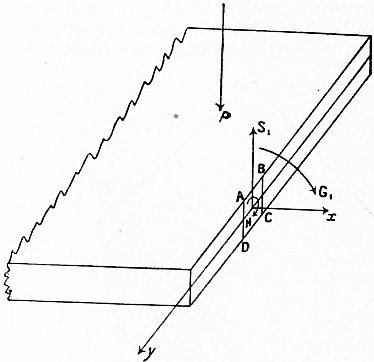
Fig. 28.
68. To express this theory analytically, let the middle plane of the plate in the unstrained position be taken as the plane of (x, y), and let normal sections at right angles to the axes of x and y be drawn through any point. After strain let w be the displacement of this point in the direction perpendicular to the plane, marked p in fig. 28. If the axes of x and y were parallel to the lines of curvature at the point, the flexural couple acting across the section normal to x (or y) would have the axis of y (or x) for its axis; but when the lines of curvature are inclined to the axes of co-ordinates, the flexural couple across a section normal to either axis has a component about that axis as well as a component about the perpendicular axis. Consider an element ABCD of the section at right angles to the axis of x, contained between two lines near together and perpendicular to the middle plane. The action of the portion of the plate to the right upon the portion to the left, across the element, gives rise to a couple about the middle line (y) of amount, estimated per unit of length of that line, equal to C [∂²w/∂x² + σ (∂²w/∂y²)], = G1, say, and to a couple, similarly estimated, about the normal (x) of amount −C (1 − σ) (∂²w/∂x∂y), H, say. The corresponding couples on an element of a section at right angles to the axis of y, estimated per unit of length of the axis of x, are of amounts −C [∂²w/∂y² + σ (∂²w/∂x²)], = G2 say, and −H. The resultant S1 of the shearing stresses on the element ABCD, estimated as before, is given by the equation S1 = ∂G1/∂x − ∂H/∂y (cf. § 57), and the corresponding resultant S2 for an element perpendicular to the axis of y is given by the equation S2= −∂H/∂x − ∂G2/∂y. If the plate is bent by a pressure p per unit of area, the equation of equilibrium is ∂S1/∂x + ∂S2/∂y = p, or, in terms of w,
∂4w + ∂4w + 2 ∂4w = p .
∂x4 ∂y4 ∂x2∂y2 C
This equation, together with the special conditions at the rim, suffices for the determination of w, and then all the quantities here introduced are determined. Further, the most important of the stress-components are those which act across elements of normal sections: the tension in direction x, at a distance z from the middle plane measured in the direction of p, is of amount −3Cz/2h3 [∂²w/∂x² + σ (∂²w/∂y²)], and there is a corresponding tension in direction y; the shearing stress consisting of traction parallel to y on planes x = const., and traction parallel to x on planes y = const., is of amount [3C(1 − σ)z/2h3] · (∂²w/∂x∂y); these tensions and shearing stresses are equivalent to two principal tensions, in the directions of the lines of curvature of the surface into which the middle plane is bent, and they give rise to the flexural couples.
69. In the special example of a circular plate, of radius a, supported at the rim, and held bent by a uniform pressure p, the value of w at a point distant r from the axis is
1 p (a² − r²) ( 5 + σ a² − r² ),
64 C 1 + σ
and the most important of the stress components is the radial tension, of which the amount at any point is 3⁄32(3 + σ) pz (a² − r)/h³; the maximum radial tension is about 1⁄3(a/h)²p, and, when the thickness is small compared with the diameter, this is a large multiple of p.
70. General Theorems.—Passing now from these questions of flexure and torsion, we consider some results that can be deduced from the general equations of equilibrium of an elastic solid body.
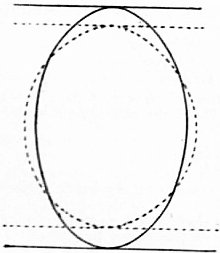
Fig. 29.
The form of the general expression for the potential energy (§ 27) stored up in the strained body leads, by a general property of quadratic functions, to a reciprocal theorem relating to the effects produced in the body by two different systems of forces, viz.: The whole work done by the forces of the first system, acting over the displacements produced by the forces of the second system, is equal to the whole work done by the forces of the second system, acting over the displacements produced by the forces of the first system. By a suitable choice of the second system of forces, the average values of the component stresses and strains produced by given forces, considered as constituting the first system, can be obtained, even when the distribution of the stress and strain cannot be determined.
Taking for example the problem presented by an isotropic body of any form4 pressed between two parallel planes distant l apart (fig. 29), and denoting the resultant pressure by p, we find that the diminution of volume -δv is given by the equation
−δv = lp / 3k,
where k is the modulus of compression, equal to 1⁄3E / (1 − 2σ). Again, take the problem of the changes produced in a heavy body by different ways of supporting it; when the body is suspended from one or more points in a horizontal plane its volume is increased by
δv = Wh / 3k,
where W is the weight of the body, and h the depth of its centre of gravity below the plane; when the body is supported by upward vertical pressures at one or more points in a horizontal plane the volume is diminished by
−δv = Wh′ / 3k,
where h′ is the height of the centre of gravity above the plane; if the body is a cylinder, of length l and section A, standing with its base on a smooth horizontal plane, its length is shortened by an amount
−δl = Wl / 2EA;
if the same cylinder lies on the plane with its generators horizontal, its length is increased by an amount
δl = σWh′ / EA.
71. In recent years important results have been found by considering the effects produced in an elastic solid by forces applied at isolated points.
Taking the case of a single force F applied at a point in the interior, we may show that the stress at a distance r from the point consists of
(1) a radial pressure of amount
2 − σ F cos θ ,
1 − σ 4π r²
(2) tension in all directions at right angles to the radius of amount
1 − 2σ F cos θ ,
2(1 − σ) 4π r²
(3) shearing stress consisting of traction acting along the radius dr on the surface of the cone θ = const. and traction acting along the meridian dθ on the surface of the sphere r = const. of amount
1 − 2σ F sin θ ,
2(1 − σ) 4π r²
where θ is the angle between the radius vector r and the line of action of F. The line marked T in fig. 30 shows the direction of the tangential traction on the spherical surface.
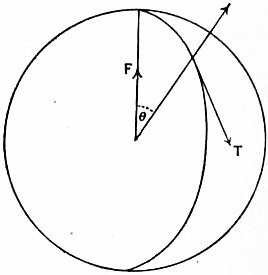
Fig. 30.
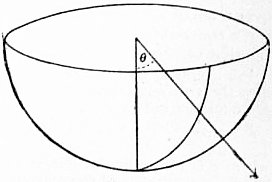
Fig. 31.
Thus the lines of stress are in and perpendicular to the meridian plane, and the direction of one of those in the meridian plane is inclined to the radius vector r at an angle
½ tan−1 ( 2 − 4σ tan θ ).
5 − 4σ
The corresponding displacement at any point is compounded of a radial displacement of amount
1 + σ F cos θ
2(1 − σ) 4πE r
and a displacement parallel to the line of action of F of amount
(3 − 4σ) (1 + σ) F 1 .
2(1 − σ) 4πE r
The effects of forces applied at different points and in different directions can be obtained by summation, and the effect of continuously distributed forces can be obtained by integration.
72. The stress system considered in § 71 is equivalent, on the plane through the origin at right angles to the line of action of F, to a resultant pressure of magnitude ½F at the origin and a [1 − 2σ/2(1 − σ)] · F/4πr², and, by the application of this system of tractions to a solid bounded by a plane, the displacement just described would be produced. There is also another stress system for a solid so bounded which is equivalent, on the same plane, to a resultant pressure at the origin, and a radial traction proportional to 1/r², but these are in the ratio 2π : r−2, instead of being in the ratio 4π(1 − σ) : (1 − 2σ)r−2.
The second stress system (see fig. 31) consists of:
(1) radial pressure F′r−2,
(2) tension in the meridian plane across the radius vector of amount
F′r−2 cos θ / (1 + cos θ),
(3) tension across the meridian plane of amount
F′r−2 / (l + cos θ),
(4) shearing stress as in § 71 of amount
F′r−2 sin θ / (1 + cos θ),
and the stress across the plane boundary consists of a resultant pressure of magnitude 2πF′ and a radial traction of amount F′r−2. If then we superpose the component stresses of the last section multiplied by 4(1 − σ)W/F, and the component stresses here written down multiplied by −(1 − 2σ)W/2πF′, the stress on the plane boundary will reduce to a single pressure W at the origin. We shall thus obtain the stress system at any point due to such a force applied at one point of the boundary.
In the stress system thus arrived at the traction across any plane parallel to the boundary is directed away from the place where W is supported, and its amount is 3W cos²θ / 2πr². The corresponding displacement consists of
(1) a horizontal displacement radially outwards from the vertical through the origin of amount
W (1 + σ) sin θ ( cos θ − 1 − 2σ ),
2πEr 1 + cos θ
(2) a vertical displacement downwards of amount
W (1 + σ) {2 (1 − σ) + cos²θ }.
2πEr
The effects produced by a system of loads on a solid bounded by a plane can be deduced.
The results for a solid body bounded by an infinite plane may be interpreted as giving the local effects of forces applied to a small part of the surface of a body. The results show that pressure is transmitted into a body from the boundary in such a way that the traction at a point on a section parallel to the boundary is the same at all points of any sphere which touches the boundary at the point of pressure, and that its amount at any point is inversely proportional to the square of the radius of this sphere, while its direction is that of a line drawn from the point of pressure to the point at which the traction is estimated. The transmission of force through a solid body indicated by this result was strikingly demonstrated in an attempt that was made to measure the lunar deflexion of gravity; it was found that the weight of the observer on the floor of the laboratory produced a disturbance of the instrument sufficient to disguise completely the effect which the instrument had been designed to measure (see G.H. Darwin, The Tides and Kindred Phenomena in the Solar System, London, 1898).
73. There is a corresponding theory of two-dimensional systems, that is to say, systems in which either the displacement is parallel to a fixed plane, or there is no traction across any plane of a system of parallel planes. This theory shows that, when pressure is applied at a point of the edge of a plate in any direction in the plane of the plate, the stress developed in the plate consists exclusively of radial pressure across any circle having the point of pressure as centre, and the magnitude of this pressure is the same at all points of any circle which touches the edge at the point of pressure, and its amount at any point is inversely proportional to the radius of this circle. This result leads to a number of interesting solutions of problems relating to plane systems; among these may be mentioned the problem of a circular plate strained by any forces applied at its edge.
74. The results stated in § 72 have been applied to give an account of the nature of the actions concerned in the impact of two solid bodies. The dissipation of energy involved in the impact is neglected, and the resultant pressure between the bodies at any instant during the impact is equal to the rate of destruction of momentum of either along the normal to the plane of contact drawn towards the interior of the other. It has been shown that in general the bodies come into contact over a small area bounded by an ellipse, and remain in contact for a time which varies inversely as the fifth root of the initial relative velocity.
For equal spheres of the same material, with σ = ¼, impinging directly with relative velocity v, the patches that come into contact are circles of radius
( 45π ) 1⁄5 ( v ) 2⁄5 r,
256 V
where r is the radius of either, and V the velocity of longitudinal waves in a thin bar of the material. The duration of the impact is approximately
(2.9432) ( 2025π² ) 1⁄5 r .
512 v1/5V4/5
For two steel spheres of the size of the earth impinging with a velocity of 1 cm. per second the duration of the impact would be about twenty-seven hours. The fact that the duration of impact is, for moderate velocities, a considerable multiple of the time taken by a wave of compression to travel through either of two impinging bodies has been ascertained experimentally, and constitutes the reason for the adequacy of the statical theory here described.
75. Spheres and Cylinders.—Simple results can be found for spherical and cylindrical bodies strained by radial forces.
For a sphere of radius a, and of homogeneous isotropic material of density ρ, strained by the mutual gravitation of its parts, the stress at a distance r from the centre consists of
(1) uniform hydrostatic pressure of amount 1⁄10 gρa (3 − σ) / (1 − σ),
(2) radial tension of amount 1⁄10 gρ (r²/a) (3 − σ) / (1 − σ),
(3) uniform tension at right angles to the radius vector of amount
1⁄10 gρ (r²/a) (1 + 3σ) / (1 − σ),
where g is the value of gravity at the surface. The corresponding strains consist of
(1) uniform contraction of all lines of the body of amount
1⁄30 k−1gρa (3 − σ) / (1 − σ),
(2) radial extension of amount 1⁄10 k−1gρ (r²/a) (1 + σ) / (1 − σ),
(3) extension in any direction at right angles to the radius vector of amount
1⁄30 k−1gρ (r²/a) (1 + σ) / (1 − σ),
where k is the modulus of compression. The volume is diminished by the fraction gρa/5k of itself. The parts of the radii vectors within the sphere r = a {(3 − σ) / (3 + 3σ)}1/2 are contracted, and the parts without this sphere are extended. The application of the above results to the state of the interior of the earth involves a neglect of the caution emphasized in § 40, viz. that the strain determined by the solution must be small if the solution is to be accepted. In a body of the size and mass of the earth, and having a resistance to compression and a rigidity equal to those of steel, the radial contraction at the centre, as given by the above solution, would be nearly 1⁄3, and the radial extension at the surface nearly 1⁄6, and these fractions can by no means be regarded as “small.”
76. In a spherical shell of homogeneous isotropic material, of internal radius r1 and external radius r0, subjected to pressure p0 on the outer surface, and p1 on the inner surface, the stress at any point distant r from the centre consists of
(1) uniform tension in all directions of amount
p1r1³ − p0r0³ ,
r0³ − r1³
(2) radial pressure of amount
p1 − p0 r0³r1³ ,
r0³ − r1³ r³
(3) tension in all directions at right angles to the radius vector of amount
½ p1 − p0 r0³r1³ .
r0³ − r1³ r³
The corresponding strains consist of
(1) uniform extension of all lines of the body of amount
1 p1r1³ − p0r0³ ,
3k r0³ − r1³
(2) radial contraction of amount
1 p1 − p0 r0³r1³ ,
2μ r0³ − r1³ r³
(3) extension in all directions at right angles to the radius vector of amount
1 p1 − p0 r0³r1³ ,
4μ r0³ − r1³ r³
where μ is the modulus of rigidity of the material, = ½E / (1 + σ). The volume included between the two surfaces of the body is increased by the fraction (p1r1³ − p0r0³) / k(r0³ − r1³) of itself, and the volume within the inner surface is increased by the fraction
3 (p1 − p0) r0³ + p1r1³ − p0r0³
4μ r0³ − r1³ k (r0³ − r1³)
of itself. For a shell subject only to internal pressure p the greatest extension is the extension at right angles to the radius at the inner surface, and its amount is
pr1³ ( 1 + 1 r0³ );
r0³ − r1³ 3k 4μ r1³
the greatest tension is the transverse tension at the inner surface, and its amount is p (½ r0³ + r1³) / (r0³ − r1³).
77. In the problem of a cylindrical shell under pressure a complication may arise from the effects of the ends; but when the ends are free from stress the solution is very simple. With notation similar to that in § 76 it can be shown that the stress at a distance r from the axis consists of
(1) uniform tension in all directions at right angles to the axis of amount
p1r1² − p0r0² ,
r0² − r1²
(2) radial pressure of amount
p1 − p0 r0²r1² ,
r0² − r1² r²
(3) hoop tension numerically equal to this radial pressure.
The corresponding strains consist of
(1) uniform extension of all lines of the material at right angles to the axis of amount
1 − σ p1r1² − p0r0² ,
E r0² − r1²
(2) radial contraction of amount
1 + σ p1 − p0 r0²r1² ,
E r0² − r1² r²
(3) extension along the circular filaments numerically equal to this radial contraction,
(4) uniform contraction of the longitudinal filaments of amount
2σ p1r1² − p0r0² .
E r0² − r1²
For a shell subject only to internal pressure p the greatest extension is the circumferential extension at the inner surface, and its amount is
p ( r0² + r1² + σ );
E r0² − r1²
the greatest tension is the hoop tension at the inner surface, and its amount is p (r0² + r1²) / (r0² − r1²).
78. When the ends of the tube, instead of being free, are closed by disks, so that the tube becomes a closed cylindrical vessel, the longitudinal extension is determined by the condition that the resultant longitudinal tension in the walls balances the resultant normal pressure on either end. This condition gives the value of the extension of the longitudinal filaments as
(p1r1² − p0r0²) / 3k (r0² − r1²),
where k is the modulus of compression of the material. The result may be applied to the experimental determination of k, by measuring the increase of length of a tube subjected to internal pressure (A. Mallock, Proc. R. Soc. London, lxxiv., 1904, and C. Chree, ibid.).
79. The results obtained in § 77 have been applied to gun construction; we may consider that one cylinder is heated so as to slip over another upon which it shrinks by cooling, so that the two form a single body in a condition of initial stress.
We take P as the measure of the pressure between the two, and p for the pressure within the inner cylinder by which the system is afterwards strained, and denote by r′ the radius of the common surface. To obtain the stress at any point we superpose the system consisting of radial pressure p (r1²/r²) · (r0² − r²) / (r0² − r1²) and hoop tension p (r1²/r²) · (r0² + r²) / (r0² − r1²) upon a system which, for the outer cylinder, consists of radial pressure P (r′²/r²) · (r0² − r²) / (r0² − r′²) and hoop tension P (r′²/r²) · (r0² + r²) / (r0² − r′²), and for the inner cylinder consists of radial pressure P (r′²/r²) · (r² − r1²) / (r′² − r1²) and hoop tension P (r′²/r²) · (r² + r1²) / (r′² − r1²). The hoop tension at the inner surface is less than it would be for a tube of equal thickness without initial stress in the ratio
1 − P 2r′² r0² + r1² : 1.
p r0² + r1² r′² − r1²
This shows how the strength of the tube is increased by the initial stress. When the initial stress is produced by tightly wound wire, a similar gain of strength accrues.
80. In the problem of determining the distribution of stress and strain in a circular cylinder, rotating about its axis, simple solutions have been obtained which are sufficiently exact for the two special cases of a thin disk and a long shaft.
Suppose that a circular disk of radius a and thickness 2l, and of density ρ, rotates about its axis with angular velocity ω, and consider the following systems of superposed stresses at any point distant r from the axis and z from the middle plane:
(1) uniform tension in all directions at right angles to the axis of amount 1⁄8 ω²ρa² (3 + σ),
(2) radial pressure of amount 1⁄8 ω²ρr² (3 + σ),
(3) pressure along the circular filaments of amount 1⁄8 ω²ρr² (1 + 3σ),
(4) uniform tension in all directions at right angles to the axis of amount 1⁄6 ω²ρ (l² − 3z²) σ (1 + σ) / (1 − σ).
The corresponding strains may be expressed as
(1) uniform extension of all filaments at right angles to the axis of amount
1 − σ 1⁄8 ω²ρa² (3 + σ),
E
(2) radial contraction of amount
1 − σ² 3⁄8 ω²ρr²,
E
(3) contraction along the circular filaments of amount
1 − σ² 1⁄8 ω²ρr²,
E
(4) extension of all filaments at right angles to the axis of amount
1 1⁄6 ω²ρ (l² − 3z²) σ (1 + σ),
E
(5) contraction of the filaments normal to the plane of the disk of amount
2σ 1⁄8 ω²ρa² (3 + σ) − σ 1⁄2 ω²ρr² (1 + σ) + 2σ 1⁄6 ω²ρ (l² − 3z²) σ (1 + σ) .
E E E (1 − σ)
The greatest extension is the circumferential extension near the centre, and its amount is
(3 + σ) (1 − σ) ω²ρa² + σ (1 + σ) ω²ρl².
8E 6E
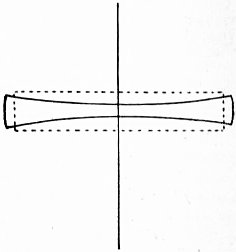
Fig. 32.
The longitudinal contraction is required to make the plane faces of the disk free from pressure, and the terms in l and z enable us to avoid tangential traction on any cylindrical surface. The system of stresses and strains thus expressed satisfies all the conditions, except that there is a small radial tension on the bounding surface of amount per unit area 1⁄6 ω²ρ (l² − 3z²) σ (1 + σ) / (1 − σ). The resultant of these tensions on any part of the edge of the disk vanishes, and the stress in question is very small in comparison with the other stresses involved when the disk is thin; we may conclude that, for a thin disk, the expressions given represent the actual condition at all points which are not very close to the edge (cf. § 55). The effect to the longitudinal contraction is that the plane faces become slightly concave (fig. 32).
81. The corresponding solution for a disk with a circular axle-hole (radius b) will be obtained from that given in the last section by superposing the following system of additional stresses:
(1) radial tension of amount 1⁄8 ω²ρb² (1 − a²/r²) (3 + σ),
(2) tension along the circular filaments of amount
1⁄8 ω²ρb² (1 + a²/r²) (3 + σ).
The corresponding additional strains are
(1) radial contraction of amount
3 + σ { (1 + σ) a² − (1 − σ) } ω²ρb²,
8E r²
(2) extension along the circular filaments of amount
3 + σ { (1 + σ) a² + (1 − σ) } ω²ρb².
8E r²
(3) contraction of the filaments parallel to the axis of amount
σ (3 + σ) ω²ρb².
4E
Again, the greatest extension is the circumferential extension at the inner surface, and, when the hole is very small, its amount is nearly double what it would be for a complete disk.
82. In the problem of the rotating shaft we have the following stress-system:
(1) radial tension of amount 1⁄8 ω²ρ (a² − r²) (3 − 2σ) / (1 − σ),
(2) circumferential tension of amount
1⁄8 ω²ρ {a² (3 − 2σ) / (1 − σ) − r² (1 + 2σ) / (1 − σ)},
(3) longitudinal tension of amount ¼ ω²ρ (a² − 2r²) σ / (1 − σ).
The resultant longitudinal tension at any normal section vanishes, and the radial tension vanishes at the bounding surface; and thus the expressions here given may be taken to represent the actual condition at all points which are not very close to the ends of the shaft. The contraction of the longitudinal filaments is uniform and equal to ½ ω²ρa²σ / E. The greatest extension in the rotating shaft is the circumferential extension close to the axis, and its amount is 1⁄8 ω²ρa² (3 − 5σ) / E (1 − σ).
The value of any theory of the strength of long rotating shafts founded on these formulae is diminished by the circumstance that at sufficiently high speeds the shaft may tend to take up a curved form, the straight form being unstable. The shaft is then said to whirl. This occurs when the period of rotation of the shaft is very nearly coincident with one of its periods of lateral vibration. The lowest speed at which whirling can take place in a shaft of length l, freely supported at its ends, is given by the formula
ω²ρ = ¼ Ea² (π/l)4.
As in § 61, this formula should not be applied unless the length of the shaft is a considerable multiple of its diameter. It implies that whirling is to be expected whenever ω approaches this critical value.
83. When the forces acting upon a spherical or cylindrical body are not radial, the problem becomes more complicated. In the case of the sphere deformed by any forces it has been completely solved, and the solution has been applied by Lord Kelvin and Sir G.H. Darwin to many interesting questions of cosmical physics. The nature of the stress produced in the interior of the earth by the weight of continents and mountains, the spheroidal figure of a rotating solid planet, the rigidity of the earth, are among the questions which have in this way been attacked. Darwin concluded from his investigation that, to support the weight of the existing continents and mountain ranges, the materials of which the earth is composed must, at great depths (1600 kilometres), have at least the strength of granite. Kelvin concluded from his investigation that the actual heights of the tides in the existing oceans can be accounted for only on the supposition that the interior of the earth is solid, and of rigidity nearly as great as, if not greater than, that of steel.
84. Some interesting problems relating to the strains produced in a cylinder of finite length by forces distributed symmetrically round the axis have been solved. The most important is that of a cylinder crushed between parallel planes in contact with its plane ends. The solution was applied to explain the discrepancies that have been observed in different tests of crushing strength according as the ends of the test specimen are or are not prevented from spreading. It was applied also to explain the fact that in such tests small conical pieces are sometimes cut out at the ends subjected to pressure.
85. Vibrations and Waves.—When a solid body is struck, or otherwise suddenly disturbed, it is thrown into a state of vibration. There always exist dissipative forces which tend to destroy the vibratory motion, one cause of the subsidence of the motion being the communication of energy to surrounding bodies. When these dissipative forces are disregarded, it is found that an elastic solid body is capable of vibrating in such a way that the motion of any particle is simple harmonic motion, all the particles completing their oscillations in the same period and being at any instant in the same phase, and the displacement of any selected one in any particular direction bearing a definite ratio to the displacement of an assigned one in an assigned direction. When a body is moving in this way it is said to be vibrating in a normal mode. For example, when a tightly stretched string of negligible flexural rigidity, such as a violin string may be taken to be, is fixed at the ends, and vibrates transversely in a normal mode, the displacements of all the particles have the same direction, and their magnitudes are proportional at any instant to the ordinates of a curve of sines. Every body possesses an infinite number of normal modes of vibration, and the frequencies (or numbers of vibrations per second) that belong to the different modes form a sequence of increasing numbers. For the string, above referred to, the fundamental tone and the various overtones form an harmonic scale, that is to say, the frequencies of the normal modes of vibration are proportional to the integers 1, 2, 3, .... In all these modes except the first the string vibrates as if it were divided into a number of equal pieces, each having fixed ends; this number is in each case the integer defining the frequency. In general the normal modes of vibration of a body are distinguished one from another by the number and situation of the surfaces (or other loci) at which some characteristic displacement or traction vanishes. The problem of determining the normal modes and frequencies of free vibration of a body of definite size, shape and constitution, is a mathematical problem of a similar character to the problem of determining the state of stress in the body when subjected to given forces. The bodies which have been most studied are strings and thin bars, membranes, thin plates and shells, including bells, spheres and cylinders. Most of the results are of special importance in their bearing upon the theory of sound.
86. The most complete success has attended the efforts of mathematicians to solve the problem of free vibrations for an isotropic sphere. It appears that the modes of vibration fall into two classes: one characterized by the absence of a radial component of displacement, and the other by the absence of a radial component of rotation (§ 14). In each class there is a doubly infinite number of modes. The displacement in any mode is determined in terms of a single spherical harmonic function, so that there are modes of each class corresponding to spherical harmonics of every integral degree; and for each degree there is an infinite number of modes, differing from one another in the number and position of the concentric spherical surfaces at which some characteristic displacement vanishes. The most interesting modes are those in which the sphere becomes slightly spheroidal, being alternately prolate and oblate during the course of a vibration; for these vibrations tend to be set up in a spherical planet by tide-generating forces. In a sphere of the size of the earth, supposed to be incompressible and as rigid as steel, the period of these vibrations is 66 minutes.
87. The theory of free vibrations has an important bearing upon the question of the strength of structures subjected to sudden blows or shocks. The stress and strain developed in a body by sudden applications of force may exceed considerably those which would be produced by a gradual application of the same forces. Hence there arises the general question of dynamical resistance, or of the resistance of a body to forces applied so quickly that the inertia of the body comes sensibly into play. In regard to this question we have two chief theoretical results. The first is that the strain produced by a force suddenly applied may be as much as twice the statical strain, that is to say, as the strain which would be produced by the same force when the body is held in equilibrium under its action; the second is that the sudden reversal of the force may produce a strain three times as great as the statical strain. These results point to the importance of specially strengthening the parts of any machine (e.g. screw propeller shafts) which are subject to sudden applications or reversals of load. The theoretical limits of twice, or three times, the statical strain are not in general attained. For example, if a thin bar hanging vertically from its upper end is suddenly loaded at its lower end with a weight equal to its own weight, the greatest dynamical strain bears to the greatest statical strain the ratio 1.63 : 1; when the attached weight is four times the weight of the bar the ratio becomes 1.84 : 1. The method by which the result just mentioned is reached has recently been applied to the question of the breaking of winding ropes used in mines. It appeared that, in order to bring the results into harmony with the observed facts, the strain in the supports must be taken into account as well as the strain in the rope (J. Perry, Phil. Mag., 1906 (vi.), vol. ii.).
88. The immediate effect of a blow or shock, locally applied to a body, is the generation of a wave which travels through the body from the locality first affected. The question of the propagation of waves through an elastic solid body is historically of very great importance; for the first really successful efforts to construct a theory of elasticity (those of S.D. Poisson, A.L. Cauchy and G. Green) were prompted, at least in part, by Fresnel’s theory of the propagation of light by transverse vibrations. For many years the luminiferous medium was identified with the isotropic solid of the theory of elasticity. Poisson showed that a disturbance communicated to the body gives rise to two waves which are propagated through it with different velocities; and Sir G.G. Stokes afterwards showed that the quicker wave is a wave of irrotational dilatation, and the slower wave is a wave of rotational distortion accompanied by no change of volume. The velocities of the two waves in a solid of density ρ are √ {(λ + 2μ)/ρ} and √ (μ/ρ), λ and μ being the constants so denoted in § 26. When the surface of the body is free from traction, the waves on reaching the surface are reflected; and thus after a little time the body would, if there were no dissipative forces, be in a very complex state of motion due to multitudes of waves passing to and fro through it. This state can be expressed as a state of vibration, in which the motions belonging to the various normal modes (§ 85) are superposed, each with an appropriate amplitude and phase. The waves of dilatation and distortion do not, however, give rise to different modes of vibration, as was at one time supposed, but any mode of vibration in general involves both dilatation and rotation. There are exceptional results for solids of revolution; such solids possess normal modes of vibration which involve no dilatation. The existence of a boundary to the solid body has another effect, besides reflexion, upon the propagation of waves. Lord Rayleigh has shown that any disturbance originating at the surface gives rise to waves which travel away over the surface as well as to waves which travel through the interior; and any internal disturbance, on reaching the surface, also gives rise to such superficial waves. The velocity of the superficial waves is a little less than that of the waves of distortion: 0.9554 √ (μ/ρ) when the material is incompressible 0.9194 √ (μ/ρ) when the Poisson’s ratio belonging to the material is ¼.
89. These results have an application to the propagation of earthquake shocks (see also Earthquake). An internal disturbance should, if the earth can be regarded as solid, give rise to three wave-motions: two propagated through the interior of the earth with different velocities, and a third propagated over the surface. The results of seismographic observations have independently led to the recognition of three phases of the recorded vibrations: a set of “preliminary tremors” which are received at different stations at such times as to show that they are transmitted directly through the interior of the earth with a velocity of about 10 km. per second, a second set of preliminary tremors which are received at different stations at such times as to show that they are transmitted directly through the earth with a velocity of about 5 km. per second, and a “main shock,” or set of large vibrations, which becomes sensible at different stations at such times as to show that a wave is transmitted over the surface of the earth with a velocity of about 3 km. per second. These results can be interpreted if we assume that the earth is a solid body the greater part of which is practically homogeneous, with high values for the rigidity and the resistance to compression, while the superficial portions have lower values for these quantities. The rigidity of the central portion would be about (1.4)1012 dynes per square cm., which is considerably greater than that of steel, and the resistance to compression would be about (3.8)1012 dynes per square cm. which is much greater than that of any known material. The high value of the resistance to compression is not surprising when account is taken of the great pressures, due to gravitation, which must exist in the interior of the earth. The high value of the rigidity can be regarded as a confirmation of Lord Kelvin’s estimate founded on tidal observations (§ 83).
90. Strain produced by Heat.—The mathematical theory of elasticity as at present developed takes no account of the strain which is produced in a body by unequal heating. It appears to be impossible in the present state of knowledge to form as in § 39 a system of differential equations to determine both the stress and the temperature at any point of a solid body the temperature of which is liable to variation. In the cases of isothermal and adiabatic changes, that is to say, when the body is slowly strained without variation of temperature, and also when the changes are effected so rapidly that there is no gain or loss of heat by any element, the internal energy of the body is sufficiently expressed by the strain-energy-function (§§ 27, 30). Thus states of equilibrium and of rapid vibration can be determined by the theory that has been explained above. In regard to thermal effects we can obtain some indications from general thermodynamic theory. The following passages extracted from the article “Elasticity” contributed to the 9th edition of the Encyclopaedia Britannica by Sir W. Thomson (Lord Kelvin) illustrate the nature of these indications:—“From thermodynamic theory it is concluded that cold is produced whenever a solid is strained by opposing, and heat when it is strained by yielding to, any elastic force of its own, the strength of which would diminish if the temperature were raised; but that, on the contrary, heat is produced when a solid is strained against, and cold when it is strained by yielding to, any elastic force of its own, the strength of which would increase if the temperature were raised. When the strain is a condensation or dilatation, uniform in all directions, a fluid may be included in the statement. Hence the following propositions:—
“(1) A cubical compression of any elastic fluid or solid in an ordinary condition causes an evolution of heat; but, on the contrary, a cubical compression produces cold in any substance, solid or fluid, in such an abnormal state that it would contract if heated while kept under constant pressure. Water below its temperature (3.9° Cent.) of maximum density is a familiar instance.
“(2) If a wire already twisted be suddenly twisted further, always, however, within its limits of elasticity, cold will be produced; and if it be allowed suddenly to untwist, heat will be evolved from itself (besides heat generated externally by any work allowed to be wasted, which it does in untwisting). It is assumed that the torsional rigidity of the wire is diminished by an elevation of temperature, as the writer of this article had found it to be for copper, iron, platinum and other metals.
“(3) A spiral spring suddenly drawn out will become lower in temperature, and will rise in temperature when suddenly allowed to draw in. [This result has been experimentally verified by Joule (’Thermodynamic Properties of Solids,’ Phil. Trans., 1858) and the amount of the effect found to agree with that calculated, according to the preceding thermodynamic theory, from the amount of the weakening of the spring which he found by experiment.]
“(4) A bar or rod or wire of any substance with or without a weight hung on it, or experiencing any degree of end thrust, to begin with, becomes cooled if suddenly elongated by end pull or by diminution of end thrust, and warmed if suddenly shortened by end thrust or by diminution of end pull; except abnormal cases in which with constant end pull or end thrust elevation of temperature produces shortening; in every such case pull or diminished thrust produces elevation of temperature, thrust or diminished pull lowering of temperature.
“(5) An india-rubber band suddenly drawn out (within its limits of elasticity) becomes warmer; and when allowed to contract, it becomes colder. Any one may easily verify this curious property by placing an india-rubber band in slight contact with the edges of the lips, then suddenly extending it—it becomes very perceptibly warmer: hold it for some time stretched nearly to breaking, and then suddenly allow it to shrink—it becomes quite startlingly colder, the cooling effect being sensible not merely to the lips but to the fingers holding the band. The first published statement of this curious observation is due to J. Gough (Mem. Lit. Phil. Soc. Manchester, 2nd series, vol. i. p. 288), quoted by Joule in his paper on ‘Thermodynamic Properties of Solids’ (cited above). The thermodynamic conclusion from it is that an india-rubber band, stretched by a constant weight of sufficient amount hung on it, must, when heated, pull up the weight, and, when cooled, allow the weight to descend: this Gough, independently of thermodynamic theory, had found to be actually the case. The experiment any one can make with the greatest ease by hanging a few pounds weight on a common india-rubber band, and taking a red-hot coal in a pair of tongs, or a red-hot poker, and moving it up and down close to the band. The way in which the weight rises when the red-hot body is near, and falls when it is removed, is quite startling. Joule experimented on the amount of shrinking per degree of elevation of temperature, with different weights hung on a band of vulcanized india-rubber, and found that they closely agreed with the amounts calculated by Thomson’s theory from the heating effects of pull, and cooling effects of ceasing to pull, which he had observed in the same piece of india-rubber.”
91. Initial Stress.—It has been pointed out above (§ 20) that the “unstressed” state, which serves as a zero of reckoning for strains and stresses is never actually attained, although the strain (measured from this state), which exists in a body to be subjected to experiment, may be very slight. This is the case when the “initial stress,” or the stress existing before the experiment, is small in comparison with the stress developed during the experiment, and the limit of linear elasticity (§ 32) is not exceeded. The existence of initial stress has been correlated above with the existence of body forces such as the force of gravity, but it is not necessarily dependent upon such forces. A sheet of metal rolled into a cylinder, and soldered to maintain the tubular shape, must be in a state of considerable initial stress quite apart from the action of gravity. Initial stress is utilized in many manufacturing processes, as, for example, in the construction of ordnance, referred to in § 79, in the winding of golf balls by means of india-rubber in a state of high tension (see the report of the case The Haskell Golf Ball Company v. Hutchinson & Main in The Times of March 1, 1906). In the case of a body of ordinary dimensions it is such internal stress as this which is especially meant by the phrase “initial stress.” Such a body, when in such a state of internal stress, is sometimes described as “self-strained.” It would be better described as “self-stressed.” The somewhat anomalous behaviour of cast iron has been supposed to be due to the existence within the metal of initial stress. As the metal cools, the outer layers cool more rapidly than the inner, and thus the state of initial stress is produced. When cast iron is tested for tensile strength, it shows at first no sensible range either of perfect elasticity or of linear elasticity; but after it has been loaded and unloaded several times its behaviour begins to be more nearly like that of wrought iron or steel. The first tests probably diminish the initial stress.
92. From a mathematical point of view the existence of initial stress in a body which is “self-stressed” arises from the fact that the equations of equilibrium of a body free from body forces or surface tractions, viz. the equations of the type
∂Xx + ∂Xy + ∂Zx = 0,
∂x ∂y ∂z
possess solutions which differ from zero. If, in fact, φ1, φ2, φ3 denote any arbitrary functions of x, y, z, the equations are satisfied by putting
Xx = ∂²φ3 + ∂²φ2 , ..., Yz = − ∂²φ1 , ... ;
∂y² ∂z ∂y∂z
and it is clear that the functions φ1, φ2, φ3 can be adjusted in an infinite number of ways so that the bounding surface of the body may be free from traction.
93. Initial stress due to body forces becomes most important in the case of a gravitating planet. Within the earth the stress that arises from the mutual gravitation of the parts is very great. If we assumed the earth to be an elastic solid body with moduluses of elasticity no greater than those of steel, the strain (measured from the unstressed state) which would correspond to the stress would be much too great to be calculated by the ordinary methods of the theory of elasticity (§ 75). We require therefore some other method of taking account of the initial stress. In many investigations, for example those of Lord Kelvin and Sir G.H. Darwin referred to in § 83, the difficulty is turned by assuming that the material may be treated as practically incompressible; but such investigations are to some extent incomplete, so long as the corrections due to a finite, even though high, resistance to compression remain unknown. In other investigations, such as those relating to the propagation of earthquake shocks and to gravitational instability, the possibility of compression is an essential element of the problem. By gravitational instability is meant the tendency of gravitating matter to condense into nuclei when slightly disturbed from a state of uniform diffusion; this tendency has been shown by J.H. Jeans (Phil. Trans. A. 201, 1903) to have exerted an important influence upon the course of evolution of the solar system. For the treatment of such questions Lord Rayleigh (Proc. R. Soc. London, A. 77, 1906) has advocated a method which amounts to assuming that the initial stress is hydrostatic pressure, and that the actual state of stress is to be obtained by superposing upon this initial stress a stress related to the state of strain (measured from the initial state) by the same formulae as hold for an elastic solid body free from initial stress. The development of this method is likely to lead to results of great interest.
Authorities.—In regard to the analysis requisite to prove the results set forth above, reference may be made to A.E.H. Love, Treatise on the Mathematical Theory of Elasticity (2nd ed., Cambridge, 1906), where citations of the original authorities will also be found. The following treatises may be mentioned: Navier, Résumé des leçons sur l’application de la mécanique (3rd ed., with notes by Saint-Venant, Paris, 1864); G. Lamé, Leçons sur la théorie mathématique de l’élasticité des corps solides (Paris, 1852); A. Clebsch, Theorie der Elasticität fester Körper (Leipzig, 1862; French translation with notes by Saint-Venant, Paris, 1883); F. Neumann, Vorlesungen über die Theorie der Elasticität (Leipzig, 1885); Thomson and Tait, Natural Philosophy (Cambridge, 1879, 1883); Todhunter and Pearson, History of the Elasticity and Strength of Materials (Cambridge, 1886-1893). The article “Elasticity” by Sir W. Thomson (Lord Kelvin) in 9th ed. of Encyc. Brit. (reprinted in his Mathematical and Physical Papers, iii., Cambridge, 1890) is especially valuable, not only for the exposition of the theory and its practical applications, but also for the tables of physical constants which are there given.
(A. E. H. L.)
1 The sign of M is shown by the arrow-heads in fig. 19, for which, with y downwards,
EI d²y + M = 0.
dx²
2 The figure is drawn for a case where the bending moment has the same sign throughout.
3 M0 is taken to have, as it obviously has, the opposite sense to that shown in fig. 19.
4 The line joining the points of contact must be normal to the planes.
ELATERITE, also termed Elastic Bitumen and Mineral Caoutchouc, a mineral hydrocarbon, which occurs at Castleton in Derbyshire, in the lead mines of Odin and elsewhere. It varies somewhat in consistency, being sometimes soft, elastic and sticky; often closely resembling india-rubber; and occasionally hard and brittle. It is usually dark brown in colour and slightly translucent. A substance of similar physical character is found in the Coorong district of South Australia, and is hence termed coorongite, but Prof. Ralph Tate considers this to be a vegetable product.
ELATERIUM, a drug consisting of a sediment deposited by the juice of the fruit of Ecballium Elaterium, the squirting cucumber, a native of the Mediterranean region. The plant, which is a member of the natural order Cucurbitaceae, resembles the vegetable marrow in its growth. The fruit resembles a small cucumber, and when ripe is highly turgid, and separates almost at a touch from the fruit stalk. The end of the stalk forms a stopper, on the removal of which the fluid contents of the fruit, together with the seeds, are squirted through the aperture by the sudden contraction of the wall of the fruit. To prepare the drug the fruit is sliced lengthwise and slightly pressed; the greenish and slightly turbid juice thus obtained is strained and set aside; and the deposit of elaterium formed after a few hours is collected on a linen filter, rapidly drained, and dried on porous tiles at a gentle heat. Elaterium is met with in commerce in light, thin, friable, flat or slightly incurved opaque cakes, of a greyish-green colour, bitter taste and tea-like smell.
The drug is soluble in alcohol, but insoluble in water and ether. The official dose is 1⁄10-1⁄2 grain, and the British pharmacopeia directs that the drug is to contain from 20 to 25% of the active principle elaterinum or elaterin. A resin in the natural product aids its action. Elaterin is extracted from elaterium by chloroform and then precipitated by ether. It has the formula C20H28O5. It forms colourless scales which have a bitter taste, but it is highly inadvisable to taste either this substance or elaterium. Its dose is 1⁄40-1⁄10 grain, and the British pharmacopeia contains a useful preparation, the Pulvis Elaterini Compositus, which contains one part of the active principle in forty.
The action of this drug resembles that of the saline aperients, but is much more powerful. It is the most active hydragogue purgative known, causing also much depression and violent griping. When injected subcutaneously it is inert, as its action is entirely dependent upon its admixture with the bile. The drug is undoubtedly valuable in cases of dropsy and Bright’s disease, and also in cases of cerebral haemorrhage, threatened or present. It must not be used except in urgent cases, and must invariably be employed with the utmost care, especially if the state of the heart be unsatisfactory.
ELBA (Gr. Αἰθαλία; Lat. Ilva), an island off the W. coast of Italy, belonging to the province of Leghorn, from which it is 45 m. S., and 7 m. S.W. of Piombino, the nearest point of the mainland. Pop. (1901) 25,043 (including Pianosa). It is about 19 m. long, 6½ m. broad, and 140 sq. m. in area; and its highest point is 3340 ft. (Monte Capanne). It forms, like Giglio and Monte Cristo, part of a sunken mountain range extending towards Corsica and Sardinia.
The oldest rocks of Elba consist of schist and serpentine which in the eastern part of the island are overlaid by beds containing Silurian and Devonian fossils. The Permian may be represented, but the Trias is absent, and in general the older Palaeozoic rocks are overlaid directly by the Rhaetic and Lias. The Liassic beds are often metamorphosed and the limestones contain garnet and wollastonite. The next geological formation which is represented is the Eocene, consisting of nummulitic limestone, sandstone and schist. The Miocene and Pliocene are absent. The most remarkable feature in the geology of Elba is the extent of the granitic and ophiolitic eruptions of the Tertiary period. Serpentines, peridotites and diabases are interstratified with the Eocene deposits. The granite, which is intruded through the Eocene beds, is associated with a pegmatite containing tourmaline and cassiterite. The celebrated iron ore of Elba is of Tertiary age and occurs indifferently in all the older rocks. The deposits are superficial, resulting from the opening out of veins at the surface, and consist chiefly of haematite. These ores were worked by the ancients, but so inefficiently that their spoil-heaps can be smelted again with profit. This process is now gone through on the island itself. The granite was also quarried by the Romans, but is not now much worked.
Parts of the island are fertile, and the cultivation of vines, and the tunny and sardine fishery, also give employment to a part of the population. The capital of the island is Portoferraio—pop. (1901) 5987—in the centre of the N. coast, enclosed by an amphitheatre of lofty mountains, the slopes of which are covered with villas and gardens. This is the best harbour, the ancient Portus Argous. The town was built and fortified by Cosimo I. in 1548, who called it Cosmopolis. Above the harbour, between the forts Stella and Falcone, is the palace of Napoleon I., and 4 m. to the S.W. is his villa; while on the N. slope of Monte Capanne is another of his country houses. The other villages in the island are Campo nell’ Elba, on the S. near the W. end, Marciana and Marciana Marina on the N. of the island near the W. extremity, Porto Longone, on the E. coast, with picturesque Spanish fortifications, constructed in 1602 by Philip III.; Rio dell’ Elba and Rio Marina, both on the E. side of the island, in the mining district. At Le Grotte, between Portoferraio and Rio dell’ Elba, and at Capo Castello, on the N.E. of the island, are ruins of Roman date.
Elba was famous for its mines in early times, and the smelting furnaces gave it its Greek name of Α᾽ θαλία (“soot island”). In Roman times, and until 1900, however, owing to lack of fuel, the smelting was done on the mainland. In 453 B.C. Elba was devastated by a Syracusan squadron. From the 11th to the 14th century it belonged to Pisa, and in 1399 came under the dukes of Piombino. In 1548 it was ceded by them to Cosimo I. of Florence. In 1596 Porto Longone was taken by Philip III. of Spain, and retained until 1709, when it was ceded to Naples. In 1802 the island was given to France by the peace of Amiens. On Napoleon’s deposition, the island was ceded to him with full sovereign rights, and he resided there from the 5th of May 1814 to the 26th of February 1815. After his fall it was restored to Tuscany, and passed with it to Italy in 1860.
See Sir R. Colt Hoare, A Tour through the Island of Elba (London, 1814).
ELBE (the Albis of the Romans and the Labe of the Czechs), a river of Germany, which rises in Bohemia not far from the frontiers of Silesia, on the southern side of the Riesengebirge, at an altitude of about 4600 ft. Of the numerous small streams (Seifen or Flessen as they are named in the district) whose confluent waters compose the infant river, the most important are the Weisswasser, or White Water, and the Elbseifen, which is formed in the same neighbourhood, but at a little lower elevation. After plunging down the 140 ft. of the Elbfall, the latter stream unites with the steep torrential Weisswasser at Mädelstegbaude, at an altitude of 2230 ft., and thereafter the united stream of the Elbe pursues a southerly course, emerging from the mountain glens at Hohenelbe (1495 ft.), and continuing on at a soberer pace to Pardubitz, where it turns sharply to the west, and at Kolin (730 ft.), some 27 m. farther on, bends gradually towards the north-west. A little above Brandeis it picks up the Iser, which, like itself, comes down from the Riesengebirge, and at Melnik it has its stream more than doubled in volume by the Moldau, a river which winds northwards through the heart of Bohemia in a sinuous, trough-like channel carved through the plateaux. Some miles lower down, at Leitmeritz (433 ft.), the waters of the Elbe are tinted by the reddish Eger, a stream which drains the southern slopes of the Erzgebirge. Thus augmented, and swollen into a stream 140 yds. wide, the Elbe carves a path through the basaltic mass of the Mittelgebirge, churning its way through a deep, narrow rocky gorge. Then the river winds through the fantastically sculptured sandstone mountains of the “Saxon Switzerland,” washing successively the feet of the lofty Lilienstein (932 ft. above the Elbe), the scene of one of Frederick the Great’s military exploits in the Seven Years’ War, Königstein (797 ft. above the Elbe), where in times of war Saxony has more than once stored her national purse for security, and the pinnacled rocky wall of the Bastei, towering 650 ft. above the surface of the stream. Shortly after crossing the Bohemian-Saxon frontier, and whilst still struggling through the sandstone defiles, the stream assumes a north-westerly direction, which on the whole it preserves right away to the North Sea. At Pirna the Elbe leaves behind it the stress and turmoil of the Saxon Switzerland, rolls through Dresden, with its noble river terraces, and finally, beyond Meissen, enters on its long journey across the North German plain, touching Torgau, Wittenberg, Magdeburg, Wittenberge, Hamburg, Harburg and Altona on the way, and gathering into itself the waters of the Mulde and Saale from the left, and those of the Schwarze Elster, Havel and Elde from the right. Eight miles above Hamburg the stream divides into the Norder (or Hamburg) Elbe and the Süder (or Harburg) Elbe, which are linked together by several cross-channels, and embrace in their arms the large island of Wilhelmsburg and some smaller ones. But by the time the river reaches Blankenese, 7 m. below Hamburg, all these anastomosing branches have been reunited, and the Elbe, with a width of 4 to 9 m. between bank and bank, travels on between the green marshes of Holstein and Hanover until it becomes merged in the North Sea off Cuxhaven. At Kolin the width is about 100 ft., at the mouth of the Moldau about 300, at Dresden 960, and at Magdeburg over 1000. From Dresden to the sea the river has a total fall of only 280 ft., although the distance is about 430 m. For the 75 m. between Hamburg and the sea the fall is only 3¼ ft. One consequence of this is that the bed of the river just below Hamburg is obstructed by a bar, and still lower down is choked with sandbanks, so that navigation is confined to a relatively narrow channel down the middle of the stream. But unremitting efforts have been made to maintain a sufficient fairway up to Hamburg (q.v.). The tide advances as far as Geesthacht, a little more than 100 m. from the sea. The river is navigable as far as Melnik, that is, the confluence of the Moldau, a distance of 525 m., of which 67 are in Bohemia. Its total length is 725 m., of which 190 are in Bohemia, 77 in the kingdom of Saxony, and 350 in Prussia, the remaining 108 being in Hamburg and other states of Germany. The area of the drainage basin is estimated at 56,000 sq. m.
Navigation.—Since 1842, but more especially since 1871, improvements have been made in the navigability of the Elbe by all the states which border upon its banks. As a result of these labours there is now in the Bohemian portion of the river a minimum depth of 2 ft. 8 in., whilst from the Bohemian frontier down to Magdeburg the minimum depth is 3 ft., and from Magdeburg to Hamburg, 3 ft. 10 in. In 1896 and 1897 Prussia and Hamburg signed covenants whereby two channels are to be kept open to a depth of 9¾ ft., a width of 656 ft., and a length of 550 yds. between Bunthaus and Ortkathen, just above the bifurcation of the Norder Elbe and the Süder Elbe. In 1869 the maximum burden of the vessels which were able to ply on the upper Elbe was 250 tons; but in 1899 it was increased to 800 tons. The large towns through which the river flows have vied with one another in building harbours, providing shipping accommodation, and furnishing other facilities for the efficient navigation of the Elbe. In this respect the greatest efforts have naturally been made by Hamburg; but Magdeburg, Dresden, Meissen, Riesa, Tetschen, Aussig and other places have all done their relative shares, Magdeburg, for instance, providing a commercial harbour and a winter harbour. In spite, however, of all that has been done, the Elbe remains subject to serious inundations at periodic intervals. Among the worst floods were those of the years 1774, 1799, 1815, 1830, 1845, 1862, 1890 and 1909. The growth of traffic up and down the Elbe has of late years become very considerable. A towing chain, laid in the bed of the river, extends from Hamburg to Aussig, and by this means, as by paddle-tug haulage, large barges are brought from the port of Hamburg into the heart of Bohemia. The fleet of steamers and barges navigating the Elbe is in point of fact greater than on any other German river. In addition to goods thus conveyed, enormous quantities of timber are floated down the Elbe; the weight of the rafts passing the station of Schandau on the Saxon Bohemian frontier amounting in 1901 to 333,000 tons.
A vast amount of traffic is directed to Berlin, by means of the Havel-Spree system of canals, to the Thuringian states and the Prussian province of Saxony, to the kingdom of Saxony and Bohemia, and to the various riverine states and provinces of the lower and middle Elbe. The passenger traffic, which is in the hands of the Sächsisch-Böhmische Dampfschifffahrtsgesellschaft is limited to Bohemia and Saxony, steamers plying up and down the stream from Dresden to Melnik, occasionally continuing the journey up the Moldau to Prague, and down the river as far as Riesa, near the northern frontier of Saxony, and on the average 1½ million passengers are conveyed.
In 1877-1879, and again in 1888-1895, some 100 m. of canal were dug, 5 to 6½ ft. deep and of various widths, for the purpose of connecting the Elbe, through the Havel and the Spree, with the system of the Oder. The most noteworthy of these connexions are the Elbe Canal (14¼ m. long), the Reek Canal (9½ m.), the Rüdersdorfer Gewässer (11½ m.), the Rheinsberger Canal (11¼ m.), and the Sacrow-Paretzer Canal (10 m.), besides which the Spree has been canalized for a distance of 28 m., and the Elbe for a distance of 70 m. Since 1896 great improvements have been made in the Moldau and the Bohemian Elbe, with the view of facilitating communication between Prague and the middle of Bohemia generally on the one hand, and the middle and lower reaches of the Elbe on the other. In the year named a special commission was appointed for the regulation of the Moldau and Elbe between Prague and Aussig, at a cost estimated at about £1,000,000, of which sum two-thirds were to be borne by the Austrian empire and one-third by the kingdom of Bohemia. The regulation is effected by locks and movable dams, the latter so designed that in times of flood or frost they can be dropped flat on the bottom of the river. In 1901 the Austrian government laid before the Reichsrat a canal bill, with proposals for works estimated to take twenty years to complete, and including the construction of a canal between the Oder, starting at Prerau, and the upper Elbe at Pardubitz, and for the canalization of the Elbe from Pardubitz to Melnik (see Austria: Waterways). In 1900 Lübeck was put into direct communication with the Elbe at Lauenburg by the opening of the Elbe-Trave Canal, 42 m. in length, and constructed at a cost of £1,177,700, of which the state of Lübeck contributed £802,700, and the kingdom of Prussia £375,000. The canal has been made 72 ft. wide at the bottom, 105 to 126 ft. wide at the top, has a minimum depth of 81⁄6 ft., and is equipped with seven locks, each 262½ ft. long and 39¼ ft. wide. It is thus able to accommodate vessels up to 800 tons burden; and the passage from Lübeck to Lauenburg occupies 18 to 21 hours. In the first year of its being open (June 1900 to June 1901) a total of 115,000 tons passed through the canal.1 A gigantic project has also been put forward for providing water communication between the Rhine and the Elbe, and so with the Oder, through the heart of Germany. This scheme is known as the Midland Canal. Another canal has been projected for connecting Kiel with the Elbe by means of a canal trained through the Plön Lakes.
Bridges.—The Elbe is crossed by numerous bridges, as at Königgrätz, Pardubitz, Kolin, Leitmeritz, Tetschen, Schandau, Pirna, Dresden, Meissen, Torgau, Wittenberg, Rosslau, Barby, Magdeburg, Rathenow, Wittenberge, Dömitz, Lauenburg, and Hamburg and Harburg. At all these places there are railway bridges, and nearly all, but more especially those in Bohemia, Saxony and the middle course of the river—these last on the main lines between Berlin and the west and south-west of the empire—possess a greater or less strategic value. At Leitmeritz there is an iron trellis bridge, 600 yds long. Dresden has four bridges, and there is a fifth bridge at Loschwitz, about 3 m. above the city. Meissen has a railway bridge, in addition to an old road bridge. Magdeburg is one of the most important railway centres in northern Germany; and the Elbe, besides being bridged—it divides there into three arms—several times for vehicular traffic, is also spanned by two fine railway bridges. At both Hamburg and Harburg, again, there are handsome railway bridges, the one (1868-1873 and 1894) crossing the northern Elbe, and the other (1900) the southern Elbe; and the former arm is also crossed by a fine triple-arched bridge (1888) for vehicular traffic.
Fish.—The river is well stocked with fish, both salt-water and fresh-water species being found in its waters, and several varieties of fresh-water fish in its tributaries. The kinds of greatest economic value are sturgeon, shad, salmon, lampreys, eels, pike and whiting.
Tolls.—In the days of the old German empire no fewer than thirty-five different tolls were levied between Melnik and Hamburg, to say nothing of the special dues and privileged exactions of various riparian owners and political authorities. After these had been de facto, though not de jure, in abeyance during the period of the Napoleonic wars, a commission of the various Elbe states met and drew up a scheme for their regulation, and the scheme, embodied in the Elbe Navigation Acts, came into force in 1822. By this a definite number of tolls, at fixed rates, was substituted for the often arbitrary tolls which had been exacted previously. Still further relief was afforded in 1844 and in 1850, on the latter occasion by the abolition of all tolls between Melnik and the Saxon frontier. But the number of tolls was only reduced to one, levied at Wittenberge, in 1863, about one year after Hanover was induced to give up the Stade or Brunsbüttel toll in return for a compensation of 2,857,340 thalers. Finally, in 1870, 1,000,000 thalers were paid to Mecklenburg and 85,000 thalers to Anhalt, which thereupon abandoned all claims to levy tolls upon the Elbe shipping, and thus navigation on the river became at last entirely free.
History.—The Elbe cannot rival the Rhine in the picturesqueness of the scenery it travels through, nor in the glamour which its romantic and legendary associations exercise over the imagination. But it possesses much to charm the eye in the deep glens of the Riesengebirge, amid which its sources spring, and in the bizarre rock-carving of the Saxon Switzerland. It has been indirectly or directly associated with many stirring events in the history of the German peoples. In its lower course, whatever is worthy of record clusters round the historical vicissitudes of Hamburg—its early prominence as a missionary centre (Ansgar) and as a bulwark against Slav and marauding Northman, its commercial prosperity as a leading member of the Hanseatic League, and its sufferings during the Napoleonic wars, especially at the hands of the ruthless Davoût. The bridge over the river at Dessau recalls the hot assaults of the condottiere Ernst von Mansfeld in April 1626, and his repulse by the crafty generalship of Wallenstein. But three years later this imperious leader was checked by the heroic resistance of the “Maiden” fortress of Magdeburg; though two years later still she lost her reputation, and suffered unspeakable horrors at the hands of Tilly’s lawless and unlicensed soldiery. Mühlberg, just outside the Saxon frontier, is the place where Charles V. asserted his imperial authority over the Protestant elector of Saxony, John Frederick, the Magnanimous or Unfortunate, in 1547. Dresden, Aussig and Leitmeritz are all reminiscent of the fierce battles of the Hussite wars, and the last named of the Thirty Years’ War. But the chief historical associations of the upper (i.e. the Saxon and Bohemian) Elbe are those which belong to the Seven Years’ War, and the struggle of the great Frederick of Prussia against the power of Austria and her allies. At Pirna (and Lilienstein) in 1756 he caught the entire Saxon army in his fowler’s net, after driving back at Lobositz the Austrian forces which were hastening to their assistance; but only nine months later he lost his reputation for “invincibility” by his crushing defeat at Kolin, where the great highway from Vienna to Dresden crosses the Elbe. Not many miles distant, higher up the stream, another decisive battle was fought between the same national antagonists, but with a contrary result, on the memorable 3rd of July 1866.
See M. Buchheister, “Die Elbe u. der Hafen von Hamburg,” in Mitteil. d. Geog. Gesellsch. in Hamburg (1899), vol. xv. pp. 131-188; V. Kurs, “Die künstlichen Wasserstrassen des deutschen Reichs,” in Geog. Zeitschrift (1898), pp. 601-617; and (the official) Der Elbstrom (1900); B. Weissenborn, Die Elbzölle und Elbstapelplätze im Mittelalter (Halle, 1900); Daniel, Deutschland; and A. Supan, Wasserstrassen und Binnenschifffahrt (Berlin, 1902).
1 See Der Bau des Elbe-Trave Canals und seine Vorgeschichte (Lübeck, 1900).
ELBERFELD, a manufacturing town of Germany, in the Prussian Rhine province, on the Wupper, and immediately west of and contiguous to Barmen (q.v.). Pop. (1816) 21,710; (1840) 31,514; (1885) 109,218; (1905) 167,382. Elberfeld-Barmen, although administratively separate, practically form a single whole. It winds, a continuous strip of houses and factories, for 9 m. along the deep valley, on both banks of the Wupper, which is crossed by numerous bridges, the engirdling hills crowned with woods. Local intercommunication is provided by an electric tramway line and a novel hanging railway—on the Langen mono-rail system—suspended over the bed of the river, with frequent stations. In the centre of the town are a number of irregular and narrow streets, and the river, polluted by the refuse of dye-works and factories, constitutes a constant eyesore. Yet within recent years great alterations have been effected; in the newer quarters are several handsome streets and public buildings; in the centre many insanitary dwellings have been swept away, and their place occupied by imposing blocks of shops and business premises, and a magnificent new town-hall, erected in a dominant position. Among the most recent improvements must be mentioned the Brausenwerther Platz, flanked by the theatre, the public baths, and the railway station and administrative offices. There are eleven Evangelical and five Roman Catholic churches (noticeable among the latter the Suitbertuskirche), a synagogue, and chapels of various other sects. Among other public buildings may be enumerated the civic hall, the law courts and the old town-hall.
The town is particularly rich in educational, industrial, philanthropic and religious institutions. The schools include the Gymnasium (founded in 1592 by the Protestant community as a Latin school), the Realgymnasium (founded in 1830, for “modern” subjects and Latin), the Oberrealschule and Realschule (founded 1893, the latter wholly “modern”), two girls’ high schools, a girls’ middle-class school, a large number of popular schools, a mechanics’ and polytechnic school, a school of mechanics, an industrial drawing school, a commercial school, and a school for the deaf and dumb. There are also a theatre, an institute of music, a library, a museum, a zoological garden, and numerous scientific societies. The town is the seat of the Berg Bible Society. The majority of the inhabitants are Protestant, with a strong tendency towards Pietism; but the Roman Catholics number upwards of 40,000, forming about one-fourth of the total population. The industries of Elberfeld are on a scale of great magnitude. It is the chief centre in Germany of the cotton, wool, silk and velvet manufactures, and of upholstery, drapery and haberdashery of all descriptions, of printed calicoes, of Turkey-red and other dyes, and of fine chemicals. Leather and rubber goods, gold, silver and aluminium wares, machinery, wall-paper, and stained glass are also among other of its staple products. Commerce is lively and the exports to foreign countries are very considerable. The railway system is well devised to meet the requirements of its rapidly increasing trade. Two main lines of railway traverse the valley; that on the south is the main line from Aix-la-Chapelle, Cologne and Düsseldorf to central Germany and Berlin, that on the north feeds the important towns of the Ruhr valley.
The surroundings of Elberfeld are attractive, and public grounds and walks have been recently opened on the hills around with results eminently beneficial to the health of the population.
In the 12th century the site of Elberfeld was occupied by the castle of the lords of Elverfeld, feudatories of the archbishops of Cologne. The fief passed later into the possession of the counts of Berg. The industrial development of the place started with a colony of bleachers, attracted by the clear waters of the Wupper, who in 1532 were granted the exclusive privilege of bleaching yarn. It was not, however, until 1610 that Elberfeld was raised to the status of a town, and in 1640 was surrounded with walls. In 1760 the manufacture of silk was introduced, and dyeing with Turkey-red in 1780; but it was not till the end of the century that its industries developed into importance under the influence of Napoleon’s continental system, which barred out British competition. In 1815 Elberfeld was assigned by the congress of Vienna, with the grand-duchy of Berg, to Prussia, and its prosperity rapidly developed under the Prussian Zollverein.
See Coutelle, Elberfeld, topographisch-statistische Darstellung (Elberfeld, 1853); Schell, Geschichte der Stadt Elberfeld (1900); A. Shadwell, Industrial Efficiency (London, 1906); and Jorde, Führer durch Elberfeld und seine Umgebung (1902).
ELBEUF, a town of northern France in the department of Seine-Inférieure, 14 m. S.S.W. of Rouen by the western railway. Pop. (1906) 17,800. Elbeuf, a town of wide, clean streets, with handsome houses and factories, stands on the left bank of the Seine at the foot of hills over which extends the forest of Elbeuf. A tribunal and chamber of commerce, a board of trade-arbitrators, a lycée, a branch of the Bank of France, a school of industry, a school of cloth manufacture and a museum of natural history are among its institutions. The churches of St Étienne and St Jean, both of the Renaissance period with later additions, preserve stained glass of the 16th century. The hôtel-de-ville and the Cercle du Commerce are the chief modern buildings. The town with its suburbs, Orival, Caudebec-lès-Elbeuf, St Aubin and St Pierre, is one of the principal and most ancient seats of the woollen manufacture in France; more than half the inhabitants are directly maintained by the staple industry and numbers more by the auxiliary crafts. As a river-port it has a brisk trade in the produce of the surrounding district as well as in the raw materials of its manufactures, especially in wool from La Plata, Australia and Germany. Two bridges, one of them a suspension-bridge, communicate with St Aubin on the opposite bank of the Seine, and steamboats ply regularly to Rouen.
Elbeuf was, in the 13th century, the centre of an important fief held by the house of Harcourt, but its previous history goes back at least to the early years of the Norman occupation, when it appears under the name of Hollebof. It passed into the hands of the houses of Rieux and Lorraine, and was raised to the rank of a duchy in the peerage of France by Henry III. in favour of Charles of Lorraine (d. 1605), grandson of Claude, duke of Guise, master of the hounds and master of the horse of France. The last duke of Elbeuf was Charles Eugène of Lorraine, prince de Lambesc, who distinguished himself in 1789 by his energy in repressing risings of the people at Paris. He fought in the army of the Bourbons, and later in the service of Austria, and died in 1825.
ELBING, a seaport town of Germany, in the kingdom of Prussia, 49 m. by rail E.S.E. of Danzig, on the Elbing, a small river which flows into the Frische Haff about 5 m. from the town, and is united with the Nogat or eastern arm of the Vistula by means of the Kraffohl canal. Pop. (1905) 55,627. By the Elbing-Oberländischer canal, 110 m. long, constructed in 1845-1860, Lakes Geserich and Drewenz are connected with Lake Drausen, and consequently with the port of Elbing. The old town was formerly surrounded by fortifications, but of these only a few fragments remain. There are several churches, among them the Marienkirche (dating from the 15th century and restored in 1887), a classical school (Gymnasium) founded in 1536, a modern school (Realschule), a public library of over 28,000 volumes, and several charitable institutions. The town-hall (1894) contains a historical museum.
Elbing is a place of rapidly growing industries. At the great Schichau iron-works, which employ thousands of workmen, are built most of the torpedo-boats and destroyers for the German navy, as well as larger craft, locomotives and machinery. In addition to this there are at Elbing important iron foundries, and manufactories of machinery, cigars, lacquer and metal ware, flax and hemp yarn, cotton, linen, organs, &c. There is a considerable trade also in agricultural produce.
The origin of Elbing was a colony of traders from Lübeck and Bremen, which established itself under the protection of a castle of the Teutonic Knights, built in 1237. In 1246 the town acquired “Lübeck rights,” i.e. the full autonomy conceded by the charter of the emperor Frederick II. in 1226 (see Lübeck), and it was early admitted to the Hanseatic League. In 1454 the town repudiated the overlordship of the Teutonic Order, and placed itself under the protection of the king of Poland, becoming the seat of a Polish voivode. From this event dates a decline in its prosperity, a decline hastened by the wars of the early 18th century. In 1698, and again in 1703, it was seized by the elector of Brandenburg as security for a debt due to him by the Polish king. It was taken and held to ransom by Charles XII. of Sweden, and in 1710 was captured by the Russians. In 1772, when it fell to Prussia through the first partition of Poland, it was utterly decayed.
See Fuchs, Gesch. der Stadt Elbing (Elbing, 1818-1852); Rhode, Der Elbinger Kreis in topographischer, historischer, und statistischer Hinsicht (Danzig, 1871); Wernick, Elbing (Elbing, 1888).
ELBOW, in anatomy, the articulation of the humerus, the bone of the upper arm, and the ulna and radius, the bones of the forearm (see Joints). The word is thus applied to things which are like this joint in shape, such as a sharp bend of a stream or river, an angle in a tube, &c. The word is derived from the O. Eng. elnboga, a combination of eln, the forearm, and boga, a bow or bend. This combination is common to many Teutonic languages, cf. Ger. Ellbogen. Eln still survives in the name of a linear measure, the “ell,” and is derived from the O. Teut. alina, cognate with Lat. ulna and Gr. ὠλένη, the forearm. The use of the arm as a measure of length is illustrated by the uses of ulna, in Latin, cubit, and fathom.
ELBURZ, or Alburz (from O. Pers. Hara-bere-zaiti, the “High Mountain”), a great chain of mountains in northern Persia, separating the Caspian depression from the Persian highlands, and extending without any break for 650 m. from the western shore of the Caspian Sea to north-eastern Khorasan. According to the direction, or strike, of its principal ranges the Elburz may be divided into three sections: the first 120 m. in length with a direction nearly N. to S., the second 240 m. in length with a direction N.W. to S.E., and the third 290 m. in length striking S.W. to N.E. The first section, which is connected with the system of the Caucasus, and begins west of Lenkoran in 39° N. and 45° E., is known as the Talish range and has several peaks 9000 to 10,000 ft. in height. It runs almost parallel to the western shore of the Caspian, and west of Astara is only 10 or 12 m. distant from the sea. At the point west of Resht, where the direction of the principal range changes to one of N.W. to S.E., the second section of the Elburz begins, and extends from there to beyond Mount Demavend, east of Teheran. South of Resht this section is broken through at almost a right angle by the Safid Rud (White river), and along it runs the principal commercial road between the Caspian and inner Persia, Resht-Kazvin-Teheran. The Elburz then splits into three principal ranges running parallel to one another and connected at many places by secondary ranges and spurs. Many peaks of the ranges in this section have an altitude of 11,000 to 13,000 ft., and the elevation of the passes leading over the ranges varies between 7000 and 10,000 ft. The highest peaks are situated in the still unexplored district of Talikan, N.W. of Teheran, and thence eastwards to beyond Mount Demavend. The part of the Elburz immediately north of Teheran is known as the Kuh i Shimran (mountain of Shimran, from the name of the Shimran district on its southern slopes) and culminates in the Sar i Tochal (12,600 ft.). Beyond it, and between the border of Talikan in the N.W. and Mount Demavend in the N.E., are the ranges Azadbur, Kasil, Kachang, Kendevan, Shahzad, Varzeh, Derbend i Sar and others, with elevations of 12,000 to 13,500 ft., while Demavend towers above them all with its altitude of 19,400 ft. The eastern foot of Demavend is washed by the river Herhaz (called Lar river in its upper course), which there breaks through the Elburz in a S.-N. direction in its course to the Caspian, past the city of Amol. The third section of the Elburz, with its principal ranges striking S.W. to N.E., has a length of about 290 m., and ends some distance beyond Bujnurd in northern Khorasan, where it joins the Ala Dagh range, which has a direction to the S.E., and, continuing with various appellations to northern Afghanistan, unites with the Paropamisus. For about two-thirds of its length—from its beginning to Khush Yailak—the third section consists of three principal ranges connected by lateral ranges and spurs. It also has many peaks over 10,000 ft. in height, and the Nizva mountain on the southern border of the unexplored district of Hazarjirib, north of Semnan, and the Shahkuh, between Shahrud and Astarabad, have an elevation exceeding 13,000 ft. Beyond Khush Yailak (meaning “pleasant summer quarters”), with an elevation of 10,000 ft., are the Kuh i Buhar (8000) and Kuh i Suluk (8000), which latter joins the Ala Dagh (11,000).
The northern slopes of the Elburz and the lowlands which lie between them and the Caspian, and together form the provinces of Gilan, Mazandaran and Astarabad, are covered with dense forest and traversed by hundreds (Persian writers say 1362) of perennial rivers and streams. The breadth of the lowlands between the foot of the hills and the sea is from 2 to 25 m., the greatest breadth being in the meridian of Resht in Gilan, and in the districts of Amol, Sari and Barfurush in Mazandaran. The inner slopes and ranges of the Elburz south of the principal watershed, generally the central one of the three principal ranges which are outside of the fertilizing influence of the moisture brought from the sea, have little or no natural vegetation, and those farthest south are, excepting a few stunted cypresses, completely arid and bare.
“North of the principal watershed forest trees and general verdure refresh the eye. Gurgling water, strips of sward and tall forest trees, backed by green hills, make a scene completely unlike the usual monotony of Persian landscape. The forest scenery much resembles that of England, with fine oaks and greensward. South of the watershed the whole aspect of the landscape is as hideous and disappointing as scenery in Afghanistan. Ridge after ridge of bare hill and curtain behind curtain of serrated mountain, certainly sometimes of charming greys and blues, but still all bare and naked, rugged and arid” (“Beresford Lovett, Proc. R.G.S., Feb. 1883).
The higher ranges of the Elburz are snow-capped for the greater part of the year, and some, which are not exposed to the refracted heat from the arid districts of inner Persia, are rarely without snow. Water is plentiful in the Elburz, and situated in well-watered valleys and gorges are innumerable flourishing villages, embosomed in gardens and orchards, with extensive cultivated fields and meadows, and at higher altitudes small plateaus, under snow until March or April, afford cool camping grounds to the nomads of the plains, and luxuriant grazing to their sheep and cattle during the summer.