VOLUME IX SLICE I Edwardes to Ehrenbreitstein
Reading edition
Articles in This Slice
EDWARDES, SIR HERBERT BENJAMIN EGER (town of Austria)
EDWARDS, AMELIA ANN BLANDFORD EGER (town of Hungary)
EDWARDS, BELA BATES EGERIA
EDWARDS, BRYAN EGERTON, SIR PHILIP DE MALPAS GREY
EDWARDS, GEORGE EGG, AUGUSTUS LEOPOLD
EDWARDS, HENRY THOMAS EGG
EDWARDS, JONATHAN EGGENBERG, HANS ULRICH VON
EDWARDS, LEWIS EGGER, ÉMILE
EDWARDS, RICHARD EGGLESTON, EDWARD
EDWARDS, THOMAS CHARLES EGHAM
EDWARDSVILLE (Illinois, U.S.A.) EGIN
EDWARDSVILLE (Pennsylvania, U.S.A) EGLANTINE
EDWIN (king of Northumbria) EGLINTON, EARLS OF
EDWIN, JOHN EGMONT, EARLS OF
EDWY EGMONT LAMORAL
EECKHOUT, GERBRAND VAN DEN EGOISM
EEL EGORIEVSK
EFFENDI EGREMONT, EARLS OF
EFFIGIES, MONUMENTAL EGREMONT
EGAN, PIERCE EGRESS
EGBO EGYPT
EGEDE, HANS EHRENBERG, CHRISTIAN GOTTFRIED
EGER, AQIBA EHRENBREITSTEIN
EDWARDES, SIR HERBERT BENJAMIN (1819-1868), English soldier-statesman in India, was born at Frodesley in Shropshire on the 12th of November 1819. His father was Benjamin Edwardes, rector of Frodesley, and his grandfather Sir John Edwardes, baronet, eighth holder of a title conferred on one of his ancestors by Charles I. in 1644. He was educated at a private school and at King’s College, London. Through the influence of his uncle, Sir Henry Edwardes, he was nominated in 1840 to a cadetship in the East India Company; and on his arrival in India, at the beginning of 1841, he was posted as ensign in the 1st Bengal Fusiliers. He remained with this regiment about five years, during which time he mastered the lessons of his profession, obtained a good knowledge of Hindustani, Hindi and Persian, and attracted attention by the political and literary ability displayed in a series of letters which appeared in the Delhi Gazette.
In November 1845, on the breaking out of the first Sikh War, Edwardes was appointed aide-de-camp to Sir Hugh (afterwards Viscount) Gough, then commander-in-chief in India. On the 18th of December he was severely wounded at the battle of Mudki. He soon recovered, however, and fought by the side of his chief at the decisive battle of Sobraon (February 10, 1846). He was soon afterwards appointed third assistant to the commissioners of the trans-Sutlej territory; and in January 1847 was named first assistant to Sir Henry Lawrence, the resident at Lahore. Lawrence became his great exemplar and in later years he was accustomed to attribute to the influence of this “father of his public life” whatever of great or good he had himself achieved. He took part with Lawrence in the suppression of a religious disturbance at Lahore in the spring of 1846, and soon afterwards assisted him in reducing, by a rapid movement to Jammu, the conspirator Imam-ud-din. In the following year a more difficult task was assigned him—the conduct of an expedition to Bannu, a district on the Waziri frontier, in which the people would not tolerate the presence of a collector, and the revenue had consequently fallen into arrear. By his rare tact and fertility of resource, Edwardes succeeded in completely conquering the wild tribes of the valley without firing a shot, a victory which he afterwards looked back upon with more satisfaction than upon others which brought him more renown. His fiscal arrangements were such as to obviate all difficulty of collection for the future. In the spring of 1848, in consequence of the murder of Mr vans Agnew and Lieutenant Anderson at Multan, by order of the diwan Mulraj, and of the raising of the standard of revolt by the latter, Lieutenant Edwardes was authorized to march against him. He set out immediately with a small force, occupied Leiah on the left bank of the Indus, was joined by Colonel van Cortlandt, and, although he could not attack Multan, held the enemy at bay and gave a check at the critical moment to their projects. He won a great victory over a greatly superior Sikh force at Kinyeri (June 18), and received in acknowledgment of his services the local rank of major. In the course of the operations which followed near Multan, Edwardes lost his right hand by the explosion of a pistol in his belt. On the arrival of a large force under General Whish the siege of Multan was begun, but was suspended for several months in consequence of the desertion of Shere Singh with his army and artillery. Edwardes distinguished himself by the part he took in the final operations, begun in December, which ended with the capture of the city on the 4th of January 1849. For his services he received the thanks of both houses of parliament, was promoted major by brevet, and created C.B. by special statute of the order. The directors of the East India Company conferred on him a gold medal and a good service pension of £100 per annum.
After the conclusion of peace Major Edwardes returned to England for the benefit of his health, married during his stay there, and wrote and published his fascinating account of the scenes in which he had been engaged, under the title of A Year on the Punjab Frontier in 1848-1849. His countrymen gave him fitting welcome, and the university of Oxford conferred on him the degree of D.C.L. In 1851 he returned to India and resumed his civil duties in the Punjab under Sir Henry Lawrence. In November 1853 he was entrusted with the responsible post of commissioner of the Peshawar frontier, and this he held when the Mutiny of 1857 broke out. It was a position of enormous difficulty, and momentous consequences were involved in the way the crisis might be met. Edwardes rose to the height of the occasion. He saw as if by inspiration the facts and the needs, and by the prompt measures which he adopted he rendered a service of incalculable importance, by effecting a reconciliation with Afghanistan, and securing the neutrality of the amir and the frontier tribes during the war. So effective was his procedure for the safety of the border that he was able to raise a large force in the Punjab and send it to co-operate in the siege and capture of Delhi. In 1859 Edwardes once more went to England, his health so greatly impaired by the continual strain of arduous work that it was doubtful whether he could ever return to India. During his stay he was created K.C.B., with the rank of brevet colonel; and the degree of LL.D. was conferred upon him by the university of Cambridge. Early in 1862 he again sailed for India, and was appointed commissioner of Umballa and agent for the Cis-Sutlej states. He had been offered the governorship of the Punjab, but on the ground of failing health had declined it. In February 1865 he was compelled to finally resign his post and return to England. A second good service pension was at once conferred on him; in May 1866 he was created K.C. of the Star of India; and early in 1868 was promoted major-general in the East Indian Army. He had been for some time engaged on a life of Sir Henry Lawrence, and high expectations were formed of the work; but he did not live to complete it, and after his death it was put into the hands of Mr Herman Merivale. He died in London on the 23rd of December 1868. Great in council and great in war, he was singularly beloved by his friends, generous and unselfish to a high degree, and a man of deep religious convictions.
See Memorials of the Life and Letters of Sir Herbert Benjamin Edwardes, by his wife (2 vols., London, 1886); T. R. E. Holmes, Four Soldiers (London, 1889); J. Ruskin, Bibl. pastorum, iv. “A Knight’s Faith” (1885), passages from the life of Edwardes.
EDWARDS, AMELIA ANN BLANDFORD (1831-1892), English author and Egyptologist, the daughter of one of Wellington’s officers, was born in London on the 7th of June 1831. At a very early age she displayed considerable literary and artistic talent. She became a contributor to various magazines and newspapers, and besides many miscellaneous works she wrote eight novels, the most successful of which were Debenham’s Vow (1870) and Lord Brackenbury (1880). In the winter of 1873-1874 she visited Egypt, and was profoundly impressed by the new openings for archaeological research. She learnt the hieroglyphic characters, and made a considerable collection of Egyptian antiquities. In 1877 she published A Thousand Miles up the Nile, with illustrations by herself. Convinced that only by proper scientific investigations could the wholesale destruction of Egyptian antiquities be avoided, she devoted herself to arousing public opinion on the subject, and ultimately, in 1882, was largely instrumental in founding the Egypt Exploration Fund, of which she became joint honorary secretary with Reginald Stuart Poole. For the business of this Fund she abandoned her other literary work, writing only on Egyptology. In 1889-1890 she went on a lecturing tour in the United States. The substance of her lectures was published in volume form in 1891 as Pharaohs, Fellahs, and Explorers. She died at Weston-super-Mare, Somerset, on the 15th of April 1892, bequeathing her valuable collection of Egyptian antiquities to University College, London, together with a sum to found a chair of Egyptology. Miss Edwards received, shortly before her death, a civil list pension from the British government.
EDWARDS, BELA BATES (1802-1852), American man of letters, was born at Southampton, Massachusetts, on the 4th of July 1802. He graduated at Amherst College in 1824, was a tutor there in 1827-1828, graduated at Andover Theological Seminary in 1830, and was licensed to preach. From 1828 to 1833 he was assistant secretary of the American Education Society (organized in Boston in 1815 to assist students for the ministry), and from 1828 to 1842 was editor of the society’s organ, which after 1831 was called the American Quarterly Register. He also founded (in 1833) and edited the American Quarterly Observer; in 1836-1841 edited the Biblical Repository (after 1837 called the American Biblical Repository) with which the Observer was merged in 1835; and was editor-in-chief of the Bibliotheca Sacra from 1844 to 1851. In 1837 he became professor of Hebrew at Andover, and from 1848 until his death was associate professor of sacred literature there. He died at Athens, Georgia, on the 20th of April 1852. Among his numerous publications were A Missionary Gazetteer (1832), A Biography of Self Taught Men (1832), a once widely known Eclectic Reader (1835), a translation, with Samuel Harvey Taylor (1807-1871), of Kuhner’s Schulgrammatik der Griechischen Sprache and Classical Studies (1844), essays in ancient literature and art written in collaboration with Barnas Sears and C. C. Felton.
Edwards’ Addresses and Sermons, with a memoir by Rev. Edwards A. Park, were published in two volumes at Boston in 1853.
EDWARDS, BRYAN (1743-1800), English politician and historian, was born at Westbury, Wiltshire, on the 21st of May 1743. His father died in 1756, when his maintenance and education were undertaken by his maternal uncle, Zachary Bayly, a wealthy merchant of Jamaica. About 1759 Bryan went to Jamaica, and joined his uncle, who engaged a private tutor to complete his education, and when Bayly died his nephew inherited his wealth, succeeding also in 1773 to the estate of another Jamaica resident named Hume. Edwards soon became a leading member of the colonial assembly of Jamaica, but in a few years he returned to England, and in 1782 failed to secure a seat in parliament as member for Chichester. He was again in Jamaica from 1787 to 1792, when he settled in England as a West India merchant, making in 1795 another futile attempt to enter parliament, on this occasion as the representative of Southampton. In 1796, however, he became member of parliament for Grampound, retaining his seat until his death at Southampton on the 15th or 16th of July 1800. In general Edwards was a supporter of the slave trade, and was described by William Wilberforce as a powerful opponent. By his wife, Martha, daughter of Thomas Phipps of Westbury, he left an only son, Hume.
In 1784 Edwards wrote Thoughts on the late Proceedings of Government respecting the Trade of the West India Islands with the United States of America, in which he attacked the restrictions placed by the government upon trade with the United States. In 1793 he published in two volumes his great work, History, Civil and Commercial, of the British Colonies in the West Indies, and in 1797 published his Historical Survey of the French Colony in the Island of St Domingo. In 1801 a new edition of both these works with certain additions was published in three volumes under the title of History of the British Colonies in the West Indies. This has been translated into German and parts of it into French and Spanish, and a fifth edition was issued in 1819. When Mungo Park returned in 1796 from his celebrated journey in Africa, Edwards, who was secretary of the Association for Promoting the Discovery of the Interior Parts of Africa, drew up from Park’s narrative an account of his travels, which was published by the association in their Proceedings, and when Park wrote an account of his journeys he availed himself of Edwards’ assistance. Edwards also wrote some poems and some other works relating to the history of the West Indies.
He left a short sketch of his life which was prefixed to the edition of the History of the West Indies, published in 1801.
EDWARDS, GEORGE (1693-1773), English naturalist, was born at Stratford, Essex, on the 3rd of April 1693. In his early years he travelled extensively over Europe, studying natural history, and gained some reputation for his coloured drawings of animals, especially birds. In 1733, on the recommendation of Sir Hans Sloane, he was appointed librarian to the Royal College of Physicians in London. In 1743 he published the first volume of his History of Birds, the fourth volume of which appeared in 1751, and three supplementary volumes, under the title Gleanings of Natural History, were issued in 1758, 1760 and 1764. The two works contain engravings and descriptions of more than 600 subjects in natural history not before described or delineated. He likewise added a general index in French and English, which was afterwards supplied with Linnaean names by Linnaeus himself, with whom he frequently corresponded. About 1764 he retired to Plaistow, Essex, where he died on the 23rd of July 1773. He also wrote Essays of Natural History (1770) and Elements of Fossilogy (1776).
EDWARDS, HENRY THOMAS (1837-1884), Welsh divine, was born on the 6th of September 1837 at Llan ym Mawddwy, Merioneth, where his father was vicar. He was educated at Westminster and at Jesus College, Oxford (B.A., 1860), and after teaching for two years at Llandovery went to Llangollen as his father’s curate. He became vicar of Aberdare in 1866 and of Carnarvon in 1869. Here he began his lifelong controversy with Nonconformity, especially as represented by the Rev. Evan Jones (Calvinistic Methodist) and Rev. E. Herber Evans (Congregationalist). In 1870 he fought in vain for the principle of all-round denominationalism in the national education system, and in the same year addressed a famous letter to Mr Gladstone on “The Church of the Cymry,” pointing out that the success of Nonconformity in Wales was largely due to “the withering effect of an alien episcopate.” One immediate result of this was the appointment of the Welshman Joshua Hughes (1807-1889) to the vacant see of St Asaph. Edwards became dean of Bangor in 1876 and at once set about restoring the cathedral, and he promoted a clerical education society for supplying the diocese with educated Welsh-speaking clergy. He was a popular preacher and an earnest patriot; his chief defect was a lack of appreciation of the theological attainments of Nonconformity, and a Welsh commentary on St Matthew, which he had worked at for many years and published in two volumes in 1882, was severely handled by a Bangor Calvinistic Methodist minister. Edwards suffered from overwork and insomnia and a Mediterranean cruise in 1883 failed to restore his health; and he died by his own hand on the 24th of May 1884 at Ruabon.
See V. Morgan, Welsh Religious Leaders in the Victorian Era.
EDWARDS, JONATHAN (1703-1758), American theologian and philosopher, was born on the 5th of October 1703 at East (now South) Windsor, Connecticut. His earliest known ancestor was Richard Edwards, Welsh by birth, a London clergyman in Elizabeth’s reign. His father Timothy Edwards (1669-1758), son of a prosperous merchant of Hartford, had graduated at Harvard, was minister at East Windsor, and eked out his salary by tutoring boys for college. His mother, a daughter of the Rev. Solomon Stoddard, of Northampton, Mass., seems to have been a woman of unusual mental gifts and independence of character. Jonathan, the only son, was the fifth of eleven children. The boy was trained for college by his father and by his elder sisters, who all received an excellent education. When ten years old he wrote a semi-humorous tract on the immateriality of the soul; he was interested in natural history, and at the age of twelve wrote a remarkable essay on the habits of the “flying spider.” He entered Yale College in 1716, and in the following year became acquainted with Locke’s Essay, which influenced him profoundly. During his college course he kept note books labelled “The Mind,” “Natural Science” (containing a discussion of the atomic theory, &c.), “The Scriptures” and “Miscellanies,” had a grand plan for a work on natural and mental philosophy, and drew up for himself rules for its composition. Even before his graduation in September 1720 as valedictorian and head of his class, he seems to have had a well formulated philosophy. The two years after his graduation he spent in New Haven studying theology. In 1722-1723 he was for eight months stated supply of a small Presbyterian church in New York city, which invited him to remain, but he declined the call, spent two months in study at home, and then in 1724-1726 was one of the two tutors at Yale, earning for himself the name of a “pillar tutor” by his steadfast loyalty to the college and its orthodox teaching at the time when Yale’s rector (Cutler) and one of her tutors had gone over to the Episcopal Church.
The years 1720 to 1726 are partially recorded in his diary and in the resolutions for his own conduct which he drew up at this time. He had long been an eager seeker after salvation and was not fully satisfied as to his own “conversion” until an experience in his last year in college, when he lost his feeling that the election of some to salvation and of others to eternal damnation was “a horrible doctrine,” and reckoned it “exceedingly pleasant, bright and sweet.” He now took a great and new joy in the beauties of nature, and delighted in the allegorical interpretation of the Song of Solomon. Balancing these mystic joys is the stern tone of his Resolutions, in which he is almost ascetic in his eagerness to live earnestly and soberly, to waste no time, to maintain the strictest temperance in eating and drinking. On the 15th of February 1727 he was ordained minister at Northampton and assistant to his grandfather, Solomon Stoddard. He was a student minister, not a visiting pastor, his rule being thirteen hours of study a day. In the same year he married Sarah Pierrepont, then aged seventeen, daughter of James Pierrepont (1659-1714), a founder of Yale, and through her mother great-granddaughter of Thomas Hooker. Of her piety and almost nun-like love of God and belief in His personal love for her, Edwards had known when she was only thirteen, and had written of it with spiritual enthusiasm; she was of a bright and cheerful disposition, a practical housekeeper, a model wife and the mother of his twelve children. Solomon Stoddard died on the 11th of February 1729, leaving to his grandson the difficult task of the sole ministerial charge of one of the largest and wealthiest congregations in the colony, and one proud of its morality, its culture and its reputation.
In 1731 Edwards preached at Boston the “Public Lecture” afterwards published under the title God Glorified in Man’s Dependence. This was his first public attack on Arminianism. The leading thought was God’s absolute sovereignty in the work of redemption: that while it behoved God to create man holy, it was of His “good pleasure” and “mere and arbitrary grace” that any man was now made holy, and that God might deny this grace without any disparagement to any of His perfections. In 1733 a revival of religion began in Northampton, and reached such intensity in the winter of 1734 and the following spring as to threaten the business of the town. In six months nearly three hundred were admitted to the church. The revival gave Edwards an opportunity of studying the process of conversion in all its phases and varieties, and he recorded his observations with psychological minuteness and discrimination in A Faithful Narrative of the Surprising Work of God in the Conversion of Many Hundred Souls in Northampton (1737). A year later he published Discourses on Various Important Subjects, the five sermons which had proved most effective in the revival, and of these none, he tells us, was so immediately effective as that on the Justice of God in the Damnation of Sinners, from the text, “That every mouth may be stopped.” Another sermon, published in 1734, on the Reality of Spiritual Light set forth what he regarded as the inner, moving principle of the revival, the doctrine of a “special” grace in the immediate and supernatural divine illumination of the soul. In the spring of 1735 the movement began to subside and a reaction set in. But the relapse was brief, and the Northampton revival, which had spread through the Connecticut valley and whose fame had reached England and Scotland, was followed in 1739-1740 by the Great Awakening, distinctively under the leadership of Edwards. The movement met with no sympathy from the orthodox leaders of the church. In 1741 Edwards published in its defence The Distinguishing Marks of a Work of the Spirit of God, dealing particularly with the phenomena most criticized, the swoonings, outcries and convulsions. These “bodily effects,” he insisted, were not “distinguishing marks” of the work of the Spirit of God; but so bitter was the feeling against the revival in the more strictly Puritan churches that in 1742 he was forced to write a second apology, Thoughts on the Revival in New England, his main argument being the great moral improvement of the country. In the same pamphlet he defends an appeal to the emotions, and advocates preaching terror when necessary, even to children, who in God’s sight “are young vipers ... if not Christ’s.” He considers “bodily effects” incidentals to the real work of God, but his own mystic devotion and the experiences of his wife during the Awakening (which he gives in detail) make him think that the divine visitation usually overpowers the body, a view in support of which he quotes Scripture. In reply to Edwards, Charles Chauncy anonymously wrote The Late Religious Commotions in New England Considered (1743), urging conduct as the sole test of conversion; and the general convention of Congregational ministers in the Province of Massachusetts Bay protested “against disorders in practice which have of late obtained in various parts of the land.” In spite of Edwards’s able pamphlet, the impression had become widespread that “bodily effects” were recognized by the promoters of the Great Awakening as the true tests of conversion. To offset this feeling Edwards1 preached at Northampton during the years 1742 and 1743 a series of sermons published under the title of Religious Affections (1746), a restatement in a more philosophical and general tone of his ideas as to “distinguishing marks.” In 1747 he joined the movement started in Scotland called the “concert in prayer,” and in the same year published An Humble Attempt to Promote Explicit Agreement and Visible Union of God’s People in Extraordinary Prayer for the Revival of Religion and the Advancement of Christ’s Kingdom on Earth. In 1749 he published a memoir of David Brainerd; the latter had lived in his family for several months, had been constantly attended by Edwards’s daughter Jerusha, to whom he had been engaged to be married, and had died at Northampton on the 7th of October 1747; and he had been a case in point for the theories of conversion held by Edwards, who had made elaborate notes of Brainerd’s conversations and confessions.
In 1748 there had come a crisis in his relations with his congregation. The Half-Way Covenant adopted by the synods of 1657 and 1662 had made baptism alone the condition to the civil privileges of church membership, but not of participation in the sacrament of the Supper. Edwards’s grandfather and predecessor, Solomon Stoddard, had been even more liberal, holding that the Supper was a converting ordinance and that baptism was a sufficient title to all the privileges of the church. As early as 1744 Edwards, in his sermons on the Religious Affections, had plainly intimated his dislike of this practice. In the same year he had published in a church meeting the names of certain young people, members of the church, who were suspected of reading improper books,2 and also the names of those who were to be called as witnesses in the case. But witnesses and accused were not distinguished on this list, and the congregation was in an uproar. A great many, fearing a scandal, now opposed an investigation which all had previously favoured. Edwards’s preaching became unpopular; for four years no candidate presented himself for admission to the church; and when one did in 1748, and was met with Edwards’s formal but mild and gentle tests, as expressed in the Distinguishing Marks and later in Qualifications for Full Communion (1749) the candidate refused to submit to them; the church backed him and the break was complete. Even permission to discuss his views in the pulpit was refused him. The ecclesiastical council voted by 10 to 9 that the pastoral relation be dissolved. The church by a vote of more than 200 to 23 ratified the action of the council, and finally a town meeting voted that Edwards should not be allowed to occupy the Northampton pulpit, though he did this on occasion as late as May 1755. He evinced no rancour or spite; his “Farewell Sermon” was dignified and temperate; nor is it to be ascribed to chagrin that in a letter to Scotland after his dismissal he expresses his preference for Presbyterian to Congregational church government. His position at the time was not unpopular throughout New England, and it is needless to say that his doctrine that the Lord’s Supper is not a cause of regeneration and that communicants should be professing Christians has since (very largely through the efforts of his pupil Joseph Bellamy) become a standard of New England Congregationalism.
Edwards with his large family was now thrown upon the world, but offers of aid quickly came to him. A parish in Scotland could have been procured, and he was called to a Virginia church. He declined both, to become in 1750 pastor of the church in Stockbridge and a missionary to the Housatonic Indians. To the Indians he preached through an interpreter, and their interests he boldly and successfully defended by attacking the whites who were using their official position among them to increase their private fortunes. In Stockbridge he wrote the Humble Relation, also called Reply to Williams (1752), which was an answer to Solomon Williams (1700-1776), a relative and a bitter opponent of Edwards as to the qualifications for full communion; and he there composed the treatises on which his reputation as a philosophical theologian chiefly rests, the essay on Original Sin, the Dissertation concerning the Nature of True Virtue, the Dissertation concerning the End for which God created the World, and the great work on the Will, written in four months and a half, and published in 1754 under the title, An Inquiry into the Modern Prevailing Notions Respecting that Freedom of the Will which is supposed to be Essential to Moral Agency.
In 1757, on the death of President Burr, who five years before had married Edwards’s daughter Esther, he reluctantly accepted the presidency of the College of New Jersey (now Princeton University), where he was installed on the 16th of February 1758. Almost immediately afterwards he was inoculated for smallpox, which was raging in Princeton and vicinity, and, always feeble, he died of the inoculation on the 28th of March 1758. He was buried in the old cemetery at Princeton. He was slender and fully six feet tall, and with his oval, gentle, almost feminine face looked the scholar and the mystic.
The Edwardean System.—It is difficult to separate Edwards’s philosophy from his theology, except as the former is contained in the early notes on the Mind, where he says that matter exists only in idea; that space is God; that minds only are real; that in metaphysical strictness there is no being but God; that entity is the greatest and only good; and that God as infinite entity, wherein the agreement of being with being is absolute, is the supreme excellency, the supreme good. It seems certain that these conclusions were independent of Berkeley and Malebranche, and were not drawn from Arthur Collier’s Clavis universalis (1713), with which they have much in common, but were suggested, in part at least, by Locke’s doctrine of ideas, Newton’s theory of colours, and Cudworth’s Platonism, with all of which Edwards was early familiar. But they were never developed systematically, and the conception of the material universe here contended for does not again explicitly reappear in any of his writings. The fundamental metaphysical postulate that being and God are ultimately identical remained, however, the philosophical basis of all his thinking, and reverence for this being as the supreme good remained the fundamental disposition of his mind. That he did not interpret this idea in a Spinozistic sense was due to his more spiritual conception of “being” and to the reaction on his philosophy of his theology. The theological interest, indeed, came in the end to predominate, and philosophy to appear as an instrument for the defence of Calvinism. Perhaps the best criticism of Edwards’s philosophy as a whole is that, instead of being elaborated on purely rational principles, it is mixed up with a system of theological conceptions with which it is never thoroughly combined, and that it is exposed to all the disturbing effects of theological controversy. Moreover, of one of his most central convictions, that of the sovereignty of God in election, he confesses that he could give no account.
Edwards’s reputation as a thinker is chiefly associated with his treatise on the Will, which is still sometimes called “the one large contribution that America has made to the deeper philosophic thought of the world.” The aim of this treatise was to refute the doctrine of free-will, since he considered it the logical, as distinguished from the sentimental, ground of most of the Arminian objections to Calvinism. He defines the will as that by which the “mind chooses anything.” To act voluntarily, he says, is to act electively. So far he and his opponents are agreed. But choice, he holds, is not arbitrary; it is determined in every case by “that motive which as it stands in the view of the mind is the strongest,” and that motive is strongest which presents in the immediate object of volition the “greatest apparent good,” that is, the greatest degree of agreeableness or pleasure. What this is in a given case depends on a multitude of circumstances, external and internal, all contributing to form the “cause” of which the voluntary act and its consequences are the “effect.” Edwards contends that the connexion between cause and effect here is as “sure and perfect” as in the realm of physical nature and constitutes a “moral necessity.” He reduces the opposite doctrine to three assumptions, all of which he shows to be untenable: (1) “a self-determining power in the will”; (2) “indifference,... that the mind previous to the act of volition (is) in equilibrio”; (3) “contingence ... as opposed to ... any fixed and certain connexion (of the volition) with some previous ground or reason for its existence.” Although he denies liberty to the will in this sense—indeed, strictly speaking, neither liberty nor necessity, he says, is properly applied to the will, “for the will itself is not an agent that has a will”—he nevertheless insists that the subject willing is a free moral agent, and argues that without the determinate connexion between volition and motive which he asserts and the libertarians deny, moral agency would be impossible. Liberty, he holds, is simply freedom from constraint, “the power ... that any one has to do as he pleases.” This power man possesses. And that the right or wrong of choice depends not on the cause of choice but on its nature, he illustrates by the example of Christ, whose acts were necessarily holy, yet truly virtuous, praiseworthy and rewardable. Even God Himself, Edwards here maintains, has no other liberty than this, to carry out without constraint His will, wisdom and inclination.
There is no necessary connexion between Edwards’s doctrine of the motivation of choice and the system of Calvinism with which it is congruent. Similar doctrines have more frequently perhaps been associated with theological scepticism. But for him the alternative was between Calvinism and Arminianism, simply because of the historical situation, and in the refutation of Arminianism on the assumptions common to both sides of the controversy, he must be considered completely successful. As a general argument his account of the determination of the will is defective, notably in his abstract conception of the will and in his inadequate, but suggestive, treatment of causation, in regard to which he anticipates in important respects the doctrine of Hume. Instead of making the motive to choice a factor within the concrete process of volition, he regards it as a cause antecedent to the exercise of a special mental faculty. Yet his conception of this faculty as functioning only in and through motive and character, inclination and desire, certainly carries us a long way beyond the abstraction in which his opponents stuck, that of a bare faculty without any assignable content. Modern psychology has strengthened the contention for a fixed connexion between motive and act by reference to subconscious and unconscious processes of which Edwards, who thought that nothing could affect the mind which was unperceived, little dreamed; at the same time, at least in some of its developments, especially in its freer use of genetic and organic conceptions, it has rendered much in the older forms of statement obsolete, and has given a new meaning to the idea of self-determination, which, as applied to an abstract power, Edwards rightly rejected as absurd.
Edwards’s controversy with the Arminians was continued in the essay on Original Sin, which was in the press at the time of his death. He here breaks with Augustine and the Westminster Confession by arguing, consistently with his theory of the Will, that Adam had no more freedom of will than we have, but had a special endowment, a supernatural gift of grace, which by rebellion against God was lost, and that this gift was withdrawn from his descendants, not because of any fictitious imputation of guilt, but because of their real participation in his guilt by actual identity with him in his transgression.
The Dissertation on the Nature of True Virtue, posthumously published, is justly regarded as one of the most original works on ethics of the 18th century, and is the more remarkable as reproducing, with no essential modification, ideas on the subject written in the author’s youth in the notes on the Mind. Virtue is conceived as the beauty of moral qualities. Now beauty, in Edwards’s view, always consists in a harmonious relation in the elements involved, an agreement of being with being. He conceives, therefore, of virtue, or moral beauty, as consisting in the cordial agreement or consent to intelligent being. He defines it as benevolence (good-will), or rather as a disposition to benevolence, towards being in general. This disposition, he argues, has no regard primarily to beauty in the object, nor is it primarily based on gratitude. Its first object is being, “simply considered,” and it is accordingly proportioned, other things being equal, to the object’s “degree of existence.” He admits, however, benevolent being as a second object, on the ground that such an object, having a like virtuous propensity, “is, as it were, enlarged, extends to, and in some sort comprehends being in general.” In brief, since God is the “being of beings” and comprehends, in the fullest extent, benevolent consent to being in general, true virtue consists essentially in a supreme love to God. Thus the principle of virtue—Edwards has nothing to say of “morality”—is identical with the principle of religion. From this standpoint Edwards combats every lower view. He will not admit that there is any evidence of true virtue in the approbation of virtue and hatred of vice, in the workings of conscience or in the exercises of the natural affections; he thinks that these may all spring from self-love and the association of ideas, from “instinct” or from a “moral sense of a secondary kind” entirely different from “a sense or relish of the essential beauty of true virtue.” Nor does he recognize the possibility of a natural development of true virtue out of the sentiments directed on the “private systems”; on the contrary, he sets the love of particular being, when not subordinated to being in general, in opposition to the latter and as equivalent to treating it with the greatest contempt. All that he allows is that the perception of natural beauty may, by its resemblance to the primary spiritual beauty, quicken the disposition to divine love in those who are already under the influence of a truly virtuous temper.
Closely connected with the essay on Virtue is the boldly speculative Dissertation on the End for which God Created the World. As, according to the doctrine of virtue, God’s virtue consists primarily in love to Himself, so His final end in creation is conceived to be, not as the Arminians held, the happiness of His creatures, but His own glory. Edwards supposes in the nature of God an original disposition to an “emanation” of His being, and it is the excellency of this divine being, particularly in the elect, which is, in his view, the final cause and motive of the world.
Edwards makes no attempt to reconcile the pantheistic element in his philosophy with the individuality implied in moral government. He seems to waver between the opinion that finite individuals have no independent being and the opinion that they have it in an infinitesimal degree; and the conception of “degrees of existence” in the essay on Virtue is not developed to elucidate the point. His theological conception of God, at any rate, was not abstractly pantheistic, in spite of the abstractness of his language about “being,” but frankly theistic and trinitarian. He held the doctrine of the trinitarian distinctions indeed to be a necessity of reason. His Essay on the Trinity, first printed in 1903, was long supposed to have been withheld from publication because of its containing Arian or Sabellian tendencies. It contains in fact nothing more questionable than an attempted deduction of the orthodox Nicene doctrine, unpalatable, however, to Edwards’s immediate disciples, who were too little speculative to appreciate his statement of the subordination of the “persons” in the divine “oeconomy,” and who openly derided the doctrine of the eternal generation of the Son as “eternal nonsense”; and this perhaps was the original reason why the essay was not published.
Though so typically a scholar and abstract thinker on the one hand and on the other a mystic, Edwards is best known to the present generation as a preacher of hell fire. The particular reason for this seems to lie in a single sermon preached at Enfield, Connecticut, in July 1741 from the text, “Their foot shall slide in due time,” and commonly known from its title, Sinners in the Hands of an Angry God. The occasion of this sermon is usually overlooked. It was preached to a congregation who were careless and loose in their lives at a time when “the neighbouring towns were in great distress for their souls.” A contemporary account of it says that in spite of Edwards’s academic style of preaching, the assembly was “deeply impressed and bowed down, with an awful conviction of their sin and danger. There was such a breathing of distress and weeping, that the preacher was obliged to speak to the people and desire silence, that he might be heard.” Edwards preached other sermons of this type, but this one was the most extreme. The style of the imprecatory sermon, however, was no more peculiar to him than to his period. He was not a great preacher in the ordinary meaning of the word. His gestures were scanty, his voice was not powerful, but he was desperately in earnest, and he held his audience whether his sermon contained a picturesque and detailed description of the torments of the damned, or, as was often the case, spoke of the love and peace of God in the heart of man. He was an earnest, devout Christian, and a man of blameless life. His insight into the spiritual life was profound. Certainly the most able metaphysician and the most influential religious thinker of America, he must rank in theology, dialectics, mysticism and philosophy with Calvin and Fénelon, Augustine and Aquinas, Spinoza and Novalis; with Berkeley and Hume as the great English philosophers of the 18th century; and with Hamilton and Franklin as the three American thinkers of the same century of more than provincial importance.
Edwards’s main aim had been to revivify Calvinism, modifying it for the needs of the time, and to promote a warm and vital Christian piety. The tendency of his successors was—to state the matter roughly—to take some one of his theories and develop it to an extreme. Of his immediate followers Joseph Bellamy is distinctly Edwardean in the keen logic and in the spirit of his True Religion Delineated, but he breaks with his master in his theory of general (not limited) atonement. Samuel Hopkins laid even greater stress than Edwards on the theorem that virtue consists in disinterested benevolence; but he went counter to Edwards in holding that unconditional resignation to God’s decrees, or more concretely, willingness to be damned for the glory of God, was the test of true regeneration; for Edwards, though often quoted as holding this doctrine, protested against it in the strongest terms. Hopkins, moreover, denied Edwards’s identity theory of original sin, saying that our sin was a result of Adam’s and not identical with it; and he went much further than Edwards in his objection to “means of grace,” claiming that the unregenerate were more and more guilty for continual rejection of the gospel if they were outwardly righteous and availed themselves of the means of grace. Stephen West (1735-1819), too, out-Edwardsed Edwards in his defence of the treatise on the Freedom of the Will, and John Smalley (1734-1820) developed the idea of a natural (not moral) inability on the part of man to obey God. Emmons, like Hopkins, considered both sin and holiness “exercises” of the will. Timothy Dwight (1752-1847) urged the use of the means of grace, thought Hopkins and Emmons pantheistic, and boldly disagreed with their theory of “exercises,” reckoning virtue and sin as the result of moral choice or disposition, a position that was also upheld by Asa Burton (1752-1836), who thought that on regeneration the disposition of man got a new relish or “taste.”
Jonathan Edwards3 the younger (1745-1801), second son of the philosopher, born at Northampton, Massachusetts, on the 26th of May 1745, also takes an important place among his followers. He lived in Stockbridge in 1751-1755 and spoke the language of the Housatonic Indians with ease, for six months studied among the Oneidas, graduated at Princeton in 1765, studied theology at Bethlehem, Connecticut, under Joseph Bellamy, was licensed to preach in 1766, was a tutor at Princeton in 1766-1769, and was pastor of the White Haven Church, New Haven, Connecticut, in 1769-1795, being then dismissed for the nominal reason that the church could not support him, but actually because of his opposition to the Half-Way Covenant as well as to slavery and the slave trade. He preached at Colebrook, Connecticut, in 1796-1799 and then became president of Union College, Schenectady, New York, where he died on the 1st of August 1801. His studies of the Indian dialects were scholarly and valuable. He edited his father’s incomplete History of the Work of Redemption, wrote in answer to Stephen West, A Dissertation Concerning Liberty and Necessity (1797), which defended his father’s work on the Will by a rather strained interpretation, and in answer to Chauncy on universal salvation formulated what is known as the “Edwardean,” New England or Governmental theory of the atonement in The Necessity of the Atonement and its Consistency with Free Grace in Forgiveness (1785). His collected works were edited by his grandson Tryon Edwards in two volumes, with memoir (Andover, 1842). His place in the Edwardean theology is principally due to his defence against the Universalists of his father’s doctrine of the atonement, namely, that Christ’s death, being the equivalent of the eternal punishment of sinners, upheld the authority of the divine law, but did not pay any debt, and made the pardon of all men a possibility with God, but not a necessity.
Bibliography.—There have been various editions of Edwards’s works. His pupil, Samuel Hopkins, in 1765 published two volumes from manuscript containing eighteen sermons and a memoir; the younger Jonathan Edwards with Dr Erskine published an edition in 4 volumes (1744 sqq.), and Samuel Austin in 1808 edited an edition in 8 volumes. In 1829 Sereno E. Dwight, a great-grandson of Edwards, published the Life and Works in 10 volumes, the first volume containing the memoir, which is still the most complete and was the standard until the publication (Boston, 1889) of Jonathan Edwards, by A. V. G. Allen, who attempts to “distinguish what he (Edwards) meant to affirm from what he actually teaches.” In 1865 the Rev. Alexander B. Grosart edited from original manuscripts Selections from the Unpublished Writings of Jonathan Edwards of America (Edinburgh, 1865, printed for private circulation). This was the only part of a complete edition planned by Grosart that ever appeared. It contained the important Treatise on Grace, Annotations on the Bible, Directions for Judging of Persons’ Experiences, and Sermons, the last for the most part merely in outline. E. C. Smyth published from a copy Observations Concerning the Scripture Oeconomy of the Trinity and Covenant of Redemption (New York, 1880), a careful edition from the manuscript of the essay on the Flying Spider (in the Andover Review, January 1890) and “Some Early Writings of Jonathan Edwards,” with specimens from the manuscripts (in Proceedings of the American Antiquarian Society, October, 1895). In 1900 on the death of Prof. Edwards A. Park, the entire collection of Edwards’s manuscripts loaned to him by Tryon Edwards was transferred to Yale University. Professor Park, like Mr Grosart before him, had been unable to accomplish the great task of editing this mass of manuscript. “A Study of the Manuscripts of Jonathan Edwards” was published by F. B. Dexter in the Proceedings of the Massachusetts Historical Society, series 2, vol. xv. (Boston, 1902), and in the same volume of the Proceedings appeared “A Study of the Shorthand Writings of Jonathan Edwards,” by W. P. Upham. The long sought for essay on the Trinity was edited (New York, 1903) with valuable introduction and appendices by G. P. Fisher under the title, An Unpublished Essay of Edwards’s on the Trinity. The only other edition of Edwards (in whole or in part) of any importance is Selected Sermons of Jonathan Edwards (New York, 1904), edited by H. N. Gardiner, with brief biographical sketch and annotations on seven sermons, one of which had not previously been published.
For estimates of Edwards consult: The Volume of the Edwards Family Meeting at Stockbridge, Massachusetts, September 6-7, a.d. 1870 (Boston, 1871); Jonathan Edwards, a Retrospect, Being the Addresses Delivered in Connecticut with the Unveiling of a Memorial in the First Church of Christ in Northampton, Massachusetts, on the One Hundred and Fiftieth Anniversary of his Dismissal from the Pastorate of that Church, edited by H. N. Gardiner (Boston, 1901); Exercises Commemorating the Two Hundredth Anniversary of the Birth of Jonathan Edwards, held at Andover Theological Seminary, October 4-5, 1903 (Andover, 1904); and among the addresses delivered at Stockbridge in October 1903, John De Witt, “Jonathan Edwards: A Study,” in the Princeton Theological Review (January, 1904). Also H. C. King, “Edwards as Philosopher and Theologian,” in Hartford Theological Seminary Record, vol. xiv. (1903), pp. 23-57; H. N. Gardiner, “The Early Idealism of Jonathan Edwards,” in the Philosophical Review, vol. ix. (1900), pp. 573-596; E. C. Smyth, American Journal of Theology, vol. i. (1897), pp. 960-964; Samuel P. Hayes, “An Historical Study of the Edwardean Revivals,” in American Journal of Psychology, vol. xiii. (1902), pp. 550 ff.; J. H. MacCracken, “Philosophical Idealism of Edwards” in Philosophical Review, vol. xi. (1902), pp. 26-42, suggesting that Edwards did not know Berkeley, but Collier, and the same author’s Jonathan Edwards’ Idealismus (Halle, 1899); F. J. E. Woodbridge, “Jonathan Edwards,” in Philosophical Review, vol. xiii. (1904), pp. 393-408; W. H. Squires, Jonathan Edwards und seine Willenslehre (Leipzig, 1901); Samuel Simpson, “Jonathan Edwards, A Historical Review,” in Hartford Seminary Record, vol. xiv. (1903), pp. 3-22; and The Edwardean, a Quarterly Devoted to the History of Thought in America (Clinton, New York, 1903-1904), edited by W. H. Squires, of which only four parts appeared, all devoted to Edwards and all written by Squires.
(H. N. G.; R. We.)
1 Edwards recognized the abuse of impulses and impressions, opposed itinerant and lay preachers, and defended a well-ordered and well-educated clergy.
2 These were probably not fiction like Pamela, as Sir Leslie Stephen suggested, for Edwards listed several of Richardson’s novels for his own reading, and considered Sir Charles Grandison a very moral and excellent work.
3 Besides the younger Jonathan many of Edwards’s descendants were great, brilliant or versatile men. Among them were: his son Pierrepont (1750-1826), a brilliant but erratic member of the Connecticut bar, tolerant in religious matters and bitterly hated by stern Calvinists, a man whose personal morality resembled greatly that of Aaron Burr; his grandsons, William Edwards (1770-1851), an inventor of important leather rolling machinery; Aaron Burr the son of Esther Edwards; Timothy Dwight (1752-1817), son of Mary Edwards, and his brother Theodore Dwight, a Federalist politician, a member, the secretary and the historian of the Hartford Convention; his great-grandsons, Tryon Edwards (1809-1894) and Sereno Edwards Dwight, theologian, educationalist and author; and his great-great-grandsons, Theodore William Dwight, the jurist, and Timothy Dwight, second of that name to be president of Yale.
EDWARDS, LEWIS (1809-1887), Welsh Nonconformist divine, was born in the parish of Llanbadarn Fawr, Cardiganshire, on the 27th of October 1809. He was educated at Aberystwyth and at Llangeitho, and then himself kept school in both these places. He had already begun to preach for the Calvinistic Methodists when, in December 1830, he went to London to take advantage of the newly-opened university. In 1832 he settled as minister at Laugharne in Carmarthenshire, and the following year went to Edinburgh, where a special resolution of the senate allowed him to graduate at the end of his third session. He was now better able to further his plans for providing a trained ministry for his church. Previously, the success of the Methodist preachers had been due mainly to their natural gifts. Edwards made his home at Bala, and there, in 1837, with David Charles, his brother-in-law, he opened a school, which ultimately became the denominational college for north Wales. He died on the 19th of July 1887.
Edwards may fairly be called one of the makers of modern Wales. Through his hands there passed generation after generation of preachers, who carried his influence to every corner of the principality. By fostering competitive meetings and by his writings, especially in Y Traethodydd (“The Essayist”), a quarterly magazine which he founded in 1845 and edited for ten years, he did much to inform and educate his countrymen on literary and theological subjects. A new college was built at Bala in 1867, for which he raised £10,000. His chief publication was a noteworthy book on The Doctrine of the Atonement, cast in the form of a dialogue between master and pupil; the treatment is forensic, and emphasis is laid on merit. It was due to him that the North and South Wales Calvinistic Methodist Associations united to form an annual General Assembly; he was its moderator in 1866 and again in 1876. He was successful in bringing the various churches of the Presbyterian order into closer touch with each other, and unwearying in his efforts to promote education for his countrymen.
See Bywyd a Llythyrau y Parch, (i.e. Life and Letters of the Rev.) Lewis Edwards, D.D., by his son T. C. Edwards.
EDWARDS, RICHARD (c. 1523-1566), English musician and playwright, was born in Somersetshire, became a scholar of Corpus Christi College, Oxford, in 1540, and took his M.A. degree in 1547. He was appointed in 1561 a gentleman of the chapel royal and master of the children, and entered Lincoln’s Inn in 1564, where at Christmas in that year he produced a play which was acted by his choir boys. On the 3rd of September 1566 his play, Palamon and Arcite, was performed before Queen Elizabeth in the Hall of Christ Church, Oxford. Another play, Damon and Pithias, tragic in subject but with scenes of vulgar farce, entered at Stationers’ Hall in 1567-8, appeared in 1571 and was reprinted in 1582; it may be found in Dodsley’s Old Plays, vol. i., and Ancient British Drama, vol. i. It is written in rhymed lines of rude construction, varying in length and neglecting the caesura. A number of the author’s shorter pieces are preserved in the Paradise of Dainty Devices, first published in 1575, and reprinted in the British Bibliographer, vol. iii.; the best known are the lines on May, the Amantium Irae, and the Commendation of Music, which has the honour of furnishing a stanza to Romeo and Juliet. The Historie of Damocles and Dionise is assigned to him in the 1578 edition of the Paradise. Sir John Hawkins credited him with the part song “In going to my lonely bed”; the words are certainly his, and probably the music. In his own day Edwards was highly esteemed. The fine poem, “The Soul’s Knell,” is supposed to have been written by him when dying.
See Grove’s Dict. of Music (new edition); the Shakespeare Soc. Papers, vol. ii. art. vi.; Ward, English Dram. Literature, vol. i.
EDWARDS, THOMAS CHARLES (1837-1900), Welsh Nonconformist divine and educationist, was born at Bala, Merioneth, on the 22nd of September 1837, the son of Lewis Edwards (q.v.). His resolve to become a minister was deepened by the revival of 1858-1859. After taking his degrees at London (B.A. 1861, M.A. 1862), he matriculated at St Alban Hall, Oxford, in October 1862, the university having just been opened to dissenters. He obtained a scholarship at Lincoln College in 1864, and took a first class in the school of Literae Humaniores in 1866. He was especially influenced by Mark Pattison and Jowett, who counselled him to be true to the church of his father, in which he had already been ordained. Early in 1867 he became minister at Windsor Street, Liverpool, but left it to become first principal of the University College of Wales at Aberystwyth, which had been established through the efforts of Sir Hugh Owen and other enthusiasts. The college was opened with a staff of three professors and twenty-five students in October 1872, and for some years its career was chequered enough. Edwards, however, proved a skilful pilot, and his hold on the affection of the Welsh people enabled him to raise the college to a high level of efficiency. When it was destroyed by fire in 1885 he collected £25,000 to rebuild it; the remainder of the necessary £40,000 being given by the government (£10,000) and by the people of Aberystwyth (£5000). In 1891 he gave up what had been the main work of his life to accept an undertaking that was even nearer his heart, the principalship of the theological college at Bala. A stroke of paralysis in 1894 fatally weakened him, but he continued at work till his death on the 22nd of March 1900. The Calvinistic Methodist Church of Wales bestowed on him every honour in their possession, and he received the degree of D.D. from the universities of Edinburgh (1887) and Wales (1898). His chief works were a Commentary on 1 Corinthians (1885), the Epistle to the Hebrews (“Expositor’s Bible” series, 1888), and The God-Man (“Davies Lecture,” 1895).
EDWARDSVILLE, a city and the county-seat of Madison county, Illinois, U.S.A., in the south-western part of the state, on Cahokia Creek, about 18 m. N.E. of St Louis. Pop. (1890) 3561; (1900) 4157 (573 foreign-born); (1910) 5014. Edwardsville is served by the Toledo, St Louis & Western, the Wabash, the Litchfield & Madison, and the Illinois Terminal railways, and is connected with St Louis by three electric lines. It has a Carnegie library. The city’s principal manufactures are carriages, ploughs, brick, machinery, sanitary ware and plumber’s goods. Bituminous coal is extensively mined in the vicinity. Adjoining Edwardsville is the co-operative village Leclaire (unincorporated), with the factory of the N.O. Nelson Manufacturing Co., makers of plumber’s supplies, brass goods, sanitary fixtures, &c.; the village was founded in 1890 by Nelson O. Nelson (b. 1844), and nearly all of the residents are employed by the company of which he is the head; they share to a certain extent in its profits, and are encouraged to own their own homes. The company supports a school, Leclaire Academy, and has built a club-house, bowling alleys, tennis-courts, base-ball grounds, &c. The first settlement on the site of Edwardsville was made in 1812, and in 1815 the town was laid out and named in honour of Ninian Edwards (1775-1833), the governor of the Illinois Territory (1809-1818), and later United States senator (1818-1824) and governor of the state of Illinois (1826-1830). Edwardsville was incorporated in 1819 and received its present charter in 1872.
EDWARDSVILLE, a borough of Luzerne county, Pennsylvania, U.S.A., on the north branch of the Susquehanna river, adjoining Kingston and close to the north-western limits of Wilkes-Barre (on the opposite side of the river), in the north-eastern part of the state; the official name of the post office is Edwardsdale. Pop. (1890), 3284; (1900), 5165, of whom 2645 were foreign-born; (1910 census), 8407. It is served by the electric line of the Wilkes-Barre & Wyoming Valley Traction Co. Coal mining and brewing are the chief industries. Edwardsville was incorporated in 1884.
EDWIN, Aeduini or Edwine (585-633), king of Northumbria, was the son of Ella of Deira. On the seizure of Deira by Æthelfrith of Bernicia (probably 605), Edwin was expelled and is said to have taken refuge with Cadfan, king of Gwynedd. After the battle of Chester, in which Æthelfrith defeated the Welsh, Edwin fled to Rœdwald, the powerful king of East Anglia, who after some wavering espoused his cause and defeated and slew Æthelfrith at the river Idle in 617. Edwin thereupon succeeded to the Northumbrian throne, driving out the sons of Æthelfrith. There is little evidence of external activity on the part of Edwin before 625. It is probable that the conquest of the Celtic kingdom of Elmet, a district in the neighbourhood of the modern Leeds, ruled over by a king named Cerdic (Ceredig) is to be referred to this period, and this may have led to the later quarrel with Cadwallon, king of Gwynedd. Edwin seems also to have annexed Lindsey to his kingdom by 625. In this year he entered upon negotiations with Eadbald of Kent for a marriage with his sister Æthelberg. It was made a condition that Christianity should be tolerated in Northumbria, and accordingly Paulinus was consecrated bishop by Justus in 625, and was sent to Northumbria with Æthelberg. According to Bede, Edwin was favourably disposed towards Christianity owing to a vision he had seen at the court of Rœdwald, and in 626 he allowed Eanfled, his daughter by Æthelberg, to be baptized. On the day of the birth of his daughter, the king’s life had been attempted by Eomer, an emissary of Cwichelm, king of Wessex. Preserved by the devotion of his thegn Lilla, Edwin vowed to become a Christian if victorious over his treacherous enemy. He was successful in the ensuing campaign, and abstained from the worship of the gods of his race. A letter of Pope Boniface helped to decide him, and after consulting his friends and counsellors, of whom the priest Coifi afterwards took a prominent part in destroying the temple at Goodmanham, he was baptized with his people and nobles at York, at Easter 627. In this town he granted Paulinus a see, built a wooden church and began one of stone. Besides York, Yeavering and Maelmin in Bernicia, and Catterick in Deira, were the chief scenes of the work of Paulinus. It was the influence of Edwin which led to the conversion of Eorpwald of East Anglia. Bede notices the peaceful state of Britain at this time, and relates that Edwin was preceded on his progresses by a kind of standard like that borne before the Roman emperors. In 633 Cadwallon of North Wales and Penda of Mercia rose against Edwin and slew him at Hatfield near Doncaster. His kinsman Osric succeeded in Deira, and Eanfrith the son of Æthelfrith in Bernicia. Bede tells us that Edwin had subdued the islands of Anglesey and Man, and the Annales Cambriae record that he besieged Cadwallon (perhaps in 632) in the island of Glannauc (Puffin Island). He was definitely recognized as overlord by all the other Anglo-Saxon kings of his day except Eadbald of Kent.
See Bede, Hist. Eccl. (ed. Plummer, Oxford, 1896), ii. 5, 9, 11, 12, 13, 15, 16, 18, 20; Nennius (ed. San Marte, 1844), § 63; Vita S. Oswaldi, ix. Simeon of Durham (ed. Arnold, London, 1882-1885, vol. i. R.S.).
(F. G. M. B.)
EDWIN, JOHN (1749-1790), English actor, was born in London on the 10th of August 1749, the son of a watchmaker. As a youth, he appeared in the provinces, in minor parts; and at Bath in 1768 he formed a connexion with a Mrs Walmsley, a milliner, who bore him a son, but whom he afterwards deserted. His first London appearance was at the Haymarket in 1776 as Flaw in Samuel Foote’s The Cozeners, but when George Colman took over the theatre he was given better parts and became its leading actor. In 1779 he was at Covent Garden, and played there or at the Haymarket until his death on the 31st of October 1790. Ascribed to him are The Last Legacy of John Edwin, 1780; Edwin’s Jests and Edwin’s Pills to Purge Melancholy.
His son, John Edwin (1768-1805), made a first appearance on the stage at the Haymarket as Hengo in Beaumont and Fletcher’s Bonduca in 1778, and from that time acted frequently with his father, and managed the private theatricals organized by his intimate friend Lord Barrymore at Wargrave, Berks. In 1791 he married Elizabeth Rebecca Richards, an actress already well known in juvenile parts, and played at the Haymarket and elsewhere thereafter with her. He died in Dublin on the 22nd of February 1805. His widow joined the Drury Lane company (then playing, on account of the fire of 1809, at the Lyceum), and took all the leading characters in the comedies of the day. She died on the 3rd of August 1854.
EDWY (Eadwig), ”The Fair” (c. 940-959), king of the English, was the eldest son of King Edmund and Ælfgifu, and succeeded his uncle Eadred in 955, when he was little more than fifteen years old. He was crowned at Kingston by Archbishop Odo, and his troubles began at the coronation feast. He had retired to enjoy the company of the ladies Æthelgifu (perhaps his foster-mother) and her daughter Ælfgifu, whom the king intended to marry. The nobles resented the king’s withdrawal, and he was induced by Dunstan and Cynesige, bishop of Lichfield, to return to the feast. Edwy naturally resented this interference, and in 957 Dunstan was driven into exile. By the year 956 Ælfgifu had become the king’s wife, but in 958 Archbishop Odo of Canterbury secured their separation on the ground of their being too closely akin. Edwy, to judge from the disproportionately large numbers of charters issued during his reign, seems to have been weakly lavish in the granting of privileges, and soon the chief men of Mercia and Northumbria were disgusted by his partiality for Wessex. The result was that in the year 957 his brother, the Ætheling Edgar, was chosen as king by the Mercians and Northumbrians. It is probable that no actual conflict took place, and in 959, on Edwy’s death, Edgar acceded peaceably to the combined kingdoms of Wessex, Mercia and Northumbria.
Authorities.—Saxon Chronicle (ed. Earle and Plummer, Oxford), sub ann.; Memorials of St Dunstan (ed. Stubbs, Rolls Series); William of Malmesbury, Gesta regum (ed. Stubbs, Rolls Series); Birch, Cartularium Saxonicum, vol. ii. Nos. 932-1046; Florence of Worcester.
EECKHOUT, GERBRAND VAN DEN (1621-1674), Dutch painter, born at Amsterdam on the 19th of August 1621, entered early into the studio of Rembrandt. Though a companion pupil to F. Bol and Govaert Flinck, he was inferior to both in skill and in the extent of his practice; yet at an early period he assumed Rembrandt’s manner with such success that his pictures were confounded with those of his master; and, even in modern days, the “Resurrection of the Daughter of Jairus,” in the Berlin museum, and the “Presentation in the Temple,” in the Dresden gallery, have been held to represent worthily the style of Rembrandt. As evidence of the fidelity of Eeckhout’s imitation we may cite his “Presentation in the Temple,” at Berlin, which is executed after Rembrandt’s print of 1630, and his “Tobit with the Angel,” at Brunswick, which is composed on the same background as Rembrandt’s “Philosopher in Thought.” Eeckhout not merely copies the subjects; he also takes the shapes, the figures, the Jewish dress and the pictorial effects of his master. It is difficult to form an exact judgment of Eeckhout’s qualities at the outset of his career. His earliest pieces are probably those in which he more faithfully reproduced Rembrandt’s peculiarities. Exclusively his is a tinge of green in shadows marring the harmony of the work, a certain gaudiness of jarring tints, uniform surface and a touch more quick than subtle. Besides the pictures already mentioned we should class amongst early productions on this account the “Woman taken in Adultery,” at Amsterdam; “Anna presenting her Son to the High Priest,” in the Louvre; the “Epiphany,” at Turin; and the “Circumcision,” at Cassel. Eeckhout matriculated early in the Gild of Amsterdam. A likeness of a lady at a dressing-table with a string of beads, at Vienna, bears the date of 1643, and proves that the master at this time possessed more imitative skill than genuine mastery over nature. As he grew older he succeeded best in portraits, a very fair example of which is that of the historian Dappers (1669), in the Städel collection. Eeckhout occasionally varied his style so as to recall in later years the “small masters” of the Dutch school. Waagen justly draws attention to his following of Terburg in “Gambling Soldiers,” at Stafford House, and a “Soldiers’ Merrymaking,” in the collection of the marquess of Bute. A “Sportsman with Hounds,” probably executed in 1670, now in the Vander Hoo gallery, and a “Group of Children with Goats” (1671), in the Hermitage, hardly exhibit a trace of the artist’s first education. Amongst the best of Eeckhout’s works “Christ in the Temple” (1662), at Munich, and the “Haman and Mordecai” of 1665, at Luton House, occupy a good place. Eeckhout died at Amsterdam on the 22nd of October 1674.
EEL. The common freshwater eel (Lat. anguilla; O. Eng. œl) belongs to a group of soft-rayed fishes distinguished by the presence of an opening to the air-bladder and the absence of the pelvic fins. With its nearest relatives it forms the family Muraenidae, all of which are of elongated cylindrical form. The peculiarities of the eel are the rudimentary scales buried in the skin, the well-developed pectoral fins, the rounded tail fin continuous with the dorsal and ventral fins. Only one other species of the family occurs in British waters, namely, the conger, which is usually much larger and lives in the sea. In the conger the eyes are larger than in the eel, and the upper jaw overlaps the lower, whereas in the eel the lower jaw projects beyond the upper. Both species are voracious and predatory, and feed on almost any animal food they can obtain, living or dead. The conger is especially fond of squid or other Cephalopods, while the eel greedily devours carrion. The common eel occurs in all the rivers and fresh waters of Europe, except those draining towards the Arctic Ocean, the Black Sea and the Caspian Sea. It also occurs on the Atlantic side of North America. The conger has a wider range, extending from the western and southern shores of Britain and Ireland to the East Indian Archipelago and Japan. It is common in the Mediterranean.
The ovaries of the eel resemble somewhat those of the salmon in structure, not forming closed sacs, as in the majority of Teleostei, but consisting of laminae exposed to the body cavity. The laminae in which the eggs are produced are very numerous, and are attached transversely by their inner edges to a membranous band running nearly the whole length of the body-cavity. The majority of the eels captured for market are females with the ovaries in an immature condition. The male eel was first discovered in 1873 by Syrski at Trieste, the testis being described by him as a lobed elongated organ, in the same relative position as the ovary in the female, surrounded by a smooth surface without laminae. He did not find ripe spermatozoa. He discovered the male by examining small specimens, all the larger being female. L. Jacoby, a later observer, found no males exceeding 19 in. in length, while the female may reach a length of 39 in. or more. Dr C. G. J. Petersen, in a paper published in 1896, states that in Denmark two kinds of eels are distinguished by the fishermen, namely, yellow eels and silver eels. The silver eels are further distinguished by the shape of the snout and the size of the eyes. The snout in front of the eyes is not flat, as in the yellow eels, but high and compressed, and therefore appears more pointed, while the eyes are much larger and directed outwards. In both kinds there are males and females, but Petersen shows that the yellow eels change into silver eels when they migrate to the sea. The sexual organs in the silver eels are more developed than in the yellow eels, and the former have almost or entirely ceased to take food. The male silver eels are from 11½ to 19 in. in length, the females from 16½ to about 39 in. It is evident, therefore, that if eels only spawn once, they do not all reach the same size when they become sexually mature. The male conger was first described in 1879 by Hermes, who obtained a ripe specimen in the Berlin Aquarium. This specimen was not quite 2½ ft. in length, and of the numerous males which have been identified at the Plymouth Laboratory, none exceeded this length. The large numbers of conger above this size caught for the market are all immature females. Female conger of 5 or 6 ft. in length and weighing from 30 to 50 ℔ are common enough, and occasionally they exceed these limits. The largest recorded was 8 ft. 3 in. long, and weighed 128 ℔.
There is every reason to believe that eels and conger spawn but once in their lives, and die soon after they have discharged their generative products. When kept in aquaria, both male and female conger are vigorous and voracious. The males sooner or later cease to feed, and attain to the sexually mature condition, emitting ripe milt when handled and gently squeezed. They live in this condition five or six months, taking no food and showing gradual wasting and disease of the bodily organs. The eyes and skin become ulcerated, the sight is entirely lost, and the bones become soft through loss of lime. The females also after a time cease to feed, and live in a fasting condition for five or six months, during which time the ovaries develop and reach great size and weight, while the bones become soft and the teeth disappear. The female, however, always dies in confinement before the ova are perfectly ripe and before they are liberated from the ovarian tissue. The absence of some necessary condition, perhaps merely of the pressure which exists at the bottom of the sea, evidently prevents the complete development of the ovary. The invariable death of the fish in the same almost ripe condition leads to the conclusion that under normal conditions the fish dies after the mature ova have been discharged. G. B. Grassi states that he obtained ripe male eels, and ripe specimens of Muraena, another genus of the family, in the whirlpools of the Strait of Messina. A ripe female Muraena has also been described at Zanzibar. Gravid female eels, i.e. specimens with ovaries greatly enlarged, have been occasionally obtained in fresh water, but there is no doubt that, normally, sexual maturity is attained only in the sea.
Until recent years nothing was known from direct observation concerning the reproduction of the common eel or any species of the family. It was a well-known fact that large eels migrated towards the sea in autumn, and that in the spring small transparent eels of 2 in. in length and upwards were common on the shore under stones, and ascended rivers and streams in vast swarms. It was reasonable, therefore, to infer that the mature eels spawned in the sea, and that there the young were developed.
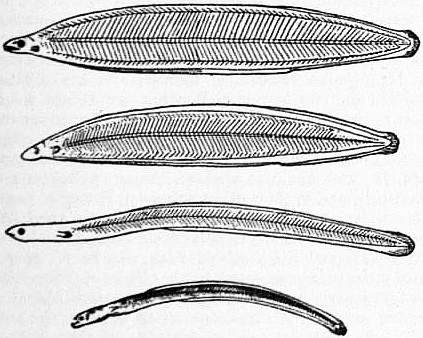
Leptocephali. (By permission of J. & A. Churchill.)
A group of peculiar small fishes were, however, known which were called Leptocephali, from the small proportional size of the head. The first of these described was captured in 1763 near Holyhead, and became the type of L. Morrisii, other specimens of which have been taken either near the shore or at the surface of the sea. Other forms placed in the same genus had been taken by surface fishing in the Mediterranean and in tropical ocean currents. The chief peculiarities of Leptocephali, in addition to the smallness of the head, are their ribbon-like shape and their glassy transparency during life. The body is flattened from side to side, and broad from the dorsal to the ventral edge. Like the eels, they are destitute of pelvic fins and no generative organs have been observed in them (see fig.).
In 1864 the American naturalist, T. N. Gill, published the conclusion that L. Morrisii was the young or larva of the conger, and Leptocephali generally the young stages of species of Muraenidae. In 1886 this conclusion was confirmed from direct observation by Yves Delage, who kept alive in a tank at Roscoff a specimen of L. Morrisii, and saw it gradually transformed into a young conger. From 1887 to 1892 Professor Grassi and Dr Calandruccio carried on careful and successful researches into the development of the Leptocephali at Catania, in Sicily. The specimens were captured in considerable numbers in the harbour, and the transformation of L. Morrisii into young conger, and of various other forms of Leptocephalus into other genera of Muraenidae, such as Muraena, Congromuraena and Ophichthys, was observed. In 1894 the same authors published the announcement that another species of Leptocephalus, namely, L. brevirostris, was the larva of the common eel. This larval form was captured in numbers with other Leptocephali in the strong currents of the Strait of Messina. In the metamorphosis of all Leptocephali a great reduction in size occurs. The L. brevirostris reaches a length of 8 cm., or a little more than 2½ in., while the perfectly-formed young eel is 2 in. long or a little more.
The Italian naturalists have also satisfied themselves that certain pelagic fish eggs originally described by Raffaele at Naples are the eggs of Muraenidae, and that among them are the eggs of Conger and Anguilla. They believe that these eggs, although free in the water, remain usually near the bottom at great depths, and that fertilization takes place under similar conditions. No fish eggs of the kind to which reference is here made have yet been obtained on the British coasts, although conger and eels are so abundant there. Raffaele described and figured the larva newly hatched from one of the eggs under consideration, and it is evident that this larva is the earliest stage of a Leptocephalus.
Although young eels, some of them more or less flat and transparent, are common enough on the coasts of Great Britain and north-western Europe in spring, neither eggs nor specimens of Leptocephalus brevirostris have yet been taken in the North Sea, English Channel or other shallow waters in the neighbourhood of the British Islands, or in the Baltic. Marked eels have been proved to migrate from the inmost part of the Baltic to the Kattegat. Recently, however, search has been made for the larvae in the more distant and deeper portions of the Atlantic Ocean. In May 1904 a true larval specimen was taken at the surface south-west of the Faeroe Islands, and another was taken 40 m. north by west of Achill Head, Ireland. In 1905 numbers were taken in deep water in the Atlantic. The evidence at present available indicates that the spawning of mature eels takes place beyond the 100 fathom line, and that the young eels which reach the coast are already a year old. As eels, both young and old, are able to live for a long time out of water and have the habit of travelling at night over land in wet grass and in damp weather, there is no difficulty in explaining their presence in wells, ponds or other isolated bodies of fresh water at any distance from the sea.
See “The Eel Question,” Report U.S. Commissioner of Fisheries for 1879 (Washington, 1882); J. T. Cunningham, “Reproduction and Development of the Conger,” Journ. Mar. Biol. Assn. vol. ii.; C. G. J. Petersen, Report Dan. Biol. Station, v. (1894); G. B. Grassi, Quart. Journ. Mic. Sci. vol. xxxix. (1897).
(J. T. C.)
EFFENDI (a Turkish word, corrupted from the Gr. αὐθέντης, a lord or master), a title of respect, equivalent to the English “sir,” in the Turkish empire and some other eastern countries. It follows the personal name, when that is used, and is generally given to members of the learned professions, and to government officials who have no higher rank, such as Bey, Pasha, &c. It may also indicate a definite office, as Hakim effendi, chief physician to the sultan. The possessive form effendim (my master) is used by servants and in formal intercourse.
EFFIGIES, MONUMENTAL. An “effigy” (Lat. effigies, from effingere, to fashion) is, in general, a material image or likeness of a person; and the practice of hanging or burning people “in effigy,” i.e. their semblance only, preserves the more general sense of the word. Such representations may be portraits, caricatures or models. But, apart from general usages of the term (see e.g. Wax Figures), it is more particularly applied in the history of art to a particular class of sculptured figures, in the flat or the round, associated with Christian sepulchral monuments, dating from the 12th century. The earliest of these attempts at commemorative portraiture were executed in low relief upon coffin-lids of stone or purbeck marble, some portions of the designs for the most part being executed by means of incised lines, cut upon the raised figure. Gradually, with the increased size and the greater architectural dignity of monumental structures, effigies attained to a high rank as works of art, so that before the close of the 13th century very noble examples of figures of this order are found to have been executed in full relief; and, about the same period, similar figures also began to be engraved, either upon monumental slabs of stone or marble, or upon plates of metal, which were affixed to the surfaces of slabs that were laid in the pavements of churches.
Engraved plates of this class, known as “Brasses” (see Brasses, Monumental), continued in favour until the era of the Reformation, and in recent times their use has been revived. It seems probable that the introduction and the prevalence of flat engraved memorials, in place of commemorative effigies in relief, was due, in the first instance, to the inconvenience resulting from increasing numbers of raised stones on the pavement of churches; while the comparatively small cost of engraved plates, their high artistic capabilities, and their durability, combined to secure for them the popularity they unquestionably enjoyed. If considerably less numerous than contemporary incised slabs and engraved brasses, effigies sculptured in relief—with some exceptions in full relief—continued for centuries to constitute the most important features in many medieval monuments. In the 13th century, their origin being apparently derived from the endeavour to combine a monumental effigy with a monumental cross upon the same sepulchral stone (whether in sculpture or by incised lines), parts only of the human figure sometimes were represented, such as the head or bust, and occasionally also the feet; in some of the early examples of this curious class the cross symbol was not introduced, and after awhile half-length figures became common.
Except in very rare instances, that most important element, genuine face-portraiture, is not to be looked for, in even the finest sculptured effigies, earlier than about the middle of the 15th century. In works of the highest order of art, indeed, the memorials of personages of the most exalted rank, effigies from an early period in their existence may be considered occasionally to have been portraits properly so called; and yet even in such works as these an approximately correct general resemblance but too frequently appears to have been all that was contemplated or desired. At the same time, in the earliest monumental effigies we possess contemporary examples of vestments, costume,1 armour, weapons, royal and knightly insignia, and other personal appointments and accessories, in all of which accurate fidelity has been certainly observed with scrupulous care and minute exactness. Thus, since the monumental effigies of England are second to none in artistic merit, while they have been preserved in far greater numbers, and generally in better condition than those in other countries, they represent in unbroken continuity an unrivalled series of original personal representations of successive generations, very many of them being, in the most significant acceptation of that term, veritable contemporaneous portraits.
Once esteemed to be simply objects of antiquarian curiosity, and either altogether disregarded or too often subjected to injurious indignity, the monumental effigies in England long awaited the formation of a just estimate of their true character and their consequent worth in their capacity as authorities for face-portraiture. In the original contract for the construction of the monument at Warwick to Richard Beauchamp, the fifth earl, who died in 1439, it is provided that an effigy of the deceased noble should be executed in bronze gilt, with all possible care, by the most skilful and experienced artists of the time; and the details of the armour and the ornaments of the figure are specified with minute precision. It is remarkable, however, that the effigy itself is described only in the general and indefinite terms—“an image of a man armed.” There is no provision that the effigy should be “an image” of the earl; and much less is anything said as to its being such a “counterfeit presentment” of the features and person of the living man, as the contemporaries of Shakespeare had learned to expect in what they would accept as true portraiture. The effigy, almost as perfect as when it left the sculptor’s hands, still bears witness, as well to the conscientious care with which the conditions of the contract were fulfilled, as to the eminent ability of the artists employed. So complete is the representation of the armour, that this effigy might be considered actually to have been equipped in the earl’s own favourite suit of the finest Milan steel. The cast of the figure also was evidently studied from what the earl had been when in life, and the countenance is sufficiently marked and endowed with the unmistakable attributes of personal character. Possibly such a resemblance may have been the highest aim in the image-making of the period, somewhat before the middle of the 15th century. Three-quarters of a century later, a decided step towards fidelity in true portraiture is shown to have been taken, when, in his will (1510 a.d.), Henry VII. spoke of the effigies of himself and of his late queen, Elizabeth of York, to be executed for their monument, as “an image of our figure and another of hers.” The existing effigies in the Beauchamp chapel and in Henry VII.’s chapel, with the passages just quoted from the contract made by the executors of the Lancastrian earl, strikingly illustrate the gradual development of the idea of true personal portraiture in monumental effigies, during the course of the 15th and at the commencement of the 16th century in England.
Study of the royal effigies still preserved must commence in Worcester Cathedral with that of King John. This earliest example of a series of effigies of which the historical value has never yet been duly appreciated is rude as a work of art, and yet there is on it the impress of such individuality as demonstrates that the sculptor did his best to represent the king. Singularly fine as achievements of the sculptor’s art are the effigies of Henry III., Queen Eleanor of Castile, and her ill-fated son Edward II., the two former in Westminster Abbey, the last in Gloucester cathedral; and of their fidelity also as portraits no doubt can be entertained. In like manner the effigies of Edward III. and his queen Philippa, and those of their grandson Richard II. and his first consort, Anne of Bohemia (all at Westminster), and of their other grandson, Henry of Lancaster, with his second consort, Joan of Navarre, at Canterbury—all convince us that they are true portraits. Next follow the effigies of Henry VII. and Elizabeth of York,—to be succeeded, and the royal series to be completed, by the effigies of Queen Elizabeth and Mary Stuart, all of them in Westminster Abbey. Very instructive would be a close comparison between the two last-named works and the painted portraits of the rival queens, especially in the case of Mary, the pictures of whom differ so remarkably from one another.
As the 15th century advanced, the rank of the personage represented and the character of the art that distinguishes any effigy goes far to determine its portrait qualities. Still later, when more exact face-portraiture had become a recognized element, sculptors must be supposed to have aimed at the production of such resemblance as their art would enable them to give to their works; and accordingly, when we compare effigies with painted portraits of the same personages, we find that they corroborate one another. The prevalence of portraiture in the effigies of the 16th and 17th centuries, when their art generally underwent a palpable decline, by no means raises all works of this class, or indeed the majority of them, to the dignity of true portraits; on the contrary, in these effigies, as in those of earlier periods, it is the character of the art in each particular example that affects its merit, value and authority as a portrait. In judging of these latter effigies, however, we must estimate them by the standard of art of their own era; and, as a general rule, the effigies that are the best as works of art in their own class are the best also and the most faithful in their portraiture. The earlier effigies, usually produced without any express aim at exact portraiture, as we now employ that expression, have nevertheless strong claims upon our veneration. Often their sculpture is very noble; and even when they are rudest as works of art, there is rarely lacking a rough grandeur about them, as exhibited in the fine bold figure of Fair Rosamond’s son, Earl William of the Long Sword, which reposes in such dignified serenity in his own cathedral at Salisbury. These effigies may not bring us closely face to face with remote generations, but they do place before us true images of what the men and women of those generations were.
Observant students of monumental effigies will not fail to appreciate the singular felicity with which the medieval sculptors adjusted their compositions to the recumbent position in which their “images” necessarily had to be placed. Equally worthy of notice is the manner in which many monumental effigies, particularly those of comparatively early date, are found to have assumed an aspect neither living nor lifeless, and yet impressively life-like. The sound judgment also, and the good taste of those early sculptors, were signally exemplified in their excluding, almost without exception, the more extravagant fashions in the costume of their era from their monumental sculpture, and introducing only the simpler but not less characteristic styles of dress and appointments. Monumental effigies, as commonly understood, represent recumbent figures, and the accessories of the effigies themselves have been adjusted to that position. With the exceptions when they appear on one side resting on the elbow (as in the case of Thomas Owen (d. 1598) and Sir Thomas Heskett (d. 1605), both in Westminster Abbey), these effigies lie on their backs, and as a general rule (except in the case of episcopal figures represented in the act of benediction, or of princes and warriors who sometimes hold a sceptre or a sword) their hands are uplifted and conjoined as in supplication. The crossed-legged attitude of numerous armed effigies of the era of mail-armour has been supposed to imply the personages so represented to have been crusaders or Knights of the Temple; but in either case the supposition is unfounded and inconsistent with unquestionable facts. Much beautiful feeling is conveyed by figures of ministering angels being introduced as in the act of supporting and smoothing the pillows or cushions that are placed in very many instances to give support to the heads of the recumbent effigies. The animals at the feet of these effigies, which frequently have an heraldic significance, enabled the sculptors, with equal propriety and effectiveness, to overcome one of the special difficulties inseparable from the recumbent position. In general, monumental effigies were carved in stone or marble, or cast in bronze, but occasionally they were of wood: such is the effigy of Robert Curthose, son of William I. (d. 1135), whose altar tomb in Gloucester cathedral was probably set up about 1320.
In addition to recumbent statues, upright figures must receive notice here, especially those set in wall-monuments in churches mainly. These usually consisted in half-length figures, seen full-face, placed in a recess within an architectural setting more or less elaborate. They belong mainly to the 16th and 17th centuries. Among the many examples in old St Paul’s cathedral (destroyed in the Great Fire of 1666) were those of Dean Colet (d. 1519), William Aubrey (1595) and Alexander Nowell (d. 1601). In St Giles’s, Cripplegate, is the similarly designed effigy of John Speed (d. 1629); while that of John Stow (d. 1605) is a full-length, seated figure. This, like the figure of Thomas Owen, is in alabaster, but since its erection has always been described as terra-cotta—a material which came into considerable favour for the purpose of busts and half-lengths towards the end of the 16th century, imported, of course, from abroad. Sometimes the stone monuments were painted to resemble life, as in the monuments to Shakespeare and John Combe (the latter now over-painted white), in Holy Trinity Church, Stratford-on-Avon.
Bibliography.—Among the more noteworthy publications are the following: Monumental Effigies in Great Britain (Norman Conquest to Henry VIII.), by C. A. Stothard, folio (London, 1876); The Recumbent Monumental Effigies in Northamptonshire, by A. Hartshorne (4to, London, 1867-1876); Sepulchral Memorials (Northamptonshire), by W. H. Hyett (folio, London, 1817); Ancient Sepulchral Effigies and Monumental Sculpture of Devon, by W. H. H. Rogers (4to, Exeter, 1877); The Ancient Sepulchral Monuments of Essex, ed. by C. M. Carlton (4to, Chelmsford, 1890); and other works dealing with the subject according to counties. Of particular value is the Report of the Sepulchral Monuments Committee of the Society of Antiquaries, laboriously compiled at the request of the Office of Works, arranged (1) personally and chronologically, and (2) locally (1872).
(C. B.; M. H. S.)
1 It is well known that the costume of effigies nearly always represented what was actually worn by the remains of the person commemorated, when prepared for interment and when lying in state; and, in like manner, the aspect of the lifeless countenance, even if not designedly reproduced by medieval “image” makers, may long have exercised a powerful influence upon their ideas of consistent monumental portraiture.
EGAN, PIERCE (1772-1849), English sporting writer, was born in London in 1772. He began life as sporting reporter for the newspapers, and was soon recognized as the best of his day. In 1814 he wrote, set and printed a book about the relations of the prince regent (afterwards George IV.) and Miss Robinson, called The Mistress of Royalty, or the Loves of Florizel and Perdita. But his best-known work is Life in London, or Days and Nights of Jerry Hawthorne and his Elegant Friend Corinthian Tom (1821), a book describing the amusements of sporting men, with illustrations by Cruikshank. This book took the popular fancy and was one of Thackeray’s early favourites (see his Roundabout Papers). It was repeatedly imitated, and several dramatic versions were produced in London. A sequel containing more of country sports and misadventures probably suggested Dickens’s Pickwick Papers. In 1824 Pierce Egan’s Life in London and Sporting Guide was started, a weekly newspaper afterwards incorporated with Bell’s Life. Among his numerous other books are Boxiana (1818), Life of an Actor (1824), Book of Sports (1832), and the Pilgrims of the Thames (1838). Egan died at Pentonville on the 3rd of August 1849.
His son, Pierce Egan (1814-1880), illustrated his own and his father’s books, and wrote a score of novels of varying merit, of which The Snake in the Grass (1858) is perhaps the best.
EGBO, a secret society flourishing chiefly among the Efiks of the Calabar district, West Africa. Egbo or Ekpé is a mysterious spirit who lives in the jungle and is supposed to preside at the ceremonies of the society. Only males can join, boys being initiated about the age of puberty. Members are bound by oath of secrecy, and fees on entrance are payable. The Egbo-men are ranked in seven or nine grades, for promotion to each of which fresh initiation ceremonies, fees and oaths are necessary. The society combines a kind of freemasonry with political and law-enforcing aims. For instance any member wronged in an Egbo district, that is one dominated by the society, has only to address an Egbo-man or beat the Egbo drum in the Egbo-house, or “blow Egbo” as it is called, i.e. sound the Egbo horn before the hut of the wrong-doer, and the whole machinery of the society is put in force to see justice done. Formerly the society earned as bad a name as most secret sects, from the barbarous customs mingled with its rites; but the British authorities have been able to make use of it in enforcing order and helping on civilization. The Egbo-house, an oblong building like the nave of a church, usually stands in the middle of the villages. The walls are of clay elaborately painted inside and ornamented with clay figures in relief. Inside are wooden images, sometimes of an obscene nature, to which reverence is paid. Much social importance attaches to the highest ranks of Egbo-men, and it is said that very large sums, sometimes more than a thousand pounds, are paid to attain these dignities. At certain festivals in the year the Egbo-men wear black wooden masks with horns which it is death for any woman to look on.