VOLUME IX SLICE I Edwardes to Ehrenbreitstein (continued 4)
Reading edition
Elaborate ceremonies are observed at funerals. Immediately on death the corpse is turned towards Mecca, and the women of the household, assisted by hired mourners, commence their peculiar wailing, while fikis recite portions of the Koran. The funeral takes place on the day of the death, if that happen in the morning; otherwise on the next day. The corpse, having been washed and shrouded, is placed in an open bier, covered with a cashmere shawl, in the case of a man; or in a closed bier, having a post in front, on which are placed feminine ornaments, in that of a woman or child. The funeral procession is headed by a number of poor, and generally blind, men, chanting the profession of the faith, followed by male friends of the deceased, and a party of schoolboys, also chanting, generally from a poem descriptive of the state of the soul after death. Then follows the bier, borne on the shoulders of friends, who are relieved by the passers-by, such an act being deemed highly meritorious. Behind come the women relatives and the hired wailers. On the way to the cemetery the corpse is generally carried to some revered mosque. Here the funeral service is performed by the imam, and the procession then proceeds to the tomb. In the burials of the rich, water and bread are distributed to the poor at the grave; and sometimes a buffalo or several buffaloes are slaughtered there, and the flesh given away. The tomb is a vault, surmounted by an oblong stone monument, with a stele at the head and feet; and a cupola, supported by four walls, covers the whole in the case of sheikhs’ tombs and those of the wealthy. During the night following the interment, called the Night of Desolation, or that of Solitude, the soul being believed to remain with the body that one night, fikis are engaged at the house of the deceased to recite various portions of the Koran, and, commonly, to repeat the first clause of the profession of the faith, “There is no God but God,” three thousand times. The women alone put on mourning attire, by dyeing their veils, shirts, &c., dark blue, with indigo; and they stain their hands, and smear the walls, with the same colour. Everything in the house is also turned upside down. The latter customs are not, however, observed on the death of an old man. At certain periods after the burial, a khatmeh, or recitation of the whole of the Koran, is performed, and the tomb is visited by the women relations and friends of the deceased. The women of the peasants of Upper Egypt perform strange dances, &c., at funerals, which are regarded partly as relics of ancient Egyptian customs.
The harem system of appointing separate apartments to the women, and secluding them from the gaze of men, is observed in Egypt as in other Moslem countries, but less strictly. The women of an Egyptian household in which old customs are maintained never sit in the presence of the master, but attend him at his meals, and are treated in every respect as inferiors. The mother, however, forms a remarkable exception to this rule; in rare instances, also, a wife becomes a companion to her husband. On the other hand, if a pair of women’s shoes are placed outside the door of the harem apartments, they are understood to signify that female visitors are within, and a man is sometimes thus excluded from the upper portion of his own house for many days. Ladies of the upper or middle classes lead a life of extreme inactivity, spending their time at the bath, which is the general place of gossip, or in receiving visits, embroidering, and the like, and in absolute dolce far niente. Both sexes are given to licentiousness.
The principal meals are breakfast, about an hour after sunrise; dinner, or the mid-day meal, at noon; and supper, which is the chief meal of the day, a little after sunset. Pastry, sweetmeats and fruit are highly esteemed. Coffee is taken at all hours, and is, with a pipe, presented at least once to each guest. Tobacco is the great luxury of the men of all classes in Egypt, who begin and end the day with it, and generally smoke all day with little intermission. Many women, also, especially among the rich, adopt the habit. The smoking of hashish, though illegal, is indulged in by considerable numbers of people. Men who can afford to keep a horse, mule or ass are very seldom seen to walk. Ladies ride asses and sit astride. The poorer classes cannot fully observe the harem system, but the women are in general carefully veiled. Some of them keep small shops, and all fetch water, make fuel, and cook for their households. Domestic slavery lingers but is moribund. The majority of the slaves are negresses employed in household duties.
In social intercourse the Egyptians observe many forms of salutation and much etiquette; they are very affable, and readily enter into conversation with strangers. Their courtesy and dignity of manner are very striking, and are combined with ease and a fluency of discourse. They have a remarkable quickness of apprehension, a ready wit, a retentive memory, combined, however, with religious pride and hypocrisy, and a disregard for the truth. Their common discourse is full of asseverations and expressions respecting sacred things. They entertain reverence for their Prophet; and the Koran is treated with the utmost respect—never, for example, being placed in a low situation—and this is the case with everything they esteem holy. They are fatalists, and bear calamities with surprising resignation. Their filial piety and respect for the aged have been mentioned, and benevolence and charity are conspicuous in their character. Humanity to animals is another virtue, and cruelty is openly discountenanced in the streets. Their affability, cheerfulness and hospitality are remarkable, as well as frugality and temperance in food and drink, and honesty in the payment of debt. Their cupidity is mitigated by generosity; their natural indolence by the necessity, especially among the peasantry, to work hard to gain a livelihood. Egyptians, however, are as a rule suspicious of all not of their own creed and country. Murders and other grave crimes are rare, but petty larcenies are very common.
The amusements of the people are generally not of a violent kind, being in keeping with their sedentary habits and the heat of the climate. The bath is a favourite resort of both sexes and all classes. They are acquainted with chess, draughts, backgammon, and other games, among which is one peculiar to themselves, called Mankalah, and played with cowries. Notwithstanding its condemnation by Mahomet, music is the most favourite recreation of the people; the songs of the boatmen, the religious chants, and the cries in the streets are all musical. There are male and female musical performers; the former are both instrumental and vocal, the latter (called ‘Almeh, pl. ‘Awālim) generally vocal. The ‘Awālim are, as their name (“learned”) implies, generally accomplished women, and should not be confounded with the Ghawāzi, or dancing-girls. There are many kinds of musical instruments. The music, vocal and instrumental, is generally of little compass, and in the minor key; it is therefore plaintive, and strikes a European ear as somewhat monotonous, though often possessing a simple beauty, and the charm of antiquity, for there is little doubt that the favourite airs have been handed down from remote ages. The Ghawāzi (sing. Ghāzīa) form a separate class, very similar to the gipsies. They intermarry among themselves only, and their women are professional dancers. Their performances are often objectionable and are so regarded by many Egyptians. They dance in public, at fairs and religious festivals, and at private festivities, but, it is said, not in respectable houses. Mehemet Ali banished them to Esna, in Upper Egypt; and the few that remained in Cairo called themselves ‘Awālim, to avoid punishment. Many of the dancing-girls of Cairo to-day are neither ‘Awālim nor Ghawāzi, but women of the very lowest class whose performances are both ungraceful and indecent. A most objectionable class of male dancers also exists, who imitate the dances of the Ghawāzi, and dress in a kind of nondescript female attire. Not the least curious of the public performances are those of the serpent-charmers, who are generally Rifā’iā (Saadīa) dervishes. Their power over serpents has been doubted, yet their performances remain unexplained; they, however, always extract the fangs of venomous serpents. Jugglers, rope-dancers and farce-players must also be mentioned. In the principal coffee-shops of Cairo are to be found reciters of romances, surrounded by interested audiences.
The periodical public festivals are exceedingly interesting, but many of the remarkable observances connected with them are passing away. The first ten days of the Mahommedan year are held to be blessed, and especially the tenth; Public festivals. and many curious practices are observed on these days, particularly by the women. The tenth day, being the anniversary of the martyrdom of Hosain, the son of Ali and grandson of the Prophet, the mosque of the Hasanēn at Cairo is thronged to excess, mostly by women. In the evening a procession goes to the mosque, the principal figure being a white horse with white trappings, upon which is seated a small boy, the horse and the lad, who represents Hosain, being smeared with blood. From the mosque the procession goes to a private house, where a mullah recites the story of the martyrdom. Following the order of the lunar year, the next festival is that of the Return of the Pilgrims, which is the occasion of great rejoicing, many having friends or relatives in the caravan. The Mahmal, a kind of covered litter, first originated by Queen Sheger-ed-Dur, is brought into the city in procession, though not with as much pomp as when it leaves with the pilgrims. These and other processions have lost much of their effect since the extinction of the Mamelukes, and the gradual disuse of gorgeous dress for the retainers of the officers of state. A regiment of regular infantry makes but a sorry substitute for the splendid cavalcade of former times. The Birth of the Prophet (Molid en-Nebi), which is celebrated in the beginning of the third month, is the greatest festival of the whole year. For nine days and nights Cairo has more the aspect of a fair than of a city keeping a religious festival. The chief ceremonies take place in some large open spot round which are erected the tents of the khedive, of great state officials, and of the dervishes. Next in time, and also in importance, is the Molid El-Hasanēn, commemorative of the birth of Hosain, and lasting fifteen days and nights; and at the same time is kept the Molid of al-Ṣāliḥ Ayyūb, the last sovereign but two of the Ayyubite dynasty. In the seventh month occur the Molid of the sayyida Zenab, and the commemoration of the Miarāg, or the Prophet’s miraculous journey to heaven. Early in the eighth month (Sha’bān), the Molid of the imam Shāfi‘i is observed; and the night of the middle of that month has its peculiar customs, being held by the Moslems to be that on which the fate of all living is decided for the ensuing year. Then follows Ramadān, the month of abstinence, a severe trial to the faithful; and the Lesser Festival (Al-’id aṣ-ṣaghīr), which commences Shawwāl, is hailed by them with delight. A few days after, the Kiswa, or new covering for the Ka’ba at Mecca, is taken in procession from the citadel, where it is always manufactured, to the mosque of the Hasanēn to be completed; and, later, the caravan of pilgrims departs, when the grand procession of the Mahmal takes place. On the tenth day of the last month of the year the Great Festival (Al-’id al-kabīr), or that of the Sacrifice (commemorating the willingness of Ibrahim to slay his son Ismail—according to the Arab legend), closes the calendar. The Lesser and Great Festivals are those known in Turkish as the Bairam (q.v.).
The rise of the Nile is naturally the occasion of annual customs, some of which are doubtless relics of antiquity; these are observed according to the Coptic calendar. The commencement of the rise is commemorated on the night of the 11th of Baūna, the 17th of June, called that of the Drop (Lelet-en-Nukta), because a miraculous drop is then supposed to fall and cause the swelling of the river. The real rise begins at Cairo about the summer solstice, or a few days later, and early in July a crier in each district of the city begins to go his daily rounds, announcing, in a quaint chant, the increase of water in the nilometer of the island of Rōda. When the river has risen 20 or 21 ft., he proclaims the Wefā en-Nil, “Completion” or “Abundance of the Nile.” On the following day the dam which closed the canal of Cairo was cut with much ceremony. The canal having been filled up in 1897 the ceremony has been much modified, but a brief description of what used to take place may be given. A pillar of earth before the dam is called the “Bride of the Nile,” and Arab historians relate that this was substituted, at the Moslem conquest, for a virgin whom it was the custom annually to sacrifice, to ensure a plentiful inundation. A large boat, gaily decked out, representing that in which the victim used to be conveyed, was anchored near, and a gun on board fired every quarter of an hour during the night. Rockets and other fireworks were also let off, but the best, strangely, after daybreak. The governor of Cairo attended the ceremony, with the cadi and others, and gave the signal for the cutting of the dam. As soon as sufficient water had entered, boats ascended the canal to the city. The crier continues his daily rounds, with his former chant, excepting on the Coptic New Year’s Day, when the cry of the Wefā is repeated, until the Salib, or Discovery of the Cross, the 26th or 27th of September, at which period, the river having attained its greatest height, he concludes his annual employment with another chant, and presents to each house some limes and other fruit, and dry lumps of Nile mud.
The period of the hot winds, called the khamsin, that is, “the fifties,” is calculated from the day after the Coptic Easter, and terminates on the day of Pentecost, and the Moslems observe the Wednesday preceding this period, called “Job’s Wednesday,” as well as its first day, when many go into the country from Cairo, “to smell the air.” This day is hence called Shem en-Nesim, or “the smelling of the zephyr.” The Ulema observe the same custom on the first three days of the spring quarter.
Tombs of saints abound, one or more being found in every town and village; and no traveller up the Nile can fail to remark how every prominent hill has the sepulchre of its patron saint. The great saints of Egypt are the imam Ash-Shāfi‘i, founder of the persuasion called after him, the sayyid Aḥmad al-Baiḍāwī, and the sayyid Ibrāhīm Ed-Desūkī, both of whom were founders of orders of dervishes. Al-Baiḍāwī, who lived in the 13th century a.d., is buried at the town of Tanta, in the Delta, and his tomb attracts many thousands of visitors at each of the three festivals held yearly in his honour; Ed-Desūkī is also much revered, and his festivals draw together, in like manner, great crowds to his birthplace, the town of Desūk. But, besides the graves of her native saints, Egypt boasts of those of several members of the Prophet’s family, the tomb of the sayyida Zeyneb, daughter of ‘Ali, that of the sayyida Sekeina, daughter of Hosain, and that of the sayyida Nefisa, great-granddaughter of Hasan, all of which are held in high veneration. The mosque of the Hasanēn (or that of the “two Hasans”) is the most reverenced shrine in the country, and is believed to contain the head of Hosain. Many orders of Dervishes live in Egypt, the following being the most celebrated:—(1) the Rifā’iā, and their sects the ‘Ilwānīa and Saadīa; (2) the Qādirīa (Kāhirīa), or howling dervishes; (3) the Ahmedīa, or followers of the sayyid Aḥmad al-Baiḍāwī, and their sects the Beyūmīa (known by their long hair), Shinnawīa, Sharawīa and many others; and (4) the Barāmīa, or followers of the sayyid Ibrāhīm Ed-Desūkī. These are all presided over by a direct descendant of the caliph Abu Bekr, called the Sheikh El-Bekri. The Saadīa are famous for charming and eating live serpents, &c., and the ‘Ilwānīa for eating fire, glass, &c. The Egyptians firmly believe in the efficacy of charms, a belief associated with that in an omnipresent and over-ruling providence. Thus the doors of houses are inscribed with sentences from the Koran, or the like, to preserve from the evil eye, or avert the dangers of an unlucky threshold; similar inscriptions may be observed over most shops, while almost every one carries some charm about his person. The so-called sciences of magic, astrology and alchemy still flourish.
Authorities.—The standard authority for the Moslem Egyptians is E. W. Lane’s Manners and Customs of the Modern Egyptians, first published in 1836. The best edition is that of 1860, edited, with additions, by E. S. Poole. See also B. Saint-John, Village Life in Egypt (2 vols., 1852); S. Lane Poole, Social Life in Egypt (1884); P. Arminjon, L’Enseignement, la doctrine, el la vie dans les universités musulmanes d’Égypte (Paris, 1907). For the language see J. S. Willmore, The Spoken Arabic of Egypt (2nd ed., London, 1905); Spitta Bey, Grammatik des arabischen Vulgardialektes von Ägypten, Contes arabes modernes (Leiden, 1883). For statistical information consult the reports on the censuses of 1897 and 1907, published by the Ministry of the Interior, Cairo, in 1898 and 1909.
(E. S. P.; S. L.-P.; F. R. C.)
Finance.
The important part which the financial arrangements have played in the political and social history of Egypt since the accession of Ismail Pasha in 1863 is shown in the section History of this article. Here it is proposed to trace the steps by which Egypt, after having been brought to a state of bankruptcy, passed through a period of great stress, and finally attained prosperity and a large measure of financial autonomy.
In 1862 the foreign debt of Egypt stood at £3,292,000. With the accession of Ismail (q.v.) there followed a period of wild extravagance and reckless borrowing accompanied by the extortion of every piastre possible from the fellahin. The real state of affairs was disclosed in the report of Mr Stephen Cave, a well-known banker, who was sent by the British government in December 1875 to inquire into the situation. The Cave report showed that Egypt suffered from “the ignorance, dishonesty, waste and extravagance of the East” and from “the vast expense caused by hasty and inconsiderate endeavours to adopt the civilization of the West.” The debtor and creditor account of the state from 1864 to 1875 showed receipts amounting to £148,215,000. Of this sum over £94,000,000 had been obtained from revenue and nearly £4,000,000 by the sale of the khedive’s shares in the Suez Canal to Great Britain. The rest was credited to: loans £31,713,000, floating debt £18,243,000. The cash which reached the Egyptian treasury from the loans and floating debt was far less than the nominal amount of such loans, none of which cost the Egyptian government less than 12% per annum. When the expenditure during the same period was examined the extraordinary fact was disclosed that the sum raised by revenue was only three millions less than that spent on administration, tribute and public works, including a sum of £10,500,000, described as “expenses of questionable utility or policy.” The whole proceeds of the loans and floating debt had been absorbed in payment of interest and sinking funds, with the exception of £16,000,000 debited to the Suez Canal. In other words, Egypt was burdened with a debt of £91,000,000—funded or floating—for which she had no return, for even from the Suez Canal she derived no revenue, owing to the sale of the khedive’s shares.
Soon after Mr Cave’s report appeared (March 1876), default took place on several of the loans. Nearly the whole of the debt, it should be stated, was held in England or France, and at the instance of French financiers the stoppage of payment was followed by a scheme to unify the debt. This scheme included the distribution of a bonus of 25% to holders of treasury bonds. These bonds had then reached a sum exceeding £20,000,000 and were held chiefly by French firms. The unification scheme was elaborated in a khedivial decree of the 7th of May 1876, but was rendered abortive by the opposition of the British bondholders. Its place was taken by another scheme drawn up by Mr (afterwards Lord) Goschen and M. Joubert, who represented the British and French bondholders respectively. The details of this settlement, promulgated by decree of the 17th of November 1876, need not be given, as it was superseded in 1880. One of the securities devised for the benefit of the bondholders in the abortive scheme of May 1876 was retained in the Goschen-Joubert settlement, and being continued in later settlements grew to be one of the most important institutions in Egypt. This security was the establishment of a Treasury of the Public Debt, known by its French title of Caisse de la Dette, and commonly spoken of simply as “the Caisse.” The duty of this body was to act as receivers of the revenues assigned to the service of the debt. To render their powers effective they were given the right to sue the Egyptian government in the Mixed Tribunals for any breach of engagement to the bondholders.
The Goschen-Joubert settlement was accompanied by guarantees against maladministration by the appointment of an Englishman and a Frenchman to superintend the revenue and expenditure—the “Dual Control”; The Law of Liquidation. while a commission was appointed in 1878 to investigate the condition of the country. The settlement of 1880 was effected on the basis of the proposals made by this commission, and was embodied in the Law of Liquidation of July 1880—after the deposition of Ismail. For the purposes of the new settlement the loans raised by Ismail on his private estates, those known as the Daïra (i.e. “administrations”) and Domains loans, were brought into account. By the Law of Liquidation the floating debt was paid off, the whole debt being consolidated into four large loans, upon which the rate of interest was reduced to a figure which it was considered Egypt was able to bear. The Egyptian debt under this composition was:
Privileged debt £22,609,000
Unified debt 58,018,000
Daïra Sanieh loan 9,513,000
Domains loan 8,500,000
—————
£98,640,000
The rate of interest was, on the Privileged debt and Domains loan, 5%; on the Unified debt and Daïra loan, 4%. Under this settlement the total annual charges on the country amounted to £4,500,000, about half the then revenue of Egypt. These charges included the services of the Privileged and Unified debts, the tribute to Turkey and the interest on the Suez Canal shares held by Great Britain, but excluded the interest on the Daïra and Domains loans, expected to be defrayed by the revenues from the estates on which those loans were secured. The general revenue of Egypt was divided between the bondholders and the government, any surplus on the bondholders’ share being devoted to the redemption of the capital.
The 1880 settlement proved little more lasting than that of 1876. After a brief period of prosperity, the Arabi rising, the riots at Alexandria, and the events generally which led to the British occupation of Egypt in 1882, followed by the losses incurred in the Sudan in the effort to prevent it falling into the hands of the Mahdi, brought Egypt once more to the verge of financial disaster. The situation was an anomalous one. While the revenue assigned to the service of the debt was more than sufficient for the payment of interest and the sinking fund was in full operation, the government found that their share of the revenue was altogether inadequate for the expenses of administration, and they were compelled to borrow on short loans at high rate of interest. Moreover, to make good the losses incurred at Alexandria, and to get money to pay the charges arising out of the Sudan War and the Arabi rebellion, a new loan was essential. On the initiative of Great Britain a conference between the representatives of the great powers and Turkey was held in London, and resulted in the signing of a convention in March 1885. The terms agreed upon in this instrument, known as the London Convention, were embodied in a khedivial decree, which, with some modification in detail, remained for twenty years the organic law under which the finances of Egypt were administered.
The principle of dividing the revenue of the country between the Caisse, as representing the bondholders, and the government was maintained by the London Convention. The revenue assigned to the service of the debt, namely, that derived from the railway, telegraphs, port of Alexandria, customs (including tobacco) and from four of the provinces, remained as before. It was recognized, however, that the non-assigned revenue was Provisions of the London Convention. insufficient to meet the necessary expenses of government, and a scale of administrative expenditure was drawn up. This was originally fixed at £E.5,237,000,6 but subsequently other items were allowed, and in 1904, the last year in which the system described existed, it was £E.6,300,600. The Caisse was authorized, after payment of the coupons on the debt, to make good out of their balance in hand the difference between the authorized expenditure and the non-assigned revenue. If a surplus remained to the Caisse after making good such deficit the surplus was to be divided equally between the Caisse and the government; the government to be free to spend its share as it pleased, while the Caisse had to devote its share to the reduction of the debt. This limitation of administrative expenditure was the cardinal feature and the leading defect of the convention. Those responsible for this arrangement—the most favourable for Egypt that Great Britain could secure—failed to recognize the complete change likely to result from the British occupation of Egypt, and probably regarded that occupation as temporary. The system devised might have been justifiable as a check on a retrograde government, but was wholly inapplicable to a reforming government and a serious obstacle to the attainment of national prosperity. In practice administrative expenditure always exceeded the amount fixed by the convention. Any excess could, however, only be met out of the half-share of the eventual surplus reached in the manner described. Consequently, in order to meet new expenditure necessitated by the growing wants of a country in process of development, just double the amount of revenue had to be raised.
To return to the provisions of the London Convention. The convention left the permanent rate of interest on the debt, as fixed by the Law of Liquidation, unchanged, but to afford temporary relief to the Egyptian exchequer a reduction of 5% on the interest of the debt was granted for two years, on condition that if at the end of that period payment, including the arrears of the two years, was not resumed in full, another international commission was to be appointed to examine into the whole financial situation. Lastly, the convention empowered Egypt to raise a loan of nine millions, guaranteed by all the powers, at a rate of interest of 3%. For the service of this loan—known as the Guaranteed loan—an annuity of £315,000 was provided in the Egyptian budget for interest and sinking fund. The £9,000,000 was sufficient to pay the Alexandria indemnities, to wipe out the deficits of the preceding years, to give the Egyptian treasury a working balance of £E.500,000 and thereby avoid the creation of a fresh floating debt, and to provide a million for new irrigation works. To the wise foresight which, at a moment when the country was sinking beneath a weight of debt, did not hesitate to add this million for expenditure on productive works, the present prosperity of Egypt is largely due.
The provisions of the London Convention did not exhaust the restrictions placed upon the Egyptian government in respect of financial autonomy. These restrictions were of two categories, (1) those independent of the London Convention, (2) those dependent upon that instrument. In the first category came (a) the prohibition to raise a loan without the consent of the Porte. The right to raise loans had been granted to the khedive Ismail in 1873, but was taken away in 1879 by the firman appointing Tewfik khedive. (b) Next came the inability to levy taxes on foreigners without the consent of their respective governments. This last obligation was, in virtue of the Capitulations, applicable to Egypt as part of the Ottoman empire. The only exception, resulting from the Ottoman law under which foreigners are allowed to acquire and hold real property, is the land tax. (All taxes formerly paid by natives and not by foreigners have been abolished in Egypt, but the immunity described constitutes a most serious obstacle to the redistribution of the burden of taxation in a more equitable manner.)
From the purely Egyptian point of view the most powerful restriction in this first category remains to be named. In 1883 the supervision exercised over the finances by French and British controllers was replaced by that of a British official called the financial adviser. The British government has declared that “no financial decision shall be taken without his consent,” a declaration never questioned by the Egyptian government. This restriction, therefore, is at the same time the chief safeguard for the purity of Egypt’s finances.
In the second category of restrictions, namely, those dependent on the London Convention, were the various commissions or boards known as Mixed Administrations and having relations of a quasi-independent character with the ministry of finance. Of these boards by far the most important was the Caisse. As first constituted it consisted of a French, an Austrian, and an Italian member; a British member was added in 1877 and a German and a Russian member in 1885. The revenue assigned to the debt charges was paid direct to the Caisse without passing through the ministry of finance. The assent of the Caisse (as well as that of the sultan) was necessary before any new loan could be issued, and in the course of a few years from its creation this body acquired very extensive powers. Besides the Caisse there was the Railway Board, which administered the railways, telegraphs and port of Alexandria for the benefit of the bondholders, and the Daïra and Domains commissions, which administered the estates mortgaged to the holders of those loans. Each of the three boards last named consisted of an Englishman, a Frenchman and an Egyptian.
During the two years that followed the signing of the London Convention, the financial policy of the Egyptian government was directed to placing the country in a position to resume full payment of the interest on the debt in 1887, and The race against bankruptcy. thereby to avoid the appointment of an international commission. By the exercise of the most rigid economy in all branches this end was attained, though budgetary equilibrium was only secured by a variety of financial expedients, justified by the vital importance of saving Egypt from further international interference. By such means this additional complication was averted, but the struggle to put Egypt in a genuinely solvent position was by no means over. It was not until his report on the financial results of 1888 that Sir Evelyn Baring (afterwards Lord Cromer) was able to inform the British government that the situation was such that “it would take a series of untoward events seriously to endanger the stability of Egyptian finance and the solvency of the Egyptian government.” From this moment the corner was turned, and the era of financial prosperity commenced. The results of the labours of the preceding six years began to manifest themselves with a rapidity which surprised the most sanguine observers. The principal feature of the successive Egyptian budgets of 1890-1894 was the fiscal relief afforded to the population. From 1894 onward more attention was paid than had hitherto been possible to the legitimate demands of the spending departments and to the prosecution of public works. Of these the most notable was the construction (1898-1902) of the Assuan dam, which by bringing more land under cultivation permanently increased the resources of the country and widened the area of taxation.
With the accumulating proofs of the financial stability of the country various changes were made in connexion with the debt charges. With the consent of the powers a General Reserve Fund was created by decree of the 12th of July Reserve funds. 1888, into which was paid the Caisse’s half-share in the eventual surplus of revenue. This fund, primarily intended as a security for the bondholders, might be drawn upon for extraordinary expenditure with the consent of the commissioners of the Caisse. Large sums were so advanced for the purposes of drainage and irrigation and other public works, and in relief of taxation. The defect of this arrangement consisted in the necessity of obtaining the consent of the commissioners—a consent sometimes withheld on purely political grounds. At the same time it is believed that but for the faculty given by the decree of 1888 to spend the General Reserve Fund on public works, the financial system elaborated by the London Convention would have broken down altogether. Between 1888 and 1904 about £10,000,000 was devoted from this fund to public works.
In June 1890 the assent of the powers was obtained to the conversion of the Preference (Privileged), Domains and Daïra loans on the following conditions, imposed at the initiative of the French government:—
1. The employment of the economies resulting from the conversion was to be the subject of future agreement with the powers.
2. The Daïra loan was to be reimbursed at 85%, instead of 80%, as provided by the Law of Liquidation.
3. The sales of Domains and Daïra lands were to be restricted to £E.300,000 a year each, thus prolonging the period of liquidation of those estates.
The interest on the Preference stock was reduced from 5 to 3½%, and on the Domains from 5 to 4¼%. As regards the Daïra loan, there was no apparent reduction in the rate of interest, which remained at 4%, but the bondholders received £85 of the new stock for every £100 of the old. The capital of the debt was increased by £1,945,000 by these conversions, while the annual economy to the Egyptian government amounted at the time of the conversion to £E.348,000. Further, an engagement was entered into that there should be no reimbursement of the loans till 1905 for the Preference and Daïra, and 1908 for the Domains. By an arrangement concluded in June 1898, between the Egyptian government and a syndicate, the unsold balance of the Daïra estates was taken over by the syndicate in October 1905, for the amount of the debt remaining, when the Daïra loan ceased to exist. The fund formed by the accumulation of the economies resulting from the conversion of the Privileged, Daïra and Domains loan was known as the Conversion Economies Fund. The fund could not be used for any purpose without the consent of the powers, and the money paid into it was invested by the Caisse in Egyptian stock. The fund therefore acted as a very expensive sinking fund, the market price of the stock purchased being above par. Up to 1904 the consent of the powers to the employment of this fund for any purpose of public utility was withheld. On the 31st of December of that year the fund amounted to £E.6,031,000. It may be added that besides the General Reserve Fund and the Conversion Economies Fund, there existed another fund called the Special Reserve Fund. This was constituted in 1886 and was chiefly made up of the net savings of the Egyptian government on its share of the annual surpluses from revenue. Of the three funds this last-named was the only one at the absolute disposal of the government. The whole of the extraordinary expenditure of the Sudan campaigns of 1896-1898, with the exception of £800,000 granted by the British government, was paid out of this fund—a sum amounting in round figures to £1,500,000.
Notwithstanding all the hampering conditions stated, the prosperity of the country became more manifest each succeeding year. During the four years 1883-1886, both inclusive, the aggregate deficit amounted to £E.2,606,000. In An era of prosperity. 1887 there was practical equilibrium in the budget, in 1888 there was a deficit of £E.53,000. In 1889 there was a surplus of £E.218,000, and from that date onward every year has shown a surplus. In 1895 the surplus exceeded, for the first time, £E.1,000,000. The growth of revenue was no less marked. “In 1883—the first complete year after the British occupation—the revenue was slightly under 9 millions. This sum was collected with difficulty. The revenue steadily rose until, in 1890, the figure of 10 millions was exceeded. In 1897 a figure of over 11 millions was attained. Continuing to rise with ever-increasing rapidity, a revenue of close on 12 millions was collected in 1901 and 1902, in spite of the fact that during the latter of these two years the Nile flood was one of the lowest on record. In 1903 the revenue amounted to 12½ millions, and in 1904 the unprecedented figure of £E.13,906,000 was reached.”7 Yet during this period the amount of direct taxation remitted reached £E.1,900,000 a year. Arrears of land tax to the extent of £E.1,245,000 were cancelled. In indirect taxation the salt tax had been reduced by 40%, the postal, railway and telegraph rates lowered, octroi duties and bridge and lock dues abolished. The only increase of taxation had been on tobacco, on which the duty was raised from P.T. 14 to P.T. 20 per kilogramme. At the same time the house duty, with the consent of the powers, had been imposed on European residents. The fact that during the period under review Egypt suffered very severely from the general fall in the price of commodities makes the prosperity of the country the more remarkable. Had it not been for the great increase of production as the result of improved irrigation and the fiscal relief afforded to landowners, the agricultural depression would have impaired the financial situation. In this connexion it should be stated that during 1899 the reassessment of the land tax, a much-needed reform, was seriously taken in hand. The existing assessment, made before the British occupation, had long been condemned by all competent authorities, but the inherent intricacies and difficulties of the problem had hitherto postponed a solution. After careful study and a preliminary examination of the land, a scheme was passed which has given satisfaction to the landowning community, and which distributes the tax equitably in proportion to the fertility of the soil. The reassessment was completed in 1907.
While the country thus prospered it also suffered greatly from the restrictions imposed by the system of international control. This system produced a great disproportion between the sums available for capital and those available for The cost of internationalism. administrative expenditure. Although the money for public works could be obtained out of grants from the General Reserve Fund, there was no fund from which to provide a sufficient sum to keep those works in order. Moreover, to avoid having to pay half the amount received into the General Reserve Fund the government was compelled to keep certain items of revenue and expenditure out of the accounts altogether—a violation of the principles of sound finance. Then there was the glaring anomaly of allowing the Conversion Economies to accumulate at compound interest in the hands of the commissioners of the Caisse, instead of using the money for remunerative purposes. The net result of internationalism was to impose an extra charge of about £1,750,000 a year on the Egyptian treasury.
All these cumbersome restrictions were swept away by the khedivial decree of the 28th of November 1904, a decree which received the assent of the powers and was the result of the Anglo-French agreement of April 1904 (see § History).Egypt gains financial liberty. The decree did not affect the inability of Egypt to tax foreigners without their consent nor remove the right of Turkey to veto the issue of new loans, but in other respects the financial changes made by it were of a radical character. The main effect was to give to the Egyptian government a free hand in the disposal of its own resources so long as the punctual payment of interest on the debt was assured. The plan devised by the London Convention of fixing a limit to administrative expenditure was abolished. The consent of the Caisse to the raising of a new loan was no longer required. The Caisse itself remained, but shorn of all political and administrative powers, its functions being strictly limited to receiving the assigned revenues and to ensuring the due payment of the coupon. The nature of the assigned revenue was altered, the land tax being substituted for those previously assigned, that tax being chosen as it had a greater character of stability than any other source of revenue. By this means Egypt gained complete control of its railways, telegraphs, the port of Alexandria and the customs, and as a consequence the mixed administration known as the Railway Board ceased to exist. Moreover, it was provided that when the Caisse had received from the land tax the amount needed for the service of the debt, the balance of the tax was to be paid direct to the Egyptian treasury. The Conversion Economies Fund was also placed at the free disposal of the Egyptian government. The General Reserve Fund ceased to exist, but for the better security of the bondholders a reserve fund of £1,800,000 was constituted and left in the hands of the Caisse to be used in the highly improbable event of the land tax being insufficient to meet the debt charges. Moreover, the Caisse started under the new arrangement with a cash balance of £1,250,000. The interest of the money lying in the hands of the Caisse goes towards meeting the debt charges and thus reduces the amount needed from the land tax. The bondholders gained a further material advantage by the consent of the Egyptian government to delay the conversion of the loans, which under previous arrangements they would have been free to do in 1905. It was agreed that there should be no conversion of the Guaranteed or Privileged debts before 1910 and no conversion of the Unified debt until 1912. Such were the chief provisions of the khedivial decree, and in 1905, for the first time, it was possible to draw up the Egyptian budget in accordance with the needs of the country and on perfectly sound principles.
In the system adopted in 1905 and since maintained, recurring and non-recurring expenditure were shown separately, the non-recurring expenditure being termed “special.” At the same time a new General Reserve Fund was created, made up chiefly of the surpluses of the old General Reserve, Special Reserve, and Conversion Economies funds. This new fund started with a capital of £13,376,000 and was replenished by the surpluses of subsequent years, by the interest earned by its temporary investment, and by the sums accruing by the liquidation of the Daïra and Domains loans. During 1905 and 1906 about £3,000,000 was paid into the fund through the liquidation of the Daïra loan. From this fund, which had a balance of over £12,000,000 in 1906, is taken capital expenditure on remunerative public works in Egypt and the Sudan, and while the fund lasts the necessity for any new loan is avoided. The greater freedom of action attained as the result of the Anglo-French declaration of 1904 enabled the Egyptian government to advance simultaneously along the lines of fiscal reform and increased administrative expenditure. Thus in 1906 the salt monopoly was abolished at a cost to the revenue of £175,000, while the reduction of import duties on coal and other fuels, live-stock, &c., involved a further loss of £118,000, and an increase of over £1,000,000 in expenditure was budgeted for. The accounts for 1907 showed a total revenue of £E.16,368,000 and a total expenditure of £E.14,280,000, a surplus of £E.2,088,000. The annual growth of revenue for the previous five years averaged over £E.500,000. About one-third of the annual revenue is derived from the land tax; customs and tobacco duties yield about £3,000,000, and an equal or larger amount is received from railways and other revenue-earning departments. The chief items of ordinary expenditure are tribute and debt charges, the expenses of the civil administration, of the Egyptian army (between £500,000 and £600,000 yearly), of the revenue-earning departments and of pensions.
It will be convenient here to summarize the position of the Egyptian debt at the close of 1905, that is at the period immediately following the liquidation of the Daïra loan. In a previous table it has been shown that under the Law of Liquidation of 1880 the total debt was £98,640,000. In 1883, the first complete year after the British occupation, the capital of the debt—then exclusively held by the public—was £96,457,000. In 1885 the Guaranteed loan, the nominal capital of which was £9,424,000, was issued, and in 1891 the debt reached its maximum figure of £106,802,000. At that period the charge for interest and sinking fund was £4,127,000. On the 31st of December 1905 the total capital of the debt was as follows:—
Guaranteed 3% £7,849,000
Preference 3½% 31,128,000
Unified 4% 55,972,000
Domains 4¼% 1,535,000
—————
Total £96,484,000
The charge on account of interest and sinking fund was £3,709,000. Thus the capital of the debt in 1905 stood at almost the exact figure it did in 1883, although by borrowing and conversion operations nearly £17,000,000 had in the meantime been added to the capital. This reduction was brought about by surplus revenue, and by the operation of the sinking fund in the case of the Guaranteed loan, while £15,729,000 had been wiped out by the sale of Daïra and Domains property. These figures do not, however, indicate fully the prosperity of the country, for although the nominal amount of the capital was practically identical in 1883 and 1905, in the latter year the Egyptian government or the Caisse held stock (bought with surplus revenue) to the value of £8,770,000. The amount of debt in the hands of the public was therefore only £87,714,000, that is to say £8,743,000 less than in 1883, while the interest charge to be borne by the taxpayer of Egypt was £3,378,000, being £890,000 less than in 1883. The charge amounts to about 40% of the national expenditure. On the other hand, Egypt is not now weighed down with a huge warlike expenditure. There is no navy to support, and the army costs but 7% of the total expenditure.
Authorities.—A concise view of the financial situation in 1877 will be found in J. C. McCoan’s Egypt as it is (London n.d.). Mr Cave’s report is printed in an appendix. The subsequent history of Egyptian finance is told in the following blue-books, &c.:—Correspondence respecting the State Domains of Egypt (1883); Statement of the Revenue and Expenditure of Egypt, together with a List of the Egyptian Bonds and the Charges for their Services (1885); Reports on the Finances of Egypt, by the British agent, yearly from 1888; Convention ... relative to the Finance of Egypt, signed at London, March 18, 1885; Khedivial decree of the 28th November 1904; Compte général de l’administration des finances, issued yearly at Cairo. Consult also the works of Lord Cromer, Lord Milner, and Sir A. Colvin cited under § History, last section.
(E. Go.; F. R. C.)
The Egyptian Army.
The fellah soldier has been aptly likened to a bicycle, which although incapable of standing up alone, is very useful while under the control of a skilful master. It is generally believed that the successes gained in the time of the Early history. Pharaohs were due to foreign legions; and from Cambyses to Alexander, from the Ptolemies to Antony (Cleopatra), from Augustus to the 7th century, throughout the Arab period, and from Saladin’s dynasty down to the middle of the 13th century, the military power of Egypt was dependent on mercenaries. The Mamelukes (slaves), imported from the eastern borders of the Black Sea and then trained as soldiers, usurped the government of Egypt, and held it till 1517, when the Ottomans began to rule. This form of government, speaking generally, endured till the French invasion at the end of the 18th century. British and Turkish troops drove the French out after an occupation of two years, the British troops remaining till 1803. Then Mehemet Ali, a small tobacconist of Kavala, Macedonia, coming with Albanian mercenaries, made himself governor, and later (1811), by massacring the Mamelukes, became the actual master of the country, and after seven years’ war brought Arabia under Egypt’s rule. He subdued Nubia and Sennar in 1820-22; and then, requiring a larger army, he obtained instructors from France. To them were handed over 1000 Turks and Circassians to be trained as officers, who later took command of 30,000 Sudanese. These died so rapidly in Egypt from pneumonia8 that Mehemet Ali conscripted over 250,000 fellahin, and in so arbitrary a fashion that many peasants mutilated themselves to avoid the much-dreaded service. The common practice was to place a small piece of nitrate of silver into the eye, which was then kept tightly bandaged till the sight was destroyed. Battalions were then formed of one-eyed men, and of soldiers who, having cut off their right-hand fingers, were made to shoot from the left shoulder. Every man who could not purchase exemption, with the exception of those living in Cairo, Alexandria and Suez, on becoming 19 years old was liable nominally to 12 years’ service; but many men were kept for 30 or 40 years, in spite of constant appeals. Nevertheless the experiment succeeded. The docile, yet robust and hardy peasants, under their foreign leaders, gained an unbroken series of successes in the first Syrian War; and after the bloody battle of Konia (1832), where the raw Turkish army was routed and the grand vizier taken prisoner, it was only European intervention which prevented the Egyptian general, Ibrahim Pasha, from marching unopposed to the Bosphorus. The defeat of the Turkish army at Nizib (Nezeeb or Nisib), in the second Syrian War (1839), showed that it was possible to obtain favourable military results with Egyptians when stiffened by foreigners and well commanded. Ibrahim, the hero of Konia, declared, however, that no native Egyptian ought to rise higher than the rank of sergeant; and in the Syrian campaigns nearly all the officers were Turks or Circassians, as were several non-commissioned officers. In the cavalry and artillery many of the privates were foreigners, numbers of the janissaries who escaped the massacre at Stamboul (1832) having joined Mehemet Ali‘s army.
In the reign of Abbas, who succeeded Mehemet Ali, the Egyptian troops were driven from Nejd, and the Wahhabi state recovered its independence. The next viceroy, Said, began as an ardent soldier, but took to agriculture, and at his death (1863) 3000 men only were retained under arms. Ismail, on succeeding, immediately added 27,000 men, and in seven years was able to put 100,000 men, well equipped, in the field. He sent 10,000 men to help to suppress a rebellion in Crete, and conquered the greater part of the (Nile) Sudan; but an expedition of 11,000 men, sent to Abyssinia under Prince Hasan and Rateb Pasha, well equipped with guns and all essentials, was, in two successive disasters (1875 and 1876), practically destroyed. The education of Egyptians in continental cities had not produced the class of leaders who led the fellahin to victory at Konia.
Ismail’s exactions from the Egyptian peasantry reacted on the army, causing discontent; and when he was tottering on the throne he instigated military demonstrations against his own government, and, by thus sapping the foundations of discipline, assisted Arabi’s revolution; the result was the battle of Tell el-Kebir, the British occupation, and the disbandment of the army, which at that time in Egypt proper consisted of 18,000 men. Ismail had collected 500 field-guns, 200 Armstrong cannon, and had created factories of warlike and other stores. These latter were conducted extravagantly, and badly administered.
In January 1883, Major-General Sir Evelyn Wood, V.C., was given £200,000, and directed to spend it in raising a fellahin force of 6000 men for the defence of Egypt. He was assisted at first by 26 officers, amongst whom were Reorganization. two who later became successively sirdars—Colonel F. Grenfell, commanding a brigade, and Lieutenant H. Kitchener, R.E., second in command of the cavalry regiment. There were four batteries, eight battalions, and a camel company. Each battalion of the 1st infantry brigade had three British mounted officers, Turks and Egyptians holding the corresponding positions in the battalions of the 2nd Brigade. The sirdar selected these native officers from those of Arabi’s followers who had been the least prominent in the recent mutiny; non-commissioned officers who had been drill-instructors in the old army were recalled temporarily, but all the privates were conscripted from their villages. The earlier merciless practice had been in theory abolished by a decree based on the German system, published in 1880; but owing to defective organization, and internal disturbances induced by Khedive Ismail’s follies, the law had not been applied, and the 6000 recruits collected at Cairo in January 1883 represented the biggest and strongest peasants who could not purchase exemption by bribing the officials concerned. The difficulties experienced in applying the 1880 decree were great, but the perseverance of British officers gave the oppressed peasants, in 1885, an equitable law, which has been since improved by the decree of 1900. General considerations later caused the sirdar to allow exemption by payment of (Badalia) £20 before ballot. This tax, which is popular amongst the peasantry, produced in 1906 £E.150,000, and over £250,000 in 1908. This is a marked indication of the increasing prosperity of the fellahin. A portion of the badalia is expended in the betterment of the soldier’s position. He is no longer drafted into the police on completing his army service, but goes free at the end of five years with a gift of £E.20. The sirdar is allowed, moreover, to use £20,000 per annum of the badalia for the improvement of the education of the rank and file. As an experiment the police is now a voluntary service, except in Alexandria and Cairo, for which cities peasants are conscripted for the police under army conditions. The recruiting superintending committee, travelling through districts, supervise every ballot, and work under stringent rules which render systematic bribery difficult. The recruits who draw unlucky numbers at 19 years of age are seldom called up till they are 23, when they are summoned by name and escorted by a policeman to Cairo. To prevent substitution on the journey each recruit wears a string girdle sealed in lead. The periods of service are: with the colours, 5 years; in the reserve, 5 years, during which time they may be called up for police service, manœuvres, &c. The pay is £E.3, 14s. per annum for all services, and the liberal scale of rations of meat, bread and rice remains as before in theory, but in practice the value of pay and food received is greatly enhanced. So also with the pension and promotion regulations. They were in 1882 sufficiently liberal on paper, but had never been carried into effect.
The efforts of 48 American officers, who under Gen. C. P. Stone zealously served Ismail, had entirely failed to overcome Egyptian venality and intrigue; and in spite of the military schools, with a comprehensive syllabus, the only perceptible difference between the Egyptian officer and private in 1879 consisted, according to one of the Americans, in the fact that the first was the product of the harem, and the second of the field. Marshal Marmont, writing in 1839, mentions the capacity of the Egyptians for endurance; and it was tested in 1883, especially in the 2nd Brigade, since its officers (Turks and Egyptians), anxious to excel as drill-masters, worked their men not only from morn till eve, but also by lamplight in the corridors of the barracks. On the 31st March 1883, ten weeks after the arrival of the first draft of recruits, about 5600 men went through the ceremonial parade movements as practised by the British guards in Hyde Park, with unusual precision. The British officers had acquired the words of command in Turkish, as used in the old army, an attempt to substitute Egyptian words having failed owing to lack of crisp, sharp-sounding words. As the Egyptian brigadier, who had spent some years in Berlin, spoke German fluently, and it was also understood by the senior British officers, that language was used for all commands given by the sirdar on that special parade. The British drill-book, minus about one-third of the least serviceable movements, was translated by an English officer, and by 1900 every necessary British official book had been published in English and Arabic, except the new Recruiting Law (1885) and a manufacturing manual, for which French and Arabic editions are in use. The discipline of the old army had been regulated by a translation of part of the Code Napoleon, which was inadequate for an Eastern army, and the sirdar replaced it by the British Army Act of 1881, slightly modified, and printed in Arabic.
The task undertaken by the small body of British officers was difficult. There was not one point in the former administration of the army acceptable to English gentlemen. That there had been no adequate auxiliary departments, without which an army cannot move or be efficient, was comparatively a minor difficulty. To succeed, it was essential that the fellah should be taught that discipline might be strict without being oppressive, that pay and rations would be fairly distributed, that brutal usage by superiors would be checked, that complaints would be thoroughly investigated, and impartial justice meted out to soldiers of all ranks. An epidemic of cholera in the summer of 1883 gave the British officers their first chance of acquiring the esteem and confidence of their men, and the opportunity was nobly utilized. While the patient fellah, resigned to the decrees of the Almighty, saw the ruling Egyptian class hurry away from Cairo, he saw also those of his comrades who were stricken tenderly nursed, soothed in death’s struggles, and in many cases actually washed, laid out and interred by their new self-sacrificing and determined masters. The regeneration of the fellahin army dates from that epidemic.
When the Egyptian Army of the Delta was dispersed at Tell el-Kebir, the khedive had 40,000 troops in the Sudan, scattered from Massawa on the Red Sea to 1200 m. towards the west, and from Wadi Halfa, 1500 m. southward to Wadelai, near Albert Nyanza. These were composed of Turks, Albanians, Circassians and some Sudanese. Ten thousand fellahin, collected in March 1883, mainly from Arabi’s former forces, set out from Duem, 100 m. south of Khartum, in September 1883, under Hicks Pasha, a dauntless retired Indian Army officer, to vanquish the Mahdi. They disappeared in the deserts of Kordofan, where they were destroyed by the Mahdists about 50 m. south of El Obeid. In the wave of successful rebellion, except at Khartum, few of the Egyptian garrisons were killed when the posts fell, long residence and local family ties rendering easy their assimilation in the ranks of the Mahdists.
Baker Pasha, with about 4000 constabulary, who were old soldiers, attempted to relieve Tokar in February 1884. He was attacked by 1200 tribesmen and utterly routed, losing 4 Krupp guns, 2 machine guns and 3000 rifles. Only 1400 Egyptians escaped the slaughter.
The sirdar made an attempt to raise a battalion of Albanians, but the few men obtained mutinied when ordered to proceed to the Sudan, and it was deemed advisable, after the ringleaders had been executed, to abandon the idea, and rely on blacks to stiffen the fellahin. Then the 9th (Sudanese) Battalion was created for service at Suakin, and four others having been successively added, these (with one exception—at Gedaref) have since borne the brunt of all the fighting which has been done by the khedivial troops. The Egyptian troops in the operations near Suakin behaved well; and there were many instances of personal gallantry by individual soldiers. In the autumn of 1884, when a British expedition went up the Nile to endeavour to relieve the heroic Gordon, besieged in Khartum, the Egyptians did remarkably good work on the line of communication from Assiut to Korti, a distance of 800 m., and the training and experience thus gained were of great value in all subsequent operations. The honesty and discipline of the fellah were shown to be undoubtedly of a high order. When the crews of the whale-boats were conveying stores, the forwarding officers tried to keep brandy and such like medical comforts from the European crews, coffee and tea from Canadian voyageurs and sugar from Kroo boys. The only immaculate carrier was the Egyptian. A large sum of specie having failed under British escort to reach Dongola, an equivalent sum was handed to an Egyptian lieutenant of six months’ service, with 10 men, and duly reached its destination.
Twelve years later the standard of honesty was unimpaired, and the British officers had imparted energy and activity into Egyptians of all ranks. The intelligent professional knowledge of the native officers, taught under British gentlemen, and the constant hard work cheerfully rendered by the fellah soldiers, were the main factors of the success achieved at Omdurman on the 2nd of September 1898. The large depots of stores at Assuan, Halfa and Dongola could only be cursorily supervised by British officers, and yet when the stores were received at the advance depot the losses were infinitesimal.
By nature the fellah is unwarlike. Born in the valley of a great river, he resembles in many respects the Bengali, who exists under similar conditions; but the Egyptian has proved capable of greater improvement. He is Character of Egyptian soldier. stronger in frame, and can undergo greater exertion. Singularly unemotional, he stood steady at Tell el-Kebir after Arabi Pasha and all his officers, from general to subaltern, had fled, and gave way only when decimated by the British field artillery firing case shot. At El Teb, however, in 1884 he allowed himself to be slaughtered by tribesmen formerly despised, and only about one-fourth of the force under General Valentine Baker escaped. Baker Pasha’s force was termed constabulary, yet his men were all old soldiers, though new to their gallant leader and to the small band of their brave but strange British officers. Since that fatal day, however, many of the fellahin have shown they are capable of devoted conduct, and much has been done to raise in the soldiers a sense of self-respect, and, in spite of centuries of oppression, of veracity. The barrack-square drill was smart under the old system, but there was no fire discipline, and all individuality was crushed. Now both are encouraged, and the men, receiving their full rations, are unsurpassable in endurance at work and in marching. All the troops present in the surprise fight when the Dervish force was destroyed at Firket in June 1896 had covered long distances, and one battalion (the 10th Sudanese) accomplished 90 m. within 72 hours, including the march back to railhead immediately after the action. The troops under Colonel Parsons, Royal Artillery, who beat the Dervishes at Gedaref, were so short of British officers that all orders were necessarily given in Arabic and carried to commanders of units by Arabs. While an Egyptian battalion was attacking in line, it was halted to repel a rush from the rear, and front and rear ranks were simultaneously engaged, firing in opposite directions—yet the fellahin were absolutely steady; they shot well and showed no signs of trepidation. On the other hand, neither was there any exultation after their victory. It has been aptly said “the fellah would make an admirable soldier if he only wished to kill some one!” The fellahin furnish three squadrons, five batteries, three garrison artillery companies and nine battalions.
The well-educated Egyptian officer, with his natural aptitude for figures, does subordinate regimental routine carefully, and works well when supervised by men of stronger character. The ordinary Egyptian is not self-reliant or energetic by nature, and, like most Eastern people, finds it difficult to be impartial where duty and family or other personal relations are in the balance. The black soldier has, on the other hand, many of the finest fighting qualities. This was observed by British officers, from the time of the preliminary operations about Kosha and at the action near Ginnis in December 1885 down to the brilliant operations in the pursuit of the Mahdists on the Blue Nile after the action of Gedaref (subsequent to the battle of Omdurman), and the fighting in Kordofan in 1899, which resulted in the death of the khalifa and his amirs.
Black soldiers served in the army of Mehemet Ali, but their fighting value was not then duly appreciated. Prior to the death of the khalifa, many of his soldiers deserted to join their brethren who had been captured by the sirdar’s troops, during the gradual advance up the Nile. After 1899 many more enlisted: the greater number were Shilluks and Dinkas coming from the country between Fashoda and the equatorial provinces, but a proportion came from the western borders of the Sudan, and some from Wadai and Bornu. Many were absolute savages, difficult to control, wayward and thoughtless like children. Sudanese are very excitable and apt to get out of hand; unlike the fellahs they are not fond of drill, and are slow to acquire it; but their dash, pugnacious instincts and desire to close with an enemy, are valuable military qualities. The Sudanese, moreover, shoot better than the fellahin, whose eyesight is often defective. The Sudanese captain can seldom read or write, and is therefore in the hands of the Egyptian-born company quartermaster-sergeant as regards pay and clothing accounts. He is slow, and as a rule has little knowledge of drill. Nevertheless he is self-reliant, much respected by his men, and can be trusted in the field to carry out any orders received from his British officer. The most efficient companies in the Sudanese battalions are apparently those in which the captain is a black and the lieutenants are Egyptians.
In 1908 the Egyptian army, with a total establishment of 18,000, consisted of three squadrons of cavalry (one composed of Sudanese) each numbering 116 men; four batteries of field artillery and a Maxim battery, horses and mules being used, with a total strength of 1257 of all ranks; the camel corps, 626 of all ranks (fellahin and Sudanese); and nine fellahin and six Sudanese infantry battalions, 10,631 of all ranks. Every battalion receives two additional companies on mobilization and takes the field with six companies.
The armament of the infantry is Martini-Henry rifle and bayonet; of the cavalry, lance, sword and carbine.
There are seven gunboats on the Nile.
The medical department (reorganized in 1883 by Surgeon-Major J. G. Rogers at the time of the cholera epidemic) controls in peace fourteen station hospitals, and in war furnishes a mobile field hospital to each brigade. There are also veterinary station hospitals. The supply department controls mills at Tura, Halfa and Khartum.
The stringent system of selecting British officers, originated by the first sirdar in 1883, is shown by the fact that of the 24 employed in creating the army, 14 rose to be generals. The competition for employment in the army is still severe. In 1908 there were 140 British warrant and non-commissioned officers. Four of the fellahin battalions were officered by Orientals; in the other five, British officers commanded. Seven officers were employed with the artillery, six with the camel corps. Each of the Sudanese battalions had four British officers, and each squadron of cavalry one. Twelve medical and two veterinary officers are also employed departmentally, as well as officers acting as directors of supply, &c. Since the assumption of command by the third sirdar, Colonel (afterwards Lord) Kitchener, the ordnance, supply and engineer services have been separately administered, and a financial secretary is charged with the duty of preparing the budget, making contracts, &c. The total annual expenditure is £500,000.
The reorganized military school system under British control, for supplying officers, dates from 1887. The course lasts for about two years, and two hundred students can be accommodated. After the reconquest of the Sudan one-fourth of the cadets in the military school of Cairo were Sudanese. Later, however, the Sudanese cadets were transferred to a branch school at Khartum.
The army raised by the first sirdar in January 1883 was highly commended for its work on the line of communication in 1884-1885, and its artillery and camelry distinguished themselves in the action at Kirbekan in February 1885. Colonel Sir Francis Grenfell succeeded General Sir Evelyn Wood in March 1885, and while under his command the army continued to improve, and fought successful actions at Gemaiza, Argin, Toski and Tokar. At Toski the Dervish force was nearly annihilated. In March 1892 Colonel Kitchener succeeded General Sir Francis Grenfell, and four years later began his successful reconquest of the Sudan. In June 1896, owing to the indefatigable exertions of Major Wingate, a perfected system of secret intelligence enabled the sirdar to bring an overwhelming force of 6 to 1 against the Dervish outpost at Firket and destroy it. In September 1896 a skirmish at Hafir, with similarly successful tactics, gave the British commander the possession of Dongola. On the 7th of August 1897 Colonel Hunter surprised and annihilated a weak Dervish garrison at Abu Hamed, to which place, by the 31st of October 1897, a railway had been laid across the Nubian desert from Wadi Halfa, a distance of 230 m., the “record” construction of 5300 yds surveyed, embanked and laid in one day having been attained. On the 26th of December 1897 the Italian troops handed over Kassala to Colonel Parsons, R.A. On the 8th of April 1898 a British division, with the Egyptian army, destroyed the Dervish force under the amir Mahmud Ahmed, on the Atbara river. On the 2nd of September the khalifa attacked the British-Egyptian troops at Kerreri (near Omdurman), and being routed, his men dispersed; Khartum was occupied, and on the 19th of September the Egyptian flag was rehoisted at Fashoda. On the 22nd of September 1898 Gedaref was taken from the amir Ahmed Fedil by Colonel Parsons, and on the 26th of December the army of Ahmed Fedil was finally defeated and dispersed near Roseires. The khalifa’s army, reduced to an insignificant number, after several unsuccessful engagements withdrew to the west of the Nile, where it was attacked, on the 24th of November 1899, after a forced march by Colonel Wingate, and annihilated. The khalifa himself was killed; while the victor, who had joined the Egyptian army in 1883 as aide-de-camp to the first sirdar, in December 1899 became the fourth sirdar, as Major-General Sir F. R. Wingate, K.C.B., K.C.M.G., D.S.O., &c.
(E. Wo.)
II. Ancient Egypt
A. Exploration and Research.—Owing to its early development of a high civilization with written records, its wealth, and its preservative climate, Egypt is the country which most amply repays archaeological research. It is especially those long ages during which Egypt was an independent centre of culture and government, before its absorption in the Persian empire in the 6th century b.c., that make the most powerful appeal to the imagination and can often justify this appeal by the splendour of the monuments representing them. Later, however, the history of Hellenism, the provincial history of the Roman empire, the rise of Christianity and the triumph of Islam successively receive brilliant illustration in Egypt.
As early as the 17th century travellers began to bring home specimens of ancient Egyptian handiwork: a valuable stele from Sakkara of the beginning of the Old Kingdom was presented to the Ashmolean Museum at Oxford in 1683. In the following century the Englishman R. Pococke (1704-1765), the Dane F. L. Norden (1708-1742), both travelling in 1737, and others later, planned, described or figured Egyptian ruins in a primitive way and identified many of the sites with cities named in classical authors. Napoleon’s great military expedition in 1798 was accompanied by a scientific commission including artists and archaeologists, the results of whose labours fill several of the magnificent volumes of the Description de l’Égypte. The antiquities collected by the expedition, including the famous Rosetta stone, were ceded to the British government at the capitulation of Alexandria, in 1801. Thereafter Mehemet Ali threw Egypt freely open to Europeans, and a busy traffic in antiquities began, chiefly through the agency of the consuls of different powers. From the year 1820 onwards the growth of the European collections was rapid, and Champollion’s decipherments (see below, § “Language and Writing”) of the hieroglyphic inscriptions, dating from 1821, added fresh impetus to the fashion of collecting, in spite of doubts as to their trustworthiness. In 1827 a combined expedition led by Champollion and Rosellini was despatched by the governments of France and Tuscany, and accomplished a great deal of valuable work in copying scenes and inscriptions. But the greatest of such expeditions was that of Lepsius, under the auspices of the Prussian government, in 1842-1845. Its labours embraced not only Egypt and Nubia (as far as Khartum) but also the Egyptian monuments in Sinai and Syria; its immense harvest of material is of the highest value, the new device of taking paper impressions or “squeezes” giving Lepsius a great advantage over his predecessors, similar to that which was later conferred by the photographic camera.
A new period was opened in Egyptian exploration in 1858 when Mariette was appointed director of archaeological works in Egypt, his duties being to safeguard the monuments and prevent their exploitation by dealers. As early as 1835 Mehemet Ali had given orders for a museum to be formed; little however, was accomplished before the whole of the resulting collection was given away to the Archduke Maximilian of Austria in 1855. Mariette, who was appointed by the viceroy Said Pasha at the instance of the French government, succeeded in making his office effective and permanent, in spite of political intrigues and the whims of an Oriental ruler; he also secured a building on the island of Bulak (Bulaq) for a viceregal museum in which the results of his explorations could be permanently housed. Supported by the French interest, the established character of this work as a department of the Egyptian government (which also claims the ancient sites) has been fully recognized since the British occupation. The “Service of Antiquities” now boasts a large annual budget and employs a number of European and native officials—a director, curators of the museum, European inspectors and native sub-inspectors of provinces (at Luxor for Upper Egypt and Nubia, at Assiut for Middle Egypt and the Fayum, at Mansura for Lower Egypt, besides a European official in charge of the government excavations at Memphis). The museum, no longer the property of an individual, was removed in 1889 from the small building at Bulak to a disused palace at Giza, and since 1902 has been established at Kasr-en-Nil, Cairo, in a special building, of ample size and safe from fire and flood. In the year 1881 the directorship of the museum was temporarily undertaken by Prof. Maspero, who resumed it in 1899. The admirably conducted Archaeological Survey of the portion of Nubia threatened by the raising of the Assuan dam is in the charge of another department—the Survey department, directed for many years up to 1909 by Captain H. G. Lyons. Non-official agencies (supported by voluntary contributions) for exploration in Egypt comprise the Egypt Exploration Fund, started in London in 1881, with its two branches, viz. the Archaeological Survey (1890) for copying and publishing the monuments above ground, and the Graeco-Roman Branch (1897), well known through the brilliant work in Greek papyri of B. P. Grenfell and A. S. Hunt; and the separate Research Account founded by Professor W. M. Flinders Petrie in London (University College) in 1896, and since 1905 called the British School of Archaeology in Egypt (see especially Memphis). The Mission archéologique française au Caire, established as a school by the French government in 1881, was re-organized in 1901 on a lavish scale under the title Institut français d’archéologie orientale du Caire, and domiciled with printing-press and library in a fine building near the museum. As the result of an excellent bargain, it was afterwards removed to the Munira palace in the south-east part of the city. An archaeologist is attached to the German general consulate to look after the interests of German museums, and is director of the German Institute of Archaeology. The Orient-Gesellschaft (German Orient-Society) has worked in Egypt since 1901 with brilliant results. Excavations and explorations are also conducted annually by the agents of universities and museums in England, America and Germany, and by private explorers, concessions being granted generally on the terms that the Egyptian government shall retain half of the antiquities discovered, while the other half remains for the finders.
The era of scientific excavation began with Flinders Petrie’s work at Tanis in 1883. Previous explorers kept scientific aims in view, but the idea of scientific archaeology was not realized by them. The procedure in scientific excavation is directed to collecting and interpreting all the information that can be obtained from the excavation as to the history and nature of the site explored, be it town, temple, house, cemetery or individual grave, wasting no evidence that results from it touching the endless problems which scientific archaeology affords—whether in regard to arts and crafts, manners and customs, language, history or beliefs. This is a totally different thing from mere hunting for inscriptions, statues or other portable objects which will present a greater or less value in themselves even when torn from their context. Such may, of course, form the greater part of the harvest and working material of a scientific excavator; their presence is most welcome to him, but their complete absence need be no bar to his attainment of important historical results. The absence of scientific excavation in Egypt was deplored by the Scottish archaeologist Alexander Henry Rhind (1833-1863), as early as 1862. Since Flinders Petrie began, the general level of research has gradually risen, and, while much is shamefully bad and destructive, there is a certain proportion that fully realizes the requirements of scientific archaeology.
Antiquities, Sites, &c.—The remains for archaeological investigation in Egypt may be roughly classified as material and literary: to the latter belong the texts on papyri and the inscriptions, to the former the sites of ancient towns with the temples, fortifications and houses; remains of roads, canals, quarries and other matters falling within the domain of ancient topography; the larger monuments, as obelisks, statues, stelae, &c.; and finally the small antiquities—utensils, clothes, weapons, amulets, &c. Where moisture can reach the antiquities their preservation is no better in Egypt than it would have been in other countries; for this reason all the papyri in the Delta have perished unless they happen to have been charred by fire. A terrible pest is a kind of termite which is locally abundant and has probably visited most parts of Egypt at one time or another, destroying all dead vegetable or animal material in the soil that was not specially protected.
In Lower Egypt the cities built of crude brick were very numerous, especially after the 7th century b.c., but owing to the value of stone very few of their monuments have escaped destruction: even the mounds of rubbish which marked their sites furnish a valuable manure for the fields and in consequence are rapidly disappearing. Granite and other hard stones, having but a limited use (for millstones and the like), have the best chance of survival. At Bubastis, Tanis, Behbeit (Iseum) and Heliopolis considerable stone remains have been discovered. In the north of the Delta wherever salt marshes have prevented cultivation in modern times, the mounds, such as those of Pelusium, still stand to their full height, and the more important are covered with ruins of brick structures of Byzantine and Arab date.
Middle and Upper Egypt were less busy and prosperous in the later ages than Lower Egypt. There was consequently somewhat less consumption of the old stone-work. Moreover, in many places equally good material could be obtained without much difficulty from the cliffs on both sides of the Nile. Yet even the buried portions of limestone buildings have seldom been permitted to survive on the cultivated land; the Nubian sandstone of Upper Egypt was of comparatively little value, and, generally speaking, buildings in that material have fallen into decay rather than been destroyed by quarrying.
Starting from Cairo and going southward we have first the great pyramid-field, with the necropolis of Memphis as its centre; stretching from Abū Roāsh on the north to Lisht on the south, it is followed by the pyramid group of Dahshūr, the more isolated pyramids of Medūm and Illahūn, and that of Hawāra in the Fayūm. On the east bank are the limestone quarries of Turra and Masāra opposite Memphis. South of the Fayūm on the western border of the desert are the tombs of Deshāsha, Meir and Assiūt, and on the east bank those of Beni Hasan, the rock-cut temple of Speos Artemidos, the tombs of El Bersha and Sheikh Said, the tombs and stelae of El Amarna with the alabaster quarries of Hanub in the desert behind them, and the tombs of Deir el Gebrāwi. Beyond Assiūt are the tombs of Dronka and Rīfa, the temples of Abydos and Dendera, and the tombs, &c., at Akhmīm and Kasr es Saiyād. Farther south are the stupendous ruins of Thebes on both sides of the river, the temple of Esna, the ruins and tombs of El Kāb, the temple of Edfū, the quarries of Silsila and the temple of Ombos, followed by the inscribed rocks of the First Cataract, the tombs and quarries of Assuan and the temples of Philae.
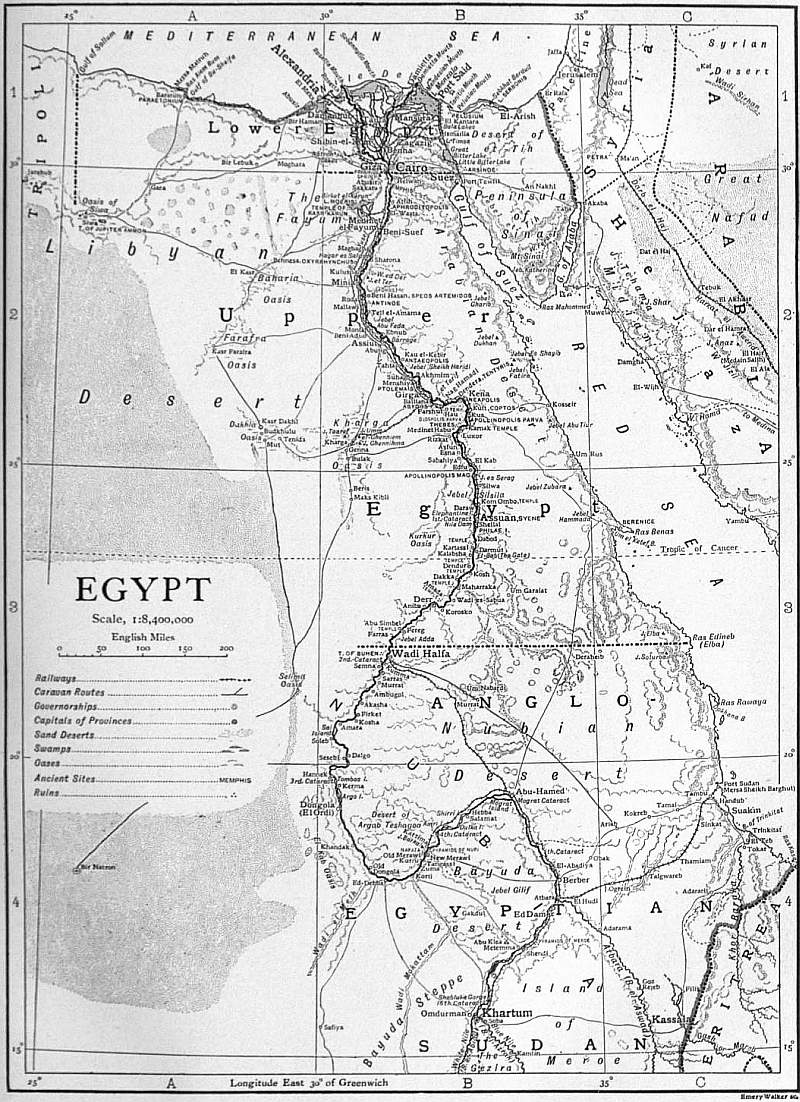
(Click to enlarge.)
In Nubia, owing to the poverty of the country and its scanty population, the proportion of monuments surviving is infinitely greater than in Egypt. Here are the temples of Debōd, the temple and quarries of Kertassi, the temples of Kalabsha, Bēt el Wali, Dendūr, Gerf Husēn, Dakka, Maharaka, Es-Sebū’a, ‘Amāda and Derr, the grottos of Elles ya, the tombs of Anība, the temple of Ibrīm, the great rock-temples of Abū-Simbel, the temples at Jebel Adda and Wadi Halfa, the forts and temples of Semna, the temples of Amāra (Meroitic) and Sōleb. Beyond are the Ethiopian temples and pyramids of Jebel Barkal and the other pyramids of Napata at Tangassi, &c., the still later pyramids of Meroe at Begerawīa, and the temples of Mesauwarāt and Nāga reaching to within 50 m. of Khartūm.
Outside the Nile valley on the west are temples in the Great and Little Oases and the Oasis of Ammon: on the east quarries and stelae on the Hammamāt road to the Red Sea, and mines and other remains at Wadi Maghāra and Serābīt el Khādim in the Sinai peninsula. In Syria there are tablets of conquest on the rocks at the mouth of the Nahr el Kelb.
Of the collections of Egyptian antiquities in public museums, those of the British Museum, Leiden, Berlin, the Louvre, Turin were already very important in the first half of the 19th century, also in a less degree those of Florence, Bologna and the Vatican. Most of these have since been greatly increased and many others have been created. By far the largest collection in the world is that at Cairo. In America the museums and universities of Boston, Chicago, Philadelphia, San Francisco and New York have collections of greater or less interest. Besides these the museums of Edinburgh, Liverpool, Manchester and Oxford are noteworthy in Great Britain for their Egyptian antiquities, as are those of St Petersburg, Vienna, Marseilles, Munich, Copenhagen, Palermo and Athens; there are also collections in most of the British colonies. Private collections are numerous.
Literary Records.—In estimating the sources of information regarding pre-Christian Egypt, the native sources, first opened to us by Champollion, are infinitely the most important. With very few exceptions they are contemporary with the events which they record. Of the composition of history and the description of their own manners and customs by the Egyptians for posterity, few traces have reached our day. Consequently the information derived from their monuments, in spite of their great abundance, is of a fortuitous character. For one early papyrus that survives, many millions must have perished. If the journals of accounts, the letters and business documents, had come down to us en masse, they would no doubt have yielded to research the history and life of Egypt day by day; but those that now represent a thousand years of the Old Kingdom and Middle Kingdom together would not half fill an ordinary muniment chest. A larger proportion of the records on stone have survived, but that an event should be inscribed on stone depends on a variety of circumstances and not necessarily on its importance. There may seem to be a great abundance of Egyptian monuments, but they have to cover an enormous space of time, and even in the periods which are best represented, gravestones recording the names of private persons with a prayer or two are scarcely material for history. A scrap of annals has been found extending from the earliest times to the Vth Dynasty, as well as a very fragmentary list of kings reaching nearly to the end of the Middle Kingdom, to help out the scattered data of the other monuments. As to manners and customs, although we possess no systematic descriptions of them from a native source, the native artists and scribes have presented us with exceptionally rich materials in the painted and sculptured scenes of the tombs from the Old and Middle Kingdoms and the New Empire. For the Deltaic dynasties these sources fail absolutely, the scenes being then either purely religious or conventional imitations of the earlier ones.
Fortunately the native records are largely supplemented by others: valuable information comes from cuneiform literature, belonging to two widely separated periods. The first group is contemporary with the XVIIIth and XIXth Dynasties and consists in the first place of the Tell el Amarna tablets with others related to them, containing the reports of governors of the Syrian possessions of Egypt, and the correspondence of the kings of Babylon, Assur, Mitanni and Khatti (the Hittites) with the Pharaohs. The sequel to this is furnished by Winckler’s discovery of documents relating to Rameses II. of the XIXth Dynasty in the Hittite capital at Boghaz Keui (see also Hittites and Pteria). The other group comprises the annals and inscriptions of the Assyrian kings Esarhaddon and Assur-bani-pal, recording their invasions of Egypt under the XXVth Dynasty. There are also a few references to Egypt of later date down to the reign of Darius. In Hebrew literature the Pentateuch, the historical books and the prophets alike contain scanty but precious information regarding Egypt. Aramaic papyri written principally by Jews of the Persian period (5th century b.c.) have been found at Syene and Memphis.
Of all the external sources the literary accounts written in Greek are the most valuable. They comprise fragments of the native historian Manetho, the descriptions of Egypt in Herodotus and Diodorus, the geographical accounts of Strabo and Ptolemy, the treatise of Plutarch on Isis and Osiris and other monographs or scattered notices of less importance. Our knowledge of the history of Alexander’s conquest, of the Ptolemies and of the Roman occupation is almost entirely derived from Greek sources, and in fact almost the same might be said of the history of Egypt as far back as the beginning of the XXVIth Dynasty. The non-literary Greek remains in papyri and inscriptions which are being found in great abundance throw a flood of light on life in Egypt and the administration of the country from the time of Ptolemy Philadelphus to the Arab conquest. On the other hand, papyri and inscriptions in Latin are of the greatest rarity, and the literary remains in that language are of small importance for Egypt.
Arabic literature appears to be entirely barren of authentic information regarding the earlier condition of the country. Two centuries of unchallenged Christianity had broken almost completely the traditions of paganism, even if the Moslems had been willing to consider them, either in their fanciful accounts of the origins of cities, &c., or elsewhere.
B. The Country in Ancient Times.—The native name of Egypt was Kēmi (KM·T), clearly meaning “the black land,” Egypt being so called from the blackness of its alluvial soil (cf. Plut. De Is. et Os. cap. 33): in poetical inscriptions Kēmi is often opposed to Toshri, “the red land,” referring to the sandy deserts around, which however, would probably be included in the term Kēmi in its widest sense. Egypt is called in Hebrew Mizraim, םירצמ, possibly a dual form describing the country in reference to its two great natural and historical divisions of Upper Egypt and Lower Egypt: but Mizraim (poetically sometimes Māzōr) often means Lower Egypt, Upper Egypt being named Pathros, “the south land.” In Assyrian the name was Muṣri, Miṣri: in Arabic it is Miṣr, , pronounced Maṣr in the vulgar dialect of Egypt. These names are certainly of Semitic origin and perhaps derive from the Assyrian with the meaning “frontier-land” (see Mizraim). Winckler’s theory of a separate Muṣri immediately south of Palestine is now generally rejected (see, for instance, Ed. Meyer, Die Israeliten und ihre Nachbarstämme, 455). The Greek Αἴγυπτος (Aegyptus) occurs as early as Homer; in the Odyssey it is the name of the Nile (masc.) as well as of the country (fem.): later it was confined to the country. Its origin is very obscure (see Pietschmann in Pauly-Wissowa, Realencyclopädie, s.v. “Aigyptos”). Brugsch’s derivation from Hakeptah, a name of the northern capital, Memphis, though attractive, is unconfirmed.

Egypt normally included the whole of the Nile valley from the First Cataract to the sea; pure Egyptians, however, formed the population of Lower Nubia above the Cataract in prehistoric times; at some periods also the land was divided into separate kingdoms, while at others Egypt stretched southward into Nubia, and it generally claimed the neighbouring Libyan deserts and oases on the west and the Arabian deserts on the east to the shore of the Red Sea, with Sinai and the Mediterranean coast as far as Rhinocorura (El Arīsh). The physical features in ancient times were essentially the same as at the present day. The bed of the Nile was lower: it appears to have risen by its own deposits at a rate of about 4 in. in a century. In the north of the Delta, however, there was a sinking of the land, in consequence of which the accumulations on some of the ancient sites there extend below the present sea-level. On the other hand at the south end of the Suez canal the land may have risen bodily, since the head of the Gulf of Suez has been cut off by a bank of rock from the Bitter lakes, which were probably joined to it in former days. The banks of the Nile and the islands in it are subject to gradual but constant alteration—indeed, several ancient sites have been much eroded or destroyed—and the main volume of the stream may in course of time be diverted into what has previously been a secondary channel. According to the classical writers, the mouths or branches of the Nile in the Delta were five in number (seven including two that were artificial): now there are only two. In Upper Egypt the main stream tended as now to flow along the eastern edge of the valley, while to the west was a parallel stream corresponding to the Bahr Yusuf. From the latter a canal or branch led to the Lake of Moeris, which, until the 3rd century b.c., filled the deep depression of the Fayum, but is now represented only by the strongly brackish waters of the Birket el Kerūn, left in the deepest part. The area of alluvial land has probably not changed greatly in historic times. The principal changes that have occurred are due to the grip which civilization has taken upon the land in the course of thousands of years, often weakening but now firmer than ever. In early days no doubt the soil was cultivated in patches, but gradually a great system of canals was organized under the control of the central government, both for irrigation and for transport. The wild flora of the alluvial valley was probably always restricted and eventually was reduced almost to the “weeds of cultivation,” when every acre of soil, at one period of the year under water, and at another roasted under the burning heat of a semi-tropical sun, was carefully tilled. The acacia abounded on the borders of the valley, but the groves were gradually cut down for the use of the carpenter and the charcoal-burner. The desert was full of wild life, the balance of nature being preserved by the carnivorous animals preying on the herbivorous; trees watered by soakage from the Nile protected the undergrowth and encouraged occasional rainfall. But this balance was upset by the early introduction of the goat and later of the camel, which destroyed the sapling trees, while the grown ones fell to the axe of the woodcutter. Thus in all probability the Egyptian deserts have become far poorer in animals and trees than they were in primitive times. Much of Lower Egypt was left in a wilder state than Upper Egypt. The marshy lands in the north were the resort of fishermen and fowlers, and the papyrus, the cultivation of which was a regular industry, protected an abundance of wild life. The abandonment of papyrus culture in the 8th century a.d., the neglect of the canals, and the inroads of the sea, have converted much of that country into barren salt marsh, which only years of draining and washing can restore to fertility.
The rich alluvial deposits of the Nile which respond so readily to the efforts of the cultivator ensured the wealth of the country. Moulded into brick, without burning, this black clay also supplied the common wants of the builder, and even the palaces of the greatest kings were constructed of crude brick. For more lasting and ambitious work in temples and tombs the materials could be obtained from the rocks and deserts of the Nile valley. The chief of these was limestone of varying degrees of fineness, composing the cliffs which lined the valley from the apex of the Delta to the neighbourhood of El Kāb; the best quality was obtained on the east side opposite Memphis from the quarries of Turra and Masāra. From El Kāb southward its place was taken by Libyan sandstone, soft and easily worked, but unsuitable for fine sculpture. These two were the ordinary building stones. In the limestone was found the flint or chert used for weapons and instruments in early times. For alabaster the principal quarry was that of Hanub in the desert 10 m. behind El Amarna, but it was obtained elsewhere in the limestone region, including a spot near Alexandria. A hard and fine-grained quartzite sandstone was quarried at Jebel Ahmar behind Heliopolis, and basalt was found thence along the eastern edge of the Delta to near the Wadi Tumilāt. Red granite was obtained from the First Cataract, breccia and diorite were quarried from very early times in the Wadi Hammamāt, on the road from Coptos to the Red Sea, and porphyry was brought, chiefly in Roman times but also in the prehistoric age, from the same region at Jebel Dokhān.