VOLUME IX SLICE I Edwardes to Ehrenbreitstein (continued 6)
Reading edition
Month, a hawk-headed god of the Thebaid: in Thebes itself his cult was superseded by that of Ammon, but it persisted in Hermonthis. He was often given the solar attributes, and was credited as a great warrior.
Min, the god of Coptos and Panopolis (Akhmim), seems to have been early looked upon as a deity of the harvest and crops. His cult dates from the earliest times. Represented as ithyphallic, with two tall plumes on his head, the right arm upraised and bearing a scourge. In old times he is identified with Horus: later Ammon was confused with him, and depicted in his image.
Nechbet (Nekhbi, Nekhebi), the vulture-goddess of El Kab, called Eileithyia by the Greeks. She gained an ascendancy as patroness of the south at the time when the two kingdoms were striving for the mastery. It is as such, in opposition to Buto the goddess of the north, that she is most often named on the monuments.
Neith, the very ancient and important goddess of Sais, the Greek Athene. On the earliest monuments she is represented by a shield transfixed by arrows. Later she wears the crown of Lower Egypt, and carries in her hands a bow and arrows, a sign of her warlike character. In the XXVIth Dynasty, when a line of Pharaohs sprang from Sais, she regained a prominent position, and was given many cosmogonic attributes, including the title of mother of Re.
Nephthys, the sister of Osiris and wife of Seth, daughter of Keb and Nut, plays a considerable rôle in the Osiris story. She sided with Isis and aided her to bring Osiris back to life. Isis and Nephthys are often mentioned together as protectresses of the dead.
Onouris, Egyptian En-hūri, “sky-bearer,” the god of Thinis. Later identified with Shu (Show), who holds heaven and earth apart.
Ptah, the Hephaestus of the Greeks, a demiurgic and creative god, special patron of hand-workers and artisans. Worshipped in Memphis, he perhaps owed his importance more to the political prominence of that town than to anything else. He was early identified with an ancient but obscure god Tenen, and further with the sepulchral deity Sokaris. He is represented either as a closely enshrouded figure whose protruding hands grasp a composite sceptre, the whole standing on a pedestal within a shrine; or else as a misshapen dwarf.
Sakhmi, a lion-headed goddess of war and strife, whose name signifies the mighty. She was worshipped at Latopolis (Esna), but also at a late date as a member of the Memphite triad, with Ptah as husband and Nefertem (Iphthimis) as son: often, too, confounded with Ubasti.
Seth (Egyptian Sēt, Stḫ or Stš), by the Greeks called Typhon, was depicted as an animal that has been compared with the jerboa by some, and with the okapi by others, but which the Egyptians themselves occasionally conceived to be nothing but a badly drawn ass. In historic times his cult was celebrated at Tanis and Ombos. He regained a certain prestige as god of the Hyksos rulers, and two Pharaohs of the XIXth Dynasty derived their name Sethos (Seti) from him. But, generally speaking, he was abominated as a power of evil, and his figure was often obliterated on the monuments. He is named in similes as a great warrior, and as such and “son of Nut” he is identified with the Syrian Baal.

4. The Divine Cult.—In the midst of every town rose the temple of the local god, a stately building of stone, strongly contrasting with the mud and plaster houses in which even the wealthiest Egyptians dwelt. It was called the “house of the god” , and in it the deity was supposed to reside, attended by his “servants” the priests. There was indeed a certain justification for this contention, even when a contrary theory assigned to the divinity a place in the sky, as in the case of the lunar divinity Thoth; for in the inmost sanctuary stood a statue of the god, which served as his representative for the purposes of the cult. Originally each temple was dedicated to one god only; but it early became usual to associate with him a mate of the opposite sex, besides a third deity who might be represented either as a second wife or as a child. As examples of such triads, as they are called, may be mentioned that of Thebes, consisting of Ammon, Mut and Chons, father, mother and child; and as typical of the other kind, where a god was accompanied by two goddesses, that of Elephantine, consisting of Khnum, Satis and Anukis. The needs of the god were much the same as those of mortals; no more than they could he dispense with food and drink, clothes for his apparel, ointment for his limbs, and music and dancing to rejoice his heart. The only difference was that the divine statue was half-consciously recognized as a lifeless thing that required carefully regulated rites and ceremonies to enable it to enjoy the good things offered to it. Early every morning the officiating priest proceeded to the holy of holies, after the preliminaries of purification had cleansed him from any miasma that might interfere with the efficacy of the rites. Then with the prescribed gestures, and reciting appropriate formulae all the while, he broke the seal upon the door of the shrine, loosed the bolts, and at last stood face to face with the god. There followed a series of prostrations and adorations, culminating in the offering of a small image of Maat, the goddess of Truth. This seems to have been the psychological moment of the entire service: hitherto the statue had been at best a god in posse; now the symbolical act placed him in possession of all his faculties, he was a god in truth, and could participate like any mortal in the food and luxuries that his servants put before him. The daily ceremony closed with ablutions, anointings and a bountiful feast of bread, geese, beer and oxen; having taken his fill of these, the god returned to his shrine until the next morning, when the ritual was renewed. The words that accompanied the manual gestures are, in the rituals that have come down to us, wholly dominated by the myth of Osiris: it is often hard to discern much connexion between the acts and the formulae recited, but the main thought is clearly that the priest represents Horus, the pious son of the dead divinity Osiris. That this conception is very old is proved by the fact that even in the Pyramid texts “the eye of Horus” is a synonym for all offerings: an ancient tale of which only shreds have reached us related how Seth had torn the eye of Horus from him, though not before he himself had suffered a still more serious mutilation; and by some means, we know not how, the restoration of the eye was instrumental in bringing about the vindication of Osiris. As to the manual rites of the daily cult, all that can here be said is that incense, purifications and anointings with various oils played a large part; the sacrifices consisted chiefly of slaughtered oxen and geese; burnt offerings were a very late innovation.


At an early date the rites practised in the various temples were conformed to a common pattern. This holds good not only for the daily ritual, but also for many festivals that were celebrated on the same day throughout the whole length of the land. Such were the calendrical feasts, called “the beginnings of the seasons,” and including, for example, the monthly and half-monthly festivals, that of the New Year and that of the rising of Sirius (Sothis). But there were also local feast days like that of Neith in Sais (Hdt. ii. 62) or that of Ammon in southern Opi (Luxor). These doubtless had a more individual character, and often celebrated some incident supposed to have occurred in the lifetime of the god. Sometimes, as in the case of the feast of Osiris in Abydos, a veritable drama would be enacted, in which the whole history of the god, his sufferings and final triumph were represented in mimic form. At other times the ceremonial was more mysterious and symbolical, as in the feast of the raising of the Ded-column when a column of the kind was drawn by cords into an upright position. But the most common feature of these holy days was the procession of the god, when he was carried on the shoulders of the priests in his divine boat far beyond the precincts of his temple; sometimes, indeed, even to another town, where he paid a visit to the god of the place. These occasions were public holidays, and passed amid great rejoicings. The climax was reached when at a given moment the curtains of the shrine placed on the boat were withdrawn, and the god was revealed to the eyes of the awe-struck multitude. Music and dancing formed part of the festival rites.

As with the rites and ceremonies, so also the temples were early modelled upon a common type. Lofty enclosure walls, adorned with scenes from the victorious campaigns of the Pharaoh, shut off the sacred buildings from the Temples. surrounding streets. A small gateway between two massive towers or pylons gave admittance to a spacious forecourt open to the sky, into which the people were allowed to enter at least on feast days. Farther on, separated from the forecourt by smaller though still massive pylons, lay a hypostyle hall, so called from its covered colonnades; this hall was used for all kinds of processions. Behind the hypostyle hall, to which a second similar one might or might not be added, came the holy of holies, a dark narrow chamber where the god dwelt; none but the priests were admitted to it. All around lay the storehouses that contained the treasures of the god and the appurtenances of the divine ritual. The temples of the earliest times were of course far more primitive than this: from the pictures that are all that is now left to indicate their nature, they seem to have been little more than huts or sheds in which the image of the god was kept. One temple of a type different from that above described has survived at Abusir, where it has been excavated by German explorers. It was a splendid edifice dedicated to the sun-god Re by a king of the Vth Dynasty, and was probably a close copy of the famous temple of Heliopolis. The most conspicuous feature was a huge obelisk on a broad superstructure : the obelisk always remained closely connected with the solar worship, and probably took the place of the innermost shrine and statue of other temples. The greater part of the sanctuary was left uncovered, as best befitted a dwelling-place of the sun. Outside its walls there was a huge brick model of the solar bark in which the god daily traversed the heavens.

As the power of the Pharaohs increased, the maintenance of the cult became one of the most important affairs of state. The most illustrious monarchs prided themselves no less on the buildings they raised in honour of the gods than on the successful wars they waged: indeed the wars won a religious significance through the gradual elevation of the god of the capital to god of the nation, and a large part of the spoils was considered the rightful perquisite of the latter. Countless were the riches that the kings heaped upon the gods in the hope of being requited with long life and prosperity on the throne of the living. It became the theory that the temples were the gifts of the Pharaoh to his fathers the gods, and therefore in the scenes of the cult that adorn the inner walls it is always he who is depicted as performing the ceremonies. As a matter of fact the priesthoods Power of the priests. were much more independent than was allowed to appear. Successive grants of land placed no small portion of the entire country in their hands, and the administration of the temple estates gave employment to a large number of officials and serfs. In the New Kingdom the might of the Theban god Ammon gradually became a serious menace to the throne: in the reign of Rameses III. he could boast of more than 80,000 dependants, and more than 400,000 cattle. It is not surprising that a few generations later the high priests of Ammon supplanted the Pharaohs altogether and founded a dynasty of their own.
At no period did the priests form a caste that was quite distinctly separated from the laity. In early times the feudal lords were themselves the chief priests of the local temples. Under them stood a number of subordinate priests, both professional and lay. Among the former were the kher-heb, a learned man entrusted with the conduct of the ceremonies, and the “divine fathers,” whose functions are obscure. The lay priests were divided into four classes that undertook the management of the temple in alternate months; their collective name was the “hour-priesthood.” Perhaps it was to them that the often recurring title oueb, “the pure,” should properly be restricted, though strict rules as to personal purity, dress and diet were demanded of all priests. The personnel of the temple was completed by various subordinate officials, doorkeepers, attendants and slaves. In the New Kingdom the leading priests were more frequently mere clerics than theretofore, though for instance the high priest of Ammon was often at the same time the vizier of southern Egypt. In some places the highest priests bore special names, such as the Ouer maa, “the Great Seer,” of Re in Heliopolis, or the Khorp himet, “chief artificer,” of the Memphite Ptah. Women could also hold priestly rank, though apparently in early times only in the service of goddesses; “priestess of Hathor” is a frequent title of well-born ladies in the Old Kingdom. At a later date many wealthy dames held the office of “musicians” (shemat) in the various temples. In the service of the Theban Ammon two priestesses called “the Adorer of the God” and the “Wife of the God” occupied very influential positions, and towards the Saite period it was by no means unusual for the king to secure these offices for his daughters and so to strengthen his own royal title.
5. The Dead and their Cult.—While the worship of the gods tended more and more to become a monopoly of the state and the priests, and provided no adequate outlet for the religious cravings of the people themselves, this deficiency was amply supplied by the care which they bestowed upon their dead: the Egyptians stand alone among the nations of the world in the elaborate precautions which they took to secure their own welfare beyond the tomb. The belief in immortality, or perhaps rather the incapacity to grasp the notion of complete annihilation, is traceable from the very earliest times: the simplest graves of the prehistoric period, when the corpses were committed to the earth in sheepskins and reed mats, seldom lack at least a few poor vases or articles of toilet for use in the hereafter. In proportion as the prosperity of the land increased, and the advance of civilization afforded the technical means, so did these primitive burials give place to a more lavish funereal equipment. Tombs of brick with a single chamber were succeeded by tombs of stone with several chambers, until they really merited the name of “houses of eternity” that the Egyptians gave to them. The conception of the tomb as the residence of the dead is the fundamental notion that underlies all the ritual observances in connexion with the dead, just as the idea of the temple as the dwelling-place of the god is the basis of the divine cult. The parallelism between the attitude of the Egyptians towards the dead and their attitude towards the gods is so striking that it ought never to be lost sight of: nothing can illustrate it better than the manner in which the Osirian doctrines came to permeate both kinds of cult.
The general scheme of Egyptian tombs remained the same throughout the whole of the dynastic period, though there were many variations of detail. By preference they were built in the Western desert, the Amente, near the Tombs. place where the sun was seen to go to rest, and which seemed the natural entrance to the nether world. A deep pit led down to the sepulchral chamber where the dead man was deposited amid the funereal furniture destined for his use; and no device was neglected that might enable him to rest here undisturbed. This aim is particularly conspicuous in the pyramids, the gigantic tombs which the Pharaohs of the Old Kingdom constructed for themselves: the passages that lead to the burial chamber were barred at intervals by vast granite blocks, and the narrow opening that gave access to them was hidden from view beneath the stone casing of the pyramid sides. Quite separate from this part of the tomb lay the rooms employed for the cult of the dead: their walls were often adorned with pictures from the earthly life of the deceased, which it was hoped he might still continue to enjoy after death. The innermost chamber was the chapel proper: on its western side was sculptured an imitation door for the dead man to pass through, when he wished to participate in the offerings brought by pious relatives. It was of course only the few who could afford elaborate tombs of the kind: the poor had to make shift with an unpretentious grave, in which the corpse was placed enveloped only by a few rags or enclosed in a rough wooden coffin.
The utmost care was taken to preserve the body itself from decay. Before the time of the Middle Kingdom it became usual for the rich to have their bodies embalmed. The intestines were removed and placed in four vases (the Embalming and burial. so-called Canopic jars) in which they were supposed to enjoy the protection of the four sons of Horus, the man-headed Mesti, the ape-headed Hapi, the jackal Duamutef and the falcon Kebhsenuf. The corpse was treated with natron and asphalt, and wound in a copious swathing of linen bandage, with a mask of linen and stucco on the face. The “mummy” thus prepared was then laid on its side like a sleeper, the head supported by a head-rest, in a sarcophagus of wood or stone. The operations in connexion with the mummy grow more and more elaborate towards the end of the Pharaonic period: already in the New Kingdom the wealthiest persons had their mummies laid in several coffins, each of which was gaudily painted with mythological scenes and inscriptions. The costliest process of embalmment lasted no less than seventy days. Many superstitious rites had to be observed in the course of the process: a late book has preserved to us the magical formulae that were repeated by the wise kher-heb priest (who in the necropolis performed the functions of taricheutes, “embalmer”), as each bandage was applied.
A large number of utensils, articles of furniture and the like were placed in the burial-chamber for the use of the dead—jars, weapons, mirrors, and even chairs, musical instruments and wigs. In the early times statuettes of servants, representing them as engaged in their various functions (brewers, bakers, &c.), were included for the same purpose; they were supposed to perform their menial functions for their deceased lord in the future life. In the Middle Kingdom these are gradually replaced by small models of the mummy itself, and the belief arose that when their owner was called upon to perform any distasteful work in the nether world, they would answer to his name and do the task for him. The later ushebti-figures, little statuettes of wood, stone or faience, of which several hundreds are often found in a single tomb, are confused survivals of both of the earlier classes of statuettes. Still more important than all such funereal objects are the books that were placed in the grave for the use of the dead: in the pyramids they are written on the walls of the sepulchral chamber and the passages leading to it; in the Middle Kingdom usually inscribed on the inner sides of the sarcophagus; in later times contained in rolls of papyrus. The Pyramid texts and the Book of the Dead are the most important of these, and teach us much about the dangers and needs that attended the dead man beyond the tomb, and about the manner in which it was thought they could be counteracted.
The burial ceremony itself must have been an imposing spectacle. In many cases the mummy had to be conveyed across the Nile, and boats were gaily decked out for this purpose. On the western bank a stately procession conducted the deceased to his last resting-place. At the door of the tomb the final ceremonies were performed; they demanded a considerable number of actors, chief among whom were the sem-priest and the kher-heb priest. It was a veritable drama that was here enacted, and recalled in its incidents the story of Osiris, the divine prototype of all successive generations of the Egyptian dead.
However carefully the preliminary rites of embalmment and burial might have been performed, however sumptuous the tomb wherein the dead man reposed, he was nevertheless almost entirely at the mercy of the living for The soul. his welfare in the other world: he was as dependent on a continued cult on the part of the surviving members of his family as the gods were dependent on the constant attendance of their priests. That portion of a man’s individuality which required, even after death, food and drink, and the satisfaction of sensuous needs, was called by the Egyptians the ka, and represented in hieroglyphs by the uplifted hands . This ka was supposed to be born together with the person to whom it belonged, and on the very rare occasions when it is depicted, wears his exact semblance. The conception of this psychical entity is too vaguely formulated by the Egyptians and too foreign to modern thought to admit of exact translation: of the many renderings that have been proposed, perhaps “double” is the most suitable. At all events the ka has to be distinguished from the soul, the bai (in hieroglyphs or ), which was of more tangible nature, and might be descried hovering around the tomb in the form of a bird or in some other shape; for it was thought that the soul might assume what shape it would, if the funerary rites had been duly attended to. The gods had their ka and bai, and the forms attributed to the latter are surprising; thus we read that the soul of the sky Nun is Re, that of Osiris the Goat of Mendes, the souls of Sobk are crocodiles, and those “of all the gods are snakes”; similarly the soul of Ptah was thought to dwell in the Apis bull, so that each successive Apis was during its lifetime the reincarnation of the god. Other parts of a man’s being to which at given moments and in particular contexts the Egyptians assigned a certain degree of separate existence are the “name” ran, the “shadow” , khaibet, and the “corpse” , khat.


It was, however, the ka alone to which the cult of the dead was directly addressed. This cult was a positive duty binding on the children of a dead man, and doubtless as a rule discharged by them with some regularity and conscientiousness; at least, on feast-days offerings would be brought to the tomb, and the ceremonies of purification and opening the mouth of the deceased would be enacted. But there could be little guarantee that later generations would perpetuate the cult. It therefore became usual under the Old Kingdom for the wealthiest persons to make testamentary dispositions by which certain other persons agreed for a consideration to observe the required rites at stated periods: they received the name of “servants of the ka,” and stood in the same relation to the deceased as the priests to the gods. Or again, contracts might be made with a neighbouring temple, the priesthood of which bound itself to reserve for the contracting party some portion of the offerings that had already been used for the divine cult. There is probably a superstitious reason for the preference shown by the dead for offerings of this kind; no wish is commoner than that one may receive “bread and beer that had gone up on to the altar of the local god,” or “with which the god had been sated”; something of the divine sanctity still clung about such offerings and made them particularly desirable. In spite of all the precautions they took and the contracts they made, the Egyptians could never quite rid themselves of the dread that their tombs might decay and their cult be neglected; and they sought therefore to obtain by prayers and threats what they feared they might lose altogether. The occasional visitor to the tomb is reminded by its inscriptions of the many virtues of the dead man while he yet lived, and is charged, if he be come with empty hands, at least to pronounce the funerary formula; it will indeed cost him nothing but “the breath of his mouth”! Against the would-be desecrator the wrath of the gods is invoked: “with him shall the great god reckon there where a reckoning is made.”
The funerary customs that have been described are meaningless except on the supposition that the tomb was the regular dwelling-place of the dead. But just as the Egyptians found no contradiction between the view of the temple as the residence of the god and the conception of him as a cosmic deity, so too they often attributed to the dead a continued existence quite apart from the tomb. According to a widely-spread doctrine of great age the deceased Egyptian was translated to the heavens, where he lived on in the form of a star. This theme is elaborated with great detail in the Pyramid texts, where it is the dead king to whom this destiny is promised. It was perhaps only a restricted aristocracy who could aspire to such high honour: the ikh, or “glorified being,” who has his place in the sky seems often to hold an intermediate position between the gods and the rank and file of the dead. But in a few early passages the required qualification appears to be rather moral integrity than exalted station. The life of the dead man in the sky is variously envisaged in different texts: at one moment he is spoken of as accompanying the sun-god in his celestial bark, at another as a mighty king more powerful than Re himself; the crudest fancy of all pictures him as a hunter who catches the stars and gods, and cooks and eats them. According to another conception that persisted in the imagination of the Egyptians longer than any of the ideas just mentioned, the home of the dead in the heavens was a fertile region not very different from Egypt itself, intersected by canals and abounding in corn and fruit; this place was called the Sokhet Earu or “field of Reeds.”

Even in the oldest texts these beliefs are blended inextricably with the Osirian doctrines. It is not so much as king of the dead that Osiris here appears, but every deceased Egyptian was regarded as himself an Osiris, as having undergone all the indignities inflicted upon the god, but finally triumphant over the powers of death and evil impersonated by Seth. This notion became so popular, that beside it all other views of the dead sink into insignificance; it permeates the funerary cult in all its stages, and from the Middle Kingdom onwards the dead man is regularly called “the Osiris so-and-so,” just as though he were completely identical with the god. One incident of the tale of Osiris acquired a deep ethical meaning in connexion with the dead. It was related how Seth had brought an accusation against Osiris in the great judgment hall of Heliopolis, and how the latter, helped by the skilful speaker Thoth, had emerged from the ordeal acquitted and triumphant. The belief gradually grew up that every dead man would have to face a similar trial before he could be admitted to a life of bliss in the other world. A well-known vignette in the Book of the Dead depicts the scene. In a shrine sits Osiris, the ruler and judge of the dead, accompanied by forty-two assessors; and before him stands the balance on which the heart of the deceased man is to be weighed against Truth; Thoth stands behind and registers the result. The words that accompany this picture are still more remarkable: they form a long negative confession, in which the dead man declares that he has sinned neither against man nor against the gods. Not all the sins named are equally heinous according to modern conceptions; many of them deal with petty offences against religious usages that seem to us but trifling. But it is clear that by the time this chapter was penned it was believed that no man could attain to happiness in the hereafter if he had not been upright, just and charitable in his earthly existence. The date at which these conceptions became general is not quite certain, but it can hardly be later than the Middle Kingdom, when the dead man has the epithet “justified” appended to his name in the inscriptions of his tomb.
It was but a natural wish on the part of the Egyptians that they should desire to place their tombs near the traditional burying-place of Osiris. By the time of the XIIth Dynasty it was thought that this lay in Abydos, the town where the kings of the earliest times had been interred. But it was only in a few cases that such a wish could be literally fulfilled. It therefore became customary for those who possessed the means to dedicate at least a tombstone in the neighbourhood of “the staircase of the great god,” as the sacred spot was called. And those who had found occasion to visit Abydos in their lifetime took pleasure in recalling the part that they had there taken in the ceremonies of Osiris. Such pilgrims doubtless believed that the pious act would stand to their credit when the day of death arrived.
6. Magic.—Among the rites that were celebrated in the temples or before the statues of the dead were many the mystical meaning of which was but imperfectly understood, though their efficacy was never doubted. Symbolical or imitative acts, accompanied by spoken formulae of set form and obscure content, accomplished, by some peculiar virtues of their own, results that were beyond the power of human hands and brain. The priests and certain wise men were the depositaries of this mysterious but highly useful art, that was called hik or “magic”; and one of the chief differences between gods and men was the superior degree in which the former were endowed with magical powers. It was but natural that the Egyptians should wish to employ magic for their own benefit or self-gratification, and since religion put no veto on the practice so long as it was exercised within legal bounds, it was put to a widespread use among them. When magicians made figures of wax representing men whom they desired to injure, this was of course an illegal act like any other, and the law stepped in to prevent it: one papyrus that has been preserved records the judicial proceedings taken in such a case in connexion with the harem conspiracy against Rameses III.
One of the chief purposes for which magic was employed was to avert diseases. Among the Egyptians, as in other lands, illnesses were supposed to be due to evil spirits or the ghosts of dead men who had taken up their abode in the body of the sufferer, and they could only be driven thence by charms and spells. But out of these primitive notions arose a real medical science: when the ailment could be located and its nature roughly determined, a more materialistic view was taken of it; and many herbs and drugs that were originally used for some superstitious reason, when once they had been found to be actually effective, easily lost their magical significance and were looked upon as natural specifics. It is extremely hard to draw any fixed line in Egypt between magic and medicine; but it is curious to note that simple diagnoses and prescriptions were employed for the more curable diseases, while magical formulae and amulets are reserved for those that are harder to cope with, such as the bites of snakes and the stings of scorpions.
The formulae recited for such purposes are not purely cabalistic, though inasmuch as mystery is of the very essence of magic, foreign words and outlandish names occur in them by preference. Often the magician relates some mythical case where a god had been afflicted with a disease similar to that of the patient, but had finally recovered: a number of such tales were told of Horus, who was usually healed by some device of his mother Isis, she being accounted as a great enchantress. The mere recitation of such similar cases with their happy issue was supposed to be magically effective; for almost unlimited power was supposed to be inherent in mere words. Often the demon is directly invoked, and commanded to come forth. At other times the gods are threatened with privations or even destruction if they refuse to aid the magician: the Egyptians seem to have found little impiety in such a use of the divine name, though to us it would seem the utmost degree of profanity when, for instance, a magician declares that if his spell prove ineffective, he “will cast fire into Mendes and burn up Osiris.”
The verbal spells were always accompanied by some manual performance, the tying of magical knots or the preparation of an amulet. In these acts particular significance was attached to certain numbers: a sevenfold knot, for example, was more efficacious than others. Often the formula was written on a strip of rag or a scrap of papyrus and tied round the neck of the person for whom it was intended. Beads and all kinds of amulets could be infused with magical power so as to be potent phylacteries to those who wore them.
In conclusion, it must be emphasized that in Egypt magic stands in no contrast or opposition to religion, at least as long as it was legitimately used. The religious rites and ceremonies are full of it. When a pretence was made of opening, with an iron instrument, the mouth of the divine statue, to the accompaniment of recited formulae, this can hardly be termed anything but magic. Similarly, the potency attributed to ushebti-figures and the copies of the Book of the Dead deposited in the tombs is magical in quality. What has been considered under this heading, however, is the use that the same principles of magic were put to by men in their own practical life and for their own advantage.
Authorities.—An excellent list of books and articles on the various topics connected with Egyptian Religion will be found in H. O. Lange’s article on the subject in P. D. Chantepie de la Saussaye, Lehrbuch der Religionsgeschichte (Tübingen, 1905), vol. i. pp. 172-245. Among general works may be especially recommended A. Erman, Die ägyptische Religion (Berlin, 1905); and chapters 2 and 3 in G. Maspero, Histoire ancienne des peuples de l’Orient, les origines, vol. i. (Paris, 1895).
(A. H. G.)
D. Egyptian Language and Writing.—Decipherment.—Although attempts were made to read Egyptian hieroglyphs so far back as the 17th century, no promise of success appeared until the discovery of the Rosetta stone in 1799 by the French engineers attached to Napoleon’s expedition to Egypt. This tablet was inscribed with three versions, in hieroglyphic, demotic and Greek, of a long decree of the Egyptian priests in honour of Ptolemy V., Epiphanes and his wife Cleopatra. The Greek and demotic versions were still almost perfect, but most of the hieroglyphic text had been broken away with the top of the tablet; portions of about half of the lines remained, but no single line was complete. In 1802 J. D. Akerblad, a Swedish orientalist attached to the embassy in Paris, identified the proper names of persons which occurred in the demotic text, being guided to them by the position of their equivalents in the Greek. These names, all of them foreign, were written in an alphabet of a limited number of characters, and were therefore analysed with comparative ease.
The hieroglyphic text upon the Rosetta stone was too fragmentary to furnish of itself the key to the decipherment. But the study of this with the other scanty monuments and imperfect copies of inscriptions that were available enabled the celebrated physicist Thomas Young (1773-1829) to make a beginning. In an article completed in 1819 and printed (over the initials I. J.) in the supplement to the 4th, 5th and 6th editions of the Encyclopaedia Britannica (vol. iv., 1824), he published a brief account of Egyptian research, with five plates containing the “rudiments of an Egyptian vocabulary.” It appears that Young could place the hieroglyphic, demotic and Greek texts of the Rosetta stone very correctly parallel; but he could not accurately break up the Egyptian sentences into words, much less could he attribute to the words their proper sounds. Yet he recognized correctly the names of Apis and Re, with many groups for words such as “assembly,” “good,” “name,” and important signs such as those which distinguish feminine words. In a bad copy of another monument he rightly guessed the royal name of Berenice in its cartouche by the side of that of Ptolemy, which was already known from its occurrence on the Rosetta stone. He considered that these names must be written in phonetic characters in the hieroglyphic as in demotic, but he failed to analyse them correctly. It was clear, however, that with more materials and perseverance such efforts after decipherment must eventually succeed.
Meanwhile J. F. Champollion “le Jeune” (see Champollion; and Hartleben, Champollion, sein Leben und sein Werk, Berlin, 1906) had devoted his energies whole-heartedly since 1802, when he was only eleven years old, to preparing himself for the solution of the Egyptian problem, by wide linguistic and historical studies, and above all by familiarizing himself with every scrap of Egyptian writing which he could find. By 1818 he made many equations between the demotic and the hieroglyphic characters, and was able to transcribe the demotic names of Ptolemy and Cleopatra into hieroglyphics. At length, in January 1822, a copy of the hieroglyphic inscription on the Bankes obelisk, which had long been fruitlessly in the hands of Young, reached the French savant. On the base of this obelisk was engraved a Greek inscription in honour of Ptolemy Euergetes II. and Cleopatra; of the two cartouches on the obelisk one was of Ptolemy, the other was easily recognized as that of Cleopatra, spelt nearly as in Champollion’s experimental transcript of the demotic name, only more fully. This discovery, and the recognition of the name Alexander, gave fourteen alphabetic signs, including homophones, with ascertained values. Starting from these, by the beginning of September Champollion had analysed a long series of Ptolemaic and Roman cartouches. His next triumph was on the 14th of September, when he read the names of the ancient Pharaohs Rameses and Tethmosis in some drawings just arrived from Egypt, proving that his alphabetic characters were employed, in conjunction with syllabic signs, for spelling native names; this gave him the assurance that his discovery touched the essential nature of the Egyptian writing and not merely, as had been contended, a special cipher for the foreign words which might be quite inapplicable to the rest of the inscriptions. His progress continued unchecked, and before the end of the year the connexion of ancient Egyptian and Coptic was clearly established. Subsequently visits to the museums of Italy and an expedition to Egypt in 1828-1829 furnished Champollion with ample materials. The Précis du système hiéroglyphique (1st ed. 1823, 2nd ed. 1828) contained the philological results of his decipherments down to a certain point. But his MS. collections were vast, and his illness after the strenuous labours of the expedition and his early death in 1832 left all in confusion. The Grammaire égyptienne and Dictionnaire égyptien, edited from these MSS. by his brother, precious as they were, must be a very imperfect register of the height of his attainments. In his last years he was able to translate long texts in hieroglyphic and in hieratic of the New Kingdom and of the later periods with some accuracy, and his comprehension of demotic was considerable. Champollion outdistanced all his competitors from the first, and had practically nothing to thank them for except material to work on, and too often that had been intentionally withheld from him. In eleven years he broke ground in all directions; if the ordinary span of life had been allowed him, with twenty or thirty more years of labour he might have brought order into the chaos of different ages and styles of language and writing; but, as it was, the task of co-ordination remained to be done by others. For one year, before his illness incapacitated him, Champollion held a professorship in Paris; but of his pupils and fellow-workers, F. P. Salvolini, insincere and self-seeking, died young, and Ippolito Rosellini (1800-1843) showed little original power. From 1832 to 1837 there was a pause in the march of Egyptology, and it seemed as if the young science might be overwhelmed by the storm of doubts and detraction that was poured upon it by the enemies of Champollion. Then, however, Lepsius in Germany and Samuel Birch in England took up the thread where the master had dropped it, and E. de Rougé, H. Brugsch, François Joseph Chabas and a number of lesser lights quickly followed. Brugsch (q.v.) was the author of a hieroglyphic and demotic dictionary which still holds the field, and from time to time carried forward the study of demotic by a giant’s stride. De Rougé (d. 1872) in France was a brilliant translator of hieroglyphic texts and the author of an important grammatical work. Chabas (1817-1882) especially addressed himself to the reading of the hieratic texts of the New Kingdom. By such labours after forty years the results attained by Champollion in decipherment were entirely superseded. Yet, while the values of the signs were for the most part well ascertained, and the meanings of most works fixed with some degree of accuracy, few grammatical rules had as yet been established, the varieties of the language at different periods had not been defined, and the origins of the hieroglyphs and of their values had not been investigated beyond the most obvious points. At this time a rare translator of Egyptian texts in all branches was arising in G. Maspero (q.v.), while E. Revillout addressed himself with success to the task of interpreting the legal documents of demotic which had been almost entirely neglected for thirty years. But the honour of inaugurating an epoch marked by greater precision belongs to Germany. The study of Coptic had begun in Europe early in the 17th century, and reached a high level in the work of the Dane Georg Zoega (1755-1809) at the end of the 18th century. In 1835, too late for Champollion to use it, Amadeo Peyron (1785-1870) of Turin published a Coptic lexicon of great merit which is still standard, though far from satisfying the needs of scholars of the present day. In 1880 Ludwig Stern (Koptische Grammatik) admirably classified the grammatical forms of Coptic. The much more difficult task of recovering the grammar of Egyptian has occupied thirty years of special study by Adolf Erman and his school at Berlin, and has now reached an advanced stage. The greater part of Egyptian texts after the Middle Kingdom having been written in what was even then practically a dead language, as dead as Latin was to the medieval monks in Italy who wrote and spoke it, Erman selected for special investigation those texts which really represented the growth of the language at different periods, and, as he passed from one epoch to another, compared and consolidated his results.
The Neuägyptische Grammatik (1880) dealt with texts written in the vulgar dialect of the New Kingdom (Dyns. XVIII. to XX.). Next followed, in the Zeitschrift für ägyptische Sprache und Alterthumskunde, studies on the Old Kingdom inscription of Una, and the Middle Kingdom contracts of Assiut, as well as on an “Old Coptic” text of the 3rd century a.d. At this point a papyrus of stories written in the popular language of the Middle Kingdom provided Erman with a stepping-stone from Old Egyptian to the Late Egyptian of the Neuägyptische Grammatik, and gave the connexions that would bind solidly together the whole structure of Egyptian grammar (see Sprache des Papyrus Westcar, 1889). The very archaic pyramid texts enabled him to sketch the grammar of the earliest known form of Egyptian (Zeitschrift d. Deutsch. Morgenl. Gesellschaft, 1892), and in 1894 he was able to write a little manual of Egyptian for beginners (Ägyptische Grammatik, 2nd ed., 1902), centring on the language of the standard inscriptions of the Middle and New Kingdoms, but accompanying the main sketch with references to earlier and later forms. Of the work of Erman’s pupils we may mention G. Steindorff’s little Koptische Grammatik (1894, ed. 1904), improving greatly on Stern’s standard work in regard to phonology and the relationship of Coptic forms to Egyptian, and K. Sethe’s Das Ägyptische Verbum (1899). The latter is an extensive monograph on the verb in Egyptian and Coptic by a brilliant and laborious philologist. Owing to the very imperfect notation of sound in the writing, the highly important subject of the verbal roots and verbal forms was perhaps the obscurest branch of Egyptian grammar when Sethe first attacked it in 1895. The subject has been reviewed by Erman, Die Flexion des ägyptischen Verbums in the Sitzungsberichte of the Berlin Academy, 1900. The Berlin school, having settled the main lines of the grammar, next turned its attention to lexicography. It has devised a scheme, founded on that for the Latin Thesaurus of the Berlin Academy, which almost mechanically sorts the whole number of occurrences of every word in any text examined. Scholars in England, America and Denmark, as well as in Germany, have taken part in this great enterprise, and though the completion of it may be far off, the collections of classified material already made are very valuable for consultation.11 At present Egyptologists depend on Heinrich Brugsch’s admirable but somewhat antiquated Wörterbuch and on Levi’s useful but entirely uncritical Vocabolario. Though demotic has not yet received serious attention at Berlin, the influence of that great school has made itself felt amongst demotists, especially in Switzerland, Germany, America and England. The death of Heinrich Brugsch in 1895 was a very severe blow to demotic studies; but it must be admitted that his brilliant gifts lay in other directions than exact grammatical analysis. Apart from their philological interest, as giving the history of a remarkable language during a period of several thousand years, the grammatical studies of the last quarter of the 19th century and afterwards are beginning to bear fruit in regard to the exact interpretation of historical documents on Egyptian monuments and papyri. Not long ago the supposed meaning of these was extracted chiefly by brilliant guessing, and the published translations of even the best scholars could carry no guarantee of more than approximate exactitude, where the sense depended at all on correct recognition of the syntax. Now the translator proceeds in Egyptian with some of the sureness with which he would deal with Latin or Greek. The meaning of many words may be still unknown, and many constructions are still obscure; but at least he can distinguish fairly between a correct text and a corrupt text. Egyptian writing lent itself only too easily to misunderstanding, and the writings of one period were but half intelligible to the learned scribes of another. The mistaken readings of the old inscriptions by the priests at Abydos (Table of Abydos), when attempting to record the names of the kings of the 1st Dynasty on the walls of the temple of Seti I., are now admitted on all sides; and no palaeographer, whether his field be Greek, Latin, Arabic, Persian or any other class of MSS., will be surprised to hear that the Egyptian papyri and inscriptions abound in corruptions and mistakes. The translator of to-day can, if he wishes, mark where certainty ends and mere conjecture begins, and it is to be hoped that advantage will be taken more widely of this new power. The Egyptologist who has long lived in the realm of conjecture is too prone to consider any series of guesses good enough to serve as a translation, and forgets to insert the notes of interrogation which would warn workers in other fields from implicit trust.
Language and Writing.—The history of the Egyptian language is evidenced by documents extending over a very long range of time. They begin with the primitive inscriptions of the Ist Dynasty (not later than 3300 b.c.) and end with the latest Coptic compositions of about the 14th century a.d. The bulk of the hieroglyphic inscriptions are written in a more or less artificial literary language; but in business documents, letters, popular tales, &c., the scribes often adhered closely to the living form of the tongue, and thus reveal its progressive changes.
The stages of the language are now distinguished as follows:—
Old Egyptian.—This is properly the language of the Old Kingdom. In it we have (a) the recently discovered inscriptions of the Ist Dynasty, too brief and concise to throw much light on the language of that time; and the great collections of spells and ritual texts found inscribed in the Pyramids of the Vth and VIth Dynasties, which must even then have been of high antiquity, though they contain later additions made in the same style. (b) A few historical texts and an abundance of short inscriptions representing the language of the IVth, Vth and VIth Dynasties. The ordinary literary language of the later monuments is modelled on Old Egyptian. It is often much affected by contemporary speech, but preserves in the main the characteristics of the language of the Old Kingdom.
Middle and Late Egyptian.—These represent the vulgar speech of the Middle and New Kingdoms respectively. The former is found chiefly in tales, letters, &c., written in hieratic on papyri of the XIIIth Dynasty to the end of the Middle Kingdom; also in some inscriptions of the XVIIIth Dynasty. Late Egyptian is seen in hieratic papyri of the XVIIIth to the XXIst Dynasties. The spelling of Late Egyptian is very extraordinary, full of false etymologies, otiose signs, &c., the old orthography being quite unable to adapt itself neatly to the profoundly modified language; nevertheless, this clumsy spelling is expressive, and the very mistakes are instructive as to the pronunciation.
Demotic.—Demotic Egyptian seems to represent approximately the vulgar speech of the Saite period, and is written in the “demotic” character, which may be traced back to the XXVIth Dynasty, if not to a still earlier time. With progressive changes, this form of the language is found in documents reaching down to the fall of Paganism in the 4th century a.d.12 Under the later Ptolemies and the Roman rule documents in Greek are more abundant than in demotic, and the language of the ruling classes must have begun to penetrate the masses deeply.
Coptic.—This, in the main, represents the popular language of early Christian Egypt from the 3rd to perhaps the 10th century a.d., when the growth of Coptic as a literary language must have ceased. The Greek alphabet, reinforced by a few signs borrowed from demotic, rendered the spoken tongue so accurately that four distinct, though closely allied, dialects are readily distinguishable in Coptic MSS.; ample remains are found of renderings of the Scriptures into all these dialects. The distinctions between the dialects consist largely in pronunciation, but extend also to the vocabulary, word-formation and syntax. Such interchanges are found as l for r, ϭ (k, ch) for ϫ (dj), final i for final e, a for e, a for o. Early in the 2nd century a.d., pagan Egyptians, or perhaps foreigners settled in Egypt, essayed, as yet unskilfully, to write the native language in Greek letters. This Old Coptic, as it is termed, was still almost entirely free from Greek loan-words, and its strong archaisms are doubtless accounted for by the literary language, even in its most “vulgar” forms, having moved more slowly than the speech of the people. Christian Coptic, though probably at first contemporary with some documents of Old Coptic, contrasts strongly with the latter. The monks whose task it was to perfect the adaptation of the alphabet to the dialects of Egypt and translate the Scriptures out of the Greek, flung away all pagan traditions. It is clear that the basis which they chose for the new literature was the simplest language of daily life in the monasteries, charged as it was with expressions taken from Greek, pre-eminently the language of patristic Christianity. There is evidence that the amount of stress on syllables, and the consequent length of vowels, varied greatly in spoken Coptic, and that the variation gave much trouble to the scribes; the early Christian writers must have taken as a model for each dialect the deliberate speech of grave elders or preachers, and so secured a uniform system of accentuation. The remains of Old Coptic, though very instructive in their marked peculiarities, are as yet too few for definite classification. The main divisions of Christian Coptic as recognized and named at present are: Sahidic (formerly called Theban), spoken in the upper Thebais; Akhmimic, in the neighbourhood of Akhmim, but driven out by Sahidic about the 5th century; Fayumic, in the Fayum (formerly named wrongly “Bashmuric,” from a province of the Delta); Bohairic, the dialect of the “coast district” (formerly named “Memphite”), spoken in the north-western Delta. Coptic, much alloyed with Arabic, was spoken in Upper Egypt as late as the 15th century, but it has long been a dead language.13 Sahidic and Bohairic are the most important dialects, each of these having left abundant remains; the former spread over the whole of Upper Egypt, and the latter since the 14th century has been the language of the sacred books of Christianity throughout the country, owing to the hierarchical importance of Alexandria and the influence of the ancient monasteries established in the north-western desert.
The above stages of the Egyptian language are not defined with absolute clearness. Progress is seen from dynasty to dynasty or from century to century. New Egyptian shades off almost imperceptibly into demotic, and it may be hoped that gaps which now exist in the development will be filled by further discovery.
Coptic is the only stage of the language in which the spelling gives a clear idea of the pronunciation. It is therefore the mainstay of the scholar in investigating or restoring the word-forms of the ancient language. Greek transcriptions of Egyptian names and words are valuable as evidence for the vocalization of Egyptian. Such are found from the 6th century b.c. in the inscription of Abu Simbel, from the 5th in Herodotus, &c., and abound in Ptolemaic and later documents from the beginning of the 3rd century b.c. onwards. At first sight they may seem inaccurate, but on closer examination the Graecizing is seen to follow definite rules, especially in the Ptolemaic period. A few cuneiform transcriptions, reaching as far back as the XVIIIth Dynasty, give valuable hints as to how Egyptian was pronounced in the 15th century b.c. Coptic itself is of course quite inadequate to enable us to restore Old Egyptian. In it the Old Egyptian verbal forms are mostly replaced by periphrases; though the strong roots are often preserved entire, the weaker consonants and the צ have largely or entirely disappeared, so that the language appears as one of biliteral rather than triliteral roots. Coptic is strongly impregnated with Greek words adopted late; moreover, a certain number of Semitic loan-words flowed into Egyptian at all ages, and especially from the 16th century b.c. onwards, displacing earlier words. It is only by the most careful scrutiny, or the exercise of the most piercing insight, that the imperfectly spelled Egyptian has been made to yield up one grammatical secret after another in the light brought to bear upon it from Coptic. Demotic grammar ought soon to be thoroughly comprehensible in its forms, and the study of Late Egyptian should not stand far behind that of demotic. On the other hand, Middle Egyptian, and still more Old Egyptian, which is separated from Middle Egyptian by a wide gap, will perhaps always be to us little more than consonantal skeletons, the flesh and blood of their vocalization being for the most part irretrievably lost.14
In common with the Semitic languages, the Berber languages of North Africa, and the Cushite languages of North-East Africa, Egyptian of all periods possesses grammatical gender, expressing masculine and feminine. Singularly few language groups have this peculiarity; and our own great Indo-European group, which possesses it, is distinguished from those above mentioned by having the neuter gender in addition. The characteristic triliteral roots of all the Semitic languages seemed to separate them widely from others; but certain traits have caused the Egyptian, Berber and Cushite groups to be classed together as three subfamilies of a Hamitic group, remotely related to the Semitic. The biliteral character of Coptic, and the biliteralism which was believed to exist in Egyptian, led philologists to suspect that Egyptian might be a surviving witness to that far-off stage of the Semitic languages when triliteral roots had not yet been formed from presumed original biliterals; Sethe’s investigations, however, prove that the Coptic biliterals are themselves derived from Old Egyptian triliterals, and that the triliteral roots enormously preponderated in Egyptian of the earliest known form; that view is, therefore, no longer tenable. Many remarkable resemblances have been observed in the grammatical structure of the Berber and Cushite groups with Semitic (cf. H. Zimmern, Vergleichende Grammatik d. semitischen Sprachen, Berlin, 1898, especially pronouns and verbs); but the relationship must be very distant, and there are no ancient documents that can take back the history of any one of those languages more than a few centuries. Their connexion with Semitic and Egyptian, therefore, remains at present an obscure though probable hypothesis. On the other hand, Egyptian is certainly related to Semitic. Even before the triliterality of Old Egyptian was recognized, Erman showed that the so-called pseudo-participle had been really in meaning and in form a precise analogue of the Semitic perfect, though its original employment was almost obsolete in the time of the earliest known texts. Triliteralism is considered the most essential and most peculiar feature of Semitic. But there are, besides, many other resemblances in structure between the Semitic languages and Egyptian, so that, although the two vocabularies present few points of clear contact, there is reason to believe that Egyptian was originally a characteristic member of the Semitic family of languages. See Erman, “Das Verhältnis d. ägyptischen zu d. semitischen Sprachen” (Zeitschrift d. deutschen morgenl. Gesellschaft, 1892); Zimmern, Vergl. Gram., 1898; Erman, “Flexion d. ägyptischen Verbums” (Sitzungsberichte d. Berl. Akad., 1900). The Egyptians proper are not, and so far as we can tell never were, Semitic in physical feature. As a possible explanation of the facts, Erman supposes that a horde of conquering Semites, like the Arabs of a later day, imposed their language on the country, but disappeared, being weakened by the climate or absorbed by the native population. The latter acquired the Semitic language imperfectly from their conquerors; they expressed the verbal conjugations by periphrases, mispronounced the consonants, and so changed greatly the appearance of the vocabulary, which also would certainly contain a large proportion of native non-Semitic roots. Strong consonants gave place to weak consonants (as has done to , in the modern Arabic of Egypt), and then the weak consonants disappearing altogether produced biliterals from the triliterals. Much of this must have taken place, according to the theory, in the prehistoric period; but the loss of weak consonants, of ע and of one of two repeated consonants, and the development of periphrastic conjugations continued to the end. The typical Coptic root thus became biliteral rather than triliteral, and the verb, by means of periphrases, developed tenses of remarkable precision. Such verbal resemblances as exist between Coptic and Semitic are largely due to late exchanges with Semitic neighbours.


The following sketch of the Egyptian language, mainly in its earliest form, which dates from some three or four thousand years b.c., is founded upon Erman’s works. It will serve to contrast with Coptic grammar on the one hand and Semitic grammar on the other.
The Egyptian Alphabet
= l; so conventionally transcribed since it unites two values, being sometimes y but often א (especially at the beginning of words), and from the earliest times used in a manner corresponding to the Arabic hamza, to indicate a prosthetic vowel. Often lost.

and are frequently employed for y.


= ’(א); easily lost or changes to y.

= ’(ע); lost in Coptic. This rare sound, well known in Semitic, occurs also in Berber and Cushite languages.

= w; often changes to y.

= b.

= p.

= f.

= m.

= n.

= r; often lost, or changes to y. r and l are distinguished in later demotic and in Coptic.

= h distinction lost in Coptic.

= ḥ ” ”

= h; in Coptic ϣ (sh) or Ϧ (kh) correspond to it.

= ḫ; generally written with (š) in the Old Kingdom, but corresponds to kh in Coptic.


= s distinction lost at the end of the Old Kingdom.

= ś ” ” ”

= š (sh).
= q; Coptic κ.

= k Coptic κ; or ϭ, ϫ, according to dialect.

= g Coptic κ; or ϭ.

= ṯ; often lost at the end of words.

= t (θ); often changes to t, otherwise Coptic ϯ; or ϫ, ϭ.

= d; in Coptic reduced to t.

= ḏ (z); often changes to d, Coptic ϯ; otherwise in Coptic ϫ.

ROOTS
Egyptian roots consist of consonants and semi-consonants only, the inflexion being effected by internal vowel-change and the addition of consonants or vowels at the beginning or end. The Egyptian system of writing, as opposed to the Coptic, showed only the consonantal skeletons of words: it could not record internal vowel-changes; and semi-consonants, even when radicals, were often omitted in writing.
PERSONAL PRONOUNS
Sing. 1. c. iw (?) later wi. 2. m. kw. f. ṯn. 3. m. *fy, surviving only in a special verbal form. f. śy. Pl. 1. c. n. 2. c. ṯn. 3. m. śn, early lost, except as suffix. f. *śt surviving as 3. c. Du. 2. c. ṯny. 3. c. śny.
From these are derived the suffixes, which are shortened forms attached to nouns to express the possessor, and to verbs to express the subject. In the latter case the verb was probably in the participle, so that śḏmii-śn, “they hear,” is literally “hearing are they.” The singular suffixes are: (1) c. -i; (2) m. -k, f. -ṯ; (3) m. -f, f. -ś;—the dual and plural have no special forms.
Another series of absolute pronouns is: (2) m. ṯwt, ṯw; f. ṯmt, ṯm; (3) m. śwt, św; f. śtt, śt. Of these ṯwt, ṯmt, &c., are emphatic forms.
Many of the above absolute pronouns were almost obsolete even in the Old Kingdom. In ordinary texts some survive, especially as objects of verbs, namely, wi, tw, tn, sw, st. The suffixes of all numbers and persons except the dual were in full use throughout, to Coptic; sn, however, giving way to a new suffix, -w, which developed first in the New Kingdom.
Another absolute pronoun of the first person is ink, like Heb. יכנא. It is associated with a series for the second and third persons: nt-k, nt-ṯ, nt-f, nt-śn, &c.; but from their history, use and form, it seems probable that the last are of later formation, and are not to be connected with the Semitic pronouns (chiefly of the 2nd person) resembling them.

DEMONSTRATIVE PRONOUNS
There are several series based on m. p; f. t; pl. n; but n as a plural seems later than the other two. From them are developed a weak demonstrative to which possessive suffixes can be attached, producing the definite and possessive articles (p’, t’, n’, “the,” p’y-f, “his,” p’y-s “her,” &c.) of Middle Egyptian and the later language.
NOUNS
Two genders, m. (ending w, or nothing), f. (ending t). Three numbers: singular, dual (m. wi, f. ti, gradually became obsolete), plural (m. w; f. wt). No case-endings are recognizable, but construct forms—to judge by Coptic—were in use. Masculine and feminine nouns of instrument or material are formed from verbal roots by prefixing m; e.g. m·sdm·t, “stibium,” from sdm, “paint the eye.” Substantives and adjectives are formed from substantives and prepositions by the addition of y in the masculine; e.g. n·t, “city,” nt·y, “belonging to a city,” “citizen”; ḥr, “upon,” ḥr·y (f. ḥr·t; pl. ḥr·w), “upper.” This is not unlike the Semitic nisbe ending iy, ay (e.g. Ar. beled, “city,” beledi, “belonging to a city”). Adjectives follow the nouns they qualify.
NUMERALS
1, w’; 2, śn; 3, ḫmt; 4, fdw; 5, dw’; 6, sis (or sw’ ?); 7, sfḫ; 8, ḫmn; 9, psḏ; 10, mt. 2, 6, 7, 8 and 9 (?) resemble Semitic numerals. 20 and 30 (m’b) had special names; 40-90 were named as if plurals of the units 4-9, as in Semitic. 100, šnt; 1000, ḫ’; 10,000, zb’; 100,000, ḥfnw.
VERBS
The forms observable in hieroglyphic writing lead to the following classification:—
Strong Verbs. Biliteral Often showing traces of an original III. inf.; in early times very rare.
Triliteral Very numerous.
Quadriliteral Quinqueliteral Generally formed by reduplication. In Late Egyptian they were no longer inflected, and were conjugated with the help of iry, “do.”
Weak Verbs. II. geminatae Properly triliterals, but, with the 2nd or 3rd radical alike, these coalesced in many forms where no vowel intervened, and gave the word the appearance of a biliteral.
III. gem. Rare.
III. inf. Numerous. III. w, and III. i were unified early. Some very common verbs, “do,” “give,” “come,” “bring” are irregular.
IV. inf. Partly derived from adjectival formations in y, from nouns and infinitives:—e.g. ś·ip, inf. śipt; adj. śipty; verb (4 lit.), śipty.
Many verbs with weak consonants—Iy, Iw, II. inf. (m[w]t), and those with א—are particularly difficult to trace accurately, owing to defective writing.
It seems that all the above classes may be divided into two main groups, according to the form of the infinitive:—with masculine infinitive the strong triliteral type, and with feminine infinitive the type of the III. inf. The former group includes all except III. inf., IV. inf., and the causative of the biliterals, which belong to the second group.
It is probable that the verb had a special form denoting condition, as in Arabic. There was a causative form prefixing ś, and traces of forms resembling Pi‘el and Niphal are observed. Some roots are reduplicated wholly or in part with a frequentative meaning, and there are traces of gemination of radicals.
Pseudo-Participle.—In very early texts this is the past indicative, but more commonly it is used in sentences such as, gm-n-f wi ‘ḥ‘·kwi, “he found me I stood,” i.e. “he found me standing.” The indicative use was soon given up and the pseudo-participle was employed only as predicate, especially indicating a state; e.g. ntr·t šm·ti, “the goddess goes”; iw-k wḏ’·ti, “thou art prosperous.” The endings were almost entirely lost in New Egyptian. For early times they stand thus:—
Sing. 3. masc. fem 2. masc. fem. 1. c. i, late w. ti. ti ti kwi. Dual wii. tiiw Pl. w. ti. tiwny. wyn.
The pseudo-participle seems, by its inflexion, to have been the perfect of the original Semitic conjugation. The simplest form being that of the 3rd person, it is best arranged like the corresponding tense in Semitic grammars, beginning with that person. There is no trace of the Semitic imperfect in Egyptian. The ordinary conjugation is formed quite differently. The verbal stem is here followed by the subject-suffix or substantive—śḏm-f, “he hears”; śḏmw śtn, “the king hears.” It is varied by the addition of particles, &c., n, in, ḫr, tw, thus:—
śḏm-f, “he hears”; śḏm-w-f, “he is heard” (pl. śḏm-ii-śn, “they are heard”); śḏm-tw-f, “he is heard”; śḏm-n-f, “he heard”; śḏm-n-tw-f, “he was heard”; also, śḏm-in-f, śḏm-ḫr-f, śḏm-k’-f. Each form has special uses, generally difficult to define, śdm-f seems rather to be imperfect, śḏm-n-f perfect, and generally to express the past. Later, śḏm-f is ordinarily expressed by periphrases; but by the loss of n, śḏm-n-f became itself sdm-f, which is the ordinary past in demotic. Coptic preserves śḏm-f forms of many verbs in its causative (e.g. “cause him to live,” from Egyptian di·t·nḫ-f), and, in its periphrastic conjugation, the same forms of wn, “be,” and iry, “do.” With śḏm-f (śeḏmo-f) was a more emphatic form (eśḏomef), at any rate in the weak verbs.

The above, with the relative forms mentioned below, are supposed by Erman to be derived from the participle, which is placed first for emphasis: thus, śḏm·w śtn, “hearing is the king”; śḏm-f, for śḏm-fy, “hearing he is.” This Egyptian paraphrase of Semitic is just like the Irish paraphrase of English, “It is hearing he is.”
The imperative shows no ending in the singular; in the plural it has y, and later w; cf. Semitic imperative.
The infinitive is of special importance on account of its being preserved very fully in Coptic. It is generally of masculine form, but feminine in iii. inf. (as in Semitic), and in causatives of biliterals.
There are relative forms of śḏm-f and śḏm-n-f, respectively śḏm·w-f (masc.), śḏm·t-n-f (fem.), &c. They are used when the relative is the object of the relative sentence, or has any other position than the subject. Thus śḏm·t-f may mean “she whom he hears,” “she who[se praises] he hears,” “she [to] whom he hears [someone speaking],” &c. There are close analogies between the function of the relative particles in Egyptian and Semitic; and the Berber languages possess a relative form of the verb.
Participles.—These are active and passive, perfect and imperfect, in the old language, but all are replaced by periphrases in Coptic.
Verbal Adjectives.—There is a peculiar formation, śḏm·ty-fy, “he who shall hear,” probably meaning originally “he is a hearer,” śḏm·ty being an adjective in y formed from a feminine (t) form of the infinitive, which is occasionally found even in triliteral verbs; the endings are: sing., masc. ty-fy, fem. ty-śy; pl., masc. ty-śn, fem. ty-śt. It is found only in Old Egyptian.
Particles.—There seems to be no special formation for adverbs, and little use is made of adverbial expressions. Prepositions, simple and compound, are numerous. Some of the commonest simple prepositions are n “for,” r “to,” m “in, from,” ḥr “upon.” A few enclitic conjunctions exist, but they are indefinite in meaning—śwt a vague “but,” grt a vague “moreover,” &c.
Coptic presents a remarkable contrast to Egyptian in the precision of its periphrastic conjugation. There are two present tenses, an imperfect, two perfects, a pluperfect, a present and a past frequentative, and three futures besides future perfect; there are also conjunctive and optative forms. The negatives of some of these are expressed by special prefixes. The gradual growth of these new forms can be traced through all the stages of Egyptian. Throughout the history of the language we note an increasing tendency to periphrasis; but there was no great advance towards precision before demotic. In demotic there are distinguishable a present tense, imperfect, perfect, frequentative, future, future perfect, conjunctive and optative; also present, past and future negatives, &c. The passive was extinct before demotic; demotic and Coptic express it, clumsily it must be confessed, by an impersonal “they,” e.g. “they bore him” stands for “he was born.”
It is worth noting how, in other departments besides the verb, the Egyptian language was far better adapted to practical ends during and after the period of the Deltaic dynasties (XXII.-XXX.) than ever it was before. It was both simplified and enriched. The inflexions rapidly disappeared and little was left of the distinctions between masculine and feminine, singular, dual and plural—except in the pronouns. The dual number had been given up entirely at an earlier date. The pronouns, both personal and demonstrative, retained their forms very fully. As prefixes, suffixes and articles, they, together with some auxiliary verbs, provided the principal mechanism of the renovated language. An abundant supply of useful adverbs was gradually accumulated, as well as conjunctions, so far as the functions of the latter were not already performed by the verbal prefixes. These great improvements in the language correspond to great changes in the economic condition of the country; they were the result of active trade and constant intercourse of all classes of Egyptians with foreigners from Europe and Asia. Probably the best stage of Egyptian speech was that which immediately preceded Coptic. Though Coptic is here and there more exactly expressive than the best demotic, it was spoilt by too much Greek, duplicating and too often expelling native expressions that were already adequate for its very simple requirements. Above all, it is clumsily pleonastic.
The Writing
The ancient Egyptian system of writing, so far as we know, originated, developed and finally expired strictly within the limits of the Nile Valley. The germ of its existence may have come from without, but, as we know it, it is essentially Egyptian and intended for the expression of the Egyptian language. About the 1st century b.c., however, the semi-barbarous rulers of the Ethiopian kingdoms of Meroe and Napata contrived the “Meroitic” alphabet, founded on Egyptian writing, and comprising both a hieroglyphic and a cursive form (see Ethiopia). As yet both of these kinds of Nubian writing are undeciphered. Egyptian hieroglyphic was carried by conquest into Syria, certainly under the XVIIIth Dynasty, and again under the XXVIth for the engraving of Egyptian inscriptions; but in the earlier period the cuneiform syllabary, and in the later the “Phoenician” alphabet, had obtained a firm hold there, and we may be sure that no attempt was made to substitute the Egyptian system for the latter. Cuneiform tablets in Syria, however, seem almost confined to the period of the XVIIIth Dynasty. Although it cannot be proved it seems quite possible that the traders of Phoenicia and the Aegean adopted the papyrus and Egyptian hieratic writing together, before the end of the New Kingdom, and developed their “Phoenician” alphabet from the latter about 1000 b.c. In very early times a number of systems of writing already reigned in different countries forming a compact and not very large area—perhaps from South Arabia to Asia Minor, and from Persia to Crete and Egypt. Whether they all sprang from one common stock of picture-writing we shall perhaps never know, nor can we as yet trace the influence which one great system may have had on another, owing to the poverty of documents from most of the countries concerned.
It is certain that in Egypt from the IVth Dynasty onwards the mode of writing was essentially the same as that which was extinguished by the fall of paganism in the 4th century a.d. Its elements in the hieroglyphic form are pictorial, but each hieroglyph had one or more well-defined functions, fixed by convention in such a manner that the Egyptian language was expressed in writing word by word. Although a picture sign may at times have embarrassed the skilled native reader by offering a choice of fixed values or functions, it was never intended to convey merely an idea, so as to leave to him the task of putting the idea into his own words. How far this holds good for the period before the IVth Dynasty it is difficult to say. The known inscriptions of the earlier times are so brief and so limited in range that the system on which they were written cannot yet be fully investigated. As far back as the Ist Dynasty, phonograms (see below) were in full use. But the spelling then was very concise: it is possible that some of the slighter words, such as prepositions, were omitted in the writing, and were intended to be supplied from the context. As a whole, we gain the impression that a really distinct and more primitive stage of hieroglyphic writing by a substantially vaguer notation of words lay not far behind the time of the Ist Dynasty.
The employment of the signs are of three kinds: any given sign represents either (1) a whole word or root; or (2) a sound as part of a word; or (3) pictorially defines the meaning of a word the sound of which has already been given by a sign or group of signs preceding. The number of phonograms is very restricted, but some signs have all these powers. For instance, is the conventional picture of a draughtboard (shown in plan) with the draughtsmen (shown in elevation) on its edge:—this sign (1) signifies the root mn, “set,” “firm”; or (2) in the group , represents the same sound as part of the root mnḫ, “good”; or (3) added to the group snt (thus: ), shows that the meaning intended is “draught-board,” or “draughts,” and not any of the other meanings of snt. Thus signs, according to their employment, are said to be (1) “word-signs,” (2) “phonograms,” or (3) “determinatives.”


Word-signs.—The word-sign value of a sign is, in the first place, the name of the object it represents, or of some material, or quality, or action, or idea suggested by it. Thus is ḥr, “face”; , a vase of ointment, is mrḥ.t, “ointment”; is wdb, “turn.” Much investigation is still required to establish the origins of the values of the signs; in some cases the connexion between the pictures and the primary values seems to be curiously remote. Probably all the signs in the hieroglyphic signary can be employed in their primary sense. The secondary value expresses the consonantal root of the name or other primary value, and any, or almost any, derivative from that root: as when , a mat with a cake upon it, is not only ḥtp, an “offering-mat,” but also ḥtp in the sense of “conciliation,” “peace,” “rest,” “setting” (of the sun), with many derivatives. In the third place, some signs may be transferred to express another root having the same consonants as the first: thus , the ear, by a play upon words can express not only śḏm, “hear,” but also śdm, “paint the eyes.”


Phonograms.—Only a limited number of signs are found with this use, but they are of the greatest importance. By searching throughout the whole mass of normal inscriptions, earlier than the periods of Greek and Roman rule when great liberties were taken with the writing, probably no more than one hundred different phonograms can be found. The number of those commonly employed in good writing is between seventy and eighty. The most important phonograms are the uniliteral or alphabetic signs, twenty-four in number in the Old Kingdom and without any homophones: later these were increased by homophones to thirty. Of biliteral phonograms—each expressing a combination of two consonants—there were about fifty commonly used: some fifteen or twenty were rarely used. As Egyptian roots seldom exceeded three letters, there was no need for triliteral phonograms to spell them. There is, however, one triliteral phonogram, the eagle, , tyw, or tiu (?), used for the plural ending of adjectives in y formed from words ending in t (whether radical or the feminine ending).

The phonetic values of the signs are derived from their word-sign values and consist usually of the bare root, though there are rare examples of the retention of a flexional ending; they often ignore also the weaker consonants of the root, and on the same principle reduce a repeated consonant to a single one, as when the hoe , ḥnn, has the phonetic value ḥn. The history of some of the alphabetic signs is still very obscure, but a sufficient number of them have been explained to make it nearly certain that the values of all were obtained on the same principles.15 Some of the ancient words from which the phonetic values were derived probably fell very early into disuse, and may never be discoverable in the texts that have come down to us. The following are among those most easily explained:—

, reed flower, value y and א; from , y’, “reed.”

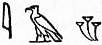
(It seems as if the two values y and א were obtained by choosing first one and then the other of the two semi-consonants composing the name. They are much confused, and a conventional symbol l has to be adopted for rendering .)
, forearm, value ’(ע); from , ’(ע), “hand.”


, mouth, value r; from , r, “mouth.”

, belly and teats, value ḫ; from , ḫ.t, “belly.”


(The feminine ending is here, as usual, neglected.)
, tank, value š; from , š, “tank.”


, slope of earth or brickwork, value q; from , q’’, “slope,” “height.”

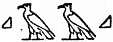
(The doubled weak consonant is here neglected.)
, hand, value d; from , d.t, “hand.”


, cobra, value z; from , z.t, “cobra.”


For some alphabetic signs more than one likely origin might be found, while for others, again, no clear evidence of origin is yet forthcoming.
It has already been explained that the writing expresses only consonants. In the Graeco-Roman period various imperfect attempts were made to render the vowels in foreign names and words by the semi-vowels as also by , the consonant ע which originally represented having been reduced in speech by that time to the power of א, only. Thus, Πτολεμαιος is spelt Ptwrmys, Antoninus, ’Nt’nynws or Intnyns, &c. &c. Much earlier, throughout the New Kingdom, a special “syllabic” orthography, in which the alphabetic signs for the consonants are generally replaced by groups or single signs having the value of a consonant followed by a semi-vowel, was used for foreign names and words, e.g.
תבכרמ, “chariot,” was written , in Coptic .


לדגמ, “tower,” was written , , .
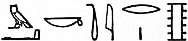


רונכ, “harp,” was written .

תמח, “Hamath,” was written .

According to W. Max Müller (Asien und Europa, 1893, chap, v.), this represents an endeavour to express the vocalization; but, if so, it was carried out with very little system. In practice, the semi-vowels are generally negligible. This method of writing can be traced back into the Middle Kingdom, if not beyond, and it greatly affected the spelling of native words in New Egyptian and demotic.
Determinatives.—Most signs can on occasion be used as determinatives, but those that are very commonly employed as phonograms or as secondary word-signs are seldom employed as determinatives; and when they are so used they are often somewhat differentiated. Certain generic determinatives are very common, e.g.:—
; of motion.

; of acts involving force.

; of divinity.

; of a person or a man’s name.

; of buildings.

; of inhabited places.

; of foreign countries.

; club; of foreigners.

; of all actions of the mouth—eating and speaking, likewise silence and hunger.

; ripple-lines; of liquid.

; hide; of animals, also leather, &c.

; of plants and fibres.

; of flesh.

; a sealed papyrus-roll; of books, teaching, law, and of abstract ideas generally.

In the earliest inscriptions the use of determinatives is restricted to the , &c., after proper names, but it developed immensely later, so that few words beyond the particles were written without them in the normal style after the Old Kingdom.

Some few signs ideographic of a group of ideas are made to express particular words belonging to that group by the aid of phonograms which point out the special meaning. In such cases the ideogram is not merely a determinative nor yet quite a word-sign. Thus “Semite,” “Libyan,” &c., but cannot stand by itself for the name of any particular foreign people. So also in monogram is šm “go,” is “conduct.”
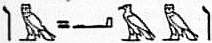
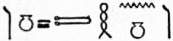


Orthography.—The most primitive form of spelling in the hieroglyphic system would be by one sign for each word, and the monuments of the Ist Dynasty show a decided tendency to this mode. Examples of it in later times are preserved in the royal cartouches, for here the monumental style demanded special consciseness. Thus, for instance, the name of Tethmosis III.—MN-ḪPR-R’—is spelled (as R’ is the name of the sun-god, with customary deference to the deity it is written first though pronounced last). A number of common words—prepositions, &c.—with only one consonant are spelled by single alphabetic signs in ordinary writing. Word-signs used singly for the names of objects are generally marked with | in classical writing, as , ib, “heart,” , ḥr, “face,” &c.
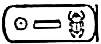


But the use of bare word-signs is not common. Flexional consonants are almost always marked by phonograms, except in very early times; as when the feminine word = z.t, “cobra,” is spelled . Also, if a sign had more than one value, a phonogram would be added to indicate which of its values was intended: thus in is św, “he,” but in it is śtn, “king.” Further, owing to the vast number of signs employed, to prevent confusion of one with another in rapid writing they were generally provided with “phonetic complements,” a group being less easily misread than a single letter. E.g. , wz, “command,” is regularly written , wz (w); but , ḥz, “white,” is written , ḥz(z). This practice had the advantage also of distinguishing determinatives from phonograms. Thus the root or syllable ḥn is regularly written to avoid confusion with the determinative . Redundance in writing is the rule; for instance, b is often spelled (b)b’(’). Biliteral phonograms are very rare as phonetic complements, nor are two biliteral phonograms employed together in writing the radicals of a word.


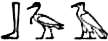
Spelling of words purely in phonetic or even alphabetic characters is not uncommon, the determinative being generally added. Thus in the pyramidal texts we find ḫpr, “become,” written in one copy of a text, in another . Such variant spellings are very important for fixing the readings of word-signs. It is noteworthy that though words were so freely spelled in alphabetic characters, especially in the time of the Old Kingdom, no advance was ever made towards excluding the cumbersome word-signs and biliteral phonograms, which, by a judicious use of determinatives, might well have been rendered quite superfluous.


Abbreviations.—We find , strictly ’nḫ z’ ś standing for the ceremonial viva! ’nḫ wz, śnb. “Life, Prosperity and Health,” and in course of time was used in accounts instead of dmz, “total.”


Monograms are frequent and are found from the earliest times. Thus , mentioned above are monograms, the association of and having no pictorial meaning. Another common monogram is , i.e. and for Ḥ·t-Ḥrw “Hathor.” A word-sign may be compounded with its phonetic complement, as ḥz “white,” or with its determinative, as ḥz “silver.”


The table on the opposite page shows the uses of a few of the commoner signs.
The decorative value of hieroglyphic was fully appreciated in Egypt. The aim of the artist-scribe was to arrange his variously shaped characters into square groups, and this could be done in great measure by taking advantage of the different ways in which many words could be spelt. Thus ḥs could be written , ḥsy , ḥs-f , ḥs-n-f . But some words in the classical writing were intractable from this point of view. It is obvious that the alphabetic signs played a very important part in the formation of the groups, and many words could only be written in alphabetic signs. A great advance was therefore made when several homophones were introduced into the alphabet in the Middle and New Kingdoms, partly as the result of the wearing away of old phonetic distinctions, giving the choice between and and and and and . In later times the number of homophones in use increased greatly throughout the different classes, the tendency being much helped by the habit of fanciful writing; but few of these homophones found their way into the cursive script. Occasionally a scribe of the old times indulged his fancy in “sportive” or “mysterious” writing, either inventing new signs or employing old ones in unusual meanings. Short sportive inscriptions are found in tombs of the XIIth Dynasty; some groups are so written cursively in early medical papyri, and certain religious inscriptions in the royal tombs of the XIXth and XXth Dynasties are in secret writing. Fanciful writing abounds on the temples of the Ptolemaic and Roman periods.


Palaeography
HRGic.—The main division is into monumental or epigraphic hieroglyphs and written hieroglyphs. The former may be rendered by the sculptor or the painter in stone, on wood, &c., with great delicacy of detail, or may be simply sunk or painted in outline. When finely rendered they are of great value to the student investigating the origins of their values. No other system of writing bears upon its face so clearly the history of its development as the Egyptian; yet even in this a vast amount of work is still required to detect and disentangle the details. Monumental hieroglyphic did not cease till the 3rd century a.d. (Temple of Esna). The written hieroglyphs, formed by the scribe with the reed pen on papyrus, leather, wooden tablets, &c., have their outlines more or less abbreviated, producing eventually the cursive scripts hieratic and demotic. The written hieroglyphs were employed at all periods, especially for religious texts.
Hieratic.—A kind of cursive hieroglyphic or hieratic writing is found even in the Ist Dynasty. In the Middle Kingdom it is well characterized, and in its most cursive form seems hardly to retain any definable trace of the original hieroglyphic pictures. The style varies much at different periods.
Sign. Description. Name. Word-sign Value. Phonetic Value. Determinative Value.
child hrd (khrod) youth

face ḥr (ḥor) ḥr [ḥr]

eye ir.t (yori.t) ir ir see, &c.

mouth r (ro) r r

forearm ’ (’ei) ’ ’ [action of hand or arm]

arm with stick nḫt “be strong” nḫt violent action

man with stick nḫt “be strong” nḫt violent action

lungs and windpipe sm; sm;

heart ib heart

heart and windpipe ? nfr

sparrow ? šr evil, worthlessness, smallness

widgeon s;.t s; s;

bolti-fish in.t in in

tusk (1) ibḥ “tooth” (2) ḥw “taste” bḥ ḥw bḥ bite, &c.

cut branch ḫt ḫt [ḫt] wood, tree

threshing-floor sp.t sp

sun (1) r’ “sun” (2) hrw “day” (1) sun (2) division of time

chamber, house pr pr

flat land t’ t’ t’ boundless horizon, eternity

libation vase ḥs.t ḥs ḥs

cord on stick wz wz wz

basket nb.t nb

looped basket ? k k

sickle ? m’ m’

composite hoe [mr?] mr mr tillage

fire-drill z’.t(?) z’ z’

attendant’s equipment šmś “follow” šmś

knife dś dś cut, prick, cutting instrument

Demotic.—Widely varying degrees of cursiveness are at all periods observable in hieratic; but, about the XXVIth Dynasty, which inaugurated a great commercial era, there was something like a definite parting between the uncial hieratic and the most cursive form afterwards known as demotic. The employment of hieratic was thenceforth almost confined to the copying of religious and other traditional texts on papyrus, while demotic was used not only for all business but also for writing literary and even religious texts in the popular language. By the time of the XXVth Dynasty the cursive of the conservative Thebais had become very obscure. A better form from Lower Egypt drove this out completely in the time of Amasis II. and is the true demotic. Before the Macedonian conquest the cursive ligatures of the old demotic gave birth to new symbols which were carefully and distinctly formed, and a little later an epigraphic variety was engraved on stone, as in the case of the Rosetta stone itself. One of the most characteristic distinctions of later demotic is the minuteness of the writing.
HRGic is normally written from right to left, the signs facing to the commencement of the line; hieratic and demotic follow the same direction. But monumental hieroglyphic may also be written from left to right, and is constantly so arranged for purposes of symmetry, e.g. the inscriptions on the two jambs of a door are frequently turned in opposite directions; the same is frequently done with the short inscriptions scattered over a scene amongst the figures, in order to distinguish one label from another.
In modern founts of type, the hieroglyphic signs are made to run from left to right, in order to facilitate the setting where European text is mixed with the Egyptian. The table on next page shows them in their more correct position, in order to display more clearly their relation to the hieratic and demotic equivalents.
Clement of Alexandria states that in the Egyptian schools the pupils were first taught the “epistolographic” style of writing (i.e. demotic), secondly the “hieratic” employed by the sacred scribes, and finally the “hieroglyphic” (Strom. v. 657). It is doubtful whether they classified the signs of the huge hieroglyphic syllabary with any strictness. The only native work on the writing that has come to light as yet is a fragmentary papyrus of Roman date which has a table in parallel columns of hieroglyphic signs, with their hieratic equivalents and words written in hieratic describing them or giving their values or meanings. The list appears to have comprised about 460 signs, including most of those that occur commonly in hieratic. They are to some extent classified. The bee heads the list as a royal sign, and is followed by figures of nobles and other human figures in various attitudes, more or less grouped among themselves, animals, reptiles and fishes, scorpion, animals again, twenty-four alphabetic characters, parts of the human body carefully arranged from to , thirty-two in number, parts of animals, celestial signs, terrestrial signs, vases. The arrangement down to this point is far from strict, and beyond it is almost impossible to describe concisely, though there is still a rough grouping of characters according to resemblance of form, nature or meaning. It is a curious fact that not a single bird is visible on the fragments, and the trees and plants, which might easily have been collected in a compact and well-defined section, are widely scattered. Why the alphabetic characters are introduced where they are is a puzzle; the order of these is:—





Three others, and , had already occurred amongst the fish and reptiles. There seems to be no logical aim in this arrangement of the alphabetic characters and the series is incomplete. Very probably the Egyptians never constructed a really systematic list of hieroglyphs. In modern lists the signs are classified according to the nature of the objects they depict, as human figures, plants, vessels, instruments, &c. Horapollon’s Hieroglyphica may be cited as a native work, but its author, if really an Egyptian, had no knowledge of good writing. His production consists of two elaborate complementary lists: the one describing sign-pictures and giving their meanings, the other cataloguing ideas in order to show how they could be expressed in hieroglyphic. Each seems to us to be made up of curious but perverted reminiscences eked out by invention; but they might some day prove to represent more truly the usages of mystics and magicians in designing amulets, &c., at a time approaching the middle ages.