VOLUME IX SLICE I Edwardes to Ehrenbreitstein (continued 2)
Reading edition
See Mary H. Kingsley, West African Studies (1901); Rev. Robt. H. Nassau, Fetichism in West Africa (1904); C. Partridge, Cross River Natives (1905).
EGEDE, HANS (1686-1758), Norwegian missionary, was born in the vogtship of Senjen, Norway, on the 31st of January 1686. He studied at the university of Copenhagen, and in 1706 became pastor at Vaagen in the Lofoten islands, but the study of the chronicles of the northmen having awakened in him the desire to visit the colony of Northmen in Greenland, and to convert them to Christianity, he resigned his charge in 1717; and having, after great difficulty, obtained the sanction and help of the Danish government in his enterprise, he set sail with three ships from Bergen on the 3rd of May 1721, accompanied by his wife and children. He landed on the west coast of Greenland on the 3rd of July, but found to his dismay that the Northmen were entirely superseded by the Eskimo, in whom he had no particular interest, and whose language he would be able to master, if at all, only after years of study. But, though compelled to endure for some years great privations, and at one time to see the result of his labours almost annihilated by the ravages of small-pox, he remained resolutely at his post. He founded the colony of Godthaab, and soon gained the affections of the people. He converted many of them to Christianity, and established a considerable commerce with Denmark. Ill-health compelling him to return home in 1736, he was made principal of a seminary at Copenhagen, in which workers were trained for the Greenland mission; and from 1740 to 1747 he was superintendent of the mission. He died on the 5th of November 1758. He is the author of a book on the natural history of Greenland.
His work in Greenland was continued, on his retirement, by his son Paul Egede (1708-1789), who afterwards returned to Denmark and succeeded his father as superintendent of the Greenland mission. Paul Egede also became professor of theology in the mission seminary. He published a Greenland-Danish-Latin dictionary (1750), Greenland grammar (1760) and Greenland catechism (1756). In 1766 he completed the translation begun by his father of the New Testament into the Greenland tongue; and in 1787 he translated Thomas à Kempis. In 1789 he published a journal of his life in Greenland.
EGER, AQIBA (1761-1837), Jewish scholar, was for the last twenty-five years of his life rabbi of Posen. He was a rigorous casuist of the old school, and his chief works were legal notes on the Talmud and the code of Qaro (q.v.). He believed that religious education was enough, and thus opposed the party which favoured secular schools. He was a determined foe of the reform movement, which began to make itself felt in his time.
EGER (Czech, Cheb), a town of Bohemia, Austria, 148 m. W.N.W. of Prague by rail. Pop. (1900) 23,665. It is situated on the river Eger, at the foot of one of the spurs of the Fichtelgebirge, and lies in the centre of a German district of about 40,000 inhabitants, who are distinguished from the surrounding population by their costumes, language, manners and customs. On the rock, to the N.W. of the town, lies the Burg or Castle, built probably in the 12th century, and now in ruins. It possesses a massive black tower, built of blocks of lava, and in the courtyard is an interesting chapel, in Romanesque style with fantastic ornamentations, which was finished in the 13th century. In the banquet-room of this castle Wallenstein’s officers Terzky, Kinsky, Illo and Neumann were assassinated a few hours before Wallenstein himself was murdered by Captain Devereux. The murder took place on the 25th of February 1634 in the town-house, which was at that time the burgomaster’s house. The rooms occupied by Wallenstein have been transformed since 1872 into a museum, which contains many historical relics and antiquities of the town of Eger. The handsome and imposing St Nicholas church was built in the 13th century and restored in 1892. There is a considerable textile industry, together with the manufacture of shoes, machinery and milling. Eger was the birthplace of the novelist and playwright Braun von Braunthal (1802-1866). About 3 m. N.W. of Eger is the well-known watering place of Franzensbad (q.v.).
The district of Eger was in 870 included in the new margraviate of East Franconia, which belonged at first to the Babenbergs, but from 906 to the counts of Vohburg, who took the title of margraves of Eger. By the marriage, in 1149, of Adela of Vohburg with the emperor Frederick I., Eger came into the possession of the house of Swabia, and remained in the hands of the emperors until the 13th century. In 1265 it was taken by Ottakar II. of Bohemia, who retained it for eleven years. After being repeatedly transferred from the one power to the other, according to the preponderance of Bohemia or the empire, the town and territory were finally incorporated with Bohemia in 1350, after the Bohemian king became the emperor Charles IV. Several imperial privileges, however, continued to be enjoyed by the town till 1849. It suffered severely during the Hussite war, during the Swedish invasion in 1631 and 1647, and in the War of the Austrian Succession in 1742.
See Drivok, Ältere Geschichte der deutschen Reichstadt Eger und des Reichsgebietes Egerland (Leipzig, 1875).
EGER (Ger. Erlau, Med. Lat. Agria), a town of Hungary, capital of the county of Heves, 90 m. E.N.E. of Budapest by rail. Pop. (1900) 24,650. It is beautifully situated in the valley of the river Eger, an affluent of the Theiss, and on the eastern outskirts of the Mátra mountains. Eger is the see of an archbishopric, and owing to its numerous ecclesiastical buildings has received the name of “the Hungarian Rome.” Amongst the principal buildings are the beautiful cathedral in the Italian style, with a handsome dome 130 ft. high, erected in 1831-1834 by the archbishop Ladislaus Pyrker (1772-1847); the church of the Brothers of Mercy, opposite which is a handsome minaret, 115 ft. high, the remains of a mosque dating from the Turkish occupation, other Roman Catholic churches, and an imposing Greek church. The archiepiscopal palace; the lyceum, with a good library and an astronomical observatory; the seminary for Roman priests; and the town-hall are all noteworthy. On an eminence N.E. of the town, laid out as a park, are the ruins of the old fortress, and a monument of Stephen Dobó, the heroic defender of the town against the assaults of the Turks in 1552. The chief occupation of the inhabitants is the cultivation of the vineyards of the surrounding hills, which produce the red Erlauer wine, one of the best in Hungary. To the S.W. of Eger, in the same county of Heves, is situated the town of Gyöngyös (pop. 15,878). It lies on the south-western outskirts of the Mátra mountains, and carries on a brisk trade in the Erlauer wine, which is produced throughout the district. The Hungarians defeated the Austrians at Gyöngyös on the 3rd of April 1849. To the S.W. of Gyöngyös is situated the old town of Hatvan (pop. 9698), which is now a busy railway junction, and possesses several industrial establishments.
Eger is an old town, and owes its importance to the bishopric created by King Stephen in 1010, which was one of the richest in the whole of Hungary. In 1552 Eger resisted the repeated assaults of a large Turkish force; in 1596, however, it was given up to the Turks by the Austrian party in the garrison, and remained in their possession until 1687. It was created an archbishopric in 1814. During the revolution of 1848-1849, Eger was remarkable for the patriotic spirit displayed by its inhabitants; and it was here that the principal campaigns against the Austrians were organized.
EGERIA, an ancient Italian goddess of springs. Two distinct localities were regarded as sacred to her,—the grove of Diana Nemorensis at Aricia, and a spring in the immediate neighbourhood of Rome at the Porta Capena. She derives her chief importance from her legendary connexion with King Numa, who had frequent interviews with her and consulted her in regard to his religious legislation (Livy i. 19; Juvenal iii. 12). These meetings took place on the spot where the sacred shield had fallen from heaven, and here Numa dedicated a grove to the Camenae, like Egeria deities of springs. After the death of Numa, Egeria was said to have fled into the grove of Aricia, where she was changed into a spring for having interrupted the rites of Diana by her lamentations (Ovid, Metam. xv. 479). At Aricia there was also a Manius Egerius, a male counterpart of Egeria. Her connexion with Diana Nemorensis, herself a birth goddess, is confirmed by the fact that her aid was invoked by pregnant women. She also possessed the gift of prophecy; and the statement (Dion. Halic. ii. 60) that she was one of the Muses is due to her connexion with the Camenae, whose worship was displaced by them.
EGERTON, SIR PHILIP DE MALPAS GREY, Bart. (1806-1881), English palaeontologist, was born on the 13th of November 1806, the son of the 9th baronet. He was educated at Eton and Christ Church, Oxford, where he graduated B.A. in 1828. While at college his interest in geology was aroused by the lectures of W. Buckland, and by his acquaintance with W.D. Conybeare. Subsequently when travelling in Switzerland with Lord Cole (afterwards 3rd earl of Enniskillen) they were introduced to Prof. L. Agassiz at Neufchatel, and determined to make a special study of fossil fishes. During the course of fifty years they gradually gathered together two of the largest and finest of private collections—that of Sir Philip Grey Egerton being at Oulton Park, Tarporley, Cheshire. He described the structure and affinities of numerous species in the publications of the Geological Society of London, the Geological Magazine and the Decades of the Geological Survey; and in recognition of his services the Wollaston medal was awarded to him in 1873 by the Geological Society. He was elected F.R.S. in 1831, and was a trustee of the British Museum. As a member of Parliament he represented the city of Chester in 1830, the southern division of Cheshire from 1835 until 1868, and the western division from 1868 to 1881. He died in London on the 6th of April 1881. His collection of fossil fishes is now in the British Museum.
EGG, AUGUSTUS LEOPOLD (1816-1863), English painter, was born on the 2nd of May 1816 in London, where his father carried on business as a gun-maker. He had some schooling at Bexley, and was not at first intended for the artistic profession; but, developing a faculty in this line, he entered in 1834 the drawing class of Mr Sass, and in 1836 the school of the Royal Academy. His first exhibited picture appeared in 1837 at the Suffolk Street gallery. In 1838 he began exhibiting in the Academy, his subject being a “Spanish Girl”; altogether he sent twenty-seven works to this institution. In 1848 he became an associate and in 1860 a full member of the Academy: he had considerable means, apart from his profession. In 1857 he took a leading part in selecting and arranging the modern paintings in the Art-Treasures Exhibition in Manchester. His constitution being naturally frail, he went in 1853, with Dickens and Wilkie Collins, to Italy for a short trip, and in 1863 he visited Algeria. Here he benefited so far as his chronic lung-disease was concerned; but exposure to a cold wind while out riding brought on an attack of asthma, from which he died on the 26th of March 1863 at Algiers, near which city his remains were buried.
Egg was a gifted and well-trained painter of genre, chiefly in the way of historical anecdote, or of compositions from the poets and novelists. Among his principal pictures may be named: 1843, the “Introduction of Sir Piercie Shafton and Halbert Glendinning” (from Scott’s Monastery); 1846, “Buckingham Rebuffed”; 1848, “Queen Elizabeth discovers she is no longer young”; 1850, “Peter the Great sees Catharine for the first time”; 1854, “Charles I. raising the Standard at Nottingham” (a study); 1855, the “Life and Death of Buckingham”; 1857 and 1858, two subjects from Thackeray’s Esmond; 1858, “Past and Present, a triple picture of a faithless wife”; 1859, the “Night before Naseby”; 1860, his last exhibited work, the Dinner Scene from The Taming of the Shrew. The Tate Gallery contains one of his earlier pictures, Patricio entertaining two Ladies, from the Diable boiteux; it was painted in 1844.
Egg was rather below the middle height, with dark hair and a handsome well-formed face; the head of Peter the Great (in the picture of Peter and Catharine, which may be regarded as his best work, along with the Life and Death of Buckingham) was studied, but of course considerably modified, from his own countenance. He was manly, kind-hearted, pleasant, and very genial and serviceable among brother-artists; social and companionable, but holding mainly aloof from fashionable circles. As an actor he had uncommon talent. He appeared among Dickens’s company of amateurs in 1852 in Lord Lytton’s comedy Not so Bad as we Seem, and afterwards in Wilkie Collins’s Frozen Deep, playing the humorous part of Job Want.
EGG (O.E. aeg, cf. Ger. Ei, Swed. aegg, and prob. Gr. ὠόν, Lat. ovum), the female reproductive cell or ovum of animals, which gives rise generally only after fertilization to the young. The largest eggs are those of birds; and this because, to the minute essential portion of the egg, or germ, from which the young bird grows, there is added a large store of food-material—the yolk and white of the egg—destined to nourish the growing embryo while the whole is enclosed within a hard shell.
The relative sizes of eggs depend entirely on the amount of the food-yolk thus enclosed with the germ; while the form and texture of the outer envelope are determined by the nature of the environment to which the egg is exposed. Where the food material is infinitesimal in quantity the egg is either not extruded—the embryo being nourished by the maternal tissues,—or it passes out of the parental body and gives rise at once to a free-living organism or “larva” (see Larval Forms), as in the case of many lowly freshwater and marine animals. In such cases no “egg” in the usual sense of the term is produced.
The number of eggs periodically produced by any given individual depends on the risks of destruction to which they, and the young to which they give rise, are exposed: not more than a single egg being annually laid by some species, while with others the number may amount to millions.
Birds’ Eggs.—The egg of the bird affords, for general purposes, the readiest example of the modifications imposed on eggs by the external environment. Since it must be incubated by the warmth of the parent’s body, the outer envelope has taken the form of a hard shell for the protection of the growing chick from pressure, while the dyes which commonly colour the surface of this shell serve as a screen to hide it from egg-eating animals.
Carbonate of lime forms the principal constituent of this shell; but in addition phosphate of lime and magnesia are also present. In section, this shell will be found to be made up of three more or less distinct crystalline layers, traversed by vertical canals, whereby the shell is made porous so as to admit air to the developing chick.
The outermost, or third, layer of this shell often takes the form of a glaze, as of porcelain, as for example in the burnished egg of the ostrich: or it may assume the character of a thick, chalky layer as in some cuckoos (Guira, Crotophaga ani), cormorants, grebes and flamingoes: while in some birds as in the auks, gulls and tinamous, this outer layer is wanting; yet the tinamous have the most highly glazed eggs of all birds, the second layer of the shell developing a surface even more perfectly burnished than that formed by the outermost, third layer in the ostrich.
While the eggs of some birds have the shell so thin as to be translucent, e.g. kingfisher, others display considerable thickness, the maximum being reached in the egg of the extinct Aepyornis.
Though in shape differing but little from that of the familiar hen’s egg, certain well-marked modifications of form are yet to be met with. Thus the eggs of the plover are pear-shaped, of the sand-grouse more or less cylindrical, of the owls and titmice spherical and of the grebes biconical.
In the matter of coloration the eggs of birds present a remarkable range. The pigments to which this coloration is due have been shown, by means of their absorption spectra (Sorby, Proc. Zool. Soc., 1875), to be seven in number. The first of these, oorhodeine, is brown-red in tone, and rarely absent: the second and third, oocyanin, and banded oocyanin, are of a beautiful blue, and though differing spectroscopically give rise to the same product when oxidized: the fourth and fifth are yellow, and rufous ooxanthine, the former combining with oocyanin gives rise to the wonderful malachite green of the emu’s egg, while the latter occurs only in the eggs of tinamous: the sixth is lichenoxanthine, a pigment not yet thoroughly known but present in the shells of all eggs having a peculiar brick-red colour. Still less is known of the seventh pigment which is, as yet, nameless. It is a substance giving a banded absorption spectrum, and which, mixed with other pigments, imparts an abnormally browner tint. The origin of these pigments is yet uncertain, but it is probable that they are derived from the haemoglobin or red colouring matter of the blood. This being so, then the pigments of the egg-shell differ entirely in their nature from those which colour the yolk or the feathers.
While many eggs are either colourless or of one uniform tint, the majority have the surface broken up by spots or lines, or a combination of both, of varying tints: the pigment being deposited as the egg passes down the lower portion of the oviduct. That the egg during this passage turns slowly on its long axis is shown by the fact that the spots and lines have commonly a spiral direction; though some of the markings are made during periods of rest, as is shown by their sharp outlines, movement giving a blurred effect. Where the egg is pyriform, the large end makes way for the smaller. Many eggs display, in addition to the strongly marked spots, more or fewer fainter spots embedded in a deeper layer of the shell, and hence such eggs are said to be “double-spotted,” e.g. rails and plovers.
Among some species, as in birds of prey, the intensity of this coloration is said to increase with age up to a certain point, when it as gradually decreases. Frequently, especially where but two eggs are laid (Newton), all the dye will be deposited, sometimes on the first, sometimes on the last laid, leaving the other colourless. But although of a number of eggs in a “clutch”—as the full complement of eggs in a nest is called—no two are exactly alike, they commonly bear a very close resemblance. Among certain species, however, which lay several eggs, one of the number invariably differs markedly from the rest, as for example in the eggs of the house-sparrow or in those of the sparrow-hawk, where, of a clutch of six, two generally differ conspicuously from the rest. Differing though these eggs do from the rest of the clutch, all yet present the characters common to the species. But the eggs of some birds, such as the Australian swamp quail, Synoecus australis, present a remarkably wide range of variation in the matter of coloration, no two clutches being alike, the extremes ranging from pure white to eggs having a greenish ground colour and rufous spots or blotches. But a still more interesting illustration of variation equally marked is furnished by the chikor partridge (Caccabis chukar), since here the variation appears to be correlated with the geographical distribution of the species. Thus eggs taken in Greece are for the most part cream-coloured and unspotted; those from the Grecian Archipelago are generally spotted and blotched; while more to the eastward spots are invariably present, and the blotches attain their maximum development.
But in variability the eggs of the guillemot (Lomvia troile) exceed all others: both in the hue of the ground colour and in the form of the superimposed markings, these eggs exhibit a wonderful range for which no adequate explanation has yet been given.
Individual peculiarities of coloration are commonly reproduced, not only with this species but also in others, year after year.
The coloration of the egg bears no sort of relation to the coloration of the bird which lays it; but it bears on the other hand a more or less direct relation to the nature of the Significance of colour. environment during incubation.
White eggs may generally be regarded as representing the primitive type of egg, since they agree in this particular with the eggs of reptiles. And it will generally be found that eggs of this hue are deposited in holes or in domed nests. So long indeed as nesting-places of this kind are used will the eggs be white. And this because coloured eggs would be invisible in dimly lighted chambers of this description, and therefore constantly exposed to the risk of being broken by the sitting bird, or rolling out of reach where the chamber was large enough to admit of this, whereas white eggs are visible so long as they can be reached by the faintest rays of light. Pigeons invariably lay white eggs; and while some deposit them in holes others build an open nest, a mere platform of sticks. These exceptions to the rule show that the depredations of egg-eating animals are sufficiently guarded against by the overhanging foliage, as well as by the great distance from the ground at which the nest is built. Birds which have reverted to the more ancient custom of nesting in holes after having developed pigmented eggs, have adopted the device of covering the shell with a layer of chalky matter (e.g. puffins), or, to put the case more correctly, they have been enabled to maintain survival after their return to the more ancient mode of nidification, because this reversion was accompanied by the tendency to cover the pigmented surface of the shell with this light-reflecting chalky incrustation.
Eggs which are deposited on the bare ground, or in other exposed situations, are usually protectively coloured: that is to say, the hue of the shell more or less completely harmonizes with the ground on which the egg is placed. The eggs of the plover tribe afford the most striking examples of this fact.
But the majority of birds deposit their eggs in a more or less elaborately constructed nest, and in such cases the egg, so far from being protectively coloured, often displays tints that would appear calculated rather to attract the attention of egg-stealing animals; bright blue or blue spotted with black being commonly met with. It may be, however, that coloration of this kind is less conspicuous than is generally supposed, but in any case the safety of the egg depends not so much on its coloration as on the character of the nest, which, where protective devices are necessary, must harmonize sufficiently with its surroundings to escape observation from prowling egg-stealers of all kinds.
The size of the egg depends partly on the number produced and partly on the conditions determining the state of the young bird at hatching: hence there is a great disparity in the relative sizes of the eggs of different birds. Thus it will be found that young birds which emerge in the world blind, naked and helpless are the product of relatively small eggs, while on the contrary young hatched from relatively large eggs are down-clad and active from birth.
The fact that the eggs must be brooded by the parent is also a controlling factor in so far as number is concerned, for no more can be hatched than can be covered by the sitting bird. Other factors, however, less understood, also exercise a controlling influence in this matter. Thus the ostrich lays from 12 to 16, the teal 15, the partridge 12-20, while among many other species the number is strictly limited, as in the case of the hornbills and guillemots, which lay but a single egg; the apteryx, divers, petrels and pigeons never lay more than 2, while the gulls and plovers never exceed 4. Tropical species are said to lay fewer eggs than their representatives in temperate regions, and further immature birds lay more and smaller eggs than when fully adult.
Partly owing to the uniformity of shape, size and texture of the shell, the eggs of birds are by no means easy to distinguish, except in so far as their family resemblances are concerned: that is to say, except in particular cases, they cannot be specifically distinguished, and hence they are of but little or no value for the purposes of classification.
Save only among the megapodes, all birds brood their eggs, the period of incubation varying from 13 days, as in small passerine birds, to 8 weeks, as in the cassowary, though eggs of the rhea and of Struthio hatch in from 5 to 6 weeks. But the megapodes deposit their eggs in mounds of decaying vegetable matter or in sand in the neighbourhood of hot springs, and there without further apparent care leave them. Where the nestling is active from the moment of hatching the eggs have a relatively longer incubation period than in cases where the nestlings are for a long while helpless.
Eggs of Mammals.—Only in the spiny ant-eater, or Echidna, and the duck-billed platypus, or Ornithorhynchus, among the Mammalia, are the eggs provided with a large store of yolk, enclosed within a shell, and extruded to undergo development apart from the maternal tissues. In the case of the echidna the eggs, two in number, are about as large as those of a sparrow, similar in shape, and have a white, parchment-like shell. After expulsion they are transferred by the beak of the mother to a pouch resembling that of the marsupial kangaroos, and there they undergo development. The Ornithorhynchus, on the other hand, lays from two to four eggs, which in size and general appearance resemble those of the echidna. They are, however, deposited in a loosely constructed nest at the end of a long burrow and there brooded. In Marsupials, the eggs are smaller than those of Echidna and Ornithorhynchus, and they contain a larger proportion of yolk than occurs in higher mammals.
Eggs of Reptiles.—The eggs of reptiles are invariably provided with a large amount of food yolk and enclosed with a firm test or shell, which though generally parchment-like in texture may be calcareous as in birds, as, for example, in many of the tortoises and turtles and in the crocodiles.
Among reptiles the egg is always white or yellowish, while the number laid often far exceeds that in the case of birds. The tuatara of New Zealand, however, lays but ten—white hard-shelled, long and oval—at intervals between November and January. The long intervals between the appearance of the successive eggs is a characteristic feature of the reptiles, but is met with among the birds only in the megapodes, which, like the reptiles, do not “brood” their eggs.
Among the Chelonia the number of eggs varies from two to four in some of the tortoises, to 200 in some of the turtles: while in the crocodiles between 20 and 30 are produced, hard-shelled and white.
The eggs of the lizards are always white or yellowish, and generally soft-shelled; but the geckos and the green lizard lay hard-shelled eggs. Many of the soft-shelled eggs are remarkable for the fact that they increase in size after extrusion, owing to the stretching of the membranous shell by the growing embryo. In the matter of number lizards are less prolific than many of the Chelonia, a dozen eggs being the general number, though as many as thirty may be produced at a time, as in the case of the common chameleon.
While as a general rule the eggs of lizards are laid in burrows or buried, some are retained within the body of the parent until the young are ready to emerge; or they may even hatch within the oviduct. This occurs with some chameleons and some lizards, e.g. the slow-worm. The common English lizard is also viviparous. Normally the young leaves the egg immediately after its extrusion, but if by any chance this extrusion is delayed they escape while yet in the oviduct.
The majority of the snakes lay eggs, but most of the vipers and the aquatic snakes are viviparous, as also are a few terrestrial species. The shell of the egg is always soft and parchment-like. As a rule the number of eggs produced among the snakes is not large, twenty or thirty being common, but some species of python lay as many as a hundred. Generally, among the oviparous snakes the eggs are buried, but some species of boas jealously guard them, enclosing them within the coils of the body.
Eggs of Amphibia.—Among the amphibia a greater variety obtains in the matter of the investment of the egg, as well as in the number, size and method of their disposal. The outer covering is formed by a toughening of the surface of a thick gelatinous coat which surrounds the essential parts of the egg. This coat in many species of salamander—using this name in the wide sense—is produced into threads which serve either to anchor the eggs singly or to bind them together in bunches.
Viviparity occurs both among the limbless and the tailed Amphibia, the eggs hatching before they leave the oviduct or immediately after extrusion. The number of young so produced is generally not large, but the common salamander (Salamandra maculosa) may produce as many as fifty at a birth, though fifteen is the more normal figure. When the higher number is reached the young are relatively small and weak.
As a rule among the Amphibia the young leave the egg in the form of larvae, generally known as “tadpoles”; but many species produce eggs containing a sufficient amount of food material to enable the whole of the larval phase to be completed before hatching.
Among the tailless Amphibia (frogs and toads) there are wide differences in the number of eggs produced, while the methods by which these eggs are disposed of present a marvellous variety.
As a rule vast quantities of eggs are shed by the female into the water in the form of “spawn.” In the common toad as many as 7000 eggs may be extruded at a time. These leave the body in the form of two long strings—one from each oviduct—of translucent globules, gelatinous in texture, and enclosing a central sphere of yolk, the upper pole of which is black. The spawn of the common frog differs from that of the toad in that the eggs all adhere to form a huge jelly-like mass. But in many species the number of eggs produced are few; and these may be sufficiently stored with food-yolk to allow of the tadpole stage being passed before hatching, as in frogs of the genus Hylodes. In many cases the eggs are deposited out of the water and often in quite remarkable ways.
Eggs of Fishes.—The eggs of fishes present an extremely wide range of form, and a no less extensive range in the matter of number. Both among the cartilaginous and bony fishes viviparity occurs. Most of the sharks and rays are viviparous, but in the oviparous species the eggs present some interesting and peculiar forms. Large in size, the outer coat or “shell” is in all cases horn-like and flexible, but differs greatly in shape. Thus in the egg of the larger spotted dog-fish it is oblong in shape, flattened from side to side, and has the angles produced into long, slender tendrils. As the egg is laid the lower tendrils project from the vent, and the mother rubs herself against some fixed body. The tendrils soon catch fast in some slight projection, when the egg is dragged forth there to remain till hatching takes place. A couple of narrow slits at each corner of the upper end serve to admit fresh water to the imprisoned embryo during the later stages of development; when development is complete escape is made through the end of the shell. In the rays or “skates,” long spines take the place of tendrils, the egg simply resting at the bottom of the sea. The empty egg-cases of the rays are often found on the seashore, and are known as “Mermaids’ purses.” The egg of the Port Jackson shark (Cestracion) is of enormous size, pear-shaped, and provided with a spiral flange extending along the whole length of the capsule. In the Chimaera the egg is long, more or less spindle-shaped, and produced on each side into a broad flange having a fringed edge, so that the whole bears a close resemblance to a long leaf, broad and notched at one end, pointed at the other. This likeness to the seaweed among which it rests is doubtless a protective device, akin to that of protectively coloured birds’ eggs.
Among the bony fishes the eggs generally take the form of small spheres, enclosed within a tough membrane or capsule. But they present many important differences, being in some fishes heavy and remaining at the bottom of the water, in other light and floating on the surface. While in some species they are distributed separately, in others they adhere together in masses. The eggs of the salmon, for example, are heavy, hard and smooth, and deposited separately in a trough dug by the parent and afterwards covered to prevent them from being carried away by the stream. In the perch they are adhesive and form long band-like masses of spawn adhering to water-plants. In the gobies the egg is spindle-shaped, and attached by one end by means of a network of fibres, resembling rootlets; while in the smelt the egg is loosely suspended by a membrane formed by the peeling off of a part of the outer sheath of the capsule. The eggs of the garfish (Belone vulgaris) and of the flying-fish of the genus Exocoetus, attach themselves to foreign objects, or to one another, by means of threads or cords developed at opposite poles of the egg.
Among a number of fishes the eggs float at the surface of the sea, often in enormous masses, when they are carried about at the mercy of tides and currents. An idea of the size which such masses attain may be gathered from the fact that the spawn of the angler-fish, Lophius piscatorius, takes the form of a sheet from 2 to 3 ft. wide, and 30 ft. long. Another remarkable feature of these floating eggs is their transparency, inasmuch as they are extremely difficult to see, and hence they probably escape the rapacious maws of spawn-eating animals. The cod tribe and flat-fishes lay floating eggs of this description.
The maximum number of eggs laid by fishes varies greatly, some species laying relatively few, others an enormous number. But in all cases the number increases with the weight and age of the fish. Thus it has been calculated that the number laid by the salmon is roughly about 1000 to every pound weight of the fish, a 15 ℔ salmon laying 15,000 eggs. The sturgeon lays about 7,000,000; the herring 50,000; the turbot 14,311,000; the sole 134,000; the perch 280,000. Briefly, the number is greatest where the risks of destruction are greatest.
The eggs of the degenerate fishes known as the lampreys and hag-fishes are remarkable for the fact that in the latter they are large in size, cylindrical in shape, and provided at each end with hooklets whereby they adhere one to another; while in the lampreys they are extremely small and embedded in a jelly.
Molluscs.—Among the Mollusca, Crustacea and Insecta yolk-stored eggs of very remarkable forms are commonly produced.
In variety, in this connexion, the Mollusca must perhaps be given the first place. This diversity, indeed, is strikingly illustrated by the eggs of the Cephalopoda. In the squids (Loligo), for example, the eggs are enclosed in long cylindrical cases, of which there are several hundreds, attached by one end to a common centre; the whole series looking strangely like a rough mop-head. Each case, in such a cluster, contains about 250 eggs, or about 40,000 in all. By way of contrast the eggs of the true cuttle-fish (Sepia) are deposited separately, each enclosed in a tough, black, pear-shaped capsule which is fastened by a stalk to fronds of sea-weed or other object. They appear to be extruded at short intervals, till the full complement is laid, the whole forming a cluster looking like a bunch of grapes. The octopus differs yet again in this matter, its eggs being very small, berry-like, and attached to a stalk which runs through the centre of the mass.
The eggs of the univalve Mollusca are hardly less varied in the shapes they take. In the common British Purpura lapillus they resemble delicate pink grains of rice set on stalks; in Busycon they are disk-shaped, and attached to a band nearly 3 ft. long. The eggs of the shell-bearing slugs (Testacella) are large, and have the outer coat so elastic that if dropped on a stone floor they will rebound several inches; while some of the snails (Bulimus) lay eggs having a white calcareous and slightly iridescent shell, in size and shape closely resembling the egg of the pigeon. Some are even larger than the egg of the wood-pigeon. The beautiful violet-snail (Ianthina)—a marine species—carries its eggs on the under side of a gelatinous raft. No less remarkable are the eggs of the whelk; since, like those of the squids, they are not laid separately but enveloped in capsules, and these to the number of many hundreds form the large, ball-like masses so commonly met with on the seashore. When the eggs in these capsules hatch, the crowd of embryos proceed to establish an internecine warfare, devouring one another till only the strongest survives!
With the Mollusca, as with other groups of animals, where the eggs are exposed to great risks they are small, produced in great numbers, and give rise to larvae. This is well illustrated by the common oyster which annually disperses about 60,000,000 eggs. But where the risk of destruction is slight, the eggs are large and produce young differing from the parent only in size, as in the case of the pigeon-like eggs of Bulimus.
Crustaceans.—Among the higher Crustacea, as a rule, the eggs are carried by the female, attached to special appendages on the under side of the body. But in some—Squillas—they are deposited in burrows. Generally they are relatively small so that the young which emerge therefrom differ markedly in appearance from the parents, but in deep-sea and freshwater species the eggs are large, when the young, on emerging, differ but little from the adults in appearance.
Insects, &c.—The eggs of insects though minute, are also remarkable for the great variety of form which they present, while they are frequently objects of great beauty owing to the sculptured markings of the shell. They are generally laid in clusters, either on the ground, on the leaves of plants, or in the water. Some of the gnats (Culex) lay them on the water. Cylindrical in shape they are packed closely together, set on end, the whole mass forming a kind of floating raft. Frequently, as in the case of the stick and leaf insect, the eggs are enclosed in capsules of very elaborate shapes and highly ornamented.
As to the rest of the Invertebrata—above the Protozoa the eggs are laid in water, or in damp places. In the former case they are as a rule small, and give rise to larvae; while eggs hatched on land are sometimes enclosed in capsules, “cocoons,” as in the case of the earthworm, where this capsule is filled with a milky white fluid, of a highly nutritious character, on which the embryos feed.
Among some invertebrates two different kinds of eggs are laid by the same individual. The water-flea, Daphnia (a crustacean), lays two kinds of eggs known as “summer” and “winter” eggs. The summer eggs are carried by the female in a “brood-pouch” on the back. The “winter” eggs, produced at the approach of winter, differ markedly in appearance from the summer eggs, being larger, darker in colour, thicker shelled, and enclosed in a capsule formed from the shell or carapace, of the parent’s body. “Winter eggs,” however, may be produced in the height of summer. While the “summer eggs” are unfertilized, the winter eggs are fertilized by the male, and possess the remarkable power of lying dormant for months or even years before they develop. The production of these two kinds of eggs is a device to overcome the cold of winter, or the drying up of the pools in which the species lives, during the heat of the summer. The power of resistance which such eggs possess may be seen in the fact that a sample of mud which had been kept dry for ten years still contained living eggs. In deep water where neither drought nor winter cold can seriously affect the Daphnias, they propagate all the year round by unfertilized “summer” eggs.
Bibliography.—For further details on this subject the following authors should be consulted:—Mammals: F. E. Beddard, “Remarks on the Ovary of Echidna,” Proc. Roy. Phys. Soc. Edin. vol. viii. (1885); W. H. Caldwell, “The Embryology of Monotremata and Marsupialia,” Phil. Trans. Roy. Soc. vol. 178 (1887); E. B. Poulton, “The Structures connected with the Ovarian Ovum of the Marsupialia and Monotremata,” Quart. Journ. Micros. Sci. vol. xxiv. (1884). Birds, Systematic:—H. Seebohm, Coloured Figures of the Eggs of British Birds (1896); A. Newton, Ootheca Wooleyana (1907); E. Oates, Cat. Birds’ Eggs Brit. Mus. (appearing), vols. i.-iv. published. General:—A. Newton, Dictionary of Birds (1896). Colouring matter:—Newbegin, Colour in Nature (1898). Reptiles and Amphibia:—H. Gadow, “Reptiles,” Camb. Nat. Hist. (1901); G. A. Boulenger, “The Tailless Batrachians of Europe,” Ray Soc. (1896). Fishes:—Bridge and Boulenger, “Fishes, Ascidians, &c.,” Camb. Nat. Hist. (1904); B. Dean, Fishes Living and Fossil (1895); J. T. Cunningham, Marketable Marine Fishes (1896). Invertebrate:—G. H. Carpenter, Insects. Their Structure and Life (1899); L. C. Miall, A History of Aquatic Insects (1895); T. R. R. Stebbing, Crustacea, Internat. Sci. series (1893); M. C. Cooke, “Mollusca,” Camb. Nat. Hist. (1906). For further references to the above and other Invertebrate groups see various text-books on Entomology, Zoology.
(W. P. P.)
EGGENBERG, HANS ULRICH VON, Prince (1568-1634), Austrian statesman, was a son of Siegfried von Eggenberg (d. 1594), and began life as a soldier in the Spanish service, becoming about 1596 a trusted servant of the archduke of Styria, afterwards the emperor Ferdinand II. Having become a Roman Catholic, he was soon the chancellor and chief adviser of Ferdinand, whose election as emperor he helped to secure in 1619. He directed the imperial policy during the earlier part of the Thirty Years’ War, and was in general a friend and supporter of Wallenstein, and an opponent of Maximilian I., duke of Bavaria, and of Spain. He was largely responsible for Wallenstein’s return to the imperial service early in 1632, and retired from public life just after the general’s murder in February 1634, dying at Laibach, on the 18th of October 1634. Eggenberg’s influence with Ferdinand was so marked that it was commonly said that Austria rested upon three hills (Berge): Eggenberg, Questenberg and Werdenberg. He was richly rewarded for his services to the emperor. Having received many valuable estates in Bohemia and elsewhere, he was made a prince of the Empire in 1623, and duke of Krumau in 1625.
See H. von Zwiedineck-Südenhorst, Hans Ulrich, Fürst von Eggenberg (Vienna, 1880); and F. Mares, Beiträge zur Geschichte der Beziehungen des Fürsten J. U. von Eggenberg zu Kaiser Ferdinand II und zu Waldstein (Prague, 1893).
EGGER, ÉMILE (1813-1885), French scholar, was born in Paris on the 18th of July 1813. From 1840 till 1855 he was assistant professor, and from 1855 till his death professor of Greek literature in the Faculté; des Lettres at Paris University. In 1854 he was elected a member of the Académie des Inscriptions and in 1873 of the Conseil supérieur de l’instruction publique. He was a voluminous writer, a sound and discerning scholar, and his influence was largely responsible for the revival of the study of classical philology in France. His most important works were Essai sur l’histoire de la critique chez les Grecs (1849), Notions élémentaires de grammaire comparée (1852), Apollonius Dyscole, essai sur l’histoire des théories grammalicales dans l’antiquité (1854), Mémoires de littérature ancienne (1862), Mémoires d’histoire ancienne et de philologie (1863), Les Papyrus grecs du Musée du Louvre et de la Biblioth&èque Impériale (1865), Études sur les traités publics chez les Grecs et les Romains (1866), L’Hellénisme en France (1869), La Littérature grecque (1890). He was also the author of Observations et réflexions sur le développement de l’intelligence et du langage chez les enfants (1879). Egger died in Paris on the 1st of September 1885.
EGGLESTON, EDWARD (1837-1902), American novelist and historian, was born in Vevay, Indiana, on the 10th of December 1837, of Virginia stock. Delicate health, by which he was more or less handicapped throughout his life, prevented his going to college, but he was naturally a diligent student. He was a Methodist circuit rider and pastor in Indiana and Minnesota (1857-1866); associate editor (1866-1867) of The Little Corporal, Chicago; editor of The National Sunday School Teacher, Chicago (1867-1870); literary editor and later editor-in-chief of The Independent, New York (1870-1871); and editor of Hearth and Home in 1871-1872. He was pastor of the church of Christian Endeavour, Brooklyn, in 1874-1879. From 1880 until his death on the 2nd of September 1902, at his home on Lake George, New York, he devoted himself to literary work. His fiction includes Mr Blake’s Walking Stick (1869), for children; The Hoosier Schoolmaster (1871); The End of the World (1872); The Mystery of Metropolisville (1873); The Circuit Rider (1874); Roxy (1878); The Hoosier Schoolboy (1883); The Book of Queer Stories (1884), for children; The Graysons (1888), an excellent novel; The Faith Doctor (1891); and Duffels (1893), short stories. Most of his stories portray the pioneer manners and dialect of the Central West, and the Hoosier Schoolmaster was one of the first examples of American local realistic fiction; it was very popular, and was translated into French, German and Danish. During the last third of his life Eggleston laboured on a History of Life in the United States, but he lived to finish only two volumes—The Beginners of a Nation (1896) and The Transit of Civilization (1900). In addition he wrote several popular compendiums of American history for schools and homes.
See G. C. Eggleston, The First of the Hoosiers (Philadelphia, 1903), and Meredith Nicholson, The Hoosiers (1900).
His brother George Cary Eggleston (1839- ), American journalist and author, served in the Confederate army; was managing editor and later editor-in-chief of Hearth and Home (1871-1874); was literary editor of the New York Evening Post (1875-1881), literary editor and afterwards editor-in-chief of the New York Commercial Advertiser (1884-1889), and editorial writer for The World (New York) from 1889 to 1900. Most of his books are stories for boys; others, and his best, are romances dealing with life in the South especially in the Virginias and the Carolinas—before and during the Civil War. Among his publications may be mentioned: A Rebel’s Recollections (1874); The Last of the Flatboats (1900); Camp Venture (1900); A Carolina Cavalier (1901); Dorothy South (1902); The Master of Warlock (1903); Evelyn Byrd (1904); A Daughter of the South (1905); Blind Alleys (1906); Love is the Sum of it all (1907); History of the Confederate War (1910); and Recollections of a Varied Life (1910).
EGHAM, a town in the Chertsey parliamentary division of Surrey, England, on the Thames, 21 m. W.S.W. of London by the London & South Western railway. Pop. (1901) 11,895. The church of St John the Baptist is a reconstruction of 1817; it contains monuments by John Flaxman. Above the right bank of the river a low elevation, Cooper’s Hill, commands fine views over the valley, and over Windsor Great Park to the west. On the hill was the Royal Indian Civil Engineering College, commonly called Cooper’s Hill College, of which Sir George Tomkyns Chesney was the originator and first president (1871). It educated men for the public works, accounts, railways and telegraph departments of India, and included a school of forestry; but it was decided, in the face of some opposition, to close it in 1906, on the theory that it was unnecessary for a college with such a specialized object to be maintained by the government, in view of the readiness with which servants for these departments could be recruited elsewhere. Part of the organization, including the school of forestry, was transferred to Oxford University. Cooper’s Hill gives name to a famous poem of Sir John Denham (1642). A large and handsome building houses the Royal Holloway College for Women (1886), founded by Thomas Holloway; in the neighbourhood is the sanatorium of the same founder (1885) for the treatment of mental ailments, accommodating about 250 patients. The college for women, surrounded by extensive grounds, commands a wide view from the wooded slope on which it stands. The recreation hall, with its fine art collection, is the most notable room in this handsome building, which can receive 250 students. Within the parish, bordering the river, is the field of Runnymede, which, with Magna Charta Island lying off it, is famous in connexion with the signature of the charter by King John. Virginia Water, a large and picturesque artificial lake to the south of Windsor Great Park, is much frequented by visitors. It was formed under the direction of the duke of Cumberland, about 1750, and was the work of the brothers Thomas and Paul Sandby.
EGIN (Armenian Agn, “the spring”), an important town in the Mamuret el-Aziz vilayet of Asiatic Turkey (altitude 3300 ft.). Pop. about 20,000, fairly equally divided between Armenian Christians and Moslems. It is picturesquely situated in a theatre of lofty, abrupt rocks, on the right bank of the western Euphrates, which is crossed by a wooden bridge. The stone houses stand in terraced gardens and orchards, and the streets are mere rock ladders. Egin was settled by Armenians who emigrated from Van in the 11th century with Senekherim. On the 8th of November 1895 and in the summer of 1896 many Armenians were massacred here.
(D. G. H.)
EGLANTINE (E. Frisian, egeltiere; Fr. aiglantier), a plant-name of which Dr R. C. A. Prior (Popular Names of British Plants, p. 70) says that it “has been the subject of much discussion, both as to its exact meaning and as to the shrub to which it properly belongs.” The eglantine of the herbalists was the sweet-brier, Rosa rubiginosa. The signification of the word seems to be thorn-tree or thorn-bush, the first two syllables probably representing the Anglo-Saxon egla, egle, a prick or thorn, while the termination is the Dutch tere, taere, a tree. Eglantine is frequently alluded to in the writings of English poets, from Chaucer downwards. Milton, in L‘Allegro, is thought by the term “twisted eglantine” to denote the honeysuckle, Lonicera Periclymenum, which is still known as eglantine in north-east Yorkshire.
EGLINTON, EARLS OF. The title of earl of Eglinton has been held by the famous Scottish family of Montgomerie since 1508. The attempts made to trace the descent of this house to Roger of Montgomery, earl of Shrewsbury (d. 1094), one of William the Conqueror’s followers, will not bear examination, and the sure pedigree of the family only begins with Sir John Montgomerie, lord of Eaglesham, who fought at the battle of Otterbourne in 1388 and died about 1398. His grandson, Sir Alexander Montgomerie (d. c. 1460), was made a lord of the Scottish parliament about 1445 as Lord Montgomerie, and Sir Alexander’s great-grandson Hugh, the 3rd lord (c. 1460-1545), was created earl of Eglinton, or Eglintoun, in 1508. Hugh, who was a person of importance during the minority of James V., was succeeded by his grandson Hugh (d. 1546), and then by the latter’s son Hugh (c. 1531-1585), who became 3rd earl of Eglinton. This nobleman was a firm supporter of Mary queen of Scots, for whom he fought at Langside, and of the Roman Catholic Church; his son and successor, Hugh, was murdered in April 1586 by the Cunninghams, a family with which his own had an hereditary blood feud. In 1612, by the death of Hugh, the 5th earl, the male line of the Montgomeries became extinct.
Having no children Earl Hugh had settled his title and estates on his cousin, Sir Alexander Seton of Foulstruther (1588-1661), a younger son of Robert Seton, 1st earl of Wintoun (c. 1550-1603), and his wife Margaret, daughter of the 3rd earl of Eglinton. Alexander, who thus became the 6th earl of Eglinton and took the name of Montgomerie, was commonly called Greysteel; he was a prominent Covenanter and fought against Charles I. at Marston Moor. Later, however, he supported the cause of Charles II., and fell into the hands of Cromwell, who imprisoned him. His fifth son, Robert Montgomerie (d. 1684), a soldier of distinction, fought against Cromwell at Dunbar and at Worcester, afterwards escaping from the Tower of London and serving in Denmark. Robert’s elder brother, Hugh, 7th earl of Eglinton (1613-1669), who also fought against Cromwell, was the grandfather of Alexander, the 9th earl (c. 1660-1729), who married, for his third wife, Susannah (1689-1780), daughter of Sir Archibald Kennedy, Bart., of Culzean, a lady celebrated for her wit and beauty. Alexander, the 10th earl (1723-1769), a son of the 9th earl, was one of the first of the Scottish landowners to carry out improvements on his estates. He was shot near Ardrossan by an excise officer named Mungo Campbell on the 24th of October 1769. His brother and successor, Archibald, the 11th earl (1726-1796), raised a regiment of Highlanders with which he served in America during the Seven Years’ War. As he left no male issue he was succeeded in the earldom by his kinsman Hugh Montgomerie (1739-1819), a descendant of the 6th earl, who was created a peer of the United Kingdom as Baron Ardrossan in 1806. Before succeeding to the earldom Hugh had served in the American war and had been a member of parliament; after this event he began to rebuild Eglinton castle on a magnificent scale and to construct a harbour at Ardrossan.
This earl’s successor was his grandson, Archibald William, the 13th earl (1812-1861), who was born at Palermo on the 29th of September 1812. His father was Archibald, Lord Montgomerie (1773-1814), the eldest son of the 12th earl, and his mother was Mary (d. 1848), a daughter of the 11th earl. Educated at Eton, the young earl’s main object of interest for some years was the turf; he kept a large racing stud and won success and reputation in the sporting world. In 1839 his name became more widely known in connexion with the famous tournament which took place at Eglinton castle and is said to have cost him £30,000 or £40,000. This was made the subject of much ridicule and was partly spoiled by the unfavourable weather, the rain falling in torrents. Yet it was a real tournament and the “knights” broke their spears in the orthodox way. Prince Louis Napoleon (Napoleon III.) took part in it, and Lady Seymour, a daughter of Thomas Sheridan and the wife of Lord Seymour, afterwards 12th duke of Somerset, was the queen of beauty. A list of the challengers with an account of the jousts and the melée will be found in the volume on the tournament written by John Richardson, with drawings by J. H. Nixon. It is also described by Disraeli in Endymion. Eglinton was a staunch Tory, and in February 1852 he became lord-lieutenant of Ireland under the earl of Derby. He retired with the ministry in the following December, having by his princely hospitality made himself one of the most popular of Irish viceroys. When Derby returned to office in February 1858 he was again appointed lord-lieutenant, and he discharged the duties of this post until June 1859. In this year he was created earl of Winton, an earldom which had been held by his kinsfolk, the Setons, from 1600 until 1716, when George Seton, the 5th earl (c. 1678-1749), was deprived of his honours for high treason. The earl died on the 4th of October 1861, and was succeeded by his eldest son Archibald William (1841-1892). When this earl died in 1892 his younger brother George Arnulph (b. 1848) became 15th earl of Eglinton and 3rd earl of Winton.
See Sir W. Fraser, Memorials of the Montgomeries, earls of Eglinton (1859).
EGMONT, EARLS OF. John Perceval, 1st earl of Egmont (1683-1748), Irish politician, and partner with J. E. Oglethorpe in founding the American colony of Georgia, was created earl in 1733. He claimed descent from the Egmonts of Flanders, but his title was taken from the place in County Cork where the family residence stood. Its name of Burton House, and that of Burton manor which formed part of the family estates, were a reminiscence of Burton in Somerset, where was the earlier English family property of his great-great-grandfather Richard Perceval (1550-1620), Burghley’s secret agent, and author of a Spanish dictionary published in 1591, whose son Sir Philip Perceval (1605-1647) acquired the Irish estates by judicious use of his opportunities as commissioner for land titles and of his interest at court. Sir Philip’s son John, grandfather of the 1st earl, was made a baronet in 1661. The first earl of Egmont (who had been made Baron Perceval in 1715, and Viscount Perceval in 1723) is chiefly important for his connexion with the colonization of Georgia, and for his voluminous letters and writings on biography and genealogy.
John Perceval, 2nd earl of Egmont (1711-1770), his eldest son, was an active politician, first lord of the admiralty (1763-1766), and political pamphleteer, and like his father an ardent genealogist. He was twice married, and had eight sons and eight daughters. One of his younger sons was Spencer Perceval, prime minister of England. His eldest son succeeded as 3rd earl, and the eldest by his second marriage (with Catherine Compton, baroness of Arden in Ireland) was in 1802 created Baron Arden of the United Kingdom, a title which subsequently became merged in the Egmont earldom.
EGMONT (Egmond), LAMORAL, Count of, prince of Gavre (1522-1568), was born in Hainaut in 1522. He was the younger of the two sons of John IV., count of Egmont, by his wife Françoise of Luxemburg, princess of Gavre. On the death of his elder brother Charles, about 1541, he succeeded to his titles and estates. In this year he served his apprenticeship as a soldier in the expedition of the emperor Charles V. to Algiers, distinguishing himself in the command of a body of cavalry. In 1544 he married Sabina, sister of the elector palatine Frederick III., and the wedding was celebrated at Spires with great pomp in the presence of the emperor and his brother Ferdinand, afterwards emperor. Created knight of the Golden Fleece in 1546, he accompanied Philip of Spain in his tour through the Netherland towns, and in 1554 he went to England at the head of a special embassy to ask the hand of Mary of England for Philip, and was afterwards present at the wedding ceremony at Winchester. In the summer of 1557 Egmont was appointed commander of the Flemish cavalry in the war between Spain and France; and it was by his vehement persuasion that the battle of St Quentin was fought. The victory was determined by the brilliant charge that he led against the French. The reputation which he won at St Quentin was raised still higher in 1558, when he encountered the French army under de Thermes at Gravelines, on its march homewards after the invasion of Flanders, totally defeated it, and took Marshal de Thermes prisoner. The battle was fought against the advice of the duke of Alva, and the victory made Alva Egmont’s enemy. But the count now became the idol of his countrymen, who looked upon him as the saviour of Flanders from the devastations of the French. He was nominated by Philip stadtholder of Flanders and Artois. At the conclusion of the war by the treaty of Cateau Cambrésis, Egmont was one of the four hostages selected by the king of France as pledges for its execution.
The attempt made by King Philip to convert the Netherlands into a Spanish dependency and to govern it by Spanish ministers excited the resentment of Egmont and other leading members of the Netherlands aristocracy. Between him and Cardinal Granvella, the all-powerful minister of the regent Margaret of Parma, there was no love lost. As a member of the council of state Egmont joined the prince of Orange in a vigorous protest addressed to Philip (1561) against the autocratic proceedings of the minister; and two years later he again protested in conjunction with the prince of Orange and Count Horn. In the spring of 1564 Granvella left the Netherlands, and the malcontent nobles once more took their places in the council of state. The resolve, however, of Philip to enforce the decrees of the council of Trent throughout the Netherlands once more aroused their resentment. Although himself a good Catholic, Egmont had no wish to see the Spanish Inquisition established in his native country. Orange, Egmont and others were convinced that the enforcement of the decrees in the Netherlands was impossible, and, in January 1665, Egmont accepted a special mission to Spain to make known to Philip the state of affairs and the disposition of the people. At Madrid the king gave him an ostentatiously cordial reception, and all the courtiers vied with one another in lavishing professions of respect upon him. They knew his vain and somewhat unstable character, and hoped to win him over without conceding anything to the wishes of the Netherlanders. The king gave him plenty of flatteries and promises, but steadily evaded any serious discussion of the object of his mission, and Egmont finally returned home without having accomplished anything. At the same time Philip sent further instructions to the regent to abate nothing of the severity of the persecution.
Egmont was naturally indignant at the treatment he had received, while the terrors of the Inquisition were steadily rousing the people to a state of frenzied excitement. In 1566 a confederacy of the lesser nobility was formed (Les Gueux) whose principles were set out in a document known as the Compromise. From this league Egmont held aloof; he declined to take any step savouring of actual disloyalty to his sovereign. He withdrew to his government of Flanders, and as stadtholder took active measures for the persecution of heretics. But in the eyes of Philip he had long been a marked man. The Spanish king had temporized only until the moment arrived when he could crush opposition by force. In the summer of 1567 the duke of Alva was despatched to the Netherlands at the head of an army of veterans to supersede the regent Margaret and restore order in the discontented provinces. Orange fled to Germany after having vainly warned Egmont and Horn of the dangers that threatened them. Alva was at pains to lull their suspicions, and then suddenly seized them both and threw them in the castle of Ghent. Their trial was a farce, for their fate had already been determined before Alva left Spain. After some months of imprisonment they were removed to Brussels, where sentence was pronounced upon them (June 4) by the infamous Council of Blood erected by Alva. They were condemned to death for high treason. It was in vain that the most earnest intercessions were made in behalf of Egmont by the emperor Maximilian, by the knights of the order of the Golden Fleece, by the states of Brabant, and by several of the German princes. Vain, too, was the pathetic pleading of his wife, who with her eleven children was reduced to want, and had taken refuge in a convent. Egmont was beheaded at Brussels in the square before the town hall on the day after his sentence had been publicly pronounced (June 5, 1568). He met his fate with calm resignation; and in the storm of terror and exasperation to which this tragedy gave rise Egmont’s failings were forgotten, and he and his fellow-victim to Spanish tyranny were glorified in the popular imagination as martyrs of Flemish freedom. From this memorable event, which Goethe made the theme of his play Egmont (1788), is usually dated the beginning of the famous revolt of the Netherlands. In 1865 a monument to Counts Egmont and Horn, by Fraiken, was erected on the spot where they were beheaded.
Bibliography.—T. Juste, Le Comte d’Egmont et le comte de Hornes (Brussels, 1862), Les Pays-Bas sous Philippe II, 1555-1565 (2 vols., Brussels, 1855); J. L. Motley, Rise of the Dutch Republic, 1555-1584 (3 vols., London, 1856); J. P. Blok, History of the People of the Netherlands (tr. from Dutch), vol. iii. (New York, 1900); R. Fruin, Het voorspel van den tastigjarigen oorlag (Amsterdam, 1866); E. Marx, Studien zur Geschichte des niederländischen Aufstandes (Leipzig, 1902).
(G. E.)
EGOISM (from Gr. and Lat. ego, I, the 1st personal pronoun), a modern philosophical term used generally, in opposition to “Altruism,” for any ethical system in which the happiness or the good of the individual is the main criterion of moral action. Another form of the word, “Egotism,” is really interchangeable, though in ordinary language it is often used specially (and similarly “egoism,” as in George Meredith’s Egoist) to describe the habit of magnifying one’s self and one’s achievements, or regarding all things from a selfish point of view. Both these ideas derive from the original meaning of ego, myself, as opposed to everything which is outside myself. This antithesis of ego and non-ego, self and not-self, may be understood in several senses according to the connexion in which it is used. Thus the self may be held to include one’s family, property, business, and an indefinitely wider range of persons or objects in which the individual’s interest is for the moment centred, i.e. everything which I can call “mine.” In this, its widest, sense “a man’s Self is the sum total of all that he can call his” (Wm. James, Principles of Psychology, chap x.). This self may be divided up in many ways according to the various forms in which it may be expressed. Thus James (ibid.) classifies the various “selves” as the material, the spiritual, the social and the “pure.” Or again the self may be narrowed down to a man’s own person, consisting of an individual mind and body. In the true philosophical sense, however, the conception of the ego is still further narrowed down to the individual consciousness as opposed to all that is outside it, i.e. can be its object. This conception of the self belongs mainly to metaphysics and involves the whole problem of the relation between subject and object, the nature of reality, and the possibility of knowledge of self and of object. The ordinary idea of the self as a physical entity, obviously separate from others, takes no account of the problem as to how and in what sense the individual is conscious of himself; what is the relation between subject and object in the phenomenon of self-consciousness, in which the mind reflects upon itself both past and present? The mind is in this case both subject and object, or, as William James puts it, both “I” and “me.” The phenomenon has been described in various ways by different thinkers. Thus Kant distinguished the two selves as rational and empirical, just as he distinguished the two egos as the noumenal or real and the phenomenal from the metaphysical standpoint. A similar distinction is made by Herbart. Others have held that the self has a complex content, the subject self being, as it were, a fuller expression of the object-self (so Bradley); or again the subject self is the active content of the mind, and the object self the passive content which for the moment is exciting the attention. The most satisfactory and also the most general view is that consciousness is complex and unanalysable.
The relation of the self to the not-self need not to be treated here (see Metaphysics). It may, however, be pointed out that in so far as an object is cognized by the mind, it becomes in a sense part of the complex self-content. In this sense the individual is in himself his own universe, his whole existence being, in other words, the sum total of his psychic relations, and nothing else being for him in existence at all. A similar idea is prominent in many philosophico-religious systems wherein the idea of God or the Infinite is, as it were, the union of the ego and the non-ego, of subject and object. The self of man is regarded as having limitations, whereas the Godhead is infinite and all-inclusive. In many mystical Oriental religions the perfection of the human self is absorption in the infinite, as a ripple dies away on the surface of water. The problems of the self may be summed up as follows. The psychologist investigates the ideal construction of the self, i.e. the way in which the conception of the self arises, the different aspects or contents of the self and the relation of the subject to the object self. At this point the epistemologist takes up the question of empirical knowledge and considers the kind of validity, if any, which it can possess. What existence has the known object for the knowing subject? The result of this inquiry is generally intellectual scepticism in a greater or less degree, namely, that the object has no existence for the knower except a relative one, i.e. in so far as it is “known” (see Relativity of Knowledge). Finally the metaphysician, and in another sphere the theologian, consider the nature of the pure or transcendental self apart from its relations, i.e. the absolute self.
In ethics, egoistic doctrines disregard the ultimate problems of selfhood, and assume the self to consist of a man’s person and those things in which he is or ought to be directly interested. The general statement that such doctrines refer all moral action to criteria of the individual’s happiness, preservation, moral perfection, raises an obvious difficulty. Egoism merely asserts that the self is all-important in the application of moral principles, and does not in any way supply the material of these principles. It is a purely formal direction, and as such merely an adjunct to a substantive ethical criterion. A practical theory of ethics seeks to establish a particular moral ideal; if it is an absolute criterion, then the altruist would place first the attainment of that ideal by others, while the egoist would seek it for himself. The same is true of ethical theories which may be described as material. Of the second type are those, e.g. of Hobbes and Spinoza, which advocate self-preservation as the ideal, as contrasted with modern evolutionist moralists who advocate race-preservation. Again, we may contrast the early Greek hedonists, who bade each man seek the greatest happiness (of whatever kind), with modern utilitarian and social hedonists, who prefer the greatest good or the greatest happiness of the greatest number. It is with hedonistic and other empirical theories that egoism is generally associated. As a matter of fact, however, egoism has been no less prominent in intuitional ethics. Thus the man who seeks only or primarily his own moral perfection is an egoist par excellence. Such are ascetics, hermits and the like, whose whole object is the realization of their highest selves.
The distinction of egoistical and altruistic action is further complicated by two facts. In the first place, many systems combine the two. Thus Christian ethics may be said to insist equally on duty to self and duty to others, while crudely egoistic systems become unworkable if a man renders himself obnoxious to his fellows. On the other hand, every deliberate action based on an avowedly altruistic principle necessarily has a reference to the agent; if it is right that A should do a certain action for the benefit of B, then it tends to the moral self-realization of A that he should do it. Upon whatsoever principle the rightness of an action depends, its performance is right for the agent. The self-reference is inevitable in every action in so far as it is regarded as voluntary and chosen as being of a particular moral quality.
It is this latter fact which has led many students of human character to state that men do in fact aim at the gratification of their personal desires and impulses. The laws of the state and the various rules of conduct laid down by religion or morality are merely devices adopted for general convenience. The most remarkable statement of this point of view is that of Friedrich Nietzsche, who went so far as to denounce all forms of self-denial as cowardice:—let every one who is strong seek to make himself dominant at the expense of the weak.
EGORIEVSK, a town of Russia, in the government of Ryazañ, 70 m. by rail E.S.E. of Moscow, by a branch line (15 m.) connecting with the Moscow to Ryazañ main line. The cotton mills and other factories give occupation to 6000 persons. Egorievsk has important fairs for grain, hides, &c., which are exported. Pop. (1897) 23,932.
EGREMONT, EARLS OF. In 1749 Algernon Seymour, 7th duke of Somerset, was created earl of Egremont, and on his childless death in February 1750 this title passed by special remainder to his nephew, Sir Charles Wyndham or Windham, Bart. (1710-1763), a son of Sir William Wyndham of Orchard Wyndham, Somerset. Charles, who had succeeded to his father’s baronetcy in 1740, inherited Somerset’s estates in Cumberland and Sussex. He was a member of parliament from 1734 to 1750, and in October 1761 he was appointed secretary of state for the southern department in succession to William Pitt. His term of office, during which he acted in concert with his brother-in-law, George Grenville, was mainly occupied with the declaration of war on Spain and with the negotiations for peace with France and Spain, a peace the terms of which the earl seems to have disliked. He was also to the fore during the proceedings against Wilkes, and he died on the 21st of August 1763. Horace Walpole perhaps rates Egremont’s talents too low when he says he “had neither knowledge of business, nor the smallest share of parliamentary abilities.”
The 2nd earl’s son and successor, George O’Brien Wyndham (1751-1837), was more famous as a patron of art and an agriculturist than as a politician, although he was not entirely indifferent to politics. For some time the painter Turner lived at his Sussex residence, Petworth House, and in addition to Turner, the painter Leslie, the sculptor Flaxman and other talented artists received commissions from Egremont, who filled his house with valuable works of art. Generous and hospitable, blunt and eccentric, the earl was in his day a very prominent figure in English society. Charles Greville says, “he was immensely rich and his munificence was equal to his wealth”; and again that in his time Petworth was “like a great inn.” The earl died unmarried on the 11th of November 1837, and on the death of his nephew and successor, George Francis Wyndham, the 4th earl (1785-1845), the earldom of Egremont became extinct. Petworth, however, and the large estates had already passed to George Wyndham (1787-1869), a natural son of the 3rd earl, who was created Baron Leconfield in 1859.
EGREMONT, a market town in the Egremont parliamentary division of Cumberland, England, 5 m. S.S.E. of Whitehaven, on a joint line of the London & North Western and Furness railways. Pop. of urban district (1901) 5761. It is pleasantly situated in the valley of the Ehen. Ruins of a castle command the town from an eminence. It was founded c. 1120 by William de Meschines; it is moated, and retains a Norman doorway and some of the original masonry, as well as fragments of later date. The church of St Mary is a modern reconstruction embodying some of the Norman features of the old church. Iron ore and limestone are raised in the neighbourhood.
It seems impossible to find any history for Egremont until after the Norman Conquest, when Henry I. gave the barony of Coupland to William de Meschines, who erected a castle at Egremont around which the town grew into importance. The barony afterwards passed by marriage to the families of Lucy and Multon, and finally came to the Percys, earls of Northumberland, from whom are descended the present lords of the manor of Egremont. The earliest evidence that Egremont was a borough occurs in a charter, granted by Richard de Lucy in the reign of King John, which gave the burgesses right to choose their reeve, and set out the customs owing to the lord of the manor, among which was that of providing twelve armed men at his castle in the time of war. The borough was represented by two members in the parliament of 1295, but in the following year was disfranchised, on the petition of the burgesses, on account of the expense of sending members. In 1267 Henry III. granted Thomas de Multon a market every Wednesday at Egremont, and a fair every year on the eve, day and morrow of the Nativity of the Virgin Mary. In the Quo Warranto rolls he is found to have claimed by prescription another weekly market on Saturday. The market rights were purchased from Lord Leconfield in 1885, and the market on Saturday is still held. Richard de Lucy’s charter shows that dyeing, weaving and fulling were carried on in the town in his time.
EGRESS (Lat. egressus, going out), in astronomy, the end of the apparent transit of a small body over the disk of a larger one; especially of a transit of a satellite of Jupiter over the disk of that planet. It designates the moment at which the smaller body is seen to leave the limb of the other.
EGYPT, a country forming the N.E. extremity of Africa.1 In the following account a division is made into (I.) Modern Egypt, and (II.) Ancient Egypt; but the history from the earliest times is given as a separate section (III.).
Section I. includes Geography, Economics, Government, Inhabitants, Finance and Army. Section II. is subdivided into:—(A) Exploration and Research; (B) The Country in Ancient Times; (C) Religion; (D) Language and Writing; (E) Art and Archaeology; (F) Chronology. Section III. is divided into three main periods:—(1) Ancient History; (2) the Mahommedan Period; (3) Modern History (from Mehemet Ali).
I. Modern Egypt
Boundaries and Areas.—Egypt is bounded N. by the Mediterranean, S. by the Anglo-Egyptian Sudan, N.E. by Palestine, E. by the Red Sea, W. by Tripoli and the Sahara. The western frontier is ill-defined. The boundary line between Tripoli and Egypt is usually taken to start from a point in the Gulf of Sollum and to run S. by E. so as to leave the oasis of Siwa to Egypt. South of Siwa the frontier, according to the Turkish firman of 1841, bends eastward, approaching the cultivated Nile-land near Wadi Halfa, i.e. the southern frontier. This southern frontier is fixed by agreement between Great Britain and Egypt at the 22° N. The N.E. frontier is an almost direct line drawn from Taba, near the head of the Gulf of Akaba, the eastern of the two gulfs into which the Red Sea divides, to the Mediterranean at Rafa in 34° 15′ E. The peninsula of Sinai, geographically part of Asia, is thus included in the Egyptian dominions. The total area of the country is about 400,000 sq. m., or more than three times the size of the British Isles. Of this area 14⁄15ths is desert. Canals, roads, date plantations, &c., cover 1900 sq. m.; 2850 sq. m. are comprised in the surface of the Nile, marshes, lakes, &c. A line corresponding with the 30° N., drawn just S. of Cairo, divides the country into Lower and Upper Egypt, natural designations in common use, Lower Egypt being the Delta and Upper Egypt the Nile valley. By the Arabs Lower Egypt is called Er-Rif, the cultivated or fertile; Upper Egypt Es Sa’id, the happy or fortunate. Another division of the country is into Lower, Middle and Upper Egypt, Middle Egypt in this classification being the district between Cairo and Assiut.
General Character.—The distinguishing features of Egypt are the Nile and the desert. But for the river there would be nothing to differentiate the country from other parts of the Sahara. The Nile, however, has transformed the land through which it passes. Piercing the desert, and at its annual overflow depositing rich sediment brought from the Abyssinian highlands, the river has created the Delta and the fertile strip in Upper Egypt. This cultivable land is Egypt proper; to it alone is applicable the ancient name—“the black land.” The Misr of the Arabs is restricted to the same territory. Beyond the Nile valley east and west stretch great deserts, containing here and there fertile oases. The general appearance of the country is remarkably uniform. The Delta is a level plain, richly cultivated, and varied alone by the lofty dark-brown mounds of ancient cities, and the villages set in groves of palm-trees, standing on mounds often, if not always, ancient. Groves of palm-trees are occasionally seen besides those around the villages, but other trees are rare. In Upper Egypt the Nile valley is very narrow and is bounded by mountains of no great height. They form the edge of the desert on either side of the valley, of which the bottom is level rock. The mountains rarely take the form of peaks. Sometimes they approach the river in bold promontories, and at others are divided by the dry beds of ancient watercourses. The bright green of the fields, the reddish-brown or dull green of the great river, contrasting with the bare yellow rocks, seen beneath a brilliant sun and a deep-blue sky, present views of great beauty. In form the landscape varies little and is not remarkable; in colour its qualities are always splendid, and under a general uniformity show a continual variety.
The Coast Region.—Egypt has a coast-line of over 600 m. on the Mediterranean and about 1200 m. on the Red Sea. The Mediterranean coast extends from the Gulf of Sollum on the west to Rafa on the east. From the gulf to the beginning of the Delta the coast is rock-bound, but slightly indented, and possesses no good harbourage. The cliffs attain in places a height of 1000 ft. They are the termination of a stony plateau, containing several small oases, which southward joins the more arid and uninhabitable wastes of the Libyan Desert. The Delta coast-line, composed of sandhills and, occasionally, limestone rocks, is low, with cape-like projections at the Nile mouths formed by the river silt. Two bays are thus formed, the western being the famous Bay of Aboukir. It is bounded W. by a point near the ancient Canopic mouth, eastward by the Rosetta mouth. Beyond the Delta eastward the coast is again barren and without harbours. It rises gradually southward, merging into the plateau of the Sinai peninsula. The Red Sea coast is everywhere mountainous. The mountains are the northern continuation of the Abyssinian table-land, and some of the peaks are over 6000 ft. above the sea. The highest peaks, going from north to south, are Jebels Gharib, Dukhan, Es Shayib, Fatira, Abu Tiur, Zubara and Hammada (Hamata). The coast has a general N.N.W. and S.S.E. trend, and, save for the two gulfs into which it is divided by the massif of Sinai, is not deeply indented. Where the frontier between Egypt and the Sudan reaches the sea is Ras Elba (see further Red Sea).
The Nile Valley (see also Nile).—Entering Egypt proper, a little north of the Second Cataract, the Nile flows through a valley in sandstone beds of Cretaceous age as far as 25° N., and throughout this part of its course the valley is extremely narrow, rarely exceeding 2 m. in width. At two points, namely, Kalabsha—the valley here being only 170 yds. wide and the river over 100 ft. deep—and Assuan (First Cataract), the course of the river is interrupted by outcrops of granites and other crystalline rocks, which have been uncovered by the erosion of the overlying sandstone, and to-day form the mass of islands, with numerous small rapids, which are described not very accurately as cataracts; no good evidence exists in support of the view that they are the remains of a massive barrier, broken down and carried away by some sudden convulsion. From 25° N. northwards for 518 m. the valley is of the “rift-valley” type, a level depression in a limestone plateau, enclosed usually by steep cliffs, except where the tributary valleys drained into the main valley in early times, when there was a larger rainfall, and now carry off the occasional rainstorms that burst on the desert. The cliffs are highest between Esna and Kena, where they reach 1800 ft. above sea-level. The average width of the cultivated land is about 10 m., of which the greater part lies on the left (western) bank of the river; and outside this is a belt, varying from a few hundred yards to 3 or 4 m., of stony and sandy ground, reaching up to the foot of the limestone cliffs, which rise in places to as much as 1000 ft. above the valley. This continues as far as 29° N., after which the hills that close in the valley become lower, and the higher plateaus lie at a distance of 10 or 15 m. back in the desert.
The Fayum.—The fertile province of the Fayum, west of the Nile and separated from it by some 6 m. of desert, seems to owe its existence to movements similar to those which determined the valley itself. Lying in a basin sloping in a series of terraces from an altitude of 65 ft. above sea-level in the east to about 140 ft. below sea-level on the north-west, at the margin of the Birket-el-Kerun, this province is wholly irrigated by a canalized channel, the Bahr Yusuf, which, leaving the Nile at Derut esh Sherif in Upper Egypt, follows the western margin of the cultivation in the Nile valley, and at length enters the Fayum through a gap in the desert hills by the XIIth Dynasty pyramids of Lahun and Hawara (see Fayum).
The Delta.—About 30° N., where the city of Cairo stands, the hills which have hitherto run parallel with the Nile turn W.N.W. and E.N.E., and the triangular area between them is wholly deltaic. The Delta measures 100 m. from S. to N., having a width of 155 m. on the shore of the Mediterranean between Alexandria on the west and Port Said on the east. The low sandy shore of the Delta, slowly increasing by the annual deposit of silt by the river, is mostly a barren area of sand-hills and salty waste land. This is the region of the lagoons and marshes immediately behind the coast-line. Southwards the quality of the soil rapidly improves, and becomes the most fertile part of Egypt. This area is watered by the Damietta and the Rosetta branches of the Nile, and by a network of canals. The soil of the Delta is a dark grey fine sandy soil, becoming at times almost a stiff clay by reason of the fineness of its particles, which consist almost wholly of extremely small grains of quartz with a few other minerals, and often numerous flakes of mica. This deposit varies in thickness, as a rule, from 55 to 70 ft., at which depth it is underlain by a series of coarse and fine yellow quartz sands, with occasional pebbles, or even banks of gravel, while here and there thin beds of clay occur. These sand-beds are sharply distinguished by their colour from the overlying Nile deposit, and are of considerable thickness. A boring made in 1886 for the Royal Society at Zagazig attained a depth of 375 ft. without reaching rock, and another, subsequently sunk near Lake Aboukir (close to Alexandria), reached a depth of 405 ft. with the same result. Numerous other borings to depths of 100 to 200 ft. have given similar results, showing the Nile deposit to rest generally on these yellow sands, which provide a constant though not a very large supply of good water; near the northern limits of the Delta this cannot, however, be depended on, since the well water at these depths has proved on several occasions to be salt. The surface of the Delta is a wide alluvial plain sloping gently towards the sea, and having an altitude of 29 ft. above it at its southern extremity. Its limits east and west are determined by the higher ground of the deserts, to which the silt-laden waters of the Nile in flood time cannot reach. This silt consists largely of alumina (about 48%) and calcium carbonate (18%) with smaller quantities of silica, oxide of iron and carbon. Although the Nile water is abundantly charged with alluvium, the annual deposit by the river, except under extraordinary circumstances, is smaller than might be supposed. The mean ordinary rate of the increase of the soil of Egypt is calculated as about 4½ in. in a century.
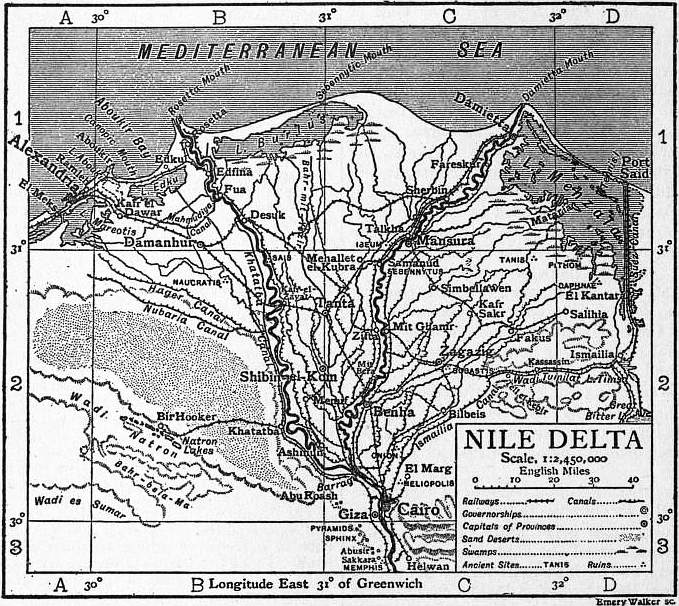
The Lakes.—The lagoons or lakes of the Delta, going from west to east, are Mareotis (Mariut), Edku, Burlus and Menzala. The land separating them from the Mediterranean is nowhere more than 10 m. wide. East of the Damietta mouth of the Nile this strip is in places not more than 200 yds. broad. All the lakes are shallow and the water in them salt or brackish. Mareotis, which bounds Alexandria on the south side, varies considerably in area according to the rise or fall of the Nile; when the Nile is low there is a wide expanse of marsh, when at its highest the lake covers about 100 sq. m. In ancient times Mareotis was navigable and was joined by various canals to the Nile. The country around was cultivated and produced the famous Mareotic wine. The canals being neglected, the lake decreased in size, though it was still of considerable area in the 15th and 16th centuries, and was then noted for the value of its fisheries. When the French army occupied Egypt in 1798, Mareotis was found to be largely a sandy plain. In April 1801 the British army besieging Alexandria cut through the land between Aboukir and the lake, admitting the waters of the sea into the ancient bed of Mareotis and laying under water a large area then in cultivation. This precedent was twice imitated, first by the Turks in 1803 and a second time by the British in 1807. Mareotis has no outlet, and the water is kept at a uniform level by means of powerful pumps which neutralize the effect of the Nile flood. A western arm has been cut off from the lake by a dyke, and in this arm a thick crust of salt is formed each year after the evaporation of the flood water. Near the shores of the lake wild flowers grow in rich profusion. Like all the Delta lakes, Mareotis abounds in wild-fowl. North-east of Mareotis was Lake Aboukir, a small sheet of water, now dry, lying S.W. of Aboukir Bay. East of this reclaimed marsh and reaching to within 4 m. of the Rosetta branch of the Nile, lies Edku, 22 m. long and in places 16 wide, with an opening, supposed to be the ancient Canopic mouth of the Nile, into Aboukir Bay. Burlus begins a little eastward of the Rosetta channel, and stretches bow-shaped for 64 m. Its greatest width is about 16 m. Adjoining it S.E. is an expanse of sandy marsh. Several canals or canalized channels enter the lake. Opposite the spot where the Bahr-mit Yezir enters is an opening into the Mediterranean. Canal and opening indicate the course of the ancient Sebennytic branch of the Nile. Burlus is noted for its water-melons, which are yellow within and come into season after those grown on the banks of the Nile.
Menzala greatly exceeds the other Delta lakes in size, covering over 780 sq. m. It extends from very near the Damietta branch of the Nile to Port Said. It receives the waters of the canalized channels which were once the Tanitic, Mendesian and Pelusiac branches. The northern shore is separated from the sea by an extremely narrow strip of land, across which, when the Mediterranean is stormy and the lake full, the waters meet. Its average length is about 40 m., and its average breadth about 15. The depth is greater than that of the other lakes, and the water is salt, though mixed with fresh. It contains a large number of islands, and the whole lake abounds in reeds of various kinds. Of the islands Tennīs (anciently Tennesus) contains ruins of the Roman period. The lake supports a considerable population of fishermen, who dwell in villages on the shore and islands and live upon the fish of the lake. The reeds are cover for waterfowl of various kinds, which the traveller sees in great numbers, and wild boars are found in the marshes to the south. The Suez Canal runs in a straight line for 20 m. along the eastern edge of the lake. That part of the lake east of where the canal was excavated is now marshy plain, and the Tanitic and Pelusiac mouths of the Nile are dry. East of Menzala is the site of Serbonis, another dried-up lake, which had the general characteristics of the Delta lagoons. In the Isthmus of Suez are Lake Timsa and the Great and Little Bitter Lakes, occupying part of the ancient bed of the Red Sea. All three were dry or marshy depressions previously to the cutting of the Suez Canal, at which time the waters of the Mediterranean and Red Sea were let into them (see Suez Canal).
A chain of natron lakes (seven in number) lies in a valley in the western desert, 70 to 90 m. W.N.W. of Cairo. In the Fayum province farther south is the Birket-el-Kerun, a lake, lying below the level of the Nile, some 30 m. long and 5 wide at its broadest part. Kerun is all that is left of the Lake of Moeris, an ancient artificial sheet of water which played an important part in the irrigation schemes of the Pharaohs. The water of el-Kerun is brackish, though derived from the Nile, which has at all seasons a much higher level. It is bounded on the north by the Libyan Desert, above which rises a bold range of mountains; and it has a strange and picturesque wildness. Near the lake are several sites of ancient towns, and the temple called Kasr-Karun, dating from Roman times, distinguishes the most important of these. South-west of the Fayum is the Wadi Rayan, a large and deep depression, utilizable in modern schemes for re-creating the Lake of Moeris (q.v.).