VOLUME IX SLICE I Edwardes to Ehrenbreitstein (continued 7)
Reading edition


Plate I.
EARLIEST EGYPTIAN ART
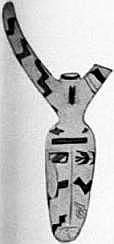
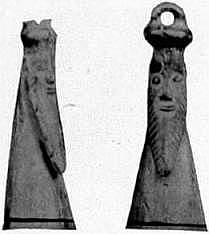
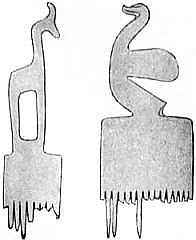
1. TATOOED FEMALE, LIMESTONE SLAG. 2. HEADS ON IVORY TUSKS. 3. 4. ANIMALS ON BONE COMBS. 5.
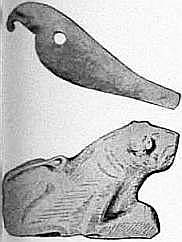
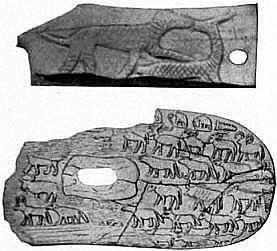
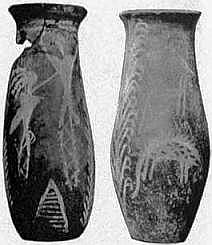
6. IVORY HAWK. LIMESTONE LION. 8. IVORY DOG AND GAZELLE. 9. IVORY HANDLE OF KNIFE. 10. 11. WHITE ON RED VASES; MEN AND ANIMALS.
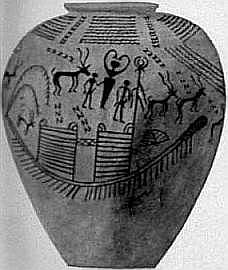
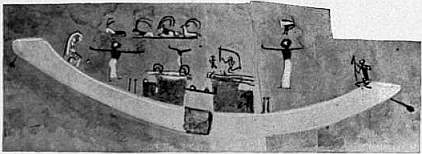
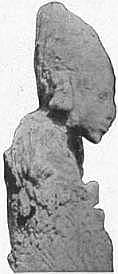
12. SHIP ON A VASE. 13. SHIP ON A WALL PAINTING. 14. IVORY KING.
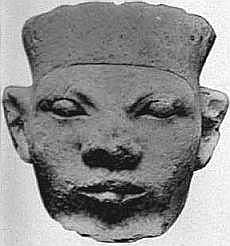
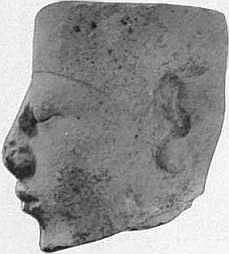
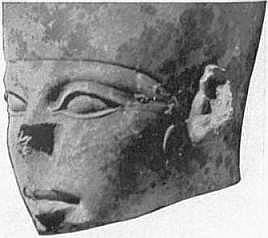
15. ARCHAIC KING’S HEAD, STUDY IN LIMESTONE. 16. 17. HEAD OF KHASEKHEM.
Plate II.
EARLY EGYPTIAN ART.
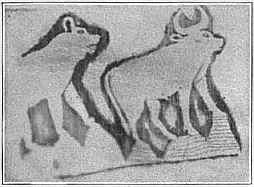
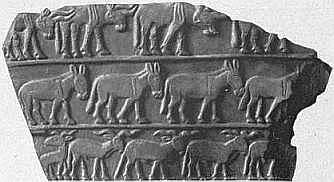
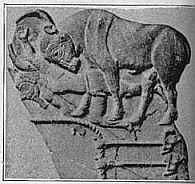
18. LIMESTONE RELIEF. Photo, Mansell. 19. ANIMALS ON SLATE PALETTE. 20. CONQUEROR AS A BULL.
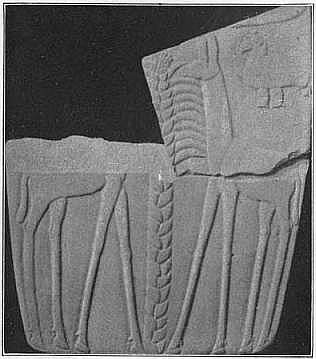
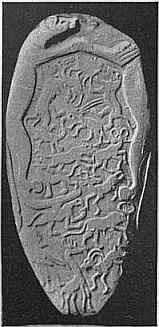
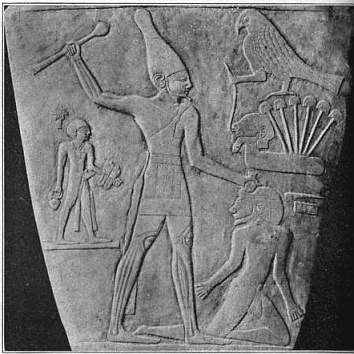
21. GAZELLES AND PALM, SLATE. 22. ANIMALS, SLATE. 23. KING NARMER, SLATE PALETTE.
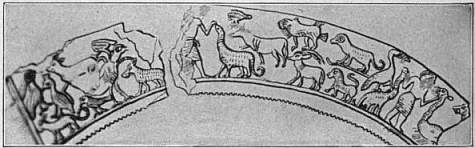
24. IVORY TUSK, WITH ANIMALS. 25. IVORY WAND, WITH ANIMALS.
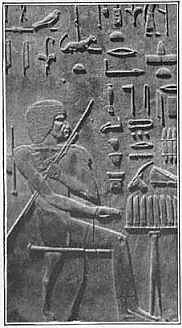
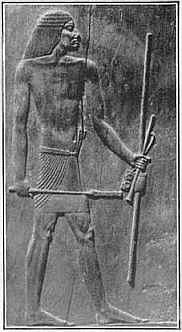
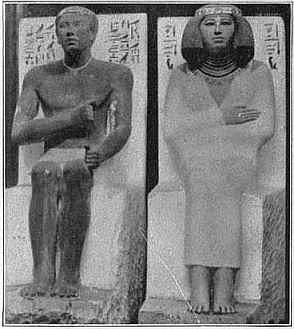
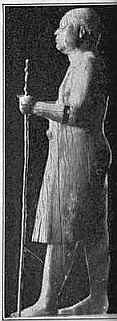
26. WOODEN PANELS OF HESI. 27. RAHOTP AND NEFERT. 28. WOODEN FIGURE.
Demotic. Hieratic. Hieroglyphic.
ent, “who” nty


Perso (“Pharaoh”) Per‘o ‘nḫ wz, śnb

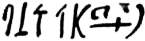
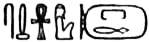
yôt, “father” ’itf


‘ônkh, “live” ‘nḫ


ekh, “know” rḫ



ahe, “stand” ‘ḫ‘


eine, “carry” ’in


ms (phon.) ms


s (alph.) s


s (alph.) ś


m (alph.) m


n (alph.) n


The early scribe’s outfit, often carried slung over his shoulder, is seen in the hieroglyph . It consisted of frayed reed pens or brushes, a small pot of water, and a palette with two circular cavities in which black and red ink were placed, made of finely powdered colour solidified with gum. In business and literary documents red ink was used for contrast, especially in headings; in demotic, however, it is very rarely seen. The pen became finer in course of time, enabling the scribe to write very small. The split reed of the Greek penman was occasionally adopted by the late demotic scribes.

Egypt had long been bilingual when, in papyri of the 2nd century a.d., we begin to find transcripts of the Egyptian language into Greek letters, the latter reinforced by a few signs borrowed from the demotic alphabet: so written we have a magical text and a horoscope, probably made by foreigners or for their use. The infinite superiority of the Greek alphabet with its full notation of vowels was readily seen, but piety and custom as yet barred the way to its full adoption. The triumph of Christianity banished the old system once and for all; even at the beginning of the 4th century the native Egyptian script scarcely survived north of the Nubian frontier at Philae; a little later it finally expired. The following eight signs, however, had been taken over from demotic by the Copts:
ϣ = š, from ši, dem. . ϩ = h, probably from ḥw (or ḥi), dem. . Ϧ (Boh.) = ḫ, from ḫi, dem. . (Akhm.) = ḫ, from ḫy, ḫt, dem. . ϥ = f, from f, dem. . ϭ = č from k (or ḫ), dem. . ϫ = ğ, from di (or ti), dem. . ϯ = ti, from dy·t, dem. .


For origins of hieroglyphs, see Petrie’s Medum (1892); F. Ll. Griffith, A Collection of HRGs (1898); N. de G. Davies, The Mastaba of Ptahhetep and Akhethetep, pt. i. (1900); M. A. Murray, Saqqara Mastabas (London, 1905); also Petrie and Griffith, Two HRGic Papyri from Tanis (London, 1889) (native sign-list); G. Möller, Hieratische Paläographie (Leipzig, 1909); Griffith, Catalogue of Demotic Papyri in the J. Rylands Collection (Manchester, 1909).
(F. Ll. G.)
E. Art and Archaeology.—In the following sections a general history of the characteristics of Ancient Egyptian art is first given, showing the variation of periods and essentials of style; and this is followed by an account of the use made of material products, of the tools and instruments employed, and of the monuments. For further details see also the separate topographical headings (for excavations, &c.), and the general articles on the various arts and art-materials (for references to Egypt); also Pyramids; Mummy, &c.
General Characteristics.
The wide and complex subject of Egyptian art will be treated here in six periods: Prehistoric, Early Kings, Pyramid Kings, XIIth Dynasty, XVIIIth-XXth Dynasties, XXVIth Dynasty and later. In each age will be considered the (A) statuary, (B) reliefs, (C) painting.
Prehistoric.—The earliest civilized population of Egypt was highly skilled in mechanical accuracy and regularity, but had little sense of organic forms. They kept the unfinished treatment of the limbs and extremities which is so characteristic of most barbaric art; and the action was more considered than the form.
(A) In the round there are in the earlier graves female figures of two races, the Bushman type and European, both probably representing servants or slaves. These have the legs always united, sloping to a point without feet (Plate I. fig. 1); the arms are only stumps. The face has a beaky nose and some indication of eyes. Upon the surface is colouring; red for the Bushman, with black whisker though female; white for the European type, with black tattoo patterns. Other female figures are modelled in a paste, upon a stick, and the black hair is sometimes made separately to fit on as a wig over the red head, showing that wigs were then used. Male figures are generally only heads in the earlier times. Tusks with carved heads (Plate I. figs. 2, 3) are the earliest, beginning at S.D. (sequence date) 33;16 heads on the top of combs are found, from S.D. 42 to the close of such combs in the fifties. All of these heads show a high forehead and a pointed beard; and such expression as may be discovered is grave but not savage. In later times whole figures of ivory, stone and clay are found, with the legs united, and the arms usually joined to the body. A favourite way of indicating the eyes was by drilling two holes and inserting a white shell bead in each. The figures of animals (Plate I. figs. 4, 5) are quite as rude as the human figures: they only summarily indicate the mature, and often hardly express the genus. They are most usual on combs and pins; but sacred animals are also found. The lion is the most usual (Plate I. fig. 7), but the legs are roughly marked, if at all: the leonine air is given, but the attitude is more distinct than the form. The hawk (Plate I. fig. 6) is modelled in block without any legs. The slate palettes in the form of animals are even more summary, and continually degraded until they lost all trace of their origin. There are also curious figures of animals chipped in flint, which show some character, but no detail.
(B) Reliefs with animal figures belong to the later part of the prehistoric age. The relief is low, and the form hatched across with lines (Plate I. fig. 8), a style copied from drawing. There is more animation than in the round figures. At the close of this age the fashion of long processions of animals appears (Plate I. fig. 9); some character is shown in these, but no sense of action.
(C) Drawing is found from the earliest civilization, done in white slip on red vases. Figures of men are very rare (Plate I. fig. 10); they have the body triangular, the waist being very narrow; the legs are two lines linked by a zigzag, as if to express that they move to and fro. The usual figures are goats and hippopotami; always having the body covered with cross lines to express the connexion of the outlines (Plate I. fig. 11). This technique is in every way closely akin to that of the modern Kabyle. An entirely different mode is common at a later time when designs were painted in thin red colour on a light brown ware. The subjects of the earlier of these examples are imitations of cordage, of marbling, and of basket-work; later there are rows of men and animals, and ships (Plate I. figs. 12, 13), with various minor signs. The figures are never cross-hatched as in earlier drawing, but always filled in altogether. The fact that the ships have oars and not sails makes it probable that they were rather for the sea than for Nile traffic, and a starfish among the motives on such pottery also points to the sea connexion. The ulterior meaning of the decoration is probably religious and funereal, but the objects which are figured must have been familiar.
For this whole period see Jean Capart, Débuts de l’art en Égypte (1904; trans. Primitive Art in Ancient Egypt).
The Early Kings.—The dynastic race wrought an entire transformation in the art of Egypt; in place of the clumsy and undetailed representations, there suddenly appears highly artistic work, full of character, action and anatomical detail.
(A) The earliest statues of this age are the colossi of the god Min from Coptos; that they belong to the artistic race is evident from the spirited reliefs upon them (see below, B), but the figures were very rude, the legs and arms being joined all in the mass. The main example of this early art is a limestone head of a king (Plate I. figs. 15, 16), which is a direct study from life, to serve as a model. For the accuracy of the facial curves, and the grasp of character and type, it is equal to any later work; and in its entire absence of conventions and its pure naturalism there is no later sculpture so good: as Prof. A. Michaelis says, “it renders the race type with astounding keenness, and shows an excellent power of observation in the exact representation of the eyes.” By the portrait, it is probably of King Narmer or some king related to him, that is, about the beginning of the Ist Dynasty. The ivory statuette of an aged king (Plate I. fig. 14) is probably slightly later. It shows the same subtle sense of character, and is unsurpassed in its reality. Many ivory figures of men, women and animals are known from Nekhen (Hieraconpolis) and Abydos; and they all show the same school of work, simple, dignified, observant, and with an air which places them on a higher plane of truthfulness and precision than later art. There is none of the mannerism of a long tradition, but a nobility pervades them which has no self-consciousness. The lower class of work of this age is shown by great numbers of glazed pottery figures both human and animal. Later in the IInd Dynasty, the head of Khasekhem (Plate I. fig. 17) shows the beginning of convention, but yet has a delicacy about the mouth which surpasses later works.
(B) Reliefs abound at this age, and include the most important evidences of the development of the art. The earliest examples are those of animals (Plate II. fig. 18) and shells on the colossi of Coptos. They show a keen sense of form, and the stag’s head, which is probably the earliest, already bears an artistic feeling wholly different to that of any of the prehistoric works (P.K. iii. iv.). The carvings on slate palettes appear to begin with work crudely accurate and forceful, the heavy limbs being ridged with tendons and muscles (Plate II. fig. 19), but there is more proportion, with the same massive strength (Plate II. fig. 20). Soon after, with a leap, the artist produced the first pure work of art that is known (Plate II. fig. 21), a design for its own sake without the tie of symbolism or history. The group of two long-necked gazelles facing a palm tree is of extraordinary refinement, and shows the artistic consciousness in every part; the symmetric rendering of the palm tree, reduced to fit the scale of the animals, the dainty grace of the smooth gazelles contrasted with the rugged stem, the delicacy of the long flowing curves and the fine indications of the joints, all show a sense of design which has rarely been equalled in the ceaseless repetitions of the tree and supporters motive during every age since. Passing the various palettes with hunting scenes and animals (Plate II. fig. 22), we come to the great historical carving of King Narmer (Plate II. fig. 23). Here the anatomy has reached its limits for such work; the precision of the muscles on the inner and outer sides of the leg, of the uniform grip in the left arm, and the tense muscle upholding the right arm, prove that the artist knew that part of his work perfectly. The large ceremonial mace-heads recording the Sed festivals of the king Narmer and another, belong also to this school; but owing to their smaller size they have not such artistic detail. With them were found many reliefs in ivory, on tusks, wands and cylinders. The main motive in these is a long procession of animals (Plate II. figs. 24, 25) often grotesquely crowded; but there is much observation shown and the figures are expressive. No drawing of this age has survived.
The Pyramid Kings.—A different ideal appears in the pyramid times; in place of the naturalism of the earlier work there is more regularity, some convention, and the sense of a school in the style. The prevailing feeling is a noble spaciousness both in scale and in form, an equanimity based upon knowledge and character, a grandeur of conception expressed by severely simple execution. There is nothing superfluous, nothing common, nothing trivial. The smallest as well as the largest work seems complete, inevitable, immutable, without limitations of time, or labour or thought.
(A) The statuette of Khufu or Cheops (Plate III. fig. 29) though only a minute figure in ivory, shows the character of immense energy and will; the face is an astonishing portrait to be expressed in a quarter of an inch. The life-size statue of Khafrē or Chephren (Plate III. fig. 30) is a majestic work, serene and powerful; carved in hard diorite, yet unhesitating in execution. The muscular detail is full, but yet kept in harmony with the massive style of the figure. The private persons have entirely different treatment according to the character of their position. In place of the awful dignity of the kings there is the placid high-bred Princess Nofri (Plate II. fig. 27, Plate III. fig. 31), the calm conscientious dignitary Hemset (Plate III. fig. 32), the bustling, active, middle-class official, Ka-aper (Plate II. fig. 28, Plate III. fig. 33), and the kneeling figure of a servitor. The differences of character are very skilfully rendered in all the sculpture of this age. The whole figures are stiff in the earlier time, as the figure of Nes; then square and massive, but true in form, as Rahotp and Nofri (Plate II. fig. 27); and afterwards easier and less monumental, as Ka-aper (Plate II. fig. 28). The skill in beaten copper work is shown by the portrait of the Prince Mer-en-ra (Plate III. fig. 35).
(B) The reliefs are quite equal to the statuary. The wooden panels of Hesi (Plate II. fig. 26) show the archaic style of great detail, with a bold, stark vigour of attitude. Later work is abundant in the tomb-sculptures of this age, with a fulness of variety and detail which makes them the most interesting of all branches of the art. The general effect cannot be judged without a large scene, but the figures of two men and an ox (Plate III. fig. 37) show the freshness and vigour of the style, which is even higher than this in some examples. The clear, noble spacing of the surface work is well shown by a group of offerings and inscribed titles (Plate III. fig. 36).
Plate III.
PYRAMID PERIOD.
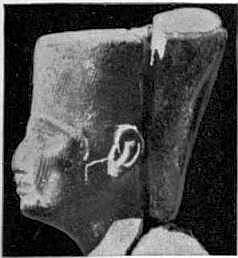
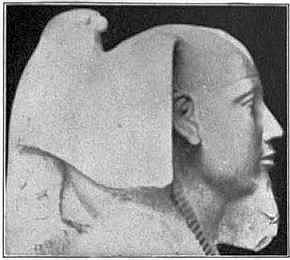
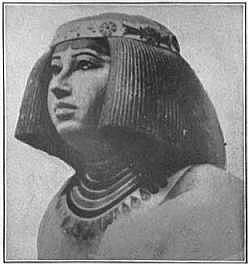
29. IVORY OF CHEOPS. 30. DIORITE OF CHEPHREN. 31. LIMESTONE OF NEFERT.
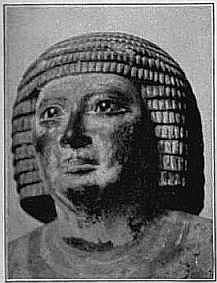
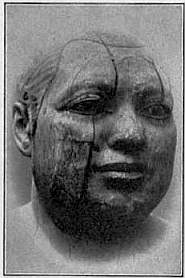
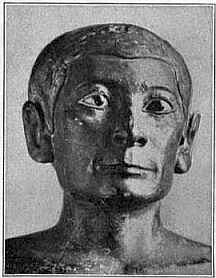
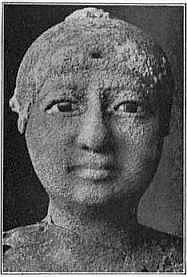
32. HEMSET: LIMESTONE. 33. WOOD (see Fig. 28). 34. SCRIBE: LIMESTONE. 35. MER-EN-RA: COPPER.
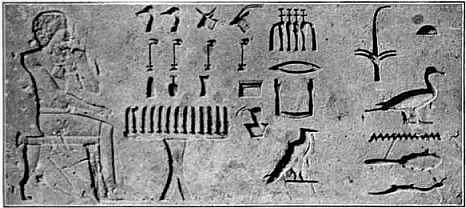
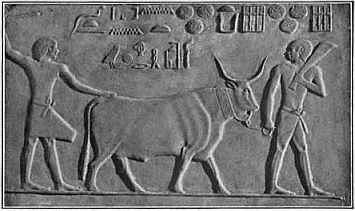
36. LIMESTONE SLAB OF KHENT-ER-KA. Photo, Bonfils 37. THE OXHERDS: LIMESTONE.
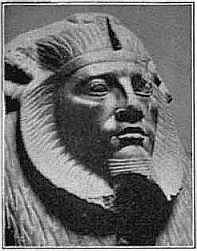
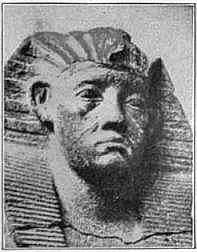
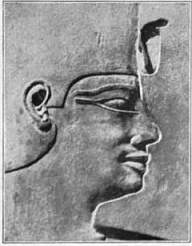
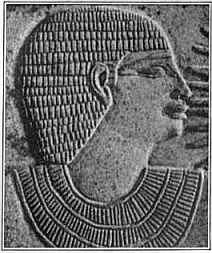
38. GRANITE SPHINX. 39. AMENEMHË III. 40. SENWOSRI I.: LIMESTONE RELIEFS: HOTEPA. 41.
Plate IV.
1400 B. C. TO ROMAN.
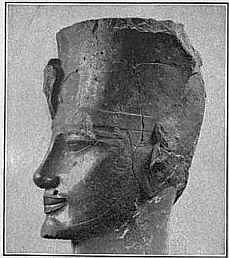
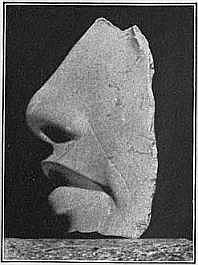
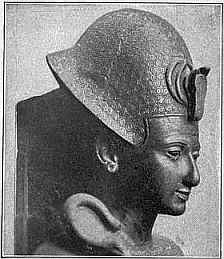
Photo, Manseil. 42. AMENOPHIS III.: GRANITE. 43. QUEEN TAIA: LIMESTONE. Photo, Anderson. 44. RAMESES II.: GRANITE.
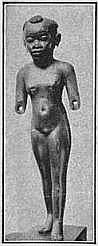
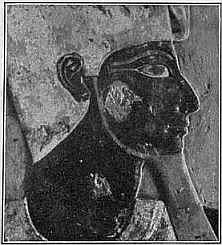
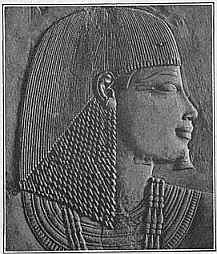
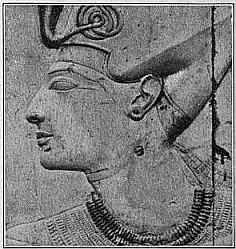
45. NEGRESS: EBONY. 46. QUEEN HATSHEPSUT. 47. KHA-EM-HAT. 48. SETI I.
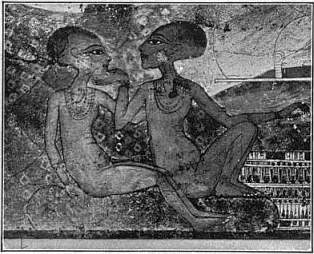
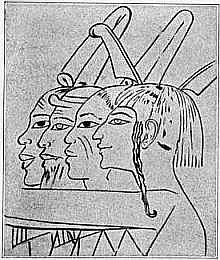
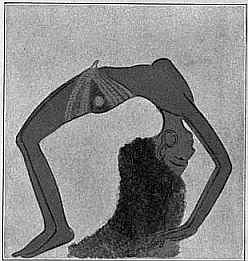
49. PRINCESSES: FRESCO. 50. FOUR RACES OF MAN. 51. TUMBLER.
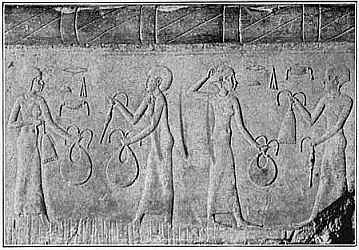
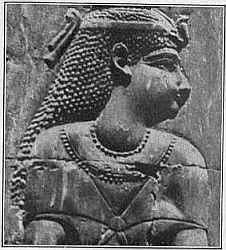
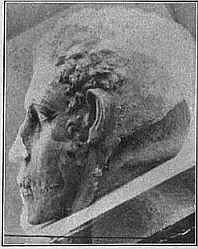
52. SCENE IN XXVI. DYNASTY. 53. PTOLEMAIC RELIEF. 54. MODELLED HEAD AND SKULL.
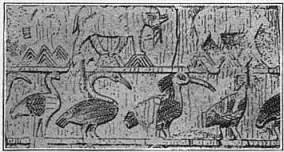
(C) Flat drawings of this age are rare. Some fine examples, such as the geese from Mēdūm, show that such work kept pace with the reliefs; but most of the fresco-work has perished, and there are few instances of line drawing.
The XIIth Dynasty.—This age overlaps the previous in its style. The end of the last age was in the very degraded tomb work of the early XIth Dynasty.
(A) The new style begins with the royal statues, which it seems we must attribute to the foreign kings from whom the XIIth Dynasty was descended. These statues were later appropriated by the Hyksos, and so came to be called by their name, which is a misnomer. The type of face (Plate III. fig. 38) is thick-featured, full of force, with powerful masses of facial muscle covering the skull. The style is very vigorous and impassioned, without any trace of relenting towards conventional work. The surfaces are not in the least subdued by a general breadth of style, as in the last period; but, on the contrary, revel in the full detail of variety. There is perhaps no age where nature is so little controlled by convention in either the living character or its sculptured expression. One of these kings might well be the founder of the IXth Dynasty, “Achthoes (Kheti), who did much injury to all the inhabitants,” “Khuther Taurus the tyrant”; the expression is that of a Chlodwig or an Alboin. From this type evidently descended the milder and more civilized kings of the XIIth Dynasty, the resemblance being so strong that the fierce figures have even been identified with that dynasty by some. A good example is that of the statue of Amenemhat (Amenemhē) III. (Plate III. fig. 39). The style of the XIIth Dynasty may be summed up as clean, highly-finished work, strong in facial detail; but with neither the grandeur of the IVth nor the vivacity of the XVIIIth Dynasty. This passed in the XIIIth Dynasty into a graceful but weak manner, as in the statues of Sebkhotp (Sebek-hotep) III. and Neferhotp.
(B) The relief work shows most clearly the rise of the new style. In the middle of the XIth Dynasty an entirely fresh treatment appears; the Old Kingdom work had died out in very bad sunk-reliefs, the fresh style (Plate III. fig. 41) was a low relief with sharp edges above the field. It was full of delicate variety in the surfaces, and of elaborated close-packed lines of hair and ornaments. By the time of the early XIIth Dynasty, this reached a perfection of refinement in the detail of facial curves, with an ostentatiously low relief (P.K. ix. i.), rather on the lines of modern French work; but the whole with clean, firm outlines, severely restrained in the expression, and without any trace of emotion. It is the work of a school, in which high training took the place of the reliance on nature. Sunk relief was also well used, as by Senusert (Senwosri) I. (Plate III. fig. 40). There was a steady decline during the XIIth Dynasty and onward, but the same tone was followed.
(C) In some tombs painting only was used, and it followed the general character of the relief treatment, being more rigid, detailed, and scholastic than the older style.
The XVIIIth-XXth Dynasties.—The obvious, not to say superficial, character of this age has rendered it one of the most popular in Egyptian art. The older breadth, fulness, and vigour have vanished, those great qualities which stamp the immortal works of early times. The difference is much like that between the Parthenon and the Niobids, or between Jacopo Avanzi and Caracci. In this change is the whole difference between the art of character and the art of emotion; and though the emotional side is the more popular, as needing less thought to understand it, yet the unfailing canon is that in every age and land the true quality of art is proportionate to the expression of character as apart from transient emotion. This may perhaps apply to other arts as well as to sculpture and painting. If we accept frankly the emotional nature of this age, we may admire its graceful outlines, its vivacious manner, its romantic style, with an occasional sauciness which is amusing and attractive. It revelled in rich detail, and close masses of lines, as in wigs and ribbed dresses. It sported with a seductive Syrian type of face, especially under Amenophis (Amenhotep) III.; but we find the anatomy giving way to mere smoothness of surface, for the sake of contrast with the masses of detail. The romantic element increased, solemn funereal statues show husband and wife hand in hand; and it culminated under Akhenaton, who is seen kissing his wife in the chariot, or dancing her on his knee. An overwhelming naturalism swamped the older reserves of Egyptian art, and the expression of the postures, actions and familiarities of daily life, or the instantaneous attitudes of animals, became the dernier cri of fashion. It was all charming and wonderful, but it was the end,—nothing could come after it. The XIXth Dynasty, at its best under Seti I., could only excel in high finish of smoothness and graceful curves; life, character, meaning, had vanished. And soon after, under Rameses II., mere mechanical copying, hard lifeless routine of stone-cutting, regardless of truth and of nature, dominated the whole.
(A) In sculpture there is a certain baldness of style at first, as in the Amenophis I. at Turin or Mutnefert at Cairo. More fulness and richness of character succeeded, as in Tahutmes (Tethmosis) III. and Amenophis III. (Plate IV. fig. 42, British Museum). And the feeling of the age finds greater scope in private statues, many of which have a personal fascination about them, as in the seated figures at Cairo and Florence, and the freer work in wood, of which the ebony negress (Plate IV. fig. 45) is the best example. The burst of naturalism under Akhenaton resulted in some marvellous portraiture, of which the fragment of a queen’s head (Plate IV. fig. 43) is perhaps the most brilliant instance; the fidelity in the delicate curves of the nose and around the mouth is enhanced by the touch of artistic convention in the facing of the lips. The only work of ability in the XIXth Dynasty is the black granite figure (Plate IV. fig. 44) of Rameses II. at Turin. The ordinary statuary of his reign is painfully stiff and poor, and there is no later work in the period worth notice.
(B) The reliefs of the early XVIIIth Dynasty are closely like the scenes of the tombs in the pyramid age, but soon carving was superseded by the cheaper painting, and but few tombs in relief are known. The temples were the principal places for reliefs; and they steadily deteriorate from the first great example, Deir el Bahri (see Architecture: Egyptian), down to the late Ramessides. The portraiture is strong and clear-cut (Plate IV. fig. 46), but somewhat mechanical and without muscular detail: the sameness is rather more than is probable. There is a good deal of repetition for mere effect, even in the fine work of Kha-em-hat (Plate IV. fig. 47), under Amenophis III. That the artists were conscious of their poverty of thought is shown by some precise imitations of the style of early monuments. On reaching the age of Akhenaton, the peculiar style of that school is obvious in every relief; the older conventions were deserted, and, for good or for bad, a new start from nature was attempted. After that the smooth finish of the Seti reliefs at Abydos (Plate IV. fig. 48) shows no life or observation; and only occasionally the artist triumphed over the stone-worker, as in the portrait of Bantanta at Memphis, which is precisely like another head of her found in Sinai. The innumerable reliefs of the XIXth-XXth Dynasty temples are only of historic interest, and are all despicable in comparison with earlier works.
(C) Painting was the art most congenial to this age; the lightness of touch, abundance of incident, and even comedy, of the scenes are familiar in the frescoes in the British Museum. And under Akhenaton this was pervaded by an entire naturalism of posture, as seen in the two little princesses (Plate IV. fig. 49). Drawing continued to be the strong point of the art after the more laborious sculpture had lost all vitality. The tomb of Seti shows exquisitely firm line drawing; and the heads of four races (Plate IV. fig. 50), Western, Syrian, and two Negro, here show the unfailing line-work which has never been matched in later times. The artist habitually drew the long lines of whole limbs without a single hesitation or revoke; and the drawing of a tumbling girl (Plate IV. fig. 51) shows how credibly such contortions could be represented. The comic papyri of the XXth Dynasty have also a very strong sense of character, even through coarse drawing and some childish combinations.
The subsequent centuries show continuous decline, and in whatever branch we compare the work, we see that each dynasty was poorer than that which preceded it. The XXVIth Dynasty is often looked on as a renaissance; but when we compare similar work we see that it was poorer than the XXIInd, as that was poorer than the XIXth. The alabaster statue of Amenardus of the XXVth is faulty in pose, and perfunctory in modelling; the resemblance between this and the head of her nephew Tirhaka is perhaps the best evidence of truthful work. After this there was a strong archaistic fashion, much like that under Hadrian; in both cases it may have arrested decay, but it did not lift the art up again. The work of this age can always be detected by the faulty jointing (Plate IV. fig. 52) and muscular treatment. The elements are right enough, but there was not the vital sense to combine them properly. Hence the monstrous protuberances (Plate IV. fig. 53) on relief figures of this age; a fault which the Greek fell into in his decline, as shown in the Farnese Hercules.
Portraiture, with its limited demand on imagination and lack of ideals, was the form of art which flourished latest. The Saitic heads in basalt show a school of close observation, with fair power of rendering the personal character; and even in Roman times there still were provincial artists who could model a face very truthfully, as is shown in one case in which the stucco head (Plate IV. fig. 54) from a coffin is here superposed on the view of the actual skull to show the accuracy of the work. The school of portrait-painting belongs entirely to Greek art, and is therefore not touched upon here. (See Edgar, Catalogue of Graeco-Egyptian Coffins, 48 plates, for this subject.)
Lastly we must recognize the different schools of Egyptian sculpture which are as distinct as those of recent painting. The black-granite school in every age is the finest; its seat we do not know, but its vitality and finish always exceed those of contemporary works. The limestone school was probably the next best, to judge from the reliefs, but hardly any statues of this school have survived; it probably was seated at Memphis. The quartzite work from Jebel Ahmar near Cairo stands next, as often very fine design is found in this hard material. The red granite school of Assuan comes lower, the work being usually clumsy and with unfinished corners and details. And the lowest of all was the sandstone school of Silsila, which is always the worst. Broadly speaking, the Lower Egyptian was much better than the Upper Egyptian; a conclusion also evident in the art of the tombs done on the spot. But the secret of the black granite school, and its excellence, is the main problem unsolved in the history of the art.
(W. M. F. P.)
Tools and Material Products.
Tools (see Illustrations 1 to 111).—The history of tools is a very large subject which needs to be studied for all countries; the various details of form are too numerous to specify here, but the general outline of tools used in Egypt may be briefly stated under general and special types. The general include tools for striking, slicing and scraping; the special tools are for fighting, hunting, agriculture, building and thread-work.
Striking Tools.—The wooden mallet of club form (1) was used in the VIth and XIIth Dynasties; of the modern mason’s form (2) in the XIIth and XVIIIth. The stone mace head was a sharp-edged disk (3), in the prehistoric from 31-40 sequence date; of the pear shape (4) from S.D. 42, which was actually in use till the IVth Dynasty, and represented down to Roman time. The metal or stone hammer with a long handle was unknown till Greek or Roman times; but, for beating out metal, hemispherical stones (5) were held in the hand, and swung at arm’s length overhead. Spherical hard stone hammers (6) were held in the hand for dressing down granite. The axe was at the close of the prehistoric age a square slab of copper (7) with one sharp edge; small projecting tails then appeared at each end of the back (8), and increased until the long tail for lashing on to the handle is more than half the length of the axe in an iron one of Roman (?) age (13). Flint axes were made in imitation of metal in the XIIth Dynasty (9). Battle-axes with rounded outline started as merely a sharp edge of metal (10) inserted along a stick (10, 11); they become semicircular (12) by the VIth Dynasty, lengthen to double their width in the XIIth, and then thin out to a waist in the middle by the XVIIIth Dynasty. Flint hoes (14) are common down to the XIIth Dynasty. Small copper hoes (15) with a hollow socket are probably of about the XXIInd Dynasty. Long iron picks (16), like those of modern navvies, were made by Greeks in the XXVIth Dynasty.
Slicing Tools.—The knife was originally a flint saw (17), having minute teeth; it must have been used for cutting up animals, fresh or dried, as the teeth break away on soft wood. The double-edged straight flint knife dates from S.D. 32-45. The single-edged knife (18) is from 33-65. The flint knives of the time of Menes are finely curved (19), with a handle-notch; by the end of the IInd Dynasty they were much coarser (20) and almost straight in the back. In the XIth-XIIth Dynasty they were quite straight in the back (21), and without any handle-notch. The copper knives are all one-edged with straight back (22) down to the XVIIIth Dynasty, when two-edged symmetrical knives (23) become usual. Long thin one-edged knives of iron begin about 800 b.c. Various forms of one-edged iron knives, straight (24) and curved (25), belong to Roman times. A cutting-out knife, for slicing through textiles, began double-edged (26) in the Ist Dynasty, and went through many single-edged forms (27-29) until it died out in the XXth Dynasty (Man, 1901, 123). A small knife hinged on a pointed backing of copper (31) seems to have been made for hair curling and toilet purposes. Razors (30) are known of the XIIth Dynasty, and became common in the XVIIIth. A curious blade of copper (32), straight sided, and sharpened at both ends, belongs to the close of the prehistoric age. Shears are only known of Roman age and appear to have been an Italian invention: there is a type in Egypt with one blade detachable, so that each can be sharpened apart. Chisels of bronze began of very small size (33) at S.D. 38, and reached a full size at the close of the prehistoric age. In historic times the chisels are about 1 × ½, × 6 to 8 in. long (34). Small chisels set in wooden handles are found (35) of the XIIth and XVIIIth Dynasties. Ferrules first appear in the Assyrian iron of the 7th century b.c. The rise of stone work led to great importance of heavy chisels (36) for trimming limestone and Nubian sandstone; such chisels are usually round rods about ¾ in. thick and 6 in. long. The cutting edge was about ½ in. wide for flaking tools (36), which were not kept sharp, and 1 in. wide for facing tools (37) which had a good edge. In Greek times the iron chisels are shorter and merge into wedges (39). The socketed or mortising chisel (38) is unknown till the Italian bronze of the 8th century b.c., and the Naucratis iron of the 6th century. Adzes begin in S.D. 56, as plain slips of copper (40) 4 to 6 in. long, about 1 wide and 1⁄8th thick. The square end was rounded in the early dynastic times, and went through a series of changes down to the XIXth Dynasty. Adzes of iron are probably of Greek times. A fine instance of a handle about 4 ft. long is represented in the IIIrd Dynasty (P.M. XI.). The adze (41) was used not only for wood-work but also for dressing limestone.
Scraping Tools.—Flint scrapers are found from S.D. 40 and onward. The rectangular scraper (42) began in S.D. 63, and continued into the IInd Dynasty: the flake with rounded ends (43) was used from the Ist to the IVth Dynasty (P. Ab. i. xiv., xv.). Round scrapers were also made (44). Flint scrapers were used in dressing down limestone sculpture in the IIIrd Dynasty. Rasps of conical form (45), made of a sheet of bronze punched and coiled round, were common in the XVIIIth Dynasty, apparently as personal objects, possibly used for rasping dried bread. In the Assyrian iron tools of the 7th century b.c. the long straight rasp (46) is exactly of the modern type. The saw is first found as a notched bronze knife of the IIIrd Dynasty. Larger toothed saws (47) are often represented in the IVth-VIth Dynasty, as used by carpenters. There are no dated specimens till the Assyrian iron saws (48) of the 7th century b.c. Drills were of flint (49) for hard material and bead-making, of bronze for woodwork. In the Assyrian tools iron drills are of slightly twisted scoop form (50), and of centre-bit type with two scraping edges (51). In Roman times the modern V drill (52) is usual. The drill was worked by a stock with a loose cap (53), rotated by a drill bow, in the XIIth to Roman dynasties. The pump drill with cords twisted round it was in Roman use. The bow drill (56) was used as a fire drill to rotate wood (55) on wood (57); and the cap (54) for such use was of hard stone with a highly polished hollow. The drill brace appears to have been used by Assyrians in the 7th century b.c. Piercers of bronze tapering (58), to enlarge holes in leather, &c., were common in all ages.
Fighting Weapons.—The battle-axe has been described above with axes. The flint dagger (59) is found from S.D. 40-56. A very finely made copper dagger (60) with deep midrib is dated to between 55 and 60 S.D. Copper daggers with parallel ribbing (61) down the middle are common in the XIth-XIVth Dynasties; and in the XVIIIth-XXth Dynasties they are often shown in scenes and on figures. The falchion with a curved blade (62) belongs to the XVIIIth-XXth Dynasty. The rapier (63) or lengthened dagger is rarely found, and is probably of prehistoric Greek origin. The sword is of Greek and Roman age, always double-edged and of iron. The spear is not commonly found in Egypt, until the Greek age, but it is represented from the XIth Dynasty onward; it belonged to the Semitic people (L.D. ii. 133). The bow was always of wood, in one piece in the prehistoric and early times, also of two horns in the Ist Dynasty; but the compound bow of horn is rarely found, only as an importation, in the XVIIIth Dynasty. The arrow-heads of flint (64-66) and of bone (68-69) were pointed, and also square-ended (67) for hunting (P.R.T. ii. vi.; vii. A., 7; xxxiv.). The copper arrow-heads appear in the XIXth Dynasty, of blade form with tang (70); the triangular form (72), and leaf form with socket (71), are of the XXVIth Dynasty. Triangular iron arrows with tang are of the same age. Tangs show that the shaft was a reed, sockets show that it was of wood. Many early arrows (XIIth) have only hard wood points of conical form. The sling is rarely shown in the XIXth-XXth Dynasties; and the only known example is probably of the XXVIth.
Hunting Weapons.—The forked lance of flint was at first wide with slight hollow (73) from S.D. 32-43; then the hollow became a V notch (74) in 38 S.D. and onward. The lance was fixed in a wooden shaft for throwing, and held in by a check-cord from flying too far if it missed the animal (P.N. LXXIII.). The harpoon for fishing was at first of bone (75), and was imitated in copper (76, 77) from S.D. 36 onwards. The boomerang or throw-stick (78) was used from the Ist to the XXIInd Dynasty, and probably later. Fish-hooks of copper (79-82) are found from the Ist Dynasty to Roman times. A trap for animals’ legs, formed by splints of palm stick radiating round a central hole, is figured in S.D. 60, and one was found of probably the XXth Dynasty. Fishing nets were common in all historic times, and the lead sinkers (83) and stone sinkers (84) are often found under the XVIIIth-XXth Dynasties.
Agricultural Tools.—The hoe of wood (85) is the main tool from the late prehistoric time, and many have been found of the XVIIIth Dynasty. With the handle lengthened (86) and turned forward, this became the plough (87 is the hieroglyph, 88 the drawing, of a plough); this was always sloping, and never the upright post of the Italic type. The rake of wood (89) is usual in the XIIth and XVIIIth Dynasties. The fork (90), used for tossing straw, was common in the Old Kingdom, but none has been found. The sickle was of wood (92), with flints (91) inserted, apparently a copy of the ox-jaw and teeth. The notched flints for it are common from the Ist to the XVIIIth Dynasty. In Roman times the same principle was followed, by making an iron sickle with a deep groove, in which was inserted the cutting blade of steel (P.E. XXIX.). Shovel-boards, to hold in right (93) or left hand for scraping up the grain in winnowing, are usual in the XVIIIth Dynasty, and are figured in use in the Old Kingdom Pruning knives with curved blades (94) are Italic, and were made of iron by the Romans. Corn grinders were flat oval stones, with a smaller one lying cross-ways (95), and slid from end to end. Such were used from the Old Kingdom down to late times. In the Roman period a larger stone was used, with a rectangular slab (96) sliding on it, in which a long trough held the grain and let it slip out below for grinding. The quern with rotary motion is late Roman, and still used by Arabs. The large circular millstones of Roman age worked by horse-power are usually made from slices of granite columns.
Building Tools.—The adze described above was used for dressing blocks of limestone. The brick-mould was an open frame, with one side prolonged into a handle (97), exactly as the modern mould. The plasterers’ floats (98) were entirely cut out of wood. The mud rake for mixing mortar is rather narrower than the modern form. The square (99) and plummet (100, 101) have remained unchanged since the XIXth Dynasty. For dressing flat surfaces three wooden pegs (102) of equal length were used; a string was stretched between the tops of two, and the third peg was set on the point to be tested and tried against the string.
Thread-Work.—Stone spindle whorls (103) are common in the prehistoric age; wooden ones were usual, of a cylindrical form (104) in the XIIth, and conical (105) in the XVIIIth Dynasty. The thread was secured by a spiral notch in the stick. In Roman times an iron hook on the top held the thread (106) as in modern spindles. Needles of copper were made in the prehistoric, as early as S.D. 48, and very delicate ones by S.D. 71. Gold needles are found of the Ist Dynasty. Fine ones of bronze are common in the XVIIIth Dynasty, and some with two eyes at right angles, one above the other, to carry two different threads. The copper bodkin is found in S.D. 70. Netters are common, of rib bones, pointed (107); the thread was wound round them. Long netting needles were probably brought in by the dynastic people as they figure in the hieroglyphs. Finely-made ones are found in the XVIIIth Dynasty and later. Reels were also commonly used for net making, of pottery (108) or even pebbles (109) with a groove chipped around. The flint vase-grinders were used in the early dynasties (110), and also sandstone grinders for hollowing larger vases (111).
Stone-Work.—In the prehistoric ages stone building was unknown, but many varieties of stones were used for carving into vases, amulets and ornaments. The stone vases were at first of cylindrical forms, with a foot, and ears for hanging. These are worked in brown basalt, syenite, porphyry, alabaster and limestone. In the second prehistoric civilization barrel-shaped vases became usual; and to the former materials were added slate, grey limestone and breccia. Serpentine appears later, and diorite towards the close of the prehistoric ages. Flat dishes were used in earlier times; gradually deeper forms appear, and lastly the deep bowl with turned-in edge belongs to the close of the prehistoric time and continued common in the earlier dynasties (P.D.P. 19). This stone-work was usually formed on the outside with rotary motion, but sometimes the vase was rotated upon the grinder (Q. H. 17). The interior was ground out by cutters (figs. 110, 111) fixed in the end of a stick and revolved with a weight on the top, as shown in scenes on the tombs of the Vth Dynasty. The cutters were sometimes flints of a crescent shape (P. Ab. ii. liii. 24), but more usually grinders blocks of quartzite sandstone (26-34), and occasionally of diorite (Q. H. xxxii. lxii.). These blocks were fed with sand and water to give the bite on the stone (P. Ab. i. 26). The outsides of the vases were entirely wrought by handwork, with the polishing lines crossing diagonally. Probably the first forming was done by chipping and hammer-dressing, as in later times; the final facing of the hard stones was doubtless by means of emery in block or powder, as emery grinding blocks are found.
In the early dynasties the hard stones were still worked, and the Ist dynasty was the most splendid age for vases, bowls, and dishes of the finest stones. The royal tombs have preserved an enormous quantity of fragments, from which five hundred varied forms have been drawn (P.R.T. ii. xlvi.-liii. 6). The materials are quartz crystal, basalt, porphyry, syenite, granite, volcanic ash, various metamorphics, serpentine, slate, dolomite marble, alabaster, many coloured marbles, saccharine marble, grey and white limestones. The most splendid vase is one from Nekhen (Hieraconpolis), of syenite, 2 ft. across and 16 in. high, hollowed so as to be marvellously light and highly polished (Q.H. xxxvii). Another branch of stone-work, surface carving, was early developed by the artistic dynastic race. The great palettes of slate covered with elaborate reliefs are probably all of the pre-Menite kings; the most advanced of them having the figure of Narmer, who preceded Menes. Other carving full of detail is on the great mace-heads of Narmer and the Scorpion king, where scenes of ceremonials are minutely engraved in relief. In the Ist Dynasty the large tombstones of the kings are of bold work, but the smaller stones of private graves vary much in the style, many being very coarse. All of this work was by hammer-dressing and scraping. The scrapers seem to have always been of copper.
The earliest use of stone in buildings is in the tomb of King Den (Ist Dynasty), where some large flat blocks of red granite seem to have been part of the construction. The oldest stone chamber known is that of Khasekhemui (end of the IInd Dynasty). This is of blocks of limestone whose faces follow the natural cleavages, and only dressed where needful; part is hammer-dressed, but most of the surfaces are adze-dressed. The adze was of stone, probably flint, and had a short handle (P.R.T. ii. 13). The same king also wrought granite with inscriptions in relief. In the close of the IIIrd Dynasty a great impetus was given to stone-work, and the grandest period of refined masonry is at the beginning of the IVth Dynasty under Cheops. The tombs of Mēdūm under Snefru are built with immense blocks of limestone of 20 and 33 tons weight. The dressing of the face between the hieroglyphs was done partly with copper and partly with flint scrapers (P.M. 27). The most splendid masonry is that of the Great Pyramid of Cheops. The blocks of granite for the roofing are 56 in number, of an average weight of 54 tons each. These were cut from the water-worn rocks at the Cataract—the soundest source for large masses, as any incipient flaws are well exposed by wear. The blocks were quarried by cleavage; a groove was run along the line intended, and about 2 ft. apart holes about 4 in. wide were jumped downward from it in the intended plane; this prevented a skew fracture (P.T. 93). In shallower masses a groove was run, and then holes, apparently for wedges, were sunk deeper in the course of it; whether wetted wood was used for the expansive force is not known, but it is probable, as no signs are visible of crushing the granite by hard wedges. The facing of the cloven surfaces was done by hammer-dressing, using rounded masses of quartzose hornstone, held in the hand without any handle. In order to get a hold for moving the blocks without bruising the edges, projecting lumps or bosses were left on the faces, about 6 or 8 in. across and 1 or 2 in. thick. After the block was in place the boss was struck off and the surface dressed and polished (P.T. 78, 82). In the pyramid of Cheops the blocks were all faced before building; but the later granite temple of Chephren and the pyramid of Mycerinus (Menkaura, Menkeurē) show a system of building with an excess of a few inches left rough on the outer surface, which was dressed away when in position (P.T. 110, 132).
The flatness of faces of stone or rock (both granite and limestone) was tested by placing a true-plane trial plate, smeared with red ochre, against the dressed surface, as in modern engineering. The contact being thus reddened showed where the face had to be further dressed away; and this process was continued until the ochre touched points not more than an inch apart all over the joint faces, many square feet in area. On stones too large for facing-plates a diagonal draft was run, so as to avoid any wind in the plane (P.T. 83).
The cutting of granite was not only by cleavage and hammer dressing, but also by cutting with harder materials than quartz such as emery. Long saws of copper were fed with emery powder, and used to saw out blocks as much as 7½ ft. long (P.T. Plate XIV.). In other cases the very deep scores in the sides of the saw-cut suggest that fixed cutting points were inserted in the copper saws; and this would be parallel to the saw-cuts in the very hard limestone of the Palace of Tiryns, in which a piece of a copper saw has been broken, and where may be yet found large chips of emery, too long and coarse to serve as a powder, but suited for fixed teeth. A similar method was common for circular holes, which were cut by a tube, either with powder or fixed teeth. These tubular drills were used from the IVth Dynasty down to late times, in all materials from alabaster up to carnelian. The resulting cores are more regular than those of modern rock-drilling.
Limestone in the Great Pyramid, as elsewhere, was dressed by chopping it with an adze, a tool used from prehistoric to Roman times for all soft stones and wood. This method was carried on up to the point of getting contact with the facing-plate at every inch of the surface; the cuts cross in various directions. For removing rock in reducing a surface to a level, or in quarrying, cuts were made with a pick, forming straight trenches, and the blocks were then broken out between these. In quarrying the cuts are generally 4 or 5 in. wide, just enough for the workman’s arm to reach in; for cutting away rock the grooves are 20 in. wide, enough to stand in, and the squares of rock about 9 ft. wide between the grooves (P.T. 100). The accuracy of the workmanship in the IVth Dynasty is astonishing. The base of the pyramid of Snefru had an average variation of 6 in. on 5765 and 10′ of squareness. But, immediately after, Cheops improved on this with a variation of less than 6 in. on 9069 in. and 12″ of direction. Chephren fell off, having 1.5 error on 8475, and 33″ of variation; and Mycerinus (Menkeurē) had 3 in. error on 4154 and 1′ 50″ variation of direction (P.M. 6; P.T. 39, 97, 111). Of perhaps later date the two south pyramids of Dahshur show errors of 3.7 on 7459 and 1.1 on 2065 in., and variation of direction of 4′ and 10′ (P.S. 28, 30). The above smallest error of only 1 in 16,000 in lineal measure, and 1 in 17,000 of angular measure, is that of the rock-cutting for the foundation of Khufu, and the masonry itself (now destroyed) was doubtless more accurate. The error of flatness of the joints from a straight line and a true square is but 1⁄100th in. on 75 in. length; and the error of level is only 1⁄50th in. along a course, or about 10″ on a long length (P.T. 44). We have entered thus fully on the details of this period, as it is the finest age for workmanship in every respect. But in the XIIth Dynasty the granite sarcophagus of Senwosri II. is perhaps the finest single piece of cutting yet known; the surfaces of the granite are all dull-ground, the errors from straight lines and parallelism are only about 1⁄200th inch (P. 1, 3).
In later work we may note that copper scrapers were used for facing the limestone work in the VIth, the XIIth and the XVIIIth Dynasties. In the latter age granite surfaces were ground, hieroglyphs were chipped out and polished by copper tools fed with emery; outlines were graved by a thick sheet of copper held in the hand, and sawed to and fro with emery. Corners of signs and intersections of lines were first fixed by minute tube-drill holes, into which the hand tool butted, so that it should not slip over the outer surface.
The marking out of work was done by fine black lines; and supplemental lines at a fixed distance from the true one were put in to guard against obliteration in course of working (P.T. 92); similarly in building a brick pyramid the axis was marked, and there were supplemental marks two cubits to one side (P.K. 14). When cutting a passage in the rock a rough drift-way was first made, the roof was smoothed, a red axis line was drawn along it, and then the sides were cut parallel to the axis. For setting out a mastaba with sloping sides, on an irregular foundation at different levels, hollow corner walls were built outside the place of each corner; the distances of the faces at the above-ground level were marked on the inner faces of the walls; the above-ground level was also marked; then sloping lines at the intended angle of the face were drawn downward from the ground-level measures, and each face was set out so as to lie in the plane thus defined by two traces at the ends (P.M. VIII.).
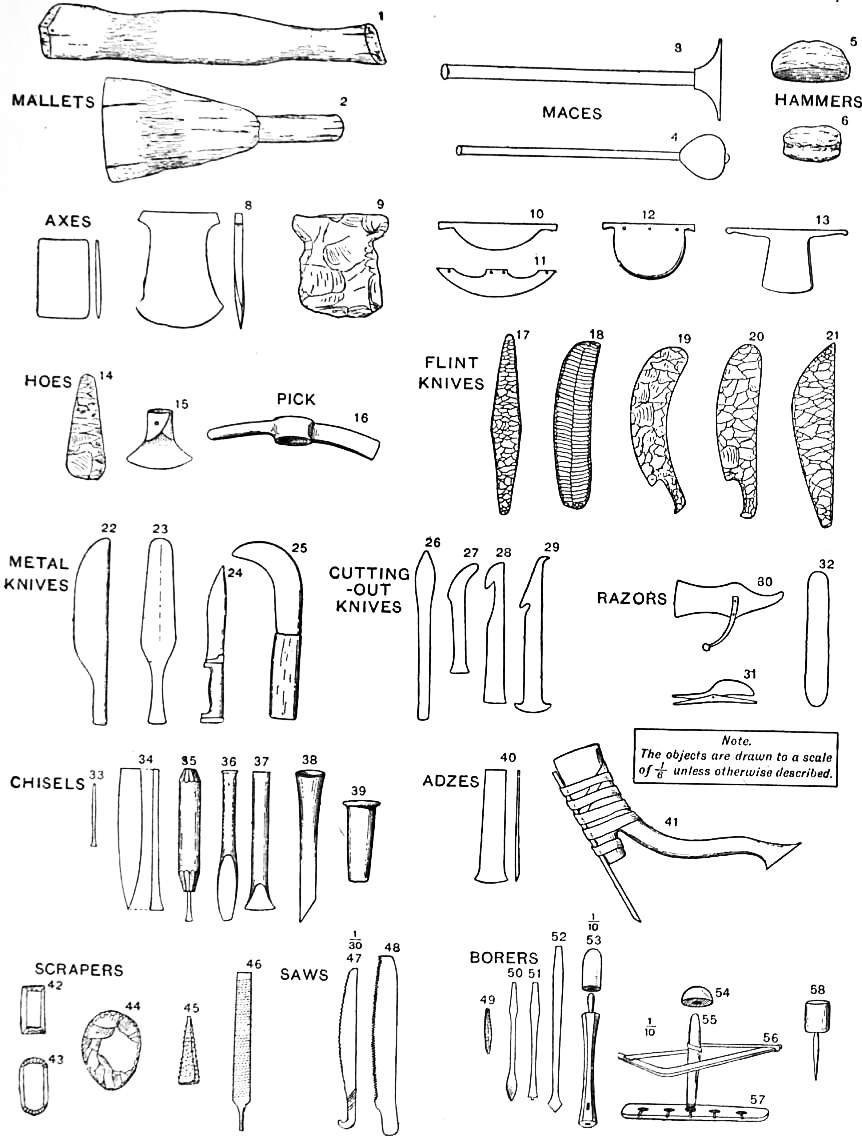
Ancient Egyptian tools.
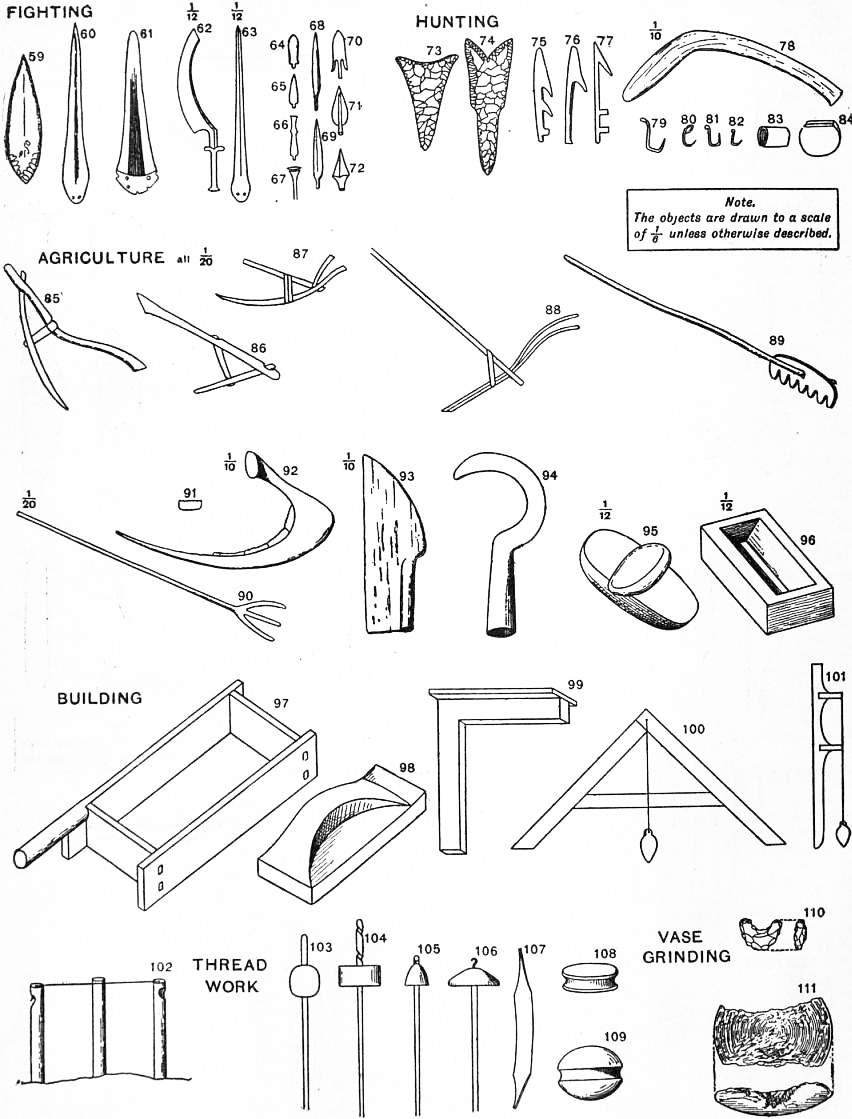
Ancient Egyptian tools.
Metal-Work.—Copper was wrought into pins, a couple of inches long, with loop heads, as early as the oldest prehistoric graves, before the use of weaving, and while pottery was scarcely developed. The use of harpoons and small chisels of copper next arose, then broad flaying knives, needles and adzes, lastly the axe when the metal was commoner. On these prehistoric tools, when in fine condition, the original highly-polished surface remains. It shows no trace of grinding lines or attrition, nor yet of the blows of a hammer. Probably it was thus highly finished by beating between polished stone hammers which were almost flat on the face. Most likely the forms of the tools were cast to begin with, and then finished and polished by fine hammering. A series of moulds for casting in the XIIth Dynasty show that the forms were carved out in thick pieces of pottery, and then lined with fine ashy clay. The mould was single, so that one side of the tool was the open face of metal. As early as the pyramid times solid casting by cire perdue was already used for figures: but the copper statues of Pepi and his son seem, by their thinness and the piecing together of the parts, to have been entirely hammered out. The portraiture in such hammer work is amazingly life-like. By the time of the XIIth Dynasty, and perhaps earlier, cire perdue casting over an ash core became usual. This was carried out most skilfully, the metal being often not 1⁄50th in. thick, and the core truly centred in the mould. Casting bronze over iron rods was also done, to gain more stiffness for thin parts.
In gold work the earliest jewelry, that of King Zer of the Ist Dynasty, shows a perfect mastery of working hollow balls with minute threading holes, and of soldering with no trace of excess nor difference of colour. Thin wire was hammered out, but there is no ancient instance of drawn wire. Castings were not trimmed by filing or grinding, but by small chisels and hammering (P.R.T. ii. 17). In the XIIth Dynasty the soldering of the thin cells for the cloisonnée inlaid pectorals, on to the base plate, is a marvellous piece of delicacy; every cell has to be perfectly true in form, and yet all soldered, apparently simultaneously, as the heat could not be applied to successive portions (M.D. i.). Such work was kept up in the XVIIIth and XXVIth Dynasties. There is nothing distinctive in later jewelry different from Greek and Roman work elsewhere.
Glaze and Glass.—From almost the beginning of the prehistoric age there are glazed pottery beads found in the graves: and glazing on amulets of quartz or other stones begins in the middle of the prehistoric. Apparently then glazing went together with the working of the copper ores, and probably accidental slags in the smelting gave the first idea of using glaze intentionally. The development of glazing at the beginning of the dynasties was sudden and effective. Large tiles, a foot in length, were glazed completely all over, and used to line the walls of rooms; they were retained in place by deep dovetails and ties of copper wire. Figures of glazed ware became abundant; a kind of visiting card was made with the figure of a man and his titles to present in temples which he visited; and glazed ornaments and toggles for fastening dresses were common (P. Ab. ii.). Further, besides thus using glaze on a large scale, differently coloured glazes were used, and even fused together. A piece of a large tile, and part of a glazed vase, have the royal titles and name of Menes, originally in violet inlay in green glaze. There was no further advance in the art until the great variety of colours came into use about 4000 years later. In the XIIth Dynasty a very thin smooth glaze was used, which became rather thicker in the XVIIIth. The most brilliant age of glazes was under Amenophis III. and his son Akhenaton. Various colours were used; beside the old green and blue, there were purple, violet, red, yellow and white. And a profusion of forms is shown by the moulds and actual examples, for necklaces, decorations, inlay in stone and applied reliefs on vases. Under Seti II. cartouches of the king in violet and white glaze are common; and under Rameses III. there were vases with relief figures, with painted figures, and tiles with coloured reliefs of captives of many races. The latter development of glazing was in thin delicate apple-green ware with low relief designs, which seem to have originated under Greek influence at Naucratis. The Roman glaze is thick and coarse, but usually of a brilliant Prussian blue, with dark purple and apple-green; and high reliefs of wreaths, and sometimes figures, are common.
Though glaze begins so early, the use of the glassy matter by itself does not occur till the XVIIIth Dynasty; the earlier reputed examples are of stone or frit. The first glass is black and white under Tethmosis (Tahutmes) III. It was not fused at a high point, but kept in a pasty state when working. The main use of it was for small vases; these were formed upon a core of sandy paste, which was modelled on a copper rod, the rod being the core for the neck. Round this core threads of glass were wound of various colours; the whole could be reset in the furnace to soften it for moulding the foot or neck, or attaching handles, or dragging the surface into various patterns. The colours under later kings were as varied as those of the glazes. Glass was also wheel-cut in patterns and shapes under Akhenaton. In later times the main work was in mosaics of extreme delicacy. Glass rods were piled together to form a pattern in cross-section. The whole was then heated until it perfectly adhered, and the mass was drawn out lengthways so as to render the design far more minute, and to increase the total length for cutting up. The rod was then sliced across, and the pieces used for inlaying. Another use of coloured glass was for cutting in the shapes of hieroglyphs for inlaying in wooden coffins to form inscriptions. Glass amulets were also commonly placed upon Ptolemaic mummies. Blown glass vessels are not known until late Greek and Roman times, when they were of much the same manufacture as glass elsewhere. The supposed figures of glass-blowers in early scenes are really those of smiths, blowing their fires by means of reeds tipped with clay. The variegated glass beads belonging to Italy were greatly used in Egypt in Roman times, and are like those found elsewhere. A distinctively late Egyptian use of glass was for weights and vase-stamps, to receive an impress stating the amount of the weight or measure. The vase-stamps often state the name of the contents (always seeds or fruits), probably not to show what was in them, but to show for what kind of seed the vessel was a true measure. These measure stamps bear names dating them from a.d. 680 to about 950. The large weights of ounces and pounds are disks or cuboid blocks; they are dated from 720 to 785 for the lesser, and to a.d. 915 for larger, weights. The greater number are, however, small weights for testing gold and silver coins of later caliphs from a.d. 952 to 1171. The system was not, however, Arab, as there are a few Roman vase-stamps and weights. Of other medieval glass may be noted the splendid glass vases for lamps, with Arab inscriptions fused in colours on the outsides. No enamelling was ever done by Egyptians, and the few rare examples are all of Roman age due to foreign work.
The manufacture of glass is shown by examples in the XVIIIth Dynasty. The blue or green colour was made by fritting together silica, lime, alkaline carbonate and copper carbonate; the latter varied from 3% in delicate blues to 20% in deep purple blues. The silica was needed quite pure from iron, in order to get the rich blues, and was obtained from calcined quartz pebbles; ordinary sand will only make a green frit. These materials were heated in pans in the furnace so as to combine in a pasty, half-fused condition. The coloured frit thus formed was used as paint in a wet state, and also used to dissolve in glass or to fuse over a surface in glazing. The brown tints often seen in glazed objects are almost always the result of the decomposition of green glazes containing iron. The blue glazes, on the other hand, fade into white. The essential colouring materials are, for blue, copper; green, copper and iron; purple, cobalt; red, haematite; white, tin. An entirely clear colourless glass was made in the XVIIIth Dynasty, but coloured glass was mainly used. After fusing a panful of coloured glass, it was sampled by taking pinches out with tongs; when perfectly combined it was left to cool in the pan, as with modern optical glass. When cold the pan was chipped away, and the cake of glass broken up into convenient pieces, free of sediment and of scum. A broken lump would then be heated to softness in the furnace; rolled out under a bar of metal, held diagonally across the roll; and when reduced to a rod of a quarter of an inch thick, it was heated and pulled out into even rods about an eighth of an inch thick. These were used to wind round glass vases, to form lips, handles, &c.; and to twist together for spiral patterns. Glass tube was similarly drawn out. Beads were made by winding thin threads of glass on copper wires, and the greater contraction of the copper freed the bead when cold. The coiling of beads can always be detected by (1) the little tails left at the ends, (2) the streaks, (3) the bubbles, seen with a magnifier. Roman glass beads are always drawn out, and nicked off hot, with striation lengthways; except the large opaque variegated beads which are coiled. Modern Venetian beads are similarly coiled. In the XXIIIrd Dynasty beads of a rich transparent Prussian blue glass were made, until the XXVIth. About the same time the eyed beads, with white and brown eyes in a blue mass, also came in (P.A. 25-27, Plate XIII.).
Pottery (see fig. 112).—The earliest style of pottery is entirely hand made, without any rotary motion; the form being built up with a flat stick inside and the hand outside, and finally scraped and burnished in a vertical direction. The necks of vases were the first part finished with rotation, at the middle and close of the prehistoric age. Fully turned forms occur in the Ist Dynasty; but as late as the XIIth Dynasty the lower part of small vases is usually trimmed with a knife. In the earlier part of the prehistoric age there was a soft brown ware with haematite facing, highly burnished. This was burnt mouth-down in the oven, and the ashes on the ground reduced the red haematite to black magnetic oxide of iron; some traces of carbonyl in the ash helped to rearrange the magnetite as a brilliant mirror-like surface of intense black. The lower range of jars in the oven had then black tops, while the upper ranges were entirely red. A favourite decoration was by lines of white clay slip, in crossing patterns, figures of animals, and, rarely, men. This is exactly of the modern Kabyle style in Algeria, and entirely disappeared from Egypt very early in the prehistoric age. Being entirely hand made, various oval, doubled and even square forms were readily shaped.
The later prehistoric age is marked by entirely different pottery, of a hard pink-brown ware, often with white specks in it, without any applied facing beyond an occasional pink wash, and no polishing. It is decorated with designs in red line, imitating cordage and marbling, and drawings of plants, ostriches and ships. The older red polished ware still survived in a coarse and degraded character, and both kinds together were carried on into the next age (P.D.P.).
The early dynastic pottery not only shows the decadent end of the earlier forms, but also new styles, such as grand jars of 2 or 3 ft. high which were slung in cordage, and which have imitation lines of cordage marked on them. Large ring-stands also were brought in, to support jars, so that the damp surfaces should not touch the dusty ground. The pyramid times show the great jars reduced to short rough pots, while a variety of forms of bowls are the most usual types (P.R.T.; P.D.; P. Desh.)
In the XIIth Dynasty a hard thin drab ware was common, like the modern qulleh water flasks. Drop-shaped jars with spherical bases are typical, and scrabbled patterns of incised lines. Large jars of light brown pottery were made for storing liquids and grain, with narrow necks which just admit the hand (P.K.).
The XVIIIth Dynasty used a rather softer ware, decorated at first with a red edge or band around the top, and under Tethmosis (Tahutmes) III. black and red lines were usual. Under Amenophis III. blue frit paint was freely used, in lines and bands around vases; it spread to large surfaces under Amenophis IV., and continued in a poor style into the Ramesside age. In the latter part of the XVIIIth and the XIXth Dynasties a thick hard light pottery, with white specks and a polished drab-white facing, was generally used for all fine purposes. The XIXth and XXth Dynasties only show a degradation of the types of the XVIIIth; and even through to the XXVth Dynasty there is no new movement (P.K.; P.I.; P.A.; P.S.T.).
The XXVIth Dynasty was largely influenced by Greek amphorae imported with wine and oil. The native pottery is of a very fine paste, smooth and thin, but poor in forms. Cylindrical cups, and jars with cylindrical necks and no brim, are typical. The small necks and trivial handles begin now, and are very common in Ptolemaic times (P.T. ii.).
The great period of Roman pottery is marked by the ribbing on the outsides. The amphorae began to be ribbed about a.d. 150, and then ribbing extended to all the forms. The ware is generally rather rough, thick and brown for the amphorae, thin and red for smaller vessels. At the Constantine age a new style begins, of hard pink ware, neatly made, and often with “start-patterns” made by a vibrating tool while the vessel rotated: this was mainly used for bowls and cups (P.E.). Of the later pottery of Arab times we have no precise knowledge.
The abbreviations used above refer to the following sources of information:—
M.D. Morgan, Dahshur;
P.A. Petrie, Tell el Amarna;
P. Ab. Petrie, Abydos;
P.D. Petrie, Dendereh;
P. Desh. Petrie, Deshasheh;
P.D.P. Petrie, Diospolis Parva;
P.E. Petrie, Ehnasya;
P.I. Petrie, Illahun;
P.K. Petrie, Kahun;
P.M. Petrie, Medum;
P.N. Petrie, Naqada;
P.R.T. Petrie, Royal Tombs;
P.S. Petrie, Season in Egypt;
P.S.T. Petrie, Six Temples;
P.T. Petrie, Pyramids and Temples of Gizeh;
P.T. ii. Petrie, Tanis, ii.;
Q.H. Quibell, Hieraconpolis.
(W. M. F. P.)
Monuments.—The principal monuments that are yet remaining to illustrate the art and history of Egypt may be best taken in historical order. Of the prehistoric age there are many rock carvings, associated with others of later periods: they principally remain on the sandstone rocks about Silsila, and their age is shown by the figures of ostriches which were extinct in later times. One painted tomb was found at Nekhen (Hieraconpolis), now in the Cairo Museum; the brick walls were colour-washed and covered with irregular groups of men, animals and ships, painted with red, black and green. The cemeteries otherwise only contain graves, cut in gravel or brick lined, and formerly roofed with poles and brushwood. The Ist to IIIrd Dynasties have left at Abydos large forts of brickwork, remains of two successive temples, and the royal tombs (see Abydos). Elsewhere are but few other monuments; at Wadi Maghāra in Sinai is a rock sculpture of Semerkhet of the Ist Dynasty in perfect state, at Gīza is a group of tombs of a prince and retinue of the Ist Dynasty, and at Gīza and Bēt Khallaf are two large brick mastabas with extensive passages closed by trap-doors, of kings of the IIIrd Dynasty. The main structure of this age is the step-pyramid of Sakkara, which is a mastaba tomb with eleven successive coats of masonry, enlarging it to about 350 by 390 ft. and 200 ft. high. In the interior is sunk in the rock a chamber 24 × 23 ft. and 77 ft. high, with a granite sepulchre built in the floor of it, and various passages and chambers branching from it. The doorway of one room (now in Berlin Museum) was decorated with polychrome glazed tiles with the name of King Neterkhet. The complex original work and various alterations of it need thorough study, but it is now closed and research is forbidden.
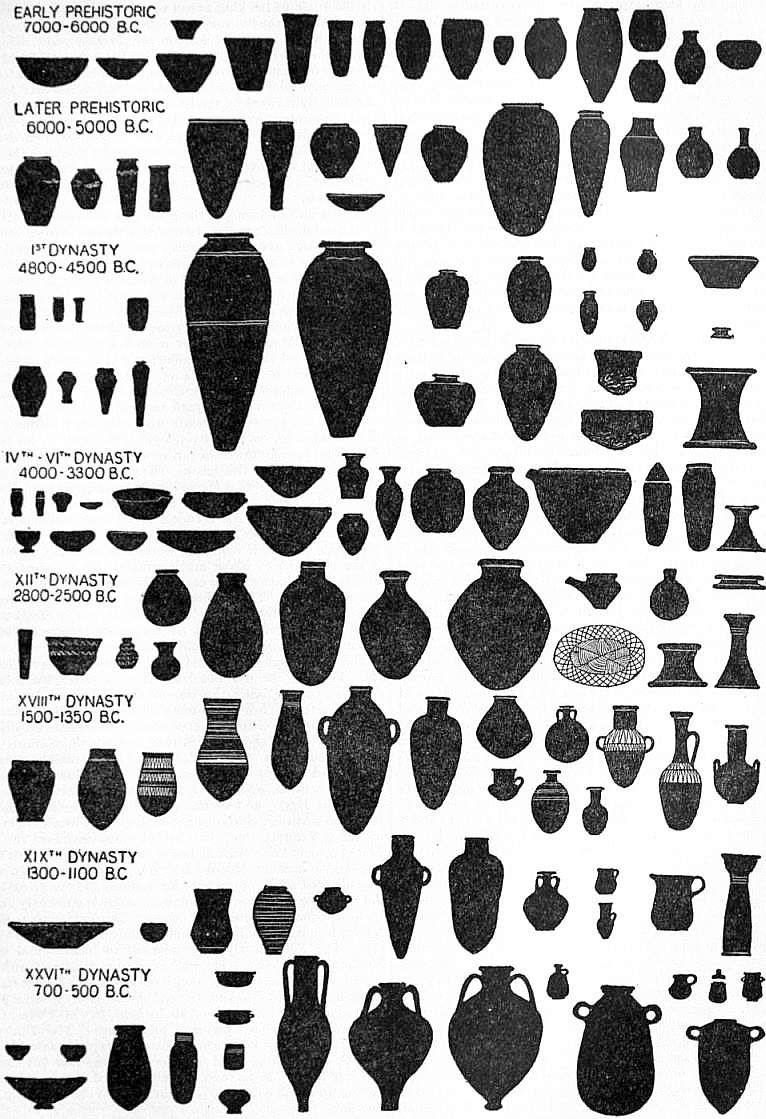
Fig. 112.—Principal Types of Pottery of Ancient Egypt. (Scale 1 : 20.)
The IVth to VIth Dynasties are best known by the series of pyramids (see Pyramid) in the region of Memphis. Beyond these tombs, and the temples attached to them, there are very few fixed monuments; of Cheops and Pepi I. there are temple foundations at Abydos (q.v.), and a few blocks on other sites; of Neuserre (Raenuser) there is a sun temple at Abusīr; and of several kings there were tablets in Sinai, now in the Cairo Museum. A few tablets of the IXth Dynasty have been found at Sakkāra, and a tomb of a prince at Assiūt. Of the XIth Dynasty is the terrace-temple of Menthotp III. recently excavated at Thebes: also foundations of this king and of Sankhkerē at Abydos. In the XIIth Dynasty there is the celebrated red granite obelisk of Heliopolis, one of a pair erected by Senwosri (Senusert) I. in front of his temple which has now vanished. Another large obelisk of red granite, 41 ft. high, remains in the Fayūm. The most important pictorial tombs of Beni Hasan belong to this age; the great princes appear to have largely quarried stone for their palaces, and to have cut the quarry in the form of a regular chamber, which served for the tomb chapel. These great rock chambers were covered with paintings, which show a large range of the daily life and civilization. The pyramids and temples of Senwosri II. and III. and Amenemhē III. remain at Illahūn, Dahshūr and Hawāra. The latter was the celebrated Labyrinth, which has been entirely quarried away, so that only banks of chips and a few blocks remain. At the first of these sites is the most perfect early town, of which hundreds of houses still remain. Of Senwosri III. there are the forts and temples above the second cataract at Semna and Kumma. Of the Hyksos age there are the scanty remains of a great fortified camp at Tell el-Yehudia.
In the XVIIIth to XXth Dynasties we reach the great period of monuments. Of Amāsis (Aahmes) and Amenophis I. there are but fragments left in later buildings; and of the latter a great quantity of sculpture has been recovered at Karnak. The great temple of Karnak had existed since the XIth Dynasty or earlier, but the existing structure was begun under Tethmosis (Tahutmes) I., and two of the great pylons and one obelisk of his remain in place. He also built the simple and dignified temple of Medinet Habu at Thebes, which was afterward overshadowed by the grandiose work of Rameses III. The next generation—Tethmōsis II. and Hatshepsut—added to their father’s work; they also built another pylon and some of the existing chambers at Karnak, set up the great obelisks there and carved some colossi. The obelisks are exquisitely cut in red granite, each sign being sawn in shape by copper tools fed with emery, and the whole finished with a perfection of proportion and delicacy not seen on other granite work. One obelisk being overthrown and broken we can examine the minute treatment of the upper part, which was nearly a hundred feet from the ground. The principal monument of this period is the temple of Deir el Bahri, the funeral temple of Hatshepsut, on which she recorded the principal event of her reign, the expedition to Punt. The erasures of her name by Tethmosis III., and reinsertions of names under later kings, the military scenes, and the religious groups showing the sacred kine of Hathor, all add to the interest of the remarkable temple. It stands on three successive terraces, rising to the base of the high limestone cliffs behind it. The rock-cut shrine at Speos Artemidos, and the temple of Serabīt in Sinai are the only other large monuments of this queen yet remaining. Tethmosis III. was one of the great builders of Egypt, and much remains of his work, at about forty different sites. The great temple of Karnak was largely built by him; most of the remaining chambers are his, including the beautiful botanical walls showing foreign plants. Of his work at Heliopolis there remain the obelisks of London and New York; and from Elephantine is the obelisk at Sion House. On the Nubian sites his work may still be seen at Amāda, Ellesīa, Ibrīm, Semna and in Sinai at Serabīt el Khādem. Of Amenophis II. and Tethmosis IV. there are no large monuments, they being mainly known by additions at Karnak. The well known stele of the sphinx was cut by the latter king, to commemorate his dream there and his clearing of the sphinx from sand. Amenophis III. has left several large buildings of his magnificent reign. At Karnak the temple had a new front added as a great pylon, which was later used as the back of the hall of columns by Seti I. But three new temples at Karnak, that of Month (Mentu), of Mut and a smaller one, all are due to this reign, as well as the long avenue of sphinxes before the temple of Khons; these indicate that the present Ramesside temple of Khons has superseded an earlier one of this king. The great temple of Luxor was built to record the divine origin of the king as son of Ammon; and on the western side of Thebes the funerary temple of Amenophis was an immense pile, of which the two colossi of the Theban plain still stand before the front of the site, where yet lies a vast tablet of sandstone 30 ft. high. The other principal buildings are the temples of Sedenga and of Sōlib in Nubia. Akhenaton has been so consistently eclipsed by the later kings who destroyed his work, that the painted pavement and the rock tablets of Tell el Amarna are the only monuments of his still in position, beside a few small inscriptions. Harmahib (Horemheb) resumed the work at Karnak, erecting two great pylons and a long avenue of sphinxes. The rock temple at Silsila and a shrine at Jebel Adda are also his.
In the XIXth Dynasty the great age of building continued, and the remains are less destroyed than the earlier temples, because there were subsequently fewer unscrupulous rulers to quarry them away. Seti I. greatly extended the national temple of Karnak by his immense hall of columns added in front of the pylon of Amenophis III. His funerary temple at Kurna is also in a fairly complete condition. The temple of Abydos is celebrated owing to its completeness, and the perfect condition of its sculptures, which render it one of the most interesting buildings as an artistic monument; and the variety of religious subjects adds to its importance. The very long reign and vanity of Rameses II. have combined to leave his name at over sixty sites, more widely spread than that of any other king. Yet very few great monuments were originated by him; even the Ramesseum, his funerary temple, was begun by his father. Additions, appropriations of earlier works and scattered inscriptions are what mark this reign. The principal remaining buildings are part of a court at Memphis, the second temple at Abydos, and the six Nubian temples of Bēt el-Wāli, Jerf Husein, Wadi es-Sebūa, Derr, and the grandest of all—the rock-cut temple of Abu Simbel, with its neighbouring temple of Hathor. Mineptah has left few original works; the Osireum at Abydos is the only one of which much remains, his funerary temple having been destroyed as completely as he destroyed that of Amenophis III. The celebrated Israel stele from this temple is his principal inscription. The rock shrines at Silsila are of small importance. There is no noticeable monument of the dozen troubled years of the end of the dynasty.
The XXth Dynasty opened with the great builder Rameses III. Probably he did not really exceed other kings in his activity; but as being the last of the building kings at the western side of Thebes, his temple has never been devastated for stone by the claims of later work. The whole building of Medinet Habu is about 500 ft. long and 160 wide, entirely the work of one reign. The sculptures of it are mainly occupied with the campaigns of the king against the Libyans, the Syrians and the negroes, and are of the greatest importance for the history of Egypt and of the Mediterranean lands. Another large work was the clearance and rebuilding of much of the city of Tell el Yehudia, the palace hall of which contained the celebrated coloured tiles with figures of captives. At Karnak three temples, to Ammon, Khonsu and Mut, all belong to this reign. The blighted reigns of the later Ramessides and the priest-kings did not leave a single great monument, and they are only known by usurpations of the work of others. The Tanite kings of the XXIst Dynasty rebuilt the temple of their capital, but did little else. The XXIInd Dynasty returned to monumental work. Sheshonk I. added a large wall at Karnak, covered with the record of his Judaean war. Osorkon (Uasarkon) I. built largely at Bubastis, and Osorkon II. added the great granite pylon there, covered with scenes of his festival; but at Thebes these kings only inscribed previous monuments. The Ethiopian (XXVth) dynasty built mainly in their capital under Mount Barkal, and Shabako and Tirhaka (Tahrak) also left chapels and a pylon at Thebes; and the latter added a great colonnade leading up to the temple of Karnak, of which one column is still standing.
Of the Saite kings there are very few large monuments. Their work was mainly of limestone and built in the Delta, and hence it has been entirely swept away. The square fort of brickwork at Daphnae (q.v.) was built by Psammetichus I. Of Apries (Haa-ab-ra, Hophra) an obelisk and two monolith shrines are the principal remains. Of Amasis (Aahmes) II. five great shrines are known; but the other kings of this age have only left minor works. The Persians kept up Egyptian monuments. Darius I. quarried largely, and left a series of great granite decrees along his Suez canal; he also built the great temple in the oasis of Kharga.
The XXXth Dynasty renewed the period of great temples. Nekhtharheb built the temple of Behbēt, now a ruinous heap of immense blocks of granite. Beside other temples, now destroyed, he set up the great west pylon of Karnak, and the pylon at Kharga. Nekhtnebf built the Hathor temple and great pylon at Philae, and the east pylon of Karnak, beside temples elsewhere, now vanished. Religious building was continued under the Ptolemies and Romans; and though the royal impulse may not have been strong, yet the wealth of the land under good government supplied means for many places to rebuild their old shrines magnificently. In the Fayum the capital was dedicated to Queen Arsinoe, and doubtless Ptolemy rebuilt the temple, now destroyed. At Sharona are remains of a temple of Ptolemy I. Dendera is one of the most complete temples, giving a noble idea of the appearance of such work anciently. The body of the temple is of Ptolemy XIII., and was carved as late as the XVIth (Caesarion), and the great portico was in building from Augustus to Nero. At Coptos was a screen of the temple of Ptolemy I. (now at Oxford), and a chapel still remains of Ptolemy XIII. Karnak was largely decorated; a granite cella was built under Philip Arrhidaeus, covered with elaborate carving; a great pylon was added to the temple of Khonsu by Ptolemy III.; the inner pylon of the Ammon-temple was carved by Ptolemy VI. and IX.; and granite doorways were added to the temples of Month and Mūt by Ptolemy II. At Luxor the entire cella was rebuilt by Alexander. At Medīnet Habū the temple of Tethmosis III. had a doorway built by Ptolemy X., and a forecourt by Antoninus. The smaller temple was built under Ptolemy X. and the emperors. South of Medīnet Habū a small temple was built by Hadrian and Antoninus. At Esna the great temple was rebuilt and inscribed during a couple of centuries from Titus to Decius. At El Kab the temple dates from Ptolemy IX. and X. The great temple of Edfū, which has its enclosure walls and pylon complete, and is the most perfect example remaining, was gradually built during a century and a half from Ptolemy III. to XI. The monuments of Philae begin with the wall of Nekhtnebf. Ptolemy II. began the great temple, and the temple of Arhesnofer (Arsenuphis) is due to Ptolemy IV., that of Asclepius to Ptolemy V., that of Hathor to Ptolemy VI., and the great colonnades belong to Ptolemy XIII. and Augustus. The beautiful little riverside temple, called the “kiosk,” was built by Augustus and inscribed by Trajan; and the latest building was the arch of Diocletian.
Farther south, in Nubia, the temples of Dabōd and Dakka were built by the Ethiopian Ergamenes, contemporary of Ptolemy IV.; and the temple of Dendūr is of Augustus. The latest building of the temple style is the White Monastery near Suhag. The external form is that of a great temple, with windows added along the top; while internally it was a Christian church. The modern dwellings in it have now been cleared out, and the interior admirably preserved and cleaned by a native Syrian architect.
Beside the great monuments, which we have now noticed, the historical material is found on several other classes of remains. These are: (1) The royal tombs, which in the Vth, VIth, XVIIIth, XIXth and XXth Dynasties are fully inscribed; but as the texts are always religious and not historical, they are less important than many other remains. (2) The royal coffins and wrappings, which give information by the added graffiti recording their removals; (3) Royal tablets, which are of the highest value for history, as they often describe or imply historical events; (4) Private tombs and tablets, which are in many cases biographical. (5) Papyri concerning daily affairs which throw light on history; or which give historic detail, as the great papyrus of Rameses III., and the trials under Rameses X. (6) The added inscriptions on buildings by later restorers, and alterations of names for misappropriation. (7) The statues which give the royal portraits, and sometimes historical facts. (8) The ostraca, or rough notes of work accounts, and plans drawn on pieces of limestone or pottery. (9) The scarabs bearing kings’ names, which under the Hyksos and in some other dark periods, are our main source of information. (10) The miscellaneous small remains of toilet objects, ornaments, weapons, &c., many of which bear royal names.
Every object and monument with a royal name will be found catalogued under each reign in Petrie’s History of Egypt, 3 vols., the last editions of each being the fullest.
(W. M. F. P.)
F. Chronology.—1. Technical.—The standard year of the Ancient Egyptians consisted of twelve months of thirty days17 each, with five epagomenal days, in all 365 days. It was thus an effective compromise between the solar year and the lunar month, and contrasts very favourably with the intricate and clumsy years of other ancient systems. The leap-year of the Julian and Gregorian calendars confers the immense benefit of a fixed correspondence to the seasons which the Egyptian year did not possess, but the uniform length of the Egyptian months is enviable even now. The months were grouped under three seasons of four months each, and were known respectively as the first, second, third and fourth month of (i’ḫ·t) “inundation” or “verdure,” pr·t (pro) “seed-time,” “winter,” and šmw (shôm) “harvest,” “summer,” the “five (days) over the year” being outside these seasons and the year itself, according to the Egyptian expression, and counted either at the beginning or at the end of the year. Ultimately the Egyptians gave names to the months taken from festivals celebrated in them, in order as follows:—Thoth, Paophi, Athyr, Choiak, Tōbi, Mechīr, Phamenōth, Pharmūthi, Pachons, Payni, Epiphi, Mesore, the epagomenal days being then called “the short year.” In Egypt the agricultural seasons depend more immediately on the Nile than on the solar movements; the first day of the first month of inundation, i.e. nominally the beginning of the rise of the Nile, was the beginning of the year, and as the Nile commences to rise very regularly at about the date of the annual heliacal rising of the conspicuous dog-star Sothis (Sirius) (which itself follows extremely closely the slow retrogression of the Julian year), the primitive astronomers found in the heliacal rising of Sothis as observed at Memphis (on July 19 Julian) a very correct and useful starting-point for the seasonal year. But the year of 365 days lost one day in four years of the Sothic or Julian year, so that in 121 Egyptian years New Year’s day fell a whole month too early according to the seasons, and in 1461 years a whole year was lost. This “Sothic period” or era of 1460 years, during which the Egyptian New Year’s day travelled all round the Sothic year, is recorded by Greek and Roman writers at least as early as the 1st century b.c. The epagomenal days appear on a monument of the Vth Dynasty and in the very ancient Pyramid texts. They were considered unlucky, and perhaps this accounts for the curious fact that, although they are named in journals and in festival lists, &c., where precise dating was needed, no known monument or legal document is dated in them. It is, however, quite possible that by the side of the year of 365 days a shorter year of 360 was employed for some purposes. Lunar months were observed in the regulation of temples, and lunar years, &c., have been suspected. To find uniformity in any department in Egyptian practice would be exceptional. By the decree of Canopus, Ptolemy III. Euergetes introduced through the assembly of priests an extra day every fourth year, but this reform had no acceptation until it was reimposed by Augustus with the Julian calendar. Whether any earlier attempt was made to adjust the civil to the solar or Sothic year in order to restore the festivals to their proper places in the seasons temporarily or otherwise, is a question of great importance for chronology, but at present it remains unanswered. Probably neither the Sothic nor any other era was employed by the ancient Egyptians, who dated solely by regnal years (see below). An inscription of Rameses II. at Tanis is dated in the 400th year of the reign of the god Sēth of Ombos, probably with reference to some religious ordinance during the rule of the Seth-worshipping Hyksos; Rameses II. may well have celebrated its quater-centenary, but it is wrong to argue from this piece of evidence alone that an era of Sēth was ever observed.


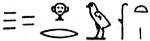
From the Middle Kingdom onward to the Roman period, the dates upon Egyptian documents are given in regnal years. On the oldest monuments the years in a reign were not numbered consecutively but were named after events; thus in the Ist Dynasty we find “the year of smiting the Antiu-people,” in the beginning of the IIIrd Dynasty “the year of fighting and smiting the people of Lower Egypt.” But under the IInd Dynasty there was a census of property for taxation every two years, and the custom, continuing (with some irregularities) for a long time, offered a uniform mode of marking years, whether current or past. Thus such dates are met with as “the year of the third time of numbering” of a particular king, the next being designated as “the year after the third time of numbering.” Under the Vth Dynasty this method was so much the rule that the words “of numbering” were commonly omitted. It would seem that in the course of the next dynasty the census became annual instead of biennial, so that the “times” agreed with the actual years of reign; thenceforward their consecutive designation as “first time,” “second time,” for “first year,” “second year,” was as simple as it well could be, and lasted unchanged to the fall of paganism. The question arises from what point these regnal dates were calculated. Successive regnal years might begin (1) on the anniversary of the king’s accession, or (2) on the calendrical beginning in each year (normally on the first day of the nominal First month of inundation, i.e. 1st Thoth in the later calendar). In the latter case there would be a further consideration: was the portion of a calendar year following the accession of the new king counted to the last year of the outgoing king, or to the first year of the new king? In Dynasties I., IV.-V., XVIII. there are instances of the first mode (1), in Dynasties II., VI. (?), XII., XXVI. and onwards they follow the second (2). It may be that the practice was not uniform in all documents even of the same age. In Ptolemaic times not only were Macedonian dates sometimes given in Greek documents, but there were certainly two native modes of dating current; down to the reign of Euergetes there was a “fiscal” dating in papyri, according to which the year began in Paophi, besides a civil dating probably from Thoth; later, all the dates in papyri start from Thoth.
The Macedonian year is found in early Ptolemaic documents. The fixed year of the Canopic decree under Euergetes (with 1st Thoth on Oct. 22) was never adopted. Augustus established an “Alexandrian” era with the fixed Julian year, retaining the Egyptian months, with a sixth epagomenal day every fourth year. The capture of Alexandria having taken place on the 1st of August 30 b.c., the era began nominally in 30 b.c., but it was not actually introduced till some years later, from which time the 1st Thoth corresponded with the 29th of August in the Julian year. The vague “Egyptian” year, however, continued in use in native documents for some centuries along with the Alexandrian “Ionian” year. The era of Diocletian dates from the 29th of August 284, the year of his reforms; later, however, the Christians called it the era of the Martyrs (though the persecution was not until 302), and it survived the Arab conquest. The dating by indictions, i.e. Roman tax-censuses, taking place every fifteenth year, probably originated in Egypt, in a.d. 312, the year of the defeat of Maxentius. The indictions began in Payni of the fixed year, when the harvest had been secured.
See F. K. Ginzel, Handbuch der mathematischen und technischen Chronologie, Bd. i. (Leipzig, 1906), and the bibliography in the following section.
2. Historical.18—As to absolute chronology, the assigning of a regnal year to a definite date b.c. is clear enough (except in occasional detail) from the conquest by Alexander onwards. Before that time, in spite of successive efforts to establish a chronology, the problem is very obscure. The materials for reconstructing the absolute chronology are of several kinds: (1) Regnal dates as given on contemporary monuments may indicate the lengths of individual reigns, but not with accuracy, as they seldom reach to the end of a reign and do not allow for co-regencies. Records of the time that has elapsed between two regnal dates in the reigns of different kings are very helpful; thus stelae from the Serapeum recording the ages of the Apis bulls with the dates of their birth and death have fixed the chronology of the XXVIth Dynasty. Traditional evidence for the lengths of reigns exists in the Turin Papyrus of kings and in Manetho’s history; unfortunately the papyrus is very fragmentary and preserves few reign-lengths entire, and Manetho’s evidence seems very untrustworthy, being known only from late excerpts. (2) The duration of a period may be calculated by generations or the probable average lengths of reigns, but such calculations are of little value, and the succession of generations even when the evidence seems to be full is particularly difficult to ascertain in Egyptian, owing to adoptions and the repetition of the same name even in one family of brothers and sisters. (3) Synchronisms in the histories of other countries furnish reliable dates—Greek, Persian, Babylonian and Biblical dates for the XXVIth Dynasty, Assyrian for the XXVth; less precise are the Biblical date of Rehoboam, contemporary with the invasion of Shishak (Sheshonk) in the XXIInd Dynasty, and the date of the Babylonian and Assyrian kings contemporary with Amenhotp IV. in the XVIIIth Dynasty. The last, about 1400 b.c., is the earliest point to which such coincidences reach. (4) Astronomical data, especially the heliacal risings of Sothis recorded by dates of their celebration in the vague year. These are easily calculated on the assumption first that the observations were correctly made, secondly that the calendrical dates are in the year of 365 days beginning on 1st Thoth, and thirdly that this year subsequently underwent no readjustment or other alteration before the reign of Euergetes. The assumption may be a reasonable one, and if the results agree with probabilities as deduced from the rest of the evidence it is wise to adopt it; if on the other hand the other evidence seems in any serious degree contrary to those results it may be surmised that the assumption is faulty in some particular. The harvest date referred to below helps to show that the first part of the assumption is justified.
Dynasty. Meyer 1887 (minimum date). Petrie 1894 &c. Meyer 1904-1908. Sethe 1905. Breasted 1906. Petrie 1906.
I. 3180 4777 3315 3360 3400 5510
II. ” 4514 3110 5247
III. ” 4212 2895 2810 2980 4945
IV. 2830 3998 2840 2720 2900 4731
V. 3721 2680 2630 2750 4454
VI. 2530 3503 2540 2480 2625 4206
VII. 3322 2300 2475 4003
VIII. 3252 3933
IX. 3106 2360 2445 3787
X. 3006 3687
XI. 2821 2160 2100 2160 3502
XII. 2130 2778 2000 2000 2000 3459
XIII. 1930 2565 1791 1788 3246