VOLUME IX SLICE I Edwardes to Ehrenbreitstein (continued 12)
Reading edition
It was clear at Korti that something must be done at once; and on the 13th of December 1100 men, with 2200 camels, under General Sir H. Stewart, were despatched to occupy Jakdul wells, 96 m. on the desert route to Metemma. Stewart returned on the 5th of January, and started again on the 8th, with orders to establish a fort at Abu Klea and to occupy Metemma. The Desert Column, 1800 men, with 2880 camels in poor condition and 153 horses, found the enemy in possession of Abu Klea wells on the 16th, and was desperately attacked on the 17th. The want of homogeneity of the force, and the unaccustomed tactics imposed upon the cavalry, somewhat hampered the defence, Stewart’s Desert Column; battle of Abu Klea wells. and the square was broken at the left rear corner. Driven back upon the camels in the centre, the troops fought hand to hand with the greatest gallantry. Order was quickly restored, and the attack was repulsed, with a loss of 74 killed and 94 wounded. At least 1100 of the enemy were killed. The wells being occupied and a zeriba formed, the column started on the evening of the 18th. The wrong road was taken, and great confusion occurred, during the night, but at dawn this was rectified; and after forming a rough fort under fire, by which General Sir H. Stewart was fatally wounded, an advance was made at 3 P.M. The square was again heavily attacked, but the Arabs could not get to close quarters and in the evening a bivouac was formed on the Nile. The British losses on this day were 23 killed and 98 wounded. The Desert Column was now greatly exhausted. On the 20th the village of Gubat was occupied; and on the following day Sir C. Wilson, on whom the command had devolved, advanced against Metemma, which was found too strong to assault. On this day General Gordon’s four steamers arrived; and on the morning of the 24th Sir C. Wilson, with 20 British soldiers in red coats and about 280 Sudanese, started in the “Bordein” and “Telahawiyeh” for Khartum. The “Bordein” grounded on the following day, and again on the 26th, by which twenty-four hours were lost. At 11 A.M. on the 28th Khartum was sighted, and it soon became clear that the town was in the hands of the enemy. After reconnoitring farther, the steamers turned and proceeded down stream under a heavy fire, the Sudanese crews showing signs of disaffection. The “Telahawiyeh” was wrecked on the 29th of January and the “Bordein” on the 31st, Sir C. Wilson’s party being rescued on the 4th of February by Lord C. Beresford in the “Safieh,” which had come up from Gubat on receipt of news carried there by Lieutenant Stuart Wortley in a row-boat. Khartum had been taken and General Gordon killed on the morning of the 26th of January 1885, having thus held out thirty-four days beyond the date when he had expected the end. The garrison Failure of relief expedition. had been reduced to starvation; and the arrival of twenty British soldiers, with orders to return at once, could not have affected the situation. The situation of the Desert Column and of its transport was most imperfectly understood at Korti, where impossible plans were formed. Fortunately Major-General Sir R. Buller, who arrived at Gubat on the 11th of February, decided upon withdrawal, thus averting impending disaster, and by the 16th of March the Desert Column had returned to Korti.
The advance from Korti of the River Column, under Major-General Earle, began on the 28th of December, and great difficulties of navigation were encountered. On the 10th of February an action was fought at Kirbekan with about 800 of the enemy, entailing a loss of 10 killed, including Major-General Earle, and 47 wounded. The column, now commanded by Brigadier-General Brackenbury, continued its slow advance, and on the morning of the 24th of February it was about 26 m. below Abu Hamed, a point where the Korosko desert route strikes the Nile, 350 m. from Khartum. Here it received orders to retire, and it reached Korti on the 8th of March.
The verbal message received from General Gordon on the 30th of December 1884 rendered the extreme danger of the position at Khartum painfully apparent, and the secretary of state for war, acting on Sir E. Baring’s Suakin operations. advice, offered to make an active demonstration from Suakin. To this proposal Lord Wolseley demurred, but asked that ships of war should be sent to Suakin, and that “marines in red coats should be frequently landed and exercised.” Lord Hartington replied that the government did not consider that a demonstration of this kind could be effective, and again suggested stronger measures. On the 8th of January 1885 Lord Wolseley repeated that “the measures you propose will not assist my operations against Khartum,” adding:—
“I have from first endeavoured to impress on government that I am strong enough to relieve Khartum, and believe in being able to send a force, when returning by way of Berber, to Suakin, to open road and crush Osman Digna.”
On this very day the small Desert Column started from Korti on its hazardous mission to the relief of a town fully 270 m. distant, held by a starving garrison, and invested by 30,000 fighting men, mostly armed with good rifles. Before reaching the Nile the Desert Column had lost 300 men and was unable to take Metemma, while its transport had completely broken down. On the 8th of February Lord Wolseley telegraphed, “The sooner you can now deal with Osman Digna the better,” and recommended the despatch of Indian troops to Suakin, to “co-operate with me in keeping road to Berber open.” On the 11th of February, the day on which Sir R. Buller most wisely decided to withdraw the Desert Column from a position of extreme danger, it was determined at Korti that the River Column should proceed to attack Berber, and Lord Wolseley accepted the proposal of the government to make a railway from Suakin, telegraphing to Lord Harrington:—
“By all means make railway by contract to Berber, or as far as you can, during summer. It will be invaluable as a means of supply, and I recommend it being begun immediately. Contract to be, if possible, for so much per ton military stores and supplies and men carried, per mile.”
Every effort was now concentrated upon sending an expeditionary force to Suakin, and before the end of March about 13,000 men, including a brigade from India and a field battery from New South Wales, with nearly 7000 camels and 1000 mules, were there assembled. Lieutenant-General Sir G. Graham was placed in command of this force, with orders to break down the power of Osman Digna and to press the construction of the railway towards Berber. The troops at Suakin, on arrival, were much harassed by small night attacks, which ceased as soon as the scattered camps were drawn together. On the 19th of March Sir G. Graham, with the cavalry brigade and the infantry of the Indian contingent, reconnoitred as far as Hashin, finding the country difficult on account of the dense mimosa scrub. The enemy occupied the hills and fired upon the cavalry. On the 20th Sir G. Graham, with about 9000 men, again advanced Battle of Hashin. to Hashin, and Dehilbat hill was taken by the Berkshire regiment and the Royal Marines. A squadron of the 9th Royal Lancers, which was dismounted in the thick bush, was driven back with the loss of 9 men; but elsewhere the Arabs never succeeded in closing, and the troops returned to Suakin in the afternoon, leaving the East Surrey regiment in a zeriba covering some low hills near Hashin village. The total British loss was 9 killed and 39 wounded.
On the 22nd of March a force, consisting of two British and three Indian battalions, with a naval brigade, a squadron of lancers, two companies of engineers, and a large convoy of camels carrying water and supplies, under McNeill’s zeriba. Major-General Sir J. McNeill, started from Suakin for Tamai, with orders to form a half-way zeriba. The advance was much impeded by the dense bush, and the force halted at Tofrik, about 6 m. out, at 10.30 A.M. A native had brought information that the enemy intended to attack while the zeriba was being formed, and this actually occurred. The force was caught partly unprepared soon after 2.30 P.M., and severe fighting took place. The enemy were repulsed in about twenty minutes, the naval brigade, the Berkshire regiment, the Royal Marines, and the 15th Sikhs showing the greatest gallantry. The casualties, including those among non-combatants, were 150 killed, 148 missing, and 174 wounded. More than 500 camels were killed. The tribesmen lost more than 1000 killed. As soon as firing was heard at Suakin, Sir G. Graham, with two battalions of Guards and a battery of horse artillery, started for Tofrik, but returned on being assured that reinforcements were not required. On the 24th and 26th convoys proceeding in square to Tofrik were attacked, the enemy being repulsed without difficulty. On the 2nd of April a force exceeding 7000 men, with 14 guns and 1600 transport animals, started from Suakin at 4.30 A.M., and bivouacked twelve hours later at Tesela Hill. Next morning an advance was made towards Tamai, and a number of huts in the Khor Ghob were burned. The force then returned to Suakin. The railway was now pushed on without interruption, reaching Otao on the 30th. On the night of the 6th of May a combined movement was made from Suakin and Otao, which resulted in the surprise and break-up of a force of the enemy under Mahommed Sardun, and the capture of a large number of sheep and goats. The moral effect of this operation was marked, and large numbers of tribesmen placed themselves unconditionally at the disposal of Sir G. Graham. A great native movement could now have been organized, which would have kept the route to Berber and enabled the railway to be rapidly pushed forward.
Meanwhile many communications had passed between the war office and Lord Wolseley, who at first believed that Berber could be taken before the summer. In a long despatch of the 6th of March he discussed the general situation, Political and military situation at end of operations. and pointed out that although the force at his disposal “was amply sufficient” for raising the siege of Khartum and defeating the mahdi, the conditions were changed by the fall of the town. It was now “impossible ... to undertake any offensive operations until about the end of the summer,” when twelve additional British battalions, four strong squadrons of British cavalry, and two R.H.A. batteries, together with a large extension of the Wadi Halfa railway, eleven steamers, and three hundred more whale-boats, would be required. He considered it necessary to hold Dongola, and he reported that he was “distributing this army along the left bank of the Nile, on the open reach of water” between the Hannek cataract and Abu Dom, opposite Merawi. On the 30th of March Lord Wolseley quitted the army and proceeded to Cairo. A cloud having arisen on the frontiers of Afghanistan, the withdrawal of the troops from the Sudan was ordered on the 11th of May. On the formation of Lord Salisbury’s cabinet, the new secretary of state for war, Mr W. H. Smith, inquired whether the retirement could be arrested, but Major-General Sir R. Buller reported that the difficulties of reoccupation would be great, and that if Dongola was to be held, a fresh expedition would be required. On the 22nd of June, before the British rearguard had left Dongola, the mahdi died. The withdrawal of the Suakin force began on the 17th of May, and the friendly tribes, deprived of support, were compelled to make terms with Osman Digna, who was soon able to turn his attention to Kassala, which capitulated in August, nearly at the same time as Sennar.
The failure of the operations in the Sudan had been absolute and complete, and the reason is to be sought in a total misconception of the situation, which caused vacillation and delay, and in the choice of a route by which, having regard to the date of the decision, the relief of General Gordon and Khartum was impossible.
(G. S. C.)
Military Operations in Egypt and the Sudan, 1885 to 1896
The operations against Mahdism during the eleven years from the end of the Nile expedition and the withdrawal from the Sudan to the commencement of the Dongola campaign will be more easily understood if, instead of narrating them in one chronological sequence, the operations in each province are considered separately. The mahdi, Mahommed Ahmed, died at Omdurman on the 22nd of June 1885. He was succeeded by the principal khalifa, Abdullah el Taaisha, a Baggara Arab, who for the next thirteen years ruled the Sudan with despotic power. Cruel, vicious, unscrupulous and strong, the country groaned beneath his oppression. He removed all possible rivals, concentrated at Omdurman a strong military force composed of men of his own tribe, and maintained the ascendancy of that tribe over all others. As the British troops retired to Upper Egypt, his followers seized the evacuated country, and the khalifa cherished the idea, already formulated by the mahdi, of the conquest of Egypt, but for some years he was too much occupied in quelling risings, massacring the Egyptians in the Sudan, and fighting Abyssinia, to move seriously in the matter.
Upper Egypt.—Mahommed el Kheir, dervish amir of Dongola, however, advanced towards the frontier in the autumn of 1885, and at the end of November came in touch with the frontier field force, a body of some 3000 men composed in nearly equal parts of British and Egyptian troops. A month of harassing skirmishes ensued, during which the Egyptian troops showed their mettle at Mograka, where 200 of them held the fort against a superior number of dervishes, and in combats at Ambigol, Kosha and Firket. Sir Frederick Stephenson, commanding the British army of occupation in Egypt, then concentrated the frontier field force at Firket, and attacked the main body of the enemy at Ginnis on the 30th of December 1885, completely defeating it and capturing two guns and twenty banners. It was here the new Egyptian army received its baptism of fire and acquitted itself very creditably. Although checked, the dervishes were not discouraged, and continued to press upon the frontier in frequent raids, and thus in many bloody skirmishes the fighting qualities of the Egyptian troops were developed. In April 1886 the frontier was drawn back to Wadi Halfa, a fortified camp at the northern end of the desolate defile, Batn-el-Hagar, through which the Nile tumbles amid black, rocky hills in a succession of rapids, and debouches on a wide plain. The protection of the frontier was now left in the hands of the Egyptian army, a British force remaining at Assuan, 200 m. to the north, as a reserve in case of emergency, and two years later even this precaution was deemed unnecessary.
In October 1886 Wad en Nejumi, the amir who had defeated Hicks Pasha in Kordofan three years before, and led the assault at Khartum when General Gordon was slain in January 1885, replaced Mahommed el Kheir as “commander of the force for the conquest of Egypt,” and brought large reinforcements to Dongola. An advanced column under Nur-el-Kanzi occupied Sarras in April 1887, was attacked by the Egyptian force under Colonel H. Chermside on the 28th of that month, and after a stubborn resistance was defeated with great loss. Nur-el-Kanzi was killed and ten standards taken.
The troubles in Darfur and with Abyssinia (q.v.) induced the khalifa to reduce the garrisons of the north; nevertheless, the dervishes reoccupied Sarras, continued active in raids and skirmishes, and destroyed the railway south of Sarras, which during the Nile expedition of 1884 and 1885 had been carried as far as Akasha. It was not until May 1889 that an invasion of the frontier on a large scale was attempted. At this time the power and prestige of the khalifa were at their height: the rebellions in Darfur and Kordofan had been stamped out, the anti-mahdi was dead, and even the dervish defeat by the Abyssinians had been converted by the death of King John and the capture of his body into a success. It was therefore an opportune time to try to sweep the Turks and the British into the sea. On the 22nd of June Nejumi was at Sarras with over 6000 fighting men and 8000 followers. On the 2nd of July Colonel J. Wodehouse headed off a part of this force from the river at Argin, and, after a sharp action, completely defeated it, killing 900, among whom were many important amirs, and taking 500 prisoners and 12 banners, with very small loss to his own troops. A British brigade was on its way up stream, but the sirdar, who had already arrived to take the command in person, decided not to wait for it. The Egyptian troops, with a squadron of the 20th Hussars, Battle of Toski. concentrated at Toski, and thence, on the 3rd of August, General Grenfell, with slight loss, gained a decisive victory. Wad en Nejumi, most of his amirs, and more than 1200 Arabs were killed; 4000 prisoners and 147 standards were taken, and the dervish army practically destroyed. No further serious attempts were made to disturb the frontier, of which the most southerly outpost was at once advanced to Sarras.
The escape from Omdurman of Father Ohrwalder and of two of the captive nuns in December 1891, of Father Rossignoli in October 1894, and of Slatin Bey in February 1895, revealed the condition of the Sudan to the outside world, threw a vivid light on the rule of the khalifa, and corroborated information already received of the discontent which existed among the tribes with the oppression and despotism under which they lived.
The Eastern Sudan.—In 1884 Colonel Chermside, governor of the Red Sea littoral, entered into arrangements with King John of Abyssinia for the relief of the beleaguered Egyptian garrisons. Gera, Amadib, Senhit and Gallabat were, in consequence, duly succoured, and their garrisons and Egyptian populations brought away to the coast by the Abyssinians in 1885. Unfortunately famine compelled the garrison of Kassala to capitulate on the 30th of July of that year, and Osman Digna hurried there from Tamai to raise a force with which to meet the Abyssinian general, Ras Alula, who was preparing for its relief. By the end of August Osman Digna had occupied Kufit, in the Barea country, with 10,000 men and entrenched himself. On the 23rd of September Ras Alula attacked him there with an equal number of men and routed him with great slaughter. Over 3000 dervishes with their principal amirs, except Osman Digna, lay dead on the field, and many more were killed in the pursuit. The Abyssinians lost 40 officers and 1500 men killed, besides many more wounded. Instead of marching on to Kassala, Ras Alula, who at this time was much offended by the transfer of Massawa by the Egyptians to Italy, made a triumphant entry into Asmara, and absolutely refused to make any further efforts to extricate Egyptian garrisons from the grip of the khalifa. Meanwhile Osman Digna, who had fled from Kufit to Kassala, wreaked his vengeance upon the unhappy captives at Kassala.
In the neighbourhood of Suakin there were many tribes disaffected to the khalifa’s cause, and in the autumn of 1886 Colonel H. Kitchener, who was at the time governor of the Red Sea littoral, judiciously arranged a combination of them to overthrow Osman Digna, with the result that his stronghold at Tamai was captured on the 7th of October, 200 of his men killed, and 50 prisoners, 17 guns and a vast store of rifles and ammunition captured. For about a year there was comparative quiet. Then at the end of 1887 Osman Digna again advanced towards Handub. Suakin, but his force at Taroi was routed by the “Friendlies,” and he fell back on Handub. Kitchener unsuccessfully endeavoured to capture Osman Digna on the 17th of January 1888, but in the attack was himself severely wounded, and was shortly after invalided. Later in the year Osman Digna collected a large force and besieged Suakin. In December the sirdar arrived with reinforcements from Cairo, and on the 20th sallied out and attacked the dervishes in their trenches at Gemaiza, clearing the whole line and inflicting considerable loss on the enemy, who retired towards Handub, and the country was again fairly quiet for a time. During 1889 and 1890 Tokar became the centre of dervish authority, while Handub continued to be occupied for the khalifa. In January 1891 Osman Digna showed signs of increased activity, and Colonel (afterwards Sir Charles) Holled Smith, then governor of the Red Sea littoral, attacked Handub successfully on the 27th and occupied it, then seized Trinkitat and Teb, and on the 19th of February fought the decisive action of Afafit, occupied Tokar, and drove Osman Battle of Afafit. Digna back to Temrin with a loss of 700 men, including all his chief amirs. This action proved the final blow to the dervish power in the neighbourhood of Suakin, for although raiding continued on a small scale, the tribes were growing tired of the khalifa’s rule and refused to support Osman Digna.
In the spring of 1891 an agreement was made between England and Italy by which the Italian forces in Eritrea were at liberty, if they were able, to capture and occupy Kassala, which lay close to the western boundary of their new colony, on condition that they restored it to Egypt at a future day when required to do so. Three years passed before they availed themselves of this agreement. In 1893 the dervishes, 12,000 strong, under Ahmed Ali, invaded Eritrea, and were met on the 29th of December at Agordat by Colonel Arimondi with 2000 men of a native force. Ahmed Ali’s force was completely routed and himself killed, and in the following July Colonel Baratieri, with 2500 men, made a fine forced march from Agordat, surprised and captured Kassala on the 17th of that month, and continued to hold it for three years and a half.
The Abyssinian Frontier.—On the Abyssinian frontier Ras Adal was in command of a considerable force of Abyssinians early in 1886, and in June of that year he invaded Gallabat and defeated the dervishes on the plain of Madana; the dervish amir Mahommed Wad Ardal was killed and his camp captured. In the following year the amir Yunis ed Dekeim made two successful raids into Abyssinian territory, upon which Ras Adal collected an enormous army, said to number 200,000 men, for the invasion of the Sudan. The khalifa sent the amir Hamdan Abu Angar, a very skilful leader, with an army of over 80,000 men against him. Abu Angar entered Abyssinia and, in August 1887, attacked Ras Adal in the plain of Debra Sin and, after a prolonged battle, defeated the Abyssinians, captured their camp, and marched on Gondar, the ancient capital of Abyssinia, which he sacked, and then returned into Gallabat. King John, the negus of Abyssinia, burning to avenge this defeat, marched, in February 1889, with an enormous army to Gallabat, where the amir Zeki Tumal commanded the khalifa’s forces, some 60,000 strong, and had strongly fortified the town and the camp. On the 9th of March 1889 the Abyssinians made a terrific onslaught, stormed and burnt the town, and took thousands of prisoners. A small party of dervishes still held a zeriba when King John was struck by a stray bullet. The Abyssinians decided to retire, fighting ceased, and they moved off with their prisoners and the wounded negus. That night the king died, and the greater part of the army having gone ahead with the prisoners, a party of Arabs pursued the rearguard, which consisted of the king’s bodyguard, routed them, and captured the king’s body, which was sent to Omdurman to confirm the report of a brilliant victory sent by Zeki Tumal to the khalifa. Internal strife prevented the new negus of Abyssinia from prosecuting the war, which thus, in spite of the Abyssinian success, resulted in the increased prestige of the khalifa. From this time, however, the dervishes ceased to trouble the Abyssinians.
Darfur and Kordofan.—On the outbreak of the mahdi’s rebellion Slatin Bey was governor of the province, and when Madibbo, the insurgent sheikh of Rizighat, attacked and occupied Shakka and was following up his success, Slatin twice severely defeated him, and, having concentrated his forces at El Fasher, repulsed the enemy again at Om Shanga. Mahdism, however, spread over Darfur in spite of Slatin’s efforts to stay it. He fought no fewer than twenty-seven actions in various parts of his province, but his own troops, in course of time, became infected with the new faith and deserted him. He was obliged to surrender at Dara in December 1883, and was a prisoner, first at Obeid and then at Omdurman, until he escaped in 1895. In January 1884 Zogal, the new dervish amir of the province, attacked El Fasher, where Said Bey Guma and an Egyptian garrison 1000 strong with 10 guns was still holding out, and captured it. He also reduced the Jebel Marra district, where the loyal hill-people gave him some trouble.
After the death of the mahdi in 1885, Madibbo revolted against the khalifa, but was defeated by Karamalla, the dervish amir of the Bahr-el-Ghazal, and was caught and executed. A war then sprang up between Karamalla and Sultan Yusef, who had succeeded Zogal as amir of Darfur. Yusef was joined in 1887 by Sultan Zayid, the black ruler of Jebel Marra, and Karamalla’s trusted general, Ketenbur, was defeated with great slaughter at El Towaish on the 29th of June 1887. Osman wad Adam (Ganu), amir of Kordofan, was sent by the khalifa to Karamalla’s assistance. He forced back the Darfurians near Dara on the 26th of December, routed Zayid in a second battle, entered El Fasher, and, in 1888, became complete master of the situation, the two sultans being killed. The Darfurian chiefs then allied themselves with Abu Gemaiza, sheikh of the Masalit Arabs, who had proclaimed himself “Khalifa Osman,” and was known as the anti-mahdi. The revolt assumed large proportions, and became the more dangerous to Abdullah, the khalifa, by reason of its religious character, wild rumours spreading over the country and reaching to Egypt and Suakin of the advent to power of an opposition mahdi. Abu Gemaiza attacked a portion of Osman Adam’s force, under Abd-el-Kader, at Kebkebia, 30 m. from El Fasher, and almost annihilated it on the 16th of October 1888; and a week later another large force of Osman Adam met with the same fate at the same place. Instead of following up his victories, Abu Gemaiza retired to Dar Tama to augment his army, to which thousands flocked as the news of his achievements spread far and wide. He again advanced to El Fasher in February 1889, but was seized with smallpox. His army, however, under Fiki Adam, fought a fierce battle close to El Fasher on the 22nd, which resulted in its defeat and dispersion, and Abu Gemaiza himself dying the following day, the movement collapsed.
In 1891 Darfur and Kordofan were again disturbed, and Sultan Abbas succeeded in turning the dervishes out of the Jebel Marra district. Two years later a saint of Sokoto, Abu Naal Muzil el Muhan, collected many followers and for a time threatened the khalifa’s power, but the revolt gradually died out.
The Bahr-el-Ghazal.—The first outbreak in favour of Mahdism in the Bahr-el-Ghazal took place at Liffi in August 1882, when the Dinka tribe, under Jango, revolted and was defeated by Lupton Bey with considerable slaughter at Tel Gauna, and again in 1883 near Liffi. In September of that year Lupton’s captain, Rufai Aga, was massacred with all his men at Dembo, and Lupton, short of ammunition, was forced to retire to Dem Suliman, where he was completely cut off from Khartum. After gallantly fighting for eighteen months he was compelled by the defection of his troops to surrender on the 21st of April 1884 to Karamalla, the dervish amir of the province. He died at Omdurman in 1888.
In 1890 the Shilluks in the neighbourhood of Fashoda rose against the khalifa, and the dervish amir of Gallabat, Zeki Tumal, was engaged for two years in suppressing the rebellion. He got the upper hand in 1892, and was recalled to oppose an Italian force said to be advancing from Massawa; but on reporting that it was impossible to invade Eritrea, as the khalifa wished him to do, he was summoned to Omdurman and put to death. The country then relapsed into its original barbarous condition, and dervish influence was nominal only. In 1892 the Congo State expedition established posts up to the seventh parallel of north latitude. In 1893 the dervish amir, Abu Mariam, fought with the Dinka tribe and was killed and his force destroyed, the fugitives taking refuge in Shakka. In the following year the Congo expedition established further posts, and in consequence the khalifa sent 3000 men, under the amir Khatem Musa, from Shakka to reoccupy the Bahr-el-Ghazal. The Belgians at Liffi retired before him, and he entered Faroga. Famine and disease broke out in Khatem Musa’s camp in 1895, and a retreat was made towards Kordofan.
Equatoria.—In the Equatorial Province, which extended from the Albert Nyanza to Lado, Emin Bey, who had a force of 1300 Egyptian troops and 3000 irregulars, distributed among many stations, held out, hoping for reinforcements. In March 1885, however, Amadi fell to the dervishes, and on the 18th of April Karamalla arrived near Lado, the capital, and sent to inform Emin of the fall of Khartum. Emin and Captain Casati, an Italian, moved south to Wadelai, giving up the northern posts, and opened friendly relations with Kabarega, king of Unyoro. On the 26th of February 1886 Emin received despatches from Cairo via Zanzibar, from which he learned all that had occurred during the previous three years, and that “he might take any step he liked, should he decide to leave the country.” He determined to remain where he was and “hold together, as long as possible, the remnant of the last ten years.” His troops were in a mutinous state, wishing to go north rather than south, as Emin had ordered them to do, and unsuccessfully endeavoured to carry him with them by force.
His communications to Europe through Zanzibar led to the relief expedition under H. M. Stanley, which went to his rescue by way of the Congo in 1887, and after encountering incredible dangers and experiencing innumerable sufferings, met with Emin and Casati at Nsabé, on the Albert Nyanza, on the 29th of April 1888. Stanley went back in May to pick up his belated rearguard, leaving Mounteney Jephson and a small escort to accompany Emin round his province. The southern garrisons decided to go with Emin, but the troops at Labore mutinied, and a general revolt broke out, headed by Fadl-el-Maula, governor of Fabbo. On arriving at Dufile in August 1888, Emin and Jephson were made prisoners by the Egyptian mutineers. In the meantime the arrival of Stanley at Lake Albert had caused rumours, which quickly spread to Omdurman, of a great invading white pasha, with the result that in July the khalifa sent up the river three steamers and six barges, containing 4000 troops, to oppose this new-comer. In October Omar-Saleh, the Mahdist commander, took Rejaf and sent messengers to Dufile to summon Emin to surrender; but on the 15th of November the mutineers released both Emin and Jephson, who returned to Lake Albert with some 600 refugees, and joined Stanley in February 1889. The expedition arrived at Zanzibar at the end of the year.
Emin’s mutinous troops kept the dervishes at bay between Wadelai and Rejaf, and eventually severely defeated them, driving them back to Rejaf. They did not, however, follow up their victory, and under the leadership of Fadl-el-Maula Bey remained about Wadelai, while the dervishes strengthened their post at Rejaf. In 1893 Fadl-el-Maula Bey and many of his men took service with Baert of the Congo State expedition. The bey was killed fighting the dervishes at Wandi in January 1894, and the remnant of his men eventually were found by Captain Thruston from Uganda on the 23rd of March 1894 at Mahagi, on the Albert Nyanza, whither they had drifted from Wadelai in search of supplies. They were enlisted by Thruston and brought back under the British flag to Uganda.
In consequence of the Franco-Congolese Treaty of 1894, Major Cunningham and Lieutenant Vandeleur were sent from Uganda to Dufile, where they planted the British flag on the 15th of January 1895.
Sudan Operations, 1896-1900
The wonderful progress—political, economical and social—which Egypt had made during British occupation, so ably set forth in Sir Alfred Milner’s England in Egypt (published in 1892), together with the revelation in so strong a light of the character of the khalifa’s despotism in the Sudan and the miserable condition of his misgoverned people, as detailed in the accounts of their captivity at Omdurman by Father Ohrwalder and Slatin Bey (published in 1892 and 1896), stirred public opinion in Great Dongola campaign, 1896. Britain, and brought the question of the recovery of the Sudan into prominence. A change of ministry took place in 1895, and Lord Salisbury’s cabinet, which had consistently assailed the Egyptian policy of the old, was not unwilling to consider whether the flourishing condition of Egyptian finance, the prosperity of the country and the settled state of its affairs, with a capable and proved little army ready to hand, did not warrant an attempt being made to recover gradually the Sudan provinces abandoned by Egypt in 1885 on the advice of Mr Gladstone’s government.
Such being the condition of public and official sentiment, the crushing defeat of the Italians by the Abyssinians at the battle of Adowa on the 1st of March 1896, and the critical state of Kassala—held by Italy at British suggestion, and now closely invested by the dervishes—made it not only desirable but necessary to take immediate action.
On the 14th of March 1896 Major-General Sir H. Kitchener, who succeeded Sir Francis Grenfell as sirdar of the Egyptian army in 1892, received orders to reoccupy Akasha, 50 m. south of Sarras, and to carry the railway on from Sarras. Subsequent operations were to depend upon the amount of resistance he encountered. On the 20th of March Akasha was occupied without opposition by an advanced column of Egyptian troops under Major J. Collinson, who formed an entrenched camp there. The reserves of the Egyptian army were called out, and responded with alacrity. The troops were concentrated at Wadi Halfa; the railway reconstruction, under Lieutenant E. P. Girouard, R.E., pushed southward; and a telegraph line followed the advance. At the commencement of the campaign the Egyptian army, including reserves, consisted of 16 battalions of infantry, of which 6 were Sudanese, 10 squadrons of cavalry, 5 batteries of artillery, 3 companies of garrison artillery, and 8 companies of camel corps, and it possessed 13 gunboats for river work. Colonel H. M. L. Rundle was chief of the staff; Major F. R. Wingate was head of the intelligence department, with Slatin Bey as his assistant; and Colonel A. Hunter was in command of Sarras, and south. The 1st battalion of the North Staffordshire regiment moved up from Cairo to join the Egyptian army.
In the meantime the advance to Akasha had already relieved the pressure at Kassala, Osman Digna having withdrawn a considerable force from the investing army and proceeded with it to Suakin. To meet Osman Digna’s movement Lieutenant-Colonel G. E. Lloyd, the Suakin commandant, advanced to the Taroi Wells, 19 m. south of Suakin, on the 15th of April to co-operate with the “Friendlies,” and with Major H. M. Sidney, advancing with a small force from Tokar. His cavalry, under Major M. A. C. B. Fenwick, went out to look for Sidney’s force, and were surprised by a large number of dervishes. Fenwick, with some 40 officers and men, seized an isolated hill and held it through the night, repulsing the dervishes, who were the same night driven back with such heavy loss in attacking Lloyd’s zeriba that they retired to the hills, and comparative quiet again reigned at Suakin. At the end of May an Indian brigade arrived for garrison duty, and the Egyptian troops were released for service on the Nile.
The dervishes first came in contact with the Egyptian cavalry on the Nile near Akasha, on the 1st of May, and were repulsed. The army concentrated at Akasha early in June, and on the 6th Kitchener moved to the attack of Firket 16 m. away, where the amir Hamuda, with 3000 men, was encamped. The attack was made in two columns: one, under Colonel Hunter, marching along the river-bank, approached Firket from the north; while the other, under Major Burn-Murdoch, making a detour through the desert, approached it from the south. The co-operation of the two columns was admirably timed, and on the morning of the 7th the dervish camp was surrounded, and, after a sharp fight, Hamuda and many amirs and about 1000 men were killed, and 500 prisoners taken. The dash and discipline of the Egyptian troops in this victory were a good augury for the future.
By the end of June the railway was advanced beyond Akasha, and headquarters were at Kosha, 10 m. farther south. Cholera and fever were busy both with the North Staffordshire regiment at Gemai, whither they had been moved on its approach, and with the Egyptian troops at the front, and carried off many officers and men. The railway reached Kosha early in August; the cholera disappeared, and stores were collected and arrangements steadily made for a farther advance. The North Staffordshire moved up to the front, and in September the army moved on Kerma, which was found to be evacuated, the dervishes having crossed the river to Hafir. There they were attacked by the gunboats and Kitchener’s artillery from the opposite bank, and forced to retire, with their commander, Wad Bishara, seriously wounded. Dongola was bombarded by the gunboats and captured by the army on the 23rd of September. Bishara and his men retreated, but were pursued by the Egyptians until the retreat became a hopeless rout. Guns, small arms and ammunition, with large stores of grain and dates, were captured, many prisoners taken, while hundreds surrendered voluntarily, among them a brother of the amir Wad en Nejumi. The dervish Dongola army had practically ceased to exist. Debba was seized on the 3rd October, Korti and Merawi occupied soon after, and the principal sheiks came in and submitted to the sirdar. The Dongola campaign was over, and the province recovered to Egypt. The Indian brigade at Suakin returned to India, and was replaced by Egyptians. The North Staffordshire returned to Cairo. The work of consolidation began, and preparations were made for a farther advance when everything should be ready.
The railway up the right bank of the Nile was continued to Kerma, in order to evade the difficulties of the 3rd cataract; but the sirdar had conceived the bold project of cutting off the great angle of the Nile from Wadi Halfa to Abu The Sudan campaign, 1897. Hamed, involving nearly 600 m. of navigation and including the 4th cataract, by constructing a railway across the Nubian desert, and so bringing his base at Wadi Halfa within a few hours of his force, when it should have advanced to Abu Hamed, instead of ten days. Early in 1897 this new line of railway was commenced from Wadi Halfa across the great Nubian desert 230 m. to Abu Hamed. The first-mentioned line reached Kerma in May, and by July the second had advanced 130 m. into the desert towards Abu Hamed, when it became necessary, before it was carried farther, to secure that terminus by an advance from Merawi.
In the meantime the khalifa was not idle. He occupied Abu Klea wells and Metemma; recalled the amir Ibrahim Khalil, with 4000 men, from the Ghezira; brought to Omdurman the army of the west under Mahmud—some 10,000 men; entrusted the line of the Atbara—Ed Darner, Adarama, Asubri and El Fasher—to Osman Digna; constructed defences in the Shabluka gorge; and personally superintended the organization and drill of the forces gathered at Omdurman, and the collection of vast stores of food and supplies of camels for offensive expeditions.
Towards the end of June the chief of the Jaalin tribe, Abdalla wad Said, who occupied Metemma, angered by the khalifa, made his submission to Kitchener and asked for support, at the same time foolishly sending a defiant letter to the khalifa. The sirdar sent him rifles and ammunition across the desert from Korti; but before they arrived, Mahmud’s army, sent by the khalifa, swept down on Metemma on the 1st of July and massacred Abdalla wad Said and his garrison.
On the 29th of July, after several reconnaissances, Major-General Hunter, with a flying column, marched up the Nile from near Merawi to Abu Hamed, 133 m. distant, along the edge of the Monassir desert. He arrived on the 7th of August and captured it by storm, the dervishes losing 250 killed and 50 prisoners. By the end of the month the gunboats had surmounted the 4th cataract and reached Abu Hamed. Berber was found to be deserted, and occupied by Hunter on the 5th of September, and in the following month a large force was entrenched there. The khalifa, fearing an attack on Omdurman, moved Osman Digna from Adarama to Shendi. In the 23rd of October Hunter, with a flying column lightly equipped, left Berber for Adarama, which he burned on the 2nd of November, and after reconnoitring for 40 m. up the Atbara, returned to Berber. The Nile was falling, and Kitchener decided to keep the gunboats above the impassable rapid at Um Tuir, 4 m. north of the confluence of the Atbara with the Nile, where he constructed a fort. The gunboats made repeated reconnaissances up the river, bombarding Metemma with effect. The railway reached Abu Hamed on the 4th of November, and was pushed rapidly forward along the right bank of the Nile towards Berber.
The forces of the khalifa remaining quiet, the sirdar visited Kassala and negotiated with the Italian General Caneva for its restoration to Egypt. The Italians were anxious to leave it; and on Christmas day 1897 Colonel (afterwards General Sir Charles) Parsons, with an Egyptian force from Suakin, took it formally over, together with a body of Arab irregulars employed by the Italians. These troops were at once despatched to capture the dervish posts at Asabri and El Fasher, which they did with small loss.
On his return from Kassala to Berber the sirdar received information of an intended advance of the khalifa northward. He at once ordered a concentration of Egyptian troops towards Berber, and telegraphed to Cairo for a British Sudan campaign, 1898. brigade. By the end of January the concentration was complete, and the British brigade, under Major-General Gatacre, was at Dakhesh, south of Abu Hamed. Disagreement among the khalifa’s generals postponed the dervish advance and gave Kitchener much-needed time. But at the end of February, Mahmud crossed the Nile to Shendi with some 12,000 fighting men, and with Osman Digna advanced along the right bank of the Nile to Aliab, where he struck across the desert to Nakheila, on the Atbara, intending to turn Kitchener’s left flank at Berber. The sirdar took up a position at Ras el Hudi, on the Atbara. His force consisted of Gatacre’s British brigade (1st Warwicks, Lincolns, Seaforths and Camerons) and Hunter’s Egyptian division (3 brigades under Colonels Maxwell, MacDonald and Lewis respectively), Broadwood’s cavalry, Tudway’s camel corps and Long’s artillery. The dervish army reached Nakheila on the 20th of March, and entrenched themselves there in a formidable zeriba. After several reconnaissances in which fighting took place with Mahmud’s outposts, it was ascertained from prisoners that their army was short of provisions and that great leakage was going on. Kitchener, therefore, did not hurry. He sent his flotilla up the Nile and captured Shendi, the dervish depôt, on the 27th of March. On the 4th of April he advanced to Abadar. A final reconnaissance was made on the 5th. On the following day he bivouacked at Umdabia, where he constructed a strong zeriba, which was garrisoned by an Egyptian battalion, and on the night of the 7th he marched to the attack of Mahmud’s zeriba, which, after an hour’s bombardment on the morning of the 8th of April, was stormed with complete success. Mahmud and several hundred dervishes were captured, 40 amirs and 3000 Arabs killed, and many more wounded; the rest escaped to Gedaref. The sirdar’s casualties were 80 killed and 472 wounded.
Preparations were now made for the attack on the khalifa’s force at Omdurman; and in the meantime the troops were camped in the neighbourhood of Berber, and the railway carried on to the Atbara. At the end of July reinforcements were forwarded from Cairo; and on the 24th of August the following troops were concentrated for the advance at Wad Hamad, above Metemma, on the western bank of the 6th cataract:—British division, under Major-General Gatacre, consisting of 1st Brigade, commanded by Colonel A. G. Wauchope (1st Warwicks, Lincolns, Seaforths and Camerons), and 2nd Brigade, commanded by Colonel the Hon. N. G. Lyttelton (1st Northumberlands and Grenadier Guards, 2nd Lancashire and Rifle Brigade); Egyptian division, under Major-General Hunter, consisting of four brigades, commanded by Colonels MacDonald, Maxwell, Lewis and Collinson; mounted troops—21st Lancers, camel corps, and Egyptian cavalry; artillery, under Colonel Long, 2 British batteries, 5 Egyptian batteries, and 20 machine guns; detachment of Royal Engineers. The flotilla, under Commander Keppel, R.N., consisted of 10 gunboats and 5 transport steamers. The total strength was nearly 26,000 men.
While the army moved along the west bank of the river, a force of Arab irregulars or “Friendlies” marched along the east bank, under command of Major Stuart-Wortley and Lieutenant Wood, to clear it of the enemy as far as Battle of Omdurman. the Blue Nile; and on the 1st of September the gunboats bombarded the forts on both sides of the river and breached the great wall of Omdurman. Kitchener met with no opposition; and on the 1st of September the army bivouacked in zeriba at Egeiga, on the west bank of the Nile, within 4 m. of Omdurman. Here, on the morning of the 2nd of September, the khalifa’s army, 40,000 strong, attacked the zeriba, but was repulsed with slaughter. Kitchener then moved out and marched towards Omdurman, when he was again twice fiercely attacked on the right flank and rear, MacDonald’s brigade bearing the brunt. MacDonald distinguished himself by his tactics, and completely repulsed the enemy. The 21st Lancers gallantly charged a body of 2000 dervishes which was unexpectedly met in a khor on the left flank, and drove them westward, the Lancers losing a fifth of their number in killed and wounded. The khalifa was now in full retreat, and the sirdar, sending his cavalry in pursuit, marched into Omdurman. The dervish loss was over 10,000 killed, as many wounded, and 5000 prisoners. The khalifa’s black flag was captured and sent home to Queen Victoria. The British and Egyptian casualties together were under 500. The European prisoners of the khalifa found in Omdurman—Charles Neufeld, Joseph Ragnotti, Sister Teresa Grigolini, and some 30 Greeks—were released; and on Sunday the 4th of September the sirdar, with representatives from every regiment, crossed the river to Khartum, where the British and Egyptian flags were hoisted, and a short service held in memory of General Gordon, near the place where he met his death.
The results of the battle of Omdurman were the practical destruction of the khalifa’s army, the extinction of Mahdism in the Sudan, and the recovery of nearly all the country formerly under Egyptian authority.
The khalifa fled with a small force to Obeid in Kordofan. The British troops were quickly sent down stream to Cairo, and the sirdar, shortly afterwards created Lord Kitchener of Khartum, was free to turn his attention to the reduction of the country to some sort of order.
He had first, however, to deal with a somewhat serious matter—the arrival of a French expedition at Fashoda, on the White Nile, some 600 m. above Khartum. He started for the south on the 10th of September, with 5 gunboats and Captain Marchand at Fashoda. a small force, dispersed a body of 700 dervishes at Reng on the 15th, and four days later arrived at Fashoda, to find the French Captain Marchand, with 120 Senegalese soldiers, entrenched there and the French flag flying. He arranged with Marchand to leave the political question to be settled by diplomacy, and contented himself with hoisting the British and Egyptian flags to the south of the French flag, and leaving a gunboat and a Sudanese battalion to guard them. He then steamed up the river and established a post at Sobat; and after sending a gunboat up the Bahr-el-Ghazal to establish another post at Meshra-er-Rek, he returned to Omdurman. The French expedition had experienced great difficulties in the swampy region of the Bahr-el-Ghazal, and had reached Fashoda on the 10th of July. It had been attacked by a dervish force on the 25th of August, and was expecting another attack when Kitchener arrived and probably saved it from destruction. The Fashoda incident was the subject of important diplomatic negotiations, which at one time approached an acute phase; but ultimately the French position was found to be untenable, and on the 11th of December Marchand and his men returned to France by the Sobat, Abyssinia and Jibuti. In the following March the spheres of interest of Great Britain and France in the Nile basin were defined by a declaration making an addition to Article IV. of the Niger convention of the previous year.
During the sirdar’s absence from Omdurman Colonel Hunter commanded an expedition up the Blue Nile, and by the end of September had occupied and garrisoned Wad Medani, Sennar, Karkoj and Roseires. In the meantime Colonel Parsons marched with 1400 men from Kassala on the 7th of September, to capture Gedaref. He encountered 4000 dervishes under the amir Saadalla outside the town, and after a desperate fight, in which he lost 50 killed and 80 wounded, defeated them and occupied the town on the 22nd. The dervishes left 500 dead on the field, among whom were four amirs. Having strongly entrenched himself, Parsons beat off, with heavy loss to the dervishes, two impetuous attacks made on the 28th by Ahmed Fedil. But the garrison of Gedaref suffered from severe sickness, and Colonel Collinson was sent to their aid with reinforcements from Omdurman. He steamed up the Blue Nile and the Rahad river to Ain-el-Owega, whence he struck across the desert, reaching Gedaref on the 21st of October, to find that Ahmed Fedil had gone south with his force of 5000 men towards Roseires. Colonel Lewis, who was at Karkoj with a small force, moved to Roseires, where he received reinforcements from Omdurman, and on the 26th of December caught Ahmed Fedil’s force as it was crossing the Blue Nile at Dakheila, and after a very severe fight cut it up. The dervish loss was 500 killed, while the Egyptians had 24 killed and 118 wounded. Two thousand five hundred fighting men surrendered later, and the rest escaped with Ahmed Fedil to join the khalifa in Kordofan.
On the 25th of January 1899 Colonel Walter Kitchener was despatched by his brother, in command of a flying column of 2000 Egyptian troops and 1700 Friendlies, which had been concentrated at Faki Kohi, on the White Nile, Operations in the Sudan, 1899. some 200 m. above Khartum, to reconnoitre the khalifa’s camp at Sherkela, 130 m. west of the river, in the heart of the Baggara country in Kordofan, and if possible to capture it. The position was found to be a strong one, occupied by over 6000 men; and as it was not considered prudent to attack it with an inferior force at such a distance from the river base, the flying column returned. No further attempt was made to interfere with the khalifa in his far-off retreat until towards the end of the year, when, good order having been generally established throughout the rest of the Sudan, it was decided to extend it to Kordofan.
In the autumn of 1899 the khalifa was at Jebel Gedir, a hill in southern Kordofan, about 80 m. from the White Nile, and was contemplating an advance. Lord Kitchener concentrated 8000 men at Kaka, on the river, 380 m. south of Khartum, and moved inland on the 20th of October. On arriving at Fongor it was ascertained that the khalifa had gone north, and the cavalry and camel corps having reconnoitred Jebel Gedir, the expedition returned. On the 13th November the amir Ahmed Fedil debouched on the river at El Alub, but retired on finding Colonel Lewis with a force in gunboats. Troops and transport were then concentrated at Faki Kohi, and Colonel Wingate sent with reinforcements from Khartum to take command of the expedition and march to Gedid, where it was anticipated the khalifa would be obliged to halt. A flying column, comprising a squadron of cavalry, a field battery, 6 machine guns, 6 companies of the camel corps, and a brigade of infantry and details, in all 3700 men, under Wingate, left Faki Kohi on the 21st of November. The very next day he encountered Ahmed Fedil at Abu Aadel, drove him from his position with great loss, and captured his camp and a large supply of grain he was convoying to the khalifa. Gedid was reached on the 23rd, and the khalifa was ascertained to be at Om Debreikat. Wingate marched at midnight of the 24th, and was resting his troops on high ground in front of the khalifa’s position, when at daybreak of the 25th his picquets were driven in and the dervishes attacked. They Death of the khalifa. were repulsed with great slaughter, and Wingate advancing, carried the camp. The khalifa Abdullah el Taaisha, unable to rally his men, gathered many of his principal amirs around him, among whom were his sons and brothers, Ali Wad Helu, Ahmed Fedil, and other well-known leaders, and they met their death unflinchingly from the bullets of the advancing Sudanese infantry. Three thousand men and 29 amirs of importance, including Sheik-ed-din, the khalifa’s eldest son and intended successor, surrendered. The dervish loss in the two actions was estimated at 1000 killed and wounded, while the Egyptian casualties were only 4 killed and 29 wounded. Thus ended the power of the khalifa and of Mahdism.
On the 19th of January 1900 Osman Digna, who had been so great a supporter of Mahdism in the Eastern Sudan, and had always shown great discretion in securing the safety of his own person, was surrounded and captured at Jebel Warriba, as he was wandering a fugitive among the hills beyond Tokar.
The reconquest of Dongola and the Sudan provinces during the three years from March 1896 to December 1898, considering the enormous extent and difficulties of the country, was achieved at an unprecedentedly small cost, while the main item of expenditure—the railway—remains a permanent benefit to the country. The figures are:—
Railways £E.1,181,372
Telegraphs 21,825
Gunboats 154,934
Military 996,223
——————
Total £E.2,354,354
Towards this expense the British government gave a grant-in-aid of £800,000, and the balance was borne by the Egyptian treasury. The railway, delayed by the construction of the big bridge over the Atbara, was opened to the Blue Nile opposite Khartum, 187 m. from the Atbara, at the end of 1899.
(R. H. V.)
1 By the Greek and Roman geographers Egypt was usually assigned to Libya (Africa), but by some early writers the Nile was thought to mark the division between Libya and Asia. The name occurs in Homer as Αἴγυπτος, but is of doubtful origin.
2 A vivid description of Cairo during the prevalence of plague in 1835 will be found in A. W. Kinglake’s Eothen.
3 A kantar equals 99 ℔.
4 To the ministry of public instruction was added in 1906 a department of agriculture and technical instruction.
5 The place of publication is London unless otherwise stated.
6 The figures of the debt are always given in £ sterling. The budget figures are in £E. (pounds Egyptian), equal to £1, 0s. 6d.
7 Egypt, No. 1 (1905), p. 20.
8 Similar mortality, though on a smaller scale, recurred in 1889, when Sudanese battalions coming from Suakin were detained temporarily in Cairo.
9 Formerly transcribed hau or “heap”-problems.
10 Clepsydras inscribed in hieroglyphic are found soon after the Macedonian conquest.
11 Annual reports of the progress of the work are printed in the Sitzungsberichte of the Berlin Academy of Sciences; see also Erman, Zur ägyptischen Sprachforschung, ib. for 1907, p. 400, showing the general trend of the results.
12 In the temple of Philae, where the worship of Isis was permitted to continue till the reign of Justinian, Brugsch found demotic inscriptions with dates to the end of the 5th century.
13 The Arabic dialects, which gradually displaced Coptic as Mahommedanism supplanted Christianity, adopted but few words of the old native stock.
14 In the articles referring to matters of Egyptology in this edition, Graecized forms of Old Egyptian names, where they exist, are commonly employed; in other cases names are rendered by their actual equivalents in Coptic or by analogous forms. Failing all such means, recourse is had to the usual conventional renderings of hieroglyphic spelling, a more precise transcription of the consonants in the latter being sometimes added.
15 It seems that “acrophony” (giving to a sign the value of the first letter of its name) was indulged in only by priests of the latest age, inventing fantastic modes of writing their “vain repetitions” on the temple walls.
16 In the prehistoric age when absolute dating is out of reach a “sequence dating” by means of the sequence of types in pottery, tools, &c., has been proposed in Petrie’s Diospolis Parva, pp. 4 et sqq. The earliest prehistoric graves yet known are placed at S.D. 30, and shortly before S.D. 80 the period of the first historic dynasty is entered.
17 Ten-day periods as subdivisions of the month can be traced as far back as the Middle Kingdom. The day consisted of twenty-four hours, twelve of day (counted from sunrise to sunset) and twelve of night; it began at sunrise.
18 For the “sequence” dating (S.D.) used by archaeologists for the prehistoric period see above (§ Art and Archaeology, ad init. note).
19 Reisner (Early Dynastic Cemeteries, p. 126), from his work in the prehistoric cemeteries, believes that Egypt was too uncivilized at that early date to have performed this scientific feat.
20 The history of Hatshepsut has been very obscure, and the mutilations of her cartouches have been variously accounted for. Recent discoveries by M. Legrain at Karnak and Prof. Petrie at Sinai have limited the field of conjecture. The writer has followed M. Naville’s guidance in his biography of the queen (in T. M. Davis, The Tomb of Hatshopsîtû, London, 1906, pp. 1 et seq.), made with very full knowledge of the complicated data.
21 This, it may be remarked, is the time vaguely represented by the Dodecarchy of Herodotus.
22 Khosrev Pasha afterwards filled several of the highest offices at Constantinople. He died on the 1st of February 1855. He was a bigot of the old school, strongly opposed to the influences of Western civilization, and consequently to the assistance of France and Great Britain in the Crimean War.
23 The work was carried out under the supervision of the Frenchman, Colonel Sève, who had turned Mahommedan and was known in Islam as Suleiman Pasha. The effectiveness of the new force was first tried in the suppression of a revolt of the Albanians in Cairo (1823) by six disciplined Sudanese regiments; after which Mehemet Ali was no more troubled with military émeutes.
24
The Dynasty of Mehemet Ali.
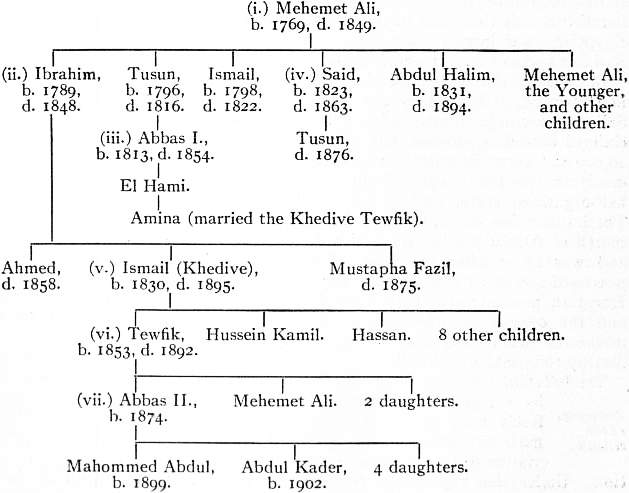
25 Part of this money was devoted to an expedition sent against Abyssinia in 1876 to avenge losses sustained in the previous year. The new campaign was, however, equally unsuccessful.
26 Lord Cromer, writing in 1905, declared that the movement “was, in its essence, a genuine revolt against misgovernment,” and “was not essentially anti-European” (vide Egypt No. 1, 1905, p. 2).
27 Except in so far as it was necessary to call out men to guard the banks of the Nile in the season of high flood.
28 The Egyptians keep large numbers of pigeons, which are allowed to be shot only by permission of the village omdeh (head-man). After the occurrence here related, officers were prohibited from shooting pigeons in any circumstances.
29 On the 8th of January 1908, the anniversary of the khedive’s accession, the whole of the Denshawai prisoners were pardoned and released. For the Denshawai incident see the British parliamentary papers, Egypt No. 3 and Egypt No. 4 of 1906.]
30 See Egypt No. 2 (1906), Correspondence respecting the Turco-Egyptian Frontier in the Sinai Peninsula (with a map).]
EHRENBERG, CHRISTIAN GOTTFRIED (1795-1876), German naturalist, was born at Delitzsch in Saxony on the 19th of April 1795. After studying at Leipzig and Berlin, where he took the degree of doctor of medicine in 1818, he was appointed professor of medicine in the university of Berlin (1827). Meanwhile in 1820 he was engaged in a scientific exploration conducted by General von Minutoli in Egypt. They investigated parts of the Libyan desert, the Nile valley and the northern coasts of the Red Sea, where Ehrenberg made a special study of the corals. Subsequently parts of Syria, Arabia and Abyssinia were examined. Some results of these travels and of the important collections that had been made were reported on by Humboldt in 1826; and afterwards Ehrenberg was enabled to bring out two volumes Symbolae physicae (1828-1834), in which many particulars of the mammals, birds, insects, &c., were made public. Other observations were communicated to scientific societies. In 1829 he accompanied Humboldt through eastern Russia to the Chinese frontier. On his return he gave his attention to microscopical researches. These had an important bearing on some of the infusorial earths used for polishing and other economic purposes; they added, moreover, largely to our knowledge of the microscopic organisms of certain geological formations, especially of the chalk, and of the modern marine and freshwater accumulations. Until Ehrenberg took up the study it was not known that considerable masses of rock were composed of minute forms of animals or plants. He demonstrated also that the phosphorescence of the sea was due to organisms. He continued until late in life to investigate the microscopic organisms of the deep sea and of various geological formations. He died in Berlin on the 27th of June 1876.
Publications.—Die Infusionsthierchen als vollkommene Organismen (2 vols. fol., Leipzig, 1838); Mikrogeologie (2 vols. fol., Leipzig, 1854); and “Fortsetzung der mikrogeologischen Studien,” in Abhandl. der k. Akad. der Wissenschaft (Berlin, 1875).
EHRENBREITSTEIN, a town of Germany, in the Prussian Rhine province, on the right bank of the Rhine, facing Coblenz, with which it is connected by a railway bridge and a bridge of boats, on the main line of railway Frankfort-on-Main-Cologne. Pop. (including the garrison) 5300. It has an Evangelical and two Roman Catholic churches, a Capuchin monastery, tanneries, soap-works and a considerable trade in wine. Above the town, facing the mouth of the Mosel, on a rock 400 ft. high, lies the magnificent fortress of Ehrenbreitstein, considered practically impregnable. The sides towards the Rhine and the south and south-east are precipitous, and on the south side, on which is the winding approach, strongly defended. The central fort or citadel is flanked by a double line of works with three tiers of casemate batteries. The works towards the north and north-east end in a separate outlying fort. The whole forms a part of the system of fortifications which surround Coblenz.
The site of the castle is said to have been occupied by a Roman fort built in the time of the emperor Julian. In the rith century the castle was held by a noble named Erembert, from whom it is said to have derived its name. In the 12th century it came into the possession of Archbishop Hillin (de Fallemagne) of Trier, who strengthened the defences in 1153. These were again extended by Archbishop Henry II. (de Fénétrange) in 1286, and by Archbishop John II. of Baden in 1481. In 1631 it was surrendered by the archbishop elector Philip Christopher von Soetern to the French, but was recovered by the Imperialists in 1637 and given to the archbishop elector of Cologne. It was restored to the elector of Trier in 1650, but was not strongly fortified until 1672. In 1688 the French bombarded it in vain, but in 1759 they took it and held it till 1762. It was again blockaded in 1795, 1796 and 1797, in vain; but in 1799 they starved it into surrender, and at the peace of Lunéville in 1801 blew it up before evacuating it. At the second peace of Paris the French paid 15,000,000 francs to the Prussian government for its restoration, and from 1816 to 1826 the fortress was reconstructed by General E. L. Aster (1778-1855).