VOLUME VII SLICE IV Coquelin to Costume (continued 9)
Reading edition
His collected Teatro poetico was published in 1887.
COSSACKS (Russ. Kazak; plural, Kazaki, from the Turki quzzāq, “adventurer, free-booter”), the name given to considerable portions of the population of the Russian empire, endowed with certain special privileges, and bound in return to give military service, all at a certain age, under special conditions. They constitute ten separate voiskos, settled along the frontiers: Don, Kuban, Terek, Astrakhan, Ural, Orenburg, Siberian, Semiryechensk, Amur and Usuri. The primary unit of this organization is the stanitsa, or village, which holds its land as a commune, and may allow persons who are not Cossacks (excepting Jews) to settle on this land for payment of a certain rent. The assembly of all householders in villages of less than 30 households, and of 30 elected men in villages having from 30 to 300 households (one from each 10 households in the more populous ones), constitutes the village assembly, similar to the mir, but having wider attributes, which assesses the taxes, divides the land, takes measures for the opening and support of schools, village grain-stores, communal cultivation, and so on, and elects its ataman (elder) and its judges, who settle all disputes up to £10 (or above that sum with the consent of both sides). Military service is obligatory for all men, for 20 years, beginning with the age of 18. The first 3 years are passed in the preliminary division, the next 12 in active service, and the last 5 years in the reserve. Every Cossack is bound to procure his own uniform, equipment and horse (if mounted)—the government supplying only the arms. Those on active service are divided into three equal parts according to age, and the first third only is in real service, while the two others stay at home, but are bound to march out as soon as an order is given. The officers are supplied in the usual way by the military schools, in which all Cossack voiskos have their own vacancies, or are non-commissioned Cossack officers, with officers’ grades. In return for this service the Cossacks have received from the state considerable grants of land for each voisko separately.
The total Cossack population in 1893 was 2,648,049 (1,331,470 women), and they owned nearly 146,500,000 acres of land, of which 105,000,000 acres were arable and 9,400,000 under forests. This land was divided between the stanitsas, at the rate of 81 acres per each soul, with special grants to officers (personal to some of them, in lieu of pensions), and leaving about one-third of the land as a reserve for the future. The income which the Cossack voiskos receive from the lands which they rent to different persons, also from various sources (trade patents, rents of shops, fisheries, permits of gold-digging, &c.), as also from the subsidies they receive from the government (about £712,500 in 1893), is used to cover all the expenses of state and local administration. They have besides a special reserve capital of about £2,600,000. The expenditure of the village administration is covered by village taxes. The general administration is kept separately for each voisko, and differs with the different voiskos. The central administration, at the Ministry of War, is composed of representatives of each voisko, who discuss the proposals of all new laws affecting the Cossacks. In time of war the ten Cossack voiskos are bound to supply 890 mounted sotnias or squadrons (of 125 men each), 108 infantry sotnias or companies (same number), and 236 guns, representing 4267 officers and 177,100 men, with 170,695 horses. In time of peace they keep 314 squadrons, 54 infantry sotnias, and 20 batteries containing 108 guns (2574 officers, 60,532 men, 50,054 horses). Altogether, the Cossacks have 328,705 men ready to take arms in case of need. As a rule, popular education amongst the Cossacks stands at a higher level than in the remainder of Russia. They have more schools and a greater proportion of their children go to school. In addition to agriculture, which (with the exception of the Usuri Cossacks) is sufficient to supply their needs and usually to leave a certain surplus, they carry on extensive cattle and horse breeding, vine culture in Caucasia, fishing on the Don, the Ural, and the Caspian, hunting, bee-culture, &c. The extraction of coal, gold and other minerals which are found on their territories is mostly rented to strangers, who also own most factories.
A military organization similar to that of the Cossacks has been introduced into certain districts, which supply a number of mounted infantry sotnias. Their peace-footing is as follows:—Daghestan, 6 regular squadrons and 3 of militia; Kuban Circassians, 1 sotnia; Terek, 8 sotnias; Kars, 3 sotnias; Batum, 2 infantry and 1 mounted sotnia; Turkomans, 3 sotnias; total, 25 squadrons and 2 companies.
For the origin and history of the Cossacks see Poland: History, and the biographies of Razin, Chmielnicki and Mazepa.
(P. A. K.)
COSSIMBAZAR, or Kasimbazar, a decayed town on the river Bhagirathi in the Murshidabad district of Bengal, India, now included in the Berhampur municipality. Pop. (1901) 1262. Though the history of the place cannot be traced back earlier than the 17th century, it was of great importance long before the foundation of Murshidabad. From the first European traders set up factories here, and after the ruin of Satgaon by the silting up of the mouth of the Saraswati it gained a position, as the great trading centre of Bengal, which was not challenged until after the foundation of Calcutta. In 1658 the first English agent was established at Cossimbazar, and in 1667 the chief of the factory there became an ex-officio member of council. In English documents of this period, and till the early 19th century, the Bhagirathi was described as the Cossimbazar river, and the triangular piece of land between the Bhagirathi, Padma and Jalangi, on which the city stands, as the island of Cossimbazar. The proximity of the factory to Murshidabad, the Mahommedan capital, while it was the main source of its wealth and of its political importance, exposed it to constant danger. Thus in 1757 it was the first to be taken by Suraj-ud-dowlah, the nawab; ana the resident with his assistant (Warren Hastings) were taken as prisoners to Murshidabad.
At the beginning of the 19th century the city still flourished; so late as 1811 it was described as famous for its silks, hosiery, koras and beautiful ivory work. But an insidious change in its once healthy climate had begun to work its decay; the area of cultivated land round it had shrunk to vanishing point, jungle haunted by wild beasts taking its place; and in 1813 its ruin was completed by a sudden change in the course of the Bhagirathi, which formed a new channel 3 m. from the old town, leaving an evil-smelling swamp around the ancient wharves. Of its splendid buildings the fine palace of the maharaja of Cossimbazar alone remains, the rest being in ruins or represented only by great mounds of earth. The first wife of Warren Hastings was buried at Cossimbazar, where her tomb with its inscription still remains.
See Imp. Gaz. of India (Oxford, 1908), s.v.
COSTA, GIOVANNI (1826-1903), Italian painter, was born in Rome. He fought under Garibaldi in 1848, and served as a volunteer in the war of 1859; and his enthusiasm for Italian unity was actively shown again in 1870, when he was the first to mount the breach in the assault of Rome near the Porta Pia. He had settled meanwhile at Florence, where his fight for the independence of art from worn-out traditions was no less strenuous, and he became known as a landscape-painter of remarkable originality, and of great influence in the return to minute observation of nature. He had many English friends and followers, notably Matthew Ridley Corbet (1850-1902), and Lord Carlisle, and was closely associated with Corot and the Barbizon school. In later years he lived and worked mainly in Rome, where his studio was an important centre. An exhibition of his pictures was held in London in 1904, and he is represented in the Tate Gallery. He died at Rome in 1903.
See also Madame Agresti’s Giovanni Costa (1904).
COSTA, LORENZO (1460-1535), Italian painter, was born at Ferrara, but went in early life to Bologna and ranks with the Bolognese school. In 1438 he painted his famous “Madonna and Child with the Bentivoglio family,” and other frescoes, on the walls of the Bentivoglio chapel in San Giacomo Maggiore, and he followed this with many other works. He was a great friend of Francia, who was much influenced by him. In 1509 he went to Mantua, where his patron was the Marquis Francesco Gonzaga, and he eventually died there. His “Madonna and Child enthroned” is in the National Gallery, London, but his chief works are at Bologna. His sons, Ippolito (1506-1561) and Girolamo, were also painters, and so was Girolamo’s son Lorenzo the younger (1537-1583).
COSTA, SIR MICHAEL ANDREW AGNUS (1808-1884), British musical conductor and composer, the son of Cavalière Pasquale Costa, a Spaniard, was born at Naples on the 14th of February 1808. Here he became at an early age a scholar at the Royal College of Music. His cantata L’Immagine was composed when he was fifteen. In 1826 he wrote his first opera Il Delitto Punito; in 1827 another opera Il sospetto funesto. To this period belong also his oratorio La Passione, a grand Mass for four voices, a Dixit Dominus, and three symphonies. The opera Il Carcere d’Ildegonda was composed in 1828 for the Teatro Nuovo, and in 1829 Costa wrote his Malvina for Barbaja, the impresario of San Carlo. In this latter year he visited Birmingham to conduct Zingarelli’s Cantata Sacra, a setting of some verses from Isaiah ch. xii. Instead, however, of conducting, he sang the tenor part. In 1830 he settled in London, having a connexion with the King’s theatre. His ballet Kenilworth was written in 1831, the ballet Une Heure à Naples in 1832, and the ballet Sir Huon (composed for Taglioni) in 1833. In this latter year he wrote his famous quartet Ecco quel fiero istante. Malek Adhel, an opera, was produced in Paris in 1837. In 1842 he wrote the ballet music of Alma for Cerito, and in 1844 his opera Don Carlos was produced in London. Costa became a naturalized Englishman and received the honour of knighthood in 1869. He conducted the opera at Her Majesty’s from 1832 till 1846, when he seceded to the Italian Opera at Covent Garden; he was conductor of the Philharmonic Society from 1846 to 1854, of the Sacred Harmonic Society from 1848, and of the Birmingham festival from 1849. In 1855 Costa wrote Eli, and in 1864 Naaman, both for Birmingham. Meanwhile he had conducted the Bradford (1853) and Handel festivals (1857-1880), and the Leeds festivals from 1874 to 1880. On the 29th of April 1884 he died at Brighton. Costa was the great conductor of his day, but both his musical and his human sympathies were somewhat limited; his compositions have passed into oblivion, with the exception of the least admirable of them—his arrangement of the national anthem.
COSTAKI, ANTHOPOULOS (1835-1902), Turkish pasha, was born in 1835. He became a professor at the Turkish naval college; then entered the legal branch of the Turkish service, rising to the post of procureur impérial at the court of cassation. He was governor-general of Crete; and in 1895 was appointed Ottoman ambassador in London, a post which he continued to hold until his death at Constantinople in 1902. He bore throughout his career the reputation of an intelligent and upright public servant.
COSTANZO, ANGELO DI (c 1507-1591), Italian historian and poet, was born at Naples about 1507. He lived in a literary circle, and fell in love with the beautiful Vittoria Colonna. His great work, Le Istorie del regno di Napoli dal 1250 fino al 1498, first appeared at Naples in 1572, and was the fruit of thirty or forty years’ labour; but nine more years were devoted to the task before it was issued in its final form at Aquila (1581). It is still one of the best histories of Naples, and the style is distinguished by clearness, simplicity and elegance. The Rime of di Costanzo are remarkable for finical taste, for polish and frequent beauty of expression, and for strict obedience to the poetical canons of his time.
See G. Tiraboschi, Storia della letteratura italiana, vol. vii. (Florence, 1812).
COSTA RICA, a republic of Central America, bounded on the N. by Nicaragua, E. by the Caribbean Sea, S.E. and S. by Panama, S.W., W. and N.W. by the Pacific Ocean. (For map, see Central America.) The territory thus enclosed has an area of about 18,500 sq. m., and may be roughly described as an elevated tableland, intersected by lofty mountain ranges, with their main axis trending from N.W. to S.E. It is fringed, along the coasts, by low-lying marshes and lagoons, alternating with tracts of rich soil and wastes of sand.
Physical Description.—The northern frontier, drawn 2 m. S. of the southern shores of the river San Juan and of Lake Nicaragua, terminates at Salinas Bay on the Pacific; its southern frontier skirts the valley of the Sixola or Tiliri, strikes south-east along the crests of the Talamanca Mountains as far as 9° N., and then turns sharply south, ending in Burica Point. The monotonous Atlantic littoral is unbroken by any large inlet or estuary, and thus contrasts in a striking manner with the varied outlines of the Pacific coast, which includes the three bold promontories of Nicoya, Golfo Dulce and Burica, besides the broad sweep of Coronada Bay and several small harbours. The Gulf of Nicoya, a shallow landlocked inlet, containing a whole archipelago of richly-wooded islets, derives its name from Nicoya, an Indian chief who, with his tribe, was here converted to Christianity in the 16th century. It is famous for its purple-yielding murex, pearls and mother-of-pearl. The Golfo Dulce has an average depth of 100 fathoms and contains no islands. Two volcanic Cordilleras or mountain chains, separated from one another by the central plateau of San José and Cartago, traverse the interior of Costa Rica, and form a single watershed, often precipitous on its Pacific slope, but descending more gradually towards the Atlantic, where there is a broad expanse of plain in the north-east. The more northerly range, in which volcanic disturbances on a great scale have been comparatively recent, extends transversely across the country, from a point a little south of Salinas Bay, to the headland of Carreta, the southern extremity of the Atlantic seaboard, also known as Monkey Point. Its direction changes from south-east to east-south-east opposite to the entrance into the Gulf of Nicoya, where it is cut into two sections by a depression some 20 m. wide. At first it is rather a succession of isolated volcanic cones than a continuous ridge, the most conspicuous peaks being Orosi (5185 ft.), the four-crested Rincon de la Vieja (4500), Miravalles (4698) and Tenorio (6800). In this region it is known as the Sierra de Tilaran. Then succeed the Cerros de los Guatusos, a highland stretching for more than 50 m. without a single volcano. Poas (8895), the scene of a violent eruption in 1834, begins a fresh series of igneous peaks, some with flooded craters, some with a constant escape of smoke and vapour. From Irazú (11,200), the culminating point of the range, both oceans and the whole of Costa Rica are visible; its altitude exceeds that of Aneto, the highest point in the Pyrenees, but so gradual is its acclivity that the summit can easily be reached by a man on horseback. Turialba (10,910), adjoining Irazú on the east, was in eruption in 1866. Its name, though probably of Indian origin, is sometimes written Turrialba, and connected with the Latin Turris Alba, “White Tower.” The more southerly of the two Costa Rican ranges, known as the Cordillera de Talamanca, rises south of the Gulf of Nicoya, and extends midway between the two oceans towards the south-east. It follows exactly the curve of the mainland, and is continued into Panama, under the name of the Cordillera de Chiriqui. Its chief summits are Chirripo Grande (11,485), the loftiest in the whole country, Buena Vista (10,820), Ujum (8695), Pico Blanco (9645) and Rovalo (7050), on the borders of Panama. Throughout the volcanic area earthquakes and landslides are of frequent occurrence.
The narrowness of the level ground between the mountains and the sea renders almost impossible the formation of any navigable river. The most important streams are those of the Atlantic seaboard, notably the San Juan, which drains Lake Nicaragua. Issuing from the lake within Nicaraguan territory, the San Juan has a course of 95 m., mostly along the frontier, to the Colorado Mouth, which is its main outfall, and belongs wholly to Costa Rica. Its chief right-hand tributaries are the San Carlos and Sarapiqui. The Reventazon, or Parismina, flows from the central plateau to the Caribbean Sea; despite the shortness of its valley, its volume is considerable, owing to the prevalence of moist trade-winds near its sources. Six small streams and one large river, the Rio Frio, flow across the northern frontier into Lake Nicaragua. On the Pacific coast all the rivers are rapid and liable to sudden floods. None is large, although three bear the prefix Rio Grande, “great river.” The Tempisque enters the Pacific at the head of the Gulf of Nicoya, and tends to silt up that already shallow inlet (5-10 fathoms) with its alluvial deposits. The Rio Grande de Tarcoles also enters the gulf, and the Rio Grande de Pirris and Rio Grande de Terrabis or Diquis flow into Coronada Bay. The Rio Grande de Tarcoles rises close to the Ochomogo Pass and the sources of the Reventazon, at the base of Irazú; and the headwaters of these two streams indicate precisely the depression in the central plateau which severs the northern from the southern mountains.
Costa Rica is not differentiated from the neighbouring lands by any very marked peculiarities of geological formation, or of plant and animal life. Its geology, flora and fauna are therefore described under Central America (q.v.).
Climate.—Owing to the proximity of two oceans, and the varied configuration of the surface of Costa Rica, an area of a few square miles may exhibit the most striking extremes of climate; but, over the entire country, it is possible to distinguish three climatic zones—tropical, temperate and cold. These generally succeed one another as the altitude increases, although the heat is greater at the same elevation on the Pacific than on the Atlantic coast. It is, however, less oppressive, as cool breezes prevail and damp is comparatively rare. The tropical zone comprises the coast and the foothills, and ranges, in its mean annual temperature, from 72° F. to 82°. In the San José plateau (3000-5000 ft.), which is the most densely populated portion of the temperate zone, the average is 68°, with an average variation for all seasons of only 5°. Above 7500 ft. frosts are frequent, but snow rarely falls. The wet season, lasting during the prevalence of the south-west monsoon, from April to December, is clearly defined on the Pacific slope. It is curiously interrupted by a fortnight of dry weather, known as the Veranillo de San Juan, in June. Towards the Atlantic the trade-winds may bring rain in any month. Winter lasts from December to February. The normal rainfall is about 80 in., but as cloud-bursts are common, it may rise to 150 in. or even more. Rheumatism on the Atlantic seaboard, and malaria on both coasts, are the commonest forms of disease; but, as a whole, Costa Rica is one of the healthiest of tropical lands.
Population.—In 1904, according to the official returns, the total population numbered 331,340; having increased by more than one-fourth in a decade. Spanish, with various modifications of dialect, and the introduction of many Indian words, is the principal language; and the majority of the inhabitants claim descent from the Spanish colonists—chiefly Galicians—who came hither during the 16th and subsequent centuries. The percentage of Spanish blood is greater than in the other Central American republics; but there is also a large population of half-castes (ladinos or mestizos) due to intermarriage with native Indians. The resident foreigners, who are mostly Spaniards, Italians, Germans and British subjects, numbered less than 8000 in 1904; immigration is, however, encouraged by the easy terms on which land can be purchased from the state. The native Indians, though exterminated in many districts, and civilized in others, remain in a condition of complete savagery along parts of the Nicaraguan border, where they are known as Prazos or Guatusos, in the Talamanca country and elsewhere. Their numbers may be estimated at 4000. They are a quiet and inoffensive folk, who dwell in stockaded encampments, and preserve their ancestral language and customs. For an account of early Indian civilization in Costa Rica, see Central America: Archaeology. The Mosquito Indians come every summer to fish for turtle off the Atlantic coast. As only 200 negroes were settled in Costa Rica when slavery was abolished in 1824, and no important increase ever took place through immigration, the black population is remarkably small, amounting only to some 1200.
Chief Towns and Communications.—The whites are congregated in or near the chief towns, which include the capital, San José (pop. 1904 about 24,500), the four provincial capitals of Alajuela (4860), Cartago (4536), Heredia (7151) and Liberia or Guanacaste (2831), with the seaportsof Puntarenas (3569), on the Pacific, and Limon (3171) on the Atlantic. These, with the exception of Heredia and Liberia, are described in separate articles. The transcontinental railway from Limon to Puntarenas was begun in 1871, and forms the nucleus of a system intended ultimately to connect all the fertile parts of the country, and to join the railways of Nicaragua and Panama. It skirts the Atlantic coast as far as the small port of Matina; thence it passes inland to Reventazon, and bifurcates to cross the northern mountains; one branch going north of Irazú, while the other traverses the Ochomogo Pass. At San José these lines reunite, and the railway is continued to Alajuela, the small Pacific port of Tivives, and Puntarenas. The railways are owned partly by the state, partly by the Costa Rica railway company, which, in 1904, arranged to build several branch lines through the banana districts of the Atlantic littoral. Apart from the main lines of communication the roads are very rough, often mere tracks; and the principal means of transport are ox-carts or pack-mules. The postal and telegraphic services are also somewhat inadequate.
Agriculture and Industries.—The name “Costa Rica,” meaning “rich coast,” is well deserved; for, owing to the combination of ample sunshine and moisture with a wonderfully fertile soil, almost any kind of fruit or flower can be successfully cultivated; while the vast tracts of virgin forest, which remain along the Atlantic slopes, contain an abundance of cedar, mahogany, rosewood, rubber and ebony, with fustic and other precious dye-woods. The country is essentially agricultural, and owes its political stability to the presence of a large class of peasant proprietors, who number more than two-thirds of the population. Coffee, first planted in 1838, is grown chiefly on the plateau of San José. The special adaptability of this region to its growth is attributed to the nature of the soil, which consists of layers of black or dark-brown volcanic ash, varying in depth from 1 to 6 yds. Bananas are grown over a large and increasing area; rice, maize, barley, potatoes and beans are cultivated to some extent in the interior; cocoa, vanilla, sugar-cane, cotton and indigo are products of the warm coast-lands, but are hardly raised in sufficient quantities to meet the local demand. Stock-farming, a relatively undeveloped industry, tends to become more important, owing to the assistance which the state renders by the importation of horses, cattle, sheep and swine, from Europe and the United States, in order to improve the native breeds. In the south-east farmers are often compelled to retire with their flocks and herds before the thousands of huge, migratory vampires, which descend suddenly on the pastures and are able in one night to bleed the strongest animal to death. The manufactures are insignificant; and although silver, copper, iron, zinc, lead and marble are said to exist in considerable quantities, the only ores that have been worked are gold, silver and copper. At the beginning of the 20th century the silver and copper mines had been abandoned. The goldfields are exploited with American capital, and yield a fair return.
Commerce.—The exports, which comprise coffee, bananas, cocoa, cabinet-woods and dye-woods, with hides and skins, mother-of-pearl, tortoiseshell and gold, were officially valued at £1,398,000 in 1904; and in the same year the imports, including foodstuffs, dry goods and hardware, were valued at £1,229,000. Over £1,250,000 worth of the exports consisted of coffee and bananas, and these commodities were of almost equal value. Nearly 85% of the coffee, or more than 20,000,000 ℔, were sent to Great Britain. The development of the banana trade dates from 1881, when 3500 bunches of fruit were exported to New Orleans. This total increased very rapidly, and in 1902 a monthly service of steamers was established from Limon to Bristol and Manchester. The service to England soon became a weekly one, while there are at least three weekly sailings to the United States. In 1904 the number of bunches sent abroad exceeded 6,000,000. So important is this crop that the rate of wages to labourers in the banana districts is nearly 3s. daily, as compared with an average of 1s. 8d. in the coffee plantations. The bulk of the imports comes from the United States (52% in 1904), Great Britain (19%) and Germany (13%). Almost the whole foreign trade passes through Limon and Puntarenas. In 1904, exclusive of banana steamers, there were regular steamship services weekly from Limon to the United States and Germany, fortnightly to Great Britain, and monthly to France, Italy and Spain; while at Puntarenas four American liners called monthly on the voyage between San Francisco and Panama.
Finance.—The valuable resources of the republic, and its comparative immunity from revolution, formerly attracted the attention of European and American investors, who supplied the capital for internal development. In 1871 the government contracted a loan of £1,000,000 in London, and in 1872 it borrowed an additional £2,400,000 for railway construction. The outstanding foreign debt amounted in 1887 to £2,691,300, while the arrears of interest were no less than £2,119,500. An arrangement with the creditors was concluded in 1888; but in 1895 the republic again became bankrupt, and a fresh arrangement was sanctioned in March 1897, by which the interest on £1,475,000 was reduced to 2½% and that on £525,000 to 3%. It was provided that amortization, at £10,000 yearly, should begin in 1917. In 1904 the service of the external debt, which then amounted to £2,500,000, including £500,000 arrears of interest, was again suspended; the total of the internal debt was £815,000. About one-half of the national revenue is derived from customs, the remainder being principally furnished by railways, stamps, and the salt and tobacco monopolies. In the financial year 1904-1905 the revenue was £503,000, the expenditure £390,000. Education, internal development and the service of the internal debt were the chief sources of expenditure.
Money and Credit.—There are three important banks, the Anglo-Costa Rican Bank, with a capital of £120,000, the Bank of Costa Rica (£200,000), and the Commercial Bank of Costa Rica (£100,000), founded in 1905. On the 25th of April 1900 a law was enacted for the regulation of the constitution, capital, note emission and metallic reserves of banks. On the 24th of October 1896 an act was passed for the adoption of a gold coinage, and the execution of this act was decreed on the 17th of April 1900. The monetary unit is the gold colon weighing .778 gramme, .900 fine, and thus worth about 23d. It is legally equivalent to the silver peso, which continues in circulation. The gold coins of the United States, Great Britain, France and Germany are legally current. The metric system of weights and measures was introduced by law in 1884, but the old Spanish system is still in use.
Constitution and Government.—Costa Rica is governed under a constitution of 1870, which, however, only came into force in 1882, and has often been modified. The legislative power resides in a House of Representatives, consisting of about 30 to 40 deputies, or one for every 8000 inhabitants. The deputies are chosen for a term of four years by local electoral colleges, whose members are returned by the votes of all self-supporting citizens. One-half of the chamber retires automatically every two years. The president and three vice-presidents constitute the executive. They are assisted by a cabinet of four ministers, representing the departments of the interior, police and public works; foreign affairs, justice, religion and education; finance and commerce; war and marine. For purposes of local administration the state is divided into five provinces, Alajuela, Cartago, Guanacaste, Heredia and San José, and two maritime districts (comarcas), Limon and Puntarenas. All these divisions except Guanacaste—which takes its name from a variety of mimosa very common in the province—are synonymous with their chief towns; and each is controlled by a governor or prefect appointed by the president. Justice is administered by a supreme court, two courts of appeal, and the court of cassation, which sit in San José, and are supplemented by various inferior tribunals.
Religion and Education.—The Roman Catholic Church is supported by the state, and the vast majority of the people accept its doctrines; but complete religious liberty is guaranteed by the constitution. The Jesuits, who formerly exercised widespread influence, were expelled in 1884. Of the other religious communities, the most important are the Protestants, numbering 3000, and the Buddhists, about 250. Primary education is free and compulsory; the standard of attendance is high and the instruction fair, but a large proportion of the older inhabitants were illiterate at the beginning of the 20th century. In the matter of secondary education considerable neglect has been shown. In 1904 there were only six secondary schools, including the institute of law and medicine and the training-school for teachers at San José. The state grants scholarships tenable at European universities to promising pupils, and there are three important public libraries.
Defence.—Military service in time of war is compulsory for all able-bodied citizens aged 18-50. There are a permanent army, of about 600; a militia, comprising an active service branch to which all under 40 belong, with a reserve for those between 40 and 50; and a national guard, including all males under 18 and over 50 who are capable of bearing arms. On a war footing these forces would number about 36,000. A gunboat and a torpedo boat constitute the navy, which, however, requires the services of an admiral, subordinate to the ministry of marine.
History.—The origin of the name Costa Rica (Spanish for “Rich Coast”) has been much disputed. It is often stated that the territories to which the name is now applied were first known as Nueva Cartago, while Costa Rica was used in a wider sense to designate the whole south-western coast of the Caribbean Sea, from the supposed mineral wealth of this region. Then, in 1540, the name was restricted to an area approximately equal to that of modern Costa Rica. In such a case it must have been bestowed ironically, for the country proved very unprofitable to the gold-seekers, who were its earliest European settlers. Col. Church, in the paper cited below, derives it from Costa de Oreja, “Earring Coast,” in allusion to the earrings worn by the Indians and remarked by their conquerors. He quotes evidence to show that this name was known to 16th-century cartographers.
With the rest of Central America, Costa Rica remained a province of the Spanish captaincy-general of Guatemala until 1821. Its conquest was completed by 1530, and ten years later it was made a separate province, the limits of which were fixed, by order of Philip II., between 1560 and 1573. This task was principally executed by Juan Vazquez de Coronado (or Vasquez de Coronada), an able and humane governor appointed in 1562, whose civilizing work was undone by the almost uninterrupted maladministration of his fifty-eight successors. The Indians were enslaved, and their welfare was wholly subordinated to the quest for gold. From 1666 onwards both coasts were ravaged by pirates, who completed the ruin of the country. Diego de la Haya y Fernandez, governor in 1718, reported to the crown that no province of Spanish America was in so wretched a condition. Cocoa-beans were the current coinage. Tomás de Acosta, governor from 1797 to 1809, confirmed this report, and stated that the Indians were clothed in bark, and compelled in many cases to borrow even this primitive attire when the law required their attendance at church.
On the 15th of September 1821 Costa Rica, with the other Central American provinces, revolted and joined the Mexican empire under the dynasty of Iturbide; but this subjection never became popular, and, on the establishment of a Mexican republic in 1823, hostilities broke out between the Conservatives, who desired to maintain the union, and the Liberals, who wished to set up an independent republic. The opposing factions met near the Ochomogo Pass; the republicans were victorious, and the seat of government was transferred from Cartago, the old capital, to San José, the Liberal headquarters. From 1824 to 1839 Costa Rica joined the newly formed Republic of the United States of Central America; but the authority of the central government proved little more than nominal, and the Costa Ricans busied themselves with trade and abstained from politics. The exact political status of the country was not, however, definitely assured until 1848, when an independent republic was again proclaimed. In 1856-60 the state was involved in war with the adventurer William Walker (see Central America); but its subsequent history has been one of immunity from political disturbances, other than boundary disputes, and occasional threats of revolution, due chiefly to unsatisfactory economic conditions. The attempt of J. R. Barrios, president of Guatemala, to restore federal unity to Central America failed in 1885, and had little influence on Costa Rican affairs. In 1897 the state joined the Greater Republic of Central America, established in 1895 by Honduras, Nicaragua and Salvador, but dissolved in 1898. The boundary question between Costa Rica and Nicaragua was referred to the arbitration of the president of the United States, who gave his award in 1888, confirming a treaty of 1858; further difficulties arising from the work of demarcation were settled by treaty in 1896. The boundary between Costa Rica and Panama (then a province of Colombia) was fixed by the arbitration of the French president, who gave his award on the 15th of September 1900. The frontiers delimited in accordance with these awards have already been described.
Bibliography.—In addition to the works on Central America cited under that heading, the following give much general information: G. Niederlein, The Republic of Costa Rica (Philadelphia, 1898); R. Villafranca, Costa Rica (New York, 1895); L. Z. Baron, Compendio geographico y estadistico de la Republica de Costa Rica (San José, 1894); H. Pittier, Apuntaciones sobre el clima y geographia de la Republica de Costa Rica (San José, 1890); P. Biolley, Costa Rica and her Future (Washington, 1889); M. M. de Peralta, Costa Rica (London, 1873). For an account of immigration, commerce and other mainly statistical matters, see J. Schroeder, Costa Rica State Immigration (San José, 1894); Bulletins of the Bureau of American Republics (Washington); British Diplomatic and Consular Reports (London); U.S.A. Consular Reports (Washington); Reports of the Ministries (San José). For the history of Costa Rica, see L. Z. Baron, Compendio de la historia de Costa Rica (San José, 1894); F. M. Barrantes, Elementos de historia de Costa Rica (San José, 1892); J. B. Calvo, The Republic of Costa Rica (Chicago, 1890), gives a partisan account of local politics, trade and finance, authorized by the government. Frontier questions are discussed fully in Col. G. E. Church’s “Costa Rica,” a very valuable paper in vol. x. of the Journal of the Royal Geographical Society (London, 1897); and, by Dr E. Seler, in “Der Grenzstreit zwischen den Republiken Costa Rica und Colombia,” in Petermann’s Mittheilungen, vol. xlvi. (1900). For a detailed bibliography see D. J. Maluquer, Republica de Costa Rica (Madrid, 1890). The best maps are that of the Bureau of American Republics (1903), and, for physical features, that of Col. Church, published by the R.G.S. (London, 1897).
COSTELLO, DUDLEY (1803-1865), English journalist and novelist, son of Colonel J. F. Costello, was born in Ireland in 1803. He was educated for the army at Sandhurst, and served for a short time in India, Canada and the West Indies. His literary and artistic tastes led him to quit the army in 1828, and he then passed some years in Paris. He was introduced to Baron Cuvier, who employed him as draughtsman in the preparation of his Règne animal. He next occupied himself in copying illuminated manuscripts in the Bibliothèque Royale; and to him and his sister belongs the merit of being the first to draw general attention to this beautiful forgotten art, and of thus leading to its revival. About 1838 Costello became foreign correspondent to the Morning Herald; in 1846 he became foreign correspondent of the Daily News; and during the last twenty years of his life he held the post of sub-editor of the Examiner. He wrote A Tour through the Valley of the Meuse (1845) and Piedmont and Italy, from the Alps to the Tiber (1859-1861). Among his novels are Stories from a Screen (1855), The Millionaire (1858), Faint Heart never won Fair Lady (1859) and Holidays with Hobgoblins (1860). He died on the 30th of September 1865.
His elder sister, Louisa Stuart Costello (1799-1870), author and miniature painter, was born in Ireland in 1799. Her father died while she was young, and Louisa, who removed to Paris with her mother in 1814, helped to support her mother and brother by her skill as an artist. At the age of sixteen she published a volume of verse entitled The Maid of the Cyprus Isle, and other poems. This was followed in 1825 by Songs of a Stranger, dedicated to W. L. Bowles. Ten years later appeared her Specimens of the Early Poetry of France, illustrated by beautifully executed illuminations, the work of her brother and herself. It was dedicated to Moore, and procured her his friendship as well as that of Sir Walter Scott. Her principal works are—A Summer among the Bocages and Vines (1840); The Queen’s Poisoner (or The Queen-Mother), a historical romance (1841); Béarn and the Pyrenees (1844); Memoirs of Eminent Englishwomen (1844); The Rose Garden of Persia (1845), a series of translations from Persian poets, with illuminations by herself and her brother; The Falls, Lakes and Mountains of North Wales (1845); Clara Fane (1848), a novel; Memoirs of Mary of Burgundy (1853); and Memoirs of Anne of Brittany (1855). She died at Boulogne on the 24th of April 1870.
COSTER-MONGER (originally Costard-monger, a seller of costards, a species of large ribbed apple). The word “monger” is common, in various forms, in Teutonic languages in the sense of trader or dealer, and appears in “iron-monger” and “fish-monger,” and with a derogatory significance of petty or under-hand dealing in such words as “scandal-monger.” A “coster-monger,” or “coster,” originally, therefore, one who sold apples and fruit in the street, is now an itinerant dealer in fruit, vegetables or fish, but more particularly, as distinguished from a “hawker” on the one hand, and “general dealer” on the other, is a street trader in the above commodities who uses a barrow. The coster-monger’s trade in London, so far as it falls under clause 6 of the Metropolitan Streets Act 1867, which deals with obstruction by goods to footways and streets is subject to regulations of the commissioner of police. So long as these are carried out, coster-mongers, street hawkers and itinerant traders are exempted, by an amending act, from the liabilities imposed by clause 6 of the above act.
COSTS, a term used in English law to denote the expenses incurred (1) in employing a lawyer in his professional capacity for purposes other than litigation; (2) in instituting and carrying on litigation whether with or without the aid of a lawyer.
Solicitor and Client.—The retainer of a solicitor implies a contract to pay to him his proper charges and disbursements with respect to the work done by him as a solicitor. In cases of conveyancing his remuneration is now for the most part regulated by scales ad valorem on the value of the property dealt with (Solicitors’ Remuneration Order 1882), and clients are free to make written agreements for the conduct of any class of non-litigious business, fixing the costs by a percentage on the value of the amount involved. So far as litigious business is concerned, the arrangement known as “no cure no pay” is objected to by the courts and the profession as leading to speculative actions, and stipulations as to a share of the proceeds of a successful action are champertous and illegal. An English solicitor’s bill drawn in the old form is a voluminous itemized narrative of every act done by him in the cause or matter with a charge set against each entry and often against each letter written. Before the solicitor can recover from his client the amount of his charges, he must deliver a signed bill of costs and wait a month before suing.
The High Court has a threefold jurisdiction to deal with solicitors’ costs:—(1) by virtue of its jurisdiction over them as its officers; (2) statutory, under the Solicitors Act 1843 and other legislation; (3) ordinary, to ascertain the reasonableness of charges made the subject of a claim.
The client can, as a matter of course, get an order for taxation within a month of the delivery of the solicitor’s bill, and either client or solicitor can get such an order as of course within twelve months of delivery. After expiry of that time the court may order taxation if the special circumstances call for it, and even so late as twelve months after actual payment.
Costs as between solicitor and client are taxed in the same office as litigious costs, and objections to the decisions of the taxing officer, if properly made, can be taken for review to a judge of the High Court and to the Court of Appeal.
Litigious Costs.—The expenses of litigation fall in the first instance on the person who undertakes the proceedings or retains and employs the lawyer. It is in accordance with the ordinary ideas of justice that the expenses of the successful party to litigation should be defrayed by the unsuccessful party, a notion expressed in the phrase that “costs follow the event.” But there are many special circumstances which interfere to modify the application of this rule. The action, though successful, may be in its nature frivolous or vexatious, or it may have been brought in a higher court where a lower court would have been competent to deal with it. On the other hand the defendant, although he has escaped a judgment against him, may by his conduct have rendered the action necessary or otherwise justifiable. In such cases the rule that costs should follow the event would be felt to work an injustice, and exceptions to its operation have therefore been devised. In the law of England the provisions as to litigious costs, though now simpler than of old, are still elaborate and complicated, and the costs themselves are on a higher scale than is known in most other countries.
Except as regards appeals to the House of Lords and suits in equity, the right to recover costs from the opposite party in litigation has always depended on statute law or on rules made under statutory authority, “Costs are the creature of statute.” The House of Lords has declared its competence to grant costs on appeals independently of statute.
In the judicial committee of the privy council the power to award, in its discretion, costs on appeals from the colonies or other matters referred to it, is given by § 15 of the Judicial Committee Act 1833; and the costs are taxed by the registrar of the council.
Courts of equity have always claimed a discretion independently of statute to give or refuse costs, but as a general rule the maxim of the civil law, victus victori in expensis condemnatus est, was followed. The successful party was recognized to have a prima facie claim to costs, but the court might, on sufficient cause shown, not only deprive him of his costs, but even in some rare cases order him to pay the costs of his unsuccessful opponent. There was a class of cases in which the court generally gave costs to parties sustaining a certain character, whatever might be the result of the suit (e.g. trustees, executors and mortgagees).
In the courts of common law, costs were not given either to plaintiff or defendant, although the damages given to a successful plaintiff might suffice to cover not only the loss sustained by the wrong done, but also the expense he had been put to in taking proceedings. The defendant in a baseless or vexatious action could not even recover his costs thus indirectly, and the indirect costs given to a plaintiff under the name of damages were often inadequate and uncertain. Costs were first given under the Statute of Gloucester (1277, 6 Edward I. c. 1), which enacted that “the demandant shall recover damages in an assize of novel disseisin and in writs of mort d’ancestor, cosinage, aiel and beziel, and further that the demandant may recover against the tenant the costs of his writ purchased together with the damages above said. And this act shall hold in all cases when the party is to recover damages.” The words “costs of his writ” were extended to mean all the legal costs in the suit. The statute gave costs, wherever damages were recovered, and no matter what the amount of the damages may be. Costs were first given to a defendant by the Statute of Marlbridge (1267) in a case relating to wardship in chivalry (52 Henry III. C. 6); but costs were not given generally to successful defendants until 1531 (23 Henry VIII. c. 15), when it was enacted that “if in the actions therein mentioned the plaintiff after appearance of the defendant be non-suited, or any verdict happen to pass by lawful trial against the plaintiff, the defendant shall have judgment to recover his costs against the plaintiff, to be assessed and taxed at the discretion of the court, and shall have such process and execution for the recovery and paying his costs against the plaintiff, as the plaintiff should or might have had against the defendant, in case the judgment had been given for the plaintiff.” In 1606 by 4 James I. c. 3, this “good and profitable law” was extended to other actions not originally specified, although within the mischief of the act, so that in any action wherein the plaintiff might have costs if judgment were given for him, the defendant if successful should have costs against the plaintiff. The policy of these enactments is expressed to be the discouragement of frivolous and unjust suits. This policy was carried out by other and later acts. The Limitations Act 1623, § 6, ordered that if the plaintiff in an action of slander recovered less than 40s. damages, the plaintiff should be allowed no more as costs than he got as damages. By 43 Elizabeth c. 6 it was enacted that in any personal action not being for any title or interest in land, nor concerning the freehold or inheritance of lands nor for battery, where the damages did not amount to 40s. no more costs than damages could be allowed. By 3 & 4 Vict. c. 24 (Lord Denman’s Act 1840), where the plaintiff in an action of tort recovered less than 40s., he was not allowed costs unless the judge certified that the action was really brought to try a right besides the right to recover damages, or that the injury was wilful or malicious.
All these enactments have been superseded by the Judicature Acts, but in the case of slander on women the provisions of the act of 1623 were re-enacted in the Slander of Women Act 1891.
Supreme Court.—The general rule now in force in the Supreme Court of Judicature is as follows:—“Subject to the provisions of the Judicature Acts and the rules of the court made thereunder, and to the express provision of any statute whether passed before or after the 14th of August 1890, the costs of and incident to all proceedings in the Supreme Court, including the administration of estates and trusts, shall be in the discretion of the court or judge, and the court or judge shall have full power to determine by whom and to what extent such costs are to be paid. Provided (1) that nothing herein contained shall deprive an executor, administrator, trustee or mortgagee who has not unreasonably carried on or resisted any proceedings of any right to costs out of a particular estate or fund to which he would be entitled under the rules hitherto (i.e. before 1883) acted upon in the chancery division as successor of the court of chancery; (2) that where an action, cause, matter or issue is tried with a jury, the costs shall follow the event unless the judge who tried the case or the court shall for good cause otherwise order.” (R.S.C., O. 65, r. 1.)
The rule above stated applies to civil proceedings on the crown side of the king’s bench division, including mandamus, prohibition quo warranto, and certiorari (R. v. Woodhouse, 1906, 2 K.B. 502, 540); and to proceedings on the revenue side of that division (O. 68, r. 1); but it does not apply to criminal proceedings in the High Court, which are regulated by the crown office rules of 1906, or by statutes dealing with particular breaches of the law, and as to procedure in taxing costs by O. 65, r. 27, of the Rules of the Supreme Court.
The rule is also subject to specific provision empowering the courts to limit the costs to be adjudged against the unsuccessful party in proceedings in the High Court, which could and should have been instituted in a county court, e.g. actions of contract under £100, or actions of tort in which less than £10 is recovered (County Courts Act 1888, §§ 65, 66, 116; County Courts Act 1903, § 3).
For instance, in actions falling within the Public Authorities Protection Act 1893 against public bodies or officials, the defendant, if successful, is entitled to recover costs as between solicitor and client unless a special order to the contrary is made by the court; and under some statutes still unrepealed, double or treble costs are to be allowed. Besides the rules above stated, there is also a provision, adopted from the practice of courts of equity, that if tender was made before action of a sum sufficient to satisfy the plaintiff’s just demand and is followed by payment into court in the action of the sum tendered, the court will make the plaintiff pay the costs of action as having been unnecessarily brought.
Costs of interlocutory proceedings in the course of a litigation are sometimes said to be “costs in the cause,” that is, they abide the result of the principal issue. A party succeeding in interlocutory proceedings, and paying the costs therein made “costs in the cause,” would recover the amount of such costs if he had a judgment for costs on the result of the whole trial, but not otherwise. But it is usual now not to tax the costs of interlocutory proceedings till after final judgment.
Taxation.—When an order to pay the costs of litigation is made the costs are taxed in the central office of the High Court, unless the court when making the order fixes the amount to be paid (R.S.C., O. 65, r. 23). Recent changes in the organization for taxing have tended to create a uniformity of system and method which had long been needed.
The taxation is effected, under an elaborate set of regulations, by reference to the prescribed scales, and on what is known as the lower scale, unless the court has specially ordered taxation on the higher scale (R.S.C., O. 65, rr. 8, 9, appendix N).
In the taxation of litigious costs two methods are still adopted, known as “between party and party” and “between solicitor and client.” Unless a special order is made the first of the two methods is adopted. Until very recently “party and party” costs were found to be a very imperfect indemnity to the successful litigant; because many items which his solicitor would be entitled to charge against him for the purposes of the litigation were not recoverable from his unsuccessful opponent. The High Court can now, in exercise of the equitable jurisdiction derived from the court of chancery, make orders on the losing party to pay the costs of the winner as between solicitor and client. These orders are not often made except in the chancery division. But even where party and party costs only are ordered to be paid under the present practice (dating from 1902), the taxing office allows against the unsuccessful party all costs, charges and expenses necessary or proper for the attainment of justice or defending the rights of the successful party, but not costs incurred through over-caution, negligence, or by paying special fees to counsel or special fees to witnesses or other persons, or by any other unusual expenses (R.S.C., O. 65, rr. 27, 29). This practice tends to give an approximate indemnity, while preventing oppression of the losing party by making him pay for lavish expenditure by his opponent. The taxation is subject to review by a judge on formal objections carried on, and an appeal lies to the Court of Appeal.
County Courts.—The costs of all proceedings in county courts follow the event, unless the judge in his discretion otherwise orders. The amount allowed is regulated by scales included in the county court rules, and is ascertained by the registrar of the court subject to any special direction by the judge, and to review by him. The costs are allowed as between party and party, but the registrar on the application of solicitor or party, and subject to the like review, taxes costs as between solicitor and client. Nothing is allowed which is not sanctioned by the scales, unless it is proved that the client has agreed in writing to pay (County Courts Act 1888, § 118).
Costs in Criminal Cases.—In criminal cases the right to recover the expenses of prosecution or defence from public funds or the opposite party depends wholly on statute. According to the common law rule the crown neither pays nor receives costs, but the rule is in some cases altered by statute (Thomas v. Pritchard, 1903, 1 K.B. 209).
Courts of summary jurisdiction may order costs to be paid by the unsuccessful to the successful party (Summary Jurisdiction Act 1848, § 18).
On prosecutions for treason or felony the court may order the accused person, if convicted, to pay the costs of his prosecution (Forfeiture Act 1870); and the like power exists as to persons convicted of offences indictable under the Criminal Law Amendment Act 1885 (see § 18), and as to persons convicted on indictment of assault, corrupt practices at elections, offences against the Merchandise Marks Acts, or of defamatory libel, if they have unsuccessfully pleaded jurisdiction.
Provision is also made for the payment out of the local rate of the district of the costs of prosecuting all felonies (except treason felony) and a number of misdemeanours. A list of these offences will be found in Archbold, Criminal Pleading, 23rd ed., 246. The legislation on this subject authorizes the payment of the expenses of witnesses and of the prosecutor, both at a preliminary inquiry before justices and at the trial, and in the case of summary conviction for any of the indictable offences in question. It has been extended so as to include the expenses of witnesses for the defence in any indictable case if they have given evidence at the preliminary inquiry, and the costs of the defence of poor prisoners in every indictable case in which the committing justices or the court of trial certify for legal aid (Poor Prisoners’ Defence Act 1903). The costs are taxed by the proper officer of the court of assize or the clerk of the peace in accordance with scales issued by the Home Office in 1903 and 1904. These scales do not fix the fees to be allowed to counsel or solicitor for the prosecution. The costs, when taxed, are paid by the treasurer of the county or borough on whom the order for payment is made.
Where a prosecution or indictment fails, the prosecutor cannot as a rule be made to pay the costs of the defence: except in cases within the Vexatious Indictments Act 1859 and its amendments (i.e. where he has, after a refusal by justices to commit for trial, insisted on continuing the prosecution); or where a defamatory libel is successfully justified, or where prosecutions in respect of merchandise marks or corrupt practices at elections have failed.
(W. F. C.)
COSTUME (through the Fr. costume, from Ital. costume, Late Lat. costuma, a contracted form of Lat. consuetudinem, acc. of consuetudo, custom, habit, manner, &c.), dress or clothing, especially the distinctive clothing worn at different periods by different peoples or different classes of people. The word appears in English in the 18th century, and was first applied to the correct representation, in literature and art, of the manners, dress, furniture and general surroundings of the scene represented. By the early part of the 19th century it became restricted to the fashion or style of personal apparel, including the head-dresses, jewelry and the like.
The subject of clothing is far wider than appears at first sight. To the average man there is a distinction between clothing and ornament, the first being regarded as that covering which satisfies the claims of modesty, the second as those appendages which satisfy the aesthetic sense. This distinction, however, does not exist for science, and indeed the first definition involves a fallacy of which it will be as well to dispose forthwith.
Modesty is not innate in man, and its conventional nature is easily seen from a consideration of the different ideas held by different races on this subject. With Mahommedan peoples it is sufficient for a woman to cover her face; the Chinese women would think it extremely indecent to show their artificially compressed feet, and it is even improper to mention them to a woman; in Sumatra and Celebes the wild tribes consider the exposure of the knee immodest; in central Asia the finger-tips, and in Samoa the navel are similarly regarded. In Tahiti and Tonga clothing might be discarded without offence, provided the individual were tattooed; and among the Caribs a woman might leave the hut without her girdle but not unpainted. Similarly, in Alaska, women felt great shame when seen without the plugs they carried in their lips. Europeans are considered indelicate in many ways by other races, and a remark of Peschel1 is to the point: “Were a pious Mussulman of Ferghana to be present at our balls and see the bare shoulders of our wives and daughters, and the semi-embraces of our round dances, he would silently wonder at the long-suffering of Allah who had not long ago poured fire and brimstone on this sinful and shameless generation.” Another point of interest lies in the difference of outlook with which nudity is regarded by the English and Japanese. Among the latter it has been common for the sexes to take baths together without clothing, while in England mixed bathing, even in full costume, is even now by no means universal. Yet in England the representation of the nude in art meets with no reproach, though considered improper by the Japanese. Even more striking is the fact that in civilized countries what is permitted at certain times is forbidden at others; a woman will expose far more of her person at night, in the ballroom or theatre, than would be considered seemly by day in the street; and a bathing costume which would be thought modest on the beach would meet with reprobation in a town.
Modesty therefore is highly conventional, and to discover its origin the most primitive tribes must be observed. Among these, in Africa, South America, Australia and so forth, where clothing is at a minimum, the men are always more elaborately ornamented than the women. At the same time it is noticeable that no cases of spinsterhood are found; celibacy, rare as it is, is confined to the male sex. It is reasonable, therefore, to conclude that ornament is a stimulus to sexual selection, and this conclusion is enforced by the fact that among many comparatively nude peoples clothing is assumed at certain dances which have as their confessed object the excitation of the passions of the opposite sex. Many forms of clothing, moreover, seem to call attention to those parts of the body of which, under the conditions of Western civilization at the present day, it aims at the concealment; certain articles of dress worn by the New Hebrideans, the Zulu-Xosa tribes, certain tribes of Brazil and others, are cases in point. Clothing, moreover—and this is true also of the present day—almost always tends to accentuate rather than to conceal the difference between the sexes. Looking at the question then from the point of view of sexual selection it would seem that a stage in the progress of human society is marked by the discovery that concealment affords a greater stimulus than revelation; that the fact is true is obvious,—even to modern eyes a figure partially clad appears far more indecent than a nude. That the stimulus is real is seen in the fact that among nude races flagrant immorality is far less common than among the more clothed; the contrast between the Polynesians and Melanesians, living as neighbours under similar conditions, is striking evidence on this point. Later, when the novelty of clothing has spent its force, the stimulus is supplied by nudity complete or partial.
One more point must be considered: there is the evidence of competent observers to show that members of a tribe accustomed to nudity, when made to assume clothing for the first time, exhibit as much confusion as would a European compelled to strip in public. This fact, considered together with what has been said above, compels the conclusion that modesty is a feeling merely of acute self-consciousness due to appearing unusual, and is the result of clothing rather than the cause. In the words of Westermarck: “The facts appear to prove that the feeling of shame, far from being the cause of man’s covering his body, is, on the contrary, a result of this custom; and that the covering, if not used as a protection from the climate, owes its origin, at least in a great many cases, to the desire of men and women to make themselves mutually attractive.”
Primitive adornment in its earliest stages may be divided into three classes; first the moulding of the body itself to certain local standards of beauty. In this category may be placed head-deformation, which reached its extreme development among the Indians of North-West America and the ancient Peruvians; foot-constriction as practised by the Chinese; tooth-chipping among many African tribes; and waist-compression common in Europe at the present day. Many forms of deformation, it may be remarked in passing, emphasize some natural physical characteristic of the people who practise them. Secondly, the application of extraneous matter to the body, as painting and tattooing, and the raising of ornamental scars often by the introduction of foreign matter into flesh-wounds (this practice belongs partly to the first category also). Thirdly, the suspension of foreign bodies from, or their attachment to, convenient portions of the body. This category, by far the largest, includes ear-, nose- and lip-ornaments, head-dresses, necklets, armlets, wristlets, leglets, anklets, finger-and toe-rings and girdles. The last are important, as it is from the waist-ornaments chiefly that what is commonly considered clothing at the present day has been developed.
Setting aside for the moment the less important, historically, of these, nearly all of which exist in Western civilization of the present day, it will be as well to consider that form of dress which is marked by the greatest evolution. It is generally supposed that man originated in tropical or subtropical latitudes, and spread gradually towards the poles. Naturally, as the temperature became lower, a new function was gradually acquired by his clothing, that of protecting the body of the wearer. Climate then is one of the forces which play an important part in the evolution of dress; at the same time care must be taken not to attribute too much influence to it. It must be remembered that the Arabs, who inhabit an extremely hot country, are very fully clothed, while the Fuegians at the extremity of Cape Horn, exposed to all the rigours of an antarctic climate, have, as sole protection, a skin attached to the body by cords, so that it can be shifted to either side according to the direction of the wind.
Dr. C. H. Stratz divides clothing climatically into two classes: tropical, which is based on the girdle (or, when the attachment is fastened round the neck, the cloak), and the arctic, based on the trouser. This classification is ingenious and convenient as far as it goes, but it seems probable that the trouser, which also has the waist as its point of attachment, may itself be a further development of the girdle. Certainly, however, in historical times the division holds good, and it is worthy of remark that one of the points about the northern barbarians which struck the ancient Greeks and Romans most forcibly was the fact that they wore trousers. Amongst the most northerly races the latter garb is worn by both sexes alike; farther south by the men, the women retaining the tropical form; farther south still the latter reigns supreme. No distinct latitude can be assigned as a boundary between the two forms, from the simple fact that where migration in comparatively recent times has taken place a natural conservatism has prevented the more familiar garb from being discarded; at the same time the two forms can often be seen within the limits of the same country; as, for instance, in China, where the women of Shanghai commonly wear trousers, those of Hong-Kong skirts. The retention by women in Europe of the tropical garb can be explained by the fact that her sphere has been mainly confined to the house, and her life has been less active than that of man; consequently the adoption of the arctic dress has been in her case less necessary. But it is noticeable that where women engage in occupations of a more than usually strenuous nature, they frequently don male costume while at their work; as, for instance, women who work in mines (Belgium) and who tend cattle (Switzerland, Tirol). The retention of the tropical pattern by the Highlanders is due directly to environment, since the kilt is better suited than trousers for walking over wet heather.
Another factor besides climate which has exerted a powerful influence on dress—more perhaps on what is commonly regarded as “jewelry” as distinct from “clothing”—is superstition. Doubtless many of the smaller objects with which primitive man adorned himself, especially trophies from the animal world, were supposed to exert some beneficial or protective influence on the wearer, or to produce in him the distinguishing characteristics attributed to the object, or to the whole of which the object was a part. Such objects might be imitated in other materials and by successive copying lose their identity, or their first meaning might be otherwise forgotten, and they would ultimately exercise a purely decorative function. Though this factor may be responsible for much, or even the greater part, of primitive “jewelry,” yet it does not seem likely that it is the cause of all forms of ornament; much must be attributed to the desire to satisfy an innate aesthetic sense, which is seen in children and of which some glimmerings appear among the lower animals also.
See Ed. Westermarck, The History of Human Marriage (London, 1901); Racinet, Le Costume historique (Paris, 1888); C. H. Stratz, Frauenkleidung (Stuttgart).
(T. A. J.)
I. Ancient Costume
i. Ancient Oriental.—Although the numerous discoveries of monuments, sculptures, wall-paintings, seals, gems, &c., combine with the evidence from inscriptions and from biblical and classical writers to furnish a considerable accumulation of material, the methodical study of costume (in its widest sense) in the ancient oriental world (western Asia and Egypt) has several difficulties of its own. It is often difficult to obtain quite accurate or even adequate reproductions of scenes and subjects, and, when this is done, it is obviously necessary to refrain from treating the work of the old artists and sculptors as equivalent to photographic representations. Art tended to become schematic, artists were bound by certain limitations and conventions (Egypt under Amenophis IV. is a notable exception), and their work was apt to be stilted. In Egypt, too, the spirit of caricature occasionally shows itself. But when every allowance is made for the imperfections or the cunning of the workman, one need only examine any collection of antiquities to see that there was a distinct appreciation of foreign physical types (not so much for personal portraiture), costumes, toilet, armour and decoration, often markedly different from native forms, and that a single scene (e.g. war, tribute-bearers, captives) will represent varieties of dress which are consistently observed in other scenes or which can be substantiated from native sources.2 Important evidence can thus be obtained on ethnological relations, foreign influences and the like. Speaking generally, it has been found that the East as opposed to the West has undergone relatively little alteration in the principal constituents of dress among the bulk of the population, and, although it is often difficult to interpret or explain some of the details as represented (one may contrast, for example, worn sculptures or seals with the vivid Egyptian paintings), comparison with later descriptions and even with modern usage is frequently suggestive. The vocabulary of old oriental costume is surprisingly large, and some perplexity is caused by the independent evolution both of the technical terms (where they are intelligible) and of the articles of dress themselves. In reality there were numerous minor variations in the cut and colour of ancient dress even as there are in the present day in or around Palestine. These differences have depended upon climate, occupation, occasion (e.g. marriage, worship, feasts), and especially upon individual status and taste. Rank has accounted for much, and ceremonial dress—the apparel of the gods, their representatives and their ministers—opens out several interesting lines of inquiry. The result of intercourse, whether with other Orientals, or (in later times) with Greeks and Romans, naturally left its mark, and there have been ages of increasing luxury followed by periods of reaction, with a general levelling and nationalization on religious grounds (Judaism, Islam). All in all the study of oriental costume down to the days of Hellenism proves to be something more than that of mere apparel, and any close survey of the evidence speedily raises questions which concern old oriental history and thought.
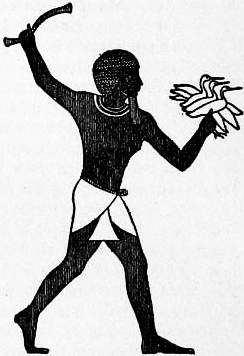
Fig. 1.—Egyptian Loin-cloth.
The simplest of all coverings is the loin-cloth characteristic of warm climates, and a necessary protection where there are trying extremes of temperature. Clothing did not originate in ideas of decency (Gen. ii. 25, iii. 7). Children Body-Covering. ran and still run about naked, the industrious workman upon the Egyptian monuments is often nude, and the worshipper would even appear before his deity in a state of absolute innocence.3 The Hebrews held that the leaves of the fig-tree (the largest available tree in Palestine) served primitive man and that the Deity gave them skins for a covering—evidently after he had slain the animals (Gen. iii. 21). With this one may compare the Phoenician myth (now in a late source) which ascribed the novelty of the use of skins to the hero Usōos (cf. the biblical Esau, q.v.). The loin-or waist-cloth prevailed under a very great variety of minor differentiated forms. In Egypt it was the plain short linen cloth wrapped around the loins and tied in front (see fig. 1). It was the usual garb of scribes, servants and peasants, and in the earlier dynasties was worn even by men of rank. Sometimes, however, it was of matting or was seated with leather, or it would take the form of a narrow fringed girdle resembling that of many African tribes. The Semites who visited Egypt wore a larger and coloured cloth, ornamented with parallel stripes of patterns similar to those found upon some early specimens of Palestinian pottery. The border was fringed or was ornamented with bunches of tassels. But a close-fitting skirt or tunic was more usual, and the Semites on the famous Beni-Hasan tombs (about the 20th or 19th century B.C.) wear richly decorated cloth (pattern similar to the above), while the leader is arrayed in a magnificent wrapper in blue, red and white, with fringed edges, and a neck-ribbon to keep it in position (see fig. 2).4 In harmony with prevailing custom the women’s dress is rather longer than that of the men, but both sexes have the arms free and the right shoulder is exposed. Returning to Egypt we find that the loin-cloth developed downwards into a skirt falling below the knees. Among the upper classes it was unusually broad and was made to stand out in front in triangular form. In the Middle Kingdom an outer fine light skirt was worn over the loin-cloth; ordinary people, however, used thicker material. Egyptian women had a tight foldless tunic which exposed the breasts; it was generally kept up by means of braces over the shoulders. This plain diaphanous garment, without distinction of colour (white, red or yellow), and with perhaps only an embroidered hem at the top, was worn by the whole nation, princess and peasant, from the IVth to the XVIIIth Dynasties (Erman, Life in Ancient Egypt, p. 212). Variation, such as it was, consisted of a sleeveless dress covering the shoulders, the neck being cut in the shape of a V. Female servants and peasants when engaged at work, however, had a short skirt which left the legs free and the upper part of the body bare; a like simplicity was probably customary among female servants or captives throughout (cf. Isa. xlvii. 2). Even at the present day the wardrobe of the Sinaitic Bedouin is much more complicated than that of their female folk.
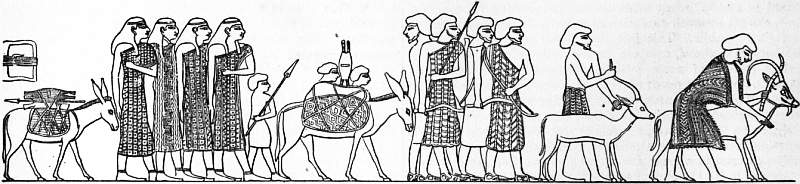
Fig. 2.—Asiatics visiting Egypt (Beni-Hasan Tombs).
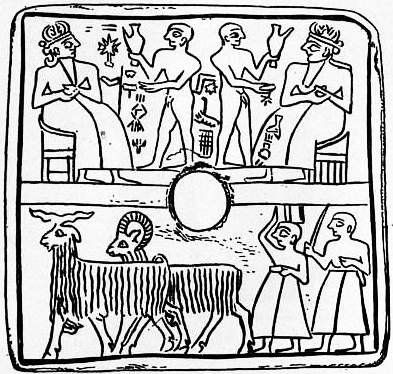
From Hilprecht’s Explorations in Bible Lands, by permission of A. J. Holman & Co. and T. & T. Clark. Fig. 3.—Old Babylonian Costume.
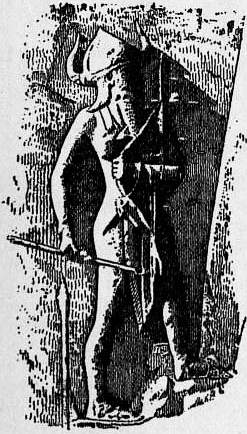
Fig. 4.—Naram-Sin on the Stele of Victory.
The earliest dress of Babylonia also covered only the lower half of the body. As worn by gods and men it was a long and rather loose kind of skirt suspended from a girdle. It is sometimes smooth; but sometimes it is a shaggy skin (or woollen) skirt with horizontal rows of vertically furrowed stuff. It allowed a certain freedom to the legs, but often it is not clear whether it was joined down the middle. An instructive development shows the upper part of the skirt hanging over the girdle so that an elementary mantle would be obtained by drawing the loose end up over the shoulders (Meyer, p. 93, cf. pp. 55, 76). The characteristic skirt is sometimes supplemented by a coarse cloth, perhaps a fleece, thrown over the shoulders; and in later times it is seen fastened outside a tunic by means of a girdle (see fig. 3).
The favourite attitude, one leg planted firmly before the other, shows the right leg fully exposed. A tunic or skirt is found as early as the time of Naram-Sin, son of the great Sargon; it reaches to his knees and appears to be held up by ornamental shoulder-bands (Meyer, pp. 11, 115; fig. 4). Egyptian monuments depict Semites with long bordered tunics reaching from neck to ankle; they have sleeves, which are sometimes curiously decorated, and are tied at the neck with tasselled cords; sometimes there is a peculiar design at the neck resembling a cross (Müller, Asien und Europa, pp. 298 seq.). The Hittite warriors upon north Syrian sculptures (Zenjīrli, perhaps 11th to 9th centuries) have a short-sleeved tunic which ends above the knees, and this type of garment recurs over a large area with numerous small variations (with or without girdle, slits at the neck, or bordering). An interesting example of the long plain variety is afforded by the prisoners of Lachish before Sennacherib (701 B.C.); the circumstances and a comparison of the details would point to its being essentially a simple dress indicative of mourning and humiliation. It may be compared in its general form with the woollen jubba of Arabia, which reached to the knees and was sewn down the front (except at the top and bottom). A modern Bedouin equivalent has long sleeves; it is common to both sexes, the chief difference lying in the colour—white for men, dyed with indigo for women.
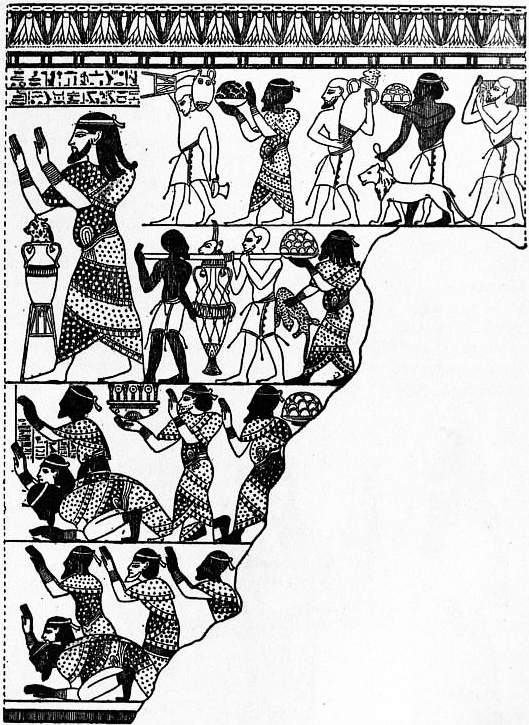
Fig. 5.—Asiatic Envoys in Egypt.
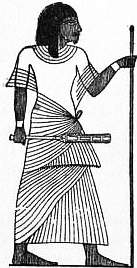
Fig. 6.—An Egyptian Officer.
Another very characteristic garment suggests an original loin-cloth considerably longer than the elementary article which was noticed above. The Arab izār, though now a large outer wrapper, was once a loin-cloth (like the Hebrew ĕzōr), which, however, was long enough to be trodden upon. At the present day male and female pilgrims at Mecca wear such a cloth (the iḥrām); it covers the knees and one end of it may be cast over the shoulder. In Egyptian tombs have been found linen bands no less than 30 ft. in length and 3 ft. in width. The distinctive feature is the spiral arrangement of the garment, the body being wrapped to a greater or less extent with a bandage of varying length in more or less parallel stripes. In old Babylonia both the arms and the whole of the right shoulder were originally uncovered, and one end of the garment was allowed to hang loose over the left arm. It is frequently found upon deities, kings and magnates, and appears to have been composed of some thick furrowed or fluted material, sometimes of bright and variegated design. Not seldom it is difficult to distinguish between the true spiral garment and a dress with parallel horizontal stripes, and one could sometimes suppose that the flounced dress with volants, well known in the Aegean area, had its parallel in Babylonia.5 Egypt furnishes admirable painted and sculptured representations of the forms taken by the Semitic spiral dress in the XVIIIth and XIXth Dynasties; the highly-coloured and gay apparel of Palestine and Syria standing in the strongest contrast to the plain, simple and often scanty garments of the Egyptians (fig. 5). While the common Semite wore a short skirt, often with tassels and sometimes with an upper tunic, the more important had an elaborate scarf (extending from waist to knee) wound over the long tunic, or a longer and close-fitting variety coloured blue and red and generally adorned with rich embroidery. A significant feature is the kind of cape which covers the shoulders, it would not and no doubt was not intended to leave play for the arms; it was the dress of the leisured classes, and a typical scene depicts the chiefs of Lebanon thus arrayed submissively felling cedars for Seti I. (about 1300 B.C.).
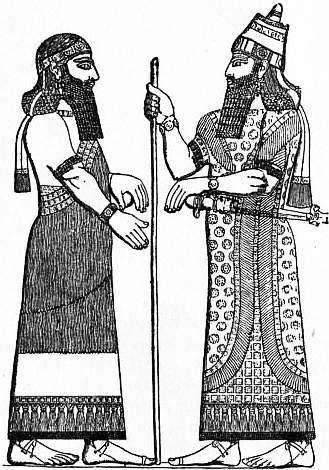
Drawn from a photo by Giraudon. Fig. 7. Sargon and his Commander-in-Chief.
Not until the XVIIIth and XIXth Dynasties does a change come over Egyptian costume. The Asiatic conquests made Egypt politically supreme, the centre of life and intercourse, and the tendency arose to pay some attention to outward appearance. From the highest to the lowest—with the important exception of the priests—the new age of luxury wiped out the earlier simplicity. The upper part of the body was covered with a tunic fastened over the girdle. Often the left arm had a short sleeve while the right was bare, but flowing sleeves came into use and various pleated skirts became customary. Garments were multiplied, and the cape and long mantle, which had previously been uncommon, were now usual. Fashions changed in quick succession; upper classes were successively copied by those beneath them and were forced to ensure their dignity by assuming new styles. Whether for ordinary or for special occasions a great variety of costume prevailed, and several types can be distinguished among both sexes (Erman, pp. 207 seq., 213 sqq.; see fig. 6). The fashionable material was linen, and although, according to Herodotus (ii. 81), a woollen mantle was worn over the fringed linen skirt, wool was forbidden to the priests in the temple. The preference for fine white linen, quite in keeping with the exaggerated Egyptian ideas of cleanliness, brought the art of spinning and weaving to a singularly high level; in embroidery, as in tapestry, however, it is probable that western Asia more than held its own (see figs. 7 and 8).
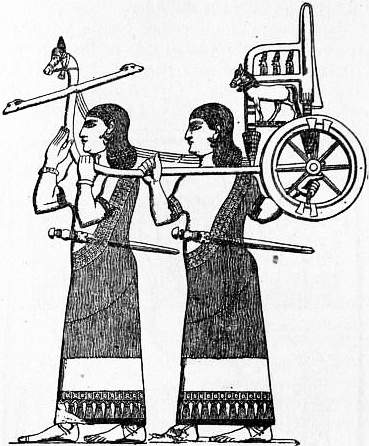
Fig. 8.—Assyrian Officers.
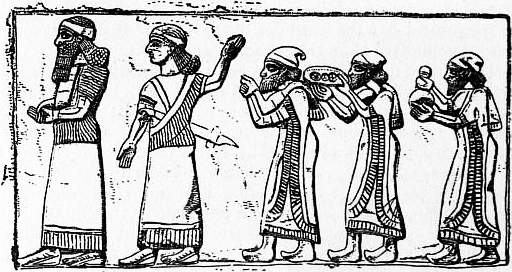
Fig. 9.—Israelite Tribute-bearers introduced by two Assyrian Officers.
Quite distinct from the spiral is the old Babylonian cloak, which was thrown over the left shoulder, passed under the right armpit, and hung down, leaving sufficient freedom for the legs. It is often decorated with a fringed border from top to bottom. In time this mantle covered both shoulders and assumed sleeves, and in one form or another it is frequently represented. So Jehu’s tribute-bearers wear short sleeves, trimmed border, and the general effect could even suggest an Assyrian dress (see fig 9). Not unlike this is the style on the bilingual Hittite boss of Tarkudimme, where the skirt ends in a point nearly to the ground and one leg stands out bare to the front—the very favourite attitude. Long fringed robes were worn by Hittites of both sexes, and the women represented at Mar’ash and Zenjīli wear it hung over the characteristic Hittite cylindrical head-dress (fig. 10). On the other hand, the unhappy females of Lachish have a long plain mantle which covers the head and forehead (fig. 11), and the same principle recurs in modern usage, where the tunic will be supplemented by a veil or shawl which (generally bound to the head by a band) frames the face and falls back to the waist. A large mantle could thus serve as a veil, and Rebekah covered her face with her square or oblong wrapper on meeting Isaac (Gen. xxiv. 65). Veiling was ceremonial (1 Cor. xi. 5), and customary on meeting a future bridegroom or at marriage (see Gen. xxix. 23-25). Nevertheless veils were not usually worn out of doors, the countrywoman of to-day is not veiled, and it is uncertain whether there is any early parallel for the yashmak, the narrow strip which covers the face below the eyes and hangs down to the feet.
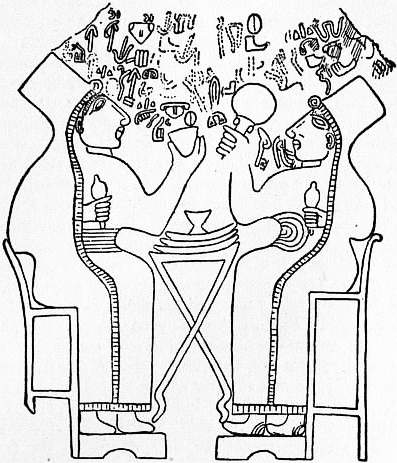
From Der alte Orient, by permission of J. C. Hinrichs’sche Buchhandlung. Fig. 10.—Hittite Women.
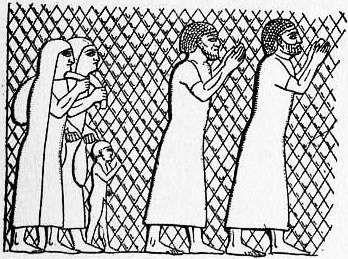
Fig. 11.—Prisoners of Lachish.
Before passing to the special covering for the feet and head some further reference to the Old Testament usage may be made. Among the Hebrews the outer garment, as distinct from the inner loin wrapper (ĕzōr) or tunic, evidently took many forms. The tunic (kuttōneth, cf. χιτών, tunica), like its Greek counterpart, was apparently of two kinds, for, although essentially a simple and probably sleeveless garment, there was a special variety worn by royal maidens and men of distinction, explicitly described as a tunic of palms or soles (passīm), that is, one presumably reaching to the hands and feet (Gen. xxxvii. 3; 2 Sam. xiii. 18 sq.).6 The kuttōneth could be removed at night (Cant. v. 3). For the outer garments the most distinctive term is the simlah. This was worn by both sexes, though obviously there was some difference as regards length, &c. (Deut. xxii. 5). Ruth put one on before going out of doors, and its folds could be used for carrying small loads (Ruth iii. 9; Ex. xii. 34). The law forbade the creditor to retain it over-night as a pledge (Ex. xxii. 26 sq.), and consequently we may assume that it was a large outer wrapper which could be dispensed with out of doors by men, or indoors by women. The simlah of the warrior (Isa. ix. 5) can be illustrated from the Assyrian sculptures (Ency. Bib., art. “Siege”); according to Herodotus (vii. 69) the Arabs under Xerxes wore a long cloak fastened by a girdle. The outer girdle (Heb. ḥagōrah; the Arabic equivalent term is a kilt from thigh to knee) varied, as the monuments show, in richness and design, and could be used as a sword-belt or pocket much in the same way as the modern native uses the long cloth twined twice or thrice around his body. The more ornate variety, called abňēt, was worn by prominent officials (Isa. xxii. 21) and by the high priest. The modern oriental open waistcoat finds its fellow in the jacket or bolero from ancient Crete, and seems to have been distinctively Aegean. The same may also be true of breeches. The pantaloons worn by modern females, with short tunic and waistcoat, are not found among the Bedouin (e.g. of Sinai), trousers being considered undignified even for men. But a baggy kind of knickerbockers is represented in old Aegean scenes, and it is noteworthy that the Arab mi’zar (drawers such as were worn by wrestlers or sailors) takes its name from the izār or loin-cloth (Ency. Bib. 1734). Such a cloth may once have passed between the legs, being kept in position by the waistband (examples in Perrot and Chipiez, Greece, ii. 198 sq., 456). On the other hand, among the Africans of Punt the waistcloth passes from each knee to the opposite thigh, and two sashes hang down to conceal the parts where they intersect (Müller, 108). The people of Keft (Aegeans) wore a similar arrangement which is a step in the direction of the proper drawers. The latter are found exceptionally upon Semitic Bedouin with an upper covering of bands wound round the body (Müller, 140). However, the woven decorated drawers in Cyprus do not appear to be of Semitic origin (J. L. Myres, Classical Review, x. 355), and it is not until later that they were prescribed to the Israelite priests (Ezek. xliv. 18). But the garment as explained by Josephus (Ant. iii. 7. 1) was properly a loin-cloth (cf. the examples from Punt), and the reason given for its use (Ex. xxviii. 42) points to a later date than the law which enforced the same regard for decency by forbidding the priests to ascend altars with steps (ib. xx. 26). As trousers were distinctively Persian—though the Persians had the reputation for borrowing Median and foreign dress (Herod. i. 71, vii. 61)—they were no doubt familiar in Palestine in the post-exilic age, and in the Roman period the braccae and feminalia were certainly known. On supposed references to breeches in Dan. iii. 21, see Journ. of Philology, xxvi. 307-313.
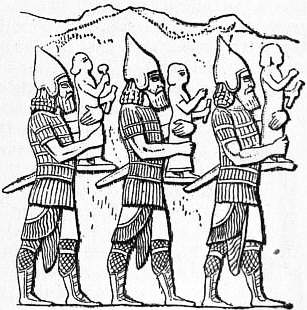
Fig. 12. Assyrian Warriors with captured Idols.
Special protection for the feet was chiefly necessary in rocky districts or upon long journeys. In early Egypt men of rank would be followed by a servant carrying a pair of sandals in case of need; but in the New Kingdom they Footgear. were in common use, although a typical difference is observed when princes appear unshod in the presence of the Pharaoh, who wears sandals himself. The simplest kind was a pad or sole of leather or papyrus bound to the foot by two straps, one passing over the instep, the other between the toes.7 A third was sometimes fastened behind the heel, and the front is often turned up to protect the toe (Egypt and elsewhere). The Semites of the XIIth Dynasty wore on their journeys sandals of black leather, those of the women and children being more serviceable, and, in the case of women, parti-coloured. Practically the same simple sandal came into use everywhere when required. But the warrior had something stouter, and the Hittites wore a turned-up shoe bound round the legs with thongs. Among the latter is also found a piece of protecting leather reaching halfway up the shin, and similar developments with tight-fitting bandages, buskins or laced garters were worn in Assyria and Asia Minor (see fig. 12). Such coverings find their analogies among the peasants of modern Cilicia and Cappadocia. Stockings, it may be added, do not appear, and are quite exceptional at the present day.
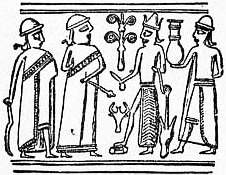
From Palestine Exploration Fund Quarterly Statement, Oct, 1907. Fig. 13.—Sacrificial Scene on a Seal from Gezer.
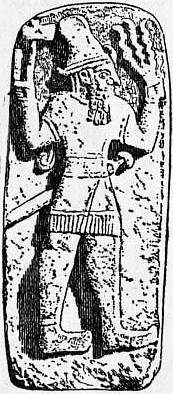
Fig. 14.—Hittite Weather-god.
The treatment of the hair, moustache and beard is extremely interesting in the study of oriental archaeology (see Müller, Meyer, opp. citt.). A special covering for the head was not indispensable. The Semites often bound Headgear. their bushy locks with a fillet, which varies from a single band (so often, e.g. Palestinian captives, 10th century) to a fourfold one, from a plain band to highly decorated diadems. The Ethiopians of Tirhakah’s army (7th cent.) stuck a single feather in the front of their fillet, and a feathered ornament recurs from the old Babylonian goddess with two large feathers on her head to the feathered crown common from Assur-bani-pal’s Arabians to Ararat, and is familiar from the later distinctive Persian head-dress.8 But the ordinary Semitic head covering was a cloth which sometimes appears with two ends tied in front, the third falling behind. Or it falls over the nape of the neck and is kept in position with a band; or again as a cloth cap has lappets to protect the ears. Sometimes it has a more bulky appearance. In general, the use of a square or rectangular cloth (whether folded diagonally or not) corresponds to the modern keffiyeh woven with long fringes which are plaited into cords knitted at the ends or worked into little balls sewn over with coloured silks and golden threads.9 The keffiyeh covering cheek, neck and throat, is worn over a small skull-cap and will be accompanied with the relatively modern fez (tarbūsh) and a woollen cloth. Probably the oldest head-dress is the circular close-fitting cap (plain or braided), which, according to Meyer, is of Sumerian (non-Semitic) origin. But it has a long history. Palestinian captives in the Assyrian age wear it with a plain close-fitting tunic, and it appears upon the god Hadad in north Syria (cf. also the Gezer seal, fig. 13). With some deities (e.g. the moon-god Sin) it has a kind of straight brim which gives it a certain resemblance to a low-crowned “bowler.” Very characteristic is the conical cap which, like the Persian hat (Gr. kurbasia), resembled a cock’s comb. It is worn by gods and men, and with the latter sometimes has ear-flaps (at Lachish, with other varieties, Ball, 190) or is surmounted by a feather or crest. It was probably made of plaited leather or felt. Veritable helmets of metal, such as Herodotus ascribes to Assyrians and Chalybians (vii. 63, 76), and metal armour, though known farther west, scarcely appear in old oriental costume, and the passage which attributes bronze helmets and coats of mail to the Philistine Goliath and the Israelite Saul cannot be held (on other grounds) to be necessarily reliable for the middle or close of the 11th century (1 Sam. xvii). A loftier head-covering was sometimes spherical at the top and narrowed in the middle; with a brim or border turned up back and front it is worn by Hittite warriors of Zenjīrli and by their god of storm and war (fig. 14). Elongated and more pointed it is the archaic crown of the Pharaohs (symbolical of upper Egypt), is worn by a Hittite god of the 14th century, and finds parallels upon old cultus images from Asia Minor, Crete and Cyprus. Later, Herodotus describes it as distinctively Scythian (vii. 64). Finally the cylindrical hat of Hittite kings and queens reappears with lappets in Phoenicia (Perrot and Chipiez, Phoen. ii. 77); without the brim it resembles the crown ofthe Babylonian Merodach-nadin-akhi, with a feathered top it distinguishes Adad (god of storm, &c.) at Babylonia. Narrower at the top and surmounted by a spike it distinguishes the Assyrian kings.
When the deities were regarded as anthropomorphic they naturally wore clothing which, on the whole, was less subject to change of fashion and was apt to be symbolical of their attributes. The old Babylonian hero Gilgamesh Costume of the Gods. and the Egyptian Bes (perhaps of foreign extraction) are nude, and so in general are the figurines of the Ishtar-Astarte type. Numerous bronze images of a kneeling god at Telloh give him only a loin-cloth, and often the deity, like the monarch, has only a skirt. In course of time various plaids or mantles are assumed, and in Babylonia the goddesses were the first to have both shoulders covered. Distinctive features are found in the head-dress, e.g. crowns (cf. the Ammonite god, 2 Sam. xii. 30) or horns (a single pair or an arrangement of four pairs), and in Babylonia symbolical emblems are attached to the shoulders (e.g. the rays of the sun-god, stalks, running water). Long garments ornamented with symbolical designs (stars, &c.) are worn by Marduk and Adad. The custom of clothing images is well known in the ancient world, and at the restoration of an Egyptian temple care was taken to anoint the divine limbs and to prepare the royal linen for the god. The ceremonial clothing of the god on the occasion of festal processions, undertaken in Egypt by the “master of secret things,” may be compared with the well-known Babylonian representations of such promenades. The Babylonian temples received garments as payment in kind, and the Egyptian lists in the Papyrus Harris (Rameses III.) enumerate an enormous number of skirts, tunics and mantles, dyed and undyed, for the various deities. A priest, “master of the wardrobe,” is named as early as the VIth Dynasty, and later texts refer to the weavers and laundry servants of the temple. It is probable that 2 Kings xxiii. 7 originally referred to the women who wove garments for the goddess in the temple at Jerusalem.
In Egypt the king was regarded as the incarnation of the deity, his son and earthly likeness. The underlying conception shows itself under differing though not unrelated forms over western Asia, and in their light the question of religious Royal costume. and ceremonial dress is of great interest. Throughout Egyptian history the official costume was conventionalized, and the latest kings and even the Roman emperors are arrayed like their predecessors of the IVth Dynasty. The crook which figures among royal and divine insignia may go back to the boomerang-like object which was a prominent weapon in antiquity (Müller, 123 sq.). It appears in old Babylonia as a curved stick, and, like the club, is a distinctive symbol of god and king. It resembles the sceptre curved at the end, which was carried by old Hittite gods. The Pharaoh’s characteristic crown (or crowns) symbolized his royal domains, the sacred uraeus marked his divine ancestry, and he sometimes appeared in the costume of the gods with their fillets adorned with double feathers and horns. In Babylonia Naram-Sin in the guise of a god wears the pointed helmet and two great horns distinctive of the deities.10 This relationship between the gods and their human representatives is variously expressed. Khammurabi and the sun-god Shamash, on the former’s famous code of laws, have the same features and almost the same frizzled beard, and, according to Meyer, the king in claiming supremacy over Sumer and Akkad wears the costume of the lands.11 Ordinary folk could not claim these honours, and in Egypt, where shaving was practically universal, artificial beards were worn upon solemn occasions as a peculiar duty. But the appendage of the official was shorter than that of the king, and the gods had a distinctive shape for themselves; if it appears upon the dead it is because they in their death had become identified with the god Osiris (Erman, 59, 225 sq.). Young Egyptian princes and youthful kings had a long plaited lock (or later a lappet) on the side of their head in imitation of the youthful Horus, and the peculiar tonsure adopted by the later Arabs of Sinai was inspired by the desire to copy their god Orotal-Dionysus.12 Thus we perceive that ancient costume and toilet involves the relations between the gods and men, and also, what is extremely important, the political conditions among the latter. When the king symbolizes both the god and the extent of his kingdom, ceremonies which could appear commonplace often acquire a new significance, any discussion of which belongs to the intricacies of the history of religion and pre-monarchical society. It must suffice, therefore, to record the Pharaoh’s simple girdle (with or without a tunic) from which hangs the lion’s tail, or the tail-like band suspended from the extremity of his head-dress (above), or the panther or leopard skin worn over the shoulders by the high priest at Memphis, subsequently a ceremonial dress of men of rank. That the Pharaoh’s skirt, sometimes decorated with a pleated golden material, should become an honorific garment, the right of wearing which was proudly recorded among the bearer’s titles, is quite intelligible, but many difficulties arise when one attempts to identify the individuals represented, or to trace the evolution of ideas.13