VOLUME VII SLICE IV Coquelin to Costume (continued 11)
Reading edition
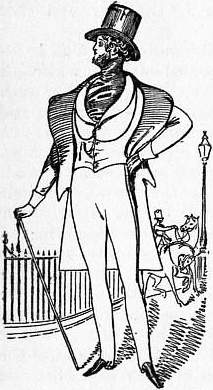
From Fraser’s Magazine, Dec. 1834. Fig. 47.—Count D’Orsay. Dress of a man of Fashion in Early Victorian Period.
With powdered hair and the pigtail passed away the 18th century cloth breeches. Here again some old-fashioned people made a stand against the change, the opposition of the clergy being commemorated in the black breeches still worn by bishops and other dignitaries of the church. But in the regent’s time pantaloons of closely fitting and elastic cloth were worn with low shoes or Hessians, and pantaloons and Hessians did not utterly disappear from the streets until the end of the ’fifties. Squires and sportsmen put on buckskins of an amazing tightness and walked the street in top-boots. But the loose Cossack trousers soon made their appearance. The regent’s influence made the blue coat with a very high velvet collar, a high-waisted Marcella waistcoat and white duck trousers strapped under the instep, a mode in which men even ventured to appear at evening receptions, although, in the year before Waterloo, the duke of Wellington was refused admittance to Almack’s when thus clad. Long skirted overcoats, fur-collared and tight in the waist, completed this costume. Coats were blue, claret, buff and brown. “Pea-green Hayne” was known among clubmen by a brighter coloured garment. Civilians, like Jos Sedley, would sometimes affect a frock frogged and braided in semi-military fashion. The shirt collar turned upward, the points showing above vast cravats whose careful arrangement was maintained by one or two scarf-pins. Brummel the master dandy of his age, may be called the first dandy of the modern school. Dressing, as a rule, in black, he distinguished himself, not as the bucks of an earlier age by bright colours, rich materials or jewellery, but by his extravagant neatness and by the superb fit of garments which set the fashion for lesser men. To him, according to Grantley Berkeley, we owe the modern dress-coat. An idle phrase in Bulwer-Lytton’s Pelham (1828), that “people must be very distinguished in appearance” to look well in black, made black henceforward the colour of evening coats and frock coats. With the perfection of the silk hat in the ’thirties, English costume enters on its last phase. The coat cut away squarely in front was then out of the mode; it remains but in the evening-dress coat now always worn unbuttoned, and in the dress of the hunting field. The rest is a record of such slight changes as tailors may cautiously introduce among customers, no one of whom will dare to lead a new fashion boldly. For many decades the fashionably dressed man has been eager to conform to the last authorized vogue and to lose himself among others as shyly obedient. The tubular lines of 20th-century clothing advantage the tailor by the tendency of new clothing to crease at the elbow and bag at the knee. In preserving the necessary straight lines of his garments, in following the season’s fashions in details which only an expert eye would mark, and in providing himself with clothes specialized for every hour of the day, for a score of sports and for the gradations of social ceremonial—in these things only can the modern dandy rival his magnificent predecessors. For ornament, other than plain shirt studs, a plain seal ring, a simple watch guard and a rarely-worn scarf pin, is denied him.
Women at the beginning of the 19th century were clad in those fashions which revolutionary France borrowed from the antique. The simplicity of this style gave it a certain grace; it was at the other pole from the absurdity of the court dress which, until George IV. ordered otherwise, perpetuated the bunched draperies, the flounces and furbelows and even the hoop of the worst period of the 18th century. The gown, lightly girdled near the arm-pits with a tasselled cord, fell in straight clinging folds. Soft muslin was the favourite material, and in muslin fashionable women faced the winter winds, protected only by the long pelisses which in summer were replaced by short spencers. Turbans, varying from a light headscarf of lace or muslin to a velvet confection like that of a Turk on a signboard, were the favourite headgear, although bonnets, hats and caps are found in a hundred shapes. Muslin handkerchiefs or small ruffs were worn about the neck in the morning dress. About the Waterloo period the elegance of the classical gown disappeared. The waist was still high at first but the gown was shorter and wider at the skirt. For evening dress these skirts were stiffened with buckram and trimmed with much tasteless trumpery. Large bonnets were common, and the hair was dragged stiffly to the back of the head, to be secured by a large comb. From 1830 begins a period of singular ugliness. Tight stays came back again, the skirt swept the pavements, a generation of over-clad matrons seemed to have followed a generation of nymphs. The ’fifties showed even more barbarous devices, and about 1854 came in from France the crinoline, that strange revival of the ancient hoop. Plaids, checks and bars, bright blues, crude violets and hideous crimsons, were seen in French merinos, Irish poplins and English alpacas. Women in short jackets, hooped skirts, hideous bonnets and shawls seemed to have banished their youth. The empress Eugénie, a leader of European fashion, decreed that white muslin should be the evening mode, and at balls, where the steels and whalebones of the crinoline were impossible, the women swelled their skirts by wearing a dozen or fourteen muslin petticoats at once. Towards the end of the ’sixties the crinolines disappeared as suddenly as they came, and by 1875 skirts were so tight at the knees that walking upstairs in them was an affair of deliberation. Before 1880 dress-reformers and aesthetes had attacked on two sides the fashions which had halted at the “Princesse” robe, draped and kilted. Both movements failed, but left marked effects. From that time fashion has been less blindly followed, and women have enjoyed some limited individual freedom in designing their costumes. Of 20th-century fashions it is most notable that they change year by year with mechanical regularity. The clothes of smart women can no longer be said to express any tendency of an age. Year by year the modes are deliberately altered by a conclave of the great modistes whose desire is less to produce rich or beautiful garments than to make that radical alteration from loose sleeve to tight sleeve, from draped skirt to plain skirt, which will force every women to cast aside the last season’s garments and buy those of the newer device. But of modern dress it may at least be said that cheaper materials, the sewing machine and the popular fashion papers allow women of the humbler classes to dress more decently and tastefully. Their dress is no longer that frowsy parody of richer women’s frippery which shocked observant foreigners a generation ago.
Underclothing.—Of the underclothing worn next the skin something may be said apart from the general history of costume. Linen shirts were worn by both men and women in the age before the Conquest, and even in the 10th century it was a penance to wear a woollen one. After that time we soon hear of embroidery and ornament applied to them, presumably at the collar which would be visible above gown or tunic. Men added short drawers, or breeches, a word which does not secure its modern value until the end of the 16th century. “Drawers” signified various descriptions of overall, Cotgrave explaining the word as coarse stockings drawn over others although Randle Holme gives it in its later sense. Isaac of Cyprus is named by Robert of Brunne as escaping “bare in his serke and breke.” Henry Christall, who brought four Irish kings to London, told Froissart how, finding that they wore no breeches, he bought linen cloth for them. Medieval romances and the like give us the choice of shirts of linen, of fine Holland, of cloth of Rennes and even of silk, and Chaucer speaks of women’s smocks wrought with silk, embroidered behind and before. Poorer folk went, like Thynne’s poor countryman, in shirts of “canvas hard and tough,” or of coarse Breton dowlas. Under the first Tudors, shirts are decorated with gold, silk and black thread embroideries, the latter being seen in the ruffled shirt worn by the earl of Surrey in our illustration (see fig. 38). Stubbes, in his often-quoted Anatomie of Abuses (1583) declaims against the extravagant sums spent in shirts, the meanest of which would cost a crown or a noble, while the most curiously stitched were valued at ten pounds a piece, “which is horrible to hear.” The Puritans, many of whom, like the later Clapham sect, were careful of intimate luxuries, had a curious fashion of wearing shirts and smocks worked with “holy embroideries,” Biblical sentences or figures, which recall a similar custom among the early Christians. At this time underclothing had increased in quantity, for there are many indications that the men and women of the middle ages were often content with a bare change of linen at the best. The Book of Courtesy (temp. Hen. VII.) orders the servant to provide “clene sherte and breche” against his master’s uprising, but the laundering of the linen of the Percy household, a hundred and seventy people, costs but forty shillings a year in the reign of Henry VIII.
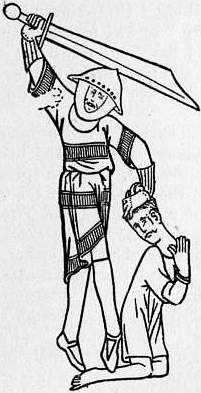
Fig. 48.—A Man-at-arms and a Man in a Shirt (early 14th century). From Royal MS. 19 B. xv.
With that modern period of dress which may be said to begin with the Restoration, shirts increased in number. Women shifted their smocks when coming in from field sports, fine gentlemen became proud of the number of their shirts, as was that 18th-century lord who boasted to Casanova of his changing a shirt several times in the day, his chin being shaved on each occasion. A valuable document concerning the underclothing worn by a citizen in the reign of Charles II. is afforded by the evidence of the man who helped to strip the body of the suicide Sir Edmond Berry Godfrey. “I pulled off his shoes,” says Fisher, “three pairs of stockings and a pair of socks, his black breeches and his drawers.” His coat and waistcoat, his shirt and his flannel shirt are also named. The knight came by his end on an October day. He was therefore warmly clad. His three pair of stockings will be noted: two pair are worn at the present day by most men in court dress. The socks are a rarely named addition, and the flannel shirt may be remarked. Loose ruffles of lace were attached to shirt cuffs until during the great part of the 18th century, and the ruffled or goffered shirt-front, which became common under George III., continued in use in the early Victorian period, the stiffly starched shirt-front taking its place at last even in evening dress. The last quarter of the 19th century, breaking through the strange mock-modesty which spoke of breeches as “inexpressibles,” saw the question of hygienic underclothing a subject much in debate, and now most men other than the poorer sort wear, besides the shirt, a light woollen vest and short drawers or long pantaloons of wool or wool’s counterfeit. Woollen shirts are worn by bicyclists, cricketers and tennis players. In morning dress the inconvenience of the starched shirt-front is commonly avoided. A goffered shirt-front worn with evening dress is the mark of a foreigner in London, but some few men venture to clothe themselves for the evening in a shirt whose front is pleated and but slightly starched. Loose collars, formerly known as false collars, descendants of the Puritan’s “plain band,” have been attached to the shirt by studs at least for the last fifty years. Their fashions often change, but the older type turned down at the edge is not often seen. To women’s underclothing drawers have been added in the 19th century. Brantôme, writing in the 16th, speaks of this garment as then lately introduced since the time of Henri II., but the fashion, apparently, did not long endure in France. In England they are noted as in occasional use at the Restoration. After 1820 a sort of trouser with a frilled edge was worn for a time by fashionable women in England. The pantalette which afterwards appears in pictures of young girls was a mere legging fastened by tapes above the knees. Many women of the better class only adopted drawers at the end of the ’forties, and it may be presumed that the fashion reached the humble sort at a much later date. Towards the end of the 19th century both drawers and smock or “chemise” were commonly exchanged for a more convenient “combination garment.”
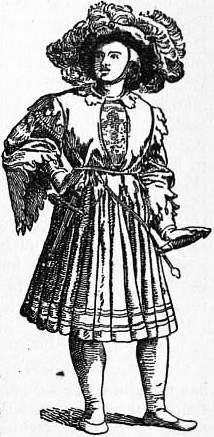
From Hottenroth, Trachten der Völker, by permission of Gustav Weise Verlag. Fig. 49.—German Dress (early 16th century).
European Fashions.—Race, climate, poverty and wealth have all had their part in the fashion of clothing. A mountaineer is not clad as a lowlander; the Tirolese in his short breeches, the Highlanders of Scotland and Albania in their tartan or white linen kilts go with uncovered knees. The Russian moujik in winter has his frowsy sheepskin coat, and the Russian prince imitates it in costly furs. While the rich man’s clothing alters with every fancy of the tailors, the poor man’s garments, fewer and cheaper, change slowly in the ages. An old Lincolnshire peasant wearing his smock frock and leathern gaiters might pass unnoted in a peasant crowd of centuries ago. Here and there in Europe we find in the 20th century a peasantry in whose clothing fashion seems to have been suddenly stayed. A Breton peasant in his holiday dress gives us a man of the late 17th century, even as an Irish peasant may keep the breeches, shoes and tailed coat of the early 19th. But the old fashions are passing from Europe: the sewing machine and the railway sweep before them the pleasant provincialisms of dress. A shirt with the bosom heavily embroidered, a skirt with a year’s stitching in the hem are not to be imitated by the dealer in ready-made clothing, who offers, instead, cheapness and the brisk variety of the town. Old writers, each in turn, set up their wail that the time was come when you could not tell Jack from his master, the burgess from the knight. And now that time has come in some sort, for the town dress of the richer classes of London or Paris is imitated by all peoples and by rich and poor. Especially is this the case in England where the clean and honourable blouse of the French workman is not, a journeyman painter or labourer often going to his work in a frayed and greasy morning coat after the cut of that in which a rich man will pay a London morning call. English fashions for men are followed in Paris. London women follow the modes of the rue de la Paix. Berlin tailors and dressmakers laboriously misapprehend both styles. To those who do not understand the international trafficking of the middle ages and the age of renascence it is strange to note how little the fashions varied in European lands. All kinds of folks, crusaders and merchants, diplomatists and religious, carried between nation and nation the news of the latest cut of the shears.
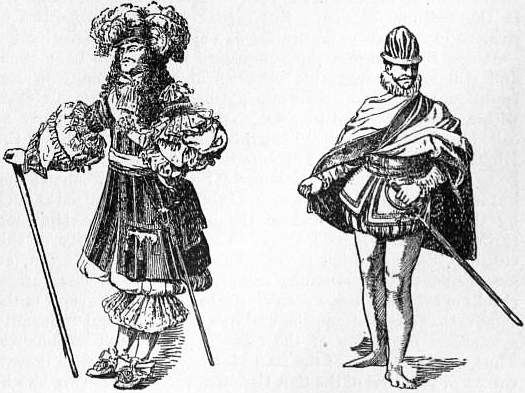
From Hottenroth, Trachten der Völker. From Hottenroth, Trachten der Völker.
Fig. 50.—A French Nobleman (c. 1660). Fig. 51.—A Spanish Nobleman (latter half of 16th century).
Nevertheless, national character touched each nation’s dress—the Venetian loving the stateliness of flowing line, the Germans grotesque slashings and jaggings. Frenchmen, says Randle Holme in the 17th century, keep warm and muff themselves in cold weather, “but in summer through fantastical dresses go almost naked.” For the same writer the Spaniard was noted as a man in a high-crowned hat with narrow brim, a ruff about his neck, a doublet with short and narrow skirts and broad wings at the shoulders, ruff-cuffs at his hands, breeches narrow and close to his thighs, hose gartered, shoes with rounded toes, a short cloak and a long sword. In all of those points we may take it that the Spaniard differed from the Englishman as observed by this observant one. Even in our own days we may catch something of those national fashions. The Spaniard may no longer walk with his long sword, his ruff and gartered hose, but he keeps his fancy for sombre blacks, and so do the citizens of those Netherlands which he once ruled.
(O. Ba.)
III. National and Class Costume
Costume, as readers of Carlyle’s Sartor Resartus know, always has a significance deeper than the mere whims of fashion. In the cosmopolitan society of modern times dress everywhere tends to become assimilated to a common model, and this assimilation, however regrettable from the picturesque point of view, is one of the most potent forces in the break-down of the traditional social distinctions. In the middle ages in Europe, and indeed down to the French Revolution, the various classes of the community were clearly differentiated by their dress. Everywhere, of course, it happened that occasionally jackdaws strutted in peacock’s feathers; but even in England, where class distinctions were early less clearly marked than on the continent of Europe, the assumption of a laced coat and a sword marked the development of a citizen into a “gentleman” (q.v.). Nothing has more powerfully contributed to the social amalgamation of the “upper-middle” and the “upper” classes in England than the fashion, introduced in the 19th century, of extreme simplicity in the costume of men. But, apart from the properties of richness in material or decoration as a symbol of class distinction—at one time enforced by sumptuary laws—there have been, and still are, innumerable varieties of costume more or less traditional as proper to certain nationalities or certain classes within those nationalities. Of national costumes properly so called the best known to the English-speaking world is that of the Highlands of Scotland. This is, indeed no longer generally worn, being usually confined to gentlemen of birth and their dependents, but it remains a national dress and is officially recognized as such by the English court and in the uniforms of the Highland regiments in the British army. The chief peculiarity of this costume, distinguishing it from any others, is the tartan, an arrangement of a prevailing colour with more or less narrow checks of other colours, by which the various clans or septs of the same race can be distinguished, while a certain general uniformity symbolizes the union of the clans in a common nationality. Thus, e.g. the tartan of the clan McDonell is green with narrow checks of red, that of the clan Gregarach red with narrow checks of black. The costume consists of a short tunic, vest, a kilt—heavily pleated—fastened round the waist, and reaching not quite to the knees (like a short petticoat), stockings gartered below the bare knee, and shoes. In front of the person, hanging from a belt round the waist, is the “sporran” or “spleuchan,” a pocket-purse covered with fur; and a large “plaid” or scarf, usually wrapped round the body, the ends hanging down from a brooch fastened on the left shoulder, but sometimes gathered up and hanging from the brooch behind, completes the costume. The head-gear is a cloth cap or “bonnet,” in which a sprig of heather is stuck, or an eagle’s feather in the case of chiefs. A dirk is worn thrust into the right stocking. Up to the end of the 16th century the tunic and “philibeg” or kilt formed a single garment; but otherwise the costume has come down the ages without sensible modification. Kilt and plaid are of tartan; and sometimes tartan “trews,” i.e. trousers, are substituted for the former.
Among other national costumes still surviving in Europe may be mentioned the Albanian-Greek dress (characterized by the spreading, pleated white kilt, or fustanella), and the splendid full-dress of a Hungarian gentleman, the prototype of the well-known hussar uniform; to which may be added the Tirolese costume, which, so far as the men are concerned, is characterized by short trousers, cut off above the knee, and a short jacket, the colour varying in different districts. This latter trait illustrates the fact that most of the still surviving “national” costumes in Europe are in fact local and distinctive of class, though they conform to a national type. These “folk-costumes” (Volkstrachten), as the Germans call them, survive most strongly in the most conservative of all classes, that of the peasants and naturally mainly in those districts least accessible to modern “enterprise.” These peasant costumes, often of astonishing richness and beauty, vary more or less in every village, each community having its own traditional type; and, since this type does not vary, they can be handed down as valuable heirlooms from father to son and from mother to daughter. But they are fast disappearing. In the British islands, where there were no free peasant cultivators to maintain the pride of class, they vanished long since; the white caps and steeple-crowned hats of Welsh women were the last to go; and even the becoming and convenient “sun bonnet,” which survives in the United States, has given place almost everywhere to the hideous “cloth cap” of commerce; while the ancient smocked frock, the equivalent of the French peasant’s workmanlike blouse, has become a curiosity. The same process is proceeding elsewhere; for the simple peasant women cannot resist the blandishments of the commercial traveller and the temptation of change and cheap finery. The transition is at once painful and amusing, and not without interest as illustrating the force of tradition in its struggle with fashion; for it is no uncommon thing, e.g. in France or Holland, to see a “Paris model” perched lamentably on the top of the beautiful traditional head-dress. Similarly in the richer Turkish families women are rapidly acquiring a taste for Parisian costumes, frequently worn in absurd combination with their ordinary garments.
The same process has extended far beyond the limits of Europe. Improved communication and industrial enterprise have combined with the prestige of European civilization to commend the European type of costume to peoples for whom it is eminently unsuited. Even the peoples of the East, whose costume has remained unchanged for untold centuries, and for whom the type has been (as in India) often determined by religious considerations, are showing an increasing tendency to yield to the world-fashion. Turkey, as being most closely in touch with Europe, was the first to feel the influence; the introduction of the fez and the frock-coat, in place of the large turban and flowing caftan of the old Turk, was the most conspicuous of the reforms of Sultan Mahmud II.; and when, in 1909, the first Turkish parliament met, only a small minority of its members wore their traditional costumes. The introduction of Japan into the comity of nations was followed by the adoption of European costume by the court and the upper classes, at least in public and on ceremonial occasions; in private the wide-sleeved, loose, comfortable kimono continues to be worn. China, on the other hand, has been more conservative, even her envoys in Europe preserving intact (except sometimes in the matter of boots) the traditional costume of their nation and class, while those of Japan, Corea and Siam appear in the conventional diplomatic or “evening” dress in Europe. In the Mussulman East, even when European dress has been adopted, an exception has usually been made in favour of head-gear, which has a special religious significance. In Turkey, for instance, the hat has not succeeded in displacing the fez; and in India, though the Parsis had by the beginning of the 20th century begun to modify their traditional high turban-like hat into a modified “bowler,” and Hindus—abroad at least—were affecting the head-gear of the West, those Mussulman princes who had adopted, wholly or partially, European dress continued to wear the turban. On the other hand, the amir of Afghanistan, when he visited India, had—out of doors at least—discarded the turban for the ugly “solar topee.” In spite of the natural conservatism, strengthened by religious conventions, of the Eastern races, there is a growing danger that the spread of European enlightenment will more or less rapidly destroy that picturesque variety of costume which is the delight of the traveller and the artist. For Indian costumes see India: Costume; for Chinese see China; &c.
IV. Official Costume
Official costumes, in so far as they are not, like the crowns and tabards of heralds, the coronets of peers, or the gold keys tacked to the coat-tails of royal chamberlains—consciously symbolical, are for the most part ceremonious survivals of bygone general fashions. This is as true of the official costume of the past as of the present; as may be illustrated from ancient Rome, where the toga, once the general costume of Roman citizens, in the 3rd and 4th centuries was the official robe of senators and officials (see also under Vestments). Thus, at the present time, the lay chamberlains of the pope and the members of his Swiss guard wear costumes of the 16th century, and the same is true of the king’s yeomen of the guard in England. In general, however (apart from robes, which are much older in their origin), official costumes in Europe, or in countries of European origin, are based on the fashions of the 18th and early 19th centuries. Knee-breeches, however, which survive in the full-dress of many British officials, as in ordinary court dress, had practically disappeared on the continent of Europe, surviving only in certain peasant costumes, when the emperor William II. reintroduced them at the court of Berlin. The tendency in the modern democratic communities of Anglo-Saxon race has been to dispense with official costumes. In the United States the judges of the Supreme Court alone wear robes; the president of the Republic wears on all occasions the dress of an ordinary citizen, unrelieved by order or decoration, and thus symbolizes his pride of place as primus inter pares; an American ambassador appears on state occasions among his colleagues, gorgeous in bullion-covered coats, in the ordinary black “evening dress” of a modern gentleman. The principle, which tends to assert itself also in the autonomous “British dominions beyond the seas,” is not the result of that native dislike of “dressing up” which characterizes many Englishmen of the upper and middle classes; for modern democracy shares to the full the taste of past ages for official or quasi-official finery, as is proved by the costumes and insignia of the multitudinous popular orders, Knights Templars, Foresters, Oddfellows and the like. It is rather cherished as the outward and visible sign of that doctrine of the equality of all men which remains the most generally gratifying of the gifts of French 18th-century philosophy to the world. In Great Britain, where equality has ever been less valued than liberty, official costumes have tended to increase rather than to fall into disuse; mayors of new boroughs, for instance, are not considered properly equipped until they have their gown and chain of office. In France, on the other hand, the taste of the people for pomp and display, and, it may be added, their innate artistic sense, have combined with their passion for equality to produce a somewhat anomalous situation as regards official costume. Lawyers have their robes, judges their scarlet gowns, diplomatists their gold-laced uniforms; but the state costume of the president of the Republic is “evening dress,” relieved only by the red riband and star of the Legion of Honour. In the Latin states of South America, which tend to be disguised despotisms rather than democracies, the actual rather than the theoretical state of things is symbolized by the gorgeous official uniforms which are among the rewards of those who help the dictator for the time being to power. See also Robes; for military costume see Uniforms; for ecclesiastical costume see Vestments and subsidiary articles.
(W. A. P.)
Bibliography.—Apart from the enormous number of books especially devoted to costume, innumerable illustrated works exist which are, in various degrees, useful for the study of the history of this subject. It may be noted here, e.g. that the illuminators and painters of the middle ages did not affect historical accuracy in their presentment of biblical or secular subjects, but clothed their patriarchs, apostles or Roman warriors in the dress of their own ages, their pictures thus becoming invaluable records of the costume of their time. In this respect the knowledge of classical antiquity revived during the Renaissance introduced a certain confusion. Artists began to realize the incongruity of representing antique figures in modern garb, but, in the absence of exact knowledge, fancy began to play a greater part than research in the dressing of their characters. Portraits and representations of contemporary scenes (e.g. Rembrandt’s “Night Watch”) continue to be first-hand authorities for the costume of the period in which they were produced; but representations of biblical or historical scenes have little or no value from this point of view. Thus in Rubens’s famous picture of St Ambrose repelling Theodosius from the door of his cathedral, the bishop is vested in the mitre and cope which only came into vogue centuries later, while the emperor wears a military costume modelled on that of Roman imperators of an earlier day. Even in portraiture, however, a certain conservatism tends to make the record untrustworthy; thus, great men continued to be painted in full armour long after it had in fact ceased to be worn.
Of authorities for English costume the following may be selected as especially useful: J. C. Bruce, The Bayeux Tapestry Elucidated (London, 1856), with 17 plates; F. W. Fairholt, Costume in England to the end of the 18th Century (2nd ed., ib., 1860); William Fowler, Examples of Medieval Art (1796-1829), 116 plates; Froissart’s Chronicles, translated by T. Johnes (4 vols., 1844), 72 plates and many woodcuts; R. N. Humphrey, Illuminated Books of the Middle Ages (ib., 1849); Facsimiles of Original Drawings by Holbein, in the Collection of His Majesty, for Portraits of Persons of the Court of Henry VIII., engraved by F. Bartolozzi, &c. (London, 1884); John Nichols, Progresses, Pageants, &c., of Queen Elizabeth (3 vols., 1823), and of James I. (4 vols., 1828), with numerous plates; Hogarth’s Works, engraved by himself, with descriptions by J. Nichols (1822), 153 plates; Edmund Lodge, Portraits of Illustrious Personages of Great Britain (12 vols., 1823-1835), 240 plates; J. R. Planché, Hist. of British Costume (3rd ed., Bohn, 1874), and Cyclopaedia of Costume (2 vols., 1876-1877); Henry Shaw, Dresses and Decorations of the Middle Ages (2 vols., 1840-1843), 94 plates and many woodcuts; Joseph Strutt, engraver, Dress and Habits of the People of England (2 vols., 1796-1799), and Regal and Ecclesiastical Antiquities of Great Britain, new edition with notes by J. R. Planché (1842), 153 plates; Westwood, Miniatures of Anglo-Saxon and Irish Manuscripts (1868), 54 plates; C. A. Stothard, The Monumental Effigies of Great Britain (1817-1832; ed. Hewitt, 1876); Herbert Haines, Manual of Monumental Brasses (Oxford, 1861), with many woodcuts; J. G. and L. A. B. Waller, A Series of Monumental Brasses (London, 1864); H. Druitt, Costume on Brasses (London, 1906). Of foreign works on costume the most important are Hefner-Alteneck, Trachten, &c., vom frühesten Mittelalter bis Ende des 18. Jahrhunderts (2nd ed., Frankfort, 1879-1890); Viollet-le-Duc, Dictionnaire raisonné du mobilier français (6 vols., Paris, 1858-1875), the first four volumes devoted to armour and costume; Friedrich Hottenroth, Trachten der Völker alter und neuer Zeit (2nd ed., Stuttgart, 1882-1890), with excellent plates, Fr. transl. by J. Bernhoff, Les Costumes chez les peuples, &c. (Paris, 1885), and Handbuch der deutschen Tracht (1898); Bonnard et Mercuri, Costumes historiques des XIIe, XIIIe, XIVe et XVe siècles (2 vols., Paris, 1867), 200 plates; Burgmair, Triomphe de l’empereur Maximilien I. (Vienna, 1796), 135 plates; Chapuy, Le Moyen Age pittoresque (2 vols., 1837), 180 plates; Chevignard et Duplessis, Costumes historiques des XVIe, XVIIe et XVIIIe siècles (2 vols., Paris, 1867), 150 plates; du Sommerard, Les Arts au moyen âge (10 vols., Paris, 1838-1848), 510 plates; Duflos, Recueil d’estampes, représentant les grades, les rangs, et les dignités, suivant le costume de toutes les nations existantes (Paris, 1779-1780), 240 plates; España artistica y monumental (3 vols., Paris, 1842-1859), 145 plates; Fabri, Raccolta di varii vestimenti ed arti del regno di Napoli (Naples, 1773), 27 plates; Jaquemin, Iconographie méthodique du costume du Ve au XIXe siècle (Paris), 200 plates; Lacombe, Galerie de Florence et du palais Pitti (4 vols., Paris, 1789-1807), 192 plates; Paul Lacroix, Manners, Customs and Dress during the Middle Ages and the Renaissance, Eng. trans. (London, 1874), Military and Religious Life in the Middle Ages and the Renaissance (London, 1874), and The 18th Century, its Institutions, Customs, Costumes (London, 1875-1876); L. M. Lanté, Galerie française de femmes célèbres, atlas (Paris, 1841), 70 plates; Malliot et Martin, Recherches sur les costumes, les mœurs, les usages religieux, civils et militaires des anciens peuples (3 vols., Paris, 1809), 228 plates; Pauly, Description ethnographique des peuples (St Petersburg, 1862); Pauquet Frères, Modes et costumes historiques et étrangers (2 vols., Paris, 1873), 196 plates; Auguste Racinet, Le Costume historique, in two forms, large and small (Paris, 1876, another ed. in 6 vols., with 500 plates, 1888); G. M. Straub, Trachten oder Stammbuch (1600), several hundreds of curious woodcuts of costumes; Vecellio, Habiti antichi et moderni di tutto il mondo (3 vols., Venice, 1859-1863).
Examples and illustrations of early costume of great interest and value may be found in the Archaeologia, M. Didron’s Annales archéologiques, the Journals of the Archaeological Societies, the various county histories, the Monumenta Vetusta of the London Society of Antiquaries, and other kindred works.
Besides works on costume generally, there are a large number devoted specially to national or “folk” costumes. Of these may be mentioned: F. Hottenroth, Deutsche Volkstrachten, städtische und ländliche, vom XVI. Jahrhundert his zum Anfange des XIX. Jahrhunderts (Frankfort, 1898, 1900, 1902, &c.), including German, Bohemian, Swiss and Dutch local costumes, with references to further works; L. M. Lanté, Costume de divers pays (undated, c. 1825), 177 coloured plates of female costumes, mainly French, some Spanish, German, &c.; A. Hård, Swedish Costumes (Stockholm, 1858), 10 coloured plates; Félix Benoist, La Normandie illustrée (2 vols, fol., Nantes, 1854), with excellent coloured lithographs of costumes by Hyppolite Lalaine; E. H. T. Pingret, Galerie royale de costumes (Paris, undated), beautiful lithographs of costumes, principally Italian with some Spanish and Swiss, lithographed from paintings by Pingret by various artists; Edward Harding, Costume of the Russian Empire (London, 1811), with 70 hand-coloured plates, including costumes of many of the semi-barbaric tribes of central Asia; for Turkish costume in the 18th century see Recueil de cent estampes représentant différentes nations du Levant, engraved by Le Hay (Paris, 1714); for Greek costume at the time of the War of Independence see Baron O. M. von Stackelberg, Costumes et usages des peuples de la Grèce moderne (Rome, 1825), with 30 beautiful plates. For Highland costume see R. R. MacIan, Costumes of the Clans (Glasgow, 1899), with letterpress by J. Logan.