VOLUME VII SLICE IV Coquelin to Costume (continued 10)
Reading edition
The well-known conservatism of religious practice manifests itself in ceremonial festivals (where there is a tendency for the original religious meaning to be obscured) and among the priests, and it is interesting to observe that despite Ceremonial costume. the great changes in Egyptian costume in the New Kingdom the priests still kept to the simple linen skirt of earlier days (Erman, 206). Religious dress (whether of priests or worshippers) was regulated by certain fundamental ideas concerning access to the deity and its consequences. That it was proper to wear special garments (or at least to rearrange one’s weekday clothes) on the Jewish sabbath was recognized in the Talmud, and Mahommedans, after discussing at length the most suitable raiment for prayer, favoured the use of a single simple garment (Bukhāri, viii.). It was a deep-seated belief that those who took part in religious functions were liable to communicate this “holiness” to others (compare the complex ideas associated with the Polynesian taboo). Hence priests would remove their ceremonial dress before leaving the sanctuary “that they sanctify not the people with their garments” (Ezek. xliv. 19; cf. xlii. 14), and every precaution was taken on religious occasions to ensure purity by special ablutions and by cleansing the clothes.14 In the old ritual at Mecca, the man who wore his own garments must leave them in the sanctuary, as they had become “taboo”; hence the sacred circumambulation of the Ka’ba was performed naked (prohibited by Mahomet), or in clothes provided for the occasion. The old archaic waist-cloth was used, and at the present day both male and female pilgrims enter bare-footed and clad in the scanty iḥrām (C. M. Doughty, Arabia Deserta, ii. 479, 481, 537). In several old Babylonian representations the priests or worshippers appear before the deity in a state of nature.15 It is known that laymen were required to wear special garments, and the priests (who wore dark-red or purple) were sometimes called upon to change their garments in the course of a ceremony. Thus the temples required clothing not merely for the gods but also for the attendants (so at Samaria, 2 Kings x. 22).
In the late usage at Harran the worshipper, after purifying his garments and his heart, was advised to put on the clothing of the particular god he addressed (de Goeje, Oriental Congress, Leiden, 1883, pp. 341 sqq.). The reason is obvious, and the principle could be variously expressed. But we are not told whether the prophetess who wore bands on her arm and drew a mantle over her head (so read in Ezek. xiii. 17-23) actually used the clothing peculiar to some deity, nor is it quite clear what is meant when a Babylonian ritual text refers to the magical use of the linen garment of Eridu (seat of the cult of Ea). The Bishop Gregentius denounced as heathenish the rites in which the Arabs wore masks (W. R. Smith, 438), and one is tempted to compare the use of masks elsewhere in animal worship. Next, one may observe upon old Babylonian seals, eagle-headed deities with short feathered skirts attended by human beings similarly arrayed (Ball, 151) or figures draped in a fish skin (Menant, Rev. de l’hist. des relig. xi. 295-301) or a worshipper arrayed somewhat like a cock (Meyer, 63; cf. Lucian’s De Dea Syria, § 48; for “bees,” &c., as titles of sacred attendants, see J. G. Frazer, Pausanias, iv. 223, v. 621). Although there is much that is obscure in this line of research, it is a natural assumption that, in those ritual functions where the gods were supposed to participate, the rôle was taken by men, and the general idea of assimilating oneself to the god (and the reverse process) manifests itself in too many ways to be ignored (cf. W. R. Smith, 293, 437 sq., 474; C. J. Ball, Ency. Bib., art. “Cuttings”). But the deities were not originally anthropomorphic, and it is with the earlier stages in their development that some of the more remarkable costumes are apparently concerned.
Of all priestly costumes16 the most interesting is undoubtedly that of the Jewish Levitical high-priest. In addition to a tunic (kuttōneth) and a seamless mantle or robe (mĕ’īl), he wore the breastplate (ḥōshen), the ephod, and a rich outer girdle. Breeches were assumed on the Day of Atonement. His head-dress was as distinctive as that of the high priest at Hierapolis, who wore a golden tiara and a purple dress, while the ordinary priests had a pilos (conical cap, also worn in Israel, Ex. xxviii. 40) and white garments. But the various descriptions cannot be easily reconciled.17 The robe had pomegranates and golden bells that the sound might give warning as he went in and out of the sanctuary, and “that he died not” (Ex. xxviii. 35). According to Josephus they symbolized the lightning and thunder respectively. The “ephod of prophecy” (so Test. of Levi, viii. 2) was essentially once an object of divination (see Ephod). The “breastplate of judgment” was set with twelve jewels engraved with the names of the tribes; the foreordained covering of the semi-divine being in the garden of the gods bore the same number of stones (Ezek. xxviii. 13, Septuagint). This breast ornament finds analogies in the royal and high priestly dress of Egypt, and in the six jewels of the Babylonian king.18 The sacred lots which gave “judgment” in accordance with the divine oracle (Num. xxvii. 21) have been plausibly compared with the Babylonian tablets of destiny worn by the gods and the mystic lots upon the bosom of Noah.19 The two jewels also engraved with the names of the tribes in a suitable setting, worn upon the shoulder (see p. 102, c.), served, like the twelve mentioned, for a memorial before the Deity, effectively bringing them to remembrance, without any action on the part of the bearer, and thus tacitly involving supernatural intervention as amulets are regularly expected to do. The golden plate inscribed “holy to Yahweh” placed over the head (the details are discrepant) had a mystic atoning force (Ex. xxviii. 38), and in general writers recognized the peculiar efficacy of the costume and its symbolical meaning (Philo, Vita Mosis, iii. 14; Jos. Ant. iii. 7. 7; Talm. Zeb. 88b). Although Jewish tradition ascribed this gorgeous and significant array to the Mosaic age (if not to the pre-Mosaic days of Levi, so the Test. of Levi), its very character, in common with the high priest’s status, combines kingly and priestly powers in a manner which is impossible for the period (about 15th-13th cent.). Where the king is the human representative of the Deity he is theoretically and officially the priesthood, although the priests carry on the ordinary subordinate functions. The Hebrew kings, at all events, undertook priestly duties, and not until after the fall of Jerusalem does the history allow that usurpation of monarchical rights upon which the prophet Ezekiel (q.v.) encroaches. The embodiment of political and religious supremacy displayed in the high priest’s authority, clothing and symbols can only reflect exilic or rather post-exilic conditions.20 (See further Priest.) In the Maccabaean age the high priest Jonathan received the purple robe and crown and the buckle of gold worn on the shoulder as a sign of priestly and secular rank (1 Macc. x. 20, 38, 89, xi. 58). His brother Simon received similar honours (xiv. 48 sq.), and Hyrcanus, the “second David,” was supposed to have had two crowns, one royal and the other priestly (Talm. Kidd. 66a). The later Rabbis wore most sumptuous apparel, and were crowned until the death of Eliezer ben Azarya.
Thus there was a real significance in ceremonial investiture (cf. Num. xx. 26, 28) and in the transference of clothes (cf. Elisha and Elijah’s mantle, 2 Kings ii. 13). Further the exchange of garments was not meaningless, and the prohibition in Deut. xxii. 5 points to religious or superstitious beliefs, on which see J. G. Frazer, Adonis, Attis and Osiris (2nd ed.), pp. 428-435. On the claim involved by the act of throwing a garment over another (Ruth iii. 9; cf. 1 Kings xix. 19), see W. R. Smith, Kinship and Marriage21, 105 sq.; J. Wellhausen, Archiv f. Religionswiss. (1907), pp. 40 sqq.; and on some interesting ideas associated with sandals, see Ency. Bib., s.v. “Shoes.” As a sign of grief, or on any occasion when the individual felt himself brought into closer contact with his deity, the garments were rent (subsequently a conventional slit at the breast sufficed) and he donned the sak, a loin-cloth or wrapper which appears to be a survival of older and more primitive dress.21 Later tradition (Mish., Kil. ix. 1) does not endorse Ezekiel’s prohibition of woollen garments among the priests in the sanctuary (xliv. 17 sq.). Why the layman was forbidden a mixture of wool and linen (sha’atnēz, Deut. xxii. 11) is difficult to explain, though Maimonides perhaps correctly regarded the law as a protest against heathenism (on the magical use of representatives of the animal and vegetable kingdom, in conjunction with a metal ring, see I. Goldziher, Zeit. f. alttest. Wissens. xx. 36 sq.).
Ancient oriental costume then cannot be severed from the history and development of thought. On the one side we may see the increase of rich apparel and the profusion of clothes by which people of rank indicated their position. On the other are such figures as the Hebrew prophets, distinguished by their hairy garment and by their denunciation of the luxury of both sexes.22 Superfluous clothing was both weakening and deteriorating; this formed the point of the advice of Croesus to Cyrus (Herod. i. 155). But “foreign apparel” was only too apt to involve ideas of foreign worship (Zeph. i. 8. sq.), and the recognition that national costume, custom and morality were inseparable underlay the objection to the Greek cap (the πέτασος) introduced among the Jews under Antiochus Epiphanes (2 Macc. iv. 10-17, with the parallel 1 Macc. i. 11-15). The Israelite distinctive costume and toilet as part of a distinctive national religion was in harmony with oriental thought, and, as a people chosen and possessed by Yahweh, “a kingdom of priests and an holy nation” (Ex. xix. 5 sq.; cf. Is. lxi. 6), certain outward signs assumed a new significance and continued to be cherished by orthodox Jews as tokens of their faith. The tassels attached by blue threads to the four corners of the outer garment were unique only as regards the special meaning attached to them (Num. xv. 37-41; Deut. xxii. 12), and when in the middle ages they marked out the Jew for persecution they were transferred to a small under-garment (the little tālīth), the proper tālīth being worn over the head in the synagogue. Similarly, sentences bound on the left arm or placed upon the forehead (Deut. xi. 18, cf. the high priest’s plate) find analogies in the means taken elsewhere to ensure the protection of or to manifest one’s adherence to a deity; the novelty lies in the part these sentences took in the religion (see Phylactery). While the particular prohibition regarding the beard and hair in Lev. xix. 27 (cf. Ezek. xliv. 20) was for the avoidance of heathen customs, the pēyōth or long curls which became typical in the middle ages are reminiscent of the Horns-curl of Egypt and the Mahommedan “heaven lock” and evidently served as positive distinctive marks. Apart from these details later Jewish dress does not belong to this section. In the Greek and Roman period foreign influence shows itself very strongly in the introduction of novelties of costume and of classical terms, and the subject belongs rather to the Greek and Roman dress of the age.23 Two conflicting tendencies were constantly at work, and reached their climax in the middle ages. There was an anxiety to avoid articles of dress peculiar to other religions, especially when these were associated with religious practices; and there was a willingness to refrain from costume contrary to the customs of an unsympathetic land. On the one hand, there was a conservatism which is exemplified when the Jews in course of immigration took with them the characteristic dress of their former adopted home, or when they remained unmoved by the changes of the Renaissance. On the other hand, the prominent badge enforced by Pope Innocent III. in 1215 was intended to prevent Jews from being mistaken for Christians, and similarly in Mahommedan lands they were compelled to wear some distinctive indication of their sect. Thus the many quaint and interesting features of later Jewish costume have arisen from certain specific causes, any consideration of which concerns later and medieval costume generally. See I. Abrahams, Jewish Life in the Middle Ages (1896), chap. xv. sq.; and especially the Jew. Encyc., s.v. “Dress” (with numerous illustrations).
Authorities.—Much useful material will be found in popular illustrated books (especially C. J. Ball, Light from the East, London, 1899) and in the magnificent volumes on the history of ancient art by G. Perrot and C. Chipiez. On Egyptian costume see especially J. G. Wilkinson, Manners and Customs of the Ancient Egyptians (ed. by S. Birch, 1878), and A. Erman Life in Ancient Egypt (1894, especially pp. 200-233); for Egyptian evidence, see W. M. Müller, Asien und Europa nach altägypt. Denkmäler (Leipzig, 1893), Mitteil. d. vorderasiat. Gesellschaft (1904), ii. (and elsewhere). The most important study on old Babylonian dress is that of E. Meyer, “Sumerier und Semiten in Babylonien,” in the Abhandlungen of the Berlin University (1906). For Hittite material, see the collection by L. Messerschmidt, Mitteil. d. vorderas. Ges. (1900 and 1902). For special discussions, see H. Weiss, Kostümkunde, i. (Stuttgart, 1881), articles in Dict. Bible (Hastings), Ency. Biblica, and Jewish Encyc., and I. Benzinger, Hebr. Archäologie (Tubingen, 1907), pp. 73 sqq. See also the general bibliography at the end.
(S. A. C.)
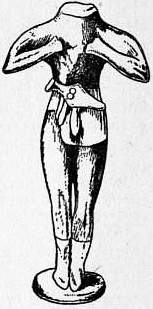
From Petsofá (Annual of the Brit. School at Athens). Fig. 15.—Terra-cotta Statuette.
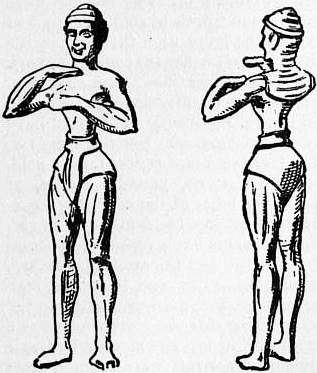
Perrot et Chipiez’s Art in Primitive Greece, by permission of Chapman & Hall. Fig. 16.—Lead Statuette from Kampos.
ii. Aegean Costume.—The discoveries made at Mycenae and other centres of “Mycenaean” civilization, and those of more recent date due to the excavations of Dr A. J. Evans and others in Crete, have shown that Hellenic culture was preceded in the Aegean by a civilization differing from it in many respects (see Aegean Civilization), and not least in costume. The essential feature both of male and female dress during the “Minoan” and “Mycenaean” periods was the loin-cloth, which is best represented by the votive terra-cotta statuettes from Petsofá in Crete discovered by Professor J. L. Myres and published in the ninth volume of the Annual of the British School at Athens (fig. 15). J. L. Myres shows that the costume consists of three parts—the loin-cloth itself, a white wrapper or kilt worn over it, and a knotted girdle which secured the whole and perhaps played its part in producing and maintaining the wasp waists characteristic of the Aegean race. The loin-cloth was the only costume (except for high boots, probably made of pale leather, since they are represented with white paint) regularly worn by the male sex, though we sometimes find a hood or wrapper, as on a lead statuette found in Laconia (fig. 16), but the Aegean women developed it into a bodice-and-skirt costume, well represented by the frescoes of Cnossus and the statuettes of the snake-goddess and her votaries there discovered. This transformation of the loin-cloth has been illustrated by Mr D. Mackenzie (see below) from Cretan seal-impressions. In place of the belted kilt of the men we find a belted panier or polonaise, considerably elongated in front, worn by Aegean women; and Mackenzie shows that this was repeated several times until it formed the compound skirt with a number of flounces which is represented on many Mycenaean gems. On a fresco discovered at Phaestus (Hagia Triada) (fig. 17) and a sealing from the same place this multiple skirt is clearly shown as divided; but this does not seem to have been the general rule. On other sealings we find a single overskirt with a pleated underskirt. The skirts were held in place by a thick rolled belt, and the upper part of the body remained quite nude in the earliest times; but from the middle Minoan period onward we often find an important addition in the shape of a low-cut bodice, which sometimes has sleeves, either tight-fitting or puffed, and ultimately develops into a laced corsage. A figurine from Petsofá (fig. 18) shows the bodice-and-skirt costume, together with a high pointed head-dress, in one of its most elaborate forms. The bodice has a high peaked collar at the back. Other forms of head-dress are seen on the great signet from Mycenae. The fact that both male and female costume amongst the primitive Aegean peoples is derivable from the simple loin-cloth with additions is rightly used by Mackenzie as a proof that their original home is not to be sought in the colder regions of central Europe, but in a warm climate such as that of North Africa. It is not until the latest Mycenaean period that we find brooches, such as were used in historical Greece, to fasten woollen garments, and their presence in the tombs of the lower city of Mycenae indicates the coming of a northern race.
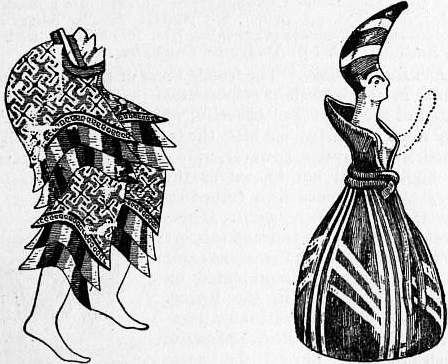
From Monumenti antichi (Acad. Lincei). From Annual of the Brit. School at Athens.
Fig. 17.—Part of a Fresco discovered at Phaestus. Fig. 18.—Terra-cotta Statuette from Petsofá.
See Annual of the British School at Athens, ix. 356 sqq. (Myres); xii. 233 sqq. (Mackenzie); Tsountas and Manatt, The Mycenaean Age, ch. vii.
iii. Greek Costume.—All articles of Greek costume belong either to the class of ἐνδύματα, more or less close-fitting, sewn garments, or of περιβλήματα, loose pieces of stuff draped round the body in various ways and fastened with pins or brooches. For the former class the generic name is χιτών, a word of Semitic origin, which denotes the Eastern origin of the garment; for the latter we find in Homer and early poetry πέπλος, in later times ἱμάτιον. The πέπλος (also called ἑανός and φᾶρος in Homer) was the sole indispensable article of dress in early Greece, and, as it was always retained as such by the women in Dorian states, is often called the “Doric dress” (ἐσθὴς Δωρίς). It was a square piece of woollen stuff about a foot longer than the height of the wearer, and equal in breadth to twice the span of the arms measured from wrist to wrist. The upper edge was folded over for a distance equal to the space from neck to waist—this folded portion was called ἀπόπτυγμα or διπλοῒς,—and the whole garment was then doubled and wrapped round the body below the armpits, the left side being closed and the right open. The back and front were then pulled up over the shoulders and fastened together with brooches like safety-pins (περόναι). This was the Doric costume, which left the right side of the body exposed and provoked the censure of Euripides (Andr. 598). It was usual, however, to hold the front and back of the πέπλος together by a girdle (ζώνη), passed round the waist below the ἀπόπτυγμα; the superfluous length of the garment was pulled up through the girdle and allowed to fall over in a baggy fold (κόλπος) (see Greek Art, fig. 75). Sometimes the ἀπόπτυγμα was made long enough to fall below the waist, and the girdle passed outside it (cf. the figure of Artemis on the vase shown in Greek Art, fig. 29); this was the fashion in which the Athena Parthenos of Pheidias was draped. The “Attic” or “Corinthian” πέπλος was sewn together on the right side from below the arm, and thus became an ἔνδυμα. The πέπλος was worn in a variety of colours and often decorated with bands of ornament, both horizontal and vertical; Homer uses the epithets κροκόπεπλος and κυανόπεπλος, which show that yellow and dark blue πέπλοι were worn, and speaks of embroidered πέπλοι (ποικίλοι). Such embroideries are indicated by painting on the statues from the Acropolis and are often shown on vase paintings.
The chiton, χιτών, was formed by sewing together at the sides two pieces of linen, or a double piece folded together, leaving spaces at the top for the arms and neck, and fastening the top edges together over the shoulders and upper arm with buttons or brooches; more rarely we find a plain sleeveless chiton. The length of the garment varied considerably. The χιτωνίσκος, worn in active exercise, as by the so-called “Atalanta” of the Vatican, or the well-known Amazon statues (Greek Art, fig. 40), reached only to the knee; the χιτὼν ποδήρης covered the feet. This long, trailing garment was especially characteristic of Ionia; in the Homeric poems (Il. xiii. 685) we read of the Ίαόνες ἑλκεχίτωνες. If worn without a girdle it went by the name of χιτὼν ὀρθοστάδιος. The long chiton was regularly used by musicians (e.g. Apollo the lyre-player) and charioteers. In ordinary life it was generally pulled up through the girdle and formed a κόλπος (Greek Art, fig. 2).
Herodotus (v. 82-88) tells a story (cf. Aegina), the details of which are to all appearance legendary, in order to account for a change in the fashion of female dress which took place at Athens in the course of the 6th century B.C. Up to that time the “Dorian dress” had been universal, but the Athenians now gave up the use of garments fastened with pins or brooches, and adopted the linen chiton of the Ionians. The statement of Herodotus is illustrated both by Attic vase-paintings and also by the series of archaic female statues from the Acropolis of Athens, which (with the exception of one clothed in the Doric πέπλος) wear the Ionic chiton, together with an outer garment, sometimes laid over both shoulders like a cloak (Greek Art, fig. 3), but more usually fastened on the right shoulder only, and passed diagonally across the body so as to leave the left arm free. The garment (which resembles the Doric πέπλος, but seems to have been rectangular rather than square) is folded over at the top, and the central part is drawn up towards the right shoulder to produce an elaborate system of zigzag folds (Greek Art, fig. 22). The borders of the garment are painted with geometrical patterns in vivid colours; a broad stripe of ornament runs down the centre of the skirt.24
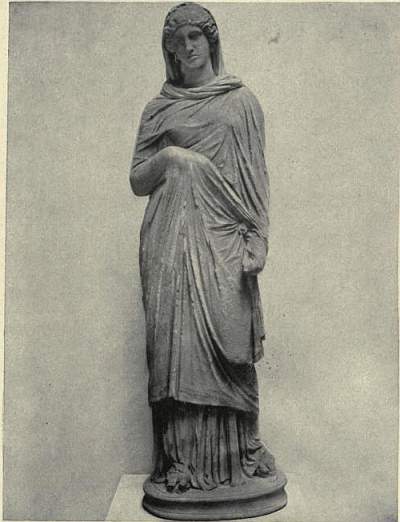
This fashion of dress was only temporary. Thucydides (i. 6) tells us that in his own time the linen chiton of Ionia had again been discarded in favour of the Doric dress, and the monuments show that after the Persian wars a reaction against Orientalism showed itself in a return to simpler fashions. The long linen chiton, which had been worn by men as well as women, was now only retained by the male sex on religious and festival occasions; a short chiton was, however, worn at work or in active exercise (Greek Art, fig. 3) and often fastened on the left shoulder only, when it was called χιτὼν ἑτερομάσχαλος or ἐξωμίς. But the garment usually worn by men of mature age was the ἱμάτιον, which was (like the πέπλος) a plain square of woollen stuff. One corner of this was pulled over the left shoulder from the back and tucked in under the left arm; the rest of the garment was brought round the right side of the body and either carried under the right shoulder, across the chest and over the left shoulder, if it was desired that the right arm should be free, or wrapped round the right arm as well as the body, leaving the right hand in a fold like a sling (Greek Art, fig. 2). The ἱμάτιον was also worn by women over the linen chiton, and draped in a great variety of ways, which may be illustrated by the terra-cotta figurines from Tanagra (4th-3rd cent. B.C.) and the numerous types of female statues, largely represented by copies of Roman date, made to serve as grave-monuments. The upper part of the ἱμάτιον was often drawn over the head as in the example here shown (Plate, fig. 21), a statue formerly in the duke of Sutherland’s collection at Trentham and now in the British Museum.
A lighter garment was the χλαμύς, chlamys, a mantle worn by young men, usually over a short chiton girt at the waist, and fastened on the right shoulder (cf. the figure of Hermes in Greek Art, fig. 2). The χλαῖνα was a heavy woollen cloak worn in cold weather. Peasants wore sheepskins or garments of hide called βαίτη or σίσυρα; slaves, who were required by custom to conceal their limbs as much as possible, wore a sleeved chiton and long hose.
A woman’s head was usually covered by drawing up the ἱμάτιον (see above), but sometimes instead of this, a separate piece of cloth was made to perform this service, the end of it falling over the himation. This was the καλύπτρα, or veil called κρήδεμνον in Homer. A cap merely intended to cover in the hair and hold it together was called κεκρύφαλος. When the object was only to hold up the hair from the neck, the σφενδόνη was used, which, as its name implies, was in the form of a sling; but in this case it was called more particularly ὀπισθοσφενδόνη, as a distinction from the sphendonē when worn in front of the head. The head ornaments include the διάδημα, a narrow band bound round the hair a little way back from the brow and temples, and fastened in the knot of the hair behind; the ἄμπυξ, a variety of the diadem; the στεφάνη, a crown worn over the forehead, its highest point being in the centre, and narrowing at each side into a thin band which is tied at the back of the head. It is doubtful whether this should be distinguished from the στέφανος, a crown of the same breadth and design all round, as on the coins of Argos with the head of Hera, who is expressly said by Pausanias to wear a stephanos. This word is also employed for crowns of laurel, olive or other plant. High crowns made of wicker-work (πόλοι, κάλαθοι) were also worn (see Gerhard, Antike Bildwerke, pls. 303-305). When the hair, as was most usual, was gathered back from the temples and fastened in a knot behind, hair-pins were required, and these were mostly of bone or ivory, mounted with gold or plain; so also when the hair was tied in a large knot above the forehead, as in the case of Artemis, or of Apollo as leader of the Muses. The early Athenians wore their hair in the fashion termed κρώβυλος, with fastenings called “grasshoppers” (τέττιγες), in allusion to their claim of having originally sprung from the soil (Thuc. i. 6). The τέττιγες have been identified by Helbig with small spirals of gold wire, such as are found in early Etruscan tombs lying near the head of the skeleton. Such spirals were used in early Athens to confine the back hair, and this fashion may therefore be identified as the κρώβυλος. In archaic figures the hair is most frequently arranged over the brow and temples in parallel rows of small curls which must have been kept in their places by artificial means. Ear-rings (ἐνώτια, ἐλλόβια, ἑλικτῆρες) of gold, silver, or bronze plated with gold, and frequently ornamented with pearls, precious stones, or enamel, were worn attached to the lobes of the ear. For necklaces (ὅρμοι), bracelets (ὄφεις), brooches (περόναι), and finger-rings (δακτύλιοι or σφραγῖδες) the same variety and preciousness of material was employed. For the feet the sandal (σάνδαλον, πέδιλον) was the usual wear; for hunting and travelling high boots were worn. The hunting-boot (ἐνδρομίς) was laced up the front, and reached to the calves; the κοθορνος (cothurnus) was a high boot reaching to the middle of the leg, and as worn by tragic actors had high soles. Slippers (περσικαί) were adopted from the East by women; shoes (ἐμβάδες) were worn by the poorer classes. Gloves (χειρῖδες) were worn by the Persians, but apparently never by the Greeks unless to protect the hands when working (Odyssey, xxiv. 230). Hats, which were as a rule worn only by youths, workmen and slaves, were of circular shape, and either of some stiff material, as the Boeotian hat observed in terra-cottas from Tanagra, or of pliant material which could be bent down at the sides like the πέτασος worn by Hermes and sometimes even by women. The καυσία, or Macedonian hat, seems to have been similar to this. The κυρβασία, or κίδαρις, was a high-pointed hat of Persian origin, as was also the τιάρα, which served the double purpose of an ornament and a covering for the head. Workmen wore a close-fitting felt cap (πῖλος).
See F. Studniczka, “Beiträge zur Geschichte der altgriechischen Tracht” (Abhandlungen des arch.-epigr. Seminars in Wien, vii. 1886); Lady Evans, Chapters on Greek Dress (1893); W. Kalkmann, “Zur Tracht archäischer Gewandfiguren” (Jahrb. des k. deutschen arch. Instituts, 1896, pp. 19 ff.); S. Cybulski, Tabulae quibus antiquitates Graecae et Romanae illustrantur, Nos. 16-18 (1903), with text by W. Amelung; Ethel B. Abrahams, Greek Dress (1908).
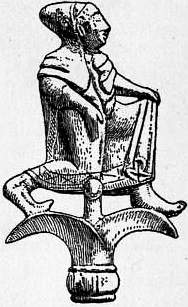
Fig. 19.
iv. Etruscan Costume.—The female dress of the Etruscans did not differ in any important respect from that of the Greeks; it consisted of the chiton and himation, which was in earlier times usually worn as a shawl, not after the fashion of the Doric πέπλος. Two articles of costume, however, were peculiar to the Etruscans—the high conical hat known as the tutulus,25 and the shoes with turned-up points (Latin calcei repandi). These have oriental analogies, and lend support to the tradition that the Etruscans came from Asia. Both are represented on a small bronze figure in the British Museum (fig. 19). On a celebrated terra-cotta sarcophagus in the British Museum of much later date (fig. 20), the female figure reclining on the lid wears a Greek chiton of a thin white material, with short sleeves fastened on the outside of the arm, by means of buttons and loops; a himation of dark purple thick stuff is wrapped round her hips and legs; on her feet are sandals, consisting of a sole apparently of leather, and attached to the foot and leg with leather straps; under the straps are thin socks which do not cover the toes; she wears a necklace of heavy pendants; her ears are pierced for ear-rings; her hair is partly gathered together with a ribbon at the roots behind, and partly hangs in long tresses before and behind; a flat diadem is bound round her head a little way back from the brow and temples. Purple, pale green and white, richly embroidered, are favourite colours in the dresses represented on the painted tombs.
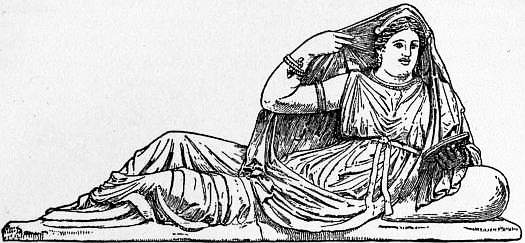
Redrawn from photo (Mansell). Fig. 20.
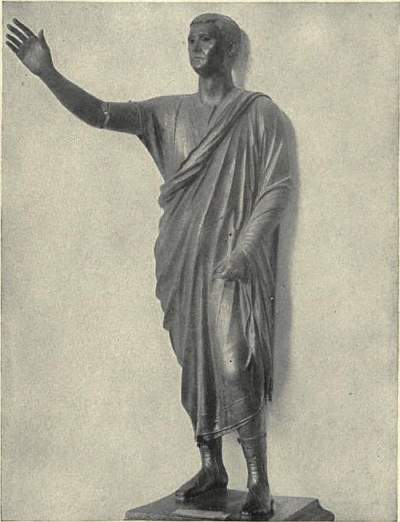
The chief article of male dress was called the tebenna. We are told by ancient writers that the toga praetexta, with its purple border (περιπόρφυρος τήβεννα), as worn by Roman magistrates and priests, had been derived from the Etruscans (Pliny, N.H. ix. 63, “praetextae apud Etruscos originem invenere”); and the famous statue of the orator in Florence (Plate, fig. 22), an Etruscan work of the 3rd century B.C., represents a man clothed in this garment, which will be described below. Under the tebenna, or toga, which was necessary only for public appearance, the Etruscans wore a short tunic similar to the Greek chiton. For workmen and others of inferior occupation this appears to have been the only dress. Youths, when engaged in horsemanship and other exercises, wore a chlamys round the shoulders, which, however, was semicircular in cut, and was fastened on the breast by buttons and a loop, or tied in a knot, whereas the Greek chlamys was oblong and fastened on the shoulder by a brooch. On public or festal occasions the Etruscan noble wore, besides the tebenna, a bulla, or necklace of bullae, and a wreath, corona Etrusca. The bulla was a circular gold locket containing a charm of some kind against evil.26 On the later sarcophagi the male figures wear not only a wreath or corona proper, but also a garland of flowers hung round the neck. The male head-dress was the galerus, a hat of leather, said to have been worn by the Lucumos in early times, or the apex, a pointed hat corresponding to the tutulus worn by females. The fashion of shoes worn by Roman senators was said to have been derived from Etruria. Etruscan shoes were prized both in Greece and in Rome.
Helbig’s articles, referred to at the close of the next section, should be consulted. J. Martha, L’Art étrusque, gives reproductions of the most important monuments. See also the works on Etruscan civilization named in the art. Etruria.
v. Roman Costume.—We are told that the toga, the national garment of the Romans, was originally worn both by men and by women; and though the female dress of the Romans was in historical times essentially the same as that of the Greeks, young girls still wore the toga on festal occasions, as we see from the reliefs of the Ara Pacis Augustae. In early times no undergarment was worn save a loin-cloth (subligaculum), which seems to be a survival of early Mediterranean fashions (see above, sect. Aegean Costume), and candidates for office in historical times appeared in the toga and subligaculum only. In this period, however, the tunica, corresponding to the Greek chiton, was universally worn in ordinary life, and the toga gradually became a full-dress garment which was only worn over the tunica on important social occasions; Juvenal (iii. 171) tells us that in a great part of Italy no one wore the toga except at his burial!
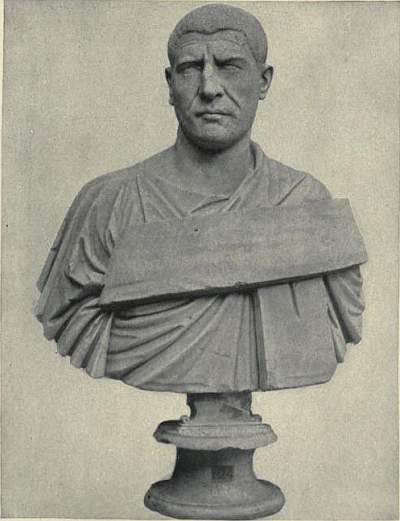
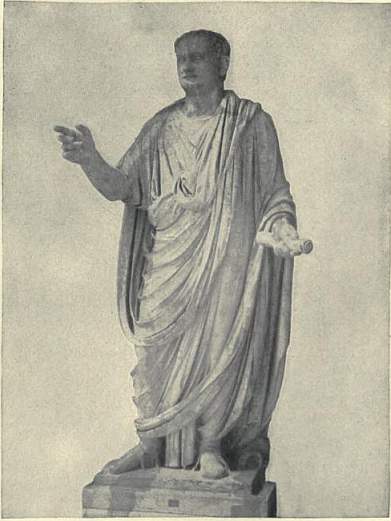
The toga was a piece of woollen cloth in the form of a segment of a circle,27 the chord of the arc being about three times the height of the wearer, and the height a little less than one-half of this length. One end of this garment was thrown over the left shoulder and allowed to hang down in front; the remainder was drawn round the body and disposed in various ways. In the cinctus Gabinus, which was the fashion adopted in early times when fighting was in prospect, the end of the toga was drawn tightly round the waist and formed a kind of girdle; this was retained in certain official functions, such as the opening of the temple of Janus in historical times.28 In time of peace the toga was wrapped round the right arm, leaving the hand only free, much after the fashion of the Greek himation, and thrown over the left shoulder so as to fall down behind (see Roman Art, Plate II., fig. 11, male figure to r.); or, if greater freedom were desired, it was passed under the right arm-pit. In religious ceremonies, the magistrate presiding at the sacrifice drew the back of the toga over his head; see in the same illustration the priest with veiled head, ritu Gabino, who also wears his toga with the cinctus Gabinus. Towards the end of the republic a new fashion was generally adopted. A considerable length of the toga was allowed to hang from the left shoulder; the remainder was passed round the body so as to rise like a baldric (balteus) from the right hip to the left shoulder, being folded over in front (the fold was called sinus), then brought round the back of the neck so that the end fell over the right shoulder; the hanging portion on the left side was drawn up through the sinus, and bulged out in an umbo (Plate, fig. 24). Later still, this portion, instead of forming a bundle of folds in the centre, was carefully folded over and carried up over the left shoulder, and in course of time these folds were carefully arranged in several thicknesses resembling boards, tabulae, hence called contabulatio (Plate, fig. 23). Yet another fashion was that adopted by the flamens, who passed the right-hand portion of the toga over the right shoulder and arm and back over the left shoulder, so that it hung down in a curve over the front of the body; the upper edge was folded over. The flamens are thus represented on the Ara Pacis Augustae.
The plain white toga (toga pura) was the ordinary dress of the citizen, but the toga praetexta, which had a border of purple, was worn by boys till the age of sixteen, when they assumed the plain toga virilis, and also by curule magistrates and some priests. A purple toga with embroidery (toga picta) was worn together with a gold-embroidered tunic (tunica palmata) by generals while celebrating a triumph and by magistrates presiding at games; it represented the traditional dress of the kings and was adopted by Julius Caesar as a permanent costume. The emperors wore it on occasions of special importance. The trabea, which in historical times was worn by the consuls when opening the temple of Janus, by the equites at their yearly inspection and on some other occasions, and by the Salii at their ritual dances, and had (according to tradition) formed the original costume of the augurs and flamens (who afterwards adopted the toga praetexta), was apparently a toga smaller in size than the ordinary civil dress, decorated with scarlet stripes (trabes). It was fastened with brooches (fibulae) and appears to have been worn by the equites, e.g. at the funeral ceremony of Antoninus Pius.
The tunica was precisely like the Greek chiton; that of the senator had two broad stripes of purple (latus clavus) down the centre, that of the knight two narrow stripes (angustus clavus). A woollen undergarment (subucula) was often worn by men; the women’s under-tunic was of linen (indusium). When women gave up the use of the toga, they adopted the stola, a long tunic with a border of a darker colour (instita) along the lower edge; the neck also sometimes had a border (patagium). The tunic with long sleeves (tunica manicata) was a later fashion. Over this the ricinium or rica, a shawl covering the head and shoulders, was worn in early times, and retained by certain priestesses as an official costume;29 but it gave place to the palla, the equivalent of the Greek himation, and the dress of the Roman women henceforward differed in no essential particular from that of the Greek.
A variety of cloaks were worn by men during inclement weather; in general they resembled the Greek chlamys, but often had a hood (cucullus) which could be drawn over the head. Such were the birrus (so-called from its red colour), abolla and lacerna. The paenula, which was the garment most commonly worn, especially by soldiers when engaged on peace duties, was an oblong piece of cloth with a hole in the centre for the neck; a hood was usually attached to the back. It survives in the ritual chasuble of the Western Church. The Greek military chlamys appears in two forms—the paludamentum of the general (e.g. Trajan as represented on the Arch of Constantine, Roman Art, Plate III., fig. 16), and the sagum worn by the common soldier (e.g. by some of the horsemen on the base of the Antonine column, Roman Art, Plate V., fig. 21). When the toga went out of use as an article of everyday wear, the pallium, i.e. the Greek himation, was at first worn only by Romans addicted to Greek fashions, but from the time of Tiberius, who wore it in daily life, its use became general. Long robes bearing Greek names (synthesis, syrma, &c.) were worn at dinner-parties.
The Romans often wore sandals (soleae) or light shoes (socci), but in full dress (i.e. with the toga) it was necessary to wear the calceus, which had various forms by which classes were distinguished, e.g. the calceus patricius, mulleus (of red leather) and senatorius (of black leather). This was a shoe with slits at the sides and straps knotted in front; its forms may be seen on the relief from the Ara Pacis. The senators’ calceus had four such straps (quattuor corrigiae), which were wound round the ankle (cf. the flamen on the Ara Pacis), and was also adorned with an ivory crescent (lunula). A leathern tongue (lingula) is often seen to project from beneath the straps. The soldier’s boot (caliga, from which the emperor Gaius derived his nickname, Caligula) was in reality a heavy hobnailed sandal with a number of straps wound round the ankle and lower leg. A high hunting boot was called compagus. Women at times wore the calceus, but are generally represented in art with soft shoes or sandals.
Hats were seldom worn except by those who affected Greek fashions, but the close-fitting leather pileus seems to have been an article of early wear in Italy, since its use survived in the ceremony of manumission, and the head-dress of the pontifices and flamines (cf. the relief of the Ara Pacis already referred to) consisted in such a cap (galerus) with an apex, or spike, of olive wood inserted in the crown.
For personal ornament finger-rings of great variety in the material and design were worn by men, sometimes to the extent of one or more on each finger, many persons possessing small cabinets of them. But at first the Roman citizen wore only an iron signet ring, and this continued to be used at marriages. The jus annuli aurei, or right of wearing a gold ring, originally a military distinction, became a senatorial privilege, which was afterwards extended to the knights and gradually to other classes. Women’s ornaments consisted of brooches (fibulae), bracelets (armillae), armlets (armillae, bracchialia), ear-rings (inaures), necklaces (monilia), wreaths (coronae) and hair-pins (crinales). The tore (torques), or cord of gold worn round the neck, was introduced from Gaul. A profusion of precious stones, and absence of skill or refinement in workmanship, distinguish Roman from Greek or Etruscan jewelry; but in the character of the designs there is no real difference.
See Marquardt-Mau, Privatleben der Römer, pp. 550 seq. (gives a full collection of literary references); Cybulski, op. cit., pls. xix., xx., with Amelung’s text; articles by W. Helbig, especially Sitzungsberichte der bayrischen Akademie (1880), pp. 487 seq. (on headgear); Hermes xxxix. 161 seq. (on toga and trabea), and Mémoires de l’Académie des inscriptions, xxxvii. (1905) (on the costume of the Salii); articles by L. Heuzey in Daremberg and Saglio’s Dictionnaire des antiquités, also in Revue de l’art, i. 98 seq., 204 seq., ii. 193 seq., 295 seq. (on the toga). See also the general bibliography at the end.
(H. S. J.)
II. Costume in Medieval and Modern Europe
i. Pre-Roman and Roman Britain.—Men who had found better clothing than the skins of beasts were in Britain when Caesar landed. Little as we know of England before the English, we have at least the knowledge that Britons, other than the poorer and wilder sort of the north and the fens, wore cloaks and hats, sleeved coats whose skirts were cut above the knee and loose trousers after the fashion of the Gauls. They were not an armoured race, for they would commonly fight naked to the waist, dreadful with tattooing and woad staining, but Pliny describes their close-woven felts as all but sword-proof. Dyers as well as weavers, their cloaks, squares of cloth like a Highland plaid, were of black or blue, rough on the one side, while coats and trousers were bright coloured, striped and checkered, red being the favourite hue. For ornament the British chiefs wore golden torques about their necks and golden arm-rings with brooches and pins of metal or ivory, beads of brass, of jet and amber from their own coasts, and of glass bought of the Southern merchants. Their women had gowns to the ankle, with shorter tunics above them. The Druid bards had their vestments of blue, while the star-gazers and leeches went in green.
Agricola’s Romanizing work must have made great changes in dress as in policy. The British chief with the Latin tongue in his mouth, living in a Roman villa and taking his bath as did the Romans, wore the white woollen toga and the linen tunic, his wife having the stole, the pall and the veil.
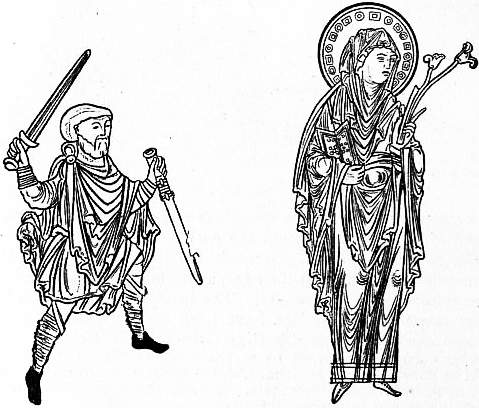
Fig. 25.—Old English Dress. From the Benedictional of St Æthelwold (c. 963-984). Fig. 26.—The Blessed Virgin. From the Benedictional of St Æthelwold (c. 963-984).
ii. Old English Dress.—The skill of their artists gives us many accurate pictures of the dress of the English before the Norman Conquest, the simple dress of a nation whose men fight, hunt and plough. The man’s chief garment is Before the Conquest. a sleeved tunic hanging to the knee, generally open at the side from hip to hem and in front from the throat to the breast. Sleeves cut loosely above the elbow are close at the forearm. The legs are in hose like a Highlander’s or in long breeches bandaged or cross-gartered below the knee. A short mantle to the calf is brooched at the shoulder or breast (fig. 25). There are long gowns and toga-like cloaks, but these as a rule seem garments for the old man of rank. In the open air the cloak is often pulled over the head, for hats and caps are rare, the Phrygian bonnet being the commonest form. Girdles of folded cloth gather the loose tunic at the waist. Most paintings show the ankle shoe as black, cut with a pointed tab before and behind, the soles being sometimes of wood like the sole of the Lancashire clog of our own days. A nobleman will have his shoes embroidered with silks or coloured yarns, and the like decoration for the hem and collar of his tunic. Poor men wear little but the tunic, often going barelegged, although the hinds in the well-known pictures of the twelve months have shoes, and the shepherd as he watches his flock covers himself with a cloak. In every graveyard of the old English we find the brooches, armlets, rings and pins of a people loving jewelry. Women wore a long gown covering the feet, the loose sleeves sometimes hanging over the hands to the knee. Over this there is often a shorter tunic with short sleeves. Their mantles were short or long, the hood or head rail wrapped round the chin (fig. 26). In broidery and ornament the women’s dress matched that of the men. The Danes, warriors of the sea, soon took the English habit, becoming notable for their many changes of gay clothing.
Plate
Photo, Walker. Photo, Alinari.
Fig. 21.—GRAVE-STATUE. Fig. 22.—THE ORATOR (R. Arch. Mus., Florence).
Photo, Anderson. Photo, Moscioni.
Fig. 23.—BUST OF PHILIP THE ARABIAN (Vatican). Fig. 24.—TITUS (Vatican).
The Norman Conquest is marked by no great change in English clothing, the conquerors inclining towards the island fashions, as we may see by the fact that they gave up their curious habit of shaving the back of the head. But The Normans. with the reign of the second William came the taste for the luxury of clothing and that taste for flowing hair and shoes with sharp points which is lamented by William of Malmesbury. In this reign we have the story of the Red King refusing to put on boots that cost but three shillings—the price of an ox—and wearing the same gladly when his chamberlain told him that they were a new pair worth a mark. Even more than the fashion of long cloaks and trailing gowns whose sleeves hang far below the hands, the fantastic boot and shoe toes bring the curses of the clergy and the moralizings of chroniclers. Fulk Rechin of Anjou is said by Orderic to have invented such gear to hide the monstrous bunions upon his toes, but a worthless Robert, a hanger-on of the court of William II., distinguishes himself and gains the surname of Cornard by stuffing his shoe tips with tow and twisting them like the horns of the ram.
There are many illuminations which give us in plenty the details of all costumes of the 12th century. Thus the devil in a well-known MS. wears the gown of a lady of rank, the bodice tightly laced, the hanging sleeve knotted to 12th and 13th centuries. keep it out of the mud. A MS. at Corpus Christi College, Oxford, shows in a picture of the vision of Henry I. that the men who reap and dig are simply clad in loose skirted tunics with close sleeves, that they have hats with brims, and cloaks caught by a brooch at the shoulder. Hats and caps are common in all classes and take many shapes—the Phrygian cap, the flat bonnet, the brimmed hat and the skull-cap.
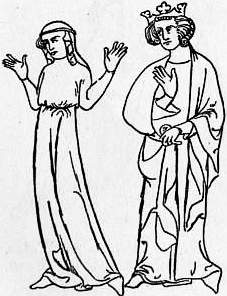
Fig. 27.—A Lady and a King (temp. Hen. III.). (From Cotton MS. Nero, D. i.)
With the coming of the house of Anjou English dress clears itself of the more fantastic features of an earlier generation. Henry II. brought in the short Angevin mantle and from it had his name of Curtmantle, but it was not a mastering fashion and the long cloak holds its own. Rich stuffs, cloth of gold or silk woven with gold, webs of damask wrought with stripes or rays and figured with patterns are brought in from the ports. Rare furs are eagerly sought. But the simplicity of line is remarkable. The drawings made for Matthew Paris’s lives of the two Offas show people of all ranks clad without a trace of the tailor’s fantasy. Kings and lords, churchmen and men of substance go in long gowns to the feet, the great folk having an orphrey or band of embroidery at the somewhat low-cut neck (fig. 27). Some of the sleeves have wide ends cut off at the mid-forearm, showing the tight sleeve of a shirt or smock below. Fashion, however, tends to lengthen sleeves to a tight wrist, the upper halves being cut wide and loose with the large armholes characteristic of most ancient tailoring. Over this gown is worn an ample cloak fastened at the neck with a brooch or clasp, and sometimes fitted with a hood. The dress of the common folk and of men of rank when actively employed is a tunic which is but the gown shortened to the knee, a short cloak to the knee being worn with it (fig. 28). Belts and girdles are narrow and plain, the thongs without enrichment, showing no beginnings of the rich buckles and heavy bosses of a later fashion. Shoes and low-cut boots are slightly pointed, and hats, caps, hoods and coifs of many types cover the head. The women are like to the men in their long gown, but the head is wrapped in a coverchef hanging over the shoulder and bound with a fillet round the brow. Gloves are common in this age; “scraps of the cloth or the skin,” says a poet, “do not want for a use: of them gloves are made.”
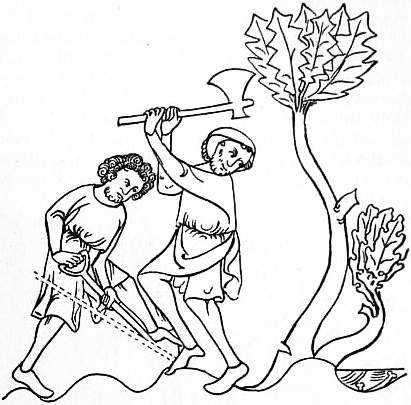
Fig. 28.—Labourers (temp. Hen. III.). (From Cotton MS. Nero, D.i.)
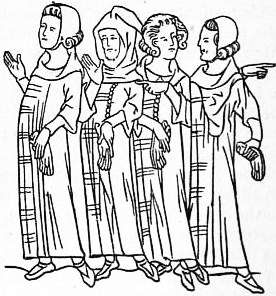
Fig. 29.—A Group of Clerks (early 14th century). (From Royal MS. 19 B. xv.)
At the court of Edward II., son of a king who went simply clad, Piers Gaveston and his like began to set the fashions for a century which to the curious antiquary is a garden of delights. For the history of the 14th-century 14th century. clothing illuminations are supplemented by a number of effigies upon which the carver has wrought out the last details, by monumental brasses, and by contemporary literature and records (fig. 29). Garments take many shapes; sleeves, skirts and head-dresses run through many fashions; while personal ornaments are rich and beautiful to a degree never yet surpassed. With the beginning of the century there is seen a tendency to shorten the long gown, which had been the best wear of a man of good estate, to a more convenient length, although the knees are still well covered. Loose sleeves falling below the elbow leave to view the sleeve of an under-garment, buttoned tightly to the arm. In winter time a man’s gown will have long sleeves that cover the hands when the arms are at length. The full cloak, although still found, is somewhat rare among a people that has, perhaps, learned to wear more clothes and warmer upon the body. Hoods are worn in many fashions, to be cast back upon the shoulders like a monk’s cowl, the part at the back of the head being drawn out into a “liripipe” long enough at times, when the hood is drawn up, to be knotted round the brow turban-fashion (fig. 30). Long hose are drawn up the legs to join the short breech, and the toes of the ankle-shoes are pointed so long that holy men see visions of little devils using them as chariots. The women love trailing gowns. They have under-skirts and loose over-garments, sometimes sleeveless. Their hair at least would not shock those earlier prelates who cursed the long plaits, for it is caught up in a caul or braided at the sides of the head. In the second half of the century men of rank borrow from Germany the fashion of the cote-hardie. In its plainest form this short tunic, covering the fork of the leg, is cut closely to the body and arms (fig. 31). Sometimes the sleeve ends at the elbow and then another streamer is added to the one which falls from the hood, a strip of stuff continuing the elbow-sleeve as low as the coat edge. This strip and the hem of the skirt are often “slittered” with fanciful jags, a fashion which soon draws down the satirist’s anger. Parti-coloured garments were an added offence; a gentleman would have his coat parted down the middle in red and white, with hose of white and red to match. Men and women of rank wear a twisted garland of rich stuff, crown-wise on the head, set with pearls and precious stones, a fashion which is followed on the great helm of the knights, being the “wreath” or “torce” of heraldry. The dames of such as wear the cote-hardie imitate its tightness in the sleeves and bodices of their long gown. A curious fashion which now begins is the sleeveless upper gown whose sides are cut away in curved sweeps from the shoulder to below the waist, the edges of the opening being deeply furred. The strange head-dress with a steeple-horn draped with lawn kerchiefs makes its appearance to shock the moralists. Although it was probably a rare sight in this century, the horn could easily fulfil its mission of drawing notice to all its wearers.
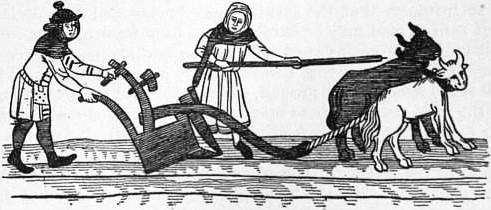
Fig. 30.—English Ploughmen of the 14th century.
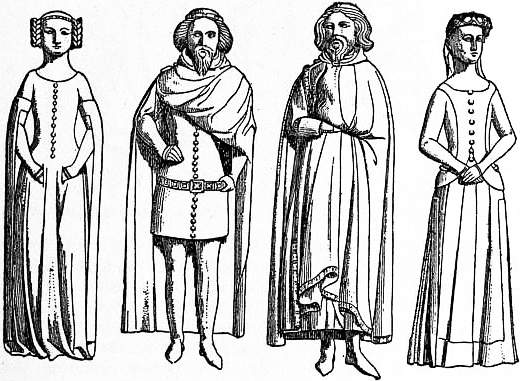
Fig. 31.—Sons and Daughters of Edward III. (From his tomb in Westminster Abbey.)
Of the cote-hardie it might at least be said that it was the symbol of a knightly age in arms, the garment of a man who must have hand and limbs free, and, save for its sleeves, it faithfully copied the coat-armour of the armed knight. The softer days of Richard II. are remarkable for a dress which has also its significance, men of high rank taking to themselves gowns of such fulness that the satirists may be justified who declare that men so clad may be hardly known from women. The close collar of these gowns rises high as the neckcloth of a French incroyable, the upper edge turned slightly over and jagged. The full skirts sweep on the ground, which is touched by the last jags of the vast sleeves, whose openings, wide as a woman’s skirts, are dagged like the edges of vine or oak leaves. “And but if the slevis,” says the satirist, “slide on the erthe, thei wolle be wroth as the wynde.” Sometimes this gown is slit at the sides that the gallant may the better show his coloured hose and tips of shoes that pike out two feet from heel to toe. When not wearing the gown such a lord would have a high-necked coat, shorter even than the cote-hardie, but looser in the skirt, the sleeves ending full and loose with dagged edges turned over at the cuff. Hats are more commonly worn in this century, and in its latter half take many shapes, a notable one being that of a shortened sugar-loaf or thimble with a brim turned up, either all round, or, more frequently, behind or before. The long shoes, as their name of crackowes or poleynes implies, were a fashion which, by repute, came from Poland, a land ruled by the grandfather of Richard’s first queen. When medieval fashions were past, they were remembered as a type of the old time, and a certain French conteur begins a tale of old days, not with jadis, but with “In the time when they wore poleynes.” Even parish priests, whose preaching should “dryve out the daggis and alle the Duche cotis,” went, in this age of fine apparel, gaily clad in gowns of scarlet and green, “shape of the newe,” in “cutted clothes” with “long pikes on her shone.” More than this, they made scandal by ruffling with weapons—“bucklers brode and sweardes long, bandrike with baselardes kene.” The skill of goldsmiths and craftsmen decorates all the appurtenances of the dress of this 14th century. Buttons, which appear in the first Edward’s time as a scandalous ornament on men of low degree, have now become common, and, cunningly wrought, are used as much for queintise as for service. A close row of them will run from wrist to elbow of tight sleeve. A row of buttons goes from the neck of a woman’s gown, and the cote-hardie may be fastened down the front with a dozen and a half of rich buttons. A purse or gipciere hung by a ring to the girdle gives more room for ornament in the silver or brass bar on which the bag depends. Above all the girdle, which—in harness or in silk—rich men wear broad and bossed with jewels across the thigh below the waist, makes work for the jeweller’s craftsman. Such a girdle is for great folk alone; but lesser men, wearing a strap about their waists, will yet have a handsome buckle and a fanciful pendant of metal guarding the loose end of the strap.
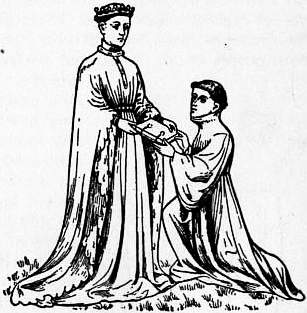
Fig. 32.—Henry, Prince of Wales, and Occleve the Poet (c. 1410). (From Arundel MS. 38.)
However fantastic the fashions of this or any other ages, folk of the middling sort will avoid the extremes. From the Knight to the Reve, no man of Chaucer’s company calls to us by the fantasy of his clothing. The Knight himself rides in his fustian gipoun, the grime of his habergeon upon it, although his son’s short gown, the gayest garment at the Tabard, had long and wide sleeves and is embroidered with flowers like any mead. A coat and hood of green mark the Yeoman, who has a silver Christopher brooch for ornament. The Merchant is in motley stuff, his beaver hat from Flanders and his clasped boots taking Chaucer’s eye, as do the anlas and silken gipser which hang at the rich Franklin’s belt. As for the London burgesses, their knife-chapes, girdles and pouches are in clean silver. The Shipman wears his knife in a lanyard about his neck, as his fellows do to this day, and his coat is of coarse falding to the knee. The Wife of Bath has the wimple below her broad hat and rides in a foot mantle about her hips. Poorer men’s dress is on the Reve and the Ploughman, the one in a long surcote of sky-blue and the other in the tabard which we may recognize as that smock-frock which goes down the ages with little change.
In the 15th century the middle ages run out. Fashions in this period become, if not more fantastic, more various. Its earlier years see men of rank still inclined to the rich modes of the last age: Harry of Monmouth, drawn 15th century. about 1410 by an artist who shows him as Occleve’s patron, wears a blue gown which might have passed muster at the court of Richard II. for its trailing skirts and its long sleeves, their slittered edges turned back (fig. 32). A strange fancy at this time was the hanging of silver bells on the dress. One William Staunton, in 1409, seeing in a vision at St Patrick’s Purgatory the fate of earth’s proud ones, is exact to note that in the place of torment the jags in men’s clothes turn to adders, that women’s trailing skirts are burnt over their heads, and that those men whose garments are overset with silver gingles and bells have burning nails of fire driven through each gingle. As for the chaplets of gold, of pearls and precious stones, they turn into nails of iron on which the fiends hammer.
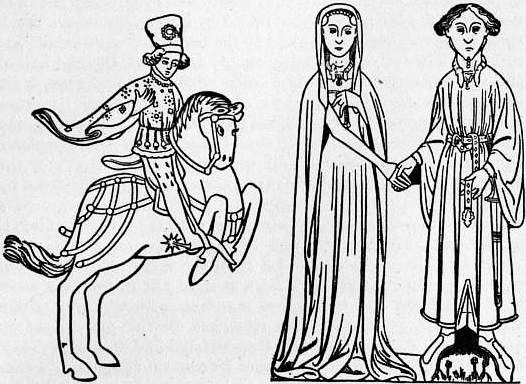
Fig. 33.—The Squire. (From the Ellesmere MS. of the Canterbury Tales. Fig. 34.—An English Squire and his Wife. (From a brass of 1409.)
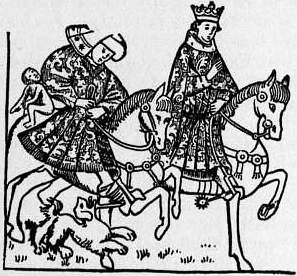
Fig. 35.—English Dress, c. 1433. (From Harl. MS. 2278.)
The common habit of a well-clad man in the first half of this century is a loose tunic, lined with fur, or edged with fur at neck, wrist and skirt. At first the sleeves are long and bag-like, like to the Richard II. sleeve but drawn in to the wrist, where early examples are fastened with a button. A shorter tunic is worn below, whose tight sleeves are seen beyond the furred edge of the upper garment, mittens being sometimes attached to them. Over the shoulders the hood is thrown, or, in foul weather, a hood and cloak. The gown is girdled at the waist with a girdle from which hangs the anelace or baselard (fig. 34). Shoes are pointed. Hats and caps are seen in many shapes, but the most remarkable is the developed form of that head-dress which the 14th-century man seems to have achieved by putting his pate into the face-hole of his hood and twisting its liripipe round his brows. In the 15th century the effect is produced with a thick, turban-like roll of stuff from the top of which hung down on one side folds of cloth coming nigh to the shoulder, and on the other the liripipe broadened and lengthened to 4 or 5 ft. of a narrower folded cloth. As the century advances the bagpipe sleeves shrink in size and the tunic skirts are shortened (fig. 35). The old habit of going armed with anelace or baselard dies away in spite of troublous times. In the middle of the century the tunic is often no longer than a modern frock-coat, its sleeves little wider than those of a modern overcoat. Dress, indeed, becomes at this time convenient and attractive to our modern eyes. The last quarter of the century sees a new and important change. The tunic or gown, which was the garment of ceremony answering at once to our dress coats and frock coats, runs down to the feet. An act of 1463 ordered that coats should at least cover the buttocks, but fashion achieved suddenly what law failed to enforce. Men who had polled their hair short allowed it to grow and hang over the shoulders. The belt carries the purse or gipciere more commonly, although weapons are rarely seen, and it is notable that, as the Reformation approaches, the fashion of wearing a large “pair of beads” in the belt becomes a very common one. Last of all, the shoes change their shape. The reign of Edward IV. had seen the pointed toes as iniquitously long as ever the 14th century saw them. Even the long riding boot has the curving point, although otherwise much resembling the jack-boot of the 18th century. But after Bosworth Field the soles broaden, the point shrinks back and then disappears, and the footprint becomes shovel-shaped.
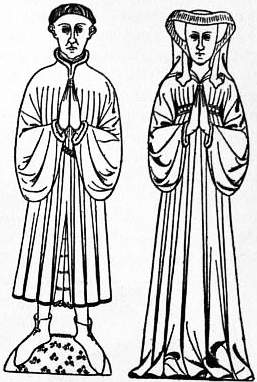
Fig. 36.—A Gentleman and his Wife. (From a brass of 1435.)
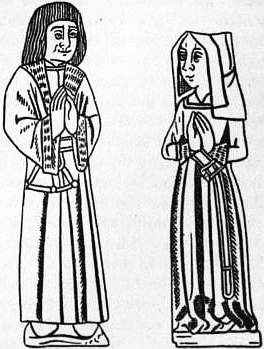
Fig. 37.—A Gentleman and his Wife. (From a brass of 1508.)
Drawn from a photo by Mansell. Fig. 38.—The Earl of Surrey (late in reign of Henry VIII.).
Women’s dress in the 15th century often follows the man’s fashion of the furred gown, the skirts being lengthened for all difference. But the close-bodied and close-sleeved gown, with skirts broadening into many folds below the hips, is often seen with the long and plain cloak drawn with a cord at the breast, widows wearing this dress with the barbe, a crimped cloth of linen drawn up under the chin and ears and covering the collar-bone. With the barbe went the kerchief, draping head and shoulders. The bossed cauls of the earlier head-dress, drawn high on either side of the head until face and head-dress took the shape of a heart, are characteristic of the age (fig. 36). In some cases the cauls are drawn out at the sides to the form of a pair of bulls’ horns or of a mitre set sideways. In the time of Edward IV. we have a popular head-dress to which has been given the name of the butterfly. The hair in its caul is pulled backward, and wires set in it allow the ends of a cambric veil to float behind like the wings of a butterfly settled on a flower.
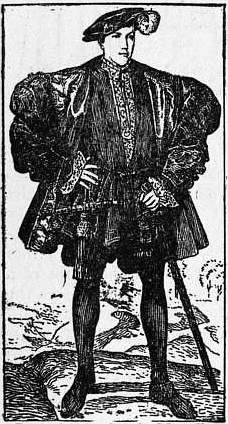
The new England of the 16th century breaks with the past in most of its fashions. Never again does an Englishman return to the piked shoes. High fashion under Henry VIII. is all for broad toes, so broad that the sumptuary laws, from The 16th century. banning long toes, swing about to condemn excess in the new guise. Under Henry VII. the medieval influence is still strong in the body-clothing. A bravely dressed man will go in long hose, cut close to the body, and a short vest under which the shirt is seen at waist and wrist. Over this he will wear the open gown, lined with fur, and cut short as a jacket but having the sleeves hanging below the knee. Such sleeves are commonly slashed open at the sides to allow the forearm to pass through. Shorter false sleeves of this pattern had become popular in the age of Edward IV. Graver men will wear, in place of this short gown, a long one dropping to the broad shoe-toes, the sleeves wide-mouthed (fig. 37). Sometimes it hangs loosely; sometimes it has the girdle with purse and beads. Notaries and scriveners add to the girdle a penner, or pen-case, and a stoppered ink-bottle. Wide hats are found, crowned with huge plumes of feathers, but the characteristic headgear is that made familiar by portraits of Henry VII., a low-crowned cap whose upturned brim is nicked at one side. A few sober men wear coats differing little from the short gown of forty years before. Among ladies the butterfly head-dress and the steeple cap passed out of fashion, and a grave headgear comes in which has been compared with a dog-kennel, a hood-cap thrown over head and shoulders, the front being edged with a broad band which was often enriched with needlework, the ends falling in lappets to the breast. This band is stiffened until the face looks out as from the open gable-end of a house. The gown is simple in form, close-fitting to the body, the cuffs turned up with fur and the skirts long. A girdle is worn loosely drawn below the waist, its long strap letting the metal pendant fall nearly to the feet. Long cloaks, plainly cut, are gathered at the neck with a pair of long cords, like tasselled bell-pulls. While Henry VIII. is spending his father’s hoards we have a splendid court, gallantly dressed in new fashions. His own broad figure, in cloth of gold, velvet and damask, plaits, puffs and slashes, stiff with jewels, is well known through scores of portraits, and may stand for the high-water mark of the modes of his age. The Hampton Court picture of the earl of Surrey is characteristic of a great lord’s dress of a somewhat soberer style (see fig. 38). The king, proud of his own broad shoulders, set the fashion to accent this breadth, and it will be seen that the earl’s figure, leaving out the head and hose, all but fills a perfect square. Such men have the air of playing-card knaves. Surrey’s cap is flat, with a rich brooch and a small side-feather. His short doublet of the new style is open in front to show a white shirt covered with black embroidery whose ruffles cover his wrists. His over-garment or jerkin has vast sleeves, rounded, puffed and slashed. Under the doublet are seen wide trunk-breeches. He goes all in scarlet, even to the shoes, which are of moderate size. The girdle carries a sword with the new guard and a dagger of the Renascence art, graced with a vast tassel. All is in the new fashion, nothing recalling the earlier century save the hose and the immodest braguette which, seen in the latter half of the fourteen-hundreds, is defiantly displayed in the dress and armour of this age of Henry VIII. Even the hair follows the new French mode and is cropped close. Other fashionable suits of the time give us the tight doublets, loose upper sleeves and trunk hose as a mass of small slashes and puffs, a fashion which came in from the Germans and Switzers whom Henry saw in the imperial service. Such clothing goes with the shoes whose broad toes are slashed with silk, and the wide and flat caps with slashed edges, bushed with feathers, which headgear was often allowed to hang upon the shoulders by a pair of knotted bonnet-strings, while a skull-cap covered the head. With all this fantasy the dress of simpler folk has little concern, and a man in a plain, short-skirted doublet, with a flat cap, trunk breeches, long hose and plain shoes, has nothing grotesque or unserviceable in his attire. The new sumptuary laws, which were not allowed to become a dead letter, had their influence in restraining middle-class extravagance. No man under a knight’s degree was to wear a neck-chain of gold or gilded, or a “garded or pinched shirte.” Brooches of goldsmith’s work were for none below a gentleman. Women whose husbands could not afford to maintain a light horse for the king’s service had no business with gowns or petticoats of silk, chains of gold, French hoods, or bonnets of velvet. This French hood is the small bonnet, two of whose many forms may be seen in the best-known portraits of Mary of England and Mary, queen of Scots—a cap stiffened with wires. With its introduction the fashionable skirt began to lose its graceful folds and to spread stiffly outward in straight lines from the tight-laced waist, the front being open to show a petticoat as stiff and enriched as the skirt. The neck of the gown, cut low and square, showed the partlet of fine linen pleated to the neck. In the days of Edward VI. and Queen Mary the dress of most men and women loses the fantastic detail of the earlier Tudor age. In the dress of both sexes the joining of the sleeve to the shoulder has, as a rule, that large puff which stage dressmakers bestow so lavishly upon all old English costumes, but otherwise the woman’s gown and hood and the man’s doublet, jerkin and trunk hose are plain enough, even the shoes losing all the fanciful width. Mary, indeed, added to the statute book more stringent laws against display of rich apparel, laws that would fine even a gentleman of under £20 a year if silk were found in his cap or shoe. Small ruffs, however, begin to appear at the neck, and most wrists are ruffled. The ruff, which began simply enough in the first half of this century as a little cambric collar with a goffered edge, is for all of us the distinguishing note of Elizabethan dress. It grew wide and flapping, therefore it was stiffened upon wires and spread from a concealed frame, row on row of ruffs being added one above the other until the wearer, man or woman, seemed to carry the head in a cambric charger. Starch, cursed as a devilish liquor by the new Puritan, gave it help, and English dress acquired a deformity which can only be compared with the great farthingale or with the last follies of the wig. The skirt of a woman of fashion, which had already begun to jut from the waist, was drawn out before the end of Elizabeth’s reign at right angles from the waist until the dame had that air of standing within a great drum which Sir Roger de Coverley remarked in the portrait of an ancestress. Elizabeth herself, long-waisted and of meagre body, set the fashions of her court, other women pinching their waists into the long and straight stomacher ending in a peak before. She herself followed her father’s taste in ornament, and on great days was set about like the Madonna of a popular shrine with decorations of all kinds, patterns in pearl, quiltings, slashings, puffings and broidery, tassels and rich buttons. Among men the important change is the disappearance of the last of the long hose, all men taking to trunk-hose and nether-stocks or stockings, while their doublets tend to follow the same long-waisted fashion as the bodices of the women, whose doublets and jerkins, buttoned up the breast, bring the Puritan satirists against them. Of these satirists Philip Stubbes is the best-known, his Anatomie of Abuses, published in 1583, being a very wardrobe of Elizabethan fashions, although false or dyed hair, the ruff and its starch, and the ear-rings worn by some women and many men draw his hottest anger. William Harrison sings on a like note about the same time, declaiming especially against the mutability of fashion, declaring that the imported Spanish, French and German guises made it easier to inveigh against such enormities than to describe the English attire with any certainty. For him women were become men, and men transformed into monsters. “Neither was it ever merrier with England than when an Englishman was known abroad by his own cloth and contented himself at home with his fine carsey hosen and a mean slop; his coat, gown and cloak of brown, blue or puke, with some pretty furniture of velvet or fur and a doublet of sad tawny or black velvet or other comely silk, without such cuts and garish colours as are worn in these days, and never brought in but by the consent of the French, who think themselves the gayest men when they have most diversities of jags and change of colours about them.” He adds that “certes of all estates our merchants do least alter their attire ... for albeit that which they wear be very fine and costly, yet in form and colour it representeth a great piece of the ancient gravity appertaining to citizens and burgesses.” But as for the “younger sort” of citizens’ wives, Harrison finds in their attire “all kind of curiosity ... in far greater measure than in women of a higher calling.”
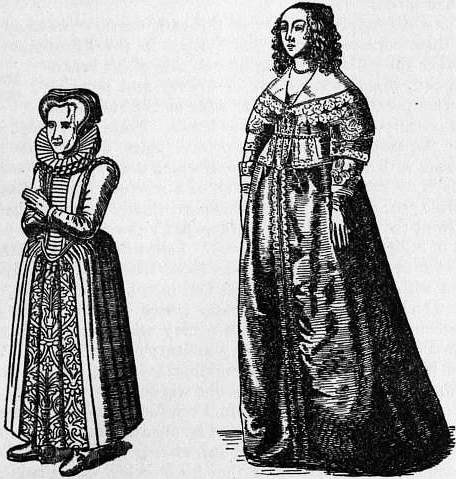
Fig. 39.—An English Lady. From a brass of 1605. Fig. 40.—An English Lady of rank in 1643. After Hollar.
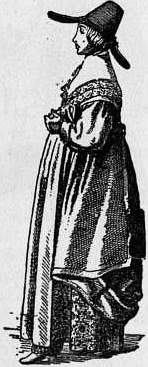
Fig. 41.—The English Countrywoman of 1643. After Hollar.
The coming of King James is not marked by any sudden change of attire, most of the Elizabethan fashions running on into his reign. The tight doublet has stiff wings at the shoulders, close sleeves and short skirt. The many fashions of breeches are still 17th century. popular, most of them padded or stuffed. There are trunk hose that have the air of petticoats rolled inward half way up the thigh. There is the “great round abominable breech,” pegtop shaped from below the knee to waist, as it appears in the well-known print of James himself with hawk on fist. Among women of fashion obtained a remarkable mode of exposing the breast, when the ruff and bodice were cut away; and the wheel fardingale was still worn, an order against it in 1613 rather increasing than diminishing its size. But simpler fashions were setting in, and with the reign of Charles I. the extravagances of padding and slashing disappear. The ruff gives place at last to the falling band, a wide collar of lace or plain linen. The belt or girdle ceases to be common wear, save for those who hang a sword from it. Parties in the state come to be known by their dress, and we have the Puritan, his crop head covered by a wide-brimmed, high-crowned felt, without hatband or feather, and his plain falling band over a staidly-cut coat. Beside him we set the cavalier, lace at his band edge, wrist and wide boot tops. His hat is feathered, his doublet lets the fine cambric of the shirt be seen at the waist, his short breeches are fringed with points or tags. His long hair has one lock brought over the left shoulder to be marked as a lovelock by a ribbon at the end. But the clothing of this age has been illustrated by Van Dyck and by a hundred other portrait painters, who as illustrators of costume take the place of the monumental sculptors, then less commonly called on for an effigy in the habit of life. And the time of the Commonwealth passes without notable change. Those who were in power favoured a sober habit, although we find General Harrison in scarlet and clinquant matching with Colonel Hutchinson in courtly apparel, and before the Restoration the tract-writers find matter of condemnation, especially in the items of patches, hair-powder and face paints.
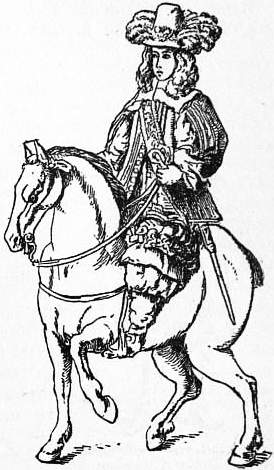
Fig. 42.—A Squire of a Knight of the Bath at the Crowning of Charles II.
So far as the court was concerned, King Charles II. brought in the extravagant fashions of the courtiers of Louis XIV. The short-waisted doublets with loose sleeves slashed open at the sides, the short and wide petticoat breeches, their lining lower than the petticoat edge and tied below the knee, and the hose whose tops bagged over the garter, were in England before King Charles returned. He added to the breeches the rows of looped ribbons, gave falling ruffles to the knees of the hose and many feathers to the hat. The long, narrow-bladed rapier hung in a broad, embroidered belt, passed over the right shoulder, and the high-heeled shoes and knots of ribbons. Lely painted the women of this court in a studied negligence, but many pictures show us the loose sleeves turned up to the elbow with bows of ribbon, the close bodice ending in a loose gown worn over a full skirted petticoat, a wide collar covering the shoulders.
Pepys is our chief authority for the remarkable resolution of Charles to change the fashion of his dress to one which he would never alter, a decision which the king communicated to his council in October 1666. On the 15th of that month the diarist noted that “this day the king begins to put on his vest, and I did see several persons of the House of Lords and Commons too, great courtiers, who are in it; being a long cassocke close to the body, of black cloth and pinked with white silk under it, and a coat over it, and the legs ruffled with black riband like a pigeon’s leg ... a very fine and handsome garment.” Rugge’s diary records the same change to “a close coat of cloth pinkt, with a white taffety under the cutts. This in length reached the calf of the leg, and upon that a sercoatt cutt at the breast, which hung loose and shorter than the vest six inches. The breeches the Spanish cut, and buskins, some of cloth, some of leather, but of the same colour as the vest or garment.” Says Evelyn, “a comely and manly habit, too good to hold.” Later in the same month Pepys saw the court “all full of vests, only my Lord St Albans not pinked, but plain black; and they say the king says the pinking upon whites makes them look too much like magpies, and therefore hath bespoke one of plain velvet.” The change, although the court was fickle, is of the first importance in the history of costume, for we have here the coat and waistcoat in a form from which our own coats and waistcoats derive without a break. Another important change affects dress for a century and a half. Just as costume begins to take the modern path we have the wig or peruke, strangest of all the fantasies of fashion, introduced as the wear for all men of standing. Pepys, the son of a tailor and a man with a shy affection for fine clothing, may again here be quoted. On a Sunday in February 1661 he “began to go forth in my coat and sword, as the manner now among gentlemen is.” In November 1663 he takes another step with fashion, going to the periwig-maker to have his hair cut off and to put on his first periwig, for which he paid 3l, another to be made up of the hair with which he had parted. The next day he wore the periwig to his office, and “no great matter was made of it.” Two days later my Lord Sandwich “wondered at first to see me in my peruque,” but even in church Pepys found that he drew little attention in the new guise. The same month the duke of York announced that he would wear the periwig, “and they say the king also will.” Thus began this costly and inconvenient mode. At home and at their ease men commonly replaced the wig with a soft silk or velvet “night-cap,” and the coat with a “morning gown” like our modern dressing gown. Powder, which had been dusted about the hair by a few courtiers and fashionable folk since the reign of Elizabeth, was used by most wearers of the wig. Hair “dressed with a powder” was often seen in London under the Commonwealth, and now the great periwig brought powder into frequent use.
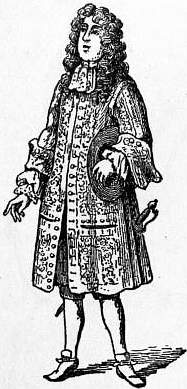
Fig. 43.—A Gentleman of the Privy Chamber at the Crowning of James II.
Before the end of the 17th century the periwig reached its greatest height and breadth, the curls of a fine gentleman towering in a mass above the brow and flowing far down over the shoulders or nigh to the waist. Guardsmen wore them tossing over their corslets, although a smaller variety, the campaign wig, had been introduced for war or travel. Many portraits of this age show its locks contrasting strangely with the soldier’s steel breastplate and pauldrons, but it must be remembered that martial gentlemen would often choose to be painted in armour although such harness was disappearing from actual use.
Under James II. the coat adopted in the late reign was firmly established as the principal garment of a well-dressed man. Gowns remained but to make a ceremonial dress for the great officers of state, for the judges and the London liverymen, for such, indeed, as those who wear them in our own days. As for “the comely cloak, altogether used in the beginning of my time,” Randle Holme notes that it was “now scarce used but by old and grave persons.” The coat was sometimes buttoned down the front but was more often thrown open to display the waistcoat, a lesser coat with skirts. The great turned over cuffs were now below the elbow, although there was good space for the display of the ruffle, and at the neck was the large cravat with laced ends. After the battle of Steinkirk, in 1692, to which the young French nobles hastened with disarranged neckcloths, the cravat was sometimes worn twisted, the ends passed through a ring, although the word Steinkirk was in later years often carelessly given to the neckcloth worn in any style. For riding, the big jack-boot of earlier days, with spurs and broad spur-leathers, remained in fashion, although the bell-shaped tops were turned up and not down. Boots, however, were riding-gear. Gondomar, the Spanish ambassador to James I., had laughed over the citizens of London “all booted and ready to go out of town,” but this custom died away, and a man in boots showed that he was for the road. William III.’s grave court was not one in which new fashions flourished, but it is remarkable that feminine modes take curious variety before the century end. Long-waisted and straitly cut stays were worn, the gown sleeve is short as the coat-sleeve of a Charles II. courtier. The gown itself has the skirts gathered to show the petticoat, and small aprons fringed with lace are often seen. The simple head-dresses of the Restoration are changed for caps with long lace lappets, or for a cap whose top-knot or commode stood up stiff and fan-shaped like a section cut out of an old ruff. When no commode was worn, a loose hood, thrown gracefully over the head and gathered at the shoulders, sometimes took its place. As a riding or walking dress, ladies of quality often wore coats, waistcoats, hats and cravats, not to be distinguished from those of their lords.
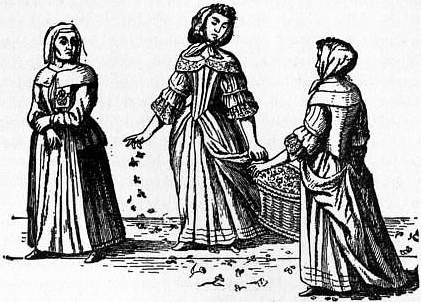
Fig. 44.—The Herbwoman and her Maids at the Crowning of James II.
For a distinguishing note of the 18th century, we may take the three-cornered cocked hat. Even in the Elizabethan age we have the gallant cocking up one side of his broad-brimmed, high-crowned felt or beaver and securing The 18th century. it with a jewel. Brims were as wide at the end of the 17th century, but the crown was lower. From the French court came the fashion of cocking up three sides, one at least being fastened with a loop of ribbon from which developed the cockade. A black cockade became the sign of a military man in England before 1750, and the same ornament, highly conventionalized, is now at the side of the tall hats worn by the grooms and coachmen of military and naval officers. Following varying fashions, the 18th-century cocked hat was laced with gold and silver or edged with feathers. It was cocked in a hundred forms, from that which has three sides slightly curled upward to the great Khevenhueller cock, wherewith a very wide-brimmed hat was flapped up at the front and rear, a military or martial hat. Wigs, worn by all the upper- and middle-class men, were generally powdered, but the lesser or Ramillie wig soon drove out the huge and costly full-bottomed periwig, even for ceremonial occasions. Of Lord Bolingbroke it is told that he once attended Queen Anne in haste with a tie or Ramillie wig on his head. Her Majesty showed her displeasure by remarking that his lordship would next come to court in a night-cap. Nevertheless, the tie-wig soon became court wear, secured at the back with a huge bow of ribbon below which hung the plaited pigtail, worn waist-long about 1740. But by that time young bloods were leaving campaign-wigs for the bob-wig which sat yet more closely to the head, the curls leaving the neck uncovered. Bag-wigs, found early in the century, covered the looped up pigtail in a black silk bag. Clergymen and grave physicians affected the full-bottomed wig after it became old fashioned. Subject to slight changes, eagerly followed by the beaux and mocked by the satirists, the habit of well-dressed men shows no great variety—the large-cuffed, collarless coats whose full skirts are now shortened, now lengthened, the long waistcoat to match, the closely fitting breeches, the stockings, the shoes and jack-boots. The coat tends to be thrown open to show the waistcoat, upon which brocade and embroideries were lavished. Stockings, until the middle of the century, were commonly drawn over the ends of the breeches and gartered below the knee. By 1740 the long cravat with hanging ends grows old fashioned. Young men take to the solitaire, a black cravat which became a mere loop of ribbon passed loosely round the neck and secured to the black tie of the wig.
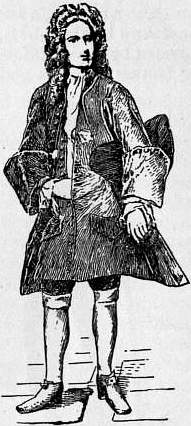
Fig. 45.—An English Gentleman (c. 1730).
George III.’s long reign begins with men’s fashions little changed from those of his great-grandfather’s time, although his sixty years carry us to the beginning of all the modern modes. The small wig long holds its own. The coat begins to show the broad skirts cut away diagonally from the waist to the skirt edge, and stockings are no longer rolled over the knee. Perhaps the most remarkable fashion was that which distinguished the Macaronis, travelled exquisites with whom the wig or long hair was dragged high above the forehead in a tall “toupee” with two large rows of curls at the side. This head-dress, clubbed into a heavy knot behind, was surmounted by a very little hat. The coat with small cuffs was much cut away before, the skimped skirts reaching midway down the thigh. Waistcoat flaps were but little below the waist. Breeches, striped or spotted like those of a Dresden china shepherd, were fastened at the knee with a bunch of ribbon ends; a watch-guard hung from each fob. The shirt-front was frilled and a white cravat was tied in a great bow at the chin. Macaronis wore a little curved hanger, or replaced the sword with a long, heavily tasselled cane, which served to lift the little hat off the topmost peak of the toupee. The woman-Macaroni wore no hoop but in full dress. Her gown was a loose wrapper, the sleeves short and wide with many ruffles, the skirt pulled aside to show a petticoat laced and embroidered with flowers. But her distinguishing mark was her head-dress, which exaggerated the male fashion, towering upward until the flowers and feathers at the top threatened the candelabra of the assembly room. The Macaronis appear about 1772 and stay but a short while, for the revolutionary fashions tread upon their heels.
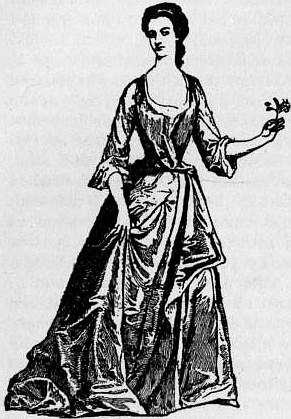
Fig. 46.—An English Lady (c. 1730).
Women’s dress in this 18th century is dominated by the hoop-petticoat which Sir Roger de Coverley recognizes in 1711 as a new fashion and an old one revived. A stiff bodice laced in front, a gown, with short and wide-ended sleeves, gathered up in folds above the petticoat, a laced apron and a lace cap with hanging lappets, is the dress of the century’s beginning. So the women of fashion are compared with children in go-carts, their tight-laced waists rising from vast bells of petticoats over which the gown is looped up like a drawn curtain. By 1750 the hoop-petticoat ringed with whalebone is so vast that architects begin to allow for its passage up London stairways by curving the balusters outward. Great variety of women’s dress appears under George II., but those in the height of the mode affected a shepherdess simplicity in their walking clothes, wearing the flat-crowned or high-crowned hats and long aprons of the dairymaid. At this time a new fashion comes in, the sacque, a gown, sometimes sleeveless, open to the waist, hanging loosely from the shoulders to near the edge of the hoop-petticoat. George III.’s reign saw women’s head-dressings reach an extravagance of folly passing all that had come before it. Hair kneaded with pomatum and flour was drawn up over a cushion or pad of wool, and twisted into curls and knots and decorated with artificial flowers and bows of ribbon. As this could not be achieved without the aid of a skilled barber, the “head” sometimes remained unopened for several weeks. At the end of that time sublimate powder was needed to kill off the tenantry which had multiplied within. At the beginning of the last quarter of the century the feathers grew larger, chains of beads looped about the curls, while ships in full sail, coaches and horses, and butterflies in blown glass, rocked upon the upper heights. Loose mob-caps or close “Joans” were worn in undress, often as simple as the full dress was fantastic. Varieties of the gown and sacque remained in fashion, the petticoat being still much in evidence, flounced or quilted, or festooned with ribbons. Before the ’eighties of this century were over, a new taste, encouraged by the painters of the school of Reynolds, began to sweep away many follies, and the revolutionary fashions of France, breaking with all that spoke of the old régime, expelled many more. The age of powder and gold lace, of peach-bloom brocade coats with muff-shaped cuffs, of bag-wigs and three-cornered hats drew suddenly to an end. Mr Pitt killed hair-powder by his tax of 1795, but before that time fashionable men, who since the beginning of George III’s. reign had been somewhat inconstant to the wig, were wearing their own hair unpowdered and tied in a club at the back of the coat collar. Before the century end the roughly cropped “Brutus” head was seen. The wig remained here and there on some old-fashioned pates. Bishops wore it until far into the Victorian age, and it may still be seen in the Houses of Parliament and in the courts of law. Even breeches were passing, tight pantaloons showing themselves in the streets. The coat, cut away over the hips, began to take a high collar and the beginnings of the lappel. Its cuffs were of the modern shape, showing a narrow ruffle. The waistcoat ended at the waist. Loose neck-cloths were worn above a frilled shirt-front. Great jack-boots were given to postillions, and men of fashion walked the streets in short top-boots of soft black leather. Most remarkable of the revolutionary changes, the round hat came back, sometimes in a form which recalled the earlier 17th century, and at last took shape as the predecessor of our modern silk hat. Court dresses kept something of their magnificence, but men at home or in the streets were giving up in this time of change their ancient right to wear rich and figured stuffs. Laces and embroideries were henceforward but for military and civil uniforms.
Before 1790 women had begun to dismantle their high headgear, returning to nature by way of a frizzled bush, like a bishop’s wig, with a few curls hanging over the shoulders. Over such heads would be seen towering mob-caps tied with ribbon and edged deeply with lace. Skirts took a moderate size and even court hoops were but panniers hung on either side of the hips. Short jackets with close half-sleeves were worn with the neck and breast covered with a cambric buffant that borrowed a mode from the pouter pigeon. A riding habit follows as far as the short waist the new fashions for men’s coats, the wide-brimmed hat being to match. Short waists came in soon after 1790, the bodice ending under the arm pits, “a petticoat tied round the neck: the arms put through the pocket-holes.” With these French gowns came small coal-scuttle-shaped bonnets of straw, hung with many ribbons and decorated with feathers. At last the woman of fashion, dressed by a Parisian modiste after the orders of David the painter, gathered her hair in a fillet and clothed herself in little more than a diaphanous tunic gown over a light shift and close, flesh-coloured drawers. Her shoes became sandals: her jewels followed the patterns of old Rome. Yet the same woman, shivering half-clad in something that wrapped her less than a modern bathing-dress, appeared at court in the ancient hoop-skirt, tasselled, ribboned and garlanded, hung with heavy swags of coloured silk, and this until George IV. at last broke the antique order by a special command.
The 19th century soon made an end of 18th century fashions already discredited by the revolutionary spirit. The three-cornered hat had gone, the heavy coat cuff and the cravat with hanging ends. Civilians had given up the 19th century. ancient custom of going armed with a sword. The wig and even the pigtail tied with black shalloon were abandoned by all but a few old folk. Soldiers cut off their pigtails in 1808. But judges and lawyers wear their wigs in court in the 20th century, state coachmen wear them on the box, and physicians and the higher clergy wore them even in the street long after laymen had given them up. George IV. refused to receive a bishop of London who appeared at court without a wig, and Sumner, archbishop of Canterbury, wore one until his death in 1862. A few powdered heads were seen as late as the ’forties. M. de Ste Aulaire, the ambassador, made, as Lord Palmerston writes, a very deep and general impression in London society of 1841, not because he wore hair-powder but because he used so much of it. It is now used only by a few lacqueys. In the early Victorian period the cropped “Brutus” head was out of fashion, many men wearing their hair rather long and so freely oiled that the “anti-macassar” came in to protect drawing-room chair-backs.