VOLUME VII SLICE IV Coquelin to Costume (continued 8)
Reading edition
At length, tired of struggling with adversaries unworthy of him, whom the court took care to multiply, he returned to Europe, hoping to confound his enemies. But Charles V. received him coldly. Cortes dissembled, redoubled the assiduity of his attendance on the emperor, accompanied him in the disastrous expedition to Algiers in 1541, served as a volunteer, and had a horse killed under him. This was his last appearance in the field, and if his advice had been followed the Spanish arms would have been saved from disgrace, and Europe delivered nearly three centuries earlier from the scourge of organized piracy. Soon afterwards he fell into neglect, and could scarcely obtain an audience. The story goes that, having forced his way through the crowd which surrounded the emperor’s carriage, and mounted on the door-step, Charles, astonished at an act of such audacity, demanded to know who he was. “I am a man,” replied the conqueror of Mexico proudly, “who has given you more provinces than your ancestors left you cities.” So haughty a declaration of important services ill-requited could scarcely fail to offend a monarch on whom fortune had lavished her choicest favours. Cortes, overwhelmed with disgust, withdrew from court, passed the remainder of his days in solitude, and died, near Seville, on the 2nd of December 1547.
The only writings of Cortes are five letters on the subject of his conquests, which he addressed to Charles V. The best edition of them is that of Don Francisco Antonio Lorenzana, archbishop of Mexico, entitled Historia de Nueva-España escrita par su esclarecido conquistador, Hernan Cortes, aumentada con otros documientos y notas (Mexico, 1770, 4to), a work the noble simplicity of which attests the truth of the recital it contains. An English translation of the letters, edited by Francis A. MacNutt, was published in 1908. The conquests of Cortes have been described with pompous elegance by Antonio de Solis in his Historia de la conquista de Mejico (1684), and with more truth and simplicity by Bernardo Diaz del Castillo in his work under the same title (1632). See also Sir Arthur Helps’s Life of Hernando Cortes (2 vols., London, 1871), F. A. MacNutt’s Fernando Cortes (“Heroes of the Nations” Series, 1909), and the bibliography to Mexico.
CORTES, a Spanish term literally signifying the “courts,” and applied to the states, or assembly of the states, of the kingdom. (See Spain and Portugal.)
CORTI, LODOVICO, Count (1823-1888), Italian diplomatist, was born at Gambarano on the 28th of October 1823. Early involved with Benedetto Cairoli in anti-Austrian conspiracies, he was exiled to Turin, where he entered the Piedmontese foreign office. After serving as artillery officer through the campaign of 1848, he was in 1850 appointed secretary of legation in London, whence he was promoted minister to various capitals, and in 1875 ambassador to Constantinople. Called by Cairoli to the direction of foreign affairs in 1878, he took part in the congress of Berlin, but unwisely declined Lord Derby’s offer for an Anglo-Italian agreement in defence of common interests. At Berlin he sustained the cause of Greek independence, but in all other respects remained isolated, and excited the wrath of his countrymen by returning to Italy with “clean hands.” For a time he withdrew from public life, but in 1881 was again sent to Constantinople by Cairoli, where he presided over the futile conference of ambassadors upon the Egyptian question. In 1886 he was transferred to the London embassy, but was recalled by Crispi in the following year through a misunderstanding. He died in Rome on the 9th of April 1888.
CORTLAND, a city and the county-seat of Cortland county, New York, U.S.A., in the central part of the state, on Tioughnioga river, at the junction of its E. and W. branches. Pop. (1890) 8590; (1900) 9014, of whom 682 were foreign born; (1905) 11,272;(1910) 11,504. It is served by the Delaware, Lackawanna & Western and the Lehigh Valley railways. The Franklin Hatch library and a state normal and training school (opened in 1869) are in Cortland. The city has important manufactories of wire, and wire-cloth and netting (one of the largest in America), cabs, carriages and waggons, iron and steel, wall-paper, dairy supplies, corundum wheels, and clothing. The value of the city’s factory products increased from $3,063,828 in 1900 to $4,574,191 in 1905 or 49.3%. The town of Cortlandville, which formed a part of the Phelps and Gorham Purchase, was first settled in 1792, and until 1829 was a part of the town of Homer; from which in the latter year it was separated, and made the county-seat. In 1900 the village of Cortland in the town of Cortlandville was chartered as a city.
See H. C. Goodwin, Cortland County and the Border Wars of New York (New York, 1859).
CORTONA, a town and episcopal see of Italy, in the province of Arezzo, 18 m. S. by E. from the town of Arezzo by rail. The ancient and modern names are identical. Pop. (1901) of town, 3579; commune, 29,296. The highest point of Cortona, a medieval castle (Fortezza), is situated 2130 ft. above sea-level on a hill commanding a splendid view, and is approached by a winding road. It is surrounded by its ancient Etruscan walls, which for the greater part of the circuit are fairly well preserved. They are constructed of parallelepipedal blocks of limestone, finely jointed (though the jointing has often been spoilt by weathering), and arranged in regular courses which vary in size in different parts of the enceinte. Near the N.W. angle some of the blocks are 7 to 8½ ft. long and 2½ ft. high, while on the W. side they are a good deal smaller—sometimes only 1 ft. high (see F. Noack in Römische Mitteilungen, 1897, 184). Within the town are two subterranean vaulted buildings in good masonry, of uncertain nature, some other remains under modern buildings, and a concrete ruin known as the “Bagni di Bacco.” The museum of the Accademia Etrusca, a learned body founded by Ridolfino Venuti in 1726, is situated in the Palazzo Pretorio; it contains some Etruscan objects, among which may be specially noted a magnificent bronze lamp with 16 lights, of remarkably fine workmanship, found in 1740, at the foot of the hill, two votive hands and a few other bronzes, and a little gold jewellery. The library has a good MS. of Dante. The cathedral, originally a Tuscan Romanesque building of the 11th-12th centuries, is now a fine Renaissance basilica restored in the 18th century, containing some paintings by Luca Signorelli, a native of the place. Opposite is the baptistery, with three fine pictures by Fra Angelico. S. Margherita, just below the Fortezza, is an ugly modern building occupying the site of a Gothic church of 1294, and containing a fine original rose window and reliefs from the tomb of the saint by Angelo e Francesco di maestro Pietro d’Assisi. Other works by Signorelli are to be seen elsewhere in the town, especially in S. Domenico; Pietro Berettini (Pietro da Cortona, 1596-1669) is hardly represented here at all. Below the town is the massive tomb chamber (originally subterranean, but now lacking the mound of the earth which covered it) known as the Grotta di Pitagora (grotto of Pythagoras). To the E. is the church of S. Maria del Calcinaio, a fine early Renaissance building by Francesco di Giorgio Martini of Siena, with fine stained glass windows.
The foundation of Cortona belongs to the legendary period of Italy. It appears in history as one of the strongholds of the Etruscan power; but in Roman times it is hardly mentioned. Dionysius’s statement that it was a colony (i. 26) is probably due to confusion.
See G. Dennis, Cities and Cemeteries of Etruria (London, 1883), ii. 394 seq.; A. Della Cella, Cortona Antica (Cortona, 1900).
(T. As.)
CORUMBÁ, a town and river port of Brazil on the W. bank of the Paraguay river, 1986 m. above Buenos Aires and 486 m. above the Paraguayan frontier. Pop. (1890) 8414. Corumbá is a fortified military post, has the large Ladario naval arsenal, where small river boats are built and repaired, and is the commercial entrepôt of the state of Matto Grosso. It is near the Bolivian frontier and is strongly garrisoned. Although the climate is extremely hot, the neighbouring country has many large cattle farms. Corumbá is one of the most important places in the interior of Brazil.
CORUNDUM, a mineral composed of native alumina (Al2O3). remarkable for its hardness, and forming in its finer varieties a valuable gem-stone. Specimens were sent from India to England in the 18th century, and were described in 1798 by the Hon. C. Greville under the name of corundum—a word which he believed to be the native name of the stone (Hindi, kurund; Tamil, kurundam; Sanskrit, kuruvinda, “ruby”). The finely coloured, transparent varieties include such gem-stones as the ruby and sapphire, whilst the impure granular and massive forms are known as emery. The term corundum is often restricted to the remaining kinds, i.e. those crystallized and crystalline varieties which are not sufficiently transparent and brilliant for ornamental purposes, and which were known to the older mineralogists as “imperfect corundum.” Such varieties were termed by J. Black, in consequence of their hardness, adamantine spar, but this name is now usually restricted to a hair-brown corundum, remarkable for a pearly sheen on the basal plane.
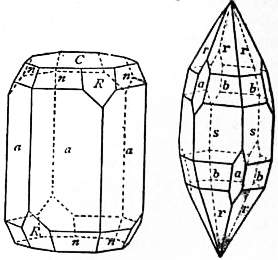
Fig. 1. Fig. 2.
Corundum crystallizes in the hexagonal system. In fig. 1, which is a form of ruby, the prism a is combined with a hexagonal pyramid n, a rhombohedron R, and the basal pinacoid C. In fig. 2, which represents a typical crystal of sapphire, the prism s is associated with the acute pyramids b, r, and a rhombohedron a. Other crystals show a tabular habit, consisting usually of the basal pinacoid with a rhombohedron, and it is notable that this habit is said to be characteristic of corundum which has consolidated from a fused magma. Corundum has no true cleavage, but presents parting planes due to the structure of the crystal, which have been studied by Prof. J. W. Judd.
Next to diamond, corundum is the hardest known mineral. Its hardness is generally given as 9, but there are slight variations in different stones, sapphire being rather harder than ruby, and ruby than common corundum. The colours are very varied, and it is probable that iron is responsible for many of the tints, though chromium is a possible agent in certain cases. The transparent varieties are often distinguished as “Oriental” stones. (See Ruby and Sapphire.) Corundum is used largely for watch-jewels, and for bearings in electrical apparatus.
The coloured corundums fit for gem-stones come chiefly from Ceylon, Burma, Siam and Montana. Coarse dull corundum is found in many localities, and usually has higher commercial value as an abrasive agent than emery, which is less pure. The coarse corundum, however, is often partially hydrated or otherwise altered, whereby its hardness is diminished. In India, where the native lapidaries use corundum-sticks and rubbers formed of the powdered mineral cemented with lac, it occurs in the Salem district, Madras, in Mysore and in Rewa. Large deposits of corundum exist in the United States, especially in N. Carolina and Georgia, where they are associated with peridotites, often near contact with gneiss. The mineral has been extensively worked, as at Corundum Hill, Macon county, N.C., near which, in 1871, were discovered numerous rubies, sapphires and pebbles of coarse corundum in the bed of a river. Corundum occurs also at many localities in Montana, where the crystals are often of gem quality. They are found mostly as loose crystals in gravel, but are known also in igenous rocks like andesite and lamprophyre. Prof. J. H. Pratt, who has studied the occurrence both in Montana and in N. Carolina, considers that the alumina was dissolved in a molten magma, from which it separated at an early period of consolidation, as illustrated by the experiments of J. Morozewicz. Corundum occurs also in Canada in an igneous rock, a nepheline-syenite, associated with Laurentian gneiss. Important deposits were discovered by the Geological Survey in 1896, in Hastings county, Ontario; and corundum is now worked there and in Renfrew county. New South Wales, Queensland and Victoria are other localities for corundum. The mineral is found also in the Urals and the Ilmen Mountains, in the Alps (in dolomite), in the basalts of the Rhine, and indeed as a subordinate rock-constituent corundum seems to enjoy a wide distribution, being found even in the British Isles.
See Joseph Hyde Pratt, “Corundum and its Occurrence and Distribution in the United States,” Bulletin U.S. Geol. Surv., No. 269 (1906); T. H. Holland, Economic Geology of India (2nd ed.), Part i. (1898).
(F. W. R.*)
CORUNNA, a maritime province in the extreme north-west of Spain; forming part of Galicia, and bounded on the E. by Lugo, S. by Pontevedra, W. and N. by the Atlantic Ocean. Pop. (1900) 653,556; area, 3051 sq. m. The coast of Corunna is exposed to the full force of the Atlantic; it forms one succession of fantastically shaped promontories, divided by bays and estuaries which often extend for many miles inland, with reefs and small islands in their midst. Though well lighted, this coast is very dangerous to navigation, gales and fogs being frequent in winter and spring. The most conspicuous headlands are Cape Ortegal and Cape de Vares, the most northerly points of the Spanish seaboard, and Capes Finisterre and Toriñana in the extreme west. The principal bays are those of Santa Marta, Ferrol and Corunna, on the north; Corcubion, Muros y Noya and Arosa, on the west. Wild and rugged though this region appears to travellers at sea, the mountains which overspread the interior are covered with forests and pastures, and watered by an abundance of small rivers and streams. The climate is mild and singularly equable, but the rainfall is very heavy. All the fruits and vegetables of northern Europe thrive in the sheltered valleys, and the cultivation of cherries, strawberries, peas and onions, for export, ranks among the most profitable local industries. Heavy crops of wheat, rye, maize and sugar-beet are raised. The wines of Corunna are heady and of inferior flavour. Cattle-breeding, once a flourishing industry, had greatly declined by the beginning of the 20th century, owing to foreign competition. All along the coast there are valuable fisheries of sardines, lobsters, cod, hake and other fish. Copper, tin and gold are procured in small quantities, and other minerals undoubtedly exist. The exports consist chiefly of farm produce and fish; the imports, of coal and textiles from England, petroleum from the United States, marble from Italy, salt fish from Norway and Newfoundland, and hides. The principal towns are Corunna, the capital and chief port (pop. 1900, 43,971); Ferrol (25,281), another seaport; Santiago de Compostela (24,120), famous as a place of pilgrimage; Carballo (13,032); Ortigueira (18,426) and Ribeira (12,218). These are described under separate headings. Along the coast there are numerous trading and fishing stations of minor importance. Railway communication is very defective. From Corunna a line passes south-eastward to Lugo and Madrid, and from Santiago another line goes southward to Vigo and Oporto; but the centre and the north-west of the province are, to a great extent, inaccessible except by road; and many, even of the main highways, are ill-constructed and ill-kept. Very few Spanish provinces have so high a birthrate, but the population increases very slowly owing to emigration. For a description of the peasantry, who are distinguished in may respects from those inhabiting other parts of Spain, see Galicia.
CORUNNA (Span. La Coruña; Fr. La Corogne; Eng. formerly often The Groyne), the capital of the province described above; in 43° 22′ N., and 8° 22′ W.; on the bay of Corunna, an inlet of the Atlantic Ocean. Pop. (1900) 43,971. The principal railways of north-western Spain converge on Corunna, and afford direct communication with Madrid and Oporto. Corunna consists of an upper and a lower town, built respectively on the eastern side of a small peninsula, and on the isthmus connecting the peninsula with the mainland. The upper town is the more ancient, and is still surrounded by walls and bastions, and defended by a citadel; but it has been gradually outgrown by the lower, which, though at first a mere fishing village, as its name of Pescaderia implies, is now comparatively well built, and has many broad and handsome streets. There is little remarkable in the public buildings, although the churches of Santiago and the Colegiata date respectively from the 12th and 13th centuries, and there are several convents, two hospitals, a palace for the captain-general of Galicia, a theatre, a school of navigation, an arsenal and barracks. The harbour is on the east. Though difficult to approach in stormy weather, it is completely sheltered, and accommodates vessels drawing 22 ft. It is defended by several forts, of which the most important are San Diego, on the east, and San Antonio, on the west. These fortifications are of little practical value on the landward side, as they are commanded by a hill which overlooks the town. The so-called Tower of Hercules, on the north, has been increased by modern additions to a height of nearly 400 ft., and is surmounted by a fine revolving light. Many foreign steamers call here, for emigrants or mails, on their way to South America. Upwards of 1200 merchant ships, mostly British, entered the port in 1905. The exports are chiefly agricultural produce, wine and fish; the imports are coal, colonial products, and manufactured goods. Chief among the industrial establishments is a state tobacco factory; the sardine and herring fisheries also employ a large number of the inhabitants.
Corunna, possibly at first a Phoenician settlement, is usually identified with the ancient Ardobrica, a seaport mentioned by the 1st-century historian, Pomponius Mela, as in the country of the Artabri, from whom the name of Portus Artabrorum was given to the bay on which the city is situated. In the middle ages, and probably at an earlier period, it was called Caronium; and this name is much more probably the origin of the present designation than the Latin Columna which is sometimes put forward. The harbour has always been of considerable importance, but it is only in comparatively modern times that it has made a figure in history. In 1588 it gave shelter to the Invincible Armada; in 1598 the town was captured and burned by the British under Drake and Norris. In 1747, and again in 1805, the bay was the scene of a naval victory of the British over the French; and on the 16th of January 1809 a battle took place in the neighbourhood, which is celebrated in British military annals (see Peninsular War). The French under Marshal Soult attempted to prevent the embarcation of the English under Sir John Moore, but were successfully repulsed in spite of their superior numbers. Moore was mortally wounded and died shortly afterwards. He was hastily buried in the ramparts near the sea; a monument in the Jardin de San Carlos raised by the British government commemorates his death. The town joined the revolutionary movement of 1820, but in 1823 it was forced to capitulate by French troops. In 1836 it was captured by the Carlists. Corunna suffered heavily when Spain was deprived of Cuba and Porto Rico by the Spanish-American War of 1898, for it had hitherto had a thriving trade with these colonies.
CORVÉE, in feudal law, the term used to designate the unpaid labour due from tenants, whether free or unfree, to their lord; hence any forced labour, especially that exacted by the state, the word being applied both to each particular service and to the system generally. Though the corvée formed a characteristic feature of the feudal system, it was, as an institution, much older than feudalism, and was already developed in its main features under the Roman Empire. Thus, under the Roman system, personal services (operae) were due from certain classes of the population not only to the state but to private proprietors. Apart from the obligations (operae officiales) imposed on freedmen as a condition of their enfranchisement, which in the country usually took the form of unpaid work on the landlord’s domain, the semi-servile coloni were bound, besides paying rent in money or kind, to do a certain number of days’ unremunerated labour on that part of the estate reserved by the landed proprietor. The state also exacted personal labour (operae publicae), in lieu of taxes, from certain classes for such purposes as the upkeep of roads, bridges and dykes; while the inhabitants of the various regions were responsible for the maintenance of the posting system (cursus publicus), for which horses, carts or labour would be requisitioned.
Under the Frankish kings, who in their administration followed the Roman tradition, this system was preserved. Thus for the repair of roads, or other public works, within their jurisdiction the counts were empowered to requisition the labour of the inhabitants of the pagus, while the missi and other public functionaries on their travels were entitled to demand from the population en route entertainment and the means of transport for themselves and their belongings. It was, however, the economic revolution which between the 6th and 10th centuries converted the Gallo-Roman estates into the feudal model, and the political conditions under which the officials of the Frankish empire developed into hereditary feudal nobles, that evolved the system of the corvée as it existed throughout the middle ages and, in some countries, survived far into the 19th century. The Roman estate had been cultivated by free farmers, by coloni, and by slave labour. Under Frankish rule the farmers became coloni or hospites, the slaves, serfs. The estate was now habitually divided into the lord’s domain (terra indominicata, dominicum) and a series of allotments (mansi), parcels of land distributed by lot to the cultivators of the domain, who held them, partly by payment of rent in money or kind, partly by personal service and labour on the domain, these obligations both as to their nature and amount being very rigorously defined and permanently fixed in the case of each mansus and passing with the land to each new tenant. They varied, of course, very greatly according to the size of the holding and the needs of the particular estate, but they possessed certain common characteristics which are everywhere found. Luchaire (Manuel, p. 346) divides all corvées into two broad categories, (1) corvées properly so called, (2) military services. The second of these, so far as the obligation to serve in the host (Hostis et equitatus) is concerned, was common to all classes of feudal society; though the obligation of villeins to keep watch and ward (gueta, warda) and to labour at the building or strengthening of fortifications (muragium, munitio castri) are special corvées. We are, however, mainly concerned with the first category, which may again be subdivided into two main groups, (1) personal service of men and women (manoperae, manuum operae, Fr. manœuvres, manual labour), (2) carriage (carroperae, carragia, carrata, &c., Fr. charrois), i.e. service rendered by means of carts, barrows or draught animals. These again were divided into fixed services (operae rigae) and exceptional services, demanded when the others proved insufficient. To these latter was given in the 8th century the name of operae corrogatae (i.e. requisitioned works, from rogare, to request.) From this term (corrupted into corvatae, curvadae, corveiae, &c.) is derived the word corvée, which was gradually applied as a general term for all the various services.
As to the nature of these corvées it must be noted that in the middle ages the feudal lords had replaced the centralized state for all administrative purposes, and the services due to them by their tenants and serfs, were partly in the nature of rent in the form of labour, partly those which under the Roman and Frankish monarchs had been exacted in lieu of taxes, and which the feudal lords continued to impose as sovereigns of their domains. To the former class belonged the service of personal labour in the fields, of repairing buildings, felling trees, threshing corn, and the like, as well as the hauling of corn, wine or wood; to the latter belonged that of labouring on the roads, of building and repairing bridges, castles and churches, and of carrying letters and despatches. Corvées were further distinguished as real, i.e. attached to certain parcels of land, and personal, i.e. due from certain persons.
In spite of the fact that the corvées were usually strictly defined by local custom and by the contracts of tenancy, and that, in an age when currency was rare, payment in personal labour was a convenience to the poor, the system was open to obvious abuses. With the growth of communal life in the towns the townsmen early managed to rid themselves of these burdensome obligations either by purchase, or by exchanging the obligation of personal work for that of supplying carts, draught animals and the like. In the country, however, the system survived all but intact; and, so far as it was modified, was modified for the worse. Whatever safeguards the free cultivators may have possessed, the serfs were almost everywhere—especially in the 10th and 11th centuries—actually as well as nominally in this respect at the mercy of their lords (corvéables à merci), there being no limit to the amount of money or work that could be demanded of them. The system was oppressive even when the nobles to whom these services were paid gave something in return, namely, protection to the cultivator, his family and his land; they became intolerable when the development of the modern state deprived the land-owners of their duties, but not of their rights. In the case of France, in the 17th century the so-called corvée royale was added to the burden of the peasants, i.e. the obligation to do unpaid labour on the public roads, an obligation made general in 1738; and this, together with the natural resentment of men at the fact that the land which their ancestors had bought was still subject to burdensome personal obligations in favour of people whom they rarely saw and from whom they derived no benefit, was one of the most potent causes of the Revolution. By the Constituent Assembly personal corvées were abolished altogether, while owners of land were allowed the choice of continuing real corvées or commuting them for money. The corvée as an incident of land tenure has thus disappeared in France. The corvée royale of repairing the roads, however, abolished in 1789, was revived, under the name of prestation, under the Consulate, by the law of 4 Thermidor an X., modified by subsequent legislation in 1824, 1836 and 1871. Under these laws the duty of keeping the roads in repair is still vested in the local communities, and all able-bodied men are called upon either to give three days’ work or its equivalent in money to this purpose. It is precisely the same system as that in force under the Roman Empire, and if it differ from the corvée it is mainly in the fact that the burden is equitably distributed, and that the work done is of actual value to those who do it.
As regards other countries, the corvée was everywhere, sooner or later, abolished with the serfdom of which it was the principal incident (see Serfdom). Though so early as 1772 Maria Theresa had endeavoured to mitigate its hardships in her dominions (in Hungary unpaid labour was only to be demanded of the serfs on 52 days in the year!) it survived longest in the Austrian empire, being finally abolished by the revolution of 1848. The duty of personal labour on the public roads is, however, still maintained in other countries besides France. This was formerly the case in England also, where the occupiers of each parish who, by the common law, had access to the roads were responsible also for their upkeep. An act of 1555 imposed four days of forced labour for the repair of roads, and an act of Elizabeth (5 Eliz. c. 13) raised the number of days to six, or the payment of a composition instead. The system of turnpikes, dating from 1663, which gradually extended over the whole of England, lessened the burden of this system of taxation, so far as main roads were concerned, but the greater number of the local roads were subject to repair by statutory labour until the Highways Act 1835, by which highways were put under the direction of a parish surveyor, and the necessary expenses met by a rate levied on the occupiers of land. In Scotland, statutory labour on highways was created by an act of 1719, and abolished in 1883.
In Egypt, the corvée has been employed from time immemorial, more especially for the purpose of cleaning out the irrigation canals. In the days when only one harvest a year was reaped, this forced labour was not a very great burden, but the introduction of cotton and the sugar-cane under Mehemet Ali changed the conditions. These latter are crops which require watering at various seasons of the year, and very often the fellah was called away for work in the canals at times when his own crops required the utmost attention. Moreover, the inequality of the corvée added to the evil. In some districts it was possible to purchase exemption, and the more wealthy paid no more for the privilege than the humblest fellah, consequently the corvée fell with undue hardship on the poorer classes. Under the premiership of Riaz Pasha the corvée was gradually abolished in Egypt between the years 1888 and 1891, and a small rate on the land substituted to provide the labour necessary for cleaning the canals. The corvée is now employed only to a limited extent to guard the banks of the Nile during flood.
See Du Cange, Glossarium inf. et med. Lat. s.v. “Corvatae”; A Luchaire, Manuel des institutions françaises (Paris, 1892), pp. 346-349; La Grande Encyclopédie, s.v., with bibliography. For further works see the bibliography to the article Serfdom.
CORVEY, a place in the Prussian province of Westphalia, on the Weser, a mile north of the town of Höxter, with which it communicates by an avenue of lime trees. During the middle ages it was famous for its great Benedictine abbey, which was founded and endowed by the emperor Louis the Pious about 820, and received its name from having been first occupied by a body of monks coming from Corbie in Picardy. The bones of St Vitus, the patron saint of Saxony, were removed thither according to legend in 836, but apart from this attraction, Corvey became the centre of Christianity in Saxony and a nursery of classical studies. The abbot was a prince of the Empire, and Corvey was made a bishopric in 1783. In 1803 the abbey was secularized, in 1815 its lands were given to Prussia, and in 1822 they were bestowed on Victor Amadeus, landgrave of Hesse-Rotenburg, by whom they were bequeathed, in 1834, to Prince Victor of Hohenlohe-Schillingsfürst, duke of Ratibor. The abbey, which is now used as a residence, possesses a magnificent library of 150,000 volumes especially rich in old illustrated works, though the ancient collection due to the literary enthusiasm of the Benedictines is no longer extant. Here in 1517 the manuscript of the five first books of the Annals of Tacitus was discovered. Here Widukind wrote his Res gestae Saxonicae. Here, also, the librarian and poet Hoffmann von Fallersleben lived and worked. The Annales Corbejenses 648-1148 of the monks can be read in the Monumenta Germaniae historica, Band iii. The Chronicon Corbejense, published by A. C. Wedekind in 1823, has been declared by S. Hirsch and Waitz (Kritische Prüfung, Berlin, 1839) to be a forgery.
See P. Wigand, Geschichte der Abtei Korvey (Höxter, 1819); and M. Meyer, Zur ältern Geschichte Corveys und Höxters (Paderborn, 1893).
CORVINUS, JÁNOS [John] (1473-1504), illegitimate son of Matthias Hunyadi, king of Hungary, and one Barbara, supposed to be the daughter of a burgess of Breslau. He took his name from the raven (corvus) in his father’s escutcheon. Matthias originally intended him for the Church, but on losing all hope of offspring from his consort Queen Beatrice, determined, towards the end of his life, to make the youth his successor on the throne. He loaded him with honours and riches, till he was by far the wealthiest magnate in the land. He publicly declared him his successor, created him a prince with vast apanages in Silesia, made the commandants of all the fortresses in the kingdom take an oath of allegiance to him, and tried to arrange a marriage for him with Bianca Maria Sforza of Milan, a project which was frustrated by the intrigues of Queen Beatrice. Matthias also intended to make the recognition of János as prince royal of Hungary by the emperor Frederick a condition precedent of relinquishing all or part of the conquered hereditary domains of the house of Habsburg; but his sudden death left the matter still pending, and the young prince suddenly found himself alone in the midst of enemies. The inexperienced and irresolute youth speedily became the victim of the most shameful chicanery. He was first induced formally to resign his claims to the throne, on the understanding that he was to be compensated with the crown of Bosnia. He was then persuaded to retire southwards with the royal treasures which Matthias had confided to him, whereupon an army immediately started in pursuit, scattered his forces, and robbed him of everything. Meanwhile the diet had elected Vladislav of Bohemia king (July 15, 1490), to whom János hastened to do homage, in order to save something from the wreck of his fortunes. He was also recognized as prince of Slavonia and duke of Troppau, but compelled to relinquish both titles five years later. On the invasion of Hungary by Maximilian, he shewed his loyalty to the crown by relinquishing into the hands of Vladislav the three important fortresses of Pressburg, Komárom and Tata, which had been entrusted to him by his father. But now, encouraged by his complacency, the chief dignitaries, headed by the palatine Stephen Zapolya, laid claim to nearly all his remaining estates and involved him in a whole series of costly processes. This they could do with perfect impunity, as they had poisoned the mind of the indolent and suspicious king against their victim. In 1496 Corvinus married Beatrice, the daughter of Bernard Frangepán. His prospects now improved, and in 1498 he was created perpetual ban of Croatia and Slavonia. From 1499 to 1502 he successfully defended Bosnia against the Turks, and in the following year aspired to the dignity of palatine, but was defeated by a combination of Queen Beatrice and his other enemies. He died on the 12th of October 1504, leaving one son, Prince Christopher, who died on the 17th of March 1505.
See Gyula Schönherr, János Corvinus Hunyadi (Hung.) (Budapest, 1894).
(R. N. B.)
CORVUS, MARCUS VALERIUS (c. 370-270 B.C.), Roman general of the early republican period. According to the legend a raven settled on his helmet during his combat with a gigantic Gaul, and distracted the enemy’s attention by flying in his face. He was twice dictator and six times consul, and occupied the curule chair twenty-one times. In his various campaigns he defeated successively the Gauls, the Volscians, the Samnites, the Etruscans and the Marsians. His most important victory (343) was over the Samnites at Mount Gaurus.
See Livy vii. 26-42, x. 2-11.
CORWEN (“the white choir”), a market town of Merionethshire, Wales, on branches of the London & North Western and the Great Western railways; 10 m. from Llangollen, through the Glyn Dyfrdwy (Dee Vale). Pop. (1901) 2680. Telford’s road, raised on the lower Berwyn range side and overlooking the Dee, opens up the picturesqueness of Corwen, historically interesting from the reminiscences of Wales’s last struggle for independence under Owen Glendower. In the old parish church was traditionally Owen’s pew; his knife, fork and dagger, are at the neighbouring Rûg (Rhûg); his palace, 3 m. distant at Sychnant (dry stream). Here is the church dedicated to St Julian, archbishop of St David’s (d. 1009), with “the college,” an almshouse endowed by William Eyton of Plâs Warren, Shropshire. The old British fort, Caer Drewyn, one of a chain of forts from Dyserth to Canwyd, is the supposed scene of Glendower’s retreat under Henry IV., and here Owen Cwynedd is said to have prepared to repulse Henry II. To the N.E. are the Clwyd hills; to the S. the Berwyn range, to the S.W. Arran Mawddy and Cadair (Cader) Idris; to the W. the two Arenigs; to the N.W. Snowdon. Corwen is a favourite station for artists and anglers. Besides the Dee, there are several streamlets, such as the Trystion, which forms the Rhaiadr Cynwyd (waterfall), the Ceudiog, and the Alwen.
CORWIN, THOMAS (1794-1865), American statesman and orator, was born in Bourbon county, Kentucky, on the 29th of July 1794. In 1798 his father, Matthias Corwin (1761-1829), removed to what later became Lebanon, Ohio, where the son worked on a farm, read much, and in 1817 was admitted to the bar. As an advocate he was at once successful, but after 1831 he devoted his attention chiefly to politics, identifying himself first with the Whig and after 1858 with the Republican party. He was a member of the lower house of the Ohio legislature in 1821, 1822 and 1829, and of the national House of Representatives from 1831 to 1840; was governor of Ohio in 1840-1842; served in the United States Senate from 1845 to 1850; was secretary of the treasury in the cabinet of President Fillmore in 1850-1853; was again a member of the national House of Representatives from 1859 to 1861; and from 1861 to 1864 was minister of the United States to Mexico—a position of peculiar difficulty at that time. As a legislator he spoke seldom, but always with great ability, his most famous speech being that of the 11th of February 1847 opposing the Mexican War. In 1860 he was chairman of the House “Committee of Thirty-three,” consisting of one member from each state, and appointed to consider the condition of the nation and, if possible, to devise some scheme for reconciling the North and the South. He is remembered chiefly as an orator. Many anecdotes have been told to illustrate his kindliness, his inimitable humour, and his remarkable eloquence. He died at Washington, D.C., on the 18th of December 1865.
See the Life and Speeches of Thomas Corwin (Cincinnati, 1896), edited by Josiah Morrow; and an excellent character sketch, Thomas Corwin (Cincinnati, 1881), by A. P. Russell.
CORY, WILLIAM JOHNSON (1823-1892), English schoolmaster and author, son of Charles Johnson of Torrington, Devonshire, was born on the 9th of January 1823. He was educated at Eton and King’s College, Cambridge. At Cambridge he gained the chancellor’s medal for an English poem on Plato in 1843, and the Craven Scholarship in 1844. In 1845, after graduating at the university, he was made an assistant master at Eton, where he remained for some twenty-six years. He has been called “the most brilliant Eton tutor of his day.” He had a great influence on his pupils, and he defended the Etonian system against the criticism of Matthew James Higgins. In 1872, having inherited an estate at Halsdon and assumed the name of Cory, he left Eton. He married late in life, and after four years spent in Madeira he settled in 1882 at Hampstead. He died on the 11th of June 1892. He proved his genuine lyrical power in Ionica (1858), which was republished with some additional poems in 1891. He also produced Lucretilis (1871), a work on the writing of Latin verses; Iophon (1873), on Greek Iambics; and Guide to Modern History from 1815 to 1835 (1882). Extracts from the Letters and Journals of William Cory, which contains much paradoxical and suggestive criticism, were edited by F.W. Cornish and published by private subscription in 1897.
His elder brother, Charles Wellington Johnson Furse (1821-1900), who, on the death of his father in 1854, took the name of Furse, was canon and archdeacon of Westminster from 1894 till his death. The artist Charles Wellington Furse, A.R.A. (1868-1904), was a son of Archdeacon Furse.
CORYATE, THOMAS (1577?-1617), English traveller and writer, was born at Odcombe, Somersetshire, where his father, the Rev. George Coryate, prebendary of York Cathedral, was rector. Educated at Westminster school and at Oxford, he became a kind of court fool, eventually entering the household of Prince Henry, the eldest son of James I. In 1611 he published a curious account of a prolonged walking tour undertaken in 1608, under the title of Coryate’s Crudities hastily gobbled up in Five Months Travels in France, Italy, &c. At the command of Prince Henry, verses in mock praise of the author, and intended originally to persuade some bookseller to undertake the publication of the Crudities, were added to the volume. These commendatory verses, written in a number of languages, and some in a mixture of languages, by Ben Jonson, Donne, Chapman, Drayton and others, were afterwards published (1611) by themselves as the Odcombian Banquet. The book contains a clear and interesting account of Coryate’s travels, and, being the first of its kind, was extremely popular. It is now very rare, and the copy in the Chetham library is said to be the only perfect one. In the same year was published a second volume of a similar kind, Coryats Crambe, or his Coleworte twice Sodden. In 1612 he set out on another journey, which also was mostly performed on foot. He visited Greece, the Holy Land, Persia and India; from Agra and Ajmere he sent home an account of his adventures. Some of his letters were published in 1616 under the title of Letters from Asmere, the Court of the Great Mogul, to several Persons of Quality in England, and some fragments of his writings were included in Purchas his Pilgrimes in 1625. Coryate was a curious and observant traveller; he gives accounts of inscriptions he had copied, of the antiquities of the towns he passed through, and of manners and customs, from the Italian pronunciation of Latin to the new-fangled use of forks. He acquired a knowledge of Turkish, Persian and Hindustani in the course of his travels, and on being presented by the English ambassador, Sir Thomas Roe, to the Great Mogul, he delivered a speech in Persian. His journeys were performed at small expense, for he says that he spent only three pounds between Aleppo and Agra, and often lived “competently” for a penny a day. Coryate died at Surat in 1617.
Coryate’s Crudities, with his letters from India, was reprinted from the edition of 1611 in 1776, and at the Glasgow University Press (2 vols., 1905). The Odcombian Banquet was ridiculed by John Taylor, the Water Poet, in his Laugh and be Fat, or a Commentary on the Odcombian Banket (1613) and two other satires.
CORYBANTES (Gr. Κορύβαντες), in Greek mythology, half divine, half demonic beings, bearing the same relation to the Asiatic Great Mother of the Gods that the Curetes bear to Rhea. From their first appearance in literature, they are already often identified or confused with them, and are distinguished only by their Asiatic origin and by the more pronouncedly orgiastic nature of their rites. Various accounts of their origin are given: they were earth-born, sons of Cronus, sons of Zeus and Calliope, sons of Rhea, of Ops, of the Great Mother and a mystic father, of Apollo and Thalia, of Athena and Helios. Their names and number were as indistinct even to the ancients as those of the Curetes and Idaean Dactyli. Like the Curetes, Dactyli, Telchines and Cabeiri (q.v.), however, they represent primitive gods of procreative significance, who survived in the historic period as subordinate deities associated with a form of the Great Mother goddess, their relation to the Great Mother of the Gods, Cybele, being comparable with that of Attis (q.v.). They may have been represented or impersonated by priests in her rites as Attis was, but they were also, like him, not actual priests in the first instance, but objects of worship in which a frenzied dance, with accompaniment of flute music, the beating of tambourines, the clashing of cymbals and castanets, wild cries and self-infliction of wounds—the whole culminating in a state of ecstasy and exhaustion—were the most prominent features. The dance of the Corybantic priests, like that of the priests who represented the Curetes, may have originated in a primitive faith in the power of noise to avert evil. Its psychic effect, both upon the dancer and upon the mystic about whom he danced during the initiation of the Cybele-Attis mysteries, made it a widely known and popular feature of the cult.
In art the Corybantes appear, usually not more than two or three in number, fully armed and executing their orgiastic dance in the presence of the Great Mother, her lions and Attis. They sometimes appear with the child Dionysus, between whose cult and that of the Mother there was a close affinity.
(G. Sn.)
CORYDON, a town and the county-seat of Harrison county, Indiana, U.S.A., on Indian Creek, about 21 m. W. by S. of Louisville, Kentucky. Pop. (1900) 1610; (1910) 1703. Corydon is served by the Louisville, New Albany & Corydon railway, which connects at Corydon Junction, 8 m. N., with the Southern railway. There are sulphur springs here, and the town is a summer and health resort. Wyandotte Cave is several miles W. of Corydon. Corydon is in an agricultural region, and there are valuable quarries in the neighbourhood; among the town’s manufactures are waggons, and building and lithographic stone. Corydon was settled about 1805, and was the capital of Indiana Territory from 1813 to 1816, and of the state until 1824. The convention which framed the first state constitution met here in June 1816. The original state house, an unpretentious two-storey stone building, is still standing. Corydon was captured by the Confederates during Gen. Morgan’s raid on the 9th of July 1863.
CORYPHAEUS (from Gr. κορυφήkoruphê, the top of the head), in Attic drama, the leader of the chorus. Hence the term (sometimes in an Anglicized form “coryphe”) is used for the chief or leader of any company or movement. In 1856 in the university of Oxford there was founded the office of Coryphaeus or Praecentor, whose duty it was to lead the musical performances directed by the Choragus (q.v.). The office ceased to exist in 1899.
COS, or Stanko (Ital. Stanchio, Turk. Istan-keui, by corruption from Εἰς τὰν Κῶ), an island in that part of the Turkish archipelago which was anciently known as the Myrtoan Sea, not far from the south-western corner of Asia Minor, at the mouth of the Gulf of Halicarnassus, or Bay of Budrum. Its total length is about 25 m. and its circumference about 74. Its population is estimated at about 10,000, of whom nearly all are Greeks.
A considerable chain of mountains, known to the ancients as Oromedon, or Prion, extends along the southern coast with hardly a break except near the island of Nisyros; so that the greatest versant and most important streams turn towards the north. The whole island is little more than a mass of limestone, and consequently unites great aridity in the drier mountain regions with the richest fertility in the alluvial districts. As the attention of the islanders is mainly directed to the culture of their vineyards, which yield the famous sultana raisins, a considerable proportion of the arable land is left untouched, though wheat, barley and maize are sown in some quarters, and melons and sesamum seed appear among the exports. The Cos lettuce is well known. Fruit, especially grapes, is exported in large quantities to Egypt, mostly in local sailing boats. The wild olive is abundant enough, but neglected; and cotton, though it thrives well, is grown only in small quantities. As the principal harbour, in spite of dredging operations, is fit only for smaller vessels, the island is not of so much commercial importance as it would otherwise be; but since 1868 it has been regularly visited by steamers. The only town in the island is Cos, or Stanko, at the eastern extremity, remarkable for its fortress, founded by the knights of Rhodes, and for the gigantic plane-tree in the public square. The fortress preserves in its walls a number of interesting architectural fragments. The plane-tree has a circumference of about 30 ft., and its huge and heavy branches have to be supported by pillars; of its age there is no certain knowledge, but the popular tradition connects it with Hippocrates. The town is supplied by an aqueduct, about 4 m. in length, with water from a hot chalybeate spring, which is likewise named after the great physician of the island. The villages of Pyli and Kephalas are interesting, the former for the Greek tomb of a certain Charmylos, and the latter for a castle of the knights of St John and the numerous inscriptions that prove that it occupies the site of the chief town of the ancient deme of Isthmos. The most interesting site on the island is the precinct of Asclepius, which was excavated in 1900-1904 on the slope of Mount Prion, about 2 m. from the town of Cos. It consists of three terraces, the uppermost containing a temple, a cypress grove and porticoes; the middle, which is the earliest portion, two or three temples, an altar, and other buildings; and the lower a kind of sacred agora enclosed by porticoes. The precinct had been enlarged and reconstructed at various times. The earliest buildings on the middle terrace probably date from the 6th century B.C. The temple on the upper terrace, with the imposing flight of steps by which it is approached, seems to belong to the 2nd century B.C. when the whole precinct was enlarged and reconstructed. After a destructive earthquake, the whole appears to have been rebuilt by Xenophon, the physician and poisoner of the emperor Claudius. The final destruction was brought about by the earthquake of A.D. 554. Among other things the precinct contains a fountain of water with medicinal properties. It is doubtful whether this water is brought from Burinna, the famous fountain of Hippocrates in the mountain above.
History.—Cos was a Dorian colony with a large contingent of settlers from Epidaurus who took with them their Asclepius cult and made their new home famous for its sanatoria. The other chief sources of the island’s wealth lay in its wines, and in later days, in its silk manufacture. Its early history is obscure. During the Persian wars it was ruled by tyrants, but as a rule it seems to have been under an oligarchic government. In the 5th century it joined the Delian League, and after the revolt of Rhodes served as the chief Athenian station in the south-eastern Aegean (411-407). In 366 a democracy was instituted. After helping, in the Social War (357-355), to weaken Athenian power it fell for a few years to the Carian prince Maussollus. In the Hellenistic age Cos attained the zenith of its prosperity. Its alliance was valued by the kings of Egypt, who used it as an outpost for their navy to watch the Aegean. As a seat ef learning it rose to be a kind of provincial branch of the museum of Alexandria, and became a favourite resort for the education of the princes of the Ptolemaic dynasty; among its most famous sons were the physician Hippocrates, the painter Apelles, the poets Philetas and, perhaps, Theocritus (q.v.). Following the lead of its great neighbour, Rhodes, Cos generally displayed a friendly attitude towards the Romans; in A.D. 53 it was made a free city. In A.D. 1315 it was occupied by the Knights of St John; in 1523 it passed under Ottoman sway. Except for occasional incursions by corsairs and some severe earthquakes the island has rarely had its peace disturbed.
Authorities.—L. Ross, Reisen nach Kos, &c. (Halle, 1852), pp. 11-29, and Reisen auf den griechischen Inseln (Stuttgart, 1840-1845), ii. 86 ff.; O. Rayet, Mémoire sur l’île de Cos (Paris, 1876); M. Dubois, De Co Insula (Paris and Nancy, 1884); W. Paton and E. Hicks, The Inscriptions of Cos (Oxford, 1891); B. V. Head, Historia Numorum (Oxford, 1887), pp. 535-537; Archäol. Anzeiger, 1905, i.; for coins see also Numismatics: Greek, § “Calymna and Cos.”
(E. Gr.; M. O. B. C.)
COSA, an ancient city of Etruria, on the S.W. coast of Italy, close to the Via Aurelia, 4½ m. E.S.E. of the modern town of Orbetello. Apparently it was not an independent Etruscan town, but was founded as a colony by the Romans in the territory of the Volceientes, whom they had recently conquered, in 273 B.C. The town was strongly fortified, and the walls, about a mile in circuit, with three gates, and seventeen projecting rectangular towers at intervals, are in places preserved to a height of over 30 ft. on the outside, and 15 on the inside. The lower part is built of polygonal, the upper of rectangular, blocks, and the masonry is of equal fineness all through, so that a difference of date cannot be assumed; such a change of technique is not without parallel in Greece (F. Noack in Römische Mitteilungen, 1897, 194). Within the city no remains are visible. The place was of importance as a fortress; it was approached by a branch road which diverged from the Via Aurelia at the post station of Succosa, at the foot of the hill on which the town stood. The harbour, too, was of some importance. In the 5th century we hear of it as deserted, and in the 9th a town called Ansedonia took its place for a short time, but itself soon perished, though it has left its name to the ruins.
See G. Dennis, Cities and Cemeteries of Etruria (London, 1883), ii. 245.
(T. As.)
COSEL, or Kosel, a town of Germany, in the Prussian province of Silesia, at the junction of the Klodnitz and the Oder, 29 m. S.E. of Oppeln by rail. Pop. (1905) 7085. It has an Evangelical and a Roman Catholic church, an old château and a grammar-school (Progymnasium). Its industries are of some importance, including a manufactory of cellulose (employing 1200 hands), steam saw- and flour-mills and a petroleum refinery. There is a lively trade by river.
The first record of Cosel dates from 1286. From 1306 to 1359 it was the seat of an independent duchy held by a cadet line of the dukes of Teschen. In 1532 it fell to the emperor, was several times besieged during the Thirty Years’ War, and came into Prussian possession by the treaty of Breslau in 1742. Frederick II. converted it into a fortress, which was besieged in vain by the Austrians in 1758, 1759, 1760 and 1762. In 1807 it withstood another siege, by the Bavarian allies of Napoleon. The fortifications were razed and their site converted into promenades in 1874.
COSENZ, ENRICO (1812-1898), Italian soldier, was born at Gaeta, on the 12th of January 1812. As captain of artillery in the Neapolitan army he took part in the expedition sent by Ferdinand II. against the Austrians in 1848; but after the coup d’état at Naples he followed General Guglielmo Pepe in disobeying Ferdinand’s order for the withdrawal of the troops, and proceeded to Venice to aid in defending that city. As commandant of the fort of Marghera, Cosenz displayed distinguished valour, and after the fall of the fort assumed the defence of the Piazzale, where he was twice wounded. Upon the fall of Venice he fled to Piedmont, where he remained until, in 1859, he assumed the command of a Garibaldian regiment. In 1860 he conducted the third Garibaldian expedition to Sicily, defeated two Neapolitan brigades at Piale (August 23), and marched victoriously upon Naples, where he was appointed minister of war, and took part in organizing the plébiscite. During the war of 1866 his division saw but little active service. After the war he repeatedly declined the portfolio of war. In 1881, however, he became chief of the general staff, and held that position until a short time before his death at Rome on the 7th of August 1898.
COSENZA (anc. Consentia), a town and archiepiscopal see of Calabria, Italy, the capital of the province of Cosenza, 755 ft. above sea-level, 43 m. by rail S. by W. of Sibari, which is a station on the E. coast railway between Metaponto and Reggio. Pop. (1901) town, 13,841; commune, 20,857. It is situated on the slope of a hill between the Crati and Busento, just above the junction, and is commanded by a castle (1250 ft.). The Gothic cathedral, consecrated in 1222, on the site of another ruined by an earthquake in 1184, goes back to French models in Champagne, and is indeed unique in Italy. It contains the Gothic tomb of Isabella of Aragon, wife of Philip III. of France, and also the tomb of Louis III., duke of Anjou; but it has been spoilt by restoration both inside and out. S. Domenico has a fine rose window. The Palazzo del Tribunale (law courts) is a fine building, and the upper town contains several good houses of rich proprietors of the province; while the lower portion is unhealthy. Earthquakes, and a fire in 1901, have done considerable damage to the town.
The ancient Consentia is first named as the burial place of Alexander of Epirus in about 330 B.C. In 204 it became Roman, though it was more under the influence of Greek culture. It is mentioned by Strabo as the chief town of the Bruttii, and frequently spoken of in classical authors as an important place. It lay on the Via Popillia. Varro speaks of its apple trees which gave fruit twice in the year and Pliny praises its wine also. It is the more surprising that in the whole of its territory no inscriptions, either Greek or Latin, have ever been found, those that are recorded by some writers being fabrications. in A.D. 410 Alaric fell in battle here and was buried, it is said, in the bed of the Busento, which was temporarily diverted and then allowed to resume its natural course. Cosenza became an archbishopric in the 11th century. In 1461 it was taken by Roberto Orsini, and suffered severely. It was the home of a scientific academy founded by the philosopher Bernardino Telesio (1509-1588). In 1555-1561 it was the centre of the persecution by the Inquisition of the Waldenses who had settled there towards the end of the 14th century.
(T. As.)
COSHOCTON, a city and the county-seat of Coshocton county, Ohio, U.S.A., at the confluence of the Tuscarawas and the Walhonding rivers, with the Muskingum river, and about 70 m. E.N.E. of Columbus. Pop. (1890) 3672; (1900) 6473 (364 foreign-born); (1910) 9603. It is served by the Pennsylvania, the Pittsburg, Cincinnati, Chicago & St Louis (controlled by the Pennsylvania), and the Wheeling & Lake Erie railways. The city is built on a series of four broad terraces, the upper one of which has an elevation of 824 ft. above sea-level, and commands pleasant views of the river and the valley. It has a public library. Coshocton is the commercial centre of an extensive agricultural district and has manufactories of paper, glass, flour, china-ware, cast-iron pipes and especially of advertising specialities. The municipality owns and operates its water-works. Coshocton occupies the site of a former Indian village of the same name—the chief village of the Turtle tribe of the Delawares. This village was destroyed by the whites in 1781. The first settlement by whites was begun in 1801; and in 1802 the place was laid out as a town and named Tuscarawas. In 1811, when it was made the county-seat, the present name was adopted. Coshocton was first incorporated in 1833.
COSIN, JOHN (1594-1672), English divine, was born at Norwich on the 30th of November 1594. He was educated at Norwich grammar school and at Caius College, Cambridge, where he was scholar and afterwards fellow. On taking orders he was appointed secretary to Bishop Overall of Lichfield, and then domestic chaplain to Bishop Neile of Durham. In December 1624 he was made a prebendary of Durham, and in the following year archdeacon of the East Riding of Yorkshire. In 1628 he took his degree of D.D. He first became known as an author in 1627, when he published his Collection of Private Devotions, a manual stated to have been prepared by command of Charles I., for the use of the queen’s maids of honour.1 This book, together with his insistence on points of ritual in his cathedral church and his friendship with Laud, exposed him to the suspicions and hostility of the Puritans; and the book was rudely handled by William Prynne and Henry Burton. In 1628 Cosin took part in the prosecution of a brother prebendary, Peter Smart, for a sermon against high church practices; and the prebendary was deprived. In 1634 Cosin was appointed master of Peterhouse, Cambridge; and in 1640 he became vice-chancellor of the university. In October of this year he was promoted to the deanery of Peterborough. A few days before his installation the Long Parliament had met; and among the complainants who hastened to appeal to it for redress was the ex-prebendary, Smart. His petition against the new dean was considered; and early in 1641 Cosin was sequestered from his benefices. Articles of impeachment, were, two months later, presented against him, but he was dismissed on bail, and was not again called for. For sending the university plate to the king, he was deprived of the mastership of Peterhouse (1642). He thereupon withdrew to France, preached at Paris, and served as chaplain to some members of the household of the exiled royal family. At the Restoration he returned to England, was reinstated in the mastership, restored to all his benefices, and in a few months raised to the see of Durham (December 1660). At the convocation in 1661 he played a prominent part in the revision of the prayer-book, and endeavoured with some success to bring both prayers and rubrics into completer agreement with ancient liturgies. He administered his diocese with conspicuous ability and success for about eleven years; and applied a large share of his revenues to the promotion of the interests of the Church, of schools and of charitable institutions. He died in London on the 15th of January 1672.
Cosin occupies an interesting and peculiar position among the churchmen of his time. Though a ritualist and a rigorous enforcer of outward conformity, he was uncompromisingly hostile to Roman Catholicism, and most of his writings illustrate this antagonism. In France he was on friendly terms with Huguenots, justifying himself on the ground that their non-episcopal ordination had not been of their own seeking, and at the Savoy conference in 1661 he tried hard to effect a reconciliation with the Presbyterians. He differed from the majority of his colleagues in his strict attitude towards Sunday observance and in favouring, in the case of adultery, both divorce and the re-marriage of the innocent party. He was a genial companion, frank and outspoken, and a good man of business.
Among his writings (most of which were published posthumously) are a Historia Transubstantiationis Papalis (1675), Notes and Collections on the Book of Common Prayer (1710) and A Scholastical History of the Canon of Holy Scripture (1657). A collected edition of his works, forming 5 vols. of the Oxford Library of Anglo-Catholic Theology, was published between 1843 and 1855; and his Correspondence (2 vols.) was edited by Canon Ornsby for the Surtees Society (1868-1870).
COSMAS, of Alexandria, surnamed from his maritime experiences Indicopleustes, merchant and traveller, flourished during the 6th century A.D. The surname is inaccurate, since he never reached India proper; further, it is doubtful whether Cosmas is a family name, or merely refers to his reputation as a cosmographer. In his earlier days he had sailed on the Red Sea and the Indian Ocean, visiting Abyssinia and Socotra and apparently also the Persian Gulf, western India and Ceylon. He subsequently became a monk, and about 548, in the retirement of a Sinai cloister, wrote a work called Topographia Christiana. Its chief object is to denounce the false and heathen doctrine of the rotundity of the earth, and to vindicate the scriptural account of the world. Photius, who had read it, calls it a “commentary on the Octateuch” (meaning the eight books of Ptolemy’s great geographical work; according to some, the first eight books of the Old Testament). According to Cosmas the earth is a rectangular plane, covered by the vaulted roof of the firmament, above which lies heaven. In the centre of the plane is the inhabited earth, surrounded by ocean, beyond which lies the paradise of Adam. The sun revolves round a conical mountain to the north—round the summit in summer, round the base in winter, which accounts for the difference in the length of the day. Cosmas is supposed by some to have been a Nestorian. Although not to be commended from a theological standpoint, the Topographia contains some curious information. Especially to be noticed is the description of a marble seat discovered by him at Adulis (Zula) in Abyssinia, with two inscriptions recounting the heroic deeds and military successes of Ptolemy Euergetes and an Axumitic king. It also contains in all probability the oldest Christian maps. From allusions in the Topographia Cosmas seems to have been the author of a larger cosmography, a treatise on the motions of the stars, and commentaries on the Psalms and Canticles. Photius (Cod. 36) speaks contemptuously of the style and language of Cosmas, and throws doubt upon his truthfulness. But the author himself expressly disclaims any claims to literary elegance, which in fact he considers unsuited to a Christian circle of readers, and the accuracy of his statements has been confirmed by later travellers.
The Topographia will be found in Migne, Patrologia Graeca, lxxxviii.; an edition by G. Siefert is promised in the Teubner series. See H. Gelzer, “Kosmas der Indienfahrer,” in Jahrbücher für protestantische Theologie, ix. (1883) and C. R. Beazley, The Dawn of Modern Geography, i. (1897). There is an English translation, with introduction and notes, by J. W. McCrindle (1897), published by the Hakluyt society.
COSMAS, of Prague (1045-1125), dean of the cathedral and the earliest Bohemian historian. His Chronicae Bohemorum libri iii., which contains the history and traditions of Bohemia up to nearly the time of his death, has earned him the title of the Herodotus of his country. This work, which his continuators brought down to the year 1283, is of the highest value to historians in spite of the fact that its reputation for disingenuousness and credibility has been greatly affected by the critical attacks of J. Loserth (Studien zu Cosmas von Prag, Vienna, 1880, &c.).
The work was first published at Hanover in 1602, from the imperfect Strassburg codex. A perfected edition was brought out at the same place in 1607; this was reprinted, with notes by C. G. Schwarz in I. B. Menckenius, Scriptores rer. Germ. (3 vols., Lips., 1728-1730). It is included in Pelzel and Dobrowsky, Script. rer. Bohem. i. pp. 1-282, after collation with Dresden MS., edited very fully by R. Köpke in Mon. Germ. Hist. Scrip. ix. 1-132, and repeated in Migne, Patrol. lat. clxvi. pp. 55-388, and in Fontes rer. Bohem. ii. (1874), 1-370 (Latin and Czech), by W. Wl. Tomek. See A. Potthast, Bibliotheca Hist. Med. Aevi.
COSMATI, the name of a Roman family, seven members of which, for four generations, were skilful architects, sculptors and workers in mosaic. The following are the names and dates known from existing inscriptions:—
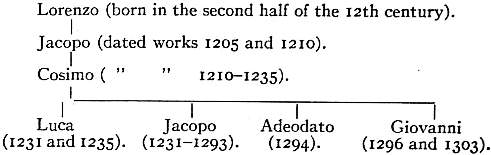
Their principal works in Rome are: ambones of S. Maria in Ara Coeli (Lorenzo); door of S. Saba, 1205, and door with mosaics of S. Tommaso in Formis (Jacopo); chapel of the Sancta Sanctorum, by the Lateran (Cosimo); pavement of S. Jacopo alla Lungara, and (probably) the magnificent episcopal throne and choir-screen in S. Lorenzo fuori le Mura, of 1254 (Jacopo the younger); baldacchino of the Lateran and of S. Maria in Cosmedin, c. 1294 (Adeodato); tombs in S. Maria sopra Minerva (c. 1296), in S. Maria Maggiore, and in S. Balbina (Giovanni). The chief signed works by Jacopo the younger and his brother Luca are at Anagni and Subiaco. A large number of other works by members and pupils of the same family, but unsigned, exist in Rome. These are mainly altars and baldacchini, choir-screens, paschal candlesticks, ambones, tombs and the like, all enriched with sculpture and glass mosaic of great brilliance and decorative effect.
Besides the more mechanical sort of work, such as mosaic patterns and architectural decoration, they also produced mosaic pictures and sculpture of very high merit, especially the recumbent effigies, with angels standing at the head and foot, in the tombs of Ara Coeli, S. Maria Maggiore and elsewhere. One of their finest works is in S. Cesareo; this is a marble altar richly decorated with mosaic in sculptured panels, and (below) two angels drawing back a curtain (all in marble) so as to expose the open grating of the confessio. The magnificent cloisters of S. Paolo fuori le Mura, built about 1285 by Giovanni, the youngest of the Cosmati, are one of the most beautiful works of this school. The baldacchino of the same basilica is a signed work of the Florentine Arnolfo del Cambio, 1285, “cum suo socio Petro,” probably a pupil of the Cosmati. Other works of Arnolfo, such as the Braye tomb at Orvieto (q.v.), show an intimate artistic alliance between him and the Cosmati. The equally magnificent cloisters of the Lateran, of about the same date, are very similar in design; both these triumphs of the sculptor-architect’s and mosaicist’s work have slender marble columns, twisted or straight, richly inlaid with bands of glass mosaic in delicate and brilliant patterns. The shrine of the Confessor at Westminster is a work of this school, executed about 1268. The general style of works of the Cosmati school is Gothic in its main lines, especially in the elaborate altar-canopies, with their pierced geometrical tracery. In detail, however, they differ widely from the purer Gothic of northern countries. The richness of effect which the English or French architect obtained by elaborate and carefully worked mouldings was produced in Italy by the beauty of polished marbles and jewel-like mosaics—the details being mostly rather coarse and often carelessly executed.
An excellent account of the Cosmati is given by Boito, Architettura del media evo (Milan, 1880), pp. 117-182.
COSMIC (from Gr. κόσμος, order or universe), pertaining to the universe, universal or orderly. In ancient astronomy, the word “cosmical” means occurring at sunrise, and designates especially the rising or setting of the stars at that time. “Cosmical physics” is a term broadly applied to the totality of those branches of science which treat of cosmical phenomena and their explanation by the laws of physics. It includes terrestrial magnetism, the tides, meteorology as related to cosmical causes, the aurora, meteoric phenomena, and the physical constitution of the heavenly bodies generally. It differs from astrophysics only in dealing principally with phenomena in their wider aspects, and as the products of physical causes, while astrophysics is more concerned with minute details of observation.
COSMOGONY (from Gr. κόσμος, world and γίγνεσθαι, to be born), a theory, however incomplete, of the origin of heaven and earth, such as is produced by primitive races in the myth-making age, and is afterwards expanded and systematized by priests, poets or philosophers. Such a theory must be mythical in form, and, after gods have arisen, is likely to be a theogony (θεός, god) as well as a cosmogony (Babylonia, Egypt, Phoenicia, Polynesia).
1. To many the interest of such stories will depend on their parallelism to the Biblical account in Genesis i.; the anthropologist, however, will be attracted by them in proportion as they illustrate the more primitive phases of human culture. In spite of the frequent overgrowth of a luxuriant imagination, the leading ideas of really primitive cosmogonies are extremely simple. Creation out of nothing is nowhere thought of, for this is not at all a simple idea. The pre-existence of world-matter is assumed; sometimes too that of heaven, as the seat of the earth-maker, and that of preternatural animals, his coadjutors. The earth-making process may, among the less advanced races, be begun by a bird, or some other animal (whence the term “theriomorphism”), for the high idea of a god is impossible, till man has fully realized his own humanity. Of course, the earth-forming animal is a preternaturally gifted one, and is on the line of development towards that magnified man who, in a later stage, becomes the demiurge.1 Between the two comes the animal—man, i.e. a being who has not yet shed the slough of an animal shape, but combines the powers—natural and preternatural—of some animal with those of a man. Let us now collect specimens of the evidence for different varieties of cosmogony, ranging from those of the Red Indian tribes to that of the people of Israel.
2. North American Stories.—Theriomorphic creators are most fully attested for the Red Indian tribes, whose very backwardness renders them so valuable to an anthropologist. There is a painted image from Alaska, now in the museum of the university of Pennsylvania, which represents such an one. We see a black crow tightly holding a human mask which he is in the act of incubating. Let us pass on to the Thlinkît Indians of the N.W. coast. A cycle of tales is devoted to a strange humorous being called Yehl or Yelch, i.e. the Raven, miraculously born, not to be wounded, and at once a semi-developed creator and a culture hero.2 His bitter foe is his uncle; the germs of dualism appear early. Like some other culture-heroes, he steals sun, moon and stars out of a box, so enlightening the dark earth. These people are at any rate above the Greenlanders, but are surpassed by the Algonkins described by Nicholas Perrot in 1700, and by the Iroquois, whom the heroic Father Brébeuf (1593-1649) learned to know so well.3 The earth-maker of the former was called Michabo, i.e. the Great Hare.4 He is the leader of some animals on a raft on a shoreless sea. Three of these in succession are sent to dive for a little earth. A grain of sand is brought; out of it he makes an island (America?). Of the carcases of the dead animals he makes the present men (N. Americans?). There is also a Flood-story, an episode in which has a bearing on the great dragon-myth5 (see Deluge). The Iroquois are in advance of the Algonkins; their creator-hero has no touch of the animal in him. Above the waters there existed a heaven, or a heavenly earth (cf. Mexico, Babylonia, Egypt), through a hole in which Aataentsic fell to the water. The broad back of a tortoise (cf. § 6) on which a diving animal had placed some mud, received her. Here, being already pregnant, she gave birth to a daughter, who in turn bore the twins Joskeha and Tawiscara (myth of hostile brothers). By his violence (cf. Gen. xxv. 22) the latter killed his mother, out of whose corpse grew plants. Tawiscara fled to the west, where he rules over the dead. Joskeha made the beasts and also men. After acting as culture-giver he disappeared to the east, where he is said to dwell with his grandmother as her husband.6
3. Mexican.—The most interesting feature in the Mexican cosmology is the theory of the ages of the world. Greece, Persia and probably Babylon, knew of four such ages.7 The Priestly Writer in the Pentateuch also appears to be acquainted with this doctrine; it is the first of four ages which begins with the Creation and ends with the Deluge. The Mexicans, however, are said to have assumed five ages called “suns.” The first was the sun of earth; the second, of fire; the third, of air; the fourth, of water; the fifth (which is the present) was unnamed. Each of these closed with a physical catastrophe.8 The speculations which underlie the Mexican theory have not come down to us. For the Iranian parallel, see § 8, and on the Hebrew Priestly Writer, Gunkel, Genesis[2], pp. 233 ff.
4. Peruvian.—In Peru, as in Egypt, the sun-god obtained universal homage. But there were creator-gods in the background. A theoretical supremacy was accorded by the Incas to Pachacamac, whose worship, like that of Viracocha, they appear to have already found when they conquered the land. Pachacamac means, in Quichua, “world-animator.”9 The “philosophers” of Peru declared that he desired no temples or sacrifices, no worship but that of the heart. This is conceivable; Maui, too, in New Zealand had no temple or priests. But most probably this deity had another less abstract name, and the horrible worship offered in the one temple which he really had under the Incas, accorded with his true cosmic significance as the god of the subterranean fire. Viracocha too had a cosmic position; an old Peruvian hymn calls him “world-former, world-animator.”10 He was connected with water. A third creator was Manco Capac (“the mighty man”), whose sister and wife is called Mama Oello, “the mother-egg.” Afterwards, the creator and the mother-egg became respectively the sun and the moon, represented by the Inca priest-king and his wife, the supposed descendants of Manco Capac.11 Dualistic tendencies were also developed. Las Casas12 reports a story that before creation the creator-god had a bad son who sought, after creation, to undo all that his father had done. Angered at this, his father hurled him into the sea. We need not suspect Christian influences, but the parallelism of Rev. xx. 3, Isa. xiv. 12, 15, Ezek. xxviii. 16 is obvious.
5. Polynesian.—Polynesia, that classic land of mythology, is specially rich in myths of creation. The Maori story, told by Grey and others, of the rending apart of Rangi ( = Langi, heaven) and Papa (earth) can be paralleled in China, India and Greece, and more remotely in Egypt and Babylonia. The son of Rangi and Papa was Tangaloa (also called Tangaroa and Taaroa), the sea-god and the father of fishes and reptiles.13 In other parts of Polynesia he is the Heaven God, to whom there is no like, no second. In Samoa he is even called Tangaloa-Langi (Tangaloa = heaven). And if he is the sea-god, we must remember that there is a heavenly as well as an earthly ocean; hence the clouds are sometimes called Tangaloa’s ships. It is true, the popular imagery is unworthy of such a god. Sometimes he is said to live in a shell, by throwing off which from time to time he increases the world; or in an egg, which at last he breaks in pieces; the pieces are the islands. We also hear that long ago he hovered as an enormous bird over the waters, and there deposited an egg. The egg may be either the earth with the overarching vault of heaven or (as in Egypt—but this is a later view) the sun. The latter received mythical representation in that most interesting god (but originally rather culture-hero) Maui, who, in New Zealand practically supplants Tangaloa, and becomes the god of the air and of the heaven, the creator and the causer of the flood.14 Speculation opened the usual deep problem; whence came the gods? It was answered that Po, i.e. darkness, was the begetter of all things, even of Tangaloa.
6. Indian.—India, however, is the natural home of a mythology recast by speculation. The classical specimen of an advanced cosmogony is to be found in the Rig Veda (x. 129); it is the hymn which begins, “There then was neither Aught nor Naught!”15 Another such cosmogony is given in Manu. It is “the self-existent Lord,” who, “with a thought, created the waters, and deposited in them a seed which became a golden egg, in which egg he himself is born as Brahmā, the progenitor of the worlds.”16 The doctrine of creation by a thought is characteristically Indian. In the şatapatha Brahmana (cf. Deluge), we meet again with the primeval waters and the world-egg, and with the famous mythological tortoise-theory,17 also found among the Algonkins (§ 2)—antique beliefs gathered up by the framers of philosophic systems, who felt the importance of maintaining such links with the distant past.
7. Egyptian.—In Egypt too the systematizers were busily engaged in the co-ordination of myths. They retained the belief that the germs of all things slept for ages within the dark flood, personified as Nûn or Nû. How they were drawn forth was variously told.18 In some districts the demiurge was called Khnūmu; it was he who modelled the egg (of the world?) and also man.19 Elsewhere he was the artizan-god Ptaḥ, who with his hammer broke the egg; sometimes Thoth, the moon-god and principle of intelligence, who spoke the world into existence.20 A strange episode in the legend of the destruction of man by the gods tells how Ra (or Re), the first king of the world, finding in his old age that mankind ceased to respect him, first tried the remedy of massacre, and then ascended the heavenly cow, and organized a new world—that of heaven.21
8. Iranian.—The Iranian account of creation22 is specially interesting because its religious spirit is akin to that of Genesis i. From a literary point of view, indeed, it cannot compare with the dignified Hebrew narrative, but considering the misfortunes which have befallen the collection of Zoroastrian traditions now represented by the Bundahish (the Parsee Genesis) we cannot reasonably be surprised. The work referred to begins by describing the state of things in the beginning; the good spirit in endless light and omniscient, and the evil spirit in endless darkness and with limited knowledge. Both produced their own creatures, which remained apart, in a spiritual or ideal state, for 3000 years, after which the evil spirit began his opposition to the good creation under an agreement that his power was not to last more than 9000 years, of which only the middle 3000 were to see him successful. By uttering a sacred formula the good spirit throws the evil one into a state of confusion for a second 3000 years, while he produces the archangels and the material creation, including the sun, moon and stars. At the end of that period the evil spirit, encouraged by the demons he had produced, once more rushes upon the good creation to destroy it. The demons carry on conflicts with each of the six classes of creation, namely, the sky, water, earth, plants, animals represented by the primeval ox, and mankind represented by Gāyōmard or Kayumarth (the “first man” of the Avesta).23 Four points to be noticed here: (1) the belief in the four periods of the world, each of 3000 years (cf. § 3); (2) the comparative success for a time of Angra Mainyu (the evil principle personified); (3) the absence of any recognition of pre-existent matter; (4) the mention of six classes of good creatures. Each of these deserves a comment which we cannot, however, here give, and the third may seem to suggest direct influence of the Iranian upon the Jewish cosmogony. But though there are in Gen. i. six days of creative activity, and the creative works are not six, but eight, if not ten in number, and indirect Babylonian influence is more strongly indicated. Jewish thinkers would have been attracted by the emphatic assertion of the creatorship of the One God in the royal Persian inscriptions more than by the traditional cosmogony. See further Ency. Bib., “Creation,” § 9.
9. Phoenician and Greek.—Phoenician cosmogonies would appear, from the notices which have come down to us,24 to have been composite. The traditions are pale and obscure. It is clear, however, that the primeval flood and the world-egg (out of which came heaven and earth) are referred to. See Ency. Bib., “Creation” § 7; “Phoenicia” § 15; Lagrange, Religions sémitiques, pp. 351 ff. Greek cosmogonies (the orientalism of which is clear) will be found in Hesiod, Theog. 116 ff.; Aristophanes, Birds, 692 ff.; cf. Clem. Rom., Homil. vi. 4. See Miss Harrison, Prolegomena to the Study of Greek Religion, chap. xii, “Orphic Cosmogony.”
10. Babylonian and Israelitish.—Of the Babylonian and Israelitish cosmogonies we have several more or less complete records. For details as to the former, see Babylonian and Assyrian Religion. With regard to the latter, we may notice that in Gen. ii. 4b-25 we have an account of creation which, though in its present form very incomplete, is highly attractive, because it is pervaded by a breath from primitive times. It has, however, been interwoven with an account of the Garden of Eden from some other source (see Eden; Paradise), and perhaps in order to concentrate the attention of the reader, the description of the origin of “earth and heaven” as well as of the plants and of the rain, appears to have been omitted. In fact, both the creation-stories at the opening of Genesis must have undergone much editorial manipulation. Originally, for instance, Gen. i. 26 must have said that man was made out of earth; this point of contact between the two cosmogonic traditions has, however, been effaced.
The other narrative, Gen. i. 1-ii. 4a, is a much more complete cosmogony, and since the theory of P. A. Lagarde (1887), which ascribes it to Iranian influence (see § 8), has no very solid ground, whereas the theory which explains it as largely Babylonian is in a high degree plausible, we must now consider the relations between the Israelitish and Babylonian cosmogonies. The short account of creation first translated in 1890 by T. G. Pinches is distinguished by its non-mythical character; in particular, the dragon of chaos and darkness is conspicuous by her absence. This may illustrate the fact that the dragon is also unmentioned in the Hebrew cosmogony; to some writers the dragon-element may have seemed grotesque and inappropriate. We must, however, study this element in the most important Babylonian tradition, even if only for its relation to non-Semitic myths and especially to some striking passages in the Bible (Isa. xxvii. 1, li. 9b; Ps. lxxiv. 14, lxxxix. 10, 11; Job iii. 8, ix. 13, xxvi. 12, 13; Rev. xii. 3, 4, xx. 1-3). One may also be permitted to hold that the mythic figure of the dragon, if used poetically, is a highly serviceable one, and consider that “in the beginning God fought with the dragon, and slew him” would have formed an admirable illustration of the passages just now referred to, especially to those in the Apocalypse.
The student should, however, notice that the dragon-element is not entirely unrepresented even in the priestly Hebrew cosmogony. It is said in Gen. i. 9, 10, 14, 15, that God divided the primeval waters into two parts by an intervening “firmament” or “platform,” on which the sun, moon and stars (planets) were placed to mark times and to give light. This division (cp. Ps. lxxiv. 13) is really a pale version of the old mythic statement respecting the cleaving of the carcase of Tiāmat (the Dragon) into two parts, one of which kept the upper waters from coming down.25 And we must affirm that the technical term tĕ hōm (rendered in the English Bible “the deep”), which evidently signifies the enveloping primeval flood, and which closely resembles Tiāmat, the name given to the dragon or serpent in the epic (cf. tiamtu and tamtu, Babylonian words for “the ocean”), can only be due to the influence—probably the very early influence—of Babylonia.
But we are far from having exhausted the evidence of Babylonian influence on the Hebrew cosmogony. The description of chaos in v. 2 not only mentions the great water (tĕhōm), but the earth, i.e. the earth-matter, out of which the earth and (potentially) its varied products (vv. 9-11), and (as we know from the Babylonian epic) the “firmament” or “platform” of the heaven were to appear. This earth-matter is called “tōhu and bōhu”; there is nothing like this phrase in the epic, but we may infer from Jer. iv. 23, where the same phrase occurs, that it means “devoid of living things.” For a commentary on this see the opening of the Babylonian account referred to above, which refers to the period of chaos as one in which there were neither reeds nor trees, and where “the lands altogether were sea.” As to the creative acts, we may admit that the creation of light does not form one of them in the epic (cf. Gen. i. 3), but the existence of light apart from the sun is presupposed; Marduk the creator is in fact a god of light. Nor ought we to find a discrepancy between the Babylonian and the Hebrew accounts in the creation of the heavenly bodies after the plants, related in Gen. i. 14-18. For the position of this creative act is due to the necessity of bringing all the divine acts into the framework of six working days. On the whole, the Hebrew statement of the successive stages of creation corresponds so nearly to that in the Babylonian epic that we are bound to assume that one has been influenced by the other. And if we are asked, “Which is the more original?” we answer by appealing to the well-established fact of the profound influence of Babylonian culture upon Canaan in remote times (see Canaan). An important element in this culture would be mythic representations of the origin of things, such as the Babylonian Creation and Deluge-stories in various forms. Indeed, not only Canaan but all the neighbouring regions must have been pervaded by Babylonian views of the universe and its origin. Myths of origins there must indeed have been in those countries before Babylonian influence became so overpowering, but, if so, these myths must have become recast when the great Teacher of the Nations half-attracted and half-compelled attention. More than this we need not assert. Zimmern’s somewhat different treatment of the subject in Ency. Biblica, “Creation,” § 4, may be compared.
Popular writers are in some danger of misrepresenting this important result. It is tempting, but incorrect, to suppose that a docile Israelitish writer accepted one of the chief forms of the Babylonian cosmogony, merely omitting its polytheism and substituting “Yahweh” for “Marduk.” As we have seen, various myths of Creation may have been current both in N. Arabia (whence the Israelites may have come) and in Canaan prior to the great extension of Babylonian influence. These myths doubtless had peculiarities of their own. From one of them may have come that remarkable statement in Gen. i. 2b, “and the spirit of God (Elohim) was hovering over the face of the waters,” which, until we find some similar myth nearer home, is best illustrated and explained by a Polynesian myth (see Cheyne, Traditions and Beliefs of Ancient Israel, ad loc.). It is also probably to a non-Babylonian source that we owe the prescription of vegetarian or herb diet in Gen. i. 29, 30, which has a Zoroastrian parallel26 and is evidently based on a myth of the Golden Age, independent of the Babylonian cosmogony. Gen. i., therefore, has not, as it stands, been directly borrowed from Babylonia, and yet the infused Babylonian element is so considerable that the story is, in a purely formal aspect, much more Babylonian than either Israelitish or Canaanitish or N. Arabian. We say “in a purely formal aspect,” because the strictness with which Babylonian mythic elements have been adapted in Gen. i. to the wants of a virtually monotheistic community is in the highest degree remarkable.
On the literary scheme of the Creation-story in Gen. i. see the commentaries (e.g. Dillman’s and Driver’s). On the other Old Testament references to creation, and on the prophetic doctrine of creation, see Ency. Bib., “Creation,” §§ 27-29. On the traces of dragon and serpent myths in the Old Testament and their significance, see Gunkel, Schöpfung und Chaos (1895)—a pioneering work of the highest merit—and Ency. Bib., “Behemoth,” “Dragon,” “Rahab,” “Serpent.” On the connexion of the Creation and the Deluge-stories, see Deluge. Cf. also the article on Babylonian and Assyrian Religion; and Cheyne, Traditions and Beliefs of Ancient Israel (1907).
(T. K. C.)
COSMOPOLITAN (Gr. κόσμος, world, and πολίτης, citizen), of or belonging to a “citizen of the world,” i.e. one whose sympathies, interests, whether commercial, political or social, and culture are not confined to the nation or race to which he may belong, opposed therefore to “national” or “insular.” As an attribute the word may be applied to a cultured man of the world, who has travelled widely and is at home in many forms of civilization, to such races as the Jewish, scattered through the civilized world, yet keeping beneath their cosmopolitanism the racial type pure, and also to mark a profound line of cleavage in economic and political thought.
COSNE, a town of central France, capital of an arrondissement in the department of Nièvre, on the right bank of the Loire at its junction with the Nohain, 37 m. N.N.W. of Nevers by the Paris-Lyon railway. Pop. (1906) town, 5750; commune, 8437. Two suspension bridges unite it to the left bank of the Loire. The church of St Aignan is a building of the 12th century, restored in the 16th and 18th centuries; the only portions in the Romanesque style are the apse and the north-west portal. It formerly belonged to a Benedictine priory depending on the abbey of La Charité (Nièvre). The manufacture of files, flour-milling and tanning are carried on in the town which has a subprefecture, a tribunal of first instance and a communal college. Cosne is mentioned in the Antonine Itinerary under the name of Condate, but it was not till the middle ages that it rose into importance as a military post. In the 12th century the bishop of Auxerre and the count of Nevers agreed to a division of the supremacy over the town and its territory.
COSSA, LUIGI (1831-1896), Italian economist, was born at Milan on the 27th of May 1831. Educated at the universities of Pavia, Vienna and Leipzig, he was appointed professor of political economy at Pavia in 1858. He died at Pavia on the 10th of May 1896. Cossa was the author of several works which established for him a high reputation; including Scienza delle finanze (1875, English translation 1888 under title Taxation, its Principles and Methods); Guida allo studio dell’ economia politica (1876, English translation 1880), an admirable compendium of the theoretical preliminaries of economics, with a brief critical history of the science and an excellent bibliography; Introduzione allo studio dell’ economia politica, (1876, English translation by L. Dyer, 1893); and Saggi di economia politica, 1878.
COSSA, PIETRO (1830-1880), Italian dramatist, was born at Rome in 1830, and claimed descent from the family of Pope John XXIII., deposed by the council of Constance. He manifested an independent spirit from his youth, and was expelled from a Jesuit school on the double charge of indocility and patriotism. After fighting for the Roman republic in 1849, he emigrated to South America, but failing to establish himself returned to Italy, and lived precariously as a literary man until 1870, when his reputation was established by the unexpected success of his first acted tragedy, Nero. From this time to his death in 1880 Cossa continued to produce a play a year, usually upon some classical subject. Cleopatra, Messalina, Julian, enjoyed great popularity, and his dramas on subjects derived from Italian history, Rienzi and The Borgias, were also successful. Plautus, a comedy, was preferred by the author himself, and is more original. Cossa had neither the divination which would have enabled him to reconstruct the ancient world, nor the imagination which would have enabled him to idealize it. But he was an energetic writer, never tame or languid, and at the same time able to command the attention of an audience without recourse to melodramatic artifice; while his sonorous verse, if scarcely able to support the ordeal of the closet, is sufficiently near to poetry for the purposes of the stage.