VOLUME VII SLICE IV Coquelin to Costume (continued 3)
Reading edition
The founding of the church in Corinth (cf. 1 Cor. iv. 15) and nearly everything important that we know of Paul’s first visit there will be found, well told, in Acts xviii. 1-18, a passage for which, evidently, the writer of the history had excellent sources of information. Of the somewhat chastened spirit with which Paul came he himself tells in 1 Cor. ii. 1-5. His success was prompt and large, and in the year and six months of his stay a vigorous church was gathered, including Aquila and Priscilla, as well as Crispus, the ruler of the synagogue, of whom we hear again in 1 Cor. i. 14; whether Sosthenes, who seems to have succeeded Crispus in his office (Acts xviii. 17), was afterwards converted and became the Christian brother mentioned in i Cor. i. 1 cannot be known. The church evidently consisted mainly of Gentile converts, but with some Jews (i Cor. x. 14, “flee from idolatry”; xii. 2, “when ye were Gentiles “; vii. 18, “was any man called being circumcised?”).
The apostle’s next long stay was at Ephesus, whither he seems to have gone in the course of the same year in which he left Corinth (A.D. 51-55) and where he stayed three years. Before he arrived at Ephesus Aquila and Priscilla, who had settled there, made the acquaintance of Apollos, a Jew from Alexandria, well-educated and zealous, who with imperfect Christian knowledge was preaching the gospel of Jesus to his fellow-countrymen in the synagogue. He presently went to Corinth and carried on Christian work there with success (Acts xviii. 24-28), “I planted,” says Paul (1 Cor. iii. 6), “Apollos watered.” From this point on our information comes from the epistles, of which the first was written from Ephesus before Pentecost of the year in which Paul left that city, i.e. A.D. 54-58 (1 Cor. xvi. 8).
It appears that the church grew in numbers, for Paul refers in 2 Cor. i. 1 to “saints who are in all Achaea.” Its membership was mostly of humble people (1 Cor. i. 26-29), but probably not exclusively so, for Crispus and Stephanas (who with his household was able to render services that may well have been costly, 1 Cor. xvi. 15), Gaius and Erastus (Rom. xvi. 23), would appear to have been persons of substance. The references to law-suits perhaps imply fairly prosperous traders, the tone of the letters suggests considerable education and a reasonable degree of property on the part of many (though not all) of the readers.
The first need of the church for help from Paul seems to have grown out of the dangers from surrounding heathenism. In 1 Cor. v. 9 we read of a letter in which Paul had directed the Christians “not to have company with fornicators.” This letter, so far as we know, opened the correspondence which was maintained during the three years of Paul’s stay in Ephesus, whence there was easy and frequent communication with Corinth. He refers to it in order to explain the injunction which had been (perhaps wilfully) misunderstood and exaggerated.1
While at Ephesus Paul was visited by persons of the household of Chloe (1 Cor. i. 11), and by Stephanas with Fortunatus and Achaicus (probably his slaves, xvi. 17). From them and from a letter (vii. 1), which was brought perhaps by Stephanas, he was able to gain the intimate knowledge which the epistles everywhere reveal. The letter from Corinth must have contained inquiries as to practical conduct with regard to marriage (vii. 1), meat offered to idols (viii. 1), and the “spiritual gifts” (xii. 1), and may well have related to other matters, such as the collection of money for Jerusalem (xvi. 1), the visit of Apollos (xvi. 12), the position of women (xi. 2). Paul’s reply includes many other topics. When it was sent, his trusted helper Timothy had also started on his way (probably through Macedonia) to Corinth, to contribute there to the edification of the Christians (iv. 17, xvi. 10). The letter itself was doubtless sent by the hand of returning Corinthians, possibly by the unnamed brethren referred to in xvi. 11, and was expected to arrive before Timothy.
First Epistle.—The first epistle (in many respects the most systematic of all Paul’s letters) is a pastoral letter, dealing both with positive evils that need correction, and with difficult questions of practice and of thought upon which advice may be valued. Through it all there is a genial undercurrent of confidence in the personal loyalty of the Corinthian church to Paul, its founder and father. We shall be aided to understand its contents by a brief summary of the tendencies and conditions at Corinth which it reflects.
First of all there was a lack of supreme devotion to the Cause itself, which led the Corinthians to forget that they were first, last and always Christians, and so to form factions and parties. Of these there were distinguished at least three, attached to the names respectively of the founder Paul, of the learned Apollos, and of the great pillar-apostle at Jerusalem, Peter, besides, as many hold, a fourth, which arrogantly claimed to be the party of Christ (i. 12). What were the precise motives and principles of these parties cannot be determined. They do not in any case seem to represent recognizable definite points of view with regard to the controverted matters that are taken up in the epistle. Yet some conjectures are possible. Paul and Apollos were personally on friendly terms (xvi. 12, cf. iii. 5-9, iv. 6), and were understood to be in fundamental agreement. But doubtless the more elaborate discourses of Apollos were admired, and Paul’s teaching seemed in contrast bare, plain and crude (cf. 2 Cor. x. 10). The contrast between the Hellenic and Jewish types of thought may well have played a part also. Paul seems to be replying to such criticisms brought against him when he declares that he deliberately chose to bring to Corinth not the “wisdom of men” but the “power of God” (i. 17, ii. 1-5), and informs them that he has a store of wisdom for those who are ready for it (ii. 6). On the other hand the party of Cephas must have had Jewish-Christian leanings. A little later, in the second epistle, such a tendency is seen breaking out into violent opposition to Paul. The “Christ-party,” if, as is probable, it existed, must also have been a party with a Judaizing turn (cf. 2 Cor. x. 7, xi. 22 f.), perhaps of a more extreme character. The danger of shattering the solid front of the Christian church against surrounding heathenism was keenly felt by Paul, as nearly every one of his epistles testifies. How serious it was at Corinth is shown by the long passage (chaps, i.-iv.) in which he points out that sectarianism is a mark not of superior but of inferior maturity and devotion.
Other difficulties arose from various causes. The influences of the heathen world, from which most of the Corinthian Christians had come and to which their friends and neighbours belonged, were always with them, and the problems created by these relations were very numerous. Christianity had brought over and had even intensified the moral code of Judaism, and, especially in the relations of the sexes, this brought a strain upon the naturalistic impulses and lower standards of converts trained in a different system.
Again, there were law-suits in the ordinary courts, a natural result of the frictions and strains of an oriental trading community. To Paul this was abhorrent, and here too he urges a complete break with their past. With regard to the social customs of meals at which meat that had been offered in heathen sacrifices was a part, and of feasts actually at heathen temples, doubtful questions arose. Was it a denial of the faith to eat such food or not? Mixed marriages, too, had their problems; ought the believing wife to separate herself? Ought the believing husband to insist that his heathen wife stay with him against her will? And, further, in the case of slaves, does the consciousness of Christian manhood give a new motive for trying to gain worldly freedom? In all these matters Paul gives sensible advice. There were clearly two groups of Christians, the “weak,” or scrupulous, whose principle was to abstain, and the “strong,” or free, who maintained that the morally insignificant must not usurp a place to which it has no right. Paul sides with neither, but follows two principles, one that the church and its members must be kept pure, the other that the moral welfare not only of the individual but of his neighbour must be the controlling motive.
Not due so much to heathen influences as to the natural tendencies of imperfect and passionate human nature were other conditions. The most striking incident here, and one which gave Paul much concern, was the case of a man who after his father’s death had married his own stepmother (“the case of incest”). That this was rare in the ancient world and generally abominated both by Jews and Greeks made it seem to Paul the more imperative that this stain on the Christian church should be removed. His language shows his indignation and grief that the Corinthians themselves have not already taken the matter in hand.
Besides these troubles from heathenism there were questions of asceticism; the Greek reaction against naturalism held that nature was vile and marriage wrong. Paul had a qualified tendency to asceticism, but he shows excellent good sense in his discussion of these delicate matters.
A different set of difficulties arose from the freedom into which Christianity had introduced persons from all classes of life. What degree of freedom was permissible to a Christian woman? How far must a woman of the lower classes who became a Christian subject herself to the restrictions of a higher class of society? Might a woman, as a free child of God, take part in the Christian public meeting?
Also in matters pertaining to the common religious life of the new society the new situation raised new problems. How should reasonable order be maintained in the wholly democratic forms of the church devotional meeting? What value should be assigned to the different religious functions or “spiritual gifts”? Did any of them confer the right to a consciousness of God’s special favour? Again, the celebration of the Lord’s supper, which was associated with a proper meal, was marred by exhibitions of selfishness and irreverence that needed correction.
The great variety of practical problems present to the anxious minds of the Corinthians themselves and of germinant abuses revealed to the paternal scrutiny of the apostle, opens to us some notion of the exciting times in which the Corinthian Christians stood, and explains the intensity and detailed concern of the apostle. From every side and at every moment new and often difficult questions were arising; to every one of them belonged remoter relations that made it profoundly important. It is by no accident that Paul is in the habit of treating the simplest moral issues by reference to the highest principles of his theology. From the situation at Corinth we gain an idea of what was taking place in many cities, but in the seething life of so great a capital with more rapid and varied development.
Of strictly intellectual and theological problems or errors only one is treated systematically, although at many other points in the practical discussions we can detect the theoretical basis cf the errors combated and the theological foundations of Paul’s own judgments. Questions about the resurrection, however, had appeared, of a rationalistic nature and evincing an Hellenic failure to understand the Jewish view. In his reply Paul shows that he too recognizes the significance of the Greek’s difficulties and he presents a conception which, fortunately for the later Church, does some measure of justice to the superior scientific insight of their attitude.
Second Epistle.—After the despatch of First Corinthians there took place, it would appear, the riot in the theatre at Ephesus (Acts xix. 23 ff.), to which 2 Cor. i. 8 seems to refer. On leaving Ephesus Paul went to Troas (2 Cor. ii. 12), then to Macedonia, and from Macedonia (2 Cor. vii. 5, viii. 1, ix. 2) he wrote Second Corinthians. This must have been in the autumn of one of the years A.D. 54-58, nearly or quite a year after First Corinthians was written (cf, “a year ago,” 2 Cor. viii. 10, ix. 2 and 1 Cor. xvi. 1-4). In the meantime there had been exciting developments in Paul’s relations with Corinth, the course of which we can partly trace by the aid of the second epistle. These events explain the great difference in tone between the second epistle and the first.
Several allusions in Second Corinthians show that Paul had already twice visited Corinth (2 Cor. ii. 1, xii. 14, xii. 21, xiii. 2). The second of these visits is not mentioned in Acts; it is referred to by Paul as having a painful character. The most natural hypothesis is that, in consequence of a growing spirit of insubordination on the part of the Corinthians, Paul found it necessary to go to Corinth from Ephesus (probably by sea direct) at some time after First Corinthians was written. Of what happened on this visit, which the writer of Acts has naturally enough thought it unnecessary to mention, we seem to learn further from certain passages in the letter (2 Cor. ii. 5-11, vii. 9) which refer to some sort of an insult to Paul for which there has now been repentance and which the apostle heartily forgives. For the offender he entreats also the pardon of the church. It may well be that the sad affair had to do with the gross offender of the “case of incest” (1 Cor. v. 1-8), who with the support of his fellow Christians may have refused to conform to Paul’s imperative commands. We may suppose an angry scene, possibly an attack of Paul’s bodily ailment (especially if the “thorn in the flesh” be understood to be epilepsy), the immediate triumph of the adversaries, Paul’s speedy departure in grief. If, as other scholars hold, the offender was not the same as in the first epistle, the general picture of the visit will not have to be much changed.
Besides making this visit it is probable that Paul also wrote to Corinth a letter, now lost, intended to secure the result of which the unfortunate visit had failed (ii. 3, 4, 9, vii. 8, 12). It, is, however, possible that the allusions merely refer to I Cor. v., in which case it is not necessary to assume this intermediate letter. The letter, if there was one, may have been sent by Titus, whom Paul in any case commissioned to go to Corinth and try to mend matters. Paul describes his anxiety over this last resource in touching language (ii. 12, 13). Disappointed that Titus did not meet him at Troas, he moved on to Macedonia, and there (vii. 5-9) was rejoiced by the coming of the envoy with good news of the complete return of the Corinthians to integrity and loyalty.
Second Corinthians was Paul’s response to this friendly attitude reported by Titus. It went by the hand of Titus, who was promptly sent back to complete the work he had so well begun (viii. 6, 16-24). In company with him (viii. 18) was sent a brother (unnamed) who had already been appointed as the representative of the churches to accompany Paul in carrying to Jerusalem the great collection of money now nearly completed. The greater part of the epistle consists of the outpouring of Paul’s thankful and loving heart (chaps, i.-vii.), together with directions and exhortations relating to the collection.
But the epistle contains evidence of another and a disagreeable side to the affairs of the Corinthian church. Especially the last four chapters, but also references in the earlier chapters, show that virulent personal opponents of Paul and his work had been exercising an evil activity. It is not easy to discover the precise relation of these persons to the parties at Corinth or to the series of events which have just been sketched, but we can well understand that their presence and efforts played a large part in the history. We learn that Jewish Christians (xi. 22) had come to Corinth, doubtless from Jerusalem, with letters of recommendation (iii. 1). They urged their own claims as apostles (though not of the twelve), and set themselves up as superior to Paul (xi. 5, xii. 11, v. 12, xi. 18). Paul calls them “false apostles” (xi. 13-15), and declares that they preach “another Jesus, another Spirit, another Gospel” (xi. 4). That in Paul’s judgment his influence with the Corinthian church depended on overthrowing the power of these disturbers of the peace is plain, and this accounts for the strenuous, and occasionally violent, tone of his polemic in chapters x.-xiii. As we compare them with the Judaizers of Galatia it seems that their polemic was less on the ground of principles and doctrines, and more a personal attack. Paul does not much argue, as he does in Galatians, against the inclination of Gentile Christians to subject themselves to the Law (yet note the contrast of the old veiled covenant and the new open revelation, iii. 4-18, esp. iii. 6); he is engaged in personal defence against charges of carnal motives (x. 2), perhaps even of embezzlement (xii. 16-18), and also of fickleness (i. 12-ii. 4). When he ironically calls himself a “fool” (xi. 1, 16, 17, 19, 21, xii. 6-11), he is doubtless taking up their term of abuse, and in many of the hard passages of this most difficult of all Paul’s epistles we may suspect that half-quoted flings of the enemy glimmer through his retort. From 2 Cor. x. 7, xi. 22 it may be inferred that these Jewish Christians had something to do with the “Christ-party” of which we seem to hear in the first epistle.
To the tact and firmness of Titus must be ascribed much of the successful issue of these dealings with the Corinthians. Paul spent the following winter at Corinth (Acts xx. 2, 3); while there he wrote the Epistle to the Romans, which in its milder tone gives clear indication that the day of violent controversy with Judaizing emissaries like those who came to Galatia had passed. There was indeed, as might have been expected, trouble from enemies among the Jews, but Paul escaped the danger, and with the money for the mother church, the collection of which had so long lain near his heart, he was able to start for Jerusalem in the spring of one of the years 55-59 (See Paul).
In later time (circ. A.D. 95) we hear from the epistle of Clement of Rome that the Corinthian church paid full honour to Paul’s memory; and circ. A.D. 139, the excellent Catholic (though Hebrew) Christian Hegesippus found himself deeply refreshed by the honest life and the fidelity to Christian truth of the descendants and successors of the Christians over whom Paul had laboured with such faithful oversight and so many anxious tears.
Critical Questions.—The manuscript evidence for the Corinthian epistles is the same as for the other epistles of Paul (see Bible: New Testament). Of early attestation the amount is rather greater for First Corinthians than for other epistles. Not only were both epistles included without question in the Pauline canon of Marcion (circ. A.D. 150) and in the Muratorian list (end of 2nd century), and known to various Gnostic sects of the 2nd century, but Clement of Rome (circ. A.D. 95) makes a specific reference (xlvii. 1) to the fact that the Corinthians “received the Epistle of the blessed Apostle Paul,” and proceeds with an unmistakable quotation from 1 Cor. i. 11-13. Other quotations from First Corinthians are found in Clement, Ignatius, Polycarp, Athenagoras, Theophilus, Irenaeus, Clement of Alexandria, Tertullian, while use of the epistle can probably be detected in Hermas. Second Corinthians was, and still remains, less quotable, but it is probably used by Polycarp, perhaps by Ignatius, and by the presbyters known to Irenaeus, and it was freely used by Theophilus, Irenaeus, Clement of Alexandria and Tertullian.
The only serious doubt of the genuineness of First and Second Corinthians has been that of the so-called Dutch school of critics, in the latter part of the 19th century, and forms a part of their attempt (the first since that of Baur) entirely to reconstruct the history of early Christianity. Their view that the Corinthian epistles are the product of a body of progressive Christians in the 2nd century, who ascribed to a legendary Paul the advanced views they had themselves developed, has not commended itself to critics, and seems to be burdened by nearly all possible difficulties. The genuineness of both epistles is, in fact, amply attested not only by early writers, but by the surer proof of complicated and consistent concreteness, with perfect adaptation to all we know of Paul and of the passing circumstances of the earliest days of Christianity in Greece. For a writer a century later to have composed the Corinthian epistles and then successfully passed them off as the work of Paul could be explained only by an hypothesis of inspiration! It would have been as difficult as to forge a daily newspaper. It is to be observed that the two epistles are so intimately connected by their contents with Romans and Galatians that the four together support one another’s genuineness.
In Second Corinthians two important questions of integrity have been much discussed. (1) 2 Cor. vi. 14-vii. 1 is a passage somewhat distinct from its context, and introduced by a seemingly abrupt break in the sequence of thought. It is, therefore, held by some (including G. Heinrici) to be an interpolation by another writer, by others (as A. Hilgenfeld) to be a part of the letter referred to in 1 Cor. v. 9. But the arguments against Pauline authorship are not convincing; there is after all a certain real connexion to be traced between the section and vi. I; and the resemblance to the substance of 1 Cor. v. 9 is natural in any case. (2) More important is the question as to 2 Cor. x.-xiii. Since J. S. Semler (1776) it has been held by careful scholars that these chapters are written in a tone of excited irritation which is out of accord with the genial tone of gratified affection and confidence that pervades chaps, i.-ix. Hence such scholars as A. Hausrath, R. A. Lipsius, O. Pfleiderer, P. W. Schmiedel, A. C. M’Giffert have adopted the view that these four chapters were not written as part of Second Corinthians, but, while unquestionably from Paul’s hand, were from a separate letter (the “Vier-kapitel-Brief”), probably the same as that supposed to be referred to in 2 Cor. ii. 3-9, vii. 8-12. This theory is, however, probably not correct, for while, on the one hand, it is based on an exaggeration of the differences and a neglect of certain lines of connexion between the chaps, x.-xiii. and chaps, i.-ix., on the other hand the identification supposed is made difficult by several facts. Thus these chapters contain no mention whatever of the offender of 2 Cor. ii. 5-11, of whose case the intervening letter must have mainly treated; again, x. 1, 9, 10, 11 imply a previous sharp rebuke already administered, such as is hardly accounted for merely by First Corinthians; and finally, xii. 18 implies that these four chapters were not written until after Titus’s visit, that is, that they were written at just the same time as Second Corinthians.
An apocryphal correspondence of Paul and the church at Corinth, consisting of the church’s letter and Paul’s reply, had canonical authority in the Syrian church in the 4th century (Aphraates, Ephraem). It is preserved in Armenian and Latin manuscripts, and is now known to have been a part of the Acts of Paul, written in the 2nd century. The letters relate to the condemnation of certain Gnostic views. For a translation see Stanley’s Epistles of St Paul to the Corinthians (4th ed., 1876), PP. 593-598. See Harnack, Geschichte der altchristlichen Literatur, i. pp. 37-39, ii. 1, pp. 506-508; Bardenhewer, Geschichte der altkirchlichen Literatur, i. pp. 463-467; Hennecke, Neutestamentliche Apokryphen, pp. 362-364, 378-380.
Bibliography.—On the Corinthian Epistles consult the Introduction to the New Testament of H. Holtzmann (1885, 3rd ed. 1892); B. Weiss (1886, 3rd ed. 1897, Eng. trans. 1887); G. Salmon (1887); A. Jülicher (1894, 5th and 6th ed. 1906, Eng. trans. 1904); T. Zahn (1897-1899, 2nd ed. 1900); and the articles in the Bible dictionaries, especially those by A. Robertson in Hastings’s Dictionary. See also Lives of Paul; and the general works on the Apostolic Age of C. von Weizsäcker (1886, 2nd ed. 1892); O. Pfleiderer, Das Urchristentum (1887, 2nd ed. 1902, Eng. trans. 1906); and A. C. M’Giffert (1897). Especially valuable for 1 and 2 Corinthians is E. von Dobschütz, Christian Life in the Primitive Church (1902, Eng. trans. 1904).
In English, Dean Stanley’s work (1855, 4th ed. 1876) is now out of date. On First Corinthians reference may be made to the works of T. Evans in Speaker’s Commentary (1881); T. C. Edwards (1885); C. J. Ellicott (1887); Fr. Godet (1886-1887, Eng. trans. 1887); on both epistles to those of H. A. W. Meyer (5th ed. 1870, Eng. trans. 1877-1879) and J. J. Lias, in Cambridge Greek Testament (1886-1892). F. W. Robertson’s classic Sermons on St Paul’s Epistles to the Corinthians (1859) should not be neglected. In German there are commentaries of much value by G. Heinrici (1880—1887) and in Heinrici’s revision of Meyer’s Kommentar (8th ed., 1896-1900), and by P. W. Schmiedel in Hand-Commentar (1891, 2nd ed. 1892). For further literature see Robertson’s art, “Corinthians, First Epistle to the,” in Hastings’s Dictionary of the Bible. On early attestation see A. H. Charteris, Canonicity (1880), and the Oxford Committee’s New Testament in the Apostolic Fathers (1905).
(J. H. Rs.)
CORINTO, a seaport on the Pacific coast of Nicaragua, in the department of Chinandega, built on the small island of Asserradores or Corinto, at the entrance to Realejo Bay, 65 m. by rail N.W. of Managua. Pop. (1900) about 3000. The town, which was founded in 1849, and first came into prominence as a port in 1863, has a spacious and sheltered harbour, the best in Nicaragua. It possesses no docks or wharves, and vessels anchor some 500 yds. off-shore to load or discharge cargo by means of lighters. On the mainland is the terminus of a railway to Leon, Managua and other commercial centres. Coffee, gold, mahogany, rubber and cattle are largely exported; and more than half the foreign trade of Nicaragua passes through this port, which has completely superseded the roadstead of Realejo, now partly filled with sandbanks, but from 1550 to 1850 the principal seaport of the country. About 450 ocean-going ships, of some 450,000 tons, annually enter the port. Most of the foreign vessels are owned in Germany or the United States. The coasting trade is restricted to Nicaraguan boats.
CORIOLANUS, GAIUS (or Gnaeus) MARCIUS, Roman legendary hero of patrician descent. According to tradition, his surname was due to the bravery displayed by him at the siege of Corioli (493 B.C.) during the war against the Volscians (but see below). In 492, when there was a famine in Rome, he advised that the people should not be relieved out of the supplies obtained from Sicily, unless they would consent to the abolition of their tribunes. For this he was accused by the tribunes, and, being condemned to exile, took refuge with his friend Attius Tullius, king of the Volscians. A pretext for a quarrel with Rome was found, and Coriolanus, in command of the Volscian army, advanced against his native city. In vain the first men of Rome prayed for moderate terms. He would agree to nothing less than the restoration to the Volscians of all their land, and their admission among the Roman citizens. A mission of the chief priests also failed. At last, persuaded by his mother Veturia and his wife Volumnia, he led back the Volscian army, and restored the conquered towns. He died at an advanced age in exile amongst the Volscians; according to others, he was put to death by them as a traitor; a third tradition (mentioned, but ridiculed, by Cicero) represents him as having taken his own life.
The whole legend is open to serious criticism. At the traditional date (493 B.C.) Corioli was not a Volscian possession, but one of the Latin cities which had concluded a treaty of alliance with Rome; further, Livy himself states that the chroniclers knew nothing of a campaign carried on by the consul Postumus Cominius Auruncus (under whom Coriolanus is said to have served) against the Volscians. Only one of the consuls was mentioned as having concluded the treaty; the absence of the other was consequently assumed, and a reason for it found in a Volscian war. The bestowal of a cognomen from a captured city was unknown at the time, the first instance being that of Scipio; in any case, it would have been conferred upon the commander-in-chief, Postumus Cominius Auruncus, not upon a subordinate. The conquest of Corioli by Coriolanus is invented to explain the surname. The details of the famine are borrowed from those of later years, especially 433 and 411. The incident of Coriolanus taking refuge with the Volscian king, who, according to Plutarch, was his bitter enemy, curiously resembles the appeal of Themistocles to the Molossian king Admetus. Further, the tradition that Coriolanus, like Themistocles, committed suicide, renders it a probable conjecture that these incidents are derived from a Greek source. The contradictions in the accounts of the campaign against Rome and its inherent improbability give further ground for suspicion. Twelve important towns are taken in a single summer apparently without resistance on the part of the Romans, and after the retirement of Coriolanus they are immediately abandoned by the conquerors. It is strange that the Volscians should have entrusted a stranger with the command of their army, and it is possible that the attribution of their successes to a Roman general was intended to gratify the national pride and obliterate the memory of a disastrous war. It is suggested that Coriolanus never commanded the Volscian army at all, but that, like Appius Herdonius—the Sabine chieftain who in 460, with a band of fugitives and slaves, obtained possession of the capital—he appeared at the gates of Rome at the head of a body of exiles (but at a much later date, c. 443), at a time when the city was in great distress, perhaps as the result of a pestilence, and only desisted from making himself master of Rome at the earnest entreaty of his mother. This seems to be the historical nucleus of the tradition, which accentuates the great influence exercised by and the respect shown to the Roman matrons in early times.
Ancient Authorities.—Plutarch’s Life; Livy ii. 34-40; Dion. Halic. vi. 92-94, vii. 21-27, 41-47, viii. 1-60; Cicero, Brutus, x. 42. The story is the subject of Shakespeare’s Coriolanus. For a critical examination of the story see Schwegler, Römische Geschichte, bk. xxiv.; Sir G. Cornewall Lewis, Credibility of Early Roman History, ch. xii. 19-23; W. Ihne, History of Rome, i.; T. Mommsen, “Die Erzählung von Cn. Marcius Coriolanus,” in Hermes, iv. (1869); E. Pais, Storia di Roma, i. ch. 4 (1898).
CORIOLI, an ancient Volscian city in Latium adiectum, taken, according to the Roman annals in 493 B.C., with Longula and Pollusca, and retaken (but see above) for the Volsci by Gaius Marcius Coriolanus, its original conqueror, who, in disgust at his treatment by his countrymen, had deserted to the enemy. After this it does not appear in history, and we hear soon afterwards (443 B.C.) of a dispute between Ardea and Aricia about some land which had been part of the territory of Corioli, but had at an unknown date passed to Rome with Corioli. The site is apparently to be sought in the N.W. portion of the district between the sea, the river Astura and the Alban Hills; but it cannot be more accurately fixed (the identification with Monte Giove, S. of the Valle-Aricciana, rests on no sufficient evidence), and even in the time of Pliny it ranked among the lost cities of Latium.
CORIPPUS, FLAVIUS CRESCONIUS, Roman epic poet of the 6th century A.D. He was a native of Africa, and in one of the MSS. is called grammaticus (teacher). He has been identified, but on insufficient grounds, with Cresconius, an African bishop (7th century), author of a Concordia Canonum, or collection of the laws of the church. Nothing is known of Corippus beyond what is contained in his own poems. He appears to have held the office of tribune or notary (scriniarius) under Anastasius, imperial treasurer and chamberlain of Justinian, at the end of whose reign he left Africa for Constantinople, in consequence of having lost his property during the Moorish and Vandal wars. He was the author of two poems, of considerable importance for the history of the times, one of which was not discovered till the beginning of the 19th century. The latter poem, dedicated to the nobles of Carthage, which comes first in point of time, is called Johannis or De bellis Libycis, and relates the overthrow of the Moors by a certain Johannes, magister militum in 546; it is in eight books (the last is unfinished) and contains about 5000 hexameters. The narrative commences with the despatch of Johannes to the theatre of war by Justinian, and ends with the decisive victory near Carthage (548). The other poem (In laudem Justini minoris), in four books, contains the death of Justinian, the coronation of his successor Justin II. (14th of November 565), and the early events of his reign. It is preceded by a preface, and a short and fulsome panegyric on Anastasius, the poet’s patron. The Laus was published at Antwerp in 1581 by Michael Ruyz Azagra, secretary to the emperor Rudolf II., from a 9th or 10th century MS. The preface contains a reference to a previous work by the author on the wars in Africa, and although Johannes Cuspinianus (1473-1529) in his De Caesaribus et Imperatoribus professed to have seen a MS. of it in the library at Buda (destroyed by Suleiman II. in 1527), it was not till 1814 that it was discovered at Milan by Cardinal Mazzucchelli, librarian of the Ambrosian library, from the codex Trivultianus (in the library of the marquis Trivulzi), the only MS. of the Johannis still extant.
The Johannis is of great value, not only from a purely historical point of view, but also as giving a description of the land and people of Africa, which conscientiously records the impressions of an intelligent native observer; many of his statements as to manners and customs are confirmed both by independent ancient authorities (such as Procopius) and by our knowledge of the modern Berbers. Virgil, Lucan, and Claudian were the poet’s chief models. The Laus, which was written when he was advanced in years, although marred by Byzantine servility and gross flattery of a by no means worthy object, throws much light upon Byzantine court ceremony, as in the account of the accession of Justin and the reception of the embassy of the Avars. On the whole the language and metre of Corippus, considering the age in which he lived and the fact that he was not a native Italian, is remarkably pure. That he was a Christian is rendered probable by negative indications, such as the absence of all the usual mythological accessories of an epic poem, positive allusions to texts of Scripture, and the highly orthodox passage Laus iv. 294 ff.
The editions of the Johannis by P. Mazzucchelli (1820) and of the Laus by P. F. Foggini (1777) are still valuable for their commentaries. They are both included in the 28th volume of the Bonn Corpus scriptorum historiae Byzantinae. The best modern editions are by J. Partsch (in Monumenta Germaniae historica, 1879), with very valuable prolegomena, and M. Petschenig (Berliner Studien für klassische Philologie, iv., 1886); see also Gibbon, Decline and Fall, ch. xlv.
CORISCO, the name of a bay and an island on the Guinea Coast, West Africa. The bay is bounded N. by Cape San Juan (1° 10′ N.) and S. by Cape Esterias (0° 36′ N.), and is about 31 m. across, while it extends inland some 15 m. The bay is much encumbered with sandbanks, which impair its value as a harbour. Whereas the Muni river or estuary, which enters the bay on its northern side, has a maximum depth of over 100 ft., vessels entering it have to come by a channel with an average depth of six fathoms. The entrance to the southern part of the bay is obstructed by the Bana Bank, which extends for 9 m., rendering navigation dangerous. The bay encloses many small islands and islets, some hardly distinguishable from sandbanks and submerged at high water, giving rise to a native saying that “half the islands live under water.” The principal islands are four, Bana, Great and Little Elobey, and Corisco, the last-named lying farthest to seaward and giving its name to the bay.
Corisco Island, the largest of the group, is some 3 m. long by 1¾ m. in breadth and has an area of about 5½ sq. m. The surface of the island is very diversified. On a miniature scale it possesses mountains and valleys, rivers, lakes, forests and swamps, grassland and bushland, moorland and parkland. The forests supply ebony and logwood for export. The natives are a Bantu-Negro tribe called Benga. There are among them many converts to Roman Catholicism and a few Protestants. Corisco and the other islands named are Spanish possessions and are governed as dependencies of Fernando Po.
See Mary H. Kingsley, Travels in West Africa, ch. xvii. (London, 1897); E. L. Perea, “Guinea española: La isla de Corisco,” in Revista de geog. colon. y mercantil (Madrid, 1906).
CORK, RICHARD BOYLE, 1st Earl of (1566-1643), Irish statesman, second son of Roger Boyle of Faversham in Kent, a descendant of an ancient Herefordshire family, and of Joan, daughter of Robert Naylor of Canterbury, was born at Canterbury on the 3rd of October 1566, and was educated at the King’s school and at Bennet (Corpus Christi) College, Cambridge, where he was admitted in 1583. He afterwards studied law at the Middle Temple and became clerk to Sir Richard Manwood, chief baron of the exchequer; but finding his position offered little opportunity for advancement he determined to make a new start in Ireland. He landed in Dublin on the 23rd of June 1588, as he relates himself, with £27, 3s. in money, a gold bracelet worth £10, and a diamond ring, besides some fine wearing apparel. He began to make his fortune almost immediately. In 1590 he obtained the appointment of deputy escheator to John Crofton, the escheator-general, and in 1595 he married Joan, daughter and co-heiress of William Appsley of Limerick, who died in 1599, having brought him an estate of £500 a year.
Meanwhile he had been the object of the attacks of Sir Henry Wallop and others, incited, according to his own account, by envy at his success and increasing prosperity, and was apprehended on various charges of fraud in his office, being more than once thrown into prison. He was on the point of leaving for England to justify himself to the queen, when the rebellion in Munster in October 1598 again reduced him to poverty and obliged him to return to London to his chambers at the Temple. He was, however, almost immediately taken by Essex into his service, when Sir Henry Wallop again renewed his prosecution, with the result that Boyle was summoned before the star chamber. His enemies appear to have failed in substantiating their accusations, and in the course of the inquiry, at which he had secured the presence of the queen herself, he was able to expose several instances of malversation on the part of his opponent, who was dismissed in consequence from his office of treasurer, while Boyle himself, who had favourably impressed the queen, was declared by her as “a man fit to be employed by ourselves” and was at once made clerk of the council of Munster. He brought to Elizabeth the news of the victory near Kingsale in December 1601, and in October 1602 was again sent over by Sir George Carew, the president of Munster, on Irish affairs; and on this occasion, at the instance of Carew, he bought for £1000 the whole of Sir Walter Raleigh’s lands in Cork, Waterford and Tipperary, consisting of 12,000 acres with immense capabilities of development. This offered a splendid opportunity for the exercise of his genius for business and administration. Manufactures were established, the breeding of cattle and fish introduced, mines opened, colonists from England encouraged to come over, the natural resources of the land developed, bridges, harbours and roads constructed, and towns settled, order being maintained by 13 castles garrisoned by retainers.
While himself quickly accumulating vast riches, the services which Boyle rendered to the government and to the nation at such a time of disorder and transition were incalculable. He soon became the most powerful subject in Ireland. On the 25th of July 1603 he married, as his second wife, Catherine, daughter of Sir Geoffrey Fenton, secretary of state, and was knighted. In 1606 he became a privy councillor for Munster and in 1613 for Ireland. On the 6th of September 1616 he was raised to the peerage as Lord Boyle, baron of Youghal, and on the 26th of October 1620 was created earl of Cork and Viscount Dungarvan. He was appointed on the 26th of October 1629 a lord justice, and on the 9th of November 1631 lord high treasurer. Though no peer of England, he was “by writ called into the Upper House by His Majesty’s great grace,” and took his place as an “assistant sitting on the inside of the Woolsack.”1 The appointment of Wentworth (Lord Strafford), however, as lord deputy in 1633 put an end to the predominant power and influence of Cork in Ireland. “A most cursed man,” he writes in his diary on Wentworth’s arrival, “to all Ireland and to me in particular.” In reality these two great men had much in common, held similar views of administration, and had the same talents for practical statesmanship. Cork had already carried out in Munster the policy which Strafford desired to see extended to the whole of Ireland. But Cork belonged to the “spacious days of great Elizabeth,” and for such a man there was no room within the narrow despotism and intolerance of the government of Charles. The subjection of the great was part of Strafford’s settled policy, and consequently, instead of seeking his collaboration in developing the country and in maintaining order, he studied merely to diminish his influence. He subjected him to various humiliations. He forced him to remove his wife’s tomb from the choir in St Patrick’s at Dublin, and deprived him arbitrarily of the greater part of the revenues of Youghal, a portion of the Raleigh estates. “No physic,” wrote Laud, delighted, “better than a vomit if it be given in time, and therefore you have taken a very judicious course to administer one so early to my Lord of Cork. I hope it will do him good....”2 Cork, however, refrained from any systematic or retaliatory resistance, and even simulated an admiration for Strafford’s rule. At the latter’s trial he was an important witness, but took no active part in the prosecution, though he thoroughly approved of his condemnation and execution. Scarcely had he returned to Ireland from witnessing his rival’s destruction when the rebellion broke out, but his influence and preparations, supported by the military prowess of his sons, were sufficient to offer a successful resistance to the rebels in Munster and to save the province from ruin. This was his last great service to the state. He died about the 15th of September 1643, leaving a large and illustrious family by his second wife.
Four of his seven sons received independent peerages,—Richard, created Baron Clifford and earl of Burlington; Lewis, Viscount Kinalmeaky, killed in 1642 at the battle of Liscarrol; Roger, baron of Broghill and earl of Orrery; and Francis, Viscount Shannon. Another son was Robert Boyle (q.v.), the famous natural philosopher and chemist.
The title passed to the eldest surviving son, Richard Boyle, 1st earl of Burlington and 2nd earl of Cork (1612-1698), who matriculated at Christ Church, Oxford, and was knighted in 1624. Returning home after travelling abroad he married in 1635 Elizabeth, daughter and heir of Henry, Lord Clifford, later earl of Cumberland. On the outbreak of the rebellion he supported his father in Munster, fought at the battle of Liscarrol, and raised forces for the first war with the Scots. In 1640 he represented Appleby in the Long Parliament, and in the civil war he supported zealously the royal cause, being created in 1643 Baron Clifford of Lanesborough in the peerage of England, in addition to the earldom of Cork which he inherited from his father the same year. At the Restoration he obtained also the earldom of Burlington (or Bridlington), and was appointed lord-lieutenant of the West Riding of Yorkshire, resigning this office through opposition to the government of James II. He held the office of lord treasurer of Ireland from 1680 till 1695. He died on the 15th of January 1698. His two sons having predeceased him, he was succeeded in his titles by his grandson Charles, issue of his eldest son Charles, as 2nd earl of Burlington and 3rd earl of Cork; and on the extinction of the direct male line in the person of Richard, the 4th earl, in 1753 the earldom of Cork fell to the younger branch of the Boyle family, in the person of John, 5th earl of Orrery, he and later earls being “of Cork and Orrery.”
John Boyle, 5th earl of Cork and Orrery (1707-1762), only son of the 4th earl of Orrery, was born on the 2nd of January 1707. He was educated at Christ Church, Oxford, and was led by indifferent health and many untoward accidents to cultivate in retirement his talents for literature and poetry. His translation of the Letters of Pliny the Younger, with various notes, for the use of his eldest son, was published in 1751. He also published Remarks on the Life and Writings of Jonathan Swift (1751), in several letters addressed to his second son, and Memoirs of Robert Carey, earl of Monmouth, from the original manuscript, with preface and notes. He died on the 16th of November 1762. His Letters from Italy appeared in 1774, edited, with memoir, by the Rev. J. Duncombe. The earldom continued in later years in the Boyle family, being held in 1909 by the 10th earl (b. 1861). The wife of the 7th earl (see Cork and Orrery, Mary, Countess of) was a famous figure in society in the early 19th century.
Bibliography for 1st Earl.—True Remembrances, written by himself and printed by Birch in his edition of the works of Robert Boyle; Lismore Papers, ed. by A. B. Grosart (10 vols., 1886-1887), 1st series consisting of the diary from 1611 to his death and of autobiographical notes, and 2nd series of correspondence; Life of Lord Cork, by Dorothea Townshend (1904); article in the Dict. of Nat. Biog., with authorities there given; Egerton MSS. 80 (copies of correspondence); Add. MSS., Brit. Mus., 19831-19832 (rebellion in Munster, examination before the Star Chamber, correspondence) and 18023; Strafford’s Letters; Calendars of State Papers, Domestic and Irish, and Carew Papers; E. Lodge’s Irish Peerage, i. 144; E. Budgell’s Memoirs of the Boyles (1737); Ed. Edwards’s Life of Raleigh; Gardiner’s Hist. of England; Charles Smith’s History of Cork (1893); R. Caulfield’s Council Book of Youghal; also the biography in Biographia Britannica, Kippis, vol. ii.
CORK, a county of Ireland in the province of Munster, bounded S. by the Atlantic Ocean, E. by the counties Waterford and Tipperary, N. by Limerick, and W. by Kerry. It is the largest county in Ireland, having an area of 1,849,686 acres, or about 2890 sq. m. The outline is irregular; the coast is for the most part bold and rocky, and is intersected by the bays of Bantry, Dunmanus, and Roaring Water. The southern part of the coast projects several headlands into the Atlantic, and its south-eastern side is indented by Cork Harbour, and Ballycotton and Youghal Bays. The surface is undulating. It consists of low rounded ridges, with corresponding valleys, running east and west, except in the western portion of the county, which is more mountainous. The principal rivers are the Blackwater, the Lee, and the Bandon, flowing generally eastward from their sources in the high ground of the west. The most elevated part of the county is in the Boggeragh Mountains, in the north-west, which reach an extreme height of 2118 ft. To the south are the Shehy Mountains, at the root of the two promontories flanking Bantry Bay, the Caha Mountains forming the backbone of the northern of these promontories, and the hills of the district of Corbery to the south of the Shehy range. North of the Blackwater the country is comparatively level, being a branch of the great plain which occupies a large part of the centre of Ireland. Of the principal rivers the Blackwater has its source in the county Limerick. The Lee originates in the wild and picturesque Gouganebarra Lough, and the Bandon river rises in the Cullinagh Lough. There are also some smaller streams which flow directly into the sea, the more important of these being in the south-west portion of the county. No lakes of any magnitude occur, the largest being Lough Allua, or Inchigeelagh, an expansion of the river Lee. The scenery of the western parts of the county is bold and rugged. In the central and eastern parts, especially in the valleys, it is green and quiet, and in some spots well wooded.
Geology.—The county presents a remarkable simplicity of geological structure. Its surface is controlled throughout by the “Hercynian” folds, running from the Kerry border eastward to the sea at Youghal. The Old Red Sandstone comes out in the north, forming the heather-clad Ballyhoura Hills, which are repeated across the limestone hollow of Mitchelstown by the western spur of the Knockmealdown Mountains. On the west, beds as high as the Millstone Grit and Coal Measures remain above the limestone, extending from Mallow and Kanturk to the Limerick and Kerry borders. Another synclinal of Carboniferous Limestone runs from Millstreet through Lismore, and the Blackwater has worn out an easy course along it. Then the Old Red Sandstone again rises as an undulating upland through the centre of the county, with a few synclinal patches of Carboniferous Shale and Limestone caught in on its back. Cork city lies on the north slope and in the floor of a larger synclinal, and the Yellow Sandstone, which forms the passage-beds from the Old Red Sandstone to the Carboniferous, appears near the city. This hollow continues across the Lee through Middleton. The limestone in it has become crystalline, veined and brecciated, while a fine red staining, especially at Little Island, adds to its value as a marble. After another anticlinal of Old Red Sandstone, the Carboniferous Slate occupies most of the country southward, with occasional appearances of the basal Coomhola Grits and of the underlying Old Red Sandstone along anticlinals. The soils thus vary from sandy loams, usually on the higher ground, to stiff clays along the limestone hollows.
This country admirably illustrates the system of river-development originally traced out by Prof. J. B. Jukes in 1862, and further explained by Prof. W. M. Davis and others. The folded series, culminating originally in Upper Carboniferous strata, was worn down, perhaps as far back as Permian times, until it possessed a fairly uniform surface. This surface, or “peneplain,” was probably the result of denudation working away the beds almost to sea-level. A subsequent elevation enabled the streams, as in so many cases now recognized, to cut into the surface along the direction of greatest inclination, which here happened to be southward. When the higher strata had been worn away, the rivers and their tributaries worked upon rocks of very various hardness, but with a common strike from east to west. The tributaries, running along the strike, speedily confined themselves to the synclinals of limestone, along which they could erode and dissolve long valleys. The present surface of anticlinal sandstone ridges and synclinal limestone hollows thus began to arise; but the main streams still held on their courses across the strike, that is, from north to south. Here and there a more active tributary worked its way back at its head into the basin of one of the cross-streams, and drew off into its own system the head-waters of this other stream. With this new flood of water the strengthened system still further deepened its original ravine across the strike, while the beheaded cross-stream or streams rapidly dwindled in importance. Ultimately, the tributaries of the surviving river-systems appeared as the most important feature, stretching far west—in the case of county Cork—along the synclinal hollows; while the original cross-ravine remained in the course of each river, a right-angled bend occurring thus in the lower portion of the valleys. Jukes urged that the upper part of the original cross-ravine can be traced above the bend in each case, though the stream now descending along it seems merely a tributary entering parallel with the north-and-south portion of the main stream. Moreover, the tributaries on the north side of the great synclinal valleys may in many cases be the relics of original cross-streams that once flowed directly to the sea until captured by the growth along the synclinal of the tributary of another stream. The Blackwater, rising on Upper Carboniferous beds on the Kerry border, thus falls steeply southward to Rathmore, and then turns eastward along the synclinal valley of limestone from Millstreet to Cappoquin. Here it abruptly turns south, keeping, in fact, to that part of its valley which was first developed. The Lee, rising in the Old Red Sandstone moors of Gouganebarra, runs east, encountering one or two patches of limestone in the floor of the synclinal on its way, mere residues of the rock that once occupied the hollow. Near Cork, the limestone and accompanying shale are better preserved; but the river, instead of continuing along the synclinal through Middleton to Youghal, turns south, and forms the now submerged valley of Cork Harbour. Observations have shown that the coast lay much at its present level in pre-Glacial times, and that Cork Harbour was thus a marine inlet before the ice descended into it. The synclinal valleys of Bantry Bay and Dunmanus Bay were also, in all probability, submerged at this same early epoch.
The county has been famous for its copper-mines, notably at Allihies in the extreme west. The region south-west of Bantry has been mined in several places. Both gold and silver have been found in the copper-ores of this latter area. Barytes has been mined near Bantry, Schull and Clonakilty, and manganese-ore at Glandore. Anthracite has been raised from time to time in the band of Coal Measures south-west of Kanturk. The marble of Little Island near Cork is quarried under the name of “Cork Red,” and the veined pink and grey marble of Middleton is also much esteemed.
Climate and Watering-places.—The climate is moist and warm, the prevailing winds being from the west and south-west. The annual rainfall in the city of Cork is about 40 in., that of the whole county being somewhat higher. The mean annual temperature is about 52° F. The snow-fall during the winter is usually slight, and snow rarely remains long on the ground except in sheltered places. The thermal spring of Mallow was formerly in considerable repute; it is situated in a basin on the banks of the Blackwater, rising from the base of a limestone hill. The chief places for sea-bathing are Blackrock, Passage, Monkstown, Queenstown, and other waterside villages in the vicinity of Cork; Bantry, Baltimore, Kinsale, Glengarrif and Youghal are also much frequented during the summer months.
Industries.—The soils of the county exhibit no great variety. They may be reduced in number to four: the calcareous in the limestone districts; the deep mellow loams found in districts remote from limestone, and generally occurring in the less elevated parts of the grey and red sandstone districts; the light shallow soils, and the moorland or peat soils, the usual substratum of which is coarse retentive clay. About one-sixth of the total area is quite barren. In a district of such extent and variety of surface, the state of agriculture must be liable to much variation. The more populous parts near the sea, and in the vicinity of the great lines of communication, exhibit favourable instances of agricultural improvement. Oats, potatoes and turnips are the principal crops, but the extent of land under tillage shows a general decrease. Pasture land, however, extends, and the number of cattle, sheep and poultry rises; for dairies are numerous and the character of the Cork butter and farmyard produce stands high in English and foreign markets.
Youghal, Kinsale, Queenstown, Castletown and Bearhaven are the deep-sea and coast fishing district centres of the county; while the salmon fishing is distributed among the districts of Cork, Bandon, Skibbereen and Bantry. The mackerel fishery is especially productive from mid-March to mid-June. The Blackwater, Lee and Bandon, apart from the netting industry, afford good rod-fishing for salmon, especially the first, on which Lismore, Fermoy and Mallow are the principal centres. The loughs, the upper waters of these rivers and their tributaries, frequently abound in trout. Macroom, Inchigeelagh, Bandon, Dunmanway and Glandore, with Bantry and Skibbereen, are all good stations.
Communications.—The main line of the Great Southern & Western railway, entering the county from the north at Charleville, serves Cork and Queenstown. The Cork, Bandon & South Coast line runs west to Skibbereen, Baltimore, Bantry, Clonakilty and Kinsale; and there are also the Cork & Macroom line to Macroom; the Cork, Blackrock & Passage to the western waterside villages of Cork Harbour, and the Great Southern & Western branch eastward from Cork to Youghal; while from Mallow a branch of the same system continues towards Killarney and the south-western coast of Ireland. There is also connexion from this junction with Fermoy, Mitchelstown and county Waterford eastward. The Timoleague and Courtmacsherry line connects these villages with the Clonakilty branch of the Cork, Bandon & South Coast Railway.
Population.—The population (438,432 in 1891; 404,611 in 1901) exhibits a decrease among the most serious of the Irish counties, and emigration is correspondingly heavy. Of the total about 90% are Roman Catholics, and about 70% constitute the rural population. The principal towns are Cork (pop. 76,122, a county of a city); Queenstown (7909), Fermoy (6126); Kinsale (4250), Bandon (2830), Youghal (5393), Mallow (4542), Skibbereen (3208), Macroom (3016), Bantry (3109), Middleton (3361), Clonakilty (3098), and among smaller towns Charleville, Mitchelstown, Passage West, Doneraile and Kanturk. Crookhaven in the extreme S.W. is of importance as a harbour of refuge, but the chief ports are Cork and Queenstown. The county is divided into east and west ridings, and contains twenty-three baronies and 249 parishes. Assizes are held at Cork, and quarter-sessions at Cork, Fermoy, Kanturk, Kinsale, Mallow, Middleton, and Youghal in the east riding; and Bandon, Bantry, Clonakilty, Macroom and Skibbereen in the west riding. The county is in the Protestant diocese of Cork, and the Roman Catholic diocese of Cork, Cloyne, Kerry and Ross. There are seven parliamentary divisions, east, mid, north, north-east, south, south-east and west, each returning one member.
History.—Cork is one of the counties which is generally considered to have been instituted by King John. It had not always its present extent, for its existing boundaries include part of the ancient territory of Desmond (q.v.), which, in the later half of the 16th century, ranked as a separate county. In 1598, however, there were two sheriffs in the county Cork, one especially for Desmond, which was then included in Cork, but was afterwards amalgamated with the county Kerry. In the same period wide lands in the county were given to settlers under the crown, and among these were Sir Walter Raleigh and Edmund Spenser the poet, who received 40,000 acres and 3028 acres respectively. In 1602 a large portion of the estates of Sir Walter Raleigh and Fane Beecher were purchased by Richard Boyle, 1st earl of Cork, who had them colonized with English settlers; and by founding or rebuilding the towns of Bandon, Clonakilty, Baltimore, Youghal, and afterwards those of Middleton, Castlemartyr, Charleville and Doneraile, which were incorporated and made parliamentary boroughs, the family of Boyle became possessed of nearly the entire political power of the county.
Antiquities.—The earlier antiquities of the county are rude monuments of the Pagan era. There are two so-called druids’ altars, the most perfect near Cloyne, and certain pillar stones scattered through the county, with straight marks cut on the edges called Ogham inscriptions, the interpretation of which is a subject of much controversy. The remains of the old ecclesiastical buildings are in a very ruinous condition, being used as burial-places by the country people. The principal is Kilcrea, founded by Cormac M’Carthy about 1485, some of the tombs of whose descendants are still in the chancel; the steeple is still nearly perfect, and chapter-house, cloister, dormitory and kitchen can be seen. Timoleague church, situated on a romantic spot on rising ground at the extreme end of Courtmacsherry Bay, contains some tombs of interest, and is still in fair condition. Buttevant Abbey (13th century) contains some tombs of the Barrys and other distinguished families. There is a good crypt here. All these were the property of the Franciscans. There are two round towers in the county, one in a fine state of preservation opposite Cloyne Cathedral, the other at Kinneigh. On the chapter seal at Ross, which is dated 1661, and seems to have been a copy of a much earlier one, there is a good example of a round tower and stone-roofed church, with St Fachnan, to whom the church is dedicated, standing by, with a book in one hand and a cross in the other. The present church dates from 1837, but is on the site of a former cathedral united to Cork in 1583. Of Mourne Abbey, near Mallow, once a preceptory of the Knights Templars, and Tracton Abbey, which once sent a prior to parliament, the very ruins have perished. On an island of Lough Gouganebarra are remains of an oratory of St Finbar.
Of the castles, Lohort, built in the reign of King John, is by far the oldest, and in its architectural features the most interesting; it is still quite perfect and kept in excellent repair by the owner, the Earl of Egmont. Blarney Castle, built by Cormac M‘Carthy about 1449, has a wide reputation (see Blarney). Castles Mahon and Macroom have been incorporated into the residences of the earls of Bandon and Bantry. The walls of Mallow Castle attest its former strength and extent, as also the castle of Kilbolane. The castles of Buttevant, Kilcrea and Dripsy are still in good condition. At Kanturk is a huge Elizabethan castle still known as “M‘Donagh’s Folly,” left unfinished owing to objections raised by a jealous government. At Kilcolman castle near Doneraile the “Faerie Queene” was written by Spenser.
CORK, a city, county of a city, parliamentary and municipal borough and seaport of Co. Cork, Ireland, at the head of the magnificent inlet of Cork Harbour, on the river Lee, 165½ m. S.W. of Dublin by the Great Southern & Western railway. Pop. (1901) 76,122. Until the middle of the 19th century it ranked second only to Dublin, but is now surpassed by Belfast in commercial importance. It is the centre of a considerable railway system, including the Great Southern & Western, the Cork, Bandon & South Coast, the Cork & Macroom Direct, the Cork, Blackrock & Passage railways, and the Cork & Muskerry light railway; each of which companies possesses a separate station in the city. The passenger steamers to Great Britain, mainly under the control of the City of Cork Steam Packet Company, serve Fishguard, Glasgow, Liverpool, Plymouth and Southampton, London and other ports, starting from Penrose Quay on the North Channel.
The nucleus of the city occupies an island formed by the North and South Channels, two arms of the river Lee, and in former times no doubt merited its name, which signifies a swamp. In the beginning of the 18th century, indeed, this island was broken up into many parts connected by drawbridges, by numerous small channels navigable at high tide. It now includes most of the principal thoroughfares, which form a notable contrast to many of the smaller streets and alleys, in which good building and cleanliness are lacking. Three bridges cross the North Channel, a footbridge, North Gate bridge and St Patrick’s bridge, the last a handsome three-arch structure leading to St Patrick’s Street, a wide and pleasant thoroughfare, containing a statue of Father Mathew, the celebrated Capuchin advocate of temperance, born in 1790. It communicates with the Grand Parade and this in turn with Great George’s Street, to the west, and the South Mall to the east, the last containing the principal banks, the County Club house, and good commercial buildings. The Clarks, South Gate, Parliament and Parnell bridges cross the South Channel to the southern parts of the city. Public grounds are few, but on the outskirts of the city are a park and race-course, with the fashionable Marina promenade; while the Mardyke walk, on the west of the island, is pleasantly shaded by a fine avenue, and was the site of the International exhibition held in 1902. Electric tramways connect the city and suburbs and traverse the principal streets and the St Patrick’s and Parnell bridges. Both branches of the Lee are lined with fine quays of cut limestone, extending in total length over 4 m.
The principal church is the Protestant cathedral, founded in 1865, and consecrated on St Andrew’s Day 1870; while the central tower was completed in 1879. It is dedicated to St Fin Barre or Finbar, who founded the original cathedral in the 7th century. The present building is in the south-west part of the city, and replaces a somewhat mean structure erected in 1735 on the site of the ancient cathedral, which suffered during the siege of Cork in September 1689. Money for the erection of the building of 1735 was raised by the curious method of a tax on imported coal. The new cathedral is in the Early French (pointed) style, with an eastern apse and a striking west front. Its design was by William Burges (d. 1881), and its erection was due to the indefatigable exertions and munificence of Dr John Gregg, bishop of Cork, Cloyne and Ross; while the tower and spires were the gift of two merchants of Cork. The other principal Protestant churches are St Luke’s, St Nicholas and St Anne Shandon, with its striking tower of parti-coloured stones; and its peal of bells extolled in Father Prout’s lyric “The Bells of Shandon.” The Roman Catholic cathedral, also dedicated to St Finbar, is conspicuous on the north side of the city; it dates from 1808, but has been since restored. Other fine churches of this faith are St Mary, St Peter and Paul, St Patrick, Holy Trinity and St Vincent de Paul. St Finbar’s cemetery has handsome monuments, and St Joseph’s, founded by Father Mathew in 1830 on the site of the old botanic gardens of the Cork Institution, is beautifully planted. The court house in Great George’s Street has a good Corinthian portico, happily undamaged in a fire which destroyed the rest of the building in 1891. The custom-house commands the river in a fine position at the lower junction of the branches. The usual commercial and public buildings are mainly on the island. The most notable educational establishment is the University College, founded as Queen’s College (1849), with those of the same name at Belfast and Galway, under an Act of 1845. A new charter was granted to it under letters patent pursuant to the Irish Universities Act 1908, when it was given its present name. The building, designed by Sir Thomas Deane, occupies a beautiful site on the river in the west of the city, where Gill Abbey, of the 7th century, formerly stood. It is a fine building in Tudor Style, “worthy,” said Macaulay, “to stand in the High Street of Oxford.” A large library, museum and well-furnished laboratory are here. The Crawford School of Science (1885); and the Munster Dairy and Agricultural School, 1 m. west of the city, also claim notice, while besides parochial and industrial schools several of the religious orders located here devote themselves to education. The Cork library (founded 1790) contains a valuable collection of books. The Royal Cork Institution (1807), in addition to an extensive library and a rare collection of Oriental MSS., possesses a valuable collection of minerals, and the collections of casts from the antique presented by the pope to George IV. There are numerous literary and scientific societies, including the Cork Cuvierian and Archaeological Society. The principal clubs are the County and the Southern in South Mall, and the City in Grand Parade; while for sport there are the Cork Golf Club, Little Island, three rowing clubs, and the Royal Munster and Royal Cork Yacht clubs, the latter located at Queenstown. The theatres are the opera-house in Nelson’s Place, and the Theatre Royal.
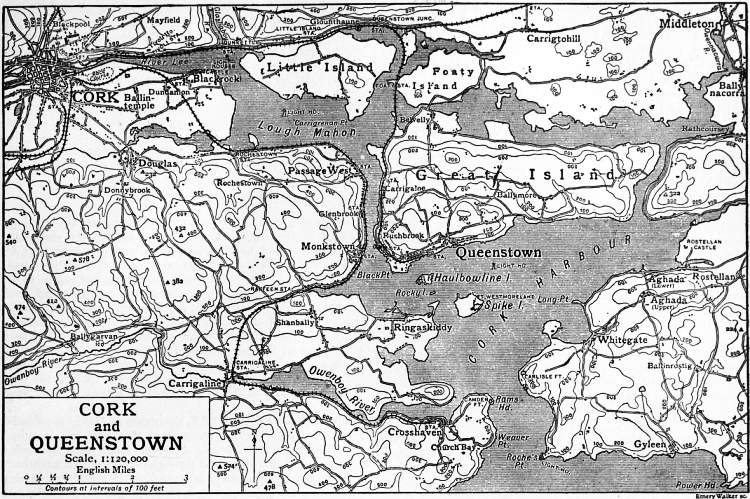
(Click to enlarge.)
Based on information embodied from the Ordnance Survey, by permission of the Controller of H. M. Stationery Office.
The country neighbouring to Cork is highly attractive. The harbour, with the ceaseless activity of shipping, its calm waters, sheltered by many islands, and its well-wooded shores studded with pleasant watering-places, affords a series of charming views, apart from its claim to be considered one of the finest natural harbours in the kingdom. Military depots occupy several of the smaller islets, and three batteries guard the entry. This is about 1 m. wide, but within the width increases to 3 m. while the length is about 10 m. The Atlantic port of Queenstown (q.v.) is on Great Island at the head of the outer harbour. Tivoli (the residence of Sir Walter Raleigh), Fort William, Lota Park, and Blackrock Castle are notable features on the shore; and Passage, Blackrock, Glenbrook and Monkstown are waterside resorts. Inland from Cork runs the picturesque valley of the Lee, and low hills surround the commanding situation of the port.
The harbour is by far the most important on the south coast of Ireland, and dredging operations render the quays approachable for vessels drawing 20 ft. at all states of the tide. Its trade is mainly with Bristol and the ports of South Wales. The imports, exceeding £1,000,000 in annual value, include large quantities of wheat and maize, while the exports (about £9000 annually) are chiefly of cattle, provisions, butter and fish. The Cork Butter Exchange, where classification of the various qualities is carried out by branding under the inspection of experts, was important in the early part of the 17th century, and an unbroken series of accounts dates from 1769 when the present market was founded. There are distilleries, breweries, tanneries and iron foundries in the city; and manufactures of woollen and leather goods, tweeds, friezes, gloves and chemical manure. Nearly six-sevenths of the population are Roman Catholics. The city does not share with the county the rapid decrease of population. It is governed by a lord mayor, 14 aldermen and 42 councillors. The parliamentary borough returns two members.
The original site of Cork seems to have been in the vicinity of the Protestant cathedral; St Finbar’s ecclesiastical foundation attracting many students and votaries. In the 9th century the town was frequently pillaged by the Northmen. According to the Annals of the Four Masters a fleet burned Cork in 821, in 846 the Danes appear to have been in possession of the town, for a force was collected to demolish their fortress; and in 1012 Cork again fell in flames. The Danes then appear to have founded the new city on the banks of the Lee as a trading centre. It was anciently surrounded with a wall, an order for the reparation of which is found so late as 1748 in the city council books (which date from 1610). Submission and homage were made to Henry II. on his arrival in 1172, and subsequently the English held the town for a long period against the Irish, by constant and careful watch. Cork showed favour to Perkin Warbeck in 1492, and its mayor was hanged in consequence. In 1649 it surrendered to Cromwell, and in 1689 to the earl of Marlborough after five days’ siege, when Henry, duke of Grafton, was mortally wounded. Cork was a borough by prescription, and successive charters were granted to it from the reign of Henry II. onward. By a charter of Edward IV. the lord mayor of Cork was created admiral of the port, and this office is manifested in a triennial ceremony in which the mayor throws a dart over the harbour.
See C. Smith, Ancient and Present State of the County and City of Cork (1750), edited by R. Day and W. A. Copinger (Cork, 1893); C. B. Gibson, History of the City and County of Cork (London, 1861); M. F. Cusack, History of the City and County of Cork, 1875.
CORK (perhaps through Sp. corcha from Lat. cortex, bark, but possibly connected with quercus, oak), the outer layer of the bark of an evergreen species of oak (Quercus Suber). The tree reaches the height of about 30 ft., growing in the south of Europe and on the North African coasts generally; but it is principally cultivated in Spain and Portugal. The outer layer of bark in the cork oak by annual additions from within gradually becomes a thick soft homogeneous mass, possessing those compressible and elastic properties upon which the economic value of the material chiefly depends. The first stripping of cork from young trees takes place when they are from fifteen to twenty years of age. The yield, which is rough, unequal and woody in texture, is called virgin cork, and is useful only as a tanning substance, or for forming rustic work in ferneries, conservatories, &c. Subsequently the bark is removed every eight or ten years, the quality of the cork improving with each successive stripping; and the trees continue to live and thrive under the operation for 150 years and upwards. The produce of the second barking is still so coarse in texture that it is only fit for making floats for nets and for similar applications. The operation of stripping the trees takes place during the months of July and August. Two cuts are made round the stem—one a little above the ground, and the other immediately under the spring of the main branches. Between these three or four longitudinal incisions are then made, the utmost care being taken not to injure the inner bark. The cork is thereafter removed in the sections into which it has been cut, by inserting under it the wedge-shaped handle of the implement used in making the incisions. After the outer surface has been scraped and cleaned, the pieces are flattened by heating them over a fire and submitting them to pressure on a flat surface. In the heating operation the surface is charred, and thereby the pores are closed up, and what is termed “nerve” is given to the material. In this state the cork is ready for manufacture or exportation.
Though specially developed in the cork-oak, the substance cork is an almost universal product in the stems (and roots) of woody plants which increase in diameter year by year. Generally towards the end of the first year the original thin protective layer of a stem or branch is replaced by a thin layer of “cork,” that is a layer of cells the living contents of which have disappeared while the walls have become thickened and toughened as the result of the formation in them of a substance known as suberin. Fresh cork is formed each season by an active formative layer below the layer developed last season, which generally peels off. Where the formation is extensive and persistent as in the cork-oak, a thick covering of cork is formed. In some cases, as on young shoots of the cork-elm, the development is irregular and wing-like outgrowths of cork are formed. In northern Russia a similar method to that used for obtaining cork from the cork-oak is employed with the birch.
Cork possesses a combination of properties which peculiarly fits it for many and diverse uses, for some of which it alone is found applicable. The leading purpose for which it is used is for forming bungs and stoppers for bottles and other vessels containing liquids. Its compressibility, elasticity and practical imperviousness to both air and water so fit it for this purpose that the term cork is even more applied to the function than to the substance. Its specific lightness, combined with strength and durability, recommend it above all other substances for forming life-buoys, belts and jackets, and in the construction of life-boats and other apparatus for saving from drowning. On account of its lightness, softness and non-conducting properties it is used for hat-linings and the soles of shoes, the latter being a very ancient application of cork. It is also used in making artificial limbs, for lining entomological cases, for pommels in leather-dressing, and as a medium for making architectural models. Chips and cuttings are ground up and mixed with india-rubber to form kamptulicon floor-cloth, or “cork-carpet.” The inner bark of the cork-tree is a valuable tanning material.
Certain of the properties and uses of cork were known to the ancient Greeks and Romans, and the latter, we find by Horace (Odes iii. 8), used it as a stopper for wine-vessels:—
“corticem adstrictum pice dimovebit amphorae”—
It appears, however, that cork was not generally used for stopping bottles till so recent a period as near the end of the 17th century, and bottles themselves were not employed for storing liquids till the 15th century. Many substitutes have been proposed for cork as a stoppering agent; but except in the case of aerated liquids none of these has recommended itself in practice. For aerated water bottles several successful devices have been introduced. The most simple of these is an india-rubber ball pressed upwards into the narrow of the bottle neck by the force of the gas contained in the water; and in another system a glass ball is similarly pressed against an india-rubber collar inserted in the neck of the bottle. By analogy the term “to cork” is used of any such devices for sealing up a bottle or aperture.
CORK AND ORRERY, MARY, Countess of (Mary Monckton) (1746-1840), was born on the 21st of May 1746, the daughter of the first Viscount Galway. From her early years she took a keen interest in literature, and through her influence her mother’s house in London became a favourite meeting-place of literary celebrities. Dr Johnson was a frequent guest. According to Boswell, Miss Monckton’s “vivacity enchanted the sage, and they used to talk together with all imaginable ease.” Sheridan, Reynolds, Burke and Horace Walpole were among her constant visitors, and Mrs Siddons was her closest friend. In 1786 she married the seventh earl of Cork and Orrery, who died in 1798. As Lady Cork, her love of social “lions” became more pronounced than ever. Among her regular guests were Canning and Castlereagh, Byron, Sir Walter Scott, Lord John Russell, Sir Robert Peel, Theodore Hook and Sydney Smith. She is supposed to have been the original of Lady Bellair in Disraeli’s Henrietta Temple, and Dickens is believed to have drawn on her for some of the peculiarities of Mrs Leo Hunter in Pickwick. Lady Cork had a remarkable memory, and was a brilliant conversationalist. She died in London on the 30th of May 1840. She was then ninety-four, but within a few days of her death had been either dining out or entertaining every night. There is a fine portrait of her by Reynolds.
CORLEONE (Saracen, Korliun), a town of Sicily, in the province of Palermo, 42 m. S. of Palermo by rail and 21 m. direct, 1949 ft. above sea-level. Pop. (1901) 14,803. The town was a Saracen settlement, but a Lombard colony was introduced by Frederick II. Two medieval castles rise above the town, and there are some churches of interest.
CORMENIN, LOUIS MARIE DE LA HAYE, Vicomte de (1788-1868), French jurist and political pamphleteer, was born at Paris on the 6th of January 1788. His father and his grandfather both held the rank of lieutenant-general of the admiralty. At the age of twenty he was received advocate, and about the same time he gained some reputation as a writer of piquant and delicate poems. In 1810 he received from Napoleon I. the appointment of auditor to the council of state; and after the restoration of the Bourbons he became master of requests. During the period of his connexion with the council he devoted himself zealously to the study of administrative law. He was selected to prepare some of the most important reports of the council. Among his separate publications at this time are noted,—Du conseil d’état envisagé comme conseil et comme juridiction dans notre monarchie constitutionnelle (1818), and De la responsabilité des agents du gouvernement. In the former he claimed, for the protection of the rights of private persons in the administration of justice, the institution of a special court whose members should be irremovable, the right of oral defence, and publicity of trial. In 1822 appeared his Questions de droit administratif, in which he for the first time brought together and gave scientific shape to the scattered elements of administrative law. These he arranged and stated clearly in the form of aphorisms, with logical deductions, establishing them by proofs drawn from the archives of the council of state. This is recognized as his most important work as a jurist. The fifth edition (1840) was thoroughly revised.
In 1828 Cormenin entered the Chamber of Deputies as member for Orleans, took his seat in the Left Centre, and began a vigorous opposition to the government of Charles X. As he was not gifted with the qualifications of the orator, he seldom appeared at the tribune; but in the various committees he defended all forms of popular liberties, and at the same time delivered, in a series of powerful pamphlets, under the pseudonym of “Timon,” the most formidable blows against tyranny and all political and administrative abuses. After the revolution of July 1830, Cormenin was one of the 221 who signed the protest against the elevation of the Orleans dynasty to the throne; and he resigned both his office in the council of state and his seat in the chamber. He was, however, soon re-elected deputy, and now voted with the extreme Left. The discussions on the budget in 1831 gave rise to the publication of his famous series of Lettres sur la liste civile, which in ten years ran through twenty-five editions. In the following year he was elected deputy for Belley. In 1834 he was elected by two arrondissements, and sat for Joigny, which he represented till 1846. In this year he lost his seat in consequence of the popular prejudice aroused against him by his trenchant pamphlet Oui et non (1845) against attacks on religious liberty, and a second entitled Feu! Feu! (1845), written in reply to those who demanded a retractation of the former. Sixty thousand copies were rapidly sold.
Cormenin was an earnest advocate of universal suffrage before the revolution of February 1848, and had remorselessly exposed the corrupt practices at elections in his pamphlet—Ordre du jour sur la corruption électorale. After the revolution he was elected by four departments to the Constituent Assembly, and became one of its vice-presidents. He was also member and president of the constitutional commission, and for some time took a leading part in drawing up the republican constitution. But the disputes which broke out among the members led him to resign the presidency. He was soon after named member of the council of state and president of the comité du contentieux. It was at this period that he published two pamphlets—Sur l’indépendance de l’Italie. After the coup d’état of December 2, 1851, Cormenin, who had undertaken the defence of Prince Louis Napoleon after his attempt at Strassburg, accepted a place in the new council of state of the empire. Four years later, by imperial ordinance, he was made a member of the Institute. One of the most characteristic works of Cormenin is the Livre des orateurs, a series of brilliant studies of the principal parliamentary orators of the restoration and the monarchy of July, the first edition of which appeared in 1838, and the eighteenth in 1860. In 1846 he published his Entretiens de village, which procured him the Montyon prize, and of which six editions were called for the same year. His last work was Le Droit de tonnage en Algérie (1860). He died at Paris, on the 6th of May 1868. Two volumes of his Reliquiae were printed in Paris in the same year.
CORMON, FERNAND (1845- ), French painter, was born in Paris. He became a pupil of Cabanel, Fromentin and Portaels, and one of the leading historical painters of modern France. At an early age he attracted attention by the better class of sensationalism in his art, although for a time his powerful brush dwelled with particular delight on scenes of bloodshed, such as the “Murder in the Seraglio” (1868) and the “Death of Ravara, Queen of Lanka” at the Toulouse Museum. The Luxembourg has his “Cain flying before Jehovah’s Curse”; and for the Mairie of the fourth arrondissement of Paris he executed in grisaille a series of Panels: “Birth,” “Death,” “Marriage,” “War,” &c. “A Chief’s Funeral,” and pictures having the Stone Age for their subject, occupied him for several years. He was appointed to the Legion of Honour in 1880. Subsequently he also devoted himself to portraiture.
CORMONTAINGNE, LOUIS DE (c. 1697-1752), French military engineer, was born at Strassburg. He was present as a volunteer at the sieges of Freiburg and Landau in the later years of the War of the Spanish Succession, and in 1715 he entered the engineers. After being stationed for some years at Strassburg he became captain, and was put in charge (at first in a subordinate capacity, and subsequently as chief engineer) of the new works, Forts Moselle and Bellecroix, at Metz, which he built according to his own system of fortification. He was present at the siege of Philipsburg in 1733, and as a lieutenant-colonel took part in most of the sieges in the Low Countries during the War of the Austrian Succession. He attained the rank of brigadier and finally that of maréchal de camp, and was employed in fortification work until his death. His Architecture militaire, written in 1714, was long kept secret by order of the authorities, but, an unauthorized edition having appeared at the Hague in 1741, he himself prepared another version called Premier mémoire sur la fortification, which from 1741 onwards was followed by others. His ideas are closely modelled on those of Vauban (q.v.), and in his lifetime he was not considered the equal of such engineers as d’Asfeld and Filley. It was not until twenty years after his death that his system became widely known. Fourcroy de Rainecourt, then chief of engineers, searching the archives for valuable matter, chose the numerous memoirs of Cormontaingne for publication amongst engineer officers in 1776. Even then they only circulated privately, and it was not until the engineer Bousmard published Cormontaingne’s Mémorial de l’attaque des places (Berlin, 1803) that Fourcroy, and after him General La Fitte de Clavé, actually gave to the general public the Œuvres posthumes de Cormontaingne (Paris, 1806-1809).
His system of fortification was not marked by any great originality of thought, which indeed could not be expected of a member of the corps du génie, the characteristics of which were a close caste spirit and an unquestioning reverence for the authority of Vauban. Forts Moselle and Bellecroix are still in existence.
See Von Brese-Winiari, Über Entstehen etc. der neueren Befestigungsmethode (Berlin, 1844); Prévost du Vernois, De la fortification depuis Vauban (Paris, 1861); Cosseron de Villenoisy, Essai historique sur la fortification (Paris, 1869).
CORMORANT (from the Lat. corvus marinus,1 through the Fr., in some patois of which it is still “cor marin”; in certain Ital. dialects are the forms “corvo marin” or “corvo marino”), a large sea-fowl belonging to the genus Phalacrocorax2 (Carbo, Halieus and Graculus of some ornithologists), and that group of the Linnaean order Anseres, now partly generally recognized by Illiger’s term Steganopodes, of which it with its allies forms a family Phalacrocoracidae.
The cormorant (P. carbo) frequents almost all the sea-coast of Europe, and breeds in societies at various stations, most generally on steep cliffs, but occasionally on rocky islands as well as on trees. The nest consists of a large mass of sea-weed, and, with the ground immediately surrounding it, generally looks as though bespattered with whitewash, from the excrement of the bird, which lives entirely on fish. The eggs, from four to six in number, are small, and have a thick, soft, calcareous shell, bluish-white when first laid, but soon becoming discoloured. The young are hatched blind, and covered with an inky-black skin. They remain for some time in the squab-condition, and are then highly esteemed for food by the northern islanders, their flesh being said to taste as well as a roasted hare’s. Their first plumage is of a sombre brownish-black above, and more or less white beneath. They take two or three years to assume the fully adult dress, which is deep black, glossed above with bronze, and varied in the breeding-season with white on the cheeks and flanks, besides being adorned by filamentary feathers on the head, and further set off by a bright yellow gape. The old cormorant looks nearly as big as a goose, but is really much smaller; its flesh is quite uneatable.
Taken when young from the nest, this bird is easily tamed and can be trained to fish for its keeper, as was of old time commonly done in England, where the master of the cormorants was one of the officers of the royal household. Nowadays the practice is nearly obsolete. When taken out to furnish sport, a strap is fastened round the bird’s neck so as, without impeding its breath, to hinder it from swallowing its captures.3 Arrived at the waterside, it is cast off. It at once dives and darts along the bottom as swiftly as an arrow in quest of its prey, rapidly scanning every hole or pool. A fish is generally seized within a few seconds of its being sighted, and as each is taken the bird rises to the surface with its capture in its bill. It does not take much longer to dispose of the prize in the dilatable skin of its throat so far as the strap will allow, and the pursuit is recommenced until the bird’s gular pouch, capacious as it is, will hold no more. It then returns to its keeper, who has been anxiously watching and encouraging its movements, and a little manipulation of its neck effects the delivery of the booty. It may then be let loose again, or, if considered to have done its work, it is fed and restored to its perch. The activity the bird displays under water is almost incredible to those who have not seen its performances, and in a shallow river scarcely a fish escapes its keen eyes, and sudden turns, except by taking refuge under a stone or root, or in the mud that may be stirred up during the operation, and so avoiding observation (see Salvin and Freeman, Falconry, 1859).
Nearly allied to the cormorant, and having much the same habits, is the shag, or green cormorant of some writers (P. graculus). The shag (which name in many parts of the world is used in a generic sense) is, however, about one-fourth smaller in linear dimensions, is much more glossy in plumage, and its nuptial embellishment is a nodding plume instead of the white patches of the cormorant. The easiest diagnostic on examination will be found to be the number of tail-feathers, which in the former are fourteen and in the shag twelve. The latter, too, is more marine in the localities it frequents, scarcely ever entering fresh or indeed inland waters.
In the south of Europe a much smaller species (P. pygmaeus) is found. This is almost entirely a fresh-water bird, and is not uncommon on the lower Danube. Other species, to the number perhaps of thirty or more, have been discriminated from other parts of the world, but all have a great general similarity to one another. New Zealand and the west coast of northern America are particularly rich in birds of this genus, and the species found there are the most beautifully decorated of any. All, however, are remarkable for their curiously-formed feet, the four toes of each being connected by a web, for their long stiff tails, and for the absence, in the adult, of any exterior nostrils. When gorged, or when the state of the tide precludes fishing, they are fond of sitting on an elevated perch, often with extended wings, and in this attitude they will remain motionless for a considerable time, as though hanging themselves out to dry. It was perhaps this peculiarity that struck the observation of Milton, and prompted his well-known similitude of Satan to a cormorant (Parad. Lost, iv. 194); but when not thus behaving they themselves provoke the more homely comparison of a row of black bottles. Their voracity is proverbial.
(A. N.)
CORN (a common Teutonic word; cf. Lat. granum, seed, grain), originally meaning a small hard particle or grain, as of sand, salt, gunpowder, &c. It thus came to be applied to the small hard seed of a plant, as still used in the words barley-corn and pepper-corn. In agriculture it is generally applied to the seed of the cereal plants. It is often locally understood to mean that kind of cereal which is the leading crop of the district; thus in England it refers to wheat, in Scotland and Ireland to oats, and in the United States to maize (Indian corn). See Grain Trade; Corn Laws; Agriculture; Wheat; Maize; &c.
The term “corned” is given to a preparation of meat (especially beef) on account of the original manner of preserving it by the use of salt in grains or “corns.”
CORN (from Lat. cornu, horn), in pathology (technically clavus), a localized outgrowth of the epidermic layer of the skin, most commonly of the toe, with a central ingrowth of a hard horny plug. The underlying papillae are atrophied, causing a cup-shaped hollow, whilst the surrounding papillae are hyper-trophied. The condition is mainly caused by badly fitting boots, though any undue pressure, of insufficient power to give rise to ulceration, may be the cause of a corn. Corns may be hard or soft. The hard corn usually occurs on one of the toes, is a more or less conical swelling and may be extremely painful at times. If suppuration occurs around the corn, it is apt to burrow, and if unattended to may give rise to arthritis or even necrosis. The best treatment is to soften the corn with hot water, pare it very carefully with a sharp knife, and then paint it with a solution of salicylic acid in collodion. The painting must be repeated three times a day for a week or ten days. The soft corn occurs between the toes and is usually a more painful condition. Owing to the absorption of sweat its surface may become white and sodden in appearance. The treatment is much the same, but spirits of camphor should be painted on each night, and a layer of cotton wool placed between the toes during the daytime.