VOLUME VII SLICE IV Coquelin to Costume (continued 4)
Reading edition
CORNARO, CATERINA (1454-1510), queen of Cyprus, was the daughter of Marco Cornaro, a Venetian noble, whose brother Andrea was an intimate friend of James de Lusignan, natural son of King John II. of Cyprus. In the king’s death in 1458 the succession was disputed, and James, with the help of the sultan of Egypt, seized the island. But several powers were arrayed against him—the duke of Savoy, who claimed the island on the strength of the marriage of his son Louis to Charlotte, the only legitimate daughter of John II.,1 the Genoese, and the pope. It was important that he should make a marriage such as would secure him powerful support. Andrea Cornaro suggested his niece Caterina, famed for her beauty, as that union would bring him Venetian help. The proposal was agreed to, and approved of by Caterina herself and the senate, and the contract was signed in 1468. But further intrigues caused delay, and it was not until 1471 that James’s hesitations were overcome. Caterina was solemnly adopted by the doge as a “daughter of the Republic” and sailed for Cyprus in 1472 with the title of queen of Cyprus, Jerusalem and Armenia. But she only enjoyed one year of happiness, for in 1473 her husband died of fever, leaving his kingdom to his queen and their child as yet unborn. Enemies and rival claimants arose on all sides, for Cyprus was a tempting bait. In August the child James III. was born, but as soon as the Venetian fleet sailed away a plot to depose him in favour of Zarla, James’s illegitimate daughter, broke out, and Caterina was kept a prisoner. The Venetians returned, and order was soon restored, but the republic was meditating the seizure of Cyprus, although it had no valid title whatever, and after the death of Caterina’s child in 1474 it was Venice which really governed the island. The poor queen was surrounded by intrigues and plots, and although the people of the coast towns loved her, the Cypriot nobles were her bitter enemies and hostile to Venetian influence. In 1488 the republic, fearing that Sultan Bayezid II. intended to attack Cyprus, and having also discovered a plot to marry Caterina to King Alphonso II. of Naples, a proposal to which she seemed not averse, decided to recall the queen to Venice and formally annex the island. Caterina at first refused, for she clung to her royalty, but Venice was a severe parent to its adopted daughter and would not be gainsaid; she was forced to abdicate in favour of the republic, and returned to Venice in 1489. The government conferred on her the castle and town of Asolo for life, and there in the midst of a learned and brilliant little court, of which Cardinal Bembo (q.v.) was a shining light, she spent the rest of her days in idyllic peace. She died in July 1510. Titian’s famous portrait of her is in the Uffizi gallery in Florence.
Bibliography.—A. Centelli, Caterina Cornaro e il suo regno (Venice, 1892); S. Romanin, Storia documentata di Venezia, vol. iv. (Venice, 1855), and his Lezioni di storia Veneta (Florence, 1875); L. de Mas Latrie, Histoire de l’île de Chypre (Paris, 1852-1861); and Horatio Brown’s essay in his Studies in Venetian History (London, 1907), which gives the best sketch of the queen’s career and a list of authorities.
(L. V.*)
CORNARO, LUIGI (1467-1566), a Venetian nobleman, famous for his treatises on a temperate life. In his youth he lived freely, but after a severe illness at the age of forty, he began under medical advice gradually to reduce his diet. For some time he restricted himself to a daily allowance of 12 oz. of solid food and 14 oz. of wine; later in life he reduced still further his bill of fare, and found he could support his life and strength with no more solid meat than an egg a day. At the age of eighty-three he wrote his treatise on The Sure and Certain Method of Attaining a Long and Healthful Life, the English translation of which went through numerous editions; and this was followed by three others on the same subject, composed at the ages of eighty-six, ninety-one and ninety-five respectively. The first three were published at Padua in 1558. They are written, says Addison (Spectator, No. 195), “with such a spirit of cheerfulness, religion and good sense, as are the natural concomitants of temperance and sobriety.” He died at Padua at the age of ninety-eight.
CORNBRASH, in geology, the name applied to the uppermost member of the Bathonian stage of the Jurassic formation in England. It is an old English agricultural name applied in Wiltshire to a variety of loose rubble or “brash” which, in that part of the country, forms a good soil for growing corn. The name was adopted by William Smith for a thin band of shelly limestone which, in the south of England, breaks up in the manner indicated. Although only a thin group of rocks (10-25 ft.), it is remarkably persistent; it may be traced from Weymouth to the Yorkshire coast, but in north Lincolnshire it is very thin, and probably dies out in the neighbourhood of the Humber. It appears again, however, as a thin bed in Gristhorpe Bay, Cayton Bay, Wheatcroft, Newton Dale and Langdale. In the inland exposures in Yorkshire it is difficult to follow on account of its thinness, and the fact that it passes up into dark shales in many places—the so-called “clays of the Cornbrash,” with Avicula echinata.
The Cornbrash is a very fossiliferous formation; the fauna indicates a transition from the Lower to the Middle Oolites, though it is probably more nearly related to that of the beds above than to those below. Good localities for fossils are Radipole near Weymouth, Closworth, Wincanton, Trowbridge, Cirencester, Witney, Peterborough and Sudbrook Park near Lincoln. A few of the important fossils are: Waldheimia lagenalis, Pecten levis, Avicula echinata, Ostrea flabelloides, Myacites decurtatus, Echinobrissus clunicularis; Macrocephalites macrocephalus is abundant in the midland counties but rarer in the south; belemnites are not known. The remains of saurians (Steneosaurus) are occasionally found. The Cornbrash is of little value for building or road-making, although it is used locally; in the south of England it is not oolitic, but in Yorkshire it is a rubbly, marly, frequently ironshot oolitic limestone. In Bedfordshire it has been termed the Bedford limestone.
See Jurassic; also H. B. Woodward, “The Jurassic Rocks of Britain,” vol. iv. (1894); and C. Fox Strangways, vol. i.; both Memoirs of the Geological Survey.
(J. A. H.)
CORNEILLE, PIERRE (1606-1684), French dramatist and poet, was born at Rouen, in the rue de la Pie, on the 6th of June 1606. The house, which was long preserved, was destroyed not many years ago. His father, whose Christian name was the same, was avocat du roi à la Table de Marbre du Palais, and also held the position of maître des eaux et forêts in the vicomté (or bailliage, as some say) of Rouen. In this latter office he is said to have shown himself a vigorous magistrate, suppressing brigandage and plunder without regard to his personal safety. He was ennobled in 1637 (it is said not without regard to his son’s distinction), and the honour was renewed in favour of his sons Pierre and Thomas in 1669, when a general repeal of the letters of nobility recently granted had taken place. There appears, however, to be no instance on record of the poet himself assuming the “de” of nobility. His mother’s name was Marthe le Pesant.
After being educated by the Jesuits of Rouen, Corneille at the age of eighteen was entered as avocat, and in 1624 took the oaths, as we are told, four years before the regular time, a dispensation having been procured. He was afterwards appointed advocate to the admiralty, and to the “waters and forests,” but both these posts must have been of small value, as we find him parting with them in 1650 for the insignificant sum of 6000 livres. In that year and the next he was procureur-syndic des États de Normandie. His first play, Mélite, was acted in 1629. It is said by B. le B. de Fontenelle (his nephew) to have been inspired by personal experiences, and was extremely popular, either because or in spite of its remarkable difference from the popular plays of the day, those of A. Hardy. In 1632 Clitandre, a tragedy, was printed (it may have been acted in 1631); in 1633 La Veuve and the Galerie du palais, in 1634 La Suivante and La Place Royale, all the last-named plays being comedies, saw the stage. In 1634 also, having been selected as the composer of a Latin elegy to Richelieu on the occasion of the cardinal visiting Rouen, he was introduced to the subject of his verses, and was soon after enrolled among the “five poets.” These officers (the others being G. Colletet, Boisrobert and C. de l’Étoile, who in no way merited the title, and J. de Rotrou, who was no unworthy yokefellow even of Corneille) had for task the more profitable than dignified occupation of working up Richelieu’s ideas into dramatic form. No one could be less suited for such work than Corneille, and he soon (it is said) incurred his employer’s displeasure by altering the plan of the third act of Les Thuileries, which had been entrusted to him.
Meanwhile the year 1635 saw the production of Médée, a grand but unequal tragedy. In the next year the singular extravaganza entitled L’Illusion comique followed, and was succeeded about the end of November by the Cid, based on the Mocedades del Cid of Guillem de Castro. The triumphant success of this, perhaps the most “epoch-making” play in all literature, the jealousy of Richelieu and the Academy, the open attacks of Georges de Scudéry and J. de Mairet and others, and the pamphlet-war which followed, are among the best-known incidents in the history of letters. The trimming verdict of the Academy, which we have in J. Chapelain’s Sentiments de l’Académie française sur la tragi-comédie du Cid (1638), when its arbitration was demanded by Richelieu, and not openly repudiated by Corneille, was virtually unimportant; but it is worth remembering that no less a writer than Georges de Scudéry, in his Observations sur le Cid (1637), gravely and apparently sincerely asserted and maintained of this great play that the subject was utterly bad, that all the rules of dramatic composition were violated, that the action was badly conducted, the versification constantly faulty, and the beauties as a rule stolen! Corneille himself was awkwardly situated in this dispute. The esprit bourru by which he was at all times distinguished, and which he now displayed in his rather arrogant Excuse à Ariste, unfitted him for controversy, and it was of vital importance to him that he should not lose the outward marks of favour which Richelieu continued to show him. Perhaps the pleasantest feature in the whole matter is the unshaken and generous admiration with which Rotrou, the only contemporary whose genius entitled him to criticise Corneille, continued to regard his friend, rival, and in some sense (though Rotrou was the younger of the two) pupil. Finding it impossible to make himself fairly heard in the matter, Corneille (who had retired from his position among the “five poets”) withdrew to Rouen and passed nearly three years in quiet there, perhaps revolving the opinions afterwards expressed in his three Discours and in the Examens of his plays, where he bows, somewhat as in the house of Rimmon, to “the rules.” In 1639, or at the beginning of 1640, appeared Horace with a dedication to Richelieu. The good offices of Madame de Combalet, to whom the Cid had been dedicated, and perhaps the satisfaction of the cardinal’s literary jealousy, had healed what breach there may have been, and indeed the poet was in no position to quarrel with his patron. Richelieu not only allowed him 500 crowns a year, but soon afterwards, it is said, though on no certain authority, employed his omnipotence in reconciling the father of the poet’s mistress, Marie de Lampérière, to the marriage of the lovers (1640). In this year also Cinna appeared. A brief but very serious illness attacked him, and the death of his father the year before had increased his family anxieties by leaving his mother in very indifferent circumstances. It has, however, been recently denied that he himself was at any time poor, as older traditions asserted.
In the following year Corneille figured as a contributor to the Guirlande de Julie, a famous album which the marquis de Montausier, assisted by all the literary men of the day, offered to his lady-love, Julie d’Angennes. 1643 was, according to the latest authorities (for Cornelian dates have often been altered), a very great year in the dramatist’s life. Therein appeared Polyeucte, the memorable comedy of Le Menteur, which though adapted from the Spanish stood in relation to French comedy very much as Le Cid, which owed less to Spain, stood to French tragedy; its less popular and far less good Suite,—and perhaps La Mort de Pompée. Rodogune (1644) was a brilliant success; Théodore (1645), a tragedy on a somewhat perilous subject, was the first of Corneille’s plays which was definitely damned. Some amends may have been made to him by the commission which he received next year to write verses for the Triomphes poétiques de Louis XIII. Soon after (22nd of January 1647) the Academy at last (it had twice rejected him on frivolous pleas) admitted the greatest of living French writers. Héraclius (1646), Andromède (1650), a spectacle-opera rather than a play, Don Sanche d’Aragon (1650) and Nicomède (1651) were the products of the next few years’ work; but in 1652 Pertharite was received with decided disfavour, and the poet in disgust resolved, like Ben Jonson, to quit the loathed stage. In this resolution he persevered for six years, during which he worked at a verse translation of the Imitation of Christ (finished in 1656), at his three Discourses on Dramatic Poetry, and at the Examens which are usually printed at the end of his plays. In 1659 Fouquet, the Maecenas of the time, persuaded him to alter his resolve, and Œdipe, a play which became a great favourite with Louis XIV., was the result. It was followed by La Toison d’or (1660), Sertorius (1662) and Sophonisbe (1663). In this latter year Corneille (who had at last removed his residence from Rouen to Paris in 1662) was included among the list of men of letters pensioned at the proposal of Colbert. He received 2000 livres. Othon (1664), Agésilas (1666), Attila (1667), and Tite et Bérénice (1670), were generally considered as proofs of failing powers,—the cruel quatrain of Boileau—
“Après l’Agésilas Hélas! Mais après l’Attila Holà!”
in the case of these two plays, and the unlucky comparison with Racine in the Bérénice, telling heavily against them. In 1665 and 1670 some versifications of devotional works addressed to the Virgin had appeared. The part which Corneille took in Psyché (1671), Molière and P. Quinault being his coadjutors, showed signs of renewed vigour; but Pulchérie (1672) and Suréna (1674) were allowed even by his faithful followers to be failures. He lived for ten years after the appearance of Suréna, but was almost silent save for the publication, in 1676, of some beautiful verses thanking Louis XIV. for ordering the revival of his plays. He died at his house in the rue d’Argenteuil on the 30th of September 1684. For nine years (1674-1681), and again in 1683, his pension had, for what reason is unknown, been suspended. It used to be said that he was in great straits, and the story went (though, as far as Boileau is concerned, it has been invalidated), that at last Boileau, hearing of this, went to the king and offered to resign his own pension if there were not money enough for Corneille, and that Louis sent the aged poet two hundred pistoles. He might, had it actually been so, have said, with a great English poet in like case, “I have no time to spend them.” Two days afterwards he was dead.
Corneille was buried in the church of St Roch, where no monument marked his grave until 1821. He had six children, of whom four survived him. Pierre, the eldest son, a cavalry officer who died before his father, left posterity in whom the name has continued; Marie, the eldest daughter, was twice married, and by her second husband, M. de Farcy, became the ancestress of Charlotte Corday. Repeated efforts have been made for the benefit of the poet’s descendants, Voltaire, Charles X. and the Comédie française having all borne part therein.
The portraits of Corneille (the best and most trustworthy of which is from the burin of M. Lasne, an engraver of Caen), represent him as a man of serious, almost of stern countenance, and this agrees well enough with such descriptions as we have of his appearance, and with the idea of him which we should form from his writings and conduct. His nephew Fontenelle admits that his general address and manner were by no means prepossessing. Others use stronger language, and it seems to be confessed that either from shyness, from pride, or from physical defects of utterance, probably from all three combined, he did not attract strangers. Racine is said to have assured his son that Corneille made verses “cent fois plus beaux” than his own, but that his own greater popularity was owing to the fact that he took some trouble to make himself personally agreeable. Almost all the anecdotes which have been recorded concerning him testify to a rugged and somewhat unamiable self-contentment. “Je n’ai pas le mérite de ce pays-ci,” he said of the court, “Je n’en suis pas moins Pierre Corneille,” he is said to have replied to his friends as often as they dared to suggest certain shortcomings in his behaviour, manner or speech, “Je suis saoul de gloire et affamé d’argent” was his reply to the compliments of Boileau. Yet tradition is unanimous as to his affection for his family, and as to the harmony in which he lived with his brother Thomas who had married Marguerite de Lampérière, younger sister of Marie, and whose household both at Rouen and at Paris was practically one with that of his brother. No story about Corneille is better known than that which tells of the trap between the two houses, and how Pierre, whose facility of versification was much inferior to his brother’s, would lift it when hard bestead, and call out “Sans-souci, une rime!” Notwithstanding this domestic felicity, an impression is left on the reader of Corneille’s biographies that he was by no means a happy man. Melancholy of temperament will partially explain this, but there were other reasons. He appears to have been quite free from envy properly so called, and to have been always ready to acknowledge the excellences of his contemporaries. But, as was the case with a very different man—Goldsmith—praise bestowed on others always made him uncomfortable unless it were accompanied by praise bestowed on himself. As Guizot has excellently said, “Sa jalousie fut celle d’un enfant qui veut qu’un sourire le rassure contre les caresses que reçoit son frère.”
Although his actual poverty has been recently denied, he cannot have been affluent. His pensions covered but a small part of his long life and were most irregularly paid. He was no “dedicator,” and the occasional presents of rich men, such as Montauron (who gave him a thousand, others say two hundred, pistoles for the dedication of Cinna), and Fouquet (who commissioned Œdipe), were few and far between, though they have exposed him to reflections which show great ignorance of the manners of the age. Of his professional earnings, the small sum for which, as we have seen, he gave up his offices, and the expression of Fontenelle that he practised “sans goût et sans succès,” are sufficient proof. His patrimony and his wife’s dowry must both have been trifling. On the other hand, it was during the early and middle part of his career impossible, and during the later part very difficult, for a dramatist to live decently by his pieces. It was not till the middle of the century that the custom of allowing the author two shares in the profits during the first run of the piece was observed, and even then revivals profited him nothing. Thomas Corneille himself, who to his undoubted talents united wonderful facility, untiring industry, and (gift valuable above all others to the playwright) an extraordinary knack of hitting the public fancy, died, notwithstanding his simple tastes, “as poor as Job.” We know that Pierre received for two of his later pieces two thousand livres each, and we do not know that he ever received more.
But his reward in fame was not stinted. Corneille, unlike many of the great writers of the world, was not driven to wait for “the next age” to do him justice. The cabal or clique which attacked the Cid had no effect whatever on the judgment of the public. All his subsequent masterpieces were received with the same ungrudging applause, and the rising star of Racine, even in conjunction with the manifest inferiority of Corneille’s last five or six plays, with difficulty prevailed against the older poet’s towering reputation. The great men of his time—Condé, Turenne, the maréchal de Grammont, the knight-errant duc de Guise—were his fervent admirers. Nor had he less justice done him by a class from whom less justice might have been expected, the brother men of letters whose criticisms he treated with such scant courtesy. The respectable mediocrity of Chapelain might misapprehend him; the lesser geniuses of Scudéry and Mairet might feel alarm at his advent; the envious Claverets and D’Aubignacs might snarl and scribble. But Balzac did him justice; Rotrou, as we have seen, never failed in generous appreciation; Molière in conversation and in print recognized him as his own master and the foremost of dramatists. We have quoted the informal tribute of Racine; but it should not be forgotten that Racine, in discharge of his duty as respondent at the Academical reception of Thomas Corneille, pronounced upon the memory of Pierre perhaps the noblest and most just tribute of eulogy that ever issued from the lips of a rival. Boileau’s testimony is of a more chequered character; yet he seems never to have failed in admiring Corneille whenever his principles would allow him to do so. Questioned as to the great men of Louis XIV.’s reign, he is said to have replied: “I only know three,—Corneille, Molière and myself.” “And how about Racine?” his auditor ventured to remark. “He was an extremely clever fellow to whom I taught the art of elaborate rhyming” (rimer difficilement). It was reserved for the 18th century to exalt Racine above Corneille. Voltaire, who was prompted by his natural benevolence to comment on the latter (the profits went to a relation of the poet), was not altogether fitted by nature to appreciate Corneille, and moreover, as has been ingeniously pointed out, was not a little wearied by the length of his task. His partially unfavourable verdict was endorsed earlier by Vauvenargues, who knew little of poetry, and later by La Harpe, whose critical standpoint has now been universally abandoned. Napoleon I. was a great admirer of Corneille (“s’il vivait, je le ferais prince,” he said), and under the Empire and the Restoration an approach to a sounder appreciation was made. But it was the glory of the romantic school, or rather of the more catholic study of letters which that school brought about, to restore Corneille to his true rank. So long, indeed, as a certain kind of criticism was pursued, due appreciation was impossible. When it was thought sufficient to say with Boileau that Corneille excited, not pity or terror, but admiration which was not a tragic passion; or that
“D’un seul nom quelquefois le son dur ou bizarre Rend un poème entier ou burlesque ou barbare;”
when Voltaire could think it crushing to add to his exposure of the “infamies” of Théodore—“après cela comment osons-nous condamner les pièces de Lope de Véga et de Shakespeare?”—it is obvious that the Cid and Polyeucte, much more Don Sanche d’Aragon and Rodogune, were sealed books to the critic.
Almost the first thing which strikes a reader is the singular inequality of this poet, and the attempts to explain this inequality, in reference to his own and other theories, leave the fact untouched. Producing, as he certainly has produced, work which classes him with the greatest names in literature, he has also signed an extraordinary quantity of verse which has not merely the defects of genius, irregularity, extravagance, bizarreté, but the faults which we are apt to regard as exclusively belonging to those who lack genius, to wit, the dulness and tediousness of mediocrity. Molière’s manner of accounting for this is famous in literary history or legend. “My friend Corneille,” he said, “has a familiar who inspires him with the finest verses in the world. But sometimes the familiar leaves him to shift for himself, and then he fares very badly.” That Corneille was by no means destitute of the critical faculty his Discourses and the Examens of his plays (often admirably acute, and, with Dryden’s subsequent prefaces, the originals to a great extent of specially modern criticism) show well enough. But an enemy might certainly contend that a poet’s critical faculty should be of the Promethean, not be Epimethean order. The fact seems to be that the form in which Corneille’s work was cast, and which by an odd irony of fate he did so much to originate and make popular, was very partially suited to his talents. He could imagine admirable situations, and he could write verses of incomparable grandeur—verses that reverberate again and again in the memory, but he could not, with the patient docility of Racine, labour at proportioning the action of a tragedy strictly, at maintaining a uniform rate of interest in the course of the plot and of excellence in the fashion of the verse. Especially in his later plays a verse and a couplet will crash out with fulgurous brilliancy, and then be succeeded by pages of very second-rate declamation or argument. It was urged against him also by the party of the Doucereux, as he called them, that he could not manage, or did not attempt, the great passion of love, and that except in the case of Chimène his principle seemed to be that of one of his own heroines:—
“Laissons, seigneur, laissons pour les petites âmes Ce commerce rampant de soupirs et de flammes.” (Aristie in Sertorius.)
There is perhaps some truth in this accusation, however much some of us may be disposed to think that the line just quoted is a fair enough description of the admired ecstasies of Achille and Bajazet. But these are all the defects which can be fairly urged against him; and in a dramatist bound to a less strict service they would hardly have been even remarked. They certainly neither require, nor are palliated by, theories of his “megalomania,” of his excessive attention to conflicts of will and the like. On the English stage the liberty of unrestricted incident and complicated action, the power of multiplying characters and introducing prose scenes, would have exactly suited his somewhat intermittent genius, both by covering defects and by giving greater scope for the exhibition of power.
How great that power is can escape no one. The splendid soliloquies of Medea which, as Voltaire happily says, “annoncent Corneille,” the entire parts of Rodogune and Chimène, the final speech of Camille in Horace, the discovery scene of Cinna, the dialogues of Pauline and Sévère in Polyeucte, the magnificently-contrasted conception and exhibition of the best and worst forms of feminine dignity in the Cornélie of Pompée and the Cléopâtre of Rodogune, the singularly fine contrast in Don Sanche d’Aragon, between the haughtiness of the Spanish nobles and the unshaken dignity of the supposed adventurer Carlos, and the characters of Aristie, Viriate and Sertorius himself, in the play named after the latter, are not to be surpassed in grandeur of thought, felicity of design or appropriateness of language. “Admiration” may or may not properly be excited by tragedy, and until this important question is settled the name of tragedian may be at pleasure given to or withheld from the author of Rodogune. But his rank among the greatest of dramatic poets is not a matter of question. For a poet is to be judged by his best things, and the best things of Corneille are second to none.
The Plays.—It was, however, some time before his genius came to perfection. It is undeniable that the first six or seven of his plays are of no very striking intrinsic merit. On the other hand, it requires only a very slight acquaintance with the state of the drama in France at the time to see that these works, poor as they may now seem, must have struck the spectators as something new and surprising. The language and dialogue of Mélite are on the whole simple and natural, and though the construction is not very artful (the fifth act being, as is not unusual in Corneille, superfluous and clumsy), it is still passable. The fact that one of the characters jumps on another’s back, and the rather promiscuous kissing which takes place, are nothing to the liberties usually taken in contemporary plays. A worse fault is the στιχομυθία, or, to borrow Butler’s expression, the Cat-and-Puss dialogue, which abounds. But the common objection to the play at the time was that it was too natural and too devoid of striking incidents. Corneille accordingly, as he tells us, set to work to cure these faults, and produced a truly wonderful work, Clitandre. Murders, combats, escapes and outrages of all kinds are provided; and the language makes The Rehearsal no burlesque. One of the heroines rescues herself from a ravisher by blinding him with a hair-pin, and as she escapes the seducer apostrophizes the blood which trickles from his eye, and the weapon which has wounded it, in a speech forty verses long. This, however, was his only attempt of the kind. For his next four pieces, which were comedies, there is claimed the introduction of some important improvements, such as the choosing for scenes places well known in actual life (as in the Galerie du palais), and the substitution of the soubrette in place of the old inconvenient and grotesque nurse. It is certain, however, that there is more interval between these six plays and Médée than between the latter and Corneille’s greatest drama. Here first do we find those sudden and magnificent lines which characterize the poet. The title-rôle is, however, the only good one, and as a whole the play is heavy. Much the same may be said of its curious successor L’Illusion comique. This is not only a play within a play, but in part of it there is actually a third involution, one set of characters beholding another set discharging the parts of yet another. It contains, however, some very fine lines, in particular, a defence of the stage and some heroics put into the mouth of a braggadocio. We have seen it said of the Cid that it is difficult to understand the enthusiasm it excited. But the difficulty can only exist for persons who are insensible to dramatic excellence, or who so strongly object to the forms of the French drama that they cannot relish anything so presented. Rodrigue, Chimène, Don Diègue are not of any age, but of all time. The conflicting passions of love, honour, duty, are here represented as they never had been on a French stage, and in the “strong style” which was Corneille’s own. Of the many objections urged against the play, perhaps the weightiest is that which condemns the frigid and superfluous part of the Infanta. Horace, though more skilfully constructed, is perhaps less satisfactory. There is a hardness about the younger Horace which might have been, but is not made, imposing, and Sabine’s effect on the action is quite out of proportion to the space she occupies. The splendid declamation of Camille, and the excellent part of the elder Horace, do not altogether atone for these defects. Cinna is perhaps generally considered the poet’s masterpiece, and it undoubtedly contains the finest single scene in all French tragedy. The blot on it is certainly the character of Émilie, who is spiteful and thankless, not heroic. Polyeucte has sometimes been elevated to the same position. There is, however, a certain coolness about the hero’s affection for his wife which somewhat detracts from the merit of his sacrifice; while the Christian part of the matter is scarcely so well treated as in the Saint Genest of Rotrou or the Virgin Martyr of Massinger. On the other hand, the entire parts of Pauline and Sévère are beyond praise, and the manner in which the former reconciles her duty as a wife with her affection for her lover is an astonishing success. In Pompée (for La Mort de Pompée, though the more appropriate, was not the original title) the splendid declamation of Cornélie is the chief thing to be remarked. Le Menteur fully deserves the honour which Molière paid to it. Its continuation, notwithstanding the judgment of some French critics, we cannot think so happy. But Théodore is perhaps the most surprising of literary anomalies. The central situation, which so greatly shocked Voltaire and indeed all French critics from the date of the piece, does not seem to blame. A virgin martyr who is threatened with loss of honour as a bitterer punishment than loss of life offers points as powerful as they are perilous. But the treatment is thoroughly bad. From the heroine who is, in a phrase of Dryden’s, “one of the coolest and most insignificant” heroines ever drawn, to the undignified Valens, the termagant Marcelle, and the peevish Placide, there is hardly a good character. Immediately upon this in most printed editions, though older in representation, follows the play which (therein agreeing rather with the author than with his critics) we should rank as his greatest triumph, Rodogune. Here there is hardly a weak point. The magnificent and terrible character of Cléopâtre, and the contrasted dispositions of the two princes, of course attract most attention. But the character of Rodogune herself, which has not escaped criticism, comes hardly short of these. Héraclius, despite great art and much fine poetry, is injured by the extreme complication of its argument and by the blustering part of Pulchérie. Andromède, with the later spectacle piece, the Toison d’or, do not call for comment, and we have already alluded to the chief merit of Don Sanche. Nicomède, often considered one of Corneille’s best plays, is chiefly remarkable for the curious and unusual character of its hero. Of Pertharite it need only be said that no single critic has to our knowledge disputed the justice of its damnation. Œdipe is certainly unworthy of its subject and its author, but in Sertorius we have one of Corneille’s finest plays. It is remarkable not only for its many splendid verses and for the nobility of its sentiment, but from the fact that not one of its characters lacks interest, a commendation not generally to be bestowed on its author’s work. Of the last six plays we may say that perhaps only one of them, Agésilas, is almost wholly worthless. Not a few speeches of Suréna and of Othon are of a very high order. As to the poet’s non-dramatic works, we have already spoken of his extremely interesting critical dissertations. His minor poems and poetical devotions are not likely to be read save from motives of duty or curiosity. The verse translation of à Kempis, indeed, which was in its day immensely popular (it passed through many editions), condemns itself.
Bibliography.—The subject of the bibliography of Corneille was treated in the most exhaustive manner by M. E. Picot in his Bibliographie Cornélienne (Paris, 1875-1876). Less elaborate, but still ample information may be found in J. A. Taschereau’s Vie and in M. Marty-Laveaux’s edition of the Works. The individual plays were usually printed a year or two after their first appearance: but these dates have been subjected to confusion and to controversy, and it seems better to refer for them to the works quoted and to be quoted. The chief collected editions in the poet’s lifetime were those of 1644, 1648, 1652, 1660 (with important corrections), 1664 and 1682, which gives the definitive text. In 1692 T. Corneille published a complete Théâtre in 5 vols. 12mo. Numerous editions appeared in the early part of the 18th century, that of 1740 (6 vols. 12mo, Amsterdam) containing the Œuvres diverses as well as the plays. Several editions are recorded between this and that of Voltaire (12 vols. 8vo; Geneva, 1764, 1776, 8 vols. 4to), whose Commentaires have often been reprinted separately. In the year IX. (1801) appeared an edition of the Works with Voltaire’s commentary and criticisms thereon by Palissot (12 vols. 8vo, Paris). Since this the editions have been extremely numerous. Those chiefly to be remarked are the following. Lefèvre’s (12 vols. 8vo, Paris, 1854), well printed and with a useful variorum commentary, lacks bibliographical information and is disfigured by hideous engravings. Of Taschereau’s, in the Bibliothèque elzévirienne, only two volumes were published. Lahure’s appeared in 5 vols. (1857-1862) and 7 vols. (1864-1866). The edition of Ch. Marty-Laveaux in Regnier’s Grands Écrivains de la France (1862-1868), in 12 vols. 8vo, is still the standard. In appearance and careful editing it leaves nothing to desire, containing the entire works, a lexicon, full bibliographical information, and an album of illustrations of the poet’s places of residence, his arms, some title-pages of his plays, facsimiles of his writings, &c. Nothing is wanting but variorum comments, which Lefèvre’s edition supplies. Fontenelle’s life of his uncle is the chief original authority on that subject, but Taschereau’s Histoire de la vie et des ouvrages de P. Corneille (1st ed. 1829, 2nd in the Bibl. elzévirienne, 1855) is the standard work. Its information has been corrected and augmented in various later publications, but not materially. Of the exceedingly numerous writings relative to Corneille we may mention the Recueil de dissertations sur plusieurs tragédies de Corneille et de Racine of the abbé Granet (Paris, 1740), the criticisms already alluded to of Voltaire, La Harpe and Palissot, the well-known work of Guizot, first published as Vie de Corneille in 1813 and revised as Corneille et son temps in 1852, and the essays, repeated in his Portraits littéraires, in Port-Royal, and in the Nouveaux Lundis of Sainte-Beuve. More recently, besides essays by MM. Brunetière, Faguet and Lemaître and the part appurtenant of M. E. Rigal’s work on 16th century drama in France, see Gustave Lanson’s “Corneille” in the Grands Écrivains français (1898); F. Bouquet’s Points obscurs et nouveaux de la vie de Pierre Corneille (1888); Corneille inconnu, by J. Levallois (1876); J. Lemaître, Corneille et la poétique d’Aristote (1888); J. B. Segall, Corneille and the Spanish Drama (1902); and the recently discovered and printed Fragments sur Pierre et Thomas Corneille of Alfred de Vigny (1905). On the Cid quarrel E. H. Chardon’s Vie de Rotrou (1884) bears mainly on a whole series of documents which appeared at Rouen in the proceedings of the Société des bibliophiles normands during the years 1891-1894. The best-known English criticism, that of Hallam in his Literature of Europe, is inadequate. The translations of separate plays are very numerous, but of the complete Théâtre only one version (into Italian) is recorded by the French editors. Fontenelle tells us that his uncle had translations of the Cid in every European tongue but Turkish and Slavonic, and M. Picot’s book apprises us that the latter want, at any rate, is now supplied. Corneille has suffered less than some other writers from the attribution of spurious works. Besides a tragedy, Sylla, the chief piece thus assigned is L’Occasion perdue recouverte, a rather loose tale in verse. Internal evidence by no means fathers it on Corneille, and all external testimony is against it. It has never been included in Corneille’s works. It is curious that a translation of Statius (Thebaid, bk. iii.), an author of whom Corneille was extremely fond, though known to have been written, printed and published, has entirely dropped out of sight. Three verses quoted by Ménage are all we possess.
(G. Sa.)
CORNEILLE, THOMAS (1625-1709), French dramatist, was born at Rouen on the 20th of August 1625, being nearly twenty years younger than his brother, the great Corneille. His skill in verse-making seems to have shown itself early, as at the age of fifteen he composed a piece in Latin which was represented by his fellow-pupils at the Jesuits’ college of Rouen. His first French play, Les Engagements du hasard, was acted in 1647. Le Feint Astrologue, imitated from the Spanish, and imitated by Dryden, came next year. At his brother’s death he succeeded to his vacant chair in the Academy. He then turned his attention to philology, producing a new edition of the Remarques of C. F. Vaugelas in 1687, and in 1694 a dictionary of technical terms, intended to supplement that of the Academy. A complete translation of Ovid’s Metamorphoses (he had published six books with the Heroic Epistles some years previously) followed in 1697. In 1704 he lost his sight and was constituted a “veteran,” a dignity which preserved to him the privileges, while it exempted him from the duties, of an academician. But he did not allow his misfortune to put a stop to his work, and in 1708 produced a large Dictionnaire universel géographique et historique in three volumes folio. This was his last labour. He died at Les Andelys on the 8th of December 1709, aged eighty-four. It has been the custom to speak of Thomas Corneille as of one who, but for the name he bore, would merit no notice. This is by no means the case; on the contrary, he is rather to be commiserated for his connexion with a brother who outshone him as he would have outshone almost any one. But the two were strongly attached to one another, and practically lived in common. Of his forty-two plays (this is the utmost number assigned to him) the last edition of his complete works contains only thirty-two, but he wrote several in conjunction with other authors. Two are usually reprinted as his masterpieces at the end of his brother’s selected works. These are Ariane (1672) and the Comte d’ Essex, in the former of which Rachel attained success. But of Laodice, Camma, Stilica and some other pieces, Pierre Corneille himself said that “he wished he had written them,” and he was not wont to speak lightly. Camma (1661, on the same story as Tennyson’s Cup) especially deserves notice. Thomas Corneille is in many ways remarkable in the literary gossip-history of his time. His Timocrate boasted of the longest run (80 nights) recorded of any play in the century. For La Devineresse he and his coadjutor de Visé (1638-1710, founder of the Mercure galant, to which Thomas contributed) received above 6000 livres, the largest sum known to have been thus paid. Lastly, one of his pieces (Le Baron des Fondrières) contests the honour of being the first which was hissed off the stage.
There is a monograph, Thomas Corneille, sa vie et ses ouvrages (1892), by G. Reynier. See also the Fragments inédits de critique sur Pierre et Thomas Corneille of Alfred de Vigny, published in 1905.
(G. Sa.)
CORNELIA (2nd cent. B.C.), daughter of Scipio Africanus the Elder, mother of the Gracchi and of Sempronia, the wife of Scipio Africanus the Younger. On the death of her husband, refusing numerous offers of marriage, she devoted herself to the education of her twelve children. She was so devoted to her sons Tiberius and Gaius that it was even asserted that she was concerned in the death of her son-in-law Scipio, who by his achievements had eclipsed the fame of the Gracchi, and was said to have approved of the murder of Tiberius. When asked to show her jewels she presented her sons, and on her death a statue was erected to her memory inscribed, “Cornelia, the mother of the Gracchi.” After the murder of her second son Gaius she retired to Misenum, where she devoted herself to Greek and Latin literature, and to the society of men of letters. She was a highly educated woman, and her letters were celebrated for their beauty of style. The genuineness of the two fragments of a letter from her to her son Gaius, printed in some editions of Cornelius Nepos, is disputed.
See L. Mercklin, De Corneliae vita (1844), of no great value; J. Sörgel, Cornelia, die Mutter der Gracchen (1868), a short popular sketch.
CORNELIUS, pope, was elected in 251 during the lull in the persecution of the emperor Decius. Two years afterwards, under the emperor Gallus, he was exiled to Centumcellae (Civita Vecchia), where he died. He was very intimate with St Cyprian, and is commemorated with him on the 16th of September, which is not, however, the anniversary of his death. He died in June 253.
CORNELIUS, CARL AUGUST PETER (1824-1874), German musician and poet, son of an actor at Wiesbaden, grandson of the engraver Ignaz Cornelius, and nephew of Cornelius the painter, was born at Mainz on the 24th of December 1824. In his childhood his bent was towards languages, but his musical gifts were carefully cultivated and he learned to sing and to play the violin. Cornelius the elder, anxious for his son to become an actor, himself taught the boy the elements of the art. These theatrical studies, however, were interrupted early by a visit paid by Peter Cornelius to England as second violin in the Mainz orchestra. On returning home young Cornelius made his stage debut as John Cook in Kean. But after two more appearances, as the lover in the comedy Das war Ich and as Perin in Moreto’s Donna Diana, he practically abandoned the stage for music, his idea being to become a comic opera composer. In 1843 his father died. Hitherto Cornelius’s musical studies had been unsystematic. Now opportunity served to remedy this, for his relative, Cornelius the painter, summoned him in 1844 to Berlin, and enabled him a year later to become a pupil of Siegfried Wilhelm Dehn (1799-1858), counterpoint and theory generally being worked at laboriously. After leaving Dehn, Cornelius proved his independence by writing a trio in A minor, a quartet in C, as well as two comic opera texts. In 1847 he returned to Dehn and immediately composed an enormous mass of music, including a second trio, 30 vocal canons, several sonatas, a Mass, a Stabat Mater; he also wrote a number of translations of old French poems, which are classics of their kind. In 1852 he first came in touch with Liszt, through his uncle’s instrumentality. At Weimar, whither he went in 1852, he heard Berlioz’s delightful Benvenuto Cellini, a work which ultimately exercised great influence over him. For the time, however, he devoted himself, on Liszt’s advice, to further Church compositions, the influence of the Church on him at that time being so great that he applied, but vainly, for a place in a Jesuit college. Still his mind was bent on the production of a comic opera, but the composition was long delayed by the work of translating the prefaces for Liszt’s symphonic poems and the texts of works by Berlioz and Rubinstein. Between October 1855 and September in the following year, Cornelius wrote the book of the Barbier von Bagdad, and on December 15, 1858, the opera was produced at Weimar under Liszt, and hissed off the stage. Thereupon Liszt resigned his post, and shortly afterwards Cornelius went to Vienna and Munich, and still later came very much under Wagner’s influence. Cornelius’s Cid was completed and produced at Weimar in 1865. For the last nine years of his life (1865-1874) Cornelius was occupied with his opera Gunlöd and other compositions, besides writing ably and abundantly on Wagner’s music-dramas. In 1867 he became teacher of rhetoric and harmony at the Musikschule, Munich, and married Berthe Jung. He died on the 26th of October 1874. Not the least of Cornelius’s many claims to fame was his remarkable versatility. Many of his original poems, as well as his translations from the French, rank high. Among his songs, special mention may be made of the lovely “Weihnachtslieder,” and of the “Vätergruft,” an unaccompanied vocal work for baritone solo and choir.
CORNELIUS, PETER VON (1784-1867), German painter, was born in Düsseldorf in 1784. His father, who was inspector of the Düsseldorf gallery, died in 1799, and the young Cornelius was stimulated to extraordinary exertions. In a letter to the Count Raczynski he says, “It fell to the lot of an elder brother and myself to watch over the interests of a numerous family. It was at this time that it was attempted to persuade my mother that it would be better for me to devote myself to the trade of a goldsmith than to continue to pursue painting—in the first place, in consequence of the time necessary to qualify me for the art, and in the next, because there were already so many painters. My dear mother, however, rejected all this advice, and I felt myself impelled onward by an uncontrollable enthusiasm, to which the confidence of my mother gave new strength, which was supported by the continual fear that I should be removed from the study of that art I loved so much.” His earliest work of importance was the decoration of the choir of the church of St Quirinus at Neuss. At the age of twenty-six he produced his designs from Faust. On October 14, 1811, he arrived in Rome, where he soon became one of the most promising of that brotherhood of young German painters which included Overbeck, Schadow, Veit, Schnorr and Ludwig Vogel (1788-1879),—a fraternity (some of whom selected a ruinous convent for their home) who were banded together for resolute study and mutual criticism. Out of this association came the men who, though they were ridiculed at the time, were destined to found a new German school of art.
At Rome Cornelius participated, with other members of his fraternity, in the decoration of the Casa Bartoldi and the Villa Massimi, and while thus employed he was also engaged upon designs for the illustration of the Nibelungenlied. From Rome he was called to Düsseldorf to remodel the Academy, and to Munich by the then crown-prince of Bavaria, afterwards Louis I., to direct the decorations for the Glyptothek. Cornelius, however, soon found that attention to such widely separated duties was incompatible with the just performance of either, and most inconvenient to himself; eventually, therefore, he resigned his post at Düsseldorf to throw himself completely and thoroughly into those works for which he had been commissioned by the crown-prince. He therefore left Düsseldorf for Munich, where he was joined by those of his pupils who elected to follow and to assist him. At the death of Director Langer, 1824-1825, he became director of the Munich Academy.
The fresco decorations of the Ludwigskirche, which were for the most part designed and executed by Cornelius, are perhaps the most important mural works of modern times. The large fresco of the Last Judgment, over the high altar in that church, measures 62 ft. in height by 38 ft. in width. The frescoes of the Creator, the Nativity, and the Crucifixion in the same building are also upon a large scale. Amongst his other great works in Munich may be included his decorations in the Pinakothek and in the Glyptothek; those in the latter building, in the hall of the gods and the hall of the hero-myths, are perhaps the best known. About the year 1839-1840 he left Munich for Berlin to proceed with that series of cartoons, from the Apocalypse, for the frescoes for which he had been commissioned by Frederick William IV., and which were intended to decorate the Campo Santo or royal mausoleum. These were his final works.
Cornelius, as an oil painter, possessed but little technical skill, nor do his works exhibit any instinctive appreciation of colour. Even as a fresco painter his manipulative power was not great. And in critically examining the execution in colour of some of his magnificent designs, one cannot help feeling that he was, in this respect, unable to do them full justice. Cornelius and his associates endeavoured to follow in their works the spirit of the Italian painters. But the Italian strain is to a considerable extent modified by the Dürer heritage. This Dürer influence is manifest in a tendency to overcrowding in composition, in a degree of attenuation in the proportions of, and a poverty of contour in, the nude figure, and also in a leaning to the selection of Gothic forms for draperies. These peculiarities are even noticeable in Cornelius’s principal work of the “Last Judgment,” in the Ludwigskirche in Munich. The attenuation and want of flexibility of contour in the nude are perhaps most conspicuous in his frescoes of classical subjects in the Glyptothek, especially in that representing the contention for the body of Patroclus. But notwithstanding these peculiarities there is always in his works a grandeur and nobleness of conception, as all must acknowledge who have inspected his designs for the Ludwigskirche, for the Campo Santo, &c. If he were not dexterous in the handling of the brush, he could conceive and design a subject with masterly purpose. If he had an imperfect eye for colour, in the Venetian, the Flemish, or the English sense, he had vast mental foresight in directing the German school of painting; and his favourite motto of Deutschland über alles indicates the direction and the strength of his patriotism. Karl Hermann was one of Cornelius’s earliest and most esteemed scholars, a man of simple and fervent nature, painstaking to the utmost, a very type of the finest German student nature; Kaulbach and Adam Eberle were also amongst his scholars. Every public edifice in Munich and other German cities which were embellished with frescoes, became, as in Italy, a school of art of the very best kind; for the decoration of a public building begets a practical knowledge of design. The development of this institution of scholarship in Munich was a work of time. The cartoons for the Glyptothek were all by Cornelius’s own hand. In the Pinakothek his sketches and small drawings sufficed; but in the Ludwigskirche the invention even of some of the subjects was entrusted to his scholar Hermann.
To comprehend and appreciate thoroughly the magnitude of the work which Cornelius accomplished for Germany, we must remember that at the beginning of the 19th century Germany had no national school of art. Germany was in painting and sculpture behind all the rest of Europe. Yet in less than half a century Cornelius founded a great school, revived mural painting, and turned the gaze of the art world towards Munich. The German revival of mural painting had its effect upon England, as well as upon other European nations, and led to the famous cartoon competitions held in Westminster Hall, and ultimately to the partial decoration of the Houses of Parliament. When the latter work was in contemplation, Cornelius, in response to invitations, visited England (November 1841). His opinion was in every way favourable to the carrying out of the project, and even in respect of the durability of fresco in the climate of England. Cornelius, in his teaching, always inculcated a close and rigorous study of nature, but he understood by the study of nature something more than what is ordinarily implied by that expression, something more than constantly making studies from life; he meant the study of nature with an inquiring and scientific spirit. “Study nature,” was the advice he once gave, “in order that you may become acquainted with its essential forms.”
The personal appearance of Cornelius could not but convey to those who were fortunate enough to come into contact with him the impression that he was a man of an energetic, firm and resolute nature. He was below the middle height and squarely built. There was evidence of power about his broad and overhanging brow, in his eagle eyes and firmly gripped attenuated lips, which no one with the least discernment could misinterpret. Yet there was a sense of humour and a geniality which drew men towards him; and towards those young artists who sought his teaching and his criticism he always exhibited a calm patience.
See Förster, Peter von Cornelius (Berlin, 1874).
(W. C. T.)
CORNELL UNIVERSITY, one of the largest of American institutions of higher education, situated at Ithaca, New York. Its campus is finely situated on a hill above the main part of the city; it lies between Fall Creek and Cascadilla Creek (each of which has cut a deep gorge), and commands a beautiful view of the valley and of Lake Cayuga. The university is co-educational (since 1872), and comprises the graduate school, with 306 students in 1909; the college of arts and sciences (902 students); the college of law (225 students), established in 1887; the medical college (217 students, of whom 29 were taking freshman or sophomore work in Ithaca, where all women entering the college must pursue the first two years of work)—this college was established in 1898 by the gift of Oliver Hazard Payne, and has buildings opposite Bellevue hospital on First Avenue and 28th Street, New York city; the New York state veterinary college (94 students), established by the state legislature in 1894; the New York state college of agriculture (413 students), established as such by the state legislature in 1904,—the teaching of agriculture had from the beginning been an important part of the university’s work,—with an agricultural experiment station, established in 1887 by the Federal government; the college of architecture (133 students); the college of civil engineering (569 students); and the Sibley College of mechanical engineering and mechanic arts (1163 students), named in honour of Hiram Sibley (1807-1888), a banker of Rochester, N.Y., who gave $180,000 for its endowment and equipment and whose son Hiram W. Sibley gave $130,000 to the college. A state college of forestry was established in connexion with the university in 1898, but was discontinued after several years. The total enrolment of regular students in 1909 was 3980; in addition, 841 students were enrolled in the 1908 summer session (which is especially for teachers) and 364 in the “short winter course in agriculture” in 1909. Nearly all the states and territories of the United States and thirty-two foreign countries were represented—e.g. there were 33 students from China, 12 from the Argentine Republic, 6 from India, 10 from Japan, 10 from Mexico, 5 from Peru, &c.
In the W. central part of the campus is the university library building, which, with an endowment (1891) of $300,000 for the purchase of books and periodicals, was the gift of Henry Williams Sage (1814-1897), second president of the board of trustees; in 1906 it received an additional endowment fund of about $500,000 by the bequest of Prof. Willard Fiske. The building, of light grey Ohio sandstone, houses the general library (300,050 volumes in 1909), the seminary and department libraries (7284 volumes), and the forestry library (1007 volumes). Among the special collections of the general library are the classical library of Charles Anthon, the philological library of Franz Bopp, the Goldwin Smith library (1869), the White architectural and historical libraries, the Spinoza collection presented by Andrew D. White (1894), the library of Jared Sparks, the Samuel J. May collection of works on the history of slavery, the Zarncke library, especially rich in Germanic philology and literature, the Eugene Schuyler collection of Slavic folk-lore, literature and history, the Willard Fiske Rhaeto-Romanic, Icelandic, Dante and Petrarch collections, and the Herbert H. Smith collection of works on Latin America (in addition there are college and department libraries—that of the college of law numbers 38,735 volumes—bringing the total to 353,638 bound volumes in 1909). Among the other buildings are: Morse Hall, Franklin Hall, Sibley College, Lincoln Hall (housing the college of civil engineering), Goldwin Smith Hall (for language and history), Stimson Hall (given by Dean Sage to the medical college), Boardman Hall (housing the college of law), Morrill Hall (containing the psychological laboratory), McGraw Hall and White Hall—these, with the library, forming the quadrangle; S. of the quadrangle, Sage chapel (with beautiful interior decorations), Barnes Hall (the home of the Cornell University Christian Association), Sage College (a dormitory for women), and the armoury and gymnasium; E. of the quadrangle, the Rockefeller Hall of Physics (1906) and the New York State College of Agriculture (completed in 1907); and S.E. of the quadrangle the New York State Veterinary College and the Fuertes Observatory. The university is well-equipped with laboratories, the psychological laboratory, the laboratories of Sibley college and the hydraulic laboratory of the college of civil engineering being especially noteworthy; the last is on Fall Creek, where a curved concrete masonry dam has been built, forming Beebe Lake. East of the campus is the university playground and athletic field (55 acres), built with funds raised from the alumni. Cayuga Lake furnishes opportunity for rowing, and the Cornell crews are famous. During their first two years all undergraduates, unless properly excused, must take a prescribed amount of physical exercise. Normally the first year’s exercise for male students is military drill under the direction of a U.S. army officer detailed as commandant.
The reputation of the university is particularly high in mechanical engineering; Sibley college was built up primarily under Prof. Robert Henry Thurston (1839-1903), a well-known engineer, its director in 1885-1903. The college includes the following departments: machine design and construction, experimental engineering, power engineering, and electrical engineering. The “Susan Linn Sage School of Philosophy,” so called since the gift (1891) of $200,000 from Henry W. Sage in memory of his wife, issues The Philosophical Review and Cornell Studies in Philosophy, and is well known for the psychological laboratory investigations under Prof. E. B. Titchener (b. 1867). Equally well known are the college of agriculture under Prof. Liberty Hyde Bailey (b. 1858); the “Cornell School” of Latin grammarians, led first by Prof. W. G. Hale and then by Prof. C. E. Bennett; the department of entomology under Prof. J. H. Comstock (b. 1849), the department of physics under Prof. E. L. Nichols (b. 1854), and other departments. The university publishes Cornell Studies in Classical Philology, the Journal of Physical Chemistry, the Physical Review, Publications of Cornell University Medical College, various publications of the college of agriculture, and Studies in History and Political Science (of “The President White School of History and Political Science”). Among the student publications are The Cornell Era (1868, weekly), The Cornell Daily Sun (1880), The Sibley Journal of Engineering (1882), The Cornell Magazine, a literary monthly, and The Cornell Widow (1892), a comic tri-weekly. The regular annual tuition fee is $100, but in medicine, in architecture, and in civil and mechanical engineering it is $150. In the veterinary and agricultural colleges there are no tuition fees for residents of New York state. There are 150 free-tuition state scholarships (one for each of the state assembly districts), and, in addition, there are 36 undergraduate university scholarships (annual value, $200) tenable for two years, and 23 fellowships and 17 graduate scholarships (annual value, $300-600 each). In the college of arts and sciences the elective system, with certain restrictions, obtains.
The university has always been absolutely non-sectarian; its charter prescribes that “persons of every religious denomination, or of no religious denomination, shall be equally eligible to all offices and appointments” and that “at no time shall a majority of the board (of trustees) be of one religious sect or of no religious sect.” There is, however, an active Christian Association and religious services—provided for by the Dean Sage Preachership Endowment—are conducted in Sage chapel by eminent clergymen representing various sects and denominations.
The affairs of Cornell university are under the administration of a board which must consist of forty trustees, of whom ten are elected by the alumni. The following are ex officio members of the board: the president of the university, the librarian of the Cornell Library (in Ithaca), the governor and the lieutenant-governor of the state, the speaker of the state assembly, the state commissioners of education and of agriculture, and the president of the state agricultural society. The internal government is in the hands of the university faculty (which consists of the president, the professors and the assistant professors, and has jurisdiction over matters concerning the university as a whole), and of the special faculties, which consist of the president, the professors, the assistant professors, and the instructors of the several colleges, and which have jurisdiction over distinctively collegiate matters.
In 1909 the invested funds of the university amounted to about $8,594,300, yielding an annual income of about $428,800; the income from state and nation was about $232,050, and from tuition fees about $336,100; the campus and buildings were valued at about $4,263,400, and the Library, collections, apparatus, &c. at about $1,826,100.
The university was incorporated by the legislature of New York state on the 27th of April 1865, and was named in honour of Ezra Cornell,1 its principal benefactor. In 1864 Cornell, at the suggestion of Andrew D. White, his fellow member of the state senate, decided to found a university of a new type—which should be broad and liberal in its scope, should be absolutely non-sectarian, and which should recognize and meet the growing need for practical training and adequate instruction in the sciences as well as in the humanities. He offered to the state as an endowment $500,000 (with 200 acres of land) on condition that the state add to this fund the proceeds of the sales of public lands granted to it by the Morrill Act of 1862 for “the endowment, support and maintenance of at least one college, where the leading object shall be ... to teach such branches of learning as are related to agriculture and the mechanic arts.... “2 The charter provided that “such other branches of science and knowledge may be embraced in the plan of instruction and investigation pertaining to the university as the trustees may deem useful and proper,” and Ezra Cornell expressed his own ideal in the oft-quoted words: “I would found an institution where any person can find instruction in any study.” The opposition to Cornell’s plan was bitter, especially on the part of denominational schools and press, but incorporation was secured, and the trustees first met on the 5th of September 1865. Andrew D. White was elected president and the entire educational scheme was left to him. Dr White’s ideals in part were: a closer union between the advanced and the general educational system of the state; liberal instruction of the industrial classes; increased stress on technical instruction; unsectarian control; “a course in history and political and social science adapted to the practical needs of men worthily ambitious in public affairs”; a more thorough study of modern languages and literatures, especially English; the “steady effort to abolish monastic government and pedantic instruction”; the elective system of studies; and the stimulus of non-resident lecturers. On the 7th of October 1868 the Cornell University opened with some confusion due to the condition of the campus, and to the presence of 412 would-be pupils, many of whom expected to “work their way through.” The brilliance of the faculty and especially of its non-resident members (including J. R. Lowell, Louis Agassiz, G. W. Curtis, Bayard Taylor, Theodore D. Dwight, and Goldwin Smith, who was a resident professor in 1866-1869), was to a degree over-shadowed during the fifteen years 1868-1882 by financial difficulties. But Ezra Cornell himself paid many salaries during early years, and provided much valuable equipment solely at his own expense; and because the state’s land scrip was selling too low to secure an adequate endowment for the University, in 1866 he bought the land scrip yet unsold (819,920 acres)3 by the state at the rate of sixty cents an acre on the understanding that all profits, in excess of the purchase money, should constitute a separate endowment fund to which the restrictions in the Morrill Act should not apply; and in 1866-1867 he “located” 512,000 acres in Wisconsin, Minnesota, and Kansas. In November 1874 he transferred these lands, which had cost him $576,953 more than he had received from them, to the university. This actual deficit on the lands owned by the university steadily increased up to 1881, when, after the trustees had refused (in 1880) an offer of $1,250,000 for 275,000 acres of pine lands, they sold about 140,600 acres for $2,319,296; ultimately 401,296 acres of the land turned over to the university by Cornell were sold, bringing a net return of about $4,800,000. The university was put on a sound financial footing; the number of students, less in 1881-1882 than in 1868 at the opening of the university, again increased, so that it was 585 in 1884-1885, and 2120 in 1897-1898. The presidents of the university have been: Andrew Dickson White, 1865-1885; Charles Kendall Adams, 1885-1892; and Jacob Gould Schurman.
CORNET, a word having two distinct significations and two etymological histories, both, however, ultimately referable to the same Latin origin:—
1. (Fr. cornette, dim. of corne, from Lat. cornu, a horn), a small standard, formerly carried by a troop of cavalry, and similar to the pennon in form, narrowing gradually to a point. The term was then applied to the body of cavalry which carried a cornet. In this sense it is used in the military literature of the 16th century and, less frequently, in that of the 17th. Before the close of the 16th century, however, the world had also come to mean a junior officer of a troop of cavalry who, like the “ensign” of foot, carried the colour. The spelling “coronet” occurs in the 16th century, and has perhaps contributed to obscure the derivation of “colonel” or “coronel.” The rank of “cornet” remained in the British cavalry until the general adoption of the term “second lieutenant.” In the Boer republics “field-cornets” were local subordinate officers of the commando (q.v.), the unit of the military forces. Elected for three years by the wards into which the electoral districts were divided, they had administrative as well as military duties, and acted as magistrates, inspectors of natives and registration officers for their respective wards. In 1907, the “field-cornet” system was re-established in the Transvaal; the new duties of the “field-cornets” are those performed by assistant magistrates, viz. petty jurisdiction, registration of voters, births and deaths, the carrying out of regulations as to animal diseases, and maintenance of roads. The “field-cornets” are appointed by government for three years.
2. (Fr. cornet, Ital. cornetto, Med. Lat. cornetum, a bugle, from Lat. cornu, a horn), in music, the name of two varieties of wind instruments (see below), and also of certain stops of the organ. The great organ “solo cornet” was a mixture or compound stop, having either 5, 4, or 3 ranges of pipes; occasionally it was placed on a separate soundboard, when it was known as a “mounted cornet.” The “echo cornet” was a similar stop, but softer and enclosed in a box. In German and Dutch organs the term cornet is sometimes applied to a pedal reed stop.
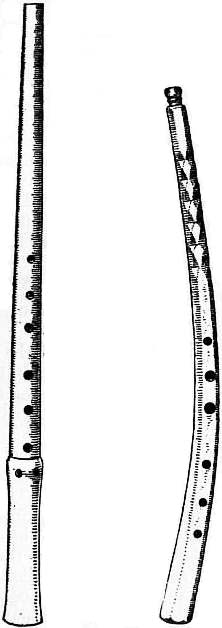
From Capt. C. R. Day’s Descriptive Catalogue of Musical Instruments, by permission of Messrs. Eyre & Spottiswoode.
Fig. 1.—Cornetto Muto. Fig. 2.—Cornetto Curvo.
(a) Cornet or Cornett (Fr. cornet, cornet à bouquin; Ger. Zinck, Zincken; Ital. cornetto) is the name given to a family of wood wind instruments, now obsolete, having a cup-shaped mouthpiece and a conical bore without a bell, and differing entirely from the modern cornet à pistons. The old cornets were of two kinds, the straight and the curved, characterized by radical differences in construction. There were two very different kinds of straight cornets (Ger. gerader Zinck, Ital. cornetto diretto or recto), the one most commonly used having a detachable cup-shaped mouthpiece similar to that of the trumpet, while the other was made to all appearance without mouthpiece, there being not even a moulded rim at the end of the tube to break the rigid straight line. Examination of the tube, however, reveals the secret of the characteristic sweet tone of this latter kind of cornet; unsuspected inside the top of the tube is cut out of the thickness of the wood a mouthpiece, not cup-shaped, but like a funnel similar to that of the French horn, which merges gradually into the bore of the instrument. This mode of construction, together with the narrower bore adopted, greatly influenced the timbre of the instrument, whose softer tone was thus due mainly to the substitution of the funnel for the sharp angle of incidence at the bottom of the cup mouthpiece known as the throat (see Mouthpiece), where it communicates with the tube. It is this sharp angle, which in the other cornets with detachable mouthpiece, causes the column of air to break, producing a shrill quality of tone, while the wider bore and slightly rough walls of the tube account for the harshness. In Germany the sweet-toned cornet was known as stiller or sanfter Zinck, and in Italy as cornetto muto (fig. 1), while in France the instruments with detachable mouthpiece were distinguished by the addition of à bouquin (= with mouthpiece). The curved cornet (Ger. krummer Zinck or Stadtkalb; Ital. cornetto curvo) could not for obvious reasons have the bore pierced through a single piece of wood; the channel for the vibrating column of air was, therefore, hollowed out of two pieces of wood, the diameter increasing from the mouthpiece to the lower end. The two pieces of wood thus prepared were joined together with glue and covered with leather, the outer surface of the tube being finished off in octagonal shape. The separate mouthpiece, made indifferently of wood, horn, ivory or metal,1 analogous to that of the trumpet, was distinctly cup-shaped and fixed by a tenon to the upper extremity of the pipe. The primitive instrument was an animal’s horn.
Pipes of such short length give only, besides the first or fundamental, the second and sometimes the third note of the harmonic series. Thus a pipe that has for its fundamental A will, if the pressure of breath and tension of the lips be steadily increased, give the octave A and the twelfth E. In order to connect the first and second harmonics diatonically, the length of the pipe was progressively shortened by boring lateral holes through the tube for the fingers to cover. The successive opening of these holes furnished the instrumentalist with the different intervals of the scale, six holes sufficing for this purpose:
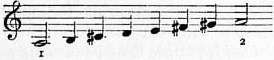
The fundamental was thus connected with its octave by all the degrees of a diatonic scale, which became chromatic by the help of cross-fingering and the greater or less tension of the lips stretched as vibrating reeds across the opening of the mouthpiece. This increased compass of twenty-seven notes obtained by cross-fingering is very clearly shown in a table by Eisel.2 The fingering was completed by a seventh hole, which had for its object the production of the octave without the necessity of closing all the holes in order to produce the second note of the harmonic series. The first complete octave, thus obtained by a succession of fundamental notes, was easily octaved by a stronger pressure of breath and tension of the lips across the mouthpiece, and thus the ordinary limits of the compass of a Zinck or cornet could be extended to a fifteenth. Whether straight or curved it was pierced laterally with seven holes, six through the front, and the seventh, that nearest the mouthpiece, through the back. The first three holes were usually covered with the third, second and first fingers of the right hand, the next four with the third, second and first fingers and the thumb of the left hand. But some instrumentalists inverted the position of the hands. Virdung3 shows, besides the cornetto recto, a kind of Zinck made of an animal’s horn with only four holes, three in the front of the pipe and one at the back. Such an instrument as this had naturally a very limited compass, since these four holes only sufficed to produce the intermediate notes between the second and third proper tones of the harmonic scale, the lower octave comprised between the first and second remaining incomplete; by overblowing, however, the next octave would be obtained in addition.
At the beginning of the 17th century Praetorius4 represents the Zincken as a complete family comprising: (1) the little Zinck with the lowest note , (2) the ordinary Zinck with the lowest note , (3) the great Zinck, cornon or corno torto, a great cornet in the shape of an with the lowest note . In France5 the family was composed of the following instruments:


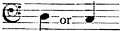
(1) The dessus or treble cornet with the lowest note ;

(2) the haute-contre or alto cornet with the lowest note ;

(3) the taille or tenor cornet with the lowest note and the basse or bass or pédalle6 cornet with the lowest note .


The cornets of the lowest pitch were sometimes furnished with an open key which, when closed, lengthened the tube, and extended the compass downwards by a note. Mersenne figures a cornon with a key.
During the middle ages these instruments were in such favour that an important part was given to them in all instrumental combinations. At Dresden,7 between 1647 and 1651, the Kapelle of the electoral prince of Saxony included two cornets, the bass being supplied by the trombone. Monteverde introduced two cornets in the 3rd and 4th acts of his Orfeo (1607). In France the charges for the Chapelle-Musique of the kings of France for the year 1619 contain two entries of the sum of 450 livres tournois, salary paid to one Marcel Cayty, joueur de cornet, a post held by him from 1604 until at least 1631, when another cornet player, Jean Daneau, is also mentioned.8
In Germany in the 17th and 18th centuries, Zincken were used with trombones in the churches to accompany the chorales. There are examples of this use of the instrument in the sacred cantatas of J. S. Bach, where the cornet is added to the upper voice parts to strengthen them. Johann Mattheson, conductor of the opera at Hamburg, writing on the orchestra in 17139 gives a description of the Zinck as a member of the orchestra, but in 1739,10 in his work on the perfect conductor, he deplores the decrease of its popularity in church music, from which it seems to be banished as useless. Gluck was the last composer of importance who scored for the cornet, as for instance in Orfeo, in Paride ed Elena, in Alceste and in Armide, &c. The great vogue of the curved cornet is not to be accounted for by its musical qualities, for it had a hard, hoarse, piercing sound, and it failed utterly in truth of intonation; these natural defects, moreover, could only be modified with great difficulty. Mersenne’s eulogium of the dessus, then more employed than the other cornets, can only be appreciated at its full value if we look upon the art of cornet playing as a lost art. “The dessus,” he says, “was used in the vocal concerts and to make the treble with the organ, which is ravishing when one knows how to play it to perfection like the Sieur Guiclet;” and again further on, “the character of its tone resembles the brilliance of a sunbeam piercing the darkness, when it is heard among the voices in churches, cathedrals or chapels.”11 Mersenne further observes that the serpent is the true bass of the cornet, that one without the other is like body without soul. A drawing in pen and ink of a curved cornet is given by Randle Holme in his Academy of Armoury (1688);12 and at the end of the description of the instrument he adds, “It is a delicate pleasant wind musick, if well played and humoured.” Giovanni Maria Artusi13 of Bologna, writing at the end of the 16th century, devotes much space to the cornet, explaining in detail the three kinds of tonguing used with the instrument. By tonguing is understood a method of articulation into the mouthpiece of flute, cornet à pistons or trumpet, of certain syllables which add brilliance to the tone. Artusi advocates (1) for the guttural effect, ler, ler, ler, der, ler, der, ler; ter, ler, ter; ler, ter, ler; (2) for the tongue effect, tere, tere, tere; (3) for the dental effect, teche, teche, teche, used by those who wish to strike terror into the hearts of the hearers—an effect, however, which offends the ear. A clue to the popularity of the instrument during the middle ages may perhaps be found in Artusi’s remark that this instrument is the most apt in imitating the human voice, but that it is very difficult and fatiguing to play; the musician, he adds elsewhere, should adopt an instrument to imitate the voice as much as possible, such as the cornetto and the trombone. He mentions two players in Venice, Il Cavaliero del Cornetto and M. Girolamo da Udine, who excelled in the art of playing the cornet.
Being derived from the horn of an animal through which lateral holes had been pierced, the curved cornet was probably the earlier, and when the instrument came to be copied in metal and in wood the straight cornet was the result of an attempt to simplify the construction. The evolution probably took place in Asia Minor, where tubes with conical bore were the rule, and the instrument was thence introduced into Europe. A straight Zinck, having a grotesque animal’s head at the bell-end, and six holes visible, is pictured in a miniature of the 11th century.14 What appears to be precisely the same kind of instrument, although differing widely in reality, the chaunter being reed-blown, is to be found in illuminated MSS. as the chaunter of the bagpipe, as for example in a royal roll of Henry III. at the British Museum,15 where it occurs twice played by a man on stilts. The grotesque was probably added to the chaunter in imitation of that on the straight Zinck. Two stille Zincken or cornetti muti are among the musical instruments represented in the triumphal procession of the emperor Maximilian I.16 (d. 1519), designed at his command by H. Burgmair under the superintendence of Albrecht Dürer.
(b) Cornet à Pistons, Cornet, Cornopaean (Fr. cornet à pistons; Ger. Cornett; Ital. cornetto), are the names of a modern brass wind instrument of the same pitch as the trumpet. Being a transformation of the old post-horn, the cornet should have a conical bore of wide diameter in proportion to the length of tube, but in practice usually only a small portion of the tube is conical, i.e. from the mouthpiece to the slide of the first valve and from the slide of the third valve to the bell. The tube of the cornet is doubled round upon itself. The cup-shaped mouthpiece is larger than that of the trumpet; the shape of the cup in conjunction with the length of the tube and the proportions of the bore determines the timbre of the instrument. The outline of the bottom of the cup, where it communicates with the bore, is of the greatest importance.17 If, as in the trumpet, it presents angles against which the column of air breaks, it produces a brilliant tone quality. In the cornet mouthpiece there are no angles at the bottom of the cup, which curves into the bore; hence the cornet’s loose, coarse quality of tone. The sound is produced by stretching the lips across the mouthpiece, and making them act as double reeds, set in vibration by the breath. There are no fixed notes on the cornet as in instruments with lateral holes, or with keys; the musical scale is obtained by means of the power the performer possesses—once he has learned how to use it—of producing the notes of the harmonic series by overblowing, i.e. by varying the tension of the lips and the pressure of breath. In the cornet this series is short, comprising only the harmonics from the 2nd to the 8th:
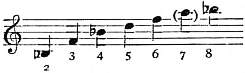
Harmonic series of the B♭ cornet—the 7th is slightly flat, a defect which the performer corrects, if he uses the note at all.
The intermediate notes completing the chromatic scale are obtained by means of three pistons which, on being depressed, open valves leading into supplementary wind-ways, which lengthen the original tube. The pitch of the instrument is thus lowered respectively one tone, half a tone, and one tone and a half. The action of the piston temporarily changes the key of the instrument and with it the notes of the harmonic series. Before a performer, therefore, can play a note he must know in which harmonic series it is best obtained and use the proper piston in conjunction with the requisite lip tension. By means of the pistons the compass of the cornet is thus extended from
Real sounds for the cornet in C.
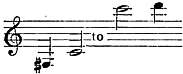
(The minims indicate the practical compass but the extension shown by the crotchets is possible to all good players.)
The treble clef is used in notation, and in England the music for the cornet is usually written as sounded, but most French and German composers score for it as for a transposing instrument; for example, the music for the B♭ cornet is written in a key one tone higher than that of the composition.
The timbre of the cornet lies somewhere between that of the horn and the trumpet, having the blaring, penetrating quality of the latter without its brilliant noble sonorousness. The great favour with which the cornet meets is due to the facility with which it speaks, to the little fatigue it causes, and to the simplicity of its mechanism. We must, however, regret from the point of view of art that its success has been so great, and that it has ended in usurping in brass bands the place of the bugles, the tone colour of which is infinitely preferable as a foundation for an ensemble composed entirely of brass instruments. Even the symphonic orchestra has not been secure from its intrusion, and the growing tendency in some orchestras, notably in France, to allow the cornet to supersede the trumpet, to the great detriment of tone colour, is to be deplored. The cornet used in a rich orchestral harmony is of value for completing the chords of trumpets, or to undertake diatonic and chromatic passages which on account of their rapidity cannot easily be fingered by trombones or horns. The technical possibilities of the instrument are very great, almost unrivalled in the brass wind:—notes sustained, crescendo or diminuendo; diatonic and chromatic scale and arpeggio passages; leaps, shakes, and in fact all kinds of musical figures in any key, can be played with great facility on the three-valved cornet. Double tonguing is also practicable, the articulation with the tongue of the syllables ti-ke for double, and of ti-ke-ti for triple time producing a striking staccato effect.
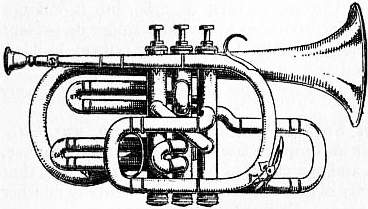
Fig. 3.—B♭ Cornet with enharmonic valves (Besson & Co.).
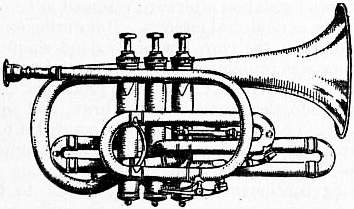
Fig. 4.—B♭ Cornet with strictly conical bore throughout, Klussmann’s patent (Rudall, Carte & Co.).
The cornet was evolved in Germany, at the beginning of the 19th century, from the post-horn, by the application of the newly invented pistons of Stoelzel and Bluemel patented in 1815. It was introduced into Great Britain and France about 1830. There were at first only two pistons—for a whole tone and for a half tone—from which there naturally resulted gaps in the chromatic scale of the instrument. The use of a combination of pistons (see Bombardon and Valves) fails to give acoustically correct intervals, because the length of tubing thus thrown open is not of the theoretical length required to produce the interval. A tube about 4 ft. long, such as that of the B♭ cornet, needs an additional length of about 3 in. to lower the pitch a semitone; but, if this cornet has already been lowered one tone to the key of A♭, the length of tube has increased some 6 in., and the 3-in. semitone piston no longer adds sufficient tubing to produce a semitone of correct intonation. To the performer falls the task of concealing the shortcomings of his instrument, and he therefore corrects the intonation by varying the lip tension. At first the cornet was supplied with a great many crooks for A, A♭, G, F, E, E♭ and D, but from the explanation now given, it will be readily understood that they were found unpractical for valve instruments, and all but the first two mentioned have been abandoned. The history of the cornet is a record of the endeavours of successive musical instrument makers to overcome this inherent defect in construction. The most ingenious and successful of these improvements are the following:—(1) The six-valve-independent system18 of Adolphe Sax, designed about 1850, by which a separate valve was used for each position, thus obviating the necessity of using combinations of pistons. This theoretically perfect system unfortunately introduced great difficulties in practice, the valves being made ascending instead of descending, and each piston cutting off a definite length of wind-way from the open tube, instead of adding to it. The system was eventually abandoned. (2) The Besson Registre giving eight independent positions, afterwards modified as the (3) Besson compensating system transpositeur, patented in England in 1859, which was considered so successful that the idea was extensively used by other makers. (4) The Boosey automatic compensating piston, invented by D. J. Blaikley, and patented in 1878, a very ingenious device whereby when two or more pistons are used simultaneously the length of the air column is automatically adjusted to the theoretical length required to ensure correct intonation. (5) Victor Mahillon’s automatic regulating pistons (pistons régulateur automatique) produced about 1886, the result of independent efforts in the same direction as Blaikley, and equally ingenious and effectual.19 Finally we have (6) more recently the Besson enharmonic valve system (fig. 3) with three pistons and six independent tuning slides which give the seven positions independently, thus realizing in a simple effectual manner all that Sax strove to accomplish with his six pistons. The enharmonic valves give all notes theoretically true; there are in addition separate means for adjusting each of the first six lengths, for although these lengths are theoretically correct there are always certain modifying conditions connected with brass instruments which render it essential to provide means for adjustment. All notes being true on this Besson cornet, they can be fingered to the greatest advantage for smoothness and rapidity. (7) Rudall, Carte & Co.’s cornet (fig. 4), with strictly conical bore (Klussmann’s patent) throughout the open tube and additional lengths from the mouthpiece to the bell, gives a perfect intonation and is at the same time easy to blow. There are no crooks to this cornet when constructed in B♭, but it may be instantaneously transposed into the key of A major by means of an undetachable slide guided by a piston rod.
(V. M.; K. S.)
CORNETO TARQUINIA (anc. Tarquinii), a town of Italy, in the province of Rome, 62 m. N.W. by rail from the town of Rome, 490 ft. above sea-level. Pop. (1901) 5273. Corneto probably arose after the ancient town had been destroyed by the Saracens. In the 10th century it began to acquire importance, and for some time was an independent commune. It is picturesquely situated, and commands a fine view. It possesses medieval fortifications, and no less than twenty-five towers are still standing in various parts of the town, which thus has a remarkably medieval appearance. The castle on the N. contains the Romanesque church of S. Maria in Castello, begun in 1121, with a fine portal of 1143, a ciborium of 1168 and a pulpit of 1209, both in “cosmatesque” work: the pavement in marble mosaic also is fine. There are several other Romanesque and Gothic churches in the town more or less restored. The oldest parts of the Palazzo Comunale date from about 1000. The Gothic Palazzo Vitelleschi (1439) contains remarkably rich windows. The municipal museum (which is to be transferred to this palace) and the Palazzo Bruschi, contain fine collections of Etruscan antiquities from the tombs of Tarquinii. Four miles to the S.W. is the Porto Clementino (perhaps the ancient Graviscae, the port of Tarquinii), with government saltworks, in which convicts are employed.
See L. Dasti, Notizie storiche archeologiche di Tarquinia e Corneto (Rome, 1878); for the cemeteries, Notizie degli Scavi, 1906, 1907.
CORNICE (Fr. corniche, Ital. cornice), in architecture, the projection at the top of a wall, which is provided to throw off the rain water from the roof, beyond the face of the building. As employed in classic architecture it forms the upper part of the entablature of an order, and is there subdivided into bed mould, corona and cymatium. The term is also generally applied to any moulding projection which crowns the feature to which it is attached; thus doors and windows, internally as well as externally, have each their cornice, and the same applies to pieces of furniture (see also Masonry).
CORNIFICIUS, the author of a work on rhetorical figures, and perhaps of a general treatise (ars, τέχνη) on the art of rhetoric (Quintilian, Instit., iii. 1. 21, ix. 3. 89). He has been identified with the author of the four books of Rhetorica dedicated to a certain Q. Herennius and generally known under the title of Auctor ad Herennium. The chief argument in favour of this identity is the fact that many passages quoted by Quintilian from Cornificius are reproduced in the Rhetorica. Jerome, Priscian and others attributed the work to Cicero (whose De inventione was called Rhetorica prima, the Auctor ad Herennium, Rhetorica secunda), while the claims of L. Aelius Stilo, M. Antonius Gnipho, and Ateius Praetextatus to the authorship have been supported by modern scholars. But it seems improbable that the question of authorship will ever be satisfactorily settled. Internal indications point to the date of compositions as 86-82 B.C., the period of Marian domination in Rome. The unknown author, as may be inferred from the treatise itself, did not write to make money, but to oblige his relative and friend Herennius, for whose instruction he promises to supply other works on grammar, military matters and political administration. He expresses his contempt for the ordinary school rhetorician, the hair-splitting dialecticians and their “sense of inability to speak, since they dare not even pronounce their own name for fear of expressing themselves ambiguously.” Finally, he admits that rhetoric is not the highest accomplishment, and that philosophy is far more deserving of attention. Politically, it is evident that he was a staunch supporter of the popular party.
The first and second books of the Rhetorica treat of inventio and forensic rhetoric; the third, of dispositio, pronuntiatio, memoria, deliberative and demonstrative rhetoric; the fourth, of elocutio. The chief aims of the author are conciseness and clearness (breviter et dilucide scribere). In accordance with this, he ignores all rhetorical subtleties, the useless and irrelevant matter introduced by the Greeks to make the art appear more difficult of acquisition; where possible, he uses Roman terminology for technical terms, and supplies his own examples of the various rhetorical figures. The work as a whole is considered very valuable. The question of the relation of Cicero’s De inventione to the Rhetorica has been much discussed. Three views were held: that the Auctor copied from Cicero; that they were independent of each other, parallelisms being due to their having been taught by the same rhetorician at Rome; that Cicero made extracts from the Rhetorica, as well as from other authorities, in his usual eclectic fashion. The latest editor, F. Marx, puts forward the theory that Cicero and the Auctor have not produced original works, but have merely given the substance of two τέχναι (both emanating from the Rhodian school); that neither used the τέχναι directly, but reproduced the revised version of the rhetoricians whose school they attended, the introductions alone being their own work; that the lectures on which the Ciceronian treatise was based were delivered before the lectures attended by the Auctor.