VOLUME VII SLICE IV Coquelin to Costume (continued 2)
Reading edition
So far he was only known as an able subordinate, but his capacity could not be hidden from such an excellent judge of character as Isabella, to whom as a woman he appealed by a chivalrous union of devotion and respect. When, therefore, the Catholic sovereigns decided to support the Aragonese house of Naples against Charles VIII. of France, Gonzalo was chosen by the influence of the queen, and in preference to older men, to command the Spanish expedition. It was in Italy that he won the title of the Great Captain; Guicciardini says that it was given him by the customary arrogance of the Spaniards, but it was certainly accepted as just by all the soldiers of the time of whatever nationality. A detailed account of his campaigns cannot be given here. He held the command in Italy twice. In 1495 he was sent with a small force of little more than five thousand men to aid Ferdinand of Naples to recover his kingdom, and he returned home after achieving success, in 1498. After a brief interval of service against the conquered Moors who had risen in revolt, he returned to Italy in 1501. Ferdinand of Spain had entered into his iniquitous compact with Louis XII. of France for the spoliation and division of the kingdom of Naples. The Great Captain was chosen to command the Spanish part of this robber coalition. As general and as viceroy of Naples he remained in Italy till 1507. During his first command he was mostly employed in Calabria in mountain warfare which bore much resemblance to his former experience in Granada. There was, however, a material difference in the enemy. The French forces, commanded by the Scotsman Stuart d’Aubigny, consisted largely of Swiss pikemen, and of their own men-at-arms. With his veterans of the Granadine war, foot soldiers armed with sword and buckler, or arquebuses and crossbows, and light cavalry, trained to unsleeping vigilance, capable of long marches, and of an endurance unparalleled among the soldiers of the time, he could carry on a guerrillero warfare which wore down his opponents, who suffered far more than the Spaniards from the heat. But he saw clearly that this was not enough. His experience in Seminara showed him that something more was wanted on the battlefield. The action was lost mainly because King Ferdinand, disregarding the advice of Gonzalo, persisted in fighting a pitched battle with inferior numbers, some of whom were untrustworthy Neapolitans. The Spanish foot behaved excellently, but the result showed that in the open field their loose formation and their swords put them at a disadvantage as against a charge of heavy cavalry or pikemen. Gonzalo therefore introduced a much more strict formation, and adopted the pike as the weapon of a part of his foot. The division of the Spanish infantry into the “battle” or main central body of pikemen, and the wings (alas) of “shot” to be employed in outflanking the enemy, was primarily due to the Great Captain.
The French were expelled by 1498 without another battle. When the Great Captain reappeared in Italy he had first to perform the congenial task of driving the Turk from Cephalonia, then to aid in robbing the king of Naples, Frederick, brother of his old ally Ferdinand. When the king of Naples had been despoiled, the French and Spaniards quarrelled over the booty. The Great Captain now found himself with a much outnumbered army in the presence of the French. The war was divided into two phases very similar to one another. During the end of 1502 and the early part of 1503 the Spaniards stood at bay in the entrenched camp at Barletta near the Ofanto on the shores of the Adriatic. He resolutely refused to be tempted into battle either by the taunts of the French or the discontent of his own soldiers. Meanwhile he employed the Aragonese partisans in the country, and flying expeditions of his own men, to harass the enemy’s communications. When he was reinforced, and the French committed the mistake of scattering their forces too much to secure supplies, he took the offensive, pounced on the enemy’s depot of provisions at Cerignola, took a strong position, threw up hasty field works, and strengthened them with a species of wire entanglements. The French made a headlong front attack, were repulsed, assailed in flank, and routed. The later operations on the Garigliano were very similar, and led to the total expulsion of the French from Naples. Gonzalo remained as governor of Naples till 1507. But he had become too great not to arouse the jealousy of such a typical king of the Renaissance as Ferdinand the Catholic. The death of the queen in 1504 had deprived him of a friend, and it must be allowed that he was profuse in rewarding his captains and his soldiers out of the public treasury. Ferdinand loaded him with titles and fine words, but recalled him so soon as he could, and left him unemployed till his death on the 2nd of December 1515.
The Great Captain is sometimes spoken of as the first of modern generals. The expression is uncritical, for modern generalship arose from many sides, but he was emphatically a general. There is much in his methods which bears a curious likeness to those of the duke of Wellington; Barletta, for instance, has a distinct resemblance to the Torres Vedras campaign, and the battle on the Garigliano to Assaye. As an organizer he founded the Spanish infantry of the 16th and 17th centuries, and he gave the best proof of his influence by forming a school of officers. The best generals of Charles V. were either the pupils of the Great Captain or were trained by them.
There is no life of Gonzalo de Córdoba written by a scholar who was also a good judge of war. The dull Cronica del Gran Capitan gives the bare events of his campaigns rather wearisomely but fully. Paulus Govius, Vitae illustrium virorum, translated by Domenichi (Florence, 1550), is elegant and very readable. Don José Quintana includes him in his Españoles celebres (Rivadeneyra Biblioteca de autores españoles, vol. xix., Madrid, 1846-1880); and Prescott collected the authorities, and made good use of them in his Ferdinand and Isabella. See also P. du Poncet, Histoire de Gonsalve de Cordoue (Paris, 1714). The Gonsalve de Cordoue, ou Grenade reconquise of Florian (Paris, 1791) is a romance.
(D. H.)
CÓRDOBA, a large central province of the Argentine Republic, bounded N. by Santiago del Estero, E. by Santa Fé, S. by Buenos Aires and La Pampa, W. by San Luis and Rioja, and N.W. by Catamarca. Pop. (1895) 351,223; (1904, estimate) 465,464; area, 62,160 sq. m. The greater part of the province belongs to the pampas, though less fertile and grassy than the plains farther E. and S. It likewise includes large saline and swampy areas. The N.W. part of the province is traversed by an isolated mountain system made up of the Córdoba, Pocho and Ischilin sierras, which extend for a distance of some 200 m. in a N. and S. direction. These ranges intercept the moist winds from the Atlantic, and receive on their eastern slopes an abundant rainfall, which gives them a strikingly verdant appearance in comparison with the surrounding plains. West and N.W. of the sierras are extensive saline basins called Las Salinas Grandes, which extend into the neighbouring provinces and are absolutely barren. In the N.E. the land is low and swampy; here are the large saline lagoons of Mar Chiquita and Los Porongos. The principal rivers, which have their sources in the sierras and flow eastward, are the Primero and Segundo, which flow north-easterly into the lacustrine basin of Mar Chiquita; the Tercero and Quarto, which unite near the Santa Fé frontier to form the Carcaraña, a tributary of the Paraná; and the Quinto, which flows south-easterly into the swamps of the Laguna Amarga in the S. part of the province. Countless small streams also descend the eastern slopes of the sierras and are lost in the great plains. The eastern districts are moderately fertile, and are chiefly devoted to cattle-breeding, though cereals are also produced. In the valleys and well-watered foothills of the sierras, however, cereals, alfalfa and fruit are the principal products. The rainfall is limited throughout the province, and irrigation is employed in but few localities. The mineral resources include gold, silver, copper, lead and iron, but mining is carried on only to a very limited extent. Salt and marble are also produced. Córdoba is traversed by several railway lines—those running westward from Buenos Aires and Rosario to Mendoza and the Chilean frontier, those connecting the city of Córdoba with the same cities, and with Tucuman on the N. and Catamarca and Rioja on the N.W. The chief towns are Córdoba, the capital, Rio Quarto, Villa Maria, an important railway centre 82 m. S.E. of Córdoba, and Cruz del Eje on the W. slopes of the sierras, 110 m. N.W. of Córdoba.
CÓRDOBA, a city in the central part of the Argentine Republic, capital of the above province, on the Rio Primero, 435 m. by rail N.W. of Buenos Aires by way of Rosario, 246 m. from the latter. Pop. (1895) 42,783—the suburbs having 11,679 more—(1905, estimate) 60,000. The city is connected by railway with Buenos Aires and Rosario, and with the capitals of all the surrounding provinces. Córdoba stands on a high eastward-sloping plain called the “Altos,” 1240 ft. above sea-level, and is built in a broad river bottom washed out by periodical inundations and the action of the rains on the alluvial banks. The inundations have been brought under control by the construction of barriers and dams, but the banks are constantly broken down. The city is regularly laid out, and contains many fine edifices and dwellings. Several suburban settlements surround the city, the more important of which are served by the urban tramway lines. The streets are lighted by gas and electricity, and an excellent telephone service is maintained. The noteworthy public buildings include the cathedral, a handsome edifice curiously oriental in appearance, a massive old Jesuit church with a ceiling of richly carved and gilded cedar, the old university, founded in 1613, which still occupies the halls built by the Jesuits around a large quadrangle, the fine old cabildo, or government house, of Moorish appearance, and the national observatory on the barranca overlooking the city. There are, also, two national normal schools, a national college, an episcopal seminary, an endowed Carmelite orphanage, a national meteorological station, a national academy of sciences, and a good public library. Among the attractive features of the city is an alameda of about six acres, within which is a square artificial lake of 4 acres, surrounded by shrubbery and shaded walks; the alameda dates from the time when the Jesuits ruled the city, and to them also are due the tiled baths, supplied with running water. A short avenue connects the alameda with the principal plaza, a pretty garden and promenade. The water supply of Córdoba is derived from the Rio Primero, 12 m. above the city, where an immense dam (Dique San Roque), one of the largest of its kind in South America, has been built across the river valley. This dam also serves to irrigate the valley below, and to furnish power for the electric plant which provides Córdoba with light and electric power. In and about the city there are several industrial establishments which have sprung into existence since the opening of the first railway in 1870. The surrounding country is irrigated and well cultivated, and produces an abundance of fruit and vegetables.
The city was founded in 1573 by Luis Geronimo de Cabrera and was for a long time distinguished for its learning and piety. It was the headquarters of the Jesuits in this part of South America for two centuries, and for a time the capital of the Spanish intendencia of Tucuman. The expulsion of the Jesuits in 1767 proved to be a serious blow to the academic reputation of the city, from which it did not recover until 1870, when President Sarmiento engaged some eminent scientific men from Europe to teach modern science in the university.
CÓRDOBA, a town of the state of Vera Cruz, Mexico, 55 m. W.S.W. of the port of Vera Cruz, in a highly fertile valley, near the volcano of Orizaba, and 2880 ft. above sea-level. Pop. (1895) 7974. The surrounding district produces sugar, tobacco and coffee, Córdoba being one of the principal coffee-producing centres of Mexico. It also manufactures cotton and woollen fabrics. The town is regularly laid out and built of stone, and contains several handsome edifices, chief of which is the old cathedral. Córdoba was a town of considerable importance in colonial times, but fell into decay after the revolution. The railway from Vera Cruz to Mexico, which passes through it, and the development of coffee production, have helped the city to recover a part of its lost trade.
CORDON (a French derivative of corde, cord), a word used in many applications of its meaning of “line” or “cord,” and particularly of a cord of gold or silver lace worn in military and other uniforms. The word is especially used of the sash or ribbon worn by members of an order of knighthood, crossing from one shoulder to the opposite hip. The cordon bleu, the sky-blue ribbon of the knight’s grand cross of the order of the Holy Spirit, the highest order of the Bourbon kings of France, was, like the “blue ribbon” of the English Garter, taken as a type of the highest reward or prize to which any one can attain (see also Cookery). In heraldry, “cordons” are the ornamental cords which, with the hats to which they are attached, ensign the shields of arms of certain ecclesiastical dignitaries; they are interlaced to form a mesh or network and terminate in rows of tassels. A cardinal’s cordon is gules with five rows of fifteen tassels, an archbishop’s vert with four rows of ten, and a bishop’s also vert, with three rows of six. In architecture a “cordon” is a projecting band of stone along the outside of a building, a string-course. The word is frequently used in a transferred sense of a line of posts or stations to guard an enclosed area from unauthorized passage, e.g. a military or police cordon, and especially a sanitary cordon, a line of posts to prevent communication from or with an area infected with disease.
CORDOVA (Span. Córdoba), an inland province of southern Spain, bounded on the N.E. by Ciudad Real, E. by Jaén, S.E. by Granada, S. by Málaga, S.W. and W. by Seville, and N.W. by Badajoz. Pop. (1900) 455,859; area, 5299 sq. m. The river Guadalquivir divides the province into two very dissimilar portions. On the right bank is the mountainous region of the Sierra Morena, less peopled and fertile than the left bank, with its great plains (La Campiña) and slightly undulating country towards the south and south-east, where the surface again becomes mountainous with the outlying ridges of the Sierra Nevada. The Guadalquivir, flowing from E.N.E. to W.S.W., waters the richest districts of Cordova, and has many tributaries, notably the Bembezar, Guadiato and Guadamellato, on the right, and the Genil and Guadajoz on the left. The northern districts (Los Pedroches) are drained by several small tributaries of the Guadiana. The climate is much varied. Snow is to be found for months on the highest peaks of the mountains; mild temperature in the plains, except in the few torrid summer months, when rain seldom falls. The peasantry are chiefly occupied in various branches of husbandry; sheep-farming and the culture of the olive employ large numbers. The agricultural wealth of Cordova is, however, not fully exploited, owing to the conservatism and backward education of the peasantry. There are no great manufacturing towns, but mining is an industry of some importance. In 1903 coal was obtained in considerable quantities in the Belmez district; argentiferous lead and zinc near Pozoblanco and elsewhere; iron ore at Luque, near Baena. A small amount of bismuth is also obtained. Mining is facilitated by a fairly complete and well-kept system of communication by road and railway. The main line Madrid-Lináres-Seville follows the Guadalquivir valley throughout the province, passing through the capital, Cordova. Here it meets the line from Almorchón, on the north, to Málaga, on the south, which has three important branches—Belmez-Fuente del Arco, Cordova-Utrera, and Puente Genil-Jaén. After the capital, the principal towns are Aguilar de la Frontera (13,236), Baena (14,539), Cabra (13,127), Fuente Ovejuna (11,777), Lucena (21,179), Montilla (13,603), Montoro (14,581), Pozoblanco (12,792), Priego de Cordoba (16,904) and Puente Genil (12,956). These are described under separate headings. Other towns of less importance are Adamuz (6974), Belalcázar (7682), Belmez (8978), Bujalance (10,756), Castro del Río (11,821), Hinojosa del Duque (10,673), Palma del Río (7914), Rute (10,740) and Villafranca de Córdoba (9771).
CORDOVA (Span. Córdoba; Lat. Corduba), the capital of the Spanish province of Cordova, on the southern slopes of the Sierra de Cordova, and the right bank of the river Guadalquivir. Pop. (1900) 58,275. At Cordova the Madrid-Seville railway meets the branch line from Almorchón to Málaga. The city is an episcopal see. Few fragments remain of its Moorish walls, which were erected on Roman foundations and enclosed a very wide area, now largely occupied by garden-ground cleared from the ruins of ancient buildings. On the outskirts are many modern factories in striking contrast with the surrounding orange, lemon and olive plantations, and with the pastures which belong to the celebrated Cordovan school of bull-fighting. Nearer the centre the streets are for the most part narrow and crooked. Almost every building, however, is profusely covered with whitewash, and thus there is little difference on the surface between the oldest and the most modern houses. The southern suburb communicates with the town by means of a bridge of sixteen arches across the river, exhibiting the usual combination of Roman and Moorish masonry and dominated at the one end by an elevated statue of the patron saint, St Raphael, whose effigy is to be seen in various other quarters of the city. The most important of the public buildings are the cathedral, the old monastic establishments, the churches, the bishop’s palace, the city hall, the hospitals and the schools and colleges, including the academy for girls founded in 1590 by Bishop Pacheco of Cordova, which is empowered to grant degrees. The Alcázar, or royal palace, stands on the south-west amid the gardens laid out by its builder, the caliph Abd-ar-Rahman III. (912-961). Its older parts are in ruins, and even the so-called New Alcázar, erected by Alphonso XI. of Castile in 1328, and long used as the offices of the Holy Inquisition, has only one wing in good repair, which serves as a prison.
But the glory of Cordova, surpassing all its other Moorish or Christian buildings, is the mezquita, or mosque, now a cathedral, but originally founded on the site of a Roman temple and a Visigothic church by Abd-ar-Rahman I. (756-788), who wished to confirm the power of his caliphate by making its capital a great religious centre. Immigration from all the lands of Islam soon rendered a larger mosque necessary, owing to the greatly increased multitude of worshippers, and, by orders of Abd-ar-Rahman II. (822-852) and Al-Hakim II. (961-976), the original size was doubled. After various minor additions, Al-Mansur, the vizier of the caliph Hisham II. (976-1009), again enlarged the Zeca, or House of Purification, as the mosque was named, to twice its former size, rendering it the largest sacred building of Islam, after the Kaaba at Mecca. The ground plan of the completed mosque forms a rectangle, measuring 570 ft. in length and 425 in breadth, or little less than St Peter’s in Rome. About one-third of this area is occupied by the courtyard, and the cloisters which surround it on the north, west and east. The exterior, with the straight lines of its square buttress towers, has a heavy and somewhat ungainly appearance; but the interior is one of the most beautiful specimens of Moorish architecture. Passing through a grand courtyard about 500 ft. in length, shady with palm and cypress and orange trees and watered by five fountains, the visitor enters on the south a magnificent and bewildering labyrinth of pillars in which porphyry, jasper and many-coloured marbles are boldly combined. Part came from the spoils of Nîmes or Narbonne, part from Seville or Tarragona, some from the older ruins of Carthage, and others as a present to Abd-ar-Rahman I. from the East Roman emperor Leo IV., who sent also from Constantinople his own skilled workmen, with 16 tons of tesserae for the mosaics. Originally of different heights, the pillars have been adjusted to their present standard of 12 ft. either by being sunk into the soil or by the addition of Corinthian capitals. Twelve hundred was the number of the columns in the original building, but many have been destroyed. The pillars divide the area of the building from north to south, longitudinally into nineteen and transversely into twenty-nine aisles—each row supporting a tier of open Moorish arches of the same height (12 ft.) with a third and similar tier superimposed upon the second. The full height of the ceiling is thus about 35 ft. The Moorish character of the building was unfortunately impaired in the 16th century by the formation in the interior of a crucero, or high altar and cruciform choir, by the addition of numerous chapels along the sides of the vast quadrangle, and by the erection of a belfry 300 ft. high in room of the old minaret. The crucero in itself is no disgrace to the architect Hernan Ruiz, but every lover of art must sympathize with the rebuke administered by the emperor Charles V. (1500-1558) to the cathedral authorities: “You have built here what could have been built as well anywhere else; and you have destroyed what was unique in the world.” Magnificent, indeed, as the cathedral still is, it is almost impossible to realize what the mosque must have been when the worshippers thronged through its nineteen gateways of bronze, and its 4700 lamps, fed with perfumed oil, illuminated its brilliant aisles. Of the exquisite elaboration bestowed on the more sacred portions abundant proof is afforded by the third Mihrab, or prayer-recess, a small 10th-century chapel, heptagonal in shape, roofed with a single shell-like block of snow-white marble, and inlaid with Byzantine mosaics of glass and gold.
Cordova was celebrated in the time of the Moors for its silversmiths, who are said to have come originally from Damascus; and it exported a peculiar kind of leather which took its name from the city, whence is derived the word cordwainer. Fine silver filigree ornaments are still produced; and Moorish work in leather is often skilfully imitated, although this handicraft almost disappeared in the 15th century. The chief modern industries of Cordova are distillation of spirits and the manufacture of woollen, linen and silken goods.
Corduba, probably of Carthaginian origin, was occupied by the Romans under Marcus Marcellus in 152 B.C.. and shortly afterwards became the first Roman colonia in Spain. From the large number of men of noble rank among the colonists, the city obtained the title of Patricia; and to this day the Cordovese pride themselves on the purity and antiquity of their descent. In the 1st century B.C. Cordova aided the sons of Pompey against Caesar; but after the battle of Munda, in 45 B.C., it fell into the hands of Caesar, who avenged the obstinacy of its resistance by massacring 20,000 of the inhabitants. Under Augustus, if not before, it became a municipality, and was the capital of the thoroughly Romanized province of Baetica. In the lifetime of Strabo, however (c. 63 B.C.-A.D. 21), it still ranked as the largest city of Spain. Its prosperity was due partly to its position on the Baetis, and on the Via Augusta, the great commercial road from northern Spain built by Augustus, and partly to its proximity to mines and rich grazing and grain-producing districts. Hosius, its bishop, presided over the first council of Nicaea in 345; and its importance was maintained by the Visigothic kings, whose rule lasted from the 5th to the beginning of the 8th century. Under the Moors, Cordova was at first an appanage of the caliphate of Damascus; but after 756 Abd-ar-Rahman I. made it the capital of Moorish Spain, and the centre of an independent caliphate (see Abd-ar-Rahman). It reached its zenith of prosperity in the middle of the 10th century, under Abd-ar-Rahman III. At his death, it is recorded by native chroniclers, probably with Arabic exaggeration, that Cordova contained within its walls 200,000 houses, 600 mosques, 900 baths, a university, and numerous public libraries; whilst on the bank of the Guadalquivir, under the power of its monarch, there were eight cities, 300 towns and 12,000 populous villages. A period of decadence began in 1016, owing to the claims of the rival dynasties which aimed at succeeding to the line of Abd-ar-Rahman; the caliphate never won back its position, and in 1236 Cordova was easily captured by Ferdinand III. of Castile. The substitution of Spanish for Moorish supremacy rather accelerated than arrested the decline of art, industry and population; and in the 19th century Cordova never recovered from the disaster of 1808, when it was stormed and sacked by the French. Few cities of Spain, however, can boast of so long a list of illustrious natives in the Moorish and Roman periods, and even, to a less extent, in modern times. It was the birthplace of the rhetorician Marcus Annaeus Seneca, and his more famous son Lucius (c. 3 B.C.-A.D. 65); of the poet Lucan (A.D. 39-65); of the philosophers Averroes (1126-1198) and Maimonides (1135-1204); of the Spanish men of letters Juan de Mena (c. 1411-1456), Lorenzo de Sepúlveda (d. 1574) and Luis de Gongora y Argote (1561-1627); and the painters Pablo de Céspedes (1538-1608) and Juan de Valdés Leal (1630-1691). The celebrated captain Gonzalo Fernandez de Córdoba (q.v.), the conqueror of Naples (1495-1498), was born in the neighbouring town of Montilla.
See Estudio descriptivo de los monumentos árabes de Granada y Córdoba, by R. Contreras (Madrid, 1885); Córdoba, a large illustrated volume of the series España, by P. de Madrazo (Barcelona, 1884); Inscripciones árabes de Córdoba, by R. Amador de los Ríos y Villalta (Madrid, 1886).
CORDUROY, a cotton cloth of the fustian kind, made like a ribbed velvet. It is generally a coarse heavy material and is used largely for workmen’s clothes, but some finer kinds are used for ladies’ dresses, &c. According to the New English Dictionary the word is understood to be of English invention, “either originally intended, or soon after assumed, to represent a supposed French corde du roi.” It is said that a coarse woollen fabric called duroy, made in Somerset during the 18th century, has no apparent connexion with it. From the ribbed appearance of the cloth the name corduroy is applied, particularly in America, to a rough road of logs laid transversely side by side, usually across swampy ground.
CORDUS, AULUS CREMUTIUS, Roman historian of the later Augustan age. He was the author of a history (perhaps called Annales) of the events of the civil wars and the reign of Augustus, embracing the period from at least 43-18 B.C. In A.D. 25 he was brought to trial for having eulogized Brutus and spoken of Cassius as the last of the Romans. His real offence was a witticism at the expense of Sejanus, who put up two of his creatures to accuse him in the senate. Seeing that nothing could save him, Cordus starved himself to death. A decree of the senate ordered that his works should be confiscated and burned by the aediles. Some copies, however, were saved by the efforts of Cordus’s daughter Marcia, and after the death of Tiberius the work was published at the express wish of Caligula. It is impossible to form an opinion of it from the scanty fragments (H. Peter, Historicorum Romanorum Fragmenta, 1883). According to ancient authorities, the writer was very outspoken in his denunciations, and his relatives considered it necessary to strike out the most offensive passages of the work before it was widely circulated (Quintilian, Instit. x. 1, 104). Two passages in Pliny (Nat. Hist. x. 74 [37], xvi. 108 [45]) seem to refer to a work of a different nature from the history—perhaps a treatise on Admiranda or remarkable things.
See Tacitus, Annals, iv. 34, 35; Suetonius, Tiberius, 61, Caligula, 16; Seneca, Suasoriae, vii., esp. the Consolatio to Cordus’s daughter Marcia; Dio Cassius lvii. 24. There are monographs by J. Held (1841) and C. Rathlef (1860). Also H. Peter, Die geschichtliche Literatur über die römische Kaiserzeit (1897); Teuffel-Schwabe, Hist. of Roman Lit., Eng. trans., 277, 1.
CORELLI, ARCANGELO (1653-1713), Italian violin-player and composer, was born on the 12th or 13th of February 1653, at Fusignano near Imola, and died in 1713. Of his life little is known. His master on the violin was Bassani. Matteo Simonelli, the well-known singer of the pope’s chapel, taught him composition. His first decided success was gained in Paris at the age of nineteen. To this he owed his European reputation. From Paris Corelli went to Germany. In 1681 he was in the service of the electoral prince of Bavaria; between 1680 and 1685 he spent a considerable time in the house of his friend Farinelli. In 1685 he was certainly in Rome, where he led the festival performances of music for Queen Christine of Sweden and was also a favourite of Cardinal Ottoboni. From 1689 to 1690 he was in Modena, the duke of which city made him handsome presents. In 1708 he went once more to Rome, living in the palace of Cardinal Ottoboni. His visit to Naples, at the invitation of the king, took place in the same year. The style of execution introduced by Corelli and preserved by his pupils, such as Geminiani, Locatelli, and many others, has been of vital importance for the development of violin-playing, but he employed only a limited portion of his instrument’s compass, as may be seen by his writings, wherein the parts for the violin never proceed above D on the first string, the highest note in the third position; it is even said that he refused to play, as impossible, a passage which extended to A in altissimo in the overture to Handel’s Trionfo del Tempo, and took serious offence when the composer played the note in evidence of its practicability. His compositions for the instrument mark an epoch in the history of chamber music; for his influence was not confined to his own country. Even Sebastian Bach submitted to it. Musical society in Rome owed much to Corelli. He was received in the highest circles of the aristocracy, and arranged and for a long time presided at the celebrated Monday concerts in the palace of Cardinal Ottoboni. Corelli died possessed of a sum of 120,000 marks and a valuable collection of pictures, the only luxury in which he had indulged. He left both to his benefactor and friend, who, however, generously made over the money to Corelli’s relations. Corelli’s compositions are distinguished by a beautiful flow of melody and by a masterly treatment of the accompanying parts, which he is justly said to have liberated from the strict rules of counterpoint. Six collections of concerti, sonatas and minor pieces for violin, with accompaniment of other instruments, besides several concerted pieces for strings, are authentically ascribed to this composer. The most important of these is the XII. Suonati a violino e violone o cimbalo (Rome, 1700).
CORELLI, MARIE (1864- ), English novelist, was the daughter of an Italian father and a Scottish mother, but in infancy was adopted by Charles Mackay (q.v.), the song-writer and journalist, whose son Eric, at his death, became her guardian. She was sent to be educated in a French convent with the object of training her for the musical profession, and while still a girl composed various pieces of music. But her journalistic connexion proved a stronger stimulus to expression, and editors who were friends of her adopted father printed some of her early poetry. Then she produced what was at least a clever, if not a remarkably well written, romantic story, on the theme of a self-revelation connecting the Christian Deity with a world force in the form of electricity, which was published in 1886 under the title of A Romance of Two Worlds. It had an immediate and large sale, which resulted, naturally, in her devoting her inventive faculty to satisfy the public demand for similar work. Thus she wrote in succession a series of melodramatic romantic novels, original in some aspects of their treatment, daring in others, but all combining a readable plot with enough au fond of what the majority demanded in ethical and religious correctness to suit a widespread contemporary taste; these were Vendetta (1886), Thelma (1887), Ardath (1889), The Soul of Lilith (1892), Barabbas (1893), The Sorrows of Satan (1895),—the very titles were catching,—The Mighty Atom (1896),—which appealed to all who knew enough of modern science to wish to think it wicked,—and others, down to The Master Christian (1900), again satisfying the socio-ethico-religious demand, and Temporal Power (1902), with its contemporary suggestion from the accession of Edward VII. Miss Corelli had the advantage of writing quite sincerely and with conviction, amid what superior critics sneered at as bad style and sensationalism, on themes which conventional readers nevertheless enjoyed, and round plots which were dramatic and vigorous. Her popular success was great and advertised itself. It was helped by a well-spread belief that Queen Victoria preferred her novels to any other. Reviewers wrote sarcastically, and justly, of her obvious literary lapses and failings; she retorted by pitying the poor reviewers and letting it be understood that no books of hers were sent to the Press for criticism. When she went to live at Stratford-on-Avon, her personality, and her importance in the literary world, became further allied with the historic associations of the place; and in the public life of women writers her utterances had the réclame which is emphasized by journalistic publicity. Such success is not to be gauged by purely literary standards; the popularity of Miss Corelli’s novels is a phenomenon not so much of literature as of literary energy—entirely creditable to the journalistic resource of the writer, and characteristic of contemporary pleasure in readable fiction.
CORENZIO, BELISARIO (c. 1558-1643), Italian painter, a Greek by birth, studied at Venice under Tintoretto, and then settled at Naples, where he became famous for unscrupulous conduct as a man and rapid execution as an artist. Though careless in composition and a mannerist in style, he possessed an acknowledged fertility of invention and readiness of hand; and these qualities, allied to a certain breadth of conception, seem in the eyes of his contemporaries to have atoned for many defects. When Guido Reni came in 1621 to Naples to paint in the chapel of St Januarius, Corenzio suborned an assassin to take his life. The hired bravo killed Guido’s assistant, and effectually frightened Reni, who prudently withdrew to Rome. Corenzio, however, only suffered temporary imprisonment, and lived long enough to supplant Ribera in the good graces of Don Pedro di Toledo, viceroy of Naples, who made him his court painter. Corenzio vainly endeavoured to fill Guido’s place in the chapel of St Januarius. His work was adjudged to have been under the mark, and yet the numerous frescoes which he left in Neapolitan churches and palaces, and the large wall paintings which still cover the cupola of the church of Monte Casino are evidence of uncommon facility, and show that Corenzio was not greatly inferior to the fa prestos of his time. His florid style, indeed, seems well in keeping with the overladen architecture and full-blown decorative ornament peculiar to the Jesuit builders of the 17th century. Corenzio died, it is said, at the age of eighty-five by a fall from a scaffolding.
CO-RESPONDENT, in law, generally, a person made respondent to, or called upon to answer, along with another or others, a petition or other proceeding. More particularly, since the Matrimonial Causes Act 1857, the term is applied to the person charged by a husband, when presenting a petition praying for the dissolution of his marriage on the ground of adultery, with misconduct with his wife, and made, jointly with her, a respondent to the suit. (See also Divorce.)
CORFE CASTLE, a town in the eastern parliamentary division of Dorsetshire, England, in the district called the Isle of Purbeck, 129½ m. S.W. by W. from London by the London & South-Western railway. Pop. (1901) 1440. The castle, through which the town is famous, guarded a gap in the line of considerable hills which rise in the centre of Purbeck. It is strongly placed on an eminence falling almost sheer on three sides. Its ruins are extensive, and date for the most part from the Norman period to the reign of Edward I. There is, however, a trace of early masonry which may have belonged to the Saxon house where, in 978, King Edward the Martyr was murdered. Corfe Castle was held for the empress Maud against King Stephen in 1139, was frequently the residence of King John, and was a stronghold of the barons against Henry III. Edward II. was imprisoned here for a short period. The castle withstood a protracted siege by the Parliamentarians in 1643, and fell to them by treachery in 1646, after which it was dismantled and wrecked. The church in the town, almost wholly rebuilt, is dedicated to St Edward the Martyr. The quarrying of Purbeck stone and the raising of potters’ clay are the chief industries.
Probably Corfe Castle (Corfes geat, Corf geat, Corve, Corph) was an early Anglo-Saxon settlement. According to William of Malmesbury the church was founded by St Aldhelm in the 7th century. In 1086 the abbey of Shaftesbury held the manor, which afterwards passed to the Norman kings, who raised the castle. Its date is disputed, but the town dependent on it seems to have grown up during the 13th century, being first mentioned in 1290, when an inquisition states that the mayor has pesage of wool and cheese. The rights of the burgesses seem to have been undefined, for frequent commissions attest to encroachments on the rights of warren, forest and wreckage belonging to the royal manor. In 1380-1381 at an inquisition into the liberties of Corfe Castle, the jurors declared that from time immemorial the constable and his steward had held all pleas and amerciaments except those of the mayor’s court of Pie Powder, but that the town had judgment by fire, water and combat. The tenants, or “barons,” elected themselves a mayor and coroners, but the constable received the assize of ale. Elizabeth in 1577 gave exclusive admiralty jurisdiction within the island of Purbeck to Sir Christopher Hatton, and granted the mayor and “barons” of Corfe the rights they enjoyed by prescription and charter and that of not being placed on juries or assizes in matters beyond the island. Charles II. incorporated Corfe Castle in 1663, the mayor being elected at a court leet from three nominees of the lord of the manor. Corfe Castle first returned two representatives to parliament in 1572, but was disfranchised in 1832. A market for each Saturday was granted to Corfe in 1214, and in 1248 the town obtained a fair and a market on each Thursday, while Elizabeth granted fairs on the feasts of St Philip and St James and of St Luke; both of these still survive. As early as the 14th century the quarrying and export of marble gave employment to the men of Corfe, and during the 18th century the knitting of stockings was a flourishing industry.
See T. Bond, History and Description of Corfe Castle (London and Bournemouth, 1883).
CORFINIUM, in ancient Italy, the chief city of the Paeligni, 7 m. N. of Sulmona in the valley of the Aternus. The site of the original town is occupied by the village of Pentima. It probably became subject to Rome in the 4th century B.C., though it does not appear in Roman history before the Social War (90 B.C.), in which it was at first adopted by the allies as the capital and seat of government of their newly founded state under the name Italia (this form, not Italica, is vouched for by the coins). It appears also as a fortress of importance in the Civil War, though it only resisted Caesar’s attack for a week (49 B.C.). Whether the Via Valeria ran as far as Corfinium before the time of Claudius is uncertain: he, however, certainly extended it to the Adriatic, and at the same time constructed a cross road, the Via Claudia Nova, which diverged from the Via Claudia Valeria at a point 6 m. farther north, and led past Peltuinum and Aveia to Foruli on the Via Salaria. Another road ran S.S.E. past Sulmo to Aesernia. It was thus an important road centre, and must have been, in the imperial period, a town of some size, as may be gathered from the inscriptions that have been discovered there, and from the extent rather than the importance of the buildings visible on the site (among them may be noted the remains of two aqueducts), which has, however, never been systematically excavated. Short accounts of discoveries will be found in Notizie degli Scavi, passim, and a museum, consisting chiefly of the contents of tombs, has been formed at Pentima. In one corner of a large enclosed space (possibly a palaestra) was constructed the church of S. Pelino. The present building dates from the 13th century, though its origin may be traced to the end of the 5th when it was the cathedral of the see of Valva, which appears to have been the name of Corfinium at the close of the Roman period.
(T. As.)
CORFU (anc. and mod. Gr. Κέρκυρα or Κόρκυρα, Lat. Corcyra), an island of Greece, in the Ionian Sea, off the coast of Albania or Epirus, from which it is separated by a strait varying in breadth from less than 2 to about 15 m. The name Corfu is an Italian corruption of the Byzantine Κορυφώ, which is derived from the Greek Κορυφαί (crests). In shape it is not unlike the sickle (drepanē), to which it was compared by the ancients,—the hollow side, with the town and harbour of Corfu in the centre, being turned towards the Albanian coast. Its extreme length is about 40 m. and its greatest breadth about 20. The area is estimated at 227 sq. m., and the population in 1907 was 99,571, of whom 28,254 were in the town and suburbs of Corfu. Two high and well-defined ranges divide the island into three districts, of which the northern is mountainous, the central undulating and the southern low-lying. The most important of the two ranges is that of San Salvador, probably the ancient Istone, which stretches east and west from Cape St Angelo to Cape St Stefano, and attains its greatest elevation of 3300 ft. in the summit from which it takes its name. The second culminates in the mountain of Santi Deca, or Santa Decca, as it is called by misinterpretation of the Greek designation οἱ Ἄγιοι Δέκα, or the Ten Saints. The whole island, composed as it is of various limestone formations, presents great diversity of surface, and the prospects from the more elevated spots are magnificent.
Corfu is generally considered the most beautiful of all the Greek isles, but the prevalence of the olive gives some monotony to its colouring. It is worthy of remark that Homer names, as adorning the garden of Alcinous, seven plants only—wild olive, oil olive, pear, pomegranate, apple, fig and vine. Of these the apple and the pear are now very inferior in Corfu; the others thrive well and are accompanied by all the fruit trees known in southern Europe, with addition of the Japanese medlar (or loquat), and, in some spots, of the banana. When undisturbed by cultivation, the myrtle, arbutus, bay and ilex form a rich brushwood and the minor flora of the island is extensive.
The common form of laud tenure is the colonia perpetua, by which the landlord grants a lease to the tenant and his heirs for ever, in return for a rent, payable in kind, and fixed at a certain proportion of the produce. Of old, a tenant thus obtaining half the produce to himself was held to be co-owner of the soil to the extent of one-fourth; and if he had three-fourths of the crop, his ownership came to one-half. Such a tenant could not be expelled except for non-payment, bad culture or the transfer of his lease without the landlord’s consent. Attempts have been made to prohibit so embarrassing a system; but as it is preferred by the agriculturists, the existing laws permit it. The portion of the olive crop due to the landlord, whether by colonia or ordinary lease, is paid, not according to the actual harvest, but in keeping with the estimates of valuators mutually appointed, who, just before the fruit is ripe, calculate how much each tree will probably yield. The large old fiefs (baronie) in Corfu, as in the other islands, have left their traces in the form of quit-rents (known in Scotland by the name of feu-duties), generally equal to one-tenth of the produce. But they have been much subdivided, and the vassals may by law redeem them. Single olive trees of first quality yield sometimes as much as 2 gallons of oil, and this with little trouble or expense beyond the collecting and pressing of the fallen fruit. The trees grow unrestrained, and some are not less than three hundred years old. The vineyards are laboured by the broad heart-shaped hoe. The vintage begins on the festival of Santa Croce, or the 26th of September (O.S.). None of the Corfu wines is much exported. The capital is the only city or town of much extent in the island; but there are a number of villages, such as Benizze, Gasturi, Ipso, Glypho, with populations varying from 300 to 1000. Near Gasturi stands the Achilleion, the palace built for the Empress Elizabeth of Austria, and purchased in 1907 by the German emperor, William II.
The town of Corfu stands on the broad part of a peninsula, whose termination in the citadel is cut from it by an artificial fosse formed in a natural gully, with a salt-water ditch at the bottom. Having grown up within fortifications, where every foot of ground was precious, it is mostly, in spite of recent improvements, a labyrinth of narrow, tortuous, up-and-down streets, accommodating themselves to the irregularities of the ground, few of them fit for wheel carriages. There is, however, a handsome esplanade between the town and the citadel, and a promenade by the seashore towards Castrades. The palace, built by Sir Thomas Maitland (?1759-1824; lord high commissioner of the Ionian Islands, 1815), is a large structure of white Maltese stone. In several parts of the town may be found houses of the Venetian time, with some traces of past splendour, but they are few, and are giving place to structures in the modern and more convenient French style. Of the thirty-seven Greek churches the most important are the cathedral, dedicated to Our Lady of the Cave (ἡ Παναγία Σπηλιώτισσα); St Spiridion’s, with the tomb of the patron saint of the island; and the suburban church of St Jason and St Sosipater, reputed the oldest in the island. The city is the seat of a Greek and a Roman Catholic archbishop; and it possesses a gymnasium, a theatre, an agricultural and industrial society, and a library and museum preserved in the buildings formerly devoted to the university, which was founded by Frederick North, 5th earl of Guilford (1766-1827, himself the first chancellor in 1824,) in 1823, but disestablished on the cessation of the English protectorate. There are three suburbs of some importance—Castrades, Manduchio and San Rocco. The old fortifications of the town, being so extensive as to require a force of from 10,000 to 20,000 troops to man them, were in great part thrown down by the English, and a simpler plan adopted, limiting the defences to the island of Vido and the old citadel; these are now dismantled.
History.—According to the local tradition Corcyra was the Homeric island of Scheria, and its earliest inhabitants the Phaeacians. At a date no doubt previous to the foundation of Syracuse it was peopled by settlers from Corinth, but it appears to have previously received a stream of emigrants from Eretria. The splendid commercial position of Corcyra on the highway between Greece and the West favoured its rapid growth, and, influenced perhaps by the presence of non-Corinthian settlers, its people, quite contrary to the usual practice of Corinthian colonies, maintained an independent and even hostile attitude towards the mother city. This opposition came to a head in the early part of the 7th century, when their fleets fought the first naval battle recorded in Greek history (about 664 B.C.). These hostilities ended in the conquest of Corcyra by the Corinthian tyrant Periander (c. 600), who induced his new subjects to join in the colonization of Apollonia and Anactorium. The island soon regained its independence and henceforth devoted itself to a purely mercantile policy. During the Persian invasion of 480 it manned the second largest Greek fleet (60 ships), but took no active part in the war. In 435 it was again involved in a quarrel with Corinth and sought assistance from Athens. This new alliance was one of the chief immediate causes of the Peloponnesian War (q.v.), in which Corcyra was of considerable use to the Athenians as a naval station, but did not render much assistance with its fleet. The island was nearly lost to Athens by two attempts of the oligarchic faction to effect a revolution; on each occasion the popular party ultimately won the day and took a most bloody revenge on its opponents (427 and 425). During the Sicilian campaigns of Athens Corcyra served as a base for supplies; after a third abortive rising of the oligarchs in 410 it practically withdrew from the war. In 375 it again joined the Athenian alliance; two years later it was besieged by a Lacedaemonian armament, but in spite of the devastation of its flourishing countryside held out successfully until relief was at hand. In the Hellenistic period Corcyra was exposed to attack from several sides; after a vain siege by Cassander it was occupied in turn by Agathocles and Pyrrhus. It subsequently fell into the hands of Illyrian corsairs, until in 229 it was delivered by the Romans, who retained it as a naval station and gave it the rank of a free state. In 31 B.C. it served Octavian (Augustus) as a base against Antony.
Eclipsed by the foundation of Nicopolis, Corcyra for a long time passed out of notice. With the rise of the Norman kingdom in Sicily and the Italian naval powers, it again became a frequent object of attack. In 1081-1085 it was held by Robert Guiscard, in 1147-1154 by Roger II. of Sicily. During the break-up of the Later Roman Empire it was occupied by Genoese privateers (1197-1207) who in turn were expelled by the Venetians. In 1214-1259 it passed to the Greek despots of Epirus, and in 1267 became a possession of the Neapolitan house of Anjou. Under the latter’s weak rule the island suffered considerably from the inroads of various adventurers; hence in 1386 it placed itself under the protection of Venice, which in 1401 acquired formal sovereignty over it. Corcyra remained in Venetian hands till 1797, though several times assailed by Turkish armaments and subjected to two notable sieges in 1536 and 1716-1718, in which the great natural strength of the city again asserted itself. The Venetian feudal families pursued a mild but somewhat enervating policy towards the natives, who began to merge their nationality in that of the Latins and adopted for the island the new name of Corfu. The Corfiotes were encouraged to enrich themselves by the cultivation of the olive, but were debarred from entering into commercial competition with Venice. The island served as a refuge for Greek scholars, and in 1732 became the home of the first academy of modern Greece, but no serious impulse to Greek thought came from this quarter.
By the treaty of Campo Formio Corfu was ceded to the French, who occupied it for two years, until they were expelled by a Russo-Turkish armament (1799). For a short time it became the capital of a self-governing federation of the Hephtanesos (“Seven Islands”); in 1807 its faction-ridden government was again replaced by a French administration, and in 1809 it was vainly besieged by a British fleet. When, by the treaty of Paris of November 5, 1815, the Ionian Islands were placed under the protectorate of Great Britain, Corfu became the seat of the British high commissioner. The British commissioners, who were practically autocrats in spite of the retention of the native senate and assembly, introduced a strict method of government which brought about a decided improvement in the material prosperity of the island, but by its very strictness displeased the natives. In 1864 it was, with the other Ionian Islands, ceded to the kingdom of Greece, in accordance with the wishes of the inhabitants. The island has again become an important point of call and has a considerable trade in olive oil; under a more careful system of tillage the value of its agricultural products might be largely increased.
Corfu contains very few and unimportant remains of antiquity. The site of the ancient city of Corcyra (Κέρκυρα) is well ascertained, about 1½ m. to the south-east of Corfu, upon the narrow piece of ground between the sea-lake of Calichiopulo and the Bay of Castrades, in each of which it had a port. The circular tomb of Menecrates, with its well-known inscription, is on the Bay of Castrades. Under the hill of Ascension are the remains of a temple, popularly called of Neptune, a very simple Doric structure, which still in its mutilated state presents some peculiarities of architecture. Of Cassiope, the only other city of ancient importance, the name is still preserved by the village of Cassopo, and there are some rude remains of building on the site; but the temple of Zeus Cassius for which it was celebrated has totally disappeared. Throughout the island there are numerous monasteries and other buildings of Venetian erection, of which the best known are Paleocastrizza, San Salvador and Pelleka.
Authorities.—Strabo vi. p. 269; vii. p. 329; Herodotus viii. 168; Thucydides i.-iii.; Xenophon, Hellenica, vi. 2; Polybius ii. 9-11; Plutarch, Quaestiones Graecae, ch. xi.; H. Jervis, The Ionian Islands during the Present Century (London, 1863); D. F. Ansted, The Ionian Islands in the Year 1863 (London, 1863); Riemann, Recherches archéologiques sur les Îles ioniennes (Paris, 1879-1880); J. Partsch, Die Insel Korfu (Gotha, 1887); B. Schmidt, Korkyräische Studien (Leipzig, 1890); B. V. Head, Historia Numorum (Oxford, 1887), pp. 275-277; H. Lutz in Philologus, 56 (1897), pp. 71-77; also art. Numismatics: Greek, § “Epirus.”
(E. Gr.; M. O. B. C.)
CORI (anc. Cora), a town and episcopal see of the province of Rome, Italy, 36 m. S.E. by rail from the town of Rome, on the lower slopes of the Volscian mountains, 1300 ft. above sea-level. Pop. (1901) 6463. It occupies the site of the ancient Volscian town of Cora, the foundation of which is by classical authors variously ascribed to Trojan settlers, to the Volscians (with a later admixture of Latins), and to the Latins themselves. The last is more probable (though in that case it was the only town of the Prisci Latini in the Volscian hills), as it appears among the members of the Latin league. Coins of Cora exist, belonging at latest to 350-250 B.C. It was devastated by the partisans of Marius during the struggle between him and Sulla. Before the end of the Republic it had become a municipium. It lay just above the older road from Velitrae to Terracina, which followed the foot of the Volscian hills, but was 6 m. from the Via Appia, and it is therefore little mentioned by classical writers. It is comparatively often spoken of in the 4th century, but from that time to the 13th we hear hardly anything of it, as though it had almost ceased to exist. The remains of the city walls are considerable: three different enceintes, one within the other, enclose the upper and lower town and the acropolis. They are built in Cyclopean work, and different parts vary considerably in the roughness or fineness of the jointing and hewing of the blocks; but explorations at Norba (q.v.) have proved that inferences as to their relative antiquity based upon such considerations are not to be trusted. There is a fine single-arched bridge, now called the Ponte della Catena, just outside the town on the way to Norba, to which an excessively early date is often assigned.
At the summit of the town is a beautiful little Doric tetrastyle temple, belonging probably to the 1st century B.C., built of limestone with an inscription recording its erection by the duumviri. It is not known to what deity it was dedicated; and there is no foundation for the assertion that the porphyry statue of Minerva (or Roma) now in front of the Palazzo del Senatore, at Rome, was found here in the 16th century. Lower down are two columns of a Corinthian temple dedicated to Castor and Pollux, as the inscription records. The church of Santa Oliva stands upon the site of a Roman building. The cloister, constructed in 1466-1480, is in two storeys; the capitals of the columns are finely sculptured by a Lombard artist (G. Giovannoni in L’Arte, 1906, p. 108). There are remains of several other ancient buildings in the modern town, especially of a series of large cisterns probably belonging to the imperial period. Some interesting frescoes of the Roman school of the 15th century are to be found in the chapel of the Annunziata outside the town (F. Hermanin in L’Arte, 1906, p. 45).
See G. B. Piranesi, Antichità di Cora (Rome, n.d., c. 1770); A. Nibby, Analisi della Carta dei Dintorni di Roma (Rome, 1848), i. 487 seq.
(T. As.)
CORIANDER, the fruit, improperly called seed, of an umbelliferous plant (Coriandrum sativum), a native of the south of Europe and Asia Minor, but cultivated in the south of England, where it is also found as an escape, growing apparently wild. The name is derived from the Gr. κόρις (a bug), and was given on account of its foetid, bug-like smell. The plant produces a slender, erect, hollow stem rising 1 to 2 ft. in height, with bipinnate leaves and small flowers in pink or whitish umbels. The fruit is globular and externally smooth, having five indistinct ridges, and the mericarps, or half-fruits, do not readily separate from each other. It is used in medicine as an aromatic and carminative, the active principle being a volatile oil, obtained by distillation, which is isomeric with Borneo camphor, and may be given in doses of ½ to 3 minims. On account of its pleasant and pungent flavour it is a favourite ingredient in hot curries and sauces. The fruit is also used in confectionery, and as a flavouring ingredient in various liqueurs. The essential oil on which its aroma depends is obtained from it by distillation. The tender leaves and shoots of the young plant are used in soups and salads.
CORINGA, a seaport of British India, in the district of Godavari and presidency of Madras, on the estuary of a branch of the Godavari river. The harbour is protected from the swell of the sea by the southward projection of Point Godavari, and affords a shelter to vessels during the south-west monsoon; but though formerly the most important on this coast it has been silted up and lost its trade. The repairing and building of small coasting ships is an industry at Tallarevu in the vicinity. In 1787 a gale from the north-east occasioned an inundation which swept away the greater part of Coringa with its inhabitants; and in 1832 another storm desolated the place, carrying vessels into the fields and leaving them aground. Of Europeans the Dutch were the first to establish themselves at Coringa. In 1759 the English took possession of the town, and erected a factory 5 m. to the south of it.
CORINNA, surnamed “the Fly,” a Greek poetess, born at Tanagra in Boeotia, flourished about 500 B.C. She is chiefly known as the instructress and rival of Pindar, over whom she gained the victory in five poetical contests. According to Pausanias (ix. 22. 3), her success was chiefly due to her beauty and her use of the local Boeotian dialect. The extant fragments of her poems, dealing chiefly with mythological subjects, such as the expedition of the Seven against Thebes, will be found in Bergk’s Poëtae Lyrici Graeci.
Some considerable remains of two poems on a 2nd-century papyrus (Berliner Klassikertexte, v., 1907) have also been attributed to Corinna (W. H. D. Rouse’s Year’s Work in Classical Studies, 1907; J. M. Edmonds, New Frags. of ... and Corinna, 1910).
CORINTH, a city of Greece, situated near the isthmus (see Corinth, Isthmus of) which connects Peloponnesus and central Greece, and separates the Saronic and the Corinthian gulfs on E. and W. The ancient town stood 1½ m. from the latter, in a plain extending westward to Sicyon. The citadel, or Acrocorinthus, rising precipitously on the S. to a height of 1886 ft. was separated by a ravine from Oneium, a range of hills which runs E. to the isthmus entrance. Between this ridge and the offshoots of Geraneia opposite a narrow depression allowed of easy transit across the Isthmus neck. The territory of Corinth was mostly rocky and unfertile; but its position at the head of two navigable gulfs clearly marked it out as a commercial centre. Its natural advantages were enhanced by the “Diolcus” or tram-road, by which ships could be hauled across the Isthmus. It was connected in historic times with its western port of Lechaeum by two continuous walls, with Cenchreae and Schoenus on the east by chains of fortifications. The city walls attained a circuit of 10 m.
I. History.—In mythology, Corinth (originally named Ephyre) appears as the home of Medea, Sisyphus and Bellerophon, and already has over-sea connexions which illustrate its primitive commercial activity. Similarly the early presence of Phoenician traders is attested by the survival of Sidonian cults (Aphrodite Urania, Athena Phoenicice, Melicertes, i.e. Melkarth). In the Homeric poems Corinth is a mere dependency of Mycenae; nor does it figure prominently in the tradition of the Dorian migrations. Though ultimately conquered by the invaders it probably retained much of its former “Ionian” population, whose god Poseidon continued to be worshipped at the national Isthmian games throughout historic times; of the eight communal tribes perhaps only three were Dorian. Under the new dynasty of Aletes, which reigned according to tradition from 1074 to 747, Corinthian history continues obscure. The government subsequently passed into the hands of a small corporation of nobles descended from a former king Bacchis, and known as the Bacchidae, who nominated annually a Prytanis (president) from among their number. The maritime expansion of Corinth at this time is proved by the foundation of colonies at Syracuse and Corcyra, and the equipment of a fleet of triremes (the newly invented Greek men-of-war) to quell a revolt of the latter city.
But Corinth’s real prosperity dates from the time of the tyranny (657-581), established by a disqualified noble Cypselus (q.v.). and continued under his son Periander (q.v.). Under these remarkable men, whose government was apparently mild, the city rapidly developed. She extended her sphere of influence throughout the coast-lands of the western gulf; by the settlement of numerous colonies in N.W. Greece she controlled the Italian and Adriatic trade-routes and secured a large share of the commerce with the western Greeks. In Levantine waters connexions grew up with the great marts of Chalcis and Miletus, with the rulers of Lydia, Phrygia, Cyprus and Egypt. As an industrial centre Corinth achieved pre-eminence in pottery, metal-work and decorative handicraft, and was the reputed “inventor” of painting and tiling; her bronze and her pottery, moulded from the soft white clay of Oneium, were widely exported over the Mediterranean. The chief example of her early art was the celebrated “chest of Cypselus” at Olympia, of carved cedar and ivory inlaid with gold. The city was enriched with notable temples and public works (see § Archaeology), and became the home of several Cyclic poets and of Arion, the perfecter of the dithyramb.
The tyranny was succeeded by an oligarchy based upon a graduated money qualification, which ruled with a consistency equalling that of the Venetian Council, but pursued a policy too purely commercial to the neglect of military efficiency. Late in the 6th century Corinth joined the Peloponnesian league under Sparta, in which her financial resources and strategic position secured her an unusual degree of independence. Thus the city successfully befriended the Athenians against Cleomenes I. (q.v.), and supported them against Aegina, their common commercial rival in eastern waters. In the great Persian war of 480 Corinth served as the Greek headquarters: her army took part at Thermopylae and Plataea and her navy distinguished itself at Salamis and Mycale. Later in the century the rapid development of Athenian trade and naval power became a serious menace. In 459 the Corinthians, in common with their former rivals the Aeginetans, made war upon Athens, but lost both by sea and land. Henceforward their Levantine commerce dwindled, and in the west the Athenians extended their rivalry even into the Corinthian Gulf. Though Syracuse remained friendly, and the colonies in the N.W. maintained a close commercial alliance with the mother-city, the disaffection of Corcyra hampered the Italian trade. The alliance of this latter power with Athens accentuated the rising jealousy of the Corinthians, who, after deprecating a federal war in 440, virtually forced Sparta’s hand against Athens in 432. In the subsequent war Corinth displayed great activity in the face of heavy losses, and the support she gave to Syracuse had no little influence on the ultimate issue of the war (see Peloponnesian War). In 395 the domineering attitude of Sparta impelled the Corinthians to conclude an alliance with Argos which they had previously contemplated on occasions of friction with the former city, as well as with Thebes and with Athens, whose commercial rivalry they no longer dreaded. In the ensuing “Corinthian War” the city suffered severely, and the war-party only maintained itself by the help of an Argive garrison and a formal annexation to Argos. Since 387 the Spartan party was again supreme, and after Leuctra Corinth took the field against the Theban invaders of Peloponnesus (371-366). In 344 party struggles between oligarchs and democrats led to a usurpation by the tyrant Timophanes, whose speedy assassination was compassed by his brother Timoleon (q.v.).
After the campaign of Chaeronea, Philip II. of Macedon summoned a Greek congress at Corinth and left a garrison on the citadel. This citadel, one of the “fetters of Greece,” was eagerly contended for by the Macedonian pretenders after Alexander’s death; ultimately it fell to Antigonus Gonatas, who controlled it through a tyrant. In 243 Corinth was freed by Aratus and incorporated into the Achaean league. After a short Spartan occupation in 224 it was again surrendered to Macedonia. T. Quinctius Flamininus, after proclaiming the liberty of Greece at the Isthmus, restored Corinth to the league (196). With the revival of its political and commercial importance the city became the centre of resistance against Rome. In return for the foolish provocation of war in 146 B.C. the Roman conquerors despoiled Corinth of its art treasures and destroyed the entire settlement: the land was partly made over to Sicyon and partly became public domain.
In 46 Julius Caesar repeopled Corinth with Italian freedmen and dispossessed Greeks. Under its new name Laus Julii and an Italian constitution it rapidly recovered its commercial prosperity. Augustus made it the capital of Achaea; Hadrian enriched it with public works. Its prosperity, as also its profligacy, is attested by the New Testament, by Strabo and Pausanias. After the Gothic raids of 267 and 395 Corinth was secured by new fortifications at the Isthmus. Though restricted to the citadel, the medieval town became the administrative and ecclesiastical capital of Peloponnesus, and enjoyed a thriving trade and silk industry until in 1147 it was sacked by the Normans. In 1210 it was joined to the Latin duchy of the Morea, and subsequently was contended for by various Italian pretenders. Since the Turkish conquest (1459) the history of Corinth has been uneventful, save for a raid by the Maltese in 1611 and a Venetian occupation from 1687 to 1715.
Authorities.—Strabo, pp. 378-382; Pausanias ii. 1-4; Curtius, Peloponnesos (Gotha, 1851), ii., 514-556; E. Wilisch, Die Altkorinthische Thonindustrie (Leipzig, 1892) and Geschichte Korinth’s (1887, 1896, 1901); G. Gilbert, Griechische Staatsaltertümer (Leipzig, 1885), li. pp. 87-91.
(M. O. B. C.)
II. Archaeology and Modern Town.—The modern town of New Corinth, the head of a district in the province of Corinth (pop. 71,229), is situated on the Isthmus of Corinth near the south-eastern recess of the Gulf of Corinth, 3½ m. N.E. from the site of the ancient city. It was founded in 1858, when Old Corinth was destroyed by an earthquake. It is connected by railway with Athens (57 m.), with Patras (80 m.), and with Nauplia (40 m.), the capital of Argolis. Communication by sea with Athens, Patras, the Ionian Islands and the shores of the Ambracian Gulf, is constant since the opening of the Corinthian ship canal, in 1893. It has not, however, attained great prosperity. It has broad streets and low houses, but is architecturally unattractive, like most of the creations of the time of King Otto. Its chief exports are seedless grapes (“currants”), olive-oil, silk and cereals. Pop. (1905) about 4300.
Old Corinth passed through its various stages, Greek, Roman, Byzantine, Turkish. After the War of Liberation it was again Greek, and, being a considerable town, was suggested as the capital of the new kingdom of Greece. The earthquake of 1858 levelled it to the ground with the exception of about a dozen houses. A mere handful of the old inhabitants remained on the site. But fertile fields and running water made it attractive; and outsiders gradually came in. At present it is an untidy, poverty-stricken village of about 1000 inhabitants, mostly of Albanian blood. Like the ancient city, it spreads out over two terraces, one about 100 ft. above the other. These were formed in different geological ages by the gulf, which had in historical times receded to a distance of 1¼ m. from the city. At the nearest point to the city was laid out the harbour, Lechaeum, a basin dug far into the shore and joined with the city by long walls. At about the middle of the two terraces, 1½ m. long, the edge of the upper one was worn back into a deep indentation, probably by running water, possibly by quarrying. Here was the heart of the ancient city. At the lower end of the indentation is the modern public square, shaded by a gigantic and picturesque plane tree, nourished by the surplus water of Pirene. As the visitor looks from the square up the indentation he sees on a height to the right a venerable temple ruin, and, directly in front, Acro-Corinth, rising over 1500 ft. above the village. Even from the village, the view over the gulf, including Parnassus with its giant neighbours on the N., Cyllene and its neighbours on the W., and Geraneia on the N.E., is very fine. But from Acro-Corinth the view is still finer, and is perhaps unsurpassed in Greece.
The excavations begun in 1896 by the American school of Classical Studies at Athens, under the direction of Rufus B. Richardson, have brought to light important monuments of the ancient city, both Greek and Roman.
The first object was the locating of the agora, or public square, first because Pausanias says that most of the important monuments of the city were either on or near the agora; and secondly because, beginning with the agora, he mentions, sometimes with a brief description, the principal monuments in order along three of the principal thoroughfares radiating from it. In the first year’s work twenty-one trial trenches were dug in the hope of finding a clue to its position. Somewhat less than a quarter of a mile to the N.W. of the temple, set back into the edge of the upper terrace, there was found, under 20 ft. of soil, a ruined Roman theatre built upon the ruins of a Greek theatre. This theatre was, according to Pausanias, on the street leading from the agora towards Sicyon, and so to the west of the agora. Another trench dug across the deep indentation to the E. of the temple revealed a broad limestone pavement leading from the very northern edge of the city up through the indentation, in the direction of Acro-Corinth. It required little sagacity to identify it with the street mentioned by Pausanias as leading from the agora towards Lechaeum. It was practically certain that by following up this pavement to its point of intersection with the road from Sicyon the agora would be discovered.
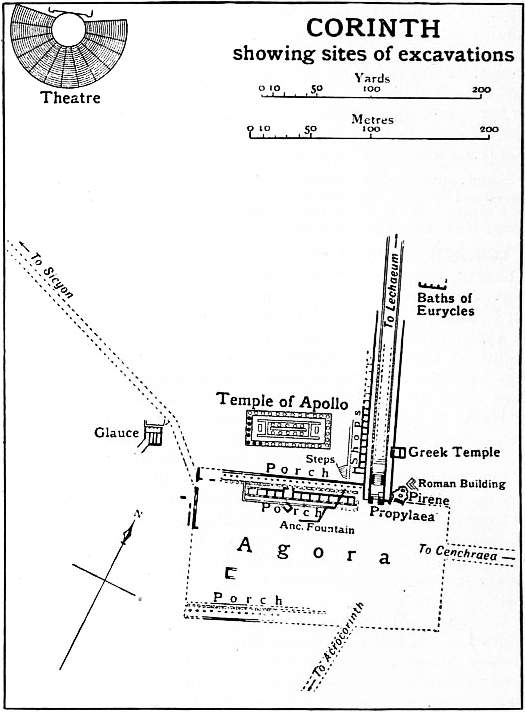
The limestone pavement, with long porches on either side, was found to stop at the foot of a marble staircase of thirty-four steps of Byzantine construction, underneath which appeared a Roman arrangement of the two flights with a platform halfway up. The top flight led up to the propylaea. The remains of the propylaea above ground are few; but the foundations are massive and well laid, at the end of the upper terrace where it is farthest worn back. These foundations are clearly those of a Roman triumphal arch, which perhaps took the name “propylaea” from an ancient Greek structure on the same spot. This arch appears on Roman coins from Augustus to Commodus; according to Pausanias it bore two four-horse chariots, one driven by Helios and the other by Phaethon, his son, all in gilded bronze.
Although a considerable part of the agora has been excavated, none of the statues which Pausanias saw in it have been discovered. On the upper (S.) side are excellent foundations of a long porch. On the N. side, stretching westward from the propylaea, are two porches of different periods. The older one, which still existed in Roman times, was backed up against the temple hill, which was cut away to make room for it. An ancient staircase, 15 ft. broad, led down from the temple hill into the lower area of the broad pavement, from which access to the agora and the Pirene was easy.
To the E. of the paved road and close up against the agora itself, only at a much lower level, was found, buried under 35 ft. of earth, the famous fountain Pirene, tallying exactly with the description of Pausanias, as “a series of chambers that are like caves, and bearing a façade of white marble.” This Pirene originally had a two-storey façade of Roman fashion made of limestone, but, before the time of Pausanias, it had received a covering of marble which has now fallen off, but has left traces of itself in the holes drilled into the limestone, in the rough hacking away of the half columns, and in the numerous marble fragments which lay in front of the façade. This was not, however, the earliest form of Pirene. It was built up in front of a more simple Greek fountain-structure which consisted of seven cross-walls placed under the edge of the stratum forming the upper terrace. Six chambers were thus formed which showed the chaste beauty of Greek workmanship, while the stratum of native rock which covered them gave a touch of nature and made them caves. The walls ended at the front in the form of an anta delicately carved. On a parapet at the rear of each chamber a single slender Ionic column between two antae supported an Ionic entablature. The stuccoed walls were striped horizontally and vertically with red on a blue field, on which appear fishes swimming. The chambers were really reservoirs, filled by the water which flowed along their backs.
We know nothing further about the Greek system, but in the Roman adjustment the water was led from this series of cisterns into a large rectangular basin which formed the centre of a quadrangle 50 ft. square. In the N.E. corner is a hole through which it was drained, and at the N. end a flight of five steps led down into it. Besides the four orifices through which water flowed into it there were two other holes about 4 in. lower down to keep the basin from overflowing. Two uses of water are mentioned by Pausanias, “The water,” he says, “was sweet to drink,” and also good for tempering bronze. It seems clear then, that the basin was at stated times used for the latter purpose, and was converted into a tank. The bronze was plunged into the water in a red hot condition, and thus acquired its peculiar excellence.
In Byzantine times five columns, of various diameters, with no two bases of the same size, bearing Corinthian capitals, were set up about 6 ft. in front of the façade. Blocks of marble which had seen use elsewhere ran from them back into the façade, which was hacked away in rough fashion to receive them. Probably these blocks formed the floor of a balcony, a tawdry marble addition.
Pirene was at all times the heart of the city. Here it was that Athena helped Bellerophon to bridle Pegasus; and hence she received the epithet of “the Bridler,” Chalinitis. The importance of the fountain is attested by the fact that the Greek poets and the Delphic oracle instead of saying Corinth said, “the city of Pirene.” That it was a place of common resort is shown by Euripides (Medea, 68 f.), where it is said that the elders were to be found “near the august waters of Pirene, playing draughts (πεσσί).” The quadrangle, with its walls 20 ft. high, and its three apses probably covered with half domes, provided considerable shade. There is reason for supposing that the marble coating of the façade, and perhaps the erection of the quadrangle, also covered with marble, were the work of Herodes Atticus, and therefore just completed when Pausanias saw them. A base on which stood a statue of Herodes’ wife, Regilla, was found close to the façade, inscribed with fulsome praise, stating that the statue was “set up by order of the Sisyphaean Senate at the outpouring of the streams.” Two inscriptions of Roman times make the identity of Pirene certain, if there could be any doubt in the face of the exact agreement of Pausanias’s description with the structure.
Of the surviving monuments of the Greek city the most important is the temple of Apollo. While it was probably badly wrecked by the Romans at the sack of the city, its massive columns with the entablature survived. That it was restored and was in use in Roman time is shown by the fact that both the seven columns still standing and two fallen columns discovered in the excavations, to say nothing of several fragments of others, have a thick coating of Roman stucco laid over the finer Greek. The style of the temple points to 600 B.C., when Periander was at the height of his power. According to Herodotus he made his doubtful adherents deposit pledges of faithfulness in the temple of Apollo. Quite near the W. end of the temple is the fountain Glaucē cut out of a cube of rock, apparently left standing when the material for the temple was quarried around it. In it were carved out four chambers or reservoirs all connected and a porch consisting of three pillars between two antae in which the side walls ended. The water coming down from Acro-Corinth was introduced from behind. Approached by a flight of steps partly rock-cut, it had at the rear of the porch a balustrade with marble lions’ heads through which the water overflowed. Two of these heads were found. The top of the system of reservoirs was too heavy for the slender cross walls and pillars, only the stumps of which remain; a collapse took place, by which the porch and the W. compartment were carried away. From its location only about 50 yds. from the temple it seems to have been the temple fountain. It was named after the second wife of Jason, Glaucē, who plunged into it to quench the fire of the poisoned bridal garments given her by Medea.
It is not surprising that monuments were found of which there is no record in ancient writings. Such was a very ancient fountain W. of the propylaea, 25 ft. below the surface. Under remains of the Roman city appeared a triglyphon of porous stone with an extent from N. to S. of about 30 ft. At the N. end it turned westward at an obtuse angle and extended about 10 ft. in that direction. The system is about 4 ft. high. While the colours on the metopes and triglyphs had faded somewhat, the border above them, topped with a cornice projecting 6 in., retained a most brilliant maeander pattern of red, blue and yellow, while below these were two bands of godroons of blue and red. On the top of this system as a foundation were set several statue bases, one bearing the signature of Lysippus, which shows that the system stood there at least as early as the 4th century B.C. Some parts of it may have been taken from older buildings, but not the cornice nor the corner metope block which formed an obtuse angle. Near the middle of the long side is an opening; and from it a flight of seven steps led down to a trapezoidal chamber, on the back wall of which are two lions’ heads of bronze, through which water, conducted in long semi-cylindrical channels of bronze, from behind the wall, poured out into pitchers for which holes are cut in the floor. Channels for the overflow were cut along the back and sides of the chamber. All this was once approached from the front at the level of the floor, long before the triglyphon was set up, 7 ft. above it. Considering its depth this fountain must be dated back to the 5th century, probably near the beginning. The style of the lions’ heads would hardly admit a later date. This is the only case of an ancient Greek fountain of such an early date, unaltered and intact. The pains taken to preserve it suggest that it was invested with a sacred character.
Sculptures in large numbers, both of the Greek city and the Roman, are collected in the new museum erected by the Greek government near the plane tree. The finest of the Greek sculptures is the head of a youth found in the orchestra of the theatre at a depth of 23 ft. It lacks only the lower part of the bridge of the nose, and has style and character, resembling Myron’s heads in shape and in the hair. A large fragment of a relief also of early date, represents two dancing maenads half life-size. Most impressive is a colossal female figure of grand style and excellent drapery. If not an original of the 5th century it is one of the finest of copies. Of the great amount of Roman sculpture the best single piece is a head of Dionysus under the influence of wine, crowned with a wreath of ivy, his right hand thrown carelessly over his head. The fine execution is all that differentiates it from the numerous copies in various museums. The most important sculptures of the Roman period, however, are a group of colossal figures supporting an entablature, a large part of which has been recovered. One of the figures, a barbarian captive, effeminate like those which appear on Roman triumphal arches, is practically intact. Another, its counterpart, is preserved down to the hips. These differ from Caryatids, which bear the architrave on their heads. Here a pilaster forming the back of the figure receives a Corinthian capital, upon which the architrave rests; and the figures merely brace up the pilaster. Two of these figures stood at the end of a re-entrant curve, several pieces of which are preserved. Two female heads of like proportions belong to the system, since the backs of their heads are cut away in the same manner as the male heads. The building to which the figures belonged, a porch, extended westward from the propylaea; and may be traced for 45 ft. All that is left of it is the core of opus incertum.
The excavations brought to light vases and fragments of vases, of nearly every period except the Mycenaean. On the N. side of the hill on which stands the village schoolhouse, from which one looks across the indentation to the Apollo temple, several vertical shafts in the limestone stratum were found, and underneath it in horizontal passages were bodies surrounded with vases. These are pre-Mycenaean, and their only ornament is scratches, into which white matter has been pressed. There are over fifty of these vases, of multiform shapes. By the side of the Lechaeum road, near the steps leading to the propylaea, were found in deep diggings thirteen early Geometric vases. Proto-Corinthian vases also were everywhere strongly represented. The best find of pottery, however, was an Old Corinthian celebē (κελέβη, drinking vessel), about a foot high, in forty-six fragments, found in a well, 30 ft. below the surface. On one side are a boar and a leopard confronting each other, and on the other side two cocks in the same heraldic arrangement. On the projecting plates supported by the handles are palmettes.
Two inscriptions in the Old Corinthian alphabet came to light. But, on the whole, inscriptions before the Roman times were almost entirely lacking. One inscription, though of late date, deserves mention. On a marble block broken away at both ends, which in a second use was a lintel, we read ΑΓΩΓΗΕΒΡ, which can only be συναγωγὴ Ἑβραίων (synagogue of the Hebrews).
The excavations were confined to a small part of the city, but there is little doubt that it was the most important part. By good fortune the earth here was very deep. On the higher level of the agora and the Apollo temple, where the depth of earth is comparatively slight, there is little hope of important finds. There is no hope of finding the great bronze Athena, which stood in the middle of the agora. To the west, beyond the theatre, one might find the temple of Athena Chalinitis and the fountain Lerna, and somewhere near Glauce, the Odeum and the tomb of Medea’s children; but it is more likely that they have disappeared. On the Lechaeum road, on which a bewildering wealth of fountains and statues is enumerated, only the Baths of Eurycles below the plane tree were found; deep diggings were made into them, and the foundations of the façade laid bare. This great complex was apparently supplied with water from Hadrian’s aqueduct from Lake Stymphalus. On the street going eastward from the agora nothing is mentioned between it and the city wall. This level eastern part was probably given up to fine houses, all traces of which have perished. Outside the gate, apparently, was the famous Craneion, shaded by cypress trees, and near it the tombs of Lais and Diogenes, a precinct of Bellerophon and of Athena Melaenis. The number of temples and shrines enumerated by Pausanias along the road leading up to Acro-Corinth is bewildering. Here were represented Isis and Serapis, Helios, the Mother of the Gods, the Fates, Demeter and Persephone; but no trace of these temples remains. At the highest point of the road, according to Pausanias, there stood the famous temple of Aphrodite, but the remains excavated at this point seem to be those of a late tower, and the few foundations below it do not resemble those of a temple. We are equally unfortunate in regard to Strabo’s splendid marble Sisyphaeum just below the summit. The fountain Pirene, “behind the temple,” still exists, but so much earth has accumulated about it that one now approaches it by going down a ladder. The water is so crystal clear that one inadvertently steps into it. The identity of name with that of Pirene in the city is justified by the fact that the upper spring is the source of the Pirene below.
See, for details, the American Journal of Archaeology (from 1896).
(R. B. R.)
CORINTH, a city and the county-seat of Alcorn county, Mississippi, U.S.A., situated in the N.E. part of the state, about 90 m. E. by S. of Memphis, Tennessee. Pop.(1890) 2111; (1900) 3661 (1174 negroes); (1910) 5020. It is served by the Mobile & Ohio and the Southern railways; and by a branch of the Illinois Central connecting Jackson, Miss., and Birmingham, Ala. It has woollen mills, cotton compresses, clothing, furniture, and spoke and stave factories and machine shops, and is a cotton market. Because of its situation and its importance as a railway junction, Corinth played an important part in the western campaigns of the Civil War. After the first Confederate line of defence had been broken by the capture of Fort Henry and Fort Donelson (February 1862), Corinth was fortified by General P. G. T. Beauregard, and was made the centre of the new line along the Memphis & Charleston railway, “the great East and West artery of the Confederacy.” Grant’s advance on this centre, then defended by General A. S. Johnston, led to the battle of Shiloh, fought on April 6/7 about 20 m. N.E. of Corinth; after this engagement Beauregard withdrew to Corinth. General H. W. Halleck, with a greatly superior force, cautiously and slowly advanced upon the Confederate position, consuming more than a month in the operation. During the night of the 29th of May Beauregard evacuated the place (which was occupied by the Federals on the following day), and re-established his line at Tupelo. Corinth then became the headquarters of the Union forces under General W. S. Rosecrans, who on the 3/4 of October 1862 was fiercely attacked here by General Earl von Dorn, whom he repulsed, both sides suffering considerable losses in killed and wounded, and the Confederates leaving many prisoners behind.
CORINTH, ISTHMUS OF, an isthmus of Greece, dividing the Gulf of Corinth from the Saronic Gulf. Ships were sometimes dragged across it in ancient times at a place called the Diolcus (διέλκειν, to pull or cut through). Nero, in A.D. 67, began cutting a canal through it; but the project was abandoned. In 1893 a ship canal was opened, with its western entrance about 1¼ m. N.E. of the little town of New Corinth. It was begun in 1881 by a French company, which ceased operations in 1889, a Greek company completing the undertaking. The canal is about 70 ft. broad, nearly 4 m. long, and 26 ft. deep. It shortens the journey from the Adriatic to the Peiraeus by 202 m., but foreign steamships seldom use it, as the narrowness of the canal and the strength of the current at times render the passage dangerous. About 1 m. from its western end it is crossed by the iron bridge of the Athens and Corinth railway. Traces of the Isthmian wall may still be seen parallel to the canal; it was constructed, at an unknown date, for the fortification of the Isthmus. Just to the S. of it, and about ½ m. from the sea are the remains of the Isthmian precinct of Poseidon and its stadium, where the Isthmian games were celebrated. This precinct served also as a fortress. Within it have been found traces of the temple of Poseidon and other buildings.
(E. Gr.)
CORINTHIANS, EPISTLES TO THE, two books of the Bible (New Testament). The two letters addressed to the Christian church at Corinth are, with Romans, the longest of the Pauline epistles. They possess a singular interest and value, due to the apostle’s close acquaintance with the members of the church addressed and their circumstances. In consequence of this intimate character the First Epistle to the Corinthians presents a picture, unrivalled in fulness and colour, of the life of a Pauline church, while the Second Epistle, written out of strong feeling, gives a revelation of the innermost feelings and characteristic temperament of Paul himself, such as is not elsewhere to be found. Dealing, as both epistles do, with concrete problems of morals and with such tendencies of thought and life as find their parallel in all times, they are full of instruction to the modern Church; and this instruction increases in effectiveness the better we come to understand ancient modes of thought in their diversity from our own.
Lofty and vivid expression of the apostle’s thought on the highest themes is also to be found here—witness the “Hymn to Love” (1 Cor. xiii.), the declaration of the resurrection (1 Cor. xv. 51-57), or the list of signatures of the true servant of God (2 Cor. vi. 3-10). In important historical statements, also, these epistles stand second to none, not even to Galatians—as may be indicated by a reference to the words about the institution of the Lord’s supper (1 Cor. xi. 23-26) and the death and resurrection of Jesus Christ (1 Cor. xv. 1-8); or to the autobiographical utterances in which Paul explains that he was once a persecutor of Christians (1 Cor. xv. 9), mentions his escape from Damascus (2 Cor. xi. 32 f.), describes his coming to Corinth (1 Cor. ii. 1 ff.), enumerates his sufferings for the Gospel (2 Cor. xi. 16-31), tells of his visions (2 Cor. xii. 1-9). In the Corinthian epistles we come in contact, as nowhere else, with the man Paul and his daily life.
The history of Paul’s relations with Corinth can be made out from the Acts and the Epistles with considerable clearness. The chronology of Paul’s life is not at any point surely determinable within a range of less than five years, but it must have been in the autumn of one of the years A.D. 49-53 (the usual chronology has fixed on A.D. 52) that the arrival of Paul in Corinth took place as described in Acts xviii. 1. In his so-called second missionary journey Paul had been driven by irresistible inner impulses to push on into Greece the missionary work already begun in Asia Minor. First he preached in the province of Macedonia, where the work opened auspiciously at Philippi, Thessalonica and Beroea; then, apparently driven out by the violent opposition of the Jews, he moved on to Achaea, and after rather unsuccessful attempts to secure converts among the philosophers of Athens came to Corinth.
This ancient city, taken and destroyed by the Romans in 146 B.C., had been refounded by Julius Caesar as a Roman colony in 46 B.C., settled with Italian colonists, and made a residence of the Roman governor. Its situation on the isthmus of Corinth made it a stage on the greatest of the trade routes between Rome and the East, and it was at this time the commercial capital of Greece. The traditions of licentiousness and sensuality associated with the worship of Aphrodite, which had given rise to the sinister word corinthianize, increased the natural tendencies of a great city to wickedness and wanton luxury. Here, as in all great centres of trade and industry, there was a body of Jews, with a synagogue. The conditions of life in Corinth—the heathen surroundings, the temptations to vice, the competition and disputes of trading life, the controversial arguments of Jews, the alertness of mind of a lively city people, the haughty temper of the inhabitants of the capital—all these are to be seen reflected in the earnest paragraphs of Paul’s two epistles.