VOLUME VI SLICE V Clervaux to Cockade
Reading edition
Articles in This Slice
CLERVAUX CLOVELLY
CLETUS CLOVER
CLEVEDON CLOVES
CLEVELAND, BARBARA VILLIERS CLOVIO, GIORGIO GIULIO
CLEVELAND, JOHN CLOVIS
CLEVELAND, STEPHEN GROVER CLOWN
CLEVELAND CLOYNE
CLEVER CLUB
CLEVES CLUB-FOOT
CLEYNAERTS CLUE
CLICHTOVE, JOSSE VAN CLUENTIUS HABITUS, AULUS
CLICHY CLUMP
CLIFF-DWELLINGS CLUNES
CLIFFORD (English family) CLUNY
CLIFFORD, JOHN CLUSERET, GUSTAVE PAUL
CLIFFORD, WILLIAM KINGDON CLUSIUM
CLIFFORD OF CHUDLEIGH CLUWER
CLIFTON CLYDE, COLIN CAMPBELL
CLIM CLYDE (river of Scotland)
CLIMACTERIC CLYDEBANK
CLIMATE AND CLIMATOLOGY. CNIDUS
CLIMAX, JOHN CNOSSUS
CLIMBING COACH
CLINCHANT, JUSTIN COAHUILA
CLINIC; CLINICAL COAL
CLINKER COALBROOKDALE
CLINOCLASITE COAL-FISH
CLINTON, DE WITT COALING STATIONS
CLINTON, GEORGE COALITION
CLINTON, SIR HENRY COAL-TAR
CLINTON, HENRY FYNES COALVILLE
CLINTON (city of Iowa) COAST
CLINTON (township of Massachusetts) COAST DEFENCE
CLINTON (city of Missouri) COASTGUARD
CLINTON (village of New York) COASTING
CLINTONITE COATBRIDGE
CLISSON, OLIVIER DE COATESVILLE
CLISSON (town of France) COATI
CLITHEROE COB
CLITOMACHUS COBALT
CLITUMNUS COBALTITE
CLIVE, CAROLINE COBÁN
CLIVE, CATHERINE COBAR
CLIVE, ROBERT CLIVE COBB, HOWELL
CLOACA COBBETT, WILLIAM
CLOCK COBBOLD, THOMAS SPENCER
CLODIA, VIA COBDEN, RICHARD
CLODIUS COBET, CAREL GABRIEL
CLOGHER COBHAM
CLOISTER COBIJA
CLONAKILTY COBLE
CLONES COBLENZ
CLONMACNOISE COBOURG
CLONMEL COBRA
CLOOTS, DE GRÂCE COBURG
CLOQUET COCA
CLOSE, MAXWELL HENRY COCAINE
CLOSE COCANADA
CLOSURE COCCEIUS
CLOT, ANTOINE BARTHÉLEMY COCCIDIA
CLOTAIRE COCCULUS INDICUS
CLOTH COCHABAMBA (department of Bolivia)
CLOTHIER COCHABAMBA (city of Bolivia)
CLOTILDA, SAINT COCHEM
CLOUD COCHERY, LOUIS ADOLPHE
CLOUDBERRY COCHIN, DENYS MARIE AUGUSTIN
CLOUD-BURST COCHIN (state of India)
CLOUDED LEOPARD COCHIN (town of India)
CLOUET, FRANÇOIS COCHIN-CHINA
CLOUET, JEAN COCHINEAL
CLOUGH, ANNE JEMIMA COCHLAEUS, JOHANN
CLOUGH, ARTHUR HUGH COCK, EDWARD
CLOUTING COCKADE
CLERVAUX (clara vallis), a town in the northern province of Oesling, grand-duchy of Luxemburg, on the Clerf, a tributary of the Sûre. Pop. (1905) 866. In old days it was the fief of the de Lannoy family, and the present proprietor is the bearer of a name not less well known in Belgian history, the count de Berlaymont. The old castle of the de Lannoys exists, and might easily be restored, but its condition is now neglected and dilapidated. In 1798 the people of Clervaux specially distinguished themselves against the French in an attempt to resist the institution of the conscription. The survivors of what was called the Kloppel-krieg (the “cudgel war”) were shot, and a fine monument commemorates the heroism of the men of Clervaux.
CLETUS, formerly regarded as the name of one of the early successors of St Peter in the see of Rome, or, according to Epiphanius and Rufinus, as sharing the direction of the Roman Church with Linus during Peter’s lifetime. He has been identified beyond doubt with Anencletus (q.v.). See Père Colombier, in Rev. des questions hist. Ap. 1st, 1876, p. 413.
CLEVEDON, a watering-place in the northern parliamentary division of Somersetshire, England, on the Bristol Channel, 15½ m. W. of Bristol on a branch of the Great Western railway. Pop. of urban district (1901) 5900. The cruciform church of St Andrew has Norman and later portions; it is the burial-place of Henry Hallam the historian, and members of his family, including his sons Arthur and Henry. Clevedon Court is a remarkable medieval mansion, dating originally from the early part of the 14th century, though much altered in the Elizabethan and other periods. The house is considered to be the original of “Castlewood” in Thackeray’s Esmond; the novelist was acquainted with the place through his friendship with the Rev. William Brookfield and his wife, the daughter of Sir Charles Elton of Clevedon Court.
CLEVELAND, BARBARA VILLIERS, Duchess of (1641-1709), mistress of the English king Charles II., was the daughter of William Villiers, 2nd Viscount Grandison (d. 1643), by his wife Mary (d. 1684), daughter of Paul, 1st Viscount Bayning. In April 1659 Barbara married Roger Palmer, who was created earl of Castlemaine two years later, and soon after this marriage her intimacy with Charles II. began. The king was probably the father of her first child, Anne, born in February 1661, although the paternity was also attributed to one of her earliest lovers, Philip Stanhope, 2nd earl of Chesterfield (1633-1713). Mistress Palmer, as Barbara was called before her husband was made an earl, was naturally much disliked by Charles’s queen, Catherine of Braganza, but owing to the insistence of the king she was made a lady of the bedchamber to Catherine, and began to mix in the political intrigues of the time, showing an especial hatred towards Edward Hyde, earl of Clarendon, who reciprocated this feeling and forbad his wife to visit her. Her house became a rendezvous for the enemies of the minister, and according to Pepys she exhibited a wild paroxysm of delight when she heard of Clarendon’s fall from power in 1667. Whilst enjoying the royal favour Lady Castlemaine formed liaisons with various gentlemen, which were satirized in public prints, and a sharp quarrel which occurred between her and the king in 1667 was partly due to this cause. But peace was soon made, and her influence, which had been gradually rising, became supreme at court in 1667 owing to the marriage of Frances Stuart (la belle Stuart) (1648-1702) with Charles Stuart, 3rd duke of Richmond (1640-1672). Accordingly Louis XIV. instructed his ambassador to pay special attention to Lady Castlemaine, who had become a Roman Catholic in 1663.
In August 1670 she was created countess of Southampton and duchess of Cleveland, with remainder to her first and third sons, Charles and George Palmer, the king at this time not admitting the paternity of her second son Henry; and she also received many valuable gifts from Charles. An annual income of £4700 from the post office was settled upon her, and also other sums chargeable upon the revenue from the customs and the excise, whilst she obtained a large amount of money from seekers after office, and in other ways. Nevertheless her extravagance and her losses at gaming were so enormous that she was unable to keep up her London residence, Cleveland House, St James’s, and was obliged to sell the contents of her residence at Cheam. About 1670 her influence over Charles began to decline. She consoled herself meanwhile with lovers of a less exalted station in life, among them John Churchill, afterwards duke of Marlborough, and William Wycherley; by 1674 she had been entirely supplanted at court by Louise de Kéroualle, duchess of Portsmouth. Soon afterwards the duchess of Cleveland went to reside in Paris, where she formed an intrigue with the English ambassador, Ralph Montagu, afterwards duke of Montagu (d. 1709), who lost his position through some revelations which she made to the king. She returned to England just before Charles’s death in 1685. In July 1705 her husband, the earl of Castlemaine, whom she had left in 1662, died; and in the same year the duchess was married to Robert (Beau) Feilding (d. 1712), a union which was declared void in 1707, as Feilding had a wife living. She died at Chiswick on the 5th of October 1709.
Bishop Burnet describes her as “a woman of great beauty, but most enormously vicious and ravenous, foolish but imperious, ever uneasy to the king, and always carrying on intrigues with other men, while yet she pretended she was jealous of him.” Dryden addressed Lady Castlemaine in his fourth poetical Epistle in terms of great adulation, and Wycherley dedicated to her his first play, Love in a Wood. Her portrait was frequently painted by Sir Peter Lely and others, and many of these portraits are now found in various public and private collections. By Charles II. she had three sons and either one or two daughters. She had also in 1686 a son by the actor Cardonnell Goodman (d. 1699), and one or two other daughters.
Her eldest son, Charles Fitzroy (1662-1730), was created in 1675 earl of Chichester and duke of Southampton, and became duke of Cleveland and earl of Southampton on his mother’s death. Her second son, Henry (1663-1690), was created earl of Euston in 1672 and duke of Grafton in 1675; by his wife Isabella, daughter of Henry Bennet, earl of Arlington, he was the direct ancestor of the later dukes of Grafton; he was the most popular and the most able of the sons of Charles II., saw a considerable amount of military service, and met his death through a wound received at the storming of Cork. Her third son, George (1665-1716), was created duke of Northumberland in 1683, and died without issue, after having served in the army. Her daughters were Anne (1661-1722), married in 1674 to Thomas Lennard, Lord Dacre (d. 1715), who was created earl of Sussex in 1684; Charlotte (1664-1718), married in 1677 to Edward Henry Lee, earl of Lichfield (d. 1716); and Barbara (1672-1737), the reputed daughter of John Churchill, who entered a nunnery in France, and became by James Douglas, afterwards 4th duke of Hamilton (1658-1712), the mother of an illegitimate son, Charles Hamilton (1691-1754).
The first husband of the duchess, Roger Palmer, earl of Castlemaine (1634-1705), diplomatist and author, was an ardent Roman Catholic, who defended his co-religionists in several publications. Having served in the war against Holland in 1665-67, he wrote in French an account of this struggle, which was translated into English and published by T. Price in London in 1671. Having been denounced by Titus Oates as a Jesuit, he was tried and acquitted, afterwards serving James II. as ambassador to Pope Innocent XI., a mission which led to a brief imprisonment after the king’s flight from England. Subsequently his Jacobite sympathies caused him to be suspected by the government, and his time was mainly spent either in prison or in exile. The earl died at Oswestry on the 21st of July 1705.
The title of duke of Cleveland, which had descended in 1709 to Charles Fitzroy, together with that of duke of Southampton, became extinct when Charles’s son William, the 2nd duke, died without issue in 1774. One of the first duke’s daughters, Grace, was married in 1725 to Henry Vane, 3rd Baron Barnard, afterwards earl of Darlington (d. 1758), and their grandson William Henry Vane (1766-1842) was created duke of Cleveland in 1833. The duke was succeeded in the title in turn by three of his sons, who all died without male issue; and consequently when Harry George, the 4th duke, died in 1891 the title again became extinct.
Previous to the creation of the dukedom of Cleveland there was an earldom of Cleveland which was created in 1626 in favour of Thomas, 4th Baron Wentworth (1591-1667), and which became extinct on his death.
See the article Charles II. and the bibliography thereto; G.S. Steinmann, Memoir of Barbara, duchess of Cleveland (London, 1871), and Addenda (London, 1874); and the articles (“Villiers, Barbara” and “Palmer, Roger”) in the Dictionary of National Biography, vols. xliii. and lviii. (London, 1895-1899).
CLEVELAND (or Cleiveland), JOHN (1613-1658), English poet and satirist, was born at Loughborough, where he was baptized on the 20th of June 1613. His father was assistant to the rector and afterwards vicar of Hinckley. John Cleveland was educated at Hinckley school under Richard Vines, who is described by Fuller as a champion of the Puritan party. In his fifteenth year he was entered at Christ’s College, Cambridge, and in 1634 was elected to a fellowship at St John’s. He took his M.A. degree in 1635, and was appointed college tutor and reader in rhetoric. His Latinity and oratorical powers were warmly praised by Fuller, who also commends the “lofty fancy” of his verse. He eagerly opposed the candidature of Oliver Cromwell as M.P. for Cambridge, and when the Puritan party triumphed there Cleveland, like many other Cambridge students, found his way (1643) to Oxford. His gifts as a satirist were already known, and he was warmly received by the king, whom he followed (1645) to Newark. In that year he was formally deprived of his Cambridge fellowship as a “malignant.” He was judge-advocate in the garrison at Newark, and under the governor defended the town until in 1646 Charles I. ordered the surrender of the place to Leslie; when there is a curious story that the Scottish general contemptuously dismissed him as a mere ballad-monger. He saw Charles’s error in giving himself into the hands of the Scots, and his indignation when they surrendered the king to the Parliament is expressed in the vigorous verses of “The Rebel Scot,” the sting of which survives even now. Cleveland wandered over the country depending on the alms of the Royalists for bread. He at length found a refuge at Norwich in the house of Edward Cooke, but in 1655 he was arrested as being of no particular occupation, and moreover a man whose great abilities “rendered him able to do the greater disservice.” He spent three months in prison at Yarmouth, but was released by order of Cromwell, to whom he addressed a manly appeal, in which he declared his fidelity to the royal house, pointing out at the same time that his poverty and inoffensiveness were sufficient assurance that his freedom was no menace to Cromwell’s government. He was released early in 1656, and seems to have renewed his wanderings, finding his way eventually to Gray’s Inn, where Aubrey says he and Samuel Butler had a “club” every night. There he died on the 29th of April 1658.
Cleveland’s poems were more highly esteemed than Milton’s by his contemporaries, and his popularity is attested by the very numerous editions of his works. His poems are therefore of great value as an index to the taste of the 17th century. His verse is frequently obscure and full of the far-fetched conceits of the “metaphysical” poets, none of whom surpassed the ingenuity of “Fuscara, or the Bee Errant.” His satires are vigorous personal attacks, the interest of which is, from the nature of the subject, often ephemeral; but the energy of his invective leaves no room for obscurity in such pieces as “Smectymnuus, or the Club Divines,” “Rupertismus” and “The Rebel Scot.”
Cleveland’s works are: “Character of a London Diurnal,” a broadside; Monumentum regale ... (1649), chiefly by Cleveland, containing three of his elegies on the king; “The King’s Disguise” (1646); “On the Memory of Mr Edward King,” in the collection of verse which also included Milton’s “Lycidas,” and many detached poems.
For a bibliographical account of Cleveland’s peoms see J.M. Berdan, The Poems of John Cleveland (New York, 1903), in which there is a table of the contents of twenty-three editions, of which the chief are: The Character of a London Diurnal, with Several Select Poems (1647); Poems. By John Cleavland. With additions, never before printed (1659); J. Cleaveland Revived ... (1659), in which the editor, E. Williamson, says he inserted poems by other authors, trusting to the critical faculty of the readers to distinguish Cleveland’s work from the rest; Clievelandi Vindiciae ... (1677), edited by two of Cleveland’s former pupils, Bishop Lake and S. Drake, who profess to take out the spurious pieces; and a careless compilation, The Works of John Cleveland ... (1687), containing poems taken from all these sources. A prefatory note by Williamson makes it clear that only a small proportion of Cleveland’s political poems have survived, many of them having been dispersed in MS. among his friends and so lost, and that he refused to authenticate an edition of his works, although most of the earlier collections were genuine.
CLEVELAND, STEPHEN GROVER (1837-1908), president of the United States from 1885 to 1889, and again from 1893 to 1897, was born, the fifth in a family of nine children, in the village of Caldwell, Essex county, New Jersey, on the 18th of March 1837. His father, Richard F. Cleveland, a clergyman of the Presbyterian Church, was of good colonial stock, a descendant of Moses Cleveland, who emigrated from Ipswich, England, to Massachusetts in 1635. The family removed to Fayetteville, N.Y., and afterwards to Clinton, N.Y. It was intended that young Grover should be educated at Hamilton College, but this was prevented by his father’s death in 1852. A few years later he drifted westward with twenty-five dollars in his pocket, and the autumn of 1855 found him in a law office in the city of Buffalo. At the end of four years (1859), he was admitted to the bar.
In 1863 he was appointed assistant district attorney of Erie county, of which Buffalo is the chief city. This was his first public office, and it came to him, like all later preferments, without any solicitation of his own. Two years later (1865) he was the Democratic candidate for district attorney, but was defeated. In 1869 Cleveland was nominated by the Democratic party for the office of sheriff, and, despite the fact that Erie county was normally Republican by a decisive majority, was elected. The years immediately succeeding his retirement from the office of sheriff in 1873 he devoted exclusively to the practice of law, coming to be generally recognized as one of the leaders of the western New York bar. In the autumn of 1881 he was nominated by the Democrats for mayor of Buffalo. The city government had been characterized by extravagance and maladministration, and a revolt of the independent voters at the polls overcame the usual Republican majority and Cleveland was elected. As mayor he attracted wide attention by his independence and business-like methods, and under his direction the various departments of the city government were thoroughly reorganized. His ability received further recognition when in 1882 he was nominated by his party as its candidate for governor. The Republican party in the state was at that time weakened by the quarrels between the “Stalwart” and “Halfbreed” factions within its ranks; and the Democrats were thus given an initial advantage which was greatly increased by the Republicans’ nomination for governor of Charles J. Folger (1818-1884), then secretary of the treasury. Secretary Folger was a man of high character and ability, who had been chief justice of the New York supreme court when placed in control of the treasury department by President Arthur in 1881. But the cry of Federal interference was raised as a result of the methods employed in securing his nomination, and this, together with the party division and the popularity of Cleveland, brought about Cleveland’s election by the unprecedented plurality of 192,854. As governor Cleveland’s course was marked by the sterling qualities that he had displayed in his other public positions. His appointees were chosen for their business qualifications. The demands of party leaders were made subordinate to public interests. He promoted the passage of a good civil service law. All bills passed by the legislature were subjected to the governor’s laborious personal scrutiny, and the veto power was used without fear or favour.
In 1884 the Democratic party had been out of power in national affairs for twenty-three years. In this year, however, the generally disorganized state of the Republican party seemed to give the Democrats an unusual opportunity. Upon a platform which called for radical reforms in the administrative departments, the civil service, and the national finances, Cleveland was nominated for president, despite the opposition of the strong Tammany delegation from his own state. The nominee of the Republican party, James G. Blaine (q.v.) of Maine, had received the nomination only after a contest in which violent personal animosities were aroused. The campaign that followed was one of the bitterest political contests in American history. The Republican party was still further weakened by the defection of a large body of independents, known as “Mugwumps.” The result was close, but Cleveland carried New York, and was elected, obtaining a majority in the electoral college of 219 to 182.
Cleveland’s first term was uneventful, but was marked by firmness, justice and steady adherence on his part to the principles which he deemed salutary to the nation. He was especially concerned in promoting a non-partisan civil service. Congress in 1883 had passed the “Pendleton Bill” (introduced by Senator George H. Pendleton) to classify the subordinate places in the service, and to make entrance to it, and promotion therein, depend upon competitive examination of applicants, instead of mere political influence. The first test of the efficiency and permanence of this law came with the shifting of political power at Washington. The new president stood firmly by the new law. It applied only to places of the rank of clerkships, but the president was authorized to add others to the classified service from time to time. He added 11,757 during his first term.
President Cleveland made large use of the veto power upon bills passed by Congress, vetoing or “pocketing” during his first term 413 bills, more than two-thirds of which were private pension bills. The most important bill vetoed was the Dependent Pension Bill, a measure of extreme profligacy, opening the door, by the vagueness of its terms, to enormous frauds upon the treasury. In 1887 there was a large and growing surplus in the treasury. As this money was drawn from the channels of business and locked up in the public vaults, the president looked upon the condition as fraught with danger to the commercial community and he addressed himself to the task of reducing taxation. About two-thirds of the public revenue was derived from duties on imports, in the adjustment of which the doctrine of protection to native industry had a large place. Cleveland attacked the system with great vigour in his annual message of 1887. He did not propose the adoption of free trade, but the administration tariff measure, known as the Mills Bill, from its introducer Congressman Roger Q. Mills (b. 1832) of Texas, passed the House, and although withdrawn owing to amendments in the Republican Senate, it alarmed and exasperated the protected classes, among whom were many Democrats, and spurred them to extraordinary efforts to prevent his re-election.
In the following year (1888), however, the Democrats renominated Cleveland, and the Republicans nominated Benjamin Harrison of Indiana. The campaign turned on the tariff issue, and Harrison was elected, receiving 233 electoral votes to 168 for Cleveland, who however received a popular plurality of more than 100,000. Cleveland retired to private life and resumed the practice of the law in New York. He had married on the 2nd of June 1886 Miss Frances Folsom, a daughter of a former law partner in Buffalo.
Congress had passed a law in 1878 requiring the treasury department to purchase a certain amount of silver bullion each month and coin it into silver dollars to be full legal tender. As no time had been fixed for this operation to cease, it amounted to an unlimited increase of a kind of currency that circulated at a nominal value much above its real value. Both political parties were committed to this policy, and strong passions were aroused whenever it was called in question. Cleveland had written a letter for publication before he became president, saying that a financial crisis of great severity must result if this coinage were continued, and expressing the hope that Congress would speedily put an end to it. In 1890 Congress, now controlled by the Republican party, passed the McKinley Bill, by which the revenues of the government were reduced by more than $60,000,000 annually, chiefly through a repeal of the sugar duties. At the same time expenditures were largely increased by liberal pension legislation, and the government’s purchase of silver bullion almost doubled by the provisions of the new Sherman Silver Purchase Act of 1890.
In 1892 Cleveland was nominated for president a third time in succession. President Harrison was nominated by the Republicans. Cleveland received 277 electoral votes and Harrison 145, and 22 were cast for James B. Weaver (b. 1833) of Iowa, the candidate of the “People’s” party. Cleveland’s second term embraced some notable events. The most important was the repeal of the silver legislation, which had been a growing menace for fifteen years. Nearly $600,000,000 of “fiat money” had been thrust into the channels of commerce in addition to $346,000,000 of legal tender notes that had been issued during the Civil War. A reserve of $100,000,000 of gold had been accumulated for the redemption of these notes. In April 1893 the reserve fell below this sum. President Cleveland called an extra session of Congress to repeal the Silver Law. The House promptly passed the repealing act. In the Senate there was a protracted struggle. The Democrats now had a majority of that body and they were more decidedly pro-silver than the Republicans. The president had undertaken to coerce his own party to do something against its will, and it was only by the aid of the Republican minority that the passage of the repealing bill was at last made possible (October 30th). The mischief, however, was not ended. The deficit in the treasury made it inevitable that the gold reserve should be used to meet current expenses. Holders of the government’s legal tender notes anticipating this fact presented them for redemption. Borrowing was resorted to by the government. Bonds were issued and sold to the amount of $162,000,000. The business world was in a state of constant agitation. Bank failures were numerous and commercial distress widespread. Among the consequences of the panic was a reduction of wages in many employments, accompanied by labour troubles more or less serious. The centre of disturbance was the Pullman strike at Chicago (q.v.), whence the disorder extended to the Pacific coast, causing riot and bloodshed in many places. President Cleveland waited a reasonable time, as he conceived, for Governor Altgeld of Illinois to put an end to the disorder in that state. On the 6th of July 1894, despite Governor Altgeld’s protest, he directed the military forces of the United States to clear the way for trains carrying the mails. The rioters in and around Chicago were dispersed in a single day, and within a week the strike was broken.
Another important event was the action of the government as regards the question of arbitration between Great Britain and Venezuela (q.v.), in which Richard Olney, the secretary of state, played a somewhat aggressive part. On the 17th of December 1895 President Cleveland sent to Congress a special message calling attention to Great Britain’s action in regard to the disputed boundary line between British Guiana and Venezuela, and declaring the necessity of action by the United States to prevent an infringement of the Monroe Doctrine. Congress at once appropriated funds for an American commission to investigate the matter. The diplomatic situation became for the moment very acute, but after a short period of bellicose talk the common-sense of both countries prevailed. Negotiations with Great Britain ensued, and before the American special commission finished its work, Great Britain had agreed, November 1896, to arbitrate on terms which safeguarded the national dignity on both sides.
Cleveland’s independence was nowhere more strikingly shown during his second term than in his action in regard to the tariff legislation of his party in Congress. A tariff bill introduced in the House by William Lyne Wilson (1843-1900), of West Virginia, chairman of the Committee of Ways and Means, was so amended in the Senate, through the instrumentality of Senator Arthur Pue Gorman and a coterie of anti-administration democratic senators, that when the bill eventually came before him, although unwilling to veto it, the president signified his dissatisfaction with its too high rates by allowing it to become a law without his signature. Cleveland’s second administration began by vigorous action in regard to Hawaii; he at once withdrew from the Senate the annexation treaty which President Harrison had negotiated.
During his second term Cleveland added 44,004 places in the civil service to the classified list, bringing them within the rules of the merit system. This was a greater number than all that had been placed in the list before, and brought the whole number up to 86,932. Toward the end of his second term the president became very much out of accord with his party on the free-silver question, in consequence of which the endorsement of the administration was withheld by the Democratic national convention at Chicago in 1896. In the ensuing campaign the president and his cabinet, with the exception of Hoke Smith (b. 1855), secretary of the interior, who resigned, gave their support to Palmer and Buckner, the National, or “Sound Money” Democratic nominees.
Cleveland’s second term expired on the 4th of March 1897, and he then retired into private life, universally respected and constantly consulted, in the university town of Princeton, New Jersey, where he died on the 24th of June 1908. He was a trustee of Princeton University and Stafford Little lecturer on public affairs. Chosen in 1905 as a member of a committee of three to act as trustees of the majority of the stock of the Equitable Life Assurance Company, he promoted the reorganization and the mutualization of that company, and acted as rebate referee for it and for the Mutual and New York Life insurance companies. He published Presidential Problems (New York, 1904), made up in part of lectures at Princeton University, and Fishing and Hunting Sketches (1906).
A large amount of magazine literature has been devoted to President Cleveland’s career. W.O. Stoddard’s Grover Cleveland (1888; “Lives of the Presidents” series) and J. Lowry Whittle’s Grover Cleveland (1896; “Public Men of To-day” series) are judicious volumes; and “Campaign Biographies” (1884) were written by W. Dorsheimer, F.E. Goodrich, P. King and D. Welch. See articles by Woodrow Wilson (Atlantic Monthly, vol. 79; “Cleveland as President”); Carl Schurz (McClure’s Magazine, vol. ix.; “Second Administration of Grover Cleveland”); William Allen White (McClure’s, vol. 18, “Character Sketch of Cleveland”), and Henry L. Nelson (North American Review, vol. 188). Also Jesse L. Williams, Mr Cleveland: A Personal Impression (1909), and G.W. Parker, Recollections of Grover Cleveland (1909).
(H. Wh.)
CLEVELAND, a city and port of entry in the state of Ohio, U.S.A., and the county-seat of Cuyahoga county, the sixth largest city in the United States. It is on Lake Erie at the mouth of Cuyahoga river, about 260 m. N.E. of Cincinnati, 357 m. E. of Chicago, and 623 m. W. by N. of New York. Pop. (1890) 261,353; (1900) 381,768, of whom 124,631 were foreign-born, 288,591 were of foreign parentage (i.e. having one or both parents foreign-born), and 5988 were negroes; (1910) 560,663. Of the 124,631, who in 1900 were foreign-born, Germans were greatly predominant (40,648, or 32.6%), with the Bohemians (13,599, or 10.9%) and Irish (13,120, or 10.6%) next in importance, the Bohemians being later comers than the Irish.
The city commands pleasant views from its position on a plateau, which, at places on bluffs along the shore, has elevations of about 75 ft. above the water below, and rises gradually toward the S.E. to 115 ft. and on the extreme E. border to more than 200 ft. above the lake, or about 800 ft. above sea-level; the surface has, however, been cut deeply by the Cuyahoga, which here pursues a meandering course through a valley about ½ m. wide, and is also broken by several smaller streams. The city’s shore-line is more than 12 m. long. The city varies considerably in width, and occupies a total area of about 41 sq. m., much the greater part of which is E. of the river. The streets are of unusual width (varying from 60 ft. to 132 ft.); are paved chiefly with Medina dressed stone, brick and asphalt; and, like the parks, are so well shaded by maples, elms and other trees, that Cleveland has become known as the “Forest City.” The municipality maintains an efficient forestry department. About ½ m. from the lake and the same distance E. of the river is the Public Square, or Monumental Park, in the business centre of the city. Thence the principal thoroughfares radiate. The river is spanned with bridges, and its valley by two viaducts, the larger of which (completed in 1878 at a cost of more than $2,000,000), 3211 ft. long, 64 ft. wide, and 68 ft. above water, connects Superior Avenue on the E. with Detroit Avenue on the W. The Central Viaduct, finished in 1888, extends from Central Avenue to W. 14th Street, and there connects with a smaller viaduct across Walworth Run, the combined length of the two being about 4000 ft. Another viaduct (about 830 ft. long) crosses Kingsbury Run a short distance above its mouth. Lower Euclid Avenue (the old country road to Euclid, O., and Erie, Pa.) is given up to commercial uses; the eastern part of the avenue has handsome houses with spacious and beautifully ornamented grounds, and is famous as one of the finest residence streets in the country. Sections of Prospect Avenue, E. 40th, E. 93rd, E. 75th, E. 55th, W. 44th and E. 79th streets also have many fine residences. The principal business thoroughfares are Superior Avenue (132 ft. wide), the W. part of Euclid Avenue, and Ontario St. The manufacturing quarters are chiefly in the valley of the Cuyahoga, and along the railway tracks entering the city, chiefly on the E. side. In 1902 the city arranged for grouping its public buildings—in the so-called “Group Plan”—at a cost of $25,000,000. The court-house and city hall are on the bluff overlooking Lake Erie; 1000 ft. south are the Federal post-office and the public library. The Mall connecting the court-house and city hall with the post-office and library is 600 ft. wide; on one side of it is the grand music-hall, on the other a fine art gallery. The six granite buildings forming this quadrangle were built under the supervision of Arnold Brunner, a government architect, and of John M. Carrere and D. H. Burnham, who planned the buildings at the Pan-American Exposition and the Chicago World’s Fair respectively. The city has, besides, numerous fine office buildings, including that of the Society for Savings (an institution in which each depositor is virtually a stockholder), the Citizens’, Rose, Williamson, Rockefeller, New England and Garfield buildings; and several beautiful churches, notably the Roman Catholic and Trinity cathedrals, the First Presbyterian (“Old Stone”), the Second Presbyterian, the First Methodist and Plymouth (Congregational) churches. The Arcade, between Euclid and Superior avenues, and the Colonial Arcade, between Euclid and Prospect avenues, are office and retail store buildings worthy of mention. The former, finished in 1889, is 400 ft. long, 180 ft. wide, and 140 ft. high, with a large interior court, overlooked by five balconies. The Colonial Arcade contains a hotel as well; it was finished in 1898. In the Public Square is a soldiers’ and sailors’ monument consisting of a granite shaft rising from a memorial room to a height of 125 ft., and surmounted with a figure of Liberty; in the same park, also, is a bronze statue of Moses Cleaveland, the founder of the city. On a commanding site in Lake View Cemetery is the Garfield Memorial (finished in 1890) in the form of a tower (165 ft. high), designed by George Keller and built mostly of Ohio sandstone; in the base is a chapel containing a statue of Garfield and several panels on which are portrayed various scenes in his life; his remains are in the crypt below the statue. A marble statue of Commodore Oliver H. Perry, erected in commemoration of his victory on Lake Erie in 1813, is in Wade Park, where there is also a statue of Harvey Rice (1800-1891), who reformed the Ohio public school system and wrote Pioneers of the Western Reserve (1882) and Sketches of Western Life (1888).
The parks contain altogether more than 1500 acres. A chain of parks connected by driveways follows the picturesque valley of Doan Brook on the E. border of the city. At the mouth of the brook and on the lake front is the beautiful Gordon Park of 122 acres, formerly the private estate of William J. Gordon but given by him to the city in 1893; from this extends up the Doan Valley the large Rockefeller Park, which was given to the city in 1896 by John D. Rockefeller and others, and which extends to and adjoins Wade Park (85 acres; given by J. H. Wade) in which are a zoological garden and a lake. Lake View Park along the lake shore contains only 10½ acres, but is a much frequented resting-place near the business centre of the city, and affords pleasant views of the lake and its commerce. Monumental Park is divided into four sections (containing about 1 acre each) by Superior Avenue and Ontario Street. Of the several cemeteries, Lake View (about 300 acres), on an elevated site on the E. border, is by far the largest and most beautiful, its natural beauty having been enhanced by the landscape gardener. Besides Garfield, John Hay and Marcus A. Hanna are buried here.
Education.—Cleveland has an excellent public school system. A general state law enacted in 1904 placed the management of school affairs in the hands of an elective council of seven members, five chosen at large and two by districts. This board has power to appoint a school director and a superintendent of instruction. The superintendent appoints the teaching force, the director all other employés; appointments are subject to confirmation by the board, and all employés are subject to removal by the executive officials alone. The “Cleveland plan,” in force in the public schools, minimizes school routine, red tape and frequent examinations, puts great stress on domestic and manual training courses, and makes promotion in the grammar schools depend on the general knowledge and development of the pupil, as estimated by a teacher who is supposed to make a careful study of the individual. In 1909 there were 8 high schools and 90 grammar schools in the city; more than $2,500,000 is annually expended by Cleveland on its public schools. Besides the public school system there are many parochial schools; the University school, with an eight years’ course; the Western Reserve University, with its medical school (opened in 1843), the Franklin T. Backus Law School (1892), the dental department (1892), Adelbert College (until 1882 the Western Reserve College, founded in 1826, at Hudson, Ohio), the College for Women (1888), and the Library school (1904); St Ignatius College (Roman Catholic, conducted by the Fathers of the Society of Jesus; incorporated 1890), which has an excellent meteorological observatory; St Mary’s theological seminary (Roman Catholic); the Case School of Applied Science, founded in 1880 by Leonard Case (1820-1880), and opened in 1881; the Cleveland College of Physicians and Surgeons (founded in 1863; from 1869 until 1896 the medical department of the University of Wooster; since 1896 a part of Ohio Wesleyan University, Delaware, Ohio), the Cleveland Homeopathic Medical College, the Cleveland School of Pharmacy, the Cleveland Art School, and a school for the deaf, dumb and blind. In 1907-1908 Western Reserve University had 193 instructors and 914 students (277 in Adelbert College; 269 in College for Women; 20 in graduate department; and 102 in medical, 133 in law, 75 in dental and 51 in Library school); and the Case School of Applied Science 40 instructors and 440 students. The public library contained 330,000 volumes in 1908, the Case library (subscription) 65,000 volumes, the Hatch library of Adelbert College about 56,000 volumes, the library of the Western Reserve Historical Society 22,500 volumes, and the Cleveland law library, in the court house, 20,000 volumes.
The city has a highly developed system of charitable and corrective institutions. A farm of more than 1600 acres, the Cleveland Farm Colony, 11 m. from the city, takes the place of workhouses, and has many cottages in which live those of the city’s poor who were formerly classed as paupers and were sent to poorhouses, and who now apply their labour to the farm and are relieved from the stigma that generally attaches to inmates of poorhouses. On the “farm” the city maintains an “infirmary village,” a tuberculosis sanatorium, a detention hospital, a convalescent hospital and houses of correction. On a farm 22 m. from the city is the Boyville Home (maintained in connexion with the juvenile court) for “incorrigible” boys. The “cottage” plan has been adopted; each cottage is presided over by a man and wife whom the boys call father and mother. The boys have a government of their own, elect their officials from among themselves, and inflict such punishment on any of their number as the boys deem merited. Besides the city, there are the Northern Ohio (for the insane, founded in 1855), the Cleveland general. Lake Side (endowed), St Alexis and the Charity hospitals (the last managed by Sisters of Charity). The Goodrich House (1897), the Hiram House and the Alta House are among the best equipped and most efficient social settlements in the country. Cleveland has also its orphan asylums, homes for the aged, homes for incurables, and day nurseries, besides a home for sailors, homes for young working women, and retreats for unfortunate girls. The various charity and benevolent institutions are closely bound together on a co-operative basis by the agency of the associated charities.
The principal newspapers of the city are the Plain Dealer (1841, independent), the Press (1878, independent), the Leader (1847, Republican), and the News (1889, Republican). Bohemian, Hungarian and German dailies are published.
Municipal Enterprise.—Municipal ownership has been a greater issue in Cleveland than in any other large city in the United States, chiefly because of the advocacy of Tom Loftin Johnson (born 1854), a street-railway owner, iron manufacturer, an ardent single-taxer, who was elected mayor of the city in 1901, 1903, 1905 and 1907. The municipality owns the water-works, a small electric-light plant, the garbage plant and bath houses. The city water is pumped to reservoirs, through a tunnel 9 ft. in diameter 60 ft. below the bottom of the lake, from an intake situated a distance of 26,500 ft. from the shore. The system has a delivery capacity of 80,000,000 gallons daily. The department serves about 70,000 consumers. All water is metered and sells for 40 cents per thousand cub. ft., or 5 barrels for 1 cent. The municipal electric-lighting plant does not seriously compete with the private lighting company. The municipal garbage plant (destructor) collects and reduces to fertilizer 100 tons of garbage per day. The sale of the fertilizer more than pays for the cost of reduction, and the only expense the city has is in collecting it. In the city’s six bath houses the average number of baths per day, per house, in 1906, was 1165. The municipal street cleaning department cleans all streets by the wet process. To do this the city maintained (1906) 24 flushing wagons working 2 shifts of 8 hours each per day. A new street car company began operations on the 1st of November 1906, charging a 3 cent fare. The grants of this company were owned by the Forest City Railway Company and the property was leased to the Municipal Traction Company (on behalf of the public—the city itself not being empowered to own and operate street railways). In 1908 the Cleveland Electric Street Railway Corporation (capital $23,000,000), which owned most of the electric lines in the city, was forced to lease its property to the municipality’s holding company, receiving a “security franchise,” providing that under certain circumstances (e.g. if the holding company should default in its payment of interest) the property was to revert to the corporation, which was then to charge not more than twenty-five cents for six tickets. In October 1908, at a special election, the security franchise was invalidated, and the entire railway system was put in the hands of receivers. In 1909 Johnson was defeated. In 1910 a 25-year franchise was granted to the Cleveland Railway Company, under which a 3-cent fare is required if the company can earn 6% on that basis, and 4 cents (7 tickets for 25 cents) is the maximum fare, with a cent transfer charge, returned when the transfer is used.
Commerce.—To meet the demands of the rapidly increasing commerce the harbour has been steadily improved. In 1908 it consisted of two distinct parts, the outer harbour being the work of the federal government, and the inner harbour being under the control of the city. The outer harbour was formed by two breakwaters enclosing an area of 2 m. long and 1700 ft. wide; the main entrance, 500 ft. wide, lying opposite the mouth of the Cuyahoga river, 1350 ft. distant. The depth of the harbour ranges from 21 to 26 ft.; and by improving this entrance, so as to make it 700 ft. wide, and 1000 ft. farther from the shore, and extending the east breakwater 3 m., the capacity of the outer harbour has been doubled. The inner harbour comprises the Cuyahoga, the old river bed, and connecting slips. The channel at the mouth of the river (325 ft. wide) is lined on the W. side by a concrete jetty 1054 ft. long, and on the E. side by commercial docks. The river and old river bed furnish about 13 m. of safe dock frontage, the channel having been dredged for 6 m. to a depth of 21 ft. The commerce of the harbour of Cleveland in 1907 was 12,872,448 tons.
Cleveland’s rapid growth both as a commercial and as a manufacturing city is due largely to its situation between the iron regions of Lake Superior and the coal and oil regions of Pennsylvania and Ohio. Cleveland is a great railway centre and is one of the most important ports on the Great Lakes. The city is served by the Lake Shore & Michigan Southern; the New York, Chicago & St Louis; the Cleveland, Cincinnati, Chicago & St Louis; the Pennsylvania; the Erie; the Baltimore & Ohio; and the Wheeling & Lake Erie railways; by steamboat lines to the principal ports on the Great Lakes; and by an extensive system of inter-urban electric lines. Cleveland is the largest ore market in the world, and its huge ore docks are among its most interesting features; the annual receipts and shipments of coal and iron ore are enormous. It is also the largest market for fresh-water fish in America, and handles large quantities of lumber and grain. The most important manufactures are iron and steel, carriage hardware, electrical supplies, bridges, boilers, engines, car wheels, sewing machines, printing presses, agricultural implements, and various other commodities made wholly or chiefly from iron and steel. Other important manufactures are automobiles (value, 1905, $4,256,979) and telescopes. More steel wire, wire nails, and bolts and nuts are made here than in any other city in the world (the total value for iron and steel products as classified by the census was, in 1905, $42,930,995, and the value of foundry and machine-shop products in the same year was $18,832,487), and more merchant vessels than in any other American city. Cleveland is the headquarters of the largest shoddy mills in the country (value of product, 1905, $1,084,594), makes much clothing (1905, $10,426,535), manufactures a large portion of the chewing gum made in the United States, and is the site of one of the largest refineries of the Standard Oil Company. The product of Cleveland breweries in 1905 was valued at $3,986,059, and of slaughtering and meat-packing houses in the same year at $10,426,535. The total value of factory products in 1905 was $172,115,101, an increase of 36.4% since 1900; and between 1900 and 1905 Cleveland became the first manufacturing city in the state.
Government.—Since Cleveland became a city in 1836 it has undergone several important changes in government. The charter of that year placed the balance of power in a council composed of three members chosen from each ward and as many aldermen as there were wards, elected on a general ticket. From 1852 to 1891 the city was governed under general laws of the state which entrusted the more important powers to several administrative boards. Then, from 1891 to 1903, by what was practically a new charter, that which is known as the “federal plan” of government was tried; this centred power in the mayor by making him almost the only elective officer, by giving to him the appointment of his cabinet of directors—one for the head of each of the six municipal departments—and to each director the appointment of his subordinates. The federal plan was abandoned in 1903, when a new municipal code went into effect, which was in operation until 1909, when the Paine Law established a board of control, under a government resembling the old federal plan. (For laws of 1903 and 1909 see Ohio.) Few if any cities in the Union have, in recent years, been better governed than Cleveland, and this seems to be due largely to the keen interest in municipal affairs which has been shown by her citizens. Especially has this been manifested by the Cleveland Chamber of Commerce and by the Municipal Association, an organization of influential professional and business men, which, by issuing bulletins concerning candidates at the primaries and at election time, has done much for the betterment of local politics. The Cleveland Chamber of Commerce, an organization of 1600 leading business men, is a power for varied good in the city; besides its constant and aggressive work in promoting the commercial interests of the city, it was largely influential in the federal reform of the consular service; it studied the question of overcrowded tenements and secured the passage of a new tenement law with important sanitary provisions and a set minimum of air space; it urges and promotes home-gardening, public baths and play-grounds, and lunch-rooms, &c., for employés in factories; and it was largely instrumental in devising and carrying out the so-called “Group Plan” described above.
History.—A trading post was established at the mouth of the Cuyahoga river as early as 1786, but the place was not permanently settled until 1796, when it was laid out as a town by Moses Cleaveland (1754-1806), who was then acting as the agent of the Connecticut Land Company, which in the year before had purchased from the state of Connecticut a large portion of the Western Reserve. In 1800 the entire Western Reserve was erected into the county of Trumbull and a township government was given to Cleveland; ten years later Cleveland was made the seat of government of the new county of Cuyahoga, and in 1814 it was incorporated as a village. Cleveland’s growth was, however, very slow until the opening of the Ohio canal as far as Akron in 1827; about the same time the improvement of the harbour was begun, and by 1832 the canal was opened to the Ohio river. Cleveland thus was connected with the interior of the state, for whose mineral and agricultural products it became the lake outlet. The discovery of iron ore in the Lake Superior region made Cleveland the natural meeting-point of the iron ore and the coal from the Ohio, Pennsylvania and West Virginia mines; and it is from this that the city’s great commercial importance dates. The building of railways during the decade 1850-1860 greatly increased this importance, and the city grew with great rapidity. The growth during the Civil War was partly due to the rapid development of the manufacturing interests of the city, which supplied large quantities of iron products and of clothing to the Federal government. The population of 1076 in 1830 increased to 6071 in 1840, to 17,034 in 1850, to 43,417 in i860, to 92,829 in 1870 and to 160,146 in 1880. Until 1853 the city was confined to the E. side of the river, but in that year Ohio City, which was founded in 1807, later incorporated as the village of Brooklyn, and in 1836 chartered as a city (under the name Ohio City), was annexed. Other annexations followed: East Cleveland in 1872, Newburg in 1873, West Cleveland and Brooklyn in 1893, and Glenville and South Brooklyn in 1905. In recent history the most notable events not mentioned elsewhere in this article were the elaborate celebration of the centennial of the city in 1896 and the street railway strike of 1899, in which the workers attempted to force a redress of grievances and a recognition of their union. Mobs attacked the cars, and cars were blown up by dynamite. The strikers were beaten, but certain abuses were corrected. There was a less violent street car strike in 1908, after the assumption of control by the Municipal Traction Company, which refused to raise wages according to promises made (so the employees said) by the former owner of the railway; the strikers were unsuccessful.
Authorities.—Manual of the City Council (1879); Annuals of the Cleveland Chamber of Commerce (1894- ); E. M. Avery, Cleveland in a Nutshell: An Historical and Descriptive Ready-reference Book (Cleveland, 1893); James H. Kennedy, A History of the City of Cleveland (Cleveland, 1896); C. A. Urann, Centennial History of Cleveland (Cleveland, 1896); C. Whittlesey, The Early History of Cleveland (Cleveland, 1867); C. E. Bolton, A Few Civic Problems of Greater Cleveland (Cleveland, 1897); “Plan of School Administration,” by S. P. Orth, in vol. xix. Political Science Quarterly (New York, 1904); Charles Snavely, A History of the City Government of Cleveland (Baltimore, 1902); C. C. Williamson, The Finances of Cleveland (New York, 1907); “The Government of Cleveland, Ohio,” by Lincoln Steffens, in McClure’s Magazine, vol. xxv. (New York, 1905); and C. F. Thwing, “Cleveland, the Pleasant City,” in Powell’s Historic Towns of the Western States (New York, 1901).
CLEVER, an adjective implying dexterous activity of mind or body, and ability to meet emergencies with readiness and adroitness. The etymology and the early history of the word are obscure. The earliest instance quoted by the New English Dictionary is in the Bestiary of c. 1200 (An Old English Miscellany, ed. R. Morris, 1872, E.E.T.S. 49)—“On the clothed the neddre (adder) is cof (quick) and the devel cliver on sinnes,” i.e. quick to seize hold of; this would connect the word with a M. Eng. “cliver” or “clivre,” a talon or claw (so H. Wedgwood, Dict. of Eng. Etym.). The ultimate original would be the root appearing in “claw,” “cleave,” “cling,” “clip,” &c., meaning to “stick to.” This original sense probably survives in the frequent use of the word for nimble, dexterous, quick and skilful in the use of the hands, and so it is often applied to a horse, “clever at his fences.” The word has also been connected with O. Eng. gléaw, wise, which became in M. Eng. gleu, and is cognate with Scottish gleg, quick of eye. As to the use of the word, Sir Thomas Browne mentions it among “words of no general reception in English but of common use in Norfolk or peculiar to the East Angle countries” (Tract. viii. in Wilkins’s ed. of Works, iv. 205). The earlier uses of the word seem to be confined to that of bodily dexterity. In this sense it took the place of a use of “deliver” as an adjective, meaning nimble, literally “free in action,” a use taken from Fr. delivre (Late Lat. deliberare, to set free), cf. Chaucer, Prologue to Cant. Tales, 84, “wonderly deliver and grete of strength,” and Romaunt of the Rose, 831, “Deliver, smert and of gret might.” It has been suggested that “clever” is a corruption of “deliver” in this sense, but this is not now accepted. The earliest use of the word for mental quickness and ability in the New English Dictionary is from Addison in No. 22 of The Freeholder (1716).
CLEVES (Ger. Cleve or Kleve), a town of Germany in the kingdom of Prussia, formerly the capital of the duchy of its own name, 46 m. N.W. of Düsseldorf, 12 m. E. of Nijmwegen, on the main Cologne-Amsterdam railway. Pop. (1900) 14,678. The town is neatly built in the Dutch style, lying on three small hills in a fertile district near the frontier of Holland, about 2 m. from the Rhine, with which it is connected by a canal (the Spoykanal). The old castle of Schwanenburg (formerly the residence of the dukes of Cleves), has a massive tower (Schwanenturm) 180 ft. high. With it is associated the legend of the “Knights of the Swan,” immortalized in Wagner’s Lohengrin. The building has been restored in modern times to serve as a court of justice and a prison. The collegiate church (Stiftskirche) dates from about 1340, and contains a number of fine ducal monuments. Another church is the Annexkirche, formerly a convent of the Minorites; this dates from the middle of the 15th century. The chief manufactures are boots and shoes, tobacco and machinery; there is also some trade in cattle. To the south and west of the city a large district is laid out as a park, where there is a statue to the memory of John Maurice of Nassau-Siegen (1604-1679), who governed Cleves from 1650 to 1679, and in the western part there are mineral wells with a pump room and bathing establishment. Owing to the beautiful woods which surround it and its medicinal waters Cleves has become a favourite summer resort.
The town was the seat of the counts of Cleves as early as the 11th century, but it did not receive municipal rights until 1242. The duchy of Cleves, which lay on both banks of the Rhine and had an area of about 850 sq. m., belonged before the year 1000 to a certain Rutger, whose family became extinct in 1368. It then passed to the counts of La Marck and was made a duchy in 1417, being united with the neighbouring duchies of Jülich and Berg in 1521. The Reformation was introduced here in 1533, but it was not accepted by all the inhabitants. The death without direct heirs of Duke John William in 1609 led to serious complications in which almost all the states of Europe were concerned; however, by the treaty of Xanten in 1614, Cleves passed to the elector of Brandenburg, being afterwards incorporated with the electorate by the great elector, Frederick William. The French held Cleves from 1757 to 1762 and in 1795 the part of the duchy on the left bank of the Rhine was ceded to France; the remaining portion suffered a similar fate in 1805. After the conclusion of peace in 1815 it was restored to Prussia, except some small portions which were given to the kingdom of Holland.
See Char, Geschichte des Herzogtums Kleve (Cleves, 1845); Velsen, Die Stadt Kleve (Cleves, 1846); R. Scholten, Die Stadt Kleve (Cleves, 1879-1881). For Anne of Cleves see that article.
CLEYNAERTS (Clenardus or Clénard), NICOLAS (1495-1542), Belgian grammarian and traveller, was born at Diest, in Brabant, on the 5th of December 1495. Educated at the university of Louvain, he became a professor of Latin, which he taught by a conversational method. He applied himself to the preparation of manuals of Greek and Hebrew grammar, in order to simplify the difficulties of learners. His Tabulae in grammaticen hebraeam (1529), Institutiones in linguam graecam (1530), and Meditationes graecanicae (1531) appeared at Louvain. The Institutiones and Meditationes passed through a number of editions, and had many commentators. He maintained a principle revived in modern teaching, that the learner should not be puzzled by elaborate rules until he has obtained a working acquaintance with the language. A desire to read the Koran led him to try to establish a connexion between Hebrew and Arabic. These studies resulted in a scheme for proselytism among the Arabs, based on study of the language, which should enable Europeans to combat the errors of Islam by peaceful methods. In prosecution of this object he travelled in 1532 to Spain, and after teaching Greek at Salamanca was summoned to the court of Portugal as tutor to Don Henry, brother of John III. He found another patron in Louis Mendoza, marquis of Mondexas, governor-general of Granada. There with the help of a Moorish slave he gained a knowledge of Arabic. He tried in vain to gain access to the Arabic MSS. in the possession of the Inquisition, and finally, in 1540, set out for Africa to seek information for himself. He reached Fez, then a flourishing seat of Arab learning, but after fifteen months of privation and suffering was obliged to return to Granada, and died in the autumn of 1542. He was buried in the Alhambra palace.
See his Latin letters to his friends in Belgium, Nicolai Clenardi, Peregrinationum ac de rebus machometicis epistolae elegantissimae (Louvain, 1550), and a more complete edition, Nic. Clenardi Epistolarum libri duo (Antwerp, 1561), from the house of Plantin; also Victor Chauvin and Alphonse Roersch, “Étude sur la vie et les travaux de Nicolas Clénard” in Mémoires couronnés (vol. lx., 1900-1901) of the Royal Academy of Belgium, which contains a vast amount of information on Cleynaerts and an extensive bibliography of his works, and of notices of him by earlier commentators.
CLICHTOVE, JOSSE VAN (d. 1543), Belgian theologian, received his education at Louvain and at Paris under Jacques Lefèbvre d’Etaples. He became librarian of the Sorbonne and tutor to the nephews of Jacques d’Amboise, bishop of Clermont and abbot of Cluny. In 1519 he was elected bishop of Tournai, and in 1521 was translated to the see of Chartres. He is best known as a distinguished antagonist of Martin Luther, against whom he wrote a good deal. When Cardinal Duprat convened his Synod of Paris in 1528 to discuss the new religion, Clichtove was summoned and was entrusted with the task of collecting and summarizing the objections to the Lutheran doctrine. This he did in his Compendium veritatum ... contra erroneas Lutheranorum assertiones (Paris, 1529). He died at Chartres on the 22nd of September 1543.
CLICHY, or Clichy-la-Garenne, a town of northern France, in the department of Seine, on the right bank of the Seine, immediately north of the fortifications of Paris, of which it is a manufacturing suburb. Pop. (1906) 41,516. Its church was built in the 17th century under the direction of St Vincent de Paul, who had previously been curé of Clichy. Its industries include the manufacture of starch, rubber, oil and grease, glass, chemicals, soap, &c. Clichy, under the name of Clippiacum, was a residence of the Merovingian kings.
CLIFF-DWELLINGS, the general archaeological term for the habitations of primitive peoples, formed by utilizing niches or caves in high cliffs, with more or less excavation or with additions in the way of masonry. Two special sorts of cliff-dwelling are distinguished by archaeologists, (1) the cliff-house, which is actually built on levels in the cliff, and (2) the cavate house, which is dug out, by using natural recesses or openings. A great deal of attention has been given to the North American cliff-dwellings, particularly among the canyons of the south-west, in Arizona, New Mexico, Utah and Colorado, some of which are still used by Indians. There has been considerable discussion as to their antiquity, but modern research finds no definite justification for assigning them to a distinct primitive race, or farther back than the ancestors of the modern Pueblo Indians. The area in which they occur coincides with that in which other traces of the Pueblo tribes have been found. The niches which were utilized are often of considerable size, occurring in cliffs of a thousand feet high, and approached by rock steps or log-ladders.
See the article, with illustrations and bibliography, in the Handbook of American Indians (Washington, 1907).
CLIFFORD, the name of a famous English family and barony, taken from the village of Clifford in Herefordshire, although the family were mainly associated with the north of England.
Robert de Clifford (c. 1275-1314), a son of Roger de Clifford (d. 1282), inherited the estates of his grandfather, Roger de Clifford, in 1286; then he obtained through his mother part of the extensive land of the Viponts, and thus became one of the most powerful barons of his age. A prominent soldier during the reigns of Edward I. and Edward II., Clifford was summoned to parliament as a baron in 1299, won great renown at the siege of Carlaverock Castle in 1300, and after taking part in the movement against Edward II.’s favourite, Piers Gaveston, was killed at Bannockburn. His son Roger, the 2nd baron (1299-1322), shared in the rebellion of Thomas, earl of Lancaster, and was probably executed at York on the 23rd of March 1322. Robert’s grandson Roger, the 5th baron (1333-1389), and the latter’s son Thomas, the 6th baron (c. 1363-c. 1391), served the English kings on the Scottish borders and elsewhere. The same is true of Thomas, the 8th baron (1414-1455), who was killed at the first battle of St Albans in May 1455.
Thomas’s son John, the 9th baron (c. 1435-1461), was more famous. During the Wars of the Roses he fought for Henry VI., earning by his cruelties the name of the “butcher”; after the battle of Wakefield in 1460 he murdered Edmund, earl of Rutland, son of Richard, duke of York, exclaiming, according to the chronicler Edward Hall, “By God’s blood thy father slew mine; and so will I do thee and all thy kin.” Shakespeare refers to this incident in King Henry VI., and also represents Clifford as taking part in the murder of York. It is, however, practically certain that York was slain during the battle, and not afterwards like his son. Clifford was killed at Ferrybridge on the 28th of March 1461, and was afterwards attainted. His young son Henry, the 10th baron (c. 1454-1523), lived disguised as a shepherd for some years, hence he is sometimes called the “shepherd lord.” On the accession of Henry VII. the attainder was reversed and he received his father’s estates. He spent a large part of his time at Barden in Lancashire, being interested in astronomy and astrology. Occasionally, however, he visited London, and he fought at the battle of Flodden in 1513. This lord, who died on the 23rd of April 1523, is celebrated by Wordsworth in the poems “The white doe of Rylstone” and “Song at the feast of Brougham Castle.” Henry, the 11th baron, was created earl of Cumberland in 1525, and from this time until the extinction of the title in 1643 the main line of the Cliffords was associated with the earldom of Cumberland (q.v.).
Richard Clifford, bishop of Worcester and London under Henry IV. and Henry V., was probably a member of this family. This prelate, who was very active at the council of Constance, died on the 20th of August 1421.
On the death of George, 3rd earl of Cumberland, in 1605, the barony of Clifford, separated from the earldom, was claimed by his daughter Anne, countess of Dorset, Pembroke and Montgomery; and in 1628 a new barony of Clifford was created in favour of Henry, afterwards 5th and last earl of Cumberland. After Anne’s death in 1676 the claim to the older barony passed to her daughter Margaret (d. 1676), wife of John Tufton, 2nd earl of Thanet, and her descendants, whose title was definitely recognized in 1691. After the Tuftons the barony was held with intervening abeyances by the Southwells and the Russells, and to this latter family the present Lord De Clifford belongs.1
When the last earl of Cumberland died in 1643 the newer barony of Clifford passed to his daughter Elizabeth, wife of Richard Boyle, 2nd earl of Cork, and from the Boyles it passed to the Cavendishes, falling into abeyance on the death of William Cavendish, 6th duke of Devonshire, in 1858.
The barony of Clifford of Lanesborough was held by the Boyles from 1644 to 1753, and the Devonshire branch of the family still holds the barony of Clifford of Chudleigh, which was created in 1672.
See G. E. C(okayne), Complete Peerage (1887-1898); and T. D. Whitaker, History of Craven (1877).
CLIFFORD, JOHN (1836- ), British Nonconformist minister and politician, son of a warp-machinist at Sawley, Derbyshire, was born on the 16th of October 1836. As a boy he worked in a lace factory, where he attracted the notice of the leaders of the Baptist community, who sent him to the academy at Leicester and the Baptist college at Nottingham to be educated for the ministry. In 1858 he was called to Praed Street chapel, Paddington (London), and while officiating there he attended University College and pursued his education by working at the British Museum. He matriculated at London University (1859), and took its B.A. degree (1861), B.Sc. (1862), M.A. (1864), and LL.B. (1866), and in 1883 he was given the honorary degree of D.D. by Bates College, U.S.A., being known therefrom as Dr Clifford. This degree, from an American college of minor academic status, afterwards led to sarcastic allusions, but Dr Clifford had not courted it, and his London University achievements were evidence enough of his intellectual equipment. At Praed Street chapel he gradually obtained a large following, and in 1877 Westbourne Park chapel was opened for him. As a preacher, writer, propagandist and ardent Liberal politician, he became a power in the Nonconformist body. He was president of the London Baptist Association in 1879, of the Baptist Union in 1888 and 1899, and of the National Council of Evangelical Churches in 1898. His chief prominence in politics, however, dates from 1903 onwards in consequence of his advocacy of “passive resistance” to the Education Act of 1902. Into this movement he threw himself with militant ardour, his own goods being distrained upon, with those of numerous other Nonconformists, rather than that any contribution should be made by them in taxation for the purpose of an Education Act which in their opinion was calculated to support denominational religious teaching in the schools. The “passive resistance” movement, with Dr Clifford as its chief leader, had a large share in the defeat of the Unionist government in January 1906, and his efforts were then directed to getting a new act passed which should be undenominational in character. The rejection of Mr Birrell’s bill in 1906 by the House of Lords was accordingly accompanied by denunciations of that body from Dr Clifford and his followers; but as year by year went by, up to 1909, with nothing but failure on the part of the Liberal ministry to arrive at any solution of the education problem,—failure due now not to the House of Lords but to the inherent difficulties of the subject (see Education),—it became increasingly clear to the public generally that the easy denunciations of the act of 1902, which had played so large a part in the elections of 1906, were not so simple to carry into practice, and that a compromise in which the denominationalists would have their say would have to be the result. Meanwhile “passive resistance” lost its interest, though Dr Clifford and his followers continued to protest against their treatment.
CLIFFORD, WILLIAM KINGDON (1845-1879), English mathematician and philosopher, was born on the 4th of May 1845 at Exeter, where his father was a prominent citizen. He was educated at a private school in his native town, at King’s College, London, and at Trinity College, Cambridge, where he was elected fellow in 1868, after being second wrangler in 1867 and second Smith’s prizeman. In 1871 he was appointed professor of mathematics at University College, London, and in 1874 became fellow of the Royal Society. In 1875 he married Lucy, daughter of John Lane of Barbados. In 1876 Clifford, a man of high-strung and athletic, but not robust, physique, began to fall into ill-health, and after two voyages to the South, died during the third of pulmonary consumption at Madeira, on the 3rd of March 1879, leaving his widow with two daughters. Mrs W. K. Clifford soon earned for herself a prominent place in English literary life as a novelist, and later as a dramatist. Her best-known story, Mrs Keith’s Crime (1885), was followed by several other volumes, the best of which is Aunt Anne (1893); and the literary talent in the family was inherited by her daughter Ethel (Mrs Fisher Dilke), a writer of some charming verse.
Owing to his early death, Professor Clifford’s abilities and achievements cannot be fairly judged without reference to the opinion formed of him by his contemporaries. He impressed every one as a man of extraordinary acuteness and originality; and these solid gifts were set off to the highest advantage by quickness of thought and speech, a lucid style, wit and poetic fancy, and a social warmth which made him delightful as a friend and companion. His powers as a mathematician were of the highest order. It harmonizes with the concrete visualizing turn of his mind that, to quote Professor Henry Smith, “Clifford was above all and before all a geometer.” In this he was an innovator against the excessively analytic tendency of Cambridge mathematicians. In his theory of graphs, or geometrical representations of algebraic functions, there are valuable suggestions which have been worked out by others. He was much interested, too, in universal algebra, non-Euclidean geometry and elliptic functions, his papers “Preliminary Sketch of Bi-quaternions” (1873) and “On the Canonical Form and Dissection of a Riemann’s Surface” (1877) ranking as classics. Another important paper is his “Classification of Loci” (1878). He also published several papers on algebraic forms and projective geometry.
As a philosopher Clifford’s name is chiefly associated with two phrases of his coining, “mind-stuff” and the “tribal self.” The former symbolizes his metaphysical conception, which was suggested to him by his reading of Spinoza. “Briefly put,” says Sir F. Pollock, “the conception is that mind is the one ultimate reality; not mind as we know it in the complex forms of conscious feeling and thought, but the simpler elements out of which thought and feeling are built up. The hypothetical ultimate element of mind, or atom of mind-stuff, precisely corresponds to the hypothetical atom of matter, being the ultimate fact of which the material atom is the phenomenon. Matter and the sensible universe are the relations between particular organisms, that is, mind organized into consciousness, and the rest of the world. This leads to results which would in a loose and popular sense be called materialist. But the theory must, as a metaphysical theory, be reckoned on the idealist side. To speak technically, it is an idealist monism.” The other phrase, “tribal self,” gives the key to Clifford’s ethical view, which explains conscience and the moral law by the development in each individual of a “self,” which prescribes the conduct conducive to the welfare of the “tribe.” Much of Clifford’s contemporary prominence was due to his attitude towards religion. Animated by an intense love of truth and devotion to public duty, he waged war on such ecclesiastical systems as seemed to him to favour obscurantism, and to put the claims of sect above those of human society. The alarm was greater, as theology was still unreconciled with the Darwinian theory; and Clifford was regarded as a dangerous champion of the anti-spiritual tendencies then imputed to modern science.
His works, published wholly or in part since his death, are Elements of Dynamic (1879-1887); Seeing and Thinking, popular science lectures (1879); Lectures and Essays, with an introduction by Sir F. Pollock (1879); Mathematical Papers, edited by R. Tucker, with an introduction by Henry J. S. Smith (1882); and The Common Sense of the Exact Sciences, completed by Professor Karl Pearson (1885).
CLIFFORD OF CHUDLEIGH, THOMAS CLIFFORD, 1st Baron (1630-1673), English lord treasurer, a member of the ancient family of Clifford, descended from Walter de Clifford of Clifford Castle in Herefordshire, was the son of Hugh Clifford of Ugbrook near Exeter, and of Mary, daughter of Sir George Chudleigh of Ashton, Devonshire. He was born on the 1st of August 1630, matriculated in 1647 at Exeter College, Oxford, where he showed distinguished ability, supplicated for the B.A. degree in 1650, and entered the Middle Temple in 1648. He represented Totnes in the convention parliament and in that of 1661; and he joined the faction of young men who spoke “confidently and often,” and who sought to rise to power by attacking Clarendon. The chancellor, according to Burnet, had repulsed his advances on account of his Romanism, and Clifford accordingly offered his services to Arlington, whose steady supporter he now became.
On the 16th of February 1663 Clifford obtained the reversion of a tellership in the exchequer, and in 1664, on the outbreak of the Dutch war, was appointed commissioner for the care of the sick, wounded and prisoners, with a salary of £1200. He was knighted, and was present with James at the victory off Lowestoft over the Dutch on the 3rd of June 1665, was rewarded with the prize-ship “Patriarch Isaac,” and in August, under the earl of Sandwich, took a prominent part in the unsuccessful attempt to capture the Dutch East India fleet in Bergen harbour. In August he was appointed by Arlington’s influence ambassador with Henry Coventry to the north of Europe. Subsequently he served again with the fleet, was present with Albemarle at the indecisive fight on the 1st to the 4th of June 1666, and at the victory on the 25th of July. In October 1667 he was one of those selected by the Commons to prepare papers concerning the naval operations. He showed great zeal and energy in naval affairs, and he is described by Pepys as “a very fine gentleman, and much set by at court for his activity in going to sea and stoutness everywhere and stirring up and down.” He became the same year controller of the household and a privy councillor, in 1667 a commissioner for the treasury, and in 1668 treasurer of the household. In the Commons he supported the court, opposing the bill for frequent parliaments in 1668 and the Coventry Act (see Coventry, Sir John) in 1670.
Clifford was an ardent Roman Catholic, a supporter of the royal prerogative and of the French alliance. He regarded with favour the plan of seeking French assistance in order to force Romanism and absolute government upon the country, and his complete failure to understand the real political position and the interests of the nation is reflected in the advice he was said to have given to Charles, to accept the pension from Louis, and “be the slave of one man rather than of 500.” As one of the Cabal ministry, therefore, he co-operated very zealously with the king in breaking through the Triple Alliance and in effecting the understanding with France. He was the only minister besides Arlington entrusted with the secret treaty of Dover of 1670, signing both this agreement and also the ostensible treaty imparted to all the members of the Cabal, and did his utmost to urge Charles to join France in the attack upon the Dutch, whom he detested as republicans and Protestants. In 1672, during the absence of Arlington and Coventry abroad, Clifford acted as principal secretary of state, and was chiefly responsible for the “stop of the exchequer,” and probably also for the attack upon the Dutch Smyrna fleet. He was appointed this year a commissioner to inquire into the settlement of Ireland. On the 22nd of April he was raised to the peerage as Baron Clifford of Chudleigh, and on the 28th of November, by the duke of York’s interest, he was made lord treasurer; his conduct to Arlington, whose claims to the office he had pretended to press, was, according to Evelyn, the only act of “real ingratitude” in his career. Arlington, however, quickly discovered a means of securing Clifford’s fall. The latter was strongly in favour of Charles’s policy of indulgence, and supported the declaration of this year, urging the king to overcome the resistance of parliament by a dissolution. Arlington advocated the contrary policy of concession, and after Charles’s withdrawal of the declaration gave his support to the Test Act of 1673. Clifford spoke with great vehemence against the measure, describing it as “monstrum horrendum ingens,” but his speech only increased the anti-Roman Catholic feeling in parliament and ensured the passing of the bill. In consequence Clifford, as a Roman Catholic, followed the duke of York into retirement. His resignation caused considerable astonishment, since he had never publicly professed his religion, and in 1671 had even built a new Protestant chapel at his home at Ugbrook. According to Evelyn, however, his conduct was governed by a promise previously given to James. He gave up the treasuryship and his seat in the privy council in June. On the 3rd of July 1673 he received a general pardon from the king. In August he said a last farewell to Evelyn, and in less than a month he died at Ugbrook. In Evelyn’s opinion the cause of death was suicide, but his suspicions do not appear to have received any contemporary support. Clifford was one of the worst advisers of Charles II., but a sincere and consistent one. Evelyn declares him “a valiant, uncorrupt gentleman, ambitious, not covetous, generous, passionate, a most constant, sincere friend.” He married Elizabeth, daughter of William Martin of Lindridge, Devonshire, by whom he had fifteen children, four sons and seven daughters surviving him. He was succeeded as 2nd baron by Hugh, his fifth, but eldest surviving son, the ancestor of the present Lord Clifford of Chudleigh.
(P. C. Y.)
CLIFTON, a suburb and residential district of Bristol, England, adjoining it on the west; 122 m. W. of London by the Great Western railway. The river Avon (q.v.) here runs in a gorge, followed closely by a railway on either side, and having several quarries, which have in a measure spoiled the beauty of its hanging woods. At a height of 245 ft. above high water Isambard Brunel’s famous suspension bridge bestrides this gorge. It was begun in 1832 and completed in 1864. It has a span of 702 ft., and its total weight is 1500 tons, and it is calculated to bear a burden of 9 tons per sq. in. The long famous hot springs of Clifton, to which, in fact, the town was indebted for its rise, issue from an aperture at the foot of St Vincent’s Rock, in the portion of Clifton known as Hotwells. The water has a temperature of about 76° F. A hydropathic establishment is attached to them. Immediately above the suspension bridge the Clifton Rocks railway ascends from the quays by the river-side to the heights above. The Clifton and Durdham Downs (both on the Gloucestershire side of the river), form the principal pleasure-grounds of Bristol. They lie high above the river, extend for some 5000 acres, and command a beautiful prospect over the city, with its picturesque irregular site and many towers, and over the surrounding well-wooded country.
Three ancient British earthworks bear witness to an early settlement on the spot, and a church was in existence as far back as the time of Henry II., when it was bestowed by William de Clyfton on the abbot of the Austin canons in Bristol; but there are no longer any architectural vestiges of an earlier date than the 18th century. Clifton gives name to a Roman Catholic bishopric. Of the churches the most important are St Andrew’s parish church; All Saints, erected in 1863 after the designs of G. E. Street, and remarkable for the width of its nave and the narrowness of its aisles; and the Roman Catholic pro-cathedral church of the Holy Apostles, with a convent and schools attached. Clifton College, a cluster of buildings in Gothic style, was founded in 1862 by a limited liability company, and takes rank among the principal modern English public schools. Down the river from Clifton is Shirehampton, a favourite resort from Bristol.
CLIM (or Clym) OF THE CLOUGH, a legendary English archer, a supposed companion of the Robin Hood band. He is commemorated in the ballad Adam Bell, Clym of the Cloughe and Wyllyam of Cloudeslee. The three were outlaws who had many adventures of the Robin Hood type. The oldest printed copy of this ballad is dated 1550.
CLIMACTERIC (from the Gr. κλιμακτήρ, the rung or step of a κλῖμαξ or ladder), a critical period in human life; in a medical sense, the period known as the “change of life,” marked in women by the menopause. Certain ages, especially those which are multiples of seven or nine, have been superstitiously regarded as particularly critical; thus the sixty-third and the eighty-first year of life have been called the “grand climacteric.” The word is also used, generally, of any turning-point in the history of a nation, a career or the like.
CLIMATE AND CLIMATOLOGY. The word clima (from Gr. κλίνειν, to lean or incline; whence also the English “clime,” now a poetical term for this or that region of the earth, regarded as characterized by climate), as used by the Greeks, probably referred originally either to the supposed slope of the earth towards the pole, or to the inclination of the earth’s axis. It was an astronomical or a mathematical term, not associated with any idea of physical climate. A change of clima then meant a change of latitude. The latter was gradually seen to mean a change in atmospheric conditions as well as in length of day, and clima thus came to have its present meaning. “Climate” is the average condition of the atmosphere. “Weather” denotes a single occurrence, or event, in the series of conditions which make up climate. The climate of a place is thus in a sense its average weather. Climatology is the study or science of climates.
Relation of Meteorology and Climatology.—Meteorology and climatology are interdependent. It is impossible to distinguish sharply between them. In a strict sense, meteorology deals with the physics of the atmosphere. It considers the various atmospheric phenomena individually, and seeks to determine their physical causes and relations. Its view is largely theoretical. When meteorology (q.v.) is considered in its broadest meaning, climatology is a subdivision of it. Climatology is largely descriptive. It aims at giving a clear picture of the interaction of the various atmospheric phenomena at any place on the earth’s surface. Climatology may almost be defined as geographical meteorology. Its main object is to be of practical service to man. Its method of treatment lays most emphasis on the elements which are most important to life. Climate and crops, climate and industry, climate and health, are subjects of vital interest to man.
The Climatic Elements and their Treatment.—Climatology has to deal with the same groups of atmospheric conditions as those with which meteorology is concerned, viz. temperature (including radiation); moisture (including humidity, precipitation and cloudiness); wind (including storms); pressure; evaporation, and also, but of less importance, the composition and chemical, optical and electrical phenomena of the atmosphere. The characteristics of each of these so-called climatic elements are set forth in a standard series of numerical values, based on careful, systematic, and long-continued meteorological records, corrected and compared by well-known methods. Various forms of graphic presentation are employed to emphasize and simplify the numerical results. In Hann’s Handbuch der Klimatologie, vol i., will be found a general discussion of the methods of presenting the different climatic elements. The most complete guide in the numerical, mathematical and graphic treatment of meteorological data for climatological purposes is Hugo Meyer’s Anleitung zur Bearbeitung meteorologischer Beobachtungen für die Klimatologie (Berlin, 1891).
Climate deals first of all with average conditions, but a satisfactory presentation of a climate must include more than mere averages. It must take account, also, of regular and irregular daily, monthly and annual changes, and of the departures, mean and extreme, from the average conditions which may occur at the same place in the course of time. The mean minimum and maximum temperatures or rainfalls of a month or a season are important data. Further, a determination of the frequency of occurrence of a given condition, or of certain values of that condition, is important, for periods of a day, month or year, as for example the frequency of winds according to direction or velocity; or of different amounts of cloudiness; or of temperature changes of a certain number of degrees; the number of days with and without rain or snow in any month, or year, or with rain of a certain amount, &c. The probability of occurrence of any condition, as of rain in a certain month; or of a temperature of 32°, for example, is also a useful thing to know.
Solar Climate.—Climate, in so far as it is controlled solely by the amount of solar radiation which any place receives by reason of its latitude, is called solar climate. Solar climate alone would prevail if the earth had a homogeneous land surface, and if there were no atmosphere. For under these conditions, without air or ocean currents, the distribution of temperature at any place would depend solely on the amount of energy received from the sun and upon the loss of heat by radiation. And these two factors would have the same value at all points on the same latitude circle.
The relative amounts of insolation received at different latitudes and at different times have been carefully determined. The values all refer to conditions at the upper limit of the earth’s atmosphere, i.e. without the effect of absorption by the atmosphere. The accompanying figure (fig. 1), after Davis, shows the distribution of insolation in both hemispheres at different latitudes and at different times in the year. The latitudes are given at the left margin and the time of year at the right margin. The values of insolation are shown by the vertical distance above the plane of the two margins.
At the equator, where the day is always twelve hours long, there are two maxima of insolation at the equinoxes, when the sun is vertical at noon, and two minima at the solstices when the sun is farthest off the equator. The values do not vary much through the year because the sun is never very far from the zenith, and day and night are always equal. As latitude increases, the angle of insolation becomes more oblique and the intensity decreases, but at the same time the length of day rapidly increases during the summer, and towards the pole of the hemisphere which is having its summer the gain in insolation from the latter cause more than compensates for the loss by the former. The double period of insolation above noted for the equator prevails as far as about lat. 12° N. and S.; at lat. 15° the two maxima have united in one, and the same is true of the minima. At the pole there is one maximum at the summer solstice, and no insolation at all while the sun is below the horizon. On the 21st of June the equator has a day twelve hours long, but the sun does not reach the zenith, and the amount of insolation is therefore less than at the equinox. On the northern tropic, however, the sun is vertical at noon, and the day is more than twelve hours long. Hence the amount of insolation received at this latitude is greater than that received on the equinox at the equator. From the tropic to the pole the sun stands lower and lower at noon, and the value of insolation would steadily decrease with latitude if it were not for the increase in the length of day. Going polewards from the northern tropic on the 21st of June, the value of insolation increases for a time, because, although the sun is lower, the number of hours during which it shines is greater. A maximum value is reached at about lat. 43½° N. The decreasing altitude of the sun then more than compensates for the increasing length of day, and the value of insolation diminishes, a minimum being reached at about lat. 62°. Then the rapidly increasing length of day towards the pole again brings about an increase in the value of insolation, until a maximum is reached at the pole which is greater than the value received at the equator at any time. The length of day is the same on the Arctic circle as at the pole itself, but while the altitude of the sun varies during the day on the former, the altitude at the pole remains 23½° throughout the 24 hours. The result is to give the pole a maximum. On the 21st of June there are therefore two maxima of insolation, one at lat. 43½° and one at the north pole. From lat. 43½° N., insolation decreases to zero on the Antarctic circle, for sunshine falls more and more obliquely, and the day becomes shorter and shorter. Beyond lat. 66½° S. the night lasts 24 hours. On the 21st of December the conditions in southern latitudes are similar to those in the northern hemisphere on the 21st of June, but the southern latitudes have higher values of insolation because the earth is then nearer the sun.
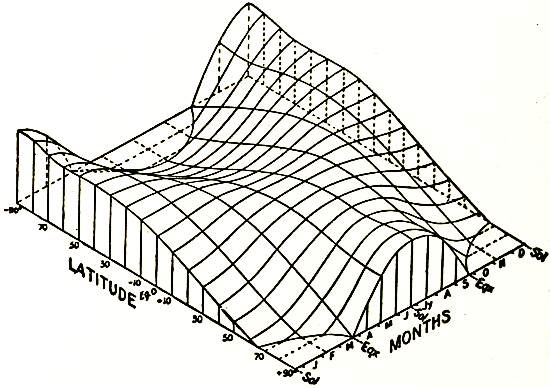
From Davis’s Elementary Meteorology.
Fig. 1.—Distribution of Insolation over the Earth’s Surface.
At the equinox the days are equal everywhere, but the noon sun is lower and lower with increasing latitude in both hemispheres until the rays are tangent to the earth’s surface at the poles (except for the effect of refraction). Therefore, the values of insolation diminish from a maximum at the equator to a minimum at both poles.
The effect of the earth’s atmosphere is to weaken the sun’s rays. The more nearly vertical the sun, the less the thickness of atmosphere traversed by the rays. The values of insolation at the earth’s surface, after passage through the atmosphere, have been calculated. They vary much with the condition of the air as to dust, clouds, water vapour, &c. As a rule, even when the sky is clear, about one-half of the solar radiation is lost during the day by atmospheric absorption. The great weakening of insolation at the pole, where the sun is very low, is especially noticeable. The following table (after Angot) shows the effect of the earth’s atmosphere (coefficient of transmission 0.7) upon the value of insolation received at sea-level.
Values of Daily Insolation at the Upper Limit of the Earth’s Atmosphere and at Sea-Level.
Lat. Upper Limit of Atmosphere. Earth’s Surface.
Equator. 40°. N. Pole. Equator. 40°. N. Pole.
Winter solstice 948 360 0 552 124 0
Equinoxes 1000 773 0 612 411 0
Summer solstice 888 1115 1210 517 660 494
The following table gives, according to W. Zenker, the relative thickness of the atmosphere at different altitudes of the sun, and also the amount of transmitted insolation:
Relative Distances traversed by Solar Rays through the Atmosphere, and Intensities of Radiation per Unit Areas.
Altitude of sun 0° 5° 10° 20° 30° 40° 50° 60° 70° 80° 90°
Relative lengths of path through the atmosphere 44.7 10.8 5.7 2.92 2.00 1.56 1.31 1.15 1.06 1.02 1.00
Intensity of radiation on a surface normal to the rays 0.0 0.15 0.31 0.51 0.62 0.68 0.72 0.75 0.76 0.77 0.78
Intensity of radiation on a horizontal surface 0.0 0.01 0.05 0.17 0.31 0.44 0.55 0.65 0.72 0.76 0.78
Physical Climate.—The distribution of insolation explains many of the large facts of temperature distribution, for example, the decrease of temperature from equator to poles; the double maximum of temperature on and near the equator; the increasing seasonal contrasts with increasing latitude, &c. But the regular distribution of solar climate between equator and poles which would exist on a homogeneous earth, whereby similar conditions prevail along each latitude circle, is very much modified by the unequal distribution of land and water; by differences of altitude; by air and ocean currents, by varying conditions of cloudiness, and so on. Hence the climates met with along the same latitude circle are no longer alike. Solar climate is greatly modified by atmospheric conditions and by the surface features of the earth. The uniform arrangement of solar climatic belts, arranged latitudinally, is interfered with, and what is known as physical climate results. According to the dominant control we have solar, continental and marine, and mountain climates. In the first-named, latitude is the essential; in the second and third, the influence of land or water; in the fourth, the effect of altitude.