VOLUME VI SLICE V Clervaux to Cockade (continued 11)
Reading edition
See Daniel, Deutschland (Leipzig, 1895); W. A. Günther, Geschichte der Stadt Koblenz (Cobl., 1815); and Bär, Urkunden und Akten zur Geschichte der Verfassung und Verwaltung der Stadt Koblenz bis zum Jahre 1500 (Bonn, 1898).
COBOURG, the capital of Northumberland county, Ontario, Canada, on Lake Ontario and the Grand Trunk railway; 70 m. E.N.E. of Toronto. Pop. (1901) 4239. It has a large, safe harbour, and steamboat communication with St Lawrence and Lake Ontario ports. It contains car-works, foundries, and carpet and woollen factories, and is a summer resort, especially for Americans. Victoria University, formerly situated here, was removed to Toronto in 1890.
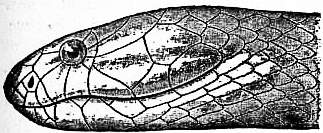
Head of Cobra.
COBRA (Naja tripudians), a poisonous Colubrine snake, belonging to the family Elapidae, known also as the hooded snake, cobra di capello or naga. In this genus the anterior ribs are elongated, and by raising and bringing forward these, the neck can be expanded at will into a broad disk or hood. It possesses two rows of palatine teeth in the upper jaw, while the maxillary bones bear the fangs, of which the anterior one only is in connexion with the poison gland, the others in various stages of growth remaining loose in the surrounding flesh until the destruction of the poison fang brings the one immediately behind to the front, which then gets anchylosed to the maxillary bone, and into connexion with the gland secreting the poison, which in the cobra is about the size of an almond. Behind the poison fangs there are usually one or two ordinary teeth. The cobra attains a length of nearly 6 ft. and a girth of about 6 in.
The typical cobra is yellowish to dark-brown, with a black and white spectacle-mark on the back of the hood, and with a pair of large black and white spots on the corresponding under-surface. There are, however, many varieties, in some of which the spectacle markings on the hood are wanting. The cobra may be regarded as nocturnal in its habits, being most active by night, although not unfrequently found in motion during the day. It usually conceals itself under logs of wood, in the roofs of huts and in holes in old walls and ruins, where it is often come upon inadvertently, inflicting a death wound before it has been observed. It feeds on small quadrupeds, frogs, lizards, insects and the eggs of birds, in search of which it sometimes ascends trees. When seeking its prey it glides slowly along the ground, holding the anterior third of its body aloft, with its hood distended, on the alert for anything that may come in its way. “This attitude,” says Sir J. Fayrer, “is very striking, and few objects are more calculated to inspire awe than a large cobra when, with his hood erect, hissing loudly and his eyes glaring, he prepares to strike.” It is said to drink large quantities of water, although like reptiles in general it will live for many months without food or drink. The cobra is oviparous; and its eggs, which are from 18 to 25 in number, are of a pure white colour, somewhat resembling in size and appearance the eggs of the pigeon, but sometimes larger. These it leaves to be hatched by the heat of the sun. It is widely distributed, from Transcaspia to China and to the Malay Islands, and is found in all parts of India, from Ceylon to the Himalayas up to about 8000 ft. above the level of the sea.
Closely allied is N. haje, the common hooded cobra of all Africa, the Spy-slange, i.e. spitting snake of the Boers.
The cobra is justly regarded as one of the most deadly of the Indian Thanatophidia. Many thousand deaths are caused annually by this unfortunately common species, but it is difficult to obtain accurate statistics. The bite of a vigorous cobra will often prove fatal in a few minutes, and as there is no practicable antidote to the poison, it is only in rare instances that such mechanical expedients as cauterizing, constriction or amputation can be applied with sufficient promptitude to prevent the virus from entering the circulation. Owing to a small reward offered by the Indian government for the head of each poisonous snake, great numbers of cobras have been destroyed; but only low-caste Hindus will engage in such work, the cobra being regarded by the natives generally with superstitious reverence, as a divinity powerful to injure, and therefore to be propitiated; and thus oftentimes when found in their dwellings this snake is allowed to remain, and is fed and protected. “Should fear,” says Sir J. Fayrer, “and perhaps the death of some inmate bitten by accident, prove stronger than superstition, it may be caught, tenderly handled, and deported to some field, where it is released and allowed to depart in peace, not killed” (Thanatophidia of India). Great numbers, especially of young cobras, are killed by the adjutant birds and by the mungoos—a small mammal which attacks it with impunity, apparently not from want of susceptibility to the poison, but by its dexterity in eluding the bite of the cobra. Mere scratching or tearing does not appear to be sufficient to bring the poison from the glands; it is only when the fangs are firmly implanted by the jaws being pressed together that the virus enters the wound, and in those circumstances it has been shown by actual experiment that the mungoos, like all other warm-blooded animals, succumbs to the poison. In the case of reptiles, the cobra poison takes effect much more slowly, while it has been proved to have no effect whatever on other venomous serpents.
In the Egyptian hieroglyphics the cobra occurs constantly with the body erect and hood expanded; its name was ouro, which signifies “king,” and the animal appears in Greek literature as ouraios and basiliscus. With the Egyptian snake-charmers of the present day the cobra is as great a favourite as with their Hindu colleagues. They pretend to change the snake into a rod, and it appears that the supple snake is made stiff and rigid by a strong pressure upon its neck, and that the animal does not seem to suffer from this operation, but soon recovers from the cataleptic fit into which it has been temporarily thrown.
The cobra is the snake usually exhibited by the Indian jugglers, who show great dexterity in handling it, even when not deprived of its fangs. Usually, however, the front fang at least is extracted, the creature being thus rendered harmless until the succeeding tooth takes its place, and in many cases all the fangs, with the germs behind, are removed—the cobra being thus rendered innocuous for life. The snake charmer usually plays a few simple notes on the flute, and the cobra, apparently delighted, rears half its length in the air and sways its head and body about, keeping time to the music.
The cobra, like almost all poisonous snakes, is by no means aggressive, and when it gets timely warning of the approach of man endeavours to get out of his way. It is only when trampled upon inadvertently, or otherwise irritated, that it attempts to use its fangs. It is a good swimmer, often crossing broad rivers, and probably even narrow arms of the sea, for it has been met with at sea at least a quarter of a mile from land.
COBURG, a town of Germany, the twin capital with Gotha of the duchy of Saxe-Coburg-Gotha, on the left bank of the Itz, an affluent of the Regen, on the southern slope of the Frankenwald, the railway from Eisenach to Lichtenfels, and 40 m. S.S.E. of Gotha. Pop. (1905) 22,489. The town is for the most part old, and contains a number of interesting buildings. The ducal palace, known as the Ehrenburg, is a magnificent building, originally erected on the site of a convent of bare-footed friars by Duke John Ernest in 1549, renovated in 1698, and restored in 1816 by Duke Ernest I. It contains a vast and richly decorated hall, the court church and a fine picture gallery. In the gardens are the mausoleum of Duke Francis (d. 1806) and his wife, a bronze equestrian statue of Duke Ernest II. and a fountain in commemoration of Duke Alfred (duke of Edinburgh). In the market square are the medieval Rathaus, the government buildings, and a statue of Prince Albert (consort of Queen Victoria), by William Theed the younger (1804-1891). In the Schloss-platz are the Edinburgh Palace (Palais Edinburg), built in 1881, the theatre and an equestrian statue of Duke Ernest I. Among the churches the most remarkable is the Moritzkirche, with a lofty tower. The educational establishments include a gymnasium, founded in 1604 by Duke John Casimir (d. 1633) and thus known as the Casimirianum, a commercial, an agricultural and other schools. The Zeughaus (armoury) contains the ducal library of 100,000 volumes, and among other public buildings may be mentioned the Augustenstift, formerly the seat of the ministerial offices, and the Marstall (royal mews). On a commanding eminence above the town is the ancient castle of Coburg, dating from the 11th century (see below). In 1781 it was turned into a penitentiary and lunatic asylum, but in 1835-1838 was completely restored, and now contains a natural history museum. The most interesting room in this building is that which was occupied by Luther in 1530, where the surroundings may have inspired, though (as is now proved) he did not compose, the famous hymn, Ein’ feste Burg ist unser Gott; the bed on which he slept, and the pulpit from which he preached in the old chapel are shown. Coburg is a place of considerable industry, the chief branches of the latter being brewing, manufactures of machinery, colours and porcelain, iron-founding and saw-milling; and there is an important trade in the cattle reared in the neighbourhood. Among various places of interest in the vicinity are the ducal residences of Callenberg and Rosenau, in the latter of which Albert, Prince Consort, was born in 1819; the castle of Lauterburg; and the village of Neuses, with the house of the poet J. M. F. Rückert, who died here in 1866, and on the other side of the river the tomb of the poet Moritz August von Thümmel (1738-1817).
The town of Coburg, first mentioned in a record of 1207, owed its existence and its name to the castle, and in the 15th and 16th centuries was of considerable importance as a halting-place on the great trade route from Nuremberg via Bamberg to the North. In 1245 the castle became the seat of the elder branch of the counts of Henneberg (Coburg-Schmalkalden). The countships of Coburg and Schmalkalden passed by the marriage of Jutta, daughter of Hermann I. (d. 1290), to Otto V. of Brandenburg, whose grandson John, however, sold them to Henry VIII. of Henneberg, his brother-in-law. Henry’s daughter Catherine (d. 1397) married Frederick III. of Meissen, and so brought the castle, town and countship into the possession of the Saxon house of Wettin. In 1549 Duke John Ernest of Saxony made Coburg his residence and turned the old castle into a fortress strong enough to stand a three years’ siege (1632-1635) during the Thirty Years’ War. In 1641 Coburg fell to the dukes of Saxe-Altenburg. In 1835 it became the residence of the dukes of Saxe-Coburg. For the princes of the house of Coburg see Wettin And Saxe-Coburg.
COCA, or Cuca (Erythroxylon coca), a plant of the natural order Erythroxylaceae, the leaves of which are used as a stimulant in the western countries of South America.1 It resembles a blackthorn bush, and grows to a height of 6 or 8 ft. The branches are straight, and the leaves, which have a lively green tint, are thin, opaque, oval, more or less tapering at the extremities. A marked characteristic of the leaf is an areolated portion bounded by two longitudinal curved lines one on each side of the midrib, and more conspicuous on the under face of the leaf. Good samples of the dried leaves are uncurled, are of a deep green on the upper, and a grey-green on the lower surface, and have a strong tea-like odour; when chewed they produce a sense of warmth in the mouth, and have a pleasant, pungent taste. Bad specimens have a camphoraceous smell and a brownish colour, and lack the pungent taste. The flowers are small, and disposed in little clusters on short stalks; the corolla is composed of five yellowish-white petals, the anthers are heart-shaped, and the pistil consists of three carpels united to form a three-chambered ovary. The flowers are succeeded by red berries. The seeds are sown in December and January in small plots (almacigas) sheltered from the sun, and the young plants when from 1½ to 2 ft. in height are placed in holes (aspi), or, if the ground is level, in furrows (uachos) in carefully-weeded soil. The plants thrive best in hot, damp situations, such as the clearings of forests; but the leaves most preferred are obtained in drier localities, on the sides of hills. The leaves are gathered from plants varying in age from one and a half to upwards of forty years. They are considered ready for plucking when they break on being bent. The first and most abundant harvest is in March, after the rains; the second is at the end of June, the third in October or November. The green leaves (matu) are spread in thin layers on coarse woollen cloths and dried in the sun; they are then packed in sacks, which, in order to preserve the quality of the leaves, must be kept from damp.
In the Kew Bulletin for January 1889 is an account of the history and botany of the plant, which has been so long under cultivation in South America that its original home is doubtful. As the result of this cultivation numerous forms have arisen. The writer distinguishes from the typical Peruvian form with pointed leaves a variety novo-granatense, from New Granada, which has smaller leaves with a rounded apex. The plant is now cultivated in the West Indies, India, Ceylon, Java and elsewhere. It has been estimated that coca is used by about 8,000,000 of the human race, being consumed in Bolivia, Peru, Ecuador, Colombia and Rio Negro. In Peru the Indians carry a leathern pouch (the chuspa or huallqui) for the leaves, and a supply of pulverized unslaked lime, or a preparation of the ashes of the quinoa plant (Chenopodium Quinoa), called llipta or llucta. Three or four times a day labour is suspended for chacchar or acullicar, as the mastication of coca is termed. The leaves, deprived of their stalks, are chewed and formed into a ball (acullico) in the mouth; a small quantity of the lime or llipta is then applied to the acullico to give it a proper relish. Two or three ounces of coca are thus daily consumed by each Indian.
Coca was used by the Peruvian Indians in the most ancient times. It was employed as an offering to the sun, or to produce smoke at the great sacrifices; and the priests, it was believed, must chew it during the performance of religious ceremonies, otherwise the gods would not be propitiated. Coca is still held in superstitious veneration among the Peruvians, and is believed by the miners of Cerro de Pasco to soften the veins of ore, if masticated and thrown upon them.
The composition of different specimens of coca leaves is very inconstant. Besides the important alkaloid cocaine (q.v.), occurring to the extent of about O.2% in fresh specimens, there are several other alkaloids. The preparations of coca leaves are incompatible with certain drugs which might often be prescribed in combination with them, such as salts of mercury, menthol and mineral acids, which latter decompose cocaine into benzoic acid and ecgonine.
Coca leaves and preparations of them have no external action. Internally their action is similar to that of opium, though somewhat less narcotic, and causing a dilatation of the pupil of the eye instead of a contraction. When masticated, the leaves first cause a tingling in the tongue and mucous membrane of the mouth, owing to a stimulation of the nerves of common sensation, and then abolish taste owing to a paralysis of the terminals of the gustatory nerves. They have a definite anaesthetic action upon the mucous membrane of the stomach, from which there come in large part those organic sensations which we interpret as hunger. Hence it is possible, under the influence of coca, to go without food or consciousness of needing it, for as long a period as three days. The drug is not a food, however, as its composition and history in the body clearly show, and the individual who comfortably fasts under its influence nevertheless shows all the physical signs of starvation, such as loss of weight. In small doses coca stimulates the intestinal peristalsis and thus is an aperient, but in large doses it paralyses the muscular coat of the bowel, causing constipation, such as is constantly seen in coco-maniacs, and in those inhabitants of Peru and the adjacent countries who take it in excess or are markedly susceptible to its influence.
The injection of coca leaves has a very remarkable effect upon the higher tracts of the nervous system—an effect curiously contrary to that produced by their chief ingredient upon the peripheral parts of the nervous apparatus. The mental power is, at any rate subjectively, enhanced in marked degree. In the absence of extended experiments in psychological laboratories, such as have been conducted with alcohol, it is not possible to say whether the apparent enhancement of the intellect is an objectively demonstrable fact. The physical power is unquestionably increased, such muscular exercises as are involved in ascending mountains being made much easier after the chewing of an ounce or so of these leaves. Excess in coca-chewing leads in many cases to great bodily wasting, mental failure, insomnia, weakness of the circulation and extreme dyspepsia. For other pharmacological characters and the therapeutic employments of coca see Cocaine.
COCAINE, C17H21NO4, an alkaloid occurring to the extent of about 1% in the leaves of Erythroxylon coca (see above). It is associated with many other alkaloids: cinnamyl cocaine, C19H23NO4; α-truxilline, (C19H23NO4)2; β-truxilline, (C19H23NO4)2; benzoylecgonine, C16H19NO2; tropa-cocaine, C15H19NO2; hygrine, C8H15NO; cuscohygrine, C13H24NO2. These substances, which may be collectively termed “cocaines,” are all derivatives of ecgonine (q.v.). Cocaine is benzoylmethyl ecgonine. It crystallizes from alcohol in prisms, which are sparingly soluble in water. Its solution has a bitter taste, alkaline reaction, and is laevorotatory. Its use as a local anaesthetic (see Anaesthesia) makes it the most valuable of the coca alkaloids, and it is much used in ophthalmic practice. Applied to the conjunctiva it causes anaesthesia, dilatation of the pupil, diminution of the intraocular tension, and some interference with accommodation. The conversion of the mixture obtained by extracting coca-leaves into cocaine is effected by saponifying the esters into ecgonine and the respective acids, and then benzoylating and methylating the ecgonine. Homologues of cocaine—ethylbenzoylecgonine, &c.—have been prepared; they closely resemble natural cocaine. Cinnamyl cocaine is cinnamylmethylecgonine, i.e. cocaine in which the benzoyl group is replaced by the cinnamyl group. α- and β-truxillines, named from their isolation from a coca of Truxillo (Peru), are two isomeric alkaloids which hydrolyse to ecgonine, methyl alcohol, and two isomeric acids, the truxillic acids, C18H16O4. The alkaloids are therefore methyl truxillylecgonines. The truxillic acids have been studied by K. Liebermann and his students (Ber., vols. 21-27, and 31), and are diphenyl tetramethylene dicarboxylic acids.
COCANADA, or Coconada, a town of British India, in the Godavari district of Madras, on the coast in the extreme north of the Godavari delta, about 315 m. N. of Madras. Pop. (1901) 48,096, showing an increase of 18% in the decade. As the administrative headquarters of the district, and the chief port on the Coromandel coast after Madras, Cocanada was formerly of considerable importance, but its shipping trade has declined, owing to the silting of the anchorage, and to the construction of the railway. It is connected by navigable channels with the canal system of the Godavari delta, and by a branch line with Samalkot on the East Coast railway. The anchorage is an open roadstead, with two lighthouses. The chief exports are rice, cotton, sugar and oilseeds. Mills have been established for cleaning rice. The town contains a second-grade college, a high school, and a literary association.
COCCEIUS [strictly Koch], JOHANNES (1603-1669), Dutch theologian, was born at Bremen. After studying at Hamburg and Franeker, where Sixtinus Amama was one of his teachers, he became in 1630 professor of biblical philology at the “Gymnasium illustre” in his native town. In 1636 he was transferred to Franeker, where he held the chair of Hebrew, and from 1643 the chair of theology also, until 1650, when he succeeded Fr. Spanheim the elder as professor of theology at Leiden. He died on the 4th of November 1669. His chief services as an oriental scholar were in the department of Hebrew philology and exegesis. As one of the leading exponents of the “covenant” or “federal” theology, he spiritualized the Hebrew scriptures to such an extent that it was said that Cocceius found Christ everywhere in the Old Testament and Hugo Grotius found him nowhere. He taught that before the Fall, as much as after it, the relation between God and man was a covenant. The first covenant was a “Covenant of Works.” For this was substituted, after the Fall, the “Covenant of Grace,” to fulfil which the coming of Jesus Christ was necessary. He held millenarian views, and was the founder of a school of theologians who were called after him Cocceians. His theology was founded entirely on the Bible, and he did much to promote and encourage the study of the original text. In one of his essays he contends that the observance of the Sabbath, though expedient, is not binding upon Christians, since it was a Jewish institution. His most distinguished pupil was the celebrated Campeius Vitringa. His most valuable work was his Lexicon et Commentarius Sermonis Hebraici et Chaldaici (Leiden, 1669), which has been frequently republished; his theology is fully expounded in his Summa Doctrinae de Foedere et Testamento Dei (1648).
His collected works were published in 12 folio volumes (Amsterdam, 1673-1675). See Herzog-Hauck, Realencyklopädie.
COCCIDIA, an important order of Sporozoa Ectospora, parasites possessing certain very distinctive characters. With one or two possible exceptions, they are invariably intracellular during the entire trophic life of the individual. They always attack tissue-cells, usually of an epithelium, and never blood-corpuscles. Correlated with the advanced degree of parasitism, there is a complete absence of specialization or differentiation of the cell-body, and the trophozoite is quite incapable of any kind of movement. In all cases, so far as known, the life-cycle is digenetic, an asexual generation (produced by schizogony) alternating with a sexual one (gametogony). After conjugation of two highly-differentiated gametes has taken place, a resistant oocyst is formed, which provides for the dispersal of the species; inside this sporogony (spore- and sporozoite-formation) goes on.
Hake (1839) was, perhaps, the first to describe a Coccidian, but he regarded the parasites as pathological cell-products. In 1845 N. Lieberkühn pointed out the resemblances to Gregarines, with which organisms he considered History. Coccidia to be allied. A year later, H. Kloss proved the existence of similar parasites in the snail, and attempted to construct their life-history; this form was subsequently named Klossia helicina by A. Schneider. The asexual part of the life-cycle was first described by Th. Eimer in 1870, for a Coccidian infesting the mouse, which was afterwards elevated by Schneider into a distinct genus Eimeria. The generic name Coccidium was introduced by R. Leuckart in 1879, for the parasite of the rabbit. It was many years, however, before the double character of the life-cycle was realized, and the ideas of L. and R. Pfeiffer, who first suggested the possibility of an alternation of generations, for a long time found no favour. In the first decade of the 20th century great progress was accomplished, thanks largely to the researches of F. Schaudinn and M. Siedlecki, who first demonstrated the occurrence of sexual conjugation in the group; and the Coccidian life-history is now one of the best known among Sporozoa.
Coccidia appear to be confined1 to four great phyla, Vertebrates, Molluscs, Arthropods and Annelids; the first named group furnishes by far the most hosts, the parasites being frequently met with in domestic animals, both birds and mammals. Following Habitat: effects on host. from the casual method of infection, the epithelium of the gut or of its appendages (e.g. the liver [Plate I., fig. 1]) is a very common seat of the parasitic invasion. But in many cases Coccidia are found in other organs, to which they are doubtless carried by lymphatic or circulatory channels. In Molluscs, they often occur in the kidneys (fig. 2); in Insects, they are met with as “coelomic” parasites, the fat-bodies, pericardial cells, &c., being a favourite habitat; even the testis is not free from their attentions in one or two instances, though the ovary appears always immune.
The parasite invariably destroys its host-cell completely. The latter is at first stimulated to abnormal growth and activity and becomes greatly hypertrophied, the nucleus also undergoing karyolytic changes (fig. 4). The fatty materials elaborated by the host-cell are rapidly used up by the Coccidian, as nourishment; and at length the weakened and disorganized cell is no longer able to assimilate but dies and is gradually absorbed by the parasite, becoming reduced to a mere enclosing skin or envelope. In some cases (ex. Cyclospora caryolytica of the mole) the parasite is actually intranuclear, the nucleus becoming greatly swollen and transformed into a huge vacuole containing it.
The effects of a Coccidian infection upon the host as a whole depend largely upon the extent to which endogenous multiplication of the parasites takes place. On the one hand, schizogony may be so limited in extent as not to cause appreciable injury to the host. This seems to be often the case in forms infecting Molluscs and Arthropods. On the other hand, where schizogony is rapid and prolonged, the results are often serious. For, although any one individual only causes the death of a single host-cell, yet the number of the parasites may be so enormously increased by this means, that the entire affected epithelium may be overrun and destroyed. Thus are occasioned grave attacks of coccidiosis, characterized by severe enteritis and diarrhoea, which may end fatally. In the case of the Vertebrates, secondary causes, resulting from the stoppage of the bile ducts, also help to produce death. There is, however, one factor in the endangered animal’s favour. Schizogony cannot go on indefinitely; it has a limit, dependent upon the supply of host-cells, and consequently of nutriment, available. As this shows signs of becoming exhausted, by the rapid multiplication of the parasites, the latter begin to make preparations for the exogenous cycle, inaugurated by gametogony. When conjugation has taken place and sporogony is begun, the danger to the host is at an end. So that, if the acute stage of the disease is once successfully passed, the regenerative capacity of the epithelium may be able to restore something like equilibrium to the deranged metabolism in time to prevent collapse.
Coccidium schubergi, parasitic in the intestine of a centipede (Lithobius forficatus), may be taken as an example of a Coccidian life-history (see Schaudinn, 1900): some of the more important variations exhibited by other forms will be Morphology and life-history. noted afterwards. The trophozoite, or actively-growing parasite, is an oval or rounded body (fig. 3, I.). The general cytoplasm shows no differentiation into ectoplasm and endoplasm; it is uniformly alveolar in character. The nucleus is relatively large, and possesses a distinct membrane and a well-marked reticulum in which are embedded grains of chromatin. Its most conspicuous feature is the large deeply-staining karyosome, which consists of the greater part of the chromatin of the nucleus intimately bound up with a plastinoid basis. When fully grown, the trophozoite (now a schizont) undergoes schizogony. Its nucleus divides successively to form a number of nuclei, which travel to the periphery, and there become more or less regularly disposed (fig. 3, II. and III.). The protoplasm in the neighbourhood of each next grows out, as a projecting bud, carrying the nucleus with it. In this manner are formed a number of club-shaped bodies, the merozoites, which are at length set free from the parent-body (IV.), leaving a certain amount of residual cytoplasm behind. By the rupture of the disorganized host-cell,2 the fully-formed merozoites are liberated into the intestinal lumen, and seek out fresh epithelial cells. Each is more or less sickle-shaped, and capable of active movements. Once inside a new host-cell, the merozoite grows to a schizont again.
After this course has been repeated several times, gametogony sets in, the trophozoites growing more slowly and becoming the parent-cells of the sexual elements (gametocytes), either male individuals (microgametocytes) or female ones (megagametocytes). A microgametocyte (fig. 3, VI. ♂) is characterized by its dense but finely reticular or alveolar cytoplasm, very different from the loose structure of that of a schizont. The male elements (microgametes) are formed in a manner essentially comparable to that in which the formation of merozoites takes place. Although the details of the nuclear changes and divisions vary somewhat, the end-result is similar, a number of little nuclear agglomerations being evenly distributed at the surface (VII. ♂) Each of these elongates considerably, becoming comma-shaped and projecting from the gametocyte. Nearly all the body of the male gamete (VIII. ♂) consists of chromatin, the cytoplasm only forming a very delicate zone or envelope around the nucleus. From the cytoplasm two long fine flagella grow out, one of which originates at the anterior end, the other, apparently, at the hinder end, acting as a rudder; but it is probable that this also is developed at the anterior end and attached to the side of the body. By means of their flagella the numerous microgametes break loose from the body of the microgametocyte and swim away in search of a female element.
A megagametocyte (VI. ♀) is distinguished by its rather different shape, being more like a bean than a sphere until ripe for maturation, and by the fact that it stores up in its cytoplasm quantities of reserve nutriment in the form of rounded refringent plastinoid grains. Each female gametocyte gives rise to only a single female element (megagamete), after a process of nuclear purification. The karyosome is expelled from the nucleus into the cytoplasm, where it breaks up at once into fragments (VII. ♀). Meanwhile the gametocyte is becoming spherical, and its changes in shape aid in setting it free from the shrivelled host-cell. The fragments of the karyosome, which are, as it were, squeezed out to the exterior, exert a powerful attraction upon the microgametes, many of which swarm round the now mature megagamete. The female nucleus (pronucleus) approaches the surface of the cell (VIII. ♀), and at this spot a little clear cytoplasmic prominence arises (cone of reception). On coming into contact with this protuberance (probably attracted to it by the female pronucleus), a microgamete adheres. Partly by its own movements and partly by the withdrawal of the cone of attraction, the male penetrates into the female element and fertilization is accomplished. Only one microgamete can thus pass into the megagamete, for immediately its entry is effected a delicate membrane is secreted around the copula (zygote), which effectually excludes other less fortunate ones. This membrane rapidly increases in thickness and becomes the oocyst (IX.), and the copula is now ready to begin sporogony.
Sporogony goes on indifferently either inside the host or after the cyst has been passed out with the faeces to the exterior. The definitive nucleus of the zygote (resulting from the intimate fusion of the male and female pronuclei, by means of a somewhat elaborate “fertilization-spindle” [X.]) gives rise by successive direct divisions to four nuclei (XII.), around which the protoplasm becomes segregated; these segments form the four sporoblasts. Around each sporoblast two membranes are successively secreted (exospore and endospore), which constitute the sporocyst (XIII.); the sporocyst and its contents forming the spore. The nucleus of each spore next divides, again directly, and this is followed by the division of the cytoplasm. As a final result, each of the four spores contains two germs (sporozoites), and a certain amount of residual protoplasm (fig. 3, XIV.); this latter encloses a viscid, vacuole-like body, which aids in the subsequent dehiscence of the sporocyst. On being eaten by a fresh host, the wall of the oocyst is dissolved at a particular region by the digestive juices, which are thus enabled to reach the spores and cause the rupture of the sporocysts. As the result of instructive experiments, Metzner has shown that it is the pancreatic and not the gastric juice by which this liberation of the germs is effected. The liberated sporozoites creep out and proceed to infect the epithelial cells. The sporozoites (XV.) are from 15-20 µ long by 4-6 µ wide; they are fairly similar to merozoites in form, structure and behaviour, the chief point of distinction being that they have no karyosome in the nucleus (cf. above).
Plate I.
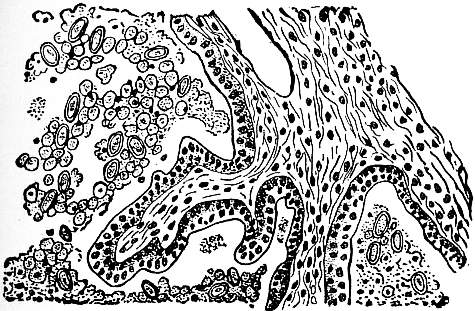
Fig. 1.—SECTION THROUGH RABBIT’S LIVER, INFECTED WITH COCCIDIUM CUNICULI. (AFTER THOMA.)
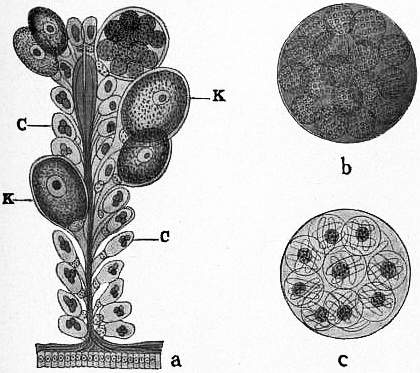
Fig. 2.—KLOSSIA HELICINA, FROM KIDNEY OF HELIX HORTENSIS.
a, Portion of a section of the kidney showing normal epithelial cells containing concretions (c), and enlarged epithelial cells containing the parasite (k) in various stages; b, cyst of the Klossia containing sporoblasts; c, cyst with ripe spores, each enclosing four sporozoites and a patch of residual protoplasm. (From Wasielewski, after Balbiani.)
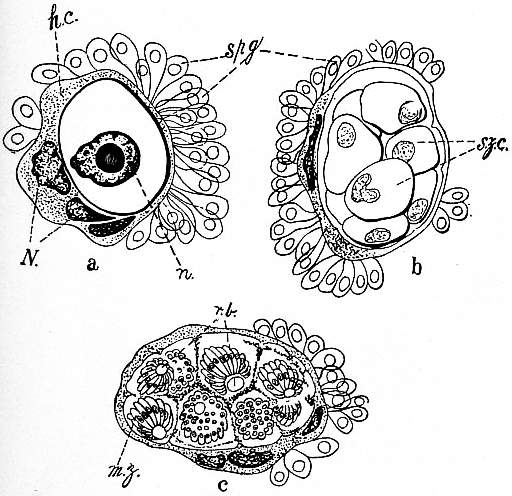
Fig. 3.—THE LIFE-CYCLE OF COCCIDIUM SCHUBERGI, SCHAUD. (PAR. LITHOBIUS FORFICATUS). (FROM MINCHIN, AFTER SCHAUDINN.)
I.-IV represents the schizogony, commencing with infection of an epithelial cell by a sporozoite or merozoite. After stage IV the development may start again at stage I, as indicated by the arrows; or it may go on to the formation of gametocytes (V). V-VIII represents the sexual generation. The line of development, hitherto single (I-IV) becomes split into two lines—male (VI ♂, VII ♂, VIII ♂), and female (VI ♀, VII ♀, VIII ♀), culminating in the highly differentiated micro- and mega-gametes. By conjugation these two lines are again united. IX, X, show the formation of the zygote by fusion of the nuclei of the gametes. XI-XV, sporogony. H.C, host-cell; N, its nucleus; mz, merozoite; szt, schizont; ky, karyosome (or fragments of same); n.n, daughter-nuclei of schizont; pl.gr, plastinoid grains; ooc, oocyst; n.zyg, zygote-nucleus (segmentation-nucleus); sp.m, spore-membrane (sporocyst); rp, residual protoplasm of oocyst (“reliquat kystal”); rp.sp, residual protoplasm of spore (“reliquat sporal”); sp.z, sporozoite.
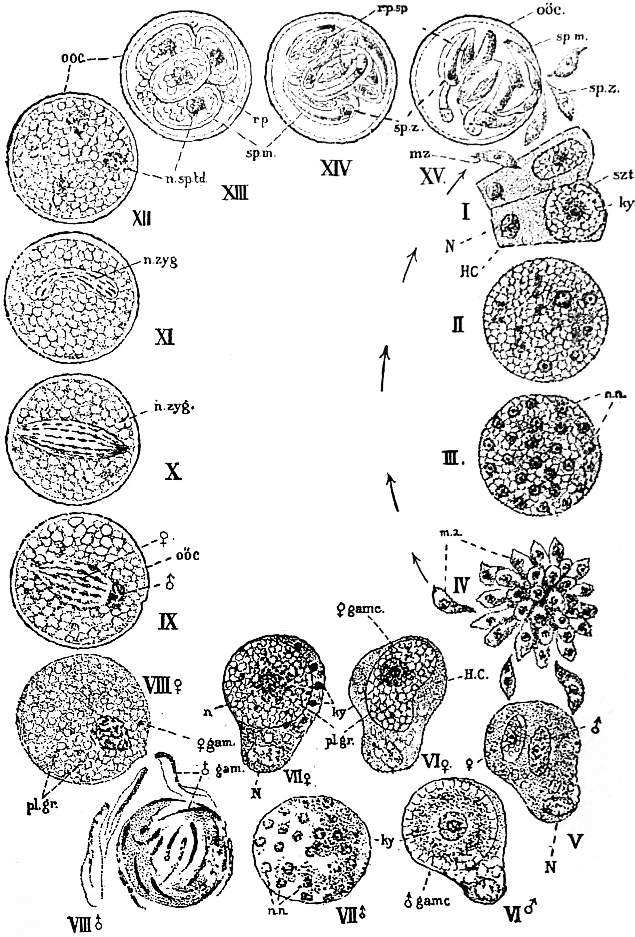
Fig. 4.—PHASES OF CARYOTROPHA MESNILII, SIEDL. (PAR. POLYMNIA NEBULOSA).
a, Young schizont in a cluster of spermatogonia; the host-cell (represented granulated) and two of its neighbours are greatly hypertrophied, with very large nuclei, and have fused into a single mass containing the parasite (represented clear, with a thick outline). The other spermatogonia are normal. b, Intracellular schizont divided up into schizontocytes (c), each schizontocyte giving rise to a cluster of merozoites arranged as a “corps en barillet”; spg, spermatogonia; h.c, host-cell; N, nucleus of host-cell or cells; n, nucleus of parasite; szc, schizontocyte; mz, merozoites; r.b, residual bodies of the schizontocytes. (From Minchin, after Siedlecki.)
Plate II.
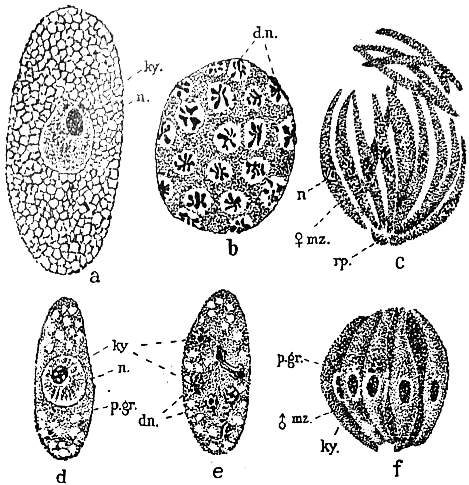
Fig. 5.—SCHIZOGONY OF ADELEA OVATA, A. SCHN. (PAR. LITHOBIUS FORFICATUS).
a-c, ♀ generation; d-f, ♂ generation. a, Full-grown ♀ schizont (megaschizont), with a large nucleus (n) containing a conspicuous karyosome (ky). b, Commencement of schizogony; the nucleus has divided up to form a number of daughter-nuclei (d.n). The karyosome of stage a has broken up into a great number of daughter-karyosomes, each of which forms at first the centre of one of the star-shaped daughter-nuclei; but in a short time the daughter-karyosomes become inconspicuous. c, Completion of schizogony; the ♀ schizont has broken up into a number of megamerozoites (♀ mz) implanted on a small quantity of residual protoplasm (r.p.). Each ♀ merozoite has a chromatic nucleus (n) without a karyosome. d, Full-grown ♂ schizont (microschizont), with nucleus (n), karyosome (ky), and a number of characteristic pigment-granules (p.gr). e, Commencement of schizogony. The nucleus is dividing up into a number of daughter-nuclei (d.n), each with a conspicuous karyosome (ky). f, Completion of schizogony. The numerous micro-merozoites (♂ mz) have each a nucleus with a conspicuous karyosome (ky) at one pole, and the protoplasm contains pigment-granules (p.gr) near the nucleus, on the side farthest from the karyosome. (From Minchin, after Siedlecki.)
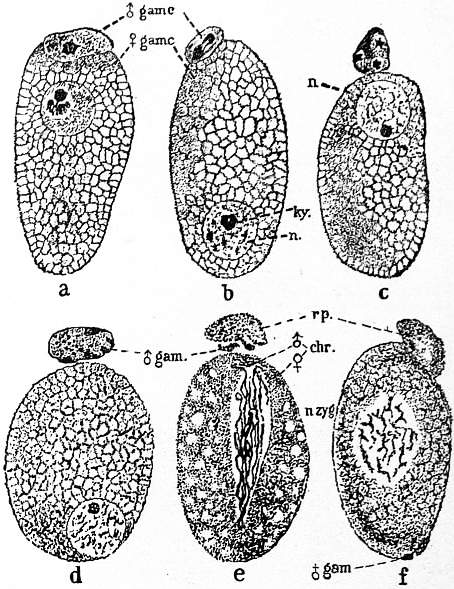
Fig. 6.—ASSOCIATION AND CONJUGATION IN ADELEA OVATA.
a, Young microgametocyte (♂ gamc.) attached to a megagametocyte (♀ gamc.). The nucleus of the microgametocyte gives rise to 4 daughter-nuclei (c) which become (d) 4 microgametes (♀ gam.). e, One of the microgametes penetrates the megagamete, which forms a fertilization-spindle composed of male and female chromatin (♂ and ♀ chr.). The other 3 microgametes and the residual protoplasm of the microgametocyte (r.p.) perish. The karyosome of the megagamete has disappeared, as such. f, Union of the chromatin of both elements, to produce the zygote-nucleus (n.zyg.). (From Minchin, after Siedlecki.)
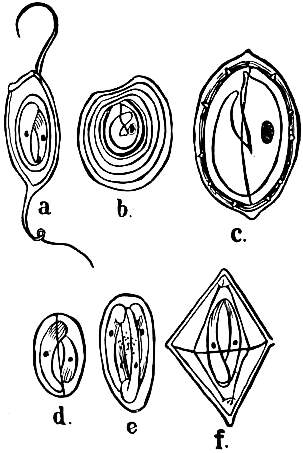
Fig. 7.—SPORES OF VARIOUS COCCIDIAN GENERA.
a, Minchinia chitonis (E.R.L.), (par. (Chiton); b, Diaspora hydatidea, Léger (par. Polydesmus); c, Echinospora labbei, Léger (par. Lithobius mutabilis); d, Goussia motellae, Labbé; e, Diplospora (Hyaloklossia), lieberkuhni (Labbé), (par. Rana esculenta); f, Crystallospora crystalloides (Thél.), (par. Motella tricirrata). (From Minchin; b and c after Léger, the others after Labbé.)
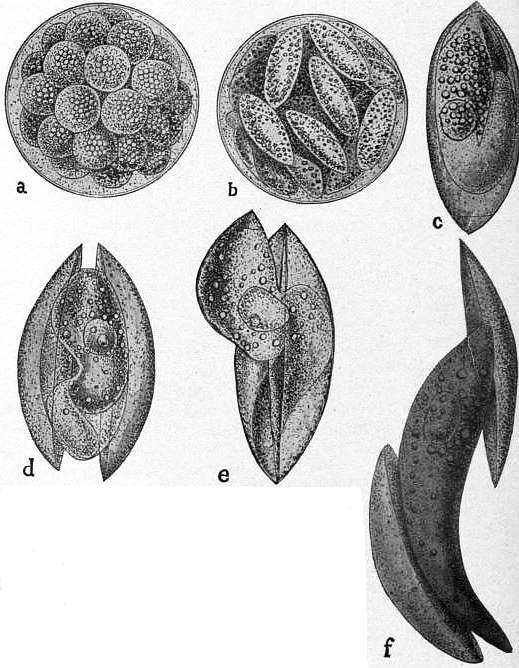
Fig. 8.—SPOROGONY AND SPORE-GERMINATION IN BARROUSSIA ORNATA, A. SCH., FROM THE GUT OF NEPA CINERA.
a, Oocyst with sporoblasts; b, oocyst with ripe spores; c, a spore highly magnified, showing the single sporozoite bent on itself; d, the spore has split along its outer coat or epispore, but the sporozoite is still enclosed in the endospore; e, the sporozoite, freed from the endospore, is emerging; f, the sporozoite has straightened itself out and is freed from its envelopes. (From Wasielewski, after A. Schneider.)
Comparing the life-cycle of other Coccidia with that just described, a greater or less degree of modification is frequently met with. In the process of schizogony two orders of division sometimes occur; the parent-schizont first divides up into a varying number of rounded daughter-schizonts (schizontocytes), each of which gives rise, in the usual manner, to a cluster of merozoites,3 which thus constitute a second order of cells. Siedlecki (1902) has found this to be the case in Caryotropha mesnilii (fig. 4), and Woodcock (1904) has shown that it is most probably really the same process which Smith and Johnson (1902) mistook for sporogony when originally describing their Coccidian of the mouse, Klossiella. In Caryotropha, a perfectly similar state of affairs is seen in the formation of microgametes from the microgametocyte; this is additionally interesting as showing that this process is neither more nor less than male schizogony.
Coming to the sexual generation, considerable variation is met with as regards the period in the life-history when sexual differentiation first makes its appearance. Sexuality may become evident at the very beginning of schizogony, as, e.g. in Adelea ovata (Siedlecki, 1899), where the first-formed schizonts (those developed from the sporozoites) are differentiated into male and female (micro-and mega-schizonts) (see Plate II., fig. 5). Correspondingly, the merozoites, to which they give rise, are also different (micro-and mega-merozoites). In one or two cases sexuality appears even earlier in the cycle, and has thus been carried still farther back.
The Coccidia, as a whole, have not developed the phenomenon of association of the sexual individuals prior to gamete-formation which is so characteristic of Gregarines. Their method of endeavouring to secure successful sporulation, and thus the survival of the species, has been rather by the extreme specialization of the sexual process. In place of many female elements, which the primitive or ancestral forms may be assumed to have had,4 there is always, save possibly for one exception,5 only a single relatively huge megagamete formed, which offers a comparatively easy goal for one of the many microgametes. Nevertheless in the effort to render fertilization absolutely certain, a few Coccidia have acquired (secondarily) the power of associating; a state of things which enables those forms, moreover, to effect an economy in the number of male gametes, only three or four being developed. Instances are seen in Adelea mesnili (Perez, 1903), A. ovata (fig. 6), and Klossia helicina (Siedlecki, 1899). It is very interesting to note that, in the two last cases, unless this association of the microgametocyte with the megagametocyte occurs, neither can the former produce male elements (microgametes) nor can the female individual maturate and become ready for fertilization. (Concerning this question of association see also Gregarines.)
In sporogony, great variation is seen with respect to the number of spores and sporozoites formed; and, as in Gregarines, these characters are largely used for purposes of classification, under which heading they are better considered. Usually, the spores (fig. 7) are quite simple in outline, and not produced into spines or processes; exceptions are found, however, in a few instances (e.g. Minchinia chitonis). In one case (Coccidium mitrarium), the oocyst itself, instead of being spherical, is curiously shaped like a mitre.
The life-history as a whole is invariably undergone in a single host, i.e. there is no alternation of true hosts.6 Schaudinn, in his work on the Coccidia of Lithobius (1900), showed that the oocysts expelled with the faeces may be eaten by wood-lice (Oniscus), but when this happens they pass through the intestine of the wood-louse unaltered, the latter not being an intermediate host but merely a carrier.
The order Coccidiidea is divided into four families, characterized by the number of sporocysts (if any) found in the oocyst.
Classification. Fam. Asporocystidae, Léger. No sporozoites are formed in the oocyst, the sporozoites being unenclosed (gymnospores).
Genus, Légerella, Mesnil. This genus actually conforms to Aimé Schneider’s original definition of Eimeria, which was founded on what were really the schizogonous generations of other forms, then thought to be distinct. In view of the great confusion attending the use of this name, however, Mesnil (1900) has suggested the new one here adopted. Two species known, L. nova and L. testiculi, both from different species of Glomeris, a Myriapod; the former inhabits the Malpighian tubules, the latter the testis.
Fam. Disporocystidae, Léger. The oocyst contains 2 spores.
Genus 1. Cyclospora, A. Schneider. Spores dizoic, i.e. with two sporozoites. C. glomericola, from the intestinal epithelium of Glomeris, and C. caryolytica, from the intestinal epithelium of the mole, intranuclear.
Genus 2. Diplospora, Labbé. Spores tetrazoic. D. lacazei, from many birds, is the best-known species; and others have been described from different Sauropsida. D. lieberkühni is an interesting form occurring in the kidneys of the frog, which it reaches by way of the circulation.
Genus 3. Isospora, Schn. Spores polyzoic. Founded for I. rara, parasitic in the black slug (Limax cinereo-niger). Many authors consider that Schneider was mistaken in attributing many sporozoites to this form, and would unite with it the genus Diplospora.
Fam. Tetrasporocystidae, Léger. The oocyst contains 4 spores.
Genus 1. Coccidium,7 Leuckart. The spores are dizoic and the sporocysts rounded or oval. A very large number of species are known, mostly from Vertebrate hosts. C. cuniculi (= C. oviforme) from the rabbit (intestine and diverticula), but also occurring sometimes in other domestic animals; C. falciformis, from the mouse; C. faurei from sheep; and C. schubergi, from Lithobius (a centipede), are among the best-known forms. All of them may cause disastrous epidemics of coccidiosis.
Genus 2. Paracoccidium, Laveran and Mesnil. This genus is distinguished from Coccidium by the fact that the sporocysts become dissolved up in the oocyst, thus leaving the 8 sporozoites unenclosed, recalling the condition in Légerella. P. prevoti, unique species, from the frog’s intestine.
Genus 3. Crystallospora, Labbé. Spores also dizoic, but having the form of a double pyramid. C. crystalloides from a fish, Motella tricirrata.
Genus 4. Angeiocystis, Brasil. Apparently 6 sporozoites, but the only species, A. audouiniae, has only been briefly described; from a Polychaete (Audouinia).
Fam. Polysporocystidae, Léger. The oocyst contains numerous spores.
There are several genera with monozoic spores, characterized by variations in the form and structure of the sporocysts, e.g. Barroussia, Schn. (fig. 8), Echinospora, Léger, and Diaspora, Léger; most of these forms are from Myriapods.
Genus Adelea, Schn. Dizoic spores; sporocysts round or oval, plain. Several species are included in this well-known genus, among them being A. ovata, A. mesnili, A. dimidiata; most of them are parasitic in Insects or Myriapods.
Genus Minchinia, Labbé. Dizoic spores; the sporocysts are produced at each pole into a long filament. M. chitonis, from the liver of Chiton (Mollusca).
Genus Klossia, Schn. The spores are tetrazoic (or perhaps polyzoic). K. helicina from the kidney of various land-snails is the best-known form. Usually said to have 5 to 6 spores, but Mesnil considers that the normal number is 4, as is the case in another species, K. soror.
Genus Caryotropha, Siedlecki. Many spherical spores (about 20) each with 12 sporozoites. C. mesnilii, unique species, from the spermatogonial (testis) cells of Polymnia (a Polychaete). An interesting point in the schizogony is the formation of schizontocytes (see above).
A Coccidian parasitic in the kidneys of the mouse has been described by Smith and Johnson (1902) and named by them Klossiella, on the ground that it possessed many spores, each with about 20 sporozoites. Woodcock has shown, however, that the authors were in all probability dealing with a similar modification of schizogony to that which obtains in Caryotropha. The sporogony of this form (and hence its systematic position) remains at present, therefore, quite unknown.
There are several doubtful or insufficiently known genera, e.g. Bananella, Goussia, Hyaloklossia, Gonobia, Pfeifferella and Rhabdospora, many of which probably represent only schizogonous generations of other forms. (For information concerning these see Labbé, 1897.)
Lastly it remains to mention the extremely interesting forms parasitic in Cephalopods. For some years these have provided a fruitful source of discussion to systematists. Here it may be stated simply that their systematic position and nomenclature were thought to have been finally settled by the researches of Jacquemet (1903) and Lühe (1902) in the following terms:—
Genus Eucoccidium. Lühe (syn. Légerina Jacq.), Coccidia possessing polysporous oocysts and lacking schizogony, parasitic in Cephalopods. Two well-known species: E. eberthi (Labbé), (=Benedenia seu Klossia e. seu octopiana), parasitic in Sepia, which is tri- or tetra-zoic; and E. octopianum (Schn.), (syn. Benedenia seu Klossia o.) from Octopus, which is polyzoic, having 10 to 12 sporozoites. In both forms cysts containing megaspores and megasporozoites, and others containing microspores and microsporozoites are found, considered as representing sexual differentiation thrown back to the very earliest stages of the life-cycle.
Quite recently much additional light has been thrown upon our knowledge of these parasites, including a new one, E. jacquemeti. Moroff (1906) has shown that not one but many megagametes are formed, and fertilized by the microgametes. For this reason he regards them as Gregarines rather than Coccidia. Further, Léger and Duboscq (1906) have found that the characteristic coelomic parasites (Aggregata) of Crustacea, generally regarded as gymnosporous Gregarines (i.e. Gregarines in which the sporozoites are naked) constitute in reality nothing more or less than a schizogonous generation of these Cephalopodan parasites, which have thus an alternation of true hosts. The ripe sporocysts from the Cephalopod are eaten by a particular crab (e.g. Portunus or Inachus, according to the parasite), the sporozoites are liberated and traverse the mucous membrane of the intestine, coming to rest in the surrounding lymphatic layer. Here a large “cyst” is formed, projecting into the body-cavity, the contents of which give rise to a great number of merozoites. On the crab being devoured by the right species of Cephalopod, the merozoites doubtless give rise to the sexual generation again.
As the name Aggregata is much the older, and as, moreover, there is no longer any reason to retain that of Eucoccidium, these parasites must in future receive the former generic appellation. With regard to the various specific names, however, they remain quite unsettled until the life-history is properly worked out in different cases (see also Gregarines).
It seems to the writer a much more open question than Moroff and Léger and Duboscq apparently suppose, whether these parasites are to be relegated to the Gregarines. For undoubtedly they have many Coccidian features, and on the other hand they differ in many ways from Gregarines. The chief feature of agreement with the latter order is the possession of many female gametes. As already said, there can be little doubt that this was the condition in the Coccidian ancestor, and it is by no means impossible that one or two forms existing at the present day remain primitive in that respect. On the other hand, the advanced character of the parasitism (the parasites remaining intracellular up to and including gamete-formation); the entire lack of the characteristic feature of association; the schizogony, which is only a very rare occurrence in Gregarines, and which, in the present case, strongly suggests the process in Caryotropha and Klossiella; and, last but not least, the varying number of the sporozoites (3 in one form, 10-15 in others), which is very different from the almost constant number (8) in Gregarines, are all characters in which these forms agree with Coccidia and not with Gregarines. Having regard to these points, the writer is inclined, for the present, to consider Aggregata as an offshoot rather from the Coccidian than from the Gregarine branch of the Ectosporan tree.
Bibliography.—The following are some of the important papers dealing with the order:—G. Bonnet-Eymard, “Sur l’Évolution de l’Eimeria nova, Schneider,” C.R. Soc. Biol. 52, p. 659, 1900; L. Brasil, “Sur une Coccidie nouvelle, &c.,” C.R.Ac. Sci. 139, p. 645, 1904; L. Cuénot, “Légerella testiculi n. sp., &c.,” Arch. Zool. exp. (N. et R.), (3) 10, p. 49, 6 figs., 1902; M. Jacquemet, “Sur la systématique des Coccidies des Céphalopodes,” Arch. Protistenk. 2 p., 190, 1903; A. Labbé, “Recherches zoologiques, cytologiques et biologiques sur les Coccidies,” Arch. zool. exp. (3), 4, p. 517, 3 pls., 1897; A. Laveran, “Sur les modes de réproduction d’Isospora lacazei,” C.R. Soc. Biol. 50, p. 1139, 1898; A. Laveran and F. Mesnil, “Sur deux Coccidies intestinales de la Rana esculenta,” op. cit. 54, p. 857, 9 figs., 1902; A. Laveran and F. Mesnil, “Sur la Coccidie trouvée dans le rein de la Rana esculenta, &c.,” C.R.Ac. Sci. 135, p. 82, 10 figs., 1902; A. Laveran and F. Mesnil, “Sur quelques Protozoaires parasites d’une tortue, &c.” t. c. p. 609, 14 figs., 1902; L. Léger, “Sur une nouvelle Coccidie à microgamètes ciliés,” op. cit., 127, p. 418, 1898; L. Léger, “Sur la morphologie et le développement des microgamètes des Coccidies,” Arch. zool. exp. (N. et R.) (3), 6, 1898; L. Léger, “Essai sur la classification des Coccidies, &c.,” Ann. Mus. Nat. Hist., Marseille (2), Bull. i. p. 71, 4 pls., 1898; L. Léger “Sur la présence d’une Coccidie coelomique chez Olocrates, &c.,” Arch. zool. exp. (N. et R.) (3), 8, p. i., 1900; L. Léger, “Sur le genre Eimeria et la classification des Coccidies,” C.R. Soc. Biol. 52, p. 575, 1900; L. Léger and O. Duboscq, “Recherches sur les Myriapodes de Corse et leurs parasites,” Arch. zool. exp. (4), 1, p. 307, 24 figs., 1903; L. Léger and O. Duboscq, “Sur l’évolution des Grégarines gymnosporées des Crustacés,” C.R.Ac. Sci. 142, p. 1225, 1906; L. Léger and O. Duboscq, “L’Évolution d’une Aggregata de la seiche chez le Portunus depurator,” C.R. Soc. Biol. 6o, p. 1001, 1906; M. Lühe, “Über Geltung und Bedeutung der Gattungsnamen Eimeria und Coccidium,” C.B. Bakter (1) 31 Orig, p. 771, 1902; C.B. Bakter, “Die Coccidien-Literatur der letzten vier Jahre,” Zool. Centrlbl. 10, 45 pp., 1903; F. Mesnil, “Sur la conservation du nom générique Eimeria, &c.,” C.R. Soc. Biol. 52, p. 603, 1900; F. Mesnil, “Les Travaux récents sur les Coccidies,” Bull. Inst. Pasteur, i. pp. 473, 505, 1903; R. Metzner, “Untersuchungen an Coccidium cuniculi,” Arch. Protistenk. 2, p. 13, pl. ii. 1903; G. Moussu and G. Marotel, “La Coccidiose du mouton et son parasite,” Arch. Parasitol. 6, p. 82, 10 figs., 1902; T. Moroff, “Sur l’évolution des prétendues Coccidies des Céphalopodes,” C.R.Ac. Sci. 142, p. 652, 1906; C. Perez, “Le Cycle évolutif de l’Adelea mesnili, &c.,” Arch. Protistenk. 2, p. 1, pl. 1, 1903; F. Schaudinn, “Untersuchungen über den Generationswechsel bei Coccidien,” Zool. Jahrbücher (Anat.) 13, p. 197, 4 pls., 1900; F. Schaudinn, “Studien über krankheitserregende Protozoen—I. Cyclospora caryolytica, &c.,” Arb. kais. Gesundh.-amte, 18, p. 378, 2 pls., 1902; M. Siedlecki, “Réproduction sexuée ... chez ... Coccidium proprium,” C.R. Soc. Biol. 50, p. 664, figs., 1898; M. Siedlecki, “Étude cytologique ... de la Coccidie de la seiche, &c.,” Ann. Inst. Pasteur, 12, p. 799, 3 pls., 1898; M. Siedlecki, “Étude cytologique ... de Adelea ovata,” op. cit. 13, p. 169, 3 pls., 1899; M. Siedlecki, “Cycle évolutif de la Caryotropha mesnilii, &c.,” Bull. Ac. Cracovie, p. 561, 5 figs., 1902; T. Smith and H. P. Johnson, “On a Coccidian (Klossiella muris, gen. et spec. nov.), &c.,” J. exp. Med. 6, p. 303, 3 pls., 1902; H.M. Woodcock, “Notes on Sporozoa, I. On Klossiella muris, &c.,” Q.J. micr. Sci. 48, p. 153, 2 figs., 1904.
(H. M. Wo.)
COCCULUS INDICUS, the commercial name for the dried fruits of Anamirta Cocculus (natural order Menispermaceae), a large climbing shrub, native to India. It contains a bitter poisonous principle, picrotoxin, used in small doses to control the night sweats of phthisis. It was formerly known as Levant nut and Levant shell, owing to the fact that it was brought to Europe by way of the Levant.
COCHABAMBA, a central department of Bolivia, occupying the eastern angle of the great Bolivian plateau, bounded N. by the department of El Beni, E. by Santa Cruz, S. by Chuquisaca and Potosi, and W. by Potosi, Oruro and La Paz. Area, 23,328 sq. m.; pop. (1900) 328,163. Its average elevation is between 8000 and 10,000 ft., and its mean temperature ranges from 50° to 60° F., making it one of the best climatic regions in South America. The rainfall is moderate and the seasons are not strongly marked, the difference being indicated by rainfall rather than by temperature. The rainy season is from November to February. Cochabamba is essentially an agricultural department, although its mineral resources are good and include deposits of gold, silver and copper. Its temperate climate favours the production of wheat, Indian corn, barley and potatoes, and most of the fruits and vegetables of the temperate zone. Coca, cacáo, tobacco and most of the fruits and vegetables of the tropics are also produced. Its forest products include rubber and cinchona. Lack of transportation facilities, however, have been an insuperable obstacle to the development of any industry beyond local needs except those of cinchona and rubber. Sheep and cattle thrive in this region, and an experiment with silkworms gave highly successful results. The population is chiefly of the Indian and mestizo types, education is in a backward state, and there are no manufactures other than those of the domestic stage, the natives making many articles of wearing apparel and daily use in their own homes. Rough highways and mule-paths are the only means of communication, but a projected railway from Cochabamba (city) to Oruro, 132 m., promises to bring this isolated region into touch with the commercial world. The department is divided into nine provinces, but there is no effective local government outside the municipalities. The capital is Cochabamba; other important towns are Punata, Tarata, Totora, Mizque and Sacába.
COCHABAMBA, a city of Bolivia, capital of the department of the same name and of the province of Cercado, situated on the Rocha, a small tributary of the Guapay river, in lat. 17° 27′ S. and long. 65° 46′ W. Pop. (1900) 21,886, mostly Indians and mestizos. The city stands in a broad valley of the Bolivian plateau, 8400 ft. above sea-level, overshadowed by the snow-clad heights of Tunari and Larati, 291 m. north-north-west of Sucre and 132 m. east-north-east of Oruro, with both of which places it is connected by rough mountain roads. A subsidized stage-coach line runs to Oruro. A contract for a railway between the two cities was made in 1906, connecting with the Antofagasta and Arica lines. The climate is mild and temperate, and the surrounding country fertile and cultivated. Cochabamba is often described as the most progressive city of Bolivia, but it has been held back by its isolated situation. The warehouses of the city are well supplied with foreign goods, and trade is active in spite of high prices. The city is provided with telegraphic communication via Oruro, and enjoys a large part of the Amazon trade through some small river ports on tributaries of the Mamoré. The city is regularly laid out, and contains many attractive residences surrounded by gardens. It is an episcopal city (since 1847), containing many churches, four conventual establishments, and a missionary college of the “Propaganda Fide” for the conversion of Indians. The city has a university and two colleges, but they are poorly equipped and receive very little support from the government. Cochabamba was founded in the 16th century, and for a time was called Oropesa. It took an active part in the “war of independence,” the women distinguishing themselves in an attack on the Spanish camp in 1815, and some of them being put to death in 1818 by the Spanish forces. In 1874 the city was seized and partly destroyed by Miguel Aguirre, but in general its isolated situation has been a protection against the disorders which have convulsed Bolivia since her independence.
COCHEM, a town of Germany, in the Prussian Rhine province on the Mosel, and 30 m. W. of Coblenz by the railway to Trier, which above the town enters the longest tunnel (2½ m.) in Germany. Pop. 3500. It is romantically situated in the deep and winding valley of the Mosel, at the foot of a hill surrounded by a feudal castle dating from 1051, which has been restored in its former style. There is a considerable trade in wines.
COCHERY, LOUIS ADOLPHE (1819-1900), French statesman, was born at Paris. After studying law he soon entered politics, and was on the staff of the ministry of justice after the revolution of February 1848. From the coup d’état of 1851 to May 1869 he devoted himself to journalism. Then, elected deputy by the department of the Loiret, he joined the group of the Left Centre, and was a supporter of the revolution of the 4th of September 1870. His talent in finance won him a distinguished place in the chamber. From 1879 till 1885 he was minister of posts and telegraphs, and in January 1888 he was elected to the senate. He died in 1900.
His son, Georges Charles Paul, born in 1855, was in his father’s department from 1879 till 1885, deputy from 1885, five times president of the Budget Commission, minister of finance (1895-1898) and vice-president of the chamber (1898-1902), and again finance minister in the Briand Cabinet, 1909.
COCHIN, DENYS MARIE PIERRE AUGUSTIN (1851- ), French politician, was born at Paris. He studied law, was elected to the chamber of deputies in 1893, and gradually became one of the leaders and principal orators of the Conservative party. He opposed the project of the income-tax in 1894, the revision of the Dreyfus case in 1899, and the separation of the church and state in 1905. He is known as an author by his works, L’Évolution de la vie (1895); Le Monde extérieur (1895); Contre les barbares (1899); Ententes et ruptures (1905).
COCHIN, a feudatory state of southern India, in political subordination to Madras, with an area of 1361 sq. m. It is bounded on the N. by British Malabar, on the E. by British Malabar, Coimbatore and Travancore, on the S. by Travancore, and on the W. by British Malabar and the Arabian Sea. Isolated from the main territory, and situated to the north-east of it, lies the major portion of the Chittore taluk, entirely surrounded by British territory. The whole state may be divided into three well-defined regions or zones: (1) the eastern zone, consisting of broken forested portions of the Western Ghats, which, gradually decreasing in height, merge into (2) the central belt, comprising the uplands and plains that dip towards the lagoons or “backwaters” along the coast (see Cochin, town), beyond which lies (3) the western zone, forming the littoral strip. The low belt which borders on the seas and the backwaters is by nature flat and swampy, but has in the course of ages become enriched by the work of man. On leaving the seaboard, an undulating country is found, diversified with grassy flats, naked hills and wooded terraces, intersected by numerous torrents and rapids, and profusely dotted with homesteads, orchards and cultivated fields, up to the very foot of the Ghats. Here the landscape, now on a grander scale, embraces great forests which form a considerable source of wealth. Of the total area of the state the forests and lagoons cover nearly 605 and 16 sq. m. respectively.
In 1901 the population was 812,025, showing an increase of 12% in the decade. More than one-fifth are Christians, mostly Syrians and Roman Catholics. The revenue is estimated at £153,000, subject to a tribute of £13,000. During recent years the financial condition of the state has been flourishing. The principal products are rice, cocoanuts, timber, cardamoms, pepper and a little coffee. Salt is manufactured along the coast. The capital is Ernakulam, but the raja resides at Tripunthora. The principal commercial centre is Mattancheri, adjoining the British town of Cochin. The chief means of communication is by boat along the backwaters; but in 1902 a metre-gauge line was constructed by the Madras railway at the expense of the state to connect Ernakulam with Shoranur.
History.—What is now the native state of Cochin formed, until about the middle of the 9th century A.D., part of the ancient Chera or Kerala kingdom (see Kerala). Its port of Kodungalur (Kranganur, the ancient Muziris), at the mouth of the Periyar, was from early times one of the chief centres for the trade between Europe and India; and it was at Malankara, near Kodungalur, that the apostle Thomas is traditionally said to have landed. The history of Cochin is, however, like that of the Kerala kingdom generally, exceedingly obscure previous to the arrival of the Portuguese. The rajas of Cochin, who are of pure Kshatriya blood, claim descent from the Chera king Cheraman Perumal, the last of his race to rule the vast tract from Gokarn in North Kanara to Cape Comorin. About the middle of the 9th century this king, according to tradition, resigned his kingdom, embraced Islam, and went on pilgrimage to Arabia, where he died. Towards the end of the century the Chera kingdom was overrun and dismembered by the Cholas. It was in 1498 that Vasco da Gama reached the Malabar coast; and in 1502 the Portuguese were allowed to settle in the town of Cochin, where they built a fort and began to organize trade with the surrounding country. By the end of the century their influence had become firmly established, largely owing to the effective aid they had given to the rajas of Cochin in their wars with the Zamorin of Calicut. The Syrian Christians, forming at that time a large proportion of the population, now felt the weight of Portuguese ascendancy; in 1599 Menezes, the archbishop of Goa, held a synod at Udayamperur (Diamper), a village 12 m. south-east of Cochin, at which their tenets were pronounced heretical and their service-books purged of all Nestorian phrases. In 1663, however, Portuguese domination came to an end with the capture of Cochin by the Dutch, whose ascendancy continued for about a hundred years. In 1776 Hyder Ali of Mysore invaded the state and forced the raja to acknowledge his suzerainty and pay tribute. In 1791 Tippoo, son of Hyder Ali, ceded the sovereignty to the British, who entered into a treaty with the raja by which he became their vassal and paid an annual tribute of a lakh of rupees. On the 17th of October 1809, in consequence of an attempt of the hereditary chief minister Paliyath Achan, in 1808, to raise an insurrection against the British without his master’s knowledge, a fresh treaty was made, by which the raja undertook to hold no correspondence with any foreign state and to admit no foreigners to his service without the sanction of the British government, which, while undertaking to defend the raja’s territories against all enemies, reserved the right to dismantle or to garrison any of his fortresses. In 1818 the tribute, raised to 2½ lakhs in 1808, was permanently fixed at 2 lakhs. Since then, under the rule of the rajas, the state has greatly advanced in prosperity, especially under that of H. H. Sir Sri Rama Varma (b. 1852), who succeeded in 1895, was made a K.C.S.I. in 1897, and G.C.S.I. in 1903.
COCHIN, a town of British India, in the district of Malabar, Madras. Pop. (1901) 19,274. The town lies at the northern extremity of a strip of land about 12 m. in length, but in few places more than a mile in breadth, which is nearly insulated by inlets of the sea and estuaries of streams flowing from the Western Ghats. These form the Cochin backwaters, which consist of shallow lagoons lying behind the beach-line and below its level. In the monsoon the Cochin backwaters are broad navigable channels and lakes; in the hot weather they contract into shallows in many places not 2 ft. deep. The town of Cochin is about a mile in length by half a mile in breadth. Its first European possessors were the Portuguese. Vasco da Gama founded a factory in 1502, and Albuquerque built a fort, the first European fort in India, in 1503. The British made a settlement in 1634, but retired when the Dutch captured the town in 1663. Under the Dutch the town prospered, and about 1778 an English traveller described it as a place of great trade, “a harbour filled with ships, streets crowded with merchants, and warehouses stored with goods from every part of Asia and Europe, marked the industry, the commerce, and the wealth of the inhabitants.” In 1795 Cochin was captured from the Dutch by the British, and in 1806 the fortifications and public buildings were blown up by order of the authorities. The explosion destroyed much private property, and for a long time seriously affected the prosperity of the town. Considerable sea-borne trade is still carried on. A lighthouse stands on the ruins of the old fort. The chief exports are cocoanut products, for the preparation of which there are factories, and tea; and the chief import is rice. Cochin is the only port south of Bombay in which large ships can be built.
COCHIN-CHINA,1 a French colony in the extreme south of French Indo-China. The term formerly included the whole Annamese empire—Tongking, Annam, and Lower Cochin-China, but it now comprises only the French colony, which corresponds to Lower Cochin-China, and consists of the six southern provinces of the Annamese empire annexed by France in 1862 and 1867. Cochin-China is bounded W. by the Gulf of Siam, N.W. and N. by Cambodia, E. by Annam, and S.E. by the China Sea. Except along part of the north-west frontier, where the canal of Vinh-Thé divides it from Cambodia, its land-limits are conventional. Its area is about 22,000 sq. m.
In 1901 the population numbered 2,968,529, of whom 4932 were French (exclusive of French troops, who numbered 2537), 2,558,301 Annamese, 231,902 Cambodians, 92,075 Chinese, 42,940 savages (Min Huong), the rest being Asiatics of other nationalities, together with a few Europeans other than French.
Geography.—Cochin-China consists chiefly of an immense plain, flat and monotonous, traversed by the Mekong and extending from Ha-Tien in the west to Baria in the east, and from Bien-Hoa in the north-east to the southern point of the peninsula of Ca-Mau in the south-west. The last spurs of the mountains of Annam, which come to an end at Cape St Jacques, extend over parts of the provinces of Tay-Ninh, Bien-Hoa and Baria in the north-east and east of the colony, but nowhere exceed 2900 ft. in height; low hills are found in the north-western province of Chau-Doc. Cochin-China is remarkable for the abundance of its waterways. The Mekong divides at Pnom-Penh in Cambodia into two arms, the Fleuve supérieur and the Fleuve inférieur, which, pursuing a course roughly parallel from north-west to south-east, empty into the China Sea by means of the numerous channels of its extensive delta. From June to October the inundations of the Mekong cover most of the country, portions of which, notably the Plaine des Joncs in the north and a large tract of the peninsula of Ca-Mau, are little else than marshes. Besides a great number of small coastal streams there are four other rivers of secondary importance, all of which water the east of the colony, viz. the Don-Nai, which rising in the Annamese mountains flows west, then abruptly south, reaching the sea to the west of Cape St Jacques; the Saigon river, which flowing from north-west to south-east passes Saigon, the capital of the colony, 12 m. below which it unites with the Don-Nai; and the two Vaicos, which join the Don-Nai close to its mouth. These rivers flow into the sea through numerous winding channels, forming a delta united by canals to that of the Mekong. The waterways of Cochin-China communicate by means of natural or artificial channels (arroyos), facilitating transport and aiding in the uniform distribution of the inundation to which the country owes its fertility. Canals from Chau-Doc to Ha-Tien and from Long Xuyen to Rach-Gia join the Mekong with the Gulf of Siam. East of Cape St Jacques the mountains of Annam come down close to the sea; west of that point, as far as the southern headland of Ca-Mau, the coast-line of Cochin-China runs north-east to south-west for about 160 m. in a straight line broken only by the mouths of the Don-Nai and Mekong. From Cape Ca-Mau to Rach-Gia it runs north for a distance of 120 m., then north-west as far as Ha-Tien, where the boundary line between it and Cambodia meets the sea.
Climate and Fauna.—The climate of the country is warm, humid, and very trying to Europeans. The wet season, during which heavy rain falls almost daily, lasts from April to October, coinciding with the south-west monsoon. The hottest period lasts from the middle of April to the middle of June, the thermometer during that time often reaching 94° F., and never descending below 86°. The forest regions of Cochin-China harbour the tiger, panther, leopard, tiger-cat, ichneumon, wild boar, deer, buffalo, rhinoceros and elephant, as well as many varieties of monkeys and rats. Of birds some species of parrakeet, the “mandarin” blackbird, and the woodcock are not found in the rest of Indo-China. Duck, teal, cranes and other aquatic birds abound in the delta. Venomous reptiles are numerous, and the Mekong contains crocodiles.
Agriculture and Industries.—The cultivation of the rice-fields, which cover large extents of the plains of Cochin-China, is by far the chief industry of the colony. Pepper is grown in considerable quantities in the districts of Ha-Tien and Bien-Hoa, and sugarcanes, coffee, cotton, tobacco and jute are also produced. The buffalo, used both for transport and in the rice-fields, and swine, the flesh of which forms an important element in the native diet, are the principal domestic animals. Oxen and cows are of secondary importance and the climate is unsuitable for sheep; horses of a small breed are used to some extent. The chief industrial establishments are those for the decortication of rice at Saigon and Cholon; they are in the hands of the Chinese, by whom most of the trade in the colony is conducted. Sugar-making, the distillation of rice-spirit, silk-weaving, fishing and the preparation of a fish-sauce (nuoc-mam) made from decayed fish, and the manufacture of salt from sea-water and of lime are carried on in many localities.
Commerce.—Rice is the chief article of export, dried or salted fish, pepper and cotton ranking next in order of value. Imports include woven goods, metals, ironware, machinery, tea, wines and spirits, mineral oils, opium, paper, and arms and powder. The ports of Saigon and Mytho are accessible to the largest vessels, and are connected by a railway (see Indo-China, French). The roadsteads of Rach-Gia, Ca-Mau, and Ha-Tien can accommodate only vessels of low tonnage. In 1905 exports reached a value of £3,816,000, and imports a value of £4,834,000 (not including treasure and transit trade).
Government and Administration.—Cochin-China is administered by a lieutenant-governor under the authority of the governor-general of Indo-China. He is assisted by the conseil colonial numbering sixteen members, six of whom are French citizens elected by the French, six natives elected by the natives, the other four being members of the chamber of commerce of Saigon and the conseil privé. The conseil colonial, besides its advisory functions, discusses and votes the budget, determines the nature of the taxes, has supreme control over the tariffs, and extensive powers in the administration of colonial domains. The conseil privé is a deliberative body under the presidency of the lieutenant-governor, composed of colonial officials together with two native members. The colony is divided into four circumscriptions (Saigon, My-Tho, Vinh-Long, Bassac), at the head of each of which is an inspector of native affairs. These are subdivided into twenty provinces, each administered by an administrator of native affairs by whose side is the provincial council consisting of natives and occupied with the discussion of ways and means and questions of public works. The provinces are divided into cantons and subdivided into communes. The commune forms the basis of the native social system. Its assembly of notables or municipal council forms a sort of oligarchy, the members of which themselves elect individuals from among the more prominent inhabitants to fill vacancies. The notables elect the provincial councillors in the proportion, usually, of one to every canton, and their delegates elect the chief of the canton, who voices the wishes of the natives to the government. Local administration, e.g. supervision of markets, policing, land-transfer, &c., are carried on by a mayor and two assistants, to whom the municipal council delegates its powers. The same body draws up the list of males liable to the poll-tax and of the lands liable to land-tax, these being the chief sources of revenue. There are French tribunals of first instance in nine of the chief towns of the colony, and in four of these there are criminal courts. These administer justice in accordance both with French law and, in the case of natives, with Annamese law, which has been codified for the purpose. Saigon has two chambers of the court of appeal of French Indo-China and a tribunal of commerce. Primary instruction is given in some six hundred schools. Cochin-China is represented in the French chamber by a deputy. The capital is Saigon (q.v.); of the other towns, Cholon (q.v.), My-Tho, Vinh-Long and Chau-Doc are of importance.
In 1904 the budget receipts amounted to £495,241 (as compared with £474,545 in 1899). To this sum the land and poll-tax and other direct taxes contributed £374,630. The main heads of expenditure, of which the total was £467,328, were as follows:—
Government £87,271
Administration 62,725
Public Works 40,454
Transport 38,173
Public Instruction 36,009
Topography and Surveying 32,036
History.—The Khmer kingdom (see Cambodia), at its zenith from the 9th to the 12th centuries, included a large portion of the modern colony of Cochin-China, the coastal portion and perhaps the eastern region being under the dominion of the empire of Champa, which broke up during the 15th century. This eastern region was occupied in the 17th century by the Annamese, who in the 18th century absorbed the western provinces. From this period the history of Cochin-China follows that of Annam (q.v.) till 1867, when it was entirely occupied by the French and became a French colony. In 1887 it was united with Cambodia, Annam and Tongking to form the Indo-Chinese Union (see Indo-China, French).
COCHINEAL, a natural dye-stuff used for the production of scarlet, crimson, orange and other tints, and for the preparation of lake and carmine. It consists of the females of Coccus cacti, an insect of the family Coccidae of the order Hemiptera, which feeds upon various species of the Cactaceae, more especially the nopal plant, Opuntia coccinellifera, a native of Mexico and Peru. The dye was introduced into Europe from Mexico, where it had been in use long before the entrance of the Spaniards in the year 1518, and where it formed one of the staple tributes to the crown for certain districts. In 1523 Cortes received instructions from the Spanish court to procure it in as large quantities as possible. It appears not to have been known in Italy so late as the year 1548, though the art of dyeing then flourished there. Cornelius van Drebbel, at Alkmaar, first employed cochineal for the production of scarlet in 1650. Until about 1725 the belief was very prevalent that cochineal was the seed of a plant, but Dr Martin Lister in 1672 conjectured it to be a kind of kermes, and in 1703 Antony van Leeuwenhoek ascertained its true nature by aid of the microscope. Since its introduction cochineal has supplanted kermes (Coccus ilicis) over the greater part of Europe.
The male of the cochineal insect is half the size of the female, and, unlike it, is devoid of nutritive apparatus; it has long white wings, and a body of a deep red colour, terminated by two diverging setae. The female is apterous, and has a dark-brown plano-convex body; it is found in the proportion of 150 to 200 to one of the male insect. The dead body of the mother insect serves as a protection for the eggs until they are hatched. Cochineal is now furnished not only by Mexico and Peru, but also by Algiers and southern Spain. It is collected thrice in the seven months of the season. The insects are carefully brushed from the branches of the cactus into bags, and are then killed by immersion in hot water, or by exposure to the sun, steam, or the heat of an oven—much of the variety of appearance in the commercial article being caused by the mode of treatment. The dried insect has the form of irregular, fluted and concave grains, of which about 70,000 go to a pound. Cochineal has a musty and bitterish taste. There are two principal varieties—silver cochineal, which has a greyish-red colour, and the furrows of the body covered with a white bloom or fine down; and black cochineal, which is of a dark reddish brown, and destitute of bloom. Granilla is an inferior kind, gathered from uncultivated plants. The best crop is the first of the season, which consists of the unimpregnated females; the later crops contain an admixture of young insects and skins, which contain proportionally little colouring matter.
The black variety of cochineal is sometimes sold for silver cochineal by shaking it with powdered talc or heavy-spar; but these adulterations can be readily detected by means of a lens. The duty in the United Kingdom on imported cochineal was repealed in 1845.
Cochineal owes its tinctorial power to the presence of a substance termed cochinealin or carminic acid, C17H18O10, which may be prepared from the aqueous decoction of cochineal. Cochineal also contains a fat and wax; cochineal wax or coccerin, C30H60(C31H61O3)2, may be extracted by benzene, the fat is a glyceryl myristate C3H5(C14H27O2)3.
COCHLAEUS, JOHANN (1479-1552), German humanist and controversialist, whose family name was Dobneck, was born of poor parents in 1479 at Wendelstein (near Nuremberg), whence his friends gave him the punning surname Cochlaeus (spiral), for which he occasionally substituted Wendelstinus. Having received some education at Nuremberg from the humanist Heinrich Grieninger, he entered (1504) the university of Cologne. In 1507 he graduated, and published under the name of Wendelstein his first piece, In musicam exhortatorium. He left Cologne (May 1510) to become schoolmaster at Nuremberg, where he brought out several school manuals. In 1515 he was at Bologna, hearing (with disgust) Eck’s famous disputation against usury, and associating with Ulrich von Hutten and humanists. He took his doctor’s degree at Ferrara (1517), and spent some time in Rome, where he was ordained priest. In 1520 he became dean of the Liebfrauenkirche at Frankfort, where he first entered the lists as a controversialist against the party of Luther, developing that bitter hatred to the Reformation which animated his forceful but shallow ascription of the movement to the meanest motives, due to a quarrel between the Dominicans and Augustinians. Luther would not meet him in discussion at Mainz in 1521. He was present at the diets of Worms, Regensburg, Spires and Augsburg. The peasants’ war drove him from Frankfort; he obtained (1526) a canonry at Mainz; in 1529 he became secretary to Duke George of Saxony, at Dresden and Meissen. The death of his patron (1539) compelled him to take flight. He became canon (September 1539) at Breslau, where he died on the 10th of January 1552. He was a prolific writer, largely of overgrown pamphlets, harsh and furious. His more serious efforts retain no permanent value. With humanist convictions, he had little of the humanist spirit. We owe to him one of the few contemporary notices of the young Servetus.
See C. Otto, Johannes Cochlaeus, der Humanist (1874); Haas, in I. Goschler’s Dict. encydopéd. de la théol. cath. (1858); Brecher, in Allgemeine deutsche Biographie (1876); T. Kolde, in A. Hauck’s Realencyklopädie für prot. Theol. u. Kirche (1898).
(A. Go.*)
COCK, EDWARD (1805-1802), British surgeon, was born in 1805. He was a nephew of Sir Astley Cooper, and through him became at an early age a member of the staff of the Borough hospital in London, where he worked in the dissecting room for thirteen years. Afterwards he became in 1838 assistant surgeon at Guy’s, where from 1849 to 1871 he was surgeon, and from 1871 to 1892 consulting surgeon. He rose to be president of the College of Surgeons in 1869. He was an excellent anatomist, a bold operator, and a clear and incisive writer, and though in lecturing he was afflicted with a stutter, he frequently utilized it with humorous effect and emphasis. From 1843 to 1849 he was editor of Guy’s Hospital Reports, which contain many of his papers, particularly on stricture of the urethra, puncture of the bladder, injuries to the head, and hernia. He was the first English surgeon to perform pharyngotomy with success, and also one of the first to succeed in trephining for middle meningeal haemorrhage; but the operation by which his name is known is that of opening the urethra through the perinaeum (see Guy’s Hospital Reports, 1866). He died at Kingston in 1892.
COCKADE (Fr. cocarde, in 16th century coquarde, from coq, in allusion probably to the cock’s comb), a knot of ribbons or a rosette worn as a badge, particularly now as part of the livery of servants. The cockade was at first the button and loop or clasp which “cocked” up the side of an ordinary slouch hat. The word first appears in this sense in Rabelais in the phrase “bonnet à la coquarde,” which is explained by Cotgrave (1611) as a “Spanish cap or fashion of bonnet used by substantial men of yore ... worne proudly or peartly on th’ one side.” The bunch of ribbons as a party badge developed from this entirely utilitarian button and loop. The Stuarts’ badge was a white rose, and the resulting white cockade figured in Jacobite songs after the downfall of the dynasty. William III.’s cockade was of yellow, and the House of Hanover introduced theirs of black, which in its present spiked or circular form of leather is worn in England to-day by the royal coachmen and grooms, and the servants of all officials or members of the services. At the battle of Sheriffmuir in the reign of George I. the English soldiers wore a black rosette in their hats, and in a contemporary song are called “the red-coat lads wi’ black cockades.” At the outbreak of the French Revolution of 1789, cockades of green ribbon were adopted. These afterwards gave place to the tricolour cockade, which is said to have been a mixture of the traditional colours of Paris (red and blue) with the white of the Bourbons, the early Revolutionists being still Royalists. The French army wore the tricolour cockade until the Restoration. To-day each foreign nation has its special coloured cockade. Thus the Austrian is black and yellow, the Bavarian light blue and white, the Belgian black, yellow and red, French the tricolour, Prussian black and white, Russian green and white, and so on, following usually the national colours. Originally the wearing of a cockade, as soon as it had developed into a badge, was restricted to soldiers, as “to mount a cockade” was “to become a soldier.” There is still a trace of the cockade as a badge in certain military headgears in England and elsewhere. Otherwise it has become entirely the mark of domestic service. The military cocked hat, the lineal descendant of the bonnet à la coquarde, became the fashion in France during the reign of Louis XV.
See Genealogical Magazine, vols. i.-iii. (London, 1897-1899); Racinet, La Costume historique (6 vols., Paris, 1888).