VOLUME VI SLICE V Clervaux to Cockade (continued 6)
Reading edition
The obituary by Prof. G.A.J. Cole in Irish Naturalist, vol. xii. (1903) pp. 301-306, contains a list of publications and portrait.
CLOSE (from Lat. clausum, shut), a closed place or enclosure. In English law, the term is applied to a portion of land, enclosed or not, held as private property, and to any exclusive interest in land sufficient to maintain an action for trespass quare clausum fregit. The word is also used, particularly in Scotland, of the entry or passage, including the common staircase, of a block of tenement houses, and in architecture for the precincts of a cathedral or abbey.
The adjective “close” (i.e. closed) is found in several phrases, such as “close time” or “close season” (see Game Laws); close borough, one of which the rights and privileges were enjoyed by a limited class (see Borough); close rolls and writs, royal letters, &c., addressed to particular persons, under seal, and not open to public inspection (see Record; Chancery; Letters Patent). From the sense of “closed up,” and so “confined,” comes the common meaning of “near.”
CLOSURE (Fr. clôture), the parliamentary term for the closing of debate according to a certain rule, even when certain members are anxious to continue the debate. (See Parliament: Procedure.)
CLOT, ANTOINE BARTHÉLEMY (1793-1868), French physician, known as Clot Bey, was born at Grenoble on the 7th of November 1793, and graduated in medicine and surgery at Montpellier. After practising for a time at Marseilles he was made chief surgeon to Mehemet Ali, viceroy of Egypt. At Abuzabel, near Cairo, he founded a hospital and schools for all branches of medical instruction, as well as for the study of the French language; and, notwithstanding the most serious religious difficulties, instituted the study of anatomy by means of dissection. In 1832 Mehemet Ali gave him the dignity of bey without requiring him to abjure his religion; and in 1836 he received the rank of general, and was appointed head of the medical administration of the country. In 1849 he returned to Marseilles, though he revisited Egypt in 1856. He died at Marseilles on the 28th of August 1868. His publications included: Relation des épidémies de choléra qui ont régné à l’Heggiaz, à Suez, et en Égypte (1832); De la peste observée en Égypte (1840); Aperçu général sur l’Égypte (1840); Coup d’œil sur la peste et les quarantaines (1851); De l’ophthalmie (1864).
CLOTAIRE (Chlothachar), the name of four Frankish kings.
Clotaire I. (d. 561) was one of the four sons of Clovis. On the death of his father in 511 he received as his share of the kingdom the town of Soissons, which he made his capital, the cities of Laon, Noyon, Cambrai and Maastricht, and the lower course of the Meuse. But he was very ambitious, and sought to extend his domain. He was the chief instigator of the murder of his brother Clodomer’s children in 524, and his share of the spoils consisted of the cities of Tours and Poitiers. He took part in the various expeditions against Burgundy, and after the destruction of that kingdom in 534 obtained Grenoble, Die and some of the neighbouring cities. When Provence was ceded to the Franks by the Ostrogoths, he received the cities of Orange, Carpentras and Gap. In 531 he marched against the Thuringi with his brother Theuderich (Thierry) I., and in 542 with his brother Childebert against the Visigoths of Spain. On the death of his great-nephew Theodebald in 555, Clotaire annexed his territories; and on Childebert’s death in 558 he became king of all Gaul. He also ruled over the greater part of Germany, made expeditions into Saxony, and for some time exacted from the Saxons an annual tribute of 500 cows. The end of his reign was troubled by internal dissensions, his son Chram rising against him on several occasions. Following Chram into Brittany, where the rebel had taken refuge, Clotaire shut him up with his wife and children in a cottage, to which he set fire. Overwhelmed with remorse, he went to Tours to implore forgiveness at the tomb of St Martin, and died shortly afterwards.
Clotaire II. (d. 629) was the son of Chilperic I. On the assassination of his father in 584 he was still in his cradle. He was, however, recognized as king, thanks to the devotion of his mother Fredegond and the protection of his uncle Gontran, king of Burgundy. It was not until after the death of his cousin Childebert II. in 595 that Clotaire took any active part in affairs. He then endeavoured to enlarge his estates at the expense of Childebert’s sons, Theodebert, king of Austrasia, and Theuderich II., king of Burgundy; but after gaining a victory at Laffaux (597), he was defeated at Dormelles (600), and lost part of his kingdom. After the war between Theodebert and Theuderich and their subsequent death, the nobles of Austrasia and Burgundy appealed to Clotaire, who, after putting Brunhilda to death, became master of the whole of the Frankish kingdom (613). He was obliged, however, to make great concessions to the aristocracy, to whom he owed his victory. By the constitution of the 18th of October 614 he gave legal force to canons which had been voted some days previously by a council convened at Paris, but not without attempting to modify them by numerous restrictions. He extended the competence of the ecclesiastical tribunals, suppressed unjust taxes and undertook to select the counts from the districts they had to administer. In 623 he made his son Dagobert king of the Austrasians, and gradually subdued all the provinces that had formerly belonged to Childebert II. He also guaranteed a certain measure of independence to the nobles of Burgundy, giving them the option of having a special mayor of the palace, or of dispensing with that officer. These concessions procured him a reign of comparative tranquillity. He died on the 18th of October 629, and was buried at Paris in the church of St Vincent, afterwards known as St Germain des Prés.
Clotaire III. (652-673) was a son of King Clovis II. In 657 he became the nominal ruler of the three Frankish kingdoms, but was deprived of Austrasia in 663, retaining Neustria and Burgundy until his death.
Clotaire IV. (d. 719) was king of Austrasia from 717 to 719.
(C. Pf.)
CLOTH, properly a covering, especially for the body, clothing, then the material of which such a covering is made; hence any material woven of wool or hair, cotton, flax or vegetable fibre. In commercial usage, the word is particularly applied to a fabric made of wool. The word is Teutonic, though it does not appear in all the branches of the language. It appears in German as Kleid, dress (Kleidung, clothing), and in Dutch as kleed. The ultimate origin is unknown; it may be connected with the root kli- meaning to stick, cling to, which appears in “clay,” “cleave” and other words. The original meaning would be either that which clings to the body, or that which is pressed or “felted” together. The regular plural of “cloth” was “clothes,” which is now confined in meaning to articles of clothing, garments, in which sense the singular “cloth” is not now used. For that word, in its modern sense of material, the plural “cloths” is used. This form dates from the beginning of the 17th century, but the distinction in meaning between “cloths” and “clothes” is a 19th-century one.
CLOTHIER, a manufacturer of cloth, or a dealer who sells either the cloth or made-up clothing. In the United States the word formerly applied only to those who dressed or fulled cloth during the process of manufacture, but now it is used in the general sense, as above.
CLOTILDA, SAINT (d. 544), daughter of the Burgundian king Chilperic, and wife of Clovis, king of the Franks. On the death of Gundioc, king of the Burgundians, in 473, his sons Gundobald, Godegesil and Chilperic divided his heritage between them; Chilperic apparently reigning at Lyons, Gundobald at Vienne and Godegesil at Geneva. According to Gregory of Tours, Chilperic was slain by Gundobald, his wife drowned, and of his two daughters, Chrona took the veil and Clotilda was exiled. This account, however, seems to have been a later invention. At Lyons an epitaph has been discovered of a Burgundian queen, who died in 506, and was most probably the mother of Clotilda. Clotilda was brought up in the orthodox faith. Her uncle Gundobald was asked for her hand in marriage by the Frankish king Clovis, who had just conquered northern Gaul, and the marriage was celebrated about 493. On this event many romantic stories, all more or less embroidered, are to be found in the works of Gregory of Tours and the chronicler Fredegarius, and in the Liber historiae Francorum. Clotilda did not rest until her husband had abjured paganism and embraced the orthodox Christian faith (496). With him she built at Paris the church of the Holy Apostles, afterwards known as Ste Geneviève. After the death of Clovis in 511 she retired to the abbey of St Martin at Tours. In 523 she incited her sons against her uncle Gundobald and provoked the Burgundian war. In the following year she tried in vain to protect the rights of her grandsons, the children of Clodomer, against the claims of her sons Childebert I. and Clotaire I., and was equally unsuccessful in her efforts to prevent the civil discords between her children. She died in 544, and was buried by her husband’s side in the church of the Holy Apostles.
There is a mediocre Life in Mon. Germ. Hist.: Script. rer. Merov., vol. ii. See also G. Kurth, Sainte Clotilde (2nd ed., Paris, 1897).
(C. Pf.)
CLOUD (from the same root, if not the same word, as “clod,” a word common in various forms to Teutonic languages for a mass or lump; it is first applied in the usual sense in the late 13th century; the Anglo-Saxon clūd is only used in the sense of “a mass of rock,” wolcen being used for “cloud”), a mass of condensed vapour hanging in the air at some height from the earth.
Classification of Clouds.—The earliest serious attempt to name the varieties of cloud was made by J.B. Lamarck in 1801, but he only used French terms, and those were not always happily chosen. The field was therefore still clear when in 1803 Luke Howard published, in Tilloch’s Philosophical Magazine, an entirely independent scheme in which the terms were all Latin, and were applied with such excellent judgment that his system remains as the broad basis of those in use to-day. He recognized three primary types of cloud—Cirrus, Cumulus and Stratus—and four derivative or compound forms,—Cirro-cumulus, Cirro-stratus, Cumulo-stratus and Cumulo-cirro-stratus or Nimbus.
His own definitions were:—
(1) Cirrus.—Parallel, flexuous or diverging fibres, extensible in any or all directions.
(2) Cumulus.—Convex or conical heaps, increasing upward from a horizontal base.
(3) Stratus.—A widely-extended continuous horizontal sheet, increasing from below.
(4) Cirro-cumulus.—Small, well-defined, roundish masses, in close horizontal arrangement.
(5) Cirro-stratus.—Horizontal or slightly inclined masses, attenuated towards a part or the whole of their circumferences, bent downward, or undulated, separate or in groups consisting of small clouds having these characters.
(6) Cumulo-stratus.—The cirro-stratus blended with the cumulus, and either appearing intermixed with the heaps of the latter or superadding a widespread structure to its base.
(7) Cumulo-cirro-stratus, or nimbus.—The rain-cloud: a cloud or system of clouds from which rain is falling. It is a horizontal sheet, above which the cirrus spreads, while the cumulus enters it laterally and from beneath.
This system was universally adopted, and apart from some ambiguity in the definitions of cumulo-stratus and nimbus, it was sufficiently detailed for many purposes, such as the general relations between clouds and the movements of the barometer. When, however, such questions as the mode of origin of particular forms of cloud came to be investigated, it was at once felt that Howard’s classes were too wide, and something much more detailed was required. The result has been the promulgation from time to time of revised schemes, most of these being based on Howard’s work, and differing from him by the introduction of new terms or of subdivisions of his types. Some of these new terms have come more or less into use, such as A. Poëy’s pallium to signify a uniform sheet, but as a general rule the proposals were not accompanied by a clear enough exposition of their precise meaning for others to be quite sure of the author’s intention. Other writers not appreciating how fully Howard’s names had become established, boldly struck out on entirely new lines. The most important of these were probably those due respectively to (1) Poëy, published in the Annuaire de la société météorologique de France, 1865, (2) M. l’Abbé Maze, published in the Mémoires du congrès météorologique international, 1889, and (3) Frederic Gaster, Quart. Jour. R. Meteorological Society, 1893. In all of these Howard’s terms are used, but the systems were much more elaborate, and the verbal descriptions sometimes difficult to follow.
In his book Cloudland (1894) Clement Ley published a novel system. He grouped all clouds under four heads, in accordance with the mode in which he believed them to be formed.
I. Clouds of Radiation.
Nebula Fog.
Nebula Stillans Wet fog.
Nebula Pulverea Dust fog.
II. Clouds of Interfret.
Nubes Informis Scud.
Stratus Quietus Quiet cloud.
Stratus Lenticularis Lenticular cloud.
Stratus Maculosus Mackerel cloud.
Stratus Castellatus Turret cloud.
Stratus Precipitans Plane shower.
III. Clouds of Inversion.
Cumulo-rudimentum Rudiment.
Cumulus Heap cloud.
Cumulo-stratus Anvil cloud.
Cumulo-stratus Mammatus Tubercled anvil cloud.
Cumulo-nimbus Shower cloud.
Cumulo-nimbus Nivosus Snow shower.
Cumulo-nimbus Grandineus Hail shower.
Cumulo-nimbus Mammatus Festooned shower cloud.
Nimbus Rainfall cloud.
Nimbus nivosus Snowfall.
Nimbus grandineus Hailfall.
IV. Clouds of Inclination.
Nubes Fulgens Luminous cloud.
Cirrus Curl cloud.
Cirro-filum Gossamer cloud.
Cirro-velum Veil cloud.
Cirro-macula Speckle cloud.
Cirro-velum Mammatum.1 Draped veil cloud.
It will be seen that Ley’s scheme is really an amplification of Howard’s. The term “Interfret” is defined as the interaction of horizontal currents of different velocities. Inversion is a synonym for vertical convection, and Inclination is used to imply that such clouds consist of sloping lines of falling ice particles.
While Ley had been finishing his work and seeing it through the press, H. Hildebrand-Hildebrandsson and R. Abercromby had devised another modification which differed from Howard’s chiefly by the introduction of a new class, which they distinguished by the use of the prefix Alto. This scheme was formally adopted by the International Meteorological Conference held at Munich in 1891, and a committee was appointed to draw up an atlas showing the exact forms typical of each variety considered. Finally in August 1894 a small sub-committee consisting of Messrs H. Hildebrand-Hildebrandsson, A. Riggenbach-Burckhardt and Teisserenc de Bort was charged with the task of producing the atlas. Their task was completed in 1896, and meteorologists were at last supplied with a fairly detailed scheme, and one which was adequately illustrated, so that there could be no doubt of the authors’ meaning. It is as follows:—
The International Classification.
(a) Separate or globular masses (most frequently seen in dry weather).
(b) Forms which are widely extended, or completely cover the sky (in wet weather).
A. Upper clouds, average altitude 9000 metres.2
a. 1. Cirrus.
b. 2. Cirro-stratus.
B. Intermediate clouds, between 3000 m. and 7000 m.
a. 3. Cirro-cumulus.
4. Alto-cumulus.
b. 5. Alto-stratus.
C. Lower clouds, 2000 m.
a. 6. Strato-cumulus.
b. 7. Nimbus.
D. Clouds of Diurnal Ascending Currents.
a. 8. Cumulus, apex 1800 m., base 1400 m.
b. 9. Cumulo-nimbus, apex 3000 m. to 8000 m., base 1400 m.
E. High Fogs, under 1000 m.
10. Stratus.
Explanations.
1. Cirrus (Ci.).—Detached clouds, delicate and fibrous-looking, taking the form of feathers, generally of a white colour, sometimes arranged in belts which cross a portion of the sky in great circles and by an effect of perspective, converge towards one or two points of the horizon (the Ci.-S. and the Ci.-Cu. often contribute to the formation of these belts). See Plate, fig. 1.
2. Cirro-stratus (Ci.-S.).—A thin, whitish sheet, at times completely covering the sky, and only giving it a whitish appearance (it is then sometimes called cirro-nebula), or at others presenting, more or less distinctly, a formation like a tangled web. This sheet often produces halos around the sun and moon. See fig. 2.
3. Cirro-cumulus (Ci.-Cu.).—Small globular masses, or white flakes without shadows, or having very slight shadows, arranged in groups and often in lines. See fig. 3.
4. Alto-cumulus (A.-Cu.).—Largish globular masses, white or greyish, partially shaded, arranged in groups or lines, and often so closely packed that their edges appear confused. The detached masses are generally larger and more compact (changing to S.-Cu.) at the centre of the group; at the margin they form into finer flakes (changing to Ci.-Cu.). They often spread themselves out in lines in one or two directions. See fig. 4.
5. Alto-stratus (A.-S.).—A thick sheet of a grey or bluish colour, showing a brilliant patch in the neighbourhood of the sun or moon, and without causing halos, sometimes giving rise to coronae. This form goes through all the changes like Cirro-stratus, but according to measurements made at Upsala, its altitude is one-half as great. See fig. 5.
6. Strato-cumulus (S.-Cu.).—Large globular masses or rolls of dark cloud, frequently covering the whole sky, especially in winter, and occasionally giving it a wavy appearance. The layer is not, as a rule, very thick, and patches of blue sky are often seen through intervening spaces. All sorts of transitions between this form and Alto-cumulus are seen. It may be distinguished from nimbus by its globular or rolled appearance, and also because it does not bring rain. See fig. 6.
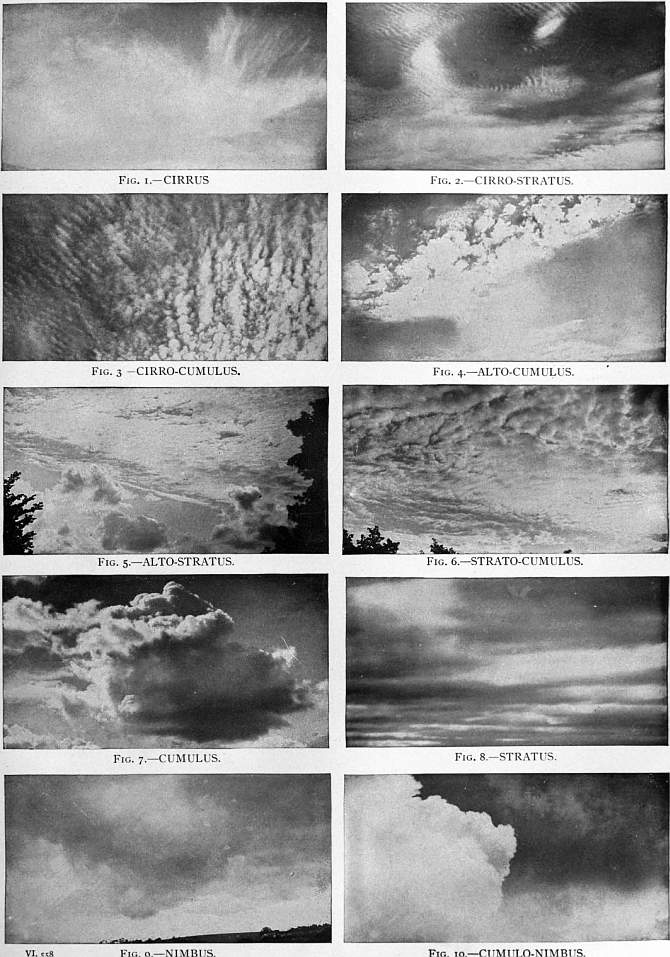
7. Nimbus (N.), Rain Cloud.—A thick layer of dark clouds, without shape and with ragged edges, from which continued rain or snow generally falls. Through openings in these clouds an upper layer of cirro-stratus or alto-stratus may almost invariably be seen. If the layer of nimbus separates up into shreds, or if small loose clouds are visible floating at a low level, underneath a large nimbus they may be described as fracto-nimbus (Scud of sailors). See fig. 9.
8. Cumulus (Cu.) (Wool-pack Clouds).—Thick clouds of which the upper surface is dome-shaped and exhibits protuberances while the base is horizontal. These clouds appear to be formed by a diurnal ascensional movement which is almost always observable. When the cloud is opposite the sun, the surfaces usually presented to the observer have a greater brilliance than the margins of the protuberances. When the light falls aslant, these clouds give deep shadows, but if they are on the same side as the sun they appear dark, with bright edges. See fig. 7.
The true cumulus has clear superior and inferior limits. It is often broken up by strong winds, and the detached portions undergo continual changes. These altered forms may be distinguished by the name of Fracto-cumulus.
9. Cumulo-nimbus (Cu.-N.); The Thunder-cloud; Shower-cloud.—Heavy masses of clouds, rising in the form of mountains, turrets or anvils, generally having a sheet or screen of fibrous appearance above (false cirrus) and underneath, a mass of cloud similar to nimbus. From the base there generally fall local showers of rain or snow (occasionally hail or soft hail). Sometimes the upper edges have the compact form of cumulus, rising into massive peaks round which the delicate false cirrus floats, and sometimes the edges themselves separate into a fringe of filaments similar to that of cirrus. This last form is particularly common in spring showers. See fig. 10.
The front of thunderclouds of wide extent frequently presents the form of a large bow spread over a portion of the sky which is uniformly brighter in colour.
10. Stratus (S.).—A horizontal sheet of lifted fog. When this sheet is broken up into irregular shreds by the wind, or by the summits of mountains, it may be distinguished by the name of Fracto-stratus. See fig. 8.
The scheme also provides that where a stratus or nimbus takes a lumpy form, this fact shall be described by the adjective cumuliformis, and if its base shows downward projecting bosses the word mammato is prefixed.
Issued as it has been with the authority of an international congress of specialists, this scheme has been generally accepted, and must be regarded as the orthodox system, and for the great majority of observations it is quite detailed enough. But it does not give universal satisfaction. Cirrus clouds, for instance, exhibit many forms, and these so diverse that they must be due to very different causes. Hence for the minuter study of cloud forms a more elaborate scheme is still needed.
Hence in 1896 H. H. Clayton of the Blue Hill observatory, Massachusetts, published in the Annals of the astronomical observatory of Harvard College a highly detailed scheme in which the International types and a number of subdivisions were grouped under four classes—stratiforms or sheet clouds; cumuliforms or woolpack clouds; flocciforms, including strato-cumulus, alto-cumulus and cirro-cumulus; and cirriforms or hairy clouds. The International terms are embodied and the special varieties are distinguished by the use of prefixes such as tracto-cirrus or cirrus bands, grano-cirro-cumulus or granular cirrus, &c.
Again in 1904 F. L. Obenbach of the Cleveland observatory devised a different system, published in the annual report, in which the International types are preserved, but each is subdivided into a number of species. In the absence of any atlas to define the precise meaning of the descriptions given, neither of these American schemes has come into general use.
Further proposals were put forward by A. W. Clayden in Cloud Studies (1905). His scheme accepts the whole of the International names which he regards as the cloud genera, and suggests specific Latin names for the chief varieties, accompanying the descriptions by photographs. The proposed scheme is as follows.
Genus. Species.
Cirrus Cirro-nebula Cirrus haze.
Cirro-filum Thread cirrus.
Cirrus Excelsus High Cirrus
Cirrus Ventosus Windy Cirrus
Cirrus Nebulosus Hazy Cirrus
Cirrus Caudatus Tailed Cirrus
Cirrus Vittatus Ribbon Cirrus
Cirrus Inconstans Change Cirrus
Cirrus Communis Common Cirrus
Cirro-stratus Communis Common Ci. S.
Nebulosus Hazy Ci. S.
Vittatus Ribbon Ci. S.
Cumulosus Flocculent Ci.-S.
Cirro-cumulus Cirro-macula Speckle cloud.
Nebulosus Hazy Ci. cu.
Alto-clouds Alto-stratus
Alto-stratus maculosus Mackerel sky.
Alto-stratus fractus
Alto-strato-cumulus
Alto-cumulus informis
Alto-cumulus nebulosus
Alto-clouds Alto-cumulus castellatus Turret cloud.
Alto-cumulus glomeratus High ball cumulus.
Alto-cumulus communis
Alto-cumulus stratiformis Flat alto-cum.
Stratus Stratus maculosus
Stratus maculosus radius Roll cloud.
Stratus maculosus lenticularis Fall cloud.
Strato-cumulus
Cumulus Cumulus minor Small cumulus.
Cumulus major Large cumulus.
Cumulo-nimbus Storm cloud.
The term nimbus is to be applied to any cloud from which rain is falling, but if the true form of the cloud is visible the term should be used as a qualifying adjective. The prefix fracto- or the adjective fractus should be used when the cloud is undergoing disintegration or appears ragged or broken. Mammato- is used in the ordinary sense, and finally undatus or waved is to be added to the name of any cloud showing a wave-like or rippled structure.
(A. W. C.)
CLOUDBERRY, Rubus Chamaemorus, a low-growing creeping herbaceous plant, with stem not prickly, and with simple obtusely lobed leaves and solitary white flowers, resembling those of the blackberry, but larger—one inch across,—and with stamens and pistils on different plants. The orange-yellow fruit is about half an inch long and consists of a few large drupes with a pleasant flavour. The plant occurs in the mountainous parts of Great Britain, and is widely distributed through the more northerly portions of both hemispheres. In northern Denmark and Sweden the fruit is gathered in large quantities and sold in the markets.
CLOUD-BURST, a sudden and violent storm of rain. The name probably originated from the idea that the clouds were solid masses full of water that occasionally burst with disastrous results. A whirlwind passing over the sea sometimes carries the water upwards in a whirling vortex; passing over the land its motion is checked and a deluge of water falls. Occasionally on high lands far from the sea violent storms occur, with rain that seems to descend in sheets, sweeping away bridges and culverts and tearing up roads and streets, being due to great and rapid condensation and vortical whirling of the resulting heavy clouds (see Meteorology).
CLOUDED LEOPARD (Felis nebulosa or macroscelis), a large arboreal cat from the forests of south-east Asia, Sumatra, Java, Borneo and Formosa. This cat, often called the clouded tiger, is beautifully marked, and has an elongated head and body, long tail and rather short limbs. The canine teeth are proportionately longer than in any other living cat. Little is known of the habits of the clouded leopard, but it preys on small mammals and birds, and rarely comes to the ground. The native Malay name is Arimaudahan (“tree-tiger”). The species is nearly related to the small Indian marbled cat (F. marmorata), and Fontaniers cat (F. tristis) of Central Asia.
(R. L.*)
CLOUET, FRANÇOIS (d. 1572), French miniature painter. The earliest reference to him is the document dated December 1541 (see Clouet, Jean), in which the king renounces for the benefit of the artist his father’s estate which had escheated to the crown as the estate of a foreigner. In it the younger Janet is said to have “followed his father very closely in the science of his art.” Like his father, he held the office of groom of the chamber and painter in ordinary to the king, and so far as salary is concerned, he started where his father left off. A long list of drawings contains those which are attributed to this artist, but we still lack perfect certainty about his works. There is, however, more to go upon than there was in the case of his father, as the praises of François Clouet were sung by the writers of the day, his name was carefully preserved from reign to reign, and there is an ancient and unbroken tradition in the attribution of many of his pictures. There are not, however, any original attestations of his works, nor are any documents known which would guarantee the ascriptions usually accepted. To him are attributed the portraits of Francis I. at the Uffizi and at the Louvre, and various drawings relating to them. He probably also painted the portrait of Catherine de’ Medici at Versailles and other works, and in all probability a large number of the drawings ascribed to him were from his hand. One of his most remarkable portraits is that of Mary, queen of Scots, a drawing in chalks in the Bibliothèque Nationale, and of similar character are the two portraits of Charles IX. and the one at Chantilly of Marguerite of France. Perhaps his masterpiece is the portrait of Elizabeth of Austria in the Louvre.
He resided in Paris in the rue de Ste Avoye in the Temple quarter, close to the Hôtel de Guise, and in 1568 is known to have been under the patronage of Claude Gouffier de Boisy, Seigneur d’Oiron, and his wife Claude de Baune. Another ascertained fact concerning François Clouet is that in 1571 he was “summoned to the office of the Court of the Mint,” and his opinion was taken on the likeness to the king of a portrait struck by the mint. He prepared the death-mask of Henry II., as in 1547 he had taken a similar mask of the face and hands of Francis I., in order that the effigy to be used at the funeral might be prepared from his drawings; and on each of these occasions he executed the painting to be used in the decorations of the church and the banners for the great ceremony.
Several miniatures are believed to be his work, one very remarkable portrait being the half-length figure of Henry II. in the collection of Mr J. Pierpont Morgan. Another of his portraits is that of the duc d’Alençon in the Jones collection at South Kensington, and certain representations of members of the royal family which were in the Hamilton Palace collection and the Magniac sale are usually ascribed to him. He died on the 22nd of December 1572, shortly after the massacre of St Bartholomew, and his will, mentioning his sister and his two illegitimate daughters, and dealing with the disposition of a considerable amount of property, is still in existence. His daughters subsequently became nuns.
His work is remarkable for the extreme accuracy of the drawing, the elaborate finish of all the details, and the exquisite completeness of the whole portrait. He must have been a man of high intelligence, and of great penetration, intensely interested in his work, and with considerable ability to represent the character of his sitter in his portraits. His colouring is perhaps not specially remarkable, nor from the point of style can his pictures be considered specially beautiful, but in perfection of drawing he has hardly any equal.
To Monsieur Louis Dimier, the leading authority upon his works, and to his volume on French Painting in the Sixteenth Century, as well as to the works of MM. Bouchot, La Borde and Maulde-La Clavière, the present writer is indebted for the information contained in this article.
(G. C. W.)
CLOUET, JEAN (d. c. 1541). French miniature painter, generally known as JANET. The authentic presence of this artist at the French court is first to be noted in 1516, the second year of the reign of Francis I. By a deed of gift made by the king to the artist’s son of his father’s estate, which had escheated to the crown, we learn that he was not actually a Frenchman, and never even naturalized. He is supposed to have been a native of the Low Countries, and probably his real name was Clowet. His position was that of groom of the chamber to the king, and he received a stipend at first of 180 livres and later of 240. He lived several years in Tours, and there it was he met his wife, who was the daughter of a jeweller. He is recorded as living in Tours in 1522, and there is a reference to his wife’s residence in the same town in 1523, but in 1529 they were both settled in Paris, probably in the neighbourhood of the parish of Ste Innocent, in the cemetery of which they were buried. He stood godfather at a christening on the 8th of July 1540, but was no longer living in December 1541, and therefore died between those two dates.
His brother, known as Clouet de Navarre, was in the service of Marguérite d’Angoulême, sister of Francis I., and is referred to in a letter written by Marguérite about 1529. Jean Clouet had two children, François and Catherine, who married Abel Foulon, and left one son, who continued the profession of François Clouet after his decease. Jean Clouet was undoubtedly a very skilful portrait painter, but it must be acknowledged without hesitation that there is no work in existence which has been proved to be his. There is no doubt that he painted a portrait of the mathematician, Oronce Finé, in 1530, when Finé was thirty-six years old, but the portrait is now known only by a print. Janet is generally believed, however, to have been responsible for a very large number of the wonderful portrait drawings now preserved at Chantilly, and at the Bibliothèque Nationale, and to him is attributed the portrait of an unknown man at Hampton Court, that of the dauphin Francis, son of Francis I. at Antwerp, and one other portrait, that of Francis I. in the Louvre.
Seven miniature portraits in the Manuscript of the Gallic War in the Bibliothèque Nationale (13,429) are attributed to Janet with very strong probability, and to these may be added an eighth in the collection of Mr J. Pierpont Morgan, and representing Charles de Cossé, Maréchal de Brissac, identical in its characteristics with the seven already known. There are other miniatures in the collection of Mr Morgan, which may be attributed to Jean Clouet with some strong degree of probability, inasmuch as they closely resemble the portrait drawings at Chantilly and in Paris which are taken to be his work. In his oil paintings the execution is delicate and smooth, the outlines hard, the texture pure, and the whole work elaborately and very highly finished in rich, limpid colour. The chalk drawings are of remarkable excellence, the medium being used by the artist with perfect ease and absolute sureness, and the mingling of colour being in exquisite taste, the modelling exceedingly subtle, and the drawing careful, tender and emphatic. The collection of drawings preserved in France, and attributed to this artist and his school, comprises portraits of all the important persons of the time of Francis I. In one album of drawings the portraits are annotated by the king himself, and his merry reflections, stinging taunts or biting satires, add very largely to a proper understanding of the life of his time and court. Definite evidence, however, is still lacking to establish the attribution of the best of these drawings and of certain oil paintings to the Jean Clouet who was groom of the chambers to the king.
The chief authority in France on the work of this artist is Monsieur Louis Dimier, and to his works, and to information derived direct from him, the present writer is indebted for almost all the information given in this article.
(G. C. W.)
CLOUGH, ANNE JEMIMA (1820-1892), English educationalist, was born at Liverpool on the 20th of January 1820, the daughter of a cotton merchant. She was the sister of Arthur Hugh Clough, the poet. When two years old she was taken with the rest of the family to Charleston, South Carolina. It was not till 1836 that she returned to England, and though her ambition was to write, she was occupied for the most part in teaching. Her father’s failure in business led her to open a school in 1841. This was carried on until 1846. In 1852, after making some technical studies in London and working at the Borough Road and the Home and Colonial schools, she opened another small school of her own at Ambleside in Westmorland. Giving this up some ten years later, she lived for a time with the widow of her brother Arthur Hugh Clough—who had died in 1861—in order that she might educate his children. Keenly interested in the education of women, she made friends with Miss Emily Davies, Madame Bodichon, Miss Buss and others. After helping to found the North of England council for promoting the higher education of women, she acted as its secretary from 1867 to 1870 and as its president from 1873 to 1874. When it was decided to open a house for the residence of women students at Cambridge, Miss Clough was chosen as its first principal. This hostel, started in Regent Street, Cambridge, in 1871 with five students, and continued at Merton Hall in 1872, led to the building of Newnham Hall, opened in 1875, and to the erection of Newnham College on its present basis in 1880. Miss Clough’s personal charm and high aims, together with the development of Newnham College under her care, led her to be regarded as one of the foremost leaders of the women’s educational movement. She died at Cambridge on the 27th of February 1892. Two portraits of Miss Clough are at Newnham College, one by Sir W. B. Richmond, the other by J. J. Shannon.
See Memoir of Anne Jemima Clough, by Blanche Athena Clough (1897).
CLOUGH, ARTHUR HUGH (1819-1861), English poet, was born at Liverpool on the 1st of January 1819. He came of a good Welsh stock by his father, James Butler Clough, and of a Yorkshire one by his mother, Anne Perfect. In 1822 his father, a cotton merchant, moved to the United States, and Clough’s childhood was spent mainly at Charleston, South Carolina, much under the influence of his mother, a cultivated woman, full of moral and imaginative enthusiasm. In 1828 the family paid a visit to England, and Clough was left at school at Chester, whence he passed in 1829 to Rugby, then under the sway of Dr Thomas Arnold, whose strenuous views on life and education he accepted to the full. Cut off to a large degree from home relations, he passed a somewhat reserved and solitary boyhood, devoted to the well-being of the school and to early literary efforts in the Rugby Magazine. In 1836 his parents returned to Liverpool, and in 1837 he went with a scholarship to Balliol College, Oxford. Here his contemporaries included Benjamin Jowett, A. P. Stanley, J. C. Shairp, W. G. Ward, Frederick Temple and Matthew Arnold.
Oxford, in 1837, was in the full swirl of the High Church movement led by J. H. Newman. Clough was for a time carried away by the flood, and, although he recovered his equilibrium, it was not without an amount of mental disturbance and an expenditure of academic time, which perhaps accounted for his failure to obtain more than a second class in his final examination. He missed a Balliol fellowship, but obtained one at Oriel, with a tutorship, and lived the Oxford life of study, speculation, lectures and reading-parties for some years longer. Gradually, however, certain sceptical tendencies with regard to the current religious and social order grew upon him to such an extent as to render his position as an orthodox teacher of youth irksome, and in 1848 he resigned it. The immediate feeling of relief showed itself in buoyant, if thoughtful, literature, and he published poems both new and old. Then he travelled, seeing Paris in revolution and Rome in siege, and in the autumn of 1849 took up new duties as principal of University Hall, a hostel for students at University College, London. He soon found that he disliked London, in spite of the friendship of the Carlyles, nor did the atmosphere of Unitarianism prove any more congenial than that of Anglicanism to his critical and at bottom conservative temper. A prospect of a post in Sydney led him to engage himself to Miss Blanche Mary Shore Smith, and when it disappeared he left England in 1852, and went, encouraged by Emerson, to Cambridge, Massachusetts. Here he remained some months, lecturing and translating Plutarch for the book-sellers, until in 1853 the offer of an examinership in the Education Office brought him to London once more. He married, and pursued a steady official career, diversified only by an appointment in 1856 as secretary to a commission sent to study certain aspects of foreign military education. At this, as at every period of his life, he enjoyed the warm respect and admiration of a small circle of friends, who learnt to look to him alike for unselfish sympathy and for spiritual and practical wisdom. In 1860 his health began to fail. He visited first Malvern and Freshwater, and then the East, France and Switzerland, in search of recovery, and finally came to Florence, where he was struck down by malaria and paralysis, and died on the 13th of November 1861. Matthew Arnold wrote upon him the exquisite lament of Thyrsis.
Shortly before he left Oxford, in the stress of the Irish potato-famine, Clough wrote an ethical pamphlet addressed to the undergraduates, with the title, A Consideration of Objections against the Retrenchment Association at Oxford (1847). His Homeric pastoral The Bothie of Toper-na-Fuosich, afterwards rechristened Tober-na-Vuolich (1848), was inspired by a long vacation after he had given up his tutorship, and is full of socialism, reading-party humours and Scottish scenery. Ambarvalia (1849), published jointly with his friend Thomas Burbidge, contains shorter poems of various dates from 1840, or earlier, onwards. Amours de Voyage, a novel in verse, was written at Rome in 1849; Dipsychus, a rather amorphous satire, at Venice in 1850; and the idylls which make up Mari Magno, or Tales on Board, in 1861. A few lyric and elegiac pieces, later in date than the Ambarvalia, complete the tale of Clough’s poetry. His only considerable enterprise in prose was a revision of the 17th century translation of Plutarch by Dryden and others, which occupied him from 1852, and was published as Plutarch’s Lives (1859).
No part of Clough’s life was wholly given up to poetry, and he probably had not the gift of detachment necessary to produce great literature in the intervals of other occupations. He wrote but little, and even of that little there is a good deal which does not aim at the highest seriousness. He never became a great craftsman. A few of his best lyrics have a strength of melody to match their depth of thought, but much of what he left consists of rich ore too imperfectly fused to make a splendid or permanent possession. Nevertheless, he is rightly regarded, like his friend Matthew Arnold, as one of the most typical English poets of the middle of the 19th century. His critical instincts and strong ethical temper brought him athwart the popular ideals of his day both in conduct and religion. His verse has upon it the melancholy and the perplexity of an age of transition. He is a sceptic who by nature should have been with the believers. He stands between two worlds, watching one crumble behind him, and only able to look forward by the sternest exercise of faith to the reconstruction that lies ahead in the other. On the technical side, Clough’s work is interesting to students of metre, owing to the experiments which he made, in the Bothie and elsewhere, with English hexameters and other types of verse formed upon classical models.
Clough’s Poems were collected, with a short memoir by F. T. Palgrave, in 1862; and his Letters and Remains, with a longer memoir, were privately printed in 1865. Both volumes were published together in 1869 and have been more than once reprinted. Another memoir is Arthur Hugh Clough: A Monograph (1883), by S. Waddington. Selections from the poems were made by Mrs Clough for the Golden Treasury series in 1894, and by E. Rhys in 1896.
(E. K. C.)
CLOUTING, the technical name given to a light plain cloth used for covering butter and farmers’ baskets, and for dish and pudding cloths. The same term is often given to light cloths of the nursery diaper pattern.
CLOVELLY, a fishing village in the Barnstaple parliamentary division of Devonshire, England, 11 m. W.S.W. of Bideford. Pop. (1901) 621. It is a cluster of old-fashioned cottages in a unique position on the sides of a rocky cleft in the north coast; its main street resembles a staircase which descends 400 ft. to the pier, too steeply to allow of any wheeled traffic. Thick woods shelter it on three sides, and render the climate so mild that fuchsias and other delicate plants flourish in midwinter. All Saints’ church, restored in 1866, is late Norman, containing several monuments to the Carys, lords of the manor for 600 years. The surrounding scenery is famous for its richness of colour, especially in the grounds of Cary Court, and along “The Hobby,” a road cut through the woods and overlooking the sea. Clovelly is described by Dickens in A Message from the Sea.
CLOVER, in botany, the English name for plants of the genus Trifolium, from Lat. tres, three, and folium, a leaf, so called from the characteristic form of the leaf, which has three leaflets (trifoliate), hence the popular name trefoil. It is a member of the family Leguminosae, and contains about three hundred species, found chiefly in north temperate regions, but also, like other north temperate genera, on the mountains in the tropics. The plants are small annual or perennial herbs with trifoliate (rarely 5- or 7-foliate) leaves, with stipules adnate to the leaf-stalk, and heads or dense spikes of small red, purple, white, or rarely yellow flowers; the small, few-seeded pods are enclosed in the calyx. Eighteen species are native in Britain, and several are extensively cultivated as fodder-plants. T. pratense, red or purple clover, is the most widely cultivated.
This plant, either sown alone or in mixture with rye-grass, has for a long time formed the staple crop for soiling; and so long as it grew freely, its power of shooting up again after repeated mowings, the bulk of crop thus obtained, its palatableness to stock and feeding qualities, the great range of soils and climate in which it grows, and its fitness either for pasturage or soiling, well entitled it to this preference. Except on certain rich calcareous clay soils, it has now, however, become an exceedingly precarious crop. The seed, when genuine, which unfortunately is very often not the case, germinates as freely as ever, and no greater difficulty than heretofore is experienced in having a full plant during autumn and the greater part of winter; but over most part of the country, the farmer, after having his hopes raised by seeing a thick cover of vigorous-looking clover plants over his field, finds to his dismay, by March or April, that they have either entirely disappeared, or are found only in capricious patches here and there over the field. No satisfactory explanation of this “clover-sickness” has yet been given, nor any certain remedy, of a kind to be applied to the soil, discovered. One important fact is, however, now well established, viz. that when the cropping of the land is so managed that clover does not recur at shorter intervals than eight years, it grows with much of its pristine vigour. The knowledge of this fact now determines many farmers in varying their rotation so as to secure this important end. At one time there was a somewhat prevalent belief that the introduction of beans into the rotation had a specific influence of a beneficial kind on the clover when it came next to be sown; but the true explanation seems to be that the beans operate favourably only by the incidental circumstance of almost necessarily lengthening the interval betwixt the recurrences of clover.
When the four-course rotation is followed, no better plan of managing this process has been yet suggested than to sow beans, pease, potatoes or tares, instead of clover, for one round, making the rotation one of eight years instead of four. The mechanical condition of the soil seems to have something to do with the success or failure of the clover crop. We have often noticed that headlands, or the converging line of wheel-tracks near a gateway at which the preceding root crop had been carted from a field, have had a good take of clover, when on the field generally it had failed. In the same way a field that has been much poached by sheep while consuming turnips upon it, and which has afterwards been ploughed up in an unkindly state, will have the clover prosper upon it, when it fails in other cases where the soil appears in far better condition. If red clover can be again made a safe crop, it will be a boon indeed to agriculture. Its seeds are usually sown along with a grain crop, any time from the 1st of February to May, at the rate of 12 ℔ to 20 ℔ per acre when not combined with other clovers or grasses.
Italian rye-grass and red clover are now frequently sown in mixture for soiling, and succeed admirably. It is, however, a wiser course to sow them separately, as by substituting the Italian rye-grass for clover, for a single rotation, the farmer not only gets a crop of forage as valuable in all respects, but is enabled, if he choose, to prolong the interval betwixt the sowings of clover to twelve years, by sowing, as already recommended, pulse the first round, Italian rye-grass the second, and clover the third.
These two crops, then, are those on which the arable-land farmer mainly relies for green forage. To have them good, he must be prepared to make a liberal application of manure. Good farm-yard dung may be applied with advantage either in autumn or spring, taking care to cart it upon the land only when it is dry enough to admit of this being done without injury. It must also be spread very evenly so soon as emptied from the carts. But it is usually more expedient to use either guano, nitrate of soda, or soot for this purpose, at the rates respectively of 2 cwt., 1 cwt. and 20 bushels. If two or more of these substances are used, the quantities of each will be altered in proportion. They are best also to be applied in two or three portions at intervals of fourteen to twenty days, beginning towards the end of December, and only when rain seems imminent or has just fallen.
When manure is broadcast over a young clover field, and presently after washed in by rain, the effect is identical with that of first dissolving it in water, and then distributing the dilution over the surface, with this difference, namely, that the first plan costs only the price of the guano, &c, and is available at any time and to every one, whereas the latter implies the construction of tanks and costly machinery.
T. incarnatum, crimson or Italian clover, though not hardy enough to withstand the climate of Scotland in ordinary winters, is a most valuable forage crop in England. It is sown as quickly as possible after the removal of a grain crop at the rate of 18 ℔ to 20 ℔ per acre. It is found to succeed better when only the surface of the soil is stirred by the scarifier and harrow than when a ploughing is given. It grows rapidly in spring, and yields an abundant crop of green food, peculiarly palatable to live stock. It is also suitable for making into hay. Only one cutting, however, can be obtained, as it does not shoot again after being mown.
T. repens, white or Dutch clover, is a perennial abundant in meadows and good pastures. The flowers are white or pinkish, becoming brown and deflexed as the corolla fades. T. hybridum, Alsike or Swedish clover, is a perennial which was introduced early in the 19th century and has now become naturalized in Britain. The flowers are white or rosy, and resemble those of the last species. T. medium, meadow or zigzag clover, a perennial with straggling flexuous stems and rose-purple flowers, is of little agricultural value. Other British species are: T. arvense, hare’s-foot trefoil, found in fields and dry pastures, a soft hairy plant with minute white or pale pink flowers and feathery sepals; T. fragiferum, strawberry clover, with densely-flowered, globose, rose-purple heads and swollen calyxes; T. procumbens, hop trefoil, on dry pastures and roadsides, the heads of pale yellow flowers suggesting miniature hops; and the somewhat similar T. minus, common in pastures and roadsides, with smaller heads and small yellow flowers turning dark brown. The last named is the true shamrock. Specimens of shamrock and other clovers are not infrequently found with four leaflets, and, like other rarities, are considered lucky. Calvary clover is a member of the closely allied genus Medicago—M. Echinus, so called from the curled spiny pod; it has small heads of yellow clover-like flowers, and is a native of the south of France.
CLOVES, the dried, unexpanded flower-buds of Eugenia caryophyllata, a tree belonging to the natural order Myrtaceae. They are so named from the French word clou, on account of their resemblance to a nail. The clove tree is a beautiful evergreen which grows to a height of from 30 to 40 ft., having large oval leaves and crimson flowers in numerous groups of terminal clusters. The flower-buds are at first of a pale colour and gradually become green, after which they develop into a bright red, when they are ready for collecting. Cloves are rather more than half an inch in length, and consist of a long cylindrical calyx, terminating in four spreading sepals, and four unopened petals which form a small ball in the centre. The tree is a native of the small group of islands in the Indian Archipelago called the Moluccas, or Spice Islands; but it was long cultivated by the Dutch in Amboyna and two or three small neighbouring islands. Cloves were one of the principal Oriental spices that early excited the cupidity of Western commercial communities, having been the basis of a rich and lucrative trade from an early part of the Christian era. The Portuguese, by doubling the Cape of Good Hope, obtained possession of the principal portion of the clove trade, which they continued to hold for nearly a century, when, in 1605, they were expelled from the Moluccas by the Dutch. That power exerted great and inhuman efforts to obtain a complete monopoly of the trade, attempting to extirpate all the clove trees growing in their native islands, and to concentrate the whole production in the Amboyna Islands. With great difficulty the French succeeded in introducing the clove tree into Mauritius in the year 1770; subsequently the cultivation was introduced into Guiana, Brazil, most of the West Indian Islands and Zanzibar. The chief commercial sources of supply are now Zanzibar and its neighbouring island Pemba on the East African coast, and Amboyna. Cloves are also grown in Java, Sumatra, Réunion, Guiana and the West India Islands.
Cloves as they come into the market have a deep brown colour, a powerfully fragrant odour, and a taste too hot and acrid to be pleasant. When pressed with the nail they exude a volatile oil with which they are charged to the unusual proportion of about 18%. The oil is obtained as a commercial product by submitting the cloves with water to repeated distillation. It is, when new and properly prepared, a pale yellow or almost colourless fluid, becoming after some time of a brown colour; and it possesses the odour and taste peculiar to cloves. The essential oil of cloves—the Oleum Caryophylli of the British Pharmacopoeia—is a mixture of two substances, one of which is oxidized, whilst the other is not. Eugenol, or eugenic acid, C10H12O2, is the chief constituent. It is capable of forming definite salts. The other constituent is a hydrocarbon C15H24, of which the distilling point differs from that of eugenol, and which solidifies only with intense cold. Oil of cloves is readily soluble in alcohol and ether, and has a specific gravity of about 1.055. Its dose is ½-3 minims. Besides this oil, cloves also contain two neutral bodies, eugenin and caryophyllin, the latter of which is an isomer of camphor. They are of no practical importance. The British Pharmacopoeia contains an infusion of cloves (Infusum Caryophylli), of which the strength is 1 part in 40 of boiling water and the dose ½-1 oz. Cloves are employed principally as a condiment in culinary operations, in confectionery, and in the preparation of liqueurs. In medicine they are tonic and carminative, but they are little used except as adjuncts to other substances on account of their flavour, or with purgatives to prevent nausea and griping. The essential oil forms a convenient medium for using cloves for flavouring purposes, it possesses the medicinal properties characteristic of a volatile oil, and it is frequently employed to relieve toothache. Oil of cloves is regarded by many dental surgeons as the most effective local anaesthetic they possess in cases where it is desired, before cutting a sensitive tooth for the purpose of filling it, to lower the sensibility of the dentine. For this purpose the cavity must be exposed to cotton wool saturated with the oil for about ten days.
CLOVIO, GIORGIO GIULIO (1498-1578), Italian painter, by birth a Croat and by profession a priest, is said to have learned the elements of design in his own country, and to have studied afterwards with intense diligence at Rome under Giulio Romano, and at Verona under Girolamo de’ Libri. He excelled in historical pieces and portraits, painting as for microscopical examination, and yet contriving to handle his subjects with great force and precision. His book of twenty-six pictures representing the procession of Corpus Domini, in Rome, was the work of nine years, and the covers were executed by Benvenuto Cellini. The British Museum has his twelve miniatures of the victories of the emperor Charles V. In the Vatican library is preserved a manuscript life of Frederick, duke of Urbino, superbly illustrated by Clovio, who is facile princeps among Italian miniaturists. He was called Macedo, or Macedone, to connect him with his supposed Macedonian ancestry.
CLOVIS [Chlodovech] (c. 466-511), king of the Salian Franks, son of Childeric I., whom he succeeded in 481 at the age of fifteen. At that date the Salian Franks had advanced as far as the river Somme, and the centre of their power was at Tournai. On the history of Clovis between the years 481 and 486 the records are silent. In 486 he attacked Syagrius, a Roman general who, after the fall of the western empire in 476, had carved out for himself a principality south of the Somme, and is called by Gregory of Tours “rex Romanorum.” After being defeated by Clovis at the battle of Soissons, Syagrius sought refuge with the Visigothic king Alaric II., who handed him over to the conqueror. Henceforth Clovis fixed his residence at Soissons, which was in the midst of public lands, e.g. Berny-Rivière, Juvigny, &c. The episode of the vase of Soissons1 has a legendary character, and all that it proves is the deference shown by the pagan king to the orthodox clergy. Clovis undoubtedly extended his dominion over the whole of Belgica Secunda, of which Reims was the capital, and conquered the neighbouring cities in detail. Little is known of the history of these conquests. It appears that St Geneviève defended the town of Paris against Clovis for a long period, and that Verdun-sur-Meuse, after a brave stand, accepted an honourable capitulation thanks to St Euspitius. In 491 some barbarian troops in the service of Rome, Arboruchi (Άρμόρνχοι), Thuringians, and even Roman soldiers who could not return to Rome, went over to Clovis and swelled the ranks of his army.
In 493 Clovis married a Burgundian princess, Clotilda, niece of Gundobald and Godegesil, joint kings of Burgundy. This princess was a Christian, and earnestly desired the conversion of her husband. Although Clovis allowed his children to be baptized, he remained a pagan himself until the war against the Alemanni, who at that time occupied the country between the Vosges, and the Rhine and the neighbourhood of Lake Constance. By pushing their incursions westward they came into collision with Clovis, who marched against them and defeated them in the plain of the Rhine. The legend runs that, in the thickest of the fight, Clovis swore that he would be converted to the God of Clotilda if her God would grant him the victory. After subduing a part of the Alemanni, Clovis went to Reims, where he was baptized by St Remigius on Christmas day 496, together with three thousand Franks. The story of the phial of holy oil (the Sainte Ampoule) brought from heaven by a white dove for the baptism of Clovis was invented by Archbishop Hincmar of Reims three centuries after the event.
The baptism of Clovis was an event of very great importance. From that time the orthodox Christians in the kingdom of the Burgundians and Visigoths looked to Clovis to deliver them from their Arian kings. Clovis seems to have failed in the case of Burgundy, which was at that time torn by the rivalry between Godegesil and his brother Gundobald. Godegesil appealed for help to Clovis, who defeated Gundobald on the banks of the Ouche near Dijon, and advanced as far as Avignon (500), but had to retire without being able to retain any of his conquests. Immediately after his departure Gundobald slew Godegesil at Vienne, and seized the whole of the Burgundian kingdom. Clovis was more fortunate in his war against the Visigoths. Having completed the subjugation of the Alemanni in 506, he marched against the Visigothic king Alaric II. in the following year, in spite of the efforts of Theodoric, king of the Ostrogoths, to prevent the war. After a decisive victory at Vouillé near Poitiers, in which Clovis slew Alaric with his own hand, the whole of the kingdom of the Visigoths as far as the Pyrenees was added to the Frankish empire, with the exception of Septimania, which, together with Spain, remained in possession of Alaric’s grandson Amalaric, and Provence, which was seized by Theodoric and annexed to Italy. In 508 Clovis received at Tours the insignia of the consulship from the eastern emperor, Anastasius, but the title was purely honorific. The last years of his life Clovis spent in Paris, which he made the capital of his kingdom, and where he built the church of the Holy Apostles, known later as the church of St Geneviève. By murdering the petty Frankish kings who reigned at Cambrai, Cologne and other residences, he became sole king of all the Frankish tribes. He died in 511.
Clovis was the true founder of the Frankish monarchy. He reigned over the Salian Franks by hereditary right; over the other Frankish tribes by reason of his kinship with their kings and by the choice of the warriors, who raised him on the shield; and he governed the Gallo-Romans by right of conquest. He had the Salic law drawn up, doubtless between the years 486 and 507; and seems to have been represented in the cities by a new functionary, the graf, comes, or count. He owed his success in great measure to his alliance with the church. He took the property of the church under his protection, and in 511 convoked a council at Orleans, the canons of which have come down to us. But while protecting the church, he maintained his authority over it. He intervened in the nomination of bishops, and at the council of Orleans it was decided that no one, save a son of a priest, could be ordained clerk without the king’s order or the permission of the count.
The chief source for the life of Clovis is the Historia Francorum (bk. ii.) of Gregory of Tours, but it must be used with caution. Among modern works, see W. Junghans, Die Geschichte der fränkischen Könige Childerich und Clodovech (Göttingen, 1857); F. Dahn, Urgeschichte der germanischen und romanischen Völker, vol. iii. (Berlin, 1883); W. Schultze, Deutsche Geschichte v. d. Urzeit bis zu den Karolingern, vol. ii. (Stuttgart, 1896); G. Kurth, Clovis (2nd ed., Paris, 1901).
(C. Pf.)
CLOWN (derived by Fuller, in his Worthies, from Lat. colonus, a husbandman; but apparently connected with “clod” and with similar forms in Teutonic and Scandinavian languages), a rustic, boorish person; the comic character in English pantomime, always dressed in baggy costume, with face whitened and eccentrically painted, and a tufted wig. The character probably descends from representations of the devil in medieval miracle-plays, developed partly through the stage rustics and partly through the fools or jesters (also called clowns) of the Elizabethan drama. The whitened face and baggy costume indicate a connexion also with the continental Pierrot. The prominence of the clown in pantomime (q.v.) is a comparatively modern development as compared with that of Harlequin.
CLOYNE, a small market town of Co. Cork, Ireland, in the east parliamentary division, 15 m. E.S.E. of the city of Cork. Pop. (1901) 827. It gives its name to a Roman Catholic diocese, the cathedral of which is at Queenstown. Cloyne was the seat of a Protestant diocese until 1835, when it was united to that of Cork. It was originally a foundation of the 6th century. The cathedral church, dedicated to its founder St Colman, a disciple of St Finbar of Cork, is a plain cruciform building mainly of the 14th century, with an earlier oratory in the churchyard. It contains a few handsome monuments to its former bishops, but until 1890, when a monument was erected, had nothing to preserve the memory of the illustrious Dr George Berkeley, who held the see from 1734 to 1753. Opposite the cathedral is a very fine round tower 100 ft. in height, though the conical roof has long been destroyed. The Roman Catholic church is a spacious building of the early 19th century. The town was several times plundered by the Danes in the 9th century; it was laid waste by Dermot O’Brien in 1071, and was burned in 1137. In 1430 the bishopric was united to that of Cork; in 1638 it again became independent, and in 1660 it was again united to Cork and Ross. In 1678 it was once more declared independent, and so continued till 1835. The name, Cluain-Uamha, signifies “the meadow of the cave,” from the curious limestone caves in the vicinity. The Pipe Roll of Cloyne, compiled by Bishop Swaffham in 1364, is a remarkable record embracing a full account of the feudal tenures of the see, the nature of the impositions, and the duties the puri homines Sancti Colmani were bound to perform at a very early period. The roll is preserved in the record office, Dublin. It was edited by Richard Caulfield in 1859.
CLUB (connected with “clump”), (1) a thick stick, used as a weapon, or heavy implement for athletic exercises (“Indian club,” &c.); (2) one of the four suits of playing-cards,—the translation of the Spanish basto—represented by a black trefoil (taken from the French, in which language it is trèfle); (3) a term given to a particular form of association of persons. It is to this third sense that this article is devoted.
By the term “club,” the most general word for which is in Gr. ἑταιρία, in Lat. sodalitas, is here meant an association within the state of persons not united together by any natural ties of kinship, real or supposed. Modern clubs are dealt with below, and we begin with an account of Greek and Roman clubs. Such clubs are found in all ancient states of which we have any detailed knowledge, and seem to have dated in one form or another from a very early period. It is not unreasonable to suppose, in the absense of certain information, that the rigid system of groups of kin, i.e. family, gens, phratria, &c., affording no principle of association beyond the maintenance of society as it then existed, may itself have suggested the formation of groups of a more elastic and expansive nature; in other words, that clubs were an expedient for the deliverance of society from a too rigid and conservative principle of crystallization.
Greek.—The most comprehensive statement we possess as to the various kinds of clubs which might exist in a single Greek state is contained in a law of Solon quoted incidentally in the Digest of Justinian (47.22), which guaranteed the administrative independence of these associations provided they kept within the bounds of the law. Those mentioned (apart from demes and phratries, which were not clubs as here understood) are associations for religious purposes, for burial, for trade, for, privateering (ἐπὶ λείαν), and for the enjoyment of common meals. Of these by far the most important are the religious clubs, about which we have a great deal of information, chiefly from inscriptions; and these may be taken as covering those for burial purposes and for common meals, for there can be no doubt that all such unions had originally a religious object of some kind. But we have to add to Solon’s list the political ἑταιρίαι which we meet with in Athenian history, which do not seem to have always had a religious object, whatever their origin may have been; and it may be convenient to clear the ground by considering these first.
In the period between the Persian and Peloponnesian wars we hear of hetairies within the two political parties, oligarchic and democratic; Themistocles is said (Plut. Aristides, 2) to have belonged to one, Pericles’ supporters seem to have been thus organized (Plut. Per. 7 and 13), and Cimon had a hundred hetairoi devoted to him (Plut. Cim. 17). These associations were used, like the collegia sodalicia at Rome (see below), for securing certain results at elections and in the law-courts (Thuc. viii. 54), and were not regarded as harmful or illegal. But the bitterness of party struggles in Greece during the Peloponnesian War changed them in many states into political engines dangerous to the constitution, and especially to democratic institutions; Aristotle mentions (Politics, p. 1310a) a secret oath taken by the members of oligarchic clubs, containing the promise, “I will be an enemy to the people, and will devise all the harm I can against them.” At Athens in 413 b.c. the conspiracy against the democracy was engineered by means of these clubs, which existed not only there but in the other cities of the empire (Thuc. viii. 48 and 54), and had now become secret conspiracies (συνωμοσίαι) of a wholly unconstitutional kind. On this subject see Grote, Hist. of Greece, v. 360; A.H.J. Greenidge, Handbook of Greek Constitutional History, 208 foll.
Passing over the clubs for trade or plunder mentioned in Solon’s law, of which we have no detailed knowledge, we come to the religious associations. These were known by several names, especially thiasi, eranoi and orgeones, and it is not possible to distinguish these from each other in historical times, though they may have had different origins. They had the common object of sacrifice to a particular deity; the thiasi and orgeones seem to be connected more especially with foreign deities whose rites were of an orgiastic character. The organization of these societies is the subject of an excellent treatise by Paul Foucart (Les Associations religieuses chez les Grecs, Paris, 1873), still indispensable, from which the following particulars are chiefly drawn. For the greater part of them the evidence consists of inscriptions from various parts of Greece, many of which were published for the first time by Foucart, and will be found at the end of his book.
The first striking point is that the object of all these associations is to maintain the worship of some foreign deity, i.e. of some deity who was not one of those admitted and guaranteed by the state—the divine inhabitants of the city, as they may be called. For all these the state made provision of priests, temples, sacrifices, &c.; but for all others these necessaries had to be looked after by private individuals associated for the purpose. The state, as we see from the law of Solon quoted above, made no difficulty about the introduction of foreign worships, provided they did not infringe the law and were not morally unwholesome, and regarded these associations as having all the rights of legal corporations. So we find the cult of deities such as Sabazius, Mater Magna (see Great Mother of the Gods) and Attis, Adonis, Isis, Serapis, Mēn Tyrannos, carried on in Greek states, and especially in seaports like the Peiraeus, Rhodes, Smyrna, without protest, but almost certainly without moral benefit to the worshippers. The famous passage in Demosthenes (de Corona, sect. 259 foll.) shows, however, that the initiation at an early age in the rites of Sabazius did not gain credit for Aeschines in the eyes of the best men. We are not surprised to find that, in accordance with the foreign character of the cults thus maintained, the members of the associations are rarely citizens by birth, but women, freedmen, foreigners and even slaves. Thus in an inscription found by Sir C. Newton at Cnidus, which contains a mutilated list of members of a thiasos, one only out of twelve appears to be a Cnidian citizen, four are slaves, seven are probably foreigners. Hence we may conclude that these associations were of importance, whether for good or for evil, in organizing and encouraging the foreign population in the cities of Greece.
The next striking fact is that these associations were organized, as we shall also find them at Rome, in imitation of the constitution of the city itself. Each had its law, its assembly, its magistrates or officers (i.e. secretary, treasurer) as well as priests or priestesses, and its finance. The law regulated the conditions of admission, which involved an entrance fee and an examination (δοκιμασία) as to character; the contributions, which had to be paid by the month, and the steps to be taken to enforce payment, e.g. exclusion in case of persistent neglect of this duty; the use to be made of the revenues, such as the building or maintenance of temple or club-house, and the cost of crowns or other honours voted by the assembly to its officers. This assembly, in accordance with the law, elected its officers once a year, and these, like those of the state itself, took an oath on entering office, and gave an account of their stewardship at the end of the year. Further details on these points of internal government will be found in Foucart’s work (pp. 20 foll.), chiefly derived from inscriptions of the orgeones engaged in the cult of the Mother of the Gods at the Peiraeus. The important question whether these religious associations were in any sense benefit clubs, or relieved the sick and needy, is answered by him emphatically in the negative.
As might naturally be supposed, the religious clubs increased rather than diminished in number and importance in the later periods of Greek history, and a large proportion of the inscriptions relating to them belong to the Macedonian and Roman empires. One of the most interesting, found in 1868, belongs to the 2nd century A.D., viz. that which reveals the worship of Mēn Tyrannos at Laurium (Foucart, pp. 119 foll.). This Phrygian deity was introduced into Attica by a Lycian slave, employed by a Roman in working the mines at Laurium. He founded the cult and the eranos which was to maintain it, and seems also to have drawn up the law regulating its ritual and government. This may help us to understand the way in which similar associations of an earlier age were instituted.
Roman.—At Rome the principle of private association was recognized very early by the state; sodalitates for religious purposes are mentioned in the XII. Tables (Gaius in Digest, 47. 22. 4), and collegia opificum, or trade gilds, were believed to have been instituted by Numa, which probably means that they were regulated by the jus divinum as being associated with particular worships. It is difficult to distinguish between the two words collegium and sodalitas; but collegium is the wider of the two in meaning, and may be used for associations of all kinds, public and private, while sodalitas is more especially a union for the purpose of maintaining a cult. Both words indicate the permanence of the object undertaken by the association, while a societas is a temporary combination without strictly permanent duties. With the societates publicanorum and other contracting bodies of which money-making was the main object, we are not here concerned.
The collegia opificum ascribed to Numa (Plut. Numa, 17) include gilds of weavers, fullers, dyers, shoemakers, doctors, teachers, painters, &c., as we learn from Ovid, Fasti, iii. 819 foll., where they are described as associated with the cult of Minerva, the deity of handiwork; Plutarch also mentions flute-players, who were connected with the cult of Jupiter on the Capitol, and smiths, goldsmiths, tanners, &c. It would seem that, though these gilds may not have had a religious origin as some have thought, they were from the beginning, like all early institutions, associated with some cult; and in most cases this was the cult of Minerva. In her temple on the Aventine almost all these collegia had at once their religious centre and their business headquarters. When during the Second Punic War a gild of poets was instituted, this too had its meeting-place in the same temple. The object of the gild in each case was no doubt to protect and advance the interests of the trade, but on this point we have no sufficient evidence, and can only follow the analogy of similar institutions in other countries and ages. We lose sight of them almost entirely until the age of Cicero, when they reappear in the form of political clubs (collegia sodalicia or compitalicia) chiefly with the object of securing the election of candidates for magistracies by fair or foul means—usually the latter (see esp. Cic. pro Plancio, passim). These were suppressed by a senatusconsultum in 64 B.C., revived by Clodius six years later, and finally abolished by Julius Caesar, as dangerous to public order. Probably the old trade gilds had been swamped in the vast and growing population of the city, and these, inferior and degraded both in personnel and objects, had taken their place. But the principle of the trade gild reasserts itself under the Empire, and is found at work in Rome and in every municipal town, attested abundantly by the evidence of inscriptions. Though the right of permitting such associations belonged to the government alone, these trade gilds were recognized by the state as being instituted “ut necessariam operam publicis utilitatibus exhiberent” (Digest, 50. 6. 6). Every kind of trade and business throughout the Empire seems to have had its collegium, as is shown by the inscriptions in the Corpus from any Roman municipal town; and the life and work of the lower orders of the municipales are shadowed forth in these interesting survivals. The primary object was no doubt still to protect the trade; but as time went on they tended to become associations for feasting and enjoyment, and more and more to depend on the munificence of patrons elected with the object of eliciting it. Fuller information about them will be found in G. Boissier, La Religion romaine d’Auguste aux Antonins, ii. 286 foll., and S. Dill, Roman Society from Nero to Marcus Aurelius, pp. 264 foll. How far they formed a basis or example for the gilds of the early middle ages is a difficult question which cannot be answered here (see Gilds); it is, however, probable that they gradually lost their original business character, and became more and more associations for procuring the individual, lost as he was in the vast desert of the empire, some little society and enjoyment in life, and the certainty of funeral rites and a permanent memorial after death.
We may now return to the associations formed for the maintenance of cults, which were usually called sodalitates, though the word collegium was also used for them, as in the case of the college of the Arval Brothers (q.v.). Of the ancient Sodales Titii nothing is known until they were revived by Augustus; but it seems probable that when a gens or family charged with the maintenance of a particular cult had died out, its place was supplied by a sodalitas (Marquardt, Staatsverwaltung, iii. 134). The introduction of new cults also led to the institution of new associations; thus in 495 B.C. when the worship of Minerva was introduced, a collegium mercatorum was founded to maintain it, which held its feast on the dies natalis (dedication day) of the temple (Liv. ii. 27. 5); and in 387 the ludi Capitolini were placed under the care of a similar association of dwellers on the Capitoline hill. In 204 B.C. when the Mater Magna was introduced from Pessinus (see Great Mother of the Gods) a sodalitas (or sodalitates) was instituted which, as Cicero tells us (de Senect. 13. 45) used to feast together during the ludi Megalenses. All such associations were duly licensed by the state, which at all times was vigilant in forbidding the maintenance of any which it deemed dangerous for religious or political reasons; thus in 186 B.C. the senate, by a decree of which part is preserved (C.I.L. i. 43), made all combination for promoting the Bacchic religious rites strictly illegal. But legalized sodalitates are frequent later; the temple of Venus Genetrix, begun by Julius and finished by Augustus, had its collegium (Pliny, N.H. ii. 93), and sodalitates were instituted for the cult of the deified emperors Augustus, Claudius, &c.
We thus arrive by a second channel at the collegia of the empire. Both the history of the trade gilds and that of the religious collegia or sodalitates conduct us by a course of natural development to that extraordinary system of private association with which the empire was honeycombed.
As has been already said of the trade gilds, the main objects of association seem to have been to make life more enjoyable and to secure a permanent burial-place; and of these the latter was probably the primary or original one. It was a natural instinct in the classical as in the pre-classical world to wish to rest securely after death, to escape neglect and oblivion. This is not the place to explain the difficulties which the poorer classes in the Roman empire had to face in satisfying this instinct; but since the publication of the Corpus Inscriptionum has made us familiar with the conditions of the life of these classes, there can be no doubt that this was always a leading motive in their passion for association. In the year A.D. 133 under Hadrian this instinct was recognized by law, i.e. by a senatusconsultum which has fortunately come down to us. It was engraved at the head of their own regulations by a collegium instituted for the worship of Diana and Antinous at Lanuvium, and runs thus: ”Qui stipem menstruam conferre volent in funera, in id collegium coëant, neque sub specie ejus collegii nisi semel in mense coëant conferendi causa unde defuncti sepeliantur” (C.I.L. xiv. 2112). From the Digest, 47. 22. 1, the locus classicus on this subject, we learn that this was a general law allowing the founding of funerary associations, provided that the law against illicit collegia were complied with, and it was natural that from that time onwards such collegia should spring up in every direction. The inscription of Lanuvium, together with many others (for which see the works of Boissier and Dill already cited), has given us a clear idea of the constitution of these colleges. Their members were as a rule of the humblest classes of society, and often included slaves; from each was due an entrance fee and a monthly subscription, and a funeral grant was made to the heir of each member at his death in order to bury him in the burying-place of the college, or if they were too poor to construct one of their own, to secure burial in a public columbarium. The instinct of the Roman for organization is well illustrated in the government of these colleges. They were organized on exactly the same lines as the municipal towns of the empire; their officers were elected, usually for a year, or in the case of honorary distinctions, for life; as in a municipal town, they were called quinquennales, curatores, praefecti, &c., and quaestors superintended the finances of the association. Their place of meeting, if they were rich enough to have one, was called schola and answered the purpose of a club-house; the site or the building was often given them by some rich patron, who was pleased to see his name engraved over its doorway. Here we come upon one of those defects in the society of the empire which seem gradually to have sapped the virility of the population—the desire to get others to do for you what you are unwilling or unable to do for yourself. The patroni increased in number, and more and more the colleges acquired the habit of depending on their benefactions, while at the same time it would seem that the primary object of burial became subordinate to the claims of the common weal. It may also be asserted with confidence, as of the Greek clubs, that these collegia rarely or never did the work of our benefit clubs, by assisting sick or infirm members; such objects at any rate do not appear in the inscriptions. The only exceptions seem to be the military collegia, which, though strictly forbidden as dangerous to discipline, continued to increase in number in spite of the law. The great legionary camps of the Roman province of Africa (Cagnat, L’Armée romaine, 457 foll.) have left us inscriptions which show not only the existence of these clubs, but the way in which their funds were spent; and it appears that they were applied to useful purposes in the life of a member as well as for his burial, e.g. to travelling expenses, or to his support after his discharge (see especially C.I.L. viii. 2552 foll.).
As the Roman empire became gradually impoverished and depopulated, and as the difficulty of defending its frontiers increased, these associations must have been slowly extinguished, and the living and the dead citizen alike ceased to be the object of care and contribution. The sudden invasion of Dacia by barbarians in A.D. 166 was followed by the extinction of one collegium which has left a record of the fact, and probably by many others. The master of the college of Jupiter Cernenius, with the two quaestors and seven witnesses, attest the fact that the college has ceased to exist. “The accounts have been wound up, and no balance is left in the chest. For a long time no member has attended on the days fixed for meetings, and no subscriptions have been paid” (Dill, op. cit. p. 285). The record of similar extinctions in the centuries that followed, were they extant, would show us how this interesting form of crystallization, in which the well-drilled people of the empire displayed an unusual spontaneity, gradually melted away and disappeared (see further Gilds and Charity and Charities).
Besides the works already cited may be mentioned Mommsen, de Collegiis et Sodaliciis (1843), which laid the foundation of all subsequent study of the subject; Marquardt, Staatsverwaltung, iii. 134 foll.; de Marchi, Il Culto privato di Roma antica, ii. 75 foll.; Kornemann, s.v. “Collegium” in Pauly-Wissowa, Realencyclopädie.
(W. W. F.*)
Modern Clubs.—The word “club,” in its modern sense of an association to promote good-fellowship and social intercourse, is not very old, only becoming common in England at the time of The Tatler and The Spectator (1709-1712). It is doubtful whether its use originated in its meaning of a knot of people, or from the fact that the members “clubbed” together to pay the expenses of their meetings. The oldest English clubs were merely informal periodic gatherings of friends for the purpose of dining or drinking together. Thomas Occleve (temp. Henry IV.) mentions such a club called La Court de Bone Compaignie, of which he was a member. John Aubrey (writing in 1659) says: “We now use the word clubbe for a sodality in a tavern.” Of these early clubs the most famous was the Bread Street or Friday Street Club, originated by Sir Walter Raleigh, and meeting at the Mermaid Tavern. Shakespeare, Beaumont, Fletcher, Selden and Donne were among the members. Another such club was that which met at the Devil Tavern near Temple Bar; and of this Ben Jonson is supposed to have been the founder.
With the introduction of coffee-drinking in the middle of the 17th century, clubs entered on a more permanent phase. The coffee-houses of the later Stuart period are the real originals of the modern club-house. The clubs of the late 17th and early 18th century type resembled their Tudor forerunners in being oftenest associations solely for conviviality or literary coteries. But many were confessedly political, e.g. The Rota, or Coffee Club (1659), a debating society for the spread of republican ideas, broken up at the Restoration, the Calves Head Club (c. 1693) and the Green Ribbon Club (1675) (q.v.). The characteristics of all these clubs were: (1) no permanent financial bond between the members, each man’s liability ending for the time being when he had paid his “score” after the meal; (2) no permanent club-house, though each clique tended to make some special coffee-house or tavern their headquarters. These coffee-house clubs soon became hotbeds of political scandal-mongering and intriguing, and in 1675 Charles II. issued a proclamation which ran, “His Majesty hath thought fit and necessary that coffee houses be (for the future) put down and suppressed,” owing to the fact “that in such houses divers false, malitious and scandalous reports are devised and spread abroad to the Defamation of his Majesty’s Government and to the Disturbance of Peace and Quiet of the Realm.” So unpopular was this proclamation that it was almost instantly found necessary to withdraw it, and by Anne’s reign the coffee-house club was a feature of England’s social life.
From the 18th-century clubs two types have been evolved. (1) The social and dining clubs, permanent institutions with fixed club-house. The London coffee-house clubs in increasing their members absorbed the whole accommodation of the coffee-house or tavern where they held their meetings, and this became the club-house, often retaining the name of the original keeper, e.g. White’s, Brooks’s, Arthur’s, Boodle’s. The modern club, sometimes proprietary, i.e. owned by an individual or private syndicate, but more frequently owned by the members who delegate to a committee the management of its affairs, first reached its highest development in London, where the district of St James’s has long been known as “Clubland”; but the institution has spread all over the English-speaking world. (2) Those clubs which have but occasional or periodic meetings and often possess no club-house, but exist primarily for some specific object. Such are the many purely athletic, sports and pastimes clubs, the Jockey Club, the Alpine, chess, yacht and motor clubs. Then there are literary clubs, musical and art clubs, publishing clubs; and the name of “club” has been annexed by a large group of associations which fall between the club proper and mere friendly societies, of a purely periodic and temporary nature, such as slate, goose and Christmas clubs, which are not required to be registered under the Friendly Societies Act.
Thus it is seen that the modern club has little in common with its prototypes in the 18th century. Of those which survive in London the following may be mentioned: White’s, originally established in 1698 as White’s Chocolate House, became the headquarters of the Tory party, but is to-day no longer political. Brooks’s (1764), originally the resort of the Whigs, is no longer strictly associated with Liberalism. Boodle’s (1762) had a tradition of being the resort of country gentlemen, and especially of masters of foxhounds. Arthur’s (1765), originally an offshoot of White’s, has always been purely social. The Cocoa Tree (1746) also survives as a social resort. Social clubs, without club-houses, are represented by the Literary Club (“The Club”), founded in 1764 by Sir Joshua Reynolds and Dr Johnson, and such recent institutions as the Johnson Club, Ye Sette of Odd Volumes (founded by Bernard Quaritch) and many others.
The number of regularly established clubs in London is now upwards of a hundred. Of these the more important, with the dates of their establishment, are: Army and Navy (1837); Athenaeum (1824), founded by Sir Walter Scott and Thomas Moore “for the association of individuals known for their scientific or literary attainments, artists of eminence in any class of the fine arts, and noblemen and gentlemen distinguished as liberal patrons of science, literature or the arts”; Bachelors’ (1881); Carlton (1832), the chief Conservative club; City Carlton (1868); Conservative (1840); Constitutional (1883); Devonshire (1875); East India United Service (1849); Garrick (1831), “for the general patronage of the drama, for bringing together the supporters of the drama, and for the formation of a theatrical library with works on costume”; Guards (1813); Junior Athenaeum (1864); Junior Carlton (1864); Marlborough (1869); National Liberal (1882); Oriental (1824); Oxford and Cambridge (1830); Reform (1837), formerly the Liberal headquarters; Savage (1857); St James’s (1857), diplomatic; Travellers’ (1819), for which a candidate must have “travelled out of the British Islands to a distance of at least 500 m. from London in a direct line”; Turf (1868); Union (1822); United Service (1815); Wellington (1885); Windham (1828). Almost every interest, rank and profession has its club. Thus there is a Press Club, a Fly-Fishers’ Club, a Gun Club, an Authors’, a Farmers’, a Lawyers’ (the Eldon) and a Bath Club. Of the purely women’s clubs the most important are the Alexandra (1884), the Empress (1897), Lyceum (1904) and Ladies’ Army & Navy (1904); while the Albemarle and the Sesame have a leading place among clubs for men and women. Of political clubs having no club-house, the best known are the Cobden (Free Trade, 1866); the Eighty (Liberal, 1880) and the United (Unionist, 1886). There are clubs in all important provincial towns, and at Edinburgh the New Club (1787), and in Dublin the Kildare Street (1790), rival those of London.
The mode of election of members varies. In some clubs the committee alone have the power of choosing new members. In others the election is by ballot of the whole club, one black ball in ten ordinarily excluding. In the Athenaeum, whilst the principle of election by ballot of the whole club obtains, the duty is also cast upon the committee of annually selecting nine members who are to be “of distinguished eminence in science, literature or the arts, or for public services,” and the rule makes stringent provision for the conduct of these elections. On the committee of the same club is likewise conferred power to elect without ballot princes of the blood royal, cabinet ministers, bishops, the speaker of the House of Commons, judges, &c.
The affairs of clubs are managed by committees constituted of the trustees, who are usually permanent members, and of ordinarily twenty-four other members, chosen by the club at large, one-third of whom go out of office annually. These committees have plenary powers to deal with the affairs of the club committed to their charge, assembling weekly to transact current business and audit the accounts. Once a year a meeting of the whole club is held, before which a report is laid, and any action taken thereupon which may be necessary. (See J. Wertheimer, The Law relating to Clubs, 1903; and Sir E. Carson on Club law, in vol. iii. of The Laws of England, 1909.)
Previous to 1902 clubs in England had not come within the purview of the licensing system. The Licensing Act of 1902, however, remedied that defect, and although it was passed principally to check the abuse of “clubs” being formed solely to sell intoxicating liquors free from the restrictions of the licensing acts, it applied to all clubs in England and Wales, of whatever kind, from the humblest to the most exalted Pall Mall club. The act required the registration of every club which occupied any premises habitually used for the purposes of a club and in which intoxicating liquor was supplied to members or their guests. The secretary of every club was required to furnish to the clerk to the justices of the petty sessional division a return giving (a) the name and objects of the club; (b) the address of the club; (c) the name of the secretary; (d) the number of members; (e) the rules of the club relating to (i.) the election of members and the admission of temporary and honorary members and of guests; (ii.) the terms of subscription and entrance fee, if any; (iii.) the cessation of membership; (iv.) the hours of opening and closing; and (v.) the mode of altering the rules. The same particulars must be furnished by a secretary before the opening of a new club. The act imposed heavy penalties for supplying and keeping liquor in an unregistered club. The act gave power to a court of summary jurisdiction to strike a club off the register on complaint in writing by any person on any of various grounds, e.g. if its members numbered less than twenty-five; if there was frequent drunkenness on the premises; if persons were habitually admitted as members without forty-eight hours’ interval between nomination and admission; if the supply of liquor was not under the control of the members or the committee, &c. The Licensing (Scotland) Act 1903 made Scottish clubs liable to registration in a similar manner.