VOLUME V SLICE VI Celtes, Konrad to Ceramics (continued 9)
Reading edition
(W. B.*)
European Porcelain to the end of the 18th Century
Europe can claim no share in the discovery of porcelain, the white and translucent pottery par excellence, for when the first specimens of Chinese porcelain were brought to Europe, perhaps as early as the 11th or 12th century, they excited the greatest wonder and admiration. Cairo was at this time the great mart for the exchange of the products of East and West, and from this centre porcelains were sent into Europe. Nasir i Khosrau, the Persian traveller, who visited Old Cairo in a.d. 1035-1042, was evidently acquainted with Chinese porcelain, and he also speaks of a translucent ware made at Fostat (Old Cairo) which may well have been the progenitor of the glassy porcelains of Persia, as well as of those made in Italy during the 15th and 16th centuries. In a.d. 1171 the famous Saladin sent from Cairo a present of forty pieces of Chinese porcelain to the sultan of Babylon; and from that time onwards we have frequent records of pieces of this exotic pottery finding their way into the treasuries of European princes. With the renewed attention paid to the potter’s art in Europe after the 14th century, it was but natural that efforts should be made to imitate a material so mysterious and beautiful. But knowledge of Chinese materials and methods was nil, and for a further two centuries all that Europe manufactured in the shape of translucent pottery was the artificial porcelain made with glass, which can only be looked upon as a substitute for true porcelain. In Italy during the 16th century, and in France during the century from 1670 to 1770 roughly, this artificial porcelain was made and developed. At Meissen in Saxony the famous Böttger made a true porcelain from materials analogous to the Chinese about 1710-1712, and this manufacture was pursued in Germany, Austria and elsewhere in Europe (even in France, the home of the artificial glassy porcelain, after 1770), so that by the end of the 18th century, when Chinese porcelain had reached and passed its zenith, the manufacture of a similar material was well established in Europe, and the glassy porcelains had been generally abandoned. The only country which offered any departure from this general rule was England. The earliest English porcelains were derived from the French, and, like them, owed their translucence to the use of glass. Efforts were made at Plymouth and at Bristol (1758-1781) to introduce the manufacture of porcelain, like the Chinese and its German counterparts, but these failed and the English potters finally invented a third kind of porcelain, in which calcined ox-bones were added to the clay and ground rock to give a white translucent porcelain capable of receiving any form of decoration. This distinctively English porcelain, perfected about 1800, is not only the principal kind made in England in our own times, but its manufacture has been adopted, to some extent in France, Germany and Sweden, as well as in the United States.
It is impossible to describe these various efforts of European potters without a certain amount of overlapping, for during the 18th century all the three kinds of European porcelain were struggling for supremacy. It is advisable, therefore, to keep clearly in mind which kind of porcelain is in question, for many problems of manufacture and decoration are absolutely determined by the nature of the materials.
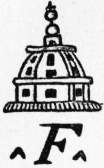
Florentine Potter’s mark.
If we could trust to documentary evidence alone, the earliest European porcelains were made at Venice in 1470, and again in 1519; while we also read of its manufacture at Ferrara in 1561.34 Unfortunately, documentary evidence alone is not conclusive, and the first European porcelain, known from actual specimens as well as by documentary evidence, was that made at Florence in the laboratory of Francesco de’ Medici, between 1575 and 1585. Specimens of this rare porcelain are to be found only in great museums and private collections, where they rank among our chief ceramic treasures. They show clearly that the Florentine potters never fully mastered their difficult material, for the ware is always imperfect and compares indifferently in whiteness and translucence with fine porcelain, while the glaze is neither smoothly melted nor free from defects. Obviously the effect of Chinese blue and white porcelain was aimed at, the decorations, reminiscent of the style of the Persian pot-painters, being executed in cobalt blue alone. These rare and interesting pieces bear distinctive marks; for at their period the use of painters’ marks or monograms had become fairly general on artistic pottery in Europe. One of the best known marks is the “palle” or balls of the arms of the Medici family, bearing the letters “F M M E D II.” for “Franciscus Medici Magnus Etruriae Dux II.”; while other pieces have a rude representation of the Great Dome of Florence and the letter “F.”
Plate VIII.
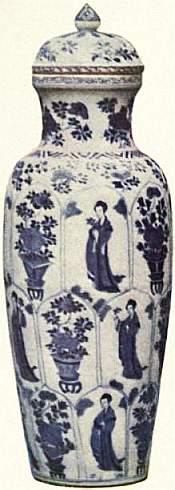
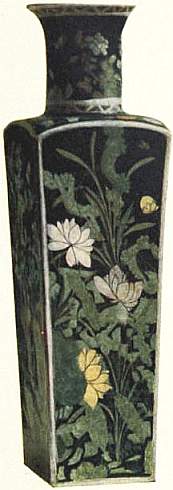
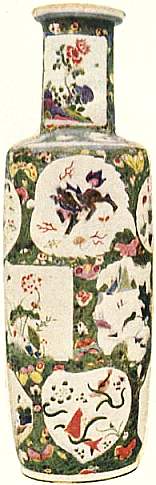
Chinese. K’ang-hsi period. Chinese. Black ground. K’ang-hsi period. Chinese (Famille Verte). K’ang-hsi period.
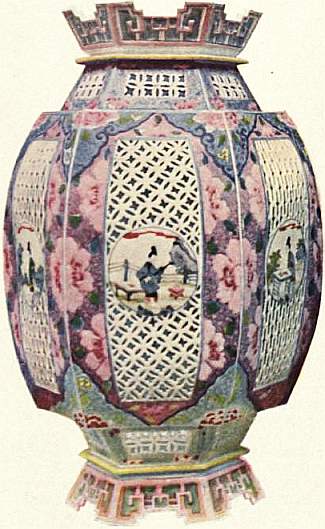
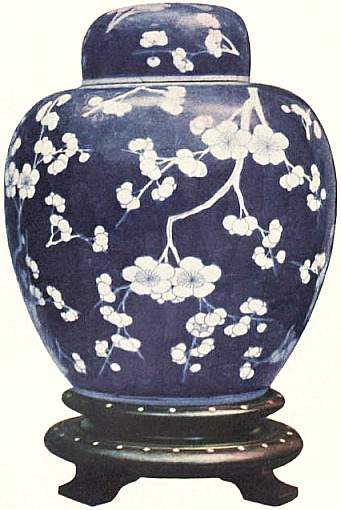
Chinese (Famille Rose). Ch’ien-lung period. Chinese. Plum-blossom jar. K’ang-hsi period.
Fortunately, too, besides the few specimens of Florentine porcelain that have survived to our day a manuscript has been found in the Magliabechian Library at Florence which states that the paste was composed of 24 parts of sand, 16 of a glass (powdered rock crystal 10 and soda 8), and 12 parts white earth of Faenza. To 12 parts of this mixture 3 parts of the kaolinic clay of Vicenza were to be added, and the pieces glazed with a lead glaze, or sometimes with the tin-enamel of the Italian faience maker. We are in the presence, therefore, of a material unlike Chinese porcelain in every respect, the Florentine porcelain being the first of a long line of European porcelains the artistic qualities of which were obtained by mixing a large quantity of glass with a small quantity of clay, so that they may almost be regarded as a species of glazed and painted glass. The technical methods used in their manufacture and decoration, however, were those of the potter and not of the glass maker.
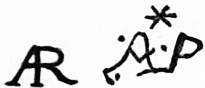
Paris Potters’ marks.
With the death of Francesco de’ Medici in 1587 it seems probable that this wonderful innovation came to an untimely end, and we hear no more of porcelain in Italy for more than a century. During this century (1587-1687) there can be no doubt that efforts were made all over Europe to discover the secret of porcelain manufacture; but the first reliable date we can point to is 1673, when Louis Poterat, a faience maker of Rouen, obtained a privilege from the French king for the manufacture of porcelain in that town. The Rouen porcelain in turn ceased with the death of Poterat in 1696. Authentic specimens are extant in the shape of salt-cellars, mustard pots and some few vases, the latter of considerable size. The pieces are usually decorated in blue with patterns in the Rouen style and were evidently painted by an expert faience painter. In composition, the porcelain of Rouen, like that of Florence, was of the artificial or glassy type, and shortly afterwards a similar ware made its appearance at the faience works of St Cloud near Paris, and at various works in the city of Paris. Well-known pieces, bearing the marks here shown, formerly supposed to be the earliest specimens of French porcelain and the work of Poterat at Rouen, are probably experimental pieces made in Paris after the date of Poterat’s discovery, as they differ in important particulars from his ware.
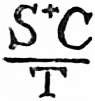
St Cloud Potters’ marks.
Once firmly established in France, this manufacture, under the patronage of the French court or of some great French noble, rapidly assumed a position of importance. The works at St Cloud received letters-patent from Louis XIV. in 1696, and the manufacture was continued there down to 1773. The appearance of the St Cloud porcelain is very characteristic, for though the paste has a yellowish tinge it is of fine quality with a clear and brilliant glaze. The first efforts appear to have consisted in frank imitations of the much-prized Oriental wares, and white pieces decorated only with branches of flowering plum in relief, or pieces modelled with imbricated or scale pattern or with delicate flutings, were made. The earliest colour decoration was naturally in under-glaze blue, and while quasi-oriental designs were largely used, the commonest feature is the prevalence of painted borders like those used on the faience of Rouen and St Cloud. At a later date decoration in over-glaze colours and gilding was also employed, and though the ware never reached to such a pitch of excellence as that of the Royal Manufactory at Sèvres, the St Cloud porcelain is one of the most distinctive French porcelains of the 18th century.
German Porcelains.—While the glassy porcelains of France were being developed at St Cloud, success of a more permanent order was reached in Germany. Augustus the Strong, elector of Saxony (1670-1733), had formed an extensive collection of Chinese and Japanese porcelains, still to be seen in the Dresden Museum, and he had established experimental pottery works, bringing skilled potters from Holland and elsewhere. His chief investigators appear to have been Tschirnhaus and Böttger, both alchemists, and it was the glory of the latter to be the first European to produce a porcelain like the Chinese, both in the nature of its materials, and in the appearance of its paste and glaze. It may be surmised that Böttger was guided toward this momentous discovery by information brought from China, though such an idea is always stoutly denied by German authorities, who, with pardonable pride, claim that Böttger at the age of twenty-four succeeded where all other European experimenters had failed. He was certainly working at the problems offered by the exotic wares of China, for his first production was an extremely hard redstone-ware—often erroneously called “Böttger’s red porcelain”—resembling the Chinese “boccaros” or red teapots of the Yi-hsing potteries. He had been anticipated in this direction by Dwight of Fulham, but the red pottery of Böttger was so intensely fired that it became dense enough to be cut and polished by the lapidary as if it were a piece of jasper or carnelian. It was first offered for sale at the Leipzig fair of 1710, and for many years it enjoyed great popularity, as well as the undesirable honour of wide imitation. At the same time (1710) Böttger exhibited a few crude specimens of greyish-white porcelain. Imperfect pieces were on sale in 1713, and by 1716 its manufacture was definitely established, though the pieces were still far from perfect. Böttger died in 1719, having had the rare fortune, in his short and eventful life, to establish in Europe the manufacture of true porcelain.
The life of Böttger reads like a page of romance, and the story of the subsequent development of porcelain manufacture throughout the German empire is hardly less romantic. When the importance of Böttger’s discovery was recognized, he and his workmen were removed from Dresden to the Albrechtsburg, a fortress situated at Meissen some 16 m. away, so that the manufacture could be conducted with the greatest secrecy. All concerned were practically state prisoners, and this extreme rigour doubtless defeated the end in view, for workmen escaped from time to time, and professing, more or less truthfully, a knowledge of the manufacture, found patrons among the German princes all eager to gain reputation as experimenters in the new art of porcelain. Some of these wandering “Arcanists,” like Ringler and Hunger, and the men who learnt from them, travelled all over the empire, and the following list of dates will show how porcelain factories sprang up from the parent factory at Meissen:—
Meissen 1710 St Petersburg 1744
Vienna 1718 Berlin 1750
Ansbach 1718 Nymphenburg 1758
Bayreuth 1720 Ludwigsburg 1758
Meissen.—Although the factory which was founded at Meissen as a result of Böttger’s discovery remained on its old site until 1863, the porcelain made there has been commonly known as Dresden porcelain; probably because Dresden was the seat of the Saxon court, and the enterprise was conducted at the expense of the electors of Saxony. So jealously were the secrets of this factory guarded that when Napoleon, the master of Europe, sent Brongniart to investigate the methods in use at Meissen in 1812, the elector of Saxony had to release Steinauer, the director, from his oath of secrecy before he would explain the processes. Meissen porcelain, therefore, affords us the best example by which we may follow the changes of fashion and taste that governed the styles of porcelain decoration in Europe during the 18th century. The early Meissen porcelain was made from the kaolin found at Aue, near Schneeberg, and while there is no mention of any other material, we may be sure that clay and felspathic rock, analogous to the Chinese kaolin and petuntse, were obtained from the same quarries, and were used together. Until after the death of Böttger in 1719 it cannot be said that the venture was more than a succès d’estime. The specimens preserved in the Dresden Museum show that the pieces were generally thick in substance and clumsy in shape, being often made from the moulds that had been designed for Böttger’s red-stoneware. Naturally enough these early examples were inspired by Chinese models, both in shape and decoration. As at St Cloud, white pieces with modelled decoration were common. Unlike the contemporary French glassy porcelains, the decorations in under-glaze blue were very imperfect, the blue colour being much run and blistered; and when attempts were made at decoration in enamel colours (i.e. colours fired on the finished glaze) the result was unsatisfactory, as, owing to the refractory nature of the hard felspathic material, these colours frequently scaled off. The later success of the Meissen factory must be attributed to Herold or Höroldt (who joined the staff in 1720 as a colour maker and painter), and to Kandler, a sculptor, who came to the works in 1731. In the hands of these two men the forms and decorations, still largely based on Chinese and Japanese models, assumed a definitely European style, while the composition of the body and the glaze, and the application of colours and gold, were brought to perfection. Herold was appointed director of the works a few years after 1720, and retained that post until 1765, while Kandler was chief modeller from 1731 to 1775. The years from 1730 (when the work definitely emerged from its experimental stage) to 1775 (when Kandler died) mark the most distinctive period of the Meissen porcelain. In the estimation of collectors also the Meissen porcelain of this period is the most valuable, and genuine examples of Alt-Meissen command high prices in the sale rooms, especially in Germany. This appreciation was quite as apparent in the 18th century, for by 1740 Meissen porcelain had won the greatest renown in Europe, and was actually exported by way of Constantinople over the Mahommedan countries of the Nearer East. It is frequently described by contemporary writers as being far superior to the porcelain of China, and so great was its vogue between 1740 and 1750 that as many as 700 workmen—a large number for those days—were employed, and the industry brought large profits as well as great reputation to the Saxon court. Each year saw some fresh departure from the original inspiration of the work, some fresh innovation of European style in design. After 1730 the rude reproductions of Chinese forms and decorations in white or blue and white were replaced by imitations of the Imari porcelains, especially those decorated in the style of Kakiemon. Here Meissen was running a race with Chantilly in setting the fashion for the dainty decorations in red and green and gold which spread in time to all the porcelain factories of Europe. Gradually European motifs became predominant. The simple oriental forms were replaced by distinctively European shapes with architectural mouldings, handles and feet. Instead of the dainty Japanese patterns, we perceive the gradual introduction of “Rococo” scroll-work (as interpreted by the Germans) to form a framework or border for miniature-like paintings of landscapes, ruins, figure-subjects, hunting scenes, &c., executed in the limited palette of on-glaze colours then available. Further evidence of the departure from oriental influence is to be found in the numerous “armorial” services produced between 1730 and 1740; and at the same period we find the first appearance of a style of decoration that has persisted to our own times, as a means of passing off pieces with small flaws in body or glaze, by hiding them among sprays of naturalistic flowers, with an occasional fly or some other winged creature thrown with seeming artlessness over the surface of the piece. This idea, though it seems to have been first used at Meissen, was so useful to the potter that it became general, and a device originally adopted to cover faults of manufacture was elevated into a distinct style of decoration by later European factories (e.g. Strassburg, Niederviller, &c.).
The talents of Kandler were applied in ambitious but unsatisfactory attempts to produce life-sized figures of the twelve apostles, an equestrian statue of Augustus the Strong of heroic proportions, and many models of animals intended for the decoration of the Japanese palace at Dresden. Many of these latter are to be seen in the Dresden Museum, and create an unfavourable impression of the taste of their period. The fame of Kandler is better perpetuated (see example, Plate IX.) by the little statuettes and groups of figures and animals that flowed in a steady stream from his facile hand; for though these figures have prettiness rather than grace, and flair rather than style, they are instinct with the spirit of the middle 18th century, and were eagerly imitated or boldly copied at every factory in Europe. Only in the biscuit porcelain figures of Sèvres, and in some few of the portrait figures of Derby, do we find anything artistically superior. These Meissen statuettes look their best when they are simply in white; many are grotesque and ugly, and the colour decorations are usually in very poor taste, the harsh, shining colours contrasting unpleasantly with the pronounced white of the porcelain.
Mention must be made of the use of modelled flowers at Meissen. Originating in the simple application of modelled branches of prunus, &c. in imitation of the white porcelains of Fu-kien, the method developed until we get not only the characteristic “May-flower” decoration (see example, Plate IX.), but also independent sprays and bouquets modelled in porcelain and coloured with the utmost mechanical precision. It is not quite clear whether this production of porcelain flowers was first perfected at Meissen or at Vincennes,35 but it was largely practised at both places.
Toward the end of this period, vases, candelabra, mirror-frames and clock cases were modelled in the most outré rococo forms with applied scrolls, shells and flowers. These pieces had their modelled details picked out in gold and colours, while the success of the French styles of decoration is still further shown by the copies of Watteau figures and groups on the more important vases, dishes and plates. Frederick the Great made sad havoc with the prosperity of Meissen during the Seven Years’ War. He looted the factory both in 1759 and 1761, and is said on the latter occasion to have carried away to Berlin both models, working moulds and many workmen. This misfortune marks the end of the most distinctive Meissen porcelain, for after this time Sèvres became the most important porcelain factory in Europe, and the later productions of Meissen were, for the most part, German versions of the styles initiated at the French royal factory. From 1764 to 1774 Dietrich, a painter, was at the head of affairs, while a Frenchman named Acier succeeded Kandler. They introduced the neo-classical style, which was spreading like a blight all over Europe, and this departure was perfected under the directorship of Count Marcolini (1774-1814), when Meissen, fallen from its high estate, was content to follow the lead of Sèvres.
After the Marcolini period there is nothing to be said of Meissen. The old productions of the factory had become valuable, and the custom of reproducing them, marks included, was adopted. Such a practice was not likely to lead to further progress, and, though the factory was removed from its old site in the Albrechtsburg in 1863, it cannot be said to have added anything to the progress of European porcelain during the 19th century.
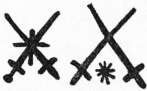
“Dresden” Potter’s mark.
During the initiatory period the “Dresden” pieces bore the monogram “A.R.” interlaced (Augustus Rex), and between 1712 and 1716 pieces intended for sale and not for the use of the court were marked with the sign of Aesculapius (a snake twining round a staff). From about 1720 two crossed swords, painted in blue under the glaze, with or without accompanying stars, crosses, &c., formed the general mark, but the mark has been so often used on other porcelains that, in itself, it is of slight value as a means of identification.
Vienna.—The first mention of the manufacture of porcelain in Vienna occurs in 1718, when a Dutchman, Claude du Paquier, was granted a patent. He had secured two runaways from Meissen, Stölzel and Hunger, yet little progress was made until after 1744, when the factory was bought by the empress Maria Theresa. At first the traditional styles of Meissen were continued, but the characteristic Viennese porcelain was produced after 1785. In this ware figure-painting, rich ground colours and elaborate gilding are associated in an unmistakeable manner. Leithner, who was chemist and colour maker at this period, succeeded in producing a more extensive and brilliant palette of colours than was in use at any other European porcelain factory in the last quarter of the 18th century; and the gilding was rich and elaborate. Apart from its technical merits the ware has nothing to recommend it, for the styles of decoration showed pronounced neo-classical influence, and lacked the saving merits of the French work in the same style. The works was closed in 1864, on account of the heavy expenses, and collectors should be reminded that many spurious imitations, the product of small Viennese factories, are to be found on the market.

Wegeli’s mark.
Berlin.—The first Berlin porcelain was made by W. Casper Wegeli, aided by workmen from other German factories, as early as 1750. This business was unsuccessful and came to an end in 1757, but its productions are highly prized on account of their rarity. Success only came when Frederick the Great brought workmen, moulds and materials from Meissen in 1761, and, becoming proprietor of the works in 1763, founded the Royal Berlin Porcelain Manufactory. Though Meissen workmen and methods had been imported, and the Meissen style governed the earliest productions, Frederick’s well-known penchant for French art was doubtless responsible for the fact that the rococo style of decoration was more determinedly followed here than elsewhere in Germany. The colour schemes of this ware are unusually simple, pieces being seldom decorated in more than three colours, while a rose-coloured enamel, a favourite colour with the great Frederick, is quite characteristic. The Royal Berlin Factory passed under a cloud in the troubled condition of the Prussian monarchy during the early years of the 19th century, and down to 1870 it was content to follow in the wake of Sèvres like most of the other European factories. Since about the year 1880, however, it has developed into the most scientific of European porcelain works, and it was here that Seger manufactured his special porcelain, made to reproduce the qualities of the finest Japanese wares. In spite of this scientific success it must be remarked that the late Berlin porcelain is artistically disappointing, being too exuberant for our taste and recalling anything rather than porcelain in its treatment.
Minor German Factories.—It is unnecessary to describe the productions of all the German porcelain works of the 18th century, for not only is there a strong family likeness, but all the works aimed at producing pieces comparable with those of Meissen, Vienna or Berlin. In every case the industry was established under the patronage or at the direct charge of princes or great nobles, anxious to emulate the success of the elector of Saxony or the king of Prussia, and generally the enterprise came to an end with the death of a patron or from his unwillingness to sustain the continued drains upon his purse.
The factory at Höchst was started about 1720 by wanderers from Meissen, but it was only carried to a successful issue through the patronage of the archbishop-elector of Mainz after 1746. The general style of Höchst is a palpable imitation of the contemporary wares of Meissen, but this factory was noted for its excellent figures and groups, especially those modelled by Melchior (1770-1780). He modelled, at Höchst, more than three hundred figures, as well as many portrait medallions. The works came to an untimely end during the French invasion of 1794.
Frankenthal had a porcelain factory (founded by the Hannongs of Strassburg) in 1756, and patronized by Karl Theodor, elector palatine from 1762 to 1795, when the French invasion put an end to its activities. Melchior, the sculptor, came here from Höchst after 1780, and elaborate pieces in the current styles of Sèvres and Dresden were made.
Nymphenburg, near Munich, had a factory which was made a royal factory in 1758 by Max Joseph III. of Bavaria. The ware was of fine quality, but without special distinction. Melchior came on here about 1800, remaining till his death in 1825; his Nymphenburg figures are as highly esteemed as those he modelled at Höchst and Frankenthal. In the early years of the 19th century elaborate painting became the rule here, as at the other royal factories, and copies were made on porcelain of some of the famous paintings in the Munich galleries. The works is still in existence, in the hands of a private company, who unfortunately sell many reproductions of the 18th-century wares.
Ludwigsburg, some 9 m. from Stuttgart, had a porcelain factory from 1758 to 1824, liberally subsidized by the dukes of Württemberg. Highly-finished painting was the rule at this factory, and because the ware bore a crown as one of its marks, it has rather foolishly been called “Kronenberg” porcelain.
Fürstenberg was the factory patronized by the dukes of Brunswick. Experiments were made as early as 1746, but little ware was produced before 1770. Fürstenberg set itself to imitate all the best-known styles of the day, and its only distinctive productions are its “biscuit” statuettes and medallions. The factory remained in operation until 1888, but as the moulds were then sold by auction, imitations of the old pieces are now common.
Other 18th-century German factories were those of Fulda, Bayreuth, Cassel, Ansbach, Kloster-Veilsdorf, Wallendorf and Limbach.
Mention must also be made of the work of certain famous decorators, like Bottengruber and Preussler, who decorated both German and oriental pieces; while Busch, the canon of Hildesheim, produced effects like fine engraving by etching the glaze with a diamond and rubbing black colour into the lines.
While France and Germany were each developing their own particular type of porcelain, it was only natural that the kings and princes of other countries should strive to emulate them in the manufacture of this still rare and highly esteemed form of pottery. Naturally, perhaps, the countries to the north and east seem to have been influenced most by German methods, whilst those to the south and west followed the French example.
Holland.—The earliest Dutch factories were started as early as 1704, first at Weesp near Amsterdam, and afterwards at Oude Loosdrecht. The mark of this factory occurs as M: O.L., or M.o.L. After 1782 the works was removed to Nieuwe Amstel, but the “Amstel” porcelain came to an end with the French invasion. The ware resembled the German both in material and decoration. The best porcelain made in Holland was produced at a factory at the Hague, founded some time after 1775. There is a choice collection of this ware in the Gemeente Museum at the Hague. No porcelain appears to have been made in Holland after about 1810 until 1890 or later.
Denmark.—It has been stated that porcelain of the German type was made in Copenhagen as early as 1731, but there is no definite record of the production of true porcelain until about 1772, when potters, modellers and painters from some of the German works founded the enterprise which was taken over by King Christian VII. in 1779 and converted into a royal factory. Fostered by the king’s patronage, fine porcelain of pronouncedly German style was largely made down to the end of the 18th century. The collection in the castle of Rosenburg contains many examples of the work of this period. In the early years of the 19th century the Empire style of decoration was adopted, and the artistic influence of Sèvres became paramount. Large sums of money were continually required from the crown to maintain the establishment until, in 1867, it was sold into private hands to get rid of an encumbrance. The subsequent new-birth of the existing royal Copenhagen porcelain works must be noted in the next section.
Sweden.—The history of Swedish porcelain in the 18th century is connected with the factories at Rörstrand and Marieberg, both in the environs of Stockholm. Tentative experiments were made at both these places before 1760, but these came to an end by the close of the 18th century, though the Rörstrand works was reopened some fifty years ago and will be subsequently referred to. The Swedish porcelains were of two kinds, one a true felspathic porcelain like the German, and the other a glassy porcelain resembling that made at Mennecy in France. It is interesting to note that the decorative styles in both cases are distinctly French in character.
Russia.—Peter the Great is said to have projected a porcelain factory at the suggestion of his ally Augustus the Third of Saxony, but the scheme was not carried into execution until the days of the empress Elizabeth. Catherine II. subsidized the work in prodigal fashion, but although she brought over French artists, the Russian porcelain more closely resembles its German than its French prototype. In the early years of the 19th century the imperial Russian factory followed the example of Sèvres in producing costly dinner services and extravagant vases of large dimensions.
Small independent factories were started in the neighbourhood of Moscow: one by an Englishman named Gardner about 1780, and another by A. Popoff. Besides producing ordinary table ware these Moscow factories sent forth a considerable number of statuettes, the most interesting being those representing Russian peasant types.
Hungary.—The one Hungarian porcelain factory of note is that at Herend, which was founded about 1830 by Moritz Fischer. At this factory copies of oriental porcelain were made that have deceived many collectors, though the pieces are usually impressed with the word “Herend” in the paste.
Switzerland.—Little porcelain has been produced in Switzerland, and considering the geographical position of the country it seems natural that porcelain of the German type should have been made at Zurich and of the French type at Nyon on the lake of Geneva, but these productions are of no particular importance.
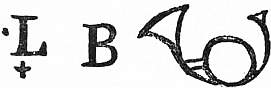
Lille and Chantilly Potters’ marks.
French Porcelains.—The beginnings of French porcelain at Rouen and St Cloud have already been mentioned, as they preceded Böttger’s discovery of true porcelain; but as nothing was known in France of the methods and materials used by the German porcelain makers, the artificial or glassy porcelain held sway in France through the greater part of the 18th century. The next important factory after St Cloud was that founded at Chantilly about 1725 under the patronage of the Prince de Condé, an enthusiastic collector of Chinese and Japanese porcelains. One distinctive feature of the Chantilly porcelain is its imitation of the Japanese Imari wares of the 17th century, especially those bearing delicate patterns in the Kakiemon style. This imitation was not confined to the decoration alone, but great efforts were made to reproduce the delicious tender whiteness of the original ware, by covering the body of the soft porcelain with a coating of the tin-enamel used by the French faience makers. Similar imitation of the Kakiemon style of decoration became the rage all over Europe, and was largely followed at Meissen and in England as well as in France; but no European imitations equalled those of the famous Chantilly ware.
Other porcelain factories were started at Mennecy-Villeroy and at Lille, but the most important French factory was that founded at Vincennes about 1740, not only because of the many beautiful pieces produced there, but also because the works was taken under the direct patronage of the king in 1753 and was transferred to Sèvres in 1756, becoming ultimately the most important porcelain factory in Europe.
Fortunately we have documentary information of the exact composition of the artificial porcelain (pâte tendre) of Sèvres, and a brief account of its manufacture will serve to explain how all the glassy porcelains of Europe were made. The potter commenced by preparing a glass or frit, melting together pure sand, alum, sea-salt, gypsum, soda and nitre. The clear portions of this frit were powdered and washed with boiling water, and the working clay was compounded by adding to such powdered frit a small quantity of chalky clay or marl and sometimes pure chalk as well. This mixture was ground in water until the fluid was as fine as cream, and it was then boiled to a thick paste which was so little plastic in itself that black soap or parchment size was added to it to give it enough plasticity for the workman to be able to shape it. Vases and other pieces were made from this paste by pressing cakes of it in plaster moulds of considerable thickness. After pressing, the pieces were dried and were then either turned on a lathe or rubbed down with sand-paper to reduce them to sufficient thinness; while handles, spouts or other ornaments in relief were applied with a lute of slip, as is customary with every other species of pottery. The fragile objects were then fired into what is known as the “biscuit” condition; the most difficult part of the whole process. During this firing the pieces frequently went out of shape because of the excessive shrinkage of the material and its tendency to soften as it approached the melting point of the frit. Consequently an elaborate system of “propping” the pieces had to be resorted to, and even then a very large proportion became deformed. When the porcelain was drawn from the oven after the first firing, the supports were removed and the pieces were rubbed with sand to clean the surface, and were then coated with glaze by sprinkling with a brush; the glaze being a fusible glass very rich in lead. The glaze coat was melted by refiring the piece at a lower temperature; and it was frequently necessary to repeat this process several times in order to get a perfectly even and brilliant result. The difficulties of such a process were enormous, and it was only by the financial support of wealthy patrons, or of the state, that such a method of manufacture was ever carried on for any length of time. At its best the material is an exceedingly beautiful one, lending itself especially to decoration in on-glaze colours, and the pieces produced at Vincennes and at Sèvres, between 1745 and 1770 or thereabouts, form a distinct class by themselves. Skilful chemists like Hellot and Macquer were employed to direct the operations, and many beautiful ground colours, such as the famous gros-bleu, bleu de roi, rose Pompadour, pea-green and apple-green were invented.
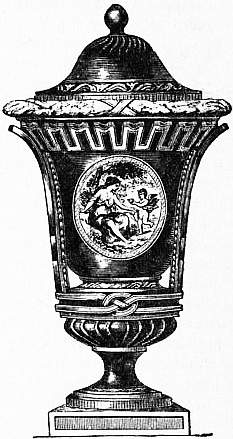
Fig. 52.—Sèvres vase, pâte tendre; green body and gilt imitation mounting. (Victoria and Albert Museum.)
Sèvres Porcelains.—The forms of the Sèvres porcelain are exceedingly varied. Many of the older shapes were designed by Duplessis, the king’s silversmith, and, as is perhaps natural, are more proper to metal than to pottery; but the French glassy porcelain is such an artificial material in every respect that such a point should not be strained too far. Owing to the want of plasticity in the paste the pieces were always made in moulds of plaster of Paris, while in many cases they were moulded in separate parts and these united together with metal screws or mounted in bands of chased ormolu. Table services made for actual use were usually painted on a plain white ground with the full palette of on-glaze colours (or enamels) and much rich gilding. The decorative pieces such as vases, candelabra, jardinières, &c., were decorated in a much more sumptuous fashion by covering the greater part of the piece with a ground of one of the rich enamel colours previously mentioned, reserving only panels in white on which delicate miniature-like decorations of the most varied kind were subsequently painted and fired (see fig. 52; and examples of Sèvres, Plate IX.). Such collections as the Wallace at Hertford House, or the Jones Bequest in the Victoria and Albert Museum, show at once the variety and perfection to which the work attained.
This Sèvres porcelain is entirely devoid of the broad decorative treatment and rich full colour of any of the great kinds of fine pottery or porcelain. Artistically considered, it has no place beside the triumphs of the Chinese or Persian potters, or of the Italian majolists. Its shapes are too formal, and are not sufficiently imbued with a sense of the qualities of the material. The ground colours defy every natural tendency of pottery colour for they are even, flawless and mechanical, with none of the palpitating richness that comes so naturally from the potter’s processes. The paintings, whether of flowers, birds or figure-subjects, are extraordinarily skilful regarded as miniatures, but as examples of pottery decoration they cannot be compared to the swift, apparently careless, brushwork of the great masters of earlier times. So pronounced was the demand of the period for smooth even finish that such ground colours as gros-bleu and bleu de roi, where the colour naturally came varied and uneven, were subsequently decorated with small diapers or lines of gold in the form of œil de perdrix or vermicelle, so as to produce a more regular and even effect. The most elaborate and costly of all the varieties of old Sèvres is what is known as “jewelled Sèvres,” which is richly sown with imitation jewels, such as turquoises, pearls and rubies, closely resembling the real stones. These imitation jewels were in every case set in beautifully chased mountings of gold, and in the museum at Sevres are to be found examples of the punches and other tools used in making these mounts. On account of the enormous expense involved in the production of such costly triumphs of skill, examples of jewelled Sèvres are rare even in the best collections, but the English student is fortunate in the fact that the Wallace collection contains a considerable number of them.
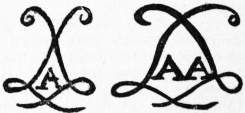
Sèvres Potters’ marks, 1753 and 1772.
Many reasons—the prestige attaching to a Royal Manufactory, the knowledge that the porcelain was produced regardless of cost, the mechanical perfection of its colours, gilding and decoration, as well as the fact that the glassy porcelain was abandoned as too costly and risky after about 1780—have all conspired to raise the prices which modern collectors are prepared to pay for fine examples of vieux Sèvres. It is doubtful whether even the prices paid for paintings by old masters have advanced so rapidly as those paid for Sèvres porcelain of the best period. In the ’seventies of the 19th century it was deemed worthy of remark that a sum of £10,000 should have been paid at public auction for three old Sèvres vases; thirty years later one such piece would probably fetch the same price. It should be added that the extravagant prices now paid for Sèvres porcelain, which is much more a triumph of technical than of artistic skill, have led to an extensive system of “faking” and even forging specimens which are purchased at high prices by amateurs.
Beautiful as the old Sèvres porcelain was, those who were responsible for its manufacture could not fail to recognize that the porcelain made at Meissen and other German factories was both harder and whiter in substance, more truly resembling the oriental porcelain in every respect. It was also known that these German porcelains were not so difficult, and therefore so costly to manufacture as the French, and all these causes combined to make the directorate of Sèvres unremitting in their efforts to discover in France natural materials analogous to those used by the German and Chinese potters. Père d’Entrecolles, the famous Jesuit missionary, had forwarded to France long before an account of the methods used by the Chinese, as well as samples of the materials they employed; and after many years’ research Millot and Macquer discovered the precious materials at St Yrieix near Limoges (see Auscher, History of French Porcelain, pp. 77-81). The first experimental pieces of this French porcelain, similar in material to the German and Chinese, appear to have been made about 1769; but it was some years after this before the manufacture of the new product was firmly established, and then to the end of the 18th century more and more of the hard porcelain and less of the glassy porcelain was made at Sèvres. Speaking broadly, we might say that after 1780 comparatively little of the original French porcelain was made in France; and from that time to this practically all French porcelain has been of the same type as the German porcelain, viz. made with china clay and felspathic rock. This technical change in the nature of the materials had a profound influence on the artistic qualities of French porcelain, and the change was doubtless accentuated by the neo-classical rage which followed on the discovery of Herculaneum and Pompeii. The influence of antique vase shapes and of modern renderings of Greek motives in design spread over Europe like a plague, and whether in France, Germany or England the last quarter of the 18th and the first quarter of the 19th century mark a definite period in pottery design and decoration. The introduction of hard-paste porcelain rendered the manufacture of large vases and other pieces possible; and after 1780 we find the manufactory at Sèvres engaged in the production of enormous vases 5 or 6 ft. in height, a manufacture which has been continued there to this day. About the same time, too, we find the first production of large plaques or slabs of porcelain on which copies of well-known pictures were painted in enamel colours. The earliest of these slabs were in soft-paste porcelain, but in this material it was only possible to make them of quite modest dimensions; with the introduction of hard-paste porcelain very large slabs were manufactured, and a series of these are to be seen in the museum at Sèvres.
The most artistic of all the productions of Sèvres are undoubtedly the “biscuit” figures and groups. These were modelled with great skill by many of the best French sculptors of the day, such as Pajou, Pigalle, Clodion, La Rue, Caffieri, Falconet, Boizot, Julien, Le Riche, &c. The best of these Sèvres “biscuits” have a real artistic value which places them in a class quite apart from the German porcelain figures made at Meissen, Frankenthal and Höchst.
Paris.—Although during the reign of Louis XV. many privileges and prerogatives had been given to the Sèvres manufactory, such as the exclusive right to gild or paint in colours on porcelain, the breakdown of the monarchical régime, which was rapidly accelerated after the accession of Louis XVI., led to the establishment in Paris and its environs of a number, of factories for the production of hard-paste porcelains more or less in open rivalry with the royal manufactory of Sèvres. In order that the royal edicts might be more easily evaded, most of these factories were placed under the patronage of one of the French princes of the blood or even of Queen Marie Antoinette. There is little need to dwell on the doings of these Parisian factories, but the productions of the best of them, such as those of Clignancourt (patronized by Monsieur, the king’s eldest brother); Rue Thiroux (patronized by Queen Marie Antoinette); Rue de Bondy (patronized by the duc d’Angoulême), compare not unfavourably with those of Sèvres itself.
It is impossible to do more than mention the other important French factories at Mennecy, Sceaux, Bourg-la-Reine, Strassburg, Niederviller, Marseilles, Limoges and Caen. In the disastrous years of the French revolution (between 1789 and 1800), such of these factories as had survived came to an untimely end, even the royal factory at Sèvres passing through a kind of lingering death between 1792 and 1801, and it was not until Napoleon decided to revive the glories of Sèvres that modern French porcelain really came into being.
Just as the manufacture of German porcelain spread into Holland, Denmark, Sweden, Russia, &c., we find the manufacture of a glassy porcelain analogous to the early French arising in Belgium, Italy, Spain and England. The materials and methods were so like those used in France that it would be ridiculous to claim for them an independent origin, even were we unable to prove by documentary evidence that workmen trained in the French factories had migrated into those countries.
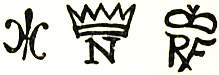
Capo-di-Monte Potters’ marks; 1736, 1759, 1780.
Italy.—In Italy we have the factories at Le Nove near Bassano (1762-1825); Doccia near Florence (founded in 1735 by the marchese Carlo Ginori, and still carried on by the same family); and Capo-di-Monte near Naples (1736-1820); with minor factories like those at Vinovo, Treviso, and the Volpato factory at Rome. The most important of these were the factories at Doccia and Capo-di-Monte. The porcelain made at Doccia was famous for its soft translucent texture, so that it lent itself beautifully to the production of white glazed porcelain figures resembling in quality the white pieces of Fu-kien.
The factory at Capo-di-Monte was under the direct patronage of Charles III., king of Naples. The earliest and best of its productions are in pure white, probably made in imitation of Chinese white pieces, though modelled in the form of natural shells supported by corals and seaweed. Figure-modelling was also largely practised, and besides groups of statuettes and figures in conjunction with vases, we have the typical Capo-di-Monte examples in which vases, cups, saucers, plates, &c., are covered with groups of figures modelled in high relief on a minute scale. This trivial style of work is greatly admired because of the minuteness of its execution. At a later period the works was removed to Portici and ultimately to Naples, but after about 1770 the classic style was adopted for the shapes and decorations. The factory came to an end as late as 1820.
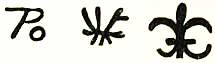
Buen Retiro Potters’ marks.
Spain.—Charles III. of Naples ascended the throne of Spain in 1759 and took with him to Madrid many of the workmen from the Capo-di-Monte factory, as well as the best moulds and models. He established a new china factory in the gardens of Buen Retiro, a palace outside Madrid. As long as Charles III. lived immense sums were lavished on this factory, and the ware was not allowed to be sold, but was either used for the decoration of the royal palaces or for presentation to other European sovereigns. Enormous vases were made, following the example of Sèvres, and these were often filled with bouquets of flowers modelled in porcelain. The most famous productions of this factory, however, were the plaques and slabs of porcelain used for lining the walls of certain rooms in the royal palaces. Two of these rooms still remain, and are frightful examples of the Spanish rococo style. The factory was entirely destroyed in 1812 during the French war, and since that date no porcelain of any importance has been made in Spain.
English Porcelains of the 18th century.—There can be no doubt that whatever experimental work may have been conducted by our early English potters, such as the famous John Dwight of Fulham, nothing like an established manufacture of porcelain existed in this country prior to about 1740-1745. There are records of many tentative experiments before this date, but no real history. Between 1745 and 1755 important porcelain works were established at Chelsea, Bow, Worcester and Derby, and when we examine the productions of these factories it is impossible to avoid the conclusion that the processes had been imported from France. The early English porcelains, like all the French porcelains of that date, were composed of artificial or glassy mixtures.
We may take the early productions of Bow and Chelsea as typical of the earliest English porcelain of which there is any definite record. The material was a mixture of pipe-clay, sand from Alum Bay in the Isle of Wight, and glass, while the glaze was a fusible English flint-glass rich in lead. It is obvious, therefore, that we are dealing with substances very similar to those used in the glassy French porcelain (see above), and such mixtures were very difficult of fabrication, being subject to great loss in the process of firing. In the other European countries the manufacture of porcelain was almost invariably carried on at the expense of some royal or princely patron; in England, however, the manufacture was not subsidized in this way, and it is probably for this reason that at a very early date we find the English porcelain-makers experimenting with other materials than glass and clay in order to make their processes more certain. In a patent taken out in 1749 by Thomas Frye of the Bow works we find mention of the use of bone-ash—the material that was to make English porcelain a distinct species by itself. From 1750 onwards there can be little doubt that, though a large proportion of glass was still used in the composition of the English porcelains, bone-ash was more and more introduced into the paste in order to obtain a more refractory material; yet it was not until about 1800 that Josiah Spode of Stoke-upon-Trent abandoned entirely the use of glass and composed his porcelain of china clay, bone-ash and felspathic rock for the body, glazing it with a rich lead glaze, and so laid the foundation of distinctively English porcelain. The material has many merits both from the useful and artistic points of view; it is much more easily fabricated than the old glassy porcelains, it endures better for ordinary table use than any other kind of porcelain, and it permits the fullest range of decoration.
Before entering upon a detailed notice of the important English factories of the 18th century, something should be said of the various influences that were at work in determining what the porcelain-maker should do, both in the way of shape and decoration. The eyes of all men were, of course, turned first to the porcelain brought from the far East; and in the early efforts of the English factories, as of those of France and Germany, we notice a predominance of white pieces or of pieces decorated with paintings in under-glaze blue alone, obviously inspired by the current importations from China. Bow and Chelsea produced large quantities of ware of this class, and in the early days of the Worcester factory little else was made there than white, or blue and white pieces closely simulating the Chinese. Another oriental influence was to be found in the Imari patterns of Japan, particularly those in the style of Kakiemon. It has been noted that Meissen, Chantilly and other continental factories had already created a vogue for these reproductions of Japanese decorations, and in our own country Bow, Chelsea and Worcester followed suit. The later Imari patterns, heavily decorated with blue and red and gold for the use of “the foreigner,” furnished another popular style for Worcester and Derby, and the vogue of these English “Japan” patterns, in the last quarter of the 18th century and the first half of the 19th century, was so great that they represent a large proportion of the output of our English porcelain works during that period. The productions of the German and French factories also exerted a profound influence on English potters; so that throughout the 18th century English porcelains largely consisted of imitations of the foreign wares brought into the country by the wealthy.
We can only point to one method of porcelain decoration which undoubtedly arose in England. This is the method of transfer-printing, whereby patterns printed on paper from engraved copper plates are transferred to porcelain or pottery and subsequently fired, either under or on the glaze. At the best these printed patterns are in no way superior to the stencilled work of modern oriental porcelain, while, at the worst, European and American printed patterns have been perhaps the most inappropriate decoration ever applied to porcelain in the world. It has been generally urged on behalf of transfer-printing that it enables elaborate effects to be produced at a small cost and so brings decorated pottery within the reach of the humblest. The truer view is, that the simplest brushwork patterns, or even no pattern at all, would be preferable to the tawdry results that the cheapest forms of transfer-printing have rendered possible.
Chelsea.—Between 1750 and 1770 the Chelsea factory was the most important of all the English porcelain works, and fine specimens of this period command high prices in the saleroom to-day. We know little of the origin of this important factory, though it is believed to have been in existence from some time after 1740 to 1784, when it was finally demolished and some of the workmen and part of the plant were removed to the then important works at Derby. The first manager was one Charles Gouyn, who was followed by a Mr Sprimont before 1750. Sprimont retained possession of the works until 1769, and died in 1771. It was during his management, from 1750 to 1770, that the finest and most characteristic pieces of Chelsea porcelain were made.
Although the styles in vogue at Chelsea are extremely varied, little was produced there that was really English in character. The earliest pieces appear to have been either in pure white or in white decorated with paintings in under-glaze blue. The goat-and-bee cream jugs, crawfish salt cellars, the shell and rockwork salt cellars, jugs, sauce boats, small cups and saucers of this type are fairly plentiful. Then came the decorations, mainly in red and gold, of the Kakiemon style, followed by reproductions of the brocade patterns of Imari porcelain. Afterwards we find the appearance of table wares modelled in imitation of leaves, animals, fruits, birds and fishes, apparently adopted from current French and German practice.
In another direction the influence of Meissen was also shown by the production of statuettes (see in Chelsea figure, Plate X.), and of the small modelled trinkets, scent-bottles and toys of which there is such a fine collection in the British Museum. In the latter days of the factory (say after 1758) we find Chelsea following in the wake of Sèvres in the production of large and elaborate rococo vases, with pierced necks and covers, scroll-work bases and interlacing handles such as are to be seen in the Jones Bequest in the Victoria and Albert Museum. Pieces of this elaborate kind are overlaid with rich grounds of Mazarine blue, turquoise, pea-green, or the famous Chelsea claret-colour, while white panels are reserved framed with gilt scrolls and painted in enamel colours with flowers, birds or figure-subjects in absolute rivalry with the pieces manufactured at Sèvres.
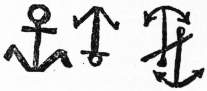
Chelsea Potters’ marks.
The Chelsea works appears to have come to an end through the ill-health of Sprimont, and it was sold in 1769-1770 to Duesbury, the proprietor of the Derby works. He carried on the establishment from 1770 to 1784, but in this period a great change is noticeable in the product of the factory. The “rococo” forms and decorations of the true Chelsea porcelain were replaced by works in the neo-classical style already rendered popular by the success of Josiah Wedgwood, and the Derby-Chelsea porcelain is quite a distinct production from the early works of Chelsea. The most distinctive mark of the Chelsea porcelain is an anchor—either embossed in the paste or painted in gold or colour. Often the anchors occur in pairs, and it is frequently associated with other marks such as a dagger or a cross. Some of the Derby-Chelsea pieces are marked with a conjoined D and an anchor.
Bow.—The date of the establishment of the factory at Stratford-le-Bow, in what is now the East End of London, is quite uncertain, but in 1744 Edward Heylyn and Thomas Frye, who were connected with this factory, took out a patent for the manufacture of porcelain. The materials mentioned in this patent are not such as would produce porcelain at all, and it appears likely that the specification was made purposely defective. In 1748 a further patent was applied for in which we get the first mention of bone-ash, so that from the technical point of view the wares made at the Bow factory are of the utmost importance as indicating the experimental beginnings of our English porcelain in which bone-ash plays such an important part. In 1750 the works at Bow belonged to Messrs Weatherby & Crowther, and was then known as “New Canton,” and as 300 workpeople were employed, the operations must have been conducted on a large scale; but ultimately, from causes that can only be surmised, the partnership was dissolved and the business failed, so that in 1775 the works was bought for a very small sum by the William Duesbury already mentioned, who transferred part of the plant and moulds to his more prosperous works at Derby. It would appear from what we know of the factory and its productions that the business was conducted on simpler lines than at the Chelsea works. We have, for instance, no elaborate vases in imitation of Sèvres, and no important groups of figures which might challenge rivalry with Meissen. We find, as is common with all the early porcelain factories of Europe, first the production of white pieces with modelled reliefs, or of pieces painted with under-glaze blue in imitation of Chinese porcelain. Then followed the well-known “Quail,” or “Partridge,” and “Wheat-sheaf” patterns in red and green and gold in imitation of the Japanese patterns; and the manufacture of table ware decorated with these simple yet bright and pleasant devices seems to have formed the greater part of the work at the factory. Many figures and statuettes were also produced at Bow, but they are fewer in number and less cleverly made and decorated than the contemporary productions of the Chelsea factory. We may surmise that there was considerable rivalry between these two works situated on the outskirts of the metropolis, for we find the “anchor” mark, which is the best recognized mark of Chelsea porcelain, often occurring on specimens that from internal evidence or from the piece itself we should rather attribute to Bow. The Bow marks are not very certain, but some of the likeliest are here given.
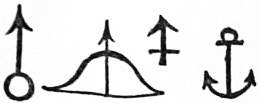
Bow Potters’ marks
Worcester.—The third of the early English factories, and ultimately the most important of all, was that founded at Worcester in 1751 by Dr Wall, a man of unusual attainments, and a number of his friends. How Dr Wall came to learn the secret of porcelain making is absolutely unknown, but even assuming that he acquired some information from wandering workmen it is certain that the Worcester porcelain was soon developed on original lines. The nature of the paste and the glaze of the early Worcester productions, as well as the sobriety of their decorations, stamp this factory as the first where Englishmen really developed a native porcelain. Between 1751 and 1770, the first period of Worcester porcelain, the prevalent influence was that of Chinese blue-and-white, and the pieces of that period are rightly esteemed by collectors for their artistic quality. Probably nowhere in Europe, certainly nowhere in England, was oriental blue-and-white more carefully studied, and a collection of this blue-and-white Worcester is most satisfactory from the aesthetic point of view. The productions at this time were tea and coffee services, bowls, dishes, mugs and plates. The cups were usually made without handles in imitation of the oriental practice, but large, two-handled covered cups for caudle, broth and chocolate were also made during the early period. Many of these larger cups bore an embossed pattern resembling a pine-cone, possibly imitated from a shape produced at St Cloud; while openwork dishes, plates and fruit baskets were also made in imitation of a popular Meissen fashion.
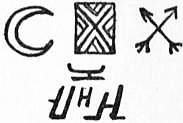
Early Worcester Potters’ marks.
The method of decorating porcelain with transfer prints was introduced at Worcester as early as 1756, when Robert Hancock, an engraver, came from York House, Battersea, where the process was first employed for the decoration of the Battersea enamels. The early Worcester prints comprised portraits of celebrities of the time (the Frederick the Great mug), or adaptations of the works of great artists such as Gainsborough and Watteau, or copies of current engravings or sporting prints. The first printing was done in black or purple, and transferred on to the fired glaze, and it was not until about 1770 that the process of printing in blue under the glaze was perfected. It is interesting to note that for many years this process of transfer printing was developed side by side with the older method of porcelain painting, and until the end of the 18th century the processes appear to have been used at Worcester quite independently. The closing of the Chelsea factory in 1770 led to the migration of some of the Chelsea painters to Worcester, and from about that date a considerable amount of Worcester porcelain was decorated on the glaze with enamel colours and gilding after the styles that had been rendered popular at Chelsea and Bow. It is only fair to remark, however, that the Worcester patterns are always distinguished by a certain English character both in the style and the workmanship (see example, Plate X.). The first and most artistic period of Worcester porcelain came to an end before 1783, when, after the death of Dr Wall, the works passed under the control of Thomas Flight and his two sons, who had been jewellers. The Flight influence was soon noticeable from the fact that the new shapes were more and more based on those of Sèvres and Meissen, while the decoration became more mechanical and precise as befitted the work of jewellers rather than potters. King George III. and Queen Charlotte visited the works in 1788 and bestowed upon the firm the privilege of styling themselves “China Manufacturers to Their Majesties,” since when the works has always been known as the Worcester Royal Porcelain Works. In 1793 Martin Barr was taken into partnership; the “Flight & Barr” period, so well known to collectors, lasted until 1807.
Another Worcester porcelain works was in existence after 1784, viz. the Chamberlain factory, which was working in rivalry with the original establishment; but its productions are of no particular artistic merit, and in 1840 the two firms became amalgamated, and so gave rise to the present Worcester Royal Porcelain Co. The most noteworthy feature of the productions of both the Worcester works at the end of the 18th century were the “Armorial” services made for various royal and noble families, and those adaptations of Imari patterns known as “Old Japan.”
Derby.—Experiments in the manufacture of porcelain appear to have been made at Derby as early as 1750 by a French refugee, Andrew Planché; but the business, which was afterwards to attain such a great development, was only founded in 1756 with William Duesbury as its manager. Duesbury was originally a decorator of china figures in London, and his career proves that he was a man of great industry and energy, for within twenty-five years he not only built up a large business at Derby, but he absorbed the decadent works at Bow and Chelsea, so that in the last quarter of the 18th century Derby was the most important china manufactory in England. As is so often the case, a commercial success like this implied the absence of any distinct artistic impulse. The porcelain produced at Derby is for the most part only an echo of the successes of Meissen, Sèvres, or the earlier English factories. It is only fair to remark that a very deep and rich under-glaze blue was attained at the Derby works, and that this was associated with very mechanical painting of birds and flowers and with gilding of exceptional quality. At this factory, too, the old Japan patterns were imitated with exceptional vigour, until “Crown-Derby Japan” became a standard trade name for this clobbered oriental style.
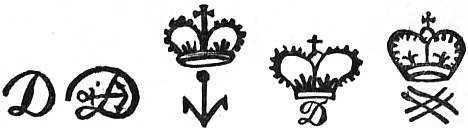
Derby Potters’ marks.
Mention has already been made of the “biscuit” porcelain figures made at Derby, which are superior in style to anything else made in-Europe in the 18th century except the “biscuit” porcelains of Sèvres. The Derby “biscuits” of the best type range from 1790 to 1810, and the finest specimens have a “waxy” surface, though there is little or no sheen and every detail remains as crisp as when the figure left the hand of its maker. The most famous of these figures are the portrait medallions and statuettes of British generals and admirals which were modelled by an artist named Stephan. Spengler, a Swiss, modelled numerous groups adapted from the drawings of Angelica Kaufmann, while a workman named Coffee seems to have modelled only rustic figures and animals.
Plymouth and Bristol.—The porcelain factories at Plymouth and Bristol are mainly noteworthy because they were the only English factories in which a true porcelain strictly analogous to the Chinese was ever manufactured. William Cookworthy, a Quaker druggist of Plymouth, was greatly interested in attempting to discover in Cornwall and Devonshire minerals similar to those which were described in the letters of Père d’Entrecolles as forming the basis of Chinese porcelain. After many years of travel and research he ascertained the nature of the Cornish stone and Cornish clay, and in 1768 he founded a works at Plymouth for the production of a porcelain similar to the Chinese from these native materials. Readers interested in this abortive enterprise, from which such great results were afterwards to come, can only be referred to the general histories of English porcelain, for the factory was removed to Bristol in 1770 and was shortly afterwards transferred to Richard Champion, a Bristol merchant, who had already been dabbling in the fashionable pursuit of porcelain making. Champion’s Bristol factory lasted from 1773 to 1781, when the business had to be sold to a number of Staffordshire potters owing to the serious losses it had entailed. The Bristol porcelain, like that of Plymouth, was always a true felspathic porcelain resembling the Chinese, but made from the china clay and china stone of Cornwall. It is, therefore, harder and whiter than the other English porcelains, and its cold, harsh, glittering glaze marks it off at once from the wares of Bow, Chelsea, Worcester or Derby.
The Bristol porcelain resembled that of Meissen quite as much in its style of decoration as in the nature of its materials. One can point to nothing distinctly English about it, and if specimens now command very high prices in the salerooms it is on account of their rarity rather than of any intrinsic quality or beauty that they possess.
Table ware of various kinds formed the greater part of the production of the Bristol works, but a considerable number of figures are known, in many cases obviously copied from those of Meissen, and a few large hexagonal vases similar in style to specimens produced at Chelsea and at Worcester. The most distinctive pieces made at the Bristol factory are certain small plaques or slabs in “biscuit” porcelain, usually bearing in the centre a portrait medallion or armorial bearings surrounded by a wreath of skilfully modelled flowers. Good examples of these choice productions are to be seen in the British Museum.
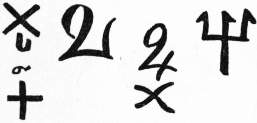
Plymouth, Bristol, Champion and Swansea marks.
The Plymouth factory is supposed to have adopted as its general mark the alchemical symbol for tin. This mark was also used to a limited extent at the Bristol factory, though the general Bristol mark was a cross or a copy of the crossed swords of Meissen. The Staffordshire potters who bought the rights of the Bristol porcelain factory from Champion established a works at Shelton, near Stoke-upon-Trent, in Staffordshire, under the name of New Hall Porcelain Co., but they never manufactured anything of artistic account.
Minor English Factories.—A number of other porcelain factories were founded in England in the latter half of the 18th century, but none of these produced ware of any particular merit. The porcelain made at Longton Hall by William Littler (1752-1758), always clumsy and ugly in form, is interesting for a splendid blue colour characteristic of the factory. This small venture was ultimately absorbed by William Duesbury.
The colony of potters established in Liverpool also made a certain amount of porcelain, as well as “Delft” and other earthenwares, and the Liverpool Museum contains some good examples of their productions.
A little factory at work at Lowestoft in the last quarter of the 18th century has attracted much more attention than it deserves, because certain writers foolishly attributed to it large quantities of “Armorial” porcelain which had, undoubtedly, been made in China. Recent excavations have established the fact that this factory was only of minor importance, and was mainly occupied in producing cheap wares in rivalry with, and even in imitation of, those of the more important English factories.
Towards the end of the 18th century the manufacture of English porcelain spread into the Staffordshire potteries, and the firms of Spode, Davenport and Minton became the most important English factories of the early 18th century. For notices of the minor English factories of the late 18th century and early 19th century, such as Caughley, Coalport, Swansea and Nantgarw, the student is referred to the special works dealing with the history of English porcelain.
Collections.—The British Museum and the Victoria and Albert Museum contain the best general collections of English porcelain. The museums at Bristol and Liverpool contain examples of the local wares; while the museum at the Worcester Royal Porcelain works has an admirable collection of the wares of that factory. Many noteworthy private collections are in existence, of which we may mention those of Mr Dyson Perrins, Mr Cockshutt and Mr Trapnell.
Literature.—Alex. Brongniart, Traitié des arts céramiques (1844); Jacquemart, Histoire de la céramique (Eng. ed. 1873); Jännicke, Grundriss der Keramik (1879); Dr Brinkmann, Handbook of European Porcelains in the Hamburg Museum; Marryat, History of Pottery and Porcelain (1857); Jewitt, Ceramic Art of Great Britain (1878); Auscher, A History and Description of French Porcelain (1905); Burton, A History and Description of English Porcelain (1902); Dillon, Porcelain (1904); Solon, Old English Porcelain (1903); Burton, Porcelain (1906); R. Almstrom, Lervarorna och deras Tillverkning (1903).
(W. B.*)
Pottery and Porcelain during the 19th Century
The development of the manufacture of pottery and porcelain in Europe and America throughout the 19th century need not be treated in such detail as the history of its growth up to that period, for modern means of communication and the general diffusion of knowledge have tended to destroy the individual character which was so marked a feature of the pottery of different countries in previous centuries. The 19th century was distinctly the century of machinery, and, for the most part, it witnessed the displacement by mechanical processes of those methods of handicraft which made the older pottery individual and interesting even in its simplest forms. Collectors are prepared to pay very large sums for choice examples of the potter’s art of bygone centuries, but it is doubtful if much of the pottery of the 19th century will ever be collected for its intrinsic merits, though it may be preserved as an illustration of the spirit of the age.
In preceding sections of this article the development of the brightly painted tin-enamelled wares and the gaily decorated porcelains of various European countries have been traced down to the end of the 18th century, because that date marks, quite distinctly, the period when the old handicraft of the potter was for various reasons displaced by organized manufacture. The disturbed economic condition of Europe in the last quarter of the 18th century and the Napoleonic Wars of the early 19th century proved disastrous to most of the pottery and porcelain works where artistic wares were made, and the disturbance of traditional methods was completed by the superior mechanical perfection and cheapness of the English earthenware introduced by Wedgwood and his contemporaries. The English pottery was neater, more perfectly finished and more durable than the painted tin-enamelled pottery of the continent. It vied in finish with the expensive continental porcelains, and for nearly half a century it carried all before it, not only in England, but throughout the world. An intelligent observer, M. Faujas de Saint Fond, writing in the beginning of the 19th century, remarks of English pottery that “Its excellent workmanship, its solidity, the advantage which it possesses of sustaining the action of fire, its fine glaze impenetrable to acids, the beauty and convenience of its form, and the cheapness of its price, have given rise to a commerce so active and so universal, that in travelling from Paris to Petersburg, from Amsterdam to the farthest parts of Sweden, and from Dunkirk to the extremity of the south of France one is served at every inn upon English ware. Spain, Portugal and Italy are supplied with it; and vessels are loaded with it for the East Indies, the West Indies, and the continent of America.”36 It was calculated that at this time three-fourths of the pottery manufactured in England was sent abroad. Such a state of things was not likely to continue, and in most of the European countries, after the settlement of 1815, such of the older factories as had survived, or new factories specially created for the purpose, adopted English methods of manufacture. In many cases experienced Staffordshire potters were procured to direct these works, and so far as ordinary domestic pottery was concerned, the first half of the 19th century witnessed the establishment in every country of Europe and in the United States of America of pottery works managed by Englishmen, where earthenwares were made after the English fashion. We shall refer presently to the survival or revival of the older styles of pottery and porcelain, but the English influence was undoubtedly paramount, with one or two notable exceptions, down to 1850, or even later. England itself witnessed a notable development of its pottery manufacture, which became more and more aggregated in that district of North Staffordshire designated emphatically “The Potteries,” where, in spite of later developments, from two-thirds to three-quarters of all the pottery and porcelain made in the British Isles is still produced. This concentration of the industry in England has resulted in a race of pottery workers not to be matched elsewhere in the world, and while it was the supply of cheap coal and coarse clay which first gave Staffordshire its pre-eminence, that pre-eminence is now retained as much by the traditional skill of the workmen of the district as by the enterprise of its manufacturers.
Plate IX
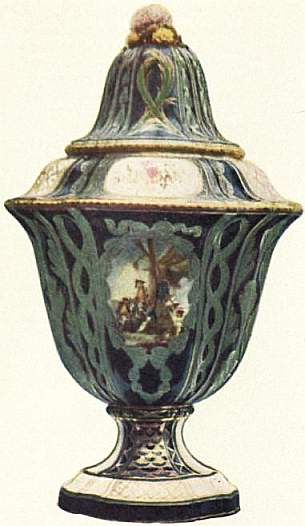
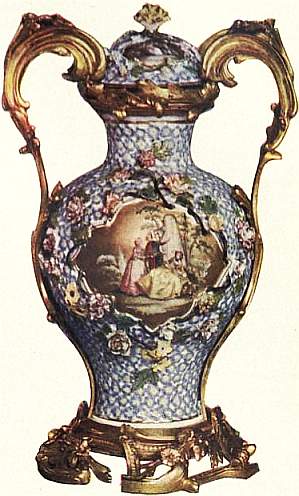
Sèvres. Pâte-tendre, c. 1757, painted by Falot and Morin Meissen. May-flower vase mounted in ormolu. Pâte-dure
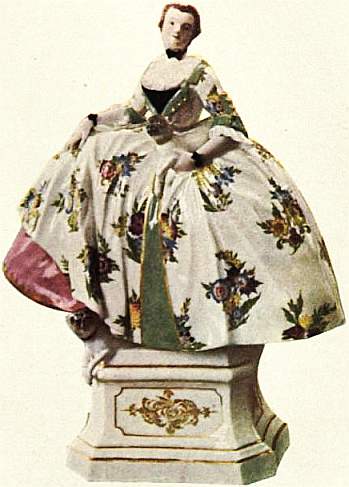
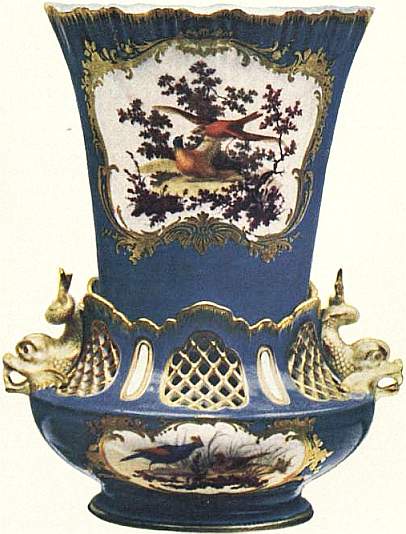
Meissen. Crinoline figure (Kandler), Pâte-dure Sèvres. Pâte-tendre, c. 1756
While we must admire, from the economic point of view, the methods of manufacture which have placed England in the first rank as a pottery-producing country, inasmuch as they have brought within the reach of the humblest domestic utensils of high finish and great durability, it is impossible to say much for the taste or art associated with them. Neatness, serviceableness and durability, English domestic wares undoubtedly possess in a degree unknown to any earlier type of pottery, but the general use of transfer-printing as the principal method of decoration, and the absence of any distinctive style of ornament, must cause them to take a low rank in comparison with the wares of past centuries, when mechanical perfection was impossible and rich colour and truly decorative painting were the chief distinctions of the pottery of every country. The London International Exhibition of 1851 is generally supposed to indicate the low-water mark of art as applied to industry; it should rather be regarded as marking the period when many of the old handicrafts had been extinguished by the use of mechanical appliances and the growth of the factory system, and when the delight of men in these current developments was so great that they were regarded as triumphs in themselves, when they were only “means to an end.”
Since that period the development of pottery and porcelain has followed two main directions: (1) an attempt on the part of manufacturers to produce the most artistic results possible with modern processes and methods, and (2) the interesting and valuable efforts of those individual potters in every country with whom art was the first consideration and commercial production was disregarded.
Though the English pottery factories were of such paramount importance in the first half of the 19th century, it must be remembered that some of the oldest factories in Europe were still alive and active. The royal factories in Sèvres, Meissen, Berlin, Vienna, St Petersburg and elsewhere, surviving the wreck of the Napoleonic Wars, continued at the expense of their respective states, to produce porcelains which were the legitimate development of their work during the 18th century.
Meissen and Berlin.—At Meissen, efforts were made to improve the technical process in use, but, unfortunately, the old Meissen wares had already become valuable, and they were reproduced, marks included, until all initiative was destroyed, and the factory continued to live, mainly, on its old reputation.
At Berlin, the financial troubles of the Prussian monarchy throughout the early years of the 19th century were severely felt, so that a cheaper class of porcelain was manufactured. The only innovations that can be ascribed to the factory during this period, though highly esteemed at the time, form striking examples of the artistic decadence of the period. Such was the lace-work decoration made by dipping lace in porcelain slip so that on firing the thread burned away, leaving a porcelain facsimile; another was the production of slabs of porcelain modelled in such a way that on viewing the piece by transmitted light it appeared like a picture painted en grisaille.
From the artistic point of view there is little to be said for the majority of productions of the Berlin factory, but nowhere in the world has greater attention been paid to the technical and scientific problems of porcelain manufacture, and this establishment has rendered the greatest service in the development of the important chemical and electrical industries of Germany by the splendid appliances it has invented for scientific use.
Since 1870 the works, removed to Charlottenburg, have been conducted with very great enterprise. It was here that Seger perfected his soft porcelain based on the glazes and bodies of the best Japanese porcelains, and here also he developed the manufacture of copper-red glazes in imitation of the old sang-de-boeuf and flambé, glazes of the Chinese, at the same time establishing some of the scientific principles underlying their production. At Berlin, too, all the modern methods of decoration, whether in coloured glazes, raised enamels, pâte sur pâte, the elaborate paintings of flowers, birds or figures, or the use of crystalline glazes, have been followed with great success; but the factory has never yet given any special impetus or new direction to the decorative side of porcelain.
Vienna.—Few European factories were so little affected by the general trend of affairs as the royal factory at Vienna. We have already referred to the elaborate paintings and rich gilding which became the distinguishing feature of its wares towards the end of the 18th century, and this style, once perfected, seems to have been continued with little change. It has been stated by a renowned German authority, that the Viennese porcelain was at its best between 1785 and 1815. During this period the plan of painting copies of pictures on porcelain was developed to its utmost, and this, in combination with the richest gilding, marks the apotheosis of Viennese porcelain. The factory came to an end in 1864, but collectors should be warned that a flood of cheap porcelains, decorated in modern Viennese workshops, and therefore styled “Viennese porcelain,” has during the last twenty years overwhelmed the English and American markets.
Sèvres.—The important part played by the Royal French manufactory at Sèvres has already been sketched. During the troublous years of the French Revolution the works practically came to a standstill, and under the Directory it was a question whether this manufactory, along with certain other state establishments in France, should be closed. Napoleon, however, decided that for the glory of France and as a means of encouraging its porcelain industry, seriously threatened by the English potters, the establishment at Sèvres should be conducted as a national factory. By a splendid coincidence Alexander Brongniart, a man of great natural ability, and a noted scientist, was appointed director, and retained that post under the successive governments of France until his death in 1847. In the hands of Brongniart the establishment at Sèvres became at once a school of research and a centre of practical accomplishment—the influence of which was felt throughout Europe. Its products were obviously inspired by the demands of successive French monarchs and their courts. It ministered to the grandiose ideas of Napoleon, who demanded pieces that were to speak of his victories, and after every campaign a fresh table service or new suite of vases was produced to commemorate the emperor’s successes. The most striking piece of this kind was the vase made to commemorate the marriage of Napoleon and Marie Louise in 1810. It was designed by Isabey and was modelled with figures in bas-relief. The principal group contains not less than 115 such figures, while the subsidiary group, representing the acclaiming populace, contains between 2000 and 3000 figures. This vase was three years in making, and is said to have cost something like £1250. Unfortunately this was not a solitary example of the productions of Sèvres, for under every successive government of the 19th century the factory has been called to produce enormous vases which are to be found in the rooms or corridors of every palace and museum in France, and while these pieces represent wonderful technical skill, both in their manufacture and the decorations with which they are covered, very few of them possess either spontaneity or charm. They are correct, frigid, cold, and compare most unfavourably from the artistic point of view with the masterpieces of oriental pottery.
Everything was carried out on the grand scale, and once again the influence of Sèvres became paramount in Europe, and its styles of painting and decoration were eagerly followed from 1830 to 1870 by all those European potters who were attempting to make anything beyond useful domestic wares. As an instance of its aims in the period between 1830 and 1850, large sums were spent in the production of great slabs of porcelain many feet in area; on which were painted copies of some of the famous portraits and other pictorial masterpieces in the galleries of the Louvre. A number of these are preserved in the museum at Sèvres, and must always excite admiration and even wonder at their technical accomplishment.
The most noticeable invention of Sèvres in the middle part of the 19th century was the pâte sur pâte decoration in which porcelain clays of various colours are used as the artist’s medium. The idea appears to have been adopted from an old Chinese vase by Robert, the chief painter, and at the London International Exhibition of 1862 some small cups decorated in this method, by Gely, were first shown. The most successful work in this style was, however, that produced by M. Solon, who worked at Sèvres until 1870. In that year he came to England and was employed at Minton’s, where for about thirty-five years he continued this method of work, one of the few artistic and beautiful styles of pottery decoration of the 19th century. As practised by M. Solon the pâte sur pâte decoration took the form of paintings of figure subjects or dainty ornamental designs in white slip on a coloured porcelain ground of green, blue, dark-grey or black. On such grounds a thin wash of the slip gives a translucent film, so that by washing on or building up successive layers of slip, sharpening the drawing with modelling tools, or softening or rounding the figure with a wet brush, the most delicate gradations of tint can be obtained, from the brilliant white of the slip to the full depth of the ground. This method was rapidly adopted by all the principal European factories, though nowhere was it carried to such perfection as at Sèvres and at Minton’s. M. Taxile Doat has executed many extraordinary pieces in this style of decoration at Sèvres, and in the British Museum there is a large vase of his, presented by the French government at the beginning of the present century. One great feature of French porcelain manufacture during the 19th century was the development of the industry at Limoges and the neighbouring district of central France. Limoges was a small centre of porcelain production in the period between 1780 and 1850, but after the latter date it rapidly developed into a pottery centre second only in importance to that of the Potteries district in England. We can do no more than mention this fact, because, for the most part, the activities of Limoges have been devoted to the production of pottery commercially, rather than pottery as an art.
The Franco-German War proved a disaster for Sèvres, and all work came to a standstill for a time. The existing manufactory, which was almost completed before the outbreak of the war, was opened by Marshal MacMahon in 1876, but for many years the work was continued under great discouragement. Between 1879 and 1889 attention was paid to the study and imitation of old Chinese methods, and this resulted in the reproduction of many of those Chinese glazes which had hitherto been the despair of European potters.
At the Paris Exhibition of 1900 the display made by Sèvres was perhaps the most notable feature of the magnificent collection of ceramics gathered there. The collection included many varieties of porcelain, both hard and soft paste, decorated in all the current styles of the period; under-glaze painting, on-glaze painting, flambé glazes and crystalline glazes, but most beautiful of all were the magnificent groups of “biscuit” figures designed as table garnitures by some of the best French sculptors of the time.
English Progress.—The demand for elaborate specimens of painted porcelain was at its height throughout Europe between 1851 and 1880, and this demand was undoubtedly fostered by the series of international exhibitions held during that period, when every European pottery works of note produced large and costly specimens of porcelain or earthenware, smothered with painting and gilding. Every famous manufactory produced something beyond the ordinary, but undoubtedly the first of European factories during this period was that of Messrs Minton at Stoke-upon-Trent. M. Leon Arnoux, a descendant of the Arnoux’s of Apt, an old family of French potters, was at this time the technical and artistic director of Messrs Minton’s works, and he was the only pottery director during the 19th century who could in any sense be compared with M. Brongniart of Sèvres. M. Arnoux combined in a remarkable degree artistic with technical skill, and under his management the works of Messrs Minton became the greatest centre of ceramic art in Europe. Skilful modellers, like Jeannest, Carriere-Belleuse, and Protat, and pottery painters such as A. Boullemier, Moussill, E. Lessore and L. Solon were engaged at this factory and produced many of the most characteristic European decorations of the middle of the 19th century.
To this period, too, we must refer another English invention, that of a special porcelain known as “Parian.” This in its finest expression was a “biscuit” porcelain used for the production of statuettes and groups rivalling the finest 18th century “biscuit” figures of Sèvres and Derby. It seems probable that this Parian was first made at the works of Copeland and Garratt, at Stoke-upon-Trent; but it was immediately adopted at Minton’s, Wedgwood’s, and at Worcester; and each of these firms used it in a distinctive way. Glazed Parian was also manufactured at the Belleek Porcelain Works in Ireland (the only Irish porcelain works of any note), and later its manufacture was developed by the Worcester Royal Porcelain Company, Moore Brothers of Longton, and other English manufacturers until it became an important branch of the English porcelain made in the period under review.
Japanese Influence.—At the Paris Exhibition of 1867 the great collection of the applied arts of Japan took Europe by storm, and there was an immediate outbreak of adaptations of Japanese art in Europe once more; not as in the 18th century, when the old Japanese patterns were copied or frankly imitated, but a European-Japanese style arose, based on the methods and ideas of the great Japanese painters and draughtsmen, the workers in metal, in iron, in lacquer and in silk. In England the Worcester Royal Porcelain Company produced a series of elaborate and skilful pieces inspired from this source, which for perfect and minute execution must be ranked before all other European works of their kind.
The most admirable result of this revived interest in Japanese art was, however, developed at the Royal Copenhagen works, the productions of which are not only famous all over the world, but have set a new style in porcelain decoration which is being followed at most of the continental factories. By the use of the pure Swedish felspar and quartz and the finest china clays from Germany or Cornwall a material of excellent quality is prepared, and on this naturalistic paintings of birds, fishes, animals and water or northern landscapes and figure subjects are painted in delicate under-glaze blues, greys and greens. The Royal Copenhagen works has also produced a profusion of skilfully modelled animals, birds and fishes, either in pure white, or delicately tinted after nature, with the same under-glaze colours.
Not only have Berlin, Sèvres and other European factories adopted the modern Copenhagen style of decoration, but the Japanese are now imitating these skilful productions which were originally inspired by their own early work.
Stonewares.—Mention must be made of the revival of the manufacture of artistic stonewares by Doultons of Lambeth, and Villeroy and Boch, the great German potters. Doultons, besides reviving the older forms of English stoneware, made some entirely new departures, and their pieces with designs etched in the clay are admirable examples of the right use of a refractory material. Villeroy and Boch reproduced the old Rhenish stonewares, and many interesting new departures in addition, but mostly in German forms that have not commended the wares to other nations.
Plate X.
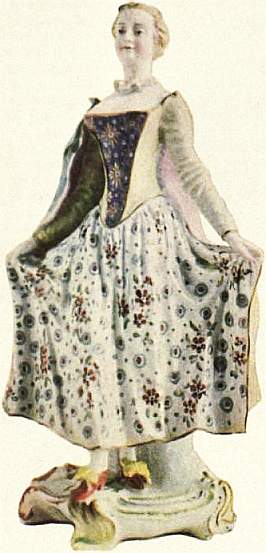
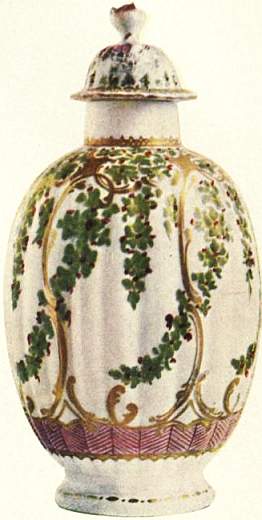
Chelsea porcelain; 1745-1770 Figure after Watteau. Worcester Porcelain; c. 1760-1770
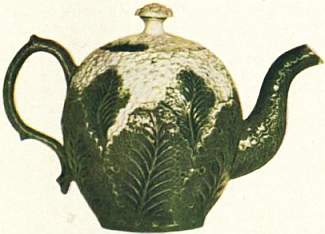
Whieldon and Wedgwood, cauliflower ware; c. 1750-1760
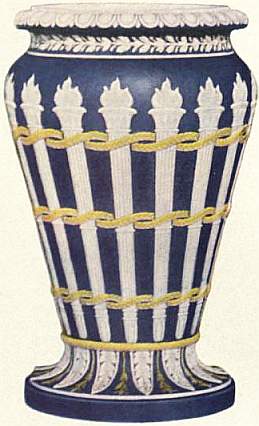
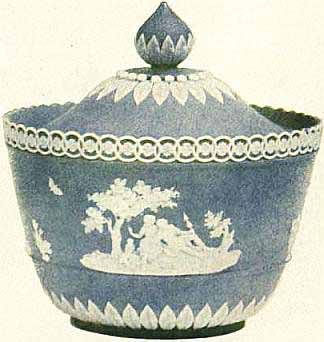
Wedgwood’s jasper; c. 1780 Turner’s jasper; c. 1780
Artistic Results.—While the great potteries of Europe have been employed in improving their methods of manufacture and in consolidating their knowledge on the technical and scientific side, so that they are able to produce pottery more perfect in shape, with a higher degree of finish and greater certainty of result than was ever known before, it cannot be said that the artistic results have been commensurate with the labour expended. Fortunately, however, the success of these important industrial concerns in stereotyping modern production has incited a considerable number of clever men, either potters or artists, to become artist-potters and producers of individual wares, often recalling the works of the great schools of bygone centuries. This movement, which to-day has its exponents in every European country as well as in the United States of America, originated in France between 1840 and 1850, when the formation of the earliest ceramic museums and the new-born interest in the old French faience led to various attempts at pottery-making by the old methods of handwork and rule of thumb. Avisseau of Tours (1845), Pull of Paris (1855), and Barbizet (1859) began to make pieces in the style of Palissy, and Ulysse of Blois (1863) revived painted faience in imitation of that of Nevers. Slowly a demand for painted pottery was created among collectors and amateurs, and in France and other countries artists began to dabble in the painting of pottery. In some cases the artist retained his freedom, painting pieces obtained from some pottery manufacturer, which he sold on his own account after they had been decorated and fired; or he became attached to a particular factory and his productions were sold by the potter; or the artist became an amateur potter, and either worked alone or encouraged other artists to co-operate with him.
It is impossible to do more than mention a few of the prominent men in each class, whose works were not only esteemed in their own day, but are also likely to be regarded always as among the distinguished productions of the 19th century. Emile Lessore and Chapelet were both painters who were attracted by the technique of the potter. For some time they bought specimens of pottery from a small manufacturer named Laurin at Bourg-la-Reine, and after a time they definitely forsook pictorial art for that of the potter. Lessore painted in underglaze colours in a delicate sketchy style figure-subjects, mostly adapted from old engravings. He worked for a short time at Sèvres, and then, like so many other French pottery artists of this period, he came to Minton’s in England, and finally entered into an engagement with the old firm of Josiah Wedgwood & Sons which continued almost to his death (1860-1876). On their fine cream-coloured earthenware he sketched many thousands of fanciful designs which had a great vogue in the ’seventies and ’eighties of the last century. Chapelet pursued a very different course. His first innovation was a method known as “Barbotine” or slip-painting, in which coloured clays were used “impasto,” often in considerable thickness, so that after the work had been fired and glazed it bore some resemblance to an oil painting. For a few years this style of decoration became the rage all over Europe, but it fell into contempt almost as rapidly as it had found favour, and is now only used for the decoration of common wares. Ultimately, Chapelet gave up painting and applied himself to the discovery of technical novelties. He was apparently the first European potter to produce flambé glazes after the manner of the Chinese, and a fine collection of these productions of his is preserved in the museum at Sèvres.
The greatest of all the French innovators was, however, Théodore Deck, who had been trained as a working potter and was led to forsake the management of an ordinary tile and pottery business in Paris to experiment on his own account. He started a little workshop in the Boulevard Montparnasse in Paris and rapidly gathered round him a number of young painters all eager to experiment in the magnificent colours which Deck with his passionate love of Persian and other oriental pottery could place at their disposal. Within a few years this venture was so successful that Deck was known all over the civilized world as a great potter, and his original creations, painted by men like Ranvier, Collin, Ehrmann, Anker and other artists, were readily purchased by the lovers of ceramic art in every country. The crown of his career came in 1887, when he was appointed director of the National Manufactory at Sèvres, for he was the only practical potter who had ever occupied that position; but he died in 1890 before he had been able to impress his personality on the work of Sèvres.