VOLUME V SLICE VI Celtes, Konrad to Ceramics (continued 7)
Reading edition
Arretine Ware.—The Latin writers, and in particular Pliny, mention numerous places in Italy, Asia Minor and elsewhere, which were famous for the production of pottery in Roman times. Pliny mentions with special commendation the “Samian Ware,” the reputation of which, he says, was maintained by Arretium (Arezzo). Samian pottery is also alluded to by other writers, and hence the term was adopted in modern times as descriptive of the typical Roman red wares with reliefs, whether found in Italy, Germany, Gaul or Britain. But it was only accepted with diffidence as a convenient name, and as early as 1840 discoveries at Arezzo made it possible to distinguish the vases found there as a local product, now known as “Arretine” ware. The name “Samian” has, however, adhered to the provincial wares and at the present day is often used even by archaeologists. But recent researches have shown that nearly all the provincial wares can be traced to Gaulish or German potteries, and, since it is implied by Pliny that “Samian” pottery is older than “Arretine,” the name may now be fairly rejected altogether, as we have rejected the name “Etruscan” for Greek pottery. The Romans probably used it as a generic term, just as we speak of “china,” and the real Samian ware is to be seen in the later Greek pottery, with reliefs, of the 3rd century b.c.
There were, as Pliny and other writers imply, many pottery centres in Italy, at Rhegium, Cumae, Mutina and elsewhere, as well as at Saguntum in Spain, but all were surpassed in excellence by Arretium. In more modern times its pottery came under notice even in the middle ages, and discoveries were made in the time of Leo X (about 1500) and again in the 18th century. The Arretine ware may be regarded as the Roman pottery par excellence, and its popularity extended from about 150 b.c. down to the end of the 1st century of the Empire, reaching its height in the 1st century b.c., after which it rapidly degenerated, and its place was taken by the wares of the provinces. Its general characteristics may be summed up as follows:—(1) The fine local red clay, carefully levigated and baked very hard to a rich coral red or a colour like sealing-wax; (2) the fine red glaze, which has already been discussed; (3) the great variety of forms employed, showing the marked influence of metal-work; (4) the almost invariable presence of stamps with potters’ names. The majority of the specimens have been found at Arezzo itself, but there was a branch of the industry at Puteoli, producing pottery almost equal in merit, and it was also exported to central and eastern Europe and Spain.
The earliest examples are of black glossy ware, but the red appears to have been introduced by 100 b.c., when the first potters’ stamps appear. These are usually quadrangular in form, though other shapes are found, and are impressed in the midst of the design on the ornamented vases, or on plain wares on the bottom of the interior. The number of potters’ names is very large, though some appear to have been more prolific than others, and to have employed a large number of slaves, whose names appear with their masters’ on the stamps. The best known is Marcus Perennius, whose wares take highest rank for their artistic merit, the designs being copied from good Greek models. He employed seventeen slaves, of whom the best known is Tigranes, the stamps usually appearing as M·PEREN and TIGRAN. The slave-name of Bargates is found on one of his finest vases, in the Boston Museum, the subject being the fall of Phaethon. We may suppose that the stamps for the figures were designed by the masters, but that the vases were actually moulded by the slaves. Other important artists are Calidius Strigo, who had twenty slaves; P. Cornelius, who had no less than forty; Aulus Titius, who signs himself A·TITI·FIGVL·ARRET; the Annii and the Tetii; and L. Rasinius Pisanus, a degenerate potter of the Flavian period, who imitated Gaulish wares.
The forms of the vases are all, without exception, borrowed from metal shapes and are of marked simplicity (see fig. 37, Nos. 1, 8, 9, 11). They are mostly of small size and devoid of handles, but a notable exception is a bell-shaped krater or mixing-bowl, of which there is a very fine example in the British Museum, found at Capua and decorated with the four seasons (Plate III. fig. 62). For the decoration and subjects the potters undoubtedly drew their inspiration from the “new-Attic” reliefs of the Hellenistic period, of which the krater just cited is an example. So, too, are such subjects as the dancing maenads or priestesses with wicker head-dresses, or the Dionysiac scenes which are found, for instance, on the vases of Perennius. Others again are distinguished by a free use of conventional ornament, figures when they occur being merely decorative. There is throughout a remarkable variety both in the ornamentation and in the methods of composition.
Provincial Wares.—The Arretine ware, as has been noted, steadily degenerated during the 1st century of the Empire, and the manufacture of ornamental pottery appears to have entirely died out in Italy by the time of Trajan. Its place was taken by the pottery of the provinces, especially by that of Gaul, where the transference of artistic traditions led to the rise of new industrial centres in the country bordering on the Rhone and the Rhine.
As to the general characteristics of the provincial wares, that is, of the ornamented wares or terra sigillata, the clay is fine and close-grained, harder than the Arretine, and when broken shows a light red fracture; the surface is smooth and lustrous, of a brighter yet darker red colour (i.e. less like coral) than that of Arretine ware, but the tone varies with the degree of heat used. The most important feature is the fine glaze with which it is coated, similar in composition to that of the Arretine; it is exceedingly thin and transparent, and laid equally over the whole surface, only slightly brightening the color of the clay. The ornament is invariably coarser than that of Arretine ware, by which, however, it is indirectly inspired.
The vases are usually of small dimensions, consisting of various types of bowls, cups and dishes, of which two or three forms are preferred almost to the exclusion of the rest, and they frequently bear the stamp of the potter impressed on the inside or outside. Although this ware is found all over the Roman world, by far the greater portion comes from Gaul, Germany or Britain, and evidence points to two—and only two—districts as the principal centres of manufacture: the valleys of the Loire and the Rhine and their immediate neighbourhood. In the 1st century a.d. Gaulish pottery was largely exported into Italy, and isolated finds of it occur in Spain and other parts.
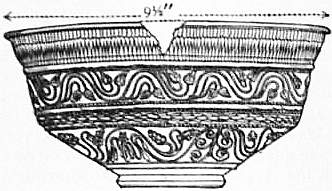
Fig. 36.—Bowl of Gaulish ware, with moulded patterns in slight relief.
The recent researches of Dr Dragendorff and M. Déchelette have shown that a chronological sequence of the pottery may be clearly traced, both in the shapes employed and in the method of decoration; and, further, that it is possible—at least as regards Gaul—to associate certain potters’ names and certain types of figures, though found in many places, with two centres in particular, Graufesenque near Rodez (department of Aveyron) in the district occupied by the Ruteni, and Lezoux near Clermont (department of Puy-de-Dôme) in the country of the Arverni. The periods during which these potteries flourished are consecutive, or rather overlapping, but not contemporaneous, the former being practically coincident with the 1st century a.d., the latter with the 2nd and 3rd down to about a.d. 260, when the manufacture of terra sigillata practically came to an end in Gaul.
There were also certain smaller potteries, some of which mark a transition between the Italian and provincial wares, in the north of Italy and on the Rhine and upper Loire, e.g. St Remy-en-Rollat, and others of later date, as at Banassac and Montans in the latter district, but none of these produced pottery of special merit or importance. The early Rhenish wares are, strictly speaking, of a semi-Celtic or Teutonic character, while the later German terra sigillata, for which the principal centres were Rheinzabern near Carlsruhe and Westerndorf in Bavaria, are of similar character but inferior to the 2nd-century pottery of Lezoux. A mould from Rheinzabern is illustrated, Plate IV. fig. 66.
The ornamented vases produced in these potteries are, as we have said, almost confined to two or three varieties, which follow one another chronologically. A shape favoured at first is the krater, which has been mentioned as one of the characteristic Arretine forms; but this enjoyed but a short term of popularity. Early in the 1st century we find a typical form of bowl in use, which, following the numeration of Dr Dragendorff’s treatise, is usually spoken of as No. 29. This is characterized by its moulded rim engraved with finely incised hatchings, and by the division of the body by a moulding into two separate friezes for the designs (fig. 36). Its ornament is at first purely decorative, consisting of scrolls and wreaths, then small animals and birds are introduced, and finally figure subjects arranged in rectangular panels or circular medallions. About the middle of the century a second variety of bowl (known as No. 30; see fig. 37) was introduced; this is cylindrical in form, and, being found both at Graufesenque and Lezoux, may be regarded as transitional in character. In the latter half of this century a new form arises (No. 37; fig. 37), a more or less hemispherical bowl which holds the field exclusively on all sites down to the termination of the potteries. In this form and in No. 30 a new system of decoration is introduced, the upper edge being left quite plain. The panels and medallions at first prevail, but are then succeeded by arcading or inverted semicircles enclosing figures, and finally after the end of the 1st century (and on form 37 only) we find the whole surface covered with a single composition of figures unconfined by borders or frames of any kind, but in a continuous frieze; this is known as the “free” style (Plate IV. fig. 69).
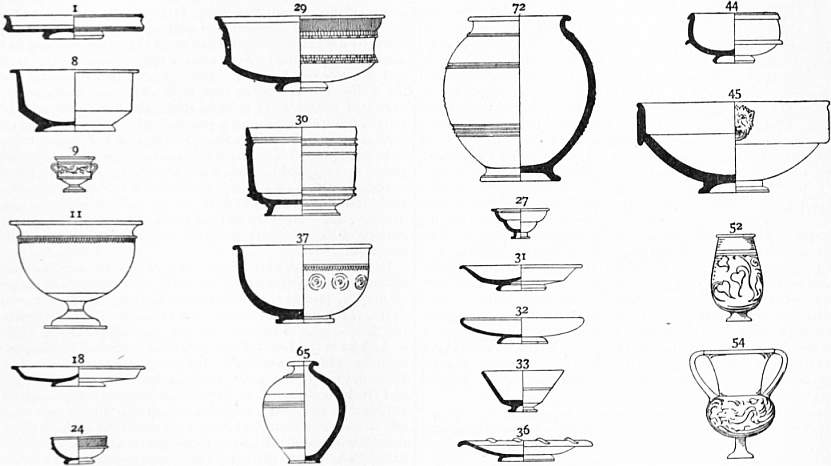
Fig. 37.—Shapes used in Roman Pottery. 1-11, Arretine; 18-65, Gaulish and German.
As regards the figure subjects, it may be generally laid down that the conceptions are good, but the execution poor. Many are obvious imitations of well-known types or works of art, and the absence of Gaulish subjects is remarkable. They include representations of gods and heroes, warriors and gladiators, hunters and animals, the two latter classes being pre-eminently popular.
The potters’ names at Graufesenque are nearly all of a common Roman type, such as Bassus, Primus, Vitalis; those at Lezoux are Gaulish in form, such as Advocisus, Butrio, Illixo or Laxtrucisa. This seems to imply that Roman influence was still strong in the earlier centre which drew its inspiration more directly from Arretium. But even the purely Roman names are sometimes converted into Gaulish forms, as Masclus for Masculus, or Tornos for Turnus. The stamps are quadrangular in form, depressed in the surface of the vase with the letters in relief; on the plain wares they are usually in the centre of the interior, but on the ornamented vases are impressed on the exterior among the figures. The usual formula is OF (for officina) or M (for manu) with the name in the genitive, or F, FE or FEC for fecit with the nominative.
Besides the ordinary terra sigillata with figures produced in moulds we find other methods of decoration employed. In the south of France, about Arles and Orange, vases were made with medallions separately moulded and attached round the body; these have a great variety of subjects, both mythological and gladiatorial or theatrical, or even portraits of emperors. There is a remarkable specimen in the British Museum with a scene from the tragedy of the Cycnus, on which Heracles and Ares are represented, with seated deities in the background (Plate IV. fig. 67). The date of these reliefs is the 3rd century after Christ.
Of the same date is a somewhat similar ware made at Lezoux. Here each figure is attached separately to the vase, and the background is filled in with foliage produced by the method known as en barbotine (slip-painting), of which we shall speak presently. The effect of these vases, which are mostly large jars or ollae (Plate IV. fig. 70), is often very decorative, and there is a fine specimen in the British Museum from Felixstowe, on which the modelling is really admirable. Other good examples have been found in various parts of Britain.
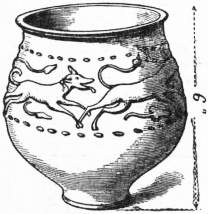
Fig. 38.—Jar of Castor ware, with reliefs of a stag pursued by a hound, executed in semi-fluid slip. 6 in. high.
The “slip-decoration” process is practically unknown in Italy, but it is found early in the 1st century of our era in Germany, and appears to have originated in the Rhine district. It is not confined to the red ware, but in the early German examples is applied on a dull grey or black background. On the continent its use is almost limited to simple decorative patterns of scrolls or foliage, but in Britain it was largely adopted, as in the well-known Castor ware made on the site of that name (Durobrivae) in Northamptonshire. Many of the vases found or made here have gladiatorial combats, hunting-scenes, or chariots executed by this method (fig. 38). The decoration was applied in the form of a thick viscous slip, usually of the same colour as the clay, but reduced to this consistency with water, and was laid on by means of a narrow tube or run from the edge of a spatula. The Castor ware appears to date from the 3rd and 4th centuries a.d.
Painted wares are at all times rare, but were occasionally produced in Gaul, Germany and Britain. A notable class of such ware seems to have been produced in the Rhine district, represented by small jars covered with a glossy black coating, on which are painted in thick white slip inscriptions of a convivial character, such as BIBE, REPLE, DA VINUM, or VIVAS (Plate IV. fig. 68). A very effective ware, obviously imitating cut glass, by means of sharply incised patterns, was made at Lezoux in both the red and black varieties.
Literature.—Dragendorff in Bonner Jahrbücher, xcvi. 37 ff.; Déchelette, Vases céramiques de la Gaule romaine (1904); Walters, Ancient Pottery, ii. chaps, xxi.-xxiii.; British Museum Catalogue of Roman Pottery (1908).
(H. B. Wa.)
Persian, Syrian, Egyptian and Turkish Pottery9
Formerly, in all general accounts of the potter’s art, it was the custom to pass over the period between the fall of the Roman empire and the appearance of the beautiful Persian and Syrian pottery of the early middle ages, as if the intervening centuries had produced nothing worthy of note. Even yet the successive steps by which this beautiful art arose are largely matters of inference and deduction, but it must be borne in mind that while the Greeks and Romans made singularly little use of glaze and painted colour, the Egyptians and the inhabitants of Syria and Mesopotamia had long been noted for their skill in this direction. In discussing the pottery of these peoples we have already pointed out at what a very early period they had developed the production of rich and beautiful coloured glazes—the Egyptians as a jewel-like decoration of small pieces made in a very sandy paste, or actually carved from stone, and the Assyrians, on a bolder scale, in their glazed and coloured brickwork. Though the Egyptian and Syrian empires were overthrown, the peoples of these countries remained; and, as we are now aware, carried on their traditional craft, though in a less splendid way. There is abundant evidence that pottery was made in the Egypt of Roman times and later with rich turquoise blue and yellow glazes, though the potters had learned to produce this glaze on a material containing more clay and less sand than that used in earlier days. We know also that they had learned that the addition of lead oxide to a glaze enabled such glaze to be applied on vessels formed from clay which was sufficiently plastic to be shaped on the wheel. This knowledge was not confined to Egypt, but appears to have been spread over Syria and parts of Asia Minor; and throughout the Byzantine empire many forms of pottery were made which were clearly the starting-points of much of the fine pottery produced in Europe in later times. We find, for instance, side by side, a manufacture of bowls, dishes and vases of very simple shape, yet made of two distinct materials: (1) a whitish sandy body on which turquoise blue, green or even white glaze, consisting mainly of silicates of soda and lime, was used either without ornament or with simple painted patterns in black or cobalt blue under the glaze; (2) similar vessels made of a lightish red clay, also rather sandy and porous, coated with a white slip (pipeclay or impure kaolin) covered with a yellowish lead glaze. These vessels were decorated in a variety of ways: (1) Graffiati; patterns cut or scratched through the coating of white slip while it was still soft, down to the red ground, so that when the vessel was glazed it displayed a pattern in dark upon a light ground. (2) Yellow and red ochre and copper scales were rudely “dabbed” over the white slip surface, so that when the vessel was glazed it presented a marbled or mottled appearance with touches of red, yellow, brown or green, on a yellowish-white ground. (See the section on Egyptian pottery above.) (3) Oxides of copper or iron were added to the lead glaze, and the resulting green or yellow glazes were applied to plain vases or to vessels decorated with moulded reliefs. In all these methods we see the continuation of old tradition in simpler forms, but we shall also see that these, in their turn, became the starting-point of much of the medieval pottery of Europe, particularly of Italy and the other southern countries.
In the same way, a little farther east, the Persians of Sassanian times seem to have preserved some of the traditions of the potters of Assyria, just as they inherited their skill; and the Assyrian device of raising strong brown outlines round a design to control the flow of coloured glazes, which is exemplified in the Frieze of Archers in the Louvre, was carried on by them, for it appears unchanged in the tiles of the Mosque of Mahommed I. built at Brusa in the 15th century. The intercourse between the Persian and Byzantine empires at this time must have led to a general diffusion of technical knowledge among the pottery centres of the various countries round the eastern end of the Mediterranean, though our knowledge is too fragmentary to furnish sufficient data for any definite placing of the progress made. Our information is mainly derived from the examination of the rubbish mounds at Fostat, or Old Cairo, in Egypt, by Dr Fouquet, and by eager inquirers like Henry Wallis. Fostat was built in a.d. 640 by Amr and destroyed in the 12th century; partially rebuilt, it was given over to pillage in 1252 by a Mameluke sultan, and all that remains is the Old Cairo of to-day, the rest of the site being covered with accumulated rubbish heaps. In the same way Rhagae or Rai, one of the ancient capitals of Persia, the site of which lies a few miles east of Teheran, was destroyed about 1220 by Jenghiz Khan. Like Fostat it was partially rebuilt, but was destroyed again in the following century, so that its existence practically ceased in the 14th century. Rhagae was once an important centre of the ceramic industry, but this was transferred to the neighbouring town of Veramin, in the 13th century. Excavations have also been made on the site of Rakka, near Aleppo, in Syria, and from all these sources, and a few others of minor importance, much interesting light has been thrown on the development of the potter’s art in these countries during the period between the 4th and 12th centuries. Yet, until systematic excavations have been made in Persia, Anatolia, Syria and the Delta, on the same scale as those which have proved so valuable in Greece, Crete, Cyprus and the valley of the Nile, we cannot hope to possess sound chronological data of the developments of the arts in these countries. Meantime the exact share which should be allotted to each district for its discoveries will remain ground of contention for scholars of conflicting schools, though there can be little doubt that Egypt and the southern part of Syria played a more important part than has generally been supposed in the development of the potter’s art at this period.
Persian Pottery.—The most important pottery of the nearer East, whether considered on its own merits or from the influence it has exercised on the pottery of later times, is that so highly valued by collectors under the distinctive name of Persian; though much that passes under that name may not have been made in Persia. From the 10th to the 16th centuries the craftsmen of Persia were perfect masters of decorative design and colour; and, as potters, they possessed a sense of the forms proper to clay, such as none of the great races of antiquity ever exhibited. The shapes of Greek pottery speak more strongly of metal than of clay, but the best Persian work exhibits a feeling for the material that has rarely been equalled. The shapes are not only true clay-shapes but they are designed so as best to exhibit the qualities of the glaze and colour with which they were to be decorated. Certainly from the 12th to the 16th centuries the pottery of the Persians must rank among the greatest achievements of the potter’s art. The ware was shaped from various mixtures such as we have already spoken of—but whether its body was a mixture of white clay with a large proportion of sand, or some inferior clay that burnt to a yellowish or red tint, and was surfaced with a fine white coating of siliceous slip, or with a mixture of soda-glass, clay and oxide of tin, which made it whiter still—the one aim was to produce a white pottery. On this white ground—with a coarsish absorbent surface—beautiful patterns, in conventional floral or animal forms, were deftly painted in cobalt-blues, manganese-purples, copper-greens and turquoise, with mixtures for intermediate tints; while a strong brownish-black outline colour was compounded by mixing the oxides of iron and manganese, to be turned into a fine, still black by the addition of a trace of cobalt and later of oxide of chromium. Over this freely painted colour, often used in broad flat masses, a singularly limpid alkaline glaze, generally of considerable thickness, was fired until it just fused; and the resultant effect is of the most rich and brilliant colour relieved on a ground of slightly toned white. Judging from fragments which have been found at Rai, and which can scarcely therefore be later than the 13th century, we find the characteristic Persian style of ornament already developed; dumpy little figures kneeling, standing or riding on grass between cypress trees, or animals and birds similarly disposed, with conventional borders and bands of Cufic inscriptions. Another well-known type of pattern consists of highly conventionalized floral ornament which often runs to a beautiful tracery of “arabesque” lines. The drawing is generally finely outlined with brown or black (a survival of the ancient Assyrian practice), and in the earliest pieces the flat washes of colour are laid in only in cobalt-blue, turquoise or green from copper, and shades of purple and brown from manganese. From the 16th century onwards Chinese influence is strongly felt both in the designs and in the colour schemes, particularly in the wares painted with patterns in blue only (fig. 39), which sometimes carry the imitation of Chinese porcelain so far as to bear forged Chinese marks. Finally, Shah Abbas I. (1587-1629) is said to have brought a number of Chinese artificers, among them many potters, to Ispahan, and we find that Chinese porcelain was largely painted at King-tê-Chên, with blue decorations in the Persian taste, so that we cannot be surprised at the growth of a hybrid Perso-Chinese style of decoration. From this period, however, Persian pottery deteriorated both in its technical and artistic aspects. Crudely moulded figures in fairly high relief, coloured with an opaque yellow and green as well as with transparent blue and turquoise, began to make their appearance, especially on the famous Persian tiles; and in the 18th century the brown and black outlines of the drawing (a most valuable decorative resource) vanish, and we get brighter and more glittering, yet poorer colours, including a rose-red enamel fired over the glaze, evidently imitated from the Chinese famille-rose porcelains of the 18th century.
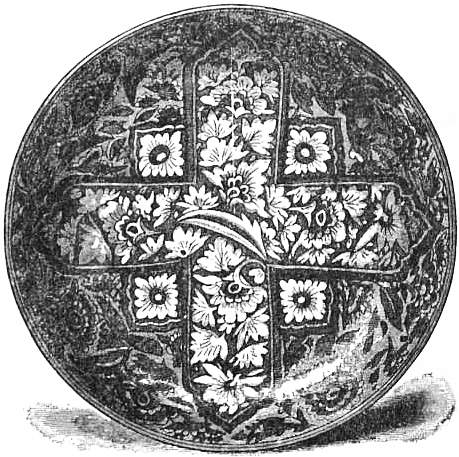
Fig. 39.—Persian Plate painted in blues only. (Victoria and Albert Museum.)
The finest work appears to have been produced from the 11th to the 14th centuries; yet so imperfect is our knowledge of what is truly Persian, Syrian or Egyptian, that we are forced to accept many conventional names that have perhaps little but custom to recommend them. There is, for instance, an important class of pottery known, until recently, only from a few remarkably handsome vases, and once called “Siculo-Arab” because these few examples had been mostly found in Sicily. This ware is characterized by its fine quality and its distinguished ornament—leaf-shaped panels with arabesques; interlacing patterns; striped and dotted bands; friezes of animals or birds amidst flowers and foliage, inscriptions, &c.; all strongly and firmly drawn in black or brown outlines and washed in with a very pure cobalt-blue or with turquoise. In spite of the resemblance of these pieces to the oldest Persian wares, we know that bowls, dishes, vases and spoilt pieces of the same kind have been dug up on the site of Rakka near Aleppo; similar ware has been found at Fostat, together with evidences of local manufacture, and occasional pieces have been brought from Persia; so that probably this distinguished ware was made at Rakka in Syria between the 9th and the 13th centuries, and was afterwards made by Syrian potters both in Persia and Egypt.
Other Persian Wares.—We have already spoken of the prevalent use of coloured glazes in all the countries of the nearer East—from Egypt to Persia—from remote times, either as the sole colour decoration or in conjunction with modelled or painted ornament. The fragments from Rai and Fostat include rich turquoise glazes (derived from the ancient Egyptian), deep and light-green glazes containing lead and copper, imitations of ancient Chinese céladon-green, a brownish-purple glaze, a coffee-brown glaze and a deep cobalt-blue glaze.10 All these may be found either on plain vases, or on vessels with modelled ornament; or covering delicate floral or arabesque patterns painted in white slip or incised in the paste. Sometimes, even at this early period, there are traces of applied gold-leaf attached, but not fired, to the glaze.
At a very early period, too, we find those beautiful bowls, dishes and vases decorated with geometrical or arabesque patterns in a singularly still underglaze black, and covered with the blue turquoise or green copper glazes. This characteristic and beautiful ware is common to Persia, Syria and Egypt in Saracen times, and it was soon prized in Europe, as is shown by the famous fragment found by the late Mr Drury Fortnum built into the outer walls of S. Cecilia in Pisa, where it was apparently placed in the 12th century.11
At a later date a shining black glaze made its appearance, and in the 13th century pale and lapis-lazuli blues, while there is a comparatively modern sage-green glaze found only on pieces bearing patterns modelled in low relief.
Persian Porcelain.—This beautiful and somewhat mysterious ware—often called “Gombroon” ware—apparently made its appearance in the 13th century, though the bulk of the known examples are not earlier than the 17th or 18th century. The ware is quite translucent and is of soft and delicate texture. Unlike Chinese porcelain, it was made from a mixture of pipe-clay and glass, and was glazed with a soft lead glaze; so that a fragment of it would melt to an opaque glass in an ordinary porcelain oven. It is principally met with in the form of dishes, bowls (often mounted on feet) and saucers. The pieces are generally very thin and are either perfectly plain or bear flutings or simple wavy patterns incised in the paste. Most characteristic and beautiful is the decoration by means of delicate perforations either straight or lozenge-shaped. In the finest pieces the perforations are filled with glaze, and then they form a decoration analogous to the well-known “rice-grain” decoration of the Chinese. Occasional pieces are found decorated with colour, either a delicate green, producing an effect like pale bright céladon, or the well-known Persian blue ground; and this is sometimes decorated with lustre patterns. Nowhere can this rare and delicately beautiful ware be so well studied as in the Victoria and Albert Museum.
Lustred Ware.—The decoration of pottery with iridescent metallic films is one of the most astonishing and beautiful inventions ever made by the potter. Hitherto we have seen only coloured clays, coloured glazes, or colours fired under the glaze, but we are now brought face to face with a colour effect produced by refiring the finished glazed pieces, at a lower temperature, with pigments painted upon the glaze (fig. 40; see also Plate V. 13th-century Persian lustre). How such a practice originated is probably an idle speculation, but it may have come through repeated attempts to decorate pottery with gold. If gold was painted under the glazes of these ancient vases, it would probably vanish and leave no trace; but gold, alloyed with much silver, applied over the finished glaze and refired, in the attempt to make it adhere, may have given the first films of iridescent colour. We know certainly that before the 13th century the elements of the process had been mastered, and that the potters of the nearer East had learnt that by mixing some compound of silver (doubtless the sulphide) with clay, and painting the mixture on the finished vase, which was refired in such a way that the pieces were only raised to a dull red heat and were then exposed to the vapours of the wood-fuel, glowing lustrous patterns were left on the ware that looked like metal—but metal shot over with all the hues of the rainbow, golden, rosy, purple and green. Numerous fragments of this lustred pottery had been disinterred from the site at Rhagae, and it was therefore assumed that the beautiful process was of Persian origin, particularly as most of the examples then known bore designs of distinctly Persian style. We are now inclined to think that the process really arose in Egypt or in Syria, and was carried eastward to Persia, just as it was afterwards carried westward to Spain. In support of this view there is the written record of the Persian traveller Nasiri Khosrau, who visited Old Cairo in the 11th century (1035-1042). He was apparently familiar with the pottery of his own country, and notes all the novel forms that he found in the bazaars of Old Cairo, which was both a great trading emporium for the traffic of East and West, and a pottery centre of note. He mentions, specially, certain translucent bowls of earthenware decorated with colours resembling a stuff called “bougalemoun,” “the tints changing according to the position which one gives to the vase.” Such a description could only apply to “lustred” pottery, and it would seem as if this process must have been known in Egypt or Syria before it was practised in Persia (see Plate V., 13th-century Syro-Persian). In any case the secret was soon carried to Persia, for we have ample evidence that it was practised at Rhagae in the next century.
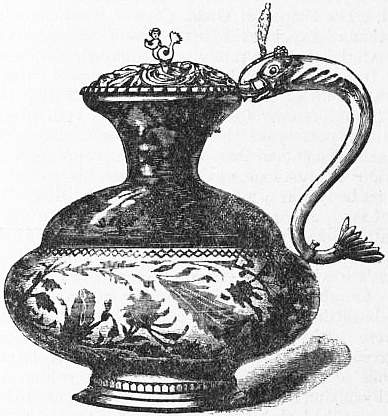
Fig. 40.—Persian Ewer, white ground, with pattern in brown copper lustre; the upper part has a blue ground. The mounting is gilt bronze, Italian 16th-century work. (British Museum.)
The earliest dated example of Persian lustred ware is a star-shaped tile of the year a.d. 1217 (a.h. 614), decorated with spotted hares, heraldically confronted, in a ground of lustre relieved by dots and curls, and surrounded by an inscribed border. A vase in the Godman collection bears the date a.d. 1231 (a.h. 629), and some of the well-known “star and cross” tiles from Veramin belong to the year a.d. 1262. The early Persian lustre is chiefly known to us through the tiles with which the walls of mosques and public buildings were decorated; the more ephemeral vases, bowls and dishes have survived in smaller numbers and very rarely in perfect condition. Common motives of decoration were animals and birds (sometimes showing Chinese influence), the hare and the deer being favourites; roughly drawn sack-like figures of men and women, mounted or on foot (probably heroes of Persian legend), conventional foliage and arabesques. The designs are usually reserved in a lustred ground, which is relieved by small scrolls, curls and dots etched in the lustre (as though the glazed piece had been covered all over with the lustre mixture and the ornament scratched out of this when it was dry), and showing beneath the ivory-white tin-enamel with which the early wares are generally coated. The lustre itself when viewed directly may look like some golden or deep chocolate-brown colour, but as the piece is turned to catch a side-light this deep colour is seen to bear a thin iridescent film, which glows with golden, green, purple or ruby-red metallic reflets. On the earliest examples the decoration is often entirely in lustre, but later, lustre is often used to eke out a pattern painted with masses of pale cobalt-blue or turquoise under the glaze. Similar tiles with rather more elaborate ornament bear 14th-century dates, and another variety has parts of the decoration, more particularly the large letters of the inscriptions, raised in low relief and heightened with blue. Yet another class, belonging to the 14th century, has a fine dark-blue alkaline glaze, with designs in low relief, picked out with scrolls and arabesques in white enamel or bold floral sprays in leaf-gold. Lustre is frequently found applied to the rich cobalt-blue ground, and there are still existing a few magnificent vases which show the artistic possibilities of this scheme of decoration. It should be noted that when the pieces are in the round, the pattern is usually painted in lustre and not reserved in a lustre ground as on the flat tiles. In the later examples the tin-enamel was replaced entirely by white slip, and the lustre decoration continued in use until the end of the reign of Shah Abbas I. (1587-1629). To the last period belong many charming bowls, narghilis, cups and dishes in a brown lustre, with ruby reflets, on a white or a deep blue ground; this ware is pure white in substance and generally translucent, and the pieces are occasionally signed (see Persian porcelain above).
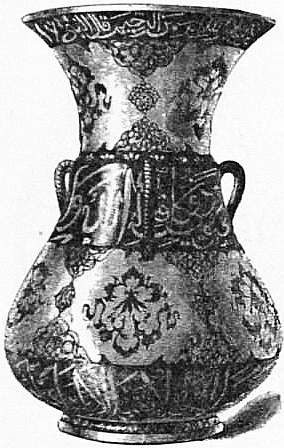
Fig. 41.—Lamp from the Mosque of Omar.
Damascus Ware.—This time-honoured name (for “Damas Ware” was often mentioned in medieval inventories, and appears to have included many varieties of oriental pottery which were highly prized in Italy, France and England in the middle ages)12 forms rather a puzzle nowadays for the archaeologist, for many diverse wares have been included under this title, some of which were not made at Damascus. Yet Damascus is one of the oldest cities in the world, and has seen unnumbered dynasties come and go around its desert-fringed oasis. An important centre of caravan traffic, a nexus of palpitating life from east and west, north and south, we cannot wonder if it developed a special pottery of its own, tinged with something of a cosmopolitan spirit. Formerly the Damascus wares were treated as a variety of the Persian pottery we have just described, but the best examples of the class now known under this name exhibit a mingling of various influences such as we might expect, and have well-marked affinities both with the Persian wares and those brilliant productions now commonly recognized as Syrian and Turkish, while even far-off echoes of Chinese decorative mannerisms are not wanting. The characteristic Damascus ware of the collector is marked by its quality; the ground is of very clear white, the colours are pure and brilliant, and the vessels, whether dishes or vases, are soundly made. The decoration, which is purely floral or conventional, recalls the more formal Persian style, but the colours recall those of the Turkish pottery with one remarkable substitution. The piled-up red-clay pigment of the latter is absent, but where it would inevitably occur in the design of a Turkish piece its place is taken by a purple made from manganese, which is often thin and rather washy in quality. Fine examples of this famous ware are to be seen in the British Museum and in the Louvre; its characteristic style of pattern is well shown in the 16th-century Damascus piece reproduced in Plate V. Another splendid example is the lamp from the Mosque of Omar at Jerusalem, also in the British Museum (fig. 41); and this has generally been classed with the Damascus wares, though its colouring and its technique belong rather to Lower Syria or to Egypt. This magnificent piece bears a dated inscription, “In the year 956 in the month Jemazi-l-oola. The painter is the poor and humble Mustafa.” This is reckoned as June a.d. 1549. It may be remarked that our difficulties of identification are increased by the fact that, under Arab rule, Syrian and Persian potters were at work in Damascus, in Old Cairo and elsewhere. Among the Fostat fragments classified by Dr Fouquet are many bearing the signatures of Syrian workmen. In the 15th and 16th centuries, too, imitations of Chinese blue-and-white porcelain became common throughout the nearer East, and quantities of fragments have been found at Fostat, Ephesus and elsewhere.
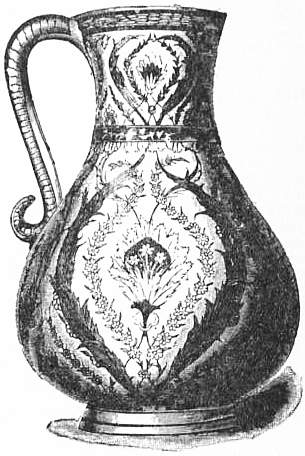
Fig. 42.—Rhodian Jug.
Turkish Pottery.—This beautiful and striking ware, formerly called Persian, and till lately Rhodian because Rhodes was a known centre of manufacture, seems to have been fabricated in all the countries overrun by the Ottoman Turks in the 13th century, so that the name “Turkish,” in spite of some opposition, is now generally applied to it. (See fig. 42; and the 16th-century Rhodian or Turkish pieces, Plate V.) It has a fine white body of the usual sandy texture, covered, as a rule, with a wash of pure white slip; it is painted in strong brilliant colours, chiefly blue, turquoise, green, and a peculiar red pigment which is heaped up in palpable relief—the whole of the ornament being outlined with black or dark green. The ware was glazed with an alkaline glaze of great depth, so that the colours soften and sometimes run, producing one of the most brilliant and attractive of all the oriental wares. In certain districts the white ground was not used, but over it a slip of the red colour (Armenian bole), varying in strength from bright red to pale salmon, was laid over the piece, reserving the pattern only in the white slip, which consequently lies lower than the red ground. Other examples are known where the ground has been covered with lavender, blue, sage, apple and turquoise greens, chocolate or coffee-brown, and the sumptuous effect of the whole was often increased by the application of gold-leaf over the fired glaze. The decorative motives are distinguished from those of the Persian wares by a breadth and boldness which are in keeping with the brilliant, and not always harmonious, colouring. They include, it is true, the Persian arabesque, the floral scroll with feathery leaf, the thistle-bloom and the cypress tree, but the naturalistic treatment which permits immediate recognition of the favourite Turkish flowers such as the tulip, hyacinth, carnation, fritillary, cornflower and lily (some of which were imported into Europe by the Turks), is as original and distinctive as the arrangement of the different elements of the design is artistic and charming. Other styles of design include formal patterns and diapers, rarely human and animal figures, and occasionally armorial devices and ships. Tiles of this ware were extensively used for lining the walls of public buildings, replacing the carpets and textile hangings which their designs so freely imitated. Of domestic articles, dishes are the most numerous, though vases, ewers, sprinklers, jugs, tankard-shaped flower-holders, covered bowls and mosque lamps are also plentiful. The tiles are found in all parts of the Turkish empire, though they were probably made at certain centres, such as Nicaea (which gave its name to the ware in the 16th century and no doubt supplied many of the mosques in Constantinople), Kutaia, Demitoka, Lindus and other centres in Rhodes and Damascus. Individual wares cannot be distinguished, except in some measure those of Damascus and Kutaia. A small jug in the Godman Collection has an Armenian inscription stating that it was made by “Abraham of Kutaia” in the 16th century. A few fine bowls and vases, painted in a beautiful blue with Persian arabesques and rosette scrolls, recalling Chinese porcelains of the Ming dynasty, but of very characteristic appearance, are also attributed to this place; and later, in the 18th and up to the end of the 19th century, an inferior ware was largely manufactured here. This late ware usually takes the form of small objects—plates, cups, jugs, egg-shaped ornaments, &c.—with a thin, well-potted, white body and slight patterns of radiating leaves, scale diapers, &c., in blue, black and yellow. Turkish pottery was at its best in the 16th and the early part of the 17th century, and though good tile work of later date exists, the general pottery deteriorated before the 18th century. An inferior ware of poor colour is still produced in Turkey, Persia and Syria, and some attempt has been made of late to revive the old lustre decoration, but the results are not likely to be mistaken for those of old times.
Collections.—The Victoria and Albert Museum contains the finest collection of the medieval pottery of the nearer East—the British Museum collection, though much smaller, has some magnificent examples. The Cluny Museum in Paris has a never-to-be-forgotten collection of Turkish pottery, especially plates and dishes. The museums of the Louvre and of Sèvres have also many beautiful examples. Berlin, Frankfort and other German towns have collections, but much smaller in extent. Private collectors in England and France own many fine specimens, and mention may be made particularly of those owned by Mr Ducane Godman and Mr George Salting.
Literature.—Fortnum, Majolica (1896) (also in South Kensington Museum Handbook); Falke, Majolica (Berlin, 1896); Fouquet, Contributions a l’étude de la céramique orientale (Cairo, 1900); Karabacek, “Zur muslimischen Keramik,” in Monatsschrift fur den Orient (1884); Lane-Poole, Art of the Saracens in Egypt (1886); Migeon, Manuel de l’art musulman, vol. ii. (1907); Sarre, Persische Keramik; and Jahrbuch der koniglichen preussichen Kunstsammlung (1905), part ii.; H. Wallis, The Godman Collection (1) Lustred Vases (London, 1891); (2) The Tenth Century Lustred Wall-tiles (1894); Notes on some Early Persian Lustre Vases (1885); Egyptian Ceramic Art (1898).
(R. L. H.; W. B.*)
Hispano-Moresque Pottery
With the doings of the Moslem potters of the countries round the eastern Mediterranean fresh in our minds, it is interesting to follow the westward trend of the Moslem conquests, and see how in their wake there also sprung up in Spain a ware of high distinction and beauty. The Iberian peninsula had been the scene of pottery-making from prehistoric times—a red unglazed ware was made before the dawn of civilization as finely finished as that found in the Nile valley by Flinders Petrie (see Egypt: Art and Archaeology), and the Romans had one of their great provincial pottery centres at Saguntum; but it was only when a great part of Spain lay under Mussulman rule that artistic and distinctive pottery was produced. What is by no means clear is how it came to pass that when the traditional methods, learnt by the Arabs in Egypt and Syria, were carried westward they should have undergone such a radical change. Oxide of tin, the opacifying and whitening material in glazes par excellence, was certainly known and used in the East from at least the 6th century b.c.; the ancient wares are coated with a covering of white tin-enamel to hide the buff or reddish-coloured clay, and it was similarly used elsewhere; but its use was sporadic and not general in those countries, where we find instead a consistent development of the pottery made with a white slip-coating and a clear alkaline glaze. Perhaps it was that at this period tin was almost as costly as gold, and it was only when potters with an oriental training brought their skill to Spain, where tin abounded, that the relative cheapness of the material led them to employ it, so far as is known, exclusively. (There is a wide distinction between the tin-enamelled and the slip-faced wares, glazed with an alkaline glaze. In the latter, the more oriental type, the slip-coating is of fine white clay and sand, and this is finished with a transparent alkaline glaze containing little or no lead: in the former there is no need of a coating of slip, for the addition of oxide of tin to a glaze rich in lead gives a dense coating of white enamel, opaque enough to disguise the color of the clay beneath.) Such colours as were used for painted patterns were painted over this enamel coating before it was fired, so that they became perfectly incorporated with it, and then this ground furnished a splendid medium for the development of those thin iridescent metallic films that we call “lustres.” The knowledge of this lustre process had been brought from the East also, where it was used on another ground, and with the growing use of lustre pigments containing copper as well as silver—until the red, strongly metallic copper lustre almost ousted the quieter silver lustres—we get the simple technique of one of the most distinctive kinds of pottery known.
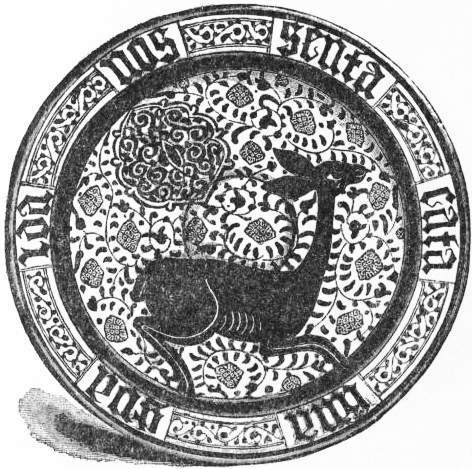
Fig. 43.—Hispano-Moorish Plate, painted in blue and copper lustre.
Briefly, the wares were “thrown” upon the wheel or “pressed” on modelled forms—handles, ribs and dots of clay, or strongly incised patterns were often added by hand—and they were then fired a first time. A coating of the tin-enamel (rich in lead as well as tin) was applied, and on this coating designs were painted in cobalt and manganese; sometimes these colours were only used as masses to break up the background. Then the second firing took place and the piece came from the firing all shining and white, except where the blue or brownish purple had been painted (see fig. 43). The lustre pigments, a mixture of sulphide of copper or sulphide of silver, or both with red ochre or other earth, was then painted over the glazed surface with vinegar as a medium. The repainted piece was fired a third time to a dull red heat, and smoked with the smoke from the wood used in firing, and when cold the loosely adherent ochre and metallic ash left were washed off, leaving the iridescent films in all their beauty.
The technical practices of the Spanish potters and the composition of the lustre pigments are given in Cocks’s account of the processes followed at Muel (Aragon) in 1585. The Manises receipt of 1785 gives:—copper 3 oz., red ochre 12 oz., silver 1 peseta piece, sulphur 3 oz., vinegar 1 qt. and the ashes scraped off the pots after lustring 36 oz.13 Interesting documents have recently been published concerning the works executed by the “Saracen,” John of Valencia, at Poitiers in 1384, and it is certain, from the list of materials supplied to him, that he made there tiles that were enamelled and lustred.
The earliest record of lustred pottery in Spain is the geographer Edrisi’s mention of the manufacture of “golden ware” then carried on at Calatayud in Aragon in 1154. Ibn Sa‘id (1214-1286) speaks of the glass and the golden pottery made at Murcia (city), Almeria and Malaga. From the 4th century the notices which have come down to us divide themselves into two main groups relating to the industry (a) at Malaga; (b) at various localities, but especially Manises in Valencia.
Malaga—Malaga was situated within the Moorish kingdom of Granada, which formed, from 1235 until the late 15th century, the last remnant of Moorish dominion in Spain. Here under the art-loving Nasride dynasty, Mussulman arts and learning flourished to an unprecedented degree. In 1337 Ahmed ben-Yahya al-Omarí enumerates, among the craft productions of Malaga, its golden pottery, the like of which he declares is not to be met with elsewhere. The Moroccan traveller Ibn Batuta mentions (1350) the Malagan golden pottery, as does Ibn al-Hatib (1313-1374) of Granada, in his description of Malaga. The principal monument of the period is the royal palace of Granada, begun in 1273, and finished during the 14th century, from which period most of its ornamentation dates. Two vases were discovered there, of which the existing one, known as the “Alhambra vase,” is admittedly the most imposing product of Hispano-Moresque ceramic art extant. Its amphora-shaped body (4 ft. 5 in. high) is encircled by a band of Arabic inscription, above which are depicted gazelles reserved in cream and golden lustre upon a blue field; the rest of the body and the prominent handles are covered with compartments of arabesques and inscriptions in the same colours; and panels on the neck, divided by mouldings and decorated with strap-work and arabesques. Vases similar in shape and technique, with ornament of Cufic characters and arabesques in horizontal rows, are to be found in the museums at St Petersburg, Palermo and Stockholm. As to the exact date of these, experts are not agreed. Though presenting all the characteristics of the 14th-century Hispano-Moresque ornament, it seems probable that they were produced at the same period as the large lustred wall-tile formerly in the Fortuny (now in the Osma) collection, an inscription upon which is by some held to refer to Yusuf III. of Granada (1409-1418), not to Yusuf I. (1333-1354). Another remarkable example is a dish (Sarre collection, Berlin), which, it is claimed, bears upon its back, in Arabic, the word Malaga; it is ornamented with eight segmental compartments filled alternately with strap-work designs and arabesques in lustre. Malaga was reconquered by Ferdinand and Isabella in 1487, and after this its industry probably decayed, as it is not mentioned by Lucio Marineo in 1539 among the localities where ceramics then flourished.
Valencia.—The emirate of Valencia was reconquered by Aragon in 1238. The history of its lustred ware is known from 1383, when Eximenes (whose evidence has been erroneously held to date from 1499) mentions the golden ware (Obra dorada) of Manises. Valencian pottery of this kind was an offshoot of the Malagan industry, as in documents lately published (ranging from 1405 to 1517) it is repeatedly designated Malaga ware (Obra de Malaga). Its decorative qualities became famous throughout the whole of Europe and North Africa. The ware was chiefly manufactured at Manises by the Moorish retainers of the Buyl or Boil family, lords of Manises, who levied dues upon the output of the kilns, and occasionally arranged for its sale. It is distinguished as regards its ornamentation from the pottery of Malaga by the adoption of a more natural rendering of plant form motives and by the use of armory. The ware consists of drug pots, deep dishes, large and small plates, aquamaniles, vases, &c. Some dozen varieties of ornament were employed during the 15th and early 16th centuries, including mock arabic inscriptions, various flower or foliage patterns taken from the vine, bryony, &c., and gadroons. The centres of dishes frequently bear the arms of a king or queen of Aragon, of the Buyls of Manises, or other Valencian or Italian families for whom they were made. Great dexterity is shown in the execution of minute and complicated schemes of ornament and in the richness of the colour schemes; golden lustre of various hues, with blue and manganese, form the simple combinations, but the ruby, violet or opalescent lustre combine to produce with the colours a wonderful decorative effect. From 1500 the use of blue and manganese was gradually discontinued and the ornament quickly became nondescript, but the brilliancy of the lustre pigment nevertheless obtained a wide popularity for the ware, as is attested by Marineo (1539), Viciana (1564) and Escolano (1610). After the expulsion of the Moriscoes (1609) the industry was carried on by those who had escaped deportation or by Spaniards who had learnt the craft; generally speaking their productions can be summed up in the word “decadence.” In the course of the 15th century the manufacture of lustred pottery was carried on at various other small towns near Valencia; in 1484 it was produced at Mislata, Paterna and Gesarte. It is known to have flourished at Calatayud in 1507, and at Muel, also in Aragon, in 1589. In the Valencia district much pottery for ordinary use, ornamented with blue on white, was also produced.
Majorca.—Scaliger, in 1557, states that Chinese porcelain was imitated in the Balearic Isles, and that the Italians called these imitations “majolica,” changing the letter in the name of the islands (then called Majorica) where they originated. The truth would appear to be that Valencian wares, being exported in Balearic vessels that called at Majorca on the voyage to Italy, acquired a reputed Mallorcan origin. There is extant a potter’s petition praying for permission to establish himself in Majorca (1560), in which he states that “Manises ware,” &c., had to be imported, as it was not made there.
Collections.—In England, the Victoria and Albert and the British Museums have fine collections of this ware. At Paris the Cluny Museum collection, and the Louvre; the museum at Sevres contains many fine typical pieces. Another good collection is that of the archaeological museum at Madrid. The Berlin and the Hamburg museums, the Metropolitan Art Museum at New York and the Boston Museum of Fine Arts also contain good specimens. The private collections of England, France and Italy are rich in these wares, among the finest being those of Mr F.D. Godman (Horsham), and of Don G.J. de Osma (Madrid).
Literature.—A. Van de Put, Hispano-Moresque Ware of the 15th Century (1904); F. Sarre, “Die spanisch-maurischen Lusterfayencen des Mittelalters,” &c. (in Jahrbuch der kgl. preuss. Kunstsammlungen, xxiv. (1903); G.J. de Osma, “Apuntes sobre cerámica morisca: textos y documentos valencianos,” No. 1, 1906, and “Los Letreros ornamentales en la ceramica morisca del siglo xv.” (in the review Cultura Española, No. ii, 1906; J. Font y Gumá, Rajolas valencianas y catalanas (1905); J. Tramoyeres Blasco, “Cerámica valenciana del siglo xvii.” (in the Almanaque, para 1908, del periodico Las Provincias de Valencia; J. Gestoso y Pérez, Historia de los barros vidriados sevillanos (1904); also J.C. Davillier, Histoire des faiences hispano-moresques à reflets metalliques (1861).
(A. v. de P.)
Medieval And Later Italian Pottery14
Little is known of the potter’s art in Italy after the fall of the Roman empire till the 13th century. The traditions of the Roman potters appear to have been gradually lost, leaving behind only sufficient skill to make rude crocks for domestic use and to coat them, if required, with a crude yellowish lead glaze sometimes stained to a vivid green with copper oxide. Applied ornament of roughly modelled clay and scratched designs were the chief embellishments of such wares, which were of the same class as the medieval pottery of Great Britain and the north of Europe. In the 12th and 13th centuries, however, contact with Asia Minor, Syria, Egypt and Spain, where ceramic skill had been highly developed in fresh directions, as we have seen, introduced into Italy as well as the rest of Europe those superior wares characterized by a white surface decorated with bright colours under a brilliant transparent glaze, and glorified by metallic lustres. The Italian potters did not long remain unaffected by these influences, but though Persian, Syrian and Egyptian pottery must have been fairly plentiful in the households of the wealthy, it was the distinctively Hispano-Moresque wares from which the potters of Italy drew the inspiration for a new ware of their own. The technique of a siliceous slip-coating with colour painted on that and covered with a transparent alkaline glaze, was only sparingly used, and then not very successfully; it is only the introduction of the tin-enamel that was turned to fruitful account and led to the production of the magnificent Italian majolica of the 15th and 16th centuries. In the same way the practice of lustre decoration might have been learnt from the Orient, but its late appearance on Italian wares (16th century) and its evident relationship to the lustres of Spain, rather than to the earlier lustres of Egypt, Syria and Persia, are further evidence that though oriental decorative motives gave the Italians certain early types of design, it is the Hispano-Moresque potters from whom the Italians learnt the art they were afterwards to develop so splendidly in a new direction.15
All the Italian pottery above the level of common crocks may be conveniently grouped into four classes.
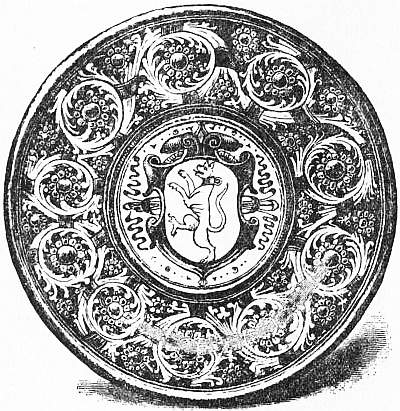
Fig. 44.—Italian Graffiato Plate, 16th century. (South Kensington Museum.)
1. The native wares, made of coarse and often dark-red clay, coated with a white clay slip (a kind of pipe-clay) and covered with a crude lead glaze, either yellow or green. The idea of rendering this ware ornamental, and fitting it for more than vulgar use, led to a great development of the graffiato process; where, while the vessel, with its white clay coating was firm yet soft enough, patterns were scratched or engraved through the white slip to the red body beneath. This decorative method has been already mentioned several times, for it was practised during the early middle ages in all the countries from India to Italy, and the Byzantine potters were adepts in its use. Nor has its practice ever ceased in Italy, for through all the times when painted majolica was the ware of the wealthy, this earlier and humbler pottery was used by those who could not afford the former; and the gaily-coloured later wares of this kind have a fine decorative quality of their own. From the depth beneath the present soil at which fragments of this ware have been disinterred, it is obvious that the method was widely practised in early times, and no simpler glazed wares are known except those covered all over with green, yellow or brown glazes. Early examples have been found all over northern Italy—in Faenza, Florence, Pisa, &c., and particularly in Padua, where it seems to have been extensively made. Pavia was another centre of its manufacture, even to the end of the 17th century, and Citta di Castello must have been noted for it in the 16th century, for Piccolpasso describes this ware as “alla Castellana” (see fig. 44). Apparently in the latter half of the 15th century a sudden advance takes place in the colouring of this graffiato ware. Instead of the simple glazes, of uniform colour, of the earlier productions, underglaze colours—green, purple, blue and a brown of the tint of burnt sienna which passes into a glossy black where it is thick—were applied in bold splashes under the straw-coloured glaze, producing a rich and decorative effect by very simple means. As fine examples of this kind we may mention the dish with the mandoline players, and one with cupids disporting themselves in a tree, in the Victoria and Albert Museum; the tazza, supported by three modelled lions, in the Louvre; and the dish, with figures of the Virgin and two saints, in the museum at Padua. The ware has often been called, quite erroneously, mezza-majolica. It had nothing to do with majolica, being the natural development of a much older process; and its manufacture was carried on all through the period of majolica manufacture and has never ceased.
2. Mezza-Majolica—This name is accurately applied to certain Italian wares that made their appearance in the 12th century or even earlier, when rude patterns—a clumsy star, a rude crossing of strokes or some equally elementary work—are found painted on a thin white ground covering a drab body. The pieces, generally pitchers of ungainly forms, are uncouth in the extreme; the body has been shaped in local clay and then thinly coated by dipping it into a white slip, which seems at first to have been of white clay only, though oxide of tin and lead were added to it even in the 12th century. The colours used for the rude painting were oxide of copper and oxide of manganese, and the final glaze, which is generally thin and often imperfectly fused, seems to have been based on the alkaline glazes of the nearer East. The specimens so assiduously recovered by Professor Aragnani, some of which, or similar wares, are to be found in the Louvre, the British and the Victoria and Albert museums, are typical of the rude work out of which, by a fuller knowledge of Spanish methods, the painted majolica grew.
3. Majolica—For the last three centuries the word majolica has been used to signify an Italian ware with a fine but comparatively soft buff body, coated with an opaque tin-enamel of varying degrees of whiteness and purity, on which a painted decoration was laid and fired. In the later pictorial wares, a fine coating of transparent alkaline glaze was fired over the painting to soften the colours—really to varnish them. The word itself appears to have been derived from the name of the island Majorca, and was originally applied by the Italians to the lustred wares of Spain which were largely imported into Italy, probably arriving in ships that called at or hailed from Majorca, as we do not believe that the ware was actually made in that island. That the secret of the tin-glaze, which is the essential feature of Italian majolica, was known in Italy in the 13th century is practically proved; and there is both literary and archaeological proof of its use there in the 14th. Mention of it is made in the Margarita Preciosa published at Pola by Pierre Le Bon in 1336, and the well-known jug, bearing the arms of Astorgio I., discovered under the Manfredi palace at Faenza, must have been made shortly after 1393. Its development marched side by side with that of the mezza-majolica, until it practically superseded the latter for painted wares in the 15th century; but the earliest examples have little more than an archaeological interest, and it was only after the last decade of the quattrocento or the first of the cinquecento that it blossomed into an artistic creation. In its prime the production of majolica was confined to a very small part of Italy. Bologna on the north, Perugia to the south, Siena on the west, and the Adriatic to the east, roughly enclose the district in which lie Faenza, Forli, Rimini, Pesaro, Cafaggiolo, Urbino, Castel Durante, Gubbio, Perugia and Siena. Towards the middle of the 16th century Venice on the one hand, and in the 17th and 18th centuries the Ligurian factories at Genoa, Albissola and Savona, made majolica of the later decadent styles, while, at the end of the 17th and in the early part of the 18th centuries, the southern town of Castelli, near Naples, produced a ware which closes the period of artistic majolica.
Plate I
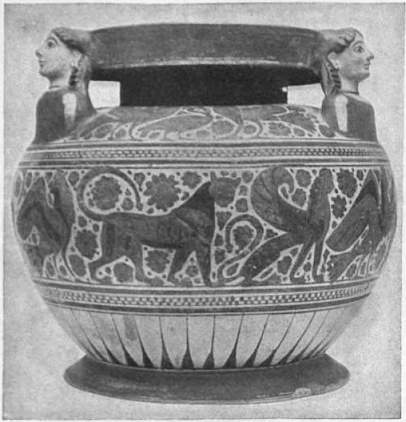
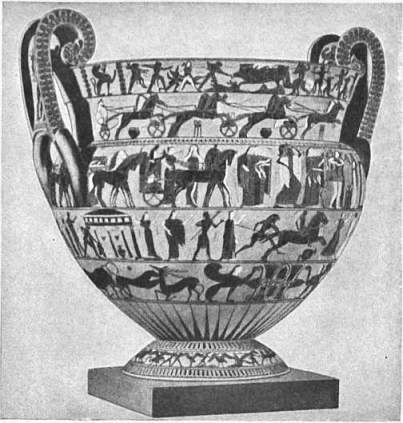
Fig. 52.—CORINTHIAN JAR. Fig. 53.—FRANÇOIS VASE. (From Furtwängler and Reichhold, Griechische Vasenmalerei, by permission of F. Bruckmann.)
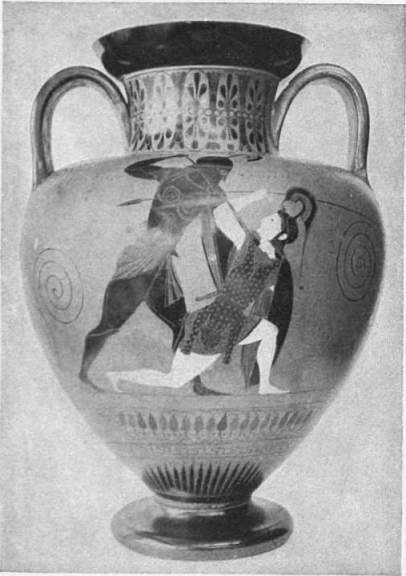
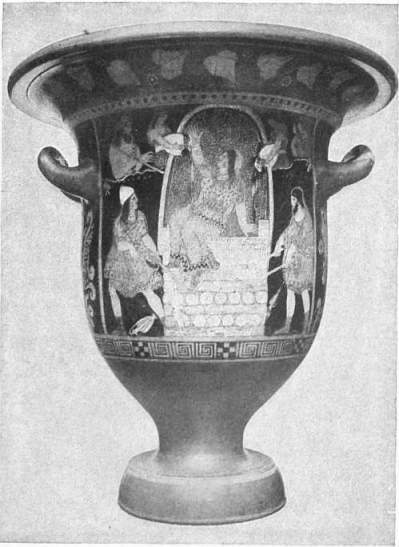
Fig. 54.—BLACK-FIGURED AMPHORA BY EXEKIAS. Fig. 55.—VASE FROM SOUTHERN ITALY. Signed by Python.
Plate II
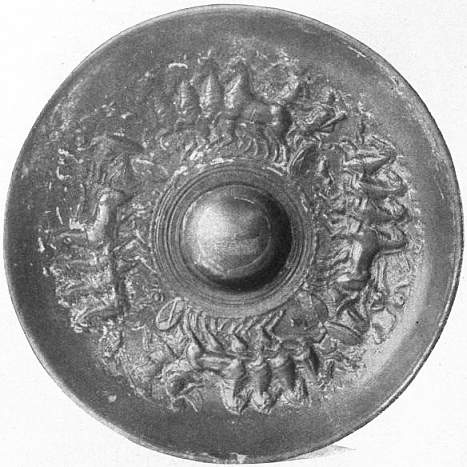
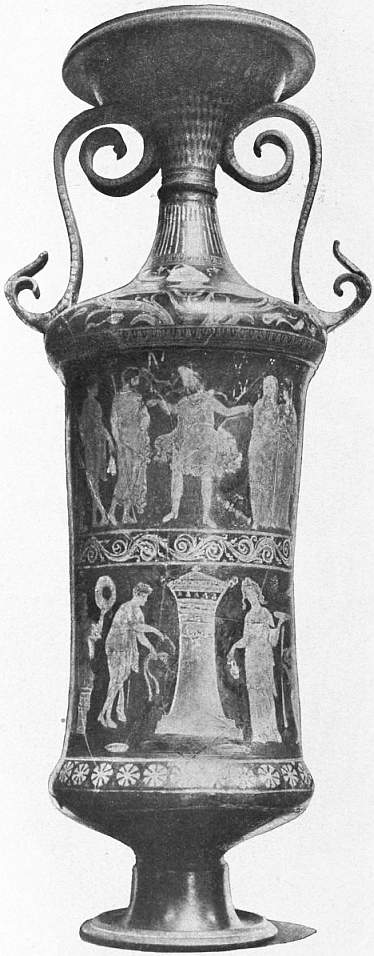
Fig. 56.—BOWL MADE AT CALES IN IMITATION OF METAL. (2ND CENT. b.c.)
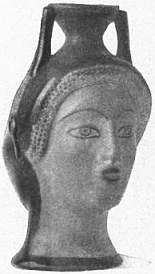
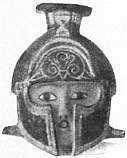
Fig. 57.—VASE OF 5th CENT. B.C., MODELLED IN FORM OF HEAD. Fig. 58.—VASE OF 6th CENT. B.C., IN FORM OF HELMETED HEAD.
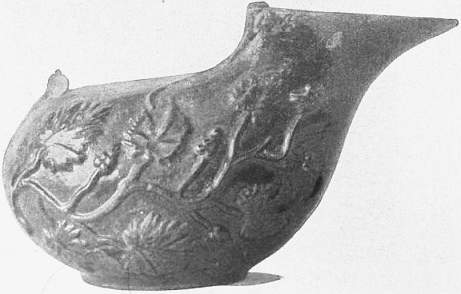
Fig. 59.—FLASK OF VITREOUS GLAZED WARE. (ROMAN PERIOD.) Fig. 60.—AMPHORA OF APULIAN STYLE, WITH SCENE FROM EURIPIDES’ “HECUBA.”
Plate III
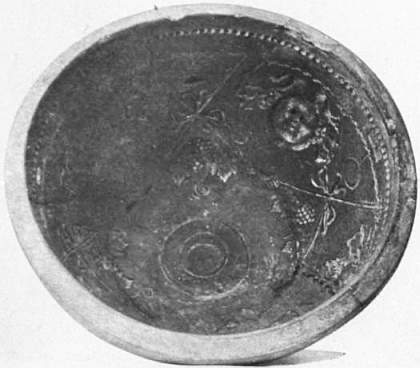
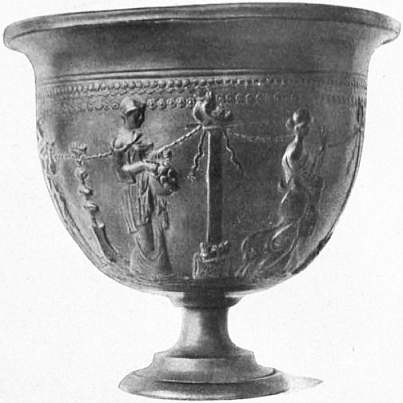
Fig. 61.—MOULD FOR ARRETINE BOWL. Fig. 62.—JAR OF ARRETINE WARE FROM CAPUA.
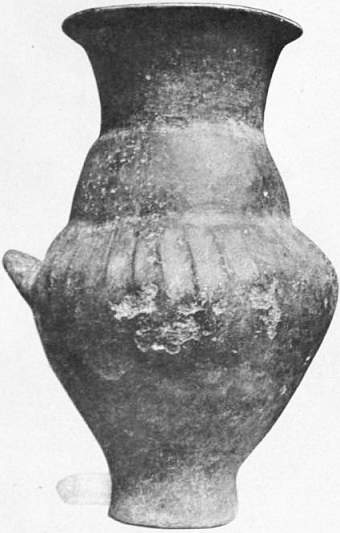
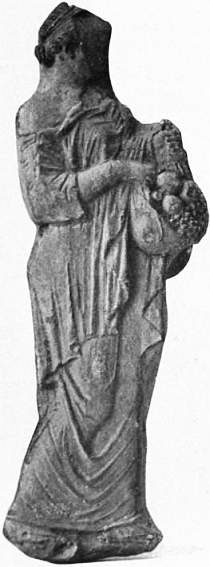
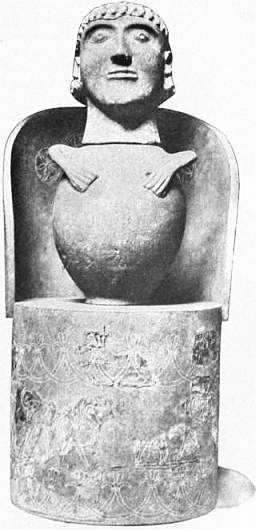
Fig. 63.—EARLY ETRUSCAN JAR. (VILLANOVA PERIOD.) Fig. 64.—STAMP FOR ORNAMENTING ARRETINE VASE. Fig. 65.—ETRUSCAN "CANOPIC" JAR PLACED IN BRONZE CHAIR.
Plate IV
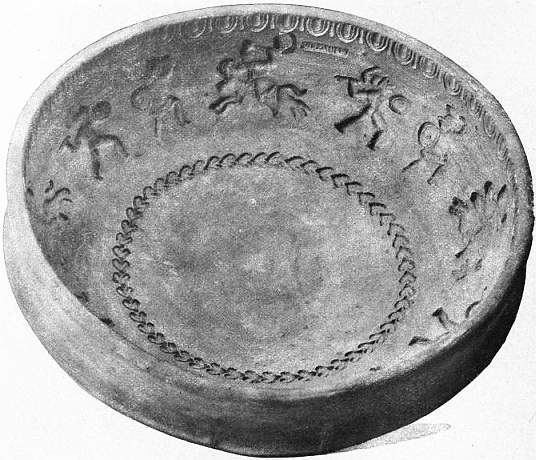
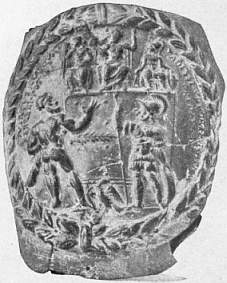
Fig. 67.—MEDALLION FROM VASE MADE IN S. FRANCE, WITH SCENE FROM TRAGEDY. (3rd CENT. AFTER CHRIST.)
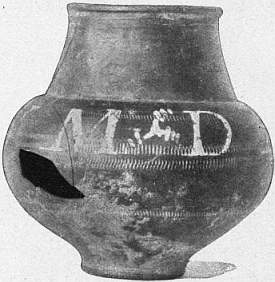
Fig. 66.—MOULD FOR BOWL OF GERMAN WARE. (2nd CENT. AFTER CHRIST.) Fig. 68.—JAR OF RHENISH WARE WITH INSCRIPTION. (3rd CENT. AFTER CHRIST.)
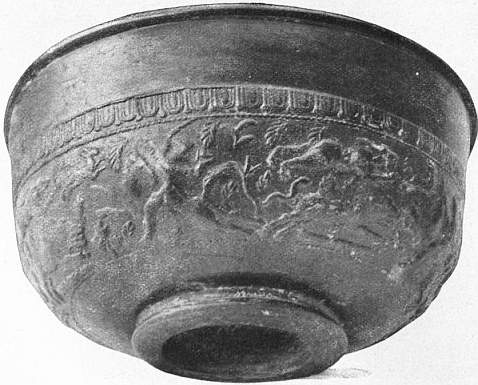
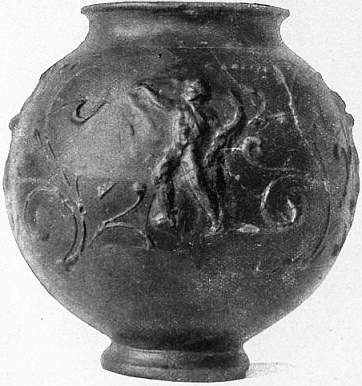
Fig. 69.—BOWL OF GAULISH (LEZOUX) WARE WITH FIGURES IN “FREE” STYLE. (2nd CENT. AFTER CHRIST.) Fig. 70.—JAR OF LATER LEZOUX WARE. (3rd CENT. AFTER CHRIST.)
4. Lustred Majolica—This brilliant species of Italian pottery (to which alone Piccolpasso applied the name majolica) seems to have been mainly produced at Deruta and Gubbio, though experiments were made at Cafaggiolo and probably at Faenza and Siena. Considering how much the Italian majolist owed to the Spanish-Moorish potter, it is remarkable that this beautiful method of decoration should have made so tardy an appearance, for the earliest specimens do not appear to be much earlier than the end of the 15th century, and the process was apparently abandoned by the middle of the 16th. The lustre wares of Deruta, probably the earliest made in Italy, have strongly-marked affinities with their Spanish prototypes; the earlier examples are hardly to be distinguished from Spanish wares, and to the last the ware remained technically like the earlier ware, though with perfectly Italian decorative treatment. Yet the best examples of Deruta silver lustre have a quality of tone that has never been surpassed; a colour resembling a wash of very transparent umber bearing a delicate nacreous film of the most tender iridescence. The Gubbio lustre is best known to us through the works of Maestro Giorgio, whose distinctive lustre is a magnificent ruby-red unlike any other. In all probability the lustre process was so quickly abandoned on the fine painted majolica, because the increasing efforts to make a “picture” were discounted by so uncertain a process. When one of the later majolica painters had spent weeks on the decoration of some vase or dish, with an elaborate composition of carefully drawn figures, it was not likely that he would care to expose it to any risks that could be avoided. The risks of the lustre process were inordinately great—Piccolpasso says, “Frequently only six pieces were good out of a hundred”—so that its use was relegated only to inferior wares, and then the process was relinquished and forgotten until its rediscovery in the second half of the 19th century.
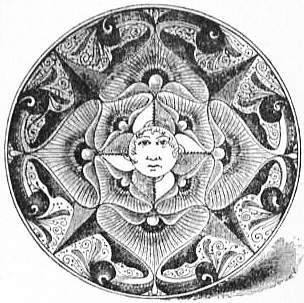
Fig. 45.—Early Faenza plate, with peacock-feather design, in blues, yellow and orange-red. (Victoria and Albert Museum.)
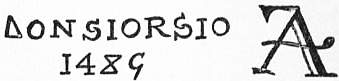
Early Faenza Potter’s mark. Late Faenza Potter’s mark.
The history of the development of these noble wares is by no means clear, nor is it always certain what part was played by each town in the successive inventions of technical methods, decoration and colouring, so that it is better, in such a general sketch as this, to treat the subject in its broadest features only. In the earlier painted wares the only colours used were manganese-purple and a transparent copper-green as on the mezza-majolica, but early in the 15th century cobalt-blue was added to the palette, and, later on, the strong yellow antimoniate of lead, mixed with iron. The decorations at this period were largely influenced by the wares imported from Persia, Syria, Egypt and Spain, specimens of which were so prized as to be used for the decoration of church fronts and the façades of public buildings. The lustre of the Saracenic wares was not yet understood, but its place was taken first by manganese and afterwards by yellow. The designs were chiefly conventional flower-patterns in the Persian or Moorish style, arabesques, and floral scrolls, the ground being filled at times with those tiny spirals, scrolls and dots to which the Eastern potters were so partial. Figures, human and animal, were introduced either among the formal ornament or only sundered from it by panels, of which the outlines often followed the contours of the central design (see the early 15th-century Faenza piece, Plate VI.). The figures were, in fact, drawn to conform to the outline of the vessel, and not the vessel made to display the figure-subject as in the majolica of the succeeding century. The earliest dated example of this period is the pavement laid down in the Caracciolo chapel in the church of San Giovanni a Carbonara, in Naples, about 1440. Specimens of these tiles may be seen in the British Museum, and from their style it has been suggested that they were made by some Spanish potters brought over to Naples by Queen Joanna, who was of the royal house of Aragon. To this period also have been referred the large ovoid jars made to contain drugs or confections, and decorated with bold scrolls of formal oak leaves enclosing spirited figures of men or animals, or heraldic devices. These are characterized by a rich blue colour generally piled up in palpable relief and sometimes verging on black; the outlines are usually in manganese, and transparent green is used for details and occasionally even as a ground colour. This ware has been definitely assigned to Florence on what seem very inadequate grounds, and it is better to speak of it simply as Tuscan. Then, essentially Italian ornament began to assert itself, and it redounds to the credit of the Italian majolist that he soon freed himself from repeating the styles of the wares from which he obtained his methods, and produced a distinctive type of ornament of his own. He revelled in patterns with bold floral scrolls, or those based on peacocks’ feathers (see fig. 45), and then he advanced to concentric bands of painted ornament, borrowed from classic art yet breathing the true spirit of the Renaissance; while cable borders, chequer and scale patterns, bands of stiff radiating leaves, festoons of fruit and flowers, zigzags and pyramidal scrolls occupied nearly the whole surface or framed an armorial or emblematic central subject. Figure-subjects occur with increasing frequency as the century advanced; Madonnas and other sacred subjects, portraits, and, occasionally, groups of figures after the early Italian masters, or scenes borrowed from the first illustrated editions of the classics, gradually encroach on the conventional borders and occupy more and more of the surface of the piece. The provenance of these 15th-century pieces still remains uncertain—Faenza, Forli, Florence, Siena and other places offering rival claims,—but there is no doubt that from the earliest times Faenza was the most fertile centre of their manufacture, and almost all the motives of the quattrocento wares are found on fragments discovered there or on examples that can be traced to Faventine factories.
It is customary to treat the enamelled terra-cottas of Luca della Robbia, the great Florentine sculptor (1399-1482), and his followers, Andrea and Giovanni della Robbia and other members of the family, as belonging rather to the domain of sculpture than of pottery, and this is right, for there is nothing certainly known of the work of this great sculptor which connects it with painted majolica. The old theory that Luca invented the tin-glaze is long since exploded; what he did was to use coloured glazes made with a basis of tin-enamel on his boldly modelled terra-cottas—a very different thing,—and it is by no means certain that he was the first to do even that. The Victoria and Albert Museum is extraordinarily rich in della Robbia ware of every kind; and one may see there these beautifully modelled figures in high relief covered with pure white tin-enamel, set in a background of slatey blue or rich manganese purple and framed in wreaths of flowers and fruit which are coloured with blue, green, purple and sometimes yellow. There are altar vases too, of classic shape with low relief ornament, covered with the same peculiar blue glaze; these are sometimes furnished with modelled fruit and flowers; and finally there is the rare set of roundels painted on the flat with figure-subjects typifying the months; but the attribution of these remains doubtful, and their method is not that of painted majolica.
A remarkable development took place at the beginning of the 16th century, and in the forty succeeding years the highest perfection of manipulative skill, both in potting and painting, was attained. Artistically regarded, the elaborate and detailed methods of painting then adopted are too much allied to fresco-painting to be considered as fit treatment for enamelled clay; but this view was certainly not accepted at the time, nor is it subscribed to by many modern collectors; yet, regarded as decorated pottery, the 15th-century majolica, simpler and more conventional in design and treatment, is eminently preferable. The ruling families of northern Italy, who now took the industry under their personal patronage, clearly inclined to the opposite view and spared no expense to provide subjects for their pot-painters. During the first two decades the influence of Faenza was paramount, and though the encroachments of purely pictorial motives are clearly indicated on the wares, room was still found for ornamental patterns. The broad rims of the dishes were covered with beautiful arabesque designs, frequently including grotesque figures, masks, dolphins and cherubs (see the Faenza Casa Pirota piece, 1525, Plate VI.). Sometimes reserved in the white on a dark blue ground and shaded with light blue and yellow, sometimes traced in dark blue on a paler grey-blue glaze (called berettino) or painted in darker tints on a ground of orange or full yellow, the Faventine arabesques form a conspicuous feature of the early wares of this century. Honeysuckle patterns and interlaced lines drawn in pure white on a toned tin-enamel (white on white or sopra-bianco decoration) commonly appear on the sides of the deep wells of the dishes, while in the centre is a single figure, a coat of arms, or a small figure-subject. A similar treatment, without the sopra-bianco, was accorded to the fruit-dishes, shallow bowls on low feet, &c., with moulded gadroons or scalloped sides, which are generally attributed to Faenza or Castel Durante. The workshops of Siena were also noted for delicately painted grotesques and arabesques, with a rich brownish-yellow or deep black ground. At Gubbio, too, the “grotesque” decoration was practised with marked success. Other developments of this style are the “a candelieri” designs, in which grotesques were symmetrically arranged round some central subject, such as a candelabrum or vase, and “a trofei” in which trophies of arms, musical instruments, and other objects were symmetrically disposed, or arranged in studied disarray throughout the design; these patterns are generally associated with the wares of Castel Durante and Deruta. Lovers’ gifts, dishes in which the whole space is occupied by a portrait bust of a girl or man, with the name and a complimentary adjective inscribed on a ribbon in the background, were common to Faenza, Castel Durante and many other factories. Elaborate figure-subjects also were attempted early in the century at Faenza and with no little success, as may be seen from a dish in the British Museum, which is entirely occupied by the scene of the death of the Virgin, after a print by Martin Schöngauer, delicately painted in shades of blue, and dated about 1500.
In the early Faventine school the outlines of the figures are almost always traced in blue, even when they are laid on the grey-blue berettino ground, and blue was the prevailing colour of the shading and details. In the third decade of the century the style affected at Urbino superseded that of Faenza. The majolica painter’s palette was now complete; in addition to the primitive blue, manganese-purple, transparent green and yellow, we find black, white, orange, greens of varying shades, brown, and a great number of intermediate tints obtained by mixing the standard colours. All the colours of the majolica of the best periods were painted on the tin-enamel before the final glazing, and were capable of standing the full heat of the fire. Such a thing as painting in enamels on the finished ware and refiring them at a lower heat was unknown before the end of the 17th or beginning of the 18th century. A true red colour seems to have been beyond the power of most of the Italian majolists, and was only attained at Faenza, and with less complete success at Cafaggiolo; the famous red of the Turkish pottery behaves very indifferently on tin-enamel.
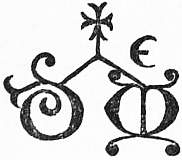
Urbino Potter’s mark.
In the Urbino style, which now became general, the ware was given over entirely to pictorial subjects, scenes from history or romance, scriptural and mythological, copied from the compositions of the Italian painters and usually set in a background of Italian landscape. Guidobaldo II., duke of Urbino, spared no pains to develop this phase of the art; the cartoons of Raphael, engraved by Marc Antonio and others, were placed at the disposal of the pot-painters, as well as the paintings of Michelangelo, Giulio Romano, Battista Franco, Rosso Rossi, Perugino, Parmeggiano and many more, and these, together with engravings by Agostino Venetiano, Marco Dente, Enea Vico and others, were copied, with more or less fidelity, on the majolica. Some of the painters, as, for instance, Xanto Avelli, were eclectic in their tastes and made up their subjects by taking a figure here or there from various pictures. Thus of three figures on a plate in the British Museum, painted with the Dream of Astyages, one is borrowed from Raphael and another from Mantegna. These “istoriati” wares reached their zenith at Urbino between the years 1530 and 1560, when the workshops of the Fontana family were in full activity; but their popularity was very general, and skilful painters at many other towns produced specimens that it is hard to distinguish from those of Urbino. Baldasara Manara was a prolific painter in this style at Faenza; Pesaro and Castel Durante were little behind Urbino in the skill of their artists, the Lanfranchi family in the former town having a well-deserved reputation, while the founders of the Fontana factories learnt their art in the latter; and a few pieces of considerable merit bear the name of Rimini as their place of origin.
There will always remain a large number of specimens of majolica which cannot be assigned with certainty to any particular factory, partly because the same style of painting was in vogue at many places at the same time, and partly because of the itinerant propensities of many of the painters, whose signed works prove that they moved from place to place to practise their art. There are, however, a few prominent artists whose touch is sufficiently well known from the examples that bear their signatures to enable us to classify a considerable proportion of the finest pieces. First of these is Niccola Pellipario, the founder of the Fontana family, who moved from Castel Durante to Urbino in 1519, and worked at the latter place in the factory of his son, Guido Fontana. There is little doubt that he was the painter of the famous service in the Correr Museum at Venice, which marks the transition from the style of Faenza to that of Urbino, and his free figure-drawing, the oval faces with strongly marked classical features, the peculiarly drawn knees, the careful landscapes and the characteristic balls of cloud are easily recognized in quite a number of pieces in the British Museum (see the Gonzago Este piece, Plate VI.). His pupil, who frequently signed his name in full, Xanto Avelli da Rovigo, was one of the foremost Urbino painters, and his work is characterized by bold colouring and fine figure-drawing, with a marked fondness for yellowish flesh tints. But Niccola’s grandson, Orazio Fontana (see example, Plate VI.), was perhaps the most celebrated exponent of the pure Urbino style, and his free drawing and soft harmonious colouring, in which a brilliant blue is usually conspicuous, are unequalled by any other majolica painter of the period.
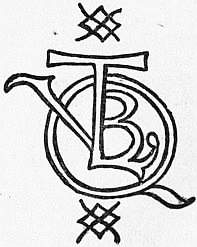
Venetian Majolica Potter’s mark.
Later Cafaggiolo Potter’s mark.
Certain characteristic wares of Faenza have already been noted. Those with the grey-blue (berettino) glaze were principally made at the factory called Casa Pirota, though inferior imitations were also produced at Padua, and a blue glaze of paler tint was largely used at Venice. Dolphins are a frequent motive in the arabesque ornaments of the same Faventine workshop, and many of the wares are marked with a circle divided by a cross and containing a dot in one of the quarters. A capital P crossed with a line or paraph is another Faventine mark, and a somewhat similar monogram, with an S added to the upper part, is found in the wares of Cafaggiolo. It has already been stated that a red colour is peculiar to Faenza and in an inferior and browner tint to Cafaggiolo; it was used, according to Piccolpasso, at the factory of Vergiliotto in the former place. At Cafaggiolo, the factory of the Medici family, many fine pieces were painted, mostly in the Faventine style; a deep blue, heavily applied and showing the marks of the brush, was freely used in backgrounds, and delicate running leaf scrolls in paler blue and reminiscent of Persian style often appear on the Cafaggiolo wares (see example, Plate VI). Not a little can be learnt from the ornament on the reverse sides of the dishes and plates; those of Faenza and Siena are richly decorated with scale patterns and concentric bands; those of Cafaggiolo and Venice are either left blank or have one or two rings of yellow. A few pre-eminently beautiful dishes, with central figure subjects of miniature-like finish in delicate landscapes with poplar trees in a peculiar mannered style, are probably the work of M. Benedetto of Siena. Borders of arabesques with black or deep orange ground belong to the same factory and were perhaps decorated by the same hand. The dishes covered, except for a few small medallions, with interlaced oak branches (“a cerquate” decoration), are no doubt the productions of Castel Durante; and a certain class of large dishes with figure subjects in blue on a toned blue glaze, and sometimes with formal ornaments in relief, are of undisputed Venetian origin.
Another phase of majolica decoration began about the middle of the 16th century and synchronized with the decline of the pictorial style. The figure subjects were relegated to central panels or entirely replaced by small medallions, and the rest of the surface covered with fantastic figures among floral scrolls, inspired by Raphael’s grotesques painted on the walls of the Loggie in the Vatican. The prevailing tone of this ornament was yellow or orange, and the tin-enamel ground, which is always more or less impure in colour on Italian pottery, was washed over with a pure milk-white, known as bianco di Ferrara or bianco allatato, said to have been invented by Alphonso I., duke of Ferrara, who took an active interest in his private factory founded at Ferrara, and managed by potters from Faenza and Urbino.
Turin Potter’s mark. Savona Potter’s marks.
The new style flourished at Urbino, Pesaro and Ferrara; at the first-named particularly in the workshops of the Patanazzi family, and lasted far into the 17th century. But the majolica was now in full decline, partly through the falling off of princely patronage, and partly, perhaps, owing to a reaction in favour of Chinese porcelain, which was becoming more plentiful and better known in Europe. The manufacture, however, never entirely ceased, and revivals of the old style were attempted at the end of the 17th century by Ferdinando Maria Campori of Siena, who copied Raphael’s and Michelangelo’s compositions, and by the families of Gentile and Grue at Naples and Castelli. The majolica of Castelli is distinguished by the lightness of the ware, good technique, and harmonious but pale and rather weak colouring; it continued into the 18th century. A coarse and inferior ware was made at Padua and Monte Lupo; and the factories of Faenza were still active, producing, among other kinds, a pure white ware with moulded scallops and gadroons. The industry continued to flourish in Venice and the north. Black ware with gilt decoration was a Venetian product of the 17th century, and at Savona and Genoa blue painted ware in imitation of Chinese blue and white porcelain made its appearance. In the 18th century a new departure was made in the introduction of enamel painting over the glaze, a method borrowed from porcelain; but this process was common to all the faience factories of Europe at the time, and though it was widely practised in Italy no special distinction was attained in any particular factory. In our own days imitations of the 16th century wares continue to be made in the factories of Ginori, Cantigalli and others, not excepting the lustred majolica of Gubbio and Deruta; but, compared with the old pieces, the modern copies are heavy to handle, stiff in drawing, suspiciously wanting in the quality of the colours and the purity of the final glaze which distinguish the work of the best period.
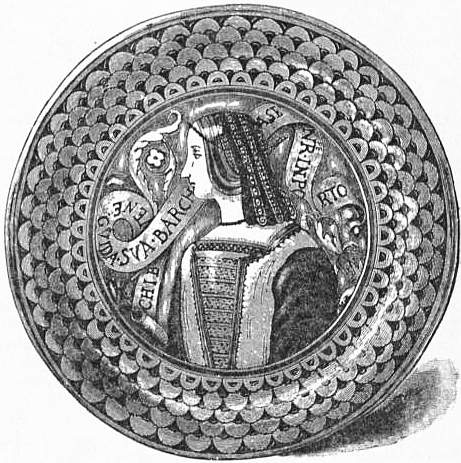
Fig. 46—Early majolica plate, in blue and yellow lustre only, made at Pesaro or Deruta, c. 1500. The motto on the scroll may be Englished as follows: “He who steers well his ship will enter the harbour.” (Louvre.)
Lustred Wares.—The lustred wares of Deruta have marked characteristics, and, though differing in actual treatment from the Hispano-Moresque, their appearance is eloquent in favour of such a derivation. The most characteristic examples are large dishes and plateaux, thickly made and with the enamel on the upper face only, the back having a lead glaze. They are often decorated (see fig. 46) with a single figure or bust in the centre (with or without an inscribed ribbon), which is usually set against a dark blue background which covers only half the field, while in the other half is a formal flower, and in the borders are radiating panels with palmettes alternating with scale pattern, or some other formal design. The whole style is archaic, the designs being heavily outlined in blue and washed over with a greenish yellow lustre, with beautiful opalescent reflets recalling mother of pearl. The lustre varies from this madreperla tint to a brassy metallic yellow, and parts of the ornament are sometimes modelled in low relief. In spite of its archaic appearance, the Deruta lustred wares are scarcely older than the 16th century, and the style was continued as late as the second half of that century. Deruta pottery was not always lustred, and some of the pieces signed by the painter El Frate, who flourished between 1541 and 1554, are without the lustre pigment, though showing the heavy blue outlines of the lustred wares. The lustred majolica of Gubbio owes its celebrity almost entirely to the work of one man, Maestro Giorgio Andreoli, who came thither from Pavia, with his brothers Salimbene and Giovanni, and obtained citizenship in 1498. His earliest efforts were in the direction of sculpture, and some of his reliefs in the style of della Robbia are still in existence; indeed the earliest dated piece of lustred majolica attributed to him is a plaque of 1501, with the figure of St Sebastian in relief, in the Victoria and Albert Museum. It is not known whence he learnt the secret of the beautiful transparent ruby lustre peculiar to Gubbio. A red or rosy lustre is found in both Persian and Hispano-Moresque wares, and no doubt the process was learnt from some Moslem potter and developed by Giorgio to unusual perfection. Golden, yellow, brown and opalescent lustres were also freely used at Gubbio, the ruby being only sparingly applied. Finished painted pieces were sent from other factories to receive the addition of lustre at Gubbio, but these can almost always be distinguished from the true Gubbio wares, in which the lustre is an integral part of the decoration. Apart from the lustred enrichment, the majolica of Gubbio has few distinctive qualities, for its styles were various and almost all borrowed (see fig 47). The archaic taste of Deruta, the arabesques and grotesques of Faenza and Castel Durante, and in a lesser degree the “istoriato” style of Urbino, reigned in turn. Perhaps the most characteristic paintings of Maestro Giorgio are the central medallions of cups and deep dishes enclosing a single figure of a child or a cupid in grisaille. Giorgio’s larger figure compositions, if indeed his signature in lustre may be taken to imply that he painted the designs as well as lustred them, show great inequality, some rising to a very high standard—as the dish with “the Three Graces” in the Victoria and Albert Museum, and the “Bath of Nymphs” in the Wallace collection—while in others the figure drawing is quite inferior. The arabesques and grotesques on the Gubbio wares are usually of great merit. There are a few known pieces of unlustred Gubbio wares with figure subjects, painted chiefly in blue and in the style of the early Faventine artists. After 1517, when we may assume that the lustre process was thoroughly mastered, the Gubbio wares were usually signed with the initials or full name of Maestro Giorgio, and a few rapidly executed scrolls in lustre completed the decorations of the reverse of the plates and dishes. The master’s latest signed work is dated 1541, and he died in 1552. It is probable that his brother Salimbene assisted him, and Piccolpasso names his son Vincentio as possessor of the lustre secret. Possibly the latter was the painter who signed his wares with the initial N, but this conjecture rests solely on the ingenious, but unsupported notion that N is a monogram of the first three letters of the name Vincentio. Other initials, M, D, R, also occur on Gubbio plates, and the latest dated example of the ware is signed by one “Mastro Prestino” in 1557, but it has little to recommend it save that it is enriched with the Gubbio lustres, which after this time entirely disappear.
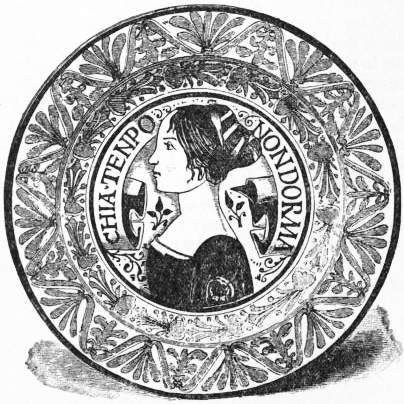
Fig. 47.—Gubbio plate, with portrait in ruby lustre and blue outline. (Victoria and Albert Museum.)
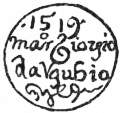
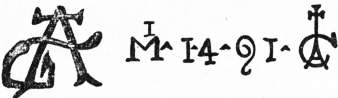
Gubbio Potters’ marks.
The old majolica shapes are briefly as follows:—among the earliest are small bowls (scodette), often with flattened sides; jugs (boccali) with large lip-spouts, and mouths pinched into trefoil form; large dishes with gradually shelving sides (bacili), or with flat broad rims and deep centres; akin to these are the plateaux with a raised flat disk in the centre; small dishes with broad flat rims and deep though narrow central walls (tondini), suitable for handing a wine-glass or sweetmeats; flat trencher-shaped plates (piatti or taglieri); saucer-shaped dishes on low feet and sometimes with moulded sides (tazze or fruttieri) suitable for holding fruit. Among the vase forms ovoid shapes with short necks and a pair of flat handles are common in the Tuscan wares of the 15th century; the jars for confectionery, drugs, or syrups were often of the cylindrical form with graceful concave sides known as the “albarello,” in shape of Eastern origin, and in name perhaps derived from the Persian el barani (a vase for drugs, &c.); other vase forms with spouts and handles were used for the same purpose; ornamental vases after classical designs (vasi a bronzi antichi); and in the best Urbino period a great variety of fanciful forms—ewers, vases, cisterns, shells, salt-cellars, ink-pots, &c., with applied masks and serpentine handles, were made in the exuberant taste of the time. A complex piece of furniture for the bedside of ladies in childbirth (vaso puerperale) consisted of a bowl with a foot surmounted by a flat trencher on which fitted an inverted drinking-bowl (ongaresca); and above this again a salt-cellar with cover. Many of these shapes were suited to daily use, but the richly decorated majolica was designed to adorn the walls, the credenze, table-centres and cabinets of the rich. This alone could have been the destination of the large dishes (piatti di pompa) with rim pieces for suspension, and the smaller dishes (coppe amatorii) with portraits of young men and girls and lovers’ symbols; and it is inconceivable that the costly lustred wares of Gubbio or the fine madreperla dishes of Deruta were designed for anything but decorative use. The ware was in fact an article produced for the wealthy in the century of Italy’s glory, and under no other conditions could such magnificent and expensive pieces have been made.
Technical Methods.—This is a convenient place to give an account of the methods used by the early medieval potters—(1) because they represent what had been learnt from Roman times to the 16th century, and indeed to the introduction of modern methods, (2) because, besides all that a potter could derive from an examination of the wares, we have ample written accounts of the methods and processes followed by the Italian majolist. Mr Solon has recently published an epitome of the account given in Biringuccio’s La Pyrotechnica (Venice, 1540), and there is the memorable MS. of Piccolpasso, a potter of Castel Durante, now in the library of the Victoria and Albert Museum, which, besides giving an account of the processes, contains illustrations of kilns, mills, decorative motives, &c.16
1. The potter’s clay was prepared from mixtures of various kinds prepared by (a) beating and picking out coarse particles, (b) mixing with water, (c) passing through a sieve, (d) drying again into plastic clay ready for the working potter. The essential point about the potter’s clay of the best tin-enamelled wares, whether Spanish, Italian, French or Dutch, is that the clays are those known geologically as “marls,” which contain a large percentage of carbonate of lime. Such clays always fire to a pinky red or buff colour, and give a ware that is strong and yet light in substance, and on no other kind of clay does the tin-enamel display its full perfection (see Deck’s La Faience). The analyses of certain tin-enamelled wares are useful as showing the essential constitution of the best pottery bodies for such purposes.
Delia Robbia. Majolica. Delft. Faience. French
Silica 49.65 48.00 49.07 48.65
Alumina 15.50 17.59 16.19 17.05
Lime 22.40 20.12 18.01 19.43
Magnesia 0.17 1.17 0.82 0.27
Oxide of iron 3.70 3.75 2.82 4.33
Carbonic Acid, water, &c. 8.58 9.46 13.09 10.27
2. Shaping.—The vessels were either “thrown” on the potter’s wheel (which had remained practically unaltered from Egyptian times), or they were formed by “pressing” thin cakes of clay into moulds, made of a composition of plaster (gesso), bone-ash and marble dust. In the latter way all shapes that were not circular were made, as well as those with heavy bosses or gadroons imitated from embossed metal forms. It is interesting, though not surprising, to note that for the fine later wares, the roughly thrown vases, when sufficiently dry, were recentred on the wheel or were placed in a joiner’s lathe and smoothed to a clean and accurate surface. The Greek potters did the same, and this practice must always be followed where fine painting or gilding is afterwards to be applied. In the later florid vases of the Urbino style the piece was built up of thrown parts and moulded parts (handles, masks, spouts, &c.), luted together with slip when they were dry enough to be safely handled, and then retouched by the modeller or vase-maker, a method followed to this day for elaborate pieces of pottery or porcelain.
Plate V
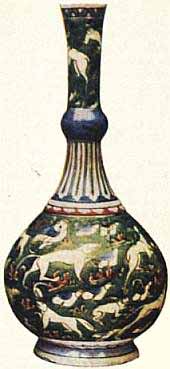
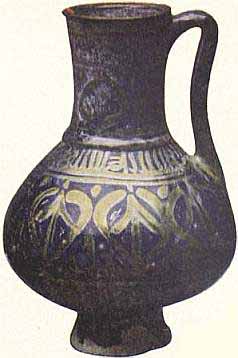
Rhodian or Turkish: 16th century. Syro-Persian: 13th century.
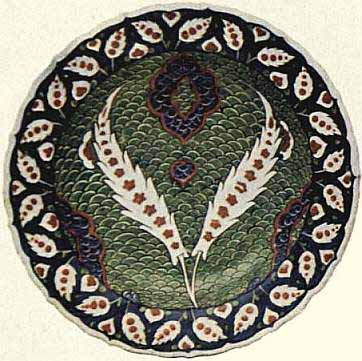
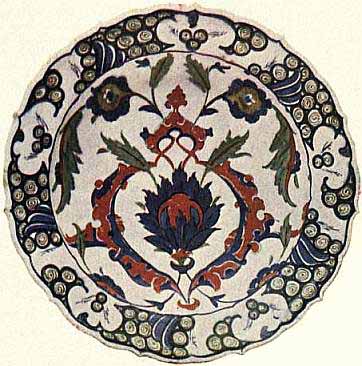
Rhodian or Turkish: 16th century. Rhodian or Turkish: 16th century.