VOLUME V SLICE VI Celtes, Konrad to Ceramics (continued 2)
Reading edition
Scotland.—In the acts relating to the census from 1801 to 1851, provision for the enumeration of Scotland was made with that for England and Wales, allowance being made for the differences in procedure, which mainly concerned the agency to be employed. In 1855, however, civil registration of births and deaths was established in Scotland, and the conduct of the census of 1861 was, by a separate act, entrusted to the registrar-general of that country. The same course was followed at the three succeeding enumerations, but in 1901 the former practice was resumed. The complexity of administrative areas, though far less than in England, was simplified, and the census compilation proportionately facilitated, by the passing of the Local Government Act for Scotland, in 1889. In 1881, the definition of a house in Scotland was made identical with that in England, since previously what was called a house in the northern portion of Great Britain was known as a tenement in the south, and vice versa. Since 1861 a return has been called for in Scotland of the number of rooms with one or more windows, and that of children of school-age under instruction is also included in the inquiry. The number of persons speaking Gaelic was recorded for the first time in 1881. The question was somewhat expanded at the next census, and in 1901 was brought into harmony with the similar inquiry as to Welsh and Manx.
Ireland.—An estimate of the population of Ireland was made as early as 1672, by Sir W. Petty, and another in 1712, in connexion with the hearth-money, but the first attempt to take a regular census was made in 1811, through the Grand Juries. It was not successful, and in 1821 again, the inquiry was considered to be but little more satisfactory. The census of 1831 was better, but the results were considered exaggerated, owing to the system of paying enumerators according to the numbers they returned. The census, therefore, was supplemented by a revisional inquiry three years afterwards, in order to get a good basis for the newly introduced system of public instruction. The completion of the ordnance survey and the establishment of an educated constabulary force brought the operations of 1841 up to the level of those of the sister kingdom. The main difference in procedure between the two inquiries is that in Ireland the schedule is filled in by the enumerator, a member of the constabulary, or, in Dublin, of the metropolitan police, instead of being left to the householder. The tabulation of the returns, again, is carried out at the central office from the original schedule, and not, as in England, from the book into which the former has been copied by the enumerating agency. The inquiry in Ireland is more extensive than that in Great Britain. It includes, for instance, a considerable amount of information regarding holdings and stock. The details of house accommodation are fuller. A column is provided for the degree of education, and another for religious denomination, an addition which has always been successfully resisted in England. This last information was made voluntary in 1881 and the following enumerations without materially affecting the extent of the record. The inquiry as to infirmities, too, is made to extend to those temporarily incapacitated from work, whether at home or in a hospital. There is also a column for the entry of persons speaking the Irish language only or able to speak both that and English. In the report of 1901 for England and Wales (p. 170) a table is given showing, for the three divisions of the United Kingdom, the relative number of persons speaking the ancient languages either exclusively or in addition to English.
British Colonies and Dependencies.—A simultaneous and uniform census of the British empire is an ideal which appeals to many, but its practical advantages are by no means commensurate with the difficulties to be surmounted. Scattered as are the colonies and dependencies over the world, the date found most suitable for the inquiry in the mother country and the temperate regions of the north is the opposite in the tropics and inconvenient at the antipodes. Then, again, as to the scope of the inquiry, the administrative purposes for which information is thus collected vary greatly in the different countries, and the inquiry, too, has to be limited to what the conditions of the locality allow, and the population dealt with is likely to be able and willing to answer. By prearrangement, no doubt, uniformity may be obtained in regard to most of the main statistical facts ascertainable at a census, at all events in the more advanced units of the empire, and proposals to this effect were made by the registrar-general of England and Wales in his report upon the figures for 1901. Previous to that date, the only step towards compilation of the census results of the empire had been a bare statement of area and population, appended without analysis; comparison or comment, to the reports for England and Wales, from the year 1861 onwards. In 1905, however, the returns published in the colonial reports were combined with those of the United Kingdom, and the subjects of house-room, sex, age, civil condition, birthplace, occupation, and, where available, instruction, religion and infirmities, were reviewed as fully as the want of uniformity in the material permitted (Command paper, 2860, 1906). The measures taken by the principal states, colonies and dependencies for the periodical enumeration of their population are set forth below.
Canada.—The first enumeration of what was afterwards called Lower Canada, took place, as above stated, in 1665, and dealt with the legal, or domiciled, population, not with that actually present at the time of the census, a practice still maintained, in contrast to that prevailing in the rest of the empire. The record was by families, and included the sex, age and civil condition of each individual, with a partial return of profession or trade. Later on, the last item was abandoned in favour of a fuller return of agricultural resources, a feature which has remained a prominent part of the inquiry. After the British occupation, a census was taken in 1765 and 1784, and annually from 1824 to 1842, the information asked for differing from time to time. Enumerations were conducted independently by the different states until 1871, when the first federal census was taken of the older parts of the Dominion. Since then, the enumeration has been decennial, except in the case of the more recently colonized territories of Manitoba and the North-West, where an intermediate census was found necessary in 1885-1886. The census of Canada is organized on the plan adopted in the United States rather than in accordance with British practice, and includes much which is the subject of annual returns in the latter country, or is not officially collected at all. The details of deaths in the year preceding the census, for instance, are called for, there being no registration of such occurrences in the rural tracts. In consideration of the large immigrant population again, the birthplace of each parent is recorded, with details as to nationality, naturalization and date of immigration. Occupation is dealt with minutely, in conjunction with temporary unemployment, average wage or salary earned, and other particulars. No less than eleven schedules are employed, most of them relating to details of industries and production. The duty of filling up so comprehensive a return, involving an answer to 561 questions, is not left to the householder, but entrusted to enumerators specially engaged, working under the supervision of the Department of Agriculture. Owing to the sparse population and difficulties of communication in a great part of the dominion, the inquiry, though referred to a single date, is not completed on that day, a month being allowed to the enumerator for the collection of his returns and their revision and transmission to the central office. A special feature in the operations is the provision, necessitated by the record of the legal population, for the inclusion in the local return of the persons temporarily absent on the date of the census, and their adjustment in the general aggregates, a matter to which considerable attention is paid. The very large mass of detail collected at these inquiries entails an unusually long time spent in compilation; the statistics of population, accordingly, are available considerably in advance of those relating to production and industries.
Australasia.—As the sphere of the census operations in Canada has been gradually spreading from the small beginnings on the east coast to the immense territories of the north-west, so, in the island continent, colonization, first concentrated in the south-east, has extended along the coasts and thence into the interior, except in the northern region. The first act of effective occupation of the country having been the establishment of a penal settlement, the only population to be dealt with in the earlier years of British administration was that under restraint, with its guardians and a few scattered immigrants in the immediate neighbourhood of Sydney Cove. This was enumerated from 1788 onwards by official “musters,” at first weekly, and afterwards at lengthening intervals. The record was so inaccurate that it had no statistical value until 1820, when the muster was taken after due preparation and with greater care, approximating to the system of a regular census. The first operation, however, called by the latter name, was the enumeration of 1828, when an act was passed providing for the enumeration of the whole population, the occupied area and the live-stock. The details of population included sex, children and adults respectively, religion and status, that is whether free (immigrants or liberated convicts), on ticket-of-leave, or under restraint. A similar inquiry was made in 1833 and again in 1836. In 1841 a separate census was taken of New Zealand and Tasmania respectively. The scope of the inquiry in New South Wales was somewhat extended and made to include occupations other than agriculture and stock-breeding. Five years later, the increase of the population justified the further addition of particulars regarding birthplace and education. The record of status, too, was made optional, and in 1856 was omitted from the schedule. In that year, moreover, Victoria, which had become a separate colony, took its own census. South Australia, too, was enumerated in 1846, ten years after its foundation as a colony. From 1861 the census has been taken decennially by all the states except Queensland, where, as in New Zealand, it has been quinquennial since 1875 and 1881 respectively. Up to and including the census of 1901 each state conducted separately its own inquiries. The scheme of enumeration is based on that of Great Britain, modified to suit the conditions of a thin and widely scattered population. The schedules are distributed by enumerators acting under district supervisors; but it is found impossible to collect the whole number in a single day, nor does the mobility of the population in the rural tracts make such expedition necessary. In more than one state the police are employed as enumerators, but elsewhere, a staff has to be specially recruited for the purpose. The operations were improved and facilitated by means of an interstatal conference held before the census of 1891, at which a standard schedule was adopted and a series of general tables agreed upon, to be supplemented in greater detail according to the requirements of each state. The standard schedule, in addition to the leading facts of sex, age, civil condition, birthplace, occupation and house-room, includes education and sickness as well as infirmities, and leaves the return of religious denomination optional with the householder. Under the head of occupation, the bread-winner is distinguished from his dependants and is returned as employer, employed, or working on his own account, as is now the usual practice in census-taking. Each state issues its own report, in which the returns are worked up in the detail required for both local administrative purposes, and for comparison with the corresponding returns for the neighbouring territory. The reports for New South Wales and Victoria are especially valuable in their statistical aspect from the analysis they contain of the vital conditions of a comparatively young community under modern conditions of progress.
South Africa.—Almost from the date of their taking possession of the Cape of Good Hope and its vicinity, the Netherlands East Indian Company instituted annual returns of population, live-stock and agricultural produce. The results from 1687 for nearly a century were recorded, but do not appear to have been more accurate than those subsequently obtained on the same method by the British government, by whom they were discontinued in 1856. The information was collected by district officials, unguided by any general instructions as to form or procedure. The first synchronous census of the colony, as it was then constituted, took place in 1865, on a fairly comprehensive schedule. Ten years later the inquiry was extended to religion and civil condition, and for the census of 1891, again, a rather more elaborate schedule was used. The next census was deferred till 1904, in consequence of the disorganization produced by the Boer war. The inquiry was on the same lines as its predecessors, with a little more detail as to industries and religious denomination. Speaking generally, the administration of the operations is conducted upon the Australian plan, with special attention to allaying the distrust of the native and more ignorant classes, for which purpose the influence of the clergy was enlisted. In some tracts it was found advisable to substitute a less elaborate schedule for that generally prescribed. In Natal, indeed, where the first independent census was taken in 1891, the Kaffir population was not on that occasion enumerated at all. In 1904, however, they were counted on a very simple schedule, by sex and by large age-groups up to 40 years old, with a return of birthplace, in a form affording a fair indication of race. Natives of India, an element of considerable extent and importance in this colony, are enumerated apart from the white population, but in full detail, recognizing the remarkable difference between the European and the Oriental in the matter of age distribution and civil condition. The Transvaal and the Orange River colonies were enumerated in 1904. In the latter, a census had been taken in 1890, in considerable detail, but that of the Transvaal, in 1896, seems to have been far from complete or accurate even in regard to the white population. In Southern Rhodesia the white residents were enumerated in 1891, but it was not until 1904 that the whole population was included in the census. The difficulty in all these cases is that of procuring a sufficient quantity of efficient agency, especially where a large and illiterate native population has to be taken into account. For this reason, amongst others, no census had been taken up to 1906 of Northern Rhodesia, the British possessions and protectorates of eastern Africa, or, again, of Nigeria and the protectorates attached to the West African colonies of Gambia, Sierra Leone and Lagos.
The West Indies.—Each of the small administrative groups here included takes its census independently of the rest, though since 1871 all take it about the date fixed for that of the United Kingdom. The information required differs in each group, but the schedule is, as a rule, of a simple character, and the results of the inquiry are usually set forth with comparatively little comment or analysis. In some of the groups distinctions of colour are returned in general terms; in others, not at all. On the other hand, considerable detail is included regarding the indentured labourers recruited from India, and those of this class who are permanently settled on the land in Guiana and Trinidad. No census was taken in the former, or in Jamaica and Barbados, in 1901.
Ceylon.—Here the census is taken decennially, on the same date as in India, in consideration of the constant stream of migration between the two countries. The schedule is much the same as in India with the substitution of race for caste. Until 1901, however, it was not filled in by the enumerator, as in India, but was distributed before and collected after the appointed date as in Great Britain.
India.—The population of India is the largest aggregate yet brought within the scope of a synchronous and uniform enumeration. It amounts to three-fourths of that of the British Empire, and but little less than a fifth of the estimated population of the world. Between 1853 and 1881 each province conducted its own census operations independently, with little or no attempt at uniformity in date, schedule or tabulation. In the latter year the operations were placed for the first time under central administration, and the like procedure was adopted in 1891 and 1901, with such modification of detail as was suggested by the experience of the preceding census. On each occasion new areas had to be brought within the sphere of enumeration, whilst the necessity for the use in the wilder tracts of a schedule simpler in its demands than the standard, grew less as the country got more accustomed to the inquiry, and the efficiency of the administrative agency increased. Not more than 5% of the householders in India can read and write, and the proportion capable of fully understanding the schedule and of making the entries in it correctly is still lower. From the literate minority, therefore, agency has to be drawn in sufficient strength to take down every particle of the information dictated by the heads of families. As it would be impossible for an enumerator to get through this task in the course of the census night for more than a comparatively small number of houses, the operation is divided into two processes. First a preliminary record is made a short time before the night in question, of the persons ordinarily residing in each house. Then, on that night, the enumerator, reinforced if necessary by aid drafted from outside, revisits his beat, and brings the record up to date by striking out the absent and entering the new arrivals. The average extent of each beat is arranged to include about 300 persons. Thus, in 1901, not far from a million men were required for enumeration alone. To this army must be added the controlling agency, of at least a tenth of the above number, charged with the instruction of their subordinates, the inspection and correction of the preliminary record, and the transmission of the schedule books to the local centre after the census has been taken. The supply of agency for these duties is, fortunately, not deficient. Irrespective of the large number of clerks, village scribes and state and municipal employés which can be drawn upon with but slight interruption of official routine, there is a fair supply of casual literary labour up to the moderate standard required. The services, too, of the educated public are often voluntarily placed at the disposal of the local authorities for the census night, with no desire for remuneration beyond out-of-pocket expenses, and the addition, perhaps, of a personal letter of thanks from the chief official of the district. By means of a well-organized chain of tabulating centres, the preliminary totals, by sexes, of the 294 millions enumerated in 1901 were given to the public within a fortnight of the census, and differed from the final results by no more than 94,000, or .03%. The schedule adopted contains in addition to the standard subjects of sex, age, civil condition, birthplace, occupation and infirmities, columns for mother-tongue, religion and sect, and caste and sub-caste. It is printed in about 20 languages. The results for each province or large state are tabulated locally, by districts or linguistic divisions. The final compilation is done by a provincial superintendent, who prepares his own report upon the operations and results. This work has usually an interest not found in corresponding reports elsewhere, in the prominent place necessarily occupied in it by the ethnographical variety of the population.
Foreign Countries
Inquiries by local officials in connexion with measures of taxation, such as the hearth-tax in France, were instituted in continental Europe as early as the 14th century; but as the basis of an estimate of population they were intrinsically untrustworthy. Going outside Europe, an extreme instance of the results of combining a census with more definite administrative objects may be found in the census of China in 1711, when the population enumerated in connexion with a poll-tax and liability to military service, was returned as 28 millions; but forty years later, when the question was that of the measures for the relief of widespread distress, the corresponding total rose to 103 millions! The notion of obtaining a periodical record of population and its movement, dissociated from fiscal or other liabilities, originated, as stated above, in Sweden, where, in 1686, the birth and death registers, till then kept voluntarily by the parish clergy, were made compulsory and general, the results for each year being communicated to a central office. A census, as a special undertaking, was not, however, carried out in that country until 1749. The example of Sweden was followed in the next year by Finland, and twenty years later, by Norway, where the parish register was an existing institution, as in the neighbouring state. Several other countries followed suit in the course of the 18th century, though the results were either partial or inaccurate. Amongst them was Spain, though here a trustworthy census was not obtained until 1857, or perhaps 1887. Some of the small states of Italy, too, recorded their population in the middle of the above century, but the first general census of that country took place in 1861, after its unification. In Austria, a census was taken in 1754 by the parish clergy, concurrently with the civil authorities and the military commandants. Hungary was in part enumerated thirty years later. The starting-point of the modern census, however, in either part of the dual monarchy, was not until 1857. Speaking generally, most of the principal countries began the current series of their censuses between 1825 and 1860. The German empire has taken its census quinquennially since its foundation, but long before 1871 a census at short intervals used to be taken in all the states of the Zollverein, for the purpose of ascertaining the contribution to the federal revenue, the amount of which was revisable every three years. The last great country to enter the census field was Russia. From 1721, what are known as revisions of the population were periodically carried out, for military, fiscal and police purposes; but these were conducted by local officials without central direction or systematic organization. In 1897 a general census was taken as synchronously throughout the empire as was found possible. It embraced a population second to that of India alone, as China, probably the most populous country in the world, has not yet been subjected to this test. The inquiry was made in great detail, under central control, and on a plan sufficiently elastic to suit the requirements of so varied a country and population. As in India, the schedules had to be issued in an unusual number of languages, and were dealt with locally in the earlier stages of tabulation. The principal regions of which the population is still a matter of mere conjecture are the Turkish empire, Persia, Afghanistan, China and the Indo-Chinese peninsula, in Asia, nearly nine-tenths of Africa, and a considerable portion of South America.
(J. A. B.)
United States
Modern census-taking seems to have originated in the United States. Professor von Mayr declares in a recent and authoritative work, “It was no European state, but the United States of America that made a beginning of census-taking in the large and true sense of that word,” and Professor H. Wagner, writing of the censuses of Sweden, said to have been taken in the 18th century, uses these words, “Since 1749 careful parish registers have been kept by the clergy and have in general the value of censuses.” The same authority, although mentioning a reported census of Norway in 1769, indicates his conviction that the first real census of that country was in 1815. Sweden, Norway and the United States are the only countries with any claim to have taken the first modern census, as distinguished from a register of tax-payers, &c., the lineal descendant of the old Roman census, and the innovation seems to be due to the United States. If so, the first modern census was the American census of 1790. At the present date more than three-fifths of the estimated population of the world has been enumerated in this way. It is of interest accordingly to note how and why the device originated.
The Federal census, which began in 1790 and has been taken every ten years since under a mandate contained in the Constitution of the United States, was the outgrowth of a controversy in the convention which prepared the document. Representatives of the smaller states as a rule claimed that the vote, and so the influence, of the states in the proposed government should be equal. Representatives of the larger states as a rule claimed that their greater population and wealth were entitled to recognition. The controversy ended in the creation of a bicameral legislature in the lower branch of which the claim of the larger states found recognition, while in the upper, the Senate, each state had two votes. In the House of Representatives seats were to be distributed in proportion to the population, and the convention, foreseeing rapid changes of population, ordained an enumeration of the inhabitants and a redistribution or reapportionment of seats in the House of Representatives every ten years.
The provision of the Constitution on the subject is as follows:— “Representatives and direct taxes shall be apportioned among the several states which may be included within this Union according to their respective numbers, which shall be determined by adding to the whole number of free persons, including those bound to service for a term of years and excluding Indians not taxed, three-fifths of all other persons. The actual enumeration shall be made within three years after the first meeting of the Congress of the United States, and within every subsequent term of ten years, in such manner as they shall by law direct.”
In 1790 the population was reported classed as slaves and free, the free classed as white and others, the free whites as males and females, and the free white males as under or above sixteen years of age. In 1800 and 1810 the same classification was preserved, except that five age-groups instead of two were given for free white males and the same five were applied also to free white females. In connexion with the census of 1810 an attempt, perhaps the earliest in any country, was made to gather certain industrial statistics showing “the number, nature, extent, situation and value of the arts and manufactures of the United States.” In 1820 a sixth age class was introduced for free white males, an age classification of four periods was applied to the free coloured and the slaves of each sex, and the number of aliens and of persons engaged in agriculture, in manufactures and in commerce was called for. The inquiry into industrial statistics begun in 1810 was also repeated and extended.
In 1830 thirteen age classes were employed for free whites of each sex, and six for the free coloured and the slaves of each sex. The number of aliens, of the deaf and dumb and the blind were also gathered.
The law under which the census of 1840 was taken contained a novel provision for the preparation in connexion with the census of statistical tables giving “such information in relation to mines, agriculture, commerce, manufactures and schools as will exhibit a full view of the pursuits, industry, education and resources of the country.” This was about the first indication of a tendency, which grew in strength for half a century, to load the Federal census with inquiries having no essential or necessary connexion with its main purpose, which was to secure an accurate enumeration of the population as a basis for a reapportionment of seats in the House of Representatives. This tendency was largely due to a doubt whether the Federal government under the Constitution possessed the power to initiate general statistical inquiries, a doubt well expressed in the 9th edition of the Encyclopaedia Britannica by Francis A. Walker, himself a prominent member of the party whose contention he states:—
“The reservation by the states of all rights not granted to the general government makes it fairly a matter of question whether purely statistical inquiries, other than for the single purpose of apportioning representation, could be initiated by any other authority than that of the states themselves. That large party which advocates a strict and jealous construction of the constitution would certainly oppose any independent legislation by the national Congress for providing a registration of births, marriages and deaths, or for obtaining social and industrial statistics, whether for the satisfaction of the publicist or for the guidance of the legislature. Even though the supreme court should decide such legislation to be within the grant of powers to the general government, the distrust and opposition, on constitutional grounds, of so large a portion of the people, could not but go far to defeat the object sought.”
The difficulty stated in the foregoing quotation, although now mainly of historic importance, exerted great influence upon the development of the American census prior to 1900.
The pioneer work of the census of 1840 in the fields of educational statistics, statistics of occupations, of defective classes and of causes of death, suffered from numerous errors and defects. Public discussion of them contributed to secure radical modifications of scope and method at the census of 1850. Before the census law was passed, a census board, consisting of three members of the president’s cabinet, was appointed to draft plans for the inquiry, and the essential features of its report prepared after consultation with a number of leading statisticians were embodied in the law.
The census of 1850 was taken on six schedules, one for free inhabitants, one for slaves, one for deaths during the preceding year, one for agriculture, one for manufactures and one for social statistics. The last asked for returns regarding valuation, taxation, educational and religious statistics, pauperism, crime and the prevailing rates of wages in each municipal division. It was also the first American census to give a line of the schedule to each person, death or establishment enumerated, and thus to make the returns in the individual form indispensable for a detailed classification and compilation. The results of this census were tabulated with care and skill, and a preliminary analysis gave the salient results and in some cases compared them with European figures.
The census of 1860 followed the model of its predecessor with slight changes. When the time for the next census approached it was felt that new legislation was needed, and a committee of the House of Representatives, with James A. Garfield, afterwards president of the United States, at its head, made a careful and thorough study of the situation and reported an excellent bill, which passed the House, but was defeated by untoward influences in the Senate. In consequence the census of 1870 was taken with the outgrown machinery established twenty years earlier, a law characterized by Francis A. Walker, the superintendent of the census, who administered it, as “clumsy, antiquated and barbarous.” It suffered also from the fact that large parts of the country had not recovered from the ruin wrought by four years of civil war. In consequence this census marks the lowest ebb of American census work. Tie accuracy of the results is generally denied by competent experts. The serious errors were errors of omission, were probably confined in the main to the Southern states, and were especially frequent among the negroes.
Since 1870 the development of census work in the United States has been steady and rapid. The law, which had been prepared for the census of 1870 by the House committee, furnished a basis for greatly improved legislation in 1879, under which the tenth census was taken. By this law the census office for the first time was allowed to call into existence and to control an adequate local staff of supervisors and enumerators. The scope of the work was so extended as to make the twenty-two quarto volumes of the tenth census almost an encyclopaedia, not only of the population, but also of the products and resources of the United States. Probably no other census in the world has ever covered so wide a range of subjects, and perhaps none except that of India and the eleventh American census has extended through so many volumes. The topics usually contained in a census suffered from the great addition of other and less pertinent matter, and the reputation of the work was unfavourably affected by the length of time required to prepare and publish the volumes (the last ones not appearing until near the end of the decade), the original underestimate of the cost of the work, which made frequent supplementary appropriations necessary, the resignation of the superintendent, Francis A. Walker, in 1882, and the disability and death of his successor, Charles W. Seaton. The eleventh census was taken under a law almost identical with that of the tenth, and extended through twenty-five large volumes, presenting a work almost as encyclopaedic, but much more distinctively statistical.
The popular opinion of a census, at least in the United States, depends largely upon the degree to which its figures for the population of the country, of states, and especially of cities, meet or fail to meet the expectations of the interested public. Judged by this standard, the census of 1890 was less favourably received than that of 1880. The enumerated population of the country in 1880 was larger than had been anticipated; and in the face of these figures it was difficult for local complaints, even where they were made, to find hearing and acceptance. But according to the eleventh census the decennial rate of growth of population fell suddenly from over 30%, which the figures had shown between 1870 and 1880, and in every preceding decade of the century, except that of the Civil War, to less than 25%, in spite of an immigration nearly double that of any preceding decade. For this change no adequate explanation was offered by the census office. Hence the protests of those who believed that the figures for population were too small swelled into a general chorus of dissatisfaction. But the census was probably more correct than the critics. Most of the motives influencing popular estimates of population in the United States tend to exaggeration. The convention which drafted the Constitution of the United States attempted to secure a balance of interests by apportioning both representatives in Congress and direct taxes according to population. A passage in The Federalist suggests the motives of the convention as follows:—
“As the accuracy of the census to be obtained by Congress will necessarily depend in a considerable degree on the disposition if not co-operation of the states, it is of great importance that the states should feel as little bias as possible to swell or reduce the amount of their numbers. Were their share of representation alone to be governed by this rule, they would have an interest in exaggerating their inhabitants. Were the rule to decide their share of taxation alone, a contrary temptation would prevail. By extending the rule to both objects the states will have opposite interests, which will control and balance each other, and produce a requisite impartiality.”
With the disappearance of direct taxation as a source of federal revenue, the motive mentioned for understating the population disappeared. On the other hand, the desire for many representatives in Congress has been reinforced by the more influential feelings of local pride and of rivalry with other cities of somewhat similar size. Hence a complaint that the population is overstated is seldom heard, and hence, also, popular charges of an under-count afford little evidence that the population was really larger than stated by the census.
After the detailed tabulation had been completed, it was shown that the number of persons under ten years of age in 1890 was surprisingly small, and that this deficiency in children was a leading cause of the slow growth in population. Before the tabulation had been made Francis A. Walker wrote:—“If the birth-rate among the previously existing population did not suffer a sharp decline ... the census of 1890 cannot be vindicated. To ascertain the facts we must await the tabulation of the population by periods of life, and ascertain how many of the inhabitants of the United States of 1890 were under ten years of age.” These results thus confirmed the accuracy of the count of 1890. Efforts to invalidate the census returns by comparison with the registration records of Massachusetts cannot be deemed conclusive, since in the United States, as in Great Britain, the census must be deemed more accurate and less subject to error than registration records. A strong argument in favour of the eleventh census, apart from its self-consistency, is that its results as a whole fit in with the subsequent state enumerations. In eleven cases such enumerations have been taken; and on computing from them and the results of the federal census of 1880 what the population at the date of the eleventh census should have been, if the annual rate of increase had been uniform, it appears that in no case, except New York City and Oregon, was the difference between the enumerations and these estimates over 4%. In Oregon about 30,000 more people were found in 1890 than the estimate would lead one to expect; in New York city, about 100,000 less. It seems not improbable that in the latter, where the difficulties incident to a count during the summer are almost insurmountable, serious omissions occurred. Still, such a comparison confirms the accuracy of the eleventh census as a whole.
The results of the twelfth census (1900) further refute the argument that would maintain the eleventh census to be inaccurate because it showed a smaller rate of increase in population during the preceding decade than had been recorded by other censuses during earlier decades. The rate of increase during the decade ending in 1900 was even less than that for the preceding decade; and it is impossible that a falling off so marked could in two successive enumerations be the result of sheer inaccuracy. The rate of increase from 1890 to 1900, eliminating from the computation the population of Alaska, Hawaii, Indian Territory and Indian reservations, was 20.7; the rate of increase if these places are included—in which case the figures of the population of Hawaii in 1890 must be taken from the census of the Hawaiian government in that year—was 21%.
The law regulating the twelfth census deserves to rank with those of 1790, 1850 and 1879 as one of the four important laws relative to census work. By this law the census office was far more independent than ever before. Appointments and removals were made by the director of the census rather than by the secretary of the interior, and in all plans for the execution of the law the head of the office was responsible for success. The law divided the subjects of census inquiry into two parts—first, those of primary importance, requiring the aid of the enumerator; and, secondly, those of subsidiary importance, capable of production without the aid of the enumerator. The former had to be finished and published by 1st July 1902; the latter were not to be undertaken until the former were well advanced towards completion. By this means the attention of the office could be concentrated on a small number of subjects rather than distributed over the long list treated in the volumes of the tenth and eleventh censuses.
Under the federal form of government, with its delegation of all residuary powers to the several states, the United States have no system of recording deaths, births and marriages. Hence there is no such basis as exists in nearly every other civilized state for a national system of registration, and the country depends upon the crude method of enumerators’ returns for its information on vital statistics, except in the states and cities which have established a trustworthy registration system of their own. These are the New England states and a few others in their vicinity or influenced by their example. Enumerators’ returns in this field are so incomplete that hardly two-thirds of the deaths which have occurred in any community during the preceding year are obtained by an enumerator visiting the families, no satisfactory basis for the computation of death-rates is afforded, and the returns have comparatively little scientific value. In the regions where census tables and interpretations are derived from registration records kept by the several states or cities they are often made more complete than those in the state or municipal documents. The census of agriculture is also liable to a wide margin of error, owing to defects in farm accounts and the inability of many farmers to state the amount or the value even of the leading crops. The census figures relate to the calendar year preceding 1st June 1900, and hurried and careless answers about the preceding year’s crop are almost sure to have been given by many farmers in the midst of the summer’s work.
The difficulties facing the manufacturing census were of a different character. A large proportion of the industries of the country keep satisfactory accounts, and can answer the questions with some correctness. But manufacturers are likely to suspect the objects of the census, and to fear that the information given will be open to the public or betrayed to competitors. Furthermore, the manufacturing schedule presupposes some uniformity in the method of accounting among different companies or lines of business, and this is often lacking. Another source of error in the manufacturing census of the United States is that the words of the census law are construed as requiring an enumeration of the various trades and handicrafts, such as carpentering. The deficiencies in such returns are gross and notorious, but the census office feels obliged to seek for them and to report what it finds, however incomplete or incorrect the results may be. Even on the population returns certain answers, such as the number of the divorced or the number unable to read and write, may be open to question.
The wide range of the American census, and the publication of uncertain figures, find a justification in the fact that the development of accurate census work requires a long educational process in the office, and, above all, in the community. Rough approximations must always precede accurate measurements; and these returns, while often inaccurate, are better than nothing, and probably improve with each decade.
Besides, the breadth of its scope, in which the American census stands unrivalled, the most important American contribution to census work has been the application of electricity to the tabulation of the results, as was first done in 1890. The main difficulties which this method reduced were two. The production of tables for so enormous a population as that of the United States through the method of tallying by hand requires a great number of clerks and a long period of time, and when complete cannot be verified except by a repetition of the process. The new method abbreviates the time, since an electric current can tally almost simultaneously the data, the tallying of which by hand would be separated by appreciable intervals. The method also renders comparatively easy the verification of the results of certain selected parts.
Judged by European standards the cost of the American census is very great. The following table gives the total and the per capita cost of each enumeration.
Date. Cost. Date. Cost.
Total in dollars. Per Capita in cents. Total in dollars. Per Capita in cents.
1790 44,377 1.12 1850 1,423,351 6.13
1800 66,109 1.24 1860 1,969,377 6.26
1810 178,445 2.46 1870 3,421,198 8.87
1820 208,526 2.16 1880 5,790,678 11.48
1830 378,545 2.94 1890 11,547,127 18.33
1840 833,371 4.88 1900 16,116,930 21.16
For the sake of comparison it may be stated that the per capita cost of the English census of 1901 was 2.24 cents, or little more than one-tenth that of the American census. This difference is due in part to the greater scope and complexity of the American census, and in part to the fact that in the United States the field work is done by well-paid enumerators, while in England it is done in most cases by the heads of families, who are not paid.
The course of events has clearly established the fact that the authority of the Federal government in this field is greater than the strict constructionists of a previous generation as represented by General Walker in the passage already quoted believed it to be. Decision after decision of individual instances has made it a settled practice for the Federal government to co-operate with or to supplement the state governments in the gathering of statistics that may furnish a basis for state or Federal legislation. The law has allowed the Federal census office in its discretion to compile and publish the birth statistics of divisions in which they are accurately kept; one Federal report on the statistics of marriages and divorces throughout the country from 1867 to 1886 inclusive was published in 1889, and a second for the succeeding twenty-year period was published in 1908-1909; an annual volume gives the statistics of deaths for about half the population of the country, including all the states and cities which have approximately complete records of deaths; Federal agencies like the bureau of labour and the bureau of corporations have been created for the purpose of gathering certain social and industrial statistics, and the bureau of the census has been made a permanent statistical office.
The Federal census office has been engaged in the compilation and publication of statistics of many sorts. Among its important lines of work may be mentioned frequent reports during the cotton ginning season upon the amount of cotton ginned, supplemental census reports upon occupations, on employees and wages, and on further interpretation of various population tables, reports on street and electric railways, on mines and quarries, on electric light and power plants, on deaths in the registration area 1900-1904, on benevolent institutions, on the insane, on paupers in almshouses, on the social statistics of cities and on the census of manufactures in 1905. Congress has recently entrusted it with still further duties, and it has developed into the main statistical office of the Federal government, finding its nearest analogue probably in the Imperial Statistical Office in Berlin.
(W. F. W.)
CENTAUREA, in botany, a genus of the natural order Compositae, containing between four and five hundred species, and of wide distribution, but with its principal centre in the Mediterranean region. The plants are herbs with entire or cut often spiny-toothed leaves, and ovoid or globose involucres surrounding a number of tubular, oblique or two-lipped florets, the outer of which are usually larger and neuter, the inner bisexual. Four species are native in Britain. C. nigra is knapweed, common in meadows and pastureland; C. Cyanus is the bluebottle or cornflower, a well-known cornfield weed; C. Calcitrapa is star-thistle, a rare plant, found in dry waste places in the south of England, and characterized by the rose-purple flower-heads enveloped by involucral bracts which end in a long, stiff spine. Besides cornflower, a few other species are worth growing as garden plants; they are readily grown in ordinary soil:—C. Cineraria, a half-hardy perennial, native of Italy, is remarkable for its white downy foliage; C. babylonica (Levant) has large downy leaves and a tall spike of small yellow flowers; C. dealbata (Caucasus) is a low-growing plant with larger rose-coloured heads; C. macrocephala (Caucasus) has large yellow heads; C. montana (Pyrenees) large handsome blue heads; and C. ragusina (S.E. Europe) beautiful silver-haired leaves and yellow flowers.
CENTAURS, in Greek mythology, a race of beings part horse part man, dwelling in the mountains of Thessaly and Arcadia. The name has been derived (1) from κεντεῖν (goad) and ταῦρος (bull), implying a people who were primarily herdsmen, (2) from κεντεῖν and the common termination -αυρος or αὔρα (“air”) i.e. “spearmen.” The former is unsatisfactory partly from the philological standpoint, and the latter, though not certain, is preferable. The centaurs were the offspring of Ixion and Nephele (the rain-cloud), or of Kentauros (the son of these two) and some Magnesian mares or of Apollo and Hebe. They are best known for their fight with the Lapithae, caused by their attempt to carry off Deidameia on the day of her marriage to Peirithous, king of the Lapithae, himself the son of Ixion. Theseus, who happened to be present, assisted Peirithous, and the Centaurs were driven off (Plutarch, Theseus, 30; Ovid, Metam. xii. 210; Diod. Sic. iv. 69, 70). In later times they are often represented drawing the car of Dionysus, or bound and ridden by Eros, in allusion to their drunken and amorous habits. Their general character is that of wild, lawless and inhospitable beings, the slaves of their animal passions, with the exception of Pholus and Chiron. They are variously explained by a fancied resemblance to the shapes of clouds, or as spirits of the rushing mountain torrents or winds. As children of Apollo, they are taken to signify the rays of the sun. It is suggested as the origin of the legend, that the Greeks in early times, to whom riding was unfamiliar, regarded the horsemen of the northern hordes as one and the same with their horses; hence the idea of the Centaur as half-man, half-animal. Like the defeat of the Titans by Zeus, the contests with the Centaurs typified the struggle between civilization and barbarism.
In early art they were represented as human beings in front, with the body and hind legs of a horse attached to the back: later, they were men only as far as the waist. The battle with the Lapithae, and the adventure of Heracles with Pholus (Apollodorus, ii. 5; Diod. Sic. iv. II) are favourite subjects of Greek art (see Sidney Colvin, Journal of Hellenic Studies, i. 1881, and the exhaustive article in Roscher’s Lexikon der Mythologie). Fig. 34 in article Greek Art (the west pediment of the temple of Zeus at Olympia) represents the attempt of the Centaurs to carry off the bride of Peirithous.
CENTAURUS (“The Centaur”), in astronomy, a constellation of the southern hemisphere, mentioned by Eudoxus (4th century b.c.) and Aratus (3rd century b.c.), Ptolemy catalogued thirty-seven stars in it. α-Centauri is a splendid binary star. Its components are of the 1st magnitude, and revolve in a period of eighty-one years; and since its parallax is 0.75″, it is the nearest star to the earth; ω-Centauri, the finest globular star-cluster in the heavens, consists of about 6000 stars in a space of about 20′ diameter, of which about 125 variables have been examined. Nova Centauri, a “new” star, was discovered in 1895 by Mrs Fleming in photographs taken at Harvard.
CENTAURY (Erythraea Centaurium, natural order Gentianaceae), an annual herb with erect, smooth stem, usually branched above, and a terminal inflorescence with numerous small red or pink regular flowers with a funnel-shaped corolla. The plant occurs in dry pastures and on sandy coasts in Britain, and presents many varieties, differing in length of stem, degree of branching, width and shape of leaves, and laxity or closeness of the inflorescence. Several other species of the genus are grown as rock-plants.
CENTENARY (from Lat. centenarius, of or belonging to a hundred, from centeni, distributive of centum, hundred), a space of a hundred years, and particularly the celebration of an event on the lapse of a hundred years, a centennial anniversary. The word “centennial” (from Lat. centennis, from centum, and annus, a year), though usually an adjective as in “the Centennial State,” the name given to Colorado on its admission to statehood in 1876, is also used as a synonym of centenary.
CENTERVILLE, a city and the county-seat of Appanoose county, Iowa, U.S.A., in the south part of the state, about 90 m. N.W. of Keokuk. Pop. (1890) 3668; (1900) 5256; (1905, state census) 5967 (487 being foreign-born); (1910) 6936. Centerville is served by the Chicago, Burlington & Quincy, the Chicago, Rock Island & Pacific and the Iowa Central railways. Among the principal buildings are the county court-house and the Federal building, and the city has a public library and a hospital. It is in one of the most productive coal regions of the state; it ships coal, limestone and livestock, has large bottling works, and manufactures iron, brick and tile, machine-shop products, woollen goods, shirts, cigars and flour. The place was platted in 1846, was called Chaldea until 1849, when the present name was adopted, was incorporated as a town in 1855, and in 1870 was chartered as a city of the second class. The city limits were extended in 1906-1907.
CENTIPEDE, the characteristic member of the group Chilopoda, a class of the Arthropoda, formerly associated with the Diplopoda (Millipedes), the Pauropoda and the Symphyla, to constitute the now abandoned group Myriapoda. The resemblance between the Chilopoda and the Diplopoda is principally superficial and due to the elongation and vermiform shape of the body, which in both is composed of a number of similar or subsimilar somites not differentiated as are those of Insecta, existing Arachnida and most Crustacea, into series or “tagmata” of varying function. Until 1893 no one doubted the correctness of the assumption that the Chilopoda and Diplopoda were orders of a class Myriapoda of the same systematic status as the Arachnida or Hexapoda. But in that year, R.I. Pocock and J.S. Kingsley independently pointed out that they differ as much from each other as either differs from the Hexapoda; and should, therefore, rank as distinct classes of Arthropods. Pocock, indeed, definitely associated the Chilopoda with the Hexapoda in a group, the Opisthogoneata (Opisthogonea), equivalent to a group, the Progoneata (Prosogonea), comprising the Diplopoda, Pauropoda and Symphyla. As the basis for this classification was taken the position of the generative orifices which open in the Opisthogonea at the posterior end and in the Prosogonea near the anterior end of the body. As a matter of fact, in the Chilopoda they are situated on the penultimate or pretelsonic somite; in the Hexapoda upon the antepenultimate somite (male) or a little farther forward (female). Moreover, the recent researches of Heymons into the embryology of Scolopendra, one of the Chilopods, has shown a close correspondence in the number of cephalic metameres between the Chilopoda and Hexapoda, a correspondence which has not yet been established in the case of the Diplopoda or Symphyla. This last discovery bears out the view of relationship between the centipedes and insects, to the exclusion of the Diplopoda, Symphyla and Pauropoda. But even if in the future it can be shown that all these groups can be brought into line with respect to the metamerism of the head, the position of the generative orifices will remain as a fundamental and constant character, distinguishing the Chilopoda from the other groups of so-called “Myriapods” and the Hexapoda from the Symphyla, which in many particulars they resemble.
Structure of the Chilopoda.—The exoskeletal elements of a typical somite consist of a dorsal plate or tergum, a ventral plate or sternum, a lateral or pleural membrane, often strengthened with chitinous sclerites, and a pair of appendages. At the anterior extremity there is a head-shield or cephalite, which bears eyes, when present, and a pair of antennae. In all centipedes, except the Scutigeridae, the preantennal portion of the cephalite is sharply reflexed, ventrally forming an area called the clypeus. The inferior edge of this bears the labrum, which is usually represented by a small median, and two large lateral plates. The appendages are modified as a single pair of antennae, four pairs of jaws or gnathites, a variable number of walking legs and a single pair of generative limbs or gonopods. The antennae, articulated to the forepart of the head and preoral in position, are long and flexible and consist of fourteen or more segments. The jaws of the first pair of mandibles are stout and bi-segmented, with a dentate cutting edge. Those of the second pair or maxillae vary considerably in structure in different groups. They are foliaceous and are usually regarded as biramous. In some genera (Scutigera, Lithobius) the inner branch consists of two distinct segments meeting those of the opposite side in the middle line. The outer branch, which is always larger, consists of three or four segments. Generally, however, the basal segments of the two branches are coalesced with each other and with the corresponding segments of the opposite side to form a single broad transverse plate. The above described condition seen in Scutigera suggests that two pairs of jaws may be involved in the formation of the maxillae in the Chilopoda. The jaws of the third pair, the palpognaths or second pair of maxillae, resemble dwarfed walking legs, and consist of five or six segments, of which the basal or coxa is united mesially to its fellow. The jaws of the fourth pair, the toxicognaths or poison-jaws, are long and powerful, and consist like the legs primarily of six segments, whereof the basal is large and usually fused with its fellow to form a large coxal plate, the second is small and generally suppressed by fusion with the third, the fourth and fifth are also small, while the sixth is transformed into a great piercing fang, at the tip of which opens the duct of a poison gland lodged within the appendage.
The tergal elements of the somites bearing the antennae, mandibles and maxillae appear to be represented by the head-shield or cephalite. The tergal element of the somite bearing the palpognath is usually suppressed; that of the toxicognath is sometimes of large size as in some Geophilomorpha (Himantarium), sometimes small as in Scutigera, Lithobius, Craterostigmus, sometimes suppressed probably by fusion with the tergum of the first leg-bearing somite as in the Scolopendromorpha. The sternal plates of all the jaw-bearing somites have disappeared, except in the case of the somite of the toxicognath, where it may be vestigial. In the case of the somites bearing the walking legs the tergal and sternal elements are preserved without fusion with the corresponding plates of the preceding or succeeding somites, so that great flexibility of the body is retained. The only exception to this is presented by Scutigera, where the terga corresponding to the somites bearing the fifteen pairs of legs are reduced by fusion and suppression to seven. The walking legs are articulated to the inferior portion of the pleural or lateral area of the somites close to the external margins of the sterna, which widely separate those of the left from those of the right side. Generally speaking the legs resemble each other, although as a rule they progressively increase in length towards the posterior end of the body. They consist typically of six segments, of which the basal is termed the coxa and the apical the tarsus. The tarsus is armed with a single terminal claw, and, except in the Geophilomorpha and a few genera of other orders, is divided by a mesial transverse joint into two segments, as is the case in Scolopendra and Lithobius for example. But in some of the longer-legged, swift-footed centipedes of the order Lithobiomorpha (e.g. Henicops, Cermalobius) the tarsi are further subdivided. The multiplication of sub-segments reaches its maximum in Scutigera, where the tarsi are extremely long, slender, flexible and annulated. The legs of the last pair are directed backwards in a line parallel with the long axis of the body, so that their coxae, fused in some cases with the pleural sclerites (Scolopendra, Geophilus), or free and of large size (Scutigera, Lithobius), serve to protect the small genital and anal somites. They are often greatly modified. In the males of some species of Lithobius one or more of the segments is inflated or furnished with tubercle-bearing, tactile bristles; in some Geophilomorpha the whole limb is thickened in the male sex. In most Scolopendromorpha the basal segment is armed beneath with spines or spikes (Dacetum, Scolopocryptops); sometimes the whole appendage is thickened and terminated by a sharp and serrate claw (Theatops, Plutonium). In these cases the legs act as weapons of defence and offence. In other cases (Newportia) the tarsi lose the claw, become many-jointed and act as feelers, while in Alipes the terminal segments are flattened, leaf-like and furnished with a peculiar stridulating organ. The genital somite is always small and sometimes retractile within the somite bearing the last pair of legs. Its tergal plate is usually retained, but its sternal plate is generally suppressed. In females of the Lithobiomorpha and Scutigeromorpha the appendages of this somite—the gonopods—are jointed, forcipate and relatively well developed although small. In the females of the other orders they are greatly reduced or absent. In the males their development varies considerably. They are well developed in Scutigera, where they form two pairs of digitiform sclerites, whereas in the Geophilomorpha they are reduced to a pair of very short, two-jointed limbs. The anal somite is always small and limbless. In Craterostigmus the genital and anal somites are represented by a pair of elongate valves projecting between the legs of the last pair. The structure of the gonopods is unknown, and the homology between the two valves and the skeletal elements of the somites in question not clearly understood.
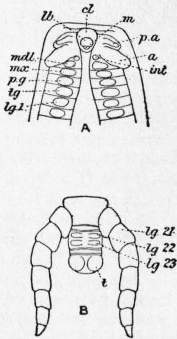
Modified from Heymons, Bib. Zool., 1901, by permission of E. Nagele.
Fig. 1.
A, Diagram of anterior extremity of an early embryo of Scolopendra, ventral view; cl, clypeus; lb, labrum; m, mouth; p.a, preantennal appendage; a, antenna; int, premandibular rudiment; mdl, mandible; mx, maxilla; p.g, palpognath; t.g, toxicognath; lg. 1, first pair of walking legs.
B, Posterior end of a later embryo of Scolopendra, ventral view, showing the anal segment or telson (t); the legs of the last pair in the adult (lg. 21) and the two rudimentary pairs of legs (lg. 22, lg. 23).
A study of the development of Scolopendra has shown that the antennae of the adult are the appendages of the second postoral metamere and the mandibles those of the fourth, the first postoral metamere, which has a pair of transient preantennal appendages, and the third, which has no appendages, being excalated at an early stage of embryonic growth. Furthermore, behind the legs of the last pair two pairs of appendages are present. The second of these persists as the gonopods of the adult, but the first is suppressed. Possibly, however, it is represented in the male of Scutigera by the anterior branches of the gonopods. The cerebral or cephalic portion of the nervous system consists of a quadrilobate mass. From the two upper lobes, which are set transversely, arise the ocular nerves; from the two lower lobes, which are united by a transverse commissure, spring the antennal nerves in front and the chords which form the oesophageal collar behind. These chords unite below the oesophagus to form the compound suboesophageal ganglion, whence the nerves for the four pairs of jaws arise. The ventral system consists of a double chord uniting in each of the leg-bearing segments in a ganglionic swelling which gives off four pairs of nerves to the limbs and tissues of the somite. There is a single ganglion in the genital segment.
Eyes are frequently absent. When present they may be either simple or compound, i.e. consisting externally of a single lens (monomeniscous) of or an aggregation of lenses (polymeniscous). Simple eyes vary in number on each side of the head from one, as in Henicops, to many as forty, as in some species of Lithobius. In Scolopendra, where there are four, the corneal lens is a biconvex thickening of the cuticle. The soft or retinal portion of the eye beneath the lens consists of an aggregation of large cells forming a single layer continuous with the epidermic cells of the circumocular area. Thus the eye is monostichous. The arrangement of the cells, however, is peculiar. They are invaginated to form what may be described as a very deep cup with exceedingly thick walls and correspondingly narrow median space, the outer surface of the cup being formed by the inner or proximal ends of the cells and the inner surface by their outer or distal ends. It results from this arrangement that the cells forming all but the bottom of the invagination lie horizontally, i.e. at right angles to the vertical axis of the eye. From the distal ends of the cells are secreted chitinous rhabdomeres, forming a rhabdom which occupies and fills up the central portion of the cup beneath the middle of the corneal lens. The outer ends of the cells are nucleated and are continuous with the fibres of the optic nerve, which passes from the outer surface of the bottom of the cup to the brain. Compound eyes are found only in the Scutigeridae. Externally the eye consists of one hundred or more little lenses or lenticles. The retinal portion is composed of a corresponding number of ocular units or ommatidia. Each ommatidium is an elongated cone with its broad extremity abutting against the corneal lenticle. It consists of a non-nucleated crystalline cone developed from embryonic cells, and is enveloped in three tiers of large nucleated cells. The cells of the outermost tier are heavily pigmented; those of the middle and innermost (proximal) tiers, the retinal cells, are at their inner extremities produced into threads continuous with the fibres of the optic nerve. In the space between these cells and the crystalline cone which they surround, there is a layer of rhabdomeres deposited apparently by the cells.
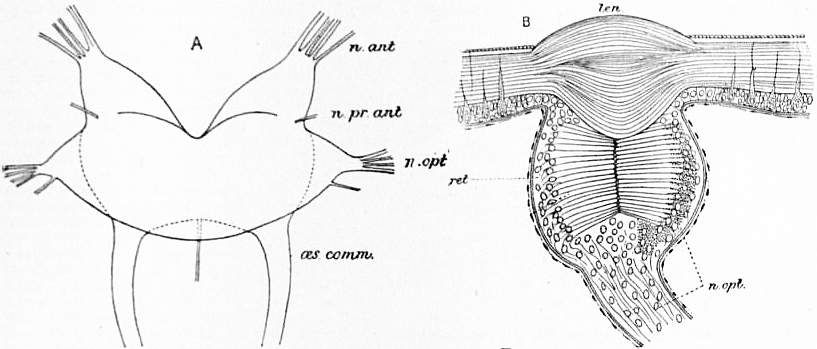
A and B after Heymons, Bibl Zool, 1901, by permission of E. Nagele.
A, Brain of Scolopendra. n. ant, Antennal nerves; n. opt, ocular nerves; n. pr. ant, preantennal nerves; oes. comm, oesophageal commissure. B, Section of Eye of Scolopendra. len, Corneal lens; ret, retinal or visual cells; n. opt, optic nerve.
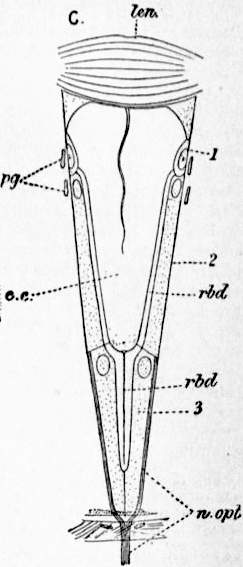
Fig. 2.
C after Adensamer, Verh. z. b. Verein, Vienna, 1893, pl. vii.
C, Ocular unit or ommatidium of compound Eye of Scutigera. len, corneal lenticle; c.c, crystalline cone; 1, pigmented cells of outermost tier; 2, 3, retinular cells of middle and innermost tiers; rbd, rhabdomeres; n. opt, optic nerve; pg, pigment cells.
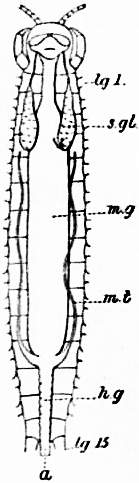
Fig. 3.—Diagram of Alimentary Canal of Lithobius.
a, Anus. mg Mid-Gut. hg, Hind-Gut. mt, Malphighian tubule. s.gl, Salivary gland. lg. 1, lg. 15, Legs of first and fifteenth pairs.
The alimentary canal is a simple tube running without convolutions from the mouth to the anus. Its anterior portion or pharynx, which arises from the stomodaeal invagination in the embryo, is short; a pair of large, so-called salivary glands open into it. The mesenteric part of the canal is relatively wide and receives at its junction with the hind-gut the excretory products of a pair of very long and slender malpighian tubes of proctodaeal origin. The posterior end of the canal, arising from the proctodaeum, is relatively short and narrow.
The generative organs vary in structural details in different centipedes. In the male of Lithobius the testes consist of a single coiled tube lying above the alimentary canal. The slender vas deferens which proceeds from its hinder end divides posteriorly into a right and left branch, embracing the gut and uniting beneath it to form a common chamber or atrium within the genital orifice. The atrium receives the secretion of two pairs of large accessory glands; and a pair of tubes, or vesiculae seminales, open, one on each side, into the divided sperm ducts close to their point of origin above the intestine. The organs of the female are very similar. There is a large median ovary followed by a short oviduct forming a circum-intestinal collar and a common atrium. Into the latter open a pair of short receptacula seminis and the slender duct of two pairs of large accessory glands. There is nothing in the female corresponding to the supra-intestinal vesiculae seminales of the male. In the male of Scolopendra, on the contrary, there are as many as twelve pairs of somewhat sausage-shaped testes, approximated two by two. From each pair proceed two slender ducts which open into a median duct coiled in the posterior third of the body and much expanded in the last three of the leg-bearing segments. The right and left portions of the intestinal ring of the genital duct are unequally developed, and there are no vesiculae seminales, but two pairs of accessory glands communicate with the genital atrium as in Lithobius. In the female Scolopendra the right and left portions of the intestinal collar are also unequally developed, and only a single pair of accessory glands besides the receptacula seminis open into the atrium.
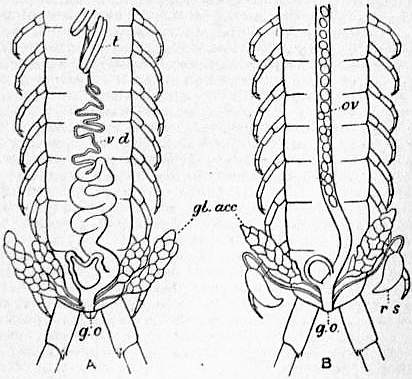
After Heymons, Bibl. Zool, 1901, by permission of E. Nagele.
Fig. 4.—Posterior portion of generative organs of male of Scolopendra (A), of female (B). t, Testes; v.d, vas deferens; ov, ovary; r.s, receptaculum seminis; gl. acc, accessory glands; g.o, generative orifice.
The heart is tubular and lies in the middle dorsal line immediately beneath the integument. It consists of a series of chambers corresponding roughly to the leg-bearing segments, and lies in a blood-sinus formed by a pericardial membrane whence large alary muscles extend to the sides of the body. Each chamber gives off in Scolopendra a pair of fine lateral vessels, and is furnished at its posterior extremity with a pair of orifices by which the blood re-enters the organ from the pericardial space. From the anterior chamber, which lies in the first or second leg-bearing segment, proceed three arteries, a median which runs forwards into the head to supply the brain and other organs, and a lateral which with its fellow of the opposite side forms an oesophageal aortic collar. From the sides of the latter arise vessels to the gnathites, and from its inferior portion an unpaired vessel passes forwards into the head and another backwards above the nerve chord to the posterior end of the body, supplying each segment in its course with a delicate lateral branch. In Scolopendra the chambers of the heart, excepting the first and last, which are small, are subequal in size; but in forms like Scutigera where the terga are very unequal in size a corresponding inequality in the size of the chambers is manifested.
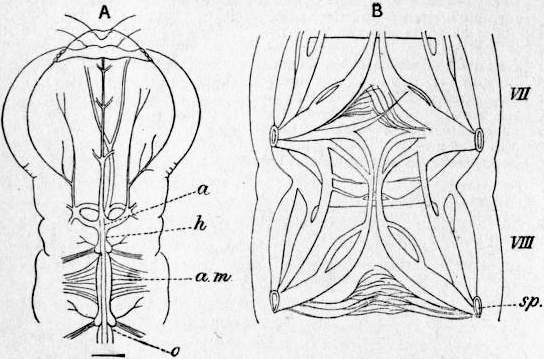
A after Newport, Phil. Trans., 1843. B after Haase, Zool. Beitrage, i. pt. 65, 1884, by permission of J.N. Kern. C after Haase, loc. cit.
A, Anterior extremity of Scolopendra, showing two chambers of the heart (h), the aortic ring (a), the alae cordis (a.m) and a cardiac orifice (o). B, Two segments of Scolopendra, showing the branching and anastomosing tracheae and a spiracle (sp).
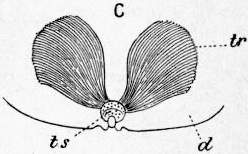
Fig 5.
C, A pair of tufted tracheae of Scutigera. d, Dorsal plate; t.s, tracheal sac; tr, tracheal tubes.
In all centipedes, except Scutigera, respiration is effected by chitinized tracheal tubes which extend with their ramifications throughout the body and open to the exterior by means of spiracles perforating the lateral or pleural membrane of more or fewer of the somites below the edge of the terga. Spiracles are never present upon the anal, genital and last leg-bearing somites, and only rarely, as in Henicops, upon the somite bearing the legs of the first pair. In the majority of cases the spiracles are circular, sigmoid or slit-like orifices, with chitinized rim, leading into a pocket-like integumental infolding, from which emanate numerous small tracheal tubes which soon anastomose to form the main tracheal trunks. In Dacetum, one of the Scolopendridae, there is no pocket-like infolding, the small tracheal tubes opening direct to the exterior on a large subcircular plate where their apertures fuse to form a complicated network. The apertures, as in the case of other genera, are protected by fine hairs; and the tracheae themselves are strengthened by a fine spiral filament. In the Lithobiidae the tracheae do not anastomose; but in Scolopendra and Geophilus the main trunks in each segment fuse transversely with those of the opposite side and also longitudinally with those of the preceding and succeeding segments.
In Scutigera the tracheae differ both in structure and position from those of all other Chilopoda. The spiracles, unpaired and seven in number, open in the median dorsal line. Each leads into a short sac from which five tracheal tubes depend into the pericardial blood-sinus.
Existing Chilopoda may be classified as follows, into five orders referable to two subclasses—
Subclass I. Pleurostigma.
Order 1 Geophilomorpha.
Order 2 Scolopendromorpha.
Order 3 Craterostigmomorpha.
Order 4 Lithobiomorpha.
Subclass II. Notostigma.
Order 5 Scutigeromorpha.
Subclass 1, Pleurostigma.—Chilopods furnished with a rich system of branching tracheal tubes, the spiracles of which are paired and open upon the pleural area of more or fewer of the somites. Each leg-bearing somite contains a distinct tergum and sternum, the number of sterna never exceeding that of the terga. Eyes are either preserved or lost; when preserved they are represented either by a single one-lensed ocellus or by an aggregation of such ocelli on each side of the head. The anterior portion of the head, bearing the labrum, is bent sharply downwards and backwards beneath the larger posterior portion lying behind the antennae, so that these appendages, approximated in the middle line, project directly forwards from the margin of the head formed by this retroversion of the labral area. The maxillae are short and have no sensory organ; the palpognaths consist of four segments, and the toxicognaths have their basal segments fused to form a single coxal plate.
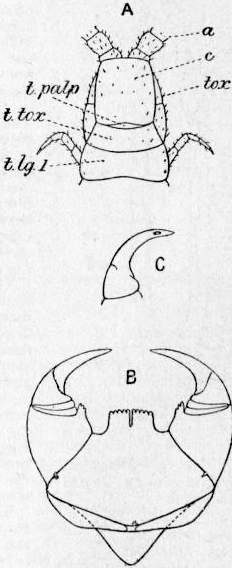
Fig. 6.
A, Upper view of anterior extremity in Geophilus. a, Basal segments of antennae. c, Cephalic plate. t.palp, Tergal plate of somite, bearing palpognaths. t.tox, Tergal plate of somite, bearing toxicognaths (tox). t.lg.1, Tergal plate of somite, bearing legs of first pair. B, Toxicognaths of Scolopendra, showing the large coxal plate and the reduced penultimate and antepenultimate segments. C, Terminal segment or fang of the same, showing the orifice of the poison gland. (After Latzel, Die Myr. öst.-ung. Mon. vol. i. “Chilopoda,” Vienna, 1880.)
Order 1. Geophilomorpha.—Chilopods with a large and indefinite number of somites, most of which are partially or completely divided into a smaller anterior segment, represented by a pretergal and two presternal sclerites, and a larger posterior segment bearing the spiracles and legs. Spiracles are present upon all the leg-bearing somites except the first and last; and the legs which are short and subequal in length consist of six segments, the basal of which remains small. There are no eyes, and the antennae consist invariably of fourteen segments. The tergal plate of the somite bearing the toxicognaths always remains distinct and separates the head-shield from the tergum of the first leg-bearing somite. The penultimate and antepenultimate segments of the toxicognaths are reduced on the preaxial side of the appendage to the condition of arthrodial integumental folds and suppressed on the postaxial side where the distal segment or fang is firmly jointed to the femoral segment. In the last leg-bearing somite the pleural sclerites coalesce with the coxa of the appendage; but the second segment (trochanter) of this appendage does not fuse with the third (femur). The genital and anal somites are not retractile within the last leg-bearing somite, and the gonopods typically persist in the male as small two-jointed appendages and in the female as jointed or unjointed sclerites. The young are hatched with the full number of segments.
Remarks.—The Geophilomorpha are universally distributed in suitable localities. The number of families into which the order should be divided is as yet unsettled, some authors admitting several groups of this rank, others referring all the genera to a single family, Geophilidae. In habits the Geophilidae are mostly subterranean, living in the earth and feeding principally upon earthworms. Occasionally they may be found eating fruit or fungi, probably for the sake of moisture. Although without eyes, they are extremely sensitive to light, and when exposed to it crawl away in serpentine fashion to the nearest sheltered spot, feeling the way with their antennae. They can, however, progress with almost equal facility backwards, using the legs of the posterior pair as feelers. Differing from the majority of the family in habits are the two species Linotaenia maritima and Schendyla submarina, which live under stones or seaweed between tide-marks on the coasts of western Europe. Most, if not all, the species are provided with glands, which open upon the sterna and secrete a fluid which in some forms (Himantarium) is blood-red, while in others it is phosphorescent. In the tropical form Orphnaeus phosphoreus the fluid is known to possess this property; and its luminosity has been repeatedly observed in England in the autumn in the case of Linotaenia acuminata and L. crassipes.
The number of pairs of legs within this family varies from between thirty and forty to over one hundred and seventy. Corresponding discrepancies are observable in size, the smallest specimens being less than 1 in. long and barely 1 mm. wide, while the largest example recorded, a specimen of Notiphilides from Venezuela, was 11 in. long and 1⁄3 of an inch wide.
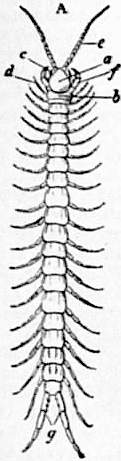
Fig. 7.—Scolopendra morsitans (after Buffon). A, a, Cephalic plate. b, Tergum of segment, bearing first pair of legs (d). c, Tip of palpognath. e, Antenna. f, Toxicognath. g, Last pair of appendages, enlarged and directed backwards.
When pairing takes place the female fertilizes herself by taking up a spermatophore which a male has left upon a sheet of web for that purpose. The female lays a cluster of eggs in some sheltered spot, sometimes in a specially prepared nest, and encircling them with her body, keeps guard until the young disperse and shift for themselves.
Order 2. Scolopendromorpha.—Chilopods differing principally from the Geophilomorpha in that the number of leg-bearing somites is definitely fixed at twenty-three or twenty-one. These are differentiated into larger and smaller, which alternate with nearly complete regularity. The anterior portion of each somite is only partially cut off as a subsegment. The tergal plate of the somite bearing the toxicognaths is suppressed, probably by fusion with the tergum of the first leg-bearing somite. The antennae consist of a number of segments varying from seventeen to about thirty, and usually differing in the individuals of a species. The second segment (trochanter) of the legs of the last pair is coalesced with the third (femur). In only one genus, namely Plutonium, which occurs in Italy, is there a pair of spiracles for each leg-bearing segment, except the first and last, as in the Geophilomorpha. In most genera there are only nine pairs of spiracles situated upon the 3rd, 5th, 8th, 10th, 12th, 14th, 16th, 18th and 20th leg-bearing segments, as in Scolopendra, Cormocephalus, Cryptops, &c. In genera with twenty-three pairs of legs, like Scolopocryptops, there is an additional pair of spiracles on the twenty-second pedigerous segment; and a few genera such as Rhysida, Edentistoma, possess a pair upon the 7th segment. Eyes, when present, are always four in number on each side. The newly hatched young has the full complement of appendages.
This order is divided into four families:—Scolopendridae (Scolopendra, Rhysida), Cryptopidae (Cryptops, Theatops), Scolopocryptopidae (Scolopocryptops, Otocryptops) and Newportudae (Newportia). Apart from the frigid zones it is cosmopolitan in distribution, though only one genus (Cryptops) extends into north temperate latitudes. In the tropics and warmer countries of the southern hemisphere the genera and species are particularly abundant, and individuals reach the greatest dimensions, some specimens of the tropical American species Scolopendra gigantea exceeding 12 in. in length. They are strictly carnivorous, their diet consisting of any animal, vertebrate or invertebrate, small enough to be overcome. They live in damp obscure places, under logs of wood or stones, and are nocturnal, shunning, like the Geophilidae, exposure to light; and as in the Geophilidae, the females guard their eggs and young until the latter disperse to lead an independent life.
Order 3. Craterostigmomorpha.—Chilopods with twenty-one tergal plates as in the typical genera of Scolopendromorpha, but with only fifteen pairs of legs as in the Lithobiomorpha. As in some members of the latter order there is a single ocellus on each side of the head, the penultimate and antepenultimate segments of the toxicognaths are complete on the postaxial side of the appendage, and spiracles are present upon the 3rd, 5th, 8th, 10th, 12th and 14th leg-bearing somites. In the size and shape of the head, of the toxicognaths, of the tergal plate of this somite, and of the first leg-bearing somite, great similarity to some genera of Geophilomorpha (e.g. Mecistocephalus) is presented; but in the structure of the posterior end of the body this order differs from all the other orders of Chilopoda. The skeletal elements of the last leg-bearing segment are welded together to form a subcylindrical tube, and the genital and anal somites are represented by a pair of chitinous valves capable of opening below for the escape of the genital and intestinal products.
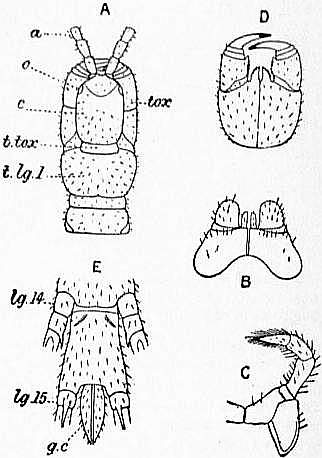
After Pocock. Q.J.M.S. vol. 45, pl. 23, 1902.
Fig. 8.
A, Anterior end of Craterostigmus from above. a, Basal segments of antennae. c, Cephalic plate with eyes (o). t.tox, Tergal plate of somite bearing toxicognaths (tox). t.lg.1, Tergal plate of somite bearing legs of the first pair. B, Maxillae. C, Palpognath. D, Toxicognath. E, Last segment with genital capsule (g.c), and basal segments of legs of 14th and 15th pairs (lg. 14, lg. 15).
This order, containing the family Craterostigmidae, is based upon a remarkable genus and species Craterostigmus tasmanianus, of which only two specimens are known. These were collected under stones upon the summit of Mount Rumney in Tasmania. They are about 1½ in. in length; but nothing has been recorded of their habits. The chief morphological interest attaching to Craterostigmus is that, apart from certain structural peculiarities of its own, it presents features previously believed to be found exclusively either in the Scolopendromorpha, or the Geophilomorpha, or the Lithobiomorpha; and it shows how the Lithobiomorpha may be derived from a Scolopendromorphous type most nearly resembling Plutonium by the excalation of the third, sixth, ninth, eleventh, fourteenth and seventeenth leg-bearing somites.
Order 4. Lithobiomorpha. Chilopoda with fifteen pairs of leg-bearing somites differentiated into larger and smaller, the 1st, 3rd, 5th, 7th, 8th, 10th, 12th and 14th being large, the others small. Spiracles present upon all the larger with the exception sometimes of the 1st. The toxicognaths are relatively weaker than in the orders hitherto considered, and have their basal segments less firmly fused mesially. In correlation with their weaker muscularity the first leg-bearing segment is relatively small. The gonopods, present and usually jointed in both sexes, are especially well developed and forcipate in the female, and arise from a large ventral plate resulting from the fusion of their coxae with the sternum of the genital somite. The antennae are many-jointed, and there is a single ocellus or a cluster of ocelli on each side of the head. The coxae of the legs are large, and those of the last four or five pairs usually contain glands opening by large orifices. The newly-hatched young has only seven pairs of legs, the remaining pairs being successively added as growth proceeds.
The genera of this order are divisible into three families, the Lithobiidae (Lithobius, Bothropolys), Henicopidae (Henicops, Haasiella), the Cermatobiidae (Cermatobius). Cermatobius, based upon a single species, martensii, from the isl. of Adenara, is of peculiar interest, since in the absence of coxal pores, and the length and multi-articulation of the antennae and tarsal segments, it approaches more nearly to Scutigera than does any other pleurostigmous Chilopod. It is also stated that the spiracles have assumed a more dorsal position, thus foreshadowing the completely dorsal situation they have taken up in the Notostigma. The Henicopidae, containing centipedes of small size, attains its maximum of development in the southern continents and islands, more particularly Australia, New Zealand, South Africa and South America. One genus (Lamyctes) however, occurs in Europe. The Lithobiidae, on the contrary, are almost exclusively northern in range, being particularly abundant and of large size individually in Europe, extra-tropical Asia, and North and Central America. In habits the Lithobiidae closely resemble the Scolopendridae. They are, however, comparatively far more agile with their shorter, more compact bodies and stronger legs. They are mostly of small size, the largest species, Lithobius fusciatus, of south Europe measuring only 2 in. in length of body. The females do not guard their eggs, but coat them with soil and leave them to their fate.
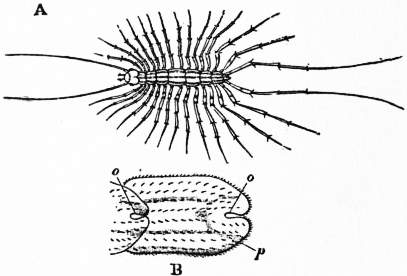
Fig. 9.—A, Scutigera rubrolineata (after Buffon). B, Tergum and part of a second of the same enlarged to show the position of the stigmata o, o; p, hinder margin of tergum.
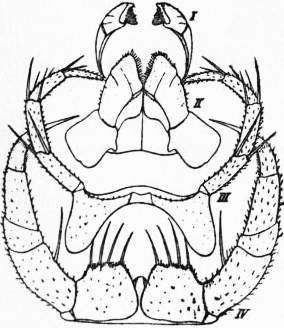
After Latzel, Die Myr öst-ung. Mon. vol. i. “Chilopoda,” Vienna, 1880. Fig. 10.—Gnathites of Scutigera. I. Mandibles. II. Maxillae. III. Palpognaths. IV. Toxicognaths.
Subclass 2, Notostigma.—Chilopods with a series of median dorsal tracheal sacs furnished with tubes dipping into the pericardial blood space, and opening each by an unpaired spiracle upon the 1st, 3rd, 5th, 8th, 10th, 12th and 14th leg-bearing somites. This characteristic is accompanied by the complete disappearance of the tergum of the 7th, either by fusion with that of the 8th or by excalation, and by the evanescence of the terga of the 2nd, 4th, 6th, 9th, 11th and 13th pedigerous somites. The preantennal area of the head is not strongly reflexed inferiorly, and the eyes are large and compound. The maxillae are long and have a sensory organ, the palpognaths are long, spiny and composed of five segments, like the primitive Chilopod leg, and the toxicognaths have their basal segments disunited and independently movable. Gonopods duplicated in the male.
This subclass contains the single order Scutigeromorpha and the family Scutigeridae. As in the Lithobiomorpha there are fifteen pairs of legs, the gonopods are well developed in both sexes and the young is hatched with only seven pairs of legs. The legs and antennae in the adult are extremely long and many jointed. In habits as well as in structure the Scutigeridae, of which Scutigera is the best-known genus, differ greatly from other centipedes. Although they hide under stones and logs of wood like Lithobius, they are not lucifugous but diurnal, and may be seen chasing their foes in the blazing sun. They run with astonishing speed and have the power of dropping their legs when seized. South of about the 40th parallel of north latitude they are universally distributed in suitable localities. In most species the body only reaches a length of about 1 in.; but twice that size or more is reached by examples of the Indian species Scutigera longicornis.
Some fossils of Carboniferous age have been described as Chilopoda by Scudder, who refers them to two families, Gerascutigeridae and Eoscolopendridae. But until the specimens have been examined by zoologists the genera they are alleged to represent cannot be taken seriously into consideration. Remains of centipedes closely related to existing forms have been recorded from Oligocene beds.
(R. I. P.)
CENTLIVRE, SUSANNA (c. 1667-1723), English dramatic writer and actress, was born about 1667, probably in Ireland, whither her father, a Lincolnshire gentleman named Freeman, had been forced to flee at the Restoration on account of his political sympathies. When sixteen she married the nephew of Sir Stephen Fox, and on his death within a year she married an officer named Carroll, who was killed in a duel. Left in poverty, she began to support herself, writing for the stage, and some of her early plays are signed S. Carroll. In 1706 she married Joseph Centlivre, chief cook to Queen Anne, who survived her. Her first play was a tragedy, The Perjured Husband (1700), and she herself appeared for the first time at Bath in her comedy Love at a Venture (1706). Among her most successful comedies are—The Gamester (1705); The Busy Body (1709); A Bold Stroke for a Wife (1718); The Basset-table (1706); and The Wonder! a Woman keeps a Secret (1714), in which, as the jealous husband, Garrick found one of his best parts. Her plots, verging on the farcical, were always ingenious and amusing, though coarse after the fashion of the time, and the dialogue fluent. She never seems to have acted in London, but she was a friend of Rowe, Farquhar and Steele. Mrs Centlivre died on the 1st of December 1723. Her dramatic works were published, with a biography, in 1761 (reprinted 1872).
CENTO, a town of Emilia, Italy, in the province of Ferrara, 18 m. S.E. direct from the town of Ferrara; 50 ft. above sea-level; it is reached by road (6 m. to the W.) from the station of S. Pietro in Casale, 15 m. S.W. by W. of Ferrara, and also by a steam tramway (18 m. N.) from Bologna to Pieve di Cento, on the opposite bank of the Reno. Pop. (1901) 4307 (town), 19,078 (commune). It is connected by a navigable canal with Ferrara. It was the birthplace of the painter Giovanni Francesco Barbieri (Guercino). The communal picture-gallery and several churches contain works by him, but none of first-rate importance. A statue of him stands in front of the 16th century Palazzo Governativo. The town was surrounded by walls, the gates of which are preserved. The origin of the name is uncertain.
CENTO (Gr. κέντρων, Lat. cento, patchwork), a composition made up by collecting passages from various works. The Byzantine Greeks manufactured several out of the poems of Homer, among which may be mentioned the life of Christ by the famous empress Eudoxia, and a version of the Biblical history of Eden and the Fall. The Romans of the later empire and the monks of the middle ages were fond of constructing poems out of the verse of Virgil. Such were the Cento Nuptialis of Ausonius, the sketch of Biblical history which was compiled in the 4th century by Proba Falconia, wife of a Roman proconsul, and the hymns in honour of St Quirinus taken from Virgil and Horace by Metellus, a monk of Tegernsee, in the latter half of the 12th century. Specimens may be found in the work of Aldus Manutius (Venice, 1504; Frankfort, 1541, 1544). In 1535 Laelius Capitulus produced from Virgil an attack upon the dissolute lives of the monks; in 1536 there appeared at Venice a Petrarca Spirituale; and in 1634 Alexander Ross (a Scotsman, and one of the chaplains of Charles I.) published a Virgilius Evangelizans, seu Historia Domini nostri Jesu Christi Virgilianis verbis et versibus descripta.
CENTRAL AMERICA, that portion of the American continent which lies between Mexico and Colombia, comprising the British crown colony of British Honduras, and the six independent republics of Guatemala, Salvador, Honduras, Nicaragua, Costa Rica and Panama. These seven divisions are described in separate articles. Central America is bounded towards the N. by the Caribbean Sea, and towards the S. by the Pacific Ocean, and extends between 7° 12′ and 18° 3′ N. and between 77° 12′ and 92° 17′ W. It has an area of about 208,500 sq. m., and stretches for some 1300 m. from N.W. to S.E., in a succession of three serpentine curves, reaching its greatest breadth, 450 m., between the Peninsula of Nicoya and the north coast of Honduras, and diminishing to 35 m. in the Isthmus of Panama. The eastern boundary of Central America was usually regarded as identical with that of Costa Rica until 1903, when the republic of Panama was formed out of the northern territories of Colombia; and the more modern definition given above does not command the universal assent of geographers, because it fails to include the whole region up to the natural frontier on the north-west, i.e. the Isthmus of Tehuantepec in Mexico. It has, however, the support of political and historical considerations, as well as of common usage; and it may therefore be regarded as adequate, although, in respect of climate and natural products, it would be more accurate to define Central America as lying between Tehuantepec and Darien.
Physical Features.—The Cordilleras, or mountain chains of Central America do not form a complete link between the western ranges in the north and south of the continent, for their continuity is interrupted by various depressions, of which the chief is the lacustrine basin of Nicaragua. With these exceptions, they traverse Central America from end to end, their main axis trending from north-west to south-east. They do not, as a rule, rise in sharply serrated ridges or series of volcanic crests, like the Andes, but the central Cordilleras are disposed in a succession of mountain masses, with many lesser chains radiating from them. The principal summits have an altitude of 12,000 and even, in a few cases, of 13,000 ft., and the general character of the ranges is volcanic, many craters being still active. Large tracts of land remained imperfectly surveyed at the beginning of the 20th century, owing to the unhealthiness of the tropical climate, and the dense underwoods which impede exploration. In the northern part of Guatemala, on the Pacific coast of the same country, in British Honduras, along the Segovia river, on the Mosquito Coast, and in the basin of Lake Nicaragua and the San Juan river, there are broad stretches of comparatively flat country. The main line of watershed is everywhere nearer to the Pacific than to the Atlantic, except in southern Costa Rica and Panama, where it is almost equidistant from the two oceans. In consequence, the rivers of the Pacific seaboard are mostly short and swift,—mere mountain torrents, in many instances, until they reach the sands and swamps which border the sea. The rivers of the Atlantic littoral descend more gradually, and by longer channels. The largest of them is the Segovia, in Nicaragua and Honduras, which has a course of 450 m. Lake Nicaragua, the largest inland sheet of water, has an area exceeding 3500 sq. m. There are also several mountain lakes of exceptional interest and beauty, such as Atitlán and Amatitlán, in Guatemala, besides two great land-locked salt-water lakes—the Pearl Lagoon of the Mosquito Coast, and the Carataska Lagoon in Honduras.
Geology.—The neck of land which unites the continents of North and South America is not, geologically, the direct continuation of either, but constitutes a third element which is wedged, as it were, between the other two. The folds in the earth’s crust which form the Andes and the Western ranges of North America, are not continued along the connecting isthmus, where, on the contrary, the strata are folded from west to east, obliquely across the trend of the continent. It should, however, be noticed that the Andes, as they approach the Caribbean sea, bend round towards the east; and it is probable that the folds of the North American Cordillera similarly bend eastward beneath the volcanic rocks of Mexico. The folds of Central America are tangential to the two arcs thus formed.
By far the greater part of Central America and Mexico is covered by Cretaceous and Tertiary deposits, both sedimentary and volcanic; but the foundation on which they rest is exposed at intervals. From the Rio Grande to the southern declivity of the Mexican plateau the existence of ancient crystalline rocks at the surface is yet unproved, but they probably occur in the Sierra Madre del Pacifico. South of the plateau, in the state of Oaxaca, low mountain ridges composed of granites and gneisses, supposed to be of Archaean age, begin to appear. They strike from west to east, and mark the front of the series of east and west folds which stand en échelon across the Central American region. Between the 15th and 17th parallels of latitude, in the state of Chiapas and in the republic of Guatemala, there is a second group of ridges composed of granites and schists with an eastward trend. In this case the evidence of age is clear, for the rocks are covered by a limestone which is proved to be Pre-Carboniferous. Similar rocks, supposed to be of Archaean or at least of early Palaeozoic age, occupy considerable areas in British Honduras, Honduras and northern Nicaragua, and occur also in Costa Rica and perhaps in Panama; and wherever the strike has been observed, it is approximately from west to east. The presence of Palaeozoic rocks has been proved in Guatemala and the adjacent state of Chiapas, where limestones have been found containing many unmistakable Carboniferous fossils, and below these is a considerable thickness of beds supposed to be Silurian. Nowhere else in the Central American region is there any palaeontological evidence of Palaeozoic rocks.